Cayuga View Senior Living Construction Update, 11/2017

29 11 2017

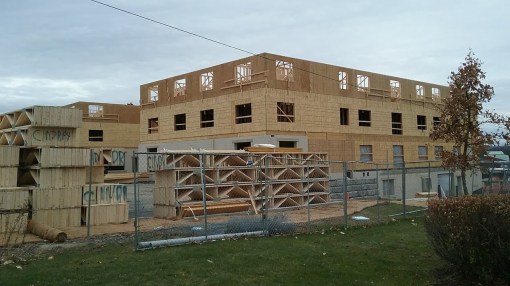
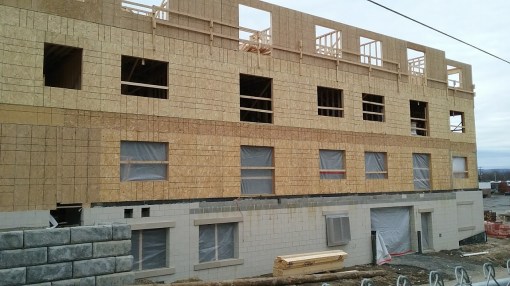
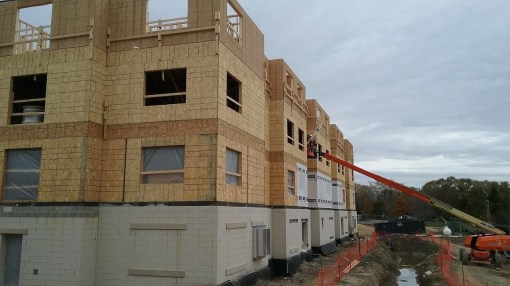
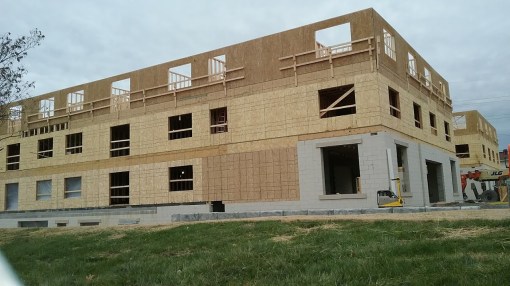
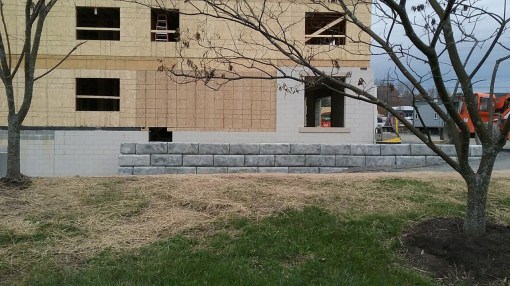
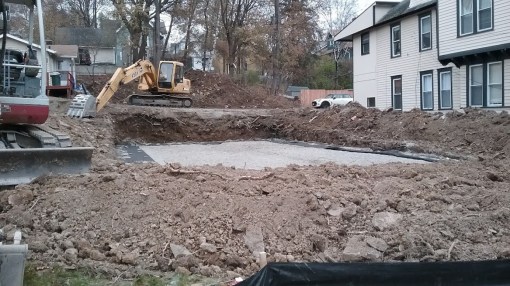
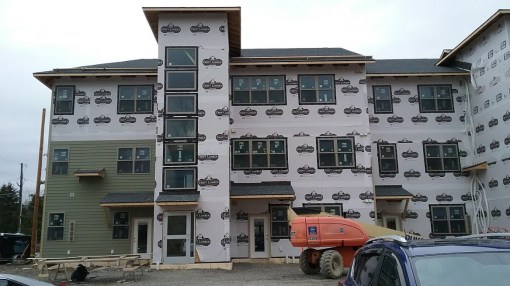
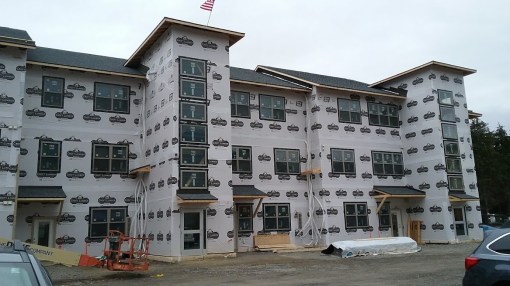
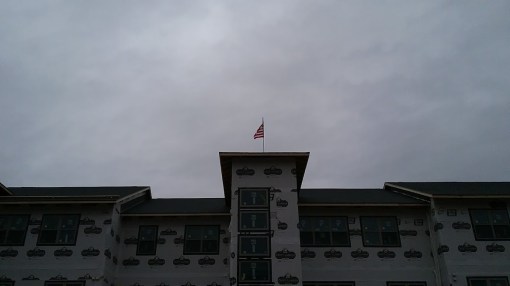
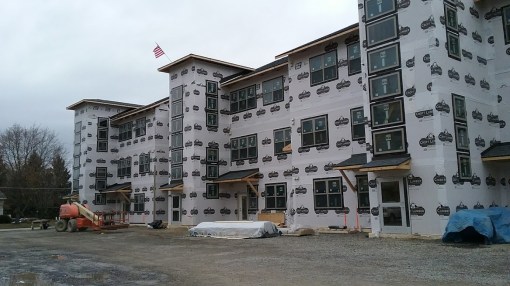
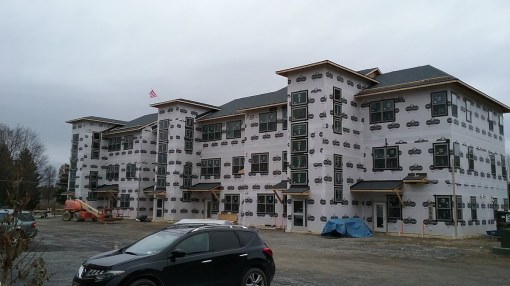
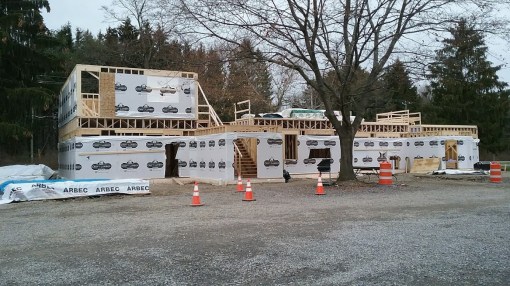
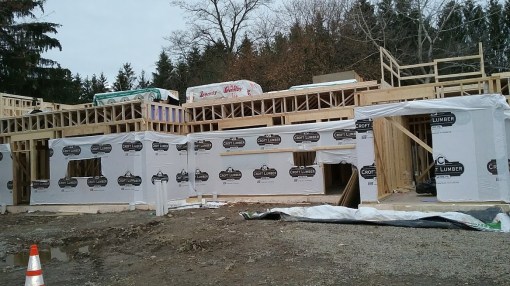
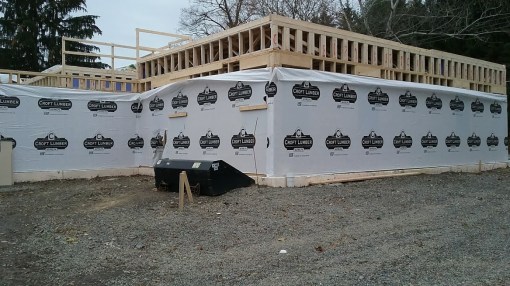
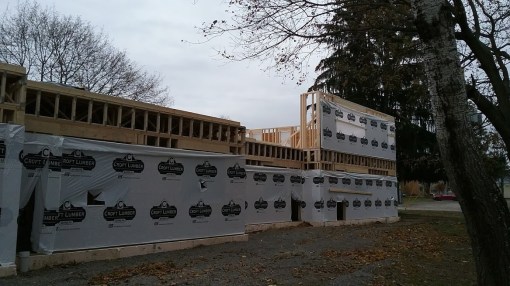
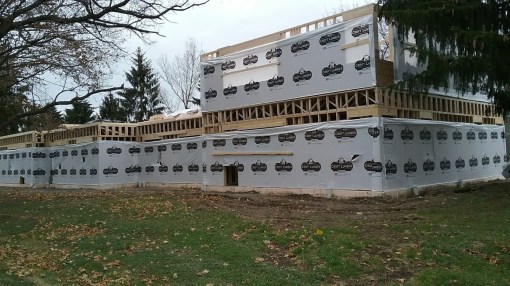
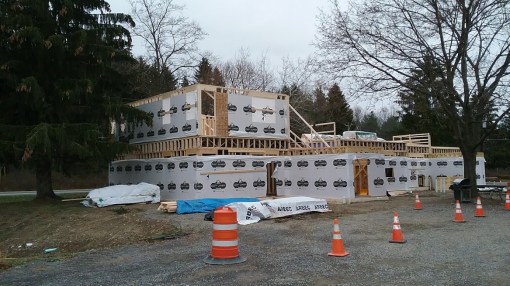
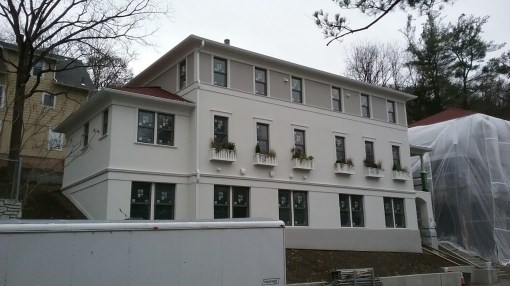
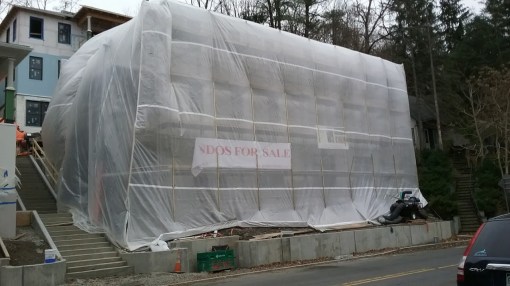
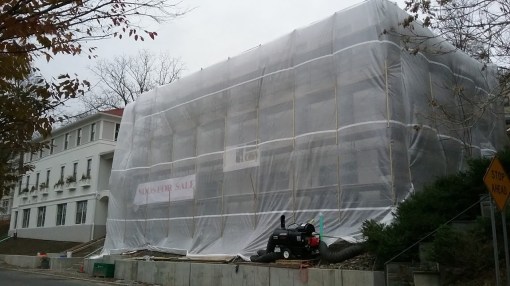
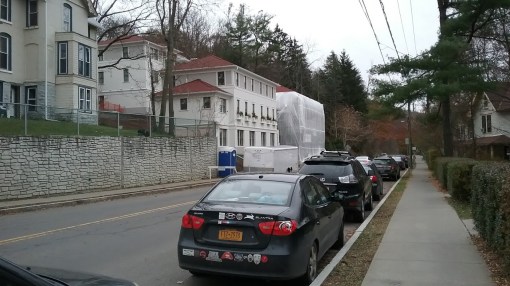
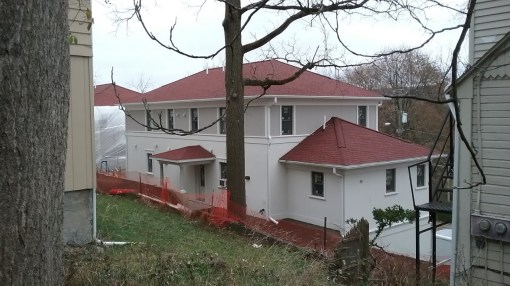
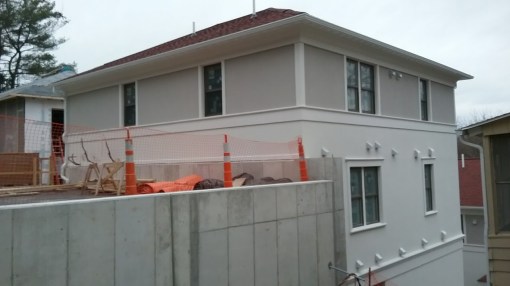
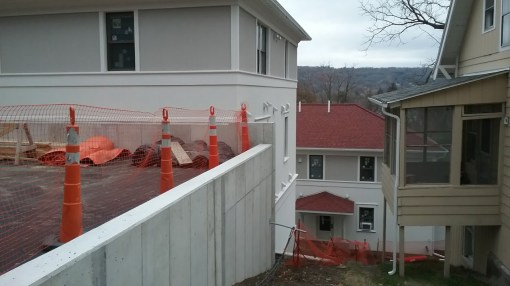
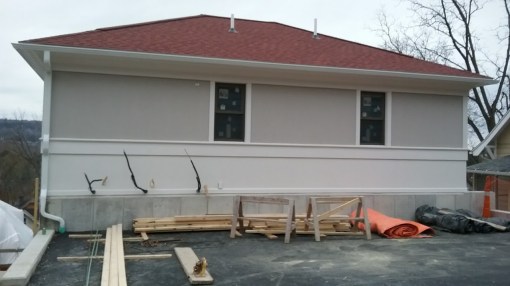
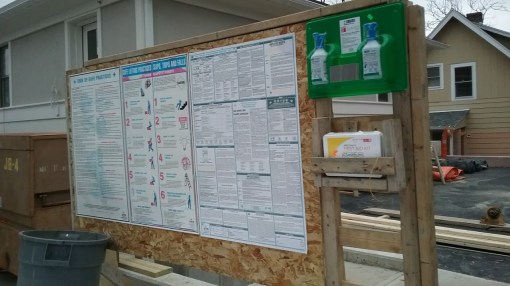
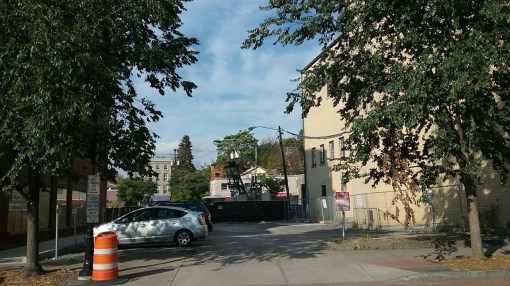
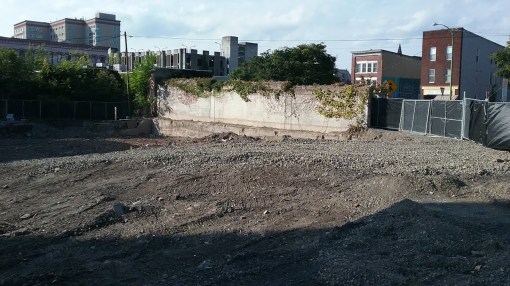
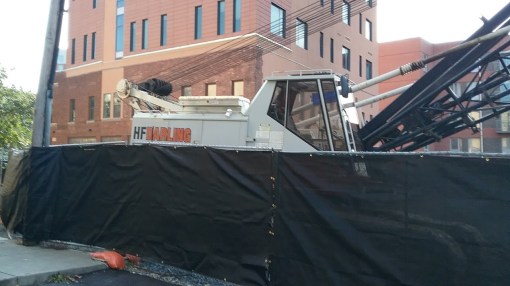
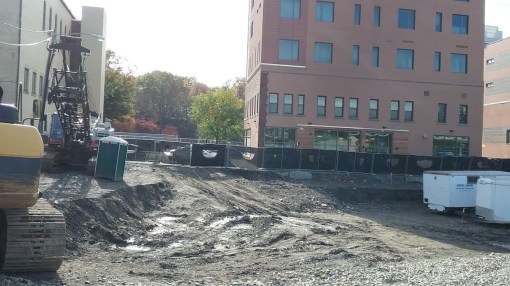
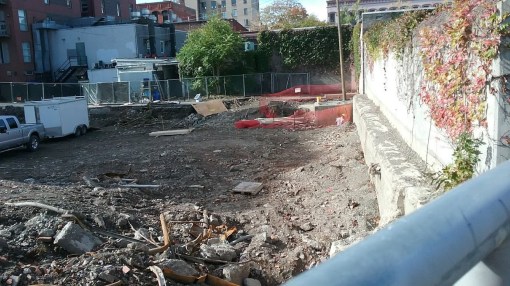
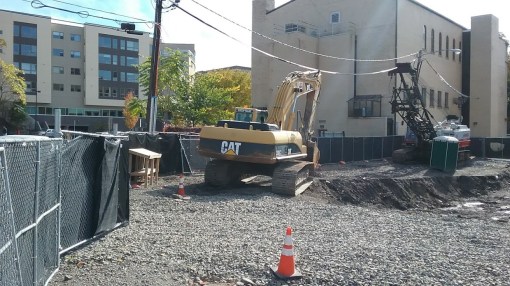
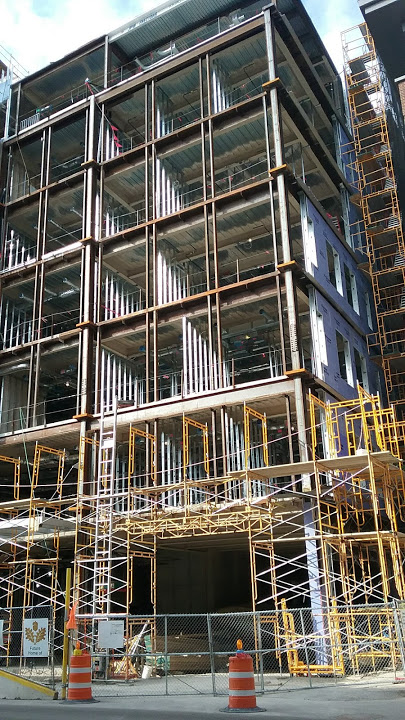
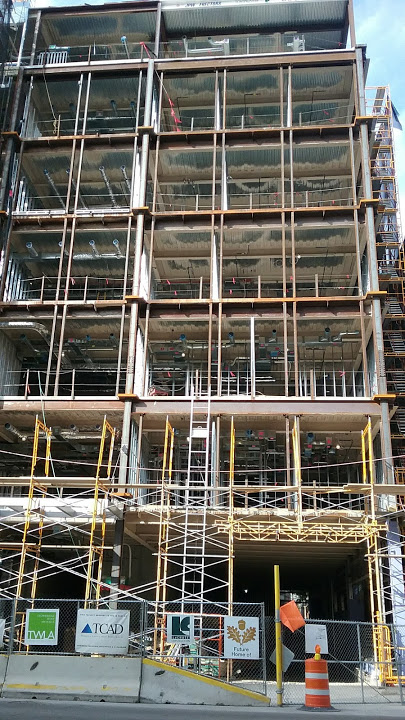
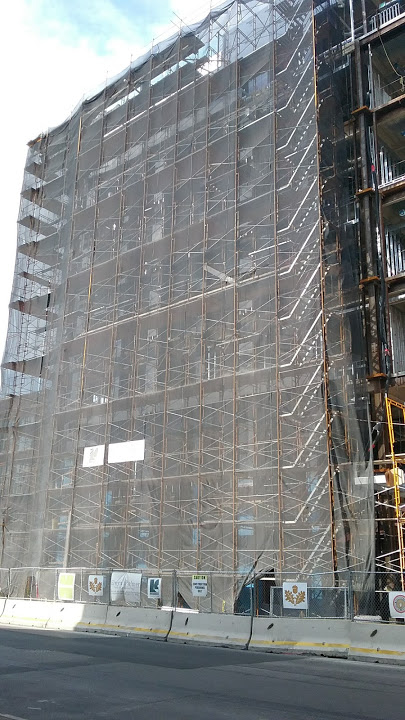
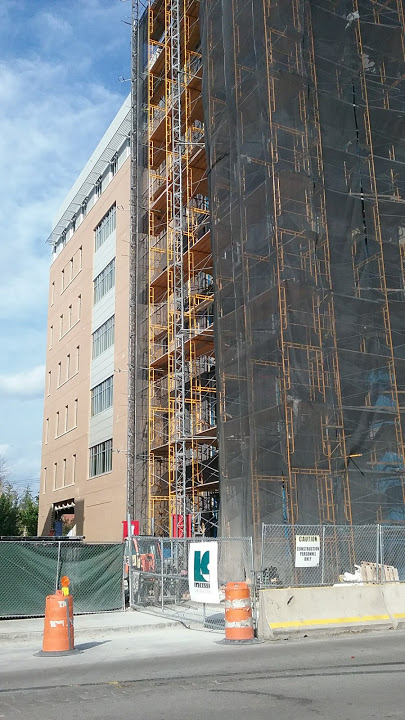
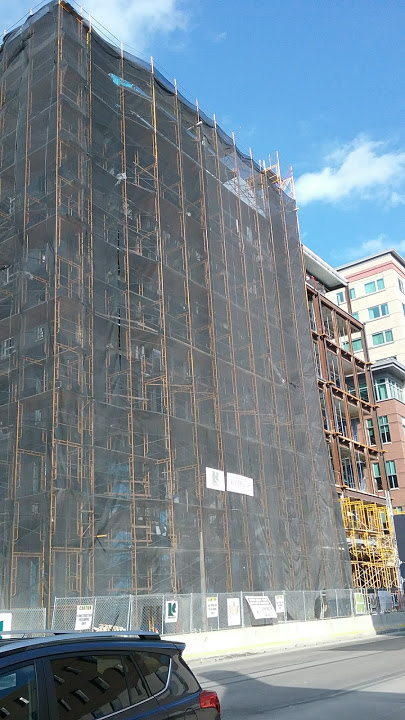
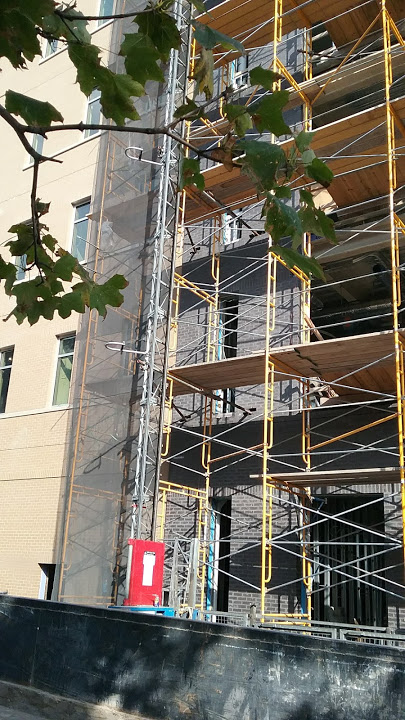
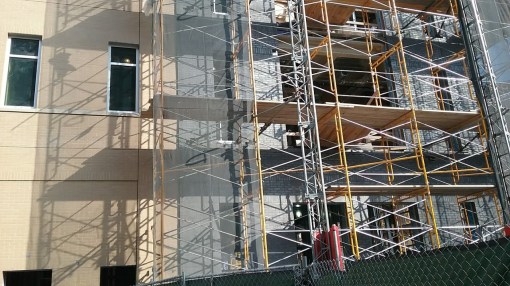
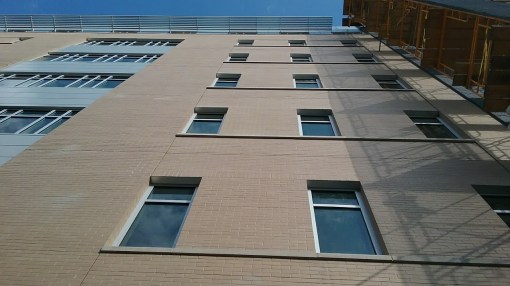
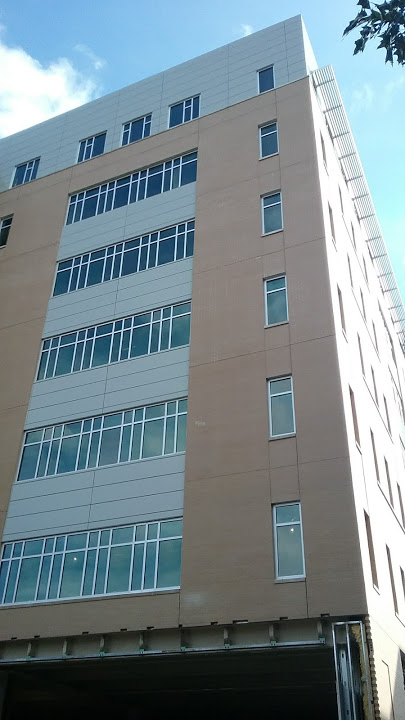
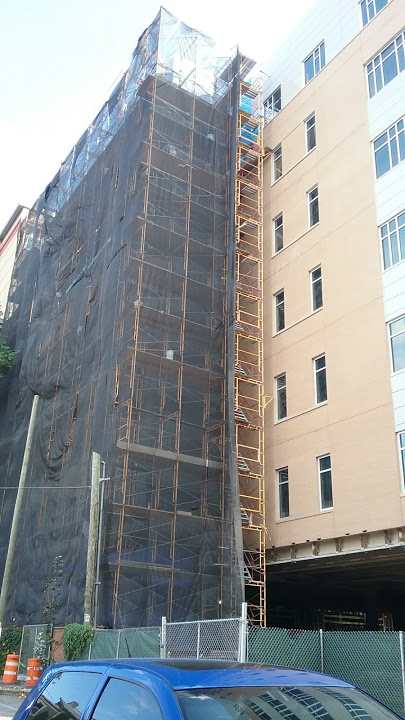
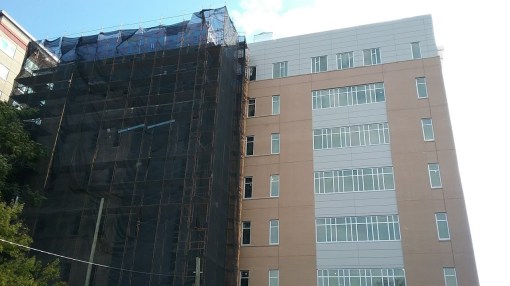
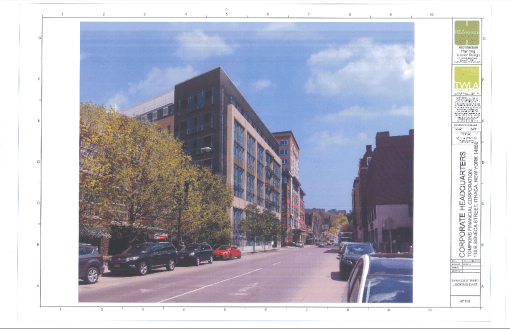
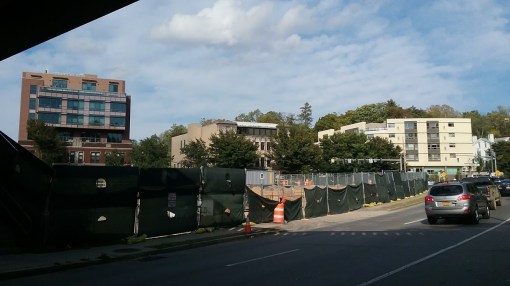
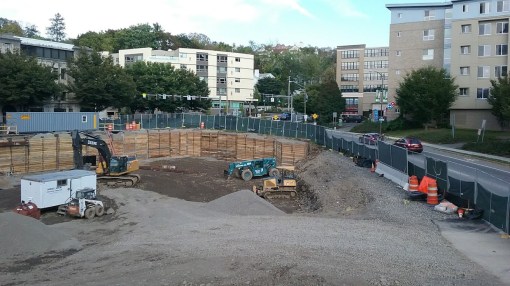
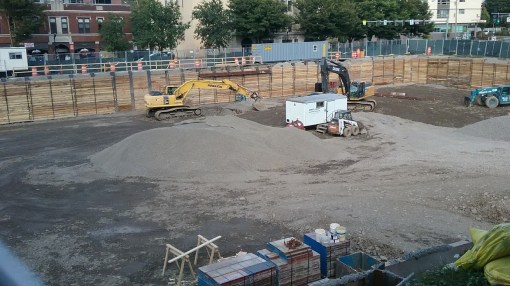
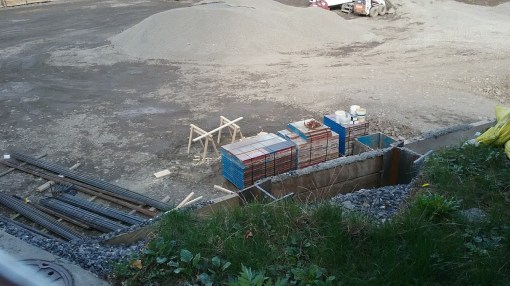
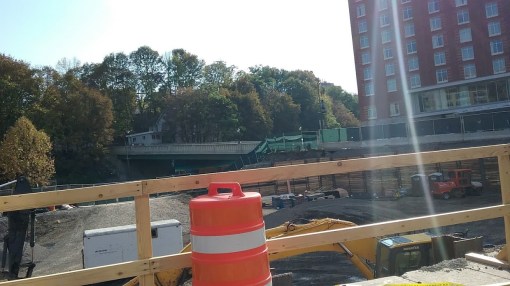
Framing for the new Cayuga View Senior Living building is one floor short of topping out. A stack of floor joists sits at the front of the construction site, as framing for the fourth floor continues. The last couple photos show how the joists are assembled between floors, typically attached to the exterior wall through joist hangers and braced with additional metal straps. Bracing has been temporarily built as the continuous plywood structural panel wall is nailed together. On the third floor they’ve started rough-ins (I see an industrial spool through the window, implying cables for electrical work), but the meat of the interior work is on the second, first and basement levels. A bit of housewrap has been applied to the rear face.

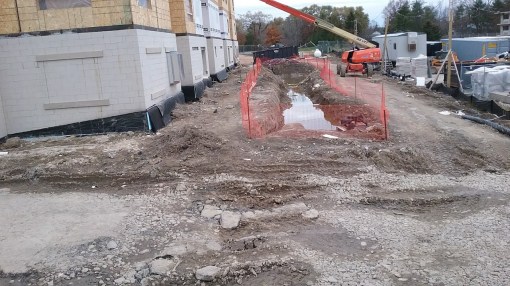
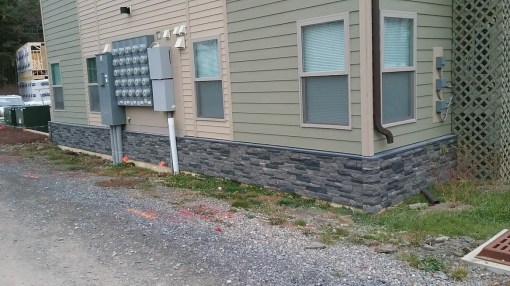
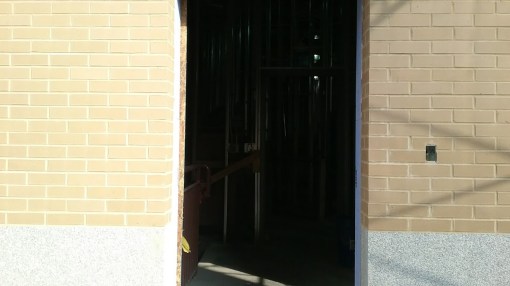
The commercial spaces are built out with masonry (CMU) walls, in contrast to the wood framing of the upper levels, and may be the result of fire code. The basement, also assembled with masonry blocks, will host utility space and some amenities. Decorative stonework provides aesthetic relief to the sloping site. Curbing has been extruded, and foundations for the light poles have been laid and wired. Not certain why there’s a moat at the rear of the building, although it may have something to do with underground utility lines.


News Tidbits 11/25/17: Not Going to Plan

27 11 2017

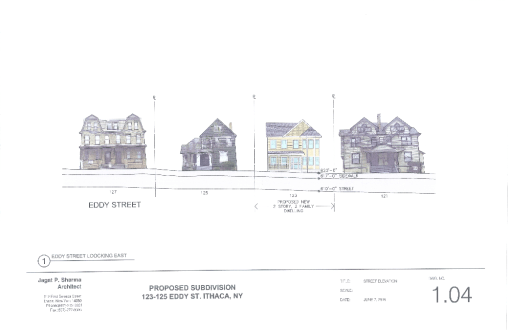
1. It looks like the Lambrous have started work on the new duplex they’ve long planned at 123 Eddy Street in Collegetown. Foundation work is underway for the two-unit, six-bedroom home, which utilized Superior Foundation Walls and modular units. The building sits on the edge of the East Hill Historic District, so to make the building compliant with the ILPC’s wishes, it features Hardie Board siding, simulated shakes, scuplted brackets and an attic vent, and detailed railings and porches. The design went through a couple iterations, with the first being historically appropriate but expensive stick-built design, and the second a modular scheme that was non-compliant with the ILPC. The Lambrous plan to have the new three-bedroom units available for rent by August.

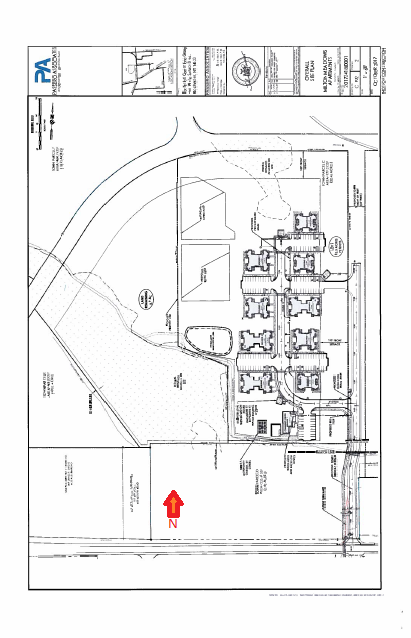
2. Lansing’s Milton Meadows affordable housing project is up for final approval next Monday, and it looks like the first 72-unit phase will be the only phase. According to documentation filed with the town, the presence of poorer soils and more wetlands than anticipated means that Cornerstone will not be undertaking a second phase. It does raise further questions regarding adjacent parcels and the amount of money the town of Lansing can reasonable gain since this sounds like a recent discovery. The final site plans here show no indication of Cornerstone Development Group buying the remaining 8.9 acres that were intended for phase two.

There are no huge obstacles to prevent approval, although some town officials are unhappy that they didn’t apply a stronger hand to the town center development plan (i.e. laying the roads and infrastructure as they wanted, and charging a higher price for the parcels). While most of the darts have been levied towards Cornerstone (some perhaps unfairly due to it being affordable housing), the town planning chair has also targeted Tiny Timbers for using Conlon Road as its primary ingress/egress in their sketch plan. But with sales already negotiated and approved, the town’s legal options are limited, and since they already dropped the ball on the town center once, the optics aren’t pretty. Any work Cornerstone does is dependent on state and federal grants that are highly competitive and awarded only a few times per year, so don’t expect much for at least a year or two after approval.

3. It looks like the land for the proposed extension of South Meadow Square has been fenced off. A query to the folks in PetSmart next door didn’t turn up much, although they said there had been some water and sewer work to prep for the new 7,315 SF addition approved earlier this year. I did not see what the current conditions are for the approved 14,744 SF addition on the south end.

4. The county and the city have competing views of the NYS DOT’s future in Tompkins County. The county has reiterated its hope that the DOT relocates to a location next to the county airport. The city would prefer a location in Southwest Park behind Wal-Mart and the proposed Maguire dealership campus. The request for state grant dollars depends on the airport proposal, and the DOT has stated preference for a site near the airport.

However, if grants are not awarded, the airport is still considering a plan to build a $1-2 million customs facility that would allow to become an international airport, servicing passenger jets from Canadian hubs (Toronto, Montreal). In the short-term, work is underway to add service to Chicago, which has an on-time percentage comparable to Detroit (80%), and better than Newark (60%) and Philadelphia (70%). Cornell is actively assisting, trying to persuade airlines as part of its “Global Cornell” initiative.

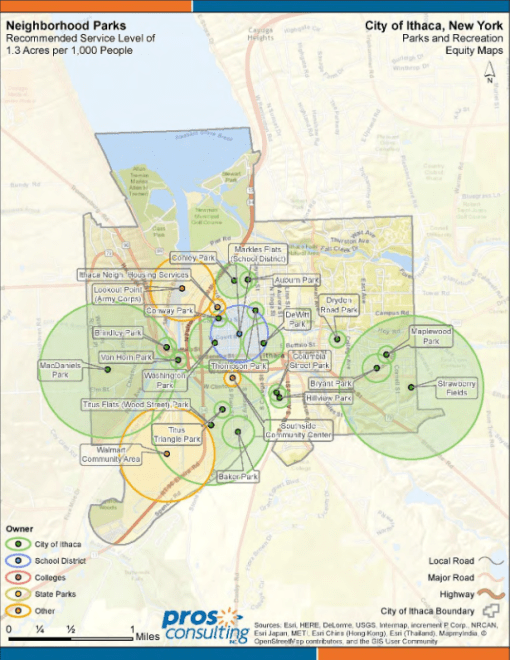
5. So here’s the city of Ithaca’s parks master plan. There’s a few interesting things of note in terms of acquisitions and de-classifications (sale).

First, a quick note – the city is legally required to replace any park land it sells off with newly acquired park land. So with that in mind, the city looked at its parks and found five that are “vastly underutilized” – Columbia Street Park (0.25 acres), Dryden Road Park (0.08 acres), Hillview Park (0.74 acres), Maple Grove Park (0.47 acres), and Strawberry Fields (9.16 acres).

The city would like to sell off the first four on that list, and replace them with a new acquisition somewhere in the city that has at least 1.54 acres, but the city is looking for up to 12 acres. Proximity to population centers, arterial roads, pedestrian access and minimal site prep are some of the big deciding factors in that acquisition process. Meanwhile, Strawberry Fields would be held for either designation as a “school park” to be managed in conjunction with the ICSD, or as a “teaching preserve” for practice field research and instruction.

If the city did opt to sell those four parks, well, there’s some development potential, though they wouldn’t be prime. Maple Grove is a Belle Sherman cul-de-sac surrounded by single-family homes. Dryden Road Park is a small triangle next to the parking garage, and while technically an MU-2 zone for six floors, it’s just as likely Cornell would pick it up amd add it to its tax-exempt rolls since it’s next to Cascadilla Hall. Hillview and Columbia Street on South Hill (R-2a zone) could potentially become a few home lots or a small apartment complex, but the land’s sale would be a political challenge.The city procedure would be an advertised sale offering through the IURA, followed by a grading system of applicants that meet the city’s specified price, as they did with foreclosed lots that became the Ithaka Terraces and 203 Third Street.

Not too keen to get in the weeds on this, since this would be controversial with neighborhood groups, but it’s really just a thought exercise at this point – any potential land sale would be on a long-term, 5 year+ time scale, and the city would need to have new land ready to be acquired for recreational uses. Even thatcould cause problems when neighbors complain that an untouched property becomes a public park that attracts people (this has been an issue with proposed extensions of the South Hill Rec Trail). There is plenty of time to debate the merits and drawbacks of long-term property assets. Right now, the focus is repair and renovating existing facilities in city parks.

6. Looking at the city’s planning board agenda for next week, it’s a short one. The duplex at 601 South Aurora and the Brindley Street Bridge are up for final approval, and a pair of new sketch plans will be reviewed – one is likely to be small, and the other a revision, potentially a downsizing. I’ve heard through the grapevine that several rental developers are holding off or even cancelling plans because they’re concerned about the impacts of Cornell’s 2,000 new beds for their North Campus – although right now there’s nothing formal apart from a statement of intent. Ideally, Cornell puts some concept forth soon, with plans not long thereafter; otherwise, there’s the risk that the local housing situation gets worse. Perhaps the reasonable worst case scenario is that, with recent federal attacks on higher education, Cornell is forced to trim its budget and cancels the housing plans, while still adding students to compensate for financial losses – basically, a sudden large growth in demand without growth in supply.

First, 209 Hudson. This was previously mentioned in a Voice article, it’s potentially a small-scale infill project by frequent infill developer Stavros Stavropoulos. The early plan for two of three rental buildings was shelved due to the South Hill overlay, and its possible that, given the relatively large lot, Stavropoulos may be planning a subdivision to build an additional two-family rental unit. Dunno if he can legally pull off more than that, however. R-2a with overlay allows a 1-2 family structure as a primary, with an accessory apartment in a secondary structure.

The second is 119-123 College Avenue. This is unusual in that this was the site for John Novarr’s College Townhouses project, a 67-unit, multi-building plan for rentals geared towards visiting Cornell faculty and staff. However, the recent NYSEG power line issue has proven problematic, and the last I checked, the project team was supposed to go before a state building codes board in Syracuse this month to get a variance to allow construction, on the basis that the power lines will soon be buried. The minutes are not online, so it’s not clear what the ruling was. While CR-4 zoning allows 45 feet as the plan is currently designed, a variance denial by the state would limit structural height to 30 feet, and would substantially impact the project’s feasibility in pricey Collegetown, as well as alter the design. For the record, 119-123 does not imply a smaller project; 123 College Avenue never existed, the three homes removed for this project were 119, 121 and 125. We’ll see what the revised plans look like next week.

1. Agenda Review 6:00
2. Privilege of the floor (3-minute maximum per person) 6:05
3. Site Plan Review

A. Project: Duplex 6:15
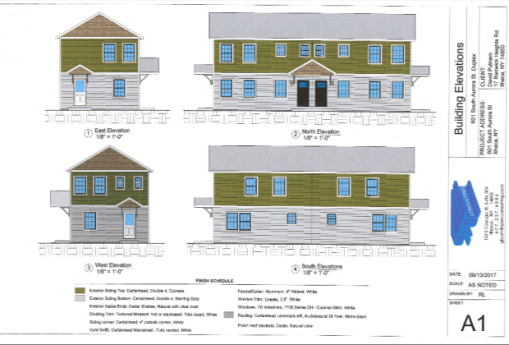
Location: 601 S Aurora Street
Applicant: David Putnam
Actions: Public Hearing, Consideration of Preliminary and Final Site Plan Approval
Project Description:
The applicant is proposing to construct a duplex on the .186 acre (8,114 SF) vacant lot. Site development includes parking for two cars, walkways, landscaping, a continuous sidewalk along the property frontage, drainage improvements and a trash enclosure. The applicant has designed curbing and on-street parking on Hillview Place in cooperation with the City Engineering Division. The project is in the R-2a Zoning district. This is a Type II Action under the City of Ithaca Environmental Quality Review Ordinance (“CEQRO”) §176-5. (C.)(8) and the State Environmental Quality Review Act (“SEQRA”) § 617.5 (c)(9) and is not subject to environmental review.

B. Project: Brindley Street Bridge Rebuild and Relocation 6:35
Location: Intersection of W State Street and Taughannock Blvd
Applicant: Addisu Gebre for the City of Ithaca
Actions: Consideration of Preliminary & Final Approval
Project Description:
The project will relocate current Brindley Street Bridge to align with W. State St./Taughannock
Blvd. intersection through the construction of a new single span extending Taughannock Blvd. over
the Cayuga Inlet to Taber Street. The project will retain existing Brindley Street Bridge and south approach road for pedestrian and bike use. This is a Type I Action under the City of Ithaca Environmental Quality Review Ordinance (“CEQRO”) §176-4 B.(1)(k) and the State Environmental Quality Review Act (“SEQRA”) § 617.4 (b)(11) for which the Board of Public Works, acting as Lead Agency made a Negative Determination of Environmental Significance in 2016.

C. 209 Hudson Street – Subdivision & Site Plan Review – Sketch Plan 7:05

D. 119-123 College Avenue – Sketch Plan 7:35

4. Old/New Business 8:00
A. Collegetown Design Guidelines – Megan Wilson
B. Parks Master Plan – Megan Wilson

5. Reports 8:40
A. Planning Board Chair (verbal)
B. Director of Planning & Development (verbal)
C. Board of Public Works Liaison (verbal)


Village Solars Construction Update, 11/2017

25 11 2017

Another redeveloped building is underway at the Village Solars property along the 1000 Block of Warren Road in Lansing. The original 8-unit, 8-bedroom 116 Village Circle is no longer of this world; the early 1970s structure was torn down to make way for a new three-story building with 6 2-bedroom units and 12 microunits (400-600 SF). Along with the framed and sheathed 102 Village Place, that means that Lifestyle Properties does in fact have two buildings underway at the site; perhaps the last visit in September just happened to catch the project during a brief lull.

102 Village Place has been fully framed, sheathed, roofed, windows and doors have been fitted, and the fiber cement siding is just beginning to be installed (possibly by T&J Contractors of Auburn; most construction work by Lifestyle Property/the Lucente family is handled by an in-house crew). On the inside, expect electrical, plumbing, and HVAC to be underway; with no open doors or windows, it was not clear if they’re hanging drywall yet. In comparison to the “older” new apartment buildings, these new ones have different fenestration and even have stone veneer at the bases, though the overall building designs are generally similar. It’s not completely certain what the purpose of all the eaves (eavelets?) are on the walls of 102, though given the utility lines, it may have something to do with weather/ice protection for the air source heat pumps, which are shielded by small eaves and wood lattice on the latest completed apartment buildings.

The replacement structure for 116 Village Circle is just starting the framework for the second floor. As previously noted, it’s not uncommon to just housewrap over the rough openings, and cut out the holes later. The excess will be trimmed off and the edges will be fastened back to the inside wall, allowing for a tight and complete wrapping of the rough opening. Taking a guess, 102 will probably be done by the end of March, and 116 the end of June perhaps.

Side note, I’ve never noticed the Village Solars construction crew put a flag up on topped-out structures before.


Ithaka Terraces Construction Update, 11/2017

23 11 2017

These are turning out quite nice. Building “A” is practically complete from the outside. The plant boxes outside the windows have even been stocked with small ornamentals. About the only thing left are the exterior finishes on the front facade columns. Building “C”, the smaller building to its east, is also nearly finished from the outside. I suspect the wiring coming out of Building “C” just above the parking area is for electric car charging stations.

Building “B”, the other large condo structure, is fully encased in plastic sheeting and wood ribbing. Stucco generally needs to be applied in dry, temperate weather conditions, above 40 F at a minimum. Given Ithaca Novembers, that means McPherson Builder has basically turned the building into a dry, heated bubble so that can apply the stucco properly. Building “D” is still being roofed, and is just getting its windows fitted. It looks like the scratch coat for the stucco is being applied over the water barrier, and the brown coat and the finish coat will come later, meaning that “D” will eventually be bubbled in as well.

Most of the concrete curbs and steps have been formed, poured and cured at this point. The grand staircase will make for a nice shortcut from South Cayuga Street to West Spencer Street.

The marketing material appears to be using the phrase “Arriving here is what you are destined for“. Tje website doesn’t indicate how many of the twelve units are spoken for (if any; the project is in the soft marketing stage, where they’re accepting inquiries but there aren’t any formal real estate listings). The two-bedroom and three-bedroom units go for $299-$434k, depending on size and location.


McDonald’s Rebuild Construction Update 11/2017

21 11 2017

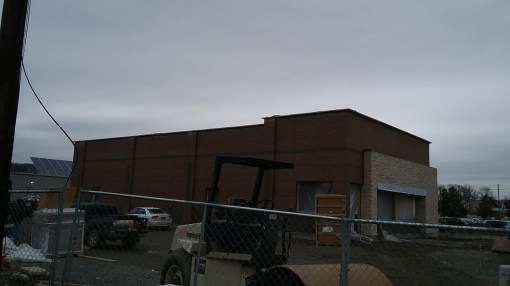
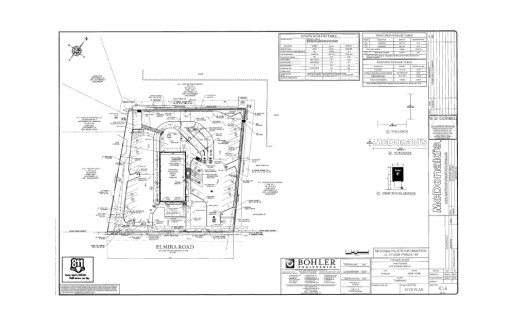
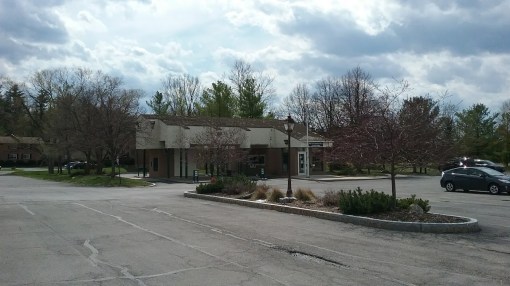
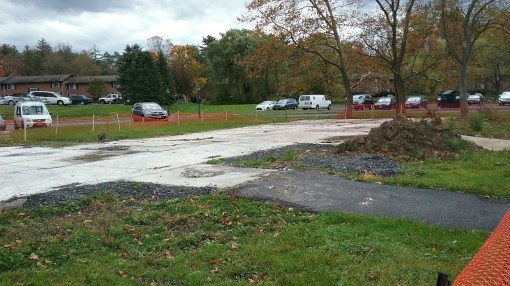
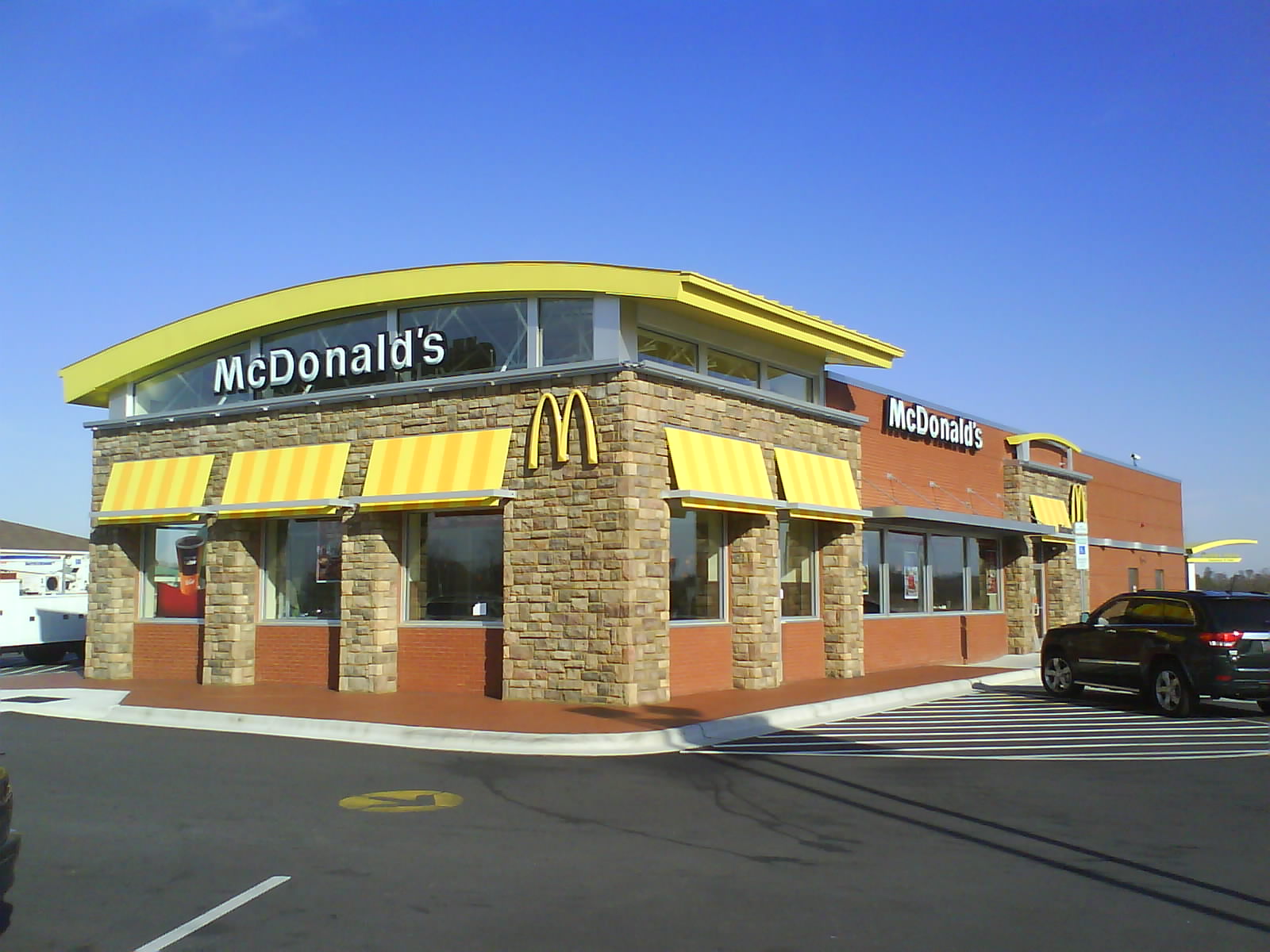
The new 4,552 SF Ithaca McDonald’s is framed, waterproofed and faced in a couple different shades of Belden Brick and Boral USA stone veneer. The aluminum metal accents have yet to be applied. Much of the work has shifted inward with plumbing, electrical and HVAC installation. The McDonald’s signage, including the modern take on the “golden arches”, will help to break up the blank spaces at the front (east) and side (north) faces. Shirt brick walls have also been mortared together for decorative landscaping, and to block off the parking and patio areas from South Meadow Street. Mulvey Construction seems to be motoring through this project quickly. The plumbing subcontractor appears to be Donofrio Mechanicals of Auburn.

If one really wants to dig around for something that makes this McDonald’s unique from all the others with the new design language, it appears that many incorporate Dry-Vit (artificial stucco) or architectural aluminum panels, but neither of those finishes are present here. The version with an elevated arch canopy and glazing is a design language feature that didn’t make the cut for the Ithaca location. Maybe it’s just too cloudy.

The new $1.375 million restaurant should be open by Christmas. Project information can be found in the introductory post here.


News Tidbits 11/11/17: It’s Back

12 11 2017

1. One of the reasons for the lull in weekly round-ups has been the lack of smaller news items to fill it with. A few larger items made it into Voice articles, but there wasn’t much of a middle ground between “expand into article” and “not newsworthy”. I’m happy to take comments here about Voice articles, although the blog is intended to cover topics that may not be ready for a full write-up.

As noted in the Voice, there isn’t much before the city of Ithaca at the moment. A sketch plan for infill rental housing at 209 Hudson Street is likely dead in the water as a result of the new South Hill Overlay, and a modest infill plan calls for a duplex at 601 South Aurora on the corner with Hillview Place, which can only be an improvement from the informal parking lot currently there. The modular unit design is thoughtful (varied materials, plenty of windows) if unexciting, and the sidewalks are a plus. The units are physically structured as townhouses, but technically they aren’t, since townhouses are defined by International Building Code as strings of units of three or more.

Meanwhile, things are so slow in the town at the moment that they cancelled their last Planning Board meeting. Before that, the only notable item on the agenda was the Cayuga Ridge renovation, which is primarily internal. Their October Building and Codes Department report indicates a single two-family home was approved, in the Cleveland Estates housing subdivision; virtually all of those duplexes have been intended as student housing.
2. If there is one town that is rather busy next week, it would have to be Lansing. The surface facilities for the new Cargill mine shaft are up for final approval at the Planning Board meeting next Tuesday, more discussion is expected about the Milton Meadows affordable housing plan at the town center, and a couple of minor projects (communications tower, illuminated free-standing sign) are up for review and vote. Neither Cargill not Milton Meadows appear to have changed significantly since their last presentations.

Also scheduled is review of public comments regarding the Comprehensive Plan, which cover several topics, with the most frequent being the Bell Station zoning (park vs. lakeshore low density) and some individuals unhappy with the potential for mixed-use or residential development near their homes or farms. Joe Wetmore has a pretty thorough critique, ranging from unrealistic expectations to discomfort with what he calls “segregated housing” based on income and age. Going political for a moment, I suspect if it weren’t for many progressive town and village boards rushing to join the Article 78 on Cargill, with less than careful thought and discussion of Cargill’s blue-collar workers and their family/friends, Wetmore would be an incoming town councilman (and to be fair, he may end up winning when the absentee ballots are counted and tallied next week).

3. Over in Dryden, just about everything is good to go with Modern Living Rentals’ 42-unit rental complex planned for 802 Dryden Road, next to the Cornell arboretum. The November tweaks were for lighting, landscaping and sidewalk details. The designs of the townhouse strings were reworked in October to include three different designs, to be used twice each (six buildings, seven units each, 42 units/108 bedrooms total). While the materials remain the same, the designs differ substantially in roof lines, architectural detailing and fenestration pattern. At this point, no one would mistake for a recycling of 902 Dryden as they started off as; John Snyder and his team have had the chance to express themselves, and the designs are contemporary and visually interesting. It looks like final approval will be coming potentially soon, which will permit a Spring 2018 – Summer 2019 construction time-frame.

Other than that, the town is reviewing another Tiny Timbers subdivision, this one for 1540 Ellis Hollow Drive. Similar to its counterpart just down the street at 1624 Ellis Hollow Drive, the long, narrow lot would be serviced with an internal driveway for five homes with a little over an acre each, and the rear (northern) 5 acres would be granted a conservation easement, to remain natural space and help protect the Fall Creek watershed. The original plan was a deed restriction, but the town’s conservation board is pushing the easement so that future owners of the land can’t just lift the restriction. They also requested an S-shaped driveway because they feel the slope is greater than Dolph states; an S-shape would also throw the plans out of whack, so let’s see what happens.

On a final brief note, review and discussion is ongoing for a pair of solar arrays off of 2243 Dryden Road, one of 1.3 MW and one of 2 MW.

4. Looking at what’s on the market this week, here’s something for the deep-pocketed investor/landlord who wants to start with an all-new, low-maintenance building. 6-unit 707 East Seneca Street is on the market for $2,999,000. The 6,469 SF apartment building was built just two years ago, after developer Todd Fox bought city surplus land that was once a playground for the closed East Hill Elementary, deeded to the city in 1982 and promptly forgotten for decades until potential liability risks convinced the city to put it up for sale. Each unit is three bedrooms, and according to the advertisement, it generates over $220k in revenue each year, which is not shabby.The property is assessed at $1 million.

It’s a bit surprising that Fox would want to part with a nearly-new building with solid rental potential, and it makes me curious if the funds would be used to fund other Visum projects planned or approved. While Fox did take a financial hit from the cancelled 311 College Avenue project, the amount invested was far less than the sale price for 707 here.

5. Also worth noting, though it’s not good news – The Computing Center’s plans to build a new 4,600 SF headquarters appear to be over. The building site and the approved building plans at Lansing’s 987 Warren Road are up for sale. $499,000 gets you 1.57 acres, the plans, and a single-family home on the eastern end of the property that generates $2,000/month. The project had received an $85,084 tax abatement for the $1.394 million project, which was expected to create six new jobs. For the record, any buyer would need to re-apply for an abatement; the one granted will go unused. At least offhand, it looks like they may have added the jobs (retain 14, add 6, and the website shows nineteen plus the retired founder, and two job postings), but it’s uncertain – they acquired a competitor (Sherpa Technologies) in September, which increased staff to 22. Based off the time of the listing, with the acquisition of Sherpa they may have just led TCC to go a different direction with a new headquarters. What will be, will be.

6. According to construction loan documents filed with Tompkins County, the new 11,180 SF Rite Aid being built at 79 North Street carried with it a $2.71 million price tag. Chemung Canal Trust Company, an Elmira-based bank with branches in Tompkins County, is providing the loan to Dryden Group LLC/Ellicott Development. Ellicott, a major developer out in Buffalo, will be using an in-house contractor team to build out the retail space.

A couple of emails came in asking if this would be a Walgreen’s. On paper, that’s a no – everything filed and documented says Rite Aid, and this was confirmed with the town planning staff. However, Walgreen’s is in the process of acquiring 1,932 Rite Aid stores (leaving Rite Aid with 2,600), and closing several hundred stores that are within close proximity to existing Walgreen’s. It’s possible that the existing Dryden Rite Aid is one of those to be “shut down as part of the sale” as the new Rite Aid-turned-Walgreen’s is being built on the north end of the village. Keep an eye on it.

7. Quick little side note – Ithaca Associates LLC, the development team behind the $110 million Green Street Garage project, is apparently in talks with INHS to manage its affordable housing component. That’s according to Ithaca Urban Renewal Agency (IURA) meeting minutes. So they are serious about meeting the city’s demand for affordable housing with some undetermined percentage of the 365 units. Heck, 60 or 70 units would be a sizable contribution, should it pan out, and it would make the project more palatable since it would clearly have a mixed-income aspect to go with its mixed uses.
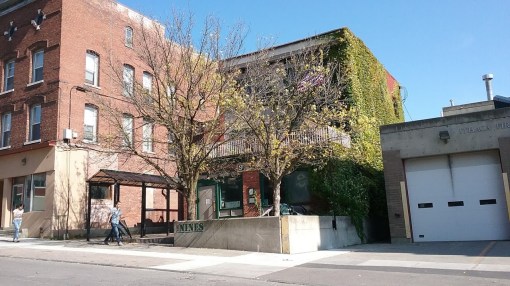
8. The Ithaca Landmarks Preservation Commission will be taking up discussion again on the Nines, though they are less than pleased with the recent 5-5 tie vote the Common Council had on the Chacona block, broken by the mayor’s vote against historic designation. For me, the fascinating part was having someone like Cynthia Brock, typically opposed to greater density, speak in favor, while pro-development councilors like Ducson Nguyen and Seph Murtagh voted in favor of historic designation. So, it was an unusual breakdown of votes that I would not have predicted, although I had heard before the meeting that it would likely be a close vote.

There is no doubt that anything Student Agencies submits will be scrutinized extra closely, especially if they try to maximize square footage or incorporate design features that don’t mesh with neighboring structures. It’s fair to say that while they lucked out with being allowed to redevelop, the resentment already stirred up means anything proposed will be starting behind the proverbial eight ball, and they would be wise to really put their best foot forward and not rush plans.

Interestingly, it looks like someone, likely but not confirmed to be the Reach Project social service group, plans to submit concept designs for the carriage house that once stood behind the house at 310 West State Street. This is a historic district, so any designs for the drug treatment and potential safe heroin injection “harm reduction” site would need to be approved by the ILPC.

It’s been amusing and a bit excruciating to see some of the comments on the Voice – some people are all about historic buildings; but it tortures them to see these venerable structures used for what they see as a less-enlightened cause than a high-end B&B or boutique office. If zoning laws (and higher authorities, in this case) okay it, so be it. Many historic buildings have humdrum or low-brow histories as factories, home businesses or tenements, and to say they can’t be used for something permitted just because it seems icky is not only illegal, it denies part of the historical element.

7. Intriguing, though I have questions – the city is looking at expanding the use of PUDs from beyond the few industrial zones to city-wide so long as properties are 2 acres. They’re also looking at expanding CIITAP to allow 1-story industrial and waterfront projects, as well as an affordable housing component of 20% on all residential or mixed-use projects with residential components of 10 units or more.

The PUD plan comes on the heels of the new Waterfront zones, which allow residential uses on a greater number of parcels, and is in fact the recommendation of the Waterfront Working Group (WWG), a 17-member group of staff and public who reviewed planned zoning changes to the Waterfront. The city planning staff are amenable, though they suggest a minimum acreage of 2 acres.

With the proposed CIITAP change, the reasoning makes sense, although its effectiveness is questionable. Industrial construction is locally limited and is usually build-to-suit for a specific client. There’s also a strong preference to less dense areas with easy access with lower land values, like Lansing or Dryden. More power to the city I guess, I just don’t see it being utilized. As for the housing component, the intent is good, but the issue always ends up being an issue of “moreness”. Developers often have to build bigger to re-balance expenses and revenue within mixed-income structures. This can make it tougher for them to get financing since it’s a larger, more costly build-out (a bigger financial risk, all other things being equal). Residents in turn balk at a bigger project with the traffic, aesthetic changes and other impacts it creates, not to mention some still instinctively sneer at affordable housing, mixed-income or not. It’s not an outright deal-breaker, but it is something to keep in mind.

The PUD can be troublesome since it’s a sort of “DIY zoning”, which would make existing rules pointless and a lot of upset voters if allowed without some big stipulations. 2 acres would limit many projects in the core of the city, but if you happen to be, say, a major landowner along the Waterfront or in the vicinity, like Guthrie or Cayuga Medical Center, it’s basically a red carpet invitation, as it allows them to set the bounds for a project. Notably, neither of those two fall within CIITAP’s boundaries, so while they wouldn’t be eligible for the tax abatement, they also don’t have to worry about the affordable housing component if they choose to do something with housing in the mix.


Cayuga Medical Associates Construction Update, 11/2017

8 11 2017

According the the federal Bureau of Labor Statistics, medical and educational services are the largest component of Ithaca’s economy, and among its fastest growing. While the colleges are growing incrementally, medical services have boomed as people live longer (up 5.2 years in Tompkins County from 1980-2014), and Baby Boomers’ need for medical services grows – Cayuga Medical Center has added several hundred jobs in the past decade alone.
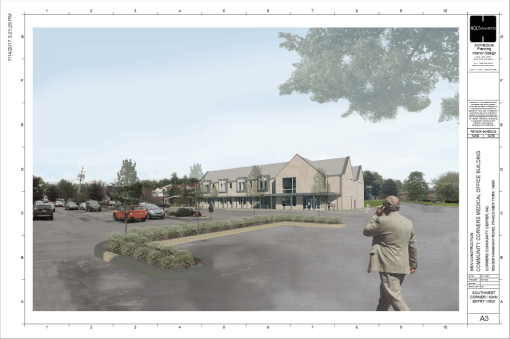
In March 2016, Cayuga Medical Associates, a for-profit business partnered with Cayuga Medical Center, announced plans to build an outpatient facility at Community Corners, an early-suburban style shopping and office center located at the five corners intersection of Cayuga Heights (the official project address is 903-909 Hanshaw Road). While the core of the plaza dates from the late 1940s, additions such as the Chemung Canal branch and the renovated Island Fitness gym branch have been built in the past several years. CMA had been looking for sites in northeast Tompkins County, and found that Community Corners was the best choice for their needs.

Initial plans called for a 3-story, 39,500 SF building designed by local architecture firm HOLT Architects, which has a well-known specialty in highly technical medical structures. the first floor would host cardiology and cardiac care services (later revised to neurological services), and internal care (prevention, diagnosis and treatment of adult diseases) on the second floor. The third floor was still rather speculative when first proposed. The building was expected to host about 72 staff and 400 patients per day. The project was going to be a bit of a slog – Cayuga Heights has what’s likely the most stringent planning board of any municipality in Tompkins, and the project would need variances for height, setbacks and lot coverage. Landscape architecture firm TWMLA’s Kim Michaels would represent owner Tim Ciaschi and the project team at meetings.

After a few months of back and forth, it became clear the the village was not going to be comfortable with the 3-story plan, and having no tenants locked down for the top floor, the scale of the project was decreased to 2 floors and 28,200 SF (23,200 SF lease-able space) in July 2016. Now only expecting 300 patients per day, the variances needed were generally more minor – while the height was contentious, a few percent over the maximum lot coverage isn’t as much of a concern. The village has eyed a denser, mixed-use Community Corners, if not necessarily the traffic and people that go with it; neighboring property owner Mark Mecenas has been mulling over plans for several years. The more modern-looking original design was replaced by one that better fit the plaza’s 1940s building, with gables and dormers.

Although concerns were raised over traffic, aesthetics, and those who felt Community Corners was the wrong place for a medical facility (they wanted street-level shops with condos above), the board was reasonably pleased with the changes, and after a few more months of SEQR review, the project was approved in November 2016. However, it was approved on the stipulation that parking demand mitigation measures be prepared and approved by the village first, as well as a customary submission of planned exterior finishes. Since parking had been underused at the rear of the site, only fifteen parking spaces are being added, for a total of 300, which brings it close to capacity (estimated daily use upon full occupancy was 262 spaces for the 3-story version). The submitted and approved parking plan allows for a small amount of overflow into neighboring lots, a partnership with the Gadabout bus service for seniors, talks with TCAT and a shower station for those who wish to bike to work. The parking plan was approved by the village back in August.

Along with the building, the project provides revised internal circulation with new driveways and sidewalks, landscaping, and stormwater facilities.  A one-story 1950s office building and a 1960s former Tompkins Trust bank branch were demolished to make room for the new building. The exterior will be faced with off-white brick and a grey brick header course, with a metal roof and aluminum windows. Current plans call for the building to open during summer 2018.

According to county filings, Chemung Canal Trust Company is providing the $7.8 million construction loan. McPherson Builders of Ithaca is the general contractor, which is offhand the largest project I can recall for which a local firm has served as GC. Along with HOLT Architects designing the building and TWMLA doing the landscaping, Ithaca’s T.G. Miller P.C. provided civil engineering and surveying work.

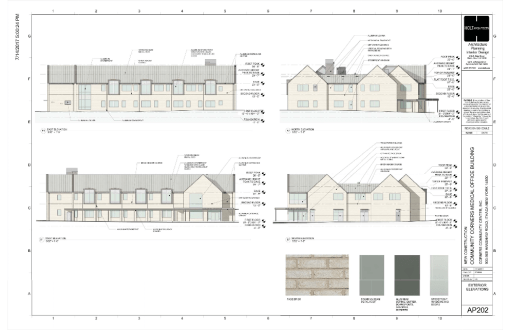
As of the end of October, demolition of existing structures has been mostly completed, with only the slab foundations remaining. The new building will also use a slab foundation, four feet thick according to the elevation drawing below.

Pre-development, April 16th 2017:

October 24th, 2017


August 2016 revision. The version approved in 2016 used fiber cement boards, later revised to brick.


Hilton Canopy Hotel Construction Update, 10/2017

31 10 2017

Tompkins County benefits from being a regional tourism destination. A combination of amenities like the colleges and wineries, scenic gorges and and convenient location have made it a popular weekend getaway from the big cities of the Northeast and Mid-Atlantic, as well as some of the major Great Lakes cities. In the past ten years, the hospitality and tourism sector of the economy has grown over 20 percent, adding several hundred jobs even after seasonality is taken into account. An additional benefit is that the room taxes are used to fund arts and culture grants, community festivals and part of TCAD, the economic development agency.

Representative of that growth has been the growth in the local hotel industry. Around 2014 or so, one of the big questions was, how many hotel rooms is too many? The Marriott was in the works, the Hilton was in an earlier stage, two hotels were planned on the Route 13 corridor, and the Hotel Ithaca had its plans. For practical purposes, it was a good question.

However, the situation evolved over time. As is often the case, the hotels opened later than anticipated. The 159-room Marriott finished late last fall, the 76-room Holiday Inn Express was completed a couple months earlier, the Hotel Ithaca went with an expansion that actually reduced the available number of rooms by ten and opened earlier this year, and one of the suburban hotels, a 37-room independent boutique hotel, was cancelled. They all came onto the market later than expected. and the number of rooms added was less than originally planned. All the while, the economy continued to grow at a consistent 1.5-2% annual pace, Cornell continued to add students and the population slowly grew. Had all the hotels opened at once with their original plans, the impact might have been a big problem. But the reality was that the Hotel Ithaca’s impact was modest, and the HIE’s and Marriott’s supply is being absorbed (though the market does need over a year to fully adjust to a 12.8% growth in supply). For the record, Airbnb and similar services have their impacts as well, but the county estimates it’s the equivalent of roughly 40-60 hotel rooms.

With the market still adjusting to the influx, it’s probably a good thing that the Canopy Hilton isn’t opening until Spring 2019, well after a new equilibrium is achieved. However, it’s been a long road to get to this point.

First, a brief history of the site. In recent years, the Hilton site was a mix of private and municipal parking. From 1916-1993, the Strand Theater occupied the site. The Carey Building was designed to match the Egyptian Revival motif of the theater, but unlike the Carey, the theater closed in the late 1970s, attempted and failed at a reopening as a community theater, and after being vacant for over a decade, the building was deemed too far gone to save, leveled by the wrecking ball during the deep recession of the 1990s.

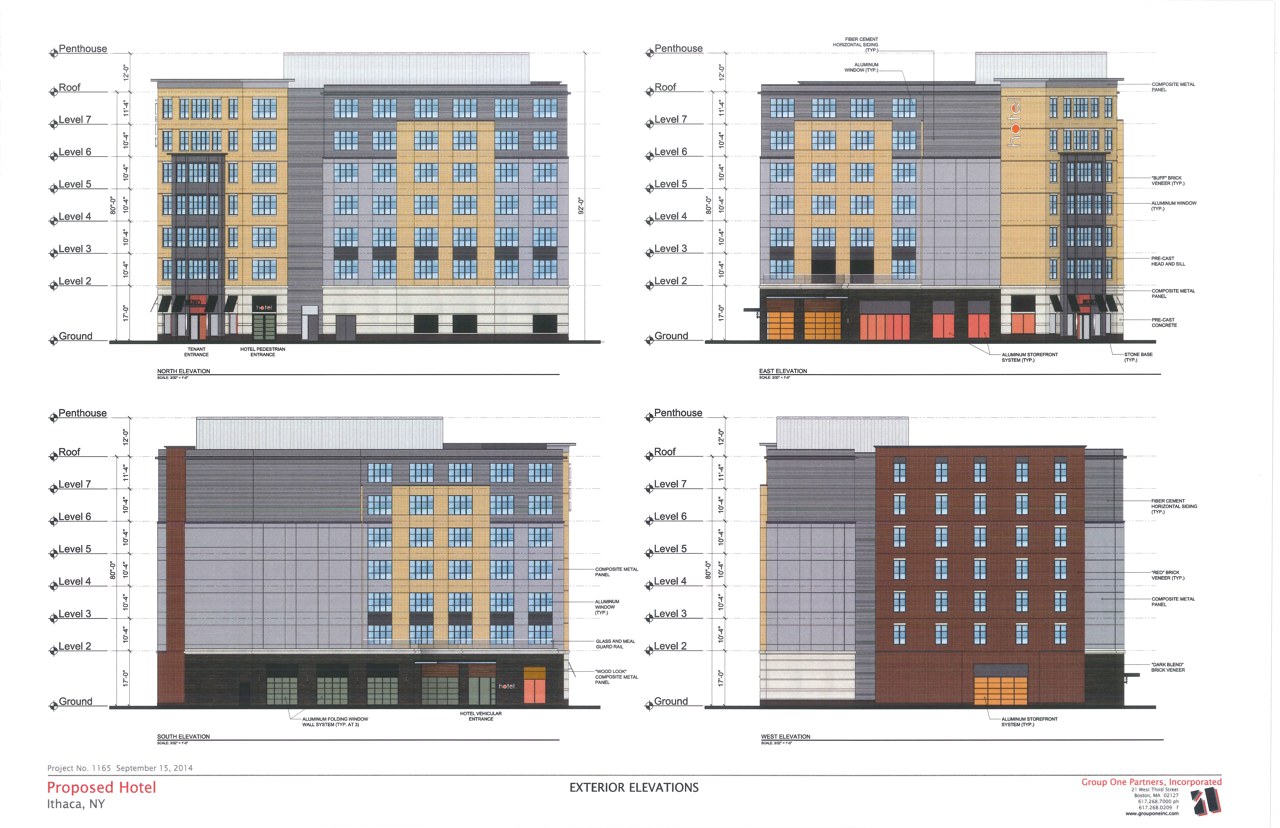
The first mention of a hotel on the 300 Block of East State/MLK Jr. was back in December 2012. Lighthouse Hotels LLC (Neil Patel) proposed a six-story, $16 million Hampton Inn on the site (v1). The 92-room hotel, designed by Jagat Sharma, would have resulted in the demolition of the Carey Building – recall this was before the Carey overbuild.

However, Patel violated an important rule when it comes to development – unless you have made previous arrangements, don’t propose something for someone else’s property. The proposed Carey demo caught Frost Travis by surprise, and he and parking lot owner Joe Daley were less than amused. Nor were Planning Board members, who were fond of the Carey and not fond of the surface parking proposed with the hotel. The project went nowhere, and a major reworking was required. Negotiations with the city and neighbors were needed to acquire the necessary land, and the IURA and Common Council agreed to have the IURA represent the city on divestiture discussions.

Fast forward 18 months to June 2014. Having hired on Whitham Planning and Design to handle the review process on behalf of Lighthouse Hotels, a new six-story sketch plan was presented (v2). This plan did not impact the Carey (by then undergoing review for the overbuild), and opted for a more modern design by Boston’s Group One Partners Inc., which specializes in urban hotel plans. By August 2014, a site plan review request was formally submitted, along with a modestly revised design (v3) – at the time, the six-story, 120-room hotel was pegged at $11.5 million. These early plans also called for a 2,000 SF retail or restaurant space on the ground level. By this time, Patel was a vice president at Baywood Hotels, a national hotel developer and management firm with over $1 billion in assets, and regional offices in suburban Rochester. The firm is so large, they have 26 hotels currently under development from Miami to Minnesota, but that might be conservative. Their planned downtown Syracuse Hampton Inn isn’t even listed, and the render for the Hilton Canopy Ithaca is out of date.

Technically the phrasing is “Canopy by Hilton Ithaca”. It will be either Canopy or Canopy Hilton on the blog.

The Canopy brand was launched in October 2014 to be the lifestyle brand geared towards younger leisure travelers. Of the eleven locations announced at launch, Ithaca was the only one not in a major city, and is arguably the only one still not planned for a major city. A month earlier, the newest 74,475 SF, 123-room, 7-story design rolled out (v4), with industrial warehouse-style aluminum windows, buff and “dark blend” brick veneer, stone base with precast concrete accents, and grey fiber cement and metal panels carried over from the previous design. The second floor would open up onto a terrace overlooking the front of the hotel, and the first floor had folding windows that could open the lobby area to the outdoors on nice days. 

By January 2015, the designed had been tweaked some more (V7 in the link, but the changes were pretty minor from V5-V7, facade materials and window treatments), the cost had risen to $19 million, and LeChase Construction was signed on to be the general contractor. In fact, Patel and Frost Travis has even worked out a clever plan to share construction equipment as both their buildings were underway. However, Patel and Baywood’s schedule fell behind Travis’s, so the plan never panned out.

During this time, the project had applied for the IDA’s enhanced tax abatement, and underwent Common Council review after its public hearing in November 2014. While concerns were raised about not paying a living wage to all staff, the council decided the pros outweighed the cons and endorsed the project. Baywood planned to hire 33 to 47 staff, of whom 11-20 would make living wage (multiple sources with different figures). Room rates were expected to be $160/night.

According to the 2015 application, the project’s combined hard and soft costs were $24.17 million, and the property tax abatement (the enhanced 10-year abatement) was $3,528,081. Another $980,928 was waived in sales taxes, and $45,000 from the mortgage tax, for a total tax abatement of $4.55 million. About $3.28 million in new taxes will be generated on top of the existing taxes on the land, along with room taxes and payroll taxes. During the public hearing, attendees went after the project for union labor, living wage and sustainable energy concerns, but the project was still approved by the IDA. They might have switched over to heat pumps, I’ll need to check into that.

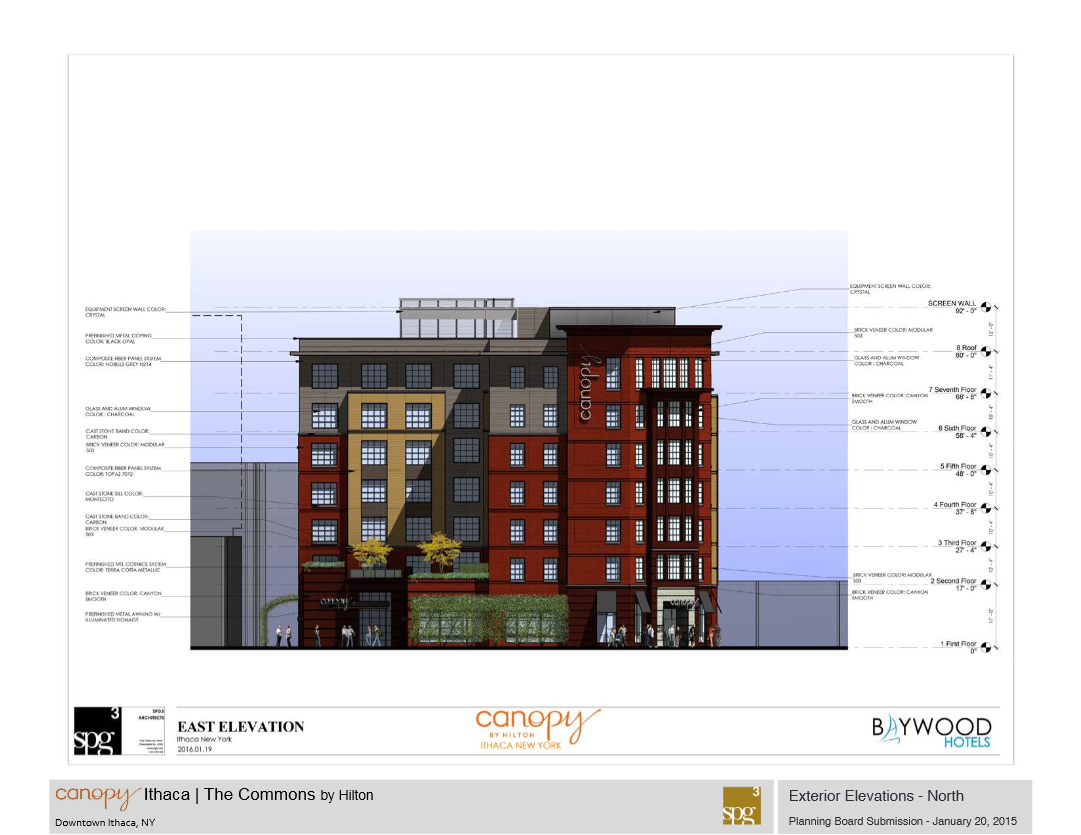
After the original project was approved in March 2015, the city voted to approve the sale of its land in April 2015, and the IDA approved a tax abatement in July 2015, the Hilton plan sat dormant for a while before undergoing a major redesign in January 2016 courtesy of Philadelphia’s spg3 Architects, now Bergmann Associates. It turned out the project had struggled to obtain financing due to rapidly rising construction costs, and underwent some “value engineering”. The general shape was kept the same, but the exterior materials were swapped, the building increased in size to 77,800 SF, the room total was brought up to 131, and the restaurant space was omitted, among other changes. This required re-approval by the city. The much longer comparison is here.

The very last version of the project, V9 in February 2016, added inset panels in the northwest wall, and some cast stone was added to the base. The second floor roof deck was tweaked, a cornice element was added to the mechanical screen, and the trellis and driveway pavers were revised.

The final form is faced with a few different shades of red brick veneer, topaz yellow and grey fiber cement panels, metal coping and cast stone trim. Floor height (ceiling of seventh floor) is 80 feet, while structural height (top of mechanical penthouse) is 92 feet. It’s not really a big impact on the downtown skyline, but it broadens the city’s shoulders a bit.

After approval and IDA approval, things were slow to start. Ithaca Downtown Associates LLC, representing the Patel family, was reorganized slightly to include other family members in the ownership, and afterward it purchased the properties for the hotel project in August 2916. $1.8 million went to the IURA for the parking lots at 320-324 East State Street, and $2.05 million to local landlord Joe Daley for the parking lots on the former Strand property at 310-312 East State Street. A $19.5 million construction loan from ESL Federal Credit Union (formerly Eastman Saving and Loan of Rochester) was received at the end of September 2016, but things were stalled for a while, and only now is the project on its way to a Spring 2019 opening, two and a half years later than initially planned. William H. Lane Inc. of Binghamton will be the general contractor.

Long story, but at least someone wrote it up. Goes to show that property development can be a very complicated process.

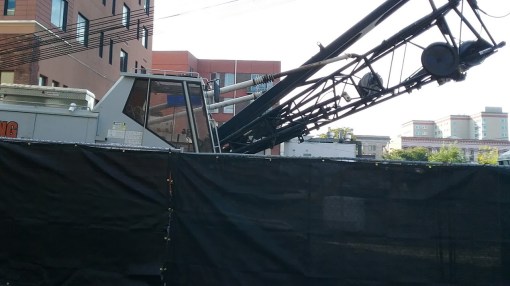
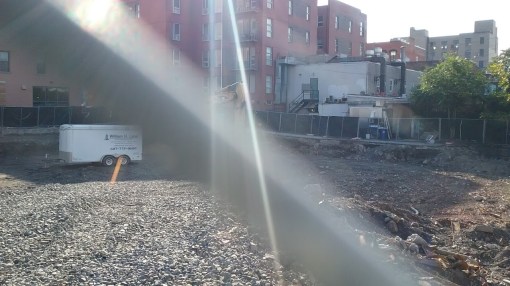
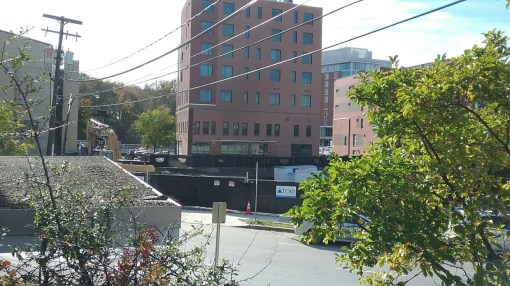
It looks like foundation excavation is currently underway – I had head many of the underground utility work was taken care of when the Carey was under construction next door. A plausible schedule has foundation work done by the end of winter, with structural steel framing underway during the spring and summer.

October 15th:

October 28th:


Tompkins Financial Corporation HQ Construction Update, 10/2017

27 10 2017

Work continues on the new Tompkins Trust office tower in downtown Ithaca. The official topping-out, which means that the building has reached maximum structural height and framing is complete, was earlier this month. U.S. Gypsum sheathing can be seen on the east and south (front) sides, with fireproofing and interior stud walls clearly visible from street level. You can see some of the HVAC rough-ins on the lower floors. Meanwhile, on the north (rear) and west faces, the exterior facade has been bricked and paneled with aluminum metal, tan brick, dark grey brick, stone sills and aluminum window fittings. It’s a little surprising the sunshades are already up, since exterior details typically don’t come until later in the construction process – and it’s clearly not that far along, given the rough openings still present at ground level. The base will be finished with brick and granite.

To be honest, I was concerned the back side would end up looking cheap, but it seems to be coming up nicely, but I’m holding off on final judgement until I see how the rear stairwell turns out.

About the biggest change at this point is that the $31.3 million, 110,000 SF building may not be finished and completed occupied until mid-May 2018, two months later than initially planned.


City Centre Construction Update, 10/2017

26 10 2017

As described in the Voice summary, City Centre is digging deep.

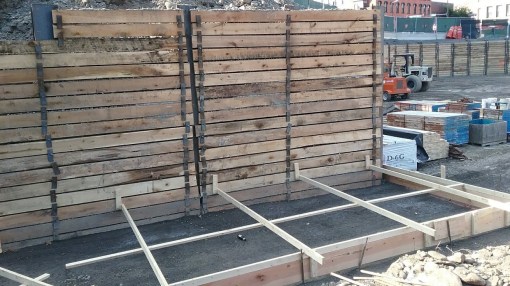
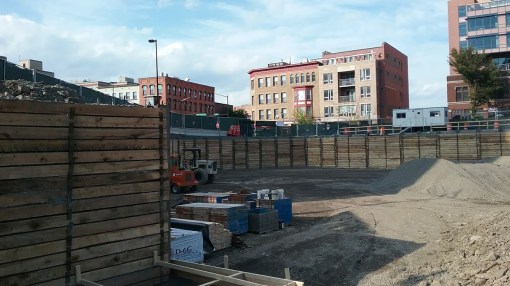
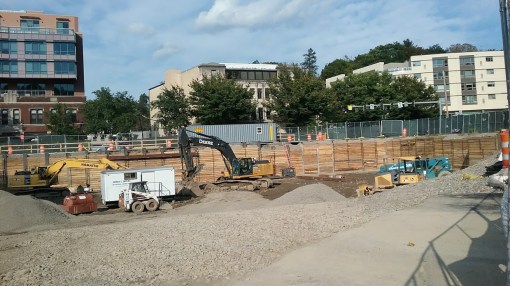
“Unlike the Hilton Canopy, City Centre will have a basement, or more specifically, a 71-space underground garage. The plan here is to use a mat foundation, which is a shallow foundation that doesn’t make use of piles or pile drivers. The company that did the geotechnical report for City Centre reported that a 26-inch mat foundation was feasible based on soil borings, and would be less expensive than a deep pile foundation like the one being used for the Canopy. So basically, excavate some trenches, build some big footers with a lot of rebar, and pour a 26″ concrete slab. Support columns will transfer the weight of the building through the garage and into the slab beneath.

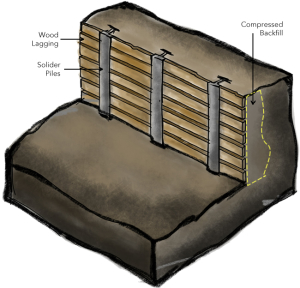
Going past the site right now, excavation work continues, with timber lagging, steel H-beam soldier piles, and steel tieback anchors that extend underneath the streets. The whole point is to reinforce the soil, because no one wants East State or South Aurora Street collapsing into the construction site. Foundations can be complex and time-consuming, and the building may not rise above street level until sometime late in the winter or early next spring. Occupancy of the eight-story mixed-use building won’t be until 2019. According to a construction loan filed with the county this week, M&T Bank is lending $47.9 million to Newman Development Group to complete the project.”

On a hunch while exploring Newman’s project-specific websites, I was able to find City Centre’s website. Morgan Communities of suburban Rochester will be the site manager, and is apparently also hosting the webpages; they’re live, but you can’t find City Centre on their search page yet.

Units will range from a 508 SF studio unit, to a 2 bed/2 bath 1319 SF units with coveted Commons views. Apartment features include quartz countertops, electric stove, microwave, dishwasher, and stainless steel appliances. On-site amenities include fitness center, “E-Lounge”, bike storage, controlled access, optional garage space rentals, electric car charging stations and furnished apartments if requested. Dogs and cats will be allowed. Rents have yet to be listed, though they’re expected to be on the medium-high side (premium, not luxury). The webpage touts Summer 2019 occupancy, which seems to be a split of the Spring 2019 and November 2019 dates used previously. Inquiries are being taken to CityCentreIthaca@morgancommunities.com, if you know someone planning that far ahead.

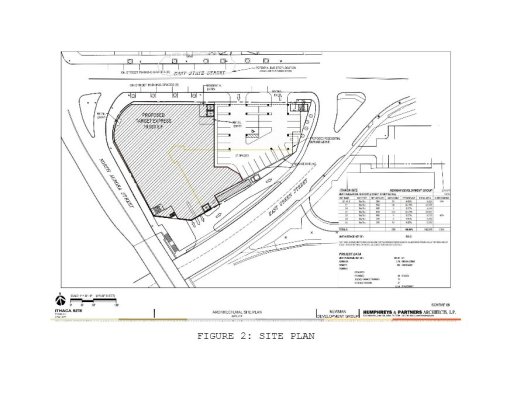
On another note, while poking around the geotechnical report, it turns out that early plans called for the entirety of the first floor to be occupied by a 19,900 SF “Target Express“, the smaller urban cousin to the Target general merchandise retail chain. This had to have been early on, because the parking had a much different configuration than the formal site plan, with an East State Street entrance vs. the South Aurora entrance in all the later revisions. With only nine stores as of mid-2016, Target is pretty selective about new Target Express locations. Why it was removed from City Centre is unclear.