City Centre Construction Update, 6/2019

18 06 2019

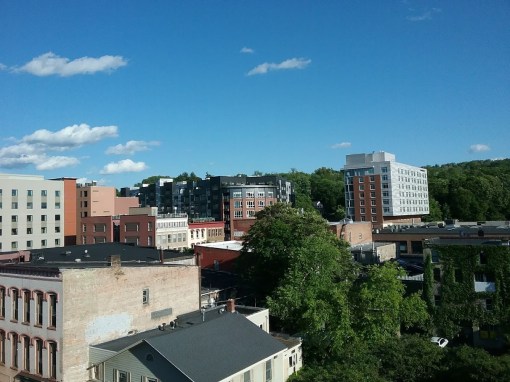
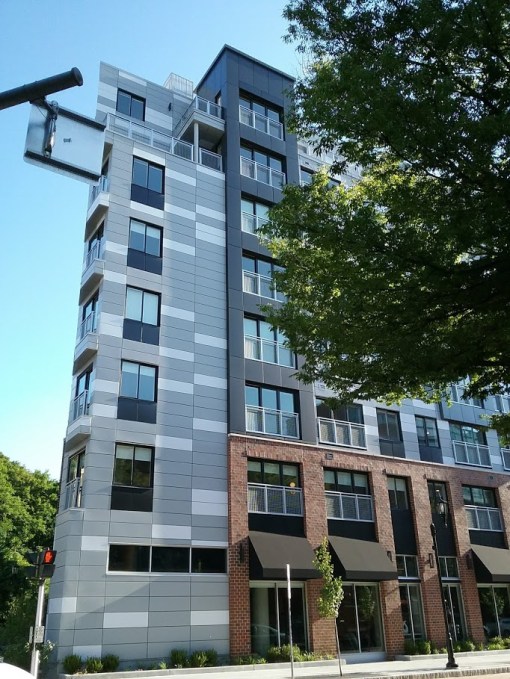
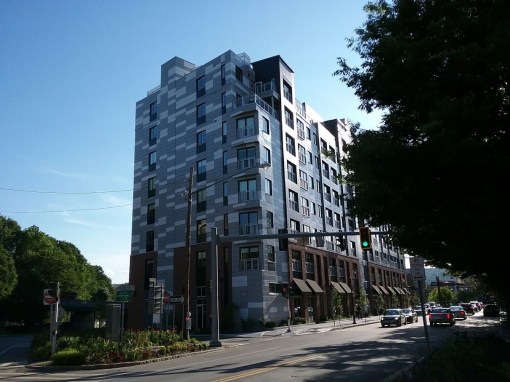
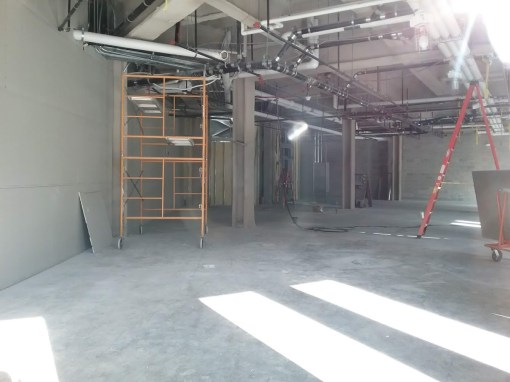
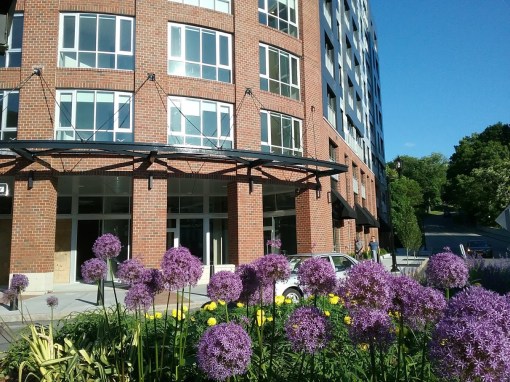
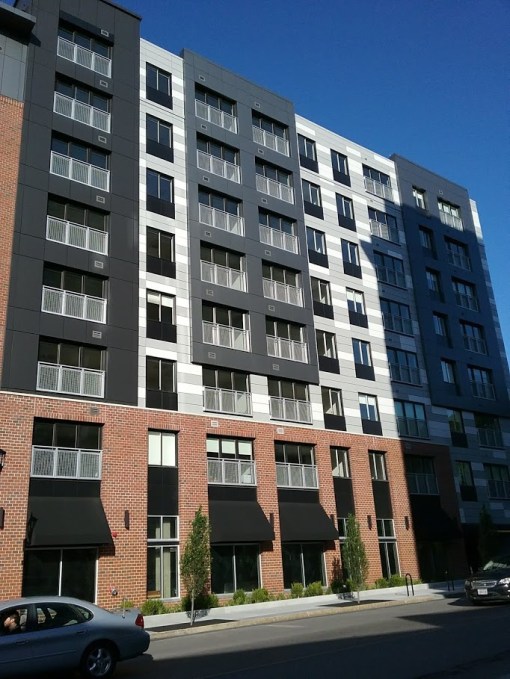
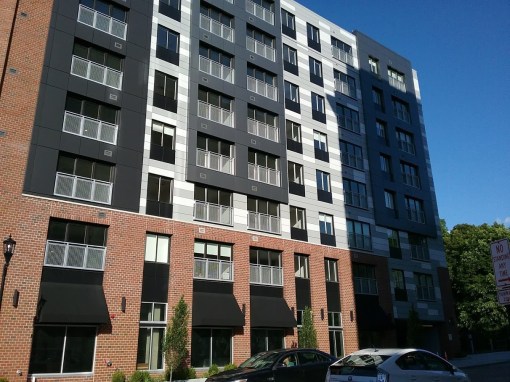
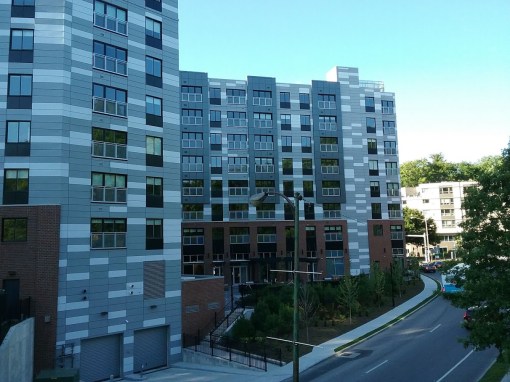
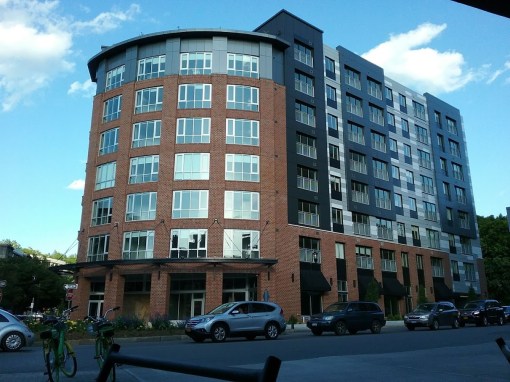
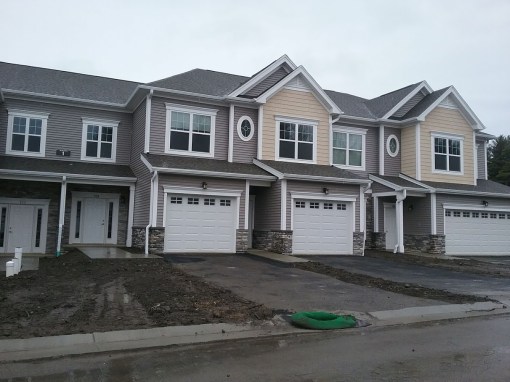
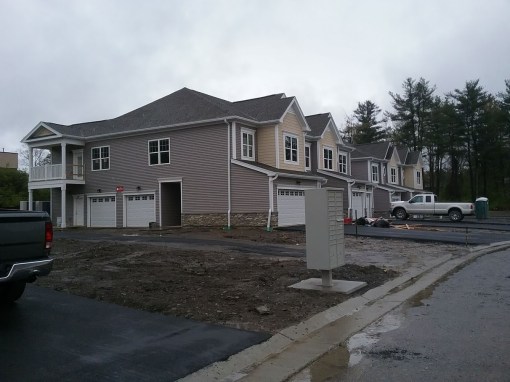
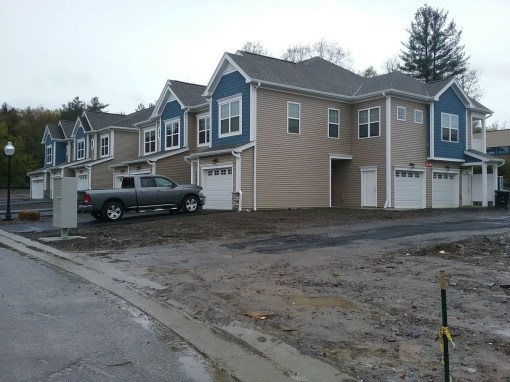
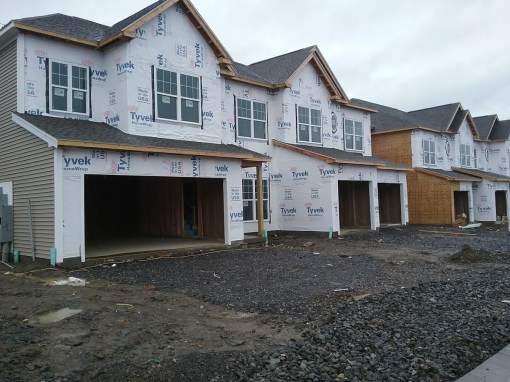
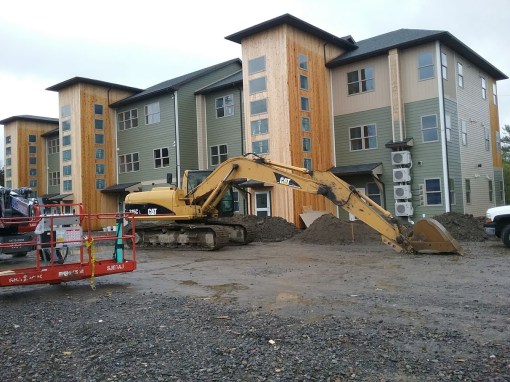
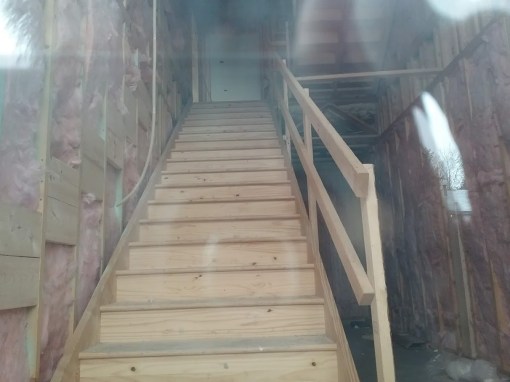
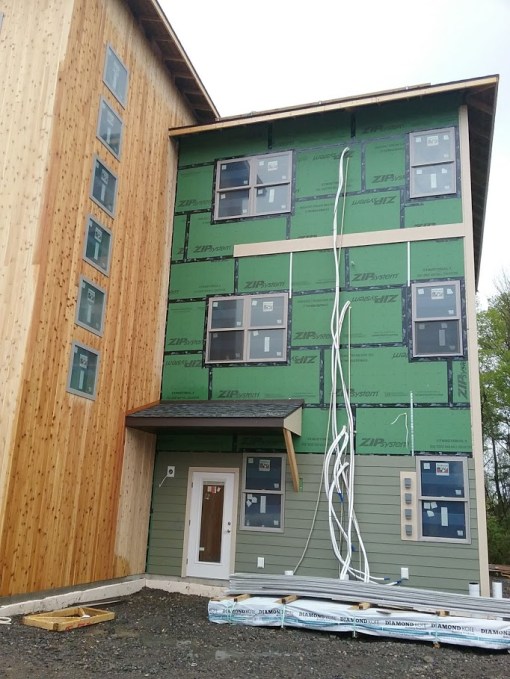
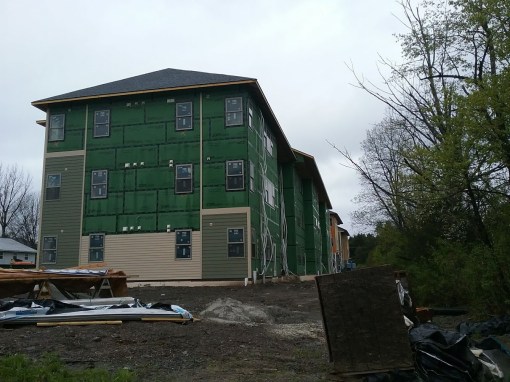
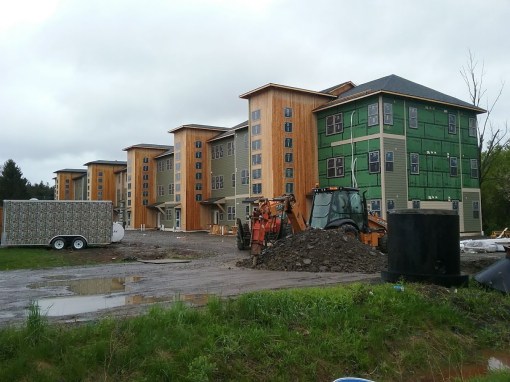
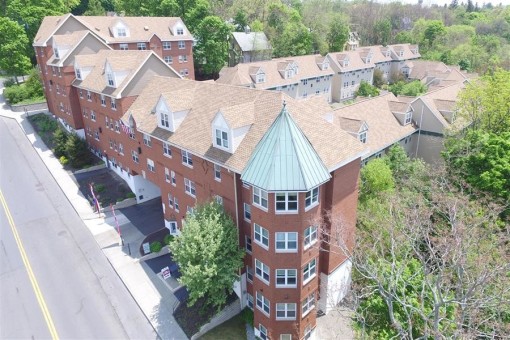
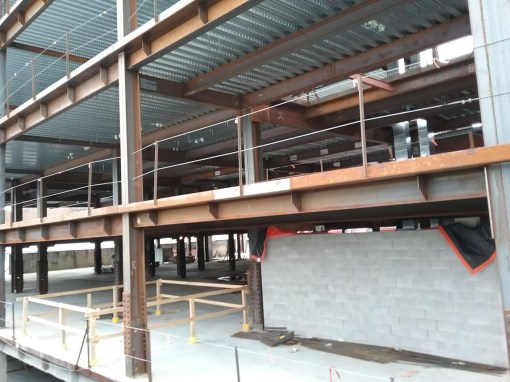
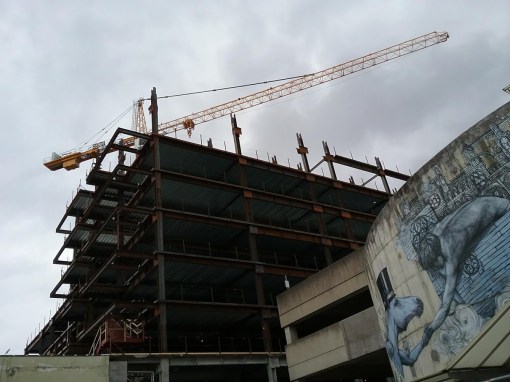
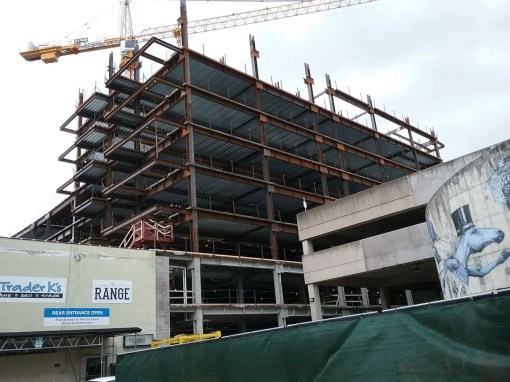
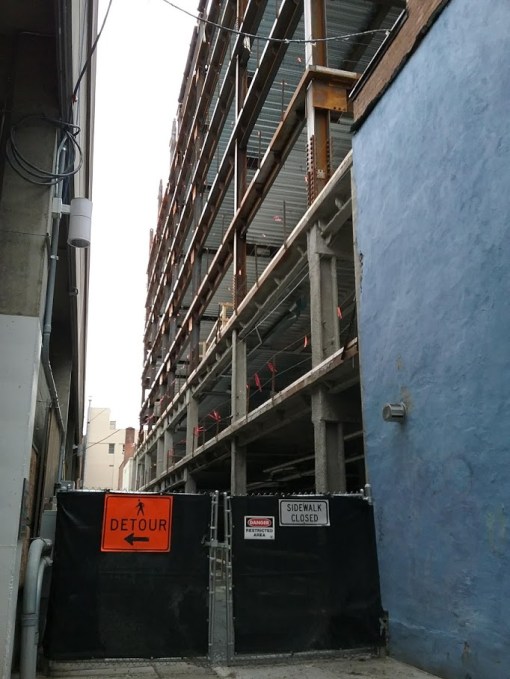
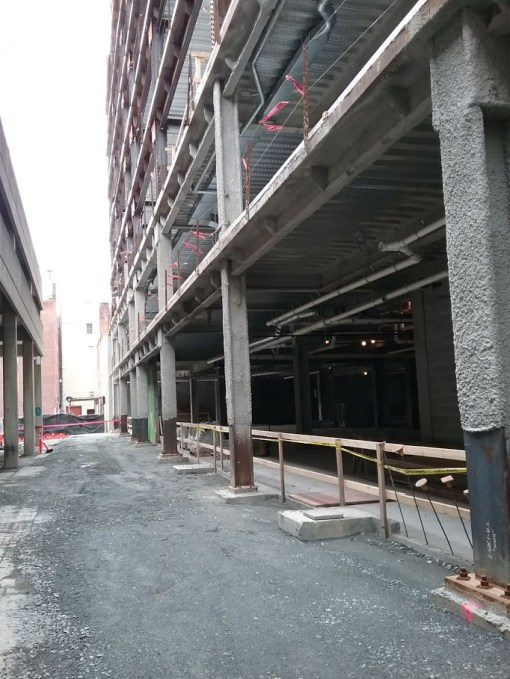
For my practical purposes, I’m going to call this one complete. The 193 apartments opened for occupancy at the start of the month, and interior framing and utilities installations are underway for the three ground-floor commercial tenants (Collegetown Bagels, Chase Bank, and the Ale House) later this summer. Landscaping and pavement is in, although the underground garage was cordoned off. With no good angles aloft, it’s not clear if the 7.5 kW rooftop solar array is in place yet.

Overall I think this project will be a real asset to Ithaca’s Downtown. It creates an active-use streetwall where there was once dead space, and extends and enhances the activity of the Commons and the other side of the 300 Block of East State. The addition of over 200 new residents downtown (224 if one per bedroom or studio) will also benefit local business owners with a steadier crowd than the workforce 9-5 and hotel guests. The project is a 218,000 SF, $52 million vote of confidence in the future of Ithaca’s urban core.

The design, however, is pretty average. The curved wall facing East State and North Aurora is a nice touch (and good on the Planning Board to push for the cornice), but the mishmash aluminum panels makes me think of an old beater car that had its original fender panels replaced with those a different color. As always with architecture, to each their own.

First person to name all the people in the Ithaca art mural in the photo set below gets a shoutout on the blog.

Background information and the history of the project can be found here. The project team includes Newman Development Group, Humphreys & Partners as architect, Whitham Planning and Design LLC as the team representative and point of contact for the review process, and T. G. Miller PC for civil engineering and surveying work. EC4B Engineering handled the mechanical, electrical and plumbing (MEP) engineering, and Taitem Engineering served as the energy systems consultant.

Before:

After:


323 Taughannock Boulevard Construction Update, 5/2019

2 06 2019

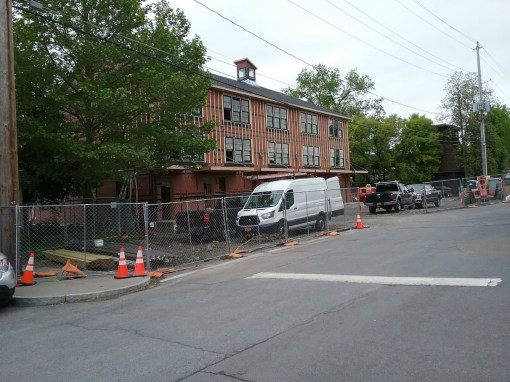
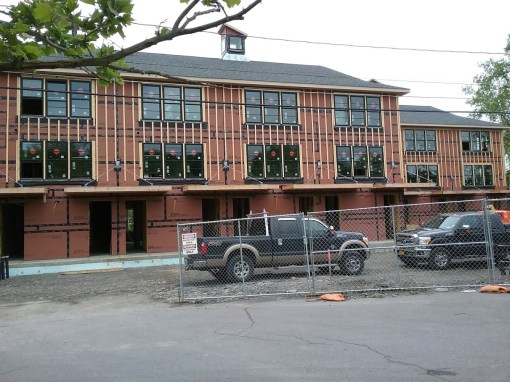
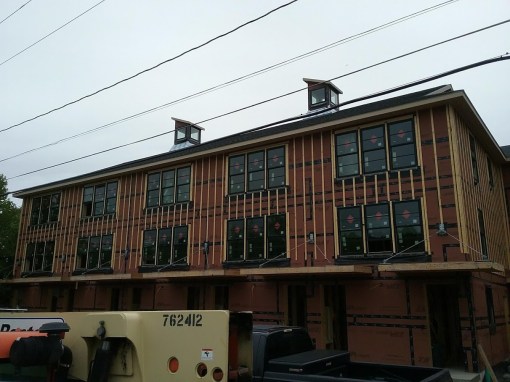
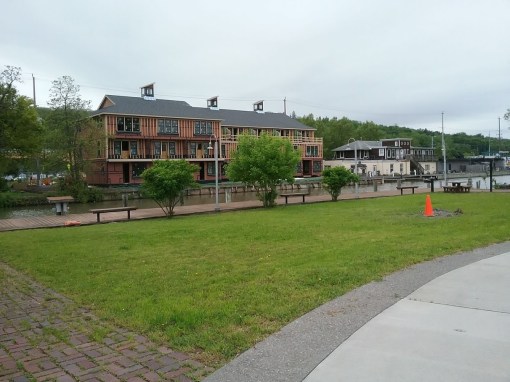
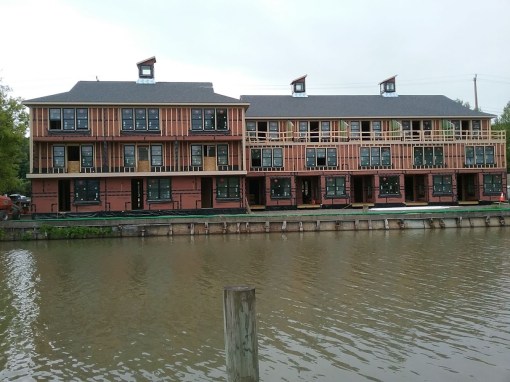
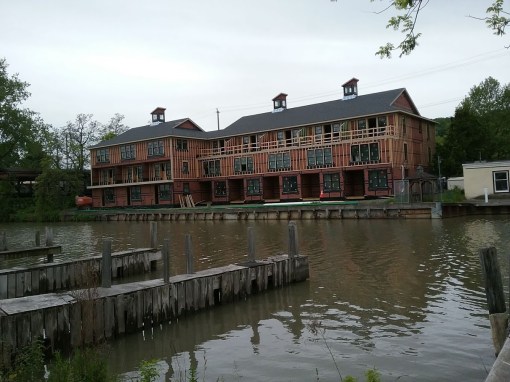
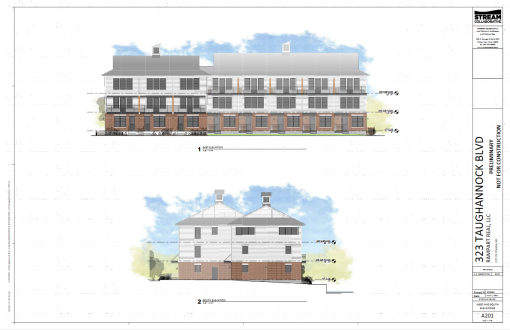
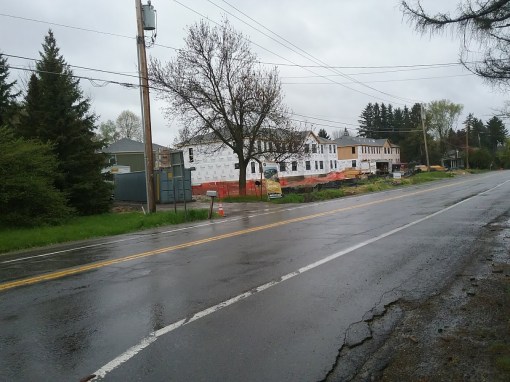
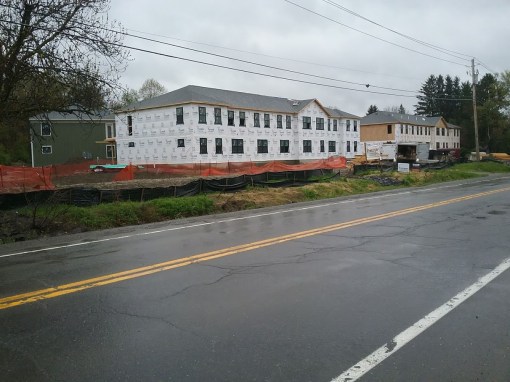
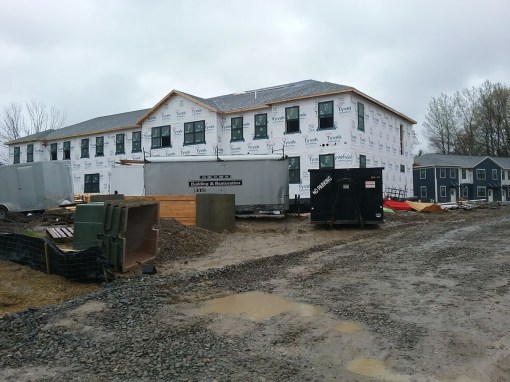
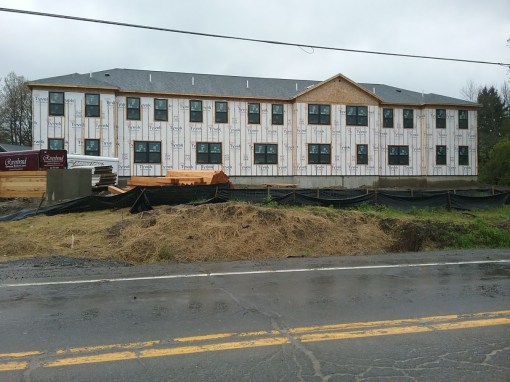
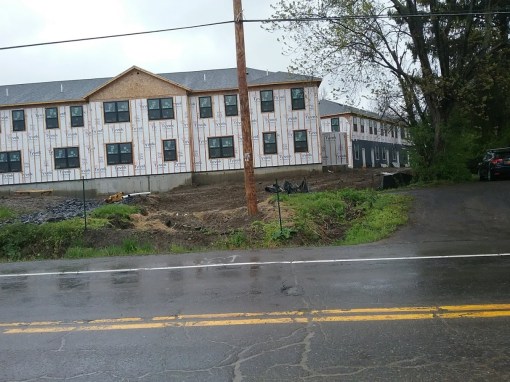
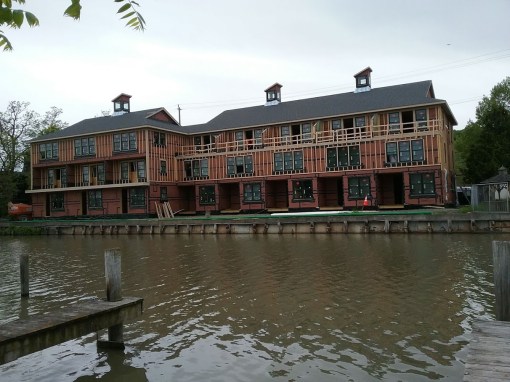
If you think these went up fast, it’s because they did. The modular pieces from Bensonwood were installed in just a couple of weeks; the group of three one week, and the group of five the next (note that the two substrings are slightly offset from each other). The units came with windows fitted and ZIP panel plywood sheathing already in place. The wood rails for the lap siding came after installation onto the foundation. The first floor will be faced with brick, the top two floors with fiber cement lap siding.

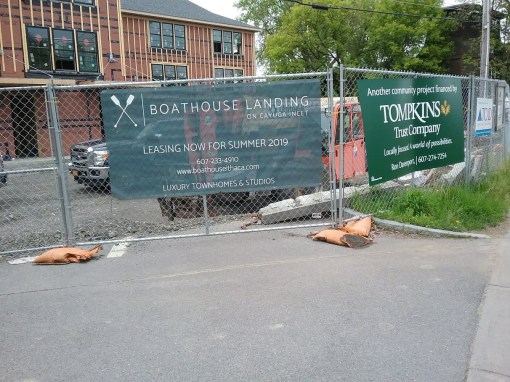
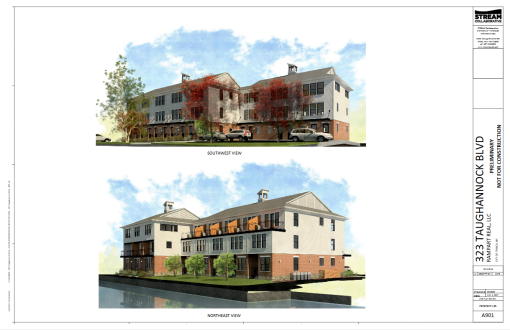
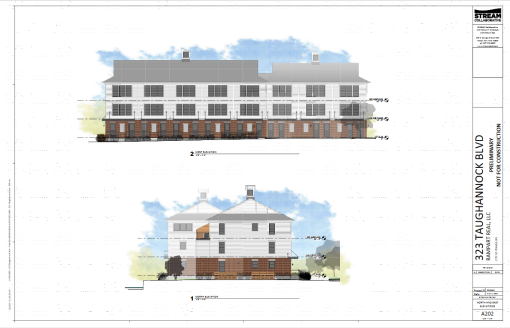
The 323 Taughannock project has a name “Boathouse Landing on Cayuga Inlet“. It’s a mouthful. The website is full of the typical heavy, pretentious marketing that defines high-end residential real estate – the reference to “private lifts”, for instance, because calling it an elevator is too plebeian. There’s a substantial possibility that STREAM Collaborative designed the website and branding as they’ve done with some of their projects like the Cottages at Fall Creek Crossing, especially since the layouts are similar, but I doubt any of their staff would employ such overly florid language. It might have been someone at the developer (Arnot Realty) office or a marketing team they contracted out to.

Features and amenities include private patios and balconies, cable and high-speed internet, stainless steel Energy Star appliances, off-site solar power, in-unit laundry, LED lighting, plank flooring on the upper levels, radiant floor heating in the bathrooms, A/C and heat that can be controlled for each room in the unit, private elevators and smart video doorbell systems on certain units, and fully accessible units for those who may have mobility or physical impairment issues. Pets are permitted, and there appears to be an on-site fitness center in the works.

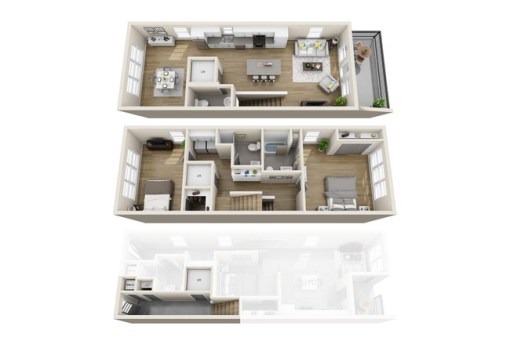
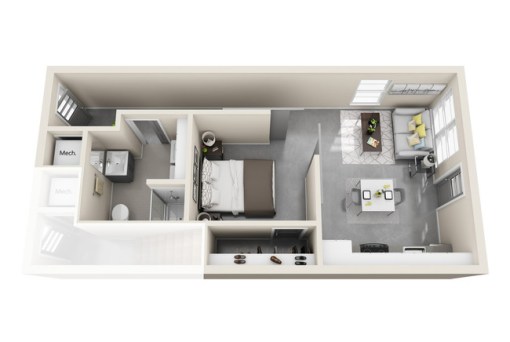
The floor plans can be seen here. The eight two-bedroom units come in three flavors, dubbed “Catalina”, “Hinckley” and “Garwood”. Catalinas have the elevators, and are the largest at 1,750 SF.  Hinckleys are slightly smaller at 1700 SF and lack the elevators, while Garwoods are the smallest at 1,360 SF. All are 2 bedroom, 2.5 bath units. The eight studios come in three flavors as well – “Crosby” (670 SF), “Hobie” (630 SF), and “Laser” (600 SF). It is not clear how those names were selected.

According to online listings, the top-of-the-line Catalinas are listed at $3600-$3700/month, while the other two-bedroom units are $3,400-$3,500/month. Studios go for $1,500-$1,850/month. The project team is aiming to be ready for occupancy by July 29th.

More about the project history and features can be found here.


Absolutely not.

The Catalina two-bedroom floorplan.

The Laser studio floor plan.


802 Dryden Road Construction Update, 5/2019

2 06 2019

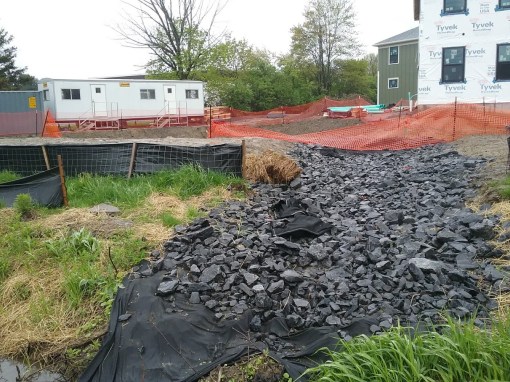
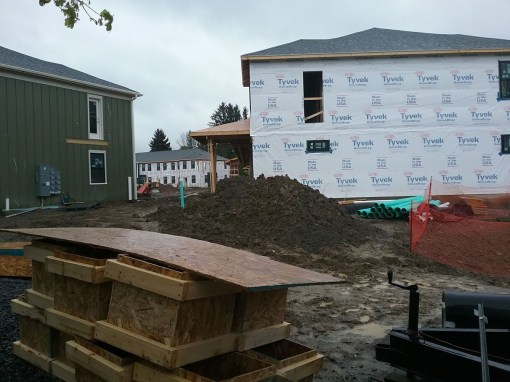
Still clearing the photo cache. From the Voice, with the abridged photo set:

“Next to the Cornell Arboretum, the 42-unit, $7.5 million Ivy Ridge Townhomes are fully framed, and two of the townhouse strings are practically complete from the outside. The website for the project touts that two of the buildings are 100% leased, which doesn’t give any clues about what percentage of all the units are leased — I could tell you the first two houses on my street are occupied, but if the other five are vacant, then that paints a substantially different picture of my street. But hey, apparently they’re giving $20 lunch gift card as a thank you for doing tours, so we know it’s not 100%.

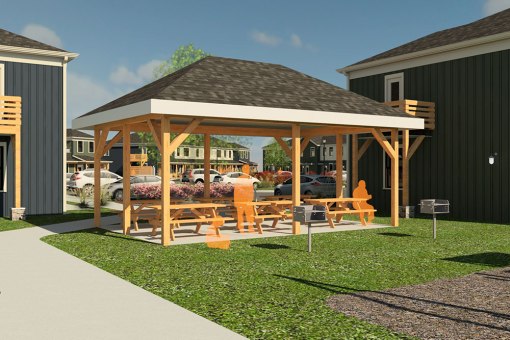
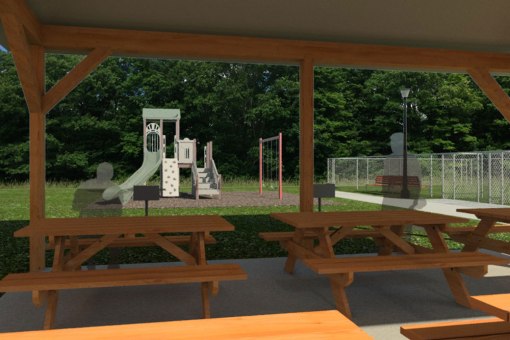
Looking at the website FAQ, it’s clearly geared to Cornell students, and though rents haven’t been posted on most websites, it looks like C.S.P. Management has discreetly posted the figures online. A two-bedroom will be $1,800/month, a three-bedroom $2,500/month, and a four-bedroom $3,200/month. Cable and most utilities (all except electric) are included in the rent, the units come partially furnished, and pets, include large dogs, are allowed. Stainless steel appliances, in-unit washer and dryer, and marble tile are also planned. Exterior features include 70 parking spaces, bike racks, stormwater ponds, bioretention areas, a children’s playground, and a dog park. Occupancy/project completion is expected by mid-August, in time for the fall academic semester.”

***

It looks like once the buildings are framed, sheathed and fitted with windows and doors, wood rails are attached over the housewrap for the vertical siding, which is attached in segments. Two of the seven-unit apartment strings (“E” and “F”, using the earlier nomenclature) are largely complete from the outside with the exception of structural trim and finish work (porches/balconies/awnings), two others (“D” and “C”) have exterior siding being applied, one was sheathed but not fitted with rails (“A”), and the last one, on the right in the first image (“B”), is still in the process of being sheathed, though I believe it started construction before “A” did. This is all work that can be finished in time for the school year. The website FAQ claims June; dunno about that.

While landscaping won’t come until the end, it looks like the wood and concrete bases for the “Ivy Ridge” monument signs are in place out front.

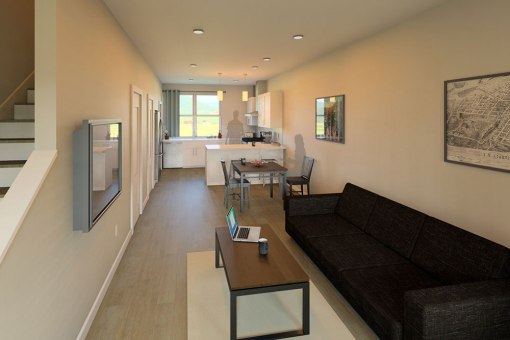
Units will come partially furnished, as many student-oriented and young professional residential facilities do. Bedrooms include a queen-size bed, a four-drawer dresser, a desk and a chair, and a headboard with an integrated shelf and a USB charger. In the commons area, there will be a dining table with chairs, a couch, a living room chair, a coffee table, an entertainment center, and a side table. Included in the rent are water, sewer, high-speed internet, cable, trash, and recycling. Residents are only responsible for electricity. The website seems to be making a bit of an effort to downplay the student side of it, probably for Dryden’s sake, but being right on the eastern edge of Cornell will certainly give them and edge over most of the rentals in the Varna and West Dryden areas.

More information about the project and its recent sale between developers can be found here and here.


News Tidbits 5/27/19

28 05 2019

Just a quick pose here to share and take a look at the city Planning Board Agenda tomorrow evening:

1. Agenda Review 6:00

(there is no Item 2. on the agenda)

3. Privilege of the Floor 6:25

4 Approval of Minutes: April 23, 2019 6:35

5. Site Plan Review

A Project: Greenstar Project Changes 6:40
Location: 770 Cascadilla Street
Applicant: Noah Demarest, Stream Collaborative (for owner)
Actions: Approval of Project Changes

Project Description: This project was approved by the Planning Board on June 26, 2018, with subsequent changes approved by the Board on March 26, 2019. The applicant is now returning to with requested items and to request additional changes. Project materials are available for download from the City website: https://www.cityofithaca.org/DocumentCenter/Index/774

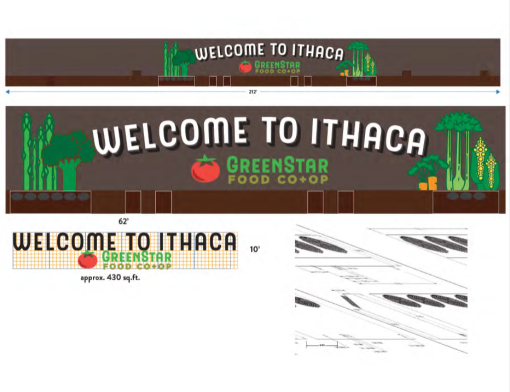
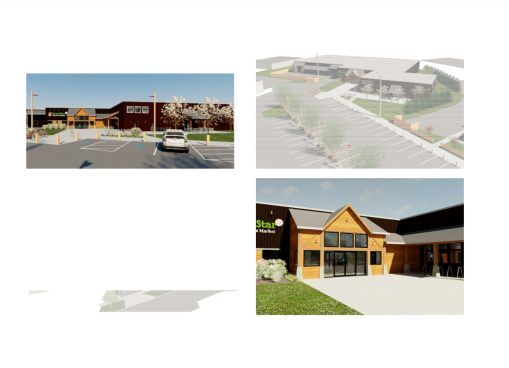
The GreenStar project was halted by the board due to aesthetic concerns related to the value engineering. In response to the concerns about the blank wall that would face Route 13, the mural above has been proposed. The development team is also proposing new signage and replacing the wood bollards in the parking lot with lighted steel bollards.

Few further issues are expected to come up, and approval of these changes would allow the project to continue with construction. GreenStar is certain enough of the Board’s approval that its existing 10,000 SF space at 701 West Buffalo Street has been put up for lease.
B Project: Chain Works District Redevelopment Plan 6:50
Location: 620 S. Aurora St.
Applicant: Jamie Gensel for David Lubin of Unchained Properties
Actions: Presentation of Revised Phase 1, Public Hearing, Potential Preliminary Approval of Conceptual Site Plan

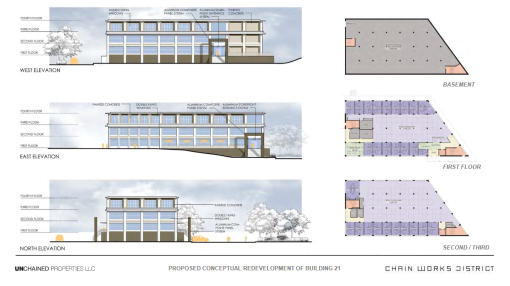
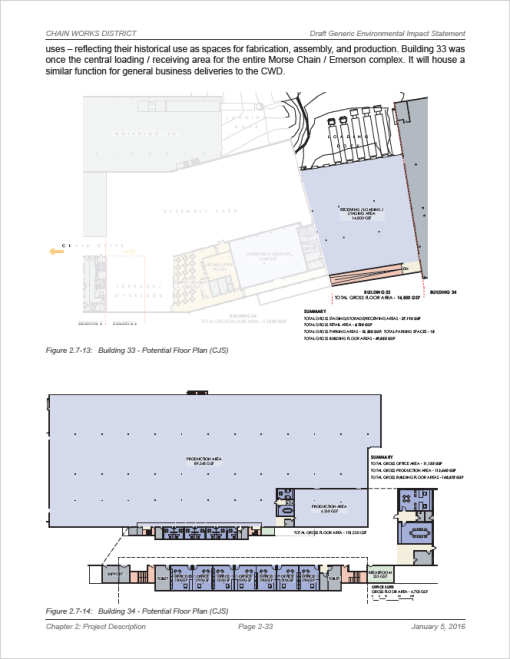
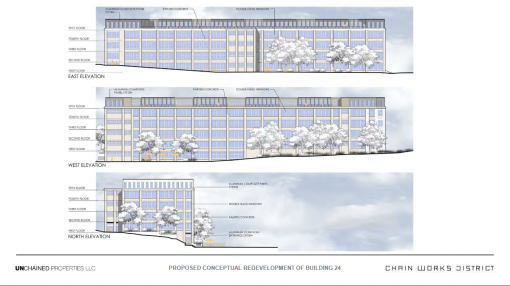
Project Description: The proposed Chain Works District is located on a 95-acre parcel traversing the City and Town of Ithaca’s municipal boundary. It is a proposed mixed-use development consisting of residential, office, commercial, retail, restaurant/café, warehousing/distribution, manufacturing, and open space. Completion of the Project is estimated to be over a seven-to-ten year period and will involve renovation of existing structures as well as new structures to complete a full buildout of 1,706,150 SF. The applicant applied for a Planned Unit Development (PUD) for development of a mixed-use district, and site plan review for Phase 1 of the development in 2014. The project also involves a Planned Development Zone (PDZ) in the Town and subdivision. This project is a Type I Action under the City of Ithaca Code, Environmental Quality Review Ordinance, §174- 6 (B)(1)(i),(j),(k),(n), (2), (6), (7),(8)(a)and (b) and the State Environmental Quality Review Act §617.4 (b)(2),(3), (5)(iii), (6)(i), and (iv), for which the Lead Agency issued a Positive Declaration of Environmental Significance on October 28, 2014. The Lead Agency held subsequently Public Scoping on November 18, 2014. The Lead Agency deemed the Draft GEIS adequate for public review on March 8, 2016, held the public hearing on March 29, 2016 and accepted comments until May 10, 2016. The Lead Agency filed a Notice of Completion for the FGEIS on March 5, 2019. The FGEIS includes the original DGEIS, all comments and responses on the DGEIS, revised information resulting from those comments, and updated information since the publication of the DEIS. The Board adopted findings on March 26, 2019. The applicant is now proposing Phase 1 of the project which entails the rehabilitation of buildings 21 and 24. Project materials are available for download from the City website: http://www.cityofithaca.org/DocumentCenter/Index/119

Doing a cross-check, I don’t quite see what changes have been made with Phase I, though early plans called for more office space (now mixed-use, with office space and 60 apartments). Approval of the concept plan (in relation to the FGEIS) is not the same as approval of the individual renovation plans, which have been submitted but will take a couple more months of the standard retinue of environmental assessment forms and declaration of findings. The approved EIS looks at the concept as a whole, while materials, construction impacts and other details associated with individual building plans still require going through the planning board.
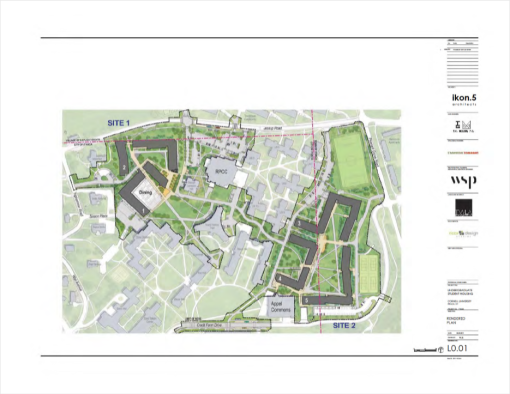
C. Project: North Campus Residential Expansion (NCRE) 7:10
Location: Cornell University Campus
Applicant: Trowbridge Wolf Michaels for Cornell University
Actions: Continuation of Site Plan Review (Jessup Road Elevations & Conditions of Approval)

Project Description: The applicant proposes to construct two residential complexes (one for sophomores and the other for freshmen) on two sites on North Campus. The sophomore site will have four residential buildings with 800 new beds and associated program space totaling 299,900 SF and a 1,200-seat, 66,300 SF dining facility. The sophomore site is mainly in the City of Ithaca with a small portion in the Village of Cayuga Heights; however, all buildings are in the City. The freshman site will have three new residential buildings (each spanning the City and Town line) with a total of 401,200 SF and 1,200 new beds and associated program space – 223,400 of which is in the City, and 177,800 of which is in the Town. The buildings will be between two and six stories using a modern aesthetic. The project is in three zoning districts: the U-I zoning district in the City in which the proposed five stories and 55 feet are allowed; the Low Density Residential District (LDR) in the Town which allows for the proposed two-story residence halls (with a special permit); and the Multiple Housing District within Cayuga Heights in which no buildings are proposed. This has been determined to be a Type I Action under the City of Ithaca Environmental Quality Review Ordinance (“CEQRO”) §176-4 B.(1)(b), (h) 4, (i) and (n) and the State Environmental Quality Review Act (“SEQRA”) § 617.4 (b)(5)(iii) for which the Lead Agency issued a Negative Declaration on December 18, 2018 and granted Preliminary Site Plan Approval to the project on March 26, 2019. Project materials are available for download from the City website: http://www.cityofithaca.org/DocumentCenter/Index/811

This one’s starting to get a bit long in the tooth – Cornell was hoping to start construction by the beginning of summer, so that the first phase of dorms (Buildings 1 and 2 above) would be ready for occupancy in August 2021. According to Kim Michaels of landscape architect (and project team rep) TWMLA, they’re aiming for preliminary approval at the June 25th meeting, which would allow them to obtain construction permits to start work. The village of Cayuga Heights’ planning board gave their okay last month, and the town has granted preliminary site plan approval as well.

Changes include replacing the concrete retaining wall for Awke:won’s driveway with natural stone, minor grading adjustments, replacing plaza asphalt with concrete and porous pavers, revised plantings (partly at the town’s suggestion, partly because the demolition plans requires the removal of six more mature trees than first anticipated, and the project team is aiming to plant new trees to make up for it), revised sidewalks, bus stops and ADA ramps.

D. Project: Arthaus on Cherry Street 7:30
Location: 130 Cherry Street
Applicant: Whitham Planning & Design (on behalf of Vecino Group)
Actions: Consideration of Preliminary & Final Site Plan Approval

Project Description: The applicant proposes an as-of-right five-story building approximately 63 feet of height with gallery, office and affordable residential space at 130 Cherry Street, on the east side of the Cayuga Inlet. The site is currently the location of AJ Foreign Auto. The program includes ground floor covered parking for approximately 52 vehicles, plus 7,000 SF of potential retail/office and amenity space geared towards artists’ needs. Building levels two through five will house approximately 120 studio, one-bedroom and two-bedroom residential units. The total building square footage is 97,500 SF. All residential rental units will be restricted to renters earning 50 to 80 percent of the Area Median Income. The north edge of the property will include a publicly-accessible path leading to an inlet overlook. This has been determined to be a Type 1 Action under the City of Ithaca Environmental Quality Review Ordinance § 176-4B(1)(k), (h)[2], (n), and the State Environmental Quality Review Act (“SEQRA”) § 617.4(b)(11). Project materials are available for download from the City website: https://www.cityofithaca.org/DocumentCenter/Index/946

The IDA has given its approval on the tax abatement, so all that’s left on the approvals side of things is preliminary and final site plan approval – with those, Vecino can begin work on affordable housing grants to help fund the project. Vecino will be pursuing a less-competitive 4% low-income housing tax credit (the typical, highly-competitive LIHTCs are 9%; quick refresher, these credits are sold to outside investors and the money is then used to fund the project), and the project team seems comfortable stating that construction will start by the end of the year for a 2021 completion.
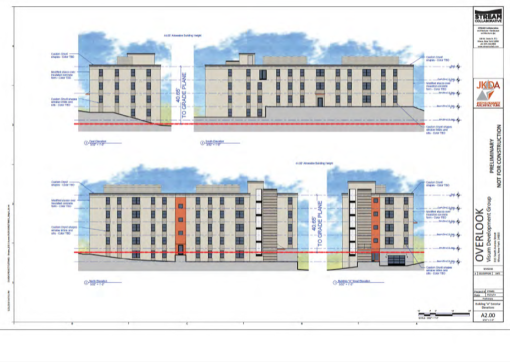
E. Project: Student Housing 7:50
Location: 815 S. Aurora Street
Applicant: Stream Collaborative, Noah Demarest for Project Sponsors Todd Fox & Charlie O’Connor
Actions: Project Presentation, Potential Consideration for Preliminary Site Plan Approval

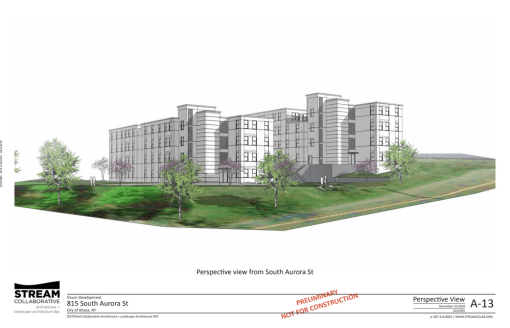
Project Description: The project applicant proposes a new 49-unit student housing complex (16,700 SF footprint) comprised of three buildings constructed on a hillside on the east side of Route 96B, overlooking the proposed Chain Works District. The proposed buildings will contain (2) efficiency units, (3) one-bedroom units, (10) two-bedroom units, (20) three-bedroom units and (14) four-bedroom units. Amenities will include a gym and media room, with access to an outdoor amenity space on the first floor of Building B, and a roof terrace and lounge on the fourth floor of Building B. The project site shares the 2.85 acre site with an existing cell tower facility, garages, an office and a one-bedroom apartment. Site improvements will include walkways and curb cuts to be tied into a public sidewalk proposed by the Town of Ithaca. Fire truck access is proposed at the existing site entry at the south end of the property, with a new fire lane to be constructed in front of the ends of buildings A & B at the northern end of the site. The project will include 68 parking spaces, as required by zoning. The property located in the R-3b zoning district. A variance will likely be required for a rear yard setback deficiency. This has been determined to be a Type 1 Action under the City of Ithaca Environmental Quality Review Ordinance §176-4(B)(1)(k), (n), (B)(2), and the State Environmental Quality Review Act (“SEQRA”) §617.4(b)(11). Project materials are available for download from the City website: https://www.cityofithaca.org/DocumentCenter/Index/982

The project description is not accurate. According to the memo from STREAM, the project is 65 units, but still 141 beds, with 2 one-bedroom, 40 two-bedroom, and 23 three-bedroom units. This has created some minor exterior changes, mostly in the window arrangements. A report from TAITEM chimed in to say that the project does meet the city’s Green Building Policy (which is approved in concept but has slowly been trudging through the legal details). Neighbors have expressed concerns with the project

F. Project: Mixed Use Apartments (77 Units) 8:10
Location: 510 W MLK/ State Street
Applicant: Stream Collaborative, Noah Demarest for Project Sponsors Todd Fox & Charlie O’Connor
Actions: Project Presentation, Declaration of Lead Agency, Review – Draft FEAF Parts 2 & 3

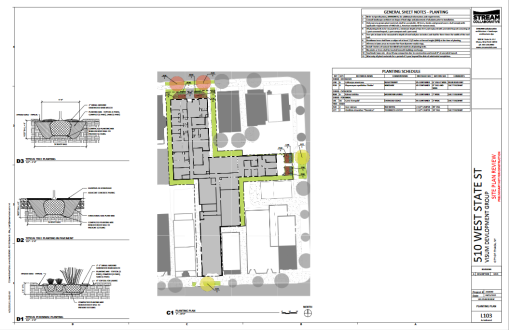
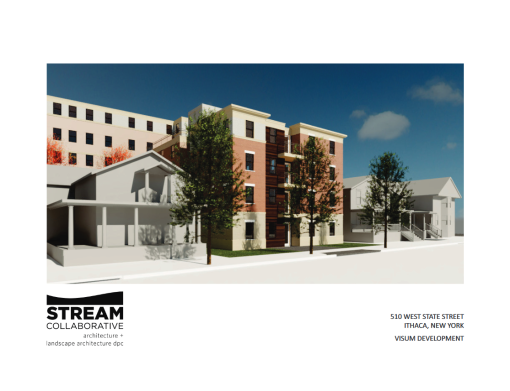
Project Description: The applicant proposes to construct a 4- to 6-story building with a footprint of 13,730 SF and a GSA of approximately 74,700 SF. The project will have 2,100 SF of retail space on the first floor facing W State/ MLK Street and 77 housing units, permanently affordable to households making 50-70% Area Median Income (AMI). Building amenities include a community room, bike and general storage, a laundry room and a fifth floor lounge with access to a rooftop terrace. The project site has frontage on three streets (W State/MLK, Corn and W Seneca) and is in two zoning districts: CBD 60 in which the maximum height is 60’ and B-2d in which the maximum height is 40’. Neither zone has a prescribed number of stories. The project is subject to the Downtown Design Guidelines and will likely require an area variance for rear yard setback. This has been determined to be a Type 1 Action under the City of Ithaca Environmental Quality Review Ordinance §176-4 B(1)(h)[4], (k) & (n), and the State Environmental Quality Review Act (“SEQRA”) §617.4(b)(11).

Looks like the number of units has settled on 77. The question here remains what to do with the State Street elevation, given the likely zoning change will force a 15′ setback from the 5th floor instead of the sixth as proposed.
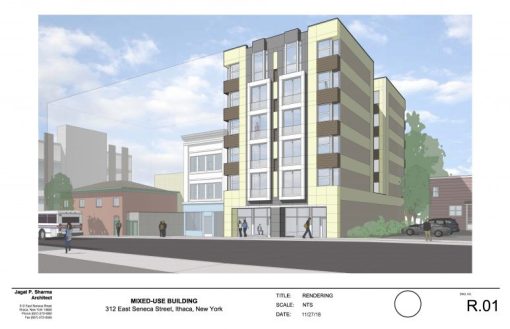
G. 312 E Seneca Street – Sketch Plan 8:30

The original design above received the planning board equivalent of a roundhouse kick to the jaw, so we’ll see what happens with round two, for which it is hoped the Stavropoulos family and their architect (presumably Jagat Sharma as before) have read the Downtown Design Guidelines. Given its location on the edge of Downtown Ithaca, this is a CBD-60 site, six floors, 100% lot converge, no parking covering.

A potential wild card here is the recent rumor that the owners of the properties next door on North Aurora have put the assemblage up for sale. A redesign may or may not include those properties.

6. Old/New Business 9:00
-Special Meeting Agenda for 4-30-19
-Board Retreat Topics
-Sexual Harassment Training

7. Reports 9:10
A. Planning Board Chair
B. BPW Liaison
C. Director of Planning & Development

8. Adjournment 9:30
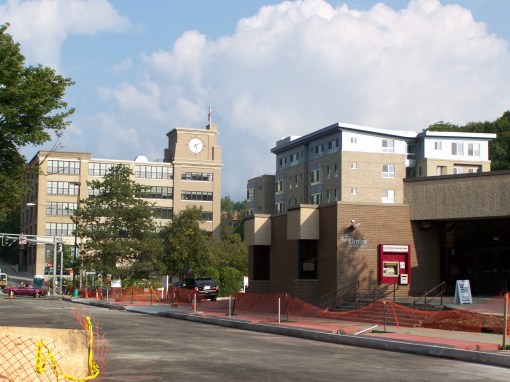


East Pointe Apartments Construction Update, 5/2019

26 05 2019

Quote: “The first 10-unit apartment strings are ready for occupancy in the 140-unit East Pointe Apartments complex on Bomax Drive in Lansing village. In the typical overwrought, florid language of press releases, Park Grove realty, the developer, states the “East Pointe Apartments offers residents a unique living option away from the compact noisy rentals of downtown Ithaca with comparable prices ranging for $1695 a month for a spacious one-bedroom to just shy of $2,000 a month for a three-bedroom unit,” with “luscious walk-up gardens”, granite counter tops, stainless steel appliances and wall-to-wall carpeted bedrooms with USB outlets.

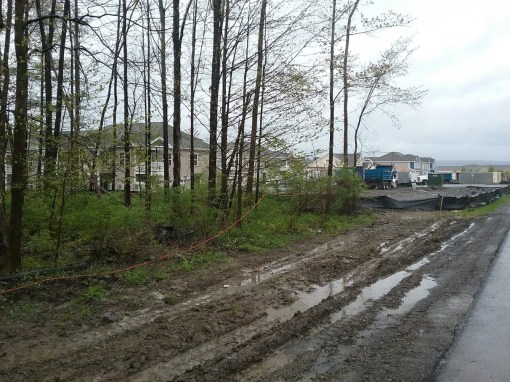
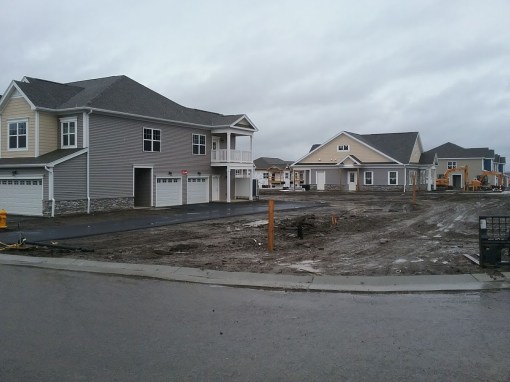
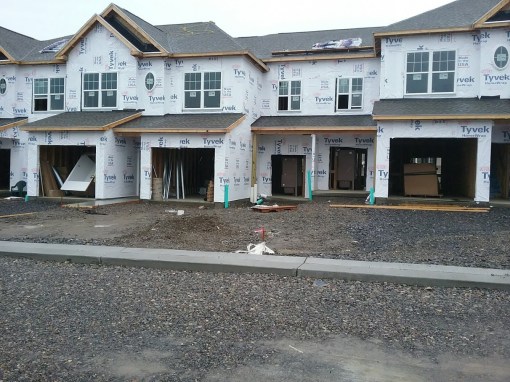
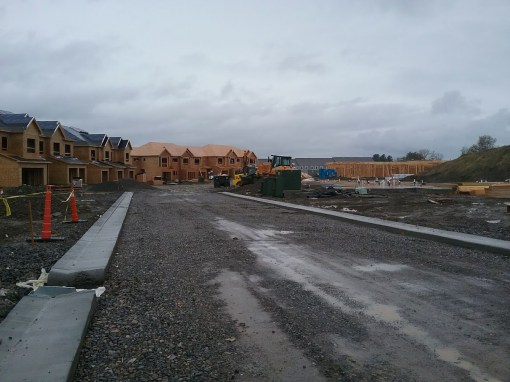
As the photos make clear, the “luscious walk-up gardens” aren’t a thing just yet, though there were dozens of saplings stacked next to Bomax Drive, waiting to be planted. Rather unusually, the timeline of the project was moved up, from a Spring 2020 completion to a finish by the end of 2019. Glancing around the project site is like a step-by-step walkthrough of the construction process. First comes the excavation and slab foundation pour with underground utilities poking out in various pipes and tubes. Then comes from the wood framing, the felt papering of the roof, and the plywood sheathing and Tyvek wrapping. Next are the roof shingles and insulation, the rough-ins, the vinyl siding and fixtures. Once the trim boards are up and the cabinets, flooring and finishes are in, they’re just about ready for their new renters.”

***

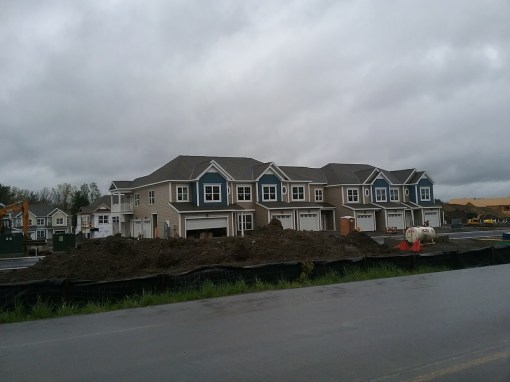
Red boxes overlay townhouse strings that are largely complete from the outside. Green is framed and sheathed (plywood with Tyvek housewrap), but lacks exterior siding, trimboards and architectural details. Blue are townhouse strings where framing is underway. Purple boxes are strings that are undergoing foundation pours and utilities installation. Looking at the site and comparing it to the site plan above, it seems that the community center is actually to the east (right) of the entrance, so there likely going to be two townhouse strings to its left (west), one of which is largely completed and one of which is just a foundation slab at this point.

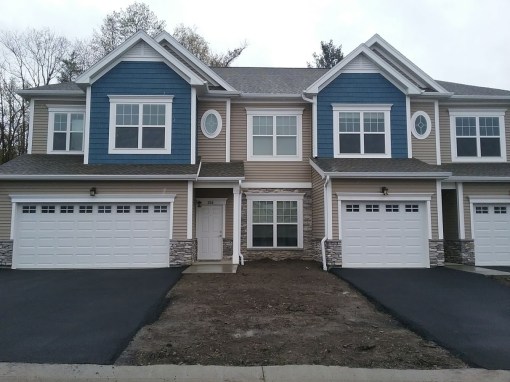
It appears they’re sticking to just the two color palettes (tan/blue and grey/yellow) and not using the third color combination from the rendering. Although the project states the first units are open for occupancy, it did not appear anyone was living there yet when these photos were taken earlier this month.

Here’s a full copy of the typically puffed-up press release, which appears to quote one of my previous Voice articles:

“Ithaca, New York (March 25, 2019) – East Pointe Apartments, the village of Lansing’s latest property development opens for residence off Bomax Drive in Ithaca, New York. The first apartments are currently available for occupancy.

East Pointe Apartments are in the heart of Lansing, New York – a rural community just North of Ithaca on the shores of Cayuga Lake. The new real estate development will help the historic village gain momentum into the twenty-first century. Rochester, NY developers and property managers, Park Grove Realty hopes to set a standard for luxury living within the community.

With 20 acres and 140 state-of-the-art new construction apartment units the Ithaca Voice rightly reports East Pointe Apartments as, “…one of the largest projects the village of Lansing has seen in many years.”

Lansing’s multi-million dollar property development project will include 42 one-bedroom units, 84 two-bedroom units, and 14 three-bedroom units all nestled within the quaint village of Lansing, New York. East Pointe Apartments offers residents a unique living option away from the compact noisy rentals of downtown Ithaca with comparable prices ranging for $1695 a month for a spacious one-bedroom to just shy of $2000 a month for a three-bedroom unit.

When approaching East Pointe Apartments property development, residents will be greeted by the luscious walk-up gardens upon pulling into their personal attached garage. Each unit includes a private entrance with a choice of oversized patio or deck.

Inside luxuries include a private laundry room with in-unit washer and dryer, granite counter tops wood cabinets and stainless steel appliances in the kitchen, high end electric and plumbing fixtures, and wall-to-wall carpeted bedrooms with USB outlets throughout.

The high-end finishes extend beyond the residences with access to Fiber Optic WiFi throughout the complex, an exclusive dog park, and a luxury community building. The residents will enjoy an in ground pool, fitness center, great room, and kitchen. The community building will also house the leasing office and professional on-site management staff.

DGA Builders, LLC construction will continue to expand the residences throughout 2019 with all 14 buildings scheduled to be completed by the end of the year.

Park Grove Realty has over 35 years of real estate experience in property development, property management, and consulting. Their focus on long-term value and community-centric actions have earned them Western New York’s Landmark Society Award of Merit. They continue to broaden their portfolio in 2019 with upcoming developments all over the Northeast.”


Village Solars Construction Update 5/2019

25 05 2019

From the Voice, with light editing:

“Quietly plodding along off the 1000 Block of Warren Road, Lifestyle Properties’ Village Solars Apartments continues its steady buildout. This is one of the largest projects in Tompkins County, with 277 apartments approved, with potentially more in the works on the adjacent property to the east. So why doesn’t it get much attention? They build a couple of apartment buildings each year, they don’t have tax abatements or any high-profile review process because they were approved by the town as a Planned Development Area (flexible “D-I-Y” zoning), and they’re in a less-trafficked part of the county north of the airport. They’re low profile, physically and programmatically.

Under construction right now are Buildings “K” (113 Village Circle) and “L” (40 Village Place), which make the 11th and 12th buildings to have been built in the past five years. The 24-unit Building “K” is mostly complete from the outside, and likely to open for occupancy later this spring, adding another 3 three-bedrooms, 6 two-bedrooms, 3 one-bedrooms and 12 studios to the market. 24-unit Building “L”, just to its east, isn’t as far along. It’s framed, sheathed and has had its windows and doors fitted, but the fiber cement siding is only partially finished, and exposed interior stud walls are visible through the windows. If you’re wondering what the rat’s nest of white cables are, those are connections for the air-source electric heat pumps – the units are installed towards the bottom, and the cables are framed in by a bump-out for aesthetic purposes.

The latest two buildings are being funded courtesy of a $5.6 million construction loan extended by Elmira Savings Bank. According to the loan filing, both buildings are expected to be completed and ready for their first tenants by the end of September. But more realistically, given that the local rental market revolves around the academic cycle and that some graduate and professional students make their homes here, expect the new apartments to be ready for occupancy no later than mid-August.”

***

I must have missed the part when “Equinox Way”, the new through road was named. Still waiting a construction start on Building “F”, as seen below the site is just grass at the moment. Offhand, Lifestyle Properties can start one more building before they have to build the mixed-use community building, and regardless, the community center must be complete by the end of 2020.

The timeline and plans for each phase is out of whack because the redevelopment of the existing apartment 1970s buildings was expected before new sites were to get underway. I’d venture a guess the 2019-2020 phase would be 18-unit Building “M” and the Community Center, for an August 2020 completion.

Giving credit where credit is due – the in-house construction crew is moving fast with these. Building “L” hardly had its site cleared and wood foundation forms in back in February. Years of practice pays off, perhaps. Interior walls and insulation is in, but drywall has yet to be hung, so completion is still a couple of months away.


News Tidbits 5/11/19

12 05 2019

1. The proposed revision (downzoning) along West State / MLK Jr. Street is moving forward with circulation (review by city departments and associated stakeholders), with a couple of major revisions. The zoning would not be CBD-60. It would be CBD-52 for structures with less than 20% affordable housing, and CBD-62 for structures with 20% or more affordable housing. The quirk in the height is due to mandatory floor heights, which will be 12 feet for the first floor, and 10 feet for each floor above – in other words, five floors for projects with a lack of affordable units (=< 80% area median income), six otherwise.

For 510 West State Street, in which all 76 or 77 units are affordable (my unit count is 76, but they typed 77 in a couple sport of the Site Plan Review), the project would remain largely intact. The new setback requirement would push the fifth and maybe a very small portion of the sixth floor back from West State/MLK Jr. Street for the mandatory fifteen feet, so a little square footage would be lost there. The city had initially sought thirty foot setbacks, but the Ithaca Fire Department said that it would not be reachable by their trucks if the fifth floor was that far away from the street face.

Now, some more astute readers might be wondering is this affects Visum’s other West End project at 109 North Corn Street. The answer is no. The setback rule only affects buildings fronting West State / MLK Jr. Street. The downzoning is intended to protect an aesthetically pleasing segment of West State more than anything else. The setback does technically apply to West Seneca Street, but the building height there is 40 feet anyway, which is the same as the setback.

The affected blocks now also include the 300 and 400 Blocks of West State Street. The only publicly known project that would be impacted is INHS’s Salvation Army redevelopment, which was only aiming for five floors on the West State Street side anyway, but could potentially be impacted by the setback rule – the project design is still in the concept stages with no public images.

A speaker during public comment asked to extend the zoning further to Downtown, and some councilors have discussed further downzoning because “the developers can just pursue a PUD”. That thought process ignores the drawbacks. The more areas impacted and the more stringent zoning becomes, the more labor and time intensive it becomes for city staff because it would likely trigger more PUDs, even while resulting in less development in general because a PUD adds months to a project timeline, uncertainty that lenders don’t like, and forces the Common Council to take on the role of a second Planning Board (which some councilors might be fine with, but some definitely would not and raised this as a complaint during the vote on whether to create the PUD overlay to begin with). Also, if the downzoning were to be applied to a property against the owner’s wishes, say the County Annex property for example, it would likely trigger a costly lawsuit. TL;DR, it looks tempting for additional “community benefits”, but could have significant negative impacts and should be used sparingly.

2. Staying in the realm of laws for a moment, there’s an ordinance that should be made aware to residents of Northside and Fall Creek. A proposal from 1st Ward councilor Cynthia Brock would require every rental agreement and every home sales transaction within 1200 feet of the Ithaca Area Wastewater Treatment Facility’s boundaries to provide documentation of the potential issues and hazards of living near the plant – “you should be prepared to accept such inconveniences and discomfort as a normal and necessary aspect of living and operating in proximity to a waste water treatment facility,” as the document states.

The document isn’t ill-intentioned, but this does impact over a hundred existing Northside and Fall Creek homes and apartments, and quite reasonably would have a negative financial impact on them, whether they plan to sell or if they rent out space. There is nothing on record that these residents have been notified of this proposal. City staff don’t even seem comfortable with the proposal as-is, they don’t think Fall Creek residents are substantially impacted and suggested a cutoff at Route 13, but the 1200 square foot radius seems to be the version being considered right now, paying a trip to city attorneys to see if it’s legal to apply it to all rentals, a detail added at the meeting. Honestly, this doesn’t seem well thought out at this time, and poses a burden to existing homeowners who have not been made aware because of the lack of sufficient outreach.

3. Arthaus and Library Place have had their tax abatement requests approved, on 7-0 and 6-1 votes. The former will bring 124 affordable housing units including special needs housing and artist-centric amenities to the city of Ithaca at 130 Cherry Street. The latter will provide 66 senior housing units on the former Library property on the 300 Block of North Cayuga Street. Arthaus is expected to start construction at the end of the year, while Library Place will resume this month, with completions in 2021 and 2020 respectively.
County legislator Leslyn McBean-Clairborne voted against the Library Place proposal, citing some of the concerns raise over the lack of affordable housing (three units will now be 80% area median income) and general discontent with the site. In my intro post to the project, I mentioned if vaguely that there was a legislator who thought the affordable housing, condominiums, and Travis Hyde projects were all terrible – that was McBean-Clairborne, who has generally favored county offices on the site instead of housing. The county did a study to consider renovating the old library for offices back in 2011, a couple years before the RFP, but the study found it was financially prohibitive because of the building’s unusual interior layout (that soaring 1960s atrium wasn’t a good use of space, and wouldn’t have been cheap to replace).

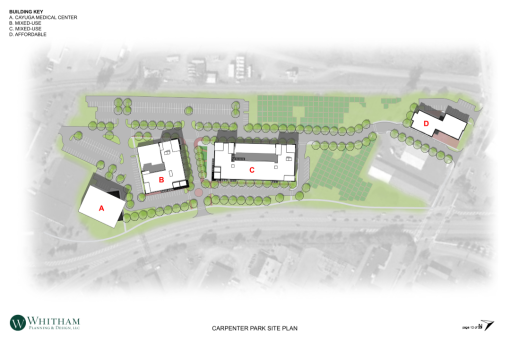
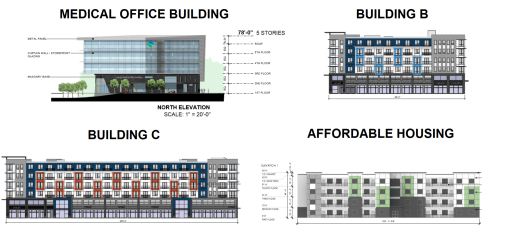
4. Carpenter Park is also moving forward, in this case with the pursuit of its special PUD zoning. The project is seeking the PUD because of some quirks in yard setbacks, and soil tests showing that they couldn’t place some of the parking underground as initially planned (so now it’s in an above ground garage between the ground-floor retail and the apartments in Buildings B and C). The project would bring about 411,600 SF of new space, including 208 apartments (42 affordable) and an expansion of Cayuga Medical Center’s medical offices, resulting in the creation of 150 jobs. The vote was 4-1, with councilor Brock opposed. The full council will vote on the PUD next month, and then the project can go to the planning board for design review. Keep in mind that the above designs might change somewhat, though the general scale and program mix should stay the same.

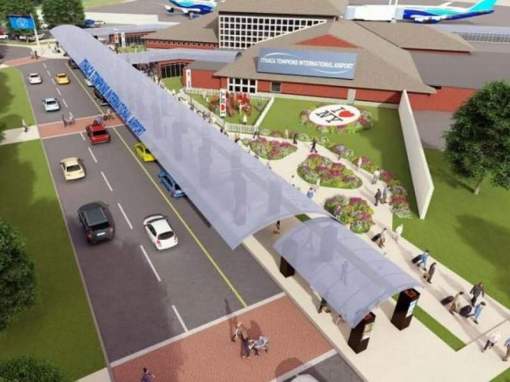
5. The Tompkins County Airport has received a $9,999,990 grant, as announced by U.S. Senator Chuck Schumer at a press conference earlier this week. The county was strongly hoping these funds would come through. With the state grant, it means the county is only paying about $260,000 of the $24.5 million bill. Click the link here to learn more about the airport expansion project.

6. The Gun Hill Residences appear to be in the process of selling. A real estate trade magazine notes Southeastern U.S. regional bank SunTrust is giving the buyer a $13.3 million acquisition loan for DMG Investments LLC. DMG Investments is an American subsidiary of a Chinese development firm, DoThink Group of Hangzhou. The company has been active in upstate recently. DMG co-owns a new 322-bed student housing apartment in Albany and has projects scattered across the country. The full sales price has not been discolosed, as the deed has yet to be filed. It was noted that the ca. 1989, 94-unit, 273-bed Gun Hill Residences on Lake Street was nearly completely full at the time of closing (late spring, which is reasonable given a couple of kids might have washed out of Cornell or otherwise moved out). The property was previously owned by Rochester’s Morgan Communities, which was raided by the FBI last year. Morgan purchased the property in February 2011 for $6.15 million, and the current county assessment for Gun Hill is $12.65 million.

OLD render

NEW render

7. Some modest revisions to the Immaculate Conception School plans. Old render first, new render second. The design of the renovated school building has changed substantially, though the overall size has remained consistent. The changes could be due to any number of reasons, from cost concerns to utilities placements necessitating design changes. The single-family homes have been replaced with a four-string of townhomes, and the yellow string has been earmarked for for-sale units.

If I may – make one of the olive green townhome strings red or orange like the houses that have been removed. Keeps it from being so “matchy-matchy”, to borrow a JoAnn Cornish term. More renders can be found on INHS’s sparkling new website here.

On that note, on Monday May 13th the City of Ithaca will hold a Public Information Session for the proposed PUD (Planned Unit Development) for the Immaculate Conception School redevelopment. The Public Information Session will begin at 4:00 PM, in the Common Council Chambers in City Hall. In accordance with the requirements of the PUD, the developer and project team will present information about the project and answer questions from the public.

8. Looking at agendas:

The city Project Review Meeting (the run up to Planning Board meetings) will look at signage changes for the new Hilton Canopy on Seneca Way, a Presentation and potential Declaration of Lead Agency for 510 West State Street (now 50-70% area median income, initially it was 80-90% AMI), The 141-bed, 49 unit Overlook student housing at 815 South Aurora (updated, and review of Full Environmental Assessment Forms Part 2 and 3), final site plan approval for Arthaus and consideration of preliminary site plan approval for the Chain Works District (the focus right now is the renovations for phase one, office space, industrial space and 60 apartments). Apparently, the “Ezra” restaurant at the Hilton is now being called “The Strand Cafe”, after the theater that once stood on the site. More information can be found in the May project memo here.

The town of Ithaca will continue its review of Chain Works as well. Their portion of phase one involves the renovation of two manufacturing spaces into industrial and warehouse space (i.e. minimal work, just a sprucing up of the digs). Also your casual reminder that, unlike Dryden, Lansing or really any other sizable community in Tompkins County, the town permitted the construction of not a single new housing unit – again – last month. It looks the next stage of Artist Alley ($150,000 buildout) and Cayuga Med’s radiation vault ($2 million cost) were permitted.

It appears that the Beer family is heading back for another visit to the village of Lansing Planning Board regarding their until-now cancelled senior cottages project. The only thing known at the moment about this latest iteration is that it would fit the village’s cluster zoning, which means 97 units or less, but not in the same configuration as before (the pocket neighborhood-style homes were too close for code). We’ll see what happens.

Nothing much to note in Lansing town. Review of the Osmica event venue and B&B will continue, as will consideration of the Lake Forest Circle subdivision renewal and the 12,000 SF commercial building proposed for North Triphammer Road just north of Franklyn Drive.

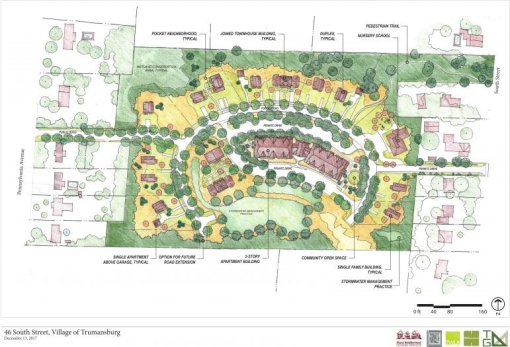
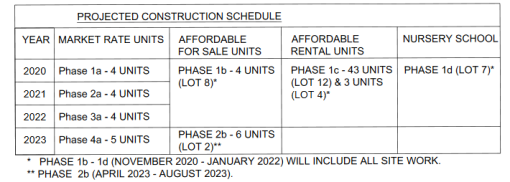
– Courtesy of the village of Trumansburg, we have a new working title for 46 South Street, formerly Hamilton Square – now it’s “Crescent Way”. PApar krief, including revised EAFs, supplements and BZA findings here. The final version has some site plan changes on the location of some townhouse string types, but the overall unit count remains the same at 73 units (17 market rate for-sale, 10 affordable for-sale, 46 affordable rentals). Approval is on the horizon, a little more than two years to the date of when the project was first introduced. The project will be built in phases, with completion not expected until 2023.


News Tidbits 4/27/19

27 04 2019

1. Matt Butler at the Times is providing an in-depth check-up on the mall this week. This was a story the Voice had laid groundwork for as well, so it’s nice that one of the local news orgs was able to make hay of it. The mall, like many middle-class local malls across the country has been struggling in the age of Amazon and the retail meltdown. The overall economy might be humming along, but retail closures continue to spike nationwide, with over 6,100 closures planned this year alone, more than the 5,900 announced in all of 2018. With planned new store openings numbering 2,100, it’s practically two stores closing for every one that opens. Retail mega-landlord Cushman and Wakefield estimates 9,000 stores will close in 2019, and over 12,000 in 2020. In the Ithaca Mall, Gertrude Hawk is gone, American Eagle closed up last year, Ultimate Athletics shut its doors, the Bon-Ton closed as part of the shutdown of the whole chain, and the Sears Hometown store is kaput. The mall’s manager cited a variety of reasons, including chain downsizing, poor performance, and some just stopped paying rent.

This has major economic impacts; the mall’s property value has declined by over 60% since the start of the decade, and the village, the county and the schools have to make up those hundreds of thousands of dollars in property tax revenue somewhere (and the county and schools have). County legislator Deborah Dawson, who represents the mall’s district, suggested doing something similar to the DeWitt Mall downtown, a mix of local businesses, but the mall is a much bigger space to fill (622,500 SF vs. 117,500 SF in the DeWitt Mall), and DeWitt Mall is mixed-use (retail and 45 apartments). Local businesses and experiential outlets can be part of the solution as Running 2 Places is showing with their 18,000 SF theater this spring, but it’s one component of a solution. Residential could be a component, but some legal and logistic issues would need to be sorted out, which owner Namdar Realty has never shown much interest in; the village has also been lukewarm to the idea. About 40 apartment units were floated for a section of the parking lot (west/on the backside of the mall if I remember right), but that idea died during the Great Recession.

There is so silver bullet here. The owner needs to be more proactive then holding a proverbial gun to its’ tenants heads in order to get them to stay. Local governing bodies also have to keep an open mind for redevelopment ideas – if parts of the mall were torn down and replaced with residential, for example. As it is, the only plans on the horizon are an unnamed tenant for the former Bon-Ton space, and the extended stay hotel planned for the parking lot behind (west) of the Ramada Inn. The future of the mall is hazy; like a species faced with a steadily changing habitat, it’s either adapt and evolve, or perish.

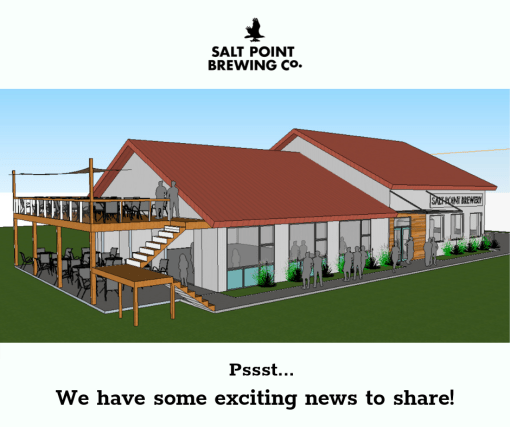
2. Courtesy of their Facebook page, here’s a sketch render of what Salt Point Brewing Compant’s new brewery and taproom would look like. It’s a fairly unobtrusive one-story structure with a gable roof and two wings, presumably the taller one for the brewing tanks and the smaller one for service functions. On the outside are wood accents and a two-story deck for outdoor drinking and possibly dining, if the restaurant option is pursued.

The building, as well as associated landscaping and parking improvements, would be located on about three of the five acres sold as Parcel “D” in the Lansing Town Center development. The remaining two acres are wetlands and would be left undisturbed. Salt Point paid $75,000 for the land, and will bring its project forth to the town planning board in the coming months. No word on any job creation figures yet.

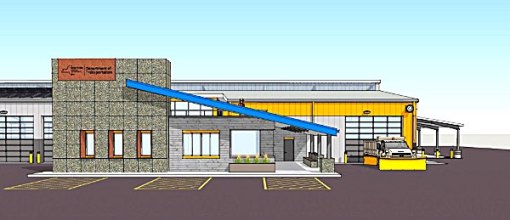
3. The NYS DOT county facility plans are moving forward. The state bought its 15 acres from Tompkins County for $840,000 according to a deed filed on April 24th. The building is classified as a sub-residency facility, a step below a primary regional facility (the main office for Region 3 is in Syracuse).

To review, the plans consist of the 30,000 SF sub-residency maintenance building, a 5,000 SF Cold Storage unit, an 8,200 SF salt barn, and a 2,500 square foot hopper building (covered lean-to). The proposed maintenance building will have vehicle storage for 10 trucks, a loader and tow plow, with one additional double depth mechanical bay and single depth, drive-thru truck washing bay. It also includes an office area (three rooms), lunch/break room (30 people), toilet/shower/locker rooms, storage rooms and mechanical/electrical rooms. The site will also contain stockpile areas for pipe, stone and millings, and ancillary site features include parking for 40 vehicles, and stormwater management facilities. A new access drive will be constructed from Warren Road.

The town has been less than pleased with the project, which is not bound to zoning code because it’s a public resource facility owned and operated by a government entity. Rather than voice approval, the planning board voted to acknowledge that they simply had no authority to control the project. Some modifications were made to the plans at the town’s request, such as the fueling station being moved onto airport property across Warren Road, but neighbors are still unhappy that snowplows and heavy-duty maintenance vehicles are about to be their next door neighbors.

The facility is expected to be open by the end of the end of the year. Once all staff and equipment have been moved in, the county may pursue a request for proposals/request for expression of interest for the current DOT property on the shores of the inlet near the Farmer’s Market. A 2015 feasibility analysis found that the site could conceivably host a $40+ million mixed-use project, and the site has became more amenable towards redevelopment with the enhanced density and use provisions made to the city’s waterfront zoning in 2017.

4. The Ithaca city planning board granted a negative declaration of environmental review to the 124-unit Arthaus affordable housing project at 130 Cherry Street. According to my editor Kelsey O’Connor, the latest revisions propose a five-story building that would include a gallery, office and affordable rental space. It would include parking for about 36 vehicles and 7,600 square feet of potential retail or office and amenity space geared toward artists. All of the units would be restricted to renters earning 50 to 80% of the area median income, or about $30,000 to $45,000. The north end of the property will also include a publicly accessible path leading to the inlet.

Speaking in favor of the project were neighborhood business owners and non-profits, and in opposition was councilman George McGonigal, who said both in a letter and in person that it was too big for the site and threatened the industrial character of the neighborhood. They have bigger concerns than housing nearby. Cherry Street is difficult to access with large trucks and commercial vehicles, the Brindley Street and Cecil Malone Drive bridges are small and in poor shape. Secondly, Cherry Street doesn’t provide much room for operations to expand, so that hinders their long-term operational planning. It’s not just lot size, but also the soil – the Emmy’s Organics project fell through because of poor soil not amenable for warehouse and other light industrial functions that rely on a concrete slab. Thirdly, the city’s strict environmental laws, fees and higher property taxes make an urban site less appealing. They can get more land with a lighter tax burden in Lansing, Dryden, or any of the other outlying towns. With these issues in mind, many of the industrial businesses down there now aren’t looking to stick around. Several have already sold or made purchase options with developers as they seek areas with lower taxes, easier access to highways and less strict environmental ordinances.

The unanimous approval by the city planning board allows the project to move forward with consideration for preliminary approval. The goal is to gain approval at next month’s meeting, and once affordable housing funds have been secured, to start construction of the project, likely in December of this year.

5. The Chain Works District presented plans for phase one at the Planning Board meeting. There are four buildings in phase one, of which two are in the city. 43,400 SF Building 21 would be renovated into a commercial office building. The work here is limited to replacing walled-up window openings with new windows, exterior cleaning and painting, and new signage and entrance canopies. Building 24 is a combination of renovation and expansion. The partially built-out basement and first floor would be renovated for commercial office space, the second and third story would be residential, and a new fourth floor would be built for residential uses, for a total of 135,450 SF across 4.5 floors. As with Building 21, new windows would be installed, and the exterior cleaned and painted. New landscaping, sidewalk and parking areas are also planned.

At a glance, the residential in the first phase would host 60 market-rate rental units. Each floor will have one studio unit, nine one-bedroom units, nine two-bedroom units, and one four-bedroom unit. According to the Site Plan Review document, the project would begin renovation in October, and be open by August 2020. The other two building in phase one are renovations of industrial and manufacturing spaces in the town, Buildings 33 and 34. These will retain industrial uses.

This meeting was only for the purpose of sharing and discussing plans, with no voting at this time. According to Edwin Viera at the Times, the board was reluctant to approve any plans without more information about who will be occupying them. That seems a bit odd, because projects are analyzed for their physical impacts, not the tenants, but the Times article says parking and landscaping may change slightly depending on the tenant. According to project representative Jamie Gensel, the USDA is considering renting out some of the office space. The USDA maintains a research facility inside the Holley Center on Cornell’s campus, and there were plans in the late 2000s to build an addition, which were later shelved during the Great Recession. It’s not clear how much space they’re seeking. Not sure what to make of that writeup, honestly, or being told to move the buildings into a different phase (personally, I’d like to be renovations before any new builds happen).

6. 815 South Aurora Street, aka “Overlook”, also continued its review at the planning board meeting. There were some minor design tweaks, seen in the before image (above) and after image (below). Changes in exterior colors, panels, ground-level entrances and fenestration, particularly on the side facing South Aurora Street. The fire trucks are  to indicate that emergency vehicles will be able to safely pull in and out from the road. Overall, project size remains at 49 units and 141 bedrooms.

There’s been some pushback from neighbors regarding size and neighborhood character. There’s an argument that these are dependent on Chain Works, but that argument doesn’t pass the smell test – if Chain Works didn’t happen, fewer units on the South Hill market would make the project even more appealing to Visum Development and Modern Living Rentals. The planning department wants more geotechnical information and bedrock to be removed, details about the new planting and landscaping, and energy systems. Documents submitted indicate the all-residential development will use electric heat pumps. The board has requested a shadow study and flesh out the environmental impacts, which is a common request for larger developments.

7. At least one project is fully approved. Although it seems at least one planning board member asked for affordable housing, the four-unit market-rate Perdita Flats infill at 224 Fair Street was granted preliminary site plan approval. The project is intended to be a sustainable building showcase of eco-friendly features, a net-zero energy showcase of what can be done with environmentally sustainable multifamily housing. The owner/developers, Courtney Royal and Umit Sirt, will be applying for incentives from the NYSERDA Low-Rise Residential New Construction Program and are hoping to attain the Zero Carbon Petal of the Living Building Challenge.


News Tidbits 4/24/19

25 04 2019

1. Here’s a real estate sale worth noting. A vacant 25-acre parcel of land between 1758 and 1786 Trumansburg Road (just south of Jacksonville) sold for $140,000, according to a deed filed with the county today. What makes this sale interesting is that the buyer is an LLC associated with the operating address of Classen Home Health, the senior healthcare firm run by local businesswoman Patty Classen. The Classen family has not been shy about investing in development projects, though her sister Elizabeth is the more active one at present. Elizabeth owns the Bridges Cornell Heights skilled care facility, and  is also involved as a partner in Travis Hyde Properties’ 66-unit Library Place Development. Taking a semi-educated guess, there’s a good chance this property will be developed out into senior housing at a later date, so it’s worth keeping an eye on.

2. Meanwhile, over in the village of Lansing, the former Autodesk Building has exchanged hands. The 19,470 SF office building on 2.37 acres sold for $4.14 million, from the Colbert family of commercial landlords (Greenstate Properties) to an LLC led by local businessman and developer Bryan Warren of Warren Real Estate. The Colberts developed the property and opened the building in 2002. The price was substantially more then  the assessment of $3.15 million, but that’s probably not because of a planned redevelopment. It likely has more to do with having a tenant lined up for the building, the Alcohol and Drug Council of Tompkins County, who will build out and operate a 40-bed detox facility at the site. A stable, long-term tenant is a strong asset to have when selling a property. The village of Lansing has not been a fan of the project (the argument being, those in treatment “don’t belong [here]” and pose a safety threat), but since it’s just an interior renovation and medical uses are permitted in its zoning, there’s not much the village can do as long as everything remains in compliance with code. The sale may be finished, but the facility won’t host overnight stays until at least the summer, and the renovations won’t be finished until late 2020.

3. How often do I report things out in Enfield? Practically never. But the town planning board is reviewing a pair of small apartment projects this month. Patrick Head, owner of Head’s Excavating, plans to build a pair of four-unit apartment buildings, each on a different site in the town. The first would be at 1795 Mecklenburg Road, and the other on the southwest corner of Enfield Center Road and Van Dorn Road. All of the units would be rentals, two bedrooms each, and according to the Environmental Assessment Forms, it looks like each unit will be about 1200 SF, with either two floors or one floor with a finished basement. Both properties are currently vacant; the former used to host a farmhouse but was destroyed by fire in September 2015, and the later is a vacant 5-acre lot that was created through the subdivision of a larger property.

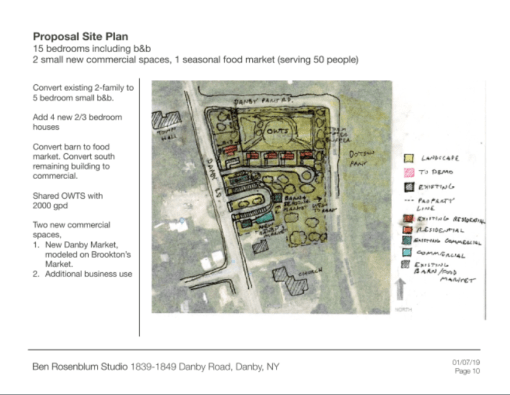
4. Sticking with the rural towns for now – out in Danby, plans are underway for a new mixed-use project at 1839-1849 Danby Road. The development calls for a small commercial retail plaza and a space for a cafe or restaurant, as well as additional residential rental space. 1839 Danby Road is a two-family house with six bedrooms, and 1849 Danby Road is a four-unit apartment house with six bedrooms, along with a couple of garages and sheds.The historic portions of the homes would be saved and incorporated into the development, which is designed to incorporate sustainable building practices (green roofs, alternative energy sources), and create a “town center” like sense of place in the hamlet of Danby. That includes a small B&B, a seasonal food market, and the small market/cafe. Ultimately, if successful the project would expand out to fifteen housing units and two more commercial spaces. It’s not big by most standards, but it’s notable for a 3,500-person town. Property owner Olivia Vent is the developer, and the plans are being designed by Ben Rosenblum Studio.

5. According to the town of Dryden’s planning department, the medical project at 2141 Dryden Road will be fairly modest in size – two floors, 3600 SF. The 908-acre Mill Creek subdivision on Caswell Road is listed as 40 lots, up one from the previous 39, though it could just be something like a stormwater parcel. Also of note, the Route 13 development study from Warren Road to the western boundary of the village of Dryden. With several large development floated for the corridor, the county has an RFP out to do a study for “strategic guidance” so as to allow development while minimizing potential negative impacts (traffic, environmental degradation from in-commuters, etc.) The RFP for that closed on the 22nd.

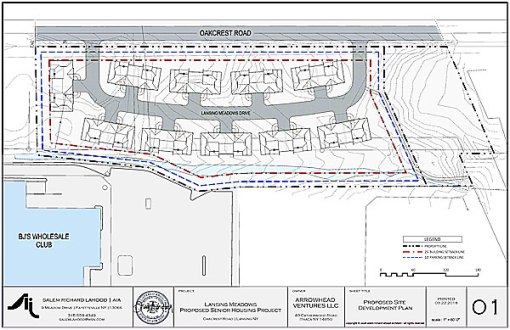
6. Will the Lansing Meadows senior housing ever happen? Developer Eric Goetzmann of Arrowhead Ventures is trying to change the senior housing in the Lansing Meadows project again. Given that the village and the county have had it up to their proverbial necks with his shenenigans, this has the potential to be very poorly received. The approved plan as it stands is for twenty two-bedroom units. It was supposed to start construction last year, but was delayed a year due to construction bids coming in higher than anticipated. Either the bids have come in too high again and he’s trying to value engineer the project, or some other issue has arisen. We’ll see how this one goes next Monday.


Harold’s Square Construction Update, 3/2019

24 03 2019

It seems we can move this one back into the under construction column? It’s been a weird few months.

The developers, L Enterprises (David Lubin) and Mcguire Development of Buffalo, parted way with Taylor the Builders, the construction manager, back in January. They were able to line up another construction manager in LeChase Construction of Rochester, which has done its fair share of work around Ithaca and Tompkins County. Issues with transferring control and insurance paperwork of the 300-ton crane, however, delayed the project’s construction by several weeks, but the project did finally resume in early March.

I can tell you that whole “craziness”, as project rep Vicki Taylor Brous put it, gave a lot of city staff and elected officials heartburn. Given the city’s recent policy of advocating for density and downtown development, a hulking, stalled steel skeleton was the type of thing that was going to really make any future project a difficult sell.

It was also very upsetting for neighboring business owners. The project has already created some frustration with its blockading of the Commons playground out of safety concerns. The construction, and lack thereof, created an unattractive nuisance, with people steering away from neighboring businesses and taking their money elsewhere. The abatement was shifted forward a year, but not without significant blowback from members of the general public who had taken the opportunity to air their grievances with the development team. The current plan is to have the office and retail space available for occupancy by the end of the year, with housing occupancy by spring 2020.

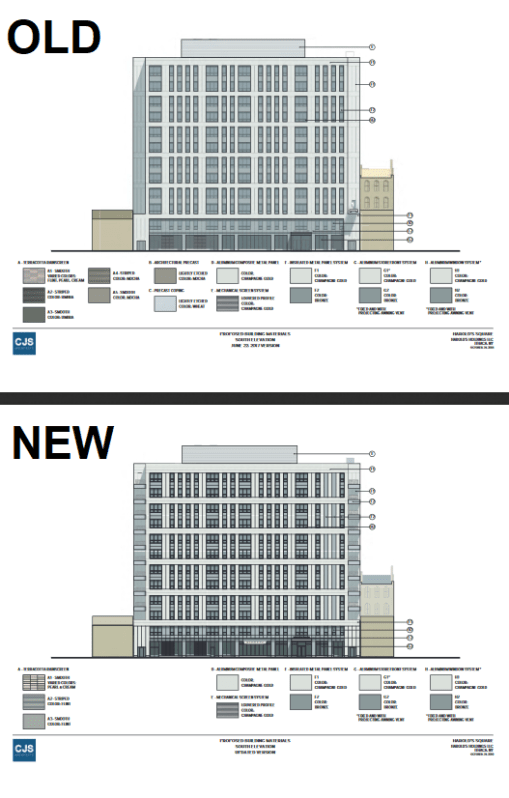
At the crux of the issue are claims by Taylor that the project had undergone significant changes and that Taylor wanted to be compensated for the late changes. Although downplayed at the time, it became clear in the months since that there were major programmatic and minor aesthetic changes. The programmatic change was the reduction of 30 micro units (for a new total of 78) to make way for an additional 10,000 SF of office space for an unspecified tech tenant, as mentioned in the revised IDA application. (For those curious, the rumor mill says it’s a growing local tech firm; 10,000 SF is about the right size for a 40-50 person operation). Most of its commercial spaces appear to still be on the market.

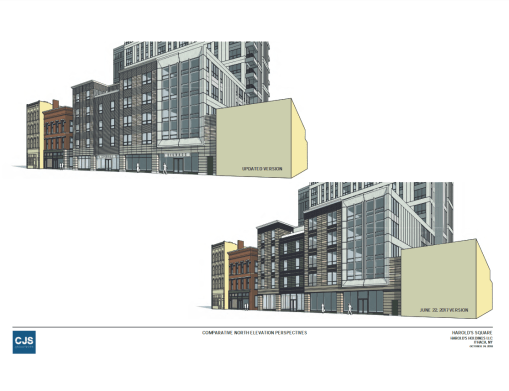
There have also been some substantial if overall minor aesthetic changes, partially as a result of transitioning some residential space back to commercial offices. Some of the metal panels are being replaced with a terra cotta exterior finish, elimination of a mechanical screen because the equipment was smaller than first anticipated, the addition of balconies on the corners, the elimination of two windows per floor on the south face in order to comply with International/NYS Building Code, and window revisions on the fifth floor for the new tenant.

The renderings at the end of this post were published in 2018. The designs are for the revisions that were reviewed by the planning board last month, with the exception of the fifth floor office tenants and changes to suit them. The only reasons I can come up for waiting to submit these changes, was that either they didn’t have to (as mentioned before, after approval, the circumstances required for re-approval are rather murky), or that they weren’t sure what was going to happen with the fifth floor and wanted to have all their revisions in one package to avoid further trips to the board. It’s not clear when they began negotiating with the tech tenant, and when Taylor started to have issues working with the developers.

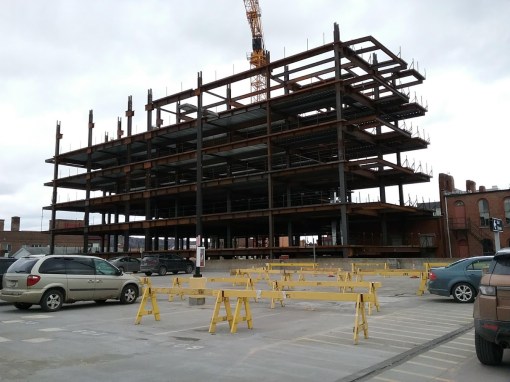
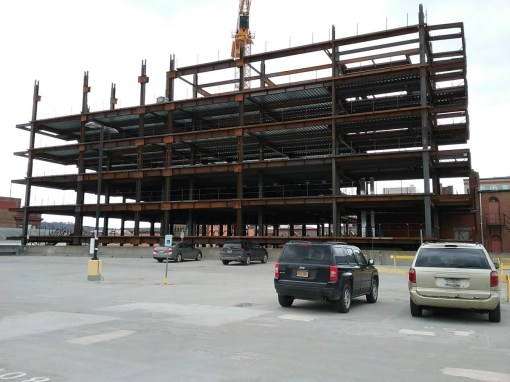
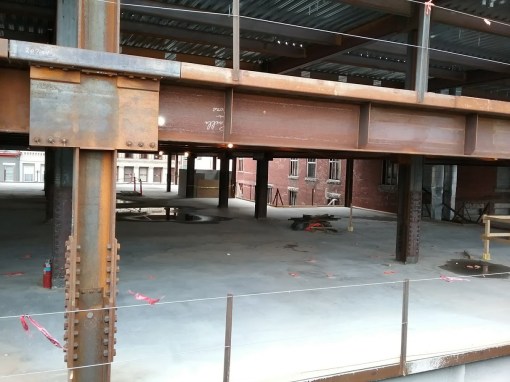
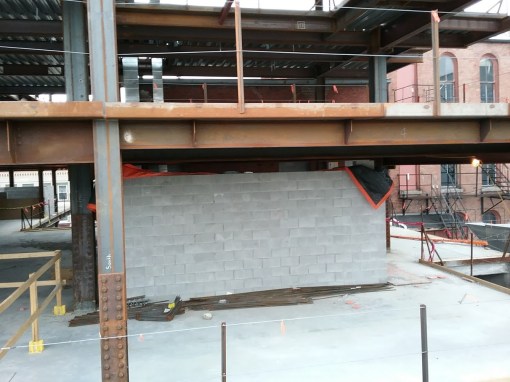
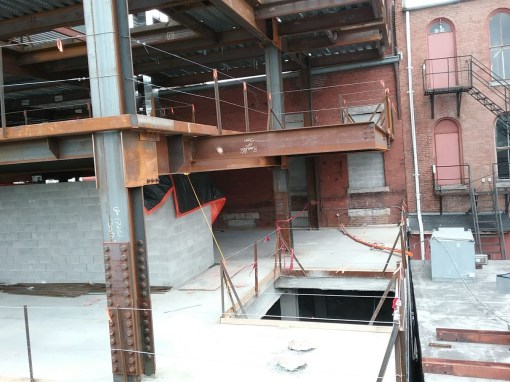
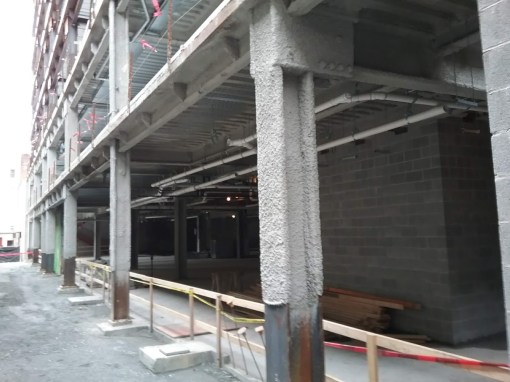
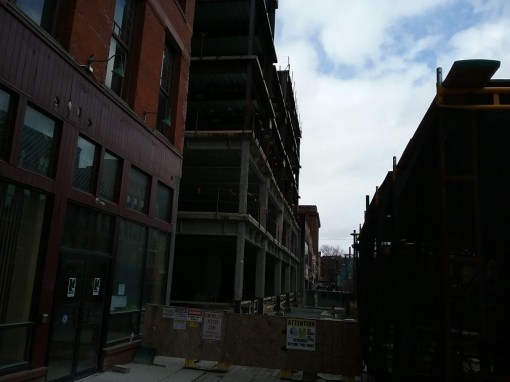
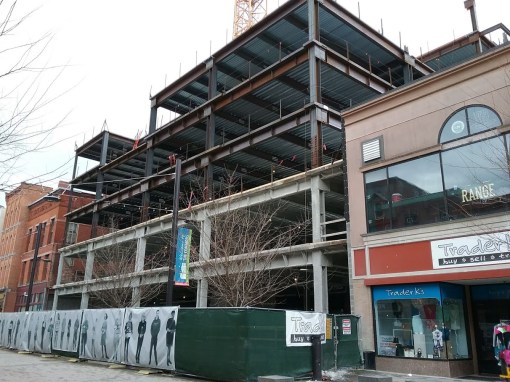
Anyway, work has recommenced on the steel structure, as the eighth floor is built out. Since the upper floors have small floorplates, the building’s steel structure will likely top out before the start of summer. From there, it’s fireproofing, sprinkler systems, exterior and interior wall framing, rough-ins, sheathing, and all the fun stuff that makes a building begin to look like its final product.