News Tidbits 8/5/17: Having the Right Look

5 08 2017

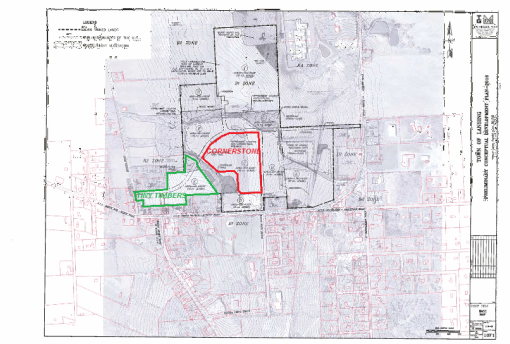
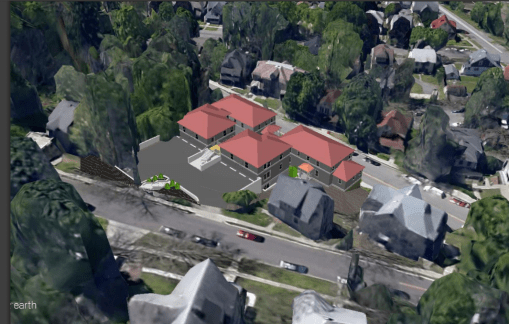
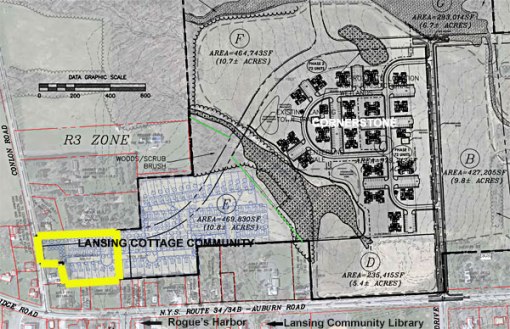
1. Thanks to Dan Veaner at the Lansing Star, we have the first rough site plan for the proposed Cornerstone and Tiny Timbers projects at the Lansing Town Center site at the intersection of Route 34B and Triphammer Roads. Readers may recall that Tiny Timbers has proposed a development of 60 for-sale single-family homes (ten in the first phase) called “Lansing Community Cottages”, and Cornerstone is proposing up to 144 affordable apartments in two phases for the town center site.

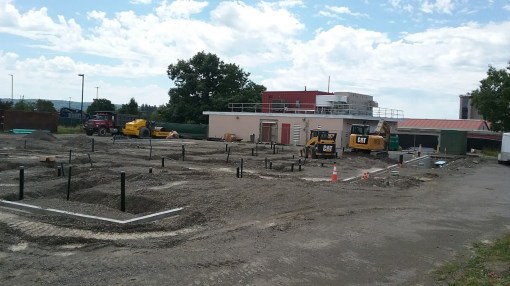
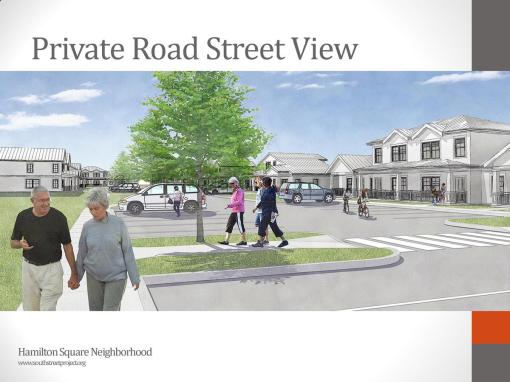
Specifically, Tiny Timbers is looking to sell homes averaging about 1,000-1,200 SF in the $175,000-$225,000 range, which is a critical but tough-to-hit segment in the local housing market. With consultation from planner David West, the homes are designed in a traditional urban layout, with congregated parking spaces instead of garages, and community green spaces. None of the homes are more than 150 feet from the roads and parking areas, a safety requirement to ensure access for emergency vehicles. Ten units would be built in phase one, twenty in phase two, and thirty in phase three. About the only concern town officials have expressed at this point is a second means of ingress/egress to keep the traffic down on Conlon Road.
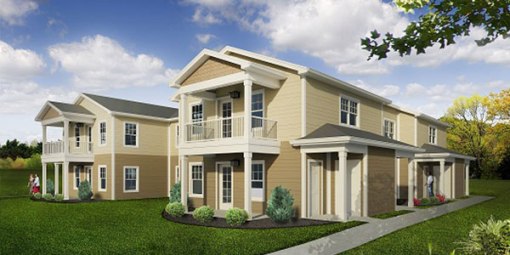
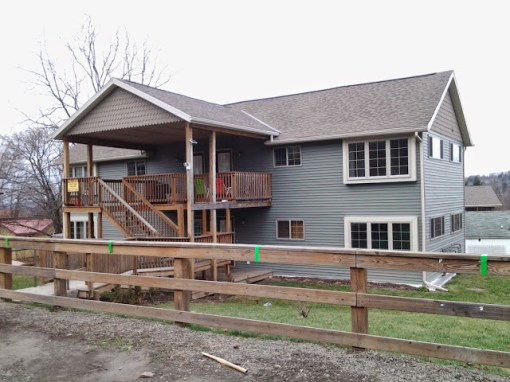
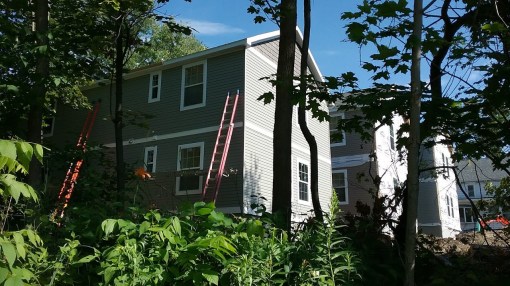
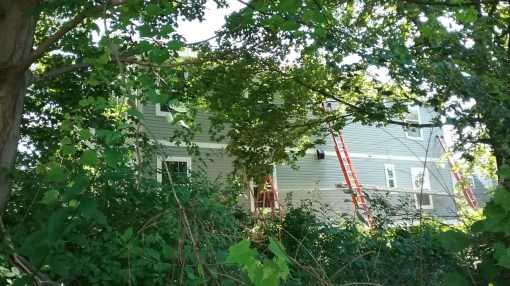
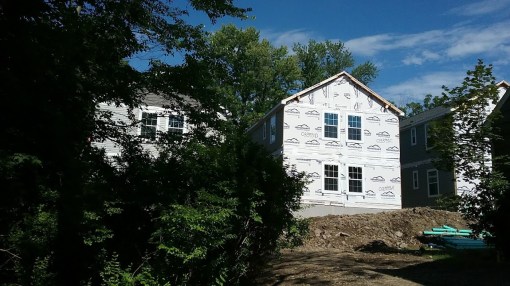
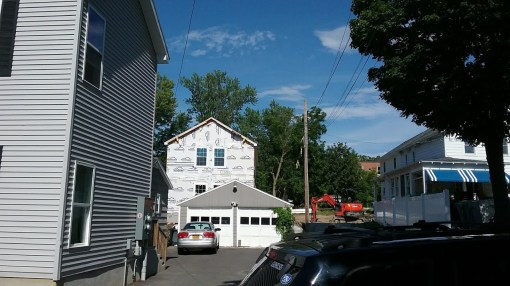
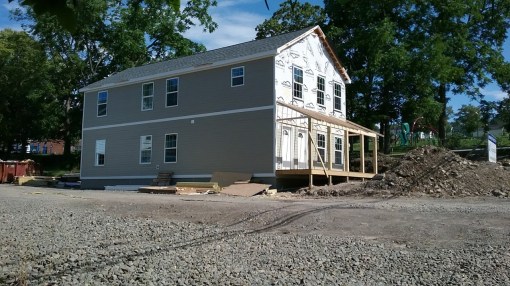
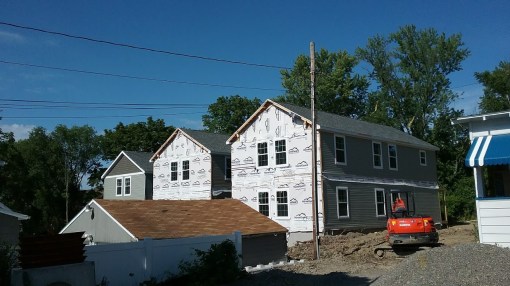
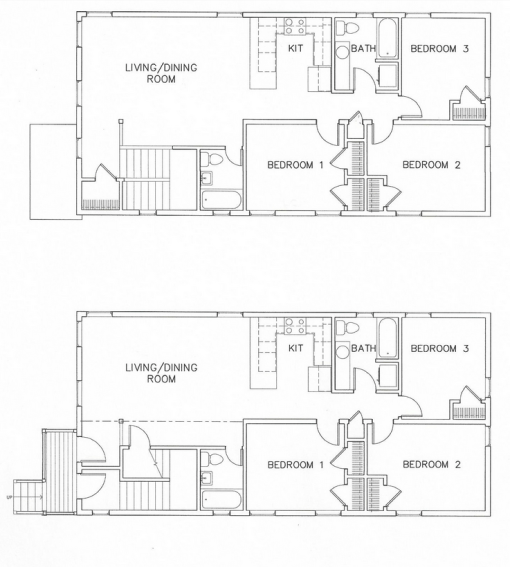
In contrast to Tiny Timbers’ site plan, the Cornerstone plan is a more conventional suburban layout with parking adjacent to each 8-unit structure. In fact, based on the above design, and the need for affordable developers to save on costs and therefore many reuse designs when they can, it’s likely that some of the Cornerstone apartments look something like the above image, which comes from a recent Cornerstone project near Brockport. The detailing and the colors may differ, but it’s a pretty good bet that’s how some of the finished units will look. Like Conifer, Cornerstone appear to be using a mix of their standard designs, and there are two distinct designs on the site plan, as well as a community center.

2. A redevelopment opportunity in downtown Ithaca has sold, but it looks like there are no plans. 110-112 West Seneca Street is a 538 SF salon with a large rental parking lot, and zoning is B-1a, meaning 4 floors 50% lot coverage, parking requirements in effect of about one space per unit or one space per 250 SF of commercial use. Tompkins Trust (Tompkins Financial Corp.) picked up the property on Friday the 28th for $600,000, below the $800k asking price but still quite substantial for what’s mostly land.

Unfortunately, it doesn’t look like anything is going to happen here. Tompkins Trust had previously rented the 23 parking spaces on site for use by its own employees – whether they’re hedging bets or don’t trust the parking garage situation, they appear to be buying the property to use as parking. Boo. With any luck, after their new HQ opens up next spring and their parking situation settles down, they’ll find better uses or potential partners for the lot. With no historic attributes but proximity to major services and amenities, a parking lot on this property is a waste of potential.
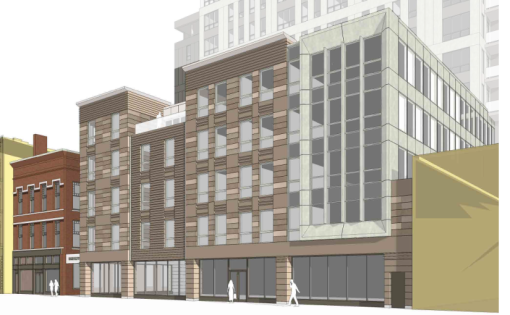
3. The Harold’s Square project team has given their website a overhaul, and with that comes the official timeline. According to the web page, asbestos abatement is now underway, demolition will start in September, construction will last through January 2019, and marketing/lease-up for the commercial spaces and 108 residential units should will start in January 2019.

The project description web page mentions 100 construction jobs, 50 retail jobs and 200 office jobs, which seems accurate for the square footage of each use (12k retail, 25k office). The estimate of 250 residents is way too generous though – the back-of-the-envelope is one person per bedroom, and there are about 144 bedrooms/studio units.

Side note, I reserve the right to grouse that the media links both go to the Times.

4. Dunno what’s going to happen with the Lansing Meadows senior housing up by the mall. Background story on the Voice here. On the one hand, the wetlands were an arduous and expensive undertaking, and Goetzmann did those to Army Corps of Engineers standards. It does make it tougher for the project to be financially viable. On the other hand, the village has a right to be frustrated, and it’s not unreasonable that they’re feeling that they’re being taken for a ride. Goetzmann received an IDA tax deal for what was largely a retail project, largely a no-no because most jobs in retail are low wage. He also received a variance for a community retail component, and multiple extensions from the IDA on fulfilling the housing component.

An increase in density spreads the fixed costs out among a greater number of units, and it’s encouraged by the village and county, so that’s not the issue. The design is what bothers them – while shared walls and utilities is a cost-saving measure, the village has expected smaller, house-like units since the project was first proposed in the late 2000s. Maybe the happy medium between this and the ten duplexes is a site plan with 3-4 unit structures with 20-24 units, with the buildings designed with pitched roofs, dormers, small porches and other home-like features. Let’s see what happens in the next couple of months.

5. Plans for co-op housing on West State Street have been waylaid, perhaps permanently. New York City businessman Fei Qi had previously proposed to renovate the historic 3,800 SF property at 310 West State Street into office space, and more recently a 12-14 person co-op. However, there have been a couple of issues with both plans – the ca. 1880 building is in need of significant structural renovation. Years of deferred maintenance prior to Qi (who bought it from the Salvation Army for $195k last year) has left the building in rough shape, and asbestos and lead need to be removed. For the housing proposal to be permitted, fire suppression systems would also need to be installed. Some city officials have expressed concern that like the carriage house that once existed at the rear of the property, if the building gets mothballed again, its structural integrity may be at risk. Any external changes would need to be approved by the Landmarks Commission. It appears that Qi recently applied to the commission stating economic hardship, saying he was unaware the building was a historic property and was not communicated to him by the seller or real estate agent, and cannot afford to renovate it to ILPC standards. The designation went into effect in April 2015, a year before sale.

Concurrently, Qi has put the property up for sale. For an asking price of $278,000, one gets the building and the architect’s plans. I’ve seen ball-park estimates of $500k for the renovation into office space, but I never saw an estimate for the co-op. As a result of the structural issues, the building’s assessed value plunged from $250,000 in 2016 to $100,000 last year, most of that being the land. Fingers crossed, someone steps up to the plate to save this building before it’s too late.

6. Last month, I speculated that there was a plan for redeveloping 217 Columbia Street on Ithaca’s South Hill. Turns out there is, and it’s really upsetting the neighbors. The plan by Modern Living Rentals is to preserve the existing building, but build an additional two-family home on the property as well. For the neighbors, this is apparently one student-oriented rental too far. Some are calling for a moratorium, and others a zoning change to prevent rentals without an owner living in the property. Most of South Hill’s zoning is R-2 residential, which is one-and-two family homes, and most of the construction in South Hill these past few years has been one and two-family homes. The issue is that they’re upset they’re rentals, many of which appeal to Ithaca College students further up the hill in the town. In theory, you could make it an approval requirement that the renters be non-students, although I’m not sure that would placate the situation. We’ll see how it goes.

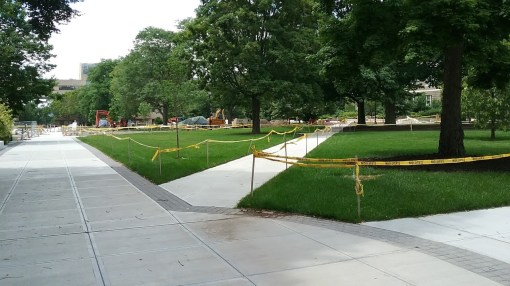

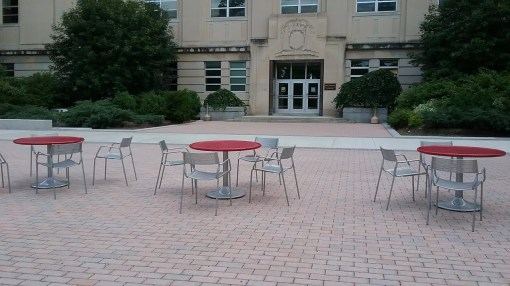
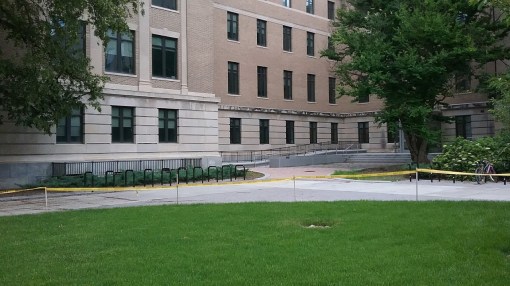
Cornell Ag Quad Rehabilitation Construction Update, 7/2017

1 08 2017

If common spaces are what make or break a campus, then it’s a wonderful thing that Cornell hosts one of the best landscape architecture programs in the world.

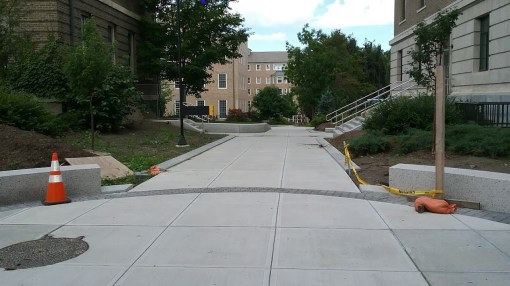
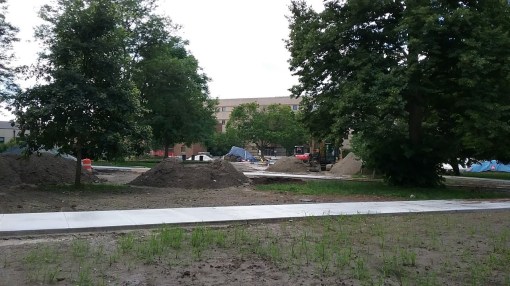
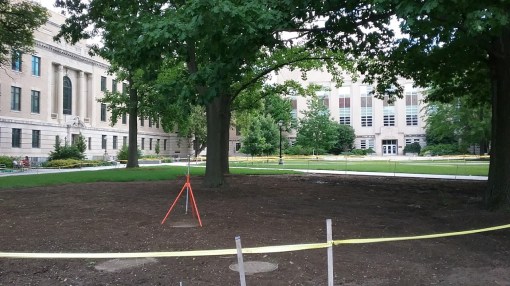
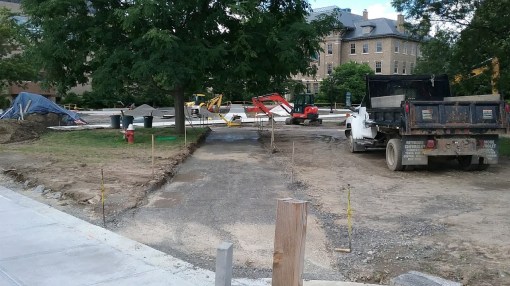
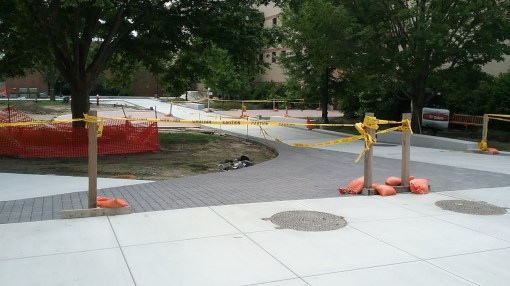
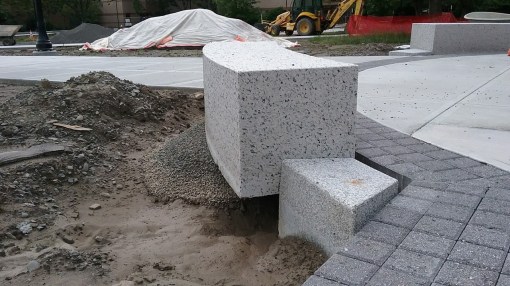
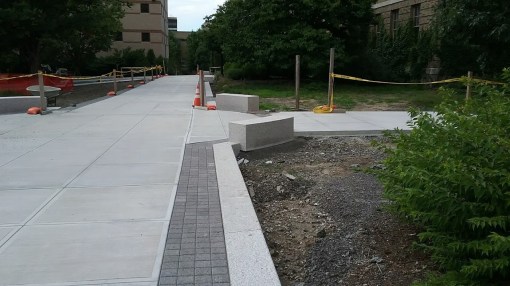
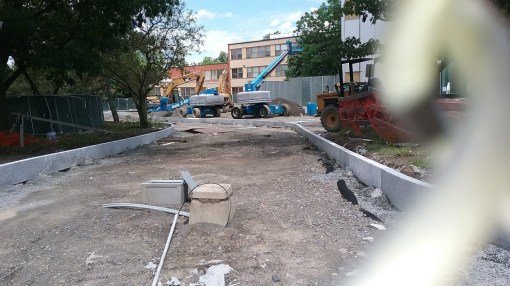
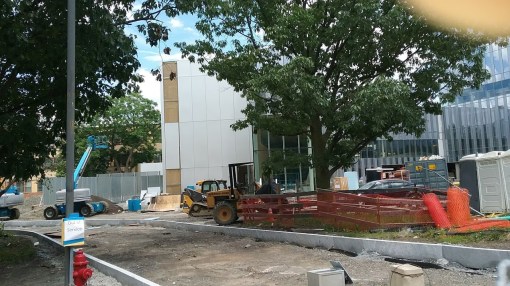
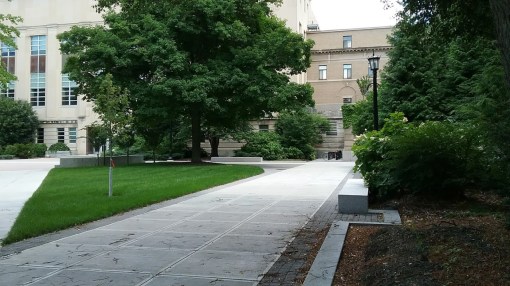
With the new underground utilities in place, the remaining work is at or close to surface level. This includes the installation of new plazas, sidewalks, decorative pavers, concrete slab benches, stairwalls, bike racks and seeding. New lamp posts have been erected, a rain garden has been added, and new saplings (54 total) were planted to replace the trees lost to the utilities work. The sidewalks were widened to allow easier emergency access. The east half was finished this past fall, but the west half could only finish utilities work before winter put the kibosh on concrete pours and landscape work.

One of the goals of the refreshed ag quad is to make it a more inviting place to be during the warmer part of the year. By making use of removable furniture and adding seating areas along areas of high traffic and near buildings, the hope is that the space will be more lively and encourage social interaction among Cornell’s many students, faculty and staff. To be fair, it doesn’t look like a bad place to have an outdoor lunch.

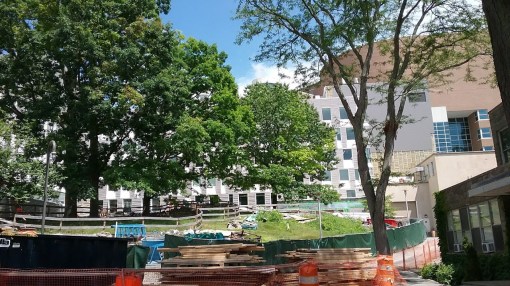
At some point, the two temporary structures between Kennedy and Plant Science will make way for a new permanent structure; as for when that happens, your guess is as good as mine. The Pleasant Grove Apartments were built on North Campus as temporary housing after World War II and the influx of students on the GI Bill, but parts of the complex were maintained until the mid 1990s.

The $9.6 million project began last summer, and is scheduled for a completion before the 2017-18 academic year. MKW & Associates LLC of New Jersey is the lead landscape architect, Over & Under Piping Contractors Inc. of Auburn is the GC, and Albany-based CHA Consulting Inc. is providing civil engineering expertise. Background information on the project can be found here.


Cornell Law School Renovation Update, 7/2017

31 07 2017

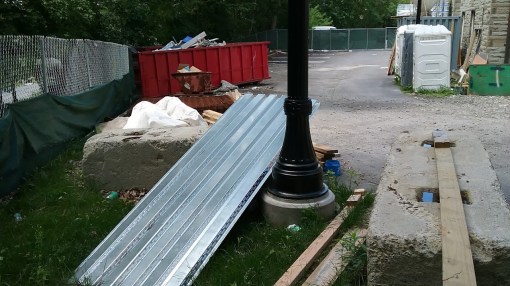
On the outside, progress is modest – the windows and CMUs from the upper floors have been removed from the west face to make way for the future glass-encased stairwell. The steel beams sitting in the staging area are part of the Certainteed Drywall Suspension System and will be used in the construction of the new ceilings in the gutted interior, although some of the different gauges present may also be used for interior wall framing. There has been no visible progress on enclosing the loggia yet.


Upson Hall Construction Update, 7/2017

28 07 2017

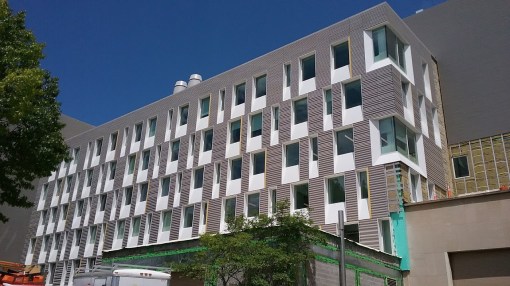
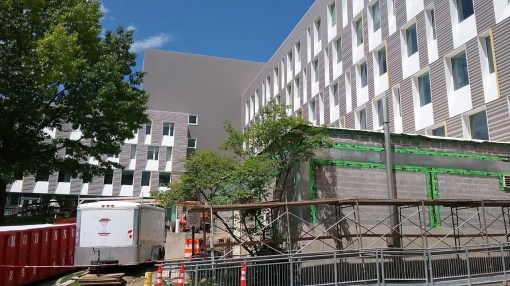
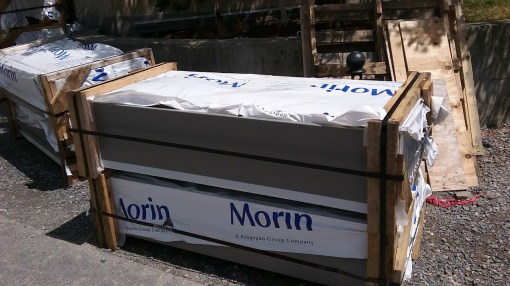
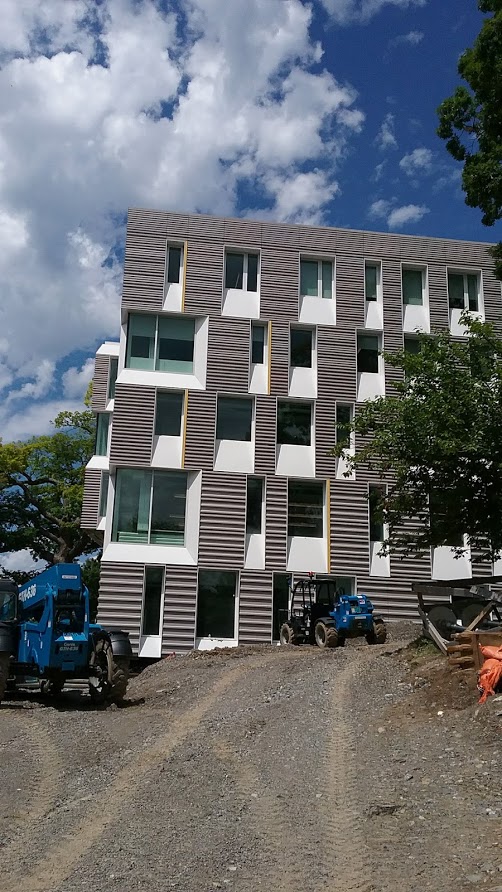
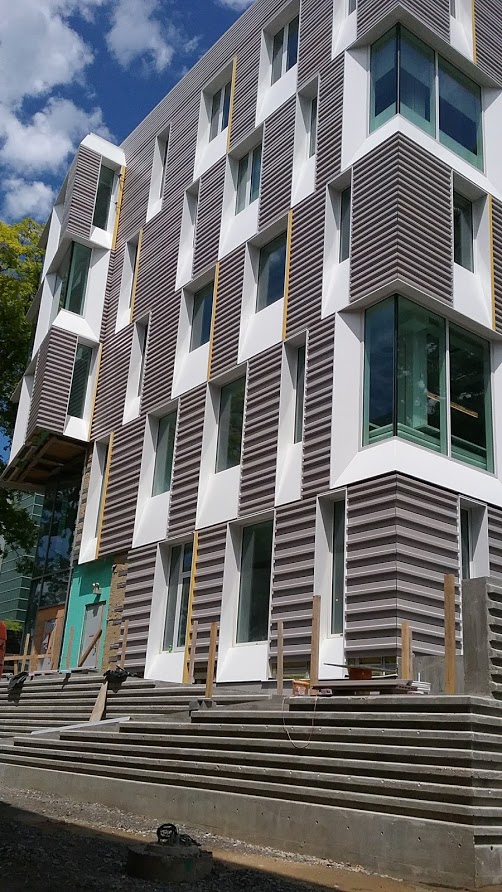
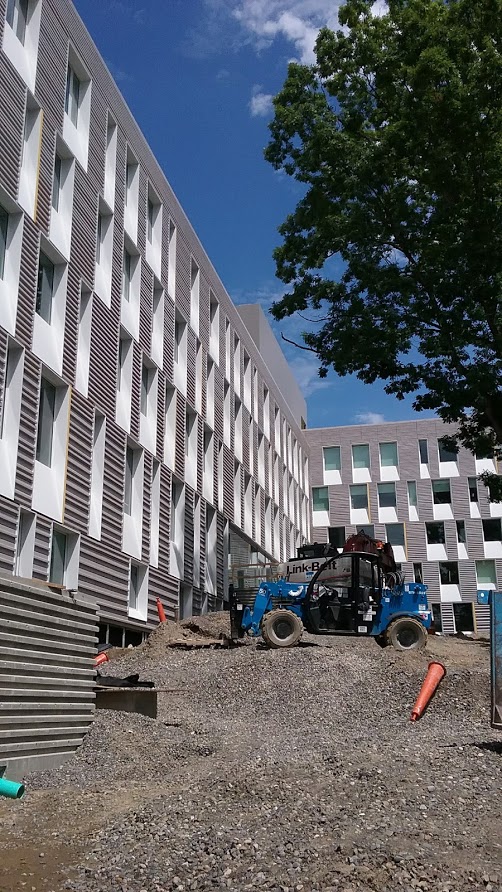
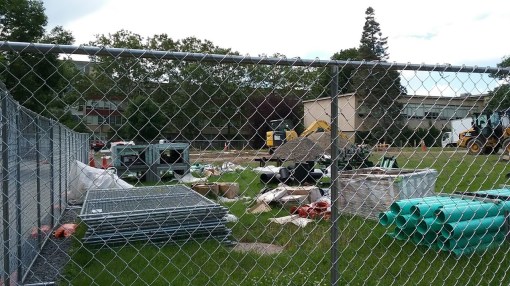
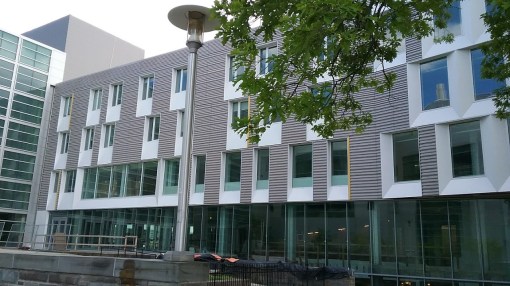
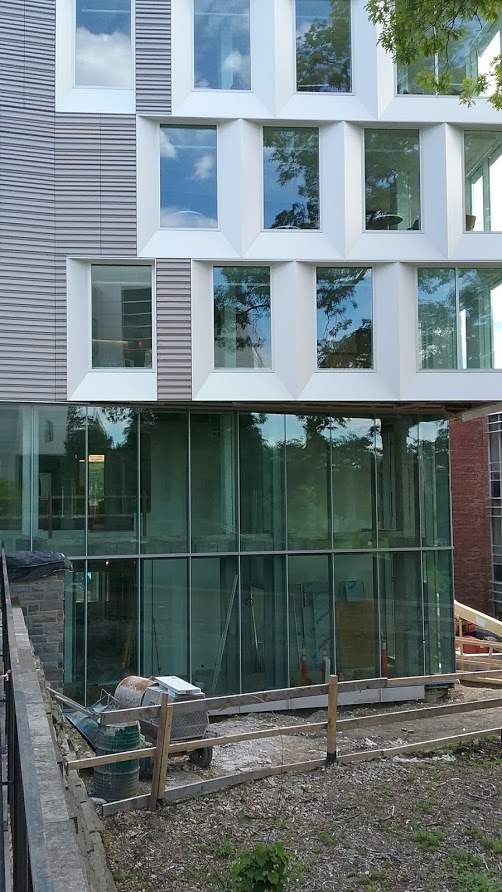
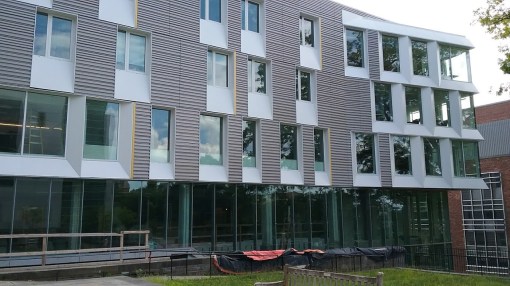
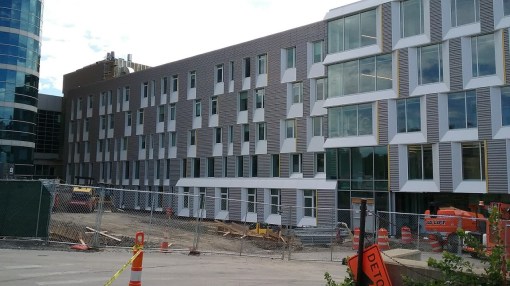
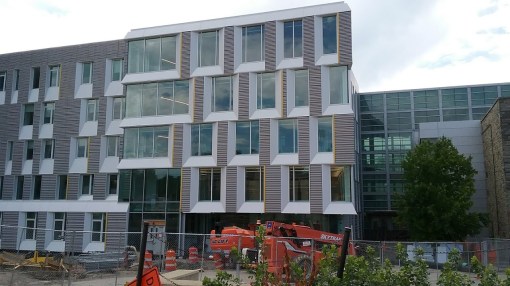
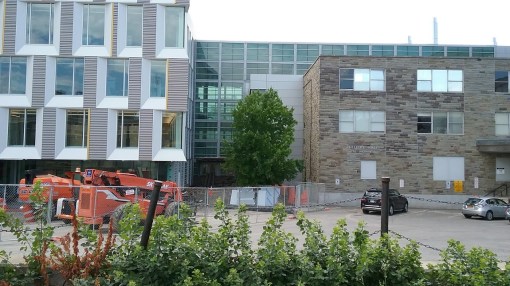
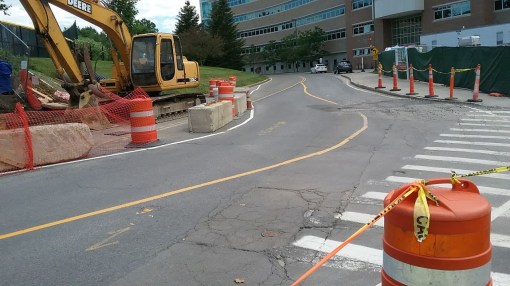
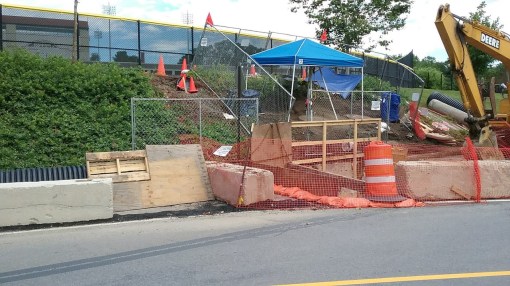
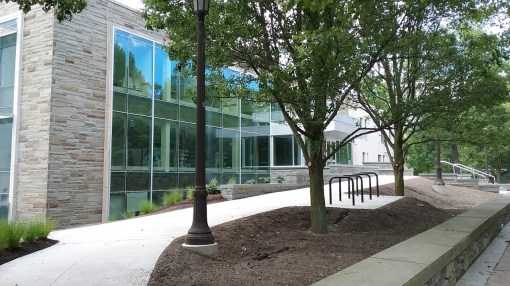
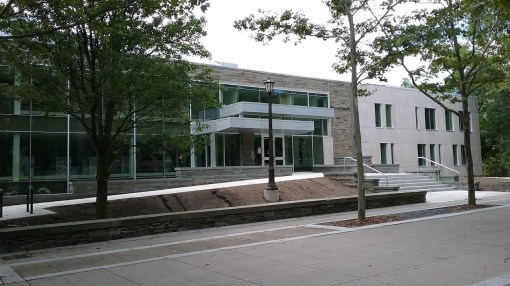
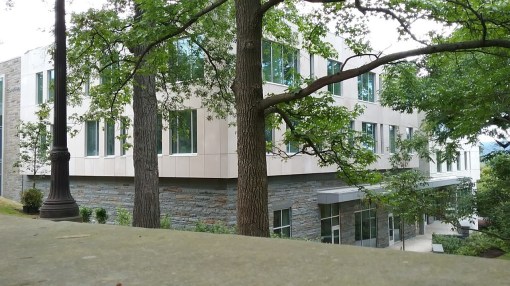
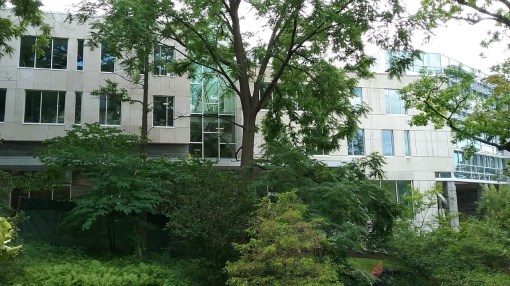
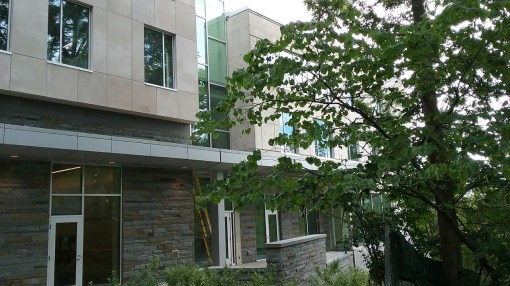
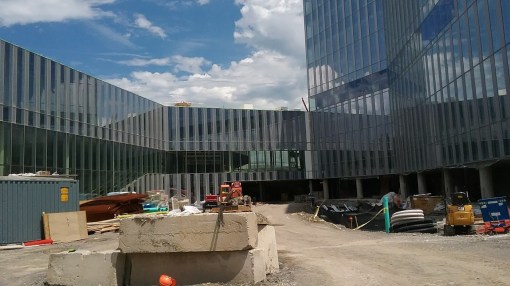
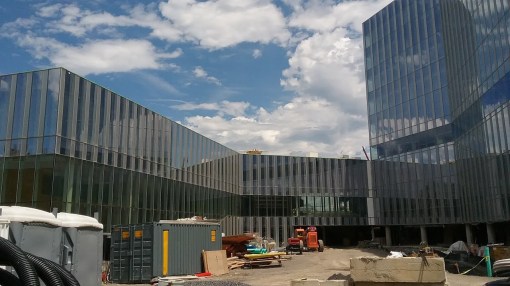
Cornell has several projects that are finishing up within the same short time frame. The renovation of Upson Hall will be one of them. Some of the Morin aluminum panels have yet to be clipped over the mineral wool, but the exterior is largely finished. It appears that the ribbing in the terra cotta panels becomes gradually finer from bottom to top. Interior work is still ongoing, from the windows it appears that drywall has been hung, but finishing work, such as interior railings, remains to be done.

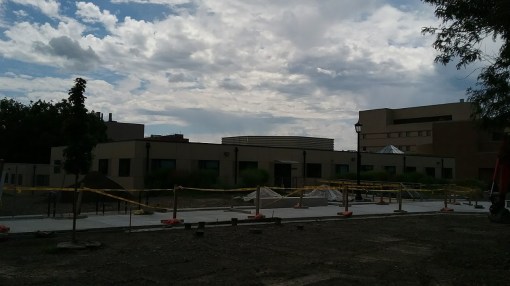
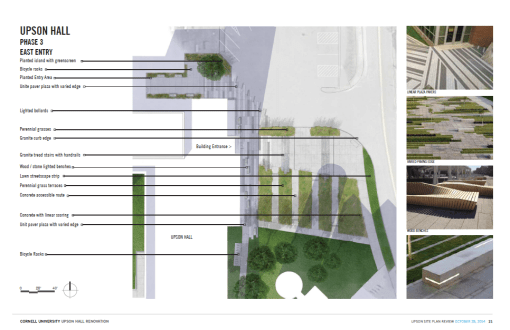
The timeline is to have the second phase completed by August, with an eventual third phase that will upgrade the landscaping from simple sidewalks and green space to more complex plaza areas with pavers, stone and wood benches and lighting effects. Given future plans to upgrade the Engineering Quad, the presence of heavy equipment and staging areas close by if not reused means that Cornell prefers to wait until all work is done on the buildings before upgrading the grounds (consider the Ag Quad for example).


Gannett Health Center Construction Update, 7/2017

27 07 2017

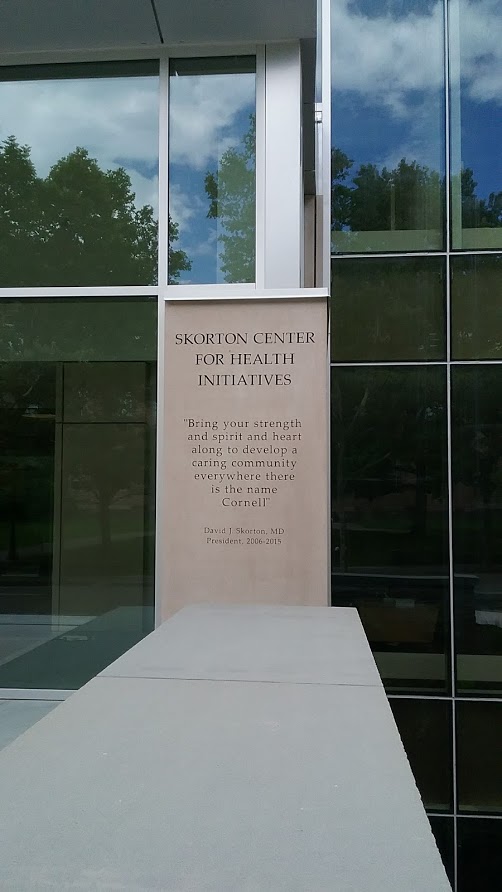
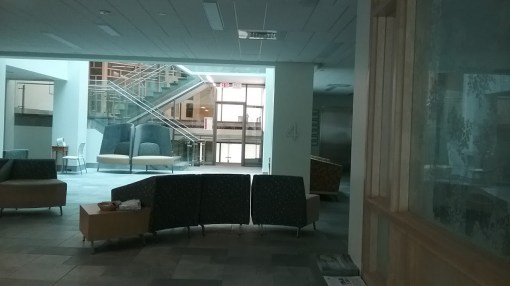
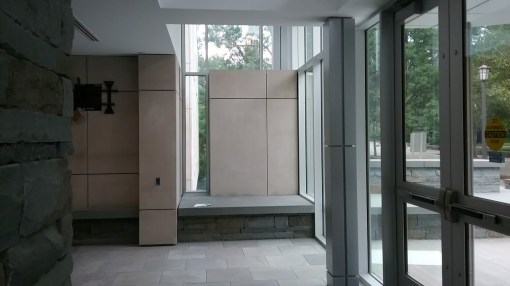
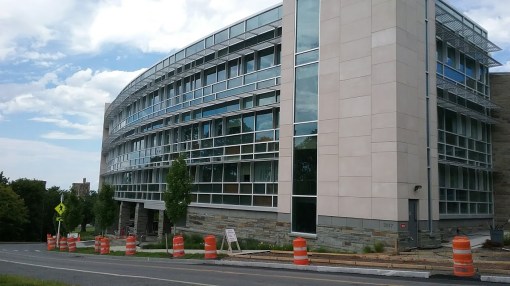
Here are the rest of the photos from the Cornell Health, formerly known as Gannett Health Center. The Voice write-up is here. The project is mostly complete, with some sidewalk and landscaping yet to be completed (the official timeline has the project wrapping up in October, but given the stocked pharmacy and furnished lobby, the project is practically complete from this blog’s perspective). Look for a potential final Voice article later in the fall, as part of an official tour of the building around the time of the ceremonial ribbon-cutting.

On a personal note, I want to briefly send my apologies for the slow updates; I’ve been dealing with a personal loss, and their passing hit me harder than I anticipated. It’s also been a very slow week news-wise, so don’t expect a weekly news round-up tomorrow evening.


Cornell Veterinary School Expansion Construction Update, 7/2017

25 07 2017

Just clearing out the photo stash – only a small sampling of the photos made it into the Voice round-up. The first set show the new administration and library wing finishing exterior aluminum panel installation, new curbing being laid, and the mostly finished entry and atrium area. The later photos are of the new Community Practice Service building, which is finishing underground utilities routing and foundation work – the new service facility will be one-story and wood-frame, which should allow the structural framing to move quickly.

The new vet school facilities will be open by late August, and the new CPS Building neat spring.


News Tidbits 7/22/17: Throwing Darts

22 07 2017

1. Let’s start off the week with a little intrigue. A vacant 12.34 acre property on Wiedmeier Court in Ithaca town sold for $65,000 earlier this week – given that it was on the market for five years and marketed for development potential, the sale merited a closer look.

At first glance, it seemed to merit a shrug. The buyer was an LLC that could be traced back to a CPA in the San Francisco area, a woman of retirement age. The profile fits the deep-pocketed subset who might buy a sizable slice of land near Ithaca, and build a home for their retirement enjoyment. Not uncommon in Tompkins County.

Then on Wednesday, the same buyer purchased 114 and 122 Birdseye View Drive from the Cleveland family for $485,000. 122 is a 4-bedroom single-family, and 114 a 3-bedroom single-family. Both are next to IC, nearly new houses in a development otherwise filled with small-scale student housing. So, things just got more interesting. We’ll see if anything comes of the Wiedmeier property.

2. Just briefly touching on Hamilton Square this week – one of the questions I previously held off on addressing was the possibility of the abatement. Although the county has said they’re open to considering affordable housing tax abatements or PILOTs (Payments In Lieu Of Taxes) as part of their housing strategy, housing itself usually isn’t enough to merit a visit to the IDA. But with the addition of the nursery/daycare, it bared similarities to 210 Hancock, which cited its planned daycare center and the new jobs at the center in its PILOT request.

So, I asked what the plan was. Here’s the response from INHS’s Real Estate Development Director, Joe Bowes:

“We are not seeking an abatement from the IDA for the project.  If the day care is a non-profit then it would be tax exempt without the need for an IDA abatement.  The housing does not need the abatement in this case so it will be assessed and will pay property taxes.  210 had other reasons for requesting an abatement.”

Emphasis his. In the documentation on Hancock, the abatement was partially driven by the acquisition cost of the property and the need for a deep pile foundation. The buildings are much smaller at 46 South Street, so a slab/shallow foundation is suitable, and it helps that Trumansburg’s soil is less water-logged and more stable than Northside’s. This results in a lower development cost per square foot, so although they arguably could (and upset the neighbors even more), INHS isn’t pursuing a PILOT or abatement. The only tax savings will be for the eleven affordable owner-occupied units, which will be assessed for what they can sell for within the Community Housing Trust, rather than a market-rate value. This has the county’s support, because taxing a townhouse for double the value of what the lower-middle class homeowner could sell it for undermines its affordability.
3. Here’s an interesting note from Lansing regarding the Cornerstone land purchase. The first phase on 13.5 acres would be 68-72 units. The second phase on the remaining 8.9 acres would potentially host another 72 units. All of these would be affordable. This might cause a backlash as too much, but if one of the phases was general affordable housing, and the other affordable senior housing, then that might negate most of the blowback. Anyway, something to watch for.

On another note, the modified PDA for the Village Solars has a stipulation that the community center/mixed-use building (“F”, green dot) has to be completed by the end of 2020, and only 4 of the 9 other buildings will be approved before the community center is complete. Everything north of Circle North will not be allowed to start construction until the community center is open. This suggests a build-out of #116/#102, 2017-18, #2/#22, 2018-19, Community Center 2019-2020, #117/#36 2020-21, and K, L and M would be built in 2021-22.


4. Laurels and darts. Here’s a dart. The town of Ithaca is seeking to, once again, extend its moratorium on two-family properties. When the law was enacted in early May 2016, it was supposed to be for 270 days, meaning an early February expiration. Then it was extended to the end of July. Now they want to extend it to the end of October, which given the seasonal nature of construction, effectively stops all new two-family properties through the winter of 2017/18.
I’ll be frank. This is not a good look. There were a number of concerns from property owners when the law was proposed for a length of one year, was unfairly long, and the town has not only realized their concerns, it’s exceeded them. The town is establishing a bad faith precedent through what property owners will complain as either being ill will, or incompetence. Part of me is concerned that anyone fighting the town on something, be it zoning, development, conservation or anything, will use this as an example of how the town “can’t be trusted”. I’ve never been a fan of moratoriums, because they end up seeking extensions. Not impressed to have another example to file away.
5. And on that note, the town of Groton just slapped a six-month moratorium on all solar arrays designed to power more than one house or one agricultural farm. No commercial solar, no community solar. Technically, the law also stops wind turbines and gas pipelines, but the Times’ quotes make it clear this was all about solar.

6. The county legislature finally approved a name to the Heritage Center this week. The “Tompkins Center for History and Culture” was approved 10-2. The previous vote failed due to a number of absent legislators and pushback for not having enough to consider the name. Legislator Chock D-3rd) initially wanted it named for late legislator Stu Stein, but naming buildings after people has been against county policy since the early 2000s. Legislator McBean-Clairborne (D-1st) voted against it because she felt the word “county” should be in there. This has not been a month where local government engenders confidence.

7. Short but interesting city of Ithaca Planning Board meeting meeting up. The only thing up for final approval is the McDonald’s rebuild at 372 Elmira Road, while INHS’s Elm Street and Lakeview’s West End project are set to begin formal environmental review. Here’s the agenda:

1. Agenda Review 6:00

2. Privilege of the Floor 6:01

3.Site Plan Review

A. Project: Commercial Rebuild (McDonalds) 6:10
Location: 372 Elmira Road
Applicant:McDonalds USA LLC
Actions: Consideration of Preliminary & Final Site Plan Approval
Project Description: The applicant proposes to replace the existing 4,800 SF restaurant facility with a new 4,400 SF building, construct a side-by-side drive-thru, install new landscaping, a dining patio, lighting, signage and a masonry landscape wall, as well as reconfigure the parking layout. The project is in the SW-2 Zoning District and requires an area variance. This is an Unlisted Action under the City of Ithaca Environmental Quality Review Ordinance (“CEQRO”), and the State Environmental Quality Review Act (“SEQRA”), for which the Planning Board as Lead Agency made a Negative Declaration of Environmental Significance on June 27, 2017.

B.Project: Elm St Apartments (Rebuild) 6:25

Location: 203-209 Elm Street
Applicant: Lynn Truame for Ithaca Neighborhood Housing Services Inc. (INHS)
Actions: Declaration of Lead Agency, Review of FEAF Parts 2 & 3
Project Description: The proposed project consist of the demolition of two single family homes and one
multiple dwelling and the construction of a single 12,585 SF apartment building with 13 dwelling units, parking for six vehicles, and other associated site improvements. Due to the slope of the site, the building will have 2 stories facing Elm Street and three stories in the rear. The project requires the consolidation of three tax parcels. The project is in the R-3a Zoning district and is seeking two area variances for relief from rear yard setback and parking requirements. This is a Type I Action under the City of Ithaca Environmental Quality Review Ordinance (“CEQRO”)§176-4 (1)(h)[3], and the State Environmental Quality Review Act(“SEQRA”)§ 617.4 (11) and is subject to environmental review.

C. Project: 709 West Court Street (Housing) 6:50
Location: 326 & 328 N Meadow St. and 709–713 W Court Street
Applicant: Trowbridge Wolf Michaels LLP for Lakeview Health Services Inc.
Actions: Declaration of Lead Agency, Review of FEAF Parts 2 & 3
Project Description: The applicant proposes to construct a five-story L-shaped building with footprintof 10,860 SF and GFA of 62,700 SF on the .81 acre project site comprising four tax parcels (to be consolidated). The building will containing sixty (60) one-bedroom apartments plus associated shared common space (community room, laundry facilities, lounges, and exterior courtyard), support staff offices, program spaces, conference room, utility rooms, and storage. The siting of the building allows for a small landscaped front yard, a south-facing exterior courtyard, and a 16 space surface parking lot in the rear of the site. Site development will require the removal of five structures and associated site elements. The project is in the WEDZ- 1 Zoning District. This is a Type I Action under the City of Ithaca Environmental Quality Review Ordinance (“CEQRO”)§176-4 (1)(k) and (n), and the State Environmental Quality Review Act (“SEQRA”) § 617.4 (11) and is subject to environmental review.

D. 105 Dearborn –Sketch Plan 7:10

This is Bridges Cornell Heights new 16-bedroom independent living building for seniors. If it’s at the Planning Board, that means the ILPC has signed off on the building and site design.

E. 311 College Ave – Sketch Plan 7:30

This is…curious. 311 College Avenue is The Nines restaurant and bar, and was built in 1905 as fire station No. 9 before the new station opened next door in the late 1960s. The old station was sold off and became the Nines in the early 1970s, and has been under its current ownership since 1980. The top two floors are used for storage, according to county records.

At a glance, it’s a valuable piece of land with a lot of posibilities – MU-2 zoning allows six floors and 100% lot coverage. On the other hand, this is a relative historic property in Collegetown, and development perceived as insensitive will likely see significant opposition. There had been talk by ILPC staff of giving the building historic designation back in February 2016 out of concerns over development pressure, but it seems no formal application was made. So there are options here, but the developer should proceed with caution.

4. Zoning Appeals 7:50
#3066, 214 Elmira Road, Area Variance
#3079, 413 Titus Ave, Area Variance

5. Old/New Business 8:00
A. Planning Board Recommendation to Council Regarding Proposed Waterfront Rezoning
B. Planning Board Report Regarding the Proposed Local Historic Landmark Designation of 403 College
Ave
C. Downtown Wayfinding

6.Reports 8:30
A. Planning Board Chair (verbal)
B. Director of Planning & Development (verbal)
C. Board of Public Works Liaison


Ithaka Terraces Construction Update, 7/2017

21 07 2017

Some more progress on the Ithaka Terraces condo project at 215-221 West Spencer Street. Buildings “A” and “B” have had their porches built out and sheathed, with some of the decorative columns are in place (the architecture, penned by STREAM Collaborative, is supposed to take design curs from traditional Greek/Mediterranean hillside structures). The white coating visible from the uphill photos is the water-resistive barrier over which the stucco will be laid. Building “C” is framed and sheathed, but the roof isn’t fully shingled and many of the windows and doors have yet to be fitted. Long-awaited Building “D” has finally started construction, with excavation underway and some foundation forms in place. The grand central stairway is beginning to take shape. From what I was told by developer Ed Cope (PPM Homes), the model unit should be unveiled in the next few weeks.

The website has been updated to take inquiries, with unit sizes ranging from a 1,005 SF 2-bed, 2-bath, unit, to a 3-bedroom, 3-bath 1520 SF unit (3 bathrooms? For the family that hates sharing sinks and showers?). Nothing on the website states pricing, which was previously estimated in the $265k-$390k range.

Side note, I dropped by 413 West Seneca Street and 109 North Corn Street, a pair of projects Ed Cope is doing in Ithaca’s State Street corridor. Nothing to report yet.


607 South Aurora Street Construction Update, 7/2017

19 07 2017

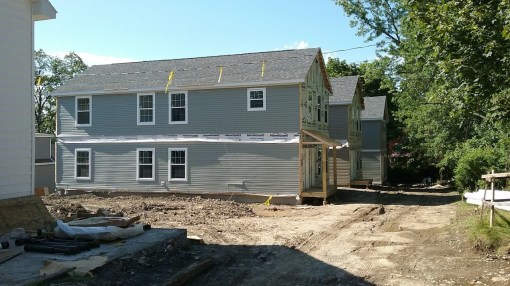
Thanks to the rapid turnaround time for modular units, the the duplexes at 607 South Aurora Street in the city’s South Hill neighborhood are galloping towards their completion date next month.

One thing to keep in mind is that, once the foundation has been built (Superior Walls here) and underground utilities are in place (water/sewer), it’s basically a matter of trucking in the boxes from the supplier and craning them into place. Per Ithaca Builds (the website is down but the pages are archived), they’re already framed, sheathed, utilities are mostly in, the interiors have drywall hung, windows and doors have been fitted, and even cabinetry, bathroom fixtures and countertops are in place. 80% of the construction work for the duplex is completed by craning four boxes into place and locking them together. The pros are better quality control, less waste, and a quicker turn around time. The cons to modular units is that there’s generally a limited set of designs and customization, although that has improved in recent years, particularly if a developer has a somewhat generous budget (see the Belle Sherman Cottages for example).

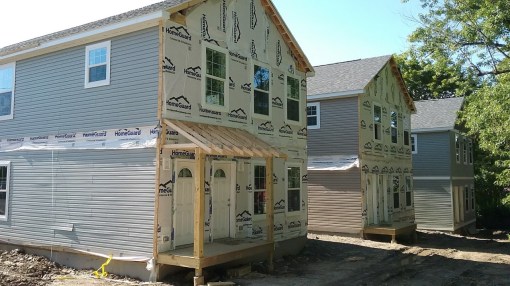
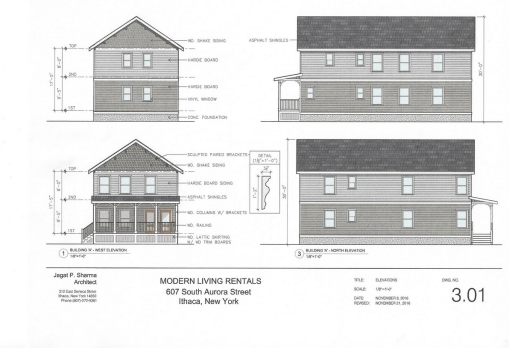
Once the boxes are craned and secured to the foundation and each other, the inside will undergo painting and finish work, while the outside gets faced with the exterior material of choice and porches, garages or other details are attached. Here, the rear three duplexes use vinyl siding, lap siding on the lower floors and shake siding on the gables, with decorative lap bands and color variations to give the outside some curb appeal. These units will have small porches with lattice skirts. The unit facing Aurora will receive nicer finishes since it’s the unit that will be seen the most by passing traffic. This includes fiber-cement siding, a full-width porch with decorative brackets (seen under construction below), and sculpted roof brackets.

Note that the rear of the existing house at 607 South Aurora has been expanded, its roof raised slightly. The original five-bedroom house is being extensively renovated into two three-bedroom units. The eight new units will each be three-bedrooms, going for about $700 per bedroom. To quote the ad:

“This home has 3 bedrooms with 2 baths and everything is BRAND NEW!

Newly constructed in 2017, this home features stainless steel appliances, granite counter tops, LED lighting throughout the home, all oil bronze finishes, with large bedrooms and ample closet space. The home is equipped with its own washer and dryer, and can come fully furnished. This property is conveniently located less than one mile from Ithaca College, with off-street parking available, this unit is a beautiful place to call home! This property is pet friendly with the correct pet and owner. 

Other Features:
-Stainless steel dishwasher, refrigerator, range and hood vent.
-Luxury vinyl flooring throughout
-W/D in unit
-Beautiful tiled bathrooms
-Modern-Contemporary Style
-Bedroom Furnishings: includes bed frame, bed mattress, dresser, desk, and desk chair
-Dining Room/Kitchen Furnishings: offer seating for dinning
-Living Room Furnishings: includes a couch
-All Room Furnishings: includes curtains decorating all windows
-Located right up the street from the heartbeat of Ithaca, the Ithaca Commons! Magnificent place to eat, shop, and have fun in the Ithaca area
-The TCAT bus stops near the development.”

A couple blocks away, Modern Living Rentals picked up 217 Columbia Street, which has the potential for a rear unit, although it’s just as likely MLR will simply spruce up the existing two-family. The fact that the rentals are only until 5/31/2018 kinda leaves the door open for some construction work next summer.


602 West State Street Construction Update, 7/2017

19 07 2017

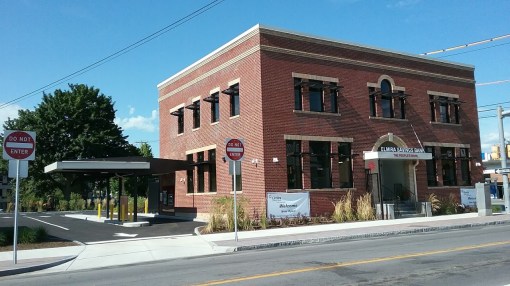
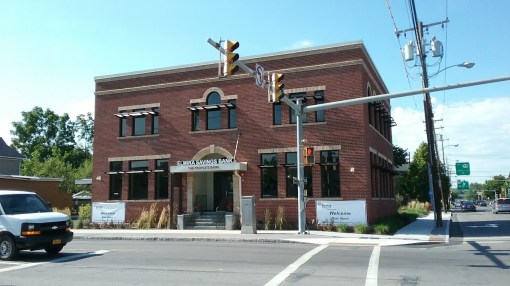
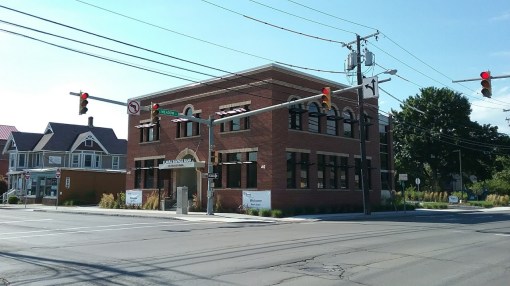
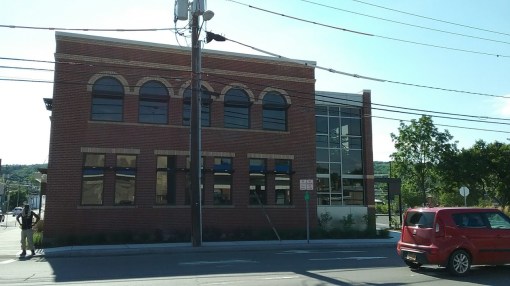
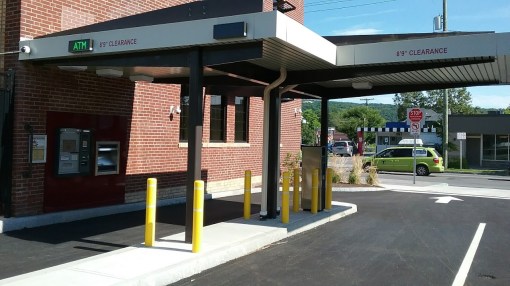
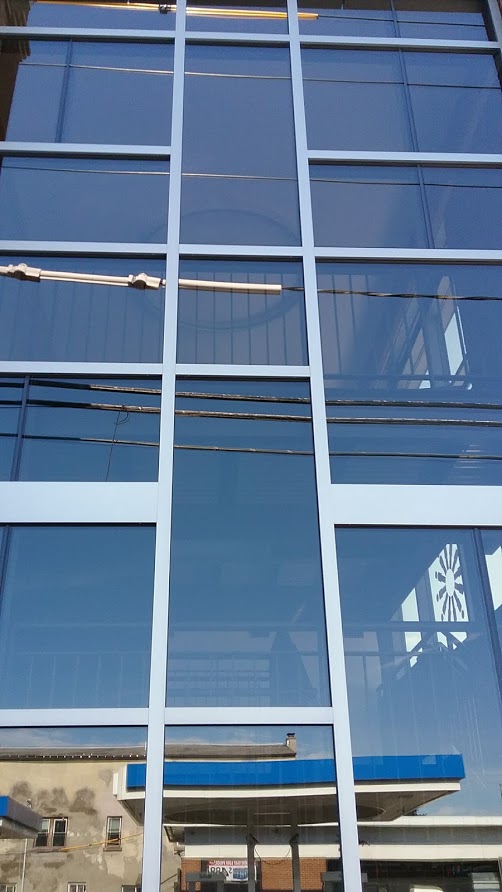
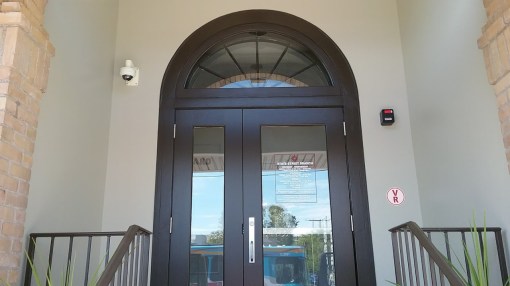
The new Elmira Savings Bank is open in Ithaca’s West End, and this project is done. A former restaurant is now 5,000 SF of renovated space plus 1,600 SF in a contemporary addition. Design-wise, it’s a smart re-use of a century-old structure, modernizing it but maintaining the integrity the original structure. Kudos to HOLT Architects for a successful blend of old and new. Elmira’s Edger Enterprises brought the $1.7 million project from the drawing board and into reality.

There’s no doubt that the project is further proof in the increased vitality and attraction of Ithaca’s long-forsaken West End, and another step on the the path to turning it into a stronger neighborhood. Within just a block, one has the new Planned Parenthood (2014), the 17-unit Iacovelli Apartments (2013), the renovated HOLT Architects office (2016), a gas station renovated into the Jade Garden restaurant (2015), and the new microbrewery opening up in the rear of the Cornell Laundry warehouse.

If there is one thing I wish had gone different with this project, it was the sale of the property and removal of three low-income families. That got ugly, and it tarnished what was otherwise a decent project. The story I’ve been told in the two years since is that the bank were mislead by the previous owner, who gave them old rental paperwork saying tenants were month-to-month, and ESB mistakenly assumed it was still accurate. So there’s something to be said about due diligence and taking a couple hours out to meet with tenants before any notices go out.

The northern end of the property has preserved a few mature trees, and in the long-run ESB would like to partner with a developer, affordable or otherwise, to do something along West Seneca. Plus, there are organizations like Lakeview, who coincidentally looked at doing a development where ESB is nowand are moving forward with affordable housing in the West End. More opportunities for mixed-use plans with market-rate and affordable housing will open up as properties go on the market and Ithaca’s economy continues to develop – and plans like Cayuga Med’s are big if auspicious question marks.

While it’s great to have new housing plans brought forward, it’s also important to maintain existing affordable housing (and programs to assist) while adding those new options. With Lakeside and Parkside scooped up and pushed upmarket, and Maple Hill now market-rate Ithaca East, that takes hundreds of units out of the equation, and this is a significant concern. It’s no surprise that tensions boiled over given the difficulties in preserving existing LMI housing options, and in approving and building new ones.

Anyway, enough with the final thoughts. Enjoy the photos.

Before:

After: