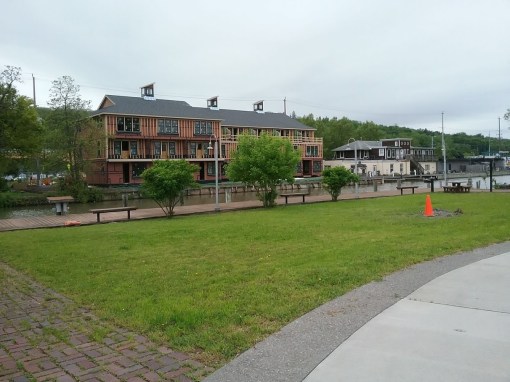
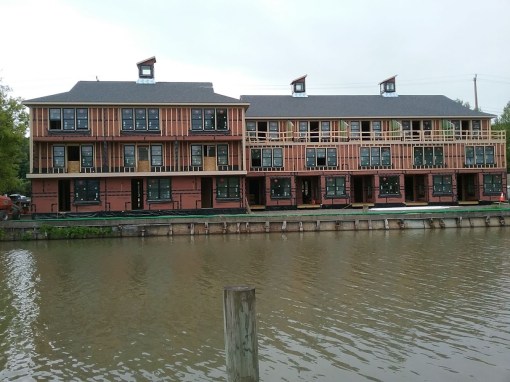
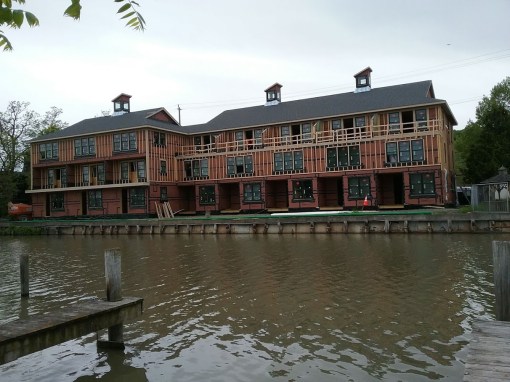
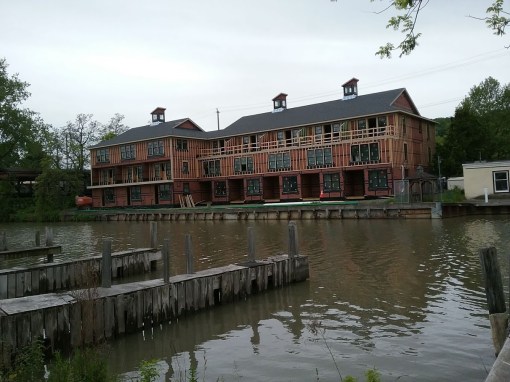
Hilton Canopy Hotel Construction Update, 6/2019

19 06 2019

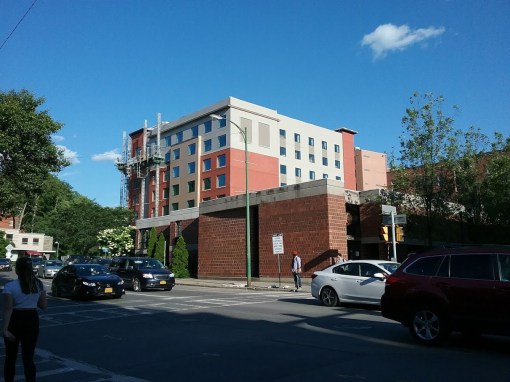
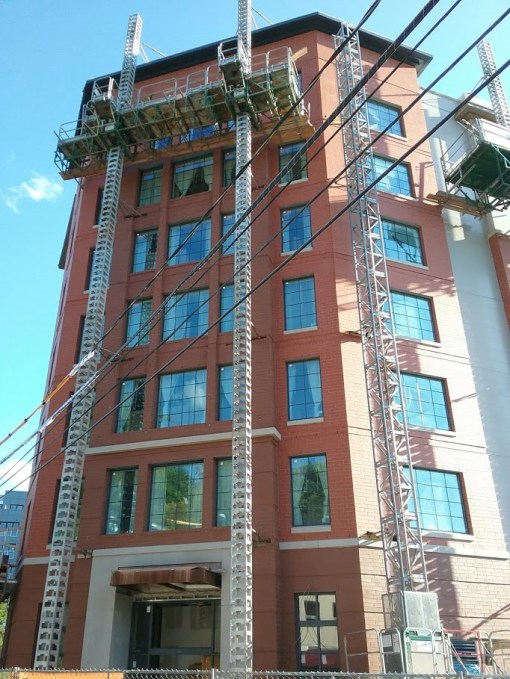
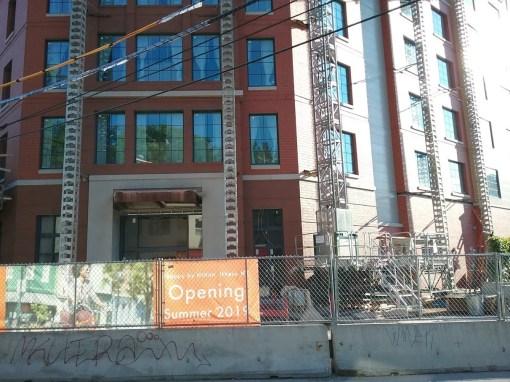
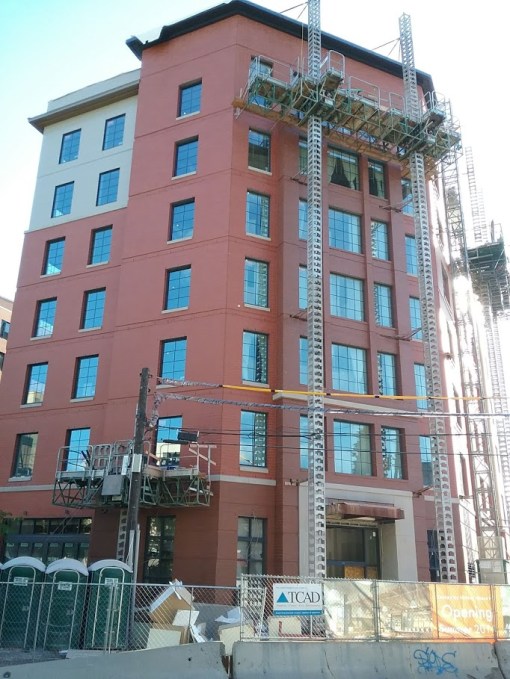
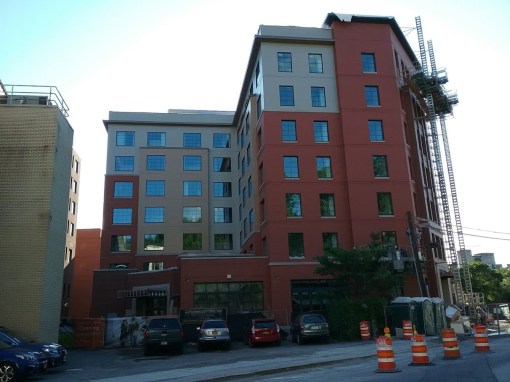
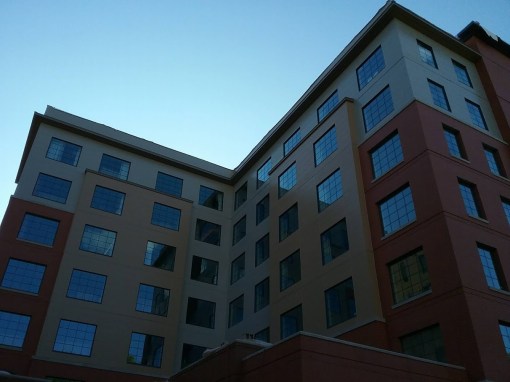
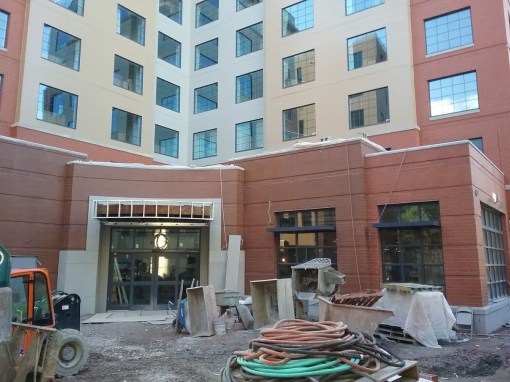
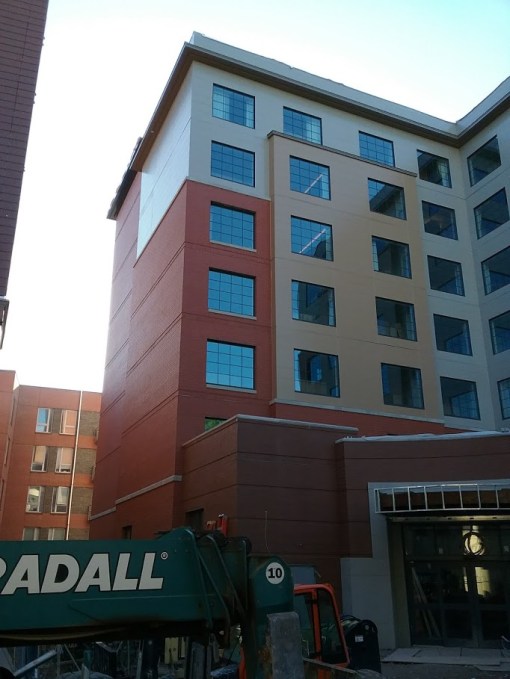
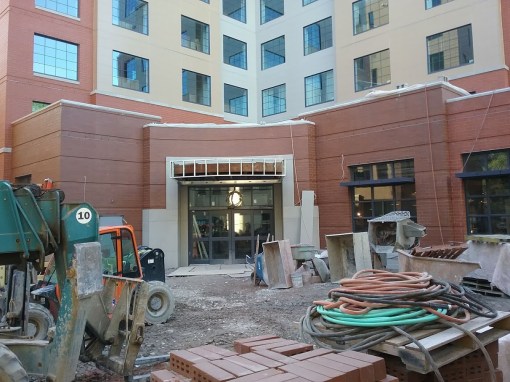
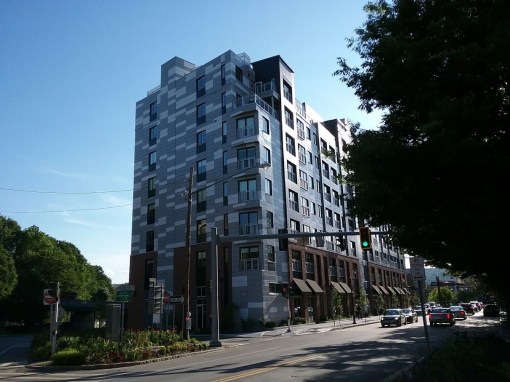
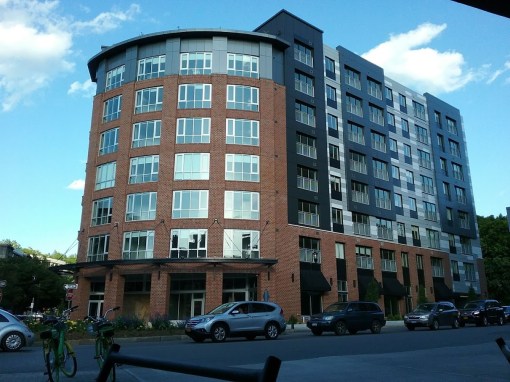
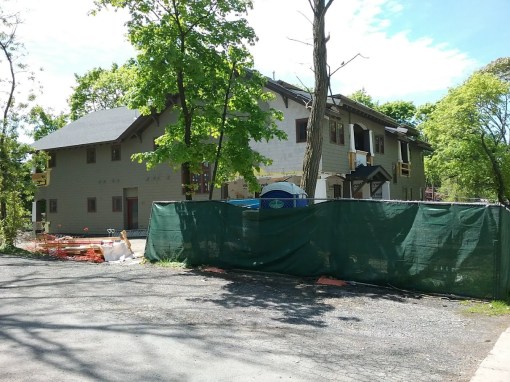
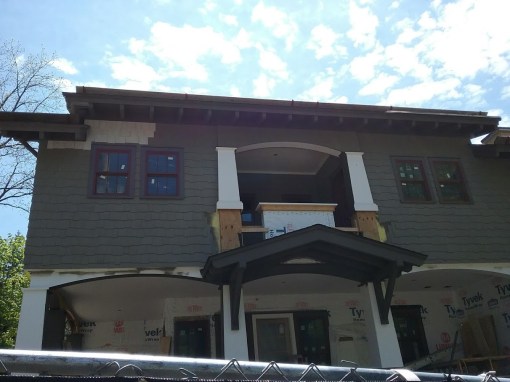
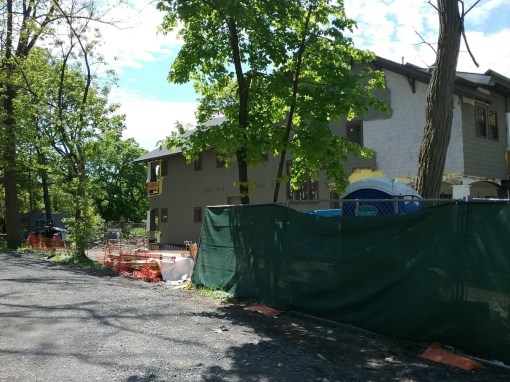
In the home stretch now. The exterior is largely complete apart from some minor trim and finishes, with the entrance canopy in the process of being framed out. Inside, it looks like the drywall has been hung based on what little can be seen from the windows. Exterior lighting and landscaping features, as well as paving and plantings, will come later in the summer. As described by the advertisements being posted on local tourism websites:

“The brand-new Canopy by Hilton is a 131 room Downtown hotel inspired by our “Gorges” surroundings, opening Summer 2019.

Enjoy a meal and a handcrafted cocktail at our full-service restaurant, featuring indoor/ outdoor seating.  Or venture out to restaurant row and the Ithaca Commons, located just steps away from our front door.

Delight in the views of Downtown Ithaca from one of our “Just-Right Rooms” and enjoy comforts like a large HDTV, refrigerated drawer, Nespresso® machine, ergonomic workspace, and our exclusive Canopy Bed.

Stay in shape in our state of the art Fitness Center. Filtered water stations on each floor will keep you refreshed.”

It’s not 100% clear when they’ll open, but their new Director of Sales previously worked at the Marriott down the street, so they’re getting knowledgeable staff on board. A hiring event for entry level staff was held at Coltivare at the end of May. While all the signage says Summer 2019, but the Hilton website says it will start taking reservations for the hotel on November 13th, which is not a good time for a new hotel being that it’s right at the onset of the slower winter season. Rates for a standard room are listed as $166 during the week and $246 for weekend nights.

Complimentary features will include (non-electric) bikes available to guests, an airport/college shuttle for guests, free Wi-Fi, 55″ TVs, built-in refrigerator drawers, bathrobes and socks in the suites, filtered water stations on every floor, serviced and to-go breakfasts, and two meeting rooms for up to fifty guests. The hotel will welcome animal guests weighing 50 pounds or less. A full list of features and amenities is here.

The ground-level restaurant, to be called the Strand Cafe after the theater that once stood on the site (the first proposal referred to it as “Ezra”, presumably for Ezra Cornell but probably too vague for its own good), will serve both “American fare and handcrafted cocktails” and feature a retractable garage-style door to let the outside air in on nicer days. A render of the cafe is at the end of the post.

MARKZEFF Design of Brooklyn will be in charge of interior layouts (render at the end of this post) and room furnishings. PID Floors of New York is supplying the hardwood for the flooring.

On a less kind note, the scaffolding incident with the fearless construction worker seems to have netted the general contractor, William H. Lane Inc. of Binghamton, a $4,000 fine for unsafe working conditions. The scaffolding subcontractor, CFI Sales and Service of Pennsylvania, received three fines totaling $22,542, since they were the perpetrators of the incident. The firm was also let go from the project after the violations.


City Centre Construction Update, 6/2019

18 06 2019

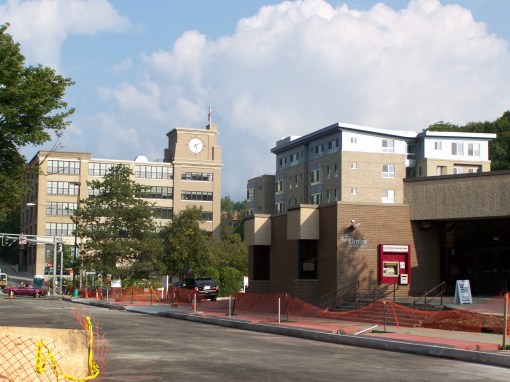
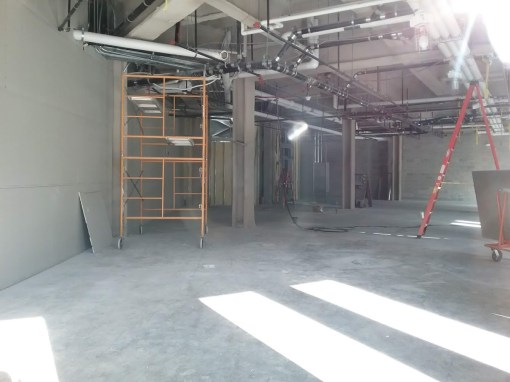
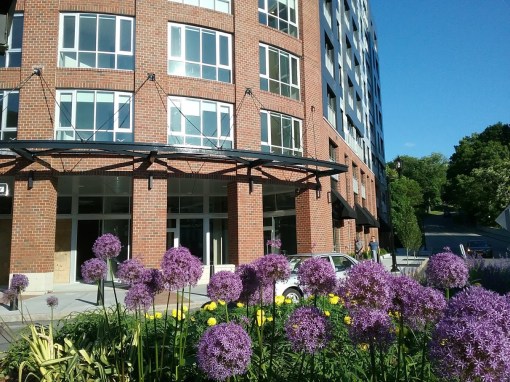
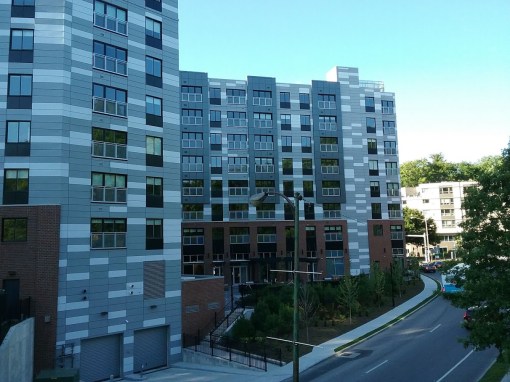
For my practical purposes, I’m going to call this one complete. The 193 apartments opened for occupancy at the start of the month, and interior framing and utilities installations are underway for the three ground-floor commercial tenants (Collegetown Bagels, Chase Bank, and the Ale House) later this summer. Landscaping and pavement is in, although the underground garage was cordoned off. With no good angles aloft, it’s not clear if the 7.5 kW rooftop solar array is in place yet.

Overall I think this project will be a real asset to Ithaca’s Downtown. It creates an active-use streetwall where there was once dead space, and extends and enhances the activity of the Commons and the other side of the 300 Block of East State. The addition of over 200 new residents downtown (224 if one per bedroom or studio) will also benefit local business owners with a steadier crowd than the workforce 9-5 and hotel guests. The project is a 218,000 SF, $52 million vote of confidence in the future of Ithaca’s urban core.

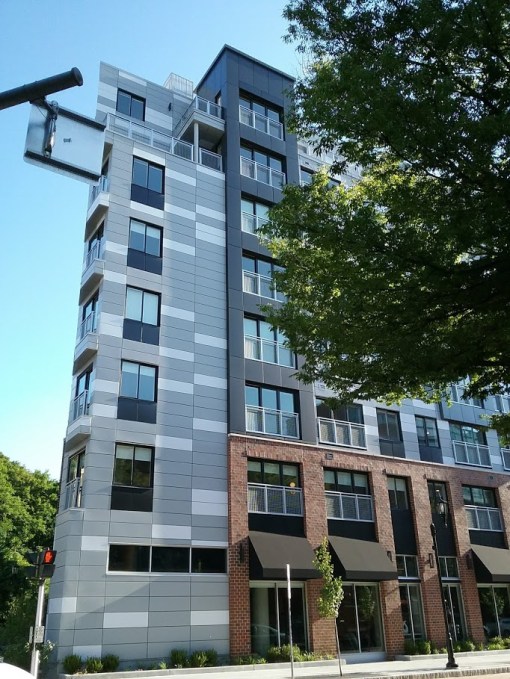
The design, however, is pretty average. The curved wall facing East State and North Aurora is a nice touch (and good on the Planning Board to push for the cornice), but the mishmash aluminum panels makes me think of an old beater car that had its original fender panels replaced with those a different color. As always with architecture, to each their own.

First person to name all the people in the Ithaca art mural in the photo set below gets a shoutout on the blog.

Background information and the history of the project can be found here. The project team includes Newman Development Group, Humphreys & Partners as architect, Whitham Planning and Design LLC as the team representative and point of contact for the review process, and T. G. Miller PC for civil engineering and surveying work. EC4B Engineering handled the mechanical, electrical and plumbing (MEP) engineering, and Taitem Engineering served as the energy systems consultant.

Before:

After:


Maguire Ford-Lincoln Construction Update, 5/2019

2 06 2019

When the Maguire Carpenter Park proposal was shot down in November 2016, that wasn’t the end of the company’s expansion plans. Maguire is by far the largest auto sales firm in the county, and is the 11th-largest employer with about 440 employees as of 2018. Auto makers expect constant refreshing of facilities to keep up with their designs; a failure to maintain the preferred aesthetics and desired features in a sales facility could result in the loss of privileges to sell the latest models rolling off the assembly line.

There’s also another factor that goes into vehicle sales, that being vehicle service, which is a large share of Maguire’s business (something like 40%). People don’t like to travel far to get their vehicles inspected and repaired. This limits Maguire’s ability to move to just the urban and inner suburban parts of the county; the town of Lansing might have offered them land at the Town Center, sure, but the Town Center site is too far away from most of the county’s population for the Maguires to maintain a viable business operation.

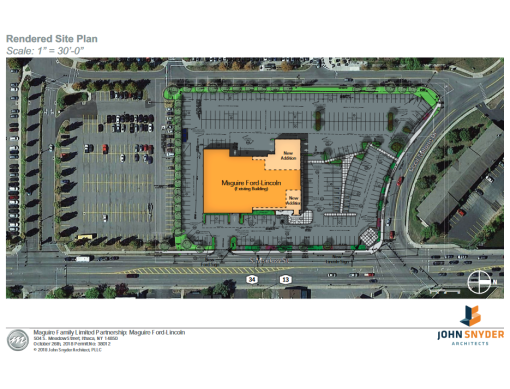
While the Chrysler-Fiat dealership was refreshed and modestly expanded a few years ago, the next phase of projects is more substantial. Maguire Ford-Lincoln-Nissan will be the first of those projects. Located at 504 South Meadow Street on the southwest side of the city, it is a two-story auto dealership on 3.11 acres, originally built in 1983 and expanded in 1999. Maguire will be demolishing some of the older portions and building new additions – the southern half of the building, used more for service, will remain largely intact from the outside, though the interior will be renovated. The northern half is where the bulk of the work will take place. The existing building is 18,500 SF, with 2,265 SF proposed for demolition and 7,865 SF of additions. The new building will be 24,110 SF.

The goals of the project are to meet Ford’s revised corporate standards and customer experience requirements, and improve interior circulation while expanding the Ford/Lincoln sales area (quick note for those unaware, Lincoln is the luxury sister brand to Ford; Mercury was the upscale in-between brand, before it was shut down a decade ago). The Nissan dealership will move to a brand new 25,300 SF location to be built off of Cinema Drive in the village of Lansing.

The western addition includes a service drive through addition to the rear (west side) of the building, including the expansion of the existing second floor for additional offices displaced from the first floor. This addition replaces an existing canopy (open air) structure currently used for car parking. The first floor will be renovated to include a new service waiting area for customers.

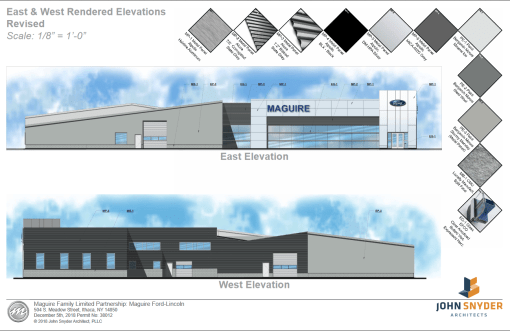
The northeastern addition includes expansion of the showroom end of the building (north and east side), aligning the building with the existing service bay portion of the building currently located on the south side of the building. Also included in this addition is a new entrance to the showroom meeting Ford corporate branding requirements. On the outside, Ford corporate requirements dictate new metal exterior panels that will encompass all sides of the building. The showroom (north side) will be differentiated from the service side of the building with differing types of metal panels. The showroom addition also includes the new Ford “foil” curved form vestibule. The interior will also feature new plumbing, electrical, mechanical and HVAC. To quote the application, “(t)his will transform the exterior appearance of the building making the exterior of this “utilitarian” car dealership into a modern, contemporary car showroom and service center.”

On the outside, new striping, LED lighting and landscaping will be deployed. During the review process, the planning board had issues with the lack of green space, so the lot attempts to use as much as possible within the limited size of the lot and Ford’s corporate requirement for parking spaces on-site (brands dictate a lot of the programming). The site will host 311 spaces, the vast majority (207) for new car display, and a smaller number for staff, customers and on-site service parking, but it also meets the 12% green space requirement for the SW-2 zone.

It’s a pretty tight timeline for construction, and Ford was pressuring Maguire quite a bit on the lengthy approvals process (the BZA wasn’t planning meetings in December 2018 or January 2019 due to lack of quorum, so the project team was practically begging the planning board to approve the front yard variance at the same time as preliminary approval). The project is expected to be completed by the end of the fall at the latest (this says September, but I dunno when the permits were issued in March as planned). During review, the project added more windows as requested, but did not employ masonry as suggested by the board because Ford rejected it.

John Snyder Architects of Ithaca is the project architect, and local firm Elwyn and Palmer is the structural engineer for the project. Saratoga Associates (of Saratoga Springs, fittingly) is the site and civil engineer. According to a tipster, G. M. Crisalli of Syracuse is the general contractor – and it’s not their first Ithaca rodeo, as they were GC for the Dryden Eddy Apartments and the Top of the Hill Apartments in Collegetown. The project cost is estimated to be $1.5 million, according to the Site Plan Review filing.

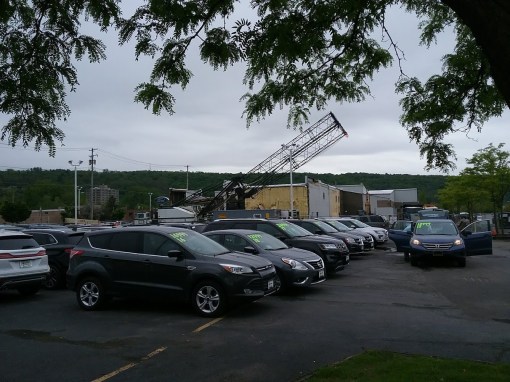
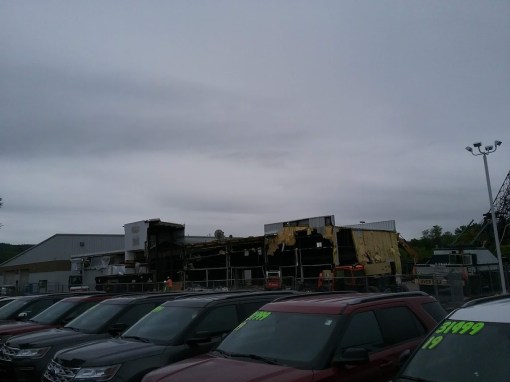
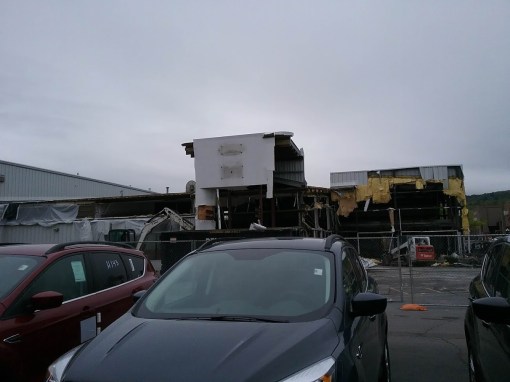
At this time, demolition is underway, and it looks like Bellisario Excavation and Drainage is the demo/site prep subcontractor. Some of the exterior facade has been stripped in the areas to be refaced and/or built out, while the northern wing is largely exposed thanks to the selective tear-downs. Props to the car salesmen who were working while all of this was going on.


Gosh, have trucks gotten expensive…

Early site plan.

Final site plan.


323 Taughannock Boulevard Construction Update, 5/2019

2 06 2019

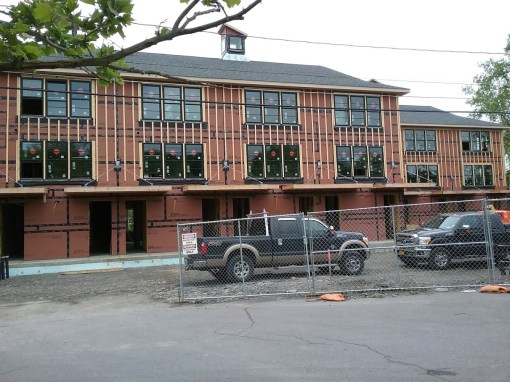
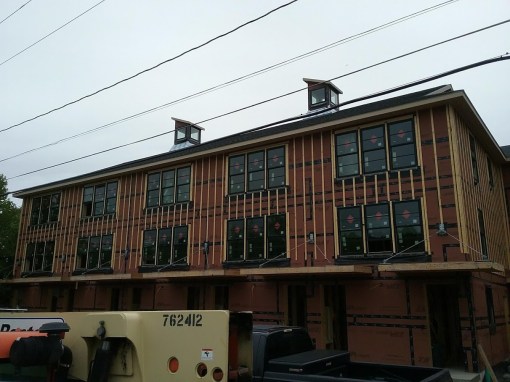
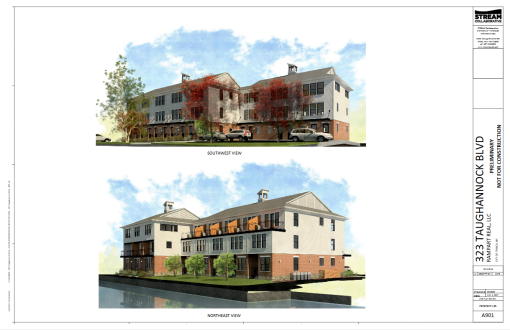
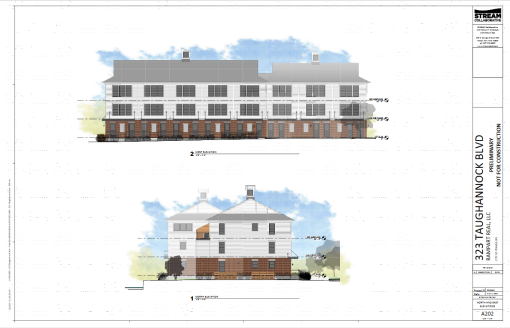
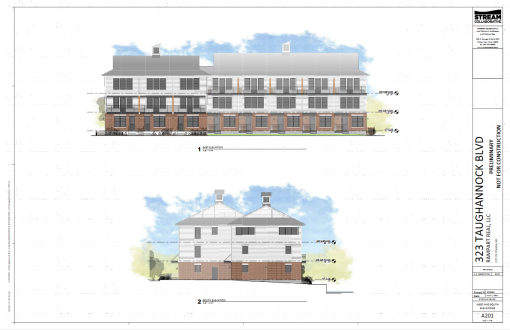
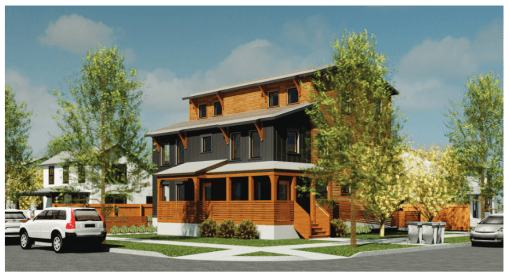
If you think these went up fast, it’s because they did. The modular pieces from Bensonwood were installed in just a couple of weeks; the group of three one week, and the group of five the next (note that the two substrings are slightly offset from each other). The units came with windows fitted and ZIP panel plywood sheathing already in place. The wood rails for the lap siding came after installation onto the foundation. The first floor will be faced with brick, the top two floors with fiber cement lap siding.

The 323 Taughannock project has a name “Boathouse Landing on Cayuga Inlet“. It’s a mouthful. The website is full of the typical heavy, pretentious marketing that defines high-end residential real estate – the reference to “private lifts”, for instance, because calling it an elevator is too plebeian. There’s a substantial possibility that STREAM Collaborative designed the website and branding as they’ve done with some of their projects like the Cottages at Fall Creek Crossing, especially since the layouts are similar, but I doubt any of their staff would employ such overly florid language. It might have been someone at the developer (Arnot Realty) office or a marketing team they contracted out to.

Features and amenities include private patios and balconies, cable and high-speed internet, stainless steel Energy Star appliances, off-site solar power, in-unit laundry, LED lighting, plank flooring on the upper levels, radiant floor heating in the bathrooms, A/C and heat that can be controlled for each room in the unit, private elevators and smart video doorbell systems on certain units, and fully accessible units for those who may have mobility or physical impairment issues. Pets are permitted, and there appears to be an on-site fitness center in the works.

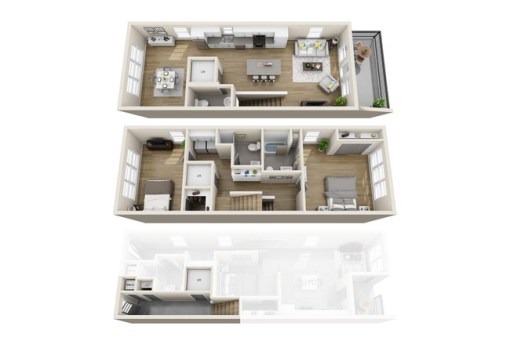
The floor plans can be seen here. The eight two-bedroom units come in three flavors, dubbed “Catalina”, “Hinckley” and “Garwood”. Catalinas have the elevators, and are the largest at 1,750 SF.  Hinckleys are slightly smaller at 1700 SF and lack the elevators, while Garwoods are the smallest at 1,360 SF. All are 2 bedroom, 2.5 bath units. The eight studios come in three flavors as well – “Crosby” (670 SF), “Hobie” (630 SF), and “Laser” (600 SF). It is not clear how those names were selected.

According to online listings, the top-of-the-line Catalinas are listed at $3600-$3700/month, while the other two-bedroom units are $3,400-$3,500/month. Studios go for $1,500-$1,850/month. The project team is aiming to be ready for occupancy by July 29th.

More about the project history and features can be found here.


Absolutely not.

The Catalina two-bedroom floorplan.

The Laser studio floor plan.


News Tidbits 5/27/19

28 05 2019

Just a quick pose here to share and take a look at the city Planning Board Agenda tomorrow evening:

1. Agenda Review 6:00

(there is no Item 2. on the agenda)

3. Privilege of the Floor 6:25

4 Approval of Minutes: April 23, 2019 6:35

5. Site Plan Review

A Project: Greenstar Project Changes 6:40
Location: 770 Cascadilla Street
Applicant: Noah Demarest, Stream Collaborative (for owner)
Actions: Approval of Project Changes

Project Description: This project was approved by the Planning Board on June 26, 2018, with subsequent changes approved by the Board on March 26, 2019. The applicant is now returning to with requested items and to request additional changes. Project materials are available for download from the City website: https://www.cityofithaca.org/DocumentCenter/Index/774

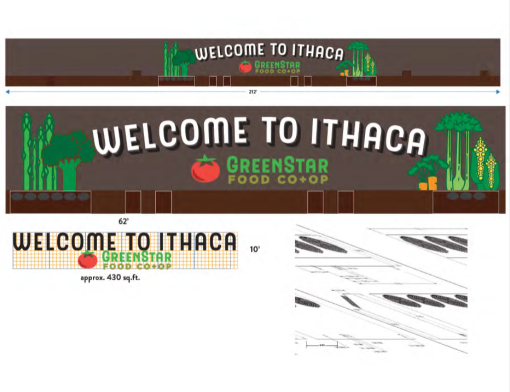
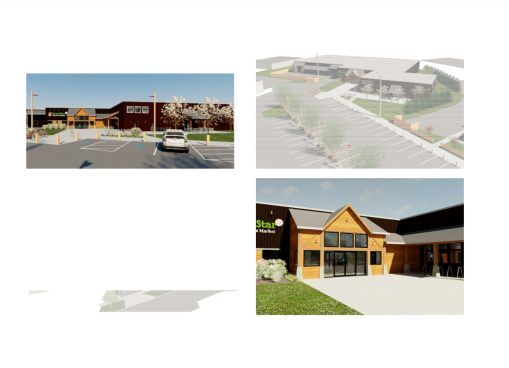
The GreenStar project was halted by the board due to aesthetic concerns related to the value engineering. In response to the concerns about the blank wall that would face Route 13, the mural above has been proposed. The development team is also proposing new signage and replacing the wood bollards in the parking lot with lighted steel bollards.

Few further issues are expected to come up, and approval of these changes would allow the project to continue with construction. GreenStar is certain enough of the Board’s approval that its existing 10,000 SF space at 701 West Buffalo Street has been put up for lease.
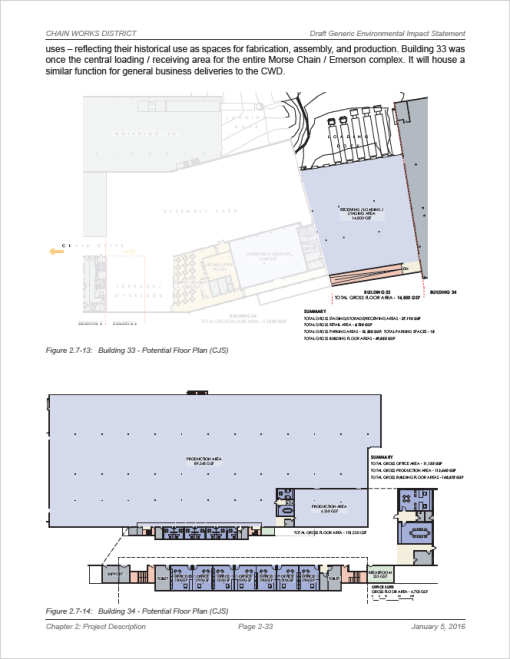
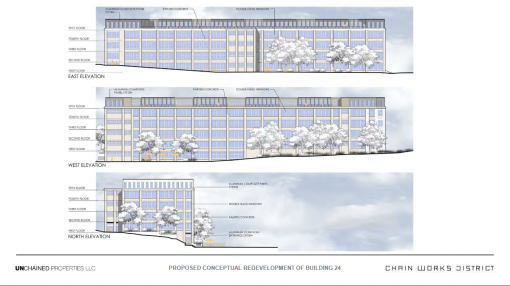
B Project: Chain Works District Redevelopment Plan 6:50
Location: 620 S. Aurora St.
Applicant: Jamie Gensel for David Lubin of Unchained Properties
Actions: Presentation of Revised Phase 1, Public Hearing, Potential Preliminary Approval of Conceptual Site Plan

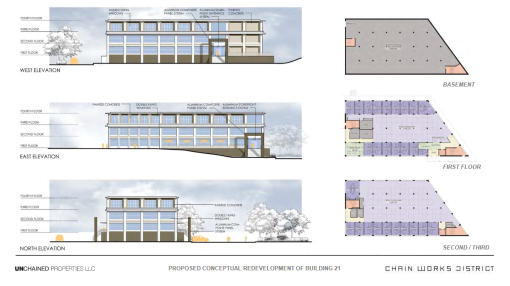
Project Description: The proposed Chain Works District is located on a 95-acre parcel traversing the City and Town of Ithaca’s municipal boundary. It is a proposed mixed-use development consisting of residential, office, commercial, retail, restaurant/café, warehousing/distribution, manufacturing, and open space. Completion of the Project is estimated to be over a seven-to-ten year period and will involve renovation of existing structures as well as new structures to complete a full buildout of 1,706,150 SF. The applicant applied for a Planned Unit Development (PUD) for development of a mixed-use district, and site plan review for Phase 1 of the development in 2014. The project also involves a Planned Development Zone (PDZ) in the Town and subdivision. This project is a Type I Action under the City of Ithaca Code, Environmental Quality Review Ordinance, §174- 6 (B)(1)(i),(j),(k),(n), (2), (6), (7),(8)(a)and (b) and the State Environmental Quality Review Act §617.4 (b)(2),(3), (5)(iii), (6)(i), and (iv), for which the Lead Agency issued a Positive Declaration of Environmental Significance on October 28, 2014. The Lead Agency held subsequently Public Scoping on November 18, 2014. The Lead Agency deemed the Draft GEIS adequate for public review on March 8, 2016, held the public hearing on March 29, 2016 and accepted comments until May 10, 2016. The Lead Agency filed a Notice of Completion for the FGEIS on March 5, 2019. The FGEIS includes the original DGEIS, all comments and responses on the DGEIS, revised information resulting from those comments, and updated information since the publication of the DEIS. The Board adopted findings on March 26, 2019. The applicant is now proposing Phase 1 of the project which entails the rehabilitation of buildings 21 and 24. Project materials are available for download from the City website: http://www.cityofithaca.org/DocumentCenter/Index/119

Doing a cross-check, I don’t quite see what changes have been made with Phase I, though early plans called for more office space (now mixed-use, with office space and 60 apartments). Approval of the concept plan (in relation to the FGEIS) is not the same as approval of the individual renovation plans, which have been submitted but will take a couple more months of the standard retinue of environmental assessment forms and declaration of findings. The approved EIS looks at the concept as a whole, while materials, construction impacts and other details associated with individual building plans still require going through the planning board.
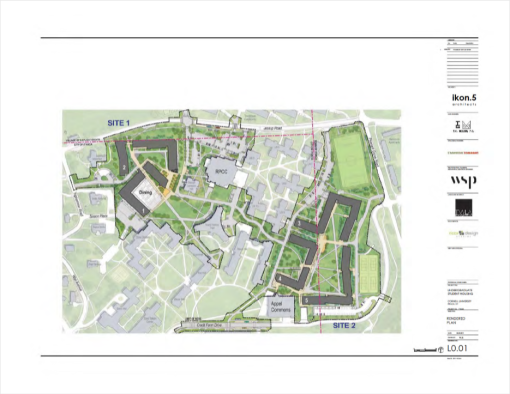
C. Project: North Campus Residential Expansion (NCRE) 7:10
Location: Cornell University Campus
Applicant: Trowbridge Wolf Michaels for Cornell University
Actions: Continuation of Site Plan Review (Jessup Road Elevations & Conditions of Approval)

Project Description: The applicant proposes to construct two residential complexes (one for sophomores and the other for freshmen) on two sites on North Campus. The sophomore site will have four residential buildings with 800 new beds and associated program space totaling 299,900 SF and a 1,200-seat, 66,300 SF dining facility. The sophomore site is mainly in the City of Ithaca with a small portion in the Village of Cayuga Heights; however, all buildings are in the City. The freshman site will have three new residential buildings (each spanning the City and Town line) with a total of 401,200 SF and 1,200 new beds and associated program space – 223,400 of which is in the City, and 177,800 of which is in the Town. The buildings will be between two and six stories using a modern aesthetic. The project is in three zoning districts: the U-I zoning district in the City in which the proposed five stories and 55 feet are allowed; the Low Density Residential District (LDR) in the Town which allows for the proposed two-story residence halls (with a special permit); and the Multiple Housing District within Cayuga Heights in which no buildings are proposed. This has been determined to be a Type I Action under the City of Ithaca Environmental Quality Review Ordinance (“CEQRO”) §176-4 B.(1)(b), (h) 4, (i) and (n) and the State Environmental Quality Review Act (“SEQRA”) § 617.4 (b)(5)(iii) for which the Lead Agency issued a Negative Declaration on December 18, 2018 and granted Preliminary Site Plan Approval to the project on March 26, 2019. Project materials are available for download from the City website: http://www.cityofithaca.org/DocumentCenter/Index/811

This one’s starting to get a bit long in the tooth – Cornell was hoping to start construction by the beginning of summer, so that the first phase of dorms (Buildings 1 and 2 above) would be ready for occupancy in August 2021. According to Kim Michaels of landscape architect (and project team rep) TWMLA, they’re aiming for preliminary approval at the June 25th meeting, which would allow them to obtain construction permits to start work. The village of Cayuga Heights’ planning board gave their okay last month, and the town has granted preliminary site plan approval as well.

Changes include replacing the concrete retaining wall for Awke:won’s driveway with natural stone, minor grading adjustments, replacing plaza asphalt with concrete and porous pavers, revised plantings (partly at the town’s suggestion, partly because the demolition plans requires the removal of six more mature trees than first anticipated, and the project team is aiming to plant new trees to make up for it), revised sidewalks, bus stops and ADA ramps.

D. Project: Arthaus on Cherry Street 7:30
Location: 130 Cherry Street
Applicant: Whitham Planning & Design (on behalf of Vecino Group)
Actions: Consideration of Preliminary & Final Site Plan Approval

Project Description: The applicant proposes an as-of-right five-story building approximately 63 feet of height with gallery, office and affordable residential space at 130 Cherry Street, on the east side of the Cayuga Inlet. The site is currently the location of AJ Foreign Auto. The program includes ground floor covered parking for approximately 52 vehicles, plus 7,000 SF of potential retail/office and amenity space geared towards artists’ needs. Building levels two through five will house approximately 120 studio, one-bedroom and two-bedroom residential units. The total building square footage is 97,500 SF. All residential rental units will be restricted to renters earning 50 to 80 percent of the Area Median Income. The north edge of the property will include a publicly-accessible path leading to an inlet overlook. This has been determined to be a Type 1 Action under the City of Ithaca Environmental Quality Review Ordinance § 176-4B(1)(k), (h)[2], (n), and the State Environmental Quality Review Act (“SEQRA”) § 617.4(b)(11). Project materials are available for download from the City website: https://www.cityofithaca.org/DocumentCenter/Index/946

The IDA has given its approval on the tax abatement, so all that’s left on the approvals side of things is preliminary and final site plan approval – with those, Vecino can begin work on affordable housing grants to help fund the project. Vecino will be pursuing a less-competitive 4% low-income housing tax credit (the typical, highly-competitive LIHTCs are 9%; quick refresher, these credits are sold to outside investors and the money is then used to fund the project), and the project team seems comfortable stating that construction will start by the end of the year for a 2021 completion.
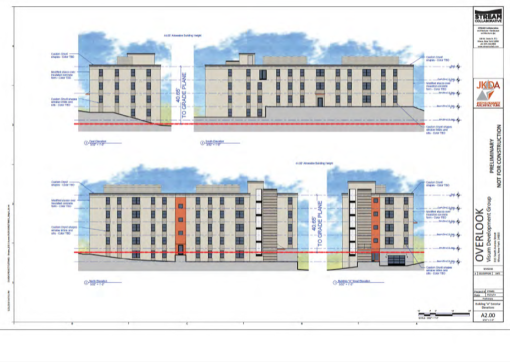
E. Project: Student Housing 7:50
Location: 815 S. Aurora Street
Applicant: Stream Collaborative, Noah Demarest for Project Sponsors Todd Fox & Charlie O’Connor
Actions: Project Presentation, Potential Consideration for Preliminary Site Plan Approval

Project Description: The project applicant proposes a new 49-unit student housing complex (16,700 SF footprint) comprised of three buildings constructed on a hillside on the east side of Route 96B, overlooking the proposed Chain Works District. The proposed buildings will contain (2) efficiency units, (3) one-bedroom units, (10) two-bedroom units, (20) three-bedroom units and (14) four-bedroom units. Amenities will include a gym and media room, with access to an outdoor amenity space on the first floor of Building B, and a roof terrace and lounge on the fourth floor of Building B. The project site shares the 2.85 acre site with an existing cell tower facility, garages, an office and a one-bedroom apartment. Site improvements will include walkways and curb cuts to be tied into a public sidewalk proposed by the Town of Ithaca. Fire truck access is proposed at the existing site entry at the south end of the property, with a new fire lane to be constructed in front of the ends of buildings A & B at the northern end of the site. The project will include 68 parking spaces, as required by zoning. The property located in the R-3b zoning district. A variance will likely be required for a rear yard setback deficiency. This has been determined to be a Type 1 Action under the City of Ithaca Environmental Quality Review Ordinance §176-4(B)(1)(k), (n), (B)(2), and the State Environmental Quality Review Act (“SEQRA”) §617.4(b)(11). Project materials are available for download from the City website: https://www.cityofithaca.org/DocumentCenter/Index/982

The project description is not accurate. According to the memo from STREAM, the project is 65 units, but still 141 beds, with 2 one-bedroom, 40 two-bedroom, and 23 three-bedroom units. This has created some minor exterior changes, mostly in the window arrangements. A report from TAITEM chimed in to say that the project does meet the city’s Green Building Policy (which is approved in concept but has slowly been trudging through the legal details). Neighbors have expressed concerns with the project

F. Project: Mixed Use Apartments (77 Units) 8:10
Location: 510 W MLK/ State Street
Applicant: Stream Collaborative, Noah Demarest for Project Sponsors Todd Fox & Charlie O’Connor
Actions: Project Presentation, Declaration of Lead Agency, Review – Draft FEAF Parts 2 & 3

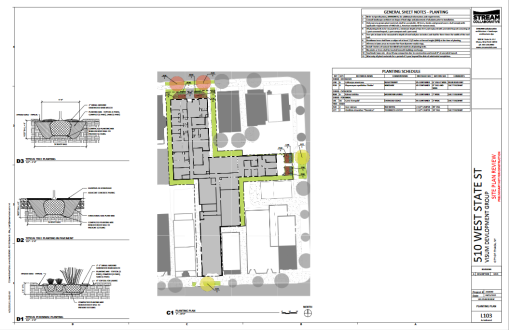
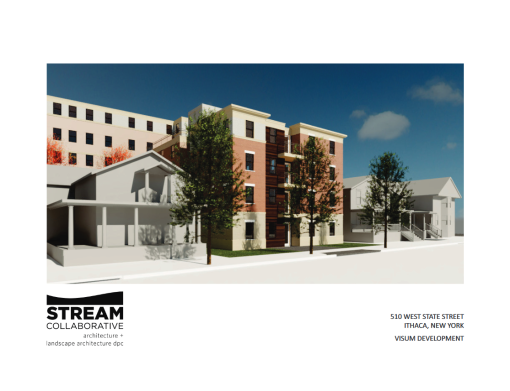
Project Description: The applicant proposes to construct a 4- to 6-story building with a footprint of 13,730 SF and a GSA of approximately 74,700 SF. The project will have 2,100 SF of retail space on the first floor facing W State/ MLK Street and 77 housing units, permanently affordable to households making 50-70% Area Median Income (AMI). Building amenities include a community room, bike and general storage, a laundry room and a fifth floor lounge with access to a rooftop terrace. The project site has frontage on three streets (W State/MLK, Corn and W Seneca) and is in two zoning districts: CBD 60 in which the maximum height is 60’ and B-2d in which the maximum height is 40’. Neither zone has a prescribed number of stories. The project is subject to the Downtown Design Guidelines and will likely require an area variance for rear yard setback. This has been determined to be a Type 1 Action under the City of Ithaca Environmental Quality Review Ordinance §176-4 B(1)(h)[4], (k) & (n), and the State Environmental Quality Review Act (“SEQRA”) §617.4(b)(11).

Looks like the number of units has settled on 77. The question here remains what to do with the State Street elevation, given the likely zoning change will force a 15′ setback from the 5th floor instead of the sixth as proposed.
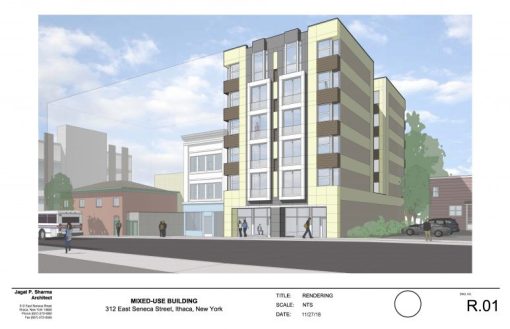
G. 312 E Seneca Street – Sketch Plan 8:30

The original design above received the planning board equivalent of a roundhouse kick to the jaw, so we’ll see what happens with round two, for which it is hoped the Stavropoulos family and their architect (presumably Jagat Sharma as before) have read the Downtown Design Guidelines. Given its location on the edge of Downtown Ithaca, this is a CBD-60 site, six floors, 100% lot converge, no parking covering.

A potential wild card here is the recent rumor that the owners of the properties next door on North Aurora have put the assemblage up for sale. A redesign may or may not include those properties.

6. Old/New Business 9:00
-Special Meeting Agenda for 4-30-19
-Board Retreat Topics
-Sexual Harassment Training

7. Reports 9:10
A. Planning Board Chair
B. BPW Liaison
C. Director of Planning & Development

8. Adjournment 9:30
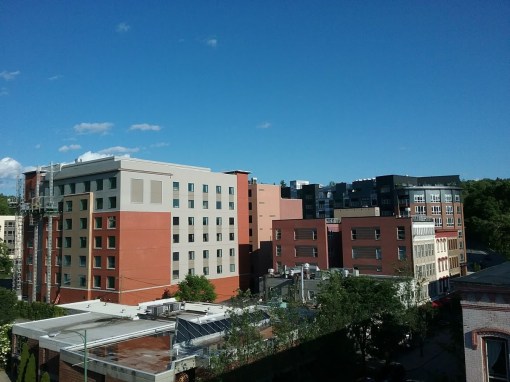


105 Dearborn Place Construction Update, 5/2019

24 05 2019

We’ll change up the format a bit for this post. Below is a recent email from Ithaca resident Joan Jacobs Brumberg:

I had an opportunity to talk yesterday with Elizabeth Classen Ambrose who is the organizational power behind a growing Bridges community. I wanted to find out more about Library Place interiors but we ended up spending a fascinating hour talking about The Craftsman, a new kind of Ithaca residence for the elderly resembling the group homes in Holland and Denmark.

Four things about this project — to be completed in November 2019– strike me as important for the public to know:
1. This is a new form of independent living for 16 older folks who do not want home or apartment to care for. Each individual room is lovely with private bath and fireplace, small refrigerator. I believe you bring your own furnishings, ie.,  the things you care about most.
2. No upfront payment and no lease.
3. Residents have access to special Car Share vehicles and also Bridges shuttle service if they do not drive.
4. Many amenities for the elderly: warming pool, gym, a trainer, maybe podiatrist and physical therapy. And a special add on: garden space.

I told some people my age about this facility and everyone asked “How did you learn about it?” Even if they are candidates for Library Place, my friends have older parents, relatives, and friends who are burdened with private homes or apartments that are increasingly hard to care for.

***

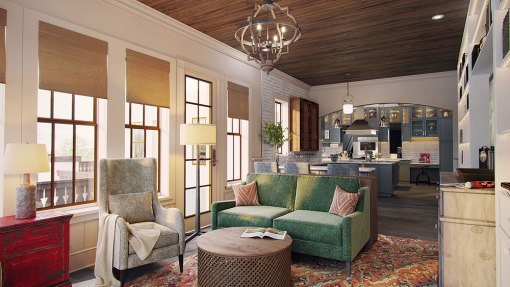
It came as part of an article pitch for the Voice, but since I did an article about Bridges for the Voice two years ago, I declined. The website for the new house is online, with plenty of rather sumptuous interior renders (a few embeds are below many more are on the website). The twelve bedrooms (eight single-occupancy, four double-occupancy for couples) will feature heated floors, fireplaces in some units, large-screen televisions, optional dry bar with refrigerator and hot beverage maker, and private deck or patio areas. Other planned features include an on-site fitness center, storage room, car share, spa and salon services, on-site concierge, and lush landscaping befitting a high-end independent living facility. Residents are expected to be able to go about their daily activities with little to no assistance, but cooking, cleaning and laundry are taken care of by staff. Pending “interviews” by staff for compatibility, residents may even be allowed to have their pets join them.

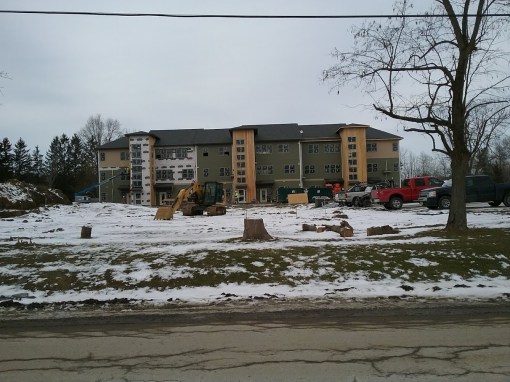
Schickel Construction has the house largely finished from the outside. Painting of the cedar shingles continues, and architectural detailing/trim (balconies, porch columns) is ongoing. The stone veneer has yet to be attached to the built-out cinder block basement level, but all of the windows and most of the doors have been fitted. No photos of the back side, because there was a kitchen staffer on break who was clearly uncomfortable with this shutterbug.

More background info about the project can be found here.


News Tidbits 5/4/19

4 05 2019

1. Generally speaking, when the opposition is opposed to the aesthetics rather than the purpose, then a project is in good shape for IDA approval. That looks to be the case with the Vecino Group’s Arthaus project. The 124-unit all-affordable (50-80% area median income) project at 130 Cherry Street will be seeking IDA approval for an abatement at the May meeting, after hosting its public hearing this month (minutes here). As noted by the Ithaca Times, apart from complaints about it being too big or ugly, there wasn’t much in the way of opposition to the premise of the project, which is what the IDA is more interested in. As far as the IDA is concerned, aesthetics are something to be handled by the Ithaca Planning Board; if it’s okay with the PB, then it’s okay with them. Chances are pretty good that the abatement will be granted. The abatement is worth about $3.73 million towards the $28.8 million project.
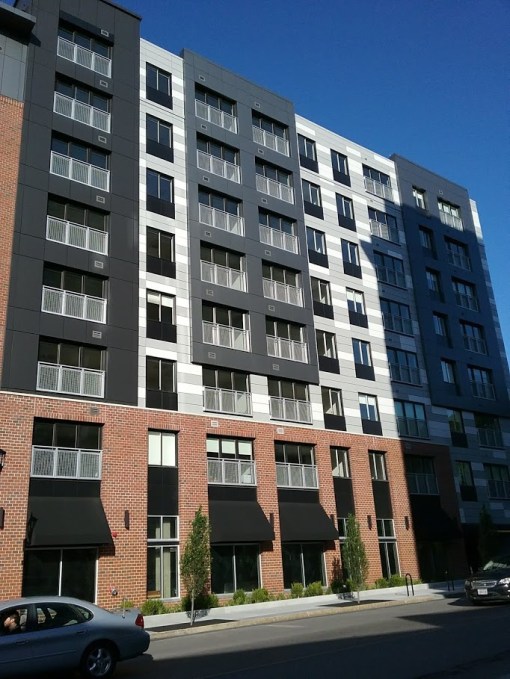
2. It may have taken two tries to get the zoning variance approved, but Habitat for Humanity is moving forward with its redevelopment and new builds at 1932 Slaterville Road in the town of Dryden. The existing 19th century farmhouse will be renovated into a four-bedroom home, a first for the local chapter. The land will be subdivided into two additional one-acre parcels for a new three-bedroom home on each lot, about 1,100 SF each. Each home will cost about $70-$75,000 to build, and the goal is to have them ready for occupancy by mid-2020.
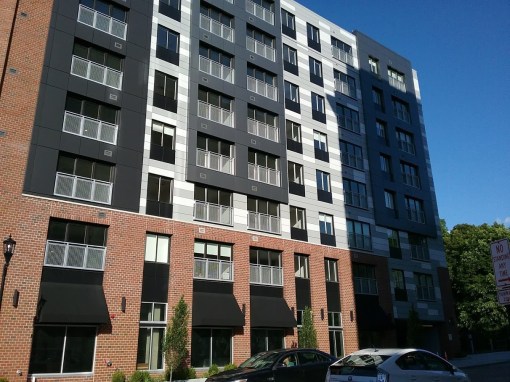
Habitat homes are typically sold to families making under 60% of Area Median Income (AMI), or about $36,000/year. The homes would have built with a combination of professional contractors and volunteer labor, including 350+ hours of “sweat equity”, where the future homeowners actively work as members of the construction crew. In a market starved for affordable housing, every little bit helps.

3. We don’t tend to see many big commercial or industrial buildings listed for sale (if in part because there aren’t many), but it looks like the TransAct Technologies building at 20 Bomax Drive in Lansing is now for sale. Now, before anyone gets nervous, the business isn’t going anywhere; they’ve always leased the space since the building opened in 1998 and have a triple-net lease.

A triple-net lease means the tenant pays everything – insurance, maintenance and real estate taxes (formally, net insurance, net maintenance and net real estate taxes on the leased asset – the three nets).  As a result, the rent is substantially lower than it otherwise might be. It may not be all that lucrative, but the property ends up being a fairly safe investment (though with a lot of fine print to determine who pays for things like if a tornado hits or the foundation cracks), generating a modest amount of rent and functioning like an inflation-protected bond, but guaranteed by the lessee rather than the government. All the better when the tenant is stable and signed on for the long-term as TransAct has been.

For just under $6 million, the buyer gets a fairly new industrial building on 7.54 acres with 18,066 SF of office space, 55,759 SF of warehouse and manufacturing space, and the security of a long-term tenant. This will not be an exciting sale, but it’ll be interesting to see who the buyer is. Warren Real Estate is the seller’s agent, and the offering description with financial data is here.

https://platform.twitter.com/widgets.js

https://platform.twitter.com/widgets.js

4. A little bit of soapboxing. I’ve been seeing and getting some messages to this effect lately. First, I’ll note that the first comment is a bit disingenuous. That’s the highest-priced three-bedroom unit. To quote the range of prices from the Ithaca Times:

“Affordable in this case will include rents for people making 50-80 percent of Area Median Income (AMI), which means that rents for studios will be between $737 and $1180 per month, to 1,095 and 1,752 [per month] for a three-bedroom apartment, the highest price.”

Anyway, the comments tend to be to the effect of “this isn’t affordable enough, so I can’t support it”. That’s a textbook case of letting the perfect getting in the way of the good. Here is a project with 124 affordable housing units, with 40 of the units set aside for formerly homeless youth and families with on-site supportive services from TC Action. It would do a lot of good to have this project available to the community.

Honestly, the argument feels like the next evolution of the arguments against affordable housing in general. Now that it’s firmly ingrained that there is a lack of affordable housing in Tompkins County and it does negatively affect the community, the next step is to say, essentially, that nothing is good enough. From a pragmatic stadnpoint, since these projects aren’t something banks and credit unions will fully finance because of the lack of a sizable return on investment, it falls to NYS to award grants. The state will not dispense larger tax credits to make a unit drop from 60% AMI to 30% AMI, that’s up to the developer to make up the bigger financial gap. To do that, either they add in higher-priced units to compensate, or the project doesn’t happen. Which is probably the end goal for many of the complainers anyway. It’s kinda like saying you’re available for a date, but only to those who are millionaire PhDs.

Anyway, weigh each project on its merits. But set reasonable goals.

5. As reported by Dan Veaner at the Lansing Star, developer Eric Goetzmann is seeking changes to the senior housing to be included as part of the Lansing Meadows project. The primary changes are making Lansing Meadows Drive into a one-way street (thus allowing it to be slightly narrower while still able to host on-street parking), and making each duplex into a triplex – three senior housing units per string, for a total of thirty. As a result, the units will be slightly smaller, though still two-bedroom apiece. The two end units in each building will be 1252 SF with a 395 SF garage. The center unit will be 1114 SF with a 251 SF garage. The third change is that Goetzmann and his project team want to amend the approvals to allow the sale of units in the future (the initial plan still calls for market-rate rentals).

This comes with a set of issues that need to be sorted out. The project has to be complete by July 2020 as required by the village in their approval resolution. The village planning board now has to consider the proposed amendments and consider whether they constitute a major change from the approved Planned Development Area (PDA, the village’s DIY zoning). Doing so would either cause the plan to be delayed and violate the resolution, or if declined for further consideration, the resolution would likely trigger a lawsuit between the village, Goetzmann, and the county IDA, who granted an abatement to Lansing Meadows. If they say the changes are minor in the context of the PDA, then construction is expected to start as soon as the amended PDA is granted (May 13th at the earliest).

The plan is to build the northern triplexes first, and then the southern units. The planning board’s not a fan from an aesthetics perspective, but the village’s code officer that the northern half is more elevated, so this reduces stormwater risks. With construction underway and loose soil on the site, if built later the exposed northern half could result in runoff and flash flooding downhill, into the southern half and its new homes. The commercial component on the east side of the property cannot legally be built until all residential units are completed.

It’s been nine years since this project was first pitched, and most stakeholders just want to get this project out of their hair. It’s not clear when that will happen.


News Tidbits 4/27/19

27 04 2019

1. Matt Butler at the Times is providing an in-depth check-up on the mall this week. This was a story the Voice had laid groundwork for as well, so it’s nice that one of the local news orgs was able to make hay of it. The mall, like many middle-class local malls across the country has been struggling in the age of Amazon and the retail meltdown. The overall economy might be humming along, but retail closures continue to spike nationwide, with over 6,100 closures planned this year alone, more than the 5,900 announced in all of 2018. With planned new store openings numbering 2,100, it’s practically two stores closing for every one that opens. Retail mega-landlord Cushman and Wakefield estimates 9,000 stores will close in 2019, and over 12,000 in 2020. In the Ithaca Mall, Gertrude Hawk is gone, American Eagle closed up last year, Ultimate Athletics shut its doors, the Bon-Ton closed as part of the shutdown of the whole chain, and the Sears Hometown store is kaput. The mall’s manager cited a variety of reasons, including chain downsizing, poor performance, and some just stopped paying rent.

This has major economic impacts; the mall’s property value has declined by over 60% since the start of the decade, and the village, the county and the schools have to make up those hundreds of thousands of dollars in property tax revenue somewhere (and the county and schools have). County legislator Deborah Dawson, who represents the mall’s district, suggested doing something similar to the DeWitt Mall downtown, a mix of local businesses, but the mall is a much bigger space to fill (622,500 SF vs. 117,500 SF in the DeWitt Mall), and DeWitt Mall is mixed-use (retail and 45 apartments). Local businesses and experiential outlets can be part of the solution as Running 2 Places is showing with their 18,000 SF theater this spring, but it’s one component of a solution. Residential could be a component, but some legal and logistic issues would need to be sorted out, which owner Namdar Realty has never shown much interest in; the village has also been lukewarm to the idea. About 40 apartment units were floated for a section of the parking lot (west/on the backside of the mall if I remember right), but that idea died during the Great Recession.

There is so silver bullet here. The owner needs to be more proactive then holding a proverbial gun to its’ tenants heads in order to get them to stay. Local governing bodies also have to keep an open mind for redevelopment ideas – if parts of the mall were torn down and replaced with residential, for example. As it is, the only plans on the horizon are an unnamed tenant for the former Bon-Ton space, and the extended stay hotel planned for the parking lot behind (west) of the Ramada Inn. The future of the mall is hazy; like a species faced with a steadily changing habitat, it’s either adapt and evolve, or perish.

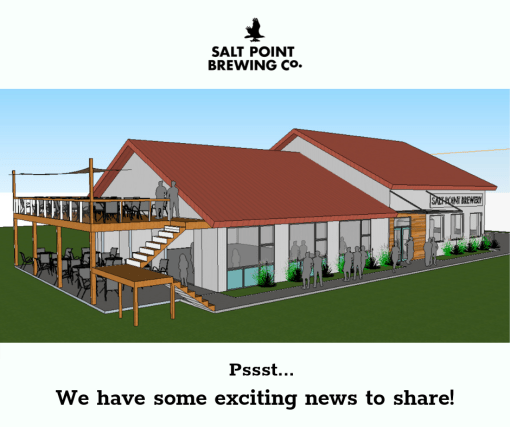
2. Courtesy of their Facebook page, here’s a sketch render of what Salt Point Brewing Compant’s new brewery and taproom would look like. It’s a fairly unobtrusive one-story structure with a gable roof and two wings, presumably the taller one for the brewing tanks and the smaller one for service functions. On the outside are wood accents and a two-story deck for outdoor drinking and possibly dining, if the restaurant option is pursued.

The building, as well as associated landscaping and parking improvements, would be located on about three of the five acres sold as Parcel “D” in the Lansing Town Center development. The remaining two acres are wetlands and would be left undisturbed. Salt Point paid $75,000 for the land, and will bring its project forth to the town planning board in the coming months. No word on any job creation figures yet.

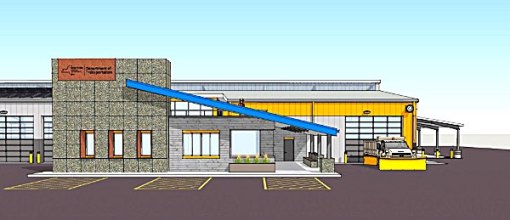
3. The NYS DOT county facility plans are moving forward. The state bought its 15 acres from Tompkins County for $840,000 according to a deed filed on April 24th. The building is classified as a sub-residency facility, a step below a primary regional facility (the main office for Region 3 is in Syracuse).

To review, the plans consist of the 30,000 SF sub-residency maintenance building, a 5,000 SF Cold Storage unit, an 8,200 SF salt barn, and a 2,500 square foot hopper building (covered lean-to). The proposed maintenance building will have vehicle storage for 10 trucks, a loader and tow plow, with one additional double depth mechanical bay and single depth, drive-thru truck washing bay. It also includes an office area (three rooms), lunch/break room (30 people), toilet/shower/locker rooms, storage rooms and mechanical/electrical rooms. The site will also contain stockpile areas for pipe, stone and millings, and ancillary site features include parking for 40 vehicles, and stormwater management facilities. A new access drive will be constructed from Warren Road.

The town has been less than pleased with the project, which is not bound to zoning code because it’s a public resource facility owned and operated by a government entity. Rather than voice approval, the planning board voted to acknowledge that they simply had no authority to control the project. Some modifications were made to the plans at the town’s request, such as the fueling station being moved onto airport property across Warren Road, but neighbors are still unhappy that snowplows and heavy-duty maintenance vehicles are about to be their next door neighbors.

The facility is expected to be open by the end of the end of the year. Once all staff and equipment have been moved in, the county may pursue a request for proposals/request for expression of interest for the current DOT property on the shores of the inlet near the Farmer’s Market. A 2015 feasibility analysis found that the site could conceivably host a $40+ million mixed-use project, and the site has became more amenable towards redevelopment with the enhanced density and use provisions made to the city’s waterfront zoning in 2017.

4. The Ithaca city planning board granted a negative declaration of environmental review to the 124-unit Arthaus affordable housing project at 130 Cherry Street. According to my editor Kelsey O’Connor, the latest revisions propose a five-story building that would include a gallery, office and affordable rental space. It would include parking for about 36 vehicles and 7,600 square feet of potential retail or office and amenity space geared toward artists. All of the units would be restricted to renters earning 50 to 80% of the area median income, or about $30,000 to $45,000. The north end of the property will also include a publicly accessible path leading to the inlet.

Speaking in favor of the project were neighborhood business owners and non-profits, and in opposition was councilman George McGonigal, who said both in a letter and in person that it was too big for the site and threatened the industrial character of the neighborhood. They have bigger concerns than housing nearby. Cherry Street is difficult to access with large trucks and commercial vehicles, the Brindley Street and Cecil Malone Drive bridges are small and in poor shape. Secondly, Cherry Street doesn’t provide much room for operations to expand, so that hinders their long-term operational planning. It’s not just lot size, but also the soil – the Emmy’s Organics project fell through because of poor soil not amenable for warehouse and other light industrial functions that rely on a concrete slab. Thirdly, the city’s strict environmental laws, fees and higher property taxes make an urban site less appealing. They can get more land with a lighter tax burden in Lansing, Dryden, or any of the other outlying towns. With these issues in mind, many of the industrial businesses down there now aren’t looking to stick around. Several have already sold or made purchase options with developers as they seek areas with lower taxes, easier access to highways and less strict environmental ordinances.

The unanimous approval by the city planning board allows the project to move forward with consideration for preliminary approval. The goal is to gain approval at next month’s meeting, and once affordable housing funds have been secured, to start construction of the project, likely in December of this year.

5. The Chain Works District presented plans for phase one at the Planning Board meeting. There are four buildings in phase one, of which two are in the city. 43,400 SF Building 21 would be renovated into a commercial office building. The work here is limited to replacing walled-up window openings with new windows, exterior cleaning and painting, and new signage and entrance canopies. Building 24 is a combination of renovation and expansion. The partially built-out basement and first floor would be renovated for commercial office space, the second and third story would be residential, and a new fourth floor would be built for residential uses, for a total of 135,450 SF across 4.5 floors. As with Building 21, new windows would be installed, and the exterior cleaned and painted. New landscaping, sidewalk and parking areas are also planned.

At a glance, the residential in the first phase would host 60 market-rate rental units. Each floor will have one studio unit, nine one-bedroom units, nine two-bedroom units, and one four-bedroom unit. According to the Site Plan Review document, the project would begin renovation in October, and be open by August 2020. The other two building in phase one are renovations of industrial and manufacturing spaces in the town, Buildings 33 and 34. These will retain industrial uses.

This meeting was only for the purpose of sharing and discussing plans, with no voting at this time. According to Edwin Viera at the Times, the board was reluctant to approve any plans without more information about who will be occupying them. That seems a bit odd, because projects are analyzed for their physical impacts, not the tenants, but the Times article says parking and landscaping may change slightly depending on the tenant. According to project representative Jamie Gensel, the USDA is considering renting out some of the office space. The USDA maintains a research facility inside the Holley Center on Cornell’s campus, and there were plans in the late 2000s to build an addition, which were later shelved during the Great Recession. It’s not clear how much space they’re seeking. Not sure what to make of that writeup, honestly, or being told to move the buildings into a different phase (personally, I’d like to be renovations before any new builds happen).

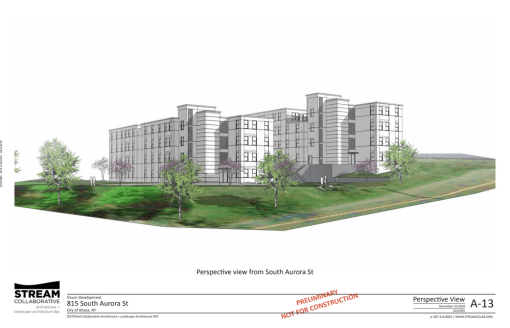
6. 815 South Aurora Street, aka “Overlook”, also continued its review at the planning board meeting. There were some minor design tweaks, seen in the before image (above) and after image (below). Changes in exterior colors, panels, ground-level entrances and fenestration, particularly on the side facing South Aurora Street. The fire trucks are  to indicate that emergency vehicles will be able to safely pull in and out from the road. Overall, project size remains at 49 units and 141 bedrooms.

There’s been some pushback from neighbors regarding size and neighborhood character. There’s an argument that these are dependent on Chain Works, but that argument doesn’t pass the smell test – if Chain Works didn’t happen, fewer units on the South Hill market would make the project even more appealing to Visum Development and Modern Living Rentals. The planning department wants more geotechnical information and bedrock to be removed, details about the new planting and landscaping, and energy systems. Documents submitted indicate the all-residential development will use electric heat pumps. The board has requested a shadow study and flesh out the environmental impacts, which is a common request for larger developments.

7. At least one project is fully approved. Although it seems at least one planning board member asked for affordable housing, the four-unit market-rate Perdita Flats infill at 224 Fair Street was granted preliminary site plan approval. The project is intended to be a sustainable building showcase of eco-friendly features, a net-zero energy showcase of what can be done with environmentally sustainable multifamily housing. The owner/developers, Courtney Royal and Umit Sirt, will be applying for incentives from the NYSERDA Low-Rise Residential New Construction Program and are hoping to attain the Zero Carbon Petal of the Living Building Challenge.


News Tidbits 4/26/19

27 04 2019

1. Here’s a little more information on the proposes medical office building at 2141 Dryden Road. Site Plan here, planning department memo here. A local doctor operating as “Slaterville Springs Real Estate Company, LLC” is planning a 3,676 SF pre-fabricated building on the site. The building would be built using a Superior Wall precast concrete foundation (Superior Walls are commonly seen with modular builds), and built into the hillside – one story from the front, two from the back. The doctor’s office would occupy the upper level, and the lower level is spec space. The plans include a roof-mounted solar system, electric heat pumps, and an electric vehicle charging station in one of the three proposed parking areas. 48 parking spaces are indicated, four of which are ADA compliant. A covered bicycle rack and dumpster enclosure are also provided.

Having all these green features at a semi-rural site with gobs of parking (the Institute for Traffic Engineers’ parking standards for medical offices is about 3.5 per 1,000 SF, or 13 in this case) is liking having a diet coke with your Big Mac. A project can be “green”, but much of its green impacts are mitigated if it encourages fossil fuel use with increased vehicle traffic. It would benefit the town to plan and zone for developments like this closer to villages and hamlets.

The site also includes landscaping, some limited signage, lighting and stormwater features. The town planning department’s opinion is that the project is not substantial enough to merit full site plan review. Spec Consulting of Groton is doing the project design.

2. The Black Diamond Trail will receive a major addition after New York State announced funding for a bridge over the Cayuga Lake flood control channel earlier this week. The $1.2 million award from the state will pay for the construction of a new pedestrian bridge for the trail, which will span the inlet from the current trail segment along Floral Avenue, to the intersection of Cherry Street and Cecil Malone Drive. This would provide greater connectivity for West Hill residents to the businesses along the waterfront and the big box corridor, giving them to option to walk/bike through here instead of going up to West State Street. In an interview with the Journal’s Tom Pudney, city transportation engineer Tim Logue notes that design work, public hearings and municipal approvals for the bridge will take another 18 months, so construction won’t be until 2021.

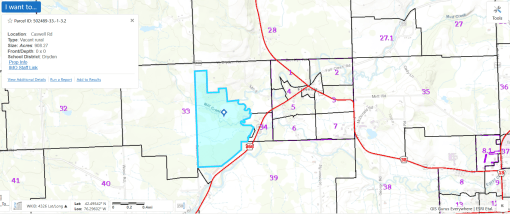
3. Now for a look at Dryden’s Mill Creek subdivision. Site plan application here, proposed covenants here, site plans here. This is the 908-acre subdivision of land west of Freeville into forty home lots. It looks like the Lucente family (as RPL Properties, for the late Rocco P. Lucente) is working with surveyor Alan Lord to plat the lots. The 40 lots range in size from just over 5 acres, to 60 acres. 23 acres on the eastern edge of the parcel would be deeded over to the town for land conservation.

Even as subdivisions go, this is a very questionable design because it’s not really following state guidelines for conservation subdivisions, which cluster houses near roads on smaller lots so as to preserve natural space. These lots aren’t designed for that, which really opens up the possibility of large-scale natural space degradation or destruction. Given that the zoning here is a conservation district, it meets the word of the law, but not the sentiment.

4. Courtesy of the County Clerk’s office, we now know what the amount of the construction loan was for the latest phase of the Village Solars. 24-unit Building “K” (113 Village Circle) and 24-unit Building “L” (40 Village Place) received a $5.6 million loan from Elmira Savings Bank, which is mildly interesting in that the previous building loans were from Tompkins Trust. Note that the buildings are switched around from the site plan above, so that middle building is “K” and the building to the east is “L”. Both buildings are expected to be completed by the end of September 2019. I

n February, my last visit, Building “K” was substantially finished from the outside, while Building “L” was just a foundation pad. However, the Lucentes in-house construction team have been building these for years and have the process down pat, so if they’re framing by now, they could certainly have “L” finished by the end of September.

5. The recent article regarding the U.S. Census Bureau estimates created quite a stir and a number of strong and/or concerned emails. Before anyone gets hung up on the numbers,realize that the census is all about estimating from an annual survey of about 2.1 million households nationwide, out of a little over 126 million. They’re reasonably comfortable with national figures, a little less so with states, and generally, they just hope to be close with counties, especially medium-sized one like Tompkins who are hard to sample but can still vary by several hundreds of people from year to year.

Now consider the statistics mentioned in the article. From 2010 to 2017, the area added 2,412 housing units, and from 2010 to 2018 it added about 6,000 jobs (1.4% annual growth). The colleges add 800 or so students in total. All signs point to steady, modest growth.

Here’s an exercise. Let’s take those 2,412 housing units. 964 single-family homes, and 1,448 multi-family units. The average household size is 2.5 persons/home, and 2.2/persons per multifamily unit. So a gross estimate for the number of occupants in new housing is (964 * 2.5) + (1,448 * 2.2), or 5,596 people.

Now for a couple of adjustments. Household sizes are known to be getting smaller. Nationally, from 2010 to 2018, the change was 2.59 to 2.53, so applying that same percent decrease to the single-family figure and the multi-family figure reduces the gross gain to 5,466 people. Also, let’s assume that not every housing unit permitted was built. The vast majority are, but not all. Let’s say 98% were. That reduces the figure to 5,356.

Secondly, some new housing replaces older housing. Those stats aren’t so readily available. But I track them here. In this case, the number I have on file is that of projects recently completed or proposed, net gain is 90.6% of the gross gain. That number is going to be a bit low because I don’t track single-family home construction, which typically happens on vacant lots. Still, assuming it’s otherwise an acceptable estimation, then (5,356 * .906) = 4,853 people.

Now, let’s account for vacancy. Overall, Tompkins County is ticking upward, though still below a healthy market rate / too tight in the urban areas. It was higher in 2010, lower in the middle of decade, and creeping up now as new construction is completed and occupied. Let’s say (rather optimistically or pessimistically, depending your view) there’s a one percent increase since 2010,. Tompkins had 43.453 housing units as of 2017. So with a +1% vacancy since 2010, that’s 434.5, of which 52.7% are homes if we break it up perfectly, but since rentals have a slightly higher vacancy rate in general, let’s say 50-50. So ((217.25 * 2.5) + (217.25 * 2.2) ) * (2.53/2.59) = 997 people.

Let’s do the math. 4,853 people – 997 people = 3,856 people. Add that to 101,564 reported in 2010, and you get 105,420 residents in 2017. The Census’s 2017 estimate for Tompkins County was 104,871. Extrapolate it out a bit, and assuming Tompkins continues to add at about 551 people/year, and 2020 will clock in around 107,073 people. 5.4% growth. A hair below national average, but well above most of upstate New York and the Northeast.

So with that exercise in mind, don’t worry about the Census estimates. They will be what they will be, whether 2,000 people magically disappear or not. They’re not looking to be great, they just hope to be kinda accurate until the next census rolls out in 2020.


News Tidbits 4/12/19

13 04 2019

1. Here’s a story of a clever use of space – Therm Inc. has recently expanded its facility on South Hill, and stopped leasing space from the nearby South Hill Business Campus as a result. That left an 18,870 square-foot hole to fill in Suite 30.

The site’s business manager, Linda Luciano, had had artists inquiring for a space, but never something that small enough to fit their needs. This vacancy was a chance to try something new, to build little studio spaces within the larger open floor plan of the warehouse space. It’s worked out well. Extremely well, as Ithaca Times editor Matt Butler reported this week as the Times feature article. Segment below:

” ‘A few studios’ turned out to be a severe underestimation of how many Ithaca artists desperately wanted their own studio space. With a calculated proposal for six studios in hand, she went to the building’s owners to lay out her vision, and they were receptive. Luciano then set about contacting artists who had previously reached out to her about renting space, meanwhile losing sleep over fears that she wouldn’t be able to find tenants for the studios and would have to start over with a new plan.

“I started calling people on my list, and we planned an open house,” Luciano said. “Before we could have the open house, they were all rented. That’s when I said ‘Oh my god.’”

It hasn’t slowed down since that initial wave, either. Seeing the success of the first push in October, Luciano and building owner Andy Sciarabba came up with a plan to add four more studios to the original six, deeming it Phase Two. Those four sold immediately in December, before they were even built. The same went for more units that were proposed in January. After the final phase, which is currently underway, Luciano plans for 27 more studios constructed in the former Therm space, with a much-requested gallery space included. Those are scheduled to be finished and opened in August; half of them are already leased…”

To put this in perspective, there are eighteen now plus a small kitchen and lounge space, and the addition will provide 27 more studios and a gallery space. The new build has so far taken over about a third of Therm’s old space, so the addition will likely the fill the rest of it out. The studios are a few hundred square feet each and rent for $275-$450/month depending on size (the price includes water/AC/electric/heat, with free parking), and leases are 12-month. I had not heard of anything trying this on a large scale, but it appears to be working out very well for the South Hill Business Campus, which hopes to spruce up the exterior to draw a little more attention to “Artist Alley”. It gives artists their own spaces outside of home, it offers collaboration between studios, and this seems to have tapped into a critically underserved market.

For those who want to call dibs on the last studios before they come onto the market next summer, the contact webpage is here. If you want to check them out in person, the address is 950 Danby Road.

2. Touching real quick on a pair of Dryden projects in the early stages. The “Mill Creek subdivision” is quite frankly a monstrosity in size. This is a 908-acre property on Caswell Road just west of the village of Freeville, and the plan would be to subdivide it into 39 home lots. No further subdivisions would be allowed, only single-family homes would be permitted, and it’s not clear if the developer is pursuing conservation zoning – per planning board minutes, it seems that the lots will be plated and the road laid out, and then sold parcel-to-parcel to custom builders.

If the owner did want to build, they have the expertise to do so – a deed check shows this property is owned by the Lucente family, who run Lifestyle Properties and have built out thousands of housing units in Tompkins County since the 1950s. The unimproved land is valued at $1,132,600, about $1,250/acre, and has been in their possession since 1954, so this doesn’t appear to be a rash decision.

Doing the math and removing a small amount for internal loop road still gives over 20 acres per lot, these properties would be very large and potentially expensive, because with improvements, that much acreage will be worth more and it will add up quickly. Maybe it’s a bit out of character for this blog, but this proposal actually seems rather worrying from an environmental and infrastructure perspective. Density in urban areas tends to draw the most attention, but these lots could potentially have much bigger impacts because of the amount of natural space that would be consumed by a sprawling high-end housing development.

As for the medical facility at 2141 Dryden Road, it sounds like it will be a two-story facility, and while they suggested parking in the front, the board requested to move it to the back (a couple handicap spaces in front are okay). There was some concern with its choice of locations (the board would much prefer the office be located in the village or a more built-up area) and curb-cuts/traffic impacts.

3. For the creative types: the Collegetown Small Business Alliance is sponsoring a contest to design streetlight banners for the neighborhood, like the ones on the Commons. The plan is to make up fifteen of them and have them hanging for two years. Here are the design criteria:

Designs that are timeless will be favored. Avoid using trendy colors, fonts that may fall out of taste.

– Collegetown is at the intersection of the Cornell campus, student life, and the Ithaca community, and as such, designs should be inclusive of all of the following groups: Cornell students, Collegetown businesses, and the City of Ithaca.

Consider these banners as creating a brand and identity of Collegetown as a whole.

Submissions must be a 24″ x 60″ image, 300dpi, with a legible “Collegetown” on the image. May include photographs, graphic designs, or scanned images. No inappropriate content. Submission are due by 11:59 PM on Tuesday April 16th, and are to be submitted here. First places get $125 and their design on the flags, second place $75, and third place $50.

4. Maybe I’m reading too much into this, but there are some unusual LLC formation notices in the Journal classifieds. 628 West Seneca Street LLC, 625-27 West Buffalo Street LLC, 629-631 West Buffalo LLC, and 205 North Fulton LLC have all been created in the past couple of weeks. They are a parking lot, an apartment house, a one-story commercial building (Emmy’s Organicsm which they will vacate for larger digs in then ear future), and another one-story commercial building (Superior Glass) respectively. They are all owned by the same guy (Robert Bond).

The LLCs are all registered to the address of Alternatives Federal Credit Union across the street at 125 North Fulton, which is a little worrying because AFCU bought 634 West Seneca a few years ago and tore it down for a parking lot. It would be very unfortunate if they decided to take down more buildings for surface parking, given that this is an area the city’s trying to build up. It’s also not clear what might happen to the Rhine House in such a situation. Anyway, it’s something to keep an eye on.