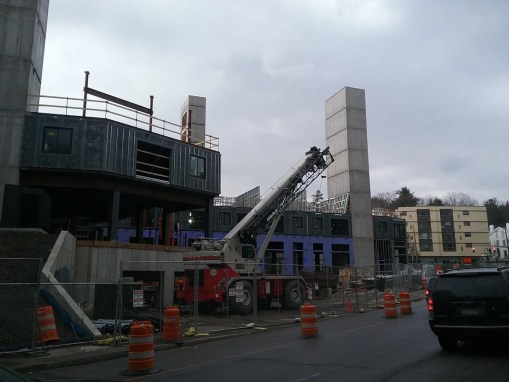
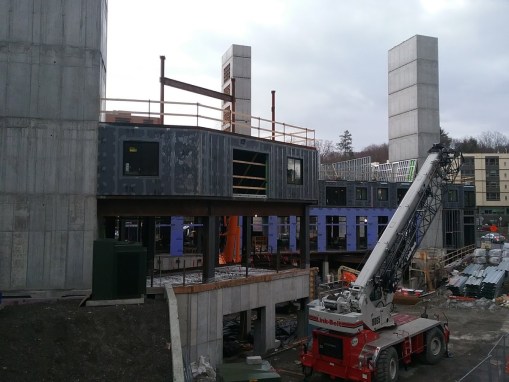
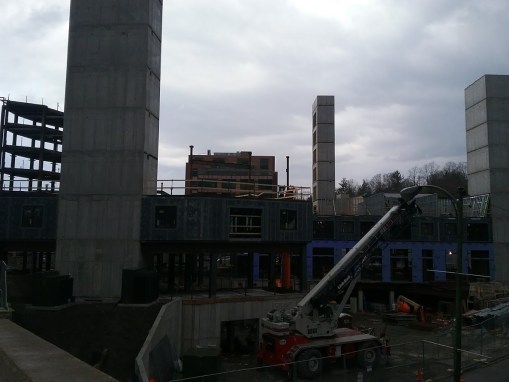
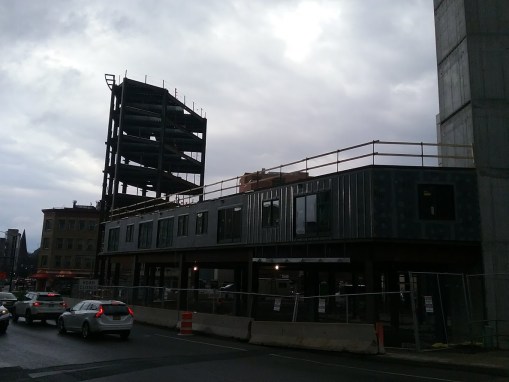
City Centre Construction Update, 4/2018

12 05 2018

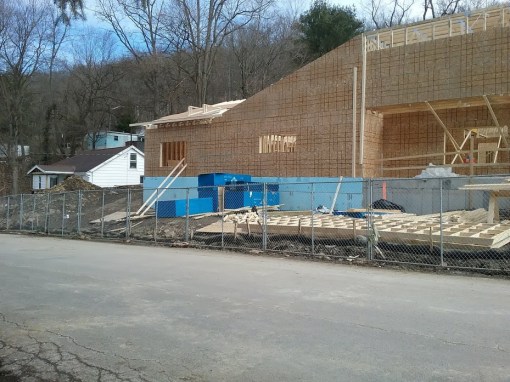
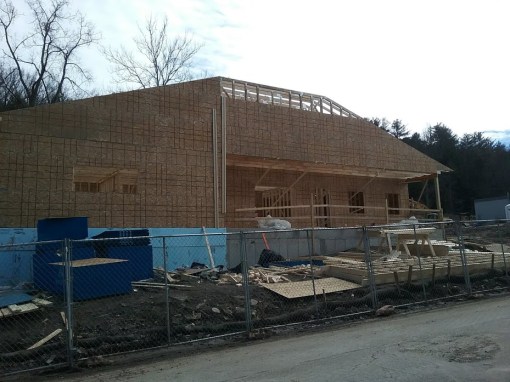
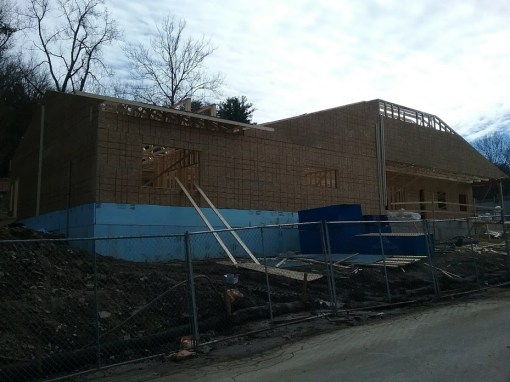
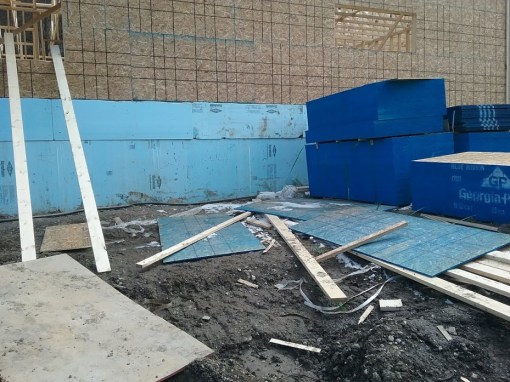
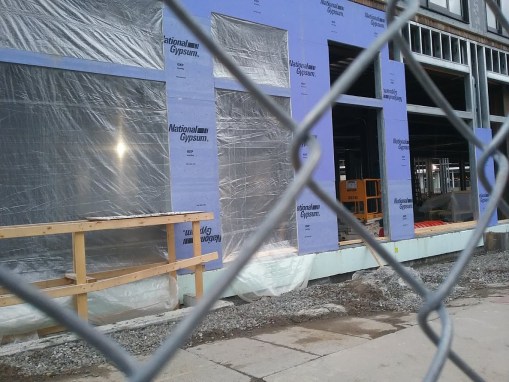
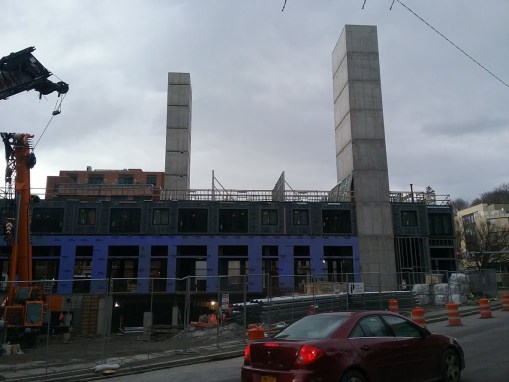
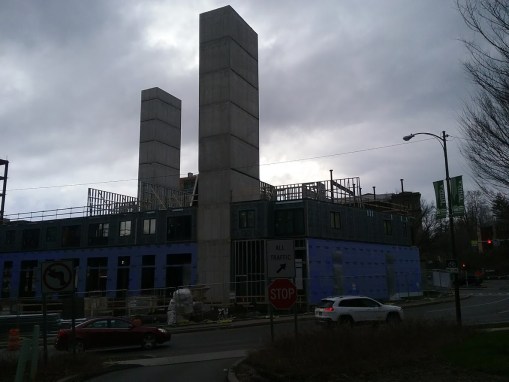
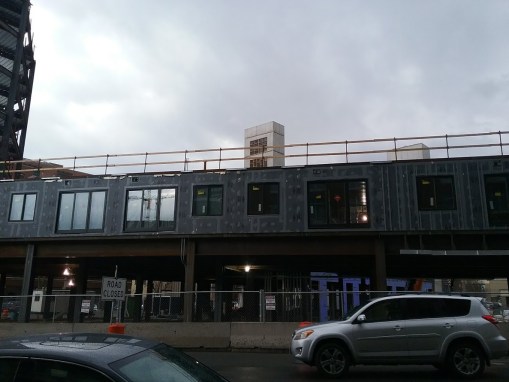
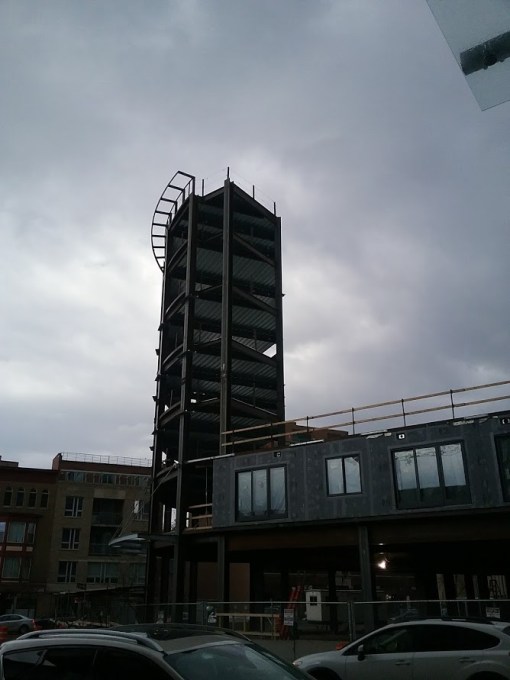
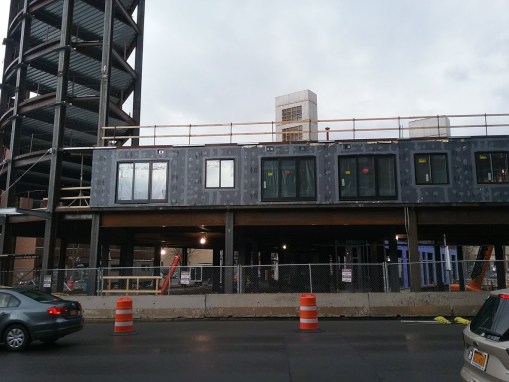
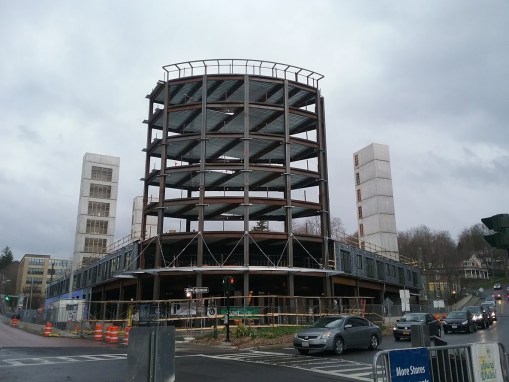
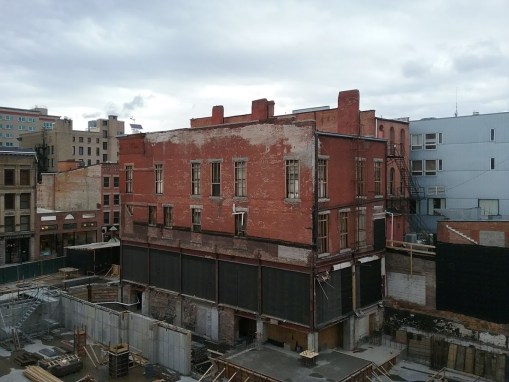
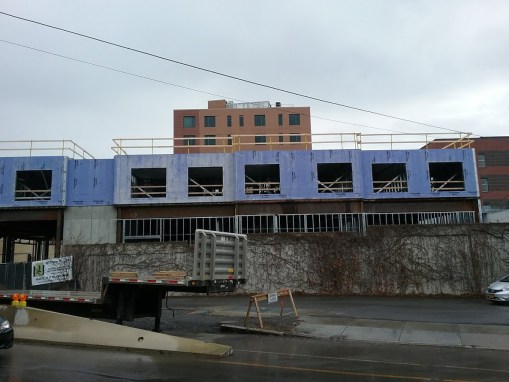
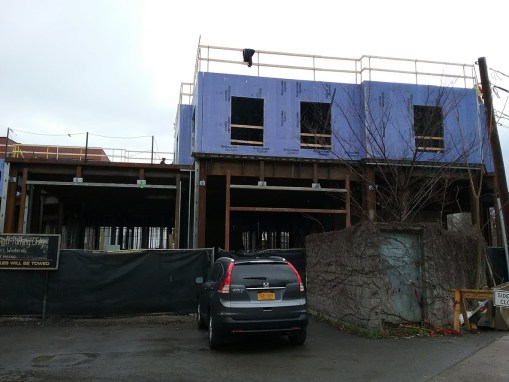
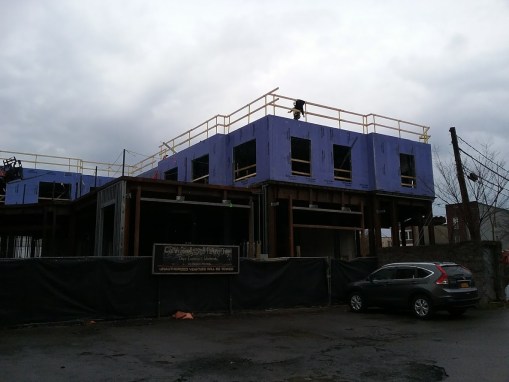
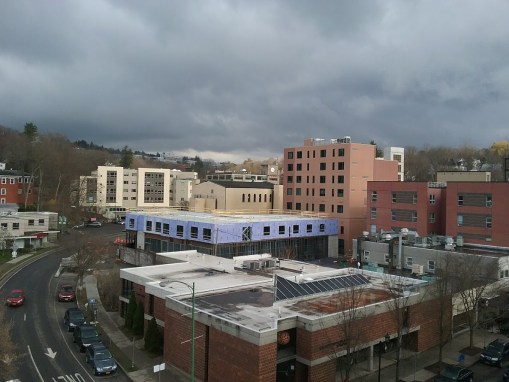
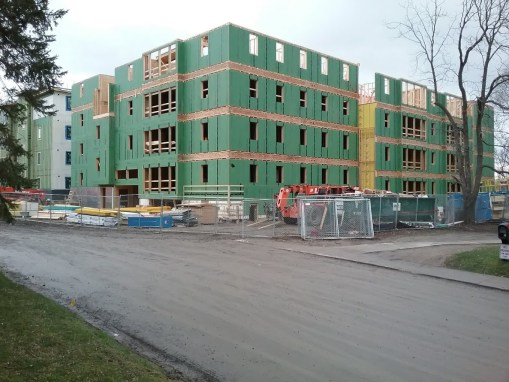
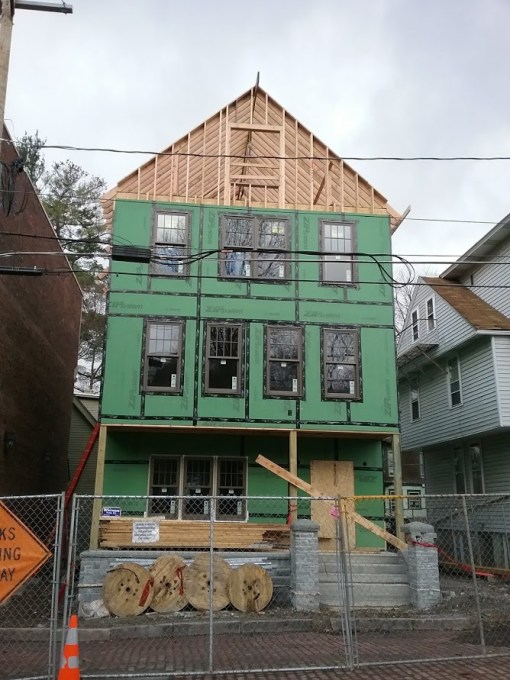
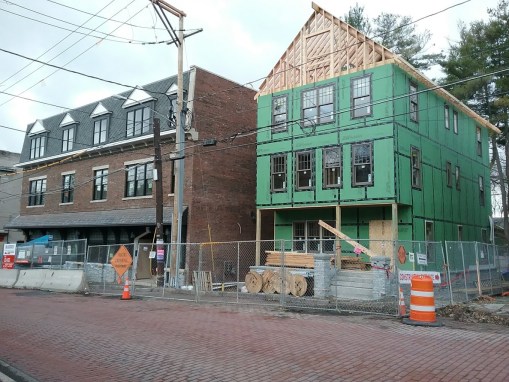
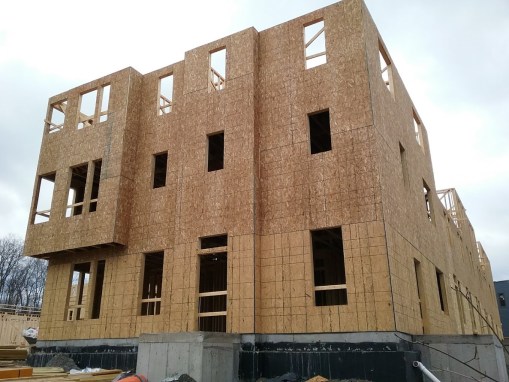
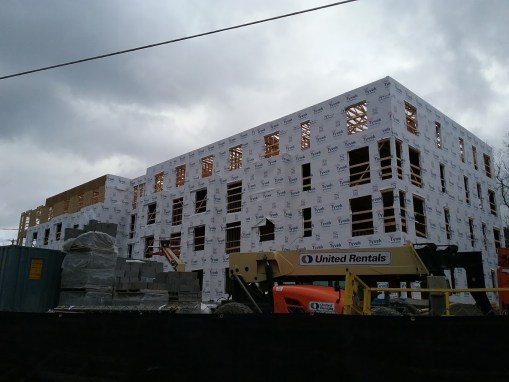
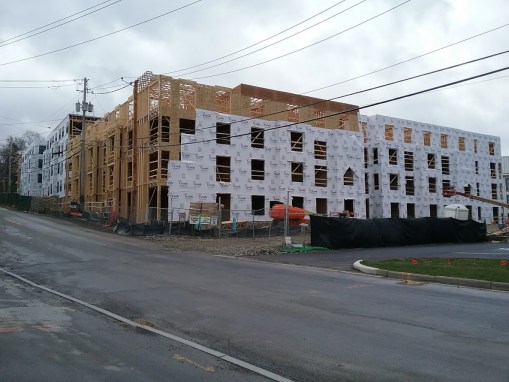
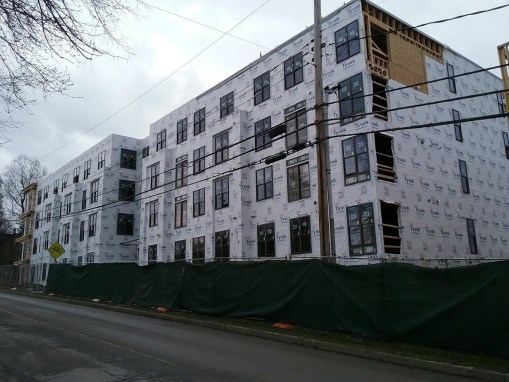
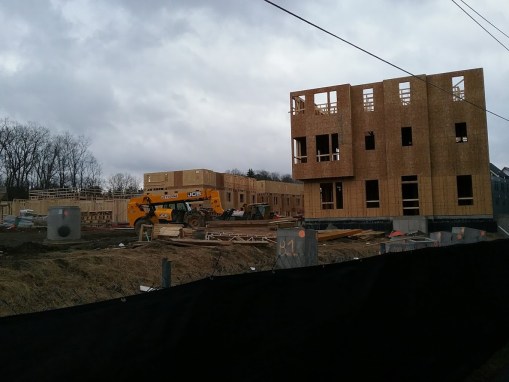
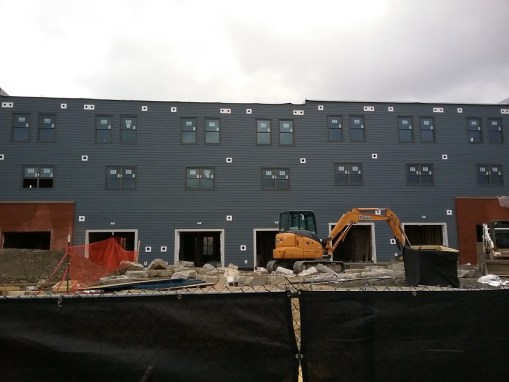
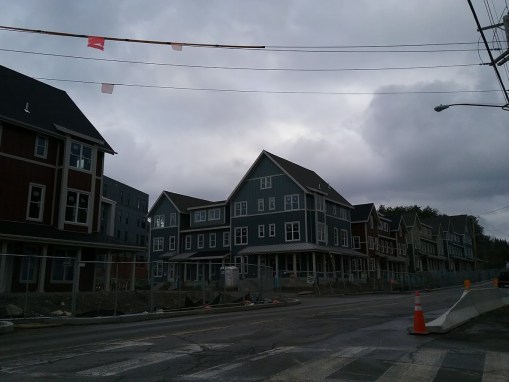
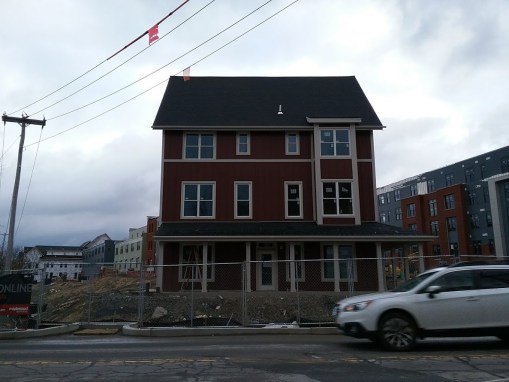
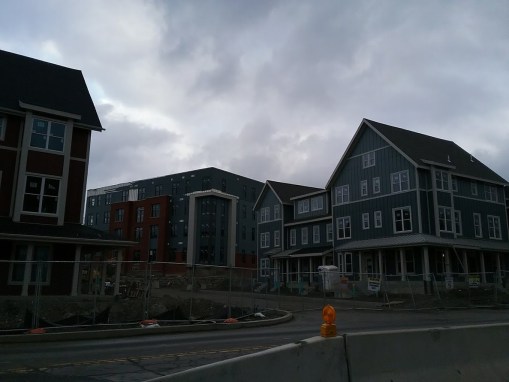
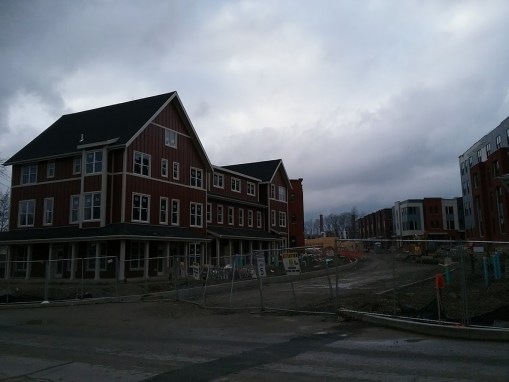
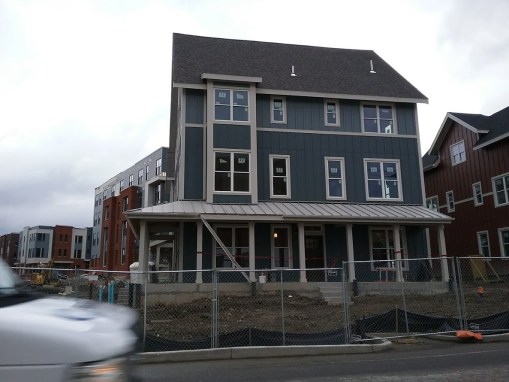
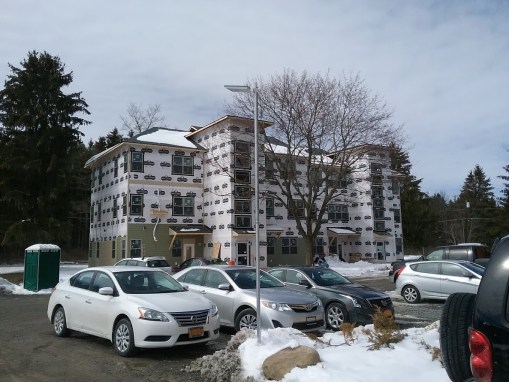
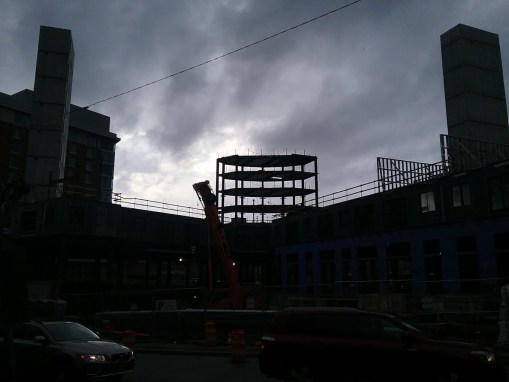
Mostly just clearing out my stash at this point; as the webcam shows, exterior framing is up to the third floor.

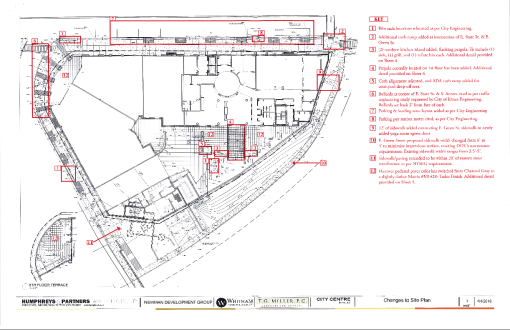
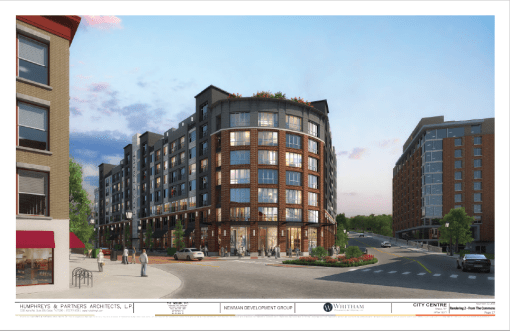
A number of changes have been made to the City Centre project, inside and out. Whitham Planning and Design shepherded the alterations through the planning board, which was generally okay with them. Among the revisions:

-Landscaping Changes. Among them, street tree species and layout, and tree grates are being replaced with FlexiPave porous paved covers. The number of shrubs was decreased, perennial flowers increased. Bike racks were relocated, street lights, curbing and curb ramps were adjusted, concrete planters were added by the parking drop-off area, a pergola with string lights was added, bollards were added, the sidewalk width along East Green Street was reduced from 6′ to 5′, and pavers were changed to a slightly darker shade of grey.

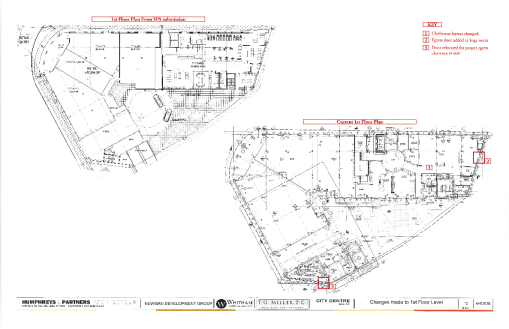
-On the first floor, the lobby layout was reconfigured, and some exterior doors were relocated for ease of access. The number of retail spaces was reduced from four to three, but the total square footage for the retail is about the same (11,000 SF). A storm water vault and fire pump room were added in the underground garage, and the parking spaces were reconfigured slightly to accommodate (still about 71 spaces).

-The unit mix has changed from 61 studios, 78 one-bedrooms, and 53 two-bedrooms, to 33 studios, 120 one-bedrooms, and 39 two-bedrooms. Still 192 units total, but with fewer studios and two-bedrooms and more one-bedrooms, basically. This might have to do with what’s easiest to rent to the target market (young professionals, a few downsizers, deep-pocketed students). Perhaps studios aren’t seen as having enough space for the upmarket market segment.

-The exterior facing materials have been changed from Nichiha aluminum panels to Overly Dimension XP Metal Systems, and Alucoil Larson ACM aluminum panels. The color palette is generally the same, perhaps slightly greyer with the revised paneling. Air intake vents were added to the building facade. Fenestration (window size/arrangement) was also changed up.

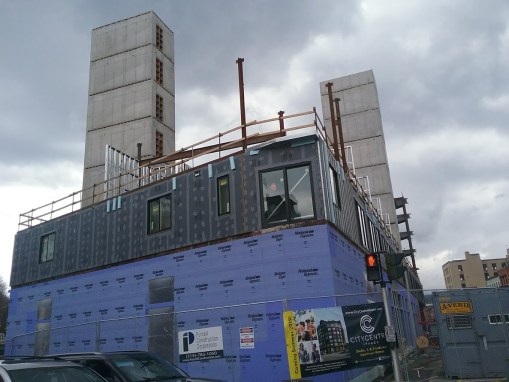
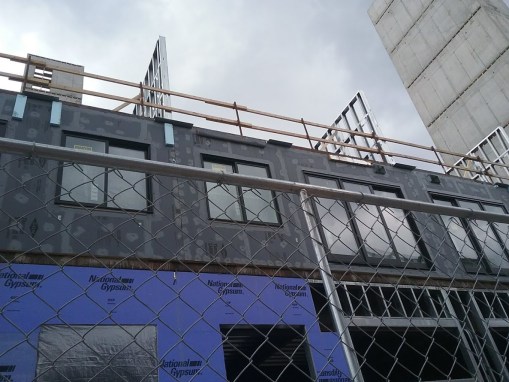
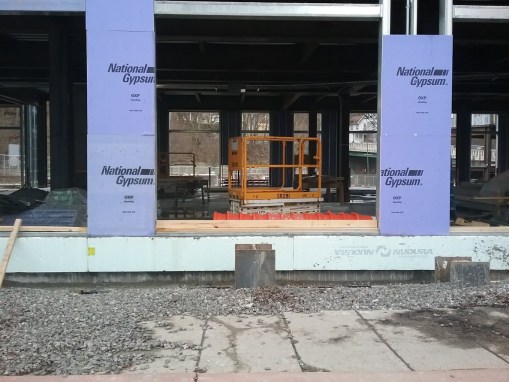
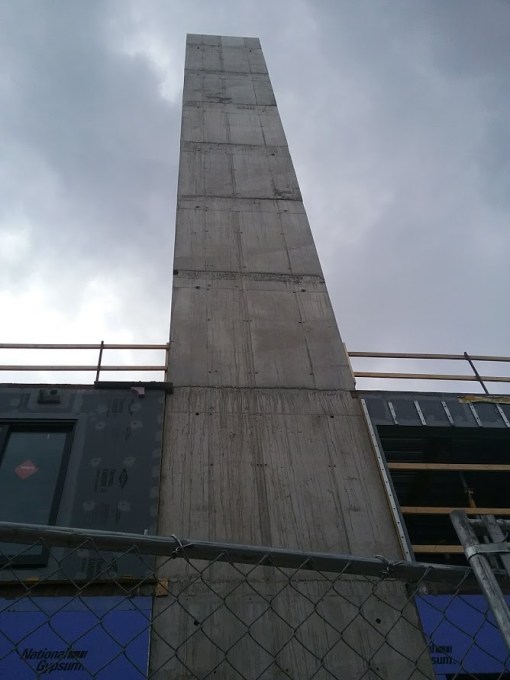
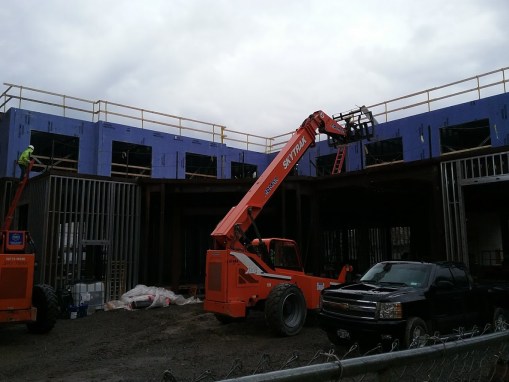
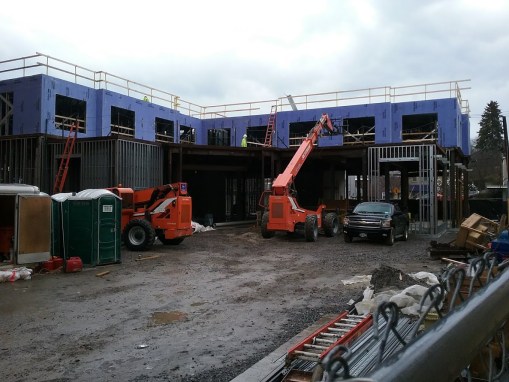
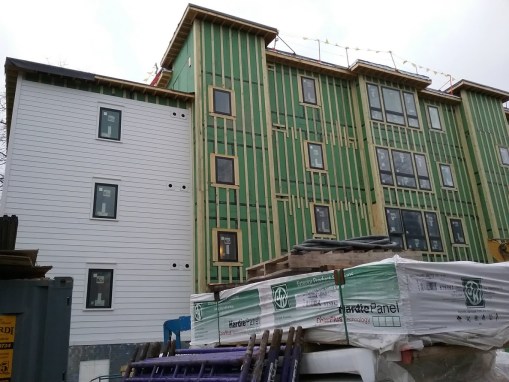
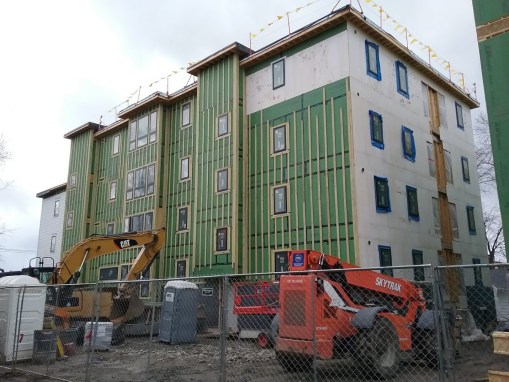
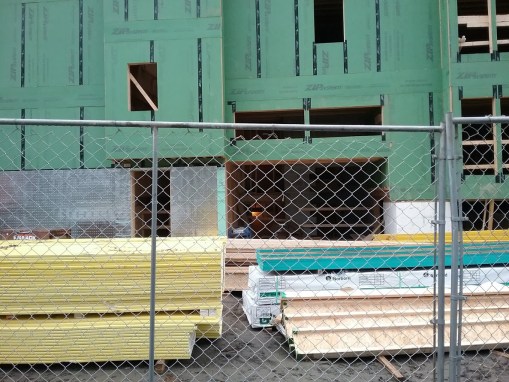
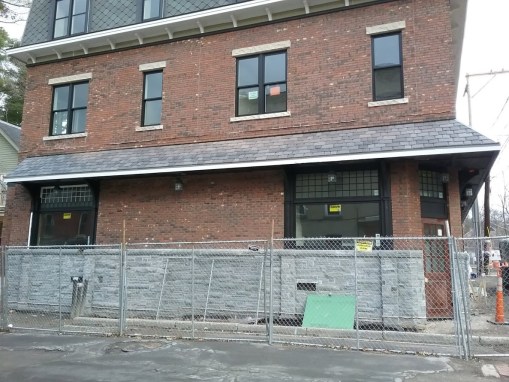
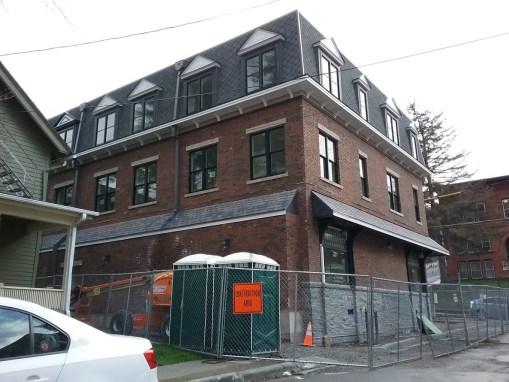
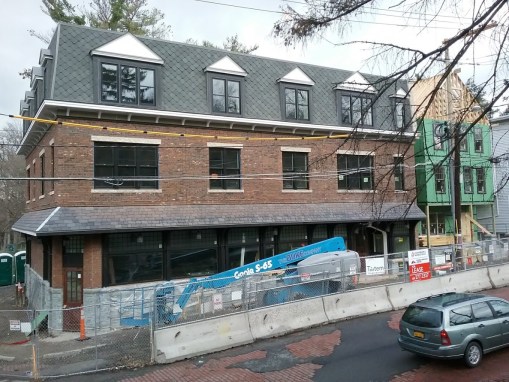
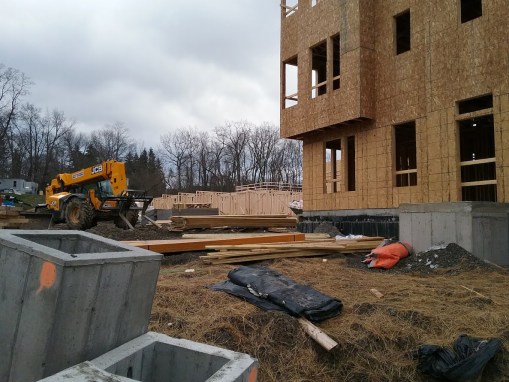
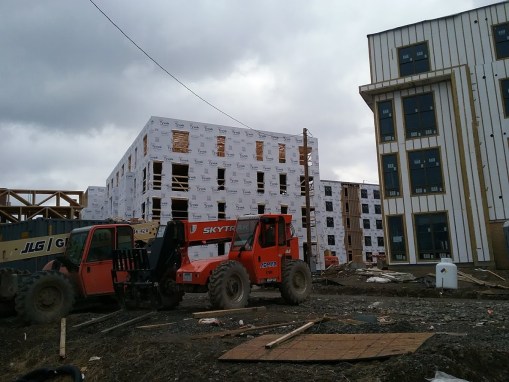
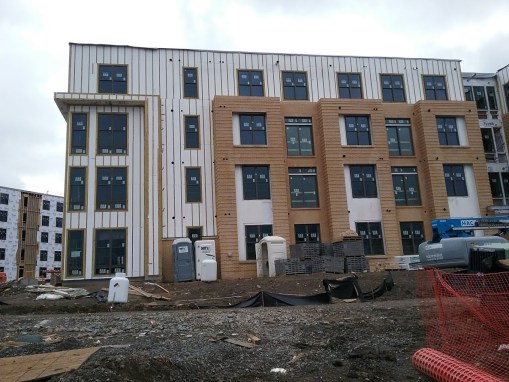
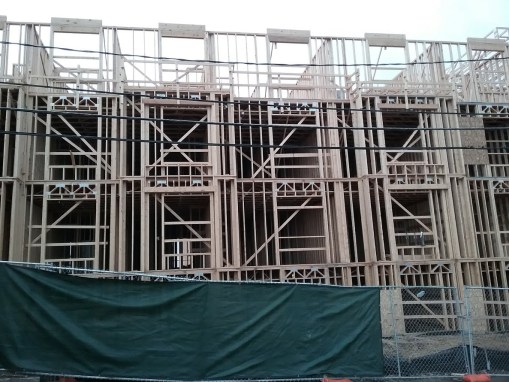
The floor buildout is a rather interesting process, because they’re practically building from the inside-out as each floor is added. The interior steel stud walls and structural steel supports go up first, then roof decking overhead, and then what appear to be prefabricated modular exterior wall panels with Marvin Windows already fitted. The dark panel is Dow Thermax Xarmor, which apart from sounding like a Star Wars extra, is a heavy-duty fire-rated fiberglass insulation board covered with a dark exterior facer that serves as a water barrier. These panels can be set into place very quickly, saving time and labor costs. The ground-level is more typical fireproof gypsum sheathing. The steel rails on the upper floors are likely for the aluminum exterior panels, so they may clipped into place.


Harold’s Square Construction Update, 4/2018

10 05 2018

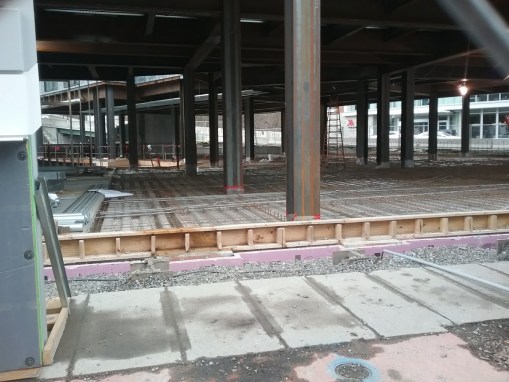
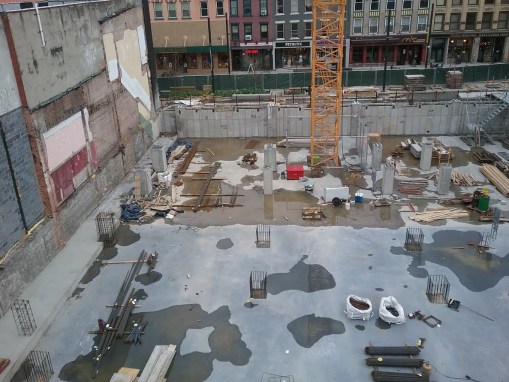
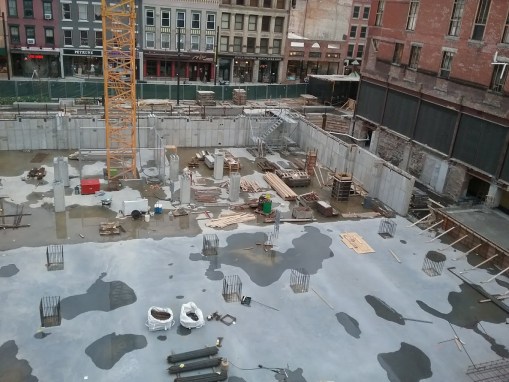
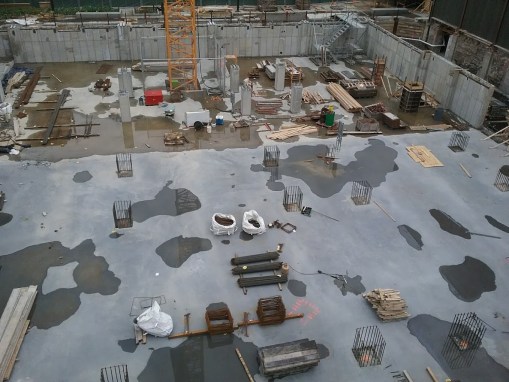
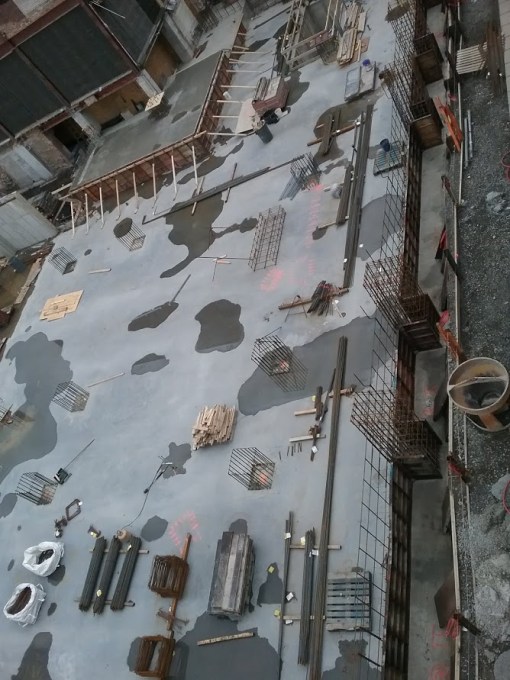
Ithaca weather is not accommodating. Originally, the pour for the concrete slab was supposed to take place on April 3rd. It’s tricky, because this is a large footprint and the building is very heavy, necessitating a thick slab – 30 inches thick. That has to all be poured at once, without any potential interruptions like rain or snow, which can weaken the concrete as it cures (upsets the mix and water balance). That was rescheduled the first time due to winter weather, and was expected to take place on the 11th, which was rained out. 4/16 was also cancelled due to winter weather. Finally the concrete was able to be poured on the 23rd.

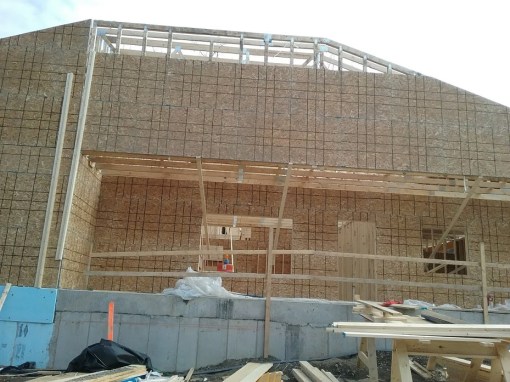
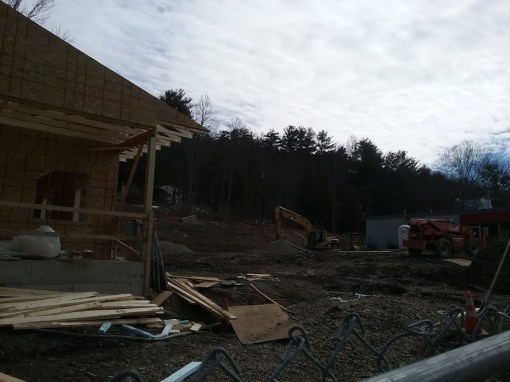
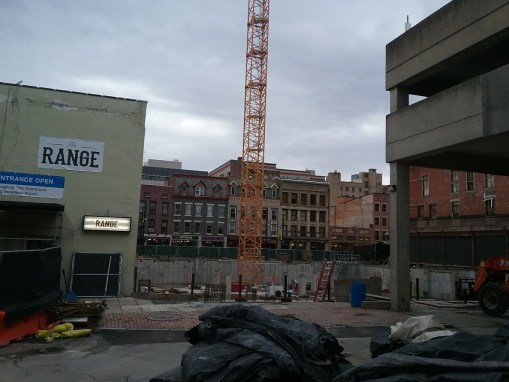
In the photos below, you can see some wood forms are still in place for smaller sections (entryway, lower right of site). The vertical concrete column bases are being poured (note the squares of vertical rebar in the sections yet to be encased), with steel plates atop the finished column to tie into the steel beams. The hole in the lower right (southeast) corner is for one of the elevator cores. Taylor the Builders will have this heading skyward in short order.


Hilton Canopy Hotel Construction Update, 4/2018

5 05 2018

Construction continues on the Canopy, but the plans are in a state of modest flux. The fiber cement panels were changed to a different manufacturer, which uses a different paint supplier. The original Cem5 fiber cement panels use Swiss Pearl paints, while the revision proposes Nichiha panels using PPG paints. The replacement colors are very similar.

However, the dull yellow “Applesauce Cake” accent panels (itself a replacement for Cem5 “Carat Topaz”), was rejected by Canopy. The replacement color, a charcoal grey “Dark Ash”, was disliked by the board, so the project team is still trying to determine a suitable color replacement with enough to get the order filed with the manufacturer without delaying the construction timeline. I wonder if, given the orange Canopy logo and branding, if a soft “rustic” orange shade might be available? The thought being that it would tell visitors quickly that this building is a Hilton Canopy, and a warm, subtle shade would brighten the facade without being obnoxious. From what I see, one can custom order panels, which is no doubt more expensive, but I’m not seeing a list of standard colors anywhere.

While excavating, the project team did find some small fragments of the Strand Theater, which stood on the site until its demolition in 1993. The “most decorative” pieces are going to be used in a display inside the hotel lobby, and further consideration is being made for an exterior mural.

The landscaping is being tweaked to extend a sidewalk through the property to Seneca Way, as well as a curb-cut and smaller planters to fit within the property line. A pair of ginkgo trees planned for the property are being replaced with some dense shrubs and perennial instead. This is the eleventh version of the project I now have on file. Background info and specifications can be found here.

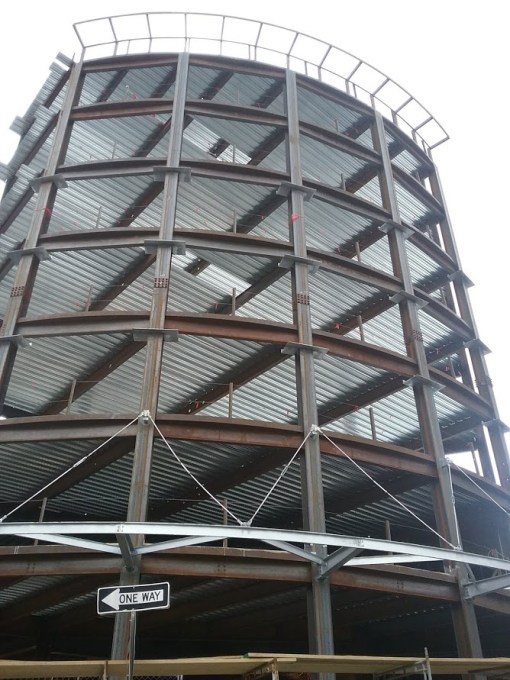
The hotel has completed foundation work and is up to the second floor. The steel skeleton and elevator cores/stairwells continue to rise, with thinner exterior steel stud walls on the ground floor and fireproof gypsum panels on the second floor. The finished product should be coming onto the market in about a year.


The Lux (232-236 Dryden Road) Construction Update, 4/2018

3 05 2018

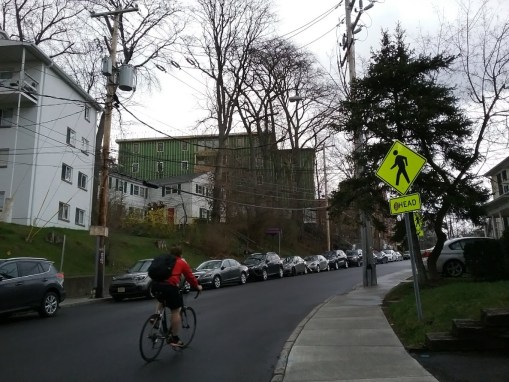
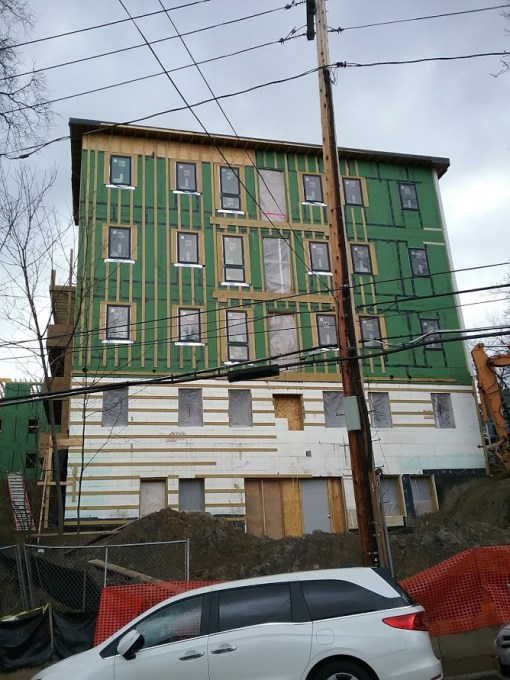
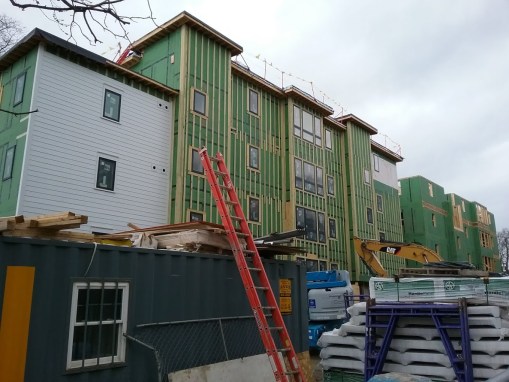
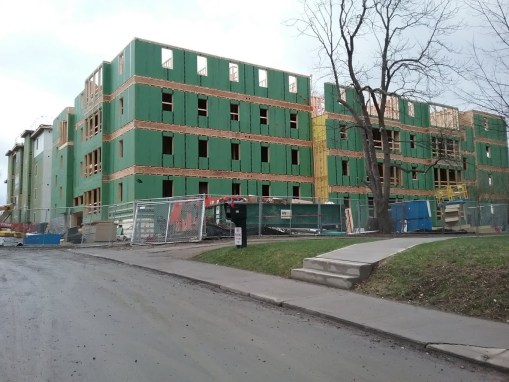
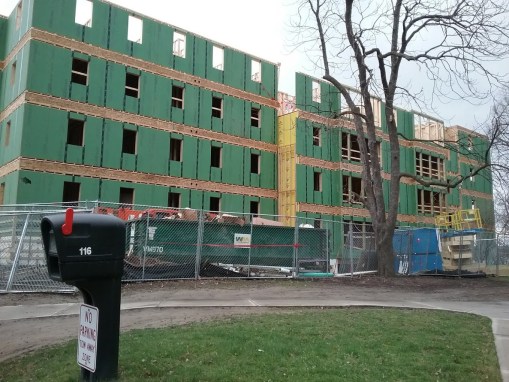
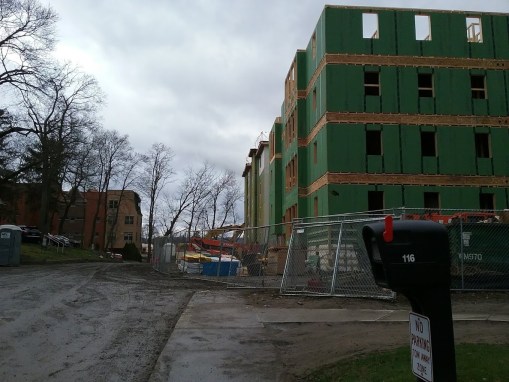
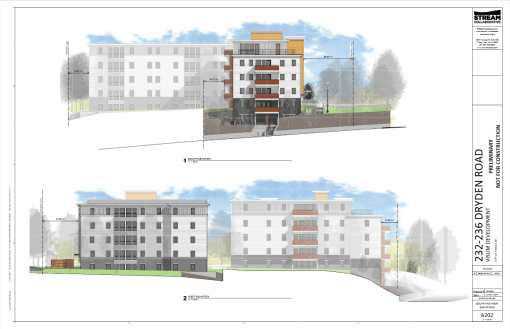
At the site of The Lux at 232-236 Dryden Road, framing continues on the new apartment buildings. I’m under the impression that, like the Ithaka Terraces project also designed by STREAM, these are thick double-stud exterior walls. Double-stud walls are built using two sets of wood stud walls used in the exterior frame, parallel to each other but spaced apart by about 5 inches. That space is then filled (if like STREAM’s other projects) with R39 densely-packed cellulose insulation. The result has its pros and cons. The cons are that it’s more expensive to build, and it reduces the interior space a little bit. The pro is that it’s very energy efficient, which comes in handy for a project trying to achieve net-zero energy use.

On top of that appears to be wood furring strips for the cladding. I think the white panels on the north side might be boards with some kind of waterproofing? The roof on 232 Dryden appears to have had underlayment applied, but no EPDM (synthetic rubber) or similar finish yet.

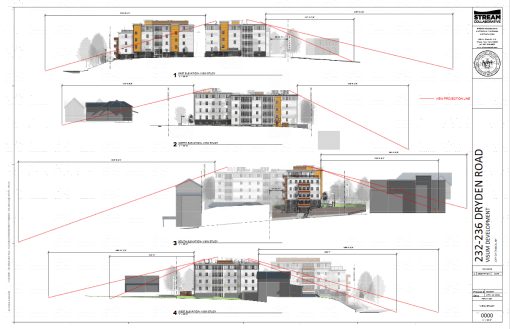
The Amvic ICF will be faced with grey stucco and a black brick veneer, while the upper levels will use LP SmartSide white and marigold yellow fiber cement lap siding. The reflective material is likely insulation that’s also intended to keep out the moisture from the exterior brick.

The top floor will be finished with fiber cement panels with LP SmartTrim laid out patterned to give some visual interest to the top of the structures. The windows are Anderson 100 series units with black frames, and what will be white casings. Still rough openings in some of the walls, and the balconies are just starting to get built on the west face. 236 Dryden has yet to be fully framed, but the roof trusses are underway.

In its March email blast, the developer, local firm Visum Development group, announced that the contest to design lounge, gym and study rooms was won by two graduate architecture students from Cornell – for that, they win $2500 and will have a lounge named after them. The winning designs are here. As of February, about half of the 207 bedrooms were leased.

The project did pay a quick visit to the planning board recently to ask if they would could have permission to not screen some of the rooftop utilities – though less attractive and meant as a cost efficiency, these are less visible parts of the roof per the diagrams provided to the city. I didn’t hear any issues with it, so I assume it was deemed acceptable by the board.


Chapter House / 406 Stewart Avenue Construction Update, 4/2018

30 04 2018

It’s hard to believe it’s been over three years now since the fire that decimated the Chapter House and the neighboring apartment house at 406 Stewart Avenue. According to a recent write-up by Mark Anbinder at 14850.com, the new build at 400-404 Stewart Avenue will host one eight units –  studio apartment, three 1-bedroom apartments, one 2-bedroom apartment, and three 3-bedroom apartments. The units are aiming for a summer occupancy, and CSP Management (Jerry Dietz and his team) are in charge of the rentals on behalf of developer/owner Jim Goldman.

From the outside, the building is practically complete, except for landscaping/paving, trim pieces, and facade installation of the ground-level bluestone veneer. The 4-unit, 11-bedroom apartment building next door is not as far along, with roof trusses only just being installed, and sheathing (ZIP panels) and window fittings underway on the lower floors. It’s a reasonable bet to say these will be available for their first tenants in time for the start of the new academic year in late August.

As fair as anyone’s aware, the ground-floor space restaurant/bar is still available for lease, at $35/SF (at 3,000 AF, that means $105,000 annually). Chapter House owner John Hoey has said in the comments here that the price is too high for his business. The possibility of a “Chapter II”, as some have dubbed it, seems increasingly remote. Any other potential lessees can contact David Huckle or August Monkemeyer at the Ithaca branch of Pyramid Brokerage.


Maplewood Redevelopment Construction Update, 4/2018

30 04 2018

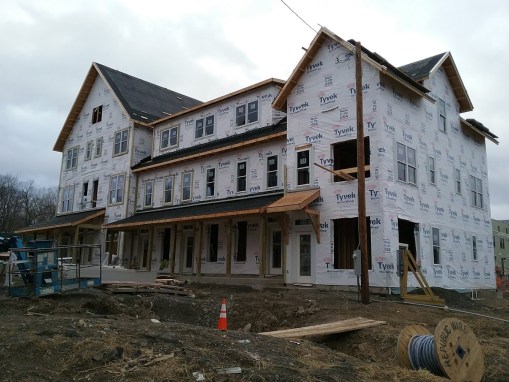
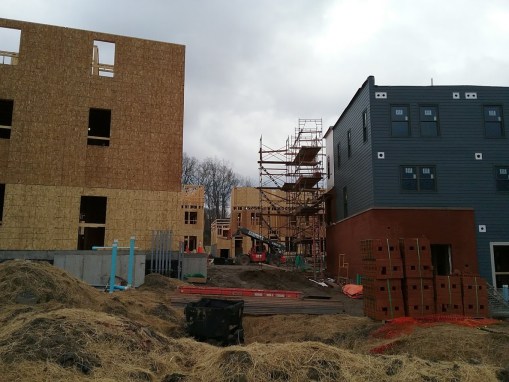
Maplewood has not had the best of luck during the construction. A wet fall, and an unusually wet and cold spring have really dampened efforts to move the project along at a clip that the development team would have liked. Supply issues (framing walls) and concerns from subcontractors about steady, non-weather interrupted work have also made things more complicated. The developer (EdR Trust, with local project representative Scott Whitham of Whitham Consulting) approached the town of Ithaca with a request to extend the working hours again from 7 AM to 10:30 PM for interior work, on top of the four-hour extension (from 9 AM – 5 PM to 7 AM – 7 PM) and the Saturday 8 AM – 4 PM hours previously granted.

It did not go over well. After getting a tongue lashing from members of the board about incompetence, the planning board did offer a partial concession to 9 PM on a 4-3 vote. As a result, barring no further major issues, most of the units are expected to be delivered in July, though some of the later-scheduled townhouse strings will likely not be complete before August. Ostensibly, there’s a fear that the units won’t be ready in time for incoming Cornell graduate and professional students, in which case EdR will incur the substantial cost of putting them up in a hotel, as some of the Collegetown developers had to do a couple of years ago (325 Eddy’s opening was especially rough). The current plan is three phases of move in, on July 1st, July 31st and August 20th.

From what I’ve heard, at least half the units are spoken for in the 441-unit, 872-bed development. Advertisements have been showing up pretty regularly on websites like Craigslist, as well as their own website.

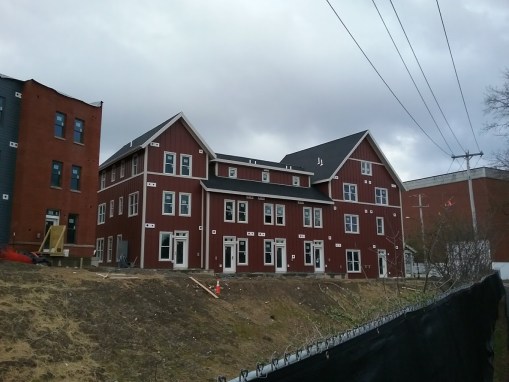
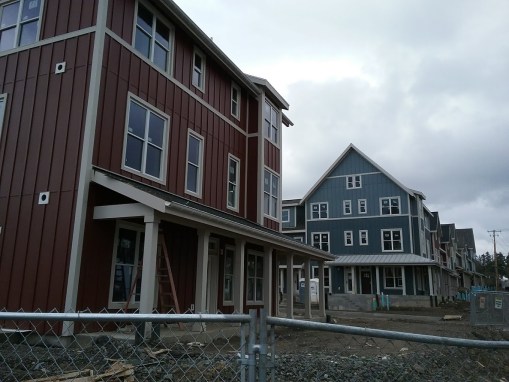
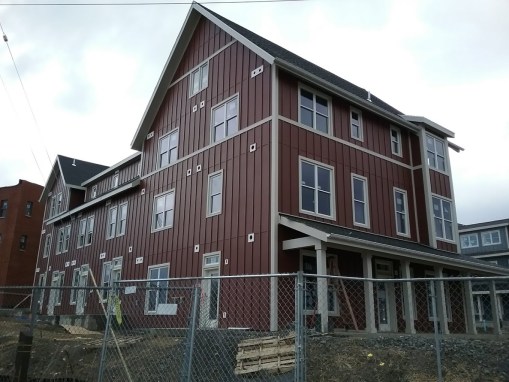
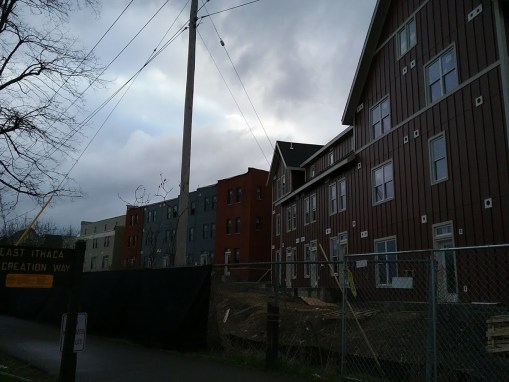
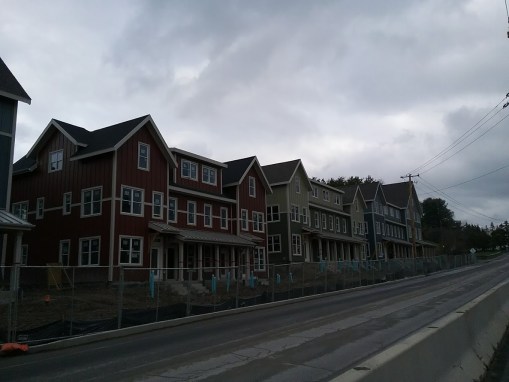
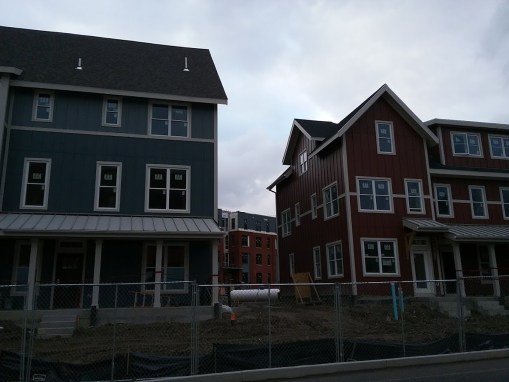
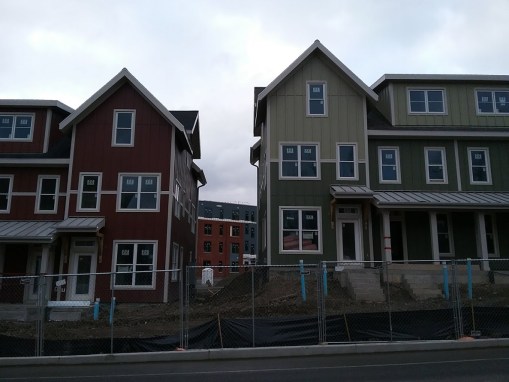
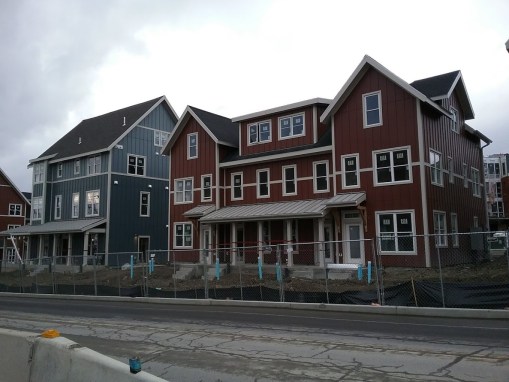
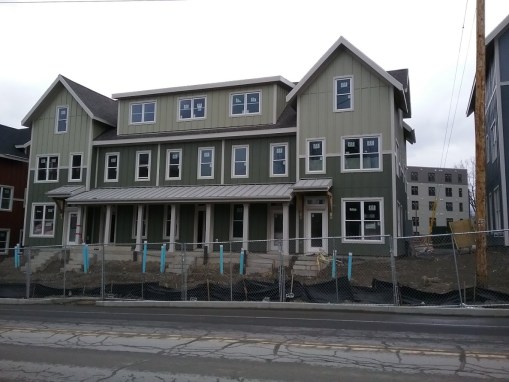
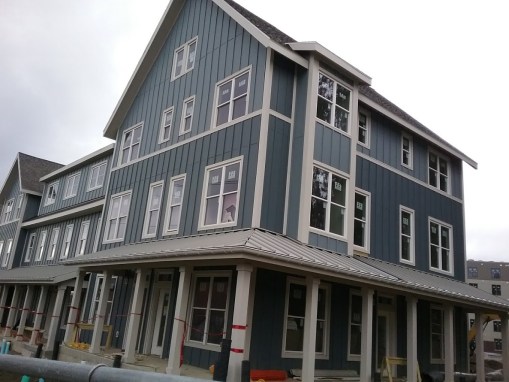
Walking around the site, construction is in just about every stage imaginable, from framing to sheathing to fit-outs to exterior siding and even trim work on the units facing Mitchell Avenue. There have been some changes in the plans, and I’d argue for the better – more color variations in the apartment buildings and the townhouse strings. The southwest corner building on Mitchell was initially supposed to be shaded of blue, but is finished with red fiber cement panels, and the panels on one of the gabled “Ht” strings next to the Belle Sherman Cottages. The apartments also show varying brick and panel ensembles, from navy panels and red brick, light grey panels and maroon brick, dark grey panels with tan brick….it makes for a more colorful and arguably more attractive site.

Quick aside, a second project webcame has been installed. This one looks over the three apartment blocks on the northern (Maple Avenue) end of the site. Link below, along with the southward camera.

For project background and planning, click here.

For a site plan breakdown, click here.

For a construction timeline, click here.

Webcam link 1 here (updated ~15 minutes).

Webcam link 2 here (New! updated ~15 minutes).


News Tidbits 4/7/18: A Day Late and A Dollar Short

7 04 2018

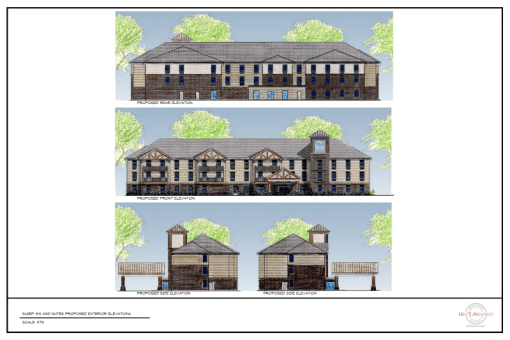
1. It appears the Sleep Inn hotel is moving forward. Building permits for the 37,000 SF, 70 room hotel at 635 Elmira Road were issued by the town of Ithaca on March 23rd. According to the town’s documentation, the project cost is $4.1 million, though it’s not 100% clear if that’s hard costs (materials/labor) and soft costs (legal/engineering/design work), or just hard costs alone.

The Sleep Inn project was first introduced in Spring 2016, and underwent substantial aesthetic revisions to a more detail, rustic appearance. Even then, the project was barely approved by the Planning Board, which had concerns about its height, relatively small lot size and proximity to the Buttermilk Falls Natural Area. The hotel’s developer, Pratik Ahir of Ahir Hotels, co-owns the Rodeway Inn further down Elmira Road. Both the Rodeway and Sleep Inn are Choice Hotels brands, so although the Sleep Inn brand is new to the area (and uncommon in upstate New York), it’s not as unusual as it seems. Given the size, a 12-month buildout seems reasonable. Look for updates as the project gets underway.

2. In a similar vein, the gut renovation and expansion at 1020 Craft Road now has a building loan on file – $1.88 million as of April 3rd, courtesy of Elmira Savings Bank. The existing 10,500 SF industrial building has been gutted down to the support beams, and will be fully rebuilt with an additional 4,400 SF of space. The project is being developed and built by Marchuska Brothers Construction of Binghamton. According to the village of Lansing and the developer, the project will be occupied by multiple medical tenants.

3. The problem with tight publishing deadlines is that if a quote doesn’t arrive in time, you can either put it in afterward as an updated statement, or it gets left out. So on the heels of the report that Visum Development Group is upstate New York’s fastest growing company in terms of revenue (Inc.com’s guidelines were three-year period 2014-16 and at least $100,000 in revenue to start), I wanted to share this for those who might have missed the article update. The statement comes courtesy of Todd Fox, who was asked for comment and responded the following day.

“I would love to acknowledge the Visum team because without them I would never be able to accomplish what I am doing. I’m blessed to have the most passionate and talented people I have ever met. Chris Petrillose is my longest running team member and is the backbone of operations. I also want to acknowledge Patrick Braga, Matt Tallarico, Marissa Vivenzio, and Piotr Nowakowski. They are all rock stars and deserve so much of the credit for our success!

We are currently looking to expand into several new markets, which are as far south as Sarasota Florida and as far west as Boise Idaho. For the Ithaca market, we are essentially hitting the breaks on student housing for Cornell, as we beginning to experience some softening in the market. Our new focus is on for-sale condos and moderate-affordable rentals. We actually have multiple properties under contract and plan to bring about 1,000 to 2,000 new beds online over the next several years.”
Note the last parts. The market for student housing if softening. Visum will focus on for-sale condos and moderate-affordable rentals, things Ithaca could use more of, and 1,000 to 2,000 beds would certainly make a dent in the housing deficit. Of course, proof is in the pudding, so we’ll see what happens over the next several years.

4. The town of Ithaca was less than pleased about Maplewood’s request to extend indoor working hours until 10:30 PM. Labor, weather and building supply (wood frame) issues were cited as reasons for the needed extension. The Ithaca Times’ Matt Butler, who was at the meeting, provided this quote:

https://platform.twitter.com/widgets.js

Yikes. The “happy medium” the board finally gave in to was construction until 9 PM on buildings interior to the project site, away from the main roads. The tradeoff is that EdR and Cornell now expect to not have some of the later structures ready until August 20th, practically move-in day for all of Cornell’s on-campus undergrads.

5. Readers of the Voice and Times will know that the county is pursuing some of the $3.3 billion in federal dollars earmarked but not yet disbursed for opioid crisis treatment. While a temporary addiction facility is being prepared, there are plans in the works to open a detox and stabilization facility in Tompkins County. Unfortunately, it needs much more funding to move forward. The new facility will cost $11 million to build and make operational, and so far about $1 million has been received so far in grants.

For the purpose of this blog, I asked about the design beside Angela Sullivan and Senator Schumer – it is a conceptual design for demonstrative purposes, and a location for a new facility has not yet been fully determined. However, they intend to send a press release once a site has been selected.

By the way, the green logo at lower right is a giveaway on the architect – that would be Ithaca’s HOLT Architects, who are specialists in healthcare facilities.

6. New to the market this week, “Clockworks Plaza” at 402 Third Street in the city of Ithaca’s Northside neighborhood. The 12,821 SF building was one of the few sizable buildings built in Ithaca in the 1990s (1993, to be exact), and is on the market for $2.6 million. The current owner, masked by an LLC, bought the property for $1.5 million in April 2016, the same value for which it is assessed.

That came up on the blog here. The buyer was Steven Wells of suburban Boston, who purchased the property in a buying spree that also included 508 West State Street (former Felicia’s, empty at the time) and 622 Cascadilla Street. 508 West State is now rented by Franco’s Pizzeria. Zaza’s still occupies 622 Cascadilla.

As I wrote at the time of sale:

“They all have different owners, and they’re in varying physical conditions. The only thing that unites these three properties is all that are in areas the city as ripe for redevelopment for urban mixed-use in the Comprehensive Plan. Felicia’s was upzoned in June 2013 to CBD-60, permitting a 60-foot tall building, no parking required. 622 Cascadilla is WEDZ-1a, allowing for five floors and no off-street parking requirement. Lastly, 402-410 Third Street is B-4, 40′ max and 50% lot coverage, but allows virtually any kind of business outside of adult entertainment. Those are some of the city’s more accommodating zoning types, so we’ll see what happens moving forward. At the very least, the public relations game will be starting from behind the proverbial eight ball.”

The reason why the public relations game was ‘behind the eight ball’? He was the guy who sold 602 West State Street and adjacent low-income housing properties to Elmira Savings Bank. There were accusations that the transaction between Wells and the bank was poorly handled, with claims that the lease terms of existing tenants were changed improperly, and tenants not being told their homes were being sold. It’s not clear it that’s accurate, because no one would share their documents to prove their claims. But what is clear is that this created a nightmare situation.


7. It looks likely fewer people will be living in City Centre than first intended. The initial 192-unit mix was 61 studios, 78 one-bedrooms and 53 two-bedrooms. The newly-proposed mix is 33 studios, 120 one-bedrooms, and 39 two-bedrooms. It also appears the retail space has been reconfigured from four spaces to three, though the overall square footage appears to be about the same. There are some minor exterior changes proposed as well; paver colors, lighting, the types of metal panel used (Alucoil to Overly Dimension XP and Larson ACM panels), landscaping, and exterior vents. Assuming the PDF is accurate, the panel change is slight, but gives the building a slightly darker grey facade. Some of these changes are in response to code and safety discussions, others are likely value engineering.

8. From the city’s project memo, we see Greenstar’s new store (which is going into the Voice) and a pair of new if small projects.

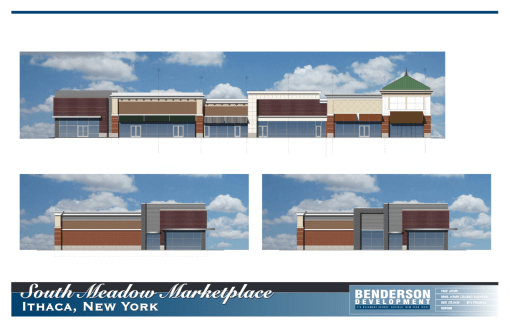
The first is that it appears Benderson is expanding South Meadow Square again. Along with the pair of endcap additions underway, the Buffalo-based retail giant is looking to add a 3,200 SF addition to the west endcap of one of its smaller retail strings. The addition is on the Chipotle/CoreLife strip, next to Firehouse Subs. The dumpster enclosure currently on-site will be relocated to the Panera strip across the road to make room for the building, which will be flush to the sidewalk with…a blank wall. Seems like a bit of a missed opportunity there. The 35′ x 92′ addition has no announced tenant, though 3,200 SF is reasonable for a smaller restaurant or retail space (Chipotle is 2,400 SF, for instance, and Panera 4,100 SF; the stores in this particular retail strip, which includes a vitamin store, tanning salon and barber shop, are in the range of 1,380-4,089 SF). The total project cost is only $132,000, and no construction period is given in the Site Plan Review document.

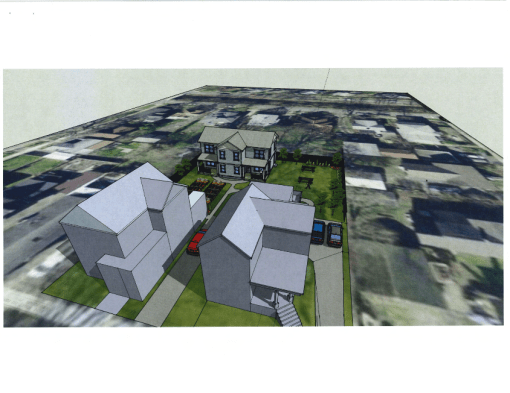
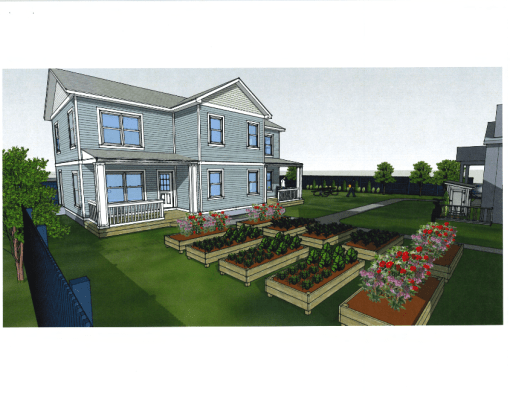
The second is a “pocket neighborhood” in Northside. Barken Family Realty of Ithaca is planning to renovate two existing homes at 207 and 209 First Street, and add a new 2,566 SF two-family home behind the properties. They would be set up as a “pocket neighborhood”, consolidated into a single tax parcel with a common area, picnic tables and raised plant beds. The fence would be repaired and the gravel driveways improved. No demolition is planned, but five mature trees would come down to make way for the new home (6-8 new trees will be planted).

Hamel Architects of Aurora designed the new duplex, which is intended to quietly fit into the neighborhood context. Each unit will be two bedrooms. The $265,000 project would be built from October 2018 to March 2019.

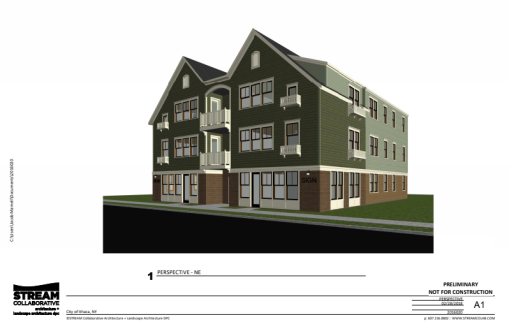
9. We’ll finish this week with a potential new build. The above project was first showcased on STREAM Collaborative’s Instagram at an early stage. It is a 3.5 story, 11,526 SF building with 10 units (6 one-bedroom, 4 two-bedroom), and the two one-bedrooms on the first floor are live-work spaces – the front entrances are workspaces for home businesses. It is proposed along West Seneca Street, and only the south side of West Seneca allowed for mixed-uses like live/work spaces. Materials look to be Hardie Board fiber cement lap siding and trim. The design is influenced by other structures along West Seneca, and a bit from STREAM architect Noah Demarest’s time with Union Studio in Providence, Rhode Island, where he worked before setting up his own practice back in Ithaca – there are similarities between here and Union Studio’s Capitol Square mixed-use design in Providence.

The project actually was sent with its name and title, but fingers crossed, it will be part of a bigger article.


News Tidbits 3/31/18: A Bit of a Lull

31 03 2018

1. In Lansing, a local developer seems to have gotten the message when it comes to a small senior housing project. As reported by Dan Veaner at the Lansing Star, the latest version of Eric Goetzmann’s Lansing Meadows calls for 20 2-bedroom units ~1500 SF (square feet) each in ten buildings along a loop road, “Lansing Meadows Drive”. The project uses the entire parcel, with the eastern end set aside for a small (less than 2500 SF) neighborhood retail component.

Goetzmann is less than happy with the latest version, saying that financially it doesn’t work, but he needs to get something built to fulfill the requirements of the BJ’s tax abatement in 2011 – the senior housing component of the project has been delayed so long, the county has prepared legal action to recuperate abated taxes if Goetzmann doesn’t get the senior housing started ASAP. The answer at the last pair of meetings went from “I just want to get this done” to “We’re looking to build 12 units and if we’re successful we’re looking to build some more, which really didn’t bode well for negotiation – at this point, a low or breakeven ROI is a price Goetzmann is willing to pay over paying the county and village millions. The Planning Board is satisfied with the newest design, and a vote to approve a special permit to start construction could be as soon as April 9th. The actual construction docs would take ten weeks and the project has to go out to bid contractors, but Goetzmann is optimistic the units will be built this year.

It’s a quiet month otherwise for the village, with a cell tower and a parking lot expansion the only other things on the latest agenda.

2. Let’s take a quick look at some noteworthy sales from the past month:

The Belleayre Apartments at 702 Stewart Avenue sold for $5,434,500 on the 22nd. The seller was Sebastian Mascaro, who some readers might remember because he previously owned the Chapter House before it burnt down. The buyer was Kimball Real Estate. The 44-unit building, which retains classic Collegiate Gothic details popular when it opened in 1933, is assessed at $3.85 million. Mascaro had paid $4.25 million for the building in November 2011. Don’t expect any big changes here, but it’s evidence of the strength of the local multi-family market.

9 Dart Drive, a 4.56-acre vacant parcel in the village of Lansing, sold for $52,500 to VPA Development on March 22nd. Yes, there is something planned here – the village Board of Trustees is aware. VPA Development’s mailing address is the same as local businessman Nick Bellisario, who is building warehouses on Hall Road in Dryden, and is a partner in the Varna Tiny Timbers (The Cottages at Fall Creek) project. Zoning here is the village’s Medium Density Residentialsingle-family and two-family homes, schools and religious facilities. Zoning is one unit per 20,000 SF for a single-family home, 25,000 SF for a duplex. So in theory, perhaps 8 or 9 home lots if single-family.

3. One of the questions that makes a fairly regular appearance in the inbox – will Maplewood finish on time in July 2018? It’s a good question, one that Cornell and EdR are damn determined to give a yes answer for. To make up for weather delays and other issues, the Maplewood construction team is requesting to do interior work to as late as 10:30 PM Monday-Friday. Keep in mind, this is on top of the Saturday hours and previous workday extension (four hours, two on both sides, to 7 AM – 7 PM). The town of Ithaca, which has to approve these changes, seems amenable to it so long as no generators are operating, doors and windows are closed, and supervisory staff is present – basically, don’t disturb the neighbors.

At last check, unseasonably cold and wet weather over the past several months had led the project to fall behind, and subcontractors to move to steadier jobs elsewhere. The project has fallen as much as 25 days behind schedule. The extensions, if approved, would create an 85.5 hour construction week, manned by different crews.

Side note, the town of Ithaca hasn’t had much else to review lately – the planning board has only had two meetings out of the scheduled six so far this year. The other projects were a single-family home lot subdivision on Trumansburg Road, and renewing the approvals for New Earth Living’s 31-unit Amabel single-family ecohousing development on Five Mile Drive. I have not seen anything underway when I’ve driven by, and the website has not been updated in a while, so it’s nice to know that something is still in the works.

4. For good housekeeping – things are slow in Dryden, so slow they cancelled their monthly planning board meeting. Things are also fairly slow in the town of Lansing, where the big controversy is a plan to relocate the shooting range for Lansing Rod & Gun. The issue is that environmentalists have criticized the gun shot’s proposal for lead shot remediation, as well as saying the range is too close to Salmon Creek. The town is still reviewing documents and has yet to make a decision.

5. Recently, the Collegetown Neighborhood Council floated a Business Improvement District (BID) similar to the Downtown Ithaca Alliance. The reception was lukewarm, according to the Times’ Matt Butler. It’s not that the concept is disliked, although some smaller property owners are a bit nervous about being outvoiced by bigger players. It’s more a concern that a BID would likely be financed by a property tax surcharge, something that the county’s (and arguably, one of upstate’s) most expensive neighborhoods would rather not have to deal with. A DIA-type group may engage in security, local beautification, event planning, or other needs as the business owners as we see fit; as of now, it’s still just a hazy idea, but we’ll see what happens with it.

6. The relative quiet in the project pipeline extends to Ithaca City. At the February planning board meeting, U-Haul corporate had submitted plans for a 5-story building that, in the words of Matt Butler, “they kicked that idea to the curb….just bludgeoned the dude.” Apparently it was too much – too big, too tall, no attractive. Also, the project for 207-209 First Street is not as bad as initially feared. Both existing two-families will be renovated, but not torn down, and a new duplex would be built at the rear of the property lots. The board says it could be similar to the Aurora Street Pocket Neighborhood, and was supportive of the plan overall.

This month was one of the quietest meeting agendas I’ve seen in years – the only project up for formal review and approval was the Stewart Park Inclusive Playground, as well as updates on the Chain Works District zoning, and the City Harbor plans. City Harbor was a late addition. There is plenty in the pipeline, some of which will come forward in the next few months; just seems there’s a bit of a lull at the moment.

7. Just a reminder – meetings for the East Hill Village neighborhood-scale proposal will be held at the The Space @ Greenstar on Monday 4/9 (an update of the past several months, 4/11 (workshops for concept designs), and 4/12 (presentation of preferred concept designs and alternatives). All meetings will be 6-8 PM, and the public is encouraged to attend.

Here’s a copy of the presentation from last May’s meeting – not anything groundbreaking, but it makes it clear that Cornell’s land holding are much more patchwork than folks might realize. I suppose the owner of the East Hill Car Wash stands to make a pretty penny at some point.


Amici House Construction Update, 3/2018

24 03 2018

Ithaca’s housing woes are fairly well-documented at this point. As in any broad situation, some have fared worse than others. If you’re fairly well off, the rapidly increasing housing prices are a nuisance, a vague political “issue” or perhaps even an opportunity if one thinks they know the market. For those will meager or no means, it’s more dire than that.

Take for instance those who are housing insecure or homeless. With a scarcity of options in Ithaca, many of Ithaca’s most vulnerable are at risk of living on the streets, with many ending up in “the Jungle” encampment behind Wal-Mart. Local shelters and supportive housing facilities are at full capacity, with dozens more turned away. This can perpetuate unemployment by reducing life stability, and it contributes to substance abuse and mental health issues. The high cost of housing has contributed to a much higher homeless rate in Tompkins County – up to five times the rate of Onondaga County (Syracuse), according to a 2016 Ithaca Voice study.

Tompkins Community Action, T.C.Action/TCAction for short, is well-aware of the issues faced by the less well-off in the Ithaca community. The non-profit started as the local unit of Lyndon Johnson’s “War on Poverty” programs in the 1960s. It administers early childhood education programs (Head Start), GED assistance, energy service programs (home weatherization), food pantries, family reunification services, housing vouchers, a fiscal literacy program, employment help – basically, social support services for thousands of low-income individuals in Tompkins County and adjacent communities, helping them succeed in their educational, professional and family endeavors.

In the past few years, Tompkins Community Action has made significant efforts to try and create more housing for those vulnerable, so that they’re less likely to end up in the Jungle or a back alley. In safe, secure housing, they are more likely to get clean, they are more likely to earn and keep steady employment, and they are more likely to take advantage of TCAction’s other supportive services, hopefully continuing on to better, more productive lives.

One of these efforts is a partnership with Finger Lakes ReUse – the pair, with consultation from affordable housing provider INHS, are entering the grant-writing phase for 22 studio units for those transitioning out of jail as well as the formerly homeless at FLR’s property at 214 Old Elmira Road. The other major project is Amici House.

Going through my archived notes, the first reference to what would become Amici House shows up all the way back in September 2014 as a 14 or 15-unit townhouse proposal, but it wasn’t until June 2016 that the first plans were presented, after a feasibility study was completed. Site plan review began in October 2016, and the project was approved in January 2017.

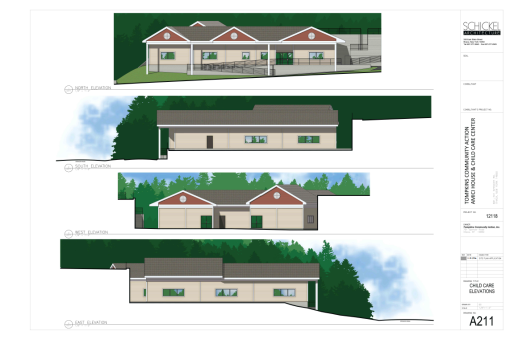
The plans, drawn up by Schickel Architecture of Ithaca, call for a narrow five-story, 20,785 SF (later 20,712 SF) building for housing, and an adjacent one-story, 7,010 SF building that will host classrooms and daycare facilities. The facilities would be a part of TCAction’s campus at 661-701 Spencer Road on the south end of the city. Two small houses would be deconstructed to make room for the classroom building, while the residential building, planned to house homeless or vulnerable youth aged 18-25, would be an addition onto the non-profit group’s existing office building.

On the first floor of the new residential building would be a children’s playroom (for homeless youth with children), case conferencing rooms, training rooms and kitchen space. 23 efficiency (studio) apartments would be built on the second through fifth floors.

The childcare building, later called the Harriet Giannelis Childcare Center in honor of a late staff member of TCAction, will provide five classrooms for Head Start and Early Head Start programs, as well as support space and staff training space. The building will host a playground, which is the blue space in the site plan above. The facility would have space for 42 children, and create about 21 living-wage jobs. The numbers were more recently revised to 48 children and 24 jobs. TCAction, which employs 104 people, is a certified living-wage employer.
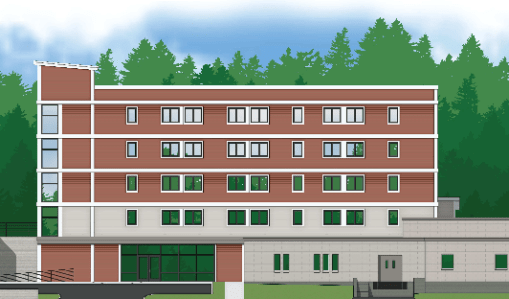
During the review process, not much changed. On the residential building, the planning board thought a glass-encased stairwell was thought to produce too much light, so the next iteration had it completely bricked in, which the Planning Board also disliked, as was a plan with small windows. Eventually, a “happy” medium was reached for medium-sized windows in the stairwell.

The project required a couple of zoning variances. The first one was for parking spaces (72 required, 65 planned). TCAction suggested that from a practical standpoint, they wouldn’t need a parking space for every housing unit, but the classrooms and office space will meet their parking requirements. Another variance was for operation of a child care facility is a residential zone, and there were three area variances related to building size and the driveway/drop-off area.

The initial estimated construction costs are $8.25 million. Per city building permit docs, The Harriet Giannellis Childcare Center’s hard costs are estimated at $1,267,479, while the 23-unit residential portion’s hard costs are estimated at $3,627,333. However, city IURA statements sat the HGCC will cost $1,774,470 to build, with $153,450 in soft costs, and a total of about $2,103,000. The residential portion comprises $6,115,000 in hard/soft costs and land acquisition (total for both $8,218,000). Welliver of Montour Falls is the general contractor.
As one might tell from above, financially it’s a bit confusing. This isn’t a traditionally-financed project with concerns about a lender’s Return On Investment. To make it become a reality, it uses a fair amount of subsidy layering – different funding grants from the city, county, NYS and the Federal HUD.

One grant, awarded in June 2016, was for $118,000 from the county that would purchase the small house next door to their headquarters – 661 Spencer, built in 1950 by the Amici family – thus allowing them to procure the land needed for developmentA later “grant” forgave the remaining $75,000 loan balance on their headquarters, and $225,000 was awarded to the project by the Tompkins-Ithaca-Cornell Community Housing Development Fund (CHDF).  TCAction first acquired their HQ with the help of the county back in 2001, and the cost of the purchase was being paid back to the county in the form of a 20-year lease. $84,200 was awarded to the Childcare Center by the Ithaca Urban Renewal Agency in 2017.

New York State awarded the project $3.732 million in April 2017, and the state’s HUD equivalent, NYS HCR, supplied another $3.26 million in two other grants, the Community Investment Fund (CIF) for the childcare center, and the Housing Trust Fund (HTF) for the housing. M&T Bank is providing a $501,883 construction loan, and another $300,000 came from a Federal Home Loan Bank.

More recently, the numbers were revised to $603,000 for M&T Bank and the NYS HCR CIF was reduced from $1.499 to $1.325 million – probably a case where the state decided not to award the full request, and TCAction had to make it up elsewhere. Funding for the Head Start operation comes from the Federal Department of Health and Human Services, and other funding comes from state and local allocations. The facilities are tax-exempt. A look at the finances, which practically break even (slight profit actually) can be found here.

Initially, construction was supposed to be from August 2017 to October 2018, but the time frames were shifted back a few months due to financial and bureaucratic snags. TCAction also discovered they couldn’t stay in their headquarters as construction went on, so they needed an emergency $90,690 loan from the IURA to rent temporary offices at 609 West Clinton Street.

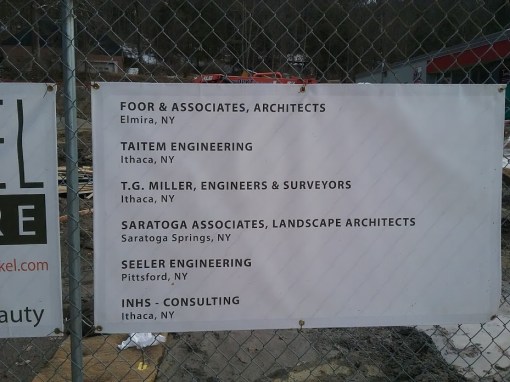
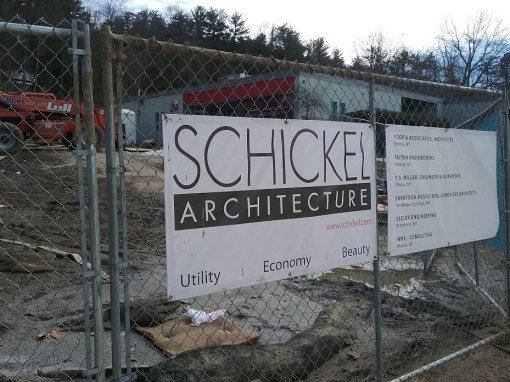
Along with Schickel Architecture and Welliver, the project team includes Taitem Engineering for structural engineering work, Foor & Associates of Elmira assisting in the design work, T. G. Miller P.C. for civil engineering and surveying, Saratoga Associates Landscape Architects, Seeler Engineering of suburban Rochester, and INHS as a consultant.

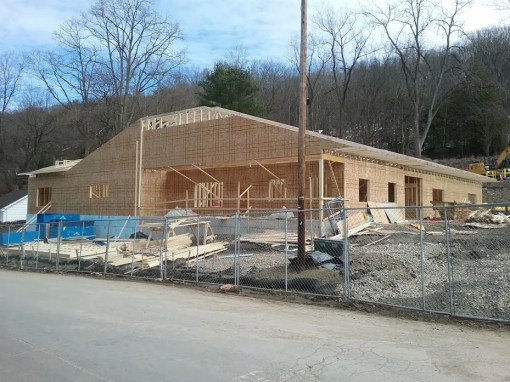
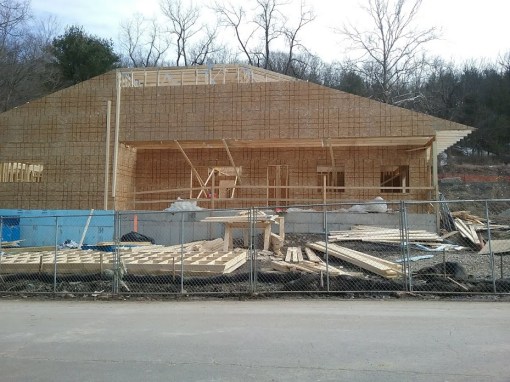
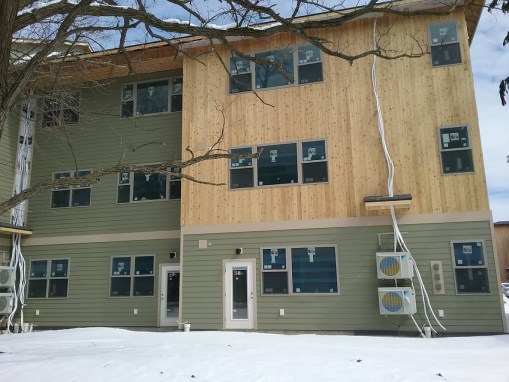
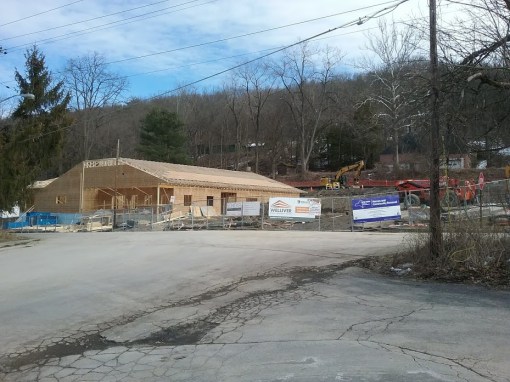
In the photos below, construction has been well underway, and has been since at least the tail end of January. The childcare center’s slab foundation and footers have been excavated, poured and insulated with rigid foam boards (the soil will be backfilled later to cover the base). The wood-frame is well underway, and it appears most if not all of the roof trusses are in place, as are many of the walls – I suppose these guys are going with housewrap instead of ZIP sheets. Although the size seems correct, the design does not look like what I have on file from , much to my chagrin. Foundation work seems to be underway for the residential portion.


Village Solars Construction Update, 3/2018

24 03 2018

It looks like 102 Village Place is just about complete from the outside, with only some minor finishing work like trim boards remaining on the to-do list. Its peer, 116 Village Circle, is a little further behind, with rough-ins, insulation and drywall in place inside, and exterior facade work underway. The air-source heat pumps have been installed, but not fully hooked up yet. The 42 units in these two (24 and 18 respectively) should be ready for occupancy by the end of the spring.

I never caught it before, but the project docs say the developer, Lifestyles Properties (the Lucente family), will plant over 500 cherry trees on the property as phases concludes and the land is no longer disturbed. Perhaps a few of the saplings below are included in that figure.

According to the phasing plan, the next phase is to replace 2 Village Circle and 22 Village Circle with a pair of 18-unit buildings. Those would be twelve studios and six two-bedrooms each, replacing two ten one-bedroom unit buildings (net gain of 28 residents, for those keeping in track). These would likely start later this year for a 2019 completion.

After that time, Phase 3b, a 20-unit, 20-bedroom mixed-use community building (building “F”, all-new), would also start construction, with the start of phase 4, the 24-unit replacement of 36 Village Circle, to follow in the 2019-2020 timeframe. 3b has to start before Phase 4 if even just one day sooner, as that was added as a stipulation by the town planning board before any new phases commence (presumably, it would also have to be completed in reasonable time). Lifestyle Properties says the two buildings per year phase-in works well for Tompkins Trust Company as lender (its market segment and location can comfortably absorb another 42 or so units every year), and for the in-house construction team and preferred subcontractors. Spring 2022 is the practical conclusion, but there are plans for additional buildings east of the current site, which could add a few hundred more units throughout the 2020s.

Just as a subjective observation, there has definitely been a change in Lansing’s development pattern. It’s still fairly suburban, but the numerous 3,000 SF Cardamone homes that seemed to be ever-underway on cul-de-sacs in the mid 2000s have now been reduced to a trickle – I never see more than 2 or 3 underway at any one time these days, and driving through Cayuga Way, Woodland Park and Whispering Pines is often a waste of gas. However, multi-family is taking off in areas with sewer access, like here at the Village Solars, and with the English Village / Cayuga Orchard properties between East Shore Drive and Triphammer Road. Likewise, the village is getting plenty of infill on its vacant parcels, from large projects like the Bomax Drive Apartments and Cayuga View Senior Living, to smaller ones like Triphammer Row.
There’s some evidence to back that up – according to the federal HUD Building Permits Database, from 2003-2006, Lansing town and village approved 187 single-family homes and not a single multi-family unit. From 2013-2016 (the latest available), the two approved 92 single-family homes and 148 multi-family units.