News Tidbits 3/25/17: Out in the Wild

25 03 2017

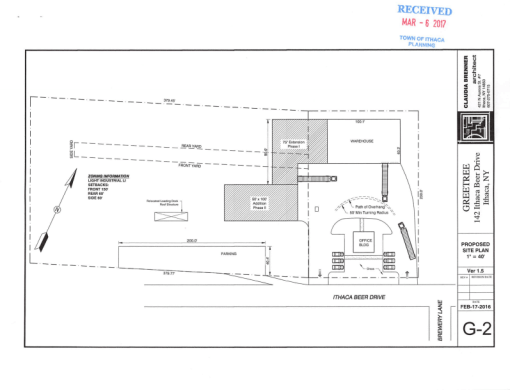
1. Let’s start by touching real quick on this past week’s Ithaca town meeting. The Bundy subdivision and the renovation of the former Wings Over Ithaca space at East Hill Plaza were approved, per Matt Butler at the Times. The Greentree project was reviewed and the board granted itself lead agency to conduct environmental review. Greentree owner John Gaunt is still unsure whether he’ll keep the Elmira Road building, which is where Ithaca Beer got its start in the late 1990s. Although primarily a warehouse/ag industry project, there will be some potentially public-friendly features, namely a garden park and picnic area. The board expressed a desire to see Greentree work with neighbor Ithaca Beer for landscaping between the two buildings.

2. I followed up with Lansing town planning consultant Michael Long regarding English Village. As readers might remember from last week, that’s the 58 single-family home lots and 59 townhouses proposed somewhere in Lansing – didn’t know where because that was the first anything has been published about it. Here’s Long’s response:

“The English Village is a concept developed by Jack Young to build a network of single family homes and apts. /condos that surround the existing soccer fields along Water Wagon [sic] Road. It is still very early in the conceptual phase so there has not been an formal application made as yet, but a project that has been talked about for many, many years. We don’t have anything specific yet but is a project “In-progress”.”

Jack Young is a Cayuga Heights businessman (and chair of their zoning board of appeals), who owns a sizable amount of undeveloped land in Lansing; most of it is used for farming. The soccer fields on Waterwagon Road are just east of The Rink, which is putting in a new climbing tower. There’s been plenty of conventional suburban development up this way since the 2000s, although in recent years the new starts have slowed as conventional suburban layout have lost some of their allure to walkable urban or truly rural properties. We’ll have to keep an eye out and see what happens.

3. Now turning attention over to Dryden. Apparently the town of Dryden thinks I’m with the Ithaca Times. Anyway, two new projects have popped up on the radar this week.
The first is a 6,016 SF, 8-unit apartment on the 500 Block of Etna Road just east of the airport. All units will be 1-bedrooms. The developer is Ithacan Salim Kasimov; with partner Yelena Kurbanova, they’ve picked up some properties in and around the area for home construction over the past few years, although this might be their first multi-family building. Simple, maybe a little bland – a floor-separating exterior lap band and two different colors of siding would do wonders.

The project exceeds zoning, where 2 units/acre is allowed, and this is pursuing 8 units on 1.78 subdivided acres (the other lot holds a two-family home). SEAF here, floor plans hereThe argument was that these are all one-bedroom units, and a typical house is 3+ bedrooms, so it’s not a substantial variance. The project was in planning before the rural zoning code was updated, which complicates matters.

According to Dryden town planning director Ray Burger, the ZBA asked for more information, but the application has been withdrawn. This project is in limbo for the time being.

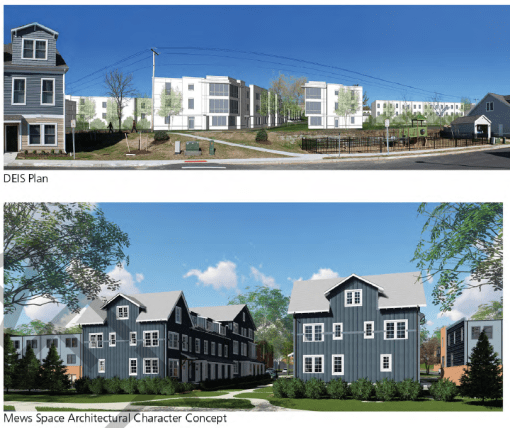
The second is called the “Pineridge Cottages”, and went to the Dryden Planning Board for a sketch plan review this week. This one came up on this blog a long time ago – it’s a proposal for about 20 single-family rental homes on about nine acres on the corner of Dryden Road/Route 13 and Mineah Road. At the time, the logic was that the density requirements would let it slip under the radar, since the project is under 4 units/acre and could have avoided triggering most site plan review regulations. But maybe with the revised zoning laws, that’s no longer the case.
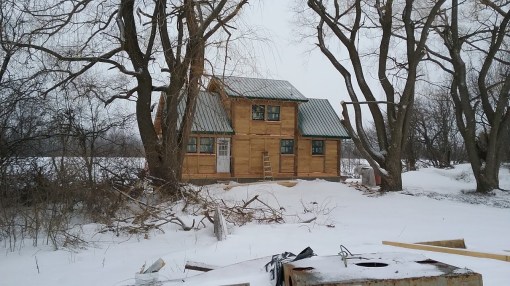
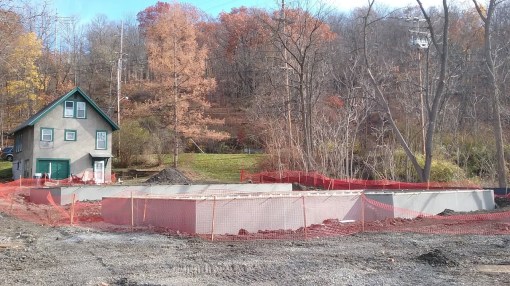
4. It’s a Tiny Timber out in the wild! Not something that was expected while covering the Maple Festival, but there it was on the property. This would be the very first one, according to the Tiny Timbers blog. The TT blog says it’s in Hector (which is correct, it’s 500 feet from the Tompkins/Schuyler County line), but the Wellspring Farm advertises itself with a Trumansburg address, so this was really just fortuitous circumstance. The model is a Model L Lofted with optional green corrugated metal roofing.

It’s looks like sales are off to a good start – the 14 Farm Pond Circle lot is pending, as is the Ellis Hollow Road lot. A Tiny Timber Big Cube is also expected to replace a dilapidated home at 104 Grandview Place on Ithaca’s South Hill. Prospects are so good, Buzz Dolph plans to rent a warehouse on Dryden’s Hall Road to serve as an assembly facility for the modular components, and is looking for construction partners in neighboring markets. Modest, affordable owner-occupied housing is an under-served but big potential market, and to its profit, Tiny Timbers looks to be part of the solution.
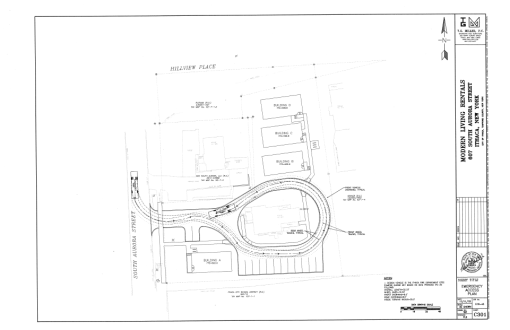
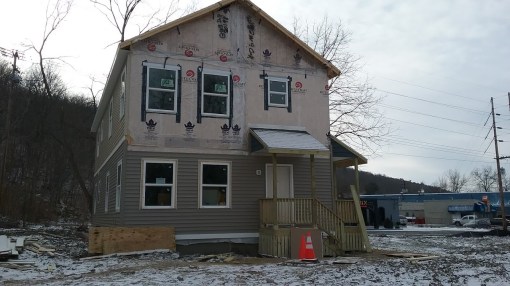
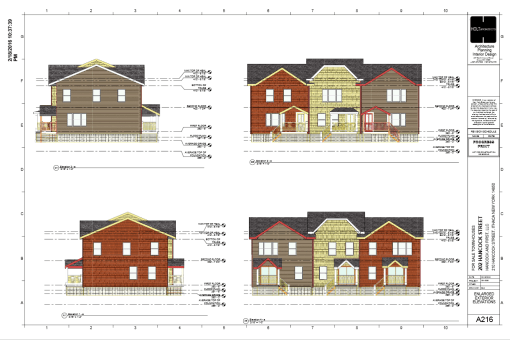
5. According to documents filed with the county this week, the construction loan for 607 South Aurora is $1,920,000. Tioga State Bank is the lender on record, with Charlie O’Connor of Modern Living Rentals as developer. The documents give a March-August build-out for the 4-building project; each building will host 2 three-bedroom units, and utilize modular components. These will look pretty similar to the pair that just opened on Old Elmira Road.

The two-family directly on South Aurora is designed with a full-length porch and sculpted brackets, with Hardie Plank fiber cement boards to look more aesthetically pleasing. The trio tucked away from road will use vinyl siding. Advertisements targeting Ithaca College students are already posted on MLR’s website, saying that the 3-bedroom units will rent for $2,250/month, or $750/bedroom.

6. One of those rare interesting things from the slimmed down Ithaca Journal – it appears CFCU has been doing pretty well this decade. Not only were they recently approved for an expansion into Cayuga County and Seneca County (that’s where Geneva is, guys), the Lansing-based credit union and financial services firm has added 40% to its financial holdings and 42 jobs since the start of the decade. Not too shabby at all, keep up the good work.

7. Interesting planning board meeting shaping up. Here’s the March agenda:

1. Agenda Review 6:00

2. Privilege of the Floor 6:01

3. Subdivision Review
A. Project:
Minor Subdivision 6:10
Location: 109 Dearborn Place Tax Parcel 9.-3-11

4. Site Plan Review

A. Project:
Apartments (11 Units) 6:20
Location: 107 S Albany Street
Applicant Stavros Stavropoulos
Actions: Consideration of Preliminary and Final Site Plan Approval

B. Project:
Schwartz Performing Arts Center Plaza Improvements 6:40
Location: 430 College Ave
Applicant: Ram Venkat for Cornell University
Actions: Declaration of Lead Agency .Public Hearing . Determination of Environmental Significance, Consideration of Preliminary & Final Site Plan Approval

C. Project:
Apartments ( 5 Units) 7:00
Location: 118 College Ave
Applicant: Visum Development Group
Actions: Declaration of Lead Agency

D. Project:
Finger Lakes ReUse Commercial Expansion and Supportive Apartments 7:20
Location: 214 Elmira Road
Applicant: Finger Lakes ReUse
Actions: Declaration of Lead Agency

E. Townhomes- 238 Linden Ave – Sketch Plan 7:30

This proposal was removed right before the February meeting. Same details as before: 238 Linden is a non-historic student rental house, and a John Novarr property in a CR-4 zone – 4 floors, no parking required. Further to that, 240 Linden to its north was taken down for staging space for the Breazzano Center, but as that will be finishing up this Spring, it leaves an MU-2 (six floors, no parking) parcel open for development. A townhomes plan suggest one or both of these parcels will host something not unlike the ikon.5-designed townhouses plan Novarr plans to build at 119-125 College Avenue.

F. Apartments 232- 236 Dryden Road – Sketch Plan 7:50

Another CR-4 proposal is slated for what is currently a parking lot at 232-236 Dryden Road. Given that the parking lot address is 232-238 Dryden, it seems plausible a small, remnant component is being kept. The owner is James Rider, the 57-year owner of the Hillside Inn budget hotel in Collegetown. Going out on a limb, it’s likely he is not the developer, but someone else who happens to have a purchasing option. Four floors, no parking required, on a parking lot – seems like a good opportunity for an infill project without much risk to the city’s historic fabric.

5. Zoning Appeals 8:10
#3059, Appeal of Determination, 742 Cascadilla At (Carpenter Bus. Park) – Yes, Maguire has filed the lawsuit and this is related. Carpenter is the Plan B at this point, but they want to make sure that Plan B is legal if that’s what it boils down to.
#3060, Area Variance, 322 Park Place – small addition to an existing house.
#3062, Area Variance, 104 Grandview Place – the Tiny Timber mentioned above.
#3063, Sign Variance, 505 3rd Street (Aldi) – Aldi is renovating and expanding stores across the country, a massive 1,300+ store project that’s liable to cost more than $1.5 billion over the next few years (prototype shown above). Ithaca will be one of the first to get the new layout, adding 2,700 SF to its Aldi outpost. The move is to allow expanded fresh food offerings (meat, dairy and produce), and install new energy-efficient refrigeration units. Note that the expansion is to allow a slightly larger combined store signage area than what’s legally allowed (total 272.9 SF vs 250 SF). Victor-based APD Engineering and Architecture is in charge.

6. Old/New Business 8:30

7. Reports


Ithaka Terraces Construction Update, 3/2017

20 03 2017

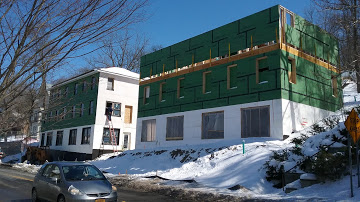
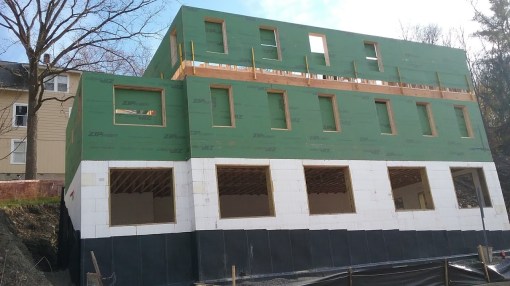
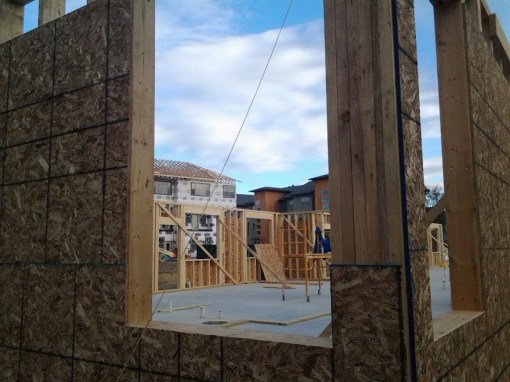
Over at the Ithaka Terraces located at 215-221 West Spencer Street, Building “A” is fully framed, sheathed, nearly all Low-E windows have been fitted and the roof has been shingled. Buildings “B” and “C” are still in the process of framing and sheathing. Building “D” might be excavated at this point, but all the snow made it impossible to tell.

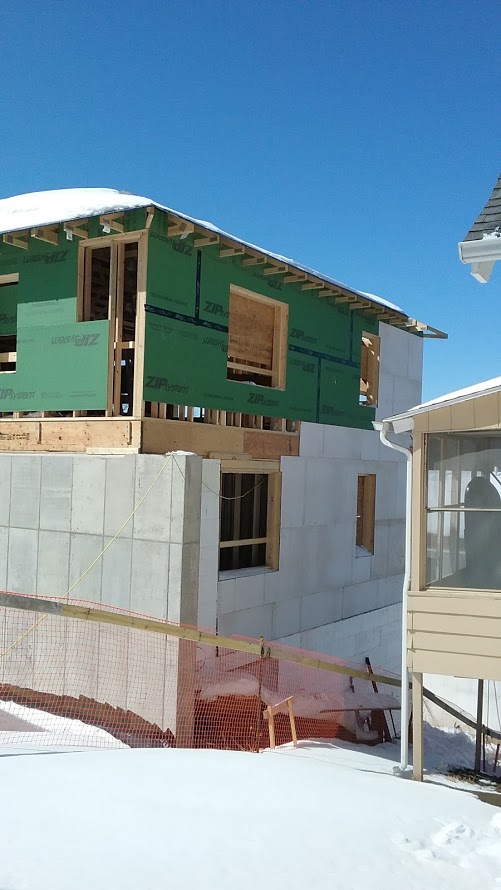
Note that the condos use double-stud walls, meaning their are two sets of wood stud walls used in the exterior frame, parallel to each other but spaced apart by about 5 inches. That space is then filled with R39 densely-packed cellulose insulation. The result has its pros and cons. The cons are that it’s more expensive to build, and it reduces the interior space a little bit. The pro is that it’s very energy efficient, which comes in handy for a project trying to achieve net-zero energy use. Along with the low energy consumption and green features, the project will be powered by a solar array owned by the developer out in Caroline.

Since these buildings will have a stucco finish, and stucco tends to absorb moisture but ZIP sheathing does not, most building codes require a water-resistant barrier between the ZIP sheathing and the exterior stucco. This allows the wall to repel and drain off moisture without risking the integrity of the facade. In the photos below, the WRB is the would be the thin white coating going over the sheathing.

Formal marketing for the 12 units is expected to launch in a couple of months. 10 2-bedrooms and 2 3-bedroom units will be available, with prices ranging from $265,000-$390,000.


Ithaka Terraces (215-221 West Spencer Street) Construction Update, 1/2017

14 01 2017

The first building of the Ithaka Terraces, Building “A”, is fully framed and in the process of being roofed. The project uses double stud exterior walls in tandem with Insulated Concrete Forms (ICFs), which is thermally insulated plastic filled with concrete. The zip sheathing goes on over the surface. The purpose of the thick, more premium approach is for more efficient insulation, since the condo units are designed to be net-zero compatible (the high energy efficiency reduces the need for off-site renewable energy sources, and net-zero becomes more feasible as a result).

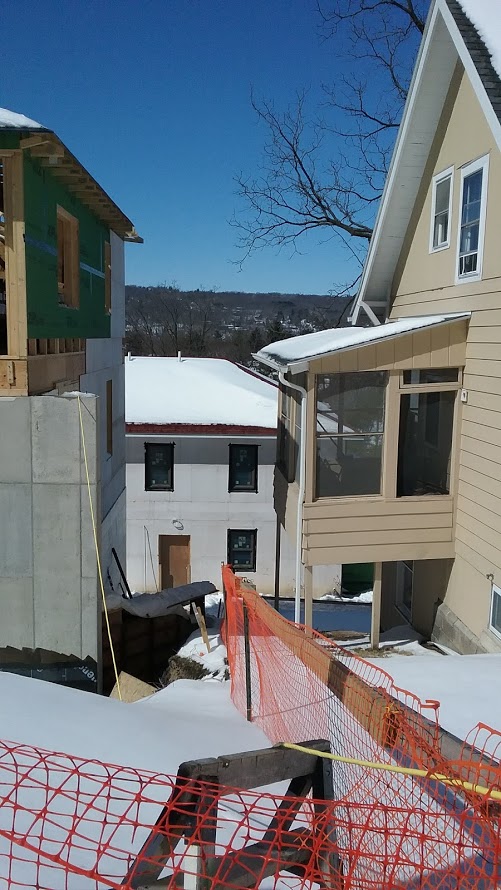
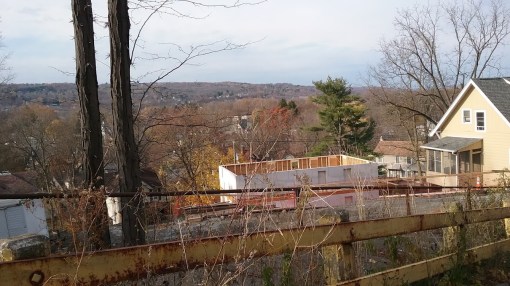
Further up the sloping site, smaller Building “B” has completed the ICF erection ground floor and is starting work on the upper floors. Note the reinforced concrete wall facing South Cayuga (east). That will eventually be back-filled and hidden from view. As seen in some of the early concept designs below, only the top floor of the three floors of Building “B” and “D” will have windows facing outward; the South Cayuga side of the property is where the parking lot will be laid.

The other large building in the four-building cluster, Building “C”, a mirrored floorplan of “A”, is just getting started; the site was being prepped and graded when these photos were taken last week. Building “D”, a mirrored floorplan of “B”, will start construction at a later date, as the other three get further along. In the last photo, one can see the winding temporary staircase workers use to get to the building themselves. AquaZephyr, an Ithaca firm specializing in eco-friendly construction, is the general contractor in charge of the buildout.

The 12-unit condo project will begin formal marketing later this Spring. There will be 10 two-bedroom units and 2 three-bedroom units, in the $265k-$390k range. A late 2017 opening is planned. Interested readers can submit queries here.

20170107_112320 20170107_112356 20170107_112359 20170107_112419 20170107_112433 20170107_112437 20170107_112656 20170107_112710 20170107_112727 20170107_112735

215-221_spencer_v1_2 215-221_spencer_v3_1

ith_terr_intro


312-314 Spencer Road Construction Update, 1/2017

10 01 2017

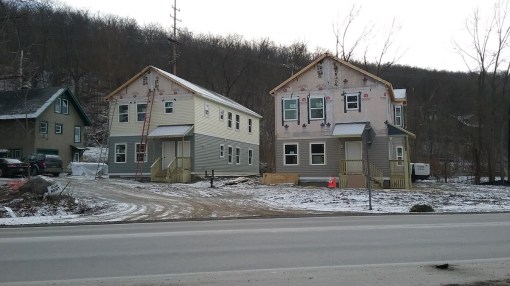
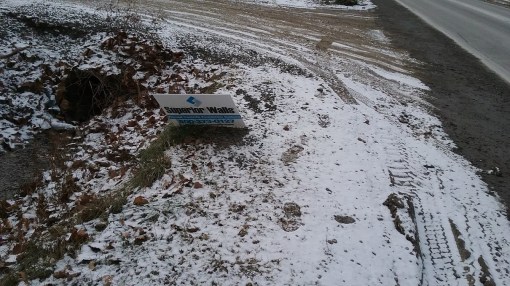
The new duplexes on Old Elmira Road seem to be moving right along. The east building has three shades of siding, one for each floor, and a third at gable-level. The exterior is accented by white trim boards. The variety in colors is an easy to way visual interest to an otherwise simple design. We’ll have to wait and see what colors they break out for the west building, which also benefits from a window bay projection facing towards the open space. It looks like plans to use shake siding on the bay projection have been dropped. Both building appear to be fully roofed and shingled. Signage at the edge of the road suggests precast concrete Superior Walls were used in the foundation work.

The 4 3-bedroom units are expected to hit the market in February. In the November update, I noted that Craigslist had these at $1700; the Modern Living Rentals website, which is the rental company for developer Charlie O’Connor, has them listed at $2100. Consider these a preview of the 4 two-family homes to be built at 607 South Aurora this spring and summer, which are also an O’Connor project.

20170107_113210 20170107_113347 20170107_113417 20170107_113438 20170107_113506 20170107_113530 20170107_113545 20170107_113554


News Tidbits 12/31/16: For Ithaca, This Wasn’t A Half-Bad Year

31 12 2016

902_dryden_final
1. Another fairly quiet week for that Christmas-New Year’s lull. There wasn’t anything too noteworthy in real estate transactions, but thanks to a construction loan filing, we have a figure for the construction cost of Modern Living Rentals’ 902 Dryden Road project – $1,192,550. The 8-unit, 26-bedroom townhouse project is being financed by Elmira’s Chemung Canal Trust Company, a regional bank which has been looking to expand its presence in the growing Ithaca market. Most mid-sized building loans like this are financed by Tompkins Trust, and this appears to be the largest project CCTC has financed locally; checking the records for the past 12 months, they’ve previously financed a few single-family homes and that’s it. A larger loan like this might be a sign that they’re building confidence in the project and the market.

815_s_aurora_night

2. Sticking with MLR, a glance at their webpage gives an interesting detail – the 87-unit, 87-bedroom 815 South Aurora project is now described as having 125 bedrooms. The multi-story apartment project sought and persuaded the city to reduce cellphone tower no-build radii last spring so that it could be built near the South Hill telecommunications mast, but because the city only reduced to 120% of height instead of tower height plus 10 feet (meaning 206 feet instead of 180 feet in this case), the project has to be tweaked. No revised designs have been released, but should something come along, you’ll see it here.

Side note, the website has an easter egg – clicking on MLR’s Commons placeholder gives you the 2015 downtown market summary from the DIA.

cornellspace-771x394

3. For those interested in learning more about Cornell’s north campus plans, video from one of their meetings can be found online here. The key takeaways – the first building, when it is built, has to be larger enough to function as swing space for Balch Hall, which appears to be first in line for renovations. Balch has 437 bedrooms, to give an idea of the potential capacity of the first new dorms. Dickson is larger (527 beds), but its renovation will be split up over two summers, allowing for partial occupancy while renovations are underway. Lot CC could potentially be replaced with 1,000 beds in multiple buildings, as well as a dining facility (a new dining facility is seen as less urgent and would be further down the line). Those new dorms would eventually be geared towards sophomores, multi-story but “contextual” in height. It sounds like the first concrete plans are expected to be ready by the end of the 2016-17 academic year.

4. The Common Council will be voting on some bond issues next week that will fund several municipal projects. $500k for street reconstruction, $367k for municipal building renovations, $653k for street lights, $600k for a replacement water tank on Coddington Road, $101k for bridge inspections, $181k for the Stewart Park pavilion, $51k for site improvements to the Hangar Theatre property, $134k for design and scoping costs for the Brindley Street bridge replacement, $340k for the Cascadilla Creekway project and a replacement ped bridge at Sears Street, water mains, traffic lights, traffic calming, new police cars, all totaling $6,464,450. A separate measure calls for an additional $950k in bonds to cover the costs of the Stewart Avenue bridge repainting and reconstruction.

Some of the money covers design studies for intersections – of particular note is a study considering a roundabout at the “five corners” intersection at Oak Ave/Dryden Rd/Maple Ave, which could be a welcome change from that awkward traffic light currently there.

The city issues bonds twice a year, in January and July, to cover its various construction projects. Some of it gets reimbursed with state and federal dollars.

city-center-v4-1

5. I cheaped out on my Voice summary of the top development stories of 2016 – there are only 5, but only because there was no way I had time to do ten this week. Here are five that missed the cut – the cancellation of State Street Triangle and the rise of its replacement, City Centre; the Tompkins County Housing Summit and the Danter Study, which are important but not really attention-grabbing; some progress in affordable housing, with Cayuga Meadows, 210 Hancock, Amici House and Poet’s Landing; the continued growth of Collegetown, with the opening of Dryden South, Dryden Eddy and Collegetown Crossing, and the entrance of the College Townhouses, 210 Linden and 126 College; and the growth of the local economy, which if the numbers hold up to revisions, 2015-2016 will have the second highest year-over-year gain in jobs since 2000 (#1 is 2011-2012).

When thinking about what’s in store next year, it’s a little sketchy because of impacts from the incoming Trump administration, and how that could impact the national economy – but if things stay consistent on a large-scale, than Ithaca can expect continued modest but steady growth, mostly in meds and eds, with a bit in tech and hospitality. We’ll probably see a couple new projects proposed in downtown and Collegetown, and maybe some smaller residential and commercial projects in other neighborhoods, like the Elmira Road strip and State Street Corridor. The town of Ithaca, it’ll depend on if they get their new zoning sorted out; if they do, there might be a burst of new proposals in some areas. The other towns, it’ll be hit or miss, maybe a larger proposal in Lansing or Dryden but otherwise scattered-site single-family, par for the course. Also, keep an eye out for more housing proposals from Cornell.

masonic_temple_1-771x595

6. It’s quiet week, so let’s finish this up with a little water cooler gossip. From the rumor mill, some of the potential tenants being discussed for the Masonic Temple include a microbrewer (good thing the city just updated their zoning to allow microbreweries), professional event space, and a church. That last one seems a little unusual, but to each their own. The renovation plans call for three rental spaces, one of which is geared towards restaurant tenants.


312-314 Spencer Road Construction Update, 11/2016

28 11 2016

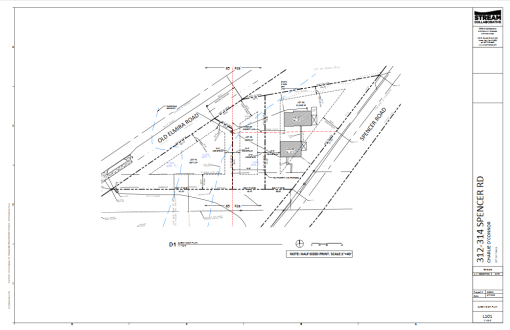
I’ll start off by saying I struggle with how to title this project. It has no official name, and the street address for the two new two-family homes has yet to be determined – presumably, they would be assigned addresses for the 200 block of Old Elmira Road. The developer, Charlie O’Connor of Modern Living Rentals, uses the address of the properties from which there were subdivided from – 312 and 314 Spencer Road, the two houses in the rear of the first photo.

Originally, 312 and 314 had three lots with some pretty unusual lot lines, but with .607 acres, there was a lot of unused backyard space, especially for city parcels. Seeing an opportunity, O’Connor negotiated a purchase agreement with property owner Giuliano Lucatelli, who ran a restaurant in the building adjacent to the houses (and perhaps a couple of readers remember Lucatelli’s Ristorante). With the benediction of the city, the project team consolidated the three parcels together, and then subdivided the newly-created parcel to create two buildable lots facing Old Elmira Road, and a third lot containing the two existing houses. The plans were approved back in June, and O’Connor officially purchased the houses and land for $193,000 in mid-July. On November 1st, the project received a $500,000 construction loan from local businessman Bryan Warren of Warren Real Estate. That would seem to cover most of the hard costs; the site plan review application estimated the construction cost at $513,000.

Plans call for two two-story houses with footprints of 23.5 feet by 48 feet (1,128 SF). Each floor will contain a three-bedroom, two-bath unit. The houses, designed by prolific local architect Noah Demarest of STREAM Collaborative, have been fashioned to blend into the early 20th century homes that comprise most of Ithaca’s South Side neighborhood – gable roofs, window bay projections, shake and lap siding, and modest porches. An earlier design shown on Modern Living Rentals’ website shows a larger and more contemporary window design on the buildings’ front faces, but it looks like that was scaled back to two more-traditional looking windows as the project went through planning board review.

To accommodate the new homes, some trees were removed, but as a mitigation measure, new trees will be planted closer to the street. The western tip of the properties intrudes into the 100-year flood zone, but that part should remain undisturbed. Each three-bedroom unit will have one parking space, in line with the city’s R-2a zoning (one space per three bedrooms).

An ad on Craigslist suggests the 3-bedroom units will be run for $1700 total, a premium price point as new units often are, but well below the prices that one would see in Downtown or Collegetown. Advertised features include stainless steel appliances, granite counter tops, in-unit washer/dryer, ample closet space and custom-tiled bathrooms. Parking will be in off-street gravel lots.

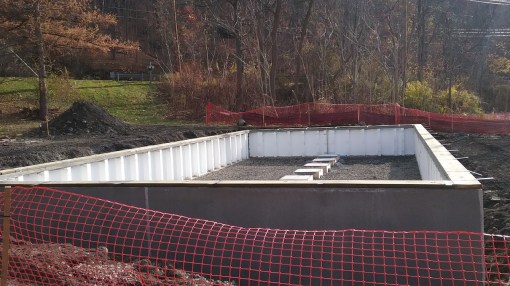
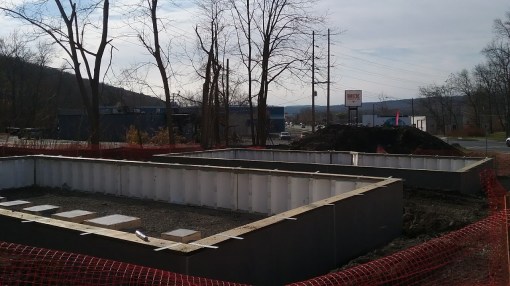
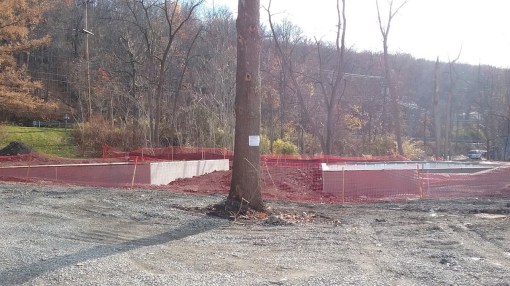
If the photos below are any indication, those tiled bathrooms and granite counter tops are still a ways off. The foundations have been excavated, formed and poured, but the framing has yet to begin. Subterranean utilities have been laid and prepped. Note that the foundation of the western house includes a bump-out for a window bay projection, but the eastern house does not.

20161119_125716 20161119_125729 20161119_125744 20161119_125800 20161119_125813 20161119_125831

312_spencer 312_spencer_2 312_spencer_3


Ithaka Terraces (215-221 West Spencer Street) Construction Update, 11/2016

26 11 2016

Ed Cope’s Ithaka Terraces have made modest but noticeable progress in the past couple of months. Building A is up to the third floor, while Building C is undergoing foundation work. The other two buildings, B and D, will come along in later stages.

Since the 12-unit South Hill condo project is going for net-zero capability, its construction is a little different from the norm. Quoting the sales website:

“The building features nominal 12 inch thick double stud exterior walls with a total of R39 continuous dense packed cellulous insulation and 18 inches of R63 loose fill cellulous insulation in the attic. The walls and attic are completely air sealed with Zip sheathing with all seams taped to prevent vapor migration through the walls and ceiling.”

The exterior walls are a combination of thick wood stud walls, thermal plastic filled with concrete and Huber Zip sheathing. In between the cavities of the stud walls, local contractor AquaZephyr will be blowing in dense cellulose insulation (pictures of that process here). This will allow the condos to achieve a very high degree of energy efficiency, and assist in making the project net-zero capable.

More info on the project can be found here.

20161119_125056 20161119_125109 20161119_125122 20161119_125128 20161119_125148 20161119_125208 20161119_125219 20161119_125229 20161119_132737

215-221_spencer_v3_1


News Tidbits 11/19/16: Winter Is Coming

19 11 2016

executive-education-center-and-hotel-777x622

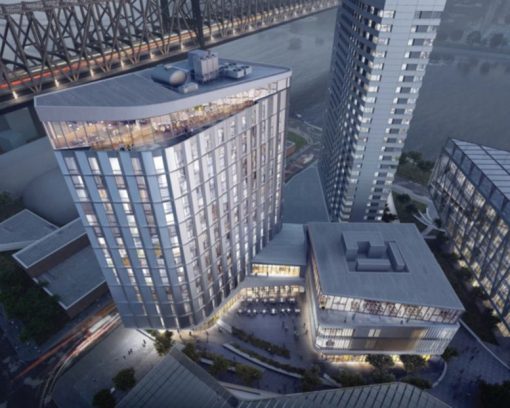
1. We’ll start off in the Big Apple this week. Cornell and its development team have released plans for the fourth and last building in the first phase of the Cornell Tech buildout. The Verizon Executive Education Center and Hotel consist of two buildings connected by a shared hall, and will include four 50-75 seat classrooms, small breakout rooms, and a 195-key hotel for visitors to the school. The plans also call for a restaurant, rooftop lounge and cafe – none of which sound very academic, but the building is meant to be an event center and gateway to the nascent school.

The exterior will be encased in aluminum and wood planks. There will be no parking, but there will be pedestrian courtyards, bike lanes and green space. The facilities are part of the campus’s first phase, which also includes a 26-story student and staff residential building; the Bridge, an incubator for researchers and small businesses; and the Bloomberg Center academic building. Those buildings will open in summer 2017, while the Verizon Center will probably be a 2018 opening, assuming the final designs are approved by the city of New York.

hopshire_1

2. Now to turn to something much closer to Ithaca. Dryden’s Hopshire Brewery is in the midst of a two-phase expansion, reports the Times. The first phase, shown above, consists of a 1,200 SF addition to the west side of the structure, and the new addition is already framed and closed up, with the expectation of being completed by the start of 2017. The space will be used to host events for as many as 100 attendees. the second phase, a 1,300 SF addition to the brewery and storage area, will start next year. The work is partially funded with an Empire State Development grant.

Speaking of drinks, the Watershed, a new bar and coffee lounge, will open by Thanksgiving. It replaces Rumble Seat Music at the former telephone exchange building at 121 West State Street in Downtown Ithaca. The Watershed owners expect to create eight living-wage jobs.

3. From county records, we can see just how much the Rodeway Inn renovation is going to cost local businessman Pratik Ahir – $2,095,000, but the hard costs are only $926,000. The difference is due to the existing mortgage on the property. The lender is Generations Bank, a small bank based out of the Seneca Falls. Anecdotally, we seem to be seeing an uptick in small upstate lenders looking to stake claims on the growing Ithaca market, which could be a real asset for the region – with a limited number of local lenders, financing is often a big hurdle with Ithaca-area projects.

maplewood-v7_8-planning-board maplewood-v7_6

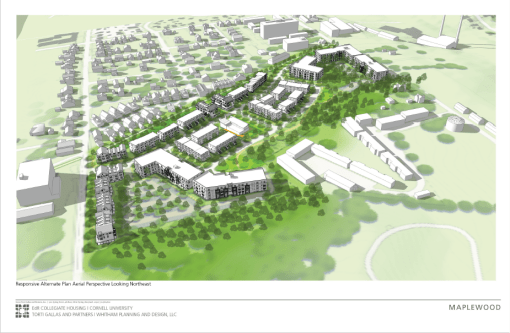
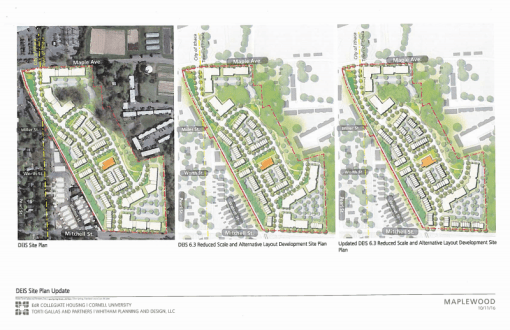
4. As noted earlier this week in the Voice, lots of new Maplewood renders to take a gander at. Going through all the emails from the public comment period, I’d say that overall most are positive and positive-constructive – there are a few sour grapes, but they’re in the minority. For this area, that’s actually a pretty big accomplishment, and it means Cornell and EdR have successfully addressed most of the concerns raised by neighbors and community members. The big changes in respone to public comment have been a a commitment to 50% off-site solar energy, $20,000 to the town for traffic calming measures on Mitchell Street (raised crosswalks, speed bumps), and the two townhouse strings facing Walnut Street and the Belle Sherman Cottages have been redesigned to look more traditional and fit in better with their non-student neighbors. We’re probably very close to the final design at this point, if not already there.

Once preliminary approval has been granted, demolition will start on the south side of the Maplewood property and make its way northward in four phases. The first townhouse strings and apartment buildings will begin construction on the south side of the property in the March-April timeframe, depending on overall progress and external factors. The first completed buildings will be ready by October/November 2017, but it looks like occupancy will happen all at once in August 2018.

wegmans_pad_parcel-1116

5. The City Planning Board Agenda is pretty busy next week – Todd Fox will be presenting two new mid-sized Collegetown projects, Wegman’s is seeking a renewal on the approvals for their pad parcel building, and several other projects had major or minor redesigns. Here’s the rundown on the Voice, and the schedule here:

AGENDA ITEM                 APPROX. START-TIME

1. Agenda Review              6:00

2. Privilege of the Floor   6:01

3. Site Plan Review
A. Project:  Maplewood Redevelopment Project                               6:10
Location: Veteran’s Ave. (between Maple Ave. & Mitchell St.)
Applicant: Scott Whitham, Whitham Planning & Design, LLC, for Cornell University
Actions: Update & Schedule
B. Project:  City Centre — Mixed Use Project (Housing & Retail)     6:25
Location: 301 E. State/M.L.K., Jr. St.
Applicant: Jeff Smetana for Newman Development Group, LLC
Actions: PUBLIC HEARING    Review of Full Environmental Assessment Form (FEAF), Part 3

C. Project:  Amici House & Childcare Center                                6:50
Location: 661-701 Spencer Rd.
Applicant: Tom Schickel for Tompkins Community Action (“TCAction”)
Actions: Declaration of Lead Agency, PUBLIC HEARING, Determination of Environmental Significance, Recommendation to BZA

D. Project:  Four Duplexes                                                         7:20
Location: 607 S. Aurora St.
Applicant: Charles O’Connor
Actions: Determination of Environmental Significance, Consideration of Preliminary Approval
E. Project:  College Townhouse Project                                      7:45
Location: 119, 121, & 125 College Ave.
Applicant: Kathryn Wolf, Trowbridge Wolf Michaels Landscape Architects, LLP
Actions: Declaration of Lead Agency, Review of Full Environmental Assessment Form (FEAF), Part 2
F. 126 College Ave. — Sketch Plan            8:00
G. 210 Linden Ave. — Sketch Plan              8:20
H. Wegmans Retail Building – Extension of Site Plan Approval     8:40
4. Zoning Appeals                                                                     8:50
• 3049, Special Permit, 908 N. Cayuga St.
• 3050, Area Variance, 528 W. Green St.
• 3051, Area Variance, 661-665 Spencer Rd.
• 3052, Area Variance & Special Permit, 701 Spencer Rd.
• 3054, Sign Permit, 222 Elmira Rd.
5. Old/New Business                                                                 9:00
A.  Special Planning Board Meeting: 11/29/16
B.  Update — City/Town Joint Planning Board Meeting
C.  Update — Joint Planning Board/ILPC Meeting (DeWitt House)
D.  Changes/Corrections to Collegetown Area Form Districts (CAFD)
E.  Building Materials — Discussion on Potential Restriction on Vinyl Siding
6. Reports                                                                                 9:20
A.  Planning Board Chair (verbal)
B.  Director of Planning & Development (verbal)
C.  Board of Public Works Liaison (verbal)

7. Approval of Minutes: May 24, 2016, June 28, 2016, July 26, 2016, and/or October 25, 2016 (time permitting)      9:30

8. Adjournment      9:31


News Tidbits 11/12/16: Oof.

12 11 2016

lansingapts600

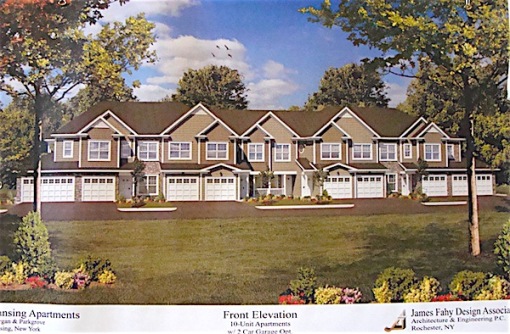
1. Starting off this week in Lansing, the village has okayed a zoning change that would allow the planning board to move forward with consideration of a 140-unit upscale apartment project on Bomax Drive. Neighbors came out to oppose the zoning change for the 19.5 acre parcel from office park business/tech to high-density residential, saying it would create additional traffic and hurt property values. The village board, however, responded in dissent, noting a lack of housing, a fit with the 2015 village comprehensive plan, and that this was about the zoning and not the project, which the planning board will critique as a separate action. The zoning change was approved unanimously. Park Grove Realty is now free to submit plans to the village, and planning board review will go from there. Expect it to take at least a few months.

therm_1

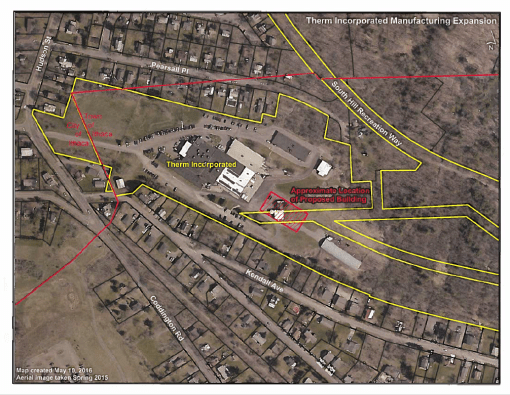
2. A couple quick notes from the town of Ithaca – Therm Inc. has commenced construction on their 20,000 SF addition at their South Hill plant. It’s a few months later than originally anticipated, but underway nevertheless. The $2.5 million project is expected to create 10 manufacturing jobs, according to the county IDA.

Also underway at this point is the renovation and expansion of the Rodeway Inn on Elmira Road. The plans call for expanding the existing 25 motel units, adding 2 new units on the ends of the main structure, and renovating a house on the property for a 1,146 SF community room to serve guests. Landscaping and lighting would also be updated. The town pegs the construction cost at about $679,000.

341_coddington_1

3. Here’s some good news – it looks like someone has taken up the Iacovellis on their offer of a free historic house at 341 Coddington Road, providing that the taker moves it. It appears NYSEG was creating some hangups since the power lines have to be moved out of the way (NYSEG is infamously difficult to work with), but with any luck, the house itself will be saved. My colleague Mike Smith is doing the legwork on a story, so hopefully more details on the “buyer” will come forth shortly.

4. Back in July, several West End properties owned by an out-of-area LLC hit the market. Now, at least one of them has sold. The duplex at 622 West Buffalo (blue in the map above) was sold for $90,000 to a gentleman from suburban Syracuse. Immediately after, paperwork was filed with the county for a $179,145 building loan courtesy of Seneca Federal Savings and Loan, a small regional bank out of Syracuse. The paperwork does not indicate if it will be renovations/additions to the existing building, or a new structure (sometimes the sale price is a part of the building loan, but in this case the buyer paid separately, with $171,187 set aside for hard costs).

20161007_163922

5. Sticking with county filings, the construction loan for the third phase of the Village Solars was filed with Tompkins County this week. $6 million is being lent by Tompkins Trust to fund construction of 42 units, 21 in each building. Initially they were slated to have 18 units each, but because the three-bedroom properties don’t have quite the same appeal as smaller one-bedroom and two-bedroom units, Lifestyle Properties (the Lucente family) has broken up the units without significantly changing the exterior appearance and layout. Actual Contractors LLC, another Lucente company, is the general contractor, with Albanese Plumbing, T. U. Electric, and Bomak Contractors (excavation/foundation) rounding out the construction team.

119_125_college_1

6. This is one of those unusual months were the city projects memo and the project review meeting agenda go out in the same week. Apart from the Collegetown Townhouse project, there are no new projects being presented, but there is new information and new renders.

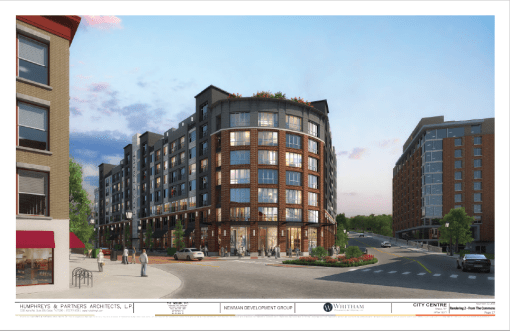
In the projects memo, Novarr’s project is the new shiny, while Amici House, the8-unit project at 607 South Aurora and City Centre are being carried over as old business. Regarding City Centre, it doesn’t look like any particular points of contention have been raised by city planning, the framework for mitigating Historic Ithaca’s design complaint is already included, and most of the other requests are for more information/paperwork. From the Design meeting, it looks like the debate on the townhouses project is minor, mostly with where to locate the trees out front, and window details. They will not be putting windows into the north face because it’s on the lot line, but they will vary the materials for visual interest. The Design Committee requested that City Centre insert more windows in some areas, and less signage, as well as consideration of decorative elements to highlight the curved facade facing Aurora and East State Streets.

The project review committee meeting has all of the above, plus updated submissions from the Maplewood project team. Although no substantial development will occur in the city, the Maplewood project crosses municipal boundaries and the city has deferred to the town for lead agency. The meeting will also have a few zoning variances to comment on. The only notable zoning variance is for local realtor Carol Bushberg, who wants to do a one-story 812 SF rear addition at her office at 528 West Green Street, which is in a WEDZ zone and requires two floors.

maplewood_v7_4

maplewood_v7_5

Looking at the Maplewood submission, the new dormer/gable style will be for the building strings that front Mitchell Street, and the two strings most visible from Walnut Street. More modern designs will be used for the remaining structures. Looking closely, the designs do vary from string to string, which will give the site some character and additional visual interest. The project timeline is pretty tight with submissions, meetings and approvals, aiming for preliminary approval from the town on December 20th, demolition to start immediately thereafter, and final site plan approval by January 3rd.

For links, here’s the Collegetown Townhouse updated submission, engineering narrative, site plan render, and cross section render. Here are the updated materials for 607 South Aurora (no significant changes, just a summary of submission materials),  here’s a new site survey for Amici House, and the project update for Maplewood.

7. Meanwhile, there’s nothing too exciting on any of the town boards next week. Lansing town will consider additions to a self-storage facility, a one-lot subdivision and a climbing wall facility next to The Rink. Ithaca town will be conducting their own analysis of Maplewood, and a one-lot subdivision.

Now, after this week’s election news, one might wonder if this has any impacts on local housing/development. Arguably, there are a few. Expect federal funds for affordable funding to be cut drastically, and grants for mass transit projects to also take a major hit. While those are major losses, the state has far greater control, so there will still be some funding available, but definitely not as much as would have been expected under a Democratic administration. Most land use and building issues are decided at the local level, so don’t expect significant impacts there.

More of a question would be infrastructure investments. The president elect wants to launch a massive rebuilding program, but the Republican Senate majority leader has already said that’s not something they’re interested in, so we’ll just have to see if he can force it through or not. If there’s any silver lining to all this, it might come in some form of deregulation, but while he might be a fan of urban environments, most of his cabinet will likely not. We also have to keep in mind the disdain for elite colleges like Cornell, so research funding, and the economy built off it, is probably going to take a hit. For the Ithaca area, the change in administrations is likely a net negative.


News Tidbits 10/15/16: Stoops and Stumbles, Growth and Gables

15 10 2016

maguirebirdseye-620x420

1. The Maguire proposal for Carpenter Business Park will be heading to the Common Council next month, but the prognosis isn’t good. The city council’s Planning Committee voted 4-0 to say that the proposal didn’t fit with the city’s Comprehensive Plan for the near-Waterfront property – the plan calls for walkable, urban mixed-uses, preferably with residential components. The discussion wasn’t unanimous in its logic – 2nd Ward Councilmen Nguyen and Murtagh were stronger adherents to the plan, while the 1st Ward’s Cynthia Brock doesn’t think housing is appropriate – but they all disagreed with the multi-brand car dealership plan as-is. Maguire has asked for a delay in vote so that the plan could be tweaked, but the Committee voted to move forward.

Because of the 18-month TMPUD in place, the Common Council has to vote to approve all projects in the waterfront area, so the resolution to decline further review of the project will be voted on at the next non-budget Council meeting. It will not be unanimous – the 3rd Ward’s Donna Fleming wrote a letter of support for the project, and the 1st Ward’s George McGonigal voiced support for the concept though not this particular plan. But the chances of approval are pretty slim at this point.

119_125_college_avenue_2

2. Judging from the site photos John Novarr’s project team sent along, it looks like environmental remediation has already commenced at the site of his faculty townhouse project at 119-125 College Avenue in Collegetown. 121 College, in particular, is already in the early stages of remediation. It’s a pretty extensive photo documentation, one that might have to do with historic preservation aspects, like determining what can be salvaged and reused. It’s pretty clear that the properties, which were recently acquired from an Endicott-based landlord who held the properties for decades, are in rough shape. Novarr seems to have a preference for prepping sites before plans are approved (ex. 209-215 Dryden), so it’s uncertain how much time these three boarding houses have left.

202_hancock_1

3. Courtesy of the Ithaca Urban Renewal Agency’s Neighborhood Investment Committee, we get to see a pretty thorough breakdown of the expenses and revenues of an owner-occupied affordable housing project.

The details come as part of INHS’s application for $314,125 in Federal HUD HOME funds, to be used for the 7 for-sale townhouse units included with the 210 Hancock project, collectively called 202 Hancock. The funds would be used to cover soft costs, like project management, engineering and architecture fees, legal fees, and site inspections.

inhs_202_financials

The 202 Hancock project construction cost is estimated at $1,754,860, about $344,000 per unit, or about $198/SF. That’s expensive, but not unusual – 203 Third Street was about $190/SF. The cost is high due to rapidly rising construction costs, and due to federal guidelines and lender specifications, INHS is required to hire contractors with extensive insurance. Add in soft costs and it jumps to $2,408.371.

Now let’s consider the sales. The five two-bedroom units are expected to sell for $130,052 to a household making no more than $38,046. The two three-bedrooms will sell for $164,979, to households making $42,428/year or less. Those incomes don’t meet the rule-of-thumb of 3.4x annual income, but HOME funds cover part of the cost ($24,000 for the 2-bedrooms, $36,000 for the three-bedrooms). INHS gets $960,218 in the project sales – and that’s the same amount Tompkins Trust Company is willing to cover with a construction loan. So the initial gap is $1,448,155. Now we’re starting to see why new housing can be so expensive.

INHS gets $7,000 in revenue from Energy Star rebates on appliances, and has up to $351,153 equity they can put towards the project, most of that being the value the of 202 Hancock’s land. The IURA would issue a low-interest bond for $215,875 to be paid back by INHS, and the non-profit has secured $280,000 in grants directly from the state (NYS AHC), and $280,000 in NYS CDBG funds awarded by local governments (this tactic is known as “subsidy layering“). This complicated puzzle of funding sources is why so many developers are not interested in doing affordable housing.

Side note, one of the pre-development costs is market analysis. Might seem silly, but grant reviewers want proof the housing crisis isn’t just bluster, and that these units won’t sit empty. An analysis by Randall/West determined that at a sale price of $136,000 for a 2-bedroom, and $162,000 for a 3-bedroom, qualified buyers would be found and under contract within 4.6 months. The units should be available for occupancy by June 2017.

202_hancock_2

Secondly, thanks to a legal settlement between the state and Morgan Stanley, a $4 million affordable housing grant is available for renovations of existing INHS scattered site rentals (98 units in 44 buildings across the city). Most of these units are rented to individuals making 60% or less of the area’s median income (about or less than $32k/yr). The funds would go towards major, long-term renovations, such as new roofs, windows, siding, and energy efficiency improvements. INHS could also use the funds, disbursed via the city, to refinance its portfolio, acquiring some of the properties and paying off $1.8 million in loans on already-purchased properties.

Here’s the short of it – the goal is to buy/pay off the scattered rental sites they manage, renovate and make them energy efficient and comfortable, lock them into the Community Housing Trust so that they become permanently affordable, transfer the land to a wholly-owned Housing Development Fund Corporation, and then sell some of the buildings to an LLC while INHS continues as property manager. The funds from sales would finance new affordable housing. This is all set up as it is to take advantage of legal and tax benefits of different corporate tax structures, while minimizing the drawbacks. Potentially, the Morgan Stanley settlement money could be used to leverage an additional $15 million in tax credits and affordable housing grants from the state.

Correction, per INHS’s Scott Reynolds in the comments section: rentals aren’t in the Community Housing Trust, but affordability would be required for 50 years.

Rochester-based SWBR would be in charge of renovation design plans, and 2+4 Construction will be general contractor. Tenants may need to be relocated as renovations occur, which will be coordinated by INHS staff. The goal is to have the settlement money accepted by the city by the end of the year, financing by April 2017, and renovations completed by the end of 2018.

cwd_bldg24_1

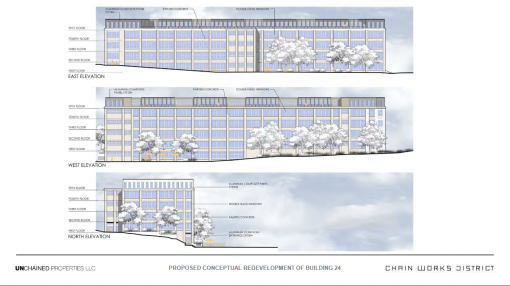
4. It’s another one of those special meetings – the city Planning Board will be sitting down next Tuesday to go over comments and sort another batch of public comments regarding the Chain Works DEIS, this time on public health. Once you get past the few pages of “this will never work and don’t bother trying”, there’s actually some interesting back and forth about remediation and what that entails. Also on the agenda are revisions to the Holiday Inn Express down in Southwest Ithaca – namely, they’re trying to avoid building the stairs to Spencer Road, as well as some other landscaping issues. At the second meeting later this month, the board is expected to Declare Lead Agency, open public hearings and review parts of the FEAF for TCAction’s Amici House, 8-unit 607 South Aurora, and the 8-story City Centre project on the Trebloc site downtown.
maplewood_v7_1

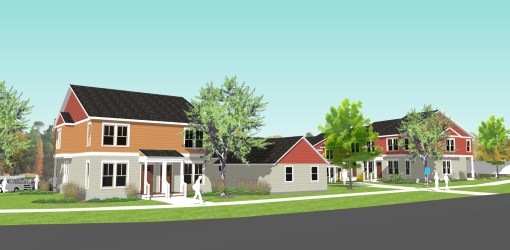
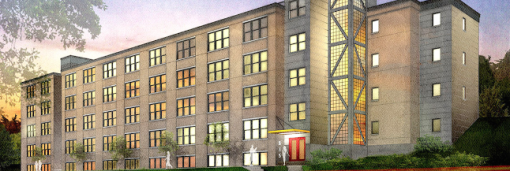
5. The plans for Maplewood have been modified yet again, in a change that the project team hopes will please neighbors and the town of Ithaca planning board. In revised plans submitted this past Wednesday, the 4-story apartment building planned for Mitchell Road has been replaced with a few sets of 2.5 and 3.5-story townhouses and stacked flats, and Building B to its north was extended slightly to compensate for the loss of bedrooms. Even so, the accompanying letter from Scott Whitham states that the unit and bed count have decreased slightly, from 473 units and 887 beds, to 442 units and 872 beds.
maplewood_v7_2 maplewood_v7_3

Also modified was their appearance – stoops, porches, dormers and gable roofs were added to give them a more harmonious appearance with the rest of the neighborhood. It’s not clear if the rest of the units were aesthetically modified as well.