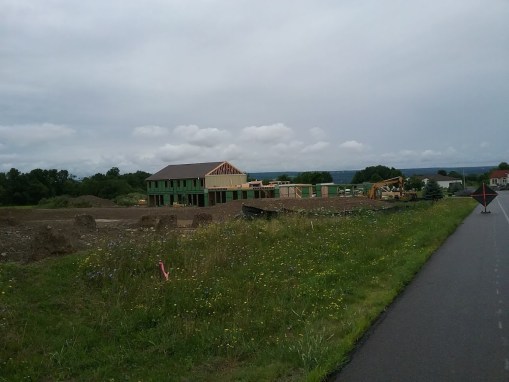
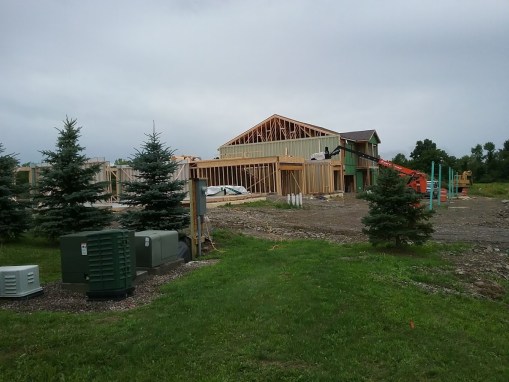
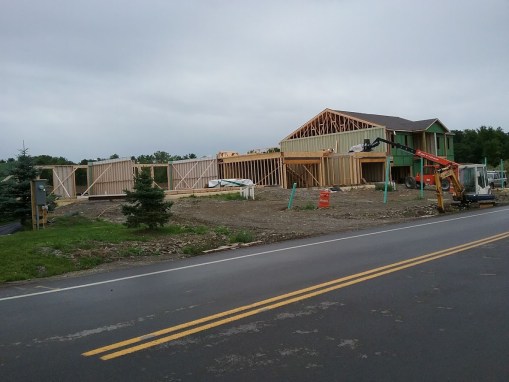
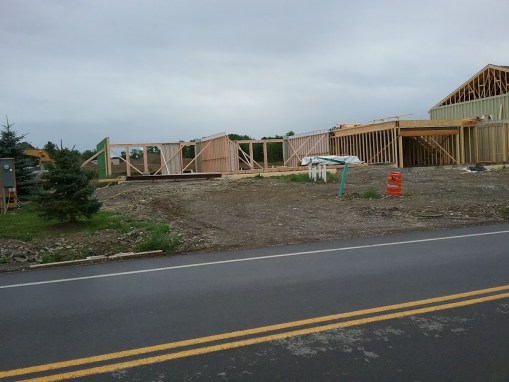
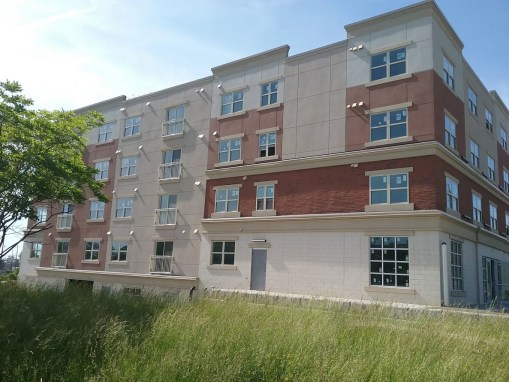
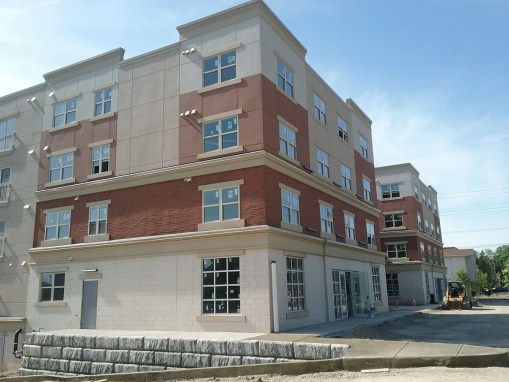
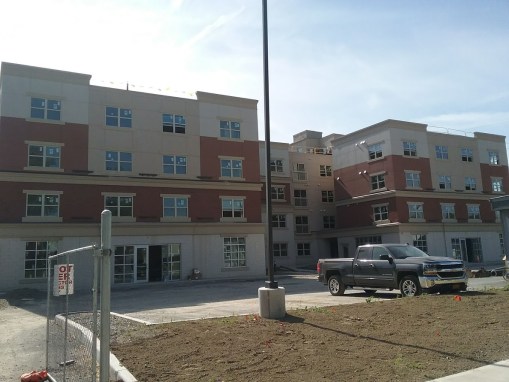
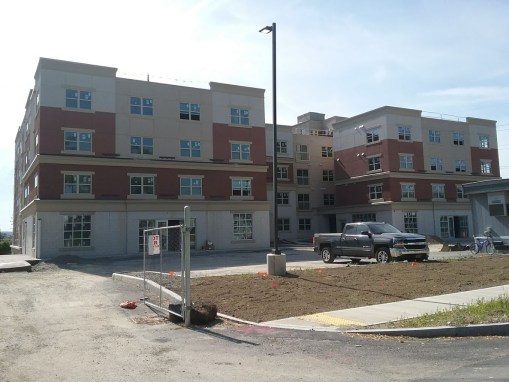
East Pointe Apartments Construction Update, 8/2018

6 08 2018

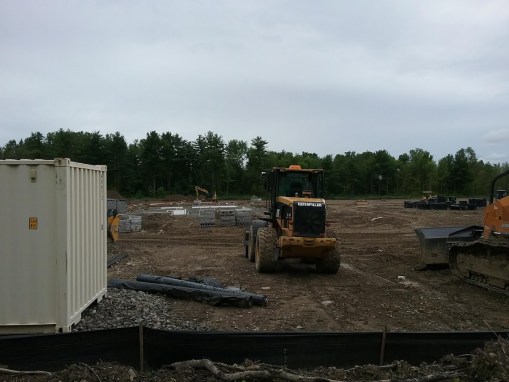
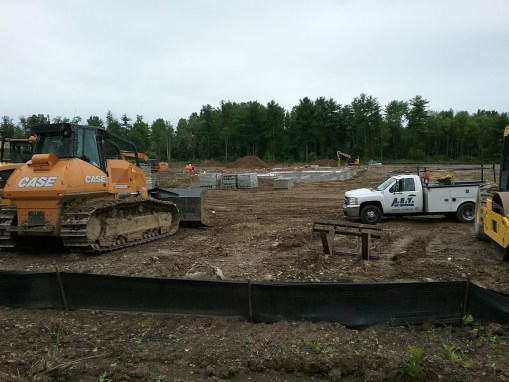
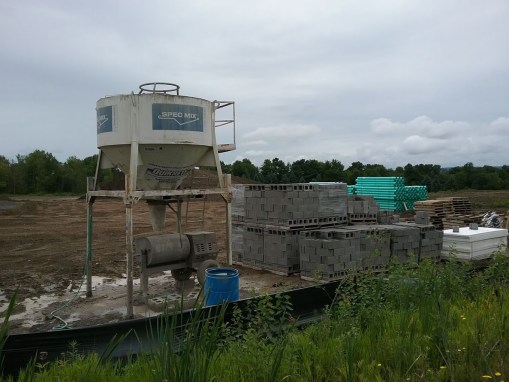
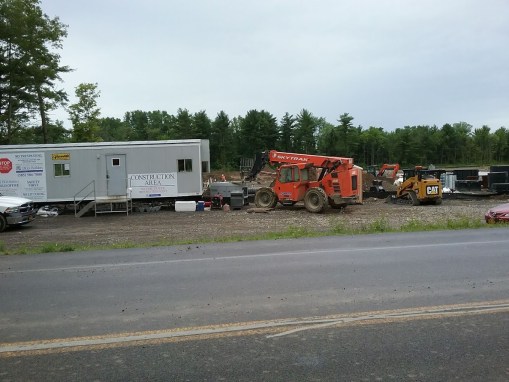
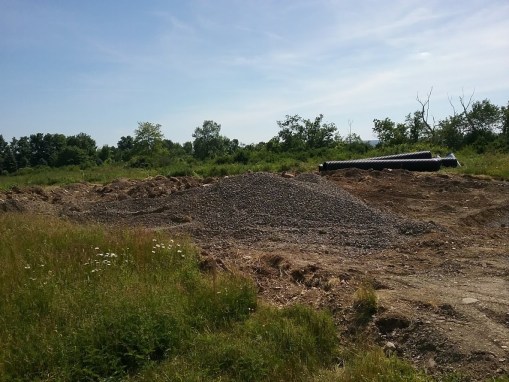
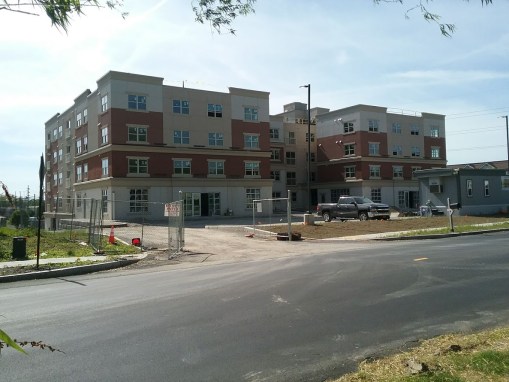
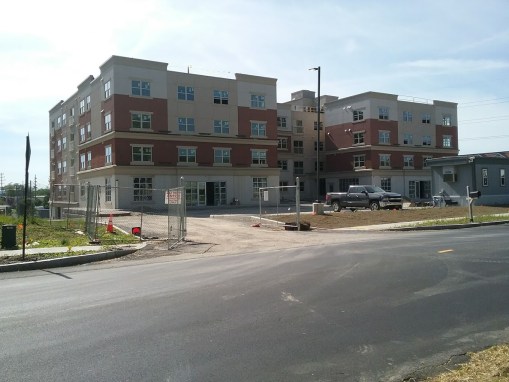
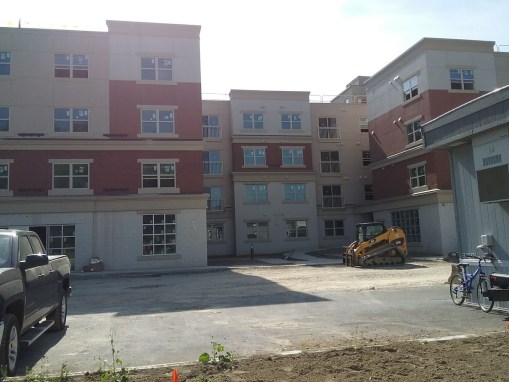
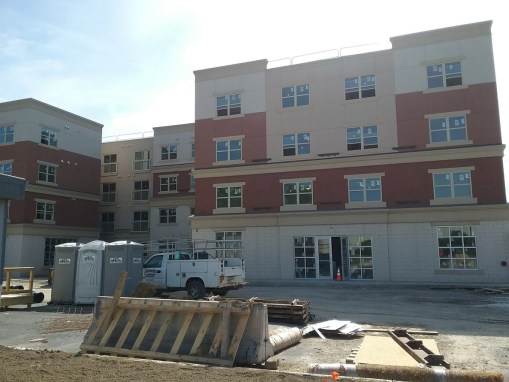
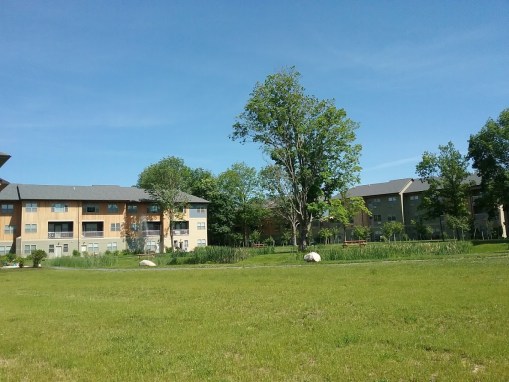
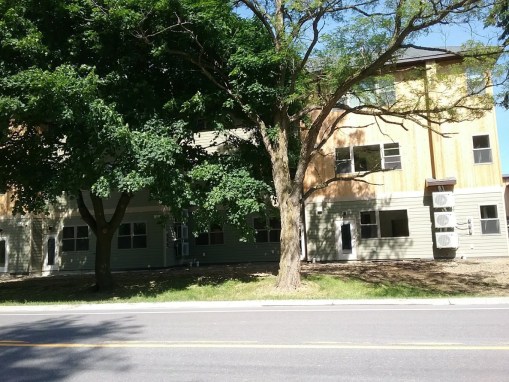
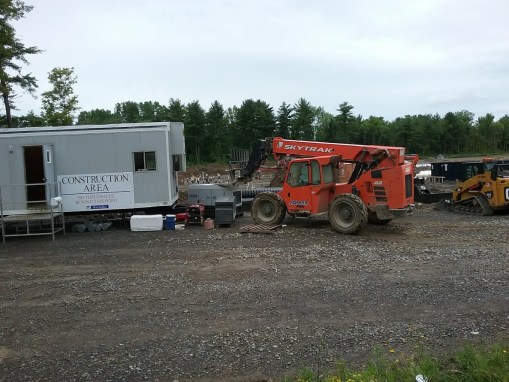
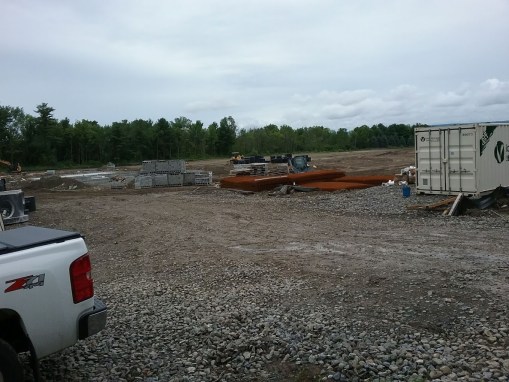
No one can say DGA Builders is wasting time. A visit on Friday showed three sets of CMU foundation walls have been assembled and mortared, each for a ten-unit townhouse string. A few crewmen kept an eye on a material placement truck, also known as a stone slinger, as it launched rocks into the footprint encased by the foundation walls. This may be a crushed stone base (hardfill) for a concrete slab pour, given the stacks of rebar with surface rust sitting nearby. A shallow foundation would work fine here because two-story buildings aren’t especially heavy as structures go, and it would be less expensive and time consuming than a deep foundation. Elsewhere around the site one sees PVC sanitation pipes (sea green), water pipes (blue), and pieces for utility junctions.

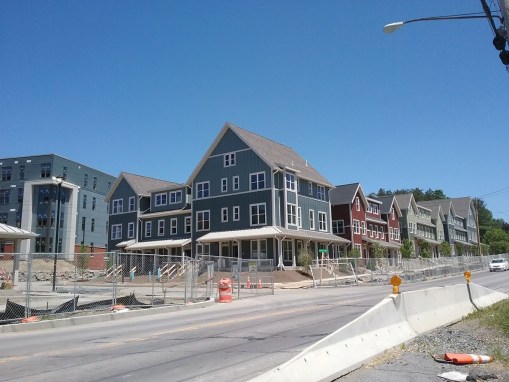
Meanwhile just a stone’s sling away on Nor Way, Forest City realty continues work on the six-unit string (hexplex?) of townhouses. Two are fully framed and roofed, two have had their first floor framed though not fully sheathed, and the other two are only partially framed on the first floor. As with all the townhouse strings, these will incorporated some unique design features while keeping the general unit layout the same. I know they’re not happy about the East Pointe townhomes, but it could be a good synergy – the price points ($1,400-$2,000/month fr East Pointe, $350k for the Heights of Lansing townhouses) are such that renters who may wish to stay in that neighborhood may look at the Heights townhomes as an option.

A website is now up and running for East Pointe. It’s mostly stock images and bland corporate-speak, but they do have floor plans and some new renders. Here’s the advertising pitch:

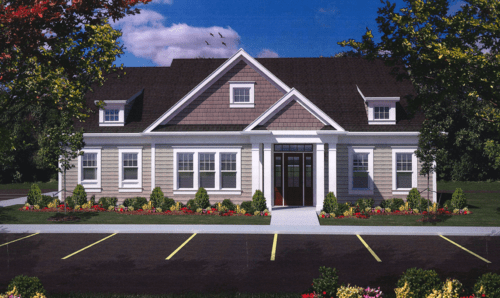
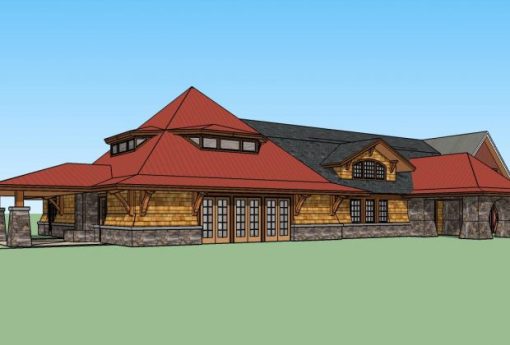
“This apartment community is located on 20 acres in Lansing, NY, which is part of the Ithaca, NY, market. This is new construction of 140 state-of-the-art apartments. There will be 36 one-bedroom units, 90 two-bedroom units, and 14 three-bedroom units. The project will include fourteen apartment buildings with 10 units in each building that will be walk-up garden style with private entrances and a community building. All units will have high end finishes and amenities, including stainless finish appliances, microwave, dishwasher, washer and dryer, ice maker, granite counter tops, wood cabinets, vinyl plank flooring and wall-to-wall carpeting, tile showers, high end plumbing fixtures and lighting fixtures. All apartments will include a patio or deck. The community building will include the leasing and maintenance office, Great Room and warming kitchen for gatherings, and a fitness center. The project also includes an outdoor pool with changing rooms and shower.”

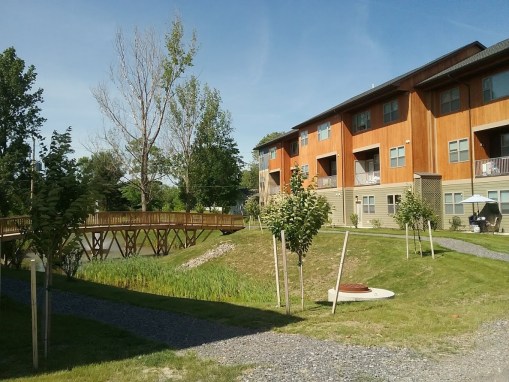
I have no idea what a warming kitchen is, but my very Sicilian mother is pretty good at turning kitchens into warming spaces around the holidays. A photo of the community center is included below.

UPDATE: I’m just going to add this here since the timing was ever so slightly off- on Monday the 6th, the construction loan was filed with the county. M&T Bank is lending Park Grove (represented by an LLC) $22.6 million for construction of the East Pointe project.


News Tidbits 7/21/18

21 07 2018

1.. I rarely check in on Groton, but here’s an interesting little rehabilitation. Back in August 2017, I noted that a historic village church at 113 Church Street was for sale. The buyers last February were David and Delsy DeMatteo, who own and rent out a number of Groton-area properties. The DeMatteos appear to have submitted and received approval for a plan to renovate the structure into a 12-unit apartment building, replacing the religious-turned-commercial space with ten apartment units (two units already exist). From the look of it, the ten new units would consist of eight one-bedroom and two two-bedroom units. The plan was approved in late fall when the DeMatteo likely had a purchase option on the property, and the sale closed on February 8th. Always nice to see new life breathed into a place that played a role in the lives of many.
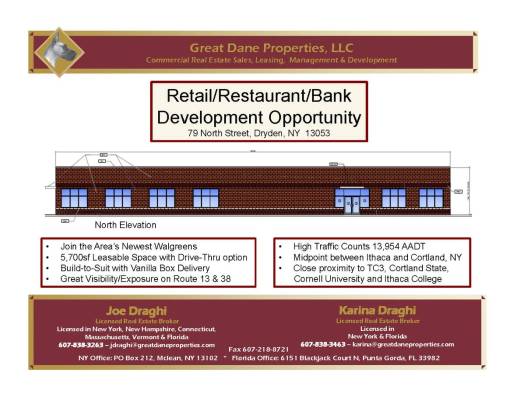
2. Over in Dryden village, the second phase of the new Rite Aid-turned-Walgreens development site is being marketed. Great Dane Properties is touting 5,700 SF of space for lease, with a drive-thru option should one desire it. The spec site plan can be seen here – the render above is likely the north elevation. Early conversations stated a 3,800 SF restaurant space (typical for a fast food /chain coffee shop), 1,900 SF of other retail space, and 33 parking spaces, but the plan is vanilla box, meaning minimally finished interior – it’s a shell with the exterior complete and all the utilities are good to go, but the build-out of fixtures, finishes and partitions is up to the tenant. A second commercial real estate posting suggests a 2019 build-out, though it’s more likely based on the ability to secure a primary tenant.  That listing also floats a hotel as another possible use of the location.

The first post came from Craigslist, which as a matter of personal opinion, that seems a bit unbecoming for high-value commercial listings, and may not effectively reach the target market of business owners and RE corporate development teams. You’re trying to fill 5,700 SF of new retail space, not sell Grandma’s old couch.

3. Also in Dryden, plans for a new veterinary office building at 1650 Hanshaw Road. Existing site plan here, proposed site plan here, elevations here. It’s not a particularly large project – a one-story metal building 4,800 SF in size, with revised landscaping 14 new parking spaces. The new building would go in front of the existing building on the property, so not much in the way of site prep required. The plans are being drawn up and led through review by local architect George Breuhaus.

4. It looks like the gut renovation and expansion of 1020 Craft Road is complete. The $1.88 million project involved taking the existing 10,500 SF car dealership-turned-industrial building, tearing out everything except the support beams, and fully rebuilding the interior along with constructing an additional 4,400 SF of space. Three commercial office spaces were completed, and it appears Cayuga Medical has leased two of the spaces for medical offices. The project was developed and built by Marchuska Brothers Construction of Binghamton.
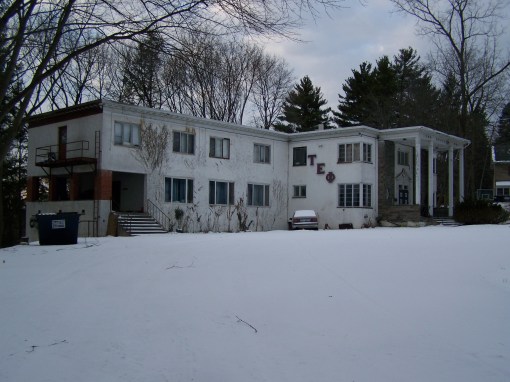
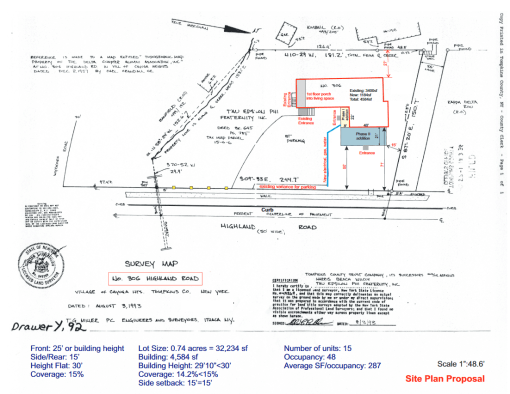
 

5. Speaking of renovations, it looks like someone is interested in the former Tau Epsilon Phi house at 306 Highland Road in Cayuga Heights. The plans show 15 “units” and potentially up to 48 beds, which sounds like a group living situation, but the plans do not identify the developer. The first phase would involve exterior and interior renovations for 36 beds in the 3,400 SF building, enclosing the side porch and constructing a small addition on the southeast face to create a new entrance. A second phase is shown in the documents that would seek a 1134 SF, 12-bed addition at what is currently the front entrance of the early 1960s building, the east facade. It was previously noted that 306 Highland was for sale for $1.385 million, which was steadily reduced to $1.025 million before being taken off the market at the start of June. The village will begin site plan review of the project at its Planning Board meeting on July 23rd.
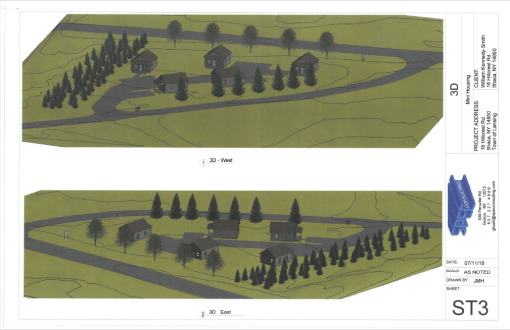
6. On to Lansing. Here’s a little more about the Hillcrest Tiny House project -memo here, application here, drawings by architectural firm SPEC Consulting here,  . The five homes would be built on 16 Hillcrest Road, a parcel split by Hillcrest Road where it intersects with Warren Drive – the developer is the home owner who lives on the other half of the parcel, south of the intersection. The triangular northern piece would host the rather traditional-looking cottages, which would be one-bedroom units, about 450 SF each, and have two parking spaces apiece. The land is zoned industrial/research, which allows commercial and industrial uses – the owners argue that its location on the west side of Warren Road near other residential development along Hillcrest means that a commercial or industrial use would be out of character.

One could make an argument that this is desirable in that their small size would help address the  middle-market for housing demand, which has been lacking in new options, resulting in existing options being pressured upward in price. The project would cost about $200,000 to build and the owner/developer estimates two months to build each cottage, though it’s not clear if construction of each cottage would be concurrent, or one at a time.

Quick side note, Milton Meadows has submitted a construction plan for the new access road in tandem with the town’s realignment of the Woodsedge Drive/Route 34 intersection. Taylor the Builder, the general contractor for the project, is planning for November 2018 – September 2019 for the 72-unit affordable apartment complex.
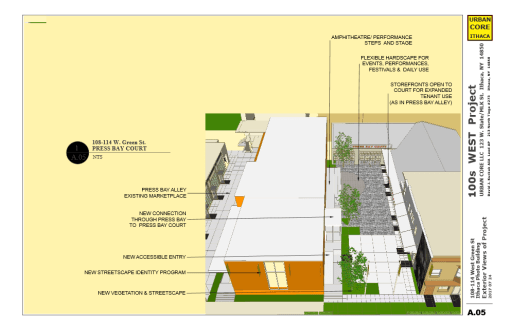
7. Urban Core LLC has started exterior demolition and reconstruction work for the Press Bay Court project. I’ve been waiting to officially move this into the construction column for a while, could never quite be sure when walking past – the full rundown and description of the project can be found in the October introduction here. To quote part of it:

“What Urban Core’s latest plans would do is expand that “experiential” micro-retail mix eastward towards the corner of Green and Cayuga Streets, the Commons and the downtown core. The parking lot in front of D. P. Dough would be converted into a plaza much like Press Bay Alley’s, and the first floor of 108-110 West Green would be renovated into 5-8 micro-retail units facing the new plaza (the Green Street entrances would be retained), with 320-2200 SF per unit. The second floor would be renovated into four below-market rate one-bedroom apartments with 510-660 SF of living space, and the exterior masonry would be cleaned and repaired. The hawk mural will be preserved. New signage, bike infrastructure, curbing, sidewalks and a parklet are included in the plans. The total square footage in phase two is about 9,000 SF.”

8. 105 Dearborn has received a construction loan to move forward. The 10,930 SF, 12-bedroom, 16-person high-end skilled care facility will cost $4.2 million to build according to the loan filed this Friday the 20th, and over the next year it’ll slowly take form on what is now a vacant corner in leafy Cornell Heights. Bridges Cornell Heights will run the facility, and add a handful of news jobs as a result of the new addition. Tompkins Trust Company is the lender, and the historically-inspired design was penned by Rochester-based Bero Architecture.

7. Looks like a fairly interesting monthly meeting ahead for the Ithaca City Planning Board. Here’s the agenda:

1. Agenda Review 6:00
2. Privilege of the Floor 6:01

3. Subdivision Review

A. Project: Minor Subdivision 6:15
Location: 508-512 Edgewood Place
Actions: Determination of Environmental Significance – Consideration of Preliminary and Final Approval

This subdivision at the end of a private street in the East Hill neighborhood would re-subdivide a double lot that had been consolidated after the original house burnt down in the late 1930s. Any news structure on the newly created .326 acre lot would be subject to Ithaca Landmarks Preservation Commission design review. No specific plans are on file.

4. Site Plan Review

A. Project: Stewart Park Inclusive Playground 6:30
Location: Stewart Park
Applicant: Rick Manning for the City of Ithaca
Actions: Consideration of Project Changes

Project Description: The project was approved by the Planning Board on March 27, 2018. The applicant is now requesting project changes, including relocation and redesign of the bathrooms and parking area, and layout and programming changes to the overall playground.

The bathroom building was to be combined with a pavilion, but that proved to be expensive and the playground architects had bad experiences with the original structural supplier, so local architecture firm STREAM Collaborative stepped in to design a separate 24′ x 24′ bathroom building with utility rooms and storage space. The pre-school playground and sand garden were moved, the splash pad tweaked, some swings were added and the adult wellness area was deleted for this initial buildout.

B. Project: Minor Subdivision & Construction of a Duplex 6:45
Location: 209 Hudson Street
Applicant: Jagat Sharma, architect, for Bia Stavropoulos, owner
Actions: Determination of Environmental Significance

Touched on this one a couple of weeks ago – the project was revised from two duplexes to just one, with three bedrooms per unit. Even development-averse councilwoman Cynthia Brock offered support for the plan (with minor aesthetic tweaks), which is about as good as one can hope for a green light to proceed. Note no approvals are planned because this has to go to the Board of Zoning Appeals for a lot size variance.

C. Project: Major Subdivision (3 Lots), Two Duplexes, One Single Family Home & Site Improvements 7:00
Location: 128 West Falls Street
Applicant: Ron Ronsvalle
Actions: Consideration of Preliminary and Final Subdivision Approval and Site Plan Approval

BZA gave Ronsvalle’s five-unit rental project in Fall Creek the all-clear. This project came up earlier this month in a previous news roundup – a five-unit infill project in Fall Creek, originally approved in February 2015, and revived now that the developer has found a way to continue working after a debilitating accident. Don’t foresee any issues here.
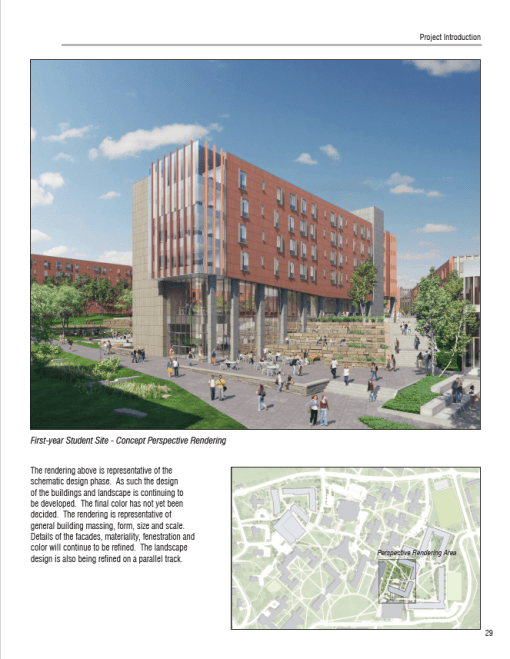
D. Project: North Campus Residential Initiative (NCRI)
Location: Cornell University Campus
Applicant: Trowbridge Wolf Michaels Landscape Architecture on behalf of Cornell
Actions: Intent to Declare Lead Agency

This will be huge – 766,000 SF of space for 2,000 student dormitory beds and associated program space, including a 1,200 seat dining hall. I’ll have more coverage next week. John Novarr favorite ikon.5 is the project architect.

E. Hudson Street Townhomes – 117-119 Coddington Road –Sketch Plan 7:50

One of this week’s new shinies. This project appears to be slated for a parking between two apartment complexes and across the street from the Elks Lodge just north of Ithaca College’s campus. Depending on how they reconfigure the existing parking lot, they could do a high single-digit or low double-digit number of townhomes. Zoning here is R-3b. Up to four floors/40 feet, 40% lot coverage, one parking space per unit of per three bedrooms (two spaces for 4-5 bed units). Lot coverage may end up being based on a subdivision, since this falls into the South Hill Zoning Overlay and no additional primary structures are allowed on a lot. The property has been owned by the Dennis family since 1979, but the developer may be someone else with a purchase deal on the subdivided lot.

F. Falls Park Project – 121-125 Lake Street – Sketch Plan 8:05

This would be whatever Travis Hyde Properties is planning for the former Ithaca Gun site on Gun Hill. I have been told this is “substantially different” from the earlier Ithaca Falls Residences plan. Assume residential. This was rezoned R-3a not long back, up to four floors/40 feet, 35% lot coverage, one parking space per unit of per three bedrooms (two spaces for 4-5 bed units). I would expect a fair number of units for a 1.42 acre property; the IFR plan was 45 units.

5. Zoning Appeals 8:10
#3102, 209 Hudson St., Area Variance
#3103, 216 University Ave., Area Variance
#3104, 737 Willow Ave., Area Variance


News Tidbits 7/14/2018

14 07 2018

1. We’ll start of in Dryden with some revisions to the Trinitas project. This project has slowly but steadily been winnowed down in size. The original proposal in late May was 224 units and 663 beds. The June revisions dropped that figure to 22 units and 649 beds. Now with the latest set of revisions, the unit and bed count has fallen to 220 units and 610 beds. In other words, capacity has dropped by about 8% so far. A copy of the presentation Trinitas gave to the town board last month can be found in their minutes on the town website here.

From a site plan perspective, you can see a number of substantial changes – some townhouse buildings were lengthened in the southern corner, other strings shortened or broken up, the clubhouse/community building is now a mixed-use structure, and a couple of townhouse strings were deleted outright. About the only portion that was unchanged was the trio of structures closest to Dryden Road.

The early working name for this project was “Fall Creek Village”, which while referencing Fall Creek just to its north, may not have been a wise choice given the neighborhood of Fall Creek in Ithaca, which has been the epicenter for Ithaca’s gentrification. It was suggested they change the name, ideally to something with “Varna” in it. There’s about a hundred other pros, cons and general thoughts shared during the meeting, which can be read here. The project team would like to have approvals by the end of the fall, for a Spring 2019 – August 2020 construction period. As all the paperwork is filed, reviewed and discussed, expect more revisions to the project before any final approval is considered and granted.

2. Tompkins Financial may have relocated all its operations to its new headquarters, but that doesn’t mean its the end of the road for its old properties. 1051 Craft Road, formerly home to the Tompkins Insurance Agency, was sold to Ithaca Dermatology Associates of Ithaca on June 5th for $1.2 million. The 7,541 SF building was built in 1995 and assessed at $990,000, so Tompkins Trust did okay with the sale price – they purchased the building for $965,000 in 2007.

The new chapter is, as you might’ve already guessed, medical office and service space. With the assistance of a $1.5 million construction loan from Tompkins Trust, the Ithaca Dermatology is renovating the building for its new clinic. The hard cost of the renovations (materials/labor) is $1.025 million, and the spruced up facilities are expected to be open by January. Local architecture firm Chiang O’Brien, who have a specialty in medical facilities (they did Cornell Health’s new building and Planned Parenthood’s new regional HQ) is designing the renovated space, and Hammond Heating and Plumbing is the contractor.

3. If you’re looking for something interesting in local planning board agenda, there isn’t much to see at the moment. The town of Ithaca’s PB will be looking at a vacant lot subdivision between 721 and 817 Elmira Road (no future plans stated), and a lot subdivision on Enfield Falls Road to create three home lots and a large wooded parcel to be conveyed to the state as a conserved natural area. Over in Lansing, they’ll be looking at a plan for five micro-sized rental cottages at 16 Hillcrest Road.

4. The near-waterfront office building at 798 Cascadilla Street has been sold. 798 Cascadilla LLC made a deal with the too-similarly named Cascadilla 798 LLC for $2.55 million on Thursday the 12th.  As reported when then building went on sale, the 18,271 SF office building is home to Palisade Corporation, a software firm specializing in decision making/risk analysis tools. 798 Cascadilla LLC is the managing company for Palisade co-founder Sam McLafferty, who recently passed away. Cascadilla 798 LLC is a bit of a question mark – they were created in May and registered to this address, so maybe someone else associated with Palisade is buying it. The asking price for 798 Cascadilla was $2.7 million, and the tax assessment is for $2 million. Pyramid Brokerage’s David Huckle conducted the sale.

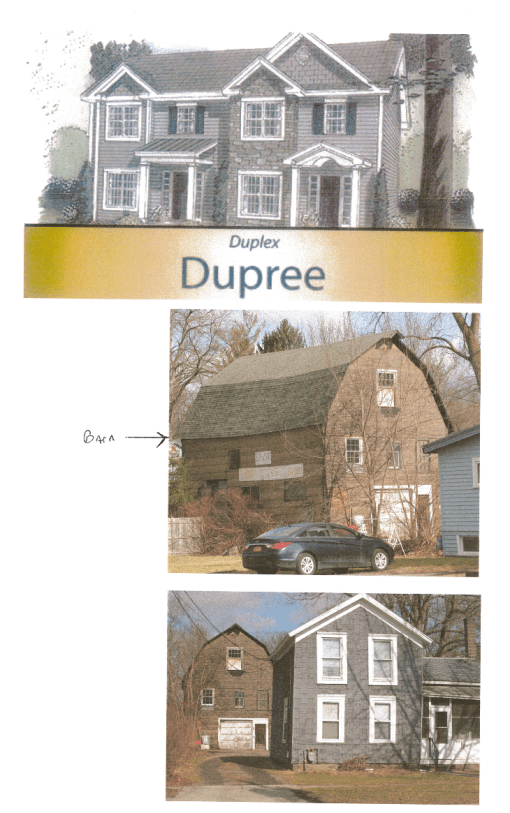
5. Maybe something the infill folks in the city want to watch – 622 West Clinton Street just sold to Jerame Hawkins, who two years ago wanted to do an affordable duplex (60% Area Median Income) to replace the old barn (yes, barn) at the rear of the property, as well as keep the existing house locked in as affordable housing. Carina would have supplied the modular units for the three-bedroom townhomes, and Finger Lakes ReUse would have salvaged the barn. Hawkins had applied for $135k in IURA federal grant funds, but the proposal was not funded. However, his purchase of the property now makes a potential affordable infill project somewhat more likely, though we’ll have to wait and see.

6. Color me intrigued – does Pat Kraft have a tenant lined up for the ground level of his Dryden South building at 205 Dryden Road? I have yet to see paperwork, but we’ll see.

7. It appears the Stavropoulos family, local landlords who have undertaken several smaller-scale projects in recent years, are about to add to their holdings. It would appear they are buying out Jagat Sharma’s properties as the well-known Collegetown architect heads into retirement (since he’s almost 80, I can’t blame him). The Stavropoulos purchased a four-unit house at 208-210 Prospect Street from Sharma this week (for $480k, well above the $350k assessed), and an LLC notice was posted recently for 312 East Seneca LLC, which is registered to the Stavropouloses’ home address. 312 East Seneca is also the office of Sharma Architecture (and the cat cafe), and was eyed as a potential Visum acquisition for its Seneca Flats mixed-use plan at 201 North Aurora Street (Visum has conceptual plans for versions with and without Sharma’s lot, so this sale doesn’t kill their plans, though not having the property shrinks it somewhat).

Slowly but steadily, the Stavropoulos are buying and building their way to significantly-sized landlords. Current projects include the 11-unit building finishing up at 107 North Albany Street, and the infill duplex planned for 209 Hudson Street. Last year, they developed four units at 1001 North Aurora Street, and they have a dozen other properties throughout the city under the business name “Renting Ithaca“.

8. We’ll leave this off with some thoughts from the Tompkins County Housing Committee, with four initiatives it will be pursuing to help address the lack of affordable housing in Ithaca and its surrounding environs:

I. Solicit the state attorney general for ways it might be able to legally expand or enhance its Community Housing Development Fund with Cornell and the city of Ithaca. The CHDF is the only way the county can fund housing development since it can’t legally fund housing development directly, but CHDF is relatively limited in its scale and abilities.

II. Develop a proposal for a municipal matching fund to help with grant writing for affordable housing, zoning improvement and infrastructure to serve affordable housing.

III. Planning staff will conduct an infill site analysis in development focus areas (Downtown, State Street Corridor). This would potentially find opportunities in surplus or underused county property that may be developed as affordable housing through an RFP process.

IV. Planning Staff will participate in the Policy Lab Study (“Jennifer and George’s Study”) to provide data and help inform the client committee. I honestly have no idea what this refers to.


News Tidbits 7/7/2018

7 07 2018

1. The infill project at 209 Hudson has been revised and reduced in size. The new plan from the Stavropoulos family of developers calls for just one new duplex at this time, on the existing lawn and swimming pool of the extra-large lot. The rear duplex was eliminated in the revised plan. A small zoning variance is still required for the subdivision (side yard deficiency), but it’s less likely to catch the ire of BZA members this time around because more mature trees are preserved in this reduced-size iteration. Modest bay window projections, fiber cement panels and wood trim will help create a higher quality product.

The duplex would be a quick build since it’s modular, but it’s not going to be ready in time for fall semester – spring (January) would be feasible, if the individual units are assembled before the snow flies. The Planning Board will make their recommendation this month, and the BZA will have their vote in early August, with potential final approval in late August. Quick note, as this has fallen under the threshold for the Ithaca project map (3 units or more), it has been removed.

Also due for review this month are final approvals for 128 West Falls Street (above) and a 3,200 SF endcap addition at South Meadow Square, and approval of a subdivision at 508-512 Edgewood Place.

2. Recently, Visum Development posted photos on their Facebook/Instagram taken during setup for an interview with Park Productions, and Ithaca College student media group. Normally, that’s not something to write about, but this caught my attention:

327 West Seneca is the new all-affordable project they introduced at last month’s planning board meeting. As for the others, I don’t have much of a clue. Ithaca does not have a Main Street, so that’s likely another community. 409 State may refer to an older building at 409 West State or 409 East State, but 409 East State is Travis Hyde’s Gateway Center property (and who at last check had no plans to sell).

As for the others, it looks like the first number was erased. Also of note, there is no East Cayuga, it’s just North and South. So I dunno quite what to make of it – hints of projects with some red herrings, it seems. Worth a look, but it’s not much to work with just yet.

3. Time for a little more speculation. A vacant lot east of 404 Wood Street in the city of Ithaca’s Southside neighborhood sold for $70,000 on June 26th. The buyers were a husband-and-wife pair who also happen to work for Taitem Engineering, a prominent local consulting engineering firm with specialties in structural engineering and associated branches in the context of green/sustainable building operation. The pair previously did a LEED Platinum, net-zero energy home in Ulysses two years ago. The likely guess here is that they’ll be building their next net-zero energy residence on this lot.

As previously noted when the property went up for sale in January 2016 (it was later subdivided from 404 Wood, which was sold a while ago), “(p)laying with some numbers a little bit, there are a couple of options if a buyer wanted to build something. The first and probably easier option would be to subdivide the lot and build on the vacant corner parcel. That would give, per R-3b zoning regulations of 40% lot coverage and 4 floors, about 1400 SF per floor. That gives 5600 SF, and if one assumes 15% off for circulation/utilities and 850 SF per unit, you get a 5 or 6 unit building at theoretical maximum.”

TL;DR – if they want to do a small infill net-zero apartment building, they can. If they want to do a sizable single-family residence, they can do that as well. We’ll just have to wait and see what happens.

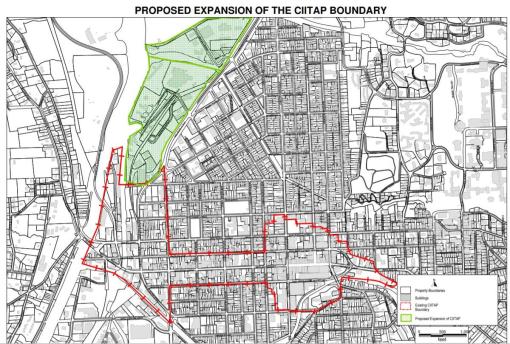
4. On the policy side, the Ithaca Common Council voted Wednesday night to move forward with a CIITAP stipulation stating projects pursuing the tax abatement must have a mandatory affordable housing component of 20%, available to those making 75% Area Median Income, affected all residential projects with ten units or more.The extension of CIITAP applicable properties along the Waterfront was also approved.

The policy comes forth after considerable debate over the right percentage and right income to apply. It’s the Goldilocks principle – too little and you don’t add an appreciable amount of affordable housing and may even decrease the amount once redevelopment occurs in lower-income blocks, too much and developers just won’t build (the Portland problem), and those who stick around will renovate existing buildings instead, meaning less supply overall, fewer existing lower-income units and accelerated gentrification. Among things discussed Wednesday night, a proposal to modify the mandatory size requirement of affordable units from a minimum of 80% the square-footage of the market-rate to 100% failed 5-4 (needed six), the % of affordable units went from 10% to 25% (the 25% was the First Ward’s George McGonigal, who has a history of being opposed to new market-rate and affordable housing, and did not get a second to open discussion).

It’s too early to say if this is too much or not enough – the City Harbor folks were in attendance for the discussion (they were at the meeting for a different topic), but didn’t raise concerns to 20%, so it seems likely their project is able to continue. The county IDA is the grantee of abatements with the city in an advisory role only, so they’ll have the final say on the application of the new law.

5. Tompkins Cortland Community College’s Childcare Center has the funds it needs to move forward. The project, first proposed in February 2016, calls for an 8,000 SF, $4 million building, plus a $1.5 million endowment for operating costs. State funds support much of the cost, as well as a $2 million donation from Ithaca CEO and major TC3 donor Arthur Kuckes, for whom the center will be named.

According to Jamie Swinnerton over at Tompkins Weekly, the project includes six classrooms with two infant rooms, three playgrounds, and be, in part, staffed by students studying to be teachers and childcare providers. 12 jobs will be created, and since it’s for faculty, students and staff, those jobs are expected to be full-time and all year-round. The building is expected to be partially opened by the start of the Spring semester, and fully occupied by the Fall 2019 semester.

Design-wise, the latest design in Tompkins Weekly shows smaller windows and the loss of some hipped roof bumpouts at the rear of the building (older version here). Value engineering noted, but the goal of helping students with children stay in school, and get the degrees they want to build their professional foundations on outweighs any shade thrown at the design changes.

6. Also finally moving forward – Lansing Meadows. There was an 11th-hour holdup for the 20-unit senior housing project when the village expressed discomfort with accepting future ownership of Lansing Meadows Drive, feeling the turns were too sharp and posed a liability. Developer Eric Goetzmann relented and agreed to maintain the road as a private road, and the village board approved the project 3-2; there are still a lot of sore feelings about the often-delayed and arguably underwhelming final proposal. Goetzmann has until July 31st to obtain permits to begin construction, or else the county IDA will recommence seeking clawback reparations from abated taxes, most of which went toward the BJ’s that was built in 2011-12.

7. Let’s slay some inbox rumors. East Hill Village is not cancelled. Nor is Trinitas’ Dryden Townhomes project. I checked with the project teams – both are still active projects. However, East Hill Village is waiting on the town of Ithaca to finish updating its zoning to a more form-based code, and the project will not move forward until that happens.

8. For fun: here’s a Google Docs spreadsheet on how the Ithaca metropolitan area lines up with other metros on new home construction permits since 1980. Key takeways – Ithaca/Tompkins County was in the top 10% of metros in 2017 for multi-family housing permits per capita (30th of 381), but it lags quite a bit in the construction of single-family homes, so its overall rank is only the 64th percentile (137th of 381). Even then, it’s still one of the fastest growing housing markets per capita in the Northeastern United States. 2016 and 2017 have been strong years, while 2015 and earlier were generally well below the national average.

The multi-family number per capita is arguably skewed higher than a typical year thanks to large projects like 441-unit/872-bed Maplewood, but the message seems to be that the community is seeing real results from its push for housing. However, with a lack of single-family being built, Ithaca and Tompkins County need to figure out ways to compensate for what single-family provides (i.e. home ownership). It’s not necessarily “we should build more single-family homes” although that is part of the answer. It’s also encouraging suitable single-home substitutes (condos) in desirable areas while maintaining a strong, steady flow of new units as the local economy continues to grow.


East Pointe Apartments Construction Update, 6/2018

24 06 2018

If the name doesn’t sound familiar, that’s okay. For the past two years, the common reference to these was either “The Bomax Drive Apartments” or the “Park Grove Realty Apartments”, either of which was used interchangeably. The official name according to Park Grove Realty’s webpage is “East Pointe Apartments”. East of what, I dunno.

Park Grove Realty is a new company headed by a group of long-time developers and real estate professionals. Andrew Crossed and Andrew Bodewes cut their teeth at Conifer Realty, a regional affordable housing developer based out of Rochester (readers might be familiar with some of their local projects, including Linderman Creek, Cayuga Meadows, and Poet’s Landing). They knew their way around development and had familiarity with the area. Not only that, they were working with Tom LiVigne, who has been on the board of many local projects and recently retired as the president of real estate operations at Cornell.

While LiVigne was at Cornell in 2008, the university purchased a 19.46 acre parcel on Bomax Drive. The property was zoned for business and technology, which is intended for commercial office, warehousing or tech-focused industrial space, which is what Cornell originally had in mind. But, with the onset of the Great Recession, and a re-assessment of Cornell’s needs, nothing ever came forth for the property.

A little bit of speculating here, but because Conifer’s Cayuga Meadows had been floating around since the late 2000s, LiVigne would have been professionally familiar with Crossed and Bodewes. It seems likely that as LiVigne retired in early 2015, and Crossed and Bodewes launched their company a few months later, they might have approached him with the idea of an Ithaca project, knowing the market’s strong economics and housing deficit. LiVigne was familiar with Cornell’s excess holdings, and whatever discussions he had with Park Grove post-retirement led to the idea of a project on this property.

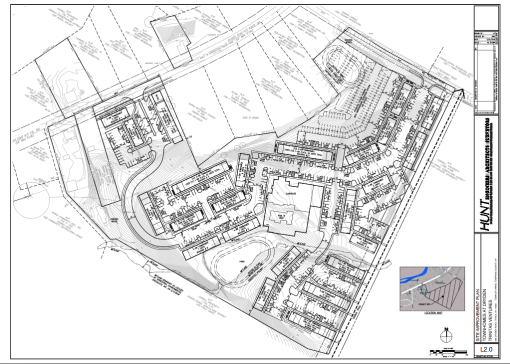
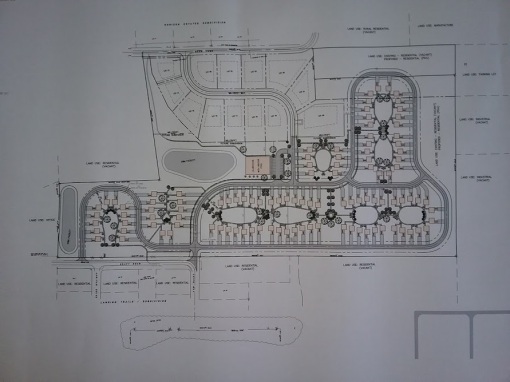
The project was first conceived and brought before the village of Lansing in July 2016. East Pointe is a 140-unit townhouse complex, fourteen strings of ten units, plus a community building, situated on a wooded vacant parcel on Bomax Drive. The intent was to explicitly avoid Collegetown and Downtown, and do a project geared towards the upper-middle class market segment, more specifically empty nesters and young professionals who may be moving in for work, but have yet to buy a house (this is exactly the same sub-market and words used by the developers of the 102-unit Cayuga Orchard project over in the town of Lansing, and even bears a passing resemblance). Arguably, a modest slice of graduate/professional students is possible as well.

To make the project possible, the zoning would have to be changed to high-density residential – the village planning board wanted a traffic study and wasn’t excited that there was no affordable housing here (the project team argued the asking price Cornell wanted made affordable housing infeasible), but was otherwise open to the idea of the zoning change; no one had developed a business and technology space since 2005, and residential was seen as a downzoning from what could have been done there, should Cornell have really pushed for a large office of research building. The neighboring developer, however, was not okay with the rezoning.

I don’t intend to rehash Forest City Realty and the Jonson family’s attempt to stop the project, but the argument was that it was a “spot rezoning” and that it was illegal. The Jonsons felt the units would decrease the desirability of their own project, the luxury for-sale townhomes in the Heights of Lansing. It became so impassioned that Lisa Bonniwell (Ivar and Janet Jonson’s daughter) ran herself and allies to try and take over the village Board of Trustees and mayorship last year in an effort to stop the proposal – they lost by a large margin. They also took the village to state court, lost, appealed, and lost again. The village estimates, with considerable distaste, that although they won, the court cases cost them close to $50,000.

It’s because of the lawsuit that the timeline gets a little muddled. The rezoning request was filed in September 2016, the public hearing in October, and the zoning change was made in November 2016 – to make it clear, that was the rezoning, not the project. The project wasn’t approved until November 2017, after the lawsuit was rejected and had gone to an appeals court. For a little while, Park Grove had a “continue at your own risk” for preparing final drawings and legal paperwork, given that the appeal was not declined by the state court until February 2nd 2018. The first real sign the project was moving forward came on March 16th of this year, when Cornell sold the land to Park Grove for $1.5 million, $300,000 more than what the university paid in August 2008.

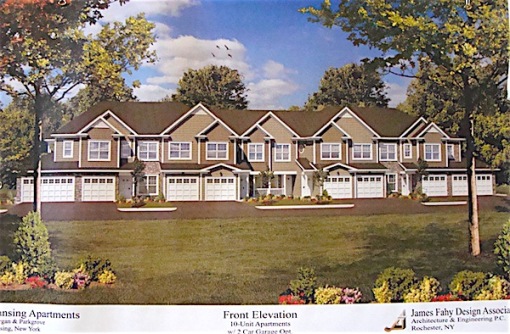
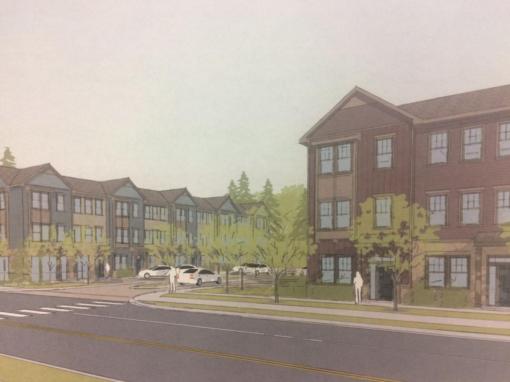
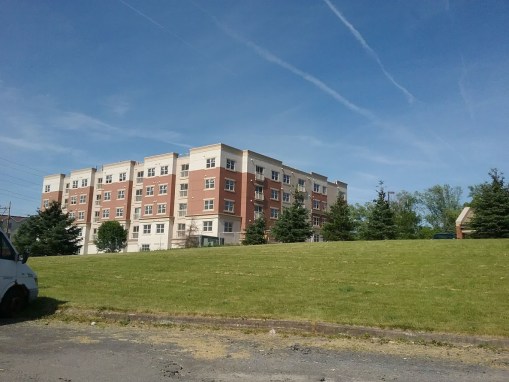
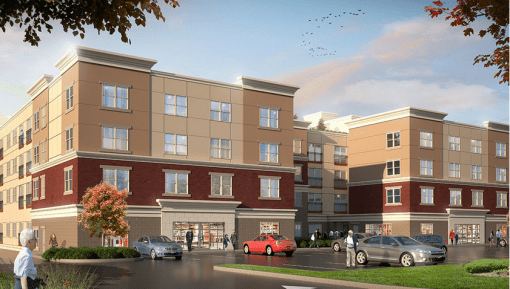
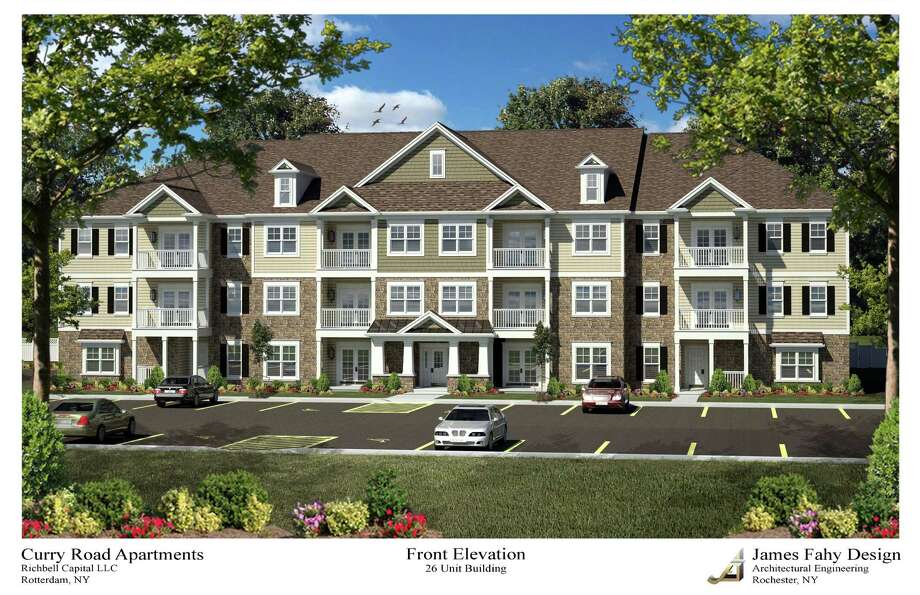
Each string will have four units on the first floor, and six units on the second floor. Each unit has their own entrance, and the project is being described by the developer as “walk-up garden style“. The mix of units is 36 one-bedroom units, 90 two-bedroom units, and 14 three-bedroom units – since 36 and 90 don’t break down evenly by 14, I’d expect slightly difference unit mixes per building, and perhaps that will result in some slight design differences for things like window and door placement. However, they’ve only ever shown one apartment string in their official renders. The renders above are from early in the process (top), and the one they uploaded to the company website last week (bottom) – note the differences in the end garages and in the second floor/roof on the right side of the image. it may be a change in design, or it may be two different building designs they plan to utilize depending on unit layout. Have to wait and see on that one.

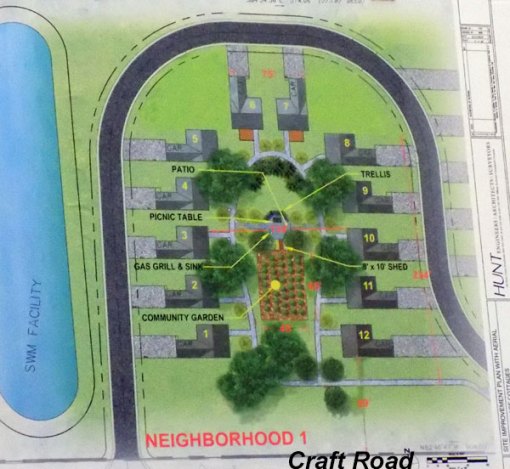
The one-bedrooms will be about 900 square feet and go for $1,400/month, according to an early interview with the Ithaca Times. The 1,300 SF two-bedroom units will go for $1,700/month, and the three-bedrooms, which will be about 1,400 SF, will for $1,900/month. The Lansing Star gives similar stats. Renters will get “high end finishes and amenities”, with possible amenities including  the community building with swimming pool, bocce ball court, walking trails, a community garden and a dog park.

I have not seen any building costs or local lending activity associated with the project, but if it’s in the ballpark of the nearby Village Solars (which is $2-$3 million per building), then it would not be unreasonable to expect something in the range of $30 million (of course, I am not the county tax assessor, so don’t take my word as gospel).

The architect, James Fahy Design Associates of Rochester, has a lot of experience with newer suburban developments, both single-family and multi-family. A google search (their website hasn’t been updated) shows similar gable-loving, shake siding and stone veneer embracing projects in the Buffalo, Rochester, Syracuse and Albany areas. Jess Sudol of Passero Associates is the engineering consultant.

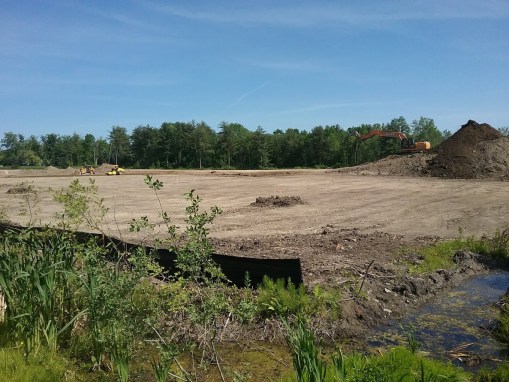
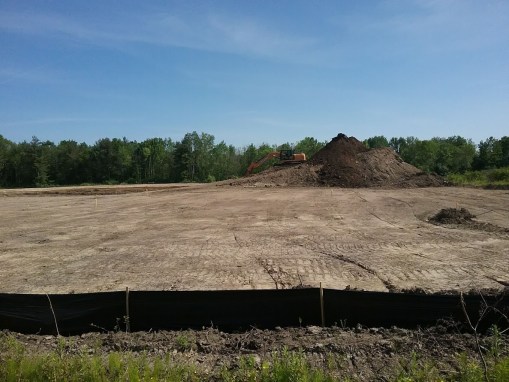
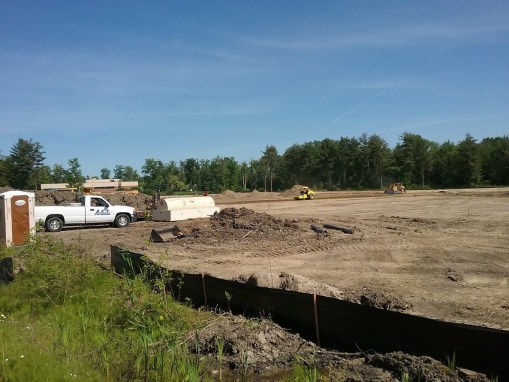
Right now, the site is being cleared and graded, with subterranean utilities installs (water/sewer) and early foundation excavation work is underway. The first two apartment strings are expected to be ready by Spring 2019. DGA Builders of Pittsford (suburban Rochester), a division of Pennsylvania-based DGA Construction Group, appears to be the general contractor, and A.E.Y. Enterprises of Macedon (Wayne County) is the site work subcontractor.


News Tidbits 6/23/2018

23 06 2018

1. The Town of Dryden has rejected the Planning Board’s suggestion for a Varna moratorium. The vote was 3-1, with one absent. This means that Trinitas may continue with the project review process – it does not mean Trinitas will automatically be able to build their proposal as currently drawn up, since planning board review, town board approval (Special Use Permit) and zoning board approval are still required.

Unfortunately no members of the press were present at the meeting – I found out through reader email. Most were covering the Democratic Party NY-23 candidate forum, and the first mention of the moratorium vote online was in the uploaded board agenda that went up just a day earlier.

Image courtesy of the Lansing Star

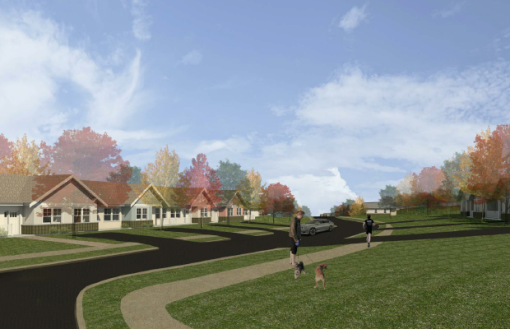
2. When I first broke the Lansing Senior Cottages story for the Voice, there was something I was concerned would happen, but didn’t include in the write-up, because speculating gets me in trouble. But these are homes looking at middle-class seniors, placed next to $500,000-$700,000 homes. The residents of those luxury homes aren’t happy, as reported by Dan Veaner at the Lansing Star.

They’re angry, which is fair in the perspective that when the property was plated, there was no sewer available here, and the plan was to keep it all high-end 2500+ square-foot homes. But the owner/developer of the land is selling off the future phases without any of the old covenants in place, meaning it’s subject to standard village zoning. 800-1200 SF cottages for seniors, some of which may potentially be for sale, is a welcome proposal to the eyes of the county. It seems unlikely this is going to hurt their home values; this is mid-market senior housing, not college student apartments (the only beer on the front lawn you’re going to see is if developer Beer Properties puts up signage). Plus, if you’re going to poll public opinion on this one, wealthy homeowners vs. middle-class seniors is not going to engender support for the homeowners. They could try a lawsuit against the landowner, but I’m doubtful it’s much of a case unless their covenants explicitly said what the undeveloped land would be used for.

The project is currently 107 units over multiple phases, about twenty more than allowed by zoning as-of-right, so it will need to go through a PDA with the village Board of Trustees’ consent, and Planning Board approval.

3. The Crossroads Life Center planned for the 100 Block of Lansing’s Graham Road is no longer alive. The project, which called for a meeting and retreat space to be owned and maintained by the Cornell International Christian Fellowship, fell through, and the land it was proposed for is once again up for sale. The 9.35 acre property (about 3-4 acres were to have been subdivided for the project) is for sale for $239,000. A couple half-acre home lots could be easily subdivided off along Dart Drive, but further development would have to address an old family cemetery towards the rear of the property. Zoning is medium density residential. Maximum buildout without special planned development area (PDA) rules is about 20 units under the village’s Medium Density Residential zoning.

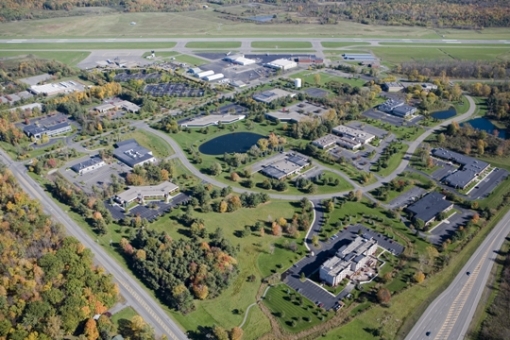
4. Speaking of land for sale in Lansing, Cornell is actively marketing the remaining vacant parcels in its Business Park. Most of the park was built out in the 1980s and 1990s, with only a few building additions in recent years. A 5-acre parcel is available between 20 and 33 Thornwood (foreground in the aerial) for $63,000, and a 22-acre parcel is available for $276,000 (it may be subdivided further), and a 6.89 acre parcel next to airport is available for $86,500.  Lansing zoning doesn’t allow housing here, and so a commercial or industrial project will need to deal with the gas moratorium. A run-of-the-mill office building might be able to make the finances work, but an industrial or lab building with high energy needs is probably is out of the question until some gas is freed up (i.e. the airport renovation), or energy alternatives become more cost efficient.  The county is working on financing a Business Energy Navigator Program to help interested businesses determine their needs and options. Should something happen up here, look for an update.

5. The town of Ithaca is looking at expanding their Public Works Facility at 106 Seven Mile Drive “to better accommodate [their] growing employee base”, and is doing a feasiblity study to see how much and what costs they can expect. The study would be conducted by HOLT Architects with several engineering and landscaping partners (the usual retinue of T. G. Miller (Civil Engineering), Elwyn Palmer (Structural Engineering), TWMLA Landscape Architects, and a mechanical/electrical engineering firm, Sack Associates), and is projected to cost about $21k for all parties. The town board will vote to authorize the study next Tuesday.

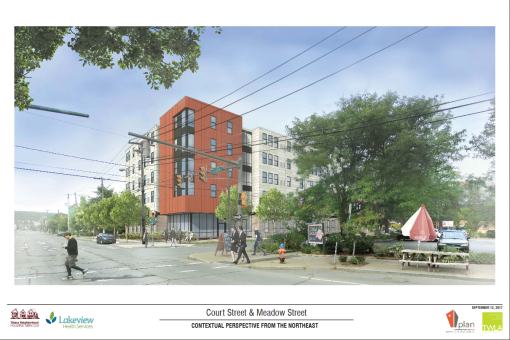
6. The good news for the county was that the state gave Milton Meadows a big grant to move forward. The bad news is, they were hoping for three grants, the others for NRP’s Ithaca Townhouses and Lakeview’s West End Heights (709-713 West Court Street). The county is trying to find other funding streams with which to get these affordable housing projects to move forward this year.

The Ithaca Townhomes would add 106 units in two phases near Cayuga Medical Center. West End Heights would add 60 units, including units for those with special mental health needs, and units for those currently experiencing homelessness.

7. Not a big city planning board agenda meeting this month, but still some interesting details. Here’s the rundown.

1. Agenda Review 6:00
2. Privilege of the Floor 6:01

3. Subdivision Review

A. Project: Minor Subdivision 6:15
Location: 508-512 Edgewood Place
Actions: PUBLIC HEARING – Potential Determination of Environmental Significance – Potential consideration of Preliminary and Final Approval

This subdivision at the end of a private street in the East Hill neighborhood would re-subdivide a double lot that had been consolidated after the original house burnt down in the late 1930s. Any news structure on the newly created .326 acre lot would be subject to Ithaca Landmarks Preservation Commission design review. No specific plans are on file.

B. Project: Minor Subdivision 6:30
Location: 101 Pier Road
Actions: PUBLIC HEARING – Determination of Environmental Significance – Potential consideration of Preliminary and Final Approval

This subdivision is to partition out the square of land Guthrie Clinic would be using for their new medical office building as part of the City Harbor development – they want to own their own building and parcel.

4. Site Plan Review

A. Project: Major Subdivision (3 Lots), Two Duplexes, One Single Family Home & Site Improvements 6:45
Location: 128 West Falls Street
Applicant: Ron Ronsvalle
Actions: PUBLIC HEARING – Consideration of Preliminary Subdivision Approval – Recommendation to BZA

This project came up earlier this month in a previous news roundup – a five-unit infill project in Fall Creek, originally approved in February 2015, and revived now that the developer has found a way to continue working after a debilitating accident. Don’t foresee any issues here.

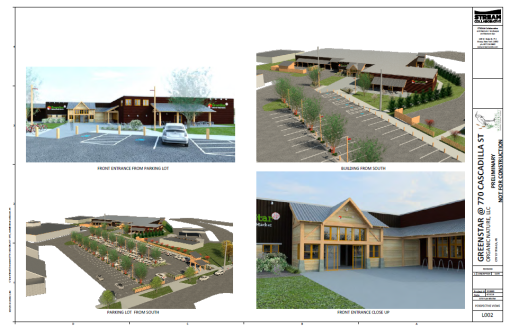
B. Project: GreenStar Cooperative Market 7:15
Location: 750-770 Cascadilla Street
Applicant: Noah Demarest for the Guthrie Clinic (Guthrie owns the land)
Actions: Consideration of Preliminary and Final Site Plan Approval

Since the last round, plantings were added, the lighting and front entrance was revised, and the project team is in discussions with the gas station next door to add planting and landscaping there as well.

C. Project: Apartments (60 units) 7:35
Location: 232-236 Dryden Road
Applicant: STREAM Collaborative for Visum Development Group
Actions: Consideration of Approval of Revised Transportation Demand Management Plan

“The applicant has revised the site plan such that the previously proposed off-site parking is no longer included in the project and has updated the TDMP narrative to reflect this.”
D. 327 W Seneca St- Housing 7:45
The new shiny. 327 West Seneca is a B-2d-zoned property on the edge of the State Street Corridor – B-2d allows multi-family housing up to 4 floors and 40 feet with 75% lot coverage. It is currently a nondescript 3-unit apartment building, that’s been for-sale for almost a year now (asking price $264,900).
A cursory search of LLC filings finds 327 W. Seneca LLC was recently registered in Tompkins County, and the address it is registered to, is the business office of Todd Fox, CEO of Visum Development Group. This may be the project alluded to in the New York Main Street grant to be written by the Downtown Ithaca Alliance, which talks about a 12-unit project by Visum planned somewhere in the State Street Corridor. No guarantees, but this seems likely to be that project.
5. Zoning Appeals 8:10
#3099, 314 Taylor St, Special Permit
#3100, 128 Falls St., Area Variance
#3101, 437 N Aurora St, Area Variance


Cayuga View Senior Living Construction Update, 6/2018

21 06 2018

We can practically call this project complete – the first tenants move in on July 1st. Somewhere along the way, the number of units was reduced from 60 to 58, and it’s not clear whether those were one-bedroom or two-bedroom units (the initial breakdown was 48 two-bedroom and 12 one-bedroom units). No tenants have been named for the twin 1,340 SF retail spaces either.

Given that this was the last vacant high-density mixed-use parcel in the village of Lansing, it seems like they got a good project out of it. 58 market-rate units to seniors aged 55+ is a welcome addition the the Tompkins County market, especially as the retirement of Boomers only continues to grow (the market will create demand for another 70 senior-focused units per year over the next several years, as well as market-rate and affordable housing for those without specialized care needs). While not exactly an urban location, it is walkable to nearby shops and restaurants at Triphammer Mall and the Bishop’s Mall across the street, and it will have a bit of an active ground-floor presence through its small commercial spaces. 5% of the units will be built handicap-accessbile, but all will be handicap-adaptable, and the rooftop solar panels are a plus.

The project was built and developed by Taylor The Builders in conjunction with the Thaler Family. NH Architecture did the design work, and Cornerstone Group will manage the property.

Some cool aerial shots of the site can be seen here courtesy of Taylor and photographer Mick McKee. Interior photos of the nearly finished units and rental information can be found on Craigslist here.


Village Solars Construction Update, 6/2018

16 06 2018

It looks like there’s a lull in the construction at the moment. Both 102 Village Place and 116 Village Circle appear to be complete, though a quick guess would be that 102 Village Place is already occupied, and 116 Village Circle will be ready for its first tenants at the end of the month. The two have a total of 42 units, 24 in the former and 18 in the latter. TCAT is in discussions to add or modify a bus route to service the growing apartment complex, which has already added a couple hundred residents to the area since 2013, with plans for hundreds more over the next several years.

According to the phasing plan, the next phase is to replace 2 Village Circle and 22 Village Circle with a pair of 18-unit buildings. Those would be twelve studios and six two-bedrooms each, replacing two ten one-bedroom unit buildings (net gain of 28 residents, for those keeping in track). Demolition has not yet started on the existing structure, but the most likely plan is to start a little later in the early summer, and have the new pair of buildings ready for a spring 2019 occupancy.


News Tidbits 6/10/2018

11 06 2018

1. For those of you looking out for something interesting next week, here’s your notice. In the village of Lansing Monday night, a sketch plan is set to be shown involving a cluster home development on the remaining phases of the Millcroft property, about 40 acres off of Millcroft Lane and Craft Road. According to the agenda, the proposal comes from Ithaca-based landlord/developer Beer Properties in partnership with Hunt Engineers.

The back story here is that the Millcroft subdivision was approved in the mid 2000s as a three-phase, 31-lot development for high-end ($500k+ homes). As it turns out, the market for that, absent lake views and on relatively small lots, isn’t so great. The Great Recession didn’t help either. The first phase of 14 lots is mostly built out, and the second phase was approved and shows up on town maps, but no construction has taken place. The village has been aware of a project in the works since at least February.

Unfortunately, I can’t seem to find the property listing for the land, which was on Zillow for quite a while – I recall a figure around $850-$950k. The property falls in the village’s medium density residential zone, Cluster zoning means the lots themselves are smaller to preserve natural space. However, the maximum number of units is the same as maximum allowed by regular zoning – 40 acres in sewered Lansing village MDR means up to 87 units, if I’m doing the math right. Not sure if single-family, townhome or otherwise, so keep an eye out for a follow-up.

2. For sale, 15.31 acres off of Wellsley Drive in the village of Dryden. Sewered, watered, and originally planned for 36 homes but never approved. Price of the land $149,900.

Here’s maybe the more interesting part – this borders Maple Ridge. Maple Ridge’s first phase is built out, and the developer, Paul Simonet, would like to build the roads and lay out phase two (and eventually phase three). However, the village’s issue is that there’s only one entry and exit into the development – something they’ve been hesitant to sign off on because of possible safety/access issues.

Now, this may have already been resolved – the village of Dryden has only updated their website twice since February, with legal paperwork for keeping fowl – but if not, there’s the option of buying the Wellsley Drive property and routing a road through there. Maybe $150k plus the extra road work isn’t in Simonet’s price range, but it’s at least an option.

3. The village of Trumansburg commissioned an independent study from Camoin Associates (the same folks who did the Airport Business Park study) looking at the financial impacts of 46 South (formerly Hamilton Square) on the village. I’ve been told this wasn’t public yet, but it’s on the village’s planning board webpage, so I dunno about that.

Quick refresher: 73 units. 56 affordable, 17 market-rate. 6 affordable rental townhomes, 40 apartments, 10 affordable for-sale townhomes, and 17 market-rate units, single-family and townhome style. 140 residents at full buildout in 2023, assuming one per bedroom.

Here’s the TL;DR on the finances. The net income to the village itself is -$23,757/year when fully built out. The unfortunate truth of residential development is that, frankly, people have needs. They use roads, they call police and fire, they use municipal power lines and water pipes and sewer mains. It is not offset by the village’s share of property taxes, here in this mixed-income example, or in the vast majority of cases. This is a reason to advocate housing density, because the impacts on, say, building new roads or infrastructure is often less per unit.

On the flip side, the school district, which makes up a greater share of the property taxes, sees a net increase of $97,669/year when fully built. Tax revenue more than offsets the expenditure of approximately 33 new students. Not everyone living in has a child, but everyone pays school taxes. This money not only helps the district, the incoming students help ameliorate concerns that declining enrollment may soon lead to consolidation with a neighboring district.

Economic impacts can be broken down into three components – the construction jobs, long-term operation/maintenance, and growth induced by the new residents, who will not just live locally, they will also shop, dine and spend money in the village. There will be an estimated $18.17 million spent on construction, $1.45 million will be spent within the County, creating 20 construction job-years in total (note there are multiple guys on site once, the project is expected to be fully complete within five years), and nearly $695,000 in total earnings. Operation/maintenance in perpetuity creates the equivalent of two jobs, creating $60,732 in earnings and $229,782 in sales. The households will spend nearly $1.7 million yearly within the County, which will support 20 total jobs with over $676,500 in earnings per year. In other words, $2 million spent in the county, 22 jobs and $737,500 in net new earnings from having those 140 more residents in the village.

By the way, if one was inclined to read 289 pages of public comments about 46 South, that can be found here. The project will be discussed at the village board’s meeting Monday evening.

4. Let me note this before I forget again – Park Grove’s Bomax Drive Apartments have started construction. The first two strings of 10-unit, three-bedroom townhomes are expected to be completed by Spring 2019. I’ll make a site visit soon for a longer write-up.

5. Meanwhile, the Triphammer Row townhomes are on pause until the road situation gets worked out. The village won’t sign off on using M&T Bank’s parking lot as an entry route, and the Sevanna Park condos don’t want to allow access to the 15 units through their private road. As a result, the village is seeking to have the road turned over to them, in part to encourage this for-sale plan, and in part because will ownership of the entry road to Sevanna Park will allow them to install better curb cuts and traffic control.

6. Here’s a for-sale property with some small-scale redevelopment potential, this one in the city of Ithaca. A dilapidated house is for sale at 815-17 North Aurora Street in Fall Creek. thanks to unsympathetic additions, the historic value is marginal. A buyer could restore it, or if interested, since it’s a double-lot, they could split the lot in two and do a two-family home on each property. Given other recent projects in the area such as 202 and 204 Queen Street and 128 West Falls Street, it appears to be an opportunity to do some modest densification keeping with Fall Creek’s fabric without upsetting the community too much in the process. The property is for sale for $269,000.

7 Let’s tie this up with something intriguing. Next week, the city’s Planning and Economic Development Committee is being asked to support a grant application by the Downtown Ithaca Alliance to the New York Main Street (NYMS) grant program. They are seeking $322,500 from the state to leverage work on four downtown projects – a commercial project in the Clinton House, a commercial project in the Boardman House, a “commercial and housing project” at 108 West State Street (the Ithaca Agency Building), and a 12-unit development by Visum Development in the West State Street Corridor. Any rehabbed housing units will be required to be 90% area median income for at least five years, but I dunno if either housing plan has existing units, I think the Ithaca Agency Building was all office space. STREAM Collaborative just moved into the second floor, so they would know best.

Quick postscript here – there’s nothing but an outline according to the DIA’s Gary Ferguson, so no Voice writeups for a while yet.


News Tidbits 4/7/18: A Day Late and A Dollar Short

7 04 2018

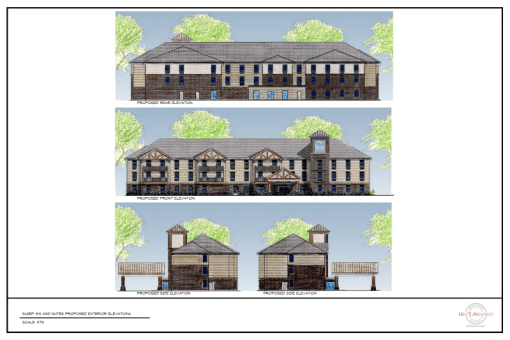
1. It appears the Sleep Inn hotel is moving forward. Building permits for the 37,000 SF, 70 room hotel at 635 Elmira Road were issued by the town of Ithaca on March 23rd. According to the town’s documentation, the project cost is $4.1 million, though it’s not 100% clear if that’s hard costs (materials/labor) and soft costs (legal/engineering/design work), or just hard costs alone.

The Sleep Inn project was first introduced in Spring 2016, and underwent substantial aesthetic revisions to a more detail, rustic appearance. Even then, the project was barely approved by the Planning Board, which had concerns about its height, relatively small lot size and proximity to the Buttermilk Falls Natural Area. The hotel’s developer, Pratik Ahir of Ahir Hotels, co-owns the Rodeway Inn further down Elmira Road. Both the Rodeway and Sleep Inn are Choice Hotels brands, so although the Sleep Inn brand is new to the area (and uncommon in upstate New York), it’s not as unusual as it seems. Given the size, a 12-month buildout seems reasonable. Look for updates as the project gets underway.

2. In a similar vein, the gut renovation and expansion at 1020 Craft Road now has a building loan on file – $1.88 million as of April 3rd, courtesy of Elmira Savings Bank. The existing 10,500 SF industrial building has been gutted down to the support beams, and will be fully rebuilt with an additional 4,400 SF of space. The project is being developed and built by Marchuska Brothers Construction of Binghamton. According to the village of Lansing and the developer, the project will be occupied by multiple medical tenants.

3. The problem with tight publishing deadlines is that if a quote doesn’t arrive in time, you can either put it in afterward as an updated statement, or it gets left out. So on the heels of the report that Visum Development Group is upstate New York’s fastest growing company in terms of revenue (Inc.com’s guidelines were three-year period 2014-16 and at least $100,000 in revenue to start), I wanted to share this for those who might have missed the article update. The statement comes courtesy of Todd Fox, who was asked for comment and responded the following day.

“I would love to acknowledge the Visum team because without them I would never be able to accomplish what I am doing. I’m blessed to have the most passionate and talented people I have ever met. Chris Petrillose is my longest running team member and is the backbone of operations. I also want to acknowledge Patrick Braga, Matt Tallarico, Marissa Vivenzio, and Piotr Nowakowski. They are all rock stars and deserve so much of the credit for our success!

We are currently looking to expand into several new markets, which are as far south as Sarasota Florida and as far west as Boise Idaho. For the Ithaca market, we are essentially hitting the breaks on student housing for Cornell, as we beginning to experience some softening in the market. Our new focus is on for-sale condos and moderate-affordable rentals. We actually have multiple properties under contract and plan to bring about 1,000 to 2,000 new beds online over the next several years.”
Note the last parts. The market for student housing if softening. Visum will focus on for-sale condos and moderate-affordable rentals, things Ithaca could use more of, and 1,000 to 2,000 beds would certainly make a dent in the housing deficit. Of course, proof is in the pudding, so we’ll see what happens over the next several years.

4. The town of Ithaca was less than pleased about Maplewood’s request to extend indoor working hours until 10:30 PM. Labor, weather and building supply (wood frame) issues were cited as reasons for the needed extension. The Ithaca Times’ Matt Butler, who was at the meeting, provided this quote:

https://platform.twitter.com/widgets.js

Yikes. The “happy medium” the board finally gave in to was construction until 9 PM on buildings interior to the project site, away from the main roads. The tradeoff is that EdR and Cornell now expect to not have some of the later structures ready until August 20th, practically move-in day for all of Cornell’s on-campus undergrads.

5. Readers of the Voice and Times will know that the county is pursuing some of the $3.3 billion in federal dollars earmarked but not yet disbursed for opioid crisis treatment. While a temporary addiction facility is being prepared, there are plans in the works to open a detox and stabilization facility in Tompkins County. Unfortunately, it needs much more funding to move forward. The new facility will cost $11 million to build and make operational, and so far about $1 million has been received so far in grants.
For the purpose of this blog, I asked about the design beside Angela Sullivan and Senator Schumer – it is a conceptual design for demonstrative purposes, and a location for a new facility has not yet been fully determined. However, they intend to send a press release once a site has been selected.
By the way, the green logo at lower right is a giveaway on the architect – that would be Ithaca’s HOLT Architects, who are specialists in healthcare facilities.

6. New to the market this week, “Clockworks Plaza” at 402 Third Street in the city of Ithaca’s Northside neighborhood. The 12,821 SF building was one of the few sizable buildings built in Ithaca in the 1990s (1993, to be exact), and is on the market for $2.6 million. The current owner, masked by an LLC, bought the property for $1.5 million in April 2016, the same value for which it is assessed.

That came up on the blog here. The buyer was Steven Wells of suburban Boston, who purchased the property in a buying spree that also included 508 West State Street (former Felicia’s, empty at the time) and 622 Cascadilla Street. 508 West State is now rented by Franco’s Pizzeria. Zaza’s still occupies 622 Cascadilla.

As I wrote at the time of sale:

“They all have different owners, and they’re in varying physical conditions. The only thing that unites these three properties is all that are in areas the city as ripe for redevelopment for urban mixed-use in the Comprehensive Plan. Felicia’s was upzoned in June 2013 to CBD-60, permitting a 60-foot tall building, no parking required. 622 Cascadilla is WEDZ-1a, allowing for five floors and no off-street parking requirement. Lastly, 402-410 Third Street is B-4, 40′ max and 50% lot coverage, but allows virtually any kind of business outside of adult entertainment. Those are some of the city’s more accommodating zoning types, so we’ll see what happens moving forward. At the very least, the public relations game will be starting from behind the proverbial eight ball.”

The reason why the public relations game was ‘behind the eight ball’? He was the guy who sold 602 West State Street and adjacent low-income housing properties to Elmira Savings Bank. There were accusations that the transaction between Wells and the bank was poorly handled, with claims that the lease terms of existing tenants were changed improperly, and tenants not being told their homes were being sold. It’s not clear it that’s accurate, because no one would share their documents to prove their claims. But what is clear is that this created a nightmare situation.


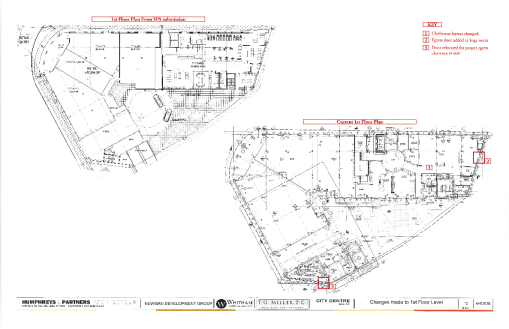
7. It looks likely fewer people will be living in City Centre than first intended. The initial 192-unit mix was 61 studios, 78 one-bedrooms and 53 two-bedrooms. The newly-proposed mix is 33 studios, 120 one-bedrooms, and 39 two-bedrooms. It also appears the retail space has been reconfigured from four spaces to three, though the overall square footage appears to be about the same. There are some minor exterior changes proposed as well; paver colors, lighting, the types of metal panel used (Alucoil to Overly Dimension XP and Larson ACM panels), landscaping, and exterior vents. Assuming the PDF is accurate, the panel change is slight, but gives the building a slightly darker grey facade. Some of these changes are in response to code and safety discussions, others are likely value engineering.

8. From the city’s project memo, we see Greenstar’s new store (which is going into the Voice) and a pair of new if small projects.

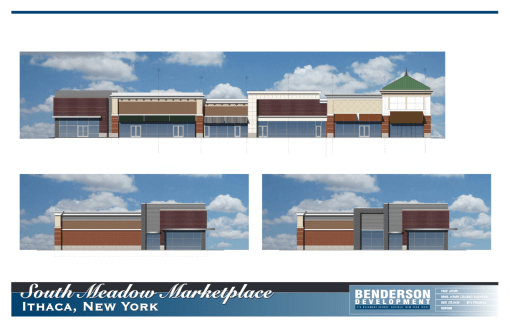
The first is that it appears Benderson is expanding South Meadow Square again. Along with the pair of endcap additions underway, the Buffalo-based retail giant is looking to add a 3,200 SF addition to the west endcap of one of its smaller retail strings. The addition is on the Chipotle/CoreLife strip, next to Firehouse Subs. The dumpster enclosure currently on-site will be relocated to the Panera strip across the road to make room for the building, which will be flush to the sidewalk with…a blank wall. Seems like a bit of a missed opportunity there. The 35′ x 92′ addition has no announced tenant, though 3,200 SF is reasonable for a smaller restaurant or retail space (Chipotle is 2,400 SF, for instance, and Panera 4,100 SF; the stores in this particular retail strip, which includes a vitamin store, tanning salon and barber shop, are in the range of 1,380-4,089 SF). The total project cost is only $132,000, and no construction period is given in the Site Plan Review document.

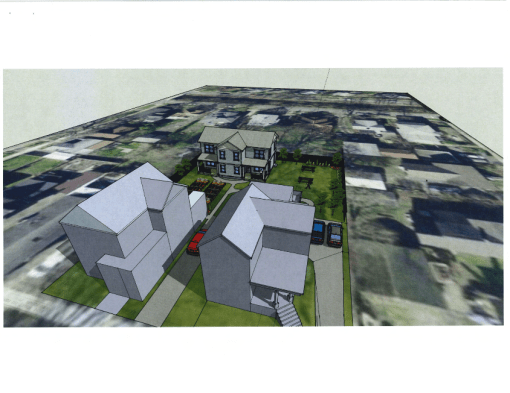
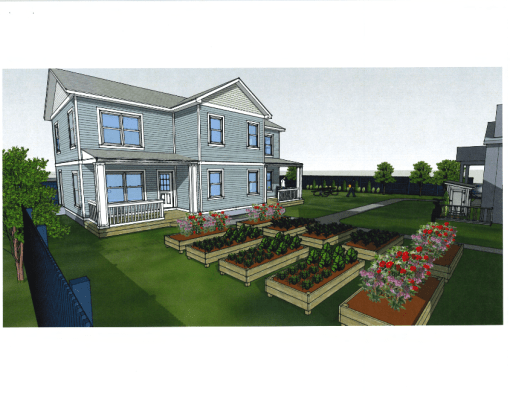
The second is a “pocket neighborhood” in Northside. Barken Family Realty of Ithaca is planning to renovate two existing homes at 207 and 209 First Street, and add a new 2,566 SF two-family home behind the properties. They would be set up as a “pocket neighborhood”, consolidated into a single tax parcel with a common area, picnic tables and raised plant beds. The fence would be repaired and the gravel driveways improved. No demolition is planned, but five mature trees would come down to make way for the new home (6-8 new trees will be planted).

Hamel Architects of Aurora designed the new duplex, which is intended to quietly fit into the neighborhood context. Each unit will be two bedrooms. The $265,000 project would be built from October 2018 to March 2019.

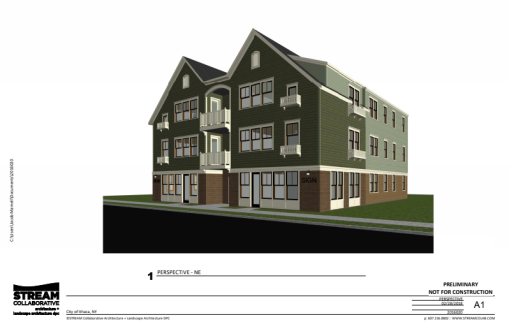
9. We’ll finish this week with a potential new build. The above project was first showcased on STREAM Collaborative’s Instagram at an early stage. It is a 3.5 story, 11,526 SF building with 10 units (6 one-bedroom, 4 two-bedroom), and the two one-bedrooms on the first floor are live-work spaces – the front entrances are workspaces for home businesses. It is proposed along West Seneca Street, and only the south side of West Seneca allowed for mixed-uses like live/work spaces. Materials look to be Hardie Board fiber cement lap siding and trim. The design is influenced by other structures along West Seneca, and a bit from STREAM architect Noah Demarest’s time with Union Studio in Providence, Rhode Island, where he worked before setting up his own practice back in Ithaca – there are similarities between here and Union Studio’s Capitol Square mixed-use design in Providence.

The project actually was sent with its name and title, but fingers crossed, it will be part of a bigger article.