News Tidbits 11/11/17: It’s Back

12 11 2017

1. One of the reasons for the lull in weekly round-ups has been the lack of smaller news items to fill it with. A few larger items made it into Voice articles, but there wasn’t much of a middle ground between “expand into article” and “not newsworthy”. I’m happy to take comments here about Voice articles, although the blog is intended to cover topics that may not be ready for a full write-up.

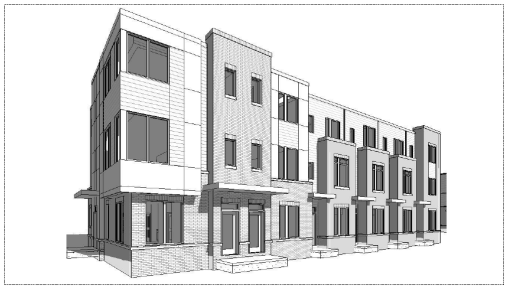
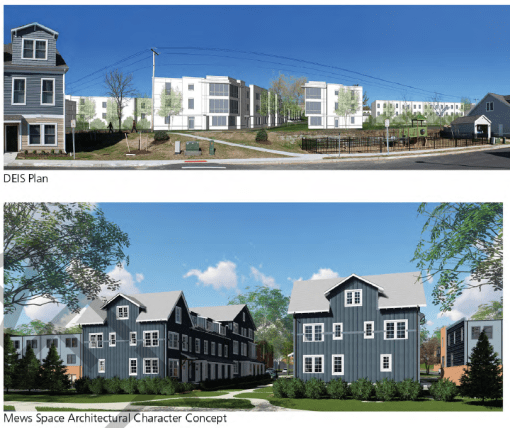
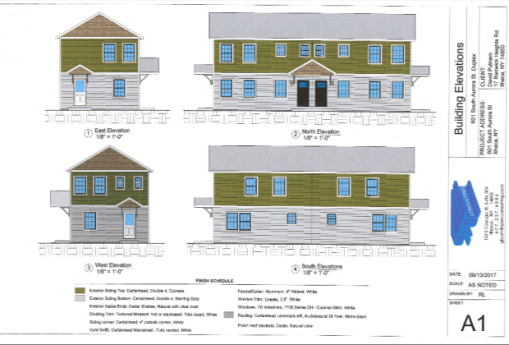
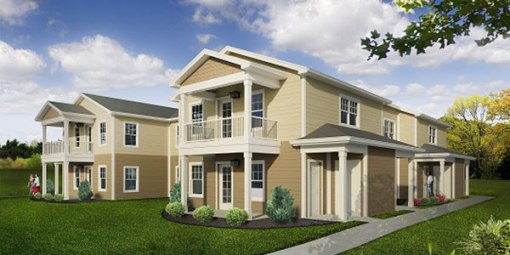
As noted in the Voice, there isn’t much before the city of Ithaca at the moment. A sketch plan for infill rental housing at 209 Hudson Street is likely dead in the water as a result of the new South Hill Overlay, and a modest infill plan calls for a duplex at 601 South Aurora on the corner with Hillview Place, which can only be an improvement from the informal parking lot currently there. The modular unit design is thoughtful (varied materials, plenty of windows) if unexciting, and the sidewalks are a plus. The units are physically structured as townhouses, but technically they aren’t, since townhouses are defined by International Building Code as strings of units of three or more.

Meanwhile, things are so slow in the town at the moment that they cancelled their last Planning Board meeting. Before that, the only notable item on the agenda was the Cayuga Ridge renovation, which is primarily internal. Their October Building and Codes Department report indicates a single two-family home was approved, in the Cleveland Estates housing subdivision; virtually all of those duplexes have been intended as student housing.
2. If there is one town that is rather busy next week, it would have to be Lansing. The surface facilities for the new Cargill mine shaft are up for final approval at the Planning Board meeting next Tuesday, more discussion is expected about the Milton Meadows affordable housing plan at the town center, and a couple of minor projects (communications tower, illuminated free-standing sign) are up for review and vote. Neither Cargill not Milton Meadows appear to have changed significantly since their last presentations.

Also scheduled is review of public comments regarding the Comprehensive Plan, which cover several topics, with the most frequent being the Bell Station zoning (park vs. lakeshore low density) and some individuals unhappy with the potential for mixed-use or residential development near their homes or farms. Joe Wetmore has a pretty thorough critique, ranging from unrealistic expectations to discomfort with what he calls “segregated housing” based on income and age. Going political for a moment, I suspect if it weren’t for many progressive town and village boards rushing to join the Article 78 on Cargill, with less than careful thought and discussion of Cargill’s blue-collar workers and their family/friends, Wetmore would be an incoming town councilman (and to be fair, he may end up winning when the absentee ballots are counted and tallied next week).

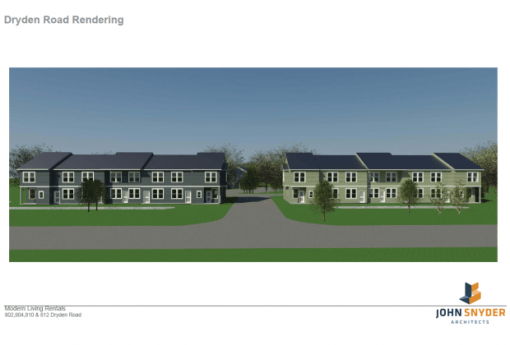
3. Over in Dryden, just about everything is good to go with Modern Living Rentals’ 42-unit rental complex planned for 802 Dryden Road, next to the Cornell arboretum. The November tweaks were for lighting, landscaping and sidewalk details. The designs of the townhouse strings were reworked in October to include three different designs, to be used twice each (six buildings, seven units each, 42 units/108 bedrooms total). While the materials remain the same, the designs differ substantially in roof lines, architectural detailing and fenestration pattern. At this point, no one would mistake for a recycling of 902 Dryden as they started off as; John Snyder and his team have had the chance to express themselves, and the designs are contemporary and visually interesting. It looks like final approval will be coming potentially soon, which will permit a Spring 2018 – Summer 2019 construction time-frame.

Other than that, the town is reviewing another Tiny Timbers subdivision, this one for 1540 Ellis Hollow Drive. Similar to its counterpart just down the street at 1624 Ellis Hollow Drive, the long, narrow lot would be serviced with an internal driveway for five homes with a little over an acre each, and the rear (northern) 5 acres would be granted a conservation easement, to remain natural space and help protect the Fall Creek watershed. The original plan was a deed restriction, but the town’s conservation board is pushing the easement so that future owners of the land can’t just lift the restriction. They also requested an S-shaped driveway because they feel the slope is greater than Dolph states; an S-shape would also throw the plans out of whack, so let’s see what happens.

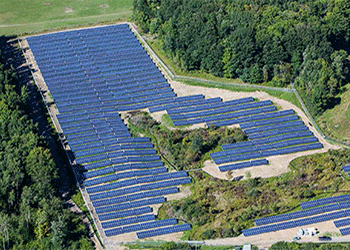
On a final brief note, review and discussion is ongoing for a pair of solar arrays off of 2243 Dryden Road, one of 1.3 MW and one of 2 MW.

4. Looking at what’s on the market this week, here’s something for the deep-pocketed investor/landlord who wants to start with an all-new, low-maintenance building. 6-unit 707 East Seneca Street is on the market for $2,999,000. The 6,469 SF apartment building was built just two years ago, after developer Todd Fox bought city surplus land that was once a playground for the closed East Hill Elementary, deeded to the city in 1982 and promptly forgotten for decades until potential liability risks convinced the city to put it up for sale. Each unit is three bedrooms, and according to the advertisement, it generates over $220k in revenue each year, which is not shabby.The property is assessed at $1 million.

It’s a bit surprising that Fox would want to part with a nearly-new building with solid rental potential, and it makes me curious if the funds would be used to fund other Visum projects planned or approved. While Fox did take a financial hit from the cancelled 311 College Avenue project, the amount invested was far less than the sale price for 707 here.

5. Also worth noting, though it’s not good news – The Computing Center’s plans to build a new 4,600 SF headquarters appear to be over. The building site and the approved building plans at Lansing’s 987 Warren Road are up for sale. $499,000 gets you 1.57 acres, the plans, and a single-family home on the eastern end of the property that generates $2,000/month. The project had received an $85,084 tax abatement for the $1.394 million project, which was expected to create six new jobs. For the record, any buyer would need to re-apply for an abatement; the one granted will go unused. At least offhand, it looks like they may have added the jobs (retain 14, add 6, and the website shows nineteen plus the retired founder, and two job postings), but it’s uncertain – they acquired a competitor (Sherpa Technologies) in September, which increased staff to 22. Based off the time of the listing, with the acquisition of Sherpa they may have just led TCC to go a different direction with a new headquarters. What will be, will be.

6. According to construction loan documents filed with Tompkins County, the new 11,180 SF Rite Aid being built at 79 North Street carried with it a $2.71 million price tag. Chemung Canal Trust Company, an Elmira-based bank with branches in Tompkins County, is providing the loan to Dryden Group LLC/Ellicott Development. Ellicott, a major developer out in Buffalo, will be using an in-house contractor team to build out the retail space.

A couple of emails came in asking if this would be a Walgreen’s. On paper, that’s a no – everything filed and documented says Rite Aid, and this was confirmed with the town planning staff. However, Walgreen’s is in the process of acquiring 1,932 Rite Aid stores (leaving Rite Aid with 2,600), and closing several hundred stores that are within close proximity to existing Walgreen’s. It’s possible that the existing Dryden Rite Aid is one of those to be “shut down as part of the sale” as the new Rite Aid-turned-Walgreen’s is being built on the north end of the village. Keep an eye on it.

7. Quick little side note – Ithaca Associates LLC, the development team behind the $110 million Green Street Garage project, is apparently in talks with INHS to manage its affordable housing component. That’s according to Ithaca Urban Renewal Agency (IURA) meeting minutes. So they are serious about meeting the city’s demand for affordable housing with some undetermined percentage of the 365 units. Heck, 60 or 70 units would be a sizable contribution, should it pan out, and it would make the project more palatable since it would clearly have a mixed-income aspect to go with its mixed uses.
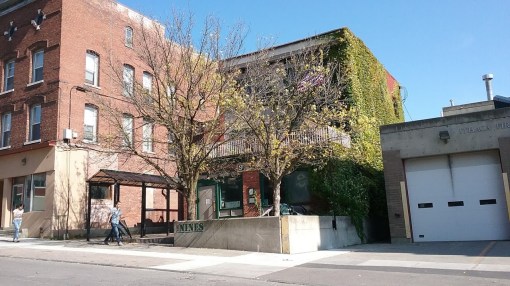
8. The Ithaca Landmarks Preservation Commission will be taking up discussion again on the Nines, though they are less than pleased with the recent 5-5 tie vote the Common Council had on the Chacona block, broken by the mayor’s vote against historic designation. For me, the fascinating part was having someone like Cynthia Brock, typically opposed to greater density, speak in favor, while pro-development councilors like Ducson Nguyen and Seph Murtagh voted in favor of historic designation. So, it was an unusual breakdown of votes that I would not have predicted, although I had heard before the meeting that it would likely be a close vote.

There is no doubt that anything Student Agencies submits will be scrutinized extra closely, especially if they try to maximize square footage or incorporate design features that don’t mesh with neighboring structures. It’s fair to say that while they lucked out with being allowed to redevelop, the resentment already stirred up means anything proposed will be starting behind the proverbial eight ball, and they would be wise to really put their best foot forward and not rush plans.

Interestingly, it looks like someone, likely but not confirmed to be the Reach Project social service group, plans to submit concept designs for the carriage house that once stood behind the house at 310 West State Street. This is a historic district, so any designs for the drug treatment and potential safe heroin injection “harm reduction” site would need to be approved by the ILPC.

It’s been amusing and a bit excruciating to see some of the comments on the Voice – some people are all about historic buildings; but it tortures them to see these venerable structures used for what they see as a less-enlightened cause than a high-end B&B or boutique office. If zoning laws (and higher authorities, in this case) okay it, so be it. Many historic buildings have humdrum or low-brow histories as factories, home businesses or tenements, and to say they can’t be used for something permitted just because it seems icky is not only illegal, it denies part of the historical element.

7. Intriguing, though I have questions – the city is looking at expanding the use of PUDs from beyond the few industrial zones to city-wide so long as properties are 2 acres. They’re also looking at expanding CIITAP to allow 1-story industrial and waterfront projects, as well as an affordable housing component of 20% on all residential or mixed-use projects with residential components of 10 units or more.

The PUD plan comes on the heels of the new Waterfront zones, which allow residential uses on a greater number of parcels, and is in fact the recommendation of the Waterfront Working Group (WWG), a 17-member group of staff and public who reviewed planned zoning changes to the Waterfront. The city planning staff are amenable, though they suggest a minimum acreage of 2 acres.

With the proposed CIITAP change, the reasoning makes sense, although its effectiveness is questionable. Industrial construction is locally limited and is usually build-to-suit for a specific client. There’s also a strong preference to less dense areas with easy access with lower land values, like Lansing or Dryden. More power to the city I guess, I just don’t see it being utilized. As for the housing component, the intent is good, but the issue always ends up being an issue of “moreness”. Developers often have to build bigger to re-balance expenses and revenue within mixed-income structures. This can make it tougher for them to get financing since it’s a larger, more costly build-out (a bigger financial risk, all other things being equal). Residents in turn balk at a bigger project with the traffic, aesthetic changes and other impacts it creates, not to mention some still instinctively sneer at affordable housing, mixed-income or not. It’s not an outright deal-breaker, but it is something to keep in mind.

The PUD can be troublesome since it’s a sort of “DIY zoning”, which would make existing rules pointless and a lot of upset voters if allowed without some big stipulations. 2 acres would limit many projects in the core of the city, but if you happen to be, say, a major landowner along the Waterfront or in the vicinity, like Guthrie or Cayuga Medical Center, it’s basically a red carpet invitation, as it allows them to set the bounds for a project. Notably, neither of those two fall within CIITAP’s boundaries, so while they wouldn’t be eligible for the tax abatement, they also don’t have to worry about the affordable housing component if they choose to do something with housing in the mix.
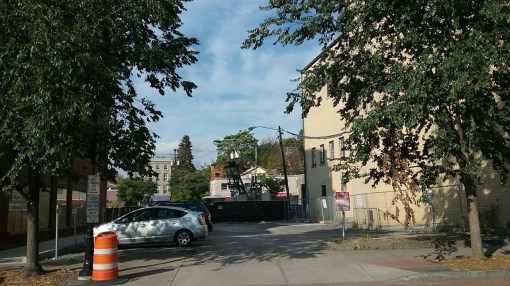


Hilton Canopy Hotel Construction Update, 10/2017

31 10 2017

Tompkins County benefits from being a regional tourism destination. A combination of amenities like the colleges and wineries, scenic gorges and and convenient location have made it a popular weekend getaway from the big cities of the Northeast and Mid-Atlantic, as well as some of the major Great Lakes cities. In the past ten years, the hospitality and tourism sector of the economy has grown over 20 percent, adding several hundred jobs even after seasonality is taken into account. An additional benefit is that the room taxes are used to fund arts and culture grants, community festivals and part of TCAD, the economic development agency.

Representative of that growth has been the growth in the local hotel industry. Around 2014 or so, one of the big questions was, how many hotel rooms is too many? The Marriott was in the works, the Hilton was in an earlier stage, two hotels were planned on the Route 13 corridor, and the Hotel Ithaca had its plans. For practical purposes, it was a good question.

However, the situation evolved over time. As is often the case, the hotels opened later than anticipated. The 159-room Marriott finished late last fall, the 76-room Holiday Inn Express was completed a couple months earlier, the Hotel Ithaca went with an expansion that actually reduced the available number of rooms by ten and opened earlier this year, and one of the suburban hotels, a 37-room independent boutique hotel, was cancelled. They all came onto the market later than expected. and the number of rooms added was less than originally planned. All the while, the economy continued to grow at a consistent 1.5-2% annual pace, Cornell continued to add students and the population slowly grew. Had all the hotels opened at once with their original plans, the impact might have been a big problem. But the reality was that the Hotel Ithaca’s impact was modest, and the HIE’s and Marriott’s supply is being absorbed (though the market does need over a year to fully adjust to a 12.8% growth in supply). For the record, Airbnb and similar services have their impacts as well, but the county estimates it’s the equivalent of roughly 40-60 hotel rooms.

With the market still adjusting to the influx, it’s probably a good thing that the Canopy Hilton isn’t opening until Spring 2019, well after a new equilibrium is achieved. However, it’s been a long road to get to this point.

First, a brief history of the site. In recent years, the Hilton site was a mix of private and municipal parking. From 1916-1993, the Strand Theater occupied the site. The Carey Building was designed to match the Egyptian Revival motif of the theater, but unlike the Carey, the theater closed in the late 1970s, attempted and failed at a reopening as a community theater, and after being vacant for over a decade, the building was deemed too far gone to save, leveled by the wrecking ball during the deep recession of the 1990s.

The first mention of a hotel on the 300 Block of East State/MLK Jr. was back in December 2012. Lighthouse Hotels LLC (Neil Patel) proposed a six-story, $16 million Hampton Inn on the site (v1). The 92-room hotel, designed by Jagat Sharma, would have resulted in the demolition of the Carey Building – recall this was before the Carey overbuild.

However, Patel violated an important rule when it comes to development – unless you have made previous arrangements, don’t propose something for someone else’s property. The proposed Carey demo caught Frost Travis by surprise, and he and parking lot owner Joe Daley were less than amused. Nor were Planning Board members, who were fond of the Carey and not fond of the surface parking proposed with the hotel. The project went nowhere, and a major reworking was required. Negotiations with the city and neighbors were needed to acquire the necessary land, and the IURA and Common Council agreed to have the IURA represent the city on divestiture discussions.

Fast forward 18 months to June 2014. Having hired on Whitham Planning and Design to handle the review process on behalf of Lighthouse Hotels, a new six-story sketch plan was presented (v2). This plan did not impact the Carey (by then undergoing review for the overbuild), and opted for a more modern design by Boston’s Group One Partners Inc., which specializes in urban hotel plans. By August 2014, a site plan review request was formally submitted, along with a modestly revised design (v3) – at the time, the six-story, 120-room hotel was pegged at $11.5 million. These early plans also called for a 2,000 SF retail or restaurant space on the ground level. By this time, Patel was a vice president at Baywood Hotels, a national hotel developer and management firm with over $1 billion in assets, and regional offices in suburban Rochester. The firm is so large, they have 26 hotels currently under development from Miami to Minnesota, but that might be conservative. Their planned downtown Syracuse Hampton Inn isn’t even listed, and the render for the Hilton Canopy Ithaca is out of date.

Technically the phrasing is “Canopy by Hilton Ithaca”. It will be either Canopy or Canopy Hilton on the blog.

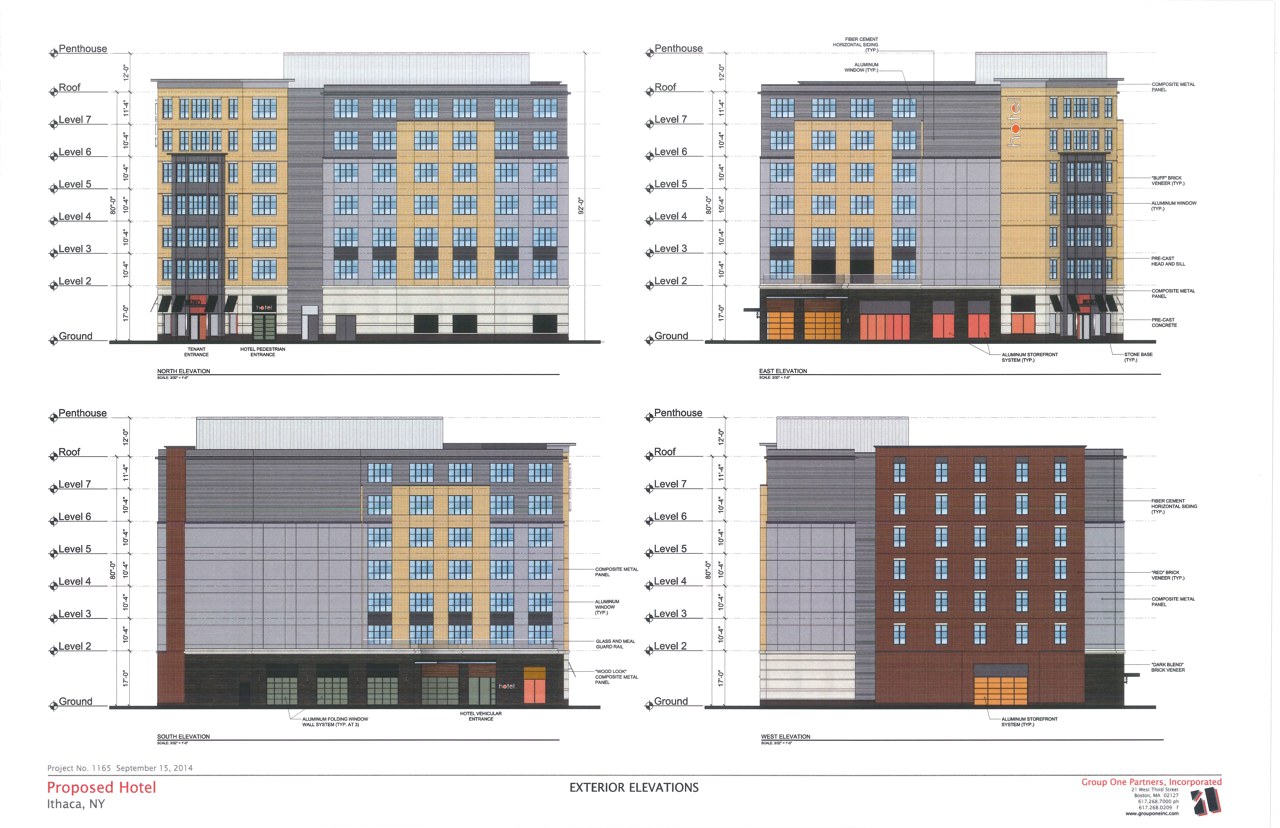
The Canopy brand was launched in October 2014 to be the lifestyle brand geared towards younger leisure travelers. Of the eleven locations announced at launch, Ithaca was the only one not in a major city, and is arguably the only one still not planned for a major city. A month earlier, the newest 74,475 SF, 123-room, 7-story design rolled out (v4), with industrial warehouse-style aluminum windows, buff and “dark blend” brick veneer, stone base with precast concrete accents, and grey fiber cement and metal panels carried over from the previous design. The second floor would open up onto a terrace overlooking the front of the hotel, and the first floor had folding windows that could open the lobby area to the outdoors on nice days. 

By January 2015, the designed had been tweaked some more (V7 in the link, but the changes were pretty minor from V5-V7, facade materials and window treatments), the cost had risen to $19 million, and LeChase Construction was signed on to be the general contractor. In fact, Patel and Frost Travis has even worked out a clever plan to share construction equipment as both their buildings were underway. However, Patel and Baywood’s schedule fell behind Travis’s, so the plan never panned out.

During this time, the project had applied for the IDA’s enhanced tax abatement, and underwent Common Council review after its public hearing in November 2014. While concerns were raised about not paying a living wage to all staff, the council decided the pros outweighed the cons and endorsed the project. Baywood planned to hire 33 to 47 staff, of whom 11-20 would make living wage (multiple sources with different figures). Room rates were expected to be $160/night.

According to the 2015 application, the project’s combined hard and soft costs were $24.17 million, and the property tax abatement (the enhanced 10-year abatement) was $3,528,081. Another $980,928 was waived in sales taxes, and $45,000 from the mortgage tax, for a total tax abatement of $4.55 million. About $3.28 million in new taxes will be generated on top of the existing taxes on the land, along with room taxes and payroll taxes. During the public hearing, attendees went after the project for union labor, living wage and sustainable energy concerns, but the project was still approved by the IDA. They might have switched over to heat pumps, I’ll need to check into that.

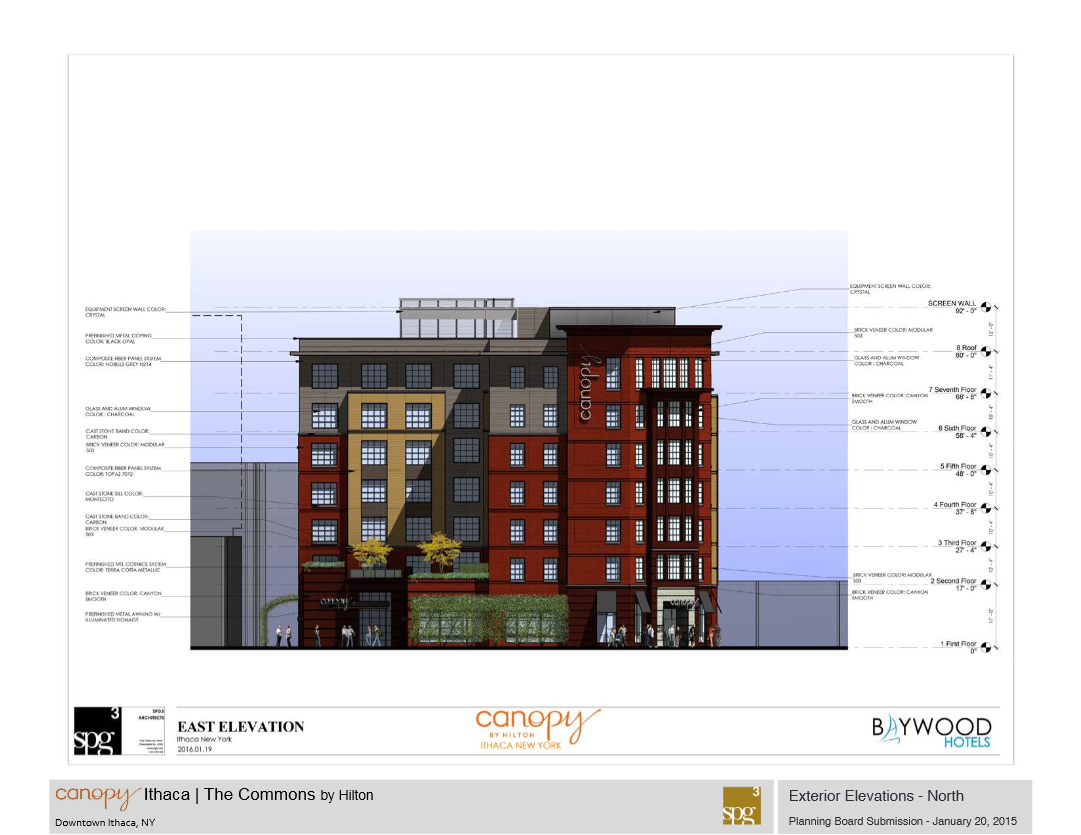
After the original project was approved in March 2015, the city voted to approve the sale of its land in April 2015, and the IDA approved a tax abatement in July 2015, the Hilton plan sat dormant for a while before undergoing a major redesign in January 2016 courtesy of Philadelphia’s spg3 Architects, now Bergmann Associates. It turned out the project had struggled to obtain financing due to rapidly rising construction costs, and underwent some “value engineering”. The general shape was kept the same, but the exterior materials were swapped, the building increased in size to 77,800 SF, the room total was brought up to 131, and the restaurant space was omitted, among other changes. This required re-approval by the city. The much longer comparison is here.

The very last version of the project, V9 in February 2016, added inset panels in the northwest wall, and some cast stone was added to the base. The second floor roof deck was tweaked, a cornice element was added to the mechanical screen, and the trellis and driveway pavers were revised.

The final form is faced with a few different shades of red brick veneer, topaz yellow and grey fiber cement panels, metal coping and cast stone trim. Floor height (ceiling of seventh floor) is 80 feet, while structural height (top of mechanical penthouse) is 92 feet. It’s not really a big impact on the downtown skyline, but it broadens the city’s shoulders a bit.

After approval and IDA approval, things were slow to start. Ithaca Downtown Associates LLC, representing the Patel family, was reorganized slightly to include other family members in the ownership, and afterward it purchased the properties for the hotel project in August 2916. $1.8 million went to the IURA for the parking lots at 320-324 East State Street, and $2.05 million to local landlord Joe Daley for the parking lots on the former Strand property at 310-312 East State Street. A $19.5 million construction loan from ESL Federal Credit Union (formerly Eastman Saving and Loan of Rochester) was received at the end of September 2016, but things were stalled for a while, and only now is the project on its way to a Spring 2019 opening, two and a half years later than initially planned. William H. Lane Inc. of Binghamton will be the general contractor.

Long story, but at least someone wrote it up. Goes to show that property development can be a very complicated process.

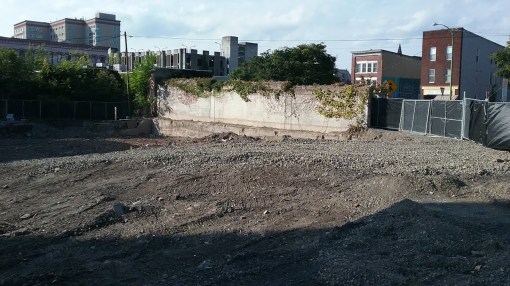
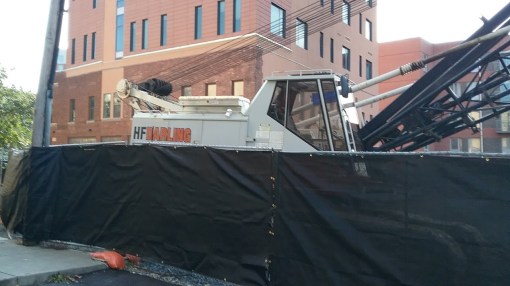
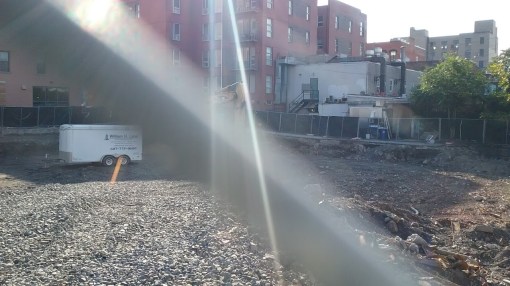
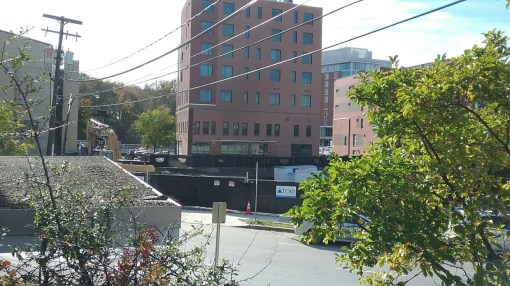
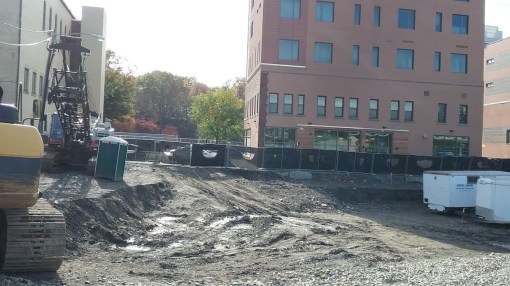
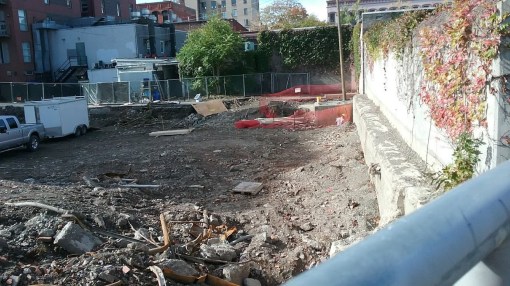
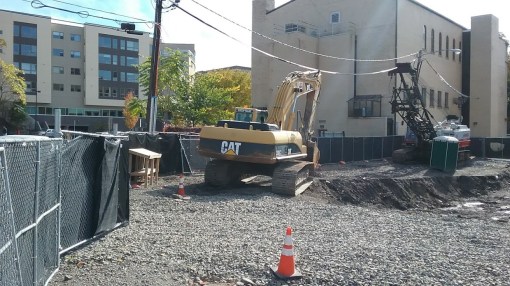
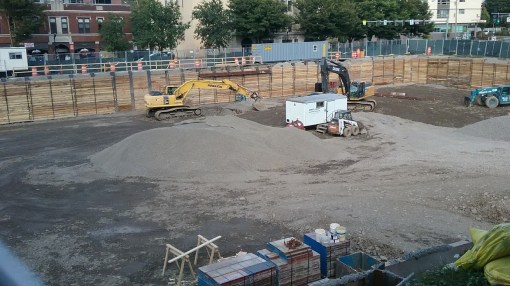
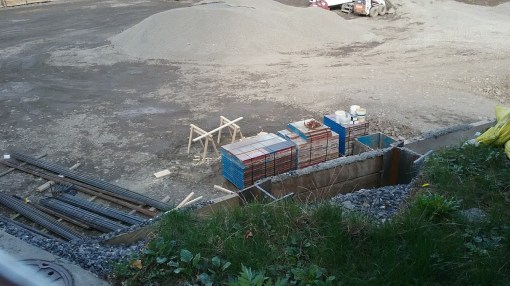
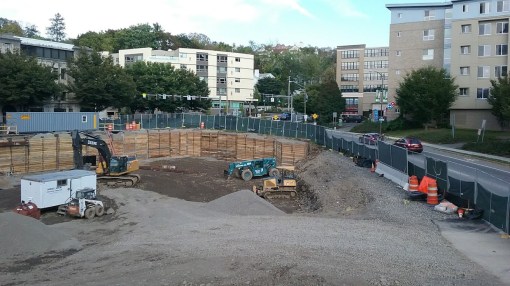
It looks like foundation excavation is currently underway – I had head many of the underground utility work was taken care of when the Carey was under construction next door. A plausible schedule has foundation work done by the end of winter, with structural steel framing underway during the spring and summer.

October 15th:

October 28th:


City Centre Construction Update, 10/2017

26 10 2017

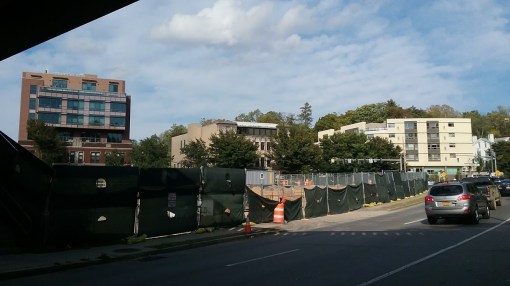
As described in the Voice summary, City Centre is digging deep.

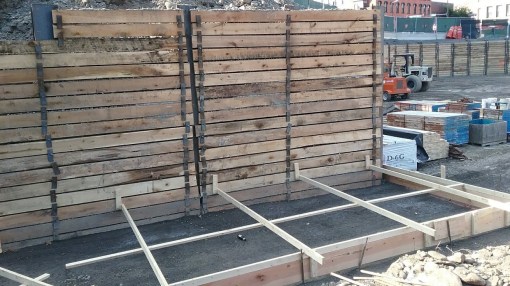
“Unlike the Hilton Canopy, City Centre will have a basement, or more specifically, a 71-space underground garage. The plan here is to use a mat foundation, which is a shallow foundation that doesn’t make use of piles or pile drivers. The company that did the geotechnical report for City Centre reported that a 26-inch mat foundation was feasible based on soil borings, and would be less expensive than a deep pile foundation like the one being used for the Canopy. So basically, excavate some trenches, build some big footers with a lot of rebar, and pour a 26″ concrete slab. Support columns will transfer the weight of the building through the garage and into the slab beneath.

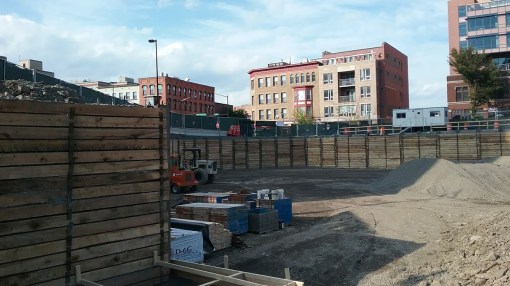
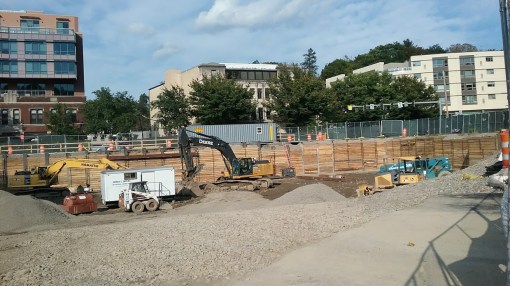
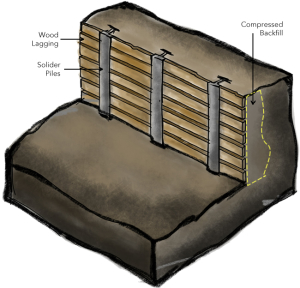
Going past the site right now, excavation work continues, with timber lagging, steel H-beam soldier piles, and steel tieback anchors that extend underneath the streets. The whole point is to reinforce the soil, because no one wants East State or South Aurora Street collapsing into the construction site. Foundations can be complex and time-consuming, and the building may not rise above street level until sometime late in the winter or early next spring. Occupancy of the eight-story mixed-use building won’t be until 2019. According to a construction loan filed with the county this week, M&T Bank is lending $47.9 million to Newman Development Group to complete the project.”

On a hunch while exploring Newman’s project-specific websites, I was able to find City Centre’s website. Morgan Communities of suburban Rochester will be the site manager, and is apparently also hosting the webpages; they’re live, but you can’t find City Centre on their search page yet.

Units will range from a 508 SF studio unit, to a 2 bed/2 bath 1319 SF units with coveted Commons views. Apartment features include quartz countertops, electric stove, microwave, dishwasher, and stainless steel appliances. On-site amenities include fitness center, “E-Lounge”, bike storage, controlled access, optional garage space rentals, electric car charging stations and furnished apartments if requested. Dogs and cats will be allowed. Rents have yet to be listed, though they’re expected to be on the medium-high side (premium, not luxury). The webpage touts Summer 2019 occupancy, which seems to be a split of the Spring 2019 and November 2019 dates used previously. Inquiries are being taken to CityCentreIthaca@morgancommunities.com, if you know someone planning that far ahead.

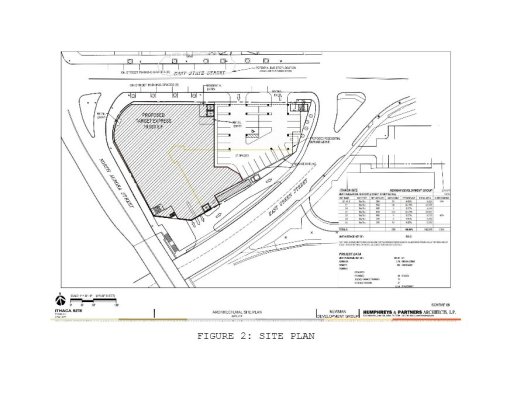
On another note, while poking around the geotechnical report, it turns out that early plans called for the entirety of the first floor to be occupied by a 19,900 SF “Target Express“, the smaller urban cousin to the Target general merchandise retail chain. This had to have been early on, because the parking had a much different configuration than the formal site plan, with an East State Street entrance vs. the South Aurora entrance in all the later revisions. With only nine stores as of mid-2016, Target is pretty selective about new Target Express locations. Why it was removed from City Centre is unclear.


Press Bay Court (108-114 West Green Street) Construction Update, 10/2017

25 10 2017

The tagline used on the Voice was “Press Bay Alley is as quirky as Ithacans like to think they are.” But it’s not just a quip. Press Bay Alley and its upcoming sibling, Press Bay Court, are unusual developments.

Completed in 2014, spaces at the micro-retail plaza on West Green Street range from a 160 SF barbershop to a 2,000 SF confectioner. Other tenants include a novelty store, a cafe, a circus school, an herb/spice shop, a high-tech workshop and electric bikes. Around Halloween, it becomes Harry Potter’s Diagon Alley. It’s an eclectic development by any regard.

Micro-retail is a growing retail trend that offers a unique niche product or a very limited selection of convenience products and services. A shop like Amuse or a service like Ithaca Generator may not need a large space to achieve its business goals, and can save on rental expenses with a limited footprint, compensated by being in a high pedestrian-traffic areas, in this case a couple blocks from The Commons. Similar examples include Memphis’s Edge Alley and Denver’s Dairy Block.

Granted, Ithaca is smaller than Memphis or Denver, but the underlying dynamics of active-use blocks and high foot traffic are present nevertheless, and businessmen John Guttridge and David Kuckuk of Urban Core LLC identified a potential market for the concept in Ithaca. Seeing an opportunity in the former printing press and garages of the shrinking Ithaca Journal, Urban Core, who had recently bought the Journal Building, decided to move forward with a renovation and see if they could make the concept work locally. The risk seems to have paid off, as Press Bay Alley is fully occupied.

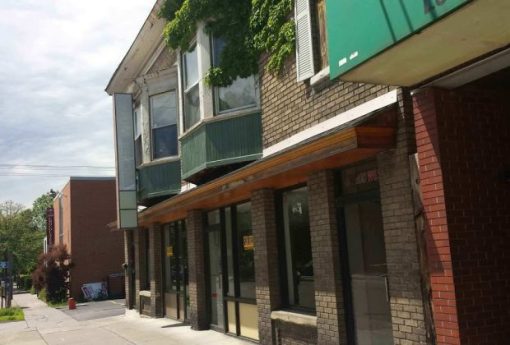
With that under their belt, and with renovations to 121 West State partially completed (waiting on fit-out for a potential restaurant tenant), Urban Core has committed to a second phase of the project at 108-114 West Green Street. Currently vacant, 108-110 West Green housed Hausner’s Garage and a Chevy car dealership in the 1920s (see photo below), a DeSoto-Plymouth dealer in the 1940s, Ithaca Photo from at least the 1950s through the late 2000s, and from 2012-2017, McNeil Music. In the rear where D.P. Dough is (114), The Haunt nightclub called it home from 1969-1997 before moving across town.

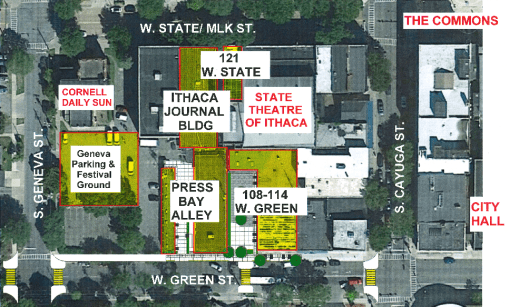
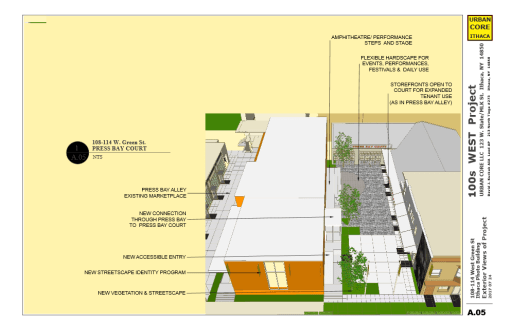
What Urban Core’s latest plans would do is expand that “experiential” micro-retail mix eastward towards the corner of Green and Cayuga Streets, the Commons and the downtown core. The parking lot in front of D. P. Dough would be converted into a plaza much like Press Bay Alley’s, and the first floor of 108-110 West Green would be renovated into 5-8 micro-retail units facing the new plaza (the Green Street entrances would be retained), with 320-2200 SF per unit. The second floor would be renovated into four below-market rate one-bedroom apartments with 510-660 SF of living space, and the exterior masonry would be cleaned and repaired. The hawk mural will be preserved. New signage, bike infrastructure, curbing, sidewalks and a parklet are included in the plans. The total square footage in phase two is about 9,000 SF.

One of the more unusual quirks of Press Bay Court is part of the plaza would be convertible into an amphitheater/stage space for outdoor performances. So if some comedy improv group or local dance troupe wants to perform for an audience of several dozen, that’s an option. The next day, it might revert back to an outdoor seating space with movable furniture and display space for retail tenants. That weekend, it might host hungry or browsing festival goers spilling out from Press Bay Alley, which will be connected through the Press Bay Building. The space will be adaptable and multi-use, which will hopefully provide exposure for tenants.

Later plans call for renovations to the 15,000 SF Ithaca Journal (Market Bay) Building for an indoor arcade and second-floor office tenants, and a 2,400 SF new restaurant tenant in 121 West State Street, in the basement below The Watershed coffee lounge and bar. Ultimately, the goal is to build a thriving, synergistic environment where the businesses create a natural flow of customers and clients between the various shops and services offered on the block, and the outdoor space’s active uses contribute to and help sustain small local enterprises.

The project cost is estimated at about $900,000, most of which went into property acquisition. Financing comes from a Tompkins Trust Company loan, cash/equity, and a $200,000 low-interest loan from the Ithaca Urban Renewal Agency. One of the tenant spaces is being offered in the Downtown Ithaca Alliance’s “Race for Space II” competition, with the specific unit to be selected by the winner.

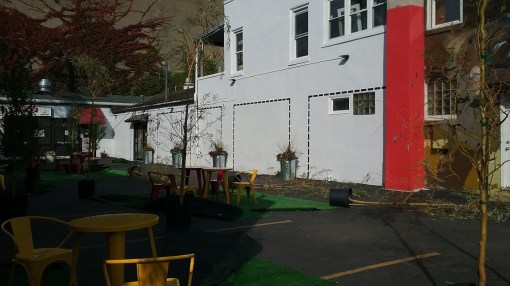
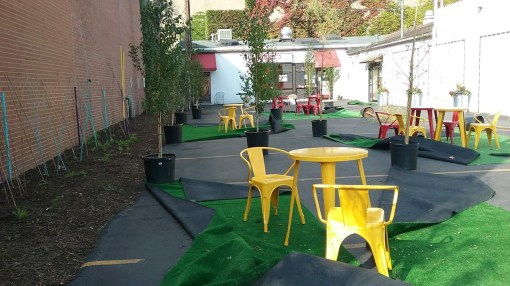
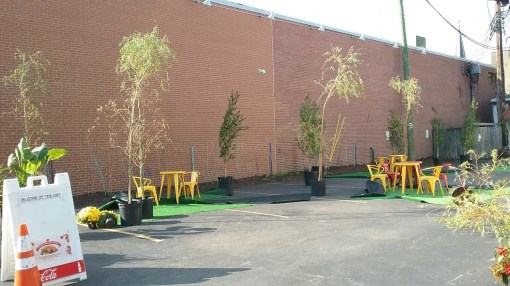
At the moment, not much appears to be happening. The “cut-out” lines are a clever advertisement for the future micro-retail storefronts, while the parking lot is a pop-up park for the time being. According to Press Bay Alley’s Facebook page, “Urban Core popped up a temporary installation to experiment with several design elements and gather public feedback.” Previous plans called for a spring opening, but with the Restore NY Grant under consideration, the project may not start until the Spring, in which case this entry saves the trouble of writing one next March. However, the later start date might force changes to Race for Space II, which asked for the selected tenant to be ready to move in by spring 2018, the same time construction was pushed back to in order to be eligible for Restore NY funds.


News Tidbits 9/16/17: The Big Surprise

16 09 2017

1. Ostensibly, the biggest newsmaker of the past week was the announcement of the Green Street redevelopment in Ithaca’s downtown core. To be frank, I was freaking out at my desk. Even more astounding was that the city slipped it out so casually, embedding it in a monthly PEDC meeting file that typically focuses on more mundane legal and planning concerns.

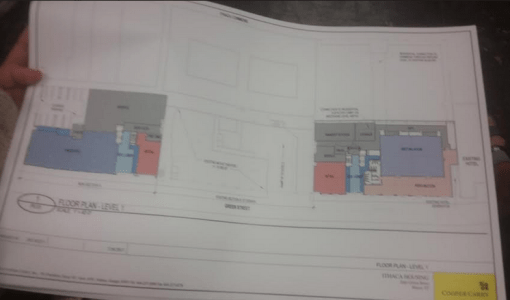
All photos that follow are from Jolene – pardon the marginal quality, we were both in note-taking mode, and these presentation papers weren’t given out to the public. North is towards the top of the floor plan images.

While the documents have yet to be uploaded to the city’s website, some basic details were released during the meeting – the number of parking spaces for the whole complex is 525. There would be two towers with residential units, a U-shaped west tower and a boxy east tower with projecting corners. 15 floors apiece. 350 units, “designed to appeal to a broad demographic”. Abatement likely, with the details to be ironed out as the percentage of affordable units is determined. The middle portion will also have residential units on top of the existing garage. 30,000 SF of conference space is planned under the eastern tower, if my notes are right.

The first floor appears to have at least two retail spaces, a lobby area, and an office, probably for management of the complex. The middle section will retain access to Cinemapolis and the garage. On levels two and three would be rebuilt garage sections (note the center section was rebuilt ten years ago and unlike the ends, is in good shape). Another floor of parking will be added.

Cooper Carry is the architect, and the initial design looks fairly safe, attractive if not particularly inspired. After the Marriott, it’s good to be wary of potential value engineering. It appears to use brick veneer, Nichiha-like metal panels and maybe fiber cement. Also, with Harold’s Square and City Centre off to the left, this would arguably create a broad-shouldered if stubby skyline for downtown Ithaca, more impressive than many communities Ithaca’s size.

My notes are that Marriott co-developer Jeff Rimland had non-public information about the Green Street garage because he owns the ground facilities under the garage’s eastern deck, and would be impacted by renovations. He was made aware of city looking at their options and put something together. The city only learned about the plan four weeks ago, and mayor Myrick wanted to make sure it was brought forward for public discussion and to determine if it was a wise choice to move froward. Ostensibly, if this came out as a surprise, a hornet’s nest of opposition would be stinging. Being transparent now helps later.

It seems the intent is an RFP for the garage for the sake of fairness, but I dunno how effective that will be. Rimland has a big advantage as owner of a portion of the parcel, since any other developer would need to arrange legal agreements with him in order to carry out a project. It was suggested by Brock, who has never been a fan of development, and I cynically wonder if this was an attempt to ensnare or at least stall the proposal. An RFP does put the city in a more legally comfortable position, perhaps. On the flip side, I cringe at the thought of another Old Library-like mess.

On a final note, there’s also a name, seen in the lower right of the rendering – “Village on the Green”. Very punny guys.


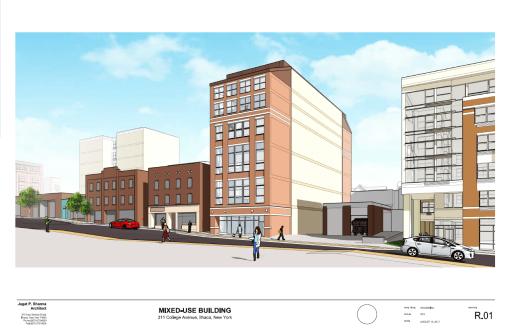
2. The other big news item of the week was 311 College Avenue, more commonly referred to as “The Nines replacement”. The Nines is a much-loved restaurant and bar that has long been a part of Collegetown’s drinking and musical scene – in the late 2000s, if I had to describe Collegetown bars, where Johnny O’s was the “fratty frat” bar and Chapter House the erudite tweed-clothed crowd, The Nines was the laidback, indie band geek-turned-rocker. Add in its location in a ca. 1908 fire station, and one of the few sizable outdoor patios in Collegetown, and one can understand that a project on this site was never going to be warmly received.

Granted, I’ve been raked over the coals a couple of times for the article, whose first headline said The Nines was being kicked out. It was an honest copy-editing mistake. For breaking news I publish ASAP, like with the Green Street development. However, that’s discouraged because the business pieces are useful for filling slow periods during the day, or to give time for others to prep articles during the early morning. Many of my articles are written in the late evening, submitted to the schedule, and skimmed through before hitting the website. In this case, I submitted Sunday night, my editor Jolene read through it early Monday morning, she thought the opening lines implied an eviction and changed the title (the original was a generic “Apartments Proposed for The Nines”). Sometimes title get changed for clarity or Search Engine Optimization (SEO), but this particular time it created a false statement. I didn’t see it until I was at work on Monday, and uncomfortable conversations ensued. Sorry all. The next article won’t wax poetic.

Anyway, with that error noted, it makes this next opinion segment more uncomfortable. I’m not a developer. But if I were one, and heard the property was being put up for sale, I’d probably have steered clear. With all due respect to Todd Fox, my gut feeling is that the cons outweigh the pros.

Ithaca is not an easy city to do a project in. A developer has to pick and choose their battles. In this case, the battle is taking a building with some degree of historic value, but more importantly a lot of local sentiment attached, and proposing to replace it with, frankly, a mediocre design with high-end student units. I understand the economics of the site, the market, and the unfortunate though economically necessary impacts building flush to lot lines has on the ability to install windows on the sides. My concern is external impacts, by creating an emblem for opposition to organize around, because it wraps several perceptibly negative impacts into one proposal. That may make future projects that much more difficult. I worry that whenever a controversial plan is brought forth in years ahead, it will be pejoratively described by NIMBY types as “just like that Nines replacement”.

It has taken years for Ithacans to become slowly more amenable to density and development. Proposals that inadequately address community concerns threaten that progress. Consider the case of Jason Fane. He toyed with the city plenty of times. Eventually it caught up to him and he got burned. The sad part is, 130 East Clinton was a solid project, and to this day I believe that had it been another developer, those apartments would have been built.

Anyway, the ILPC would like to preserve it as-is, which draws the question why the discussion never moved forward 18 months ago when they had the chance. I don’t think that’s likely at this stage, and an overbuild probably wouldn’t work due to development costs (foundation shoring, elevator if 4+ floors) with respect to developable area – the big front yard setback is an impediment to that. I heard that an offer was floated to Neil Golder to move his house at one point during the 201 debate, so maybe moving all or at least the front (1908 wing) of the old station No. 9 is possible, but the expense would be great. As for the new building’s design, maybe modest fixed windows in the north/south brick faces, or glass block features like on Sharma’s 307 design, or even something as minor as a mural on the CMU blocks would help.

But, all that might be grasping at straws. This was always going to be controversial. I won’t fault someone for seeing an opportunity, even if it’s not a plan I’d advocate. It all depends on one’s appetite for development opportunities, and sensitivity to potential blowback.

3. For sale: 405 Elmira Road. 0.74 acres of parking lot next to Buttermilk Falls Plaza. List price: $465,000, courtesy of Pyrmaid Brokerage. Also noting – the chain hotelier who bought the former Tim Horton’s next door from the same seller for $640k in January 2016. Timmy Ho’s 0.75 acres is a little small for a hotel on its own, but combined with this lot, suddenly plans start to look quite viable for a mid-sized chain in the city’s suburban-friendly SW-2 zoning. Someone else may come along and buy it, but let’s see what happens.

4. It appears the 24-unit Pineridge Cottages project is off the table. The project, planned for the corner of Mineah and Dryden Roads in Dryden town, was greatly scaled back by developer Ryzward Wawak after water tests led to concerns about having enough to supply all the units. At this time, the plan is for four cottages, each a two-bedroom unit.

5. The Times’ Matt Butler has a nice summary and brief interview with Lakeview Health CEO Harry Merriman regarding the 60-unit affordable housing plan for 709-713 West Court Street. Some of the obstacles the project faced wouldn’t be a surprise to readers of this blog – the soils require a more expensive deep (pile) foundation, and land acquisition costs are climbing, which increases the overall costs involved with bringing a proposal into reality, let alone a plan that focuses on affordable housing. The increase in units from 50 to 60 was driven by the need to balance out revenue with expenditures and make the affordable housing economically feasible. Incremental cost increases per unit are significantly less than overall structural costs, so the per-unit expense for 60 units is less than 50, making the project more appealing in competitive grant processes.

Of the 22 units to be set aside for formerly homeless individuals, six will be reserved for HIV-positive clients of STAP, the Southern Tier Aids Programs. Those infected with HIV tends to experience much higher homelessness rates than the general population, with at least 81 homeless HIV-positive individuals in Tompkins County alone. This makes it hard to do things like refrigerate medication. These six units are a small number perhaps, but for those six folks it will make a huge difference.

6. Another feather in the cap of the local STEM sector of the economy. Biotech startup Jan Biotech Inc., based out of the Cornell Business Park by the airport, has received a $3 million grant from the National Institute of Health (NIH) that will be used in the research and production of an HIV diagnostic for detection and quantification of latent HIV-infected reservoirs in patients –  cells that have the virus but aren’t actively producing HIV, which current anti-retroviral therapies struggle with. Potentially, the diagnostic could help test new medicines for their ability to target those cells, and lead to a true cure for the virus before AIDS can occur.

Along with new equipment and renovated facilities, the grant is expect to result in the hiring of another 5 to 10 scientists and engineers for the four-person firm. Which is great, but truly, it’s their work to try and improve our treatment and medicine of a deadly virus that’s more important. The very best of luck to them.

7.  A bit of news from the Cornell Daily Sun regarding the additional 2,000 beds Cornell would like to build on its North Campus, as part of its freshman expansion and “Sophmore Village” plan. The university would like to begin construction on the first dorms in 2018, and start increasing student enrollment by 2020. For that to happen, the plans pretty much need to come forward for formal planning board review within the next few months. Presumably, they’d like to have the dorms ready by August 2019 – these will be used as flex space initially, so that existing dorms like Balch and Clara Dickson can start renovation. At a bare minimum, it takes three months to go through the city planning board. Given this project’s proximity to Cayuga Heights, the local patricians will want to have their say as well, even if it is just outside village lines. With the size of the project and a minor amount of inter-municipal complexity, four months from sketch plan to approval seems realistic. Considering the need to request and award contract bids, it would seem plausible that Cornell puts the dorms forward this fall for review, with approval expected by late winter. Bids would be requested and awarded during the Spring, and construction would start by June. Whatever the case, the first construction plans are likely not far off.


The Maplewood Redevelopment, Part II: Site Plan and Layout

3 09 2017

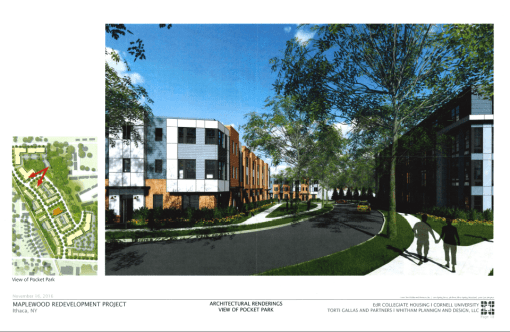
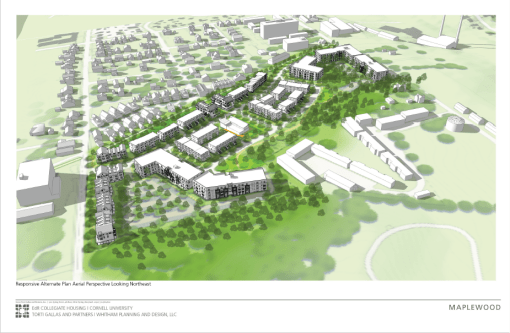
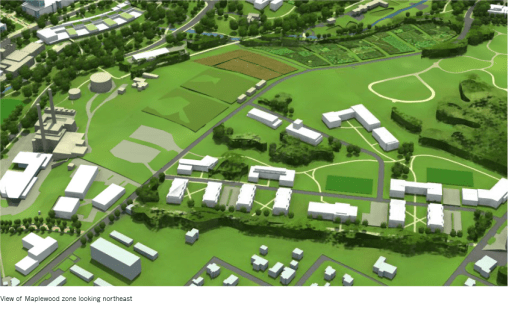
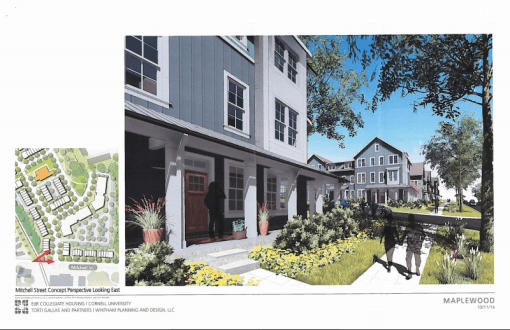
Unlike most projects, Maplewood is basically an entire new neighborhood – there are five large apartment buildings, 21 townhouse strings, and the community center, for a grand total of twenty-seven buildings. The building elevations for each structure can be found in Building Set Plans 1-3, on the town of Ithaca’s website here.

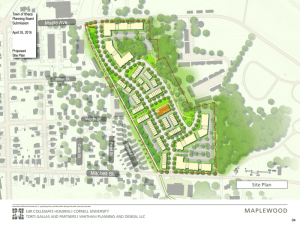
The pretty version of the site plan, from STREAM Collaborative, has most of the buildings pretty clearly labeled, but is a little outdated – the townhouses along Mitchell were added late in the process, and were not labelled here. However, this is the easiest diagram to follow, and highlights some of the landscaping features of the project. The childrens’ play area is located at the intersection of James Lane (the north-south road) and Lena Street (the east-west road). The overlook is a natural area at one of the highest elevations of the property, and the community garden is at the turn of James Lane. The bus stop/food truck area, unlabeled here, is the intersection of Maple Avenue and Veterans’ Way. The knoll between apartment buildings D, E and F is the location of the Mitchell family cemetery plot, last active in the 1850s.

Here is the more accurate but less attractive site plan. The townhouses along Mitchell have been renamed, but otherwise everything else is the same. Notably, there is no apartment building “A”. “A” was the multi-story building along Mitchell Avenue that was removed late in the planning process. In short, five multi-story buildings, B, C, D, E, and F. Then there are the townhouses, to be covered in detail in the next section.

The Townhouses

The townhouses are all 2-4 bedrooms. Counting them all off, there’s At, Bt, Ct, Dt, Et, Ft, Gt-1, Gt-2, Ht-1, Ht-2, It-1 and It-2, Jt-1 and Jt-2, Kt-1 and Kt-2, Lt, Mt, Nt, Ot, and Pt. The color coding is for easy reference.

Each uniquely-lettered string is its own design. The Gt’s, Jt’s, and Kt’s are near-identical twins exception for unit layout and building elevation steps to accommodate slopes. The more traditional-looking Ht-1 and Ht-2, and It-1 and It-2 strings are mirror images of their same-lettered counterpart.

The modern-looking townhouses use a brick veneer, light and dark fiber cement panels and lap siding, cast stone accents and wood canopies, along with concrete foundations and stairs. The more traditional townhouse strings (Ht’s, It’s, Nt, Ot, Pt) are finished with fiber cement siding and trim boards. All townhouses are 2.5-3 stories in height. Modern townhouse strings At, Dt, Et, Gt-1 and Gt-2 take advantage of the site’s slope to employ rear garages tucked into the hillside.

The ones with integrated garages (At, Dt, Et, Gt1/2’s) are all 3-bedroom units. At is 4 units, Dt is 5 units, Et is 6 units, and the Gt’s are 7 units each.

Two of the modern townhouse units have no garages and large full-length setbacks on their third floors. This includes Bt (4 units) and Lt (5 units). They are all three-bedroom units.

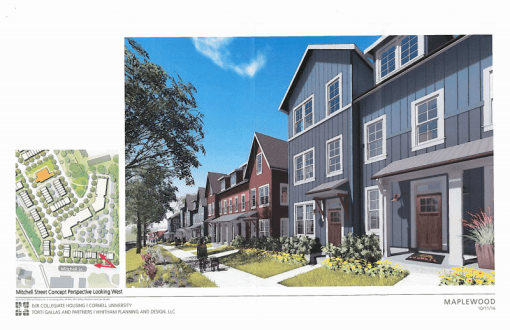
Five of the modern strings have no garage and full-length top floors. These are 4-bedroom units, like Ct (4 units), Ft (6 units) and Mt (6 units). Kt-1 and Kt-2 (Kt-1 shown in the render above) have three stacked flat 2-bedrooms on each end of the townhouse string (the first floor is one 2-bedroom unit, and the other two-bedrooms are stacked over it), and 4 four-bedroom units in the middle, for ten units each.

Then there are strings that a mixture of setbacks and no setbacks. Jt-1 and Jt-2 have 11 units apiece – 3 2-bedroom stacked units on each end of the string for a total of 6 2-bedroom units, and 3 three-bedroom and 2 four-bedroom units are wedged in between. The three-bedrooms lack a rear bedroom on the top floor.

Now the traditional units. Ht-1 and Ht-2 appear to be 7 units each – 4 3-bedrooms, 3 2-bedrooms in a stacked flat format. They are separated by the West Sylvan Mews (and the small street next to the Community Center is called East Sylvan Mews). It-1 and It-2 are almost the same as the Ht’s, but the end unit is a bit larger, resulting 4-bedrooms instead of three (for a unit total per building of 3 2-bedrooms stacked, 3 3-bedrooms, 1 4-bedroom). Nt is the same as It, but with one less three-bedroom in the middle, resulting in a total of six units – three stacked flat two-bedroom units, two three-bedrooms, and one four-bedroom unit. Lastly, Ot and Pt are the same basic design, except Pt has one more unit in the middle. Ot is clad in green siding and has 4 three-bedroom units, and Pt is clad in red siding and has 5 three-bedroom units.

The Apartment Buildings

These should be easier to follow along with, as they were labelled from south to north. All multi-story apartments use the modern design motif. The buildings generally have the same floor plan for each full floor, except for utilities/storage rooms, and that the first-floor lobby is the location of the community study room on each floor directly above.

Building B is a 4-story, L-shaped building. The building will contain 4 two-bedrooms, 2 three-bedrooms, 1 one-bedroom and 11 studios per floor. Assuming one bed/resident per studio and one per bedroom otherwise, that means 72 units and 104 beds.

Building C is a 4.5 story, J-shaped building with a partially exposed basement level. The basement has 2 two-bedroom units, one one-bedroom unit and two studio units. Each of the four upper floors has 5 two-bedroom units, 4 one-bedroom units, and 4 studio units. That results in 57 units and 79 beds.

Building D is a 4-story. L-shaped building with 4 three-bedrooms, 2 two-bedrooms, 5 one-bedrooms and 3 studios per floor. At full occupancy, Building D’s 56 units will have 96 beds.

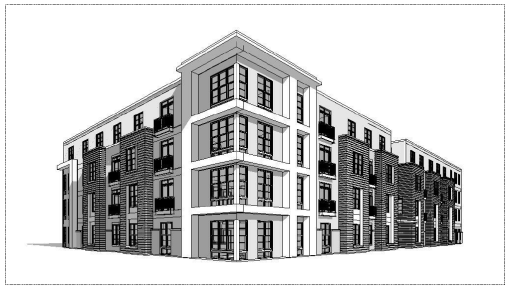
Building E (shown above) is a 4-story, L-shaped building. The corner facing Maple Avenue and Veteran’s Way will have a small retail space; the same space on the second through fourth floors is a two-bedroom unit. Overall, the building will have 16 three-bedroom units, 7 two-bedroom units, 16 one-bedroom units and 28 studios (about 106 beds).

Building F is a 4.5 story, I-shaped building. The habitable basement has 1 two-bedroom unit, 1 one-bedroom, and 3 studios. Each of the upper floors has 3 three-bedroom units, 2 two-bedroom units, 4 one-bedroom units, and 3 studios. The final sum is 53 units and 78 beds. In sum, the apartment buildings will provide 305 units and 463 beds.

The community center is something of a question. It looks like two floors with a 100′ x 65′ footprint, but I haven’t seen an exact square footage beyond early approximations of 5,000 SF.


The Maplewood Redevelopment, Part I: History and Planning

28 08 2017

Being as large and complex as it is, it was hard to figure out a way to present the Maplewood project clearly and coherently. After some thinking, it seems the best combination of clarity and detail will be to split it into three sections. This section, Part I, will be an overview of the site history and project planning. Part II will examine and break down the site plan with all of its contributing structures. Part III will be the regular construction update, which will be bi-monthly just like all the others.

Quick primer note – Maplewood Park was the name of the old complex. The new one is just called “Maplewood”. With the shorthand for Maplewood Park being Maplewood, it can get confusing.

Let’s start with the background. Love it or not, Cornell University is one of the major defining organizations of the Ithaca area. It employs nearly 10,000 people and brings billions of dollars in investment into the Southern Tier, Tompkins County and Ithaca. That investment includes the students upon which the university was founded to educate.

Traditionally, neither founder Ezra Cornell nor first university president Andrew Dickson White were fans of institutional housing. Their preference was towards boarding houses in the city, or autonomous student housing (clubs, Greek Letter Orgs, etc), where it was felt students would learn to be more independent. This mentality has often underlain Cornell’s approach to housing – it’s not a part of their primary mission, so they only build campus housing if they feel it helps them meet academic and institutional goals. If many potential students are opting for other schools because of housing concerns, or the university is under financial strain because it has to subsidize high housing costs in their scholarships, then Cornell is motivated to build housing in an effort to improve its situation and/or become more competitive with peer institutions.

With that in mind, being one of the top-ranked schools in the world means that, in the historical context of the university’s goals and plans, new housing is rarely a concern. Cornell will update housing in an effort to be more inclusive and to improve student well-being, but with labs, classrooms and faculty offices taking precedence, building new housing is rarely an objective. Only about 46% of undergrads live on campus, and just 350 of over 7,500 graduate and professional students.

From 2002 to present, Cornell has added 2,744 students, with a net increase in Ithaca of about 1900. The net increase in beds on Cornell’s Ithaca campus during that same time period is zero. While Cornell did build new dorms on its West Campus, they replaced the University “Class of” Halls. 1,800 beds were replaced with 1,800 beds. In fact, the amount of undergraduate and graduate housing on campus had actually decreased as units at Maplewood Park and the law school Hughes Hall dorm were taken offline, either due to maintenance issues, or for conversion to office/academic space. When the announcement for further decreases came in Fall 2015, I wrote a rare Ithaca Voice editorial, and even rarer, it brought Cornell out to the proverbial woodshed for poor planning and irresponsibility.

To be fair, while Cornell was the guilty body, removing housing isn’t a problem on its own. It’s when the local housing market can’t grow fast enough to support that, that it becomes a problem. The Tompkins County market is slow to react, for reasons that can be improved (cumbersome approvals process) and some that can’t (Ithaca’s small size and relative isolation poses investment and logistical hurdles). In the early and mid 2000s housing was added at a decent clip, so the impacts were more limited. But housing starts tumbled during and after the recession, and it was unable to keep up. As Cornell continued to add students in substantial quantities, it became a concern, both for students and permanent residents.

By the mid-2010s, Cornell was faced with financial strains, student unhappiness and worsening town-gown relations, all related to the housing issue. As a result, the past couple years have become one of those rare times where housing makes it close to the top of Cornell’s list of priorities.

In weighing its options, one of the long-term plans was to redevelop the 17-acre Maplewood Park property. The property was originally the holdings of an Ellis Hollow tavern keeper and the Pew family before becoming the farmstead of James and Lena (sometimes Lyna) Clabine Mitchell in the early 1800s. In 1802, James was passing through from New Jersey to Canada with plans to move across the border, but stopped in the area, liked it, and bought land from the Pews, then moving the rest of his family up to Ithaca. Apparently there’s a legend of Lena Mitchell attacking and killing a bear with a pitchfork for eating her piglets. Many of the home lots in Belle Sherman were platted in the 1890s from foreclosed Mitchell property.

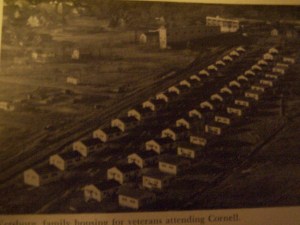
Like many of the Mitchell lands, it looks like the property was sold off around 1900 – a Sanborn map from 1910 shows a brick-making plant on the property along the railroad (now the East Ithaca Rec Way) and not much else for what was then the city’s hinterland. It’s not clear when Cornell acquired property, but by 1946, Cornell had cleared the land to make way for one of their “Vetsburgs”, also known as Cornell Quarters. The 52 pre-fabricated two-family homes were for veterans with families, who swelled Cornell’s enrollment after World War II thanks to the GI Bill. Once the GIs had come and gone, Cornell Quarters became unfurnished graduate housing, geared towards students with families, and international students.

The Cornell Quarters were meant to be temporary, and so was their replacement. In 1988-89, the university built the modular Maplewood Park Housing, with 390 units/484 beds for graduate and professional students, and an expected lifespan of 25 years. The intent was to replace them with something nicer after several years, but given Cornell’s priorities, and housing typically not among them, it fell to the back burner. As temporary units with marginal construction quality and upkeep, poor-condition units were closed off in later years, and capacity had fallen to about 356 beds when the complex’s closure was announced in May 2015 for the end of the 2015-16 academic year.

Cornell had long harbored plans to redevelop the Maplewood site – a concept schematic was shown in the 2008 university Master Plan. After weighing a renovation versus a rebuild with a few possible partners, the university entered into an agreement with national student housing developer EdR Trust to submit a redevelopment proposal. The partnership was announced in February 2016, along with the first site plan.

The core components of the project were actually fairly consistent throughout the review process. The project would have 850-975 beds, and it would be a mix of townhouse strings and 3-4 apartment buildings, with a 5,000 SF community center to serve it all. The project adheres to New Urbanist neighborhood planning, which emphasizes walk-ability and bike-ability, with interconnected and narrow streets, and parking behind buildings rather than in front of them. Energy-efficient LEED Certification was in the plans from the start.

However, the overall site plan did evolve a fair amount, mostly in response to neighbor concerns raised through the review process. Many residents on or near Mitchell Road were uncomfortable with multi-story buildings near them, so these were pulled further back into the complex, and late in the process the remaining Mitchell Street multi-story buildings were replaced with very-traditional looking townhomes with a smaller scale and footprint. More traditional designs were also rolled out for the pair of townhouse strings closest to Worth Street, since neighbors noted they would be highly visible and wanted them to fit in. The building planned in the city’s side was also pulled inward into the parcel early on due to neighbor concerns – it became an open plaza and bus stop. The university was fairly responsive to most concerns, although the most adamant opposition didn’t want any multi-story units at all, and really preferred as few students and as few families as possible.

For the record, that is every site plan I have on file. Go clockwise from top left for the chronology. So from beginning to end, there were at least five versions made public. The final product settled on 442 units with 872 bedrooms, with units ranging from studios to 4-bedrooms.

It’s also worth pointing out that the town of Ithaca, in which the majority of the property lies (the city deferred the major decision-making to the town), had a lot of leverage in the details. The town’s decades-old zoning code isn’t friendly to New Urbanism, so the property had to be declared a Planned Development Zone, a form of developer DIY zoning that the town would have to review and sign off on. Eventually, the town hopes to catch up and have form-based code that’s more amenable to New Urbanism. The town also asked for an Environmental Impact Statement, a very long but encompassing document that one could describe as a super-SEQR, reviewing all impacts and all mitigation measures in great detail. The several hundred pages of EIS docs are on the town website here, but a more modest summary is here. If you want the hundreds of pages of emailed comments and the responses from the project team, there are links in the article here.

Some details were easier to hammer out than others. The trade unions were insistent on union labor, which Cornell is pretty good about, having a select group of contractors it works with to ensure a union-backed construction workforce. Also, at the insistence of environmental groups, and as heat pumps have become more efficient and cost-effective, the project was switched from natural gas heat to electric heat pumps, with 100% of the electricity to come from renewables (mostly off-site solar arrays).

Taxes were a bit more delicate, but ended up being a boon when it was decided to pay full value on the $80 million project. It was a borderline case of tax-exemption because Cornell would own the land and EdR would own the structures, and lease the land for 50 years; but Maplewood Park was exempt, so it could have been a real debate. Instead, EdR said okay to 100% taxation, which means $2.4 million generated in property taxes on a parcel that previously paid none. Some folks were also concerned if the schools could handle the young child influx, but since Maplewood Park only sent about 4 kids to the elementary school on average, and the new plan would send 10 students when the school has capacity for another 26, so that was deemed adequate.

On the tougher end, traffic is a perennial concern, and Cornell wasn’t about to tell graduate and professional students and their families to go without a car. Streetscape mitigations include raised crosswalks, curbing, and landscaping, EdR is giving the town $30,000 for traffic calming measures (speed humps and signage) to keep the influx of residents orderly and low-speed. A new 600,000 gallon water tank also has to be built (planned for Hungerford Hill Road).

One of the thorniest issues were the accusations of segmentation, meaning that Cornell was falsely breaking their development plans up into smaller chunks and hiding their future plans to make the impacts seem smaller. This has come in the context of the Ithaca East Apartments next door, and the East Hill Village Cornell is considering at East Hill Plaza. However, neither were concrete plans at the time, and still aren’t – to my understanding, Cornell had some informal discussions about Ithaca East but decided against it early on in the process. And they only just selected a development team for EHV.

In the end, many of the concerned neighbors and interest groups were satisfied with the changes, and actually lauded Cornell and EdR for being responsive. The EIS was formally requested in May 2016. The Draft EIS was accepted in August 2016, public meetings on it were held in October, and the Final EIS was submitted at the end of October. After some more back-and-forth on the details (stormwater management plan, or SWPPP), the Final EIS was approved right before Christmas and the project was approved in February 2017, starting work shortly thereafter for an intended August 2018 completion. With the wet summer, the project managers asked for a two-hour daily extension on construction (8 am-6 pm became 7 am -7 pm) to meet the hard deadline, which the town okayed with a noise stipulation of less than 85 decibels.

Rents for the project, which include utilities, wireless and pre-furnished units, are looking to range from $790-$1147 per bed per month, depending on the specific unit. Back of the envelope calculations suggest affordability at 30% rent and 10% utilities, for 40% of income. Cornell stipends currently range from $25,152-$28,998, which translates to $838-$967/month.

On the project team apart from Cornell and Memphis-based EdR are Torti Gallas and Partners of Maryland, New Urbanist specialists who did the overall site plan and architecture. Local firms T.G. Miller P.C. is contributing to the project as structural engineer, and Whitham Planning and Design is the site plan designer, landscape planner and boots-on-the-ground project coordinator for municipal review. Brous Consulting did the public relations work, and SRF & Associates did the traffic study. Although not mentioned as often, STREAM Collaborative did the landscape architecture for the project. The general contractor is LeChase Construction of Rochester.

So that’s part one. Part two will look at the structures and site plan itself. And then with part three, we’ll have the site photos.


News Tidbits 8/24/17: Early Start

24 08 2017

1. The Old Library redevelopment is creeping forward. The Old Library Committee of the Tompkins County Legislature voted to recommend the sale of the property for the previously stated amount of $925,000 to Travis-Hyde. With that vote, it goes forward to the full legislature for a vote on September 5th, where there are no major challenges expected. The Library Committee vote was 4-1, with legislator Dooley Kiefer (D-Cayuga Heights) opposed. Kiefer has always been opposed to any sale, and has long advocated for a lease of the land – and the only way the lease made any practical sense was by being 50 years in length, so that any investment could have the possibility of being recuperated. Given that she’ll probably vote no again for consistency’s sake, and perhaps a rejection from legislator Anna Kelles (D-Ithaca) because she was a long-time proponent of the condo plan, there aren’t likely to be any other opposition votes from the 15-member legislature. Once the sale is okayed, site prep for the 58-unit mixed-use senior facility at 310-314 North Cayuga Street can begin by the end of the year, with a spring 2019 opening expected.

2. So when is an expansion truly an expansion? That’s the question raised by the Times’ recent coverage of a proposed renovation of the county jail, which faces issues with overcrowding, but whose expansion of holding cells is strongly opposed by a number of advocacy groups. The jail is shared with the Sheriff’s Department offices at the moment, and the combined facility at 779 Warren Road is collectively referred to as the Public Safety Building.

The ideal concept as pitched by the Sheriff’s Office would create an additional 13,000 square-foot administrative facility adjacent to the jail that would provide office space, conference space and locker rooms for officers. This would free up programmatic space in the PSB to be used for support functions like classrooms and counseling/meeting rooms, with the ultimate goal of reducing recidivism (the tendency of a convicted criminal to re-offend, and thus take up space in the jail). So,it’s  not a jail expansion per se, but a support services expansion, which would probably drive debate among advocacy groups. The proposal is strictly conceptual, but the county is prepared to move forward with a formal study from LaBella Associates if requested.

3. At the latest Planning Board meeting, Lakeview’s 60-unit supportive and affordable housing plan was granted the green light to go forward to the next step, though not without reservation and concern from some local business owners and elected officials. Per the Times’ Matt Butler, 1st Ward councilors Cynthia Brock and George McGonigal spoke in opposition to the current plan, feeling it was too large and unattractive, while nearby business owners were uncomfortable with the population who would live there. 30 units would be set aside for those who are mostly independent but may need some degree of mental health support, 22 units are general affordable housing, and eight are for formerly homeless individuals. All units are one bedrooms. Lakeview will provide office and support space for services on the first floor of the 62,700 SF building.

In other news, the debate over South Hill continued with the airing of grievances against student housing, Finger Lakes ReUse earned approval for its Elmira Road project, and someone must have left early, because the planning board failed to reach quorum (minimum attendance) to vote on recommendation of historic designation for the Chacona Block at 411-415 College Avenue.

4. Here’s an interesting little proposal out of Danby – a 10-unit pocket neighborhood. The project would be located on 2.2 acres at the rural intersection of Brown Road and Short Road, northeast of the hamlet of West Danby. The houses would be modular and modestly-sized with two basic styles, a 1.5-story cape and 1-story ranch. Additionally, they would be designed for aging-in-place, Net Zero Energy (zero net energy consumption), and have a shared common space (courtyard, lawn or similar), parking lot and septic system. The project, which has access to municipal water service, would require a zoning variance. The project is similar to the Amabel and Aurora Street pocket neighborhoods in Ithaca, though it’s a different developer – here, it’s Mike McLaughlin, a business owner from Newfield, and Danby residents Esther and Brooke Greenhouse. Esther was a team member in the condo proposal for the Old Library site.

Although not explicit, these are likely for-sale units, possibly with a push towards seniors. With shared spaces, modular components and modest sizes, the cost for these is likely to be modest as well – they would likely be similar to the Lansing Community Cottages price range of $175k-$225k.

5. After much debate, the Sun8 Dryden solar projects have been approved by the town planning board. The sites include a nearly 11 MW facility at 2150 Dryden Road, and an 18 MW facility along Turkey Hill and Dodge Roads. The projects will produce approximately 28 MW of electricity, which is enough to power the approximately 7,500 households. The project will utilize a Payment In Lieu of Taxes (PILOT) of $8,000/MW, or about $224,000 in year one of operation, and with built-in inflation, about $8 million over 20 years.

Meanwhile, the town has begun review on a much smaller solar project at 2243 Dryden Road. Delaware River Solar is seeking approval to construct a 2.4 MW array on the interior portion of a farm property just west of the village near Ferguson Road. About 35 acres of the 115 acre parcel would be impacted during construction, with five acres used for the panels themselves.

6. In real estate listings, here’s something unusual for those who dare to be different – a Groton church, already renovated with living space and studio space. Aptly-located 113 Church Street is listed at $174,900 and 9,490 square feet on Zillow, but a check of county records says 9,166 SF – a 1,000 SF apartment, a 1,344 SF office, 4,078 SF “non-contributing space”, and 2,744 SF “cold storage”. The property was built in either 1881 or 1883 (county record) for a Congregational denomination, and after some mergers in the 1960s it became the Groton Community Church. From records and county file photos, it looks like the church building was re-purposed in the late 1990s or early 2000s. Previous tenants include a head start program, massage therapy, and art gallery. The tax assessment is for $100k, which seems to account for the old and somewhat mothballed condition of the property, such as the boarded up windows on the steeple tower. Should one be interested, contact info can be found in the first link.

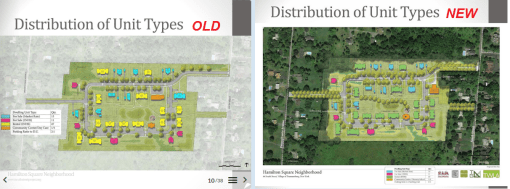
7. This week’s news round-up is running a little early because I wanted to get the latest Trumansburg Hamilton Square materials out before the planning board meeting Thursday evening. Over the past few weeks, there haven’t too many changes to the project site plan, but the daycare center was moved from inside the loop road to outside, exchanging locations with a string of for-sale market-rate townhomes. The resulting move also seems to have decreased the number of market-rate units (some townhome, some detached single-family) down by one, to 14. 11 affordable for-sale townhomes and 47 affordable rental units are still in the mix.
//simplebooklet.com/embed.php?wpKey=W7HALtX9d87mG9WFMNbp9N&source=embed

//simplebooklet.com/embed.php?wpKey=RK3Z4a5lU7XdYcy2vpC4Gc&source=embed

A copy of the traffic study from SRF Associates has also been made available on the project website. The traffic study aims to be thorough, and will likely be expanded in response to neighbor concerns about slower traffic like garbage trucks and school busses, snow impacts, and a possible sampling and estimation of school-focused but non-peak hours and a couple other intersections further from the project site (Rabbit Run Road, and Whig/South Streets). The meeting tomorrow will be at 7 PM at the Trumansburg Fire Hall. The actual submission of the project for formal board review is not expected until late next month, after incorporating feedback from the upcoming meeting.


News Tidbits 6/25/17: Lazy Sunday

25 06 2017

1. Starting off with the new project of the week: 42-unit, 108-bedroom 802 Dryden Road. As relayed on the Voice, the parcel currently hosts several rental properties in varying condition. The project is Modern Living Rentals’ largest to date, partly because developer Charlie O’Connor tends to focus more on smaller infill in urban areas.

Although no time table has been given for the $7.5 million project, a likely prospect is approval by the end of the year, with a spring 2018 groundbreaking, and a summer 2019 opening. While John Snyder Architects is in charge of design modifications, the townhouse designs are recycled from STREAM Collaborative’s 902 Dryden plan currently finishing up down the road. Marathon Engineering’s Adam Fishel will be shepherding the project through the approvals process, just as he did the Sleep Inn for Elmira Road.

Location-wise, it’s on a bus route but most everything will need some kind of vehicular transport, so it’s fairly auto-centric. There isn’t a lot of lot nearby apart from a few small rentals and single-family homes, and Cornell farm fields. On the other hand, few neighbors means fewer people likely to raise a fuss at planning board and town board meetings. As long as they provide town favorites like heat pumps, don’t expect big hangups as this plan moves through municipal review.

2. So here’s something out of the blue. Recently, the house at 2124 Mecklenburg Road in Enfield was sold to “The Broadway Group LLC d/b/a TBG Alabama LLC”, and a $998,000 construction loan agreement was filed shortly afterwards. One does not normally see million-dollar projects in Enfield, but a look at the filing yielding no information other than to suggest it was a retail building.

A little further digging indicates The Broadway Group, based out of Huntsville, Alabama, specializes in the development and construction of Dollar General stores. The lender, Southern States Bank, headquartered in Anniston, Alabama, is a preferred commercial lender for TBG. So this is a similar case to the Dollar General recently built in Lansing by Primax Properties –  it’s less about a bank being interested in Ithaca, and more about two major companies located near each other and having an established business relationship. A check of Enfield’s Planning Board reveals that the applicant took great pains not to reveal the name of the tenant, saying only a stand-alone variety dry goods store. A confidentiality clause with client limits what they could say, and TBG will technically own the metal building for a year until it transfers over to Dollar General. Expect a Q4 2017 and with it, 10-12 retail jobs.

I’ll be candid on this one – I sent out an email before writing anything up for the Voice asking if there were enough Enfield/West Hill readers who would care enough to justify an article being written. Jolene encouraged it, the piece went up, and the traffic on the article was actually pretty good, somewhat above average in fact.

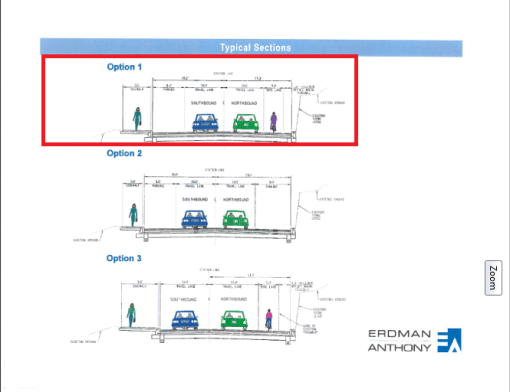
3. The city has decided which option it wants to pursue for its rework of University Avenue. Basically, say goodbye to the northbound parking aisle and say hello to a new bike lane. The southbound parking aisle will remain, along with a 7-foot wide sidewalk and 10-foot travel lanes.

4. It looks like plans for the next Press Bay Alley are moving forward. 110-112 West Green Street was sold to Urban Core LLC (John Guttridge / David Kuckuk) for $650,000 on the 19th, and a $581,250 construction loan from Tompkins Trust was filed the same day. Technically, some of the construction loan is actually for the purchase; according to the IURA breakdown, the renovation into micro-retail, office and two 500 SF apartments will only cost about $207,500, plus $40,000 for soft costs like architectural plans, engineering and legal expenses. As part of the $200,000 loan extended to Urban Core LLC by the IURA, the project needs to create at least 6 full-time jobs at full occupancy. On the Press Bay Alley Facebook page, the developers have announced plans for a spring opening, and issued a call for active-use tenants looking for anywhere from 300-2,000 SF.

5. Cincinnati-based Bloomfield Schon has arranged to sell the Cayuga Green complex, lofts, apartments and all. The developer would sell the buildings to Laureate House Ithaca Management LLC. Upon the intended purchase date of August 1st, Laureate House would pay the IURA loan balance ($733,130 at the moment with a $4,880 monthly payment) off in full. That would be about 21 years earlier than anticipated. Laureate House appears to be a start-up real estate firm backed by three wealthy Cornell alums; although the literature says they seek to launch 55+ communities for active seniors in college towns, there don’t appear to be changes in use or commercial/residential tenant mix planned with the purchase of Cayuga Green.

6. Been meaning to note this, but it appears 210 Linden Avenue is undergoing asbestos remediation, which means that the building is being prepped for deconstruction. It looks like Visum Development will be moving forward soon with their plans for a 9-unit, 36-bedroom student apartment building on the property. I did not seen any outward indication of similar work being performed on 118 College or 126 College Avenue at last check, though it’s been a couple weeks.

7. Here’s a look at the city of Ithaca’s Planning Board agenda for next week. Harold Square and 323 Taughannock will have their latest revisions checked for satisfaction of final approval (various paperwork submissions, and of samples of exterior materials to make sure they’re acceptable). 238 Linden Avenue, 232-236 Dryden Road and the DeWitt House old library redevelopment are up for final approval, and the McDonald’s and Finger Lakes ReUse’s supportive housing projects will be reviewed for determination of environmental significance, which basically means that potential impacts have been addressed and if necessary, properly mitigated.

There is also one semi-new project, which is 709-713 Court Street  – that would be the street address for Lakeview’s $20 million mixed-use affordable housing plan on Ithaca’s West End. From previous paperwork, it is known that it’s 5 floors with 50 units of affordable housing, 25 of which will be set aside for Lakeview clients with psychiatric disability. There will be 6,171 SF of commercial space on the first floor, and 17 parking spaces. PLAN Architectural Studios of Rochester will be the architect. Apart from a rough outline, there have been no renders shared of the project, so that’s the “semi-new” part.

AGENDA ITEM Approx. Start Time

  1. Agenda Review 6:00
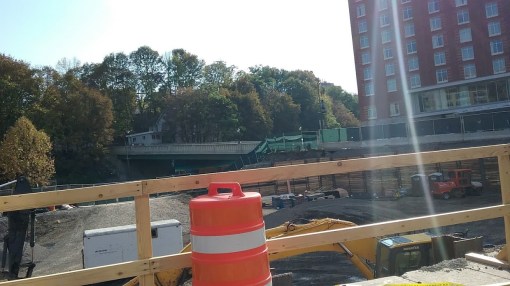
  2. Privilege of the Floor 6:01
  3. Site Plan Review

A. Project: Mixed Use Apartments – Harold Square 6:10

Location: 123-129 E State/ MLK St (the Commons)

Applicant: L Enterprises LLC

Actions: Satisfaction of Conditions

Project Description: The Board approved project changes with conditions on May 23, 2017. The Applicant was asked submit revised materials to return to satisfy the conditions in June.

B. Project: Apartments (Short-Term Rental) 6:30

Location: 238 Linden Ave

Applicant: Trowbridge Wolf Michaels for DRY-LIN Inc.

Actions: Public Hearing Determination of Environmental Significance, Preliminary & Final Approval, Approval of Transportation Demand Management Plan

C. Project: McDonalds Rebuild 6:50

Location: 372 Elmira Road

Applicant: McDonalds USA LLC

Actions: Declaration of Lead Agency, Public Hearing, Determination of Environmental Significance, Recommendation to BZA

D. Project: Residential Mixed Use (DeWitt House) 7:00

Location: 310-314 N Cayuga Street

Applicant: Kimberly Michaels, Trowbridge Wolf Michaels for Frost Travis, Owner

Actions: Preliminary and Final Approval

E. Project: Apartments 7:20

Location: 323 Taughannock Blvd

Applicant: Noah Demarest for Rampart Real LLC

Actions: Satisfaction of Conditions

Project Description: The Board approved the project with conditions on May 23, 2017. The Applicant was asked to submit revised materials to return to satisfy the conditions in June.

F. Project: Finger Lakes ReUse Commercial Expansion and Supportive Apartments 7:40

Location: 214 Elmira Road

Applicant: Finger Lakes ReUse

Actions:  Public Hearing  Determination of Environmental Significance

G. Project: Apartments (60 Units) 8:00

Location: 232-236 Dryden Road

Applicant: Noah Demarest of Stream Collaborative for Visum Development Group

Actions: Determination of Environmental Significance, Preliminary and Final Approval, Approval of

Transportation Demand Management Plan

H. 709-713 Court Street – Housing – Sketch Plan 8:20

  1. Zoning Appeals 8:45
  1. Old/New Business
  2. Planning Board Comments on the Proposal to Rezone Areas of the Waterfront 8:50
  1. Reports
  2. Planning Board Chair (verbal)

9:10

  1. Director of Planning & Development (verbal)
  2. Board of Public Works Liaison (verbal)
  3. Approval of Minutes: May 23, 2017, April 25, 2017, and November 22, 2016 (time permitting) 9:30
  4. Adjournment 9:35


The Tompkins County Housing Strategy

18 05 2017

The County’s Housing Strategy draft was originally going to be in the next news roundup, but it’s large enough to do separately, and my colleague Kelsey is tackling this meeting for the Voice. For those who couldn’t attend the Housing Strategy hosted by the county last Wednesday evening, the presentation is here and the outline is here. Comments can be sent to the Planning Department here from now through the end of the month.

First, quantities. This was touched on in the news round-up a couple of weeks ago, but the county would like at least 580 units coming online each year, plus specialty student and senior housing. For comparison’s sake, the county hasn’t exceeded that value since 1994, when Kendal was permitted in Cayuga Heights, and prior to 2016, the last time it exceeded 500 units was in 2000.

In more recent years, the value bounced between 200 and 300 units in a given year; during the recession, it dropped into the mid-100s. The article linked above is older, so it lacks the 2015 values, which were 279 units countywide, consistent with 2012-2014. Then we get to 2016, which was just finalized by HUD. There were 575 units, of which 121 were single-family homes, and 454 were multi-family structures. Let’s present that by community (click on the table to expand):

Cayuga Heights and Freeville didn’t approve a single unit, while the 271 units in Ithaca city is their highest stat since 2000, and the second highest in the 35-year online record. Dryden village’s growth can be attributed to Poet’s Landing Phase II, Ithaca town’s to Cayuga Meadows, and Lansing town’s to the Village Solars.

The point of this is to illustrate that 580 units annually is a lofty figure, but it is an attainable goal.

Then we get to locations. The ideal is to focus the growth in the city of Ithaca – since these stats are non-student housing, the targeted areas in the city include Downtown, the State Street Corridor, West End/Waterfront, and anything they can displace from the big box corridor on the southwest side. If a good opportunity for infill presents itself elsewhere in the city, that’s great, but it’s not the focus.

However, not everyone wants to live in Ithaca. Land in the “nodes” is cheaper and oftentimes the approvals process is easier. The county envisions 50-100 in the villages and growing hamlets like Varna and South Lansing, were a town center concept is in the RFP review process. Rural hamlets would see a handful of units annually (30 or less), and other locations basically just refers to Lansing’s suburban sprawl between the village and South Lansing. The town is hellbent on development any which way it happens, conventional approaches are the easiest to get financed, and the county’s not going to fight them.

The county’s housing strategy is three-pronged: Information/Collaboration, New Units and Existing Units.

  • Information and Collaboration includes a virtual housing office for resources and a collaborative network to formulate and pitch housing solutions. It’s kinda vague in the notes.
  • New unit strategies include support for targeted new development, streamlining zoning and examining potential incentives through the IDA.
    • Targeted new development can include RFQs for government-owned surplus property, early community engagement regarding DFAs (Development Focus Areas) and assistance in producing “shovel-ready” sites through things such as sewer access and energy hookups.
    • Streamlining zoning is to make it easier to get an initial product that will look like the final product – less uncertainty, less money spent on revisions. Inclusionary zoning seems pretty much dead in the water, as the county doesn’t seem to know if the community will support incentives for affordable housing, or if will even be effective. Done wrong, an inclusionary ordinance could actually result in less housing, if the burden is too great for the incentives offered.
    • Additional IDA incentives could include mixed-market or all-affordable rentals being eligible for abatements, and possible an abatement for any neighborhood or community who builds in inclusionary zoning. Looking at you, Trumansburg.
  • Existing unit strategies include the encouragement of rehabs (especially from rentals to owner-occupied), code enforcement and fair housing enforcement. Airbnb is still a tricky issue, so expect some tweaks to regulations on what constitutes rentals, hotels and legal occupancy.

There’s also a strong support/monitoring component in the strategy, which basically is a tracker of all projects underway, what stages, what they consist of, and so on. Beat you to the punch guys.