News Tidbits 9/23/17: It’s All In The Hips

23 09 2017

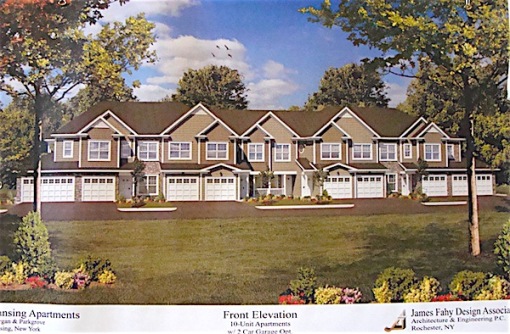
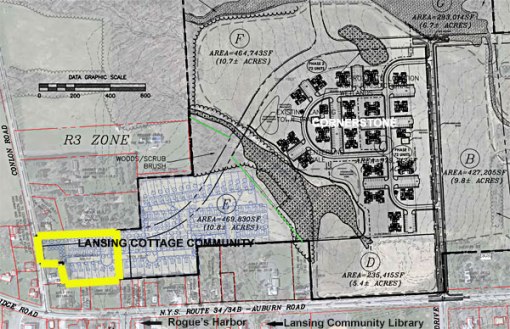
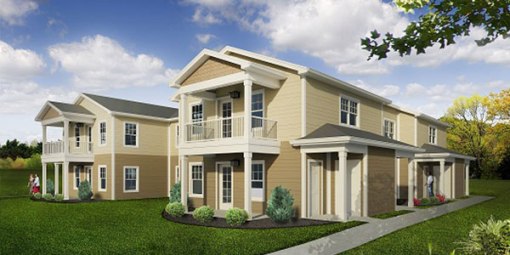
1. Points for being open and blunt, one supposes. The chairman of the town of Lansing Planning Board, typically one of the easiest boards to get approval from in the whole county, voted against the customary declaration of lead agency on the Lansing Trails affordable apartment complex planned for the town center. The reasoning was a fear that its lower-income occupants would create more crime. Rather surprising that it wasn’t veiled behind the usual guise of “concerns about neighborhood character”.

Other PB members did raise more appropriate concerns that the 581-a tax abatement to be pursued by the project may end up offsetting the property tax increase enough to cost the town, mostly through the enrollment of new students in the Lansing school district. A third-party study explained that there would likely be 43 students in the roughly 200-bedroom complex, of whom 14 would be relocations from other parts of town, and 29 who would be new to the district. Reflecting national demographic trends, local school enrollments have been in decline as Millennials are replaced with their less numerous Gen Z peers, so it’s not really a question of capacity since the schools were designed for larger class sizes, but a concern about the tax obligations and avoiding the burdening of other taxpayers. Town supervisor Ed LaVigne has spoken in favor of the project as workforce housing by a responsible developer and property manager.

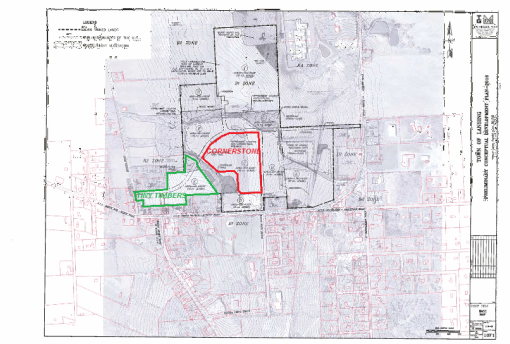
The Star’s Dan Veaner takes the middle road in his editorial, noting the project fills a need, but worried about the tax impact. I’d argue that’s while it’s a fair question, it’s probably a bit premature. There have been discussions for the other parcels in the town center that just have yet to come forward. Tiny Timbers is potentially 60 units of mid-priced owner-occupied housing (at $200k per home, that would be $12 million without counting site-wide improvements like sidewalks and community greenspace), and there are possibilities for the other parcels that are being drafted up and fleshed out before being made public. We the public don’t know what those are – there could be market-rate senior housing, patio homes and mixed-uses like the projects submitted in 2014. If three or four are affordable housing, sure, be concerned. But the town knows all the proposals, and hopefully its committee selected its choices for each lot with sound logic in mind.

2. Speaking of Lansing Trails, according to the new planning board comments, its name has been changed to “Milton Meadows”. Milton was actually the original name for Lansing, indirectly – Milton was changed to Genoa in 1808, and Lansing was split off from Genoa in 1817, the same year Tompkins County was established. It’s worth noting that “Lansing Meadows” is already taken. This would be name number three, since they had previously changed Lansing Commons to Lansing Trails.

The updated documents note that the second phase and its 56 units aren’t likely to start construction for 3-5 years, depending on external factors such as the availability of affordable housing grants, and how well the local market absorbs phase one.
3. Staying on the topic of affordable housing and taxes, the town of Ithaca will be reviewing a PILOT proposal from NRP Group to offset some of the property taxes with the Ithaca Townhouses project approved for West Hill near the hospital. Readers may recall the Ithaca Townhouses are a 106-unit, two-phase project that will be rented to households making 50-130% of area median income, with an option for renters to purchase units after a 15-year period.NRP Group is asking for the PILOT to offset the higher initial cost of using electric heat pumps in place of conventional gas heating, the difference of which they estimate to be about $300,000 upfront.

The town utilizes a few PILOT agreements, either with some of its 55+ affordable housing (Ellis Hollow Apartments, Conifer Village), the College Circle Apartments that Ithaca College purchased a few years ago, and Ithaca Beer. The combination of a lower assessed value and a PILOT generally seems to take about 25-30% off the total property tax bill.

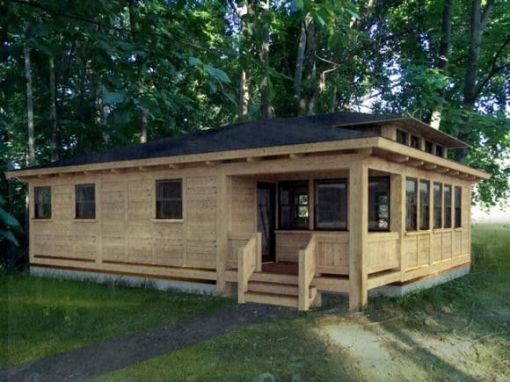
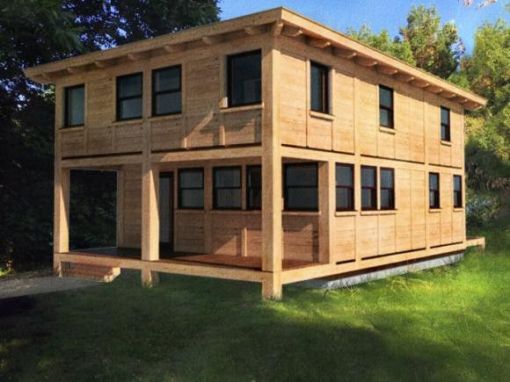
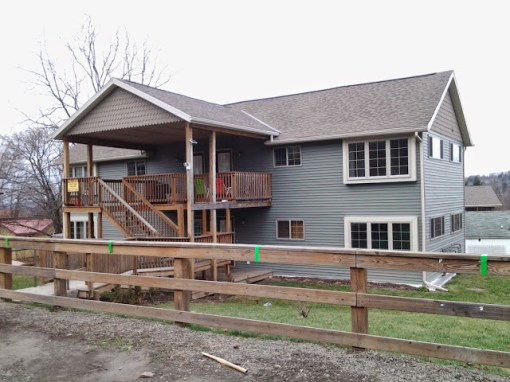
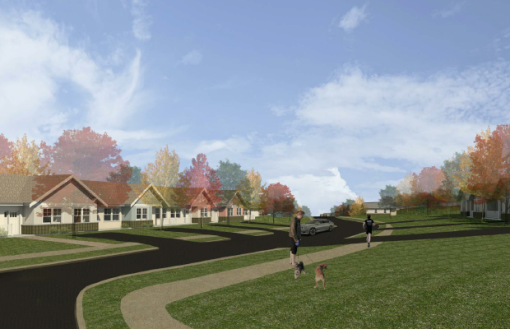
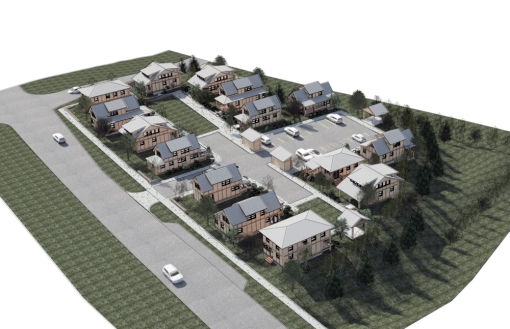
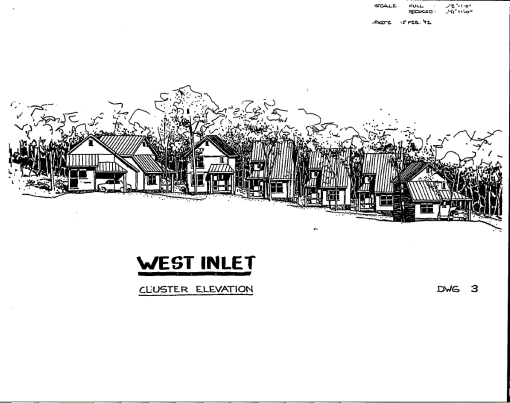
4. Here’s a little more info on the the proposed Brown Road Pocket Neighborhood in Danby. The above image appears to be the preferred cluster housing that the development team (led by Newfield businessman Mike McLaughlin), but conventional zoning only allows for the layout shown here. Small-scale cluster zoning has found a market in the Ithaca area over the past few years with projects like New Earth Living’s Aurora Street Pocket Neighborhood and the long-planned Amabel project, and Danby’s take on the concept would benefit from lower land costs, which would help keep the overall costs down and make the for-sale homes available to a wider swath of the county’s potential homeowners. The homes, which are modest 1,000 SF one and two-story plans that share a communal parking lot, are designed for residents who wish to age in place.
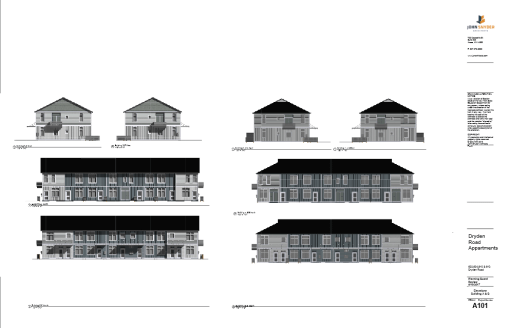
5. Some revisions have been made to the design of Modern Living Rentals’ 42-unit townhouse project at 802 Dryden. To create a little more visual interest, the townhouse strings have been diversified a bit – the rooflines were modified on two of the six strings to create a hipped roof, while the other four remain gable roofs. The fenestration was also updated, and sections of the building faces were bumped-out modestly, distinguishing individual units within the strings. The overall effect gives them a distinct appearance from their counterparts up the road at 902 Dryden, and allows the team at John Snyder Architects to give the recycled design their personal touch. Other documents, like the cover letter, utilities plan, and landscaping plan can be found here.

The public hearing is scheduled for next week, but to be honest, these haven’t generated much attention, let alone controversy. The biggest issue right now is water supply, which relies on the Bolton Point system shared by both Ithaca and parts of Dryden. 802 Dryden can get its water issue remedied by tapping a segment in the town of Ithaca’s jurisdiction, and Ithaca is interested in transfer control and maintenance of the control valve that allows that to Dryden. Given Charlie O’Connor’s South Hill debate currently underway, the relative shrug this project has received from the public might be a welcome relief.

6. Nothing new on the Ithaca City Planning Board agenda next week. That’s not to say there aren’t several projects in the works, they just aren’t ready to submit formal proposals at this time. Lakeview’s special needs and affordable housing is up for approval, as is Charlie O’Connor’s duplex at 217 Columbia (even if the South Hill overlay goes into effect, this project would be grandfathered in because it started review under existing zoning). It looks like Lakeview will use the same kind of vibratory pile-driving used at INHS’s 210 Hancock, subcontracted to Ferraro Pile and Shoring by general contractor Hayner Hoyt.

Speaking of INHS, they will be taking part in the public hearing for their 13-unit Elm Street reconstruction on West Hill, and public hearings are planned for the Nines replacement at 311 College, and Elizabaeth Classen’s ILPC-approved 16-bedroom senior mansion in Cornell Heights. The Nines inspired several letters of protest, and first ward aldermen George McGonigal chimed in his hopes that the affordable housing would be reduced for Lakeview and INHS (the planning board disagrees).

Here’s what the board has to look forward to on Tuesday:

AGENDA ITEM Approx. Start Time

  1. Agenda Review 6:00
  2. Special Order of Business- Draft Design Guidelines for Collegetown and Downtown– Megan Wilson 6:01
  3. Privilege of the Floor 6:30
  4. Site Plan Review

A. Project: 709 West Court Street 6:40

Location: 326 & 328 N Meadow St. and 709 – 713 West Court St.

Applicant: Trowbridge Wolf Michaels for Lakeview Health Services Inc.

Actions: Consideration of Preliminary and Final Approval

Project Description:
The applicant proposes to construct a five-story L-shaped building with footprint of 10,860 SF and GFA of 62,700 SF on the .81 acre project site comprising four tax parcels (to be consolidated). The building will contain sixty (60) one-bedroom apartments plus associated shared common space (community room, laundry facilities, lounges, and exterior courtyard), support staff offices, program spaces, conference room, utility rooms, and storage. The siting of the building allows for a small landscaped front yard, a south-facing exterior courtyard, and a 16 space surface parking lot in the rear of the site. Site development will require the removal of five structures and associated site elements. The project is in the WEDZ-1 Zoning District. This is a Type I Action under the City of Ithaca Environmental Quality Review Ordinance (“CEQRO”) §176-4 (1) (k) and (n), and the State
Environmental Quality Review Act (“SEQRA”) § 617.4 (11) and is subject to environmental review.

B. Project: Elm St Apartments 7:10

Location: 203-211 Elm St

Applicant:Lynn Truame for Ithaca Neighborhood Housing Services Inc. (INHS)

Actions: Public Hearing, Determination of Environmental Significance

Project Description:
The proposed project consists of the demolition of a two single family homes and one duplex and the construction of a single 12,585 SF apartment building with 13 dwelling units, parking for six vehicles, and other associated site improvements. Due to the slope of the site, the building will have 2 stories facing Elm Street and three stories in the rear. The project requires the consolidation of three tax parcels. The project is in the R-3a Zoning district and is seeking two area variances for relief from rear yard setback and parking requirements. This is a Type I Action under the City of Ithaca Environmental Quality Review Ordinance (“CEQRO”) §176-4 (1)(h)[3], and the State Environmental Quality Review Act (“SEQRA”) §617.4 (11) and is subject to environmental review.

C. Project: Duplex 7:30

Location: 217 Columbia Street

Applicant: Charlie O’Connor for 985 Danby Rd LLC

Actions: Declaration of Lead Agency, Determination of Environmental Significance, Potential Consideration of Preliminary & Final Approval

Project Description:
The applicant is proposing to install a duplex with one 3- bedroom apartment on each floor. The
new structure is proposed to be sited directly behind the existing duplex on the property. As the project will increase the off-street parking required from two to four spaces, the applicant is proposing to shift the existing curb cut to the east and install an expanded parking area and drive aisle along the eastern property line. The project also includes removing a 30”dbh oak and one street tree, closing the existing curb cut, installing a fence, landscaping and walkways. The project is in the R-2a Zoning District. This is an Unlisted Action under the City of Ithaca Environmental Quality Review Ordinance (“CEQRO”) and the State Environmental Quality Review Act (“SEQRA”) and is subject to environmental review.

Project: Apartments 7:50

Location: 311 College Ave (The Nines)

Applicant: Jagat P Sharma for Todd Fox

Actions: Declaration of Lead Agency, Public Hearing, Review of FEAF Parts 2 & 3

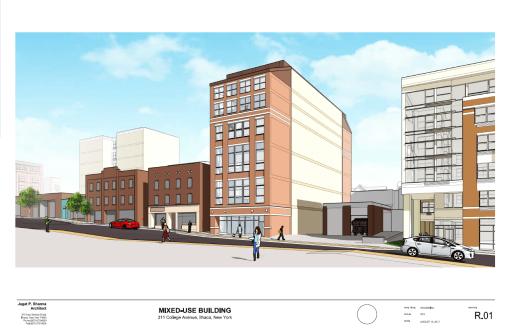
Project Description: The applicant is proposing to construct a six story, 80’ high building plus basement. The first floor will have an approximately 825 SF commercial space and five studio apartments, upper floors will have a combination of 21 studio and 24 loft apartments for a total of 45 dwelling units. The applicant’s intended market is students. Project development will require the removal/ demolition of the existing structure and all associated site features. The existing building incorporates the original Number Nine Fire Station and was identified as a structure worthy of further research in a 2009 study titled Collegetown Historic Resources Worthy or Detailed Research; Icons of Collegetown, Individual Buildings, Architectural Ensembles and Landscape Features. The project is in the MU-2 Collegetown Area Form District (CAFD) and requires Design Review. This is a Type I Action under the City of Ithaca
Environmental Quality Review Ordinance (“CEQRO”) §176-4 B.(1)(k) and the State Environmental Quality Review Act (“SEQRA”) § 617.4 (b)(11) and is subject to environmental review.
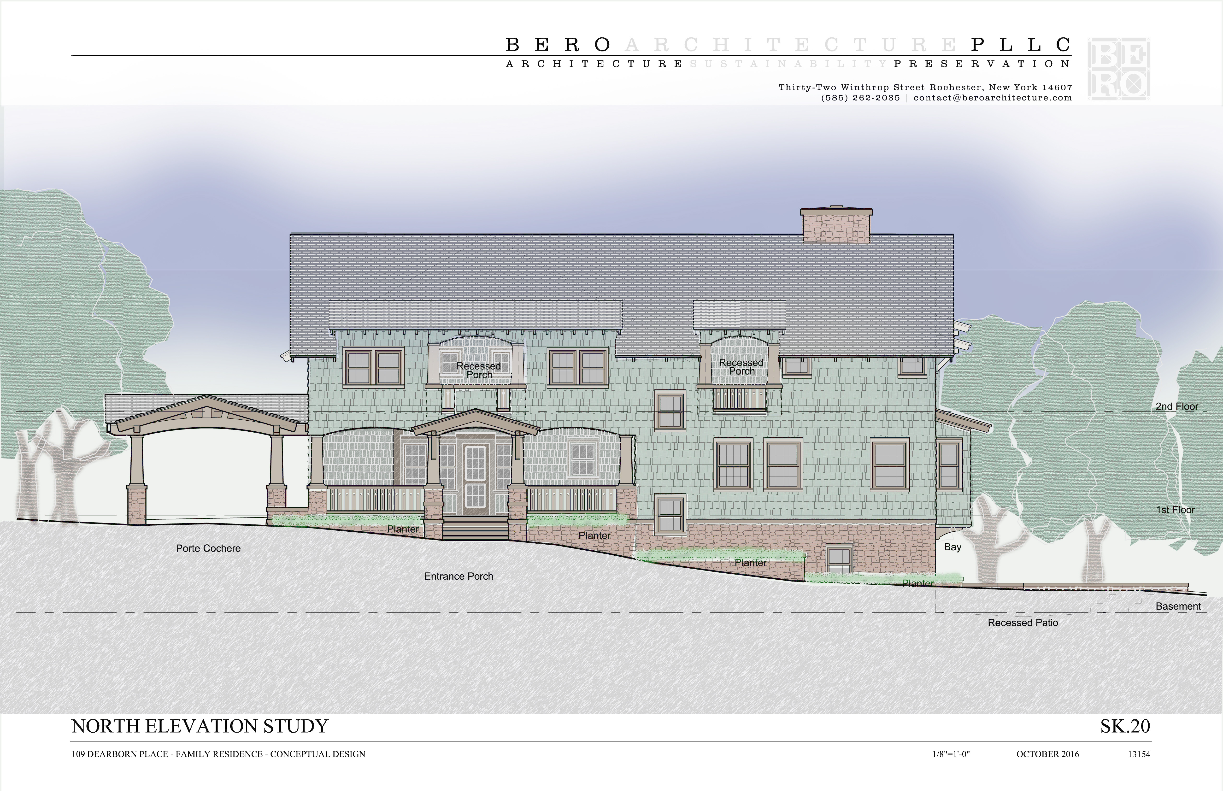
Project: Bridges Cornell Heights Residence (Senior Housing) 8:10

Location: 105 Dearborn Place

Applicant: Elizabeth Classen Ambrose

Actions: Declaration of Lead Agency, Public Hearing, Review of FEAF Parts 2 & 3

Project Description:
The applicant is proposing to construct a two story single family residence with 12 bedrooms
to house up to 16 people on the .446 acre lot. The building will have a footprint of approximately 4,150 SF, including porches. Site improvements include a porte couchere, a driveway and parking area for nine cars, three patios, walkways and landscaping plantings. The site is currently vacant. Site development will require the removal of approximately 25 trees of various sizes. The applicant is proposing to use the Landscape Compliance method, which requires Planning Board approval for placement of the parking area. The project is in the R-2a Zoning District and the Cornell Heights Local Historic District and has received a Certificate of Appropriateness from the Ithaca Landmarks Preservation Commission (ILPC). This is a Type I Action under the City of Ithaca Environmental Quality Review Ordinance (“CEQRO”) §176-4 (1)(h)(4) and the State Environmental Quality Review Act (“SEQRA”) § 617.4 (b)(11) and is subject to environmental review.

4. Zoning Appeals 8:30

5. Old/New Business 8:40
A. Planning Board Report Regarding the Proposed Local Historic Landmark Designation of 411-415
College Avenue- The Chacona Block
B. Upcoming Planning Board Recommendation to Approve Draft Design Guidelines for Collegetown &
Downtown – discussion



News Tidbits 9/16/17: The Big Surprise

16 09 2017

1. Ostensibly, the biggest newsmaker of the past week was the announcement of the Green Street redevelopment in Ithaca’s downtown core. To be frank, I was freaking out at my desk. Even more astounding was that the city slipped it out so casually, embedding it in a monthly PEDC meeting file that typically focuses on more mundane legal and planning concerns.

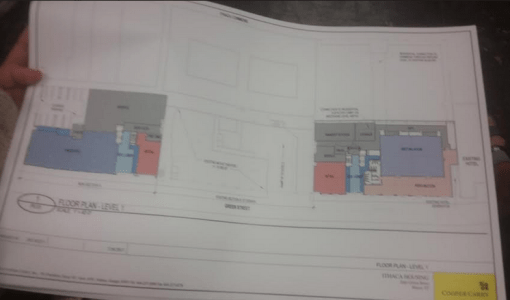
All photos that follow are from Jolene – pardon the marginal quality, we were both in note-taking mode, and these presentation papers weren’t given out to the public. North is towards the top of the floor plan images.

While the documents have yet to be uploaded to the city’s website, some basic details were released during the meeting – the number of parking spaces for the whole complex is 525. There would be two towers with residential units, a U-shaped west tower and a boxy east tower with projecting corners. 15 floors apiece. 350 units, “designed to appeal to a broad demographic”. Abatement likely, with the details to be ironed out as the percentage of affordable units is determined. The middle portion will also have residential units on top of the existing garage. 30,000 SF of conference space is planned under the eastern tower, if my notes are right.

The first floor appears to have at least two retail spaces, a lobby area, and an office, probably for management of the complex. The middle section will retain access to Cinemapolis and the garage. On levels two and three would be rebuilt garage sections (note the center section was rebuilt ten years ago and unlike the ends, is in good shape). Another floor of parking will be added.

Cooper Carry is the architect, and the initial design looks fairly safe, attractive if not particularly inspired. After the Marriott, it’s good to be wary of potential value engineering. It appears to use brick veneer, Nichiha-like metal panels and maybe fiber cement. Also, with Harold’s Square and City Centre off to the left, this would arguably create a broad-shouldered if stubby skyline for downtown Ithaca, more impressive than many communities Ithaca’s size.

My notes are that Marriott co-developer Jeff Rimland had non-public information about the Green Street garage because he owns the ground facilities under the garage’s eastern deck, and would be impacted by renovations. He was made aware of city looking at their options and put something together. The city only learned about the plan four weeks ago, and mayor Myrick wanted to make sure it was brought forward for public discussion and to determine if it was a wise choice to move froward. Ostensibly, if this came out as a surprise, a hornet’s nest of opposition would be stinging. Being transparent now helps later.

It seems the intent is an RFP for the garage for the sake of fairness, but I dunno how effective that will be. Rimland has a big advantage as owner of a portion of the parcel, since any other developer would need to arrange legal agreements with him in order to carry out a project. It was suggested by Brock, who has never been a fan of development, and I cynically wonder if this was an attempt to ensnare or at least stall the proposal. An RFP does put the city in a more legally comfortable position, perhaps. On the flip side, I cringe at the thought of another Old Library-like mess.

On a final note, there’s also a name, seen in the lower right of the rendering – “Village on the Green”. Very punny guys.


2. The other big news item of the week was 311 College Avenue, more commonly referred to as “The Nines replacement”. The Nines is a much-loved restaurant and bar that has long been a part of Collegetown’s drinking and musical scene – in the late 2000s, if I had to describe Collegetown bars, where Johnny O’s was the “fratty frat” bar and Chapter House the erudite tweed-clothed crowd, The Nines was the laidback, indie band geek-turned-rocker. Add in its location in a ca. 1908 fire station, and one of the few sizable outdoor patios in Collegetown, and one can understand that a project on this site was never going to be warmly received.

Granted, I’ve been raked over the coals a couple of times for the article, whose first headline said The Nines was being kicked out. It was an honest copy-editing mistake. For breaking news I publish ASAP, like with the Green Street development. However, that’s discouraged because the business pieces are useful for filling slow periods during the day, or to give time for others to prep articles during the early morning. Many of my articles are written in the late evening, submitted to the schedule, and skimmed through before hitting the website. In this case, I submitted Sunday night, my editor Jolene read through it early Monday morning, she thought the opening lines implied an eviction and changed the title (the original was a generic “Apartments Proposed for The Nines”). Sometimes title get changed for clarity or Search Engine Optimization (SEO), but this particular time it created a false statement. I didn’t see it until I was at work on Monday, and uncomfortable conversations ensued. Sorry all. The next article won’t wax poetic.

Anyway, with that error noted, it makes this next opinion segment more uncomfortable. I’m not a developer. But if I were one, and heard the property was being put up for sale, I’d probably have steered clear. With all due respect to Todd Fox, my gut feeling is that the cons outweigh the pros.

Ithaca is not an easy city to do a project in. A developer has to pick and choose their battles. In this case, the battle is taking a building with some degree of historic value, but more importantly a lot of local sentiment attached, and proposing to replace it with, frankly, a mediocre design with high-end student units. I understand the economics of the site, the market, and the unfortunate though economically necessary impacts building flush to lot lines has on the ability to install windows on the sides. My concern is external impacts, by creating an emblem for opposition to organize around, because it wraps several perceptibly negative impacts into one proposal. That may make future projects that much more difficult. I worry that whenever a controversial plan is brought forth in years ahead, it will be pejoratively described by NIMBY types as “just like that Nines replacement”.

It has taken years for Ithacans to become slowly more amenable to density and development. Proposals that inadequately address community concerns threaten that progress. Consider the case of Jason Fane. He toyed with the city plenty of times. Eventually it caught up to him and he got burned. The sad part is, 130 East Clinton was a solid project, and to this day I believe that had it been another developer, those apartments would have been built.

Anyway, the ILPC would like to preserve it as-is, which draws the question why the discussion never moved forward 18 months ago when they had the chance. I don’t think that’s likely at this stage, and an overbuild probably wouldn’t work due to development costs (foundation shoring, elevator if 4+ floors) with respect to developable area – the big front yard setback is an impediment to that. I heard that an offer was floated to Neil Golder to move his house at one point during the 201 debate, so maybe moving all or at least the front (1908 wing) of the old station No. 9 is possible, but the expense would be great. As for the new building’s design, maybe modest fixed windows in the north/south brick faces, or glass block features like on Sharma’s 307 design, or even something as minor as a mural on the CMU blocks would help.

But, all that might be grasping at straws. This was always going to be controversial. I won’t fault someone for seeing an opportunity, even if it’s not a plan I’d advocate. It all depends on one’s appetite for development opportunities, and sensitivity to potential blowback.

3. For sale: 405 Elmira Road. 0.74 acres of parking lot next to Buttermilk Falls Plaza. List price: $465,000, courtesy of Pyrmaid Brokerage. Also noting – the chain hotelier who bought the former Tim Horton’s next door from the same seller for $640k in January 2016. Timmy Ho’s 0.75 acres is a little small for a hotel on its own, but combined with this lot, suddenly plans start to look quite viable for a mid-sized chain in the city’s suburban-friendly SW-2 zoning. Someone else may come along and buy it, but let’s see what happens.

4. It appears the 24-unit Pineridge Cottages project is off the table. The project, planned for the corner of Mineah and Dryden Roads in Dryden town, was greatly scaled back by developer Ryzward Wawak after water tests led to concerns about having enough to supply all the units. At this time, the plan is for four cottages, each a two-bedroom unit.

5. The Times’ Matt Butler has a nice summary and brief interview with Lakeview Health CEO Harry Merriman regarding the 60-unit affordable housing plan for 709-713 West Court Street. Some of the obstacles the project faced wouldn’t be a surprise to readers of this blog – the soils require a more expensive deep (pile) foundation, and land acquisition costs are climbing, which increases the overall costs involved with bringing a proposal into reality, let alone a plan that focuses on affordable housing. The increase in units from 50 to 60 was driven by the need to balance out revenue with expenditures and make the affordable housing economically feasible. Incremental cost increases per unit are significantly less than overall structural costs, so the per-unit expense for 60 units is less than 50, making the project more appealing in competitive grant processes.

Of the 22 units to be set aside for formerly homeless individuals, six will be reserved for HIV-positive clients of STAP, the Southern Tier Aids Programs. Those infected with HIV tends to experience much higher homelessness rates than the general population, with at least 81 homeless HIV-positive individuals in Tompkins County alone. This makes it hard to do things like refrigerate medication. These six units are a small number perhaps, but for those six folks it will make a huge difference.

6. Another feather in the cap of the local STEM sector of the economy. Biotech startup Jan Biotech Inc., based out of the Cornell Business Park by the airport, has received a $3 million grant from the National Institute of Health (NIH) that will be used in the research and production of an HIV diagnostic for detection and quantification of latent HIV-infected reservoirs in patients –  cells that have the virus but aren’t actively producing HIV, which current anti-retroviral therapies struggle with. Potentially, the diagnostic could help test new medicines for their ability to target those cells, and lead to a true cure for the virus before AIDS can occur.

Along with new equipment and renovated facilities, the grant is expect to result in the hiring of another 5 to 10 scientists and engineers for the four-person firm. Which is great, but truly, it’s their work to try and improve our treatment and medicine of a deadly virus that’s more important. The very best of luck to them.

7.  A bit of news from the Cornell Daily Sun regarding the additional 2,000 beds Cornell would like to build on its North Campus, as part of its freshman expansion and “Sophmore Village” plan. The university would like to begin construction on the first dorms in 2018, and start increasing student enrollment by 2020. For that to happen, the plans pretty much need to come forward for formal planning board review within the next few months. Presumably, they’d like to have the dorms ready by August 2019 – these will be used as flex space initially, so that existing dorms like Balch and Clara Dickson can start renovation. At a bare minimum, it takes three months to go through the city planning board. Given this project’s proximity to Cayuga Heights, the local patricians will want to have their say as well, even if it is just outside village lines. With the size of the project and a minor amount of inter-municipal complexity, four months from sketch plan to approval seems realistic. Considering the need to request and award contract bids, it would seem plausible that Cornell puts the dorms forward this fall for review, with approval expected by late winter. Bids would be requested and awarded during the Spring, and construction would start by June. Whatever the case, the first construction plans are likely not far off.


News Tidbits 9/9/17: Shopping for Sales

9 09 2017

1. As Dan Veaner at the Lansing Star reports, the new owners of the Shoppes at Ithaca Mall (aka Pyramid Mall) are planning to roll out new tactics to counter the ongoing, nationwide retail apocalypse currently underway. Instead of leasing locations, the mall owner would like to subdivide retail spaces within the mall under a Planned Development Area (DIY zoning, in essence) so that tenants could potentially own their spaces instead of renting them, under the hope that when they own a store location, they are less likely to close it and will opt for closing rented spaces elsewhere. Because customary use-based (Euclidean) zoning is not suited for this unusual arrangement, a PDA has been suggested, and the village of Lansing seems amenable to the idea.

On a related note, another subdivision of the mall properties would open up a portion of the parking lot behind the Ramada Inn for the development of an extended-stay hotel. This would probably play out over a few years, given the time to design a project, secure a brand and ask for village review/approvals. Market-wise, it’s not implausible, since the other hotels planned, like the Canopy downtown or the Sleep Inn at 635 Elmira Road in Ithaca town, are geared towards the overnight crowd, and the overall market is growing at a sustainable pace. As long as the local economy continues its modest but steady growth, a medium-sized specialty property that opens in two or three years would probably be absorbed by the local hospitality market without too much fuss.

2. Meanwhile, over in the the town of Lansing, a couple of minor notes and some name changes. From the town of Lansing Planning Board agenda, it appears the 102-unit Cayuga Farms development is now going by the name “Cayuga Orchard”. The project, which has been stuck in red tape due to the stringent review of modular sewage treatment systems, is seeking modifications to their plans, which was summarized in the Voice here. The short story is that the project has the same number of units, but the impermeable area has been decreased and the number of bedrooms is down from about 220 to 178. That should help reduce stormwater runoff, and if the town sewer isn’t through yet, it could make the modular system more feasible.

Secondly, Cornerstone’s Lansing Commons Apartments are being rebranded as the “Lansing Trails Apartments”, which makes sense since there aren’t any “Commons” in the town, but the town center property is traversed by numerous recreational foot trails. The town has endorsed Cornerstone’s two-phase, 128-unit development plan for affordable rental housing, though the planning board did express concerns with the impact of dozens of additional school children on a property with 581a property tax breaks, which may result in a 4% increase in school taxes in the default scenario. The number could vary given the number of kids that actually live there – the board ballparked 80 for their back-of-the-envelope analysis, which given 128 units and roughly 208 bedrooms in the project, isn’t unreasonable.

3. On that note, it appears Cornerstone and NRP have applied to the county’s affordable housing funding grant for a bit of financial assistance towards their respective projects. Cornerstone is seeking funds for qualified units within the 72-unit first phase of its Lansing Trails project, and NRP is seeking funding for qualifying units within the 66-unit first phase of its Ithaca Townhomes project on West Hill. Each organization would receive $256,975, mostly in Cornell-donated funds, if approved by the county legislature. The money may be leveraged and with less needed from traditional affordable housing funds, it may make each project more appealing from a federal or state grant perspective, with demonstrated municipal interest and more “bang for the buck” on the grantor’s end.

4. The two-building apartment complex planned at 232-236 Dryden Road is one step closer to construction. According to Tompkins County records, Visum Development bought the two properties on which the project was proposed (114 Summit Avenue and 232-238 Dryden Road) for $7.65 million on Monday the 5th. The properties are only assessed at $2.55 million, but sellers tend to enjoy a hefty premium when developers have intent for their parcels.

The following day, the building loan agreement was filed. The loan, for $16,354,628, was granted by S&T Bank, a regional bank based in Pennsylvania that has no retail banking presence in Ithaca, but has served as the financier for several projects, including the Holiday Inn Express that recently opened on Elmira Road, and Visum’s just-opened 201 College Avenue project.

A breakdown of the costs shows the total project cost is $22,780,334. There’s $13,020,010 in hard costs (materials/labor), $7.65 million for the purchase, $475,000 in soft costs (architect/engineering/legal), $250,000 for the demolition, and the rest is for taxes during construction, interest reserve (interest on the construction loan during construction). $650,000 (5% of the hard cost) is set aside as contingency funds just in case the expenses clock in higher than expected.

Along with the loan, Visum and its investor appear to be putting up $6.325 million in equity. With these hefty sums, one has to be pretty certain of their investment. In Collegetown, they often are.

Visum CEO Todd Fox has previously stated construction is expected to start this month on the 191-bed apartment property, with an eye towards an August 2018 completion.

5. The Old Library property sale is official, on an 11-3 vote. Legislators Kiefer, Chock and McBean-Claiborne voted no, none of which are an big surprise since, as members of the Old Library Committee, they found something to dislike with every proposal back in 2014. If anything, the surprise might have been legislator Kelles, who while not a fan, supported the mixed-use project. Travis Hyde Properties will bring 58 senior apartments, community space administered by Lifelong senior services, and a small amount of commercial space when the building opens in 2019.

6. So this is interesting. Josh Brokaw is reporting over at Truthsayers that Cayuga Medical Center wants to move the Community Gardens off the land. That is a story being covered further by my colleagues at the Voice, but notable to this blog’s purview are two nuggets of information.

One, Guthrie and CMC had *a bidding war* for the property, which explains a couple of things. It explains why CMC paid $10 million for a property the Maguires only paid $2.75 million for, and it offers a clue as to why Guthrie purchased the neighboring Cornell warehouses. They both have had plans for that area, and working together isn’t a part of them.

Two, Park Grove Realty is involved with CMC. They’re a young Rochester-based company generating lots of news in Lansing with a lawsuit-laden 140-unit townhouse project, and they purchased the Chateau Claire apartments and renovated them into the upmarket Triphammer Apartments, which generated its own share of controversy.

Anyway, it makes the commotion down by Carpenter Business Park that much more interesting. Nothing has come public yet, but keep an eye on it.

7. On a related note, it’s not much of a physical change, but Maguire is using some of that cash windfall to officially acquire the former Bill Cooke Chevy-Olds-Caddy dealership on Lansing’s Cinema Drive. The franchise rights were transferred over ten years ago, but the property itself was still under the ownership of the Cooke family. Thursday’s sale was for $2,015,000. The 4 acres and 19,857 SF building was assesses at $1.8 million, so it appears the sale price was a fair deal for both sides.

I would be remiss not to point out that the buyer was “Maguire Family Limited Partnsership”. No LLCs cloaking this purchase like with Carpenter Business Park.

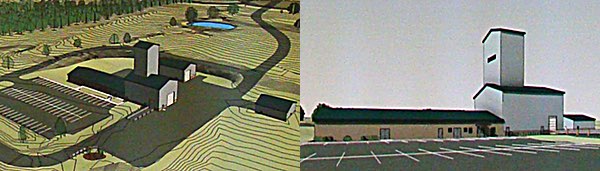
7. Now that the state has okayed the Cargill expansion, the above-ground portion of the project has to go before the Lansing planning board. The surface facilities, expected to cost $6.8 million, consist of a 10,000 SF administration building, a 2,100 SF maintenance building, a 2,600 SF hoist house, parking, landscaping and signage. A hoist house is essentially an industrial-strength engine room for operating the lift that brings people and equipment up and down from the shaft. It’s likely the primary cost contributor in the surface portion of the project.

As seen in the renders above, it’s designed for functionality rather than aesthetics, though Cargill did attempt to make the shaft building barn-like to blend in better with the farms. Construction on the above-ground structures is expected to start next year and run for about 18 months (the mine is being built from the bottom up). Although not shown in the renders, trees will be planted around the developed area to provide a green screen and help dampen noise.


Tompkins Financial Corporation HQ Construction Update, 8/2017

25 08 2017

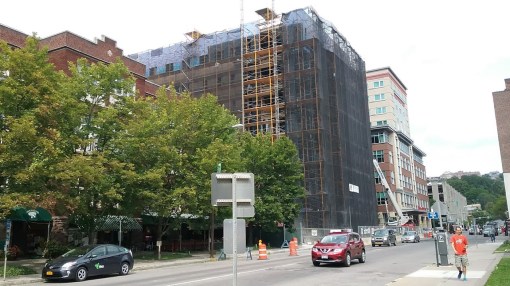
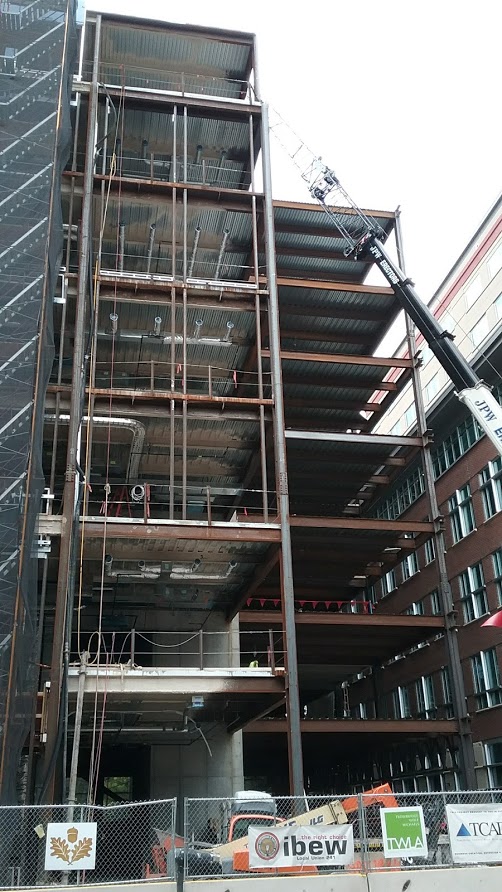
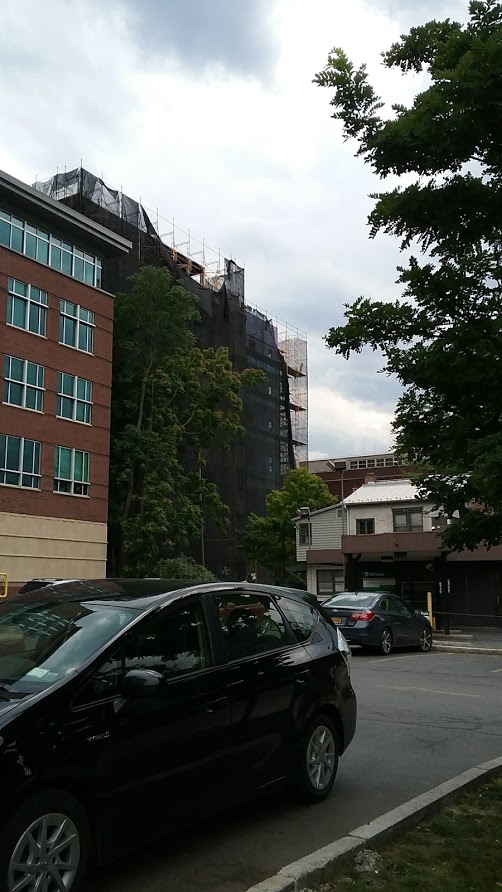
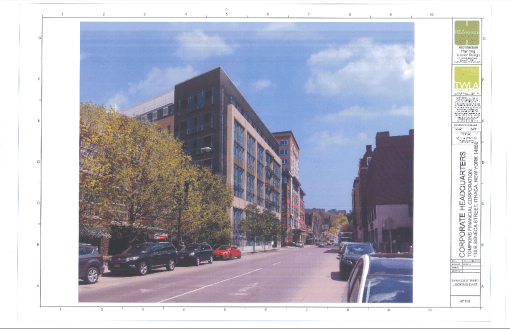
At the new Tompkins Financial Headquarters under construction at 119 West Seneca Street downtown, it looks like most of the structural steel has been erected, and gypsum sheathing has been installed over the skeleton. The top (seventh) floor is set back slightly from the lower levels, and will use light colored aluminum metal panels on all sides except the front, which will use black brick and stone veneer. With the exception of the rear stairwell, the side and rear walls will be faced with a tan brick veneer on the lower floors.

Brick veneer can be tricky because it’s porous. Water can penetrate the brick and make its way to subsurface coatings, where moisture can do damage over time. As a result, builders have to use a water-resistive barrier (WRB) between the sheathing and the brick. This can be done a few different ways – with Simeon’s and DiBella’s, for example, they used a polyurethane spray foam.

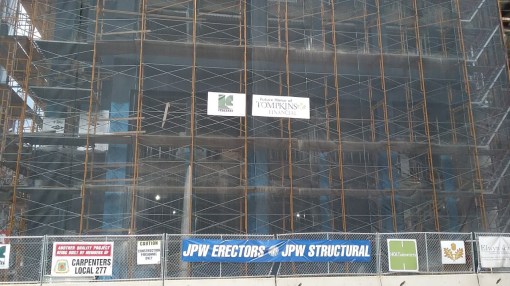
In this case, it looks like there’s a bright blue-colored vapor barrier being applied over the sheathing, probably Carisle Coating and Waterproofing (CCW) 705 or similar. CCW-705 is a rubberized-asphalt adhesive laminated with a smooth, durable plastic film. Construction crews spray an adhesive (CAV-GRIP) onto the sheathing, and then roll out the air/water barrier sheets over the top, kinda like wallpaper. These unfurled sheets are then pressed over with a seam roller to ensure it’s firmly and completely applied to the building surface.  The edges of the sheets are then filled in with a liquid mastic, which is a putty-like waterproof filler and sealant. Once the surface is completely sealed by the barrier, tie plates are fastened with washers and screws, and the brick veneer is laid over the top, typically with a 2″ spacing for drainage and ventilation. It appears the brick may be underway on the western wall of the building, as shown in the first image below. Meanwhile, the bottom floor looks like a different sheathing material, some variety of Dow Thermax panels (fiberglass embedded in polyiso) from the looks of it.

Based on building elevations and girder brackets, the JPW Erectors crane located at the southeast corner of the site will eventually be replaced with the last steel sections for the building. The steel decking is in, and there’s ductwork for the HVAC rough-ins. Curious to see if they’ll have the building closed up before the first snow flies.

LeChase is the general contractor, and it looks like they have some union crews doing work on site – the Carpenters’ Union Local 277 and the IBEW (International Brotherhood of Electrical Workers) Local 241 have signage up, as do project team members JPW Erectors, Elwyn & Palmer (structural engineering), TWMLA Landscape Architects, and HOLT Architects.


News Tidbits 8/24/17: Early Start

24 08 2017

1. The Old Library redevelopment is creeping forward. The Old Library Committee of the Tompkins County Legislature voted to recommend the sale of the property for the previously stated amount of $925,000 to Travis-Hyde. With that vote, it goes forward to the full legislature for a vote on September 5th, where there are no major challenges expected. The Library Committee vote was 4-1, with legislator Dooley Kiefer (D-Cayuga Heights) opposed. Kiefer has always been opposed to any sale, and has long advocated for a lease of the land – and the only way the lease made any practical sense was by being 50 years in length, so that any investment could have the possibility of being recuperated. Given that she’ll probably vote no again for consistency’s sake, and perhaps a rejection from legislator Anna Kelles (D-Ithaca) because she was a long-time proponent of the condo plan, there aren’t likely to be any other opposition votes from the 15-member legislature. Once the sale is okayed, site prep for the 58-unit mixed-use senior facility at 310-314 North Cayuga Street can begin by the end of the year, with a spring 2019 opening expected.

2. So when is an expansion truly an expansion? That’s the question raised by the Times’ recent coverage of a proposed renovation of the county jail, which faces issues with overcrowding, but whose expansion of holding cells is strongly opposed by a number of advocacy groups. The jail is shared with the Sheriff’s Department offices at the moment, and the combined facility at 779 Warren Road is collectively referred to as the Public Safety Building.

The ideal concept as pitched by the Sheriff’s Office would create an additional 13,000 square-foot administrative facility adjacent to the jail that would provide office space, conference space and locker rooms for officers. This would free up programmatic space in the PSB to be used for support functions like classrooms and counseling/meeting rooms, with the ultimate goal of reducing recidivism (the tendency of a convicted criminal to re-offend, and thus take up space in the jail). So,it’s  not a jail expansion per se, but a support services expansion, which would probably drive debate among advocacy groups. The proposal is strictly conceptual, but the county is prepared to move forward with a formal study from LaBella Associates if requested.

3. At the latest Planning Board meeting, Lakeview’s 60-unit supportive and affordable housing plan was granted the green light to go forward to the next step, though not without reservation and concern from some local business owners and elected officials. Per the Times’ Matt Butler, 1st Ward councilors Cynthia Brock and George McGonigal spoke in opposition to the current plan, feeling it was too large and unattractive, while nearby business owners were uncomfortable with the population who would live there. 30 units would be set aside for those who are mostly independent but may need some degree of mental health support, 22 units are general affordable housing, and eight are for formerly homeless individuals. All units are one bedrooms. Lakeview will provide office and support space for services on the first floor of the 62,700 SF building.

In other news, the debate over South Hill continued with the airing of grievances against student housing, Finger Lakes ReUse earned approval for its Elmira Road project, and someone must have left early, because the planning board failed to reach quorum (minimum attendance) to vote on recommendation of historic designation for the Chacona Block at 411-415 College Avenue.

4. Here’s an interesting little proposal out of Danby – a 10-unit pocket neighborhood. The project would be located on 2.2 acres at the rural intersection of Brown Road and Short Road, northeast of the hamlet of West Danby. The houses would be modular and modestly-sized with two basic styles, a 1.5-story cape and 1-story ranch. Additionally, they would be designed for aging-in-place, Net Zero Energy (zero net energy consumption), and have a shared common space (courtyard, lawn or similar), parking lot and septic system. The project, which has access to municipal water service, would require a zoning variance. The project is similar to the Amabel and Aurora Street pocket neighborhoods in Ithaca, though it’s a different developer – here, it’s Mike McLaughlin, a business owner from Newfield, and Danby residents Esther and Brooke Greenhouse. Esther was a team member in the condo proposal for the Old Library site.

Although not explicit, these are likely for-sale units, possibly with a push towards seniors. With shared spaces, modular components and modest sizes, the cost for these is likely to be modest as well – they would likely be similar to the Lansing Community Cottages price range of $175k-$225k.

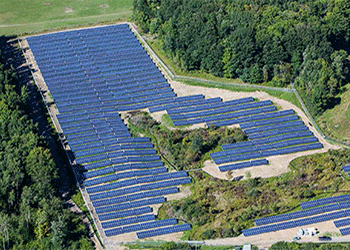
5. After much debate, the Sun8 Dryden solar projects have been approved by the town planning board. The sites include a nearly 11 MW facility at 2150 Dryden Road, and an 18 MW facility along Turkey Hill and Dodge Roads. The projects will produce approximately 28 MW of electricity, which is enough to power the approximately 7,500 households. The project will utilize a Payment In Lieu of Taxes (PILOT) of $8,000/MW, or about $224,000 in year one of operation, and with built-in inflation, about $8 million over 20 years.

Meanwhile, the town has begun review on a much smaller solar project at 2243 Dryden Road. Delaware River Solar is seeking approval to construct a 2.4 MW array on the interior portion of a farm property just west of the village near Ferguson Road. About 35 acres of the 115 acre parcel would be impacted during construction, with five acres used for the panels themselves.

6. In real estate listings, here’s something unusual for those who dare to be different – a Groton church, already renovated with living space and studio space. Aptly-located 113 Church Street is listed at $174,900 and 9,490 square feet on Zillow, but a check of county records says 9,166 SF – a 1,000 SF apartment, a 1,344 SF office, 4,078 SF “non-contributing space”, and 2,744 SF “cold storage”. The property was built in either 1881 or 1883 (county record) for a Congregational denomination, and after some mergers in the 1960s it became the Groton Community Church. From records and county file photos, it looks like the church building was re-purposed in the late 1990s or early 2000s. Previous tenants include a head start program, massage therapy, and art gallery. The tax assessment is for $100k, which seems to account for the old and somewhat mothballed condition of the property, such as the boarded up windows on the steeple tower. Should one be interested, contact info can be found in the first link.

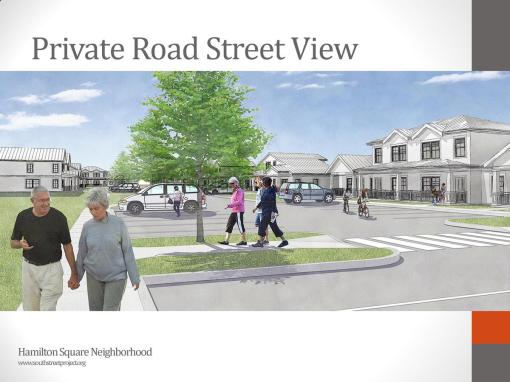
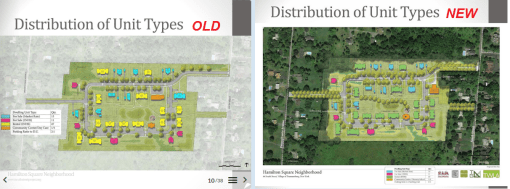
7. This week’s news round-up is running a little early because I wanted to get the latest Trumansburg Hamilton Square materials out before the planning board meeting Thursday evening. Over the past few weeks, there haven’t too many changes to the project site plan, but the daycare center was moved from inside the loop road to outside, exchanging locations with a string of for-sale market-rate townhomes. The resulting move also seems to have decreased the number of market-rate units (some townhome, some detached single-family) down by one, to 14. 11 affordable for-sale townhomes and 47 affordable rental units are still in the mix.

//simplebooklet.com/embed.php?wpKey=W7HALtX9d87mG9WFMNbp9N&source=embed

//simplebooklet.com/embed.php?wpKey=RK3Z4a5lU7XdYcy2vpC4Gc&source=embed

A copy of the traffic study from SRF Associates has also been made available on the project website. The traffic study aims to be thorough, and will likely be expanded in response to neighbor concerns about slower traffic like garbage trucks and school busses, snow impacts, and a possible sampling and estimation of school-focused but non-peak hours and a couple other intersections further from the project site (Rabbit Run Road, and Whig/South Streets). The meeting tomorrow will be at 7 PM at the Trumansburg Fire Hall. The actual submission of the project for formal board review is not expected until late next month, after incorporating feedback from the upcoming meeting.


News Tidbits 8/21/17: Insert Eclipse Pun Here

21 08 2017

1. Quite the sight in the latest Tiny Timbers update. The nascent kit-based homebuilder plans to roll out several new designs, many of which will be incorporated into the 15-unit Varna project on the corner of Dryden and Freese Roads. That brings their total number of home design options up to about 21 or so, in several general styles from four-square to prairie-style to bungalow. It is not clear if the layout will be pre-set at is was with the Belle Sherman Cottages (relatable because STREAM Collaborative designed both), or if it will be left to the buyers.

Tiny Timbers is a bit of a misnomer because the designs are a modest but still sizable 1,000-1,500 square feet, with two or three bedrooms. Prices will be in the mid 100s to low 200s, depending on unit and features. I’d be more inclined to compare them to the starter homes of the 1950s in terms of market appeal and affordability.

Tiny Timbers has yet to get permission to start marketing for the community (the state needs to sign off on all new Home Owner Associations), but marketing has started for some scattered site development on Hector Street in Ithaca’s West Hill, and there is work underway on a few custom builds for landowners in other parts of the county.

2. Last week was not a good showing for the Inn at Taughannock. As relayed by the Times’ Jamie Swinnerton, the town of Ulysses Zoning Board of Appeals denied the lot variances, the heights variances and even the sign variances. The only one they outright permitted was the height variance to allow a rooftop cupola on the existing inn. The sign variance is kinda weird, because it sounds like they were okay with some individual signs, but not the sum of parts, so they’re doing another meeting.

While this isn’t what owner/developer Carl Mazzocone was hoping for, there were alternative plans drafted that did present an alternative design that, while the same style, fit within the zoning parameters. So this is a setback, but this project isn’t off the table yet.

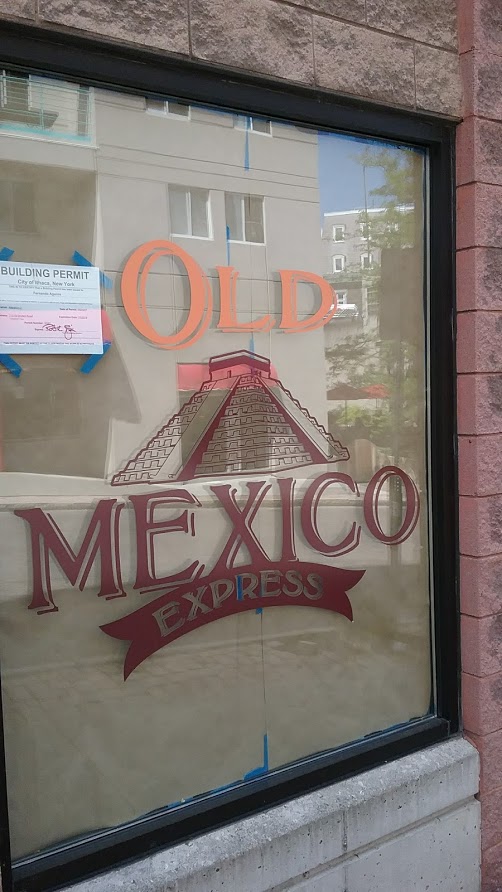
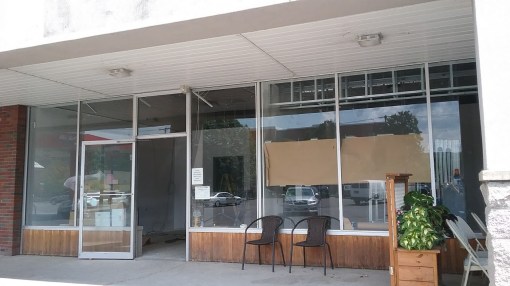
3. Sure, most readers outside the Cornell bubble avoid Collegetown like the plague, but it’s worth noting when new businesses are coming in. Old Mexico, the restaurant that replaced Manos Diner in Southwest Ithaca, will be opening a modest to-go operation at 119 Dryden Road (Collegetown Plaza) in what used to be a barbershop (at least in my time in the late 2000s). Meanwhile, where the Collegetown tobacco shop used to be at 221 Dryden (Collegetown Center), will now be a “Chinese street food” restaurant called Beijing Jianbing. Best of luck to both. At least restaurants aren’t being driven out of business by the internet anytime soon.

4. In the same vein, it was noted a few weeks ago that a $415,000 construction loan was filed for Hancock Plaza, the strip retail plaza at the corner of Hancock and Third Streets in Ithaca’s Northside. A quick check showed an interior renovation underway with new metal stud walls and sheet-rock going in, and the somewhat uncertain workers said that the storefront next to Istanbul restaurant would be a “medical service facility”.

5. Earlier this month, it was mentioned that a 4.5 acre parcel at 452 Floral Avenue in Ithaca was sold to a local homebuilder for $100,000. Now he’s trying to flip it. The asking price is $239,000. The tax assessment is $68,400.

The real estate ad notes the potential of an R-3a zone, which allows for homes, townhouses, small apartments and small-scale commercial with a special permit. The zoning permits four floors and 35% lot coverage, with a minimum of 5,000 SF per lot for a home, plus incremental increases for additional units.

On a side note, with thanks to the city for uploading about 470 documents from the IURA’s microfilm stash, here’s what the 1992 affordable for-sale proposal looked like for that same property. There appear to be 27 home lots, but a few may have been designed for accessory or two-family units. This gives an idea of what could reasonably be done under the existing zoning, but there are many possibilities.

Side note, I found this by chance. If anyone has time to pick through 470 documents from the 1960s to 2000, more power to you.

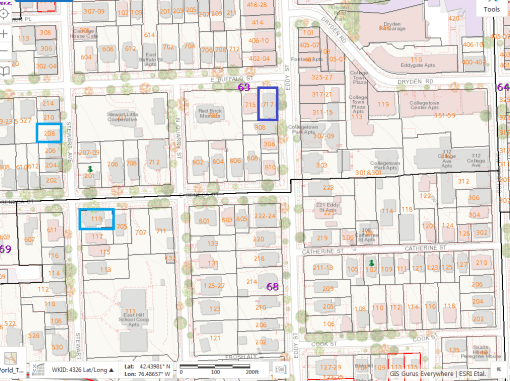
6. Also for sale, to the deep-pocketed investor looking for a safe investment – multiple East Hill apartment houses. 5-unit 119 Stewart Avenue for $995,000, a two-family home at 208 Stewart Avenue for $695,000, and $2.25 million for a 23-bed (20 SRO, 1 studio, 1 2-bedroom) property at 717 East Buffalo Street. The Stewart Avenue properties are owned by a Long Island-based LLC representing a higher ed professional now located in Massachusetts, and were purchased just a few years ago – 119 for $625k in 2014, and 208 for $513k in 2012. 717 East Buffalo was purchased by a Brooklyn investment group in 2003, and is taxed at $1.05 million. The positive is that they’re close enough to Cornell to easily take advantage of the student market. The negative is that they are all in the East Hill Historic District, which means redevelopment is off the table, and exterior renovations have to go through the ILPC.

7. Pretty slow month for the Planning Board. Finger Lakes ReUse is seeking preliminary approval for their expansion project and final approval for the warehouse portion. 709 West Court Street, the 60-unit affordable project from Lakeview, will have its DEIS finalized, potentially allowing for city approval in September. There are no new projects though, unless one counts the six-bedroom duplex at 217 Columbia, which is so minor from the state’s perspective that it only qualifies for city review. The Times is reporting that O’Connor is willing to prohibit student tenants, but permanent residents are still opposed to new student housing in their neighborhood.

There could be some interesting discussion at the meeting, not only with South Hill development, but with historic preservation matters. For instance, Student Agencies is upset that they city is likely to landmark its building at 413-415 College Avenue, which it says it had intent on redeveloping. Unfortunately, timing is everything. Likewise, the shoe is on the other foot with the Nines at 307 College Avenue, for which there has been an unpublished sketch plan of a redevelopment project. The ILPC is expressing frustration that it wasn’t landmarked already, but with the development plans already presented, the city would be acting reactively instead of proactively as it’s doing on College Avenue, and that could make the difference if a legal situation were to arise. So while the Chacona Block is likely safe and soon to be under ILPC purview, the Nines will not be protected for as long as the redevelopment plan is active, and the best the ILPC can do is recommendations.
Here’s tomorrow’s agenda:

AGENDA ITEM Approx. Start Time

  1. Agenda Review 6:00
  2. Privilege of the Floor 6:01
  3. Site Plan Review

A. Project: Mixed Use Apartments – Finger Lakes ReUse Commercial Expansion and Supportive Apartment 6:10

Location: 214 Elmira Road

Applicant: Finger Lakes ReUse

Actions: Consideration of Preliminary Approval Overall & Final Site Plan Approval for Phase 1

Project Description:

The applicant proposes to expand the existing office and retail center with a new +/- 26,100sf
attached 4-story mixed-use building to include retail, office, and 22 units of transitional housing fronting Elmira Road. A 7,435 SF covered outdoor inventory building and a 600 SF pavilion are also proposed. The new parking and loading layout will reduce the number of curb cuts on Elmira road from 5 to 2 and provide 70 parking spaces. An improved sidewalk will be constructed to provide a safer link between the existing pedestrian bridge that connects the Titus Tower property to Elmira Road. The building will have landscaped entrances facing Elmira Road and these will be connected to the new building entrances giving residents and patrons arriving on foot direct access to the street. The project site is in the B-5 Zoning District and has received the required area variance. This is a Type I Action under the City of Ithaca Environmental Quality Review Ordinance (“CEQRO”) §176-4 (I), and the State Environmental Quality Review Act (“SEQRA”) § 617.4 (11) for which the Planning Board as Lead Agency made a Negative Declaration of Environmental Significance on June 27, 2017.
Ed. note – the first phase is the warehouse addition for lumber storage. Phase 2 is the supportive apartments.

B. Project: 709 West Court Street 6:30

Location: 326 & 328 N Meadow St. and 709 – 713 West Court St.

Applicant: Trowbridge Wolf Michaels for Lakeview Health Services Inc.

Actions: Public Hearing, Determination of Environmental Significance

Project Description:

The applicant proposes to construct a five-story L-shaped building with footprint of 10,860 SF
and GFA of 62,700 SF on the .81 acre project site comprising four tax parcels (to be consolidated). The building will contain sixty (60) one-bedroom apartments plus associated shared common space (community room, laundry facilities, lounges, and exterior courtyard), support staff offices, program spaces, conference room, utility rooms, and storage. The siting of the building allows for a small landscaped front yard, a south-facing exterior courtyard, and a 16 space surface parking lot in the rear of the site. Site development will require the removal of five structures and associated site elements. The project is in the WEDZ-1 Zoning District. This is a Type I Action under the City of Ithaca Environmental Quality Review Ordinance (“CEQRO”) §176-4 (1) (k) and (n), and the State
Environmental Quality Review Act (“SEQRA”) § 617.4 (11) and is subject to environmental review.

C. Project: Duplex 6:50

Location: 217 Columbia Street

Applicant: Charlie O’Connor for 985 Danby Rd LLC

Actions: Public Hearing


Project Description:

The applicant is proposing to install a modular duplex with one 3-bedroom apartment on each floor. The new structure is proposed to be sited directly behind the existing duplex on the property. As the project will increase the off-street parking required from two to four spaces, the applicant is proposing to shift the existing curb cut to the east and install an expanded parking area and drive aisle along the eastern property line. The project also includes removing a 30”dbh oak and one street tree, closing the existing curb cut, installing a fence, landscaping and walkways. The project is in the R-2a Zoning District. This is a Type II Action under the City of Ithaca Environmental Quality Review Ordinance (“CEQRO”) §176-5 C.(8) and the State Environmental Quality Review Act (“SEQRA”) § 617.5 (C)(9) and is not subject to environmental review.


  1. Zoning Appeals 7:20
  2. Old/New Business 7:30
    1. A. 412 East State Street – review and sign off on Argos Inn shared parking agreement with 418 East State Street.
    2. B. PB Report on Proposed Local Landmark Designation of 403 College Avenue and 411-415 College Avenue . There will be a short presentation by Scott Whitham regarding 411-413 College Avenue.
    3. C. Development Patterns of South Hill – Discussion
  1. Reports from PB Chair, Director of Planning and Development, and BPW Liaison 8:00
  2. Approval of previous minutes
  3. Adjournment


209-215 Dryden Road Construction Update, 8/2017

19 08 2017

The Breazzano Center is occupied, so for practical purposes this project is complete. The interior and exterior finish work is wrapping up (interior moldings, some cosmetic exterior panels), and it looks like the new street seating, curbing and bike racks are in – the development team may hold off on plantings until next spring, depending on how well the project team thinks the new landscaping will grow in to its new environment, and by extension, its ability to withstand the winter months.

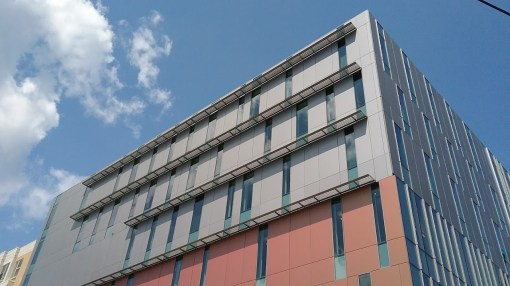
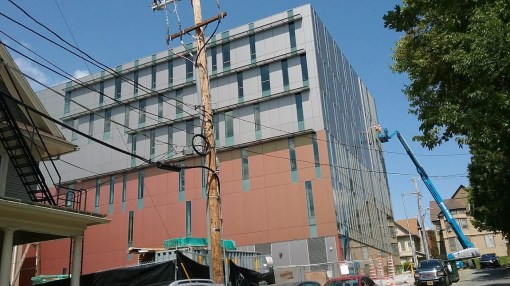
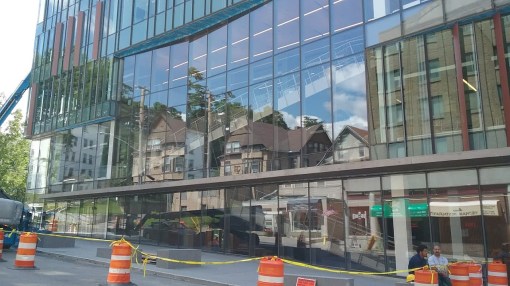
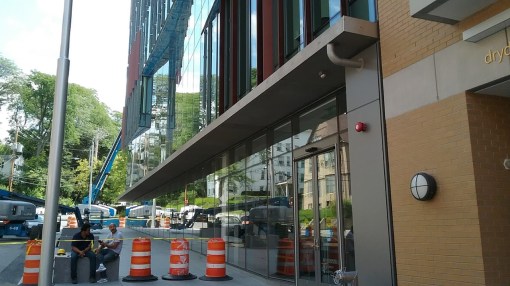
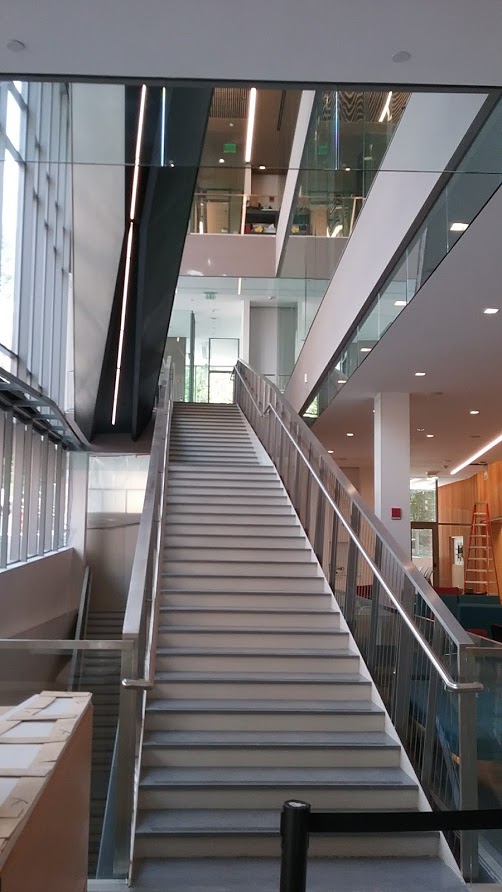
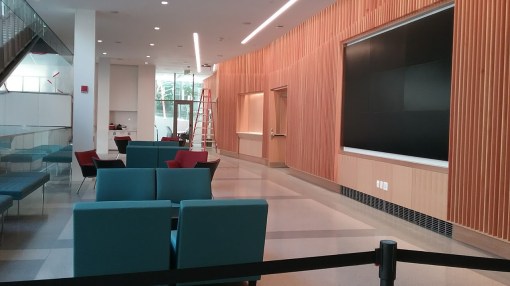
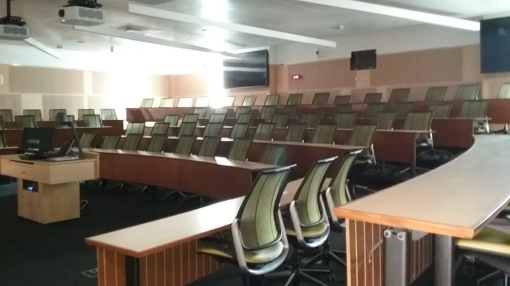
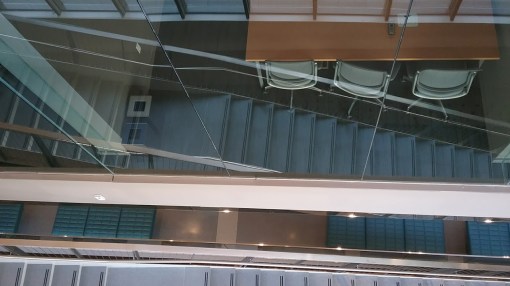
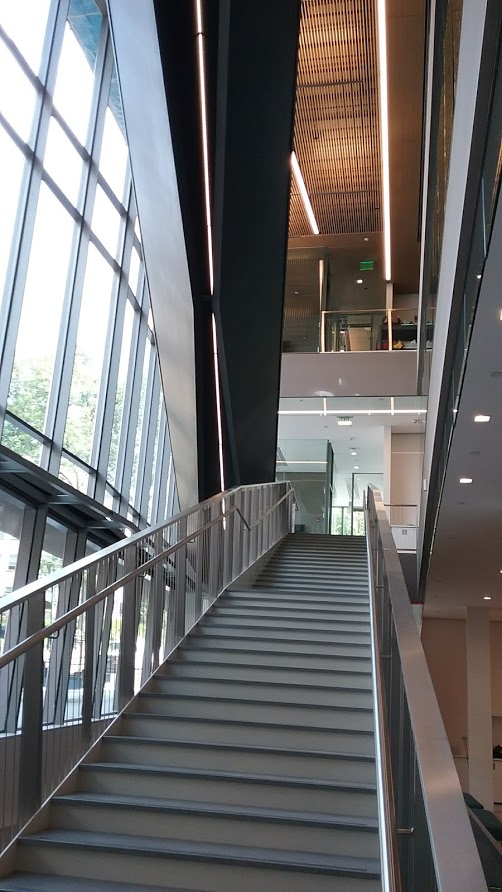
The interior is relatively dramatic for an office and academic building. There’s lots of natural light thanks to the glass curtain wall, the natural wood paneling gives it a warmer look, and the lighting underneath the staircases in the multistory atrium is a nice touch. If I have any interior critique, it’s that there’s so much transparent glass and bright light, it can feel a little disorienting, creating a feeling of space that makes the 76,000 SF building seem much larger than it is. Some of the breakout rooms and one of the tiered large-group classrooms are also included in the photos below.

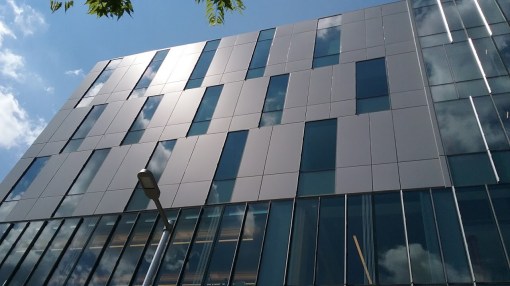
The exterior is a big change of pace from the CMU-faced residential buildings (much of it from Jagat Sharma’s hand) that define much of Collegetown. The glass curtain wall is unique, for the time being. Personally, I’m not a big fan of the aluminum panels on the sides and rear, though I recognize the cost utility provided, and necessary protection of certain interior spaces like the broadcast studio on the fourth floor.

Speaking to some construction workers on-site (the same ones who kindly gestured me to go in and take a look), they were uncertain when construction would start on Novarr’s complementary 24-unit apartment building at 238 Linden Avenue next door. But a timeline from April suggests next month, with completion next summer. That sounds reasonable – finish with one building, transition immediately to the next. Work on Novarr’s 119-125 College Avenue townhouse project has yet to start either; it appears to be a makeshift parking lot for construction crews and company trucks.

Overall, it seems the recent work in this part of Collegetown and Ithaca is a net positive. With projects like the Breazzano, 238 Linden and Dryden South, within just a few years, a corner of Ithaca that once housed a few student-oriented businesses and mostly-rundown/vacant apartments will have been replaced with dozens of beds, office space for hundreds of Cornell staff, and classrooms for deep-pocketed students who visit for only a few weeks a year. Plus, it adds up to an additional $15 million or so in taxable property (and that’s accounting for the reduction as a result of the Tompkins County IDA PILOT agreement).  There’s a clear financial benefit to Collegetown business owners and to the city. Add an aesthetic bonus point for removing the power poles and shifting moving the electrical utilities underground.

The $15.9 million project will be 100% occupied by Cornell on a 50-year lease. Hayner Hoyt Corporation of Syracuse is the general contractor.

Before:

After:


The wording on these sheets conjures images of a stuffy, tense maître d’ addressing his staff.


News Tidbits 8/12/17: Two Kinds of Rehab

12 08 2017

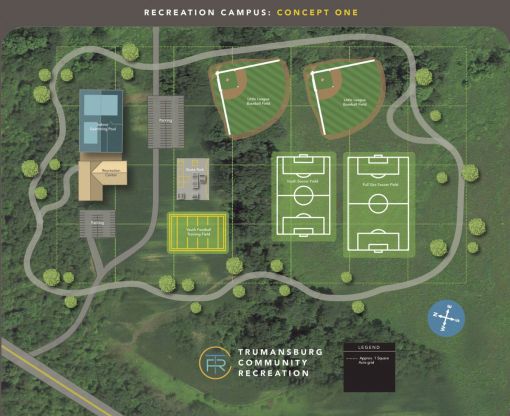
1. It looks like some Trumansburg residents want to build a recreational complex. According to the Ithaca Times’ Jamie Swinnerton, for the civic group Trumansburg Community Recration, “{t}he ultimate goal is to build a recreation center, soccer fields, baseball fields, a youth football field, a skate park, and a pool to the community. The first phase of the project would be building the sports fields and possibly a recreational campus. While the group is still searching for space for these amenities, it is raising funds through grants and donations. The fundraising goal right now is $750,000.”

Along with private donations, the community advocacy organization is seeking state funds, which state law requires be obtained via municipal entities, i.e. the village, school district, town and county. It’s not that governing bodies have to commit money, they just have to express support and sign off on applications, and allocate the awarded funds if/when they are received.

Phase two for the non-profit would be a community center, likely a re-purposed building, and phase three would be a pool, which is garnering significant community attention. Although the group hasn’t committed to a location (the rendering is completely conceptual), it is examining the feasibility of different sites in and around Trumansburg. Interested folks can contact or donate to the group here, or sign up for emails if they so like.

2. Cayuga Addiction Recovery Services (CARS) has finally received the money from a July 2016 grant award. Cayuga Addiction Recovery Services (CARS) will be using it toward a new 25-bed adult residential facility. The new facility will be built on the Trumansburg campus adjacent to a 60-bed facility on Mecklenburg Road, near the county line a couple miles to the southwest of Trumansburg. An undisclosed number of jobs are expected to be created. Founded in a Cornell U. fraternity house in 1972, CARS provides treatment, counseling, skills training and support services to help clients overcome addictions and rebuild lives. The current facility was opened in 2004.

While the location is quite rural, the nature of the facility (rehab, focus on opioid abuse) is getting pushback from at least one town board member who doesn’t want it in the town (link, scroll down to 7-25-TB minutes). The plan has yet to go before the Ulysses planning board.

3. INHS made its name on home rehabs, and it looks to be making a return to its roots. The non-profit developer is asking the IURA for $41,378 towards the renovation of an existing 3-bedroom house on 828 Hector Street, which will then be sold to a low-moderate income family (80% AMI, about $41,000/year) and locked into the Community Housing Trust.

The project cost is $238,041. $152,000 to buy the foreclosed property from Alternatives Federal Credit Union, $8,000 in closing/related costs, $60,000 in renovations, $5,000 contingency, $8,141 in other costs (legal/engineering), and $4,900 in marketing/realtor fees. The funding sources would be $144,163 from the sale, $15,000 from INHS’s loan fund (to cover the down payment for the buyer), $37,500 in equity and the $41,378 grant. A for-profit could renovate for cheaper, but federal and state guidelines say INHS has to hire those with a $1 million of liability insurance coverage, which takes many small contractors out of the equation.

Side note, the city’s federal grant funding disbursement was dropped by $50,000, because HUD is an easy target in Washington. Luckily, Lakeview decided to forego its grant funds because they found the federal regulations unwieldy, which freed up a little over $43k to move around to cover most of the losses.

4. Speaking of Hector Street, it looks like Tiny Timbers is rolling out a pair of new spec plans for two lots on the city’s portion of West Hill. The house on the left, for 0.27 acre Lot 1, is a 1,040 SF 2 BD/1BA design listed at 187,900, which is a good value for a new house in the city. 0.26 acre Lot 2 is a 3 BD/2 BA 1,370 SF home listed at $222,900. Taking a guess based on the lot sizes, these are the wooded vacant lots west of 920 Hector. There’s a third vacant lot over there, but no listing yet.

5. On the city’s Project Review Committee meeting agenda, which is the same as the memo…not much. Lakeview’s 60-unit affordable housing project on the 700 Block of West Court Street will have its public hearing and determination of envrionmental significance, the last step in SEQR and the one before preliminary approval. Same goes for INHS’s 13-unit project on the 200 Block of Elm Street.

Apart from related or minor zoning variances and review of proposed historic designation in Collegetown for the Chacona and Larkin Buildings (411-415 College and 403 College), the only other project for review is 217 Columbia, Charlie O’Connor’s. Which, as covered by my Voice colleague Kelsey O’Connor and by Matt Butler at the Times, did not go over well, though Charlie seemed willing to change plans to avert a firestorm. From a practical standpoint, I’d imagine he’s much more focused on his much larger 802 Dryden Road project, and this is small if hot potatoes. The 6-bedroom duplex (three beds each) is designed by Ithaca architect John Snyder.

My own feeling is that a moratorium isn’t the answer, but if they wanted to roll out another TM-PUD so that Common Council gets to review plans as well as the Planning Board, then so be it. My issue with moratoriums is that local municipalities do a terrible job sticking to timelines and have to extend them again and again. Plus, there are projects like the Ithaka Terraces condos, or the new Tiny Timber single-family going up on Grandview, that aren’t the focus of the debate but would be ensnared by a blanket moratorium.

Meanwhile in the town, the planning board discussion for next week will mostly focus on the NRP Ithaca Townhouses on West Hill. The revisions will be up for final approval, which would allow NRP to move forward with their 2018-19 Phase 1 buildout (66 units and a community center). Phase II (39 units) will follow in 2019-20.
6. In sales this week, the big one appears to be 808 East Seneca – 5 unit, 4,125 SF historic property just west of Collegetown in Ithaca’s East Hill neighborhood. List price was $1.575 million, and it sold for modestly less, $1.45 million, which is well above the $900,000 tax assessment. The sellers were a local couple had owned the property since 1982, and the buyer is an LLC formed by the Halkiopoulos family, one of Collegetown’s old Greek families, and medium-sized landlords with a number of other houses in the area.

Perhaps more intriguing is the sale of 452 Floral Avenue for $100,000 to home builder Carl Lupo. The vacant 4.15 acre property had been the site of a 30-unit affordable owner-occupied project back in 1992, but given that the Ithaca economy was faltering in the early 1990s, the plans never moved forward.

7. A quick update from the Lansing Star about the Park Grove Realty lawsuit. While the Jonson family of developers may have lost the village elections by a large margin, their lawsuit accusing the village of an illegal zoning change to permit the project has been reviewed by the state’s court system – and they lost. The state supreme court ruled the zoning change was perfectly legal, appropriate to the revised Comprehensive Plan, and accusations of negative impacts on the Jonsons’ Heights of Lansing project are overblown and speculative.

The Jonsons intend to file an appeal, and have to send in their final draft by September 5th. At this point, the project is left in a waiting pattern – the village is leaving the public hearing open until the appeal is resolved. If the appeal overturns the ruling, than the project can’t proceed regardless of village approval. Given the basis for the initial ruling, an overturning seems unlikely, but it will be a few more months before any approvals can be granted.


News Tidbits 8/5/17: Having the Right Look

5 08 2017

1. Thanks to Dan Veaner at the Lansing Star, we have the first rough site plan for the proposed Cornerstone and Tiny Timbers projects at the Lansing Town Center site at the intersection of Route 34B and Triphammer Roads. Readers may recall that Tiny Timbers has proposed a development of 60 for-sale single-family homes (ten in the first phase) called “Lansing Community Cottages”, and Cornerstone is proposing up to 144 affordable apartments in two phases for the town center site.

Specifically, Tiny Timbers is looking to sell homes averaging about 1,000-1,200 SF in the $175,000-$225,000 range, which is a critical but tough-to-hit segment in the local housing market. With consultation from planner David West, the homes are designed in a traditional urban layout, with congregated parking spaces instead of garages, and community green spaces. None of the homes are more than 150 feet from the roads and parking areas, a safety requirement to ensure access for emergency vehicles. Ten units would be built in phase one, twenty in phase two, and thirty in phase three. About the only concern town officials have expressed at this point is a second means of ingress/egress to keep the traffic down on Conlon Road.

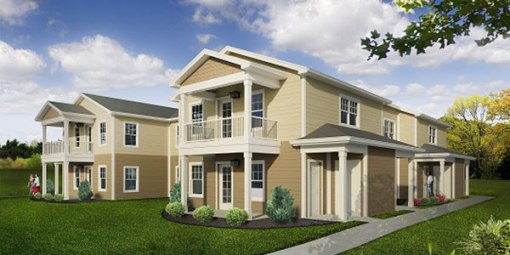
In contrast to Tiny Timbers’ site plan, the Cornerstone plan is a more conventional suburban layout with parking adjacent to each 8-unit structure. In fact, based on the above design, and the need for affordable developers to save on costs and therefore many reuse designs when they can, it’s likely that some of the Cornerstone apartments look something like the above image, which comes from a recent Cornerstone project near Brockport. The detailing and the colors may differ, but it’s a pretty good bet that’s how some of the finished units will look. Like Conifer, Cornerstone appear to be using a mix of their standard designs, and there are two distinct designs on the site plan, as well as a community center.

2. A redevelopment opportunity in downtown Ithaca has sold, but it looks like there are no plans. 110-112 West Seneca Street is a 538 SF salon with a large rental parking lot, and zoning is B-1a, meaning 4 floors 50% lot coverage, parking requirements in effect of about one space per unit or one space per 250 SF of commercial use. Tompkins Trust (Tompkins Financial Corp.) picked up the property on Friday the 28th for $600,000, below the $800k asking price but still quite substantial for what’s mostly land.

Unfortunately, it doesn’t look like anything is going to happen here. Tompkins Trust had previously rented the 23 parking spaces on site for use by its own employees – whether they’re hedging bets or don’t trust the parking garage situation, they appear to be buying the property to use as parking. Boo. With any luck, after their new HQ opens up next spring and their parking situation settles down, they’ll find better uses or potential partners for the lot. With no historic attributes but proximity to major services and amenities, a parking lot on this property is a waste of potential.

3. The Harold’s Square project team has given their website a overhaul, and with that comes the official timeline. According to the web page, asbestos abatement is now underway, demolition will start in September, construction will last through January 2019, and marketing/lease-up for the commercial spaces and 108 residential units should will start in January 2019.

The project description web page mentions 100 construction jobs, 50 retail jobs and 200 office jobs, which seems accurate for the square footage of each use (12k retail, 25k office). The estimate of 250 residents is way too generous though – the back-of-the-envelope is one person per bedroom, and there are about 144 bedrooms/studio units.

Side note, I reserve the right to grouse that the media links both go to the Times.

4. Dunno what’s going to happen with the Lansing Meadows senior housing up by the mall. Background story on the Voice here. On the one hand, the wetlands were an arduous and expensive undertaking, and Goetzmann did those to Army Corps of Engineers standards. It does make it tougher for the project to be financially viable. On the other hand, the village has a right to be frustrated, and it’s not unreasonable that they’re feeling that they’re being taken for a ride. Goetzmann received an IDA tax deal for what was largely a retail project, largely a no-no because most jobs in retail are low wage. He also received a variance for a community retail component, and multiple extensions from the IDA on fulfilling the housing component.

An increase in density spreads the fixed costs out among a greater number of units, and it’s encouraged by the village and county, so that’s not the issue. The design is what bothers them – while shared walls and utilities is a cost-saving measure, the village has expected smaller, house-like units since the project was first proposed in the late 2000s. Maybe the happy medium between this and the ten duplexes is a site plan with 3-4 unit structures with 20-24 units, with the buildings designed with pitched roofs, dormers, small porches and other home-like features. Let’s see what happens in the next couple of months.

5. Plans for co-op housing on West State Street have been waylaid, perhaps permanently. New York City businessman Fei Qi had previously proposed to renovate the historic 3,800 SF property at 310 West State Street into office space, and more recently a 12-14 person co-op. However, there have been a couple of issues with both plans – the ca. 1880 building is in need of significant structural renovation. Years of deferred maintenance prior to Qi (who bought it from the Salvation Army for $195k last year) has left the building in rough shape, and asbestos and lead need to be removed. For the housing proposal to be permitted, fire suppression systems would also need to be installed. Some city officials have expressed concern that like the carriage house that once existed at the rear of the property, if the building gets mothballed again, its structural integrity may be at risk. Any external changes would need to be approved by the Landmarks Commission. It appears that Qi recently applied to the commission stating economic hardship, saying he was unaware the building was a historic property and was not communicated to him by the seller or real estate agent, and cannot afford to renovate it to ILPC standards. The designation went into effect in April 2015, a year before sale.
Concurrently, Qi has put the property up for sale. For an asking price of $278,000, one gets the building and the architect’s plans. I’ve seen ball-park estimates of $500k for the renovation into office space, but I never saw an estimate for the co-op. As a result of the structural issues, the building’s assessed value plunged from $250,000 in 2016 to $100,000 last year, most of that being the land. Fingers crossed, someone steps up to the plate to save this building before it’s too late.
6. Last month, I speculated that there was a plan for redeveloping 217 Columbia Street on Ithaca’s South Hill. Turns out there is, and it’s really upsetting the neighbors. The plan by Modern Living Rentals is to preserve the existing building, but build an additional two-family home on the property as well. For the neighbors, this is apparently one student-oriented rental too far. Some are calling for a moratorium, and others a zoning change to prevent rentals without an owner living in the property. Most of South Hill’s zoning is R-2 residential, which is one-and-two family homes, and most of the construction in South Hill these past few years has been one and two-family homes. The issue is that they’re upset they’re rentals, many of which appeal to Ithaca College students further up the hill in the town. In theory, you could make it an approval requirement that the renters be non-students, although I’m not sure that would placate the situation. We’ll see how it goes.


News Tidbits 7/22/17: Throwing Darts

22 07 2017

1. Let’s start off the week with a little intrigue. A vacant 12.34 acre property on Wiedmeier Court in Ithaca town sold for $65,000 earlier this week – given that it was on the market for five years and marketed for development potential, the sale merited a closer look.

At first glance, it seemed to merit a shrug. The buyer was an LLC that could be traced back to a CPA in the San Francisco area, a woman of retirement age. The profile fits the deep-pocketed subset who might buy a sizable slice of land near Ithaca, and build a home for their retirement enjoyment. Not uncommon in Tompkins County.

Then on Wednesday, the same buyer purchased 114 and 122 Birdseye View Drive from the Cleveland family for $485,000. 122 is a 4-bedroom single-family, and 114 a 3-bedroom single-family. Both are next to IC, nearly new houses in a development otherwise filled with small-scale student housing. So, things just got more interesting. We’ll see if anything comes of the Wiedmeier property.

2. Just briefly touching on Hamilton Square this week – one of the questions I previously held off on addressing was the possibility of the abatement. Although the county has said they’re open to considering affordable housing tax abatements or PILOTs (Payments In Lieu Of Taxes) as part of their housing strategy, housing itself usually isn’t enough to merit a visit to the IDA. But with the addition of the nursery/daycare, it bared similarities to 210 Hancock, which cited its planned daycare center and the new jobs at the center in its PILOT request.

So, I asked what the plan was. Here’s the response from INHS’s Real Estate Development Director, Joe Bowes:

“We are not seeking an abatement from the IDA for the project.  If the day care is a non-profit then it would be tax exempt without the need for an IDA abatement.  The housing does not need the abatement in this case so it will be assessed and will pay property taxes.  210 had other reasons for requesting an abatement.”

Emphasis his. In the documentation on Hancock, the abatement was partially driven by the acquisition cost of the property and the need for a deep pile foundation. The buildings are much smaller at 46 South Street, so a slab/shallow foundation is suitable, and it helps that Trumansburg’s soil is less water-logged and more stable than Northside’s. This results in a lower development cost per square foot, so although they arguably could (and upset the neighbors even more), INHS isn’t pursuing a PILOT or abatement. The only tax savings will be for the eleven affordable owner-occupied units, which will be assessed for what they can sell for within the Community Housing Trust, rather than a market-rate value. This has the county’s support, because taxing a townhouse for double the value of what the lower-middle class homeowner could sell it for undermines its affordability.

3. Here’s an interesting note from Lansing regarding the Cornerstone land purchase. The first phase on 13.5 acres would be 68-72 units. The second phase on the remaining 8.9 acres would potentially host another 72 units. All of these would be affordable. This might cause a backlash as too much, but if one of the phases was general affordable housing, and the other affordable senior housing, then that might negate most of the blowback. Anyway, something to watch for.

On another note, the modified PDA for the Village Solars has a stipulation that the community center/mixed-use building (“F”, green dot) has to be completed by the end of 2020, and only 4 of the 9 other buildings will be approved before the community center is complete. Everything north of Circle North will not be allowed to start construction until the community center is open. This suggests a build-out of #116/#102, 2017-18, #2/#22, 2018-19, Community Center 2019-2020, #117/#36 2020-21, and K, L and M would be built in 2021-22.


4. Laurels and darts. Here’s a dart. The town of Ithaca is seeking to, once again, extend its moratorium on two-family properties. When the law was enacted in early May 2016, it was supposed to be for 270 days, meaning an early February expiration. Then it was extended to the end of July. Now they want to extend it to the end of October, which given the seasonal nature of construction, effectively stops all new two-family properties through the winter of 2017/18.

I’ll be frank. This is not a good look. There were a number of concerns from property owners when the law was proposed for a length of one year, was unfairly long, and the town has not only realized their concerns, it’s exceeded them. The town is establishing a bad faith precedent through what property owners will complain as either being ill will, or incompetence. Part of me is concerned that anyone fighting the town on something, be it zoning, development, conservation or anything, will use this as an example of how the town “can’t be trusted”. I’ve never been a fan of moratoriums, because they end up seeking extensions. Not impressed to have another example to file away.

5. And on that note, the town of Groton just slapped a six-month moratorium on all solar arrays designed to power more than one house or one agricultural farm. No commercial solar, no community solar. Technically, the law also stops wind turbines and gas pipelines, but the Times’ quotes make it clear this was all about solar.

6. The county legislature finally approved a name to the Heritage Center this week. The “Tompkins Center for History and Culture” was approved 10-2. The previous vote failed due to a number of absent legislators and pushback for not having enough to consider the name. Legislator Chock D-3rd) initially wanted it named for late legislator Stu Stein, but naming buildings after people has been against county policy since the early 2000s. Legislator McBean-Clairborne (D-1st) voted against it because she felt the word “county” should be in there. This has not been a month where local government engenders confidence.

7. Short but interesting city of Ithaca Planning Board meeting meeting up. The only thing up for final approval is the McDonald’s rebuild at 372 Elmira Road, while INHS’s Elm Street and Lakeview’s West End project are set to begin formal environmental review. Here’s the agenda:

1. Agenda Review 6:00

2. Privilege of the Floor 6:01

3.Site Plan Review

A. Project: Commercial Rebuild (McDonalds) 6:10
Location: 372 Elmira Road
Applicant:McDonalds USA LLC
Actions: Consideration of Preliminary & Final Site Plan Approval
Project Description: The applicant proposes to replace the existing 4,800 SF restaurant facility with a new 4,400 SF building, construct a side-by-side drive-thru, install new landscaping, a dining patio, lighting, signage and a masonry landscape wall, as well as reconfigure the parking layout. The project is in the SW-2 Zoning District and requires an area variance. This is an Unlisted Action under the City of Ithaca Environmental Quality Review Ordinance (“CEQRO”), and the State Environmental Quality Review Act (“SEQRA”), for which the Planning Board as Lead Agency made a Negative Declaration of Environmental Significance on June 27, 2017.

B.Project: Elm St Apartments (Rebuild) 6:25

Location: 203-209 Elm Street
Applicant: Lynn Truame for Ithaca Neighborhood Housing Services Inc. (INHS)
Actions: Declaration of Lead Agency, Review of FEAF Parts 2 & 3
Project Description: The proposed project consist of the demolition of two single family homes and one
multiple dwelling and the construction of a single 12,585 SF apartment building with 13 dwelling units, parking for six vehicles, and other associated site improvements. Due to the slope of the site, the building will have 2 stories facing Elm Street and three stories in the rear. The project requires the consolidation of three tax parcels. The project is in the R-3a Zoning district and is seeking two area variances for relief from rear yard setback and parking requirements. This is a Type I Action under the City of Ithaca Environmental Quality Review Ordinance (“CEQRO”)§176-4 (1)(h)[3], and the State Environmental Quality Review Act(“SEQRA”)§ 617.4 (11) and is subject to environmental review.

C. Project: 709 West Court Street (Housing) 6:50
Location: 326 & 328 N Meadow St. and 709–713 W Court Street
Applicant: Trowbridge Wolf Michaels LLP for Lakeview Health Services Inc.
Actions: Declaration of Lead Agency, Review of FEAF Parts 2 & 3
Project Description: The applicant proposes to construct a five-story L-shaped building with footprintof 10,860 SF and GFA of 62,700 SF on the .81 acre project site comprising four tax parcels (to be consolidated). The building will containing sixty (60) one-bedroom apartments plus associated shared common space (community room, laundry facilities, lounges, and exterior courtyard), support staff offices, program spaces, conference room, utility rooms, and storage. The siting of the building allows for a small landscaped front yard, a south-facing exterior courtyard, and a 16 space surface parking lot in the rear of the site. Site development will require the removal of five structures and associated site elements. The project is in the WEDZ- 1 Zoning District. This is a Type I Action under the City of Ithaca Environmental Quality Review Ordinance (“CEQRO”)§176-4 (1)(k) and (n), and the State Environmental Quality Review Act (“SEQRA”) § 617.4 (11) and is subject to environmental review.

D. 105 Dearborn –Sketch Plan 7:10

This is Bridges Cornell Heights new 16-bedroom independent living building for seniors. If it’s at the Planning Board, that means the ILPC has signed off on the building and site design.

E. 311 College Ave – Sketch Plan 7:30

This is…curious. 311 College Avenue is The Nines restaurant and bar, and was built in 1905 as fire station No. 9 before the new station opened next door in the late 1960s. The old station was sold off and became the Nines in the early 1970s, and has been under its current ownership since 1980. The top two floors are used for storage, according to county records.

At a glance, it’s a valuable piece of land with a lot of posibilities – MU-2 zoning allows six floors and 100% lot coverage. On the other hand, this is a relative historic property in Collegetown, and development perceived as insensitive will likely see significant opposition. There had been talk by ILPC staff of giving the building historic designation back in February 2016 out of concerns over development pressure, but it seems no formal application was made. So there are options here, but the developer should proceed with caution.

4. Zoning Appeals 7:50
#3066, 214 Elmira Road, Area Variance
#3079, 413 Titus Ave, Area Variance

5. Old/New Business 8:00
A. Planning Board Recommendation to Council Regarding Proposed Waterfront Rezoning
B. Planning Board Report Regarding the Proposed Local Historic Landmark Designation of 403 College
Ave
C. Downtown Wayfinding

6.Reports 8:30
A. Planning Board Chair (verbal)
B. Director of Planning & Development (verbal)
C. Board of Public Works Liaison