News Tidbits 7/7/2018

7 07 2018

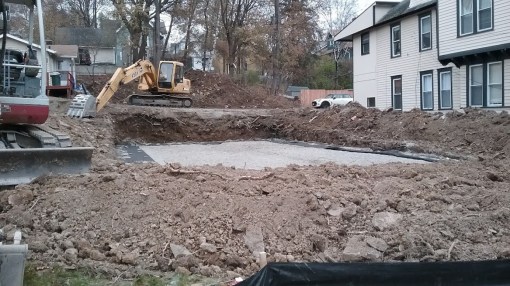
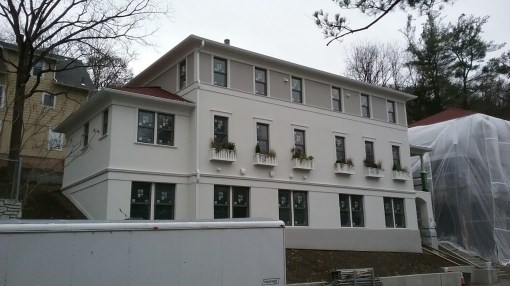
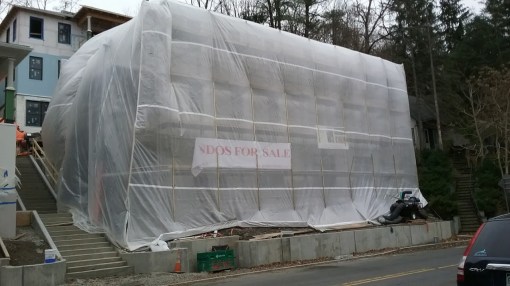
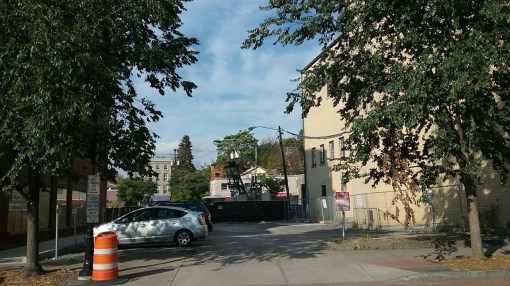
1. The infill project at 209 Hudson has been revised and reduced in size. The new plan from the Stavropoulos family of developers calls for just one new duplex at this time, on the existing lawn and swimming pool of the extra-large lot. The rear duplex was eliminated in the revised plan. A small zoning variance is still required for the subdivision (side yard deficiency), but it’s less likely to catch the ire of BZA members this time around because more mature trees are preserved in this reduced-size iteration. Modest bay window projections, fiber cement panels and wood trim will help create a higher quality product.

The duplex would be a quick build since it’s modular, but it’s not going to be ready in time for fall semester – spring (January) would be feasible, if the individual units are assembled before the snow flies. The Planning Board will make their recommendation this month, and the BZA will have their vote in early August, with potential final approval in late August. Quick note, as this has fallen under the threshold for the Ithaca project map (3 units or more), it has been removed.

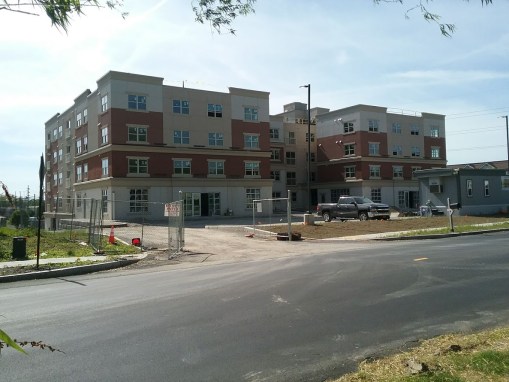
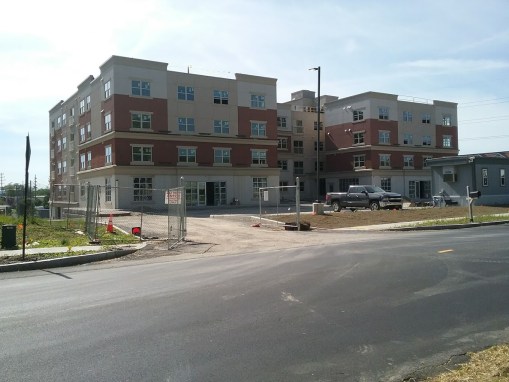
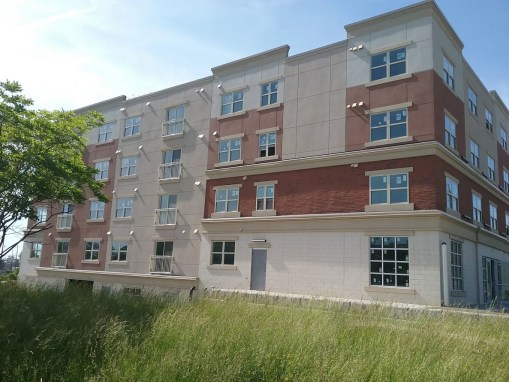
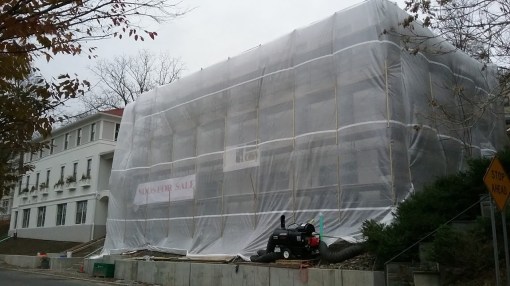
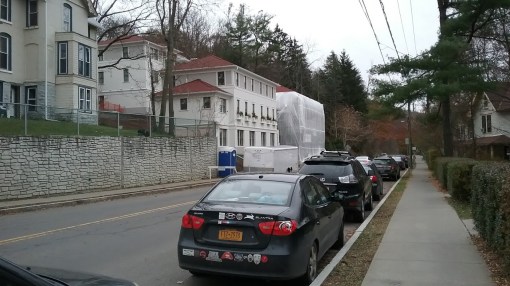
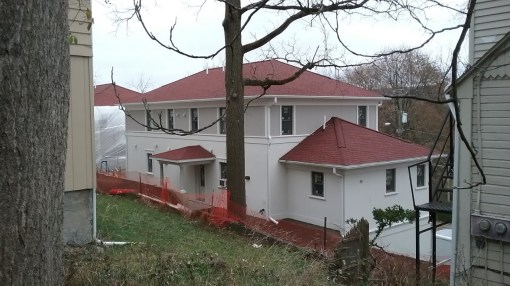
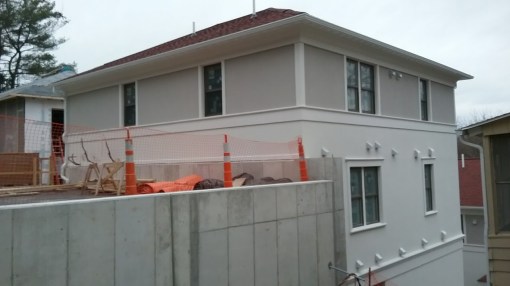
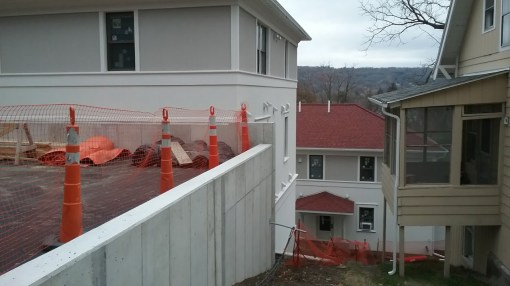
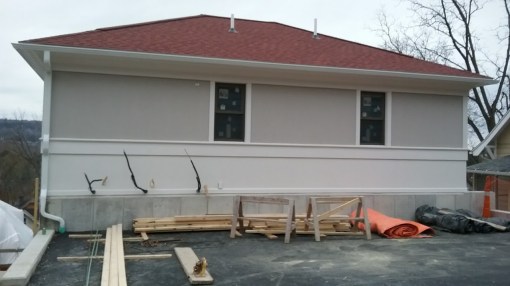
Also due for review this month are final approvals for 128 West Falls Street (above) and a 3,200 SF endcap addition at South Meadow Square, and approval of a subdivision at 508-512 Edgewood Place.

2. Recently, Visum Development posted photos on their Facebook/Instagram taken during setup for an interview with Park Productions, and Ithaca College student media group. Normally, that’s not something to write about, but this caught my attention:

327 West Seneca is the new all-affordable project they introduced at last month’s planning board meeting. As for the others, I don’t have much of a clue. Ithaca does not have a Main Street, so that’s likely another community. 409 State may refer to an older building at 409 West State or 409 East State, but 409 East State is Travis Hyde’s Gateway Center property (and who at last check had no plans to sell).

As for the others, it looks like the first number was erased. Also of note, there is no East Cayuga, it’s just North and South. So I dunno quite what to make of it – hints of projects with some red herrings, it seems. Worth a look, but it’s not much to work with just yet.

3. Time for a little more speculation. A vacant lot east of 404 Wood Street in the city of Ithaca’s Southside neighborhood sold for $70,000 on June 26th. The buyers were a husband-and-wife pair who also happen to work for Taitem Engineering, a prominent local consulting engineering firm with specialties in structural engineering and associated branches in the context of green/sustainable building operation. The pair previously did a LEED Platinum, net-zero energy home in Ulysses two years ago. The likely guess here is that they’ll be building their next net-zero energy residence on this lot.

As previously noted when the property went up for sale in January 2016 (it was later subdivided from 404 Wood, which was sold a while ago), “(p)laying with some numbers a little bit, there are a couple of options if a buyer wanted to build something. The first and probably easier option would be to subdivide the lot and build on the vacant corner parcel. That would give, per R-3b zoning regulations of 40% lot coverage and 4 floors, about 1400 SF per floor. That gives 5600 SF, and if one assumes 15% off for circulation/utilities and 850 SF per unit, you get a 5 or 6 unit building at theoretical maximum.”

TL;DR – if they want to do a small infill net-zero apartment building, they can. If they want to do a sizable single-family residence, they can do that as well. We’ll just have to wait and see what happens.

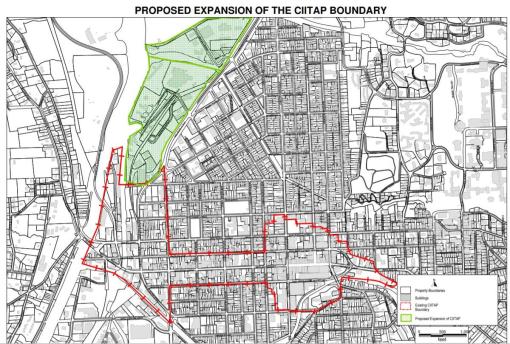
4. On the policy side, the Ithaca Common Council voted Wednesday night to move forward with a CIITAP stipulation stating projects pursuing the tax abatement must have a mandatory affordable housing component of 20%, available to those making 75% Area Median Income, affected all residential projects with ten units or more.The extension of CIITAP applicable properties along the Waterfront was also approved.

The policy comes forth after considerable debate over the right percentage and right income to apply. It’s the Goldilocks principle – too little and you don’t add an appreciable amount of affordable housing and may even decrease the amount once redevelopment occurs in lower-income blocks, too much and developers just won’t build (the Portland problem), and those who stick around will renovate existing buildings instead, meaning less supply overall, fewer existing lower-income units and accelerated gentrification. Among things discussed Wednesday night, a proposal to modify the mandatory size requirement of affordable units from a minimum of 80% the square-footage of the market-rate to 100% failed 5-4 (needed six), the % of affordable units went from 10% to 25% (the 25% was the First Ward’s George McGonigal, who has a history of being opposed to new market-rate and affordable housing, and did not get a second to open discussion).

It’s too early to say if this is too much or not enough – the City Harbor folks were in attendance for the discussion (they were at the meeting for a different topic), but didn’t raise concerns to 20%, so it seems likely their project is able to continue. The county IDA is the grantee of abatements with the city in an advisory role only, so they’ll have the final say on the application of the new law.

5. Tompkins Cortland Community College’s Childcare Center has the funds it needs to move forward. The project, first proposed in February 2016, calls for an 8,000 SF, $4 million building, plus a $1.5 million endowment for operating costs. State funds support much of the cost, as well as a $2 million donation from Ithaca CEO and major TC3 donor Arthur Kuckes, for whom the center will be named.

According to Jamie Swinnerton over at Tompkins Weekly, the project includes six classrooms with two infant rooms, three playgrounds, and be, in part, staffed by students studying to be teachers and childcare providers. 12 jobs will be created, and since it’s for faculty, students and staff, those jobs are expected to be full-time and all year-round. The building is expected to be partially opened by the start of the Spring semester, and fully occupied by the Fall 2019 semester.

Design-wise, the latest design in Tompkins Weekly shows smaller windows and the loss of some hipped roof bumpouts at the rear of the building (older version here). Value engineering noted, but the goal of helping students with children stay in school, and get the degrees they want to build their professional foundations on outweighs any shade thrown at the design changes.

6. Also finally moving forward – Lansing Meadows. There was an 11th-hour holdup for the 20-unit senior housing project when the village expressed discomfort with accepting future ownership of Lansing Meadows Drive, feeling the turns were too sharp and posed a liability. Developer Eric Goetzmann relented and agreed to maintain the road as a private road, and the village board approved the project 3-2; there are still a lot of sore feelings about the often-delayed and arguably underwhelming final proposal. Goetzmann has until July 31st to obtain permits to begin construction, or else the county IDA will recommence seeking clawback reparations from abated taxes, most of which went toward the BJ’s that was built in 2011-12.

7. Let’s slay some inbox rumors. East Hill Village is not cancelled. Nor is Trinitas’ Dryden Townhomes project. I checked with the project teams – both are still active projects. However, East Hill Village is waiting on the town of Ithaca to finish updating its zoning to a more form-based code, and the project will not move forward until that happens.
8. For fun: here’s a Google Docs spreadsheet on how the Ithaca metropolitan area lines up with other metros on new home construction permits since 1980. Key takeways – Ithaca/Tompkins County was in the top 10% of metros in 2017 for multi-family housing permits per capita (30th of 381), but it lags quite a bit in the construction of single-family homes, so its overall rank is only the 64th percentile (137th of 381). Even then, it’s still one of the fastest growing housing markets per capita in the Northeastern United States. 2016 and 2017 have been strong years, while 2015 and earlier were generally well below the national average.

The multi-family number per capita is arguably skewed higher than a typical year thanks to large projects like 441-unit/872-bed Maplewood, but the message seems to be that the community is seeing real results from its push for housing. However, with a lack of single-family being built, Ithaca and Tompkins County need to figure out ways to compensate for what single-family provides (i.e. home ownership). It’s not necessarily “we should build more single-family homes” although that is part of the answer. It’s also encouraging suitable single-home substitutes (condos) in desirable areas while maintaining a strong, steady flow of new units as the local economy continues to grow.


Cayuga View Senior Living Construction Update, 6/2018

21 06 2018

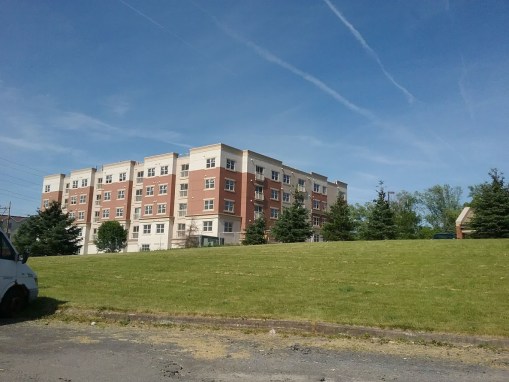
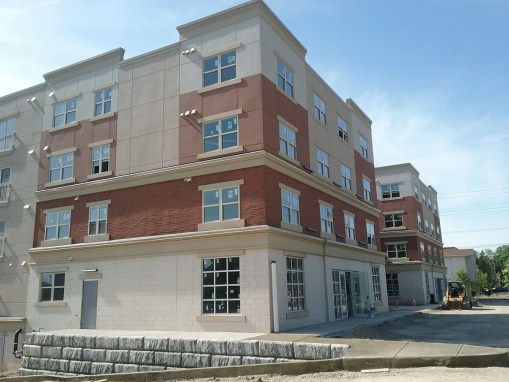
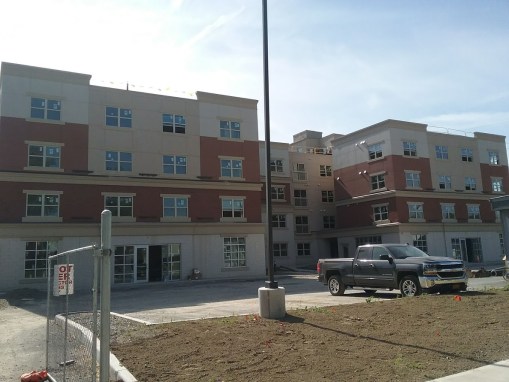
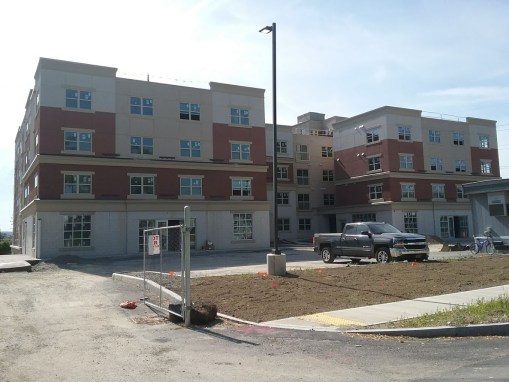
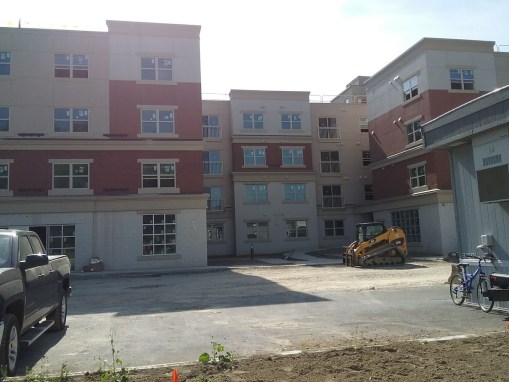
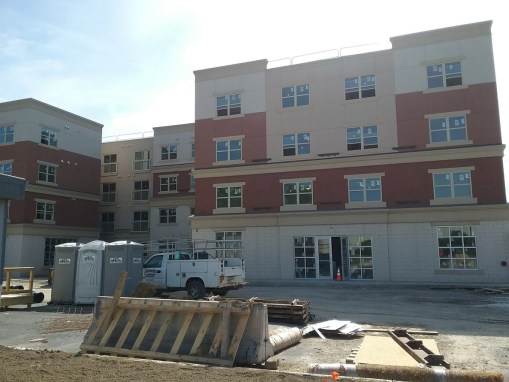
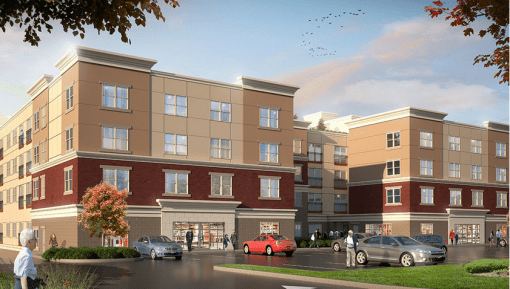
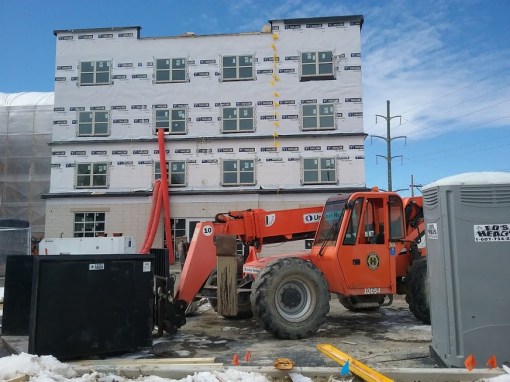
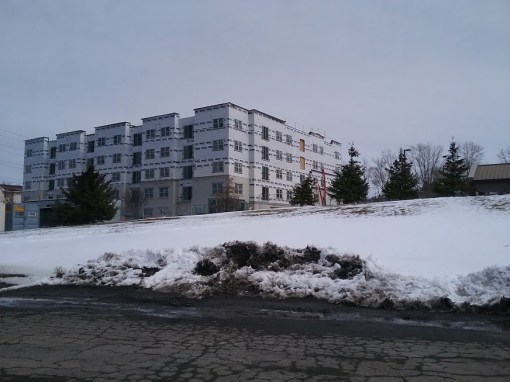
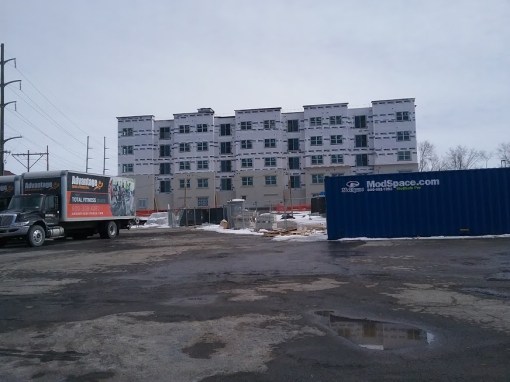
We can practically call this project complete – the first tenants move in on July 1st. Somewhere along the way, the number of units was reduced from 60 to 58, and it’s not clear whether those were one-bedroom or two-bedroom units (the initial breakdown was 48 two-bedroom and 12 one-bedroom units). No tenants have been named for the twin 1,340 SF retail spaces either.

Given that this was the last vacant high-density mixed-use parcel in the village of Lansing, it seems like they got a good project out of it. 58 market-rate units to seniors aged 55+ is a welcome addition the the Tompkins County market, especially as the retirement of Boomers only continues to grow (the market will create demand for another 70 senior-focused units per year over the next several years, as well as market-rate and affordable housing for those without specialized care needs). While not exactly an urban location, it is walkable to nearby shops and restaurants at Triphammer Mall and the Bishop’s Mall across the street, and it will have a bit of an active ground-floor presence through its small commercial spaces. 5% of the units will be built handicap-accessbile, but all will be handicap-adaptable, and the rooftop solar panels are a plus.

The project was built and developed by Taylor The Builders in conjunction with the Thaler Family. NH Architecture did the design work, and Cornerstone Group will manage the property.

Some cool aerial shots of the site can be seen here courtesy of Taylor and photographer Mick McKee. Interior photos of the nearly finished units and rental information can be found on Craigslist here.


Hilton Canopy Hotel Construction Update, 4/2018

5 05 2018

Construction continues on the Canopy, but the plans are in a state of modest flux. The fiber cement panels were changed to a different manufacturer, which uses a different paint supplier. The original Cem5 fiber cement panels use Swiss Pearl paints, while the revision proposes Nichiha panels using PPG paints. The replacement colors are very similar.

However, the dull yellow “Applesauce Cake” accent panels (itself a replacement for Cem5 “Carat Topaz”), was rejected by Canopy. The replacement color, a charcoal grey “Dark Ash”, was disliked by the board, so the project team is still trying to determine a suitable color replacement with enough to get the order filed with the manufacturer without delaying the construction timeline. I wonder if, given the orange Canopy logo and branding, if a soft “rustic” orange shade might be available? The thought being that it would tell visitors quickly that this building is a Hilton Canopy, and a warm, subtle shade would brighten the facade without being obnoxious. From what I see, one can custom order panels, which is no doubt more expensive, but I’m not seeing a list of standard colors anywhere.

While excavating, the project team did find some small fragments of the Strand Theater, which stood on the site until its demolition in 1993. The “most decorative” pieces are going to be used in a display inside the hotel lobby, and further consideration is being made for an exterior mural.

The landscaping is being tweaked to extend a sidewalk through the property to Seneca Way, as well as a curb-cut and smaller planters to fit within the property line. A pair of ginkgo trees planned for the property are being replaced with some dense shrubs and perennial instead. This is the eleventh version of the project I now have on file. Background info and specifications can be found here.

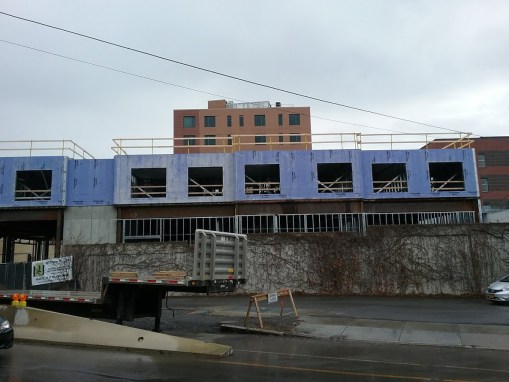
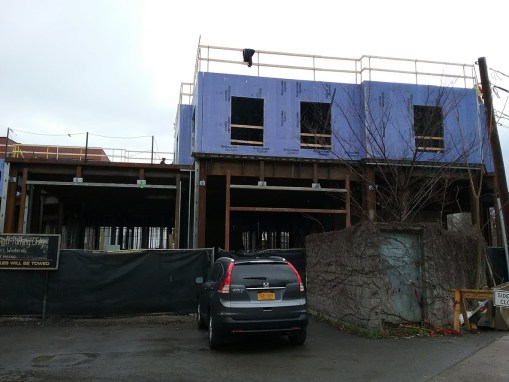
The hotel has completed foundation work and is up to the second floor. The steel skeleton and elevator cores/stairwells continue to rise, with thinner exterior steel stud walls on the ground floor and fireproof gypsum panels on the second floor. The finished product should be coming onto the market in about a year.


Cayuga View Senior Living Construction Update, 3/2018

20 03 2018

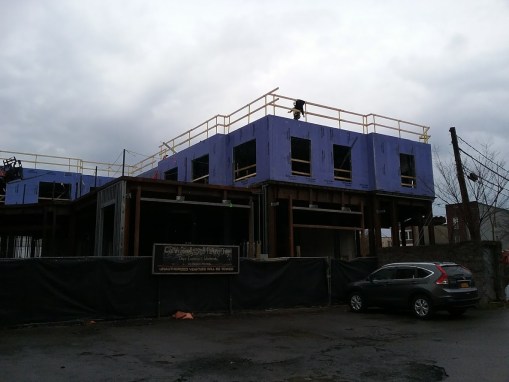
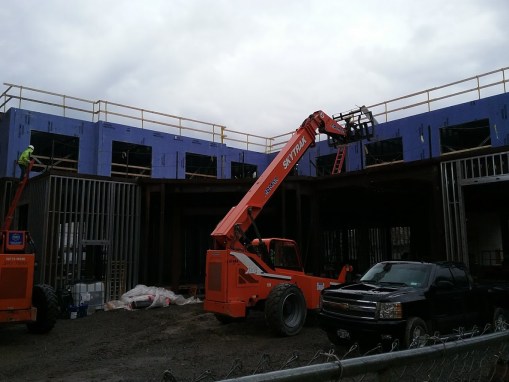
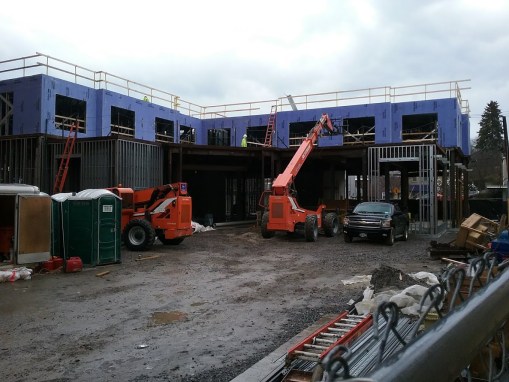
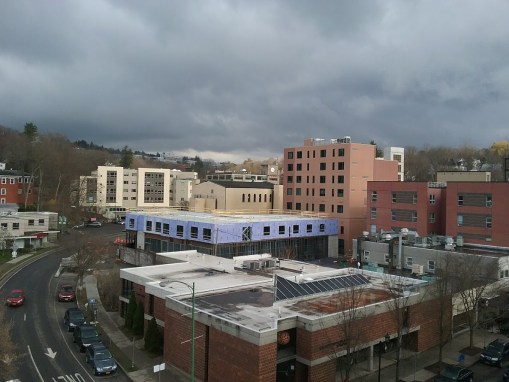
It looks like Taylor the Builders has started attaching exterior finishes to the Cayuga View Senior Living apartment building. That includes decorative cornices, brick veneer, and what appears to be a few different shades of EIFS panels. EIFS (Exterior Insulation Finishing System), sometimes called synthetic stucco or by commercial brand names such as DryVit, is a lightweight, waterproof finishing material – usually it’s two-inch thick polystyrene (rigid foam) insulating panels with an acrylic finish to mimic the appearance of stucco, along with adhesive and drainage structures. EIFS is low-maintenance; it gained popularity in the 1970s and 1980s, but developed an infamous reputation for water damage due to improper installation, which is why so many building codes are stringent about adequate drainage systems for new builds. The boards can also be damaged fairly easily by blunt-force impacts. It tends to be more common on commercial buildings than residential structures, but it is not an uncommon choice of finishes for wood-frame multi-family buildings. Other recent builds using EIFS include the Holiday Inn Express on Elmira Road, and the Seneca Way Apartments on the edge of Downtown Ithaca.

Interestingly, the top floor’s panel boards are a lighter color than the third floor – renderings have them both being the same color.

Also, note the poles and flags on the roof – that’s a good indicator that some material is being applied, probably EPDM, which is a synthetic rubber. The project team recently announced that the 87,500 SF building will not only host a rooftop garden, but a 46kW, 151-panel solar array courtesy of installer SunCommon NY of Rochester.

Current plans call for the first occupants to begin moving into its 60 apartments by the end of May (the website advertises a summer occupancy, and a leasing office is present on-site). Cornerstone Group, also of Rochester, has been selected to manage the building, whose units are reserved for those aged 55+. I’ve been in touch with the project team, and there might be a sneak preview article in the Voice a few weeks before opening.


News Tidbits 11/25/17: Not Going to Plan

27 11 2017

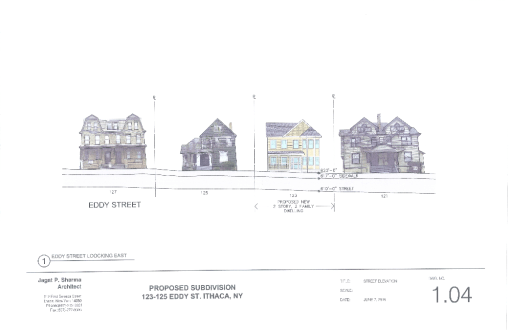
1. It looks like the Lambrous have started work on the new duplex they’ve long planned at 123 Eddy Street in Collegetown. Foundation work is underway for the two-unit, six-bedroom home, which utilized Superior Foundation Walls and modular units. The building sits on the edge of the East Hill Historic District, so to make the building compliant with the ILPC’s wishes, it features Hardie Board siding, simulated shakes, scuplted brackets and an attic vent, and detailed railings and porches. The design went through a couple iterations, with the first being historically appropriate but expensive stick-built design, and the second a modular scheme that was non-compliant with the ILPC. The Lambrous plan to have the new three-bedroom units available for rent by August.

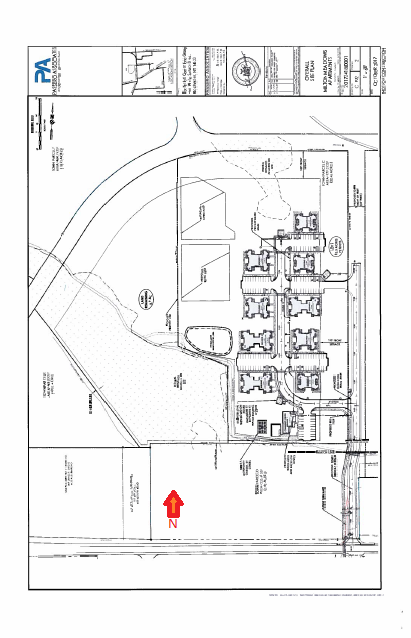
2. Lansing’s Milton Meadows affordable housing project is up for final approval next Monday, and it looks like the first 72-unit phase will be the only phase. According to documentation filed with the town, the presence of poorer soils and more wetlands than anticipated means that Cornerstone will not be undertaking a second phase. It does raise further questions regarding adjacent parcels and the amount of money the town of Lansing can reasonable gain since this sounds like a recent discovery. The final site plans here show no indication of Cornerstone Development Group buying the remaining 8.9 acres that were intended for phase two.

There are no huge obstacles to prevent approval, although some town officials are unhappy that they didn’t apply a stronger hand to the town center development plan (i.e. laying the roads and infrastructure as they wanted, and charging a higher price for the parcels). While most of the darts have been levied towards Cornerstone (some perhaps unfairly due to it being affordable housing), the town planning chair has also targeted Tiny Timbers for using Conlon Road as its primary ingress/egress in their sketch plan. But with sales already negotiated and approved, the town’s legal options are limited, and since they already dropped the ball on the town center once, the optics aren’t pretty. Any work Cornerstone does is dependent on state and federal grants that are highly competitive and awarded only a few times per year, so don’t expect much for at least a year or two after approval.

3. It looks like the land for the proposed extension of South Meadow Square has been fenced off. A query to the folks in PetSmart next door didn’t turn up much, although they said there had been some water and sewer work to prep for the new 7,315 SF addition approved earlier this year. I did not see what the current conditions are for the approved 14,744 SF addition on the south end.

4. The county and the city have competing views of the NYS DOT’s future in Tompkins County. The county has reiterated its hope that the DOT relocates to a location next to the county airport. The city would prefer a location in Southwest Park behind Wal-Mart and the proposed Maguire dealership campus. The request for state grant dollars depends on the airport proposal, and the DOT has stated preference for a site near the airport.

However, if grants are not awarded, the airport is still considering a plan to build a $1-2 million customs facility that would allow to become an international airport, servicing passenger jets from Canadian hubs (Toronto, Montreal). In the short-term, work is underway to add service to Chicago, which has an on-time percentage comparable to Detroit (80%), and better than Newark (60%) and Philadelphia (70%). Cornell is actively assisting, trying to persuade airlines as part of its “Global Cornell” initiative.

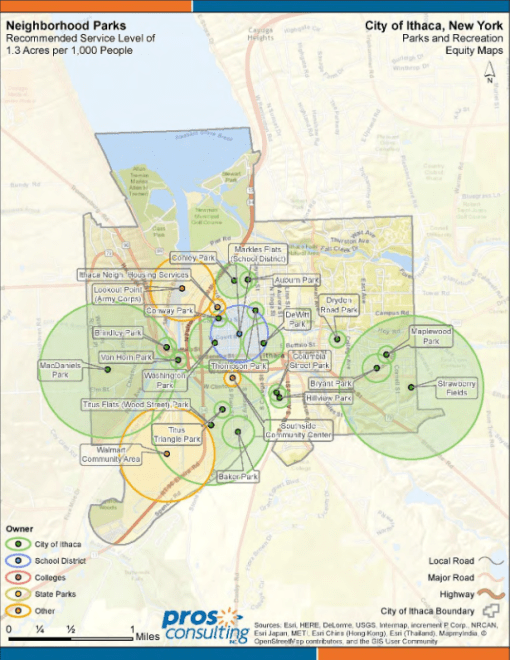
5. So here’s the city of Ithaca’s parks master plan. There’s a few interesting things of note in terms of acquisitions and de-classifications (sale).

First, a quick note – the city is legally required to replace any park land it sells off with newly acquired park land. So with that in mind, the city looked at its parks and found five that are “vastly underutilized” – Columbia Street Park (0.25 acres), Dryden Road Park (0.08 acres), Hillview Park (0.74 acres), Maple Grove Park (0.47 acres), and Strawberry Fields (9.16 acres).

The city would like to sell off the first four on that list, and replace them with a new acquisition somewhere in the city that has at least 1.54 acres, but the city is looking for up to 12 acres. Proximity to population centers, arterial roads, pedestrian access and minimal site prep are some of the big deciding factors in that acquisition process. Meanwhile, Strawberry Fields would be held for either designation as a “school park” to be managed in conjunction with the ICSD, or as a “teaching preserve” for practice field research and instruction.

If the city did opt to sell those four parks, well, there’s some development potential, though they wouldn’t be prime. Maple Grove is a Belle Sherman cul-de-sac surrounded by single-family homes. Dryden Road Park is a small triangle next to the parking garage, and while technically an MU-2 zone for six floors, it’s just as likely Cornell would pick it up amd add it to its tax-exempt rolls since it’s next to Cascadilla Hall. Hillview and Columbia Street on South Hill (R-2a zone) could potentially become a few home lots or a small apartment complex, but the land’s sale would be a political challenge.The city procedure would be an advertised sale offering through the IURA, followed by a grading system of applicants that meet the city’s specified price, as they did with foreclosed lots that became the Ithaka Terraces and 203 Third Street.

Not too keen to get in the weeds on this, since this would be controversial with neighborhood groups, but it’s really just a thought exercise at this point – any potential land sale would be on a long-term, 5 year+ time scale, and the city would need to have new land ready to be acquired for recreational uses. Even thatcould cause problems when neighbors complain that an untouched property becomes a public park that attracts people (this has been an issue with proposed extensions of the South Hill Rec Trail). There is plenty of time to debate the merits and drawbacks of long-term property assets. Right now, the focus is repair and renovating existing facilities in city parks.

6. Looking at the city’s planning board agenda for next week, it’s a short one. The duplex at 601 South Aurora and the Brindley Street Bridge are up for final approval, and a pair of new sketch plans will be reviewed – one is likely to be small, and the other a revision, potentially a downsizing. I’ve heard through the grapevine that several rental developers are holding off or even cancelling plans because they’re concerned about the impacts of Cornell’s 2,000 new beds for their North Campus – although right now there’s nothing formal apart from a statement of intent. Ideally, Cornell puts some concept forth soon, with plans not long thereafter; otherwise, there’s the risk that the local housing situation gets worse. Perhaps the reasonable worst case scenario is that, with recent federal attacks on higher education, Cornell is forced to trim its budget and cancels the housing plans, while still adding students to compensate for financial losses – basically, a sudden large growth in demand without growth in supply.

First, 209 Hudson. This was previously mentioned in a Voice article, it’s potentially a small-scale infill project by frequent infill developer Stavros Stavropoulos. The early plan for two of three rental buildings was shelved due to the South Hill overlay, and its possible that, given the relatively large lot, Stavropoulos may be planning a subdivision to build an additional two-family rental unit. Dunno if he can legally pull off more than that, however. R-2a with overlay allows a 1-2 family structure as a primary, with an accessory apartment in a secondary structure.

The second is 119-123 College Avenue. This is unusual in that this was the site for John Novarr’s College Townhouses project, a 67-unit, multi-building plan for rentals geared towards visiting Cornell faculty and staff. However, the recent NYSEG power line issue has proven problematic, and the last I checked, the project team was supposed to go before a state building codes board in Syracuse this month to get a variance to allow construction, on the basis that the power lines will soon be buried. The minutes are not online, so it’s not clear what the ruling was. While CR-4 zoning allows 45 feet as the plan is currently designed, a variance denial by the state would limit structural height to 30 feet, and would substantially impact the project’s feasibility in pricey Collegetown, as well as alter the design. For the record, 119-123 does not imply a smaller project; 123 College Avenue never existed, the three homes removed for this project were 119, 121 and 125. We’ll see what the revised plans look like next week.

1. Agenda Review 6:00
2. Privilege of the floor (3-minute maximum per person) 6:05
3. Site Plan Review

A. Project: Duplex 6:15
Location: 601 S Aurora Street
Applicant: David Putnam
Actions: Public Hearing, Consideration of Preliminary and Final Site Plan Approval
Project Description:
The applicant is proposing to construct a duplex on the .186 acre (8,114 SF) vacant lot. Site development includes parking for two cars, walkways, landscaping, a continuous sidewalk along the property frontage, drainage improvements and a trash enclosure. The applicant has designed curbing and on-street parking on Hillview Place in cooperation with the City Engineering Division. The project is in the R-2a Zoning district. This is a Type II Action under the City of Ithaca Environmental Quality Review Ordinance (“CEQRO”) §176-5. (C.)(8) and the State Environmental Quality Review Act (“SEQRA”) § 617.5 (c)(9) and is not subject to environmental review.

B. Project: Brindley Street Bridge Rebuild and Relocation 6:35
Location: Intersection of W State Street and Taughannock Blvd
Applicant: Addisu Gebre for the City of Ithaca
Actions: Consideration of Preliminary & Final Approval
Project Description:
The project will relocate current Brindley Street Bridge to align with W. State St./Taughannock
Blvd. intersection through the construction of a new single span extending Taughannock Blvd. over
the Cayuga Inlet to Taber Street. The project will retain existing Brindley Street Bridge and south approach road for pedestrian and bike use. This is a Type I Action under the City of Ithaca Environmental Quality Review Ordinance (“CEQRO”) §176-4 B.(1)(k) and the State Environmental Quality Review Act (“SEQRA”) § 617.4 (b)(11) for which the Board of Public Works, acting as Lead Agency made a Negative Determination of Environmental Significance in 2016.

C. 209 Hudson Street – Subdivision & Site Plan Review – Sketch Plan 7:05

D. 119-123 College Avenue – Sketch Plan 7:35

4. Old/New Business 8:00
A. Collegetown Design Guidelines – Megan Wilson
B. Parks Master Plan – Megan Wilson

5. Reports 8:40
A. Planning Board Chair (verbal)
B. Director of Planning & Development (verbal)
C. Board of Public Works Liaison (verbal)


Ithaka Terraces Construction Update, 11/2017

23 11 2017

These are turning out quite nice. Building “A” is practically complete from the outside. The plant boxes outside the windows have even been stocked with small ornamentals. About the only thing left are the exterior finishes on the front facade columns. Building “C”, the smaller building to its east, is also nearly finished from the outside. I suspect the wiring coming out of Building “C” just above the parking area is for electric car charging stations.

Building “B”, the other large condo structure, is fully encased in plastic sheeting and wood ribbing. Stucco generally needs to be applied in dry, temperate weather conditions, above 40 F at a minimum. Given Ithaca Novembers, that means McPherson Builder has basically turned the building into a dry, heated bubble so that can apply the stucco properly. Building “D” is still being roofed, and is just getting its windows fitted. It looks like the scratch coat for the stucco is being applied over the water barrier, and the brown coat and the finish coat will come later, meaning that “D” will eventually be bubbled in as well.

Most of the concrete curbs and steps have been formed, poured and cured at this point. The grand staircase will make for a nice shortcut from South Cayuga Street to West Spencer Street.

The marketing material appears to be using the phrase “Arriving here is what you are destined for“. Tje website doesn’t indicate how many of the twelve units are spoken for (if any; the project is in the soft marketing stage, where they’re accepting inquiries but there aren’t any formal real estate listings). The two-bedroom and three-bedroom units go for $299-$434k, depending on size and location.


Hilton Canopy Hotel Construction Update, 10/2017

31 10 2017

Tompkins County benefits from being a regional tourism destination. A combination of amenities like the colleges and wineries, scenic gorges and and convenient location have made it a popular weekend getaway from the big cities of the Northeast and Mid-Atlantic, as well as some of the major Great Lakes cities. In the past ten years, the hospitality and tourism sector of the economy has grown over 20 percent, adding several hundred jobs even after seasonality is taken into account. An additional benefit is that the room taxes are used to fund arts and culture grants, community festivals and part of TCAD, the economic development agency.

Representative of that growth has been the growth in the local hotel industry. Around 2014 or so, one of the big questions was, how many hotel rooms is too many? The Marriott was in the works, the Hilton was in an earlier stage, two hotels were planned on the Route 13 corridor, and the Hotel Ithaca had its plans. For practical purposes, it was a good question.

However, the situation evolved over time. As is often the case, the hotels opened later than anticipated. The 159-room Marriott finished late last fall, the 76-room Holiday Inn Express was completed a couple months earlier, the Hotel Ithaca went with an expansion that actually reduced the available number of rooms by ten and opened earlier this year, and one of the suburban hotels, a 37-room independent boutique hotel, was cancelled. They all came onto the market later than expected. and the number of rooms added was less than originally planned. All the while, the economy continued to grow at a consistent 1.5-2% annual pace, Cornell continued to add students and the population slowly grew. Had all the hotels opened at once with their original plans, the impact might have been a big problem. But the reality was that the Hotel Ithaca’s impact was modest, and the HIE’s and Marriott’s supply is being absorbed (though the market does need over a year to fully adjust to a 12.8% growth in supply). For the record, Airbnb and similar services have their impacts as well, but the county estimates it’s the equivalent of roughly 40-60 hotel rooms.
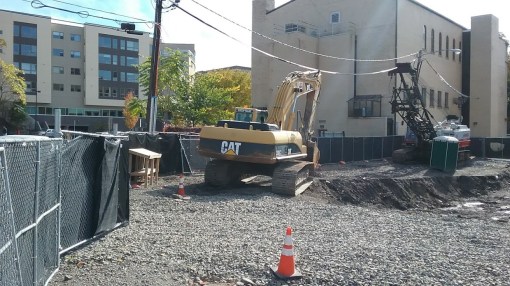
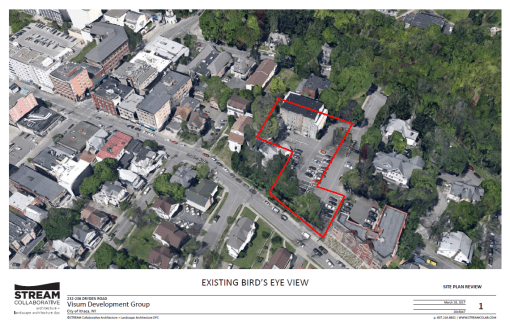
With the market still adjusting to the influx, it’s probably a good thing that the Canopy Hilton isn’t opening until Spring 2019, well after a new equilibrium is achieved. However, it’s been a long road to get to this point.

First, a brief history of the site. In recent years, the Hilton site was a mix of private and municipal parking. From 1916-1993, the Strand Theater occupied the site. The Carey Building was designed to match the Egyptian Revival motif of the theater, but unlike the Carey, the theater closed in the late 1970s, attempted and failed at a reopening as a community theater, and after being vacant for over a decade, the building was deemed too far gone to save, leveled by the wrecking ball during the deep recession of the 1990s.

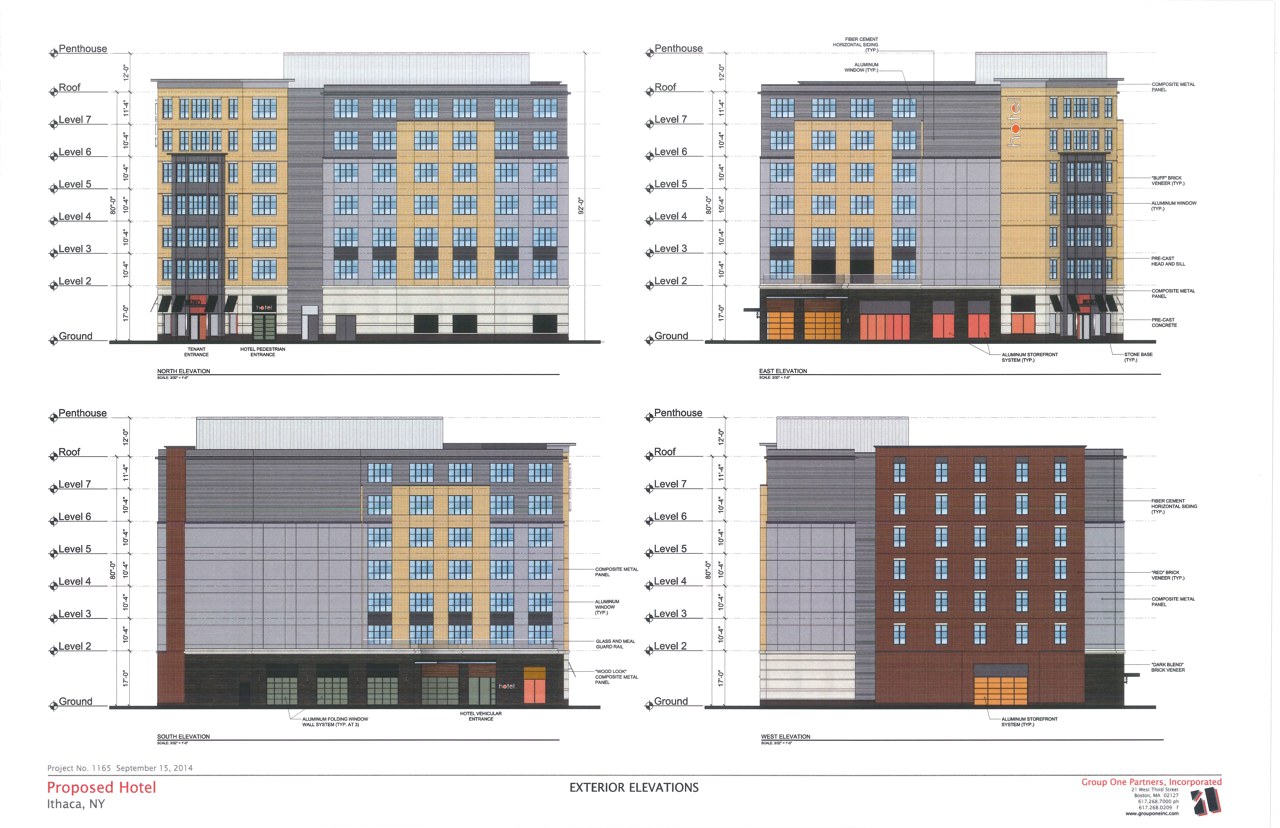
The first mention of a hotel on the 300 Block of East State/MLK Jr. was back in December 2012. Lighthouse Hotels LLC (Neil Patel) proposed a six-story, $16 million Hampton Inn on the site (v1). The 92-room hotel, designed by Jagat Sharma, would have resulted in the demolition of the Carey Building – recall this was before the Carey overbuild.

However, Patel violated an important rule when it comes to development – unless you have made previous arrangements, don’t propose something for someone else’s property. The proposed Carey demo caught Frost Travis by surprise, and he and parking lot owner Joe Daley were less than amused. Nor were Planning Board members, who were fond of the Carey and not fond of the surface parking proposed with the hotel. The project went nowhere, and a major reworking was required. Negotiations with the city and neighbors were needed to acquire the necessary land, and the IURA and Common Council agreed to have the IURA represent the city on divestiture discussions.

Fast forward 18 months to June 2014. Having hired on Whitham Planning and Design to handle the review process on behalf of Lighthouse Hotels, a new six-story sketch plan was presented (v2). This plan did not impact the Carey (by then undergoing review for the overbuild), and opted for a more modern design by Boston’s Group One Partners Inc., which specializes in urban hotel plans. By August 2014, a site plan review request was formally submitted, along with a modestly revised design (v3) – at the time, the six-story, 120-room hotel was pegged at $11.5 million. These early plans also called for a 2,000 SF retail or restaurant space on the ground level. By this time, Patel was a vice president at Baywood Hotels, a national hotel developer and management firm with over $1 billion in assets, and regional offices in suburban Rochester. The firm is so large, they have 26 hotels currently under development from Miami to Minnesota, but that might be conservative. Their planned downtown Syracuse Hampton Inn isn’t even listed, and the render for the Hilton Canopy Ithaca is out of date.

Technically the phrasing is “Canopy by Hilton Ithaca”. It will be either Canopy or Canopy Hilton on the blog.

The Canopy brand was launched in October 2014 to be the lifestyle brand geared towards younger leisure travelers. Of the eleven locations announced at launch, Ithaca was the only one not in a major city, and is arguably the only one still not planned for a major city. A month earlier, the newest 74,475 SF, 123-room, 7-story design rolled out (v4), with industrial warehouse-style aluminum windows, buff and “dark blend” brick veneer, stone base with precast concrete accents, and grey fiber cement and metal panels carried over from the previous design. The second floor would open up onto a terrace overlooking the front of the hotel, and the first floor had folding windows that could open the lobby area to the outdoors on nice days. 

By January 2015, the designed had been tweaked some more (V7 in the link, but the changes were pretty minor from V5-V7, facade materials and window treatments), the cost had risen to $19 million, and LeChase Construction was signed on to be the general contractor. In fact, Patel and Frost Travis has even worked out a clever plan to share construction equipment as both their buildings were underway. However, Patel and Baywood’s schedule fell behind Travis’s, so the plan never panned out.

During this time, the project had applied for the IDA’s enhanced tax abatement, and underwent Common Council review after its public hearing in November 2014. While concerns were raised about not paying a living wage to all staff, the council decided the pros outweighed the cons and endorsed the project. Baywood planned to hire 33 to 47 staff, of whom 11-20 would make living wage (multiple sources with different figures). Room rates were expected to be $160/night.

According to the 2015 application, the project’s combined hard and soft costs were $24.17 million, and the property tax abatement (the enhanced 10-year abatement) was $3,528,081. Another $980,928 was waived in sales taxes, and $45,000 from the mortgage tax, for a total tax abatement of $4.55 million. About $3.28 million in new taxes will be generated on top of the existing taxes on the land, along with room taxes and payroll taxes. During the public hearing, attendees went after the project for union labor, living wage and sustainable energy concerns, but the project was still approved by the IDA. They might have switched over to heat pumps, I’ll need to check into that.

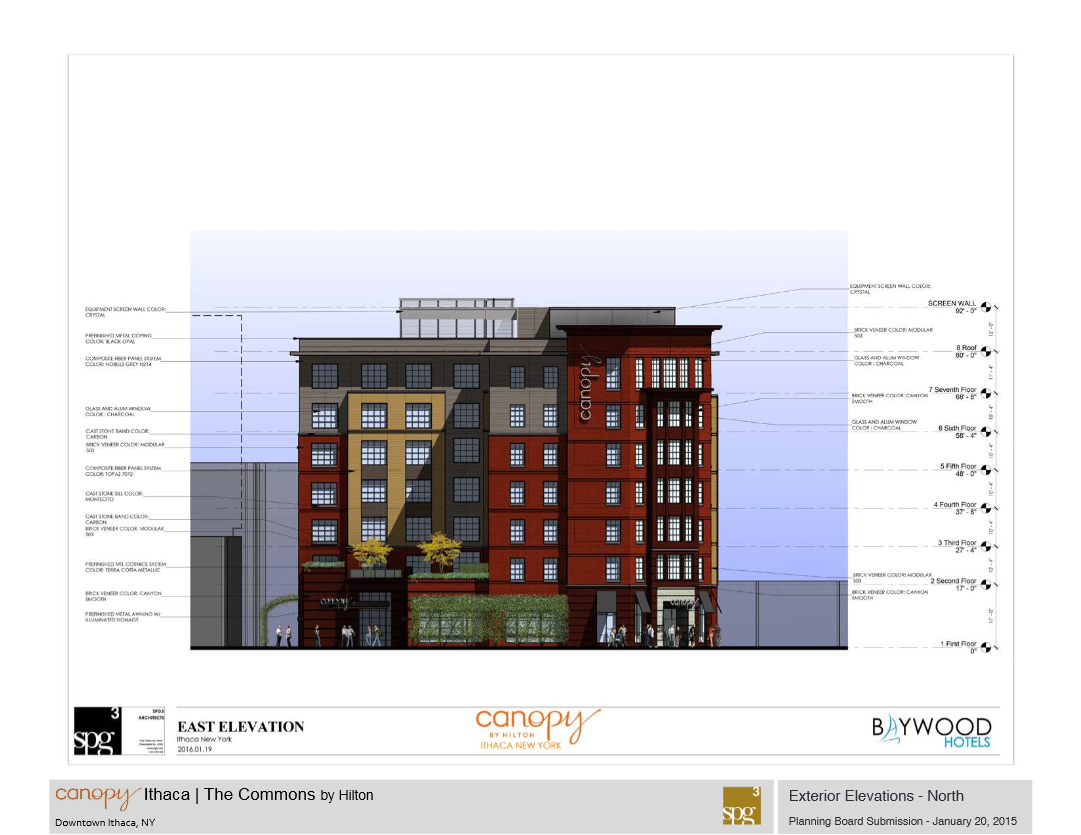
After the original project was approved in March 2015, the city voted to approve the sale of its land in April 2015, and the IDA approved a tax abatement in July 2015, the Hilton plan sat dormant for a while before undergoing a major redesign in January 2016 courtesy of Philadelphia’s spg3 Architects, now Bergmann Associates. It turned out the project had struggled to obtain financing due to rapidly rising construction costs, and underwent some “value engineering”. The general shape was kept the same, but the exterior materials were swapped, the building increased in size to 77,800 SF, the room total was brought up to 131, and the restaurant space was omitted, among other changes. This required re-approval by the city. The much longer comparison is here.

The very last version of the project, V9 in February 2016, added inset panels in the northwest wall, and some cast stone was added to the base. The second floor roof deck was tweaked, a cornice element was added to the mechanical screen, and the trellis and driveway pavers were revised.

The final form is faced with a few different shades of red brick veneer, topaz yellow and grey fiber cement panels, metal coping and cast stone trim. Floor height (ceiling of seventh floor) is 80 feet, while structural height (top of mechanical penthouse) is 92 feet. It’s not really a big impact on the downtown skyline, but it broadens the city’s shoulders a bit.

After approval and IDA approval, things were slow to start. Ithaca Downtown Associates LLC, representing the Patel family, was reorganized slightly to include other family members in the ownership, and afterward it purchased the properties for the hotel project in August 2916. $1.8 million went to the IURA for the parking lots at 320-324 East State Street, and $2.05 million to local landlord Joe Daley for the parking lots on the former Strand property at 310-312 East State Street. A $19.5 million construction loan from ESL Federal Credit Union (formerly Eastman Saving and Loan of Rochester) was received at the end of September 2016, but things were stalled for a while, and only now is the project on its way to a Spring 2019 opening, two and a half years later than initially planned. William H. Lane Inc. of Binghamton will be the general contractor.

Long story, but at least someone wrote it up. Goes to show that property development can be a very complicated process.

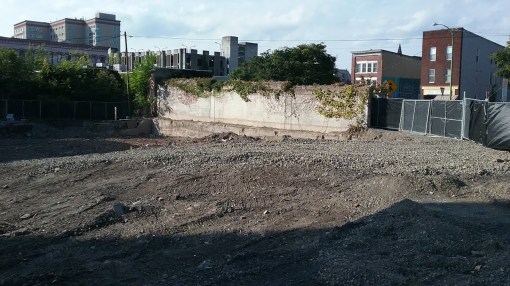
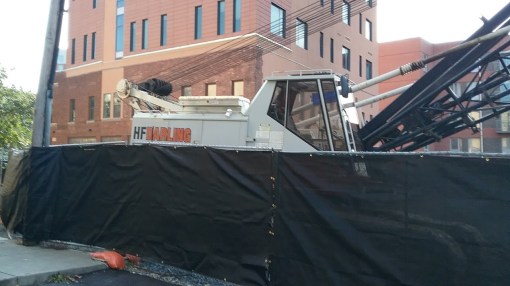
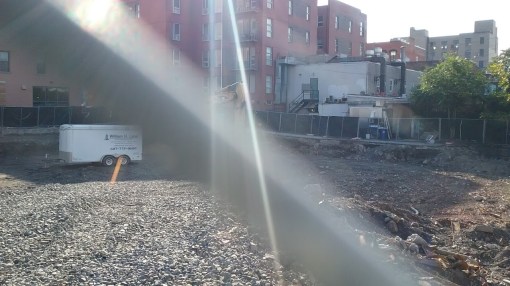
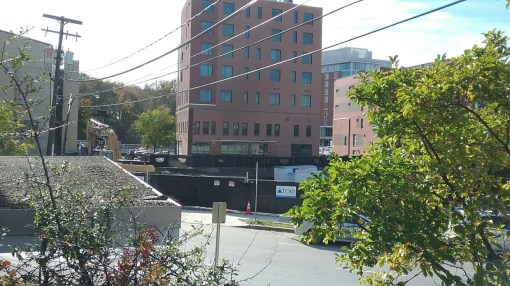
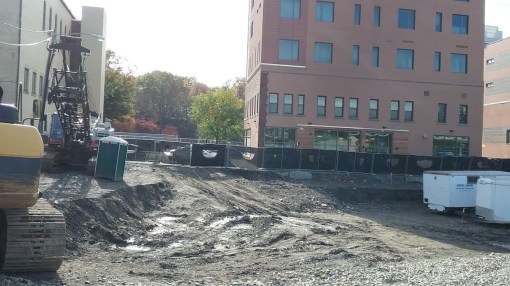
It looks like foundation excavation is currently underway – I had head many of the underground utility work was taken care of when the Carey was under construction next door. A plausible schedule has foundation work done by the end of winter, with structural steel framing underway during the spring and summer.

October 15th:

October 28th:


The Lux (232-236 Dryden Road) Construction Update, 10/2017

23 10 2017

Continuing yesterday’s theme, here’s another one of Collegetown’s development opportunities playing out, though perhaps it was less obvious as the Linden Avenue properties – coming soon to Ithaca, 60 units with 191 beds of student housing at 232-236 Dryden Road, just east of Collegetown’s core and part of the eastern transition to the Belle Sherman neighborhood.

Once again, this is a case of Visum Development Group scouting potential opportunities at the right time and place to make something happen. Along with a large surface parking lot, the previous building on this site was a 30-unit apartment building and the former dormitory for the historic Cascadilla School, a private school with a 140-year history on the corner of Oak and Summit Avenues in Collegetown. The 4-story building once housed dorms, a dining hall and a gymnasium, but after its sale to private ownership after World War I, it was remodeled again and again, each seemingly more unsympathetic than the last. By the late 20th century, it was a grim, awkward-looking box, stripped of ornamentation and of its historic value. The previous owner, the proprietor of the Hillside Inn, had owned the property for several decades; Visum paid about triple the tax assessment ($7.65 million vs. $2.55 million) to buy the property in September.

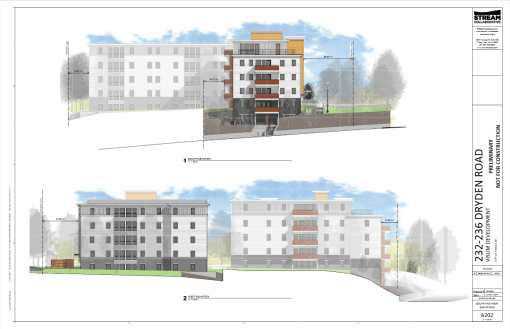
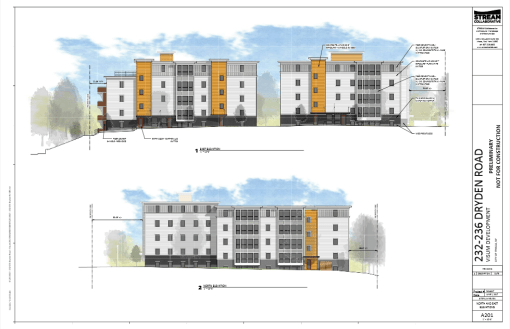
There are two buildings to be built, totaling 84,700 SF – 232 Dryden (The Lux South) and 236 Dryden (The Lux North). This allows for different plane grades, meaning they’re different elevations. That makes it easier to blend in with the neighbors, and creates less ambiguity with height limits, something that bedeviled Visum with its 201 College Avenue project. As with 210 Linden, zoning is CR-4 – four floors, 45 feet from average grade, no parking required with a city-approved transportation demand management plan (TDMP). Usually, that means free bus passes or Carshare registrations, ample bike storage, and explaining how students can easily commute to campus by walking.

The project was proposed in March 2017 and approved by August. Overall, the changes were fairly modest. No zoning variances and little public opposition helped to create a smooth review process. The biggest change came during the design review process, and affected the Dryden Road facade – revised fenestration and the addition of shingle-style balconies. STREAM Collaborative’s intent is to give the south building a little more historical sensitivity, and the balconies are throwbacks to the Cascadilla dormitory’s long-gone shingle-style balconies.

However, given that this building will date open in 2018 and not 1898, instead of wood shingle, the balconies will use Allura “Redwood” fiber cement shinglewood pulp mixed with sand and cement, shaped for a wood-like appearance, but with the durability of concrete. Fiber cement is also more expensive to buy and install vs. materials like vinyl, which is why only more expensive or visible structures tend to use it. Other planned materials include Endicott manganese ironspot velour brick veneer, fiber cement panels with LP smart trim painted in Sherwin-Williams Pure White and Anonymous (that is the actual name), lap siding in SW Pure White and Marigold, granite grey stucco (real stucco, not DryVit), a metal canopy and Andersen windows.

The loan, for $16,354,628, was granted by S&T Bank, a regional bank based in Pennsylvania that has no retail banking presence in Ithaca, but has served as the financier for several projects, including the Holiday Inn Express that recently opened on Elmira Road, and Visum’s just-opened 201 College Avenue project. A breakdown of the costs shows the total project cost is $22,780,334. There’s $13,020,010 in hard costs (materials/labor), $7.65 million for property acquisition, $475,000 in soft costs (architect/engineering/legal), $250,000 for the demolition, and the rest is for taxes during construction and interest reserve (interest on the construction loan during construction). $650,000 (5% of the hard cost) is set aside as contingency funds just in case the expenses clock in higher than expected.

Despite the rather pretentious name and logo, it’s hard to argue the amenities don’t live up to the premise – according to the marketing website, tenants of The Lux and other Visum properties have access to a media lounge, study room, hot tub, sauna, full-service gym, game room and outdoor terrace. Tenants will have trash removal, stainless steel appliances, in-unit washer and dryer, and bike storage. I feel poor just typing this stuff out. Units are 1-5 bedrooms, with the smallest being 1 bed, 1 bath and 435 SF, and the largest being a 1693 SF, five-bedroom, five-bath. Rents will be $1200-$1300/month. Visum is running an offer that if all tenants on a lease (presumably a larger unit) can show they’re members of a registered student org, they get 10% off the first month and a $150 check will be given to their organization. Many larger Collegetown units are legacy properties among student groups (fraternity annexes, bandies, club and NCAA sports), passed down from year to year by members of the org. This may be a clever move to make next years’ renting a bit easier on Visum, whose CEO noted softening in the market this year.

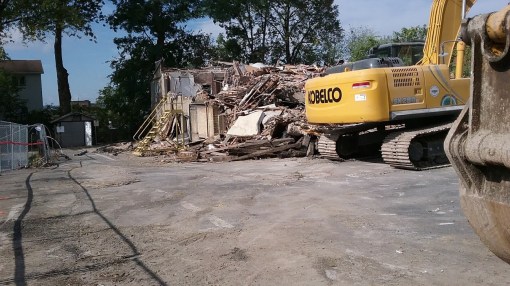
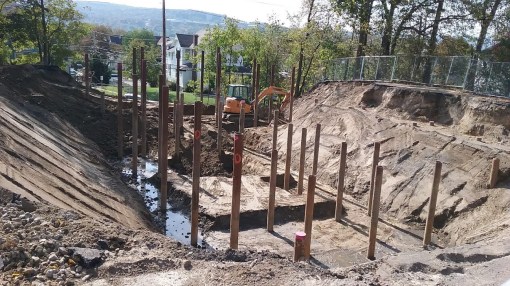
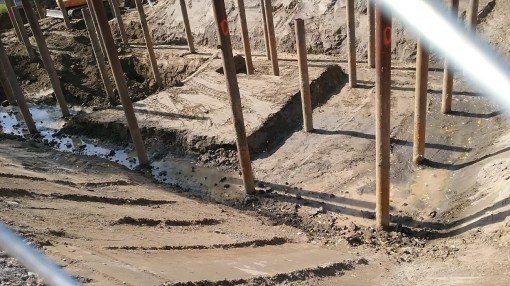
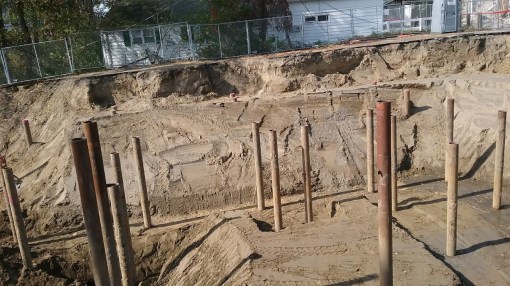
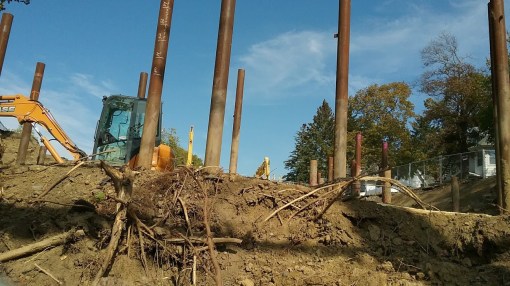
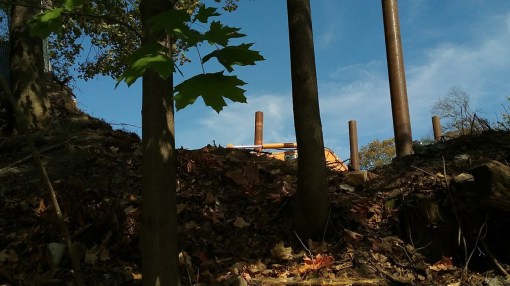
A trip to the site shows caisson (steel pipe) piles have already been laid for The Lux South, and demolition is ongoing of the old apartment building on the site of The Lux North. The pipes extend down to the solid shale bedrock 46 feet below grade, according to local engineering firm Elwyn & Palmer. A deep foundation by any measure. A benefit to building in Collegetown is that the ground is much more amenable to deep foundations than the weak, water-logged soils of the West End.


210 Linden Construction Update, 10/2017

21 10 2017

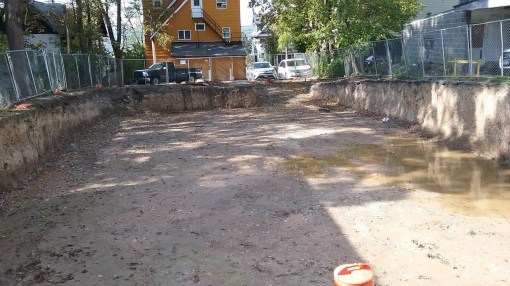
Technically, 210 Linden Avenue has been stopped for the time being, but just for the sake of having it, here’s the project description post for future reference.

One of the intents of the Collegetown Form Districts was to encourage redevelopment in portions of Collegetown that the city saw as less desirable – the really stereotypically poor-quality housing that Cornell just called out in its state of the university address. These properties are generally unsuitable for families since most of them were purpose-built boarding houses, often with haphazard additions and renovations over the years to make the bare minimum of city building and fire code. With a captive market in Cornell students, many landlords didn’t see the need for quality because the prevailing logic was that it decreased profitability. Only during the first luxury developments of the 1980s (Fane’s Collegetown Court in 1985, Mack Travis’s Eddygate in 1986) did that really start to change, and even then, many older landlords clung to the old ideas, hesitant to change from a time-tested if ethically questionable formula.

Since then, it’s been something of a development see-saw; developers see greater profit potential, but typically they need to build big to ensure a good return on investment (balancing soft construction costs, hard construction costs, interest on construction loans and current/future taxes against the revenue from renters). A large project comes along and drives discontent from East Hill and Belle Sherman, who have long clashed with the different lifestyles of students, as well as a longstanding sense of wariness from the old-style landlords who would try to buy homes and turn them into student slums. The city places a moratorium, tweaks the zoning, process starts anew. From a municipal perspective, it’s always been a delicate balance between the substantial taxes generated from Collegetown, and quality of life issues (traffic, rowdiness).

In general, the 2014 form-hybrid zoning, which removed some parking regulations and put the focus on Collegetown’s core, has had favorable outcomes; the only real debate has been 201 College Avenue, which was a rather unique situation. 210 Linden Avenue is a textbook example of a shared goal between city and developer – the 200 block of Linden has many properties in poor condition, and the city would like redevelopment mixed among the better-maintained older houses. With that in mind, zoning is generally CR-4 – 4 floors, and no parking required as long as a Transportation Demand Management (TDM) plan is received and approved by city staff. New buildings wouldn’t be large or oppressive since most buildings are 2.5-4 floors on this block, and with planning board input, high quality designs would enhance the walkable environment, build the tax base, and add some housing to reduce pressure on adjacent streets. Developers in turn would have more flexibility, and removing the parking rules really opens up the possibility for new builds on Linden’s small lots.

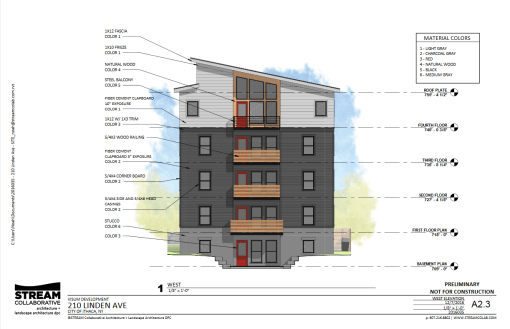
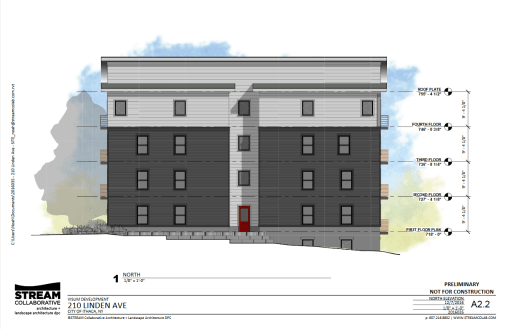
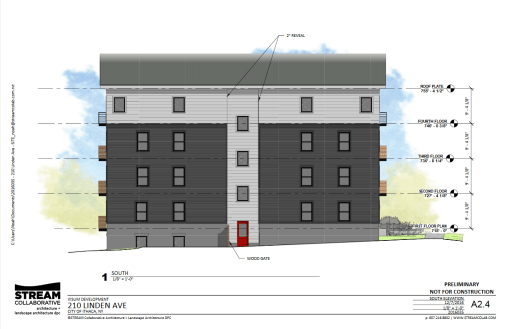
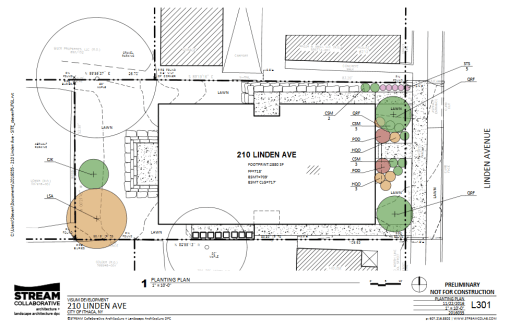
Previously, 210 Linden was a rather ramshackle 12-bedroom apartment house. Visum Development Group (VDG), led by local businessman Todd Fox, saw a potential opportunity for a new build and established a purchase option with the then-owners, a pair of small local landlords. The redevelopment is not an especially large project, medium-sized by Collegetown standards. It is 14,400 SF with 9 units, all of which are 4-bedroom, 2-bath, for a total of 36 bedrooms. Each floor has two units, except for the partially-above grade basement, which has one unit and space for the bike room, trash room and mechanicals. The project will use electric air-source heat pumps, and be net-zero energy capable with the use of an off-site renewable energy source.

210 Linden was first proposed in November 2016. With basically no opposition, and a design that the planning board found perfectly appropriate, it sailed through the review process, and approval was granted in January 2017. In something of a rarity for city projects, no zoning variance was required. 210 Linden fits the maximum length, width and building lot coverage allowed under the Collegetown Area Form District’s CR-4 zoning, and comes in at or just under the 45-foot height maximum – the sites are sloped, and the 45′ height is defined as the average above grade plane. Exterior finishes includes stucco at basement level, a couple shades of grey fiber cement lap siding above, red doors, metal balconies and natural wood trim.

There were virtually no design changes from beginning to end – the only noticeable change was that the doors were moved from the left side of the balcony/terrace to the right. The project was a fraternal twin to another infill development Visum has planned, 126 College Avenue. One has to give credit to the architect, Noah Demarest of STREAM Collaborative, for being able to provide cost-efficient and well-received designs.

A frequent partner of VDG, William H. Lane Inc. of Binghamton, is the general contractor. Right now, only the demolition and foundation excavation have been completed. Once the power lines have been buried out front by NYSEG, construction of the building can begin. The intent is to have the building completed in time for Cornell’s 2018-19 academic year, which starts in late August. Elmira Savings Bank gave VDG a $3.15 million construction loan in July to complete the project.

As one might expect with new units less than two blocks from Collegetown’s core, the cost per room is not cheap. Advertisements online say $5,000/month, or $1,250 per month per bedroom. Units come with 9′ ceilings, air conditioning, internet/cable, stainless steel appliances, quartz countertops, washer/dryer in-unit, balconies, and a security system, among other bullet points and exclamation points. A fitness room and other luxury amenities will be accessible to tenants at another Visum project, 232-236 Dryden Road.


107 South Albany Street Construction Update, 10/2017

20 10 2017

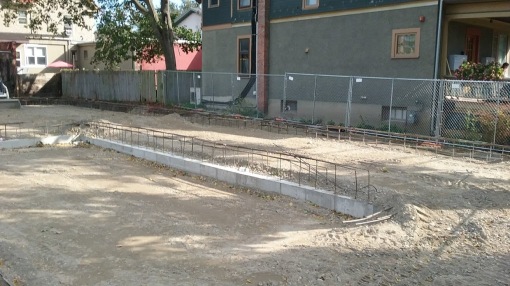
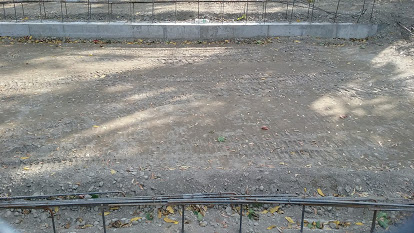
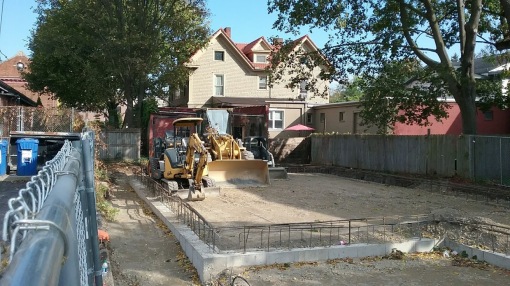
With the twin duplexes on the corner of Aurora and Queen completed, local developer Stavros Stavropoulos and his local contractor Northeast Renovations Inc. have been able to turn their focus towards building out 107 South Albany Street. At this stage, the spread concrete footers, also called formwork or footings, have been finished.

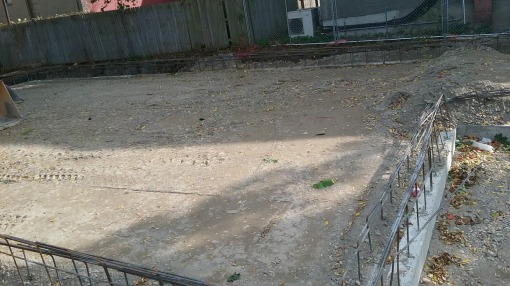
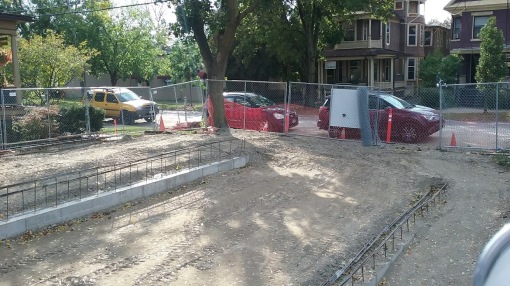
As in this case, footers are usually of concrete with steel rebar reinforcement that has been poured into an excavated trench and confined by wood forms. The purpose of footings is to support the foundation and prevent settling. The portion of rebar sticking out of the footers will be bent and wired into the foundation’s horizontal rebar, tying the two components together. I’m not sure if they simply filled in the basement of the old house or if they tore the walls out before bringing in clean fill and digging trenches for the new footers (I’d guess the latter for simplicity’s sake).

It looks like the outer footings for the ground-level common space (entry, bike storage, meter room) are at a slightly lower grade than the rest of the structure, so there might be two separate sections that comprise foundation, with one at a slightly higher elevation than the other.

The next steps involve a rebar grid being ssembled and tied per specifications, elevated a few inches from the ground by plastic rebar chairs that allow concrete to get underneath the steel rods. The concrete will be poured over the rebar, and as long as the bars stay in place, the new pour is left to dry into a solid, reinforced slab foundation upon which the building frame can be built. The building itself will have a wood-frame, so when it starts to rise, it should move at a pretty fast pace.

A summary of the project can be found here.