News Tidbits 1/20/18: Here We Go Again

20 01 2018

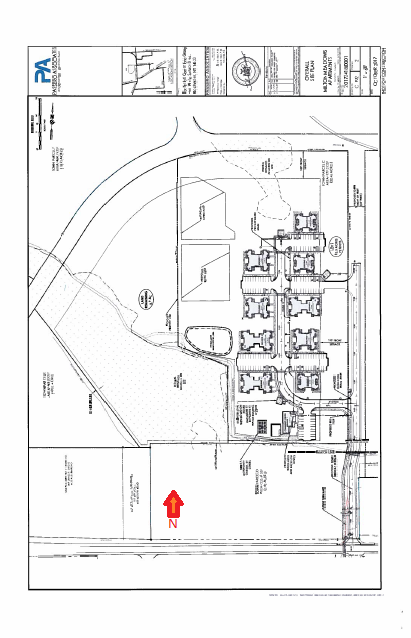
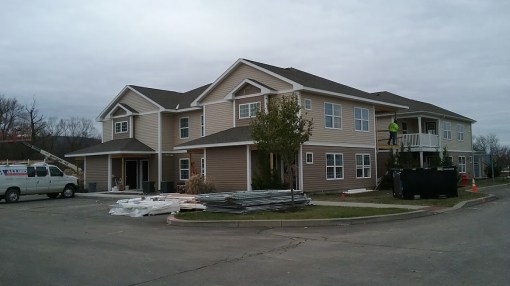
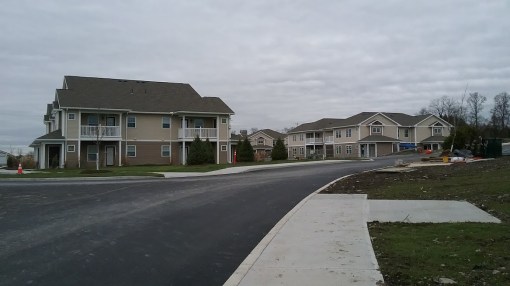
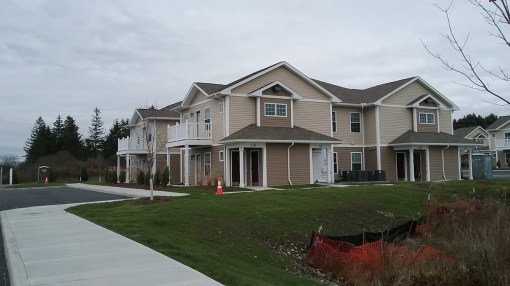
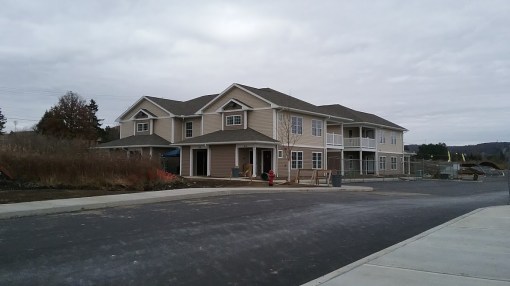
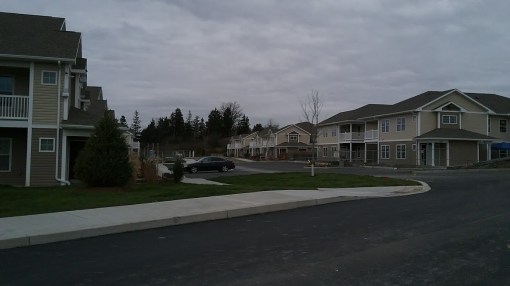
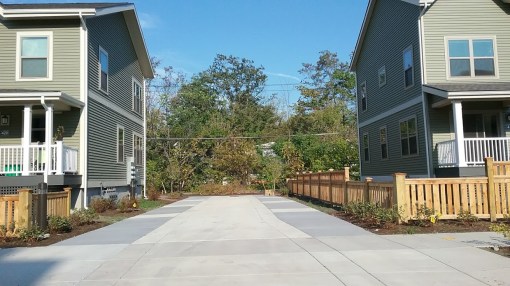
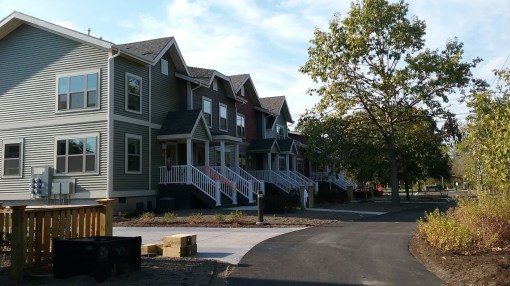
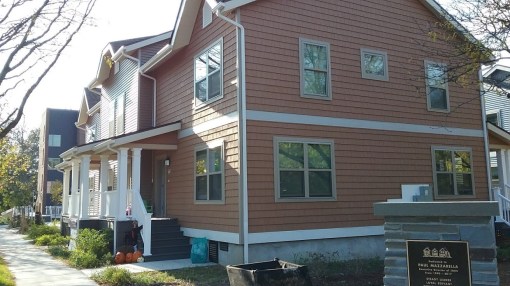
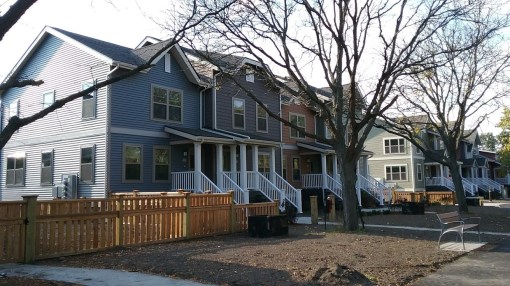
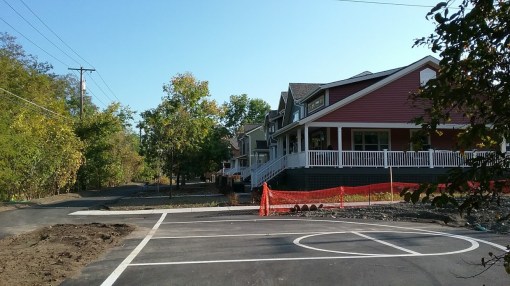
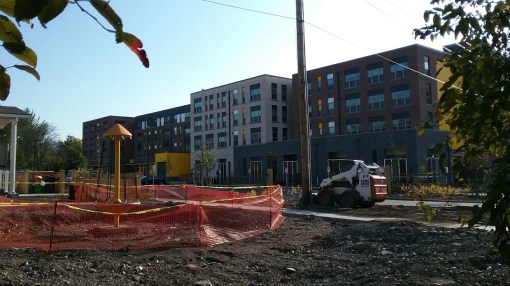
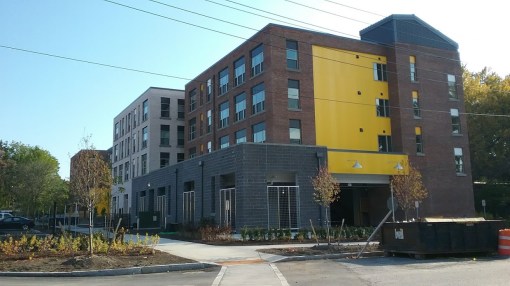
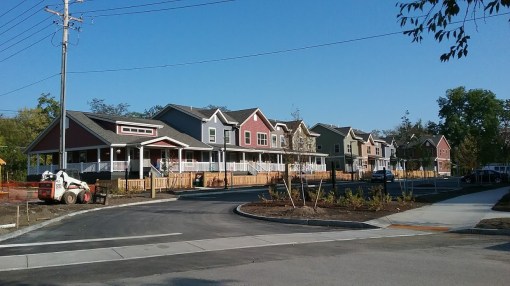
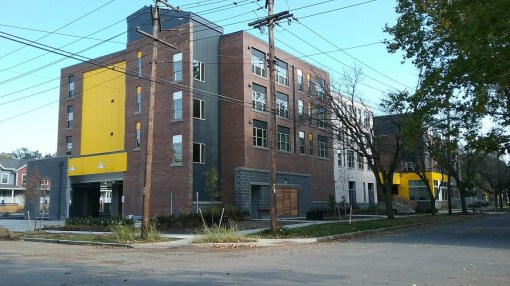
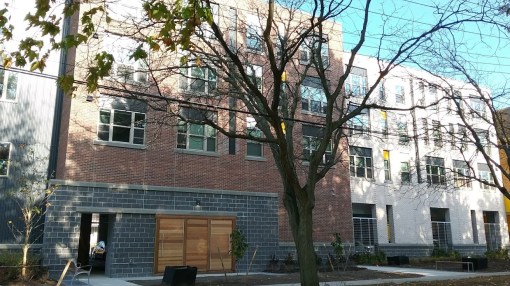
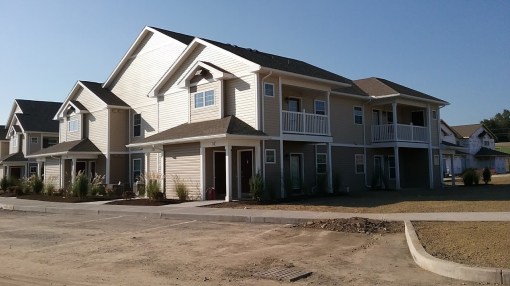
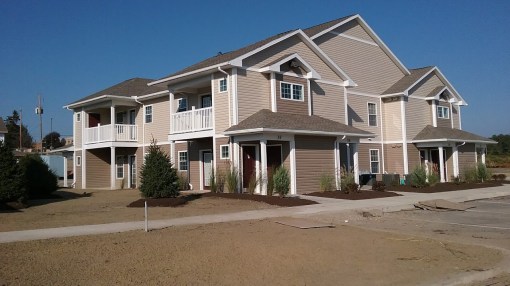
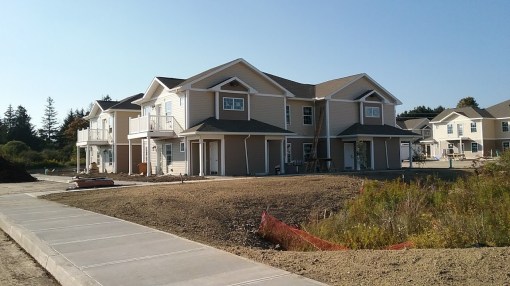
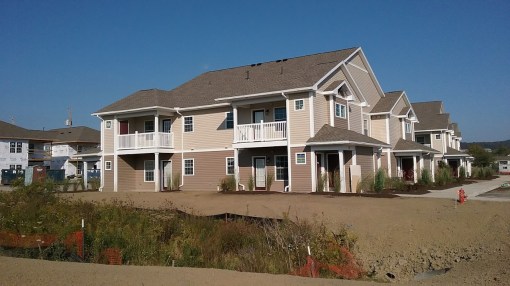
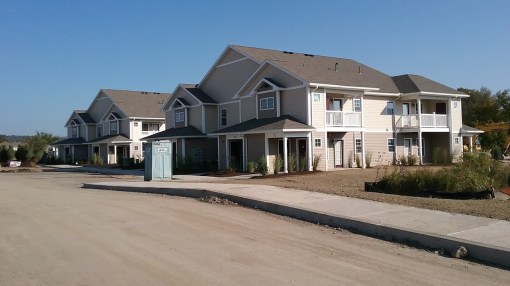
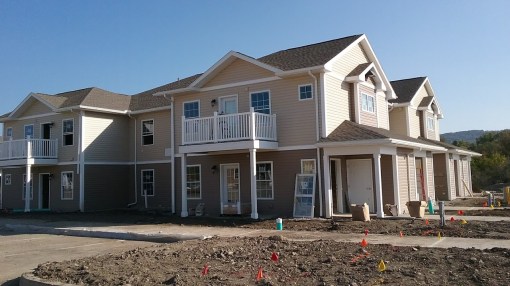
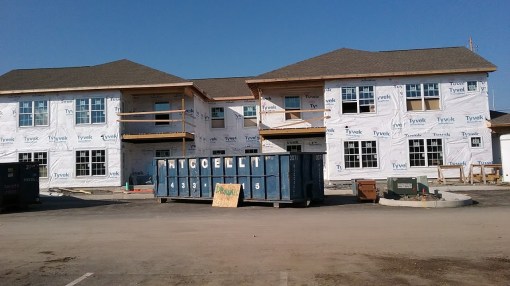
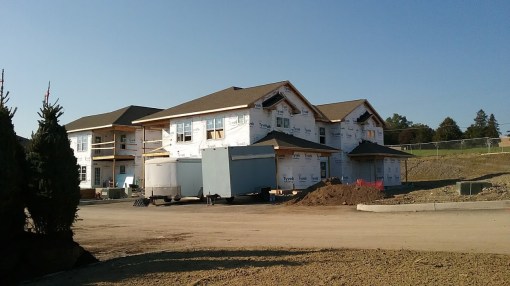
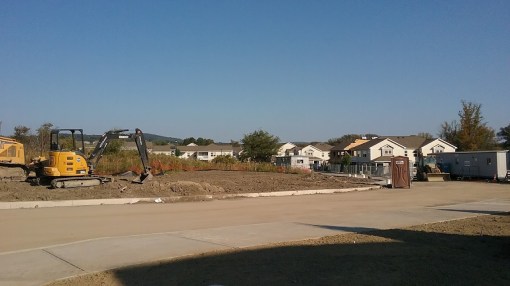
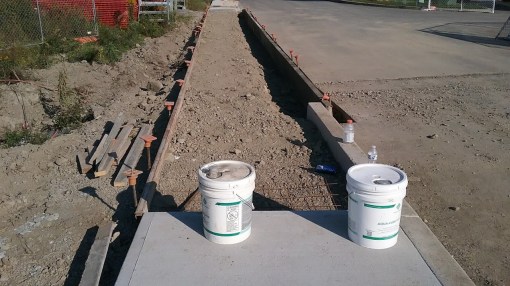
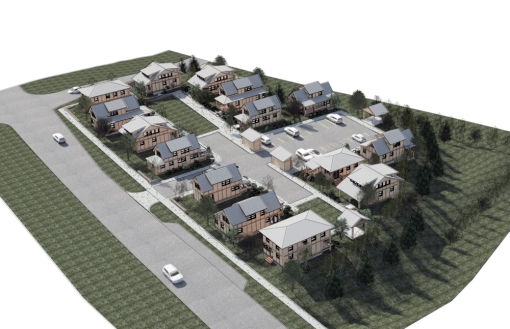
1. It looks like Cayuga Orchard will be moving forward this spring. At the moment, the 102-unit apartment project is going up for a few tweaks to the town of Lansing planning board, mainly just to get approvals for a pair of monument signs. Whitham Planning and Design is handling those last details. The project already went out for construction bids, and with a cost estimated at $25 million, which will surely help Lansing’s bottom line. With no tax abatements, and about $26.50/$1,000 assessed, the back-of-the-envelope suggests about $660,000 in taxes (however, using the hard costs alone is likely low-balling the tax assessment). The project is able to move forward thanks to a plan to pay for a sewer line extension to meet the needs of residents; the plans had long been held up by issues and red tape regarding a modular on-site sewer treatment system.

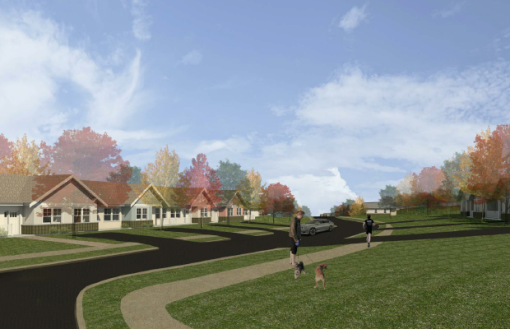
On the site plan, from left to right, are three roads – to be named “Harvest Drive”, “Blossom Road” and “Liberty Lane”. Positive connotations as most are, except one case I know – here’s a story of a downstate project where the Staten Island borough president used his right to rename roads to give a project names meaning deceit and greed. Liberty Lane is designed to be extended for whenever local developer Jack Young decides to go ahead with his 117-unit “English Village” single-family home and townhouse project on the 100-acre property to the west of Cayuga Orchards. Right now, Young’s focus is on a few home lots he’s subdividing on East Shore Circle.

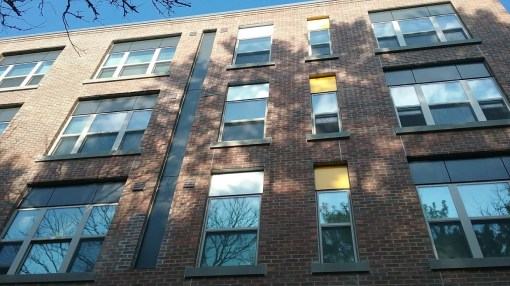
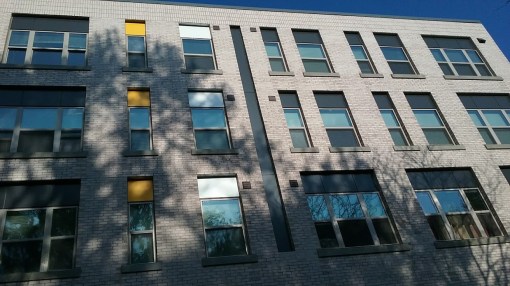
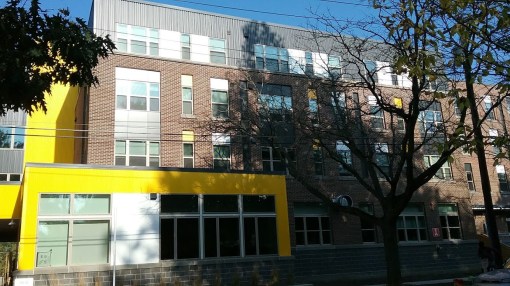
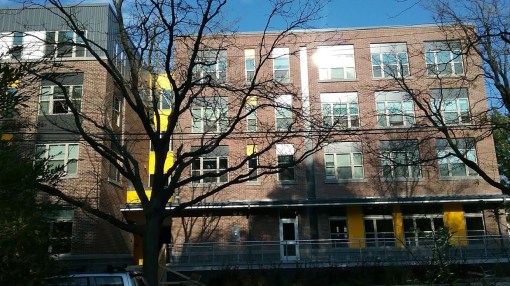
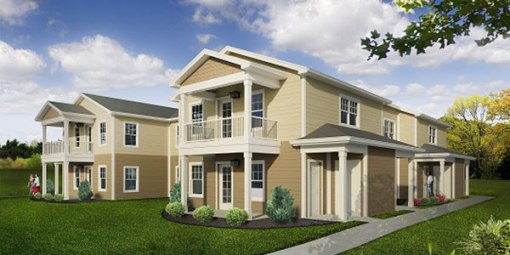
The housing is intended to be rentals in the upper-middle (premium) market, and the 26 1-bedroom and 76 2-bedroom units are welcome in a community with a tight housing supply. As for the design…meh. It’s not terrible, but the dispersed home strings and front-facing garages over-emphasize suburban aesthetics (nothing against Stampfl Associates, they actually have some neat projects). Look for the first units to come onto the market in Spring 2019.

2. For sale, another chunk of Ithaca’s near-waterfront. 798 Cascadilla is a 18,271 SF one-story flexible office space building that was renovated in the 2000s, and is home to Palisade Corporation, a software firm specializing in decision making/risk analysis tools. Palisade is doing just fine, but this is a case where they might be sniffing out an opportunity.

Consider the location. It’s next to Carpenter Business Park, which was just picked up by a team of businesses led by Cayuga Medical Center and Park Grove Realty, ultimately expected to be a large mixed-use development. That purchase was $10 million on a property that had sold for just $2.7 million less than two years earlier; a bidding war drove the purchase sky high. Next door, Guthrie Clinic picked up Palisade’s neighbors, a storage facility and a former printing press/warehouse of Cornell University, for $2.85 million, $150,000 over asking price. Paying at full or above asking price is pretty rare for commercial real estate in Ithaca. Guthrie has recently been in talks with Greenstar Co-Op to convert the storage facility into a new grocery store and cafe. In the City Harbor plans, where Guthrie and Greenstar are involved, there have been some site plan concerns note around issues like parking, that a purchase here could help solve.

Zoning on the site is newly-minted “Market District”. Hotels, restaurants, retail, housing, healthcare facilities, food production facilities, and housing. Up to five floors/63 feet, 100% lot coverage. But honestly, given the recent PUD-OD proposal, zoning regulations are not the end-all, be-all; if someone wants to try for an additional floor by throwing in a few affordable housing units, they could. Not saying that’s a great idea, but they could.

If I had to take a guess, Palisade is feeling out the market and seeing what kind of deal they can get for their building. It was an unusual choice of locations when they bought it in 2004, but they might make a tidy sum for being in the right place at the right time. Maybe.

The asking price for 798 Cascadilla is $2.7 million. The tax assessment is for $2 million. Pyramid’s David Huckle is the sales agent in charge.

3. A long time ago, back in 2009, a West Hill property was talked of as a potential development site. Now that property has exchanged hands. For the moment, its future is still fairly murky.

Kaderli Trade, a Panamanian business with Swiss ownership has owned a 68.5 parcel of land just west of Warren Place since 1977. The property is vacant, and assessed at $320,000. It just sold on Thursday to the Rancich Family for $360,000, a modest gain, and a pretty good price for vacant land.

The Ranciches are probably best known for being the original planners of the Enfield Wind Farm, and for Carrowmoor, a mixed-use project that would have had retail space, office space and up to 400 units in clustered housing on a 158-acre parcel just northwest of Kaderli’s parcel. The motif was a traditional English village. Buildings would have aesthetic half-timbers and gable roofs. It would have used alternative energy (heat pumps were practically unheard of at the time) and been priced mid-market for for-sale units. However, this was 2008-09, the recession was biting hard, and Carrowmoor never moved beyond the drawing board. Most of the renders have disappeared, but I still have one from 2009, before I knew how to crop screenshots. Less known but still important, the Ranciches also played a role in the development of the Conifer Linderman Creek affordable housing.

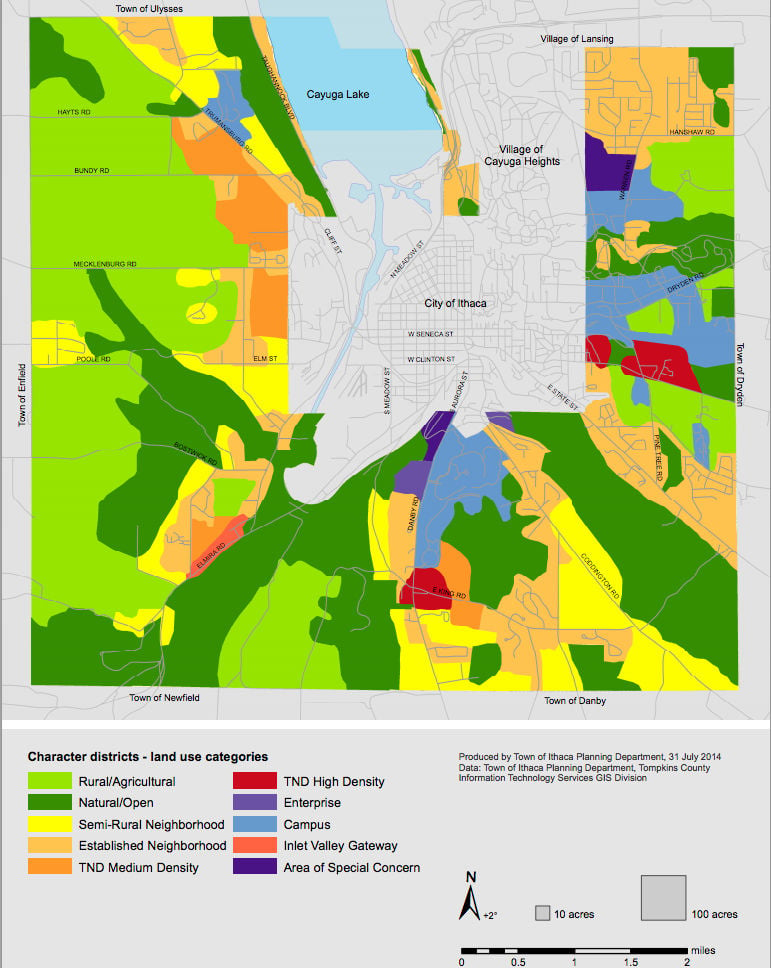
If someone were to ask what the development likelihood were based on the above information, it would get a shrug from me. The Ranciches haven’t had much success, but this purchase suggests they have some sort of interest, and the location is one the town has noted for potential development – existing zoning is Medium Density Residential, and the 2014 Comprehensive Plan plans traditional/new urban design medium density. That’s T3-T5 for the New Urban transect buffs, averaging 5-8 units/acre by the town’s count. It’s close enough to the municipal water that new pump stations and tanks wouldn’t necessarily be needed. In sum, the town would be open to something substantial. But who knows.
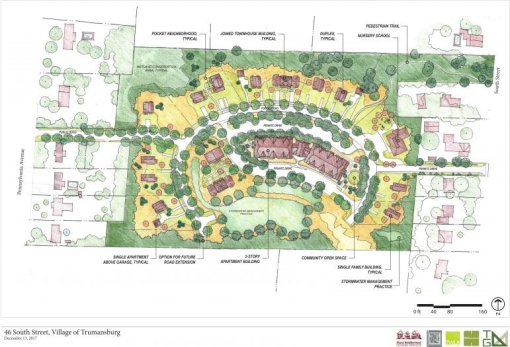
4. 46 South Street, this Claudia Brenner/INHS mixed-income mixed-use project in Trumansburg (Hamilton Square is no longer the official name) continues to go through the boards. My Voice colleague Kelsey O’Connor covered the Planning Board meeting on Thursday, where about ten people spoke for an against the proposal. It’s probably better that she cover 46 South, because I would find it hard to maintain impartiality.

On the one hand, there is the opposition. The “Trumansburg Neighbors Alliance (TBNA)” turned in a Change.org petition with 492 signatures, along with paper petitions they say brings the number up to 669. They say 432 are in Trumansburg, Ulysses, or the Trumansburg school district, which includes large sections of Schuyler County and Seneca County. From their Facebook page, they don’t have accurate numbers.

At this time, there are actively trying to re-impose a village-wide moratorium after the previous decade-long moratorium expired. The zoning was revised in 2012 and re-analyzed in 2016. The South Street housing fits its zoning.

There are plenty of others who have already spoken in favor of this proposal – the Lansing Star has had a harsh word for the opposition, and some residents in Trumansburg are speaking out in favor of the South Street housing.

Let’s go through some of the fallacies with the opposition’s issues:

Too many rental units, not home ownership, out of balance and character with the neighborhood .

46 of the 73 units are affordable (LMI) rentals – most (40 of 46) are in the two story building in the middle of the property. Here’s the thing with lower-moderate income families; a lot of folks are getting by paycheck-to-paycheck. They don’t have the money for a 15% or 20% down payment on a house, for which the median sales price in Trumansburg in 2017 was $255,000, up 38% from the $184,500 in 2012. Thankfully, groups like INHS will work to cover the down payment and sell homes to LMI buyers well below market-rate, like the townhouses on Hancock going in the $110-$145k range, about half of the market rate for a new townhouse in Ithaca.

However, funding for purchasable units is much more difficult to get. A bank isn’t going to fund a plan that doesn’t generate a good profit, so they have to turn to state and federal funds. The government is more likely to disburse a grant if it knows there are buyers waiting in the wings. And for low and moderate-income households, far more are capable of renting versus buying. In short, this argument boils down to ‘these people are too poor to live in our village’.

Does not fit ‘village character’ and 2008 Village Comprehensive Plan priorities

Character is always a bad argument to give a planning board; it overly relies on demographic perceptions, which include details like age, income and race. The 2008 Comp Plan notes historic buildings, non cookie-cutter design, and tree-lined streets. Homes are 1-3 floors. Well-designed multi-family buildings that fit the village fabric, especially those with design features friendly to seniors, were encouraged. Affordable housing is strongly encouraged.

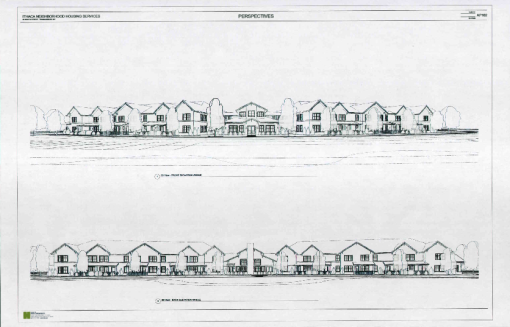
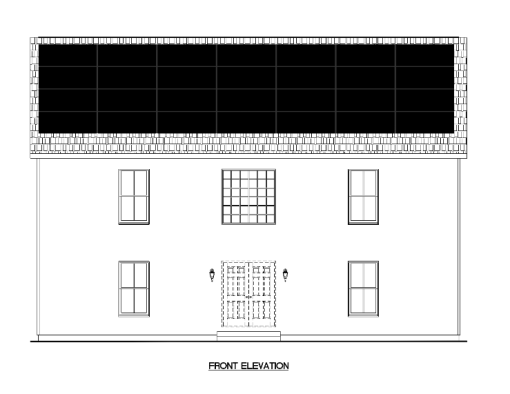
Below are some of the building elevations, pulled from the submission here. Let’s gauge based off the Comp Plan statements – there are no historic buildings on site, it’s vacant land surrounded by housing of varying ages. Designs incorporate porches, gables, bracketed eaves, dormers and other features of Trumansburg’s older housing stock. They are generally two floors. There will be several townhouse and single-family home designs interspersed throughout the site.
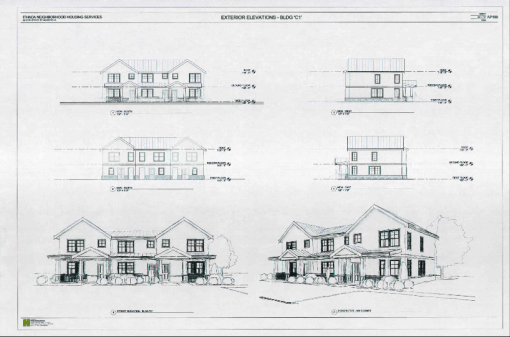
At 40 units, the apartment building is not unlike the existing Juniper Manor; as with other INHS projects like Breckenridge Place and 210 Hancock, many of these units are expected to rent to seniors – about 60% of Breckenridge is seniors, and although I don’t have stats for 210, I’d say it’s a generous percentage. The project is 72 units, 140 residents, over a 19.12 acre parcel. That is 3.77 units/acre, 7.3 residents/acre. That is less dense than the older part of the village.  Even the Tamarack/Larchmont housing, which is one of the areas of strongest opposition, has about 2.5 units and 7-9 residents per acre.

So density’s in line, it has affordability within a mixed-income layout, the apartments are senior-friendly and designed to blend in; it meets the goals of the Comprehensive Plan.

The developers did not ask residents how best to fulfill Village needs…they just decided!

No, they didn’t. Remember the community meetings to get ideas and feedback last July? The August listening sessions? The major plan revisions in response to community concerns? They’ve been listening.

Now that we have that covered, let’s take a look at some of the comments from the folks who are opposed:

From the petition:

“…we do not have the police to keep track of this ridiculous project.”

Ithaca problems must remain in Ithaca and not be spread to us

“These kind of “developments” only bring low income, low quality people.”

From the TBNA facebook page:

there is enough drug dealing on the other end of town probably not a good idea to add to it”.

“Turning trumansburg in to [sic] ithaca have fun with that will have a lot of crime”

I’ve not hidden the fact that I grew up in affordable housing. So these comments that say its occupants are drug addicts, criminals, problems and burdens is very hurtful. I can appreciate TBNA’s attempts on their page to celebrate when housing is announced in Ithaca, but honestly in this context it just reads as a selfish desire that those less well-off will go elsewhere and stay out of the village. For a community that prides itself on its social progressiveness, it’s very disappointing.


News Tidbits 1/6/18: Extra Ketchup/Catch-Up

6 01 2018

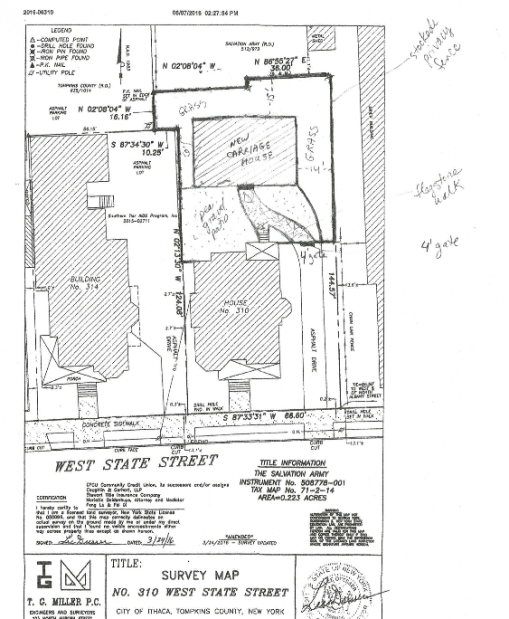
1. It looks like plans for a new historically-inspired group housing facility are moving along. The Ithaca Landmarks Preservation Commission (ILPC) will review the plans for a new “converted barn” at 310 West State Street at their meeting next week. The project is still in the “Early Design Review” stage, meaning it has a few meetings yet ahead of it.

The developers, David Halpert and Teresa Halpert Deschanes, plan to restore the existing ca. 1880 house, and build the second house as a matter of historic correctness and financial feasibility (the money generated by the new carriage house/barn helps to pay for the expensive renovations needed to the existing home, which is in a poor condition due to previous ownership). The new build’s design won’t be as architecturally unique as they one that was condemned and torn down several years ago, but will reuse a couple of design elements. The previous had an irregular shape, brick finish and mansard roof; the replacement will have a rectangular footprint with Hardie Board (fiber cement) siding and a gable roof, similar to barns from the late 1800s time period it is taking its cues from. The project also comes with new landscaping, fencing and 36 solar panels on the new build’s roof.

The plan is that each house will be its own co-op; a unique attribute for this area. I can imagine some Voice commenters would deride it as an “adult dorm”, but there is a niche market for these adult co-ops as seen with companies like WeLive in New York and San Francisco. The Ithaca Urban Renewal Agency (IURA), which is helping the project paply for state grants, has separately noted that the ILPC has already given indications that the plans would likely be accepted.

2. As part of the RFP for the Green Street Garage development, a few developers took part in a tour of the property conducted by the IURA. According to Josh Brokaw at Truthsayers, Visum Development, Ithaca Neighborhood Housing Services (INHS), Purcell Construction of Watertown/Virginia and Missouri-based Vecino Group were on the tour. Visum has previously commented on site interest, but complained that the RFP parameters were of insufficient length to put an application together – the RFP was modified later in December from 60 to 90 days, short of the six months Visum suggested. INHS may have been there on Rimland/Peak’s behalf, as they’ve been in talk to manage the affordable housing component of that project. Purcell Construction is the firm building City Centre on behalf of Newman Development Group, and Vecino Group (Spanish for “neighbor”, by the way) is a national developer with interests in affordable, supportive and student housing.

It’ll be spring before we find out who submitted what, but it looks like there will likely be a few contenders with Rimland/Peak, even if they have a clear advantage.

3. According to a press release sent to the Times (dunno if anyone at the Voice received it), New Roots Charter School is planning to expand its service by adding 6th, 7th and 8th grade classes to its grades 9-12 program. The move would lead to the enrollment of another sixty students into the school.

It is not clear whether the school plans to stay in the Clinton House downtown or move to another location in the city; should they move, there is a potential opportunity a few blocks away at the former Immaculate Conception School, if the Catholic diocese is willing to entertain the idea.

4. Marketing has officially launches for Tiny Timbers’ Varna project, “The Cottages at Fall Creek Crossing”. The layout of the houses is the same from the initial rendering, but the selected models changed quite a bit. That means something here because, like the Belle Sherman Cottages, this is a case where you buy the lot and house and Tiny Timbers builds that specific house, it’s not a “bring your own plan” setup. The website appears to be down for maintenance at the moment (linking anyway), but realtor Brent Katzmann via Zillow is showing homes ranging from an 812 SF 2 bd/1 ba for $192,900, to a 2,175 SF 3 bd/2 ba for $272,900. The prices are in a sweet spot right in the middle of Tompkins County’s housing market, and lower than most new builds thanks to the pre-fabricated approach Tiny Timbers utilizes. All the home designs were penned up by STREAM Collaborative.

5. Probably worth a quick mention for those who like trying new restaurants – Bol is open at the former Titus Gallery at 222 East State Street on the Commons. Created by the same guys behind Simeon’s, the 1,200 SF restaurant recently opened and is serving up ramens, salads, curries and broths. As you can guess, the theme is bowl-based dishes. Yelp reviews appear to be mixed, but don’t let stop you from giving it a try.

6. In Mayor Myrick’s state of the city speech, a couple of things to watch for in the coming months – movement on a public facilities master plan, and Waterfront development. I and Mike Smith covered this somewhat at the Voice, as has Nick Reynolds at the Times, but the potential to move and consolidate police, fire and city hall could very substantially reshape Downtown Ithaca, as could consolidation of water/sewer and streets in Southwest Ithaca.

Meanwhile, the West End and Waterfront are seen as the potential major development opportunities even with their physical and environmental obstacles, if simply because the number of choice parcels in Downtown and Collegetown is running low, and most other neighborhoods would put up enormous resistance with concerns of quality-of-life impacts. Waterfront development would involve a push to relocate the DEC and DOT facilities, something that the county is also keen on. Residents can also expect some movement on the Green Street Garage redevelopment, while the city does a parking study to determine how much parking is needed with future growth. This is all happening in a good economic but challenging political environment, so 2018 should be an interesting year. Of course, the phrase “may you live in interesting times” is often a damning one.

https://platform.twitter.com/widgets.js

7. Click the link above for a video of Cornell/EdR’s Maplewood advertising itself. The most interesting thing to my eyes is the apparent redesign of the community center, from an edgier modern design to a more traditional style with a gable roof. It looks like it will contain a lounge, exercise room, and perhaps small group meeting rooms (though that might actually just be apartment building study space). The EIS likely does not require any re-review since it looks to be mostly aesthetic changes, with little to any change to program space.

8. Someone’s lovin’ it – the new McDonald’s is open at 372 Elmira Road. Pardon me while I move that one into the “complete” column on the project map. I had in my notes that the store was renovated in 1972, and 14850.com has a photo of the truly original McDonald’s that stood on the site in the 1960s – check out those golden arches.

9. Eye candy for the week – here is the first published render for the Tompkins Center for History and Culture, aka the Heritage Center. As part of the state’s Regional Economic Development Council awards, the project received $1.365 million in grant funds – one, a $1.06 million arts and culture grant, the other a $305,000 economic development grant (the project is intended as a tourism generator and tourist information center). The plan is to have the $1.8 million project open in early 2019.

10. West End Heights (709 West Court Street) is now more likely to move forward this year thanks to $250,000 in Community Housing Development Fund grants from the county and city of Ithaca. The county is giving $100,000, and the city $150,000. The project will bring 60 units of affordable housing, with 30 units reserved for vulnerable individuals getting mental health support, and six for formerly homeless individuals who may have HIV/AIDS. The goal is to start construction this year, with a late 2019 or early 2020 completion.

At its January meeting, the city of Ithaca Common Council also awarded $100,000 to Amici House for its expansion and 23 units of housing for formerly homeless or vulnerable young adults.


News Tidbits 11/25/17: Not Going to Plan

27 11 2017

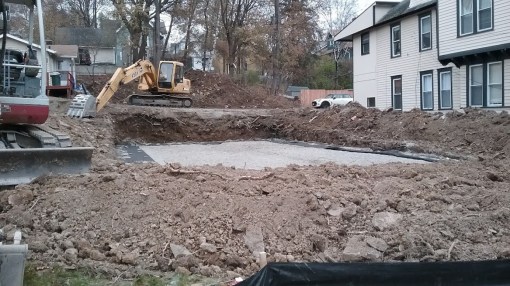
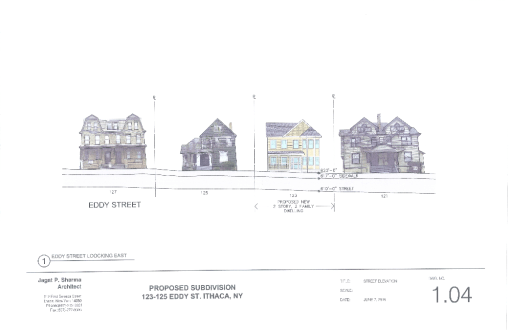
1. It looks like the Lambrous have started work on the new duplex they’ve long planned at 123 Eddy Street in Collegetown. Foundation work is underway for the two-unit, six-bedroom home, which utilized Superior Foundation Walls and modular units. The building sits on the edge of the East Hill Historic District, so to make the building compliant with the ILPC’s wishes, it features Hardie Board siding, simulated shakes, scuplted brackets and an attic vent, and detailed railings and porches. The design went through a couple iterations, with the first being historically appropriate but expensive stick-built design, and the second a modular scheme that was non-compliant with the ILPC. The Lambrous plan to have the new three-bedroom units available for rent by August.

2. Lansing’s Milton Meadows affordable housing project is up for final approval next Monday, and it looks like the first 72-unit phase will be the only phase. According to documentation filed with the town, the presence of poorer soils and more wetlands than anticipated means that Cornerstone will not be undertaking a second phase. It does raise further questions regarding adjacent parcels and the amount of money the town of Lansing can reasonable gain since this sounds like a recent discovery. The final site plans here show no indication of Cornerstone Development Group buying the remaining 8.9 acres that were intended for phase two.

There are no huge obstacles to prevent approval, although some town officials are unhappy that they didn’t apply a stronger hand to the town center development plan (i.e. laying the roads and infrastructure as they wanted, and charging a higher price for the parcels). While most of the darts have been levied towards Cornerstone (some perhaps unfairly due to it being affordable housing), the town planning chair has also targeted Tiny Timbers for using Conlon Road as its primary ingress/egress in their sketch plan. But with sales already negotiated and approved, the town’s legal options are limited, and since they already dropped the ball on the town center once, the optics aren’t pretty. Any work Cornerstone does is dependent on state and federal grants that are highly competitive and awarded only a few times per year, so don’t expect much for at least a year or two after approval.

3. It looks like the land for the proposed extension of South Meadow Square has been fenced off. A query to the folks in PetSmart next door didn’t turn up much, although they said there had been some water and sewer work to prep for the new 7,315 SF addition approved earlier this year. I did not see what the current conditions are for the approved 14,744 SF addition on the south end.

4. The county and the city have competing views of the NYS DOT’s future in Tompkins County. The county has reiterated its hope that the DOT relocates to a location next to the county airport. The city would prefer a location in Southwest Park behind Wal-Mart and the proposed Maguire dealership campus. The request for state grant dollars depends on the airport proposal, and the DOT has stated preference for a site near the airport.

However, if grants are not awarded, the airport is still considering a plan to build a $1-2 million customs facility that would allow to become an international airport, servicing passenger jets from Canadian hubs (Toronto, Montreal). In the short-term, work is underway to add service to Chicago, which has an on-time percentage comparable to Detroit (80%), and better than Newark (60%) and Philadelphia (70%). Cornell is actively assisting, trying to persuade airlines as part of its “Global Cornell” initiative.

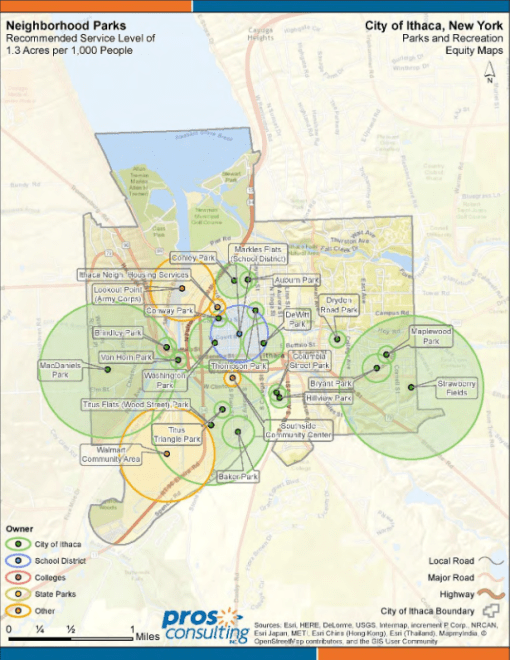
5. So here’s the city of Ithaca’s parks master plan. There’s a few interesting things of note in terms of acquisitions and de-classifications (sale).

First, a quick note – the city is legally required to replace any park land it sells off with newly acquired park land. So with that in mind, the city looked at its parks and found five that are “vastly underutilized” – Columbia Street Park (0.25 acres), Dryden Road Park (0.08 acres), Hillview Park (0.74 acres), Maple Grove Park (0.47 acres), and Strawberry Fields (9.16 acres).

The city would like to sell off the first four on that list, and replace them with a new acquisition somewhere in the city that has at least 1.54 acres, but the city is looking for up to 12 acres. Proximity to population centers, arterial roads, pedestrian access and minimal site prep are some of the big deciding factors in that acquisition process. Meanwhile, Strawberry Fields would be held for either designation as a “school park” to be managed in conjunction with the ICSD, or as a “teaching preserve” for practice field research and instruction.

If the city did opt to sell those four parks, well, there’s some development potential, though they wouldn’t be prime. Maple Grove is a Belle Sherman cul-de-sac surrounded by single-family homes. Dryden Road Park is a small triangle next to the parking garage, and while technically an MU-2 zone for six floors, it’s just as likely Cornell would pick it up amd add it to its tax-exempt rolls since it’s next to Cascadilla Hall. Hillview and Columbia Street on South Hill (R-2a zone) could potentially become a few home lots or a small apartment complex, but the land’s sale would be a political challenge.The city procedure would be an advertised sale offering through the IURA, followed by a grading system of applicants that meet the city’s specified price, as they did with foreclosed lots that became the Ithaka Terraces and 203 Third Street.

Not too keen to get in the weeds on this, since this would be controversial with neighborhood groups, but it’s really just a thought exercise at this point – any potential land sale would be on a long-term, 5 year+ time scale, and the city would need to have new land ready to be acquired for recreational uses. Even thatcould cause problems when neighbors complain that an untouched property becomes a public park that attracts people (this has been an issue with proposed extensions of the South Hill Rec Trail). There is plenty of time to debate the merits and drawbacks of long-term property assets. Right now, the focus is repair and renovating existing facilities in city parks.

6. Looking at the city’s planning board agenda for next week, it’s a short one. The duplex at 601 South Aurora and the Brindley Street Bridge are up for final approval, and a pair of new sketch plans will be reviewed – one is likely to be small, and the other a revision, potentially a downsizing. I’ve heard through the grapevine that several rental developers are holding off or even cancelling plans because they’re concerned about the impacts of Cornell’s 2,000 new beds for their North Campus – although right now there’s nothing formal apart from a statement of intent. Ideally, Cornell puts some concept forth soon, with plans not long thereafter; otherwise, there’s the risk that the local housing situation gets worse. Perhaps the reasonable worst case scenario is that, with recent federal attacks on higher education, Cornell is forced to trim its budget and cancels the housing plans, while still adding students to compensate for financial losses – basically, a sudden large growth in demand without growth in supply.

First, 209 Hudson. This was previously mentioned in a Voice article, it’s potentially a small-scale infill project by frequent infill developer Stavros Stavropoulos. The early plan for two of three rental buildings was shelved due to the South Hill overlay, and its possible that, given the relatively large lot, Stavropoulos may be planning a subdivision to build an additional two-family rental unit. Dunno if he can legally pull off more than that, however. R-2a with overlay allows a 1-2 family structure as a primary, with an accessory apartment in a secondary structure.

The second is 119-123 College Avenue. This is unusual in that this was the site for John Novarr’s College Townhouses project, a 67-unit, multi-building plan for rentals geared towards visiting Cornell faculty and staff. However, the recent NYSEG power line issue has proven problematic, and the last I checked, the project team was supposed to go before a state building codes board in Syracuse this month to get a variance to allow construction, on the basis that the power lines will soon be buried. The minutes are not online, so it’s not clear what the ruling was. While CR-4 zoning allows 45 feet as the plan is currently designed, a variance denial by the state would limit structural height to 30 feet, and would substantially impact the project’s feasibility in pricey Collegetown, as well as alter the design. For the record, 119-123 does not imply a smaller project; 123 College Avenue never existed, the three homes removed for this project were 119, 121 and 125. We’ll see what the revised plans look like next week.

1. Agenda Review 6:00
2. Privilege of the floor (3-minute maximum per person) 6:05
3. Site Plan Review

A. Project: Duplex 6:15
Location: 601 S Aurora Street
Applicant: David Putnam
Actions: Public Hearing, Consideration of Preliminary and Final Site Plan Approval
Project Description:
The applicant is proposing to construct a duplex on the .186 acre (8,114 SF) vacant lot. Site development includes parking for two cars, walkways, landscaping, a continuous sidewalk along the property frontage, drainage improvements and a trash enclosure. The applicant has designed curbing and on-street parking on Hillview Place in cooperation with the City Engineering Division. The project is in the R-2a Zoning district. This is a Type II Action under the City of Ithaca Environmental Quality Review Ordinance (“CEQRO”) §176-5. (C.)(8) and the State Environmental Quality Review Act (“SEQRA”) § 617.5 (c)(9) and is not subject to environmental review.

B. Project: Brindley Street Bridge Rebuild and Relocation 6:35
Location: Intersection of W State Street and Taughannock Blvd
Applicant: Addisu Gebre for the City of Ithaca
Actions: Consideration of Preliminary & Final Approval
Project Description:
The project will relocate current Brindley Street Bridge to align with W. State St./Taughannock
Blvd. intersection through the construction of a new single span extending Taughannock Blvd. over
the Cayuga Inlet to Taber Street. The project will retain existing Brindley Street Bridge and south approach road for pedestrian and bike use. This is a Type I Action under the City of Ithaca Environmental Quality Review Ordinance (“CEQRO”) §176-4 B.(1)(k) and the State Environmental Quality Review Act (“SEQRA”) § 617.4 (b)(11) for which the Board of Public Works, acting as Lead Agency made a Negative Determination of Environmental Significance in 2016.

C. 209 Hudson Street – Subdivision & Site Plan Review – Sketch Plan 7:05

D. 119-123 College Avenue – Sketch Plan 7:35

4. Old/New Business 8:00
A. Collegetown Design Guidelines – Megan Wilson
B. Parks Master Plan – Megan Wilson

5. Reports 8:40
A. Planning Board Chair (verbal)
B. Director of Planning & Development (verbal)
C. Board of Public Works Liaison (verbal)


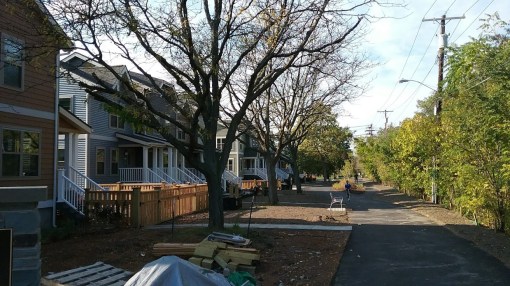
Poet’s Landing Phase II Construction Update, 11/2017

26 11 2017

For this blog’s practical purposes, Poet’s Landing Phase II is complete. At least one of the six eight-unit buildings is occupied, but perhaps only one – a woman arrived while the photos were being taken and was moving chairs out of her car. To ward off the emails pointing out its an Audi – its a 15-year old Audi, and as my buy-American family of mechanics happily relay, older Audis depreciate like stones in a pond thanks to shoddy electrical systems and high repair costs.

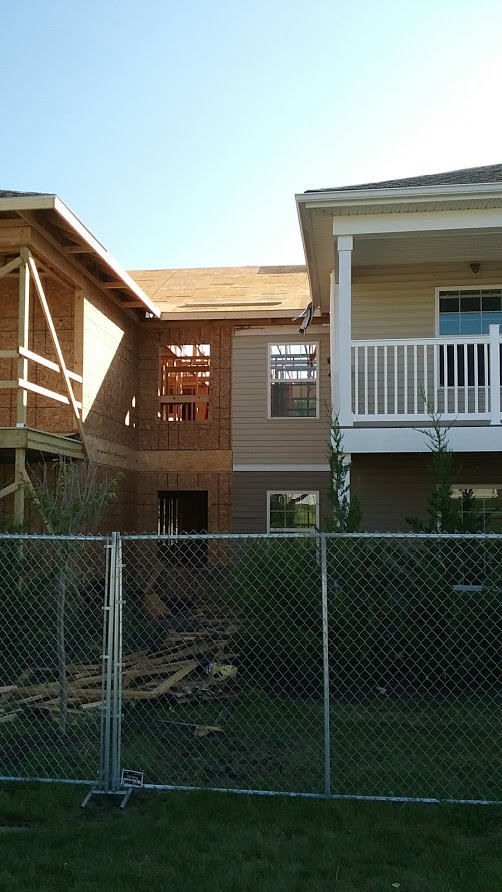
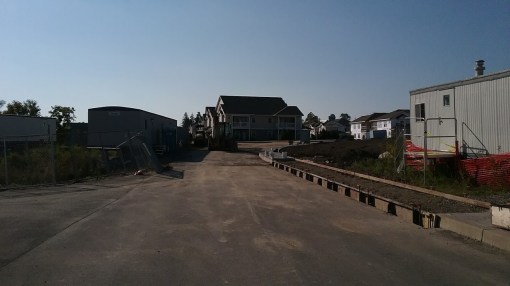
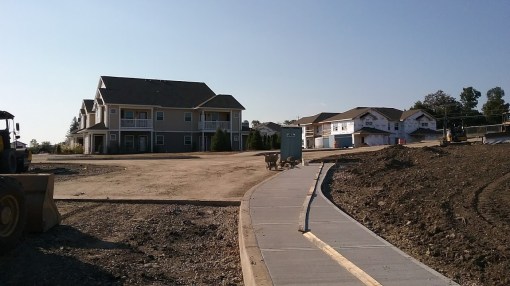
Even the youngest buildings in the second phase have been completed from the outside, and appear to be undergoing finish work in the interior. The last of the sidewalks are being poured and much of the lawn has grown in. With the fire-damaged building in phase one, the rebuilt units are missing some of their trim boards and architectural details (railings/column covers), but are likely to be finished before the end of the year. The inquiry page for rentals is here.

The affordable housing is much welcomed given the county’s housing woes, although a location closer to the urban core would be preferable given proximity to jobs and services. At least the site is walkable to the village. Kudos to Conifer Realty and LeChase Construction. The ceremonial opening is November 29th.


210 Hancock Construction Update, 10/2017

17 10 2017

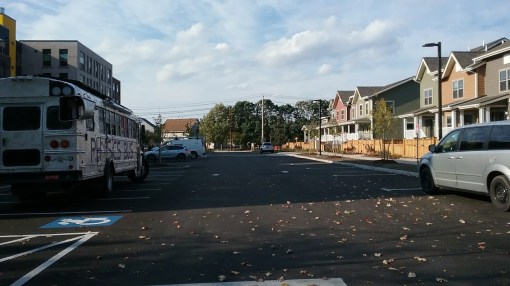
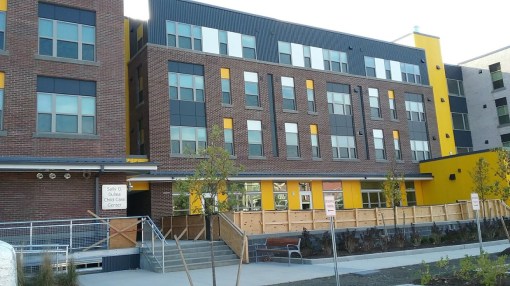
One last walk around the block. It looks like only minor exterior finishes and landscaping/playground and basketball hoop installations left. TCAction’s daycare center has been dedicated the “Sally G. Dullea Childcare Center”, in honor of Sally Dullea, a longtime Ithacan and retired M&T Vice President who led TCAction’s Board of Trustees. Next door, The balance of the first-floor commercial space for a “Free Science Workshop”, which is a part of the Ithaca Branch of the Physics Factory, non-profit exhibition program that engages children with science. The “Physics Bus” in the parking lot is the mobile exhibit.

It also appears that either the multi-use path or the project itself has been dedicated to outgoing INHS Executive Director Paul Mazzarella. Not a bad way to say thanks after 27 years of service. As for his replacement, Johanna Anderson, best of luck, and I look forward to being a constructive nuisance.

It’s never been a secret that I was an advocate for this project, given the clear need for affordable housing, and the transparency and responsiveness of the project team during early planning. I continue to hold the project in high regard. It is a real improvement over the vacant Neighborhood Pride grocery store that was once here. It helps to fill a crucial deficit in a well-thought out, contextual, urban-friendly package. While walking around, I saw a young woman moving furniture into an apartment, a man and his son heading into one of the homes, and an older gentleman walking a dog. I think that, as the dust settles, it’ll blend seamlessly into Northside’s urban fabric, and be a worthy asset of the Ithaca community.

Before (image courtesy of Jason Henderson of Ithaca Builds):

After:


Poet’s Landing Phase II Construction Update, 9/2017

1 10 2017

It looks like the first units are coming onto the market. Conifer Realty has the application up for the first apartments, as do third-party websites like apartments.com. Oddly enough, the apartment.com listing says 16 3-bedroom, 16 2-bedroom and 16 1-bedroom units. This is incorrect. There are 8 3-bedroom, 16 2-bedroom, and 24 1-bedroom units. One can tell from sight alone because Conifer uses the same three building plans in all of its suburban apartment clusters. One design consists of eight 3-bedroom units, the second design is eight two-bedroom units, and the last design is eight one-bedroom units. For units on each floor, mirroring each other in layout. Keeps things simple and materials costs down.

Keeping with the blog-only nomenclature, buildings “A” and “B”, the two that are basically complete from the outside, are the one bedroom-units. “C”, “D” and “E”, which are receiving exterior lighting rigs, trim and architectural features like balconies and patios, are the 2-bedroom clusters. Building “F”, which is still at the housewrap stage and the building that is least furthest along, is the three-bedroom cluster. For proof, consider the building that was badly damaged in this summer’s fire – it was reported that 31 people were left homeless. That would most likely imply it was the three-bedroom design, which would have 24 bedrooms.

The general rule of thumb is one person for bedroom for basic planning purposes. Affordable housing family units, for whom these three-bedroom apartments are intended, may average more than that because of income guidelines, and that two adults or multiple children may share a bedroom. Likewise, on the other end of the scale, properties with empty nesters or more affluent owners/renters may have numbers average less than one person per bedroom due to guest bedrooms, or conversion of bedrooms to home offices or hobby rooms. Owner-occupied single family homes often fall in this category, where the typical home is three bedrooms, but the average owner-occupied household size is 2.5. There are a number of companies dedicated to studying the number of people likely to live in a unit based off its location, size and intended market, and applying those figures to calculations like the number of students expected to be added to a district, or the number of car trips generated.

Curbing has been laid, the parking lot is paved and striped, streetlamps are in place and the concrete sidewalk is being poured. The process to build sidewalks is pretty similar to the work for foundations – excavate the path, build the formwork to keep the concrete in place as it cures, lay down some steel rebar to provide additional strength to the concrete, pour, level and smooth, and run a finishing trowel to create an edge so that the concrete has an expansion joint to help expand and contract without cracking the sidewalk. The steel plugs are to keep the forms in place.

The building that was damaged by fire is under reconstruction. The east wing was destroyed by the flames and was torn down. The only thing being reused for those four units is the slab foundation. The four west wing units were salvageable, but they did need an extensive renovation. Damaged trim and siding sections will be replaced, and on the inside, drywall damaged by water has been removed and new sheets are being hung. It looks like some of the appliances were saved; peering through the windows, a refrigerator was sitting in the middle of the floor in an upstairs unit. Closer to the fire, it’s more of a gur renovation, with only portions of the exterior salvaged, while the inside is replaced from the stud walls out. Taking a guess for the typical construction length of units so far, the renovated and rebuilt units probably won’t be ready for tenants for another five to six months.

According to the advertisement on Conifer’s website, amenities and feature include

Dishwasher
Garbage disposal
Wall to wall carpeting
Patio or balcony available
Walk-in closets
Discounted cable package
Central air conditioning
Smart card laundry center
Fully equipped Fitness room
Computer lab
Clubhouse with great room
Controlled building access
Key fob hardware
Professional on-site management
24 hour maintenance
Ample parking
Beautifully landscaped grounds
Accessible for people with disabilities
Close to shopping, schools & medical facilities

1-bedroom units are 716 SF, 2-bedroom units are 950 SF, and 3-bedroom units are 1,150 SF. Lease are 12 months with a month’s rent as security deposit. Three units will be adapted for mobility-impaired residents, and a fourth unit will be adapted to individuals who are hearing or vision-impaired.

According to a filing with the state as part of the grant application, the gross rents (rent plus utilities) will range from $724 to $1,070 a month, to be occupied by households with incomes 50% to 60% of area median income.

2017 AMI in Tompkins County is $53,000 for a single person, and $60,500 for a two-person household, and $68,100 for a three-person household. Therefore, the income limits are $26,500-$31,800 for a single person, $30,250-$36,300 for a two-person household, and $34,050-$40,860 for a three-person household.

Conifer and contractor partner LeChase Construction will be delivering the $10.8 million project over the next few months, and that should wrap up Conifer’s Ithaca work for the time being. The programmatically similar Milton Meadows project in Lansing is being developed by a competitor, Cornerstone Group. The two firms’ Rochester headquarters are about six miles apart; their apartment projects are about twelve miles apart.


News Tidbits 9/23/17: It’s All In The Hips

23 09 2017

1. Points for being open and blunt, one supposes. The chairman of the town of Lansing Planning Board, typically one of the easiest boards to get approval from in the whole county, voted against the customary declaration of lead agency on the Lansing Trails affordable apartment complex planned for the town center. The reasoning was a fear that its lower-income occupants would create more crime. Rather surprising that it wasn’t veiled behind the usual guise of “concerns about neighborhood character”.

Other PB members did raise more appropriate concerns that the 581-a tax abatement to be pursued by the project may end up offsetting the property tax increase enough to cost the town, mostly through the enrollment of new students in the Lansing school district. A third-party study explained that there would likely be 43 students in the roughly 200-bedroom complex, of whom 14 would be relocations from other parts of town, and 29 who would be new to the district. Reflecting national demographic trends, local school enrollments have been in decline as Millennials are replaced with their less numerous Gen Z peers, so it’s not really a question of capacity since the schools were designed for larger class sizes, but a concern about the tax obligations and avoiding the burdening of other taxpayers. Town supervisor Ed LaVigne has spoken in favor of the project as workforce housing by a responsible developer and property manager.

The Star’s Dan Veaner takes the middle road in his editorial, noting the project fills a need, but worried about the tax impact. I’d argue that’s while it’s a fair question, it’s probably a bit premature. There have been discussions for the other parcels in the town center that just have yet to come forward. Tiny Timbers is potentially 60 units of mid-priced owner-occupied housing (at $200k per home, that would be $12 million without counting site-wide improvements like sidewalks and community greenspace), and there are possibilities for the other parcels that are being drafted up and fleshed out before being made public. We the public don’t know what those are – there could be market-rate senior housing, patio homes and mixed-uses like the projects submitted in 2014. If three or four are affordable housing, sure, be concerned. But the town knows all the proposals, and hopefully its committee selected its choices for each lot with sound logic in mind.

2. Speaking of Lansing Trails, according to the new planning board comments, its name has been changed to “Milton Meadows”. Milton was actually the original name for Lansing, indirectly – Milton was changed to Genoa in 1808, and Lansing was split off from Genoa in 1817, the same year Tompkins County was established. It’s worth noting that “Lansing Meadows” is already taken. This would be name number three, since they had previously changed Lansing Commons to Lansing Trails.

The updated documents note that the second phase and its 56 units aren’t likely to start construction for 3-5 years, depending on external factors such as the availability of affordable housing grants, and how well the local market absorbs phase one.

3. Staying on the topic of affordable housing and taxes, the town of Ithaca will be reviewing a PILOT proposal from NRP Group to offset some of the property taxes with the Ithaca Townhouses project approved for West Hill near the hospital. Readers may recall the Ithaca Townhouses are a 106-unit, two-phase project that will be rented to households making 50-130% of area median income, with an option for renters to purchase units after a 15-year period.NRP Group is asking for the PILOT to offset the higher initial cost of using electric heat pumps in place of conventional gas heating, the difference of which they estimate to be about $300,000 upfront.

The town utilizes a few PILOT agreements, either with some of its 55+ affordable housing (Ellis Hollow Apartments, Conifer Village), the College Circle Apartments that Ithaca College purchased a few years ago, and Ithaca Beer. The combination of a lower assessed value and a PILOT generally seems to take about 25-30% off the total property tax bill.

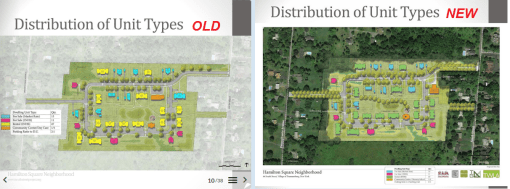
4. Here’s a little more info on the the proposed Brown Road Pocket Neighborhood in Danby. The above image appears to be the preferred cluster housing that the development team (led by Newfield businessman Mike McLaughlin), but conventional zoning only allows for the layout shown here. Small-scale cluster zoning has found a market in the Ithaca area over the past few years with projects like New Earth Living’s Aurora Street Pocket Neighborhood and the long-planned Amabel project, and Danby’s take on the concept would benefit from lower land costs, which would help keep the overall costs down and make the for-sale homes available to a wider swath of the county’s potential homeowners. The homes, which are modest 1,000 SF one and two-story plans that share a communal parking lot, are designed for residents who wish to age in place.

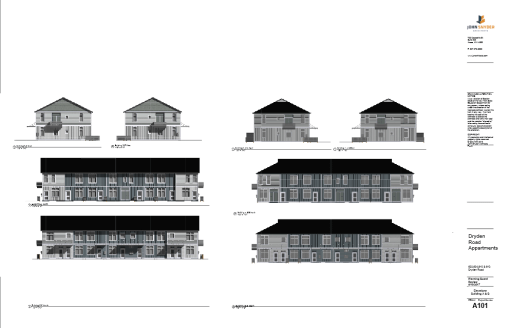
5. Some revisions have been made to the design of Modern Living Rentals’ 42-unit townhouse project at 802 Dryden. To create a little more visual interest, the townhouse strings have been diversified a bit – the rooflines were modified on two of the six strings to create a hipped roof, while the other four remain gable roofs. The fenestration was also updated, and sections of the building faces were bumped-out modestly, distinguishing individual units within the strings. The overall effect gives them a distinct appearance from their counterparts up the road at 902 Dryden, and allows the team at John Snyder Architects to give the recycled design their personal touch. Other documents, like the cover letter, utilities plan, and landscaping plan can be found here.

The public hearing is scheduled for next week, but to be honest, these haven’t generated much attention, let alone controversy. The biggest issue right now is water supply, which relies on the Bolton Point system shared by both Ithaca and parts of Dryden. 802 Dryden can get its water issue remedied by tapping a segment in the town of Ithaca’s jurisdiction, and Ithaca is interested in transfer control and maintenance of the control valve that allows that to Dryden. Given Charlie O’Connor’s South Hill debate currently underway, the relative shrug this project has received from the public might be a welcome relief.

6. Nothing new on the Ithaca City Planning Board agenda next week. That’s not to say there aren’t several projects in the works, they just aren’t ready to submit formal proposals at this time. Lakeview’s special needs and affordable housing is up for approval, as is Charlie O’Connor’s duplex at 217 Columbia (even if the South Hill overlay goes into effect, this project would be grandfathered in because it started review under existing zoning). It looks like Lakeview will use the same kind of vibratory pile-driving used at INHS’s 210 Hancock, subcontracted to Ferraro Pile and Shoring by general contractor Hayner Hoyt.

Speaking of INHS, they will be taking part in the public hearing for their 13-unit Elm Street reconstruction on West Hill, and public hearings are planned for the Nines replacement at 311 College, and Elizabaeth Classen’s ILPC-approved 16-bedroom senior mansion in Cornell Heights. The Nines inspired several letters of protest, and first ward aldermen George McGonigal chimed in his hopes that the affordable housing would be reduced for Lakeview and INHS (the planning board disagrees).

Here’s what the board has to look forward to on Tuesday:

AGENDA ITEM Approx. Start Time

  1. Agenda Review 6:00
  2. Special Order of Business- Draft Design Guidelines for Collegetown and Downtown– Megan Wilson 6:01
  3. Privilege of the Floor 6:30
  4. Site Plan Review

A. Project: 709 West Court Street 6:40

Location: 326 & 328 N Meadow St. and 709 – 713 West Court St.

Applicant: Trowbridge Wolf Michaels for Lakeview Health Services Inc.

Actions: Consideration of Preliminary and Final Approval

Project Description:
The applicant proposes to construct a five-story L-shaped building with footprint of 10,860 SF and GFA of 62,700 SF on the .81 acre project site comprising four tax parcels (to be consolidated). The building will contain sixty (60) one-bedroom apartments plus associated shared common space (community room, laundry facilities, lounges, and exterior courtyard), support staff offices, program spaces, conference room, utility rooms, and storage. The siting of the building allows for a small landscaped front yard, a south-facing exterior courtyard, and a 16 space surface parking lot in the rear of the site. Site development will require the removal of five structures and associated site elements. The project is in the WEDZ-1 Zoning District. This is a Type I Action under the City of Ithaca Environmental Quality Review Ordinance (“CEQRO”) §176-4 (1) (k) and (n), and the State
Environmental Quality Review Act (“SEQRA”) § 617.4 (11) and is subject to environmental review.

B. Project: Elm St Apartments 7:10

Location: 203-211 Elm St

Applicant:Lynn Truame for Ithaca Neighborhood Housing Services Inc. (INHS)

Actions: Public Hearing, Determination of Environmental Significance

Project Description:
The proposed project consists of the demolition of a two single family homes and one duplex and the construction of a single 12,585 SF apartment building with 13 dwelling units, parking for six vehicles, and other associated site improvements. Due to the slope of the site, the building will have 2 stories facing Elm Street and three stories in the rear. The project requires the consolidation of three tax parcels. The project is in the R-3a Zoning district and is seeking two area variances for relief from rear yard setback and parking requirements. This is a Type I Action under the City of Ithaca Environmental Quality Review Ordinance (“CEQRO”) §176-4 (1)(h)[3], and the State Environmental Quality Review Act (“SEQRA”) §617.4 (11) and is subject to environmental review.

C. Project: Duplex 7:30

Location: 217 Columbia Street

Applicant: Charlie O’Connor for 985 Danby Rd LLC

Actions: Declaration of Lead Agency, Determination of Environmental Significance, Potential Consideration of Preliminary & Final Approval

Project Description:
The applicant is proposing to install a duplex with one 3- bedroom apartment on each floor. The
new structure is proposed to be sited directly behind the existing duplex on the property. As the project will increase the off-street parking required from two to four spaces, the applicant is proposing to shift the existing curb cut to the east and install an expanded parking area and drive aisle along the eastern property line. The project also includes removing a 30”dbh oak and one street tree, closing the existing curb cut, installing a fence, landscaping and walkways. The project is in the R-2a Zoning District. This is an Unlisted Action under the City of Ithaca Environmental Quality Review Ordinance (“CEQRO”) and the State Environmental Quality Review Act (“SEQRA”) and is subject to environmental review.

Project: Apartments 7:50

Location: 311 College Ave (The Nines)

Applicant: Jagat P Sharma for Todd Fox

Actions: Declaration of Lead Agency, Public Hearing, Review of FEAF Parts 2 & 3

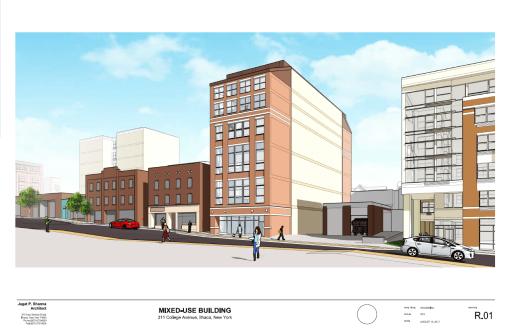
Project Description: The applicant is proposing to construct a six story, 80’ high building plus basement. The first floor will have an approximately 825 SF commercial space and five studio apartments, upper floors will have a combination of 21 studio and 24 loft apartments for a total of 45 dwelling units. The applicant’s intended market is students. Project development will require the removal/ demolition of the existing structure and all associated site features. The existing building incorporates the original Number Nine Fire Station and was identified as a structure worthy of further research in a 2009 study titled Collegetown Historic Resources Worthy or Detailed Research; Icons of Collegetown, Individual Buildings, Architectural Ensembles and Landscape Features. The project is in the MU-2 Collegetown Area Form District (CAFD) and requires Design Review. This is a Type I Action under the City of Ithaca
Environmental Quality Review Ordinance (“CEQRO”) §176-4 B.(1)(k) and the State Environmental Quality Review Act (“SEQRA”) § 617.4 (b)(11) and is subject to environmental review.

Project: Bridges Cornell Heights Residence (Senior Housing) 8:10

Location: 105 Dearborn Place

Applicant: Elizabeth Classen Ambrose

Actions: Declaration of Lead Agency, Public Hearing, Review of FEAF Parts 2 & 3

Project Description:
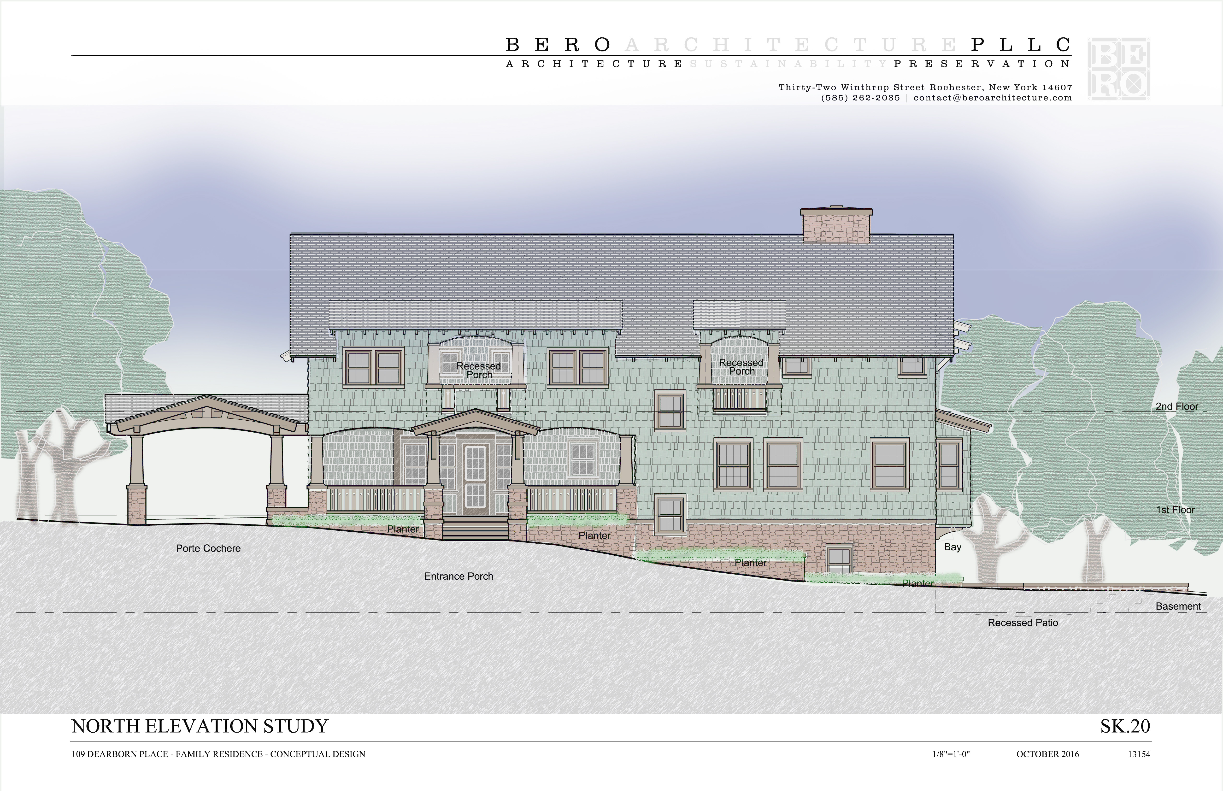
The applicant is proposing to construct a two story single family residence with 12 bedrooms
to house up to 16 people on the .446 acre lot. The building will have a footprint of approximately 4,150 SF, including porches. Site improvements include a porte couchere, a driveway and parking area for nine cars, three patios, walkways and landscaping plantings. The site is currently vacant. Site development will require the removal of approximately 25 trees of various sizes. The applicant is proposing to use the Landscape Compliance method, which requires Planning Board approval for placement of the parking area. The project is in the R-2a Zoning District and the Cornell Heights Local Historic District and has received a Certificate of Appropriateness from the Ithaca Landmarks Preservation Commission (ILPC). This is a Type I Action under the City of Ithaca Environmental Quality Review Ordinance (“CEQRO”) §176-4 (1)(h)(4) and the State Environmental Quality Review Act (“SEQRA”) § 617.4 (b)(11) and is subject to environmental review.

4. Zoning Appeals 8:30

5. Old/New Business 8:40
A. Planning Board Report Regarding the Proposed Local Historic Landmark Designation of 411-415
College Avenue- The Chacona Block
B. Upcoming Planning Board Recommendation to Approve Draft Design Guidelines for Collegetown &
Downtown – discussion


News Tidbits 9/16/17: The Big Surprise

16 09 2017

1. Ostensibly, the biggest newsmaker of the past week was the announcement of the Green Street redevelopment in Ithaca’s downtown core. To be frank, I was freaking out at my desk. Even more astounding was that the city slipped it out so casually, embedding it in a monthly PEDC meeting file that typically focuses on more mundane legal and planning concerns.

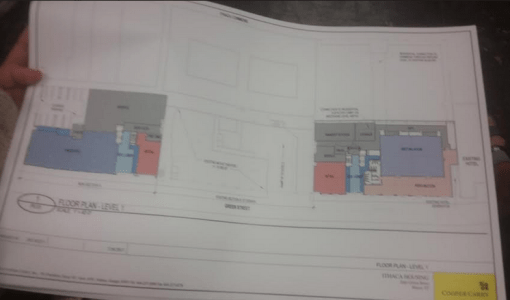
All photos that follow are from Jolene – pardon the marginal quality, we were both in note-taking mode, and these presentation papers weren’t given out to the public. North is towards the top of the floor plan images.

While the documents have yet to be uploaded to the city’s website, some basic details were released during the meeting – the number of parking spaces for the whole complex is 525. There would be two towers with residential units, a U-shaped west tower and a boxy east tower with projecting corners. 15 floors apiece. 350 units, “designed to appeal to a broad demographic”. Abatement likely, with the details to be ironed out as the percentage of affordable units is determined. The middle portion will also have residential units on top of the existing garage. 30,000 SF of conference space is planned under the eastern tower, if my notes are right.

The first floor appears to have at least two retail spaces, a lobby area, and an office, probably for management of the complex. The middle section will retain access to Cinemapolis and the garage. On levels two and three would be rebuilt garage sections (note the center section was rebuilt ten years ago and unlike the ends, is in good shape). Another floor of parking will be added.

Cooper Carry is the architect, and the initial design looks fairly safe, attractive if not particularly inspired. After the Marriott, it’s good to be wary of potential value engineering. It appears to use brick veneer, Nichiha-like metal panels and maybe fiber cement. Also, with Harold’s Square and City Centre off to the left, this would arguably create a broad-shouldered if stubby skyline for downtown Ithaca, more impressive than many communities Ithaca’s size.

My notes are that Marriott co-developer Jeff Rimland had non-public information about the Green Street garage because he owns the ground facilities under the garage’s eastern deck, and would be impacted by renovations. He was made aware of city looking at their options and put something together. The city only learned about the plan four weeks ago, and mayor Myrick wanted to make sure it was brought forward for public discussion and to determine if it was a wise choice to move froward. Ostensibly, if this came out as a surprise, a hornet’s nest of opposition would be stinging. Being transparent now helps later.

It seems the intent is an RFP for the garage for the sake of fairness, but I dunno how effective that will be. Rimland has a big advantage as owner of a portion of the parcel, since any other developer would need to arrange legal agreements with him in order to carry out a project. It was suggested by Brock, who has never been a fan of development, and I cynically wonder if this was an attempt to ensnare or at least stall the proposal. An RFP does put the city in a more legally comfortable position, perhaps. On the flip side, I cringe at the thought of another Old Library-like mess.

On a final note, there’s also a name, seen in the lower right of the rendering – “Village on the Green”. Very punny guys.


2. The other big news item of the week was 311 College Avenue, more commonly referred to as “The Nines replacement”. The Nines is a much-loved restaurant and bar that has long been a part of Collegetown’s drinking and musical scene – in the late 2000s, if I had to describe Collegetown bars, where Johnny O’s was the “fratty frat” bar and Chapter House the erudite tweed-clothed crowd, The Nines was the laidback, indie band geek-turned-rocker. Add in its location in a ca. 1908 fire station, and one of the few sizable outdoor patios in Collegetown, and one can understand that a project on this site was never going to be warmly received.

Granted, I’ve been raked over the coals a couple of times for the article, whose first headline said The Nines was being kicked out. It was an honest copy-editing mistake. For breaking news I publish ASAP, like with the Green Street development. However, that’s discouraged because the business pieces are useful for filling slow periods during the day, or to give time for others to prep articles during the early morning. Many of my articles are written in the late evening, submitted to the schedule, and skimmed through before hitting the website. In this case, I submitted Sunday night, my editor Jolene read through it early Monday morning, she thought the opening lines implied an eviction and changed the title (the original was a generic “Apartments Proposed for The Nines”). Sometimes title get changed for clarity or Search Engine Optimization (SEO), but this particular time it created a false statement. I didn’t see it until I was at work on Monday, and uncomfortable conversations ensued. Sorry all. The next article won’t wax poetic.

Anyway, with that error noted, it makes this next opinion segment more uncomfortable. I’m not a developer. But if I were one, and heard the property was being put up for sale, I’d probably have steered clear. With all due respect to Todd Fox, my gut feeling is that the cons outweigh the pros.

Ithaca is not an easy city to do a project in. A developer has to pick and choose their battles. In this case, the battle is taking a building with some degree of historic value, but more importantly a lot of local sentiment attached, and proposing to replace it with, frankly, a mediocre design with high-end student units. I understand the economics of the site, the market, and the unfortunate though economically necessary impacts building flush to lot lines has on the ability to install windows on the sides. My concern is external impacts, by creating an emblem for opposition to organize around, because it wraps several perceptibly negative impacts into one proposal. That may make future projects that much more difficult. I worry that whenever a controversial plan is brought forth in years ahead, it will be pejoratively described by NIMBY types as “just like that Nines replacement”.

It has taken years for Ithacans to become slowly more amenable to density and development. Proposals that inadequately address community concerns threaten that progress. Consider the case of Jason Fane. He toyed with the city plenty of times. Eventually it caught up to him and he got burned. The sad part is, 130 East Clinton was a solid project, and to this day I believe that had it been another developer, those apartments would have been built.

Anyway, the ILPC would like to preserve it as-is, which draws the question why the discussion never moved forward 18 months ago when they had the chance. I don’t think that’s likely at this stage, and an overbuild probably wouldn’t work due to development costs (foundation shoring, elevator if 4+ floors) with respect to developable area – the big front yard setback is an impediment to that. I heard that an offer was floated to Neil Golder to move his house at one point during the 201 debate, so maybe moving all or at least the front (1908 wing) of the old station No. 9 is possible, but the expense would be great. As for the new building’s design, maybe modest fixed windows in the north/south brick faces, or glass block features like on Sharma’s 307 design, or even something as minor as a mural on the CMU blocks would help.

But, all that might be grasping at straws. This was always going to be controversial. I won’t fault someone for seeing an opportunity, even if it’s not a plan I’d advocate. It all depends on one’s appetite for development opportunities, and sensitivity to potential blowback.

3. For sale: 405 Elmira Road. 0.74 acres of parking lot next to Buttermilk Falls Plaza. List price: $465,000, courtesy of Pyrmaid Brokerage. Also noting – the chain hotelier who bought the former Tim Horton’s next door from the same seller for $640k in January 2016. Timmy Ho’s 0.75 acres is a little small for a hotel on its own, but combined with this lot, suddenly plans start to look quite viable for a mid-sized chain in the city’s suburban-friendly SW-2 zoning. Someone else may come along and buy it, but let’s see what happens.

4. It appears the 24-unit Pineridge Cottages project is off the table. The project, planned for the corner of Mineah and Dryden Roads in Dryden town, was greatly scaled back by developer Ryzward Wawak after water tests led to concerns about having enough to supply all the units. At this time, the plan is for four cottages, each a two-bedroom unit.

5. The Times’ Matt Butler has a nice summary and brief interview with Lakeview Health CEO Harry Merriman regarding the 60-unit affordable housing plan for 709-713 West Court Street. Some of the obstacles the project faced wouldn’t be a surprise to readers of this blog – the soils require a more expensive deep (pile) foundation, and land acquisition costs are climbing, which increases the overall costs involved with bringing a proposal into reality, let alone a plan that focuses on affordable housing. The increase in units from 50 to 60 was driven by the need to balance out revenue with expenditures and make the affordable housing economically feasible. Incremental cost increases per unit are significantly less than overall structural costs, so the per-unit expense for 60 units is less than 50, making the project more appealing in competitive grant processes.

Of the 22 units to be set aside for formerly homeless individuals, six will be reserved for HIV-positive clients of STAP, the Southern Tier Aids Programs. Those infected with HIV tends to experience much higher homelessness rates than the general population, with at least 81 homeless HIV-positive individuals in Tompkins County alone. This makes it hard to do things like refrigerate medication. These six units are a small number perhaps, but for those six folks it will make a huge difference.

6. Another feather in the cap of the local STEM sector of the economy. Biotech startup Jan Biotech Inc., based out of the Cornell Business Park by the airport, has received a $3 million grant from the National Institute of Health (NIH) that will be used in the research and production of an HIV diagnostic for detection and quantification of latent HIV-infected reservoirs in patients –  cells that have the virus but aren’t actively producing HIV, which current anti-retroviral therapies struggle with. Potentially, the diagnostic could help test new medicines for their ability to target those cells, and lead to a true cure for the virus before AIDS can occur.

Along with new equipment and renovated facilities, the grant is expect to result in the hiring of another 5 to 10 scientists and engineers for the four-person firm. Which is great, but truly, it’s their work to try and improve our treatment and medicine of a deadly virus that’s more important. The very best of luck to them.

7.  A bit of news from the Cornell Daily Sun regarding the additional 2,000 beds Cornell would like to build on its North Campus, as part of its freshman expansion and “Sophmore Village” plan. The university would like to begin construction on the first dorms in 2018, and start increasing student enrollment by 2020. For that to happen, the plans pretty much need to come forward for formal planning board review within the next few months. Presumably, they’d like to have the dorms ready by August 2019 – these will be used as flex space initially, so that existing dorms like Balch and Clara Dickson can start renovation. At a bare minimum, it takes three months to go through the city planning board. Given this project’s proximity to Cayuga Heights, the local patricians will want to have their say as well, even if it is just outside village lines. With the size of the project and a minor amount of inter-municipal complexity, four months from sketch plan to approval seems realistic. Considering the need to request and award contract bids, it would seem plausible that Cornell puts the dorms forward this fall for review, with approval expected by late winter. Bids would be requested and awarded during the Spring, and construction would start by June. Whatever the case, the first construction plans are likely not far off.


News Tidbits 9/9/17: Shopping for Sales

9 09 2017

1. As Dan Veaner at the Lansing Star reports, the new owners of the Shoppes at Ithaca Mall (aka Pyramid Mall) are planning to roll out new tactics to counter the ongoing, nationwide retail apocalypse currently underway. Instead of leasing locations, the mall owner would like to subdivide retail spaces within the mall under a Planned Development Area (DIY zoning, in essence) so that tenants could potentially own their spaces instead of renting them, under the hope that when they own a store location, they are less likely to close it and will opt for closing rented spaces elsewhere. Because customary use-based (Euclidean) zoning is not suited for this unusual arrangement, a PDA has been suggested, and the village of Lansing seems amenable to the idea.

On a related note, another subdivision of the mall properties would open up a portion of the parking lot behind the Ramada Inn for the development of an extended-stay hotel. This would probably play out over a few years, given the time to design a project, secure a brand and ask for village review/approvals. Market-wise, it’s not implausible, since the other hotels planned, like the Canopy downtown or the Sleep Inn at 635 Elmira Road in Ithaca town, are geared towards the overnight crowd, and the overall market is growing at a sustainable pace. As long as the local economy continues its modest but steady growth, a medium-sized specialty property that opens in two or three years would probably be absorbed by the local hospitality market without too much fuss.

2. Meanwhile, over in the the town of Lansing, a couple of minor notes and some name changes. From the town of Lansing Planning Board agenda, it appears the 102-unit Cayuga Farms development is now going by the name “Cayuga Orchard”. The project, which has been stuck in red tape due to the stringent review of modular sewage treatment systems, is seeking modifications to their plans, which was summarized in the Voice here. The short story is that the project has the same number of units, but the impermeable area has been decreased and the number of bedrooms is down from about 220 to 178. That should help reduce stormwater runoff, and if the town sewer isn’t through yet, it could make the modular system more feasible.

Secondly, Cornerstone’s Lansing Commons Apartments are being rebranded as the “Lansing Trails Apartments”, which makes sense since there aren’t any “Commons” in the town, but the town center property is traversed by numerous recreational foot trails. The town has endorsed Cornerstone’s two-phase, 128-unit development plan for affordable rental housing, though the planning board did express concerns with the impact of dozens of additional school children on a property with 581a property tax breaks, which may result in a 4% increase in school taxes in the default scenario. The number could vary given the number of kids that actually live there – the board ballparked 80 for their back-of-the-envelope analysis, which given 128 units and roughly 208 bedrooms in the project, isn’t unreasonable.

3. On that note, it appears Cornerstone and NRP have applied to the county’s affordable housing funding grant for a bit of financial assistance towards their respective projects. Cornerstone is seeking funds for qualified units within the 72-unit first phase of its Lansing Trails project, and NRP is seeking funding for qualifying units within the 66-unit first phase of its Ithaca Townhomes project on West Hill. Each organization would receive $256,975, mostly in Cornell-donated funds, if approved by the county legislature. The money may be leveraged and with less needed from traditional affordable housing funds, it may make each project more appealing from a federal or state grant perspective, with demonstrated municipal interest and more “bang for the buck” on the grantor’s end.

4. The two-building apartment complex planned at 232-236 Dryden Road is one step closer to construction. According to Tompkins County records, Visum Development bought the two properties on which the project was proposed (114 Summit Avenue and 232-238 Dryden Road) for $7.65 million on Monday the 5th. The properties are only assessed at $2.55 million, but sellers tend to enjoy a hefty premium when developers have intent for their parcels.

The following day, the building loan agreement was filed. The loan, for $16,354,628, was granted by S&T Bank, a regional bank based in Pennsylvania that has no retail banking presence in Ithaca, but has served as the financier for several projects, including the Holiday Inn Express that recently opened on Elmira Road, and Visum’s just-opened 201 College Avenue project.

A breakdown of the costs shows the total project cost is $22,780,334. There’s $13,020,010 in hard costs (materials/labor), $7.65 million for the purchase, $475,000 in soft costs (architect/engineering/legal), $250,000 for the demolition, and the rest is for taxes during construction, interest reserve (interest on the construction loan during construction). $650,000 (5% of the hard cost) is set aside as contingency funds just in case the expenses clock in higher than expected.

Along with the loan, Visum and its investor appear to be putting up $6.325 million in equity. With these hefty sums, one has to be pretty certain of their investment. In Collegetown, they often are.

Visum CEO Todd Fox has previously stated construction is expected to start this month on the 191-bed apartment property, with an eye towards an August 2018 completion.

5. The Old Library property sale is official, on an 11-3 vote. Legislators Kiefer, Chock and McBean-Claiborne voted no, none of which are an big surprise since, as members of the Old Library Committee, they found something to dislike with every proposal back in 2014. If anything, the surprise might have been legislator Kelles, who while not a fan, supported the mixed-use project. Travis Hyde Properties will bring 58 senior apartments, community space administered by Lifelong senior services, and a small amount of commercial space when the building opens in 2019.

6. So this is interesting. Josh Brokaw is reporting over at Truthsayers that Cayuga Medical Center wants to move the Community Gardens off the land. That is a story being covered further by my colleagues at the Voice, but notable to this blog’s purview are two nuggets of information.

One, Guthrie and CMC had *a bidding war* for the property, which explains a couple of things. It explains why CMC paid $10 million for a property the Maguires only paid $2.75 million for, and it offers a clue as to why Guthrie purchased the neighboring Cornell warehouses. They both have had plans for that area, and working together isn’t a part of them.

Two, Park Grove Realty is involved with CMC. They’re a young Rochester-based company generating lots of news in Lansing with a lawsuit-laden 140-unit townhouse project, and they purchased the Chateau Claire apartments and renovated them into the upmarket Triphammer Apartments, which generated its own share of controversy.

Anyway, it makes the commotion down by Carpenter Business Park that much more interesting. Nothing has come public yet, but keep an eye on it.

7. On a related note, it’s not much of a physical change, but Maguire is using some of that cash windfall to officially acquire the former Bill Cooke Chevy-Olds-Caddy dealership on Lansing’s Cinema Drive. The franchise rights were transferred over ten years ago, but the property itself was still under the ownership of the Cooke family. Thursday’s sale was for $2,015,000. The 4 acres and 19,857 SF building was assesses at $1.8 million, so it appears the sale price was a fair deal for both sides.

I would be remiss not to point out that the buyer was “Maguire Family Limited Partnsership”. No LLCs cloaking this purchase like with Carpenter Business Park.

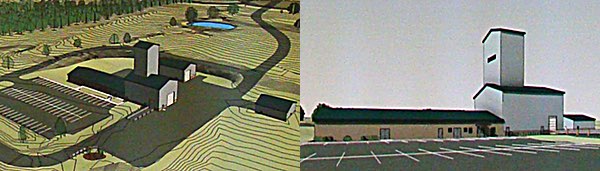
7. Now that the state has okayed the Cargill expansion, the above-ground portion of the project has to go before the Lansing planning board. The surface facilities, expected to cost $6.8 million, consist of a 10,000 SF administration building, a 2,100 SF maintenance building, a 2,600 SF hoist house, parking, landscaping and signage. A hoist house is essentially an industrial-strength engine room for operating the lift that brings people and equipment up and down from the shaft. It’s likely the primary cost contributor in the surface portion of the project.

As seen in the renders above, it’s designed for functionality rather than aesthetics, though Cargill did attempt to make the shaft building barn-like to blend in better with the farms. Construction on the above-ground structures is expected to start next year and run for about 18 months (the mine is being built from the bottom up). Although not shown in the renders, trees will be planted around the developed area to provide a green screen and help dampen noise.


News Tidbits 8/24/17: Early Start

24 08 2017

1. The Old Library redevelopment is creeping forward. The Old Library Committee of the Tompkins County Legislature voted to recommend the sale of the property for the previously stated amount of $925,000 to Travis-Hyde. With that vote, it goes forward to the full legislature for a vote on September 5th, where there are no major challenges expected. The Library Committee vote was 4-1, with legislator Dooley Kiefer (D-Cayuga Heights) opposed. Kiefer has always been opposed to any sale, and has long advocated for a lease of the land – and the only way the lease made any practical sense was by being 50 years in length, so that any investment could have the possibility of being recuperated. Given that she’ll probably vote no again for consistency’s sake, and perhaps a rejection from legislator Anna Kelles (D-Ithaca) because she was a long-time proponent of the condo plan, there aren’t likely to be any other opposition votes from the 15-member legislature. Once the sale is okayed, site prep for the 58-unit mixed-use senior facility at 310-314 North Cayuga Street can begin by the end of the year, with a spring 2019 opening expected.

2. So when is an expansion truly an expansion? That’s the question raised by the Times’ recent coverage of a proposed renovation of the county jail, which faces issues with overcrowding, but whose expansion of holding cells is strongly opposed by a number of advocacy groups. The jail is shared with the Sheriff’s Department offices at the moment, and the combined facility at 779 Warren Road is collectively referred to as the Public Safety Building.

The ideal concept as pitched by the Sheriff’s Office would create an additional 13,000 square-foot administrative facility adjacent to the jail that would provide office space, conference space and locker rooms for officers. This would free up programmatic space in the PSB to be used for support functions like classrooms and counseling/meeting rooms, with the ultimate goal of reducing recidivism (the tendency of a convicted criminal to re-offend, and thus take up space in the jail). So,it’s  not a jail expansion per se, but a support services expansion, which would probably drive debate among advocacy groups. The proposal is strictly conceptual, but the county is prepared to move forward with a formal study from LaBella Associates if requested.

3. At the latest Planning Board meeting, Lakeview’s 60-unit supportive and affordable housing plan was granted the green light to go forward to the next step, though not without reservation and concern from some local business owners and elected officials. Per the Times’ Matt Butler, 1st Ward councilors Cynthia Brock and George McGonigal spoke in opposition to the current plan, feeling it was too large and unattractive, while nearby business owners were uncomfortable with the population who would live there. 30 units would be set aside for those who are mostly independent but may need some degree of mental health support, 22 units are general affordable housing, and eight are for formerly homeless individuals. All units are one bedrooms. Lakeview will provide office and support space for services on the first floor of the 62,700 SF building.
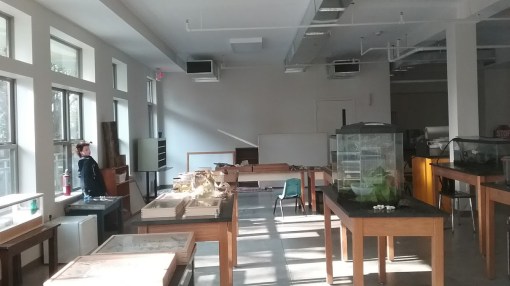
In other news, the debate over South Hill continued with the airing of grievances against student housing, Finger Lakes ReUse earned approval for its Elmira Road project, and someone must have left early, because the planning board failed to reach quorum (minimum attendance) to vote on recommendation of historic designation for the Chacona Block at 411-415 College Avenue.

4. Here’s an interesting little proposal out of Danby – a 10-unit pocket neighborhood. The project would be located on 2.2 acres at the rural intersection of Brown Road and Short Road, northeast of the hamlet of West Danby. The houses would be modular and modestly-sized with two basic styles, a 1.5-story cape and 1-story ranch. Additionally, they would be designed for aging-in-place, Net Zero Energy (zero net energy consumption), and have a shared common space (courtyard, lawn or similar), parking lot and septic system. The project, which has access to municipal water service, would require a zoning variance. The project is similar to the Amabel and Aurora Street pocket neighborhoods in Ithaca, though it’s a different developer – here, it’s Mike McLaughlin, a business owner from Newfield, and Danby residents Esther and Brooke Greenhouse. Esther was a team member in the condo proposal for the Old Library site.

Although not explicit, these are likely for-sale units, possibly with a push towards seniors. With shared spaces, modular components and modest sizes, the cost for these is likely to be modest as well – they would likely be similar to the Lansing Community Cottages price range of $175k-$225k.

5. After much debate, the Sun8 Dryden solar projects have been approved by the town planning board. The sites include a nearly 11 MW facility at 2150 Dryden Road, and an 18 MW facility along Turkey Hill and Dodge Roads. The projects will produce approximately 28 MW of electricity, which is enough to power the approximately 7,500 households. The project will utilize a Payment In Lieu of Taxes (PILOT) of $8,000/MW, or about $224,000 in year one of operation, and with built-in inflation, about $8 million over 20 years.

Meanwhile, the town has begun review on a much smaller solar project at 2243 Dryden Road. Delaware River Solar is seeking approval to construct a 2.4 MW array on the interior portion of a farm property just west of the village near Ferguson Road. About 35 acres of the 115 acre parcel would be impacted during construction, with five acres used for the panels themselves.

6. In real estate listings, here’s something unusual for those who dare to be different – a Groton church, already renovated with living space and studio space. Aptly-located 113 Church Street is listed at $174,900 and 9,490 square feet on Zillow, but a check of county records says 9,166 SF – a 1,000 SF apartment, a 1,344 SF office, 4,078 SF “non-contributing space”, and 2,744 SF “cold storage”. The property was built in either 1881 or 1883 (county record) for a Congregational denomination, and after some mergers in the 1960s it became the Groton Community Church. From records and county file photos, it looks like the church building was re-purposed in the late 1990s or early 2000s. Previous tenants include a head start program, massage therapy, and art gallery. The tax assessment is for $100k, which seems to account for the old and somewhat mothballed condition of the property, such as the boarded up windows on the steeple tower. Should one be interested, contact info can be found in the first link.

7. This week’s news round-up is running a little early because I wanted to get the latest Trumansburg Hamilton Square materials out before the planning board meeting Thursday evening. Over the past few weeks, there haven’t too many changes to the project site plan, but the daycare center was moved from inside the loop road to outside, exchanging locations with a string of for-sale market-rate townhomes. The resulting move also seems to have decreased the number of market-rate units (some townhome, some detached single-family) down by one, to 14. 11 affordable for-sale townhomes and 47 affordable rental units are still in the mix.
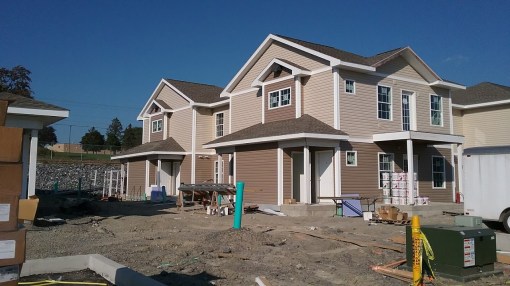
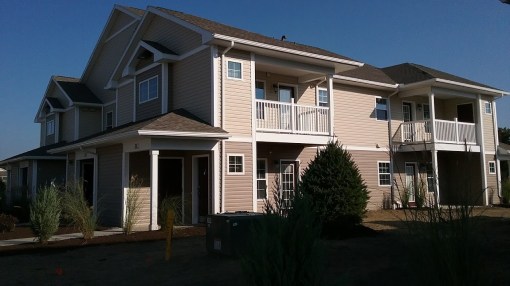
//simplebooklet.com/embed.php?wpKey=W7HALtX9d87mG9WFMNbp9N&source=embed

//simplebooklet.com/embed.php?wpKey=RK3Z4a5lU7XdYcy2vpC4Gc&source=embed

A copy of the traffic study from SRF Associates has also been made available on the project website. The traffic study aims to be thorough, and will likely be expanded in response to neighbor concerns about slower traffic like garbage trucks and school busses, snow impacts, and a possible sampling and estimation of school-focused but non-peak hours and a couple other intersections further from the project site (Rabbit Run Road, and Whig/South Streets). The meeting tomorrow will be at 7 PM at the Trumansburg Fire Hall. The actual submission of the project for formal board review is not expected until late next month, after incorporating feedback from the upcoming meeting.