News Tidbits 8/21/17: Insert Eclipse Pun Here

21 08 2017

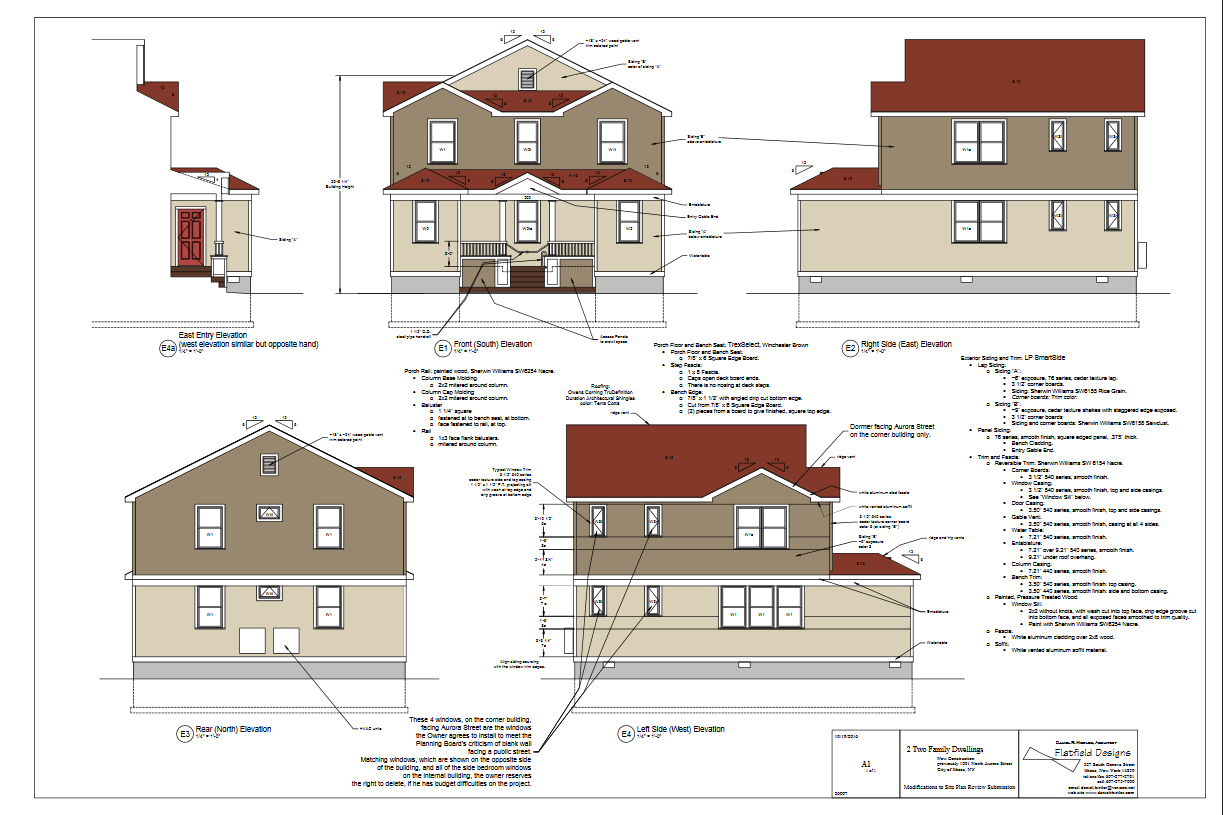
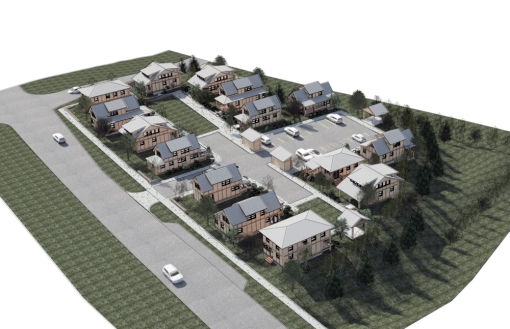
1. Quite the sight in the latest Tiny Timbers update. The nascent kit-based homebuilder plans to roll out several new designs, many of which will be incorporated into the 15-unit Varna project on the corner of Dryden and Freese Roads. That brings their total number of home design options up to about 21 or so, in several general styles from four-square to prairie-style to bungalow. It is not clear if the layout will be pre-set at is was with the Belle Sherman Cottages (relatable because STREAM Collaborative designed both), or if it will be left to the buyers.

Tiny Timbers is a bit of a misnomer because the designs are a modest but still sizable 1,000-1,500 square feet, with two or three bedrooms. Prices will be in the mid 100s to low 200s, depending on unit and features. I’d be more inclined to compare them to the starter homes of the 1950s in terms of market appeal and affordability.

Tiny Timbers has yet to get permission to start marketing for the community (the state needs to sign off on all new Home Owner Associations), but marketing has started for some scattered site development on Hector Street in Ithaca’s West Hill, and there is work underway on a few custom builds for landowners in other parts of the county.

2. Last week was not a good showing for the Inn at Taughannock. As relayed by the Times’ Jamie Swinnerton, the town of Ulysses Zoning Board of Appeals denied the lot variances, the heights variances and even the sign variances. The only one they outright permitted was the height variance to allow a rooftop cupola on the existing inn. The sign variance is kinda weird, because it sounds like they were okay with some individual signs, but not the sum of parts, so they’re doing another meeting.

While this isn’t what owner/developer Carl Mazzocone was hoping for, there were alternative plans drafted that did present an alternative design that, while the same style, fit within the zoning parameters. So this is a setback, but this project isn’t off the table yet.

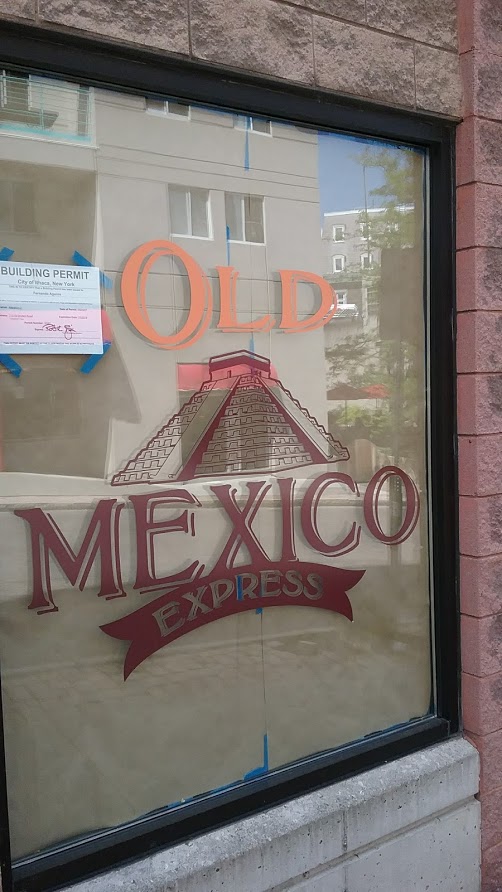
3. Sure, most readers outside the Cornell bubble avoid Collegetown like the plague, but it’s worth noting when new businesses are coming in. Old Mexico, the restaurant that replaced Manos Diner in Southwest Ithaca, will be opening a modest to-go operation at 119 Dryden Road (Collegetown Plaza) in what used to be a barbershop (at least in my time in the late 2000s). Meanwhile, where the Collegetown tobacco shop used to be at 221 Dryden (Collegetown Center), will now be a “Chinese street food” restaurant called Beijing Jianbing. Best of luck to both. At least restaurants aren’t being driven out of business by the internet anytime soon.
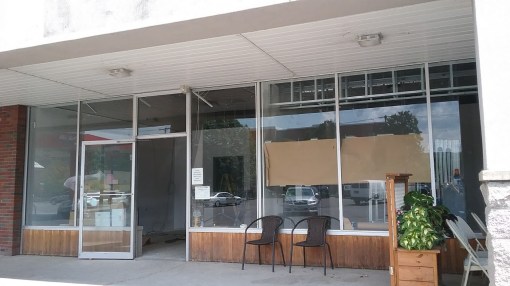
4. In the same vein, it was noted a few weeks ago that a $415,000 construction loan was filed for Hancock Plaza, the strip retail plaza at the corner of Hancock and Third Streets in Ithaca’s Northside. A quick check showed an interior renovation underway with new metal stud walls and sheet-rock going in, and the somewhat uncertain workers said that the storefront next to Istanbul restaurant would be a “medical service facility”.

5. Earlier this month, it was mentioned that a 4.5 acre parcel at 452 Floral Avenue in Ithaca was sold to a local homebuilder for $100,000. Now he’s trying to flip it. The asking price is $239,000. The tax assessment is $68,400.

The real estate ad notes the potential of an R-3a zone, which allows for homes, townhouses, small apartments and small-scale commercial with a special permit. The zoning permits four floors and 35% lot coverage, with a minimum of 5,000 SF per lot for a home, plus incremental increases for additional units.
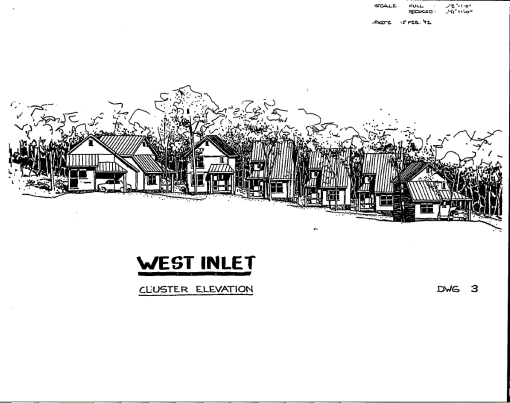
On a side note, with thanks to the city for uploading about 470 documents from the IURA’s microfilm stash, here’s what the 1992 affordable for-sale proposal looked like for that same property. There appear to be 27 home lots, but a few may have been designed for accessory or two-family units. This gives an idea of what could reasonably be done under the existing zoning, but there are many possibilities.

Side note, I found this by chance. If anyone has time to pick through 470 documents from the 1960s to 2000, more power to you.
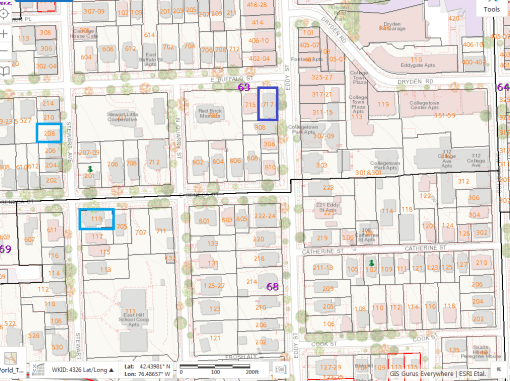
6. Also for sale, to the deep-pocketed investor looking for a safe investment – multiple East Hill apartment houses. 5-unit 119 Stewart Avenue for $995,000, a two-family home at 208 Stewart Avenue for $695,000, and $2.25 million for a 23-bed (20 SRO, 1 studio, 1 2-bedroom) property at 717 East Buffalo Street. The Stewart Avenue properties are owned by a Long Island-based LLC representing a higher ed professional now located in Massachusetts, and were purchased just a few years ago – 119 for $625k in 2014, and 208 for $513k in 2012. 717 East Buffalo was purchased by a Brooklyn investment group in 2003, and is taxed at $1.05 million. The positive is that they’re close enough to Cornell to easily take advantage of the student market. The negative is that they are all in the East Hill Historic District, which means redevelopment is off the table, and exterior renovations have to go through the ILPC.

7. Pretty slow month for the Planning Board. Finger Lakes ReUse is seeking preliminary approval for their expansion project and final approval for the warehouse portion. 709 West Court Street, the 60-unit affordable project from Lakeview, will have its DEIS finalized, potentially allowing for city approval in September. There are no new projects though, unless one counts the six-bedroom duplex at 217 Columbia, which is so minor from the state’s perspective that it only qualifies for city review. The Times is reporting that O’Connor is willing to prohibit student tenants, but permanent residents are still opposed to new student housing in their neighborhood.

There could be some interesting discussion at the meeting, not only with South Hill development, but with historic preservation matters. For instance, Student Agencies is upset that they city is likely to landmark its building at 413-415 College Avenue, which it says it had intent on redeveloping. Unfortunately, timing is everything. Likewise, the shoe is on the other foot with the Nines at 307 College Avenue, for which there has been an unpublished sketch plan of a redevelopment project. The ILPC is expressing frustration that it wasn’t landmarked already, but with the development plans already presented, the city would be acting reactively instead of proactively as it’s doing on College Avenue, and that could make the difference if a legal situation were to arise. So while the Chacona Block is likely safe and soon to be under ILPC purview, the Nines will not be protected for as long as the redevelopment plan is active, and the best the ILPC can do is recommendations.

Here’s tomorrow’s agenda:

AGENDA ITEM Approx. Start Time

  1. Agenda Review 6:00
  2. Privilege of the Floor 6:01
  3. Site Plan Review

A. Project: Mixed Use Apartments – Finger Lakes ReUse Commercial Expansion and Supportive Apartment 6:10

Location: 214 Elmira Road

Applicant: Finger Lakes ReUse

Actions: Consideration of Preliminary Approval Overall & Final Site Plan Approval for Phase 1

Project Description:

The applicant proposes to expand the existing office and retail center with a new +/- 26,100sf
attached 4-story mixed-use building to include retail, office, and 22 units of transitional housing fronting Elmira Road. A 7,435 SF covered outdoor inventory building and a 600 SF pavilion are also proposed. The new parking and loading layout will reduce the number of curb cuts on Elmira road from 5 to 2 and provide 70 parking spaces. An improved sidewalk will be constructed to provide a safer link between the existing pedestrian bridge that connects the Titus Tower property to Elmira Road. The building will have landscaped entrances facing Elmira Road and these will be connected to the new building entrances giving residents and patrons arriving on foot direct access to the street. The project site is in the B-5 Zoning District and has received the required area variance. This is a Type I Action under the City of Ithaca Environmental Quality Review Ordinance (“CEQRO”) §176-4 (I), and the State Environmental Quality Review Act (“SEQRA”) § 617.4 (11) for which the Planning Board as Lead Agency made a Negative Declaration of Environmental Significance on June 27, 2017.
Ed. note – the first phase is the warehouse addition for lumber storage. Phase 2 is the supportive apartments.

B. Project: 709 West Court Street 6:30

Location: 326 & 328 N Meadow St. and 709 – 713 West Court St.

Applicant: Trowbridge Wolf Michaels for Lakeview Health Services Inc.

Actions: Public Hearing, Determination of Environmental Significance

Project Description:

The applicant proposes to construct a five-story L-shaped building with footprint of 10,860 SF
and GFA of 62,700 SF on the .81 acre project site comprising four tax parcels (to be consolidated). The building will contain sixty (60) one-bedroom apartments plus associated shared common space (community room, laundry facilities, lounges, and exterior courtyard), support staff offices, program spaces, conference room, utility rooms, and storage. The siting of the building allows for a small landscaped front yard, a south-facing exterior courtyard, and a 16 space surface parking lot in the rear of the site. Site development will require the removal of five structures and associated site elements. The project is in the WEDZ-1 Zoning District. This is a Type I Action under the City of Ithaca Environmental Quality Review Ordinance (“CEQRO”) §176-4 (1) (k) and (n), and the State
Environmental Quality Review Act (“SEQRA”) § 617.4 (11) and is subject to environmental review.

C. Project: Duplex 6:50

Location: 217 Columbia Street

Applicant: Charlie O’Connor for 985 Danby Rd LLC

Actions: Public Hearing


Project Description:

The applicant is proposing to install a modular duplex with one 3-bedroom apartment on each floor. The new structure is proposed to be sited directly behind the existing duplex on the property. As the project will increase the off-street parking required from two to four spaces, the applicant is proposing to shift the existing curb cut to the east and install an expanded parking area and drive aisle along the eastern property line. The project also includes removing a 30”dbh oak and one street tree, closing the existing curb cut, installing a fence, landscaping and walkways. The project is in the R-2a Zoning District. This is a Type II Action under the City of Ithaca Environmental Quality Review Ordinance (“CEQRO”) §176-5 C.(8) and the State Environmental Quality Review Act (“SEQRA”) § 617.5 (C)(9) and is not subject to environmental review.


  1. Zoning Appeals 7:20
  2. Old/New Business 7:30
    1. A. 412 East State Street – review and sign off on Argos Inn shared parking agreement with 418 East State Street.
    2. B. PB Report on Proposed Local Landmark Designation of 403 College Avenue and 411-415 College Avenue . There will be a short presentation by Scott Whitham regarding 411-413 College Avenue.
    3. C. Development Patterns of South Hill – Discussion
  1. Reports from PB Chair, Director of Planning and Development, and BPW Liaison 8:00
  2. Approval of previous minutes
  3. Adjournment


City Centre Construction Update, 8/2017

21 08 2017

Ithaca is fortunate to have a downtown area with strong residential demand and relatively low commercial retail vacancy. Unlike many communities in upstate New York, its downtown area is ahead of the curve when it comes to attracting and capitalizing on investment. Apart from a few communities of similar economic strength (Saratoga Springs, Beacon), most regional cities are only just starting to re-invest in their downtrodden downtown cores.

It’s important to keep in mind that Ithaca was on a similar destructive path during the 1960s and 1970s. Like many cities, it was experiencing flight to the suburbs, competition from malls and shopping centers on the fringes, and general disinterest and loss of investment downtown. In an attempt to spur development, the city commenced with urban renewal plans that, among other things, routed Green Street through an urban block to create the tuning fork in the late 1950s, and in the mid and late 1960s, the city seized multiple 2-5 story ca. 1900 structures on the 300 Block of East State Street via eminent domain, demolishing them with the intent to sell the land to Ithaca Savings and Loan for a new bank branch and office building.
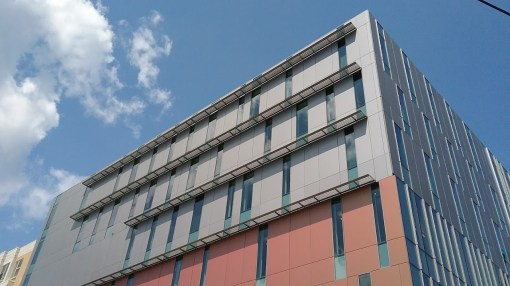
Things didn’t pan out as planned. After the bank pulled out, the now empty triangle of land bounded by South Aurora, East State and East Green Streets was used as a parking lot for construction crews, before finally being sold in 1973 to the Colbert family, who developed the Trebloc Building on the site. Originally planned at two floors, it opened in 1974, a one-story, brutalist-lite structure that was not a good fit and certainly not the transformative plan the city sold voters on a decade earlier. But, the city was desperate. They would take what they could get.
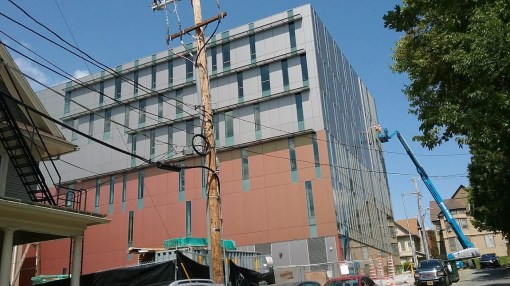
In the following decades, Ithaca’s economy remained relatively stable compared to its peers, thanks in large part to the colleges – staff counts increased to pick up some of the losses from manufacturers moving out of state or abroad, and students helped buoy the service sector. Ithaca’s downtown saw some investment in the late 20th century, but more importantly, most of the historic properties that survived Urban Renewal were now generating enough interest to avoid the wrecking ball.
By the late 1990s and 2000s, the idea of spin-offs and start-ups was starting to take off, and with Cornell serving as a sort of research incubator, it led to a modest but well-paying and growing high-tech sector. Add in an increasing trend towards college towns as a lively alternative to retirement communities, and Ithaca found itself with a growing economy. Coincident was a resurgent interest in urban living; Ithaca’s sleepy but intact downtown was poised to take advantage. It was still a risk in the 2000s, but through effort and luck, public-private projects like Cayuga Green and Seneca Place have paid off.
At this point, the initial “pioneer” projects have opened and demonstrated market strengths and weaknesses. Commercial office space is lukewarm at best, but rentals are hot. With a continued resilient, growing economy, developers were now scouting opportunities on their own. This was encouraged by the city, which upzoned several downtown parcels in 2014 to drum up interest. As part of this upzone, the Trebloc site was rezoned from CBD-60 to CBD-120, raising the maximum height from 60 feet to 120 feet, while permitting 100% lot coverage (excluding setbacks) with no requirement for on-site parking.

The first formal proposal to come along was State Street Triangle in April 2015. Texas-based Campus Advantage initially proposed a 12-story, 240-unit, 600-bed apartment building with first floor retail. The units were intended towards the student market, and Campus Advantage saw the property as an ideal location to draw in both Cornell and IC students.

Unfortunately, this development attempt pretty much checked off every box for what not to do. It was very large by Ithaca standards, officially student-oriented, the original design was mediocre at best, and according to city officials and staff, the developers came in with a condescending air, like the building was a gift and the city could only be so lucky. This stirred a hornet’s nest of opposition. Complaints included the size, the parking, the tenant mix, the design, and the developers were taken out to the proverbial woodshed for being out of touch “outsiders” who were simply going to profit off the city.

While there were some proponents, they were not many. The developers tried to make amends with a more appropriate design by STREAM Collaborative that reduced the size and scale, offered to make a donation to the city’s affordable housing fund, and broke up units to appeal to non-students, but the damage was done. When it became clear they would seek a tax abatement as most downtown projects do, the mayor, who is generally pro-density and pro-downtown, spoke out against it. Behind the scenes, a local developer was preparing to file a lawsuit if the city dared to approve the project without asking for a long, expensive Environmental Impact Statement first.

Meanwhile, the Colberts were in talks with a different developer, Newman Development Group (NDG) of Vestal. While not as large as Campus Advantage, Newman had previous experience in Downtown Ithaca, co-developing the Seneca Way mixed-use project with Bryan Warren a few years earlier. In fact, NDG’s forte is suburban shopping plazas and student housing; at the time, their only urban non-student residential project was Seneca Way. But, they knew Ithaca through experience. They knew what the city did and didn’t like, and watching Campus Advantage flounder not only gave them an opportunity to swoop in, it was an additional opportunity to watch and learn.

By December 2015, the purchase option CA had on the site had expired; and when they went to renegotiate, the Colberts were not interested, and decided to go with NDG. In January 2016, State Street Triangle was officially cancelled.

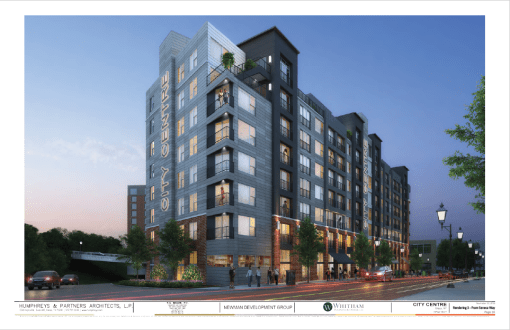
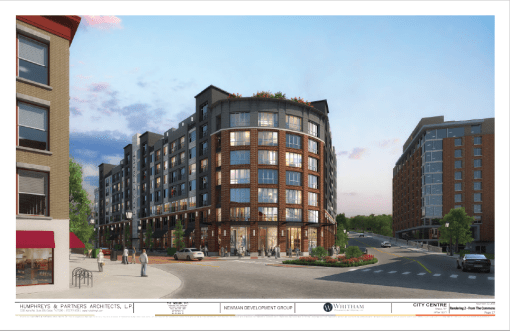
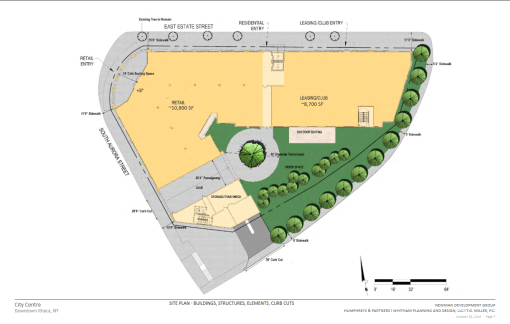
City Centre was officially announced in a press release in June 2016. From the start, it avoided the mistakes that plagued Campus Advantage. The announcement came not as a leak in the Journal, but in a press release to all three Ithaca news outlets, which gave an air of transparency and limited speculation. The initial design by Texas-based Humphreys & Partners Architects was well-regarded. The project would be non-student market-rate, with studio, 1-bedroom and 2-bedroom units. Instead of no parking at all, 71 (later 72) spaces would be located under the ground floor retail in a subterranean lot. The turn lane from Aurora onto State would be maintained, rather than lost to an expanded plaza.

With this approach, opposition to City Centre was much weaker – many critics saw this as a fair alternative. There were some complaints, like from Historic Ithaca, who were against any building with more than six floors; but overall, the reception to City Centre was much more favorable. The key changes through the municipal review process was to try and make the building less massive and less like State Street Triangle, as both had similar massing, and a visual focal point on the corner facing the Commons. The project team achieved this through setbacks and bump-outs to create more facade variation, and reducing the building to eight floors. Other details that were revised include additional street-level windows and the cornice of the curved primary facade. City Centre received preliminary approval in January, after the zoning board signed off on a rear setback variance. Final approval was granted in February. The original design can be seen here, and the final design is here.

The details of the final plan are confusing to the point of frustration – no one seems to agree on the exact figures (if anyone reading this could provide them, it’d be appreciated). The range of figures call for a 217,671-218,211 SF (square-foot) building on 0.76 acres, with 10,600 SF of ground floor retail and 8,700 SF of amenity space (gym, lobby, computer room, lounge, rental office) and 2,000 SF of utility space. On the upper floors are 192 apartments, or 193 – the square footage and unit details are all over the place. Once source says 63 studio, 73 1-bedroom, 57 2-bedroom units – another says 193, with a breakdown of 56 studio units (506 SF), 94 1-bedroom units (598-725 SF) and 43 2-bedroom units (907-1,370 SF). 68-72 parking spaces will be built in a one-story underground garage (without the garage, square footage is 186,966-187,536 SF). Building height has been reported as 85 feet, 106 feet and 111 feet, which is probably just a technical difference due to the slope of the site.

The total hard cost for the project is estimated at $32.8 million, and combined hard and soft costs come in at $52.7 million. The project was granted an enhanced tax abatement in April 2017. This was not without some opposition from residents who felt it was inappropriate to give an abatement to market-rate housing, and some landlords. Downtown business owners and interest groups were generally in favor.

Construction is expected through at least Spring 2019, although the numbers have been a bit inconsistent, with some paperwork suggesting 2020. The disagreement stems in part from the start date for the 20-month construction period, and whether that includes demo/site prep or not. It will be steel frame construction with brick veneer and a few shades of Nichiha fiber cement panels. The building will use electric air-source heat pumps and have a 7.5 KW rooftop solar array.

The project team includes NDG, Humphreys & Partners as architect, Whitham Planning and Design LLC as the team representative and point of contact for the review process, and T. G. Miller PC for civil engineering and surveying work. Rochester’s Morgan Management will be in charge of leasing. NDG is in a major expansion mode on the residential side at the moment, with a 320-bed student housing project under construction in Oswego, and a 120-unit general market project underway in Binghamton.

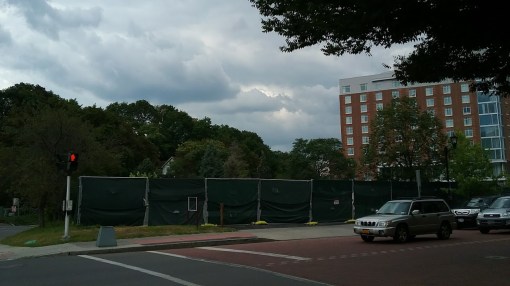
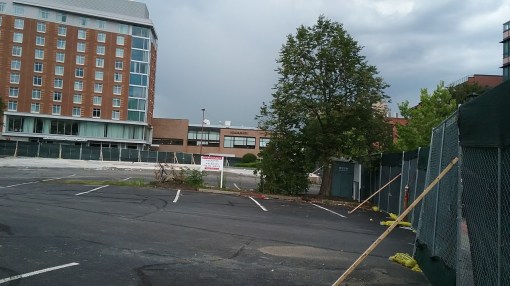
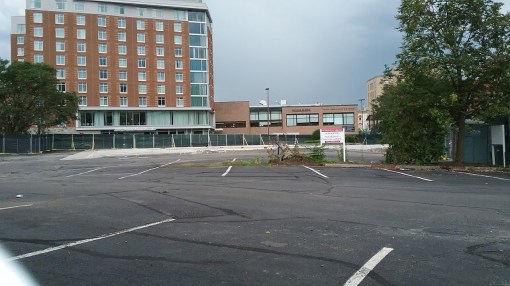
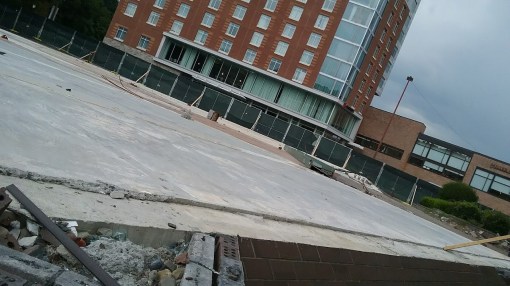
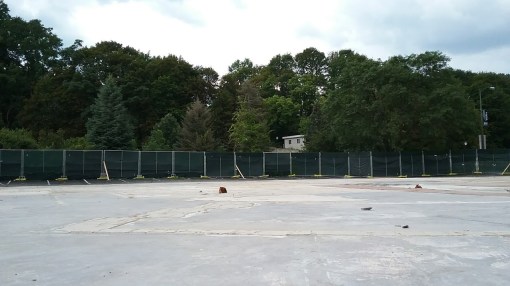
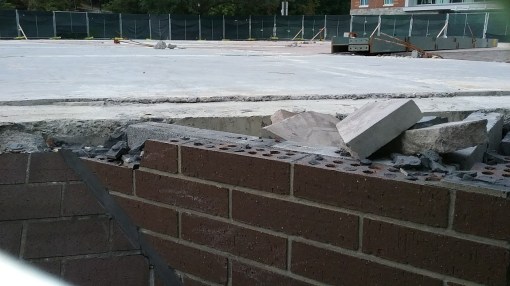
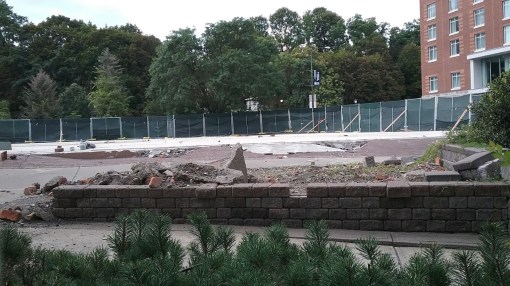
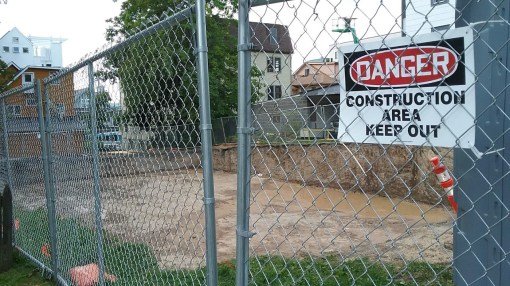
At the moment, the former Trebloc Building is no more, having been fenced off and demolished earlier in the summer. Excavation for the parking garage and 26″ thick concrete mat foundation has yet to begin. About 400 construction jobs are expected to be created, and as part of the abatement agreement, at least 25% (100) will be local labor.


1001 North Aurora Street Construction Update, 8/2017

20 08 2017

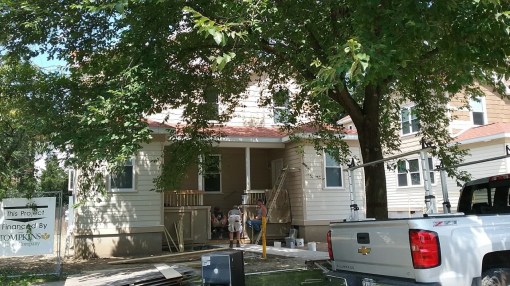
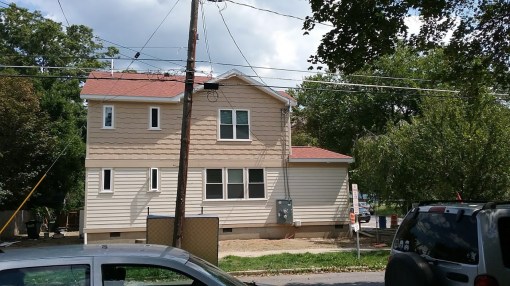
This small infill project in Ithaca’s Fall Creek is just about done. Tenants have already moved into the four three-bedroom units, and it looks like all that’s left on the outside is grass seeding and a coat of paint. According to the guys working on the duplexes, the mismatch in the second floor LP SmartSide wood siding was because the store they bought them (think they said Home Depot offhand) from had ran out, so they just bought what was available with the intent of painting over it when they were ready. It looks like the first floor has been painted, so that’s a good sign. It is nice to see that, although they were threatened for deletion if expenses came too high, the side windows on the inward-facing walls of the units (east side of 202, west side of 206) were retained.

This is a small, unassuming project. It replaced an older single-family home with four units that fit in with the neighborhood. It’s a bump in density without garnering too much attention. To be candid, it’s probably the only feasible way to add density to Fall Creek – scout out the few vacant lots, or buildings with less historic or aesthetic value, and try to design something that fits in (the only other one I’m aware of is the Heritage Builders infill project on West Falls Street, but at this point it would need re-approval from the planning board).

The three guys out front said that once these are complete, they expect to start work on developer Stavros (Nick) Stavropoulos’ next project at 107 South Albany Street. That site has not changed much over the summer, all that is there at the moment is the fenced-off foundation of the old building. The 11-unit apartment building slated for that site is expected to be completed by summer 2018.


209-215 Dryden Road Construction Update, 8/2017

19 08 2017

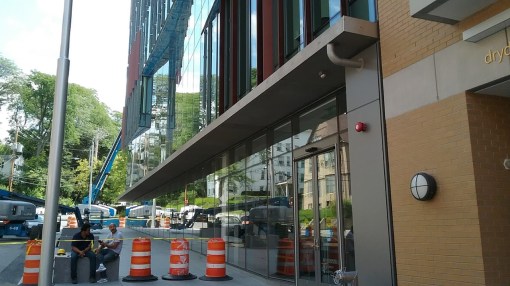
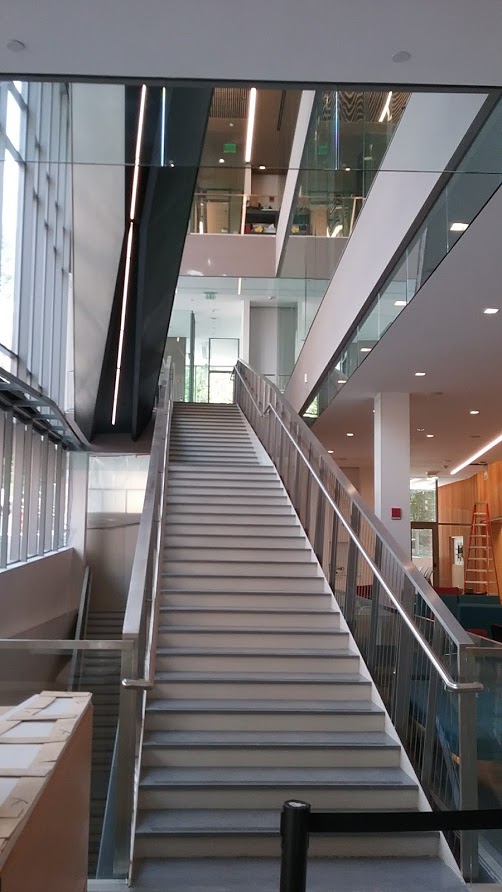
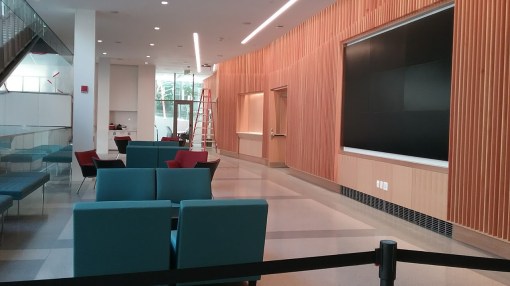
The Breazzano Center is occupied, so for practical purposes this project is complete. The interior and exterior finish work is wrapping up (interior moldings, some cosmetic exterior panels), and it looks like the new street seating, curbing and bike racks are in – the development team may hold off on plantings until next spring, depending on how well the project team thinks the new landscaping will grow in to its new environment, and by extension, its ability to withstand the winter months.

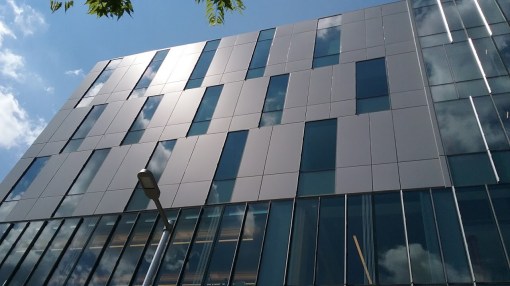
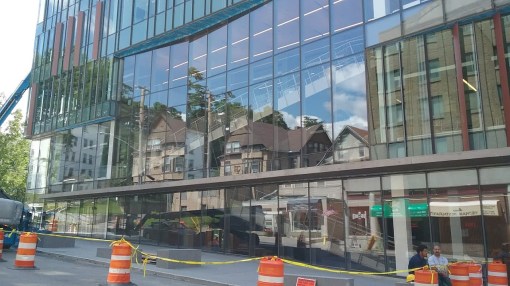
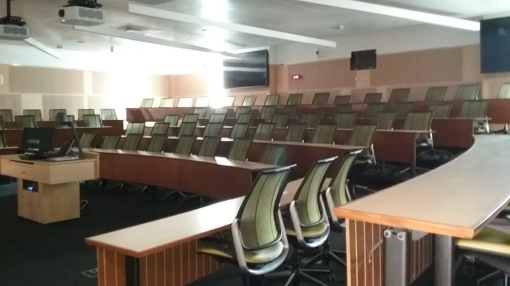
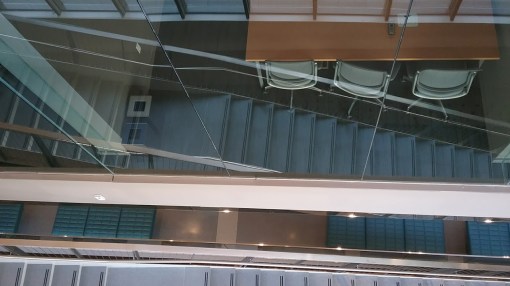
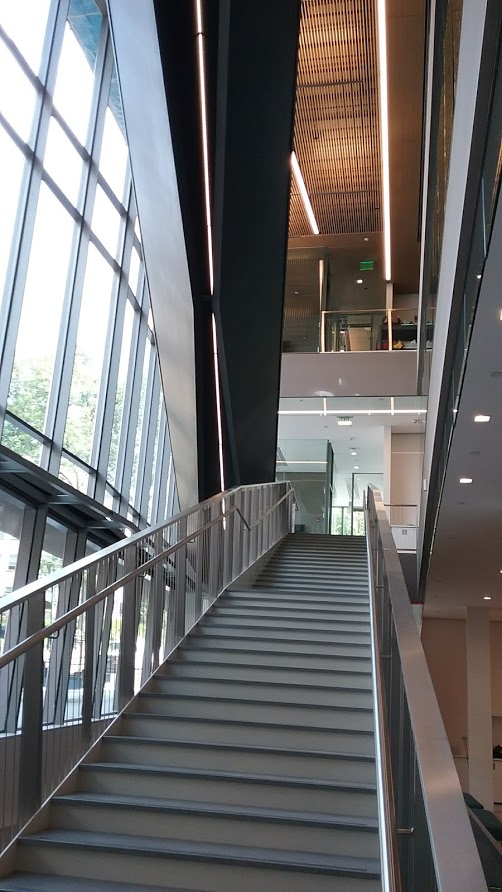
The interior is relatively dramatic for an office and academic building. There’s lots of natural light thanks to the glass curtain wall, the natural wood paneling gives it a warmer look, and the lighting underneath the staircases in the multistory atrium is a nice touch. If I have any interior critique, it’s that there’s so much transparent glass and bright light, it can feel a little disorienting, creating a feeling of space that makes the 76,000 SF building seem much larger than it is. Some of the breakout rooms and one of the tiered large-group classrooms are also included in the photos below.

The exterior is a big change of pace from the CMU-faced residential buildings (much of it from Jagat Sharma’s hand) that define much of Collegetown. The glass curtain wall is unique, for the time being. Personally, I’m not a big fan of the aluminum panels on the sides and rear, though I recognize the cost utility provided, and necessary protection of certain interior spaces like the broadcast studio on the fourth floor.

Speaking to some construction workers on-site (the same ones who kindly gestured me to go in and take a look), they were uncertain when construction would start on Novarr’s complementary 24-unit apartment building at 238 Linden Avenue next door. But a timeline from April suggests next month, with completion next summer. That sounds reasonable – finish with one building, transition immediately to the next. Work on Novarr’s 119-125 College Avenue townhouse project has yet to start either; it appears to be a makeshift parking lot for construction crews and company trucks.

Overall, it seems the recent work in this part of Collegetown and Ithaca is a net positive. With projects like the Breazzano, 238 Linden and Dryden South, within just a few years, a corner of Ithaca that once housed a few student-oriented businesses and mostly-rundown/vacant apartments will have been replaced with dozens of beds, office space for hundreds of Cornell staff, and classrooms for deep-pocketed students who visit for only a few weeks a year. Plus, it adds up to an additional $15 million or so in taxable property (and that’s accounting for the reduction as a result of the Tompkins County IDA PILOT agreement).  There’s a clear financial benefit to Collegetown business owners and to the city. Add an aesthetic bonus point for removing the power poles and shifting moving the electrical utilities underground.

The $15.9 million project will be 100% occupied by Cornell on a 50-year lease. Hayner Hoyt Corporation of Syracuse is the general contractor.

Before:

After:


The wording on these sheets conjures images of a stuffy, tense maître d’ addressing his staff.


Schwartz Plaza Construction Update, 8/2017

18 08 2017

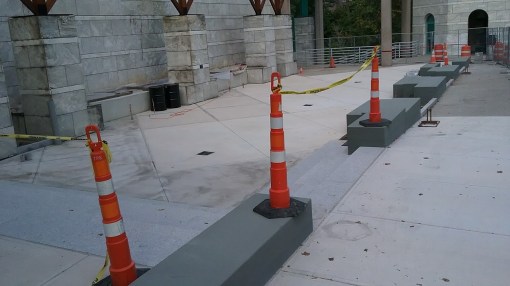
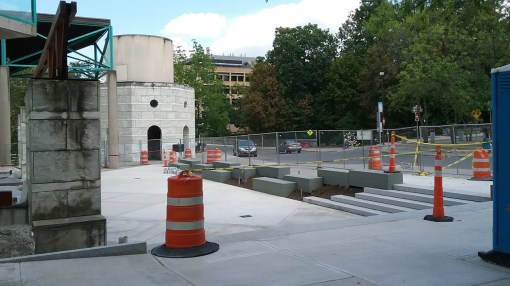
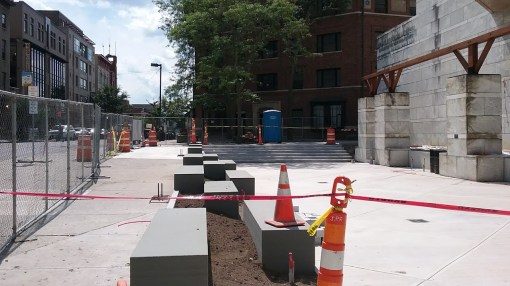
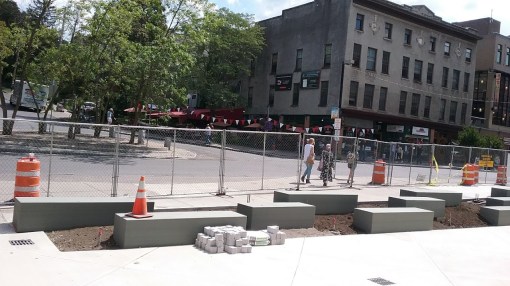
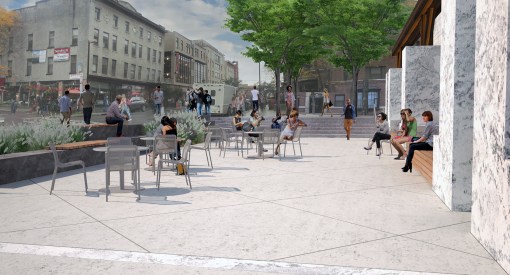
Cornell’s modest but useful renovation of Schwartz Plaza has made significant progress. Gone are the walls that kept the sunken plaza cloistered from passerby, and in its place are stone seats and durable granite setts, for what ideally serves as a visible, attractive public gathering space in Collegetown’s dense quarters. Ornamental grasses will be planted between the seats, and from the renders, it looks like recessed LED light poles will be added as well.

Wood benches will be installed on a granite base below the steel trusses of the far wall, and some of the stone seatings on the near/eastern side will be overlaid with wood benches as well. Hopefully the marble columns get a thorough cleaning; after a few decades, it could use a good scrub. New ornamental bushes and vines will be planted along the trusses and against the back wall of the sunken “forecourt”.

Originally, this was supposed to be done in time for classes, but that seems unlikely at this point. A September finish is likely a fair estimate.


Chapter House / 406 Stewart Avenue Construction Update, 8/2017

17 08 2017

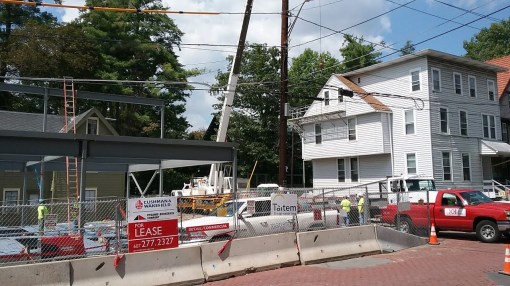
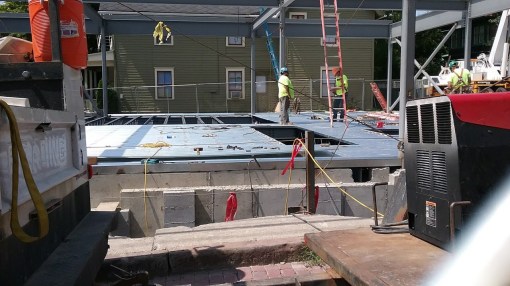
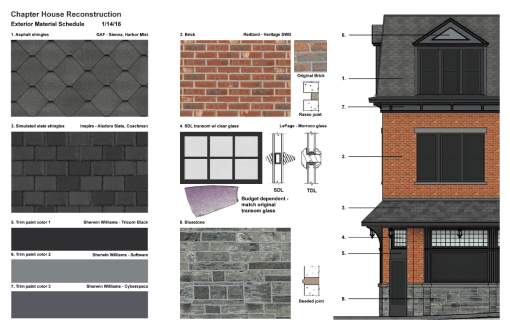
Some good news and some bad news. The good news is, the replacement building for 400-404 Stewart Avenue is well underway. No false starts, no rumor milling. The new structure is quite substantial for a modest three-story building – structural steel frame (currently up to the second floor), steel floor panels, finished basement, – all heavy duty, commercial grade construction, befitting for a mixed-use structure with possible food retail or general retail tenants on the 3,000 SF ground floor. Note the structural cross-beams; those well segments will not have windows. The exposed portion of the concrete foundation wall will be faced with bluestone later in the build-out. The fifth photo shows no concrete between the floor panels and foundation, presumably because the corner entrance will have an interior stairway that steps up to the ground level.

Now for the bad news. I chatted with a worker on the site, and when I said “the Chapter House site”, he chuckled, shook his head, and recommended I don’t use that phrase. “The Chapter House ain’t coming back,” he said before picking up a shovel. “People will forget all about it in four years anyway.” It hasn’t been a secret that the Chapter House likely isn’t making a return, but for many students and non-students, it’s still a disappointment to hear that.

The construction timeline for 400-404 Stewart called for a completion this year, which seems generous. The apartment building at 406 Stewart Avenue has been graded, but construction will not start until later this fall. Hayner Hoyt is the general contractor, with Taitem in charge of the structural engineering.

UPDATE: In the comments, John Hoey, the proprietor of the Chapter House, has written in the comments that he intends to reopen the bar, if not here then elsewhere in Collegetown.


201 College Avenue Construction Update, 8/2017

16 08 2017

201 College is a work in progress on the outside, but the inside is nearly complete. According to Visum Development’s Todd Fox, who happened to be at the site when the photos were taken yesterday, there are cleaning crews inside, and a certificate of occupancy is being obtained. Renters will be able to move in on Friday.

On the outside however, work is still coming along. From the looks of it, it appears all the woven bamboo siding has been attached. However, the overhead canopy has yet to be installed over the front entrance, and some of the decorative “iron ore” black metal rails and fiber cement panels (“Allura Snow White” and “Gauntlet Gray“) have yet to be clipped on over the structural metal rails. So while tenants will be able to move in for the fall semester later this week, construction on the exterior and landscaping finishes will extend into September. Similarly, the basement area, which will host the fitness room and bike storage, will need a few more weeks before it’s ready for use.

For what it’s worth, 201 College looks just like the renderings provided by its architect STREAM Collaborative, which one would think isn’t a big deal, but it is – there have been cases of developers building something that lacked details of features shown but not explicitly required in approval, which had led to consternation among the planning board and staff.

On another good note, I asked Fox how things were with neighbor Neil Golder, who led efforts to halt the project last year. Since the lawsuit failed, the two sides have been fairly amenable to each other – Fox still offered Golder solar panels on 201 to compensate for shadows, and Golder has let construction workers access his property when trying to maneuver equipment on and off site. Fox said that, in exchange for paying Golder’s water bill, he let construction crews hook up hoses from his spigots to spray down the dust and add water to the concrete.

As 201 wraps up, Fox has his eye on his other approved projects – 210 Linden Avenue, a 4-story, 36-bedroom building, has been excavated and padded (last two photos here), and is waiting on municipal permits to begin construction of the foundation. As with 201 College, William H. Lane Inc. of Binghamton will be the general contractor, and STREAM is the architect. 232-236 Dryden Road, a pair of 4-story buildings with 191 bedrooms, is due to start site prep in September. Two smaller Visum projects, for 118 College Avenue and 126 College Avenue, have no firm construction dates at this time.


News Tidbits 8/12/17: Two Kinds of Rehab

12 08 2017

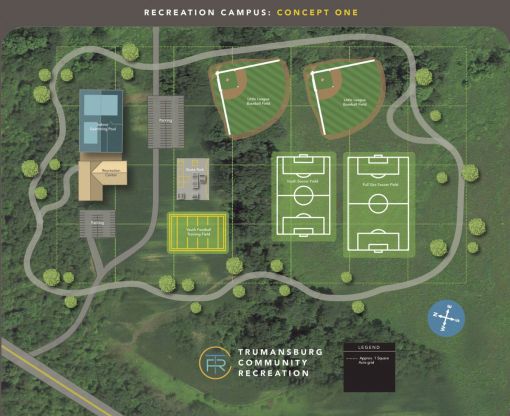
1. It looks like some Trumansburg residents want to build a recreational complex. According to the Ithaca Times’ Jamie Swinnerton, for the civic group Trumansburg Community Recration, “{t}he ultimate goal is to build a recreation center, soccer fields, baseball fields, a youth football field, a skate park, and a pool to the community. The first phase of the project would be building the sports fields and possibly a recreational campus. While the group is still searching for space for these amenities, it is raising funds through grants and donations. The fundraising goal right now is $750,000.”

Along with private donations, the community advocacy organization is seeking state funds, which state law requires be obtained via municipal entities, i.e. the village, school district, town and county. It’s not that governing bodies have to commit money, they just have to express support and sign off on applications, and allocate the awarded funds if/when they are received.

Phase two for the non-profit would be a community center, likely a re-purposed building, and phase three would be a pool, which is garnering significant community attention. Although the group hasn’t committed to a location (the rendering is completely conceptual), it is examining the feasibility of different sites in and around Trumansburg. Interested folks can contact or donate to the group here, or sign up for emails if they so like.

2. Cayuga Addiction Recovery Services (CARS) has finally received the money from a July 2016 grant award. Cayuga Addiction Recovery Services (CARS) will be using it toward a new 25-bed adult residential facility. The new facility will be built on the Trumansburg campus adjacent to a 60-bed facility on Mecklenburg Road, near the county line a couple miles to the southwest of Trumansburg. An undisclosed number of jobs are expected to be created. Founded in a Cornell U. fraternity house in 1972, CARS provides treatment, counseling, skills training and support services to help clients overcome addictions and rebuild lives. The current facility was opened in 2004.

While the location is quite rural, the nature of the facility (rehab, focus on opioid abuse) is getting pushback from at least one town board member who doesn’t want it in the town (link, scroll down to 7-25-TB minutes). The plan has yet to go before the Ulysses planning board.

3. INHS made its name on home rehabs, and it looks to be making a return to its roots. The non-profit developer is asking the IURA for $41,378 towards the renovation of an existing 3-bedroom house on 828 Hector Street, which will then be sold to a low-moderate income family (80% AMI, about $41,000/year) and locked into the Community Housing Trust.

The project cost is $238,041. $152,000 to buy the foreclosed property from Alternatives Federal Credit Union, $8,000 in closing/related costs, $60,000 in renovations, $5,000 contingency, $8,141 in other costs (legal/engineering), and $4,900 in marketing/realtor fees. The funding sources would be $144,163 from the sale, $15,000 from INHS’s loan fund (to cover the down payment for the buyer), $37,500 in equity and the $41,378 grant. A for-profit could renovate for cheaper, but federal and state guidelines say INHS has to hire those with a $1 million of liability insurance coverage, which takes many small contractors out of the equation.

Side note, the city’s federal grant funding disbursement was dropped by $50,000, because HUD is an easy target in Washington. Luckily, Lakeview decided to forego its grant funds because they found the federal regulations unwieldy, which freed up a little over $43k to move around to cover most of the losses.

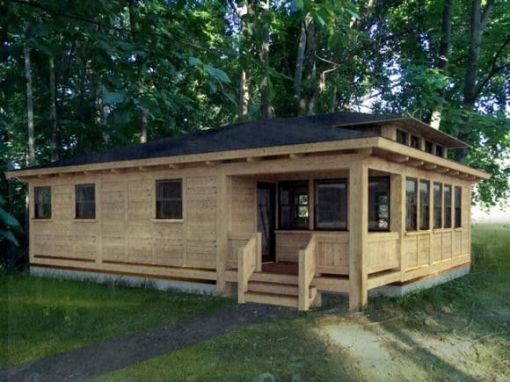
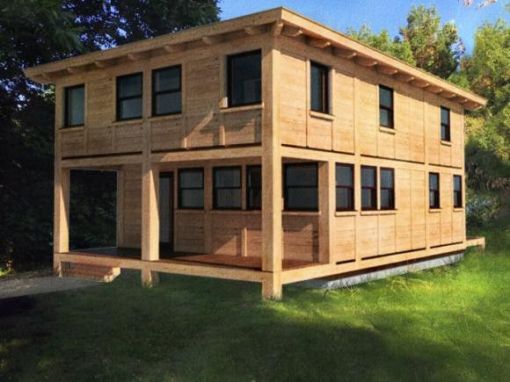
4. Speaking of Hector Street, it looks like Tiny Timbers is rolling out a pair of new spec plans for two lots on the city’s portion of West Hill. The house on the left, for 0.27 acre Lot 1, is a 1,040 SF 2 BD/1BA design listed at 187,900, which is a good value for a new house in the city. 0.26 acre Lot 2 is a 3 BD/2 BA 1,370 SF home listed at $222,900. Taking a guess based on the lot sizes, these are the wooded vacant lots west of 920 Hector. There’s a third vacant lot over there, but no listing yet.

5. On the city’s Project Review Committee meeting agenda, which is the same as the memo…not much. Lakeview’s 60-unit affordable housing project on the 700 Block of West Court Street will have its public hearing and determination of envrionmental significance, the last step in SEQR and the one before preliminary approval. Same goes for INHS’s 13-unit project on the 200 Block of Elm Street.

Apart from related or minor zoning variances and review of proposed historic designation in Collegetown for the Chacona and Larkin Buildings (411-415 College and 403 College), the only other project for review is 217 Columbia, Charlie O’Connor’s. Which, as covered by my Voice colleague Kelsey O’Connor and by Matt Butler at the Times, did not go over well, though Charlie seemed willing to change plans to avert a firestorm. From a practical standpoint, I’d imagine he’s much more focused on his much larger 802 Dryden Road project, and this is small if hot potatoes. The 6-bedroom duplex (three beds each) is designed by Ithaca architect John Snyder.

My own feeling is that a moratorium isn’t the answer, but if they wanted to roll out another TM-PUD so that Common Council gets to review plans as well as the Planning Board, then so be it. My issue with moratoriums is that local municipalities do a terrible job sticking to timelines and have to extend them again and again. Plus, there are projects like the Ithaka Terraces condos, or the new Tiny Timber single-family going up on Grandview, that aren’t the focus of the debate but would be ensnared by a blanket moratorium.

Meanwhile in the town, the planning board discussion for next week will mostly focus on the NRP Ithaca Townhouses on West Hill. The revisions will be up for final approval, which would allow NRP to move forward with their 2018-19 Phase 1 buildout (66 units and a community center). Phase II (39 units) will follow in 2019-20.

6. In sales this week, the big one appears to be 808 East Seneca – 5 unit, 4,125 SF historic property just west of Collegetown in Ithaca’s East Hill neighborhood. List price was $1.575 million, and it sold for modestly less, $1.45 million, which is well above the $900,000 tax assessment. The sellers were a local couple had owned the property since 1982, and the buyer is an LLC formed by the Halkiopoulos family, one of Collegetown’s old Greek families, and medium-sized landlords with a number of other houses in the area.

Perhaps more intriguing is the sale of 452 Floral Avenue for $100,000 to home builder Carl Lupo. The vacant 4.15 acre property had been the site of a 30-unit affordable owner-occupied project back in 1992, but given that the Ithaca economy was faltering in the early 1990s, the plans never moved forward.

7. A quick update from the Lansing Star about the Park Grove Realty lawsuit. While the Jonson family of developers may have lost the village elections by a large margin, their lawsuit accusing the village of an illegal zoning change to permit the project has been reviewed by the state’s court system – and they lost. The state supreme court ruled the zoning change was perfectly legal, appropriate to the revised Comprehensive Plan, and accusations of negative impacts on the Jonsons’ Heights of Lansing project are overblown and speculative.

The Jonsons intend to file an appeal, and have to send in their final draft by September 5th. At this point, the project is left in a waiting pattern – the village is leaving the public hearing open until the appeal is resolved. If the appeal overturns the ruling, than the project can’t proceed regardless of village approval. Given the basis for the initial ruling, an overturning seems unlikely, but it will be a few more months before any approvals can be granted.


News Tidbits 8/5/17: Having the Right Look

5 08 2017

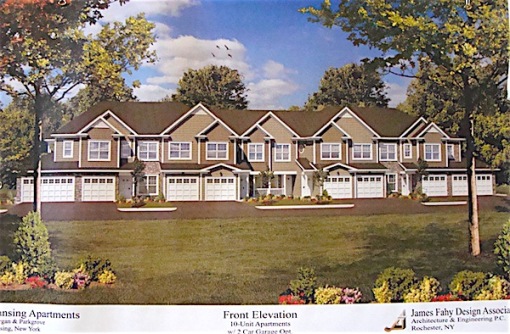
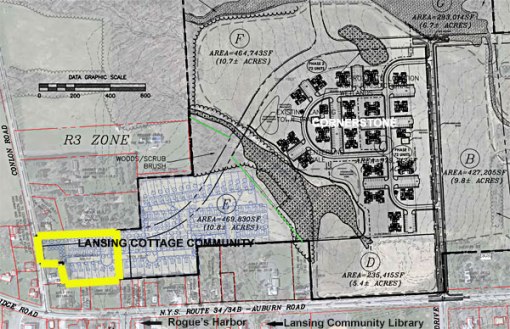
1. Thanks to Dan Veaner at the Lansing Star, we have the first rough site plan for the proposed Cornerstone and Tiny Timbers projects at the Lansing Town Center site at the intersection of Route 34B and Triphammer Roads. Readers may recall that Tiny Timbers has proposed a development of 60 for-sale single-family homes (ten in the first phase) called “Lansing Community Cottages”, and Cornerstone is proposing up to 144 affordable apartments in two phases for the town center site.

Specifically, Tiny Timbers is looking to sell homes averaging about 1,000-1,200 SF in the $175,000-$225,000 range, which is a critical but tough-to-hit segment in the local housing market. With consultation from planner David West, the homes are designed in a traditional urban layout, with congregated parking spaces instead of garages, and community green spaces. None of the homes are more than 150 feet from the roads and parking areas, a safety requirement to ensure access for emergency vehicles. Ten units would be built in phase one, twenty in phase two, and thirty in phase three. About the only concern town officials have expressed at this point is a second means of ingress/egress to keep the traffic down on Conlon Road.

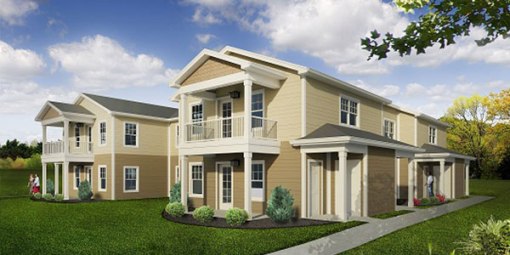
In contrast to Tiny Timbers’ site plan, the Cornerstone plan is a more conventional suburban layout with parking adjacent to each 8-unit structure. In fact, based on the above design, and the need for affordable developers to save on costs and therefore many reuse designs when they can, it’s likely that some of the Cornerstone apartments look something like the above image, which comes from a recent Cornerstone project near Brockport. The detailing and the colors may differ, but it’s a pretty good bet that’s how some of the finished units will look. Like Conifer, Cornerstone appear to be using a mix of their standard designs, and there are two distinct designs on the site plan, as well as a community center.

2. A redevelopment opportunity in downtown Ithaca has sold, but it looks like there are no plans. 110-112 West Seneca Street is a 538 SF salon with a large rental parking lot, and zoning is B-1a, meaning 4 floors 50% lot coverage, parking requirements in effect of about one space per unit or one space per 250 SF of commercial use. Tompkins Trust (Tompkins Financial Corp.) picked up the property on Friday the 28th for $600,000, below the $800k asking price but still quite substantial for what’s mostly land.

Unfortunately, it doesn’t look like anything is going to happen here. Tompkins Trust had previously rented the 23 parking spaces on site for use by its own employees – whether they’re hedging bets or don’t trust the parking garage situation, they appear to be buying the property to use as parking. Boo. With any luck, after their new HQ opens up next spring and their parking situation settles down, they’ll find better uses or potential partners for the lot. With no historic attributes but proximity to major services and amenities, a parking lot on this property is a waste of potential.

3. The Harold’s Square project team has given their website a overhaul, and with that comes the official timeline. According to the web page, asbestos abatement is now underway, demolition will start in September, construction will last through January 2019, and marketing/lease-up for the commercial spaces and 108 residential units should will start in January 2019.

The project description web page mentions 100 construction jobs, 50 retail jobs and 200 office jobs, which seems accurate for the square footage of each use (12k retail, 25k office). The estimate of 250 residents is way too generous though – the back-of-the-envelope is one person per bedroom, and there are about 144 bedrooms/studio units.

Side note, I reserve the right to grouse that the media links both go to the Times.

4. Dunno what’s going to happen with the Lansing Meadows senior housing up by the mall. Background story on the Voice here. On the one hand, the wetlands were an arduous and expensive undertaking, and Goetzmann did those to Army Corps of Engineers standards. It does make it tougher for the project to be financially viable. On the other hand, the village has a right to be frustrated, and it’s not unreasonable that they’re feeling that they’re being taken for a ride. Goetzmann received an IDA tax deal for what was largely a retail project, largely a no-no because most jobs in retail are low wage. He also received a variance for a community retail component, and multiple extensions from the IDA on fulfilling the housing component.

An increase in density spreads the fixed costs out among a greater number of units, and it’s encouraged by the village and county, so that’s not the issue. The design is what bothers them – while shared walls and utilities is a cost-saving measure, the village has expected smaller, house-like units since the project was first proposed in the late 2000s. Maybe the happy medium between this and the ten duplexes is a site plan with 3-4 unit structures with 20-24 units, with the buildings designed with pitched roofs, dormers, small porches and other home-like features. Let’s see what happens in the next couple of months.

5. Plans for co-op housing on West State Street have been waylaid, perhaps permanently. New York City businessman Fei Qi had previously proposed to renovate the historic 3,800 SF property at 310 West State Street into office space, and more recently a 12-14 person co-op. However, there have been a couple of issues with both plans – the ca. 1880 building is in need of significant structural renovation. Years of deferred maintenance prior to Qi (who bought it from the Salvation Army for $195k last year) has left the building in rough shape, and asbestos and lead need to be removed. For the housing proposal to be permitted, fire suppression systems would also need to be installed. Some city officials have expressed concern that like the carriage house that once existed at the rear of the property, if the building gets mothballed again, its structural integrity may be at risk. Any external changes would need to be approved by the Landmarks Commission. It appears that Qi recently applied to the commission stating economic hardship, saying he was unaware the building was a historic property and was not communicated to him by the seller or real estate agent, and cannot afford to renovate it to ILPC standards. The designation went into effect in April 2015, a year before sale.

Concurrently, Qi has put the property up for sale. For an asking price of $278,000, one gets the building and the architect’s plans. I’ve seen ball-park estimates of $500k for the renovation into office space, but I never saw an estimate for the co-op. As a result of the structural issues, the building’s assessed value plunged from $250,000 in 2016 to $100,000 last year, most of that being the land. Fingers crossed, someone steps up to the plate to save this building before it’s too late.

6. Last month, I speculated that there was a plan for redeveloping 217 Columbia Street on Ithaca’s South Hill. Turns out there is, and it’s really upsetting the neighbors. The plan by Modern Living Rentals is to preserve the existing building, but build an additional two-family home on the property as well. For the neighbors, this is apparently one student-oriented rental too far. Some are calling for a moratorium, and others a zoning change to prevent rentals without an owner living in the property. Most of South Hill’s zoning is R-2 residential, which is one-and-two family homes, and most of the construction in South Hill these past few years has been one and two-family homes. The issue is that they’re upset they’re rentals, many of which appeal to Ithaca College students further up the hill in the town. In theory, you could make it an approval requirement that the renters be non-students, although I’m not sure that would placate the situation. We’ll see how it goes.


Cornell Ag Quad Rehabilitation Construction Update, 7/2017

1 08 2017

If common spaces are what make or break a campus, then it’s a wonderful thing that Cornell hosts one of the best landscape architecture programs in the world.

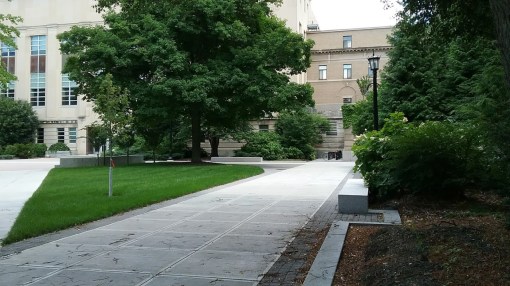
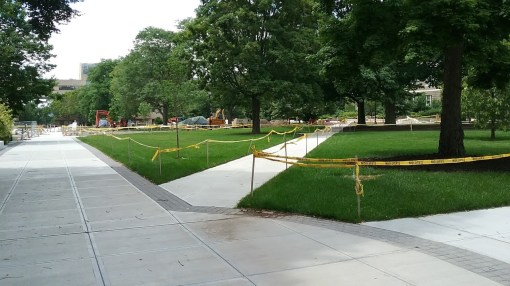
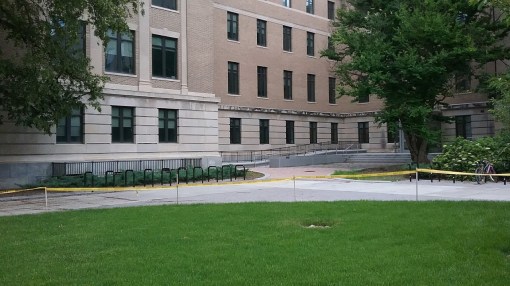
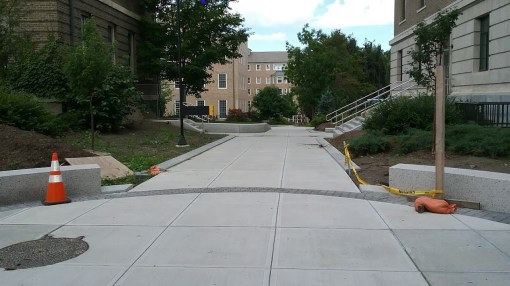
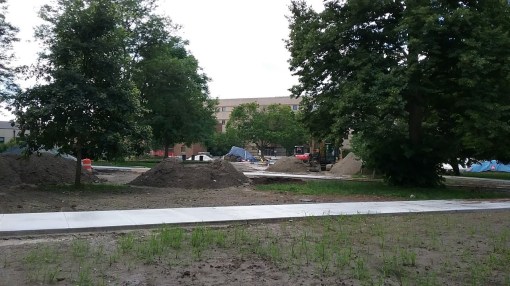
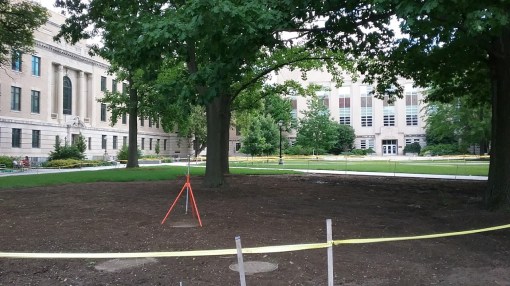
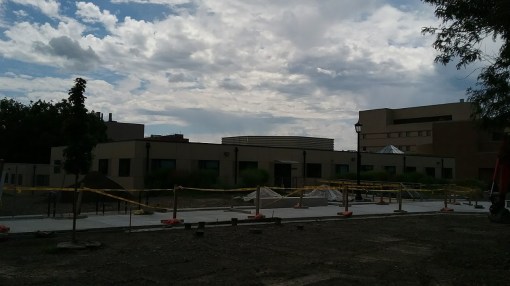
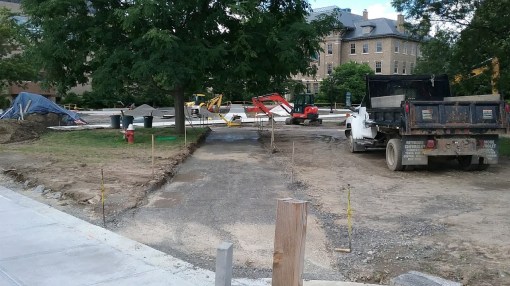
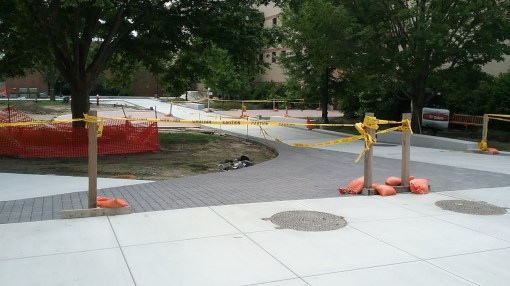
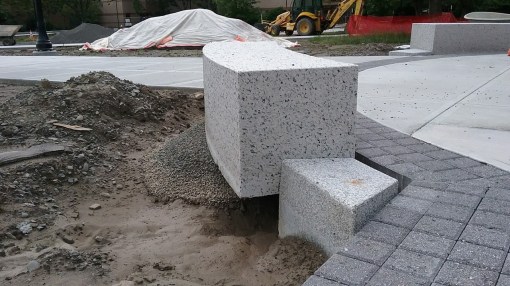
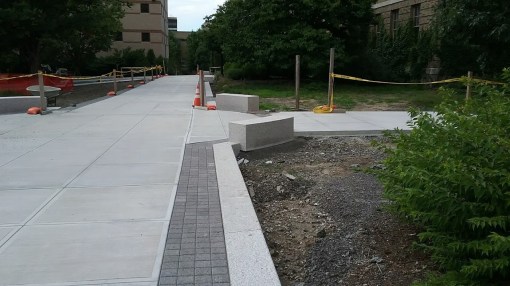
With the new underground utilities in place, the remaining work is at or close to surface level. This includes the installation of new plazas, sidewalks, decorative pavers, concrete slab benches, stairwalls, bike racks and seeding. New lamp posts have been erected, a rain garden has been added, and new saplings (54 total) were planted to replace the trees lost to the utilities work. The sidewalks were widened to allow easier emergency access. The east half was finished this past fall, but the west half could only finish utilities work before winter put the kibosh on concrete pours and landscape work.

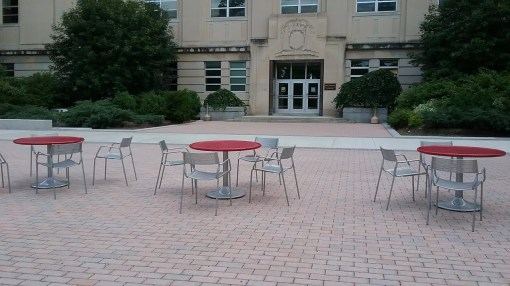
One of the goals of the refreshed ag quad is to make it a more inviting place to be during the warmer part of the year. By making use of removable furniture and adding seating areas along areas of high traffic and near buildings, the hope is that the space will be more lively and encourage social interaction among Cornell’s many students, faculty and staff. To be fair, it doesn’t look like a bad place to have an outdoor lunch.

At some point, the two temporary structures between Kennedy and Plant Science will make way for a new permanent structure; as for when that happens, your guess is as good as mine. The Pleasant Grove Apartments were built on North Campus as temporary housing after World War II and the influx of students on the GI Bill, but parts of the complex were maintained until the mid 1990s.

The $9.6 million project began last summer, and is scheduled for a completion before the 2017-18 academic year. MKW & Associates LLC of New Jersey is the lead landscape architect, Over & Under Piping Contractors Inc. of Auburn is the GC, and Albany-based CHA Consulting Inc. is providing civil engineering expertise. Background information on the project can be found here.