News Tidbits 9/9/17: Shopping for Sales

9 09 2017

1. As Dan Veaner at the Lansing Star reports, the new owners of the Shoppes at Ithaca Mall (aka Pyramid Mall) are planning to roll out new tactics to counter the ongoing, nationwide retail apocalypse currently underway. Instead of leasing locations, the mall owner would like to subdivide retail spaces within the mall under a Planned Development Area (DIY zoning, in essence) so that tenants could potentially own their spaces instead of renting them, under the hope that when they own a store location, they are less likely to close it and will opt for closing rented spaces elsewhere. Because customary use-based (Euclidean) zoning is not suited for this unusual arrangement, a PDA has been suggested, and the village of Lansing seems amenable to the idea.

On a related note, another subdivision of the mall properties would open up a portion of the parking lot behind the Ramada Inn for the development of an extended-stay hotel. This would probably play out over a few years, given the time to design a project, secure a brand and ask for village review/approvals. Market-wise, it’s not implausible, since the other hotels planned, like the Canopy downtown or the Sleep Inn at 635 Elmira Road in Ithaca town, are geared towards the overnight crowd, and the overall market is growing at a sustainable pace. As long as the local economy continues its modest but steady growth, a medium-sized specialty property that opens in two or three years would probably be absorbed by the local hospitality market without too much fuss.

2. Meanwhile, over in the the town of Lansing, a couple of minor notes and some name changes. From the town of Lansing Planning Board agenda, it appears the 102-unit Cayuga Farms development is now going by the name “Cayuga Orchard”. The project, which has been stuck in red tape due to the stringent review of modular sewage treatment systems, is seeking modifications to their plans, which was summarized in the Voice here. The short story is that the project has the same number of units, but the impermeable area has been decreased and the number of bedrooms is down from about 220 to 178. That should help reduce stormwater runoff, and if the town sewer isn’t through yet, it could make the modular system more feasible.

Secondly, Cornerstone’s Lansing Commons Apartments are being rebranded as the “Lansing Trails Apartments”, which makes sense since there aren’t any “Commons” in the town, but the town center property is traversed by numerous recreational foot trails. The town has endorsed Cornerstone’s two-phase, 128-unit development plan for affordable rental housing, though the planning board did express concerns with the impact of dozens of additional school children on a property with 581a property tax breaks, which may result in a 4% increase in school taxes in the default scenario. The number could vary given the number of kids that actually live there – the board ballparked 80 for their back-of-the-envelope analysis, which given 128 units and roughly 208 bedrooms in the project, isn’t unreasonable.

3. On that note, it appears Cornerstone and NRP have applied to the county’s affordable housing funding grant for a bit of financial assistance towards their respective projects. Cornerstone is seeking funds for qualified units within the 72-unit first phase of its Lansing Trails project, and NRP is seeking funding for qualifying units within the 66-unit first phase of its Ithaca Townhomes project on West Hill. Each organization would receive $256,975, mostly in Cornell-donated funds, if approved by the county legislature. The money may be leveraged and with less needed from traditional affordable housing funds, it may make each project more appealing from a federal or state grant perspective, with demonstrated municipal interest and more “bang for the buck” on the grantor’s end.

4. The two-building apartment complex planned at 232-236 Dryden Road is one step closer to construction. According to Tompkins County records, Visum Development bought the two properties on which the project was proposed (114 Summit Avenue and 232-238 Dryden Road) for $7.65 million on Monday the 5th. The properties are only assessed at $2.55 million, but sellers tend to enjoy a hefty premium when developers have intent for their parcels.

The following day, the building loan agreement was filed. The loan, for $16,354,628, was granted by S&T Bank, a regional bank based in Pennsylvania that has no retail banking presence in Ithaca, but has served as the financier for several projects, including the Holiday Inn Express that recently opened on Elmira Road, and Visum’s just-opened 201 College Avenue project.

A breakdown of the costs shows the total project cost is $22,780,334. There’s $13,020,010 in hard costs (materials/labor), $7.65 million for the purchase, $475,000 in soft costs (architect/engineering/legal), $250,000 for the demolition, and the rest is for taxes during construction, interest reserve (interest on the construction loan during construction). $650,000 (5% of the hard cost) is set aside as contingency funds just in case the expenses clock in higher than expected.

Along with the loan, Visum and its investor appear to be putting up $6.325 million in equity. With these hefty sums, one has to be pretty certain of their investment. In Collegetown, they often are.

Visum CEO Todd Fox has previously stated construction is expected to start this month on the 191-bed apartment property, with an eye towards an August 2018 completion.

5. The Old Library property sale is official, on an 11-3 vote. Legislators Kiefer, Chock and McBean-Claiborne voted no, none of which are an big surprise since, as members of the Old Library Committee, they found something to dislike with every proposal back in 2014. If anything, the surprise might have been legislator Kelles, who while not a fan, supported the mixed-use project. Travis Hyde Properties will bring 58 senior apartments, community space administered by Lifelong senior services, and a small amount of commercial space when the building opens in 2019.

6. So this is interesting. Josh Brokaw is reporting over at Truthsayers that Cayuga Medical Center wants to move the Community Gardens off the land. That is a story being covered further by my colleagues at the Voice, but notable to this blog’s purview are two nuggets of information.

One, Guthrie and CMC had *a bidding war* for the property, which explains a couple of things. It explains why CMC paid $10 million for a property the Maguires only paid $2.75 million for, and it offers a clue as to why Guthrie purchased the neighboring Cornell warehouses. They both have had plans for that area, and working together isn’t a part of them.

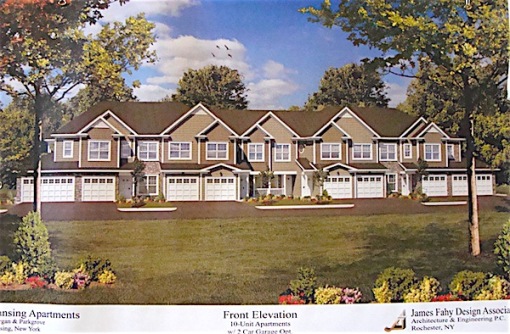
Two, Park Grove Realty is involved with CMC. They’re a young Rochester-based company generating lots of news in Lansing with a lawsuit-laden 140-unit townhouse project, and they purchased the Chateau Claire apartments and renovated them into the upmarket Triphammer Apartments, which generated its own share of controversy.

Anyway, it makes the commotion down by Carpenter Business Park that much more interesting. Nothing has come public yet, but keep an eye on it.

7. On a related note, it’s not much of a physical change, but Maguire is using some of that cash windfall to officially acquire the former Bill Cooke Chevy-Olds-Caddy dealership on Lansing’s Cinema Drive. The franchise rights were transferred over ten years ago, but the property itself was still under the ownership of the Cooke family. Thursday’s sale was for $2,015,000. The 4 acres and 19,857 SF building was assesses at $1.8 million, so it appears the sale price was a fair deal for both sides.

I would be remiss not to point out that the buyer was “Maguire Family Limited Partnsership”. No LLCs cloaking this purchase like with Carpenter Business Park.
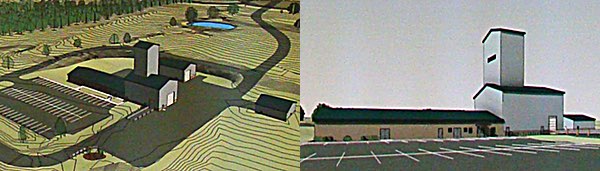
7. Now that the state has okayed the Cargill expansion, the above-ground portion of the project has to go before the Lansing planning board. The surface facilities, expected to cost $6.8 million, consist of a 10,000 SF administration building, a 2,100 SF maintenance building, a 2,600 SF hoist house, parking, landscaping and signage. A hoist house is essentially an industrial-strength engine room for operating the lift that brings people and equipment up and down from the shaft. It’s likely the primary cost contributor in the surface portion of the project.

As seen in the renders above, it’s designed for functionality rather than aesthetics, though Cargill did attempt to make the shaft building barn-like to blend in better with the farms. Construction on the above-ground structures is expected to start next year and run for about 18 months (the mine is being built from the bottom up). Although not shown in the renders, trees will be planted around the developed area to provide a green screen and help dampen noise.




The Maplewood Redevelopment, Part III: Site Photos

5 09 2017

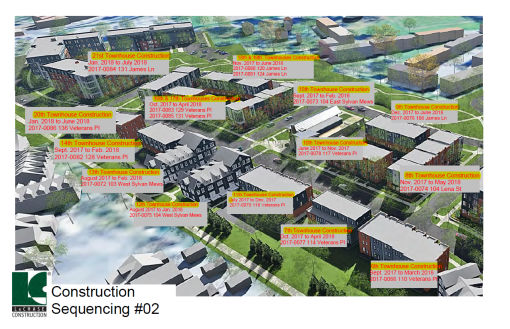
The rough construction timeline for the Maplewood structures looks something like this: Apartment buildings B and C started construction first in the spring, and the first townhouses were scheduled to begin in May. All of the major apartment buildings are expected to start construction by the end of August, while the last of the townhouse strings will not begin build-out until January 2018. Roughly speaking, the ends of the project site have earlier starts than structures in the middle of the site, and the more traditional-looking townhouse units start construction before the more modern strings.

The timeline is likely slightly behind schedule. During the mid-August site visit, a worker said that five of the foundations had been completed, but it seems at least six should have been finished by that point. The reason given for the relatively slow progress has been the wet summer, which has interfered with certain parts of the construction. For example, concrete pouring and curing for the foundations becomes a lot more complicated with the presence of frequent downpours. Rainwater can damage the foundation during certain stages of the process by causing the new pour to become soft again, reducing its structural integrity. Depending on timing, extra precautions have to be taken, or even worse, if it’s a real washout of a day the pour simply can’t take place at all. Several construction days have been lost, and to pick up the slack, the project asked for and received approval to increase the workday from 8 AM – 6 PM, to 7 AM – 7 PM, with the town’s stipulation that the extra two hours keep work noise below 85 decibels.

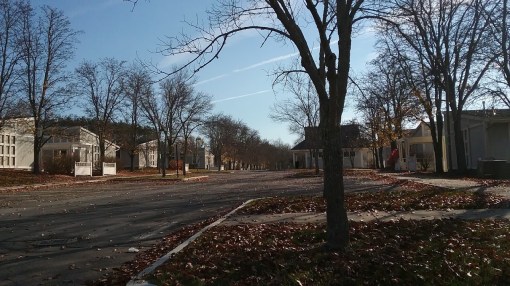
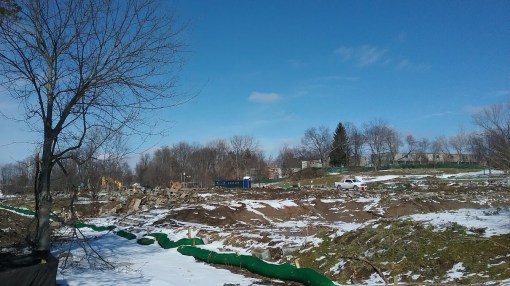
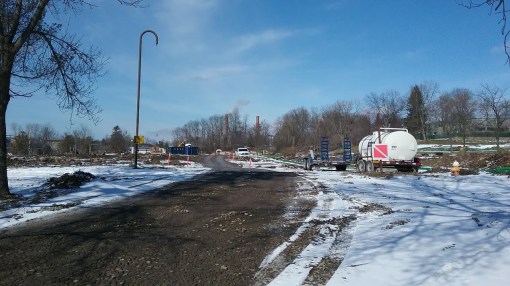
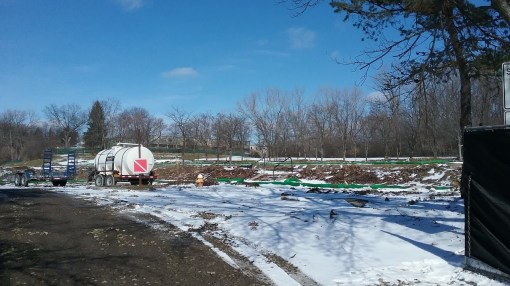
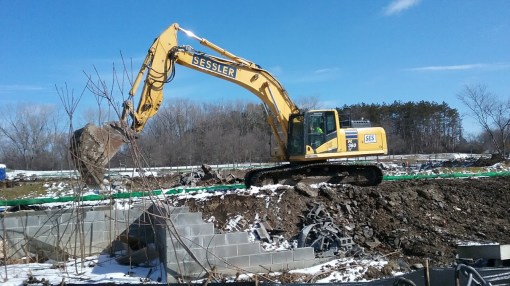
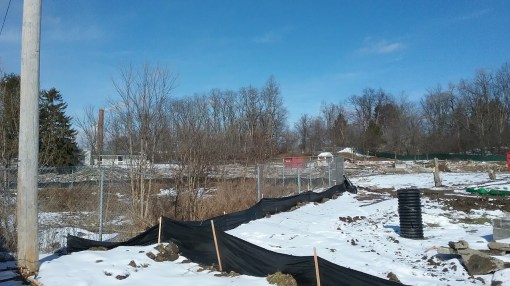
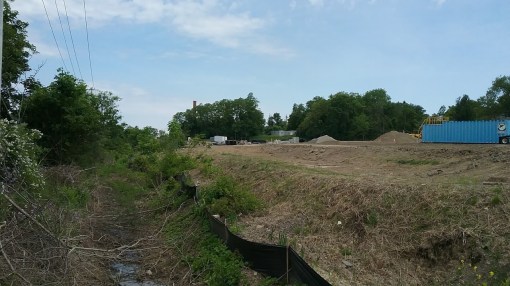
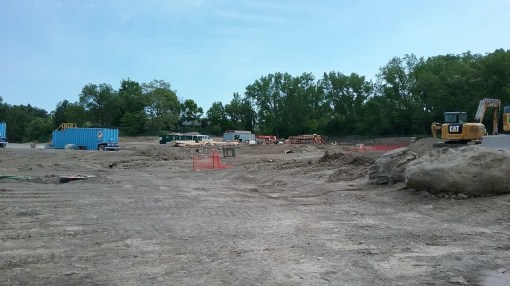
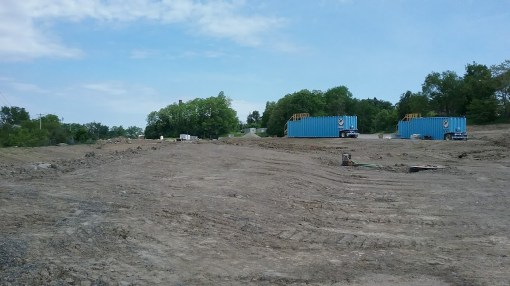
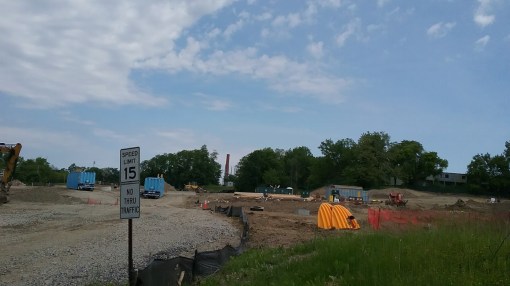
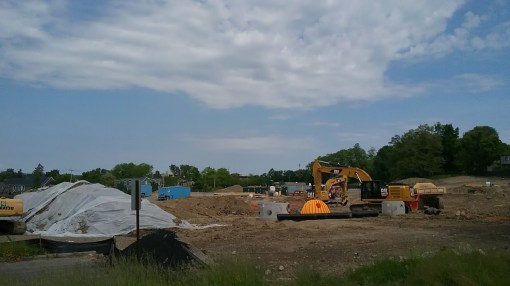
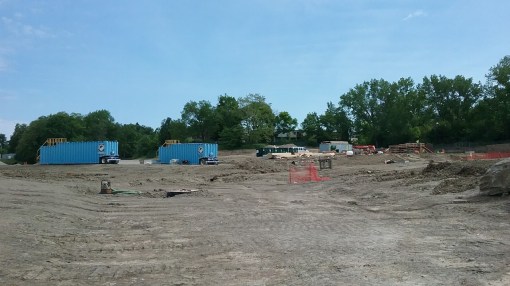
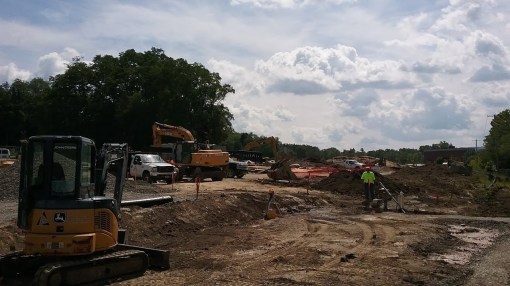
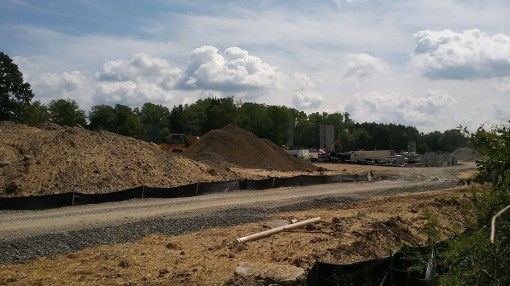
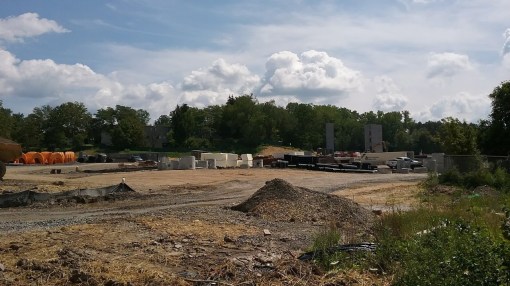
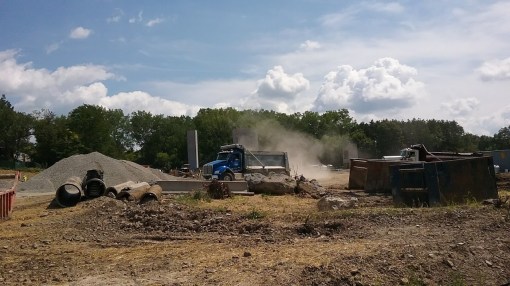
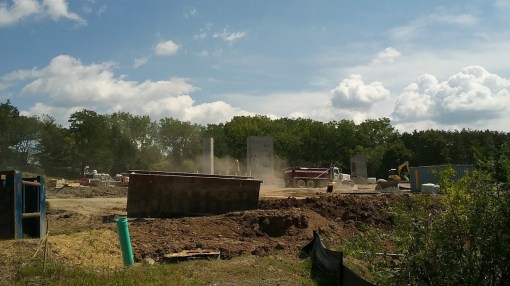
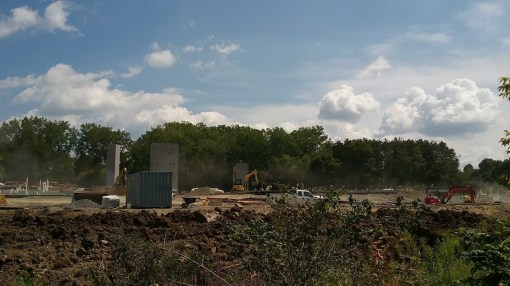
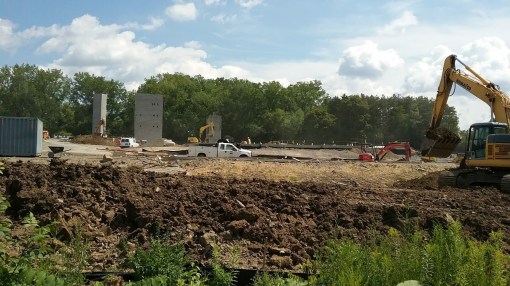
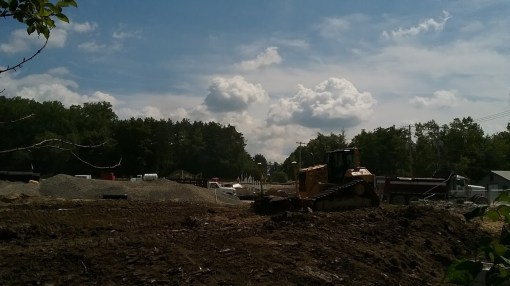
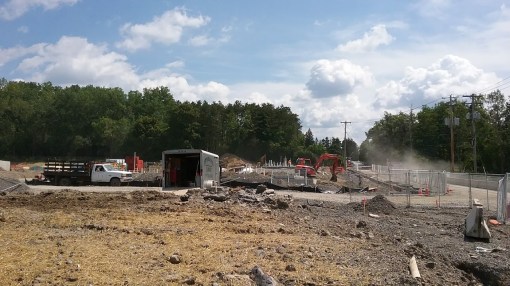
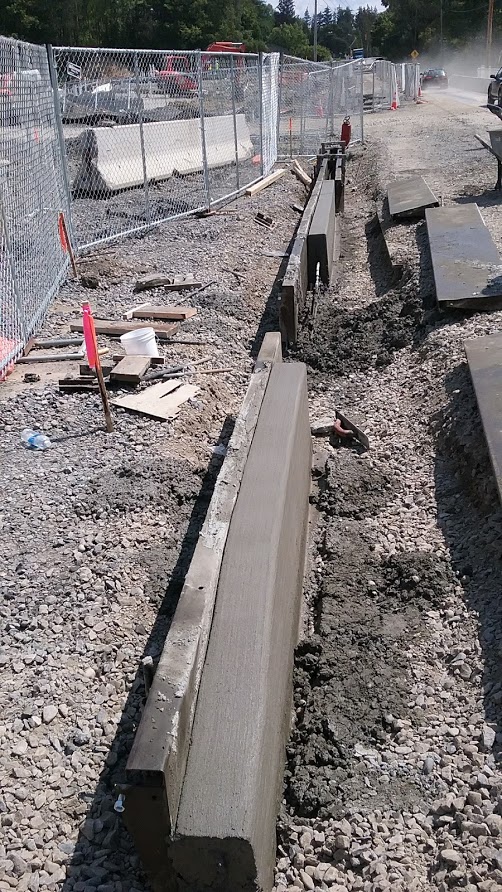
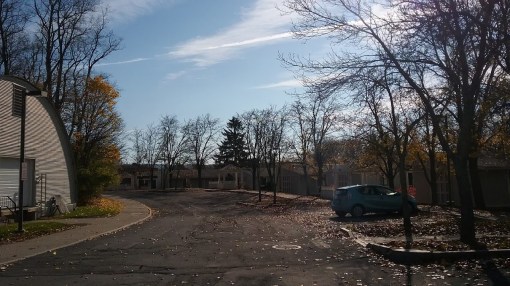
The photos below come from three separate time periods – February, which was mostly just site prep and excavation for underground utilities, the continuation of utilities excavation and installation in April, and the readying of connections to those new utilities in August. The circular concrete structures seen in April and August are for underground electric utility junctions. Similar structures may be used for wastewater pipes and drainage pipes. The teal pipes are PVC sewer pipes, and the rectangular precast concrete sections are protective covers. New curbing is being installed along Mitchell. I don’t know what the ridged crescent-shaped orange structures are, but if a reader knows, feel free to chime in in the comments.

Above-ground, it looks like the masonry stairwells for apartment buildings B and C have been built as of August. The slots in the sides suggests structural steel frames. A trailer on-site belongs to Peppard & Sons Masonry of Lockwood, so they may be the pertinent sub-contractor. Foundation slabs can be seen, and wood forms have been prepared for future pours.


Pre-development site photos:

February 2017:

June 2017:

August 2017:


The Maplewood Redevelopment, Part II: Site Plan and Layout

3 09 2017

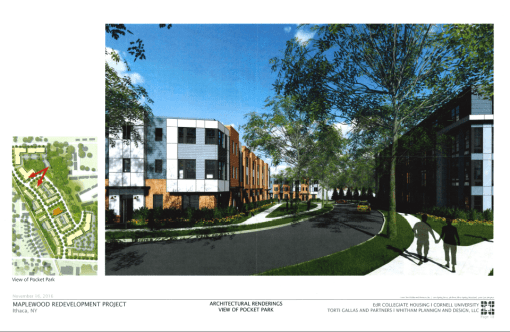
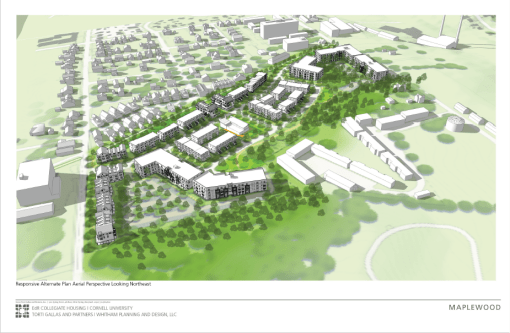
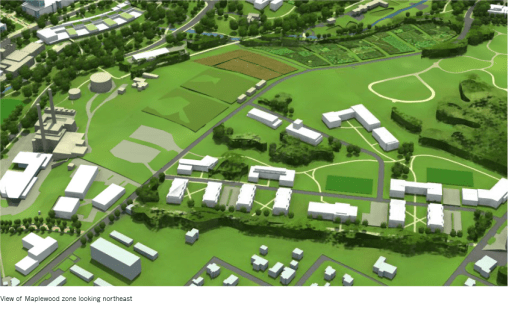
Unlike most projects, Maplewood is basically an entire new neighborhood – there are five large apartment buildings, 21 townhouse strings, and the community center, for a grand total of twenty-seven buildings. The building elevations for each structure can be found in Building Set Plans 1-3, on the town of Ithaca’s website here.

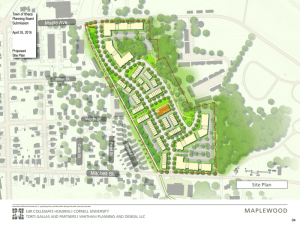
The pretty version of the site plan, from STREAM Collaborative, has most of the buildings pretty clearly labeled, but is a little outdated – the townhouses along Mitchell were added late in the process, and were not labelled here. However, this is the easiest diagram to follow, and highlights some of the landscaping features of the project. The childrens’ play area is located at the intersection of James Lane (the north-south road) and Lena Street (the east-west road). The overlook is a natural area at one of the highest elevations of the property, and the community garden is at the turn of James Lane. The bus stop/food truck area, unlabeled here, is the intersection of Maple Avenue and Veterans’ Way. The knoll between apartment buildings D, E and F is the location of the Mitchell family cemetery plot, last active in the 1850s.

Here is the more accurate but less attractive site plan. The townhouses along Mitchell have been renamed, but otherwise everything else is the same. Notably, there is no apartment building “A”. “A” was the multi-story building along Mitchell Avenue that was removed late in the planning process. In short, five multi-story buildings, B, C, D, E, and F. Then there are the townhouses, to be covered in detail in the next section.

The Townhouses

The townhouses are all 2-4 bedrooms. Counting them all off, there’s At, Bt, Ct, Dt, Et, Ft, Gt-1, Gt-2, Ht-1, Ht-2, It-1 and It-2, Jt-1 and Jt-2, Kt-1 and Kt-2, Lt, Mt, Nt, Ot, and Pt. The color coding is for easy reference.

Each uniquely-lettered string is its own design. The Gt’s, Jt’s, and Kt’s are near-identical twins exception for unit layout and building elevation steps to accommodate slopes. The more traditional-looking Ht-1 and Ht-2, and It-1 and It-2 strings are mirror images of their same-lettered counterpart.

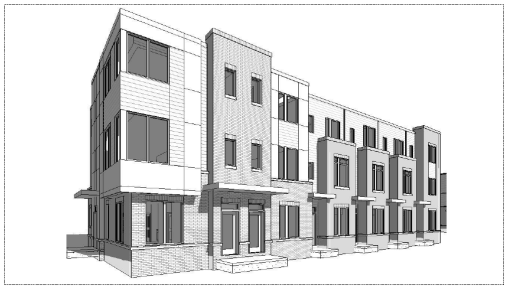
The modern-looking townhouses use a brick veneer, light and dark fiber cement panels and lap siding, cast stone accents and wood canopies, along with concrete foundations and stairs. The more traditional townhouse strings (Ht’s, It’s, Nt, Ot, Pt) are finished with fiber cement siding and trim boards. All townhouses are 2.5-3 stories in height. Modern townhouse strings At, Dt, Et, Gt-1 and Gt-2 take advantage of the site’s slope to employ rear garages tucked into the hillside.

The ones with integrated garages (At, Dt, Et, Gt1/2’s) are all 3-bedroom units. At is 4 units, Dt is 5 units, Et is 6 units, and the Gt’s are 7 units each.

Two of the modern townhouse units have no garages and large full-length setbacks on their third floors. This includes Bt (4 units) and Lt (5 units). They are all three-bedroom units.

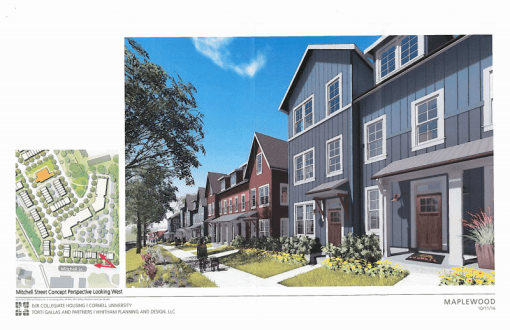
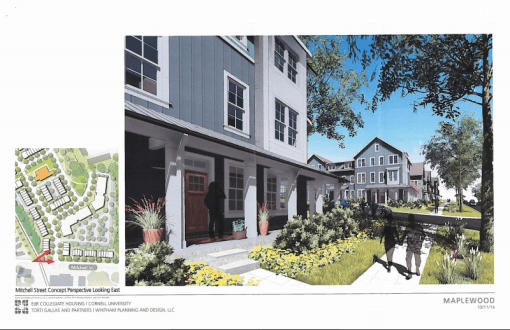
Five of the modern strings have no garage and full-length top floors. These are 4-bedroom units, like Ct (4 units), Ft (6 units) and Mt (6 units). Kt-1 and Kt-2 (Kt-1 shown in the render above) have three stacked flat 2-bedrooms on each end of the townhouse string (the first floor is one 2-bedroom unit, and the other two-bedrooms are stacked over it), and 4 four-bedroom units in the middle, for ten units each.

Then there are strings that a mixture of setbacks and no setbacks. Jt-1 and Jt-2 have 11 units apiece – 3 2-bedroom stacked units on each end of the string for a total of 6 2-bedroom units, and 3 three-bedroom and 2 four-bedroom units are wedged in between. The three-bedrooms lack a rear bedroom on the top floor.

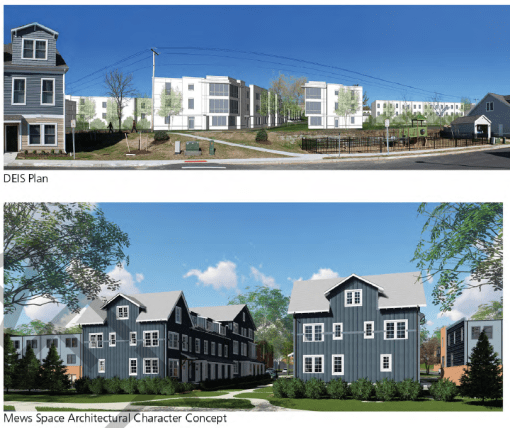
Now the traditional units. Ht-1 and Ht-2 appear to be 7 units each – 4 3-bedrooms, 3 2-bedrooms in a stacked flat format. They are separated by the West Sylvan Mews (and the small street next to the Community Center is called East Sylvan Mews). It-1 and It-2 are almost the same as the Ht’s, but the end unit is a bit larger, resulting 4-bedrooms instead of three (for a unit total per building of 3 2-bedrooms stacked, 3 3-bedrooms, 1 4-bedroom). Nt is the same as It, but with one less three-bedroom in the middle, resulting in a total of six units – three stacked flat two-bedroom units, two three-bedrooms, and one four-bedroom unit. Lastly, Ot and Pt are the same basic design, except Pt has one more unit in the middle. Ot is clad in green siding and has 4 three-bedroom units, and Pt is clad in red siding and has 5 three-bedroom units.

The Apartment Buildings

These should be easier to follow along with, as they were labelled from south to north. All multi-story apartments use the modern design motif. The buildings generally have the same floor plan for each full floor, except for utilities/storage rooms, and that the first-floor lobby is the location of the community study room on each floor directly above.

Building B is a 4-story, L-shaped building. The building will contain 4 two-bedrooms, 2 three-bedrooms, 1 one-bedroom and 11 studios per floor. Assuming one bed/resident per studio and one per bedroom otherwise, that means 72 units and 104 beds.

Building C is a 4.5 story, J-shaped building with a partially exposed basement level. The basement has 2 two-bedroom units, one one-bedroom unit and two studio units. Each of the four upper floors has 5 two-bedroom units, 4 one-bedroom units, and 4 studio units. That results in 57 units and 79 beds.

Building D is a 4-story. L-shaped building with 4 three-bedrooms, 2 two-bedrooms, 5 one-bedrooms and 3 studios per floor. At full occupancy, Building D’s 56 units will have 96 beds.

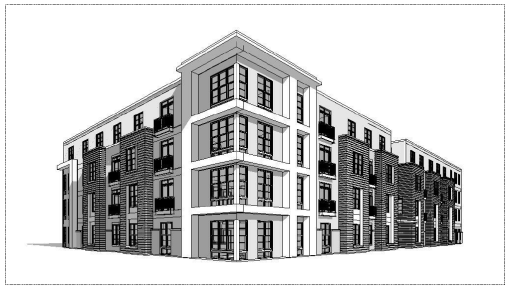
Building E (shown above) is a 4-story, L-shaped building. The corner facing Maple Avenue and Veteran’s Way will have a small retail space; the same space on the second through fourth floors is a two-bedroom unit. Overall, the building will have 16 three-bedroom units, 7 two-bedroom units, 16 one-bedroom units and 28 studios (about 106 beds).

Building F is a 4.5 story, I-shaped building. The habitable basement has 1 two-bedroom unit, 1 one-bedroom, and 3 studios. Each of the upper floors has 3 three-bedroom units, 2 two-bedroom units, 4 one-bedroom units, and 3 studios. The final sum is 53 units and 78 beds. In sum, the apartment buildings will provide 305 units and 463 beds.

The community center is something of a question. It looks like two floors with a 100′ x 65′ footprint, but I haven’t seen an exact square footage beyond early approximations of 5,000 SF.


The Maplewood Redevelopment, Part I: History and Planning

28 08 2017

Being as large and complex as it is, it was hard to figure out a way to present the Maplewood project clearly and coherently. After some thinking, it seems the best combination of clarity and detail will be to split it into three sections. This section, Part I, will be an overview of the site history and project planning. Part II will examine and break down the site plan with all of its contributing structures. Part III will be the regular construction update, which will be bi-monthly just like all the others.

Quick primer note – Maplewood Park was the name of the old complex. The new one is just called “Maplewood”. With the shorthand for Maplewood Park being Maplewood, it can get confusing.

Let’s start with the background. Love it or not, Cornell University is one of the major defining organizations of the Ithaca area. It employs nearly 10,000 people and brings billions of dollars in investment into the Southern Tier, Tompkins County and Ithaca. That investment includes the students upon which the university was founded to educate.

Traditionally, neither founder Ezra Cornell nor first university president Andrew Dickson White were fans of institutional housing. Their preference was towards boarding houses in the city, or autonomous student housing (clubs, Greek Letter Orgs, etc), where it was felt students would learn to be more independent. This mentality has often underlain Cornell’s approach to housing – it’s not a part of their primary mission, so they only build campus housing if they feel it helps them meet academic and institutional goals. If many potential students are opting for other schools because of housing concerns, or the university is under financial strain because it has to subsidize high housing costs in their scholarships, then Cornell is motivated to build housing in an effort to improve its situation and/or become more competitive with peer institutions.

With that in mind, being one of the top-ranked schools in the world means that, in the historical context of the university’s goals and plans, new housing is rarely a concern. Cornell will update housing in an effort to be more inclusive and to improve student well-being, but with labs, classrooms and faculty offices taking precedence, building new housing is rarely an objective. Only about 46% of undergrads live on campus, and just 350 of over 7,500 graduate and professional students.

From 2002 to present, Cornell has added 2,744 students, with a net increase in Ithaca of about 1900. The net increase in beds on Cornell’s Ithaca campus during that same time period is zero. While Cornell did build new dorms on its West Campus, they replaced the University “Class of” Halls. 1,800 beds were replaced with 1,800 beds. In fact, the amount of undergraduate and graduate housing on campus had actually decreased as units at Maplewood Park and the law school Hughes Hall dorm were taken offline, either due to maintenance issues, or for conversion to office/academic space. When the announcement for further decreases came in Fall 2015, I wrote a rare Ithaca Voice editorial, and even rarer, it brought Cornell out to the proverbial woodshed for poor planning and irresponsibility.

To be fair, while Cornell was the guilty body, removing housing isn’t a problem on its own. It’s when the local housing market can’t grow fast enough to support that, that it becomes a problem. The Tompkins County market is slow to react, for reasons that can be improved (cumbersome approvals process) and some that can’t (Ithaca’s small size and relative isolation poses investment and logistical hurdles). In the early and mid 2000s housing was added at a decent clip, so the impacts were more limited. But housing starts tumbled during and after the recession, and it was unable to keep up. As Cornell continued to add students in substantial quantities, it became a concern, both for students and permanent residents.

By the mid-2010s, Cornell was faced with financial strains, student unhappiness and worsening town-gown relations, all related to the housing issue. As a result, the past couple years have become one of those rare times where housing makes it close to the top of Cornell’s list of priorities.

In weighing its options, one of the long-term plans was to redevelop the 17-acre Maplewood Park property. The property was originally the holdings of an Ellis Hollow tavern keeper and the Pew family before becoming the farmstead of James and Lena (sometimes Lyna) Clabine Mitchell in the early 1800s. In 1802, James was passing through from New Jersey to Canada with plans to move across the border, but stopped in the area, liked it, and bought land from the Pews, then moving the rest of his family up to Ithaca. Apparently there’s a legend of Lena Mitchell attacking and killing a bear with a pitchfork for eating her piglets. Many of the home lots in Belle Sherman were platted in the 1890s from foreclosed Mitchell property.

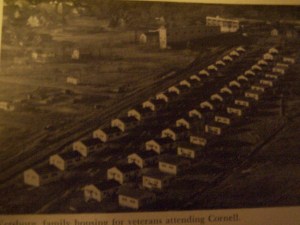
Like many of the Mitchell lands, it looks like the property was sold off around 1900 – a Sanborn map from 1910 shows a brick-making plant on the property along the railroad (now the East Ithaca Rec Way) and not much else for what was then the city’s hinterland. It’s not clear when Cornell acquired property, but by 1946, Cornell had cleared the land to make way for one of their “Vetsburgs”, also known as Cornell Quarters. The 52 pre-fabricated two-family homes were for veterans with families, who swelled Cornell’s enrollment after World War II thanks to the GI Bill. Once the GIs had come and gone, Cornell Quarters became unfurnished graduate housing, geared towards students with families, and international students.

The Cornell Quarters were meant to be temporary, and so was their replacement. In 1988-89, the university built the modular Maplewood Park Housing, with 390 units/484 beds for graduate and professional students, and an expected lifespan of 25 years. The intent was to replace them with something nicer after several years, but given Cornell’s priorities, and housing typically not among them, it fell to the back burner. As temporary units with marginal construction quality and upkeep, poor-condition units were closed off in later years, and capacity had fallen to about 356 beds when the complex’s closure was announced in May 2015 for the end of the 2015-16 academic year.

Cornell had long harbored plans to redevelop the Maplewood site – a concept schematic was shown in the 2008 university Master Plan. After weighing a renovation versus a rebuild with a few possible partners, the university entered into an agreement with national student housing developer EdR Trust to submit a redevelopment proposal. The partnership was announced in February 2016, along with the first site plan.

The core components of the project were actually fairly consistent throughout the review process. The project would have 850-975 beds, and it would be a mix of townhouse strings and 3-4 apartment buildings, with a 5,000 SF community center to serve it all. The project adheres to New Urbanist neighborhood planning, which emphasizes walk-ability and bike-ability, with interconnected and narrow streets, and parking behind buildings rather than in front of them. Energy-efficient LEED Certification was in the plans from the start.

However, the overall site plan did evolve a fair amount, mostly in response to neighbor concerns raised through the review process. Many residents on or near Mitchell Road were uncomfortable with multi-story buildings near them, so these were pulled further back into the complex, and late in the process the remaining Mitchell Street multi-story buildings were replaced with very-traditional looking townhomes with a smaller scale and footprint. More traditional designs were also rolled out for the pair of townhouse strings closest to Worth Street, since neighbors noted they would be highly visible and wanted them to fit in. The building planned in the city’s side was also pulled inward into the parcel early on due to neighbor concerns – it became an open plaza and bus stop. The university was fairly responsive to most concerns, although the most adamant opposition didn’t want any multi-story units at all, and really preferred as few students and as few families as possible.

For the record, that is every site plan I have on file. Go clockwise from top left for the chronology. So from beginning to end, there were at least five versions made public. The final product settled on 442 units with 872 bedrooms, with units ranging from studios to 4-bedrooms.

It’s also worth pointing out that the town of Ithaca, in which the majority of the property lies (the city deferred the major decision-making to the town), had a lot of leverage in the details. The town’s decades-old zoning code isn’t friendly to New Urbanism, so the property had to be declared a Planned Development Zone, a form of developer DIY zoning that the town would have to review and sign off on. Eventually, the town hopes to catch up and have form-based code that’s more amenable to New Urbanism. The town also asked for an Environmental Impact Statement, a very long but encompassing document that one could describe as a super-SEQR, reviewing all impacts and all mitigation measures in great detail. The several hundred pages of EIS docs are on the town website here, but a more modest summary is here. If you want the hundreds of pages of emailed comments and the responses from the project team, there are links in the article here.

Some details were easier to hammer out than others. The trade unions were insistent on union labor, which Cornell is pretty good about, having a select group of contractors it works with to ensure a union-backed construction workforce. Also, at the insistence of environmental groups, and as heat pumps have become more efficient and cost-effective, the project was switched from natural gas heat to electric heat pumps, with 100% of the electricity to come from renewables (mostly off-site solar arrays).

Taxes were a bit more delicate, but ended up being a boon when it was decided to pay full value on the $80 million project. It was a borderline case of tax-exemption because Cornell would own the land and EdR would own the structures, and lease the land for 50 years; but Maplewood Park was exempt, so it could have been a real debate. Instead, EdR said okay to 100% taxation, which means $2.4 million generated in property taxes on a parcel that previously paid none. Some folks were also concerned if the schools could handle the young child influx, but since Maplewood Park only sent about 4 kids to the elementary school on average, and the new plan would send 10 students when the school has capacity for another 26, so that was deemed adequate.

On the tougher end, traffic is a perennial concern, and Cornell wasn’t about to tell graduate and professional students and their families to go without a car. Streetscape mitigations include raised crosswalks, curbing, and landscaping, EdR is giving the town $30,000 for traffic calming measures (speed humps and signage) to keep the influx of residents orderly and low-speed. A new 600,000 gallon water tank also has to be built (planned for Hungerford Hill Road).

One of the thorniest issues were the accusations of segmentation, meaning that Cornell was falsely breaking their development plans up into smaller chunks and hiding their future plans to make the impacts seem smaller. This has come in the context of the Ithaca East Apartments next door, and the East Hill Village Cornell is considering at East Hill Plaza. However, neither were concrete plans at the time, and still aren’t – to my understanding, Cornell had some informal discussions about Ithaca East but decided against it early on in the process. And they only just selected a development team for EHV.

In the end, many of the concerned neighbors and interest groups were satisfied with the changes, and actually lauded Cornell and EdR for being responsive. The EIS was formally requested in May 2016. The Draft EIS was accepted in August 2016, public meetings on it were held in October, and the Final EIS was submitted at the end of October. After some more back-and-forth on the details (stormwater management plan, or SWPPP), the Final EIS was approved right before Christmas and the project was approved in February 2017, starting work shortly thereafter for an intended August 2018 completion. With the wet summer, the project managers asked for a two-hour daily extension on construction (8 am-6 pm became 7 am -7 pm) to meet the hard deadline, which the town okayed with a noise stipulation of less than 85 decibels.

Rents for the project, which include utilities, wireless and pre-furnished units, are looking to range from $790-$1147 per bed per month, depending on the specific unit. Back of the envelope calculations suggest affordability at 30% rent and 10% utilities, for 40% of income. Cornell stipends currently range from $25,152-$28,998, which translates to $838-$967/month.

On the project team apart from Cornell and Memphis-based EdR are Torti Gallas and Partners of Maryland, New Urbanist specialists who did the overall site plan and architecture. Local firms T.G. Miller P.C. is contributing to the project as structural engineer, and Whitham Planning and Design is the site plan designer, landscape planner and boots-on-the-ground project coordinator for municipal review. Brous Consulting did the public relations work, and SRF & Associates did the traffic study. Although not mentioned as often, STREAM Collaborative did the landscape architecture for the project. The general contractor is LeChase Construction of Rochester.

So that’s part one. Part two will look at the structures and site plan itself. And then with part three, we’ll have the site photos.


News Tidbits 8/21/17: Insert Eclipse Pun Here

21 08 2017

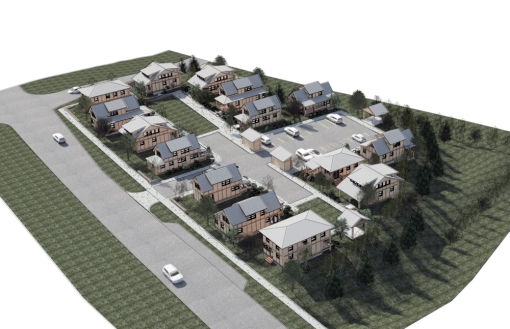
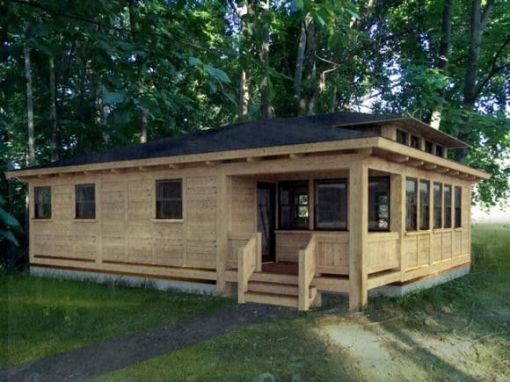
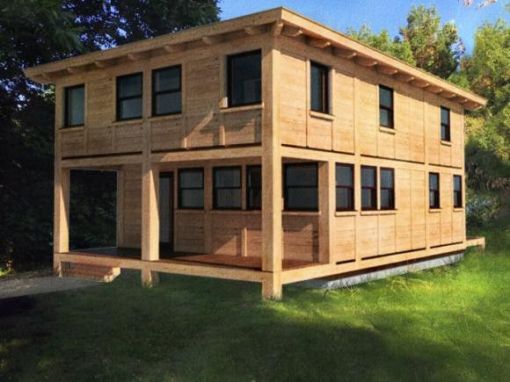
1. Quite the sight in the latest Tiny Timbers update. The nascent kit-based homebuilder plans to roll out several new designs, many of which will be incorporated into the 15-unit Varna project on the corner of Dryden and Freese Roads. That brings their total number of home design options up to about 21 or so, in several general styles from four-square to prairie-style to bungalow. It is not clear if the layout will be pre-set at is was with the Belle Sherman Cottages (relatable because STREAM Collaborative designed both), or if it will be left to the buyers.

Tiny Timbers is a bit of a misnomer because the designs are a modest but still sizable 1,000-1,500 square feet, with two or three bedrooms. Prices will be in the mid 100s to low 200s, depending on unit and features. I’d be more inclined to compare them to the starter homes of the 1950s in terms of market appeal and affordability.

Tiny Timbers has yet to get permission to start marketing for the community (the state needs to sign off on all new Home Owner Associations), but marketing has started for some scattered site development on Hector Street in Ithaca’s West Hill, and there is work underway on a few custom builds for landowners in other parts of the county.

2. Last week was not a good showing for the Inn at Taughannock. As relayed by the Times’ Jamie Swinnerton, the town of Ulysses Zoning Board of Appeals denied the lot variances, the heights variances and even the sign variances. The only one they outright permitted was the height variance to allow a rooftop cupola on the existing inn. The sign variance is kinda weird, because it sounds like they were okay with some individual signs, but not the sum of parts, so they’re doing another meeting.

While this isn’t what owner/developer Carl Mazzocone was hoping for, there were alternative plans drafted that did present an alternative design that, while the same style, fit within the zoning parameters. So this is a setback, but this project isn’t off the table yet.

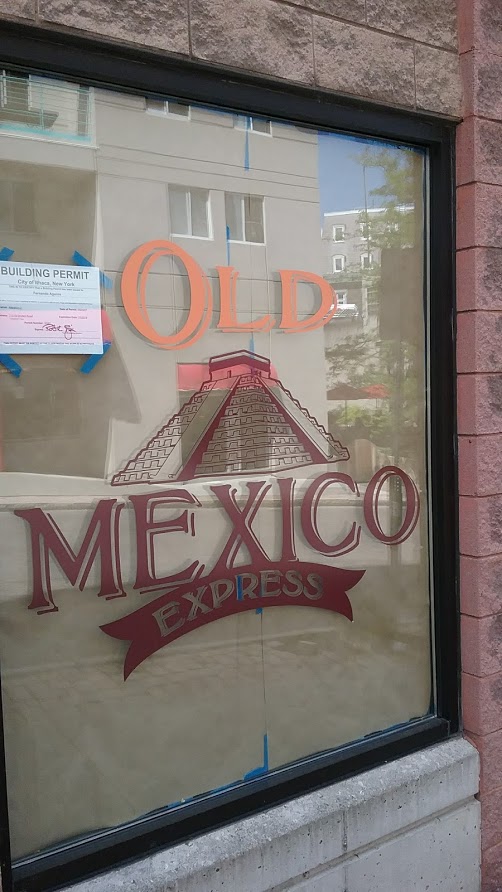
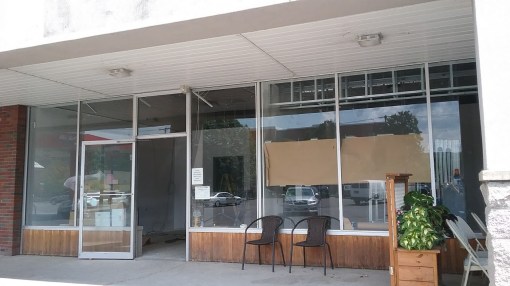
3. Sure, most readers outside the Cornell bubble avoid Collegetown like the plague, but it’s worth noting when new businesses are coming in. Old Mexico, the restaurant that replaced Manos Diner in Southwest Ithaca, will be opening a modest to-go operation at 119 Dryden Road (Collegetown Plaza) in what used to be a barbershop (at least in my time in the late 2000s). Meanwhile, where the Collegetown tobacco shop used to be at 221 Dryden (Collegetown Center), will now be a “Chinese street food” restaurant called Beijing Jianbing. Best of luck to both. At least restaurants aren’t being driven out of business by the internet anytime soon.

4. In the same vein, it was noted a few weeks ago that a $415,000 construction loan was filed for Hancock Plaza, the strip retail plaza at the corner of Hancock and Third Streets in Ithaca’s Northside. A quick check showed an interior renovation underway with new metal stud walls and sheet-rock going in, and the somewhat uncertain workers said that the storefront next to Istanbul restaurant would be a “medical service facility”.

5. Earlier this month, it was mentioned that a 4.5 acre parcel at 452 Floral Avenue in Ithaca was sold to a local homebuilder for $100,000. Now he’s trying to flip it. The asking price is $239,000. The tax assessment is $68,400.

The real estate ad notes the potential of an R-3a zone, which allows for homes, townhouses, small apartments and small-scale commercial with a special permit. The zoning permits four floors and 35% lot coverage, with a minimum of 5,000 SF per lot for a home, plus incremental increases for additional units.

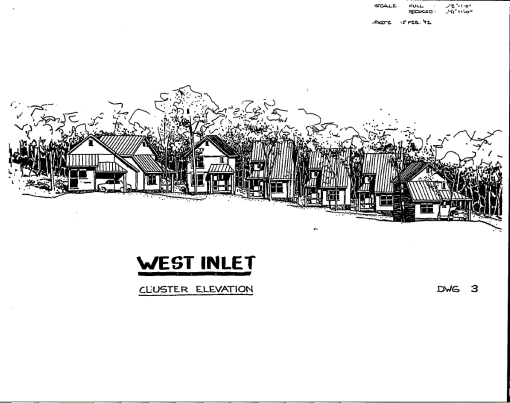
On a side note, with thanks to the city for uploading about 470 documents from the IURA’s microfilm stash, here’s what the 1992 affordable for-sale proposal looked like for that same property. There appear to be 27 home lots, but a few may have been designed for accessory or two-family units. This gives an idea of what could reasonably be done under the existing zoning, but there are many possibilities.

Side note, I found this by chance. If anyone has time to pick through 470 documents from the 1960s to 2000, more power to you.

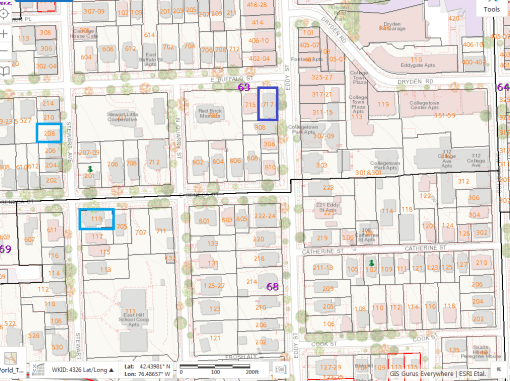
6. Also for sale, to the deep-pocketed investor looking for a safe investment – multiple East Hill apartment houses. 5-unit 119 Stewart Avenue for $995,000, a two-family home at 208 Stewart Avenue for $695,000, and $2.25 million for a 23-bed (20 SRO, 1 studio, 1 2-bedroom) property at 717 East Buffalo Street. The Stewart Avenue properties are owned by a Long Island-based LLC representing a higher ed professional now located in Massachusetts, and were purchased just a few years ago – 119 for $625k in 2014, and 208 for $513k in 2012. 717 East Buffalo was purchased by a Brooklyn investment group in 2003, and is taxed at $1.05 million. The positive is that they’re close enough to Cornell to easily take advantage of the student market. The negative is that they are all in the East Hill Historic District, which means redevelopment is off the table, and exterior renovations have to go through the ILPC.

7. Pretty slow month for the Planning Board. Finger Lakes ReUse is seeking preliminary approval for their expansion project and final approval for the warehouse portion. 709 West Court Street, the 60-unit affordable project from Lakeview, will have its DEIS finalized, potentially allowing for city approval in September. There are no new projects though, unless one counts the six-bedroom duplex at 217 Columbia, which is so minor from the state’s perspective that it only qualifies for city review. The Times is reporting that O’Connor is willing to prohibit student tenants, but permanent residents are still opposed to new student housing in their neighborhood.

There could be some interesting discussion at the meeting, not only with South Hill development, but with historic preservation matters. For instance, Student Agencies is upset that they city is likely to landmark its building at 413-415 College Avenue, which it says it had intent on redeveloping. Unfortunately, timing is everything. Likewise, the shoe is on the other foot with the Nines at 307 College Avenue, for which there has been an unpublished sketch plan of a redevelopment project. The ILPC is expressing frustration that it wasn’t landmarked already, but with the development plans already presented, the city would be acting reactively instead of proactively as it’s doing on College Avenue, and that could make the difference if a legal situation were to arise. So while the Chacona Block is likely safe and soon to be under ILPC purview, the Nines will not be protected for as long as the redevelopment plan is active, and the best the ILPC can do is recommendations.
Here’s tomorrow’s agenda:

AGENDA ITEM Approx. Start Time

  1. Agenda Review 6:00
  2. Privilege of the Floor 6:01
  3. Site Plan Review

A. Project: Mixed Use Apartments – Finger Lakes ReUse Commercial Expansion and Supportive Apartment 6:10

Location: 214 Elmira Road

Applicant: Finger Lakes ReUse

Actions: Consideration of Preliminary Approval Overall & Final Site Plan Approval for Phase 1

Project Description:

The applicant proposes to expand the existing office and retail center with a new +/- 26,100sf
attached 4-story mixed-use building to include retail, office, and 22 units of transitional housing fronting Elmira Road. A 7,435 SF covered outdoor inventory building and a 600 SF pavilion are also proposed. The new parking and loading layout will reduce the number of curb cuts on Elmira road from 5 to 2 and provide 70 parking spaces. An improved sidewalk will be constructed to provide a safer link between the existing pedestrian bridge that connects the Titus Tower property to Elmira Road. The building will have landscaped entrances facing Elmira Road and these will be connected to the new building entrances giving residents and patrons arriving on foot direct access to the street. The project site is in the B-5 Zoning District and has received the required area variance. This is a Type I Action under the City of Ithaca Environmental Quality Review Ordinance (“CEQRO”) §176-4 (I), and the State Environmental Quality Review Act (“SEQRA”) § 617.4 (11) for which the Planning Board as Lead Agency made a Negative Declaration of Environmental Significance on June 27, 2017.
Ed. note – the first phase is the warehouse addition for lumber storage. Phase 2 is the supportive apartments.

B. Project: 709 West Court Street 6:30

Location: 326 & 328 N Meadow St. and 709 – 713 West Court St.

Applicant: Trowbridge Wolf Michaels for Lakeview Health Services Inc.

Actions: Public Hearing, Determination of Environmental Significance

Project Description:

The applicant proposes to construct a five-story L-shaped building with footprint of 10,860 SF
and GFA of 62,700 SF on the .81 acre project site comprising four tax parcels (to be consolidated). The building will contain sixty (60) one-bedroom apartments plus associated shared common space (community room, laundry facilities, lounges, and exterior courtyard), support staff offices, program spaces, conference room, utility rooms, and storage. The siting of the building allows for a small landscaped front yard, a south-facing exterior courtyard, and a 16 space surface parking lot in the rear of the site. Site development will require the removal of five structures and associated site elements. The project is in the WEDZ-1 Zoning District. This is a Type I Action under the City of Ithaca Environmental Quality Review Ordinance (“CEQRO”) §176-4 (1) (k) and (n), and the State
Environmental Quality Review Act (“SEQRA”) § 617.4 (11) and is subject to environmental review.

C. Project: Duplex 6:50

Location: 217 Columbia Street

Applicant: Charlie O’Connor for 985 Danby Rd LLC

Actions: Public Hearing


Project Description:

The applicant is proposing to install a modular duplex with one 3-bedroom apartment on each floor. The new structure is proposed to be sited directly behind the existing duplex on the property. As the project will increase the off-street parking required from two to four spaces, the applicant is proposing to shift the existing curb cut to the east and install an expanded parking area and drive aisle along the eastern property line. The project also includes removing a 30”dbh oak and one street tree, closing the existing curb cut, installing a fence, landscaping and walkways. The project is in the R-2a Zoning District. This is a Type II Action under the City of Ithaca Environmental Quality Review Ordinance (“CEQRO”) §176-5 C.(8) and the State Environmental Quality Review Act (“SEQRA”) § 617.5 (C)(9) and is not subject to environmental review.


  1. Zoning Appeals 7:20
  2. Old/New Business 7:30
    1. A. 412 East State Street – review and sign off on Argos Inn shared parking agreement with 418 East State Street.
    2. B. PB Report on Proposed Local Landmark Designation of 403 College Avenue and 411-415 College Avenue . There will be a short presentation by Scott Whitham regarding 411-413 College Avenue.
    3. C. Development Patterns of South Hill – Discussion
  1. Reports from PB Chair, Director of Planning and Development, and BPW Liaison 8:00
  2. Approval of previous minutes
  3. Adjournment


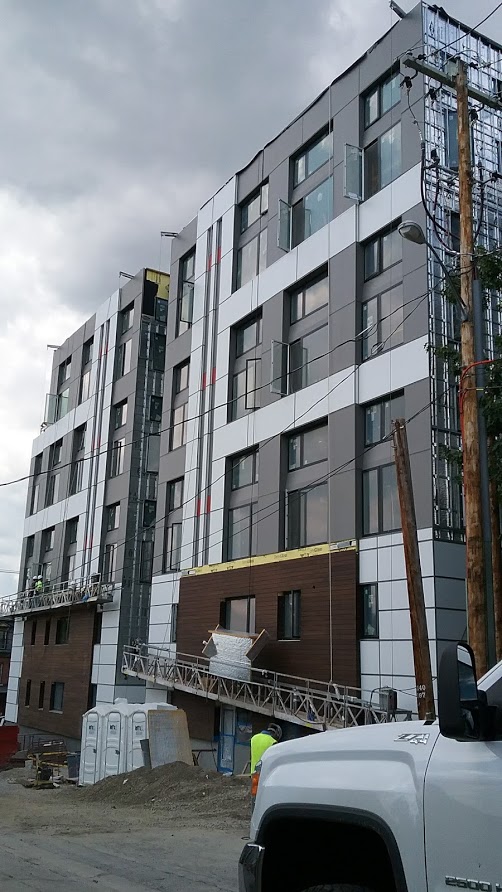
Chapter House / 406 Stewart Avenue Construction Update, 8/2017

17 08 2017

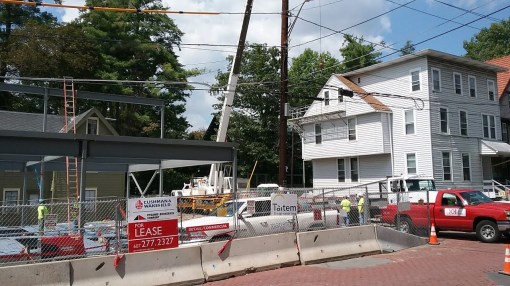
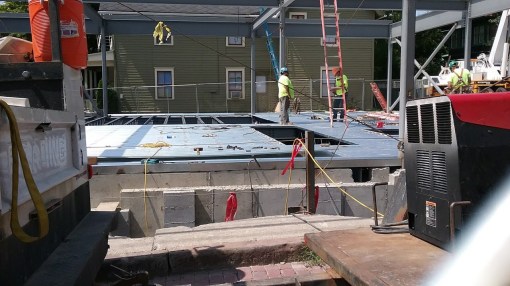
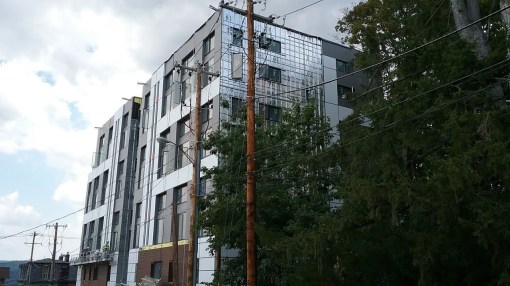
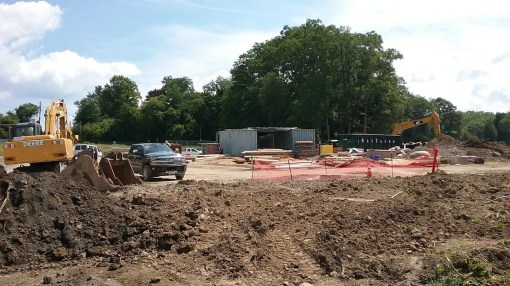
Some good news and some bad news. The good news is, the replacement building for 400-404 Stewart Avenue is well underway. No false starts, no rumor milling. The new structure is quite substantial for a modest three-story building – structural steel frame (currently up to the second floor), steel floor panels, finished basement, – all heavy duty, commercial grade construction, befitting for a mixed-use structure with possible food retail or general retail tenants on the 3,000 SF ground floor. Note the structural cross-beams; those well segments will not have windows. The exposed portion of the concrete foundation wall will be faced with bluestone later in the build-out. The fifth photo shows no concrete between the floor panels and foundation, presumably because the corner entrance will have an interior stairway that steps up to the ground level.

Now for the bad news. I chatted with a worker on the site, and when I said “the Chapter House site”, he chuckled, shook his head, and recommended I don’t use that phrase. “The Chapter House ain’t coming back,” he said before picking up a shovel. “People will forget all about it in four years anyway.” It hasn’t been a secret that the Chapter House likely isn’t making a return, but for many students and non-students, it’s still a disappointment to hear that.
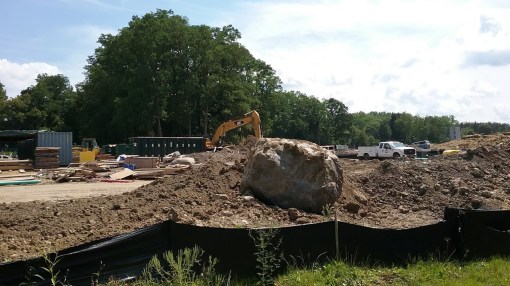
The construction timeline for 400-404 Stewart called for a completion this year, which seems generous. The apartment building at 406 Stewart Avenue has been graded, but construction will not start until later this fall. Hayner Hoyt is the general contractor, with Taitem in charge of the structural engineering.

UPDATE: In the comments, John Hoey, the proprietor of the Chapter House, has written in the comments that he intends to reopen the bar, if not here then elsewhere in Collegetown.


201 College Avenue Construction Update, 8/2017

16 08 2017

201 College is a work in progress on the outside, but the inside is nearly complete. According to Visum Development’s Todd Fox, who happened to be at the site when the photos were taken yesterday, there are cleaning crews inside, and a certificate of occupancy is being obtained. Renters will be able to move in on Friday.
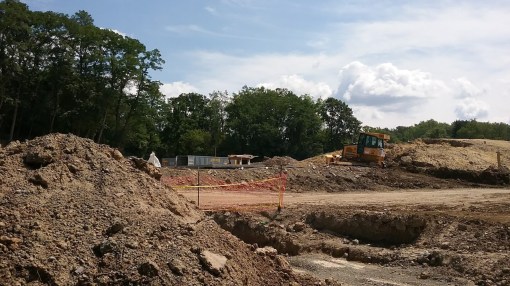
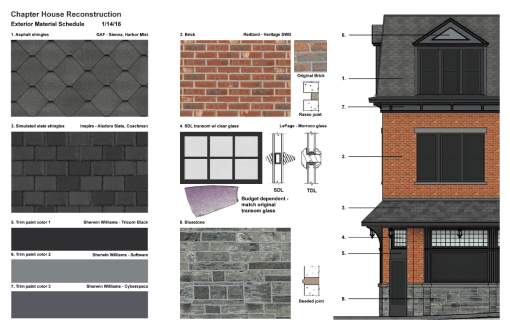
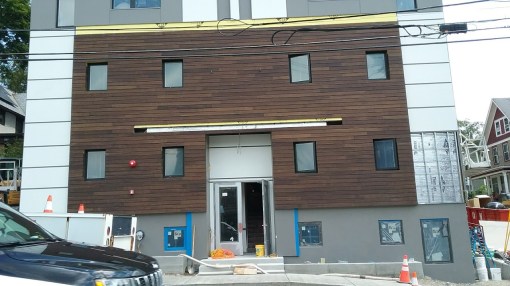
On the outside however, work is still coming along. From the looks of it, it appears all the woven bamboo siding has been attached. However, the overhead canopy has yet to be installed over the front entrance, and some of the decorative “iron ore” black metal rails and fiber cement panels (“Allura Snow White” and “Gauntlet Gray“) have yet to be clipped on over the structural metal rails. So while tenants will be able to move in for the fall semester later this week, construction on the exterior and landscaping finishes will extend into September. Similarly, the basement area, which will host the fitness room and bike storage, will need a few more weeks before it’s ready for use.

For what it’s worth, 201 College looks just like the renderings provided by its architect STREAM Collaborative, which one would think isn’t a big deal, but it is – there have been cases of developers building something that lacked details of features shown but not explicitly required in approval, which had led to consternation among the planning board and staff.

On another good note, I asked Fox how things were with neighbor Neil Golder, who led efforts to halt the project last year. Since the lawsuit failed, the two sides have been fairly amenable to each other – Fox still offered Golder solar panels on 201 to compensate for shadows, and Golder has let construction workers access his property when trying to maneuver equipment on and off site. Fox said that, in exchange for paying Golder’s water bill, he let construction crews hook up hoses from his spigots to spray down the dust and add water to the concrete.
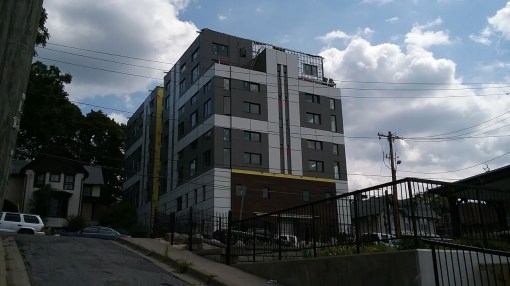
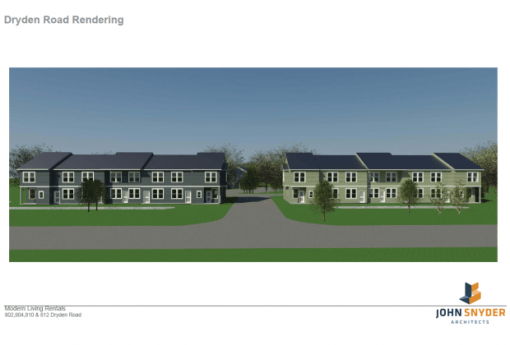
As 201 wraps up, Fox has his eye on his other approved projects – 210 Linden Avenue, a 4-story, 36-bedroom building, has been excavated and padded (last two photos here), and is waiting on municipal permits to begin construction of the foundation. As with 201 College, William H. Lane Inc. of Binghamton will be the general contractor, and STREAM is the architect. 232-236 Dryden Road, a pair of 4-story buildings with 191 bedrooms, is due to start site prep in September. Two smaller Visum projects, for 118 College Avenue and 126 College Avenue, have no firm construction dates at this time.


News Tidbits 8/12/17: Two Kinds of Rehab

12 08 2017

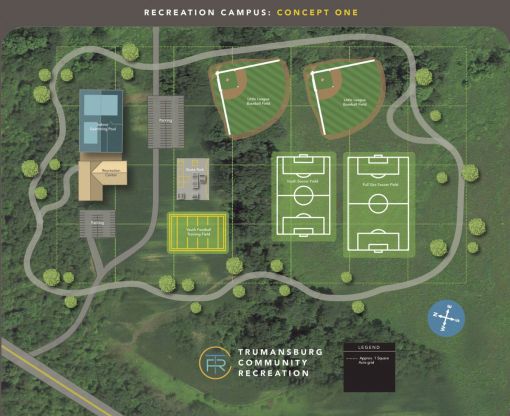
1. It looks like some Trumansburg residents want to build a recreational complex. According to the Ithaca Times’ Jamie Swinnerton, for the civic group Trumansburg Community Recration, “{t}he ultimate goal is to build a recreation center, soccer fields, baseball fields, a youth football field, a skate park, and a pool to the community. The first phase of the project would be building the sports fields and possibly a recreational campus. While the group is still searching for space for these amenities, it is raising funds through grants and donations. The fundraising goal right now is $750,000.”

Along with private donations, the community advocacy organization is seeking state funds, which state law requires be obtained via municipal entities, i.e. the village, school district, town and county. It’s not that governing bodies have to commit money, they just have to express support and sign off on applications, and allocate the awarded funds if/when they are received.

Phase two for the non-profit would be a community center, likely a re-purposed building, and phase three would be a pool, which is garnering significant community attention. Although the group hasn’t committed to a location (the rendering is completely conceptual), it is examining the feasibility of different sites in and around Trumansburg. Interested folks can contact or donate to the group here, or sign up for emails if they so like.

2. Cayuga Addiction Recovery Services (CARS) has finally received the money from a July 2016 grant award. Cayuga Addiction Recovery Services (CARS) will be using it toward a new 25-bed adult residential facility. The new facility will be built on the Trumansburg campus adjacent to a 60-bed facility on Mecklenburg Road, near the county line a couple miles to the southwest of Trumansburg. An undisclosed number of jobs are expected to be created. Founded in a Cornell U. fraternity house in 1972, CARS provides treatment, counseling, skills training and support services to help clients overcome addictions and rebuild lives. The current facility was opened in 2004.

While the location is quite rural, the nature of the facility (rehab, focus on opioid abuse) is getting pushback from at least one town board member who doesn’t want it in the town (link, scroll down to 7-25-TB minutes). The plan has yet to go before the Ulysses planning board.

3. INHS made its name on home rehabs, and it looks to be making a return to its roots. The non-profit developer is asking the IURA for $41,378 towards the renovation of an existing 3-bedroom house on 828 Hector Street, which will then be sold to a low-moderate income family (80% AMI, about $41,000/year) and locked into the Community Housing Trust.

The project cost is $238,041. $152,000 to buy the foreclosed property from Alternatives Federal Credit Union, $8,000 in closing/related costs, $60,000 in renovations, $5,000 contingency, $8,141 in other costs (legal/engineering), and $4,900 in marketing/realtor fees. The funding sources would be $144,163 from the sale, $15,000 from INHS’s loan fund (to cover the down payment for the buyer), $37,500 in equity and the $41,378 grant. A for-profit could renovate for cheaper, but federal and state guidelines say INHS has to hire those with a $1 million of liability insurance coverage, which takes many small contractors out of the equation.

Side note, the city’s federal grant funding disbursement was dropped by $50,000, because HUD is an easy target in Washington. Luckily, Lakeview decided to forego its grant funds because they found the federal regulations unwieldy, which freed up a little over $43k to move around to cover most of the losses.

4. Speaking of Hector Street, it looks like Tiny Timbers is rolling out a pair of new spec plans for two lots on the city’s portion of West Hill. The house on the left, for 0.27 acre Lot 1, is a 1,040 SF 2 BD/1BA design listed at 187,900, which is a good value for a new house in the city. 0.26 acre Lot 2 is a 3 BD/2 BA 1,370 SF home listed at $222,900. Taking a guess based on the lot sizes, these are the wooded vacant lots west of 920 Hector. There’s a third vacant lot over there, but no listing yet.

5. On the city’s Project Review Committee meeting agenda, which is the same as the memo…not much. Lakeview’s 60-unit affordable housing project on the 700 Block of West Court Street will have its public hearing and determination of envrionmental significance, the last step in SEQR and the one before preliminary approval. Same goes for INHS’s 13-unit project on the 200 Block of Elm Street.

Apart from related or minor zoning variances and review of proposed historic designation in Collegetown for the Chacona and Larkin Buildings (411-415 College and 403 College), the only other project for review is 217 Columbia, Charlie O’Connor’s. Which, as covered by my Voice colleague Kelsey O’Connor and by Matt Butler at the Times, did not go over well, though Charlie seemed willing to change plans to avert a firestorm. From a practical standpoint, I’d imagine he’s much more focused on his much larger 802 Dryden Road project, and this is small if hot potatoes. The 6-bedroom duplex (three beds each) is designed by Ithaca architect John Snyder.

My own feeling is that a moratorium isn’t the answer, but if they wanted to roll out another TM-PUD so that Common Council gets to review plans as well as the Planning Board, then so be it. My issue with moratoriums is that local municipalities do a terrible job sticking to timelines and have to extend them again and again. Plus, there are projects like the Ithaka Terraces condos, or the new Tiny Timber single-family going up on Grandview, that aren’t the focus of the debate but would be ensnared by a blanket moratorium.

Meanwhile in the town, the planning board discussion for next week will mostly focus on the NRP Ithaca Townhouses on West Hill. The revisions will be up for final approval, which would allow NRP to move forward with their 2018-19 Phase 1 buildout (66 units and a community center). Phase II (39 units) will follow in 2019-20.

6. In sales this week, the big one appears to be 808 East Seneca – 5 unit, 4,125 SF historic property just west of Collegetown in Ithaca’s East Hill neighborhood. List price was $1.575 million, and it sold for modestly less, $1.45 million, which is well above the $900,000 tax assessment. The sellers were a local couple had owned the property since 1982, and the buyer is an LLC formed by the Halkiopoulos family, one of Collegetown’s old Greek families, and medium-sized landlords with a number of other houses in the area.

Perhaps more intriguing is the sale of 452 Floral Avenue for $100,000 to home builder Carl Lupo. The vacant 4.15 acre property had been the site of a 30-unit affordable owner-occupied project back in 1992, but given that the Ithaca economy was faltering in the early 1990s, the plans never moved forward.

7. A quick update from the Lansing Star about the Park Grove Realty lawsuit. While the Jonson family of developers may have lost the village elections by a large margin, their lawsuit accusing the village of an illegal zoning change to permit the project has been reviewed by the state’s court system – and they lost. The state supreme court ruled the zoning change was perfectly legal, appropriate to the revised Comprehensive Plan, and accusations of negative impacts on the Jonsons’ Heights of Lansing project are overblown and speculative.

The Jonsons intend to file an appeal, and have to send in their final draft by September 5th. At this point, the project is left in a waiting pattern – the village is leaving the public hearing open until the appeal is resolved. If the appeal overturns the ruling, than the project can’t proceed regardless of village approval. Given the basis for the initial ruling, an overturning seems unlikely, but it will be a few more months before any approvals can be granted.


News Tidbits 7/15/17: Ess Ess, Dee Dee

15 07 2017

1. Hamilton Square. There’s a lot to say here.

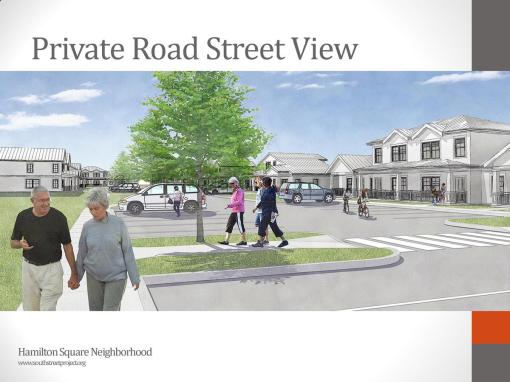
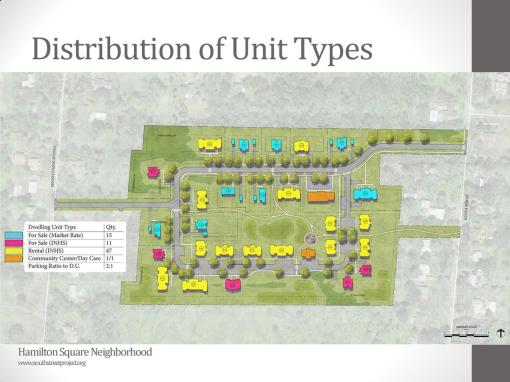
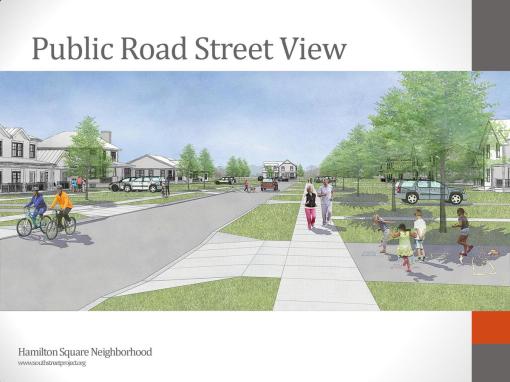
First, the neutral segment. The website is up, www.southstreetproject.org. Plenty of renders (definitely not cookie-cutter), site plans, housing prices, everything one needs for a fair assessment. The units are no more than 2 floors, mostly townhouse format. 47 affordable rentals units, 11 affordable for-sale units, and 15 market-rate for-sale units for a total of 73 on a 19 acre site. That’s less than 4 units per acre (0.26 acres/unit, comparable to the older 0.25-0.5 acre lots on Pennsylvania and South Streets), and fits zoning. The units are interspersed throughout the property. Parking ratio is 2 spaces per units, units are a mix of 1-3 bedrooms. There will be aging-in-place and energy efficient home options for sale, as well as in the rentals. The project will host a playground and nursery/daycare facility geared towards low and moderate-income households. Much of this comes from the result of constructive community feedback.

But what started off on a polite note is getting really ugly, really quickly. It is not a good sign when my editor calls me and tells me that, as a person of color, she felt uncomfortable at the latest meeting.

Given the transparency of this process, which still hasn’t even been submitted for formal planning board review, I find comments about this being “hidden” or rushed through to be a stretch. The project hasn’t submitted anything for formal review yet. Nothing but a sketch plan has been done, and multiple community meetings, and 30-minute small group listening sessions. It really does not get much more personal than that.

One of the questions that was raised was that people are unable there are many more affordable rentals than for-sale units. There are two reasons why that is. For one, funding for purchasable units is more difficult to get. The government is more likely to disburse a grant if it knows there are buyers waiting in the wings. That’s why the buildout for the for-sale units is 2-8 years. For two, for low and moderate-income households often don’t have much money saved for a big expense such as down-payment, and far more are capable of renting versus buying.

There are valid concerns that need to be addressed. For example, traffic. A study is being conducted with a third party. The typical thing I hear, affordable housing, or any project really, is that “they’ll lie, they’re in XYZ’s pocket”. If no one trusts you to do your job properly, no municipal board will sign off on accepting your study, and you’re finished as a firm. Likewise with stormwater analysis and civil engineering. School system capacity is checked with the district, which basically just sends a letter saying “yes, we have room” or “no, we don’t have room”. The study is being conducted and will be made public long before any approvals are granted, people can weigh in after reading it to say whether it’s comprehensive and adequate, and feel free to say something and explain why it may not be. That’s the purpose of SEQR, to determine impacts and mitigate unavoidable impacts.

On a related note, a board’s job is to review the objective components of a project. It is not appropriate, or legal, to decide on a subjective trait like whether the people who will live there fit the “Trumansburg way of life” or that the project is “too Ithacan”. Who decides what those things are? Because too quickly, it degenerates into a look or an image, and a train of thought that should never be a part of any development conversation. Because it’s subjective, those terms meant something quite different in 1997, and something quite different in 1977.

Also, there seems to be this idea that poor people in urban neighborhoods will be forced out here, and they will be a burden on TrumansburgThere are plenty of people who live and work in Trumansburg who need affordable options in a rapidly-appreciating real estate market. The one bedrooms will be rented to individuals making $22k-$48k. That could be a store manager, a barista, a school teacher or a retiree. Tenants are screened, visited at their current home and interviewed before being offered a unit. Qualified affordable home buyers will mostly be in the $42k-$64k range (80-120% AMI). Think nurses, office workers, tradespeople (following INHS’s sales deeds, I actually see a lot of ICSD teachers). The market rate units will offer whatever the market allows price-wise; new townhouse-style housing in Trumansburg would likely fetch $250k+, so think upper-middle income.

It would be nonsensical to make people in Ithaca move into housing in Trumansburg that they don’t want and would drive up their costs; however, those who want to live there, whether because they admire Trumansburg, work there, or both, will seek the opportunities it provides.

For a county that seems keenly aware of its housing issues, there tends to be an uncomfortable amount of pushback against affordable housing, whether it be Fall Creek, South Hill, Lansing or Trumansburg. Does that qualify as being “too Ithacan”?

2. Taking a look at the county’s records this week, it looks like 210 Linden Avenue’s construction loan has been filed. Elmira Savings Bank is lending Visum Development (Todd Fox and associates) $3.15 million, with $2,358,783 towards the hard costs (materials/labor) of replacing the existing 12-bedroom student apartment house with a 9-unit, 36-bedroom apartment building. Elmira Savings Bank is one of the biggest single-family construction loan lenders in Tompkins, but they have only been the lender for a few multi-family projects. The only other multi-million project in the past few years was the 18-unit Rabco Apartments at 312 Thurston Avenue in Cornell Heights – a project that, along with the cancelled 1 Ridgewood, so incensed deep-pocketed permanent residents nearby that they petitioned and succeeded in getting the city to downgrade the zoning.

Also filed this week was a $415,000 construction loan from Tompkins Trust to the owner of Hancock Plaza on the 300 Block of Third Street in Ithaca’s Northside neighborhood. The 19,584 SF shopping plaza, built in 1985, is assessed at $1.485 million and has been under its current ownership since 2002. Most might know it for the DMV, but it also hosts Istanbul restaurant, a bookkeeping service, and a gas station and convenience store that opened in renovated space in 2015. There’s no indication in the loan as to what kind of work will be performed, about $363,000 has been set aside for hard costs like materials and labor, and the work is required to be finished by March 2018.

3. Also filed in both sales and construction loans this week was paperwork for 306 North Cayuga Street, right next to DeWitt Park on the edge of Ithaca’s downtown. Also known as the C. R. Williams House, the 8,798 SF, ca. 1898 property was assessed at $900,000 and on the market for $1.4 million last year. The sale price was $1.3 million.

I was privy to an email chain that engaged an out-of-state condo developer to look at the property, but that person was not the buyer.  The LLC traces back to Travis Hyde Properties, just a few blocks away.

According to Frost Travis of THP, the plan is to renovate the live/work space to allow for more space for THP, which is outgrowing its North Tioga Street location, and four apartment units. Exterior changes will only be cosmetic, but any substantial changes will be subject to ILPC approval, as the property sits in the DeWitt Park Historic District. Elmira Savings Bank is lending $1.24 million for the renovation, of which $1,204,752 is going towards the actual construction (so apparently, this was a big week for ESB). The project is expected to be complete by next summer, according to the loan filing.

4. For the aspiring homebuilder or developer – new to the market this week, a run-down though salvageable 1830 home at 1975 Dryden Road just east of Dryden village, and 101 acres of developable vacant land currently rented out for agricultural use. The sale price is $795,000. The county GIS lists the property at 112.4 acres, but without a map in the listing, it’s hard to tell if there’s a typo or if there might be a subdivision somewhere. The assessment is for $531,900, $401,300 of which is the land. It appears the property has been in the ownership of the same family since 1968. The property is listed as a rural agricultural district, which is geared towards ag uses, but permits office, one-family and two-family homes as-of-right; multi-family and box retail require special use permits. Zoning is one unit per two acres, but in the case of a conservation subdivision that preserves open/natural space, it’s one unit per acre – either way, only about 50 units allowed here. Technically, a PUD (aka DIY zoning) is also an option, but would need adequate justification. Kinda hoping it doesn’t become conventional suburban sprawl, but will reserve judgement for when this sells.


5. Ithaca is once again competing for $10 million in state funds as part of the regional Downtown Redevelopment Initiative. The funds are intended to spark investment in urban cores and improve infrastructure for communities throughout the state, ten cities selected each year, one in each region. Readers may recall Elmira won last year. This year, Ithaca is competing against two of its Southern Tier peers – Watkins Glen, with which it competing with last year as well, and Endicott, a struggling satellite city over by Binghamton, that is entering the competition for the first time. Reports suggest the Ithaca submission is largely the same as last year’s. Winners will be announced in the fall.


News Tidbits 6/25/17: Lazy Sunday

25 06 2017

1. Starting off with the new project of the week: 42-unit, 108-bedroom 802 Dryden Road. As relayed on the Voice, the parcel currently hosts several rental properties in varying condition. The project is Modern Living Rentals’ largest to date, partly because developer Charlie O’Connor tends to focus more on smaller infill in urban areas.

Although no time table has been given for the $7.5 million project, a likely prospect is approval by the end of the year, with a spring 2018 groundbreaking, and a summer 2019 opening. While John Snyder Architects is in charge of design modifications, the townhouse designs are recycled from STREAM Collaborative’s 902 Dryden plan currently finishing up down the road. Marathon Engineering’s Adam Fishel will be shepherding the project through the approvals process, just as he did the Sleep Inn for Elmira Road.

Location-wise, it’s on a bus route but most everything will need some kind of vehicular transport, so it’s fairly auto-centric. There isn’t a lot of lot nearby apart from a few small rentals and single-family homes, and Cornell farm fields. On the other hand, few neighbors means fewer people likely to raise a fuss at planning board and town board meetings. As long as they provide town favorites like heat pumps, don’t expect big hangups as this plan moves through municipal review.

2. So here’s something out of the blue. Recently, the house at 2124 Mecklenburg Road in Enfield was sold to “The Broadway Group LLC d/b/a TBG Alabama LLC”, and a $998,000 construction loan agreement was filed shortly afterwards. One does not normally see million-dollar projects in Enfield, but a look at the filing yielding no information other than to suggest it was a retail building.

A little further digging indicates The Broadway Group, based out of Huntsville, Alabama, specializes in the development and construction of Dollar General stores. The lender, Southern States Bank, headquartered in Anniston, Alabama, is a preferred commercial lender for TBG. So this is a similar case to the Dollar General recently built in Lansing by Primax Properties –  it’s less about a bank being interested in Ithaca, and more about two major companies located near each other and having an established business relationship. A check of Enfield’s Planning Board reveals that the applicant took great pains not to reveal the name of the tenant, saying only a stand-alone variety dry goods store. A confidentiality clause with client limits what they could say, and TBG will technically own the metal building for a year until it transfers over to Dollar General. Expect a Q4 2017 and with it, 10-12 retail jobs.

I’ll be candid on this one – I sent out an email before writing anything up for the Voice asking if there were enough Enfield/West Hill readers who would care enough to justify an article being written. Jolene encouraged it, the piece went up, and the traffic on the article was actually pretty good, somewhat above average in fact.

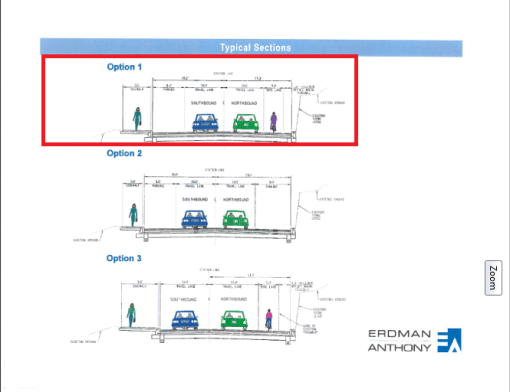
3. The city has decided which option it wants to pursue for its rework of University Avenue. Basically, say goodbye to the northbound parking aisle and say hello to a new bike lane. The southbound parking aisle will remain, along with a 7-foot wide sidewalk and 10-foot travel lanes.

4. It looks like plans for the next Press Bay Alley are moving forward. 110-112 West Green Street was sold to Urban Core LLC (John Guttridge / David Kuckuk) for $650,000 on the 19th, and a $581,250 construction loan from Tompkins Trust was filed the same day. Technically, some of the construction loan is actually for the purchase; according to the IURA breakdown, the renovation into micro-retail, office and two 500 SF apartments will only cost about $207,500, plus $40,000 for soft costs like architectural plans, engineering and legal expenses. As part of the $200,000 loan extended to Urban Core LLC by the IURA, the project needs to create at least 6 full-time jobs at full occupancy. On the Press Bay Alley Facebook page, the developers have announced plans for a spring opening, and issued a call for active-use tenants looking for anywhere from 300-2,000 SF.

5. Cincinnati-based Bloomfield Schon has arranged to sell the Cayuga Green complex, lofts, apartments and all. The developer would sell the buildings to Laureate House Ithaca Management LLC. Upon the intended purchase date of August 1st, Laureate House would pay the IURA loan balance ($733,130 at the moment with a $4,880 monthly payment) off in full. That would be about 21 years earlier than anticipated. Laureate House appears to be a start-up real estate firm backed by three wealthy Cornell alums; although the literature says they seek to launch 55+ communities for active seniors in college towns, there don’t appear to be changes in use or commercial/residential tenant mix planned with the purchase of Cayuga Green.

6. Been meaning to note this, but it appears 210 Linden Avenue is undergoing asbestos remediation, which means that the building is being prepped for deconstruction. It looks like Visum Development will be moving forward soon with their plans for a 9-unit, 36-bedroom student apartment building on the property. I did not seen any outward indication of similar work being performed on 118 College or 126 College Avenue at last check, though it’s been a couple weeks.

7. Here’s a look at the city of Ithaca’s Planning Board agenda for next week. Harold Square and 323 Taughannock will have their latest revisions checked for satisfaction of final approval (various paperwork submissions, and of samples of exterior materials to make sure they’re acceptable). 238 Linden Avenue, 232-236 Dryden Road and the DeWitt House old library redevelopment are up for final approval, and the McDonald’s and Finger Lakes ReUse’s supportive housing projects will be reviewed for determination of environmental significance, which basically means that potential impacts have been addressed and if necessary, properly mitigated.

There is also one semi-new project, which is 709-713 Court Street  – that would be the street address for Lakeview’s $20 million mixed-use affordable housing plan on Ithaca’s West End. From previous paperwork, it is known that it’s 5 floors with 50 units of affordable housing, 25 of which will be set aside for Lakeview clients with psychiatric disability. There will be 6,171 SF of commercial space on the first floor, and 17 parking spaces. PLAN Architectural Studios of Rochester will be the architect. Apart from a rough outline, there have been no renders shared of the project, so that’s the “semi-new” part.

AGENDA ITEM Approx. Start Time

  1. Agenda Review 6:00
  2. Privilege of the Floor 6:01
  3. Site Plan Review

A. Project: Mixed Use Apartments – Harold Square 6:10

Location: 123-129 E State/ MLK St (the Commons)

Applicant: L Enterprises LLC

Actions: Satisfaction of Conditions

Project Description: The Board approved project changes with conditions on May 23, 2017. The Applicant was asked submit revised materials to return to satisfy the conditions in June.

B. Project: Apartments (Short-Term Rental) 6:30

Location: 238 Linden Ave

Applicant: Trowbridge Wolf Michaels for DRY-LIN Inc.

Actions: Public Hearing Determination of Environmental Significance, Preliminary & Final Approval, Approval of Transportation Demand Management Plan

C. Project: McDonalds Rebuild 6:50

Location: 372 Elmira Road

Applicant: McDonalds USA LLC

Actions: Declaration of Lead Agency, Public Hearing, Determination of Environmental Significance, Recommendation to BZA

D. Project: Residential Mixed Use (DeWitt House) 7:00

Location: 310-314 N Cayuga Street

Applicant: Kimberly Michaels, Trowbridge Wolf Michaels for Frost Travis, Owner

Actions: Preliminary and Final Approval

E. Project: Apartments 7:20

Location: 323 Taughannock Blvd

Applicant: Noah Demarest for Rampart Real LLC

Actions: Satisfaction of Conditions

Project Description: The Board approved the project with conditions on May 23, 2017. The Applicant was asked to submit revised materials to return to satisfy the conditions in June.

F. Project: Finger Lakes ReUse Commercial Expansion and Supportive Apartments 7:40

Location: 214 Elmira Road

Applicant: Finger Lakes ReUse

Actions:  Public Hearing  Determination of Environmental Significance

G. Project: Apartments (60 Units) 8:00

Location: 232-236 Dryden Road

Applicant: Noah Demarest of Stream Collaborative for Visum Development Group

Actions: Determination of Environmental Significance, Preliminary and Final Approval, Approval of

Transportation Demand Management Plan

H. 709-713 Court Street – Housing – Sketch Plan 8:20

  1. Zoning Appeals 8:45
  1. Old/New Business
  2. Planning Board Comments on the Proposal to Rezone Areas of the Waterfront 8:50
  1. Reports
  2. Planning Board Chair (verbal)

9:10

  1. Director of Planning & Development (verbal)
  2. Board of Public Works Liaison (verbal)
  3. Approval of Minutes: May 23, 2017, April 25, 2017, and November 22, 2016 (time permitting) 9:30
  4. Adjournment 9:35