News Tidbits 3/10/18: Affordable Housing Week 2018

11 03 2018

For today, let’s take a look at the entrants competing for the city’s affordable housing funds.

The Ithaca Urban Renewal Agency will be holding public hearings on Thursday 3/22 and Thursday 3/29 s part of the process to determine who will receive money from the Housing and Urban Development (HUD) grants awarded to the city. The 28 applications, three more than last year, range from jobs training to community services to the development of affordable housing.

In aggregate, there is $2,042 million requested, and about $1.239 million available. For the sake of comparison, that’s a 60.6% funding vs. request ratio, slightly more than last year’s 58%, but less than the 83.2% ratio of 2016, and the 67% ratio in 2015. 2016’s ratio was high because of $273k in unspent money originally earmarked for the earlier INHS plan for 402 South Cayuga Street.

Roughly speaking:

Year    Request    Amount Available

2015 / $1.78m / $1.215m

2016 / $1.85m / $1.54m

2017 / $1.982m / $1.149m

2018 / $2.042m / $1.239m

Unfortunately, HUD funding is not going up – of that $1.239m, about $184k is carried over from 2017 – Finger Lakes ReUse decided to decline last year’s $50k award, as did 402 South Cayuga Street ($80k, Habitat for Humanity’s cancelled project) and Housing for School Success (~$34k). The other roughly $20k was unallocated funds. In truth, the award for 2018 is $1.055 million, while requested amounts continue to rise, and the head of HUD gets embroiled in scandal for, among several reasons, ethics issues involving HUD business dealings with his family, and trying to spend $31k on a dining set for his office.

Without discounting the value of the other applications, the focus here will be on the real estate development projects. A full rundown is provided by my Voice colleague Kelsey O’Connor here. For the record, writing about a project is neither an endorsement or opposition from this blog.
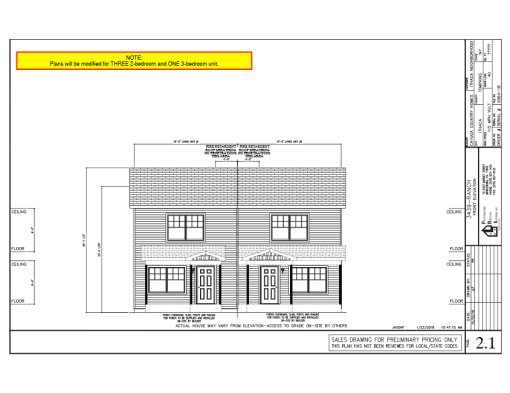
1. First, 402 South Cayuga Street. This site has had a rough history, unfortunately. It’s a small vacant lot just south of Downtown Ithaca that has had little good luck in the past several years. Five years ago, INHS originally attempted to build four units of for-sale housing on the property, but could not make it financially viable, as construction costs rose beyond what they could do within budget. Another developer proposed a market-rate plan, but the city, which owns the lot, has a strong preference for affordable for-sale housing. Habitat for Humanity also made an effort to build for-sale housing on the site, but it too saw construction costs rise beyond their capacity.

The grant application, $150,000 towards that $1.057 million project, would revive the INHS plan the planning board approved a few years ago. Two of the townhomes would sell to households making at or below 80% of Area Median Income (AMI, at or below $42,400/year for a single person), while the other two would sell to those making at or below 100% AMI (at or below $53,000/year), sometimes called “missing middle” housing. The funds would be used for construction and soft costs (legal paperwork, permit fees) on the two lower-priced units.

The reason why this is feasible now is that for one, the planning and design costs from 2013 have been paid off and the design is nearly the same, and two, the project will be modular instead of stick-built. INHS would partner with Cayuga Country Homes to build the four units. The units would be locked into the Community Housing Trust, and include features not in the previous plans, such as air-source heat pumps. However, the bay windows on the north and south walls have been removed from the new plans.

Breaking it down a little more, the construction cost would ring in at around $177/SF, about 10-15% less than stick-built. The three 2-bedroom units are 1190 SF and will cost about $210k to build, while the three-bedroom will be 1352 SF and cost about $239k to build (total about $870k, of which $830k is consumed by hard costs, materials and labor).

INHS will sell the 80% AMI two-bedroom at $121k, and the 80% AMI three-bedroom at $139k. The two 100% AMI units will sell at $159k. INHS will need to cover the remaining $291,000 with grants and subsidies just to break even. It is possible to build marginally cheaper, but insurers require INHS has to use contractors with at least $1 million in workplace liability coverage.

If funding were awarded later this spring, the units could be ready by April 2019. Although the construction method is different, the exterior changes are generally cosmetic – slightly different window arrangements, deleted bay windows, and porch details. It’s still at its essence four 2.5 story townhomes with ground-level rear garages and cantilevered rear decks. It is possible they could be signed off on at the staff level, but it’s more likely they would need to pay a quick visit to the planning board. The exterior changes could be reviewed and approved in one meeting.

2. The other INHS submission is titled “Scattered Site Phase 2: New Construction”. The request is for $100,000 to help cover soft costs (architectural and engineering fees) associated with the projects in the application. Calling them “scattered” is a little bit of a stretch – it’s two sites. One is 203-209 Elm Street on West Hill. That will have thirteen units, replacing twelve existing units, a count that includes 4-unit 203 Elm Street, currently vacant due to structural concerns. Six of the thirteen will be targeted to households at 50% AMI ($26,500/year for a single person), and the other seven at 60% AMI ($31,800/year). Ten of the units are one-bedrooms, and the remaining three are two-bedrooms.

The big question is the $16 million project planned for Downtown Ithaca. Although INHS cannot name the applicant, there were enough hints to figure it out with a fairly high degree of certainty. I can’t run conjecture on the Voice, but here, well, take the disclaimer that I could always be wrong. But consider the following:

From the notes in the application, we know it is:

  • In census tract one – mostly Downtown and the State Street Corridor.
  • The current site is a small commercial building.
  • It is in the CBD – Central Business District.
  • The site would host 20,000 square-feet of commercial space, and 40 housing units. The 30 one-bedroom and 10 two-bedroom units would be set aside for those making 30-60% AMI ($15,900-$31,800/year).
  • An unknown number of units would be set aside for formerly homeless individuals or those in need of supportive housing. The current owner would provide supportive services in the first-floor of the commercial space.
  • The partner in the project has provided services for over 150 years.
  • INHS would buy the land for $750,000.

The only site that checks off all the boxes is the Salvation Army property at 150 North Albany Street. It is currently valued at $800,000, following a $100,000 bump upward last year. A back of the envelope suggests a gross square footage of 55,000 SF, plus or minus a few percent. That would put the new build at roughly the same size as Breckenridge Place (55,300 SF).

Zoning at the site is a little odd – it’s a split, CBD-60 on the southern two-thirds, and more restrictive B-2d on the northern third. CBD allows up to 60 feet in height, 100% lot coverage no parking requirement. B-2d allows four floors, 40 feet in height, and has no parking requirement if a building is more than 60% residential use – which there’s a fairly high chance this project would exceed. I’m picturing something five or more likely six stories on State, and stepping down to four on West Seneca Street. But, there’s still a chance I could be wrong, and this may isn’t the right site.

An approximate construction time frame for the mystery project appears to be October 2019 through January 2021. A sketch plan revealing the mystery partner and site is expected to be shown to the city planning board in June. SWBR Architects of Rochester is in charge of design.
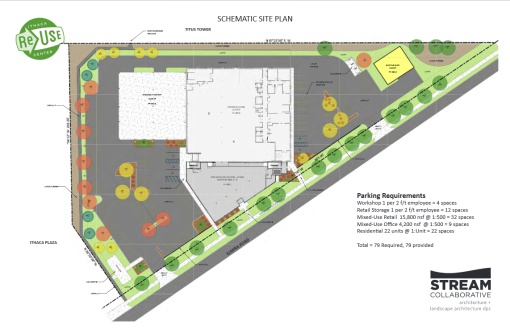
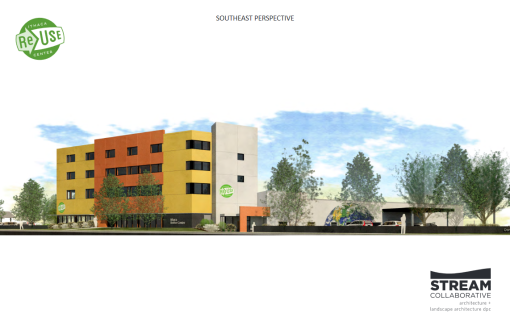
3. The last one I’ll cover is the Finger Lakes ReUse expansion. Let’s preface this by saying they don’t own the site – the former grocery store turned BOCES turned eco-services non-profit entered into a purchase agreement with John Novarr in February 2014 to purchase the building for $1.25 million (below the assessment of $1.35 million), which they will do exactly five years after the agreement was signed, in February 2019. The $100,000 requested would be assistance towards the purchase of the property, freeing up their money to work on their upcoming construction projects.

As is, the site is a 17,000 SF retail building, and a 1,330 SF former garage/repair shop. Plans have been proposed for major additions – 6,500 SF of retail, 65,000 SF of office space, and 12,000 SF of supportive housing, which consists of 22 studios for low-income individuals, with emphasis on formerly homeless and/or incarcerated individuals. Welliver, INHS and TCAction have provided guidance and assistance; Welliver may be the general contractor as construction proceeds, and TCAction may manage the housing units. STREAM Collaborative is the architect.

Point of confusion – the approved plans call for a 26,100 SF, 4-story building with mixed-use retail, office and living space components, and an 8,100 SF open-air metal warehouse for reclaimed wood processing and storage. That all totals 34,200 SF, not 83,500 SF. There’s 49,300 SF that is not clearly spoken for.

The warehouse is phase one, will cost about $500,000, and be ready by Q3 2018. It will generate at least three living-wage jobs (an estimate Finger Lakes ReUse says is conservative). Phase two is funding dependent on the affordable housing component, and will provide at least six new living-wage jobs. Although NYS HCR affordable housing grants don’t typically cover commercial space, they can be applied to mixed-use structures.

The total project cost is $10.521 million. $1.89 million of the costs are covered with a NYSERDA grants, and Empire State Development has also offered a $500,000 economic development grant. Add in other grants and awards received or being pursued, and it appears that only about $3 million will be covered through loans. IURA funding an extra $100k makes the project more competitive for other grants, since FLR will have demonstrated they have more secured funds, and a higher chance of moving forward. The idealized time frame calls for a late summer 2019 construction on Phase II with completion a year later, but sit back and see what happens with applications and awards first.



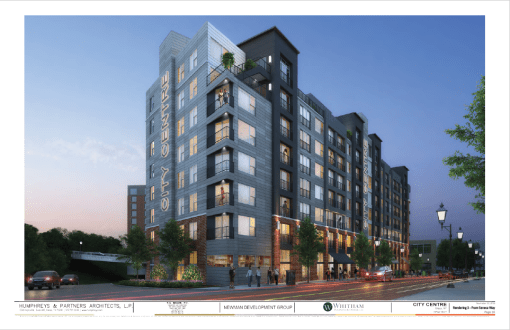
City Centre Construction Update, 2/2018

27 02 2018

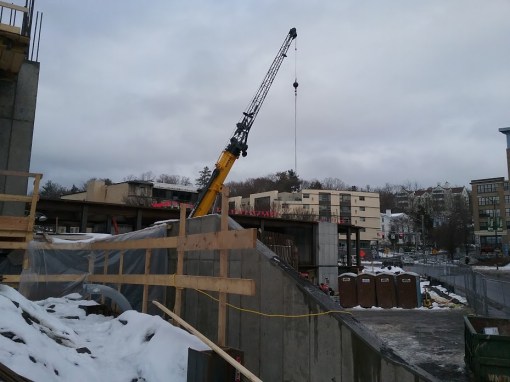
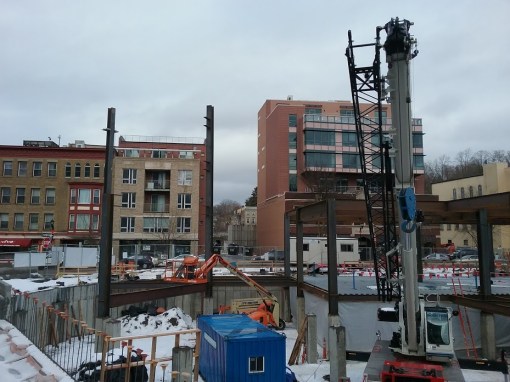
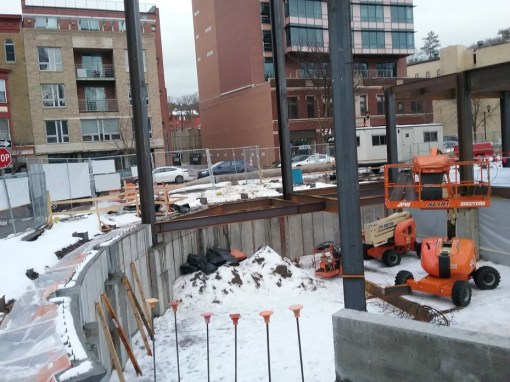
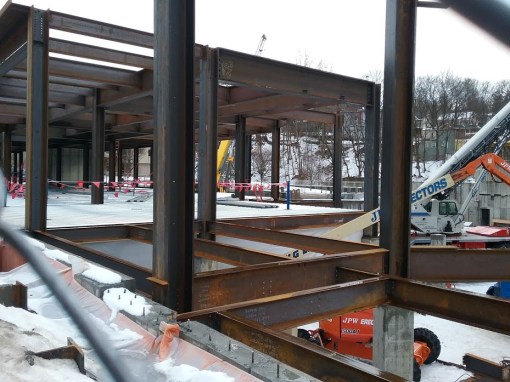
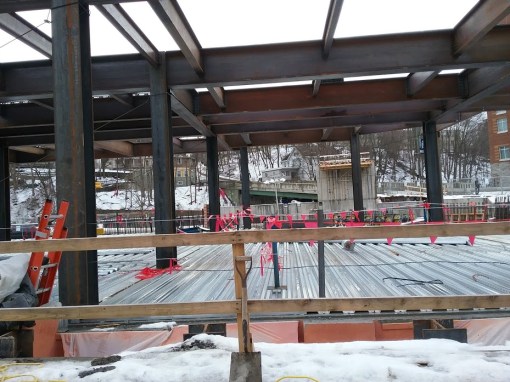
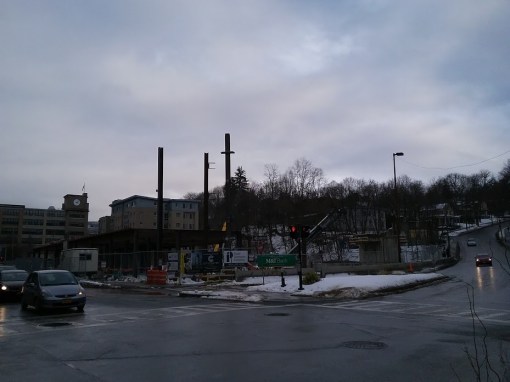
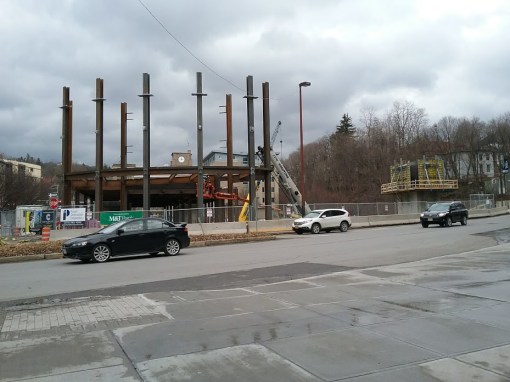
Looks like the real fun is just starting over at the City Centre construction site on the 300 Block of East State Street. With the piles in and foundation slab poured, work is starting to head skyward. The structural steel frame is being assembled, generally from east to west, beam by beam, and bolted into the concrete-encased structural support columns that will transfer the weight of the upper floors into the foundation and bedrock. Some of the exterior foundation walls are still being formed, but where it’s more further along, the steelwork has progressed far enough with its columns and cross beams that corrugated steel decking has been laid. Meanwhile, work continues on forming and pouring the concrete for the stairwell and elevator columns.

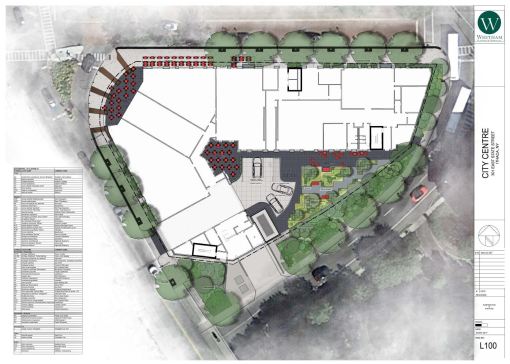
The entrance to the underground parking garage is pretty close to where the Green Street construction entrance is. The ground level will have a courtyard driveway accessed from South Aurora Street, but will not have a direct connection to the garage below (the armchair cynic suspects that will mess around with people for years to come).


Purcell Construction has a webcam set up, which shows the construction progress to date. Steel is rising rapidly on the curved northwest corner. It’s pretty fascinating to watch months of construction in 51 seconds.


One week later (2/18):

city_ctr_final_site_plan


News Tidbits 2/26/2018: One, Two, Many Tweaks

26 02 2018

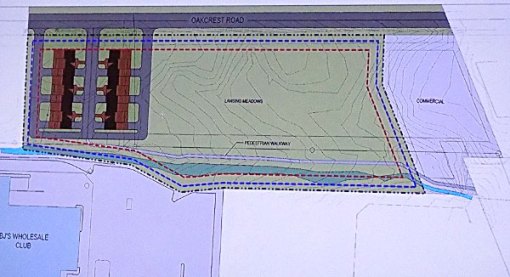
1. Let’s start off with some bad news. Than Lansing Star is reporting that developer Eric Goetzmann is in serious trouble. The village of Lansing Planning Board rejected his latest request for the Lansing Meadows senior housing component, which was to build twelve units on a fraction of the lot, and leave the rest vacant. Frankly, they liked the units, but the vacant and potentially saleable lot was too much for them to overlook. To be honest, they and the village Board of Trustees have been fairly accommodating to his other requests, but this seems to be the last straw, and they let him know it.

They will consider the latest revision, but only as a major revision, not as the minor change Goetzmann had hoped for. That means it will take months to go through the procedural review and vote. Meanwhile, the IDA has initiated legal action because Goetzmann failed to hold up his end of the deal they agreed to when he received his abatement back in 2011.

Some projects are successes. Some break even, some don’t turn out as well as hoped. But as Lansing Meadows goes, this is neigh close to a disaster.

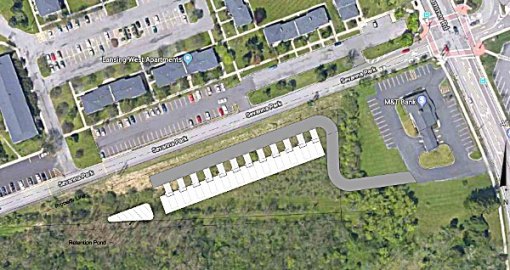
2. On a more positive note, Lansing will be considering, coincidentally, another 12-unit townhouse project. Called “Triphammer Row”, the market-rate units are planned for the vacant rear portion of a Cornell-owned parcel at 2248 North Triphammer. This blog reported on the parcel in a news roundup back in July 2016, when it went up for sale:

“Hitting the market this week is a potential opportunity for the deep-pocketed investor/developer. The property is 2248 North Triphammer Road in the village of Lansing. The sale consists of two parcels totaling 3.42 acres – a 1.53 acre parcel with a 2,728 SF M&T Bank branch built in 1992 and holding a long-term triple-net (NNN) lease; the other, an undeveloped 1.89 acre parcel to the rear that the listing notes could be developed out into 13 housing units. The price for the pair is $2,125,000.”

The plan calls for roughly 1,350 SF units with ground-floor garages. They’re intended to be marketed towards seniors looking to downsize, and young families. The developer is Robert Poprawski, who runs a small hotel group (Snooze Hotels) in metro Fort Lauderdale, Florida. Poprawski is a 2005 Cornell graduate, so there’s the likely local connection.

The planning board is supportive, but the big issue will be the driveway – they would prefer the townhomes share Sevanna Park’s driveway. That’s tricky because Sevanna Park’s road is privately owned. Not impossible to make a deal, and it would likely have the village’s benediction, but it’ll take a little while to see if a deal can be made between Sevanna Park’s HOA and Poprawski (all things considered, given that a much larger retail/office building and parking lot could be built on the combined lots, 12 more homeowners doesn’t sound like a bad option).

The village is also reporting there are development plans for the balance of the Millcroft property (the 32-acre remainder of the parcel, once intended for luxury single-family homes, has been for sale for a while), and vacant 4.56-acre 9 Dart Drive. The Ramada Inn (correction: the new extended-stay hotel proposed behind the Ramada) and Target are the only businesses interested in buying their properties from the mall’s owner, and Bon-Ton’s on deathwatch. The town’s code and planning officer notes that if it weren’t for Namdar Realty buying the mall, it would have failed, which would have forced the remaining tenants out and turned the mall into a vacant husk, to say nothing of the property tax implications.

3. Let’s shift over to Dryden. It’s been rumored for a little while that 1061 Dryden, aka the “Evergreen Townhouses”, would be trying to shift towards a smaller footprint – here’s the plan. The approved proposal calls for 36 3-bedroom units, six strings of six units. The reduced size plan still has six strings of six units, but the middle four have been reduced to two-bedroom units. The total occupancy goes from 108 to 84, and the footprints have shrunk as bit. Old render at top, new renders at middle, new site plan at bottom with new footprints in red. HOLT Architects’ design is generally the same, though I have an armchair critique with the rear flanks of the strings – a window opening would do a lot for aesthetics, if the floor plans permit.

(You can check the town’s website for docs, but some webpages have been hacked and replaced with a phishing scam, so use caution).

According to Dryden town planner Ray Burger, the developer, Lansing businessman Gary Sloan, would like to start construction this summer. That would put these units on track for an opening in time for the 2019-2020 academic year (in other words, about 12-14 month constriction timeline).

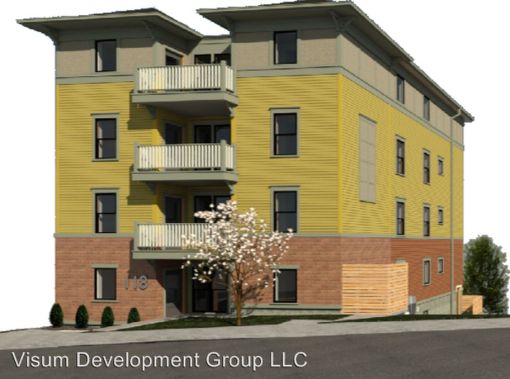
4. Another project moving forward – 118 College Avenue in Collegetown. This is a Visum proposal to replace a five-bedroom house with a 5-unit, 28-bedroom apartment building. The project was approved by the city early last year. According to the advertisements on Zillow, rents are expected to be $1,200/person, plus utilities.

I asked Visum’s Patrick Braga to confirm, and he replied that building permits would be approved “any day now”, so they’re probably looking at an August 2018 opening. With regards to a follow-up inquiry about its near-identical twin planned for 126 College Avenue, Braga replied they he does not “have any information on the status” for that project.

5. The new Greenstar West End store. Maybe coming soon. According to the news release, if the membership approves the move, the new store would be open at 750 Cascadilla Street by November 2019. The expansion would more than double their floor space, and add sixty living-wage jobs. Membership will vote on the plan next month.

The above render is courtesy of STREAM Collaborative – even without their logo, their software relies on the same pack of white Priuses, Volvos, and Touraegs to fill parking spaces (my family of mechanics would be proud I use vehicle models as a telltale attribute). The design is attractive for a big box – it has shed roofs and exposed wood trusses that give it a warmer, less industrial appearance. For the record, STREAM also did 118 College Avenue in the previous tidbit.

6. Honda of Ithaca has been sold to the Maguires for $3.5 million. The sale was recorded with the county clerk on the 20th. The acquisition means that Maguire represents just about every major vehicle make in the Ithaca area. It also drew some impassioned responses regarding customer service experiences, which given Maguire’s very visible presence, is not to be unexpected.

According to county records, the 27,558 SF dealership was built in 1985 as Cutting Motors Buick-Pontiac-GMC, and sold for $1.8 million in 2009. It was renovated and expanded in 2012; the portion closest to Elmira Road is the expansion space.

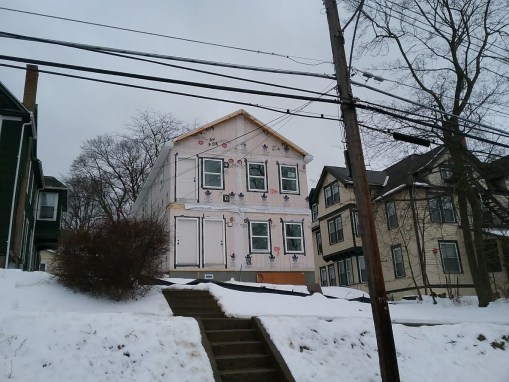
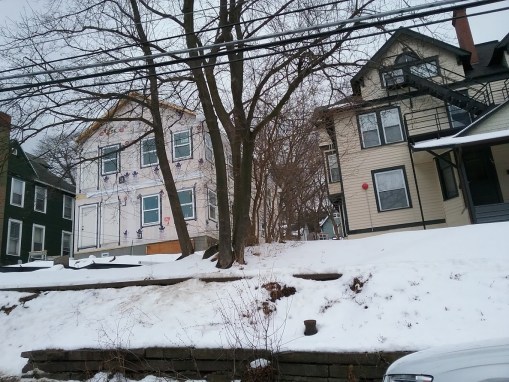
7. The Lambrou family’s latest project is coming along. Being built at 123 Eddy is a contextually-sensitive two-family home at 123 Eddy Street. While modular, the home was designed to have features respectful to its location in the East Hill Historic District – this includes a double-decker porch, roof brackets, shake siding and decorative columns and railings. The new three-bedroom units should be ready in time for the 2018-19 academic year.

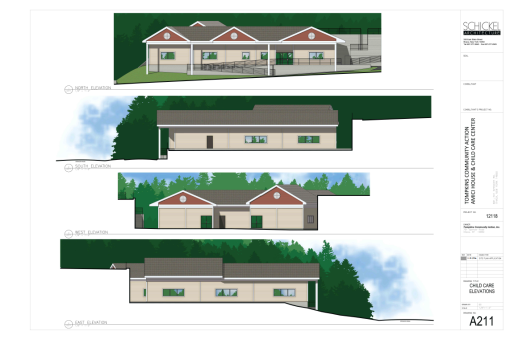
8. Quick note – building permits for both the Amici House residential and head start/daycare buildings have been filed and granted by the city. The Harriet Giannellis Childcare Center’s hard costs are estimated at $1,267,479, while the 23-unit residential portion’s hard costs are estimated at $3,627,333. Welliver will be the general contractor.

9. Looks like a pretty quite planning board agenda for this month. A pair of new projects, but they’re small ones. Let’s have a look:

I. Agenda Review 6:00

II. Privilege of the Floor 6:05

III.A. Stewart Park Inclusive Playground 6:15

B. College Townhouses – Modified Site Plan approval 6:35

C. Proposed U-Haul Self-Storage Project – Sketch Plan 7:10

Although vague, this is like for the former Salvation Army property at 339 Elmira Road. U-Haul purchased the lot in January 2016 from the development group that planned and cancelled a hotel for the property. As noted on the Voice recently, there’s been a building boom in self-storage facilities lately.

The most plausible guess for this corporate-owned property is that this will likely take after the chain’s default design for self-storage facilities, with maybe some modest aesthetic differences. Not especially pretty, but the city would probably prefer that over a parking lot for U-Haul trucks.

D. Proposed duplex and parking – 207 and 209 First Street 7:30

207 and 209 are a pair of run-down rental two-family homes in Ithaca’s Northside. After the previous owner passed away, they were sold to local businessman David Barken in June 2017. Barken previously caused a stir in Fall Creek when he bought, renovated and sold a Utica Street home for a much higher price (he said on the list-serve it wasn’t intended to be a flip, it was intended for a family member who decided to live elsewhere). Barken purchased the home for $160,000 in September 2016, and it sold for $399,500 in June 2017. He also rents out a couple other units in Fall Creek.

EDIT 3/8: Rather than a tear-down and replacement, the scope of the project appears to be that the homes would be renovated, and a new duplex would be built towards the rear of the lots. Per email after the meeting from David Barken:

“While in its beginning phases and still taking shape, I have no intention to tear down the existing homes. Instead, I plan to steadily improve these properties, working on both the exteriors and interiors as the planning phases for any future project moves forward.

Rather than de-densification, my aim is to add more fair market rate, non-student housing to the downtown market and add to urban density in our city’s core. I am designing the site for a total of 6 apartments, with an emphasis toward communal interaction, landscaping, and urban gardening. I envision a pocket community for renters, complete with the 4 renovated units in the front of the lot and an additional duplex placed in the rear of the parcel.”

IV. Old/New Business 8:00

A. Chainworks FGEIS

B. Planning Board Report Regarding the Proposed Local Historic Landmark Designation of 311 College Avenue – The Number Nine Fire Station

6. Reports 8:20

7. Approval of Minutes (1/23 and 1/30) 8:40

8. Adjournment


Harold’s Square Construction Update, 2/2018

22 02 2018

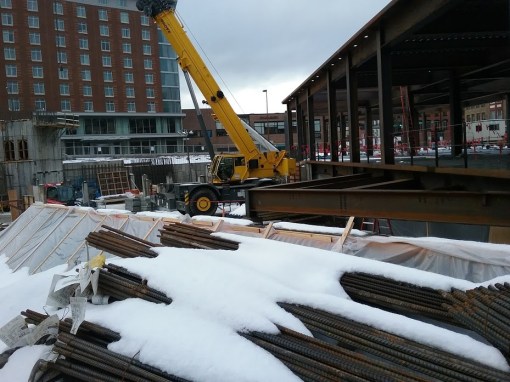
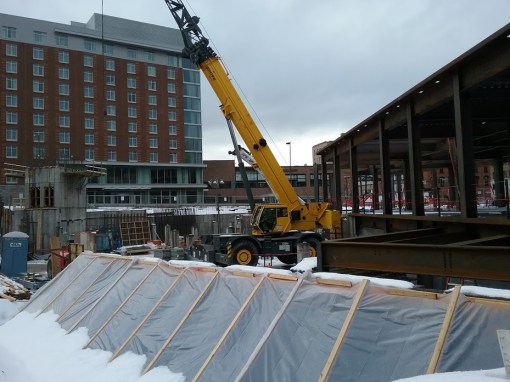
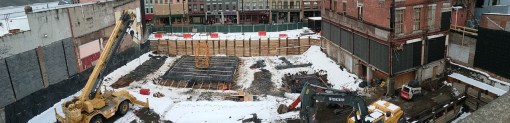
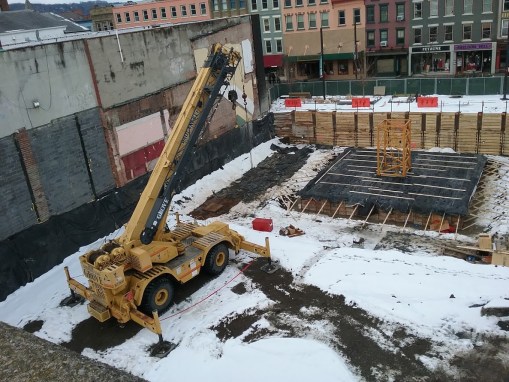
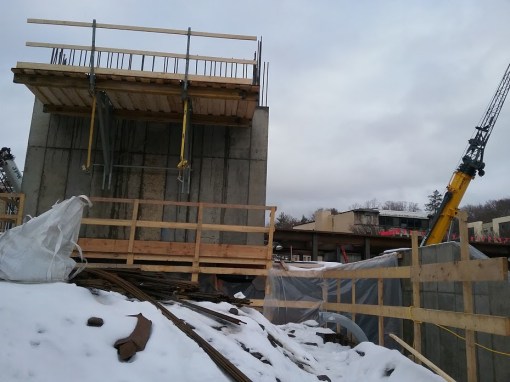
Not all cranes come on wheels. Many larger cranes are assembled and disassembled on site. A concrete crane pad is formed and poured to provide a base for the crane, with the pieces assembled upward from the base. That’s what you can see in the photos below. The size can vary depending on the size of the crane required, whether it’s free-standing or tied-in, whether there are rock anchors that can be used, and the soil upon which it and the pad will rest. Here, the crane pad will rest on a thick, firm mud layer beneath, and the concrete will be reinforced with a tied-in (meaning the grid bars are tied together) steel rebar grid. According to the Harold’s Square website, the crane pad itself will rest on a 4’6″ deep concrete, 38′ x 38′. Keep in mind, there will actually be two cranes on-site. The one mounted here will be the heavy-duty 300-ton crane, but they construction team will use a mobile 55-ton crane as well. The elevator pits are also being boxed and formed.
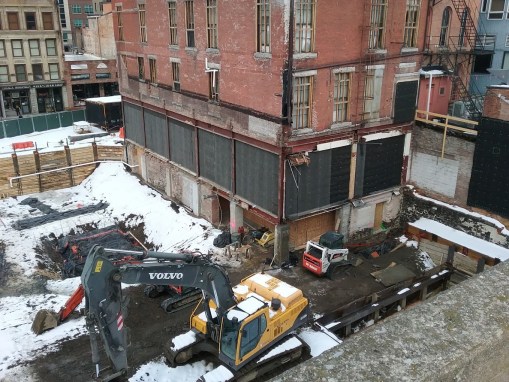
All the piles have been driven in at this point, and the sides of the site have been shored up as necessary with lagging and steel H-beams. The low-rise Commons-facing portion of the building will utilize an 18″ rebar-reinforced mat slab foundation, while the tower portion will have a 30″ rebar-reinforced mat slab. These pours should happen by mid-March. The structure will be anchored into the foundation, which will evenly distribute the weight and support the floors above. After the foundation is in, the only way to go is up.


107 South Albany Street Construction Update, 2/2018

20 02 2018

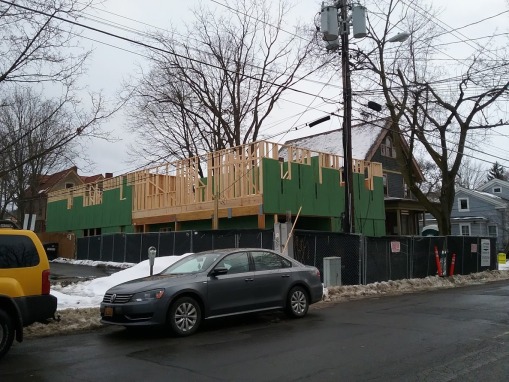
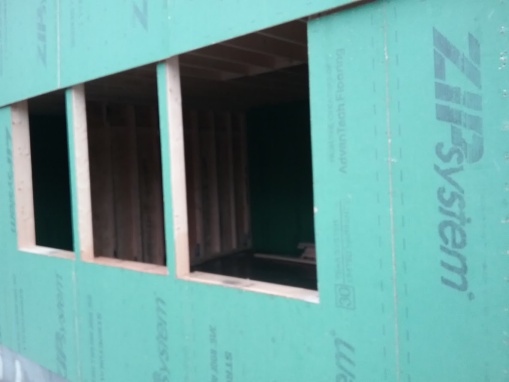
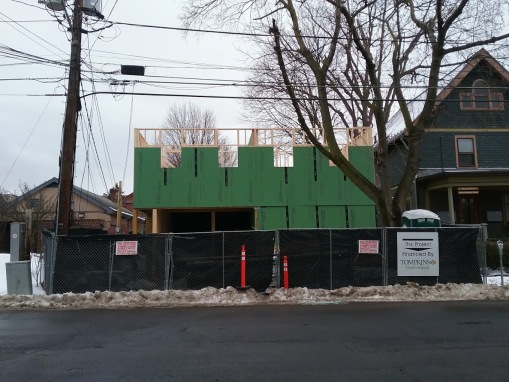
The wood frame for the eleven-unit 107 South Albany Street project is now up to the second floor. ZIP panel sheathing has started to be attached and interior stud walls have been erected. It does not appear utilities rough-ins have started on the ground floor yet.

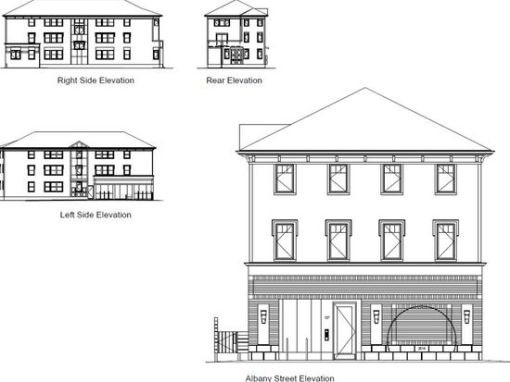
The project recently underwent a last-second but substantial design change. It doesn’t affect the interior square footage (something that would have sent it back to the Planning Board), but the aesthetic have changed up quite a bit.  The tall mid-building stair column and flat roof with cornice have been ditched in favor of a less prominent stairwell with a small gable, and a large hipped roof. The fenestration and ground floor details remain largely the same. Before and after renders are at the bottom of this post.

Marketing for the eleven one-bedroom units has started, with units starting at $1,395/month – pricey, but not Collegetown pricey. The advertisement for a “luxury unit” reads as such:

“Brand new luxury 1 bedroom apartment in Ithaca’s newest development available August 1, 2018. One block from the Ithaca Commons and a bus stop with multiple routes at your door.

The Unit:
– Is beautifully furnished
– Boasts high end finishes throughout including: custom cabinetry, quartz counter-tops, stainless appliances and a beautiful tiled bath.
– Has laundry in building
– Includes indoor bike storage
– Water, high speed internet, common area maintenance and snow removal included in this professionally managed 11-unit building

The exterior, with cornice and orthodox windows are additional architecturally designed items that add to the beauty of the building. No detail has been overlooked. A must see as downtown Ithaca continues to grow. Photos are from other recent projects and are for illustrative purposes. They represent the types of finishes you will find within apartment.”

It’s a bit of a risk, since the real estate waters are generally untested west of Ithaca’s downtown, although a couple other small projects are planned along the State Street Corridor. Long-time residents also worry about gentrification encroaching on the edge of the Southside neighborhood. However, city planners are pushing development westward from the downtown core, and the possibility of a government center on the Central Fire Station site a block away means that there may soon be a large employer practically at its doorstep. The Facebook ads are pitched with an eye to students, but that seems a stretch; even with the buses, this is a bit too far out for many Cornell or Ithaca College kids to consider, and it’s double the per bedroom price of shared South Hill, Fall Creek or outer Collegetown units.

The developers, the Stavropoulos family, don’t seem especially inclined towards any one neighborhood. Previous projects include a pair of duplexes in Fall Creek, a new home on Linn Street, and home additions on South Hill. The Stavropoulos family’s next project after this would potentially be the duplex pair at 209 Hudson Street on South Hill, if approvals are granted. Arguably, South Hill is a safer bet financially thanks to Ithaca College, though becoming less amenable due to the concerns from permanent residents regarding quality-of-life manners, which has led to a new zoning overlay to rein in infill in that neighborhood.


News Tidbits 1/27/18: The Shutterbug

28 01 2018

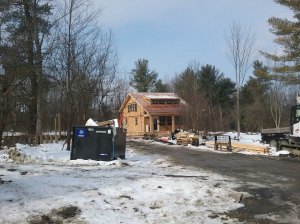
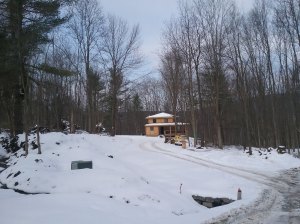
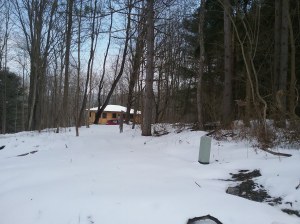
1. Let’s do some houses of the week. Above, the four new homes Tiny Timber has constructed at 1624 Ellis Hollow Road in Dryden. Each home lot is a little over an acre. The subdivision was approved last spring for the wooded parcel a couple miles east of Ithaca, and since then, Tiny Timbers has been busy selling units and lots to buyers. Two were sold in August, one in September, and the last in December. Therefore, this is 100% built out, since the last lot is a conservation lot at the rear (north) end of the property, designed to protect Cascadilla Creek. The units utilize a shared driveway, with spurs for each home. If you want to look at the homes more closely, click to enlarge the photos.

A similar plan is underway just up the road at 1540 Ellis Hollow Road, where Tiny Timbers will take a long, narrow undeveloped property and subdivide the land into five home lots and a rear (north) lot protected by a conservation easement. These homes will also be served by a common driveway. This proposal is still going through the review process, and when approved, the time frame for build-out will probably be similar. The home designs are the work of local architecture firm STREAM Collaborative.

2. Over in the village of Lansing, work has started on the next six-unit (hexplex?) at the Heights of Lansing property off of Bomax Drive. It appears that the foundation slab and footers have been formed, poured and insulated with foam boards. This is the first new townhouse string to be built in the development in six years.

Several reasons have been given for the long pause. The developers have said that the natural gas moratorium disrupted and delayed build-out plans. Secondly, the patriarch of Forest City Realty/IJ Construction, Ivar Jonson, passed away in 2014. More recently, the Jonson family (his wife Janet and daughter Lisa Bonniwell) were embroiled in a lawsuit to prevent a zoning change that would allow a market-rate apartment complex to be built down the road. Bonniwell was incensed enough to run for mayor in 2017 in an effort to stop the proposal, but did not win the election. The zoning change has been approved and the apartments were approved in October, but the Park Grove project has yet to move forward.

The townhouses were approved along with the last single-family home permit; there were some rather testy exchanges regarding sewer line easements and the installation of street lighting in conjunction with those permits. The lighting has to be in by March 2019.

Assuming these are like the other townhouses, expect them to be 3-bedroom units, low 2000s SF with garages, and to go for $350-$450k when they’re finished several months from now.

3. Dryden’s new Rite Aid is coming along. Fully framed, and the plastic in the window openings is likely intended to allow construction crews to work indoors without exposure to the fierce winter elements. The curbing and paving is complete in the parking lot, and it looks like they install metal bollards all around the lot’s perimeter to keep the less-than-attentive from driving into the wall (something that happened to the Nice N’ Easy in my hometown no less than three times before they finally put some in). It is still planned to open in March.

4. Over in Fall Creek, it appears a small apartment building is in line for some major renovations. 1002 North Aurora, a four-unit building built in 1898, had been on the market for $395,000. The seller had owned the property for 24 years, and the price was only slightly above the assessed value of $375,000.

On Friday, the property sold for $400,000 to an LLC associated with local developer Modern Living Rentals (Charlie O’Connor et al.). The same day, a building loan agreement was filed from Tioga State Bank to the LLC for $712,000. A lot of that was going towards the land acquisition, and once soft costs are deducted as well, the loan is $287,000.

MLR tends to be very transparent about their plans, and a glance at their recently updated website shows the purchase and a ‘information on this project coming soon’. However, they already uploaded the interior renovation plans from STREAM Collaborative. It’s a very thorough interior renovation, and it appears to complete change interior floor plans, with new bedrooms (net gain of one?) as well as new kitchens, bathrooms, and fire rated ceilings. Exterior changes appear to include a renovated fire escape staircase, a couple new windows on the third (top) floor), and a new skylight. While old, this apartment building is a hodge-podge of additions from decades past, so let’s see what a renovation can do to clean things up. It’s plausible the renovations would be complete by August, so they can appeal to students as well as the general market.

Quick aside, MLR has a few other “future developments” posted, though none that readers here aren’t already aware of – the 42 townhouse units at 802 Dryden, the proposed 201 North Aurora / Seneca Flats that isn’t moving forward for a while yet, and 217 Columbia, the duplex that unintentionally set South Hill into an uproar. 217 Columbia should be completed this year, and 802 Dryden in summer 2019.

5. It looks like Amici House is finally moving forward. The project, located at 661-701 Spencer Road, received a $3,732,469 loan from the New York State Homeless Housing and Assistance Corporation. The money was announced back in April, and appears to be getting disbursed now.

The five-story, 20,710 SF (square-foot) project, approved by the city of Ithaca last January, calls for 23 studio housing units for homeless or vulnerable young individuals in the 18-25 age range. Along with the units and office/function space for local social services non-profit TCAction, the plan also calls for a 7,010 SF early heard start facility, called the “Harriet Gianellis Childcare Center”, that will house five classrooms, kitchen and restrooms, and an outdoor play area. The childcare facility will serve 48 low-to-moderate income families and create up to 21 jobs.

Recently, the HGCC applied for a low-interest loan from the IURA, $90,690 to help cover unanticipated moving expenses associated with the project. TCAction thought they could stay on-site during construction, but the contractor said otherwise, so they’ll be 609 W. Clinton while the new Amici House is built. The loan says it will generate three jobs, but that’s more a technical stipulation than an actual figure associated with the project. The funding for the childcare appears to be separate, $1,325,000 already approved by the state, $603,000 from M&T Bank, and $84,200 from a standing IURA loan. It is fully funded, although it is not completely clear if it will be built concurrently with the housing (the likely answer is yes).


Village Solars Construction Update, 1/2018

24 01 2018

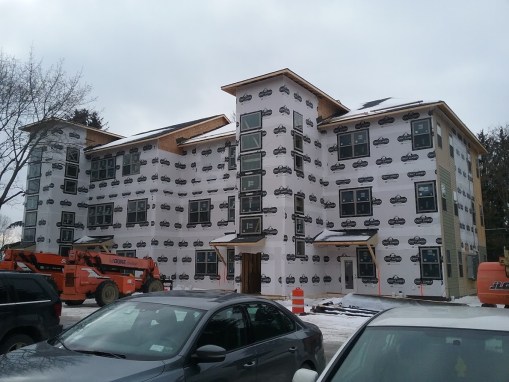
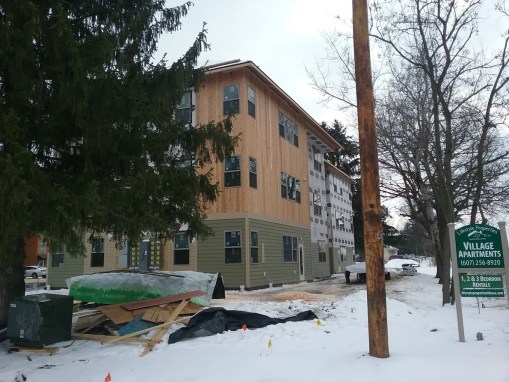
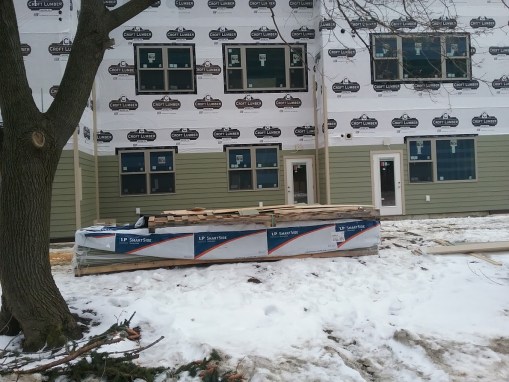
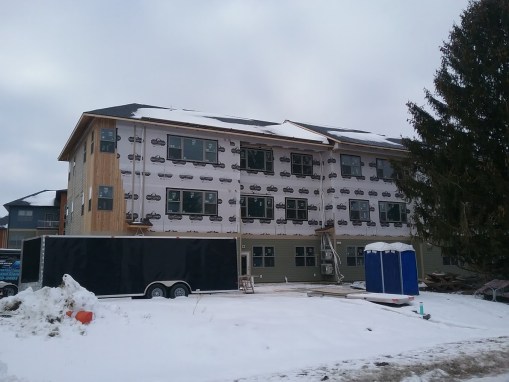
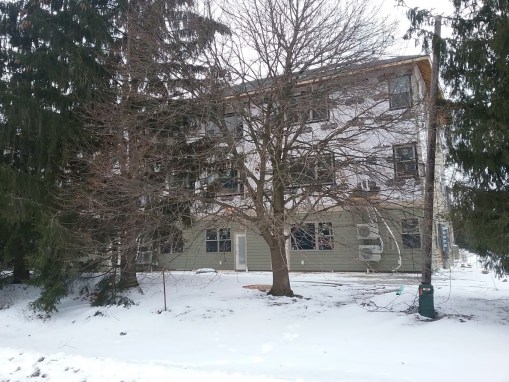
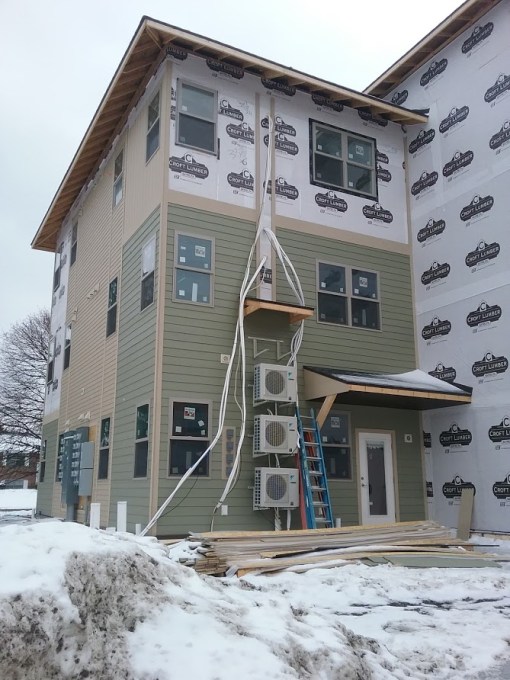
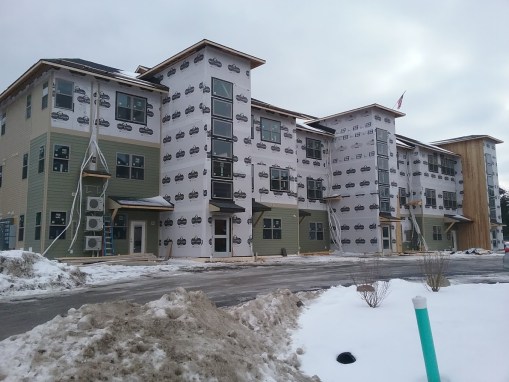
Work continues at the Village Solars apartment project in Lansing, though it’s mostly been interior construction these past couple months. 102 Village Place has had some of its composite wood siding applied (LP SmartSide treated and engineered wood siding), and the electrical wiring and air-source heat pump units are in place, though not fully connected just yet.

102 VP was already framed, roofed and fitted by the November visit, so chances are, they’ve already done utilities rough-ins and insulation, and they’ve moved on to drywall, baseboards and interior trim boards, priming and painting, and maybe some plumbing fixture and cabinetry installs. The three-story apartment building, which replaces a ten-unit 1970s structure, will have 24 units – 12 studios, three 1-bedroom, six 2-bedroom, and three 3-bedroom. If one wants to look at this from a population perspective, each of the ten units was a 1-bedroom, so the back of the envelope says there will be a net gain of 26 residents (one per bedroom, 36 – 10). And presumably, a couple million dollars in assessed value.

116 Village Place, the younger of the pair, is not as far along but has been fully framed, wrapped and shingled since November, and some siding has been attached. It looks like not all the windows have been fitted, given the wrapped rough opening on the third floor in the first photo below. Based off the open door in that same photo, it looks like framing, insulation and utilities rough-ins (plumbing, electrical, HVAC) are ongoing. 116 is the smaller building of the two, with 18 units, 12 studios and six 2-bedrooms. Like 102, it also replaces an older apartment building, an eight-unit structure of one-bedroom units (and 14 more residents on-site, using the same math as before).

Lifestyle Properties is the developer, with their in-house contractor in charge of construction. It doesn’t look like the new units are being marketed yet, but existing 2-bedrooms are going for $1,325/month, and 3-bedrooms for $1,375-$1,720/month. Anecdotally, Lifestyle has had an easier time filling the smaller units than the larger 3-bedroom units.


News Tidbits 1/21/18: Twice in One Weekend

21 01 2018

1. It appears that 107 South Albany Street has had its exterior design heavily altered, even as the building is just starting framing. The old design’s flat roof and unusual stair column feature have been toned down to a pitched (gable) roof of about the same height and dimensions. According to ads on Zillow, the 1-bedroom units, which will be ready for occupancy by August 1st, will go for about $1,395/month. For the price comes a fully furnished unit with indoor bike storage, high-end appliances, tiled bath, custom cabinets and high-speed internet. Water and snow removal are included in rent, electric is not. Fairly certain Daniel Hirtler is still the architect for Stavros Stavropoulo’s latest residential project.

To be frank, I don’t know how much an exterior design can change without having to go back to the planning board – offhand, I think they can do pretty much whatever changes they like, so long as they don’t violate zoning laws or change the habitable square footage.

2. Ithaca architecture firm HOLT Architects totally revamped their website. Among the snazzy new updates was a video.

Now, there are an embarrassing number of HOLT projects I can think off the top of my head, but while watching the 1’22” film, there was one project I did not recognize at all. Above, we see two 4 or 5 story residential buildings along a waterfront – the perspective renders behind the gentlemen’s shoulder are likely all part of the same design set, and the white vehicles in the concept site plan are parked boats. It also appears TWMLA is involved as the landscape architect.

Blowing up the image gives the name “Lembeck Landing”. At first, I thought it said Lambrou Landing, and had reached out to see if it was part of City Harbor; the response was that this appears to be another project. I tried to analyze the streets, it doesn’t look like an Ithaca map, and one street may be named “Porter”. Probably not Ithaca, but someone’s getting some nice waterfront housing. Watch the video for brief shots showing the inside of CFCU’s new HQ and some selected material finishes.

Update: It’s Watkins Glen. An undeveloped parcel near its Porter Street. Thanks to Keith Eisenman for solving the mystery.

3. Let’s just touch on the waterfront real quick. City Harbor is going to be a very substantial project. The first sketch plan involved two large apartment buildings and medical space for Guthrie Clinic; Guthrie would lease its recently purchased warehouse at 770 Cascadilla Street to Greenstar for a bigger, grander co-op; and a third location that will be presented at this month’s planning board meeting. The apartment buildings will be 4 or 5 floors and had ground-level parking with large amounts of surface parking for Guthrie, something that planning board was not a fan of. The other Cascadilla industrial building, 750 Cascadilla, may come down for more parking.

On the one hand, underground parking is out of the question due to the high water table, and above ground parking structures have to contend with soil issues as well, likely leading to deep foundations and increased costs. But an asphalt sea on the city’s shores is not something that will get the board’s approval.

Still, we are potentially talking hundreds of units, as well as a substantial amount of commercial space (and perhaps jobs) with the Guthrie component and the Greenstar expansion. It may very well be that this and the Green Street Garage plan will be the big development stories for the year.

4. Cornell will not the idea of that glass “hat” die; they’re calling it a “suggestion of a future roof pavilion”. The city’s ILPC probably isn’t comfortable with that suggestion being so close to the historically-designated Arts Quad. Anyway, renovations are underway on Rand Hall into the Mui Ho Fine Arts Library. The $21.6 million project, about half of which is funded by donations, will be ready for students and staff in August 2019.

5. It sounds like the city has had just about enough with the state’s aerial apparatus fire code changes that halted much of Collegetown’s approved development projects. They’re prepared to take steps to eliminate parking on Linden because the new state law says Linden is too narrow as-is to have construction taller than 30 feet. This seems to be in addition to the power line issue. For 210 Linden, whose developer (Visum Dev. Group) specifically applied for some kind of relief, it would just be in front of the building; Todd Fox had already started work when the building codes department were notified and started enforcing the new code, which is not a good scenario.

Ithaca would prefer the state grant a broad variance (the new code has apparently been an issue across the state), and normally removing parking wouldn’t “fix” the underlying problem, but since New York State did not notify municipalities they were changing the law, they’re attempting to compromise on something that they normally would not. It might also explain why activity in Collegetown has been quiet these past few months outside of the inner core, where the streets are wider and the power lines are underground. The city is looking into how to make development work with the fire code if the state refuses to budge on code modifications. To be fair, there is tens of millions in development and its associated tax revenue that the city was expecting and that the state, in the midst of a budget crisis, is (literally?) hosing them on.

Whatever the city decided at its BPW meeting last week, it seems to have made Visum happy. They’ve started marketing 210 Linden’s units again. It’s saying there are 10 4-bedroom units, and 1 1-bedroom unit, while my notes say 9 4-bedroom units. Maybe the basement was reconfigured? Not sure.

Update: According to a Visum Rep, 210 Linden is 9 4-bedroom units and has added a basement 1-bedroom unit. So now it’s 10 units, 37 bedrooms.


6. Around the county, not a whole lot else on municipal agendas at the moment; one of the reasons for no update last week. Dryden town’s planning board will be looking at plans for a new warehouse next to 51 Hall Road, as well as a 5-lot subdivision at 1540 Ellis Hollow Road for Tiny Timbers, the Dryden-based modular home builder. Tiny Timbers uses the warehouse at 51 Hall Road, so it wouldn’t be a shock if the new one is purpose-built for Tiny Timber’s growing business. The town of Ithaca planning board cancelled their last meeting.

The city is fairly quiet. The planning board agenda for next week is short and mostly contains smaller submissions – the pair of infill duplexes proposed at 209 Hudson are on the agenda, with some slight design tweaks (the eyebrow windows are an interesting touch on the rear building). To the developer’s (Stavros Stavropoulo’s) credit, the units are design to accommodate families rather than students – the giveaway are the separate dining room areas, vs the eat-in kitchens one typically sees with student rentals. Senior planner Lisa Nicholas also gave written kudos for the quality exterior material choices (Hardie Board fiber cement panels, aesthetic wood timbering, stone retaining walls).

A fly in the ointment, per reader email: none of the bedrooms are legal for 2-person occupancy. They are 115 SF each; the state fire code says double occupancy must be at least 120 SF. So that would be an issue if one considers couples’ bedrooms.

The board is expected to declare itself lead agency, host a public hearing, and begin review of the SEQR forms needed before a negative declaration for adverse impacts can be declared. The 4-bedroom addition for Sophia House (111 the Knoll, Cornell Heights) is up for final approval. The proposed playground at Stewart Park is also up for discussion, with the board once again expected to declare itself lead agency, host a public hearing, and begin review of the SEQR forms.BPW is not comfortable accepted the $1.7 million playgrounds, gardens and splash pad unless Friends of Stewart Park creates a $75,000 annual maintenance fund. Lastly, City Harbor will be up for a second round sketch plan, informal discussion to obtain feedback for any future formal submission to consider.

The Nines project (311 College Avenue) is not on the board’s agenda this month. Things are up in the air, as the ILPC has chosen to pursue historic designation, even as there is an active project submission. A little awkward, certainly.

On the 30th, the Planning Board will convene for a special meeting to finalize the form-based code for the Planned Unit Development to be deployed for the Chain Works District.

According to notes from the city Planning Dept, the city approved $130 million in development in 2017. There were 29 projects with 568 housing units, 107 of which are designated affordable for lower & middle income (LMI) households. Also approved was 28,600 SF of new retail & office space. These were from a summary sheet from the planning department, and the detailed write-up will come next month.

7. On a closing note, preliminary estimates suggests that Tompkins County added an average of 1300 jobs over the 2017 calendar year, bringing the average annual job count to 65,300. The gain is just over 2.0%, comfortably above the national average of about 1.5%, but nothing that screams ‘boomtown’. Since 2007, the annual average has increased by 7,700 jobs, +13.8%. The numbers suggest that the gains are slightly better in the fall and spring (7500 – 7700 jobs) than for the summer and winter (7000 jobs), indicating that academic year seasonal jobs are growing slightly faster than the overall market.


News Tidbits 1/6/18: Extra Ketchup/Catch-Up

6 01 2018

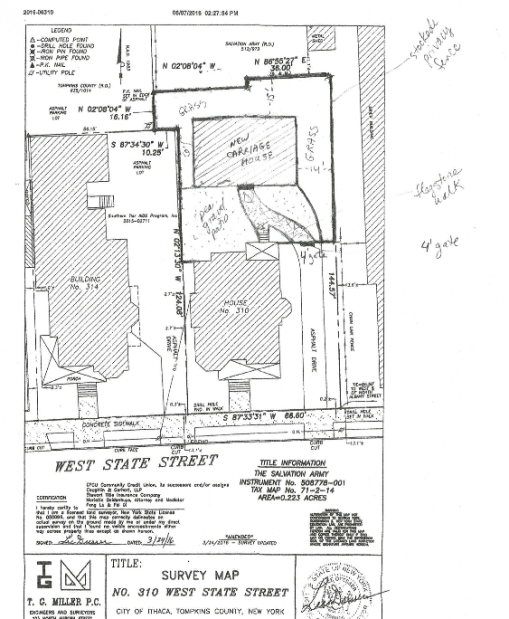
1. It looks like plans for a new historically-inspired group housing facility are moving along. The Ithaca Landmarks Preservation Commission (ILPC) will review the plans for a new “converted barn” at 310 West State Street at their meeting next week. The project is still in the “Early Design Review” stage, meaning it has a few meetings yet ahead of it.

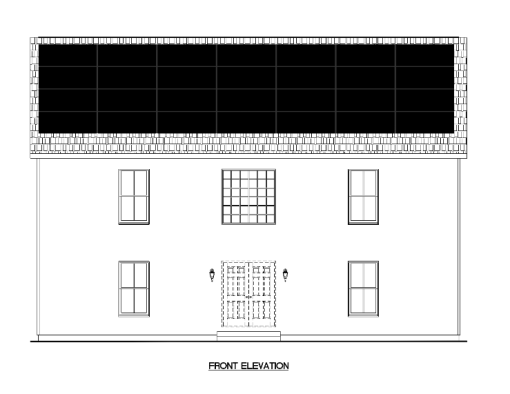
The developers, David Halpert and Teresa Halpert Deschanes, plan to restore the existing ca. 1880 house, and build the second house as a matter of historic correctness and financial feasibility (the money generated by the new carriage house/barn helps to pay for the expensive renovations needed to the existing home, which is in a poor condition due to previous ownership). The new build’s design won’t be as architecturally unique as they one that was condemned and torn down several years ago, but will reuse a couple of design elements. The previous had an irregular shape, brick finish and mansard roof; the replacement will have a rectangular footprint with Hardie Board (fiber cement) siding and a gable roof, similar to barns from the late 1800s time period it is taking its cues from. The project also comes with new landscaping, fencing and 36 solar panels on the new build’s roof.

The plan is that each house will be its own co-op; a unique attribute for this area. I can imagine some Voice commenters would deride it as an “adult dorm”, but there is a niche market for these adult co-ops as seen with companies like WeLive in New York and San Francisco. The Ithaca Urban Renewal Agency (IURA), which is helping the project paply for state grants, has separately noted that the ILPC has already given indications that the plans would likely be accepted.

2. As part of the RFP for the Green Street Garage development, a few developers took part in a tour of the property conducted by the IURA. According to Josh Brokaw at Truthsayers, Visum Development, Ithaca Neighborhood Housing Services (INHS), Purcell Construction of Watertown/Virginia and Missouri-based Vecino Group were on the tour. Visum has previously commented on site interest, but complained that the RFP parameters were of insufficient length to put an application together – the RFP was modified later in December from 60 to 90 days, short of the six months Visum suggested. INHS may have been there on Rimland/Peak’s behalf, as they’ve been in talk to manage the affordable housing component of that project. Purcell Construction is the firm building City Centre on behalf of Newman Development Group, and Vecino Group (Spanish for “neighbor”, by the way) is a national developer with interests in affordable, supportive and student housing.

It’ll be spring before we find out who submitted what, but it looks like there will likely be a few contenders with Rimland/Peak, even if they have a clear advantage.

3. According to a press release sent to the Times (dunno if anyone at the Voice received it), New Roots Charter School is planning to expand its service by adding 6th, 7th and 8th grade classes to its grades 9-12 program. The move would lead to the enrollment of another sixty students into the school.

It is not clear whether the school plans to stay in the Clinton House downtown or move to another location in the city; should they move, there is a potential opportunity a few blocks away at the former Immaculate Conception School, if the Catholic diocese is willing to entertain the idea.

4. Marketing has officially launches for Tiny Timbers’ Varna project, “The Cottages at Fall Creek Crossing”. The layout of the houses is the same from the initial rendering, but the selected models changed quite a bit. That means something here because, like the Belle Sherman Cottages, this is a case where you buy the lot and house and Tiny Timbers builds that specific house, it’s not a “bring your own plan” setup. The website appears to be down for maintenance at the moment (linking anyway), but realtor Brent Katzmann via Zillow is showing homes ranging from an 812 SF 2 bd/1 ba for $192,900, to a 2,175 SF 3 bd/2 ba for $272,900. The prices are in a sweet spot right in the middle of Tompkins County’s housing market, and lower than most new builds thanks to the pre-fabricated approach Tiny Timbers utilizes. All the home designs were penned up by STREAM Collaborative.

5. Probably worth a quick mention for those who like trying new restaurants – Bol is open at the former Titus Gallery at 222 East State Street on the Commons. Created by the same guys behind Simeon’s, the 1,200 SF restaurant recently opened and is serving up ramens, salads, curries and broths. As you can guess, the theme is bowl-based dishes. Yelp reviews appear to be mixed, but don’t let stop you from giving it a try.

6. In Mayor Myrick’s state of the city speech, a couple of things to watch for in the coming months – movement on a public facilities master plan, and Waterfront development. I and Mike Smith covered this somewhat at the Voice, as has Nick Reynolds at the Times, but the potential to move and consolidate police, fire and city hall could very substantially reshape Downtown Ithaca, as could consolidation of water/sewer and streets in Southwest Ithaca.

Meanwhile, the West End and Waterfront are seen as the potential major development opportunities even with their physical and environmental obstacles, if simply because the number of choice parcels in Downtown and Collegetown is running low, and most other neighborhoods would put up enormous resistance with concerns of quality-of-life impacts. Waterfront development would involve a push to relocate the DEC and DOT facilities, something that the county is also keen on. Residents can also expect some movement on the Green Street Garage redevelopment, while the city does a parking study to determine how much parking is needed with future growth. This is all happening in a good economic but challenging political environment, so 2018 should be an interesting year. Of course, the phrase “may you live in interesting times” is often a damning one.

https://platform.twitter.com/widgets.js

7. Click the link above for a video of Cornell/EdR’s Maplewood advertising itself. The most interesting thing to my eyes is the apparent redesign of the community center, from an edgier modern design to a more traditional style with a gable roof. It looks like it will contain a lounge, exercise room, and perhaps small group meeting rooms (though that might actually just be apartment building study space). The EIS likely does not require any re-review since it looks to be mostly aesthetic changes, with little to any change to program space.

8. Someone’s lovin’ it – the new McDonald’s is open at 372 Elmira Road. Pardon me while I move that one into the “complete” column on the project map. I had in my notes that the store was renovated in 1972, and 14850.com has a photo of the truly original McDonald’s that stood on the site in the 1960s – check out those golden arches.

9. Eye candy for the week – here is the first published render for the Tompkins Center for History and Culture, aka the Heritage Center. As part of the state’s Regional Economic Development Council awards, the project received $1.365 million in grant funds – one, a $1.06 million arts and culture grant, the other a $305,000 economic development grant (the project is intended as a tourism generator and tourist information center). The plan is to have the $1.8 million project open in early 2019.

10. West End Heights (709 West Court Street) is now more likely to move forward this year thanks to $250,000 in Community Housing Development Fund grants from the county and city of Ithaca. The county is giving $100,000, and the city $150,000. The project will bring 60 units of affordable housing, with 30 units reserved for vulnerable individuals getting mental health support, and six for formerly homeless individuals who may have HIV/AIDS. The goal is to start construction this year, with a late 2019 or early 2020 completion.

At its January meeting, the city of Ithaca Common Council also awarded $100,000 to Amici House for its expansion and 23 units of housing for formerly homeless or vulnerable young adults.


Harold’s Square Construction Update, 12/2017

31 12 2017

Grab a cup of coffee or tea for this one, it’s a long introduction.

Touching on a familiar topic again, downtown and urban living has enjoyed a revived interest in the past fifteen years, and coincident with moderate but steady economic growth in Ithaca, it has created plenty of opportunities for those with assets and expertise. Succeeding in those opportunities is a slightly different story – money and a strong project team are important, but some projects have an easier go of it than others. Harold’s Square has experienced substantial obstacles in its long pre-construction period, but thanks to developer David Lubin’s flexibility and tenacity, as well as an accommodating local government and growing market, it has surmounted those challenges and is now underway.

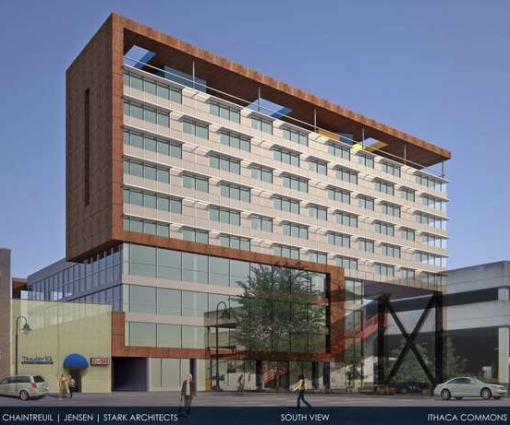
The first version of Harold Square at 123-139 The Commons was proposed back in October 2012. At the time, the plans called for first-floor retail, a few floors of office space, and 60-70 apartments on the upper floors of the 11-story building. The Sage Block (Benchwarmers) and W.H. Miller Building (Home Dairy) would be renovated, while three less historic buildings would be taken down to make way for the new development. The estimated price was $30 million and the plan was to have the 126,000 SF building finished by summer 2014. At that time, the building would have needed a fairly substantial zoning variance – the entire site was CBD-60, and it reached about 135 feet.

With the exception of the first-floor retail and Sage Block renovation, none of the other details have remained the same. However, the five major design iterations have all been by the same architect – CJS Architects (formerly Chaintreuil | Jensen | Stark Architects), with offices in Rochester and (later) Buffalo.

Lubin already had some familiarity with the project site – one of the storefronts to be removed used to be home to Harold’s Army Navy Store, a business started by his father and expanded to sixteen locations across the region. These stores were closed in the late 1990s as Lubin chose to focus on his development project and other business endeavors, like his computer recycling business. Harold’s Square is a nod to his father’s store, and the famed Herald Square of New York City.

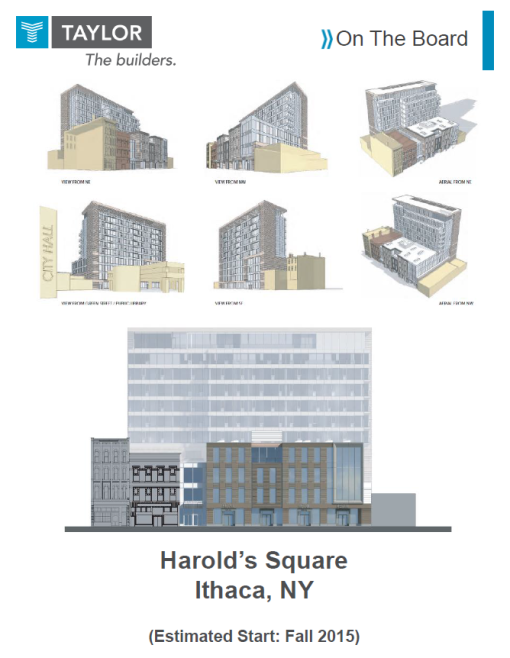
The project design was critiqued and reviewed thoroughly over the next ten months, which also produced the first major set of design changes – in fact, if you’re googling Harold’s Square without prior knowledge, images of this version, v02, turn up enough that even many current agencies and organizations (and even the posters on the construction fence) treat it as the final design. The 2015 image from the contractor’s website, Taylor the Builders, is shown above. It did away with some of the less-liked design features of v01, but retained a clean, contemporary profile with a curtain wall of glass, and terracotta panels that extended to the roof canopy. During this period, plans to acquire the W.H. Miller Building were dropped.

This was the version that was approved in August 2013, and received CIITAP tax abatements two months later in October 2013. It had 162,750 SF, with basement utilities/storage, ground-floor retail (20,670 SF), three floors of office space (56,855 SF) and 46 apartments on floors 5-10. The eleventh floor was a 5,000 SF penthouse for tenant use. The price tag was about $38 million.

At this point, post IDA approval, we kinda enter a publicly dormant period. Publicly, apart from the occasional reassurance from Lubin that the project was still alive, and the re-application for approval permits since those expire after two years, there didn’t appear to be much going on. Behind the scenes, it gets a little more interesting.

The project was having trouble securing a construction loan, and that was for a couple of reasons. For one, Lubin (as L Enterprises LLC) was having trouble securing a major office tenant, and office space made up about a third of the building. No one had any concerns about the apartments since the residential market was (and still is) strong, and retail is not hard to sell when it’s on The Commons, but office space is a different matter altogether. The demand for new space is modest, and often custom built for a tenant, rather than speculative space to be filled by tenants after it’s complete. So if we’re being fair but critical, the project team made a fair gamble but ended up overestimating the market for office space. Unless that space was spoken for, there would be no financing.

Re-examining the mix of uses, Lubin decided to revamp the project when seeking re-approvals in August 2015 – two floors of office space would be replaced with apartments. The first mention of this actually came through the New York Times, followed by the Voice and the Ithaca Times. With the drop in office space, the number of apartments jumped to 86. This also required some design changes, which were going to be reviewed by the city in Fall 2015. My notes show August 2016 ended up being the review date. We’ll call this version 3, v03.

Now Harold’s Square was 180,090 SF, with basement utility/storage space, ground-floor retail, second floor office space, and ten floors of apartments. The project had grown from 11 to 12 floors, but the height was nearly the same since residential floors have lower floor-to-ceiling heights than Class A office space. The total unit count was now 108, with 40 micro units (all the rage these days), 30 1-bedroom units, and 38 2-bedroom units. This version was approved in September 2016. By the time the project was up for re-approval, the city zoning had changed such that 140-foot buildings were allowed on-site, so no further height variance was needed.

With the space utilization issue worked out, the project was still seen as a sizable risk to potential lenders – it was at its inception the largest project proposed in downtown Ithaca since 2005’s Seneca Place, and Lubin had some experience with smaller projects, but nothing this size. Finding a partner to buy in to the plan would reduce the loan needed and add experience, making the project an easier sell to lenders. This is where McGuire Development, a major interest in the Buffalo market (3.5 million SF), came into play. They saw the potential in Lubin’s vision and the value in the Ithaca market, and agreed to buy in as a development partner. This appears to have been finalized in January 2017.

Fast forward to May 2017. With McGuire playing a role on the project team, major design iteration #4 (v04) removed the terracotta panels in favor of metal, and reconfigured the Commons storefront retail to use a common entrance, for “financial viability”. The enclosed atrium was removed and a mechanical penthouse added. It seems likely that McGuire wanted to ensure a certain return on investment. This version was approved without much further comment, except perhaps a bit of exasperation from city officials. Concurrently, the project team re-applied to the IDA for a revised tax abatement – the project’s price tag was now up to $42 million, and they were seeking revised, slightly more generous terms, which were granted with some grumbling. Complaints include a lack of explicitly affordable housing units, local labor concerns, and gentrification. The use of heat pumps and 60 kW of rooftop solar panels assuaged the sustainability crowd.

By October, the project was underway, courtesy of a construction loan from Norwich-based NBT Bank. The bank is a regional player with about 1.5x the assets of Tompkins Trust. This is new territory for NBT, which typically limits itself to single-family home loans in Tompkins, and has no service branches within county lines. The loan is for $33,842,000. L Enterprises and McGuire have each put up $5 million to cover the $43,842,000 cost of the project.

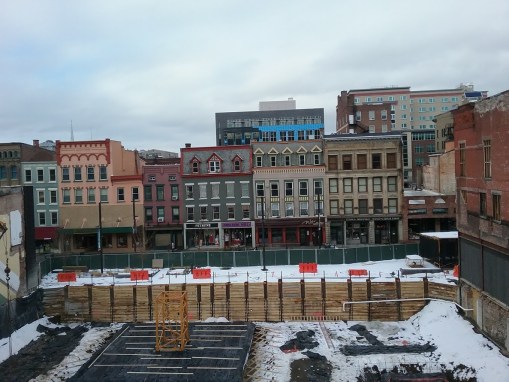
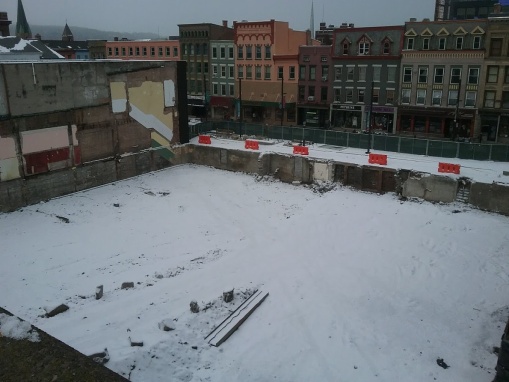
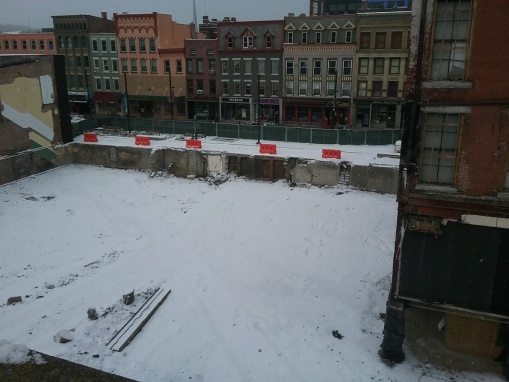
So here we are. The site has been cleared, and shoring and excavation by Paolangeli Contractor will take place over the next six weeks. After that comes ten days of pile driving, using a zero-resonance hammer to reduce vibration and noise – ostensibly, because is probably the second-most high-profile project site in the city after City Centre (which used the same method). Project completion is expected in Spring 2019. Sorry folks, but the Commons playground will remained cocooned and closed due to safety concerns.

The project team includes L Enterprises LLC (led by David Lubin) as lead developer, McGuire Development as co-developer, Taylor the Builders as the general contractor, CJS Architects, Fagan Engineers and Land Surveyors handling the application and civil/structural engineering work, and Brous Consulting for public relations. Those who want to follow the project without this blog as an intermediary can sign up for update on the project webpage here.

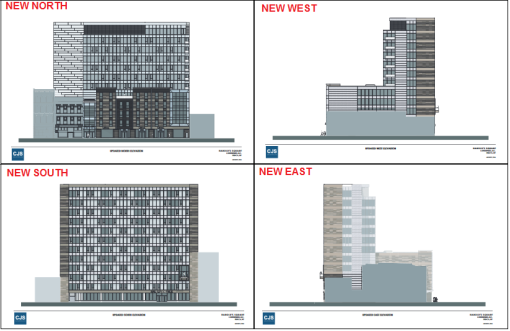
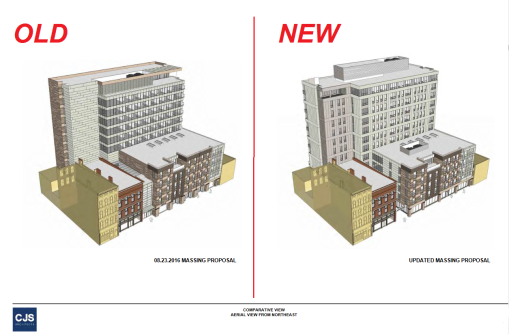
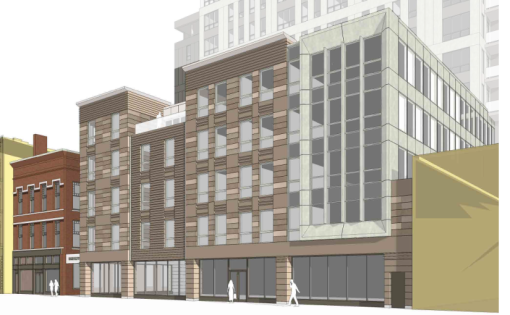
With the latest update on their webpage also comes the latest version of the project design, v05 – which doesn’t really affect the program space, but it does have several visual changes. The corner units now have exposed balconies vs enclosed rooms, the dark metal band on the top floor facing the Commons has been removed, and the retail frontage was reconfigured a bit on the Commons facade (the north module was stretched, one of the entry doors moved, and different fenestration patterns have been applied to some of the modules and the northwest face).

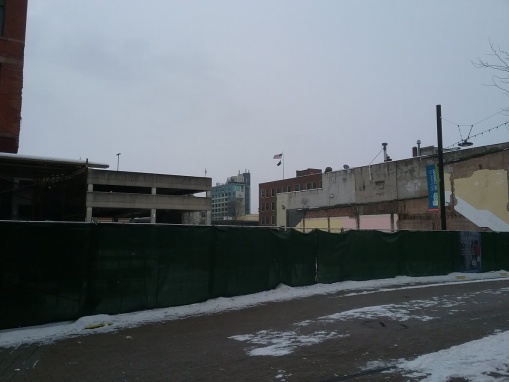
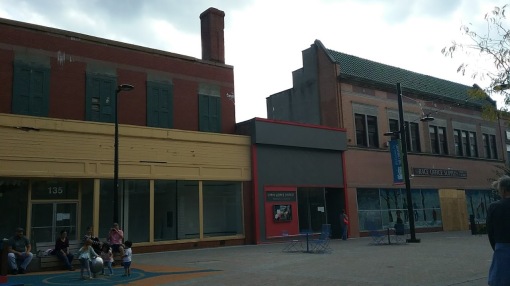
Pre-demo photo: