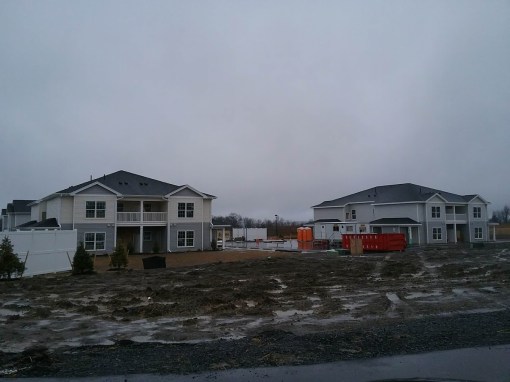
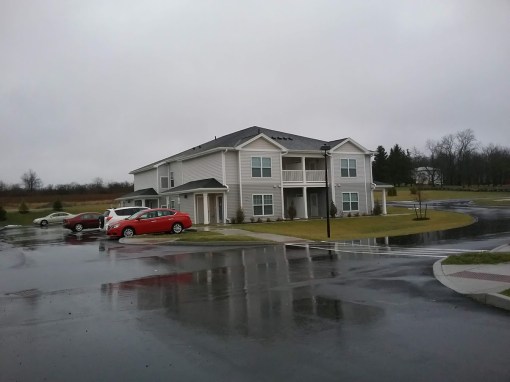
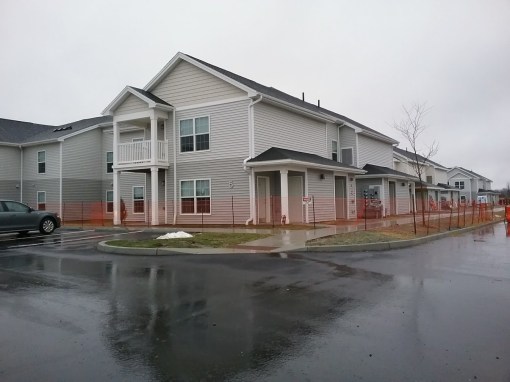
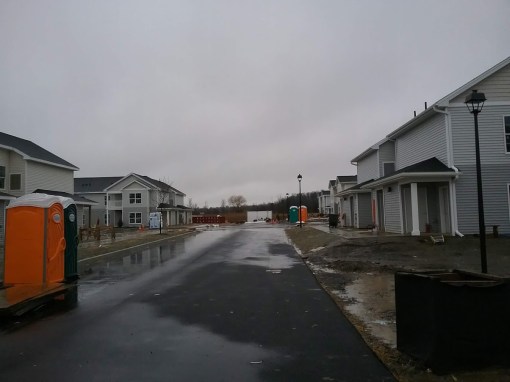
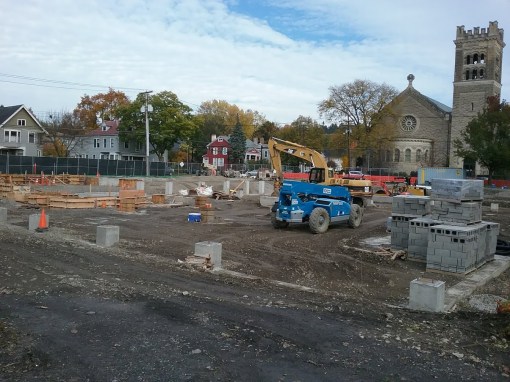
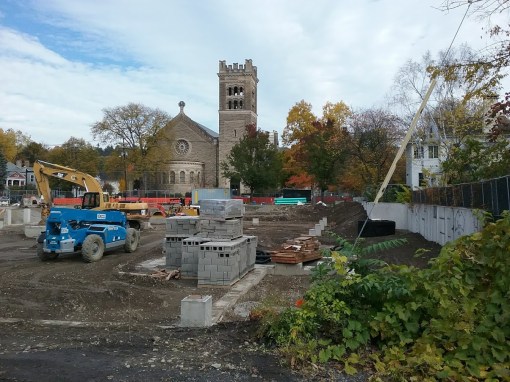
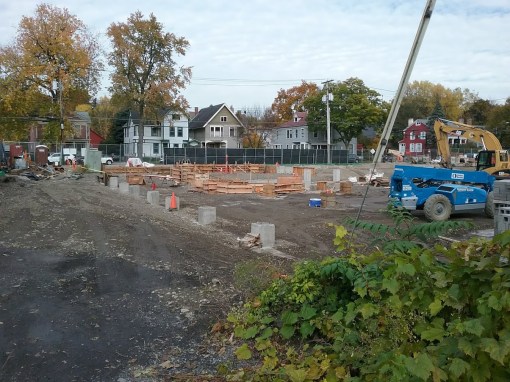
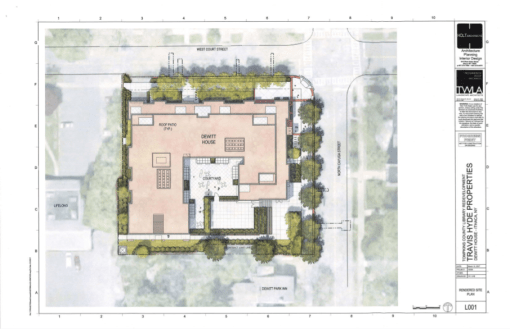
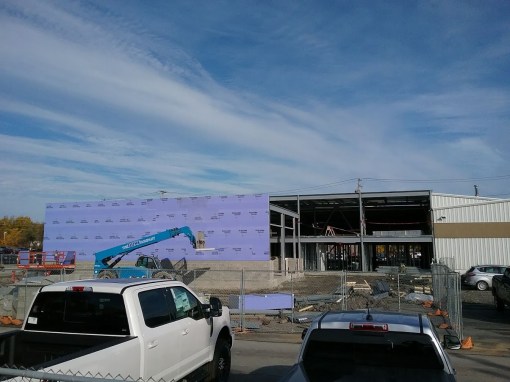
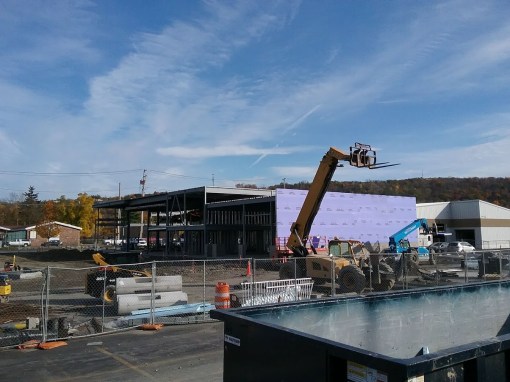
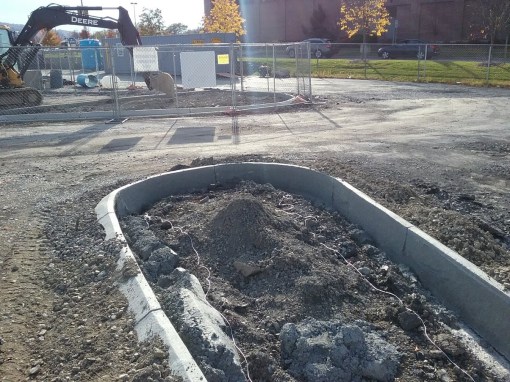
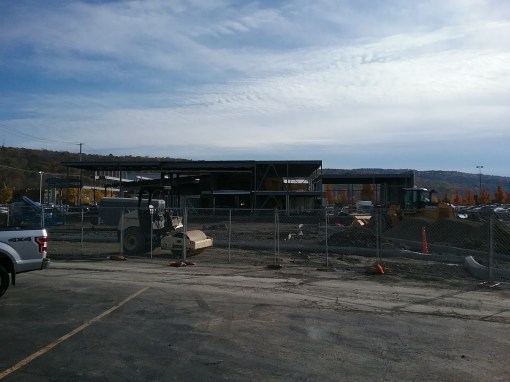
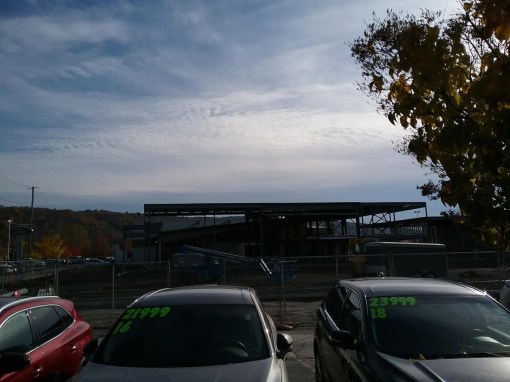
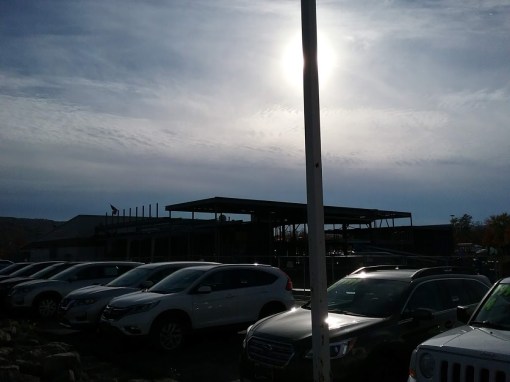
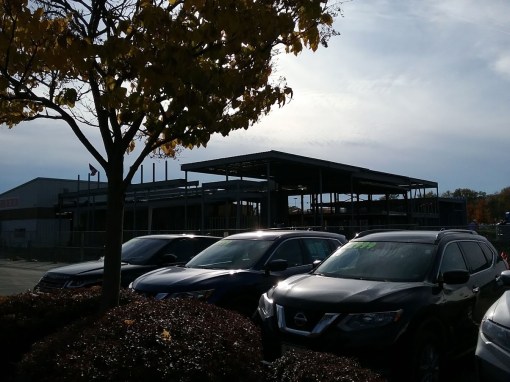
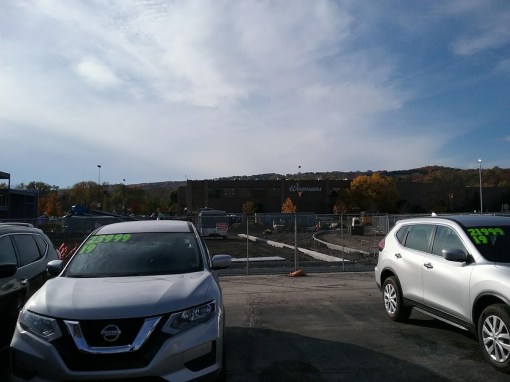
3105 North Triphammer Construction Update, 12/2019

28 12 2019

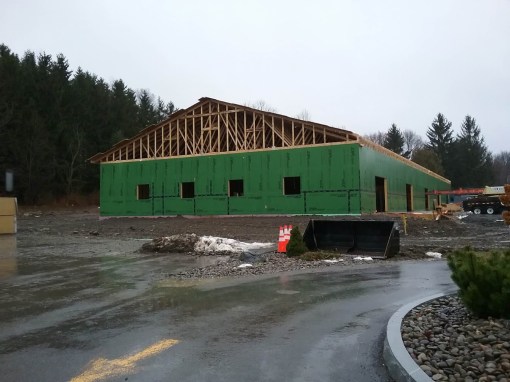
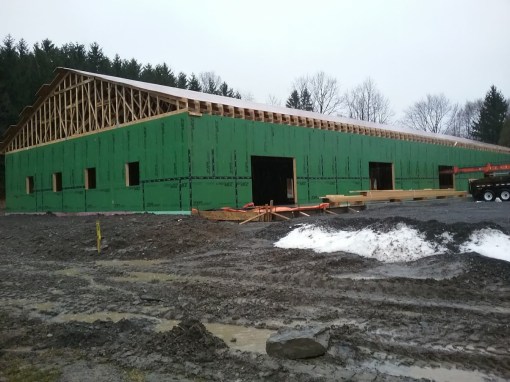
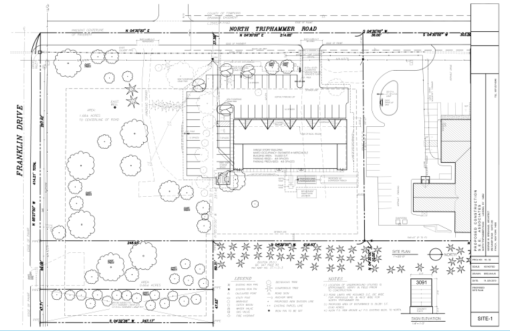
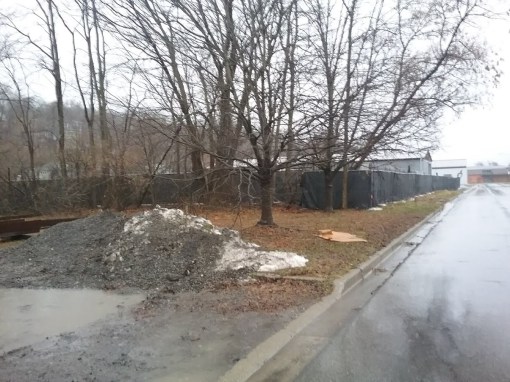
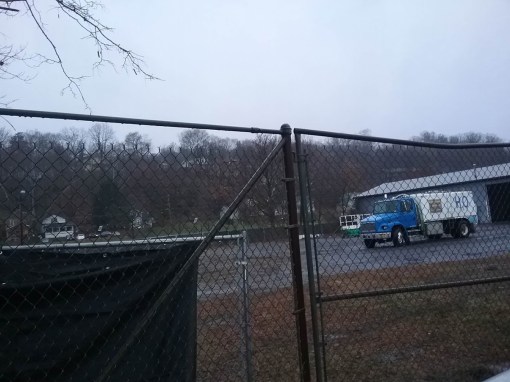
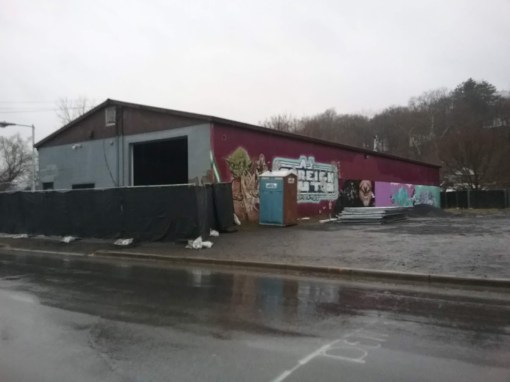
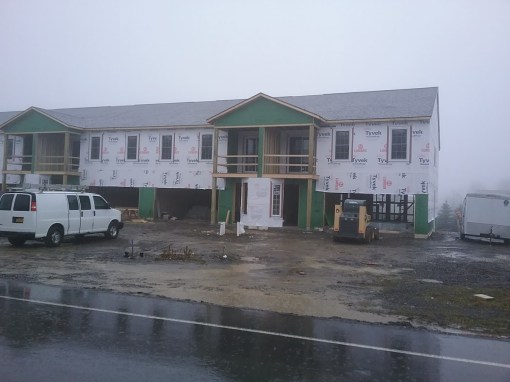
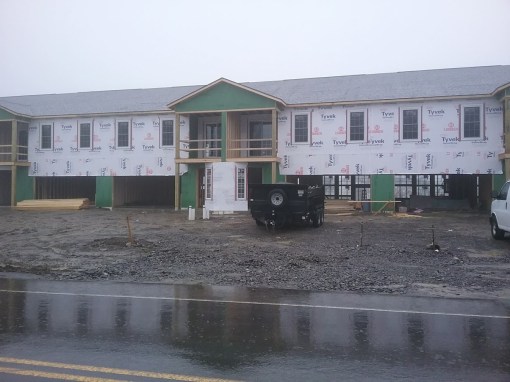
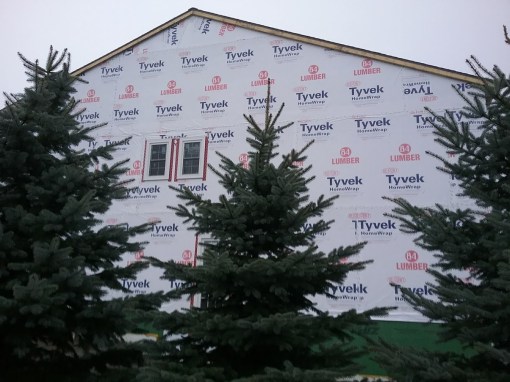
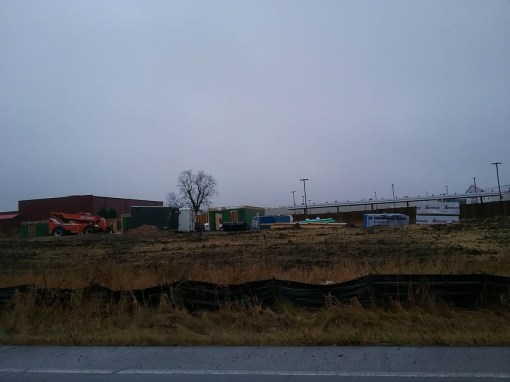
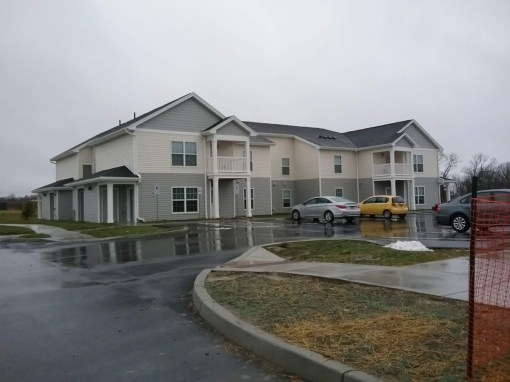
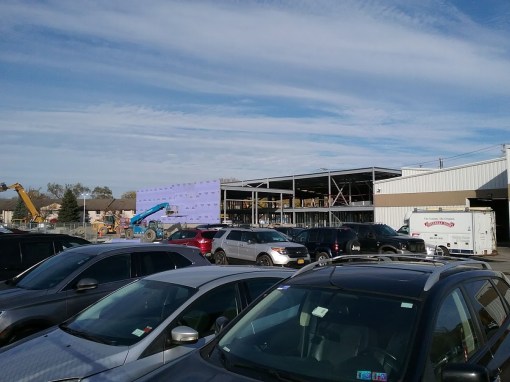
S.E.E. Associates/Andy Sciarabba’s new office building at 3095 North Triphammer Road was approve for construction last spring and started construction this past fall. What’s there right now is the basic frame of the building, a fairly utilitarian clear span one-story wood-framed design with a large gable roof atop an insulated concrete slab. A projection of the front eave will give space for porch columns and smaller gables advertising five of the seven tenant spaces being built in the 9,600 square-foot building, and the exterior will be finished out in vinyl siding and cast stone veneer. Also included are landscaping improvements, stormwater facilities and parking for 48 vehicles. Alternative/renewable energy sources, likely air-source electric heat pumps, are being explored for the project.

The commercial spaces are intended for either office or commercial retail tenants. The $500,000 project is expected to be completed by next spring. Per an email from Sciarabba that came in after the Voice article:

“We have signed 1 (unnamed) office tenant already, 1300 sf and have a verbal commitment from another tenant, a primary and acute care physician. We can accommodate up to 7 tenants and we are using air source heat pumps. The shell should be ready for tenant fit up in January with first occupancy about March. Our goal is to bring services to this part of Lansing which currently do not exist. We are very flexible as to tenant sf size since the bldg is clear span.”

Local architect George Breuhaus is the creator of the design, and Lansing construction firm D Squared (Doug Dake and Doug Boles), who just wrapped up the construction of the Boathouse Landing project, are in charge of the buildout.


Arthaus Ithaca Construction Update, 12/2019

23 12 2019

For Vecino Group of Springfield, Missouri, Ithaca is a match made in heaven. It’s a nationally-known firm with two specialties – affordable housing and student housing, two things that a college town struggling with affordability issues would seem to be a perfect fit for.

Vecino has made a concerted effort to break into the Northeastern United States in the past few years. Among the developments it has pursued are Asteri Utica, Mosaic Village in the Capital Region city of Cohoes (“Kuh-hos”, as living in the Albany area has taught me), Intrada Saratoga, Libertad in Elmira and the 444 River Lofts and Hudson Arthaus in Troy. Perhaps the most well known proposal to Ithacans would be the 218-unit Asteri Ithaca planned for East Green Street Downtown.

There is a logic to the naming. Vecino projects identify segments of their target market through the project names. Asteris, like the one proposed for the Green Street Garage, provide not just affordable housing, but several specialized units for those with developmental disabilities. Intradas, like the 157-unit Intrada going up in Saratoga Springs, provide affordable housing with a handful of units set aside for youth aging out of foster care. Muse is the student housing, Talia provides housing and services for those recovering from domestic violence, and Libertads offer housing to formerly homeless veterans. So, kinda just a neat little quirk there.

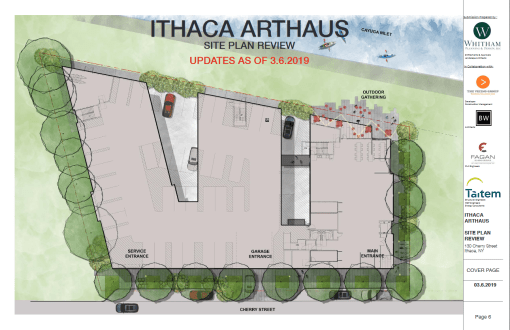
Arthaus, as one might guess, is the artist-focused affordable housing. The sort of tough part to make clear is that this is not limited to artists. The housing will be available to anyone who meets the income requirements. It just has amenities geared towards creative types, like a woodshop and storage space and gallery space run by an outside non-profit. 130 Cherry Street, where the project is located, was developed for commercial use in the late 1970s, according to documents filed with the planning board, and operated as an automotive repair facility for the last 20 years, AJ Foreign Auto.

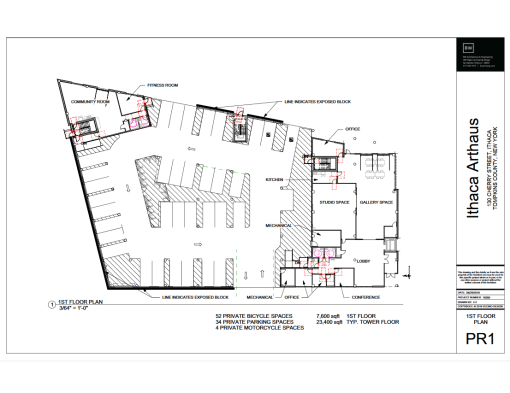
The city planning board were on board with it from the start. Plans call for a five-story, 97,500 square-foot building. Among the features are support service office space, a community room, a gallery/studio (in partnership with the Cherry Arts, according to state docs from October) and a fitness room. It’s about 123 units (48 studio, 55 1-bedroom, 20 2-bedroom) of affordable housing, 50-80% of area median income, plus a one-bedroom unit for the property manager for 124 total. A breakdown of units and rents is at the end of this post and on the NYS HCR website here. Forty units (the ESSHI grant units in the rental breakdown table) will be set aside for young adults aged 19-26 for formerly foster care and homeless youth, and administered by Tompkins Community Action.

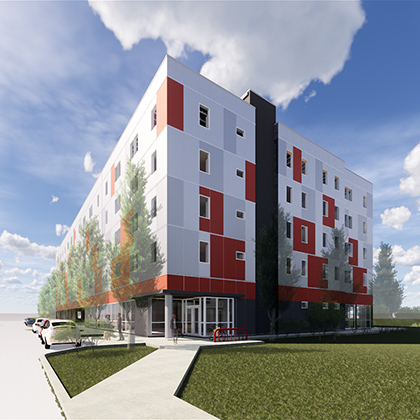
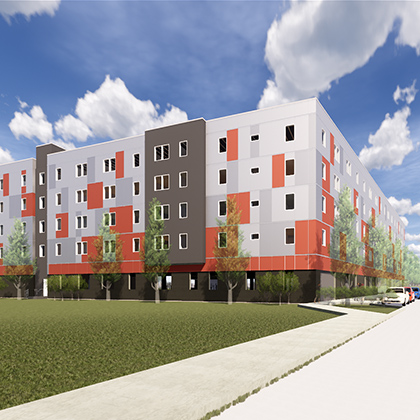
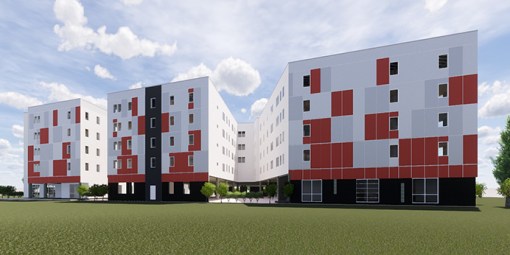
Along with the housing, the building would include parking for about 36 vehicles within and outside the building ,and 7,748 square feet of potential retail or office and amenity space geared toward artists. Also included is space for 52 bikes and 4 motorcycles, and access to Ithaca CarShare. The exterior will be finished out in light grey, medium grey and red fiber cement panels, with the internal courtyard areas having white stucco finishes. The ground level will have dark grey fiber cement panels and dark grey masonry.

A public promenade will run along the west side of the property next to the waterfront, pending approval from the NYS Department of Environmental Conservation. The project was designed by Vecino’s in-house team, BW Architects and Engineers (remember, they’re a big firm that can afford to have their own architecture team). The project is also seeking to get arts groups involved in the design, to give it a unique local flair. The project will be built to state (NYSERDA) “Performance Path for Energy Star” standards for sustainable housing (Tier II, >25% energy savings above code). The city was looking to start off on the right foot with the upzoned waterfront, and this is exactly the kind of creative, affordable project they were hoping for.

The project pursued and has been awarded a PILOT agreement from the Tompkins County IDA. The PILOT request included a one-time sales tax exemption request on building materials, a one-time mortgage tax exemption on the mortgage recording fee, and a non-standard property tax abatement request. In lieu of the typical seven-year or enhanced ten-year abatement, Vecino asked for and received a 30-year payment in lieu of taxes (PILOT) agreement that would save them about $3.54 million off the lifetime of the tax deal. With the sales and mortgage tax exemptions, the total tax savings comes to $4.54 million, with Arthaus still generating an additional $3.73 million in new tax revenue over the life of the PILOT (note that the $3.73 million figure does not include existing tax payments, and is calculated using the current property taxes as a baseline; the PILOT would not eliminate existing property tax revenue, it reduces the rate of new tax revenue growth). The total project cost is $31,948,378. The PILOT approach has been used previously, with Ithaca Neighborhood Housing Services’ 210 Hancock project in the city’s North Side neighborhood.

Neighbors to the site were generally supportive of the plan, while the council members who represent the site (George McGonigal and Cynthia Brock of the First Ward) were not, deeming it too big and too much of a concentration of affordable housing. The Arthaus project was approved by the city in April 2019.

NYS Homes and Community Renewal docs say $14,078,249 is being provided in a HCR Supportive Housing Opportunity Program (SHOP) subsidy loan, and $10,871,535 from Low Income Housing Tax Credits. Vecino is only pursuing 4% credits vs. the more lucrative and harder to get 9% credits, which made obtaining financing easier – it pays to be big and be able to leverage cost efficiencies elsewhere. The tax credit and loan package was approved by the state in October.

Alongside Vecino on the project team are Fagan Engineers of Elmira doing the civil engineering work, local firm Taitem Engineering as energy consultants, and Ithaca’s Whitham Planning and Design for landscape architecture and community outreach. CRM Property Management of Rome (Oneida County) will manage the property on Vecino’s behalf.

With the fence and dust guard up, it seems plausible that this project’s in site prep, taking apart the old body shop and readying the site for excavation and foundation work. December was the approximate date given for a construction start back when it was approved, and the plan is to open for occupancy in late summer or early fall of 2021. 150 construction jobs and four permanent jobs will be created by the Arthaus project.


Heights of Lansing Construction Update, 12/2019

23 12 2019

Forest City Realty (the Bonniwell and Jonson families) is continuing work on the next six-string of for-sale townhouses as part of their Heights of Lansing development at the end of Bomax Drive in Lansing village. The units currently under construction (65, 67, 69, 71, 73 and 75 Nor Way) will be 3 bedroom/3.5 bath with 2,500 sqaure feet of living space and a price tag of $398k-$408k, the higher price tag being for the units on either end of the string (one less party well and a pair of additional small windows).

The biggest difference between this six-string (hexplex?) and the previous is that the older set across the street steps down in elevation a little bit for each pair going southward, while this newer set is all the same elevation. In terms of finishes, they should be similar, but not the same. The gables, entries and fenestration are nearly the same, but I suspect the colors of the finishes will be different than the blue shingle/beige stucco on the older string.

Per the advertisements online, this one for 65 Nor Way:

“Brand new, luxury townhouse with Italian villa vibe in the contemporary Heights of Lansing neighborhood. End units have extra windows. Marbled flooring in entrance vestibule leads to sunken Great Room with 10′ ceilings, crown molding, rounded corners, beautiful floor to ceiling windows, gas fireplace with marble and stone mantel. Open Mediterranean style gourmet kitchen shines with stainless steel appliances and ample Ubatuba granite counter space. Back patio features stamped concrete design and privacy fence. Upper level landing with built-in shelving/office area, and balcony access. All bedrooms en suite with radiant heat in baths. Upper level laundry. Energy efficient ductless heating/cooling wall units with 5 zones will save you money, improve interior air quality, and leave a smaller carbon footprint. Attached 2 car garage with its own heating/cooling unit. Low HOA $185/mo. Convenient to Cornell, Cayuga Lake, downtown, dining, and shopping. Bellissima!”

In case you’re wondering, Ubatuba is a very dark-colored and trendy Brazilian granite. These are fully framed, roofed and are being sheathed and housewrapped now, but it doesn’t look like much more than interior framing has taken place within the townhouses, with perhaps some utilities roughs-ins just getting underway. These are likely heading for a late spring (Q2 2020) finish. For those interested but looking for something move-in ready, two of the six townhouses in the last string (64 Nor Way and 68 Nor Way) are still on the market.


Village Solars Construction Update, 12/2019

22 12 2019

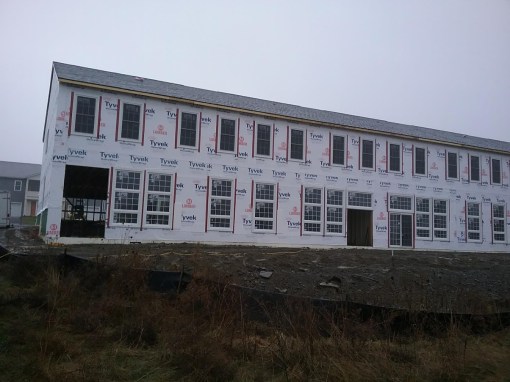
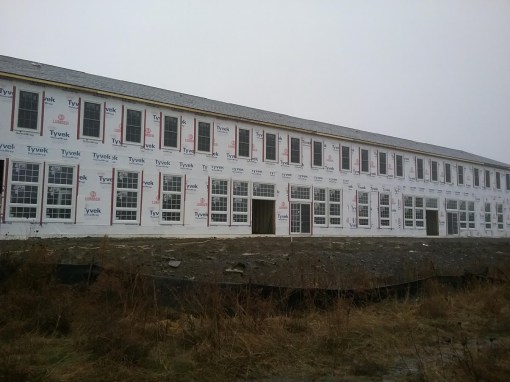
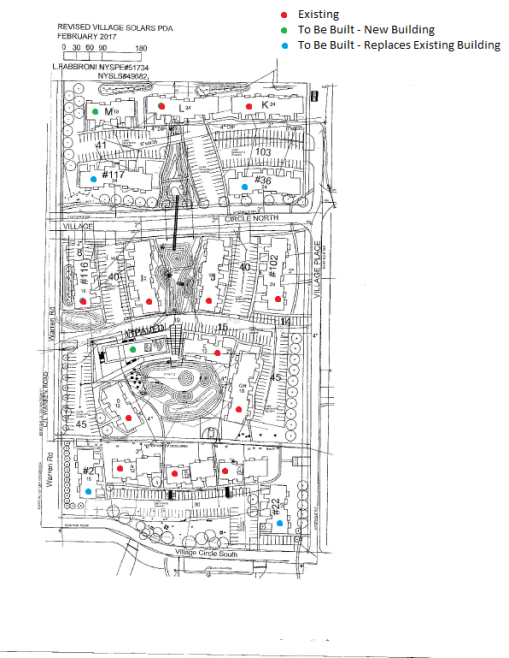
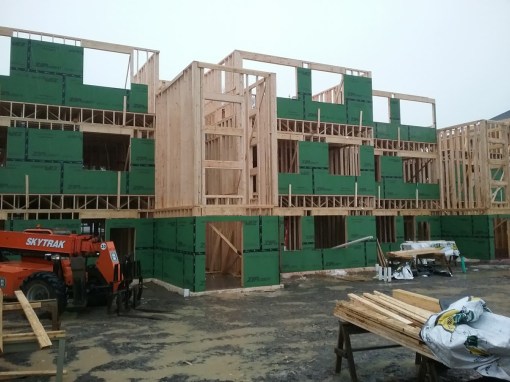
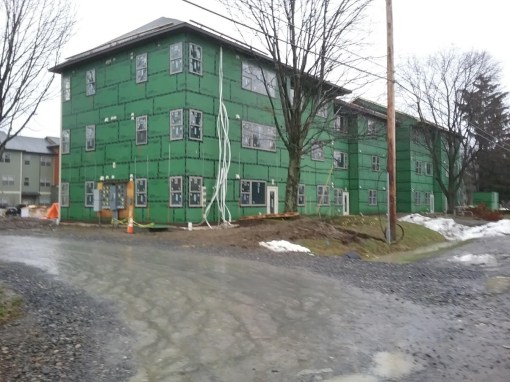
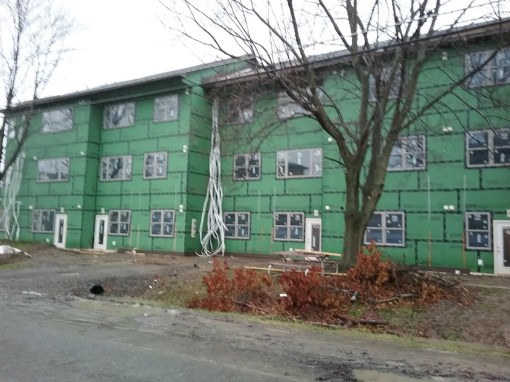
Over at the Village Solars site off of Warren Road in Lansing, phase five of apartment construction is underway. 24-unit 36 Village Circle North (3 three-bedrooms, 6 two-bedrooms, 3 one-bedrooms and 12 studios), which replaces an older 12,000 SF 10-unit structure, is fully framed, sheathed with ZIP Panels, shingled and fitted with doors and windows. The installation of exterior fiber cement trim boards is just getting underway. The sets of wires dangling from below the eaves are utility lines for the air-source electric heat pumps, as construction continues they’ll be bundled together and boxed up into the exterior siding (the heat pumps themselves will be boxed in with a decorative screen in a bump-out).

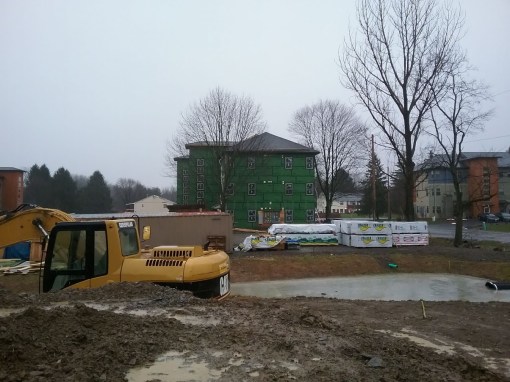
Building M is a new build on previously vacant land. It is an 18-unit building with 12 studios and 6 two-bedroom units. It is undergoing framing now and has yet to top out with roof trusses. If I had to take a guess, I’d say 36 Village Circle North will be ready by the end of April, and Building M will be ready by the end of July.

So, avoiding the political question of whether the town supervisor should have voted on approving the PDA amendment on the community center because that’s not this blog’s wheelhouse, it was granted, but the outcome for the community center is still murky. As previously discussed back in September, it could either be built at its original location in its original ground-floor community/commercial with 20 one-bedrooms above, or with a different design in a location further east, more central to the property next door for sale by Rocco Lucente Sr.’s estate.

A few weeks ago, an ad showed up on commercial real estate website Loopnet advertising Lucente Sr.’s holdings, listing the property for $10 million. For that price one gets 96.44 acres and 42 existing units in four buildings, as well as plenty of development potential. Now, my gut is that the negotiations between Steve Lucente and his father’s estate were either not going well or had fallen through completely, but no one in the family is talking, so it’s anyone’s guess as to whether or not that big merger of the two sites will happen. If it doesn’t, Steve Lucente will start work on the originally-planned community center building next year, as the modified Planned Development Area states.

I did not realize TCAT Bus Route 37 now passes through here (it appears to have started to make stops here earlier this year) but it makes sense given the population growth. At the start of the decade there were about 56 bedrooms here and about 30 on the elder Lucente’s property next door. When the latest building open next year, it will be 420 or so bedrooms on this site and 54 next door (the elder Lucente built a final 12-unit building with two-bedroom units in 2011-12). When all approved construction is complete in about 2022 (the three remaining rebuilds and the community center mixed-use), that will be up to 507 bedrooms in 333 units, not considering future growth on the property next door. It’s not quite the scale of Cornell’s dorm projects or Collegetown Terrace, but it’s probably the next largest single development site after those, it’s just no one notices because it’s rather out of the way and the build-out has been modest but steady.

According to a county deed filing just after this post went up, Northwest Bank, a regional bank mainly operating in Western Pennsylvania, is lending $4,935,000 for the construction of the two buildings.


Lansing Meadows Construction Update, 12/2019

21 12 2019

In the interest of brevity, I’m going to hold off on writing most of the backstory – as Dan Veaner at the Lansing Star noted, the project had at least nine major changes over nine years, and was a discussion topic at no less than 58 meetings. Several articles can also be found on the Voice here.

Lansing Meadows is a $14 million mixed-use project consisting of the BJ’s Wholesale Club that opened in 2012, wetland creation (done outside the area in the Cayuga County town of Montezuma), and a residential component on Oakcrest Road that was a stipulation of the village of Lansing as part of the creation of the Planned Development Area. The senior housing on Oakcrest is being built on wetlands created by an overflowing culvert in the 1970s, when the mall was built. The rest of the site was a vacant, unofficial dumping ground for materials. Whether they’re new or old, by law wetlands removed by development have to be replaced.

The project also has a payment in lieu of taxes (PILOT) with the Tompkins County IDA, which was controversial when granted (PILOTS and abatements for retail projects are generally discouraged), and as the years went on and the sentiment was that the developer, Eric Goetzmann of Triax Management Group d/b/a Arrowhead Ventures LLC, was dragging his feet on the residential and the county had started to take legal steps to “claw back” the $2.32 million in benefits before Goetzmann finally put something forth. Even then, the residential portion had to go through a few iterations in order to come to a mutually-acceptable plan with the village. The final set of plans were approved in June 2019.

As approved, the residential components consists of two phases. Four one-story triplexes (12 units total) will be ready for occupancy by the end of July 2020. Two more triplexes (6 units) will be built in a second phase to be ready for occupancy in December 2020. All units are senior rental housing, set aside for those aged 55+.

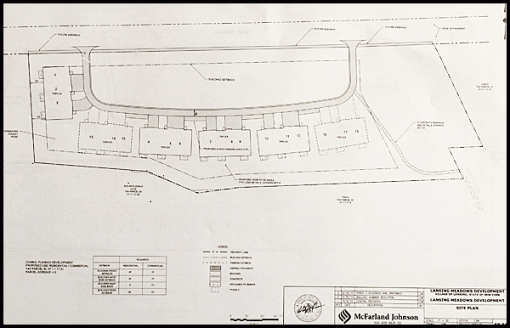
The two end units in each building will be 1252 square feet with a 395 square foot garage. The center unit will be 1114 square feet with a 251 square foot garage. Although not explicitly stated, the square footage appears to be in the ballpark for new two-bedroom or two-bedroom plus den apartments. The units all face a one-way private loop road, called “Lansing Meadows Drive”. Being a one-way allows it to be narrower, yet still meet the village’s specifications and allowing on-street parking. Project planning/design/construction services are being provided by an all-in-one firm, McFarland Johnson of Binghamton.

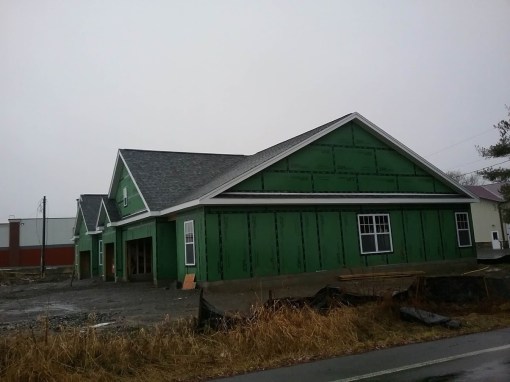
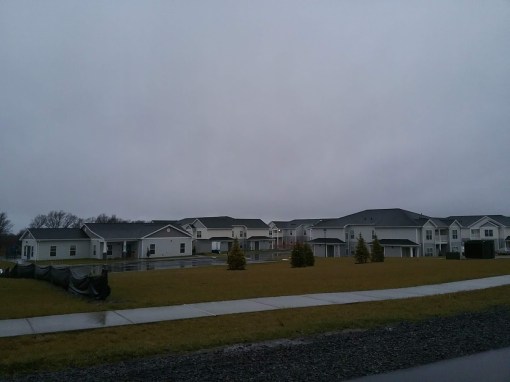
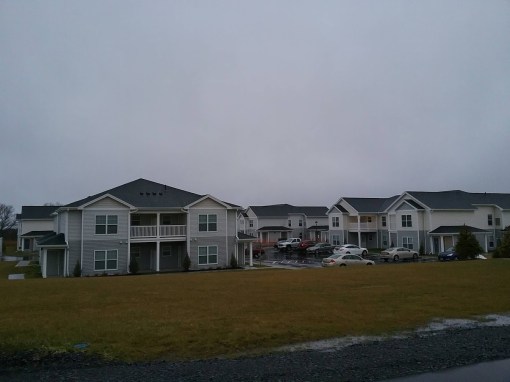
Framing and sheathing has been completed for one of the 1.5 story triplexes, with framing underway on a second and foundation work ongoing with the next two. The framing is standard wood frame on a concrete slab foundation with underground utility hook-ups, and the sheathing is the ever-popular Huber ZIP plywood panels. Windows and doors have been fitted into the most complete unit, and the roof has been shingled. Rather interestingly, it looks like vinyl trim boards are already in place on the eaves of the structure, something that usually doesn’t come along until much later in the construction process. On the inside, it appears that mechanical, electrical and plumbing rough-ins are ongoing.

The space on the easternmost end of the parcel is intended to be developed at a later date for a small-scale (~2,000 SF) commercial retail component, possibly a small restaurant or coffee shop.


Milton Meadows Construction Update, 12/2019

19 12 2019

Not completely done, but substantially complete enough that this will be the last visit. Only landscaping, paving, and exterior and interior finish work (trim pieces, carpeting) Three of the nine eight-unit apartment buildings have been opened for occupancy. The others will open over the next month or so. The units are by and large spoken for already, having been awarded through a housing lottery to screened but otherwise randomly selected income-qualified tenants (making 50-80% area median income).

This $17.3 million, 72-unit project is wrapping up, and with the confusion over Tiny Timbers it may be the only residential component of the Lansing Town Center for some time yet. A further 56 units may be built as a “Phase II” 2-3 years from now when the sewer is in. There will be at least one commercial neighbor moving in next year – the Salt Point Brewing Company has started site prep for their new 4,000 SF restaurant and tap room next door.

Project background and history can be found here. SWBR Architects of Rochester is the architect. Cornerstone Development Group is the developer, and the Taylor the Builders of Rochester served as the general contractor. Passero Associates served as project engineer.

The history and details of the project can be found here.


Library Place Construction Update, 10/2019

10 11 2019

Quoting the roundup at the Voice:

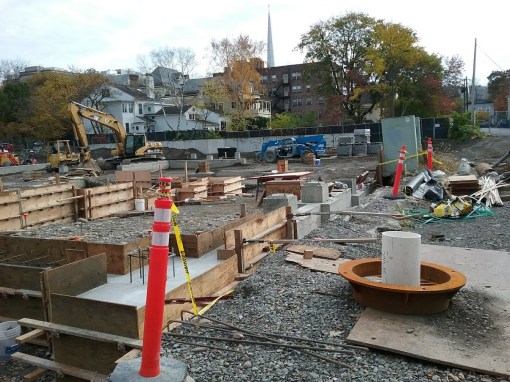
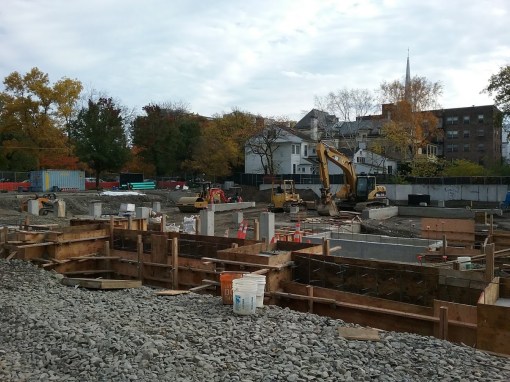
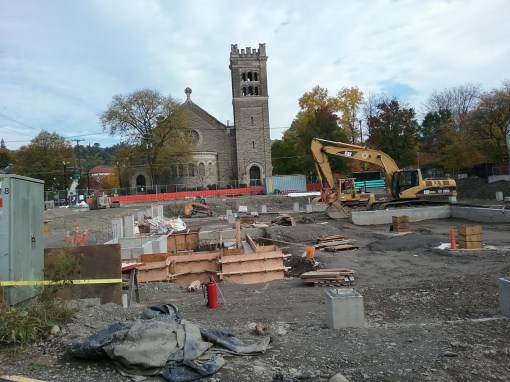
“With the foundation piles in place, wood forms have been erected for the pouring of the concrete footers and exterior foundation walls for the four-story building. Part of the old library’s foundation is being reused in the project, but the two buildings have somewhat different footprints, so some new foundation walls are necessary. The rebar extended from the steel piles is encased in concrete and capped, and the steel bolts rising out of the cap will tie into the structural skeleton of the building above. Underground water pipes are being connected from the building to the city’s water system this week.

You might notice some similarities with the Cornell project with the forming and pouring walls, but also note some big differences as well – some of the building sites in Cornell (the sophomore village buildings) don’t require deep foundations. The soil on the hills is in better shape than it is in the more low-lying areas, and can generally handle a heavier load. This gives Cornell the benefit of being able to do quicker, less expensive foundation work in those areas where a shallow foundation is feasible.

The $17 million mixed-use building, which will contain commercial space, space administered by Lifelong and 66 senior apartments, is anticipating opening at the tail end of 2020 or early 2021.”

One thing that’s not readily apparent quite yet is that there’s a partially underground parking garage below the primary structure. That garage does not extend all the way to the street except for the entrance, which is where the fence gates are (and where these photos start from). You can eyeball the perimeter walls from the three concrete wells partitioned off in various boxes – the northern one, seen in the fourth photo, will house an elevator, mechanical room and stairwell, the middle one next to the excavator will house the trash room, and the southern one, next to the huge stack of masonry blocks, will house a maintenance room and southern stairwell.


Harold’s Square Construction Update, 10/2019

10 11 2019

One of these days, we’ll get a tour to line up. Harolds Square’s project team does allow tours on a limited basis, if one can do Thursdays. Trying to get myself, the Voice staff photographer, and the project team to get all our schedules to align has so far not panned out. Maybe after Thanksgiving.

With that in mind, these photos were originally intended for use in the Harold’s Square feature, but after the second time it fell through, they ended up in the construction gallery instead. To quote that:

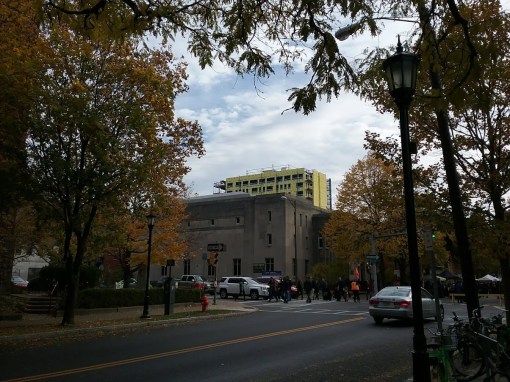
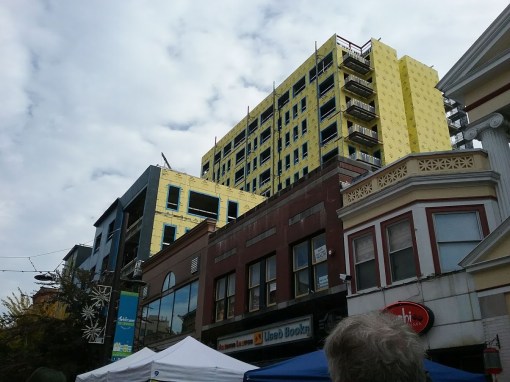
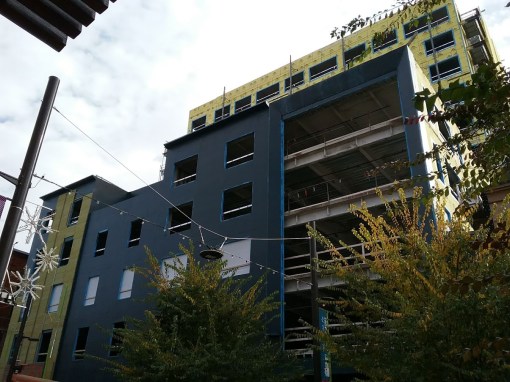
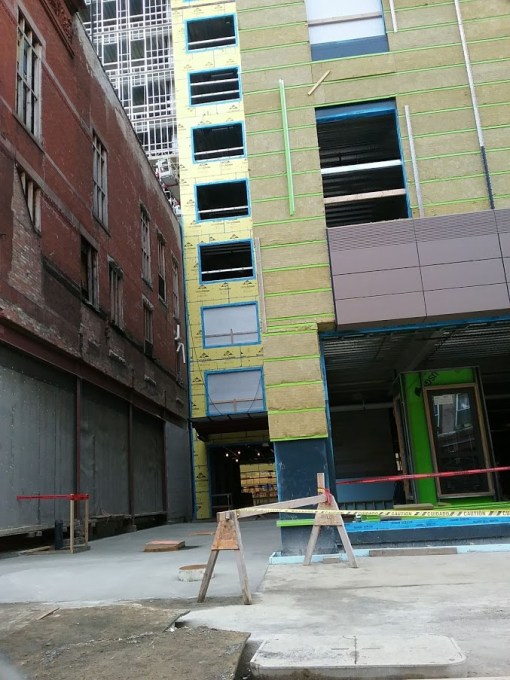
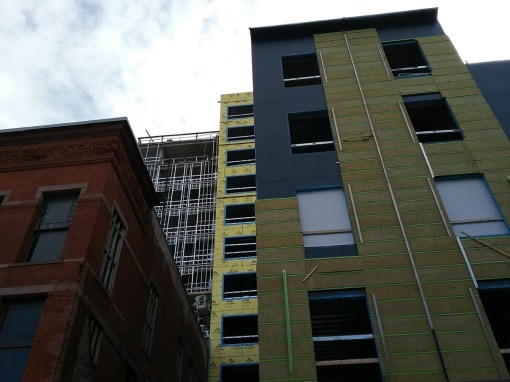
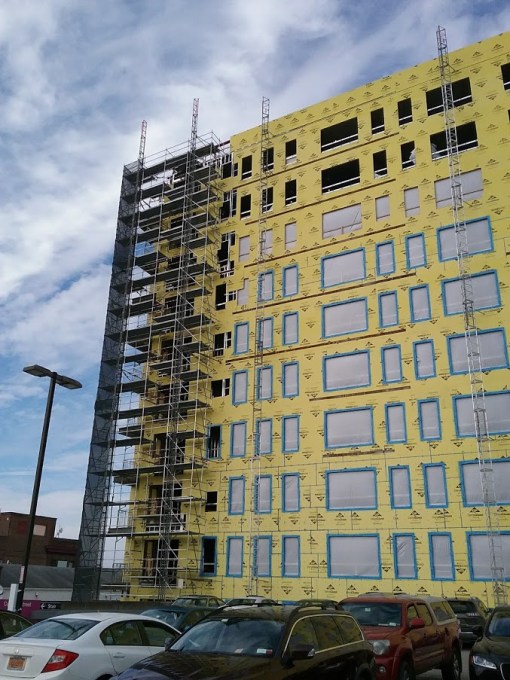
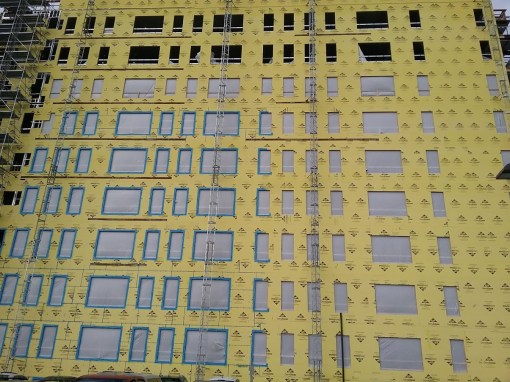
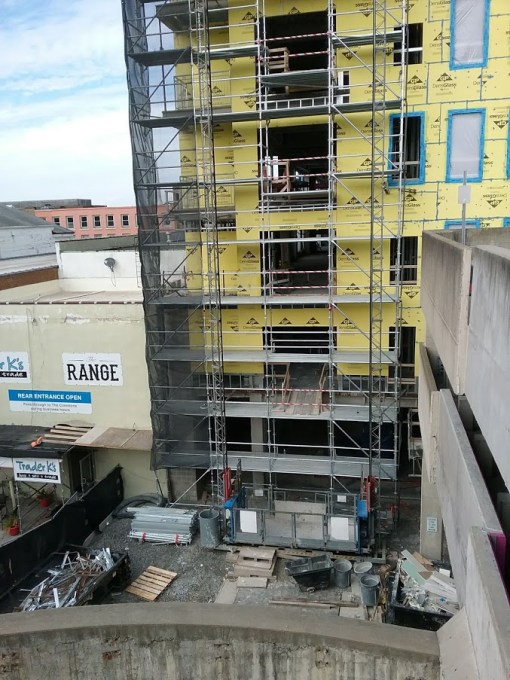
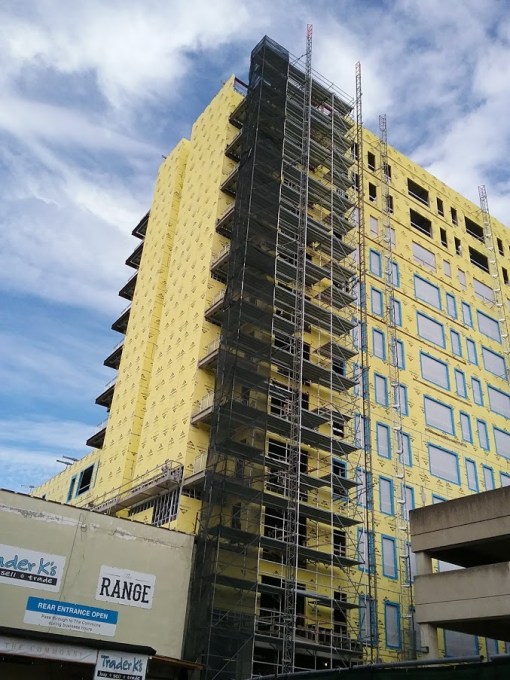
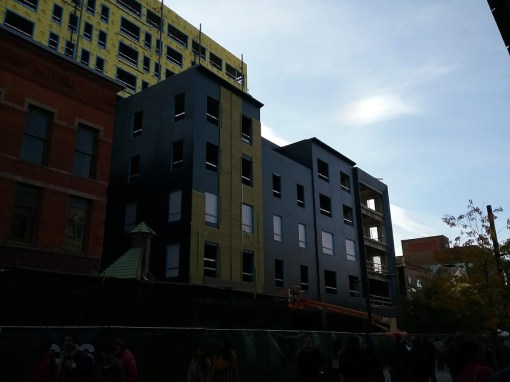
“It’s a boxy yellow giant. That bright material going over the exterior steel stud walls is the outer layer for Georgia-Pacific DensGlass fiberglass mat-faced gypsum sheathing. Fire-proof and mold-proof, DensGlass is common for commercial and mixed-use structures. The blue material around the rough window opening is likely a water-resistive barrier to prevent any rain or outside moisture from getting in under the window frames. Then a more general waterproof coating is applied over the structural walls, mineral wool insulation is attached, and then rails and clips for the aluminum exterior finishing panels.

On the inside, utilities rough-ins (mechanical, electrical and plumbing) are probably underway, but interior walls have yet to be fully built out on the uppermost levels. The large opening facing the Commons (to be a glass curtain wall section with decorative metal panels and fins) only shows fireproofing and sprinkler systems in place.

Completion of the 78 apartments, 52,000 SF of office space, and 14,400 SF of retail space is planned for summer 2020 – a little earlier on the office space and retail, a little later on the apartments. There have been rumors of an office tenant lined up, but no official announcement, and there have been neither rumors or announcements for potential occupants of the Commons-facing retail space.”


https://platform.twitter.com/widgets.js

The terra cotta used on the exterior, seen in the Commons-dacing photos, is Avenere Cladding’s NeaCera Rain Screen Terra Cotta product. Thanks for the shout-out on Twitter guys, but you got the city wrong by about sixty miles. Henderson-Johnson, the terra cotta installer / cladding subcontractor, is based out of Syracuse.

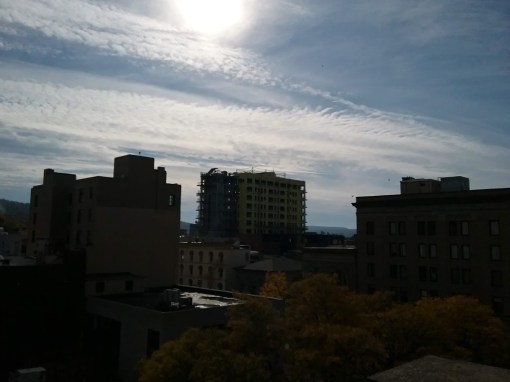
It still amazes me just how much this building is visible from other parts of the city and county. Granted, the DensGlass stands out, but 139 feet and 4 inches is enough to be readily visible from parts of South Hill, West Hill and the flats.

The design of the project’s been tweaked a bit (northwest corner windows, top floor panel color, entries and facade details on the Commons-facing portion), and some new renders, interior and exterior, can be found on CJA Architects’ website alongside floor plans. Initially I thought the paneling had changed on the northeastern wall, but it appears it’s always been a darker color, it just didn’t show up well in the older renders.

OLD:

NEW:


Maguire Ford-Lincoln Construction Update, 10/2019

8 11 2019

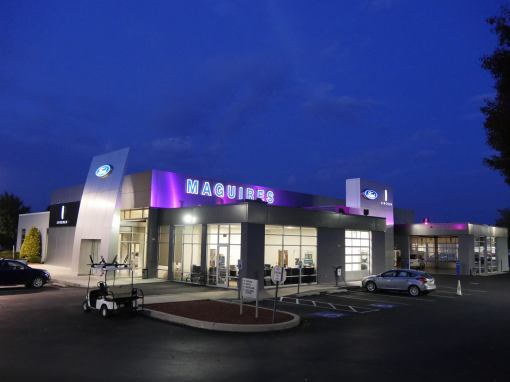
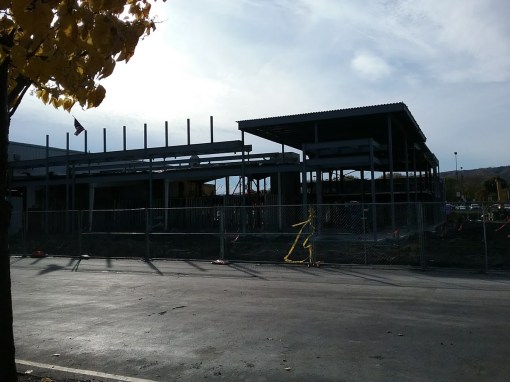
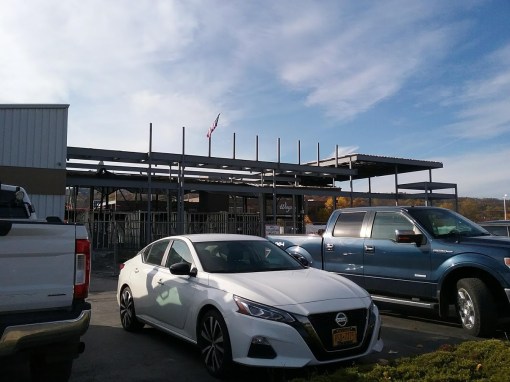
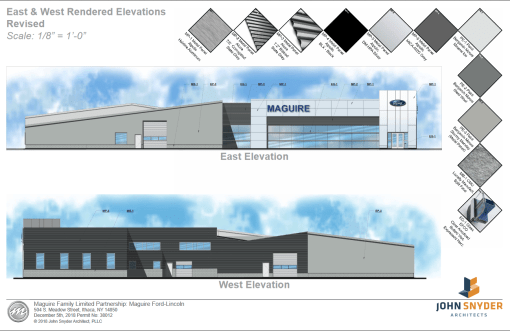
Over at 504 South Meadow Street, the concrete foundation pad is in, and the exterior masonry block wall and steel frame appear to be built out. Fireproof gypsum sheathing board are being attached to the structural steel at the back – interestingly enough, the building doesn’t appear to have exterior stud walls, so it’s not 100% clear if the west windows as depicted in the renders will make it into final product. Lighter gauge steel at the front denotes future architectural details like the curved foil vestibule and the modern, clean image Ford wants its franchisees to project. That part’s not really negotiable. Maguire is required to follow a preset design language and the architect (John Snyder Architects) has to keep the design within those bounds. Some interior steel stud walls can be seen in the building’s interior, though it doesn’t appear much progress has been made on the utilities rough-ins (mechanical, electrical, plumbing).

To give an idea of that corporate design language, the recently renovated Maguire’s Ford Lincoln in Palmyra Pennsylvania also has the curved foil vestibule, large glassy facade facing out into the public lot, and muted light and dark greys with aluminum (Alpolic) metal composite panels. The architects can decide where those features go and how they fit together, so long as they fit together in a way Ford approves (and Ford does weigh in – they rejected some of the Planning Board’s ideas, so Maguire had to sort of meet the two stakeholders halfway with details like the rear/west wing masonry. It’s not Ford’s particular desire, and it’s less than what the Planning Board wanted, but they accepted the compromise).

It’s always struck me as a little odd to put in curbing while heavy duty vehicles are still coming in and out of the construction site given the possibility of crushing the newly-laid curbing, but it’s not all that unusual. The new curbing (laid by machine, kinda mesmerizing to watch) gives an idea of where the new greenspaces will be on site. The planning board was very adamant about having a certain percentage of green space on the dealership lot when reviewing the project, which will be filled in with a number of trees and ornamental shrubs much later, when construction is nearly complete.

The last I checked, although approvals have been granted, the Maguire Nissan on Cinema Drive in Lansing village did not yet appear to be underway. The Nissan brand will move to that new 25,200 square-foot location when it is complete.

I’d expect this $1.5 million, 24,110 SF project to be ready sometime next spring. Background writeup and project description here.


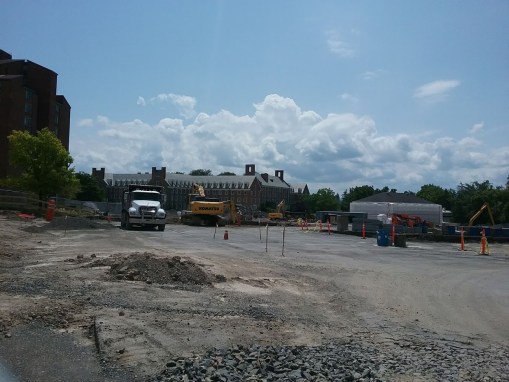
Cornell North Campus Residential Expansion Construction Update, 10/2019

31 10 2019

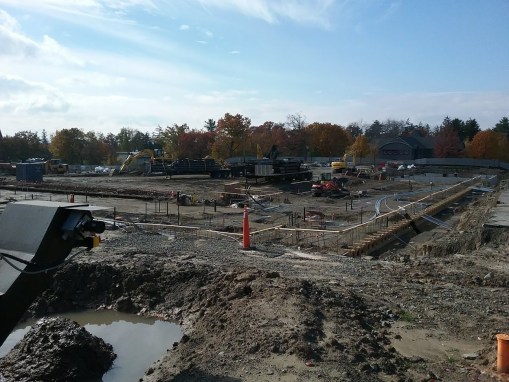
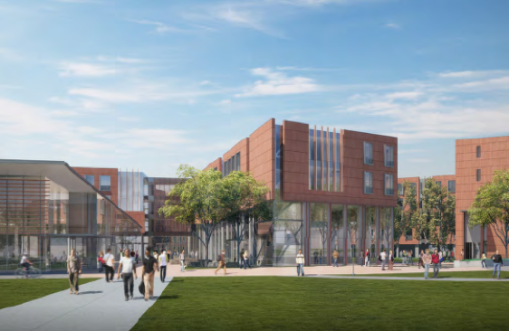
I’ve been intended to do a formal introduction piece for Cornell’s enormous North Campus Residential Expansion, but the sheer breadth of it makes it an arduous task – I’ve estimated the full write-up will push about 10-12 pages, and it’s one of the reasons why the blog has gone quiet. For now, here are monthly photo updates from the site. For now, background reading and history can be found by reading the Voice archive here and here.

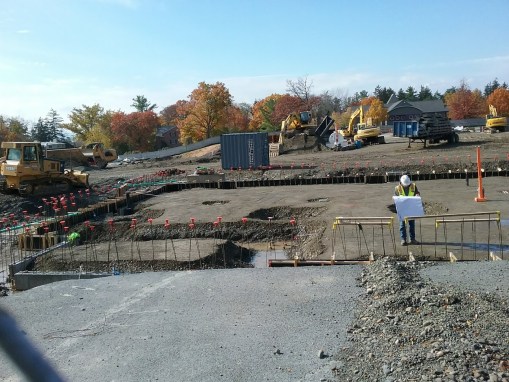
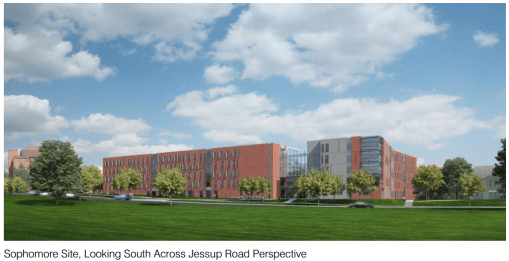
The sophomore village (Site 1) will have four residential buildings with 800 new beds and associated program space totaling 299,900 SF, and a 1,200 seat, 66,300 SF dining facility.This is being built on what was the CC Parking Lot and the former Sigma Alpha Mu fraternity on Sisson Place, now Northcross Road. All buildings in the sophomore village are in the City of Ithaca. The bounds of the sophomore village extend into the village of Cayuga Heights, but only the landscaping.

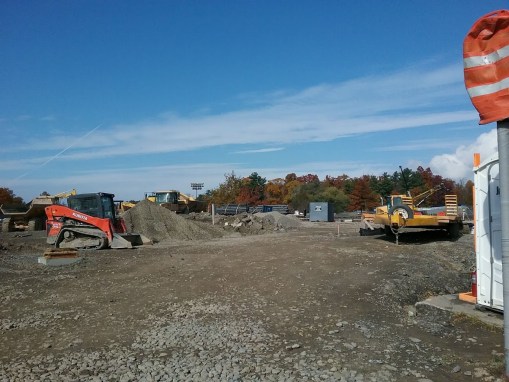
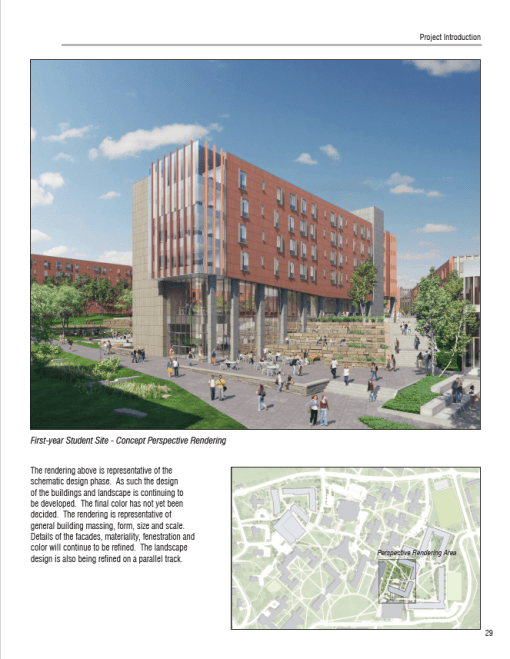
The freshman village (Site 2) will have three new residential buildings (spanning the City and Town line), with a total of 401,200 SF and 1,200 new beds and associated program space. Site Plan Review Documents indicate about 223,400 SF is in the City, and 177,800 SF is in the Town. At both sites, the buildings will be between two and six stories using a modern aesthetic. The project has an estimated price tag of $175 million and will result in the disturbance of about 25.6 acres at the two sites. The 250-page Site Plan Review (SPR) application can be found here, with supplemental reports here.

As previously noted, Cornell has grown substantially while its housing options have not. The application provides further insight by saying that one of the goals isn’t just to have housing available to 100% of freshman and sophomores, it’s to mandate they live on campus – currently, there is no requirement to live on campus, though freshmen are strongly urged to do so. 800 beds will be sophomores, 1,200 beds for freshmen, and 75 beds for live-in faculty, RAs and support staff. The growth in campus housing from 8,400 beds to 10,400 will also allow Cornell to address long-deferred maintenance to older residential halls and increase its undergraduate enrollment by another 900 (the current undergraduate enrollment is 14,900).

Water will come to the new dorms via Fall Creek and the Cornell filtration plant, sewer sustems will connect to joint city/town/village facilities, and the loss of 396 parking spaces is mitigated in part by the observation that the CC’s Lot inconvenient location and expensive parking permits meant only about 110 spaces were regularly used, and a surplus of parking in other North Campus parking lots means users will be assigned spaces nearby, with enough spaces left over for the few hundred additional vehicles 2,000 on-campus students may bring.

The dorms will tie into Cornell’s centralized energy system, which is primarily fed by the Cornell’s Combined Heat and Power Plant (CHP), which is powered primarily by natural gas and reuses waste heat, as well as an increasing set of renewable energy resources, like solar arrays and the lake source cooling program. Since the CHP system relies on natural gas as its primary energy source, it became a major source of contention during review. Cornell has stressed that more renewable sources are in the pipeline and the plan is to have all their energy be renewable by 2035, but that far-flung timeline has not been welcome news to many local environmental advocates.

The project falls in three municipalities and in three zoning districts: the U-I zoning district in the City in which the proposed 5 stories and 55 feet are allowed; the Low Density Residential District (LDR) in the Town, which allows for the proposed two-story residence halls (with a special permit); and the Multiple Housing District within Cayuga Heights, but only for landscaped areas. Technically, any one of six governmental bodies could have been lead agency – the city, the village, the town, the NYS Dormitory Authority, the Tompkins County Department of Health, or the NYS Department of Environmental Conservation. However, for the sake of coordination, the others consented to allowing the city to be Lead Agency for the project with decision-making authority on the environmental review, while offering their concurring critiques and subordinate reviews.

The buildings are being designed by ikon.5 Architects, the general contractor is Welliver of Montour Falls, and TWMLA is handling the landscape architecture. T.G. Miller is the civil engineer for the project, and Thornton Tomasetti is doing the structural engineering. Taitem Engineering served as an energy consultant for the project, which is pursuing LEED Gold Certification. Canadian firm WSP Global Inc. is in charge of the design of fire protection and mechanical/electrical/plumbing systems, and Ricca Design Studios will handle the interior design and fitting out of the food service areas within the new dining hall. SRF & Associates of Rochester did the traffic study, and John P. Stopen Engineering of Syracuse did the geotechnical work. Intergrated Acquisition and Development (IAD) is the co-developer (non-owner) with Cornell.

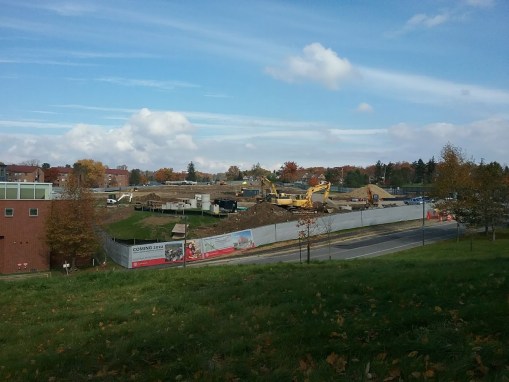
Since receiving approval in late June 2019, the project has progressed at a quick pace, with the sophomore village underway just a few weeks later. As of this week, the excavation work and concrete footer pours are already underway. Wood forms are in place to hold the concrete in place as it cures, and rebar, for structural strength, is ready for the pour, capped with orange plastic toppers for safety reasons. Underground utilities installations and excavation work are ongoing at the freshman village site, which started a little later in the fall.

Plans are to have the sophomore village open by August 2021, and the freshman village by August 2022. A project of this size will require a sizable number of workers. The project team expects that 75-100 construction workers will be employed at any one time, 140 on average, and 280 at peak construction periods. The new dorms would create 85-110 jobs after opening, mostly in maintenance and program support roles.

August 4th:

Freshman village site:

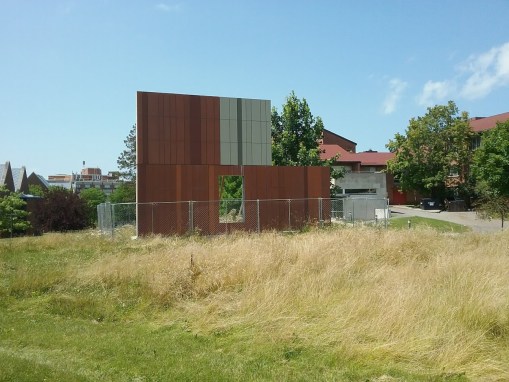
Exterior wall mock-up:
September 6th / Sophomore Village Only


October 27th: Freshman village
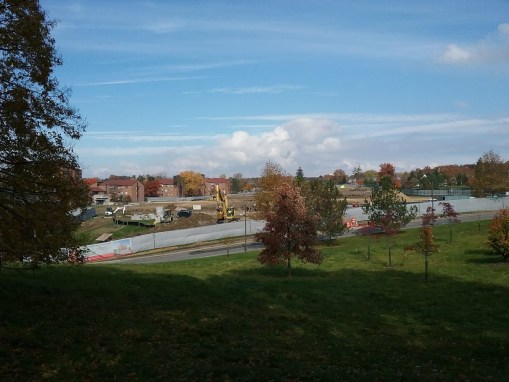
Sophomore village: