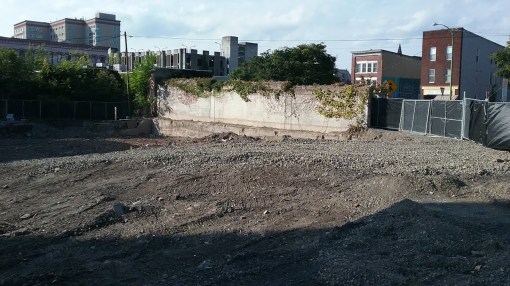
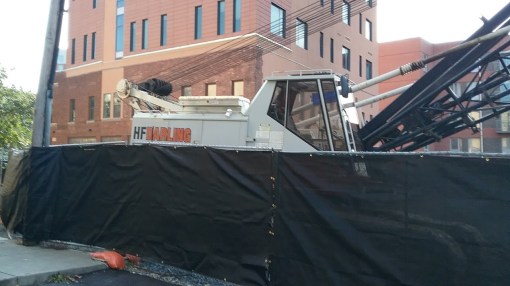
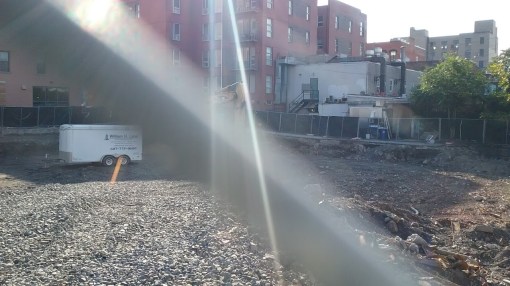
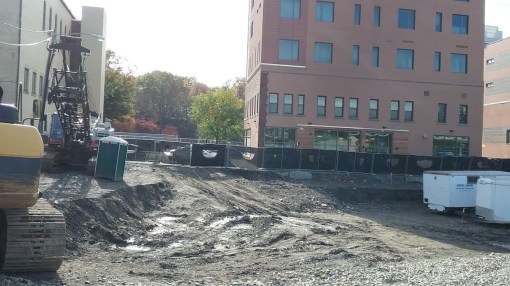
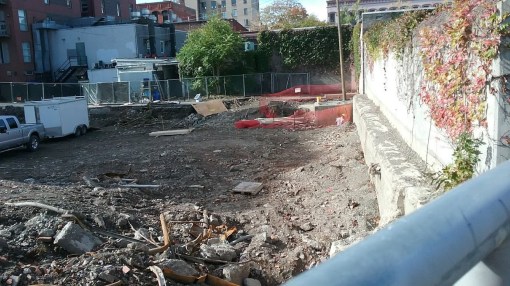
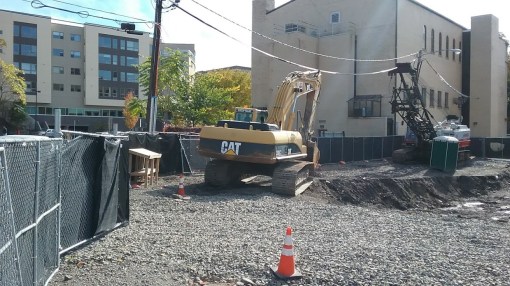
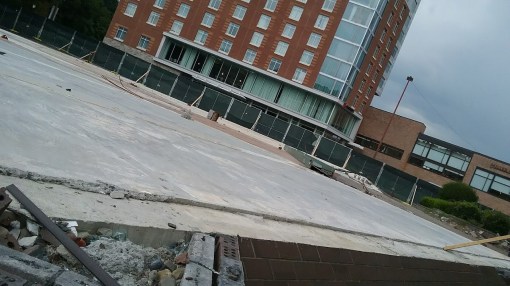
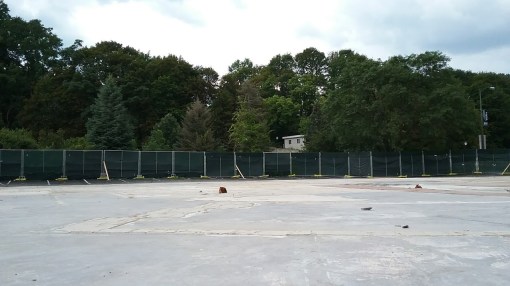
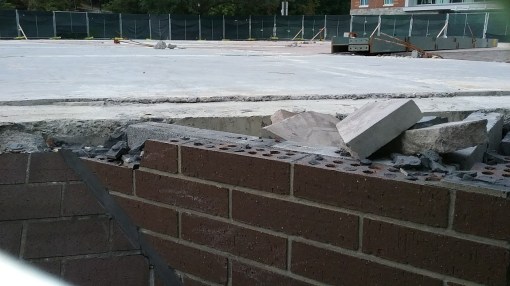
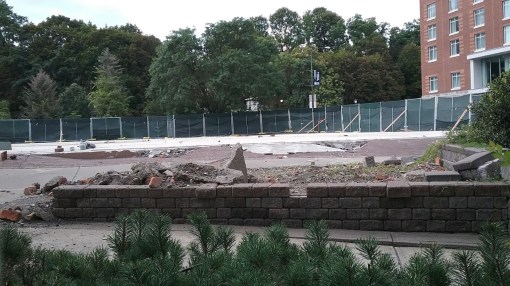
Hilton Canopy Hotel Construction Update, 10/2017

31 10 2017

Tompkins County benefits from being a regional tourism destination. A combination of amenities like the colleges and wineries, scenic gorges and and convenient location have made it a popular weekend getaway from the big cities of the Northeast and Mid-Atlantic, as well as some of the major Great Lakes cities. In the past ten years, the hospitality and tourism sector of the economy has grown over 20 percent, adding several hundred jobs even after seasonality is taken into account. An additional benefit is that the room taxes are used to fund arts and culture grants, community festivals and part of TCAD, the economic development agency.

Representative of that growth has been the growth in the local hotel industry. Around 2014 or so, one of the big questions was, how many hotel rooms is too many? The Marriott was in the works, the Hilton was in an earlier stage, two hotels were planned on the Route 13 corridor, and the Hotel Ithaca had its plans. For practical purposes, it was a good question.

However, the situation evolved over time. As is often the case, the hotels opened later than anticipated. The 159-room Marriott finished late last fall, the 76-room Holiday Inn Express was completed a couple months earlier, the Hotel Ithaca went with an expansion that actually reduced the available number of rooms by ten and opened earlier this year, and one of the suburban hotels, a 37-room independent boutique hotel, was cancelled. They all came onto the market later than expected. and the number of rooms added was less than originally planned. All the while, the economy continued to grow at a consistent 1.5-2% annual pace, Cornell continued to add students and the population slowly grew. Had all the hotels opened at once with their original plans, the impact might have been a big problem. But the reality was that the Hotel Ithaca’s impact was modest, and the HIE’s and Marriott’s supply is being absorbed (though the market does need over a year to fully adjust to a 12.8% growth in supply). For the record, Airbnb and similar services have their impacts as well, but the county estimates it’s the equivalent of roughly 40-60 hotel rooms.

With the market still adjusting to the influx, it’s probably a good thing that the Canopy Hilton isn’t opening until Spring 2019, well after a new equilibrium is achieved. However, it’s been a long road to get to this point.

First, a brief history of the site. In recent years, the Hilton site was a mix of private and municipal parking. From 1916-1993, the Strand Theater occupied the site. The Carey Building was designed to match the Egyptian Revival motif of the theater, but unlike the Carey, the theater closed in the late 1970s, attempted and failed at a reopening as a community theater, and after being vacant for over a decade, the building was deemed too far gone to save, leveled by the wrecking ball during the deep recession of the 1990s.

The first mention of a hotel on the 300 Block of East State/MLK Jr. was back in December 2012. Lighthouse Hotels LLC (Neil Patel) proposed a six-story, $16 million Hampton Inn on the site (v1). The 92-room hotel, designed by Jagat Sharma, would have resulted in the demolition of the Carey Building – recall this was before the Carey overbuild.

However, Patel violated an important rule when it comes to development – unless you have made previous arrangements, don’t propose something for someone else’s property. The proposed Carey demo caught Frost Travis by surprise, and he and parking lot owner Joe Daley were less than amused. Nor were Planning Board members, who were fond of the Carey and not fond of the surface parking proposed with the hotel. The project went nowhere, and a major reworking was required. Negotiations with the city and neighbors were needed to acquire the necessary land, and the IURA and Common Council agreed to have the IURA represent the city on divestiture discussions.

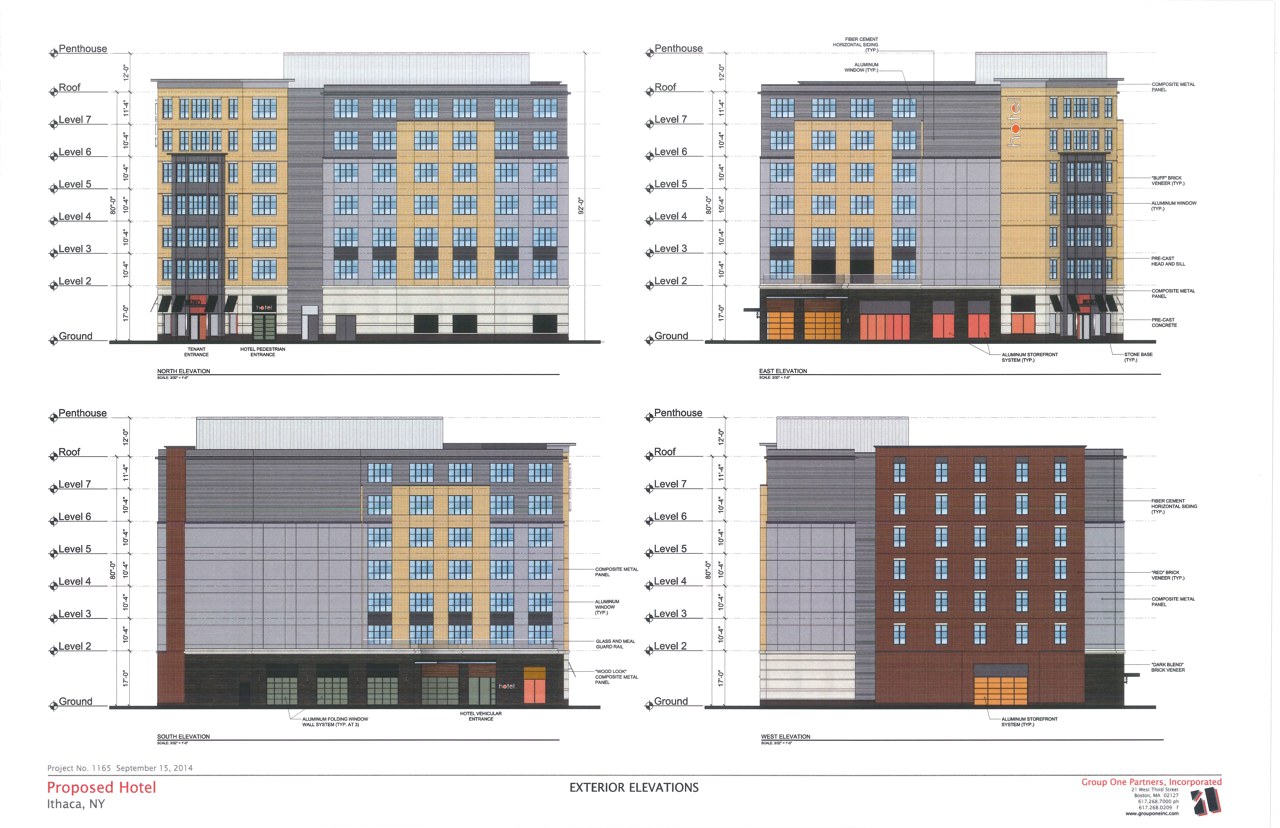
Fast forward 18 months to June 2014. Having hired on Whitham Planning and Design to handle the review process on behalf of Lighthouse Hotels, a new six-story sketch plan was presented (v2). This plan did not impact the Carey (by then undergoing review for the overbuild), and opted for a more modern design by Boston’s Group One Partners Inc., which specializes in urban hotel plans. By August 2014, a site plan review request was formally submitted, along with a modestly revised design (v3) – at the time, the six-story, 120-room hotel was pegged at $11.5 million. These early plans also called for a 2,000 SF retail or restaurant space on the ground level. By this time, Patel was a vice president at Baywood Hotels, a national hotel developer and management firm with over $1 billion in assets, and regional offices in suburban Rochester. The firm is so large, they have 26 hotels currently under development from Miami to Minnesota, but that might be conservative. Their planned downtown Syracuse Hampton Inn isn’t even listed, and the render for the Hilton Canopy Ithaca is out of date.

Technically the phrasing is “Canopy by Hilton Ithaca”. It will be either Canopy or Canopy Hilton on the blog.

The Canopy brand was launched in October 2014 to be the lifestyle brand geared towards younger leisure travelers. Of the eleven locations announced at launch, Ithaca was the only one not in a major city, and is arguably the only one still not planned for a major city. A month earlier, the newest 74,475 SF, 123-room, 7-story design rolled out (v4), with industrial warehouse-style aluminum windows, buff and “dark blend” brick veneer, stone base with precast concrete accents, and grey fiber cement and metal panels carried over from the previous design. The second floor would open up onto a terrace overlooking the front of the hotel, and the first floor had folding windows that could open the lobby area to the outdoors on nice days. 

By January 2015, the designed had been tweaked some more (V7 in the link, but the changes were pretty minor from V5-V7, facade materials and window treatments), the cost had risen to $19 million, and LeChase Construction was signed on to be the general contractor. In fact, Patel and Frost Travis has even worked out a clever plan to share construction equipment as both their buildings were underway. However, Patel and Baywood’s schedule fell behind Travis’s, so the plan never panned out.

During this time, the project had applied for the IDA’s enhanced tax abatement, and underwent Common Council review after its public hearing in November 2014. While concerns were raised about not paying a living wage to all staff, the council decided the pros outweighed the cons and endorsed the project. Baywood planned to hire 33 to 47 staff, of whom 11-20 would make living wage (multiple sources with different figures). Room rates were expected to be $160/night.

According to the 2015 application, the project’s combined hard and soft costs were $24.17 million, and the property tax abatement (the enhanced 10-year abatement) was $3,528,081. Another $980,928 was waived in sales taxes, and $45,000 from the mortgage tax, for a total tax abatement of $4.55 million. About $3.28 million in new taxes will be generated on top of the existing taxes on the land, along with room taxes and payroll taxes. During the public hearing, attendees went after the project for union labor, living wage and sustainable energy concerns, but the project was still approved by the IDA. They might have switched over to heat pumps, I’ll need to check into that.

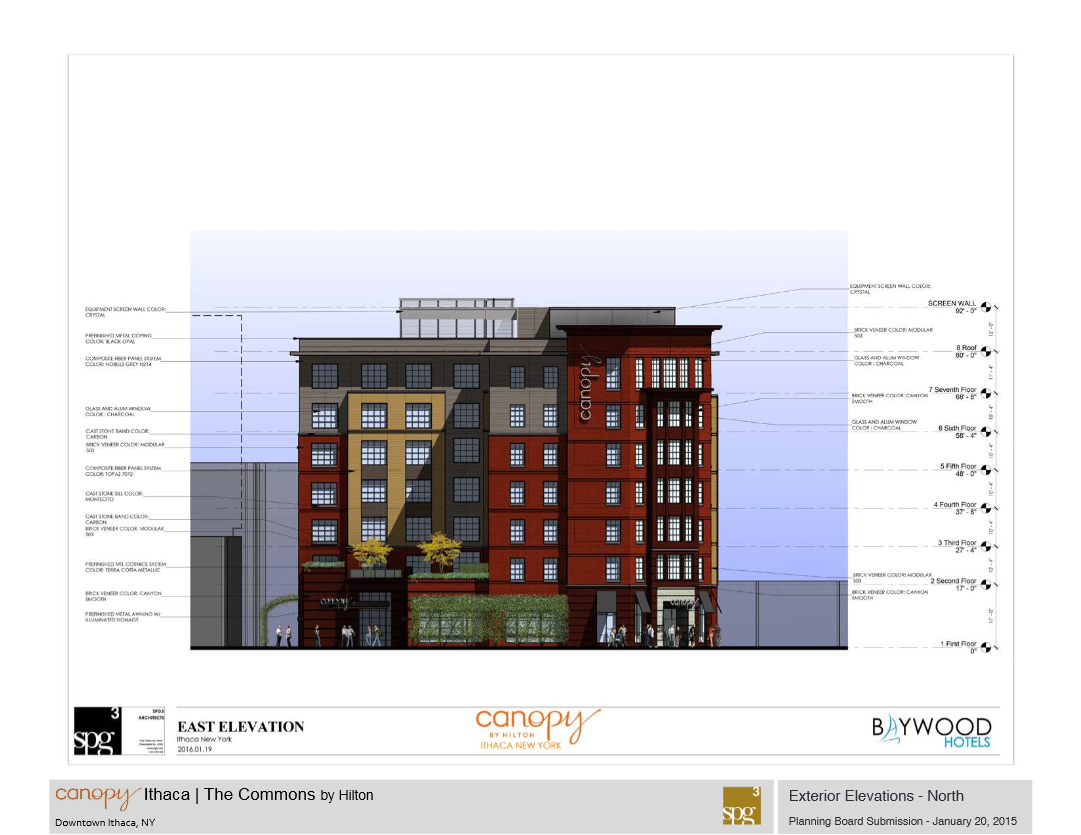
After the original project was approved in March 2015, the city voted to approve the sale of its land in April 2015, and the IDA approved a tax abatement in July 2015, the Hilton plan sat dormant for a while before undergoing a major redesign in January 2016 courtesy of Philadelphia’s spg3 Architects, now Bergmann Associates. It turned out the project had struggled to obtain financing due to rapidly rising construction costs, and underwent some “value engineering”. The general shape was kept the same, but the exterior materials were swapped, the building increased in size to 77,800 SF, the room total was brought up to 131, and the restaurant space was omitted, among other changes. This required re-approval by the city. The much longer comparison is here.

The very last version of the project, V9 in February 2016, added inset panels in the northwest wall, and some cast stone was added to the base. The second floor roof deck was tweaked, a cornice element was added to the mechanical screen, and the trellis and driveway pavers were revised.

The final form is faced with a few different shades of red brick veneer, topaz yellow and grey fiber cement panels, metal coping and cast stone trim. Floor height (ceiling of seventh floor) is 80 feet, while structural height (top of mechanical penthouse) is 92 feet. It’s not really a big impact on the downtown skyline, but it broadens the city’s shoulders a bit.

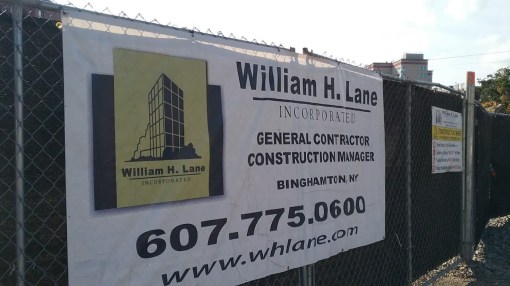
After approval and IDA approval, things were slow to start. Ithaca Downtown Associates LLC, representing the Patel family, was reorganized slightly to include other family members in the ownership, and afterward it purchased the properties for the hotel project in August 2916. $1.8 million went to the IURA for the parking lots at 320-324 East State Street, and $2.05 million to local landlord Joe Daley for the parking lots on the former Strand property at 310-312 East State Street. A $19.5 million construction loan from ESL Federal Credit Union (formerly Eastman Saving and Loan of Rochester) was received at the end of September 2016, but things were stalled for a while, and only now is the project on its way to a Spring 2019 opening, two and a half years later than initially planned. William H. Lane Inc. of Binghamton will be the general contractor.

Long story, but at least someone wrote it up. Goes to show that property development can be a very complicated process.

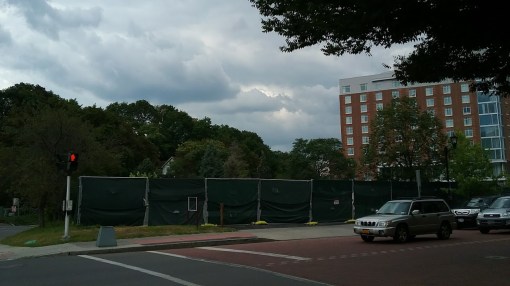
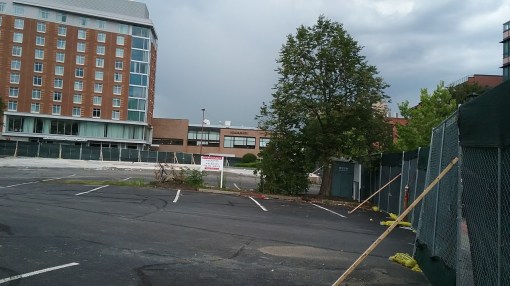
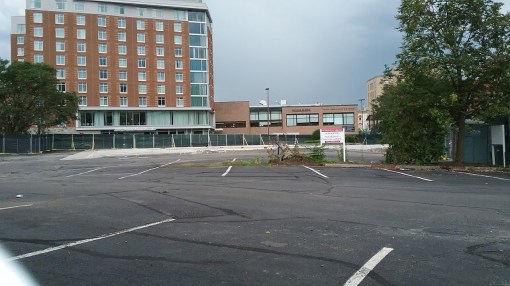
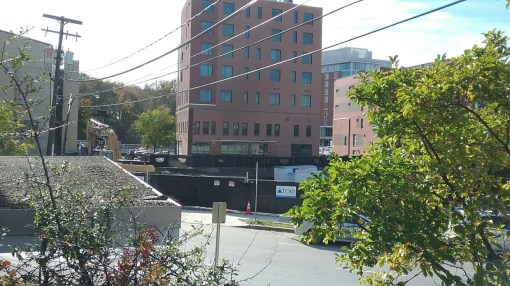
It looks like foundation excavation is currently underway – I had head many of the underground utility work was taken care of when the Carey was under construction next door. A plausible schedule has foundation work done by the end of winter, with structural steel framing underway during the spring and summer.

October 15th:
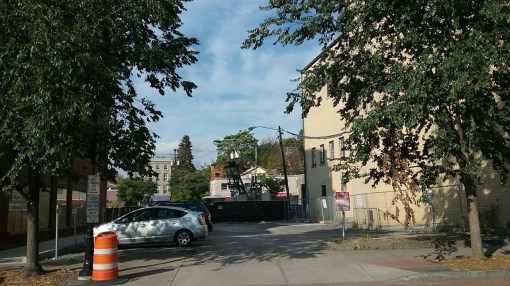
October 28th:


The Maplewood Redevelopment, Part I: History and Planning
28 08 2017

Being as large and complex as it is, it was hard to figure out a way to present the Maplewood project clearly and coherently. After some thinking, it seems the best combination of clarity and detail will be to split it into three sections. This section, Part I, will be an overview of the site history and project planning. Part II will examine and break down the site plan with all of its contributing structures. Part III will be the regular construction update, which will be bi-monthly just like all the others.

Quick primer note – Maplewood Park was the name of the old complex. The new one is just called “Maplewood”. With the shorthand for Maplewood Park being Maplewood, it can get confusing.

Let’s start with the background. Love it or not, Cornell University is one of the major defining organizations of the Ithaca area. It employs nearly 10,000 people and brings billions of dollars in investment into the Southern Tier, Tompkins County and Ithaca. That investment includes the students upon which the university was founded to educate.

Traditionally, neither founder Ezra Cornell nor first university president Andrew Dickson White were fans of institutional housing. Their preference was towards boarding houses in the city, or autonomous student housing (clubs, Greek Letter Orgs, etc), where it was felt students would learn to be more independent. This mentality has often underlain Cornell’s approach to housing – it’s not a part of their primary mission, so they only build campus housing if they feel it helps them meet academic and institutional goals. If many potential students are opting for other schools because of housing concerns, or the university is under financial strain because it has to subsidize high housing costs in their scholarships, then Cornell is motivated to build housing in an effort to improve its situation and/or become more competitive with peer institutions.

With that in mind, being one of the top-ranked schools in the world means that, in the historical context of the university’s goals and plans, new housing is rarely a concern. Cornell will update housing in an effort to be more inclusive and to improve student well-being, but with labs, classrooms and faculty offices taking precedence, building new housing is rarely an objective. Only about 46% of undergrads live on campus, and just 350 of over 7,500 graduate and professional students.

From 2002 to present, Cornell has added 2,744 students, with a net increase in Ithaca of about 1900. The net increase in beds on Cornell’s Ithaca campus during that same time period is zero. While Cornell did build new dorms on its West Campus, they replaced the University “Class of” Halls. 1,800 beds were replaced with 1,800 beds. In fact, the amount of undergraduate and graduate housing on campus had actually decreased as units at Maplewood Park and the law school Hughes Hall dorm were taken offline, either due to maintenance issues, or for conversion to office/academic space. When the announcement for further decreases came in Fall 2015, I wrote a rare Ithaca Voice editorial, and even rarer, it brought Cornell out to the proverbial woodshed for poor planning and irresponsibility.

To be fair, while Cornell was the guilty body, removing housing isn’t a problem on its own. It’s when the local housing market can’t grow fast enough to support that, that it becomes a problem. The Tompkins County market is slow to react, for reasons that can be improved (cumbersome approvals process) and some that can’t (Ithaca’s small size and relative isolation poses investment and logistical hurdles). In the early and mid 2000s housing was added at a decent clip, so the impacts were more limited. But housing starts tumbled during and after the recession, and it was unable to keep up. As Cornell continued to add students in substantial quantities, it became a concern, both for students and permanent residents.

By the mid-2010s, Cornell was faced with financial strains, student unhappiness and worsening town-gown relations, all related to the housing issue. As a result, the past couple years have become one of those rare times where housing makes it close to the top of Cornell’s list of priorities.

In weighing its options, one of the long-term plans was to redevelop the 17-acre Maplewood Park property. The property was originally the holdings of an Ellis Hollow tavern keeper and the Pew family before becoming the farmstead of James and Lena (sometimes Lyna) Clabine Mitchell in the early 1800s. In 1802, James was passing through from New Jersey to Canada with plans to move across the border, but stopped in the area, liked it, and bought land from the Pews, then moving the rest of his family up to Ithaca. Apparently there’s a legend of Lena Mitchell attacking and killing a bear with a pitchfork for eating her piglets. Many of the home lots in Belle Sherman were platted in the 1890s from foreclosed Mitchell property.

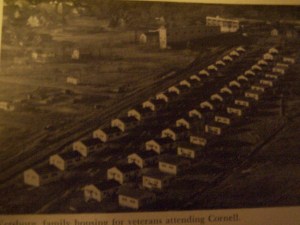
Like many of the Mitchell lands, it looks like the property was sold off around 1900 – a Sanborn map from 1910 shows a brick-making plant on the property along the railroad (now the East Ithaca Rec Way) and not much else for what was then the city’s hinterland. It’s not clear when Cornell acquired property, but by 1946, Cornell had cleared the land to make way for one of their “Vetsburgs”, also known as Cornell Quarters. The 52 pre-fabricated two-family homes were for veterans with families, who swelled Cornell’s enrollment after World War II thanks to the GI Bill. Once the GIs had come and gone, Cornell Quarters became unfurnished graduate housing, geared towards students with families, and international students.

The Cornell Quarters were meant to be temporary, and so was their replacement. In 1988-89, the university built the modular Maplewood Park Housing, with 390 units/484 beds for graduate and professional students, and an expected lifespan of 25 years. The intent was to replace them with something nicer after several years, but given Cornell’s priorities, and housing typically not among them, it fell to the back burner. As temporary units with marginal construction quality and upkeep, poor-condition units were closed off in later years, and capacity had fallen to about 356 beds when the complex’s closure was announced in May 2015 for the end of the 2015-16 academic year.

Cornell had long harbored plans to redevelop the Maplewood site – a concept schematic was shown in the 2008 university Master Plan. After weighing a renovation versus a rebuild with a few possible partners, the university entered into an agreement with national student housing developer EdR Trust to submit a redevelopment proposal. The partnership was announced in February 2016, along with the first site plan.

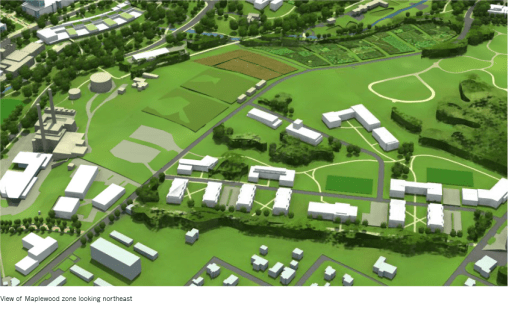
The core components of the project were actually fairly consistent throughout the review process. The project would have 850-975 beds, and it would be a mix of townhouse strings and 3-4 apartment buildings, with a 5,000 SF community center to serve it all. The project adheres to New Urbanist neighborhood planning, which emphasizes walk-ability and bike-ability, with interconnected and narrow streets, and parking behind buildings rather than in front of them. Energy-efficient LEED Certification was in the plans from the start.

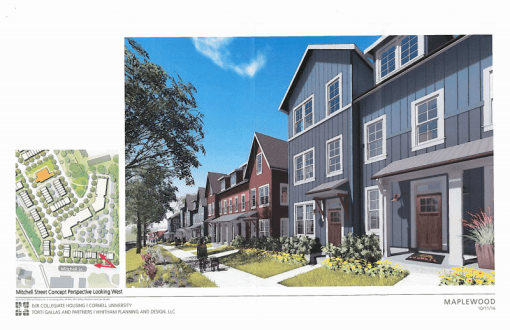
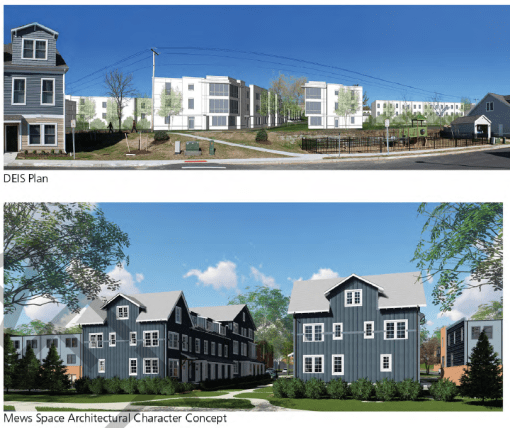
However, the overall site plan did evolve a fair amount, mostly in response to neighbor concerns raised through the review process. Many residents on or near Mitchell Road were uncomfortable with multi-story buildings near them, so these were pulled further back into the complex, and late in the process the remaining Mitchell Street multi-story buildings were replaced with very-traditional looking townhomes with a smaller scale and footprint. More traditional designs were also rolled out for the pair of townhouse strings closest to Worth Street, since neighbors noted they would be highly visible and wanted them to fit in. The building planned in the city’s side was also pulled inward into the parcel early on due to neighbor concerns – it became an open plaza and bus stop. The university was fairly responsive to most concerns, although the most adamant opposition didn’t want any multi-story units at all, and really preferred as few students and as few families as possible.

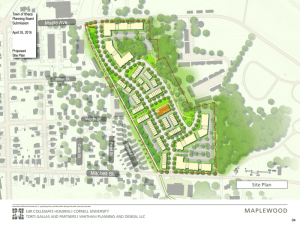
For the record, that is every site plan I have on file. Go clockwise from top left for the chronology. So from beginning to end, there were at least five versions made public. The final product settled on 442 units with 872 bedrooms, with units ranging from studios to 4-bedrooms.

It’s also worth pointing out that the town of Ithaca, in which the majority of the property lies (the city deferred the major decision-making to the town), had a lot of leverage in the details. The town’s decades-old zoning code isn’t friendly to New Urbanism, so the property had to be declared a Planned Development Zone, a form of developer DIY zoning that the town would have to review and sign off on. Eventually, the town hopes to catch up and have form-based code that’s more amenable to New Urbanism. The town also asked for an Environmental Impact Statement, a very long but encompassing document that one could describe as a super-SEQR, reviewing all impacts and all mitigation measures in great detail. The several hundred pages of EIS docs are on the town website here, but a more modest summary is here. If you want the hundreds of pages of emailed comments and the responses from the project team, there are links in the article here.

Some details were easier to hammer out than others. The trade unions were insistent on union labor, which Cornell is pretty good about, having a select group of contractors it works with to ensure a union-backed construction workforce. Also, at the insistence of environmental groups, and as heat pumps have become more efficient and cost-effective, the project was switched from natural gas heat to electric heat pumps, with 100% of the electricity to come from renewables (mostly off-site solar arrays).

Taxes were a bit more delicate, but ended up being a boon when it was decided to pay full value on the $80 million project. It was a borderline case of tax-exemption because Cornell would own the land and EdR would own the structures, and lease the land for 50 years; but Maplewood Park was exempt, so it could have been a real debate. Instead, EdR said okay to 100% taxation, which means $2.4 million generated in property taxes on a parcel that previously paid none. Some folks were also concerned if the schools could handle the young child influx, but since Maplewood Park only sent about 4 kids to the elementary school on average, and the new plan would send 10 students when the school has capacity for another 26, so that was deemed adequate.

On the tougher end, traffic is a perennial concern, and Cornell wasn’t about to tell graduate and professional students and their families to go without a car. Streetscape mitigations include raised crosswalks, curbing, and landscaping, EdR is giving the town $30,000 for traffic calming measures (speed humps and signage) to keep the influx of residents orderly and low-speed. A new 600,000 gallon water tank also has to be built (planned for Hungerford Hill Road).

One of the thorniest issues were the accusations of segmentation, meaning that Cornell was falsely breaking their development plans up into smaller chunks and hiding their future plans to make the impacts seem smaller. This has come in the context of the Ithaca East Apartments next door, and the East Hill Village Cornell is considering at East Hill Plaza. However, neither were concrete plans at the time, and still aren’t – to my understanding, Cornell had some informal discussions about Ithaca East but decided against it early on in the process. And they only just selected a development team for EHV.

In the end, many of the concerned neighbors and interest groups were satisfied with the changes, and actually lauded Cornell and EdR for being responsive. The EIS was formally requested in May 2016. The Draft EIS was accepted in August 2016, public meetings on it were held in October, and the Final EIS was submitted at the end of October. After some more back-and-forth on the details (stormwater management plan, or SWPPP), the Final EIS was approved right before Christmas and the project was approved in February 2017, starting work shortly thereafter for an intended August 2018 completion. With the wet summer, the project managers asked for a two-hour daily extension on construction (8 am-6 pm became 7 am -7 pm) to meet the hard deadline, which the town okayed with a noise stipulation of less than 85 decibels.

Rents for the project, which include utilities, wireless and pre-furnished units, are looking to range from $790-$1147 per bed per month, depending on the specific unit. Back of the envelope calculations suggest affordability at 30% rent and 10% utilities, for 40% of income. Cornell stipends currently range from $25,152-$28,998, which translates to $838-$967/month.

On the project team apart from Cornell and Memphis-based EdR are Torti Gallas and Partners of Maryland, New Urbanist specialists who did the overall site plan and architecture. Local firms T.G. Miller P.C. is contributing to the project as structural engineer, and Whitham Planning and Design is the site plan designer, landscape planner and boots-on-the-ground project coordinator for municipal review. Brous Consulting did the public relations work, and SRF & Associates did the traffic study. Although not mentioned as often, STREAM Collaborative did the landscape architecture for the project. The general contractor is LeChase Construction of Rochester.

So that’s part one. Part two will look at the structures and site plan itself. And then with part three, we’ll have the site photos.


City Centre Construction Update, 8/2017

21 08 2017

Ithaca is fortunate to have a downtown area with strong residential demand and relatively low commercial retail vacancy. Unlike many communities in upstate New York, its downtown area is ahead of the curve when it comes to attracting and capitalizing on investment. Apart from a few communities of similar economic strength (Saratoga Springs, Beacon), most regional cities are only just starting to re-invest in their downtrodden downtown cores.

It’s important to keep in mind that Ithaca was on a similar destructive path during the 1960s and 1970s. Like many cities, it was experiencing flight to the suburbs, competition from malls and shopping centers on the fringes, and general disinterest and loss of investment downtown. In an attempt to spur development, the city commenced with urban renewal plans that, among other things, routed Green Street through an urban block to create the tuning fork in the late 1950s, and in the mid and late 1960s, the city seized multiple 2-5 story ca. 1900 structures on the 300 Block of East State Street via eminent domain, demolishing them with the intent to sell the land to Ithaca Savings and Loan for a new bank branch and office building.

Things didn’t pan out as planned. After the bank pulled out, the now empty triangle of land bounded by South Aurora, East State and East Green Streets was used as a parking lot for construction crews, before finally being sold in 1973 to the Colbert family, who developed the Trebloc Building on the site. Originally planned at two floors, it opened in 1974, a one-story, brutalist-lite structure that was not a good fit and certainly not the transformative plan the city sold voters on a decade earlier. But, the city was desperate. They would take what they could get.

In the following decades, Ithaca’s economy remained relatively stable compared to its peers, thanks in large part to the colleges – staff counts increased to pick up some of the losses from manufacturers moving out of state or abroad, and students helped buoy the service sector. Ithaca’s downtown saw some investment in the late 20th century, but more importantly, most of the historic properties that survived Urban Renewal were now generating enough interest to avoid the wrecking ball.

By the late 1990s and 2000s, the idea of spin-offs and start-ups was starting to take off, and with Cornell serving as a sort of research incubator, it led to a modest but well-paying and growing high-tech sector. Add in an increasing trend towards college towns as a lively alternative to retirement communities, and Ithaca found itself with a growing economy. Coincident was a resurgent interest in urban living; Ithaca’s sleepy but intact downtown was poised to take advantage. It was still a risk in the 2000s, but through effort and luck, public-private projects like Cayuga Green and Seneca Place have paid off.

At this point, the initial “pioneer” projects have opened and demonstrated market strengths and weaknesses. Commercial office space is lukewarm at best, but rentals are hot. With a continued resilient, growing economy, developers were now scouting opportunities on their own. This was encouraged by the city, which upzoned several downtown parcels in 2014 to drum up interest. As part of this upzone, the Trebloc site was rezoned from CBD-60 to CBD-120, raising the maximum height from 60 feet to 120 feet, while permitting 100% lot coverage (excluding setbacks) with no requirement for on-site parking.

The first formal proposal to come along was State Street Triangle in April 2015. Texas-based Campus Advantage initially proposed a 12-story, 240-unit, 600-bed apartment building with first floor retail. The units were intended towards the student market, and Campus Advantage saw the property as an ideal location to draw in both Cornell and IC students.

Unfortunately, this development attempt pretty much checked off every box for what not to do. It was very large by Ithaca standards, officially student-oriented, the original design was mediocre at best, and according to city officials and staff, the developers came in with a condescending air, like the building was a gift and the city could only be so lucky. This stirred a hornet’s nest of opposition. Complaints included the size, the parking, the tenant mix, the design, and the developers were taken out to the proverbial woodshed for being out of touch “outsiders” who were simply going to profit off the city.

While there were some proponents, they were not many. The developers tried to make amends with a more appropriate design by STREAM Collaborative that reduced the size and scale, offered to make a donation to the city’s affordable housing fund, and broke up units to appeal to non-students, but the damage was done. When it became clear they would seek a tax abatement as most downtown projects do, the mayor, who is generally pro-density and pro-downtown, spoke out against it. Behind the scenes, a local developer was preparing to file a lawsuit if the city dared to approve the project without asking for a long, expensive Environmental Impact Statement first.

Meanwhile, the Colberts were in talks with a different developer, Newman Development Group (NDG) of Vestal. While not as large as Campus Advantage, Newman had previous experience in Downtown Ithaca, co-developing the Seneca Way mixed-use project with Bryan Warren a few years earlier. In fact, NDG’s forte is suburban shopping plazas and student housing; at the time, their only urban non-student residential project was Seneca Way. But, they knew Ithaca through experience. They knew what the city did and didn’t like, and watching Campus Advantage flounder not only gave them an opportunity to swoop in, it was an additional opportunity to watch and learn.

By December 2015, the purchase option CA had on the site had expired; and when they went to renegotiate, the Colberts were not interested, and decided to go with NDG. In January 2016, State Street Triangle was officially cancelled.

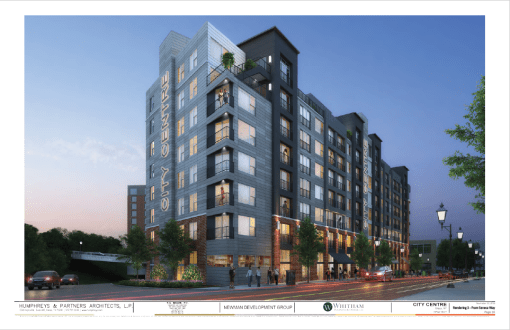
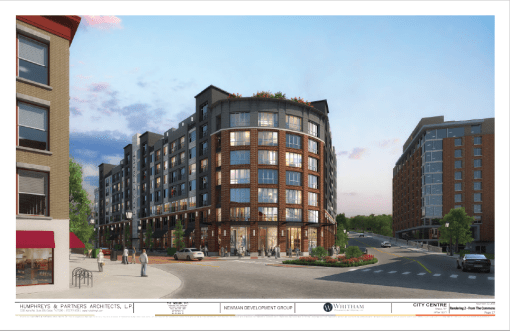
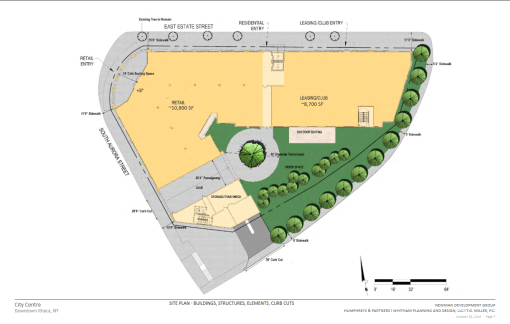
City Centre was officially announced in a press release in June 2016. From the start, it avoided the mistakes that plagued Campus Advantage. The announcement came not as a leak in the Journal, but in a press release to all three Ithaca news outlets, which gave an air of transparency and limited speculation. The initial design by Texas-based Humphreys & Partners Architects was well-regarded. The project would be non-student market-rate, with studio, 1-bedroom and 2-bedroom units. Instead of no parking at all, 71 (later 72) spaces would be located under the ground floor retail in a subterranean lot. The turn lane from Aurora onto State would be maintained, rather than lost to an expanded plaza.

With this approach, opposition to City Centre was much weaker – many critics saw this as a fair alternative. There were some complaints, like from Historic Ithaca, who were against any building with more than six floors; but overall, the reception to City Centre was much more favorable. The key changes through the municipal review process was to try and make the building less massive and less like State Street Triangle, as both had similar massing, and a visual focal point on the corner facing the Commons. The project team achieved this through setbacks and bump-outs to create more facade variation, and reducing the building to eight floors. Other details that were revised include additional street-level windows and the cornice of the curved primary facade. City Centre received preliminary approval in January, after the zoning board signed off on a rear setback variance. Final approval was granted in February. The original design can be seen here, and the final design is here.

The details of the final plan are confusing to the point of frustration – no one seems to agree on the exact figures (if anyone reading this could provide them, it’d be appreciated). The range of figures call for a 217,671-218,211 SF (square-foot) building on 0.76 acres, with 10,600 SF of ground floor retail and 8,700 SF of amenity space (gym, lobby, computer room, lounge, rental office) and 2,000 SF of utility space. On the upper floors are 192 apartments, or 193 – the square footage and unit details are all over the place. Once source says 63 studio, 73 1-bedroom, 57 2-bedroom units – another says 193, with a breakdown of 56 studio units (506 SF), 94 1-bedroom units (598-725 SF) and 43 2-bedroom units (907-1,370 SF). 68-72 parking spaces will be built in a one-story underground garage (without the garage, square footage is 186,966-187,536 SF). Building height has been reported as 85 feet, 106 feet and 111 feet, which is probably just a technical difference due to the slope of the site.

The total hard cost for the project is estimated at $32.8 million, and combined hard and soft costs come in at $52.7 million. The project was granted an enhanced tax abatement in April 2017. This was not without some opposition from residents who felt it was inappropriate to give an abatement to market-rate housing, and some landlords. Downtown business owners and interest groups were generally in favor.

Construction is expected through at least Spring 2019, although the numbers have been a bit inconsistent, with some paperwork suggesting 2020. The disagreement stems in part from the start date for the 20-month construction period, and whether that includes demo/site prep or not. It will be steel frame construction with brick veneer and a few shades of Nichiha fiber cement panels. The building will use electric air-source heat pumps and have a 7.5 KW rooftop solar array.

The project team includes NDG, Humphreys & Partners as architect, Whitham Planning and Design LLC as the team representative and point of contact for the review process, and T. G. Miller PC for civil engineering and surveying work. Rochester’s Morgan Management will be in charge of leasing. NDG is in a major expansion mode on the residential side at the moment, with a 320-bed student housing project under construction in Oswego, and a 120-unit general market project underway in Binghamton.

At the moment, the former Trebloc Building is no more, having been fenced off and demolished earlier in the summer. Excavation for the parking garage and 26″ thick concrete mat foundation has yet to begin. About 400 construction jobs are expected to be created, and as part of the abatement agreement, at least 25% (100) will be local labor.


News Tidbits 10/15/16: Stoops and Stumbles, Growth and Gables

15 10 2016

maguirebirdseye-620x420

1. The Maguire proposal for Carpenter Business Park will be heading to the Common Council next month, but the prognosis isn’t good. The city council’s Planning Committee voted 4-0 to say that the proposal didn’t fit with the city’s Comprehensive Plan for the near-Waterfront property – the plan calls for walkable, urban mixed-uses, preferably with residential components. The discussion wasn’t unanimous in its logic – 2nd Ward Councilmen Nguyen and Murtagh were stronger adherents to the plan, while the 1st Ward’s Cynthia Brock doesn’t think housing is appropriate – but they all disagreed with the multi-brand car dealership plan as-is. Maguire has asked for a delay in vote so that the plan could be tweaked, but the Committee voted to move forward.

Because of the 18-month TMPUD in place, the Common Council has to vote to approve all projects in the waterfront area, so the resolution to decline further review of the project will be voted on at the next non-budget Council meeting. It will not be unanimous – the 3rd Ward’s Donna Fleming wrote a letter of support for the project, and the 1st Ward’s George McGonigal voiced support for the concept though not this particular plan. But the chances of approval are pretty slim at this point.

119_125_college_avenue_2

2. Judging from the site photos John Novarr’s project team sent along, it looks like environmental remediation has already commenced at the site of his faculty townhouse project at 119-125 College Avenue in Collegetown. 121 College, in particular, is already in the early stages of remediation. It’s a pretty extensive photo documentation, one that might have to do with historic preservation aspects, like determining what can be salvaged and reused. It’s pretty clear that the properties, which were recently acquired from an Endicott-based landlord who held the properties for decades, are in rough shape. Novarr seems to have a preference for prepping sites before plans are approved (ex. 209-215 Dryden), so it’s uncertain how much time these three boarding houses have left.

202_hancock_1

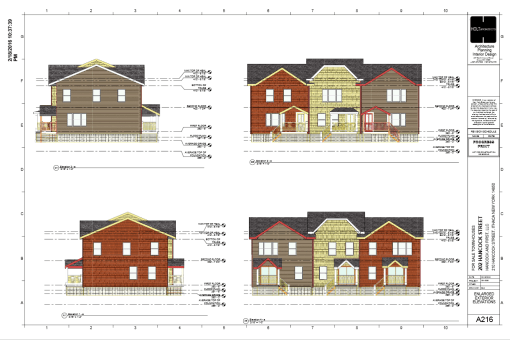
3. Courtesy of the Ithaca Urban Renewal Agency’s Neighborhood Investment Committee, we get to see a pretty thorough breakdown of the expenses and revenues of an owner-occupied affordable housing project.

The details come as part of INHS’s application for $314,125 in Federal HUD HOME funds, to be used for the 7 for-sale townhouse units included with the 210 Hancock project, collectively called 202 Hancock. The funds would be used to cover soft costs, like project management, engineering and architecture fees, legal fees, and site inspections.

inhs_202_financials

The 202 Hancock project construction cost is estimated at $1,754,860, about $344,000 per unit, or about $198/SF. That’s expensive, but not unusual – 203 Third Street was about $190/SF. The cost is high due to rapidly rising construction costs, and due to federal guidelines and lender specifications, INHS is required to hire contractors with extensive insurance. Add in soft costs and it jumps to $2,408.371.

Now let’s consider the sales. The five two-bedroom units are expected to sell for $130,052 to a household making no more than $38,046. The two three-bedrooms will sell for $164,979, to households making $42,428/year or less. Those incomes don’t meet the rule-of-thumb of 3.4x annual income, but HOME funds cover part of the cost ($24,000 for the 2-bedrooms, $36,000 for the three-bedrooms). INHS gets $960,218 in the project sales – and that’s the same amount Tompkins Trust Company is willing to cover with a construction loan. So the initial gap is $1,448,155. Now we’re starting to see why new housing can be so expensive.

INHS gets $7,000 in revenue from Energy Star rebates on appliances, and has up to $351,153 equity they can put towards the project, most of that being the value the of 202 Hancock’s land. The IURA would issue a low-interest bond for $215,875 to be paid back by INHS, and the non-profit has secured $280,000 in grants directly from the state (NYS AHC), and $280,000 in NYS CDBG funds awarded by local governments (this tactic is known as “subsidy layering“). This complicated puzzle of funding sources is why so many developers are not interested in doing affordable housing.

Side note, one of the pre-development costs is market analysis. Might seem silly, but grant reviewers want proof the housing crisis isn’t just bluster, and that these units won’t sit empty. An analysis by Randall/West determined that at a sale price of $136,000 for a 2-bedroom, and $162,000 for a 3-bedroom, qualified buyers would be found and under contract within 4.6 months. The units should be available for occupancy by June 2017.

202_hancock_2

Secondly, thanks to a legal settlement between the state and Morgan Stanley, a $4 million affordable housing grant is available for renovations of existing INHS scattered site rentals (98 units in 44 buildings across the city). Most of these units are rented to individuals making 60% or less of the area’s median income (about or less than $32k/yr). The funds would go towards major, long-term renovations, such as new roofs, windows, siding, and energy efficiency improvements. INHS could also use the funds, disbursed via the city, to refinance its portfolio, acquiring some of the properties and paying off $1.8 million in loans on already-purchased properties.

Here’s the short of it – the goal is to buy/pay off the scattered rental sites they manage, renovate and make them energy efficient and comfortable, lock them into the Community Housing Trust so that they become permanently affordable, transfer the land to a wholly-owned Housing Development Fund Corporation, and then sell some of the buildings to an LLC while INHS continues as property manager. The funds from sales would finance new affordable housing. This is all set up as it is to take advantage of legal and tax benefits of different corporate tax structures, while minimizing the drawbacks. Potentially, the Morgan Stanley settlement money could be used to leverage an additional $15 million in tax credits and affordable housing grants from the state.

Correction, per INHS’s Scott Reynolds in the comments section: rentals aren’t in the Community Housing Trust, but affordability would be required for 50 years.

Rochester-based SWBR would be in charge of renovation design plans, and 2+4 Construction will be general contractor. Tenants may need to be relocated as renovations occur, which will be coordinated by INHS staff. The goal is to have the settlement money accepted by the city by the end of the year, financing by April 2017, and renovations completed by the end of 2018.

cwd_bldg24_1

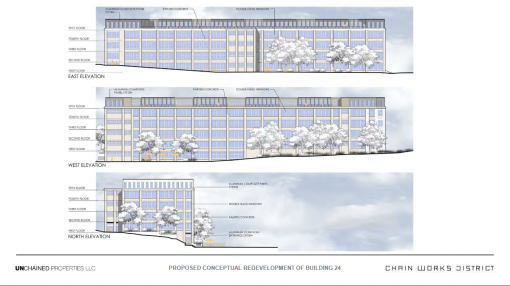
4. It’s another one of those special meetings – the city Planning Board will be sitting down next Tuesday to go over comments and sort another batch of public comments regarding the Chain Works DEIS, this time on public health. Once you get past the few pages of “this will never work and don’t bother trying”, there’s actually some interesting back and forth about remediation and what that entails. Also on the agenda are revisions to the Holiday Inn Express down in Southwest Ithaca – namely, they’re trying to avoid building the stairs to Spencer Road, as well as some other landscaping issues. At the second meeting later this month, the board is expected to Declare Lead Agency, open public hearings and review parts of the FEAF for TCAction’s Amici House, 8-unit 607 South Aurora, and the 8-story City Centre project on the Trebloc site downtown.

maplewood_v7_1

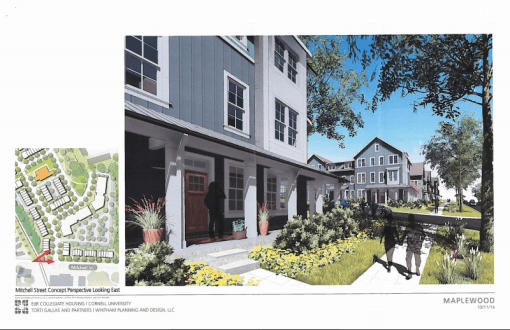
5. The plans for Maplewood have been modified yet again, in a change that the project team hopes will please neighbors and the town of Ithaca planning board. In revised plans submitted this past Wednesday, the 4-story apartment building planned for Mitchell Road has been replaced with a few sets of 2.5 and 3.5-story townhouses and stacked flats, and Building B to its north was extended slightly to compensate for the loss of bedrooms. Even so, the accompanying letter from Scott Whitham states that the unit and bed count have decreased slightly, from 473 units and 887 beds, to 442 units and 872 beds.

maplewood_v7_2 maplewood_v7_3

Also modified was their appearance – stoops, porches, dormers and gable roofs were added to give them a more harmonious appearance with the rest of the neighborhood. It’s not clear if the rest of the units were aesthetically modified as well.


Previews and Reviews From the AIA Design Crawl

10 10 2016

Last Friday, several Ithaca-area architecture and engineering firms banded together to co-host an open house night at their locations across the city. Here are some of the latest and greatest plans are from some of the local designers.

The first stop was John Snyder Architects in Ithaca’s West End. On display were the Carey Building plans and other recent works, like the internal renovation of the South Hill Business Campus for CBORD.

The second location on the list was HOLT Architects at 619 West State, which was probably the most family-friendly of the hosts, based off of the pizza bar and the children’s play-room. HOLT had several new and in-progress projects they shared with the public that evening.

20161007_175436 20161007_175444

The Computing Center is looking to move out of the Cornell Business Park and into a new property to be built at 987 Warren Drive in the town of Lansing. The property is currently a two-story farmhouse and includes a vacant lot on the corner of Warren Road and Warren Drive, purchased by its current owner (an LLC) in December 2014. The new building appears to be a one-story structure.
20161007_175504 20161007_182158
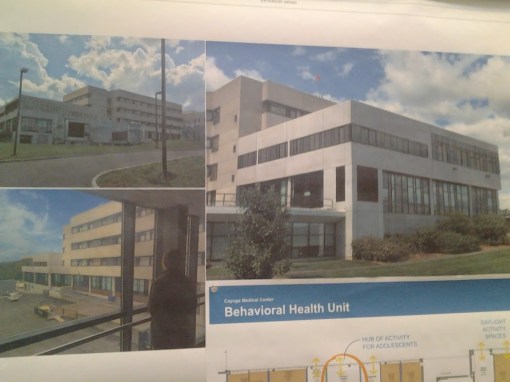
HOLT is arguably the local specialist for medical facilities and lab structures. Here’s a pair of projects recently completed at Cayuga Medical Center. The Surgical Services Renovation is a renovation and addition that includes space next to the front entrance, creating a new “face” for the complex. The Behavioral Health Unit is an addition on the northwest side of the building, and isn’t visible from most nearby roads and structures.

20161007_182103
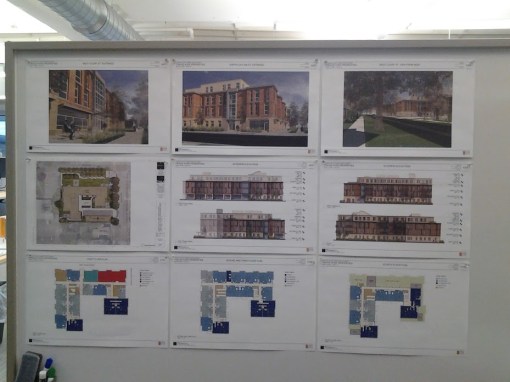
The online version of these will be showing up in the Voice soon enough, but here are the latest design plans for the Old Library site. The indoor parking was eliminated so that the fourth floor could be set further back, and the entire building has been pulled away from West Court Street. The building still has 57 apartment units for the 55+ crowd.

The next stops were at Taitem Engineering and SPEC Consulting. Taitem (which stands for “Technology As If The Earth Mattered”) serves as structural engineering for many local projects, focusing heavily on renewable energy sourcing and energy efficiency. The focus of their open house was a tour of their LEED Platinum, 120-year old building at 110 South Albany Street, which they said was only the fourth renovation of its kind to achieve Platinum designation. I snapped a photo of Taitem’s staff, but that was taken for the IV Twitter account.

SPEC Consulting had on display a couple of home renovations they have underway, a mixed-use building in Johnson City, as well as rehab of a vacant commercial building in downtown Binghamton into a 70-unit mixed use building. To be honest, I was more focused on the personal than professional when I was at SPEC – I ran into someone I knew from undergrad whom I hadn’t seen in nine years, who apparently settled in the area and married a SPEC architect.

20161007_193020

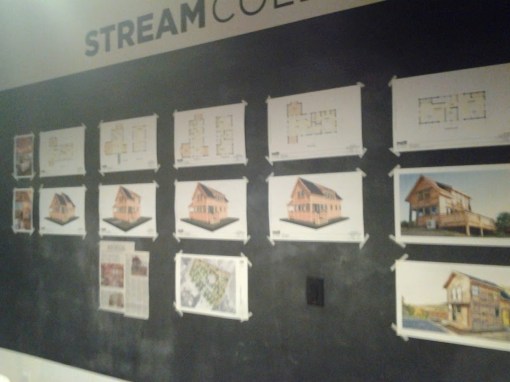
At STREAM, several projects were on display – 201 College Avenue, State Street Triangle concept drawings, and a room showcasing Tiny Timbers. According to Noah Demarest, this was the first time they had shown all the home plan designs together. Also there was Buzz Dolph, the entrepreneur behind Tiny Timbers.

Not shown here but on display were a pair of attractive design concepts for CR-4 zoning in Collegetown. They might become more than concepts at some point.

20161007_211521
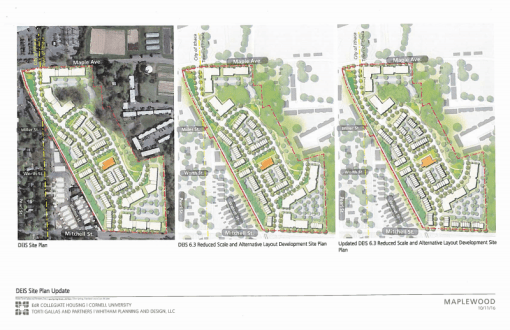
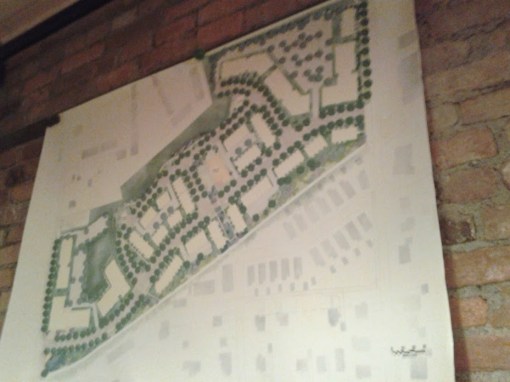
This is the latest Maplewood site plan, courtesy of Whitham Design and Planning. Here are the two big changes (previous site plan here) –

1. The Maple Avenue building has been broken up into two separate buildings.
2. Townhouses sit on Mitchell at the southwest corner of the site, replacing the multi-story apartment building previously planned.

The number of beds, previously 887, has probably decreased a little bit as a result.

I did not make it to Chiang O’Brien Architects, unfortunately. It looks like from their website they have a new project underway at SUNY Oneonta.