News Tidbits 4/7/18: A Day Late and A Dollar Short

7 04 2018

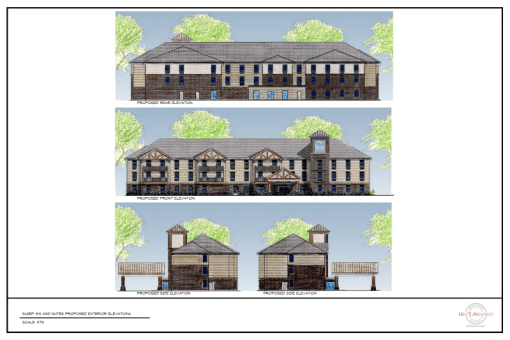
1. It appears the Sleep Inn hotel is moving forward. Building permits for the 37,000 SF, 70 room hotel at 635 Elmira Road were issued by the town of Ithaca on March 23rd. According to the town’s documentation, the project cost is $4.1 million, though it’s not 100% clear if that’s hard costs (materials/labor) and soft costs (legal/engineering/design work), or just hard costs alone.

The Sleep Inn project was first introduced in Spring 2016, and underwent substantial aesthetic revisions to a more detail, rustic appearance. Even then, the project was barely approved by the Planning Board, which had concerns about its height, relatively small lot size and proximity to the Buttermilk Falls Natural Area. The hotel’s developer, Pratik Ahir of Ahir Hotels, co-owns the Rodeway Inn further down Elmira Road. Both the Rodeway and Sleep Inn are Choice Hotels brands, so although the Sleep Inn brand is new to the area (and uncommon in upstate New York), it’s not as unusual as it seems. Given the size, a 12-month buildout seems reasonable. Look for updates as the project gets underway.

2. In a similar vein, the gut renovation and expansion at 1020 Craft Road now has a building loan on file – $1.88 million as of April 3rd, courtesy of Elmira Savings Bank. The existing 10,500 SF industrial building has been gutted down to the support beams, and will be fully rebuilt with an additional 4,400 SF of space. The project is being developed and built by Marchuska Brothers Construction of Binghamton. According to the village of Lansing and the developer, the project will be occupied by multiple medical tenants.

3. The problem with tight publishing deadlines is that if a quote doesn’t arrive in time, you can either put it in afterward as an updated statement, or it gets left out. So on the heels of the report that Visum Development Group is upstate New York’s fastest growing company in terms of revenue (Inc.com’s guidelines were three-year period 2014-16 and at least $100,000 in revenue to start), I wanted to share this for those who might have missed the article update. The statement comes courtesy of Todd Fox, who was asked for comment and responded the following day.

“I would love to acknowledge the Visum team because without them I would never be able to accomplish what I am doing. I’m blessed to have the most passionate and talented people I have ever met. Chris Petrillose is my longest running team member and is the backbone of operations. I also want to acknowledge Patrick Braga, Matt Tallarico, Marissa Vivenzio, and Piotr Nowakowski. They are all rock stars and deserve so much of the credit for our success!

We are currently looking to expand into several new markets, which are as far south as Sarasota Florida and as far west as Boise Idaho. For the Ithaca market, we are essentially hitting the breaks on student housing for Cornell, as we beginning to experience some softening in the market. Our new focus is on for-sale condos and moderate-affordable rentals. We actually have multiple properties under contract and plan to bring about 1,000 to 2,000 new beds online over the next several years.”
Note the last parts. The market for student housing if softening. Visum will focus on for-sale condos and moderate-affordable rentals, things Ithaca could use more of, and 1,000 to 2,000 beds would certainly make a dent in the housing deficit. Of course, proof is in the pudding, so we’ll see what happens over the next several years.

4. The town of Ithaca was less than pleased about Maplewood’s request to extend indoor working hours until 10:30 PM. Labor, weather and building supply (wood frame) issues were cited as reasons for the needed extension. The Ithaca Times’ Matt Butler, who was at the meeting, provided this quote:

https://platform.twitter.com/widgets.js

Yikes. The “happy medium” the board finally gave in to was construction until 9 PM on buildings interior to the project site, away from the main roads. The tradeoff is that EdR and Cornell now expect to not have some of the later structures ready until August 20th, practically move-in day for all of Cornell’s on-campus undergrads.

5. Readers of the Voice and Times will know that the county is pursuing some of the $3.3 billion in federal dollars earmarked but not yet disbursed for opioid crisis treatment. While a temporary addiction facility is being prepared, there are plans in the works to open a detox and stabilization facility in Tompkins County. Unfortunately, it needs much more funding to move forward. The new facility will cost $11 million to build and make operational, and so far about $1 million has been received so far in grants.

For the purpose of this blog, I asked about the design beside Angela Sullivan and Senator Schumer – it is a conceptual design for demonstrative purposes, and a location for a new facility has not yet been fully determined. However, they intend to send a press release once a site has been selected.

By the way, the green logo at lower right is a giveaway on the architect – that would be Ithaca’s HOLT Architects, who are specialists in healthcare facilities.

6. New to the market this week, “Clockworks Plaza” at 402 Third Street in the city of Ithaca’s Northside neighborhood. The 12,821 SF building was one of the few sizable buildings built in Ithaca in the 1990s (1993, to be exact), and is on the market for $2.6 million. The current owner, masked by an LLC, bought the property for $1.5 million in April 2016, the same value for which it is assessed.

That came up on the blog here. The buyer was Steven Wells of suburban Boston, who purchased the property in a buying spree that also included 508 West State Street (former Felicia’s, empty at the time) and 622 Cascadilla Street. 508 West State is now rented by Franco’s Pizzeria. Zaza’s still occupies 622 Cascadilla.

As I wrote at the time of sale:

“They all have different owners, and they’re in varying physical conditions. The only thing that unites these three properties is all that are in areas the city as ripe for redevelopment for urban mixed-use in the Comprehensive Plan. Felicia’s was upzoned in June 2013 to CBD-60, permitting a 60-foot tall building, no parking required. 622 Cascadilla is WEDZ-1a, allowing for five floors and no off-street parking requirement. Lastly, 402-410 Third Street is B-4, 40′ max and 50% lot coverage, but allows virtually any kind of business outside of adult entertainment. Those are some of the city’s more accommodating zoning types, so we’ll see what happens moving forward. At the very least, the public relations game will be starting from behind the proverbial eight ball.”

The reason why the public relations game was ‘behind the eight ball’? He was the guy who sold 602 West State Street and adjacent low-income housing properties to Elmira Savings Bank. There were accusations that the transaction between Wells and the bank was poorly handled, with claims that the lease terms of existing tenants were changed improperly, and tenants not being told their homes were being sold. It’s not clear it that’s accurate, because no one would share their documents to prove their claims. But what is clear is that this created a nightmare situation.
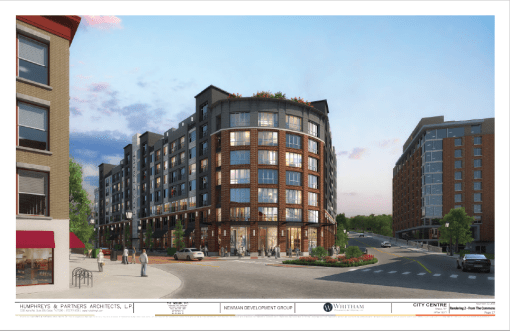
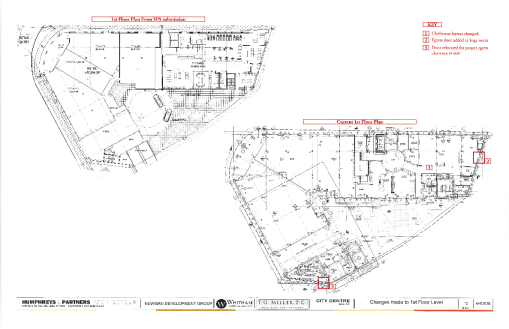
 

7. It looks likely fewer people will be living in City Centre than first intended. The initial 192-unit mix was 61 studios, 78 one-bedrooms and 53 two-bedrooms. The newly-proposed mix is 33 studios, 120 one-bedrooms, and 39 two-bedrooms. It also appears the retail space has been reconfigured from four spaces to three, though the overall square footage appears to be about the same. There are some minor exterior changes proposed as well; paver colors, lighting, the types of metal panel used (Alucoil to Overly Dimension XP and Larson ACM panels), landscaping, and exterior vents. Assuming the PDF is accurate, the panel change is slight, but gives the building a slightly darker grey facade. Some of these changes are in response to code and safety discussions, others are likely value engineering.
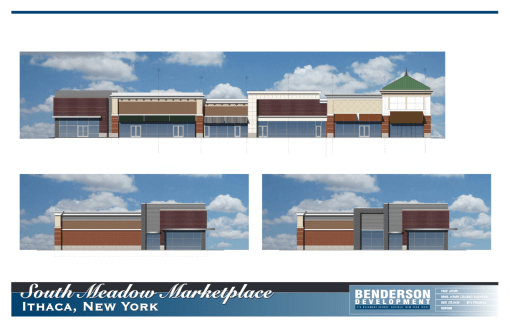
8. From the city’s project memo, we see Greenstar’s new store (which is going into the Voice) and a pair of new if small projects.

The first is that it appears Benderson is expanding South Meadow Square again. Along with the pair of endcap additions underway, the Buffalo-based retail giant is looking to add a 3,200 SF addition to the west endcap of one of its smaller retail strings. The addition is on the Chipotle/CoreLife strip, next to Firehouse Subs. The dumpster enclosure currently on-site will be relocated to the Panera strip across the road to make room for the building, which will be flush to the sidewalk with…a blank wall. Seems like a bit of a missed opportunity there. The 35′ x 92′ addition has no announced tenant, though 3,200 SF is reasonable for a smaller restaurant or retail space (Chipotle is 2,400 SF, for instance, and Panera 4,100 SF; the stores in this particular retail strip, which includes a vitamin store, tanning salon and barber shop, are in the range of 1,380-4,089 SF). The total project cost is only $132,000, and no construction period is given in the Site Plan Review document.
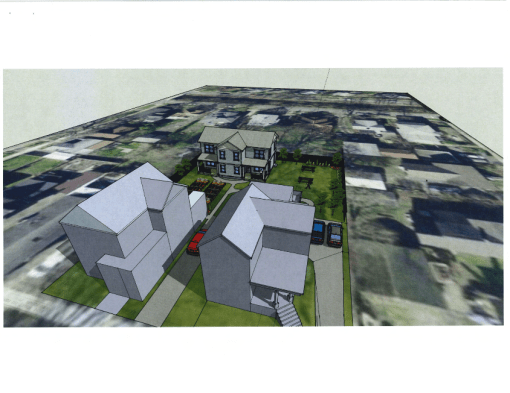
The second is a “pocket neighborhood” in Northside. Barken Family Realty of Ithaca is planning to renovate two existing homes at 207 and 209 First Street, and add a new 2,566 SF two-family home behind the properties. They would be set up as a “pocket neighborhood”, consolidated into a single tax parcel with a common area, picnic tables and raised plant beds. The fence would be repaired and the gravel driveways improved. No demolition is planned, but five mature trees would come down to make way for the new home (6-8 new trees will be planted).
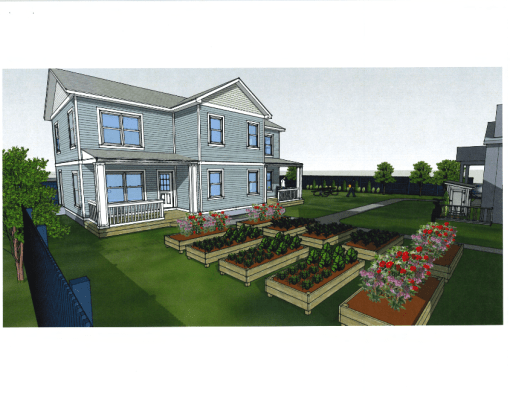
Hamel Architects of Aurora designed the new duplex, which is intended to quietly fit into the neighborhood context. Each unit will be two bedrooms. The $265,000 project would be built from October 2018 to March 2019.
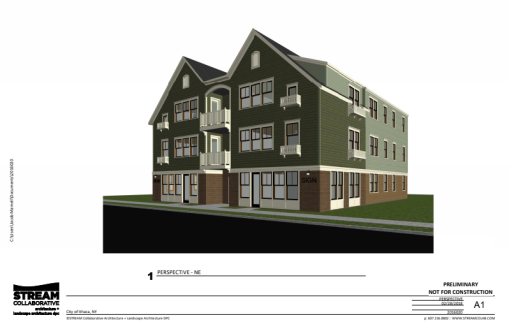
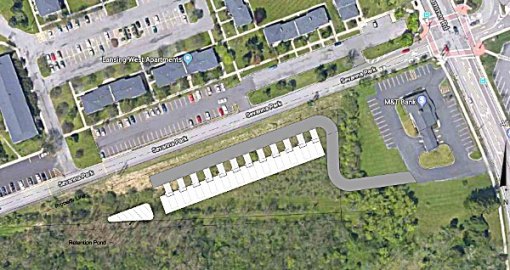
9. We’ll finish this week with a potential new build. The above project was first showcased on STREAM Collaborative’s Instagram at an early stage. It is a 3.5 story, 11,526 SF building with 10 units (6 one-bedroom, 4 two-bedroom), and the two one-bedrooms on the first floor are live-work spaces – the front entrances are workspaces for home businesses. It is proposed along West Seneca Street, and only the south side of West Seneca allowed for mixed-uses like live/work spaces. Materials look to be Hardie Board fiber cement lap siding and trim. The design is influenced by other structures along West Seneca, and a bit from STREAM architect Noah Demarest’s time with Union Studio in Providence, Rhode Island, where he worked before setting up his own practice back in Ithaca – there are similarities between here and Union Studio’s Capitol Square mixed-use design in Providence.

The project actually was sent with its name and title, but fingers crossed, it will be part of a bigger article.


News Tidbits 2/26/2018: One, Two, Many Tweaks

26 02 2018

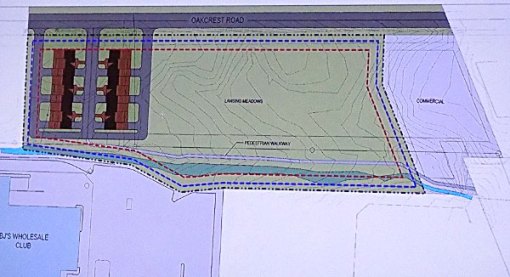
1. Let’s start off with some bad news. Than Lansing Star is reporting that developer Eric Goetzmann is in serious trouble. The village of Lansing Planning Board rejected his latest request for the Lansing Meadows senior housing component, which was to build twelve units on a fraction of the lot, and leave the rest vacant. Frankly, they liked the units, but the vacant and potentially saleable lot was too much for them to overlook. To be honest, they and the village Board of Trustees have been fairly accommodating to his other requests, but this seems to be the last straw, and they let him know it.

They will consider the latest revision, but only as a major revision, not as the minor change Goetzmann had hoped for. That means it will take months to go through the procedural review and vote. Meanwhile, the IDA has initiated legal action because Goetzmann failed to hold up his end of the deal they agreed to when he received his abatement back in 2011.

Some projects are successes. Some break even, some don’t turn out as well as hoped. But as Lansing Meadows goes, this is neigh close to a disaster.

2. On a more positive note, Lansing will be considering, coincidentally, another 12-unit townhouse project. Called “Triphammer Row”, the market-rate units are planned for the vacant rear portion of a Cornell-owned parcel at 2248 North Triphammer. This blog reported on the parcel in a news roundup back in July 2016, when it went up for sale:

“Hitting the market this week is a potential opportunity for the deep-pocketed investor/developer. The property is 2248 North Triphammer Road in the village of Lansing. The sale consists of two parcels totaling 3.42 acres – a 1.53 acre parcel with a 2,728 SF M&T Bank branch built in 1992 and holding a long-term triple-net (NNN) lease; the other, an undeveloped 1.89 acre parcel to the rear that the listing notes could be developed out into 13 housing units. The price for the pair is $2,125,000.”

The plan calls for roughly 1,350 SF units with ground-floor garages. They’re intended to be marketed towards seniors looking to downsize, and young families. The developer is Robert Poprawski, who runs a small hotel group (Snooze Hotels) in metro Fort Lauderdale, Florida. Poprawski is a 2005 Cornell graduate, so there’s the likely local connection.

The planning board is supportive, but the big issue will be the driveway – they would prefer the townhomes share Sevanna Park’s driveway. That’s tricky because Sevanna Park’s road is privately owned. Not impossible to make a deal, and it would likely have the village’s benediction, but it’ll take a little while to see if a deal can be made between Sevanna Park’s HOA and Poprawski (all things considered, given that a much larger retail/office building and parking lot could be built on the combined lots, 12 more homeowners doesn’t sound like a bad option).

The village is also reporting there are development plans for the balance of the Millcroft property (the 32-acre remainder of the parcel, once intended for luxury single-family homes, has been for sale for a while), and vacant 4.56-acre 9 Dart Drive. The Ramada Inn (correction: the new extended-stay hotel proposed behind the Ramada) and Target are the only businesses interested in buying their properties from the mall’s owner, and Bon-Ton’s on deathwatch. The town’s code and planning officer notes that if it weren’t for Namdar Realty buying the mall, it would have failed, which would have forced the remaining tenants out and turned the mall into a vacant husk, to say nothing of the property tax implications.

3. Let’s shift over to Dryden. It’s been rumored for a little while that 1061 Dryden, aka the “Evergreen Townhouses”, would be trying to shift towards a smaller footprint – here’s the plan. The approved proposal calls for 36 3-bedroom units, six strings of six units. The reduced size plan still has six strings of six units, but the middle four have been reduced to two-bedroom units. The total occupancy goes from 108 to 84, and the footprints have shrunk as bit. Old render at top, new renders at middle, new site plan at bottom with new footprints in red. HOLT Architects’ design is generally the same, though I have an armchair critique with the rear flanks of the strings – a window opening would do a lot for aesthetics, if the floor plans permit.

(You can check the town’s website for docs, but some webpages have been hacked and replaced with a phishing scam, so use caution).

According to Dryden town planner Ray Burger, the developer, Lansing businessman Gary Sloan, would like to start construction this summer. That would put these units on track for an opening in time for the 2019-2020 academic year (in other words, about 12-14 month constriction timeline).

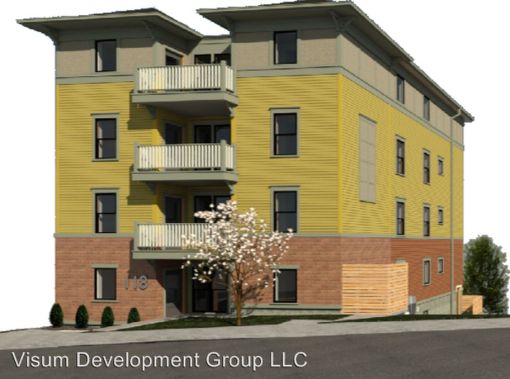
4. Another project moving forward – 118 College Avenue in Collegetown. This is a Visum proposal to replace a five-bedroom house with a 5-unit, 28-bedroom apartment building. The project was approved by the city early last year. According to the advertisements on Zillow, rents are expected to be $1,200/person, plus utilities.

I asked Visum’s Patrick Braga to confirm, and he replied that building permits would be approved “any day now”, so they’re probably looking at an August 2018 opening. With regards to a follow-up inquiry about its near-identical twin planned for 126 College Avenue, Braga replied they he does not “have any information on the status” for that project.

5. The new Greenstar West End store. Maybe coming soon. According to the news release, if the membership approves the move, the new store would be open at 750 Cascadilla Street by November 2019. The expansion would more than double their floor space, and add sixty living-wage jobs. Membership will vote on the plan next month.

The above render is courtesy of STREAM Collaborative – even without their logo, their software relies on the same pack of white Priuses, Volvos, and Touraegs to fill parking spaces (my family of mechanics would be proud I use vehicle models as a telltale attribute). The design is attractive for a big box – it has shed roofs and exposed wood trusses that give it a warmer, less industrial appearance. For the record, STREAM also did 118 College Avenue in the previous tidbit.

6. Honda of Ithaca has been sold to the Maguires for $3.5 million. The sale was recorded with the county clerk on the 20th. The acquisition means that Maguire represents just about every major vehicle make in the Ithaca area. It also drew some impassioned responses regarding customer service experiences, which given Maguire’s very visible presence, is not to be unexpected.

According to county records, the 27,558 SF dealership was built in 1985 as Cutting Motors Buick-Pontiac-GMC, and sold for $1.8 million in 2009. It was renovated and expanded in 2012; the portion closest to Elmira Road is the expansion space.

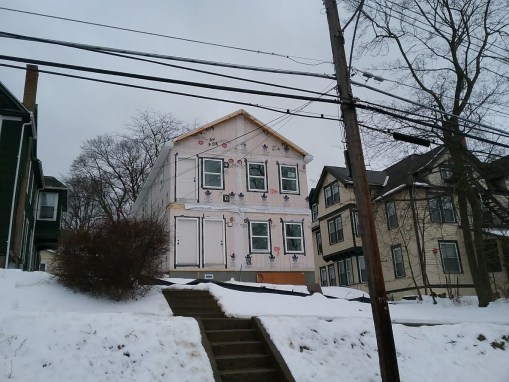
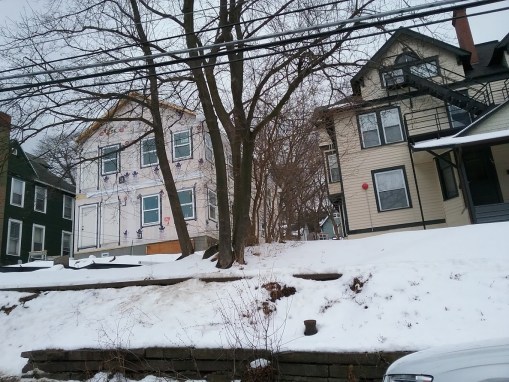
7. The Lambrou family’s latest project is coming along. Being built at 123 Eddy is a contextually-sensitive two-family home at 123 Eddy Street. While modular, the home was designed to have features respectful to its location in the East Hill Historic District – this includes a double-decker porch, roof brackets, shake siding and decorative columns and railings. The new three-bedroom units should be ready in time for the 2018-19 academic year.

8. Quick note – building permits for both the Amici House residential and head start/daycare buildings have been filed and granted by the city. The Harriet Giannellis Childcare Center’s hard costs are estimated at $1,267,479, while the 23-unit residential portion’s hard costs are estimated at $3,627,333. Welliver will be the general contractor.

9. Looks like a pretty quite planning board agenda for this month. A pair of new projects, but they’re small ones. Let’s have a look:

I. Agenda Review 6:00

II. Privilege of the Floor 6:05

III.A. Stewart Park Inclusive Playground 6:15

B. College Townhouses – Modified Site Plan approval 6:35

C. Proposed U-Haul Self-Storage Project – Sketch Plan 7:10

Although vague, this is like for the former Salvation Army property at 339 Elmira Road. U-Haul purchased the lot in January 2016 from the development group that planned and cancelled a hotel for the property. As noted on the Voice recently, there’s been a building boom in self-storage facilities lately.

The most plausible guess for this corporate-owned property is that this will likely take after the chain’s default design for self-storage facilities, with maybe some modest aesthetic differences. Not especially pretty, but the city would probably prefer that over a parking lot for U-Haul trucks.

D. Proposed duplex and parking – 207 and 209 First Street 7:30

207 and 209 are a pair of run-down rental two-family homes in Ithaca’s Northside. After the previous owner passed away, they were sold to local businessman David Barken in June 2017. Barken previously caused a stir in Fall Creek when he bought, renovated and sold a Utica Street home for a much higher price (he said on the list-serve it wasn’t intended to be a flip, it was intended for a family member who decided to live elsewhere). Barken purchased the home for $160,000 in September 2016, and it sold for $399,500 in June 2017. He also rents out a couple other units in Fall Creek.

EDIT 3/8: Rather than a tear-down and replacement, the scope of the project appears to be that the homes would be renovated, and a new duplex would be built towards the rear of the lots. Per email after the meeting from David Barken:

“While in its beginning phases and still taking shape, I have no intention to tear down the existing homes. Instead, I plan to steadily improve these properties, working on both the exteriors and interiors as the planning phases for any future project moves forward.

Rather than de-densification, my aim is to add more fair market rate, non-student housing to the downtown market and add to urban density in our city’s core. I am designing the site for a total of 6 apartments, with an emphasis toward communal interaction, landscaping, and urban gardening. I envision a pocket community for renters, complete with the 4 renovated units in the front of the lot and an additional duplex placed in the rear of the parcel.”

IV. Old/New Business 8:00

A. Chainworks FGEIS

B. Planning Board Report Regarding the Proposed Local Historic Landmark Designation of 311 College Avenue – The Number Nine Fire Station

6. Reports 8:20

7. Approval of Minutes (1/23 and 1/30) 8:40

8. Adjournment


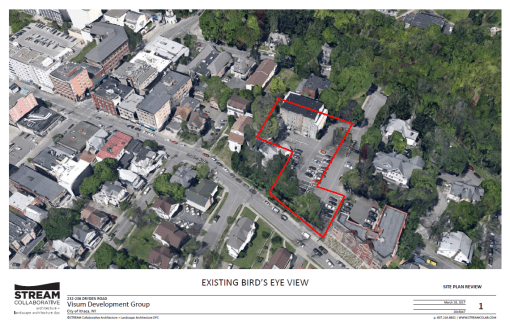
The Lux (232-236 Dryden Road) Construction Update, 2/2018

19 02 2018

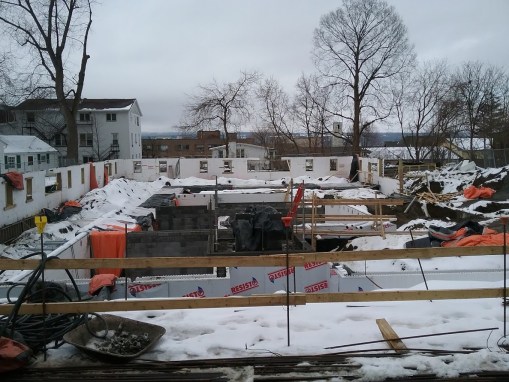
Things continue to move at a good clip over at “The Lux” at 232-236 Dryden Road. It looks like the insulated concrete forms (ICFs) have acquiesced to standard wood framing and ZIP panels on the upper floors. The building facing Dryden Road, 232/The Lux South, has commenced with framing of four of its five floors, and the elevator core/stairwell stands at full height (zoning only allows four floors/45 feet, but its a sloped site, so technically that bottom floor is a partially exposed basement level). 236/The Lux North has begun work on its basement level with the construction of ICFs covered with a vapor and water-resistant barrier (Resisto), and it appears that the first blocks for an elevator core/stair column are being assembled.

There might have been some internal reconfiguration. Site plan review documents noted that 232 Dryden will have 20 units and 53 bedrooms, and 236 Dryden will host 40 units and 138 bedrooms. But, a recent post on Visum’s facebook page suggests the project will have 207 bedrooms, not 191 as originally conceived. Everything appears to be on track for an August 2018 occupancy.

Even with the expected Cornell dorm additions in the next three years, the Lux’s location in inner Collegetown gives it an advantage over more remote housing options – students/parents with deep pockets will often pay more to be next to campus, while the amenities and worry-free living help seal the deal (worry-free in the sense that there’s no “deferred maintenance” to be concerned with when the units are brand new). Rents here are going for $1,200-$1,300 per bedroom, though they have a promotional running right now for 10% off rent for the first month.

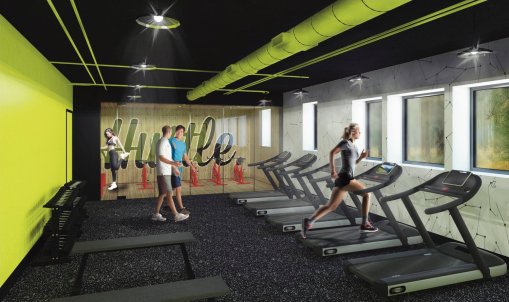
It appears there was an unusual but interesting contest held by Visum that invited students to compose interior designs for the three common rooms in the complex. Registered applicants (individual or group) received floor plans and interior documents to aid in their designs, and had about eight weeks to submit their final plans (December 2nd – January 21st). The winning team gets $2,500 and a building lounge will be named in their honor. Snagged from the website and included below are some mockups of the gym, a study room and a commons space.


210 Linden Construction Update, 2/2018

18 02 2018

So here’s some good news – 210 Linden Avenue is moving forward once again. The city’s Board of Public Works (BPW) held a special meeting on the 30th that would create a loading zone in front of 210 Linden Avenue. This is important because the new state fire code restrictions say no construction can occur along Linden since the street is no longer considered wide enough. By eliminating the parking space in front of 210 Linden and replacing it with a loading zone, it created a “wider” street since a fire crew would no longer have to worry about parked cars along the street frontage. This made it easier for the project to obtain a fire code variance from the state.

BPW is ostensibly not a fan of the arrangement, but given that the developer (Visum) was notified by the city of the change after the existing building had been torn down, they were willing to grant the loading zone given the unique circumstances.

Well, mostly unique. One other project was subject to the the same issue under very similar circumstances – Novarr-Mackesey’s 238 Linden Avenue. That project team is also asking for a loading zone during this month’s BPW meeting, and hopes to be granted a state fire code variance as well (and 210 Linden gives them reason to be optimistic). While every future project planned for Linden is now in limbo, it appears likely these two will be able to move forward.

Also in the good news category, a state fire code variance was granted for another Visum project, 118 College Avenue, under the expectation that the city and NYSEG will follow through with their plans to bury the power lines on College Avenue in the next two years. With the lines to be buried relatively soon, the state felt comfortable granting the variance for a building taller than 30 feet (118 College is just under 45 feet).

The buildings are aiming for an August 2018 completion. They are wood-framed structures, which in comparable economic circumstances, can move along faster than a concrete or steel. Even then, it’s still going to be a tight deadline for William H. Lane Inc.

A glance at Zillow shows that the basement 1-bedroom unit appears to be spoken for (the basement unit was a modification to the original plan, perhaps because many amenities will be shared with its siblings 201 College and “The Lux” at 232-236 Dryden Road), but the nine 4-bedrooms/2-bath units (1,365-1,440 SF) have not. Zillow says there are ten 4-bedroom units – that doesn’t seem correct. They are going for $4,400 apiece, or $1,100 a bedroom. That’s actually a sizable price drop from the $5,000/month they were being offered for before the fire code debacle.


The Lux (232-236 Dryden Road) Construction Update, 12/2017

18 12 2017

Some progress on Visum’s latest project, “The Lux” at 232-236 Dryden Road in Collegetown. 232 Dryden, the building closer to Dryden Road, has started work on exterior framing – the partially-above grade basement level, built into the slope of the site, appears to have been framed with Amvic insulated concrete forms (ICFs), similar to those seen at the Ithaka Terraces and the Fox Blocks at the Thurston Avenue Apartments. These are thermally insulated plastic blocks filled with concrete – they tend to be a more expensive approach, but they also tend to have a higher grade of insulation (higher R-value), making for a more energy-efficient structure. There has been talking of making the complex net-zero energy capable, provided that the energy of an off-site solar array can be procured. STREAM, the architect of The Lux, also did the Ithaka Terraces. The exterior walls will be assembled block by block, with new pours as rows of blocks are set in place. The rebar provides additional stability. It appears the cinder block elevator core/stairwell has been assembled as well.

232 Dryden might be the more visually prominent of the two building, but it is also the smaller one – it will have 20 units and 53 bedrooms. 236 Dryden will host 40 units and 138 bedrooms.

Speaking of 236 Dryden,  Welliver has the foundation excavated, and the steel piles are in. However, judging from the steel rebar sitting on the edge of the site, the concrete pours have yet to take place, and it looks like the wooden forms are just now being built on the far side of the footprint.

Pessimistically, I could note that this is one of the few Collegetown projects that was able to move forward after the building code change that brought multiple other projects to a halt – the power lines on Dryden Road aren’t close enough for the project to infringe on the new regulations. I had heard Visum might actually pay for the burial of power lines on the 200 Block of Linden Avenue, but even if they did, they would still have to deal with NYSEG’s slow schedule.


News Tidbits 12/2/17: The Changing Calculus

3 12 2017

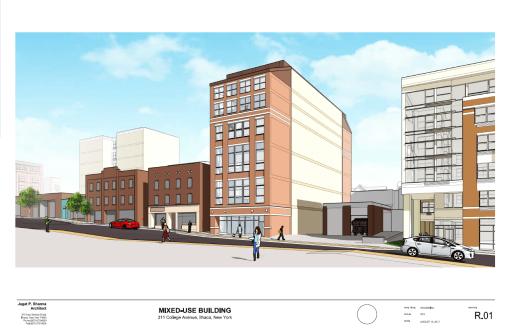
1. Perhaps the big news of the week is that Visum Development Group’s project for 311 College Avenue (the Nines restaurant and Bar) was revived after negotiations with the seller moved in a favorable direction. This time around, it appears that Visum is bringing something close to an “A” game proposal; Jagat Sharma is still the architect of record, but Visum’s VP for New Market Development, Patrick Braga, had a heavy hand in the design work and historical research. The designs produced are more historically inspired and embrace some of the elements that make the old fire station attractive to the public – the first floor doors will pull up like garage bays or slide open to create a sort of open-air loggia on warm days, and a cornice element is retained. Floor to roof will be about 66 feet according to the Times’ Matt Butler, and still contain about 50 1-bedroom and studio apartments as well as 750 SF of retail. For the record, he and I did a bit of collaboration on describing the architectural features before we ran our respective stories.

The sketch plan had a kinder reception from the Planning Board this time around, if still cautious. Even though John Schroeder made it clear he would never accept any plan for The Nines, he said something to the effect of, if this design were proposed for any other MU-2 in Collegetown, he would have no problems with it whatsoever. The rest of the board did a quick poll to see if the other members would at least entertain a proposal, and no one else said no, so the project is considered active.

Now, things can get a little awkward from here. The city planning director, JoAnn Cornish, made it clear that they could move forward with design if they want, but there’s a risk that the property may get landmarked before they get approval. Speaking with the city historic preservation director Bryan McCracken the day after the article, he said that a decision on whether or not to move forward with the landmarking process would be on the agenda for the ILPC’s December meeting. If they move forward, it still has to go to Common Council. I had previously heard through the grapevine that the council was favorable to landmarking in the case of the Nines, but that was before Visum brought forward a new plan. The truth is, things are fairly unpredictable at the moment, and it’s a matter of waiting and watching how different stakeholders act and react.

2. I like Matt Butler, he has time to do the stories that I can’t. This time, a look into the plans for a centralized government facility at the site of the Central Fire Station on the 300 Block of West Green Street. That study is still active, under the guidance of Kingsbury Architecture and TWMLA, as is the second study for a combined Public Works facility. The appraisal process and estimates of cost are also still underway.

It’s kinda a given that this would have tremendous impacts, as noted in the Voice. A lucrative Collegetown site and other redevelopment sites would be on the market, and hundreds of workers and daily visitors would extend Ithaca’s core down State Street, which the city wants, considering it to be one of the few directions downtown can expand towards without compromising too much of Ithaca’s existing urban fabric. The ILPC would need to sign off on plans due to the fire station’s proximity to the “Downtown West” historic district (it actually contains the IFD’s parking lot for the sake of contiguous parcels), so “super-edgy hypermodern” probably isn’t on the table design-wise. The city also has to make a decision relatively soon – the current city hall (former NYSEG HQ, built 1939) and “Hall of Justice” (1920s, renovated/expanded 1964-66) are in need of major renovations.

3. Also on the visionary end of discussion are future plans (2020 onward) for Collegetown’s transit network. Here, it is often a delicate case of balance; it’s a dense, lucrative secondary core of the city, but parking and traffic are problems, as is the lack of infrastructure for pedestrians and bicyclists. One option being explored is a new bike lane up College Avenue that would eliminate 35 parking spaces (and was not well received), and the other is a more modest plan that largely keeps College Avenue as is, which many didn’t like either.

Perhaps the most interesting note from the article is that the city is examining the feasibility of expanding the Dryden Road garage by adding additional floors to the 1980s structure. The Dryden Road garage has the highest parking rates and a high occupancy, and is the most lucrative of the city’s four garages. The city is also looking at incentives for on-site parking, which to be honest, probably isn’t going to work in Collegetown for a number of planning and financial reasons (i.e. a developer will make a lot more from a rentable unit per SF, than from a parking space per SF).

4. Nothing much of note from the town of Ithaca Planning Board agenda. The owners of a former convenience store at 614 Elmira Road are seeking to perform minor renovations to the building for a bottle and can return (to be called IthaCAN & Bottle Return), and Maplewood is asking the town planning board permission to work on Saturdays in a mad dash to have the 872-bed complex ready for occupancy before August. Normally, renovations don’t need to visit the board, but the zoning for the Elmira Road requires a visit for each change of occupancy/use.

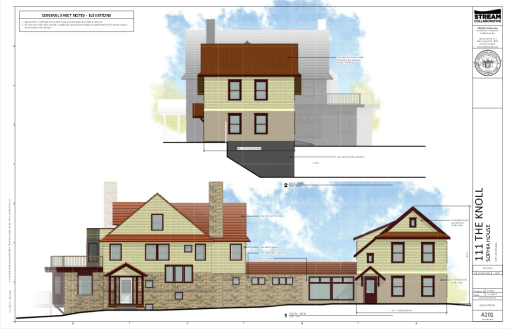
The city of Ithaca’s Planning Board memo is short as well, just the long-brewing plans for a garage-replacing addition to 115 The Knoll in Cornell Heights. The 1950s garage will be replaced with a 4-bed, 2-bath addition for Chesterton House, an all-male Christian interest group Sophia House, an all-female Christian group.  It appears the design has changed very little if at all since the plan first became public in May. The $349,900 addition, designed by STREAM Collaborative, would be built in the Spring and Summer of 2018 for an August opening. (Correction: Chesterton House is next door and owned by the same group. The project is for Sophia House. Thanks to Lyn for catching that.)

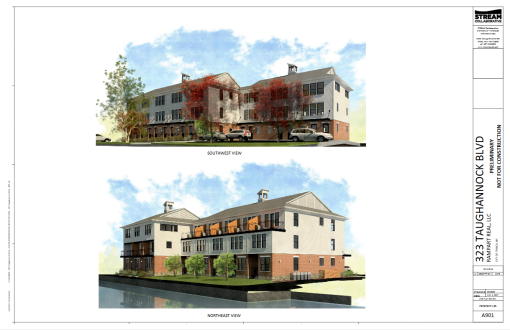
5. Local developers Steve Flash and Anne Chernish (d/b/a Rampart Real LLC) will be taking on a partner in the 323 Taughannock project. The couple sold a $203,000 stake in the 8-townhouse plan to Arnot Realty of Elmira (d/b/a 323T LLC) on the 22nd. For Flash and Chernish, it gives them a much bigger partner with experience and connections to contractors; for Arnot, it gives them a toehold in the buregoning Ithaca market, their first step into the city. The deed explicitly states this is a joint venture.

6. So this is interesting. On Friday 12/1, an LLC purchased an industrial/office building at 37-40 Elm Street in Dryden for $260,000. The property was built in the late 1980s and is about 25,000 SF, with a warehouse, manufacturing space, office space and three apartments.

The buyer was an LLC, but the LLC filing address traces back to 312 Fourth Street in Ithaca, a 13,800 SF complex of buildings and warehouses home to the All Stone & Tile Company, Ithaca Ice and Strawbridge & Jahn Construction. So either someone is growing out of space and the others are staying, or they are all moving. If they are all moving, that could be an opportunity. Zoning is B-4,  which allows a very wide variety of business and residential uses. Zoning is 4 floors/40 feet maximum height, 50% lot coverage, but being on the tip of the Waterfront/West End corridor, my suspicion is that the city could be a bit flexible with zoning variances for density and/or affordable housing. The only places one finds B-4 zones are the fringes of downtown, so it’s not well-suited for big projects, but there’s room to explore options. Of course, the electrical substation next door isn’t ideal, and the property isn’t even up for sale, but this is worth keeping an eye on.

7. So, there’s no real avoiding it this week – the tax bill in Congress. It really hurts Tompkins County. I did my one and only tweetstorm to cover some of the issues, and most of it still holds. Two last-minute changes softened the blow between then and now. One was the inclusion of the Collins amendment to reinstate a $10,000 cap on SALT (State and Local property tax) deductions, since the original Senate bill had no deduction. The other was raising the endowment from colleges with an endowment of $250,000/student, to those with $500,000/student. Cornell’s is about $310,000/student (6.8 billion/22,300 students). For the record, it wasn’t done to protect Cornell, it was done to protect conservative Hillsdale College after an amendment to give it an exclusive exemption failed. At least 30 schools were still hit, and this detail has to reconciled with the House Bill’s $250,000/student figure.

So apart from the SALT and college impacts I had already noted, one thing that got missed was that the bills allow prohibit schools from taxing out tax-exempt bonds to fund construction. For Cornell’s plan to add 2,000 beds, this is a problem.

So let’s just overview this real quick – a bond is a fixed-income investment in which an investor loans money to an entity, which borrows at a fixed or variable interest rate for a fixed period of time. When you buy a bond, you hold the debt for that entity. Most investors typically have some proportion of bonds in their portfolio – they typically are more stable investments than stocks, though the returns are typically less. Their relative safety is why financial planners recommend a higher proportion of bonds as one gets closer to retirement. The riskiness of a debtor not paying back is given by their bond rating. Cornell’s long-term debt rating is AA, which is very good, high-quality investment grade.

Now, in the case of non-profit schools, typically the tax-exempt bonds are issued with the approval of local and state authorities. The project to be financed by the bonds is determined by the school. The school does its internal approval of the project and bond plan, and the project it goes up to the community for planning board/environmental review. Once approved, the school chooses an approved issuer of bonds, often a state or local development authority (ex. The Dormitory Authority of NYS). A working group is put together to establish a timetable and structure for the bonds, and once the bond structure is settled and reviewed for issues, a public hearing is held on the bond issue, so that any issues or concerns are made clear before issuance. Barring no problems, the government signs off on the tax-exemption for the bond issue, a closing date is established and the bonds are marketed and sold, mostly to banks and big investment firms. The received funds are disbursed to pay for the project.

That’s getting taken away by this tax bill. That means any future bonds will be taxable, and have a much higher interest rate. Borrowing just became more expensive. A 30-year AA tax-exempt bond might be 2.76%, and a taxable bond 3.37%. That might seem a small difference, but a 2,000 bed project is on the order of $200 million (recall Maplewood is 872 beds and $80 million). So we’re talking millions of dollars more that Cornell will now have to pay to make those dorms happen. It opens up a distinct possibility that the project could be scaled back and/or delayed, which impacts the overall housing market. Probably the federal SALT tax cap is going to hurt much more.

Really, this bill was practically designed to decimate real and perceived enemies of politically conservative groups as much as it was designed to help billionaire donors and corporations. Poorly conceived, ignoring multiple non-partisan analyses and relying on overly optimistic projections, hastily put together and shoved through, blowing the debt trillions higher and immediately or eventually raising taxes on tens of millions. This is every cartoonish stereotype of Republicans amplified in one piece of legislation.

I don’t like to get political, but I’m a registered Republican, and have been my whole life. As a pragmatic never-Trump moderate, I joke that I’m a New York Republican and a Texas Democrat. When one writes about government red tape, the Cargill Mine, and Ithaca’s progressives attacking affordable housing, it tends to reaffirm beliefs.

But hell, this tax bill is throwing every principle out the window with this bill, causes a ton of damage to a place I care about, and with a morally deficient and unstable president at the helm, I can’t do it anymore. I mailed off the form today to become an independent. After this, I just can’t see myself voting Republican again, not for a long time.


The Lux (232-236 Dryden Road) Construction Update, 10/2017

23 10 2017

Continuing yesterday’s theme, here’s another one of Collegetown’s development opportunities playing out, though perhaps it was less obvious as the Linden Avenue properties – coming soon to Ithaca, 60 units with 191 beds of student housing at 232-236 Dryden Road, just east of Collegetown’s core and part of the eastern transition to the Belle Sherman neighborhood.

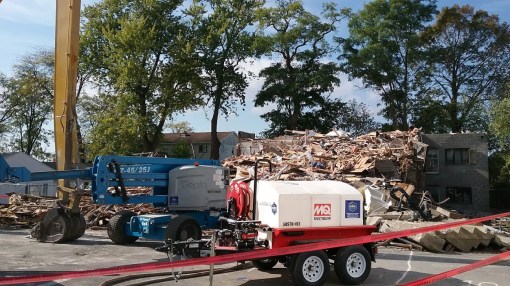
Once again, this is a case of Visum Development Group scouting potential opportunities at the right time and place to make something happen. Along with a large surface parking lot, the previous building on this site was a 30-unit apartment building and the former dormitory for the historic Cascadilla School, a private school with a 140-year history on the corner of Oak and Summit Avenues in Collegetown. The 4-story building once housed dorms, a dining hall and a gymnasium, but after its sale to private ownership after World War I, it was remodeled again and again, each seemingly more unsympathetic than the last. By the late 20th century, it was a grim, awkward-looking box, stripped of ornamentation and of its historic value. The previous owner, the proprietor of the Hillside Inn, had owned the property for several decades; Visum paid about triple the tax assessment ($7.65 million vs. $2.55 million) to buy the property in September.

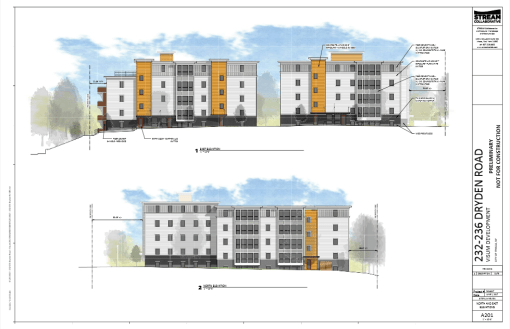
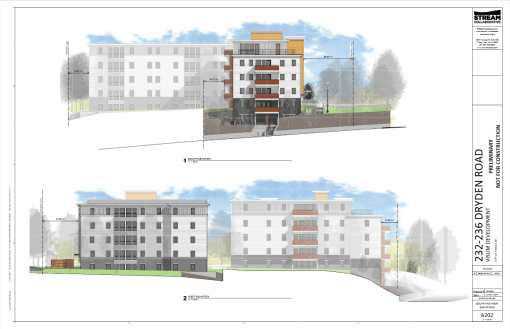
There are two buildings to be built, totaling 84,700 SF – 232 Dryden (The Lux South) and 236 Dryden (The Lux North). This allows for different plane grades, meaning they’re different elevations. That makes it easier to blend in with the neighbors, and creates less ambiguity with height limits, something that bedeviled Visum with its 201 College Avenue project. As with 210 Linden, zoning is CR-4 – four floors, 45 feet from average grade, no parking required with a city-approved transportation demand management plan (TDMP). Usually, that means free bus passes or Carshare registrations, ample bike storage, and explaining how students can easily commute to campus by walking.

The project was proposed in March 2017 and approved by August. Overall, the changes were fairly modest. No zoning variances and little public opposition helped to create a smooth review process. The biggest change came during the design review process, and affected the Dryden Road facade – revised fenestration and the addition of shingle-style balconies. STREAM Collaborative’s intent is to give the south building a little more historical sensitivity, and the balconies are throwbacks to the Cascadilla dormitory’s long-gone shingle-style balconies.

However, given that this building will date open in 2018 and not 1898, instead of wood shingle, the balconies will use Allura “Redwood” fiber cement shinglewood pulp mixed with sand and cement, shaped for a wood-like appearance, but with the durability of concrete. Fiber cement is also more expensive to buy and install vs. materials like vinyl, which is why only more expensive or visible structures tend to use it. Other planned materials include Endicott manganese ironspot velour brick veneer, fiber cement panels with LP smart trim painted in Sherwin-Williams Pure White and Anonymous (that is the actual name), lap siding in SW Pure White and Marigold, granite grey stucco (real stucco, not DryVit), a metal canopy and Andersen windows.

The loan, for $16,354,628, was granted by S&T Bank, a regional bank based in Pennsylvania that has no retail banking presence in Ithaca, but has served as the financier for several projects, including the Holiday Inn Express that recently opened on Elmira Road, and Visum’s just-opened 201 College Avenue project. A breakdown of the costs shows the total project cost is $22,780,334. There’s $13,020,010 in hard costs (materials/labor), $7.65 million for property acquisition, $475,000 in soft costs (architect/engineering/legal), $250,000 for the demolition, and the rest is for taxes during construction and interest reserve (interest on the construction loan during construction). $650,000 (5% of the hard cost) is set aside as contingency funds just in case the expenses clock in higher than expected.

Despite the rather pretentious name and logo, it’s hard to argue the amenities don’t live up to the premise – according to the marketing website, tenants of The Lux and other Visum properties have access to a media lounge, study room, hot tub, sauna, full-service gym, game room and outdoor terrace. Tenants will have trash removal, stainless steel appliances, in-unit washer and dryer, and bike storage. I feel poor just typing this stuff out. Units are 1-5 bedrooms, with the smallest being 1 bed, 1 bath and 435 SF, and the largest being a 1693 SF, five-bedroom, five-bath. Rents will be $1200-$1300/month. Visum is running an offer that if all tenants on a lease (presumably a larger unit) can show they’re members of a registered student org, they get 10% off the first month and a $150 check will be given to their organization. Many larger Collegetown units are legacy properties among student groups (fraternity annexes, bandies, club and NCAA sports), passed down from year to year by members of the org. This may be a clever move to make next years’ renting a bit easier on Visum, whose CEO noted softening in the market this year.

A trip to the site shows caisson (steel pipe) piles have already been laid for The Lux South, and demolition is ongoing of the old apartment building on the site of The Lux North. The pipes extend down to the solid shale bedrock 46 feet below grade, according to local engineering firm Elwyn & Palmer. A deep foundation by any measure. A benefit to building in Collegetown is that the ground is much more amenable to deep foundations than the weak, water-logged soils of the West End.


210 Linden Construction Update, 10/2017

21 10 2017

Technically, 210 Linden Avenue has been stopped for the time being, but just for the sake of having it, here’s the project description post for future reference.

One of the intents of the Collegetown Form Districts was to encourage redevelopment in portions of Collegetown that the city saw as less desirable – the really stereotypically poor-quality housing that Cornell just called out in its state of the university address. These properties are generally unsuitable for families since most of them were purpose-built boarding houses, often with haphazard additions and renovations over the years to make the bare minimum of city building and fire code. With a captive market in Cornell students, many landlords didn’t see the need for quality because the prevailing logic was that it decreased profitability. Only during the first luxury developments of the 1980s (Fane’s Collegetown Court in 1985, Mack Travis’s Eddygate in 1986) did that really start to change, and even then, many older landlords clung to the old ideas, hesitant to change from a time-tested if ethically questionable formula.

Since then, it’s been something of a development see-saw; developers see greater profit potential, but typically they need to build big to ensure a good return on investment (balancing soft construction costs, hard construction costs, interest on construction loans and current/future taxes against the revenue from renters). A large project comes along and drives discontent from East Hill and Belle Sherman, who have long clashed with the different lifestyles of students, as well as a longstanding sense of wariness from the old-style landlords who would try to buy homes and turn them into student slums. The city places a moratorium, tweaks the zoning, process starts anew. From a municipal perspective, it’s always been a delicate balance between the substantial taxes generated from Collegetown, and quality of life issues (traffic, rowdiness).

In general, the 2014 form-hybrid zoning, which removed some parking regulations and put the focus on Collegetown’s core, has had favorable outcomes; the only real debate has been 201 College Avenue, which was a rather unique situation. 210 Linden Avenue is a textbook example of a shared goal between city and developer – the 200 block of Linden has many properties in poor condition, and the city would like redevelopment mixed among the better-maintained older houses. With that in mind, zoning is generally CR-4 – 4 floors, and no parking required as long as a Transportation Demand Management (TDM) plan is received and approved by city staff. New buildings wouldn’t be large or oppressive since most buildings are 2.5-4 floors on this block, and with planning board input, high quality designs would enhance the walkable environment, build the tax base, and add some housing to reduce pressure on adjacent streets. Developers in turn would have more flexibility, and removing the parking rules really opens up the possibility for new builds on Linden’s small lots.

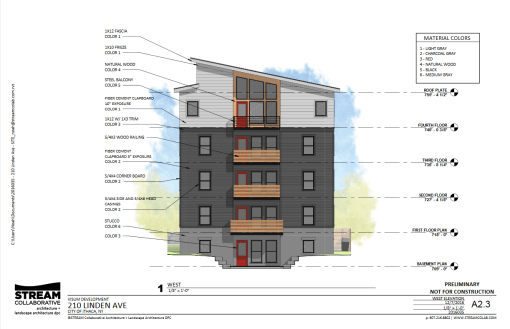
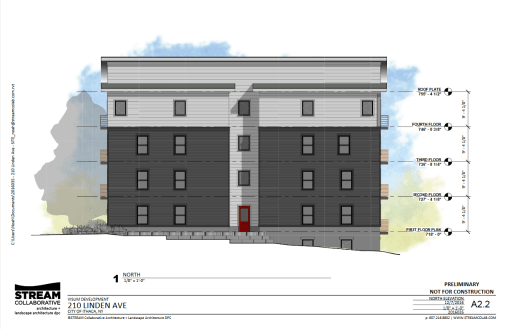
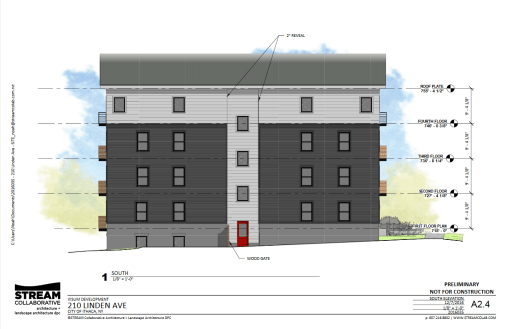
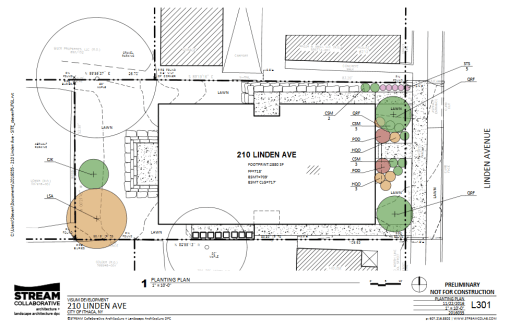
Previously, 210 Linden was a rather ramshackle 12-bedroom apartment house. Visum Development Group (VDG), led by local businessman Todd Fox, saw a potential opportunity for a new build and established a purchase option with the then-owners, a pair of small local landlords. The redevelopment is not an especially large project, medium-sized by Collegetown standards. It is 14,400 SF with 9 units, all of which are 4-bedroom, 2-bath, for a total of 36 bedrooms. Each floor has two units, except for the partially-above grade basement, which has one unit and space for the bike room, trash room and mechanicals. The project will use electric air-source heat pumps, and be net-zero energy capable with the use of an off-site renewable energy source.

210 Linden was first proposed in November 2016. With basically no opposition, and a design that the planning board found perfectly appropriate, it sailed through the review process, and approval was granted in January 2017. In something of a rarity for city projects, no zoning variance was required. 210 Linden fits the maximum length, width and building lot coverage allowed under the Collegetown Area Form District’s CR-4 zoning, and comes in at or just under the 45-foot height maximum – the sites are sloped, and the 45′ height is defined as the average above grade plane. Exterior finishes includes stucco at basement level, a couple shades of grey fiber cement lap siding above, red doors, metal balconies and natural wood trim.

There were virtually no design changes from beginning to end – the only noticeable change was that the doors were moved from the left side of the balcony/terrace to the right. The project was a fraternal twin to another infill development Visum has planned, 126 College Avenue. One has to give credit to the architect, Noah Demarest of STREAM Collaborative, for being able to provide cost-efficient and well-received designs.

A frequent partner of VDG, William H. Lane Inc. of Binghamton, is the general contractor. Right now, only the demolition and foundation excavation have been completed. Once the power lines have been buried out front by NYSEG, construction of the building can begin. The intent is to have the building completed in time for Cornell’s 2018-19 academic year, which starts in late August. Elmira Savings Bank gave VDG a $3.15 million construction loan in July to complete the project.

As one might expect with new units less than two blocks from Collegetown’s core, the cost per room is not cheap. Advertisements online say $5,000/month, or $1,250 per month per bedroom. Units come with 9′ ceilings, air conditioning, internet/cable, stainless steel appliances, quartz countertops, washer/dryer in-unit, balconies, and a security system, among other bullet points and exclamation points. A fitness room and other luxury amenities will be accessible to tenants at another Visum project, 232-236 Dryden Road.


News Tidbits 9/16/17: The Big Surprise

16 09 2017

1. Ostensibly, the biggest newsmaker of the past week was the announcement of the Green Street redevelopment in Ithaca’s downtown core. To be frank, I was freaking out at my desk. Even more astounding was that the city slipped it out so casually, embedding it in a monthly PEDC meeting file that typically focuses on more mundane legal and planning concerns.

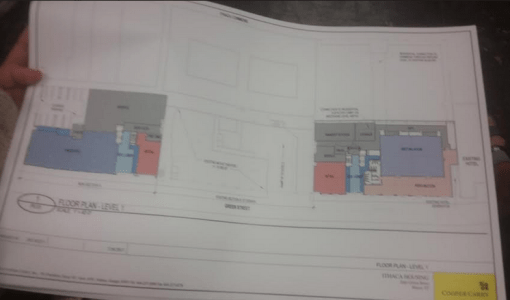
All photos that follow are from Jolene – pardon the marginal quality, we were both in note-taking mode, and these presentation papers weren’t given out to the public. North is towards the top of the floor plan images.

While the documents have yet to be uploaded to the city’s website, some basic details were released during the meeting – the number of parking spaces for the whole complex is 525. There would be two towers with residential units, a U-shaped west tower and a boxy east tower with projecting corners. 15 floors apiece. 350 units, “designed to appeal to a broad demographic”. Abatement likely, with the details to be ironed out as the percentage of affordable units is determined. The middle portion will also have residential units on top of the existing garage. 30,000 SF of conference space is planned under the eastern tower, if my notes are right.

The first floor appears to have at least two retail spaces, a lobby area, and an office, probably for management of the complex. The middle section will retain access to Cinemapolis and the garage. On levels two and three would be rebuilt garage sections (note the center section was rebuilt ten years ago and unlike the ends, is in good shape). Another floor of parking will be added.

Cooper Carry is the architect, and the initial design looks fairly safe, attractive if not particularly inspired. After the Marriott, it’s good to be wary of potential value engineering. It appears to use brick veneer, Nichiha-like metal panels and maybe fiber cement. Also, with Harold’s Square and City Centre off to the left, this would arguably create a broad-shouldered if stubby skyline for downtown Ithaca, more impressive than many communities Ithaca’s size.

My notes are that Marriott co-developer Jeff Rimland had non-public information about the Green Street garage because he owns the ground facilities under the garage’s eastern deck, and would be impacted by renovations. He was made aware of city looking at their options and put something together. The city only learned about the plan four weeks ago, and mayor Myrick wanted to make sure it was brought forward for public discussion and to determine if it was a wise choice to move froward. Ostensibly, if this came out as a surprise, a hornet’s nest of opposition would be stinging. Being transparent now helps later.

It seems the intent is an RFP for the garage for the sake of fairness, but I dunno how effective that will be. Rimland has a big advantage as owner of a portion of the parcel, since any other developer would need to arrange legal agreements with him in order to carry out a project. It was suggested by Brock, who has never been a fan of development, and I cynically wonder if this was an attempt to ensnare or at least stall the proposal. An RFP does put the city in a more legally comfortable position, perhaps. On the flip side, I cringe at the thought of another Old Library-like mess.

On a final note, there’s also a name, seen in the lower right of the rendering – “Village on the Green”. Very punny guys.


2. The other big news item of the week was 311 College Avenue, more commonly referred to as “The Nines replacement”. The Nines is a much-loved restaurant and bar that has long been a part of Collegetown’s drinking and musical scene – in the late 2000s, if I had to describe Collegetown bars, where Johnny O’s was the “fratty frat” bar and Chapter House the erudite tweed-clothed crowd, The Nines was the laidback, indie band geek-turned-rocker. Add in its location in a ca. 1908 fire station, and one of the few sizable outdoor patios in Collegetown, and one can understand that a project on this site was never going to be warmly received.

Granted, I’ve been raked over the coals a couple of times for the article, whose first headline said The Nines was being kicked out. It was an honest copy-editing mistake. For breaking news I publish ASAP, like with the Green Street development. However, that’s discouraged because the business pieces are useful for filling slow periods during the day, or to give time for others to prep articles during the early morning. Many of my articles are written in the late evening, submitted to the schedule, and skimmed through before hitting the website. In this case, I submitted Sunday night, my editor Jolene read through it early Monday morning, she thought the opening lines implied an eviction and changed the title (the original was a generic “Apartments Proposed for The Nines”). Sometimes title get changed for clarity or Search Engine Optimization (SEO), but this particular time it created a false statement. I didn’t see it until I was at work on Monday, and uncomfortable conversations ensued. Sorry all. The next article won’t wax poetic.

Anyway, with that error noted, it makes this next opinion segment more uncomfortable. I’m not a developer. But if I were one, and heard the property was being put up for sale, I’d probably have steered clear. With all due respect to Todd Fox, my gut feeling is that the cons outweigh the pros.

Ithaca is not an easy city to do a project in. A developer has to pick and choose their battles. In this case, the battle is taking a building with some degree of historic value, but more importantly a lot of local sentiment attached, and proposing to replace it with, frankly, a mediocre design with high-end student units. I understand the economics of the site, the market, and the unfortunate though economically necessary impacts building flush to lot lines has on the ability to install windows on the sides. My concern is external impacts, by creating an emblem for opposition to organize around, because it wraps several perceptibly negative impacts into one proposal. That may make future projects that much more difficult. I worry that whenever a controversial plan is brought forth in years ahead, it will be pejoratively described by NIMBY types as “just like that Nines replacement”.

It has taken years for Ithacans to become slowly more amenable to density and development. Proposals that inadequately address community concerns threaten that progress. Consider the case of Jason Fane. He toyed with the city plenty of times. Eventually it caught up to him and he got burned. The sad part is, 130 East Clinton was a solid project, and to this day I believe that had it been another developer, those apartments would have been built.
Anyway, the ILPC would like to preserve it as-is, which draws the question why the discussion never moved forward 18 months ago when they had the chance. I don’t think that’s likely at this stage, and an overbuild probably wouldn’t work due to development costs (foundation shoring, elevator if 4+ floors) with respect to developable area – the big front yard setback is an impediment to that. I heard that an offer was floated to Neil Golder to move his house at one point during the 201 debate, so maybe moving all or at least the front (1908 wing) of the old station No. 9 is possible, but the expense would be great. As for the new building’s design, maybe modest fixed windows in the north/south brick faces, or glass block features like on Sharma’s 307 design, or even something as minor as a mural on the CMU blocks would help.

But, all that might be grasping at straws. This was always going to be controversial. I won’t fault someone for seeing an opportunity, even if it’s not a plan I’d advocate. It all depends on one’s appetite for development opportunities, and sensitivity to potential blowback.

3. For sale: 405 Elmira Road. 0.74 acres of parking lot next to Buttermilk Falls Plaza. List price: $465,000, courtesy of Pyrmaid Brokerage. Also noting – the chain hotelier who bought the former Tim Horton’s next door from the same seller for $640k in January 2016. Timmy Ho’s 0.75 acres is a little small for a hotel on its own, but combined with this lot, suddenly plans start to look quite viable for a mid-sized chain in the city’s suburban-friendly SW-2 zoning. Someone else may come along and buy it, but let’s see what happens.

4. It appears the 24-unit Pineridge Cottages project is off the table. The project, planned for the corner of Mineah and Dryden Roads in Dryden town, was greatly scaled back by developer Ryzward Wawak after water tests led to concerns about having enough to supply all the units. At this time, the plan is for four cottages, each a two-bedroom unit.

5. The Times’ Matt Butler has a nice summary and brief interview with Lakeview Health CEO Harry Merriman regarding the 60-unit affordable housing plan for 709-713 West Court Street. Some of the obstacles the project faced wouldn’t be a surprise to readers of this blog – the soils require a more expensive deep (pile) foundation, and land acquisition costs are climbing, which increases the overall costs involved with bringing a proposal into reality, let alone a plan that focuses on affordable housing. The increase in units from 50 to 60 was driven by the need to balance out revenue with expenditures and make the affordable housing economically feasible. Incremental cost increases per unit are significantly less than overall structural costs, so the per-unit expense for 60 units is less than 50, making the project more appealing in competitive grant processes.

Of the 22 units to be set aside for formerly homeless individuals, six will be reserved for HIV-positive clients of STAP, the Southern Tier Aids Programs. Those infected with HIV tends to experience much higher homelessness rates than the general population, with at least 81 homeless HIV-positive individuals in Tompkins County alone. This makes it hard to do things like refrigerate medication. These six units are a small number perhaps, but for those six folks it will make a huge difference.

6. Another feather in the cap of the local STEM sector of the economy. Biotech startup Jan Biotech Inc., based out of the Cornell Business Park by the airport, has received a $3 million grant from the National Institute of Health (NIH) that will be used in the research and production of an HIV diagnostic for detection and quantification of latent HIV-infected reservoirs in patients –  cells that have the virus but aren’t actively producing HIV, which current anti-retroviral therapies struggle with. Potentially, the diagnostic could help test new medicines for their ability to target those cells, and lead to a true cure for the virus before AIDS can occur.

Along with new equipment and renovated facilities, the grant is expect to result in the hiring of another 5 to 10 scientists and engineers for the four-person firm. Which is great, but truly, it’s their work to try and improve our treatment and medicine of a deadly virus that’s more important. The very best of luck to them.

7.  A bit of news from the Cornell Daily Sun regarding the additional 2,000 beds Cornell would like to build on its North Campus, as part of its freshman expansion and “Sophmore Village” plan. The university would like to begin construction on the first dorms in 2018, and start increasing student enrollment by 2020. For that to happen, the plans pretty much need to come forward for formal planning board review within the next few months. Presumably, they’d like to have the dorms ready by August 2019 – these will be used as flex space initially, so that existing dorms like Balch and Clara Dickson can start renovation. At a bare minimum, it takes three months to go through the city planning board. Given this project’s proximity to Cayuga Heights, the local patricians will want to have their say as well, even if it is just outside village lines. With the size of the project and a minor amount of inter-municipal complexity, four months from sketch plan to approval seems realistic. Considering the need to request and award contract bids, it would seem plausible that Cornell puts the dorms forward this fall for review, with approval expected by late winter. Bids would be requested and awarded during the Spring, and construction would start by June. Whatever the case, the first construction plans are likely not far off.


News Tidbits 9/9/17: Shopping for Sales

9 09 2017

1. As Dan Veaner at the Lansing Star reports, the new owners of the Shoppes at Ithaca Mall (aka Pyramid Mall) are planning to roll out new tactics to counter the ongoing, nationwide retail apocalypse currently underway. Instead of leasing locations, the mall owner would like to subdivide retail spaces within the mall under a Planned Development Area (DIY zoning, in essence) so that tenants could potentially own their spaces instead of renting them, under the hope that when they own a store location, they are less likely to close it and will opt for closing rented spaces elsewhere. Because customary use-based (Euclidean) zoning is not suited for this unusual arrangement, a PDA has been suggested, and the village of Lansing seems amenable to the idea.

On a related note, another subdivision of the mall properties would open up a portion of the parking lot behind the Ramada Inn for the development of an extended-stay hotel. This would probably play out over a few years, given the time to design a project, secure a brand and ask for village review/approvals. Market-wise, it’s not implausible, since the other hotels planned, like the Canopy downtown or the Sleep Inn at 635 Elmira Road in Ithaca town, are geared towards the overnight crowd, and the overall market is growing at a sustainable pace. As long as the local economy continues its modest but steady growth, a medium-sized specialty property that opens in two or three years would probably be absorbed by the local hospitality market without too much fuss.

2. Meanwhile, over in the the town of Lansing, a couple of minor notes and some name changes. From the town of Lansing Planning Board agenda, it appears the 102-unit Cayuga Farms development is now going by the name “Cayuga Orchard”. The project, which has been stuck in red tape due to the stringent review of modular sewage treatment systems, is seeking modifications to their plans, which was summarized in the Voice here. The short story is that the project has the same number of units, but the impermeable area has been decreased and the number of bedrooms is down from about 220 to 178. That should help reduce stormwater runoff, and if the town sewer isn’t through yet, it could make the modular system more feasible.

Secondly, Cornerstone’s Lansing Commons Apartments are being rebranded as the “Lansing Trails Apartments”, which makes sense since there aren’t any “Commons” in the town, but the town center property is traversed by numerous recreational foot trails. The town has endorsed Cornerstone’s two-phase, 128-unit development plan for affordable rental housing, though the planning board did express concerns with the impact of dozens of additional school children on a property with 581a property tax breaks, which may result in a 4% increase in school taxes in the default scenario. The number could vary given the number of kids that actually live there – the board ballparked 80 for their back-of-the-envelope analysis, which given 128 units and roughly 208 bedrooms in the project, isn’t unreasonable.

3. On that note, it appears Cornerstone and NRP have applied to the county’s affordable housing funding grant for a bit of financial assistance towards their respective projects. Cornerstone is seeking funds for qualified units within the 72-unit first phase of its Lansing Trails project, and NRP is seeking funding for qualifying units within the 66-unit first phase of its Ithaca Townhomes project on West Hill. Each organization would receive $256,975, mostly in Cornell-donated funds, if approved by the county legislature. The money may be leveraged and with less needed from traditional affordable housing funds, it may make each project more appealing from a federal or state grant perspective, with demonstrated municipal interest and more “bang for the buck” on the grantor’s end.

4. The two-building apartment complex planned at 232-236 Dryden Road is one step closer to construction. According to Tompkins County records, Visum Development bought the two properties on which the project was proposed (114 Summit Avenue and 232-238 Dryden Road) for $7.65 million on Monday the 5th. The properties are only assessed at $2.55 million, but sellers tend to enjoy a hefty premium when developers have intent for their parcels.

The following day, the building loan agreement was filed. The loan, for $16,354,628, was granted by S&T Bank, a regional bank based in Pennsylvania that has no retail banking presence in Ithaca, but has served as the financier for several projects, including the Holiday Inn Express that recently opened on Elmira Road, and Visum’s just-opened 201 College Avenue project.

A breakdown of the costs shows the total project cost is $22,780,334. There’s $13,020,010 in hard costs (materials/labor), $7.65 million for the purchase, $475,000 in soft costs (architect/engineering/legal), $250,000 for the demolition, and the rest is for taxes during construction, interest reserve (interest on the construction loan during construction). $650,000 (5% of the hard cost) is set aside as contingency funds just in case the expenses clock in higher than expected.

Along with the loan, Visum and its investor appear to be putting up $6.325 million in equity. With these hefty sums, one has to be pretty certain of their investment. In Collegetown, they often are.

Visum CEO Todd Fox has previously stated construction is expected to start this month on the 191-bed apartment property, with an eye towards an August 2018 completion.

5. The Old Library property sale is official, on an 11-3 vote. Legislators Kiefer, Chock and McBean-Claiborne voted no, none of which are an big surprise since, as members of the Old Library Committee, they found something to dislike with every proposal back in 2014. If anything, the surprise might have been legislator Kelles, who while not a fan, supported the mixed-use project. Travis Hyde Properties will bring 58 senior apartments, community space administered by Lifelong senior services, and a small amount of commercial space when the building opens in 2019.

6. So this is interesting. Josh Brokaw is reporting over at Truthsayers that Cayuga Medical Center wants to move the Community Gardens off the land. That is a story being covered further by my colleagues at the Voice, but notable to this blog’s purview are two nuggets of information.

One, Guthrie and CMC had *a bidding war* for the property, which explains a couple of things. It explains why CMC paid $10 million for a property the Maguires only paid $2.75 million for, and it offers a clue as to why Guthrie purchased the neighboring Cornell warehouses. They both have had plans for that area, and working together isn’t a part of them.

Two, Park Grove Realty is involved with CMC. They’re a young Rochester-based company generating lots of news in Lansing with a lawsuit-laden 140-unit townhouse project, and they purchased the Chateau Claire apartments and renovated them into the upmarket Triphammer Apartments, which generated its own share of controversy.

Anyway, it makes the commotion down by Carpenter Business Park that much more interesting. Nothing has come public yet, but keep an eye on it.

7. On a related note, it’s not much of a physical change, but Maguire is using some of that cash windfall to officially acquire the former Bill Cooke Chevy-Olds-Caddy dealership on Lansing’s Cinema Drive. The franchise rights were transferred over ten years ago, but the property itself was still under the ownership of the Cooke family. Thursday’s sale was for $2,015,000. The 4 acres and 19,857 SF building was assesses at $1.8 million, so it appears the sale price was a fair deal for both sides.

I would be remiss not to point out that the buyer was “Maguire Family Limited Partnsership”. No LLCs cloaking this purchase like with Carpenter Business Park.

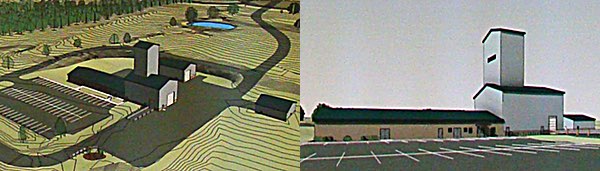
7. Now that the state has okayed the Cargill expansion, the above-ground portion of the project has to go before the Lansing planning board. The surface facilities, expected to cost $6.8 million, consist of a 10,000 SF administration building, a 2,100 SF maintenance building, a 2,600 SF hoist house, parking, landscaping and signage. A hoist house is essentially an industrial-strength engine room for operating the lift that brings people and equipment up and down from the shaft. It’s likely the primary cost contributor in the surface portion of the project.

As seen in the renders above, it’s designed for functionality rather than aesthetics, though Cargill did attempt to make the shaft building barn-like to blend in better with the farms. Construction on the above-ground structures is expected to start next year and run for about 18 months (the mine is being built from the bottom up). Although not shown in the renders, trees will be planted around the developed area to provide a green screen and help dampen noise.