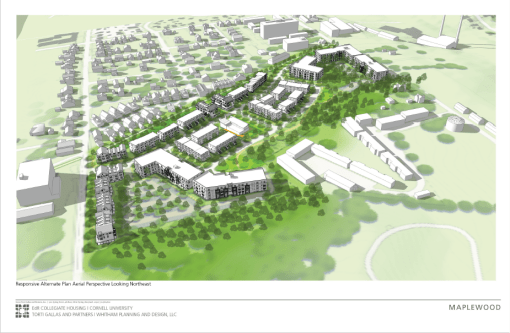
Maplewood Redevelopment Construction Update, 2/2018

19 02 2018

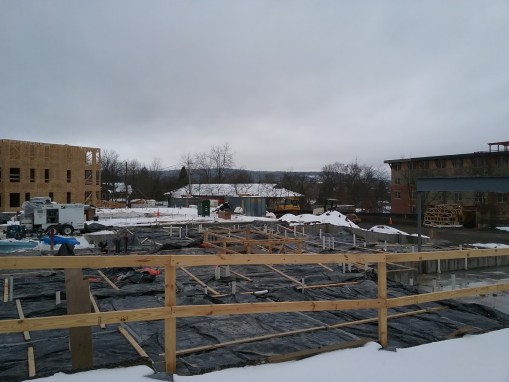
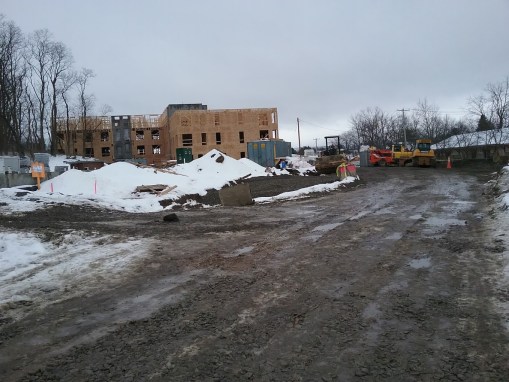
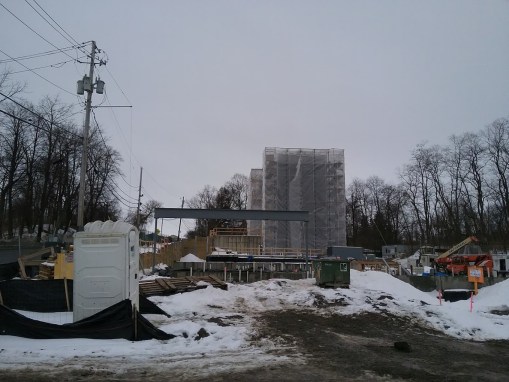
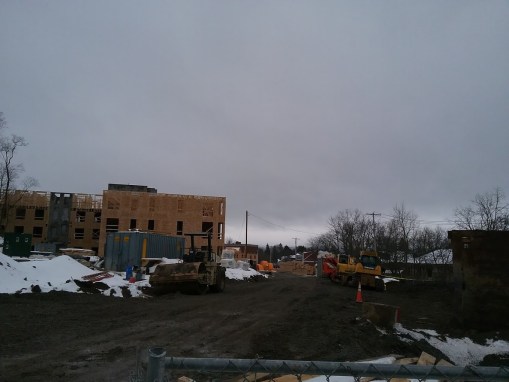
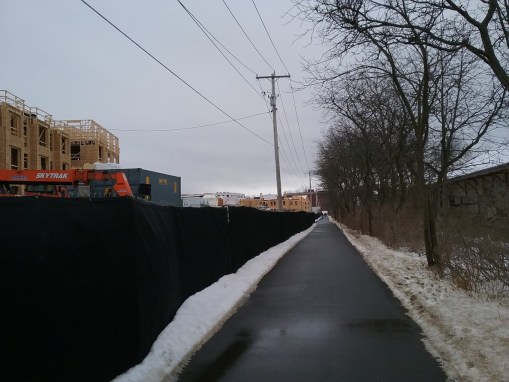
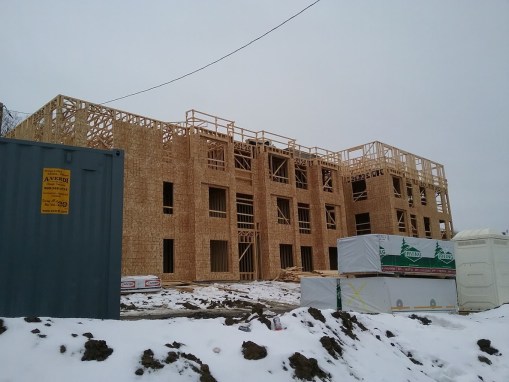
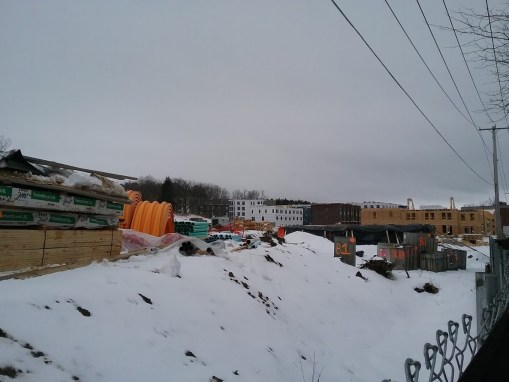
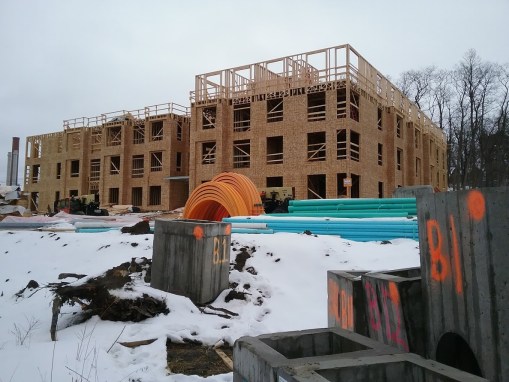
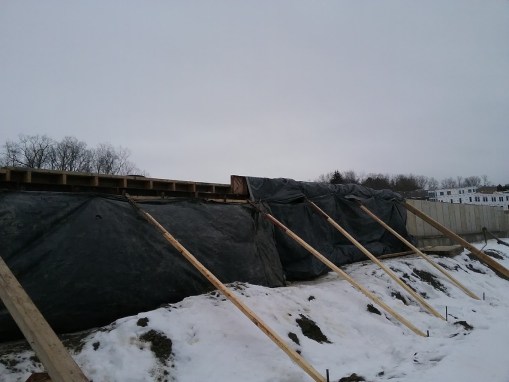
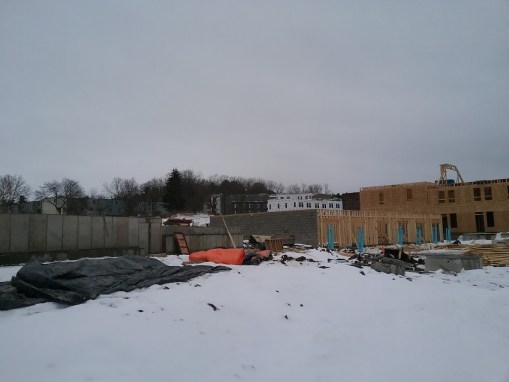
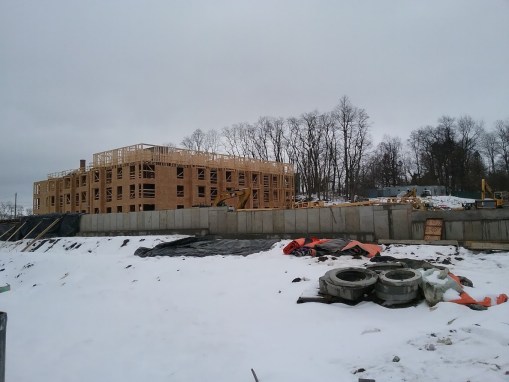
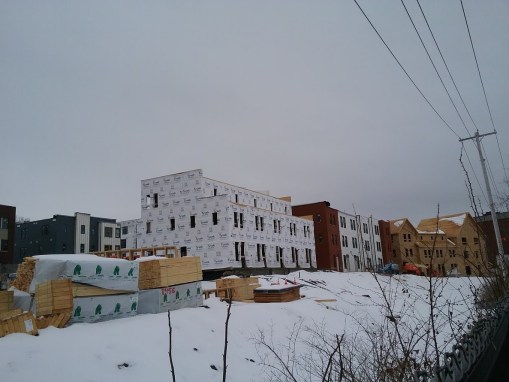
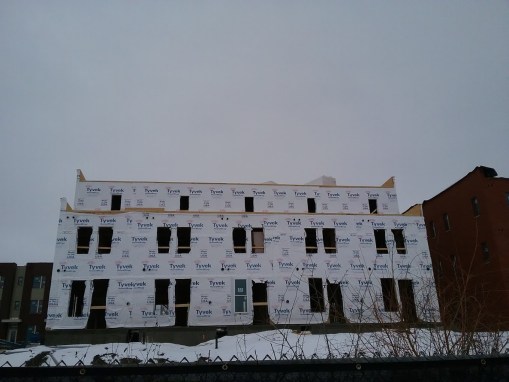
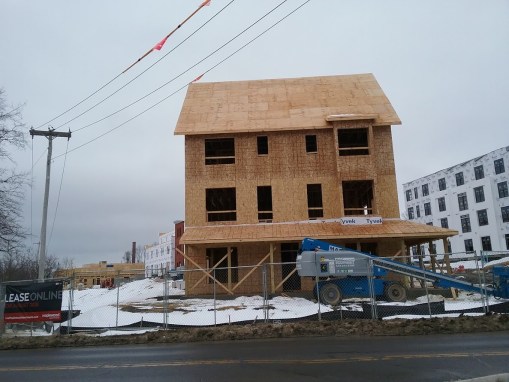
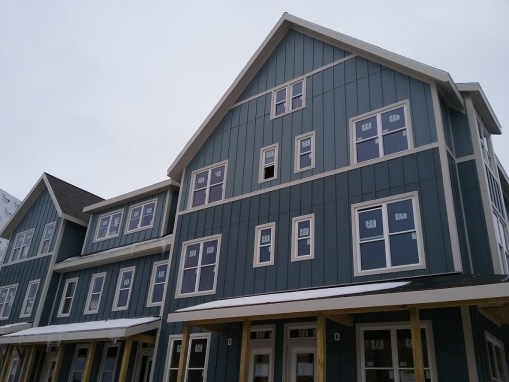
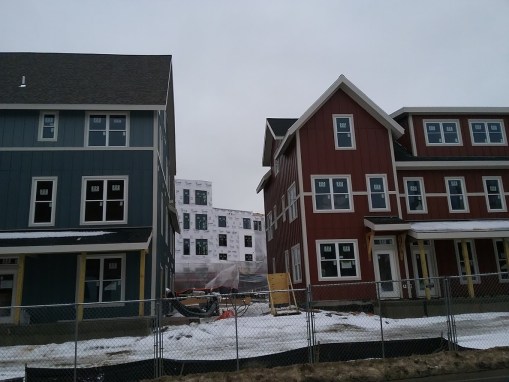
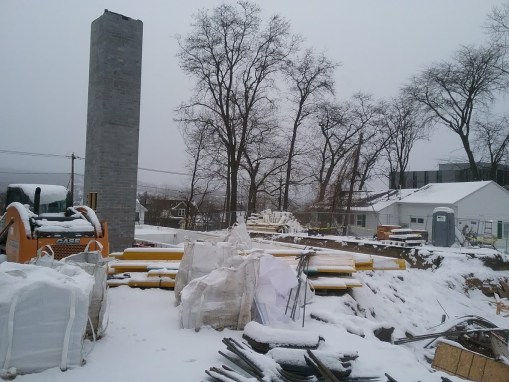
There is so much going on here – it kinda blows my mind because a development of this acreage and number of units is extremely rare in a place like Ithaca, where highly subdivided lands make large acreages difficult to find or assemble, the financial and labor capacity for a large build is limited, and review processes are stringent and rather burdensome. With the exception of a few townhouse strings towards the middle and the community center, it looks like almost everything else has moved into the framing stage. In contrast to the renders, the townhouse strings are showing greater color variation in their brick and fiber cement panels – some are navy blue boards and orange-red brick , while others are jade green boards with maroon brick. Same goes for the apartments, some of which have a navy/orange-red scheme, while others are faced in different shades of grey panels. This helps to create more visual interest and differentiation between otherwise similar structures.

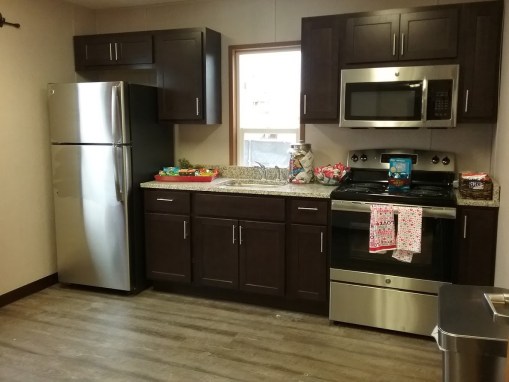
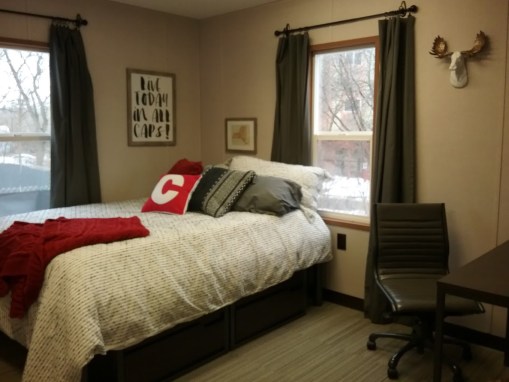
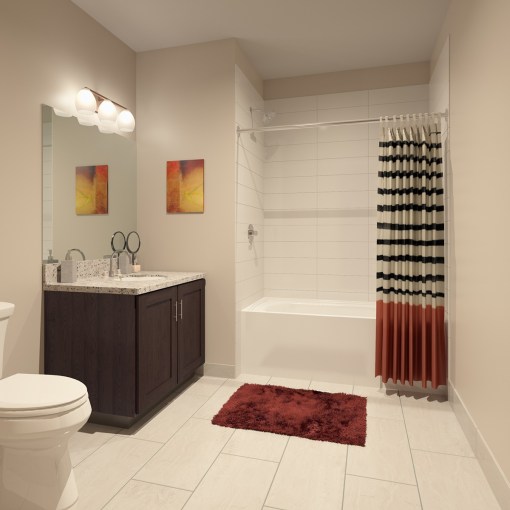
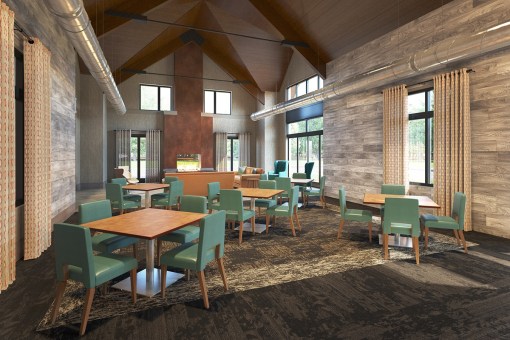
Embedded below are a couple of mock-ups from the on-site display unit inside the leasing trailer. It’s not a bad setup, though on a random note, no one in their right mind would hang a picture frame so close to the top of their bed. The units will come furnished. For those interested, the rental website can be found here. Also included below at the end are a few interior renders, of the community center, a study lounge, the fitness room and a bathroom (not a part of the walk-through mock-up).

For project background and planning, click here.

For a site plan breakdown, click here.

For a construction timeline, click here.

Webcam link here (updated ~15 minutes).


The Lux (232-236 Dryden Road) Construction Update, 2/2018

19 02 2018

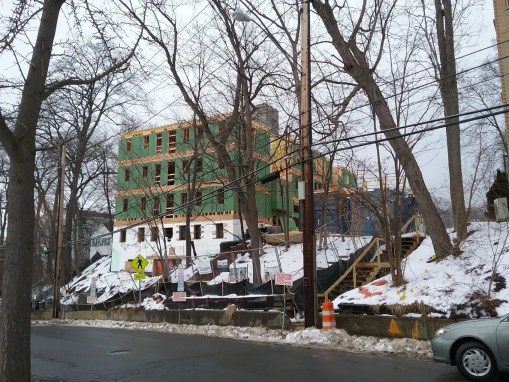
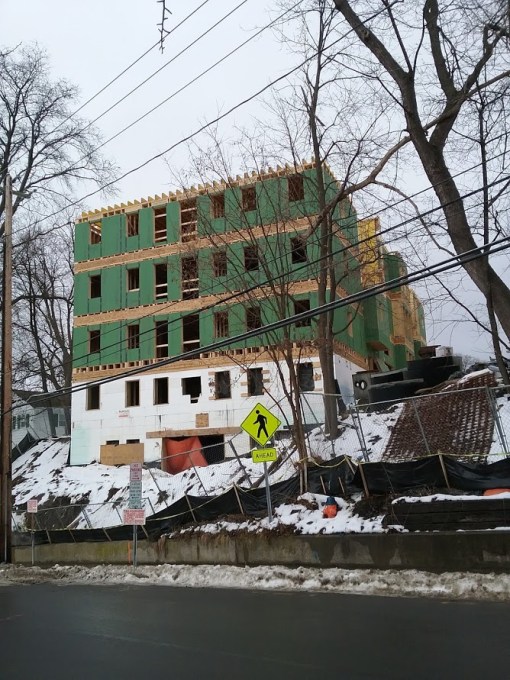
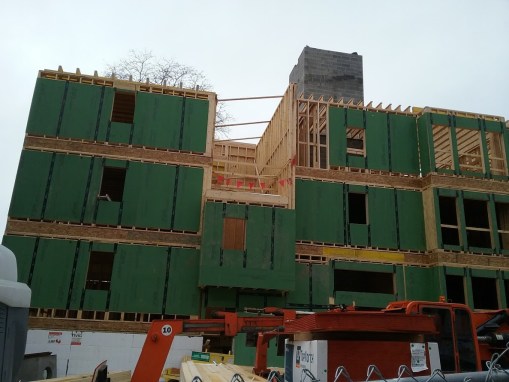
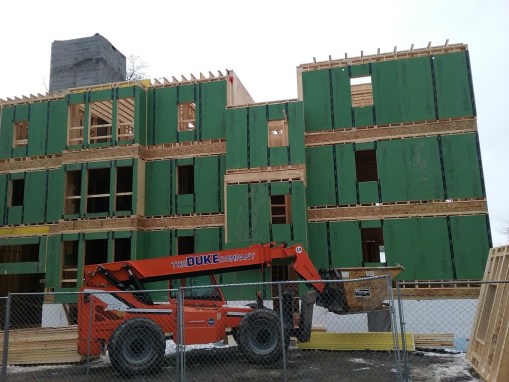
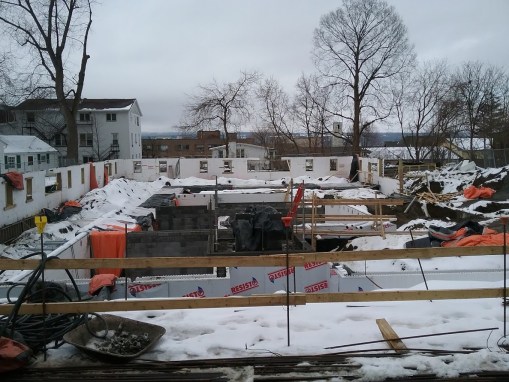
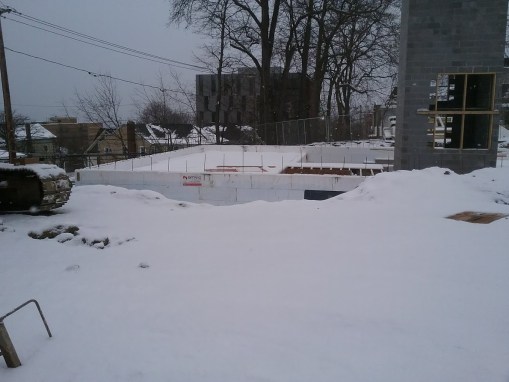
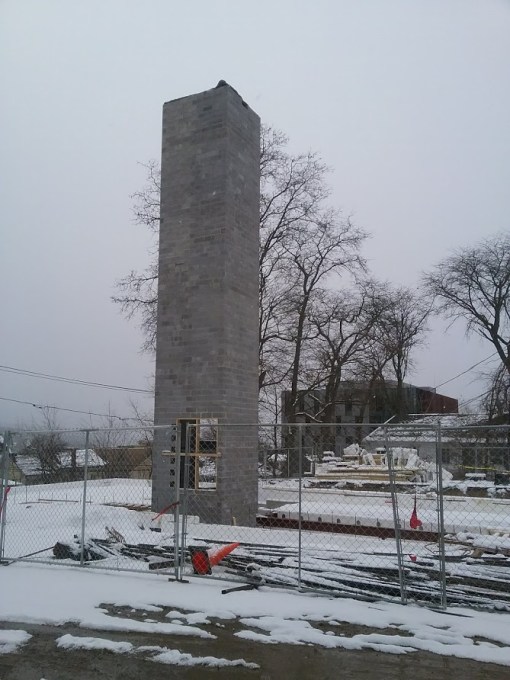
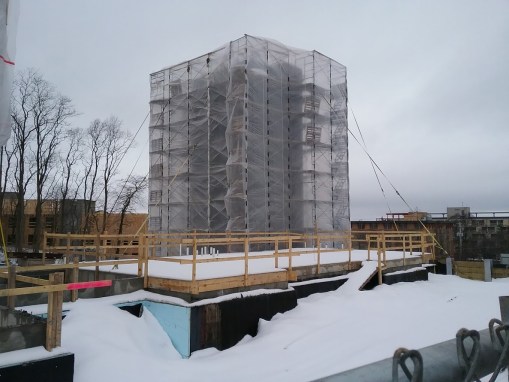
Things continue to move at a good clip over at “The Lux” at 232-236 Dryden Road. It looks like the insulated concrete forms (ICFs) have acquiesced to standard wood framing and ZIP panels on the upper floors. The building facing Dryden Road, 232/The Lux South, has commenced with framing of four of its five floors, and the elevator core/stairwell stands at full height (zoning only allows four floors/45 feet, but its a sloped site, so technically that bottom floor is a partially exposed basement level). 236/The Lux North has begun work on its basement level with the construction of ICFs covered with a vapor and water-resistant barrier (Resisto), and it appears that the first blocks for an elevator core/stair column are being assembled.

There might have been some internal reconfiguration. Site plan review documents noted that 232 Dryden will have 20 units and 53 bedrooms, and 236 Dryden will host 40 units and 138 bedrooms. But, a recent post on Visum’s facebook page suggests the project will have 207 bedrooms, not 191 as originally conceived. Everything appears to be on track for an August 2018 occupancy.

Even with the expected Cornell dorm additions in the next three years, the Lux’s location in inner Collegetown gives it an advantage over more remote housing options – students/parents with deep pockets will often pay more to be next to campus, while the amenities and worry-free living help seal the deal (worry-free in the sense that there’s no “deferred maintenance” to be concerned with when the units are brand new). Rents here are going for $1,200-$1,300 per bedroom, though they have a promotional running right now for 10% off rent for the first month.

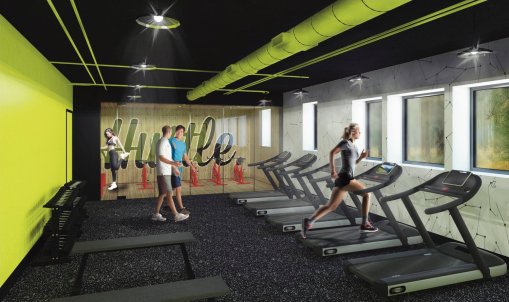
It appears there was an unusual but interesting contest held by Visum that invited students to compose interior designs for the three common rooms in the complex. Registered applicants (individual or group) received floor plans and interior documents to aid in their designs, and had about eight weeks to submit their final plans (December 2nd – January 21st). The winning team gets $2,500 and a building lounge will be named in their honor. Snagged from the website and included below are some mockups of the gym, a study room and a commons space.


400-404 & 406 Stewart Avenue Construction Update, 2/2018

18 02 2018

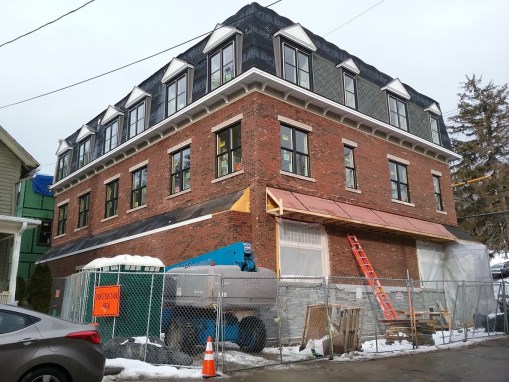
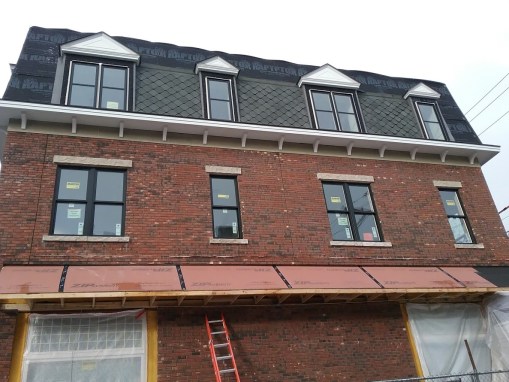
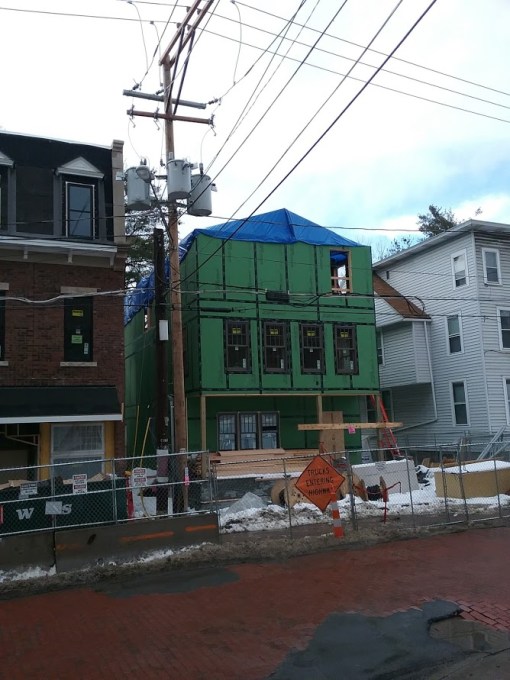
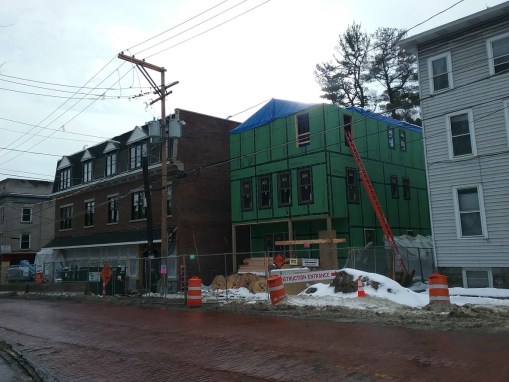
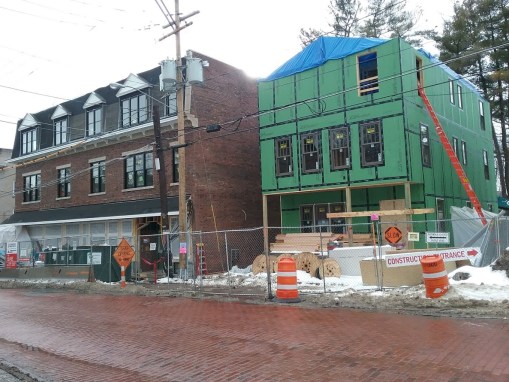
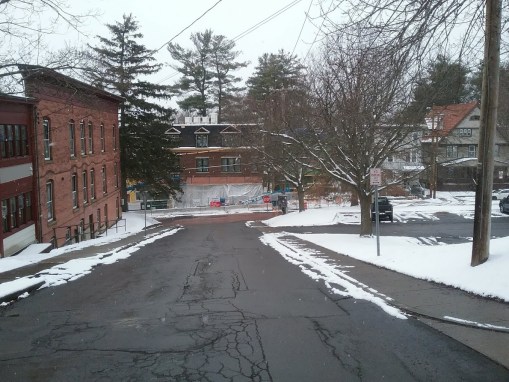
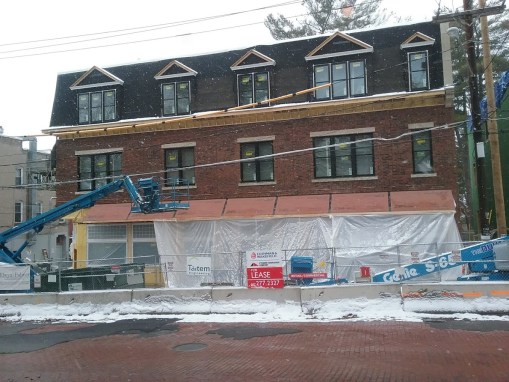
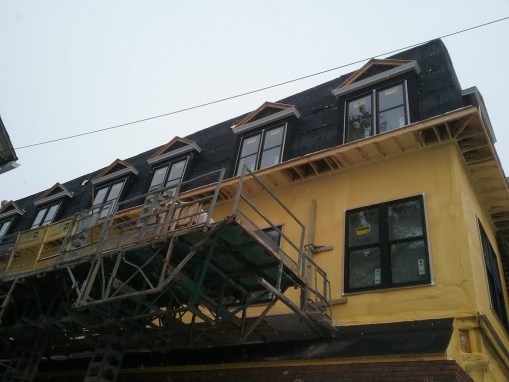
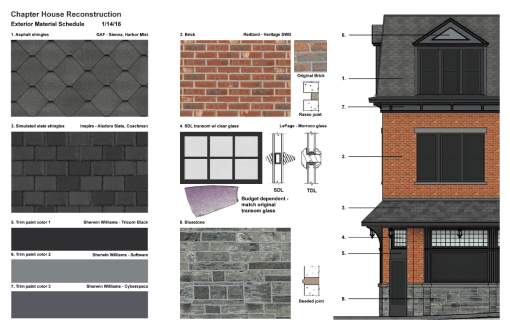
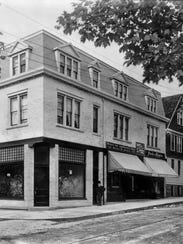
This pair appears to be coming along quite nicely. 400-404 Stewart Avenue is looking good. GAF asphalt roof shingles are being laid over the Raptor brand underlayment. The trim has been attached, with some of the ornamental board starting to go up aside the brackets. The cornice and bracket trim is to be painted grey and black, as are the gables on the dormers (I guess they do technically count as gable dormers on a mansard roof, even with the pitch as steep as it is). It has a vaguely Georgian colonial feel to it; the design is a heavy nod to the original building design from a century ago.

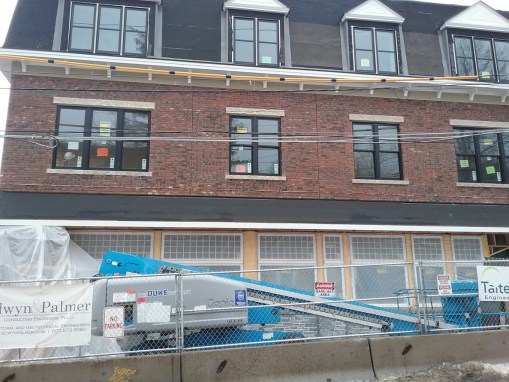
Most if not all of the Redland Heritage SWB brick is attached, and the overhangs have been framed and sheathed, with some underlayment applied – these will actually be finished with more expensive but historically appropriate (simulated) slate shingles. The transom windows and picture windows of the first floor retail/bar/restaurant space have been fitted, but the trim has yet to be attached. The bluestone veneer at the base is largely complete. The doors have yet to be fitted, as do the heavy brackets and ornate detailing of the first floor exterior.

Advertisements for the upstairs apartments has yet to make an appearance, but there are ads going around for the retail space (3,000 SF, $35/SF).

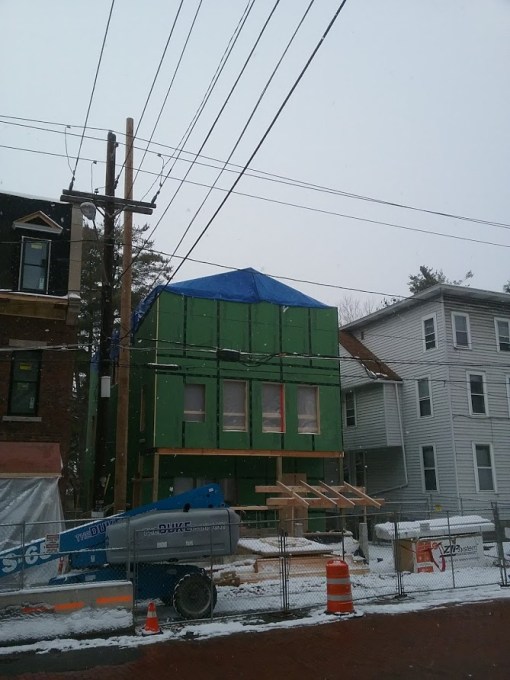
As for the new 406 Stewart Avenue, the mismatched rough window openings on the front facade appears to have been fixed. The recessed front porch is framed, and if I’m seeing it right, the stonework is already in place at the base. The construction crew is starting to cut out the openings from the Huber ZIP panels on the third floor. It is definitely a different interior layout than they had in mind when the renderings were presenting – there are substantial differences in the fenestration of the building’s north face.  The gable roof and dormer has yet to be framed, but if they’re aiming for a Q2 and Q3 opening, they look to be on track from a glance.


210 Linden Construction Update, 2/2018

18 02 2018

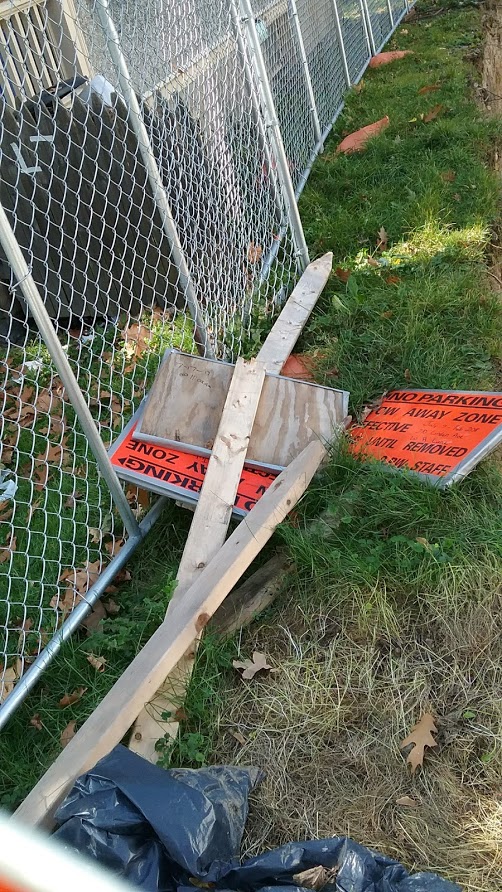
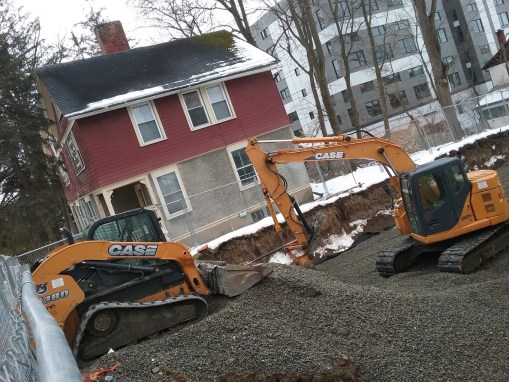
So here’s some good news – 210 Linden Avenue is moving forward once again. The city’s Board of Public Works (BPW) held a special meeting on the 30th that would create a loading zone in front of 210 Linden Avenue. This is important because the new state fire code restrictions say no construction can occur along Linden since the street is no longer considered wide enough. By eliminating the parking space in front of 210 Linden and replacing it with a loading zone, it created a “wider” street since a fire crew would no longer have to worry about parked cars along the street frontage. This made it easier for the project to obtain a fire code variance from the state.

BPW is ostensibly not a fan of the arrangement, but given that the developer (Visum) was notified by the city of the change after the existing building had been torn down, they were willing to grant the loading zone given the unique circumstances.

Well, mostly unique. One other project was subject to the the same issue under very similar circumstances – Novarr-Mackesey’s 238 Linden Avenue. That project team is also asking for a loading zone during this month’s BPW meeting, and hopes to be granted a state fire code variance as well (and 210 Linden gives them reason to be optimistic). While every future project planned for Linden is now in limbo, it appears likely these two will be able to move forward.

Also in the good news category, a state fire code variance was granted for another Visum project, 118 College Avenue, under the expectation that the city and NYSEG will follow through with their plans to bury the power lines on College Avenue in the next two years. With the lines to be buried relatively soon, the state felt comfortable granting the variance for a building taller than 30 feet (118 College is just under 45 feet).

The buildings are aiming for an August 2018 completion. They are wood-framed structures, which in comparable economic circumstances, can move along faster than a concrete or steel. Even then, it’s still going to be a tight deadline for William H. Lane Inc.

A glance at Zillow shows that the basement 1-bedroom unit appears to be spoken for (the basement unit was a modification to the original plan, perhaps because many amenities will be shared with its siblings 201 College and “The Lux” at 232-236 Dryden Road), but the nine 4-bedrooms/2-bath units (1,365-1,440 SF) have not. Zillow says there are ten 4-bedroom units – that doesn’t seem correct. They are going for $4,400 apiece, or $1,100 a bedroom. That’s actually a sizable price drop from the $5,000/month they were being offered for before the fire code debacle.


News Tidbits 2/10/18: It’s In The Minutes

10 02 2018

1. It’s round four of the senior housing proposed as part of the Lansing Meadows PDA. This time, developer Eric Goetzmann is proposing two six-unit strings, two stories, all units two-bedrooms with enclosed garages. The Lansing Star notes that the site plan is very unusual in that all the housing is clustered at one end of the property, leaving a big vacant space that could in theory be sold off. Apparently it also caught the Lansing village planning board’s attention.
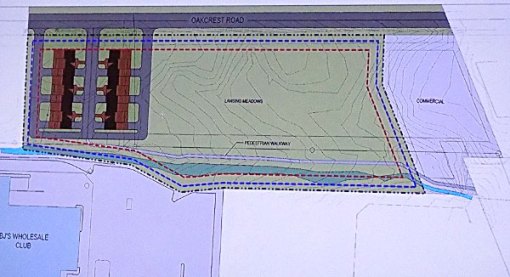
“It just looks too obvious,” said Planning Board Chair Mario Tomei. “There’s got to be some other thought going through your head about what that green area is going to be. Are you willing to share it?”

Goetzmann replied, “I don’t have anything, Mario. I need to get these 12 built. To get these things done, and then I’m going to be done with this. I don’t have any other plans for the future. I’ve listened to what you’ve said. I’ve never pushed anything. The last plan I brought here was 100% within the code. If I wanted to come back and fight it I could have done that. You had a reaction to it, and I understand. I do commercial development, not residential. But I agreed to it as part of (the overall plan to build BJ’s). I made a commitment to get these things done, and I want to get them done.”

That much is correct. The county IDA granted Goetzmann a tax abatement on the construction of BJ’s in 2011, on the provision of the wetlands and senior housing being built. After several extensions, the IDA had told him no more, the housing either starts this year, or they’ll consider him to have breached their contract. So if Goetzmann doesn’t start work on the senior housing soon, they’ll consider legal action, possibly a “clawback” on the abated taxes. As a result, this has a whiff of desperation, although the vacant land is still a question mark to just about everyone. The planning board will continue to review the plans later this month.

2. So here are a few other interesting little tidbits out of the village of Lansing:

– At the Crystal’s Salon and Spa site at 2416 North Triphammer Road, there is an early concept plan being considered for redevelopment into mixed uses with about sixty housing units. There are wetlands on the property, which the developers (as yet unknown) have said will be avoided. Zoning for the property is Commercial Low Traffic (CLT), which allows multi-family housing with a special permit. CLT is otherwise limited to office space and low-traffic operations, non-retail and non-food service. The spa might be permitted as a “clinic” health facility, the code’s a little vague at points. Crystal’s is 3.42 acres, which seems a little small for a Lansing project, though not impossible, and it’s certainly more plausible if it includes the vacant 5.61 acres next to it. Maximum height is 3 floors/35 feet., no limit on lot coverage so long as it meets setbacks and parking requirements.

1020 Craft Road, a former manufacturing facility, is being renovated by Marchuska Brothers Construction for a medical office tenant. Pyramid Brokerage has a site plan concept sketch up on their website.

The 140-unit Bomax Road apartments plan had a litigation hearing on February 2nd. It appears the developer of the proposed complex has won? If so, the plan could legally move forward.

Cayuga View might be a summer or even an early fall opening, rather than Spring 2018.

3. Over in Dryden, not a whole lot going on at the moment. The town will be reviewing the plans for Nick Bellisario’s second warehouse at 57 Hall Road. The 10,800 SF structure is a 60′ x 180′ x 20′ pole barn with a corrugated metal finish, garage bays, four parking spaces and some modest landscaping. It’s designed to complement the 12,000 SF warehouse next door, which is used by Tiny Timbers for manufacturing the components of their modular home kits. However, it’s not clear if there is a tenant in mind here.

4. It appears that there’s been some movement on the Cornell North Campus dorms. From the Student Assembly’s Campus Planning Committee fall notes:

Aspiration – 2000 new beds, 275 new freshman/year for 4 years

Process

  • Housing Master Plan will be shared with CPC in two weeks
  • Early site review: North Campus the area of focus – existing freshman and number of sophomores, and area with developable sites
  • RFP Process: 24 developers, 9 responses,  interviewed 4
  • Cornell funding decision: this will be owned and operated by Cornell
  • Fee developer to construct
  • Board of Trustees approved this early portion of the process over summer

Paul Stemkowski, serving as the North Campus Housing Expansion project manager reported:

  • We have a developer
  • Site analysis has commenced, reviewing municipal zoning and boundaries in the site areas, natural features, and a noted historic district   
  • Phase 1: proposed as 800 beds on CC Lot (1200 beds initial studies) 4 and 5 story buildings and new dining element
  • Sophomore and freshman villages
  • Appel Fields: housing proposed here for 3 to 4 stories

Timeline: August 2020 goal for phase 1 phase 2: 2021

Phase I will open spaces for deferred maintenance work- Balch Hall needs lots of restoration, rehabilitation

So, we’re looking at 4-5 floors and at least 800 beds in multiple structures on what is CC lot (the leftmost blue patch in the map), and 3-4 stories in multiple structures on the Appel Fields (rightmost blue patch). It will be Cornell owned and operated, but that makes the RFP part a bit confusing – tapping someone to build and sell Cornell the final product, or what exactly? If August 2020 is the goal, then summer 2019 is probably the hard deadline for a construction start, so expect formal site plan review to begin this fall at the latest (sooner if an in-depth Environmental Impact Statement (EIS) is expected by city planning staff). The only commercial component appears to be new dining facilities, though they are considering additional carryout food service options. No new parking will be added, and work on the Helen Newman Hall athletic facility is not a part of the expansion plans.

The October minutes cover plans for the College of engineering, with a gut renovation of Hollister and demolition of Carpenter Hall and Ward Labs. However, these appear to already be outdated, given Cornell’s state-funded plans to renovate Ward into the CEPSI+ business incubator.
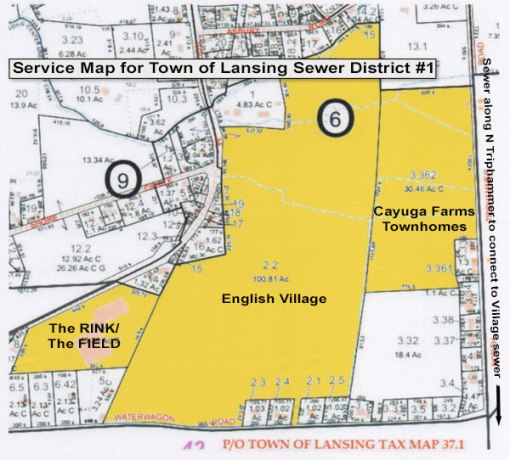
5. Lansing is finally getting that sewer line, though it won’t be along North Triphammer Road. According to the Lansing Star, the new sewer will go along East Shore Drive and Cayuga Heights Road because it appeared more feasible, and gave the village of Lansing an opportunity to reconfigure a difficult intersection. The current treatment facilities are not far from maximum capacity, and as a result, the village is expanding the lot size needed for a single-family home with a sewer connection, from 30,000 SF to 45,000 SF (just over an acre). An unsewered lot requires 60,000 SF. for the record.

Relevant to this blog, the line will terminate at a trio of lots under development or redevelopment in the town – the RINK, which is adding a climbing wall, as well as the 117-unit and 102-unit English Village and Cayuga Orchard housing developments. The village mayor, Donald Hartill, says the sewer project is in good financial shape, and that a revised land survey will allow final engineering to commence, ultimately leading to construction later this year.


6. City Harbor updated its website with additional info. Most of it has been shared previously, but the developers note that the project would create 120 new jobsGreenstar would be responsible for about 60 of those positions, while Guthrie, the waterfront restaurant and a few management/maintenance roles would compose the rest.

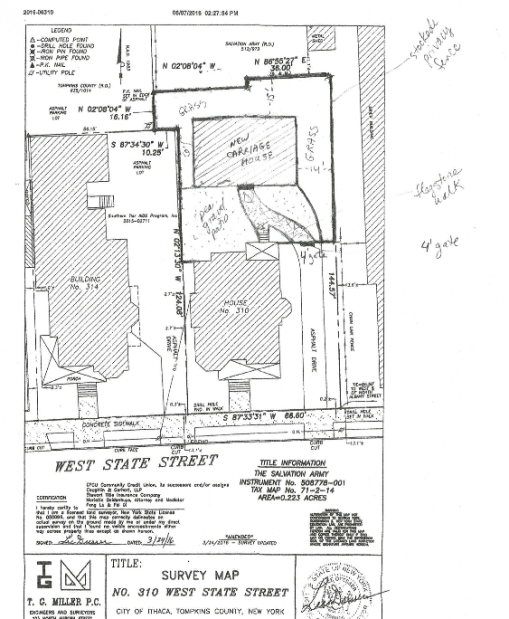
7. Not a whole lot going on at the moment. The city of Ithaca Landmarks Preservation Commission (ILPC) will host its monthly meeting next Tuesday evening to continue consider of historic designation of the Nine, and provide design guidance to a smaller proposal for the adult co-op planned at 314 West State Street. The original nine-bedroom proposal was considered too big to adequately defer to this existing historic building, so the structure was reduced to a similarly-designed six-bedroom building.

Meanwhile, the city planning board will host its Project Review meeting next week as well, but only two projects are on the agenda – Novarr’s revised College Townhouses project at 119-125 College Avenue (on the Voice here) and the Stewart Park inclusive playground.


News Tidbits 1/6/18: Extra Ketchup/Catch-Up

6 01 2018

1. It looks like plans for a new historically-inspired group housing facility are moving along. The Ithaca Landmarks Preservation Commission (ILPC) will review the plans for a new “converted barn” at 310 West State Street at their meeting next week. The project is still in the “Early Design Review” stage, meaning it has a few meetings yet ahead of it.

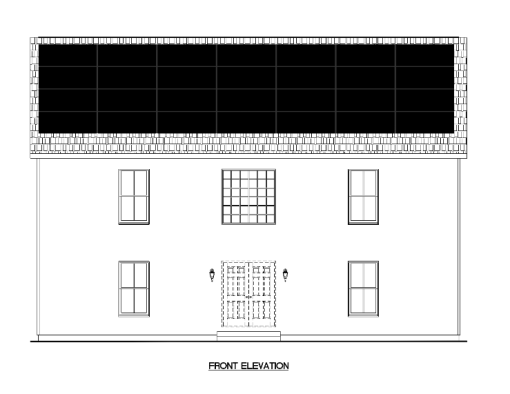
The developers, David Halpert and Teresa Halpert Deschanes, plan to restore the existing ca. 1880 house, and build the second house as a matter of historic correctness and financial feasibility (the money generated by the new carriage house/barn helps to pay for the expensive renovations needed to the existing home, which is in a poor condition due to previous ownership). The new build’s design won’t be as architecturally unique as they one that was condemned and torn down several years ago, but will reuse a couple of design elements. The previous had an irregular shape, brick finish and mansard roof; the replacement will have a rectangular footprint with Hardie Board (fiber cement) siding and a gable roof, similar to barns from the late 1800s time period it is taking its cues from. The project also comes with new landscaping, fencing and 36 solar panels on the new build’s roof.

The plan is that each house will be its own co-op; a unique attribute for this area. I can imagine some Voice commenters would deride it as an “adult dorm”, but there is a niche market for these adult co-ops as seen with companies like WeLive in New York and San Francisco. The Ithaca Urban Renewal Agency (IURA), which is helping the project paply for state grants, has separately noted that the ILPC has already given indications that the plans would likely be accepted.

2. As part of the RFP for the Green Street Garage development, a few developers took part in a tour of the property conducted by the IURA. According to Josh Brokaw at Truthsayers, Visum Development, Ithaca Neighborhood Housing Services (INHS), Purcell Construction of Watertown/Virginia and Missouri-based Vecino Group were on the tour. Visum has previously commented on site interest, but complained that the RFP parameters were of insufficient length to put an application together – the RFP was modified later in December from 60 to 90 days, short of the six months Visum suggested. INHS may have been there on Rimland/Peak’s behalf, as they’ve been in talk to manage the affordable housing component of that project. Purcell Construction is the firm building City Centre on behalf of Newman Development Group, and Vecino Group (Spanish for “neighbor”, by the way) is a national developer with interests in affordable, supportive and student housing.

It’ll be spring before we find out who submitted what, but it looks like there will likely be a few contenders with Rimland/Peak, even if they have a clear advantage.

3. According to a press release sent to the Times (dunno if anyone at the Voice received it), New Roots Charter School is planning to expand its service by adding 6th, 7th and 8th grade classes to its grades 9-12 program. The move would lead to the enrollment of another sixty students into the school.

It is not clear whether the school plans to stay in the Clinton House downtown or move to another location in the city; should they move, there is a potential opportunity a few blocks away at the former Immaculate Conception School, if the Catholic diocese is willing to entertain the idea.

4. Marketing has officially launches for Tiny Timbers’ Varna project, “The Cottages at Fall Creek Crossing”. The layout of the houses is the same from the initial rendering, but the selected models changed quite a bit. That means something here because, like the Belle Sherman Cottages, this is a case where you buy the lot and house and Tiny Timbers builds that specific house, it’s not a “bring your own plan” setup. The website appears to be down for maintenance at the moment (linking anyway), but realtor Brent Katzmann via Zillow is showing homes ranging from an 812 SF 2 bd/1 ba for $192,900, to a 2,175 SF 3 bd/2 ba for $272,900. The prices are in a sweet spot right in the middle of Tompkins County’s housing market, and lower than most new builds thanks to the pre-fabricated approach Tiny Timbers utilizes. All the home designs were penned up by STREAM Collaborative.

5. Probably worth a quick mention for those who like trying new restaurants – Bol is open at the former Titus Gallery at 222 East State Street on the Commons. Created by the same guys behind Simeon’s, the 1,200 SF restaurant recently opened and is serving up ramens, salads, curries and broths. As you can guess, the theme is bowl-based dishes. Yelp reviews appear to be mixed, but don’t let stop you from giving it a try.

6. In Mayor Myrick’s state of the city speech, a couple of things to watch for in the coming months – movement on a public facilities master plan, and Waterfront development. I and Mike Smith covered this somewhat at the Voice, as has Nick Reynolds at the Times, but the potential to move and consolidate police, fire and city hall could very substantially reshape Downtown Ithaca, as could consolidation of water/sewer and streets in Southwest Ithaca.

Meanwhile, the West End and Waterfront are seen as the potential major development opportunities even with their physical and environmental obstacles, if simply because the number of choice parcels in Downtown and Collegetown is running low, and most other neighborhoods would put up enormous resistance with concerns of quality-of-life impacts. Waterfront development would involve a push to relocate the DEC and DOT facilities, something that the county is also keen on. Residents can also expect some movement on the Green Street Garage redevelopment, while the city does a parking study to determine how much parking is needed with future growth. This is all happening in a good economic but challenging political environment, so 2018 should be an interesting year. Of course, the phrase “may you live in interesting times” is often a damning one.

https://platform.twitter.com/widgets.js

7. Click the link above for a video of Cornell/EdR’s Maplewood advertising itself. The most interesting thing to my eyes is the apparent redesign of the community center, from an edgier modern design to a more traditional style with a gable roof. It looks like it will contain a lounge, exercise room, and perhaps small group meeting rooms (though that might actually just be apartment building study space). The EIS likely does not require any re-review since it looks to be mostly aesthetic changes, with little to any change to program space.

8. Someone’s lovin’ it – the new McDonald’s is open at 372 Elmira Road. Pardon me while I move that one into the “complete” column on the project map. I had in my notes that the store was renovated in 1972, and 14850.com has a photo of the truly original McDonald’s that stood on the site in the 1960s – check out those golden arches.

9. Eye candy for the week – here is the first published render for the Tompkins Center for History and Culture, aka the Heritage Center. As part of the state’s Regional Economic Development Council awards, the project received $1.365 million in grant funds – one, a $1.06 million arts and culture grant, the other a $305,000 economic development grant (the project is intended as a tourism generator and tourist information center). The plan is to have the $1.8 million project open in early 2019.

10. West End Heights (709 West Court Street) is now more likely to move forward this year thanks to $250,000 in Community Housing Development Fund grants from the county and city of Ithaca. The county is giving $100,000, and the city $150,000. The project will bring 60 units of affordable housing, with 30 units reserved for vulnerable individuals getting mental health support, and six for formerly homeless individuals who may have HIV/AIDS. The goal is to start construction this year, with a late 2019 or early 2020 completion.

At its January meeting, the city of Ithaca Common Council also awarded $100,000 to Amici House for its expansion and 23 units of housing for formerly homeless or vulnerable young adults.


The Lux (232-236 Dryden Road) Construction Update, 12/2017

18 12 2017

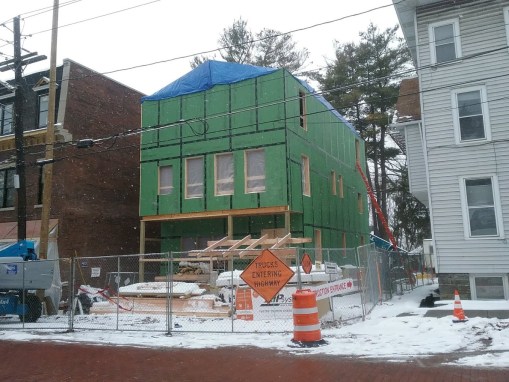
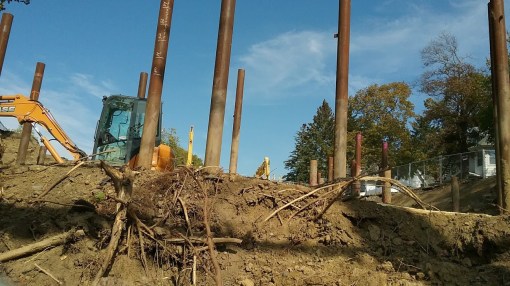
Some progress on Visum’s latest project, “The Lux” at 232-236 Dryden Road in Collegetown. 232 Dryden, the building closer to Dryden Road, has started work on exterior framing – the partially-above grade basement level, built into the slope of the site, appears to have been framed with Amvic insulated concrete forms (ICFs), similar to those seen at the Ithaka Terraces and the Fox Blocks at the Thurston Avenue Apartments. These are thermally insulated plastic blocks filled with concrete – they tend to be a more expensive approach, but they also tend to have a higher grade of insulation (higher R-value), making for a more energy-efficient structure. There has been talking of making the complex net-zero energy capable, provided that the energy of an off-site solar array can be procured. STREAM, the architect of The Lux, also did the Ithaka Terraces. The exterior walls will be assembled block by block, with new pours as rows of blocks are set in place. The rebar provides additional stability. It appears the cinder block elevator core/stairwell has been assembled as well.

232 Dryden might be the more visually prominent of the two building, but it is also the smaller one – it will have 20 units and 53 bedrooms. 236 Dryden will host 40 units and 138 bedrooms.

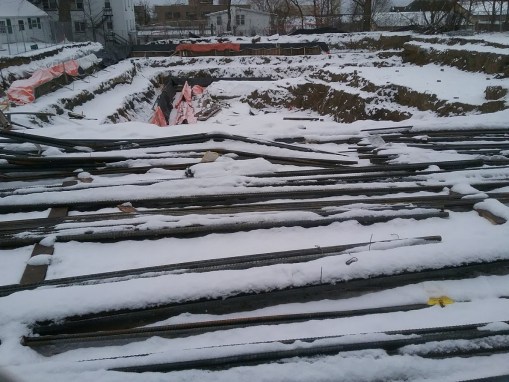
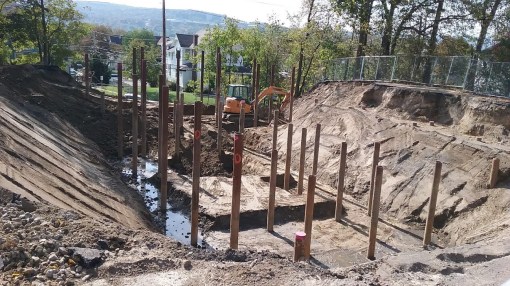
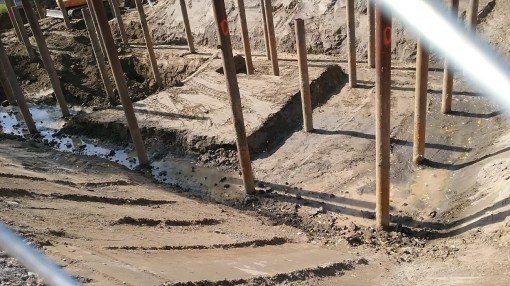
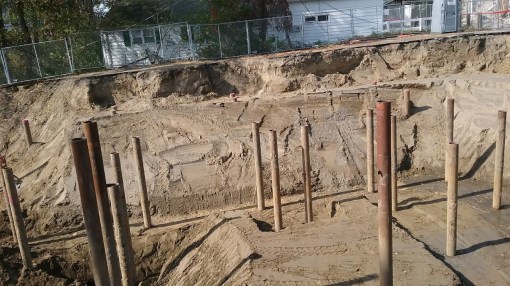
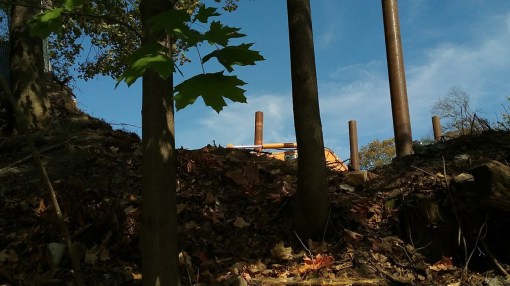
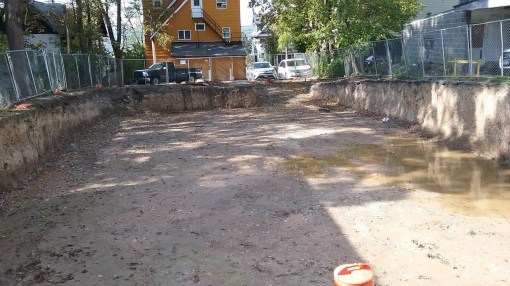
Speaking of 236 Dryden,  Welliver has the foundation excavated, and the steel piles are in. However, judging from the steel rebar sitting on the edge of the site, the concrete pours have yet to take place, and it looks like the wooden forms are just now being built on the far side of the footprint.

Pessimistically, I could note that this is one of the few Collegetown projects that was able to move forward after the building code change that brought multiple other projects to a halt – the power lines on Dryden Road aren’t close enough for the project to infringe on the new regulations. I had heard Visum might actually pay for the burial of power lines on the 200 Block of Linden Avenue, but even if they did, they would still have to deal with NYSEG’s slow schedule.


400-404 & 406 Stewart Avenue Construction Update, 12/2017

17 12 2017

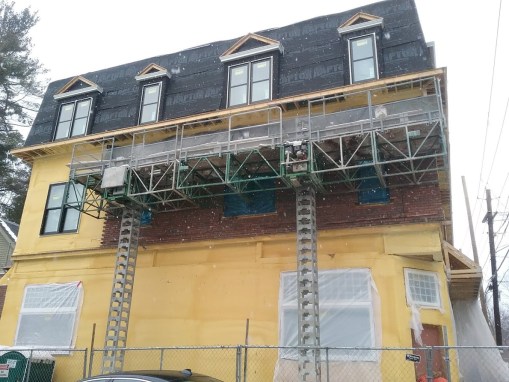
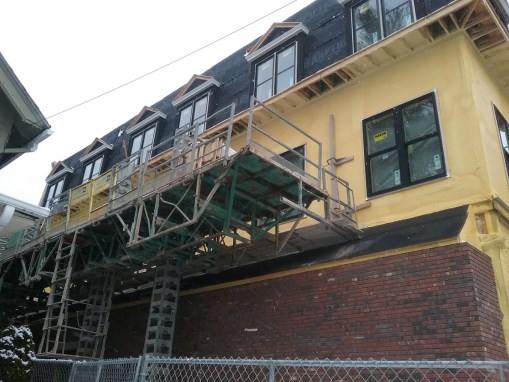
400-404 Stewart Avenue, a.k.a. the former Chapter House site, is fully framed and the brickwork is in progress. The brick veneer is Redland Brick Inc.’s Heritage SWB, and is similar in appearance to the original brick of the Chapter House, which was damaged beyond repair in an April 2015 fire. So the way this has gone is that yellow closed-cell spray foam was applied over the sheathing, probably by a subcontractor such as Goodale Spray Foam out of King Ferry. Closed-cell spray foam, made with polyurethane and applied a few inches thick, provides insulation under the brick. Brick is a tricky material in some ways – the plywood ZIP Panels are great for sealing a structure to make it air-tight, but brick absorbs moisture, so the spray foam not only serves as an insulator, it also provides a protective moisture barrier between the plywood and the brick. It’s typical to have a drainage gap underneath the brick so that they can dry out, otherwise the uninsulated brick is at risk of long-term moisture damage.

The roof looks to be covered in tar paper or similar material; this will eventually be layered over with chamfered asphalt shingles. The roof ZIP panels that make up the “awning” being built over the first floor will be covered in shingles as well, but those will be more expensive simulated slate. The trim pieces like the cornice may be cast stone or fiberglass over wood, and it looks like the window sills and heads might be cast stone. It looks like they’re using Marvin Windows for the windows themselves.

406 Stewart Avenue is still being framed with ZIP panels, now up to the third floor with just the roof trusses left. The drawings I have on file suggest the fenestration has been changed – the position and size of the second floor windows are different from the renderings, in particular the window on the far left of the front face, and one of the windows on the north side was moved further back from the street. It suggests some modest interior alterations, but the ILPC will be watching this like a hawk since these builds are under their jurisdiction (the East Hill Historic District).


The Lux (232-236 Dryden Road) Construction Update, 10/2017

23 10 2017

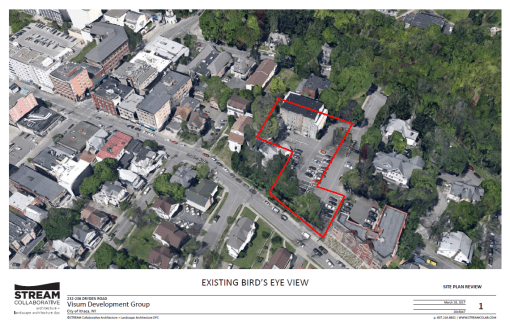
Continuing yesterday’s theme, here’s another one of Collegetown’s development opportunities playing out, though perhaps it was less obvious as the Linden Avenue properties – coming soon to Ithaca, 60 units with 191 beds of student housing at 232-236 Dryden Road, just east of Collegetown’s core and part of the eastern transition to the Belle Sherman neighborhood.

Once again, this is a case of Visum Development Group scouting potential opportunities at the right time and place to make something happen. Along with a large surface parking lot, the previous building on this site was a 30-unit apartment building and the former dormitory for the historic Cascadilla School, a private school with a 140-year history on the corner of Oak and Summit Avenues in Collegetown. The 4-story building once housed dorms, a dining hall and a gymnasium, but after its sale to private ownership after World War I, it was remodeled again and again, each seemingly more unsympathetic than the last. By the late 20th century, it was a grim, awkward-looking box, stripped of ornamentation and of its historic value. The previous owner, the proprietor of the Hillside Inn, had owned the property for several decades; Visum paid about triple the tax assessment ($7.65 million vs. $2.55 million) to buy the property in September.

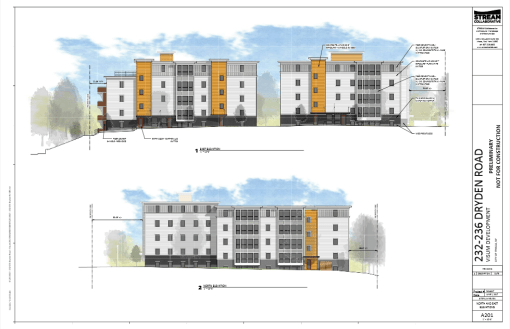
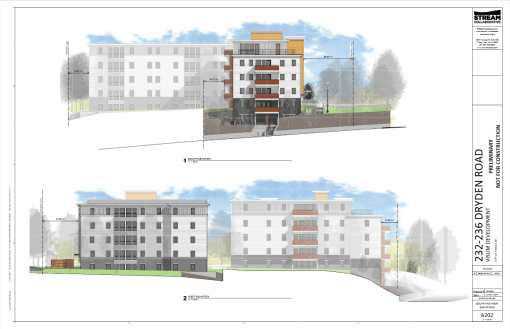
There are two buildings to be built, totaling 84,700 SF – 232 Dryden (The Lux South) and 236 Dryden (The Lux North). This allows for different plane grades, meaning they’re different elevations. That makes it easier to blend in with the neighbors, and creates less ambiguity with height limits, something that bedeviled Visum with its 201 College Avenue project. As with 210 Linden, zoning is CR-4 – four floors, 45 feet from average grade, no parking required with a city-approved transportation demand management plan (TDMP). Usually, that means free bus passes or Carshare registrations, ample bike storage, and explaining how students can easily commute to campus by walking.

The project was proposed in March 2017 and approved by August. Overall, the changes were fairly modest. No zoning variances and little public opposition helped to create a smooth review process. The biggest change came during the design review process, and affected the Dryden Road facade – revised fenestration and the addition of shingle-style balconies. STREAM Collaborative’s intent is to give the south building a little more historical sensitivity, and the balconies are throwbacks to the Cascadilla dormitory’s long-gone shingle-style balconies.

However, given that this building will date open in 2018 and not 1898, instead of wood shingle, the balconies will use Allura “Redwood” fiber cement shinglewood pulp mixed with sand and cement, shaped for a wood-like appearance, but with the durability of concrete. Fiber cement is also more expensive to buy and install vs. materials like vinyl, which is why only more expensive or visible structures tend to use it. Other planned materials include Endicott manganese ironspot velour brick veneer, fiber cement panels with LP smart trim painted in Sherwin-Williams Pure White and Anonymous (that is the actual name), lap siding in SW Pure White and Marigold, granite grey stucco (real stucco, not DryVit), a metal canopy and Andersen windows.

The loan, for $16,354,628, was granted by S&T Bank, a regional bank based in Pennsylvania that has no retail banking presence in Ithaca, but has served as the financier for several projects, including the Holiday Inn Express that recently opened on Elmira Road, and Visum’s just-opened 201 College Avenue project. A breakdown of the costs shows the total project cost is $22,780,334. There’s $13,020,010 in hard costs (materials/labor), $7.65 million for property acquisition, $475,000 in soft costs (architect/engineering/legal), $250,000 for the demolition, and the rest is for taxes during construction and interest reserve (interest on the construction loan during construction). $650,000 (5% of the hard cost) is set aside as contingency funds just in case the expenses clock in higher than expected.

Despite the rather pretentious name and logo, it’s hard to argue the amenities don’t live up to the premise – according to the marketing website, tenants of The Lux and other Visum properties have access to a media lounge, study room, hot tub, sauna, full-service gym, game room and outdoor terrace. Tenants will have trash removal, stainless steel appliances, in-unit washer and dryer, and bike storage. I feel poor just typing this stuff out. Units are 1-5 bedrooms, with the smallest being 1 bed, 1 bath and 435 SF, and the largest being a 1693 SF, five-bedroom, five-bath. Rents will be $1200-$1300/month. Visum is running an offer that if all tenants on a lease (presumably a larger unit) can show they’re members of a registered student org, they get 10% off the first month and a $150 check will be given to their organization. Many larger Collegetown units are legacy properties among student groups (fraternity annexes, bandies, club and NCAA sports), passed down from year to year by members of the org. This may be a clever move to make next years’ renting a bit easier on Visum, whose CEO noted softening in the market this year.

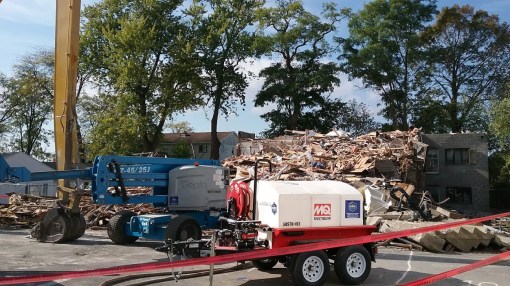
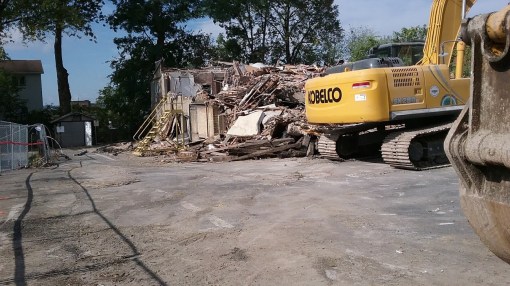
A trip to the site shows caisson (steel pipe) piles have already been laid for The Lux South, and demolition is ongoing of the old apartment building on the site of The Lux North. The pipes extend down to the solid shale bedrock 46 feet below grade, according to local engineering firm Elwyn & Palmer. A deep foundation by any measure. A benefit to building in Collegetown is that the ground is much more amenable to deep foundations than the weak, water-logged soils of the West End.


210 Linden Construction Update, 10/2017

21 10 2017

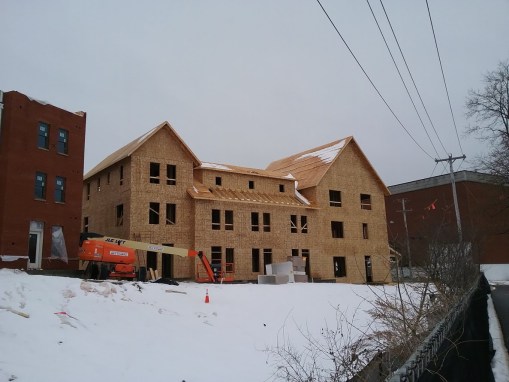
Technically, 210 Linden Avenue has been stopped for the time being, but just for the sake of having it, here’s the project description post for future reference.

One of the intents of the Collegetown Form Districts was to encourage redevelopment in portions of Collegetown that the city saw as less desirable – the really stereotypically poor-quality housing that Cornell just called out in its state of the university address. These properties are generally unsuitable for families since most of them were purpose-built boarding houses, often with haphazard additions and renovations over the years to make the bare minimum of city building and fire code. With a captive market in Cornell students, many landlords didn’t see the need for quality because the prevailing logic was that it decreased profitability. Only during the first luxury developments of the 1980s (Fane’s Collegetown Court in 1985, Mack Travis’s Eddygate in 1986) did that really start to change, and even then, many older landlords clung to the old ideas, hesitant to change from a time-tested if ethically questionable formula.

Since then, it’s been something of a development see-saw; developers see greater profit potential, but typically they need to build big to ensure a good return on investment (balancing soft construction costs, hard construction costs, interest on construction loans and current/future taxes against the revenue from renters). A large project comes along and drives discontent from East Hill and Belle Sherman, who have long clashed with the different lifestyles of students, as well as a longstanding sense of wariness from the old-style landlords who would try to buy homes and turn them into student slums. The city places a moratorium, tweaks the zoning, process starts anew. From a municipal perspective, it’s always been a delicate balance between the substantial taxes generated from Collegetown, and quality of life issues (traffic, rowdiness).

In general, the 2014 form-hybrid zoning, which removed some parking regulations and put the focus on Collegetown’s core, has had favorable outcomes; the only real debate has been 201 College Avenue, which was a rather unique situation. 210 Linden Avenue is a textbook example of a shared goal between city and developer – the 200 block of Linden has many properties in poor condition, and the city would like redevelopment mixed among the better-maintained older houses. With that in mind, zoning is generally CR-4 – 4 floors, and no parking required as long as a Transportation Demand Management (TDM) plan is received and approved by city staff. New buildings wouldn’t be large or oppressive since most buildings are 2.5-4 floors on this block, and with planning board input, high quality designs would enhance the walkable environment, build the tax base, and add some housing to reduce pressure on adjacent streets. Developers in turn would have more flexibility, and removing the parking rules really opens up the possibility for new builds on Linden’s small lots.

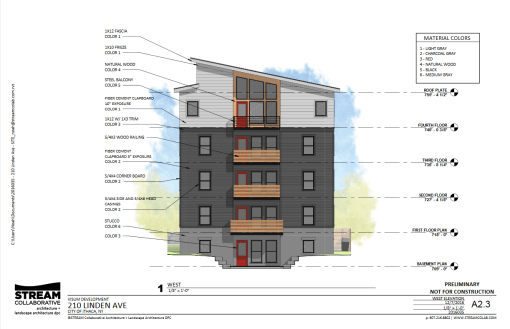
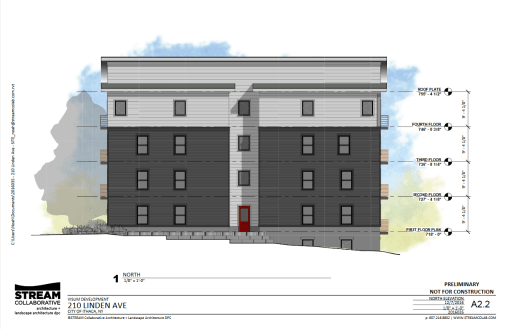
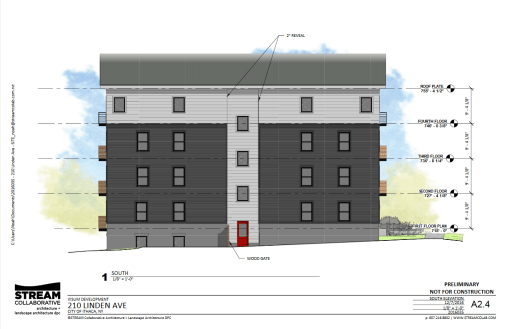
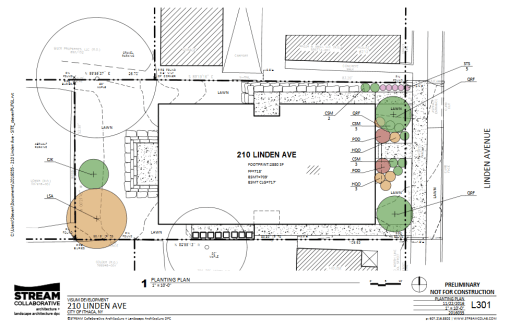
Previously, 210 Linden was a rather ramshackle 12-bedroom apartment house. Visum Development Group (VDG), led by local businessman Todd Fox, saw a potential opportunity for a new build and established a purchase option with the then-owners, a pair of small local landlords. The redevelopment is not an especially large project, medium-sized by Collegetown standards. It is 14,400 SF with 9 units, all of which are 4-bedroom, 2-bath, for a total of 36 bedrooms. Each floor has two units, except for the partially-above grade basement, which has one unit and space for the bike room, trash room and mechanicals. The project will use electric air-source heat pumps, and be net-zero energy capable with the use of an off-site renewable energy source.

210 Linden was first proposed in November 2016. With basically no opposition, and a design that the planning board found perfectly appropriate, it sailed through the review process, and approval was granted in January 2017. In something of a rarity for city projects, no zoning variance was required. 210 Linden fits the maximum length, width and building lot coverage allowed under the Collegetown Area Form District’s CR-4 zoning, and comes in at or just under the 45-foot height maximum – the sites are sloped, and the 45′ height is defined as the average above grade plane. Exterior finishes includes stucco at basement level, a couple shades of grey fiber cement lap siding above, red doors, metal balconies and natural wood trim.
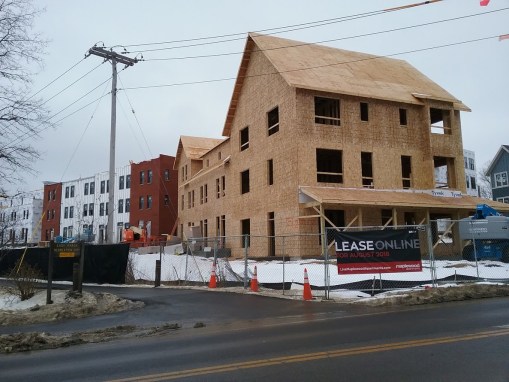
There were virtually no design changes from beginning to end – the only noticeable change was that the doors were moved from the left side of the balcony/terrace to the right. The project was a fraternal twin to another infill development Visum has planned, 126 College Avenue. One has to give credit to the architect, Noah Demarest of STREAM Collaborative, for being able to provide cost-efficient and well-received designs.

A frequent partner of VDG, William H. Lane Inc. of Binghamton, is the general contractor. Right now, only the demolition and foundation excavation have been completed. Once the power lines have been buried out front by NYSEG, construction of the building can begin. The intent is to have the building completed in time for Cornell’s 2018-19 academic year, which starts in late August. Elmira Savings Bank gave VDG a $3.15 million construction loan in July to complete the project.
As one might expect with new units less than two blocks from Collegetown’s core, the cost per room is not cheap. Advertisements online say $5,000/month, or $1,250 per month per bedroom. Units come with 9′ ceilings, air conditioning, internet/cable, stainless steel appliances, quartz countertops, washer/dryer in-unit, balconies, and a security system, among other bullet points and exclamation points. A fitness room and other luxury amenities will be accessible to tenants at another Visum project, 232-236 Dryden Road.