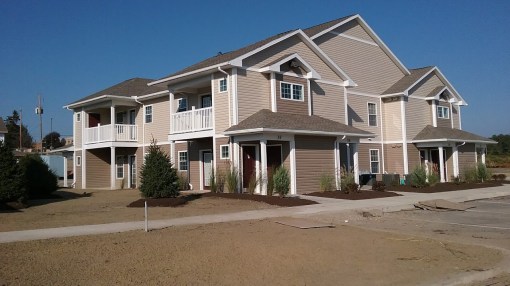
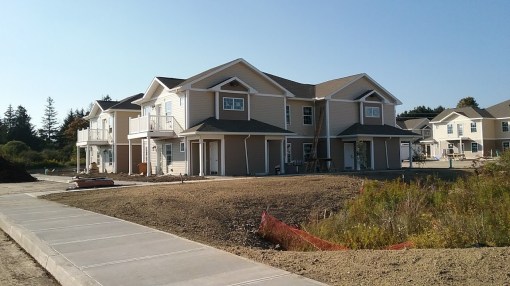
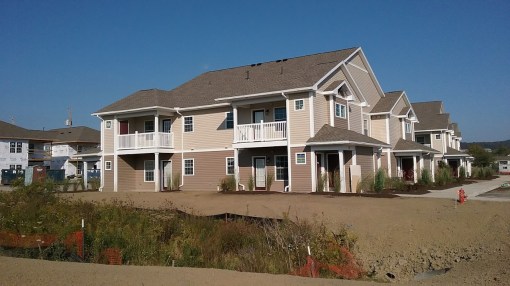
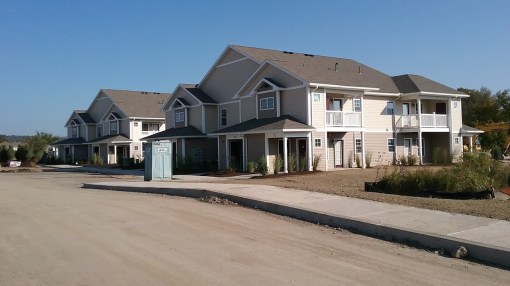
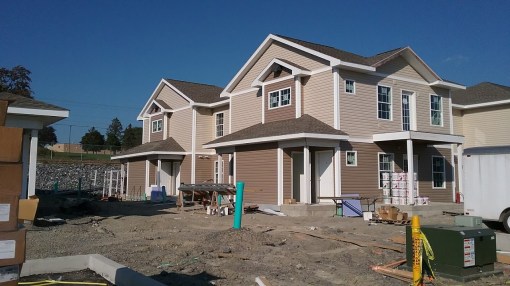
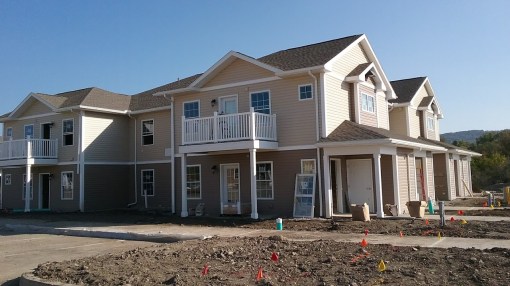
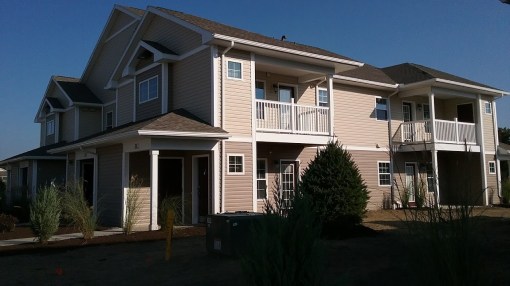
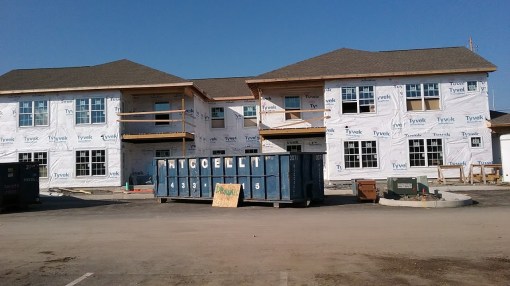
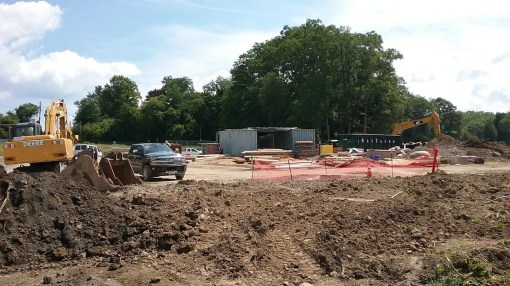
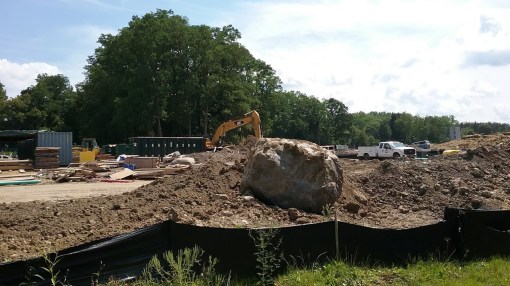
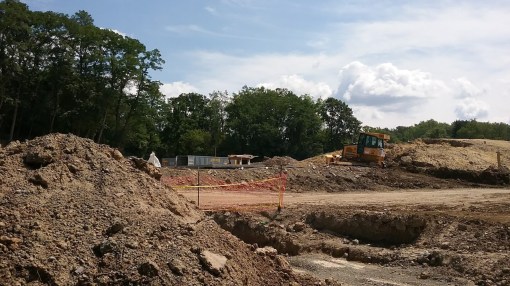
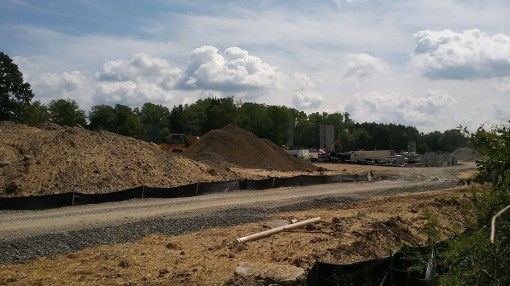
607 South Aurora Street Construction Update, 9/2017

2 10 2017

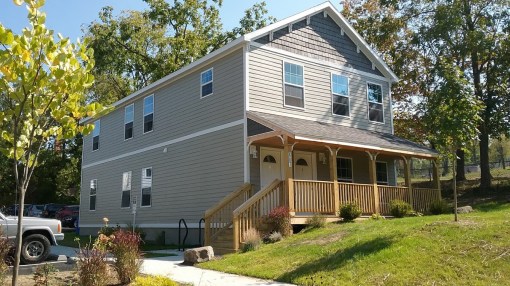
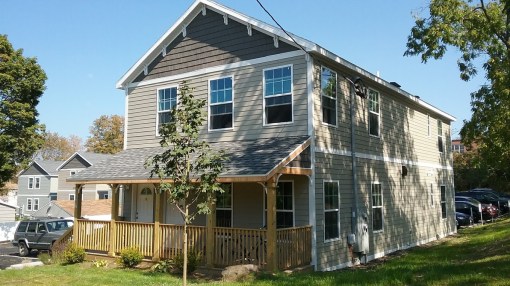
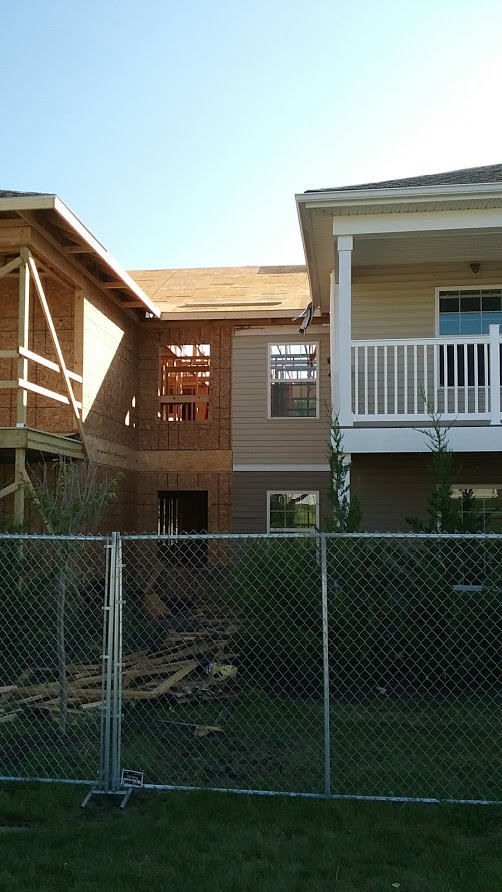
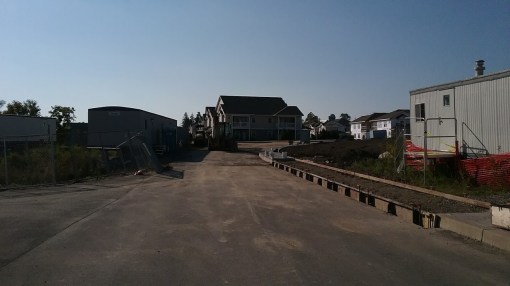
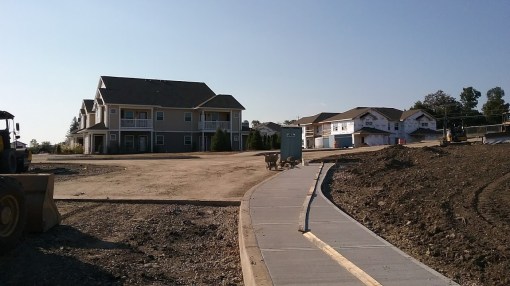
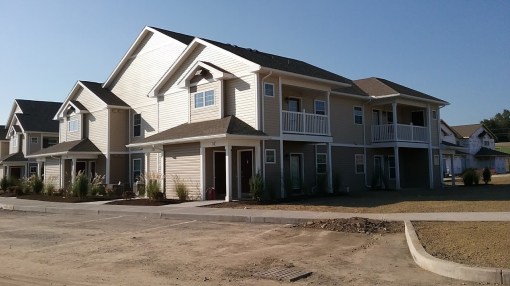
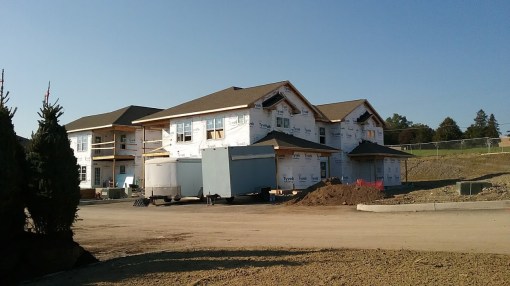
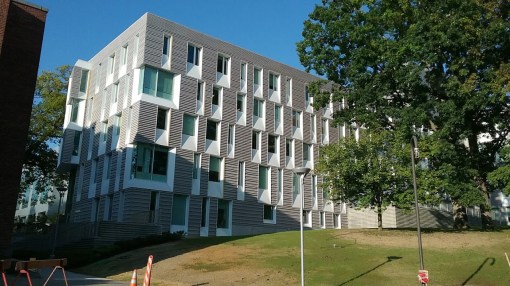
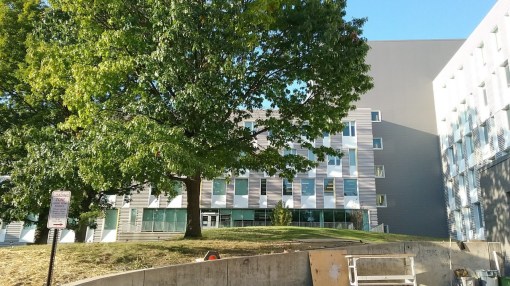
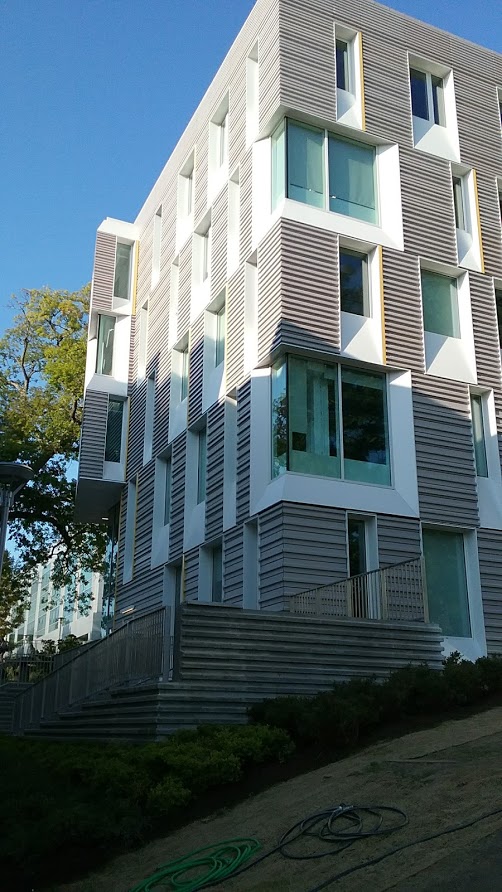
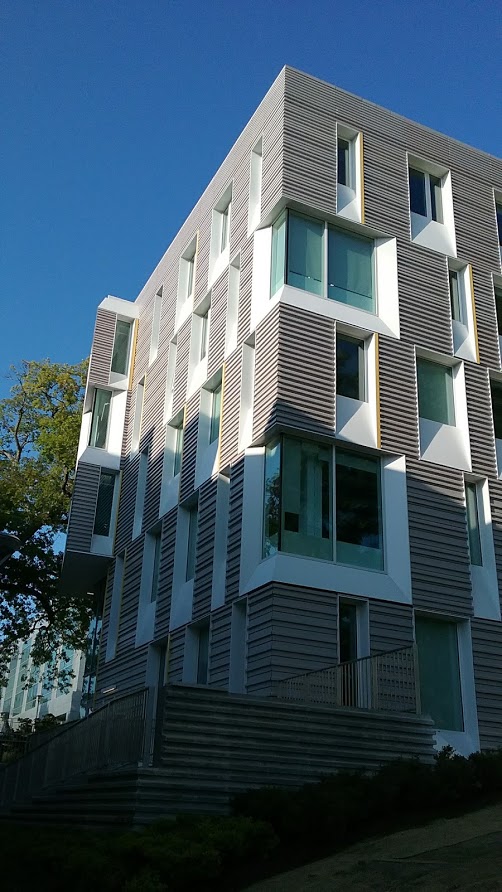
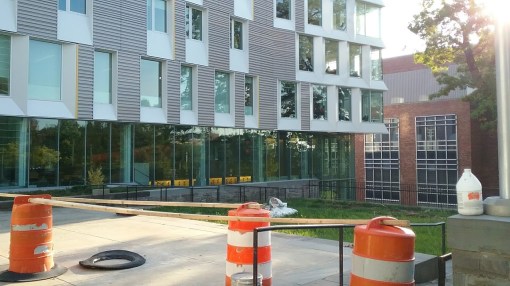
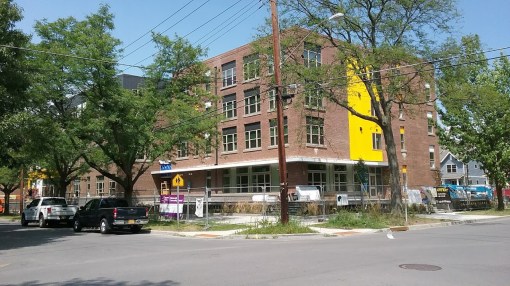
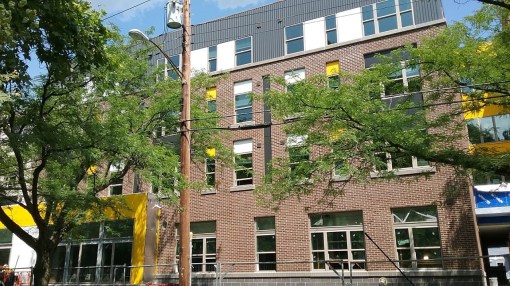
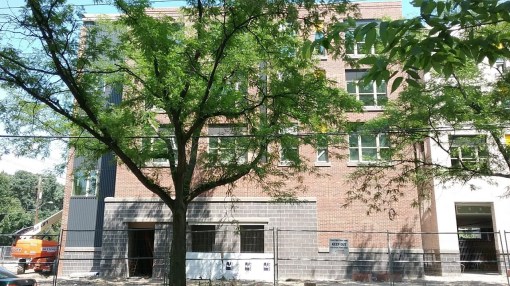
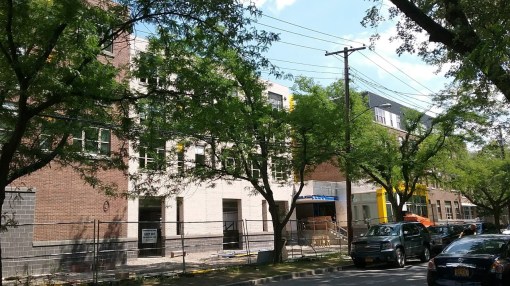
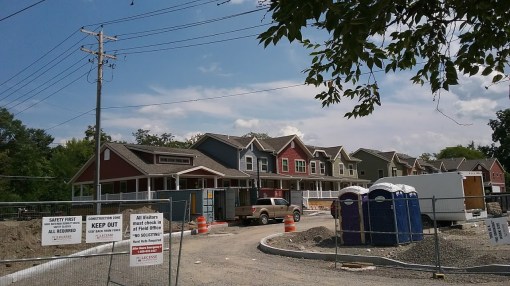
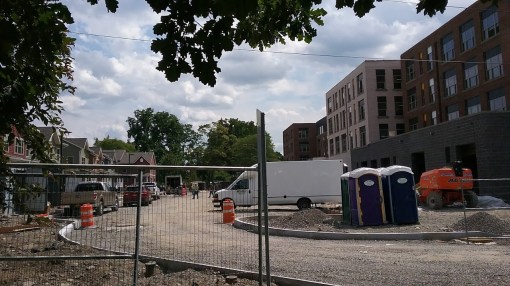
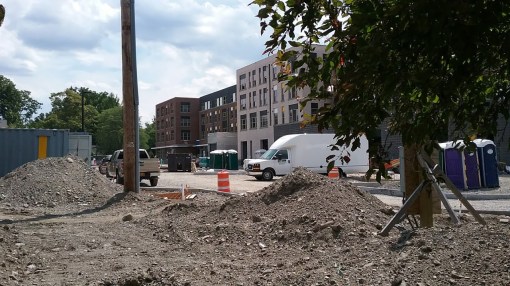
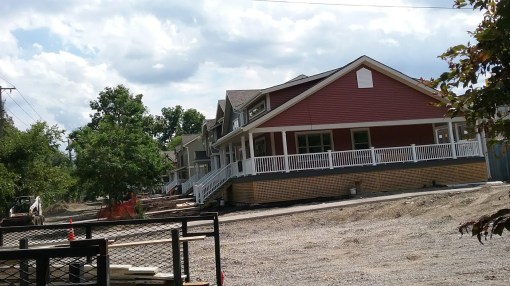
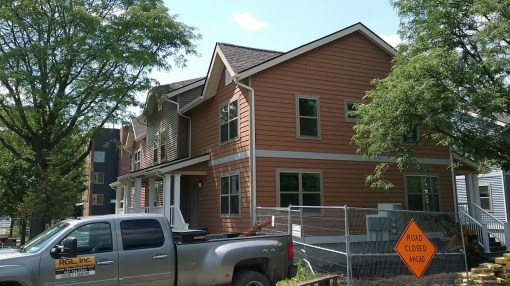
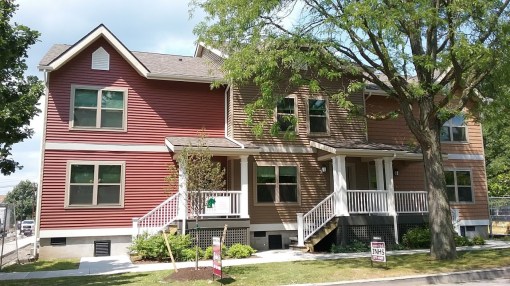
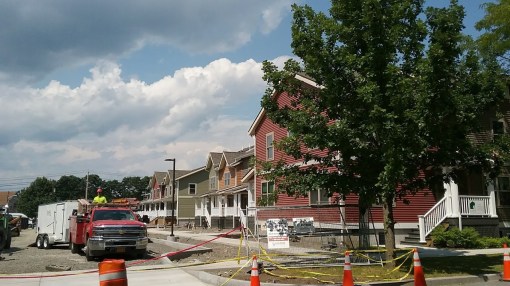
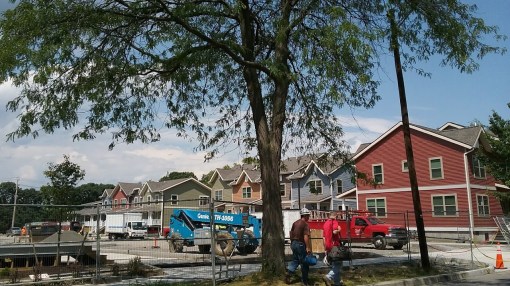
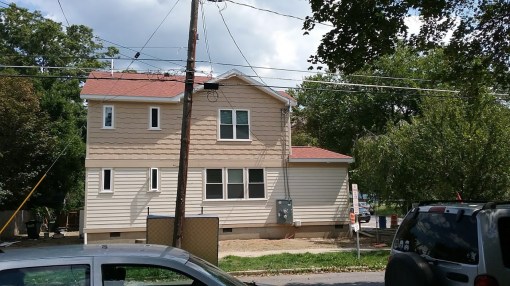
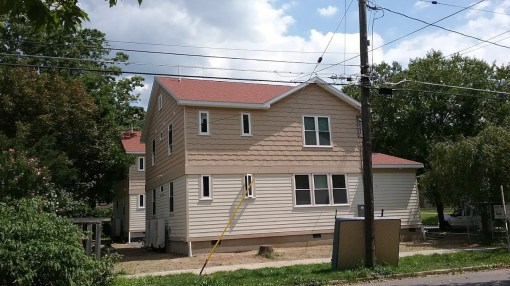
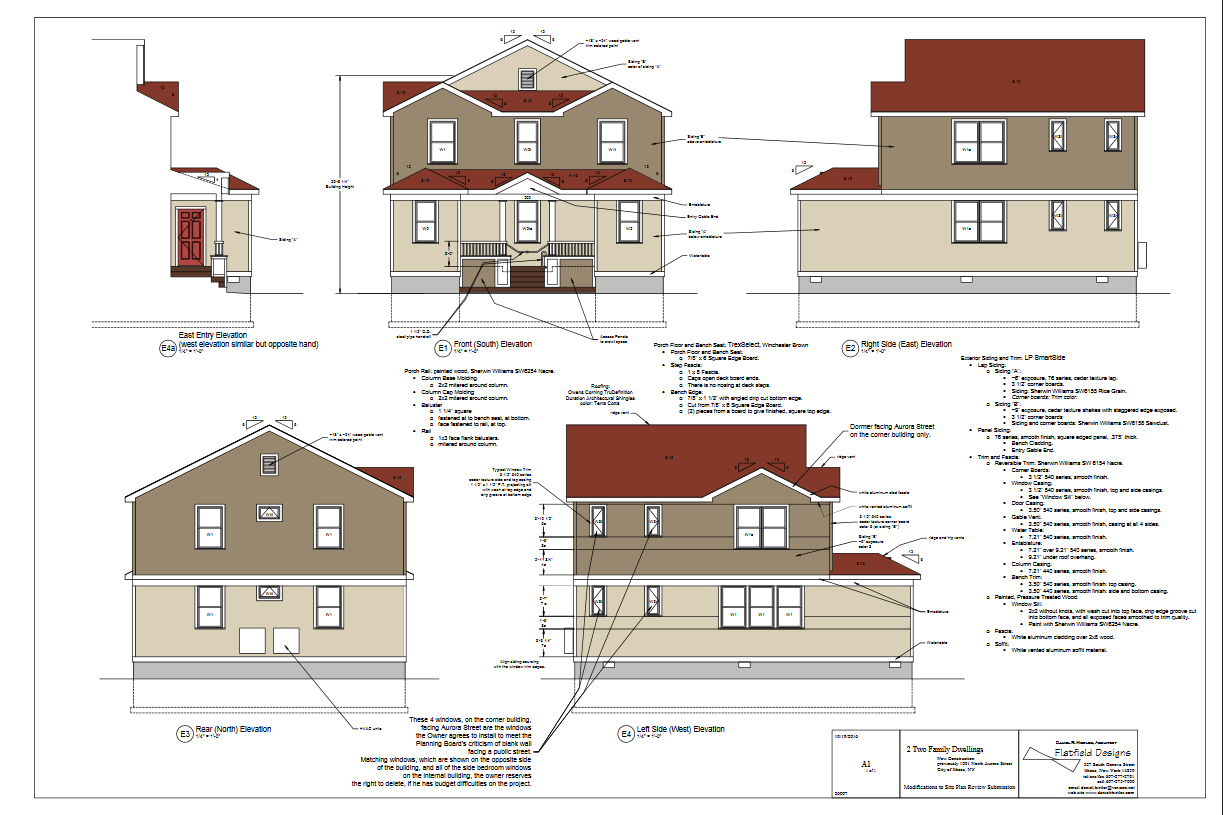
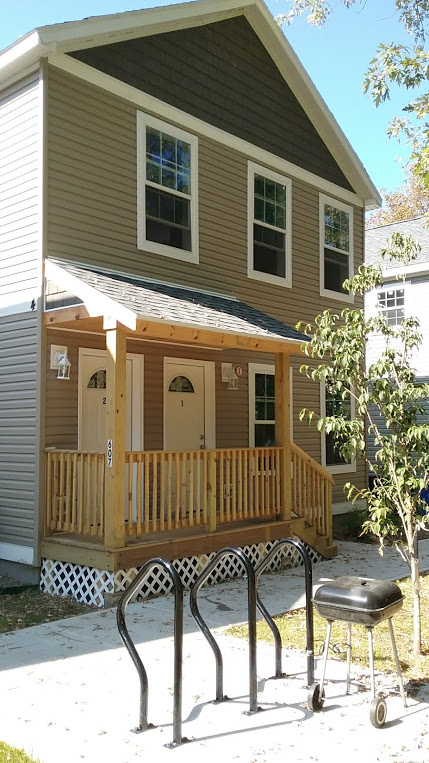
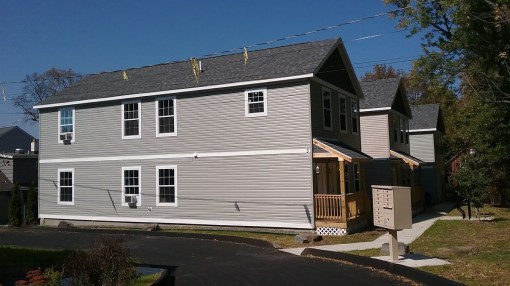
Landscaped, occupied, done. Modern Living Rentals’ infill project at 607 South Aurora Street on South Hill adds another 25 beds to the market, in four new two-family homes and a renovated existing home.

Strictly looking at the project, it’s pretty unassuming. This armchair critic thinks these turned out nicer than the ones on Elmira Road, though a greater splash of color on the siding would have been nice. The brackets and full-length porch are welcome additions on the Aurora Street structure.

If someone had told me 217 Columbia’s two-family infill would cause such a stir, I would have been surprised, since it’s a small project, and this and the Elmira Road pair didn’t create much a stir during the review process. But sometimes, after multiple projects of similar format, all it takes is one more to stir up enough consternation to snowball into a full-blown controversy.

I’m not going to fault anyone there. MLR’s Charlie O’Connor saw an opportunity and went for it. He is arguably one of the most reticent developers in Ithaca, preferring unobtrusive projects that he hopes will create as little debate as possible. It’s kinda funny in a way, because although he’s a business partner with Todd Fox (Visum’s property management is handled by MLR), the two of them are near-opposites in that regard. He paid a fair sum for 217 Columbia Street, so he doesn’t want to walk away from the investment, but he’ll do whatever it takes to make the neighbors happy short of cancelling the project. At last check, there was a proposal to stipulate the two three-bedroom units would not be permitted to student renters, and that the building would be stick-built and designed to better fit with the older structures of the neighborhood.

On the other side, permanent residents have a right to be annoyed if the perceived balance between students and non-students starts to shift and harm their quality of life. The neighborhood, like many of Ithaca’s more walkable parts, has experienced significant upward pressure on housing prices, and rental infill units can be a double-edged sword because the individual property is priced out of reach for homeowners (for-sale infill would be a different story). Even with the owner-occupied properties, there’s a strong whiff of gentrification, turning what was once a blue-collar neighborhood serving downtown shoppers and Morse Chain into a hodgepodge of increasing number of student rentals, and more white-collar, deep-pocketed households.

Somewhat incongruous to all this is that Ithaca College’s student population has declined almost 10% since 2010, which would suggest less pressure for student rentals; however, many of the college dorms date from the 1960s, and the utilities systems need replacement – some are already on their last legs, and that may limit occupancy as they sputter into obsolescenceThe college and students are aware of the discord and are trying to address it gently; more extreme measures like curtailing the ability or capping the number of students who can live off-campus might create major blowback, something the college may be actively trying to avoid after last year’s turmoil. A new dorm or two would help, but even modular temporary dorms can cost a fair sum, and there is nothing planned in the short-term. A long-term question mark is the impact of the Chain Works District, but that’s a few years out at best.

Landlords should at least be cognizant of this tension (and the ones on South Hill tend to be a mixed bag, to be honest), because if things turn south and the college does take drastic measures, units are going to become much harder to fill at current monthly rates. Town officials and voters were unhappy with the quality and appearance of new housing built in the Birdseye View development and in the Pennsylvania-Kendall Avenue corridor, and that contributed to the push to curtail student housing in the town’s portion of South Hill.

The local community is not easygoing or forgiving. If you do crap work, crap will hit the fan sooner or later. Even if you do good work like 607 South Aurora here, it pays to be attentive and flexible.

While legal language is being prepared for an overlay that would prevent more than one primary structure on South Hill properties until a new neighborhood plan is developed (2-3 years minimum), 217 Columbia had already started review before that was considered, so in effect it’s grandfathered in, even if it hasn’t started construction before the overlay likely gets passed by PEDC this month and Common Council in November.


Cayuga View Senior Living Construction Update, 9/2017

2 10 2017

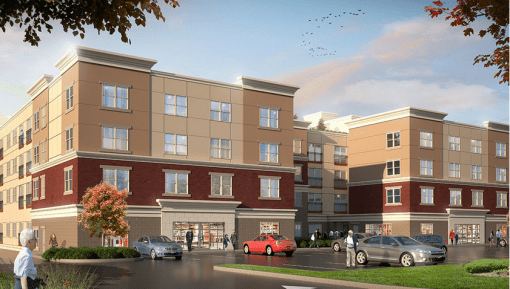
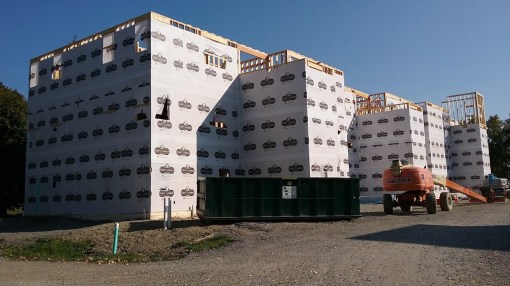
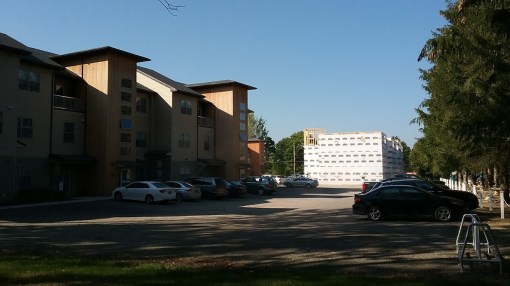
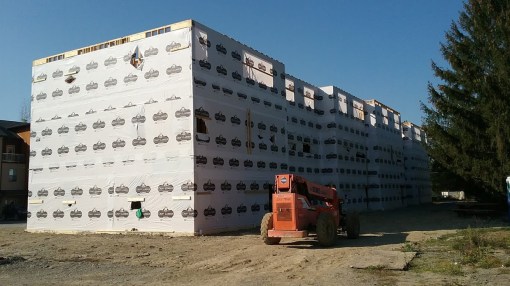
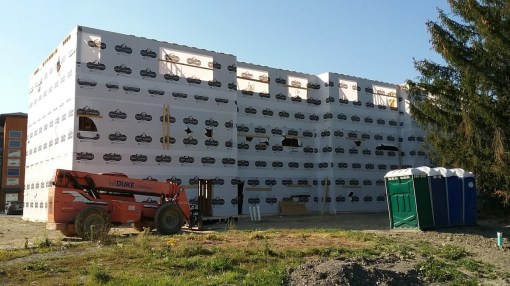
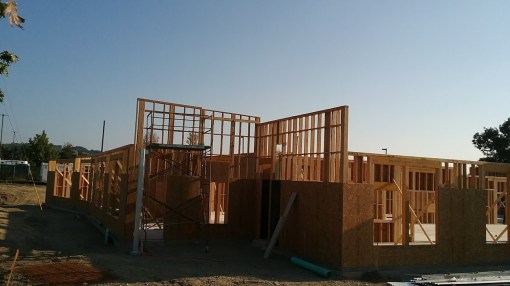
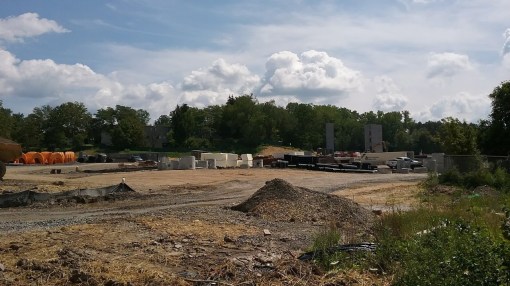
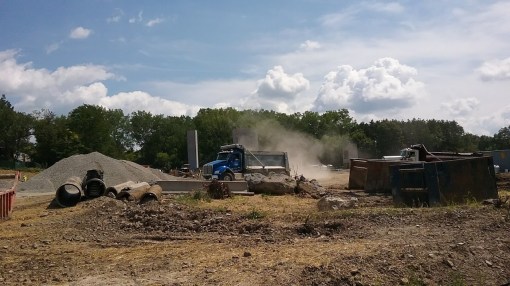
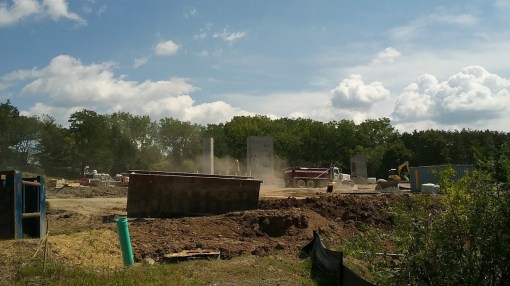
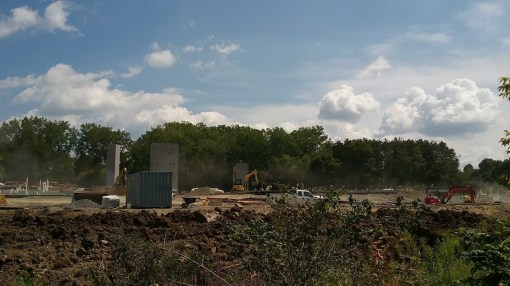
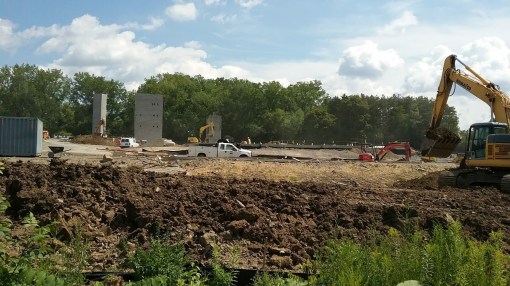
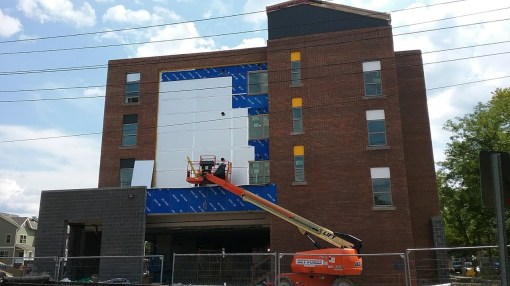
The official groundbreaking for the Cayuga View Senior Living project was back on August 9th. Since that time, the basement level of the Cayuga View Senior Living project has been built out work has begun on the ground level floorplate, and the construction of masonry stairwells and elevator cores. It looks like the big supplier for the CMUs is Zappala Block out of Rensselaer (“REN-suh-lur”).

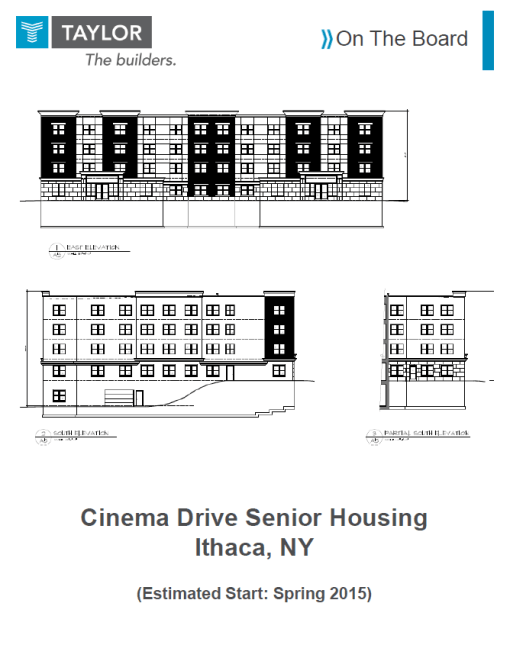
The Taylor the Builders (general contractor) press release alternately states 50 units and 60 units in the mixed-use project, but the number I’ve long heard is 60, 48 2-bedroom and 12 1-bedroom. The 2,680 SF of first-floor retail is split evenly between the two wings of the building’s ground floor. One of the things that pops up fairly often in the marketing literature is the attempt to sell it to snowbird retirees who leave the area during the cooler and cloudier months for more pleasant climes, which the Thaler family co-developing Cayuga View has long done.

“We are proud to partner with Manley Thaler and Rochester’s Cornerstone Group, to bring this scenic mixed-use development to the Village of Lansing,” said Taylor president Karl Schuler at the groundbreaking. “This project addresses a specific niche and community need for market-rate senior housing, while doing so with an overall development that more than satisfies a lifestyle choice among the growing populous {sic} of mature adults in this market.” It’s going to be a busy time for Rochester-based Taylor, as work is also getting underway in Downtown Ithaca on the 12-story Harold’s Square project this month.

Noting the gaps above the window and door rough openings, my semi-educated guess would be that it’s set aside for later architectural finishes, maybe polished stone or similar. It’s a little hard to cross-check with renders because 1) only one render of the project has ever been formally released, and 2) that render does not really show the slope of the site of the walkout basement level. An earlier render from a couple years ago predates the current window layout, but lends credence to the possibility. The below-grade base of the concrete foundation (or will be, once backfilled) looks to be insulated with Dow rigid foam board insulation with a black waterproofing membrane over the top.

The project timeline calls for a Spring 2018 opening. A synopsis of the project can be found here.


Village Solars Construction Update, 9/2017

1 10 2017

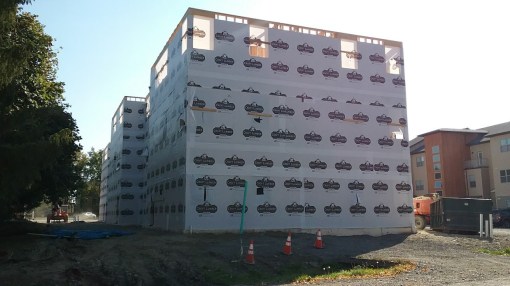
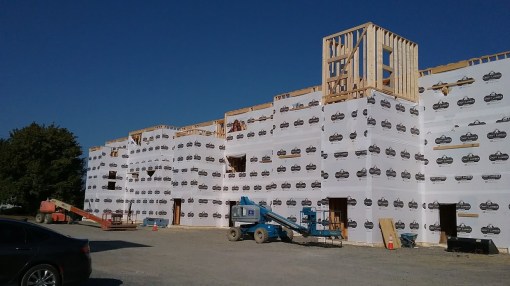
It looks like the Village Solars are moving along, albeit at the slowest pace in years. Since 102 Village Place was torn down back in June, the site was cleared, the foundation and underground utilities reconfigured, and framing has begun on its replacement. The wood frame was up to the top floor by the time of this late September site visit, and erection of the roof trusses was due to take place in just a few days. The housewrap is already in place, and as the interior receives its frames, pipes, wiring and rough-ins, work will being on window and door fittings. Probably looking at an early spring finish here.

Note that it’s not uncommon to just housewrap over the rough openings, and cut out the holes later. The excess will be trimmed off and the edges will be fastened back to the inside wall, allowing for a tight and complete wrapping of the rough opening.

Interestingly, none of the other tear-downs or new building sites have started, meaning that only one building is currently under construction. That’s rather unusual for Lifestyle Properties, whose in-house construction crew typically works on 2 or 3 buildings at a time. There was a dirt pile near one of the future building sites, but it’s been that way for a while, so it’s likely being used as a staging area. The limited construction suggests that the Lucentes may be falling behind their anticipated construction timeline, which generally calls for two or three buildings a year in order to stay on track.


Poet’s Landing Phase II Construction Update, 9/2017

1 10 2017

It looks like the first units are coming onto the market. Conifer Realty has the application up for the first apartments, as do third-party websites like apartments.com. Oddly enough, the apartment.com listing says 16 3-bedroom, 16 2-bedroom and 16 1-bedroom units. This is incorrect. There are 8 3-bedroom, 16 2-bedroom, and 24 1-bedroom units. One can tell from sight alone because Conifer uses the same three building plans in all of its suburban apartment clusters. One design consists of eight 3-bedroom units, the second design is eight two-bedroom units, and the last design is eight one-bedroom units. For units on each floor, mirroring each other in layout. Keeps things simple and materials costs down.

Keeping with the blog-only nomenclature, buildings “A” and “B”, the two that are basically complete from the outside, are the one bedroom-units. “C”, “D” and “E”, which are receiving exterior lighting rigs, trim and architectural features like balconies and patios, are the 2-bedroom clusters. Building “F”, which is still at the housewrap stage and the building that is least furthest along, is the three-bedroom cluster. For proof, consider the building that was badly damaged in this summer’s fire – it was reported that 31 people were left homeless. That would most likely imply it was the three-bedroom design, which would have 24 bedrooms.

The general rule of thumb is one person for bedroom for basic planning purposes. Affordable housing family units, for whom these three-bedroom apartments are intended, may average more than that because of income guidelines, and that two adults or multiple children may share a bedroom. Likewise, on the other end of the scale, properties with empty nesters or more affluent owners/renters may have numbers average less than one person per bedroom due to guest bedrooms, or conversion of bedrooms to home offices or hobby rooms. Owner-occupied single family homes often fall in this category, where the typical home is three bedrooms, but the average owner-occupied household size is 2.5. There are a number of companies dedicated to studying the number of people likely to live in a unit based off its location, size and intended market, and applying those figures to calculations like the number of students expected to be added to a district, or the number of car trips generated.

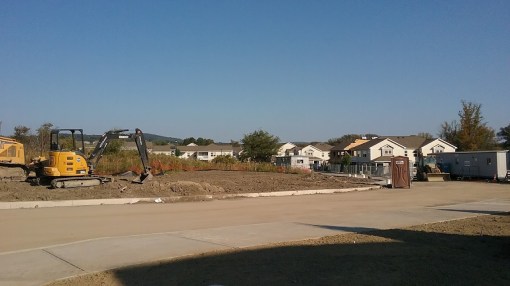
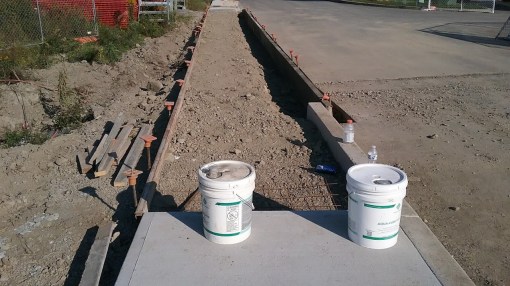
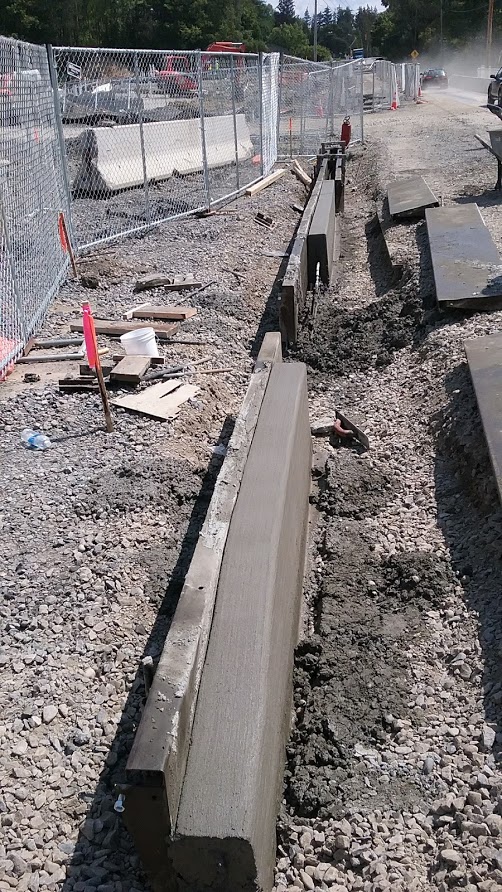
Curbing has been laid, the parking lot is paved and striped, streetlamps are in place and the concrete sidewalk is being poured. The process to build sidewalks is pretty similar to the work for foundations – excavate the path, build the formwork to keep the concrete in place as it cures, lay down some steel rebar to provide additional strength to the concrete, pour, level and smooth, and run a finishing trowel to create an edge so that the concrete has an expansion joint to help expand and contract without cracking the sidewalk. The steel plugs are to keep the forms in place.

The building that was damaged by fire is under reconstruction. The east wing was destroyed by the flames and was torn down. The only thing being reused for those four units is the slab foundation. The four west wing units were salvageable, but they did need an extensive renovation. Damaged trim and siding sections will be replaced, and on the inside, drywall damaged by water has been removed and new sheets are being hung. It looks like some of the appliances were saved; peering through the windows, a refrigerator was sitting in the middle of the floor in an upstairs unit. Closer to the fire, it’s more of a gur renovation, with only portions of the exterior salvaged, while the inside is replaced from the stud walls out. Taking a guess for the typical construction length of units so far, the renovated and rebuilt units probably won’t be ready for tenants for another five to six months.

According to the advertisement on Conifer’s website, amenities and feature include

Dishwasher
Garbage disposal
Wall to wall carpeting
Patio or balcony available
Walk-in closets
Discounted cable package
Central air conditioning
Smart card laundry center
Fully equipped Fitness room
Computer lab
Clubhouse with great room
Controlled building access
Key fob hardware
Professional on-site management
24 hour maintenance
Ample parking
Beautifully landscaped grounds
Accessible for people with disabilities
Close to shopping, schools & medical facilities

1-bedroom units are 716 SF, 2-bedroom units are 950 SF, and 3-bedroom units are 1,150 SF. Lease are 12 months with a month’s rent as security deposit. Three units will be adapted for mobility-impaired residents, and a fourth unit will be adapted to individuals who are hearing or vision-impaired.

According to a filing with the state as part of the grant application, the gross rents (rent plus utilities) will range from $724 to $1,070 a month, to be occupied by households with incomes 50% to 60% of area median income.

2017 AMI in Tompkins County is $53,000 for a single person, and $60,500 for a two-person household, and $68,100 for a three-person household. Therefore, the income limits are $26,500-$31,800 for a single person, $30,250-$36,300 for a two-person household, and $34,050-$40,860 for a three-person household.

Conifer and contractor partner LeChase Construction will be delivering the $10.8 million project over the next few months, and that should wrap up Conifer’s Ithaca work for the time being. The programmatically similar Milton Meadows project in Lansing is being developed by a competitor, Cornerstone Group. The two firms’ Rochester headquarters are about six miles apart; their apartment projects are about twelve miles apart.


Cornell Veterinary School Expansion Construction Update, 9/2017

29 09 2017

After two years of updates, the vet school expansion is practically finished. The exterior finishes are complete, and the Flower-Sprecher library is stocked with bookcases and workstations. Final landscaping and interior finish work appears to be all that is left on the agenda. According to a construction update from the Vet School, the academic spaces officially opened for academic use on September 11th. The exterior landscaping will be finished by October 1st, and offices and labs will be fitted out from now through December. The interior atrium is certainly cavernous and imposing, and it’s a shame the doors were locked during this past weekend’s visit.

The veterinary complex has never been an especially attractive group of structures, and the expansion project, designed by Weiss/Manfredi of New York, manages to add a modern update without being ostentatious. The boost in class sizes will give more students (120 per class, vs the current 102) a chance at Cornell’s quality veterinary education, and the growth provides fringe economic benefits for the Ithaca area as well. The new lecture halls, tutorial and surgery areas will no doubt be put to good use educating students and serving the community at large.

If I want to mark one concerning note, and be the obnoxious discriminating alum at the same time, I could point out that it appears that what was once the #1 vet school in the country is no longer #1 – UC Davis, whose student population is nearly 25% larger, is the new gold standard. So I suppose alumni could take to arguing over where the vet school’s resources would be better used. But, I study puffy clouds and cow farts for a living, and vet school politics is a debate outside this blog’s scope.

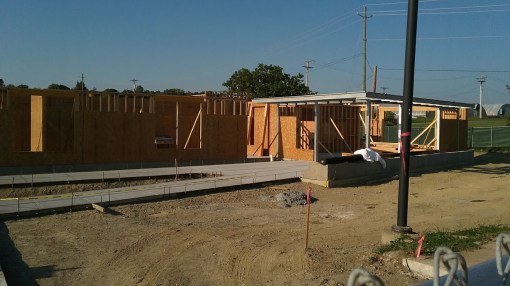
While this is the last update for the expansion, the new $7 million, 12,000 SF Community Practice Service Building will continue to use the same tags and headings, since the projects, though separate, have always been included in the same update posts. At this time, general contractor G. M. Crisalli & Associates has completed the foundation and underground utilities, and is erecting the wood framing for the walls of the one-story building. It looks like the front entrance area uses structural steel framing as a canopy. Sections of plywood sheathing are also up, and it looks like they may be planning to use a form of housewrap. A bit surprised they didn’t spring for ZIP panels, but each barrier has its pros and cons.  Some interior stud walls have also been assembled. The front sidewalks have already been poured and the curbing extruded, which seems reasonable as heavy equipment enters and exits from the other side of the construction site. The new CPS Building, designed by local firm HOLT Architects, should be open by May 2018.

Old:

New:


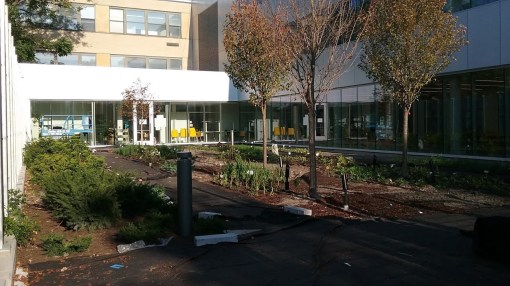
Upson Hall Construction Update, 9/2017

26 09 2017

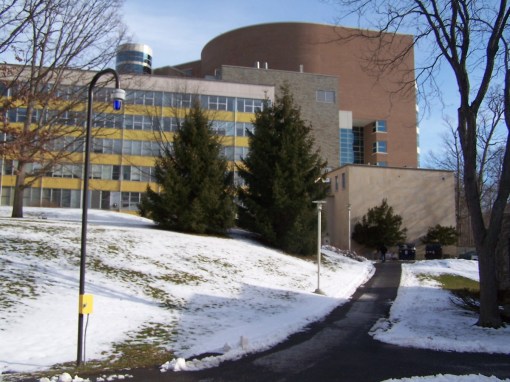
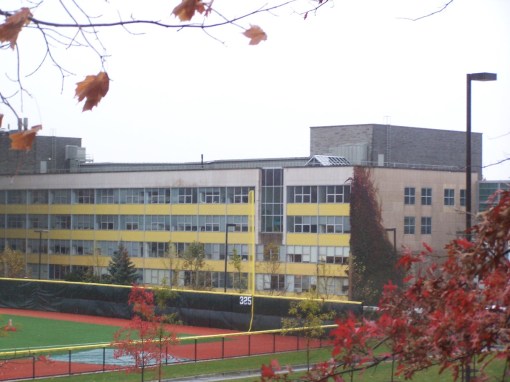
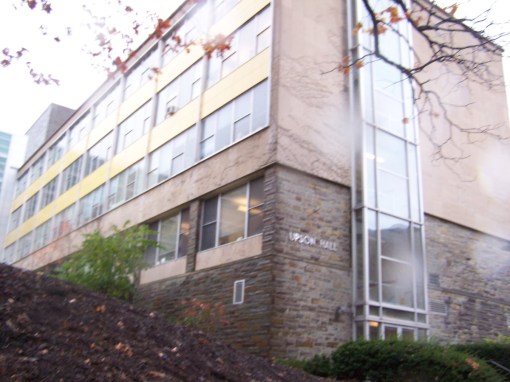
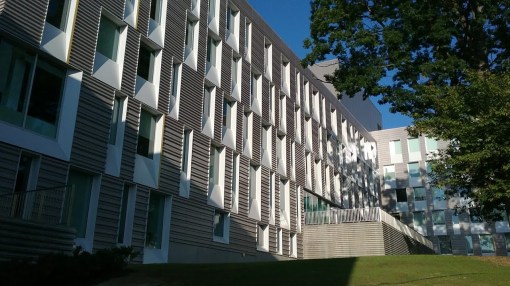
Upson Hall’s renovation is complete. The building became fully re-occupied as of August 22nd, per the Cornell Daily Sun. It’s been a long time coming. Two phases, 27 months, $74.5 million invested. One supposes that staying cutting edge in engineering requires a certain investment in cutting-edge labs and equipment.

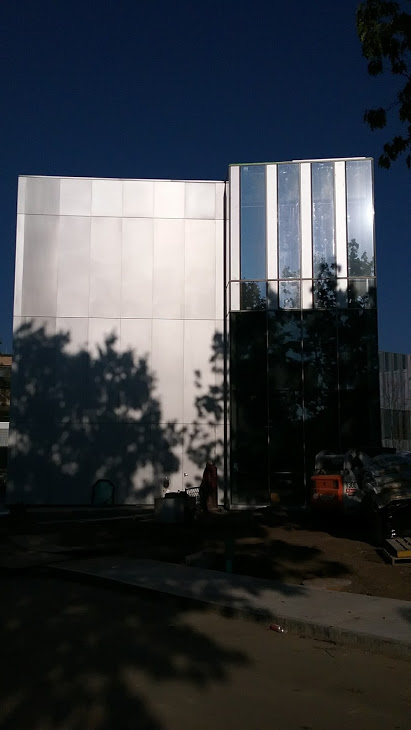
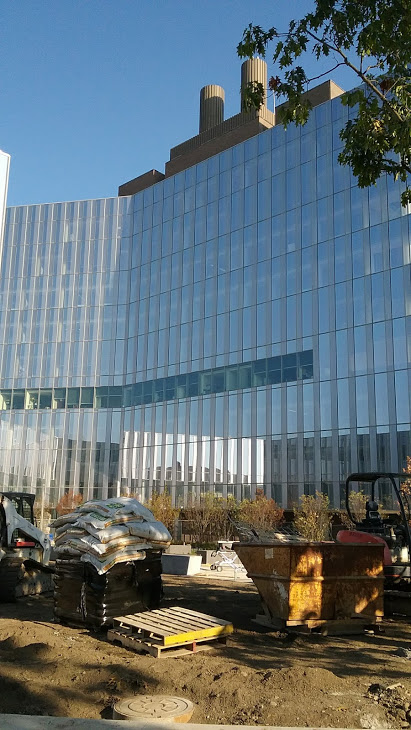
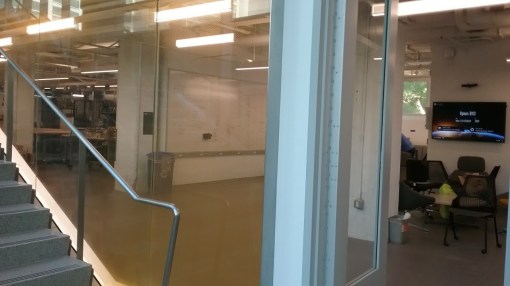
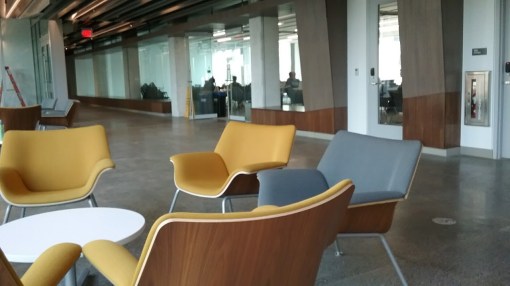
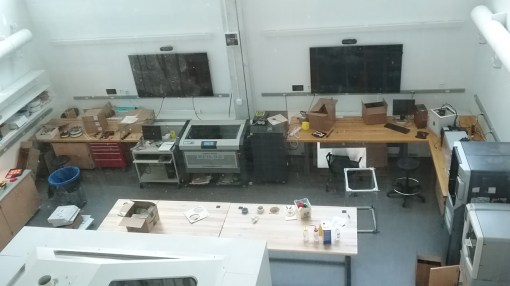
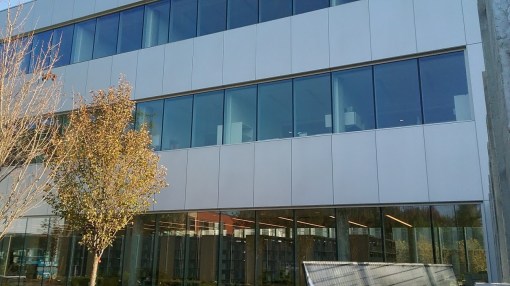
The interior is certainly impressive with its airy, industrial feel. The interior fit and finish appeared impressive, Cornell getting their money’s worth. However, on the outside the quality of Upson’s appearance is diminished somewhat by the puckered seams and slight imperfections of the aluminum panels on the stairwells/elevator cores.

To be totally honest, I was more a fan of the old Upson’s clean modernist lines. Certainly the interior needed work, but this just looks…gimmicky? I dunno how well it’ll age on the outside, but hopefully the inside will lend itself to creating exciting engineering feats and technological advances.

New York’s LTL Architects and engineering firm Thornton-Tomasetti were the primary architects and engineers for the project, assisted by the original architecture firm for the building, Perkins + Will. The landscaping, which will be finished at a later date, was designed by local firm TWMLA. The Pike Company served as the general contractor for the project.

Before (from 2008/2009):

After:


News Tidbits 9/16/17: The Big Surprise

16 09 2017

1. Ostensibly, the biggest newsmaker of the past week was the announcement of the Green Street redevelopment in Ithaca’s downtown core. To be frank, I was freaking out at my desk. Even more astounding was that the city slipped it out so casually, embedding it in a monthly PEDC meeting file that typically focuses on more mundane legal and planning concerns.

All photos that follow are from Jolene – pardon the marginal quality, we were both in note-taking mode, and these presentation papers weren’t given out to the public. North is towards the top of the floor plan images.

While the documents have yet to be uploaded to the city’s website, some basic details were released during the meeting – the number of parking spaces for the whole complex is 525. There would be two towers with residential units, a U-shaped west tower and a boxy east tower with projecting corners. 15 floors apiece. 350 units, “designed to appeal to a broad demographic”. Abatement likely, with the details to be ironed out as the percentage of affordable units is determined. The middle portion will also have residential units on top of the existing garage. 30,000 SF of conference space is planned under the eastern tower, if my notes are right.
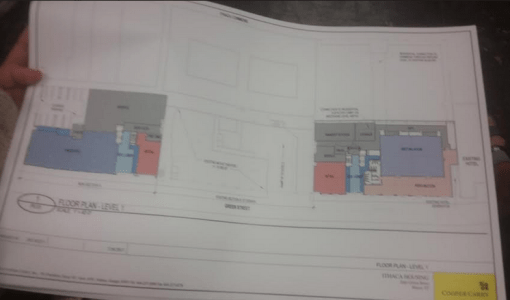
The first floor appears to have at least two retail spaces, a lobby area, and an office, probably for management of the complex. The middle section will retain access to Cinemapolis and the garage. On levels two and three would be rebuilt garage sections (note the center section was rebuilt ten years ago and unlike the ends, is in good shape). Another floor of parking will be added.

Cooper Carry is the architect, and the initial design looks fairly safe, attractive if not particularly inspired. After the Marriott, it’s good to be wary of potential value engineering. It appears to use brick veneer, Nichiha-like metal panels and maybe fiber cement. Also, with Harold’s Square and City Centre off to the left, this would arguably create a broad-shouldered if stubby skyline for downtown Ithaca, more impressive than many communities Ithaca’s size.

My notes are that Marriott co-developer Jeff Rimland had non-public information about the Green Street garage because he owns the ground facilities under the garage’s eastern deck, and would be impacted by renovations. He was made aware of city looking at their options and put something together. The city only learned about the plan four weeks ago, and mayor Myrick wanted to make sure it was brought forward for public discussion and to determine if it was a wise choice to move froward. Ostensibly, if this came out as a surprise, a hornet’s nest of opposition would be stinging. Being transparent now helps later.

It seems the intent is an RFP for the garage for the sake of fairness, but I dunno how effective that will be. Rimland has a big advantage as owner of a portion of the parcel, since any other developer would need to arrange legal agreements with him in order to carry out a project. It was suggested by Brock, who has never been a fan of development, and I cynically wonder if this was an attempt to ensnare or at least stall the proposal. An RFP does put the city in a more legally comfortable position, perhaps. On the flip side, I cringe at the thought of another Old Library-like mess.

On a final note, there’s also a name, seen in the lower right of the rendering – “Village on the Green”. Very punny guys.
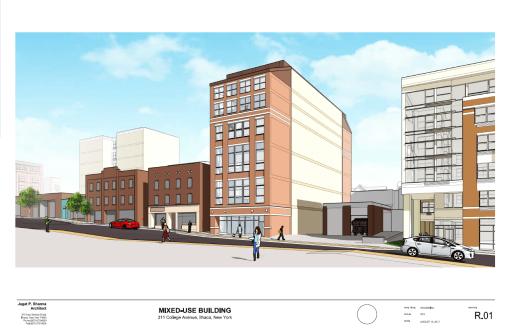

2. The other big news item of the week was 311 College Avenue, more commonly referred to as “The Nines replacement”. The Nines is a much-loved restaurant and bar that has long been a part of Collegetown’s drinking and musical scene – in the late 2000s, if I had to describe Collegetown bars, where Johnny O’s was the “fratty frat” bar and Chapter House the erudite tweed-clothed crowd, The Nines was the laidback, indie band geek-turned-rocker. Add in its location in a ca. 1908 fire station, and one of the few sizable outdoor patios in Collegetown, and one can understand that a project on this site was never going to be warmly received.

Granted, I’ve been raked over the coals a couple of times for the article, whose first headline said The Nines was being kicked out. It was an honest copy-editing mistake. For breaking news I publish ASAP, like with the Green Street development. However, that’s discouraged because the business pieces are useful for filling slow periods during the day, or to give time for others to prep articles during the early morning. Many of my articles are written in the late evening, submitted to the schedule, and skimmed through before hitting the website. In this case, I submitted Sunday night, my editor Jolene read through it early Monday morning, she thought the opening lines implied an eviction and changed the title (the original was a generic “Apartments Proposed for The Nines”). Sometimes title get changed for clarity or Search Engine Optimization (SEO), but this particular time it created a false statement. I didn’t see it until I was at work on Monday, and uncomfortable conversations ensued. Sorry all. The next article won’t wax poetic.

Anyway, with that error noted, it makes this next opinion segment more uncomfortable. I’m not a developer. But if I were one, and heard the property was being put up for sale, I’d probably have steered clear. With all due respect to Todd Fox, my gut feeling is that the cons outweigh the pros.

Ithaca is not an easy city to do a project in. A developer has to pick and choose their battles. In this case, the battle is taking a building with some degree of historic value, but more importantly a lot of local sentiment attached, and proposing to replace it with, frankly, a mediocre design with high-end student units. I understand the economics of the site, the market, and the unfortunate though economically necessary impacts building flush to lot lines has on the ability to install windows on the sides. My concern is external impacts, by creating an emblem for opposition to organize around, because it wraps several perceptibly negative impacts into one proposal. That may make future projects that much more difficult. I worry that whenever a controversial plan is brought forth in years ahead, it will be pejoratively described by NIMBY types as “just like that Nines replacement”.

It has taken years for Ithacans to become slowly more amenable to density and development. Proposals that inadequately address community concerns threaten that progress. Consider the case of Jason Fane. He toyed with the city plenty of times. Eventually it caught up to him and he got burned. The sad part is, 130 East Clinton was a solid project, and to this day I believe that had it been another developer, those apartments would have been built.

Anyway, the ILPC would like to preserve it as-is, which draws the question why the discussion never moved forward 18 months ago when they had the chance. I don’t think that’s likely at this stage, and an overbuild probably wouldn’t work due to development costs (foundation shoring, elevator if 4+ floors) with respect to developable area – the big front yard setback is an impediment to that. I heard that an offer was floated to Neil Golder to move his house at one point during the 201 debate, so maybe moving all or at least the front (1908 wing) of the old station No. 9 is possible, but the expense would be great. As for the new building’s design, maybe modest fixed windows in the north/south brick faces, or glass block features like on Sharma’s 307 design, or even something as minor as a mural on the CMU blocks would help.

But, all that might be grasping at straws. This was always going to be controversial. I won’t fault someone for seeing an opportunity, even if it’s not a plan I’d advocate. It all depends on one’s appetite for development opportunities, and sensitivity to potential blowback.

3. For sale: 405 Elmira Road. 0.74 acres of parking lot next to Buttermilk Falls Plaza. List price: $465,000, courtesy of Pyrmaid Brokerage. Also noting – the chain hotelier who bought the former Tim Horton’s next door from the same seller for $640k in January 2016. Timmy Ho’s 0.75 acres is a little small for a hotel on its own, but combined with this lot, suddenly plans start to look quite viable for a mid-sized chain in the city’s suburban-friendly SW-2 zoning. Someone else may come along and buy it, but let’s see what happens.

4. It appears the 24-unit Pineridge Cottages project is off the table. The project, planned for the corner of Mineah and Dryden Roads in Dryden town, was greatly scaled back by developer Ryzward Wawak after water tests led to concerns about having enough to supply all the units. At this time, the plan is for four cottages, each a two-bedroom unit.

5. The Times’ Matt Butler has a nice summary and brief interview with Lakeview Health CEO Harry Merriman regarding the 60-unit affordable housing plan for 709-713 West Court Street. Some of the obstacles the project faced wouldn’t be a surprise to readers of this blog – the soils require a more expensive deep (pile) foundation, and land acquisition costs are climbing, which increases the overall costs involved with bringing a proposal into reality, let alone a plan that focuses on affordable housing. The increase in units from 50 to 60 was driven by the need to balance out revenue with expenditures and make the affordable housing economically feasible. Incremental cost increases per unit are significantly less than overall structural costs, so the per-unit expense for 60 units is less than 50, making the project more appealing in competitive grant processes.

Of the 22 units to be set aside for formerly homeless individuals, six will be reserved for HIV-positive clients of STAP, the Southern Tier Aids Programs. Those infected with HIV tends to experience much higher homelessness rates than the general population, with at least 81 homeless HIV-positive individuals in Tompkins County alone. This makes it hard to do things like refrigerate medication. These six units are a small number perhaps, but for those six folks it will make a huge difference.

6. Another feather in the cap of the local STEM sector of the economy. Biotech startup Jan Biotech Inc., based out of the Cornell Business Park by the airport, has received a $3 million grant from the National Institute of Health (NIH) that will be used in the research and production of an HIV diagnostic for detection and quantification of latent HIV-infected reservoirs in patients –  cells that have the virus but aren’t actively producing HIV, which current anti-retroviral therapies struggle with. Potentially, the diagnostic could help test new medicines for their ability to target those cells, and lead to a true cure for the virus before AIDS can occur.

Along with new equipment and renovated facilities, the grant is expect to result in the hiring of another 5 to 10 scientists and engineers for the four-person firm. Which is great, but truly, it’s their work to try and improve our treatment and medicine of a deadly virus that’s more important. The very best of luck to them.

7.  A bit of news from the Cornell Daily Sun regarding the additional 2,000 beds Cornell would like to build on its North Campus, as part of its freshman expansion and “Sophmore Village” plan. The university would like to begin construction on the first dorms in 2018, and start increasing student enrollment by 2020. For that to happen, the plans pretty much need to come forward for formal planning board review within the next few months. Presumably, they’d like to have the dorms ready by August 2019 – these will be used as flex space initially, so that existing dorms like Balch and Clara Dickson can start renovation. At a bare minimum, it takes three months to go through the city planning board. Given this project’s proximity to Cayuga Heights, the local patricians will want to have their say as well, even if it is just outside village lines. With the size of the project and a minor amount of inter-municipal complexity, four months from sketch plan to approval seems realistic. Considering the need to request and award contract bids, it would seem plausible that Cornell puts the dorms forward this fall for review, with approval expected by late winter. Bids would be requested and awarded during the Spring, and construction would start by June. Whatever the case, the first construction plans are likely not far off.



The Maplewood Redevelopment, Part III: Site Photos

5 09 2017

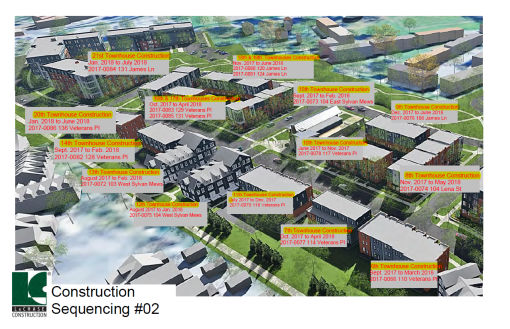
The rough construction timeline for the Maplewood structures looks something like this: Apartment buildings B and C started construction first in the spring, and the first townhouses were scheduled to begin in May. All of the major apartment buildings are expected to start construction by the end of August, while the last of the townhouse strings will not begin build-out until January 2018. Roughly speaking, the ends of the project site have earlier starts than structures in the middle of the site, and the more traditional-looking townhouse units start construction before the more modern strings.
The timeline is likely slightly behind schedule. During the mid-August site visit, a worker said that five of the foundations had been completed, but it seems at least six should have been finished by that point. The reason given for the relatively slow progress has been the wet summer, which has interfered with certain parts of the construction. For example, concrete pouring and curing for the foundations becomes a lot more complicated with the presence of frequent downpours. Rainwater can damage the foundation during certain stages of the process by causing the new pour to become soft again, reducing its structural integrity. Depending on timing, extra precautions have to be taken, or even worse, if it’s a real washout of a day the pour simply can’t take place at all. Several construction days have been lost, and to pick up the slack, the project asked for and received approval to increase the workday from 8 AM – 6 PM, to 7 AM – 7 PM, with the town’s stipulation that the extra two hours keep work noise below 85 decibels.

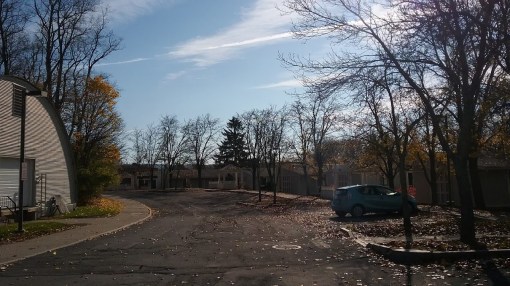
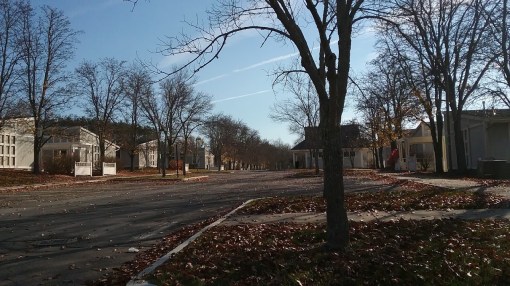
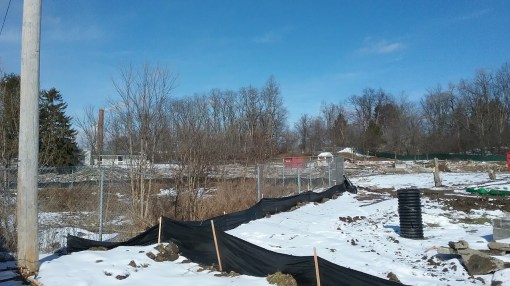
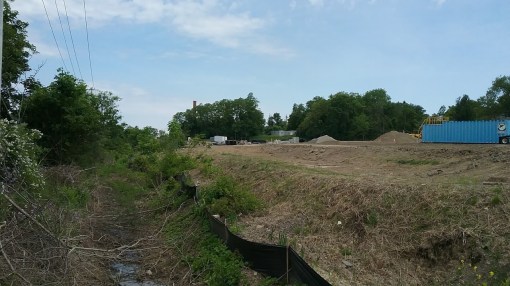
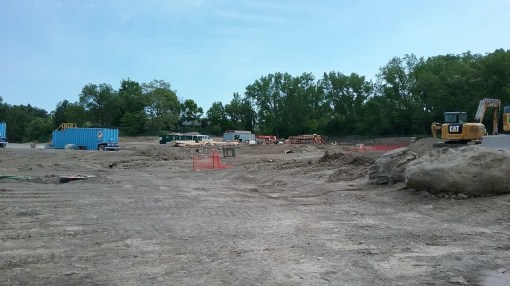
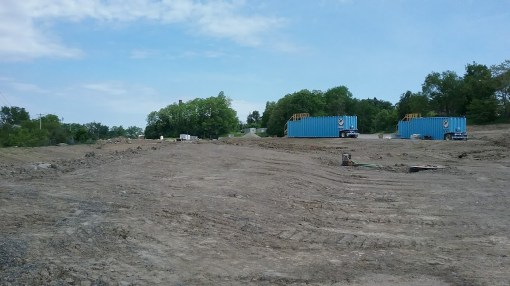
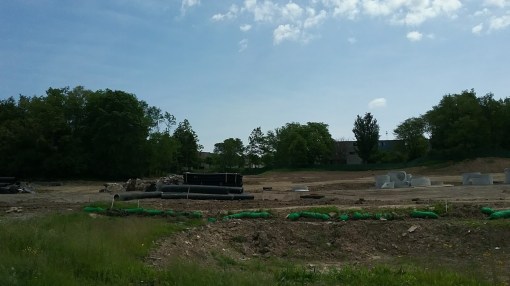
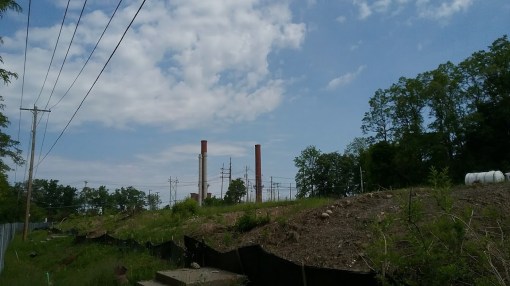
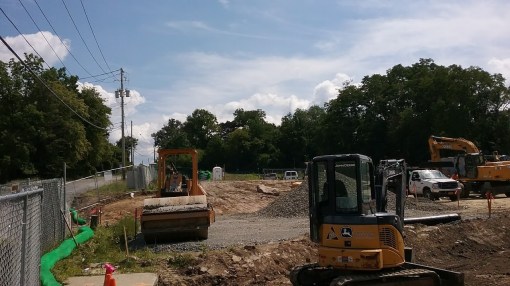
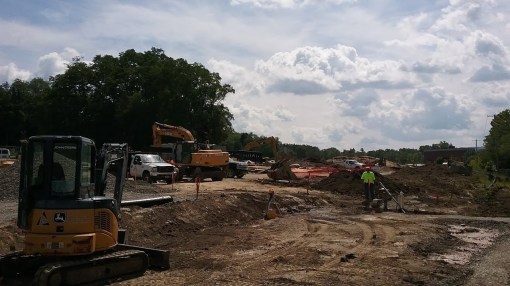
The photos below come from three separate time periods – February, which was mostly just site prep and excavation for underground utilities, the continuation of utilities excavation and installation in April, and the readying of connections to those new utilities in August. The circular concrete structures seen in April and August are for underground electric utility junctions. Similar structures may be used for wastewater pipes and drainage pipes. The teal pipes are PVC sewer pipes, and the rectangular precast concrete sections are protective covers. New curbing is being installed along Mitchell. I don’t know what the ridged crescent-shaped orange structures are, but if a reader knows, feel free to chime in in the comments.

Above-ground, it looks like the masonry stairwells for apartment buildings B and C have been built as of August. The slots in the sides suggests structural steel frames. A trailer on-site belongs to Peppard & Sons Masonry of Lockwood, so they may be the pertinent sub-contractor. Foundation slabs can be seen, and wood forms have been prepared for future pours.


Pre-development site photos:

February 2017:

June 2017:

August 2017:


210 Hancock Construction Update, 8/2017

22 08 2017

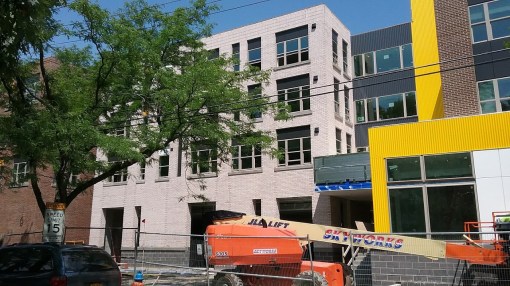
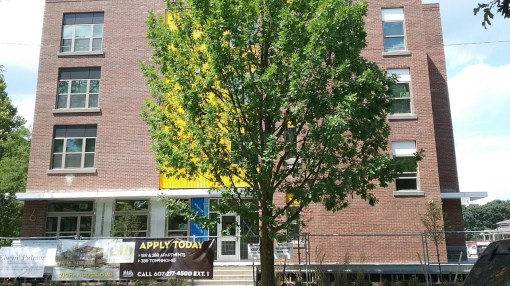
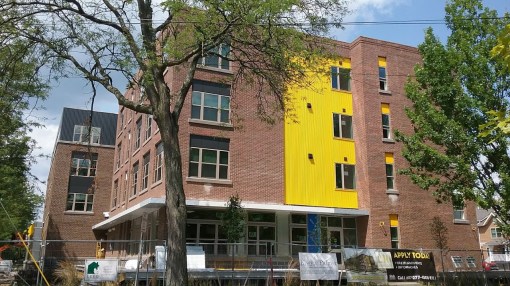
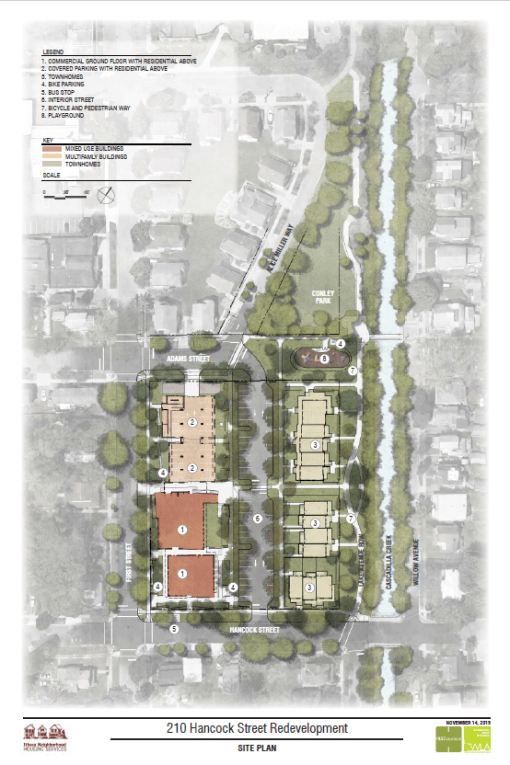
210 Hancock is nearly complete from the outside. On the apartment buildings, the brick veneer has been attached over the Blueskin, as have most of the Alpolic aluminum pearls (dark-grey “charcoal”, off-white “pearl”, and intensely bright “EYL Yellow”). Early drawings also had lime green panels in the mix, but this was later deleted. The finalized elevation drawings suggests some more yellow panels will be attached between the ground-floor windows under the awning. In fact, it’s mostly the EYL yellow panels that have yet to be installed on Building “A” and Building “B”, the southernmost pair (and the first buildings shown in the parade of pics below). The northern buildings, which are built over a ground-floor garage, are partially faced with Barnes & Cone architectural masonry – upscale and arguably more attractive versions of concrete masonry units (CMUs).

The large expense currently being paneled on Building “D” (the northern end of the building string) will be more EYL Yellow, although this will be Morin corrugated metal panels, custom painted to match. The corrugated metal, which is used elsewhere (ex. top of building “B”) in blue-grey color, will add a little more visual interest to an otherwise featureless wall. According to the 210 Hancock website, occupancy is slated for September 1st. It looks like they have a one-bedroom available, which seems odd given the lottery, but the price tag suggests this one-bedroom is one of the moderate-income units (those with annual income in the $41,000 – $60,500 range). Offhand, 11 of the 54 units were designated moderate-income, in order to provide a mixed-income development. Similarly, the handicap-accessible three-bedroom townhouse (the one-story red one) is still for rent, but the other four rental townhomes are spoken for.

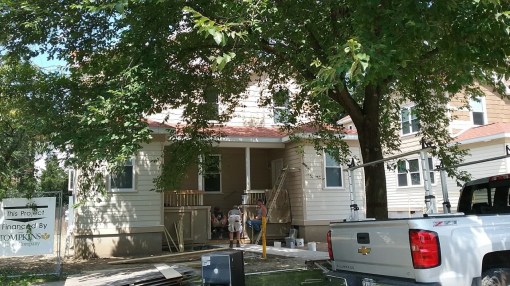
The townhouses are mostly finished, and marketing has started for the seven for-sale units. Three are already under contract. The cutoff for maximum annual income is 80% of Tompkins County’s area median income or less – $42,380 for a 1-person household, $48,400 for a 2-person household, $54,450 for a 3-person household, and so on. The wood lattice screening below the porches will be painted to match the trimboards, which come in three shades of Certainteed vinyl – “Natural Clay”, “Sandstone Beige” and “Flagstone”, or to the layman, dark tan, tan and light grey.

Outside of the building, the new lightpoles are in. RGL Inc. of Binghamton, a subcontractor for Lecesse, is laying down the new curbing and sidewalks, with road paving/striping, landscaping and the new playground to follow. For the record, the playground will be open to all neighborhood children regardless of whether their families live in the Hancock complex. As a plus, the play area connects directly with Conley Park without the need to cross any streets. Personal aside, in the affordable apartment complex I grew up in, June 25, 1997 was one of the most memorable days of my childhood because that was when they replaced a field dumpster pad with a playground — and I can remember how absolutely packed it was for weeks afterward.


1001 North Aurora Street Construction Update, 8/2017

20 08 2017

This small infill project in Ithaca’s Fall Creek is just about done. Tenants have already moved into the four three-bedroom units, and it looks like all that’s left on the outside is grass seeding and a coat of paint. According to the guys working on the duplexes, the mismatch in the second floor LP SmartSide wood siding was because the store they bought them (think they said Home Depot offhand) from had ran out, so they just bought what was available with the intent of painting over it when they were ready. It looks like the first floor has been painted, so that’s a good sign. It is nice to see that, although they were threatened for deletion if expenses came too high, the side windows on the inward-facing walls of the units (east side of 202, west side of 206) were retained.

This is a small, unassuming project. It replaced an older single-family home with four units that fit in with the neighborhood. It’s a bump in density without garnering too much attention. To be candid, it’s probably the only feasible way to add density to Fall Creek – scout out the few vacant lots, or buildings with less historic or aesthetic value, and try to design something that fits in (the only other one I’m aware of is the Heritage Builders infill project on West Falls Street, but at this point it would need re-approval from the planning board).

The three guys out front said that once these are complete, they expect to start work on developer Stavros (Nick) Stavropoulos’ next project at 107 South Albany Street. That site has not changed much over the summer, all that is there at the moment is the fenced-off foundation of the old building. The 11-unit apartment building slated for that site is expected to be completed by summer 2018.