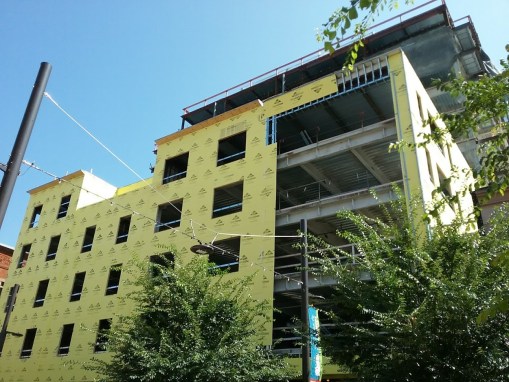
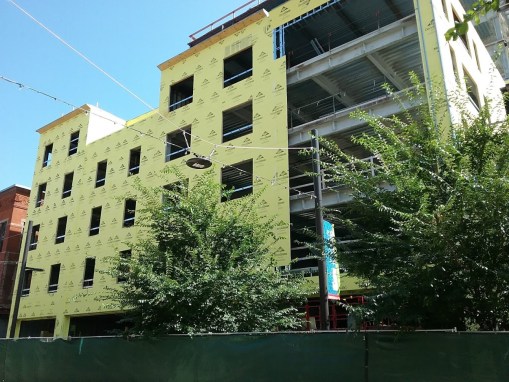
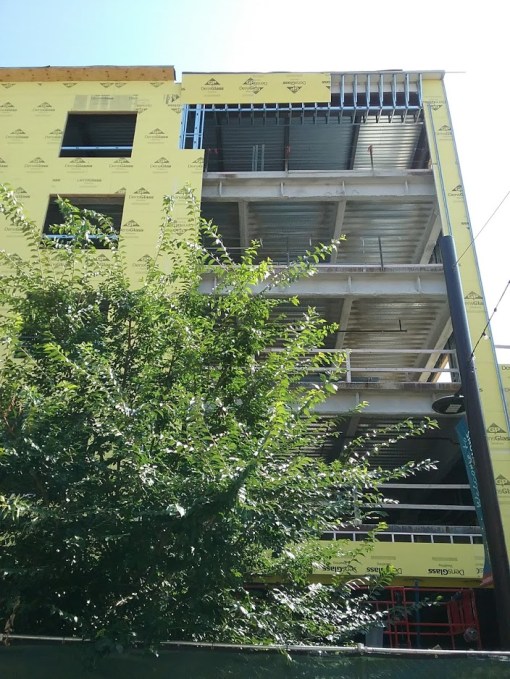
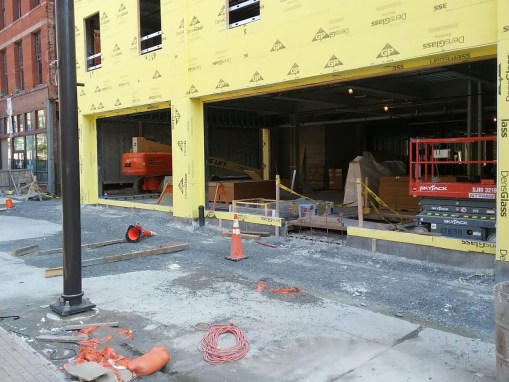
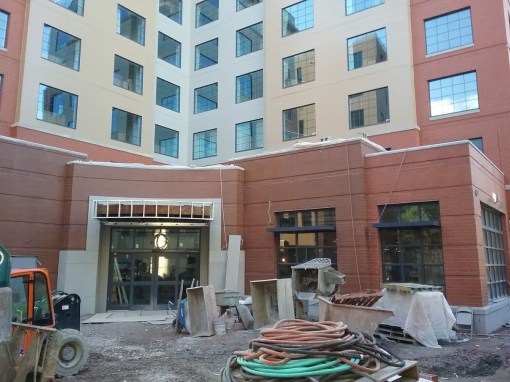
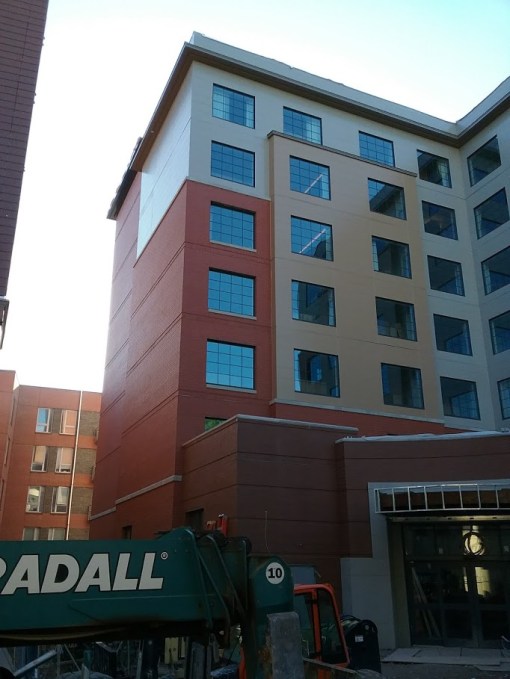
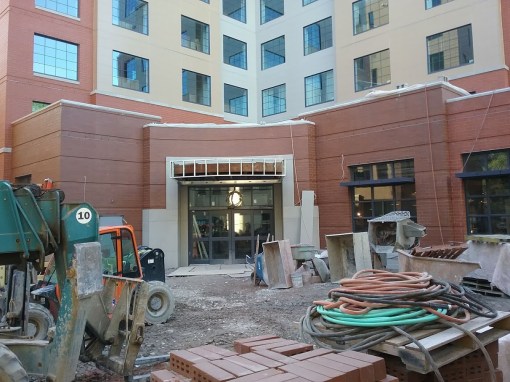
Village Solars Construction Update 9/2019

13 09 2019

So there’s been some news regarding the Village Solars buildout. The community center is in flux. The original proposal was for a mixed-use building with ground-level commercial and community amenities, and 20 one-bedroom apartments on the upper levels. Now, it’s an unknown. Per the Lansing Star:

“(T)hey will relocate the community center site to a location more central what will become an enlarged, single development. The lower floor would have amenities like a restaurant, a work-out center, and other features, with apartments on the upper floors. If not, they would build the smaller community center as already accepted by the Town.”

That means that the community center is being moved to another location on the site, and potentially take a different physical form, though programmatically it remains the same (commercial/community use on the ground level, residential above).

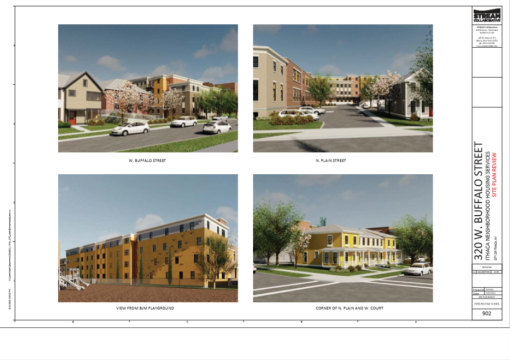
When the article says a more central location, it refers to the 96.44 acres of land east of the complex. The Village Solars are owned by Steve Lucente, and the undeveloped land to the east by his father Rocco, who had purchased it in 1960 and was recently planning his own apartment complex (schematic in the early Village Solars site plan below). My understanding is that the two Lucentes didn’t get along at all – I was warned to never bring up Steve when interviewing Rocco. After Rocco passed away about 18 months ago, Steve saw an opportunity to purchase the vacant land to the east from Rocco’s estate, and build a bigger complex in future phases (as yet unapproved). The purchase offer, at least check, is still being reviewed by Rocco’s Executors.

However, this created a problem. Local Law #6 of 2017, the Planned Development Area (PDA, like Ithaca’s PUD it’s D-I-Y zoning) with the town, stipulated that the community center had to be built and open by the end of 2020, and only one more apartment building could be built before it was done. So Steve Lucente and his project team had to make the case to the town of Lansing Planning Board and Town Board give them time to purchase the land and design the new community center, and let them do three more apartment buildings in the meanwhile to keep on pace with their construction plans. If the offer feel through, he’d build the community center starting next summer and finishing in 2021, a year later than initially planned. Generally, of all the communities to have to make such a request, Lansing would be one of the most accommodating.

Officially, only the Town Board really decides PDA amendments. But here, the Town Board was uncomfortable with the request at first, referred it to the Planning Board for guidance, and then after the Planning Board weighed in, it returned to the town board with a recommendation to consider during voting.

This caused some debate, with some of the planning board feeling like their credibility was taking a hint with this latest delay (the community center was delayed at least once, hence why it was explicitly stated in the 2017 PDA revision), and at least one member of the town board feeling as if they were purposely misled since banks would have received the notice of intent to modify the plans several months ago, but Steve Lucente countered that it was not a firm plan and only became firm later in the year when the offer looked like it had a good chance of being accepted. On a 3-1 vote, the town is permitting three more apartment buildings and only two more, and expects a community center to start next year in either the old or the new location.

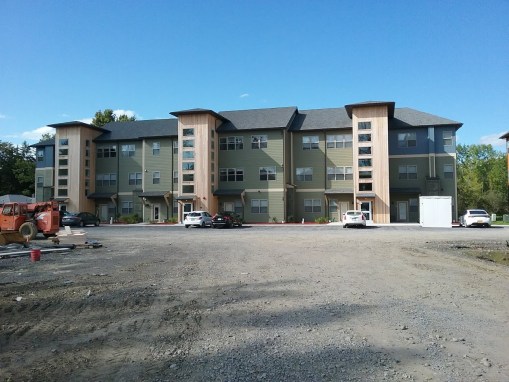
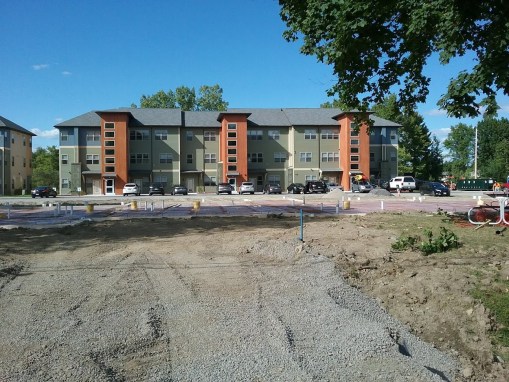
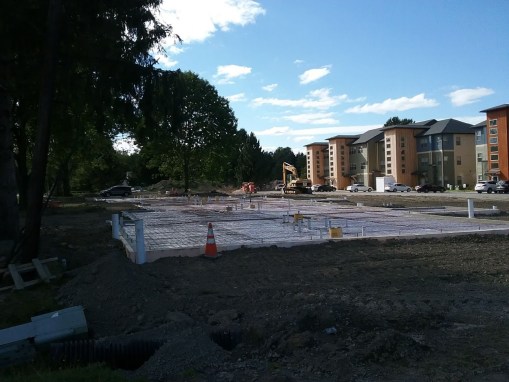
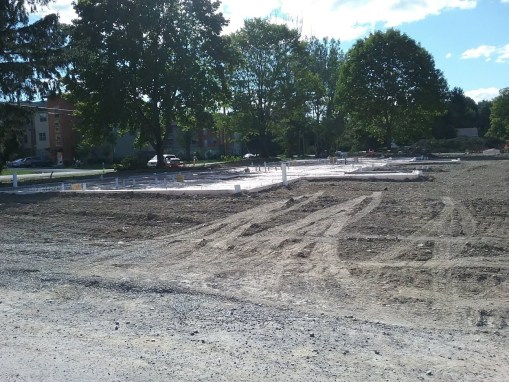
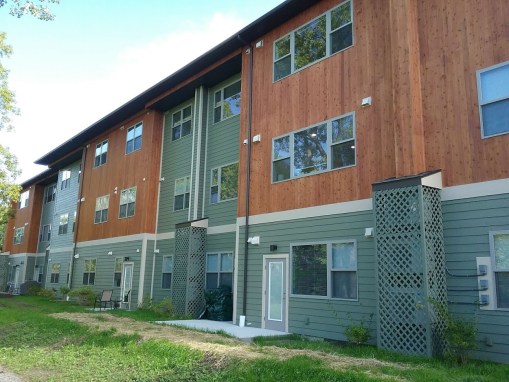
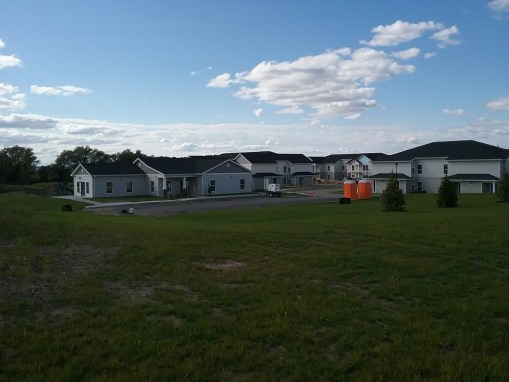
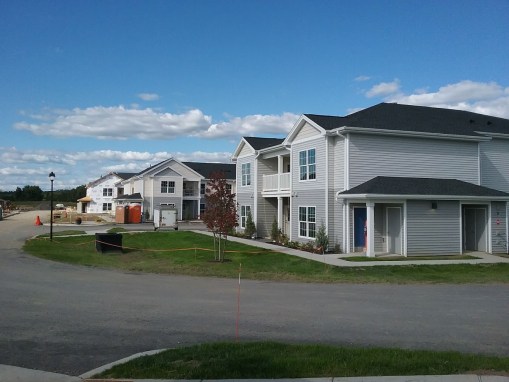
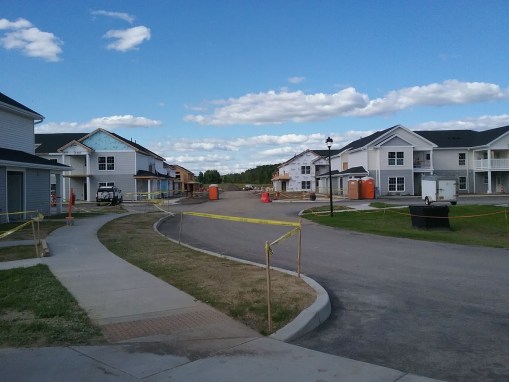
At this point, the last of the originally permitted buildings, 24-unit 36 Village Circle North (3 three-bedrooms, 6 two-bedrooms, 3 one-bedrooms and 12 studios) has had its foundation footers poured and is awaiting the concrete slab pour. The tarp and mesh are in place for stability and added strength respectively, and you can see the below-ground utilities poking out, capped for the time being. A surveyor was on site during this visit to make sure everything was level and in good order before the wood frame starts to rise. The three newly permitted buildings are all reconstruction of existing 8-10 unit buildings, into two 18-unit buildings (2 Village Place, 22 Village Place) and one 24-unit building (117 Village Circle North).

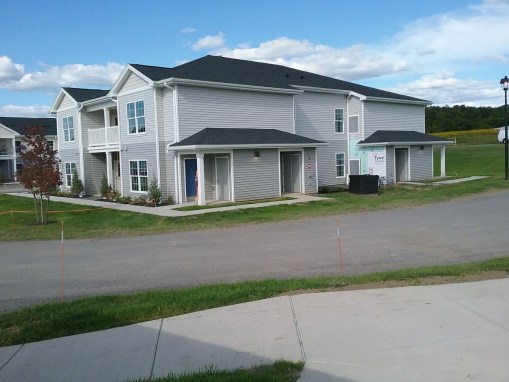
Apparently, occupancy rates have been strong. Building “L” (113 Village Circle North) opened in June, and 22 of its 24 units were spoken for, with the other two rented shortly after.

As for the future, it’s not clear. Something will be proposed that may very well require more PDA amendments, but we’ll see. The elder Lucente’s complementary apartment complex was supposed to be around 300 units in size (built over several years), and it wouldn’t be a surprise if the Village Solars plan expands by a similar amount.
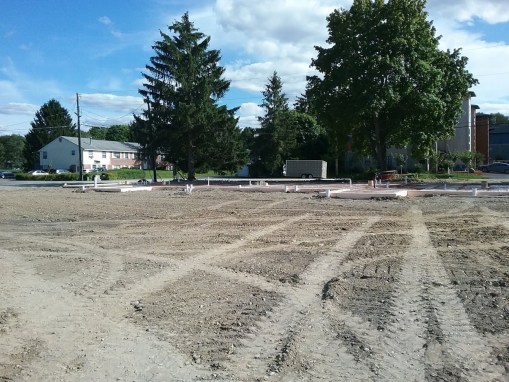


Milton Meadows Construction Update, 9/2019

9 09 2019

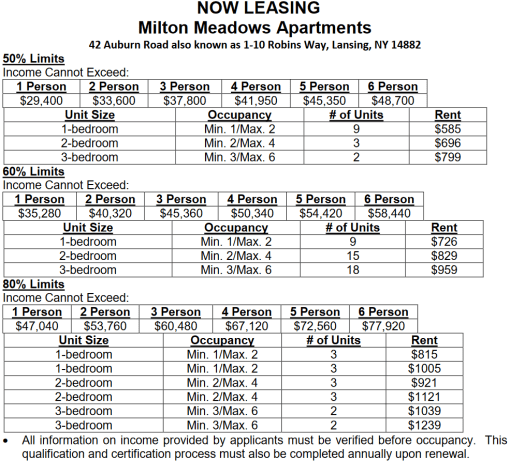
The buildings are not yet complete, but Milton Meadows is accepting applications for its 71 units (the 72nd is for an on-site manager). Income qualifications are 50-80% of area median income with first preference to veteran’s; specific on the income levels, monthly rent and associated details can be found at the end of this post, and online on the NYS Homes and Community Renewal website here.

The initial application round was from June 9th to July 9th, and applications were selected by a housing lottery. What that means is that once applications are gathered, those that qualify are put in random order and given a log number. From there, the developer begins the review process starting with the lowest log number as well as any preferential applicants. The lower one’s log number is, the more likely one is to hear back from the lottery. If there are any units remaining after the lottery is complete, those will be filled with later applications. If they’re all full, then applicants will be hanging out on a waiting list. That could be a few months, or longer. INHS has been known to take a couple years to make it all the way through its backlog for its more desirable unit sizes and locations.

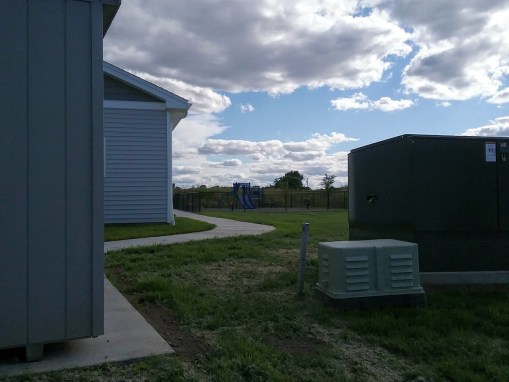
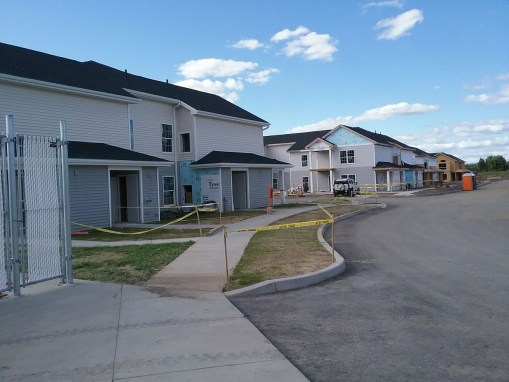
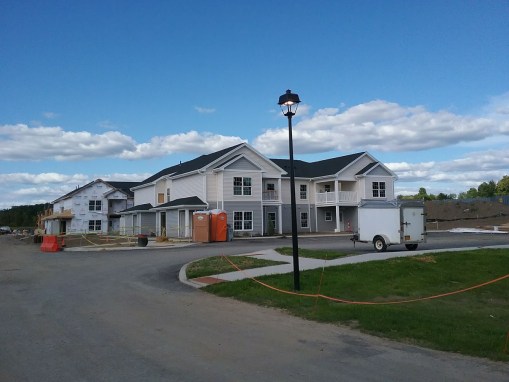
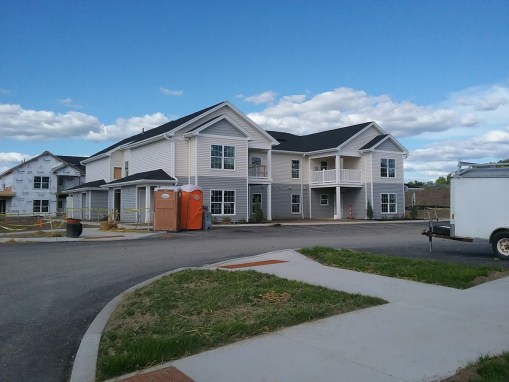
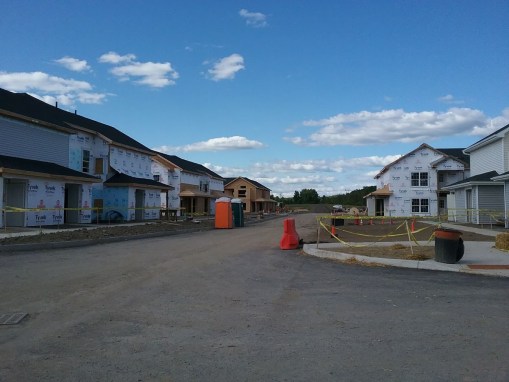
The nine apartment buildings generally progressed in the same order as their addresses. 1 Robin’s Way (42 Auburn Road), the community center, is essentially done. 2 Robin’s Way, the southeast corner building with eight 1-bedroom units, will be ready for occupancy by the end of the month. In this southern portion, the lighting and sidewalks have been installed/poured and even the grass seed has been laid. From there, buildings go backwards in the construction timeline – vinyl siding (probably Certainteed), a couple varieties of housewrap (Tyvek and a second blue-faced material), window and door fitting, and framing. 10 Robin’s Way, another building with eight 1-bedroom units, is just getting its shingles attached to the roof, and is otherwise fully framed but not much further along than that. 10 Robin’s Way will be ready for occupancy in the December time-frame, about three months later than first anticipated.

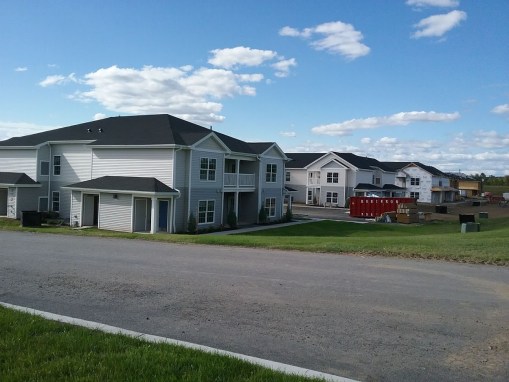
To give an idea of the visual differences between the building configurations, which come in eight one-bedroom, eight two-bedroom and eight three-bedroom flavors, the first photo shows a three-bedroom building on the left, a two-bedroom building in the middle, and a one-bedroom building on the right.

One kinda wishes they had gone with a more visually interesting color palate for the vinyl siding, which is two shades of grey and a tan, but chances are, it was whatever they could get that was durable and cheap in bulk. The early renders showed a different if still soft color palate.

Also in progress is the realignment of Woodsedge Drive with Louise Bement Lane, to make them a proper four-corner intersection. This is being paid for with a $75,000 state grant with in-kind labor from the town.


Harold’s Square Construction Update, 8/2019

10 08 2019

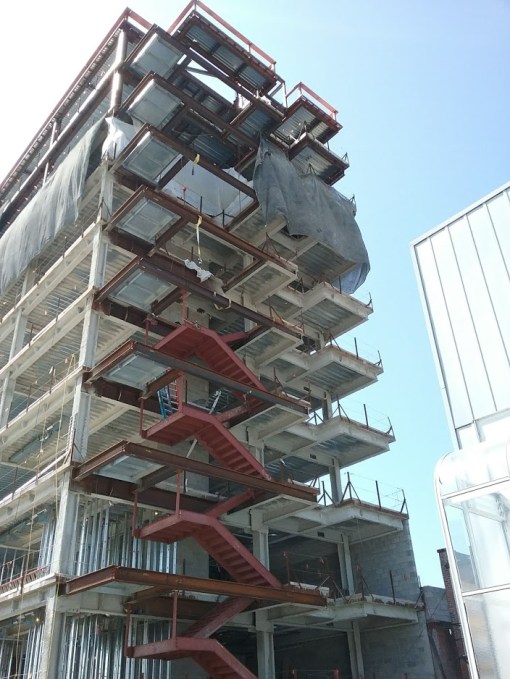
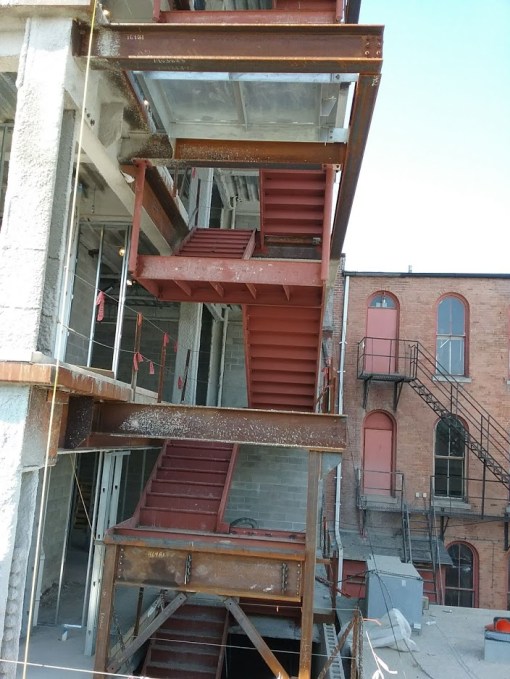
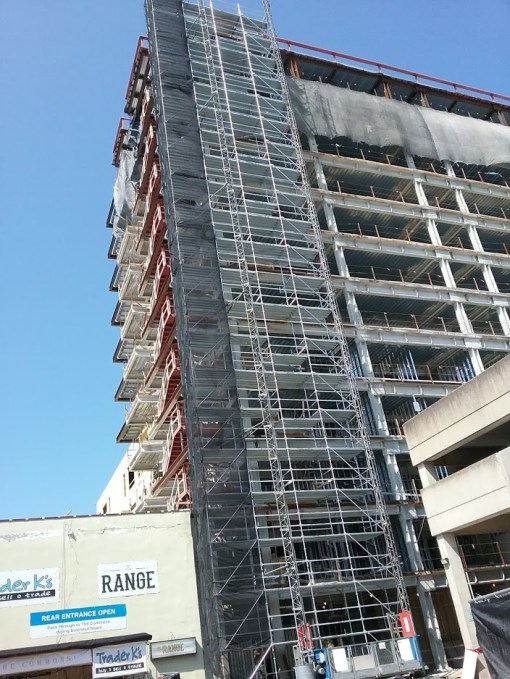
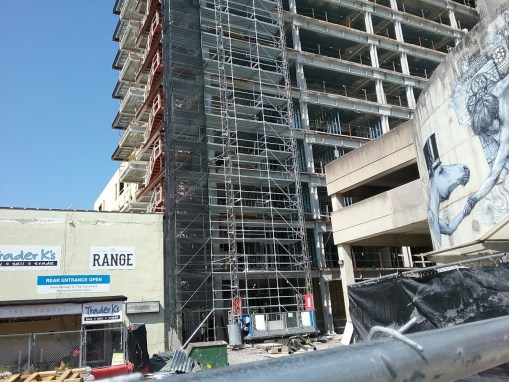
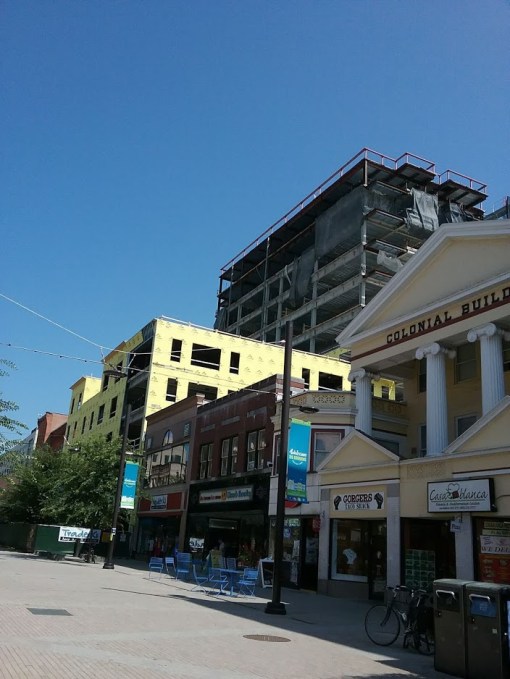
As noted by a few different news outlets including the Voice, the tower crane for the structural steel assembly has been taken apart and removed from the site. This work required about five days, the temporary clearing of some street level fixtures, and a deconstructing crane. 14850.com’s Rachel Cera won the blue ribbon for best title: “Crane-deconstructing crane coming to deconstruct construction crane on the Commons”. The formal topping off ceremony was June 27th.

We’re pretty much looking at the full scale of the building now, except from the mechanical penthouse on the roof (mechanical penthouses are generally not considered to be a part of building height because they’re not habitable space). Concrete pours have been completed on all 12 floors, and fireproofing is up to the 11th floor, with interior stud walls and initial utilities rough-ins underway on the lower levels. The fireproofing is being done by J&A Plastering and Stucco of Syracuse – click the link to see some of their on-site crew in action.

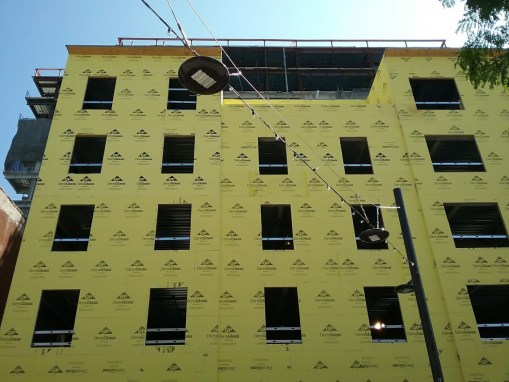
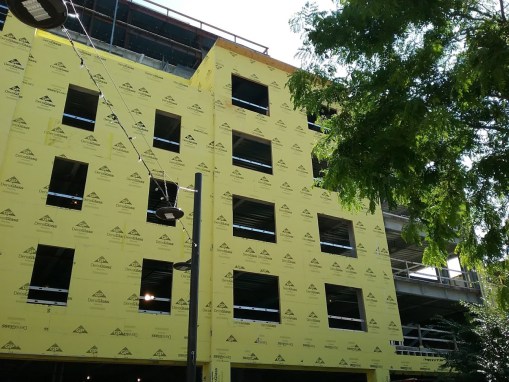
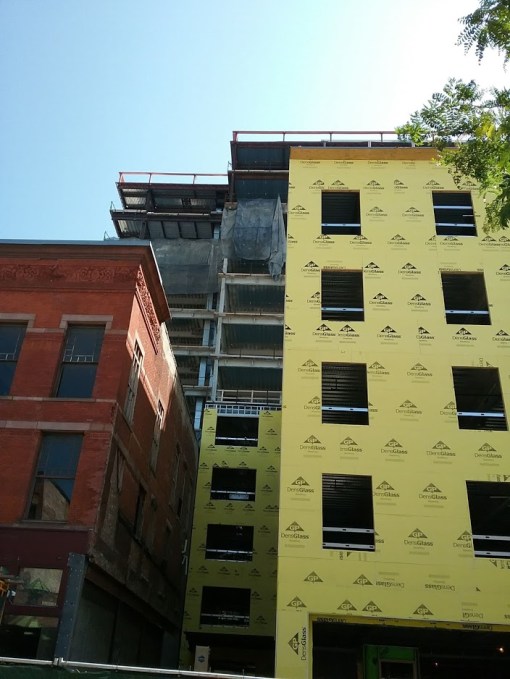
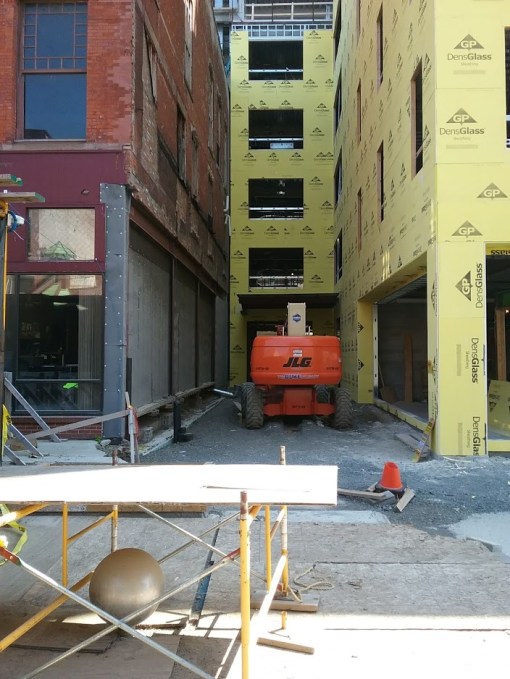
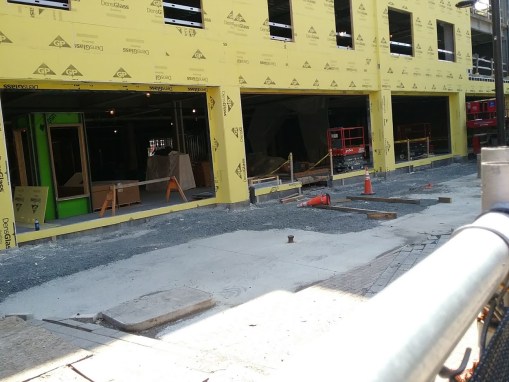
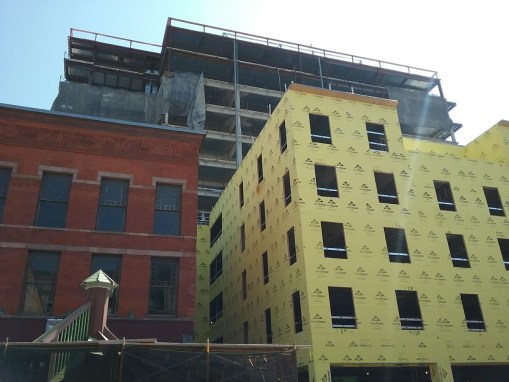
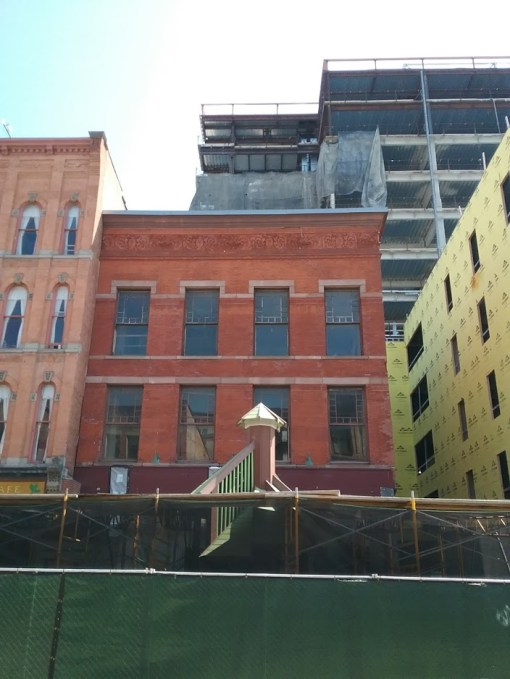
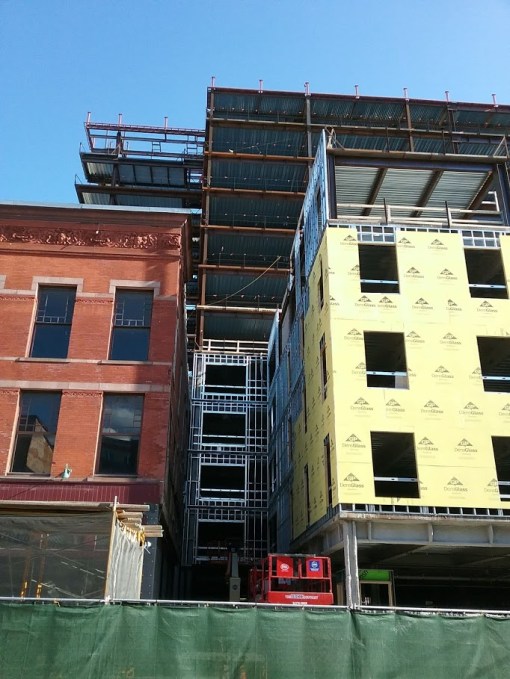
On the Commons-facing side, some Georgia-Pacific DensGlass fiberglass mat sheathing has been attached to the exterior stud walls – it may look rather ungainly now with the monolithic street face, but the variations in the facade will help, as they change up materials and patterning to create the impression of individual buildings with a less imposing scale.

It looks like Northern Mast Climbers of Skaneateles has the subcontract for the exterior facade work, and interior furnishings (flooring, cabinetry, countertops, furniture, and appliances) will be supplied by Metzger Inc. of suburban Buffalo. Harold’s Square’s apartments are listed for rent online, but you can’t actually apply, and the data’s outdated anyway – it still says 108 units, but 30 microunits were eliminated for more office space.

Look for a spring 2020 opening, a little sooner on the office and retail space, a little later for the apartments. The WordPress for the project can be found here, and the Ithacating project description here.


Library Place (Old Library Redevelopment) Construction Update, 8/2019

7 08 2019

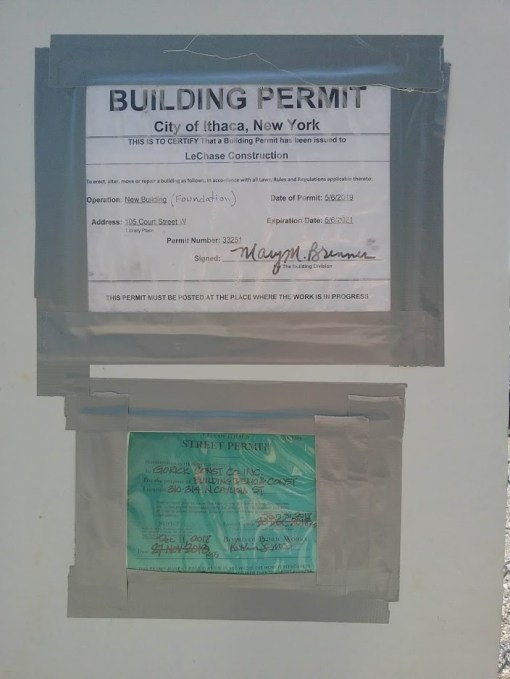
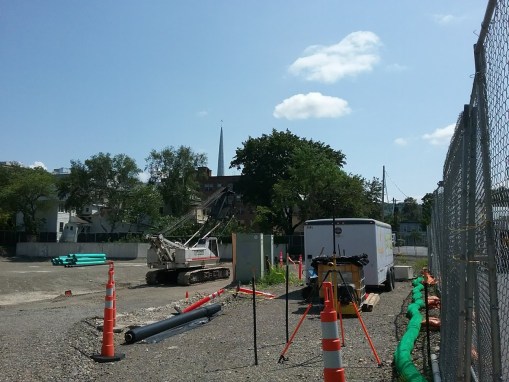
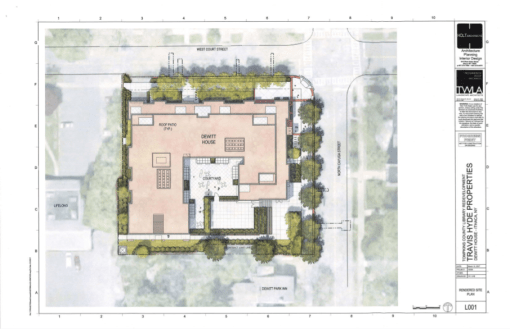
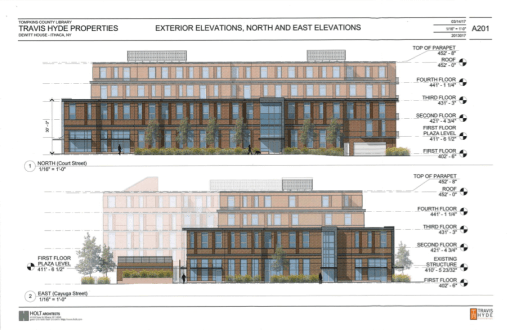
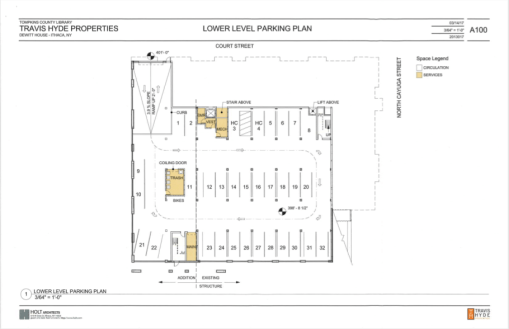
With tax abatement approvals in hand, construction on the 67-unit Library Place project is set to move forward. According to the project website, at the moment 20 steel test piles are being driven into the ground to verify the correct depth to the subsurface layer that will support the weight of the structure (the library’s foundation is being reused, but the new 4-story building is heavier and has additional load bearing needs). If all goes well, the remaining 60 piles will be delivered and driven into the ground, with pile driving work to wrap up around Labor Day. This is somewhat later in the year than first anticipated.

It looks like the pile driver in the photos below came from Ferraro Pile and Shoring Inc. of Buffalo. Some grading and surveying equipment is also scattered about the site. LeChase Construction is the general contractor for the project, and Travis Hyde Properties is the developer for the senior housing project.

Quick aside – I can generally tell how familiar readers are with Ithaca when they email asking questions about “Mr. Travis Hyde”. Quick refresher, Travis Hyde is led by company president Frost Travis of the locally prominent Travis family of developers, and his brother-in-law, company vice-president Chris Hyde.

The 50 year-old time capsule from the Old Library was recovered and opened in a public ceremony; coverage of that and the contents can be found courtesy of my Voice colleagues here. The full history of the project and a description of the plans can be found here.


119-125 College Avenue (College Townhouses) Construction Update, 8/2019

6 08 2019

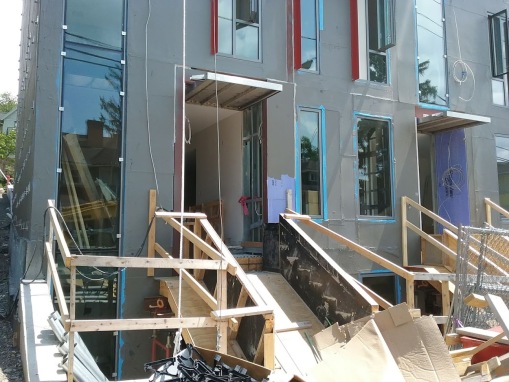
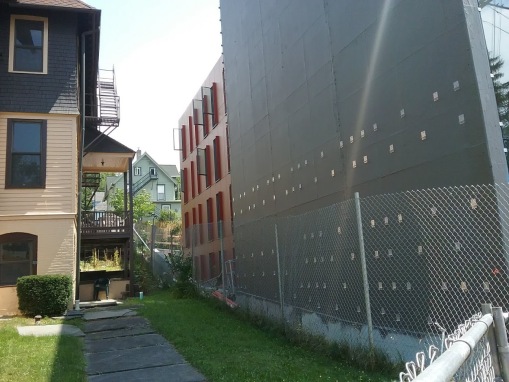
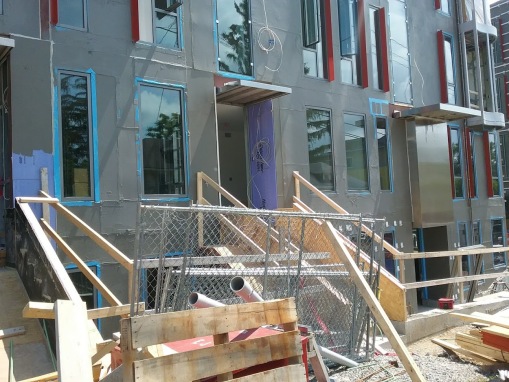
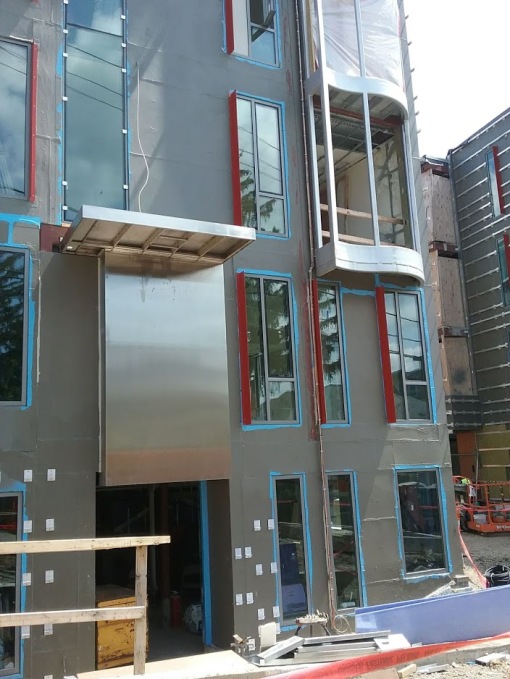
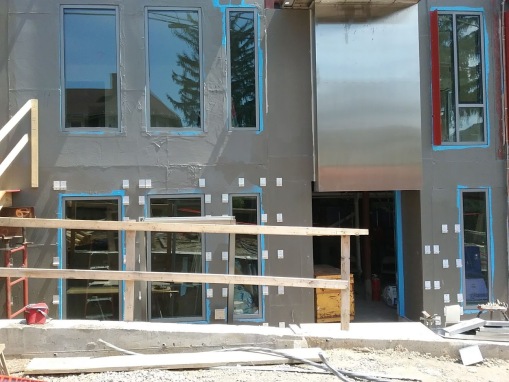
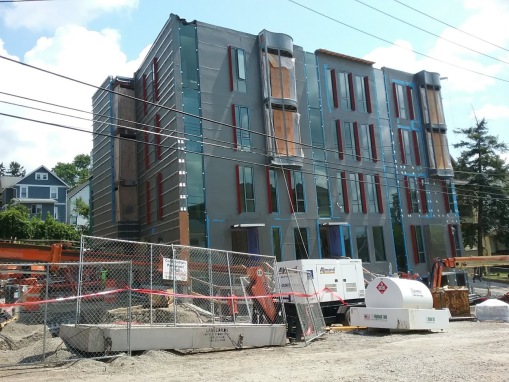
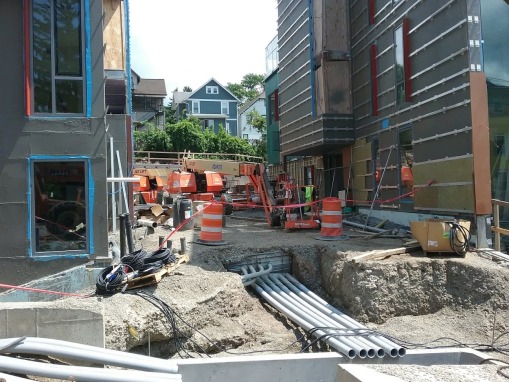
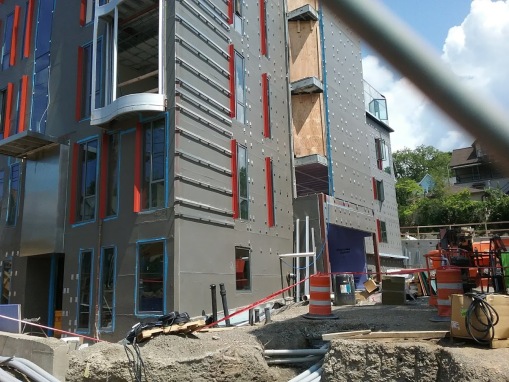
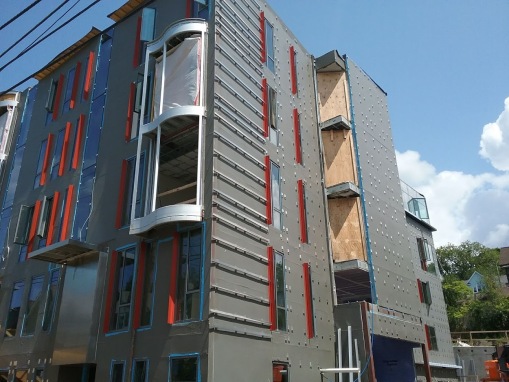
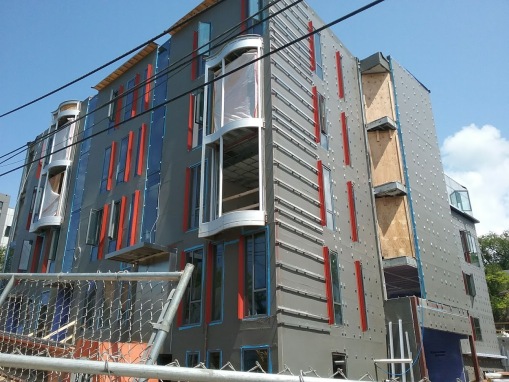
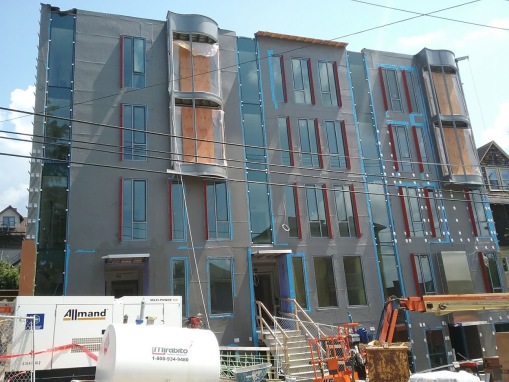
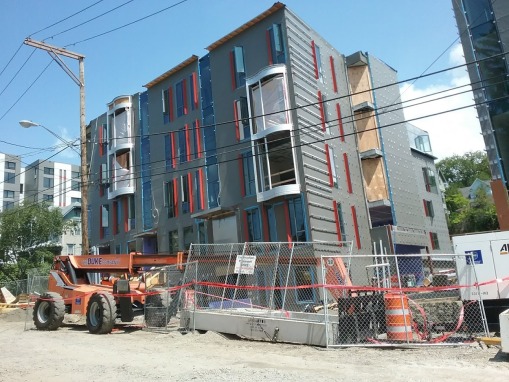
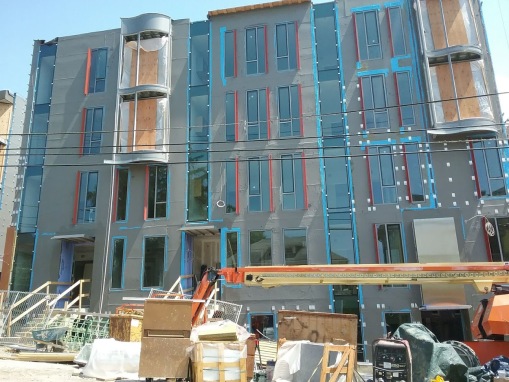
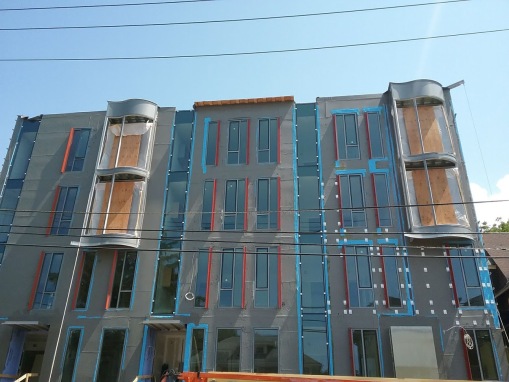
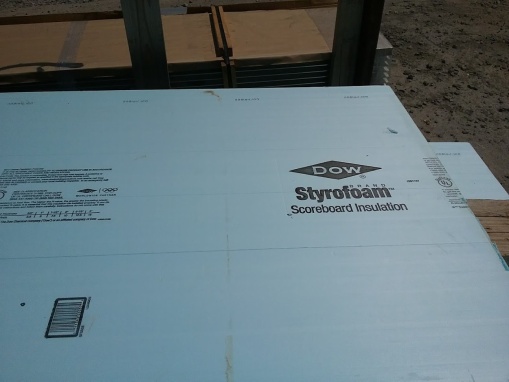
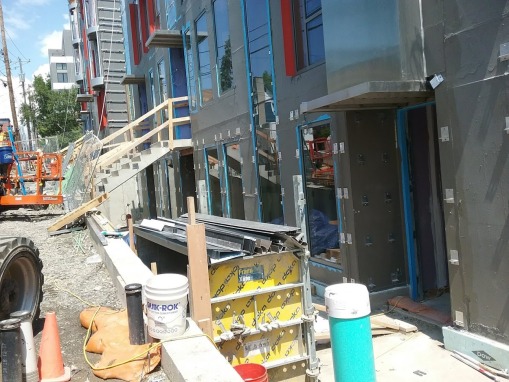
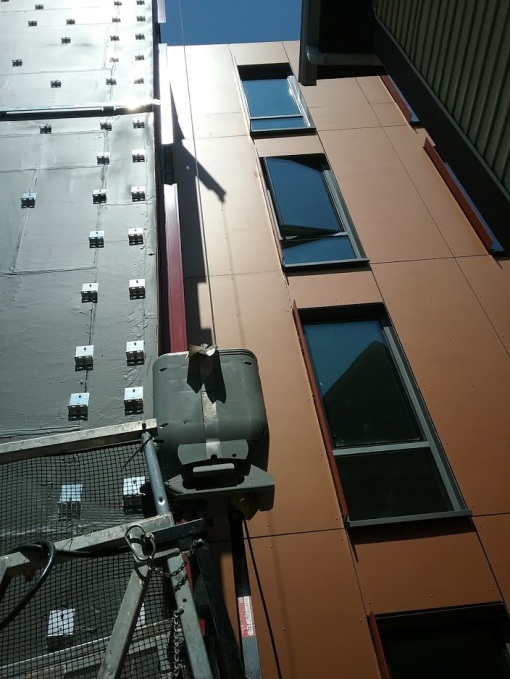
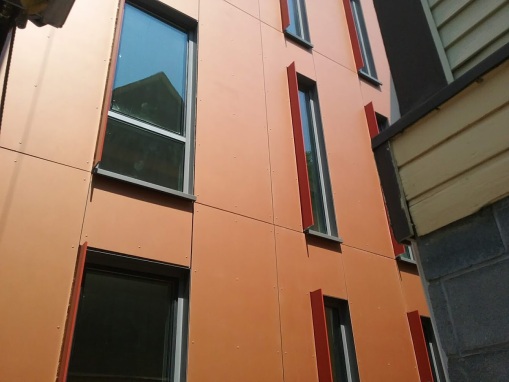
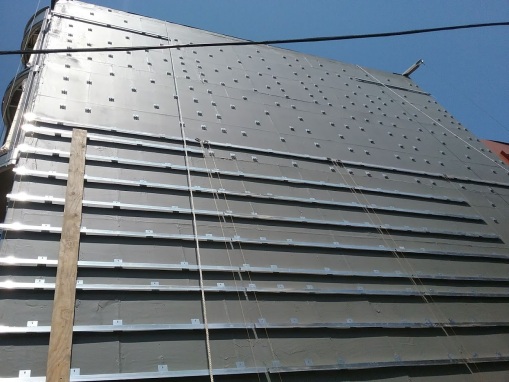
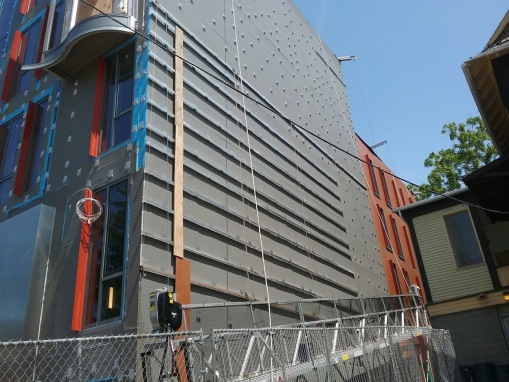
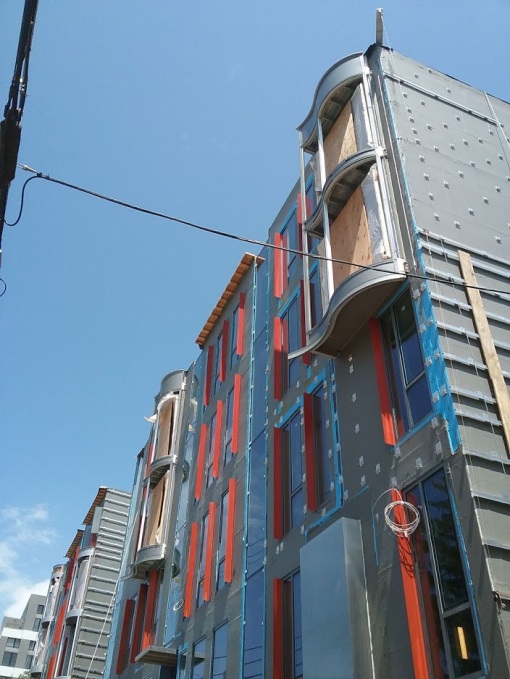
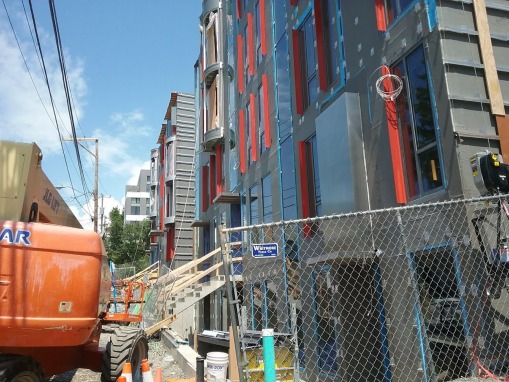
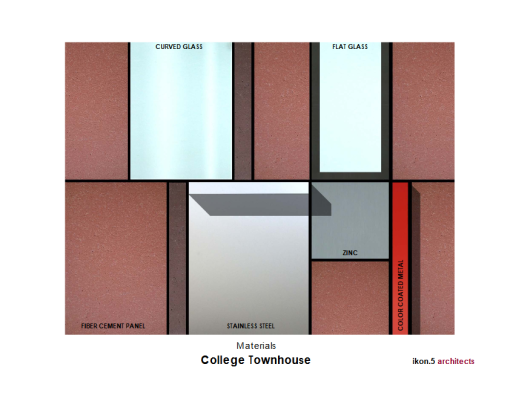
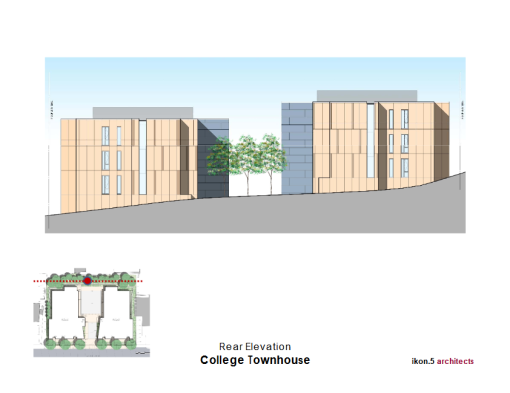
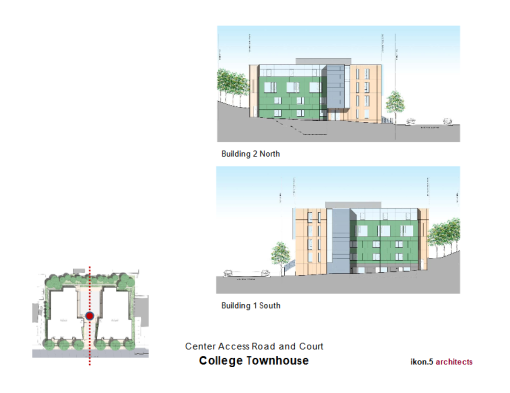
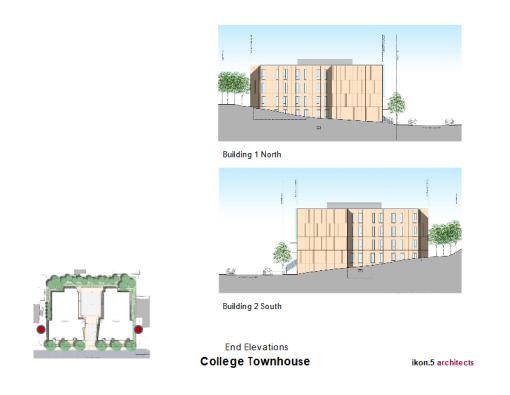
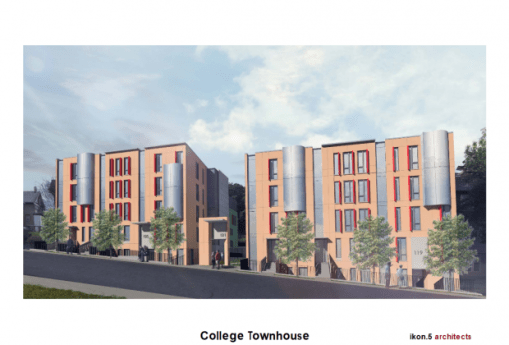
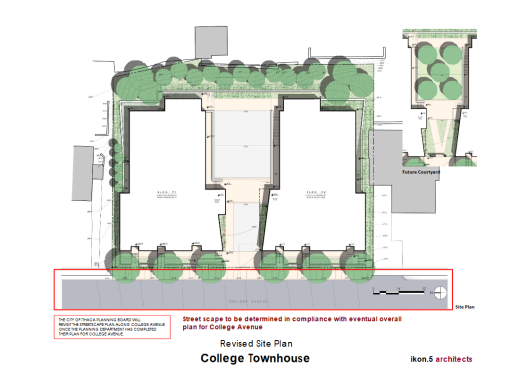
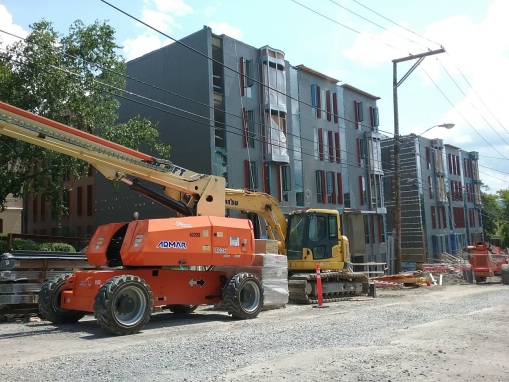
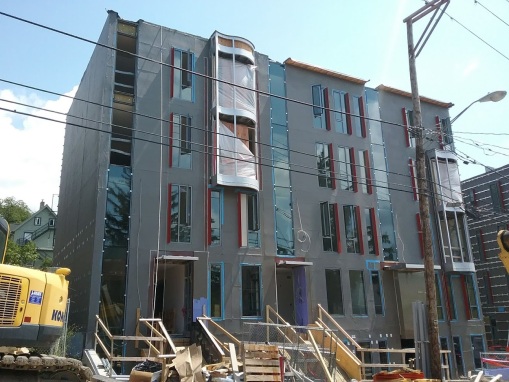
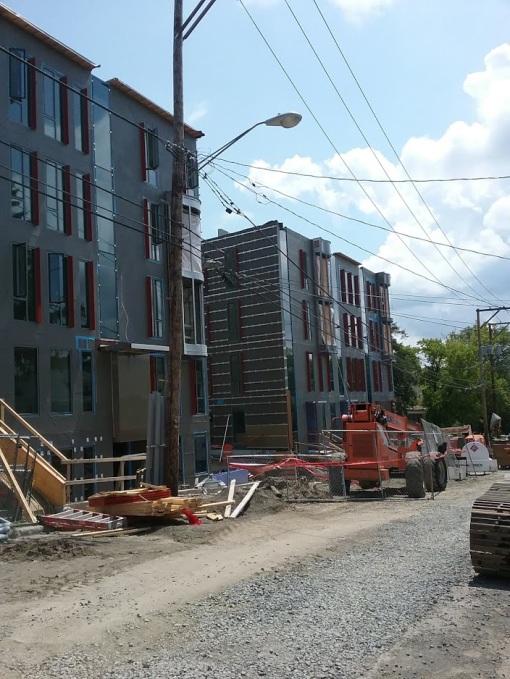
Novarr and Proujansky’s 67-unit apartment project is coming along on College Avenue. The four-story buildings are fully framed, sheathed with gypsum panels, and coated in a waterproof barrier. Atop the barrier, the construction team is attaching steel clips and rails that will be used to attach the fiber cement and zinc panels, both of which are a similar hue to those at the 238 Linden project. Red corrugated metal accents along the window frame give the project some visual interest, as do the curvaceous steel-framed window bump-outs.The stainless steel panel at the front will host the building address number and highlight the main entrances. These mimic townhouses from the front and the buildings were more townhouse-like before the changes in the fire code rendered the old design unusable, but they’re essentially traditional apartment buildings with a design twist.

Many but not all of the windows have been fitted, and interior buildout (mechanical/electrical/plumbing rough-ins) is underway. The specialty blue tape around the just-installed windows helps to seal off any potential gaps between the building structure and the aluminum frame. You can catch a glimpse of it in the photos, but the top level of the interior courtyard-facing walls have a glass curtain wall. This project seems to be on track towards its expected late January completion.

More information about the project can be found here.


815-17 North Aurora Street Construction Update, 7/2019

18 07 2019

This project rose quietly and quickly. 815-17 North Aurora is a small infill project in Fall Creek, replacing what was previously a significantly deteriorated two-family house. It was one of the typical “urban farmhouses” popular in Ithaca in the late 1800s and early 1900s, with major, unsympathetic additions tacked on at a later date. Under its previous owner, who purchased the property in 1999, the house started a gut rehab, but only got through through the “gut” part and never got to the “rehab”.

In June of 2018, the property was placed on the market for $269,000, and the listing noted small-scale redevelopment potential, that the city could conceivably allow the dilapidated house currently on the lot to be taken down and redeveloped into two two-family homes per zoning. For smaller developers, this was an opportunity. Fall Creek has become Ithaca’s walkable, urban darling in recent years so the market would support a plan, provided that the neighborhood or city didn’t object. The site could never host some grand multi-million dollar project, but it was a chance to build something complementary to the neighborhood, and add density through modest urban infill (Historic Ithaca objects to anything involving a teardown being called infill, but the textbook definition is more accommodating).

The opportunity the site held was right up the alley of a family of local owner/developers, the Stavropoulos family of West Hill, who own the State Street Diner and a growing portfolio of rental units under the name “Renting Ithaca”. The Stavropoli have redeveloped several properties in the past few years, including 1001 North Aurora Street (4 units), 107 South Albany Street (11 units), a two-family home at 514 Linn Street, and a two-family unit planned for 209 Hudson Street (they originally applied to build two two-family buildings, but reduced it to one after neighborhood pushback). Their M.O. is basically small-scale rental infill, nothing especially large or ostentatious, and with that they go under the radar for the most part. In short, this R2b-zoned site is a perfect fit for them. They purchased it for $235,000 on March 7th.

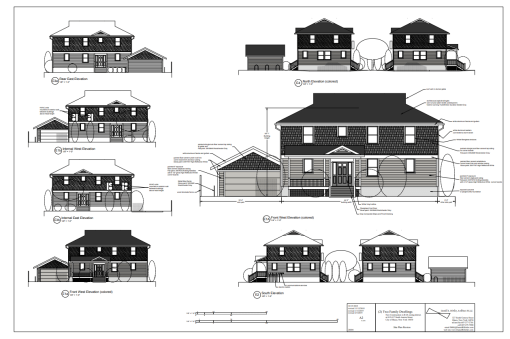
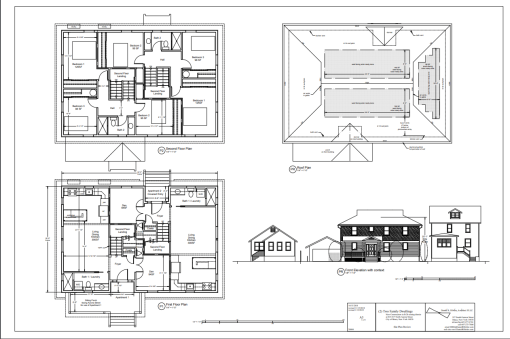
The project involves teardown of the original structure, and replacing it with two two-family structures, four units total. Each will be three bedrooms and 1,290 SF. Their usual architect of choice, Daniel Hirtler, has designed the structures to fit in with the Fall Creek vernacular, with recessed entries and aesthetic details (such as a transition between fiber cement shakes and clapboard siding) for visual interest. The buildings are positioned so that one is in the front of the lot, one at the rear, and only the front structure is visible from most public viewsheds. The site includes two parking spaces and a two-car wood-frame garage with new landscaping and utilities. Heating will come from electric heat pumps, and while the roofs will be capable of hosting solar panels, those aren’t expected to be included as part of the initial build. LED lighting, energy efficient appliances and water heaters, and high-efficiency spray foam insulation are included. This project would very likely meet the new Green Building Policy Requirements if in place.

The $627,000 development should be complete by August per Site Plan Review documents, a clear nod to having the units ready in time for the next academic year. Fall Creek tends to be less desirable to undergrads at Cornell because of the distance (<1% of total population), but graduate and professional students often rent in the neighborhood (~9% of graduate/professional students at Cornell live in Fall Creek).

Rather unusually, this project actually got some significant pushback from the Planning Board, which tends to be more acquiescent towards smaller projects; some of it had to do with the project itself, but it was also proposed while the city was hotly debating the merits of infill, a discussion that still continues. The argument was that the project will be rentals, would probably never be owner-occupied, and the board was questioning the merits of approving a project that would likely bring in students to the neighborhood and detract from Fall Creek’s “character”. In response, the initial plan for four parking spaces was replaced with two spaces and a two-car garage, with the newly freed space turned into an outdoor common area. A porch was added to the street-facing duplex, and a den in each unit to make them more family-friendly. All in all, there were four revisions from the first submission in October 2018, to final approval in February.

If you’re wondering about the color swatches – the lower level fiber-cement lap siding will be Sherwin-Williams “Knitting Needles” (light grey), and the front door and shake siding on the upper levels will be S-W “Westchester Grey”. Personal opinion, Ithaca is naturally grey enough as it is, but that’s just one guy’s take. Trim boards will be gloss white and the roof shingles will be Owens-Corning TruDefinition Duration Estate Grey. The concrete base, naturally grey, will remain exposed or potentially get a parge coat, the design plans left either option on the table.

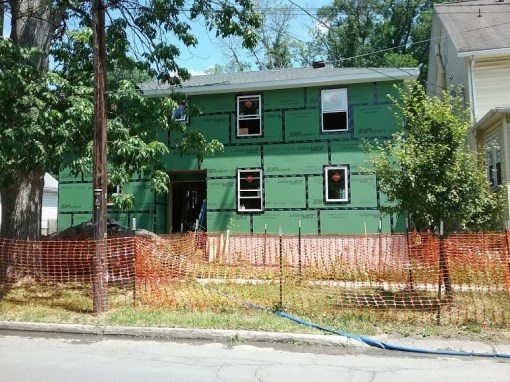
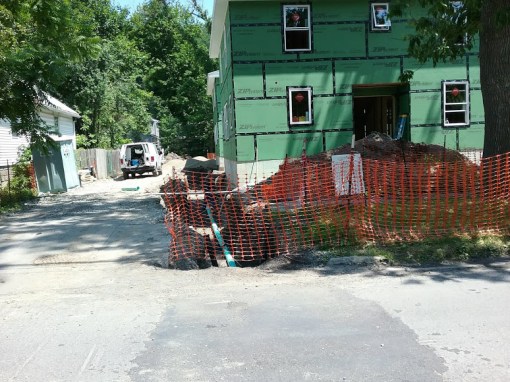
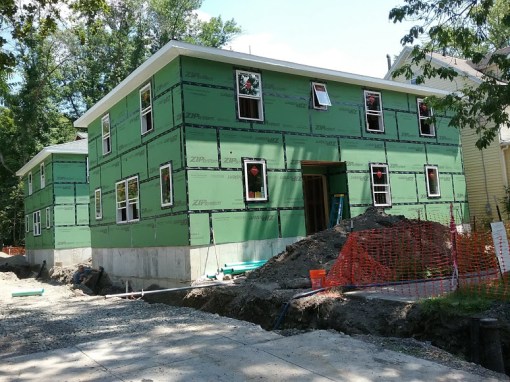
The slab foundation is in, and the buildings are framed, sheathed in plywood ZIP Panels, roofed, shingled, some roof trim boards have been attached, fiberglass windows have been fitted, and the PVC sewer line is clearly visible in its trench. The inside of the wood-frame structure is framed out, and utilities roughs-in (mechanical/electrical/plumbing) are underway. Sorry folks, this one sneaked up on me – demo permits were filed in March, building permits May 20th. Hopgart Construction of Horseheads is the construction manager.

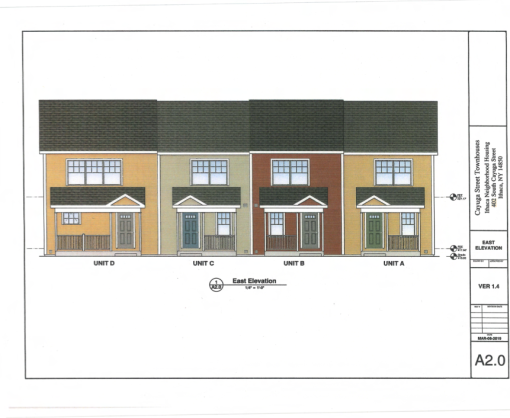
Early drawing.

Final design.


News Tidbits 7/4/19

4 07 2019

1. According to the village of Lansing Code Enforcement office, IJ Construction (the Jonson family) will be starting construction on another “6-plex”, or another six-unit string of for-sale townhomes on the southwest corner of the intersection of Bomax Drive and Nor Way. The units being completed now have sold at a decent clip, with two units sold and a third pending. I believe offhand they have to do streetscape / street lighting improvements before the other three can be sold.

In all probability, while the finishes and details will likely differ as they have in all of the townhome strings at the Heights of Lansing development, these will likely be 3-bedroom, 3.5 bath 2200-2400 SF units intended for sale in the upper 300k – lower 400k range. Previous units have included granite countertops, stainless steel appliances, electric heat pumps and other premium and/or eco-friendly features. Expect these stick-built units to be ready for occupancy sometime next spring.

Meanwhile, the Pizza Hut at 2301 North Triphammer Road is for sale, and the code enforcement officer had heard a rumor a hotelier was looking at it. However, at present, the 3,003 SF 1990s building is still for sale, with a listing price of $995,000. At 1.29 acres, the property could comfortably accommodate a 60-80 room hotel provided it was 3 floors, which is what the village allows. The more recent minutes suggest that the owners are looking for ideas, and that Pizza Hut will be calling it quits regardless.

https://platform.twitter.com/widgets.js

2. The proposed downzoning for the 300-500 Blocks of West State Street is being sent back to the Planning and Economic Committee for further revisions. The Common Council voted 8-2 (1st Ward councilors Cynthia Brock and George McGonigal opposed) to explore proposed amendments by councilor and 2nd Ward/State Street Corridor rep Ducson Nguyen. The amendments include maximum facade length, a hard limit on maximum footprint, and a 4 floor setback / 6 floor max vs. the 3 floor setback / 5 floor allowed.

3. Common Council also voted unanimously to support the INHS PUD for the Immaculate Conception Site. While some quibbles were had for more for-sale units and for larger apartment units for families (3 bedroom+ units are historically the hardest units to fill because of the limited number of applicants), the board expressed appreciation for the project on its merits and gave them the green light to go ahead with review by the Planning Board. The $17 million mixed-use project, which will include several thousand square feet of non-profit office space (the exact amount is in flux) and 78 housing units, is aiming for a Q4 2019 – Q1 2022 buildout, pending grant funding.

4. Also unanimous votes – a vote to support City Harbor’s funding application to the state for grants to fund the public proemande to be built at the development; the award of $70,000 in CHDF affordable housing grant funds to the 4-unit 402 South Cayuga Street for-sale townhome project by Ithaca Neighborhood Housing Services (INHS); cleanup of accessory dwelling code language and some law tweaks (not the same as infill), and a resolution to continue looking at a joint city-county police facility.

5. In potentially big news, thanks to a bipartisan effort of Democratic Assemblywoman Barbara Lifton and Republican State Senator Tom O’Mara, Tompkins County (and only Tompkins County) is now legally permitted to use county funds to support affordable housing development and preservation.

Here’s why that matters. Some of you might be familiar with the joint city-county-Cornell Community Housing Development Fund, which disburses a few hundred thousand dollars each year towards affordable housing projects, up to $400k for an owner-occupied project, and $300k for a rental, supporting the renovation or construction of 556 units since the program launched in 2009. A year might see $600-800k in grants disbursed.

Now here’s the caveat to the city and county contribution; it’s limited because those are federal and state grant funds. They were never allowed to fund a project directly, another government body was the middleman, and it takes time and effort to get those grant dollars back down the line. That slows down the development of affordable housing, and if the grants aren’t awarded for whatever reason, it could greatly curtail the CHDF, which creates the kind of uncertainty that developers seek to avoid, and less likelt to hash out a plan if they think the fund is ever at risk.

CHDF funds are often seed money; they’re hardly ever large enough to fund the development of an affordable housing project on their own. But the awarding of funds shows the community is interested in a certain project, and that development team can then pursue complementary (and usually much bigger) funding sources with a greater chance of being awarded grants. Typically, the funds aren’t disbursed until the project has all of its funding assured and is ready to go – for example, the county’s $100k portion of the $250k awarded to Lakeview Health Services for their 60-unit West End Heights projects in Round 16, is only being voted on to be disbursed now since the project has finally obtained all the funding it needs.

So what does this change mean? The county is expecting to have several applicants with affordable housing plans over the next few years, seeking up to $2.5 million in CHDF funds. Tompkins County is looking to put together a $3 million Housing Capital Reserve Fund with dollars from the county’s general fund, which could then be used as grant money to support infrastructure, development of affordable housing, studies to examine where it would best be built and make the greatest contribution (i.e. bang for the buck) and so forth. Potentially, this new fund that they are now to legally allowed to set up could assist in the development and preservation of another 400 units of affordable housing across the county.

6. On that note, the latest CHDF funding round appears to be a modest one; $80,000 to Habitat for Humanity for the construction of two new homes (30-60% area median income, or AMI) alongside the property under renovation at 1932 Slaterville Road in Dryden, $38,940 to INHS for the renovation of an existing house at 28 Crystal Drive in Dryden, which will sell to a family making 80% AMI and incorporated into the Community Housing Trust to keep it affordable, and $27,800 for an 80% AMI rental unit to be built in the back yard of 622 West Clinton Street in the city of Ithaca.

Quick update on the soon-to-be-built INHS apartment development at 203-209 Elm Street. They’re calling it “Cayuga Flats”. Sure, British English is hip/cosmopolitan, but there’s a bit of well-deserved eye roll. Also, play on words here, that site is by no means flat. The building two stories in the front, three in the back.

The project replaces 14 housing units of varying age and ownership, four of which were condemned because the foundation was crumbling, with a 12,585 SF, 13-unit apartment building containing ten one-bedroom and three two-bedroom units, in the 30-60% AMI range. The project cost for this development comes in at around $2.76 million and the design is by SWBR Architects of Rochester. Build out will take about 12 months.

On a related note, as INHS grows into a regional affordable housing developer, it will be tackling its second project outside of Tompkins County, a mixed-use project on a large vacant lot in the village of Watkins Glen. The project on Second Street will include 34 apartments for those making 47-80% county AMI, and a 7,341 early childhood education center on the ground level.


327 West Seneca Street Construction Update, 6/2019

23 06 2019

This project combines a pair of things that are up and coming. One is development along the State Street Corridor, the other is Visum Development Group.

Visum (Vih-SUM) is the startup firm launched by local businessman Todd Fox. Fox doesn’t really fit the normal profile of Ithaca real estate landlords. Most are older, more formal in attire and appearance, and reluctant to engage with news media and the public – “everyone’s been burned over at least once,” one 70-something year old developer once told me. Fox, on the other hand, is a different culture. He’s in his mid 30s, eschews the suit and tie for buttondowns and casual shoes, and sports what I suspect is a half sleeve tattoo on his left arm. One of Ithaca’s few millennial developers, he’s also more inclined to speak out than most – that doesn’t always make for the best headline for him, but it makes my job for the Voice easier.

However, even though Fox is a different vibe, there’s no doubting he’s good at what he does. Visum is one of the fastest growing firms in Upstate New York. 501st nationwide in 2018, and 610th this year, according to Inc., with a three-year growth of 820%. The small if growing firm got its start in 2015 as a spin off of Modern Living Rentals, which was led by Fox with developer Charlie O’Connor. But Fox and O’Connor have different approaches to development, so they pursued their own interests, O’Connor as MLR, and Fox as Visum. Since that time, Visum has developed tens of millions of dollars’ worth in property, and has tens of millions more in the development pipeline. Projects include 201 College Avenue, the Lux (232-236 Dryden Road), 210 Linden Avenue, 118 College Avenue, 707 East Seneca Street, and several smaller projects. More recently, the company is pursuing projects beyond Ithaca – a residential conversion project in Downtown Elmira, a 75-unit building in Boise, and recent signals that they’re scouting locations for a project in Raleigh.

Generally speaking, most of its projects have been geared towards students, and from a purely business standpoint that makes sense. Students are a lucrative, stable market in Ithaca – as long as your location is good, you’ve got a safe real estate investment. But with Cornell’s Maplewood and North Campus Residential Expansion, most local developers are shying away from the student market. Some are sitting on their earnings and just hoping to roll with the punches, others are pursuing new opportunities. Travis Hyde Properties is planning new senior housing, Lambrou Real Estate is pursuing a waterfront project, and Visum, the low-moderate income (LMI) affordable/workforce housing bracket.
That’s pretty unusual for a for-profit entity. Frankly, the complicated process to assemble financing to build LMI housing is exhausting and often uncertain, so most avoid it. About the only other ones I can think of with a local presence are Cornerstone Group and Vecino Group, both much larger firms than Visum.

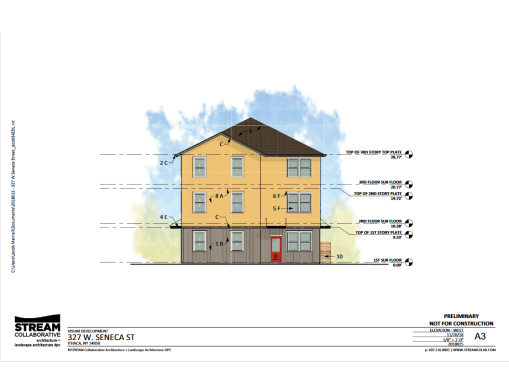
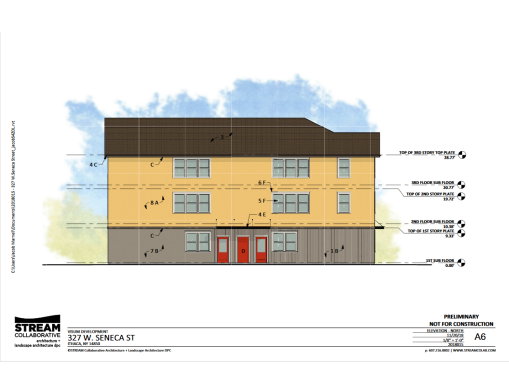
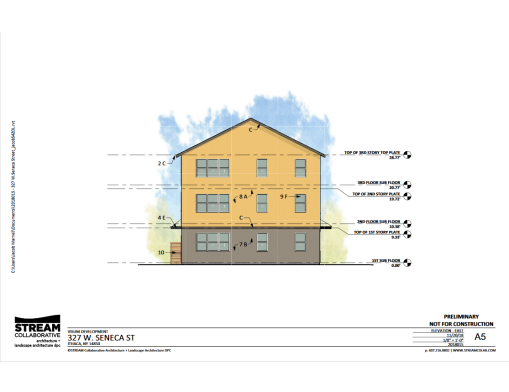
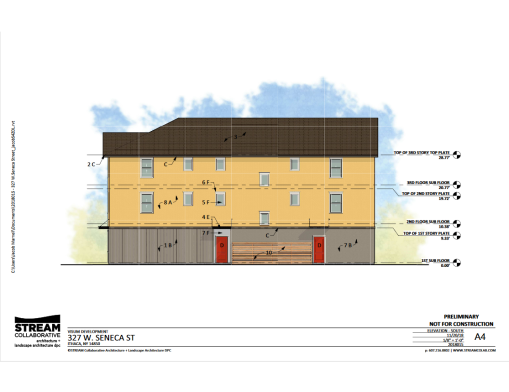
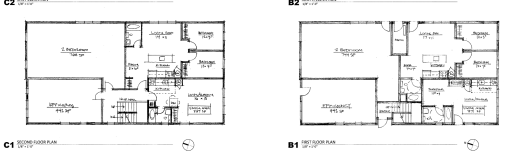
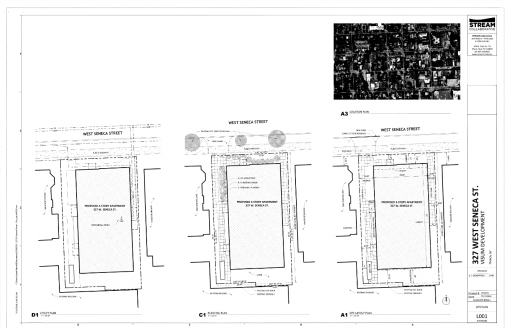
Visum is serious about it, though. 327 West Seneca would be their first affordable LMI project (at least two more are planned, though the city appears to be actively trying to kill one of them). As planned, it’s smaller-scale urban infill (yes Historic Ithaca, I’m aware you don’t like me calling any project that involves a demolition/deconstruction “infill”). A humdrum two-story, three-unit apartment house replaced with a three-story, 12-unit apartment building totaling 7,845 SF, with six studios (442 SF) and six two-bedroom units (708-744 SF), to be priced in the 70-80% area median income (AMI) bracket, so around $1,200/month for the two-bedroom units and $900/month for studios.  Zoning on the site is B-2d, which allows 4-story buildings with 75% lot coverage, and no vehicle parking requirement for all-residential structures like this one. It will have a bicycle rack. While a 4-story building was allowed, they would have needed a second set of fire stairs per state fire code, which made the extra floor cost-prohibitive. The target market is one-person and two-person working-class households.

Yard setback variances were required, and early on two versions of the building were presented, one with smaller units and no need for setbacks, and the larger version, which has marginally larger units but in need of variances. The Planning Board let the project team know early on that they encouraged the larger workforce housing units and would support variances, which is a strong voice of support to the Board of Zoning Appeals, and though self-created, the BZA accepted the Planning Board’s advice and granted the variances.

As with many Visum Projects, STREAM Collaborative is the architect (the filing docs suggest architect Jacob Marnell‘s work). The relatively simple design is intended to quietly fit in with the apartment houses that neighbor it on either side. The new structure would be finished in Dryvit synthetic stucco (color Benjamin Moore “Sunny Days”) and fiber cement clapboard and batten board (color Benjamin Moore “Indian River”). Certainteed 3-tab asphalt shingles (Timber color) will be used on the gable roof, Anderson 100 and 400 Series windows with off-white trim, black steel canopies and unpainted larch wood screening will also be used. Keeping with the warm colors, the doors will be painted BM “Jupiter Glow”. Main entries are on the sides, but one apartment is accessed via the front entrance. Heating is electric baseboard, but I don’t see anything about heat pumps in the planning docs.

The project was first proposed in June 2018, and approved in November. By Ithaca standards, the process was fairly quick and painless; there was practically no opposition to the proposal, and the design remained pretty much the same from start to finish, with the exception of some window treatments and finishes (gutters). The SIte Plan Review document suggests a six-month buildout, though I dunno if that includes the demolition; either way, a completion by the end of this year is likely, given that it’s a concrete slab and wood-framed buildings like this tend to go up quickly.

Construction costs are estimated at $1,275,330. At least $200,000 of that is covered with a joint city-county-Cornell Community Housing Development Fund (CHDF) grant – as they split it up, $170,000 from Cornell, $30,000 from Ithaca, though to be clear, the project is not Cornell-affiliated in any way. Developer equity and bank financing will cover the rest. As one city official told me with 510 West State Street, the city is nervous about its ability to lock in affordability from for-profit developers; but given that Visum plans to pursue a CHDF there as well, the threat of a costly clawback of funds plus legal costs is a pretty strong deterrent to that kind of behavior. By pursuing housing a notch above the usual 50-60% area median income sought with affordable housing, Visum doesn’t need as many grants to make a project work, and their ample developer equity (i.e. existing cash on-hand) makes affordable lower-middle income projects like this appealing for lenders and their construction loans.

Demolition permits were granted in late May. The existing house has been cleared and the site is graded. Keep an eye out for footer excavation and foundation pours in the coming weeks.

May 18th, 2019

June 14th, 2019


Harold’s Square Construction Update, 6/2019

20 06 2019

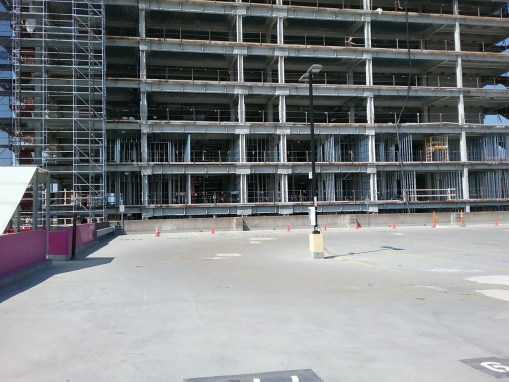
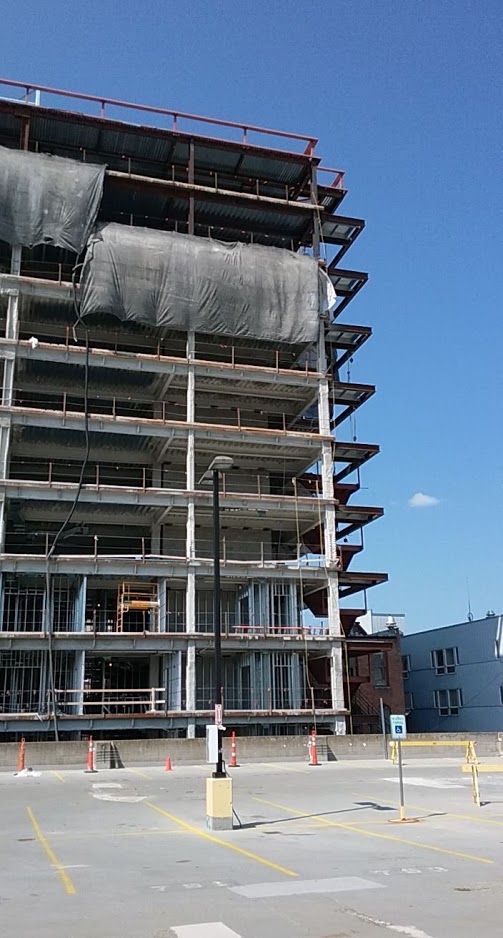
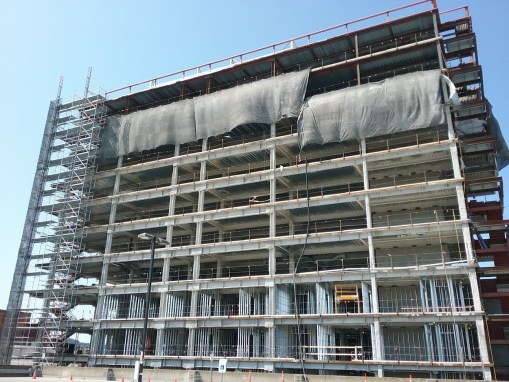
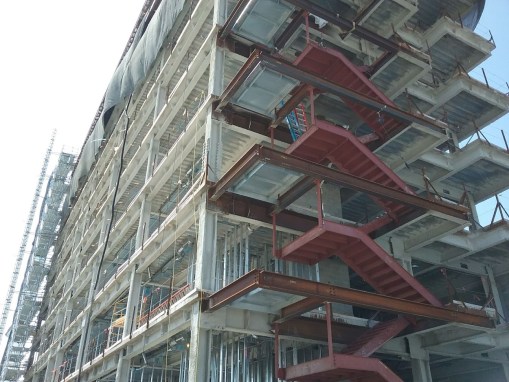
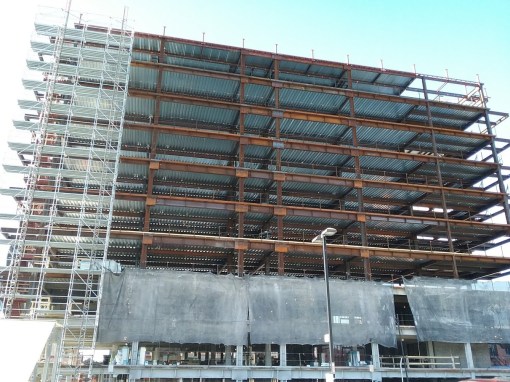
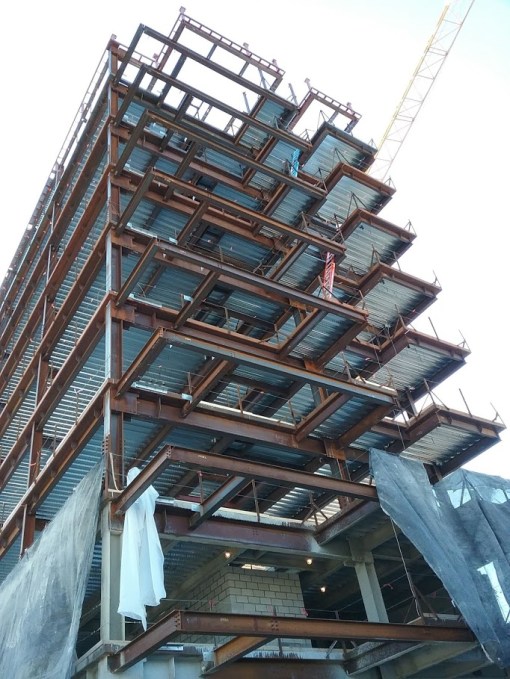
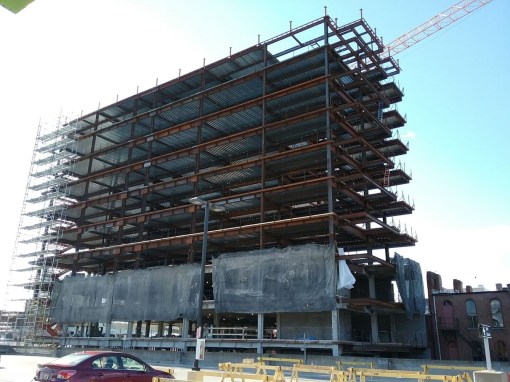
It’s not quite topped out, but it looks like all the floors have been framed for the Harold’s Square project. The steel skeleton makes quite the presence on the Ithaca skyline, and when the edge of the roof is framed and cladded, height should come in at just under 140 feet. The building may for aesthetic purposes appear a few feet higher because rooftop mechanical equipment isn’t included in height measurements, as it’s not considered part of the habitable space of the building. A formal “topping off” ceremony is planned for tomorrow next Thursday the 27th. (Sorry, wrong Thursday in the notes).

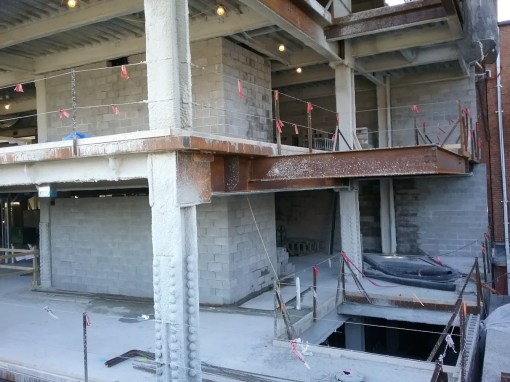
Most but not all of the corrugated steel decking is in place and concrete pours have been ongoing for the future floors. The black tarp hanging from the fifth floor is probably a barrier to keep the flame retardant from accidentally blowing out while it’s being sprayed onto the skeleton. On the lower levels, some interior steel stud walls can be seen, indicating that sprinkler systems are in and interior framing is underway. From the front, exterior steel stud walls are being bolted to the skeleton, establishing the rough openings for the windows, and Georgia-Pacific DensGlass fiberglass mat-faced gypsum sheathing is being attached – fire-proof and mold-proof, DensGlass sheathing is common for commercial and mixed-use structures.

Unfortunately, until that front face is substantially complete, it’s unlikely the Commons playground will be made available, due to the safety hazards – a piece of building material or a tool falling just the wrong way is the risk that neither the developer nor city codes is willing to take. The risk of small debris, like metal shavings or nails, also means that the playground will need to be thoroughly inspected before any reopening can take place. The hope was that it would be reopen for this summer, but the switch of contractors delayed that.

I’ll be frank. This project has an image problem, and not just because of the grumblings of its retail neighbors. I don’t have a single conversation that doesn’t have the other person trying to turn this project into a running joke that it will never be done. There is a lack of faith in L Enterprises. It may be that the only way to rectify that image issue is to keep the project moving forward as quickly and smoothly as possible and assuage people’s concerns as they see the building take shape with their own eyes. Occasional public engagement helps, like the “Wear a Word Day” banner, project updates to the city planning committee, and keeping the project blog updated)

Quick reminder, the program mix has changed to accommodate the needs of a  major tech firm office tenant. The 12-story, roughly 180k SF structure brings 12,000 SF retail on the Commons level, 41,000 SF of office space, and 12 floors with 78 dwelling units (down from 108; 30 micro-units were deleted for more office space). At a recent PEDC meeting ,the project team stated a spring 2020 occupancy for the apartments, and summer 2020 for the retail and office portions.
The WordPress for the project can be found here, and the Ithacating project description here.


Hilton Canopy Hotel Construction Update, 6/2019

19 06 2019

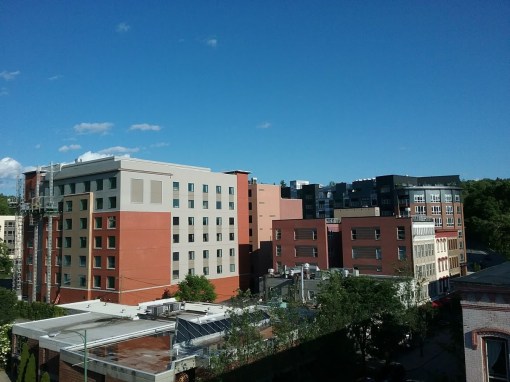
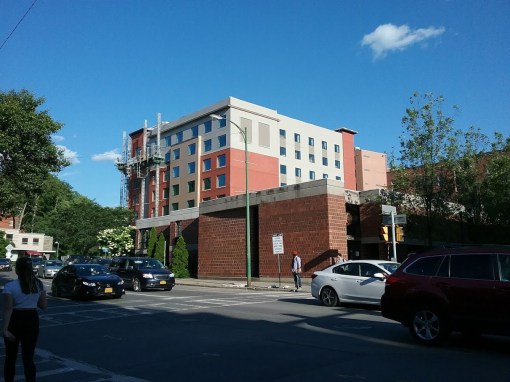
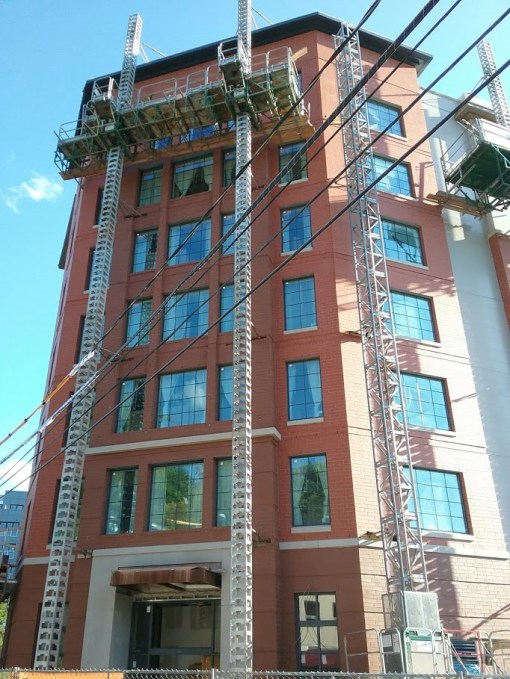
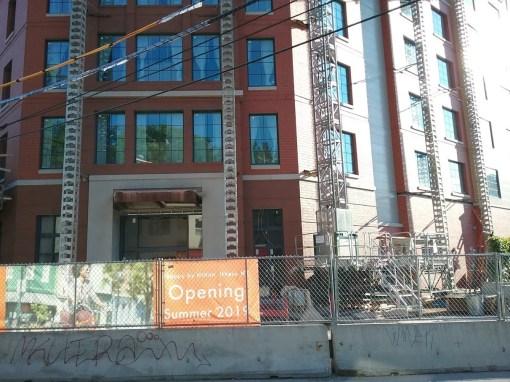
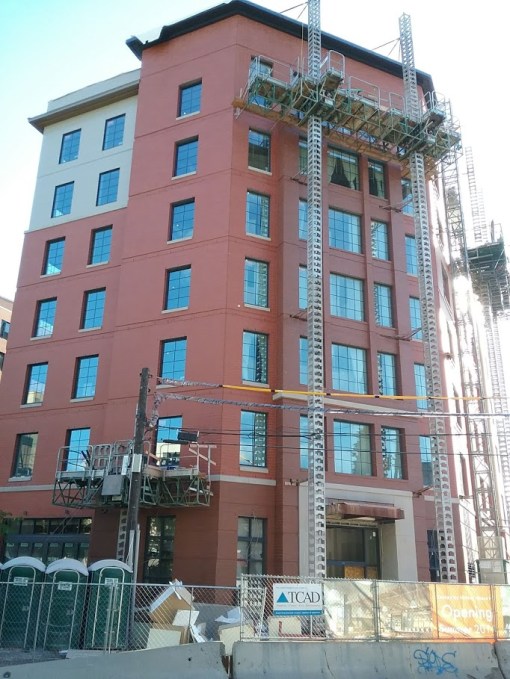
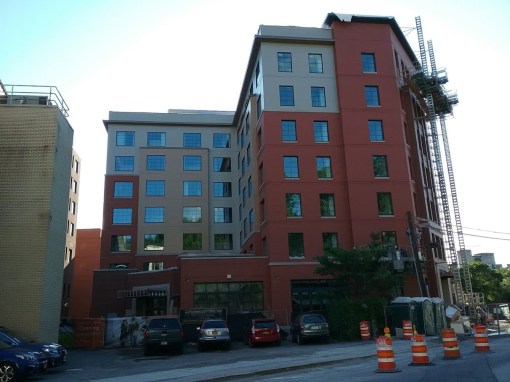
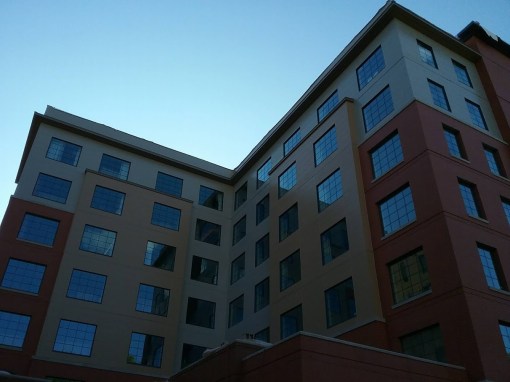
In the home stretch now. The exterior is largely complete apart from some minor trim and finishes, with the entrance canopy in the process of being framed out. Inside, it looks like the drywall has been hung based on what little can be seen from the windows. Exterior lighting and landscaping features, as well as paving and plantings, will come later in the summer. As described by the advertisements being posted on local tourism websites:
“The brand-new Canopy by Hilton is a 131 room Downtown hotel inspired by our “Gorges” surroundings, opening Summer 2019.

Enjoy a meal and a handcrafted cocktail at our full-service restaurant, featuring indoor/ outdoor seating.  Or venture out to restaurant row and the Ithaca Commons, located just steps away from our front door.

Delight in the views of Downtown Ithaca from one of our “Just-Right Rooms” and enjoy comforts like a large HDTV, refrigerated drawer, Nespresso® machine, ergonomic workspace, and our exclusive Canopy Bed.

Stay in shape in our state of the art Fitness Center. Filtered water stations on each floor will keep you refreshed.”

It’s not 100% clear when they’ll open, but their new Director of Sales previously worked at the Marriott down the street, so they’re getting knowledgeable staff on board. A hiring event for entry level staff was held at Coltivare at the end of May. While all the signage says Summer 2019, but the Hilton website says it will start taking reservations for the hotel on November 13th, which is not a good time for a new hotel being that it’s right at the onset of the slower winter season. Rates for a standard room are listed as $166 during the week and $246 for weekend nights.

Complimentary features will include (non-electric) bikes available to guests, an airport/college shuttle for guests, free Wi-Fi, 55″ TVs, built-in refrigerator drawers, bathrobes and socks in the suites, filtered water stations on every floor, serviced and to-go breakfasts, and two meeting rooms for up to fifty guests. The hotel will welcome animal guests weighing 50 pounds or less. A full list of features and amenities is here.

The ground-level restaurant, to be called the Strand Cafe after the theater that once stood on the site (the first proposal referred to it as “Ezra”, presumably for Ezra Cornell but probably too vague for its own good), will serve both “American fare and handcrafted cocktails” and feature a retractable garage-style door to let the outside air in on nicer days. A render of the cafe is at the end of the post.

MARKZEFF Design of Brooklyn will be in charge of interior layouts (render at the end of this post) and room furnishings. PID Floors of New York is supplying the hardwood for the flooring.

On a less kind note, the scaffolding incident with the fearless construction worker seems to have netted the general contractor, William H. Lane Inc. of Binghamton, a $4,000 fine for unsafe working conditions. The scaffolding subcontractor, CFI Sales and Service of Pennsylvania, received three fines totaling $22,542, since they were the perpetrators of the incident. The firm was also let go from the project after the violations.