News Tidbits 12/9/17: Not Enough Time in the World

9 12 2017

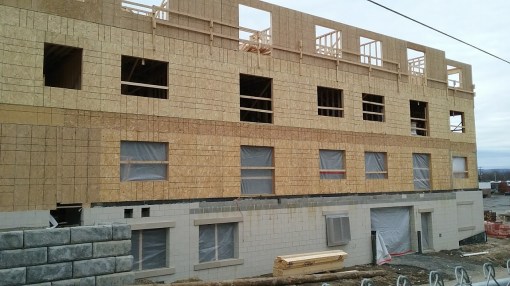
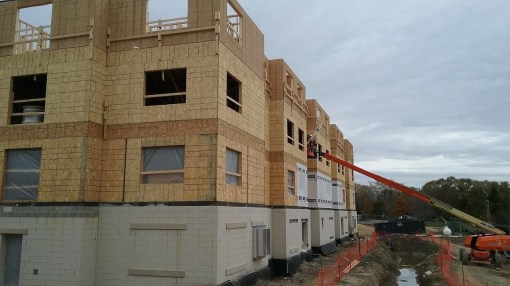
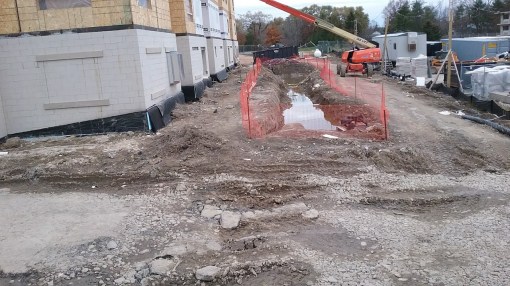
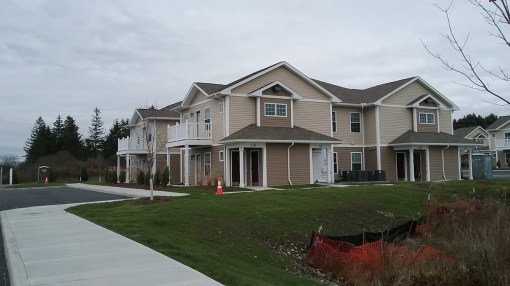
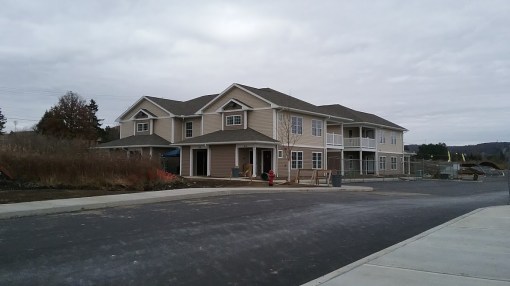
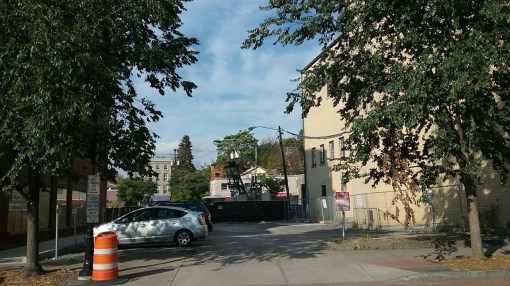
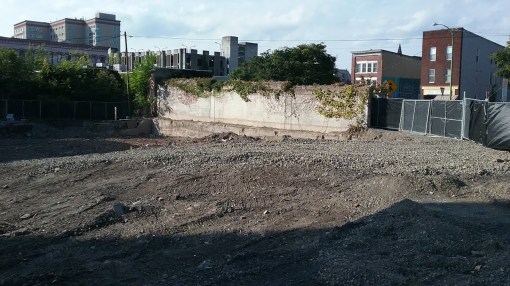
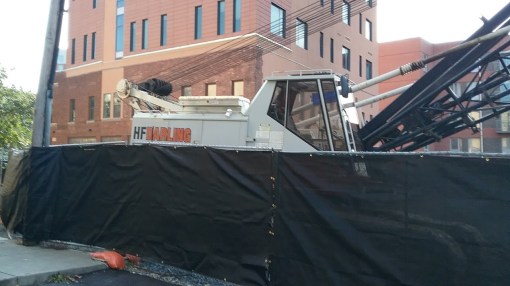
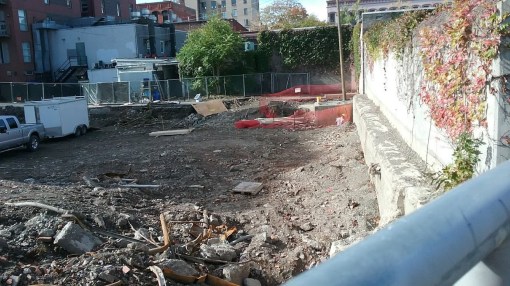
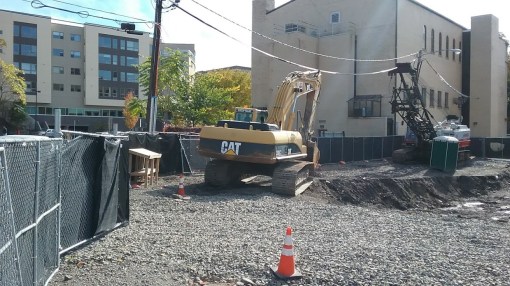
1. The good news is, Maplewood is progressing. The bad news is, it is not progressing fast enough. A combination of bad weather (rain-outs), and staffing issues. The weather delays had been so bad (with rain 2.5x monthly normals in October) that some subcontractors walked away to take other jobs – while the ~200 Maplewood construction jobs are quality union labor, it’s been difficult to get a full week’s work in. It’s a Monday-Friday job; with a rain-out, they lose a day in the week. That means they also lose out on a day’s pay. Over the past year, 37 days have been partially or fully rained out. A provision in the subcontractors’ contracts allows them to leave for other jobs id the issue becomes too severe, so some have done just that. Not hard feelings, just a tough situation for everyone.

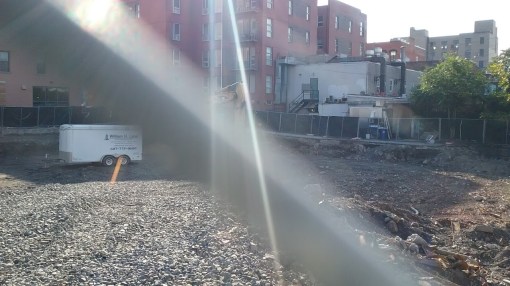
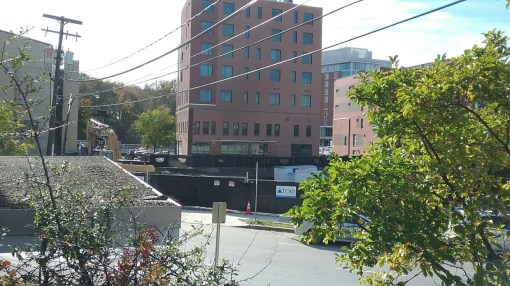
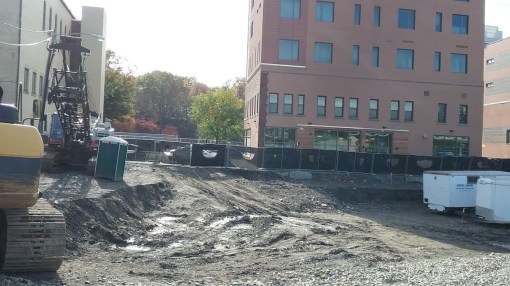
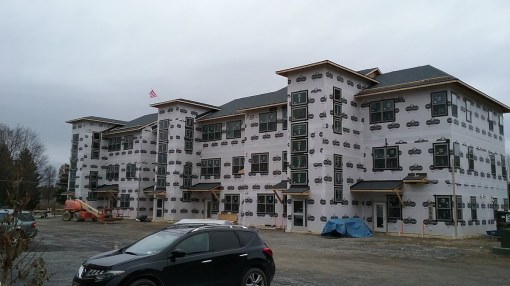
Now about 25 days behind a very tight schedule, EdR and LeChase are asking to be allowed to regularly work 8 AM – 4 PM Saturdays. The town is open to this, but wants more documentation before signing off. So, expect a six-day workweek during the winter and spring. The goal is still to deliver the $80 million, 872-bed project by July.

2. The Seneca Street Garage is “showing its age”. As the garage is now about 45 years old and is designed to last about 50 years, some components are starting to deteriorate. The city has constructed some shoring posts to keep the concrete pillars relatively stable. They are not at risk of collapse, but the tension cables, which are used in combination with rebar to provide for a heavy-duty concrete structure with fewer columns, are starting to wear out. Decades of salt, water and corrosion will do that.

The city will lose about 20 parking spaces from the life-extension measures. The Times is reporting that the city hopes to get another ten to fifteen years out of the garage, and hope to have a plan for replacement parking in place within ten years. That could be a demo and rebuild of the garage, or it could be something more substantial, like the Green Street Garage project. It’s something to mull over now, but there are no big decisions planned anytime soon. Perhaps a Seneca Street rebuild with mixed uses ends up being one of the big urban developments of the late 2020s.

3. A development site on West Hill has exchanged hands. As covered previously, Bella Vista was a planned 44-unit condominium project on Cliff Street that was approved in 2007, and never came to fruition. The site it was proposed for, an 11.71 acre property at 901-999 Cliff Street, was put up for sale in December 2015 for $395,000. Finally, it has been sold.

The developer, Mauro Marinelli as Primary Developers Inc., sold the land to American Blue Sky Holdings LLC for $330,000 on the 5th. The LLC is owned by local businessman Greg Mezey, who previously bought the 12,000 SF medical office building next door at 821 Cliff Street for $945,000 in February 2015. Since then, he and realtor Ryan Mitchell have undertaken some modest building and site improvements. As Red Door Rentals, they own and manage a few apartment houses with a total of about 25 bedrooms.

So what does that portend here? Good question. Watch and wait, for now. The Bella Vista project could still be built, but it must be re-approved by the city of Ithaca, since project approval is only good for two years. Zoning is R-3a, primarily residential uses with up to 4 floors and 35% lot coverage. Parkin is one space per unit or three bedrooms (whichever produces more), and small-scale commercial is allowed with a special permit. The site’s topography is a challenge, but the size of it and its proximity to downtown and the West End make it an interesting opportunity.

4. It looks like the first phase of Dryden’s Maple Ridge subdivision has just about filled out. For owner/developer Paul Simonet, it’s been a long time coming – the development launched right before the recession in 2008, and development didn’t really take off until the economy recovered. In 2013, there were three houses. By November 2014, only four houses had been built, with a duplex underway. Now, there are ten homes, and just about all one of the home lots have been sold. Some of the lots in phase one were combined by buyers.

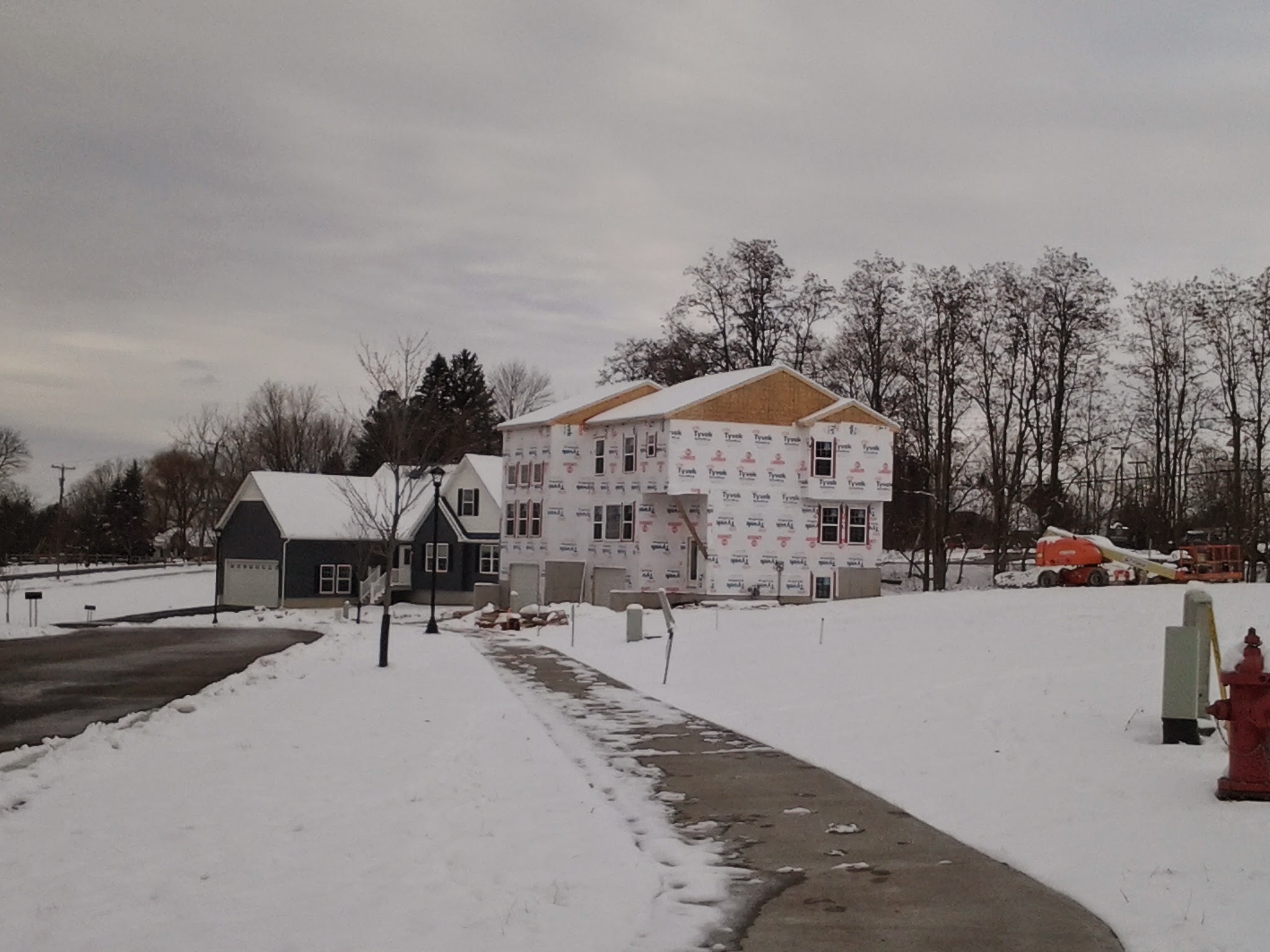
Interesting, many of the homes built in Maple Ridge are modulars – I half-jokingly suggest that Carina Construction take prospective buyers through here to show them the variety of options one can pursue with modulars. It looks like this latest build on Applewood Lane will also be a modular – the foundation is built (note the dark Bituthene membrane for moisture protection), and the pieces will be trucked over and craned and assembled shortly, if they haven’t been already.

Ultimately, Maple Ridge is supposed to be three phases and 50 lots, and phase two will have about 29 lots, and since these are larger, they’re less likely to consolidated as phase one’s were. Given the need for a new road and infrastructure, sales seem unlikely until well into next year. The village minutes (the few they upload) does show that Simonet is actively pursuing the second phase.

It also answers a question from last week – the Elm Street office/warehouse complex will be the new home of the Ithaca Ice company, after some modest renovations.

5. The Lakeview affordable housing plan for the 700 Block of West Court Street, now called “West End Heights” was selected to receive a $100,000 grant from the inter-municipal and Cornell affordable housing fund (CHDF), but the funds will be delayed a little bit because they need to be moved into the 2018 budget, as the check will be going out in 2018.

6. The latest phase of the Village Solars (the reconstruction of 102 and 116 Village Circle) is being built with a $6 million construction loan from Tompkins Trust Company. The agreement was uploaded to the county’s records on the 7th. The contractor is “Actual Contractors LLC” with an address at Stephen Lucente’s home on the lake – it’s their in-house construction crew. Albanese Plumbing will be rigging sprinklers, heating and water pipes, T.U. Electric will be doing electrical and fan installations, and Bomak Contractors of Pennsylvania is the subcontractor for excavation, bedding and foundation work. Apparently Larry Fabbroni, the consulting architect, charges $90/hour for design work, while engineering/surveying is $107.50/hour.

102 and 116 comprise 42 units (24 and 18 units respectively), but if you’ve been reading the construction updates for the project, then you already knew that. The loan says both buildings have to be completed by August 15th, 2018.

7. Not a whole lot going on at the moment. Lansing town will be hosting a Planning Board to look at a telecommunications tower, and three new 1-acre home lots to be carved from a larger lot off East Shore Circle. The city’s project review meeting is so slim, they didn’t need to attach any files – just the old business with the Sophia House addition on the Knoll, and that’s it. The city Board of Public Works will be looking at plans for a new inclusive playground at Stewart Park.


News Tidbits 12/2/17: The Changing Calculus

3 12 2017

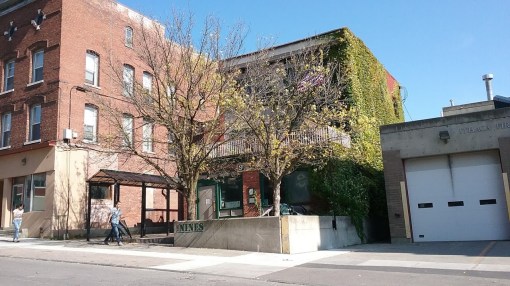
1. Perhaps the big news of the week is that Visum Development Group’s project for 311 College Avenue (the Nines restaurant and Bar) was revived after negotiations with the seller moved in a favorable direction. This time around, it appears that Visum is bringing something close to an “A” game proposal; Jagat Sharma is still the architect of record, but Visum’s VP for New Market Development, Patrick Braga, had a heavy hand in the design work and historical research. The designs produced are more historically inspired and embrace some of the elements that make the old fire station attractive to the public – the first floor doors will pull up like garage bays or slide open to create a sort of open-air loggia on warm days, and a cornice element is retained. Floor to roof will be about 66 feet according to the Times’ Matt Butler, and still contain about 50 1-bedroom and studio apartments as well as 750 SF of retail. For the record, he and I did a bit of collaboration on describing the architectural features before we ran our respective stories.

The sketch plan had a kinder reception from the Planning Board this time around, if still cautious. Even though John Schroeder made it clear he would never accept any plan for The Nines, he said something to the effect of, if this design were proposed for any other MU-2 in Collegetown, he would have no problems with it whatsoever. The rest of the board did a quick poll to see if the other members would at least entertain a proposal, and no one else said no, so the project is considered active.

Now, things can get a little awkward from here. The city planning director, JoAnn Cornish, made it clear that they could move forward with design if they want, but there’s a risk that the property may get landmarked before they get approval. Speaking with the city historic preservation director Bryan McCracken the day after the article, he said that a decision on whether or not to move forward with the landmarking process would be on the agenda for the ILPC’s December meeting. If they move forward, it still has to go to Common Council. I had previously heard through the grapevine that the council was favorable to landmarking in the case of the Nines, but that was before Visum brought forward a new plan. The truth is, things are fairly unpredictable at the moment, and it’s a matter of waiting and watching how different stakeholders act and react.

2. I like Matt Butler, he has time to do the stories that I can’t. This time, a look into the plans for a centralized government facility at the site of the Central Fire Station on the 300 Block of West Green Street. That study is still active, under the guidance of Kingsbury Architecture and TWMLA, as is the second study for a combined Public Works facility. The appraisal process and estimates of cost are also still underway.

It’s kinda a given that this would have tremendous impacts, as noted in the Voice. A lucrative Collegetown site and other redevelopment sites would be on the market, and hundreds of workers and daily visitors would extend Ithaca’s core down State Street, which the city wants, considering it to be one of the few directions downtown can expand towards without compromising too much of Ithaca’s existing urban fabric. The ILPC would need to sign off on plans due to the fire station’s proximity to the “Downtown West” historic district (it actually contains the IFD’s parking lot for the sake of contiguous parcels), so “super-edgy hypermodern” probably isn’t on the table design-wise. The city also has to make a decision relatively soon – the current city hall (former NYSEG HQ, built 1939) and “Hall of Justice” (1920s, renovated/expanded 1964-66) are in need of major renovations.

3. Also on the visionary end of discussion are future plans (2020 onward) for Collegetown’s transit network. Here, it is often a delicate case of balance; it’s a dense, lucrative secondary core of the city, but parking and traffic are problems, as is the lack of infrastructure for pedestrians and bicyclists. One option being explored is a new bike lane up College Avenue that would eliminate 35 parking spaces (and was not well received), and the other is a more modest plan that largely keeps College Avenue as is, which many didn’t like either.

Perhaps the most interesting note from the article is that the city is examining the feasibility of expanding the Dryden Road garage by adding additional floors to the 1980s structure. The Dryden Road garage has the highest parking rates and a high occupancy, and is the most lucrative of the city’s four garages. The city is also looking at incentives for on-site parking, which to be honest, probably isn’t going to work in Collegetown for a number of planning and financial reasons (i.e. a developer will make a lot more from a rentable unit per SF, than from a parking space per SF).

4. Nothing much of note from the town of Ithaca Planning Board agenda. The owners of a former convenience store at 614 Elmira Road are seeking to perform minor renovations to the building for a bottle and can return (to be called IthaCAN & Bottle Return), and Maplewood is asking the town planning board permission to work on Saturdays in a mad dash to have the 872-bed complex ready for occupancy before August. Normally, renovations don’t need to visit the board, but the zoning for the Elmira Road requires a visit for each change of occupancy/use.

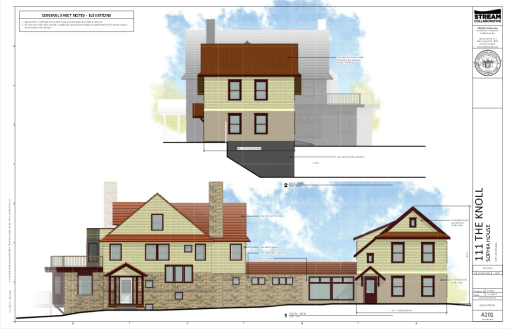
The city of Ithaca’s Planning Board memo is short as well, just the long-brewing plans for a garage-replacing addition to 115 The Knoll in Cornell Heights. The 1950s garage will be replaced with a 4-bed, 2-bath addition for Chesterton House, an all-male Christian interest group Sophia House, an all-female Christian group.  It appears the design has changed very little if at all since the plan first became public in May. The $349,900 addition, designed by STREAM Collaborative, would be built in the Spring and Summer of 2018 for an August opening. (Correction: Chesterton House is next door and owned by the same group. The project is for Sophia House. Thanks to Lyn for catching that.)

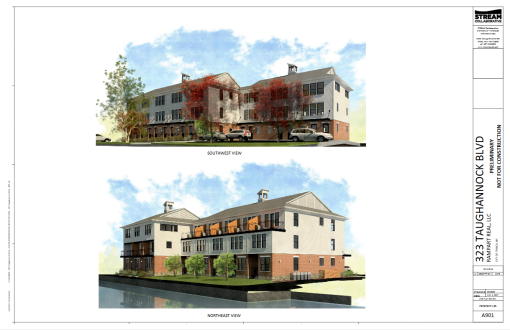
5. Local developers Steve Flash and Anne Chernish (d/b/a Rampart Real LLC) will be taking on a partner in the 323 Taughannock project. The couple sold a $203,000 stake in the 8-townhouse plan to Arnot Realty of Elmira (d/b/a 323T LLC) on the 22nd. For Flash and Chernish, it gives them a much bigger partner with experience and connections to contractors; for Arnot, it gives them a toehold in the buregoning Ithaca market, their first step into the city. The deed explicitly states this is a joint venture.

6. So this is interesting. On Friday 12/1, an LLC purchased an industrial/office building at 37-40 Elm Street in Dryden for $260,000. The property was built in the late 1980s and is about 25,000 SF, with a warehouse, manufacturing space, office space and three apartments.

The buyer was an LLC, but the LLC filing address traces back to 312 Fourth Street in Ithaca, a 13,800 SF complex of buildings and warehouses home to the All Stone & Tile Company, Ithaca Ice and Strawbridge & Jahn Construction. So either someone is growing out of space and the others are staying, or they are all moving. If they are all moving, that could be an opportunity. Zoning is B-4,  which allows a very wide variety of business and residential uses. Zoning is 4 floors/40 feet maximum height, 50% lot coverage, but being on the tip of the Waterfront/West End corridor, my suspicion is that the city could be a bit flexible with zoning variances for density and/or affordable housing. The only places one finds B-4 zones are the fringes of downtown, so it’s not well-suited for big projects, but there’s room to explore options. Of course, the electrical substation next door isn’t ideal, and the property isn’t even up for sale, but this is worth keeping an eye on.

7. So, there’s no real avoiding it this week – the tax bill in Congress. It really hurts Tompkins County. I did my one and only tweetstorm to cover some of the issues, and most of it still holds. Two last-minute changes softened the blow between then and now. One was the inclusion of the Collins amendment to reinstate a $10,000 cap on SALT (State and Local property tax) deductions, since the original Senate bill had no deduction. The other was raising the endowment from colleges with an endowment of $250,000/student, to those with $500,000/student. Cornell’s is about $310,000/student (6.8 billion/22,300 students). For the record, it wasn’t done to protect Cornell, it was done to protect conservative Hillsdale College after an amendment to give it an exclusive exemption failed. At least 30 schools were still hit, and this detail has to reconciled with the House Bill’s $250,000/student figure.

So apart from the SALT and college impacts I had already noted, one thing that got missed was that the bills allow prohibit schools from taxing out tax-exempt bonds to fund construction. For Cornell’s plan to add 2,000 beds, this is a problem.

So let’s just overview this real quick – a bond is a fixed-income investment in which an investor loans money to an entity, which borrows at a fixed or variable interest rate for a fixed period of time. When you buy a bond, you hold the debt for that entity. Most investors typically have some proportion of bonds in their portfolio – they typically are more stable investments than stocks, though the returns are typically less. Their relative safety is why financial planners recommend a higher proportion of bonds as one gets closer to retirement. The riskiness of a debtor not paying back is given by their bond rating. Cornell’s long-term debt rating is AA, which is very good, high-quality investment grade.

Now, in the case of non-profit schools, typically the tax-exempt bonds are issued with the approval of local and state authorities. The project to be financed by the bonds is determined by the school. The school does its internal approval of the project and bond plan, and the project it goes up to the community for planning board/environmental review. Once approved, the school chooses an approved issuer of bonds, often a state or local development authority (ex. The Dormitory Authority of NYS). A working group is put together to establish a timetable and structure for the bonds, and once the bond structure is settled and reviewed for issues, a public hearing is held on the bond issue, so that any issues or concerns are made clear before issuance. Barring no problems, the government signs off on the tax-exemption for the bond issue, a closing date is established and the bonds are marketed and sold, mostly to banks and big investment firms. The received funds are disbursed to pay for the project.

That’s getting taken away by this tax bill. That means any future bonds will be taxable, and have a much higher interest rate. Borrowing just became more expensive. A 30-year AA tax-exempt bond might be 2.76%, and a taxable bond 3.37%. That might seem a small difference, but a 2,000 bed project is on the order of $200 million (recall Maplewood is 872 beds and $80 million). So we’re talking millions of dollars more that Cornell will now have to pay to make those dorms happen. It opens up a distinct possibility that the project could be scaled back and/or delayed, which impacts the overall housing market. Probably the federal SALT tax cap is going to hurt much more.

Really, this bill was practically designed to decimate real and perceived enemies of politically conservative groups as much as it was designed to help billionaire donors and corporations. Poorly conceived, ignoring multiple non-partisan analyses and relying on overly optimistic projections, hastily put together and shoved through, blowing the debt trillions higher and immediately or eventually raising taxes on tens of millions. This is every cartoonish stereotype of Republicans amplified in one piece of legislation.

I don’t like to get political, but I’m a registered Republican, and have been my whole life. As a pragmatic never-Trump moderate, I joke that I’m a New York Republican and a Texas Democrat. When one writes about government red tape, the Cargill Mine, and Ithaca’s progressives attacking affordable housing, it tends to reaffirm beliefs.

But hell, this tax bill is throwing every principle out the window with this bill, causes a ton of damage to a place I care about, and with a morally deficient and unstable president at the helm, I can’t do it anymore. I mailed off the form today to become an independent. After this, I just can’t see myself voting Republican again, not for a long time.


Cayuga View Senior Living Construction Update, 11/2017

29 11 2017

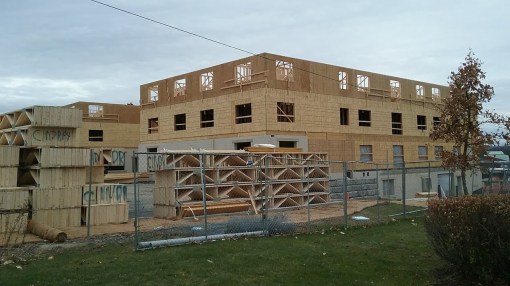
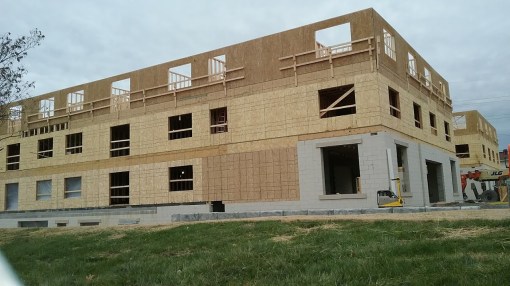
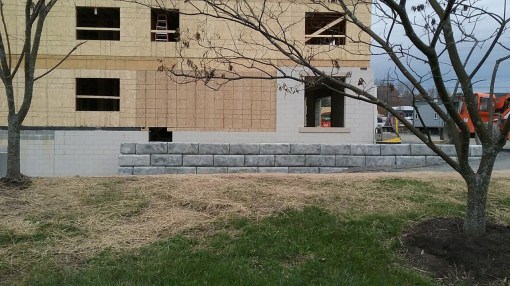
Framing for the new Cayuga View Senior Living building is one floor short of topping out. A stack of floor joists sits at the front of the construction site, as framing for the fourth floor continues. The last couple photos show how the joists are assembled between floors, typically attached to the exterior wall through joist hangers and braced with additional metal straps. Bracing has been temporarily built as the continuous plywood structural panel wall is nailed together. On the third floor they’ve started rough-ins (I see an industrial spool through the window, implying cables for electrical work), but the meat of the interior work is on the second, first and basement levels. A bit of housewrap has been applied to the rear face.

The commercial spaces are built out with masonry (CMU) walls, in contrast to the wood framing of the upper levels, and may be the result of fire code. The basement, also assembled with masonry blocks, will host utility space and some amenities. Decorative stonework provides aesthetic relief to the sloping site. Curbing has been extruded, and foundations for the light poles have been laid and wired. Not certain why there’s a moat at the rear of the building, although it may have something to do with underground utility lines.


Poet’s Landing Phase II Construction Update, 11/2017

26 11 2017

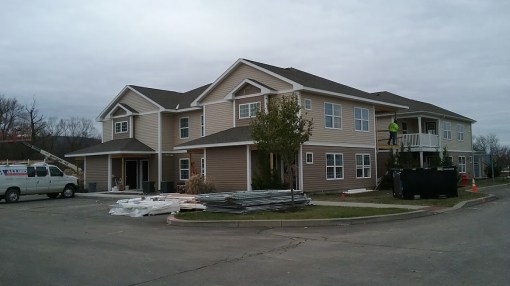
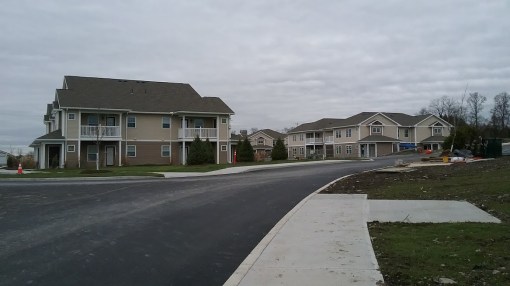
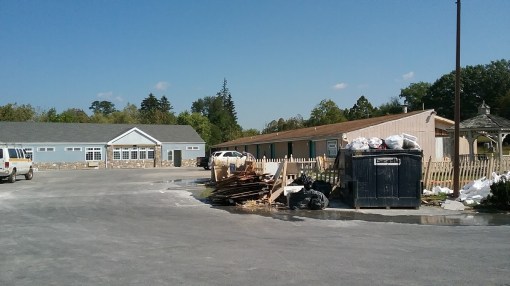
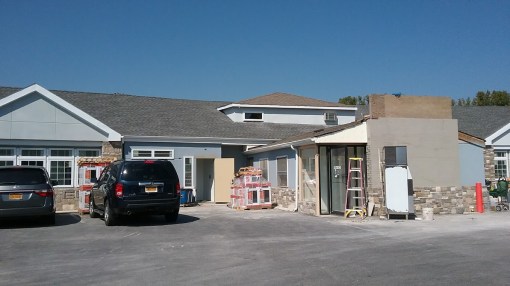
For this blog’s practical purposes, Poet’s Landing Phase II is complete. At least one of the six eight-unit buildings is occupied, but perhaps only one – a woman arrived while the photos were being taken and was moving chairs out of her car. To ward off the emails pointing out its an Audi – its a 15-year old Audi, and as my buy-American family of mechanics happily relay, older Audis depreciate like stones in a pond thanks to shoddy electrical systems and high repair costs.

Even the youngest buildings in the second phase have been completed from the outside, and appear to be undergoing finish work in the interior. The last of the sidewalks are being poured and much of the lawn has grown in. With the fire-damaged building in phase one, the rebuilt units are missing some of their trim boards and architectural details (railings/column covers), but are likely to be finished before the end of the year. The inquiry page for rentals is here.

The affordable housing is much welcomed given the county’s housing woes, although a location closer to the urban core would be preferable given proximity to jobs and services. At least the site is walkable to the village. Kudos to Conifer Realty and LeChase Construction. The ceremonial opening is November 29th.


News Tidbits 11/18/2017: Fears and Hopes for the Future

18 11 2017

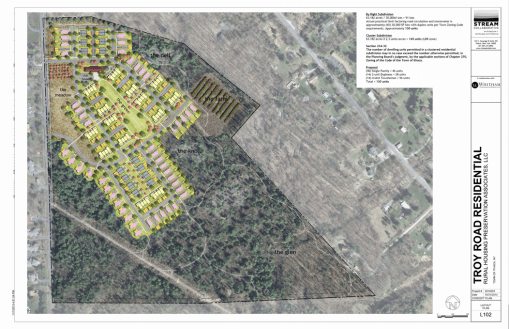
1. Here’s an interesting sale – a 62.1 acre parcel on Troy Road sold for $380,000 on the 13th, less than half the original asking price. The buyer, “Troy Heights LLC”, is registered to the same address as Giora and Limor Fix, a semi-retired husband and wife couple who have acquired a number of rental properties around the area over the past decade, with 43 or so units worth something in the ballpark of several million dollars (units are marketed by the Fixes under the name “Homes-for-you Rental Properties”).

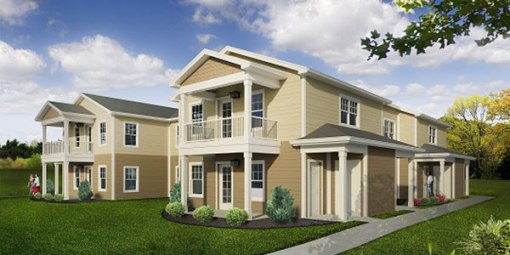
The Troy Road property is intriguing because there was a development proposal floated there a few years ago. Rural Housing Preservation Associates LLC had proposed a 130-unit combination of middle-market single family homes, townhouses and small apartment buildings for the site back in 2014; it started as 206 units, the town and neighbors complained it was too big, the project was whittled down to 130, and then the proposal was cancelled by September 2015. Using cluster zoning, the project could have built out 145 units in the low-density residential (LDR) zone, since the town’s cluster zoning allows 2.3 units/acre. STREAM was in charge of the project design, and some of the renders of the never-built apartments can be found here on their website.

So here is a log lot, bought by folks involved in local real estate and with significant assets, under the name “Troy Heights”, which sounds like a project title if anything. I reached out to Giora Fix, and he was kind enough to respond:

“[C]urrently we do not have any concrete plans to develop Troy Road. Once we have them I will be happy to share with you.”

So something to keep an eye on, though it might be a while.

2. Here’s a piece of news from the Times’ Nick Reynolds. With regards to the police consolidation debate, the city wants to have the headquarters downtown on Green Street (likely in that proposed centralized government facility floated for the Central Fire Station site), while the towns would prefer something near the current BPW on the north end of the Northside neighborhood, which offers easy access to Route 13. Consolidation is still a rather unlikely prospect at this time, and there’s little enthusiasm from the more rural parts of the county. But it sounds like the sheriff is keen on killing the city’s ideas before they take off.

3. Bad jobs month for the state, good for Ithaca. The Ithaca metro (Tompkins County) added 1,800 jobs (all private sector) from October 2016 to October 2017, bringing the total to 67,800. The 3.2% increase was the largest gain by percentage in the state over the time period. Unfortunately, the state as a whole lost 11,900 jobs last month, which falls even more to 14,600 jobs when taking away those added by the public sector (government jobs). A study from the Federal Reserve Bank last month notes that upstate economic growth in general has been losing steam over the past year, with exceptions for Ithaca and Albany. New York City is performing reasonably well.

While it’s well and good that Ithaca is doing well, I have concerns about the recent tax reform bill going through Congress. With the potential hit to SALT deductions and the taxation of graduate student tuition waivers, I could see significant negative impacts on the local economy. Given that most communities have property taxes in the range of $2500-$4000/$100,000, a cap of $10,000 as proposed by the House would hit many middle-class and upscale neighborhoods hard. A typical home in Ithaca city is worth about $230,000-$270,000 range at this point, and with about $3779 per $100,000 in property taxes, that means that homeowners with properties valued over $265,000 will take a financial hit, close to half of the homes sold. The Senate’s version removes the SALT deduction completely, affecting all local home buyers. Either case would be a severe blow to the home buying market.

Another concern is the taxation of graduate student tuition waivers as proposed by the House plan. Speaking from experience, I had a waiver that saved me about $14,000/year at the public university where I did my master’s. In my case, seeing that taxes would have cost an extra couple thousand in theory, though the doubling of the standard deduction might have limited its impact on me. A Cornell graduate student is looking at $20,800-$29,500, and could see a tax bill larger than any savings from the standard deduction increase. The Senate version does not tax tuition waivers. Another, lesser factor to consider is that the student loan interest deduction for borrowers on-time with their payments would be eliminated.

On a final note, Cornell’s endowment would be taxed an extra 1.4% under the House bill, as would any college whose endowment is worth more than $250,000 per full-time student. Cornell’s endowment is $6.8 billion, and the school has 23,016 students across all campuses as of Fall 2017. That is over the allowed cap of $5.75 billion as calculated by the bill’s guidelines.

The long story short is that Cornell recruitment takes a hit, as does its endowment, and that could impact current employment as well as future hiring. Politics aside, these “reform” bills are definitely a cause for concern from Ithaca and Tompkins’ economic standpoint.

4. A separate note not so much economic, but something many Ithacans care about – the House bill takes away the historic building rehabilitation tax credit. The renovation of 310 West State Street that I reported in the Voice earlier this week would be off the table without them, and the building will likely be demolished if the credits are eliminated. So the impacts aren’t just economic, but perhaps aesthetic as well.

5. This is looking to be a very quiet late November. For the first time in over a year, the town of Ithaca has cancelled two planning board meetings in a row. Meanwhile, in the city, the only “old business” reviews are final site plan approval for the 601 South Aurora duplex, and final approval for the Brindley Street Bridge replacement.

6. So technically, the Request for Proposals went out for the Green Street Garage site. A site tour for interested applicants is scheduled for December 4th, applications are due by January 23, 2018, and no timetable is given for the selection of the preferred developer. The applications are to include a cover letter, application form, description of project team members with relevant experience, proof of ability operate in NYS, good reputation, financial status, marketing plan, tenant management plan, conceptual designs, financing plan and demonstrated capacity to obtain financing, purchase price, project schedule, community impact benefits statement, schedule, and specific concerns (acknowledgement of site issues and plan to resolve them). A $500 application fee is also required.

Obviously, Ithaca Associates LLC has a huge leg up on the competition, since they not only have a plan fleshed out, they own the ground lease under the eastern end of the garage that everyone else would have to negotiate to obtain. About the only legitimate opening to another developer would be for the western and central portions of the garage, though the city’s requests make it such that anyone else interested had better be thinking big with housing, parking, and other site uses. Saying you’d leave things as-is would be an immediate disqualifier. Unless Fox or Lubin are dreaming up multi-story apartment buildings, it isn’t likely many developers will entertain this RFP. This really feels like it’s just the city stalling for time so they can fully absorb the immensity of the 365-unit, $118 million “Village on the Green” proposal.


News Tidbits 11/11/17: It’s Back

12 11 2017

1. One of the reasons for the lull in weekly round-ups has been the lack of smaller news items to fill it with. A few larger items made it into Voice articles, but there wasn’t much of a middle ground between “expand into article” and “not newsworthy”. I’m happy to take comments here about Voice articles, although the blog is intended to cover topics that may not be ready for a full write-up.

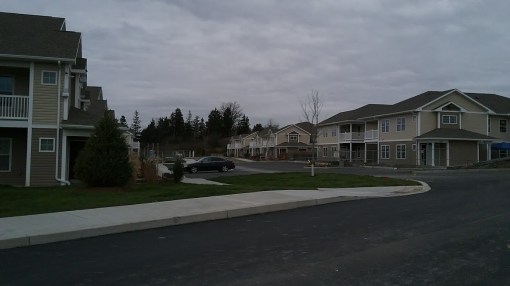
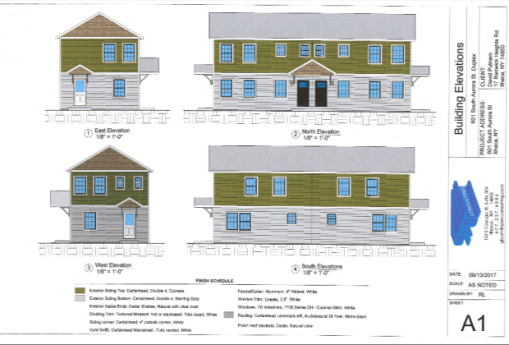
As noted in the Voice, there isn’t much before the city of Ithaca at the moment. A sketch plan for infill rental housing at 209 Hudson Street is likely dead in the water as a result of the new South Hill Overlay, and a modest infill plan calls for a duplex at 601 South Aurora on the corner with Hillview Place, which can only be an improvement from the informal parking lot currently there. The modular unit design is thoughtful (varied materials, plenty of windows) if unexciting, and the sidewalks are a plus. The units are physically structured as townhouses, but technically they aren’t, since townhouses are defined by International Building Code as strings of units of three or more.

Meanwhile, things are so slow in the town at the moment that they cancelled their last Planning Board meeting. Before that, the only notable item on the agenda was the Cayuga Ridge renovation, which is primarily internal. Their October Building and Codes Department report indicates a single two-family home was approved, in the Cleveland Estates housing subdivision; virtually all of those duplexes have been intended as student housing.

2. If there is one town that is rather busy next week, it would have to be Lansing. The surface facilities for the new Cargill mine shaft are up for final approval at the Planning Board meeting next Tuesday, more discussion is expected about the Milton Meadows affordable housing plan at the town center, and a couple of minor projects (communications tower, illuminated free-standing sign) are up for review and vote. Neither Cargill not Milton Meadows appear to have changed significantly since their last presentations.

Also scheduled is review of public comments regarding the Comprehensive Plan, which cover several topics, with the most frequent being the Bell Station zoning (park vs. lakeshore low density) and some individuals unhappy with the potential for mixed-use or residential development near their homes or farms. Joe Wetmore has a pretty thorough critique, ranging from unrealistic expectations to discomfort with what he calls “segregated housing” based on income and age. Going political for a moment, I suspect if it weren’t for many progressive town and village boards rushing to join the Article 78 on Cargill, with less than careful thought and discussion of Cargill’s blue-collar workers and their family/friends, Wetmore would be an incoming town councilman (and to be fair, he may end up winning when the absentee ballots are counted and tallied next week).

3. Over in Dryden, just about everything is good to go with Modern Living Rentals’ 42-unit rental complex planned for 802 Dryden Road, next to the Cornell arboretum. The November tweaks were for lighting, landscaping and sidewalk details. The designs of the townhouse strings were reworked in October to include three different designs, to be used twice each (six buildings, seven units each, 42 units/108 bedrooms total). While the materials remain the same, the designs differ substantially in roof lines, architectural detailing and fenestration pattern. At this point, no one would mistake for a recycling of 902 Dryden as they started off as; John Snyder and his team have had the chance to express themselves, and the designs are contemporary and visually interesting. It looks like final approval will be coming potentially soon, which will permit a Spring 2018 – Summer 2019 construction time-frame.

Other than that, the town is reviewing another Tiny Timbers subdivision, this one for 1540 Ellis Hollow Drive. Similar to its counterpart just down the street at 1624 Ellis Hollow Drive, the long, narrow lot would be serviced with an internal driveway for five homes with a little over an acre each, and the rear (northern) 5 acres would be granted a conservation easement, to remain natural space and help protect the Fall Creek watershed. The original plan was a deed restriction, but the town’s conservation board is pushing the easement so that future owners of the land can’t just lift the restriction. They also requested an S-shaped driveway because they feel the slope is greater than Dolph states; an S-shape would also throw the plans out of whack, so let’s see what happens.

On a final brief note, review and discussion is ongoing for a pair of solar arrays off of 2243 Dryden Road, one of 1.3 MW and one of 2 MW.

4. Looking at what’s on the market this week, here’s something for the deep-pocketed investor/landlord who wants to start with an all-new, low-maintenance building. 6-unit 707 East Seneca Street is on the market for $2,999,000. The 6,469 SF apartment building was built just two years ago, after developer Todd Fox bought city surplus land that was once a playground for the closed East Hill Elementary, deeded to the city in 1982 and promptly forgotten for decades until potential liability risks convinced the city to put it up for sale. Each unit is three bedrooms, and according to the advertisement, it generates over $220k in revenue each year, which is not shabby.The property is assessed at $1 million.

It’s a bit surprising that Fox would want to part with a nearly-new building with solid rental potential, and it makes me curious if the funds would be used to fund other Visum projects planned or approved. While Fox did take a financial hit from the cancelled 311 College Avenue project, the amount invested was far less than the sale price for 707 here.

5. Also worth noting, though it’s not good news – The Computing Center’s plans to build a new 4,600 SF headquarters appear to be over. The building site and the approved building plans at Lansing’s 987 Warren Road are up for sale. $499,000 gets you 1.57 acres, the plans, and a single-family home on the eastern end of the property that generates $2,000/month. The project had received an $85,084 tax abatement for the $1.394 million project, which was expected to create six new jobs. For the record, any buyer would need to re-apply for an abatement; the one granted will go unused. At least offhand, it looks like they may have added the jobs (retain 14, add 6, and the website shows nineteen plus the retired founder, and two job postings), but it’s uncertain – they acquired a competitor (Sherpa Technologies) in September, which increased staff to 22. Based off the time of the listing, with the acquisition of Sherpa they may have just led TCC to go a different direction with a new headquarters. What will be, will be.

6. According to construction loan documents filed with Tompkins County, the new 11,180 SF Rite Aid being built at 79 North Street carried with it a $2.71 million price tag. Chemung Canal Trust Company, an Elmira-based bank with branches in Tompkins County, is providing the loan to Dryden Group LLC/Ellicott Development. Ellicott, a major developer out in Buffalo, will be using an in-house contractor team to build out the retail space.

A couple of emails came in asking if this would be a Walgreen’s. On paper, that’s a no – everything filed and documented says Rite Aid, and this was confirmed with the town planning staff. However, Walgreen’s is in the process of acquiring 1,932 Rite Aid stores (leaving Rite Aid with 2,600), and closing several hundred stores that are within close proximity to existing Walgreen’s. It’s possible that the existing Dryden Rite Aid is one of those to be “shut down as part of the sale” as the new Rite Aid-turned-Walgreen’s is being built on the north end of the village. Keep an eye on it.

7. Quick little side note – Ithaca Associates LLC, the development team behind the $110 million Green Street Garage project, is apparently in talks with INHS to manage its affordable housing component. That’s according to Ithaca Urban Renewal Agency (IURA) meeting minutes. So they are serious about meeting the city’s demand for affordable housing with some undetermined percentage of the 365 units. Heck, 60 or 70 units would be a sizable contribution, should it pan out, and it would make the project more palatable since it would clearly have a mixed-income aspect to go with its mixed uses.

8. The Ithaca Landmarks Preservation Commission will be taking up discussion again on the Nines, though they are less than pleased with the recent 5-5 tie vote the Common Council had on the Chacona block, broken by the mayor’s vote against historic designation. For me, the fascinating part was having someone like Cynthia Brock, typically opposed to greater density, speak in favor, while pro-development councilors like Ducson Nguyen and Seph Murtagh voted in favor of historic designation. So, it was an unusual breakdown of votes that I would not have predicted, although I had heard before the meeting that it would likely be a close vote.

There is no doubt that anything Student Agencies submits will be scrutinized extra closely, especially if they try to maximize square footage or incorporate design features that don’t mesh with neighboring structures. It’s fair to say that while they lucked out with being allowed to redevelop, the resentment already stirred up means anything proposed will be starting behind the proverbial eight ball, and they would be wise to really put their best foot forward and not rush plans.

Interestingly, it looks like someone, likely but not confirmed to be the Reach Project social service group, plans to submit concept designs for the carriage house that once stood behind the house at 310 West State Street. This is a historic district, so any designs for the drug treatment and potential safe heroin injection “harm reduction” site would need to be approved by the ILPC.

It’s been amusing and a bit excruciating to see some of the comments on the Voice – some people are all about historic buildings; but it tortures them to see these venerable structures used for what they see as a less-enlightened cause than a high-end B&B or boutique office. If zoning laws (and higher authorities, in this case) okay it, so be it. Many historic buildings have humdrum or low-brow histories as factories, home businesses or tenements, and to say they can’t be used for something permitted just because it seems icky is not only illegal, it denies part of the historical element.

7. Intriguing, though I have questions – the city is looking at expanding the use of PUDs from beyond the few industrial zones to city-wide so long as properties are 2 acres. They’re also looking at expanding CIITAP to allow 1-story industrial and waterfront projects, as well as an affordable housing component of 20% on all residential or mixed-use projects with residential components of 10 units or more.

The PUD plan comes on the heels of the new Waterfront zones, which allow residential uses on a greater number of parcels, and is in fact the recommendation of the Waterfront Working Group (WWG), a 17-member group of staff and public who reviewed planned zoning changes to the Waterfront. The city planning staff are amenable, though they suggest a minimum acreage of 2 acres.

With the proposed CIITAP change, the reasoning makes sense, although its effectiveness is questionable. Industrial construction is locally limited and is usually build-to-suit for a specific client. There’s also a strong preference to less dense areas with easy access with lower land values, like Lansing or Dryden. More power to the city I guess, I just don’t see it being utilized. As for the housing component, the intent is good, but the issue always ends up being an issue of “moreness”. Developers often have to build bigger to re-balance expenses and revenue within mixed-income structures. This can make it tougher for them to get financing since it’s a larger, more costly build-out (a bigger financial risk, all other things being equal). Residents in turn balk at a bigger project with the traffic, aesthetic changes and other impacts it creates, not to mention some still instinctively sneer at affordable housing, mixed-income or not. It’s not an outright deal-breaker, but it is something to keep in mind.

The PUD can be troublesome since it’s a sort of “DIY zoning”, which would make existing rules pointless and a lot of upset voters if allowed without some big stipulations. 2 acres would limit many projects in the core of the city, but if you happen to be, say, a major landowner along the Waterfront or in the vicinity, like Guthrie or Cayuga Medical Center, it’s basically a red carpet invitation, as it allows them to set the bounds for a project. Notably, neither of those two fall within CIITAP’s boundaries, so while they wouldn’t be eligible for the tax abatement, they also don’t have to worry about the affordable housing component if they choose to do something with housing in the mix.


Cayuga Medical Associates Construction Update, 11/2017

8 11 2017

According the the federal Bureau of Labor Statistics, medical and educational services are the largest component of Ithaca’s economy, and among its fastest growing. While the colleges are growing incrementally, medical services have boomed as people live longer (up 5.2 years in Tompkins County from 1980-2014), and Baby Boomers’ need for medical services grows – Cayuga Medical Center has added several hundred jobs in the past decade alone.

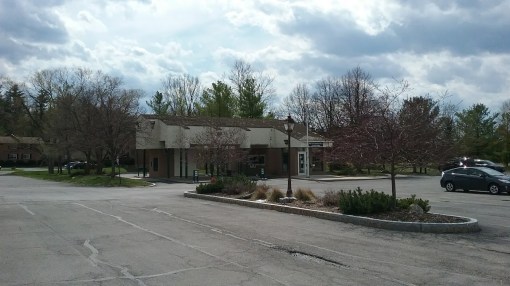
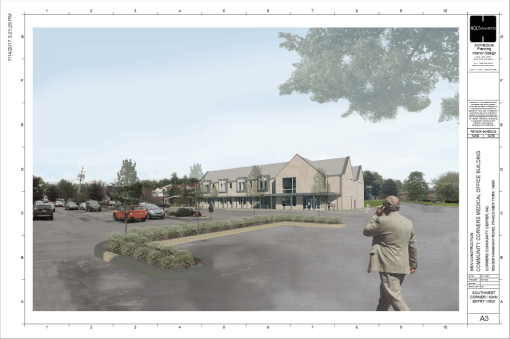
In March 2016, Cayuga Medical Associates, a for-profit business partnered with Cayuga Medical Center, announced plans to build an outpatient facility at Community Corners, an early-suburban style shopping and office center located at the five corners intersection of Cayuga Heights (the official project address is 903-909 Hanshaw Road). While the core of the plaza dates from the late 1940s, additions such as the Chemung Canal branch and the renovated Island Fitness gym branch have been built in the past several years. CMA had been looking for sites in northeast Tompkins County, and found that Community Corners was the best choice for their needs.

Initial plans called for a 3-story, 39,500 SF building designed by local architecture firm HOLT Architects, which has a well-known specialty in highly technical medical structures. the first floor would host cardiology and cardiac care services (later revised to neurological services), and internal care (prevention, diagnosis and treatment of adult diseases) on the second floor. The third floor was still rather speculative when first proposed. The building was expected to host about 72 staff and 400 patients per day. The project was going to be a bit of a slog – Cayuga Heights has what’s likely the most stringent planning board of any municipality in Tompkins, and the project would need variances for height, setbacks and lot coverage. Landscape architecture firm TWMLA’s Kim Michaels would represent owner Tim Ciaschi and the project team at meetings.

After a few months of back and forth, it became clear the the village was not going to be comfortable with the 3-story plan, and having no tenants locked down for the top floor, the scale of the project was decreased to 2 floors and 28,200 SF (23,200 SF lease-able space) in July 2016. Now only expecting 300 patients per day, the variances needed were generally more minor – while the height was contentious, a few percent over the maximum lot coverage isn’t as much of a concern. The village has eyed a denser, mixed-use Community Corners, if not necessarily the traffic and people that go with it; neighboring property owner Mark Mecenas has been mulling over plans for several years. The more modern-looking original design was replaced by one that better fit the plaza’s 1940s building, with gables and dormers.

Although concerns were raised over traffic, aesthetics, and those who felt Community Corners was the wrong place for a medical facility (they wanted street-level shops with condos above), the board was reasonably pleased with the changes, and after a few more months of SEQR review, the project was approved in November 2016. However, it was approved on the stipulation that parking demand mitigation measures be prepared and approved by the village first, as well as a customary submission of planned exterior finishes. Since parking had been underused at the rear of the site, only fifteen parking spaces are being added, for a total of 300, which brings it close to capacity (estimated daily use upon full occupancy was 262 spaces for the 3-story version). The submitted and approved parking plan allows for a small amount of overflow into neighboring lots, a partnership with the Gadabout bus service for seniors, talks with TCAT and a shower station for those who wish to bike to work. The parking plan was approved by the village back in August.

Along with the building, the project provides revised internal circulation with new driveways and sidewalks, landscaping, and stormwater facilities.  A one-story 1950s office building and a 1960s former Tompkins Trust bank branch were demolished to make room for the new building. The exterior will be faced with off-white brick and a grey brick header course, with a metal roof and aluminum windows. Current plans call for the building to open during summer 2018.

According to county filings, Chemung Canal Trust Company is providing the $7.8 million construction loan. McPherson Builders of Ithaca is the general contractor, which is offhand the largest project I can recall for which a local firm has served as GC. Along with HOLT Architects designing the building and TWMLA doing the landscaping, Ithaca’s T.G. Miller P.C. provided civil engineering and surveying work.

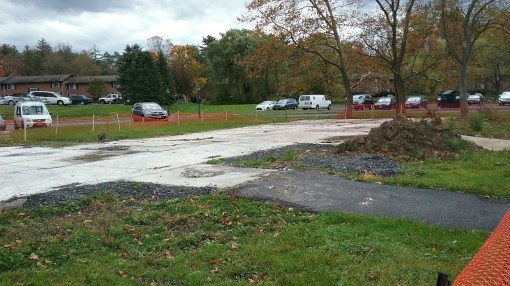
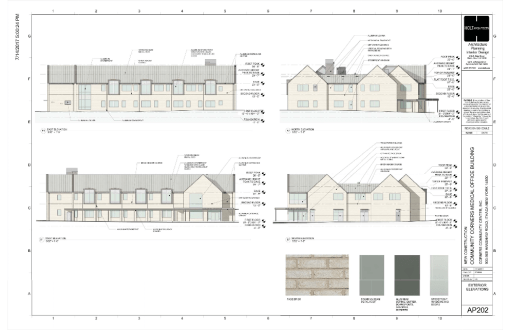
As of the end of October, demolition of existing structures has been mostly completed, with only the slab foundations remaining. The new building will also use a slab foundation, four feet thick according to the elevation drawing below.

Pre-development, April 16th 2017:

October 24th, 2017


August 2016 revision. The version approved in 2016 used fiber cement boards, later revised to brick.


Hilton Canopy Hotel Construction Update, 10/2017

31 10 2017

Tompkins County benefits from being a regional tourism destination. A combination of amenities like the colleges and wineries, scenic gorges and and convenient location have made it a popular weekend getaway from the big cities of the Northeast and Mid-Atlantic, as well as some of the major Great Lakes cities. In the past ten years, the hospitality and tourism sector of the economy has grown over 20 percent, adding several hundred jobs even after seasonality is taken into account. An additional benefit is that the room taxes are used to fund arts and culture grants, community festivals and part of TCAD, the economic development agency.

Representative of that growth has been the growth in the local hotel industry. Around 2014 or so, one of the big questions was, how many hotel rooms is too many? The Marriott was in the works, the Hilton was in an earlier stage, two hotels were planned on the Route 13 corridor, and the Hotel Ithaca had its plans. For practical purposes, it was a good question.

However, the situation evolved over time. As is often the case, the hotels opened later than anticipated. The 159-room Marriott finished late last fall, the 76-room Holiday Inn Express was completed a couple months earlier, the Hotel Ithaca went with an expansion that actually reduced the available number of rooms by ten and opened earlier this year, and one of the suburban hotels, a 37-room independent boutique hotel, was cancelled. They all came onto the market later than expected. and the number of rooms added was less than originally planned. All the while, the economy continued to grow at a consistent 1.5-2% annual pace, Cornell continued to add students and the population slowly grew. Had all the hotels opened at once with their original plans, the impact might have been a big problem. But the reality was that the Hotel Ithaca’s impact was modest, and the HIE’s and Marriott’s supply is being absorbed (though the market does need over a year to fully adjust to a 12.8% growth in supply). For the record, Airbnb and similar services have their impacts as well, but the county estimates it’s the equivalent of roughly 40-60 hotel rooms.

With the market still adjusting to the influx, it’s probably a good thing that the Canopy Hilton isn’t opening until Spring 2019, well after a new equilibrium is achieved. However, it’s been a long road to get to this point.

First, a brief history of the site. In recent years, the Hilton site was a mix of private and municipal parking. From 1916-1993, the Strand Theater occupied the site. The Carey Building was designed to match the Egyptian Revival motif of the theater, but unlike the Carey, the theater closed in the late 1970s, attempted and failed at a reopening as a community theater, and after being vacant for over a decade, the building was deemed too far gone to save, leveled by the wrecking ball during the deep recession of the 1990s.

The first mention of a hotel on the 300 Block of East State/MLK Jr. was back in December 2012. Lighthouse Hotels LLC (Neil Patel) proposed a six-story, $16 million Hampton Inn on the site (v1). The 92-room hotel, designed by Jagat Sharma, would have resulted in the demolition of the Carey Building – recall this was before the Carey overbuild.

However, Patel violated an important rule when it comes to development – unless you have made previous arrangements, don’t propose something for someone else’s property. The proposed Carey demo caught Frost Travis by surprise, and he and parking lot owner Joe Daley were less than amused. Nor were Planning Board members, who were fond of the Carey and not fond of the surface parking proposed with the hotel. The project went nowhere, and a major reworking was required. Negotiations with the city and neighbors were needed to acquire the necessary land, and the IURA and Common Council agreed to have the IURA represent the city on divestiture discussions.

Fast forward 18 months to June 2014. Having hired on Whitham Planning and Design to handle the review process on behalf of Lighthouse Hotels, a new six-story sketch plan was presented (v2). This plan did not impact the Carey (by then undergoing review for the overbuild), and opted for a more modern design by Boston’s Group One Partners Inc., which specializes in urban hotel plans. By August 2014, a site plan review request was formally submitted, along with a modestly revised design (v3) – at the time, the six-story, 120-room hotel was pegged at $11.5 million. These early plans also called for a 2,000 SF retail or restaurant space on the ground level. By this time, Patel was a vice president at Baywood Hotels, a national hotel developer and management firm with over $1 billion in assets, and regional offices in suburban Rochester. The firm is so large, they have 26 hotels currently under development from Miami to Minnesota, but that might be conservative. Their planned downtown Syracuse Hampton Inn isn’t even listed, and the render for the Hilton Canopy Ithaca is out of date.

Technically the phrasing is “Canopy by Hilton Ithaca”. It will be either Canopy or Canopy Hilton on the blog.

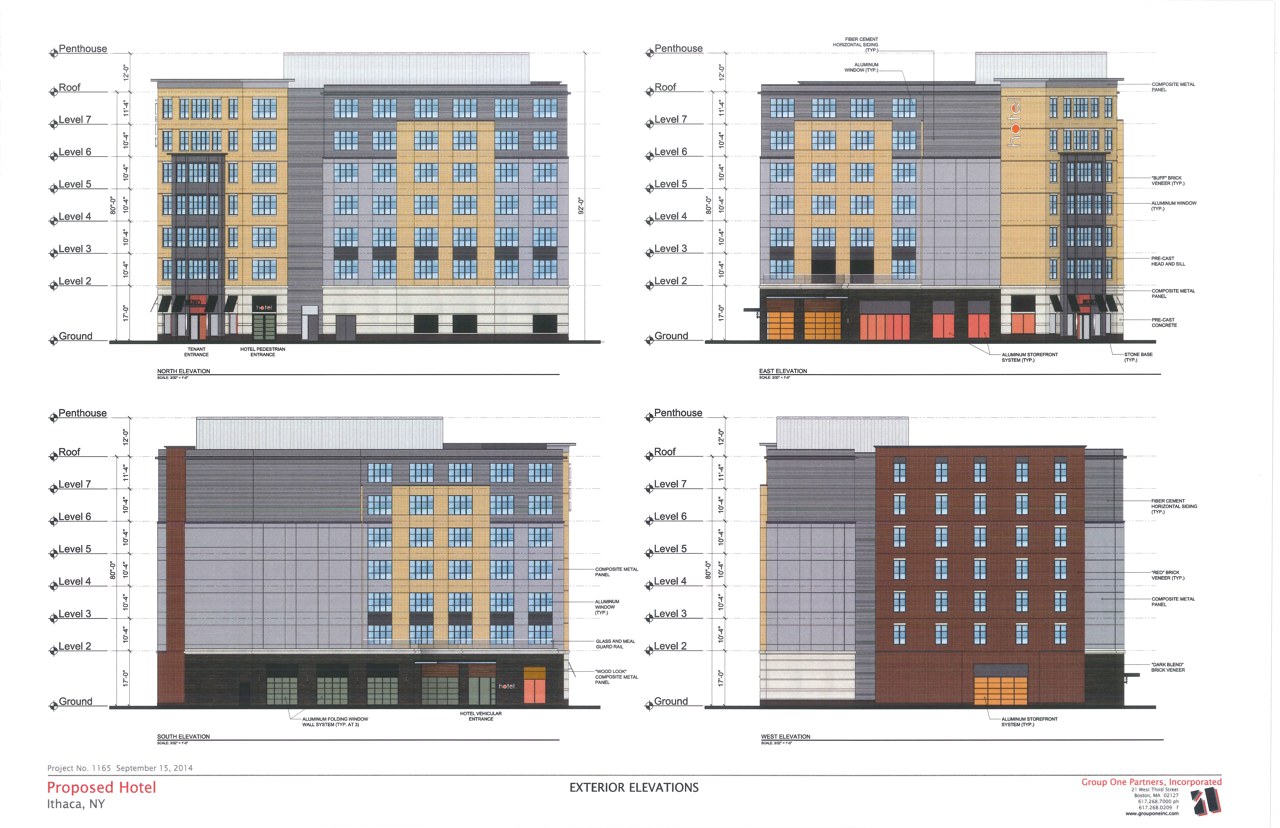
The Canopy brand was launched in October 2014 to be the lifestyle brand geared towards younger leisure travelers. Of the eleven locations announced at launch, Ithaca was the only one not in a major city, and is arguably the only one still not planned for a major city. A month earlier, the newest 74,475 SF, 123-room, 7-story design rolled out (v4), with industrial warehouse-style aluminum windows, buff and “dark blend” brick veneer, stone base with precast concrete accents, and grey fiber cement and metal panels carried over from the previous design. The second floor would open up onto a terrace overlooking the front of the hotel, and the first floor had folding windows that could open the lobby area to the outdoors on nice days. 

By January 2015, the designed had been tweaked some more (V7 in the link, but the changes were pretty minor from V5-V7, facade materials and window treatments), the cost had risen to $19 million, and LeChase Construction was signed on to be the general contractor. In fact, Patel and Frost Travis has even worked out a clever plan to share construction equipment as both their buildings were underway. However, Patel and Baywood’s schedule fell behind Travis’s, so the plan never panned out.

During this time, the project had applied for the IDA’s enhanced tax abatement, and underwent Common Council review after its public hearing in November 2014. While concerns were raised about not paying a living wage to all staff, the council decided the pros outweighed the cons and endorsed the project. Baywood planned to hire 33 to 47 staff, of whom 11-20 would make living wage (multiple sources with different figures). Room rates were expected to be $160/night.

According to the 2015 application, the project’s combined hard and soft costs were $24.17 million, and the property tax abatement (the enhanced 10-year abatement) was $3,528,081. Another $980,928 was waived in sales taxes, and $45,000 from the mortgage tax, for a total tax abatement of $4.55 million. About $3.28 million in new taxes will be generated on top of the existing taxes on the land, along with room taxes and payroll taxes. During the public hearing, attendees went after the project for union labor, living wage and sustainable energy concerns, but the project was still approved by the IDA. They might have switched over to heat pumps, I’ll need to check into that.

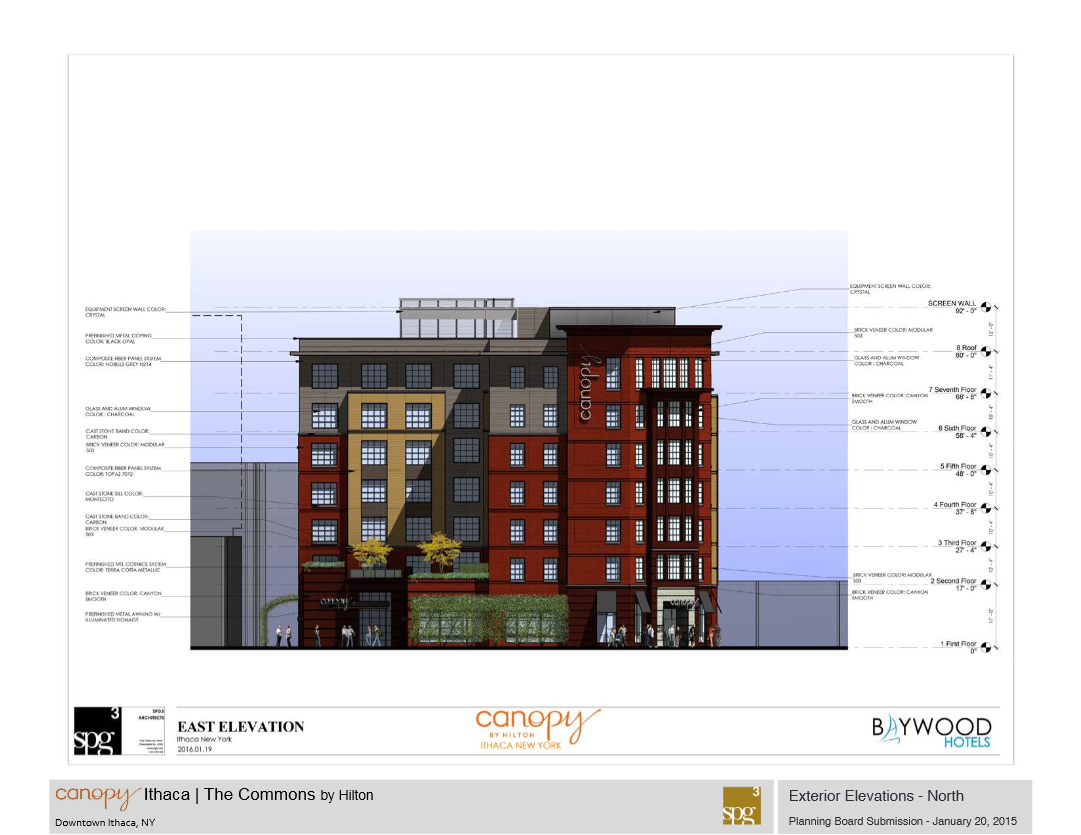
After the original project was approved in March 2015, the city voted to approve the sale of its land in April 2015, and the IDA approved a tax abatement in July 2015, the Hilton plan sat dormant for a while before undergoing a major redesign in January 2016 courtesy of Philadelphia’s spg3 Architects, now Bergmann Associates. It turned out the project had struggled to obtain financing due to rapidly rising construction costs, and underwent some “value engineering”. The general shape was kept the same, but the exterior materials were swapped, the building increased in size to 77,800 SF, the room total was brought up to 131, and the restaurant space was omitted, among other changes. This required re-approval by the city. The much longer comparison is here.

The very last version of the project, V9 in February 2016, added inset panels in the northwest wall, and some cast stone was added to the base. The second floor roof deck was tweaked, a cornice element was added to the mechanical screen, and the trellis and driveway pavers were revised.

The final form is faced with a few different shades of red brick veneer, topaz yellow and grey fiber cement panels, metal coping and cast stone trim. Floor height (ceiling of seventh floor) is 80 feet, while structural height (top of mechanical penthouse) is 92 feet. It’s not really a big impact on the downtown skyline, but it broadens the city’s shoulders a bit.

After approval and IDA approval, things were slow to start. Ithaca Downtown Associates LLC, representing the Patel family, was reorganized slightly to include other family members in the ownership, and afterward it purchased the properties for the hotel project in August 2916. $1.8 million went to the IURA for the parking lots at 320-324 East State Street, and $2.05 million to local landlord Joe Daley for the parking lots on the former Strand property at 310-312 East State Street. A $19.5 million construction loan from ESL Federal Credit Union (formerly Eastman Saving and Loan of Rochester) was received at the end of September 2016, but things were stalled for a while, and only now is the project on its way to a Spring 2019 opening, two and a half years later than initially planned. William H. Lane Inc. of Binghamton will be the general contractor.

Long story, but at least someone wrote it up. Goes to show that property development can be a very complicated process.

It looks like foundation excavation is currently underway – I had head many of the underground utility work was taken care of when the Carey was under construction next door. A plausible schedule has foundation work done by the end of winter, with structural steel framing underway during the spring and summer.

October 15th:

October 28th:


News Tidbits 10/7/17: Opportunities Come and Go

7 10 2017

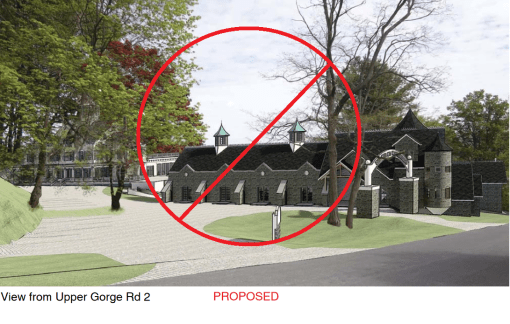
1. The Inn at Taughannock expansion is no longer. The project, which called for a 2-story addition containing dining facilities, five guest rooms and facilities to support a 200-person capacity event center, was opposed by neighbors in Ulysses for being too large, the potential for noise, traffic, and for being out of character with the area. The strong disapproval played a big role in the town of Ulysses Zoning Board of Appeals’ decision to reject two of three building variances sought for the project, the exception being a cupola on the existing building. The board also permitted four of the six proposed signs.

With denials noted, the plan at this point is mostly landscaping – clean fill (soil) to level out the south lawn for gatherings, construction of a stone fence wall and retaining wall, re-configuring a stairway and patio area, lawn seeding and stormwater facilities.

2. One door is closed, another potentially opens. For sale, a trio of parcels – 526 West Seneca Street, 528 West Seneca Street, and 209 North Meadow Street – are up for sale on the city’s West End. The listing from Pyramid Brokerage’s August Monkemeyer is short and to the point:

“Rare opportunity on prime signalized intersection in Ithaca’s commercial corridor. Corner location with excellent exposure, road frontage and heavy traffic 32,000 plus ADDT. Redevelopment site for multiple commercial uses.”

For the record, ADDT is a typo. It’s AADT – “Average Annual Daily Traffic”. The brochure is a little more in-depth, and says 39,000 AADT. The listing price for the collection is $1.5 million.

528 West Seneca is a recently renovated early 1900s 4-unit apartment house purchased by current owner Shawn Gillespie in 2003 and it has an assessed value of $200,000. 528 West Seneca is an early 1900s house converted into an office building. It was renovated in the 2000s, purchased by Gillespie in 2012 and is assessed at $220,000. 209 North Meadow, an 1880s single-family home, has seen better days. It was co-purchased by Gillespie in 2015 and is assessed at $50,000 due to its poor condition. All of the buildings are designed in the older vernacular style common to the Ithaca area (“urban farmhouses”), so they’re old, but the designs were cookie cutter for their time, and their overall historic value is limited.

Zoning is a mixed bag. The two with frontage on Meadow are WEDZ-1b, while 526 West Seneca is R-3b. R-3b allows 4-story buildings with up to 40% lot coverage, has parking requirements that vary depending on the type of residence, and is geared towards small apartment buildings. WEDZ-1b is one of the city rarer codes, general retail and office uses that allows 100% lot coverage on parcel with less than 50 feet frontage (209 Meadow in this case), and 90% otherwise. However, the maximum floor height is only two floors, and one story buildings have to have pitched roofs. Unlike its WEDZ-1a counterpart across the street, parking is required. Looking at the code, it seems like a recipe for suburban box retail in the heart of the West End, with the R-3b a possible site for additional parking. That doesn’t seem to mesh with the urban mixed-use direction the city’s been moving towards. Should it sell, and it looks noteworthy, there will be a follow-up.

3. The construction loan for Nick Stavropoulos’ 107 South Albany Street project has been filed. Tompkins Trust will be able to watch their latest loan agreement from just a few blocks away. The total loan amount is $1,110,346.75. A small local company, Northeast Renovation Inc., will be the general contractor for the 11-unit apartment building.

Subcontractors on file include Frank Belentsof of Bestway Lumber (Excavation), Brian Kehoe of Kehoe’s Concrete Concepts for foundation work, Albanese Plumbing LLC for plumbing/HVAC/sprinklers, Weydman Electric, Goodale Sprayfoam for insulation, Joe Alpert of Drywall Interiors for sheetrock hanging. Fabbroni Engineers is doing the structural engineering in partnership with architect Daniel R. Hirtler.
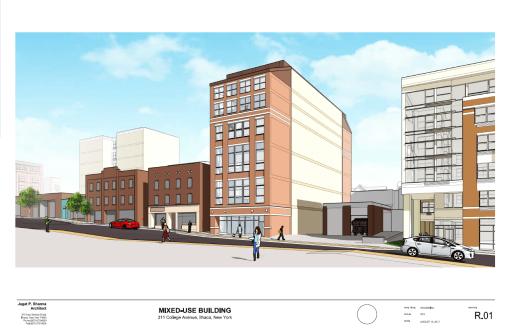
4. The city of Ithaca Planning and Development Board was less than enthused about 311 College Avenue, aka Visum Development’s mixed-use Nines replacement. From the sound of it, the board’s John Schroeder was liable to go apoplectic. At the least, it seems the board wants a feasibility study for the cost of moving the firehouse-turned-restaurant to another site. From a design perspective, the board would like for either the design to pay homage to the Nines, or to reuse some of its building materials.

In contrast, it was fairly smooth sailing for the other projects under review. The duplex at 217 Columbia and Lakeview’s 60-unit supportive/affordable housing project were approved, and INHS’s 13-unit affordable housing proposal for the 200 Block of Elm Street progressed despite West Hill neighborhood opposition.

5. To touch on that topic a little more, the Times’ Nick Reynolds did an in-depth piece looking at the “crisis point” in Collegetown. It’s worth a read. I don’t agree with some of the insinuations (Student Agencies’ renovation of ca. 1985 409 College Avenue is not an aesthetic threat to the block), but it’s worth a read.

The document that Schroeder and Tomlan wrote of buildings they wanted preserved was uploaded as a PDF, but it is no longer online. The only copy of the list is from this blog, in a post eight years ago, and an article from the June 16, 2009 Ithaca Journal. The list and the response highlighted in the Journal shows there was a real disconnection, and I doubt most readers agreed completely with either Tomlan or the property owners. Since the PDF was published and reviewed by city staff and board appointees, two of 31 structures, the Snaith House (140 College) and Grandview House (209 College), were historically designated, and rightfully so, as exemplary architecture of their period. The Larkin was just designated as well, and the Chacona Block (Student Agencies) will be before the end of the year. Both of them are attractive older structures that provide a positive aesthetic complement to the neighborhood.

The Palms dive bar was not high design or even mediocre design, nor was it much of a desired neighborhood attribute, at least to permanent residents; nostalgic perhaps, but not historic. Pushing a structure on nostalgia alone will likely not clear the Planning Committee, as Steve Smith and Cynthia Brock nearly demonstrated with the Larkin Building. Mary Tomlan wanted to preserve a bar when the owner wanted to retire and sell it to whoever would give him the most. Sounds familiar.

However, the difference between the Palms and the Nines is that the Nines has a more substantial history, the structure has historic significance as the original home of Fire Station No .9. With its outdoor patio, it adds an aesthetic quality by being setback from the street yet maintaining active use frontage. That is not economically feasible in Collegetown and hasn’t been for decades, but it made sense for a fire station that served the community for generations. If there’s a balance between giving way to the new and preserving the old, the Nines and Palms fall on different sides.

The Times article references a “stopgap” measure that is basically an indefinite moratorium. That’s not the answer either. Most Collegetown structures offer little historic value. The Nines is a rare case otherwise. Without protective regulations, it was always a potential development target. Or rather, it was more like a landmine waiting to be triggered.
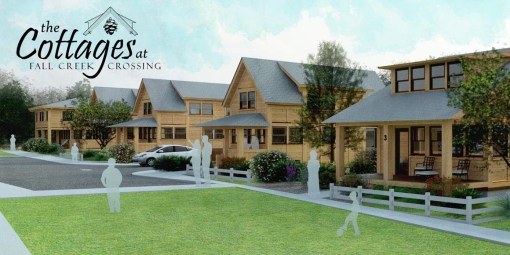
6. Courtesy of STREAM Collaborative’s biannual newsletter, the Varna Tiny Timbers project has a name and website. “The Cottages at Fall Creek Crossing”, as the 15-unit single-family development will be known, has website at http://www.cottagesatfallcreek.com. It’s bare bones at the moment and the lots have not yet begun marketing and sales. The pocket neighborhood of for-sale 2-bedroom and 3-bedroom homes will be built on the corner of Freese and Dryden Roads, the potential walkable, mixed-use center of the hamlet should a traditionally-designed Varna ever come to fruition. According to the newsletter, STREAM collaborated with Tiny Timber owner Buzz Dolph on the branding, logo and website, as well as on the design of the buildings and landscape.

7. It pains me a bit to admit this, but the Times is killing it in local meeting coverage. Even worse, the Voice has been short-staffed this week due to illness. At the Common Council meeting last night, members voted to give the IURA the necessary permission to handle the Green Street redevelopment project, including the RFP and submission review, sales terms and environmental review. Vicki Taylor Brous, public relations representative for developer Dave Lubin and his Harold’s Square project next door, spoke against the plans and said the project may be illegal, but until proven as such, review and discussion of the Ithaca Associates plan and any other submissions will move forward.

On another note, landmarking of the Larkin Building at 403 College Avenue was approved 8-2, with Cynthia Brock (D-1st) and Steve Smith (D-4th) opposed. Also, in what can only help Lansing Republicans, the city voted to join in on the Article 78 to halt the Cargill project until an Environment Impact Statement is conducted. The DEC deemed it unncecessary, and the lawsuit argues Cargill got special treatment. The dicey part is that a long, expensive study puts 200 blue-collar jobs at risk, and the debate has become a successful rallying cry for local conservatives.

I’m not a political consultant, but I think if outspoken Legislator Mike Sigler (R-Lansing) loses next month, it’ll be because of the national environment and the ability of progressive groups to tap into that at the local level. And if he wins, it’ll be because he channeled and won over the blue-collar Cargill households and their supporters who feel overlooked or kicked around in this debate.
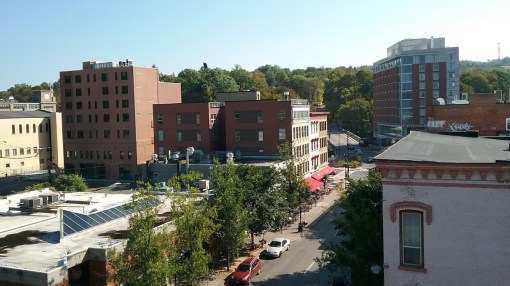
8. One of the the perks of development – the latest Ithaca city budget calls for no tax increase for the 95% of homeowners whose assessment did not go up this year (not because of the market, but because the assessment office cycles through different parts of the county on 2-3 year intervals). The city will bring in an extra $621,508 (2.8%) through property taxes, mostly from new development “closing” on assessments as they’re completed and occupied. From 2012 to 2016, the budget increased 5.2%, while taxes, notoriously high thanks to the large percentage of tax-exempt property, fell 1%. In his budget presentation (copy on the Times webpage here), Myrick stated that without the $131 million in development since 2011, taxes would be 6.9% higher.

One thing that is not made clear in the article is that Collegetown Terrace, one of those big contributors, doesn’t have a tax abatement or PILOT. That’s taxed at 100% value. According to assessor Jay Franklin, assessments for a given year are calculated for the state of a property on March 1st, and in Terrace’s case, Building 7 wasn’t finished. Now that it is, it can be assessed at full value for 2018, which will be an additional $20-$25 million in taxable property (using $22.5 million, it equates to $270,900 in city taxes, given $12.04 per $1,000 assessed).

That might be the biggest addition, but other recent completions are not inconsequential. Back of the envelope estimates here, but when the Breazzano Center and INHS 210 Hancock PILOTs first show up in 2018, they will generate an additional $52,000. Even with its abatement, the Hotel Ithaca will add about $21,600 in year one if its $15 million price tag is close to assessment, and that will increase to $216,000/year after seven years (the downtown Business Improvement District tax rate is $14.40/$1,000). Several other recently-completed downtown projects will also pay more as their abatements taper towards full property value. For example, just the 10% increase for the Marriott in 2018 equates to about $29,000. Smaller projects like 607 South Aurora, 1001 North Aurora, 602 West State, 215-221 West Spencer and 123-129 Elmira stand to add another $70,000 or so in tax revenue. So all these projects not only make a dent in the housing deficit or provide jobs, they also provide a buffer to challenging times with declining state assistance. While development does increase demand for services, projects that are close to municipal services and able to easily tap into existing infrastructure generally provide a net positive financial benefit to the community.

Meanwhile, the town of Ithaca is looking at a miniscule tax increase this year of 0.21 percent (1.57 cents per $1,000), and will benefit from the Maplewood project, which at $80 million and $6.66/1,000, will pay in the ballpark of $532,000 towards the town, its highway department and the inter-municipal fire department (the city also gets a small share, only 1-2%).

9. A couple of sales of note. A 28.07 parcel of land along Oakcrest Road in Lansing, which was touted for potential suburban housing development, was sold for $610,000 to a well-known Cornell professor and his wife. The price was a little over 90% of ask, not bad for land. From a close mutual friend, real estate development is not one of the buyer’s interests. So, less likely to be a development, but maybe a grand estate.

Meanwhile, south of the Shannon Park development, and on the southern edge of the image above, an LLC paid $480,000, slightly below assessment, for 731 Cayuga Heights Road, a well-maintained 1820 farmhouse on 12.55 acres. The LLC’s address is the same as the Pyramid Companies, owners (or recent sellers?) of the Shoppes at Ithaca Mall, which the land abuts to its east. Something to keep an eye on, for sure.


10. Looking like a slow week and month ahead. The city of Ithaca Landmarks Preservation Commission is reviewing a roofing project. Nothing new in the city project’s memo, though some supplemental documents were added for Bridges Cornell Heights’ 16-bedroom mansion proposed at 105 Dearborn Place. It and INHS’s 203-209 Elm Street plan are up for final approval at the end of the month, potentially leaving no projects for review before the city (311 College will be discussed, but not reviewed this month, and its future progress is uncertain). The town’s planning board meeting was cancelled.



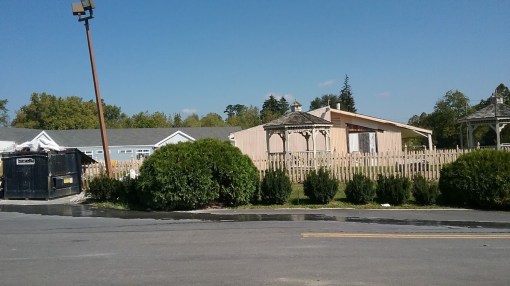
Rodeway Inn Construction Update, 9/2017

3 10 2017

The synopsis of the project can be found here.

This was one of the more interesting visits because I ran into the owner, Pratik Ahir of JAMNA Hospitality Inc., while taking photos. Granted, there’s often that uncomfortable initial tension of “who’s taking photos of my property and why”, but I’ve been in touch with him through email before, so once I introduced myself the mood was much friendlier.

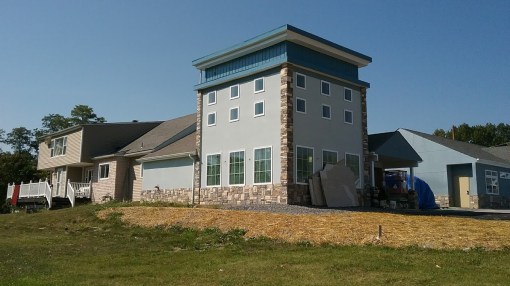
From what Ahir told me, this project could serve as a textbook example of the perils of renovating older buildings. One of the big reasons for the change in project scope was that one wings’ exterior walls partially collapsed during the initial work. So trying to make lemonade from lemons, Ahir decided to revise the project from additions to existing wings, to constructing brand new motel wings. This change also doubled the project cost.

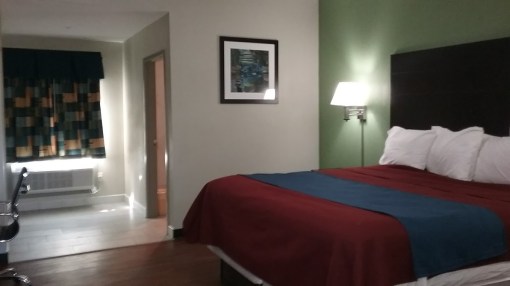
The motel should be fully open for occupancy around October 20th. The rooms appears to be no-frills but comfortable and tastefully appointed for travelers, and given Tompkins County’s premium on hotel room rates, a clean, economical option is welcome. The interior architecture is pleasant enough, while the exterior…I wouldn’t say it looks bad, but it is something of a hodge-podge of architectural features that aren’t ugly, but don’t quite mesh.

Ahir says he has plans to put his 70-room Sleep Inn project out for bid to a couple of preferred contractors, and hopes to start that project in the next few months. His partnership is with Choice Hotels (Rodeway is their economy motel unit), and he identified a market need for a new lower-middle segment hotel in the area, and Sleep Inn seemed like a good fit. Choice Hotels agreed, and the only Sleep Inn between Albany and Buffalo was green-lighted by the corporate parent.

We also touched on the presence of a couple other chain hotel specialist firms buying into or looking to buy into the Ithaca area. The temptation is there, and some, like Rudra Hotels/Rosewood Management, who did the Holiday Inn Express at 371 Elmira Road earlier this year, have established their footprint. Others are still figuring out their next step. On a related note, a number of smaller regional banks see Ithaca as a safer investment than other regional cities thanks to its economic stability, and this interest may result in a little more financing available for project developers over the next few years. Ahir says financing has been arranged for the Sleep Inn.