The Lux (232-236 Dryden Road) Construction Update, 4/2018

3 05 2018

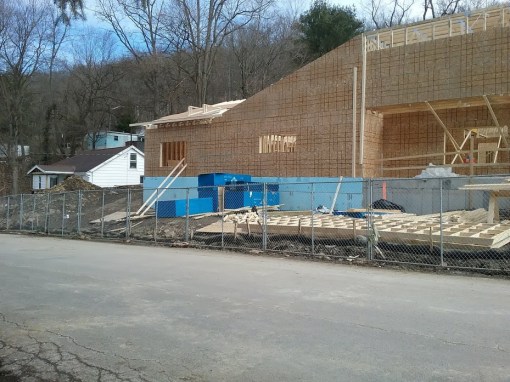
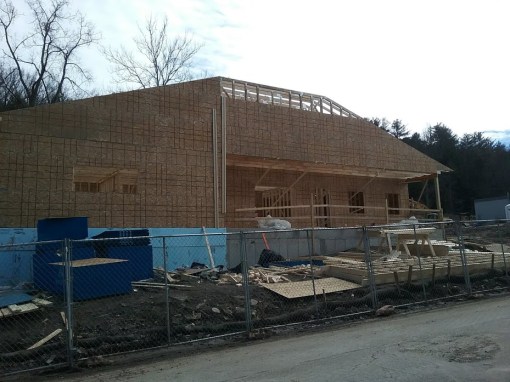
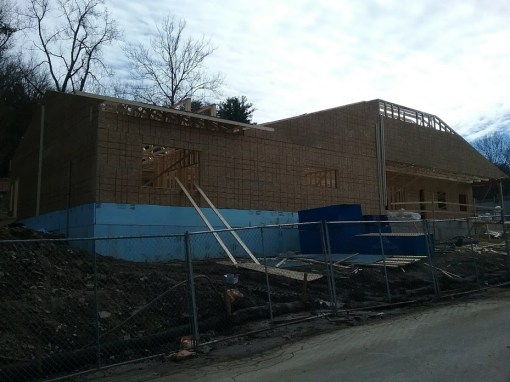
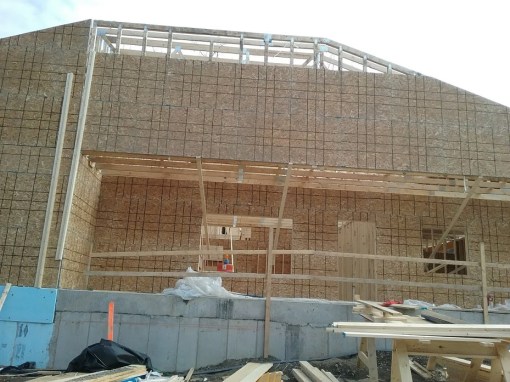
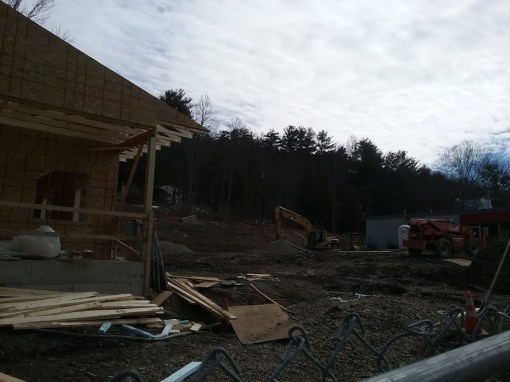
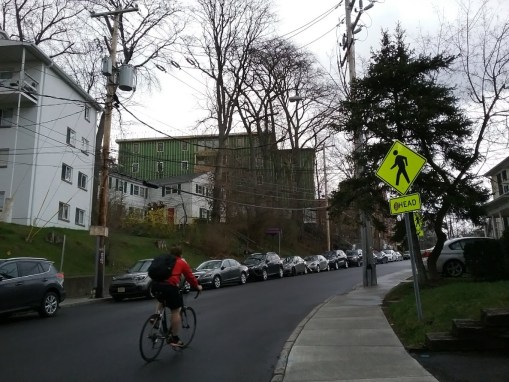
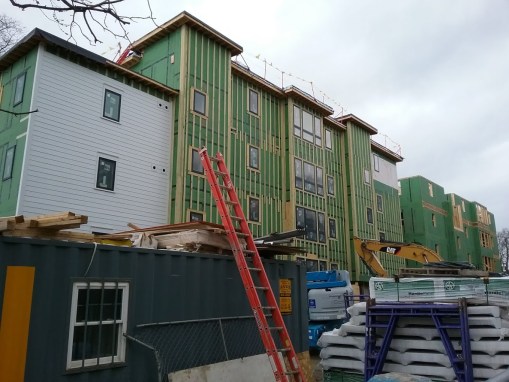
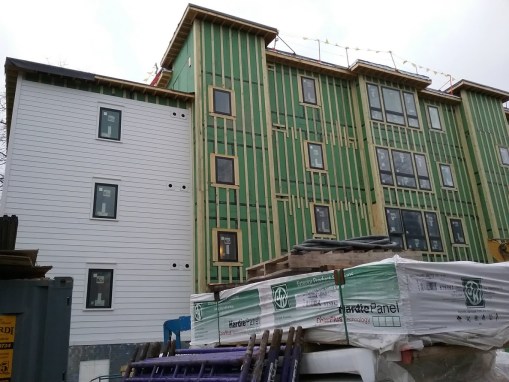
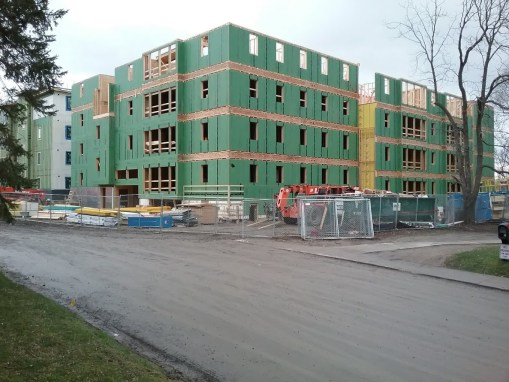
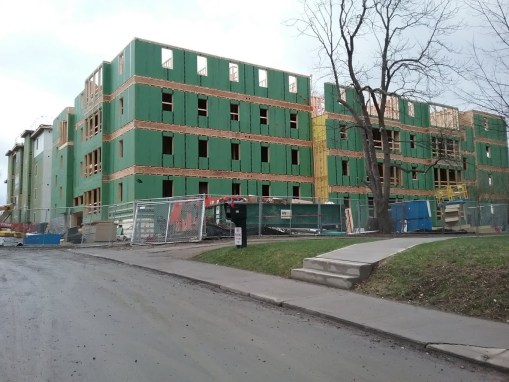
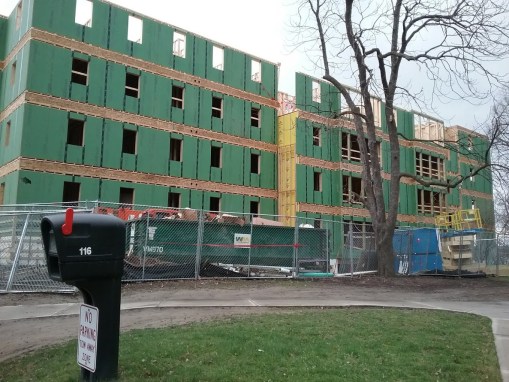
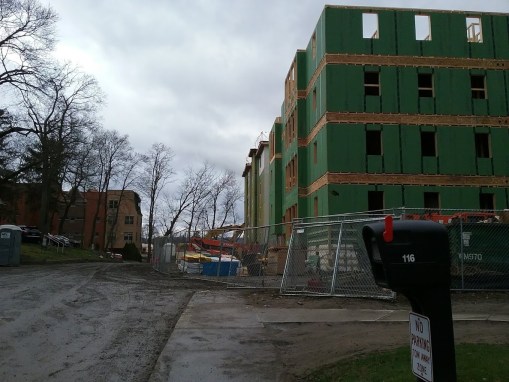
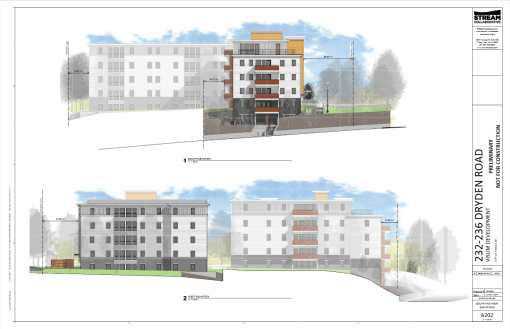
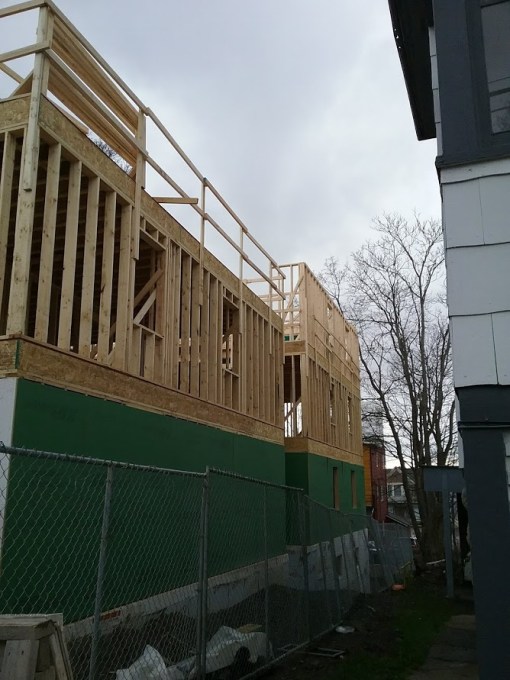
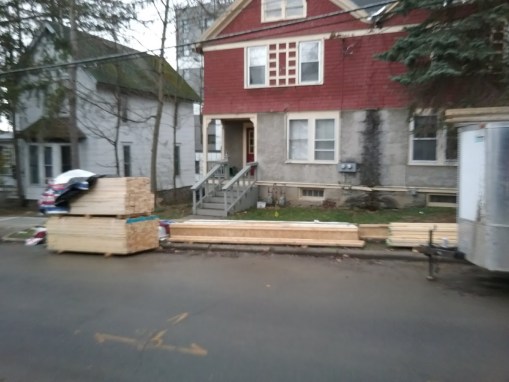
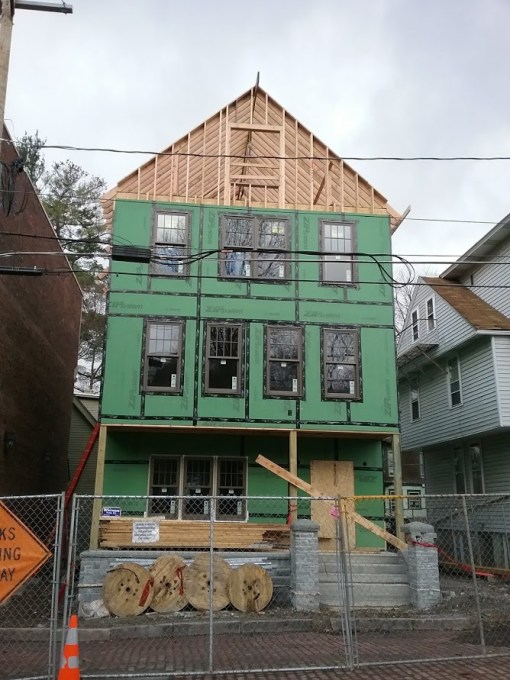
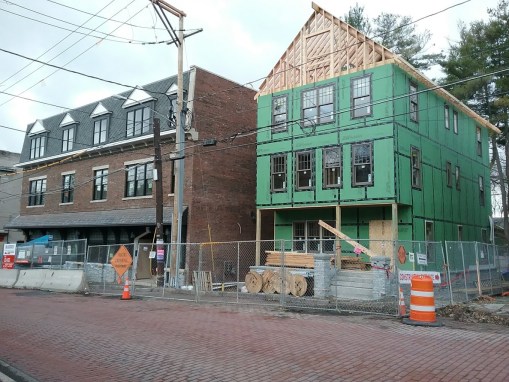
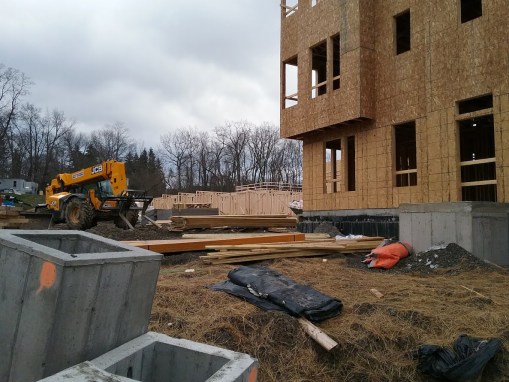
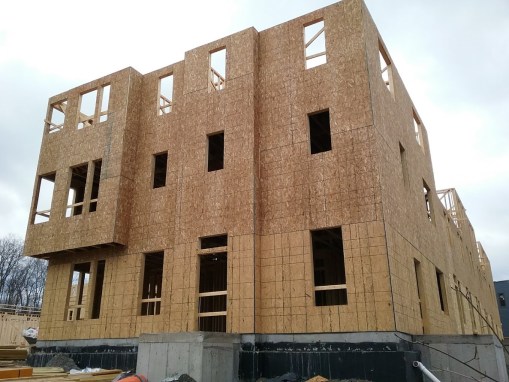
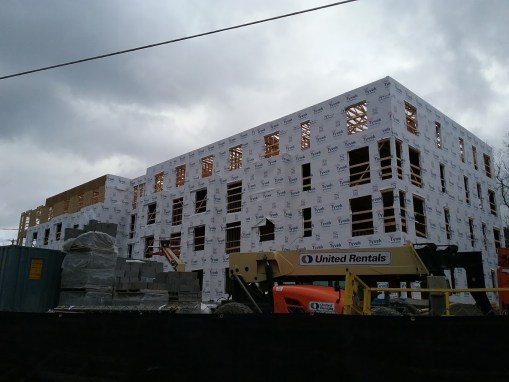
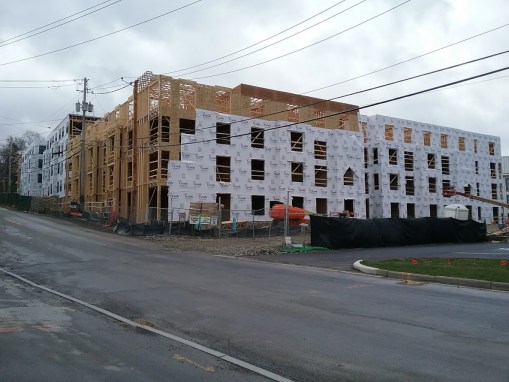
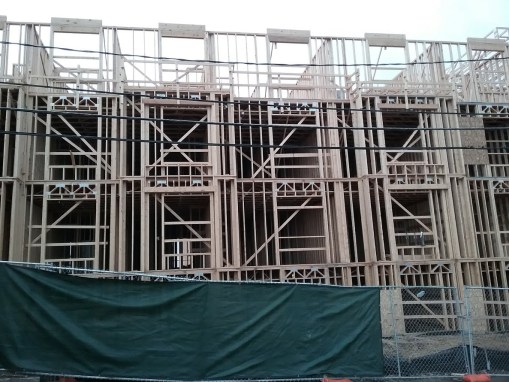
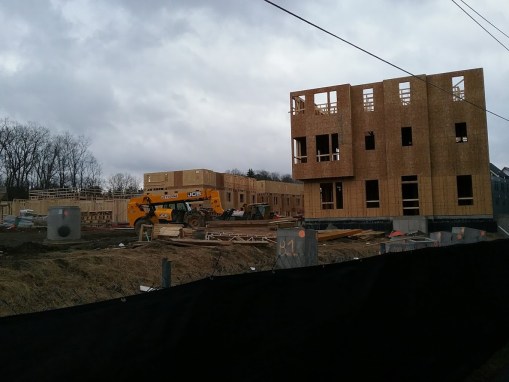
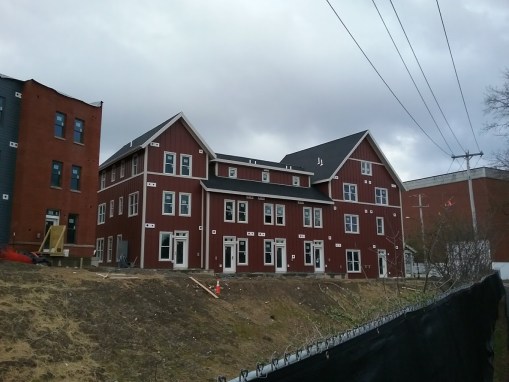
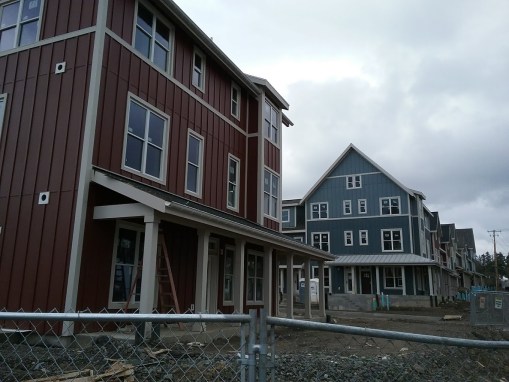
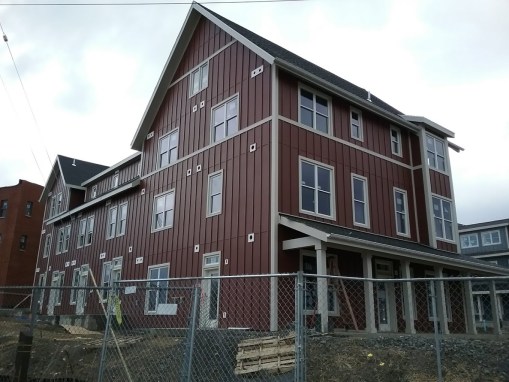
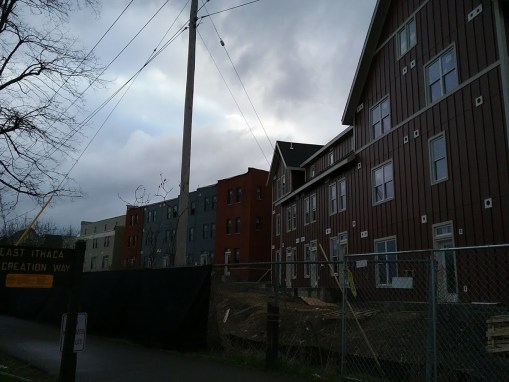
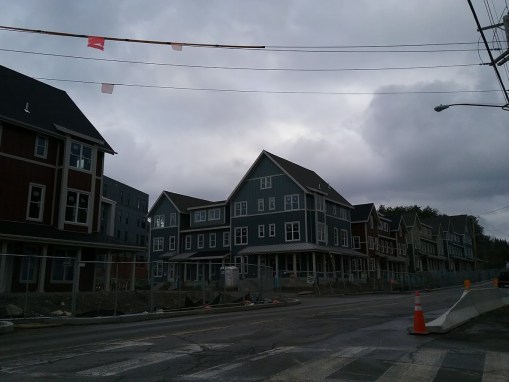
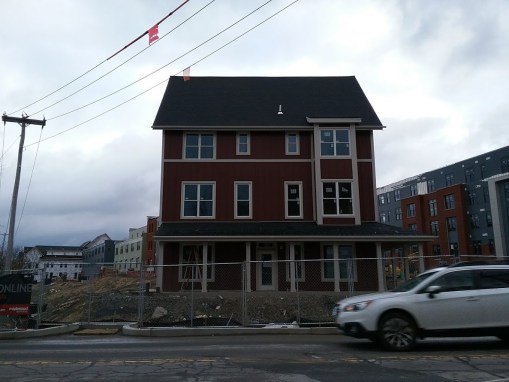
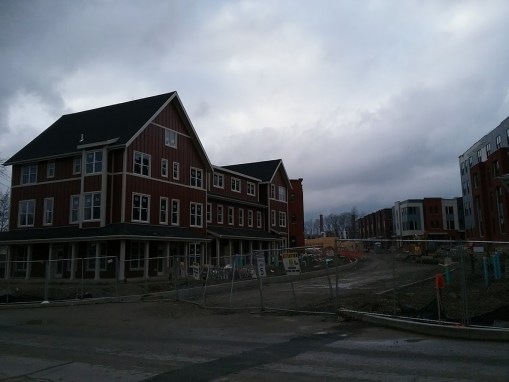
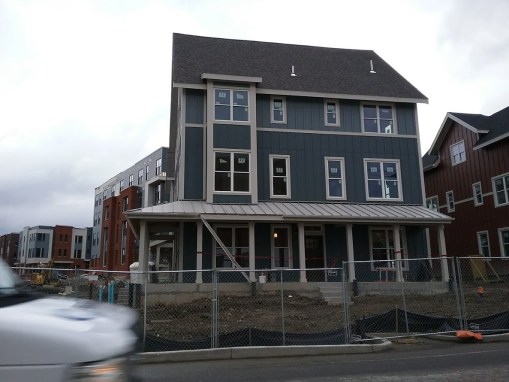
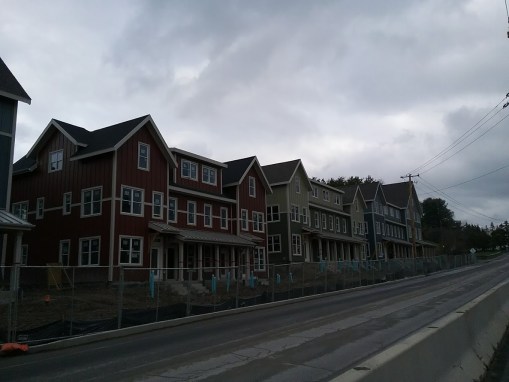
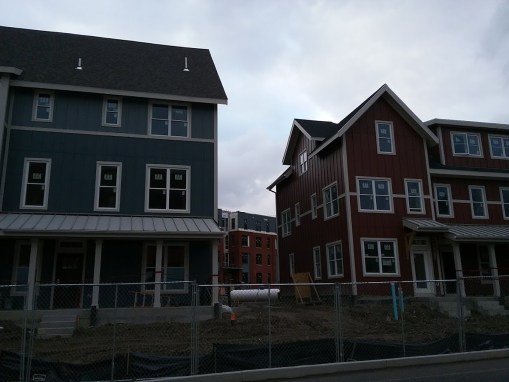
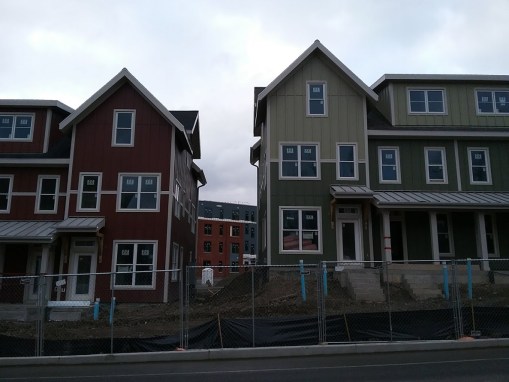
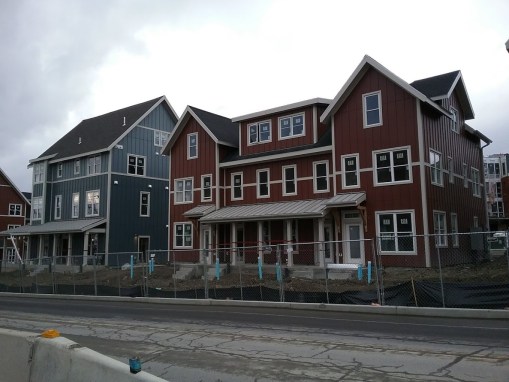
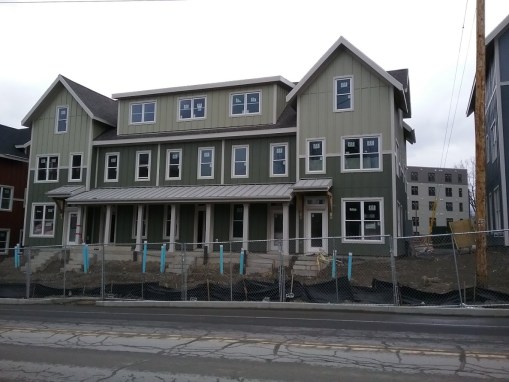
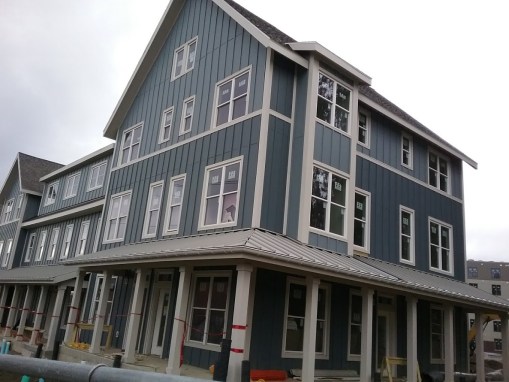
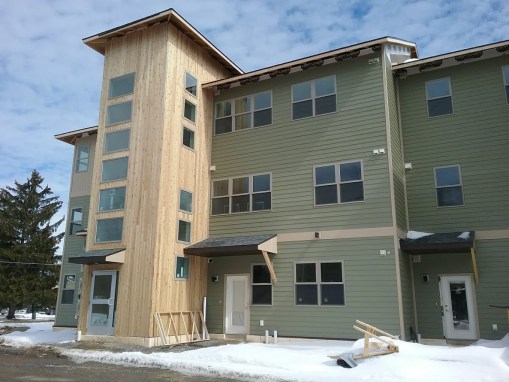
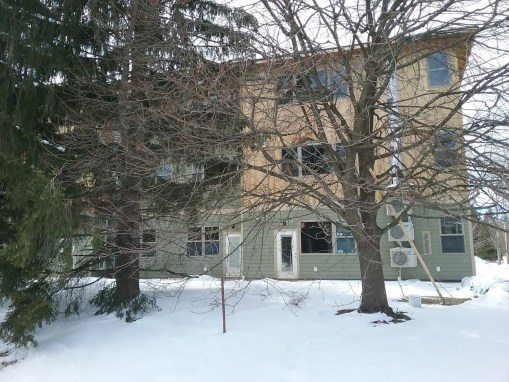
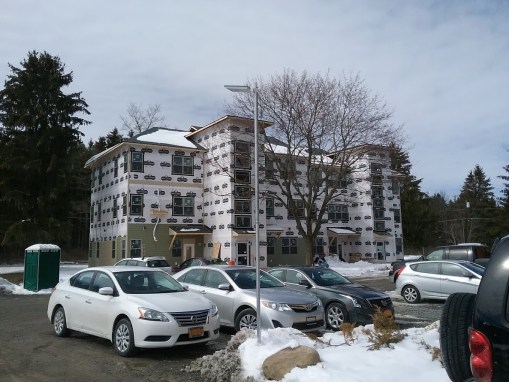
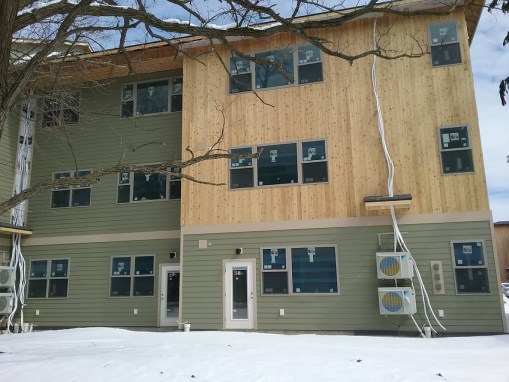
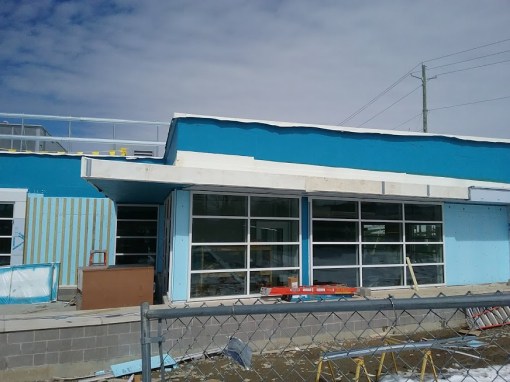
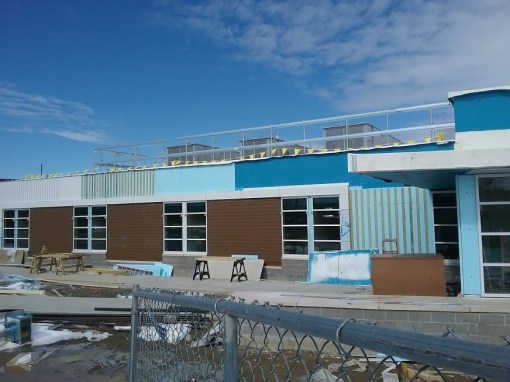
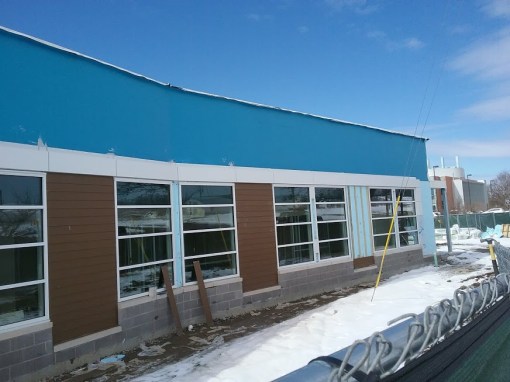
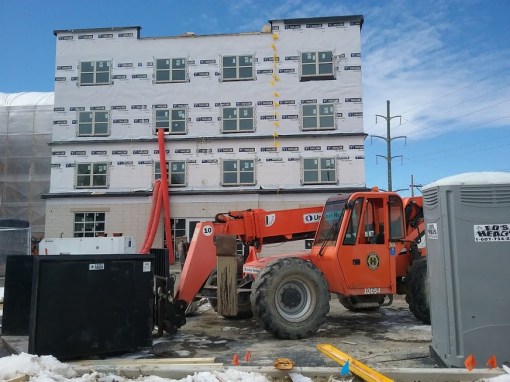
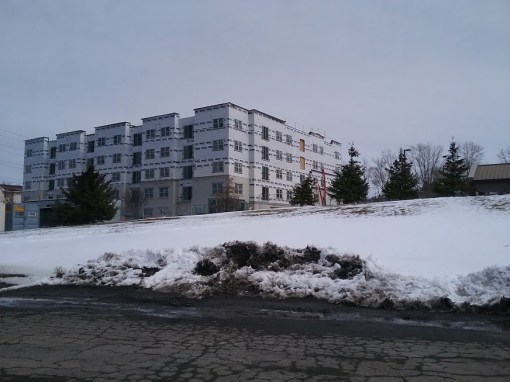
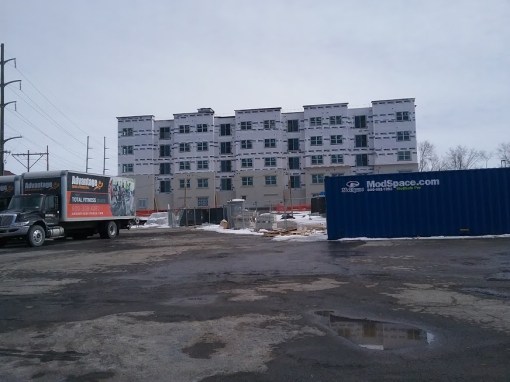
At the site of The Lux at 232-236 Dryden Road, framing continues on the new apartment buildings. I’m under the impression that, like the Ithaka Terraces project also designed by STREAM, these are thick double-stud exterior walls. Double-stud walls are built using two sets of wood stud walls used in the exterior frame, parallel to each other but spaced apart by about 5 inches. That space is then filled (if like STREAM’s other projects) with R39 densely-packed cellulose insulation. The result has its pros and cons. The cons are that it’s more expensive to build, and it reduces the interior space a little bit. The pro is that it’s very energy efficient, which comes in handy for a project trying to achieve net-zero energy use.

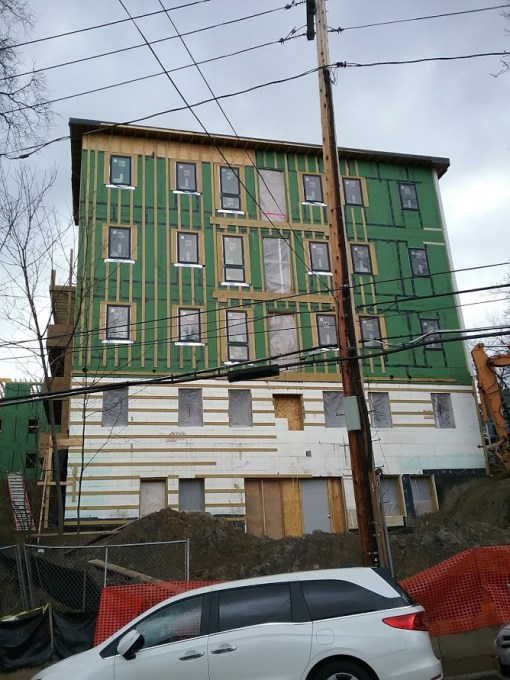
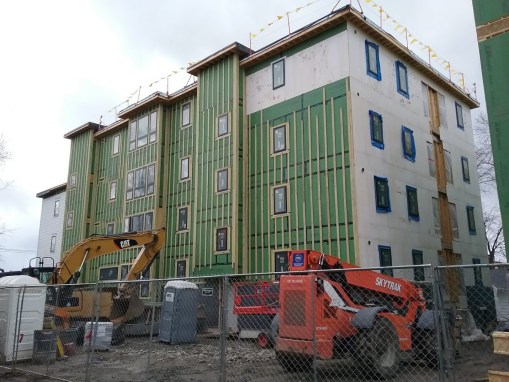
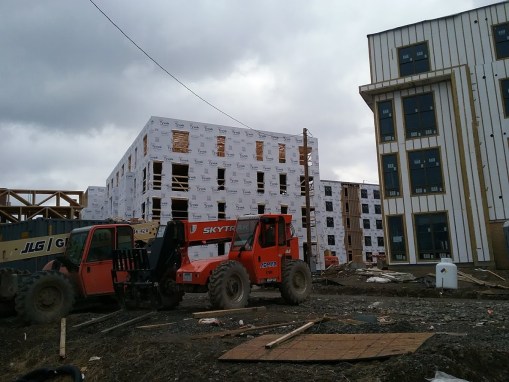
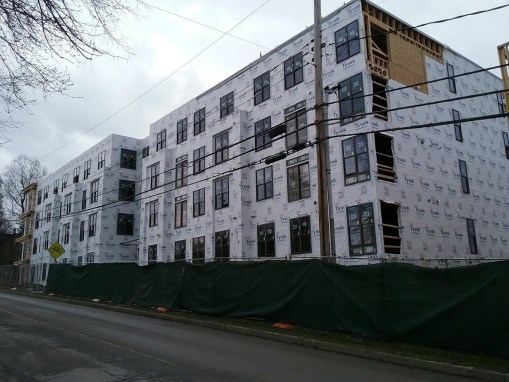
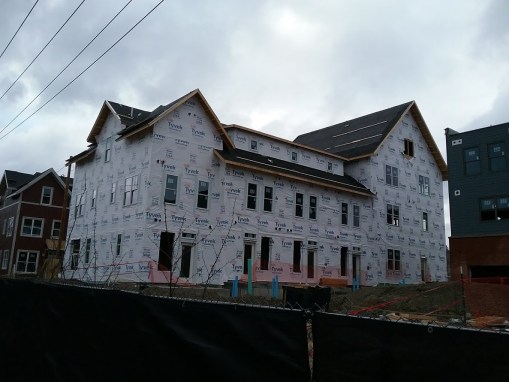
On top of that appears to be wood furring strips for the cladding. I think the white panels on the north side might be boards with some kind of waterproofing? The roof on 232 Dryden appears to have had underlayment applied, but no EPDM (synthetic rubber) or similar finish yet.

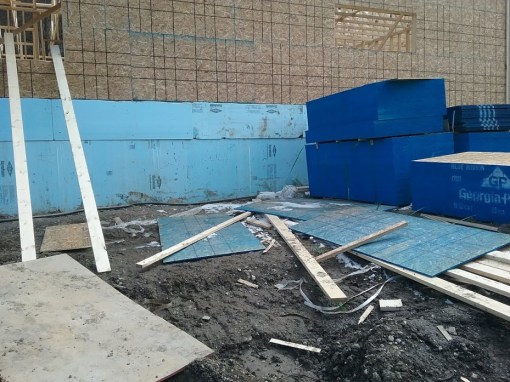
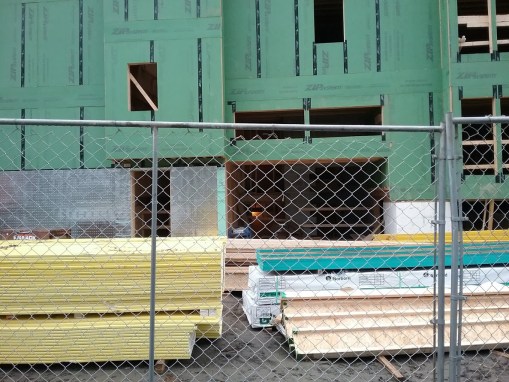
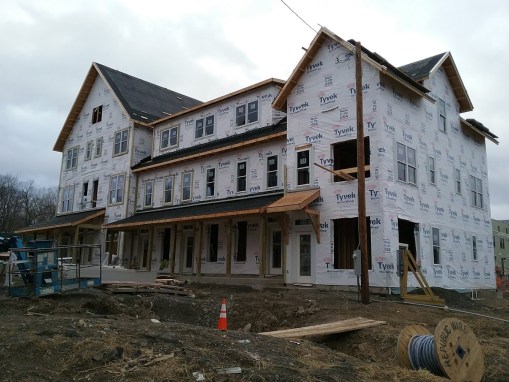
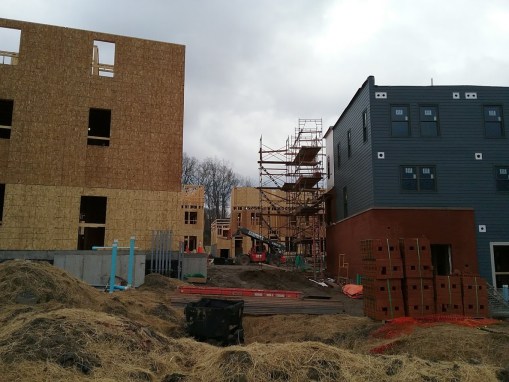
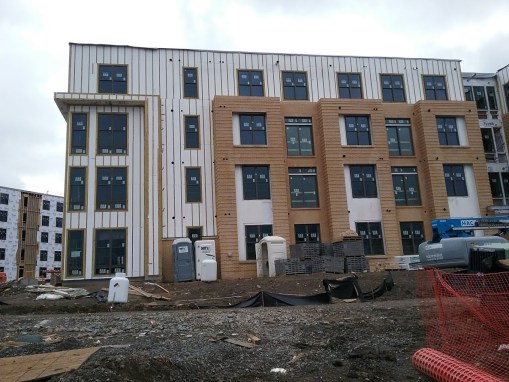
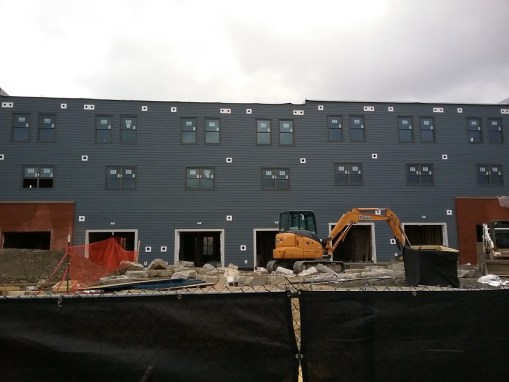
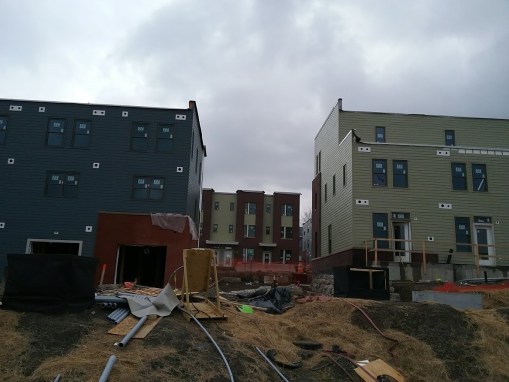
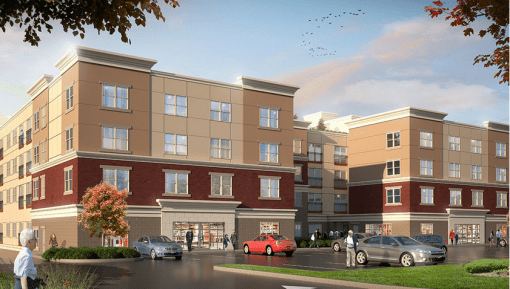
The Amvic ICF will be faced with grey stucco and a black brick veneer, while the upper levels will use LP SmartSide white and marigold yellow fiber cement lap siding. The reflective material is likely insulation that’s also intended to keep out the moisture from the exterior brick.

The top floor will be finished with fiber cement panels with LP SmartTrim laid out patterned to give some visual interest to the top of the structures. The windows are Anderson 100 series units with black frames, and what will be white casings. Still rough openings in some of the walls, and the balconies are just starting to get built on the west face. 236 Dryden has yet to be fully framed, but the roof trusses are underway.

In its March email blast, the developer, local firm Visum Development group, announced that the contest to design lounge, gym and study rooms was won by two graduate architecture students from Cornell – for that, they win $2500 and will have a lounge named after them. The winning designs are here. As of February, about half of the 207 bedrooms were leased.

The project did pay a quick visit to the planning board recently to ask if they would could have permission to not screen some of the rooftop utilities – though less attractive and meant as a cost efficiency, these are less visible parts of the roof per the diagrams provided to the city. I didn’t hear any issues with it, so I assume it was deemed acceptable by the board.


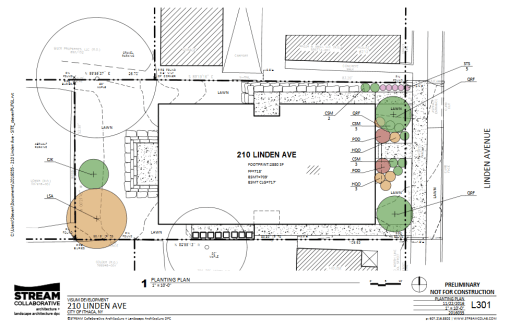
210 Linden Avenue Construction Update 4/2018

1 05 2018

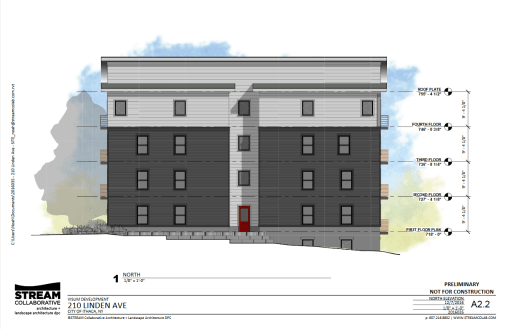
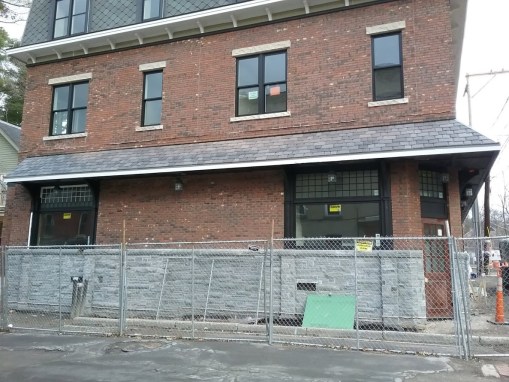
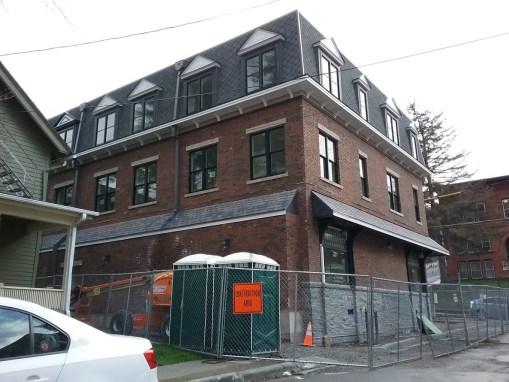
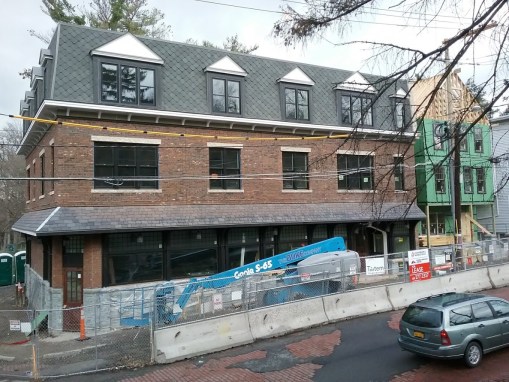
Looks like the first stud walls are going up on the third floor of the four-story 210 Linden apartment project (note the basement is partially exposed). Quite a bit of progress from the excavated hole and foundation pad back in February. This is a wood-frame structure with Huber ZIP System plywood panel sheathing and, presumably if like the other Visum projects, Amvic insulated concrete forms at the basement level. ICFs are thermally insulated plastic blocks filled with concrete – they tend to be a more expensive approach, but they also tend to have a higher grade of insulation (higher R-value), making for a more energy-efficient structure, and Visum and its project architect (STREAM Collaborative) have an eye towards net-zero energy capability, meaning all energy consumed by this building comes from renewable sources. ZIP panels are an increasingly popular to the traditional plywood and housewrap method (and since the integrated water-resistive barrier on the ZIP panels is a vivid green, they’re hard to miss). The choice of ZIP panels vs. housewrap really boils down to a matter of preference by the project team; ZIP panels tend to be easier to install (lower labor cost), but more expensive as a product.

Although my October notes show that William H. Lane Inc. was the general contractor on file, it appears that Romig General Contractor is the firm on-site. Romig of Horseheads is not known locally for involvement with multi-family projects, but as partners in Jepsen Romig Development (now Jepsen Holdings Inc.), they’ve been involved with several luxury homes built around the county (Southwoods, South Pointe, etc.) and they state on their website that they’ve provided commercial services to the ScienCenter and the Cayuga Ridge supervised care facility.

Also notable is that it appears the asking price for rent on the four-bedroom units has come down a fair amount since their first advertisements in the fall, from $1250/bedroom to $950/bedroom. This may be anecdotal evidence of some slack in the Collegetown market, as Maplewood’s 872 beds enter and steadily get absorbed into the rental market mix.

Background information on the project and more renders can be found here.


Chapter House / 406 Stewart Avenue Construction Update, 4/2018

30 04 2018

It’s hard to believe it’s been over three years now since the fire that decimated the Chapter House and the neighboring apartment house at 406 Stewart Avenue. According to a recent write-up by Mark Anbinder at 14850.com, the new build at 400-404 Stewart Avenue will host one eight units –  studio apartment, three 1-bedroom apartments, one 2-bedroom apartment, and three 3-bedroom apartments. The units are aiming for a summer occupancy, and CSP Management (Jerry Dietz and his team) are in charge of the rentals on behalf of developer/owner Jim Goldman.

From the outside, the building is practically complete, except for landscaping/paving, trim pieces, and facade installation of the ground-level bluestone veneer. The 4-unit, 11-bedroom apartment building next door is not as far along, with roof trusses only just being installed, and sheathing (ZIP panels) and window fittings underway on the lower floors. It’s a reasonable bet to say these will be available for their first tenants in time for the start of the new academic year in late August.

As fair as anyone’s aware, the ground-floor space restaurant/bar is still available for lease, at $35/SF (at 3,000 AF, that means $105,000 annually). Chapter House owner John Hoey has said in the comments here that the price is too high for his business. The possibility of a “Chapter II”, as some have dubbed it, seems increasingly remote. Any other potential lessees can contact David Huckle or August Monkemeyer at the Ithaca branch of Pyramid Brokerage.


Maplewood Redevelopment Construction Update, 4/2018

30 04 2018

Maplewood has not had the best of luck during the construction. A wet fall, and an unusually wet and cold spring have really dampened efforts to move the project along at a clip that the development team would have liked. Supply issues (framing walls) and concerns from subcontractors about steady, non-weather interrupted work have also made things more complicated. The developer (EdR Trust, with local project representative Scott Whitham of Whitham Consulting) approached the town of Ithaca with a request to extend the working hours again from 7 AM to 10:30 PM for interior work, on top of the four-hour extension (from 9 AM – 5 PM to 7 AM – 7 PM) and the Saturday 8 AM – 4 PM hours previously granted.

It did not go over well. After getting a tongue lashing from members of the board about incompetence, the planning board did offer a partial concession to 9 PM on a 4-3 vote. As a result, barring no further major issues, most of the units are expected to be delivered in July, though some of the later-scheduled townhouse strings will likely not be complete before August. Ostensibly, there’s a fear that the units won’t be ready in time for incoming Cornell graduate and professional students, in which case EdR will incur the substantial cost of putting them up in a hotel, as some of the Collegetown developers had to do a couple of years ago (325 Eddy’s opening was especially rough). The current plan is three phases of move in, on July 1st, July 31st and August 20th.

From what I’ve heard, at least half the units are spoken for in the 441-unit, 872-bed development. Advertisements have been showing up pretty regularly on websites like Craigslist, as well as their own website.

Walking around the site, construction is in just about every stage imaginable, from framing to sheathing to fit-outs to exterior siding and even trim work on the units facing Mitchell Avenue. There have been some changes in the plans, and I’d argue for the better – more color variations in the apartment buildings and the townhouse strings. The southwest corner building on Mitchell was initially supposed to be shaded of blue, but is finished with red fiber cement panels, and the panels on one of the gabled “Ht” strings next to the Belle Sherman Cottages. The apartments also show varying brick and panel ensembles, from navy panels and red brick, light grey panels and maroon brick, dark grey panels with tan brick….it makes for a more colorful and arguably more attractive site.

Quick aside, a second project webcame has been installed. This one looks over the three apartment blocks on the northern (Maple Avenue) end of the site. Link below, along with the southward camera.

For project background and planning, click here.

For a site plan breakdown, click here.

For a construction timeline, click here.

Webcam link 1 here (updated ~15 minutes).

Webcam link 2 here (New! updated ~15 minutes).


Amici House Construction Update, 3/2018

24 03 2018

Ithaca’s housing woes are fairly well-documented at this point. As in any broad situation, some have fared worse than others. If you’re fairly well off, the rapidly increasing housing prices are a nuisance, a vague political “issue” or perhaps even an opportunity if one thinks they know the market. For those will meager or no means, it’s more dire than that.

Take for instance those who are housing insecure or homeless. With a scarcity of options in Ithaca, many of Ithaca’s most vulnerable are at risk of living on the streets, with many ending up in “the Jungle” encampment behind Wal-Mart. Local shelters and supportive housing facilities are at full capacity, with dozens more turned away. This can perpetuate unemployment by reducing life stability, and it contributes to substance abuse and mental health issues. The high cost of housing has contributed to a much higher homeless rate in Tompkins County – up to five times the rate of Onondaga County (Syracuse), according to a 2016 Ithaca Voice study.

Tompkins Community Action, T.C.Action/TCAction for short, is well-aware of the issues faced by the less well-off in the Ithaca community. The non-profit started as the local unit of Lyndon Johnson’s “War on Poverty” programs in the 1960s. It administers early childhood education programs (Head Start), GED assistance, energy service programs (home weatherization), food pantries, family reunification services, housing vouchers, a fiscal literacy program, employment help – basically, social support services for thousands of low-income individuals in Tompkins County and adjacent communities, helping them succeed in their educational, professional and family endeavors.

In the past few years, Tompkins Community Action has made significant efforts to try and create more housing for those vulnerable, so that they’re less likely to end up in the Jungle or a back alley. In safe, secure housing, they are more likely to get clean, they are more likely to earn and keep steady employment, and they are more likely to take advantage of TCAction’s other supportive services, hopefully continuing on to better, more productive lives.

One of these efforts is a partnership with Finger Lakes ReUse – the pair, with consultation from affordable housing provider INHS, are entering the grant-writing phase for 22 studio units for those transitioning out of jail as well as the formerly homeless at FLR’s property at 214 Old Elmira Road. The other major project is Amici House.

Going through my archived notes, the first reference to what would become Amici House shows up all the way back in September 2014 as a 14 or 15-unit townhouse proposal, but it wasn’t until June 2016 that the first plans were presented, after a feasibility study was completed. Site plan review began in October 2016, and the project was approved in January 2017.

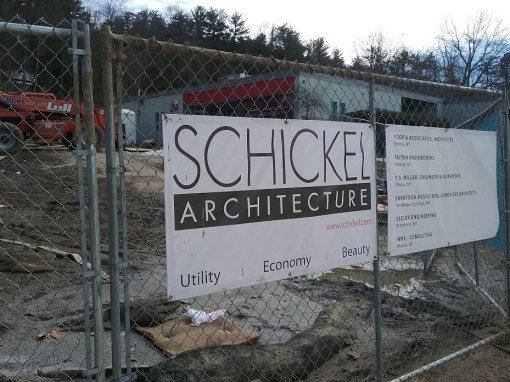
The plans, drawn up by Schickel Architecture of Ithaca, call for a narrow five-story, 20,785 SF (later 20,712 SF) building for housing, and an adjacent one-story, 7,010 SF building that will host classrooms and daycare facilities. The facilities would be a part of TCAction’s campus at 661-701 Spencer Road on the south end of the city. Two small houses would be deconstructed to make room for the classroom building, while the residential building, planned to house homeless or vulnerable youth aged 18-25, would be an addition onto the non-profit group’s existing office building.

On the first floor of the new residential building would be a children’s playroom (for homeless youth with children), case conferencing rooms, training rooms and kitchen space. 23 efficiency (studio) apartments would be built on the second through fifth floors.

The childcare building, later called the Harriet Giannelis Childcare Center in honor of a late staff member of TCAction, will provide five classrooms for Head Start and Early Head Start programs, as well as support space and staff training space. The building will host a playground, which is the blue space in the site plan above. The facility would have space for 42 children, and create about 21 living-wage jobs. The numbers were more recently revised to 48 children and 24 jobs. TCAction, which employs 104 people, is a certified living-wage employer.
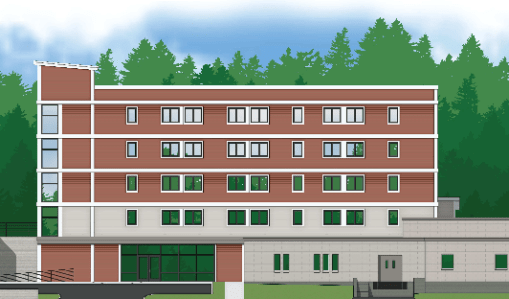
During the review process, not much changed. On the residential building, the planning board thought a glass-encased stairwell was thought to produce too much light, so the next iteration had it completely bricked in, which the Planning Board also disliked, as was a plan with small windows. Eventually, a “happy” medium was reached for medium-sized windows in the stairwell.

The project required a couple of zoning variances. The first one was for parking spaces (72 required, 65 planned). TCAction suggested that from a practical standpoint, they wouldn’t need a parking space for every housing unit, but the classrooms and office space will meet their parking requirements. Another variance was for operation of a child care facility is a residential zone, and there were three area variances related to building size and the driveway/drop-off area.

The initial estimated construction costs are $8.25 million. Per city building permit docs, The Harriet Giannellis Childcare Center’s hard costs are estimated at $1,267,479, while the 23-unit residential portion’s hard costs are estimated at $3,627,333. However, city IURA statements sat the HGCC will cost $1,774,470 to build, with $153,450 in soft costs, and a total of about $2,103,000. The residential portion comprises $6,115,000 in hard/soft costs and land acquisition (total for both $8,218,000). Welliver of Montour Falls is the general contractor.
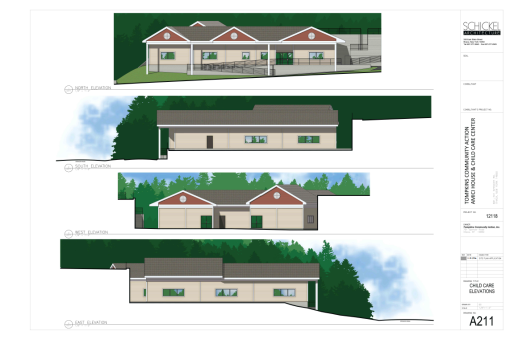
As one might tell from above, financially it’s a bit confusing. This isn’t a traditionally-financed project with concerns about a lender’s Return On Investment. To make it become a reality, it uses a fair amount of subsidy layering – different funding grants from the city, county, NYS and the Federal HUD.

One grant, awarded in June 2016, was for $118,000 from the county that would purchase the small house next door to their headquarters – 661 Spencer, built in 1950 by the Amici family – thus allowing them to procure the land needed for developmentA later “grant” forgave the remaining $75,000 loan balance on their headquarters, and $225,000 was awarded to the project by the Tompkins-Ithaca-Cornell Community Housing Development Fund (CHDF).  TCAction first acquired their HQ with the help of the county back in 2001, and the cost of the purchase was being paid back to the county in the form of a 20-year lease. $84,200 was awarded to the Childcare Center by the Ithaca Urban Renewal Agency in 2017.

New York State awarded the project $3.732 million in April 2017, and the state’s HUD equivalent, NYS HCR, supplied another $3.26 million in two other grants, the Community Investment Fund (CIF) for the childcare center, and the Housing Trust Fund (HTF) for the housing. M&T Bank is providing a $501,883 construction loan, and another $300,000 came from a Federal Home Loan Bank.

More recently, the numbers were revised to $603,000 for M&T Bank and the NYS HCR CIF was reduced from $1.499 to $1.325 million – probably a case where the state decided not to award the full request, and TCAction had to make it up elsewhere. Funding for the Head Start operation comes from the Federal Department of Health and Human Services, and other funding comes from state and local allocations. The facilities are tax-exempt. A look at the finances, which practically break even (slight profit actually) can be found here.

Initially, construction was supposed to be from August 2017 to October 2018, but the time frames were shifted back a few months due to financial and bureaucratic snags. TCAction also discovered they couldn’t stay in their headquarters as construction went on, so they needed an emergency $90,690 loan from the IURA to rent temporary offices at 609 West Clinton Street.

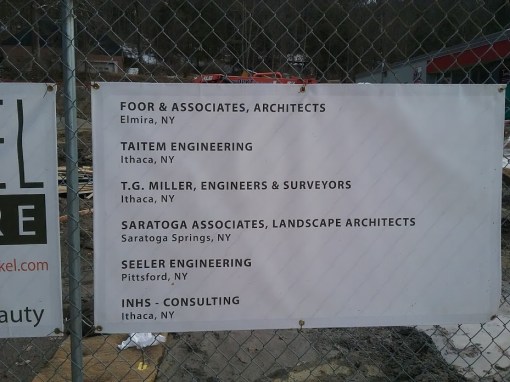
Along with Schickel Architecture and Welliver, the project team includes Taitem Engineering for structural engineering work, Foor & Associates of Elmira assisting in the design work, T. G. Miller P.C. for civil engineering and surveying, Saratoga Associates Landscape Architects, Seeler Engineering of suburban Rochester, and INHS as a consultant.

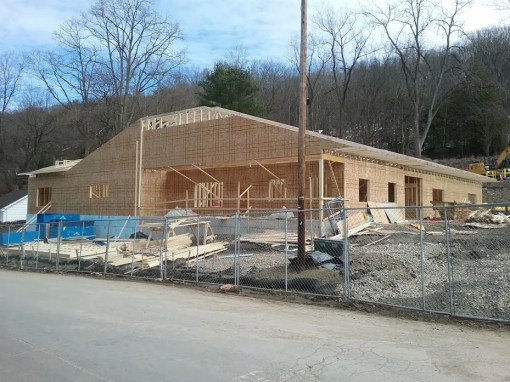
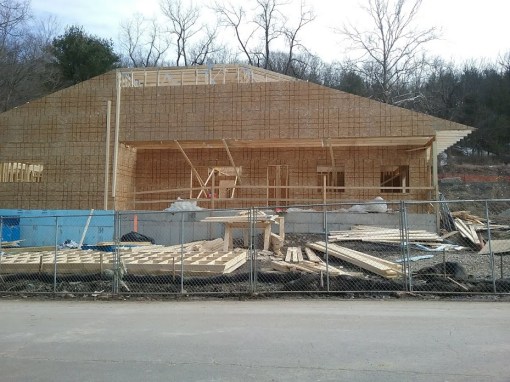
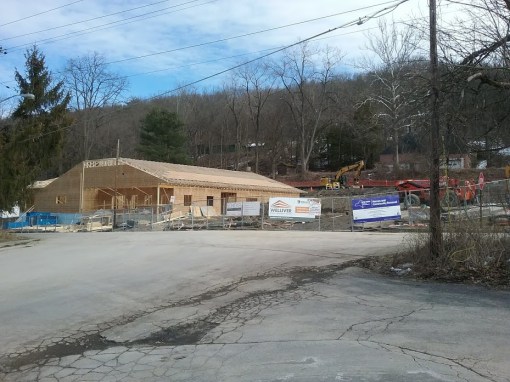
In the photos below, construction has been well underway, and has been since at least the tail end of January. The childcare center’s slab foundation and footers have been excavated, poured and insulated with rigid foam boards (the soil will be backfilled later to cover the base). The wood-frame is well underway, and it appears most if not all of the roof trusses are in place, as are many of the walls – I suppose these guys are going with housewrap instead of ZIP sheets. Although the size seems correct, the design does not look like what I have on file from , much to my chagrin. Foundation work seems to be underway for the residential portion.


Village Solars Construction Update, 3/2018

24 03 2018

It looks like 102 Village Place is just about complete from the outside, with only some minor finishing work like trim boards remaining on the to-do list. Its peer, 116 Village Circle, is a little further behind, with rough-ins, insulation and drywall in place inside, and exterior facade work underway. The air-source heat pumps have been installed, but not fully hooked up yet. The 42 units in these two (24 and 18 respectively) should be ready for occupancy by the end of the spring.

I never caught it before, but the project docs say the developer, Lifestyles Properties (the Lucente family), will plant over 500 cherry trees on the property as phases concludes and the land is no longer disturbed. Perhaps a few of the saplings below are included in that figure.

According to the phasing plan, the next phase is to replace 2 Village Circle and 22 Village Circle with a pair of 18-unit buildings. Those would be twelve studios and six two-bedrooms each, replacing two ten one-bedroom unit buildings (net gain of 28 residents, for those keeping in track). These would likely start later this year for a 2019 completion.

After that time, Phase 3b, a 20-unit, 20-bedroom mixed-use community building (building “F”, all-new), would also start construction, with the start of phase 4, the 24-unit replacement of 36 Village Circle, to follow in the 2019-2020 timeframe. 3b has to start before Phase 4 if even just one day sooner, as that was added as a stipulation by the town planning board before any new phases commence (presumably, it would also have to be completed in reasonable time). Lifestyle Properties says the two buildings per year phase-in works well for Tompkins Trust Company as lender (its market segment and location can comfortably absorb another 42 or so units every year), and for the in-house construction team and preferred subcontractors. Spring 2022 is the practical conclusion, but there are plans for additional buildings east of the current site, which could add a few hundred more units throughout the 2020s.

Just as a subjective observation, there has definitely been a change in Lansing’s development pattern. It’s still fairly suburban, but the numerous 3,000 SF Cardamone homes that seemed to be ever-underway on cul-de-sacs in the mid 2000s have now been reduced to a trickle – I never see more than 2 or 3 underway at any one time these days, and driving through Cayuga Way, Woodland Park and Whispering Pines is often a waste of gas. However, multi-family is taking off in areas with sewer access, like here at the Village Solars, and with the English Village / Cayuga Orchard properties between East Shore Drive and Triphammer Road. Likewise, the village is getting plenty of infill on its vacant parcels, from large projects like the Bomax Drive Apartments and Cayuga View Senior Living, to smaller ones like Triphammer Row.

There’s some evidence to back that up – according to the federal HUD Building Permits Database, from 2003-2006, Lansing town and village approved 187 single-family homes and not a single multi-family unit. From 2013-2016 (the latest available), the two approved 92 single-family homes and 148 multi-family units.


South Meadow Square Construction Update, 3/2018

23 03 2018

One doesn’t have to look far to see retail is taking in on the chin. Wikipedia has a well-sourced listicle of events in the “retail apocalypse“, as it’s been branded by the national media outlets. Several factors play into the spike in retail chain bankruptcies and closures across the country – the rise of Internet shopping (Amazon) and easy, cheap distribution, Wal-Mart and other megachains exerting economies of scale on other retailers can’t afford to sell as cheaply, younger generations buy less “stuff”, the United States simply has too much retail space.

For now, some retailers are more immune than others – those who focus on convenience and budget necessities (dollar stores), those who sell goods that are hard to ship (home improvement stores, wholesale clubs), and those who focus on experiences rather than items. However, even sectors that were once seen as safe as starting to feel the pinch – pharmacies and grocery stores, for instance.

With all that in mind, it seems a bit odd to be building new suburban “big-box” retail space, but Buffalo-based Benderson Development is doing just that at South Meadow Square at 742-744 South Meadow Street on the city’s southwest side. Benderson purchased the retail strip from the original developers (the Visnyei family) in 2009.

Development of Ithaca’s big-box corridor has always been contentious. Long ago, the area consisted of a few small auto-centric businesses and the county fairgrounds (hence Fairgrounds Memorial Parkway). During the mid and late 20th century, big box retail slowly made its way into the southwest part of the city – what’s now Finger Lake Reuse on Old Elmira Road was built as a grocery store in the 1970s, and parts of Ithaca Plaza next door date to 1950. Wegmans opened a store in the 1980s, and replaced with newer, larger store in 1997.

The 1990s was when big-box development pressure seemed to come to a head. Wal-Mart was stymied for years thanks to neighborhood opposition, and Target eventually gave up its plans and moved to Lansing. But, much to the city’s chagrin, the 1990s were difficult times economically – the tax base was in decline, state aid was in decline, and the local economy was mired in a deep recession. Somewhat begrudgingly, the Nichols (1989-1995) but especially the Cohen administration (1995-2003) began permitting large-scale retail development in the hopes of propping up the tax base and stemming the flow of dollars to suburban outlets in the suburbs, as well as Elmira and Cortland.

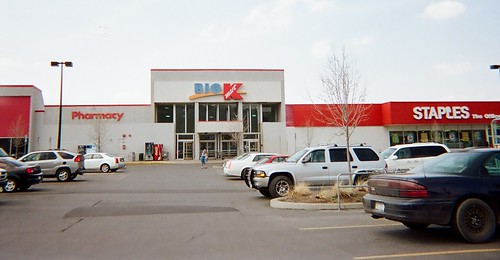
Many of the  city’s big boxes are result of that late 1990s/early 2000s wave. Wal-Mart (2005, expanded to a Supercenter in 2011), Home Depot (2003), the Tops Placa (2002). Some were all-new, others were extensive renovations and rebuilds. This particular retail strip at 742-744 is one of the latter – it had actually opened as a rather large 87,000 SF K-Mart in the 1970s (the 22,000 SF supermarket it shared a lobby with later became Staples), and was extensively renovated and in the mid-1980s and in more recent years. The K-Mart looked pretty dated when it closed in October 2011. Hobby Lobby filled some of the old K-Mart space in 2013, and in fall of that year, plans were drawn up for a pair of endcap expansions.

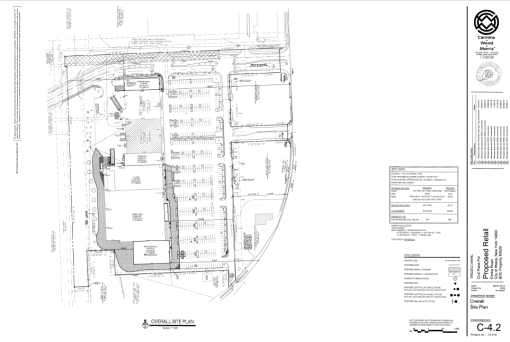
One was on the north end – 7,315 SF of retail space, next to the early 2000s 19,000 SF PetSmart. The other was a 14,744 SF south endcap that would be built were K-Mart’s garden center used to be. These plans were approved in November 2013, but then updates and revisions were proposed in 2014, when TJ Maxx and Five Below were announced to fill the remaining vacant space (21,770 SF and 8,209 SF respectively). At that time, the southern addition became 16,200 SF.

For one reason or another, Benderson decided to go back to the original plan (probably a potential tenant backed out) early last year, and asked for re-approval of the November 2013 additions – city approval is only good for two years. Unlike most parts of the city, the lack of nearby residents and general apathy towards big-box retail makes variances somewhat easier to receive; plus, a re-approval is typically a small matter – re-approval was granted in May. City zoning (SW-2, and PUDOD) is generous down here because the city keeps hoping someone will do walkable mixed-use, but the waterlogged soils make that difficult – you either build shallow, or quite deep, and quite deep requires a lot of height and square footage above ground to make up those construction costs.

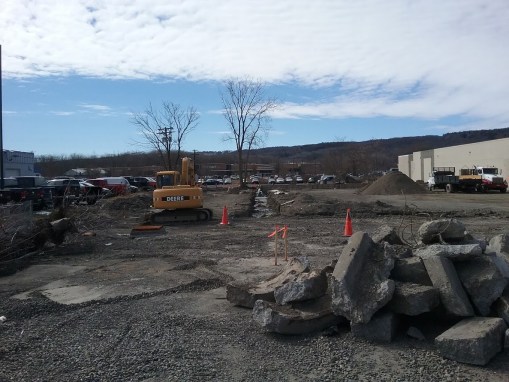
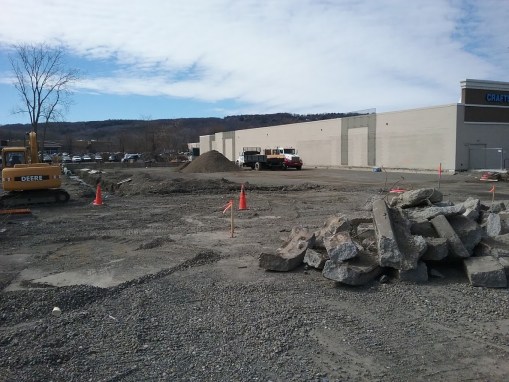
Construction is going to be fairly standard – concrete slab foundation, steel frame, masonry walls, and probably some decorative entry bays and facade work. At the moment, excavation is underway for the footers of the foundation on the southern end, while the footers have already been poured and strengthened with rebar on the northern end. The Dryvit and brick veneer on the wall of Pet-Smart has been removed, and I think that’s mineral wool insulation underneath. Expect both of these to be finished towards the end of the year. I don’t have a project value offhand, but the existing plaza (128,582 SF) is $6.5 million, so 22,059 SF of new space is probably worth about $1 million or so.

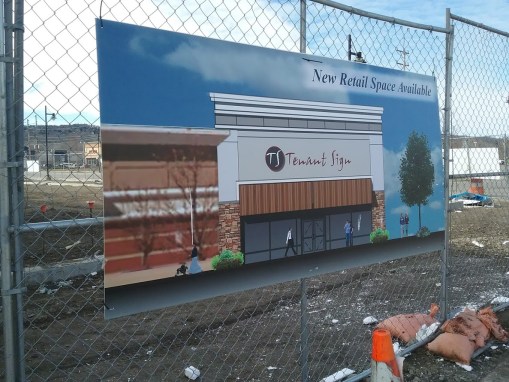
As for tenants, your guess is as good as mine. We’ll see if Benderson can make it work in the age of the retail apocalypse. Benderson’s proffered choice of designers, Buffalo’s Carmina Wood Morris D.P.C., is the architect.

November 2017

January 2018

March 2018


Cayuga Medical Associates Construction Update, 3/2018

22 03 2018

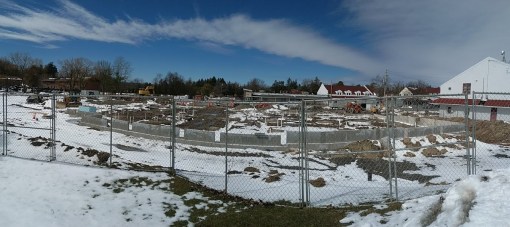
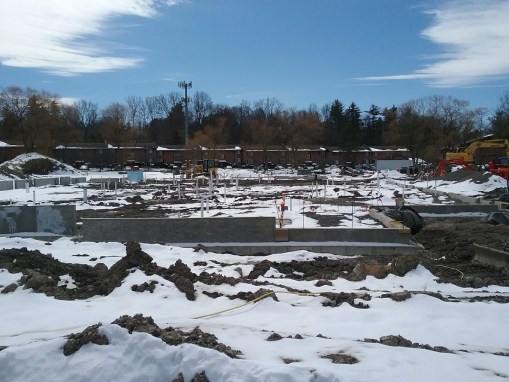
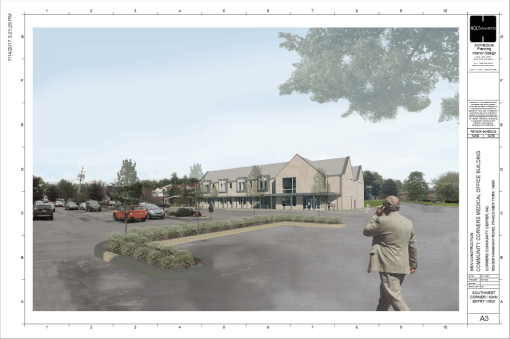
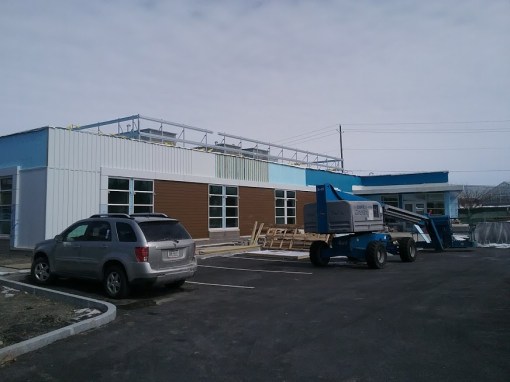
Since January, it looks like all the foundation footers have been poured and the underground utilities connections are in place. At this point comes the foundation slab itself. with a generous helping of steel rebar grid for strength. Being medical office, this is probably a steel frame construction, so visitors to Community Corners can expect that later this spring. McPherson Builders should have the $7.8 million building ready for commercial occupancy by late summer.

In the meanwhile, visitors can also look forward to the new Gimme! Coffee that is planned for the closed Lonacakes Bakery space. That new business will bring 5-10 living-wage jobs; readers might remember that the baristas recently unionized. There is a modest little cafe and catering place nearby and the swanky Heights Restaurant, but it’s probably safe to say that the niches are different enough that Gimme! won’t poach business from the others.

I remain a bit hopeful that eventually, Cayuga Heights and relevant property owners (Tim Ciaschi, Mark Mecenas) might nudge towards the denser if still relatively modest mixed-use plan that was proposed five years ago; Mecenas said at a recent meeting he’s still interested. In other village news, staff say there have been several inquiries into the former Tau Epsilon Phi fraternity property a mile away at 306 Highland Road, but no takers as of yet.


Cornell Veterinary School Expansion Construction Update, 3/2018

21 03 2018

The Cornell College of Veterinary Medicine’s new Community Practice Service is set to open in May, and it certainly appears to be in the home stretch. Exterior finishes are underway. Atop the dark blue water-resistive barrier are rigid foam insulating panels, and what appears to be a combination of corrugated steel panels (probably Morin or a similar brand), Alucobond aluminum composite trim panels and simulated wood fiber cement boards. These materials have made or are making appearances on other recent builds as well – HOLT Architects, the designers of the new CPS Building, also incorporated corrugated metal and flat aluminum panels into 210 Hancock’s multi-story apartment block. Meanwhile, wood-like fiber cement shingles will be used as one of the finishes on The Lux apartments at 232-236 Dryden Road.

It seems a little strange that the “clips” on which the wall panels will be fastened are wood instead of steel. Perhaps since the exterior finishes are light, waterproof and will be sealed tight, it’s an acceptable choice. The frame for the rooftop mechanical screen is in place, and the flag strings suggest that the roof membrane is being laid. If you look closely enough through the windows, you can see steel interior stud walls and HVAC ducts. Compared to the renders, there only seem to be a few minor differences in materials and appearance (the corrugated metal panels, and maybe the fenestration over by the entrance).

According to HOLT’s project webpage, the $7 million project is aiming for LEED Silver Certification. Here’s the building description from their webpage (which, kudos to the HOLT website manager, because not many architects include their buildings currently underway):
“The new 11,000sf Community Practice Service Building, is a stand-alone veterinary clinic and teaching facility that will provide a real-world veterinary practice to the surrounding community.

The new building design includes a welcoming waiting area, as well as veterinary surgery, imaging, and exam rooms; procedure induction/recovery, and animal holding areas; lab and pharmacy spaces; staff and faculty offices, conference rooms, lockers, restrooms, and other support spaces.
Once complete, this building will be a beacon for pet health and wellness in the community and on campus – with the architecture exemplifying the quality of learning and client service that will happen within its walls.”


Cayuga View Senior Living Construction Update, 3/2018

20 03 2018

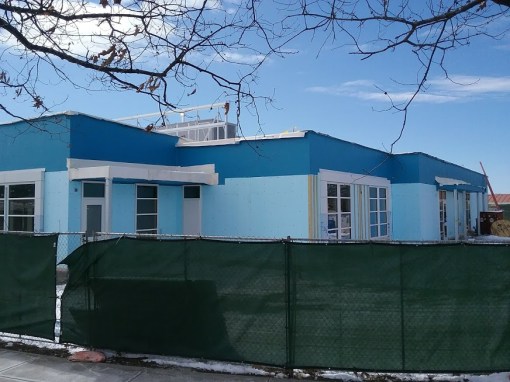
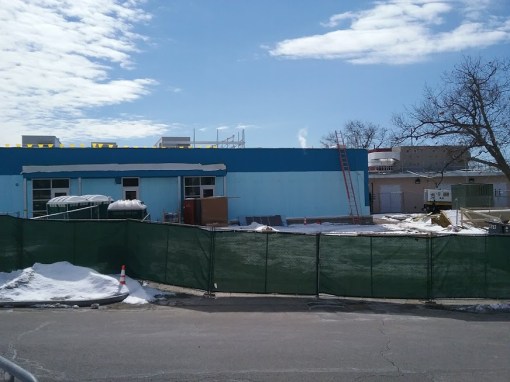
It looks like Taylor the Builders has started attaching exterior finishes to the Cayuga View Senior Living apartment building. That includes decorative cornices, brick veneer, and what appears to be a few different shades of EIFS panels. EIFS (Exterior Insulation Finishing System), sometimes called synthetic stucco or by commercial brand names such as DryVit, is a lightweight, waterproof finishing material – usually it’s two-inch thick polystyrene (rigid foam) insulating panels with an acrylic finish to mimic the appearance of stucco, along with adhesive and drainage structures. EIFS is low-maintenance; it gained popularity in the 1970s and 1980s, but developed an infamous reputation for water damage due to improper installation, which is why so many building codes are stringent about adequate drainage systems for new builds. The boards can also be damaged fairly easily by blunt-force impacts. It tends to be more common on commercial buildings than residential structures, but it is not an uncommon choice of finishes for wood-frame multi-family buildings. Other recent builds using EIFS include the Holiday Inn Express on Elmira Road, and the Seneca Way Apartments on the edge of Downtown Ithaca.

Interestingly, the top floor’s panel boards are a lighter color than the third floor – renderings have them both being the same color.

Also, note the poles and flags on the roof – that’s a good indicator that some material is being applied, probably EPDM, which is a synthetic rubber. The project team recently announced that the 87,500 SF building will not only host a rooftop garden, but a 46kW, 151-panel solar array courtesy of installer SunCommon NY of Rochester.

Current plans call for the first occupants to begin moving into its 60 apartments by the end of May (the website advertises a summer occupancy, and a leasing office is present on-site). Cornerstone Group, also of Rochester, has been selected to manage the building, whose units are reserved for those aged 55+. I’ve been in touch with the project team, and there might be a sneak preview article in the Voice a few weeks before opening.