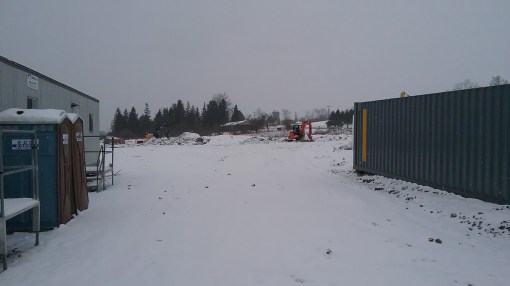
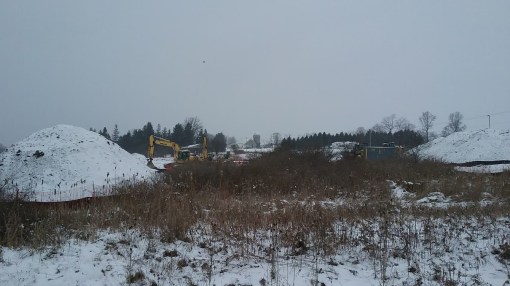
1001 North Aurora Street Construction Update, 2/2017

20 02 2017

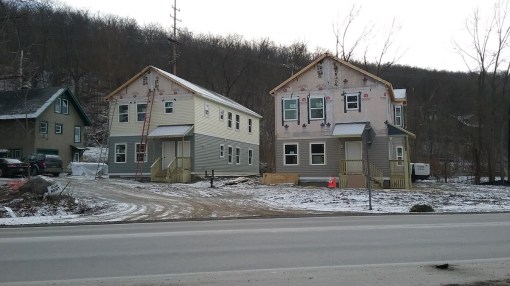
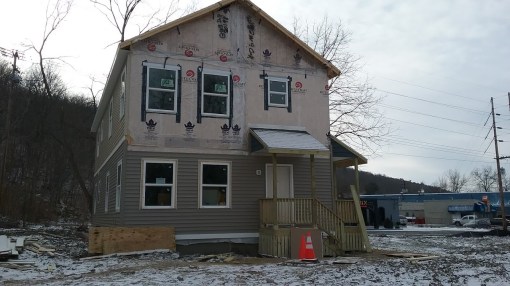
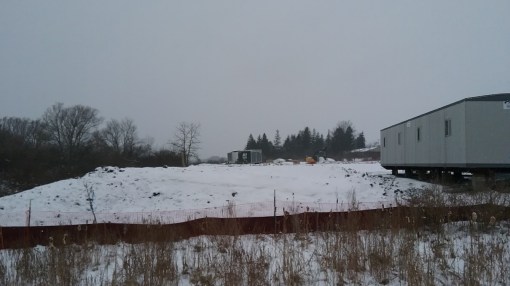
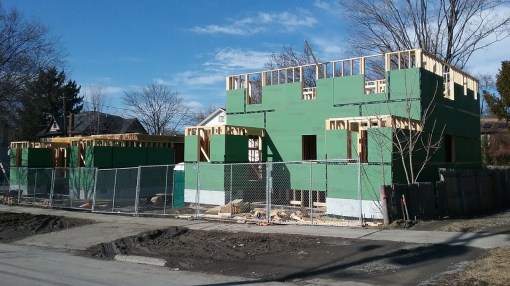
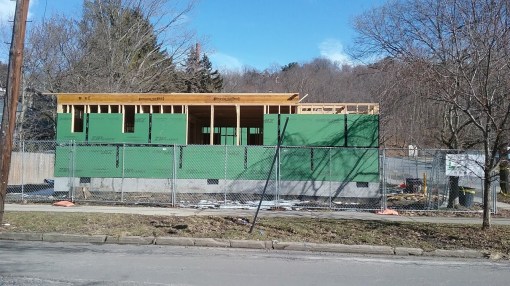
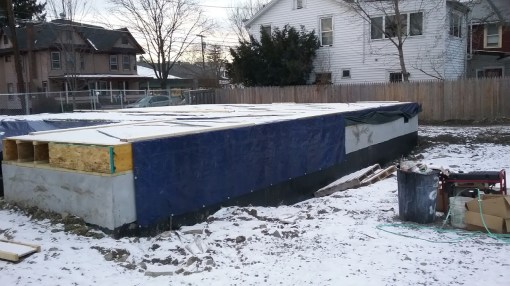
Another project making rapid progress in a short time. The two two-family homes at 1001 N. Aurora Street are being framed out. Going over the wood studs are Huber ZIP sheathing plywood panels, like all the cool kids are using in residential wood-frame construction.

There are pros and cons to each approach. DuPont, in sales literature for its Tyvek Housewrap, touts easier installation, more durability during installation, and claims superior waterproofing. The ZIP system, however, has made significant inroads into the construction market because it does an excellent job at allowing moisture to escape while keeping external water from getting in, and although it requires a little more care to work with (taping), it’s still fairly easy to work with. ZIP panels also tend to be more expensive. Liquid water-resistant barrier (WRB) sprays like the ones you see used on commercial buildings and at Cornell tend to provide the best waterproofing, but they are the most expensive option. So if one drew a scale weighing cost and performance, they could have housewraps at the low end of cost and relative performance, ZIP panels in the middle, and WRB sprays at the top.

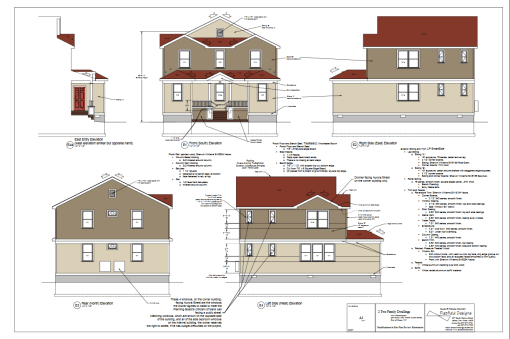
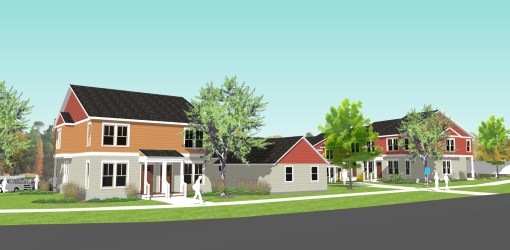
Anyway, these duplexes will be known as 202 Queen Street and 206 Queen Street. In the signage on the site, the bottom design is what was approved (quick tip – do not use old renders on signage). They replace a single-family home. Stavros Stavropoulos is the developer, and Daniel Hirtler the architect – the two are also behind the plans for the new 11-unit apartment building at 107 South Albany Street.

20170218_133909 20170218_133914 20170218_133932 20170218_133947 20170218_134030 20170218_134045 20170218_134115


News Tidbits 2/11/17: Cooperation Required

11 02 2017

107_s_albany_rev_1

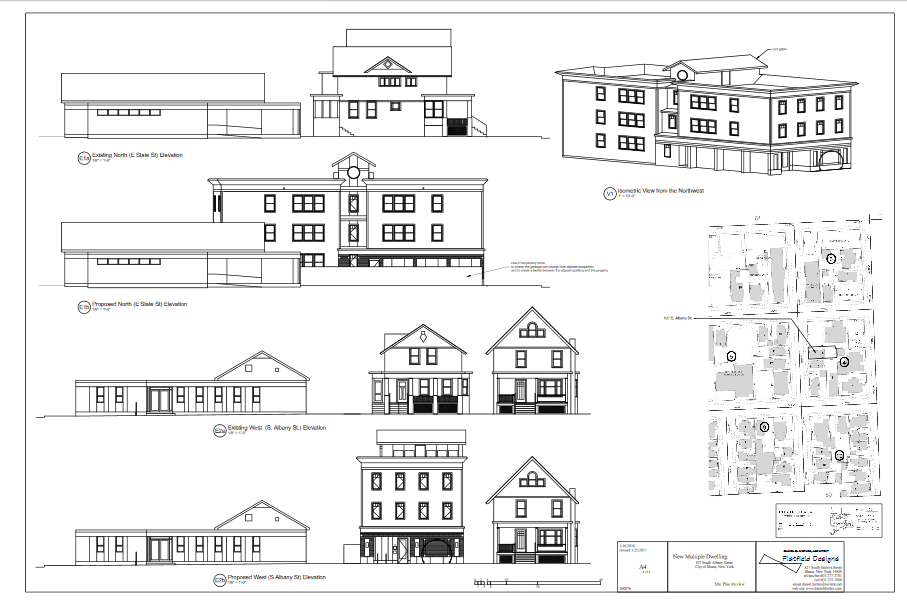
1. It looks like the plans for 107 South Albany Street are getting a major revision. Readers might recall that previously approved plans called for a rear addition onto an existing house to create a 9-unit, 11-bedroom apartment building. The latest plans are a little more substantial.

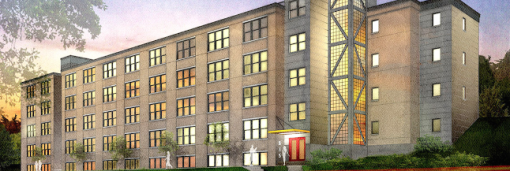
For one thing, the existing house would be no more under the new plan. In its place looks to be a 3.5 story, 8,427 SF, 11-unit apartment building, all one-bedroom apartments. Developer Stavros Stavropoulos has once again turned to local architect Daniel Hirtler for design work; for each of them, this is the largest project they’ve worked on to date. Hirtler came up with a design that offer contextual features like a cornice and an orthodox window arrangement, but adds a modern vertical stair element in the middle of the structure to keep the design from being an imitation. Zoning is CBD-60, so no parking is required, 100% lot coverage is allowed, and the 40.5′ proposal is comfortably within the 60-foot height limit.  According to the SPR filing, the construction cost will be about $900k and the construction period will be from September 2017 to June 2018.

As much as I dislike seeing attractive old houses come down, the new design fits well into an older urban context. Plus, if the medical practice on State ever gets redeveloped, 3.5 floors offers a nice transition to the lower-density structures further south. I’m not a super big fan of the blank wall next to the recessed entry, although the intent is to make it interesting with light fixtures, a brick pattern and an iron trellis that will be grown over with vines. Fiber cement will be used on the upper floors, with brick veneer and granite accents at street level.

On another note, it looks like the city will be looking at a one-lot subdivision next month at 109 Dearborn Place in the Cornell Heights Historic District – the owners, a married couple who are renovating the old PRI into a historically appropriate two-family residence, are looking to sell some of the land as part of the “partnership dissolution”. The PRI renovation is expected to continue. The application says a house was previously located on the undeveloped portion of the property (a glance at old maps indicate a schoolhouse was located on-site in the 1920s). It’s worth noting that the wife is also the owner of Bridges Cornell Heights, a high-end senior living facility on the next block. Bridges previously subdivided a Cornell Heights lot in 2005 to build a second residence to serve its deep-pocketed clients. Any new house would need to go through ILPC review.

323_taughannock_townhouses_2

2. Meanwhile, the Ithaca Common Council had their monthly Planning and Economic Development Committee meeting. It looks like the revised 323 Taughannock project has been caught up in the TM-PUD, so it will have to get Common Council approval. Apart from a certain councilor’s general objections to housing near or on the waterfront, this one isn’t likely to stir up much controversy. The construction timeline for Steve Flash’s 8-unit , 16,959 SF owner-occupied townhouse project is June 2017 – January 2018, with an estimated value of $2-$3 million. Potentially, there could be 16 units, since each townhouse comes with a live/work space that could be converted to a separate studio apartment unit.

Also included at the meeting was a session on electric car infrastructure, votes to send laws allowing dogs in Stewart Park and a temporary altar to the Common Council, votes to circulate a zoning amendment to allow brewpubs in business zones, and a discussion of tree plantings. The Maguires also discussed possibly shifting their project to Southwest Park behind Wal-Mart, which is covered on the Voice here.

3. The city of Ithaca has been awarded funding to build a replacement bridge for North Aurora Street over Cascadilla Creek. Continuing the city’s heavy infrastructure investments of the past few years (for instance, the bridges as Lake Street, East Clinton Street, and the work planned for Brindley Street/Taughannock Boulevard), the state is giving $1.178 million towards the replacement span. Engineering work and public meetings will take place in 2017 and early 2018, with construction and completion by 2019.

maplewood_v7_3

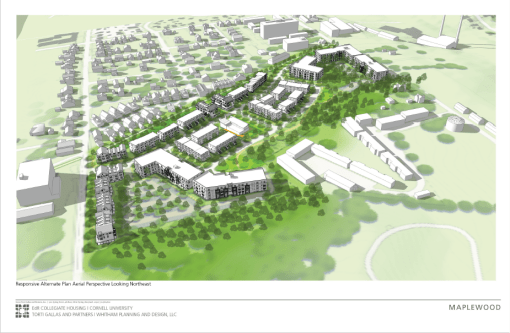
4. Over in the town of Ithaca, final approval has been granted to Cornell and EdR’s Maplewood project, meaning that everything is good to go and barring any unforseen circumstances, the 441-unit, 872-bed complex should be open for graduate and professional students by the end of July 2018. The difference between preliminary and final approval is that in preliminary, the concept is greenlighted but there needs to be additional filings completed – tree planting schedules, revised labels on diagrams, construction staging plans, and proof of final approval from the city for their portion. For those who are wondering, the 150-200 workers on-site will be parking at a temporary lot behind the Kinney Drugs at East Hill Plaza, and will be walking the five minutes down Mitchell Street to get to the job site. The first building should start to rise in late Spring of this year, with new structures rising in stages as we go through the rest of 2017.

rodeway_revision_1

The town planning board also reviewed revised plans for the Rodeway Inn at 654 Elmira Road, where the old wings will now be torn down and rebuilt on the same footprint and an enclosed corridor will be built into the new wings. The final result will have a net increase of four motel rooms, to 44 (the previous plan added only two motel rooms). The plan for renovating the single-family home on the property into a community center is unaffected by these changes and moving forward as originally planned.

20160918_151026
5. It’s been behind schedule a few months, but DiBella’s Subs is expected to open at 222 Elmira Road on February 16th.

thecomputingctr_2

thecomputingctr_3

6. It seemed a little odd when The Computing Center stated in their IDA application that their plans had already been approved, and there was nothing on file. Turns out they’re hoping to get approval for their 4,600 SF HQ from the town of Lansing next week.

The full suite of documents can be found on the town of Lansing’s website here. It looks like the farmhouse next door to 987 Warren Drive will be spared from the wrecking ball; although The Computing Center bought the property, it’s being subdivided and the barn-turned-garage is the only building that will be torn down. Lansing has one of the more lenient planning boards, so although this probably won’t be fully approved next week, there’s a good chance this project will receive final approval by the end of March.

204260_56b8b8a8c98ee1-47810900_full

7. Over on West Hill, a large vacant parcel on Bundy Road just exchanged hands. The 66.98 acre parcel has been marketed for the past few years as a development opportunity – it has municipal water and sewer, and it’s a stone’s throw from Cayuga Medical Center, Overlook and the Conifer/Cornell developments off of Route 96/Trumansburg Road. Its previous ownership, a family that has owned it in some form since 1964 (moving between members in 1984 and 1991), had it on the market for $359,900.

The buyers, a husband-and-wife pair of medical doctors who live nearby, paid $305,000 for the deed, according to a filing on the 9th. An online search for future hints doesn’t really give much guidance – the doctors have donated modest amounts to Finger Lakes Land Trust and have signed some anti-fracking petitions, and while they own undeveloped properties around them, this parcel isn’t adjacent to their house. It doesn’t really fit the Land Trust’s ideal land donations either, since it’s been substantially subdivided with medium-density residential, and borders a growing corridor. So, it’s hard to gauge just what exactly is planned here. For the record, the land is currently zoned medium density residential (max 3 floors, up to 2.9 lots/acre), but the town’s new comprehensive plan sees the property as new urbanist medium density (5-8 units/acre small-scale mixed-use), with undeveloped open space towards the southwest corner of the parcel.

cornell-project-dsun

8. Let’s finish this week off with a talk about energy. Good news first – there might be a solution to the West Dryden pipeline issue. Background here, but the nutshell is, Lansing has tapped out their natural gas capacity, and in order to accommodate new development that would need natural gas, NYSEG needs to build a higher capacity pipeline from their current facilities in the town of Dryden. This new pipeline would go along West Dryden Road, but has run into fierce opposition, mostly because Dryden residents are famous for being anti-natural gas – this was the town that took on the fracking companies and won. Keep in mind, these folks aren’t just disdainful of natural gas, they are adamantly opposed. So using their property to accommodate something they don’t like is a bit like asking to build an abortion clinic next to an evangelical church because that just happens to be where the land is cheapest, but they would have to share a driveway.

Unsurprisingly, the town of Dryden enacted a moratorium on large-scale pipeline installation. The town of Lansing is not happy because it stymies their development, and they’re extra-concerned that their biggest property taxpayer, the Cayuga Power Plant, is about to go belly up and leave the town with $100 million less on its tax rolls. The county wants to move away from fossil fuels, but it also wants to encourage development and not leave Lansing in the lurch.

This week, a plan was put forth that might accommodate both needs. A small compressor station would be built to keep pipe pressure from falling too low during times of peak demand, so that guarantees service for existing customers. The second prong is to wean existing development off natural gas and encourage new development to use other means – electric heat pumps, like those to be used in Maplewood and City Centre. This encouragement would be given through subsidies or tax breaks. The compressor station and the incentives would be in effect by late 2018.

It looks promising, but the feasibility studies are still ongoing, and Lansing is not totally on board. Both Lansing Village and Lansing Town feel they were not represented during these discussions with NYSEG, and that heat pumps are a major financial burden to saddle homebuilders with. They also wonder if the electrical grid would be capable of supporting so many heat pumps.

Speaking strictly from my experience, I’ve visited construction projects with heat pumps, and while they are a cost increase, it’s a couple percent more than the same structure with conventional heating – there’s a recently-built single-family house I can think of offhand where the cost of heat pumps was about $5,000 more on the $200,000 construction cost. If it’s incentivized, one could make it financially sensible, at least for residential options if not all. Also, I’m wary of Lansing’s reasoning because they piddled away the three town center projects five years ago – if they had stayed on top of it, they’d have $50 million more in property value and this wouldn’t be such a pressing issue now.

That being said, there are problems with this area’s approach to alternative energy. Newfield is the big culprit here – they’re about to put in a moratorium on commercial solar panel installations, which is worrying since this is the same town that redesigned their wind turbine law to ban them in essence. If municipalities are limiting residents’ abilities to turn to alternative energy sources (many urban areas have to turn to commercial arrays or turbines because there’s not enough room/too much demand on-site), then the community will be unsuccessful in weaning the population off of fossil fuels. But Dryden, which is in the process of changing their laws to accommodate large-scale solar arrays, is at the forefront of this issue – those panels could provide the electricity for the heat pumps and help turn the tide on energy sources. It only works if everyone cooperates.


News Tidbits 1/28/17: Helping You Avoid Politics For Five Minutes

28 01 2017

1. Looking at sales, it looks like there were a couple of big ones this week in the Ithaca area. The first was on Friday the 20th, where 402-04 Eddy Street was sold for $913,000. The buyer was an LLC tied to Charles and Heather Tallman, who own several properties in Collegetown. The $913k price is above the 2015 assessment of $880k, but below the 2016 $1 million assessment. The Tallman historically have not been the kind to redevelop property, and the three-story mixed-use building is part of the East Hill Historic District, so don’t expect any big changes.

The next two were on Wednesday the 25th – Parkside Gardens on the Southside at 202 Fair Street, and Lakeside (Grandview Court) on South Hill, were sold for a whopping $10,450,000 from a Long Island landlord (Arbor Hill Homes) to an LLC based out of Delaware. Parkside has 51 units and was built in the 1950s, and is assessed at $2 million. It sold for $4.2 million, about double what the $2.145 million the owner paid in 2007. Lakeside has 58 units and was built in the 1970s. It is assessed at $2.8 million, the previous owner paid $2.58 million in 2007, and just sold it for $6.25 million.

Up until 2014, they accepted housing vouchers, but according to an email from the IURA’s Nels Bohn, The Learning Web handled the vouchers and the IURA has nothing about the complexes on file after 2014. It might be a case similar to Ithaca East, where the affordable housing lease period ran out and the owner converted to market rate. The Voice tried to do a story on it in Fall 2015, but it went nowhere, and then again in January 2016, and it went nowhere. I did research but Jeff and Mike were going to be the respective writers. Here are my notes from September 21, 2015:

The two complexes were recently offered for sale, but the listing was deactivated. According to 2011 IURA minutes, the owner is kind of a sleazeball, uses them as an investment property but doesn’t do maintenance. Another company (Rochester-based Pathstone, they’ve done work with INHS) considered buying Parkside in 2011/12, but backed out when problems arose.

One could argue that the two complexes had a shady owner who just cashed out big. The buyer can be traced through its unique name to a Baltimore company called Hopkins Holding, and a LinkedIn profile of a partner in the company saying their specialty is student housing. At the high price paid for Lakeside, I could easily see a redevelopment happening, though I’m not as certain about Parkside’s future.

20170106_160711

2. There were also a couple of construction loans filed this week. Tompkins Trust lent Collegetown Crossing $500,000 according to a filing on the 23rd, but the type of work is unspecified in the county docs. Tompkins Trust also lent INHS $1,581,796 in a separate filing on the 23rd, to finance the seven for-sale townhouses underway at 202 Hancock Street in Northside, part of the 210 Hancock affordable housing project.

3. A few weeks ago, the pending sale of the former Phoenix Books barn at 1610 Dryden Road came up. Now we what the plans are. It appears a local businessman wants to renovate the barn and use it for automotive trailer sales. The plan requires a special use permit from the town because it’s a residential zone, and the project is seeking a landscaping outdoor area to showcase trailers for sale. It doesn’t read as if the barn itself will be greatly altered in appearance, although its structural stability is in question, so it will need its north wall shored up, and roof repaired so that rainwater stops pouring into the basement. The town will be going through the project over the next couple of months, but there don’t appear to be any big obstacles that will prevent a permit from being issued.

masonic_temple_1-771x595

4. For the sake of acknowledgement, the ILPC approved of Jason Fane’s renovation plans for the Masonic Temple. There was a little back-and-forth about window replacements, and they made sure to note that the “for rent” signage was not grandfathered and would have to come down once the three commercial spaces are rented out, and the signage would not be allowed to go back up even if the spaces were vacated at a later date. The ILPC also seems inclined towards a historic district on the north edge of Collegetown along Oak Avenue and Cascadilla Place, but that still has yet to take form.

5. Out in the towns and villages, there isn’t anything too exciting on the agenda. Cayuga Heights had a one-lot subdivision for a new home site at 1010 Triphammer for their latest meeting. The town of Dryden had a 5-lot subdivision off of 1624 Ellis Hollow Road, and a 7-lot subdivision at the former Dryden Lake Golf Course.Dryden also received the sketch plan for the 12 Megawatt solar array planned by Distributed Solar at 2150 Dryden Road (12 MW is enough for ~2400 homes). Ulysses had to review a special permit for turning a nursery business into a bakery/residence, and a 2 Megawatt array at the rear of 1574 Trumansburg Road. The town of Lansing had a meeting scheduled, but nothing was ever put online, nor was there a cancellation notice.

6. The townhouses at 902 Dryden are starting to rise up. Visum Development’s facebook page notes that the foundations for all structures are complete, and framing is underway; you can see roof trusses on the right of the photo. Looks like a typical wood frame with Huber ZIP sheathing, which has become the popular (and arguably more effective) alternative to traditional plywood and housewrap. According to the hashtag overkill, the 8-unit, 26-bed housing plan is still on track for an August 2017 occupancy.

20170107_113438

7. Quick wrap up, we now have addresses for the two-family homes going up on Old Elmira Road. They will be 125 Elmira Road and 129 Elmira Road. This means the end of the awkward Spencer Road/Old Elmira Road disclaimer in the next (and probably last) update in March, although for the sake of continuity the title of the post won’t change – continuity was the same reason 210 Hancock was co-tagged with neighborhood pride site for about a year. Just trying to make it easier to follow along.


News Tidbits 1/20/17: A Week Late and A Day Early

20 01 2017

1. In the town of Ulysses, work continues on a rezoning and reimagining of the hamlet of Jacksonville. The town held a meeting for public feedback this past Thursday. For those who are unfamiliar, Jacksonville is a cluster of a few dozen houses and a few small businesses about two-thirds of the way up Route 96 from Ithaca to Trumansburg. The town is working with local urban planning firm Randall + West to redevelop the hamlet, which has been plagued in recent decades with not just the standard rural upstate flight, but total disinvestment in some parts as a result of a massive gas spill in the late 1970s that poisoned the wells of neighboring properties, which Exxon bought and left in a state of low, sporadic maintenance.

However, some areas are served by municipal water systems, and the town is looking at expanding the hamlet zone, and creating a hamlet center zone in the hopes that they can give the hamlet “quality growth” and a Trumansburg-like flavor – small shops and density at the core, and somewhat walkable for basic errands, with sidewalks and interconnected streets. It’s a bit reminiscent the old “nodes” concept pushed by the county about a decade ago, but with more emphasis on walkability. The zoning brief shows participants have expressed a preference towards small-lot houses and 2-4 floor mixed use. With the latest public meeting completed, the plan is to have a zoning draft ready by March.

For the record, Ulysses permited 11 new homes in 2016, so even if the revised Jacksonville hamlet zoning becomes more accommodating, don’t expect a boomtown.

402_s_cayuga_habitat_2 402_s_cayuga_habitat_3

2. From the IURA Neighborhood Investment Committee agenda, a few more details about Habitat for Humanity’s plans for 402 South Cayuga Street. Four units, $720,000 construction cost, about $799,500 with soft costs. Savings from volunteer labor reduce the cost to $709,500. Funding comes from $100k in cash equity attained by the sale of the Morris Avenue townhouses, $300k in grants and $120k in HUD funding. Private donors and grants are expected to contribute about $189k. The initial design and land purchases expenses are being covered with funds from the $50,000 sale of a 32-acre parcel in Trumansburg for public green space. With multiple transactions required before anything can move forward, the plan is to break ground in June 2018 with construction lasting from 18-24 months.

The units will be sold to families making 30-60% of local AMI (i.e. $16-$32k/year) who put in the requisite sweat labor and take approved home-ownership and finance courses. The units will be solar-capable, though they’re still debating if the panels will be installed by Habitat or the responsibility of owners. By the way, the bright colors of the units are intentional.

The committee has said this project pretty much checks off every box on their want list, and Habitat for Humanity has been named preferred developer; contingent on approvals, the IURA will sell the property to the non-profit for $32,000.
amici_v3_1

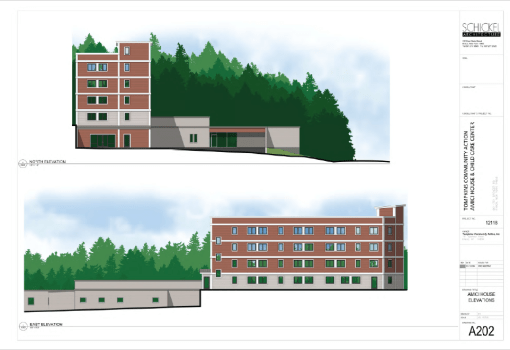
3. For those that might have missed it, the Times’ new journo, Matt Butler, did a nice piece on TCAction’s Amici House development. The 23-unit project will be up for prelim approval at this month’s Planning Board meeting. In the piece, TCAction Director Lee Dillon notes that it’s not strictly for drug rehab, it’s for homeless youth regardless of the presence of addiction. The project also provides a low-cost childcare center with five HeadStart classrooms able to support 40-45 kids. Apart from a couple of concerns and complaint, reactions have been generally receptive to the plan, which will be located at 701 Spencer Road on the southern edge of the city.

As a former Head Start student, I never knew it was geared towards low-income families until I was in high school. There’s a lot of real, tangible value to Head Start as an early education program, especially in a community like Ithaca where the school district the kids enter into is capable and well-regarded. I applaud the Amici House project and look forward to its construction.

tiny_tims_7 unnamed

4. Tiny Timbers is getting quite creative. In addition to the five existing designs, Buzz Dolph’s team, working with architect Noah Demarest, have rolled out two new designs. The first is a one-story, two-bedroom house which looks to be in the 630 SF range, with the option of deleting the second bedroom available. The second design is called “big cube”, with a 21′ x 21′ footprint (two stories, 882 SF), slightly larger than the 18′ x 18′ regular cube. The website seems to be down for an update at the moment, but the 3D panorama still works.

The town of Dryden has granted approval to the Varna site, so at this point marketing and sales of the home sites should be getting underway soon. If successful, Tiny Timbers could be a solution to meeting an underserved and difficult-to-serve segment of the Ithaca market – new, modestly-priced homes.

20161119_145216

5. Here’s the funding application for the first stages of the Tompkins County Heritage Center. The request is for $35,500 from the legislature. That would cover community presentations, legal fees for partnership agreements, a retail space plan, branding language and design, concept overview, website, floor plans, exhibit design and the launch of a capital campaign later this year (May for the silent campaign, October for the public campaign). Along with the capital campaign, primary funding may come in part from the $500 million URI fund that the state awarded to the Southern Tier back in 2015. The History Center and its partners are exploring some of the way they can reuse the 18,000 SF space currently occupied by Tompkins Trust; for example, multimedia presentations in the former bank vaults. STREAM Collaborative is in charge of the new floor plans, STREAM will work with St. John Design Group to do the branding, and Todd Zwigard Architects will handle exhibit design. The Solstice Group will be providing guidance in assembling and running the capital campaign.

To be frank, I’m still not sold on the idea of the Heritage Center being a driver of tourism itself, but I could see it being an enhancement to downtown Ithaca’s other offerings, as well as a gateway for visitors staying at the new hotels near or soon to be open within a couple blocks of the site: “Come for the colleges, wineries and gorges, but check this out while you’re here, you just might find other things you want to do and see”.
20170107_124807

6. The initial December 2016 jobs reading of 73,800 rounds out the 2016 jobs reports. Tallying up the average, the initial estimate for the Ithaca metro for 2016 is 71,600, an increase of 1.7% from last year’s average of 70,400. As always, take the initial estimates with a grain of salt, since they’re liable to be adjusted a fair amount in the big March revision. However, should they hold up, it gives Ithaca the highest percent growth of any New York State metro in the past year (although for the record, NYC added 1.1%, or 109,000 jobs in the past 12 months, basically an Ithaca and a half). For reference, the 2011 jobs average was 66,200, and the 2006 estimate was 62,600.

With the exception of those neighborhoods closest to the universities, the biggest driver of the housing affordability crisis is not student population growth, which was about 196 over the past year (+285 Cornell, -89 IC). It’s the people relocating to/near Ithaca for work. That doesn’t capture the imagination and emotion as much as saying the city’s being overrun by obnoxious 20-year olds.
20161209_121807

7. Not everything recorded in an interview makes it into Voice articles due to space constraints. Here are some transcribed notes from the “State of the State Theatre” piece that didn’t make the final cut:

Q: Where do you see things going in the next 15 years? What will the State Theatre of 2030 be like?

Doug Levine: We’d be fresh off celebrating our hundred year anniversary! They don’t build theaters like this anymore, we’ve made a lot of improvements to the building, we’ve completely renovated the restrooms. Technologically, we’ll be a lot more advanced, paperless ticketing will be a seamless transaction. We want to maintain the building charm, it’s just a grand palace, but behind the scenes, we’re getting more efficient and innovative, we’ve upgraded to LEDs, and the stage sound and lights will be a lot more cutting-edge, and we’d like to be more energy efficient. I would like to see more flexible seating in 15 years. We’d stay with DSP [Dan Smalls Presents] long-term, that’s worked out really well for us. We’re going in a good direction and I want to keep building on that success.

Q: Dovetailing off that, Ithaca is one of the few growing areas of upstate, and it’s increasingly seen as a tourism and leisure destination. Do you see ways for the State to tap into that? What other opportunities do you see (I noticed something called Ticketfly)?

DL: Conferences are a growing opportunity, the growing economy has led to a spike in conferences from all over the state wanting to come here, and those thinking creatively reach out to us, we had 2-3 last year and [we have] more planned, they’ll use us and Cinemapolis, it’s never going to be a big component but it’s nice to have those groups coming in. We average over 50,000 a year through our doors, 40% from beyond Tompkins County – New York, Philadelphia, Canada.

20151108_154139

8. It looks like the town of Ithaca wants to extend their two-family home moratorium beyond the initial 9 months. 9 months was explicitly chosen after considerable concern from developers and homebuilders last Spring stemming from the initially-proposed 12 months, which would have impacted two construction seasons. The town doesn’t even provide a new timeline, it leaves a blank next to 2017. Really burning through the goodwill here.


college_townhouses_v2_1

8. Looks like a rather luckluster agenda for the planning board next Tuesday. A bunch of projects up for preliminary and/or final approval. These meetings could start becoming very light on substance if there isn’t more in the pipeline. Here’s the schedule:

1. Agenda Review              6:00

2. Privilege of the Floor    6:01

3. Site Plan Review
A. Project:  Amici House & Childcare Center                               6:10
Location: 661-701 Spencer Rd.
Applicant: Tom Schickel for Tompkins Community Action (TC Action)
Actions: Consideration of Preliminary & Final Approval
B. Project: City Centre — Mixed Use Project (Housing & Retail)       6:30
Location: 301 E. State/M.L.K., Jr. St.
Applicant: Jeff Smetana for Newman Development Group, LLC
Actions: Public Hearing, Potential Consideration of Preliminary Approval

C. Project: College Townhouse Project 7:00
Location: 119, 121, & 125 College Ave.
Applicant: Kathryn Wolf, Trowbridge Wolf Michaels Landscape Architects, LLP
Actions: Approval of Trans. Demand Management Plan, Consideration of Preliminary & Final Approval

D. Project: Apartments (5 Units) 7:30
Location: 126 College Ave
Applicant: Visum Development Group
Actions: Public Hearing, Approval of Trans. Demand Management Plan, Consideration of Preliminary
& Final Approval

E. Project: Apartments (9 Units) 7:50
Location:210 Linden Ave
Applicant: Visum Development Group
Actions: Public Hearing, Approval of Trans. Demand Management Plan, Consideration of Preliminary
& Final Approval

F. 107 S Albany St – Sketch Plan 8:10

Presumably, the Stavropouloses are heading back for some type of major revision to their 6-unit, 9-bedroom proposal. The previous plan was an addition onto the back of the existing century-old property. We’ll see what is changed, and by how much. Zoning is CBD-60 – five floors, no parking.
G. 821 Cliff Street – Parking for Business in a Residential Zone 8:30

Parking for the medical office building at 821 Cliff Street; perhaps an expansion to help market it, as I see postings for its space scattered throughout commercial listings. Nearby properties are vacant land.

4. Zoning Appeal: 8:50
#3056, Area Variance, 301 E State St.

5.Old/New Business:
A. Sidewalk on Worth Street -Planning Board Resolution to Board of Public Works
B. 2017 Planning Division Work Plan – Planning Board Comments
C. Update — Joint Planning Board/ILPC Meeting (DeWitt House)

Regarding 5B., Apparently the city is still having discussions with Fane regarding a development of 330 College Avenue, the former Green Cafe on the SW corner of College Avenue and Dryden Road in inner Collegetown. I write “a” redevelopment because the previous 12-story proposal didn’t look like it was going to make friends and influence people. Also on the long-term agenda are the Maguire plans for the Carpenter Business Park, Ithaca Gun, and Chain Works, which is still undergoing environmental review. Those are going to be long slogs, so don’t worry about missing anything.


Ithaka Terraces (215-221 West Spencer Street) Construction Update, 1/2017

14 01 2017

The first building of the Ithaka Terraces, Building “A”, is fully framed and in the process of being roofed. The project uses double stud exterior walls in tandem with Insulated Concrete Forms (ICFs), which is thermally insulated plastic filled with concrete. The zip sheathing goes on over the surface. The purpose of the thick, more premium approach is for more efficient insulation, since the condo units are designed to be net-zero compatible (the high energy efficiency reduces the need for off-site renewable energy sources, and net-zero becomes more feasible as a result).

Further up the sloping site, smaller Building “B” has completed the ICF erection ground floor and is starting work on the upper floors. Note the reinforced concrete wall facing South Cayuga (east). That will eventually be back-filled and hidden from view. As seen in some of the early concept designs below, only the top floor of the three floors of Building “B” and “D” will have windows facing outward; the South Cayuga side of the property is where the parking lot will be laid.

The other large building in the four-building cluster, Building “C”, a mirrored floorplan of “A”, is just getting started; the site was being prepped and graded when these photos were taken last week. Building “D”, a mirrored floorplan of “B”, will start construction at a later date, as the other three get further along. In the last photo, one can see the winding temporary staircase workers use to get to the building themselves. AquaZephyr, an Ithaca firm specializing in eco-friendly construction, is the general contractor in charge of the buildout.

The 12-unit condo project will begin formal marketing later this Spring. There will be 10 two-bedroom units and 2 three-bedroom units, in the $265k-$390k range. A late 2017 opening is planned. Interested readers can submit queries here.

20170107_112320 20170107_112356 20170107_112359 20170107_112419 20170107_112433 20170107_112437 20170107_112656 20170107_112710 20170107_112727 20170107_112735

215-221_spencer_v1_2 215-221_spencer_v3_1

ith_terr_intro


1001 North Aurora Street Construction Update, 1/2017

11 01 2017

This is another one of those modest-sized infill projects where if you blink, you might just miss it.

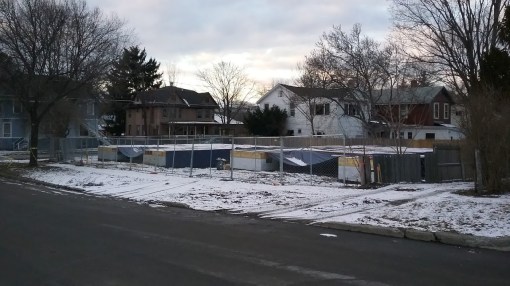
1001 North Aurora is on the north end of Fall Creek, across the street from the elementary school. The plan replaces an old though not especially historic single-family home with twom two-family homes, each unit with three bedrooms for a total twelve. Four parking spaces are included. The project was approved in October 2016 by the city planning board; the lot subdivision that triggered board review.

Over the course of review, the board requested a little more character in the house designs, including more windows, two different shades of lap siding (which will be LP SmartSide wood siding, painted Sherwin-Williams “Rice Grain” and “Sawdust”), and dormers. The materials also include Owens Corning TruDefinition “Terra Cotta” shingles and S-W “Nacre” trim boards. The initial design looked like this, and the final is shown below. The eastern building will not have the dormer, and may not have the pocket windows in the west wall either, as those were stated to be cost-dependent. The side facing Aurora, however, has to put them in as a stipulation of the approvals; after some recent issues with other projects, the board’s been getting a little more assertive when it comes to building details being built as approved.

The developer is Stavros Stavropoulos. The Stavropoulos family is perhaps best known for running State Street Diner, but recently they’ve been wading deeper into the development pool, building a new two-family home at 514 Linn Street and a two-family addition onto 318-320 Pleasant Street. Tompkins Trust gave a $400,000 construction loan to this project back in August.

Each unit will ring in at about 1200 square feet. Local architect Daniel R. Hirtler, fresh off of another duplex on the corner of Oak Avenue and Oneida Place in Collegetown, is in charge of design. Construction is expected to wrap up by the end of May 2017. According to Craigslist, the units are renting for about $2325 each ($775/bedroom), and two of the four units are already rented. Quote:

“New duplexes featuring 3 bedroom, 1.5 bath apartments. Open floor plans, ductless heating and cooling in every room, hardwood floors, stainless steel appliances, corian counter tops, stackable washer and dryer, fully furnished, off street parking and much more.”

You’ll notice in the photos below that the completed foundation slab sits a little above the ground – the northern part of Fall Creek has a high water table, so to help avoid water/flooding issues, the buildings are raised slightly. Wood framing is just beginning, so look for these to take shape as we finish out the winter and head into spring.

Quick final detail – 1001 North Aurora Street was the old address. These properties will use addresses on the 200 Block of Queen Street.

20170106_161844 20170106_161904 20170106_161928  20170106_161955 20170106_162000 20170106_162032

1001_n_aurora_v2_1


312-314 Spencer Road Construction Update, 1/2017

10 01 2017

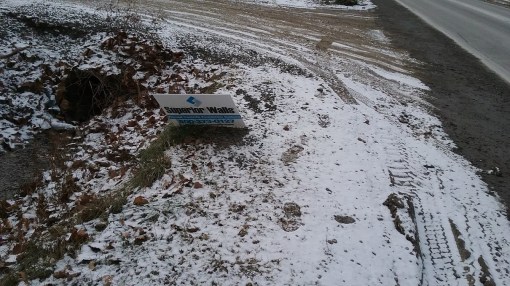
The new duplexes on Old Elmira Road seem to be moving right along. The east building has three shades of siding, one for each floor, and a third at gable-level. The exterior is accented by white trim boards. The variety in colors is an easy to way visual interest to an otherwise simple design. We’ll have to wait and see what colors they break out for the west building, which also benefits from a window bay projection facing towards the open space. It looks like plans to use shake siding on the bay projection have been dropped. Both building appear to be fully roofed and shingled. Signage at the edge of the road suggests precast concrete Superior Walls were used in the foundation work.
The 4 3-bedroom units are expected to hit the market in February. In the November update, I noted that Craigslist had these at $1700; the Modern Living Rentals website, which is the rental company for developer Charlie O’Connor, has them listed at $2100. Consider these a preview of the 4 two-family homes to be built at 607 South Aurora this spring and summer, which are also an O’Connor project.

20170107_113210 20170107_113347 20170107_113417 20170107_113438 20170107_113506 20170107_113530 20170107_113545 20170107_113554


News Tidbits 12/31/16: For Ithaca, This Wasn’t A Half-Bad Year

31 12 2016

902_dryden_final
1. Another fairly quiet week for that Christmas-New Year’s lull. There wasn’t anything too noteworthy in real estate transactions, but thanks to a construction loan filing, we have a figure for the construction cost of Modern Living Rentals’ 902 Dryden Road project – $1,192,550. The 8-unit, 26-bedroom townhouse project is being financed by Elmira’s Chemung Canal Trust Company, a regional bank which has been looking to expand its presence in the growing Ithaca market. Most mid-sized building loans like this are financed by Tompkins Trust, and this appears to be the largest project CCTC has financed locally; checking the records for the past 12 months, they’ve previously financed a few single-family homes and that’s it. A larger loan like this might be a sign that they’re building confidence in the project and the market.

815_s_aurora_night

2. Sticking with MLR, a glance at their webpage gives an interesting detail – the 87-unit, 87-bedroom 815 South Aurora project is now described as having 125 bedrooms. The multi-story apartment project sought and persuaded the city to reduce cellphone tower no-build radii last spring so that it could be built near the South Hill telecommunications mast, but because the city only reduced to 120% of height instead of tower height plus 10 feet (meaning 206 feet instead of 180 feet in this case), the project has to be tweaked. No revised designs have been released, but should something come along, you’ll see it here.

Side note, the website has an easter egg – clicking on MLR’s Commons placeholder gives you the 2015 downtown market summary from the DIA.

cornellspace-771x394

3. For those interested in learning more about Cornell’s north campus plans, video from one of their meetings can be found online here. The key takeaways – the first building, when it is built, has to be larger enough to function as swing space for Balch Hall, which appears to be first in line for renovations. Balch has 437 bedrooms, to give an idea of the potential capacity of the first new dorms. Dickson is larger (527 beds), but its renovation will be split up over two summers, allowing for partial occupancy while renovations are underway. Lot CC could potentially be replaced with 1,000 beds in multiple buildings, as well as a dining facility (a new dining facility is seen as less urgent and would be further down the line). Those new dorms would eventually be geared towards sophomores, multi-story but “contextual” in height. It sounds like the first concrete plans are expected to be ready by the end of the 2016-17 academic year.

4. The Common Council will be voting on some bond issues next week that will fund several municipal projects. $500k for street reconstruction, $367k for municipal building renovations, $653k for street lights, $600k for a replacement water tank on Coddington Road, $101k for bridge inspections, $181k for the Stewart Park pavilion, $51k for site improvements to the Hangar Theatre property, $134k for design and scoping costs for the Brindley Street bridge replacement, $340k for the Cascadilla Creekway project and a replacement ped bridge at Sears Street, water mains, traffic lights, traffic calming, new police cars, all totaling $6,464,450. A separate measure calls for an additional $950k in bonds to cover the costs of the Stewart Avenue bridge repainting and reconstruction.

Some of the money covers design studies for intersections – of particular note is a study considering a roundabout at the “five corners” intersection at Oak Ave/Dryden Rd/Maple Ave, which could be a welcome change from that awkward traffic light currently there.

The city issues bonds twice a year, in January and July, to cover its various construction projects. Some of it gets reimbursed with state and federal dollars.

city-center-v4-1

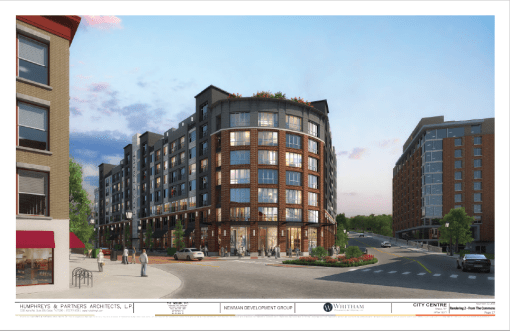
5. I cheaped out on my Voice summary of the top development stories of 2016 – there are only 5, but only because there was no way I had time to do ten this week. Here are five that missed the cut – the cancellation of State Street Triangle and the rise of its replacement, City Centre; the Tompkins County Housing Summit and the Danter Study, which are important but not really attention-grabbing; some progress in affordable housing, with Cayuga Meadows, 210 Hancock, Amici House and Poet’s Landing; the continued growth of Collegetown, with the opening of Dryden South, Dryden Eddy and Collegetown Crossing, and the entrance of the College Townhouses, 210 Linden and 126 College; and the growth of the local economy, which if the numbers hold up to revisions, 2015-2016 will have the second highest year-over-year gain in jobs since 2000 (#1 is 2011-2012).

When thinking about what’s in store next year, it’s a little sketchy because of impacts from the incoming Trump administration, and how that could impact the national economy – but if things stay consistent on a large-scale, than Ithaca can expect continued modest but steady growth, mostly in meds and eds, with a bit in tech and hospitality. We’ll probably see a couple new projects proposed in downtown and Collegetown, and maybe some smaller residential and commercial projects in other neighborhoods, like the Elmira Road strip and State Street Corridor. The town of Ithaca, it’ll depend on if they get their new zoning sorted out; if they do, there might be a burst of new proposals in some areas. The other towns, it’ll be hit or miss, maybe a larger proposal in Lansing or Dryden but otherwise scattered-site single-family, par for the course. Also, keep an eye out for more housing proposals from Cornell.

masonic_temple_1-771x595

6. It’s quiet week, so let’s finish this up with a little water cooler gossip. From the rumor mill, some of the potential tenants being discussed for the Masonic Temple include a microbrewer (good thing the city just updated their zoning to allow microbreweries), professional event space, and a church. That last one seems a little unusual, but to each their own. The renovation plans call for three rental spaces, one of which is geared towards restaurant tenants.


News tidbits 12/24/16: Looking to the Future

24 12 2016

20161211_132440

20161211_132501

20161211_132542

1. Going to take advantage of this light week to go through some of the photo stash. I thought of doing a Poet’s Landing update, but because LeChase is mostly working on site clearing/prep and excavation at this point, and given the snow on the ground, it didn’t seem like there was a whole lot to be gained from making a unique update. But, rest assured, it’s still underway, there’s just not a whole lot to see at the moment. Once the snow melts off, the slab foundations work should be visible, and there might even be some framing going up by mid-winter. The six new apartment buildings and their 48 units should be ready by the fall of 2017.

20161209_121337

2. 107 South Albany in the city is another one that doesn’t merit its own post just yet, but work should be taking place at some point soon. The building permits have been filed with the city for the 6-unit, 9-bedroom renovation and addition to the rear of the existing building, and from peering inside the existing windows, there’s the impression that interior demolition work could be underway – could explain the broken window on the second floor at least. There was no excavation work yet in the backyard, where the new wing will go. The Site Plan Review document says July 2016 to August 2017. Maybe there will be something to talk about by the next round of downtown updates.

3. Some folks might remember Phoenix Books, the hard-to-miss barn bookstore off of 366 as one approached Ithaca from Dryden. The store closed last year after 30 years of business, and the barn itself is about a century old. Now the property at 1608 Dryden Road is for sale. The barn, a small outbuilding, and 29.3 acres for $229,900. According to the Zillow posting, a sale is already pending.

4. From sales to sold. An industrial property in the Inlet Corridor of Ithaca town has exchanged hands. The property is at 142 Ithaca Beer Drive, next door to the growing brewery and restaurant. According to the listing with Pyramid Brokerage, the property consists of “Two commercial buildings totaling 6,812SF on 2.79 acres at south end and just off of Ithaca’s Elmira Road (NYS Route 13) commercial corridor. Ideal for combo of office (812SF) and industrial/warehouse (6,000SF) with lots of room to expand. All municipal services. Warehouse building has high ceilings, concrete floors, 2 overhead doors and more. Great opportunity for light industrial/manufacturing with array of flex space.”

The Iacovellis used it to house their construction equipment, and had it on the market for $409,000. It sold for just under that, a reasonable $400,000, to Greentree Garden Supply, which has operations a stone’s throw away from the property. Greentree makes their own soil products (potting soils, soil formula), so that may be a potential future use of the warehouse they just picked up. Good for them; they seem to be thriving as well as their garden plants.

58505e689f6ef-image

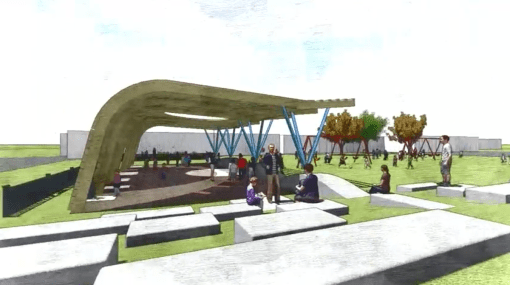
5. Here’s a cool idea – the Lansing School District is planning to build an outdoor classroom as part of $4.95 million in renovations. Cassandra Negley has the full story at the Times. The renovations were approved by a landslide 240-32 vote, which was helped by the fact that the project will be funded with grants and money from the school district’s reserve (rainy day) fund – no additional cost will be assumed by the taxpayers. In advocating for the project, school district staff noted that it would provide for “multi-sensory experiences”, a useful asset during the instruction of natural and environmental science topics, and cited studies that showed students performed better academically when given the opportunity to have classes in outdoor spaces. The space would be used as covered play space during recesses.

maplewood_v7_5

6. Going off into hand-waving territory here. Enter at your own risk.

You might have heard in the news this week that New York State, even though it added 104,500 jobs over the past year, is estimated to have recorded a population loss of about 1,800 people. That’s not a good thing for a number of reasons, but it’s a more acute issue upstate. New York City issued building permits for 101,705 residential units from 2013-2015, with another 13,000-14,000 estimated this year, and the city, just the boroughs and not even counting the suburbs, makes up nearly all the population growth (375,272 through July 2015, vs. 367,179 as the total gain for the state from 2010- July 2016). Upstate continues to hemorrhage people to other states. Not a surprise to anyone who’s travelled outside of Ithaca, Saratoga or the few other bright spots. What can we expect for Ithaca in a bad piece of news for Upstate?

Here are some off-the-cuff tallies for population growth. Ithaca’s estimated to be 30,788 as of July 2015, up 774 since 2010. The estimates due out early next year cover July 1, 2015 to July 1, 2016.  What opened in that time frame?

By my count, Stone Quarry (82 beds), the Lofts at Six Mile Creek (66 beds), 804 East State (18 beds), 707 East Seneca (18 beds), 206 Taughannock (10 beds), the Lehigh Valley House condos (6 units, will assume county average 1.7 occupants per unit, for 10 residents), 116 Catherine Street (17 beds), and the 140 College Avenue (12 bed addition). Allow another half dozen or so units with a dozen beds total, for accessory apartments or new single-family homes. Only one of these projects replaced existing housing units – a one-bedroom bungalow came down for 804 East State. The gross gain is about 244 people, if we assume the standard of one person per bedroom or studio unit.

Now let’s do some subtractions. Hughes Hall closed on Cornell’s campus. -47 off the bat, for 197. Now, the math can’t easily accommodate those who had a household member move in/be born, or move out/pass on. But trends suggest a 2% decrease per decade, so we’ll treat it as negligible. So, my baseline prediction for the 2016 estimate is 30,981.

Just thinking offhand of the projects that have opened since July 1, 2016, expect at least 210 more for the July 1, 2017 estimate, and 670 in 2018, because that’s when Collegetown Terrace phase III (344 bedrooms), Novarr’s townhouses (net gain ~60 bedrooms), 210 Hancock (90 bedrooms) and Todd Fox’s latest trio (net gain ~110 bedrooms) are included in the figures. These drive-by numbers are based just on what’s underway, or approved and financed. The 2017, or more particularly the 2018 numbers could go up. So roughly, 30,981 in 2016, 31,191 in 2017, and 31,861 by July 1, 2018, assuming no major catastrophes and that the local economy’s growth and residential vacancy rate is consistent.

For the record, the purely mental figure I use for a 2020 census is 32,500. That would consider Harold’s Square (146 bedrooms), City Centre (250 bedrooms), the first phase of Chain Works (80+ bedrooms), as well as other proposals that may arise in the next year or two and open before April 1, 2020, the official census date. I do not factor in any new Cornell North Campus dorms in the estimate, since the new dorms will initially function as temporary replacements for existing space that will be concurrently closed and renovated.

Now, when thinking about the town of Ithaca, things get really weird because of Maplewood – a loss of 370-380 beds. The town doesn’t have any large multifamily underway – my partially-imputed count from permit reports gives about five newly-occupied duplex units and 20 or so homes for the July 2015 – June 2016 period, and the 10 Belle Sherman townhouses. That’s probably 100-120 beds total. The town of Ithaca will likely show a decrease in population in the 2016 census estimate because of the Maplewood closure, and it will be bad optics because there’s all this talk of affordable housing issues, and seeing a decline in population in the news will inspire a negative kneejerk reaction – either “if it’s going down do we really need housing”, or “hey, it’s going down, then why are the rents so damned high”. Have that talking point ready, Ithaca town board.

For the 2017 count/2018 release, the partially-educated guess is an increase of 150 given Brookdale, but the 872 new Maplewood residents won’t come into count until the 2018-19 estimation period, at which point we’re pretty much at the next census. I’m thinking around 21,500 for 2020 (from 19,930 in 2010), if the current trends continue and major housing projects are completed.


902 Dryden Road Construction Update, 12/2016

19 12 2016

Varna has long been touted as one of those places where development is likely to happen. The hamlet, which has under 1,000 people, sits close to Cornell in the town of Dryden – land is cheaper than most parts of the city, but the area is served by the bus line, which opens it up to Cornell’s deep-pocketed student market. However, Varna can be a tough nut to crack – this far out, the demand is mostly driven by more cost-conscious grad students rather than free-spending undergrads, and the going price for a rental is lower. With a less captive market and less lucrative rents, Varna becomes a trickier prospect.

Plus, although the town itself is fairly accommodating, some members of the local neighborhood group, the Varna Community Association, have a disposition against rentals, preferring that any development that comes along be owner-occupied. Owner-occupied is possible as Tiny Timbers hopes to demonstrate, but it is more difficult to finance since a developer can’t guarantee income the same way they could with rentals.

Since the 1980s, one can find at least six projects proposed in Varna that never came to fruition – the latest and grandest being a massive 260-unit proposal by the Lucente family, which the town turned away from further consideration after concerns about quality of life, and significant pushback from members of the VCA. Concurrently, the town was looking at updating the hamlet’s zoning, and the issues with the Lucente plan helped formulate the new Varna comprehensive plan adopted in 2012, and revised zoning not long thereafter. The zoning identified areas for density and dvelopment (ideally, a walkable core), and preserving more rural lands beyond the main drag.

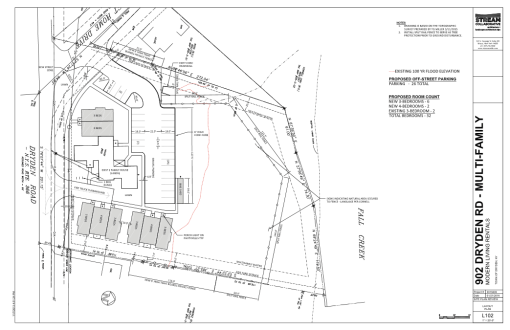
902 Dryden Road, first proposed in June 2015, was the first project to come along after those planning and zoning updates. It was somewhat unexpected by some residents, because a redevelopment of this property was not envisioned in the town’s 2012 plan (which shows that plans are guidelines, not prescriptions). Initially, it was a 15-unit, 42-bed proposal, rentals aimed towards grad students and Cornell staff. Two of the units, totaling six bedrooms, already exist. Modern Living Rentals, a partnership of local developers Charlie O’Connor and Todd Fox, purchased the property in June 2014 for $215,000. At the time, the units were going to be entirely solar-powered, aiming for net-zero energy (what is produced on-site is equal to or greater than what it consumed).

At this point in time, Fox and O’Connor had done some duplexes and the 6-unit apartment building at 707 East Seneca in the city, but 902 was going to their first “large” project. But, they hadn’t counted on strong opposition, not just from neighbors but from Cornell Plantations (now Cornell Botanical Gardens), who had concerns about the floodplain at the rear of the parcel, where it borders Fall Creek. The town was hesitant to move forward with approval unless there were revisions.

As time wore on and meetings were held with the town and VCA, the project was reduced in scale; the lot size used to determine maximum unit density was calculated incorrectly the first time and two units were removed, and then the project was scaled back further to reduce impacts on the floodplain, moving the gravel parking lot so that it wouldn’t infringe on the plain – the final count came out to 10 units and 32 bedrooms, or 8 units and 26 bedrooms if counting just the new structures. The solar panels had been on the flood plain as well, but were eliminated because they were no longer financially doable at 8 units; it was stated that the infrastructure would be built to support net-zero energy down the line, if power was purchased from off-site. The reduced-size project was acceptable to the town and to Cornell, and 902 Dryden was approved in March 2016.

Along with the existing duplex, two new units will be built opposite a shared wall. Two three-unit clusters will also be built on the east side of the parcel. The middle units of the three-unit clusters will have four bedrooms with 1606 SF of living space; all the rest will be three-bedroom units, and about 1500 SF each. STREAM Collaborative is the project architect.

There are two separate groups of drawings floating around for the buildings, and I am not sure which is correct. The render below, from shortly after approval, shows warm colors. Renders on MLR’s website show what looks like blue, brown and white fiber cement panels. The unit rents range from $1500-$2000/month for the three-bedrooms, and $2600/month for the four-bedrooms. The project cost was estimated at about $1.5 million in early Site Plan Review docs.

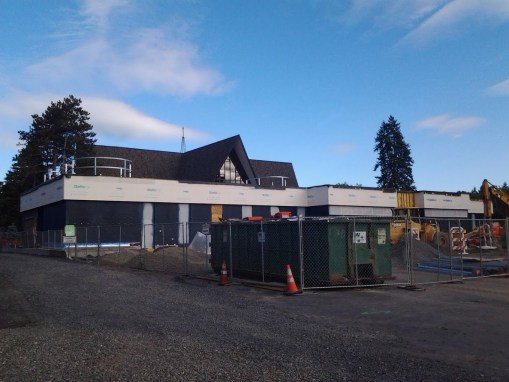
It’s a bit of tricky site for photos- the site borders the intersection of 366 and Forest Home Drive, leaving a pull-off in front of the mobile home park, or at the spit of land where the roads split. But it looks like site clearing and foundation excavation are ongoing. If anyone knows who the contractor is, drop me a line in the comments.


20161211_130116

902_dryden_final 902_dryden_v4_1