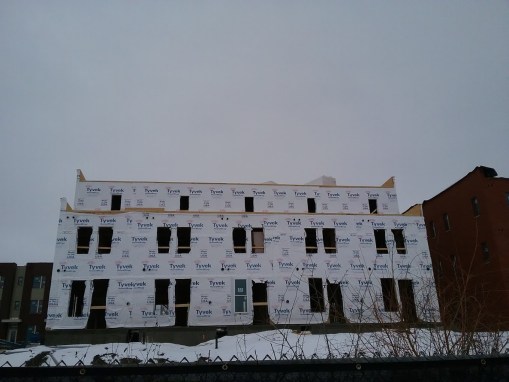
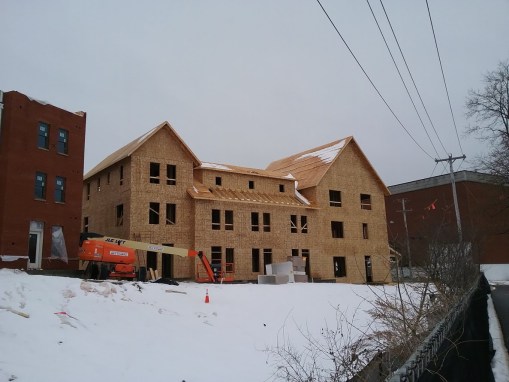
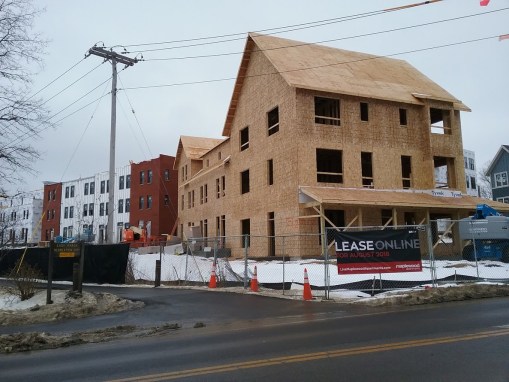
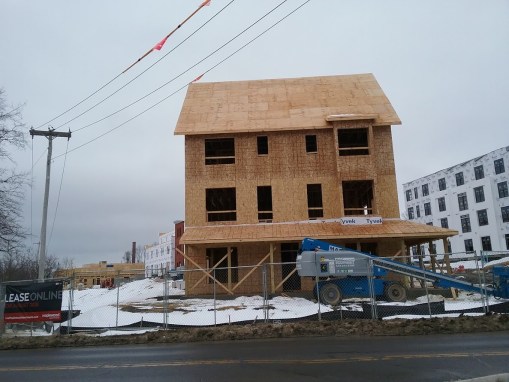
Maplewood Redevelopment Construction Update, 2/2018

19 02 2018

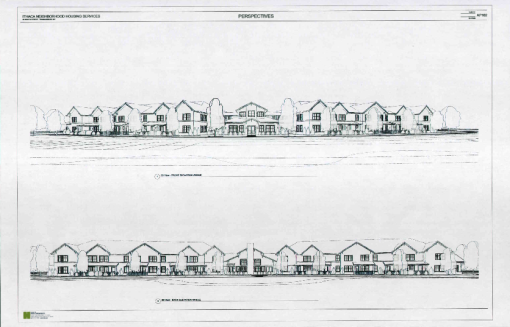
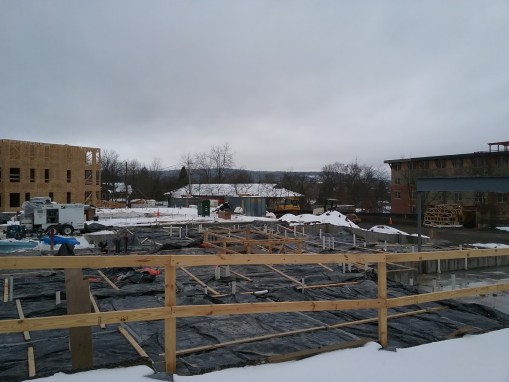
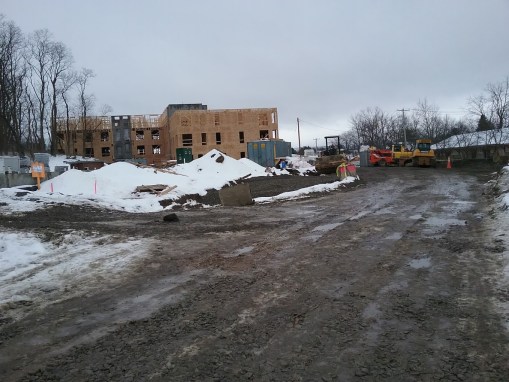
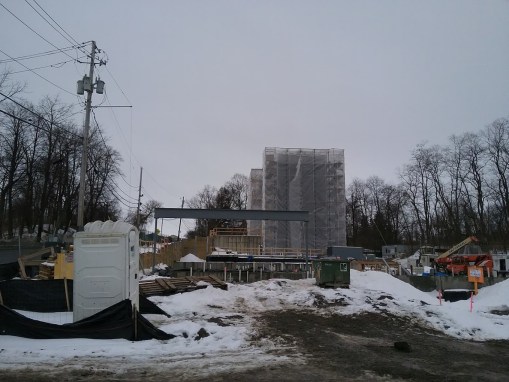
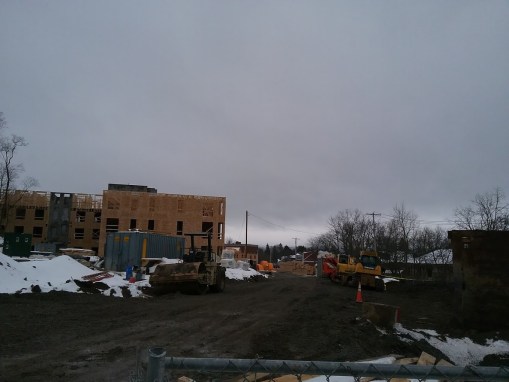
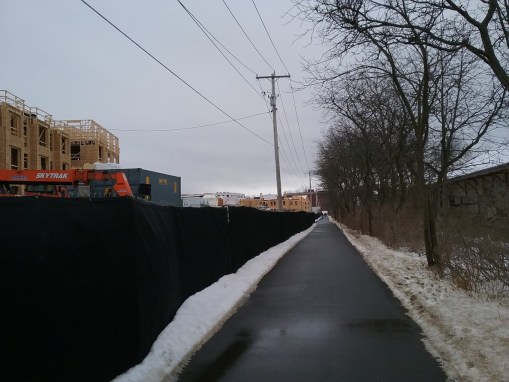
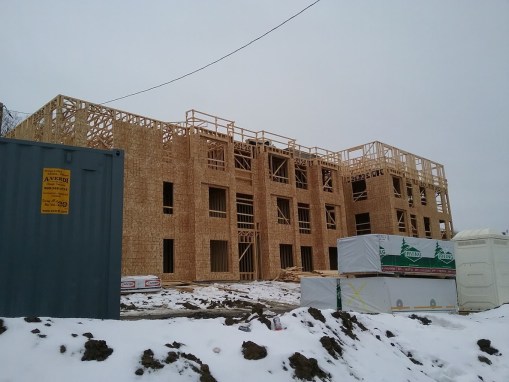
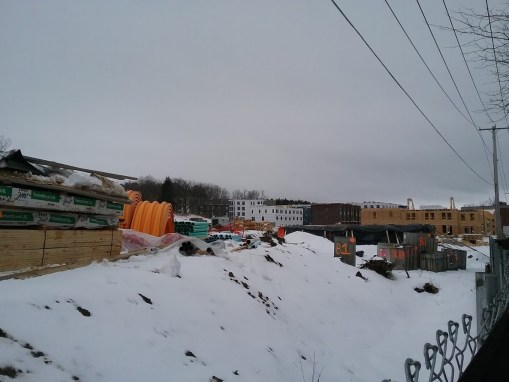
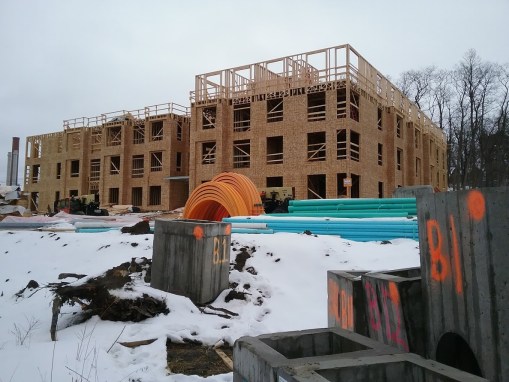
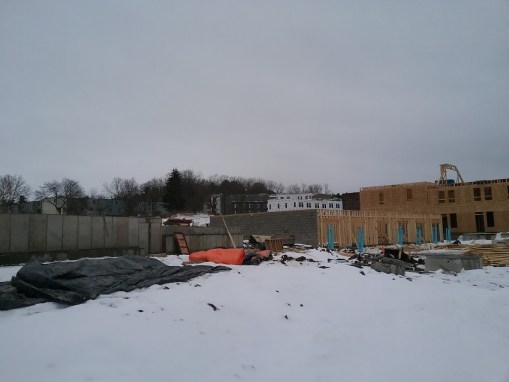
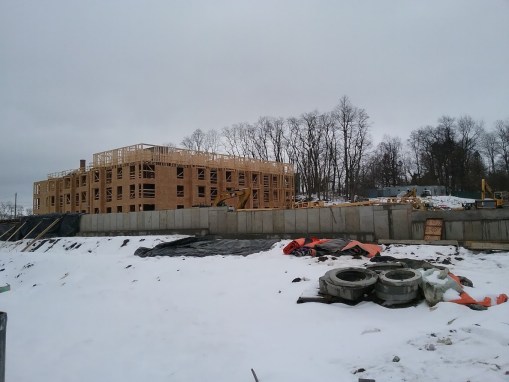
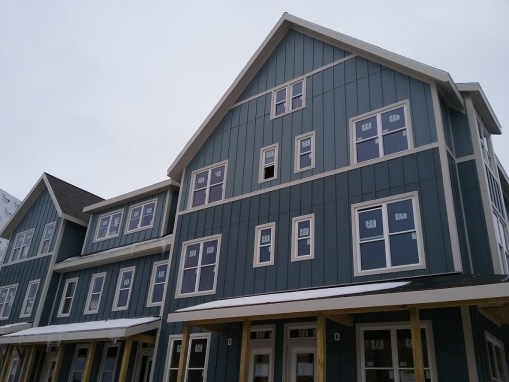
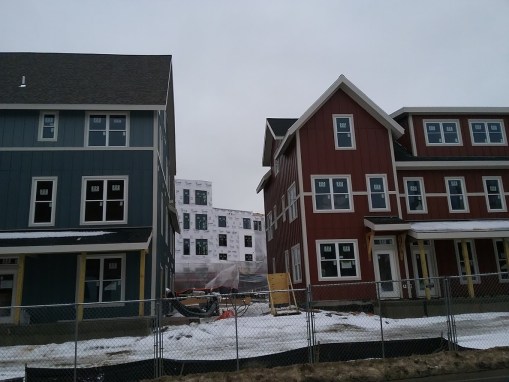
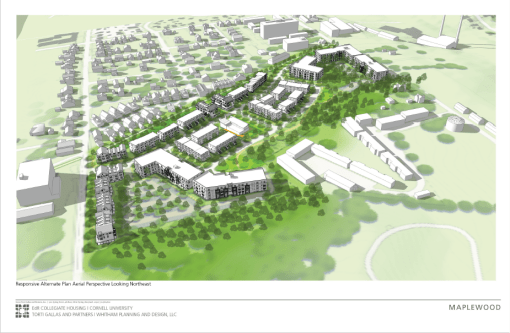
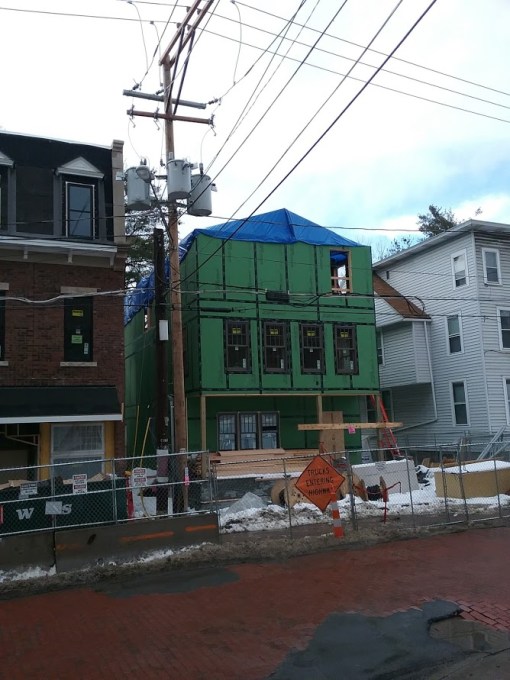
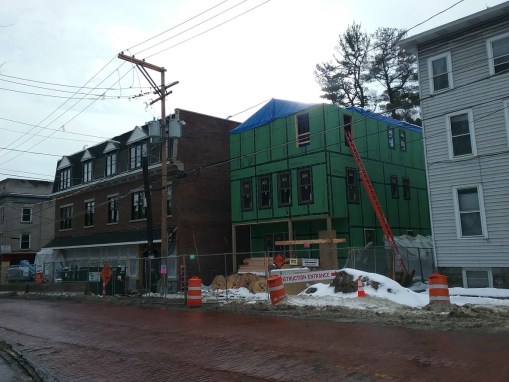
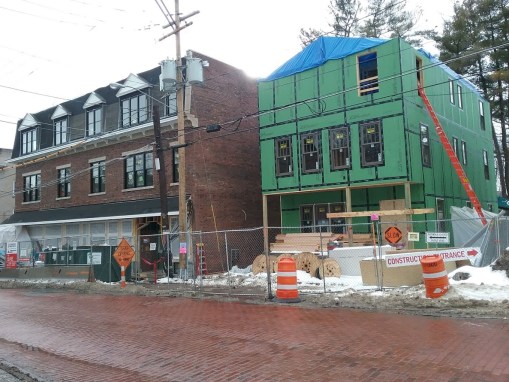
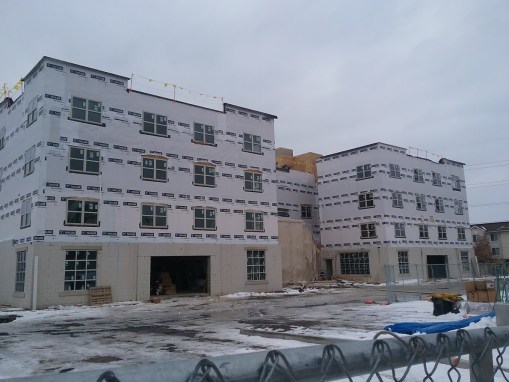
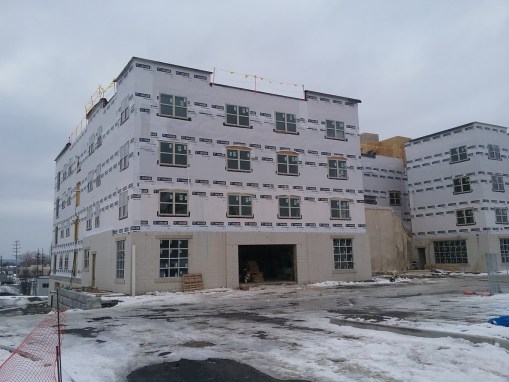
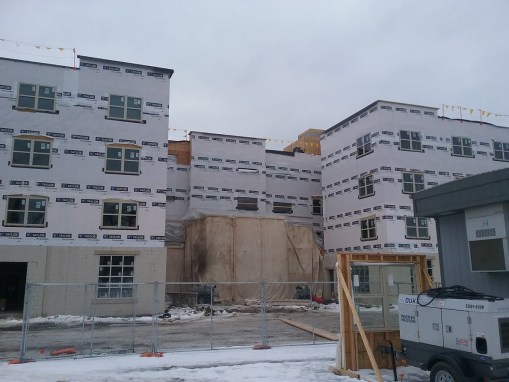
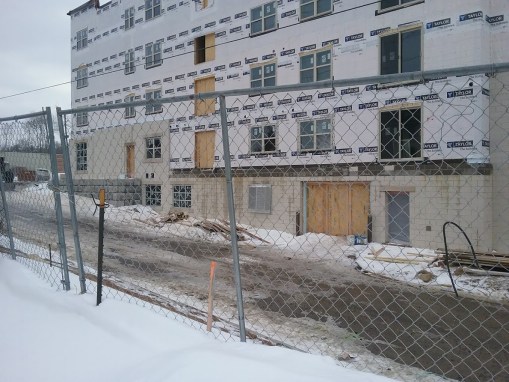
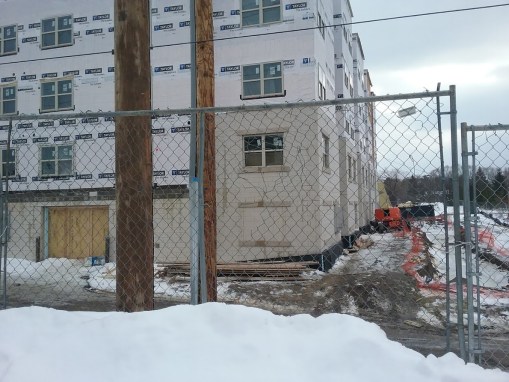
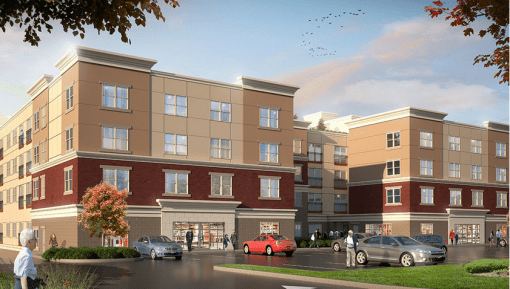
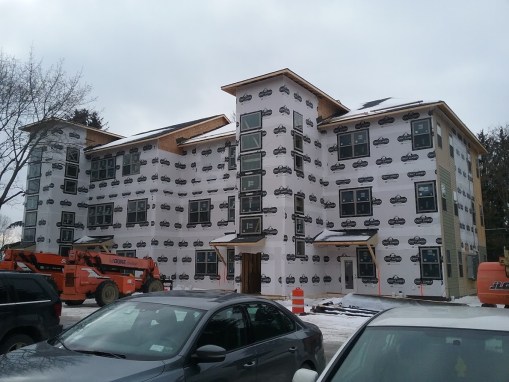
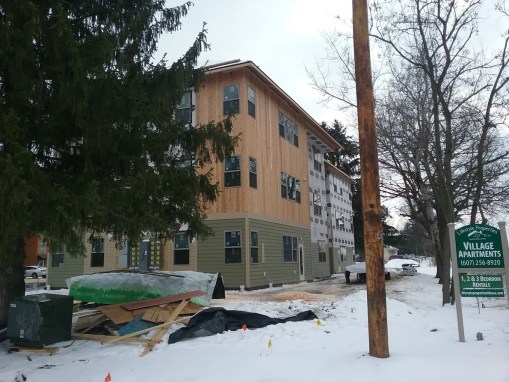
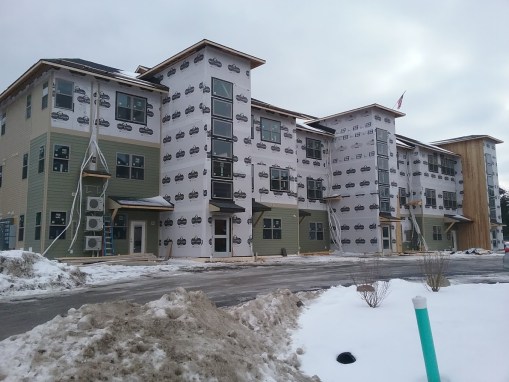
There is so much going on here – it kinda blows my mind because a development of this acreage and number of units is extremely rare in a place like Ithaca, where highly subdivided lands make large acreages difficult to find or assemble, the financial and labor capacity for a large build is limited, and review processes are stringent and rather burdensome. With the exception of a few townhouse strings towards the middle and the community center, it looks like almost everything else has moved into the framing stage. In contrast to the renders, the townhouse strings are showing greater color variation in their brick and fiber cement panels – some are navy blue boards and orange-red brick , while others are jade green boards with maroon brick. Same goes for the apartments, some of which have a navy/orange-red scheme, while others are faced in different shades of grey panels. This helps to create more visual interest and differentiation between otherwise similar structures.

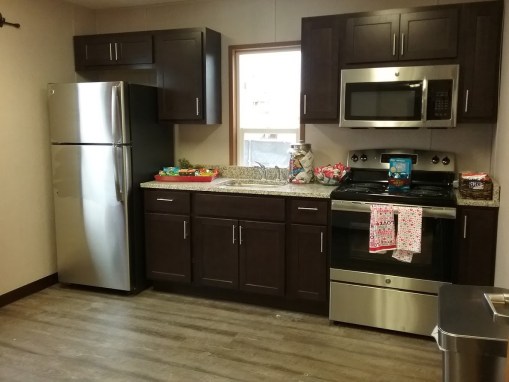
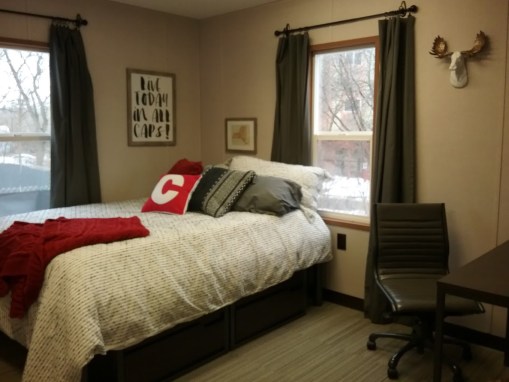
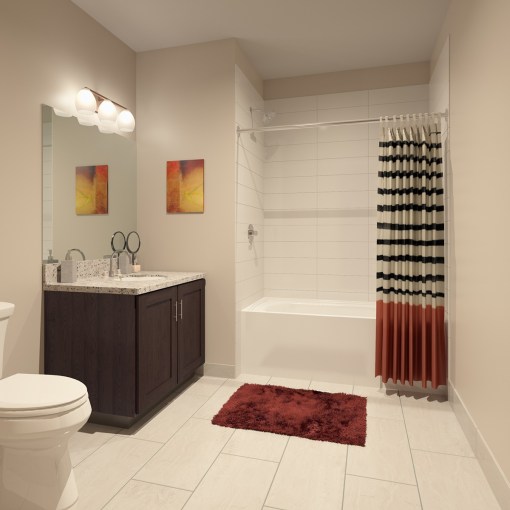
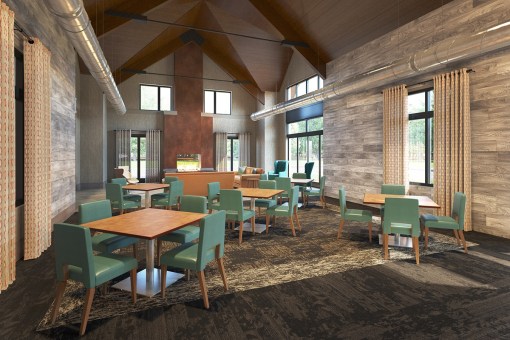
Embedded below are a couple of mock-ups from the on-site display unit inside the leasing trailer. It’s not a bad setup, though on a random note, no one in their right mind would hang a picture frame so close to the top of their bed. The units will come furnished. For those interested, the rental website can be found here. Also included below at the end are a few interior renders, of the community center, a study lounge, the fitness room and a bathroom (not a part of the walk-through mock-up).

For project background and planning, click here.

For a site plan breakdown, click here.

For a construction timeline, click here.

Webcam link here (updated ~15 minutes).


The Lux (232-236 Dryden Road) Construction Update, 2/2018

19 02 2018

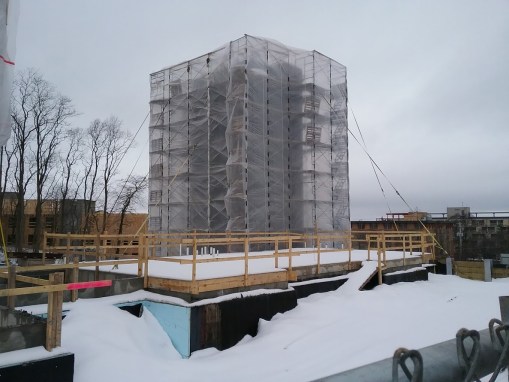
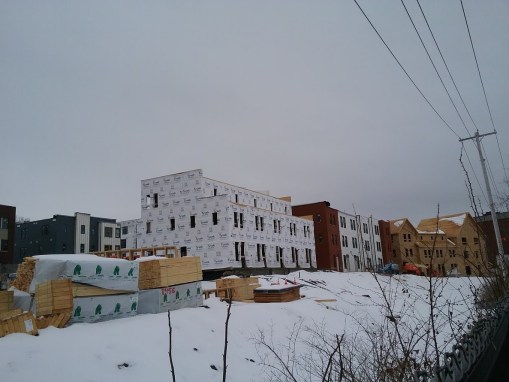
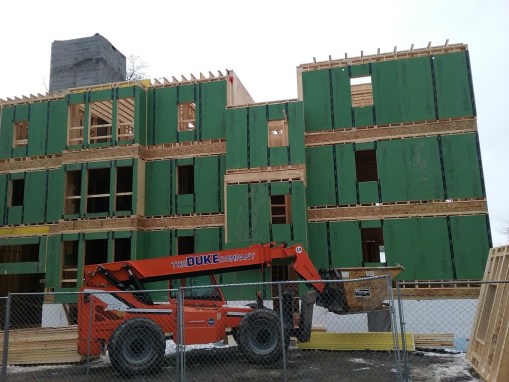
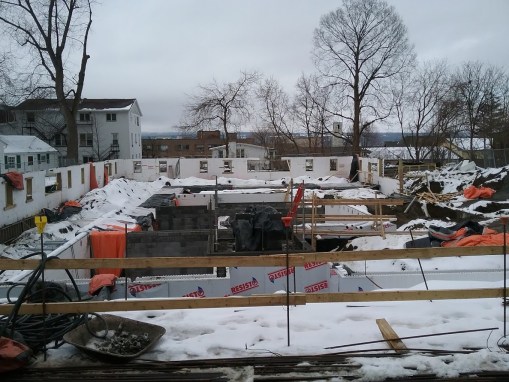
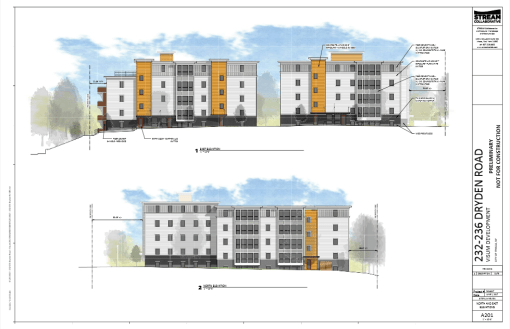
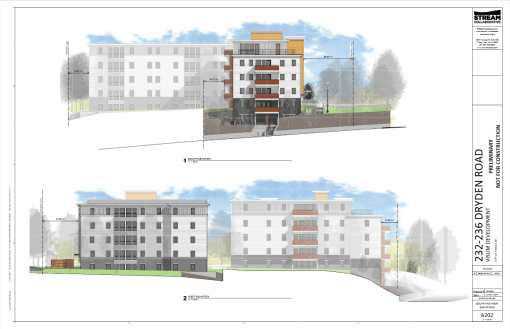
Things continue to move at a good clip over at “The Lux” at 232-236 Dryden Road. It looks like the insulated concrete forms (ICFs) have acquiesced to standard wood framing and ZIP panels on the upper floors. The building facing Dryden Road, 232/The Lux South, has commenced with framing of four of its five floors, and the elevator core/stairwell stands at full height (zoning only allows four floors/45 feet, but its a sloped site, so technically that bottom floor is a partially exposed basement level). 236/The Lux North has begun work on its basement level with the construction of ICFs covered with a vapor and water-resistant barrier (Resisto), and it appears that the first blocks for an elevator core/stair column are being assembled.

There might have been some internal reconfiguration. Site plan review documents noted that 232 Dryden will have 20 units and 53 bedrooms, and 236 Dryden will host 40 units and 138 bedrooms. But, a recent post on Visum’s facebook page suggests the project will have 207 bedrooms, not 191 as originally conceived. Everything appears to be on track for an August 2018 occupancy.

Even with the expected Cornell dorm additions in the next three years, the Lux’s location in inner Collegetown gives it an advantage over more remote housing options – students/parents with deep pockets will often pay more to be next to campus, while the amenities and worry-free living help seal the deal (worry-free in the sense that there’s no “deferred maintenance” to be concerned with when the units are brand new). Rents here are going for $1,200-$1,300 per bedroom, though they have a promotional running right now for 10% off rent for the first month.

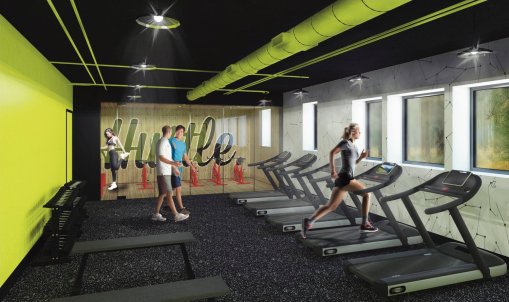
It appears there was an unusual but interesting contest held by Visum that invited students to compose interior designs for the three common rooms in the complex. Registered applicants (individual or group) received floor plans and interior documents to aid in their designs, and had about eight weeks to submit their final plans (December 2nd – January 21st). The winning team gets $2,500 and a building lounge will be named in their honor. Snagged from the website and included below are some mockups of the gym, a study room and a commons space.


400-404 & 406 Stewart Avenue Construction Update, 2/2018

18 02 2018

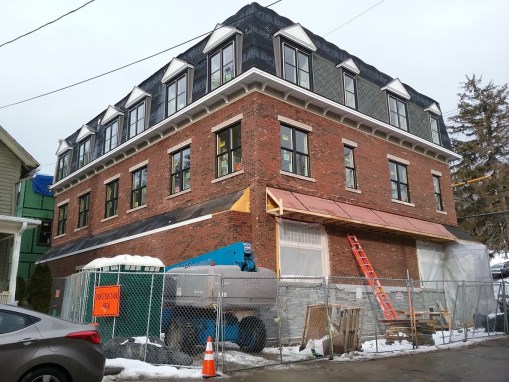
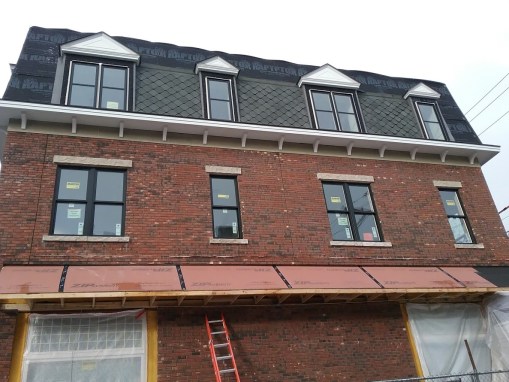
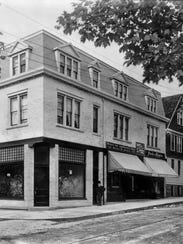
This pair appears to be coming along quite nicely. 400-404 Stewart Avenue is looking good. GAF asphalt roof shingles are being laid over the Raptor brand underlayment. The trim has been attached, with some of the ornamental board starting to go up aside the brackets. The cornice and bracket trim is to be painted grey and black, as are the gables on the dormers (I guess they do technically count as gable dormers on a mansard roof, even with the pitch as steep as it is). It has a vaguely Georgian colonial feel to it; the design is a heavy nod to the original building design from a century ago.

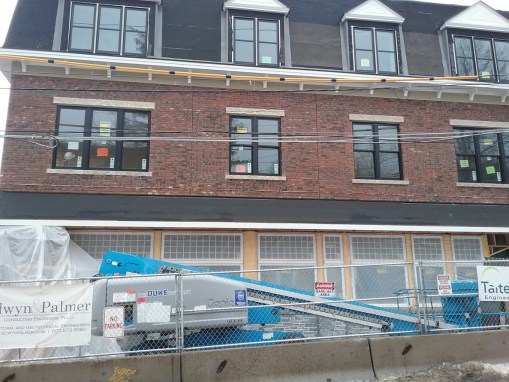
Most if not all of the Redland Heritage SWB brick is attached, and the overhangs have been framed and sheathed, with some underlayment applied – these will actually be finished with more expensive but historically appropriate (simulated) slate shingles. The transom windows and picture windows of the first floor retail/bar/restaurant space have been fitted, but the trim has yet to be attached. The bluestone veneer at the base is largely complete. The doors have yet to be fitted, as do the heavy brackets and ornate detailing of the first floor exterior.

Advertisements for the upstairs apartments has yet to make an appearance, but there are ads going around for the retail space (3,000 SF, $35/SF).

As for the new 406 Stewart Avenue, the mismatched rough window openings on the front facade appears to have been fixed. The recessed front porch is framed, and if I’m seeing it right, the stonework is already in place at the base. The construction crew is starting to cut out the openings from the Huber ZIP panels on the third floor. It is definitely a different interior layout than they had in mind when the renderings were presenting – there are substantial differences in the fenestration of the building’s north face.  The gable roof and dormer has yet to be framed, but if they’re aiming for a Q2 and Q3 opening, they look to be on track from a glance.


News Tidbits 2/10/18: It’s In The Minutes

10 02 2018

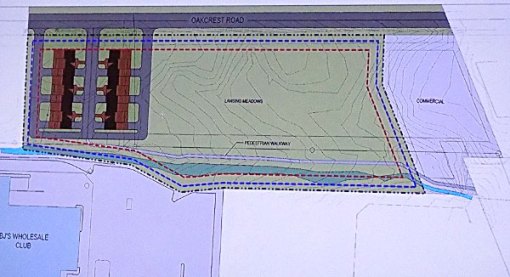
1. It’s round four of the senior housing proposed as part of the Lansing Meadows PDA. This time, developer Eric Goetzmann is proposing two six-unit strings, two stories, all units two-bedrooms with enclosed garages. The Lansing Star notes that the site plan is very unusual in that all the housing is clustered at one end of the property, leaving a big vacant space that could in theory be sold off. Apparently it also caught the Lansing village planning board’s attention.

“It just looks too obvious,” said Planning Board Chair Mario Tomei. “There’s got to be some other thought going through your head about what that green area is going to be. Are you willing to share it?”

Goetzmann replied, “I don’t have anything, Mario. I need to get these 12 built. To get these things done, and then I’m going to be done with this. I don’t have any other plans for the future. I’ve listened to what you’ve said. I’ve never pushed anything. The last plan I brought here was 100% within the code. If I wanted to come back and fight it I could have done that. You had a reaction to it, and I understand. I do commercial development, not residential. But I agreed to it as part of (the overall plan to build BJ’s). I made a commitment to get these things done, and I want to get them done.”

That much is correct. The county IDA granted Goetzmann a tax abatement on the construction of BJ’s in 2011, on the provision of the wetlands and senior housing being built. After several extensions, the IDA had told him no more, the housing either starts this year, or they’ll consider him to have breached their contract. So if Goetzmann doesn’t start work on the senior housing soon, they’ll consider legal action, possibly a “clawback” on the abated taxes. As a result, this has a whiff of desperation, although the vacant land is still a question mark to just about everyone. The planning board will continue to review the plans later this month.

2. So here are a few other interesting little tidbits out of the village of Lansing:

– At the Crystal’s Salon and Spa site at 2416 North Triphammer Road, there is an early concept plan being considered for redevelopment into mixed uses with about sixty housing units. There are wetlands on the property, which the developers (as yet unknown) have said will be avoided. Zoning for the property is Commercial Low Traffic (CLT), which allows multi-family housing with a special permit. CLT is otherwise limited to office space and low-traffic operations, non-retail and non-food service. The spa might be permitted as a “clinic” health facility, the code’s a little vague at points. Crystal’s is 3.42 acres, which seems a little small for a Lansing project, though not impossible, and it’s certainly more plausible if it includes the vacant 5.61 acres next to it. Maximum height is 3 floors/35 feet., no limit on lot coverage so long as it meets setbacks and parking requirements.

1020 Craft Road, a former manufacturing facility, is being renovated by Marchuska Brothers Construction for a medical office tenant. Pyramid Brokerage has a site plan concept sketch up on their website.

The 140-unit Bomax Road apartments plan had a litigation hearing on February 2nd. It appears the developer of the proposed complex has won? If so, the plan could legally move forward.

Cayuga View might be a summer or even an early fall opening, rather than Spring 2018.

3. Over in Dryden, not a whole lot going on at the moment. The town will be reviewing the plans for Nick Bellisario’s second warehouse at 57 Hall Road. The 10,800 SF structure is a 60′ x 180′ x 20′ pole barn with a corrugated metal finish, garage bays, four parking spaces and some modest landscaping. It’s designed to complement the 12,000 SF warehouse next door, which is used by Tiny Timbers for manufacturing the components of their modular home kits. However, it’s not clear if there is a tenant in mind here.

4. It appears that there’s been some movement on the Cornell North Campus dorms. From the Student Assembly’s Campus Planning Committee fall notes:

Aspiration – 2000 new beds, 275 new freshman/year for 4 years

Process

  • Housing Master Plan will be shared with CPC in two weeks
  • Early site review: North Campus the area of focus – existing freshman and number of sophomores, and area with developable sites
  • RFP Process: 24 developers, 9 responses,  interviewed 4
  • Cornell funding decision: this will be owned and operated by Cornell
  • Fee developer to construct
  • Board of Trustees approved this early portion of the process over summer

Paul Stemkowski, serving as the North Campus Housing Expansion project manager reported:

  • We have a developer
  • Site analysis has commenced, reviewing municipal zoning and boundaries in the site areas, natural features, and a noted historic district   
  • Phase 1: proposed as 800 beds on CC Lot (1200 beds initial studies) 4 and 5 story buildings and new dining element
  • Sophomore and freshman villages
  • Appel Fields: housing proposed here for 3 to 4 stories

Timeline: August 2020 goal for phase 1 phase 2: 2021

Phase I will open spaces for deferred maintenance work- Balch Hall needs lots of restoration, rehabilitation

So, we’re looking at 4-5 floors and at least 800 beds in multiple structures on what is CC lot (the leftmost blue patch in the map), and 3-4 stories in multiple structures on the Appel Fields (rightmost blue patch). It will be Cornell owned and operated, but that makes the RFP part a bit confusing – tapping someone to build and sell Cornell the final product, or what exactly? If August 2020 is the goal, then summer 2019 is probably the hard deadline for a construction start, so expect formal site plan review to begin this fall at the latest (sooner if an in-depth Environmental Impact Statement (EIS) is expected by city planning staff). The only commercial component appears to be new dining facilities, though they are considering additional carryout food service options. No new parking will be added, and work on the Helen Newman Hall athletic facility is not a part of the expansion plans.

The October minutes cover plans for the College of engineering, with a gut renovation of Hollister and demolition of Carpenter Hall and Ward Labs. However, these appear to already be outdated, given Cornell’s state-funded plans to renovate Ward into the CEPSI+ business incubator.

5. Lansing is finally getting that sewer line, though it won’t be along North Triphammer Road. According to the Lansing Star, the new sewer will go along East Shore Drive and Cayuga Heights Road because it appeared more feasible, and gave the village of Lansing an opportunity to reconfigure a difficult intersection. The current treatment facilities are not far from maximum capacity, and as a result, the village is expanding the lot size needed for a single-family home with a sewer connection, from 30,000 SF to 45,000 SF (just over an acre). An unsewered lot requires 60,000 SF. for the record.

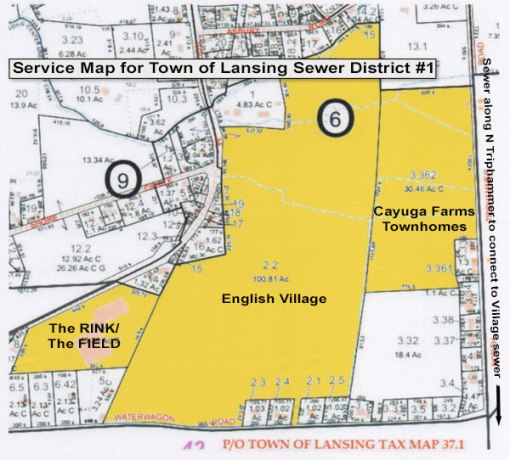
Relevant to this blog, the line will terminate at a trio of lots under development or redevelopment in the town – the RINK, which is adding a climbing wall, as well as the 117-unit and 102-unit English Village and Cayuga Orchard housing developments. The village mayor, Donald Hartill, says the sewer project is in good financial shape, and that a revised land survey will allow final engineering to commence, ultimately leading to construction later this year.


6. City Harbor updated its website with additional info. Most of it has been shared previously, but the developers note that the project would create 120 new jobsGreenstar would be responsible for about 60 of those positions, while Guthrie, the waterfront restaurant and a few management/maintenance roles would compose the rest.

7. Not a whole lot going on at the moment. The city of Ithaca Landmarks Preservation Commission (ILPC) will host its monthly meeting next Tuesday evening to continue consider of historic designation of the Nine, and provide design guidance to a smaller proposal for the adult co-op planned at 314 West State Street. The original nine-bedroom proposal was considered too big to adequately defer to this existing historic building, so the structure was reduced to a similarly-designed six-bedroom building.

Meanwhile, the city planning board will host its Project Review meeting next week as well, but only two projects are on the agenda – Novarr’s revised College Townhouses project at 119-125 College Avenue (on the Voice here) and the Stewart Park inclusive playground.


Cayuga View Senior Living Construction Update, 1/2018

3 02 2018

Somehow, these sat in my drafts folder for a week after they slipped off the radar. Anyway, Cayuga View Senior Living is topped out, most of the windows and entryways have been fitted, and much of the exterior has been wrapped. Exterior finishes include concrete masonry unit (CMU), face brick and fiber cement panels.

Worth a quick note, the property management here will be from Cornerstone Group of Rochester, the same firm developing the 72-unit Milton Meadows affordable housing at the Lansing town center. Some properties they own and manage, others like Cayuga View are managed on behalf of a client (the Thalers, in this case).

Touted amenities include “Hot Water, Basic/Standard Cable, Designer Kitchens, Energy Efficient New Construction, Trash Removal, Rooftop Garden Access, 24/7 Maintenance, Community Room, Fitness Center, Library/Computer Room, Secure Intercom, Wi-Fi Campus, [and] 24/7 Site Monitoring”, under the marketing moniker “Discover New Freedom”. One of the senior sub-markets the Thalers hope to target are snowbirds (like themselves), for whom they expect to rent the units year-round but only spend the warmer months and holidays up in Lansing. For $1,500-$2,775/month, that’s a lot of money to give up for a place to not live in all-year round. But that’s just one millennial’s shallow-pocketed perspective.

Taylor the Builders plans to deliver the 87,359 SF, 60-unit building sometime this spring – probably later in the season, perhaps May or June. No details are publicly available on the percent of units pre-leased, or for occupants of the twin 1,340 SF commercial spaces on the first floor. Background info on the project can be found here.


News Tidbits 1/27/18: The Shutterbug

28 01 2018

1. Let’s do some houses of the week. Above, the four new homes Tiny Timber has constructed at 1624 Ellis Hollow Road in Dryden. Each home lot is a little over an acre. The subdivision was approved last spring for the wooded parcel a couple miles east of Ithaca, and since then, Tiny Timbers has been busy selling units and lots to buyers. Two were sold in August, one in September, and the last in December. Therefore, this is 100% built out, since the last lot is a conservation lot at the rear (north) end of the property, designed to protect Cascadilla Creek. The units utilize a shared driveway, with spurs for each home. If you want to look at the homes more closely, click to enlarge the photos.

A similar plan is underway just up the road at 1540 Ellis Hollow Road, where Tiny Timbers will take a long, narrow undeveloped property and subdivide the land into five home lots and a rear (north) lot protected by a conservation easement. These homes will also be served by a common driveway. This proposal is still going through the review process, and when approved, the time frame for build-out will probably be similar. The home designs are the work of local architecture firm STREAM Collaborative.

2. Over in the village of Lansing, work has started on the next six-unit (hexplex?) at the Heights of Lansing property off of Bomax Drive. It appears that the foundation slab and footers have been formed, poured and insulated with foam boards. This is the first new townhouse string to be built in the development in six years.

Several reasons have been given for the long pause. The developers have said that the natural gas moratorium disrupted and delayed build-out plans. Secondly, the patriarch of Forest City Realty/IJ Construction, Ivar Jonson, passed away in 2014. More recently, the Jonson family (his wife Janet and daughter Lisa Bonniwell) were embroiled in a lawsuit to prevent a zoning change that would allow a market-rate apartment complex to be built down the road. Bonniwell was incensed enough to run for mayor in 2017 in an effort to stop the proposal, but did not win the election. The zoning change has been approved and the apartments were approved in October, but the Park Grove project has yet to move forward.

The townhouses were approved along with the last single-family home permit; there were some rather testy exchanges regarding sewer line easements and the installation of street lighting in conjunction with those permits. The lighting has to be in by March 2019.

Assuming these are like the other townhouses, expect them to be 3-bedroom units, low 2000s SF with garages, and to go for $350-$450k when they’re finished several months from now.

3. Dryden’s new Rite Aid is coming along. Fully framed, and the plastic in the window openings is likely intended to allow construction crews to work indoors without exposure to the fierce winter elements. The curbing and paving is complete in the parking lot, and it looks like they install metal bollards all around the lot’s perimeter to keep the less-than-attentive from driving into the wall (something that happened to the Nice N’ Easy in my hometown no less than three times before they finally put some in). It is still planned to open in March.

4. Over in Fall Creek, it appears a small apartment building is in line for some major renovations. 1002 North Aurora, a four-unit building built in 1898, had been on the market for $395,000. The seller had owned the property for 24 years, and the price was only slightly above the assessed value of $375,000.

On Friday, the property sold for $400,000 to an LLC associated with local developer Modern Living Rentals (Charlie O’Connor et al.). The same day, a building loan agreement was filed from Tioga State Bank to the LLC for $712,000. A lot of that was going towards the land acquisition, and once soft costs are deducted as well, the loan is $287,000.

MLR tends to be very transparent about their plans, and a glance at their recently updated website shows the purchase and a ‘information on this project coming soon’. However, they already uploaded the interior renovation plans from STREAM Collaborative. It’s a very thorough interior renovation, and it appears to complete change interior floor plans, with new bedrooms (net gain of one?) as well as new kitchens, bathrooms, and fire rated ceilings. Exterior changes appear to include a renovated fire escape staircase, a couple new windows on the third (top) floor), and a new skylight. While old, this apartment building is a hodge-podge of additions from decades past, so let’s see what a renovation can do to clean things up. It’s plausible the renovations would be complete by August, so they can appeal to students as well as the general market.

Quick aside, MLR has a few other “future developments” posted, though none that readers here aren’t already aware of – the 42 townhouse units at 802 Dryden, the proposed 201 North Aurora / Seneca Flats that isn’t moving forward for a while yet, and 217 Columbia, the duplex that unintentionally set South Hill into an uproar. 217 Columbia should be completed this year, and 802 Dryden in summer 2019.

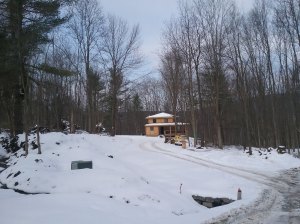
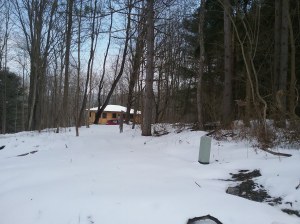
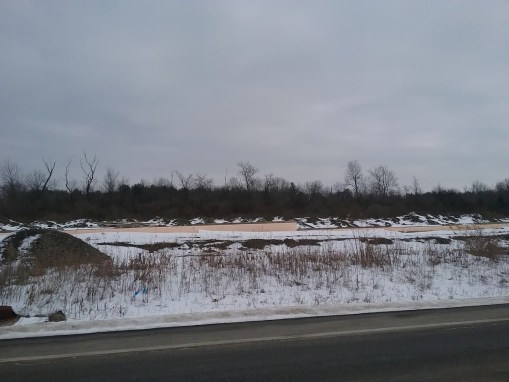
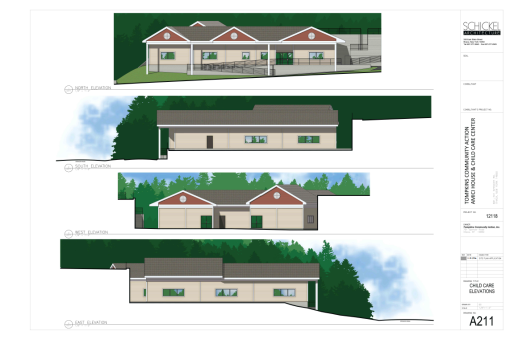
5. It looks like Amici House is finally moving forward. The project, located at 661-701 Spencer Road, received a $3,732,469 loan from the New York State Homeless Housing and Assistance Corporation. The money was announced back in April, and appears to be getting disbursed now.

The five-story, 20,710 SF (square-foot) project, approved by the city of Ithaca last January, calls for 23 studio housing units for homeless or vulnerable young individuals in the 18-25 age range. Along with the units and office/function space for local social services non-profit TCAction, the plan also calls for a 7,010 SF early heard start facility, called the “Harriet Gianellis Childcare Center”, that will house five classrooms, kitchen and restrooms, and an outdoor play area. The childcare facility will serve 48 low-to-moderate income families and create up to 21 jobs.

Recently, the HGCC applied for a low-interest loan from the IURA, $90,690 to help cover unanticipated moving expenses associated with the project. TCAction thought they could stay on-site during construction, but the contractor said otherwise, so they’ll be 609 W. Clinton while the new Amici House is built. The loan says it will generate three jobs, but that’s more a technical stipulation than an actual figure associated with the project. The funding for the childcare appears to be separate, $1,325,000 already approved by the state, $603,000 from M&T Bank, and $84,200 from a standing IURA loan. It is fully funded, although it is not completely clear if it will be built concurrently with the housing (the likely answer is yes).


Cayuga Medical Associates Construction Update, 1/2018

26 01 2018

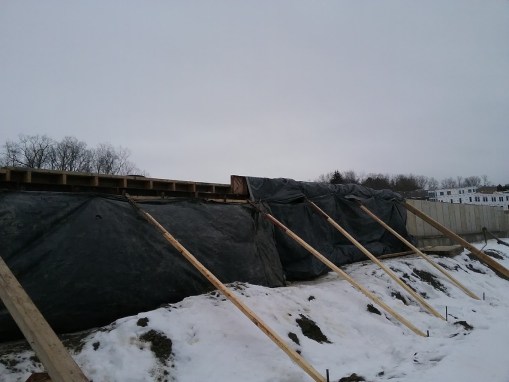
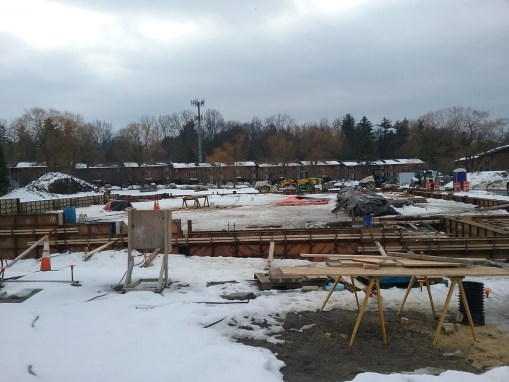
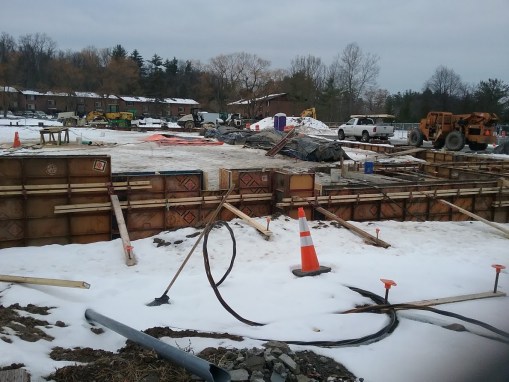
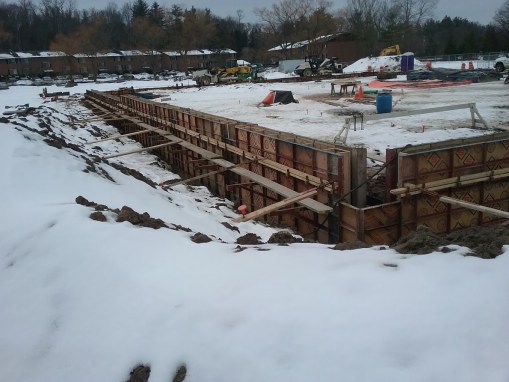
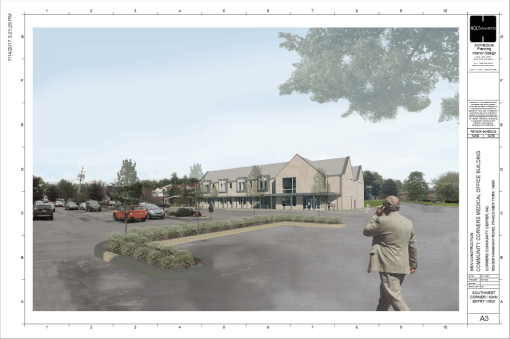
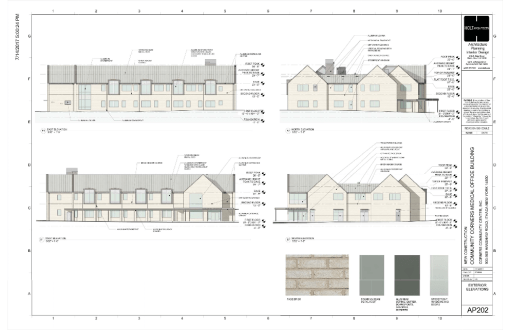
At the Cayuga Medical Associates site in Community Corners, the foundation has been excavated and the forms have been assembled. These are Symons Steel-Ply forms, steel with plywood facing that has been erected and braced along the perimeter of the building footprint.

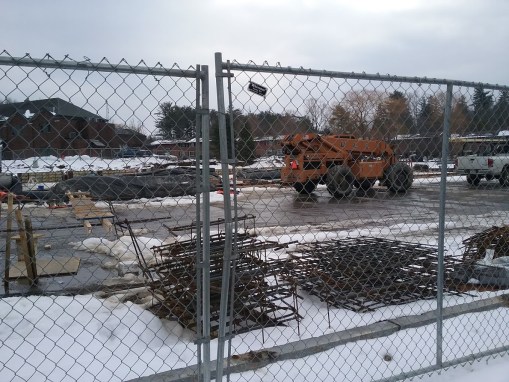
Unlike the downtown properties, the foundation here is a slab, so the footers will go in along the perimeter and the slab will be poured atop the cleared and leveled footprint of the structure, distributing the weight of the building. The steel rebar sitting along the fence will be laid within the building footprint and poured over with the concrete mix, providing additional strength to the concrete as it cures. It looks like some walls have already been poured, cured and interspersed with rebar topped with OSHA orange safety caps.

Meanwhile, it looks like the adjacent site where the former bank building was torn down has been fully cleared. This will be part of the parking lot, along with associated curbing and landscaping.


Village Solars Construction Update, 1/2018

24 01 2018

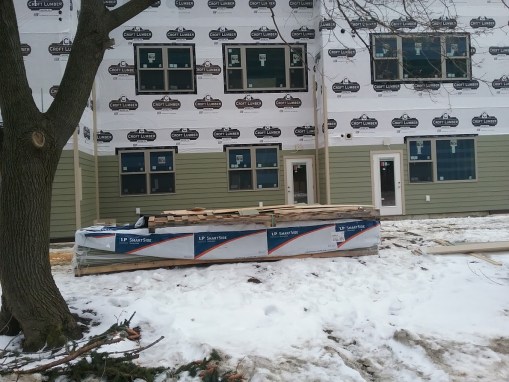
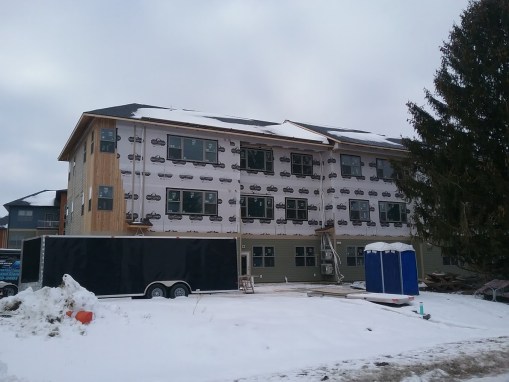
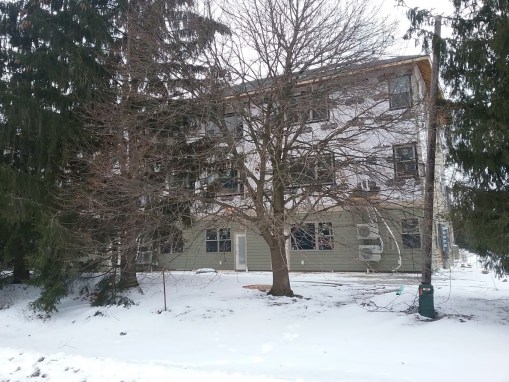
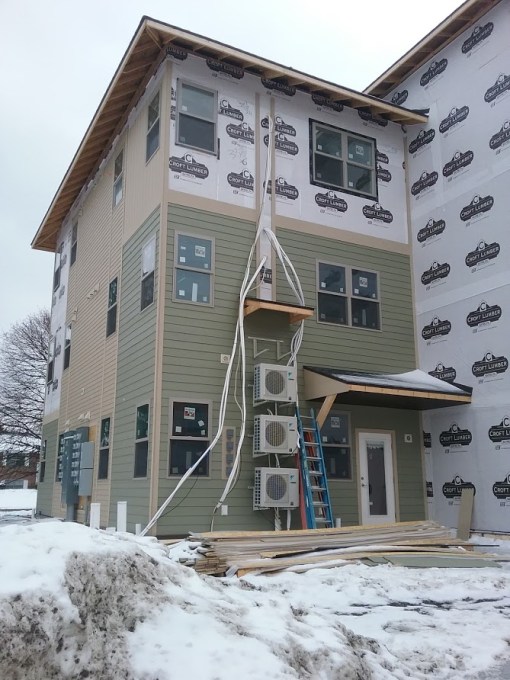
Work continues at the Village Solars apartment project in Lansing, though it’s mostly been interior construction these past couple months. 102 Village Place has had some of its composite wood siding applied (LP SmartSide treated and engineered wood siding), and the electrical wiring and air-source heat pump units are in place, though not fully connected just yet.

102 VP was already framed, roofed and fitted by the November visit, so chances are, they’ve already done utilities rough-ins and insulation, and they’ve moved on to drywall, baseboards and interior trim boards, priming and painting, and maybe some plumbing fixture and cabinetry installs. The three-story apartment building, which replaces a ten-unit 1970s structure, will have 24 units – 12 studios, three 1-bedroom, six 2-bedroom, and three 3-bedroom. If one wants to look at this from a population perspective, each of the ten units was a 1-bedroom, so the back of the envelope says there will be a net gain of 26 residents (one per bedroom, 36 – 10). And presumably, a couple million dollars in assessed value.

116 Village Place, the younger of the pair, is not as far along but has been fully framed, wrapped and shingled since November, and some siding has been attached. It looks like not all the windows have been fitted, given the wrapped rough opening on the third floor in the first photo below. Based off the open door in that same photo, it looks like framing, insulation and utilities rough-ins (plumbing, electrical, HVAC) are ongoing. 116 is the smaller building of the two, with 18 units, 12 studios and six 2-bedrooms. Like 102, it also replaces an older apartment building, an eight-unit structure of one-bedroom units (and 14 more residents on-site, using the same math as before).

Lifestyle Properties is the developer, with their in-house contractor in charge of construction. It doesn’t look like the new units are being marketed yet, but existing 2-bedrooms are going for $1,325/month, and 3-bedrooms for $1,375-$1,720/month. Anecdotally, Lifestyle has had an easier time filling the smaller units than the larger 3-bedroom units.


Cornell Veterinary School Expansion Construction Update, 1/2018

23 01 2018

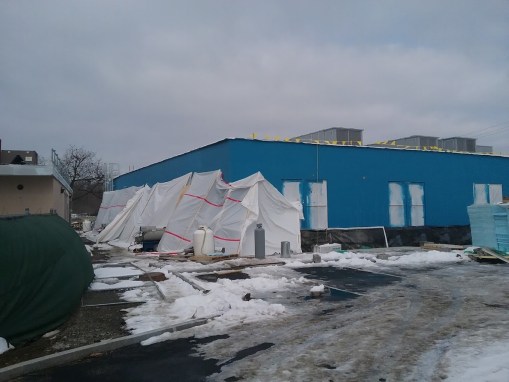
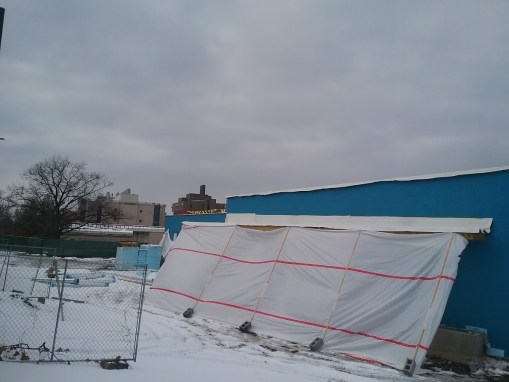
At this point, the expansion is done, and the construction at hand is the new $7 million Community Practice Service Building at 107 Farrier Road, where the Poultry Virus Lab once stood. It looks like a waterproof spray coat was applied above the previously-applied water-resistive barrier, based on the overspray on the rough window openings. There are plastic sheets with ribbing up over some of the exterior walls and part of the front entrance – the rendering shows concrete walls with decorative finishes,  so what might be happening is that these are still curing, and the sheets are there to keep precipitation (whatever it may be this time of the year) from penetrating and changing the concrete and water mixing ratio, which can weaken the wall.

The roof equipment (HVAC commercial units) appears to be in place, but the synthetic rubber membrane has yet to be laid. A truck at the rear of the construction site suggests Michael A Ferrauilo Plumbing and Heating of Rochester is one of the subcontractors. They’ll be busy for a while yet; stacks of insulating form board and galvanized metal utility ducts suggest plenty of interior and exterior work still left to be done before the May opening.

Background info on the project can be found here.


News Tidbits 1/20/18: Here We Go Again

20 01 2018

1. It looks like Cayuga Orchard will be moving forward this spring. At the moment, the 102-unit apartment project is going up for a few tweaks to the town of Lansing planning board, mainly just to get approvals for a pair of monument signs. Whitham Planning and Design is handling those last details. The project already went out for construction bids, and with a cost estimated at $25 million, which will surely help Lansing’s bottom line. With no tax abatements, and about $26.50/$1,000 assessed, the back-of-the-envelope suggests about $660,000 in taxes (however, using the hard costs alone is likely low-balling the tax assessment). The project is able to move forward thanks to a plan to pay for a sewer line extension to meet the needs of residents; the plans had long been held up by issues and red tape regarding a modular on-site sewer treatment system.

On the site plan, from left to right, are three roads – to be named “Harvest Drive”, “Blossom Road” and “Liberty Lane”. Positive connotations as most are, except one case I know – here’s a story of a downstate project where the Staten Island borough president used his right to rename roads to give a project names meaning deceit and greed. Liberty Lane is designed to be extended for whenever local developer Jack Young decides to go ahead with his 117-unit “English Village” single-family home and townhouse project on the 100-acre property to the west of Cayuga Orchards. Right now, Young’s focus is on a few home lots he’s subdividing on East Shore Circle.

The housing is intended to be rentals in the upper-middle (premium) market, and the 26 1-bedroom and 76 2-bedroom units are welcome in a community with a tight housing supply. As for the design…meh. It’s not terrible, but the dispersed home strings and front-facing garages over-emphasize suburban aesthetics (nothing against Stampfl Associates, they actually have some neat projects). Look for the first units to come onto the market in Spring 2019.

2. For sale, another chunk of Ithaca’s near-waterfront. 798 Cascadilla is a 18,271 SF one-story flexible office space building that was renovated in the 2000s, and is home to Palisade Corporation, a software firm specializing in decision making/risk analysis tools. Palisade is doing just fine, but this is a case where they might be sniffing out an opportunity.

Consider the location. It’s next to Carpenter Business Park, which was just picked up by a team of businesses led by Cayuga Medical Center and Park Grove Realty, ultimately expected to be a large mixed-use development. That purchase was $10 million on a property that had sold for just $2.7 million less than two years earlier; a bidding war drove the purchase sky high. Next door, Guthrie Clinic picked up Palisade’s neighbors, a storage facility and a former printing press/warehouse of Cornell University, for $2.85 million, $150,000 over asking price. Paying at full or above asking price is pretty rare for commercial real estate in Ithaca. Guthrie has recently been in talks with Greenstar Co-Op to convert the storage facility into a new grocery store and cafe. In the City Harbor plans, where Guthrie and Greenstar are involved, there have been some site plan concerns note around issues like parking, that a purchase here could help solve.

Zoning on the site is newly-minted “Market District”. Hotels, restaurants, retail, housing, healthcare facilities, food production facilities, and housing. Up to five floors/63 feet, 100% lot coverage. But honestly, given the recent PUD-OD proposal, zoning regulations are not the end-all, be-all; if someone wants to try for an additional floor by throwing in a few affordable housing units, they could. Not saying that’s a great idea, but they could.

If I had to take a guess, Palisade is feeling out the market and seeing what kind of deal they can get for their building. It was an unusual choice of locations when they bought it in 2004, but they might make a tidy sum for being in the right place at the right time. Maybe.

The asking price for 798 Cascadilla is $2.7 million. The tax assessment is for $2 million. Pyramid’s David Huckle is the sales agent in charge.

3. A long time ago, back in 2009, a West Hill property was talked of as a potential development site. Now that property has exchanged hands. For the moment, its future is still fairly murky.

Kaderli Trade, a Panamanian business with Swiss ownership has owned a 68.5 parcel of land just west of Warren Place since 1977. The property is vacant, and assessed at $320,000. It just sold on Thursday to the Rancich Family for $360,000, a modest gain, and a pretty good price for vacant land.

The Ranciches are probably best known for being the original planners of the Enfield Wind Farm, and for Carrowmoor, a mixed-use project that would have had retail space, office space and up to 400 units in clustered housing on a 158-acre parcel just northwest of Kaderli’s parcel. The motif was a traditional English village. Buildings would have aesthetic half-timbers and gable roofs. It would have used alternative energy (heat pumps were practically unheard of at the time) and been priced mid-market for for-sale units. However, this was 2008-09, the recession was biting hard, and Carrowmoor never moved beyond the drawing board. Most of the renders have disappeared, but I still have one from 2009, before I knew how to crop screenshots. Less known but still important, the Ranciches also played a role in the development of the Conifer Linderman Creek affordable housing.

If someone were to ask what the development likelihood were based on the above information, it would get a shrug from me. The Ranciches haven’t had much success, but this purchase suggests they have some sort of interest, and the location is one the town has noted for potential development – existing zoning is Medium Density Residential, and the 2014 Comprehensive Plan plans traditional/new urban design medium density. That’s T3-T5 for the New Urban transect buffs, averaging 5-8 units/acre by the town’s count. It’s close enough to the municipal water that new pump stations and tanks wouldn’t necessarily be needed. In sum, the town would be open to something substantial. But who knows.
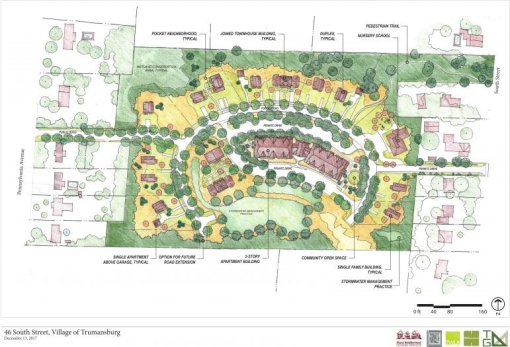
4. 46 South Street, this Claudia Brenner/INHS mixed-income mixed-use project in Trumansburg (Hamilton Square is no longer the official name) continues to go through the boards. My Voice colleague Kelsey O’Connor covered the Planning Board meeting on Thursday, where about ten people spoke for an against the proposal. It’s probably better that she cover 46 South, because I would find it hard to maintain impartiality.

On the one hand, there is the opposition. The “Trumansburg Neighbors Alliance (TBNA)” turned in a Change.org petition with 492 signatures, along with paper petitions they say brings the number up to 669. They say 432 are in Trumansburg, Ulysses, or the Trumansburg school district, which includes large sections of Schuyler County and Seneca County. From their Facebook page, they don’t have accurate numbers.

At this time, there are actively trying to re-impose a village-wide moratorium after the previous decade-long moratorium expired. The zoning was revised in 2012 and re-analyzed in 2016. The South Street housing fits its zoning.

There are plenty of others who have already spoken in favor of this proposal – the Lansing Star has had a harsh word for the opposition, and some residents in Trumansburg are speaking out in favor of the South Street housing.

Let’s go through some of the fallacies with the opposition’s issues:

Too many rental units, not home ownership, out of balance and character with the neighborhood .

46 of the 73 units are affordable (LMI) rentals – most (40 of 46) are in the two story building in the middle of the property. Here’s the thing with lower-moderate income families; a lot of folks are getting by paycheck-to-paycheck. They don’t have the money for a 15% or 20% down payment on a house, for which the median sales price in Trumansburg in 2017 was $255,000, up 38% from the $184,500 in 2012. Thankfully, groups like INHS will work to cover the down payment and sell homes to LMI buyers well below market-rate, like the townhouses on Hancock going in the $110-$145k range, about half of the market rate for a new townhouse in Ithaca.

However, funding for purchasable units is much more difficult to get. A bank isn’t going to fund a plan that doesn’t generate a good profit, so they have to turn to state and federal funds. The government is more likely to disburse a grant if it knows there are buyers waiting in the wings. And for low and moderate-income households, far more are capable of renting versus buying. In short, this argument boils down to ‘these people are too poor to live in our village’.

Does not fit ‘village character’ and 2008 Village Comprehensive Plan priorities

Character is always a bad argument to give a planning board; it overly relies on demographic perceptions, which include details like age, income and race. The 2008 Comp Plan notes historic buildings, non cookie-cutter design, and tree-lined streets. Homes are 1-3 floors. Well-designed multi-family buildings that fit the village fabric, especially those with design features friendly to seniors, were encouraged. Affordable housing is strongly encouraged.

Below are some of the building elevations, pulled from the submission here. Let’s gauge based off the Comp Plan statements – there are no historic buildings on site, it’s vacant land surrounded by housing of varying ages. Designs incorporate porches, gables, bracketed eaves, dormers and other features of Trumansburg’s older housing stock. They are generally two floors. There will be several townhouse and single-family home designs interspersed throughout the site.
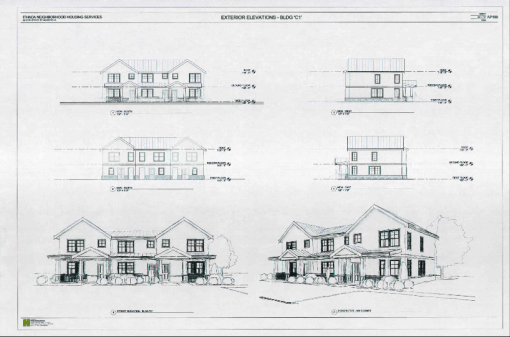
At 40 units, the apartment building is not unlike the existing Juniper Manor; as with other INHS projects like Breckenridge Place and 210 Hancock, many of these units are expected to rent to seniors – about 60% of Breckenridge is seniors, and although I don’t have stats for 210, I’d say it’s a generous percentage. The project is 72 units, 140 residents, over a 19.12 acre parcel. That is 3.77 units/acre, 7.3 residents/acre. That is less dense than the older part of the village.  Even the Tamarack/Larchmont housing, which is one of the areas of strongest opposition, has about 2.5 units and 7-9 residents per acre.

So density’s in line, it has affordability within a mixed-income layout, the apartments are senior-friendly and designed to blend in; it meets the goals of the Comprehensive Plan.

The developers did not ask residents how best to fulfill Village needs…they just decided!

No, they didn’t. Remember the community meetings to get ideas and feedback last July? The August listening sessions? The major plan revisions in response to community concerns? They’ve been listening.

Now that we have that covered, let’s take a look at some of the comments from the folks who are opposed:

From the petition:

“…we do not have the police to keep track of this ridiculous project.”

Ithaca problems must remain in Ithaca and not be spread to us

“These kind of “developments” only bring low income, low quality people.”

From the TBNA facebook page:

there is enough drug dealing on the other end of town probably not a good idea to add to it”.

“Turning trumansburg in to [sic] ithaca have fun with that will have a lot of crime”

I’ve not hidden the fact that I grew up in affordable housing. So these comments that say its occupants are drug addicts, criminals, problems and burdens is very hurtful. I can appreciate TBNA’s attempts on their page to celebrate when housing is announced in Ithaca, but honestly in this context it just reads as a selfish desire that those less well-off will go elsewhere and stay out of the village. For a community that prides itself on its social progressiveness, it’s very disappointing.