City Centre Construction Update, 3/2019

24 03 2019

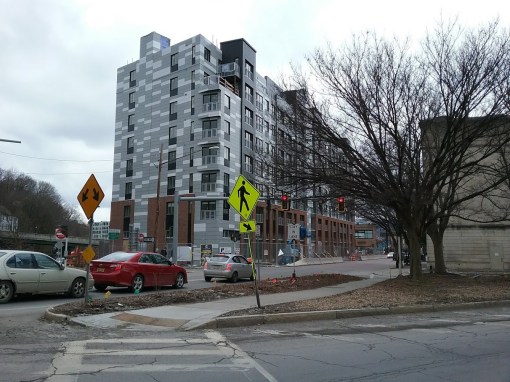
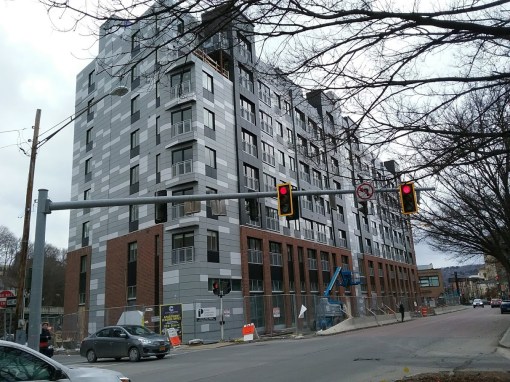
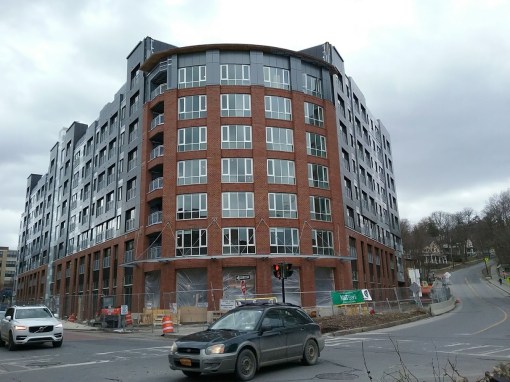
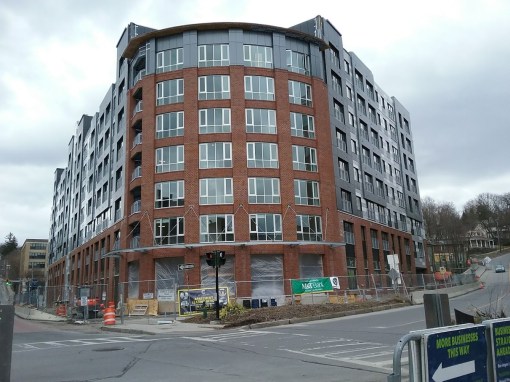
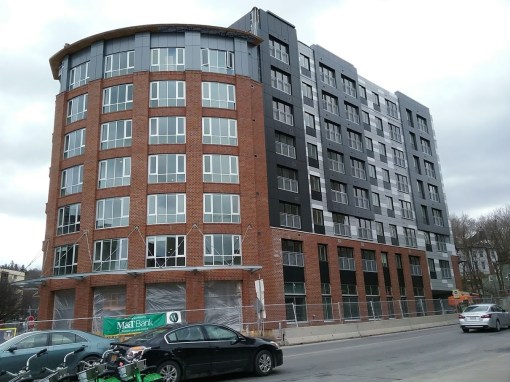
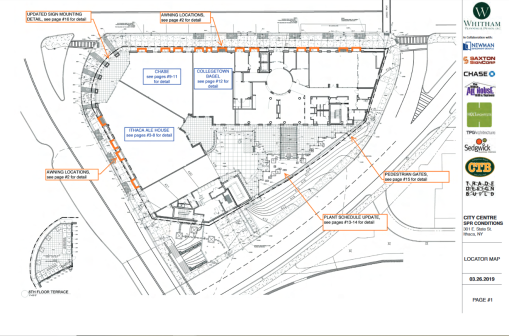
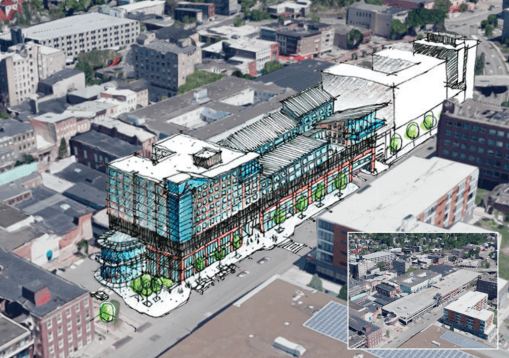
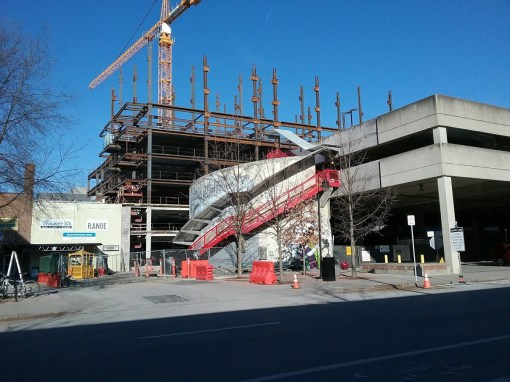
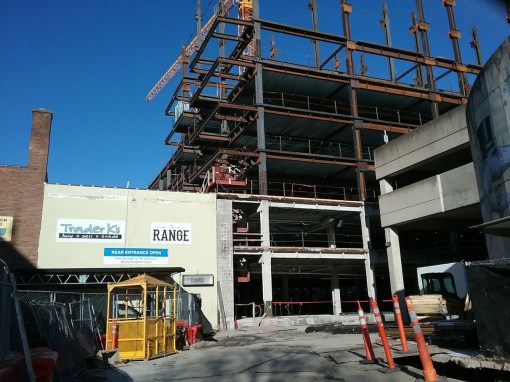
All of City Centre’s retail occupants have been identified – The Ale House, Collegetown Bagels and Chase Bank. Although two of three are cannibalizing other Downtown locations, the move comes with some benefits – it’s an expansion for CTB and the Ale House, and the Ale House is expecting to add 20 jobs, and CTB will likely add a few new positions as well. Chase is totally new, and if the average bank branch is 2,000 SF and 6.5 staff, it seems safe to assume that a 5,357 SF branch/regional office is probably 12-15 staff. Ithaca’s own HOLT Architects is engaged in some minor building design work and Whitham Planning and Design is doing the landscaping (including the heat lamps, string lighting and fire pits), Saxton Sign Corporation of Auburn will make the signage, Trade Design Build of Ithaca and TPG Architecture of New York will flesh out the interiors, and East Hill’s Sedgwick Business Interiors will provide furnishings. Clicking here will allow you to scroll through the interior layouts for the retail spaces.

A glance at their Instagram suggests that as of a week ago, about 100 of the 192 apartment units have been reserved. There don’t appear to be any particular trends in the unit selection, an off-the-cuff suggests a similar occupancy rate for studios, one-bedroom and two-bedrooms, and there’s no strong preference in floors, though perhaps there’s a slight preference towards interior-facing units (I wouldn’t call it statistically significant). It appears they’re filling at a good clip now that graduate and professional students are making their commitments to Cornell (professional students, for example business/MBA and law/JD students, tend to be older and wealthier, and are one of the target markets for the project). If trends continue, the project will be in good shape for its June opening, with full retail occupancy and high residential occupancy, even at City Centre’s decidedly upmarket prices.

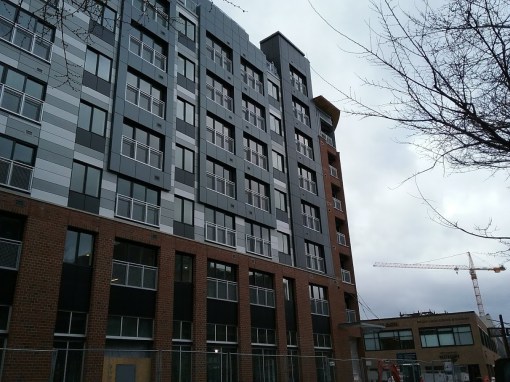
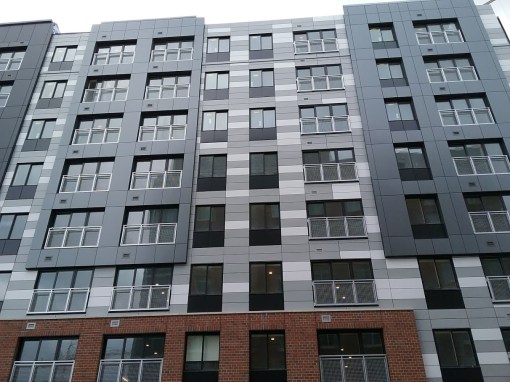
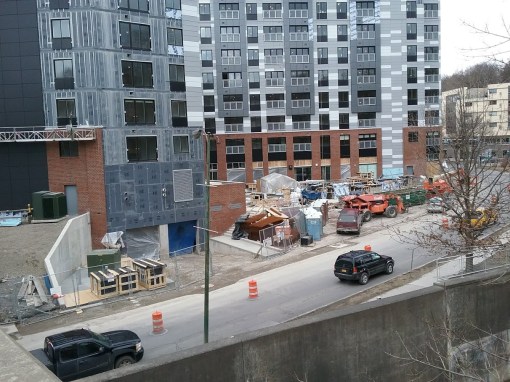
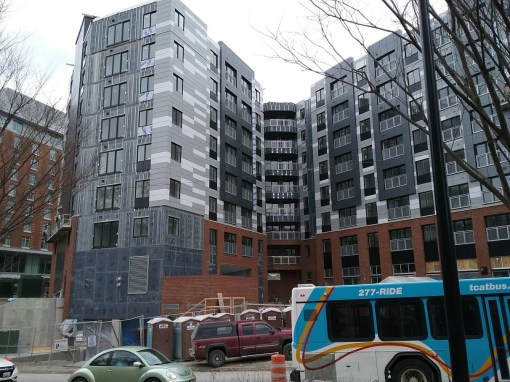
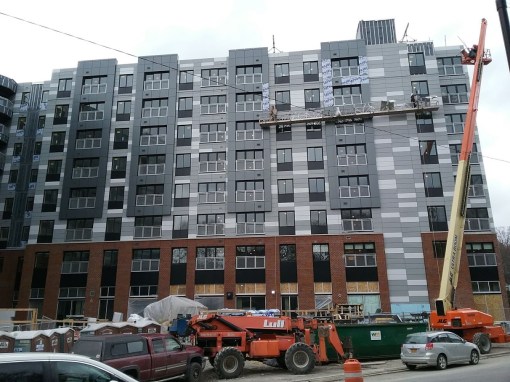
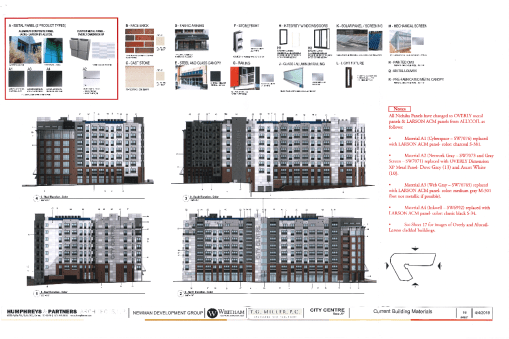
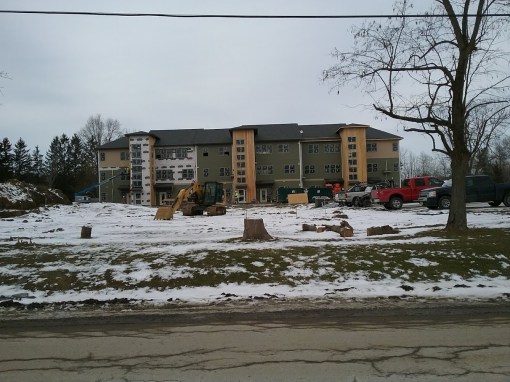
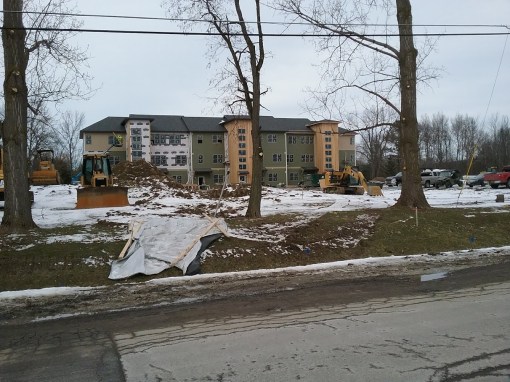
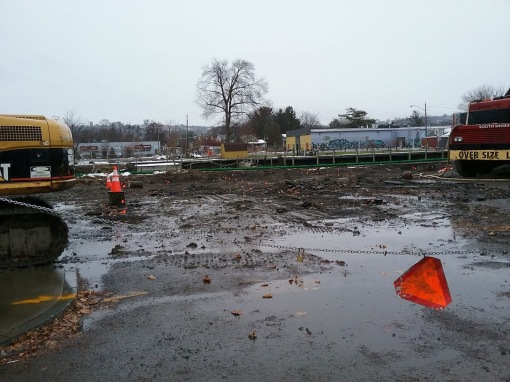
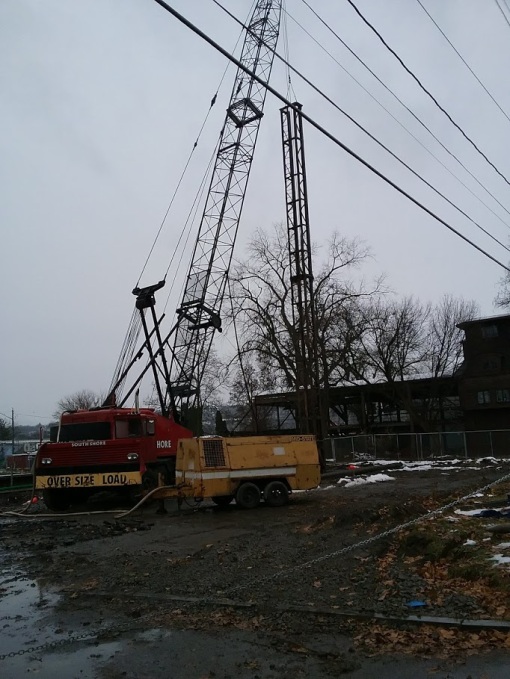
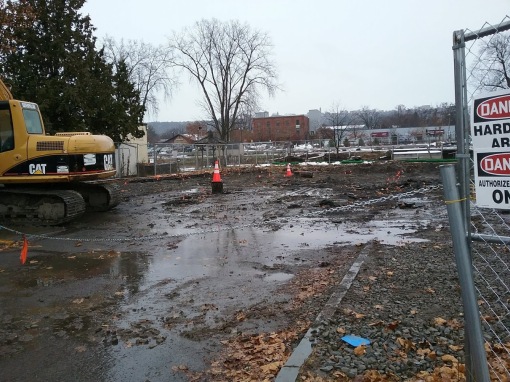
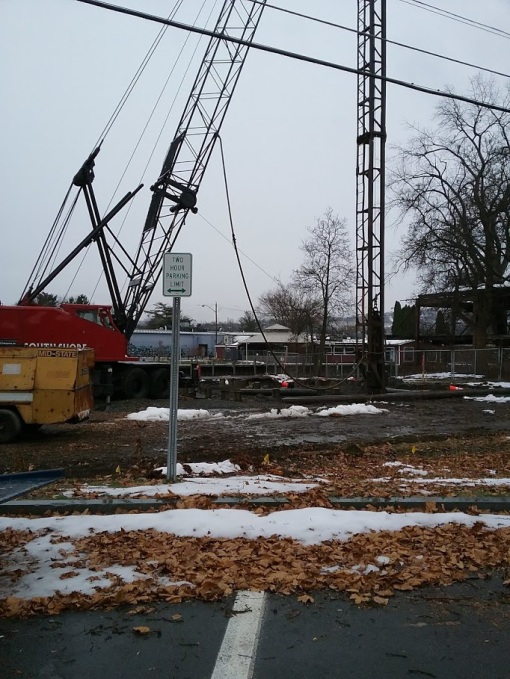
On the exterior, some of the Overly and Larson ACM metal panels have yet to be installed (mostly on the back./interior side), trim and exterior details are partially in place, and the ground level is still being built out with commercial doors and utility fixtures (garage doors for commercial deliveries, for example). The roof membrane doesn’t appear to be in place yet either. Overall, though, the exterior is substantially complete, and it looks like the will finish out over the next several weeks on schedule, which is a pretty big deal for a 218,000 SF $53 million project. Kudos to Purcell Construction and their subcontractors on that. Signage and landscaping will also go in this spring. I’m not big on the patterning of the metal panels (which looks like design by MS Paint), but it seems to be the go-to exterior material of choice.

Background information and the history of the project can be found here.


News Tidbits 3/11/19

12 03 2019

1. The city of Ithaca and The Vecino group have come to a tentative agreement. The two have been negotiating since entering into a 90-day Exclusive Negotiating Agreement at the end of last year. While Vecino is still looking at the financial models for the conference center space, it appears that the city is ready to move forward with a formal agreement to be voted on by the Ithaca Urban Renewal Agency (IURA) and the Common Council, and then to have the building plans reviewed by the Planning Board, and then the sale of the property to be brokered by the IURA and agreed to by the Common Council. If approval is granted in good order and state funding is obtained (Vecino is pursuing 4% low income housing tax credits, vs. the more competitive 9% variety), then construction could start on the $95 million mixed-use project by late 2020.

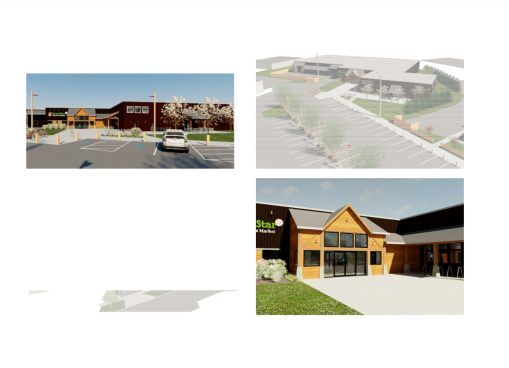
2. GreenStar will be asking the IURA for a $400,000 loan to assist in the construction of their new flagship location at 770 Cascadilla Avenue. It does not seem to be related to their construction woes, as the initial paperwork was filed in January, but it makes for rather awkward timing. The loan is likely to be approved without significant reservation thanks to GreenStar’s reputation and the promise of dozens of living wage jobs, though the IURA is unhappy with what is described as “weak collateral”, and it has some concerns with GreenStar’s ability to fundraise.

Important note – the paperwork mentions one of GreenStar’s funding sources will be the buyer of the current Space A Greenstar at 700 West Buffalo Street, who so happens to be “the owner of the Cascadilla Street property”. This buyer will pay $2 million for the building when GreenStar moves out in early 2020.

At first glance, one might think that’s Guthrie. But Guthrie transferred ownership of the parcel to “Organic Nature LLC” last month. Organic Nature LLC is a company owned by the project team building City Harbor. In short, the City Harbor developers are buying the Space @ Greenstar, and likely have plans for the property.

3. If you’re an urban planner – and I hope this blog is interesting to you if you are – the IURA is issuing a request for qualifications for a parking study. The project will include three major tasks: analysis of the current parking system; determination of possible scenarios of programs and actions for the future direction of the parking system that are financially sustainable; and preparation of a strategy and an implementation plan, with estimated costs and a schedule. TLDR; look at existing operations, describe future directions (ten year period), make parking-related recommendations and implementation recommendations. Knowledge of transportation demand management and experience with designing strategic initiatives to handle parking needs will be a big plus. Submission packets due April 12th to Director of Parking Pete Messmer, more info at the end of the agenda packet here.

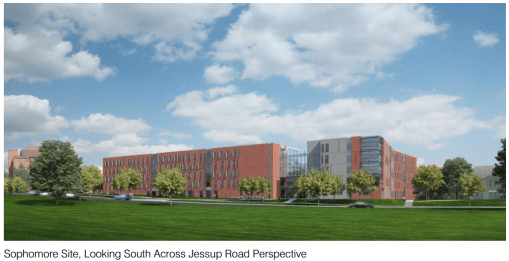
4. Quick note – the North Campus housing proposed by Cornell was modified slightly at the request of city boards. The new design adds “break points” in the facade to activate the central wings of the buildings and make the building masses seem less imposing. The general massing and material choices remain unchanged.

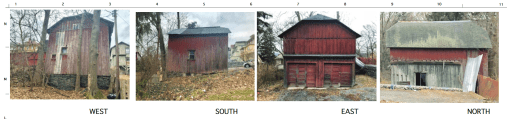
5. Mid-sized Collegetown landlords Greg and Mataoula Halkiopoulos (of Matoula’s Houses) have decided to renovate a decrepit 19th century carriage house at the rear of their property at 214 Eddy Street, and turn it into a three-bedroom, 839 SF rental. 214 Eddy is in the East Hill Historic District, so the design, by local architect John Barradas, will need to be approved by the Ithaca Landmarks Preservation Commission. It looks like a practical renovation, respectful of the carriage house’s form but also with a modern touch. Early Design Guidance will be offered at the March ILPC meeting, and any decisions on a Certificate of Appropriateness are still a few months out.

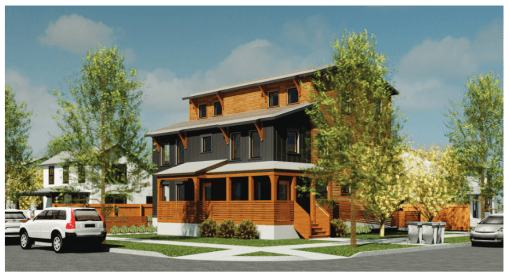
6. There have been some major changes to the Perdita Flats plan at 402 Wood Street. Previous version here. For one, it now has frontage on Fair Street and will have a Fair Street address. The building and garden have been re-positioned, the footprint reduced slightly (38’x36′ to 36’x36′), larger porch, modified exterior cladding materials, and the driveway has been removed at the Planning Board’s suggestion. The building remains 4 units and 7 bedrooms, and STREAM Collaborative penned the redesign.

The wood shiplap siding and standing-seam black metal siding are a bit of an acquired taste, especially with the wood oiled or left to grey naturally. But the house is still planning to be a net-zero energy showcase of what can be done with environmentally sustainable multifamily housing, and that’s the real statement to developers (Courtney Royal and Umit Sirt) are trying to make. The owners will be applying for incentives from the NYSERDA Low-Rise Residential New Construction Program and are hoping to attain the Zero Carbon Petal of the Living Building Challenge.


Village Solars Construction Update, 2/2019

3 03 2019

It was with some surprise that the latest trip to the never-ending Village Solars construction site yielded significant progress on only one apartment building, instead of the usual two or three. The 24-unit Building “L” is mostly complete from the outside, and likely to open for occupancy this spring, adding another 3 three-bedrooms, 6 two-bedrooms, 3 one-bedrooms and 12 studios to the market. 24-unit Building “K”, just to its east (right, in the photos), appears to have not made much progress; excavation was completed, and it looks like there are wood forms for the foundation on site, though with the snow and active work underway, it was hard to tell if the concrete slab had been poured – judging from the dirt piles, that’s a no.

Local Law #6 (2017) of the Village Solars PDA permitted three additional buildings to be built before Lifestyle Properties (the Lucente Property) was legally obligated to build the community center building (Building “F”), which is to contain a small amount of commercial space (restaurant), service space (gym, laundry, rental office) and up to twenty one-bedroom units. If “L” and “K” are completed this year, that will allow one more building to receive a building permit before the community center must be built and receive a certificate of occupancy (i.e. habitable and practically complete). Until then, no additional building permits are allowed. The law also stipulates that the community center has to be completed, regardless of the status of other apartment buildings, by the end of 2020.  Like other apartments, it won’t be subject to site plan review, bu any potential commercial applicant would have to undergo site plan review.


East Pointe Apartments Construction Update, 2/2019

1 03 2019

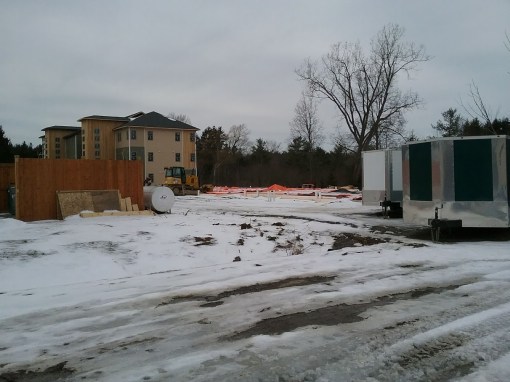
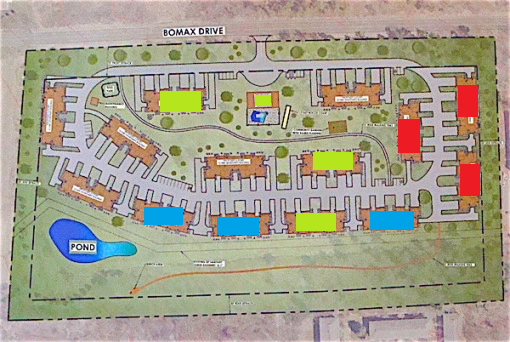
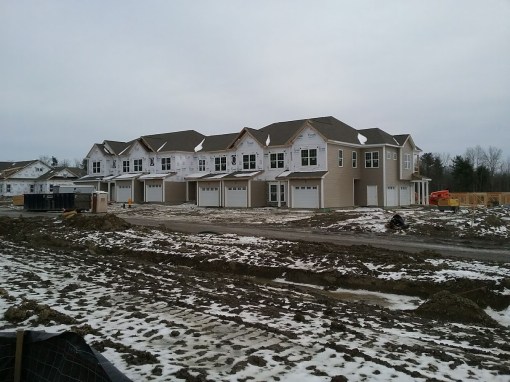
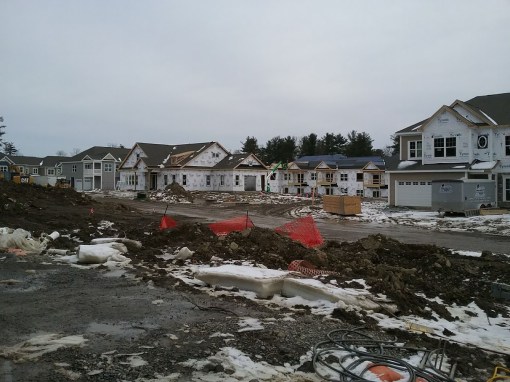
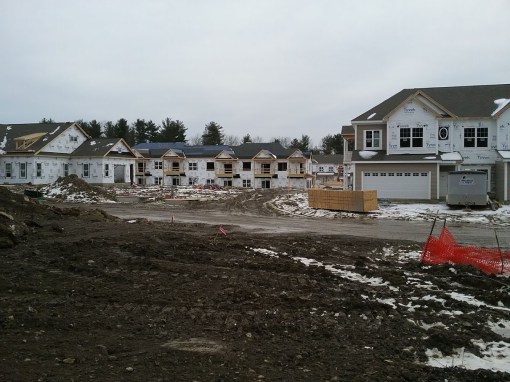
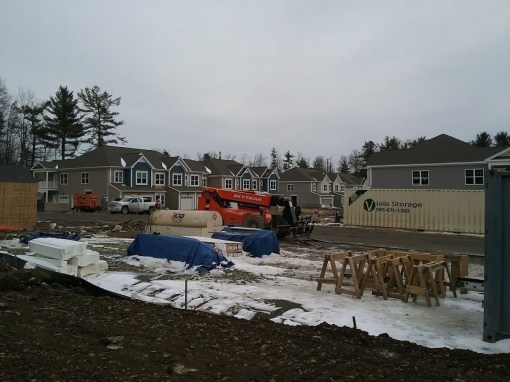
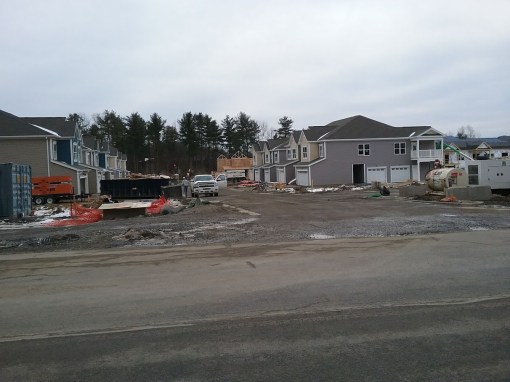
With so much construction underway at one site, I figured it’d be easiest to try and color code this using the site plan.

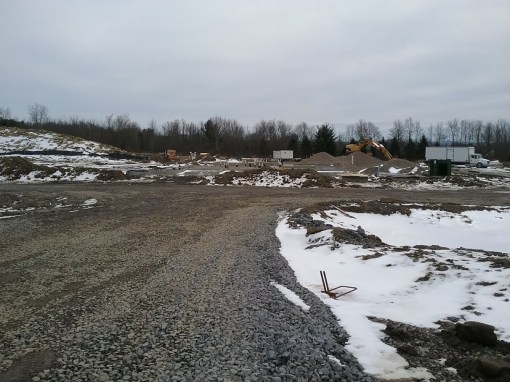
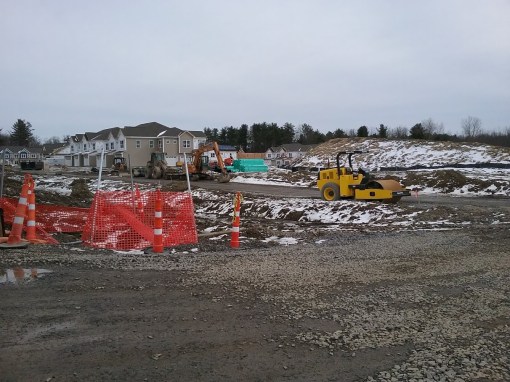
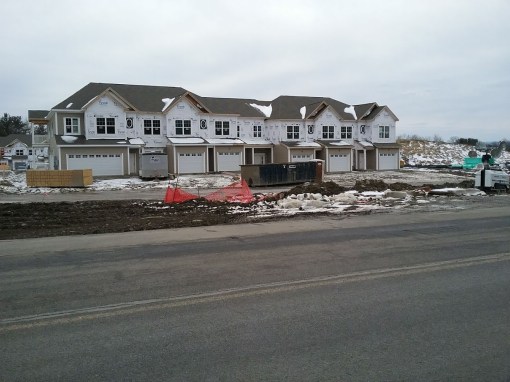
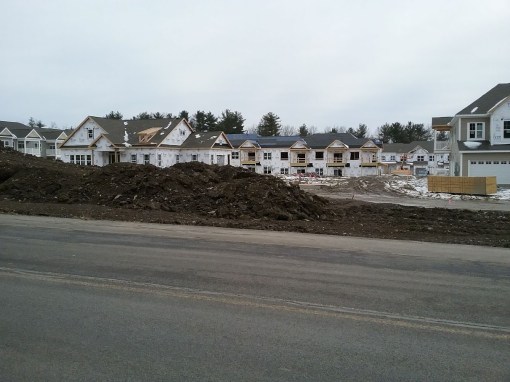
Red boxes overlay townhouse strings that are largely complete from the outside. Green is framed and sheathed (plywood with Tyvek housewrap), but lacks exterior siding, trimboards and architectural details. Blue are townhouse strings where framing is underway. Looking at the site and comparing it to the site plan above, it seems that the community center is actually to the east (right) of the entrance, so there likely going to be two townhouse strings to its left (west), one of which is framed and one of which is just a foundation at this point.

Knowing that the first units are expected to be open for occupancy on April 1st, I’d wager the three strings in red (~30 units) will be ready by that time, the community center and units in green (three strings, ~30 units) will be ready by June 1st, and the three strings in blue (~30 units) will be ready by September 1st. That would give roughly December 2019 and April 2020 for the last two sets, which sounds about right from the construction timeline I’ve seen for a spring 2020 completion.

Rents on the units are as follows, per the project website and multiple apartment advertising websites:

# BRs/ # BAs / Monthly Rent / Square Footage / Unit Code

1 BR 1 Bathroom    $1,695    820 Sq Ft   B
1 BR 1 Bathroom    $1,795    873 Sq Ft   C
2 BRs 2 Bathrooms $1,895 1,093 Sq Ft   A
2 BRs 2 Bathrooms $1,910 1,095 Sq Ft   E
2 BRs 2 Bathrooms $1,975 1,157 Sq Ft   G
2 BRs 2 Bathrooms $1,995 1,090 Sq Ft   F
3 BRs 2 Bathrooms $2,445 1,268 Sq Ft   D

Layouts can be seen here. Each townhouse string contains a mix of 1-3 bedroom units. In total there are 14 three-bedroom, 90 two-bedroom, and 36 one-bedroom units, which doesn;t break down neatly by fourteen townhouse string, so there are some variations.

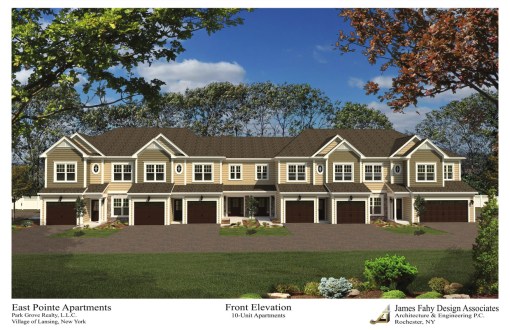
Those variations also show up in the exterior finishes. The units near completion now use what looks like Certainteed vinyl siding and trimboards. Type “1” is tan and navy blue siding with stone accents around entrances, and Type “2” is slate grey and yellow siding, though I didn’t get a close enough look to see if these have stone accents as well (there were crews actively working on site). The rendering in advertisements suggests there will be a third type, Type “3”, with beige and olive green vinyl siding and stone veneer accents.

Just like the townhouse strings, the community center is a different design than first advertised. So basically, nothing in the built project quite matches the plans that were publicly available, whether it be building designs or site plans. The only things that have stay constant are the fourteen strings of ten units with a community center and a loop road. Not a fan of surprises here, but we’ll see how the finished product is looking once more of the site has been built out later this year.

More information about the project’s history and seemingly accurate details can be found here.


128 West Falls Street Construction Update, 2/2019

26 02 2019

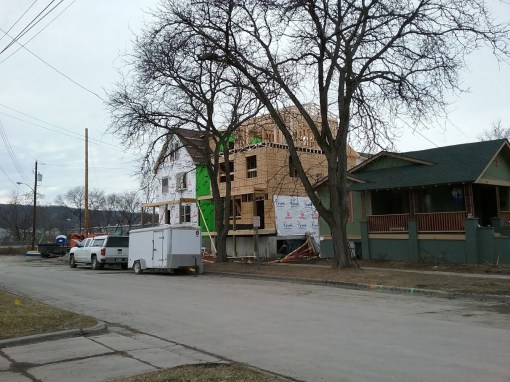
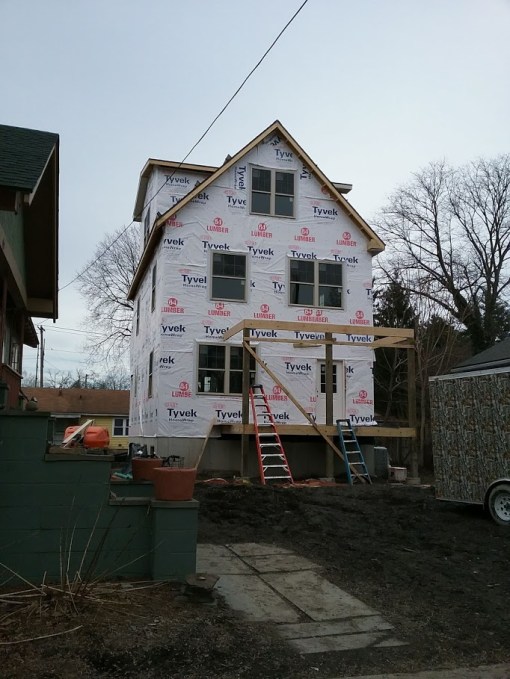
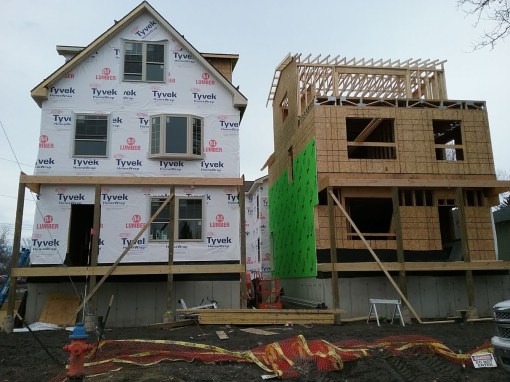
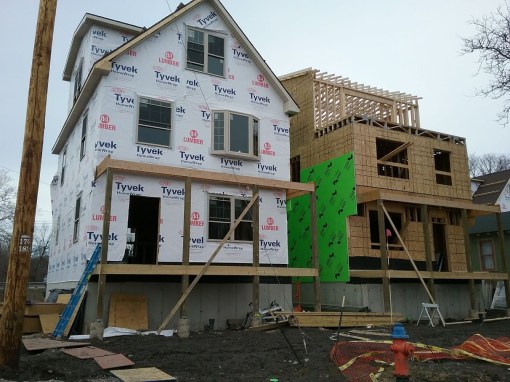
At a city planning committee meeting on infill housing, a Common Councillor well known for his dislike of nearly all things development described these houses at 128 West Falls Street as “an affront to the community” and “a monstrosity”. It seems rather misguided. This was a vacant lot, and the owners designed it with the possibility of future sale, either a small condo community, or in four separate lots if one includes the existing rentals between the new builds. As an argument over the issue of infill, this isn’t a good example anyway. The greater concern is adding new units to the rear yards of existing deep lot homes, not the development of vacant lots.

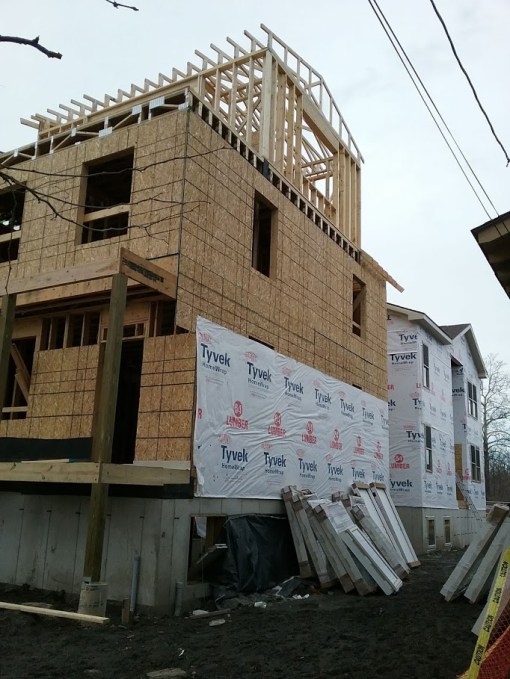
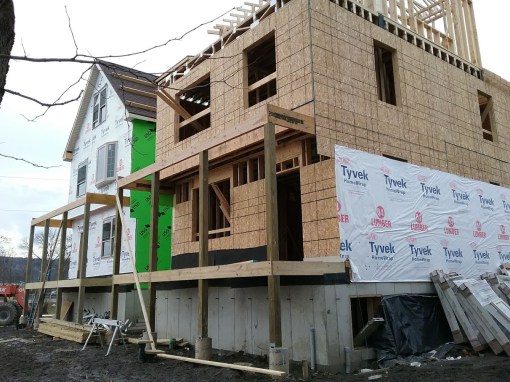
By and large, the built products are looking close to the original drawings, but not exact. The fully framed and sheathed out on the eastern end of the parcel was designed with its entry on the left side of the house, but the building under construction has its door on the right. Otherwise, the overall shape is true to plan, with dormers, gables, and porches, which are being framed after the primary structural frame has been built. The houses use Tyvek housewrap over plywood for the most part, except for the two-family structure with the breezeway; for fire safety, the walls facing each other in that pair have been sheathed with gypsum panels. The east hald of that building is still in the framin stages, with roof trusses yet to be fully assembled, but the other wind and other structures are framed, sheathed, and have most of their doors and windows fitted.The only worker on-site appeared to be working on utilities rough-ins in the unit with the bay window.

A summer occupancy seems fairly plausible. I haven’t seen any rentals for these yet, but Heritage Builders tends to go for the premium/upper-middle market bracket; the renovated two-bedroom house in the middle is going for $1800/month.

More info about the project can be found here.


323 Taughannock Boulevard Construction Update, 2/2019

25 02 2019

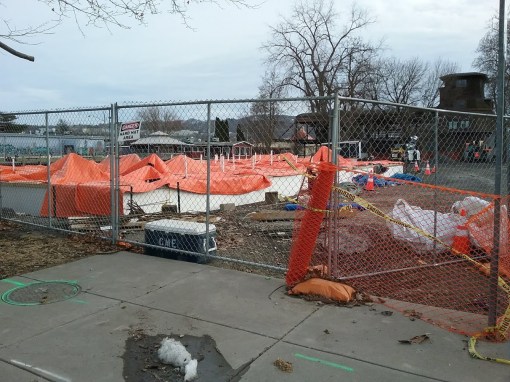
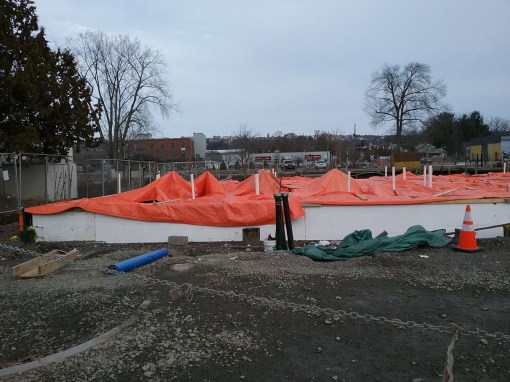
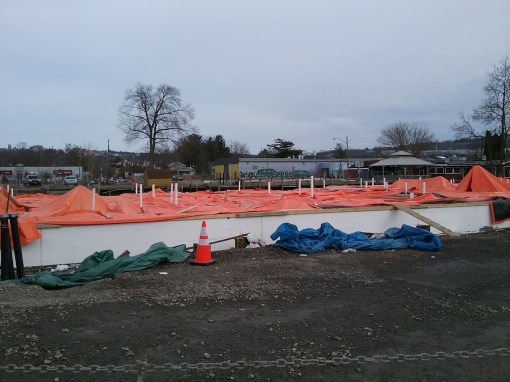
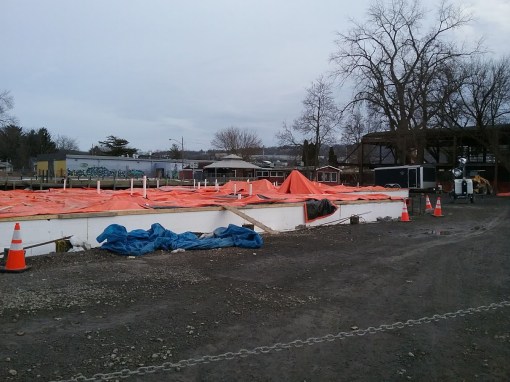
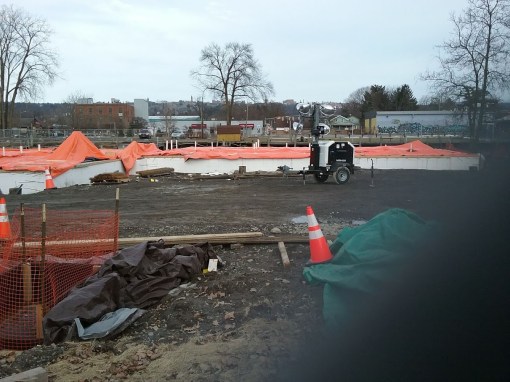
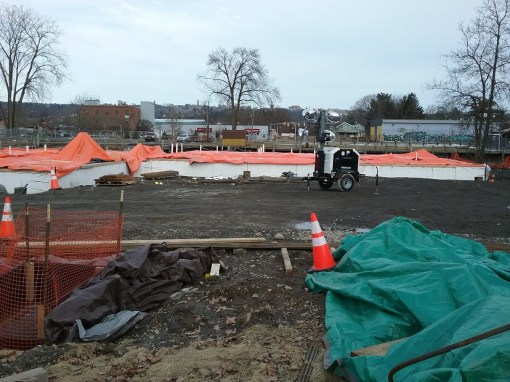
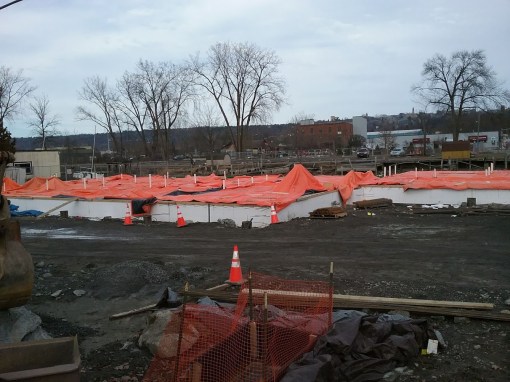
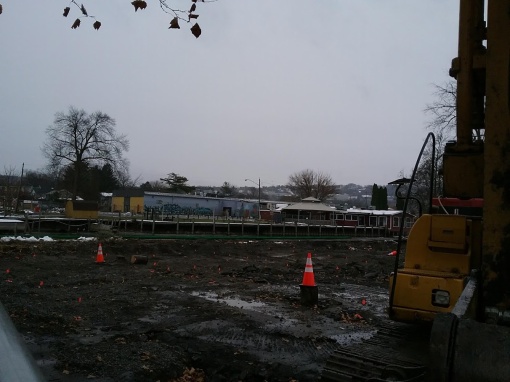
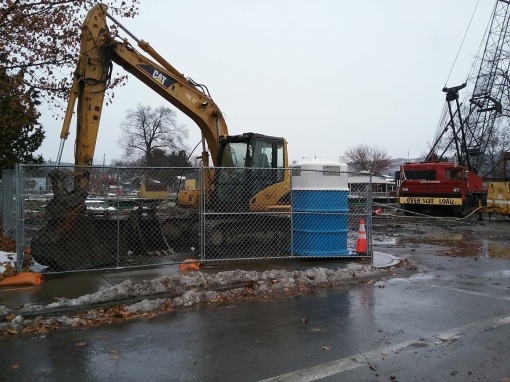
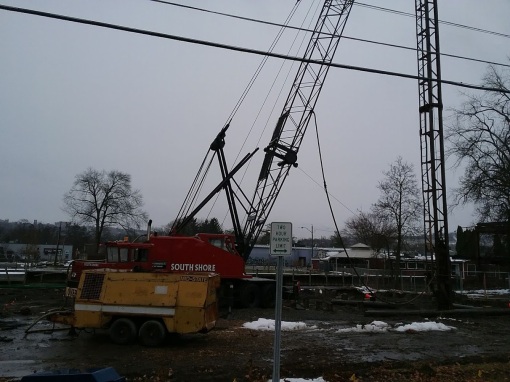
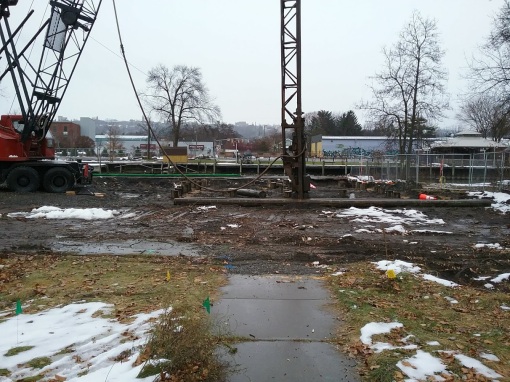
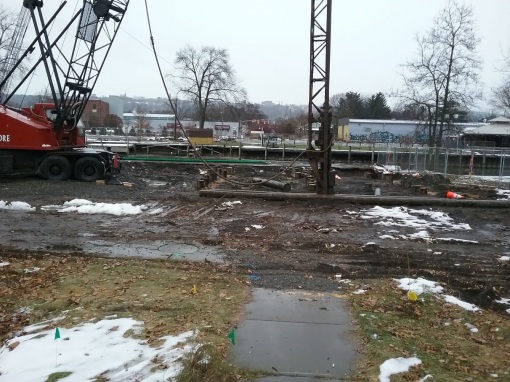
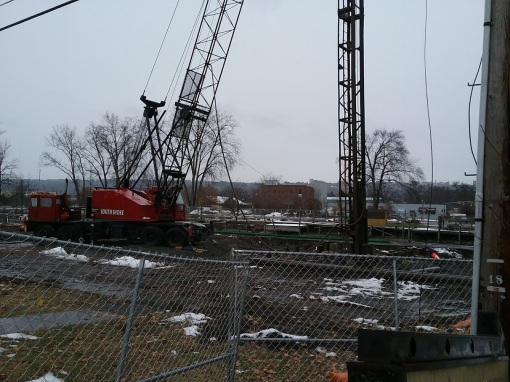
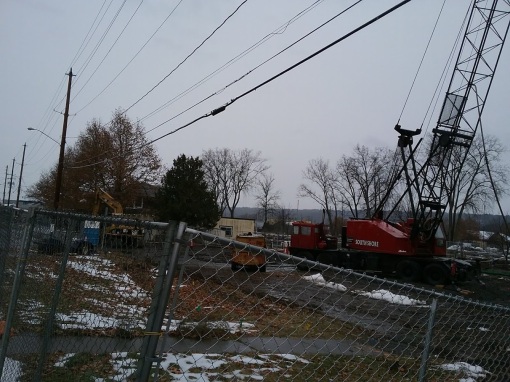
The timber piles are in and the 6″ concrete slab has been formed and poured, thus completing the lion’s share of foundation work for the 323 Taughannock residential project. The orange tarp is to allow curing without snow or rain penetrating and potentially upsetting the curing process and damaging the concrete, and ituility connections poke out through the slab. As previously mentioned, this a modular wood frame, and the pieces will be framed and sheathed off-site by Benson Wood Products, and then assembled on-site by local firm D Squared.

An interesting little note from Matt Butler’s piece at the Times, Flash initially intended for a five-story design, but found it cost-prohibitive. According to co-developer Steve Flash, “(w)hen we did soil samples and had a system for a five-story building, the costs of the foundation were too much for the number of units we could create. That might be different in a larger project where you could spread the costs out a little bit […] None of it was a surprise, we knew it going in […] We knew what we were getting into. It’s a challenge.”

To be a little more explicit, the larger the building, the heavier it would be. Given the waterlogged soils, the heavier the building would be, the deeper the piles would need to be, and likely, the structure would be too heavy for the budget-friendly wood timber pile system. They would have had to use much more expensive steel piles. In general, building denser is going to be more cost-efficient, but if it creates a sudden jump in hard costs, then it’s not in that “sweet spot” for construction costs vs. revenue, and out of the realm of economic feasibility.

Anyway, look for the pieces for the eight townhouse-like units (a studio and 2-BR in each), to start showing up over the next several weeks. Completion is expected this summer.


News Tidbits 1/20/2019

21 01 2019

Now to start digging into the odds and ends:

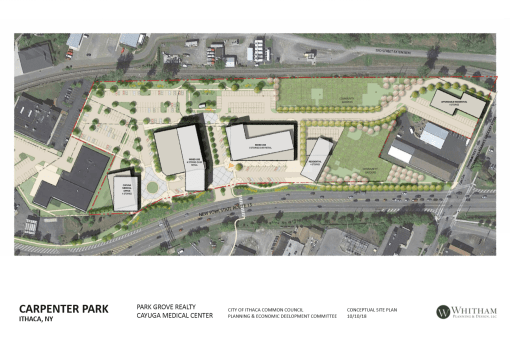
1. For those interested in learning more about the Carpenter Business Park proposal, Northside United, the neighborhood group that represents the Northside Neighborhood, will be hosting the development team for a presentation and Q&A on Monday, February 4th 6pm at the Quaker Meeting House on 120 Third Street. Here’s the project breakdown as provided in email by Northside United:

Affordable Housing. A 4-story building with 42 one and two-bedroom units of working family housing will be sited near Farmer’s Market and 3rd Street and targeted at those in the 50-60% of area median income ($30,000-$35,000 household income range). The affordable units are in a separate 4-story building from the market rate units, they say due to federal/state requirements for low-income housing tax credits. Park Grove Realty (with staff formerly associated with Conifer) will manage the affordable units.

Market Rate Housing. In addition to the building affordable housing, two other 4-6 story buildings in the development will be targeted at market rate rents (and also include commercial/retail).  Maybe 150 or so units of market rate housing.

CMC Medical Office Building. This 4-story building, at the east end of site near Cascadilla Street, is slated to be mostly medical/specialist offices and a still to be defined “healthcare location,” but not a “convenient-care” type facility.

Commercial Space. Tentatively there will also be approximately 20,000 feet of commercial space in the development.

Neighborhood Design and Features. They talk about this being a small “new neighborhood” of its own, but knitted together with our existing Northside neighborhood.

Community Gardens. Ithaca Community Garden retains its current size (following a land swap) and becomes permanent (pending agreement with Gardens and City). As this is being negotiated with the Gardens and City, NU probably does not need to spend time on it.

Opening Fifth Street to Rt. 13 is being considered.  

Northside United participants have asked the development team consider an urgent care or dental clinic on-site, screening the parking from the rode, better pedestrian and bike access (with reference to Form Ithaca’s boulevard concept), consider townhomes vs. multistory buildings, making the Fifth Street access pedestrian/bike only, well-designed green space, include a local committee of officials, residents and developers to guide the design process, and satisfaction with the affordable component, though they’d like it mixed with other buildings. That last one is always tough, because state-administered affordable housing grants don’t allow this out of concern the market-rate section goes bankrupt; so if they were in the same building, they would still have to be one contiguous entity within the building, as with Visum’s Green Street proposal.

Kind word of advice – if you want to attend but are not a Northside resident, be as respectful like you’re a guest invited to someone else’s house. In the 210 Hancock debate, Fall Creek was strongly negative to the affordable housing proposal, which was in neighboring Northside and better received in Northside. But Fall Creekers had a habit of steering the conversation, which created tensions with Northside United.

2. Dryden’s Tiny Timber Homes has been keeping busy. The firm is rolling out a new line of smaller homes in an effort to better meet the needs of the middle-income housing market. The first home shown above is their first truly tiny timber – a 330 SF home that sells for about $75,000 fully finished. The second example is a U-shaped ranch home being built on Landon Road in the town of Caroline; that 2-bedroom, 856 SF home on 1.2 acres is selling for $199,000, which is practically the maximum buying power of the median family income in Tompkins County (3.4 * $59,000 = $200.6k). The new line of homes will include designs ranging from the 330 SF example, to 1,100 SF, which can be built for $150-$200/SF depending on the home model, location and features.

Tiny Timbers has also rolled out its next cluster development, a 20-home development on 6 acres on a vacant West Hill at the dead end of Campbell Avenue. Plans call for screened parking, a community garden and a multi-use trail. As reported by my Voice colleague Devon Magliozzi, the Planning Board was enthusiastic but cautioned that West Hill was generally averse to any new development. I dunno if that is totally true in this case; I had a conversation with George McGonigal a few years ago when Tiny Timbers bought the property, and he was cautiously optimistic for owner-occupied housing as long as they weren’t “packed like sardines”; dunno if ~3 units/acre passes the test. This would be their second such development, following the Tiny Timbers Varna plan, “The Cottages at Fall Creek Crossing”, which has sold at least four of its fifteen lots (the website shows three sold, but it’s not clear when the webpage was last updated) and is undergoing site prep for the new homes. The homes here would likely be similarly priced, in the $200k-$275k range, and 850 SF – 2,000 SF.

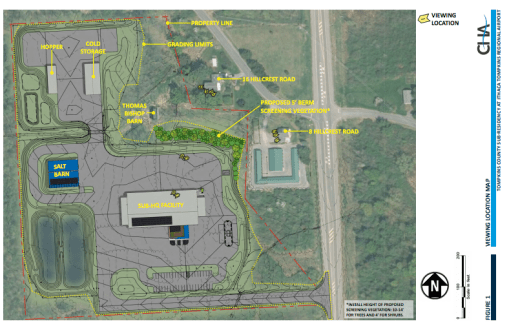
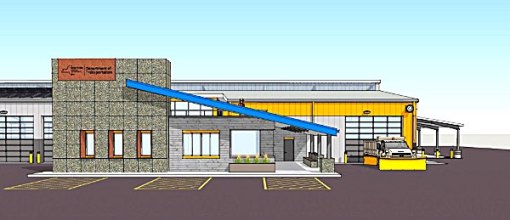
3. Here’s a look at the New York State Department of Transportation’s plan for a new regional facility on Warren Road in the town of Lansing. Here’s a description of the plan as reported by the Lansing Star, per DOT representatives at the meetings to the county and town last week:

“Buildings on the site will include a 30,000 square foot ‘sub-residency’ maintenance building, a 5,000 square foot Cold Storage, a 8,200 square foot Salt Barn, and a 2,500 square foot Hopper Building (covered lean-to). The proposed maintenance building will have vehicle storage for 10 trucks, a loader and tow plow, with one additional double depth mechanical bay and single depth, drive-thru truck washing bay. It also includes an office area (three rooms), lunch/break room (30 people), toilet/shower/locker rooms, storage rooms and mechanical/electrical rooms. The site will also contain stockpile areas for pipe, stone and millings, and ancillary site features including a fueling station, parking for 40 vehicles, and stormwater management facilities. The project will require construction of an access drive from Warren Road and the extension of utilities.”

As is often the case with high-priority state projects, the construction time frame is fast – the governor’s office wants the site built and fully operational by the end of the year. Also, much to the chagrin of some very unhappy neighbors who don’t want a DOT facility nearby, the town of Lansing is not Lead Agency in environmental review – the Federal Aviation Agency (FAA) is, given proximity to the airport (the county sold the 15.5 acres of land to the airport last September). Public resource projects by the state, like state-owned office buildings, state maintenance facilities and labs, are generally excluded from local zoning codes and do not have nearly as lengthy of an approval process. The nearly 1,000 page Environmental Site Assessment report can be found on the DOT website here. CHA Companies (formerly  Clough Harbor and Associates) of Albany, a prominent state contractor, did the assessment on behalf of the state.

There’s always going to be a bit of limitation in where the state can go with a project like this. The state wants out of the waterfront, not just because the county wants the land to be redeveloped, but because the salt and vehicle fluids could pose risks to the water quality of the inlet and lake (and DOT doesn’t want to be on the hook for that), access to 13 is more difficult due to urban traffic, the location isn’t efficient to where the state plows state roads previously handled by the town, and lastly, the state has simply outgrown the waterfront site -it needs more land, and taking the railroad’s or the Farmers Market’s is not a viable option. The state did originally plan using a site in Dryden on Ellis Drive, but the state determined that response time to urban areas was too long, and since some of the land was federally designated as wetland, the site was too small.

4. In the county’s deed filings, one of the more common recordings is the easements filed by NYSEG, often for new line connections to the power grid. Once in a blue moon, they turn up something interesting. The above site sketch comes courtesy of one of those filings. Scott Morgan owns 543 Asbury Road, and in 2015 he had proposed eight duplexes on the property, but the town had issues with that much density on a rural lot, so Morgan shelved the plan and the town amended the code to prevent such density on rural parcels. In turn, it appears that Morgan subdivided the 5-acre lot into four parcels, and is building a duplex on each. If they’re like his Lansing rentals, expect them to be ranch-style units with two bedrooms each.


Harold’s Square Construction Update, 12/2018

27 12 2018

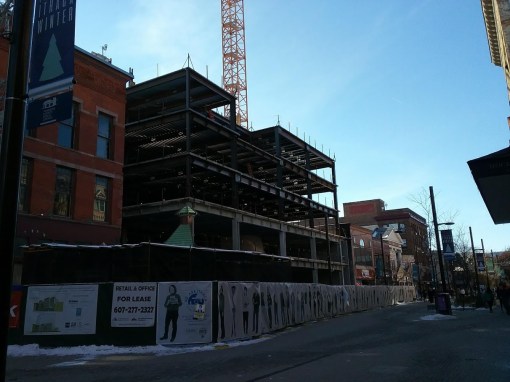
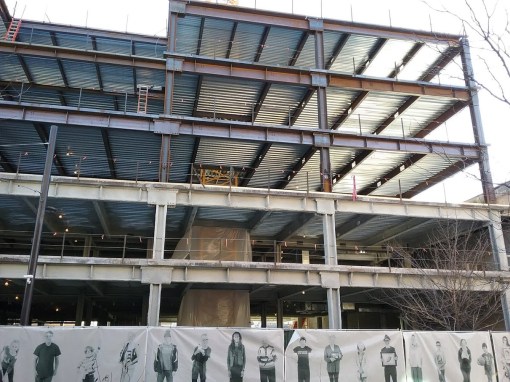
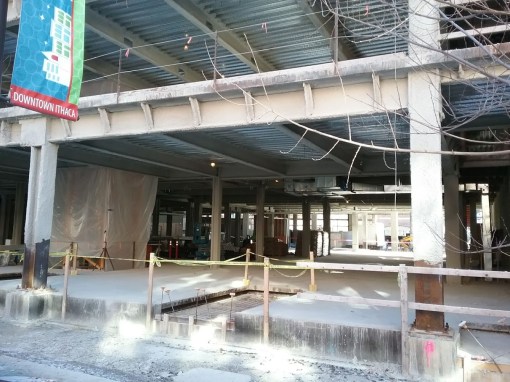
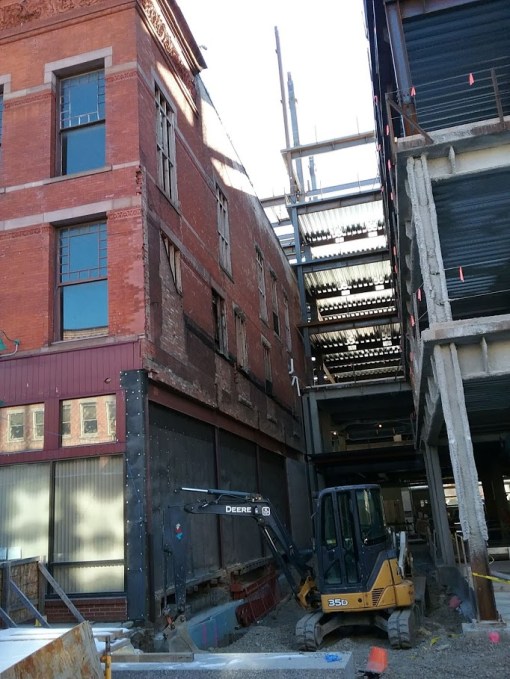
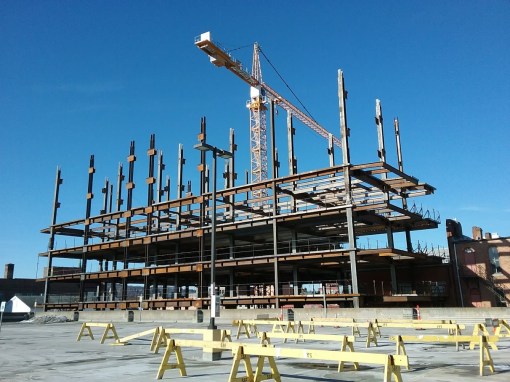
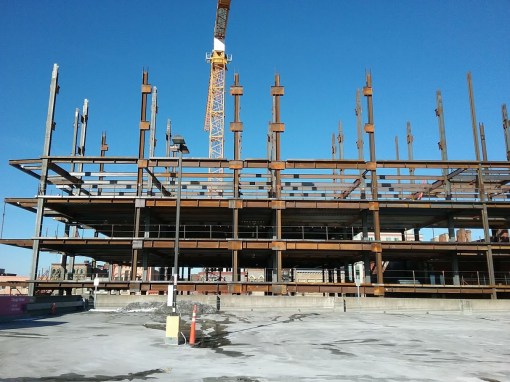
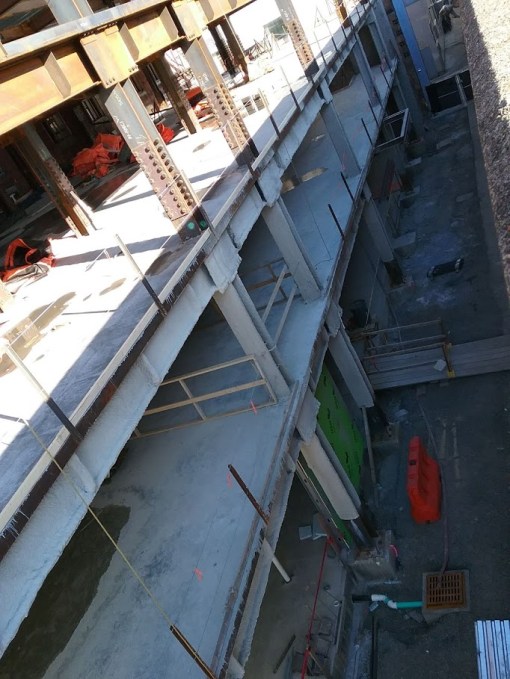
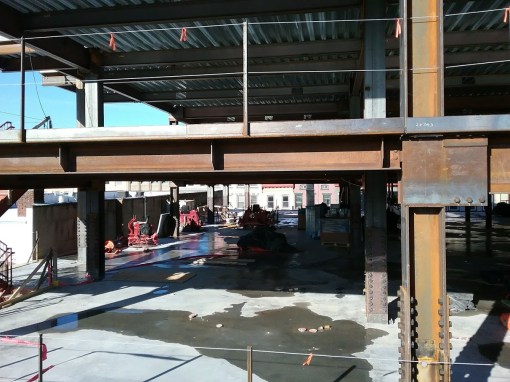
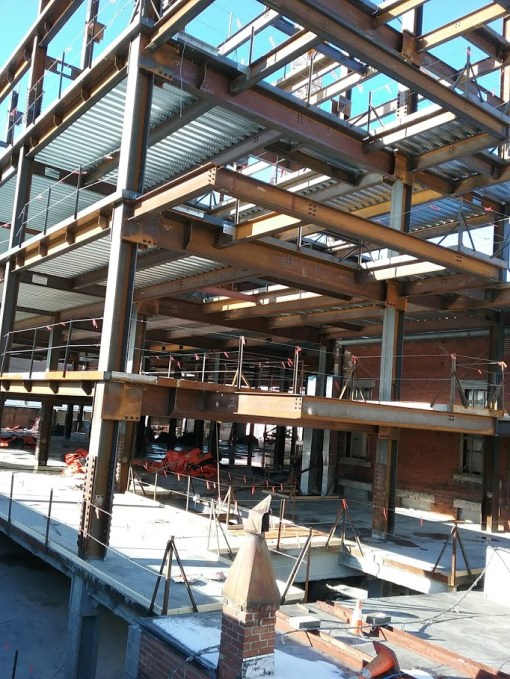
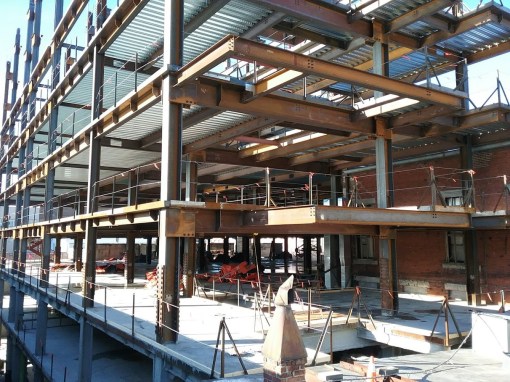
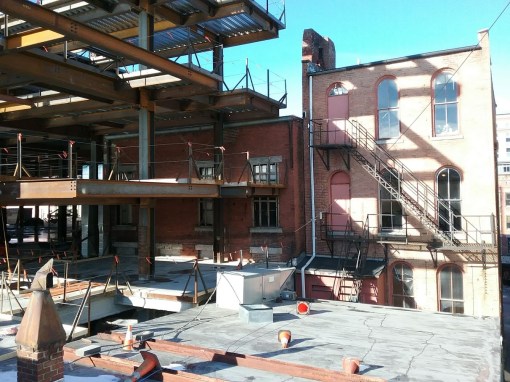
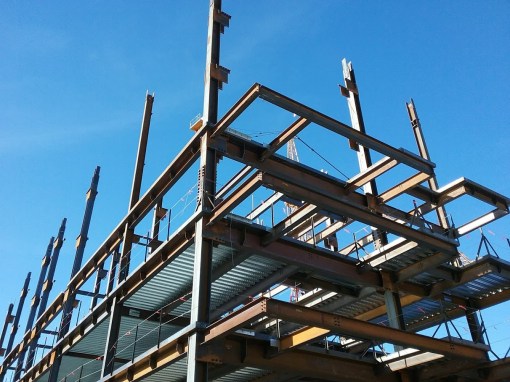
Just noting that the structural steel frame is fully built out up to the fifth floor and that fireproofing and sprinkler system installation is underway. The project utilizes SidePlate Systems for lateral steel connections, which utilizes a lighter frame design that is still durable. This has a higher upfront cost in design, but may balance out much of that with reduced materials and labor costs, as well as being able to stick to a tight buildout schedule. The IBEW (International Brotherhood of Electrical Workers) Local 241 is proudly touting their involvement with the buildout, and local labor advocates will be pleased by the commitment to local union labor. Taylor the Builders is the general contractor.

The apartment units have begun showing up online, though they are not able to be reserved just yet and no prices are given. The units come in the following sizes:

Studio 1 Bath 42 units 435 SF
1 Bed 1 Bath 32 units 686 SF
2 Beds 2 Baths 34 units 945 SF

Retail and office spaces are available for lease through Pyramid Brokerage’s David Huckle. The first floor Commons-facing units are being offered at $24/square foot (3-5 year lease), and the second and third floor office space is being offered for $22.50-$24/square foot. The retail spaces are 2,674 SF, 2,900 SF and 9,210 SF, which can be combined by a deep-pocketed lessee for a maximum of 16,241 SF. The minimum leaseble office space is 2,900 SF (which Pyramid describes as being about enough for seven people in a Class A environment), and the maximum is 33,832 SF (enough for 135 workers). The online as says a 2022 completion, which is overly, overly conservative. I would take a guess at Q4 2019 or Q1 2020. Obviously not the Spring 2019 they originally hoped for, but there have been numerous weather issues that delayed the concrete pours for weeks. The rest of the steel frame should rise faster since the tower portion (floors 6-12) is only a fraction of the building’s overall footprint.


323 Taughannock Boulevard Construction Update, 12/2018

3 12 2018

Some projects have clear, concise histories. This is not one of them.

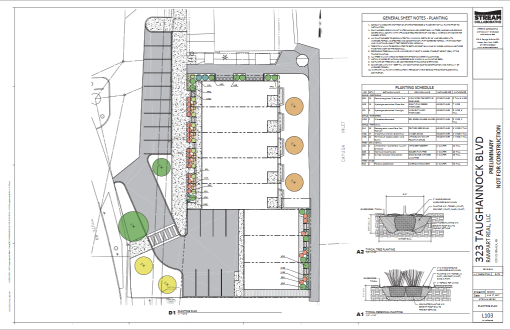
323 Taughannock started off in the summer of 2014 as a $3.5 million, 23,000 SF mixed-use building with ground-level office, 18 covered parking spaces, and 20 apartment units on the three stories above (total of four stories, 50′ height). The firm proposing the building was Rampart Real LLC, managed by local lawyer Steve Flash, who partnered with businesswoman Anne Chernish to develop the plan.

Flash had long had an interest in Inlet Island. He was an original co-owner of the Boatyard Grill restaurant on the island, and is an owner and co-manager of the nearby Finger Lakes Boating Center. In 2007, he sought to build a five-story condo/hotel on Inlet Island, and was shot down. If you think Ithacans are opposed to development now, take a look at the previous link. Current affairs don’t hold a candle to how anti-development the community and many local elected officials were for much of the 2000s. But Flash continue to scout out opportunities where he might be able to do something in time. He picked up the vacant, rundown former bar at 323 Taughannock Boulevard for $280,000 in July 2011.

The apartment plans, which were designed by STREAM Collaborative, were reviewed, revised, and approved by the city. Although the original plan was to build the apartments out from January – August 2015, the project had been unable to move off of the drawing board and into reality due to cost concerns related to “parking, soft soil, and relatively tight space,” according to Flash. Being on the waterfront means that the soils have a high water table and are easily compressed, making multi-story construction difficult. The challenges faced with the apartment building were complicated by the proposed first-floor parking, which posed constraints on the building’s structuring, and raised construction costs beyond feasibility. Long story short, although the approvals were in place, the cost projections became too steep for the developers to follow through, and the site sat quiet.

With the original plan no longer feasible, a replacement development plan was submitted in December 2016. This was a proposal for eight for-sale townhouses. Totaling 20,174 SF it’s effectively 16 units in eight townhomes – the first floor will consist of 8 studio type apartments that could also be used as commercial space. The second and third floors, which have separate entrances, will be occupied by 8 townhome style 2-story units. The original idea was that they could be live/work spaces, or that renters would live in the studio units and their rents would help cover the mortgages of the townhouse owners. Offhand, I remember they were to be in the upper 300s to low 400s price range.

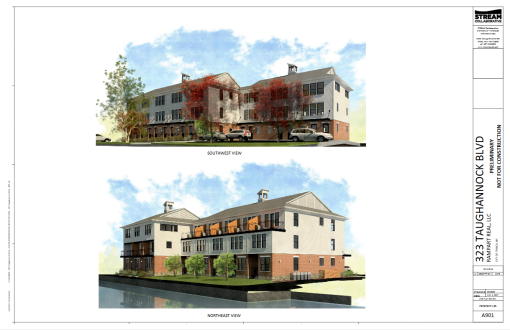
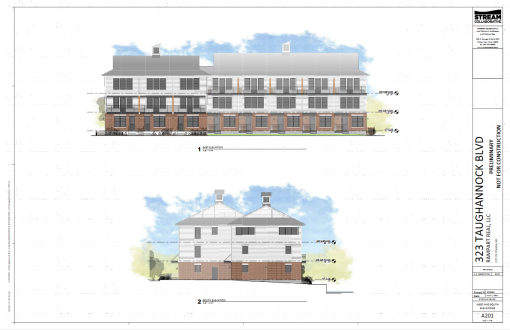
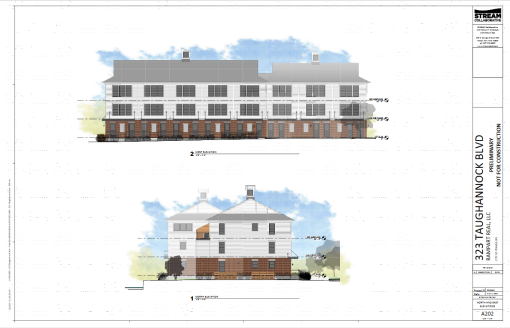
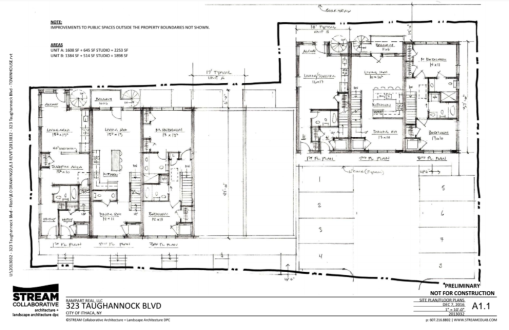
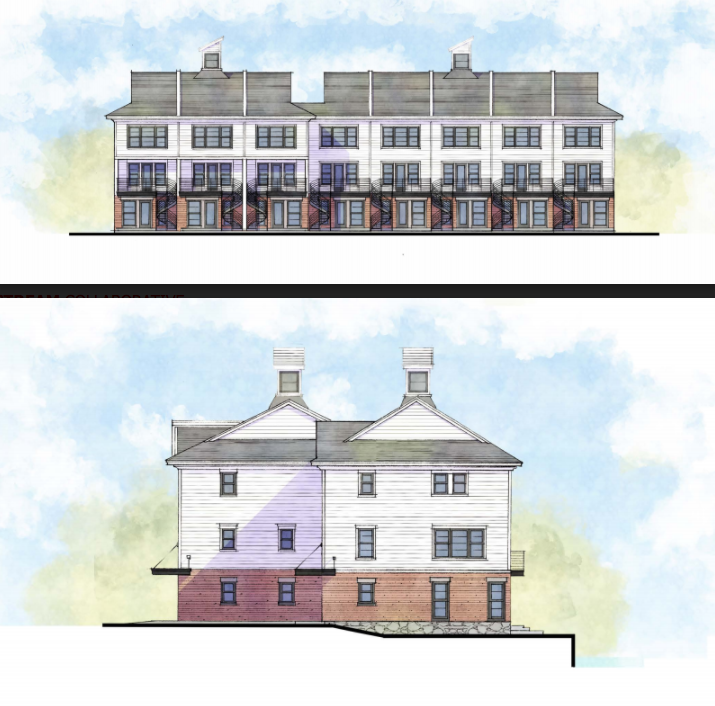
The general aesthetics of the design remained the same – as with the apartments, the for-sale townhouses are being designed by local architecture firm STREAM Collaborative. The facade “features historic and contemporary elements of rustic bricks, steel, traditional clapboard siding, and window casings”, per STREAM’s website. Five of the townhomes are larger – 645 SF studios with 2 bed/2 bath 1,608 SF units above, for a total of 2,253 SF in the “Unit A” townhouses. “Unit B”, with three examples, is a little smaller, with 514 SF studios and 2 bed/2 bath 1,384 SF upper-level units, for a total of 1,898 SF (the IDA application shows slightly different square footages for each unit, probably due to design revisions). Four units will have private elevators. The property will be landscaped and include eight on-site parking spaces with access to nine more next door. The public will have access to the waterfront on a paved promenade.

During this second round of review, 323 Taughannock received some visual tweaks. Gone are the cute sprial staircases leading to the waterfront, and in their place are more standard treatments. The group of five had their balconies moved from the second floor to the third floor. The changes on the front are more subtle, with the window fenestration now centered on each unit, and the front doors rearranged (old version here). Overall, the design was still roughly the same, the changes were only in the details.

The second set of reviews did get drawn out a bit because the project was caught up in the city’s TM-PUD affair, their fight to keep the Maguires from moving forward with their dealership at Carpenter Business Park. But the design fit zoning and was in line with the city’s desire for a more active, denser waterfront. The project was approved in May 2017.

Six months later in November, Flash and Chernish sold a $203,000 stake in 323 Taughannock plan to Arnot Realty of Elmira, who own the Arnot Mall and some commercial and multi-family properties in the Elmira/Horseheads area. As 323T LLC, the new joint venture gave Arnot a 75% stake to Flash and Chernish’s 25%, meaning Arnot is now the primary developer. For Flash and Chernish, it gives them a much bigger partner with experience and connections to contractors; for Arnot, it gives them a toehold in the burgeoning Ithaca market, their first step into the city.

One of the decisions made in this change of ownership was that the units went back to being rentals – very expensive rentals, to the tune of $3,400-3,500/month for the upper-level units. By HUD guidelines, that’s affordable to someone making $140,000/year. The studios will go for $1,400-$1,500/month. Seeking a ten-year tax abatement, sales tax exemptions and mortgage tax exemptions proved to be the most controversial part of this project, and to be fair, it’s a tough sell from a public relations perspective to say your ultra-luxury units deserve a $605,855 tax abatement. But the IDA decided that the long-term property tax increase would be worth it, and the project could potential spur development elsewhere on the island and the West End, and granted the exemptions in January 2018. One of the people who raked the developers and the IDA over the coals was Amanda Kirchgessner, back when she was a well-meaning citizen and before she became a highly controversial state senatorial candidate.

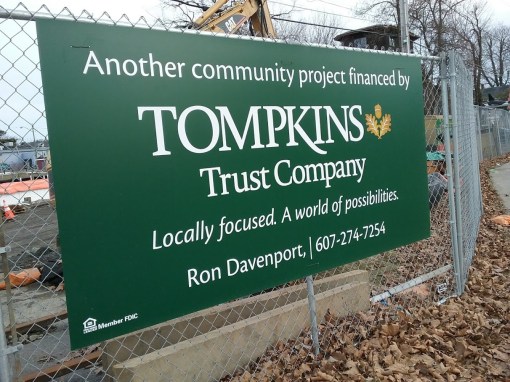
Tompkins Trust Company has lent the development team $4.061 million to finance work on the 16-unit townhouse project on Inlet Island. 323 T LLC partner equity was expected to be $1.153 million at the time of the IDA application, but that may have changed, since the bank loan was only expected to be $3.461 million at the time – total project cost was $4.615 million.

Ithaca’s Taitem Engineering is in charge of mechanical, electrical, plumbing, and structural design services. The builder looks like a newcomer – Benson Woodworking Company, working with applicant contractor D Squared Inc. (Doug Boles and Doug Dake) of Lansing. Benson’s primary work is as a modular and timber-frame builder for properties in and around southern New Hampshire where they’re based. With 323, the wood-frame wall system will actually be framed and sheathed off site by Benson, and transported over to be assembled by D Squared like pieces of a puzzle. The modular approach potentially saves on materials and labor costs makes the construction itself more energy efficient, and may make the logistics of the construction site easier to manage. The plan is to have the project be “nearly net-zero”, meaning it’s efficient in its energy use, and close to having all of its energy needs met by renewable sources (the project will be powered by an off-site solar array). For the record, yes it will use heat pumps.

Taitem also designed the rather unusual timber-based pile system deployed at the project site. The project itself is relatively light as building go, but because of the waterlogged soils, a deep foundation is still required for structural stability. Instead of heavy-duty steel, treated timber can do the job for a fairly modestly sized project like this, an affordable, lighter-load alternative. As long as the timber isn’t exposed to high levels of oxygen (open air, there isn’t enough dissolved in groundwater), they can last for hundreds of years. You can see the piles in the photos below, and watch the pile driving process in the embedded Twitter video courtesy of Ithaca second ward councilman Ducson Nguyen. All the piles are in place, and a 6″ concrete slab will be formed and poured over the top.

Construction is expected to take about eight months, roughly placing a timeline for completion at summer 2019.

Before:


https://platform.twitter.com/widgets.js


News Tidbits 11/26/18

27 11 2018

Just to get this out in time, he’s a look at what will be a rather long but very interesting city of Ithaca Planning Board meeting tomorrow evening.

1 Agenda Review 6:00

2 Special Order of Business – Planning Report on ILPC recommendation to designate the former Delaware, Lackawanna, & Western Railroad Station at 701 West Seneca Street. 6:05

3 Privilege of the Floor 6:20

4 Approval of Minutes: October 23, 2018 6:35

5 Site Plan Review
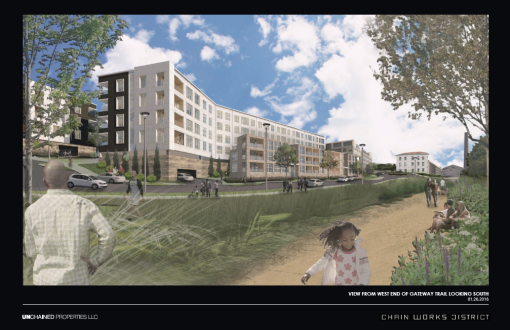
A. Project: Chain Works District Redevelopment Plan (FGEIS) 6:40
Location: 620 S. Aurora St.
Applicant: Jamie Gensel for David Lubin of Unchained Properties
Actions: Distribution of FGEIS & Review of Schedule – No Action
Project Description: The proposed Chain Works District seeks to redevelop and rehabilitate the +/-800,000 sf former Morse Chain/Emerson Power Transmission facility, located on a 95-acre parcel traversing the City and Town of Ithaca’s municipal boundary. The applicant has applied for a Planned Unit Development (PUD) for development of a mixed-use district, which includes residential, commercial, office, and manufacturing. The site’s redevelopment would bridge South Hill and Downtown Ithaca, the Town and the City of Ithaca, by providing multiple intermodal access routes including a highly-desired trail connection. The project will be completed in multiple phases over a period of several years with the initial phases involving the redevelopment of the existing structures. Current redevelopment of this property will focus on retrofitting existing buildings and infrastructure for new uses. Using the existing structures, residential, commercial, studio workspaces, and office development are proposed to be predominantly within the City of Ithaca, while manufacturing will be within both the Town and City of Ithaca.

No decisions expected tonight, but the distribution of the FGEIS (Final Generic Environmental Impact Statement) is a major step forward. From here, the Planning Board will review and critique the document, and when satisfied, it will vote for a resolution of completion. A recommendation to adopt the Chainworks PUD zoning and the FGEIS findings will follow, and if successful, the Common Council will also vote to adopt the PUD zoning. That would complete generic review for the site – new builds would still come to the board as necessary, but renovations could potentially begin not long afterward. Timing-wise, the final approvals are still a few months out, but this massive 910+ unit project is slowly closing in on approvals, and potentially, construction.
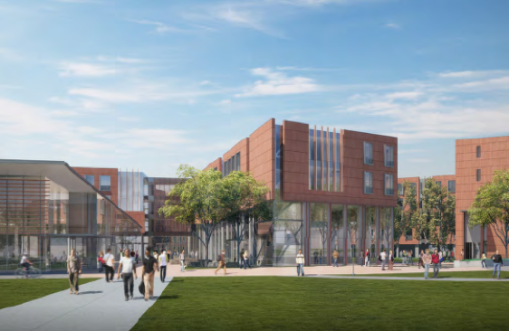
B. Project: North Campus Residential Expansion (NCRE) 6:55
Location: Cornell University Campus
Applicant: Trowbridge Wolf Michaels for Cornell University
Actions: Review of FEAF Part 3
Project Description: The applicant proposes to construct two residential complexes (one for sophomores and the other for freshmen) on two sites on North Campus. The sophomore site will have four residential buildings with 800 new beds and associated program space totaling 299,900 SF and a 59,700 SF, 1,200-seat, dining facility. The sophomore site is mainly in the City of Ithaca with a small portion in the Village of Cayuga Heights; however, all buildings are in the City. The freshman site will have three new residential buildings (each spanning the City and Town line) with a total of 401,200 SF and 1,200 new beds and associated program space – 223,400 of which is in the City, and 177,800 of which is in the Town. The buildings will be between two and six stories using a modern aesthetic. The project is in three zoning districts: the U-I zoning district in the City in which the proposed five stories and 55 feet are allowed; the Low Density Residential District (LDR) in the Town which allows for the proposed two-story residence halls (with a special permit); and the Multiple Housing District within Cayuga Heights in which no buildings are proposed. This has been determined to be a Type I Action under the City of Ithaca Environmental Quality Review Ordinance (“CEQRO”) §176-4 B.(1)(b), (h) 4, (i) and (n) and the State Environmental Quality Review Act (“SEQRA”) § 617.4 (b)(5)(iii). All NCRE materials are available for download at: http://www.cityofithaca.org/DocumentCenter/Index/811

Materials provided indicate that city planning staff are reasonably satisfied that the energy impacts of the massive North Campus housing plan have been mitigated. The only new letter on record this month is a letter of concern from the City Historic Preservation Planner about the project’s visual and aesthetic impacts on the Cornell Heights Historic District to the west.

C. Project: Apartments (12 Units) 7:25
Location: 327 W. Seneca Street
Applicant: Noah Demarest for Visum Development
Actions: Consideration of Preliminary & Final Site Plan Approval
Project Description: The applicant is proposing to construct a three-story apartment building with 12 units. Project development requires the removal of the exiting building and parking area. The project will include exterior bike storage, a trash enclosure, walkways, landscaping, signage, and lighting. The project is in the B2-d Zoning District and has received the required variances for front-, side-, and rear-yard setbacks. A small portion at the rear of the property is in the CDB-60 District. The project has received Design Review. This is an Unlisted Action under the City of Ithaca Environmental Quality Review Ordinance (“CEQRO”) and the State Environmental Quality Review Act (“SEQRA”), for which the Lead Agency made a Negative Determination of Environmental Significance on September 25, 2018.

Not much to add regarding Visum’s workforce housing (80% area median income) proposal for the State Street Corridor. The project is expected to receive $200,000 from the latest round of the Community Housing Development Fund, the affordable housing fund jointly paid into by the city, county and Cornell. In this case, Cornell will cover $170,000 and the city $30,000. Cornell doesn’t have any hand in this project, but having one entity pay most of the grant for a given project makes it less complex to administer. 
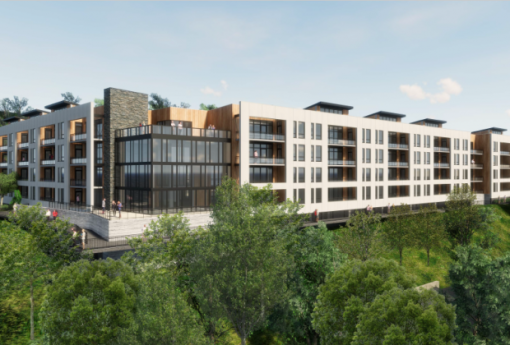
D. Project: Falls Park Apartments (74 Units) 7:35
Location: 121-125 Lake Street
Applicant: IFR Development LLC
Actions: Public Hearing, Review of FEAF Parts 2 & 3
Project Description: The applicant proposes to build a 133,000 GSF, four-story apartment building and associated site improvements on the former Gun Hill Factory site. The 74-unit, age-restricted apartment building will be a mix of one- and two-bedroom units and will include 7,440 SF of amenity space and 85 parking spaces (20 surface spaces and 65 covered spaces under the building). Site improvements include an eight-foot wide public walkway located within the dedicated open space on adjacent City Property (as required per agreements established between the City and the property owner in 2007) and is to be constructed by the project sponsor. The project site is currently in the New York State Brownfield Cleanup Program (BCP). Before site development can occur, the applicant is required to remediate the site based on soil cleanup objectives for restricted residential use. A remedial investigation (RI) was recently completed at the site and was submitted to NYSDEC in August 2018. The project is in the R-3a Zoning District and requires multiple variances. This is a Type I Action under the City of Ithaca Environmental Quality Review Ordinance (“CEQRO”) §176-4 B(1) (h)[2], (k) and (n) and the State Environmental Quality Review Act (“SEQRA”) §617-4 (b) (11).

Note that IFR is a Travis Hyde Properties business entity. The attempt to gain approval for an environmentally compromised project site is likely going to be more heavily scrutinized given the recent controversy regarding proposed demolition procedures for the Old Library site.

E. Project: New Two-Family Dwellings 7:55
Location: 815-817 N Aurora
Applicant: Stavros Stavropoulos
Actions: Declaration of Lead Agency, Review of SEAF Parts 2 & 3
Project Description: The applicant proposes to demolish an existing two-family residential structure and construct two new 1,290 SF two-family dwellings on a 9,590 SF lot. The existing residential building is a legally nonconforming building with a side setback deficiency (2.9 feet instead of the required 5 feet). The proposed redevelopment will include four parking spaces for four three-bedroom apartments. The applicant is requesting the Board’s approval to use the landscaping compliance method for parking arrangement. The project site is located in the R-2b Zoning District and meets all applicable zoning lot and setback requirements. This is an Unlisted Action under the City of Ithaca Environmental Quality Review Ordinance (“CEQRO”) and the State Environmental Quality Review Act (“SEQRA”).
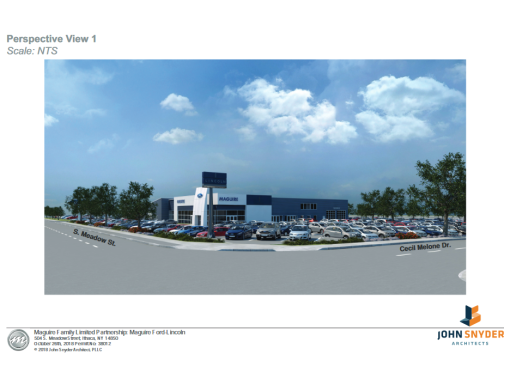
F. Project: Maguire Lincoln 8:15
Location: 370 Elmira Road
Applicant: John Snyder Architects PLLC
Actions: Declaration of Lead Agency, Review of FEAF Parts 2 & 3
Project Description: The applicant proposes to demolish a portion of the existing building and construct two additions with updated exterior materials. The existing building is 18,500 GSF, with 2,265 GSF proposed for demolition. The new building will be 24,110 GSF. Site improvements include incorporation of a new pedestrian walking path, and site connections to Wegmans. Approximately 311 parking spaces are proposed to accommodate customer, service parking, employee, and display parking. Landscape design will improve vegetative cover; however, it will not meet the City of Ithaca’s impervious/pervious requirements (12%). The project site is located in the SW-2 Zone, is subject to the 2000 Southwest Design Guidelines, and will require a zoning variance for a front yard that exceeds the maximum permissible in the SW-2 district (34 feet maximum permitted, 69-feet 3-inch setback proposed). This is an Unlisted Action under the City of Ithaca Environmental Quality Review Ordinance (“CEQRO”) and the State Environmental Quality Review Act (“SEQRA”); however, it will be treated as a Type I Action for the purpose of environmental review.

G. Sketch Plan – 312 E Seneca Street, Jagat Sharma 8:35

312 East Seneca is a 4,482 SF three-story mixed-use building on the edge of Downtown Ithaca. The building was long-owned by Ithaca architect Jagat Sharma, who ran his practice from the building (1416 SF), the Alley Cat Cafe (1926 SF), and a four-bedroom apartment (1140 SF) on the upper floors.

A few years ago, the site was floated as part of the potential footprint for Visum Development’s Seneca Flats mixed-use project, though at the time it was made clear that it was not an essential property to the development, and simply a possibility if Sharma chose to sell to Visum. Sharma didn’t – in September, he sold the building to an LLC associated with the Stavropoulos family for $800,000, double the assessed value. That lofty price relative to assessed value was a big clue something was planned here, and it looks like the first glimpse of that will come tomorrow night. The Stavropoli of West Hill have been growing their assets through acquisition or development for the past several years, including the 4-unit North Aurora project in item E. above.

Normally, the Stavropoulos family is low-key about development, preferring lower-profile infill builds in established neighborhoods – the largest project of theirs to date is the 11-unit 107 South Albany project. They often turn to local architect Daniel Hirtler, but this time, Collegetown favorite Jagat Sharma will have a hand in redeveloping the building that housed his office for so many years. This would be Sharma’s first building downtown since the Greenstate Building (127 West State Street) in 1991. For the record, this would be their second Sharma commission, with a duplex planned for 209 Hudson Street being the other (granted, that’s also a modular structure).

Zoning-wise, this is CBD-60. Within that zone, Sharma can design a five-story building up to 60 feet tall, no parking required, with any variety of commercial or residential uses. Any design will have to conform with the recently-adopted Downtown Design Guidelines. The Stavropoli are likely to do all-residential or residential with ground-floor retail. The current building is quite narrow, but it also only occupied the east half of the lot – a new structure could practically touch the neighboring building at 308 East Seneca.

H. Sketch Plan – 114 Catherine Street, Jagat Sharma 8:55

Things are about to get a bit confusing. A few years ago, the Lambrou family, mid-sized Collegetown landlords and developers of Collegetown Park, presented and built an infill project at 114 Catherine Street – while all the working docs used 114 Catherine Street, the address of the existing building set back into the lot, the new 3-unit, 17-bedroom building was christened 116 Catherine Street.

This new building is expected to be a replacement for the existing 114 Catherine Street, the Mission Apartments, and is expected to complement 116 Catherine in appearance (Jagat Sharma designed that as well). Zoning here is CR-4, up to four floors, with a maximum of 50% lot coverage (but not parking required). Expect this to be student housing – probably not too big, a few dozen beds at most, but something to take note of nevertheless.

I. Sketch Plan – 130 Cherry Street, Residential, Vecino Group 9:15

130 Cherry Street is a 4,600 SF auto body shop that’s been for sale for quite a while now. The rumor mill says Vecino CEO Rick Manzardo was walking around the area a couple of weeks ago, and it looks like there was a reason for that. The plan being floated is affordable “artist housing”. This wouldn’t be a new concept to Vecino, who renovated a vacant warehouse in Troy into the 80-unit Hudson Arthaus. What makes the Arthaus unique among affordable housing is that it offers on-site amenities geared to artists, as well as income-based rents for those who make only a modest living while engaged in their creative pursuits.  Those amenities include a wood shop, on-site storage units, gallery spaces managed by a local non-profit, and a computer/digital work suite.

Zoning here is “Cherry Street District” Waterfront Zoning. Since it’s north of Cecil Malone Drive, housing is allowed – but not on the first floor. The first floor is for light industrial and many commercial uses, including restaurants, stores and offices. No ground-level storage permitted, however. In this “artist housing” format, the first floor would likely be the exhibition/gallery.workshop space. The building may be up to five floors with 100% lot coverage once setback requirements are met. Bonus for this site, the Cherry Artspace is a few hundred feet away. With about 179,000 SF in building capacity offered by the site and zoning before setbacks are considered, a potential project could be fairly sizable.

6. Old/New Business 9:35

7. Reports 9:40
A. Planning Board Chair
B. BPW Liaison
C. Director of Planning & Development

8. Adjournment 10:00