News Tidbits 11/19/16: Winter Is Coming

19 11 2016

executive-education-center-and-hotel-777x622

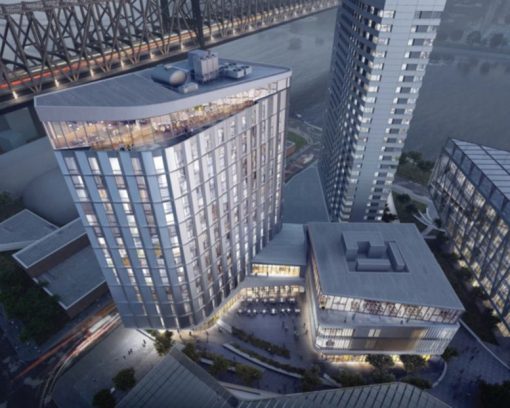
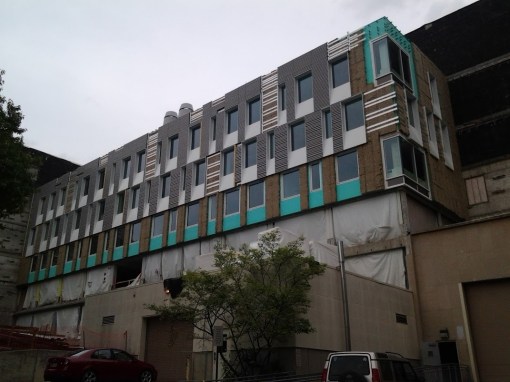
1. We’ll start off in the Big Apple this week. Cornell and its development team have released plans for the fourth and last building in the first phase of the Cornell Tech buildout. The Verizon Executive Education Center and Hotel consist of two buildings connected by a shared hall, and will include four 50-75 seat classrooms, small breakout rooms, and a 195-key hotel for visitors to the school. The plans also call for a restaurant, rooftop lounge and cafe – none of which sound very academic, but the building is meant to be an event center and gateway to the nascent school.

The exterior will be encased in aluminum and wood planks. There will be no parking, but there will be pedestrian courtyards, bike lanes and green space. The facilities are part of the campus’s first phase, which also includes a 26-story student and staff residential building; the Bridge, an incubator for researchers and small businesses; and the Bloomberg Center academic building. Those buildings will open in summer 2017, while the Verizon Center will probably be a 2018 opening, assuming the final designs are approved by the city of New York.

hopshire_1

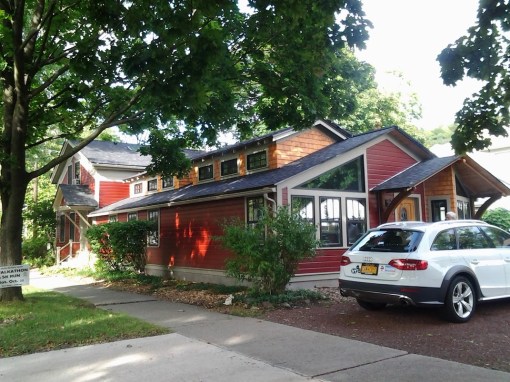
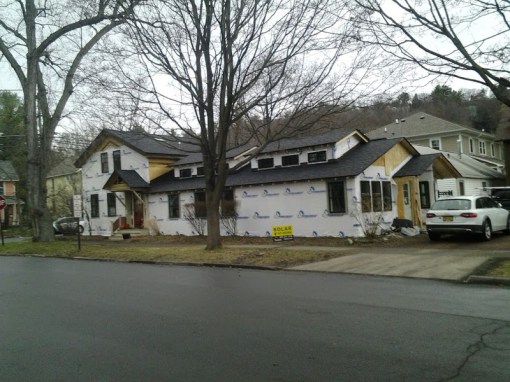
2. Now to turn to something much closer to Ithaca. Dryden’s Hopshire Brewery is in the midst of a two-phase expansion, reports the Times. The first phase, shown above, consists of a 1,200 SF addition to the west side of the structure, and the new addition is already framed and closed up, with the expectation of being completed by the start of 2017. The space will be used to host events for as many as 100 attendees. the second phase, a 1,300 SF addition to the brewery and storage area, will start next year. The work is partially funded with an Empire State Development grant.

Speaking of drinks, the Watershed, a new bar and coffee lounge, will open by Thanksgiving. It replaces Rumble Seat Music at the former telephone exchange building at 121 West State Street in Downtown Ithaca. The Watershed owners expect to create eight living-wage jobs.

3. From county records, we can see just how much the Rodeway Inn renovation is going to cost local businessman Pratik Ahir – $2,095,000, but the hard costs are only $926,000. The difference is due to the existing mortgage on the property. The lender is Generations Bank, a small bank based out of the Seneca Falls. Anecdotally, we seem to be seeing an uptick in small upstate lenders looking to stake claims on the growing Ithaca market, which could be a real asset for the region – with a limited number of local lenders, financing is often a big hurdle with Ithaca-area projects.

maplewood-v7_8-planning-board maplewood-v7_6

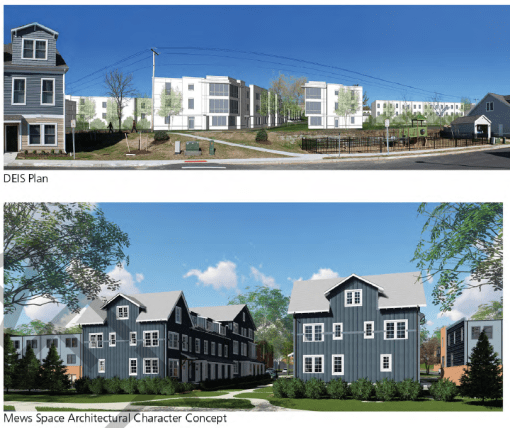
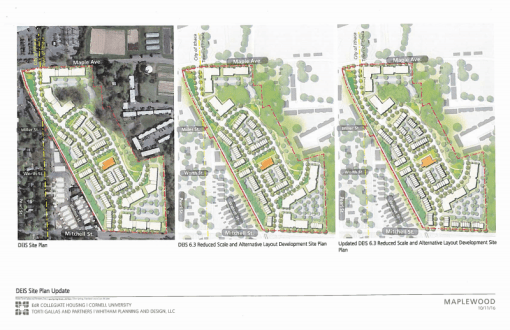
4. As noted earlier this week in the Voice, lots of new Maplewood renders to take a gander at. Going through all the emails from the public comment period, I’d say that overall most are positive and positive-constructive – there are a few sour grapes, but they’re in the minority. For this area, that’s actually a pretty big accomplishment, and it means Cornell and EdR have successfully addressed most of the concerns raised by neighbors and community members. The big changes in respone to public comment have been a a commitment to 50% off-site solar energy, $20,000 to the town for traffic calming measures on Mitchell Street (raised crosswalks, speed bumps), and the two townhouse strings facing Walnut Street and the Belle Sherman Cottages have been redesigned to look more traditional and fit in better with their non-student neighbors. We’re probably very close to the final design at this point, if not already there.

Once preliminary approval has been granted, demolition will start on the south side of the Maplewood property and make its way northward in four phases. The first townhouse strings and apartment buildings will begin construction on the south side of the property in the March-April timeframe, depending on overall progress and external factors. The first completed buildings will be ready by October/November 2017, but it looks like occupancy will happen all at once in August 2018.

wegmans_pad_parcel-1116

5. The City Planning Board Agenda is pretty busy next week – Todd Fox will be presenting two new mid-sized Collegetown projects, Wegman’s is seeking a renewal on the approvals for their pad parcel building, and several other projects had major or minor redesigns. Here’s the rundown on the Voice, and the schedule here:

AGENDA ITEM                 APPROX. START-TIME

1. Agenda Review              6:00

2. Privilege of the Floor   6:01

3. Site Plan Review
A. Project:  Maplewood Redevelopment Project                               6:10
Location: Veteran’s Ave. (between Maple Ave. & Mitchell St.)
Applicant: Scott Whitham, Whitham Planning & Design, LLC, for Cornell University
Actions: Update & Schedule
B. Project:  City Centre — Mixed Use Project (Housing & Retail)     6:25
Location: 301 E. State/M.L.K., Jr. St.
Applicant: Jeff Smetana for Newman Development Group, LLC
Actions: PUBLIC HEARING    Review of Full Environmental Assessment Form (FEAF), Part 3

C. Project:  Amici House & Childcare Center                                6:50
Location: 661-701 Spencer Rd.
Applicant: Tom Schickel for Tompkins Community Action (“TCAction”)
Actions: Declaration of Lead Agency, PUBLIC HEARING, Determination of Environmental Significance, Recommendation to BZA

D. Project:  Four Duplexes                                                         7:20
Location: 607 S. Aurora St.
Applicant: Charles O’Connor
Actions: Determination of Environmental Significance, Consideration of Preliminary Approval
E. Project:  College Townhouse Project                                      7:45
Location: 119, 121, & 125 College Ave.
Applicant: Kathryn Wolf, Trowbridge Wolf Michaels Landscape Architects, LLP
Actions: Declaration of Lead Agency, Review of Full Environmental Assessment Form (FEAF), Part 2
F. 126 College Ave. — Sketch Plan            8:00
G. 210 Linden Ave. — Sketch Plan              8:20
H. Wegmans Retail Building – Extension of Site Plan Approval     8:40
4. Zoning Appeals                                                                     8:50
• 3049, Special Permit, 908 N. Cayuga St.
• 3050, Area Variance, 528 W. Green St.
• 3051, Area Variance, 661-665 Spencer Rd.
• 3052, Area Variance & Special Permit, 701 Spencer Rd.
• 3054, Sign Permit, 222 Elmira Rd.
5. Old/New Business                                                                 9:00
A.  Special Planning Board Meeting: 11/29/16
B.  Update — City/Town Joint Planning Board Meeting
C.  Update — Joint Planning Board/ILPC Meeting (DeWitt House)
D.  Changes/Corrections to Collegetown Area Form Districts (CAFD)
E.  Building Materials — Discussion on Potential Restriction on Vinyl Siding
6. Reports                                                                                 9:20
A.  Planning Board Chair (verbal)
B.  Director of Planning & Development (verbal)
C.  Board of Public Works Liaison (verbal)

7. Approval of Minutes: May 24, 2016, June 28, 2016, July 26, 2016, and/or October 25, 2016 (time permitting)      9:30

8. Adjournment      9:31


Martha Pollack, Cornell’s New Madam President

14 11 2016

5-1-2012 123

As announced earlier today, Cornell’s 14th president will also be its second female leader. Univ. of Michigan provost Dr. Martha E. Pollack has been selected to take over the helm from interim president Hunter Rawlings starting in April 2017.

Currently, Pollack is the Provost and Executive Vice President for Academic Affairs at the University of Michigan, as well as a Professor of Computer Science. As a student, Dr. Pollack earned her degrees at two of Cornell’s peers – a bachelor’s degree in linguistics from Dartmouth College, and a PhD as well a master’s in computer science and engineering from the University of Pennsylvania. Her professional specialty is artificial intelligence, with years of research focused on the design of technology to help those with cognitive impairments, including natural-language processing, temporal reasoning, and automated planning.

Pollack has held a number of positions across the country. From 1985 to 1991, she was a computer scientist at the Artificial Technology Center of SRI International, a non-profit research institute started by, and still closely associated with Stanford University. In what be a good fit with Cornell’s trajectory, SRI was initially created in the 1940s to help spur economic development in the vicinity of Stanford – an area that would later become known as Silicon Valley.

Following her time at SRI, she was a professor at the University of Pittsburgh for nine year, moving to Ann Arbor in 2000 to join the computer science department at U. Michigan. It was at Michigan where she began to work her way up the academic leadership ladder – first as an associate chair of the Electrical Engineering and Computer Science department from 2004-2007, than as Dean of the School of Information from 2007-2010, then as a Vice Provost for Budgetary and Academic Affairs from 2010-2013, and then promoted in January 2013 to her latest position as Provost and Executive Vice President for Academic Affairs for the 44,000 student university. The provost role in higher education is basically the second-in-command, leading the administrations function of the university. Apparently, Michigan has a knack for turning out Ivy League presidents – Pollack accepted the provost position following colleague Philip Hanlon’s departure to take over as President at Dartmouth College.

Like many high-flying professionals, Pollack has earned a number of service and research awards over the course her career. When promoted in 2013, University of Michigan President Mary Sue Coleman spoke of her glowingly, saying “it’s obvious to me that she’s somebody with enormous potential.” A colleague described Pollack as “gentle, kind and has always been a tireless advocate for our student body.”

The appointment to provost, originally for two years, was renewed by the university in December 2014, and came with additional praise. “Provost Pollack has been an innovative and disciplined academic and budget leader for the campus. … I appreciate her work to hold down tuition costs, provide more financial aid to our students, and her leadership of important new initiatives in digital education and engaged learning,” said Mark Schlissel, the new president of the university.

While at Michigan, Pollack has taken some heat from conservative circles for overseeing a change in student registrations that allowed students to select their own pronouns in respect those who are gender non-conforming. earlier this year, Pollack gave a speech to Michigan students and used the example of supporting transgender children as an example of how young people must “fill the empathy gap.

Regarding her personal life, Pollack has been married for 32 years to Ken Gottschlich, an engineer and jazz musician, and has two grown children.

Although Cornell is large, well-respected and multifaceted institution, so is Michigan. A computer scientist with strong research acumen and academic connections seems like a comfortable choice for Cornell president. With her credentials, at a glance it appears that her appointment is a wise decision that fits with the university’s strategic goals.


News Tidbits 10/29/16: Envision Small Spaces

29 10 2016

lansingaptsmap600

1. The heated debate over the Park Grove project in the village of Lansing continues. The primary opposition to rezoning continues to be the Jonson family of Ithaca Home (Forest City Realty / IJ Construction), and residents of their Heights of Lansing development at the end of Bomax Drive. Reasons cited include loss in property values, increased traffic, and slowing the completion of their own project.

Pardon the incredulity when hearing about property value concerns in a community with well-documented property appreciation. Furthermore, only two houses have been built in the Heights of Lansing development in the past couple of years. Since the project first launched in 2006, they have sold 17 townhouses and homes, in a development that planned for about 80. They’ve been moving at a snail’s pace for years, and it;s hard nothing to do with the zoning of nearby property. Another angry speaker asked why Lansing has to shoulder the county’s housing burden, but it’s not just Ithaca that has housing issues. In short, while I’m critical of this specific proposal, the zoning change makes sense. The board may consider a zoning change at its November 7th meeting.

holochuck

2. Thanks to the county planning department, we have a little more information about NRP Groups’ revival of the Holochuck Homes project on West Hill. It appears Tompkins is intending to award $300,000 in Community Housing Development Funds to the development team. The CHDF funds go towards affordable housing projects intended for households making 80% of Area Median Income or less (AMI is about $54,000/year, so roughly $43,000/year and less). It looks like 89 of the 106 units in this townhouse proposal will qualify for the funds; most likely the other 17 will be priced in the 80-100% AMI range. Like 210 Hancock and other larger projects, units typically aren’t restricted to one specific income bracket, there tends to be a mix of lower and lower-middle incomes. It also appears that Arbor Housing and Development, an affordable housing developer based out of Corning, will be partnering with NRP Group on the project. Ithaca would be new territory for Arbor Housing, whose next closest site is an apartment building in Odessa in Schuyler County.

tiny_timbers_1

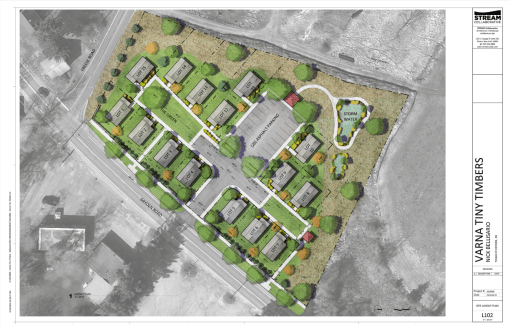
3. Looks like Tiny Timbers is one step closer to reality. The property at 5 Freese Road, once known as “Mt. Varna”, was sold on the 25th by Nick Bellisario to “VTT LLC” for $184,122.59. Presumably, VTT is short for Varna Tiny Timbers. Bellisario and co-owner Otis Phillips had purchased the land for $90k in 2006, and considered a couple different development plans for the site, including a 20-unit modular townhouse project for the site several years back. The land was most recently assessed at $100k. Philips is bowing out of ownership, but county documents show Bellisario and Tiny Timbers creator Buzz Dolph are co-partners in the LLC. The 15-unit Tiny Timbers project will be hosting an open house Saturday the 29th, and may be considered for final approval by the town of Dryden in November.

100_0520

4. Up on Ezra’s former farm, a hefty donation will finance the renovation of Noyes Lodge into a campus welcome center. The family of trustee Marvin Tang ’70 is donating $3 million to partially finance the creation of what will be the Marvin Y. Tang Welcome Center, pending approval by the Board of Trustees. The gift responds to a challenge grant created by mega-donor Atlantic Philanthropies (funded by Charles Feeney ’56), which offered up to $3 million in matching funds to donations towards the new welcome center – so with $6 million secured, the renovation’s financing is secured and will be able to move forward. Cornell has long considered a reception and exhibition space by the gorges, having mulled over but ultimately backing away from a plan penned by architect Richard Meier in the late 1980s. Tang, now retired, was a venture capitalist based in Hong Kong, and the regional chairman of a recruitment firm for business executives.

The Noyes Lodge, a 9,100 SF building that opened in 1958 as a womens’ dining hall, is currently used for language classes and training. Those functions would be moved into newly renovated space in Stimson Hall. JMZ Architects of Glens Falls, a favorite of the SUNY System, will be the design firm in charge of the renovation and re-purposing. The exhibition space will be the work of Poulin and Morris Inc. of New York City. Cornell plans to open the new welcome center by Summer 2018.

village_solars_2

5. There seem to have been some changes to the Village Solars project up in Lansing. According to the newly-uploaded planning board minutes, the site plan has been revised from 174 units to 206 units, but most of that is tied up in unit reconfiguration. Reaching out for specifics, here’s the response from Rocco Lucente the younger:

We have found that the micro unit floor plans are very, very popular and the three bedroom units have been the only units we’ve had any problems with getting rented in a timely manner (like most companies we like to be rented out by the end of Cornell’s season if possible), so we will be modifying the three bedroom floor plans to become micro units and our new junior one bedrooms, which are slightly larger than the micro unit and includes a separate bedroom and living room/kitchen area. The total number of bedrooms goes up very, very slightly and the square footage should remain relatively unchanged.”

The micro units he’s referring to are the units created during phase two, when two larger units were split into smaller units as a sort of testing of the waters – apparently it worked out quite well. It’s worth noting that three-bedroom units had the highest vacancy rate in the Danter study. We’ll see if this creates significant design changes, but one thing’s for certain, it drives up the unit count per building – for instance, Building M, slated to be built in the next phase, has increased from 17 to 24 units.

f5321f76a7c2ce2d9c3d0b069686bdab18e656969cc9b4cce8063cbab0926e8aa52b0bc270ce88ac

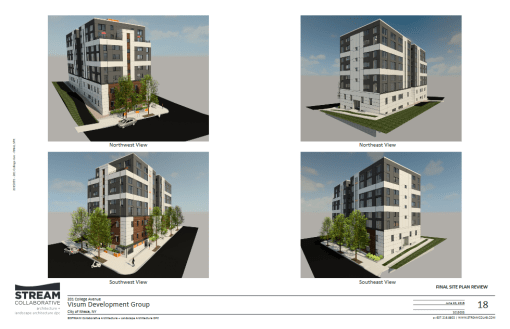
Modern Living Rentals has started advertising units for 201 College Avenue. Business partner Visum is shooting for August 2017, which will be a very quick pace – hopefully William H. Lane Inc., the general contractor, is up to the challenge. With heat included in the rent, a three-bedroom will run anywhere from $3,250-$4,170/month, a two-bedroom for $2,170/month, and a one-bedroom with top-floor patio access will cost $1,670/month,  which puts it pretty close to the high end of the Collegetown market. The “New York City-style loft apartments”, as the ads boast, come with such building amenities as a high-end gym, media lounge, bike room, and high-end security system. Apartment amenities include full furnishings, stainless steel appliances, granite countertops, in-unit dishwasher machines, washer and dryers, 16′ ceilings, and cargo nets. Yes, cargo nets – they extend from the bedroom and over the living room, and are billed as “the perfect place to relax and study”, capable of holding up to five people. I asked architect Noah Demarest about them, and he said the idea came from developer Todd Fox, and that examples can be found on Pinterest.

Meanwhile, Charlie O’Connor’s three-bedroom two-family houses underway on Old Elmira Road will be ready by February, and come in at $2,100/month per unit.


a-place-for-all-of-us

X. For those who might be interested, sign up for the Tompkins County Housing Summit can be found here. Attendance is free, and comes with a meet and greet on the night of Wednesday November 30th at the Greenstar workspace (“The Space”), and a day-long summit on Thursday December 1st (attendees can choose whether to attend one or both). It appears that there’s a wait-list already for the Thursday summit, but the Wednesday night reception still has space for new registrants.


409 College Avenue (Student Agencies eHub) Construction Update, 10/2016

17 10 2016

With all these Collegetown projects wrapping up over the past few months, I may need to re-balance my update schedule. The Student Agencies renovation is complete and eHub has opened. I intended to take a few interior photos, but the staff on the first floor were tied up with several other visitors, so I moved on to the next site.

I think the real benefit to this project isn’t so much the renovation as those who are occupying it. eHub is meant to encourage student entrepreneurs. They may migrate to Rev, they may be successful and grow their business locally, adding local jobs and helping to diversify the local economy beyond meds and eds.

For example, the tech startup Rosie was launched in 2012 by Cornell students, and was housed in eHub’s eLab space. After they graduated, the founders migrated to Rev, and have since migrated to office space on the Commons. Today, the company employs 21 people locally (26 total), with more hires planned. Another eHub “grad”, FiberSpark, has stayed local and provides the fastest internet service in Ithaca. Not all the companies are successful, and not all the successful companies stay in Ithaca. But if even a portion of them survive and thrive here, than that’s a real asset for the community. I look forward to seeing what an expanded program will cultivate.

20161007_155339 20161007_155357 20161007_155416


News Tidbits 10/15/16: Stoops and Stumbles, Growth and Gables

15 10 2016

maguirebirdseye-620x420

1. The Maguire proposal for Carpenter Business Park will be heading to the Common Council next month, but the prognosis isn’t good. The city council’s Planning Committee voted 4-0 to say that the proposal didn’t fit with the city’s Comprehensive Plan for the near-Waterfront property – the plan calls for walkable, urban mixed-uses, preferably with residential components. The discussion wasn’t unanimous in its logic – 2nd Ward Councilmen Nguyen and Murtagh were stronger adherents to the plan, while the 1st Ward’s Cynthia Brock doesn’t think housing is appropriate – but they all disagreed with the multi-brand car dealership plan as-is. Maguire has asked for a delay in vote so that the plan could be tweaked, but the Committee voted to move forward.

Because of the 18-month TMPUD in place, the Common Council has to vote to approve all projects in the waterfront area, so the resolution to decline further review of the project will be voted on at the next non-budget Council meeting. It will not be unanimous – the 3rd Ward’s Donna Fleming wrote a letter of support for the project, and the 1st Ward’s George McGonigal voiced support for the concept though not this particular plan. But the chances of approval are pretty slim at this point.

119_125_college_avenue_2

2. Judging from the site photos John Novarr’s project team sent along, it looks like environmental remediation has already commenced at the site of his faculty townhouse project at 119-125 College Avenue in Collegetown. 121 College, in particular, is already in the early stages of remediation. It’s a pretty extensive photo documentation, one that might have to do with historic preservation aspects, like determining what can be salvaged and reused. It’s pretty clear that the properties, which were recently acquired from an Endicott-based landlord who held the properties for decades, are in rough shape. Novarr seems to have a preference for prepping sites before plans are approved (ex. 209-215 Dryden), so it’s uncertain how much time these three boarding houses have left.

202_hancock_1

3. Courtesy of the Ithaca Urban Renewal Agency’s Neighborhood Investment Committee, we get to see a pretty thorough breakdown of the expenses and revenues of an owner-occupied affordable housing project.

The details come as part of INHS’s application for $314,125 in Federal HUD HOME funds, to be used for the 7 for-sale townhouse units included with the 210 Hancock project, collectively called 202 Hancock. The funds would be used to cover soft costs, like project management, engineering and architecture fees, legal fees, and site inspections.

inhs_202_financials

The 202 Hancock project construction cost is estimated at $1,754,860, about $344,000 per unit, or about $198/SF. That’s expensive, but not unusual – 203 Third Street was about $190/SF. The cost is high due to rapidly rising construction costs, and due to federal guidelines and lender specifications, INHS is required to hire contractors with extensive insurance. Add in soft costs and it jumps to $2,408.371.

Now let’s consider the sales. The five two-bedroom units are expected to sell for $130,052 to a household making no more than $38,046. The two three-bedrooms will sell for $164,979, to households making $42,428/year or less. Those incomes don’t meet the rule-of-thumb of 3.4x annual income, but HOME funds cover part of the cost ($24,000 for the 2-bedrooms, $36,000 for the three-bedrooms). INHS gets $960,218 in the project sales – and that’s the same amount Tompkins Trust Company is willing to cover with a construction loan. So the initial gap is $1,448,155. Now we’re starting to see why new housing can be so expensive.

INHS gets $7,000 in revenue from Energy Star rebates on appliances, and has up to $351,153 equity they can put towards the project, most of that being the value the of 202 Hancock’s land. The IURA would issue a low-interest bond for $215,875 to be paid back by INHS, and the non-profit has secured $280,000 in grants directly from the state (NYS AHC), and $280,000 in NYS CDBG funds awarded by local governments (this tactic is known as “subsidy layering“). This complicated puzzle of funding sources is why so many developers are not interested in doing affordable housing.

Side note, one of the pre-development costs is market analysis. Might seem silly, but grant reviewers want proof the housing crisis isn’t just bluster, and that these units won’t sit empty. An analysis by Randall/West determined that at a sale price of $136,000 for a 2-bedroom, and $162,000 for a 3-bedroom, qualified buyers would be found and under contract within 4.6 months. The units should be available for occupancy by June 2017.

202_hancock_2

Secondly, thanks to a legal settlement between the state and Morgan Stanley, a $4 million affordable housing grant is available for renovations of existing INHS scattered site rentals (98 units in 44 buildings across the city). Most of these units are rented to individuals making 60% or less of the area’s median income (about or less than $32k/yr). The funds would go towards major, long-term renovations, such as new roofs, windows, siding, and energy efficiency improvements. INHS could also use the funds, disbursed via the city, to refinance its portfolio, acquiring some of the properties and paying off $1.8 million in loans on already-purchased properties.

Here’s the short of it – the goal is to buy/pay off the scattered rental sites they manage, renovate and make them energy efficient and comfortable, lock them into the Community Housing Trust so that they become permanently affordable, transfer the land to a wholly-owned Housing Development Fund Corporation, and then sell some of the buildings to an LLC while INHS continues as property manager. The funds from sales would finance new affordable housing. This is all set up as it is to take advantage of legal and tax benefits of different corporate tax structures, while minimizing the drawbacks. Potentially, the Morgan Stanley settlement money could be used to leverage an additional $15 million in tax credits and affordable housing grants from the state.

Correction, per INHS’s Scott Reynolds in the comments section: rentals aren’t in the Community Housing Trust, but affordability would be required for 50 years.

Rochester-based SWBR would be in charge of renovation design plans, and 2+4 Construction will be general contractor. Tenants may need to be relocated as renovations occur, which will be coordinated by INHS staff. The goal is to have the settlement money accepted by the city by the end of the year, financing by April 2017, and renovations completed by the end of 2018.

cwd_bldg24_1

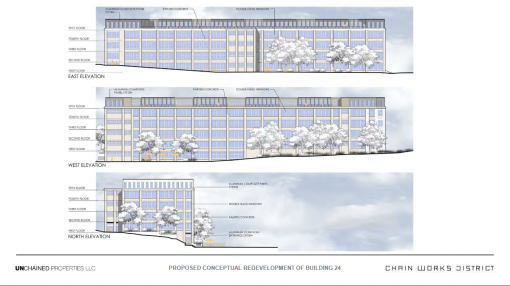
4. It’s another one of those special meetings – the city Planning Board will be sitting down next Tuesday to go over comments and sort another batch of public comments regarding the Chain Works DEIS, this time on public health. Once you get past the few pages of “this will never work and don’t bother trying”, there’s actually some interesting back and forth about remediation and what that entails. Also on the agenda are revisions to the Holiday Inn Express down in Southwest Ithaca – namely, they’re trying to avoid building the stairs to Spencer Road, as well as some other landscaping issues. At the second meeting later this month, the board is expected to Declare Lead Agency, open public hearings and review parts of the FEAF for TCAction’s Amici House, 8-unit 607 South Aurora, and the 8-story City Centre project on the Trebloc site downtown.

maplewood_v7_1

5. The plans for Maplewood have been modified yet again, in a change that the project team hopes will please neighbors and the town of Ithaca planning board. In revised plans submitted this past Wednesday, the 4-story apartment building planned for Mitchell Road has been replaced with a few sets of 2.5 and 3.5-story townhouses and stacked flats, and Building B to its north was extended slightly to compensate for the loss of bedrooms. Even so, the accompanying letter from Scott Whitham states that the unit and bed count have decreased slightly, from 473 units and 887 beds, to 442 units and 872 beds.

maplewood_v7_2 maplewood_v7_3

Also modified was their appearance – stoops, porches, dormers and gable roofs were added to give them a more harmonious appearance with the rest of the neighborhood. It’s not clear if the rest of the units were aesthetically modified as well.


209-215 Dryden Road Construction Update, 10/2016

14 10 2016

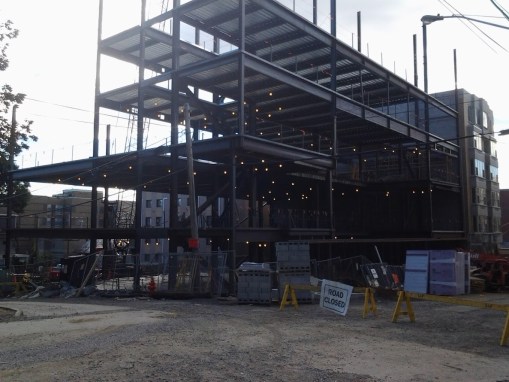
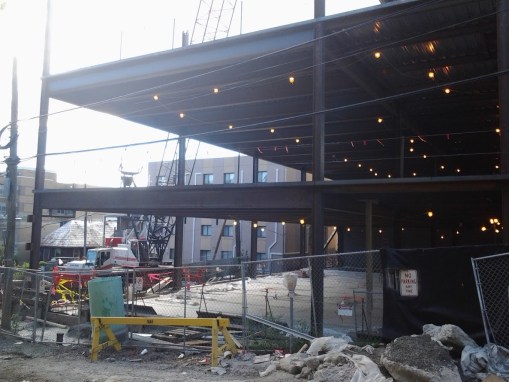
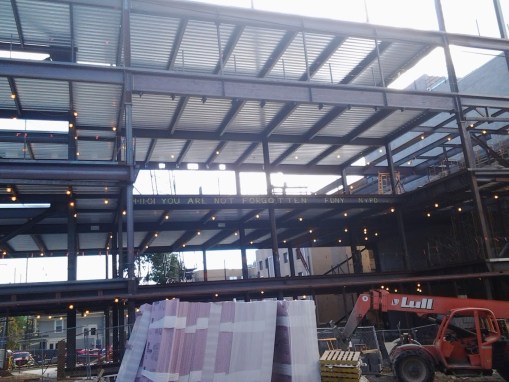
With the rise of the structural steel, 209-215 Dryden Road (aka the Breazzano Family Center for Business Education) is starting to make a significant dent in the Collegetown skyline.

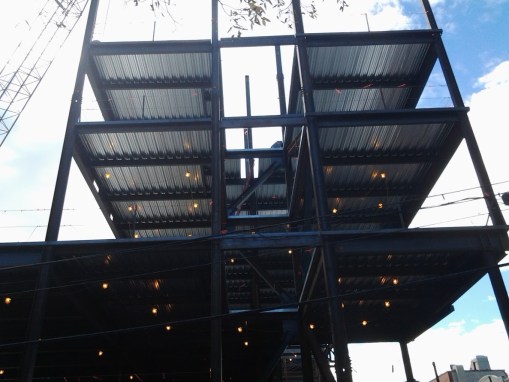
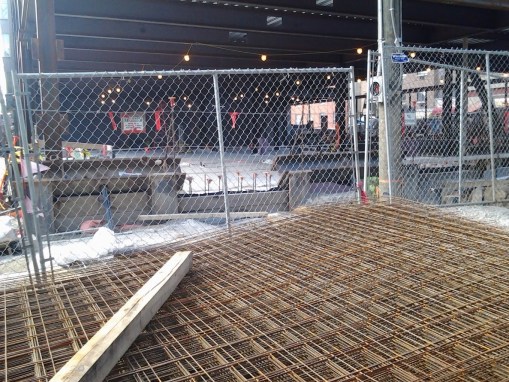
The floorplates are up to the fourth level, and the vertical steel columns indicate just how tall the building will be when the steel skeleton is built out. The concrete floor has been poured on the ground level, and corrugated steel decking has been laid on the upper floors – note that only the first and second floors have reached their full dimensions, the upper floors are waiting for the delivery of additional steel columns and cross beams for the crane to hoist into place. The sheets of wire grid seen outside the fence are for future concrete floor pours, providing strength and rigidity for the concrete, just as rebar does for foundations.

The large gap in the front of the building is the multi-story atrium space – the lower three floors are academic class space, while the upper three floors are academic office functions for the Cornell Executive MBA program. The smaller gap towards the north (right) side is for a stairwell.

Nice touch with the subtle commemoration of 9-11 emergency responders. It’s not uncommon to see these tributes when steel work is underway during the fall.

20161007_154941 20161007_155001 20161007_155014 20161007_155017 20161007_155050 20161007_155054 20161007_155100 20161007_155116 20161007_155139 20161007_155206 20161007_155234 20161007_155255

209-215_2 209-215_basement


News Tidbits 10/8/16: No Rain, But the Money’s Flowing

8 10 2016

sleep_inn_v2_1
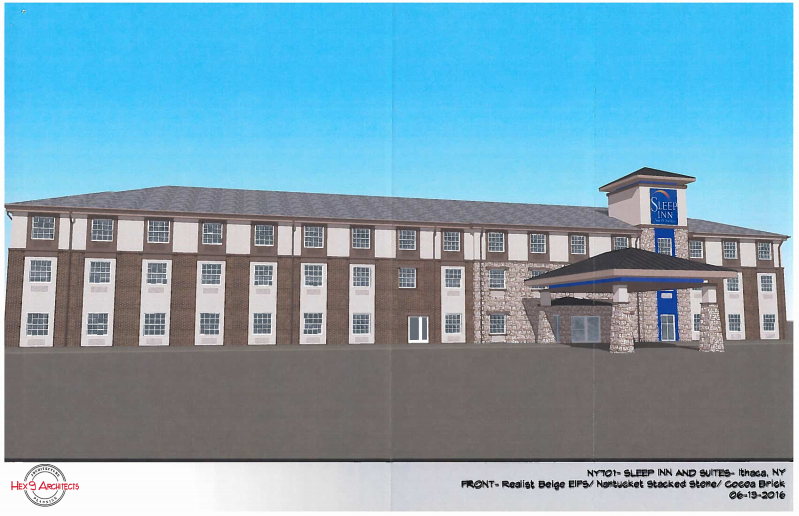
1. The Sleep Inn project at 635 Elmira Road went back to the town of Ithaca planning board last Tuesday. The initial write-up looked good – town planners were very pleased with the proposed changes, and the developer, local hotelier Pratik Ahir, proposed two different concepts to the board to see which one they were more comfortable with. The one that the board likes would be finalized in the plans and submitted for final approval later this year. No media were at the meeting, so I do not know which concept they preferred.

Both concepts by HEX 9 Architects attempt to maintain the rustic character that the town seeks to maintain for its part of the Inlet Valley Corridor. Concept one at top uses stone veneer (Elderado Stone), timber trusses, Hardie plank lap siding, and asphalt shingles. This design features balconies on both the front and rear of the building. Concept 2 incorporates a more varied roofline and building face, metal roof panels, stone veneer and a couple different types of Hardie Board. Concept 2 has less timber and no balconies. The town planning department felt that both concepts were unique enough and rustic enough to get its benediction in the SEQR analysis they sent over to the board. The concepts are a big improvement over the rendition we saw in August.

canopy_comparo_elevations_new_2
2. Looks like the Canopy Hilton is a go. The project secured a $19.5 million construction loan from ESL Federal Credit Union on Friday September 30th. ESL is a new face to the local market – “Eastman Savings and Loan” was founded in Rochester in 1920 to serve employees of former photography giant Eastman Kodak. The 7-story, 131-room hotel is expected to open in Spring 2018.

57e13f
3. Also funded this week – the second phase of Poet’s Landing out in the village of Dryden. Citibank is lending $7,702,326 to Rochester-based Confier LLC to build the 48 affordable apartment units across the street from Dryden High School, just west of 72-unit phase one. The documents were filed on Tuesday the 4th. The design of the second phase’s will be the same as phase one’s, an eight unit per building design by NH Architecture that is one of Conifer’s standard designs. The total project cost is $10.8 million, with the balance come from state affordable housing grants and tax credits. The build-out is expected to take about a year.

201_college_v5_1

4. So a few news bits about 201 College. The partially-deconstructed house at 201 College is now getting torn down, which had nothing to do with approval, and everything to do with break-ins and safety issues – there was evidence of squatters taking up residence, and the expense of a tear-down is worth avoiding a lawsuit or tragedy. Speaking of which, although a ruling on 201 College has yet to be issued and won’t be for a few weeks, Neil Golder’s lawsuit has already been re-filed. The court hearing is scheduled for December. According to an exchange with my colleague Mike Smith, Fox is planning rowhouses along Bool Street, within a 45-foot height limit but spanning the block, as it seems he has a purchase option on neighboring 202 Linden.

20161007_131502

5. According to Nick Reynolds at the Times (yes, he jumped papers), the buildings to be deconstructed for the Harold’s Square project are to be vacated by the end of October. Developer David Lubin plans to start the deconstruction process, which is a little more intensive and lengthier than a typical demolition, in November. Things have been complicated by the city’s decision to forego the project in the Restore NY grant application, where the $500,000 was allocated to pay for demolition, and must now be sourced from elsewhere. Once secured, the plan is to file for the permit, and by law they have up to 30 days to start deconstruction from the day the permit is issued. Construction should go for about 18 months, once the site is cleared.

607_s_aurora_2 607_s_aurora_1

6. The 8-unit 607 South Aurora project will be seeking “Declaration of Lead Agency” at the Planning Board meeting, and materials have been filed with the city. Project narrative here, SPR application here, drawings here. The big changes since sketch plan were sidewalk and parking lot revisions, and rotating Building D to establish harmony with Hillview Place. The project is estimated to cost $1.5 million and aims for a construction timeline of March to September 2017. This is the next incremental step up for Charlie O’Connor of Modern Living Rentals, whose M.O. is to quietly pursue modestly-sized infill projects in less dense parts of the city (ex. the two duplexes planned for 312-314 Old Elmira). In a change of pace, the staff of Sharma Architecture are the designers this time around.

123_eddy_street_2

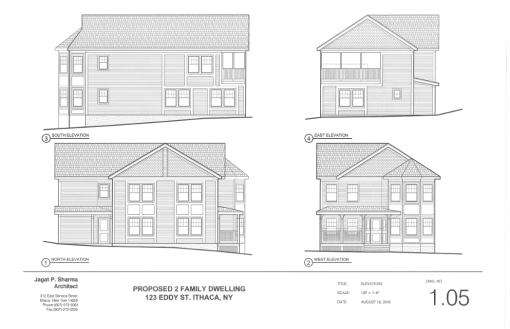
7. From the Board of Zoning Appeals meeting, the new two-family house at 123 Eddy Street has been granted zoning variances. Expect the Sharma-designed two-unit, six-bedroom rental property to start construction next year in time for the 2017-18 academic year.

20160918_155855 20160918_155910

6. House of the week. Instead of one underway, this week will show two recent completions. Leading off is this house on West Hill’s Campbell Avenue, built by Carina Construction. This project came up in a weekly roundup back in late May – it’s a $320,000 project per the permit filing with the city, with $280,000 lent by Tompkins Trust. The contrast between the wood siding and the (fiber cement?) vinyl siding is a nice touch, as is the two-story porch. Definitely a unique house, and a showcase of just what kind of variety one can do with modular pieces if they’re willing to get creative.

20160918_162315 20160918_162648

Now for house number two. This isn’t a new build, but a very thorough renovation. Every time I take photos, I run into the owners, and normally I try to be as unobtrusive as possible. But, given that I’ve run into him twice, he’s familiar enough with me that we’ve had a conversation about his work.

20160109_151921

This is in Fall Creek on North Aurora. The couple who own this place moved in from Pennsylvania, they were just starting retirement when the wife’s father was no longer able to take care of it. It had been a duplex, but the other unit was more workshop space. The building was in good shape, but these folks wanted to modernize and refresh it, so they decided to do a to-the-studs renovation, basically turning it into a new home within an existing shell. Fiber cement, wood shingles, a few modern touches (the south bumpout, the unusual gable/shed hybrid dormers), a carriage house, a lot of work went into it over the past year and a half and it shows.


Upson Hall Construction Update, 9/2016

2 10 2016

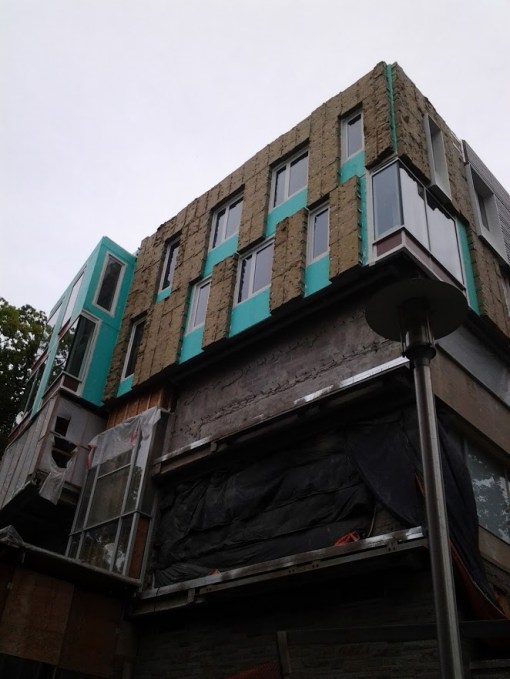
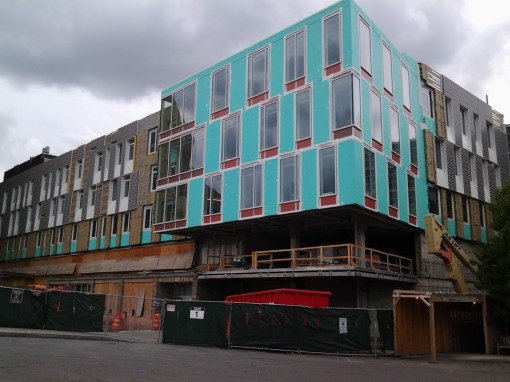
Work on the upper levels is progressing. Slowly but steadily, mineral wool is being laid and aluminum clips are being installed for the terra cotta panels. It looks like the most progress has been made on the east facade. The windows in the bump-outs have received aluminum trim. Although the project update page hasn’t had a fresh post since early August, the upper floors (3-5) should be occupied by this point and many of the utilities systems have been overhauled. Most of the interior work is now focused on the lower levels (Basement, and Floors 1 and 2). The Pike Company of Rochester will continue the interior renovations during the academic year, but as long as all goes to plan, the building should be wrapped up by August (landscaping is another matter).

20160918_135255 20160918_135339 20160918_135401 20160918_135507 20160918_135535 20160918_135628 20160918_135742 20160918_135846


Cornell Veterinary School Expansion Construction Update, 9/2016

1 10 2016

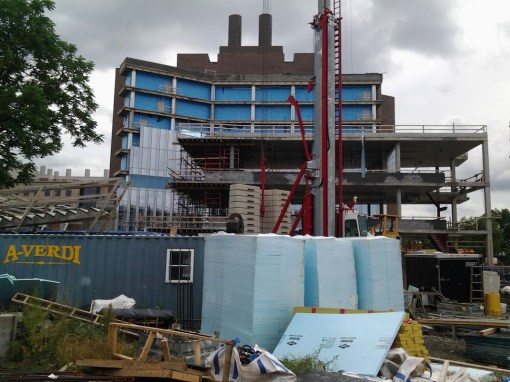
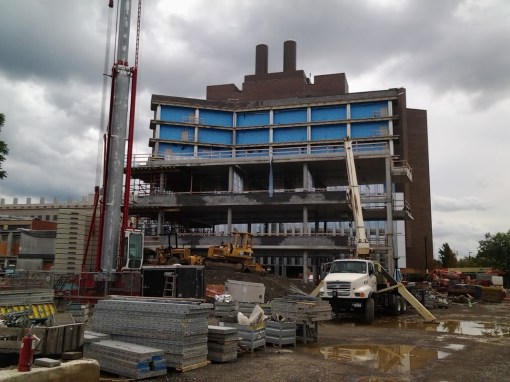
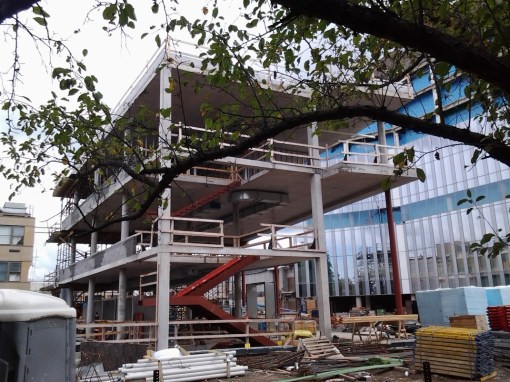
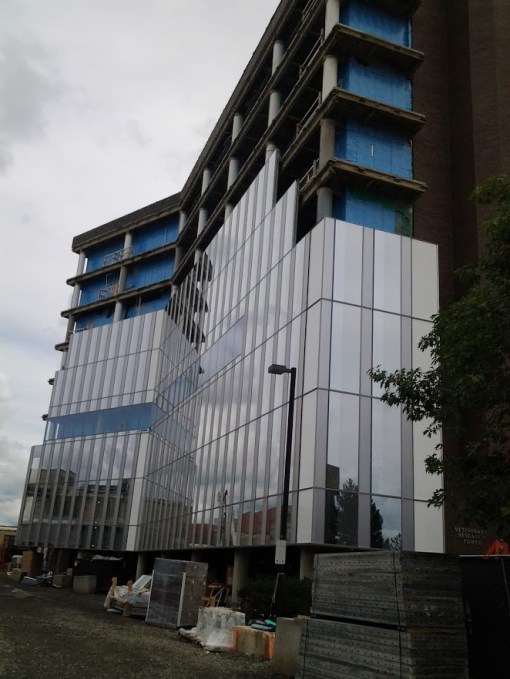
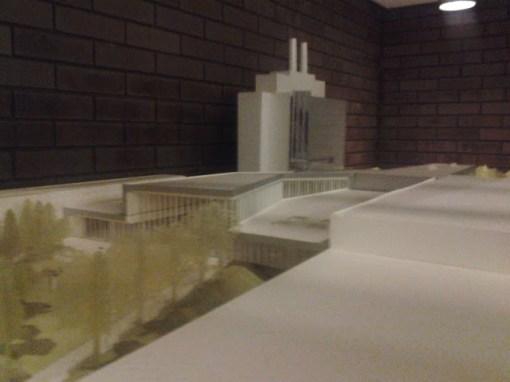
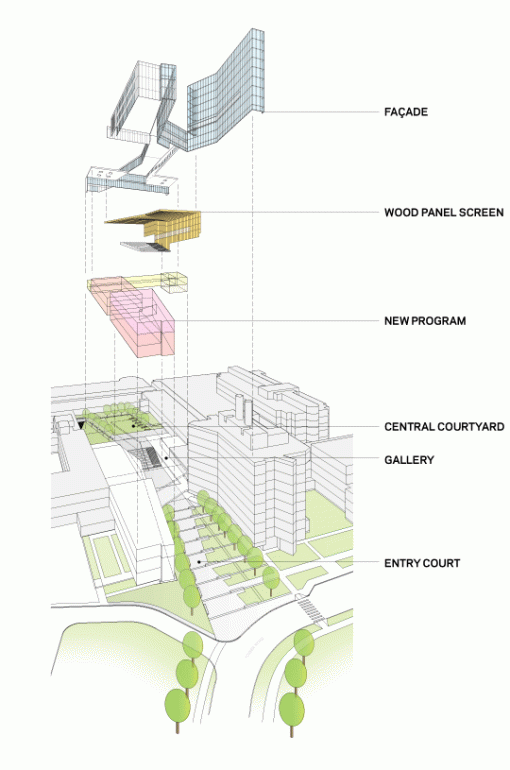
Check out that glass curtain wall going up on the Vet Research Tower. The lighter hues vs. the original dark glass gives the building a airier, less ominous presence. We’re starting to see some HVAC rough-ins going in the new library/administration building. The deconstruction of existing wings appears to be wrapped up and it looks like works has started on the frame of the new academic building to go between Schurman Hall and the VRT. Although not visible from these photos (because it is a pain to maneuver around the vet school), Cornell and its contractor Welliver have been working on the foundation and underground utilities, and construction of a new second-floor cafeteria space.

A separate project, the Community Practice Service Building, is in the design phase. CPS is what you think it is – fourth-year students, as part of their final year of education, provide low-cost veterinary services to the greater Ithaca area. It will replace the Poultry Virus Lab, which will come down in December. The CPS Building will take just under a year to build.

For those with some serious dough lying around, the new academic building’s naming rights are available for $20 million, and the administration building’s naming rights are being offered for $7 million. For the rest of the 1%, a lecture hall goes for about $1.5 million, and regular classrooms for $250,000. The most inexpensive options appear to be tutorial rooms for $75,000.

20160918_130307 20160918_130105 20160918_130035 20160918_130024 20160918_130005 20160918_125934 20160918_125838 20160918_125829 20160918_125806 20160918_125726

20160522_131445 20160522_131417

3f5656954f5a3ef1021519c03b4abe9f

cad048742a281097e5667382eced4233 eea787361994de9625f74b19aa50d91e


News Tidbits 10/1/16: Sketchy Details

1 10 2016

lansingapts600
1. Over in Lansing, it looks like Park Grove Realty is having a rough time getting their plans rolling. Legions of angry homeowners turned out at the village’s Board of Trustees meeting to protest a requested zoning change for a 20-acre Bomax Drive property that Park Grove seeks to build 140 apartments upon. The meeting wasn’t about the project, which will follow the zoning change once approved. For the record, the meeting was only about the zoning change, which is currently zoned for office park business/technology and has been owned by Cornell since 2008.

The unusual thing is that the primary opponent seems to be the Jonson family, of development company IthacaHome, formerly known as Forest City Realty. They built some of Lansing’s 1990s subdivisions and the Heights of Lansing project at the end of Bomax Drive, which is stalled out due to a lack of interest and Ivar Jonson’s passing. The claim from Janet Jonson is that if left commercial office/tech, then maybe an office building would be built and executives would build homes on some of their vacant lots. Even Larry Fabbroni was there to say an office building would generate less traffic than housing would. The meeting was very heated, according to the Lansing Star’s Dan Veaner.

The village planning board was there to listen, but not especially sympathetic. For one, there’s plenty of undeveloped commercially-zoned land; but there is a housing shortage. For two, although some complained “transients” would lower their housing values, these units will be going for $1,400-$1,900/month. The board’s not focused on the project just yet, that will come in due course. Meanwhile, the trustees moved to schedule public review for the zoning change, with that meeting planned for October 17th.

A couple miles away, Park Grove has also been getting flack for taking down willow trees as part of a plan to reduce root damage and mold issues, and to expand parking and add a 425 SF rental office on the Triphammer Apartments (former Chateau Claire) property. The heavy-handed approach was not well received. In short, Park Grove’s principals are the village pariahs at the moment, though they have brought some of it on themselves.
maplewood_v3_2

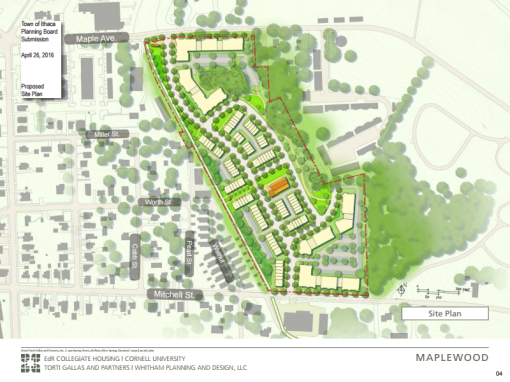
2. Just a brief check-up on the Maplewood Park redevelopment. The project team has been busy over the past month making revisions to the Draft Environmental Impact Statement (DEIS) as part of its determination of adequacy, and the DEIS was just accepted for public review as of the town of Ithaca planning board meeting on the 20th.

A digital copy of the revised DEIS can be found on the town’s website here. A public hearing will also take place on October 18th. The SEQR review period is 45 days from acceptance, so public comment will be accepted on the document up to 4 PM on Halloween.
100_1967

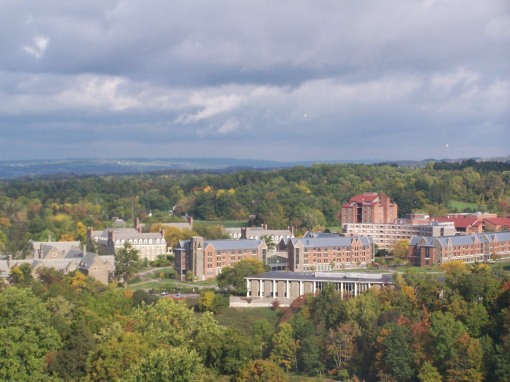
3. As part of their campus housing study, Cornell launched an extensive survey of their students. A summary and a link to the full results can be found on their webpage here. The university also held public forums this past week on campus to hear opinions from the community and explain what happens next (what needs work, how much campus housing is needed, where on campus, what student segments, strategies for the next 25 years, and so on).

Among the grad and professional (MBA/JD/MPH/etc) students, more anticipated living on campus when they arrived, than actually did – 32% vs. 18% of respondents. On average, G/P students felt they should pay about 7% less than they do. They want Wi-Fi, private bathrooms, on-site laundry and package/mail delivery. Outside, they want wider sidewalks and more frequent bus stops/service, and parking fees should be bundled in rent if parking is offered.

Those off campus preferred Downtown (26%) and Collegetown (24%). Grads and domestic students preferred Downtown, professional and international students preferred Collegetown. Grad students tended to be more satisfied with their housing than undergrads.

Similarly, more undergrad respondents want(ed) to live on campus – 56% do or have, 78% want/wanted to. That stat’s a little weird, since freshmen are required to live on campus. Only about 45% describe an apartment as ideal housing, vs 88% for grad/prof students. They also want Wi-Fi and laundry, as well as study areas and dining nearby. 49% selected Collegetown as their preferred housing choice, with another 36% preferring an on-campus location if available.

cornellspace-771x394

At the public forums, the university presented a few potential building sites for new campus housing. The goal was to have sites away from full-time residential areas (less hassle), easy to prepare (less physical hassle), accommodate 300-500 students (scale efficiencies) and be near existing facilities (quality of life and infrastructure). Three north campus locations were presented – CC parking lot, the side lot at RPCC, and the fields next to Appel Commons. The RPCC and CC locations show up on the 2008 Master Plan as well, 3-6 floors and up to 200,000 SF of space. So it seems those two locations have a more sustained interest. The city of Ithaca and the Village of Cayuga Heights have a boundary line that straddles those sites, a latitudinal line just south of Jessup Road. If something were proposed, most of the land is in the city, but the village would have to vote to defer decision-making to the city. That is a potential complication that Cornell has to keep in mind.
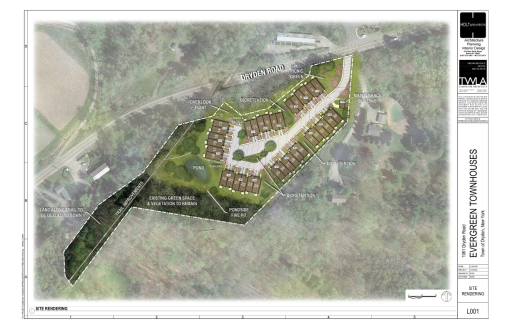
evergreen_dryden_1

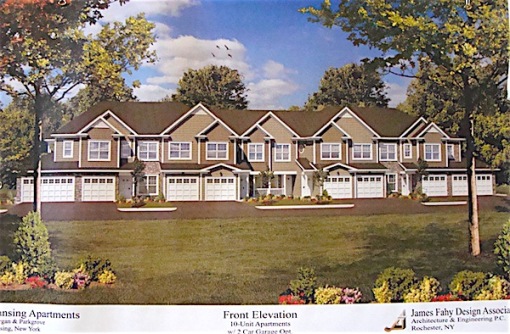
4. The Evergreen Townhouses project in Dryden will be the subject of a special meeting of the town planning board on Wednesday October 5th at 7 PM at the Varna Community Center. The full suite of documents, including county review, planning board notes for the town board (recall that in Dryden, the town board votes to approve projects instead of the planning board), sewer capacity report and concept plan description can be found here. SEQR has been reviewed and a traffic study has been completed. The project will need a PUD approval, since 36 units exceeds what the zoning allows (28). If the PUD is approved, land will be deeded to the town for its recreational rail trail. Like the Park Grove project in Lansing, this rental proposal has seen a fair amount of opposition, due to traffic and concerns about renters, and the possibility of encouraging suburban sprawl east of Varna. Oddly enough, for being this far along in the process, there still haven’t been any detailed renders of the townhouses released to the public.

5. Here are a few details about the 607 South Aurora project. Readers might recall the sketch plan was presented at the August Planning Board meeting.

As I discovered this week, sketch plans are actually off the record. Meaning that a developer doesn’t have to give it to the city for publication if they don’t want to. Apparently, John Novarr is going this route – although images for his townhouse project on the 100 Block of College Avenue were presented last week, the city has no official record of them, and he said he has no intent to share plans until he’s ready for the city to declare itself lead agency. For what it’s worth, the project, geared towards Cornell faculty and staff, was well received by the Planning Board.

On the one hand, not sharing the sketch plan limits public exposure and the risk brought by exposure, and it allows the board to eliminate the most controversial aspects before the public can see them. On the other hand, it’s less transparent, and makes me an unhappy camper.

Back to the topic at hand, 607 South Aurora as initially conceived calls for 4, 2-family, 2-story houses on the property, while retaining the existing house. That’s a total of 8 units, and 24 bedrooms total. Parking would be in two sections tucked back from the street. The project is not unlike the one approved for 312-314 Old Elmira Road in Ithaca’s South Side neighborhood. Although STREAM Collaborative’s Noah Demarest presented the project at the August meeting, STREAM is not in charge of this proposal. The project is being designed by Collegetown favorite Jagat Sharma for local developer Charlie O’Connor.
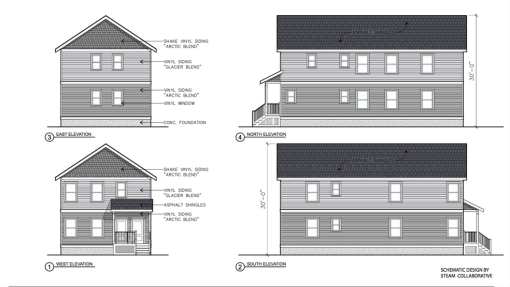
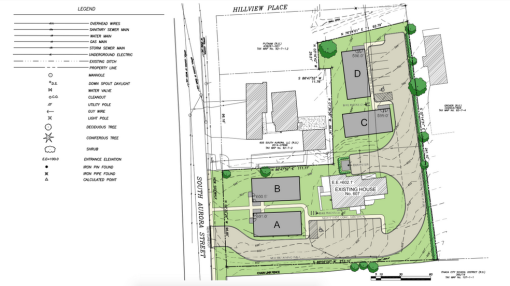
607_s_aurora_1 607_s_aurora_2

Charlie O’Connor is a part of Modern Living Rentals, and regardless of how one might actually feel about their work, it is probably the most transparent development/rental company in the local market. True to form, a quick check of their website turned up images of 607 S. Aurora. It looks like the same general design will be used for each building, and each unit will be 3 bedrooms and about 1,122 feet. I hope they change up the exterior colors for variety’s sake. The board and planning department was fine with the buildings, but suggested revisions to the site plan, so the next iteration will likely have a different site layout.

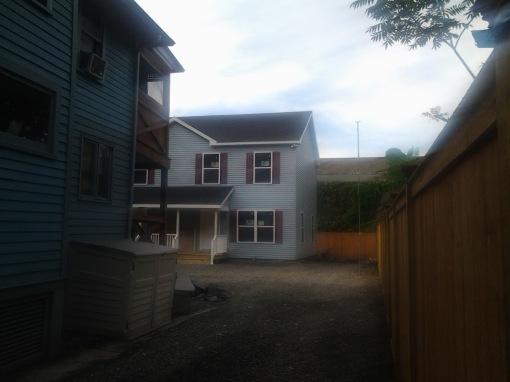
20160918_164039 20160918_164106

6. Sorry, didn’t realize the lens was smudged. This very subtle duplex is underway in Ithaca’s South Side neighborhood, behind an existing duplex at 512-14 West Green Street. Because it fits in all the setbacks (it’s a very large, deep lot for an inner city parcel) and the rear of the property falls into the State Street Corridor’s CBD-60 zoning (i.e. no parking required), this project never needed more than staff-level approval from the city. Honestly, were it not for a small disturbed area at the curb-cut from construction vehicles moving in and out, one would never know this duplex was under construction.

The property is owned by the Ciaschi family, and appears to have been passed between family members since at least the 1960s. A building loan filed on June 17th indicates that Tompkins Trust lent $330,000 towards the project. As with many smaller builds, this a modular by Ithaca’s Carina Construction. Carina is supplied by Simplex Homes, and it looks like this 3-bedroom/2-unit is based off Simplex’s “Elkton IV” plan (but that could be wrong). Give how far along the outside is, it would not be a surprise if renters move in by the start of October.

147962

7. The near-death Black Oak Wind Farm could actually happen, if they pay Enfield the money they want for FOIL costs. Using the original EIS, they’ve reverted to the initial plan, including use of the landowners’ properties who tried to pull out in the face of the project’s rancorous opposition. The BOWF project team had been attempting to move two of the turbines to accommodate property owners who changed their mind about being associated with the project, but the Supplemental EIS had been caught in legal red tape with the town of Enfield and the town of Newfield to its south, where one of the alternative sites was planned. So the new plan is to just go forward with the original signed contracts and build what was proposed before the 2015 SEIS. The project team has requested final approval, but the town has said they want to be paid $19,000 for the cost of handling all the FOIL (Freedom of Information Laws) requests, of which they’re not sure who’s actually required to cover the cost.

This project and its manager, Marguerite Wells, have probably been put through a greater Hell than any other proposal in this county, which is really, really saying something. Let’s recall, apart from the opposition that has demonized the project manager and the investors (successfully, one could unfortunately argue), that when they considered the alternative site, Newfield’s town board rewrote their wind farm law to implicitly but effectively ban wind turbines from the town. The BOWF project has been incubating for nine or ten years.
According to Marguerite Wells, if they can’t get approval at the Enfield town board’s October 12th meeting, the wind farm proposal dies. And with it, pretty much any commercial wind turbine plans for Tompkins County (looking at Newfield, maybe single-family turbine plans as well – the way the 2016 revision is written, a homeowner can’t even hook up a little one to their roof, as it’s too close to an occupied structure).

8. Here’s a little kick in the pants to end the week. It was reported in Bloomberg of the five Ivies that have released results so far, Cornell’s endowment did the worst in the past year, with a -3.3% loss (which comes out to a drop of about $200 million). The university is taking reactive measures, including moving its investment offices to New York City. “The investment committee believes over the long term the relocation to New York City gives us even better access to potential staff who might not be willing to move to Ithaca,” said Cornell CFO Joanne DeStefano. That’s a bit deflating.