Village Solars Apartments Construction Update, 12/2015

13 12 2015

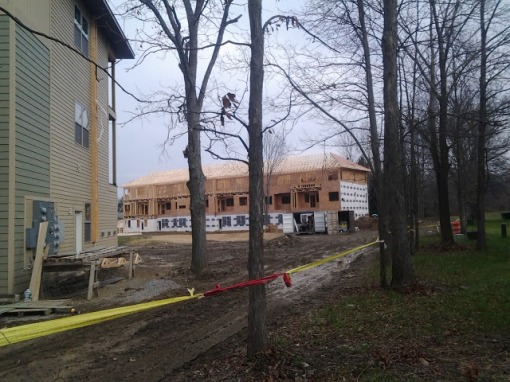
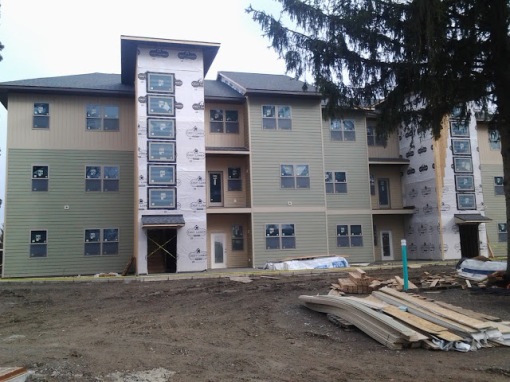
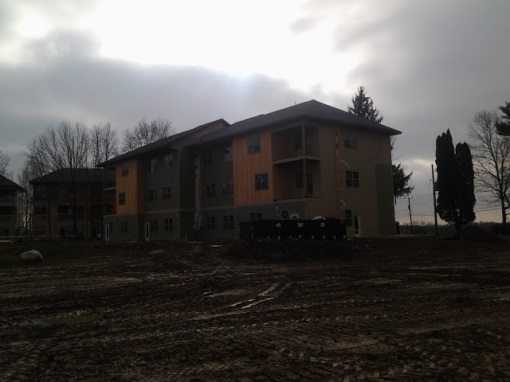
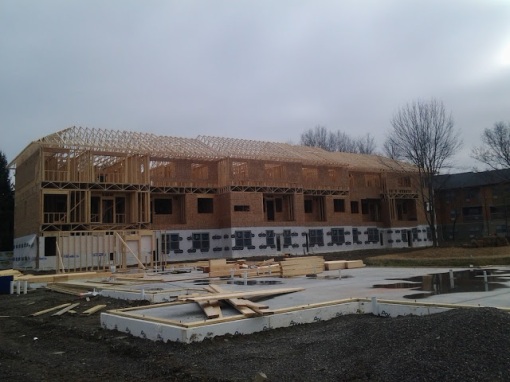
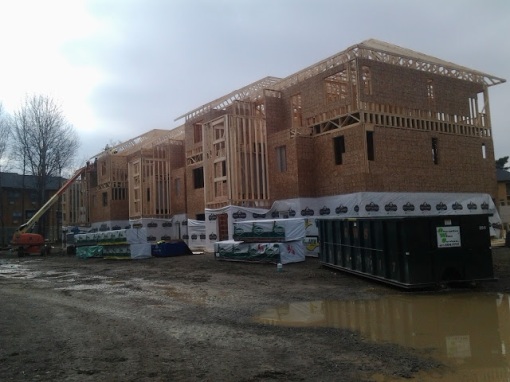
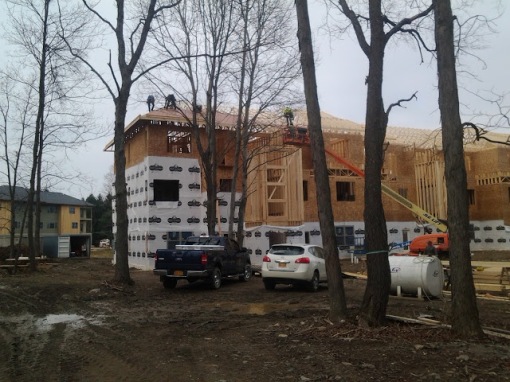
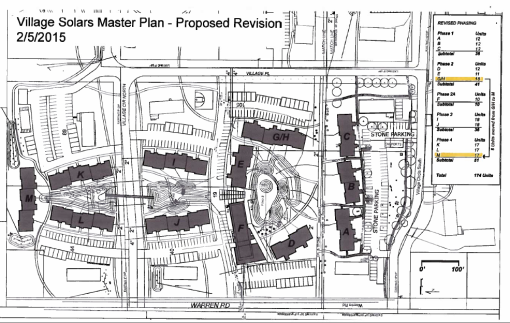
There’s been a fair amount of progress during the late fall at the Village Solars apartment complex site off of the 1000 Block of Warren Road in the town of Lansing. 12-unit Building “D” is finish up attachment of its exterior facade, which like buildings A-C, looks to be a combination of a wood grain board and earth-toned fiber cement board. Balcony railings and trim still have yet to be attached. I didn’t look inside, but based on the photos, it looks like the wood stud walls are still exposed near the entry doors on the first floor.

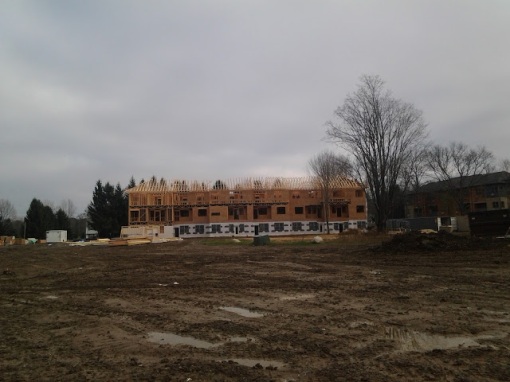
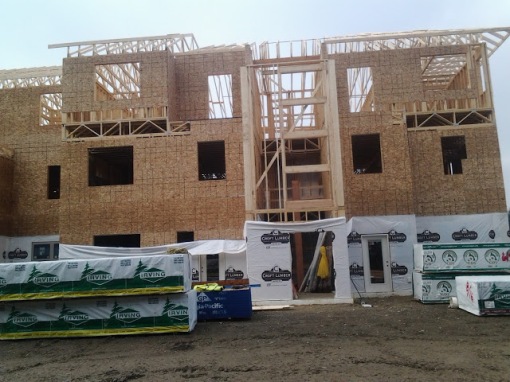
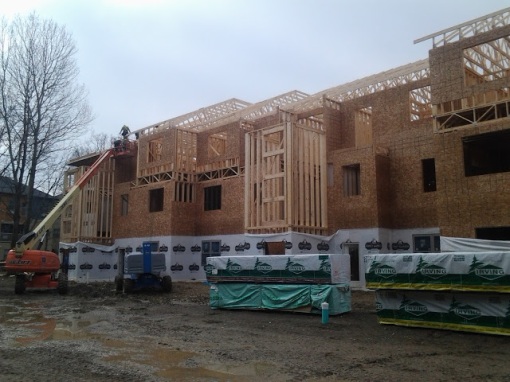
Across the future pond, 18-unit Building “G/H” (backstory here) has been framed out and some Tyvek-type sheathing has been attached (the material is labelled “Croft Lumber“, which is a building supply store down in Sayre, PA). Some first floor windows and doors have been fitted, but most of the future windows and doors are still rough openings. The roof trusses are all in place, and workers were installing ZIP system plywood sheathing while these photos were being taken.

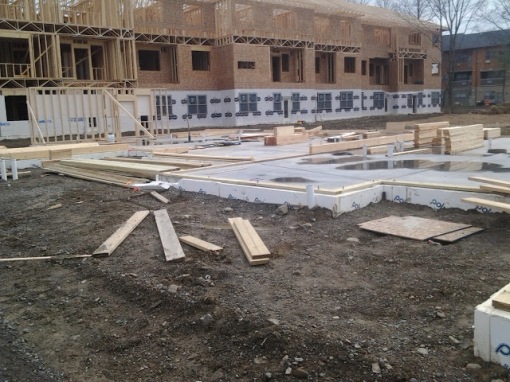
11-unit Building “E” has had its foundation poured and is only just beginning framing, with just one standing exterior stud wall.

20151205_123855 20151205_123932 20151205_123941 20151205_124021 20151205_124106 20151205_124143 20151205_124218 20151205_124235 20151205_124335 20151205_124403 20151205_124407 20151205_124839

village_solars_2 village_solars


News Tidbits 12/12/15: Money Money Money Money

12 12 2015

canopy_hampton_rev4_1

1. Time to do a little rumor-killing. There’s been some confusion as to whether or not the Hilton Canopy is actually happening, since it was supposed to have started construction by this time and it hasn’t. There was also an article in the Ithaca Times that suggested that construction costs much higher than original estimates had caused the project to be cancelled.

Well, the project has definitely been delayed, but it looks like it will still be moving forward. According to a utility easement resolution at the Ithaca Urban Renewal Agency’s Economic Development Committee (IURA EDC) meeting, a project financing commitment has been secured and the developer of the Hilton (Neil Patel of Lighthouse Hotels LLC) is planning a construction start in the first quarter (Jan-Mar) of 2016, which would suggest a mid-2017 opening.

inhs_pride_design_v5_3

2. Also in financial news, INHS looks to have secured grant funding that will allow it to move forward with its 210 Hancock project in the next four months, according to INHS Executive Director Paul Mazzarella. The grants were officially awarded in an announcement from the governor’s office on Tuesday. $3.6 million will come from the state’s Housing and Community Renewal program, $500,000 from the state low-income housing tax credit (LIHTC) program, and $1.03 million from the U.S. Department of Housing and Urban Development’s LIHTC program. In total, the award is valued at $5.13 million, about a quarter of the estimated $20 million development cost. The project has received about $17 million in grants and tax credits to date.

The money awarded covers only the rental units – 54 apartments in the four-story mixed-use building, and five townhouses. The seven owner-occupied townhouses remain unfunded.

The apartments, which include a 30-child low-income daycare facility and commercial office space for non-profits, will welcome their first tenants in Summer 2017. They will rent from 27% to 105% of local median household income, depending on the unit. Descriptively, it’s a mixed-income project with residents’ incomes ranging from $25,000-$60,000 per year.
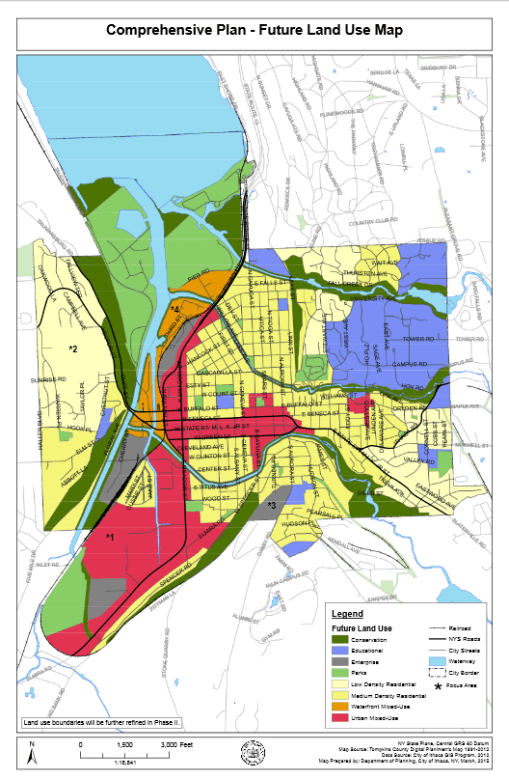
ith_big_plan_map_v2

3. From the Common Council’s Planning and Economic Development Committee, there are a few things of note this week –

A. The city seems to be looking towards greater encouragement and flexibility with redevelopment of waterfront parcels by making WF-1 and WF-2 zones Planned Unit Developments (PUDs). What a PUD does is allow greater flexibility in uses and design by removing or loosening zoning constraints on site use, and being more accommodating to mixed-use projects (the Chain Works District proposal is a PUD, for example). Previously, PUDs could only be applied to industrial sites. The other stipulation, however, is that the applicant would have to work with the Common Council to determine appropriate development of the site.

The Waterfront Zoning allows up to 5 stories and 100% lot coverage. The PUD will give flexibility beyond that, dependent on what the Common Council is comfortable with for a given site and proposal.  So if Applicant X shows up with a huge apartment building or a big industrial building, it’s probably not going to get very far. But if it’s well designed and has affordable units? Maybe the council will grant a little more density or another floor. It depends on a developer showing up with something that they feel offers some kind of community benefit and fits with the Comprehensive Plan, and whether the Common Council agrees with the developer’s reasoning.

There is great potential in the waterfront – those views can fetch a premium (i.e. higher land values, and more tax dollars), it’s far enough removed from the colleges that students would be unlikely residents, and many of the properties are underutilized, with only marginal public benefit.  So potentially, if someone wants to work with the Common Council (one can count on at least 8 or 9 of the 10 being willing to cooperate), there could be some benefits in the long-term.

B. The Commons first-floor active-use zoning ordinance looks to be heading for a Common Council vote in January. More about that ordinance here, Item 5.

C. That damned backyard chickens thing again. Only this time, it might be moving forward with a pilot program involving 20 families.

D. Per the Times’ Josh Brokaw, expect incentive/inclusionary zoning to be up for PEDC review in January.

tfc_comparo

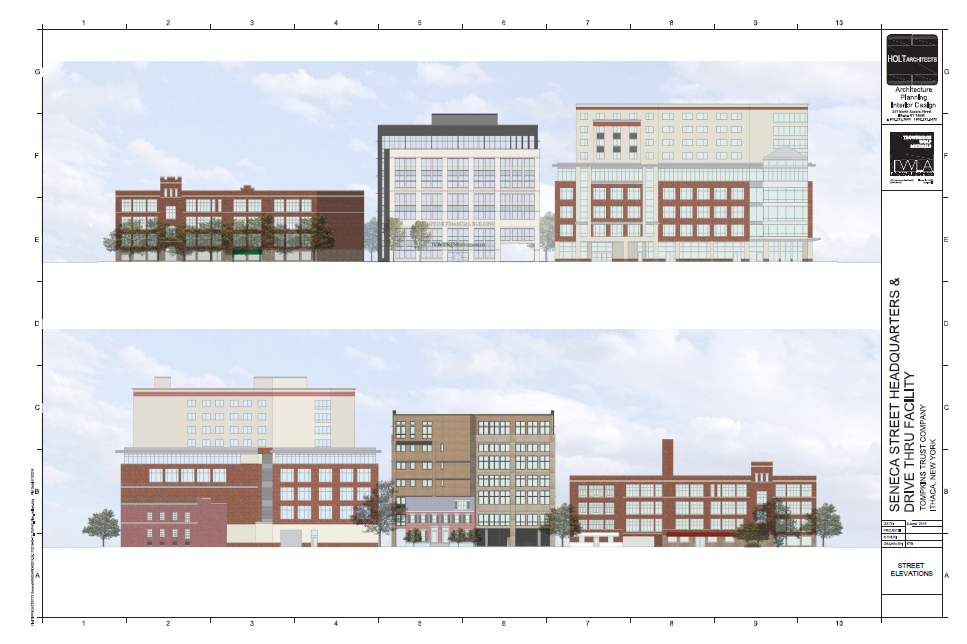
4. Hey look, this week’s eye candy. Tompkins Financial Corporation’s proposed downtown Ithaca Headquarters at 119 East Seneca Street will be reviewed for final project approval at this month’s Planning Board meeting. As part of that, here’s the final project design, part of the final Site Plan Review submission here.

From the front, it looks like some of the window layout has changed on the top floor and southwest corner, and there are fewer sunshades above the windows. There’s a third tree in the planting plan, and there’s variation in the cladding materials on the west wall facing the DeWitt Mall.

tfc_v3_1

In fact, it’s the non-primary facades that have changed the most, with different (and generally lighter-colored) brick and aluminum panels when compared to the previous rendition. Although there’s less glass than before, the lighter colors and greater variation in materials de-emphasize the bulk from the perspective of its townhouse neighbors at the rear. The 7-story, 110,000 SF commercial office building should begin construction in early 2016 with an eye towards completion the following spring.
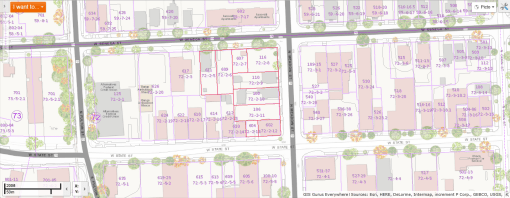
elmira_savings_1

5. There was quite a sale on Ithaca’s West End last Friday. Nine properties outlined in red on the map above – 106, 108, 100 and 116 North Meadow Street, 607, 609 and 611 West Seneca Street, and 602 and 604 West State Street – were sold for $1,725,000 to Elmira Savings Bank.

Now, there are a few reasons why this is worthy of attention. For one, banks don’t typically shell out almost two million dollars without some kind of plan. For two, Elmira Saving Bank has been moving forward with expansion plans in the Ithaca area in hopes of capitalizing on the growing local economy. For three, there has been a lot of development in this neighborhood as of late – the Iacovelli Apartments (2013) and Planned Parenthood (2014) are right across the street, and it’s worth noting that the 18,000 SF HQ for Alternatives Federal Credit Union (2002) is on the other side of the block.

The properties are currently home to parking lots, several older, non-historic houses (most in poor condition) and a two-story 4,500 SF commercial building previously home to the Pancho Villa Mexican restaurant. The restaurant building had been on the market for $699,900.

The zoning here is all WEDZ-1a. West End Zone 1a allows for 2 to 5 story buildings, 90% lot coverage in the case of large assemblages such as this, and no off-street parking requirement. That means these parcels have a lot of potential. The previous owner had been rumored to be planning a mixed-use building on some of the properties, but nothing official ever came forth.

Two phone calls were placed to Elmira Savings Bank’s headquarters in Elmira, and two voicemails were left, but neither received a response. But these properties are definitely something to keep a close watch on over the following months.

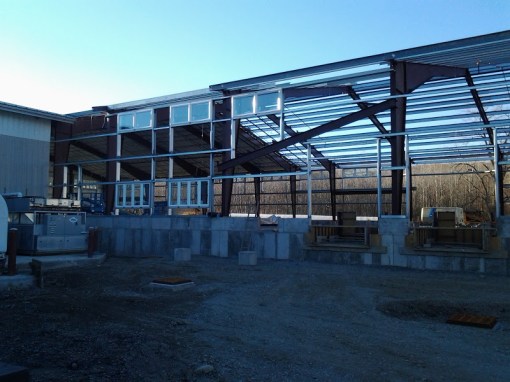
6. That 9100 SF store being developed on the corner of East Shore and Cayuga Vista Drives in Lansing that was mentioned last week (here, Item 4)? It’s going to be a Dollar General. Not sure if that’s better than the auto/tire store speculated last week.
20151108_152102

7. Lest it be forgotten, it appears Lady Luck and some state bureaucrats smiled at the Southern Tier this week, awarded the region one of the three $500 million prizes of the Upstate Revitalization Initiative, known colloquially as the Upstate “Hunger Games”. Rochester/Finger Lakes and Syracuse/Central are the other $500 million winners. Seven regions competed, and the four losers will receive $80-$100 million for their priority projects. The money will be paid out in five annual installments of $100 million. A copy of the Southern Tier’s plan is here.

I wrote about Ithaca’s plans for its share on the Voice here. The first year projects alone will have a range of impacts, ranging from job creation and training to municipal construction projects to quality of life projects like museum expansions. Potentially, it could result in hundreds of jobs in Tompkins County, financial capital for several major projects, and make the area more attractive for investment for both local and external entities. As these projects move forward, they’ll receive their due write-ups here and on the Voice.

Of course, the key things are that the community can manage this monetary award, and that someone can track and guide these projects to completion – something the Southern Tier has struggled with, when one looks at the result of previous, much smaller awards.

8. The state’s just shoveling money into Ithaca this week. The New York State Office of Community Renewal (part of the state’s HUD equivalent, the Homes and Community Renewal agency) has awarded $500,000 towards the rehabilitation of the Masonic Temple at the corner of East Seneca and North Cayuga Streets in downtown Ithaca.

The Masonic Temple was built in 1926 and designated a local historic landmark in 1994. The property is owned by Ithaca Renting Company (Jason Fane), who purchased the building from the Masons in 1993. Fane’s never been a fan of the historic designation because the ILPC can be expensive and onerous to work with, nearly everyone else hasn’t been a fan of his long-deferred maintenance of the 90-year old building (if you have ever wondered why that CIITAP rule was added about an applicant being in building code compliance with all their other properties…now you know). A few years ago, Fane had not been shy in his interest in demolishing the building.

After rejecting a purchase offer to turn the building into a community center and space for the New Roots charter school, Fane decided to go the preservation route earlier this year and apply for a grant to renovate the interior and add an elevator to the building to make it ADA-compliant. This would make the building much more marketable to commercial tenants, many of which have shunned the 17,466 SF building. Fane laid out a few different options this past summer, including one where four commercial spaces (rental, office, restaurant) would be created. Based on the grant announcement, it looks like that will be the option pursued.

The Downtown Ithaca Alliance backed the application, as did the Common Council by unanimous vote at their July meeting.

The renovation will cost at least $1 million, and according to the grant announcement, seeks to start construction in summer 2016. Expect more info when it hits the ILPC and Planning Board at a later date.
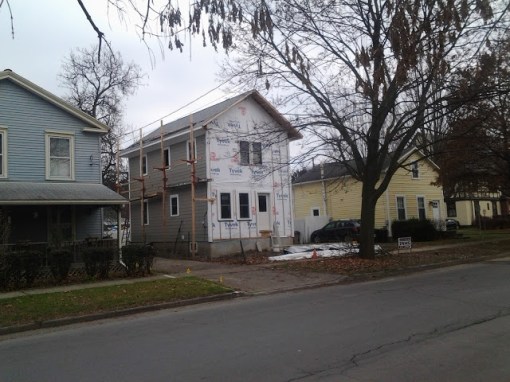
20151205_121714 20151205_121736

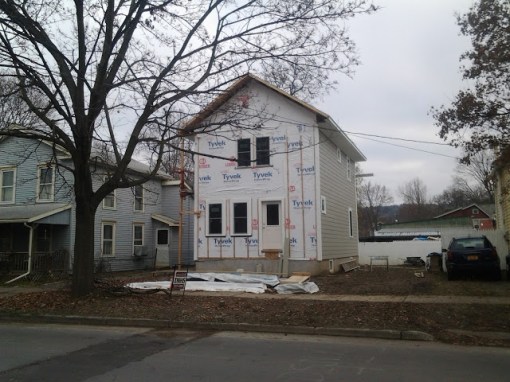
9. House of the week. This week, INHS’s new 2-bedroom, 1150 SF single-family home underway at 203 Third Street in the city of Ithaca’s Northside neighborhood. The house is framed, roofed and sheathed. Siding (Hardie board?) and trim is being attached on the sides, and one can expect a nice gracious porch to be attached once exterior materials are installed on the front. A home of the design was previously built at 507 Cascadilla Street.

203 Third Street was a vacant that the city seized in a tax foreclosure in 2011. It was transferred to the Ithaca Urban Renewal Agency, who sold it to INHS for $17,000 in December 2014. The process is pretty similar for a lot of the home lots that INHS builds on – the non-profit buys dilapidated or vacant properties from the IURA, which they build or renovate into affordable single-family and duplex houses. In the case of 203 Third Street, INHS competed for the site, outscoring Habitat for Humanity’s submission in an IURA examination of proposals.

As with all INHS homes, this one will be sold to a buyer of modest means, which means someone making at or a little less than the county’s median household income of $53k/year (I think 80% of MHI is the low bound offhand, so about $42k/year). The houses will be a part of INHS’s Community Housing Trust, limiting the price it can be sold for and requiring that if put up for sale, it is sold to another family of modest means. It may just be one house, but it will mean a lot to one family.

Claudia Brenner is the architect, with Rick May Construction and Mike Babbitt in charge of construction (thanks to Claudia for the builder info).


Kendal at Ithaca Construction Update, 12/2015

11 12 2015

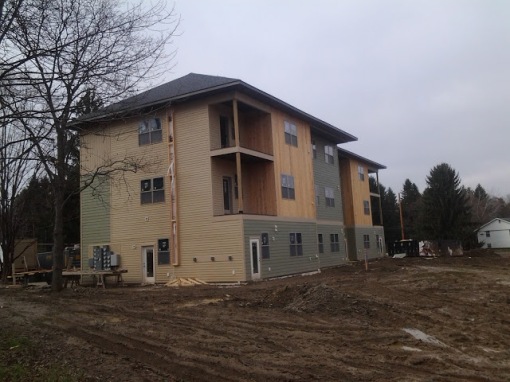
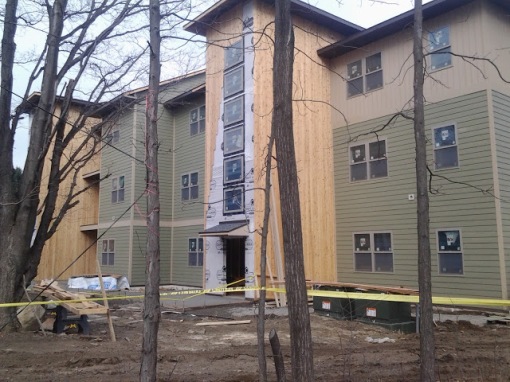
This will probably be the last update for this project, since it’s slated to open next month. The new 24-unit apartment wing is completed from the outside, the carports are ready, and the new skilled nursing wings (48 beds, 16 in each wing) are mostly if not completely done. Originally, it appeared the skill nursing wings would have some decorative roof element (second image), but that appears to be from an early site plan of the design and may have been dropped. The landscaping has been prepared, with new saplings planted and hay strewn over the new grass seed.

More information about the project and Kendal can be found in the October update here, and the June update here.

Local architecture firm Chiang O’Brien partnered with the NYC office of Perkins Eastman to design the Kendal expansion. National contractor Lecesse Construction, with an office out of suburban Rochester, handled the build-out. The $29.3 million dollar expansion will create an estimated 20 to 25 new jobs. The project will be applying for LEED Gold certification.

20151205_133155 20151205_133210 20151205_133242 20151205_133310 20151205_133346 20151205_133429 20151205_133539 20151205_133542 20151205_133548

expansion_bannerKendal_1


307 College Avenue (Collegetown Crossing) Construction Update, 12/2015

10 12 2015

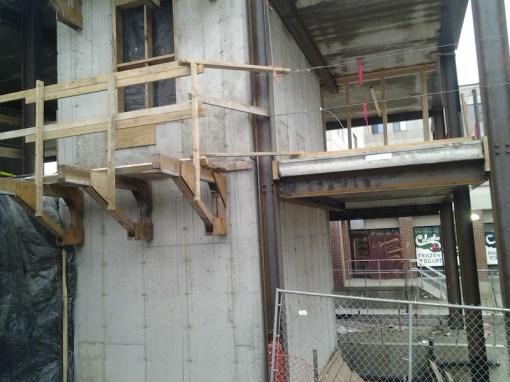
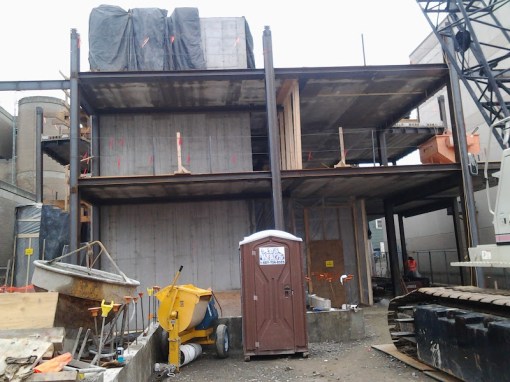
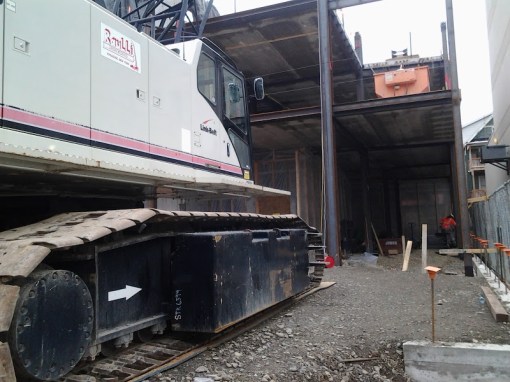
Unlike the other two Collegetown midrises under construction, Josh Lower’s project at 307 College Avenue, Collegetown Crossing, is already starting to make a noticeable dent in the Collegetown skyline. The front concrete stairwell reaches up to the third floor, with the structural steel not far behind. Corrugated decking has been laid into place and sprayed with fireproofing material. Plastic tarp has been put up for weather protection while workers go about the first steps of interior work, including the installation of sprinkler pipes and plumbing, stud walls, and so on.

The $10.5 million Collegetown Crossing project will bring 46 units and 96 bedrooms to market when it opens next august, as well as a 3,200 SF full-service branch of the Greenstar Co-Op grocery store. Two other commercial spaces and an indoor TCAT bus stop are planned. Collegetown favorite Jagat Sharma is the designer, and Hayner Hoyt Corporation out of Syracuse is the general contractor.

20151205_100653 20151205_100727 20151205_100736 20151205_100807 20151205_100838 20151205_100929 20151205_101006 20151205_101156


205 Dryden Road (Dryden South) Construction Update, 12/2015

9 12 2015

As with 327 Eddy a couple of blocks away, Pat Kraft’s 6-story building underway at 205 Dryden, called “Dryden South”, has yet to reach street level, but it’s close to going vertical. It was a little difficult to get to this site due to traffic, but the last photo shows what appear to be columns rising from a shallow mat slab foundation. Unlike the low-lying parts of Ithaca, the soil on East Hill is amenable to shallow foundations for a medium-sized building like this; all the better for the developer, since shallow foundations are cheaper than deep foundations. The steel rods at the top of the concrete columns will tie-in to the structural steel – the weight of the upper floors will be channeled down into the columns, which will then transfer the weight to the rebar mesh and concrete slab at the base (basement bottom) of the new building. The rebar mesh helps to distribute the weight of the building evenly across the slab. The thicker the mat slab is, the more weight it can support.

On a side note, it doesn’t look like John Novarr’s project at 209-215 Dryden is underway just yet, though it was originally slated to start last month. But given that Cornell has already signed up to occupy the whole building, Novarr’s project has a very good chance of moving forward, it’s just a matter of time.

Dryden South will bring 10 4-bedroom apartments to market when it opens in August 2016. The ground floor will hold 2,400 SF of retail space for Kraftee’s book and apparel store. The $6.4 million project is being built by LeChase Construction, and the design is by local architect Jagat Sharma.

20151205_100234 20151205_100323 20151205_100337


327 Eddy Street Construction Update, 12/2015

8 12 2015

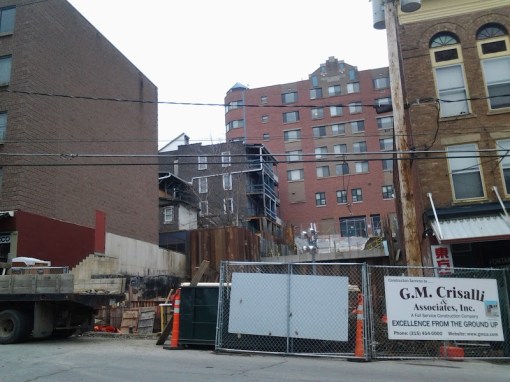
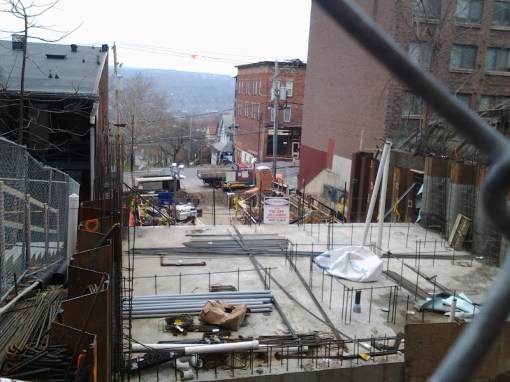
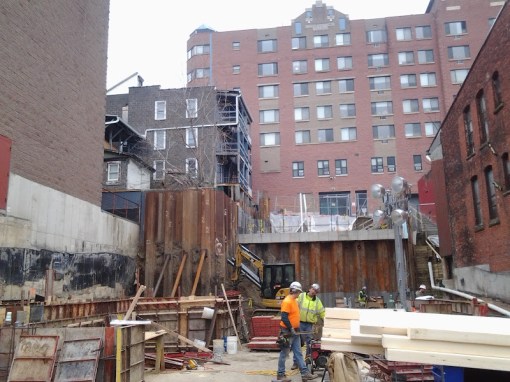
327 Eddy is almost ready to rise from the ground. The mat slab foundation for the upper tier has been poured onto the rebar mesh, with more rebar sticking out of the concrete, ready to tie-in the walls as they’re built up. On the lower tier, it looks like some forms are still in-place for further concrete pours (which sounds right, based off the elevation drawing below). No doubt the work crews have appreciated winter’s delayed arrival this year.
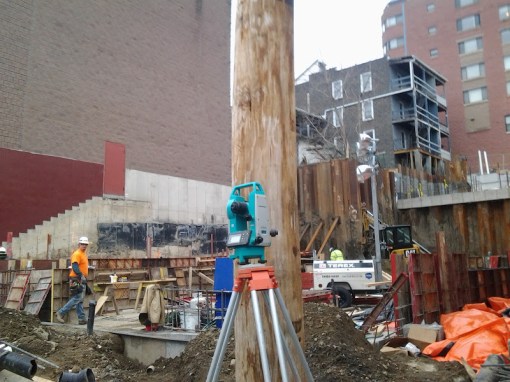
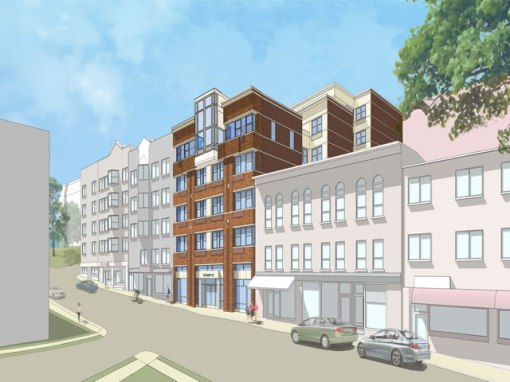
Plans call for a new 5-story building split into “steps” on the steeply-sloped site. The mixed-use building will bring 1,800 SF of retail space and 22 new apartment units with 53 bedrooms to the market in August 2016. Longtime Collegetown landlord Steve Fontana of the Fontana’s Shoes family is the developer, Jagat Sharma is the architect, and GM Crisalli & Associates of Syracuse will be overseeing construction. A construction loan of $4,824,000 is being provided by Tompkins Trust Company. A 2-story mixed-use building and the one-story Pixel Lounge building  were demolished to make way for the project.

Note in the elevation drawing below, the building is six stories. It was reduced to five, and the decorative crown was reworked after approval was granted. It also looks like the latest render was stretched to compensate the loss in height.

20151205_101654 20151205_101743 20151205_101803 20151205_102126

327_eddy_rev2_3 327_eddy_rev4_1


804 East State Street Construction Update, 12/2015

7 12 2015

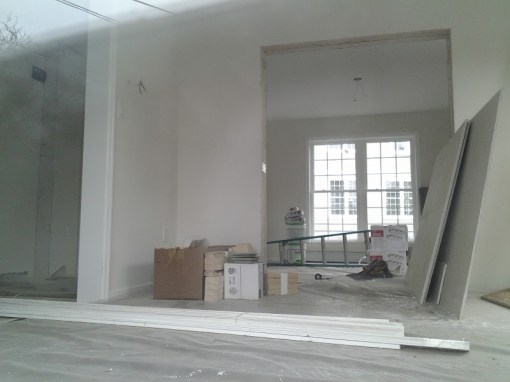
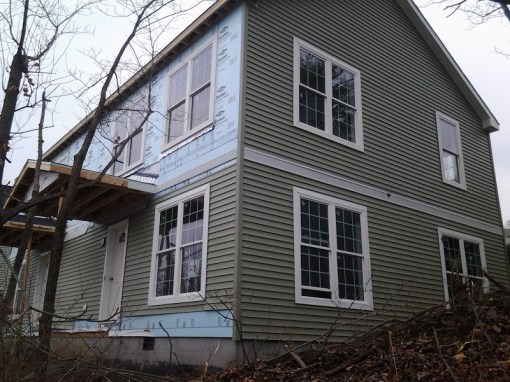
Modular projects tend to move quickly. Such is the case over at 804 East State Street. The modular units have been assembled and fitted – since the interiors comes partially finished and the windows and doors come already fitted, the builder/assembler saves on not only time, but labor costs. For further reading, Ithaca Builds provides a great discussion of how modular units are assembled, including a tour of modular manufacturer Simplex Homes’ factory here.

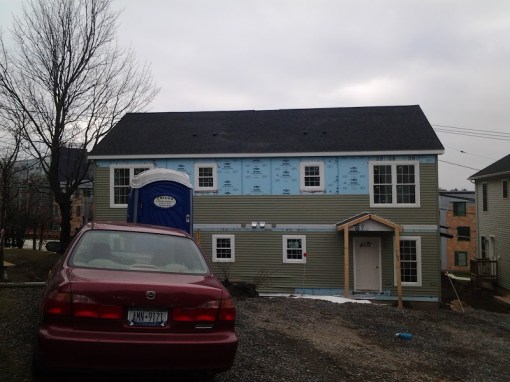
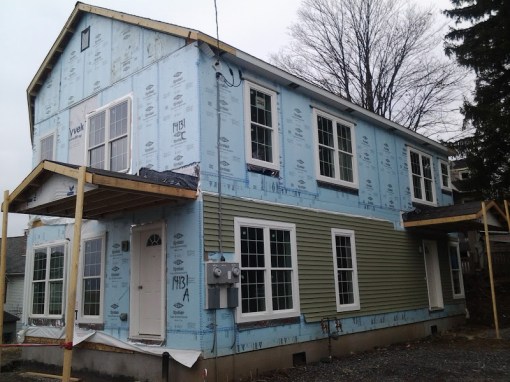
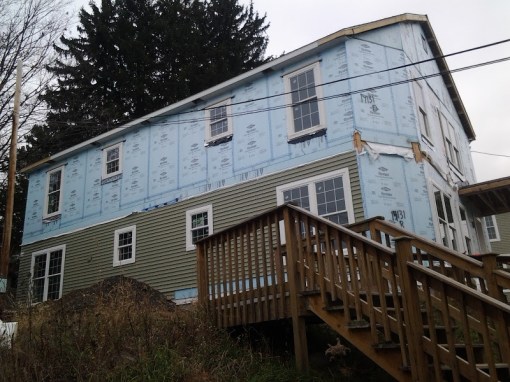
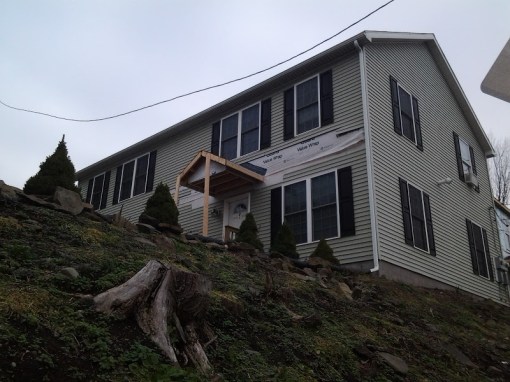
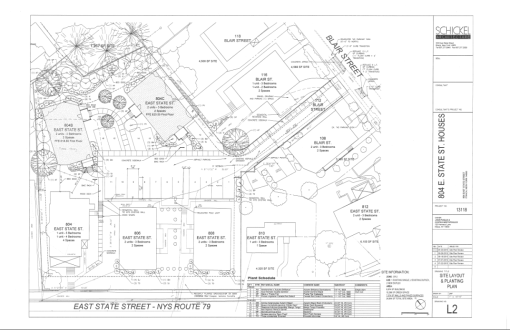
Perhaps the big surprise during this visit is that there are three duplexes underway – a third duplex is being built at 810 East State Street, which previously held a mid-century 3-bedroom bungalow. The three existing duplexes on the parcel are being spruced up as well, with the addition of small porches at their front entries. Each duplex houses 2 3-bedroom units, about 1150 SF per unit.

It appears that some exterior siding/trimming and  interior finishing remains to be completed, and then landscaping once construction wraps up. Although the duplexes themselves are rather bland (some residents in the East Hill Historic District can see the site from their windows, and were opposed to construction), the developer met with residents and oriented the new units to minimize visual impact on Orchard Place, with heavy landscaping to better conceal the State Street properties. The neighbors also pushed for stick-built houses, but the owner/developer ruled it out due to costs.

A building loan agreement filed November 10th states that Tompkins Trust Company is lending the Nestopoulos family (operating under the name “Demosjohnny LLC”) $560,000 for the project. The units should be ready for their first renters by mid-January.

Schickel Architecture is the architect, and Costas Nestopoulos is the general contractor.

20151205_103659 20151205_103715 20151205_103738 20151205_103757 20151205_103833 20151205_103906 20151205_103946 20151205_104005 20151205_104029

112_blair_v4_2

112_blair_v5_1


News Tidbits 12/5/15: Stamp of Approval

5 12 2015


hotel_ithaca_final_1

1. Over in downtown, The Journal’s Nick Reynolds attended a rather quiet CIITAP meeting for the revised Hotel Ithaca project. There were only five attendees outside of those who had to be there, and it doesn’t seem like any big issues arose during the hearing. A quibble was raised about the lack of parking on site, but city officials it’s across the street from the Cayuga Street parking garage, and downtown workers don’t usually overlap with the hours that hotel guests will be using the garage (a 9-5 crowd vs. a 5-9 crowd).

To be fair, this wasn’t expected to be a big news-maker, since a previous iteration of the project received CIITAP approvals in 2013 (since it wasn’t built, the abatement was never applied). It’s also not a big impact on the city – the 5-story, 90-room addition mostly replaces an existing two-story wing of hotel rooms currently on that part of the site. In fact, it’s a decrease in the total number of rooms at the Hotel Ithaca, from 180 to 170. An earlier write-up on the project can be found on the Voice here, the CIITAP application here.

Developer Hart Hotels of Buffalo hopes the $11.5 million project will receive the new abatement at the county IDA’s December meeting, after which construction is expected to run either from January 2016 to May 2017 (presumably in time for the graduation crowds), or March 2016 to March 2017 per Josh Brokaw at the Ithaca Times.

travis_hude_libe_libe_v3

2. Speaking of Josh Brokaw, he provides a nice rundown of last Tuesday’s Planning Board meeting in the city of Ithaca. Salient details are as follows:

– DeWitt House (the Travis Hyde proposal for the Old Library site) still looks the same, but now has a little more covered parking on site, 55 spaces. The 60 units are still shooting for middle-market, 55+ individuals. Much of the library foundation will be reused.
– There’s a few more details about the Chapter House and Simeon’s both of which have shown up on the Voice in recent weeks. Simeon’s is shooting for an April opening, with the apartments sometime later.
– 215-221 West Spencer Street was approved. Expect a Q1-Q3 2016 construction timeframe.
– The debate about the Printing Press Lounge continues. With all due sympathy towards the one speaker’s early bedtime, there might be a double-standard here, as she’s had spirited meetings with the Town of Ithaca’s ZBA about a new house and other investments at her lakefront property, angering her future neighbors in the process.


3. The town of Ithaca will have an interesting development discussion next week. The South Hill Business Campus (SHBC) at 950 Danby Road is looking to “broaden and clarify” the legal uses in its Planned Development PDZ, which was established in 2005. the PDZ establishes strict guidelines on site uses, but gives the SHBC greater autonomy from the zoning code, useful when you have a variety of commercial and industrial tenants. Along with adding the capacity for greenhouses and outdoor event gatherings, there are some minor occupational clarifications, like adding wellness centers to the definition of medical facilities. But most importantly, the owners want to legalize residential uses in the PDZ.

To provide a quick background on SHBC, the complex as a manufacturing center for National Cash Register in 1957, with the addition of a new wing for offices in 1975. At one point, NCR employed over 1,000 people at the site. However, in 1991, NCR was acquired by AT&T, who sold the Ithaca facility to French company Axiohm three years later.  Workforce reductions and outsourcing had emptied most of the building, and Axiohm accepted an offer to sell the facility to a group of local investors headed by businessman Andy Sciarabba. The complex was renovated in the 2000s into a multi-tenant business center – SHBC. Axiohm, now Cognitive TPG, continues to occupy space as a tenant.

Before the late 2000s recession, SHBC, with 90% occupancy, presented sketch plans to the town to construct several new commercial and industrial buildings and create a business park, but those plans were discontinued as tenants closed or moved out during those hard economic times. There has been some “rebound”, but not enough to justify new work spaces as of yet. They would still be an option even if residential options are approved.

The current building isn’t permitted for residential – 40 years of manufacturing left the building environmentally compromised. It’s been re-mediated enough for business use, but not residential use. Any residential on the 56.6 acre site would have to be in new buildings.

There are certainly some favorable factors to an Emerson/Chain Works-type of redevelopment to complement SHBC. It’s close to major employers downtown, across the street from Ithaca College, there’s room for parking and amenities, and the town has had an eye towards encouraging development along that section of 96B and South Hill, by engaging with Form Ithaca to come up with ideas, and through the Route 96B pedestrian corridor study.

There’s nothing firm on the table, but the revisions in the PDZ language would certainly open the door wide for future development. We’ll see what the town board thinks of the idea next Tuesday.

4. Out in the town of Lansing, it looks like the town of Lansing will soon be looking at plans for a 9,100 SF retail store at the intersection of East Shore Drive and Cayuga Vista Drive. Although details haven’t been given (only that a plan was submitted in November, according to the 11/23 minutes), we might be able to guess what’s on it’s way. Both corner lots of the T-inersection are currently undeveloped fields – the southeastern parcel is owned by Freeville-based Fingerlakes Tire & Auto (purchased 1994), the northeastern parcel is owned by a local dentist and her husband and was purchased in 2010. Retail being retail, it seems most likely to be a tire or auto supply store.

20151108_154213

20151108_154139

5. House of the week. A duplex being built at 214 Pennsylvania Avenue, just a couple blocks from Ithaca’ front entrance. These photos are a few weeks old now, so there might be more than a concrete foundation wall with rough window openings by this time. No need to guess on how it will look, though – the Iacovelli family is building the duplex, and they’ve reused the same basic design for at least 15 years, seen in the second image of a house further up the street. Each unit will have 2 bedrooms and about 1100 SF. The building permit was issued in late September.


News Tidbits 11/30/15: It’s like the 1990s All Over Again

30 11 2015

maplewood

1. I want to start this oddly-timed roundup with a big thanks to the readers and commenters who encouraged me to write last Monday’s op-ed. If it wasn’t for you guys, I would have held off. I’m not looking to make waves, but there is a significant, valid concern over Cornell’s housing shortage, and it merited a rebuke.

I also want to thank you guys because the emails I received (about 10 separate readers) were pretty much offloading on how much they hate Cornell, which completely missed the point the article. Worse still, one went into a rant on not only students, but on how much they hate racial minorities, and a second went off into a density rant (followed by stomach-churning quote “if nurses, police and teachers can’t afford to live here, they shouldn’t be living here”). If I thought they were representative of Ithaca for even a moment, I’d hang up my keyboard. But I know that there are good people like the readers here, who are more thoughtful, knowledgeable and arguably less crazy.

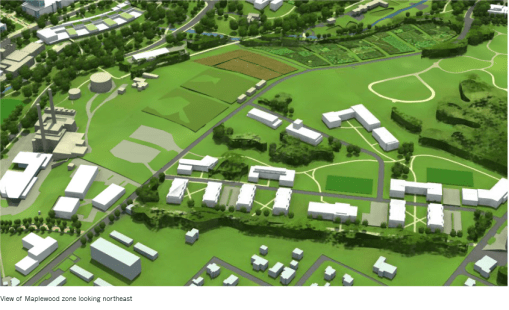
So, with all that noted, here’s the actual news – someone familiar with the Cornell Campus Planning Committee wrote in to say that the Maplewood replacement is expected to have 600-700 beds, and that the committee is still hopeful for an August 2017 opening, which would mean it would have to presented fairly soon (that would still leave a year-long gap in housing, but better late than never). They also acknowledged that “Cornell didn’t do such a good job” with planning for a possible housing shortage, which although not an official statement, seems as good of a justification for Monday’s piece as any.

gways_rev_1

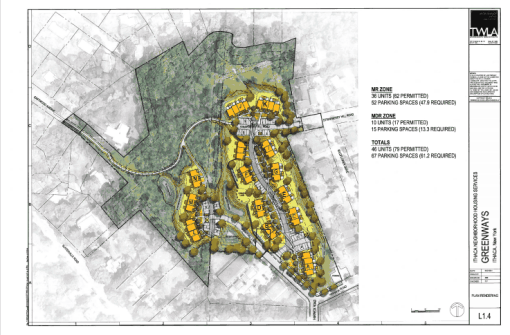
2. Then there was the other piece that dovetailed the affordable housing setbacks last week – Greenways, INHS’s 46-unit affordable owner-occupied townhouse project in the East Ithaca neighborhood, is being abandoned. A part two article with some hard data is being planned. There’s no real silver lining here. It’s Cornell land and the university could potentially revive it, but there’s no indication that will ever happen.

It’s just been a crappy week for housing affordability in Ithaca.

3. Over in Collegetown, several rental homes are being offloaded at once. The properties, 120-134 Linden Avenue, consist of six student apartment houses, with a listed price of $6.5 million. A check of the county website indicates the properties are assessed at $2.75 million, and a cross-check of the Collegetown Form Zoning shows most of these properties are CR-1 (the southern two homes) and CR-3 (the four northernmost homes). CR-1 is the least dense zoning, and CR-3 is a little denser, but mostly maxed out by the existing properties. In short, the code suggests significant redevelopment is unlikely, so the price seems to be based off of potential rental income.

The Halkiopoulos family currently owns the properties, which make up a sizable portion of their multi-million dollar Collegetown portfolio (they’re one of the medium-sized landlords). The Halkiopouloses’ M.O. has been to buy single-family homes and convert the property to student rentals, rather than building their own apartment buildings. It seems likely that the high price indicates they’ll go to one of the other big landlords, or to someone with really deep pockets looking to break into the Collegetown market.

4. A couple folks might be concerned this week after Jason Tillberg’s latest piece about Ithaca’s deflating economy. But there’s a caution light before this data is taken to be hard truth. Frankly, the BLS estimates suck.

A lot.

The numbers are subject to big revisions. Case in point, here are the pre-revision and post-revision 2013 and 2014 data:

ith_initial_1314 ith_revised_1314

It’s not uncommon for the numbers to be changed by thousands, because it’s based on a random sampling of non-government multi-person employers. 500,000 are sampled over the whole country each month, but only about 55 of the 3,300 or so orgs in Tompkins and Cortland Counties are included in the Ithaca metro sample (Cortland’s jobs numbers are included with Ithaca’s because jobs are measured by Combined Statistical Area [CSAs]. However, Ithaca is considered a separate metropolitan area [MSA] from the Cortland micropolitan area [µSA], so population stats are always distinct). The overall trend of the selected orgs is then applied to a base number. For places like Ithaca where the local economy is dominated by a few employers, random sampling isn’t the best approach because it misses crucial components of the local economic picture. But the BLS sticks with its current approach for consistency’s sake across regions and time periods.

During the first quarter of each year, the BLS conducts a full analysis and re-analysis of data going back the last three years. The general rule is, the data from three years ago is very good, the data from two years ago is okay, and the data from the previous year is…very, very preliminary. Tompkins County hasn’t had any large layoffs reported the state’s WARN database this year, and the only major retail closings recently have been A.C. Moore and Tim Horton’s.

In short, don’t let it keep you up at night, and wait until March before passing judgement on the 2015 economy.

902_dryden_v2_1

902_dryden_3
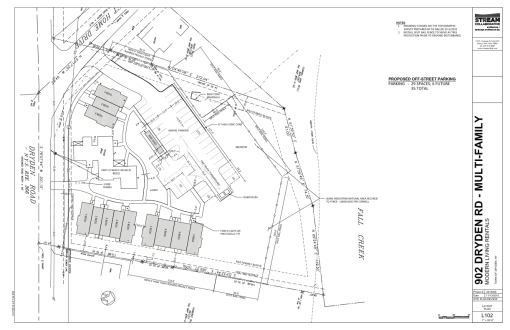
5. Over in Dryden town, the townhouse project proposed by local firm Modern Living Rentals (MLR) at 902 Dryden Road in Varna is a little smaller – 13 units and 40 bedrooms, versus the previous 15 units and 42 bedrooms; these numbers include the duplex with 6 bedrooms that currently exists on the site. Meanwhile, the procession of hate continued at the latest town meeting. The arguments are the same as before. To the earlier, larger proposal, some town councilpersons had given a tentative positive response, while at least one was opposed to the original proposal (in Dryden, the Town Board votes on projects rather than the Planning Board). MLR hopes to request approval at the town’s December 17th meeting – if approved, the construction period is planned for January-August 2016.

For those interested, the Stormwater Plan (SWPPP) is here, revised Full Environmental Assessment Form (FEAF) here, revised site plan here, project description courtesy of STREAM Collaborative here. No new renders, but presumably it still looks the same in terms of materials and colors.

biggs_1

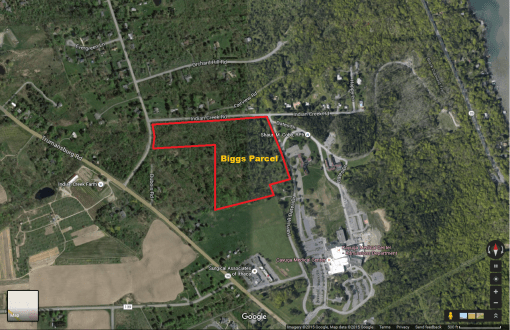
6. Next up on the suburban tour, the fighting over the Biggs Parcel in the town of Ithaca. The Indian Creek Neighborhood Association (ICNA) presented a plan for the property – and the plan is, maybe we can find a way to force the county to keep it, but if not please don’t sell the land to anyone who will build on it. All the county wants is to sell the land so it pays taxes, and the ICNA plan seems to have failed to really address that point. Tompkins officials countered by saying that they’re not keeping it and that if the ICNA cares about this parcel of land so much, buy it. There was then some back and forth about doing a new assessment to account for the developmentally-prohibitive wetlands on site – in other words, decreasing its current $340,000 assessment, with the exact amount to be determined by the county assessment department. At 25.52 acres, of which some is still developable, the price will likely stay above six figures.

So the county’s doing its new assessment, because all it wants is to sell the land so that someone is paying taxes on it. Meanwhile, the ICNA has taken to venting on their web page, angry that the county still plans to sell, and that they may have to actually buy the land in order to dictate its future use.

327_w_state_demo

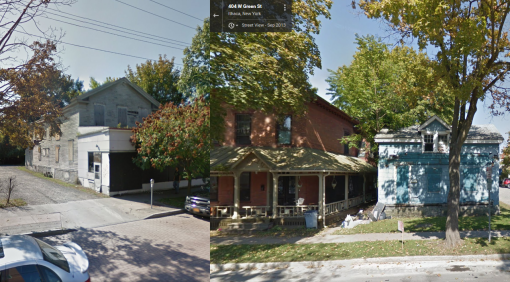
7. To wrap up a thoroughly depressing week, a couple of demolitions by neglect. 327 West State Street and 404 West Green Street will both be demolished by the end of the year, according to the Ithaca Times. Both are older, likely century-old structures, but too far gone to be salvageable. According to county records, the City Health Club, which abuts and owns both properties, purchased 404 West Green in 1987, and 327 West State Street in 1993. The porch on 404 came down sometime in the late 1990s or early 2000s, and the only change since then was painting the plywood on the boarded-up door and windows. County photos suggest 327 was in bad shape but possibly occupied up until 2000 or so, and steadily grew worse from there. Offhand, the procedure is to bill the owner for the demo. 404 West Green is B-2d zoning, 327 West State is CBD-60. But don’t expect any redevelopment anytime soon.

Hmmm…bad economic news, projects being cancelled, decay and demolitions in the city and fighting over suburban projects. For Ithaca and Tompkins County, it’s like the 1990s recession all over again.


Cornell Plans Renovation for Hughes Hall

27 11 2015

There is almost never a period without construction at Cornell. Don’t expect that to end anytime soon.

Cornell’s latest construction plans were presented as a sketch proposal at last Tuesday’s Planning and Development Board meeting. The sketch plan is the first step in the process, where an applicant solicits input and first reactions from the board. A copy of the powerpoint presentation can be found on the city’s website here.

hughes_cornell_1

The renovation of Hughes Hall is the second phase of a three-phase expansion and renovation of the Cornell Law School. The first phase, which consisted of 40,000 SF of new, partially-subterranean classrooms and a 170-space auditorium, began in Summer 2012 and was completed in Fall 2014 at a cost of $23.8 million. Ann Beha Architects of Boston, and Welliver Construction of Elmira worked on the first phase of the renovation and expansion program. Ithaca Builds offers plenty of interior and exterior images of the first phase here, and a copy of the original Ste Plan Review from 2012 is on the city’s website here.

The first phase was Certified LEED Platinum (the highest LEED designation), which was possible in part because as an underground structure, it was easier to design and pay for maximum energy efficiency. The Hughes Hall renovation will pursue LEED Silver at a minimum.

hughes_cornell_2

Initially, Hughes Hall was to be the third phase, with a renovation of Myron Taylor Hall planned as Phase II. However, since the plan was initially conceived several years ago, the second and third phases were switched around.  The total cost of all three phases is pegged at $60 million (2012 estimate).

hughes_cornell_3

Externally, the changes to Hughes Hall will be subtle – the current open-air loggia will be enclosed and a new entryway will be built on the east side of Hughes. A glass-enclosed staircase will be built onto into the West facade, and the dining room terrace will be repaired. Although some parts of the Law School are historic (Myron Taylor Hall, which dates from 1932), 62,000 SF Hughes Hall is a later addition, built in 1963/64, that lacks the historical detailing of the older structures.

hughes_cornell_4

Internally, administrative and other non-faculty offices will be located on the ground floor, with a dining room, event room and other office/flex space on the floor below (note that the building is built into a hillside, so the Fork & Gavel Cafe, although one level below the ground floor, exits near surface level on the southern side of the building). Although the upper floors aren’t discussed in the sketch plan, the general upper-level plan is for new offices for law school functions and faculty that replace dorm rooms for first-year J.D. students.

With this mostly-interior renovation, the focus of review will probably be on staging and general harmony with surrounding physical environment (buildings and landscape). At first glance, this project doesn’t appear to be stirring any major issues (overlooking the loss of student housing, which is worth criticism but nowhere close to illegal), but will probably create the standard blitz of documents and PDFs that Cornell sends to the city to preemptively answer any questions committee members may have.

Given the timing, Cornell is likely shooting for a Spring construction start, with completion in 2017.