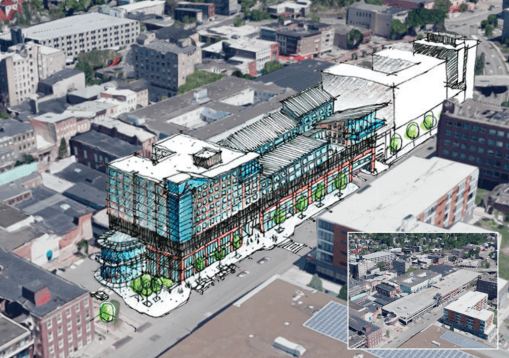
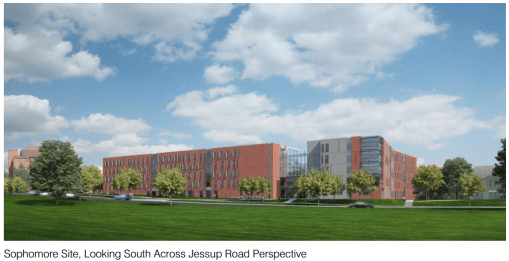
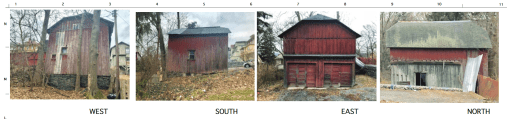
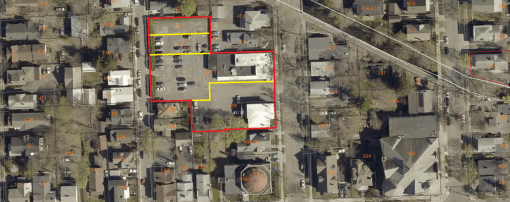
News Tidbits 4/27/19

27 04 2019

1. Matt Butler at the Times is providing an in-depth check-up on the mall this week. This was a story the Voice had laid groundwork for as well, so it’s nice that one of the local news orgs was able to make hay of it. The mall, like many middle-class local malls across the country has been struggling in the age of Amazon and the retail meltdown. The overall economy might be humming along, but retail closures continue to spike nationwide, with over 6,100 closures planned this year alone, more than the 5,900 announced in all of 2018. With planned new store openings numbering 2,100, it’s practically two stores closing for every one that opens. Retail mega-landlord Cushman and Wakefield estimates 9,000 stores will close in 2019, and over 12,000 in 2020. In the Ithaca Mall, Gertrude Hawk is gone, American Eagle closed up last year, Ultimate Athletics shut its doors, the Bon-Ton closed as part of the shutdown of the whole chain, and the Sears Hometown store is kaput. The mall’s manager cited a variety of reasons, including chain downsizing, poor performance, and some just stopped paying rent.

This has major economic impacts; the mall’s property value has declined by over 60% since the start of the decade, and the village, the county and the schools have to make up those hundreds of thousands of dollars in property tax revenue somewhere (and the county and schools have). County legislator Deborah Dawson, who represents the mall’s district, suggested doing something similar to the DeWitt Mall downtown, a mix of local businesses, but the mall is a much bigger space to fill (622,500 SF vs. 117,500 SF in the DeWitt Mall), and DeWitt Mall is mixed-use (retail and 45 apartments). Local businesses and experiential outlets can be part of the solution as Running 2 Places is showing with their 18,000 SF theater this spring, but it’s one component of a solution. Residential could be a component, but some legal and logistic issues would need to be sorted out, which owner Namdar Realty has never shown much interest in; the village has also been lukewarm to the idea. About 40 apartment units were floated for a section of the parking lot (west/on the backside of the mall if I remember right), but that idea died during the Great Recession.

There is so silver bullet here. The owner needs to be more proactive then holding a proverbial gun to its’ tenants heads in order to get them to stay. Local governing bodies also have to keep an open mind for redevelopment ideas – if parts of the mall were torn down and replaced with residential, for example. As it is, the only plans on the horizon are an unnamed tenant for the former Bon-Ton space, and the extended stay hotel planned for the parking lot behind (west) of the Ramada Inn. The future of the mall is hazy; like a species faced with a steadily changing habitat, it’s either adapt and evolve, or perish.
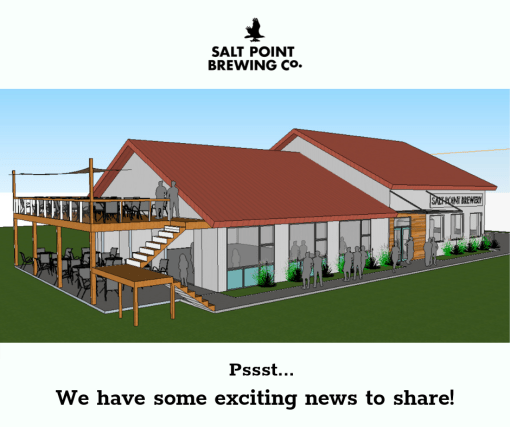
2. Courtesy of their Facebook page, here’s a sketch render of what Salt Point Brewing Compant’s new brewery and taproom would look like. It’s a fairly unobtrusive one-story structure with a gable roof and two wings, presumably the taller one for the brewing tanks and the smaller one for service functions. On the outside are wood accents and a two-story deck for outdoor drinking and possibly dining, if the restaurant option is pursued.

The building, as well as associated landscaping and parking improvements, would be located on about three of the five acres sold as Parcel “D” in the Lansing Town Center development. The remaining two acres are wetlands and would be left undisturbed. Salt Point paid $75,000 for the land, and will bring its project forth to the town planning board in the coming months. No word on any job creation figures yet.
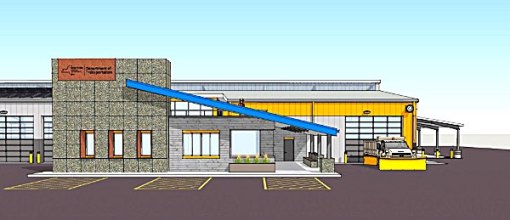
3. The NYS DOT county facility plans are moving forward. The state bought its 15 acres from Tompkins County for $840,000 according to a deed filed on April 24th. The building is classified as a sub-residency facility, a step below a primary regional facility (the main office for Region 3 is in Syracuse).

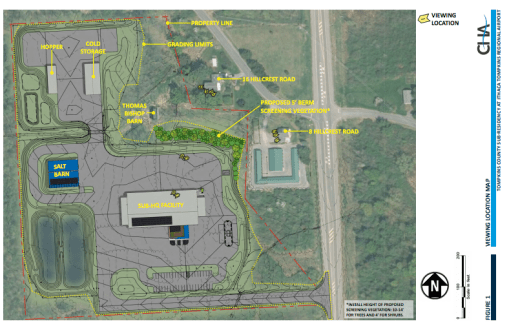
To review, the plans consist of the 30,000 SF sub-residency maintenance building, a 5,000 SF Cold Storage unit, an 8,200 SF salt barn, and a 2,500 square foot hopper building (covered lean-to). The proposed maintenance building will have vehicle storage for 10 trucks, a loader and tow plow, with one additional double depth mechanical bay and single depth, drive-thru truck washing bay. It also includes an office area (three rooms), lunch/break room (30 people), toilet/shower/locker rooms, storage rooms and mechanical/electrical rooms. The site will also contain stockpile areas for pipe, stone and millings, and ancillary site features include parking for 40 vehicles, and stormwater management facilities. A new access drive will be constructed from Warren Road.

The town has been less than pleased with the project, which is not bound to zoning code because it’s a public resource facility owned and operated by a government entity. Rather than voice approval, the planning board voted to acknowledge that they simply had no authority to control the project. Some modifications were made to the plans at the town’s request, such as the fueling station being moved onto airport property across Warren Road, but neighbors are still unhappy that snowplows and heavy-duty maintenance vehicles are about to be their next door neighbors.

The facility is expected to be open by the end of the end of the year. Once all staff and equipment have been moved in, the county may pursue a request for proposals/request for expression of interest for the current DOT property on the shores of the inlet near the Farmer’s Market. A 2015 feasibility analysis found that the site could conceivably host a $40+ million mixed-use project, and the site has became more amenable towards redevelopment with the enhanced density and use provisions made to the city’s waterfront zoning in 2017.

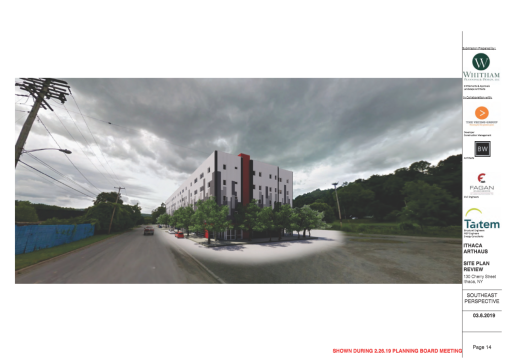
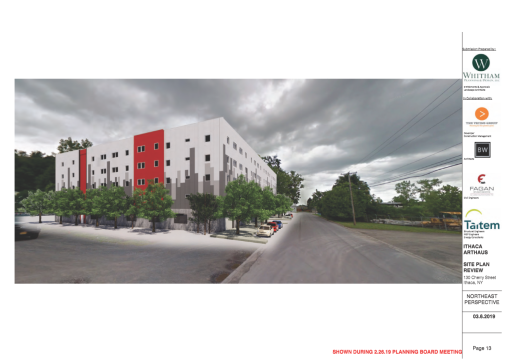
4. The Ithaca city planning board granted a negative declaration of environmental review to the 124-unit Arthaus affordable housing project at 130 Cherry Street. According to my editor Kelsey O’Connor, the latest revisions propose a five-story building that would include a gallery, office and affordable rental space. It would include parking for about 36 vehicles and 7,600 square feet of potential retail or office and amenity space geared toward artists. All of the units would be restricted to renters earning 50 to 80% of the area median income, or about $30,000 to $45,000. The north end of the property will also include a publicly accessible path leading to the inlet.

Speaking in favor of the project were neighborhood business owners and non-profits, and in opposition was councilman George McGonigal, who said both in a letter and in person that it was too big for the site and threatened the industrial character of the neighborhood. They have bigger concerns than housing nearby. Cherry Street is difficult to access with large trucks and commercial vehicles, the Brindley Street and Cecil Malone Drive bridges are small and in poor shape. Secondly, Cherry Street doesn’t provide much room for operations to expand, so that hinders their long-term operational planning. It’s not just lot size, but also the soil – the Emmy’s Organics project fell through because of poor soil not amenable for warehouse and other light industrial functions that rely on a concrete slab. Thirdly, the city’s strict environmental laws, fees and higher property taxes make an urban site less appealing. They can get more land with a lighter tax burden in Lansing, Dryden, or any of the other outlying towns. With these issues in mind, many of the industrial businesses down there now aren’t looking to stick around. Several have already sold or made purchase options with developers as they seek areas with lower taxes, easier access to highways and less strict environmental ordinances.

The unanimous approval by the city planning board allows the project to move forward with consideration for preliminary approval. The goal is to gain approval at next month’s meeting, and once affordable housing funds have been secured, to start construction of the project, likely in December of this year.
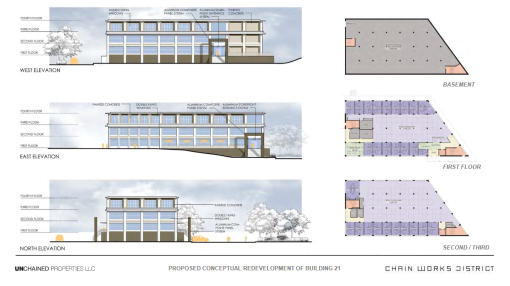
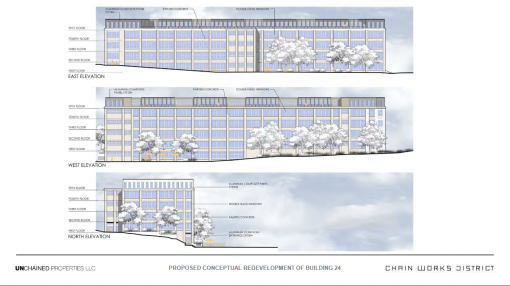
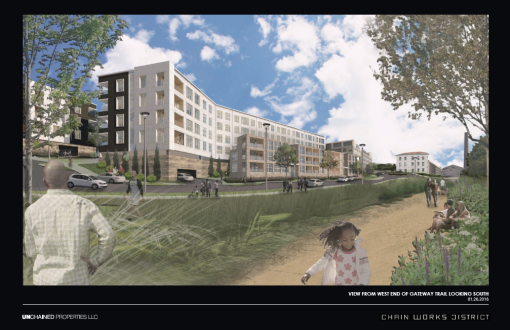
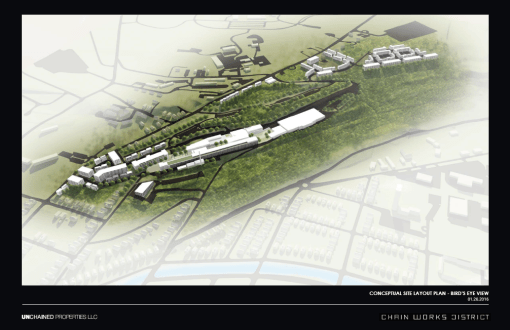
5. The Chain Works District presented plans for phase one at the Planning Board meeting. There are four buildings in phase one, of which two are in the city. 43,400 SF Building 21 would be renovated into a commercial office building. The work here is limited to replacing walled-up window openings with new windows, exterior cleaning and painting, and new signage and entrance canopies. Building 24 is a combination of renovation and expansion. The partially built-out basement and first floor would be renovated for commercial office space, the second and third story would be residential, and a new fourth floor would be built for residential uses, for a total of 135,450 SF across 4.5 floors. As with Building 21, new windows would be installed, and the exterior cleaned and painted. New landscaping, sidewalk and parking areas are also planned.

At a glance, the residential in the first phase would host 60 market-rate rental units. Each floor will have one studio unit, nine one-bedroom units, nine two-bedroom units, and one four-bedroom unit. According to the Site Plan Review document, the project would begin renovation in October, and be open by August 2020. The other two building in phase one are renovations of industrial and manufacturing spaces in the town, Buildings 33 and 34. These will retain industrial uses.

This meeting was only for the purpose of sharing and discussing plans, with no voting at this time. According to Edwin Viera at the Times, the board was reluctant to approve any plans without more information about who will be occupying them. That seems a bit odd, because projects are analyzed for their physical impacts, not the tenants, but the Times article says parking and landscaping may change slightly depending on the tenant. According to project representative Jamie Gensel, the USDA is considering renting out some of the office space. The USDA maintains a research facility inside the Holley Center on Cornell’s campus, and there were plans in the late 2000s to build an addition, which were later shelved during the Great Recession. It’s not clear how much space they’re seeking. Not sure what to make of that writeup, honestly, or being told to move the buildings into a different phase (personally, I’d like to be renovations before any new builds happen).
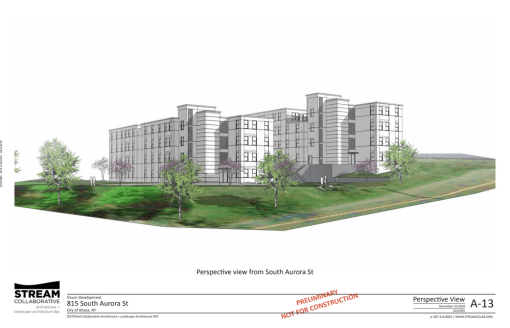
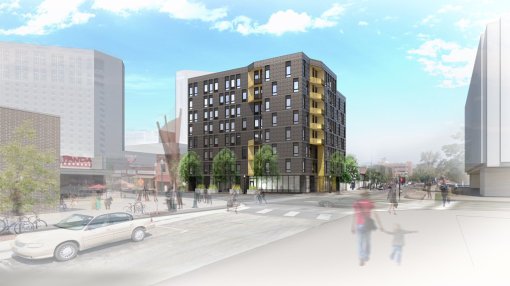
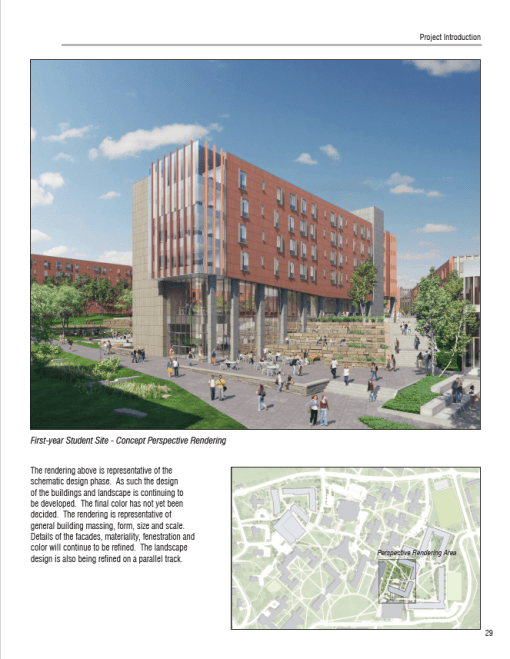
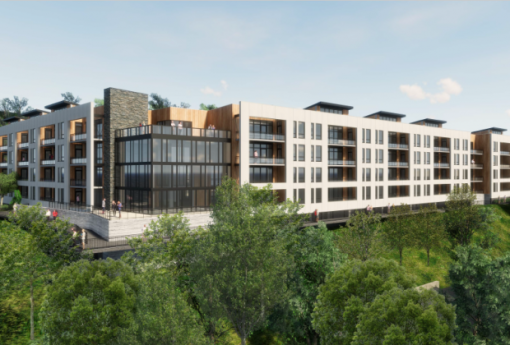
6. 815 South Aurora Street, aka “Overlook”, also continued its review at the planning board meeting. There were some minor design tweaks, seen in the before image (above) and after image (below). Changes in exterior colors, panels, ground-level entrances and fenestration, particularly on the side facing South Aurora Street. The fire trucks are  to indicate that emergency vehicles will be able to safely pull in and out from the road. Overall, project size remains at 49 units and 141 bedrooms.

There’s been some pushback from neighbors regarding size and neighborhood character. There’s an argument that these are dependent on Chain Works, but that argument doesn’t pass the smell test – if Chain Works didn’t happen, fewer units on the South Hill market would make the project even more appealing to Visum Development and Modern Living Rentals. The planning department wants more geotechnical information and bedrock to be removed, details about the new planting and landscaping, and energy systems. Documents submitted indicate the all-residential development will use electric heat pumps. The board has requested a shadow study and flesh out the environmental impacts, which is a common request for larger developments.
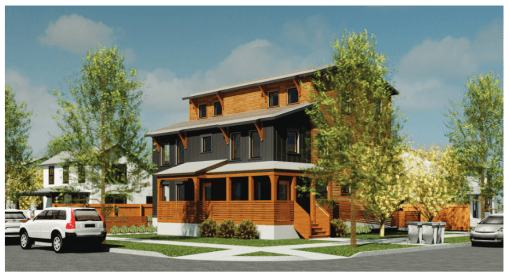
7. At least one project is fully approved. Although it seems at least one planning board member asked for affordable housing, the four-unit market-rate Perdita Flats infill at 224 Fair Street was granted preliminary site plan approval. The project is intended to be a sustainable building showcase of eco-friendly features, a net-zero energy showcase of what can be done with environmentally sustainable multifamily housing. The owner/developers, Courtney Royal and Umit Sirt, will be applying for incentives from the NYSERDA Low-Rise Residential New Construction Program and are hoping to attain the Zero Carbon Petal of the Living Building Challenge.




News Tidbits 4/12/19

13 04 2019

1. Here’s a story of a clever use of space – Therm Inc. has recently expanded its facility on South Hill, and stopped leasing space from the nearby South Hill Business Campus as a result. That left an 18,870 square-foot hole to fill in Suite 30.

The site’s business manager, Linda Luciano, had had artists inquiring for a space, but never something that small enough to fit their needs. This vacancy was a chance to try something new, to build little studio spaces within the larger open floor plan of the warehouse space. It’s worked out well. Extremely well, as Ithaca Times editor Matt Butler reported this week as the Times feature article. Segment below:

” ‘A few studios’ turned out to be a severe underestimation of how many Ithaca artists desperately wanted their own studio space. With a calculated proposal for six studios in hand, she went to the building’s owners to lay out her vision, and they were receptive. Luciano then set about contacting artists who had previously reached out to her about renting space, meanwhile losing sleep over fears that she wouldn’t be able to find tenants for the studios and would have to start over with a new plan.

“I started calling people on my list, and we planned an open house,” Luciano said. “Before we could have the open house, they were all rented. That’s when I said ‘Oh my god.’”

It hasn’t slowed down since that initial wave, either. Seeing the success of the first push in October, Luciano and building owner Andy Sciarabba came up with a plan to add four more studios to the original six, deeming it Phase Two. Those four sold immediately in December, before they were even built. The same went for more units that were proposed in January. After the final phase, which is currently underway, Luciano plans for 27 more studios constructed in the former Therm space, with a much-requested gallery space included. Those are scheduled to be finished and opened in August; half of them are already leased…”

To put this in perspective, there are eighteen now plus a small kitchen and lounge space, and the addition will provide 27 more studios and a gallery space. The new build has so far taken over about a third of Therm’s old space, so the addition will likely the fill the rest of it out. The studios are a few hundred square feet each and rent for $275-$450/month depending on size (the price includes water/AC/electric/heat, with free parking), and leases are 12-month. I had not heard of anything trying this on a large scale, but it appears to be working out very well for the South Hill Business Campus, which hopes to spruce up the exterior to draw a little more attention to “Artist Alley”. It gives artists their own spaces outside of home, it offers collaboration between studios, and this seems to have tapped into a critically underserved market.

For those who want to call dibs on the last studios before they come onto the market next summer, the contact webpage is here. If you want to check them out in person, the address is 950 Danby Road.

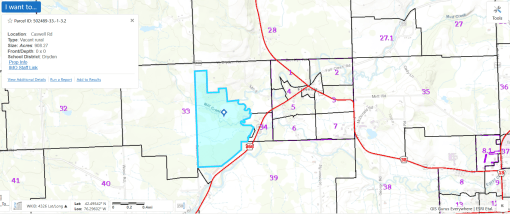
2. Touching real quick on a pair of Dryden projects in the early stages. The “Mill Creek subdivision” is quite frankly a monstrosity in size. This is a 908-acre property on Caswell Road just west of the village of Freeville, and the plan would be to subdivide it into 39 home lots. No further subdivisions would be allowed, only single-family homes would be permitted, and it’s not clear if the developer is pursuing conservation zoning – per planning board minutes, it seems that the lots will be plated and the road laid out, and then sold parcel-to-parcel to custom builders.

If the owner did want to build, they have the expertise to do so – a deed check shows this property is owned by the Lucente family, who run Lifestyle Properties and have built out thousands of housing units in Tompkins County since the 1950s. The unimproved land is valued at $1,132,600, about $1,250/acre, and has been in their possession since 1954, so this doesn’t appear to be a rash decision.

Doing the math and removing a small amount for internal loop road still gives over 20 acres per lot, these properties would be very large and potentially expensive, because with improvements, that much acreage will be worth more and it will add up quickly. Maybe it’s a bit out of character for this blog, but this proposal actually seems rather worrying from an environmental and infrastructure perspective. Density in urban areas tends to draw the most attention, but these lots could potentially have much bigger impacts because of the amount of natural space that would be consumed by a sprawling high-end housing development.

As for the medical facility at 2141 Dryden Road, it sounds like it will be a two-story facility, and while they suggested parking in the front, the board requested to move it to the back (a couple handicap spaces in front are okay). There was some concern with its choice of locations (the board would much prefer the office be located in the village or a more built-up area) and curb-cuts/traffic impacts.

3. For the creative types: the Collegetown Small Business Alliance is sponsoring a contest to design streetlight banners for the neighborhood, like the ones on the Commons. The plan is to make up fifteen of them and have them hanging for two years. Here are the design criteria:

Designs that are timeless will be favored. Avoid using trendy colors, fonts that may fall out of taste.

– Collegetown is at the intersection of the Cornell campus, student life, and the Ithaca community, and as such, designs should be inclusive of all of the following groups: Cornell students, Collegetown businesses, and the City of Ithaca.

Consider these banners as creating a brand and identity of Collegetown as a whole.

Submissions must be a 24″ x 60″ image, 300dpi, with a legible “Collegetown” on the image. May include photographs, graphic designs, or scanned images. No inappropriate content. Submission are due by 11:59 PM on Tuesday April 16th, and are to be submitted here. First places get $125 and their design on the flags, second place $75, and third place $50.

4. Maybe I’m reading too much into this, but there are some unusual LLC formation notices in the Journal classifieds. 628 West Seneca Street LLC, 625-27 West Buffalo Street LLC, 629-631 West Buffalo LLC, and 205 North Fulton LLC have all been created in the past couple of weeks. They are a parking lot, an apartment house, a one-story commercial building (Emmy’s Organicsm which they will vacate for larger digs in then ear future), and another one-story commercial building (Superior Glass) respectively. They are all owned by the same guy (Robert Bond).

The LLCs are all registered to the address of Alternatives Federal Credit Union across the street at 125 North Fulton, which is a little worrying because AFCU bought 634 West Seneca a few years ago and tore it down for a parking lot. It would be very unfortunate if they decided to take down more buildings for surface parking, given that this is an area the city’s trying to build up. It’s also not clear what might happen to the Rhine House in such a situation. Anyway, it’s something to keep an eye on.


News Tidbits 3/31/19

31 03 2019

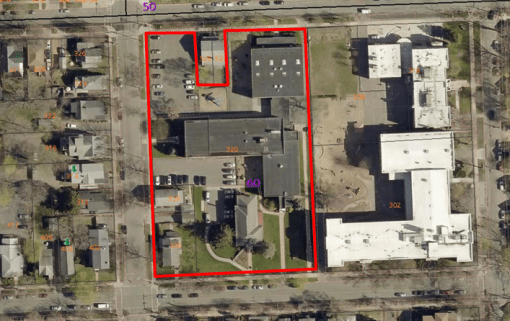
1. A couple items of note from the latest Dryden Planning Board agenda – one is a new housing subdivision called Mill Creek, but the number of lots and location is not disclosed. The other appears to be plans for a new medical office building at 2141 Dryden Road, which is currently a vacant lot near near Willow Glen Cemetery. Google Maps seems to struggle with locating the 3.3 acre lot, so the screenshot is from the county’s map. The parcel is zoned “Mixed Use Commercial” and appears to be outside the sewer service areas. This still allows for a pretty substantial building – 40 foot setback from the front, 25 feet from the rear, 7.5 feet on either side, maximum 60% lot coverage and up to 35 feet in height, which for a medical office is typically two floors (13-14′ feet per floor). Put it this way, a building built to maximum dimensions would have a gross square footage of about 86,000 SF per floor, though whatever is planned here is likely to be much less than that. Anyway, it’s something to keep an eye on as plans develop.

2. A sign of the times. The property value of the Shoppes at Ithaca Mall plunged this year, from $31 million to $19.35 million, a 38% drop. This is the result of high vacancy rates and a deteriorating long-term outlook. Downtown boosters will note with some schadenfreude that’s quite a different picture than the state of business affairs a generation ago, when downtown was in the doldrums and the mall (always in my mind the Pyramid Mall) was the center of activity.

This poses a substantial problem for the village of Lansing, but luckily, other development around the village was more than enough to offset the loss of valuation in the mall. Overall property value in the village inched up from $476.3 million to $479.5 million. Borg-Warner’s property value jumped a million dollars, and projects such as the East Pointe Apartments and Cayuga View Senior Living have also contributed to the growing property tax base.

There’s been a persistent rumor that Maguire or Guthrie are buying the mall. The short answer is some outreach was done, and no, they’re not. It’s not even possible for them to do that because Namdar’s mode of operation is to sell off the mall in sections. The long answer, with quotes, will be an article in the Voice next week.

3. When the state wants something, it can move very fast – the request for contractor bids is already out for the new proposed NYS DOT facility off of Warren Road in the town of Lansing. The bids on the $13.8 million project close April 24th. Here are the specs in brief:

“This project includes new building construction of the NYSDOT Tompkins County Sub‐Residency Building as well as site development and construction that includes asphalt concrete pavement, drainage, water & sanitary sewer work. The new NYSDOT facility will consist of office space, workshop space, truck parking and salt storage. The approximate square footage of the various structures are as follows: subresidency
maintenance building (30,000 SF), cold storage (5,000 SF), salt barn (8,200 SF), hopper building/covered lean-to (2,500 SF).

The proposed maintenance building will have vehicle storage for 10 trucks, a loader and tow plow, with one additional double depth mechanical bay and single depth, drive-thru truck washing bay. It also includes an office area (three rooms), lunch/break room (30 people), toilet/shower/locker rooms, storage rooms and mechanical/electrical rooms.

The site will also contain stockpile areas for pipe, stone and millings, and ancillary site features including a fueling station, parking for 40 vehicles, and storm water management facilities. The project will require construction of an access drive from Warren Road and the extension of utilities.”

I have not seen an updated site plan for the project. The image in last week’s Tompkins Weekly is from the SEQR Review, which is outdated. In February, a $1.5 million grant was awarded to build a refueling station closer to the airport, which has resulted in significant site plan changes to the DOT site (I’m not able to find the document offhand, but the written description stated a rotation of the main building and movement of other structures away from the residential properties to the north).

4. Word, or rather warning, to the wise. Local businessman Andrew LaVigne defrauded investors in his “Cascadilla Landing” project, to the tune of $4.6 million. Now he’ll be going to jail for 20 years, which at 66 years old, is most likely the rest of his life. So comes to an ingnomoius end to one of Ithaca’s first major projects of the decade. The 183-unit mixed-use project was proposed in the summer of 2012,  received preliminary approval that September, and did not move any further than that. Plans by local architect John Snyder included a small amount of neighborhood retail space, and covered ground-floor and outdoor surface parking. The land, owned by the Cleveland family, was sold in November 2017 and is now the site of the City Harbor development. There hasn’t been much news about City Harbor recently, but the rumor mill says that a new architect is revising the project design and site plan.

5. I accidentally dropped the ball on the Fall Creek County Office Building study. During the March PEDC meeting in which the concept was being presented, I tuned in online and had taken screenshots for my own reference, and my Voice colleague Devon Magliozzi wasin the meeting doing the official writeup. However, I never checked to see what she was covering and had assumed a big roundup. Her focus, though, was on the Lime Scooters, and it was an excellent piece, but the county office building didn’t make the news.

Anyway, the county presented about eight separate plans, seven of which had the same interpretation for the office building – a 10,500 SF that would be built to include the historic structure at 408 North Tioga in its footprint. Most of the plans differed in the amount of housing and parking, from one single family homes to three single family homes to two duplexes (two two-family units, total of four) to five townhouses. This also impacts the total amount of parking ,which ranged from 27 to 48 spaces depending on the housing footprint and whether tandem parking was used. The last plan was a proposal with no housing on-site, and selling off 408 North Tioga for an office building with an 8,400 SF footprint. All plans assumed a three-story office building plus basement, and housing designs compatible with Sears Street (1.5-2.5 floors). The mix of county occupants is still being determined, and any housing plan would likely involve an affordable housing developer like Conifer or INHS.

The county legislature is expected to get an update on the plans at their meeting on the 2nd, and make a decision on whether or not to buy the Fall Creek property at their April 16th meeting.


News Tidbits 3/30/19

31 03 2019

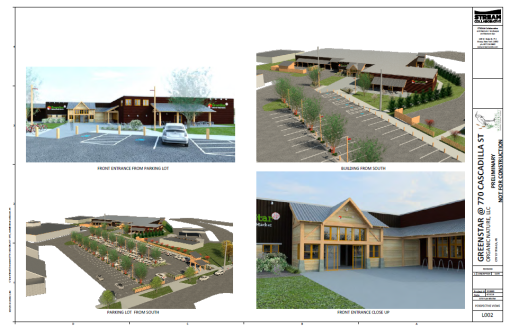
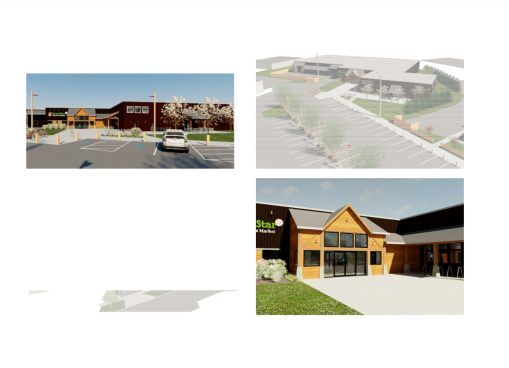
original renders

revised renders

1. Let’s start off with an update from the city of Ithaca Planning Board. As reported by the Times’ Edwin Viera, The board was not happy about the proposed changes to the GreenStar project, which were summarized in a previous blog post here. The revised site layout and materials were approved, but the board was unhappy about the loss of windows on the northeast faced and asked for an alternative if windows were no longer feasible, either graphic art or a GreenStar insignia to provide visual interest. The project will be back before the board next month.

Apparently, it was the month to express discontent, as issues were also raised with the City Centre signage and design components of the Vecino Arthaus project, which did away with the grime graphics and went with a marginally better blocky red facade, but I will henceforth call “architectural chicken pox”. Some concerns were also raised with ADA compliance, and the board asked for windows in the stairwells to encourage their use. The environmental review was okayed, and the project will be heading for preliminary approval next month.

The planning board granted preliminary approval to Cornell’s North Campus Residential Expansion, but the project also needs approvals from the town of Ithaca (to be discussed next Tuesday) and the village of Cayuga Heights. The goal is to start construction on the 2,000+ bed project by this summer. The Chainworks District’s final generic environmental impact statement (FGEIS) was also accepted on a unanimous vote – it’s not approval of the 1.71 million SF mixed-use project, but it’s a big step in that direction. The summarized 127-page report is here, and the city report establishing its findings and review of proposed mitigations is here.

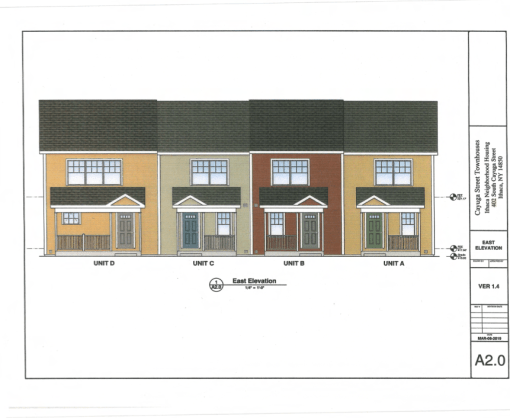
This didn’t come up much before, and that’s probably a good thing because it was rather drab, but 402 South Cayuga Street was revised with a larger window on the three bedroom unit (at far left) and some more vibrant colors. However, to stay within budget (something that defeated INHS once before and Habitat for Humanity as well), the project asked to stick with vinyl, to which the board okayed. Expect this 4-unit for-sale low-to-moderate income townhouse project to begin construction later this year, with completion before the year is out.

2. It was a bit surprising to see how far ahead Cardamone Homes has their Woodland Park project planned out. Quick refresher, this is a 65ish unit residential development off of Warren Road in the town of Lansing; the original plan from the early part of the decade was for about 80 units, but it was reduced after initial approvals. The “-ish” part comes from the 25 single-family home lots, since at least one buyer chose to merge with its neighbor. The other part of the development consists of 40 townhomes, and as ecerything Cardamone does, these are high-end “McMansion” style products. A 2,800-4,000 SF Frank Betz-styled home typically goes in the $550k-750k range with a few customized models even higher than that. The 2,500 SF townhouses are priced in the low to mid 400s. This is arguably the only gated community in Tompkins County.

The project began construction around 2014, and it looks like they’re expecting construction to continue through 2026. It looks like 2019 will see four new townhomes (including the two above, 6 and 8 Woodland Way in a photo from last month), and two or three single-family homes along Oakwood Drive. IT’s a bit of a guessing game on the homes because they use “to be developed” (most), “to be built” (2) and “to be constructed” (1). The site also shows three for sale, but it’s dated, as one of those was sold in January. McMansions may not be fashionable as they were fifteen years ago, Woodland Park still sells at a steady enough clip to keep the project moving along. The long story short for Woodland Park is that construction will be continuing at its slow but steady pace for quite some time yet.

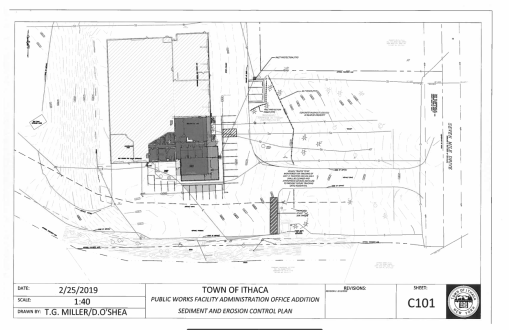
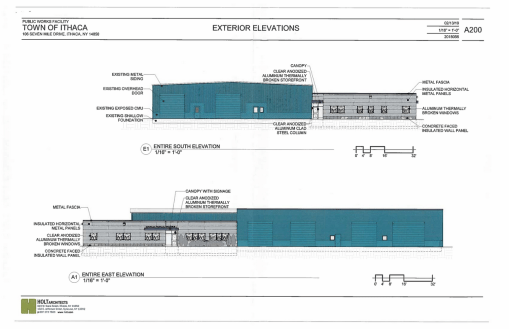
3. Just a little something here from the Town of Ithaca Planning Board – the town of Ithaca is looking to build a modest expansion to its Public Works facility. The Public Works department at 106 Seven Mile Drive handles snow removal, paving, yard waste collection, vegetation control, storm water management, and parks/trails/water/sanitary sewer/road maintenance services. The department has been growing in recent years and needs additional space. A feasibility study was commissioned last June, and a plan is now moving forward.

Overall, it’s not a large addition to the 19,400 SF building; 1,425 SF of office space, six parking spaces and minor landscaping and grading. The project is a small institutional addition, and per state guidelines, it will likely not be going through an in-depth environmental review. The addition is a bit unusual in that it’s essentially a bumpout of the existing space, one that creates a completely new face for the public entrance and offices. Expect an unassuming one-story addition with aluminum windows and metal exterior panels. The addition will be designed by HOLT Architects with several engineering and landscaping partners (the usual retinue of T. G. Miller (Civil Engineering), Elwyn Palmer (Structural Engineering), TWMLA Landscape Architects, and a mechanical/electrical engineering firm, Sack Associates). It’s the same group of firms that did the study last year.

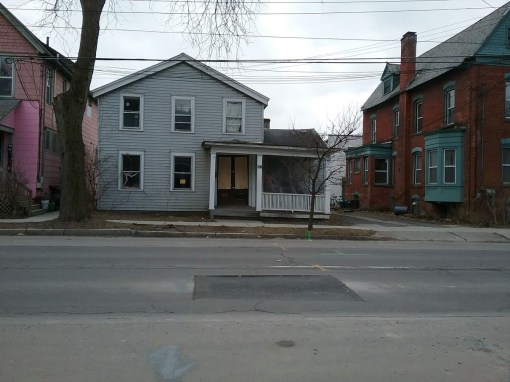
4. Quick note to point out that 327 West Seneca Street is nor long for this world, if the plastic and plywood are any indication. They’re indicative of asbestos removal prior to demolition – seal a build up, take the asbestos out, take the building down. Visum Development Group is planning a 12-unit “workforce housing” moderate-income apartment building on the site.

Speaking of Visum, Ithaca’s prolific developer has been scouting new markets for a while, and landed in Boise, Idaho for their next project, “The Vanguard”, an eight-story, 75-unit apartment building in Boise’s downtown. According to local reports, most development projects finish municipal review in two months, something that is flat out impossible for a project of substantial size in Tompkins County. Interestingly, it comes with no parking, and instead hosts bike racks for 75 bikes. Don’t take this to mean that Visum’s no longer interested in Ithaca, however; there have at several projects in the works, including condominiums in Ithaca town, 201-207 North Aurora, 815 South Aurora, 413-15 West Seneca and the State/Corn Street trio.

//www.instagram.com/embed.js

5. Dunno if Instagram embeds are going to work here, but click STREAM Collaborative’s post just above if it doesn’t show up. The modular pieces for 323 Taughannock have begun arriving on site and are being assembled. The units were built by Benson Wood Products and are being put together but a local firm, D Squared (the Dakes) of Lansing.


News Tidbits 3/11/19

12 03 2019

1. The city of Ithaca and The Vecino group have come to a tentative agreement. The two have been negotiating since entering into a 90-day Exclusive Negotiating Agreement at the end of last year. While Vecino is still looking at the financial models for the conference center space, it appears that the city is ready to move forward with a formal agreement to be voted on by the Ithaca Urban Renewal Agency (IURA) and the Common Council, and then to have the building plans reviewed by the Planning Board, and then the sale of the property to be brokered by the IURA and agreed to by the Common Council. If approval is granted in good order and state funding is obtained (Vecino is pursuing 4% low income housing tax credits, vs. the more competitive 9% variety), then construction could start on the $95 million mixed-use project by late 2020.

2. GreenStar will be asking the IURA for a $400,000 loan to assist in the construction of their new flagship location at 770 Cascadilla Avenue. It does not seem to be related to their construction woes, as the initial paperwork was filed in January, but it makes for rather awkward timing. The loan is likely to be approved without significant reservation thanks to GreenStar’s reputation and the promise of dozens of living wage jobs, though the IURA is unhappy with what is described as “weak collateral”, and it has some concerns with GreenStar’s ability to fundraise.

Important note – the paperwork mentions one of GreenStar’s funding sources will be the buyer of the current Space A Greenstar at 700 West Buffalo Street, who so happens to be “the owner of the Cascadilla Street property”. This buyer will pay $2 million for the building when GreenStar moves out in early 2020.

At first glance, one might think that’s Guthrie. But Guthrie transferred ownership of the parcel to “Organic Nature LLC” last month. Organic Nature LLC is a company owned by the project team building City Harbor. In short, the City Harbor developers are buying the Space @ Greenstar, and likely have plans for the property.

3. If you’re an urban planner – and I hope this blog is interesting to you if you are – the IURA is issuing a request for qualifications for a parking study. The project will include three major tasks: analysis of the current parking system; determination of possible scenarios of programs and actions for the future direction of the parking system that are financially sustainable; and preparation of a strategy and an implementation plan, with estimated costs and a schedule. TLDR; look at existing operations, describe future directions (ten year period), make parking-related recommendations and implementation recommendations. Knowledge of transportation demand management and experience with designing strategic initiatives to handle parking needs will be a big plus. Submission packets due April 12th to Director of Parking Pete Messmer, more info at the end of the agenda packet here.

4. Quick note – the North Campus housing proposed by Cornell was modified slightly at the request of city boards. The new design adds “break points” in the facade to activate the central wings of the buildings and make the building masses seem less imposing. The general massing and material choices remain unchanged.

5. Mid-sized Collegetown landlords Greg and Mataoula Halkiopoulos (of Matoula’s Houses) have decided to renovate a decrepit 19th century carriage house at the rear of their property at 214 Eddy Street, and turn it into a three-bedroom, 839 SF rental. 214 Eddy is in the East Hill Historic District, so the design, by local architect John Barradas, will need to be approved by the Ithaca Landmarks Preservation Commission. It looks like a practical renovation, respectful of the carriage house’s form but also with a modern touch. Early Design Guidance will be offered at the March ILPC meeting, and any decisions on a Certificate of Appropriateness are still a few months out.

6. There have been some major changes to the Perdita Flats plan at 402 Wood Street. Previous version here. For one, it now has frontage on Fair Street and will have a Fair Street address. The building and garden have been re-positioned, the footprint reduced slightly (38’x36′ to 36’x36′), larger porch, modified exterior cladding materials, and the driveway has been removed at the Planning Board’s suggestion. The building remains 4 units and 7 bedrooms, and STREAM Collaborative penned the redesign.

The wood shiplap siding and standing-seam black metal siding are a bit of an acquired taste, especially with the wood oiled or left to grey naturally. But the house is still planning to be a net-zero energy showcase of what can be done with environmentally sustainable multifamily housing, and that’s the real statement to developers (Courtney Royal and Umit Sirt) are trying to make. The owners will be applying for incentives from the NYSERDA Low-Rise Residential New Construction Program and are hoping to attain the Zero Carbon Petal of the Living Building Challenge.


News Tidbits 3/10/19

11 03 2019

1. Next Tuesday, Tompkins County is planning to present a “progress report” on its study on whether or not to buy 408-412 North Tioga Street and redevelop the site. First, let’s not be coy – Tompkins County isn’t really considering any other sites, and staff and officials are pretty strongly inclined towards purchase of the vacant site.
That doesn’t mean they want to tick off the city in the process. It looks like a few different configurations are being considered, but the plans crafted by HOLT Architects essentially call for a new 3-story, 37,000 square-foot building (10,500 SF floor plates with basement space) to replace the 11,000 SF 1950s office structure on the site, restoration of the 19th century building at 408 North Tioga, at least 27 parking spaces in an internal lot, and the selling of land along Sears Street for the construction of two, two-family homes. The county has been in talks with potential developers for those homes, which are likely to be affordable housing since they’ve been in touch with INHS as well as an undefined “others”.

The county has to make its decision by next month, and while there are no hard plans, chances are looking good that the county will be buying the property. A bit more mild speculation off that, I’d wager HOLT will have an inside track in getting the contract to design of the new office building, because they’ll already have an intimate familiarity with the site. While HOLT tends towards modern design, I’d imagine that an office proposal that borders a historic district, whether from their drawing boards or someone else’s, will be more toned town in an effort to fit into the neighborhood.

2. Although speculating is never a good idea, looking at the features of the Immaculate Conception School Redevelopment, I think INHS is in very good shape for getting a Planned Unit Development zone approved by the Ithaca Common Council. Right now, it’s 75 units of affordable housing, with four of those for-sale (if there are unit changes moving forward, it seems to be for more for-sale units and fewer rentals), ~5% will be enabled for physical handicap, ~15% set aside for a special needs group (previously homeless and units for the developmentally disabled is one idea being floated),  non-profit office space for family and childrens’ social services, protection of the Catholic Charities Building, sale of the school gymnasium to the city for use by the Greater Ithaca Activities Center, and changes to design (reduction of a floor and inclusion of a few larger 3-4 bedroom rental units) that demonstrate responsiveness to community concerns as well as transparency with its pre-application community meeting process. Probably the one thing that will remain a sore spot is parking, but this is within several blocks of Downtown Ithaca and close to existing community services, and

Reading down that list, there are a lot of community benefits involved with this plan, and honestly, I think this is exactly what the city hoped to achieve with the PUD Overlay District. The existing zoning would not be amenable to the design as-is, or to the office space alongside the housing. But INHS is putting something out there that appears to make the PUD review process well worth the city’s time and effort.


3. Here is the February redesign of the Arthaus Ithaca project by the Vecino Group. This is the 120-unit affordable housing project planned for 130 Cherry Street, a mostly industrial/post-industrial area that’s starting to see some major reinvestment as attention turns towards the waterfront and the new mixed-use zoning that makes projects like this possible.

I’ve already taken to Twitter to vent about this, but this is just a flat-out unattractive design. The windows are a tough reality of affordable housing – larger window areas raise utilities costs and construction costs, so affordable housing tends to have lower wall-to-window ratios. But the paneling, which can easily be swapped out for different colors and patterns, is just downright ugly. I know it’s a light industrial area, but faux-grunge/faux-decay is not a good look for affordable housing, whether “artistically-inclined” or not. Plus, it’s mostly whites and greys, which for anyone who’s been through a long, dreary Ithaca winter, knows that’s a very depressing combination. So, long story short, like the intended use/program, don’t like the “aesthetics”.

4. In the finishing stretch, the Hilton Canopy Hotel and City Centre have submitted sign packages to the city for approval. The Hilton has something called “Ezra”, ostensibly a nod to Ezra Cornell, but unclear from the submission if Ezra is the name of the hotel or something else; pretty sure the restaurant space was omitted late in the approvals process, so I don’t think it’s an eatery of some sort. Correction: per phone call from project representative Scott Whitham, they added a restaurant back into the plans late in the design process, so Ezra is the small in-house restaurant within the hotel.

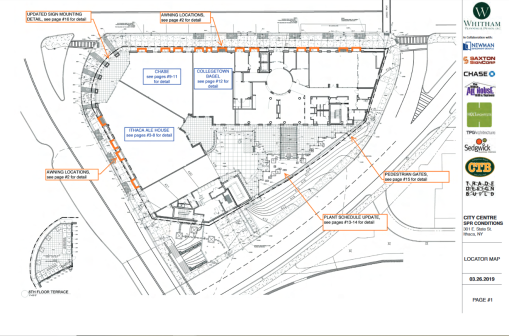
As for City Centre, its signage for the Ale House, Collegetown Bagels and Chase Bank. Although two of three are cannibalizing other Downtown locations, the move comes with some benefits – it’s an expansion for CTB and the Ale House, and the Ale House is expecting to add 20 jobs, and CTB will likely add a few new positions as well. Chase is totally new, and if the average bank branch is 2,000 SF and 6.5 staff, it seems safe to assume that a 5,357 SF branch/regional office is probably 12-15 staff. Ithaca’s own HOLT Architects is engaged in some minor building design work and Whitham Planning and Design is doing the landscaping (including the heat lamps, string lighting and fire pits), Saxton Sign Corporation of Auburn will make the signage, Trade Design Build of Ithaca and TPG Architecture of New York will flesh out the interiors, and East Hill’s Sedgwick Business Interiors will provide furnishings. Clicking here will allow you to scroll through the interior layouts for the retail spaces.

5. Now for some bad news. The GreenStar project is in bad financial straits because the construction bids came in well over budget. As a result, they’re rebidding the construction contracts, and “value-engineering”, the dreaded “V” word. Deleted farm stand, deleted forklift shed, deleted some windows and awnings, cheaper siding, reduced Electric Vehicle chargers, smaller mezzanine, and reconfigured trees and dumpster areas at NYSEG’s request. These changes will be reviewed by the city Planning Board at this month’s meeting, and are likely to pass without much issue; it’s frustrating but no one wants to see GreenStar’s project fail.

6. A few interesting notes from the IURA’s Neighborhood Investment Committee meeting:

7. Here’s a project that was submitted the IURA for possible grant funding, but later withdrawn: the second coming of 622 West Clinton Street.

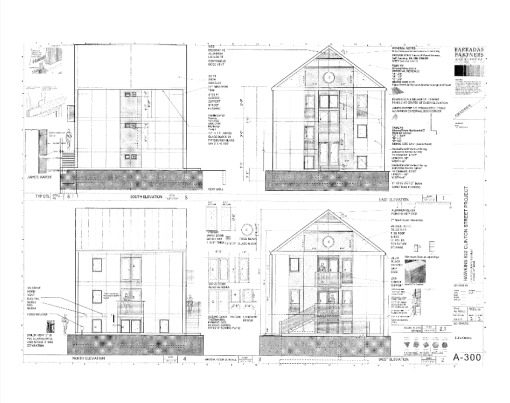
The first time around in 2016, applicant Jerame Hawkins applied to build an affordable, modular duplex at the rear of the property, but the plans weren’t fleshed out and secure enough for the IURA to consider funding. Since then, Hawkins has bought the property and is once again considering a partially-affordable duplex, this time an infill addition by local architecture firm Barradas Partners and construction by Rick May Builders. One unit would be 2 BD/1.5 BA and fair-market value (another way to say market-rate), and a 4 BD/1.5 BA targeted at 60% LMI. The request was $37,000 towards a $237,000 project. In my mind, the issue is the same as the old proposal – the LMI unit was officially limited to one year, which means he could make it market-rate afterward. The IURA would want more bang for their buck, and long-term affordability would be necessary for funding. Still something to keep an eye on in case Hawkins pursues it further.

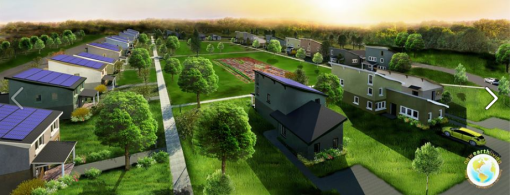
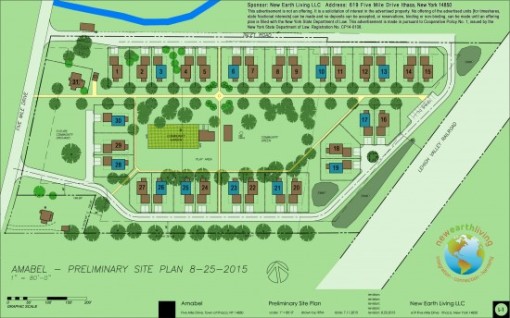
8. The Amabel project is still being worked out, but there is movement. the plan for 31 units of sustainable for-sale housing has been beset with issues. The city of Ithaca is planning to sell land to New Earth Living to let the project move forward, but that sale is contingent on the politically distinct town of Ithaca’s approval. Back in the 1990s, when Southwest Park was designated for development, 26 acres of land was bought in the town of Ithaca as substitute park land. That includes the eastern third of the Amabel property, which was bought with the parcel on the other side of the Lehigh Valley Railroad, but not intended as park space. However, when the deed was written in 1999, it had a restriction saying that all 26 acres could only be used as park space. It now needs to get straightened out, with the town lifting the restriction on the Amabel subsection so that the sale can move forward, and hopefully, Amabel can finally get underway.


GreenStar Co-Operative Market Construction Update, 2/2019

2 03 2019

We’re going to rewind the clock a bit on this to before GreenStar. It’s early 2017. Two major regional medical service providers are eyeing locations in the affluent and growing city of Ithaca. The first is Cayuga Medical Center / Cayuga Medical Associates. The second is Guthrie Clinic / Guthrie Medical Group.

How bad did these two want to outdo each other and lock their rival out of the city? So much so that Cayuga Medical Center paid several times the value on Carpenter Business Park. So much so that Guthrie bought a site that would fail to meet their needs.

For neither CMC or Guthrie was it the best of moves, but not everything is done rationally. In June 2017, Guthrie paid $2.85 million for the properties at 750 and 770 Cascadilla Street, over the asking price of $2.7 million. For those millions they purchased 3.12 acres, with a 37,422 SF printing press/ warehouse built in 1980, and a 30,000 SF storage facility built in 1988. Cornell University had previously used the facilities as part of its printing press operations, and had been seeking to sell the properties since July 2016.

Guthrie started looking at its options at that point, and wasn’t liking them. But there appeared to be an opportunity. The developers of City Harbor, working on their mixed-use proposal a couple of blocks away, would provide Guthrie a convenient escape hatch to Pier Road, where they could build a structure from scratch that would suit their needs. In return, Guthrie would offer up its recently-purchased Cascadilla properties to GreenStar on a long-term lease, with an option to buy.

For GreenStar Co-Op Market, the site was a welcome opportunity of its own, a real estate version of “one man’s meat is another man’s poison”. Founded in 1971, GreenStar has been leasing its current location at 701 West Buffalo Street since the fall of 1992, following a fire that destroyed their store on North Cayuga Street. Satellite stores operate out of the DeWitt Mall at 215 North Cayuga Street in Downtown Ithaca, and at 307 College Avenue in Ithaca’s Collegetown neighborhood. Specializing in locally-sourced and organic foods, the co-op has enjoyed significant market growth in the past decade, with sales increasing by nearly 50% since 2011, to over $22 million annually.

That was both a good and a bad thing. As I wrote for the Voice back in April 2018, GreenStar makes a very small profit on sales, and relies on membership growth as a supplement. But their West End store was jam-packed, all built out with no more room and increasingly agitated co-op members. With other grocers moving in on the organic and natural food market, it was going to be grow, or perish, taking 200 jobs with it. GreenStar had been in talks with landlords and developers for a new space, and City Harbor’s project team was one of those who listened. Just as City Harbor’s Pier Road was Guthrie’s escape hatch, 770 Cascadilla Street was going to be GreenStar’s.

Plans were first announced in December. As a Co-Operative food market, GreenStar has to put any kind of move of this scale out to its shareholders for a vote, through paper and electronic ballots with a three week voting period in March of 2018. The vote for the move was 92% in favor. The project was approved by the city last July, and the groundbreaking was this past November. If all goes well, the lease agreement will allow GreenStar to buy the property from Guthrie in 2030; this passed the member vote with 97% saying yes.

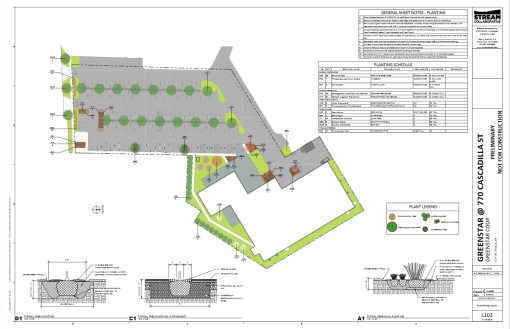
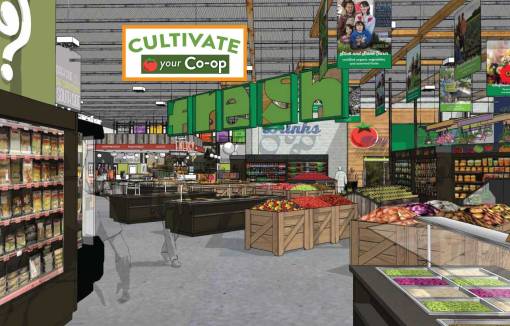
The plan is to renovate 770 Cascadilla into the latest and greatest GreenStar flagship. 750 Cascadilla would come down for a 160-space store parking lot and landscaping. The new space would have an edible garden, outdoor cafe, mezzanine stairway and classrooms. The building would be refinished, insulated, and potentially net-zero energy compatible, meaning all the energy it consumes comes from renewable sources. Breaking it down, the new retail area will be 16,500 SF, there will (well, was, see the last paragraph in this entry) be 5,200 SF mezzanine space for office and administrative functions, and a 13,000 SF kitchen and events space. With the addition of the mezzanine, the warehouse will be expanded in square footage from about 30,000 SF to 35,219 SF. The Space @ GreenStar would be moved to within the new store, and shrink from a 225-person capacity, to 125, and once moved in the old Space @ GreenStar location will be put up for sale. The Space isn’t much of a revenue generator for the Co-Op, and is rarely utilized at full capacity.

The project will take a little over a year, from November 2018 to December 2019 (the store itself wouldn’t open until February 2020, after the equipment is in, shelves are stocked and electronics are tested). Local architecture firm STREAM Collaborative is in charge of exterior design, and architect Pam Wooster will handle the interior layout. Elmira’s Edger Enterprises will be the general contractor for the buildout. Delaware River Solar will supply the solar energy to power the building via an off-site array.

GreenStar, which is carrying out the project with its City Harbor partners (Edger Enterprises, Morse Construction and Lambrou Real Estate) as Organic Nature LLC, did apply for and receive a standard seven-year tax abatement worth about $625k, about 4% of the project cost. $130k in new taxes would be paid over the period. GreenStar’s project would add at least 40 full-time equivalent positions with most jobs in the $15-$16/hour range plus benefits (Starting pay will be about $13.50/hour plus benefits; GreenStar has previously been certified as a living wage employer, though they appear to have been just below it in 2017). Generally speaking, the abatement application was one of the less contentious public hearings, which could be due to GreenStar’s stature in the Ithaca community, its labor and environmental practices, and because dedicated opposition could put 200 jobs and the whole Co-Op at risk of closure.

According to GreenStar’s TCIDA tax abatement application, while the project is $4.9 million to build (hard costs), the overall project costs are $14.8 million. Other sources have said $3.7 million in hard costs, so YMMV. Along with $8.7 million in bank and credit union financing, and $4.6 million in cash equity, the Co-Op has launched a $2.5 million capital campaign to sell investment shares to owners to help cover the project costs.

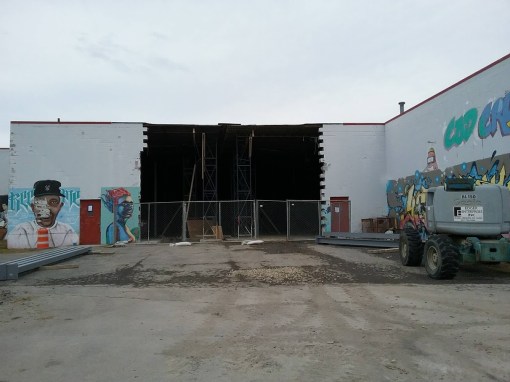
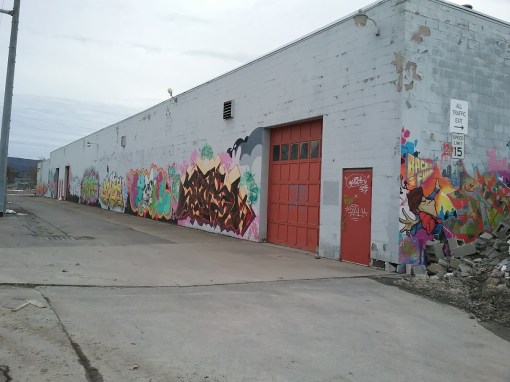
At present, a large gap has been opened in the exterior of 770 Cascadilla’s CMU facade. This is where the entrance of the new GreenStar will be, and it was practically the only major design change during the review process. The steel sitting aside the building may be for building out the mezzanine. A pile of debris sits next to 750 Cascadilla, which will itself be a pile of debris in due course. About the biggest loss here will be some pretty fantastic street art.

In the past couple of weeks, the interior was revised as a cost-cutting measure, shrinking the mezzanine by roughly half and reducing the size of the classrooms from 108 seats to a single room of 33, with the former first-floor classroom space now replaced by offices for GreenStar staff. The opening also appears to have been pushed back by 1-2 months, to “early spring 2020”.


Early render

early render

final render


News Tidbits 1/21/2019

22 01 2019

1. A quick note regarding the county’s feasibility study of a new county office building on the 400 Block of North Tioga Street on the edge between Downtown and Fall Creek – Ithaca’s HOLT Architects has been tapped to perform the analyses. The idea isn’t totally new to HOLT, who had drawn up rough ideas of a joint city-county office building as part of the Downtown Ithaca Alliance’s 2020 Strategy way back at the start of the decade. This process will quietly continue until the results are ready for review and discussion sometime in March.

In an off-record conversation with a county official, the topic came up of, “why not just move to one of the office buildings in the Cornell business park”, as the county Department of Health has done. This person pointed out that it would much easier to buy a building, renovate it, move in and start operations. Except for one bring problem – the suburban office park is hardly accessible, and so the choice of county occupants would be fairly limited, given the need for the county’s less well-off to be able to access the site. A location on the fringe of Ithaca’s Downtown is much more walkable and readily approachable from buses, bikes and so forth, while a Cornell business park is really only readily accessible to those coming by car or the occasional bus. So the county is willing to walk on coals and risk the ire of nearby residents in order to maintain a more accessible facility.

2. Before it was officially announced, the rumor that INHS was selected for the Immaculate Conception School had been floating around for a few weeks. Most of the city staff and officials I’ve spoken with were actually breathing something of a relief, because most of them know and trust INHS. Or rather, they trust INHS to be one of the less divisive choices out there. They’re local, they plan to have a mix of affordable housing and office space for family services-related non-profits, and they’ll be going through an open house process that will give residents a chance to help shape the project before anything goes up to the city for review.

Two details worth noting – for one, INHS does have timeline in mind for its redevelopment (new construction and renovations) to the site. It would like to have tenant occupancy by December 2021, so they’ve got three years to go from start to finish. Expect meetings this Spring and Summer, and probably a project submission by late summer for a fall planning board review and approval by the end of the year. That will give them time to start applying for and attaining affordable housing grants, and to break ground on the redevelopment sometime in 2020.

For two, the city of Ithaca intends on buying the school gymnasium on the northeast side of the parcel. The gym would be used for indoor recreation by the Greater Ithaca Activities Center (GIAC), which is just next door. They’re looking to pay $290,000 for the parcel. It is not clear if this was planned in conjunction with INHS, if INHS developed two separate purchase plans to accommodate that possibility, or if it simply throws a wrench into things. Generally speaking, gym access and affordable housing were the two signaled prerequisites for any city consideration of a Planned Unit Development (PUD), the DIY Zoning that would give more flexibility with site redevelopment. Regardless of PUD, I suspect renovation of the school and Catholic Charities buildings are one key redevelopment feature, and on the new construction side, the parking lot on the corner of North Plain and West Court Streets isn’t long for this world.

3. Tenant number two has been confirmed for City Centre – Collegetown Bagels will be moving from its 1,500 SF location at 201 North Aurora Street, to a 2,300 SF ground-level retail space inside the 192-unit apartment building. According to Edwin Viera at the Times, “Gregor Brous, owner and operator of Collegetown Bagels, decided to make the move after finding out the current building CTB is located in is being demolished.”

For the record, that’s a couple of years out. Visum Development does have plans for the site, which involve a mixed-use apartment building with approximately 60 units above ground-level retail. A sketch plan review was conducted back in 2015, but the plan has not undergone any formal review, and it has to undergo some redesigns anyway since they had planned to buy Jagat Sharma’s parcel at 312 East Seneca Street, and consolidate it into their project. Sharma instead sold to developer Stavros Stavropoulos, who has his own plans for a six-story building. The rumor has been that any redevelopment of the site is still a year or two away, but it is a likely prospect in the medium-term.

As for CTB, the larger space will allow them to try out some new concepts, expand their drink menu, and from the sound of it, add some alcoholic beverages to their offerings. This is not the first time they’ve looked at the Trebloc site, as they had tentatively agreed to move into State Street Triangle, had the building been approved and built.

4. Just to mention the Planning Board Agenda, for the sake of brevity, here’s the link, but not much is actually being decided on this month. Wegman’s is seeking yet another two-year extension on the 15,700 SF retail building they had approved in December 2014 (long rumored as a Wegmans-owned liquor store or a homegoods store similar to Williams-Sonoma). Amici House is seeking some signage variance approval and approval of site plan changes already made. This is likely to pass since its material color and detail changes, but because this was already done without consent and they’re going back to request consent after the fact, the board may have some harsh words. Amici House attends for its 23 studios to be available for occupancy by young, formerly homeless or otherwise vulnerable individuals by February 1st. Site plan approval is also on the agenda for the Maguire Ford Lincoln renovation and expansion. New proposals are the 200-unit mixed-use Visum affordable housing duo shared on the Voice today, and the Modern Living Rentals proposal for 815 South Aurora, which as touched on the other day, is likely to be pretty sizable.

The supplemental on the Falls Park senior housing project notes that the project is intended to qualify under Ithaca’s Green Building Policy under the “Easy Path” scoring system, and perhaps a bit disappointingly, the smokestack for Ithaca Gun, once intended for incorporation into the public space, will be coming down so that the ground beneath it can be cleaned during the remediation. However, smokestack bricks will be available as mementos for those who want them.

Heading to the ZBA will be a lot subdivision to split a double lot on Homestead Road back into two lots, the Amici House signage, and Agway’s plan to rebuild a 700 SF storage shed destroyed by fire, with a new one-story 1,400 SF structure. Zoning on its waterfront site requires two floors, but the new shed is only one floor and needs a variance.


News Tidbits 1/20/2019

21 01 2019

Now to start digging into the odds and ends:

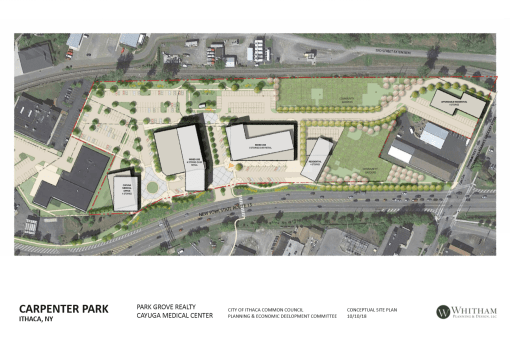
1. For those interested in learning more about the Carpenter Business Park proposal, Northside United, the neighborhood group that represents the Northside Neighborhood, will be hosting the development team for a presentation and Q&A on Monday, February 4th 6pm at the Quaker Meeting House on 120 Third Street. Here’s the project breakdown as provided in email by Northside United:

Affordable Housing. A 4-story building with 42 one and two-bedroom units of working family housing will be sited near Farmer’s Market and 3rd Street and targeted at those in the 50-60% of area median income ($30,000-$35,000 household income range). The affordable units are in a separate 4-story building from the market rate units, they say due to federal/state requirements for low-income housing tax credits. Park Grove Realty (with staff formerly associated with Conifer) will manage the affordable units.

Market Rate Housing. In addition to the building affordable housing, two other 4-6 story buildings in the development will be targeted at market rate rents (and also include commercial/retail).  Maybe 150 or so units of market rate housing.

CMC Medical Office Building. This 4-story building, at the east end of site near Cascadilla Street, is slated to be mostly medical/specialist offices and a still to be defined “healthcare location,” but not a “convenient-care” type facility.

Commercial Space. Tentatively there will also be approximately 20,000 feet of commercial space in the development.

Neighborhood Design and Features. They talk about this being a small “new neighborhood” of its own, but knitted together with our existing Northside neighborhood.

Community Gardens. Ithaca Community Garden retains its current size (following a land swap) and becomes permanent (pending agreement with Gardens and City). As this is being negotiated with the Gardens and City, NU probably does not need to spend time on it.

Opening Fifth Street to Rt. 13 is being considered.  

Northside United participants have asked the development team consider an urgent care or dental clinic on-site, screening the parking from the rode, better pedestrian and bike access (with reference to Form Ithaca’s boulevard concept), consider townhomes vs. multistory buildings, making the Fifth Street access pedestrian/bike only, well-designed green space, include a local committee of officials, residents and developers to guide the design process, and satisfaction with the affordable component, though they’d like it mixed with other buildings. That last one is always tough, because state-administered affordable housing grants don’t allow this out of concern the market-rate section goes bankrupt; so if they were in the same building, they would still have to be one contiguous entity within the building, as with Visum’s Green Street proposal.

Kind word of advice – if you want to attend but are not a Northside resident, be as respectful like you’re a guest invited to someone else’s house. In the 210 Hancock debate, Fall Creek was strongly negative to the affordable housing proposal, which was in neighboring Northside and better received in Northside. But Fall Creekers had a habit of steering the conversation, which created tensions with Northside United.

2. Dryden’s Tiny Timber Homes has been keeping busy. The firm is rolling out a new line of smaller homes in an effort to better meet the needs of the middle-income housing market. The first home shown above is their first truly tiny timber – a 330 SF home that sells for about $75,000 fully finished. The second example is a U-shaped ranch home being built on Landon Road in the town of Caroline; that 2-bedroom, 856 SF home on 1.2 acres is selling for $199,000, which is practically the maximum buying power of the median family income in Tompkins County (3.4 * $59,000 = $200.6k). The new line of homes will include designs ranging from the 330 SF example, to 1,100 SF, which can be built for $150-$200/SF depending on the home model, location and features.

Tiny Timbers has also rolled out its next cluster development, a 20-home development on 6 acres on a vacant West Hill at the dead end of Campbell Avenue. Plans call for screened parking, a community garden and a multi-use trail. As reported by my Voice colleague Devon Magliozzi, the Planning Board was enthusiastic but cautioned that West Hill was generally averse to any new development. I dunno if that is totally true in this case; I had a conversation with George McGonigal a few years ago when Tiny Timbers bought the property, and he was cautiously optimistic for owner-occupied housing as long as they weren’t “packed like sardines”; dunno if ~3 units/acre passes the test. This would be their second such development, following the Tiny Timbers Varna plan, “The Cottages at Fall Creek Crossing”, which has sold at least four of its fifteen lots (the website shows three sold, but it’s not clear when the webpage was last updated) and is undergoing site prep for the new homes. The homes here would likely be similarly priced, in the $200k-$275k range, and 850 SF – 2,000 SF.

3. Here’s a look at the New York State Department of Transportation’s plan for a new regional facility on Warren Road in the town of Lansing. Here’s a description of the plan as reported by the Lansing Star, per DOT representatives at the meetings to the county and town last week:

“Buildings on the site will include a 30,000 square foot ‘sub-residency’ maintenance building, a 5,000 square foot Cold Storage, a 8,200 square foot Salt Barn, and a 2,500 square foot Hopper Building (covered lean-to). The proposed maintenance building will have vehicle storage for 10 trucks, a loader and tow plow, with one additional double depth mechanical bay and single depth, drive-thru truck washing bay. It also includes an office area (three rooms), lunch/break room (30 people), toilet/shower/locker rooms, storage rooms and mechanical/electrical rooms. The site will also contain stockpile areas for pipe, stone and millings, and ancillary site features including a fueling station, parking for 40 vehicles, and stormwater management facilities. The project will require construction of an access drive from Warren Road and the extension of utilities.”

As is often the case with high-priority state projects, the construction time frame is fast – the governor’s office wants the site built and fully operational by the end of the year. Also, much to the chagrin of some very unhappy neighbors who don’t want a DOT facility nearby, the town of Lansing is not Lead Agency in environmental review – the Federal Aviation Agency (FAA) is, given proximity to the airport (the county sold the 15.5 acres of land to the airport last September). Public resource projects by the state, like state-owned office buildings, state maintenance facilities and labs, are generally excluded from local zoning codes and do not have nearly as lengthy of an approval process. The nearly 1,000 page Environmental Site Assessment report can be found on the DOT website here. CHA Companies (formerly  Clough Harbor and Associates) of Albany, a prominent state contractor, did the assessment on behalf of the state.

There’s always going to be a bit of limitation in where the state can go with a project like this. The state wants out of the waterfront, not just because the county wants the land to be redeveloped, but because the salt and vehicle fluids could pose risks to the water quality of the inlet and lake (and DOT doesn’t want to be on the hook for that), access to 13 is more difficult due to urban traffic, the location isn’t efficient to where the state plows state roads previously handled by the town, and lastly, the state has simply outgrown the waterfront site -it needs more land, and taking the railroad’s or the Farmers Market’s is not a viable option. The state did originally plan using a site in Dryden on Ellis Drive, but the state determined that response time to urban areas was too long, and since some of the land was federally designated as wetland, the site was too small.

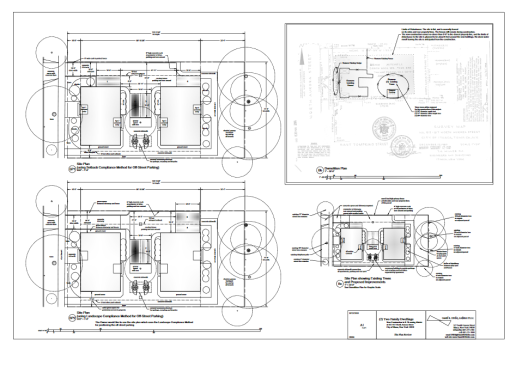
4. In the county’s deed filings, one of the more common recordings is the easements filed by NYSEG, often for new line connections to the power grid. Once in a blue moon, they turn up something interesting. The above site sketch comes courtesy of one of those filings. Scott Morgan owns 543 Asbury Road, and in 2015 he had proposed eight duplexes on the property, but the town had issues with that much density on a rural lot, so Morgan shelved the plan and the town amended the code to prevent such density on rural parcels. In turn, it appears that Morgan subdivided the 5-acre lot into four parcels, and is building a duplex on each. If they’re like his Lansing rentals, expect them to be ranch-style units with two bedrooms each.


News Tidbits 12/17/18

18 12 2018

Here’s a look at the agenda for the city of Ithaca Planning and Development Board meeting this month. It’s a week earlier than usual due to the Christmas holiday. Notes and comments in italics below.

1. Agenda Review 6:00
2. Special Order of Business – Presentation of the Greater Southside Plan 6:05
3. Privilege of the Floor 6:20
4. Approval of Minutes: November 27, 2018 6:35

5 Special Permits 6:40

A. Project: Bed & Breakfast Special Permit
Location: 130 Coddington Road
Applicant: Noah Demarest
Actions: Declaration of Lead Agency, Public Hearing, Determination of Environmental Significance, Potential Consideration of Special Permit Approval

Project Description: The applicant is seeking a Special Permit for use of the property as a homeowner occupied Bed and Breakfast. The property was originally issued a Special Permit in 1998 for operation of the five bedroom home as a homeowner occupied Bed and Breakfast; the Special Permit was not renewed in 2003, as required by §325-9c(4)(g)[3], and has therefore expired. During a recent home inspection, it was discovered the property had continued to operate absent a Special Permit, necessitating a new Special Permit application. No physical alterations to the building or the site are proposed. Issuance of a Special Permit is an Unlisted Action under the City of Ithaca Environmental Quality Review Ordinance (“CEQRO”) and the State Environmental Quality Review Act “(“SEQRA”)

This is a simple case of where the previous owner never renewed the five-year permit and didn’t tell the new buyer, who planned to continue using the home as a live-in Bed & Breakfast. No letters of opposition are on file. Approval, with the proper completion of all necessary forms, is likely to be straightforward.

B. Project: Bed & Breakfast Home Special Permit 6:50
Location: 2 Fountain Place
Applicant: Jason K Demarest
Actions: Declaration of Lead Agency, Public Hearing, Determination of Environmental Significance, Potential Consideration of Special Permit Approval
Project Description: The applicant is seeking a Special Permit to operate the existing 4,492 SF nine (9) bedroom residence located at 2 Fountain Place as a Bed and Breakfast Home. The owner is proposing to utilize four (4) of the nine (9) bedrooms as guest bedrooms for a period not to exceed 21 consecutive days, with a fifth bedroom utilized for home-owner occupancy. Guest occupancy will be limited to two persons or one family per guestroom. No exterior modifications are proposed to the existing home to establish the B&B use, and the existing house is compatible with the character of the neighborhood. Existing parking for seven (7) vehicles exists in the turnaround off Willets Place. The applicant does not propose cooking facilities in the guestrooms, and food service is to be limited to guests of the B&B. No other B&B Homes exist within 500 feet of the property. One sign that is five (5) SF maximum in area and not self-illuminated will be installed in compliance with Chapter 272 of the City Code, “Signs.”

Under city zoning code, B&Bs, which are to be owner-occupied, are allowed to four bedrooms to be used for the guests. A zoning code variance to use eight bedrooms as guest occupancy seemed unlikely, but the new owners believe the B&B may still be viable. Local architect Jason K. Demarest (brother of STREAM’s principal architect, Noah Demarest) is known for his historic restorations and historically-inspired design work, so his involvement is auspicious for those who hope that the century-old mansion and former Ithaca College president’s house retains its character.

6 Site Plan Review

A. Project: Chain Works District Redevelopment Plan (FGEIS) 7:00
Location: 620 S. Aurora St.
Applicant: Jamie Gensel for David Lubin of Unchained Properties
Actions: Review FGEIS & Town Comments – No Action
Project Description: The proposed Chain Works District seeks to redevelop and rehabilitate the +/-800,000 sf former Morse Chain/Emerson Power Transmission facility, located on a 95-acre parcel traversing the City and Town of Ithaca’s municipal boundary. The applicant has applied for a Planned Unit Development (PUD) for development of a mixed-use district, which includes residential, commercial, office, and manufacturing. The site’s redevelopment would bridge South Hill and Downtown Ithaca, the Town and the City of Ithaca, by providing multiple intermodal access routes including a highly-desired trail connection. The project will be completed in multiple phases over a period of several years with the initial phases involving the redevelopment of the existing structures. Current redevelopment of this property will focus on retrofitting existing buildings and infrastructure for new uses. Using the existing structures, residential, commercial, studio workspaces, and office development are proposed to be predominantly within the City of Ithaca, while manufacturing will be within both the Town and City of Ithaca. Project materials are available for download from the City website: http://www.cityofithaca.org/DocumentCenter/Index/119

Hey, they’re starting to include documentation links in the agenda descriptions now! Most of the town’s comments are minor modifications and a possible correction on one of the traffic lane analyses. There’s a boatload of paperwork to dig through, so this meeting is just a chance for the planning board to look at the town’s comments, digest some of the supplemental files, and make sure there are no red flags or major concerns within that subset of information.

B. Project: North Campus Residential Expansion (NCRE) 7:20
Location: Cornell University Campus
Applicant: Trowbridge Wolf Michaels for Cornell University
Actions: Determination of Environmental Significance
Project Description: The applicant proposes to construct two residential complexes (one for sophomores and the other for freshmen) on two sites on North Campus. The sophomore site will have four residential buildings with 800 new beds and associated program space totaling 299,900 SF and a 59,700 SF, 1,200-seat, dining facility. The sophomore site is mainly in the City of Ithaca with a small portion in the Village of Cayuga Heights; however, all buildings are in the City. The freshman site will have three new residential buildings (each spanning the City and Town line) with a total of 401,200 SF and 1,200 new beds and associated program space – 223,400 of which is in the City, and 177,800 of which is in the Town. The buildings will be between two and six stories using a modern aesthetic. The project is in three zoning districts: the U-I zoning district in the City in which the proposed five stories and 55 feet are allowed; the Low Density Residential District (LDR) in the Town which allows for the proposed two-story residence halls (with a special permit); and the Multiple Housing District within Cayuga Heights in which no buildings are proposed. This has been determined to be a Type I Action under the City of Ithaca Environmental Quality Review Ordinance (“CEQRO”) §176-4 B.(1)(b), (h) 4, (i) and (n) and the State Environmental Quality Review Act (“SEQRA”) § 617.4 (b)(5)(iii). Project materials are available for download from the City website: http://www.cityofithaca.org/DocumentCenter/Index/811

This is likely to be the most contentious part of the meeting. The planning staff have conducted their analysis. Some traffic mitigation measures are sought, including circulation and mass transit / multi-modal transit improvements. The city will make sewer system upgrades a stipulation of project approval, and being next to the Cornell Heights Historic District, the board as Lead Agency wants a more sensitive use of materials and material colors, and extensive vegetative screening to be reviewed further before approval. But the most debated component, the energy use impacts, the city feels is effectively mitigated through the proposed measures by the applicant team.

I’m going to raise one point of correction though – the number of beds is going up to 2,079, but the planning staff should note that a campus-owned fraternity house, the former Sigma Alpha Mu building at 10 Sisson Place (the chapter moved to 122 McGraw Place), is coming down to make way for the project, so the gross number of beds is at least 30 less that that figure.

C. Project: Falls Park Apartments (74 Units) 7:50
Location: 121-125 Lake Street
Applicant: IFR Development LLC
Actions: Review of FEAF Part 3 – No Action
Project Description: The applicant proposes to build a 133,000 GSF, four-story apartment building and associated site improvements on the former Gun Hill Factory site. The 74-unit, age-restricted apartment building will be a mix of one- and two-bedroom units and will include 7,440 SF of amenity space and 85 parking spaces (20 surface spaces and 65 covered spaces under the building). Site improvements include an eight-foot wide public walkway located within the dedicated open space on adjacent City Property (as required per agreements established between the City and the property owner in 2007) and is to be constructed by the project sponsor. The project site is currently in the New York State Brownfield Cleanup Program (BCP). Before site development can occur, the applicant is required to remediate the site based on soil cleanup objectives for restricted residential use. A remedial investigation (RI) was recently completed at the site and was submitted to NYSDEC in August 2018. The project is in the R-3a Zoning District and requires multiple variances. This is a Type I Action under the City of Ithaca Environmental Quality Review Ordinance (“CEQRO”) §176-4 B(1) (h)[2], (k) and (n) and the State Environmental Quality Review Act (“SEQRA”) §617-4 (b) (11). Project materials are available for download from the City website: http://www.cityofithaca.org/DocumentCenter/Index/852

Part III of FEAF is the city planner-written review of impacts, proposed mitigations, and whether the lead agency feels the mitigations are appropriate and effective. Some stormwater, remediation plan and other supplemental materials are still needed before a declaration of significance can be made. 

D. Project: New Two-Family Dwellings 8:10
Location: 815-817 N Aurora
Applicant: Stavros Stavropoulos
Actions: Public Hearing
Project Description: The applicant proposes to demolish an existing two-family residential structure and construct two new 1,290 SF two-family dwellings on a 9,590 SF lot. The existing residential building is a legally non-conforming building with a side setback deficiency (2.9 feet instead of the required 5 feet). The proposed redevelopment will include four parking spaces for four three-bedroom apartments. The applicant is requesting the Board’s approval to use the landscaping compliance method for parking arrangement. The project site is located in the R-2b Zoning District and meets all applicable zoning lot and setback requirements. This is an Unlisted Action under the City of Ithaca Environmental Quality Review Ordinance (“CEQRO”) and the State Environmental Quality Review Act (“SEQRA”). Project materials are available for download from the City website: http://www.cityofithaca.org/DocumentCenter/Index/859

City staff were really unhappy about this plan last month, and it was implied that this was one of the examples of “bad” infill that may lead to the new single primary structure overlay. However, barring extreme circumstances (think Maguire at Carpenter Park), review will continue under the current regulations. No new materials appear to have been submitted since the last meeting. 

E. Project: Maguire Ford Lincoln Additions and Improvements 8:30
Location: 370 Elmira Road
Applicant: John Snyder Architects PLLC
Actions: Public Hearing, Potential Determination of Environmental Significance

Project Description: The applicant proposes to demolish a portion of the existing building and construct two additions with updated exterior materials. The existing building is 18,500 GSF, with 2,265 GSF proposed for demolition. The new building will be 24,110 GSF. Site improvements include incorporation of a new pedestrian walking path, and site connections to Wegmans. Approximately 311 parking spaces are proposed to accommodate customer, service parking, employee, and display parking. The project site is located in the SW-2 Zone, is subject to the 2000 Southwest Design Guidelines, and will require a zoning variance for a front yard that exceeds the maximum permissible in the SW-2 district (34 feet maximum permitted, 69-feet 3-inch setback proposed). This is an Unlisted Action under the City of Ithaca Environmental Quality Review Ordinance (“CEQRO”) and the State Environmental Quality Review Act (“SEQRA”); however, it will be treated as a Type I Action for the purpose of environmental review. Project materials are available for download from the City website: http://www.cityofithaca.org/DocumentCenter/Index/860

The revised plans include modified architectural features (more windows, a green wall), and a greater amount of vegetated landscaping to comply with zoning. On-site solar panels are being considered per board recommendation, but the old building was not designed to hold the weight of solar panels. The new wings will be designed to host panels. Heat pumps are being evaluated for some functions, but some of the heavy-duty components like the service bay will likely rely on modified conventional fuel systems. The building will meet or exceed NYS Energy Code requirements.

F. West Hill- Tiny Timbers – Sketch Plan 8:50

This one has been a long time coming. Tiny Timbers bought a 5.45 acre parcel on the south end of Campbell Avenue’s 400 block back in September 2016, and has long planned one of its cluster home developments on the vacant lot. As noted at the time on the blog:

“Dolph et al. are looking to do a similar development to the one in Varna on a 5.45 acre parcel at the south end of the 400 Block of Campbell Avenue, which was noted in a weekly news roundup when it hit the market back for $195k in August 2015. The Journal’s Nick Reynolds touched on it in a through write-up he did earlier this week. The comprehensive plan calls this portion of West Hill low-density residential, less than 10 units per acre. Current zoning is R-1a, 10000 SF minimum lot size with mandatory off-street parking, although maybe a cluster subdivision would come into play here. The Varna property is a little over 6 units per acre. If one assumes a similar density to the Varna project, the ballpark is about 35 units, if sticking to the 10000 SF lot size, then 23 units.

On the one hand, expect some grumbling from neighbors who won’t be thrilled with development at the end of their dead-end street. On the other hand, these small houses are modestly-sized and priced, they’ll be owner-occupied, and if the Varna site is any indication, the landscaping and building design will be aesthetically pleasing.”

G. 112-114 Summit Ave – Sketch Plan 9:10

This one required some fact-checking, because 114 Summit Avenue was the former Cascadilla school dorm that came down last year to make way for the Lux apartment project at 232-236 Dryden Road. A better address for this project might be “238 Dryden”, and the rumor mill says it’s by Visum Development Group, who developed the Lux. Although the exact positioning seems uncertain, the parcel north of the Lux is CR-3 (three floors, 40% lot coverage, parking and houselike features such as gables and porches required), and the remaining adjoining parcels are CR-4 (four floors, 50% lot coverage, no parking required). With student housing experiencing a little more slack in the market lately, it’s not clear if this is student housing, or another use.

7. Old/New Business PRC Meeting Time/ Date 9:30

8. Reports
A. Planning Board Chair
B. BPW Liaison
C. Director of Planning & Development 9:40

9. Adjournment 9:50