Cornell Veterinary School Expansion Construction Update, 3/2017

26 03 2017

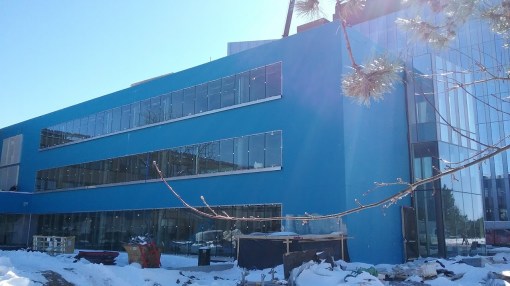
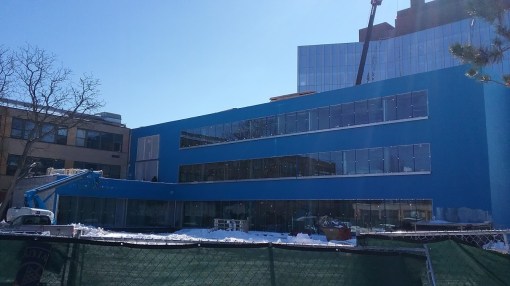
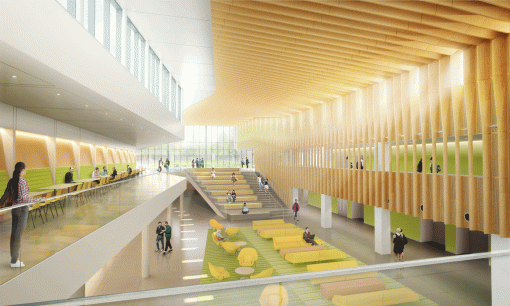
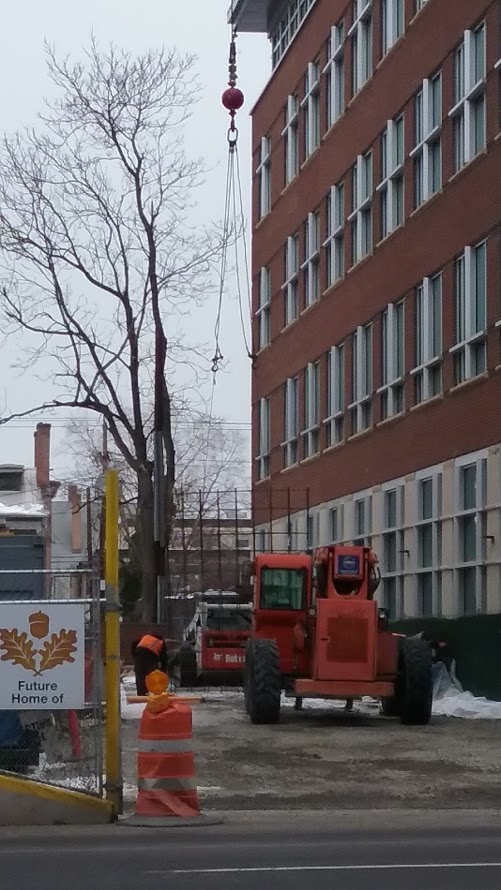
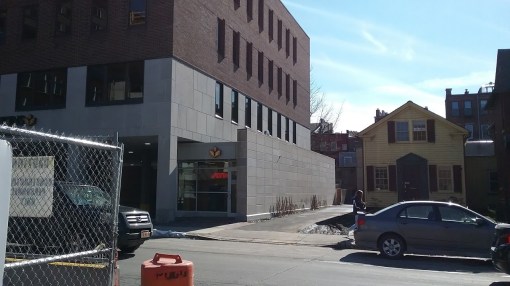
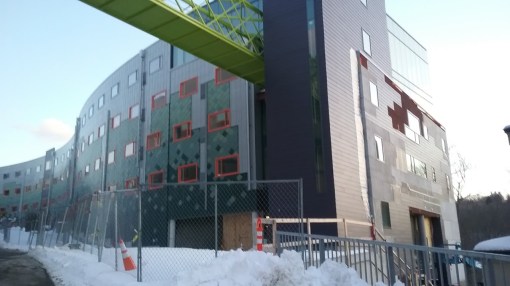
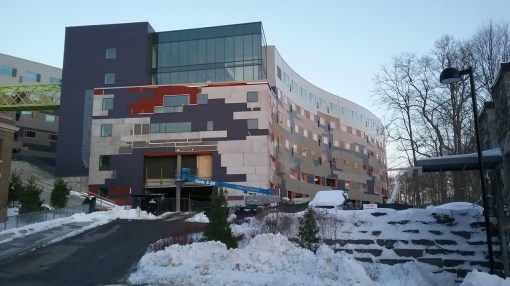
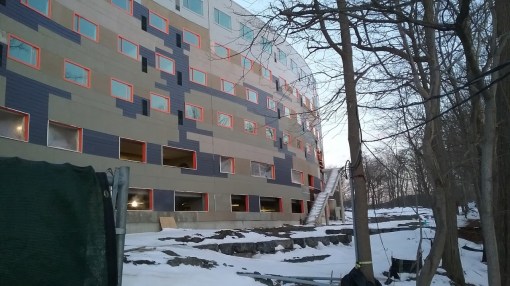
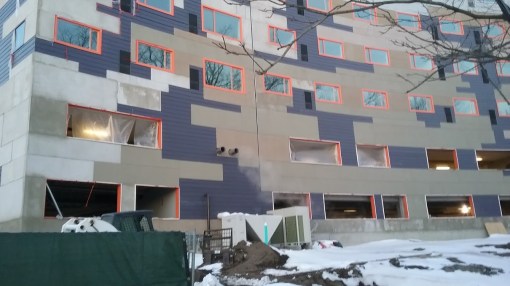
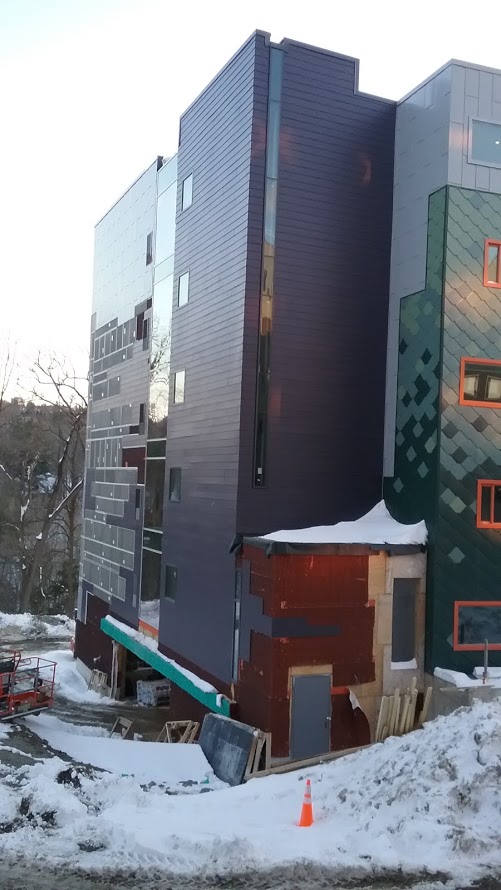
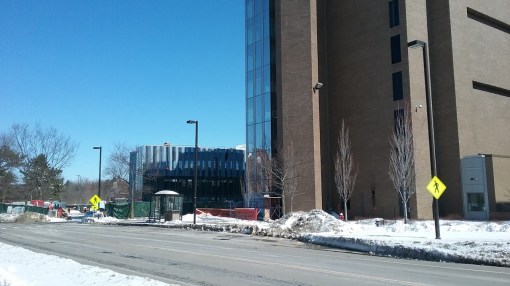
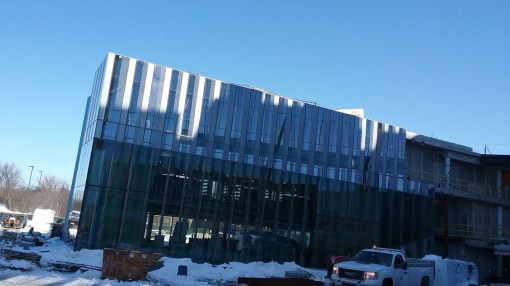
There’s been quite a bit of progress over at the Vet School. It looks like the exterior glass and aluminum are going on the new library and administrative wing. Windows and sheathing have been installed on the north face as well, with a water-resistive barrier applied over the sheathing. The new atrium is being framed out.

According to the Vet School’s construction update page, interior framing and utilities installations are underway in the new wing, and the new cafeteria is under construction – both are aiming for August completions. The new atrium and lecture hall will be closed off shortly, with interior work to launch in earnest once that occurs.

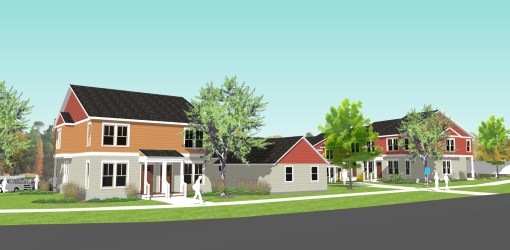
Thanks to Maria Livingston over at HOLT Architects, readers now know what the new Community Practice Service building will look like. Syracuse’s G. M. Crisalli and Associates Inc. has been selected as general contractor, and construction for the $7 million, 12,000 SF wood-frame structure is expected from March 2017- March 2018.


The Cherry Artspace Construction Update, 3/2017

26 03 2017

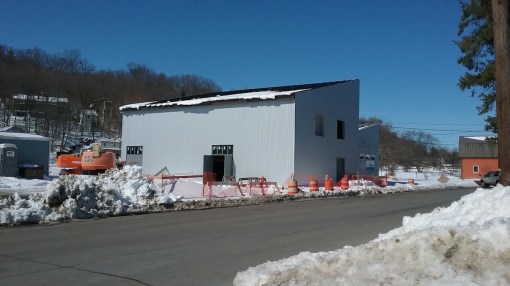
The corrugated metal exterior has been attached, the roof is complete, and the doors and windows are being fitted. Once the steel framing was completed, the exterior work was expected to move quickly, as all the components had already been assembled and were just waiting in storage. McPherson Builders is making quick work of the 1,900 SF project.

The Cherry Artspace crew do a great job providing updates on their website, on a much quicker timeframe than this blog. They also have some interior shots, which show the mezzanine area, and the insulation that has yet to be installed. The first show inside the new venue is scheduled for April 20th (for those interested, tickets here).

I did an in-depth interview for the Voice about the Cherry Arts and the Artspace with Director Samuel Buggeln and Associate Director Jennifer Herzog, which I very much enjoyed. A copy of that can be found here.


Tompkins Financial Corporation HQ Construction Update, 3/2017

25 03 2017

Apparently I forgot to to an update on the Tompkins Financial project last month? It must have slipped off the radar after the Voice received its spark notes version. Funny how it was about 60 F when the February photos were taken, and about 30 F when the March photos were snapped.

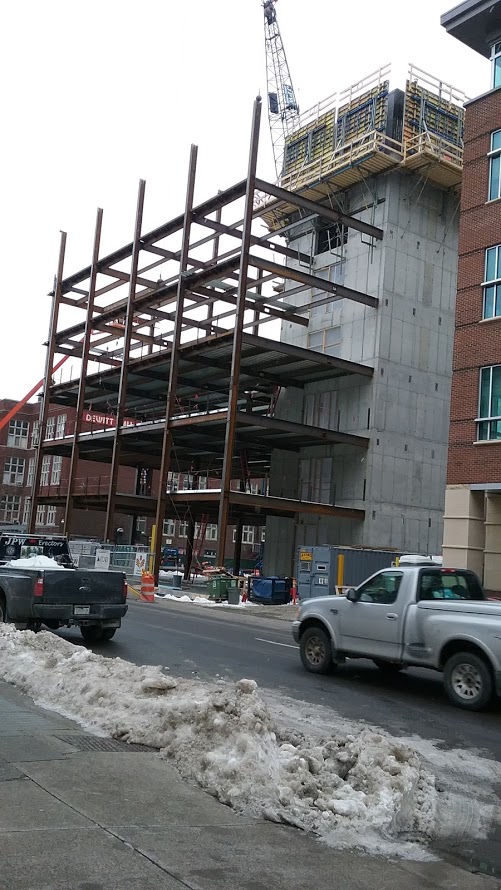
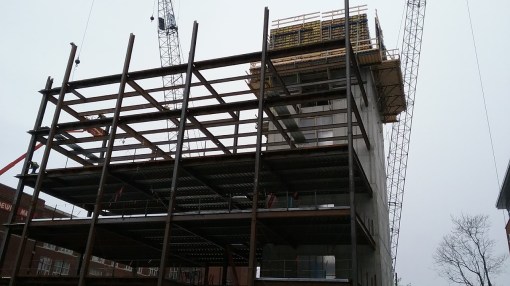
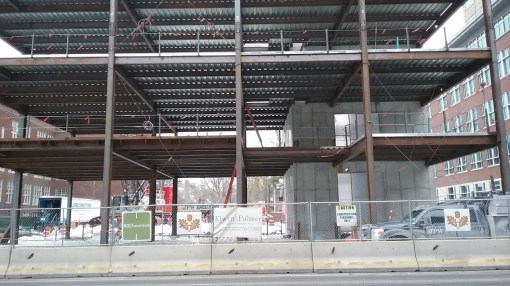
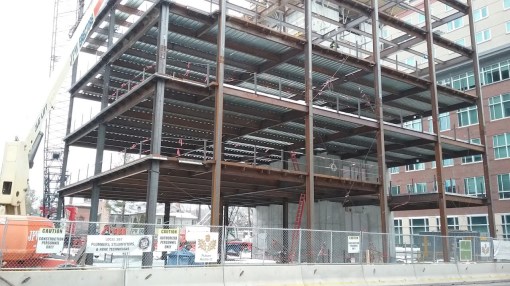
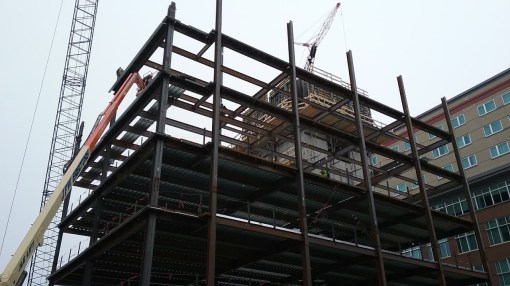
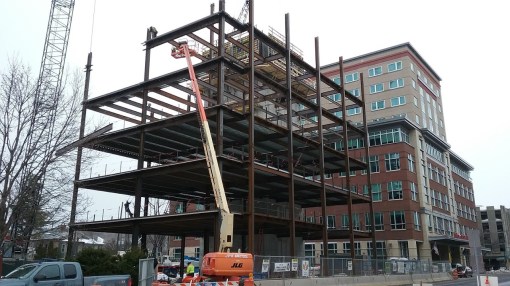
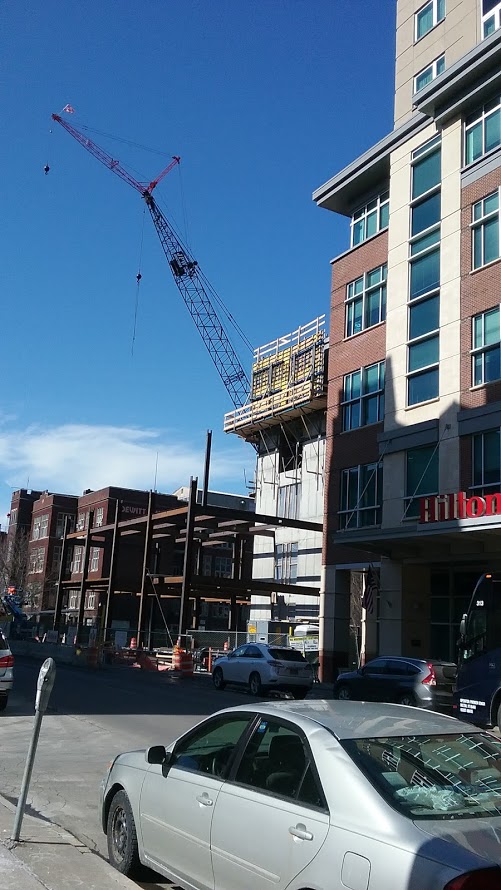
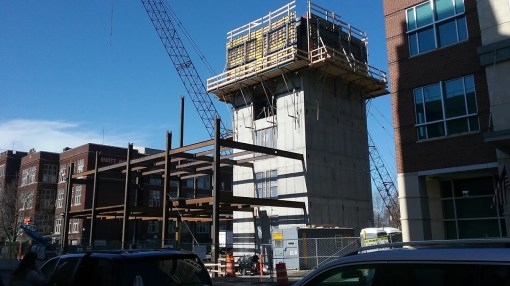
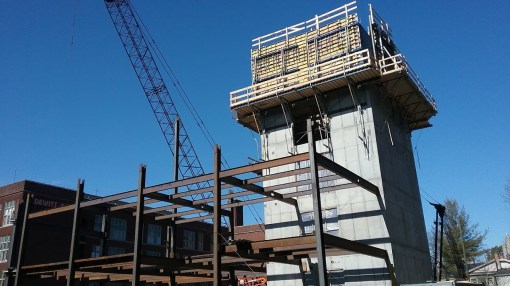
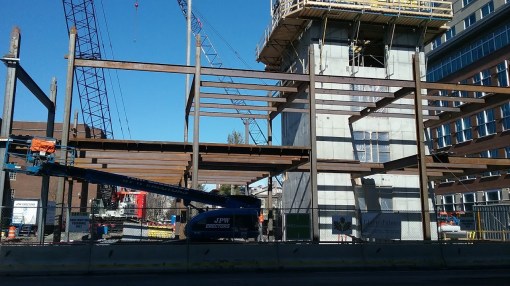
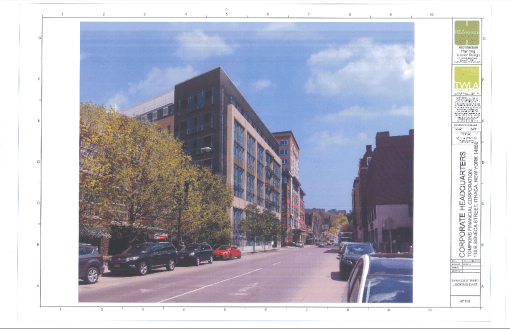
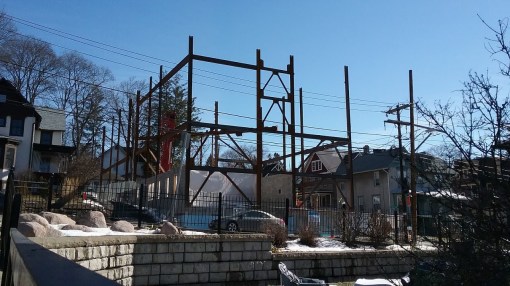
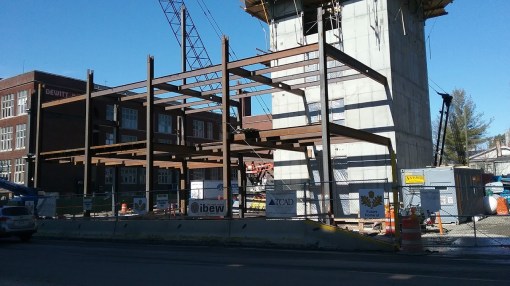
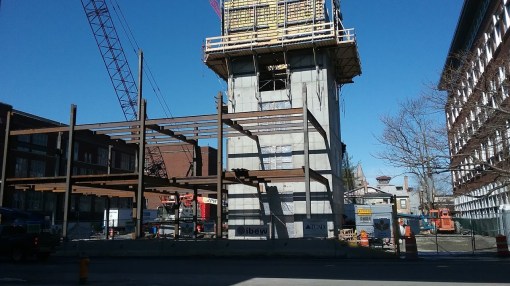
Anyway, structural steel framing is underway, giving an idea of the bulk of Tompkins Financial Corporation’s new 110,000 headquarters at 118 East Seneca Street. Framing has started for the first five floors of the seven story building, and mor beams will be built upward and outward – note the indents in the elevator core on the side facing Seneca Place, intended for future steel beams. The lowest floors have also received corrugated steel decking. There are still a couple of floors to go, as evidenced by the wood forms on the elevator shaft. The concrete will extend another two floors before it’s topped out. The building’s ground to rooftop height will be exactly 100 feet.

A May or early June topping out seems plausible. Occupancy is intended by March 2018. JPW Erectors, a division of the JPW Companies of Syracuse, is in charge of the framing, while LeChase Construction is the general contractor.

February 2017


Collegetown Terrace Construction Update, 3/2017

22 03 2017

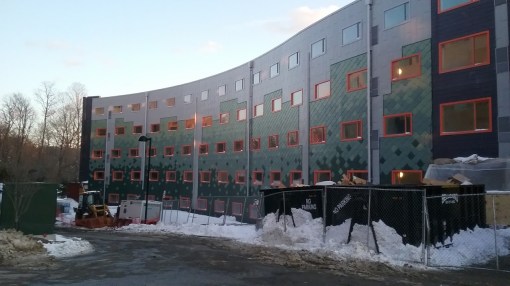
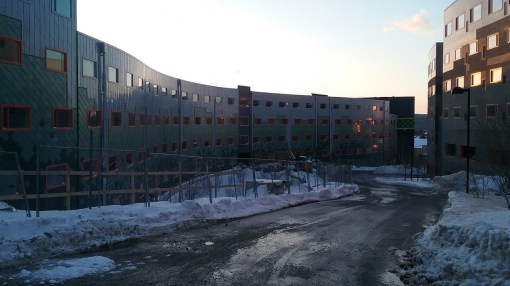
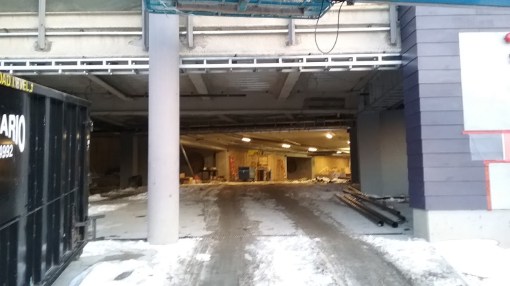
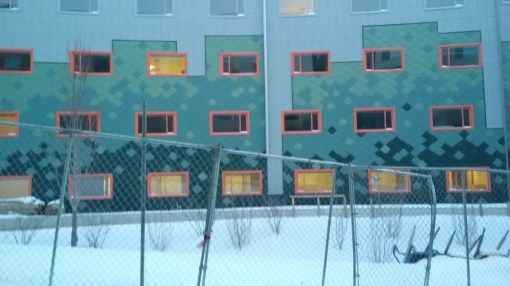
From the outside, Collegetown Terrace’s third and final phase is nearly complete. Some cement panels and clapboards are still being attached at the ends and the south face, and the entry areas need to be finished out, but otherwise it looks like the exterior is mostly finished.

Peering through the windows as the lights clicked on, it looks like drywall has been hung in most of the units, and closet doors and cabinetry are or are being installed, meaning they’re pretty far along and that finishing work is all that’s left for some units (there are 344 units, so it could take a while to do them all). All in all, things look on track for the expected summer completion. Kudos to Welliver for keeping such a massive building on schedule.

\


602 West State Street Construction Update, 3/2017

21 03 2017

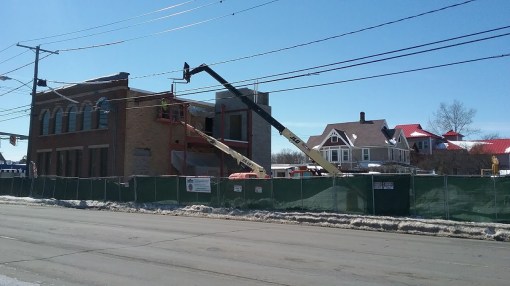
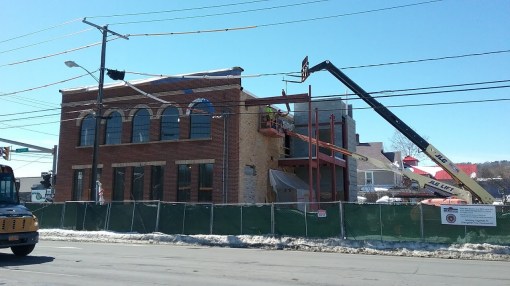
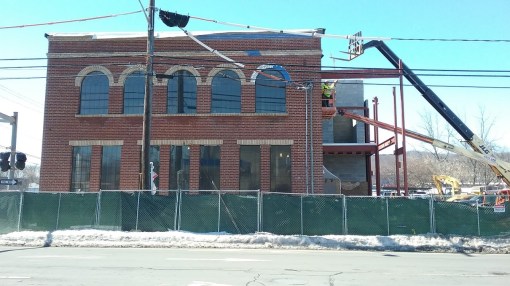
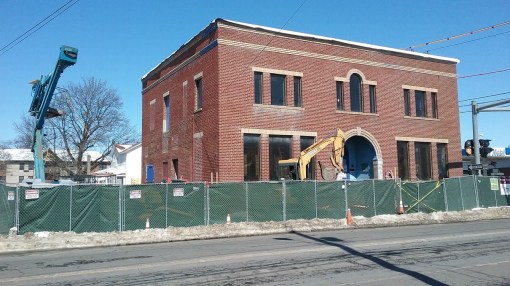
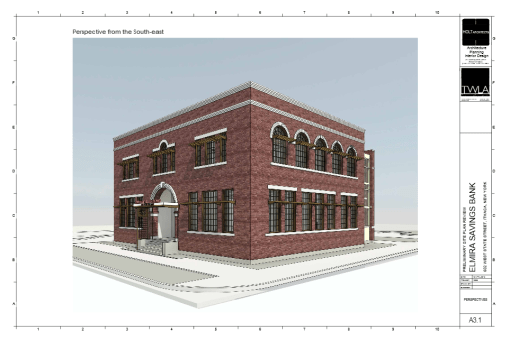
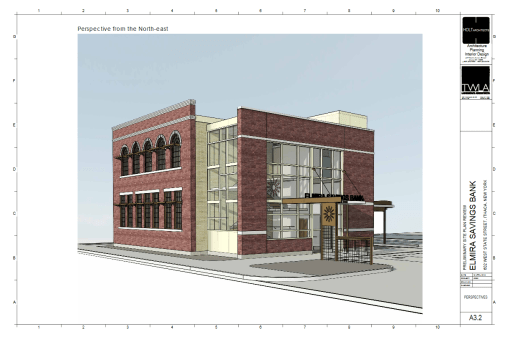
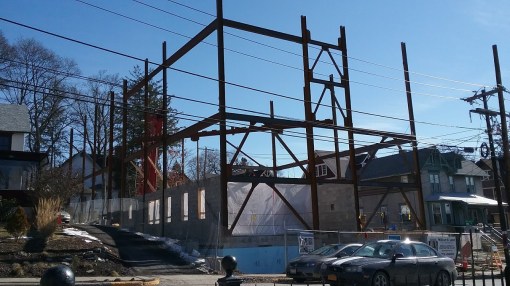
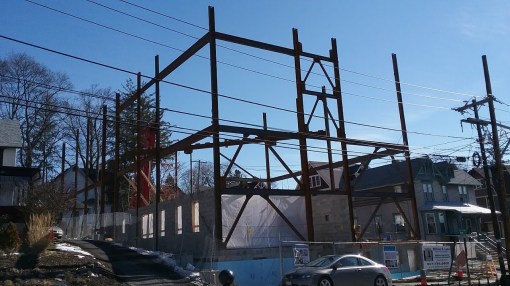
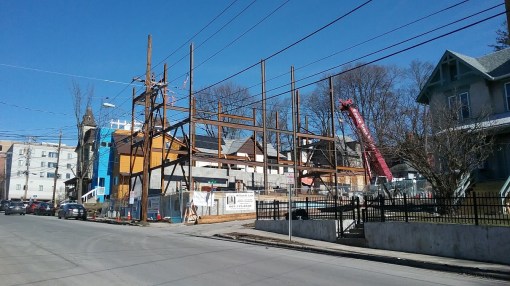
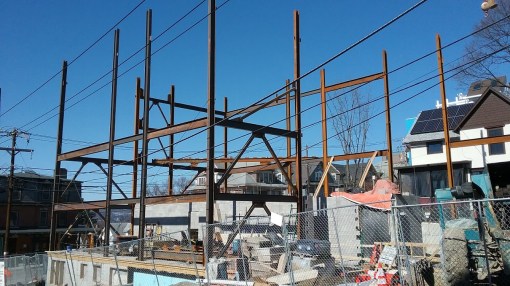
The new addition has risen out of the ground at Elmira Savings Bank’s new $1.7 million branch office at 602 West State Street. The cinder block shaft will host the elevator shaft/stairwell, and the steel framing is underway for the new 1600 SF north extension. The non-historic blue paint is being stripped from the bricks of the existing structure, and from the plastic on the roof, it looks like a new roof is being laid, probably EPDM (synthetic rubber) or something similar. The building’s insulation is being updated, and the plan is to have an all-electric HVAC system (heat pumps).

Although the initial press release called for March opening, June or July seems more likely. Elmira Savings Bank will occupy 3,300 SF on the first floor. The second floor, also about 3300 SF, will host for-rent office space. HOLT Architects is in charge of design, and Edger Enterprises is in charge of the buildout. Based off the signage, it looks like John Mills Electric (IBEW Union, Local 241) is doing the subcontracted electrical work.


Ithaka Terraces Construction Update, 3/2017

20 03 2017

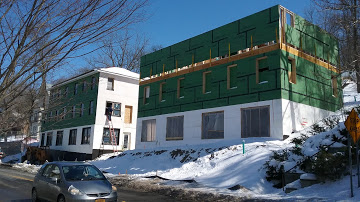
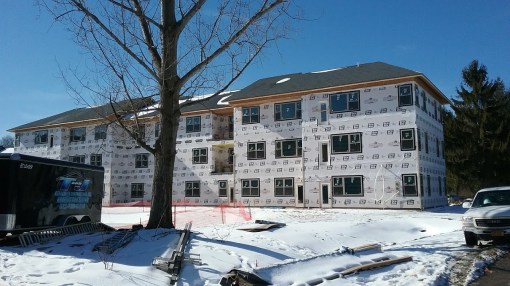
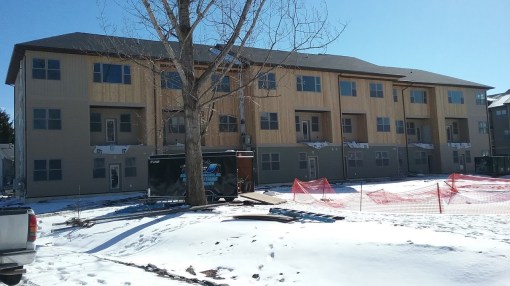
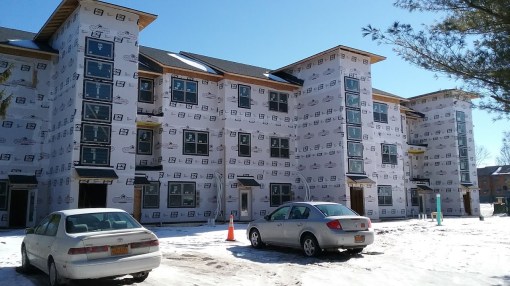
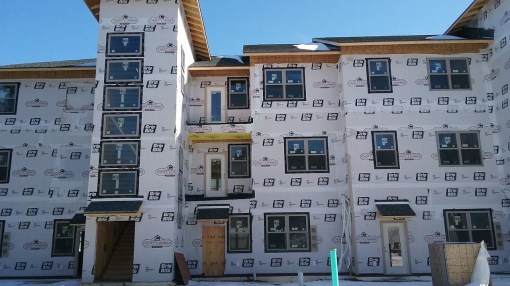
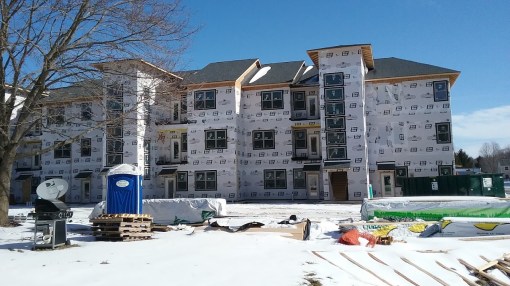
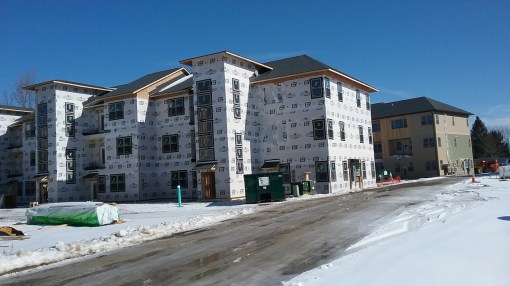
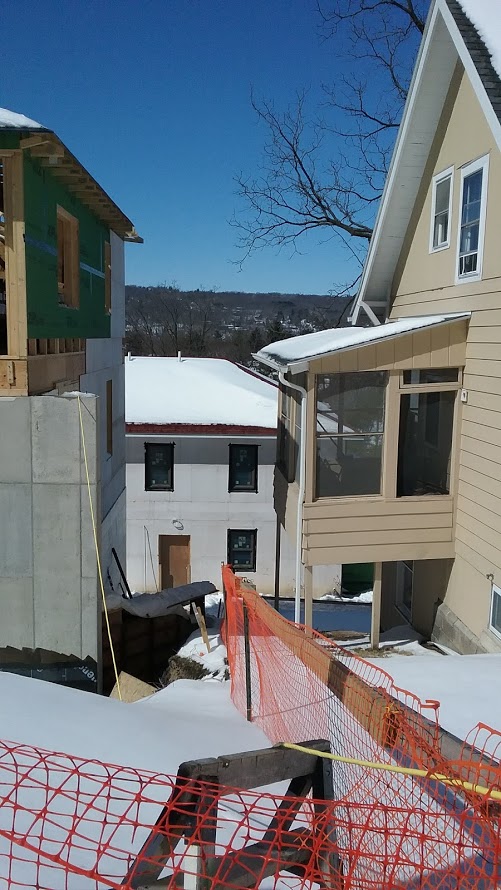
Over at the Ithaka Terraces located at 215-221 West Spencer Street, Building “A” is fully framed, sheathed, nearly all Low-E windows have been fitted and the roof has been shingled. Buildings “B” and “C” are still in the process of framing and sheathing. Building “D” might be excavated at this point, but all the snow made it impossible to tell.

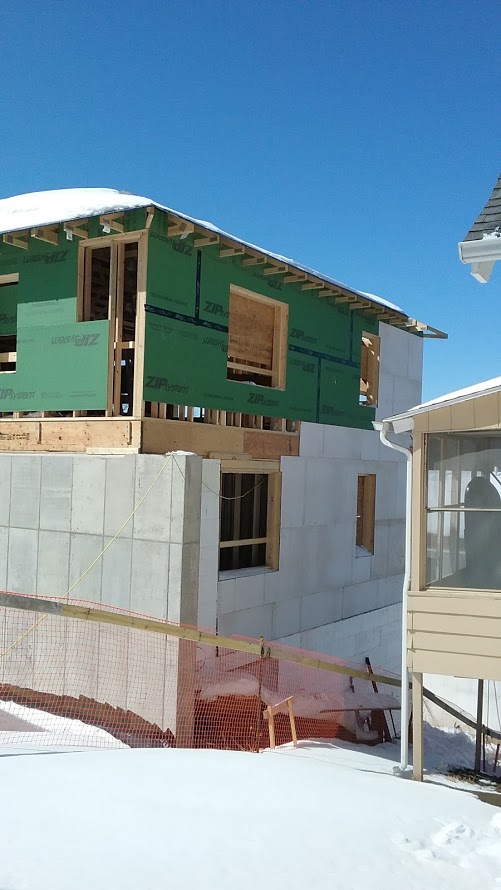
Note that the condos use double-stud walls, meaning their are two sets of wood stud walls used in the exterior frame, parallel to each other but spaced apart by about 5 inches. That space is then filled with R39 densely-packed cellulose insulation. The result has its pros and cons. The cons are that it’s more expensive to build, and it reduces the interior space a little bit. The pro is that it’s very energy efficient, which comes in handy for a project trying to achieve net-zero energy use. Along with the low energy consumption and green features, the project will be powered by a solar array owned by the developer out in Caroline.

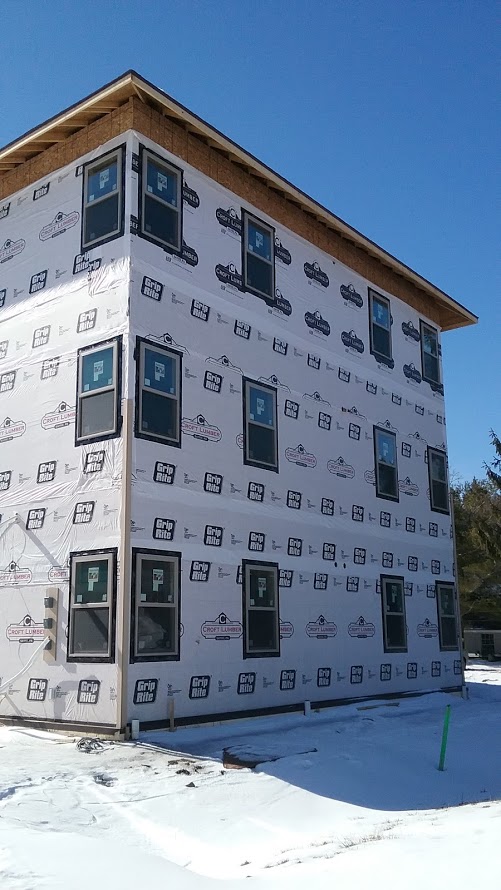
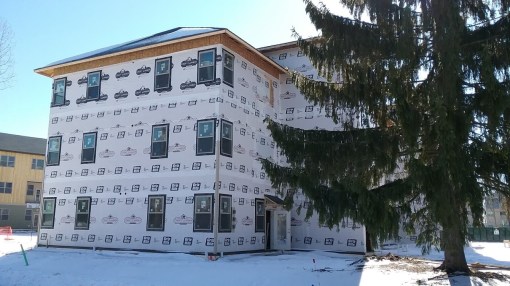
Since these buildings will have a stucco finish, and stucco tends to absorb moisture but ZIP sheathing does not, most building codes require a water-resistant barrier between the ZIP sheathing and the exterior stucco. This allows the wall to repel and drain off moisture without risking the integrity of the facade. In the photos below, the WRB is the would be the thin white coating going over the sheathing.

Formal marketing for the 12 units is expected to launch in a couple of months. 10 2-bedrooms and 2 3-bedroom units will be available, with prices ranging from $265,000-$390,000.


News Tidbits 3/4/17: Oh Hey, Tax Season

4 03 2017

20170217_155759

1. It’s that time of the year where the Tompkins County Department of Assessment goes through its assessment process in preparation for adjustments to property values for 2017, known as “Annual Equity Maintenance”, or AEM for short. Since there are 35,249 tax parcels in Tompkins County with a total value of $11.9 billion, not all are reassessed every year – most places are reassessed every three years, except for areas of rapid change (for instance, Fall Creek is every two years at present), or individual properties that are being undergoing change, whether it be a new construction, sudden property damage, or a sales transaction. The state has their own system, called Cyclical Reassessment Program (CRP, but the county docs refer to it as CRAP), but the county opts out to do their own valuations.

Some properties are easier than others – for example, a purchaser of a big-box property isn’t buying just the building, but a long-term lease from a tenant like BJ’s in Lansing. Student houses in parts of Collegetown are worth less than the property they sit on, which the tax system cannot accommodate. They provide one example of a $500,000 house sitting on $3 million of land – that’s not something the tax system is designed to handle, so the house is overvalued, but the property as a whole is very undervalued.

The department notes that sales were strong this year. According to their records, average sales are up 4.5% from $228,442 to $238,796, and the median sale is up 2.5%, from $200,000 to $205,000. The document also only notes 677 sales, which would be the lowest since before 1990, and is lower than the 681 sales noted by the Ithaca Board of Realtors (and IBR represents most but not all agencies). Someone is mistaken, it’s just hard to tell who. Assessments are on average about 8% lower (9% median) than home sale prices.

Some of the other takeaways are a modest softening in the student housing market in 2016 (Cornell enrollment in Ithaca did drop slightly from 2015-16, before renewing its upward trajectory in 2017), the city and Dryden’s Ellis Hollow continue to be strong markets but the other suburban neighborhoods are regaining interest, and Groton’s a mixed bag due to the poor state of some village properties. New assessments for 2017 (including parts of Ithaca town, Caroline, Freeville, Enfield, lakeside properties, restaurant properties, and manufacturing facilities) will be publicly available on July 1st.
schwartz_plaza_final

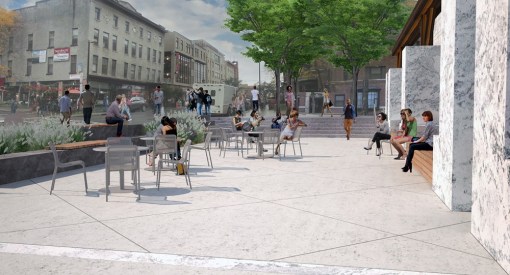
2. The redesign of Schwartz Plaza has started the formal review process. Cornell submitted the sketch plan at the February meeting, and hopes to have approvals for the renovation by next month. The properties would lose the walls and open up to the surrounding Collegetown, in what Cornell and Ithaca hope will give the densely-populated neighborhood a needed public gathering space. As reported by the Cornell Daily Sun’s Nick Bogel-Burroughs, project manager David Cutter hopes that the project leads to further public space enhancements near the stone arch bridge and down by Eddygate – this includes additional pedestrian and bike facilities, electronic boards with bus information, and a possible realignment of the Oak/College intersection into a T-configuration.

But for now the focus is on Schwartz Plaza. Cornell intends to have approvals within 1-2 months, start construction in June, and have the new plaza ready by August 2017. Trowbridge Wolf Michaels Landscape Architects is the design firm of record.

Postscript, Novarr’s townhouses at 238 Linden were pulled from the meeting before the sketch plan was due to be presented at the city planning board meeting last Tuesday. As for 301 Eddy, still trying to dig up information.

330_college

3. Nick Reynolds has a very interesting profile and interview of Jason Fane over at the Times. Definitely worth a read about one of Ithaca’s most prominent landlords.

Speaking personally, I’ve got mixed feelings about it, if only because it takes a blog quote I made about 330 College Avenue in 2014, and in the article’s context, I sound like an arthouse snob. Fane has always been serious about building on the property, and that’s great, but I stand by my quote on 330 – after the years of negotiations on the new form district code, there is no way a 12-story building was going to be built on the corner of College and Dryden, even if Jagat Sharma, Fane’s favored architect, brought his A-game. It’s not a matter of economics or taste, it’s a matter of very real opposition from the Belle Sherman and East Hill neighborhoods. Any politician who considers signing off would be voted out of office ASAP. Any city staffer who consents will be shown the door. Look at what happened with State Street Triangle. In a city where people have many gripes about development, this is one project that is truly stopped in its tracks. I think Fane could negotiate 7 or even 8 stories if he gives the city a donation towards affordable housing, or some other community benefit. but not 11 or 12.

I like grand buildings and imposing structures, but I’m also a realist. End rant.

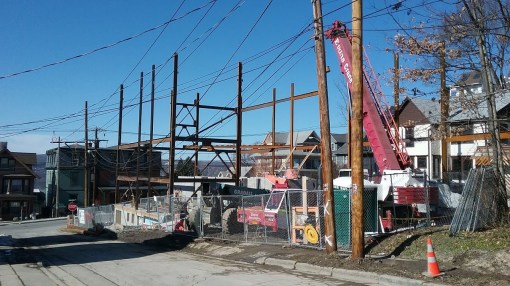
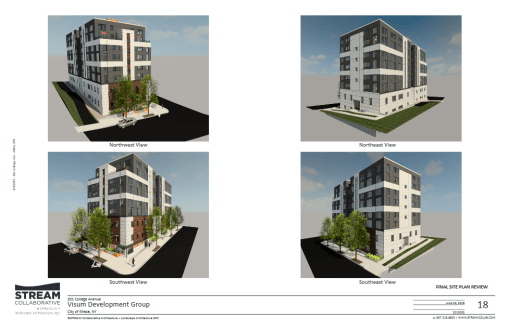
4. Todd Fox’s Visum Development has a couple construction updates on their Facebook page. Exterior stud walls are being installed on the lower floors of 201 College, and two of the three townhouse strings at 902 Dryden Road have been fully framed and sheathed, with siding installation underway. At a glance, it looks like the exterior will look more like the elevations on Modern Living Rentals’ listings page rather than the STREAM Collaborative renders – the renders had horizontal lap siding, the elevations show vertical lap siding as seen above.

If more developer could post updates as Visum and Carina Construction do, that would be swell.
sleep_inn_v3_1

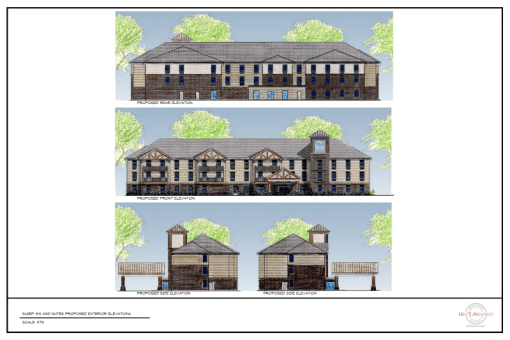
5. Wrapping up a quiet news week, here’s the agenda for the town of Ithaca planning board next week. A lot subdivision for a new house, a pair of communication towers, and the final approvals for the Sleep Inn proposed by hotelier Pratik Ahir at 635 Elmira Road. True to the sketches presented last fall, the design has that rustic look on all sides of the structure, and all the town’s requests have been met, which should allow for a smooth final approval meeting on Tuesday. The design will be unique among the 320 locations of the Sleep Inn chain. It should be noted that the town’s Zoning Board of Appeals was very split on the height and size variances, approving them with just a 3-2 margin.

In the other towns, the only one with anything new to report is Danby, whose planning board is looking at a special use permit for a property management company’s offices at 1429 Danby Road, and a 3,535 SF expansion to the Ithaca Waldorf School at 20 Nelson Road.



201 College Avenue Construction Update, 2/2017

2 03 2017

201 College Avenue is reaching for the sky – when these photos were taken about a week and half ago, the structural steel was as high as the third floor, so there’s still two more floors to be boxed out by the H-beams. Although only five floors, the mezzanine-approach to maximizing square footage means that the units on the third through fifth floors are quite tall, 16 feet from sub-floor to sub-floor, 70 feet for the whole building.

The basement level, which only occupies the west half of the building (the east half is slab-on-grade) has been fleshed out with reinforced concrete walls – the windows on the street corner will look into a gym and game room, while the two pocket windows on the northwest corner will look into the mechanical room. The blue boards on the concrete are rigid styrofoam panels used for insulation and moisture protection.

It looks like some wall framing is underway on the first floor for the three-bedroom units – those CMU walls face the stairwell, and the exterior walls of the building itself. The interior unit walls will likely be a more typical lightweight steel frame.

There’s been some documentation floating around that suggests an early working name for 201 College Avenue was “The Heustis Lofts”, Heustis (sometimes Huestis) Street being the original name of College Avenue. However, it doesn’t seem the moniker was officially adopted.
20170218_115452 20170218_115504 20170218_115509 20170218_115538 20170218_115559 20170218_115623 20170218_115712 20170218_115735 20170218_115747 20170218_115756 20170218_115802

201_college_v5_1


209-215 Dryden Road Construction Update, 2/2017

1 03 2017

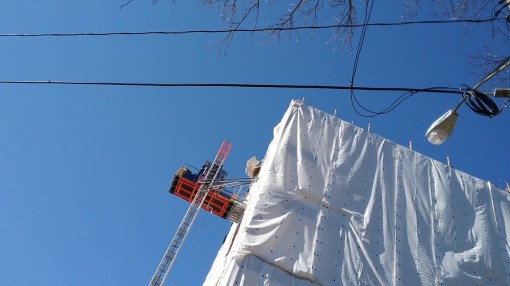
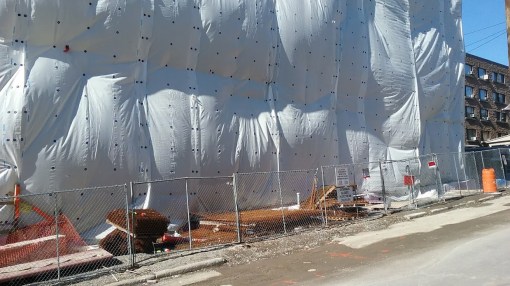
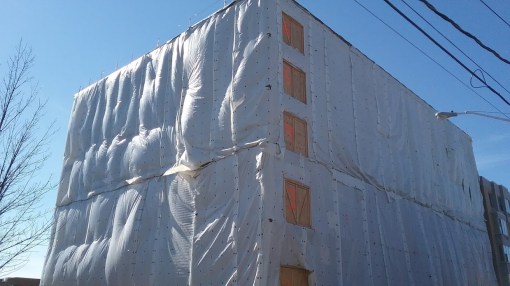
Admittedly, when the entire building is sealed up in opaque plastic covers, it makes for a less-than-interesting construction update. The plywood doors are for the loading and unloading of materials via lifts, and apart from those, there isn’t much to break up the monotony of white plastic sheets. Note that the access doors are not the same as the elevator shaft, which is located about midway along the west wall next to 205 Dryden/Dryden South.
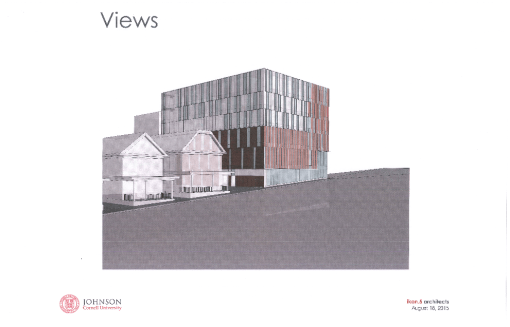
However, it does look like some exterior facade work is starting to get underway. Brown and grey metal panels are beginning to be installed on the building’s rear face – this is the side that will have the least amount of glass, as occupants won’t have much to see if developer John Novarr moves forward with his plans for townhomes on the double-lot of a house that came down to allow a construction staging area for the Breazzano Center. With the new home to the Executive MBA expected to open up this Spring, Novarr can proceed with options for that double-lot. 238 Linden is zoned CR-4, four floors with no required parking. The proposed townhouses could provide a visual transition between the 80-foot Breazzano and the 2.5 story houses that comprise most of the housing stock on this block of Linden Avenue, some of which are for pending sale.

In further detail, the rear facade windows are 1″ insulated glass with aluminum frames, and translucent insulated spandrel glass below the panes. The metal panels are insulated aluminum and are installed using a framing system – you can see the grey insulated panels with clips along the top edge of the panels. The plastic covers on the panels are to protect against scratches and scuffs prior to installation. ikon.5 sought to provide differentiation with mahogany brown panels on the south (Linden Avenue) side, with lighter salmon-peach panels planned for the north (Dryden Road). The west and east sides will be a little bit of of both. The first floor the street facing sides, and the atrium will be glass curtain walls. The dark panels are intended “to differentiate upper from lower and facilitate a relationship with the smaller scale of adjacent buildings,” per the application. Some of the later documents show a lighter shade of gray for the south side of the top floors, but to be frank, I am uncertain what is accurate.

Note that the fourth floor’s back side will have few windows because that is where the 1,990 SF video production studio will be located, and this requires a controlled-light environment. Presumably, with the green room and studio rooms, the intent is to have a comfortable and efficient interview space for live videos recorded for or streamed to students at remote campuses. The large flank of plywood panels at ground level is the service exit, with future loading dock and trash/recyclables enclosure.

20170218_120030 20170218_120120 20170218_120144 20170218_120149 20170218_120207 20170218_120254 20170218_120309 20170218_120351 20170218_120401 20170218_120408 20170218_120535

209_215_2

209_215_3


Village Solars Construction Update, 2/2017

27 02 2017

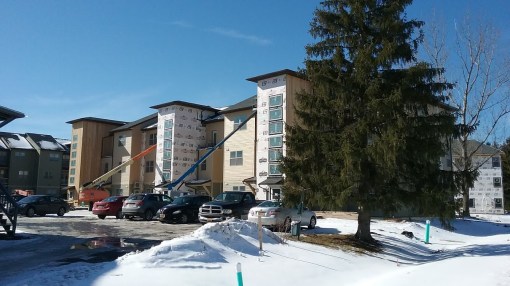
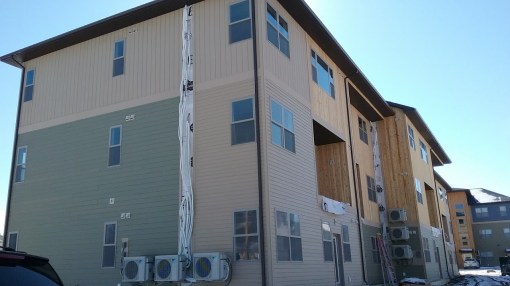
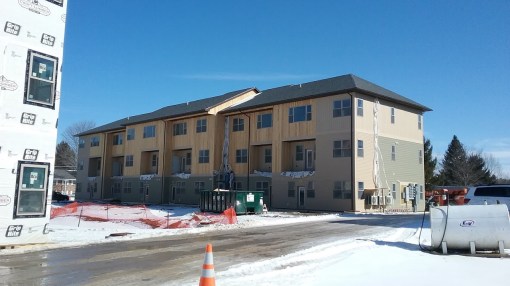
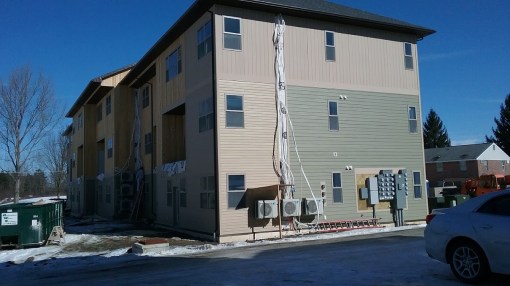
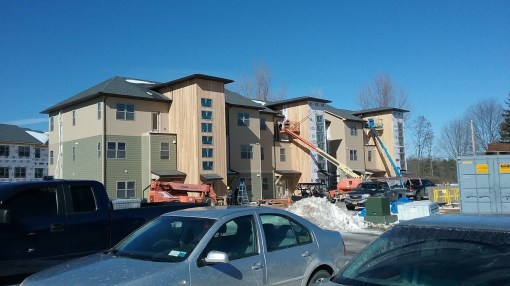
The Village Solars have made progress on their latest pair of apartment buildings. Building “I” has made more progress on its exterior finishes, while “J” is fully framed, roofed and shingled. Both of these will likely open this spring.
It’s starting to get that point where the second stage of the Village Solars may be getting ready for review by the Lansing municipal boards. The last big phase, Phase 4 with Building “K”, “L” and “M”,is likely to get underway this year for a completion in 2018, and phase 2A, the mixed-use Building “F”, has been something of a question mark for exact timing. That will finish out the initial 206 market-rate units, which range from studios to three bedrooms.

village_solars_4

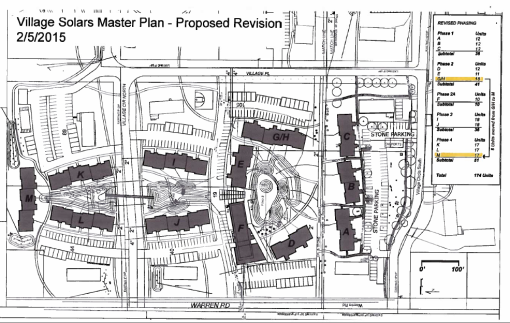
There’s an early site plan floating around showing a potential buildout second stage expansion, and although it’s outdated, it gives an idea of the general layout of later phases. Most of the later buildings would be built to the east of the initial phases, as infill between existing apartments. The total number of units in the second expansion was initially about 136 units, but given the recent trend of breaking up larger units into smaller studio units to satisfy market demand, the number is likely to be higher when formal plans are submitted.

Right now, they seem to be about the only large-scale solution to Lansing’s development quandry – the first phase uses natural gas, but with the assistance of green advocacy group Sustainable Tompkins, the later phases have been built to utilize all-electric services with air-sourced heat pumps. This led to new utilities layouts, and the merging of “G” and “H” into one building.

According to an Ithaca Times article from last March, for a 12-unit building at the site (construction cost $2 million), the upfront cost increase was $50,000-$60,000, an increase of 2.5-3%. This is balanced out by the 30-year savings on energy costs for the building ($40,000-$80,000), and a premium on the monthly rents of about $50. Units go for $1050-$1650/month, depending on size and location. Six of the Daikin heat pump units can be seen in the third photo from top.


20170218_110328 20170218_110346 20170218_110431 20170218_110437 20170218_110503 20170218_110515 20170218_110552 20170218_110623 20170218_110647 20170218_110745 20170218_110819 20170218_110839 20170218_110940 20170218_111007 20170218_111034 20170218_111056

village_solars_2