News Tidbits 8/27/16: A Week of Questions

28 08 2016

harolds_square_v4_new_comparo

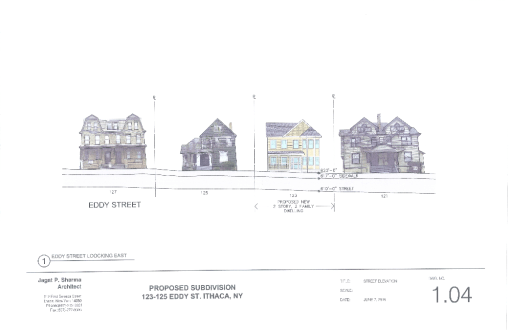
1. Let’s start off with a planning board recap. The subdivision at 123-125 Eddy Street was reviewed. My Voice colleague Mike Smith called any proposal for that part of Eddy “masochist“, and the Journal’s Nick Reynolds had some fun with it as well. Councilman Graham Kerslick paid a visit on behalf of Orchard Place, both as a resident and as spearhead for the wealthy, owner-occupied enclave’s opposition to the two-unit house due to parking and concerns about renters. There’s virtually no process to stop lot subdivisions, since those do not have physical impacts. If the lot meets legal specs, the board is obligated to pass it. They can, however, request a site plan review for the house.

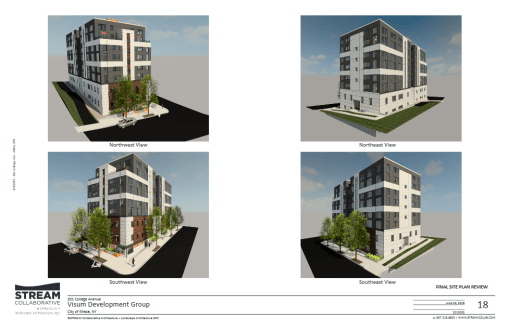
201 College’s discussion was interesting. It takes some moxy to say “Historically, Collegetown has always been a dump,” but the comment isn’t without merit. The neighborhood has effectively functioned as Cornell’s housing annex since the first boarding houses were built in the late 1800s, and owner-occupancy, never a strong presence to begin with, steadily disappeared after World War II. Many of the structures venerated now were seen as cheap and ugly in their early days. The argument provided by Fox was that historic character should be defined by the social fabric of the neighborhood, not by physical appearance. Collegetown has always been primarily a student neighborhood, and he feels his project offers a high-quality addition to maintain that student-centric social fabric. He even called out Neil Golder, the project’s primary opponent and a former student renter who eventually bought his house: “The only thing that’s out-of-character in the neighborhood is Neil’s house and demographically, Neil.”

What followed was essentially a debate on legal issues, which occasionally became heated. In the end, the board agreed to draft a zoning appeal, so now it’s onto consideration of final site plan approval, which hinges on Board of Zoning Appeal interpretation on whether or not the building is in compliance with the zoning code. In other words, on 9/6, the project team is basically going to ask, “hey does everything meet the code,” the BZA says “yes/no”, and if yes, final site plan approval is granted. Very convoluted.

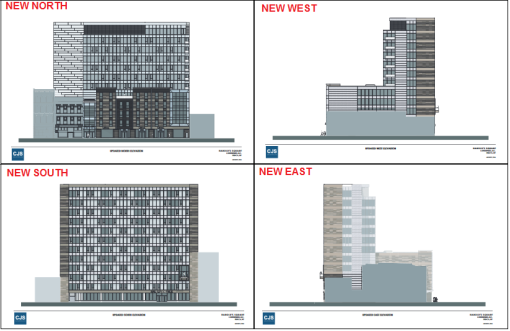
On a happier note, Harold’s Square’s changes were approved, and developer David Lubin announced that with that in hand, he has the funding secured to begin construction this fall. There had been been some debate about the architecture beforehand, which threatened to derail the plans, but the issues were ironed out.

2. The Ithaca Urban Renewal Agency will be reviewing an application for a new microbrewery in the city’s West End neighborhood. Liquid State Brewing Company would be located in 5,000 SF of leased, renovated space in the Cornell Laundry Building at 521 West State Street. The brewery would initially focus on hoppy ales with a local distribution to stores and restaurants. There will be a taproom, outdoor patio, food truck events and a small amount of merchandise for sale.

Proposed by former Ithaca Beer brewer Ben Brotman and Jamey Tielens of Trumansburg, the project would create 2.5 jobs, over or just about living wage. The written paperwork includes the two brewers and a cellar specialist, for 5.5 jobs. If approved, the brewery would open in early 2017.

Liquid State is looking for a $70,000 loan towards their $620,000 project. For the record, there will be no link provided to the application because it contains sensitive tax and financial information about the applicants. The IURA tends to be a bit dicey about things with alcohol involved, but the locally-made aspect will help sell the project to the committee.

wyllie

3. Also on the IURA Agenda, the Restore NY grants. As written about in the Voice back in July, there were ten suggestions for nine projects. Four were dropped – Josh Cope’s hostel proposal, INHS’s Elm Street project, Novarr’s project, and the renovation of 224 West Spencer. 310 West State, 121 West State and 139 East State Street (part of Harold’s Square) were bundled into one grant application called the “State Street Historic Buildings Rehabilitation”, requesting $500,000 for $3.7 million in projects. The other application, for 109 North Corn Street (Wyllie’s, above) and 413-415 W. Seneca, are part of the “Seneca/Corn Street Buildings Rehabilitation”, $500,000 for $875,000 in projects. At a glance, the State Street plans look to have a pretty strong application, but we’ll see what the state thinks after they’re submitted this fall.
chain_works_rev3_3

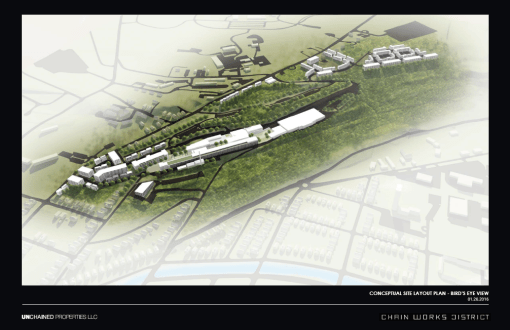
4. Here are the 15 or so pages of comments received on the Chain Works District DEIS. Some are really good questions or comments, some aren’t, some conflict with each other – it’s the nature of the beast.  The Planning Board’s Special Meeting on Tuesday is mostly just to review comment summaries, and several more meetings will be scheduled through September and October.

mettler_toledo-1-771x372

5. So I had the unpleasant task of breaking the news this week of the largest single layoff or facility closure in Tompkins County in seven years. The loss of 185 well-paying jobs is not something to take lightly, even if this area is in general faring well economically. Even worse, the Journal is reporting that TCAD never even saw it coming, they were blindsided. At least with Emerson in 2009, the writing has been on the wall for several years, especially after they transferred their senior corporate jobs to Kentucky in 2007. Here, everyone’s just been blown back. Mettler Toledo Hi-Speed paid over $100k in taxes annually, and was a big supporter of the local United Way chapter, so it has a lot of negative impacts spread out on Dryden and the county. Not a good week.

If anything, this is a sobering reminder that economic development is multi-pronged – attracting new business with new job opportunities is the obvious part, but maintaining an environment that nurtures and supports the existing workforce is just as important.
20160821_134917

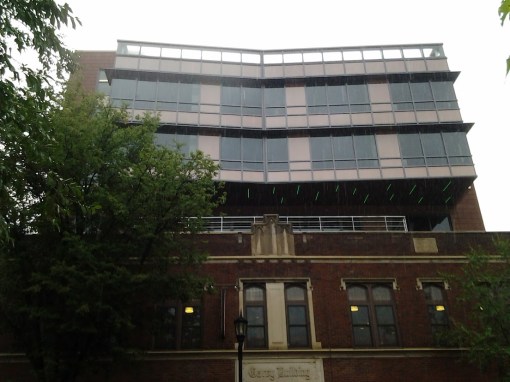
6. Giving credit where credit is due, the Journal’s Nick Reynolds did a nice write-up on the Carey Building overbuild on the 300 Block of East State Street. The article ends with a not-so-subtle teaser that Travis Hyde Properties might be bringing forward a residential proposal for the Ithaca Gun site some time next Spring, something that has been in the making in one form or another for a decade-plus (they’ve held off in the past couple of years because the city had to finish cleaning up adjacent soils).

One note of discomfort is that the article refers to the Ithaca Gun site as “its next project”. What is that saying about the Old County Library site?

7. Nothing too exciting in real estate sales this week. “SCF Realty Capital LLC” paid $6.6 million to Drake Petroleum for three gas stations – $1 million for the Sunoco on W. Main in Dryden village, $1.9 million for the Xtra Mart on Dryden Road, and $3.6 million for the recently-renovated Xtra Mart on Route 34B near the Lansing town offices. County tax assessors had them valued at $2.35 million collectively. I’m not familiar with the sales dynamics of convenience stores/gas stations, but that’s an impressive differential.

SCF stands for “Stonebriar Commercial Finance”, a company that specializes in middle-market commercial real estate finance over a wide spectrum of industries, with sale-leaseback options for clients. A copy of the deeds were sent to the corporate offices of Mirabito Energy, and a check online indicates Mirabito is buying 31 gas stations in three states, part of a corporate divestiture of locations by Drake’s parent company, Global Partners. So, the Xtra Marts are becoming Mirabitos.

Speaking of gas stations, land for sale at the Rte 13/Rte 34 split in Newfield sold this week to an LLC representing the Marshall Companies, a Weedsport company that runs Pyrus Energy and the Pit Stop Convenience Store chain.


209-215 Dryden Road Construction Update, 08/2016

23 08 2016

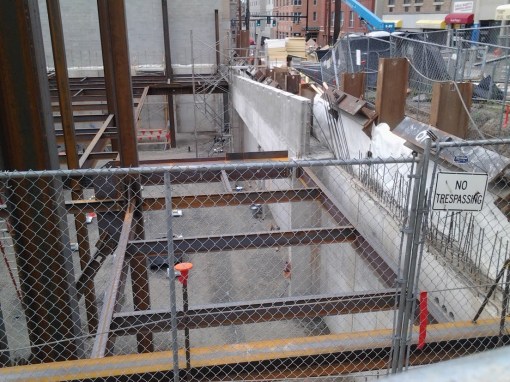
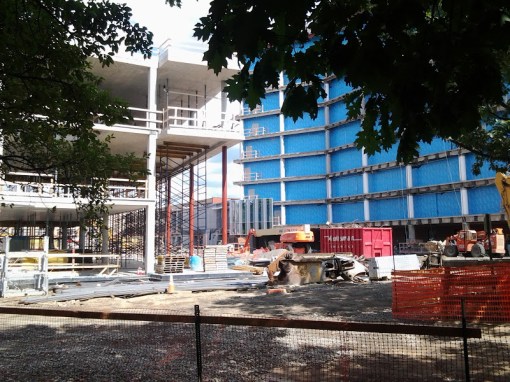
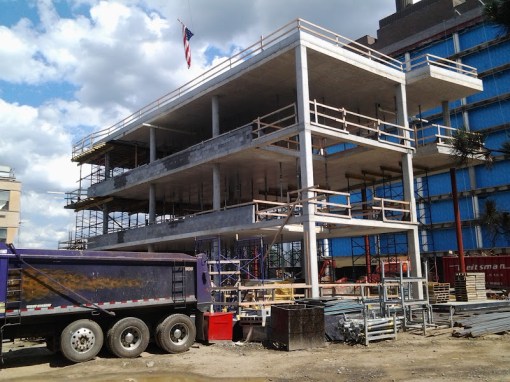
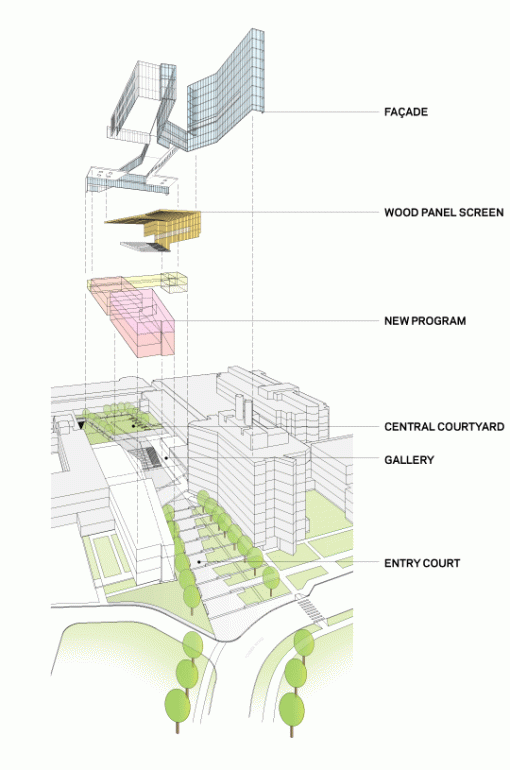
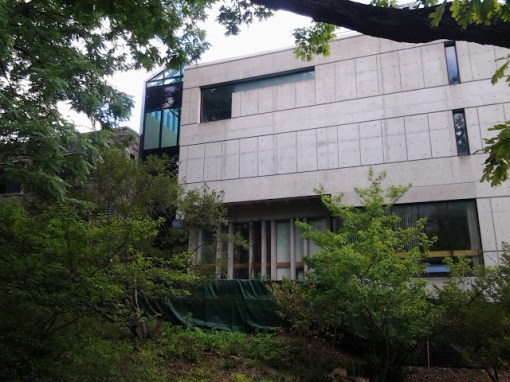
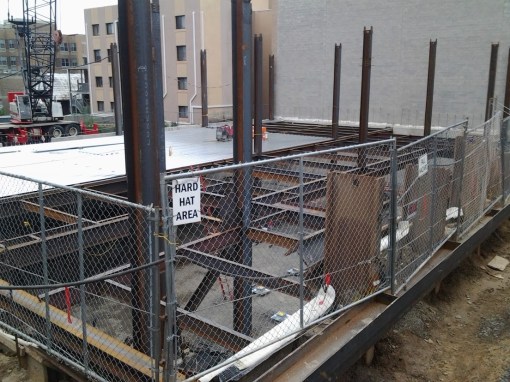
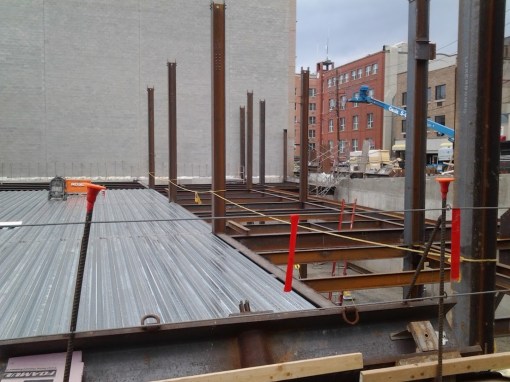
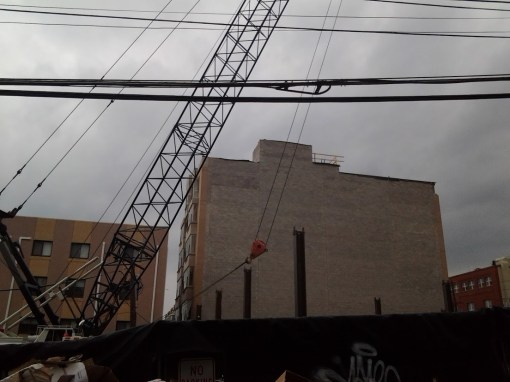
Structural steel is rising at 209-215 Dryden Road, the site of the new Breazzano Family Center for Executive Education. In the past month, the steel frame has been built out to street-level and decking is being attached to what will be the ground floor. A 90-seat tiered classroom will be in the basement below the decking, and a second 90-seat tiered classroom will be built on top of the decking. In the third-to-last photo, you can see a large open space between the steel columns, which is where the building’s four-story atrium will be. Those steel columns next to Dryden South (205 Dryden) really are as close as they look – the finished walls of the buildings will be separated by just two inches.

Like much of Collegetown, the project hasn’t been without its problems. A construction worker was injured last month when his leg was pinned against a concrete form. Thankfully, it doesn’t sound like the injury was too serious.

The six-story, 76,200 SF building is expected to open in summer 2017. Given the issues surrounding and delaying 201 College Avenue, this might be the only major building opening in inner Collegetown next year. About 200 Cornell staff will occupy the fourth through sixth floors at opening, and 350-400 Executive MBA students will attend week-long instruction sessions in the building during off-season academic periods (summer intercession and winter break).

20160821_101952 20160821_102029 20160821_103440 20160821_103525 20160821_103604 20160821_103623 20160821_103652 20160821_103721 20160821_103726

209-215_2

209-215_basement


Village Solars Construction Update, 8/2016

23 08 2016

Continuing to take photos during a pouring rain is not one of my wiser choices.

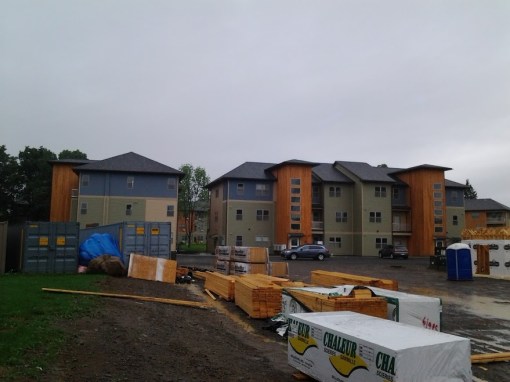
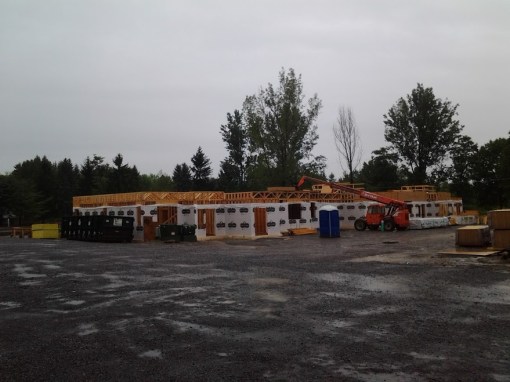
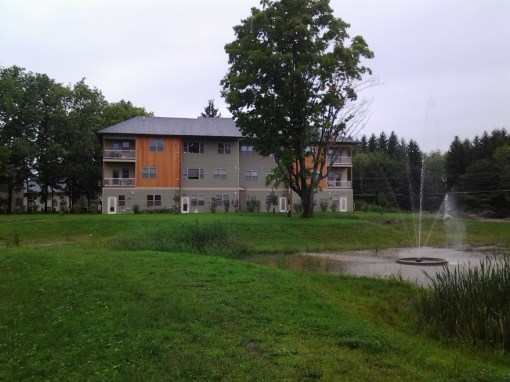
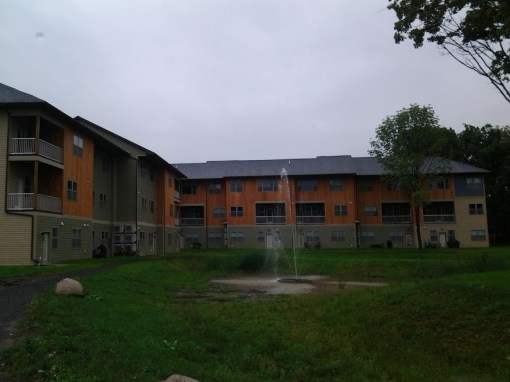
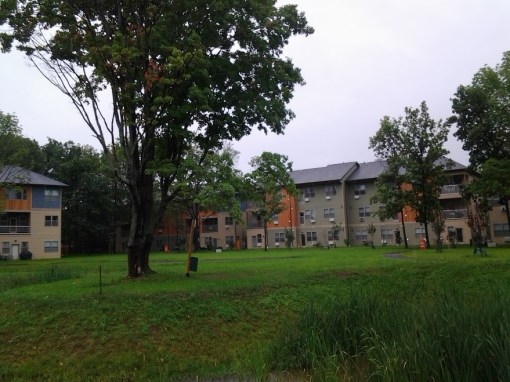
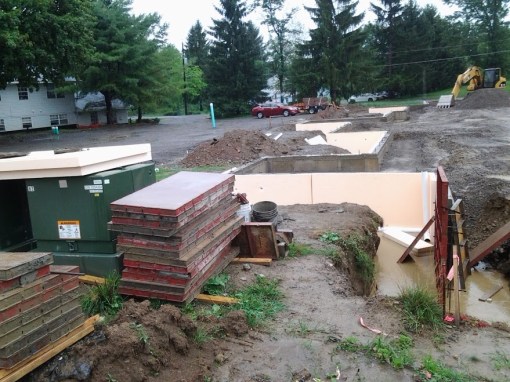
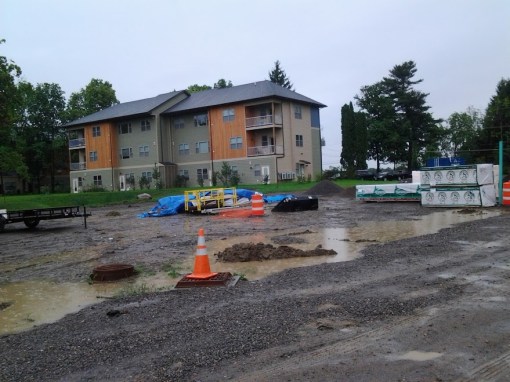
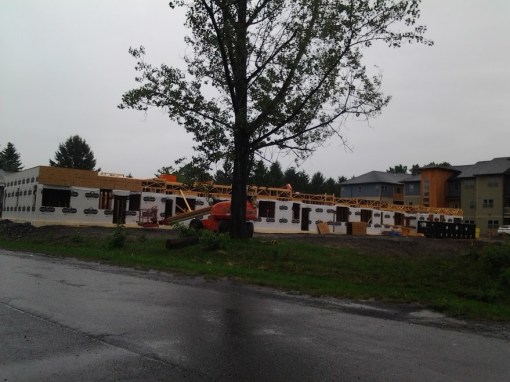
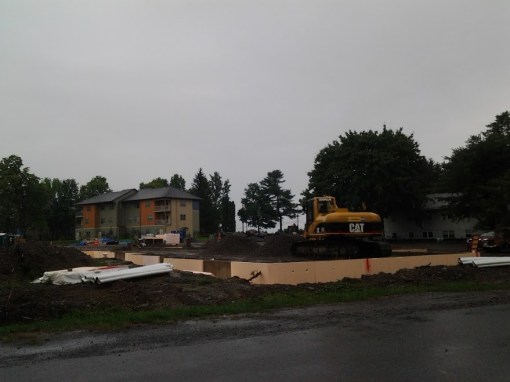
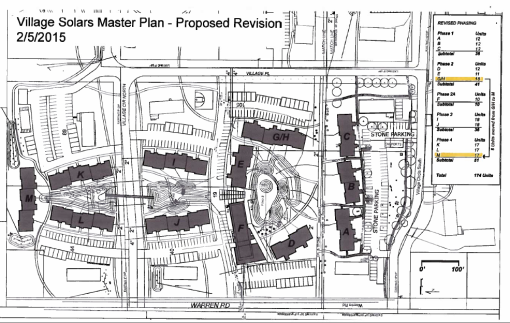
The Village Solars project in the town of Lansing continues its forward march. Phase II, which consisted of three buildings (D, E, G/H) and 41 units, has been completed and has welcomed its first tenants. Skipping over Phase IIA’s mixed-use building (F), construction is underway on Phase III and its two 18-unit buildings. Building “I” is the one further along, the foundation poured and the first floor framed out and sheathed in Croft Lumber housewrap. Building “J” is a little farther behind, with excavation and concrete forms still being used to hold the pours in place. Once the foundation walls are complete, the slab will be poured, left to cure, and if the cured concrete is satisfactory, then wood frame construction can begin. Construction of “I” began after “D” was completed in May, and “J” looks to have started work as “E” and “G/H” wrapped up more recently in June and July.

The Village Solars project appears to have inspired a similar project in the Albany suburb of Latham, consisting of an office building and two buildings with 21 apartment units. According to the Lucentes (the family that runs Lifestyle Properties and the developers of the Village Solars), the president of Sunrise Management is an old family friend, so the inspiration isn’t as unusual as it looks at first glance.

Expect buildings “I” and “J” to be ready late next spring or summer. Phase IIA is an unknown, and Phase IV and its 3 buildings/51 units will probably be on a 2017-18 construction timeframe. Long-term plans call for a second set of phases that would result in another 140 or so units, for a total of over 300.

According to Lifestyle Properties’ facebook page, there a few units left in the current build-out: a one-bedroom at $1105/month, some two-bedroom units starting at $1275/month, and three-bedroom units starting at $1580/month.

20160821_142834 20160821_142842 20160821_142938 20160821_143002 20160821_143033 20160821_143058 20160821_143128 20160821_143204 20160821_143211 20160821_143239 20160821_143315 20160821_143349 20160821_143355 20160821_143410 20160821_143452 20160821_144009 20160821_144012

village_solars_2


News Tidbits 8/13/16: The Forward Advance

13 08 2016

201_college_v5_1

1. In the news, Neil Golder’s lawsuit against the planning board and the 201 College project was dismissed on technicality. The Tompkins County State Supreme Court decided that since the lawsuit was based on preliminary site plan approval and not final site plan approval, the project was subject to further changes and that it wasn’t appropriate for the court to hear this case at this time. So in other words, Neil will probably file his lawsuit again if/when final approval is granted, since changes between preliminary and final are unlikely to be significant. The scorched earth approach will likely continue.

It’s going to be a couple of weeks before that happens. In what the Times described as “an odd move”, the project is heading before the BZA for a zoning interpretation. Even the city’s planning department director, JoAnn Cornish, thinks it was a strange move on the board’s part, and one that kind of upends her department’s authority since they had looked at the facade length and decided it fit the zoning. More about the planning board’s (John Schroeder’s) odd decision and reasoning here.

waterfront_concept_aerial_1

dot_concept_1

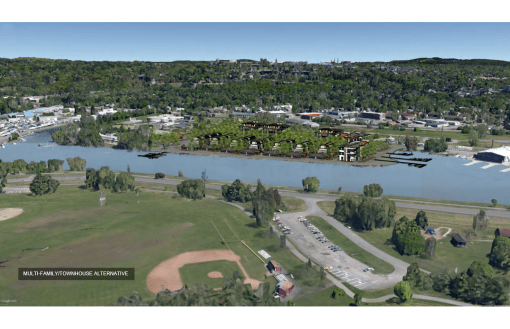
2. Looks like there’s a twist in Tompkins County’s plans to redevelop the NYS DOT site on the Ithaca waterfront. The DOT is no longer looking at moving to Enterprise Drive in Dryden, even though they bought the land there in 2005. Now they’re looking at a site along Warren Road up by the airport. So close to the airport, in fact, they apparently needed the Federal Aviation Administration (FAA) to sign off on it. The FAA has agreed to a location and the DOT is working out a long-term property lease. The cost of moving is now estimated at $11-$12 million, slightly less than the $14 million estimated for the Dryden location in the Fisher Associates study, but estimates being as they are, it would be prudent to keep an eye on those projections.


3. The Dryden town planning board recently reviewed plans to convert the former Stevens Furniture at 2085 Dryden Road into an auction house specializing in books. The 10,000 SF would be renovated with no substantial exterior modifications. It’s a fairly small, unobtrusive plan, and by itself not much of a write-up.

However, this project is being proposed by Danby’s David Hall. The same David Hall who wanted to create the Summit Enterprise Center on Danby’s Gunderman Road, and led to all sorts of rancor among town residents and officials. His company, National Book Auctions, was to be one of the tenants of the business center. Danby’s planning board notes are online up to June only,  so the question is, is the Danby plan still moving forward and this is a case of filling a pressing need, or is the Summit project done and out?

123_eddy_street_1

4. For this week’s eye candy, here’s the first image of the two-family home that Collegetown landlord Nick Lambrou wants to build at 123 Eddy Street. Jagat Sharma is the architect. The land is currently a double lot with 125 Eddy, and at present it’s part of the lawn. A planned subdivision would create a building lot on which Lambrou could put up the home. As part of the East Hill Historic District, the design has to pass ILPC muster, and at a glance, the projecting window bays (not sure they meet the definition of bay windows?), porch and comparably-pitched roof should help.

Note the lack of a garage. The street is up to 13 feet below the houses on that block, and there are no off-street parking spaces planned for either of the 3-bedroom units. The BZA would have to grant a zoning variance for a deficiency of two spaces.

tiny_timbers_1

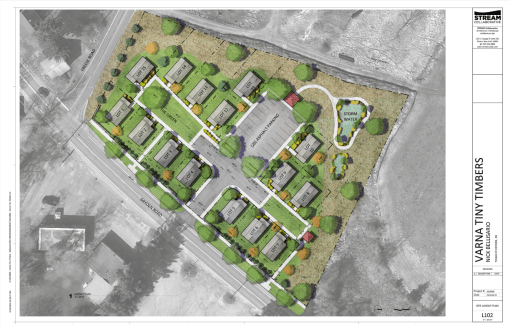
5. Tiny Timbers and the Evergreen Townhouses were both up for review by the town of Dryden’s Planning Board. Tiny Timbers once again had only a few minor quibbles among board members, who voted to approve the sketch plan and send it to the Dryden ZBA. The Evergreen Townhouses had much more resistance, but the PUD concept was approved with some stipulations on fleshing out the project further before it may continue in the process. In Dryden, the town board gives final approval to project proposals, so both of these are moving along, but not fully approved just yet. In the meanwhile, Tiny Timbers is finishing construction on prototype #2.

6. Someone’s had a busy week. On Wednesday, a Rochester-based LLC picked up the Chateau Claire Apartments, a ca. 1960 64-unit apartment complex in the village of Lansing, for $5.3 million. The same day, a second Rochester-based LLC picked up the adjacent 37,400 SF shopping center for $1.3 million. The properties are collectively assessed at just under $6 million, so the purchase price seems pretty reasonable for a decent if not especially desirable stretch of property.

With a little digging, it turns out under the LLCs, the sellers were the same for both, and the buyers the same for both. The sellers were the Goldberg family who owned Bishop’s of Ithaca, a home improvement store. After enjoying success with growing Bishop’s into a small chain, Stan Goldberg turned to development and was a major local developer from the ’60s through the early ’90s. He sold Bishops to his employees in 2003, and passed away last year. The buyer was Park Grove Realty, a startup real estate firm out of Rochester staffed by former Conifer LLC employees and making waves for proposing a 140-unit apartment complex on Bomax Drive two miles away. A little piece of old Ithaca fades, and a newcomer makes their first foray into the region.

Park Grove has taken out a $1.14 million construction loan to renovate the Chateau Claire units – kitchen and bathroom remodeling, washer-and-dryer installations, roof repair, new balconies, gutters, landscaping and lighting.

canopy_comparo_elevations_new_2

7. And the other big sale(s) of the week, also from Wednesday – Ithaca Downtown Associates LLC, the Patel family, finally purchased the properties for the 131-room Hilton Canopy hotel project. $1.8 million to the IURA for the parking lots at 320-324 East State Street, and $2.05 million to local landlord Joe Daley for the parking lots on the former Strand property at 310-312 East State Street. This marks a big step in moving the 77,800 SF, $20+ million project forward.


News Tidbits 8/6/16: Big Ideas and Small Additions

6 08 2016

20160701_200523
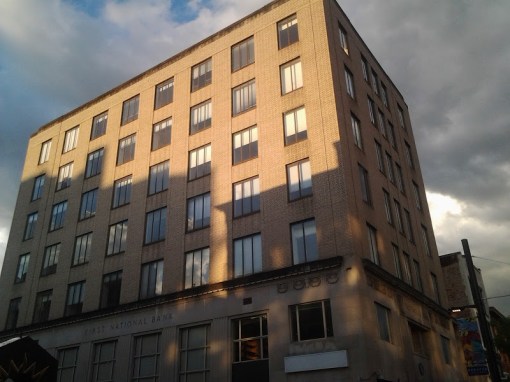
1. Some of you might remember that Chemung Canal Trust Company was embroiled in a legal battle with Ithaca Renting (Jason Fane) over the terms of their lease of 12,000 SF on the first floor of Bank Tower on the Commons. Welp, the courts have issued their decision, and it looks like Chemung Canal lost. The Elmira-based bank had to revise their quarterly earnings report after losing the dispute with their former landlord. The terms of the payout have yet to be determined, but Fane was seeking $4 million, which is in the same ballpark as the cost of Fane’s renovation of the top floors into 32 apartments. CCTC is still looking into an appeal.

119_125_college_avenue_2

119_125_college_avenue

2. It hasn’t been a secret that the price of real estate in Collegetown is getting enormously expensive. First John Novarr dropped $5.3 million on 215 College Avenue. Then Todd Fox forked over $2.65 million in June for 201 College Avenue. Now it’s Novarr’s turn again, handing over $4.75 million on the 2nd for 119, 121 and 125 College Avenue (or more specifically, an LLC filed to an address used by Novarr for his many LLCs). The three houses are collectively worth about $1.655 million, per the county assessor. Here’s a tip for readers – if you’re looking at a built property that’s recently sold, if it was purchased for more than double the existing tax assessment, the property was most likely sold based on its development potential. Less than that but still well above assessment, and it’s more likely major renovations/gentrification/Fall Creek/not being torn down.

Anyway, we already have an idea what’s planned – Novarr wants to do 50-60 units of faculty townhouses on the site, a 3-4 story, $10 million project.

1015_dryden_1

3. The other big sale this week (using that term subjectively, since someone just paid $1.25 million for a Cayuga Heights mansion) was 1015 Dryden Road out in Varna. Modern Living Rentals (Todd Fox/Charlie O’Connor) has had this 5-unit rental property on the market for a little while now, initially for $650,000, then $599,000.  The buyer “Finger Lakes Wrestling Club Inc.”, agreed to purchase the property on August 2nd for $555,000. MLR purchased the property for $425,000 in 2014. The wrestling club is listed as a non-profit serving youth training and competing in wrestling, and their plans for the property are unknown – the sale comes with plans for a pair of duplexes (4 units total), and the triplex designed by STREAM Collaborative shown above. I’ve heard of non-profits renting out real estate assets to fund their endeavors, so maybe that’s the plan.

109_dearborn

109_dearborn_v2

4. A pair of housing newsbits. Per the ILPC, the former Paleontological Research Institute  at 109 Dearborn is ready for its next phase of renovation into a rather swanky two-family residence. Background on the property from last August here. Long story short, it’s a gut renovation of a non-contributing structure of a historic district, the commission didn’t have much to say when it presented last year. This time around, the applicant wants to trade out the lower-level shingles for stucco, and the west entrance bump-out has been eliminated; anecdotal evidence says the ILPC won’t be excited, but it’s probably acceptable, since non-contributing buildings generally have an easier go with the commission.

A little further south on East Hill, local landlord Nick Lambrou wants to subdivide the large lot of 125 Eddy Street in order to build a new two-family residence. Jagat Sharma is the architect-of-record for the proposed 123 Eddy Street, which is a part of the East Hill Historic District and would have to go through ILPC approval. It will also need to pay a visit to the BZA because it’s proposed without parking (although the CPOZ was removed last year, an East Hill property still requires a parking space every 3 bedrooms) and will need a variance. Offhand, the Planning Board likely won’t be roped in on this one, since one-and-two family homes usually only need to be approved by planning department staff. Lambrou and Sharma are frequent contributors, and have faced the ILPC together before, for the reconstruction of 202 Eddy Street after it was destroyed by a fire in early 2014. The focus right now is just getting the subdivision approved, the ILPC presentation and vote will come at a later date.

215-221_spencer_v3_1

render4
5. STREAM Collaborative sent out their bi-annual newsletter, and there are a couple of interesting pieces worth re-sharing. There were brief items about the “Urban Cottage” at 228 West Spencer, Tiny Timbers and 409 College Avenue, as well as some info about 215-221 West Spencer. STREAM writes that Ed Cope has broken ground on the STREAM-designed 12-unit, 26-bedroom condominium complex. This must have been fairly recent, as the hillside was undisturbed during a site check a couple weeks ago. Anecdotally, a condo project in Ithaca needs 50% pre-sales (i.e. 6 units) in order to secure a construction loan, but there isn’t any loan on file with the county yet, so I can’t say with any certainty what the funding arrangement looks like. On the fully revamped webpage are some nifty interior renders, including the image above. Anyone interested in the 1-3 bedroom condos can contact Ed Cope at PPM’s website here.

Buttermilk+VIllage

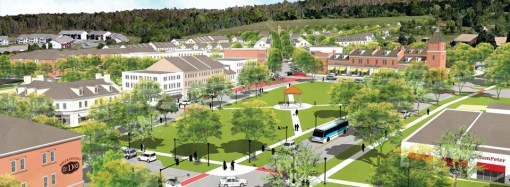
Also in the newsletter was an image from the latest set of Form Ithaca charrettes. “Buttermilk Village”, a working title for the South Hill neighborhood plan. The render above is looking northeast from the intersection of 96B and East King Road, with Ithaca College’s Circle Apartments to the upper left. Among the design features are a walkable town square, 2-4 story buildings, complete streets, and mixed uses with less dense residential further from the main roads. Some of the businesses like Sam Peter and Dolce Delight are in there to give that sense of familiarity. Most of this land is owned by Evan Monkemeyer, who’s still fuming from the College Crossings debacle. But rumor has it he’s working with another developer on a plan. It would be quite a feather in Form Ithaca’s cap if it looked something like this.


Upson Hall Construction Update, 7/2016

1 08 2016

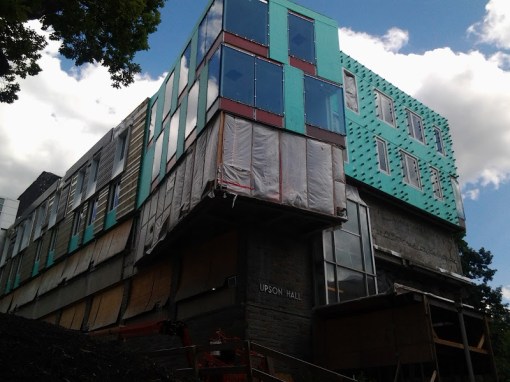
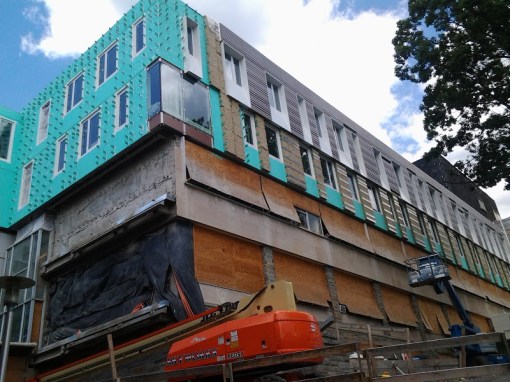
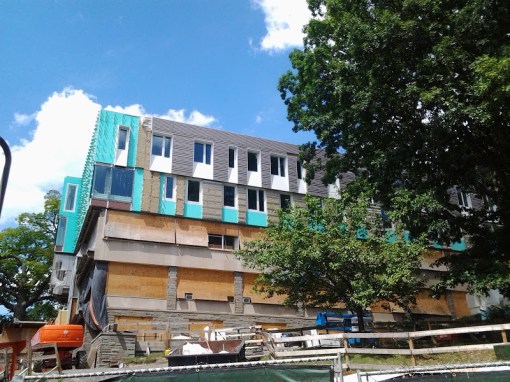
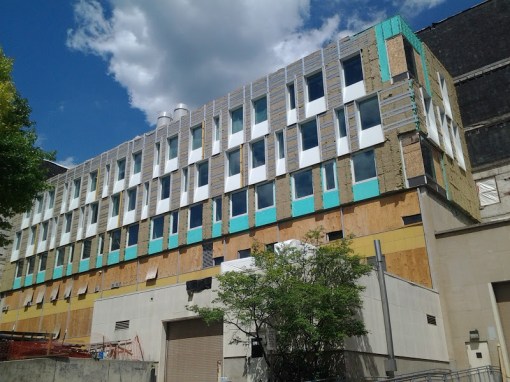
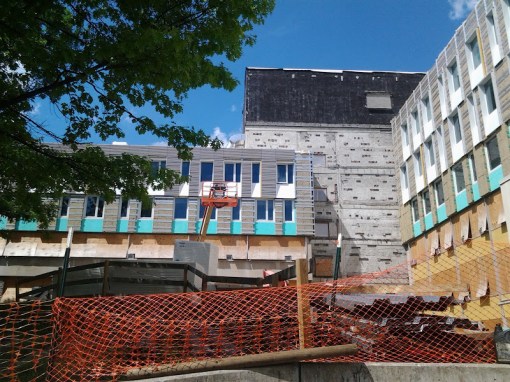
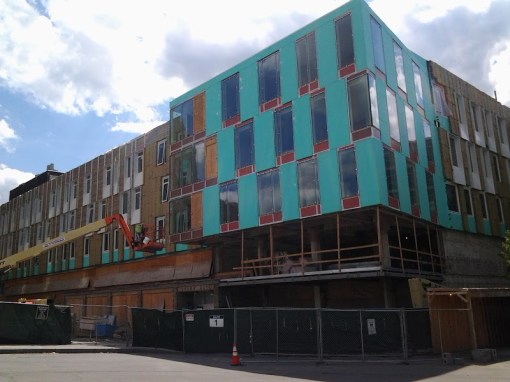
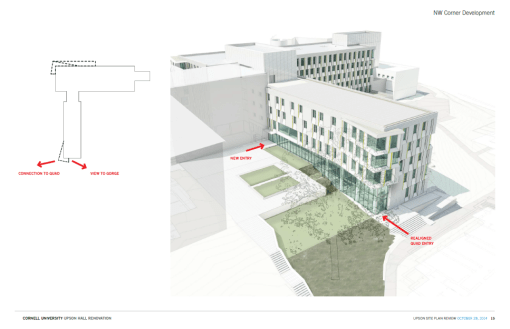
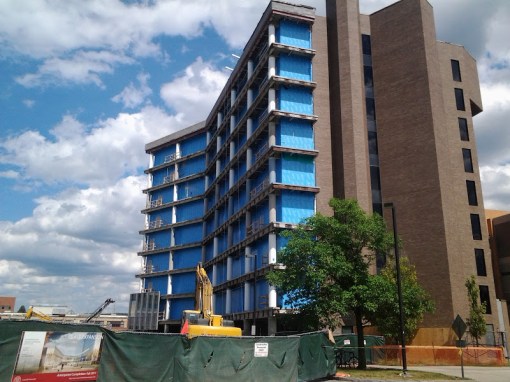
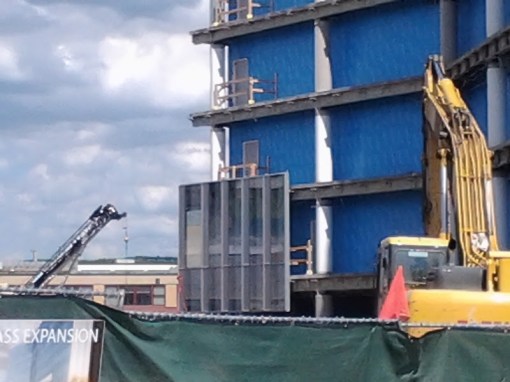
There are two different facade installations going on here – the terracotta, and the aluminum. For the terracotta, the process goes like this. First, we have the gypsum sheathing, coated with a turquoise-colored water-resistive barrier. The ends of the aluminum clips are installed onto the sheathing, and then mineral wool insulation is attached between the clip. Then, the rest of the aluminum clip is attached over the mineral wool. From there, terracotta panels are hung up and secured to the clips. The aluminum window surrounds don’t need this type of work, so the panels are just hung as-is over the sheathing.

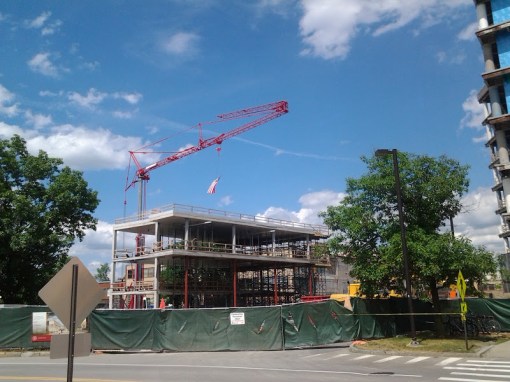
According to Cornell’s Upson Hall webpage, Phase I is nearing completion at this point. That means that floors 3, 4 and 5 are nearly finished inside and out, and work will shift towards the basement, the first and second floor. Some work has already been done in the basement with utility and infrastructure upgrades. It’s really quite a feat that the building is continues to be occupied while all the construction is going on, the work split between the top half and bottom half. Also, kudos to the faculty, staff and students who have to put up with the noise and multiple moves while the work takes place. The fully-renovated Upson Hall should be ready by next August.

20160717_150119 20160717_150157 20160717_150224 20160717_150302 20160717_150321 20160717_150641

upson_4 upson_3


Cornell Veterinary School Expansion Construction Update, 7/2016

31 07 2016

Over at the Cornell Vet School, one of the biggest changes since the last update in May has been the removal of the old glass curtain wall on the ca. 1974 Vet Research Tower. The insides have been temporarily walled off just inside the support columns. The support system for the glass wall has to be modified in order to support the replacement glass curtain wall, which should be fully installed by the fall. A small section of the new curtain wall, with a much lighter tint and trim and more transparent than the first, can be seen in photos two and three.

Most of the building demolitions should be finishing up at this point, which will allow construction of the new dean’s wing and library (reinforced concrete structure below) to extend back and connect with the rest of the vet school complex. The Poultry Virus Lab on the corner of Campus Road and Caldwell Road is the last major demolition planned, and will come down later this year to allow a new Community Practice Service building to take its place. Technically, that $7 million project is considered to be separate from the vet school expansion.
20160717_152109 20160717_152137 20160717_152145 20160717_152232 20160717_152256 20160717_152304 20160717_152351 20160717_152407

eea787361994de9625f74b19aa50d91e

20160522_131344


Gannett Health Center Construction Update, 7/2016

30 07 2016

Work on the Gannett Health Center is at the transition point between the first and second phases. With the new wing largely finished, occupants have been migrating into the new digs, while the interiors of the original 1957 wing and later 1979 addition are being prepped for a gut renovation. There’s still some bluestone and limestone cladding yet to go on the new wing’s stairwells, but the interior’s complete enough that a certificate of occupancy could be issued. I’ve received a couple messages from folks who are less than happy that the temporary main entrance in next to the ambulance bay, and that the interior’s lack of finish at moving was less than comforting to clients, but both of those problems will (hopefully) be rectified as the second phase moves towards an August 2017 completion. The whole facility will be known collectively as “Cornell Health“.

20160717_144759 20160717_144802 20160717_144805 20160717_144907 20160717_144930 20160717_145226 20160717_145230 20160717_145425 20160717_145434

gannett4 gannett_web


News Tidbits 7/30/16: The Unfortunate Surprise

30 07 2016

201_college_v5_1

201_college_site
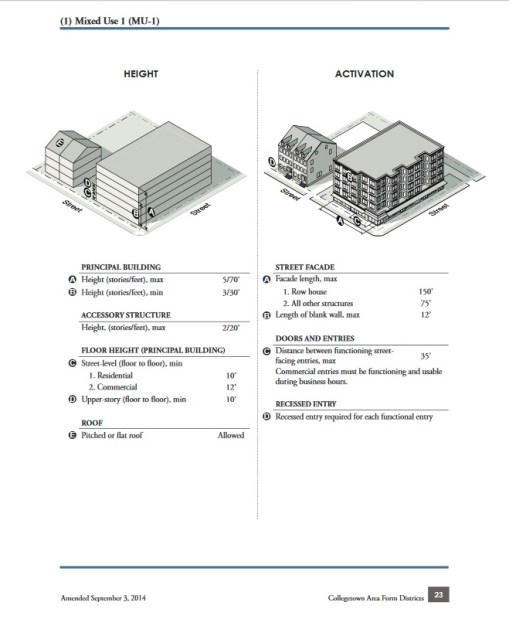
1. Pretty much everyone was caught off guard by the planning board’s decision to send 201 College Avenue to the Board of Zoning Appeals on a previously-undiscussed zoning technicality. The issue has to deal with facade height in connection to the length of a continuous wall – the argument being pushed by board member John Schroeder is that, since there are primary walls on College Avenue and Bool Street, the H-shaped proposal isn’t technically valid and the deep indentation actually has to be two separate buildings, one slightly shorter than the other since the site is on a slope. This was the subject of a prolonged and heated debate, since the code’s pretty ambiguous in that regard, and (as shown below) the design elements shown in the form district booklet demonstrate buildings with architectural indents/setbacks.

327_eddy_rev2_2

327_eddy_rev2_3

If recollection serves correctly, something similar came up in a previous discussion two years ago with 327 Eddy Street. The project fills the entirety of a sloped lot, but there was a hazy interpretation regarding one’s definition of floors and height where one could have called it 8 floors, so it had to be clarified and it became the average proposed height for cases with a sloped parcel. In this instance, there was one primary wall, on Eddy Street, which is why there’s just enough wiggle room left that a clarification request, however targeted it may be, is legally valid. The board agreed 4-3 to let the BZA issue a determination on 201 College, which could come anywhere from August 23rd to September 6th. That means a late September approval is maybe the best bet. That’s probably too late for an August 2017 opening, so whether or not the project would move forward (which could be immediately or in summer 2017 for a 2018 opening) if given approval is another question.

cafd_mu1

There is one other thing that is worrying from an impartiality standpoint. John Schroeder and Neil Golder served together as Collegetown’s Common Council reps in the 1990s. Although Schroeder’s not the biggest fan of Collegetown development, he hasn’t raised this much of a concern over other projects, and Neil has been very, very active in his outreach. There could be an argument that he should have recused himself from the decision-making process, or at least have formally acknowledged his longstanding professional relationship with the project’s primary opponent.

trebloc-future2-1-620x420

city_centre_site_options

2. Also from the Planning Board meeting, further discussion of the Trebloc project. Those following the IJ’s Nick Reynolds’ Twitter know that there was some talk about big changes with a lot of wonk talk, and this is what it has to do with. My thanks to my colleague Mike Smith for his notes.

Basically, Newman Development is floating a few different approaches to the site layout. One calls for a plaza area on State Street (the “accordion” approach”), one calls for green space (the “courtyard” approach), and the third actually breaks it up into two separate buildings. In these theoretical layouts, the square footage and number of units is kept roughly equal. All three also keep at least some emphasis on the corner facing the Commons, because that’s where the concentration of activity is, and that’s what’s going to appeal the most to first-floor retail/commercial tenants.

Each approach comes with pros and cons. The “accordion” approach opens up the sidewalk, but it opens away from the Commons (i.e. not appealing to pedestrians or retailers) and makes unit design tricky. The “courtyard” approach has public-ish green space, but it would be in unappealing, constant shadow – even if the building were just a few floors, the low angle of the sun in the cooler part of the year would keep light from reaching the courtyard. The two building approach offers an alley that could be interesting, but would likely not see much use since there’s very little activity towards that block of Green Street. Given the flaws in each, the inclination is to stay with the current “fish hook” shape, but the developers wanted to hear the planning board’s thought before committing to a layout.

Planning Board responses ran the gamut. A few members supported the State courtyard option, or stepping back the portion on State Street but building taller portions on Green if there’s a need to compensate (zoning’s 120 feet, so there’s perhaps two floors they could feasibly do that with, like an 11-story/9-story/7-story step down, without having to make a trip to the BZA and throwing additional, funding-jeopardizing uncertainty in there). One board member asked about a courtyard on the roof. The project will be pursuing tax abatements, with the hope that with those, density and smaller units, they can appeal to the middle of the rental market.

lansingapts600 lansingaptsmap600

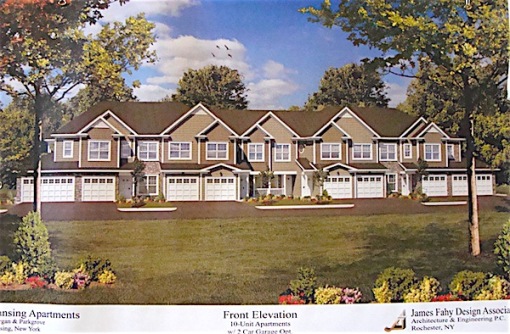
3. Thanks to Dan Veaner over at the Lansing Star, here’s a render and a site plan for the proposed Lansing Apartments / Parkgrove Apartments project for Bomax Drive in the village. The 19.46-acre property is currently owned by Cornell and is zoned to be part of its office/tech park. James Fahy Design Associates of Rochester is doing the design for the proposed 14-building, 140 unit project, and Park Grove LLC of Rochester is the developer, in tandem with retired Cornell Real Estate director and Lansing resident Tom Livigne.

According to the Star, “1,000 square foot one-bedroom apartments are anticipated to rent in the $1,300 to $1,400 range,  1,350 to 1,400 square foot two-bedroom apartments at around $1,600 to $1,700, and three-bedroom apartments up to 1,400 square feet would rent between $1,800 and $1,900.” The village of Lansing has to approve a zoning change from business to high-density residential in order for the project to move forward.

It’s a very auto-centric, premium-middle market project. For an area concerned about affordability and trying to move towards walkability and traditional neighborhoods, this really doesn’t seem like the most appropriate plan. It’s nothing against Livigne and Park Grove LLC, but I’m very critical of these kind of projects for just those reasons.

amabel_v4_1

4. It’s been a while since it’s last been discussed, but the 31-unit Amabel Project by New Earth Living’s Sue Cosentini has been approved by the state attorney general to start marketing units. According to a December presentation, the net-zero homes will range from 1600-2100 SF and market in the $385,000-$425,000 range. While that is a rather high price range, some of that cost would be paid off via energy savings, which could be up to a few thousand dollars per year compared to comparably-sized and priced older homes on the market, and other possible savings exist with water recycling and low-maintenance exterior materials. So the sales pitch becomes something of acknowledging the high up-front costs, but explaining the long-term savings.


5. The first of two state funding grants to not this week. Cayuga Addiction Recovery Services (CARS) has received a $1 million grant for a new 25-bed adult residential facility. The new facility will be built on the Trumansburg campus, which if these notes are correct, is actually two facilities, and this new one will be built adjacent to a 60-bed facility on Mecklenburg Road, near the county line a couple miles to the southwest of Trumansburg. An undisclosed number of jobs are expected to be created.

Founded in a Cornell U. fraternity house in 1972, CARS provides treatment, counseling, skills training and support services to help clients overcome addictions and rebuild lives. The current facility was opened in 2004.

Image Courtesy of Lansing Star

Image Courtesy of Lansing Star

6. Also in state grants, Ithaca-Tompkins Regional Airport received $619,935 to build a flight academy building for the East Hill Flying Club. The new facility is expected to be built in the next 2 to 3 years. When the EHFC has moved in to their new digs, the existing hangar will be offered up to rent to other tenants. The new building will offer more instructional space, the ability to engage in training for twin-engine aircraft, and what the flying academy née club hopes will include state-of-the-art flying simulators.


210 Hancock Construction Update, 7/2016

28 07 2016

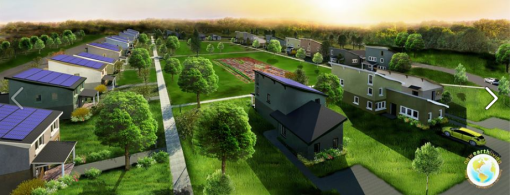
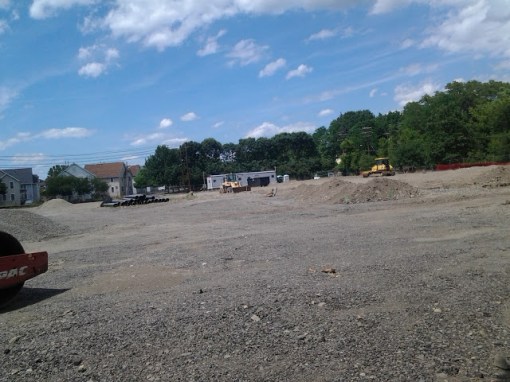
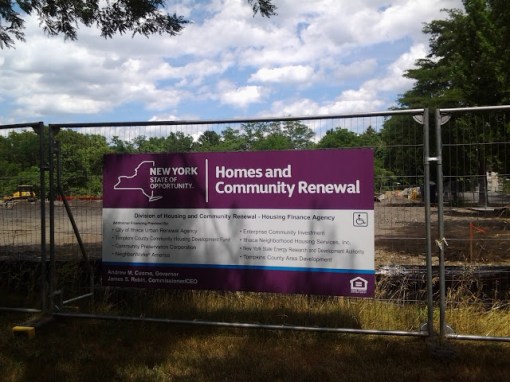
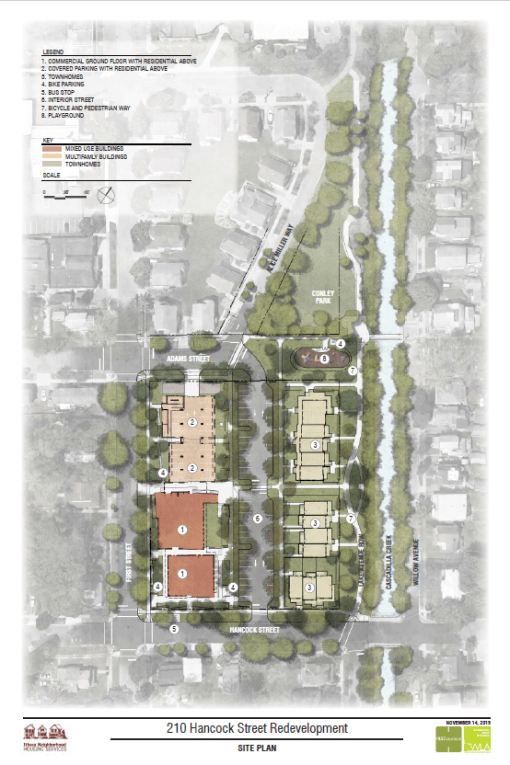
At the 210 Hancock property in Ithaca’s Northside neighborhood, site prep is taking place. The site is being graded and excavation is now underway for subsurface utilities installation (water and sewer pipes, the teal tubes stacked in the photos). INHS is conducting vibration monitoring while all this goes on, although the pile installation won’t start for another couple weeks, running foe about three weeks, mid-late August to mid September. Contractor Lecesse Construction will be installing 10-15 piles per day with a hydraulic hammer, between the hours of 8 AM and 4 PM. If the Voice’s Facebook inbox during the demolition phase this past spring was any indication, some very zealous neighbors will be providing breathless live coverage.

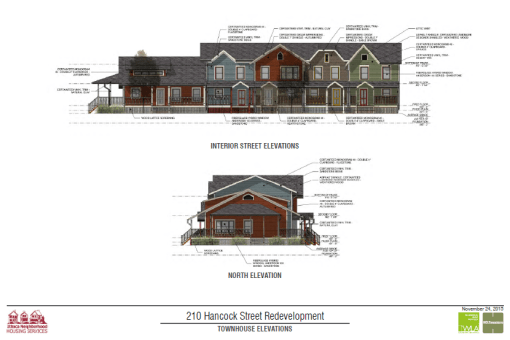
All in all, the contractor issue set INHS back about three months, but the grant funding is accommodating and rental agreements won’t be signed until the project is much closer to completion, late spring or summer 2017. For those who meet the affordable income brackets (breakdowns here), the rental interest form is here. The 54 apartments and the 5 rental townhomes should be ready to go by this time next year.

20160717_143140 20160717_143212 20160717_143239 20160717_143304 20160717_143318

20160717_143202

inhs_pride_design_v5_3 inhs_pride_design_v5_2 inhs_pride_v3_elevations_1

inhs_pride_design_v5_1