News Tidbits 10/8/16: No Rain, But the Money’s Flowing

8 10 2016

sleep_inn_v2_1
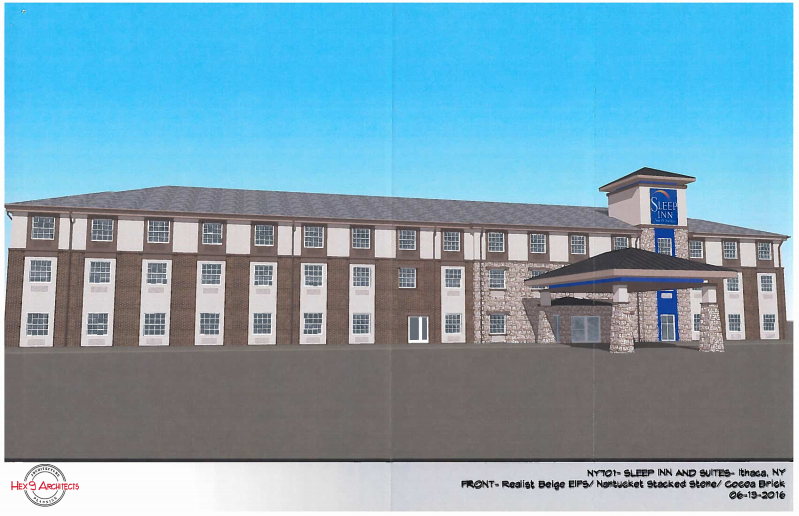
1. The Sleep Inn project at 635 Elmira Road went back to the town of Ithaca planning board last Tuesday. The initial write-up looked good – town planners were very pleased with the proposed changes, and the developer, local hotelier Pratik Ahir, proposed two different concepts to the board to see which one they were more comfortable with. The one that the board likes would be finalized in the plans and submitted for final approval later this year. No media were at the meeting, so I do not know which concept they preferred.

Both concepts by HEX 9 Architects attempt to maintain the rustic character that the town seeks to maintain for its part of the Inlet Valley Corridor. Concept one at top uses stone veneer (Elderado Stone), timber trusses, Hardie plank lap siding, and asphalt shingles. This design features balconies on both the front and rear of the building. Concept 2 incorporates a more varied roofline and building face, metal roof panels, stone veneer and a couple different types of Hardie Board. Concept 2 has less timber and no balconies. The town planning department felt that both concepts were unique enough and rustic enough to get its benediction in the SEQR analysis they sent over to the board. The concepts are a big improvement over the rendition we saw in August.

canopy_comparo_elevations_new_2
2. Looks like the Canopy Hilton is a go. The project secured a $19.5 million construction loan from ESL Federal Credit Union on Friday September 30th. ESL is a new face to the local market – “Eastman Savings and Loan” was founded in Rochester in 1920 to serve employees of former photography giant Eastman Kodak. The 7-story, 131-room hotel is expected to open in Spring 2018.

57e13f
3. Also funded this week – the second phase of Poet’s Landing out in the village of Dryden. Citibank is lending $7,702,326 to Rochester-based Confier LLC to build the 48 affordable apartment units across the street from Dryden High School, just west of 72-unit phase one. The documents were filed on Tuesday the 4th. The design of the second phase’s will be the same as phase one’s, an eight unit per building design by NH Architecture that is one of Conifer’s standard designs. The total project cost is $10.8 million, with the balance come from state affordable housing grants and tax credits. The build-out is expected to take about a year.
201_college_v5_1

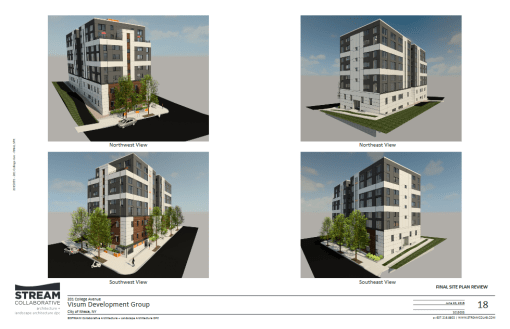
4. So a few news bits about 201 College. The partially-deconstructed house at 201 College is now getting torn down, which had nothing to do with approval, and everything to do with break-ins and safety issues – there was evidence of squatters taking up residence, and the expense of a tear-down is worth avoiding a lawsuit or tragedy. Speaking of which, although a ruling on 201 College has yet to be issued and won’t be for a few weeks, Neil Golder’s lawsuit has already been re-filed. The court hearing is scheduled for December. According to an exchange with my colleague Mike Smith, Fox is planning rowhouses along Bool Street, within a 45-foot height limit but spanning the block, as it seems he has a purchase option on neighboring 202 Linden.

20161007_131502

5. According to Nick Reynolds at the Times (yes, he jumped papers), the buildings to be deconstructed for the Harold’s Square project are to be vacated by the end of October. Developer David Lubin plans to start the deconstruction process, which is a little more intensive and lengthier than a typical demolition, in November. Things have been complicated by the city’s decision to forego the project in the Restore NY grant application, where the $500,000 was allocated to pay for demolition, and must now be sourced from elsewhere. Once secured, the plan is to file for the permit, and by law they have up to 30 days to start deconstruction from the day the permit is issued. Construction should go for about 18 months, once the site is cleared.
607_s_aurora_2 607_s_aurora_1

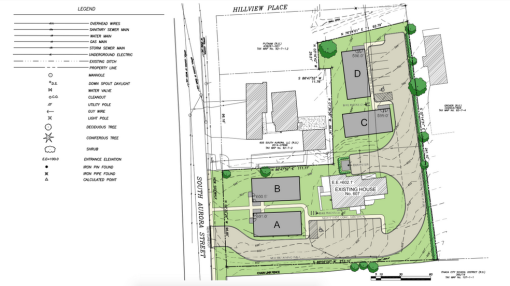
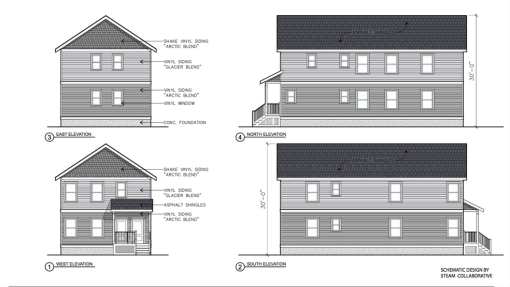
6. The 8-unit 607 South Aurora project will be seeking “Declaration of Lead Agency” at the Planning Board meeting, and materials have been filed with the city. Project narrative here, SPR application here, drawings here. The big changes since sketch plan were sidewalk and parking lot revisions, and rotating Building D to establish harmony with Hillview Place. The project is estimated to cost $1.5 million and aims for a construction timeline of March to September 2017. This is the next incremental step up for Charlie O’Connor of Modern Living Rentals, whose M.O. is to quietly pursue modestly-sized infill projects in less dense parts of the city (ex. the two duplexes planned for 312-314 Old Elmira). In a change of pace, the staff of Sharma Architecture are the designers this time around.
123_eddy_street_2

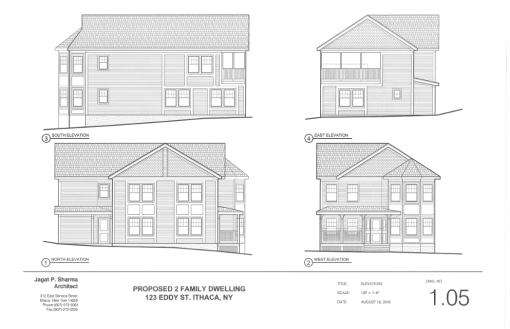
7. From the Board of Zoning Appeals meeting, the new two-family house at 123 Eddy Street has been granted zoning variances. Expect the Sharma-designed two-unit, six-bedroom rental property to start construction next year in time for the 2017-18 academic year.

20160918_155855 20160918_155910

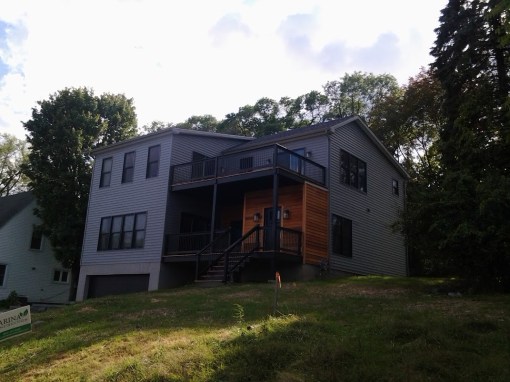
6. House of the week. Instead of one underway, this week will show two recent completions. Leading off is this house on West Hill’s Campbell Avenue, built by Carina Construction. This project came up in a weekly roundup back in late May – it’s a $320,000 project per the permit filing with the city, with $280,000 lent by Tompkins Trust. The contrast between the wood siding and the (fiber cement?) vinyl siding is a nice touch, as is the two-story porch. Definitely a unique house, and a showcase of just what kind of variety one can do with modular pieces if they’re willing to get creative.
20160918_162315 20160918_162648

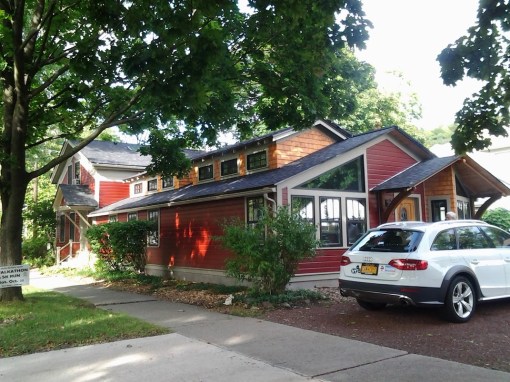
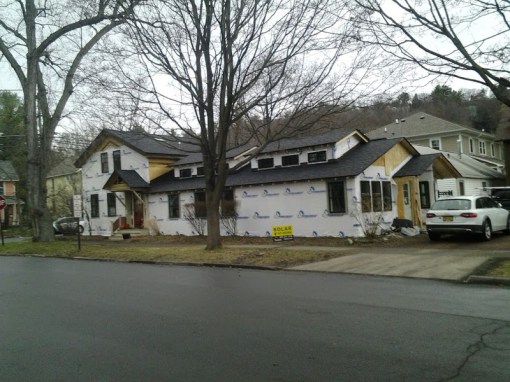
Now for house number two. This isn’t a new build, but a very thorough renovation. Every time I take photos, I run into the owners, and normally I try to be as unobtrusive as possible. But, given that I’ve run into him twice, he’s familiar enough with me that we’ve had a conversation about his work.
20160109_151921

This is in Fall Creek on North Aurora. The couple who own this place moved in from Pennsylvania, they were just starting retirement when the wife’s father was no longer able to take care of it. It had been a duplex, but the other unit was more workshop space. The building was in good shape, but these folks wanted to modernize and refresh it, so they decided to do a to-the-studs renovation, basically turning it into a new home within an existing shell. Fiber cement, wood shingles, a few modern touches (the south bumpout, the unusual gable/shed hybrid dormers), a carriage house, a lot of work went into it over the past year and a half and it shows.


Ithaka Terraces (215-221 West Spencer Street) Construction Update, 9/2016

4 10 2016

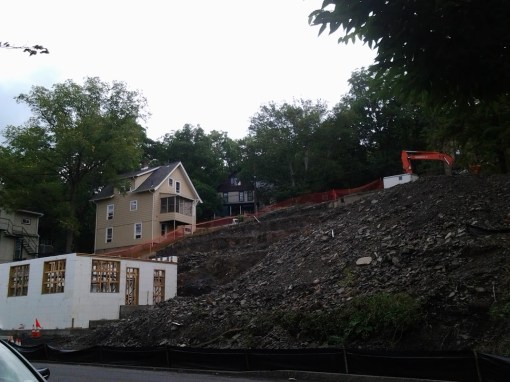
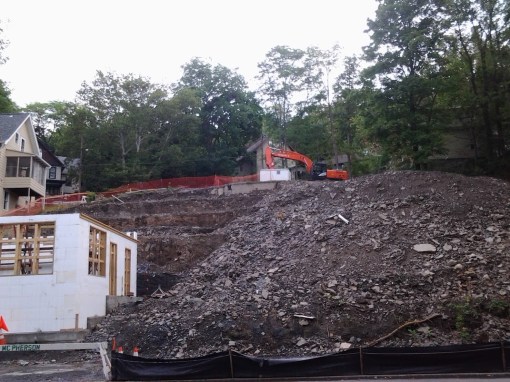
I wanted to wait until the Voice condo piece was published before putting these photos up. Work has started on the twelve condominiums planned for 215-221 West Spencer Street. The project, dubbed “Ithaka Terraces”, is the idea of Ed Cope, a retired Cornell biologist who owns the local property management firm PPM (Premium Property Management) Homes.

215-221 West Spencer Street is a steeply sloped 0.47 acre site that was previously home to a multistory apartment building. The building had fallen into disrepair by the early 2000s, and the city bought the property for $530,000 in 2003 with plans to turn it into affordable housing. However, that plan was thrown off track after the building burned down not long afterward. The site was then used as an informal parking lot by nearby residents for a number of years while the city figured out what they wanted to do with it. The city deeded the property to the Ithaca Urban Renewal Agency in 2013, who attempted to sell it as affordable housing, but found no takers at the $100,000 starting bid. Cope picked up the property when it was offered for sale to general housing, paying $110,000 in March 2015. Sketch plans were presented a few weeks later at the March Planning Board meeting.

The parcel is zoned R-3a, and the property required some variances for having parking within rear yard setback, which the planning board and BZA were comfortable with given the steep topography of the site. The property was approved by municipal boards last fall. Long story short, it’s classically-inspired urban infill.

The plan is to have the buildings ready for occupancy by September 2017. Units range from $265,000-$390,000, depending on size and location. Two of the units are 3-bedrooms, and the other ten are two-bedrooms, ranging from 637-1311 SF. For those interested, more information can be found at the just-activated website for the project here.

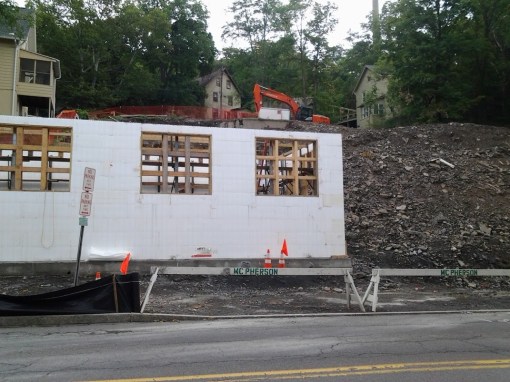
Along with Ed Cope (operating as “Net Zero NRG LLC”) on the project team is architect Noah Demarest of STREAM Collaborative, Taitem Engineering for structural engineering, T.G. Miller P.C. for site surveying and civil engineering, and green building expert AquaZephyr as general contractor. All of those businesses are local. The sawhorses in the photos say McPherson Builders, but they could be a subcontractor, or on loan.

In the now two-week old photos below, Building A is already under construction, while the site for building C has been leveled. More specifically, the foundation has already been dug, formed and poured for Building A, and the first-floor walls have been erected. Like their little pioneer across the street, The buildings are designed to be net-zero energy capable. The slab foundations will be insulated with R15 rigid foam, and the first floor walls use insulated concrete forms (ICFs) similar to the Fox Blocks used for the Thurston Avenue Apartments a couple of years ago. The walls are put together block-by-block, with concrete poured into the inside gaps. This provides insulation on both the interior and exterior of the wall.  The building will use electric air source heat pumps for winter heating and summer cooling, with the electricity provided from a solar array Cope owns in the town of Caroline. The buildings will seek net-zero certification once they are completed.

Here’s the press release from Ed Cope that I received as part of our Q&A:

One of my primary interests in Ithaca housing is to help improve the overall community. My development goals all come from that objective, and so for the past few years I have worked to identify sites that are a very inefficient use of space, and are therefore mostly vacant and difficult to build on which is why they are still in need of development.

This combines with my longtime interest in efficient use of energy which includes building energy-efficient buildings. This interest leads me into risky but rewarding projects and works well with the city’s infill development initiatives. At PPM Homes we have transformed many of the older houses that we have acquired into much more energy-efficient dwellings.

One of our successes was the complete rebuild of a rundown property on a steep and difficult site at 201 S. Aurora. We were able to transform this property into a beautiful and more appropriate “gateway” to South Hill, a sharp contrast to the decrepit and crumbling house it once was.

The Ithaka Terraces project is our second effort at completely new development, the first being across the street at 228 W. Spencer where we took an impossibly small and impossibly steep postage stamp of a site and built a netzero energy 2-bedroom house.

This house, which is now on the market, is currently powered completely by PPM Homes offsite solar array which incredibly also provides all of the electricity for many of the properties that PPM Homes manages.

The condos at Ithaka Terraces will also be powered by an additional solar array that we will be built by Renovus Energy next to our current array which is 15 miles outside of Ithaca.

Both of these properties on West Spencer Street are built on sites that are extremely difficult on which to build. They have been vacant for years and would probably have remained vacant for years to come. Special engineering consideration due to the peculiarities of building on the sites has been handled by Tatiem Engineering.

The Ithaka Terraces project also responds to the recognized need for condominiums downtown. Three blocks from the Commons and consisting of 12 two and three bedroom units, these condominiums will provide upscale quality and energy-efficient living.

In the interest of reflecting Ithaca’s namesake our design will add a pleasing Greek aesthetic to this part of West Spencer Street. The project should be complete by this time next year and be available for reserving units by early summer. Our website for the project is up and running at IthakaTerraces.com .

20160918_144152 20160918_144204 20160918_144222 20160918_144249 20160918_144307 20160918_144337 20160918_144604

215-221_spencer_v3_1 215-221_spencer_v3_2

215-221_spencer_v2_1


News Tidbits 10/1/16: Sketchy Details

1 10 2016

lansingapts600
1. Over in Lansing, it looks like Park Grove Realty is having a rough time getting their plans rolling. Legions of angry homeowners turned out at the village’s Board of Trustees meeting to protest a requested zoning change for a 20-acre Bomax Drive property that Park Grove seeks to build 140 apartments upon. The meeting wasn’t about the project, which will follow the zoning change once approved. For the record, the meeting was only about the zoning change, which is currently zoned for office park business/technology and has been owned by Cornell since 2008.

The unusual thing is that the primary opponent seems to be the Jonson family, of development company IthacaHome, formerly known as Forest City Realty. They built some of Lansing’s 1990s subdivisions and the Heights of Lansing project at the end of Bomax Drive, which is stalled out due to a lack of interest and Ivar Jonson’s passing. The claim from Janet Jonson is that if left commercial office/tech, then maybe an office building would be built and executives would build homes on some of their vacant lots. Even Larry Fabbroni was there to say an office building would generate less traffic than housing would. The meeting was very heated, according to the Lansing Star’s Dan Veaner.

The village planning board was there to listen, but not especially sympathetic. For one, there’s plenty of undeveloped commercially-zoned land; but there is a housing shortage. For two, although some complained “transients” would lower their housing values, these units will be going for $1,400-$1,900/month. The board’s not focused on the project just yet, that will come in due course. Meanwhile, the trustees moved to schedule public review for the zoning change, with that meeting planned for October 17th.

A couple miles away, Park Grove has also been getting flack for taking down willow trees as part of a plan to reduce root damage and mold issues, and to expand parking and add a 425 SF rental office on the Triphammer Apartments (former Chateau Claire) property. The heavy-handed approach was not well received. In short, Park Grove’s principals are the village pariahs at the moment, though they have brought some of it on themselves.

maplewood_v3_2

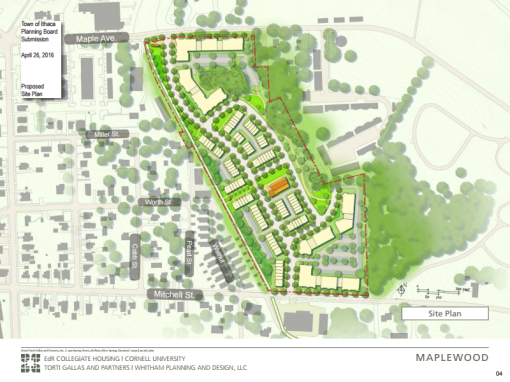
2. Just a brief check-up on the Maplewood Park redevelopment. The project team has been busy over the past month making revisions to the Draft Environmental Impact Statement (DEIS) as part of its determination of adequacy, and the DEIS was just accepted for public review as of the town of Ithaca planning board meeting on the 20th.

A digital copy of the revised DEIS can be found on the town’s website here. A public hearing will also take place on October 18th. The SEQR review period is 45 days from acceptance, so public comment will be accepted on the document up to 4 PM on Halloween.

100_1967

3. As part of their campus housing study, Cornell launched an extensive survey of their students. A summary and a link to the full results can be found on their webpage here. The university also held public forums this past week on campus to hear opinions from the community and explain what happens next (what needs work, how much campus housing is needed, where on campus, what student segments, strategies for the next 25 years, and so on).

Among the grad and professional (MBA/JD/MPH/etc) students, more anticipated living on campus when they arrived, than actually did – 32% vs. 18% of respondents. On average, G/P students felt they should pay about 7% less than they do. They want Wi-Fi, private bathrooms, on-site laundry and package/mail delivery. Outside, they want wider sidewalks and more frequent bus stops/service, and parking fees should be bundled in rent if parking is offered.

Those off campus preferred Downtown (26%) and Collegetown (24%). Grads and domestic students preferred Downtown, professional and international students preferred Collegetown. Grad students tended to be more satisfied with their housing than undergrads.

Similarly, more undergrad respondents want(ed) to live on campus – 56% do or have, 78% want/wanted to. That stat’s a little weird, since freshmen are required to live on campus. Only about 45% describe an apartment as ideal housing, vs 88% for grad/prof students. They also want Wi-Fi and laundry, as well as study areas and dining nearby. 49% selected Collegetown as their preferred housing choice, with another 36% preferring an on-campus location if available.

cornellspace-771x394

At the public forums, the university presented a few potential building sites for new campus housing. The goal was to have sites away from full-time residential areas (less hassle), easy to prepare (less physical hassle), accommodate 300-500 students (scale efficiencies) and be near existing facilities (quality of life and infrastructure). Three north campus locations were presented – CC parking lot, the side lot at RPCC, and the fields next to Appel Commons. The RPCC and CC locations show up on the 2008 Master Plan as well, 3-6 floors and up to 200,000 SF of space. So it seems those two locations have a more sustained interest. The city of Ithaca and the Village of Cayuga Heights have a boundary line that straddles those sites, a latitudinal line just south of Jessup Road. If something were proposed, most of the land is in the city, but the village would have to vote to defer decision-making to the city. That is a potential complication that Cornell has to keep in mind.

evergreen_dryden_1

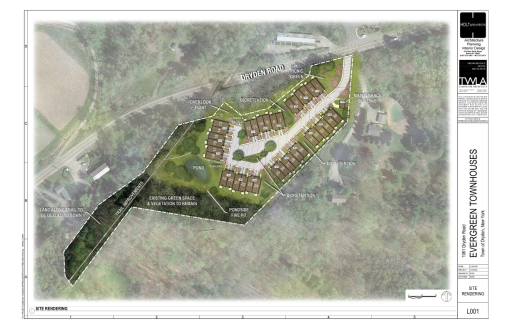
4. The Evergreen Townhouses project in Dryden will be the subject of a special meeting of the town planning board on Wednesday October 5th at 7 PM at the Varna Community Center. The full suite of documents, including county review, planning board notes for the town board (recall that in Dryden, the town board votes to approve projects instead of the planning board), sewer capacity report and concept plan description can be found here. SEQR has been reviewed and a traffic study has been completed. The project will need a PUD approval, since 36 units exceeds what the zoning allows (28). If the PUD is approved, land will be deeded to the town for its recreational rail trail. Like the Park Grove project in Lansing, this rental proposal has seen a fair amount of opposition, due to traffic and concerns about renters, and the possibility of encouraging suburban sprawl east of Varna. Oddly enough, for being this far along in the process, there still haven’t been any detailed renders of the townhouses released to the public.

5. Here are a few details about the 607 South Aurora project. Readers might recall the sketch plan was presented at the August Planning Board meeting.

As I discovered this week, sketch plans are actually off the record. Meaning that a developer doesn’t have to give it to the city for publication if they don’t want to. Apparently, John Novarr is going this route – although images for his townhouse project on the 100 Block of College Avenue were presented last week, the city has no official record of them, and he said he has no intent to share plans until he’s ready for the city to declare itself lead agency. For what it’s worth, the project, geared towards Cornell faculty and staff, was well received by the Planning Board.

On the one hand, not sharing the sketch plan limits public exposure and the risk brought by exposure, and it allows the board to eliminate the most controversial aspects before the public can see them. On the other hand, it’s less transparent, and makes me an unhappy camper.

Back to the topic at hand, 607 South Aurora as initially conceived calls for 4, 2-family, 2-story houses on the property, while retaining the existing house. That’s a total of 8 units, and 24 bedrooms total. Parking would be in two sections tucked back from the street. The project is not unlike the one approved for 312-314 Old Elmira Road in Ithaca’s South Side neighborhood. Although STREAM Collaborative’s Noah Demarest presented the project at the August meeting, STREAM is not in charge of this proposal. The project is being designed by Collegetown favorite Jagat Sharma for local developer Charlie O’Connor.

607_s_aurora_1 607_s_aurora_2

Charlie O’Connor is a part of Modern Living Rentals, and regardless of how one might actually feel about their work, it is probably the most transparent development/rental company in the local market. True to form, a quick check of their website turned up images of 607 S. Aurora. It looks like the same general design will be used for each building, and each unit will be 3 bedrooms and about 1,122 feet. I hope they change up the exterior colors for variety’s sake. The board and planning department was fine with the buildings, but suggested revisions to the site plan, so the next iteration will likely have a different site layout.

20160918_164039 20160918_164106

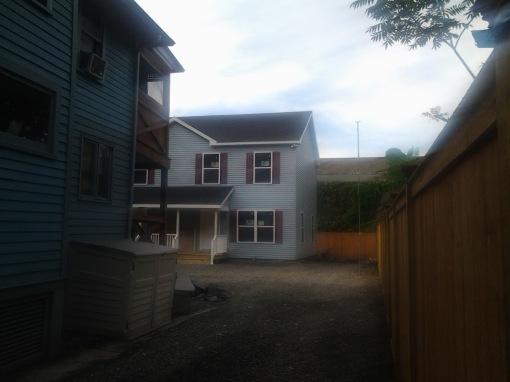
6. Sorry, didn’t realize the lens was smudged. This very subtle duplex is underway in Ithaca’s South Side neighborhood, behind an existing duplex at 512-14 West Green Street. Because it fits in all the setbacks (it’s a very large, deep lot for an inner city parcel) and the rear of the property falls into the State Street Corridor’s CBD-60 zoning (i.e. no parking required), this project never needed more than staff-level approval from the city. Honestly, were it not for a small disturbed area at the curb-cut from construction vehicles moving in and out, one would never know this duplex was under construction.

The property is owned by the Ciaschi family, and appears to have been passed between family members since at least the 1960s. A building loan filed on June 17th indicates that Tompkins Trust lent $330,000 towards the project. As with many smaller builds, this a modular by Ithaca’s Carina Construction. Carina is supplied by Simplex Homes, and it looks like this 3-bedroom/2-unit is based off Simplex’s “Elkton IV” plan (but that could be wrong). Give how far along the outside is, it would not be a surprise if renters move in by the start of October.

147962

7. The near-death Black Oak Wind Farm could actually happen, if they pay Enfield the money they want for FOIL costs. Using the original EIS, they’ve reverted to the initial plan, including use of the landowners’ properties who tried to pull out in the face of the project’s rancorous opposition. The BOWF project team had been attempting to move two of the turbines to accommodate property owners who changed their mind about being associated with the project, but the Supplemental EIS had been caught in legal red tape with the town of Enfield and the town of Newfield to its south, where one of the alternative sites was planned. So the new plan is to just go forward with the original signed contracts and build what was proposed before the 2015 SEIS. The project team has requested final approval, but the town has said they want to be paid $19,000 for the cost of handling all the FOIL (Freedom of Information Laws) requests, of which they’re not sure who’s actually required to cover the cost.

This project and its manager, Marguerite Wells, have probably been put through a greater Hell than any other proposal in this county, which is really, really saying something. Let’s recall, apart from the opposition that has demonized the project manager and the investors (successfully, one could unfortunately argue), that when they considered the alternative site, Newfield’s town board rewrote their wind farm law to implicitly but effectively ban wind turbines from the town. The BOWF project has been incubating for nine or ten years.

According to Marguerite Wells, if they can’t get approval at the Enfield town board’s October 12th meeting, the wind farm proposal dies. And with it, pretty much any commercial wind turbine plans for Tompkins County (looking at Newfield, maybe single-family turbine plans as well – the way the 2016 revision is written, a homeowner can’t even hook up a little one to their roof, as it’s too close to an occupied structure).

8. Here’s a little kick in the pants to end the week. It was reported in Bloomberg of the five Ivies that have released results so far, Cornell’s endowment did the worst in the past year, with a -3.3% loss (which comes out to a drop of about $200 million). The university is taking reactive measures, including moving its investment offices to New York City. “The investment committee believes over the long term the relocation to New York City gives us even better access to potential staff who might not be willing to move to Ithaca,” said Cornell CFO Joanne DeStefano. That’s a bit deflating.


News Tidbits 9/10/16: Situations To Be Avoided

10 09 2016

Pardon the week hiatus. Sometimes, by the time there’s enough news to share, it’s already the weekend, so it just makes more sense to fun a longer feature the following week.

maguirebirdseye-620x420

1. The Maguire dealership proposal for Carpenter Business Park had a lukewarm reception at its public info session a week and a half ago. A copy of the application can be found here, and Second Ward Councilman Ducson Nguyen was kind enough to upload a 90-minute video of the meeting on his facebook page, and a transcript of the meeting can be found here. A second public info meeting will be held on the 14th.

You might recall news of the project broke last winter, followed shortly thereafter by a vote of the city Common Council to subject waterfront and waterfront-vicinity properties to a “Temporary Mandatory Planned Unit Development” (TM-PUD), meaning that any building proposal would be subject to a vote of the Common Council as a stipulation of approval (typically, projects only need the Planning Board’s consent, plus the BZA and/or ILPC if needed). One other project has gone through the TM-PUD process since then, the Cherry Artspace performing arts building. The small experimental theater held its public info meetings at the end of March and mid-April. It enjoyed fairly broad  public support, but two of the eight voting councilmen still voted against its construction at the May meeting. If a a project with widespread support has some trouble getting passage, you can already guess what will happen with the Maguire proposal.

There’s only about a year left in that TM-PUD. But for the Maguires, it was too late as soon as the TM-PUD was passed. Perhaps more concerning, this is creating one of those cases where everybody’s opinion is coming out of the woodwork – some demand it be a park, some say industrial space only, Form Ithaca advocates walkable mixed-uses, and then there was that verbal brawl on the Ithaca West list-serve about the evils of the Ithaca Community Garden. A lot of folks think their idea is the only reasonable option, so if this plays out like the old library site, there’s going to be a lot of acrimony in the long run. Hopefully when the TM-PUD expires, the city will have the new urban mixed-use zoning ready for implementation, so situations like this can be avoided in the future.

20160821_123800

2. Can’t help but feel just a little sympathetic towards Steve Fontana – he tried to have this project open for move-in, and everything that could go wrong, was going wrong. The Journal’s Nick Reynolds reports that first it was a safety systems issue with the elevator holding up the certificate of occupancy, and then a water main burst. The latest planned opening date is September 9th, when the initial date was August 1st. Now it’s a financial issue, a public relations issue, and a mess for all involved. This could be used as an example of why Todd Fox put the 201 College site up for sale – it became clear that August 2017 opening wasn’t going to happen.

201_college_v5_1

3. On that note, I’m going touch on 201 College real quick. Given the amount of time that went into the Collegetown Form District – six years – this just looks bad all around. On the one hand, Todd Fox could benefit from more patience (granted, we don’t know what the financing situation was), and the character attack on Neil Golder in his supporting documentation turned some people off to his cause. But what John Schroeder did also deserves strong scrutiny. It’s odd to claim a zoning code issue when the MU-1 code is only three pages, and he helped write it. He was also aware that 201 College went through pre-site plan review with the city’s Planning Department, and they gave it the okay to proceed with review. This looks very suspiciously like Schroeder was explicitly looking for anything he could to help out his old colleague Neil, and that small ambiguity was the best he could do, which he was able to parlay with success.

This continues an uncomfortable pattern we’ve seen with other projects like the Old Library where one government body gives the OK, and another stops it after the consent is given. The whole point of these laborious review processes is to prevent controversy from arising. Who wants to take on the risk of proposing condos, mixed-use and affordable housing when, given that many projects require the approvals of multiple boards and committees, there’s a track record of mixed signals?

Rezoning has come up as an idea, but it’s not as simple as it sounds. Spot rezoning (single-lot rezoning) would likely be deemed illegal because the current zoning is consistent with the recently-passed Comprehensive Plan, something the courts look for in zoning lawsuits. Thinking slightly broader, Collegetown’s MU-1 is nine parcels – Fox, Josh Lower and John Novarr, all major local developers, own seven of them. If 20% of those affected by a rezoning proposal file a protest petition, a super-majority of the Common Council – 75%, 8 of 10 in practice – is required for rezoning approval. That is what stopped the first Collegetown rezoning during the Peterson administration. If it couldn’t pass then, a similar super-majority event is unlikely to pass now.

4. On the edge of Ithaca’s South Side neighborhood, the CVS Pharmacy sold for a pretty penny – or rather, $4.09 million, on the 1st. The property is assessed at $1.8 million, but sold for $3.6 million in 2006. The buyer is an LLC traceable to a suburban Boston firm with a broad retail space portfolio, so whether they plan to keep things as they are, or propose something new, is anyone’s guess.

trebloc-future2-1-620x420

5. Finally, a copy of the Site Plan Review application for Newman Development Group’s City Centre project at 301 East State Street in Downtown Ithaca. Keep in mind, this is from the June filing, so things are likely to have been updated or revised in response to the planning board. The 9 story building tops out at 96 feet. The approximate construction cost at the time of the filing was $32 million, with a proposed build-out from February 2017 to October 2019, which seems lengthy, and in another part of the document it says construction will last only 20 months. 400 construction jobs, 50 permanent jobs by tenants in the 10,600 SF of first floor retail, and building service staff. Overall square footage isn’t given, but given the retail and 7,225 SF of amenity space, 160,000 SF probably isn’t a bad first guess. For comparison, State Street Triangle was 288,000 SF, later reduced to the same height and similar dimensions as City Centre. In a sense, City Centre started off where SST required months to get to. Hopefully that bodes well for the proposal.

arpt_pk_1

6. Remember that airport business park study from a while back? There’s no strong demand for a business park. But the NYS DOT wants to move their waterfront office and storage facility to the site. So removing those salt sheds and replacing them with mixed-use waterfront property won’t happen until the state buys whatever it needs here, builds and moves in to a new facility. Not sure what they’ll do with the property on Ellis Drive in Dryden that they’ve owned for the past decade; presumably sell it as surplus, but who knows?

chain_works_rev3_3

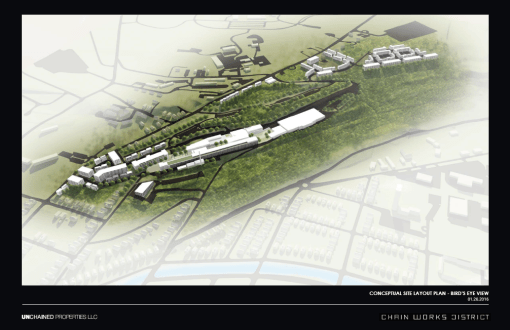
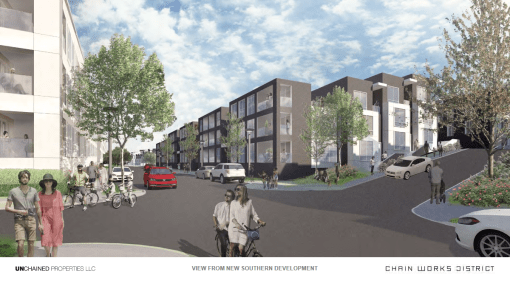
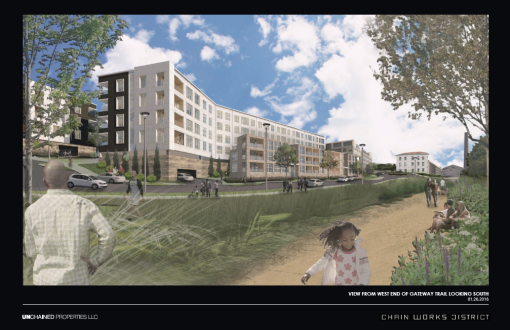
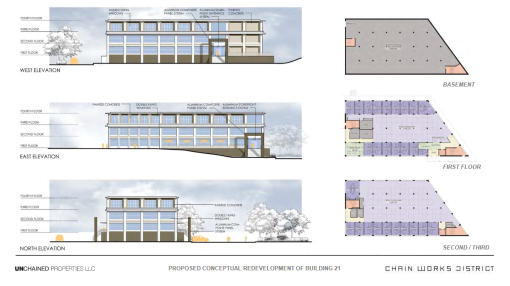
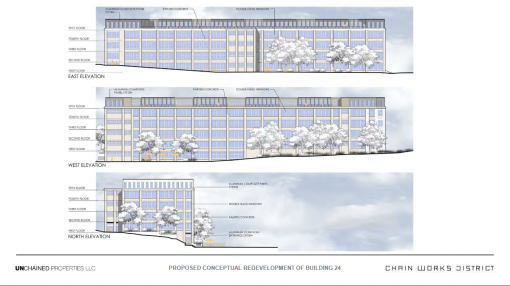
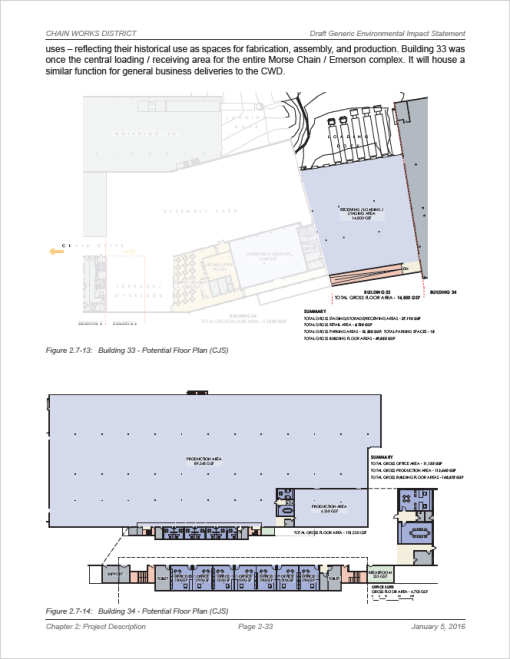
7. From the Ithaca Times: The Al-Huda Islamic Center hopes to start construction on their Graham Road mosque in 2017, and then obtain land for burials later this decade. In other news, new Times reporter Lori Sanken is reporting on the Chain Works progress, the Planning Board requesting color changes, careful consideration of heights, and debates about forest [preservation and Route 96B. Developer Dave Lubin of UnChained Properties wants to do renovations to existing buildings first, but seeing as they have yet to have the state sign off on a remediation place, they’re considering the construction of new buildings first, if NYS DEC approval for remediation gets delayed. And Catholic Charities and non-profit group Ithaca Welcomes Refugees are actively trying to procure affordable living space for 50 refugees who will be arriving in the Ithaca area after October 1st.

pinney_peruville_1
8. It’s been incubating for a while, but it looks like former Lansing town supervisor A. Scott Pinney’s plan for 15 duplexes (30 units) is moving forward. A gravel road will be extended from 4 existing duplexes at 390 Peruville Road (NYS 34B), looping through the property from Scofield to Peruville. The “Developer’s Conference” to talk about the project will be a part of the Lansing town planning board’s meeting next Monday. Also up for discussion are slight revisions to the Village Solars PDA, related to the community center and first-floor commercial space in the proposed Building F.

1001_n_aurora_1

9. From the Ithaca city Projects Memo for September, it looks like there’s a couple of subdivisions planned. One is for 404 Wood Street in the South Side neighborhood, where the owner wants to subdivide a double-lot he has for sale, allowing the vacant lot to be developed for a house or small apartment building. Quoting the application, “Instead of an empty grassy lot, there would be a building on it”. Points for simplicity.

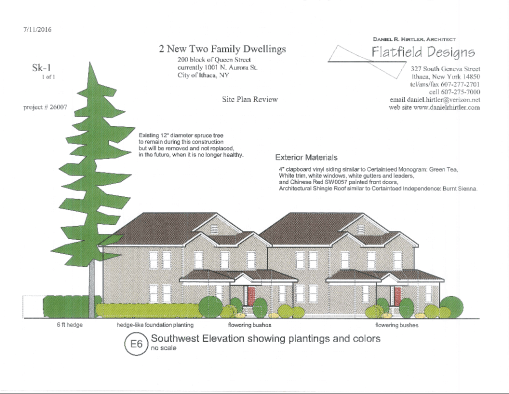
The other is a double lot at 1001 North Aurora Street in Fall Creek. This came up a couple of weeks ago in a weekly tidbits round-up, because the new owner, Stavros Stavropoulos, received a $400,000 loan to build a duplex. Turns out it’s actually two duplexes, which require a lot subdivision, and will trigger planning board review. The application notes that even with the density increase, it’s still less than the surrounding neighborhood. The two two-family homes with have 3 bedrooms and about 1200 SF per unit, and are designed by local architect Daniel R. Hirtler to fit in with the neighborhood. Unusually, the application includes documentation of the previous owner signing off on the redevelopment plan. Construction is estimated to run from this month through May 2017.


News Tidbits 8/20/16: Another Campus Coming?

20 08 2016

Fairly quiet week, but still a few things going on-

inhs_pride_design_v5_3

1. The Journal’s Nick Reynolds followed up on the pile-driving underway at the 210 Hancock site in Ithaca’s North Side neighborhood. Admittedly, no one wants to live next to a site while hearing and feeling the bang of the pile-driver against the piles being inserted into the ground. Thankfully, this phase of the affordable housing project should be wrapped up by the end of the month. Lecesse Construction’s subcontractor, Ferraro Piling and Shoring of rural Erie County, is inserting 10-15 piles per day between the hours of 8 AM and 4 PM, and about 170 piles will be used in the project. Not fun for the neighbors, but this too shall pass.

sleep_inn_1

2. The town of Ithaca’s planning board had their close look at the Sleep Inn proposal for Elmira Road. They were not impressed. The primary complaints were that it was a one-sided design (meaning the front received significantly more cosmetic attention than the rear and sides), that it was big and that it was ugly.

The architect of the 70-room hotel, Joe Turnowchyk of HEX 9 Architects, responded with “all corporate hotels are basically ugly”, which isn’t the kind of response that will be well-received. It was followed with “[He thinks] that if they’re going to put more money into the front of the building, they shouldn’t need to address the rear”, which isn’t a good response either, because the rear faces the Black Diamond Trail.

Outsider looking in, one interpretation of the board’s commentary is that the stone and brick is fine, but they want less of a slab and more articulation – the recently-opened 64-room Best Western Plus in Cortlandville comes to mind. The massing is broken up, and architectural details and brickwork add visual interest, giving it aesthetic appeal even though the road is 40 or 45 MPH over there. The minutes note a comparison to an Arizona Sleep Inn to show what can be done with Choice Hotels brands. Anyway, the decision was tabled, with a revised design presentation planned for a September meeting.

3. New to the market this week – a duplex and five-unit mobile home park in Varna being marketed for “development potential”. The site is a one acre parcel at 10 Freese Road in Varna, touted as “perfect for townhouses or apartments”. Since the late 1980s, the “Wayside Mobile Home Park” has been the property of Ithaca attorney Ray Schlather, who was an ardent opponent of West End density and waterfront rezoning a few years back.

Zoning is Varna Hamlet Traditional District (VHTD), and it gets a little weird density-wise – per the guidelines, and being one acre, a developer could do four single-family homes, six townhouses, six condos, or three rental apartments, max 30% lot coverage. If LEED Certified, add 2 S-F homes, 2 townhouses, 1 condo, or 4 apartment units respectively. Lastly, there’s a redevelopment bonus, which honestly appears to be at the town’s discretion. If awarded, add another home, 2 townhouses, condo or 4 apartments. So in theory, max build-out for a green redevelopment is either 7 single-family houses, 10 townhouses, eight condos or eleven rental apartments on that acre of land. No idea what happens if they’re combos thereof.

Anyway, the property is being offered at $219,000, just a little over the $192,500 tax assessment.

4. So this is intriguing – the city of Ithaca Common Council will be taking a vote next Wednesday to take $150,000 from the $500,000 Capital Project fund to relocate and build a new Fire station #9, and fund two consolidation studies. One would consolidate the city hall, the Central Fire Station, Station No. 9, and Police HQ into a government campus at the site of the Central Fire Station at 310 West Green Street; the second is to study a centralized facility shared by water/sewer and streets/facilities. There’s a lot that need to be considered as part of the government campus study, which would likely involve buying neighboring properties, or building skyward. Also worth noting, the fire station parking lot is part of the Downtown West historic district. Anyway, look for a lot more discussion if the money is awarded and the study gets underway.

123_eddy_street_2

5. This week’s eye candy. Folks on Orchard Place asked for more detailed renders of the proposed two-family home at 123 Eddy Street, and here they are. Medium yellow Hardie board with white trim was the original plan. It appears that after the original drawing was submitted, the roof was realigned and one of the west-facing (front) second-floor windows was removed.

Note that this is just the planning board lot subdivision approval – although a single two-family home is typically too small to trigger planning board’s site plan review qualifications, the design still has to be approved by the ILPC and the Board of Zoning Appeals.

6. Case in point – If you live in Fall Creek, you might notice a new two-family house in the coming months. The Stavropoulos family, owners of the State Street Diner, just purchased the house for sale at 1001 North Aurora Street (above asking price, which is, for better or worse, quite common in Fall Creek) and plans to replace it with a duplex. Tompkins Trust gave them a $400,000 construction loan on the 18th. It’s a little different from the Stavropoulos’ typical M.O., which is to buy an existing house and do major renovations, as they did at 318-320 Pleasant Street and 514 Linn Street. This one looks like it will be a completely new build. No BZA, ILPC or Planning Board approval is required here, just staff level approval from the city.

7. Somewhat interesting Planning Board meeting next Tuesday. Here’s what in the bullpen:

1. Agenda Review 6:00
2. Privilege of the Floor 6:01
3. Subdivision Review 6:20

A. 123 & 125 Eddy St. (shown above)
Applicant: Nick Lambrou
Actions: Declaration of Lead Agency PUBLIC HEARING Determination of Environmental Significance Recommendation to BZA

4. Site Plan Review 6:40
A. Project: Mixed-Use Building (Harold’s Square)
Location: 123-139 E. State St. (The Commons)
Applicant: David Lubin for L Enterprises, LLC
Actions: Consideration of Project Changes

So I wrote about these changes for the Voice. The Planning Board resolution calls for modifications to the new design. The board mandates glass block for the elevator shaft on the north and lower west facades, restoration of the terra cotta cap and vertical bands on the Commons-facing facade, and restoring a deleted window from the East facade above the Sage Building. Could really used some updated renders right about now.

B. Project: Mixed-Use Building — Collegetown Crossing 6:55
Location: 307 College Ave.
Applicant: Scott Whitham for
Actions: Consideration of Project Changes (Landscape)

Project Description: Some slight tweaks here to the pedestrian walkway, mostly changes “simplifying and altering materials for the landscape”. The curvy benches are now straight, and the trees were eliminated in favor of shrubs because of concerns of branches extending onto the fire station’s property.

C. Project: Apartment Building 7:05
Location: 201 College Ave.
Applicant: Noah Demarest, STREAM Collaborative, for Visum Development Group
Actions: Consideration of Amended Negative Declaration of Environmental Significance, Request for Zoning Interpretation & Appeal Consideration of Final Site Plan Approval

Dunno what to say about this one at this point, since this is unfamiliar territory for everyone involved. We’ll see what happens.

D. SKETCH PLAN: 607 S. Aurora St. 7:35

The new project of the month is for 607 South Aurora Street on South Hill. It’s a single-family home on a 0.7 acre lot owned by Lou Cassaniti, the hot dog vendor on the Commons, but rumor mill says the applicant is Charlie O’Connor of Modern Living Rentals. Zoning is R-2a, which is detached single-family and duplex. Semi-educated guess, given lot size, zoning and rumored developer, the plans are small-scale infill, maybe subdividing the existing lot to build a duplex or two.

4. Zoning Appeals 7:50

5. Old/New Business 7:55

A. Chain Works District Redevelopment Project DGEIS: Special Planning Board Meeting, August 30, 2016, 6:00 p.m. to Review Comments/Responses
B. Maguire/Carpenter Business Park Temp. Mandatory Planned Unit Development (PUD): Public Information Session, Wednesday, August 31, 2016, 6:00 p.m., Common Council Chambers


News Tidbits 8/6/16: Big Ideas and Small Additions

6 08 2016

20160701_200523
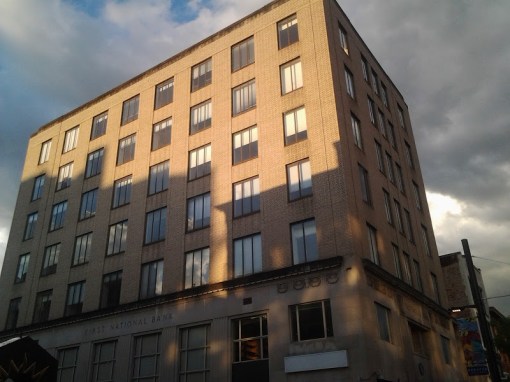
1. Some of you might remember that Chemung Canal Trust Company was embroiled in a legal battle with Ithaca Renting (Jason Fane) over the terms of their lease of 12,000 SF on the first floor of Bank Tower on the Commons. Welp, the courts have issued their decision, and it looks like Chemung Canal lost. The Elmira-based bank had to revise their quarterly earnings report after losing the dispute with their former landlord. The terms of the payout have yet to be determined, but Fane was seeking $4 million, which is in the same ballpark as the cost of Fane’s renovation of the top floors into 32 apartments. CCTC is still looking into an appeal.

119_125_college_avenue_2

119_125_college_avenue

2. It hasn’t been a secret that the price of real estate in Collegetown is getting enormously expensive. First John Novarr dropped $5.3 million on 215 College Avenue. Then Todd Fox forked over $2.65 million in June for 201 College Avenue. Now it’s Novarr’s turn again, handing over $4.75 million on the 2nd for 119, 121 and 125 College Avenue (or more specifically, an LLC filed to an address used by Novarr for his many LLCs). The three houses are collectively worth about $1.655 million, per the county assessor. Here’s a tip for readers – if you’re looking at a built property that’s recently sold, if it was purchased for more than double the existing tax assessment, the property was most likely sold based on its development potential. Less than that but still well above assessment, and it’s more likely major renovations/gentrification/Fall Creek/not being torn down.

Anyway, we already have an idea what’s planned – Novarr wants to do 50-60 units of faculty townhouses on the site, a 3-4 story, $10 million project.

1015_dryden_1

3. The other big sale this week (using that term subjectively, since someone just paid $1.25 million for a Cayuga Heights mansion) was 1015 Dryden Road out in Varna. Modern Living Rentals (Todd Fox/Charlie O’Connor) has had this 5-unit rental property on the market for a little while now, initially for $650,000, then $599,000.  The buyer “Finger Lakes Wrestling Club Inc.”, agreed to purchase the property on August 2nd for $555,000. MLR purchased the property for $425,000 in 2014. The wrestling club is listed as a non-profit serving youth training and competing in wrestling, and their plans for the property are unknown – the sale comes with plans for a pair of duplexes (4 units total), and the triplex designed by STREAM Collaborative shown above. I’ve heard of non-profits renting out real estate assets to fund their endeavors, so maybe that’s the plan.

109_dearborn

109_dearborn_v2

4. A pair of housing newsbits. Per the ILPC, the former Paleontological Research Institute  at 109 Dearborn is ready for its next phase of renovation into a rather swanky two-family residence. Background on the property from last August here. Long story short, it’s a gut renovation of a non-contributing structure of a historic district, the commission didn’t have much to say when it presented last year. This time around, the applicant wants to trade out the lower-level shingles for stucco, and the west entrance bump-out has been eliminated; anecdotal evidence says the ILPC won’t be excited, but it’s probably acceptable, since non-contributing buildings generally have an easier go with the commission.

A little further south on East Hill, local landlord Nick Lambrou wants to subdivide the large lot of 125 Eddy Street in order to build a new two-family residence. Jagat Sharma is the architect-of-record for the proposed 123 Eddy Street, which is a part of the East Hill Historic District and would have to go through ILPC approval. It will also need to pay a visit to the BZA because it’s proposed without parking (although the CPOZ was removed last year, an East Hill property still requires a parking space every 3 bedrooms) and will need a variance. Offhand, the Planning Board likely won’t be roped in on this one, since one-and-two family homes usually only need to be approved by planning department staff. Lambrou and Sharma are frequent contributors, and have faced the ILPC together before, for the reconstruction of 202 Eddy Street after it was destroyed by a fire in early 2014. The focus right now is just getting the subdivision approved, the ILPC presentation and vote will come at a later date.

215-221_spencer_v3_1

render4
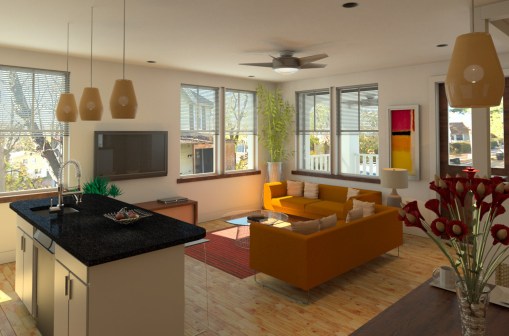
5. STREAM Collaborative sent out their bi-annual newsletter, and there are a couple of interesting pieces worth re-sharing. There were brief items about the “Urban Cottage” at 228 West Spencer, Tiny Timbers and 409 College Avenue, as well as some info about 215-221 West Spencer. STREAM writes that Ed Cope has broken ground on the STREAM-designed 12-unit, 26-bedroom condominium complex. This must have been fairly recent, as the hillside was undisturbed during a site check a couple weeks ago. Anecdotally, a condo project in Ithaca needs 50% pre-sales (i.e. 6 units) in order to secure a construction loan, but there isn’t any loan on file with the county yet, so I can’t say with any certainty what the funding arrangement looks like. On the fully revamped webpage are some nifty interior renders, including the image above. Anyone interested in the 1-3 bedroom condos can contact Ed Cope at PPM’s website here.

Buttermilk+VIllage

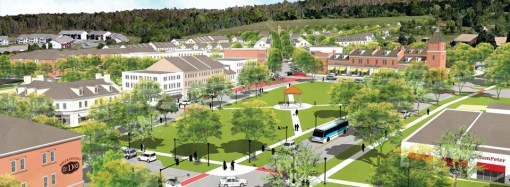
Also in the newsletter was an image from the latest set of Form Ithaca charrettes. “Buttermilk Village”, a working title for the South Hill neighborhood plan. The render above is looking northeast from the intersection of 96B and East King Road, with Ithaca College’s Circle Apartments to the upper left. Among the design features are a walkable town square, 2-4 story buildings, complete streets, and mixed uses with less dense residential further from the main roads. Some of the businesses like Sam Peter and Dolce Delight are in there to give that sense of familiarity. Most of this land is owned by Evan Monkemeyer, who’s still fuming from the College Crossings debacle. But rumor has it he’s working with another developer on a plan. It would be quite a feather in Form Ithaca’s cap if it looked something like this.


News Tidbits 7/9/16: Land Ho

9 07 2016

waterfront_foreclosure_parcels_0516

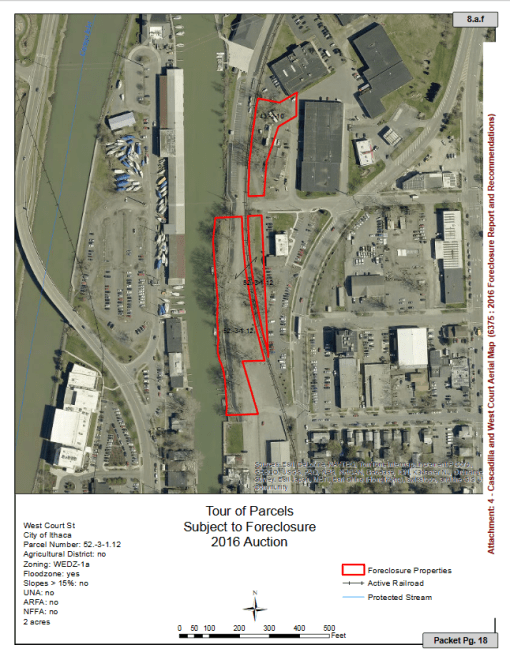
1. Starting off this week, a couple of new pieces regarding Ithaca’s waterfront. First, the city’s chances of picking up some prime waterfront real estate at a low, low price are gone, though not any fault of their own. Readers might recall that back in late May, the properties were about to be foreclosed on for unpaid taxes, and the county was discussing selling the parcels, worth over $630,000, to the city if the city paid off the $42,844 tax bill. Pretty sweet deal for the city, right?

But the owner, an LLC that has held the parcels since the late 1990s, managed to pay off the tax bill and an attached penalty fee, which means they get to keep the land. So, if the city had any plans for those parcels, they’ll be filing those away for a long while.

2. However, it looks like several properties are being put up for the sale in the city’s West End near the Waterfront. Local realtor Brent Katzmann has four properties listed – 321 N Fulton, a duplex on 0.11 acres for $144,800; 319 N Fulton, a single family on 0.04 acres for $109,875; 626 W Buffalo, a single family on a narrow and deep 0.15 acre lot, for $124,999; and 622 W Buffalo, a duplex on a narrow and deep 0.19 acre lot, for $134,800. The prices generally run at or up to 10% over the tax-assessed value ($130,000/$100,000/$125,000/$125,000). The currently owner is a Long Island-based LLC, led by a pair of New York City real estate lawyers, who acquired the properties from 2010-2012. Prior to them, many of the properties have been through a merry-go-round of owners over the past 10-15 years.

The properties are in fair to rough shape, and the marketing tactic being used isn’t renovation, but rather development potential. The four properties all fall within WEDZ-1a zoning, which is the city’s attempt at encouraging development on the West End. WEDZ-1a permits residential, commercial and mixed-use 2-5 story buildings, 90% lot coverage (100% if less than 50 feet on two sides – the Buffalo parcels and 319 N Fulton), and no parking requirement. The properties are not affected by the city’s TM-PUD.

The West Buffalo lots could be tough since the house in-between is owned by someone else, but deep lots and the corner of North Fulton and West Court offer some potential. Worth keeping an eye on, if only to see who they sell to.

20141227_140754

3. One less homebuilder around. Avalon Homes is closing up shop. The Ithaca-based company is selling off its lots and trying to wrap up the homes they have underway. Rumors abound as to why, but if firm, verifiable information can be obtained, there will be more to follow.

Avalon made its name doing stick-built built, with a focus on affordability and green construction. Avalon, a certified Living Wage employer, was the general contractor for INHS’s Holly Creek townhomes (shown above), and employed at least a dozen back in 2010.

old_library_thp_v4

old_libe_thp_holt_v6

4. The Planning Board and the Ithaca Landmarks Preservation Commission will be conducting another joint meeting on Tuesday the 12th at 5:30 regarding the Travis Hyde Properties’ proposal for the Old Library. HOLT Architects responded to comments from the ILPC at its last meeting that the design needed to be “quiet” by submitting the revised elevations seen below.

Mission accomplished? Armchair architect comment here, but the revised design is too far the other way. There’s a joke about the color beige, coincidentally similar to the new brick, being an adjective for “dull, boring, indistinctive“. I like the previous design with its wood-like fiber cement and characterful roofline, and I wonder if perhaps a revised color palette of that design, with maybe a few less full-sized balconies, would be a happy medium.

5. As announced on city of Ithaca Mayor Svante Myrick’s Facebook page, the Namgyal Monastery Institute of Buddhist Studies will be the site of a library and museum of the Dalai Lamas, the first of its kind outside of Tibet. The facility would be located on the 28 acres Namgyal owns on South Hill at its Du Khor Choe Ling monastery complex. Architectural plans and costs are still being determined, but a quote from Ngawang Dhondup, administrator for Namgyal’s facility, says that it will be larger than Namgyal, which has been underway since 2007 and will be about 14,500 SF when completed.

All in all it’s a great feather in Ithaca’s cap, but two things to be a bit wary of moving forward are the reactions and possible opposition from neighbors to what will be a very high profile religious facility, and given geopolitical issues, the reception to the Library of the Dalai Lamas may not be so warm from some denizens of cosmopolitan Ithaca.

12-29-2011 003

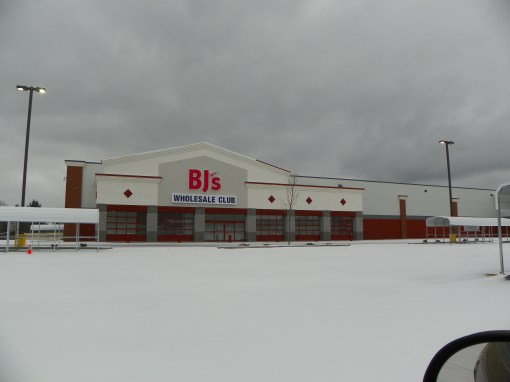
6. Way back in 2010 and early 2011, when the BJ’s Wholesale club was proposed in Lansing, one of the components of the proposal was to build 12 units of senior housing on land north of the then-proposed store. The project also called for wetlands, walking trails and a bird sanctuary on the undeveloped portion of the 11-acre property. Developer Eric Goetzmann (Arrowhead Ventures/Triax Group) faced considerable opposition to the plan since it involved big box retail and was housing outside of the density corridor, but after the IDA initially voted the project down in December 2010, a revised application calling for a smaller PILOT was passed by the IDA in April 2011 (some of the logic being that the county was in a financial bind during the recession, and some increase in taxable property was better than none).

Well, the BJ’s was built and opened the following year, but the wetlands and housing have had a much longer slog. The U.S. Army Corps of Engineers in in charge of new wetland permits, and the process is a complex, arduous one (man-made wetlands are difficult to build, and the Army Corps would rather they be done right than done fast). Goetzmann teamed up with The Upper Susquehanna Coalition and The Wetland Trust to design the “Inland Salt Marsh Bank”, which was just approved by the Army Corps, and the final permits expected shortly. With the wetlands taken care of, Arrowhead can begin to look towards the housing component, which they plan to put forward later this year for a 2017 construction date. As part of these plans, they want a one-year extension on the legal construction start for the housing from the IDA. Given that Arrowhead has met the other criteria and can demonstrate proof of progress on the wetlands, this probably won’t face much opposition. But eventually, it looks as if the village of Lansing will finally get those 12 units of senior housing.

biggs_1

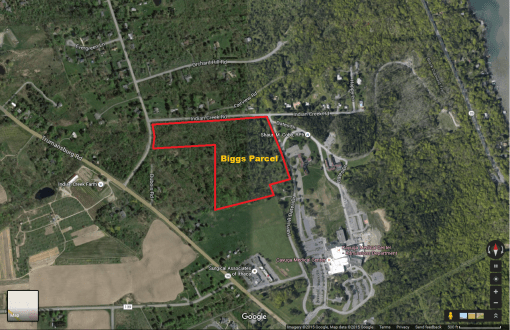
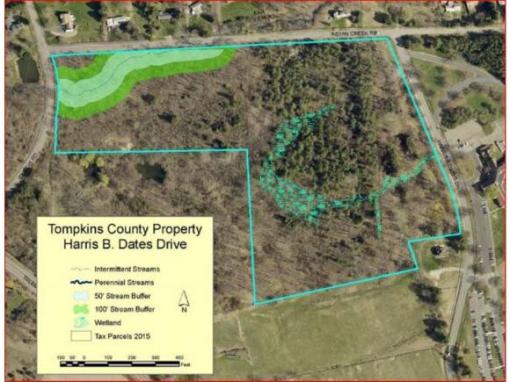
7 It looks like the Biggs Parcel is officially listed for sale. Local realtor CJ DelVecchio was selected by the county to manage the listing for the 25.52 acres near Cayuga Medical Center. The asking price is $275,000. The land comes with a conservation easement on the northwest side due to its proximity to a stream, and the wetlands near the center would be tricky to work with, because wetlands typically can’t be developed unless new wetlands are created, which is not cheap or easy to do.

c507

Readers might remember that this parcel has quite a history behind it. Declared surplus land by Tompkins County, the county had set up a tentative deal for a 58-unit affordable housing complex on the property, but the deal fell through after the wetlands were discovered to cover more area than previously thought.

Neighbors, via the Indian Creek Neighborhood Association (ICNA), have tried to force the county to hold onto the land to keep it from being developed. One of the big sticking points had been whether or not the 25.5 acres would be taxable – the county isn’t especially concerned at this point if the land gets developed or not, but they have made it clear that they want to sell it to a private owner that will pay taxes. The problem is, proposals to preserve the land often dovetailed with plans to donate it to an organization like Finger Lakes Land Trust, which would render the property tax-exempt. The ICNA did end up making a closed bid for the property, but the offer was rejected.

A neighbor to the south did propose reconfiguring the property to preserve the woods and build cottages on his back lot – by adding the Biggs land, he could have built more units under the regulations of the cluster zoning. But the plan fell through due to “size and complexity”, according to the ICNA’s Linda Grace-Kobas.

The land had been valued at $340,000 before the discovery of the additional wetlands, and the revised 2016 assessment brings that down to $240,000.


News Tidbits 6/11/16: Summer’s Heated Discussion

11 06 2016

Image Property of HOLT Architects

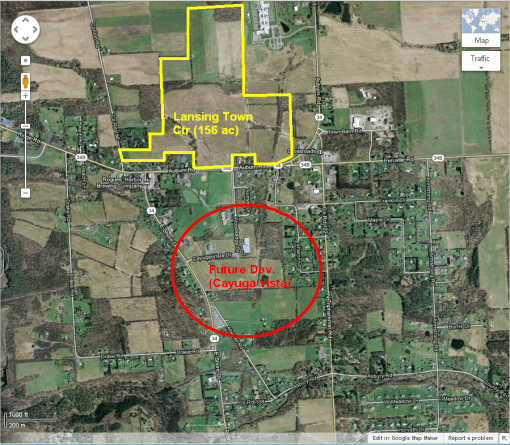
1. We’ll start this off out in Lansing. The 153 acres of land for the Lansing town center is once again in the news. The Lansing Star is reporting that the town is once again serious about selling the land.
So begins yet another chapter in the 20-year saga of the town center land. The town bought the land from the state in 1993 for $100,000, and at the time the land was deed-restricted to recreational use. In 2012, the town paid an additional $294,800 to remove the recreational deed restriction. An article about it was published here in August 2012 (original map below; dunno where why offhand it says 156 acres vs. the 153 reported now). HOLT Architects and TWMLA were hired to draw up some overarching design themes, a Request for Proposals was issued, and three developers responded.
lyc2

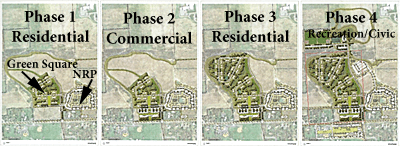
Calamar Enterprises’ Buffalo office submitted a proposal for a $17.4 million, 110-unit market-rate senior apartment building on 13.5 acres, and Cleveland-based NRP Group submitted plans for 80 one-story patio homes on about 15.5 acres. Calamar later re-sited their project at the town’s wish to the northern part of the land, and increased the number of units to 124. Green Square, led by David Taub and HOLT Principal Graham Gillespie, proposed 60 units of housing and 23,000 square feet of retail in 2-3 story arrangements, and civic and recreational space. Altogether, the value of the three would have approached $50 million.

gs_phases

However, all of this was contingent on a sewer being built, which did not happen. The developers agreed to do a package plant that would service just the town center, there was discussion of an IDA-backed tax incentive zone, and the town stood to make a hefty return on investment, but…to quote the Star, “However, the deals fell through.  Actually it seemed more like they just faded away. At least one of the developers had signed paperwork saying they intended to purchase acreage from the Town.  The Town didn’t seem in any hurry to sell the land, even with clearly interested developers.  When the developers disappeared there was no reported effort by the town to pursue the deals.”

Since then, the town continues to get a steady stream of interest, but no real idea on how they want to move forward. Like Ithaca city and town, they’re looking at the possibility of Form-Based zoning for the site, and the town hopes to issue a more specific RFP than before, incorporating revised assessment values. The most intensive approach involved the Form-Based Code and a specific RFP, the least specific is just putting up a for-sale sign ans seeing what happens. Whatever the case, the lax approach the town has taken the past few years may no longer be feasible, with the ticking tax time time bomb of the possible power plant closure looming over the town and schools’ budgets.

old_library_thp_v4

2. Speaking of long processes, the Old Library project has formally filed paperwork here to begin the application process for the Certificate of Appropriateness from the Ithaca Landmarks Preservation Commission. The meeting is scheduled for city hall at 5:30 Tuesday the 14th. Although it says early design review, a lot of the legwork has already been done at this point, since the Planning Board and ILPC have been conducting joint meetings with the project team over the past several months to create a design that they’re all comfortable with. However, the ILPC is likely to refine some details moving forward.

old_library_thp_v4_2
At this point, the unit mix consists of 22 1-bedroom units with about 700 SF each, 25 2-bedrooms with about 900 SF each, and 10 2-bedrooms with 1200 SF each, the extra space intended as a den or home office. The building also includes a 1,800 SF community room to be administered by Lifelong, and 3,750 SF of first floor commercial space. The total facility size comes out to about 85,600 SF, and parking for 25 cars and at least 12 bikes, and another 34 bike spaces for the community room. Exterior materials include brick, limestone, and a couple forms of fiber cement, including wood-textured fiber cement.

Southeast+Rendering

3. The STREAM Collaborative House at 228 West Spencer is up for sale. The house has its own website here. The 1,152 SF, 2-bedroom net-zero energy house is listed at a price of $305,000. For more info on the house, Noah Demarest was kind enough to give a construction tour of the house while it was underway, and the blog post I wrote up afterwards can be found here.

evergreen_dryden_1
4. It’s pretty clear at this point that the Evergreen Townhouses project at 1061 Dryden is evolving into the next hot-button development issue out in Varna. The Times has their interview with the angry neighbor here, and more info can be found in the town of Dryden’s April planning board meeting minutes here. So far, the only image of the townhouses themselves has been a perspective that only shows massing – 2 stories, gabled roofs.

Also of note is the town of Dryden Planning Department’s recommendation to the town board (and the planning board’s approval) for an increase in density in certain areas. The change in code affects parcels zoned rural residential, with municipal water and sewer access. The density would be increased from 2 units per acre to 6 per acre. Looking at the zoning map and the sewer map, that would primarily affect the corridor from Varna to the 13/366 intersection, and a rural swath just north of Dryden village near TC3. What this would do is allow 1061 Dryden Rd to withdraw PUD application, and apply for a special use permit (SUP), which are generally easier to obtain.

On a side note, googling Tiny Timbers brings up a Times editorial, written by the Times, that argues against Tiny Timbers for not fitting in with the appearance of Varna. Actually, it kinda takes everyone to task, from developers to town government to residents. But, to make one counter-point regarding mixed-use, commercial services need a certain amount of traffic (not necessarily vehicular) to thrive. If the population base within a certain radius isn’t there, the risk is too great for someone to put their money on the line and hope that they can somehow draw in customers. If Varna wants a mixed-use center with shops and cafes, they’re going to need the population to support it. Some think that will include 1061, some (probably more) think Tiny Timbers, but if there’s no “push”, the ball won’t be rolling.

201_college_v3_1

5. A couple of minor things to note in sales. The 4,200 SF former “Imperial Buffet” property next to the Shoppes at Ithaca Mall has sold to a Syracuse-bsed LLC (Watersprite LLC, established 2004) for $590,000 on Friday the 10th. I personally will always remember this place as being the only place my mother was comfortable with eating in Ithaca because she hates eating out, and felt everything else was “snobby and expensive”.

Meanwhile, the 12-bedroom, 2,837 SF house at 201 College Avenue, the property subject to a heated debate between Neil Golder and Todd Fox, sold for $2.65 million on Friday the 10th, which seems outrageous except that it’s becoming the norm for inner Collegetown transactions – Novarr picked up 5,500 SF 215 College for $5.3 million last year. There will be no delving into that debate again this week, but the city uploaded 580 pages of documentation here, and my colleague Mike Smith is preparing a story for the Voice.

20160522_143925 20160522_143949

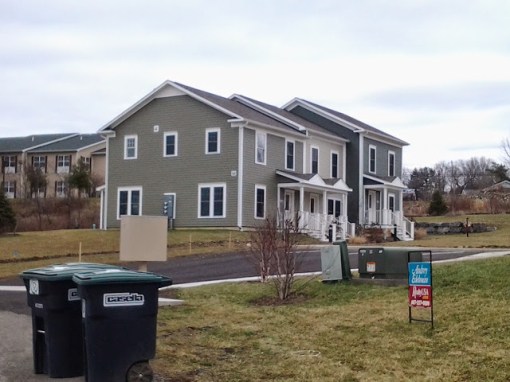
6. Houses of the week. This pair of duplexes are being built on Birdseye View Drive near Ithaca College. Each house has a 4-bedroom unit and a 2-bedroom unit; recent advertisements on Craigslist (since expired, so no link, sorry!) have them $750/bedroom. The developer is the owner of Mahogany Grill downtown, who also happens to be a part of the business team renovating the former Lucatelli’s into a new restaurant, a Tapas and pasta restaurant called Mix Social Dining after the chef’s wife.

These photos are a couple weeks old now, but the one on the right looks nearly complete, while the one on the left was still in the (wood) framing and sheathing stage. Based off the rough window and door openings, they are not exactly the same, but expect them to look similar.


News Tidbits 5/21/16: Building Bridges, or Burning Bridges

21 05 2016

209-215_2

1. 209-215 Dryden Road has a name: the Breazzano Family Center for Business Education. Let’s just call it the Breazzano Center for short. The name comes as part of a $25 million donation from Cornell MBA alum David Brezzano ’80, and is named in honor of him and his three sons, all recent Johnson School graduates. According to the Cornell Chronicle, the donation will “substantially support” the building’s construction, which construction loans on file with the county have pegged at $15.9 million. Breazzano is the president of money management and investment firm DDJ Capital Management, and did his undergrad at Union College in Schenectady, where he serves as trustee.

John Novarr is the developer for the 6-story, 76,200 sq ft building, and Cornell will occupy 100% of the structure on a 50-year lease.

chapter_house_v4_1

2. So, something weird is going on. The city BPW is set to discuss an encroachment for the Chapter House reconstruction at their meeting on the 23rd. However, all the paperwork included in the agenda dates from before the sale and refers to the previous owner. So either the new owner is pursuing the encroachment and the information hasn’t been updated, or this is outdated/no longer being pursued and no one’s updated the BPW paperwork. I tried calling the project architect (Jason Demarest) but he’s out of town until Saturday, and this publishes Friday night, so…dunno. Hopefully someone can provide some insight. For the record, the encroachment is for the first-floor roof overhang over the sidewalk, and will cost the developer $33,812.28.

100_1466

Open question, would a brick-for-brick rebuild had to have paid for this encroachment as well? It existed with the original structure, this was designed with heavy ILPC input, and given that project costs seem to be why this is in jeopardy…it just seems like an unnecessary obstacle. I know it’s a new build, but it’s replicating a previous encroachment for the sake of character. It seems like the project is being financially punished for that.

brindley_elevation
3. For this week’s eye candy, the above image appears to be the city’s proposed redesign for the Brindley Street Bridge over on the West End. Pretty similar to existing newer or renovated bridges in the city (Clinton Street, South Aurora Street), with older-style lamp posts and stylized concrete railings.

Alternative 2 calls for a pedestrian bridge to replace the existing Brindley Street Bridge, which was last renovated in 1952. A new bridge for vehicle traffic would be built south from the intersection of Taughannock and West State Streets, over the inlet, and intersecting with Taber Street. The project is expected to go out to bid next year, and completed in 2018.

4. Per the Ithaca Times, the Taughannock Farms Inn out in Ulysses has some expansions and renovations planned since new ownership purchased the property back in February. Along with a bistro for lighter fare, an electric car charging station and a dock, the Times introduced plans for a 2-story, 200-person event center that would be built on the Inn’s property. The purpose of the event center is to provide additional space for events like weddings and formals, and to capture a bit of the mid-week business meeting and convention crowd. The inn itself has 22 guest rooms in five buildings.

The original inn building dates from 1873, when it was a “summer cottage” for John and Molly Jones of Philadelphia. The Joneses also owned Taughannock Falls at the time, though they would eventually deed it over to the state in the mid 1930s to create the park. The current owners are only the fourth in the 143-year history of the property.

5. A couple of big sales in Tompkins County this week. The first one was 308 Eddy Street, a 12-bedroom apartment house in Collegetown. The Lambrou family, one of Collegetown’s medium-sized landlords at ~400 beds, sold the property to the O’Connor family (a smaller landlord family) for $1,225,000 on the 18th. The O’Connor don’t tend to develop their own properties, and 308 Eddy was receently re-roofed anyway, so don’t expect any changes here, but take it as a demonstration of what a captive rental market, high land values and high taxes will do.

The other big sale was outside of Ithaca, at 1038-40 Comfort Road in Danby. A purchaser bought several land and cabin properties being touted as a high end B&B for $1,300,000. The purchases are a couple from Florida, one of which founded the Finger Lakes School of Massage in the 1990s and now heads an aromatherapy institute.

evergreen_dryden_1

6. According to a report from the Dryden town board liaison to their planning board, the Varna Community Association’s reception to “Tiny Timbers” at the corner of Freese and Dryden Roads has been mostly positive, apart from minor traffic concerns to the 16-house project. More lukewarm was the reception to the 36-unit Evergreen Townhouses proposal at 1061 Dryden, where concerns were raised about having enough green space, and whether it was too far outside Varna to be an appropriate location.

The neighbor two doors down has already started to fight the project, and this is probably going to play out like 902 Dryden did over the past several months. Here’s a pro tip when you’re writing up that angry screed – please stop arguing that renters are second class citizens. Just stop.

therm_1

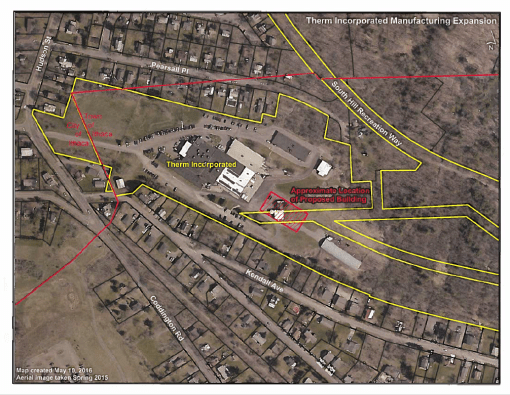
7. Therm Incorporated will be presented plans for a stand-alone 20,000 SF manufacturing facility to the town board next week. The addition will be located at their property at 1000 Hudson Street Extension, between its main building and the quonset huts. In a rarity, the industrial-zoned property won’t need to heard to a zoning board – no variances required. The new building will replaces a 3,434 SF ceramics studio. As previously reported on the Voice, Therm expects to create 10 jobs with the expansion. Therm, located at its current facility since its founding in 1935, specializes in custom machining, primarily for the aerospace and industrial turbine industries.

201_college_v2_3

8. Not a very exciting agenda for the Ithaca city planning board this month.

1. Agenda review
2. Floor Privilege
3. Special Order of Business: Incentive Zoning & Site Plan Review Discussion (Lynn Truame)

4. Subdivision Review
A. Minor Subdivision, 312-314 Spencer Road, Charlie O’Connor (MLR)

5. Site Plan Review
A. Sketch Plan, Two Duplexes at 312-314 Spencer Road

This came up back in March – Charlie O’Connor plans on re-configuring vacant street-facing property behind two houses to build two duplexes near Lucatelli’s. STREAM Collaborative is the architect.

Originally, this was at the end of the agenda as sketch plans usually are, but the agenda was revised so that the sketch plan would be allowed to go first.

B. 201 College Avenue – Declaration of Lead Agency, Public Hearing, Determination of Environmental Significance, recommendation to the BZA

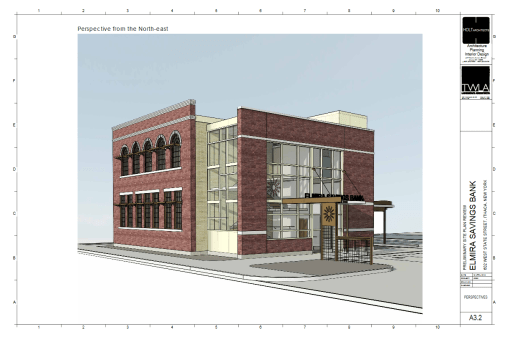
C. Elmira Savings Bank, 602 West State Street – Declaration of Lead Agency, Public Hearing, Potential Determination of Environmental Significance, recommendation to the BZA

D. Brindley Street Bridge, seen above – revised FEAF review (parts 2 and 3), recommendations to lead agency (BPW).

6. Umpteen million zoning appeals, none especially contentious
7. Chain Works DGEIS Review, Update Schedule and Special Meeting Schedule.


The Chain Works District DGEIS, Part Two: Form Codes and Phase One

17 05 2016

For part one, click on this link.

One of the challenges facing the Chain Works District is that it’s a little tough to plan out specifics when the construction timeline goes out over a decade. The renders of new buildings conceptualized as part of the redevelopment project may not look exactly as shown – in a lot of ways, they would best be described as placeholders. But, the zoning code proposed within the project’s PUD gives a pretty good idea of what a potential building would look like. The design standards can be found in Appendix C here.

The goal of the design standards is to establish a walkable, mixed-use neighborhood setting that builds on the existing industrial buildings and surrounding neighborhoods – growing without overwhelming. The design standards handle height, width, setbacks, buffer plantings, blank walls, building projections, the amount and spacing of doors and windows, porches and stoops, sidewalk width, the types of light poles allows, the “design speed” of streets – compared to Euclidean/use-based zoning, the emphasis isn’t on what’s taking place inside, but how it looks on the outside. Some might argue that it allows less creativity for architects, but it offers a lot more predictability for a multi-year development like Chain Works.

Even with the design standards, the project won’t be skipping the approvals process. New buildings and renovations that don’t conform to the initial proposed uses still have to go through Site Plan Review/Approval. Interior renovations not visible from public roads do not have to go through SPR, which is consistent with most of the city’s neighborhoods. But one step that may potentially be avoided by the PUD/PDZ are frequent trips to the Board of Zoning Appeals.

Chantreuil | Jensen | Stark Architects, STREAM Collaborative and Randall + West all played a role in site planning and developing the zoning.

chain_works_form_districts_1

There are four “sub areas” as part of the code – CW1 (Natural Sub Area), CW2 (Neighborhood General Sub Area), CW3 (Neighborhood Center Sub Area), and CW4 (Industrial Sub Area).

CW1, as the Natural Sub Area, is where land is planned to be left unaltered, or allowed to revert to “a natural state”. Some of this is due to technical issues like topography, as some of it is due to environmental features such as the presence of old-growth woods. CW1 is the most restrictive zone, allowing only passive recreational use, trails and stormwater management. New structures can only serve those purposes – sheds, park restrooms, pavilions, gazebos, and at most a visitor’s center, the sum of which may not cover more than 2% of the total area, with no single building over 2,000 SF, and nothing more than one floor / 15 feet.

cwd_cw2


CW2 is the Neighborhood General Sub area, and one of the two zones slated to host the majority of new development. The intent here is detached single-family homes, row-houses and small apartment buildings. Total area coverage of more than 60% is prohibited, and height is limited to 4 floors, except when built on a hill, in which case there may be another 1-2 floors on the downhill side, as long as it’s consistent with CW3. Street trees have to be provided on at least 60% of the length of new and existing streets in CW2, at intervals no more than 40 feet.

Apart from general housing, the CW2 code would allow for senior housing, daycares, home-office, small-scale retail (less than 2,500 SF), nursery schools/day-cares and B&Bs.

chain_works_rev3_4

CW3 is higher-density mixed-use – larger-scale office space, larger-scale retail and the same residential uses allowed in CW2. Most commercial and assembly/factory uses are allowed (but no adult uses – in any zone, in fact). Plazas are allowed along with green space, and the maximum height allowed is 6 floors, with 1 more on the downhill if on a slope, and only 4 floors permitted with 2 floors on the downslope if within 100 feet of Route 96B. Total area coverage is permitted up to 80%, and a vegetation buffer of 30 feet is required if adjacent to residential properties bordering the CWD. The street trees rule in CW2 also applies here.

cwd_cw4

CW4 consists of industrial uses and utilities/storage space, 2-4 floors. 90% area coverage is allowed, and there has to be one shade tree planted and kept healthy for every 10 parking spaces. There is no minimum parking requirement for CW4, or any of the zones.

One issue brought up in review is that the code specifies that any one floor can’t be more than a certain height, but it would be better if they specified a maximum height for the first floor, and then a max height for each subsequent floor. For instance, instead of a max of 18 feet, which could create a 72-foot, 4-story building in CW2, the draft could be improved by saying 18 feet on the first floor, 12 feet on each upper floor.

cwd_street_assembly

Several types of “thoroughfare assemblies” are displayed in the document, specifying what’s permitted in each area. This is where the design speed, sidewalk and pavement widths, and parking and street-scaping details come into play. These include streets, alleys, industrial access roads and even a woonerf.

So that briefly sums up about 33 pages of code details. Most of those won’t come into play until new structures are proposed – the streetscape will be developed as phase one is under construction, and more when further build-out occurs. Speaking of phase one, let’s take a look at that.

Phase one consists only of renovations to existing buildings, four of them. Buildings 33 and 34 would be renovated for new industrial uses per the CW4 code, and Buildings 21 and 24 would be renovated into an office building, and a mixed-use office and apartment building per the CW3 code.

cwd_bldg21_1

Building 21 becomes a 43,340 SF office building – new glass and a paint job are the biggest exterior changes. Parking would be on adjacent surface lots (page 2-27, DGEIS).

cwd_bldg24_1

Building 24 is the only building that gets an addition in phase one – 18,520 SF of new space on the top floor, a “penthouse addition” to the existing 111,050 SF space. The addition and the existing second to fourth floors would house 70 to 80 residential units in approximately 96,300 SF, in a potential mix of configurations ranging from studio to 4-bedroom units, but mostly it’s intended to be 1-bedroom and 2-bedroom units (page 2-25, DGEIS). The remaining 33,270 SF would be commercial office space. Parking would be on adjacent surface lots.

cwd_bldgs33&34

The industrial space envisioned for Buildings 33 and 34 requires minimal renovation, according to the DGEIS (page 2-33). Combined, they offer about 170,600 SF of industrial space, for manufacturing, warehousing, or related uses. Most parking (110 spaces) will be on adjacent surface lots, with a little more (15 spaces) created by the removal of Building 6A, and another 95 overflow spaces shared with CW3 structures. Part of the logic is that since workers and residents use parking spaces at different times (working the 9 to 5, vs. those who do their 9 to 5 in other parts of the city), they can share parking spaces somewhat.

Part 3 will take a look at some of the project impacts.