Harold’s Square Construction Update, 7/2018

17 07 2018

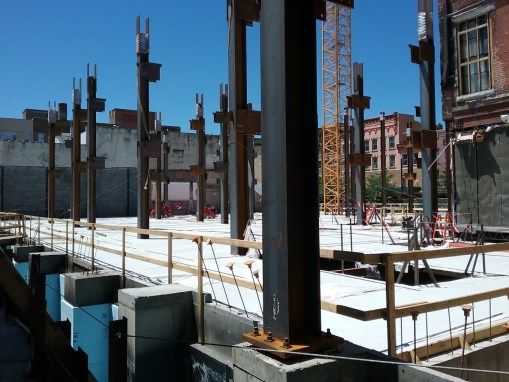
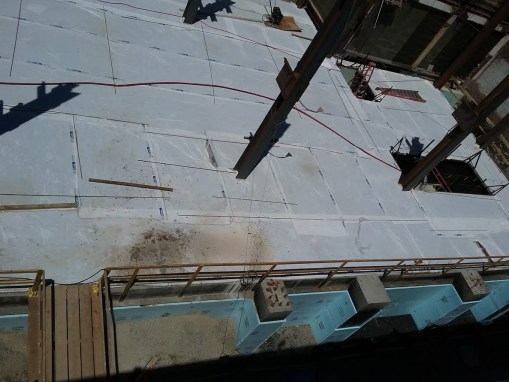
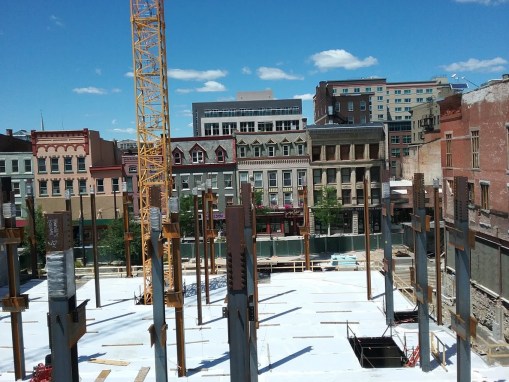
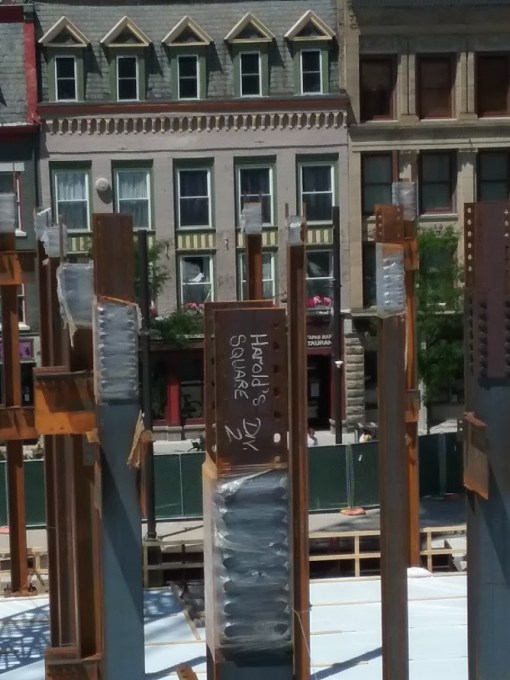
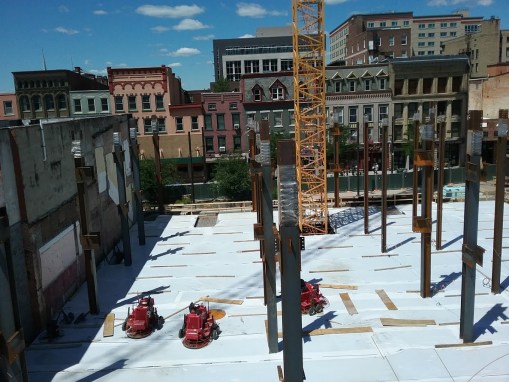
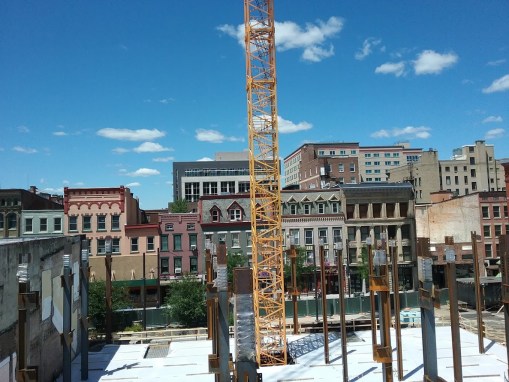
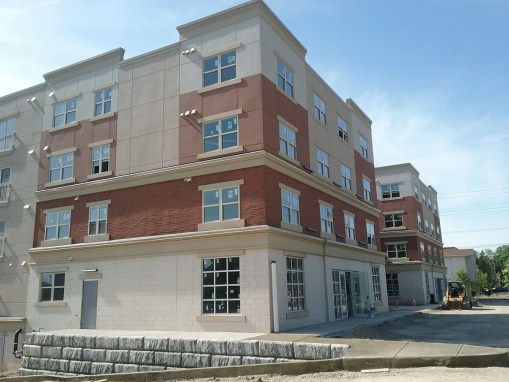
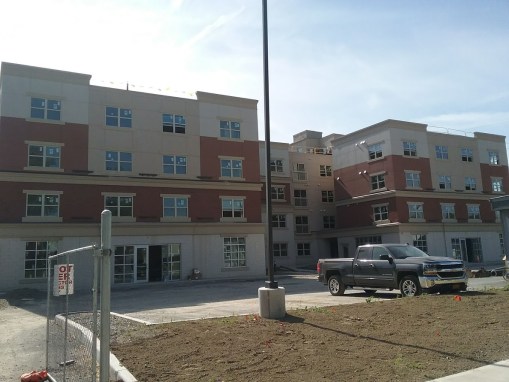
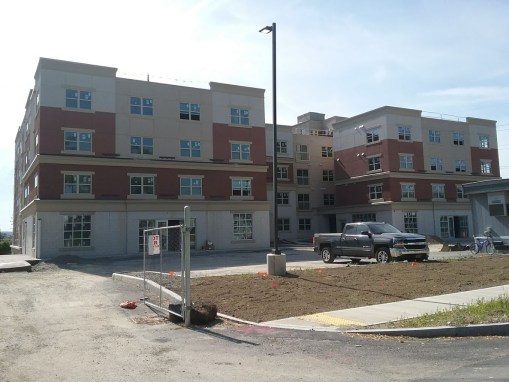
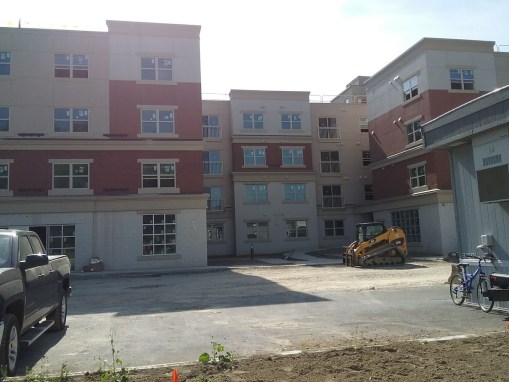
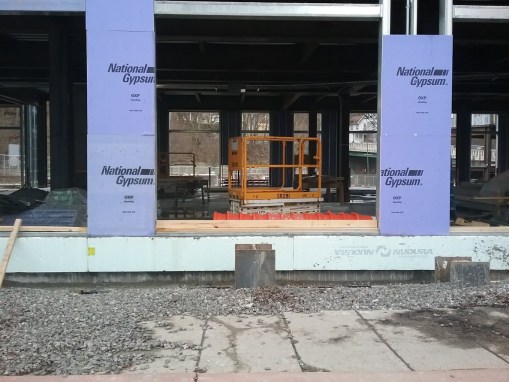
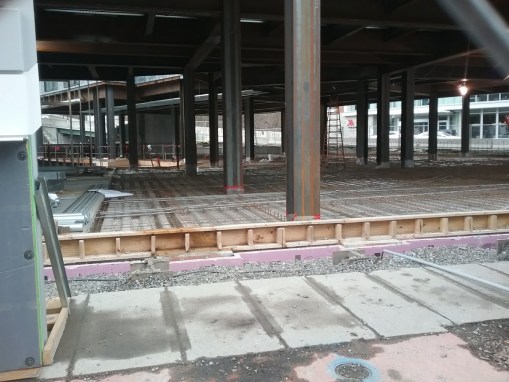
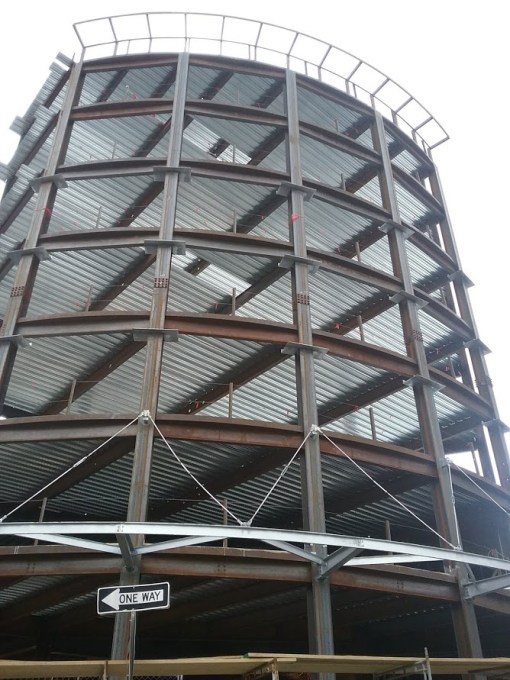
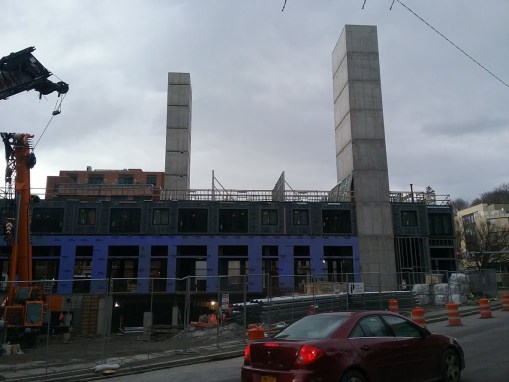
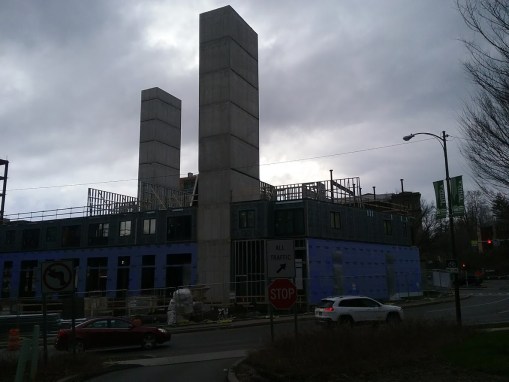
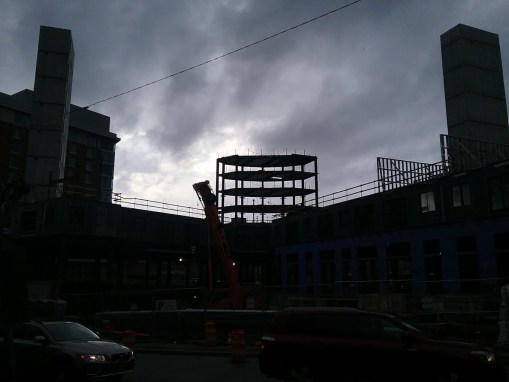
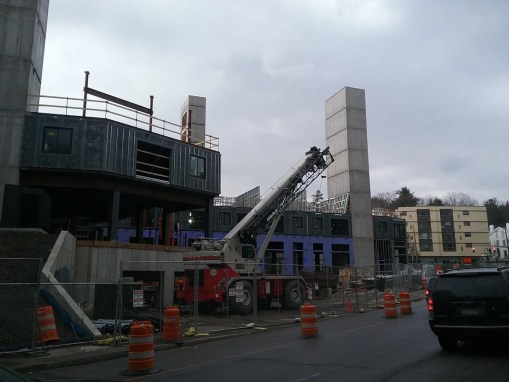
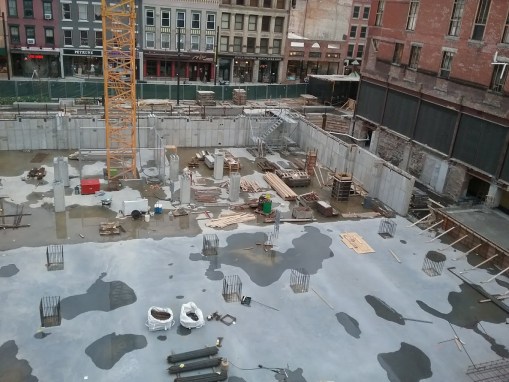
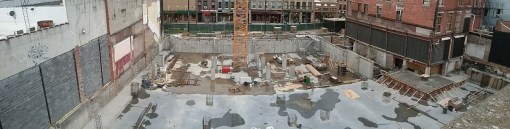
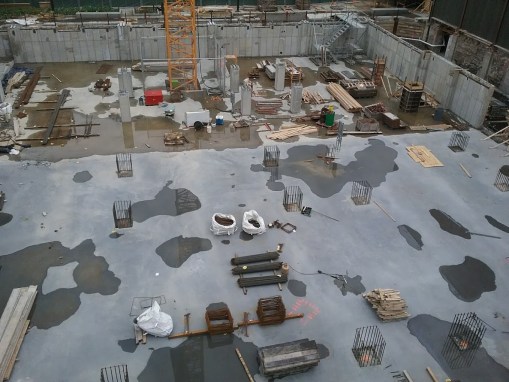
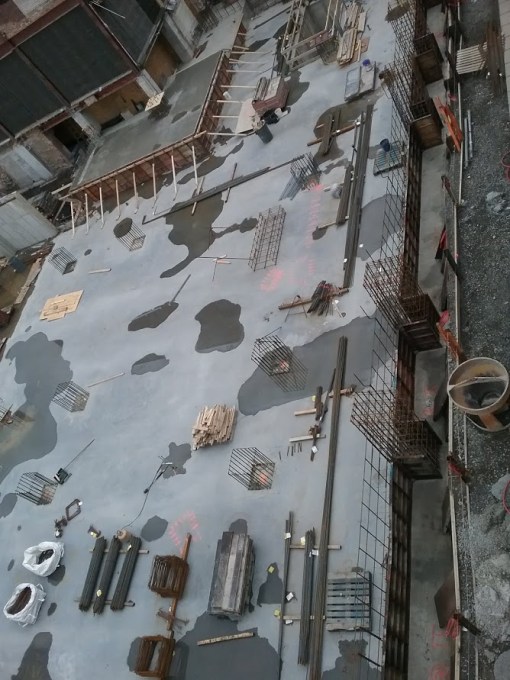
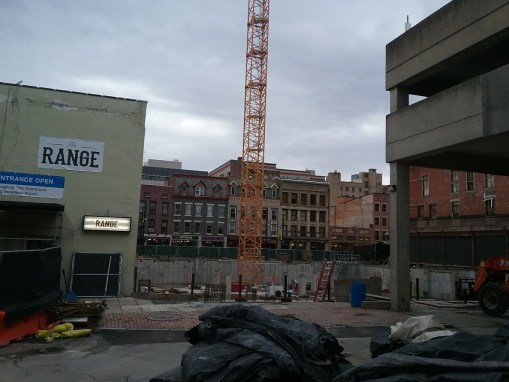
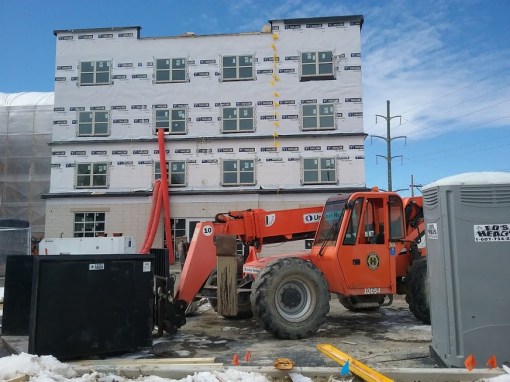
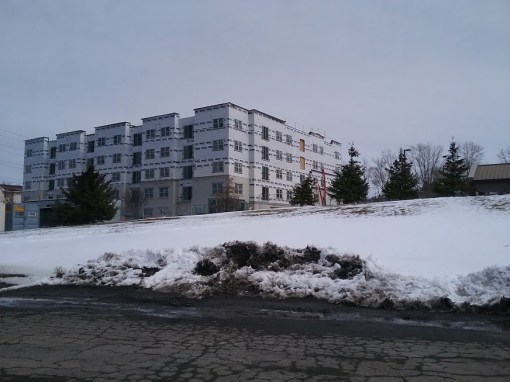
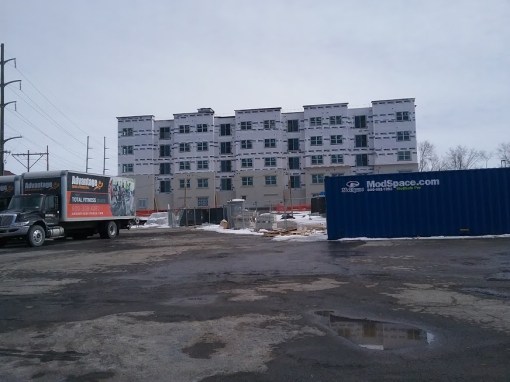
Harold’s Square is starting to take shape. The white sheets on top of the basement level are Sika Corporation UltraCure NCF curing blankets. When the steel was laid, corrugated decking was laid on top to create the base of the floor. A rebar wire mesh was then laid and tied into place, and the concrete was poured into the floor cavity, with wood forms to keep the pour in place. The rebar strengthens the concrete and ensures structural integrity. In this mid-June Facebook photo from the Harold’s Square page, you can see the decking going over the structural steel. A week and a half later, you can see the rebar grid over the completed decking. The concrete was poured in early July, the slab was covered in the cellulose fiber blankets to promote an even and structurally sound cure, and after seven days they tested the concrete and the results came back all-clear, meaning they can start to put weight on the concrete and work their way up.

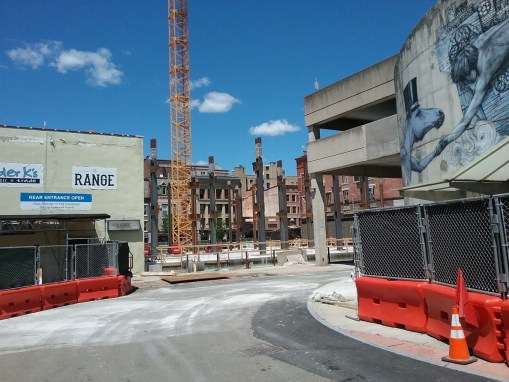
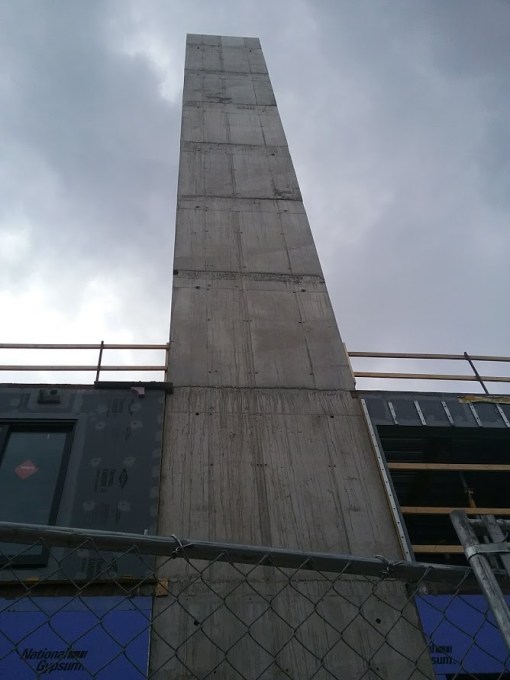
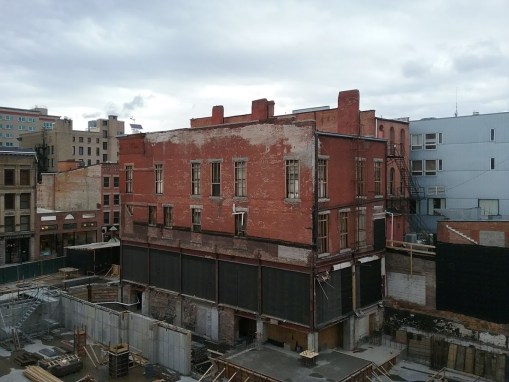
Meanwhile, structural steel erection will be taking a short break as masonry work begins on the Commons-facing side of the project, followed by masonry work on the Sage Building. The steelwork will resume in late July. Subcontractor Paolangeli will be doing backfilling (earthwork to cover up the foundation) on the Green Street (south) side of the project now that the shell of the basement has been built.

The WordPress for the project can be found here, and the Ithacating project description here.


Chapter House / 406 Stewart Avenue Construction Update, 7/2018

15 07 2018

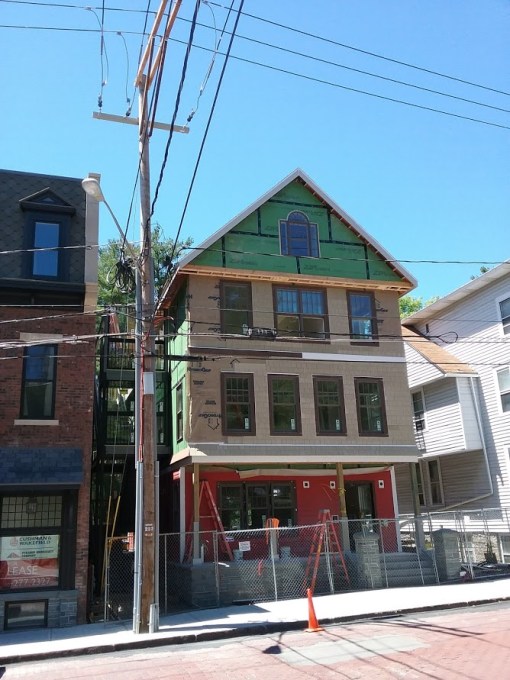
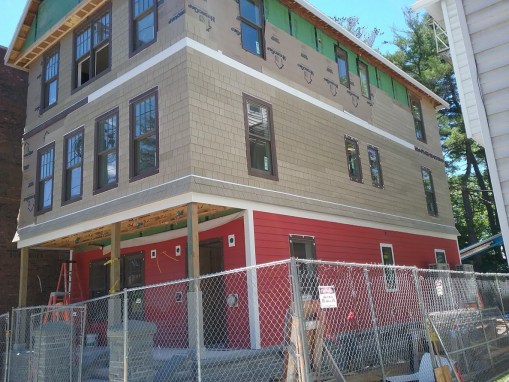
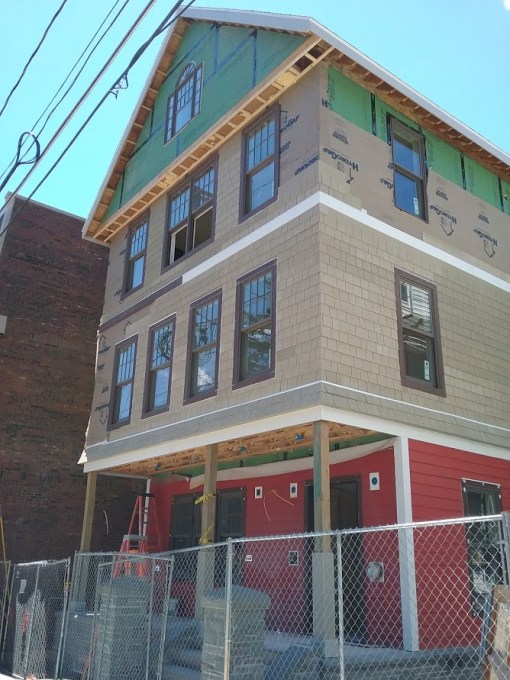
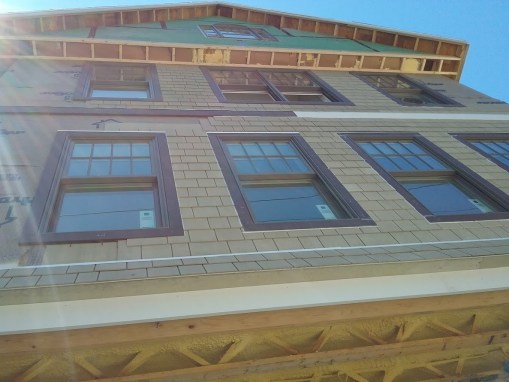
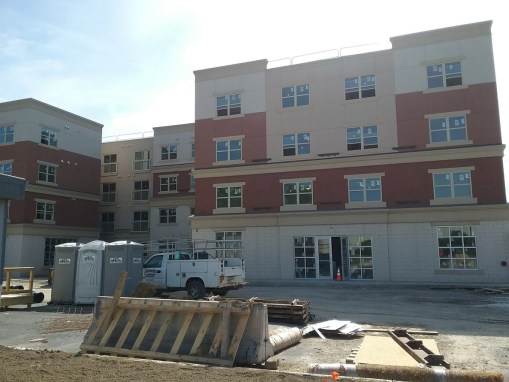
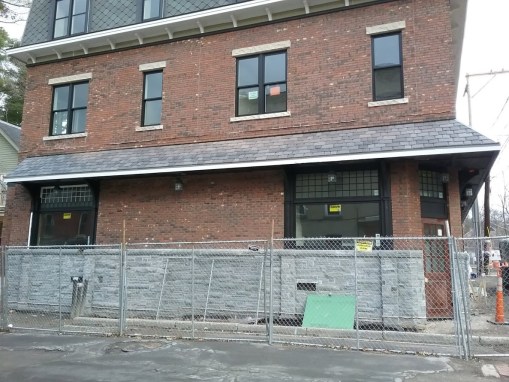
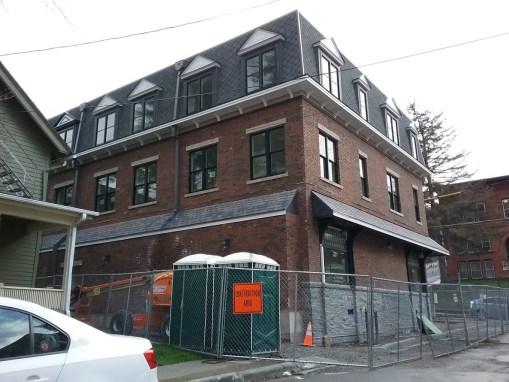
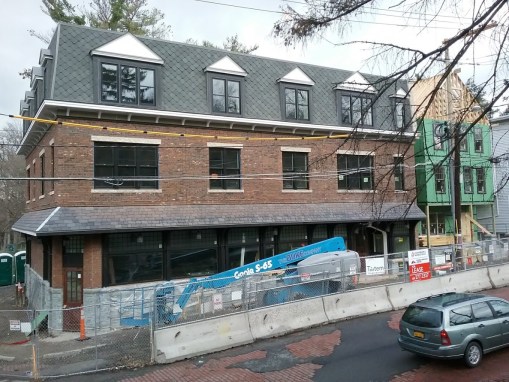
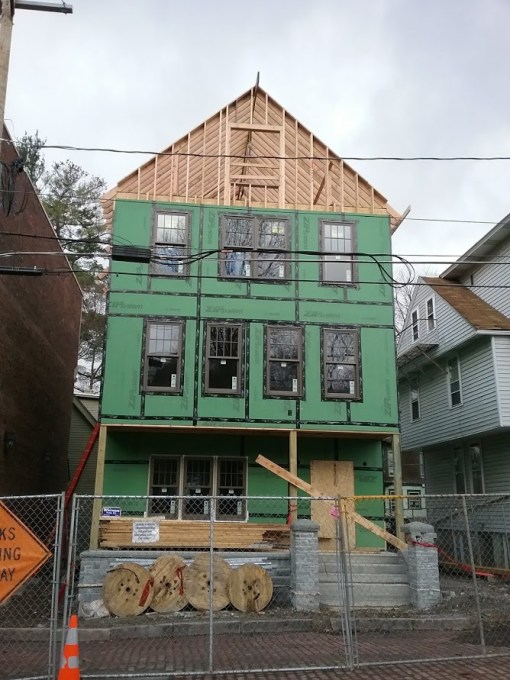
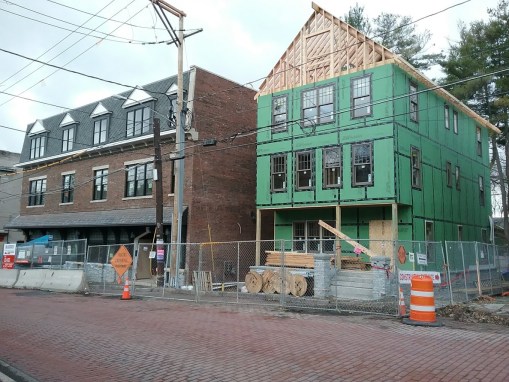
With 400-404 Stewart Avenue complete, developer Jim Goldman is focusing on the completion of the other half of his reconstruction, 406 Stewart Avenue. This is the property that Goldman originally owned and was destroyed in the spread of the fire that erupted at the Chapter House building. Architect Jason K. Demarest’s 3.5 story design is completely framed and sheathed in ZIP Panels; the panels are then covered in HydroGap, a premium grade housewrap to remove excess moisture while keeping new moisture from penetrating into the plywood sheathing. This is then layered over with (what I suspect are fiber cement) shakes, in contrast to the first floor’s lap siding.

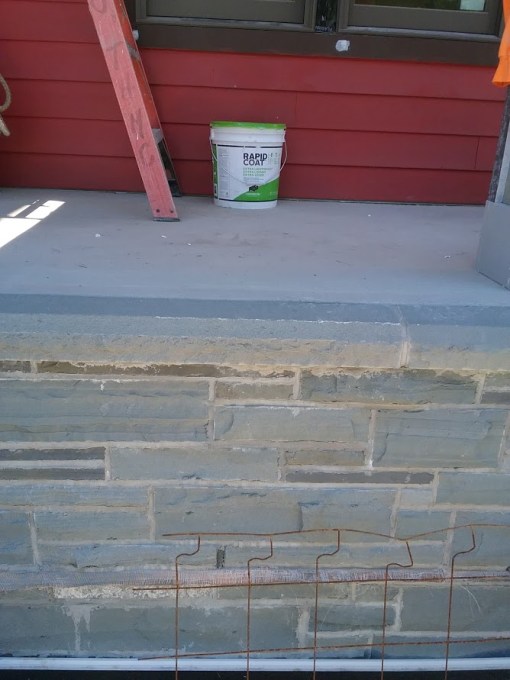
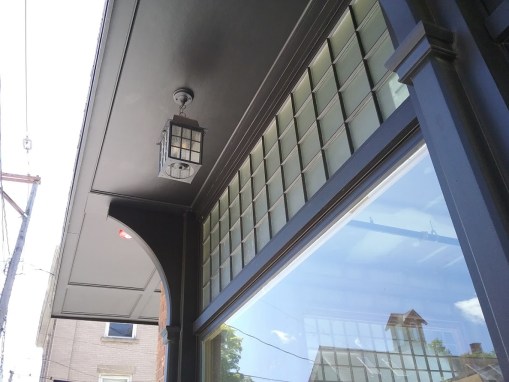
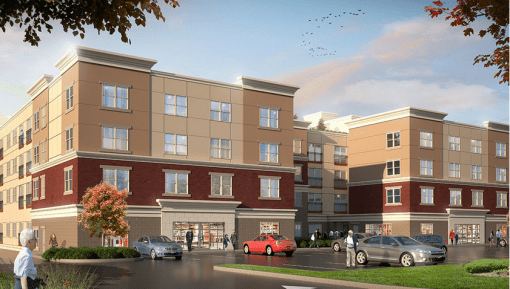
My first inclination was that they needed to be painted, but looking at the design render, it appears as if the project team decided to reverse the brown and red siding bands, so now the first floor is red like the original building, but the upper floors are brown. This is not the first major change to the design, which was approved by the ILPC, but any revisions may have been done out of committee view at the staff level. The fenestration on the third floor is different, and the dormer on the gable roof was deleted. Note the partially glazed-in access stair for the third floor apartments, and the quarried bluestone stair columns and base.

There’s still a fair amount of work to do on the exterior with facade installation, trim and finish pieces and the installation of a steel grate to access the enclosed stair column. The one inside shot shows drywall hung with doors and some trim in place, but some pieces are still missing, the wall needs to be painted and the floors have to be finished. However, it’s not an especially large building (four units and eleven bedrooms as-approved), so chances are pretty good this will be ready to go by mid-August.

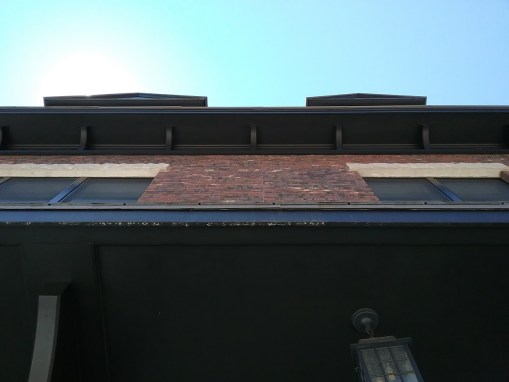
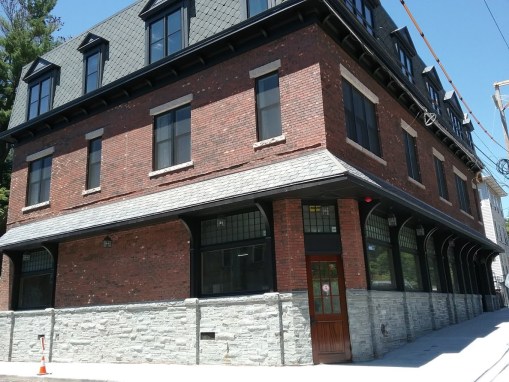
As for the Chapter House, a few shots through the window glass show the carpeted staircase leading up to the eight apartment units, and an unfinished 3,000 SF commercial space still looking for a tenant.


Cayuga View Senior Living Construction Update, 6/2018

21 06 2018

We can practically call this project complete – the first tenants move in on July 1st. Somewhere along the way, the number of units was reduced from 60 to 58, and it’s not clear whether those were one-bedroom or two-bedroom units (the initial breakdown was 48 two-bedroom and 12 one-bedroom units). No tenants have been named for the twin 1,340 SF retail spaces either.

Given that this was the last vacant high-density mixed-use parcel in the village of Lansing, it seems like they got a good project out of it. 58 market-rate units to seniors aged 55+ is a welcome addition the the Tompkins County market, especially as the retirement of Boomers only continues to grow (the market will create demand for another 70 senior-focused units per year over the next several years, as well as market-rate and affordable housing for those without specialized care needs). While not exactly an urban location, it is walkable to nearby shops and restaurants at Triphammer Mall and the Bishop’s Mall across the street, and it will have a bit of an active ground-floor presence through its small commercial spaces. 5% of the units will be built handicap-accessbile, but all will be handicap-adaptable, and the rooftop solar panels are a plus.

The project was built and developed by Taylor The Builders in conjunction with the Thaler Family. NH Architecture did the design work, and Cornerstone Group will manage the property.

Some cool aerial shots of the site can be seen here courtesy of Taylor and photographer Mick McKee. Interior photos of the nearly finished units and rental information can be found on Craigslist here.


Amici House Construction Update, 6/2018

19 06 2018

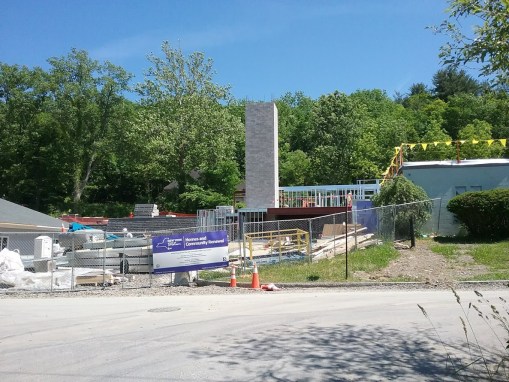
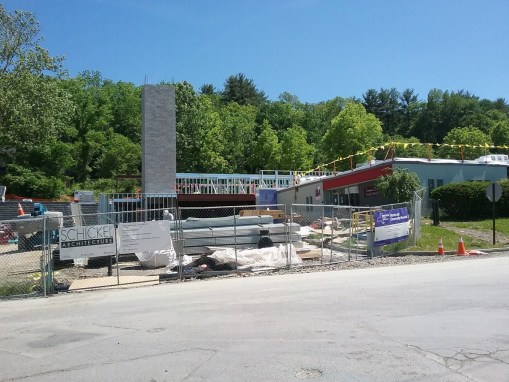
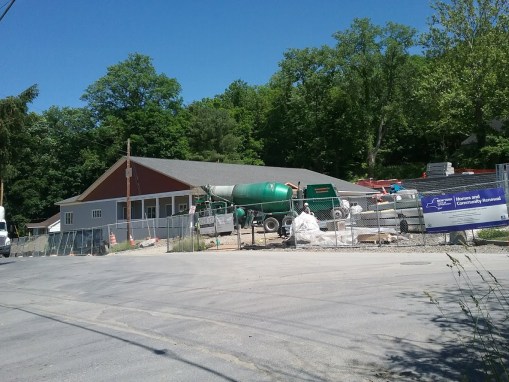
There has been significant progress at the Amici House construction site at 661-701 Spencer Road. The 7,010 SF Harriet Giannelis Childcare Center (which will host headstart classrooms and daycare facilities) is fully framed, roofed, fitted with windows, and most of the exterior siding (unsure at a glance if it’s CertainTeed vinyl or fiber cement lap siding, though the top color looks like CertainTeed “Autumn Red”) has been attached. Even some of the trimboards have already been attached along the front entry/porch. It would seem likely that, if logistics provide for it, the building could be open for its first students in the fall.

To be honest, the design is a bit of a surprise – the original building design by Schickel Architecture was the same size but looked quite different, and the revisions were never uploaded (maybe the planning and building department had something on file, but there was nothing online). Note that most of that front-facing concrete slab is going to backfilled (partial refilling of the excavated area).

As for the five-story mixed-use structure, that is just getting underway with structural framing. The first floor, which will have offices and meeting space, has its steel skeleton and some of its exterior stud walls have been attached. The second floor is just getting underway, and the masonry blocks for the elevator core have been assembled. It appears the existing TCAction building will be getting a new roof as part of the construction work – note that they are not able to work here while construction is ongoing, and have temporarily relocated to 609 West Clinton Street. The 20,712 SF building, with its offices and 23 efficiency units for homeless and/or vulnerable young adults, will be completed early next year.

The background information and planning for the project can be found in the March introductory post and photo set here. Prolific regional contractor Welliver is the construction manager for the $8.25 million project.


City Centre Construction Update, 4/2018

12 05 2018

Mostly just clearing out my stash at this point; as the webcam shows, exterior framing is up to the third floor.

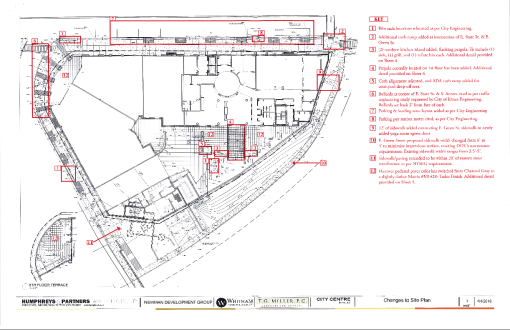
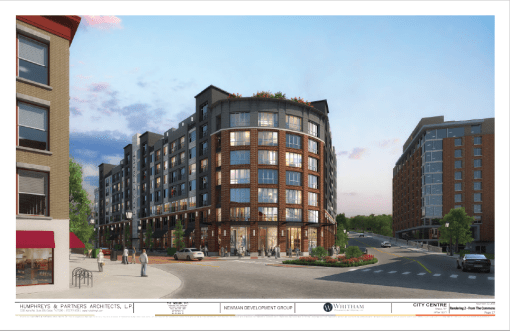
A number of changes have been made to the City Centre project, inside and out. Whitham Planning and Design shepherded the alterations through the planning board, which was generally okay with them. Among the revisions:

-Landscaping Changes. Among them, street tree species and layout, and tree grates are being replaced with FlexiPave porous paved covers. The number of shrubs was decreased, perennial flowers increased. Bike racks were relocated, street lights, curbing and curb ramps were adjusted, concrete planters were added by the parking drop-off area, a pergola with string lights was added, bollards were added, the sidewalk width along East Green Street was reduced from 6′ to 5′, and pavers were changed to a slightly darker shade of grey.

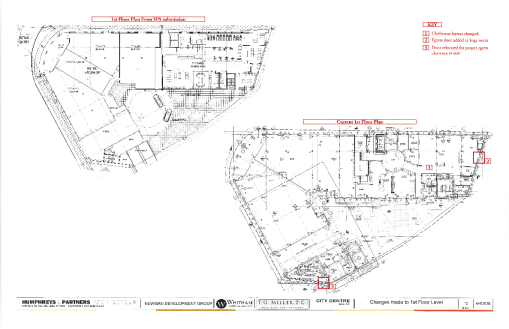
-On the first floor, the lobby layout was reconfigured, and some exterior doors were relocated for ease of access. The number of retail spaces was reduced from four to three, but the total square footage for the retail is about the same (11,000 SF). A storm water vault and fire pump room were added in the underground garage, and the parking spaces were reconfigured slightly to accommodate (still about 71 spaces).

-The unit mix has changed from 61 studios, 78 one-bedrooms, and 53 two-bedrooms, to 33 studios, 120 one-bedrooms, and 39 two-bedrooms. Still 192 units total, but with fewer studios and two-bedrooms and more one-bedrooms, basically. This might have to do with what’s easiest to rent to the target market (young professionals, a few downsizers, deep-pocketed students). Perhaps studios aren’t seen as having enough space for the upmarket market segment.

-The exterior facing materials have been changed from Nichiha aluminum panels to Overly Dimension XP Metal Systems, and Alucoil Larson ACM aluminum panels. The color palette is generally the same, perhaps slightly greyer with the revised paneling. Air intake vents were added to the building facade. Fenestration (window size/arrangement) was also changed up.

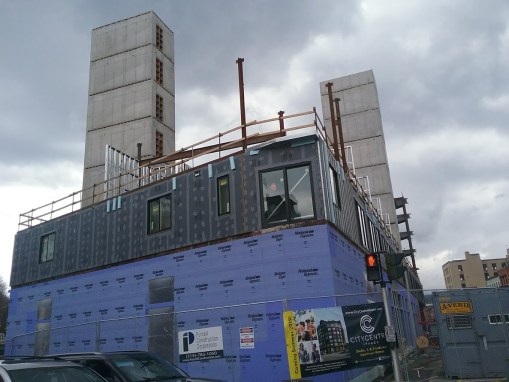
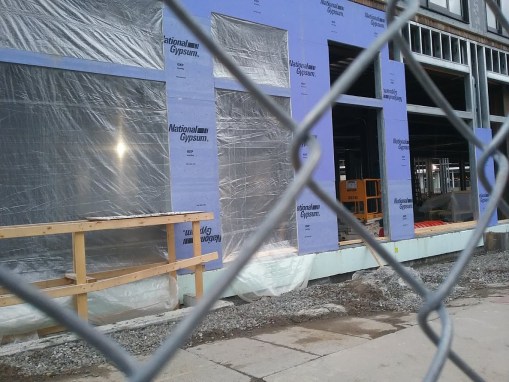
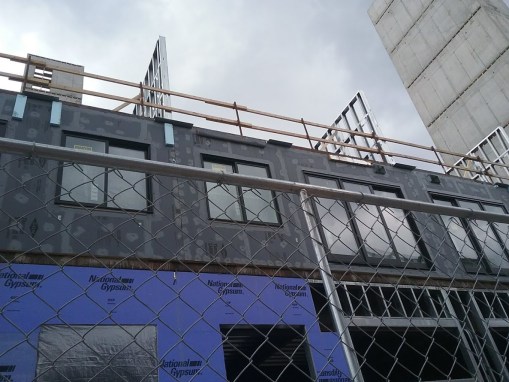
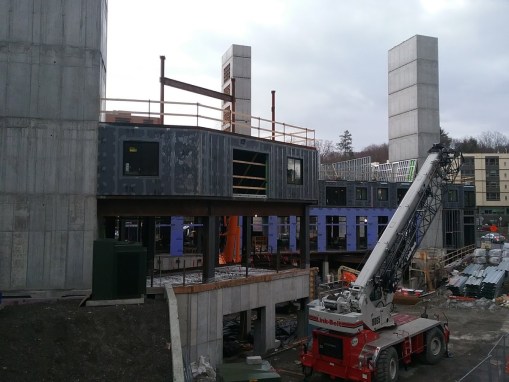
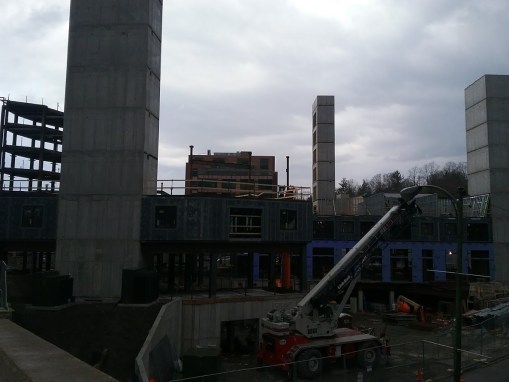
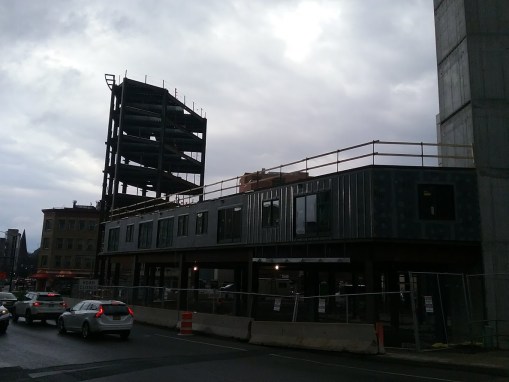
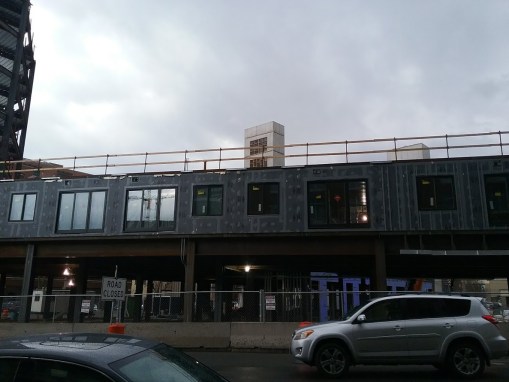
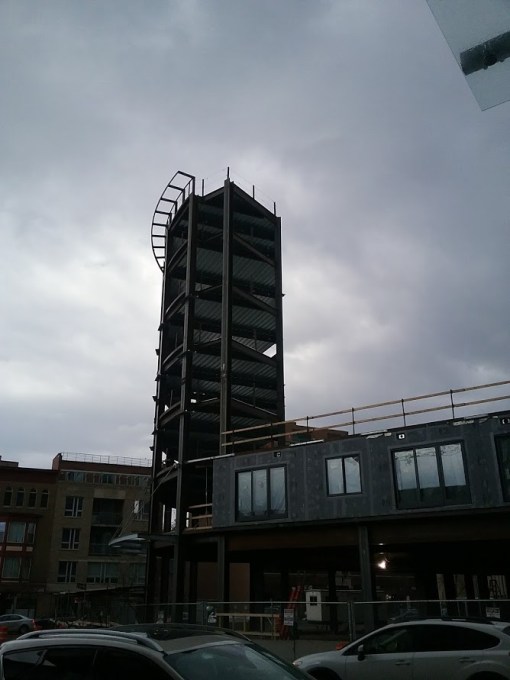
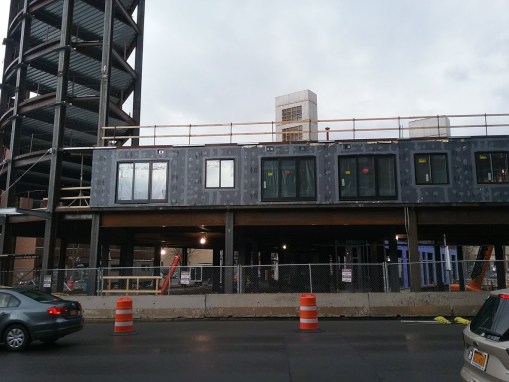
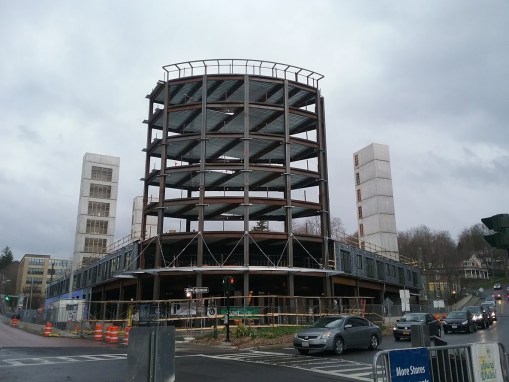
The floor buildout is a rather interesting process, because they’re practically building from the inside-out as each floor is added. The interior steel stud walls and structural steel supports go up first, then roof decking overhead, and then what appear to be prefabricated modular exterior wall panels with Marvin Windows already fitted. The dark panel is Dow Thermax Xarmor, which apart from sounding like a Star Wars extra, is a heavy-duty fire-rated fiberglass insulation board covered with a dark exterior facer that serves as a water barrier. These panels can be set into place very quickly, saving time and labor costs. The ground-level is more typical fireproof gypsum sheathing. The steel rails on the upper floors are likely for the aluminum exterior panels, so they may clipped into place.


Harold’s Square Construction Update, 4/2018

10 05 2018

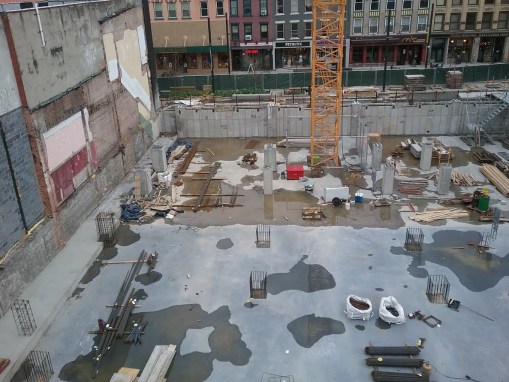
Ithaca weather is not accommodating. Originally, the pour for the concrete slab was supposed to take place on April 3rd. It’s tricky, because this is a large footprint and the building is very heavy, necessitating a thick slab – 30 inches thick. That has to all be poured at once, without any potential interruptions like rain or snow, which can weaken the concrete as it cures (upsets the mix and water balance). That was rescheduled the first time due to winter weather, and was expected to take place on the 11th, which was rained out. 4/16 was also cancelled due to winter weather. Finally the concrete was able to be poured on the 23rd.

In the photos below, you can see some wood forms are still in place for smaller sections (entryway, lower right of site). The vertical concrete column bases are being poured (note the squares of vertical rebar in the sections yet to be encased), with steel plates atop the finished column to tie into the steel beams. The hole in the lower right (southeast) corner is for one of the elevator cores. Taylor the Builders will have this heading skyward in short order.


Chapter House / 406 Stewart Avenue Construction Update, 4/2018

30 04 2018

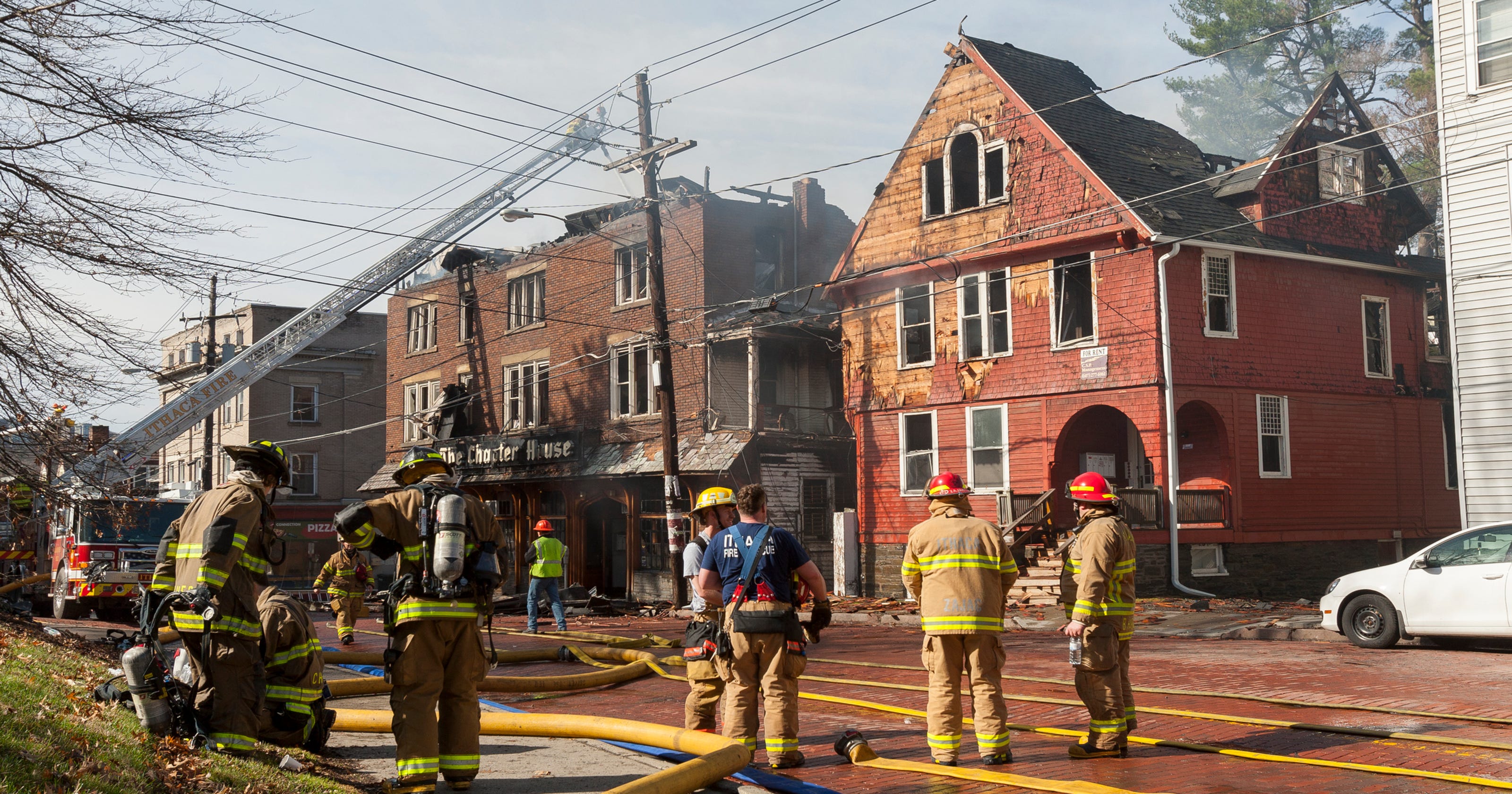
It’s hard to believe it’s been over three years now since the fire that decimated the Chapter House and the neighboring apartment house at 406 Stewart Avenue. According to a recent write-up by Mark Anbinder at 14850.com, the new build at 400-404 Stewart Avenue will host one eight units –  studio apartment, three 1-bedroom apartments, one 2-bedroom apartment, and three 3-bedroom apartments. The units are aiming for a summer occupancy, and CSP Management (Jerry Dietz and his team) are in charge of the rentals on behalf of developer/owner Jim Goldman.

From the outside, the building is practically complete, except for landscaping/paving, trim pieces, and facade installation of the ground-level bluestone veneer. The 4-unit, 11-bedroom apartment building next door is not as far along, with roof trusses only just being installed, and sheathing (ZIP panels) and window fittings underway on the lower floors. It’s a reasonable bet to say these will be available for their first tenants in time for the start of the new academic year in late August.

As fair as anyone’s aware, the ground-floor space restaurant/bar is still available for lease, at $35/SF (at 3,000 AF, that means $105,000 annually). Chapter House owner John Hoey has said in the comments here that the price is too high for his business. The possibility of a “Chapter II”, as some have dubbed it, seems increasingly remote. Any other potential lessees can contact David Huckle or August Monkemeyer at the Ithaca branch of Pyramid Brokerage.


News Tidbits 4/7/18: A Day Late and A Dollar Short

7 04 2018

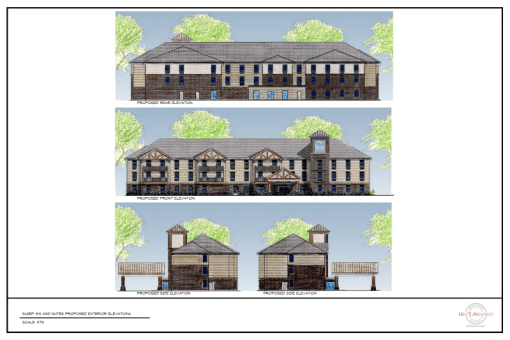
1. It appears the Sleep Inn hotel is moving forward. Building permits for the 37,000 SF, 70 room hotel at 635 Elmira Road were issued by the town of Ithaca on March 23rd. According to the town’s documentation, the project cost is $4.1 million, though it’s not 100% clear if that’s hard costs (materials/labor) and soft costs (legal/engineering/design work), or just hard costs alone.

The Sleep Inn project was first introduced in Spring 2016, and underwent substantial aesthetic revisions to a more detail, rustic appearance. Even then, the project was barely approved by the Planning Board, which had concerns about its height, relatively small lot size and proximity to the Buttermilk Falls Natural Area. The hotel’s developer, Pratik Ahir of Ahir Hotels, co-owns the Rodeway Inn further down Elmira Road. Both the Rodeway and Sleep Inn are Choice Hotels brands, so although the Sleep Inn brand is new to the area (and uncommon in upstate New York), it’s not as unusual as it seems. Given the size, a 12-month buildout seems reasonable. Look for updates as the project gets underway.

2. In a similar vein, the gut renovation and expansion at 1020 Craft Road now has a building loan on file – $1.88 million as of April 3rd, courtesy of Elmira Savings Bank. The existing 10,500 SF industrial building has been gutted down to the support beams, and will be fully rebuilt with an additional 4,400 SF of space. The project is being developed and built by Marchuska Brothers Construction of Binghamton. According to the village of Lansing and the developer, the project will be occupied by multiple medical tenants.

3. The problem with tight publishing deadlines is that if a quote doesn’t arrive in time, you can either put it in afterward as an updated statement, or it gets left out. So on the heels of the report that Visum Development Group is upstate New York’s fastest growing company in terms of revenue (Inc.com’s guidelines were three-year period 2014-16 and at least $100,000 in revenue to start), I wanted to share this for those who might have missed the article update. The statement comes courtesy of Todd Fox, who was asked for comment and responded the following day.

“I would love to acknowledge the Visum team because without them I would never be able to accomplish what I am doing. I’m blessed to have the most passionate and talented people I have ever met. Chris Petrillose is my longest running team member and is the backbone of operations. I also want to acknowledge Patrick Braga, Matt Tallarico, Marissa Vivenzio, and Piotr Nowakowski. They are all rock stars and deserve so much of the credit for our success!

We are currently looking to expand into several new markets, which are as far south as Sarasota Florida and as far west as Boise Idaho. For the Ithaca market, we are essentially hitting the breaks on student housing for Cornell, as we beginning to experience some softening in the market. Our new focus is on for-sale condos and moderate-affordable rentals. We actually have multiple properties under contract and plan to bring about 1,000 to 2,000 new beds online over the next several years.”
Note the last parts. The market for student housing if softening. Visum will focus on for-sale condos and moderate-affordable rentals, things Ithaca could use more of, and 1,000 to 2,000 beds would certainly make a dent in the housing deficit. Of course, proof is in the pudding, so we’ll see what happens over the next several years.

4. The town of Ithaca was less than pleased about Maplewood’s request to extend indoor working hours until 10:30 PM. Labor, weather and building supply (wood frame) issues were cited as reasons for the needed extension. The Ithaca Times’ Matt Butler, who was at the meeting, provided this quote:

https://platform.twitter.com/widgets.js

Yikes. The “happy medium” the board finally gave in to was construction until 9 PM on buildings interior to the project site, away from the main roads. The tradeoff is that EdR and Cornell now expect to not have some of the later structures ready until August 20th, practically move-in day for all of Cornell’s on-campus undergrads.

5. Readers of the Voice and Times will know that the county is pursuing some of the $3.3 billion in federal dollars earmarked but not yet disbursed for opioid crisis treatment. While a temporary addiction facility is being prepared, there are plans in the works to open a detox and stabilization facility in Tompkins County. Unfortunately, it needs much more funding to move forward. The new facility will cost $11 million to build and make operational, and so far about $1 million has been received so far in grants.

For the purpose of this blog, I asked about the design beside Angela Sullivan and Senator Schumer – it is a conceptual design for demonstrative purposes, and a location for a new facility has not yet been fully determined. However, they intend to send a press release once a site has been selected.

By the way, the green logo at lower right is a giveaway on the architect – that would be Ithaca’s HOLT Architects, who are specialists in healthcare facilities.

6. New to the market this week, “Clockworks Plaza” at 402 Third Street in the city of Ithaca’s Northside neighborhood. The 12,821 SF building was one of the few sizable buildings built in Ithaca in the 1990s (1993, to be exact), and is on the market for $2.6 million. The current owner, masked by an LLC, bought the property for $1.5 million in April 2016, the same value for which it is assessed.

That came up on the blog here. The buyer was Steven Wells of suburban Boston, who purchased the property in a buying spree that also included 508 West State Street (former Felicia’s, empty at the time) and 622 Cascadilla Street. 508 West State is now rented by Franco’s Pizzeria. Zaza’s still occupies 622 Cascadilla.

As I wrote at the time of sale:

“They all have different owners, and they’re in varying physical conditions. The only thing that unites these three properties is all that are in areas the city as ripe for redevelopment for urban mixed-use in the Comprehensive Plan. Felicia’s was upzoned in June 2013 to CBD-60, permitting a 60-foot tall building, no parking required. 622 Cascadilla is WEDZ-1a, allowing for five floors and no off-street parking requirement. Lastly, 402-410 Third Street is B-4, 40′ max and 50% lot coverage, but allows virtually any kind of business outside of adult entertainment. Those are some of the city’s more accommodating zoning types, so we’ll see what happens moving forward. At the very least, the public relations game will be starting from behind the proverbial eight ball.”

The reason why the public relations game was ‘behind the eight ball’? He was the guy who sold 602 West State Street and adjacent low-income housing properties to Elmira Savings Bank. There were accusations that the transaction between Wells and the bank was poorly handled, with claims that the lease terms of existing tenants were changed improperly, and tenants not being told their homes were being sold. It’s not clear it that’s accurate, because no one would share their documents to prove their claims. But what is clear is that this created a nightmare situation.


7. It looks likely fewer people will be living in City Centre than first intended. The initial 192-unit mix was 61 studios, 78 one-bedrooms and 53 two-bedrooms. The newly-proposed mix is 33 studios, 120 one-bedrooms, and 39 two-bedrooms. It also appears the retail space has been reconfigured from four spaces to three, though the overall square footage appears to be about the same. There are some minor exterior changes proposed as well; paver colors, lighting, the types of metal panel used (Alucoil to Overly Dimension XP and Larson ACM panels), landscaping, and exterior vents. Assuming the PDF is accurate, the panel change is slight, but gives the building a slightly darker grey facade. Some of these changes are in response to code and safety discussions, others are likely value engineering.

8. From the city’s project memo, we see Greenstar’s new store (which is going into the Voice) and a pair of new if small projects.

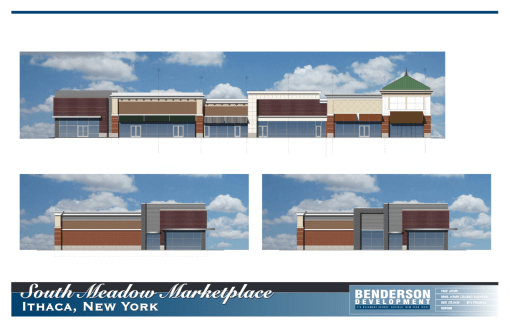
The first is that it appears Benderson is expanding South Meadow Square again. Along with the pair of endcap additions underway, the Buffalo-based retail giant is looking to add a 3,200 SF addition to the west endcap of one of its smaller retail strings. The addition is on the Chipotle/CoreLife strip, next to Firehouse Subs. The dumpster enclosure currently on-site will be relocated to the Panera strip across the road to make room for the building, which will be flush to the sidewalk with…a blank wall. Seems like a bit of a missed opportunity there. The 35′ x 92′ addition has no announced tenant, though 3,200 SF is reasonable for a smaller restaurant or retail space (Chipotle is 2,400 SF, for instance, and Panera 4,100 SF; the stores in this particular retail strip, which includes a vitamin store, tanning salon and barber shop, are in the range of 1,380-4,089 SF). The total project cost is only $132,000, and no construction period is given in the Site Plan Review document.

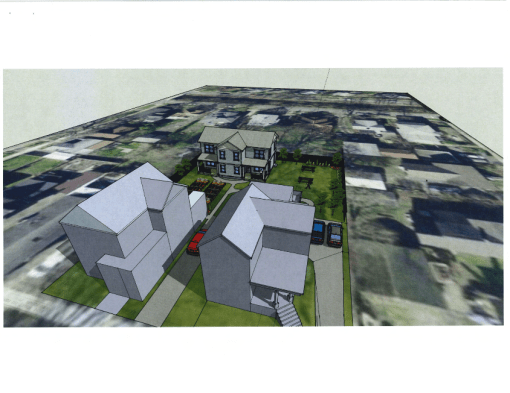
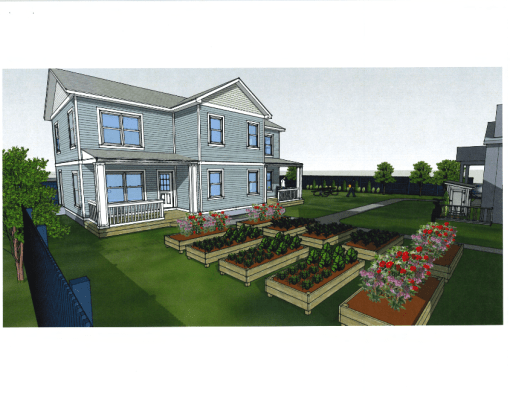
The second is a “pocket neighborhood” in Northside. Barken Family Realty of Ithaca is planning to renovate two existing homes at 207 and 209 First Street, and add a new 2,566 SF two-family home behind the properties. They would be set up as a “pocket neighborhood”, consolidated into a single tax parcel with a common area, picnic tables and raised plant beds. The fence would be repaired and the gravel driveways improved. No demolition is planned, but five mature trees would come down to make way for the new home (6-8 new trees will be planted).

Hamel Architects of Aurora designed the new duplex, which is intended to quietly fit into the neighborhood context. Each unit will be two bedrooms. The $265,000 project would be built from October 2018 to March 2019.

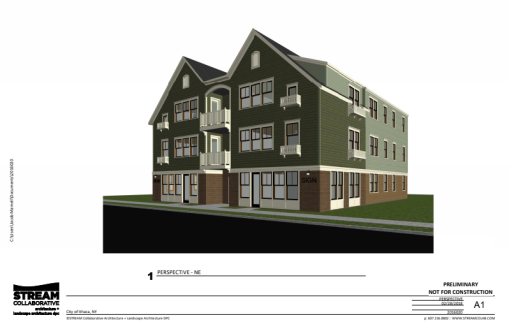
9. We’ll finish this week with a potential new build. The above project was first showcased on STREAM Collaborative’s Instagram at an early stage. It is a 3.5 story, 11,526 SF building with 10 units (6 one-bedroom, 4 two-bedroom), and the two one-bedrooms on the first floor are live-work spaces – the front entrances are workspaces for home businesses. It is proposed along West Seneca Street, and only the south side of West Seneca allowed for mixed-uses like live/work spaces. Materials look to be Hardie Board fiber cement lap siding and trim. The design is influenced by other structures along West Seneca, and a bit from STREAM architect Noah Demarest’s time with Union Studio in Providence, Rhode Island, where he worked before setting up his own practice back in Ithaca – there are similarities between here and Union Studio’s Capitol Square mixed-use design in Providence.

The project actually was sent with its name and title, but fingers crossed, it will be part of a bigger article.


Cayuga View Senior Living Construction Update, 3/2018

20 03 2018

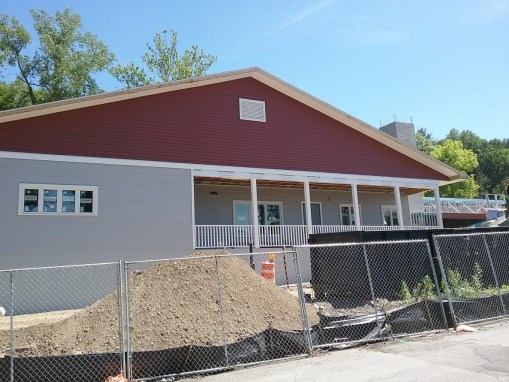
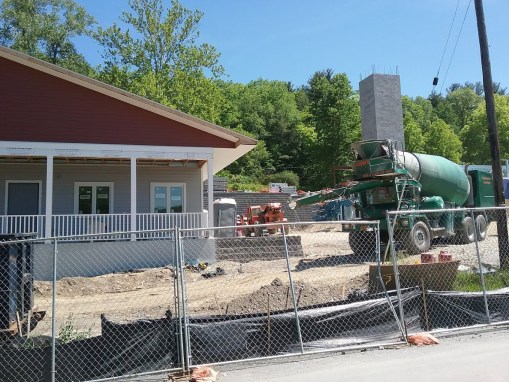
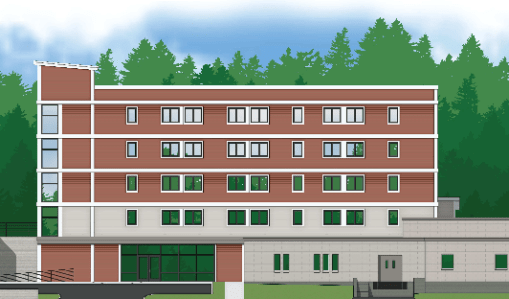
It looks like Taylor the Builders has started attaching exterior finishes to the Cayuga View Senior Living apartment building. That includes decorative cornices, brick veneer, and what appears to be a few different shades of EIFS panels. EIFS (Exterior Insulation Finishing System), sometimes called synthetic stucco or by commercial brand names such as DryVit, is a lightweight, waterproof finishing material – usually it’s two-inch thick polystyrene (rigid foam) insulating panels with an acrylic finish to mimic the appearance of stucco, along with adhesive and drainage structures. EIFS is low-maintenance; it gained popularity in the 1970s and 1980s, but developed an infamous reputation for water damage due to improper installation, which is why so many building codes are stringent about adequate drainage systems for new builds. The boards can also be damaged fairly easily by blunt-force impacts. It tends to be more common on commercial buildings than residential structures, but it is not an uncommon choice of finishes for wood-frame multi-family buildings. Other recent builds using EIFS include the Holiday Inn Express on Elmira Road, and the Seneca Way Apartments on the edge of Downtown Ithaca.

Interestingly, the top floor’s panel boards are a lighter color than the third floor – renderings have them both being the same color.

Also, note the poles and flags on the roof – that’s a good indicator that some material is being applied, probably EPDM, which is a synthetic rubber. The project team recently announced that the 87,500 SF building will not only host a rooftop garden, but a 46kW, 151-panel solar array courtesy of installer SunCommon NY of Rochester.

Current plans call for the first occupants to begin moving into its 60 apartments by the end of May (the website advertises a summer occupancy, and a leasing office is present on-site). Cornerstone Group, also of Rochester, has been selected to manage the building, whose units are reserved for those aged 55+. I’ve been in touch with the project team, and there might be a sneak preview article in the Voice a few weeks before opening.


News Tidbits 3/10/18: Affordable Housing Week 2018

11 03 2018

For today, let’s take a look at the entrants competing for the city’s affordable housing funds.

The Ithaca Urban Renewal Agency will be holding public hearings on Thursday 3/22 and Thursday 3/29 s part of the process to determine who will receive money from the Housing and Urban Development (HUD) grants awarded to the city. The 28 applications, three more than last year, range from jobs training to community services to the development of affordable housing.

In aggregate, there is $2,042 million requested, and about $1.239 million available. For the sake of comparison, that’s a 60.6% funding vs. request ratio, slightly more than last year’s 58%, but less than the 83.2% ratio of 2016, and the 67% ratio in 2015. 2016’s ratio was high because of $273k in unspent money originally earmarked for the earlier INHS plan for 402 South Cayuga Street.

Roughly speaking:

Year    Request    Amount Available

2015 / $1.78m / $1.215m

2016 / $1.85m / $1.54m

2017 / $1.982m / $1.149m

2018 / $2.042m / $1.239m

Unfortunately, HUD funding is not going up – of that $1.239m, about $184k is carried over from 2017 – Finger Lakes ReUse decided to decline last year’s $50k award, as did 402 South Cayuga Street ($80k, Habitat for Humanity’s cancelled project) and Housing for School Success (~$34k). The other roughly $20k was unallocated funds. In truth, the award for 2018 is $1.055 million, while requested amounts continue to rise, and the head of HUD gets embroiled in scandal for, among several reasons, ethics issues involving HUD business dealings with his family, and trying to spend $31k on a dining set for his office.

Without discounting the value of the other applications, the focus here will be on the real estate development projects. A full rundown is provided by my Voice colleague Kelsey O’Connor here. For the record, writing about a project is neither an endorsement or opposition from this blog.
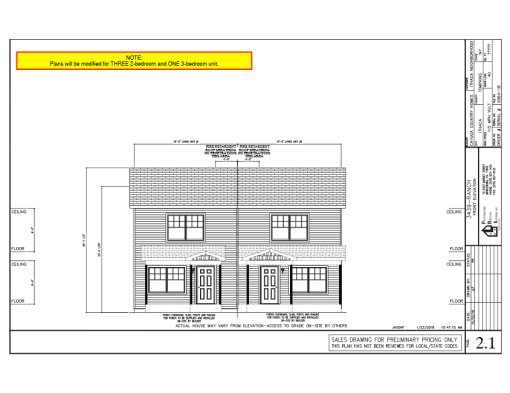
1. First, 402 South Cayuga Street. This site has had a rough history, unfortunately. It’s a small vacant lot just south of Downtown Ithaca that has had little good luck in the past several years. Five years ago, INHS originally attempted to build four units of for-sale housing on the property, but could not make it financially viable, as construction costs rose beyond what they could do within budget. Another developer proposed a market-rate plan, but the city, which owns the lot, has a strong preference for affordable for-sale housing. Habitat for Humanity also made an effort to build for-sale housing on the site, but it too saw construction costs rise beyond their capacity.

The grant application, $150,000 towards that $1.057 million project, would revive the INHS plan the planning board approved a few years ago. Two of the townhomes would sell to households making at or below 80% of Area Median Income (AMI, at or below $42,400/year for a single person), while the other two would sell to those making at or below 100% AMI (at or below $53,000/year), sometimes called “missing middle” housing. The funds would be used for construction and soft costs (legal paperwork, permit fees) on the two lower-priced units.

The reason why this is feasible now is that for one, the planning and design costs from 2013 have been paid off and the design is nearly the same, and two, the project will be modular instead of stick-built. INHS would partner with Cayuga Country Homes to build the four units. The units would be locked into the Community Housing Trust, and include features not in the previous plans, such as air-source heat pumps. However, the bay windows on the north and south walls have been removed from the new plans.

Breaking it down a little more, the construction cost would ring in at around $177/SF, about 10-15% less than stick-built. The three 2-bedroom units are 1190 SF and will cost about $210k to build, while the three-bedroom will be 1352 SF and cost about $239k to build (total about $870k, of which $830k is consumed by hard costs, materials and labor).

INHS will sell the 80% AMI two-bedroom at $121k, and the 80% AMI three-bedroom at $139k. The two 100% AMI units will sell at $159k. INHS will need to cover the remaining $291,000 with grants and subsidies just to break even. It is possible to build marginally cheaper, but insurers require INHS has to use contractors with at least $1 million in workplace liability coverage.

If funding were awarded later this spring, the units could be ready by April 2019. Although the construction method is different, the exterior changes are generally cosmetic – slightly different window arrangements, deleted bay windows, and porch details. It’s still at its essence four 2.5 story townhomes with ground-level rear garages and cantilevered rear decks. It is possible they could be signed off on at the staff level, but it’s more likely they would need to pay a quick visit to the planning board. The exterior changes could be reviewed and approved in one meeting.

2. The other INHS submission is titled “Scattered Site Phase 2: New Construction”. The request is for $100,000 to help cover soft costs (architectural and engineering fees) associated with the projects in the application. Calling them “scattered” is a little bit of a stretch – it’s two sites. One is 203-209 Elm Street on West Hill. That will have thirteen units, replacing twelve existing units, a count that includes 4-unit 203 Elm Street, currently vacant due to structural concerns. Six of the thirteen will be targeted to households at 50% AMI ($26,500/year for a single person), and the other seven at 60% AMI ($31,800/year). Ten of the units are one-bedrooms, and the remaining three are two-bedrooms.

The big question is the $16 million project planned for Downtown Ithaca. Although INHS cannot name the applicant, there were enough hints to figure it out with a fairly high degree of certainty. I can’t run conjecture on the Voice, but here, well, take the disclaimer that I could always be wrong. But consider the following:

From the notes in the application, we know it is:

  • In census tract one – mostly Downtown and the State Street Corridor.
  • The current site is a small commercial building.
  • It is in the CBD – Central Business District.
  • The site would host 20,000 square-feet of commercial space, and 40 housing units. The 30 one-bedroom and 10 two-bedroom units would be set aside for those making 30-60% AMI ($15,900-$31,800/year).
  • An unknown number of units would be set aside for formerly homeless individuals or those in need of supportive housing. The current owner would provide supportive services in the first-floor of the commercial space.
  • The partner in the project has provided services for over 150 years.
  • INHS would buy the land for $750,000.

The only site that checks off all the boxes is the Salvation Army property at 150 North Albany Street. It is currently valued at $800,000, following a $100,000 bump upward last year. A back of the envelope suggests a gross square footage of 55,000 SF, plus or minus a few percent. That would put the new build at roughly the same size as Breckenridge Place (55,300 SF).

Zoning at the site is a little odd – it’s a split, CBD-60 on the southern two-thirds, and more restrictive B-2d on the northern third. CBD allows up to 60 feet in height, 100% lot coverage no parking requirement. B-2d allows four floors, 40 feet in height, and has no parking requirement if a building is more than 60% residential use – which there’s a fairly high chance this project would exceed. I’m picturing something five or more likely six stories on State, and stepping down to four on West Seneca Street. But, there’s still a chance I could be wrong, and this may isn’t the right site.

An approximate construction time frame for the mystery project appears to be October 2019 through January 2021. A sketch plan revealing the mystery partner and site is expected to be shown to the city planning board in June. SWBR Architects of Rochester is in charge of design.
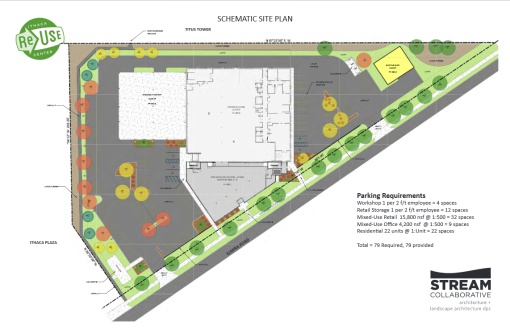
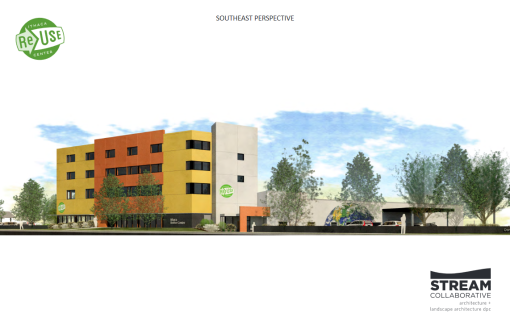
3. The last one I’ll cover is the Finger Lakes ReUse expansion. Let’s preface this by saying they don’t own the site – the former grocery store turned BOCES turned eco-services non-profit entered into a purchase agreement with John Novarr in February 2014 to purchase the building for $1.25 million (below the assessment of $1.35 million), which they will do exactly five years after the agreement was signed, in February 2019. The $100,000 requested would be assistance towards the purchase of the property, freeing up their money to work on their upcoming construction projects.

As is, the site is a 17,000 SF retail building, and a 1,330 SF former garage/repair shop. Plans have been proposed for major additions – 6,500 SF of retail, 65,000 SF of office space, and 12,000 SF of supportive housing, which consists of 22 studios for low-income individuals, with emphasis on formerly homeless and/or incarcerated individuals. Welliver, INHS and TCAction have provided guidance and assistance; Welliver may be the general contractor as construction proceeds, and TCAction may manage the housing units. STREAM Collaborative is the architect.

Point of confusion – the approved plans call for a 26,100 SF, 4-story building with mixed-use retail, office and living space components, and an 8,100 SF open-air metal warehouse for reclaimed wood processing and storage. That all totals 34,200 SF, not 83,500 SF. There’s 49,300 SF that is not clearly spoken for.

The warehouse is phase one, will cost about $500,000, and be ready by Q3 2018. It will generate at least three living-wage jobs (an estimate Finger Lakes ReUse says is conservative). Phase two is funding dependent on the affordable housing component, and will provide at least six new living-wage jobs. Although NYS HCR affordable housing grants don’t typically cover commercial space, they can be applied to mixed-use structures.

The total project cost is $10.521 million. $1.89 million of the costs are covered with a NYSERDA grants, and Empire State Development has also offered a $500,000 economic development grant. Add in other grants and awards received or being pursued, and it appears that only about $3 million will be covered through loans. IURA funding an extra $100k makes the project more competitive for other grants, since FLR will have demonstrated they have more secured funds, and a higher chance of moving forward. The idealized time frame calls for a late summer 2019 construction on Phase II with completion a year later, but sit back and see what happens with applications and awards first.