The Maplewood Redevelopment, Part II: Site Plan and Layout

3 09 2017

Unlike most projects, Maplewood is basically an entire new neighborhood – there are five large apartment buildings, 21 townhouse strings, and the community center, for a grand total of twenty-seven buildings. The building elevations for each structure can be found in Building Set Plans 1-3, on the town of Ithaca’s website here.

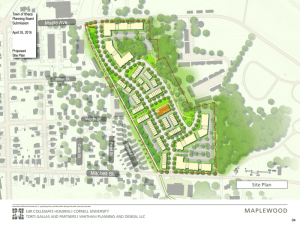
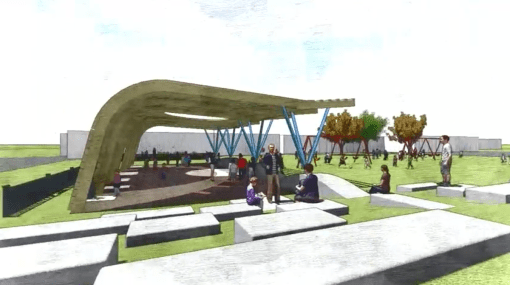
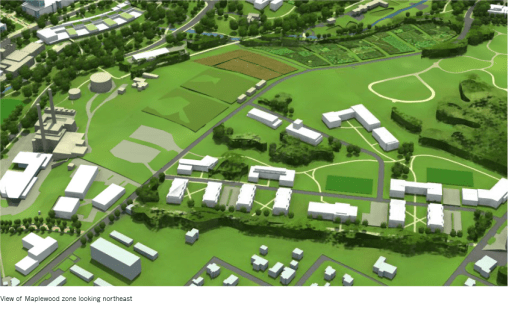
The pretty version of the site plan, from STREAM Collaborative, has most of the buildings pretty clearly labeled, but is a little outdated – the townhouses along Mitchell were added late in the process, and were not labelled here. However, this is the easiest diagram to follow, and highlights some of the landscaping features of the project. The childrens’ play area is located at the intersection of James Lane (the north-south road) and Lena Street (the east-west road). The overlook is a natural area at one of the highest elevations of the property, and the community garden is at the turn of James Lane. The bus stop/food truck area, unlabeled here, is the intersection of Maple Avenue and Veterans’ Way. The knoll between apartment buildings D, E and F is the location of the Mitchell family cemetery plot, last active in the 1850s.

Here is the more accurate but less attractive site plan. The townhouses along Mitchell have been renamed, but otherwise everything else is the same. Notably, there is no apartment building “A”. “A” was the multi-story building along Mitchell Avenue that was removed late in the planning process. In short, five multi-story buildings, B, C, D, E, and F. Then there are the townhouses, to be covered in detail in the next section.

The Townhouses
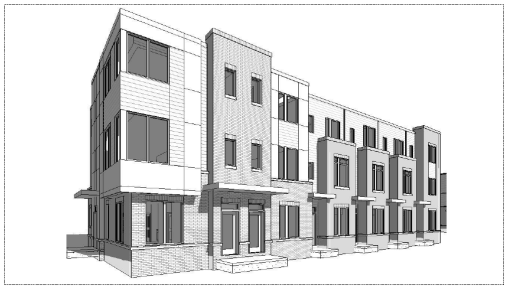
The townhouses are all 2-4 bedrooms. Counting them all off, there’s At, Bt, Ct, Dt, Et, Ft, Gt-1, Gt-2, Ht-1, Ht-2, It-1 and It-2, Jt-1 and Jt-2, Kt-1 and Kt-2, Lt, Mt, Nt, Ot, and Pt. The color coding is for easy reference.

Each uniquely-lettered string is its own design. The Gt’s, Jt’s, and Kt’s are near-identical twins exception for unit layout and building elevation steps to accommodate slopes. The more traditional-looking Ht-1 and Ht-2, and It-1 and It-2 strings are mirror images of their same-lettered counterpart.

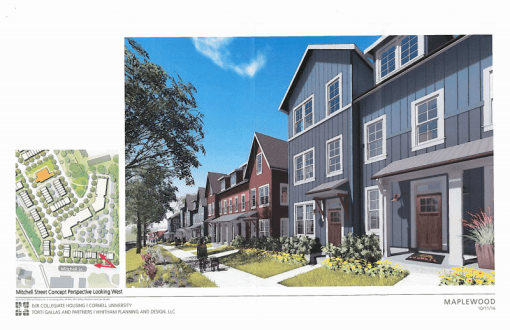
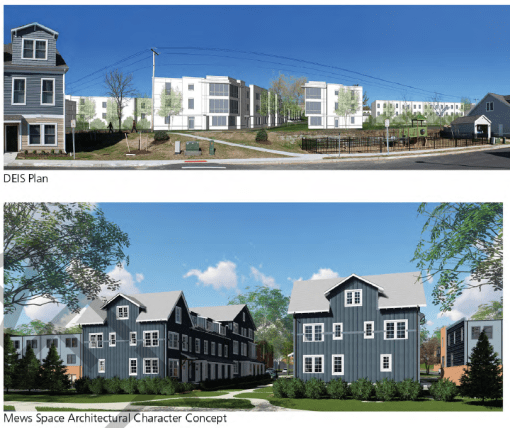
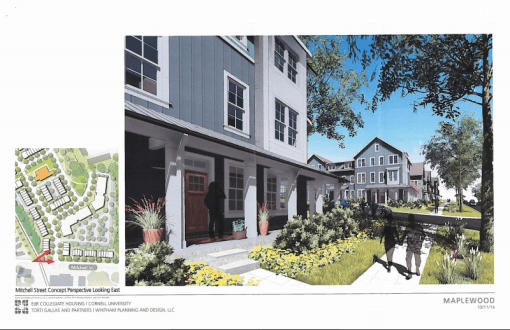
The modern-looking townhouses use a brick veneer, light and dark fiber cement panels and lap siding, cast stone accents and wood canopies, along with concrete foundations and stairs. The more traditional townhouse strings (Ht’s, It’s, Nt, Ot, Pt) are finished with fiber cement siding and trim boards. All townhouses are 2.5-3 stories in height. Modern townhouse strings At, Dt, Et, Gt-1 and Gt-2 take advantage of the site’s slope to employ rear garages tucked into the hillside.

The ones with integrated garages (At, Dt, Et, Gt1/2’s) are all 3-bedroom units. At is 4 units, Dt is 5 units, Et is 6 units, and the Gt’s are 7 units each.

Two of the modern townhouse units have no garages and large full-length setbacks on their third floors. This includes Bt (4 units) and Lt (5 units). They are all three-bedroom units.
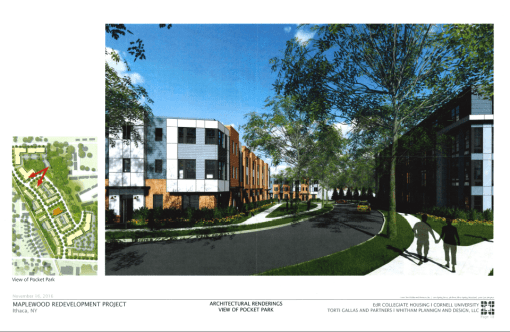
Five of the modern strings have no garage and full-length top floors. These are 4-bedroom units, like Ct (4 units), Ft (6 units) and Mt (6 units). Kt-1 and Kt-2 (Kt-1 shown in the render above) have three stacked flat 2-bedrooms on each end of the townhouse string (the first floor is one 2-bedroom unit, and the other two-bedrooms are stacked over it), and 4 four-bedroom units in the middle, for ten units each.

Then there are strings that a mixture of setbacks and no setbacks. Jt-1 and Jt-2 have 11 units apiece – 3 2-bedroom stacked units on each end of the string for a total of 6 2-bedroom units, and 3 three-bedroom and 2 four-bedroom units are wedged in between. The three-bedrooms lack a rear bedroom on the top floor.

Now the traditional units. Ht-1 and Ht-2 appear to be 7 units each – 4 3-bedrooms, 3 2-bedrooms in a stacked flat format. They are separated by the West Sylvan Mews (and the small street next to the Community Center is called East Sylvan Mews). It-1 and It-2 are almost the same as the Ht’s, but the end unit is a bit larger, resulting 4-bedrooms instead of three (for a unit total per building of 3 2-bedrooms stacked, 3 3-bedrooms, 1 4-bedroom). Nt is the same as It, but with one less three-bedroom in the middle, resulting in a total of six units – three stacked flat two-bedroom units, two three-bedrooms, and one four-bedroom unit. Lastly, Ot and Pt are the same basic design, except Pt has one more unit in the middle. Ot is clad in green siding and has 4 three-bedroom units, and Pt is clad in red siding and has 5 three-bedroom units.

The Apartment Buildings
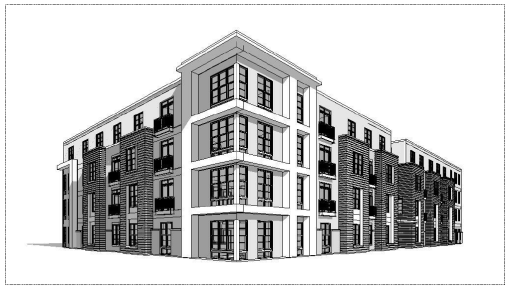
These should be easier to follow along with, as they were labelled from south to north. All multi-story apartments use the modern design motif. The buildings generally have the same floor plan for each full floor, except for utilities/storage rooms, and that the first-floor lobby is the location of the community study room on each floor directly above.

Building B is a 4-story, L-shaped building. The building will contain 4 two-bedrooms, 2 three-bedrooms, 1 one-bedroom and 11 studios per floor. Assuming one bed/resident per studio and one per bedroom otherwise, that means 72 units and 104 beds.

Building C is a 4.5 story, J-shaped building with a partially exposed basement level. The basement has 2 two-bedroom units, one one-bedroom unit and two studio units. Each of the four upper floors has 5 two-bedroom units, 4 one-bedroom units, and 4 studio units. That results in 57 units and 79 beds.

Building D is a 4-story. L-shaped building with 4 three-bedrooms, 2 two-bedrooms, 5 one-bedrooms and 3 studios per floor. At full occupancy, Building D’s 56 units will have 96 beds.

Building E (shown above) is a 4-story, L-shaped building. The corner facing Maple Avenue and Veteran’s Way will have a small retail space; the same space on the second through fourth floors is a two-bedroom unit. Overall, the building will have 16 three-bedroom units, 7 two-bedroom units, 16 one-bedroom units and 28 studios (about 106 beds).

Building F is a 4.5 story, I-shaped building. The habitable basement has 1 two-bedroom unit, 1 one-bedroom, and 3 studios. Each of the upper floors has 3 three-bedroom units, 2 two-bedroom units, 4 one-bedroom units, and 3 studios. The final sum is 53 units and 78 beds. In sum, the apartment buildings will provide 305 units and 463 beds.
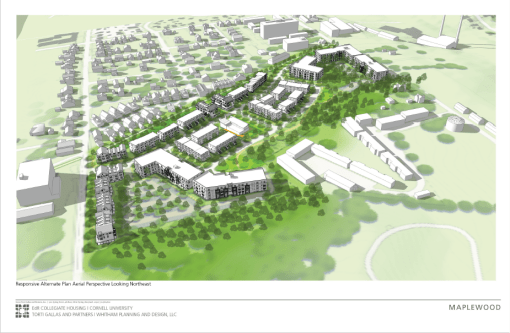
The community center is something of a question. It looks like two floors with a 100′ x 65′ footprint, but I haven’t seen an exact square footage beyond early approximations of 5,000 SF.



The Maplewood Redevelopment, Part I: History and Planning

28 08 2017

Being as large and complex as it is, it was hard to figure out a way to present the Maplewood project clearly and coherently. After some thinking, it seems the best combination of clarity and detail will be to split it into three sections. This section, Part I, will be an overview of the site history and project planning. Part II will examine and break down the site plan with all of its contributing structures. Part III will be the regular construction update, which will be bi-monthly just like all the others.

Quick primer note – Maplewood Park was the name of the old complex. The new one is just called “Maplewood”. With the shorthand for Maplewood Park being Maplewood, it can get confusing.

Let’s start with the background. Love it or not, Cornell University is one of the major defining organizations of the Ithaca area. It employs nearly 10,000 people and brings billions of dollars in investment into the Southern Tier, Tompkins County and Ithaca. That investment includes the students upon which the university was founded to educate.

Traditionally, neither founder Ezra Cornell nor first university president Andrew Dickson White were fans of institutional housing. Their preference was towards boarding houses in the city, or autonomous student housing (clubs, Greek Letter Orgs, etc), where it was felt students would learn to be more independent. This mentality has often underlain Cornell’s approach to housing – it’s not a part of their primary mission, so they only build campus housing if they feel it helps them meet academic and institutional goals. If many potential students are opting for other schools because of housing concerns, or the university is under financial strain because it has to subsidize high housing costs in their scholarships, then Cornell is motivated to build housing in an effort to improve its situation and/or become more competitive with peer institutions.

With that in mind, being one of the top-ranked schools in the world means that, in the historical context of the university’s goals and plans, new housing is rarely a concern. Cornell will update housing in an effort to be more inclusive and to improve student well-being, but with labs, classrooms and faculty offices taking precedence, building new housing is rarely an objective. Only about 46% of undergrads live on campus, and just 350 of over 7,500 graduate and professional students.

From 2002 to present, Cornell has added 2,744 students, with a net increase in Ithaca of about 1900. The net increase in beds on Cornell’s Ithaca campus during that same time period is zero. While Cornell did build new dorms on its West Campus, they replaced the University “Class of” Halls. 1,800 beds were replaced with 1,800 beds. In fact, the amount of undergraduate and graduate housing on campus had actually decreased as units at Maplewood Park and the law school Hughes Hall dorm were taken offline, either due to maintenance issues, or for conversion to office/academic space. When the announcement for further decreases came in Fall 2015, I wrote a rare Ithaca Voice editorial, and even rarer, it brought Cornell out to the proverbial woodshed for poor planning and irresponsibility.

To be fair, while Cornell was the guilty body, removing housing isn’t a problem on its own. It’s when the local housing market can’t grow fast enough to support that, that it becomes a problem. The Tompkins County market is slow to react, for reasons that can be improved (cumbersome approvals process) and some that can’t (Ithaca’s small size and relative isolation poses investment and logistical hurdles). In the early and mid 2000s housing was added at a decent clip, so the impacts were more limited. But housing starts tumbled during and after the recession, and it was unable to keep up. As Cornell continued to add students in substantial quantities, it became a concern, both for students and permanent residents.

By the mid-2010s, Cornell was faced with financial strains, student unhappiness and worsening town-gown relations, all related to the housing issue. As a result, the past couple years have become one of those rare times where housing makes it close to the top of Cornell’s list of priorities.

In weighing its options, one of the long-term plans was to redevelop the 17-acre Maplewood Park property. The property was originally the holdings of an Ellis Hollow tavern keeper and the Pew family before becoming the farmstead of James and Lena (sometimes Lyna) Clabine Mitchell in the early 1800s. In 1802, James was passing through from New Jersey to Canada with plans to move across the border, but stopped in the area, liked it, and bought land from the Pews, then moving the rest of his family up to Ithaca. Apparently there’s a legend of Lena Mitchell attacking and killing a bear with a pitchfork for eating her piglets. Many of the home lots in Belle Sherman were platted in the 1890s from foreclosed Mitchell property.

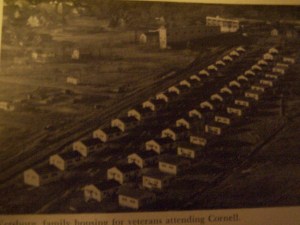
Like many of the Mitchell lands, it looks like the property was sold off around 1900 – a Sanborn map from 1910 shows a brick-making plant on the property along the railroad (now the East Ithaca Rec Way) and not much else for what was then the city’s hinterland. It’s not clear when Cornell acquired property, but by 1946, Cornell had cleared the land to make way for one of their “Vetsburgs”, also known as Cornell Quarters. The 52 pre-fabricated two-family homes were for veterans with families, who swelled Cornell’s enrollment after World War II thanks to the GI Bill. Once the GIs had come and gone, Cornell Quarters became unfurnished graduate housing, geared towards students with families, and international students.

The Cornell Quarters were meant to be temporary, and so was their replacement. In 1988-89, the university built the modular Maplewood Park Housing, with 390 units/484 beds for graduate and professional students, and an expected lifespan of 25 years. The intent was to replace them with something nicer after several years, but given Cornell’s priorities, and housing typically not among them, it fell to the back burner. As temporary units with marginal construction quality and upkeep, poor-condition units were closed off in later years, and capacity had fallen to about 356 beds when the complex’s closure was announced in May 2015 for the end of the 2015-16 academic year.

Cornell had long harbored plans to redevelop the Maplewood site – a concept schematic was shown in the 2008 university Master Plan. After weighing a renovation versus a rebuild with a few possible partners, the university entered into an agreement with national student housing developer EdR Trust to submit a redevelopment proposal. The partnership was announced in February 2016, along with the first site plan.

The core components of the project were actually fairly consistent throughout the review process. The project would have 850-975 beds, and it would be a mix of townhouse strings and 3-4 apartment buildings, with a 5,000 SF community center to serve it all. The project adheres to New Urbanist neighborhood planning, which emphasizes walk-ability and bike-ability, with interconnected and narrow streets, and parking behind buildings rather than in front of them. Energy-efficient LEED Certification was in the plans from the start.

However, the overall site plan did evolve a fair amount, mostly in response to neighbor concerns raised through the review process. Many residents on or near Mitchell Road were uncomfortable with multi-story buildings near them, so these were pulled further back into the complex, and late in the process the remaining Mitchell Street multi-story buildings were replaced with very-traditional looking townhomes with a smaller scale and footprint. More traditional designs were also rolled out for the pair of townhouse strings closest to Worth Street, since neighbors noted they would be highly visible and wanted them to fit in. The building planned in the city’s side was also pulled inward into the parcel early on due to neighbor concerns – it became an open plaza and bus stop. The university was fairly responsive to most concerns, although the most adamant opposition didn’t want any multi-story units at all, and really preferred as few students and as few families as possible.

For the record, that is every site plan I have on file. Go clockwise from top left for the chronology. So from beginning to end, there were at least five versions made public. The final product settled on 442 units with 872 bedrooms, with units ranging from studios to 4-bedrooms.

It’s also worth pointing out that the town of Ithaca, in which the majority of the property lies (the city deferred the major decision-making to the town), had a lot of leverage in the details. The town’s decades-old zoning code isn’t friendly to New Urbanism, so the property had to be declared a Planned Development Zone, a form of developer DIY zoning that the town would have to review and sign off on. Eventually, the town hopes to catch up and have form-based code that’s more amenable to New Urbanism. The town also asked for an Environmental Impact Statement, a very long but encompassing document that one could describe as a super-SEQR, reviewing all impacts and all mitigation measures in great detail. The several hundred pages of EIS docs are on the town website here, but a more modest summary is here. If you want the hundreds of pages of emailed comments and the responses from the project team, there are links in the article here.

Some details were easier to hammer out than others. The trade unions were insistent on union labor, which Cornell is pretty good about, having a select group of contractors it works with to ensure a union-backed construction workforce. Also, at the insistence of environmental groups, and as heat pumps have become more efficient and cost-effective, the project was switched from natural gas heat to electric heat pumps, with 100% of the electricity to come from renewables (mostly off-site solar arrays).

Taxes were a bit more delicate, but ended up being a boon when it was decided to pay full value on the $80 million project. It was a borderline case of tax-exemption because Cornell would own the land and EdR would own the structures, and lease the land for 50 years; but Maplewood Park was exempt, so it could have been a real debate. Instead, EdR said okay to 100% taxation, which means $2.4 million generated in property taxes on a parcel that previously paid none. Some folks were also concerned if the schools could handle the young child influx, but since Maplewood Park only sent about 4 kids to the elementary school on average, and the new plan would send 10 students when the school has capacity for another 26, so that was deemed adequate.

On the tougher end, traffic is a perennial concern, and Cornell wasn’t about to tell graduate and professional students and their families to go without a car. Streetscape mitigations include raised crosswalks, curbing, and landscaping, EdR is giving the town $30,000 for traffic calming measures (speed humps and signage) to keep the influx of residents orderly and low-speed. A new 600,000 gallon water tank also has to be built (planned for Hungerford Hill Road).

One of the thorniest issues were the accusations of segmentation, meaning that Cornell was falsely breaking their development plans up into smaller chunks and hiding their future plans to make the impacts seem smaller. This has come in the context of the Ithaca East Apartments next door, and the East Hill Village Cornell is considering at East Hill Plaza. However, neither were concrete plans at the time, and still aren’t – to my understanding, Cornell had some informal discussions about Ithaca East but decided against it early on in the process. And they only just selected a development team for EHV.

In the end, many of the concerned neighbors and interest groups were satisfied with the changes, and actually lauded Cornell and EdR for being responsive. The EIS was formally requested in May 2016. The Draft EIS was accepted in August 2016, public meetings on it were held in October, and the Final EIS was submitted at the end of October. After some more back-and-forth on the details (stormwater management plan, or SWPPP), the Final EIS was approved right before Christmas and the project was approved in February 2017, starting work shortly thereafter for an intended August 2018 completion. With the wet summer, the project managers asked for a two-hour daily extension on construction (8 am-6 pm became 7 am -7 pm) to meet the hard deadline, which the town okayed with a noise stipulation of less than 85 decibels.

Rents for the project, which include utilities, wireless and pre-furnished units, are looking to range from $790-$1147 per bed per month, depending on the specific unit. Back of the envelope calculations suggest affordability at 30% rent and 10% utilities, for 40% of income. Cornell stipends currently range from $25,152-$28,998, which translates to $838-$967/month.

On the project team apart from Cornell and Memphis-based EdR are Torti Gallas and Partners of Maryland, New Urbanist specialists who did the overall site plan and architecture. Local firms T.G. Miller P.C. is contributing to the project as structural engineer, and Whitham Planning and Design is the site plan designer, landscape planner and boots-on-the-ground project coordinator for municipal review. Brous Consulting did the public relations work, and SRF & Associates did the traffic study. Although not mentioned as often, STREAM Collaborative did the landscape architecture for the project. The general contractor is LeChase Construction of Rochester.

So that’s part one. Part two will look at the structures and site plan itself. And then with part three, we’ll have the site photos.


News Tidbits 2/25/17: Creating a Place to Call Home

25 02 2017

is2r5l9l9byvab0000000000
1. It looks like the homes designed for Tiny Timbers won’t just be limited to Tiny Timbers. The company has partnered with realtor Brent Katzmann for a to-be-built house in Lansing’s Farm Pond Circle housing development touts a Tiny Timbers-based home design by STREAM Collaborative. 1.09 acres and a 2 bed, 2 bath 1,430 SF house for $219,400. The relatively low price compared to most new builds is in part due to Tiny Timbers’ modular approach – the “Big Cube” retails for $156,900 with a finished basement, and the Farm Pond parcels go for $39k-$45k, so not counting the soft costs (permits/marketing), that pretty much sums up the costs.

Farm Pond Circle is a 19-lot subdivision in Lansing town that was the brainchild of the late Jack Jensen. All homes have to exceed state energy code by 20%, cannot exceed 2600 SF, and cannot use aluminum or vinyl siding. A couple lots have been aside for affordable single-family home construction. After Jensen’s passing in 2014, another local homebuilder, Bruno Schickel (Boiceville Cottages), picked up the undeveloped lots (10 of the 19) for about $165k last February, and intends to follow through on Jensen’s plans.

tiny_tims_7

2. Speaking of Tiny Timbers, it appears the budding modular timber-frame builder is expanding their offerings into a full line of homes. Tiny Timbers now has 16 different models in five series. Prices range from a completed 600 SF model with no basement at $109,900, to a 1,950 SF model with finished basement at $197,900, land and well/septic not included.

In a blog post on their website, Caleb Dolph, builder Buzz Dolph’s son and the guy in charge of marketing, says that the first sold house is underway in Hector (if Ithaca had exurban areas, Hector would be it), at least five others are in contract, though it’s not clear if any of those are for the 15-lot Varna site. Given that they planned for ten houses in 2017, the Tiny Timbers staff might have underestimated the market, which is more a fortunate challenge than a complaint.

3. A local non-profit is looking to expand its real estate footprint a little bit. Tompkins County Opportunities, Alternatives, and Resources (OAR) is seeking to buy a run-down house at 626 West Buffalo Street and renovate it into five beds of transitional housing for those getting out of jail and trying to get back on their feet. The intent is to provide, safe, secure housing to better help with the transition process, which can include education, job training and mental health and/or addiction treatment. The county would provide $100,000 in a one-time allotment – the house is for sale for $99,999, the purchase offer is for $95,000, and a further $60,000 would be spent on renovations. The rest of the money ($55,000) comes from grants, donations and a mortgage. Ultimately, the goal is to provide decent housing that helps reduce the recidivism rate (convicted persons committing more crimes), ideally saving the county on future court and incarceration costs, as well as what they hope pans out to a lower crime rate.

swd_websitelogo

4. Staying on the topic of special needs housing, the Second Wind Cottages is looking to add another three cottages in Newfield this year. The cottages are modest, ~200 SF and costing $12-$15k each to build. As reported by the Times’ Jaime Cone, every unit provides shelter to a formerly homeless male. Rents are “pay as you can”. A small community facility provides services like a kitchenette, office, washer and dryer. Three more cottages are planned for 2018, which will round out the “campus” with 18 units. A similar facility is planned up the road, one that will house homeless women and children. Although Newfield is a ways out, both sites are on the bus line into Ithaca.

The Second Wind Cottages are a private endeavor by businessman Carmen Guidi, and paid for through grants, fundraisers, and donations (money, furniture, etc). Volunteer labor similar to that used for Habitat for Humanity is utilized and welcomed. Like with the OAR house, by providing a safe, warm space to live, these units may help reduce homelessness and the issues homelessness creates.

123_eddy_street_2

lambrou_123_eddy_craigslist

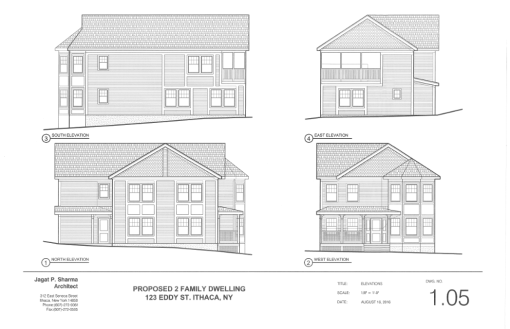
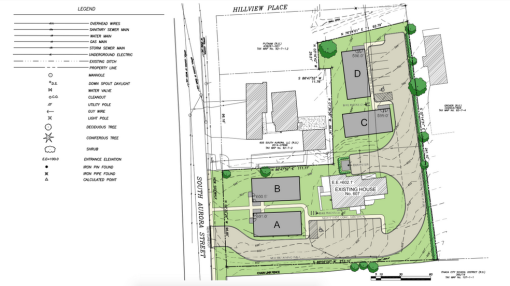
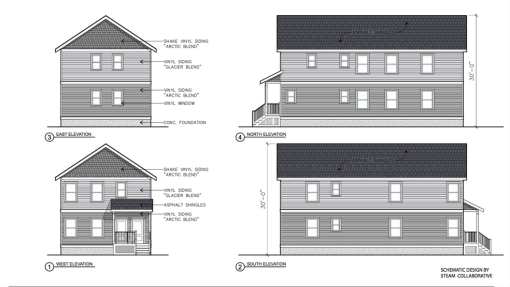
5. Work has yet to start on the new two-family home planned at 123 Eddy Street in Collegetown, but it looks like developer/landlord Nick Lambrou is seeking major changes to the project. Lambrou wants to replace the approved design at top, with the one below, which is copied from a Craigslist posting. The designs are both by Jagat Sharma, but the new plan is a variant of the two-family homes that Sharma’s doing for Charlie O’Connor at the recently-approved 4-building 607 South Aurora project.

The property falls into the East Hill Historic District, which is under the ILPC’s jurisdiction. According to Bryan McCracken, the city’s Historic Preservation Planner, the design will be heading for review within the next month or two.

The design has been used before so there’s familiarity with the design and lower risk, plus there are possible cost efficiencies if using the same contractors as O’Connor, because they’ll move quicker as they’ve done it before. On the other hand, unlike 607 South Aurora, this property is in the East Hill Historic District, and full-time neighbors on Orchard Place have been watching these plans very closely – they’re wary of students, and will likely not be fans of the projecting second-floor porch, as the previous version was tucked into the building. Not sure using a slightly more decorated version of a design being deployed elsewhere will get the ILPC’s blessing, but we’ll see what happens.

cayugafarms_2

6. Why yes, Lansing town is still hopping mad about the natural gas issue. The town supervisor cites the tap-out as the cause of delay for Robert Weinstein’s 102-unit Cayuga Farms project, although the previous documentation says it’s a sewer issue – the developer has to deploy an Orenco modular sewer system, which has to be approved by the NYS DEC.

maplewood_v7_4

7. Here’s a copy of Maplewood’s buildout timeline. The first Maplewood apartments should start construction in May 2017, pending no issues. Generally, the crews will be working from the outside in; buildings closer to Maple Avenue and Mitchell Street have earlier construction schedules, while those interior to Maplewood will start in the fall or early winter. Also, street names. Veteran’s Place will continue to be the main thoroughfare, but from north to south, it will intersect with “James Lane”, “East Sylvan Mews”, and “Lena Street”. James Lane wraps around to form the secondary N-S thoroughface on the east side of the parcel. James and Lena Mitchell were the original owners of the property when Ithaca was first settled in the early 1800s.

The Stormwater Property Protection Plan (SWPPP) still needs to be okayed by the town of Ithaca, but that’s about the only thing left before final approval is granted.

107_s_albany_rev_1

8. It looks like the Planning Board meeting should be interested. Not a whole lot being decided, but some sketch plans have been submitted. For rental projects aiming for August 2018 openings, Feb-Apr is going to be the primary submission period, as they seek approvals by May or June so that construction can run on a Summer 2017 – Summer 2018 schedule.
AGENDA ITEM Approx. Start Time
1.Agenda Review 6:00

2. Privilege of the Floor 6:01

3. Subdivision Review
A. Project: Minor Subdivision 6:10
Location: 109 Dearborn Place, Tax Parcel 9.-3-11
Applicant: Lee and Elizabeth Ambrose
Actions: Declaration of Lead Agency, Public Hearing, Determination of Environmental Significance, Recommendation to BZA

4.Site Plan Review
A. Project: Apartments (11 Units) 6:30
Location: 107 S Albany Street
Applicant: Stavros Stavropoulos
Actions: Declaration of Lead Agency, Public Hearing, Determination of Environmental Significance

B. Schwartz Plaza Redesign- Sketch Plan 6:50

More on that here.

C. 238 Linden Avenue – Townhomes – Sketch Plan 7:10

238 Linden is a non-historic student rental house, and a John Novarr property in a CR-4 zone – 4 floors, no parking required. Further to that, 240 Linden to its north was taken down for staging space for the Breazzano Center, but as that will be finishing up this Spring, it leaves an MU-2 (six floors, no parking) parcel open for development. A townhomes plan suggest one or both of these parcels will host something not unlike the ikon.5-designed townhouses plan Novarr plans to build at 119-125 College Avenue.

D. 372 Elmira Road – McDonalds Rebuild – Sketch Plan 7:30

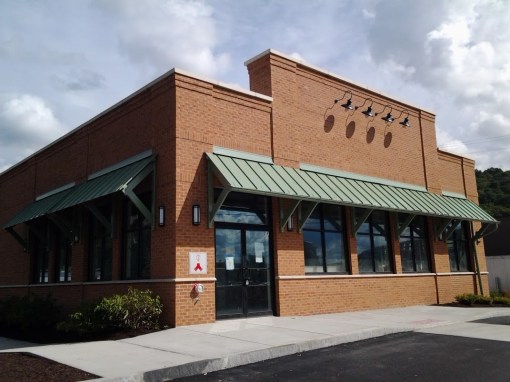
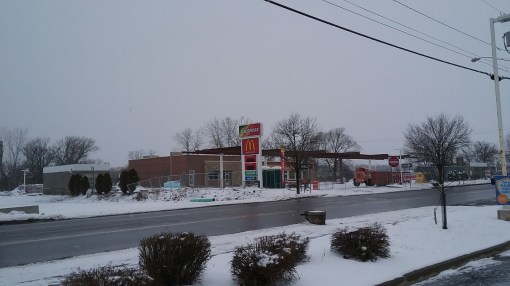
If Ithaca’s lucky, it’ll have upscale features like the one finishing up in Dryden. Otherwise, a modern update to the 1980s design is plausible. A number of older McD’s restaurants nationwide have been upgraded to the new design in the past few years.

E. 301 Eddy Street – Student Apartments 7:50

This is intriguing. 301 Eddy is a Nick Lambrou property in an MU-2 zone – a four-story, 8-unit/37 bed apartment building built in 1995, and it’s also the address for Collegetown Park’s parking lot. One possibility is replacing part of the parking lot with another apartment building – Lambrou may push to six floors, but it’s not his style. He’s described his offerings as “boutique” buildings, properties with less than 20 units and 20-50 bedrooms. Recent examples include 2015’s 116 Catherine Street, and 2012’s 309 Eddy Street. If the past is any precedent, this will be a Jagat Sharma design.

5. Zoning Appeal: #3057, Area Variance, 109 Dearborn Place 8:10

6. Old/New Business: Special Meeting Chainworks District DGEIS – Transportation 8:20

7. Reports
A. Planning Board Chair (verbal) 8:30
B. Director of Planning & Development(verbal)
C. Board of Public Works Liaison (verbal)


News Tidbits 2/18/17: Credits and Loans

18 02 2017

warren_medical_lansing_1

1. Over in Lansing village, it looks like the new Arleo medical office building is starting to moving forward. A sketch plan of the project was presented at the village planning board’s meeting earlier this week. Although Lansing doesn’t upload accessory docs like site plans and elevations, this one has been floating around for the past several months in marketing material as “Cayuga Ridge”. Quoting the May 7th 2016 news roundup:

“The new one-story building, which appears to be designed by Binghamton-based Keystone Associates, would be off of Warren Road, although it looks like the building would be accessed from a driveway coming off of Uptown Road. The 2.71 acre property north of 100 Uptown Road is zoned “Human Health Services District” by the village, and borders undeveloped land owned by Cornell, and several other suburban medical office buildings built over the past few decades. The resolution on the attached site plan is too low to determine the square footage, though it looks to be in the low tens of thousands.”

labourgade-on-seneca-dormer2

2. For those who like their cottages tiny – it looks like Schickel Construction has begun work on the spiritual successor to their 140-unit Boiceville Cottages project in Caroline. The 40-house rental development is called “La Bourgade on Seneca”, and is located in the town of Hector, in Schuyler County just outside of Burdett village. For the record, Bourgade is a French term for an unfortified village or settlement. More details can be found on the website here. There will be two cottage types available -, “The Classic”, a 2-bedroom, 900 SF plan that will rent at $1,495/month, and “The Spacious”, a 2-bedroom with a dormer loft space totaling 1,000 SF and renting at $1,695 month. The house very much like their Boiceville cousins, but with angled eaves (dunno what the correct term is and google’s not helping – if there’s an architect reading, please chime in). All units will have lake views.

Personally, I see this as a stretch for the Ithaca market, since it’s 25 miles west of the city. But it might tap into a more plebeian contingent the wine country crowd, the wealthier of whom have taken to building grand vacation or permanent homes along the Finger Lakes in recent years. The first 9 units, three clusters of three, are currently under construction, as is a community center. Delivery is expected in May 2017.

ic_master_plan_3

3. It looks like Ithaca College is putting some more thought into their housing needs. The college has been meeting with planning firm U3 Advisors to explore the possibility of new off-campus student housing.

U3 Advisors is already familiar with the area, as they are also under contract with Cornell to formulate their off-campus housing plan. Unlike Cornell, however, Ithaca College has no plans to grow enrollment – the master plan expects it to stay steady around 7,000. However, many of the dorms are reaching the end of their useful lives, meaning that the college can either sink a fair sum into renovation and replacement of utility systems, or tear down and build anew. An off-campus option could either be a private entity on private land, or a deal on IC-owned land like what Cornell and EdR are doing with Maplewood. A 200-300 bedroom off-campus option could mesh with the town of Ithaca’s visions for a walkable South Hill neighborhood on the intersection of Route 96 and King Road.

It’s still just studies and meetings at this point, but as the oldest dorms hit 50 years old on South Hill, there might be something fresh in the pipeline. We’ll see what happens.

cma_v2_2

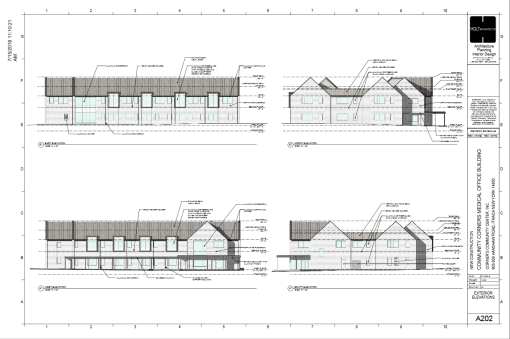
4. Ithaca’s West End will be welcoming a new tenant in the next couple months. Courtesy of Nick Reynolds over at the Times, the USDA is shifting its regional office out of Community Corners in Cayuga Heights, and into Fulton Meadows, a commercial office building at 225 South Fulton Street. the move is being undertaken in anticipation of the construction of Tim Ciaschi’s new Cayuga Medical Associates office building, which is set to get underway at Community Corners later this year.

201_college_v5_1

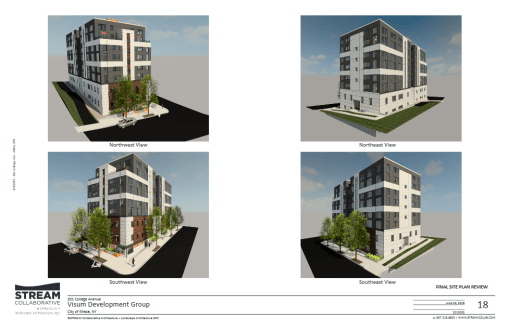
5. Looks like we have an idea of the price tag for Visum Development’s 201 College Avenue. According to a construction loan filed with the county on the 15th, S&T Bank loaned Todd Fox’s company $7,870,673 to help cover the costs of the project. The breakdown in the filing says $6,841,038 for hard construction costs (materials/equipment/labor), $507,000 in soft costs (permits/legal/marketing/financing fees), $300k in contigency and $226k in interest reserves. Add in the $2.64 million for the land purchase, and the total comes to $10,514,180.

That’s something of a premium because the project is on an accelerated schedule after the big hullabaloo with Neil Golder and the city Planning Board last fall. Note that the loan doesn’t cover all the costs and that there is money from other sources, like cash equity from Visum itself.

S&T Bank is a regional bank based out of Western Pennsylvania, but they’ve been making inroads into Ithaca’s commercial lending market. S&T Bank also financed the construction of the Holiday Inn Express that recently opened on Route 13, lending $5,973,750 to the hotel developers.

Quick aside, I think this is the first time I’m seeing the square footage calculated out – 201 College will be 33,398 SF.

20170106_160736

6. Hopefully this runs after by INHS refinancing explainer, so it makes more sense. Quick rehash, low income housing tax credits (LIHTCs) are sold to banks and similar financial institutions so that they get the tax credit, and the affordable housing developer gets the money they need to move forward with a project. With that in mind, here’s an interesting though unfortunate tidbit from INHS’s Paul Mazzarella:

“This following may be more than you want to include in this article, but it is relevant.  The pricing of tax credits exists in a marketplace where they rise and fall in value.  In past projects completed by INHS, we’ve received from $0.91 to $1.02 of equity investment for each dollar of tax credit.  The pricing of tax credits has recently plummeted because of the recent election and the uncertainty in DC.  This is mostly due to discussions about changing the corporate tax rate.  A lower corporate tax rate will mean that companies have less profits to shield from taxes and therefore the demand for tax credits will be reduced.  Even though no changes have yet been made to the corporate tax rate, just the discussion about this has reduced the pricing of tax credits to around $0.80.  What does this mean for INHS? It means that the project that we’ve been working on for several years suddenly has a funding gap that didn’t exist a few months ago, due entirely to investor’s fear of risk due to an uncertain future..  This is true for every tax credit project in the country and has all of us struggling to make the pro formas work.”

Sigh. Politics.

habitat_208_third_st


7. The Times has the first render for Habitat for Humanity’s two-family townhouse project at 208/210 Third Street on the city’s Northside. It looks to be the same architect as the 4-unit project for 402 South Cayuga – I can’t seem to find the architect offhand as a few designers have donated time and energy, but local planner George Frantz shepherded the project through the approvals process. Each unit is about 1500 SF. The plan for the $305,000 project is to break ground in April and have the move-in ceremony in Spring 2018. As with all local Habitat projects, a portion of the construction will come from volunteer labor, including 500 hours of “sweat equity”, and homeownership classes that the two recipient lower-income families (making 60% AMI or less, $32,000/year) will need to complete as part of the deal.

maplewood-v7_7-planning-board

8. Wrapping this up with the local agendas for next week – the town of Ithaca will be looking at a home B&B permit on Bostwick Road, a retaining wall for Ithaca College’s track, and finishes touches on the Maplewood approvals. The city’s project review meeting indicates the city plans to look at the subdivision at 109 Dearborn Place, Declaration of Lead Agency and Environmental Review for the 11-unit 107 South Albany Street plan,  and “Approval of Conditions” for City Centre, which is just making sure they’ve completed everything asked for in the final approval. In sum, nothing too exciting at the moment, but we’ll see if the city has any new projects coming up when the actual PB agenda comes out next week.

9. Quick note to wrap up – the woman behind the Rogues Harbor Inn in Lansing has purchased a prominent and historic building on Freeville’s main drag. Eileen Stout purchased 2 Main Street, a mixed-use building with restaurant space, a tile shop and three apartments, on Thursday for $132,000. The seller was Tompkins Trust and it’s well below assessment – doesn’t look like a foreclosure though. The bank bought the property for almost double the price in May 2016.


News Tidbits 2/11/17: Cooperation Required

11 02 2017

107_s_albany_rev_1

1. It looks like the plans for 107 South Albany Street are getting a major revision. Readers might recall that previously approved plans called for a rear addition onto an existing house to create a 9-unit, 11-bedroom apartment building. The latest plans are a little more substantial.

For one thing, the existing house would be no more under the new plan. In its place looks to be a 3.5 story, 8,427 SF, 11-unit apartment building, all one-bedroom apartments. Developer Stavros Stavropoulos has once again turned to local architect Daniel Hirtler for design work; for each of them, this is the largest project they’ve worked on to date. Hirtler came up with a design that offer contextual features like a cornice and an orthodox window arrangement, but adds a modern vertical stair element in the middle of the structure to keep the design from being an imitation. Zoning is CBD-60, so no parking is required, 100% lot coverage is allowed, and the 40.5′ proposal is comfortably within the 60-foot height limit.  According to the SPR filing, the construction cost will be about $900k and the construction period will be from September 2017 to June 2018.

As much as I dislike seeing attractive old houses come down, the new design fits well into an older urban context. Plus, if the medical practice on State ever gets redeveloped, 3.5 floors offers a nice transition to the lower-density structures further south. I’m not a super big fan of the blank wall next to the recessed entry, although the intent is to make it interesting with light fixtures, a brick pattern and an iron trellis that will be grown over with vines. Fiber cement will be used on the upper floors, with brick veneer and granite accents at street level.

On another note, it looks like the city will be looking at a one-lot subdivision next month at 109 Dearborn Place in the Cornell Heights Historic District – the owners, a married couple who are renovating the old PRI into a historically appropriate two-family residence, are looking to sell some of the land as part of the “partnership dissolution”. The PRI renovation is expected to continue. The application says a house was previously located on the undeveloped portion of the property (a glance at old maps indicate a schoolhouse was located on-site in the 1920s). It’s worth noting that the wife is also the owner of Bridges Cornell Heights, a high-end senior living facility on the next block. Bridges previously subdivided a Cornell Heights lot in 2005 to build a second residence to serve its deep-pocketed clients. Any new house would need to go through ILPC review.

323_taughannock_townhouses_2

2. Meanwhile, the Ithaca Common Council had their monthly Planning and Economic Development Committee meeting. It looks like the revised 323 Taughannock project has been caught up in the TM-PUD, so it will have to get Common Council approval. Apart from a certain councilor’s general objections to housing near or on the waterfront, this one isn’t likely to stir up much controversy. The construction timeline for Steve Flash’s 8-unit , 16,959 SF owner-occupied townhouse project is June 2017 – January 2018, with an estimated value of $2-$3 million. Potentially, there could be 16 units, since each townhouse comes with a live/work space that could be converted to a separate studio apartment unit.

Also included at the meeting was a session on electric car infrastructure, votes to send laws allowing dogs in Stewart Park and a temporary altar to the Common Council, votes to circulate a zoning amendment to allow brewpubs in business zones, and a discussion of tree plantings. The Maguires also discussed possibly shifting their project to Southwest Park behind Wal-Mart, which is covered on the Voice here.

3. The city of Ithaca has been awarded funding to build a replacement bridge for North Aurora Street over Cascadilla Creek. Continuing the city’s heavy infrastructure investments of the past few years (for instance, the bridges as Lake Street, East Clinton Street, and the work planned for Brindley Street/Taughannock Boulevard), the state is giving $1.178 million towards the replacement span. Engineering work and public meetings will take place in 2017 and early 2018, with construction and completion by 2019.

maplewood_v7_3

4. Over in the town of Ithaca, final approval has been granted to Cornell and EdR’s Maplewood project, meaning that everything is good to go and barring any unforseen circumstances, the 441-unit, 872-bed complex should be open for graduate and professional students by the end of July 2018. The difference between preliminary and final approval is that in preliminary, the concept is greenlighted but there needs to be additional filings completed – tree planting schedules, revised labels on diagrams, construction staging plans, and proof of final approval from the city for their portion. For those who are wondering, the 150-200 workers on-site will be parking at a temporary lot behind the Kinney Drugs at East Hill Plaza, and will be walking the five minutes down Mitchell Street to get to the job site. The first building should start to rise in late Spring of this year, with new structures rising in stages as we go through the rest of 2017.

rodeway_revision_1

The town planning board also reviewed revised plans for the Rodeway Inn at 654 Elmira Road, where the old wings will now be torn down and rebuilt on the same footprint and an enclosed corridor will be built into the new wings. The final result will have a net increase of four motel rooms, to 44 (the previous plan added only two motel rooms). The plan for renovating the single-family home on the property into a community center is unaffected by these changes and moving forward as originally planned.

20160918_151026
5. It’s been behind schedule a few months, but DiBella’s Subs is expected to open at 222 Elmira Road on February 16th.

thecomputingctr_2

thecomputingctr_3

6. It seemed a little odd when The Computing Center stated in their IDA application that their plans had already been approved, and there was nothing on file. Turns out they’re hoping to get approval for their 4,600 SF HQ from the town of Lansing next week.

The full suite of documents can be found on the town of Lansing’s website here. It looks like the farmhouse next door to 987 Warren Drive will be spared from the wrecking ball; although The Computing Center bought the property, it’s being subdivided and the barn-turned-garage is the only building that will be torn down. Lansing has one of the more lenient planning boards, so although this probably won’t be fully approved next week, there’s a good chance this project will receive final approval by the end of March.

204260_56b8b8a8c98ee1-47810900_full

7. Over on West Hill, a large vacant parcel on Bundy Road just exchanged hands. The 66.98 acre parcel has been marketed for the past few years as a development opportunity – it has municipal water and sewer, and it’s a stone’s throw from Cayuga Medical Center, Overlook and the Conifer/Cornell developments off of Route 96/Trumansburg Road. Its previous ownership, a family that has owned it in some form since 1964 (moving between members in 1984 and 1991), had it on the market for $359,900.

The buyers, a husband-and-wife pair of medical doctors who live nearby, paid $305,000 for the deed, according to a filing on the 9th. An online search for future hints doesn’t really give much guidance – the doctors have donated modest amounts to Finger Lakes Land Trust and have signed some anti-fracking petitions, and while they own undeveloped properties around them, this parcel isn’t adjacent to their house. It doesn’t really fit the Land Trust’s ideal land donations either, since it’s been substantially subdivided with medium-density residential, and borders a growing corridor. So, it’s hard to gauge just what exactly is planned here. For the record, the land is currently zoned medium density residential (max 3 floors, up to 2.9 lots/acre), but the town’s new comprehensive plan sees the property as new urbanist medium density (5-8 units/acre small-scale mixed-use), with undeveloped open space towards the southwest corner of the parcel.

cornell-project-dsun

8. Let’s finish this week off with a talk about energy. Good news first – there might be a solution to the West Dryden pipeline issue. Background here, but the nutshell is, Lansing has tapped out their natural gas capacity, and in order to accommodate new development that would need natural gas, NYSEG needs to build a higher capacity pipeline from their current facilities in the town of Dryden. This new pipeline would go along West Dryden Road, but has run into fierce opposition, mostly because Dryden residents are famous for being anti-natural gas – this was the town that took on the fracking companies and won. Keep in mind, these folks aren’t just disdainful of natural gas, they are adamantly opposed. So using their property to accommodate something they don’t like is a bit like asking to build an abortion clinic next to an evangelical church because that just happens to be where the land is cheapest, but they would have to share a driveway.

Unsurprisingly, the town of Dryden enacted a moratorium on large-scale pipeline installation. The town of Lansing is not happy because it stymies their development, and they’re extra-concerned that their biggest property taxpayer, the Cayuga Power Plant, is about to go belly up and leave the town with $100 million less on its tax rolls. The county wants to move away from fossil fuels, but it also wants to encourage development and not leave Lansing in the lurch.

This week, a plan was put forth that might accommodate both needs. A small compressor station would be built to keep pipe pressure from falling too low during times of peak demand, so that guarantees service for existing customers. The second prong is to wean existing development off natural gas and encourage new development to use other means – electric heat pumps, like those to be used in Maplewood and City Centre. This encouragement would be given through subsidies or tax breaks. The compressor station and the incentives would be in effect by late 2018.

It looks promising, but the feasibility studies are still ongoing, and Lansing is not totally on board. Both Lansing Village and Lansing Town feel they were not represented during these discussions with NYSEG, and that heat pumps are a major financial burden to saddle homebuilders with. They also wonder if the electrical grid would be capable of supporting so many heat pumps.

Speaking strictly from my experience, I’ve visited construction projects with heat pumps, and while they are a cost increase, it’s a couple percent more than the same structure with conventional heating – there’s a recently-built single-family house I can think of offhand where the cost of heat pumps was about $5,000 more on the $200,000 construction cost. If it’s incentivized, one could make it financially sensible, at least for residential options if not all. Also, I’m wary of Lansing’s reasoning because they piddled away the three town center projects five years ago – if they had stayed on top of it, they’d have $50 million more in property value and this wouldn’t be such a pressing issue now.

That being said, there are problems with this area’s approach to alternative energy. Newfield is the big culprit here – they’re about to put in a moratorium on commercial solar panel installations, which is worrying since this is the same town that redesigned their wind turbine law to ban them in essence. If municipalities are limiting residents’ abilities to turn to alternative energy sources (many urban areas have to turn to commercial arrays or turbines because there’s not enough room/too much demand on-site), then the community will be unsuccessful in weaning the population off of fossil fuels. But Dryden, which is in the process of changing their laws to accommodate large-scale solar arrays, is at the forefront of this issue – those panels could provide the electricity for the heat pumps and help turn the tide on energy sources. It only works if everyone cooperates.


News tidbits 12/24/16: Looking to the Future

24 12 2016

20161211_132440

20161211_132501

20161211_132542

1. Going to take advantage of this light week to go through some of the photo stash. I thought of doing a Poet’s Landing update, but because LeChase is mostly working on site clearing/prep and excavation at this point, and given the snow on the ground, it didn’t seem like there was a whole lot to be gained from making a unique update. But, rest assured, it’s still underway, there’s just not a whole lot to see at the moment. Once the snow melts off, the slab foundations work should be visible, and there might even be some framing going up by mid-winter. The six new apartment buildings and their 48 units should be ready by the fall of 2017.

20161209_121337

2. 107 South Albany in the city is another one that doesn’t merit its own post just yet, but work should be taking place at some point soon. The building permits have been filed with the city for the 6-unit, 9-bedroom renovation and addition to the rear of the existing building, and from peering inside the existing windows, there’s the impression that interior demolition work could be underway – could explain the broken window on the second floor at least. There was no excavation work yet in the backyard, where the new wing will go. The Site Plan Review document says July 2016 to August 2017. Maybe there will be something to talk about by the next round of downtown updates.

3. Some folks might remember Phoenix Books, the hard-to-miss barn bookstore off of 366 as one approached Ithaca from Dryden. The store closed last year after 30 years of business, and the barn itself is about a century old. Now the property at 1608 Dryden Road is for sale. The barn, a small outbuilding, and 29.3 acres for $229,900. According to the Zillow posting, a sale is already pending.

4. From sales to sold. An industrial property in the Inlet Corridor of Ithaca town has exchanged hands. The property is at 142 Ithaca Beer Drive, next door to the growing brewery and restaurant. According to the listing with Pyramid Brokerage, the property consists of “Two commercial buildings totaling 6,812SF on 2.79 acres at south end and just off of Ithaca’s Elmira Road (NYS Route 13) commercial corridor. Ideal for combo of office (812SF) and industrial/warehouse (6,000SF) with lots of room to expand. All municipal services. Warehouse building has high ceilings, concrete floors, 2 overhead doors and more. Great opportunity for light industrial/manufacturing with array of flex space.”

The Iacovellis used it to house their construction equipment, and had it on the market for $409,000. It sold for just under that, a reasonable $400,000, to Greentree Garden Supply, which has operations a stone’s throw away from the property. Greentree makes their own soil products (potting soils, soil formula), so that may be a potential future use of the warehouse they just picked up. Good for them; they seem to be thriving as well as their garden plants.

58505e689f6ef-image

5. Here’s a cool idea – the Lansing School District is planning to build an outdoor classroom as part of $4.95 million in renovations. Cassandra Negley has the full story at the Times. The renovations were approved by a landslide 240-32 vote, which was helped by the fact that the project will be funded with grants and money from the school district’s reserve (rainy day) fund – no additional cost will be assumed by the taxpayers. In advocating for the project, school district staff noted that it would provide for “multi-sensory experiences”, a useful asset during the instruction of natural and environmental science topics, and cited studies that showed students performed better academically when given the opportunity to have classes in outdoor spaces. The space would be used as covered play space during recesses.

maplewood_v7_5

6. Going off into hand-waving territory here. Enter at your own risk.

You might have heard in the news this week that New York State, even though it added 104,500 jobs over the past year, is estimated to have recorded a population loss of about 1,800 people. That’s not a good thing for a number of reasons, but it’s a more acute issue upstate. New York City issued building permits for 101,705 residential units from 2013-2015, with another 13,000-14,000 estimated this year, and the city, just the boroughs and not even counting the suburbs, makes up nearly all the population growth (375,272 through July 2015, vs. 367,179 as the total gain for the state from 2010- July 2016). Upstate continues to hemorrhage people to other states. Not a surprise to anyone who’s travelled outside of Ithaca, Saratoga or the few other bright spots. What can we expect for Ithaca in a bad piece of news for Upstate?

Here are some off-the-cuff tallies for population growth. Ithaca’s estimated to be 30,788 as of July 2015, up 774 since 2010. The estimates due out early next year cover July 1, 2015 to July 1, 2016.  What opened in that time frame?

By my count, Stone Quarry (82 beds), the Lofts at Six Mile Creek (66 beds), 804 East State (18 beds), 707 East Seneca (18 beds), 206 Taughannock (10 beds), the Lehigh Valley House condos (6 units, will assume county average 1.7 occupants per unit, for 10 residents), 116 Catherine Street (17 beds), and the 140 College Avenue (12 bed addition). Allow another half dozen or so units with a dozen beds total, for accessory apartments or new single-family homes. Only one of these projects replaced existing housing units – a one-bedroom bungalow came down for 804 East State. The gross gain is about 244 people, if we assume the standard of one person per bedroom or studio unit.

Now let’s do some subtractions. Hughes Hall closed on Cornell’s campus. -47 off the bat, for 197. Now, the math can’t easily accommodate those who had a household member move in/be born, or move out/pass on. But trends suggest a 2% decrease per decade, so we’ll treat it as negligible. So, my baseline prediction for the 2016 estimate is 30,981.

Just thinking offhand of the projects that have opened since July 1, 2016, expect at least 210 more for the July 1, 2017 estimate, and 670 in 2018, because that’s when Collegetown Terrace phase III (344 bedrooms), Novarr’s townhouses (net gain ~60 bedrooms), 210 Hancock (90 bedrooms) and Todd Fox’s latest trio (net gain ~110 bedrooms) are included in the figures. These drive-by numbers are based just on what’s underway, or approved and financed. The 2017, or more particularly the 2018 numbers could go up. So roughly, 30,981 in 2016, 31,191 in 2017, and 31,861 by July 1, 2018, assuming no major catastrophes and that the local economy’s growth and residential vacancy rate is consistent.

For the record, the purely mental figure I use for a 2020 census is 32,500. That would consider Harold’s Square (146 bedrooms), City Centre (250 bedrooms), the first phase of Chain Works (80+ bedrooms), as well as other proposals that may arise in the next year or two and open before April 1, 2020, the official census date. I do not factor in any new Cornell North Campus dorms in the estimate, since the new dorms will initially function as temporary replacements for existing space that will be concurrently closed and renovated.

Now, when thinking about the town of Ithaca, things get really weird because of Maplewood – a loss of 370-380 beds. The town doesn’t have any large multifamily underway – my partially-imputed count from permit reports gives about five newly-occupied duplex units and 20 or so homes for the July 2015 – June 2016 period, and the 10 Belle Sherman townhouses. That’s probably 100-120 beds total. The town of Ithaca will likely show a decrease in population in the 2016 census estimate because of the Maplewood closure, and it will be bad optics because there’s all this talk of affordable housing issues, and seeing a decline in population in the news will inspire a negative kneejerk reaction – either “if it’s going down do we really need housing”, or “hey, it’s going down, then why are the rents so damned high”. Have that talking point ready, Ithaca town board.

For the 2017 count/2018 release, the partially-educated guess is an increase of 150 given Brookdale, but the 872 new Maplewood residents won’t come into count until the 2018-19 estimation period, at which point we’re pretty much at the next census. I’m thinking around 21,500 for 2020 (from 19,930 in 2010), if the current trends continue and major housing projects are completed.


News Tidbits 12/17/16: So Much In One Week

17 12 2016

1. For the developers out there, it looks like your next opportunity just opened up in Collegetown. For sale are three houses on Linden Avenue – 6-unit, 8-bedroom 230 Linden, for sale at $675,000 (taxed at $350,000), neighboring 4-unit, 8-bedroom 228 Linden at $700,000 (taxed at $460,000), and two doors down, 2-unit, 11-bedroom 224 Linden at $525,000 (taxed at $400,000). All three are somewhat run-down student apartment houses on the cusp of inner and outer Collegetown – as such, their zoning is CR-4, which allows four floors, 50% lot coverage, and has no parking requirement.

The properties were all purchased in the mid-1970s by a small-time local landlord, who was killed in a car accident two years ago. According to the listings, the seller’s agent is a family member, and the units are leased until late 2017 or 2018, meaning that if one were to purchase with an eye towards rapid redevelopment, they would have to negotiate with the tenants, or wait it out. That being said, there’s a lot of potential here, particularly if a buyer combines 228 and 230 into one lot. The city designed the CR-4 zoning with Linden Avenue specifically in mind – the concept render is a northward perspective of a revitalized Linden Avenue. They’re a lot of money, but there could be some interesting news down the line.

210linden_126college

2. Also in Collegetown, here are a couple of concept color renders of 210 Linden Avenue (left) and 126 College Avenue, courtesy of Visum Development’s webpage (currently down, cached link here). I confess to be more of a warm colors person, but assuming these are fiber cement boards and wood trim (or fiber cement that looks like wood), they could turn out quite nice.

On a related note, Visum’s Fox and partner Charlie O’Connor have started earth moving for their townhouse project at 902 Dryden Road in Varna. As it turns out, it is a very difficult site to get photos of, despite its easily accessible location. I’ll do a more in-depth shortly, but the units should be ready by August.

20161211_131919 20161211_131943

3. Fulfilling a promise to Fred, here’s the rather upscale McDonald’s/Fasttrak combo under construction North Road in the village. There is a billboard on 366 advertising for new hires for when they reopen, but unfortunately, it was too difficult to attempt a photo of the board and render. The building’s exterior is largely complete, and the gas station canopy is framed – late winter opening? The new construction has a price tag of about $500k. Honestly, for a roadside stop, it looks pretty nice.

20161211_131533

20161211_131514

4. More on Dryden, with a couple houses of the week. Looks like some modulars are going into the Maple Ridge development – one recently completed, one in the works. The open space to the right of house number two, the Cape Cod, will host a garage. The land for house one sold to Kenn-Schl Inc, a regional modular home builder and seller, in June for $48k. House two’s land was sold to a Rochester man for $39k in October. At this rate, Maple Ridge is going to fill out their 15-lot phase one in another year or two. Although waylaid by the Great Recession, the big plan is for three phases and 51 lots.

20161211_133227

5. On the 15th, the construction loan for the William George Agency’s new 1-story, 24-unit dormitory was filed to the county records office. The $3 million loan comes courtesy of …. A trip to the property didn’t pan out, it didn’t look like anything was underway even though the building permits were filed with the town of Dryden a few months ago. Then again, as a facility for troubled youth, it’s not the most welcoming place for a random visitor to be taking photos.

maplewood_v7_4

6. So what’s being discussed by the towns? In the town of Ithaca next week, a lot line adjustment between two houses, and more Maplewood discussion, with consideration of preliminary site plan approval. Meanwhile, the town of Dryden has cell towers galore, as well as revised approvals for Storage Squad (1401 Dryden) and Tiny Timbers; plans are in the pipe line for a 7-lot subdivision of the Dryden Lake Golf Course, and a possible sewer extension study for NYS Route 366 east of the NYSEG building.

Image Property of HOLT Architects

7. Speaking of sewer, the town and village of Lansing are negotiating sewer deals so that the town can use village lines to help accommodate future growth. Dan Veaner at the Lansing Star has the story. the report says the town is asking for 700 units of capacity, where a unit is 328 gallons. 700 units would also put the Cayuga Heights plant at capacity. The town’s intent is to extend sewer capacity to encourage development along Triphammer Road (as in the town center concept shown above), with the reasoning that it’s a natural extension of established development, and would help grow the tax base in the event of the power plant closing. Not as grand as the plans that were shot down in 2007, but like the Warren Road sewer built a few years ago, it’s seen as a more organic and cost-efficient approach.

20161209_123851

20161209_123931

8. There might be some of movement on Jason Fane’s Bank Tower $4 million renovation from office space to 32 apartments. The windows were inspected and tagged recently, possibly to determine what needs to be replaced where. Most of the exterior of the Commons-facing building will receive a cleaning and re-freshening, with the bulk of the work geared towards the interior.

20161210_140231

9. In economic news, 24/7 Wall Street is reporting that Ithaca has the 25th best job growth in the nation from November 2015 – November 2016. 2,200 jobs equates to 4.4%, by their measure.

Hate to burst the bubble, but don’t buy into it just yet. Initial estimates can be way off due to statistically insignificant sample size for small communities. It may hold, it may not. Wait until March and see if the numbers get revised.

city-center-v4-1

10. Interesting meeting next week for the city Planning Board. Amici House and Maplewood are up for final approval, and a couple revitalized or new projects. Here’s the scoop:

1. Agenda Review 6:00
2. Privilege of the Floor
3. Site Plan Review

A. Project: Maplewood Redevelopment Project 6:10
Location: Veteran’s Ave. (between Maple Ave. & Mitchell St.)
Applicant: Scott Whitham, Whitham Planning & Design, LLC, for Cornell University
Actions: Adoption of Findings, Public Hearing, Consideration of Preliminary & Final Site Plan Approval

The Town Planning Board filed a Notice of Completion on November 30th, 2016, which can be viewed here: http://www.town.ithaca.ny.us/major-projects/maplewood. The Town Board will consider adoption of a Findings Statement on December 20, 2016.

The city will specifically sign off on the bus stop and landscaped area at the northwest corner. STREAM Collaborative is the landscape architect.

B. Project: City Centre — Mixed Use Project (Housing & Retail) 6:30
Location: 301 E. State/M.L.K., Jr. St.
Applicant: Jeff Smetana for Newman Development Group, LLC
Actions: Determination of Environmental Significance, Recommendation to BZA

amici_v3_1

C. Project: Amici House & Childcare Center 6:50
Location: 661-701 Spencer Rd.
Applicant: Tom Schickel for Tompkins Community Action (“TCAction”)
Actions: Consideration of Preliminary & Final Approval

Tweaked since last time – a little more glass in the stairwell, and the roofline of the classroom building has been broken up with three distinct gables.

college_townhouses_v2_1

D. Project: College Townhouse Project 7:10
Location: 119, 121, & 125 College Ave.
Applicant: Kathryn Wolf, Trowbridge Wolf Michaels Landscape Architects, LLP
Actions: Public Hearing Determination of Environmental Significance

The big changes appears to be the switch from boxy bay window projections to curvy ones. Not sure if it works, given all the other boxiness. But on the bright side, we now know what the rear apartment building looks like:

college_townhouses_v2_2

E. Project: Apartments (5 Units) 7:30
Location: 126 College Ave
Applicant: Visum Development Group
Actions: Declaration of Lead Agency, Potential Determination of Environmental Significance

This is what I get for writing things over the week rather than all at once. Confirmed fiber cement panels (wood-like and Allura olive green) and a very light yellow Nichiha panel.

F. Project: Apartments (9 Units) 7:50
Location: 210 Linden Ave
Applicant: Visum Development Group
Actions: Declaration of Lead Agency, Potential Determination of Environmental Significance

Charcoal grey fiber cement panels, light grey panels, natural wood trim and red doors. The base will be stucco.
G. 323 Taughannock – Apartment (Redesign) – Sketch Plan 8:10

Steve Flash’s 21-unit apartment building for Inlet Island was approved two years ago, but has not moved forward due to soil issues and parking costs. This new version is still a housing proposal, but I’m hearing for-sale units that may be condo-like. The design will also be new, but the aesthetic will be similar – it will once again be crafted by STREAM Collaborative.
H. Ithaca Reuse Center – Sketch Plan 8:30

I know about this project because a county staffer emailed me by accident. But without official docs, I wasn’t about to report on anything. The plan calls for a mixed-use building, not unlike that seen in design concepts a couple of years ago. TCAction and INHS are involved, so there is an affordable housing component – probably looking at mixed-use overall.

4. Zoning Appeals 8:50
• 3053, Sign Variance, 310 Taughannock Blvd.
• 3055, Area Variance, 113 Farm St.
• 3056, Area Variance, 301 E State St.

5. Old/New Business:
A. Update — Chainworks DGEIS – Transportation Comments/Responses – yes, it’s still going.
B. Update — City/Town Joint Planning Board Meeting Jan 31, 2017 – Maplewood?
C. Update — Joint Planning Board/ILPC Meeting (DeWitt House) – Let’s see how this goes…


News Tidbits 12/10/16: Missing Out On the Fun

10 12 2016

reach_works_1
1. We’ll start off out in the town of Lansing this week with a new business startup looking to climb to the top of the pack. Reach Works, the brainchild of an academic family that relocated to Ithaca, just earned final site plan approval to build a professional-grade climbing wall and facility at 1767 East Shore Drive, next to The Rink. The $1.2 million, 10,400 SF building will have a noticeable impact on the Lansing shoreline, as the building will reach 56 feet in height. South Hill’s George Breuhaus will be the architect in charge.

According to the Times’ Cassandra Negley, the owner looked at Chain Works for an opportunity, but those plans fell through. The finalizing of the wall design is underway now, and Reach Works hopes to begin construction in March and be open by next fall. Between the pro shop and the wall, they hope to employ five full-time and ten part-time, with most making about the living wage of $15/hour (although, the application on file with the town says six employees). The hope is that it also becomes a regional attraction, drawing in hardcore climbers from the Rochester, Syracuse and Binghamton metros. Best of luck to them.

maplewood_v7_4

2. Maplewood is almost ready. The city is set to give its final approval this month, and the town is expected to give preliminary approval before the Christmas holiday. The latest changes to the FEIS include the following details:

– The amount of money for traffic calming measures has been increased from $20,000 to $100,000. $30,000 goes to the city and town, and $70,000 will be allocated by EdR and Cornell for streetscape improvements that they will build.
– Recycled building materials will be incorporated into the buildings.
– A revised estimate states that 100 to 150 construction staff will be on site during construction. They will park behind the East Hill farmer’s market space and are expected to walk over to the site. They will work on weekends, with noisy work commencing after 8 AM.
– The units closest to the East Hill Rec Way have been moved another four feet back from the trail.
– Initial property taxes in 2018 will be $2.25 million. IT is assumed they will go up 3% each year thereafter.

Oh, and the questioner who freaked out over the East Hill Village plan online – that SWA plan dates from about 2007.

cayuga_med_behavioral_sciences_1-620x420

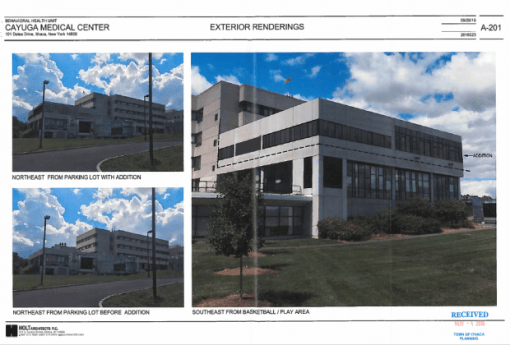
3. Cayuga Med’s plans for a 6,000 SF addition to their Behavioral Health Unit has been approved. At this point, the project needs a minor zoning variance for height,and then CMC has to apply for certification from the New York State Office of Mental Health for the facility to be approved- specialized medical facilities, like CMC and Brookdale, have to prove there is a need before they’re allowed to build. The hospital hopes to open the project to bidding early next year.

masonic_temple_1-771x595

4. So ICYMI, the Masonic Temple rehabilitation is moving forward. Six months later than anticipated, but it is moving forward. The project is valued somewhere north of $1 million. There is one other project on the Ithaca Landmarks Preservation Commission (ILPC) agenda that I thought of writing an article about, but decided it was too minor – the Alpha Phi Alpha house at 421 North Albany will be doing a reconstruction of a non-historically significant rear porch. If it were a full reno, I’d do a write-up for the Voice.

Also on the ILPC agenda – a discussion of Collegetown Historic Resources. I have the feeling this is being spurred by Novarr’s 119-125 College Avenue project, the College townhouses. Three historically significant but non-landmarked apartment houses were taken down to make way for the project, which is expected to go up for preliminary approval later this month. The city did a review after the document was first published in 2009, and landmarked the Snaith House at 140 College and Grandview House at 201 College – they could be considering making a move towards landmarking other properties – some of the historic structures on the 400 Block of College Avenue, and the 100 blocks of Oak Avenue, College Avenue and Linden Avenue are possibilities. Novarr has another project rumored for 215 College Avenue, but that building, dating from the 1870s and renovated/expanded numerous times, was not on the 2009 list.

5. Staying Collegetown, a big sale this week – 113 College Avenue sold for $1.7 million. That’s a very impressive price for an outer Collegetown apartment house – the tax assessment has it pegged at $610,000. The bones of the 13-bedroom, 3,738 SF building date from the late 1800s, but like its twin next door, it’s been the subject of a very unsympathetic renovation (records suggest the renos were done around 1980). The house has been owned by the Tallman family since 1987.

The property is zoned CR-4 – four floors, no parking required. CR-4 is the same zoning as Novarr’s townhouses and Visum’s latest pair of proposals. And, because what goes around comes around, the buyer is the same LLC that sold Visum’s Todd Fox 201 College Avenue for $2.65 million back in June – Russell Johnson’s PBC & Associates LLC. He also picked up a CR-3 building at 233 Linden Avenue for $750k back in the fall. Price suggests redevelopment, but the buyer isn’t known for that – he might have just paid big for a long-term investment. TL;DR, he might be planning something, he might not; we’ll see.

On a side note, the county’s going to make some money raising the property tax assessment on this one – offhand, I’ve noticed most of the houses sold this week (excluding a couple in Ithaca city) have gone at or well under assessment, which is a bit unusual, and probably not something that the tax assessor’s office wants to see.

20160630_142619

6. Good news and bad news from the Regional Economic Development Council awards. The good news is, the area’s getting money. Cargill gets $2 million towards their salt mine project (they requested $5 million), Cornell gets $250,000 for a startup business alliance, County Waste gets $355k for a food waste transfer station at the recycling center site, and the Sciencenter gets $150k for renovations. Several smaller awards are to hire staff for cultural and arts programs.

Now the bad news – one project, marked priority, was not funded – the Collegetown Travel Corridor proposed by the city of Ithaca to connect Downtown and Collegetown. I asked to make sure, and the Planning Department was just a little deflated in their response. Major bummer. I don’t doubt the value of arts programs, but $38,500 for a theatre director and $41,000 for a workforce expansion isn’t sustainable, it’s one year’s salary. That’s nice, but how does that benefit the area in the long-term? The Travel Corridor would have further encouraged urban development downtown and Collegetown that could have indirectly supported the arts through patronage, or directly through taxes that are used to fund local-level grants.


News Tidbits 11/5/16: Condemnation and Praise

5 11 2016

maguirebirdseye-620x420

1. The Maguire waterfront plan has been rejected. By an 8-2 vote, the Ithaca city Common Council voted to discontinue consideration of the state-of-the-art Ford/Lincoln/Nissan dealership, with most citing concerns about the project’s marginal or poor fit with the city’s comprehensive plan, which calls for an urban mixed-use form of development in the Carpenter Circle area where this dealership is proposed. The votes in favor of the proposal, from the third ward’s Donna Fleming and first ward’s George McGonigal, cited ways it could be conceived as fitting with the plan (greener alternative, local business expansion), and challenges the site offers to the city’s urban plan (poor soils, trains, chemical storage, power lines).

Although this shuts down the current proposal, this may not be the last we hear from the Maguires or the Carpenter Business Park site. At the meeting, company President Phil Maguire offered a teaser, saying they may partially liquidate their land holdings to bring in mixed-use development that would share the CBP space with the dealership. Given the heavy alterations that would need to occur, the council decided to vote down the existing proposal and send a message that it doesn’t fit the city’s goals. However, the council said they and the planning department would expedite review of an amended proposal, should it come forth.

20150613_175047

2. If you’ve ever wanted some explicit discussion of the challenges of doing affordable housing in Tompkins County, here’s a great summary courtesy of the the town of Ithaca. Back in August, the town’s Planning Committee (of town board members, similar to the city’s PEDC Committee) met with Ithaca Neighborhood Housing Services Director Paul Mazzarella for a Q&A. The town is considering regulations for inclusionary housing, and after INHS’s Greenways project fell through, they would like guidance and input on to make an effective code that promotes affordable housing without killing all residential development. Here are some of the highlights:

– Ithaca is a market of smaller builders. Local developers aren’t able or interested in doing huge projects, and most outsiders don’t see Tompkins County as a big enough or profitable enough market to tap into. So that leaves it to smaller builders who don’t have scale efficiencies, and are inclined to build luxury housing because the return on investment is more likely (i.e. less risky). The strong local economy also means that the local construction labor pool is largely tapped out, and additional crews have to be imported.

– Mandated affordable housing tends to work best in expensive, hot markets where the Return on Investment (ROI) for the market-rate units is more likely – your Seattles, San Franciscos and New Yorks. Even there, it is often paired with incentives such as height or square footage. Mazzarella noted he doesn’t think the city’s voluntary program will work very well. One thing to note with mixed-income projects is that the market-rate units will often be higher priced to cover the cost of lower-priced units. Simplified example – say you’re building ten houses for a sale price of $250,000. To meet an affordable mandate you sell two at $200,000, but to still obtain adequate ROI, that $100,000 is going to spread among the other eight – so you have two for sale at at $200,000, and eight at $262,500.

– We talk about modular homes as lower-cost alternatives, and for rural locations they often are, due to materials and labor costs. However, INHS found that in their experience for sites in the city and town, the cost is comparable to stick-built, although at larger scales, cost efficiencies may be achieved (ex. the Belle Sherman Cottages).

Another interesting read is the committee’s September meeting with city historic preservation planner Bryan McCracken and Historic Ithaca’s Christine O’Malley about protecting historical resources. As it turns out, the city cannot designate an individual landmark without the owner’s permission, and historic districts require the approval of 60% of affected property owners.

hipped_roof_tinytimbers

3. Seems like Tiny Timbers had a well-attended open house. On their blog, the Dolphs have shared a cross-sectional diagram of an exterior wall – beneath the hemlock siding and copper trim will be ZIP sheathing and polyiso (thermoset plastic foam) insulation. ZIP is everywhere in residential construction, polyiso less common – locally, it was used extensively with the Boiceville Cottages in Caroline. On the inside, one has sheetrock and bamboo flooring. Exposed hemlock posts and ceilings will complement the sheetrock.

Also being rolled out is a fifth home design, a larger two-bedroom, two-bath home with a hipped roof. Variety is the space of life, as the saying goes.

119_125_college_1

4. It was exciting to finally see the release of renderings for John Novarr’s College Townhouses project at 119-125 College Avenue. Links to the Site Plan Review document, historical documentation and drawings can be found in the Voice write-up here. There have yet to be images released for the garden apartment building to be built at the rear of the property, but look for the same general design features as the rowhouses. As expected from ikon.5 Architects, the design is modern and glassy, and given the Facebook comments and a couple of emails that came in, some neighbors are less than happy about that. However, this isn’t a historic district, so long as it meets zoning regulations, Novarr is free to hire whoever he darn well pleases. As mentioned in previous write-ups, he had ikon.5 design his guest house, so this isn’t strictly a cost thing, he genuinely likes their work. It was a bit surprising but interesting to see the well-researched history of the three 19th century boarding houses currently on the property, and it makes me wonder if that was a requirement. Novarr’s proven to be accommodating in the past, perhaps he’ll deconstruct rather than demolish, and the salvageable parts can be reused.

The project team will meet with members of the Planning Board on Tuesday afternoon for Design Review – about the only thing that stands out at initial glance is the lack of windows or visual interest with the north face, barely noticeable in the rendering. That probably won’t fly with the board, but we’ll see if it gets changed up as it goes through review. City Centre, the 8-story Trebloc site redevelopment, will also undergo further design review at the meeting.

chapter_house_reconst_v5_1

5. The Chapter House is going to the Ithaca Landmarks Preservation Commission (ILPC) yet again. The changes are subtle and few, but the rules are the rules. A service door will be added to the west (rear) wall, the inset vestibule is being reconfigured a bit, and the third-floor dormer windows are being changed from double-hung to casement – meaning that instead of sliding up and down, they’ll open with a crank. The ILPC will vote on the changes in November, which will probably sail through without much debate, and hopefully, just maybe, quite possibly, the Chapter House project can get underway.

sleep_inn_v2_1
6. A couple quick updates from the town of Ithaca Planning Board minutes – after some discussion and a bit of praise for the redesign effort, the board opted for timber-trimmed Design “A” for the Sleep Inn proposal on Elmira Road. The minutes from Maplewood’s EIS meeting were also uploaded, and it is rare to see this much positivity in discussion of a project – not to say there weren’t dissenters, but the alternative energy source and efficiency initiative, use of local labor, and softening of the design on Mitchell Street won most of the speaking audience over. Public comment closed on Halloween, and now the project team must respond to all the reasonable comments received as part of the review process.


News Tidbits 10/8/16: No Rain, But the Money’s Flowing

8 10 2016

sleep_inn_v2_1
1. The Sleep Inn project at 635 Elmira Road went back to the town of Ithaca planning board last Tuesday. The initial write-up looked good – town planners were very pleased with the proposed changes, and the developer, local hotelier Pratik Ahir, proposed two different concepts to the board to see which one they were more comfortable with. The one that the board likes would be finalized in the plans and submitted for final approval later this year. No media were at the meeting, so I do not know which concept they preferred.

Both concepts by HEX 9 Architects attempt to maintain the rustic character that the town seeks to maintain for its part of the Inlet Valley Corridor. Concept one at top uses stone veneer (Elderado Stone), timber trusses, Hardie plank lap siding, and asphalt shingles. This design features balconies on both the front and rear of the building. Concept 2 incorporates a more varied roofline and building face, metal roof panels, stone veneer and a couple different types of Hardie Board. Concept 2 has less timber and no balconies. The town planning department felt that both concepts were unique enough and rustic enough to get its benediction in the SEQR analysis they sent over to the board. The concepts are a big improvement over the rendition we saw in August.

canopy_comparo_elevations_new_2
2. Looks like the Canopy Hilton is a go. The project secured a $19.5 million construction loan from ESL Federal Credit Union on Friday September 30th. ESL is a new face to the local market – “Eastman Savings and Loan” was founded in Rochester in 1920 to serve employees of former photography giant Eastman Kodak. The 7-story, 131-room hotel is expected to open in Spring 2018.

57e13f
3. Also funded this week – the second phase of Poet’s Landing out in the village of Dryden. Citibank is lending $7,702,326 to Rochester-based Confier LLC to build the 48 affordable apartment units across the street from Dryden High School, just west of 72-unit phase one. The documents were filed on Tuesday the 4th. The design of the second phase’s will be the same as phase one’s, an eight unit per building design by NH Architecture that is one of Conifer’s standard designs. The total project cost is $10.8 million, with the balance come from state affordable housing grants and tax credits. The build-out is expected to take about a year.

201_college_v5_1

4. So a few news bits about 201 College. The partially-deconstructed house at 201 College is now getting torn down, which had nothing to do with approval, and everything to do with break-ins and safety issues – there was evidence of squatters taking up residence, and the expense of a tear-down is worth avoiding a lawsuit or tragedy. Speaking of which, although a ruling on 201 College has yet to be issued and won’t be for a few weeks, Neil Golder’s lawsuit has already been re-filed. The court hearing is scheduled for December. According to an exchange with my colleague Mike Smith, Fox is planning rowhouses along Bool Street, within a 45-foot height limit but spanning the block, as it seems he has a purchase option on neighboring 202 Linden.

20161007_131502

5. According to Nick Reynolds at the Times (yes, he jumped papers), the buildings to be deconstructed for the Harold’s Square project are to be vacated by the end of October. Developer David Lubin plans to start the deconstruction process, which is a little more intensive and lengthier than a typical demolition, in November. Things have been complicated by the city’s decision to forego the project in the Restore NY grant application, where the $500,000 was allocated to pay for demolition, and must now be sourced from elsewhere. Once secured, the plan is to file for the permit, and by law they have up to 30 days to start deconstruction from the day the permit is issued. Construction should go for about 18 months, once the site is cleared.

607_s_aurora_2 607_s_aurora_1

6. The 8-unit 607 South Aurora project will be seeking “Declaration of Lead Agency” at the Planning Board meeting, and materials have been filed with the city. Project narrative here, SPR application here, drawings here. The big changes since sketch plan were sidewalk and parking lot revisions, and rotating Building D to establish harmony with Hillview Place. The project is estimated to cost $1.5 million and aims for a construction timeline of March to September 2017. This is the next incremental step up for Charlie O’Connor of Modern Living Rentals, whose M.O. is to quietly pursue modestly-sized infill projects in less dense parts of the city (ex. the two duplexes planned for 312-314 Old Elmira). In a change of pace, the staff of Sharma Architecture are the designers this time around.

123_eddy_street_2

7. From the Board of Zoning Appeals meeting, the new two-family house at 123 Eddy Street has been granted zoning variances. Expect the Sharma-designed two-unit, six-bedroom rental property to start construction next year in time for the 2017-18 academic year.

20160918_155855 20160918_155910

6. House of the week. Instead of one underway, this week will show two recent completions. Leading off is this house on West Hill’s Campbell Avenue, built by Carina Construction. This project came up in a weekly roundup back in late May – it’s a $320,000 project per the permit filing with the city, with $280,000 lent by Tompkins Trust. The contrast between the wood siding and the (fiber cement?) vinyl siding is a nice touch, as is the two-story porch. Definitely a unique house, and a showcase of just what kind of variety one can do with modular pieces if they’re willing to get creative.

20160918_162315 20160918_162648

Now for house number two. This isn’t a new build, but a very thorough renovation. Every time I take photos, I run into the owners, and normally I try to be as unobtrusive as possible. But, given that I’ve run into him twice, he’s familiar enough with me that we’ve had a conversation about his work.

20160109_151921

This is in Fall Creek on North Aurora. The couple who own this place moved in from Pennsylvania, they were just starting retirement when the wife’s father was no longer able to take care of it. It had been a duplex, but the other unit was more workshop space. The building was in good shape, but these folks wanted to modernize and refresh it, so they decided to do a to-the-studs renovation, basically turning it into a new home within an existing shell. Fiber cement, wood shingles, a few modern touches (the south bumpout, the unusual gable/shed hybrid dormers), a carriage house, a lot of work went into it over the past year and a half and it shows.