210 Hancock Construction Update, 4/2017

23 04 2017

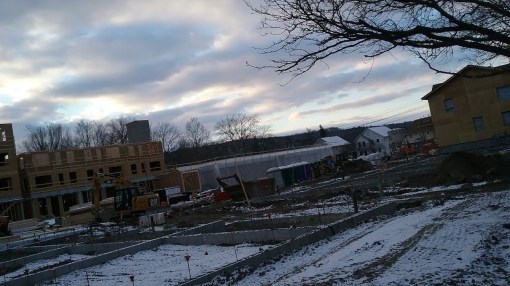
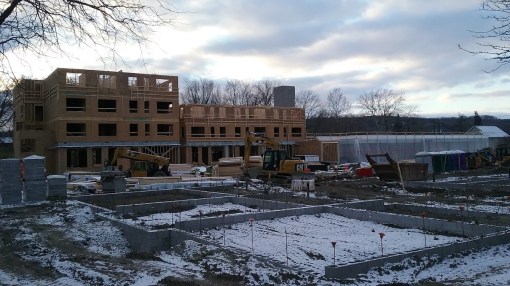
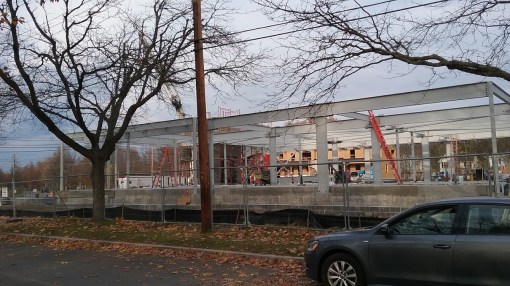
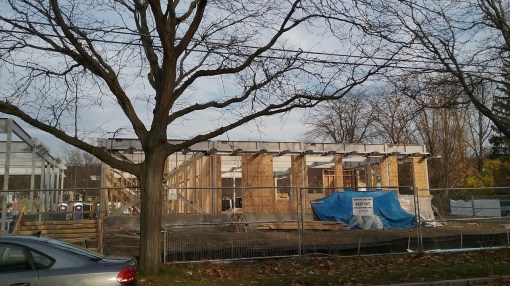
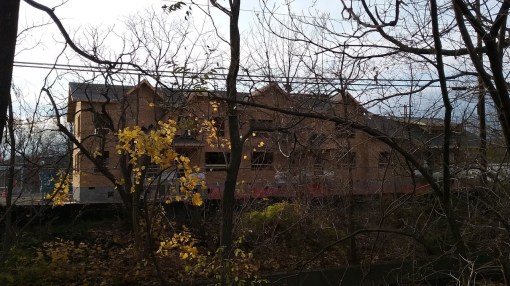
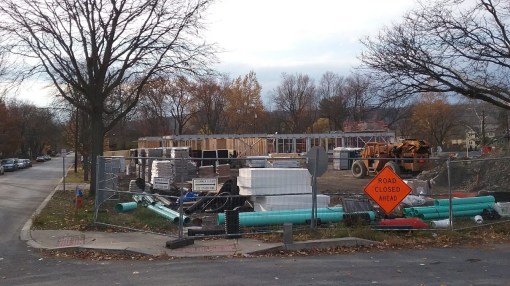
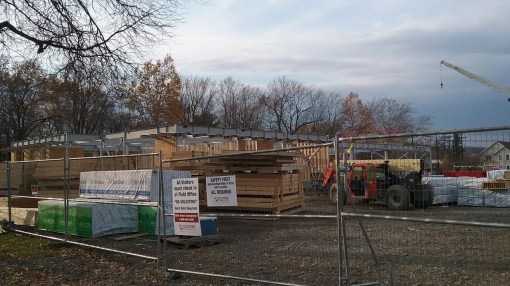
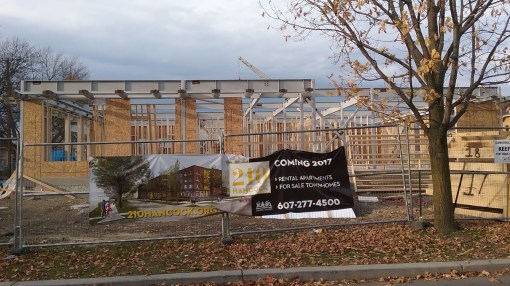
There is so much going on at INHS’s 210 Hancock site, this might be the record for most photos in a single construction update. Let’s go counterclockwise from the southwest corner, since that’s the order these photos were taken.

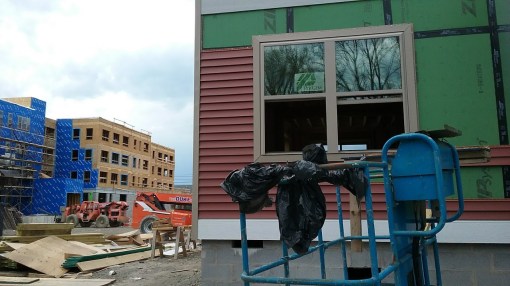
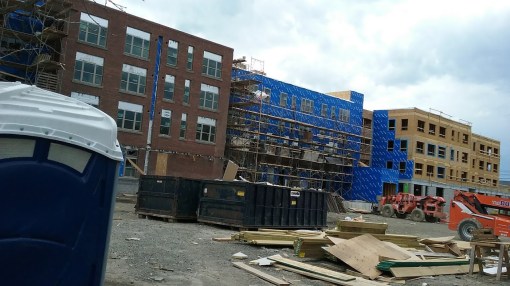
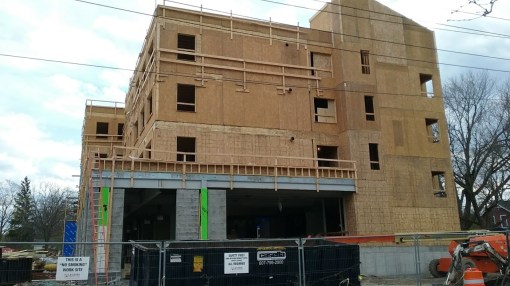
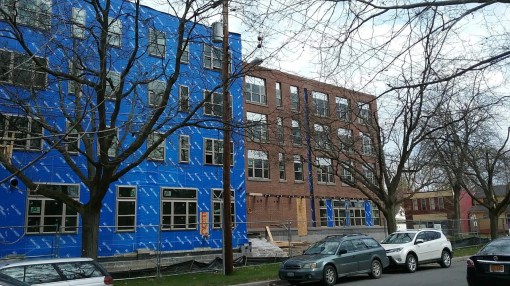
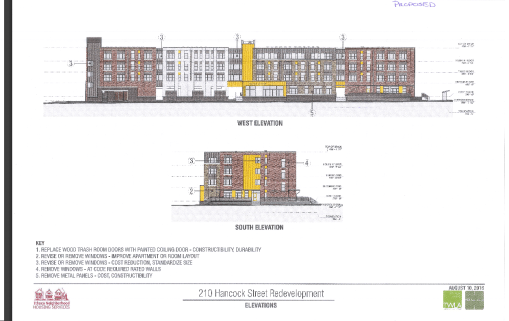
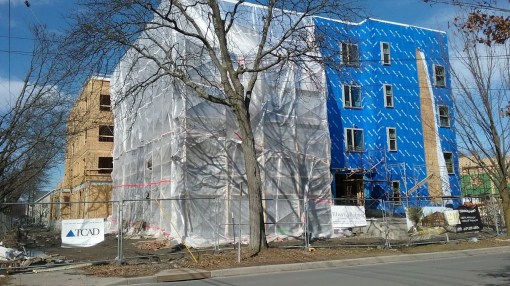
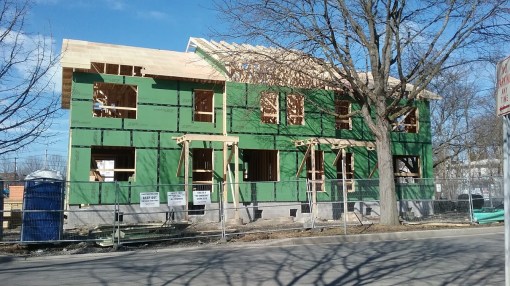
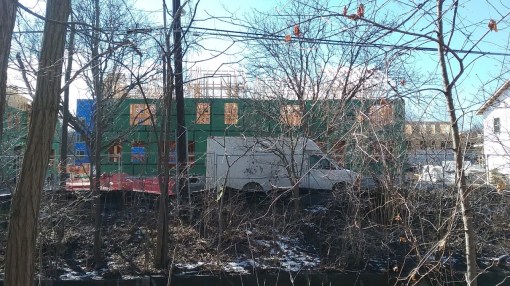
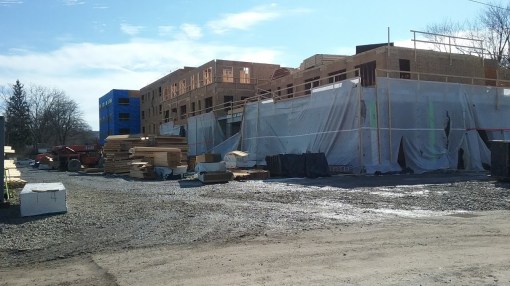
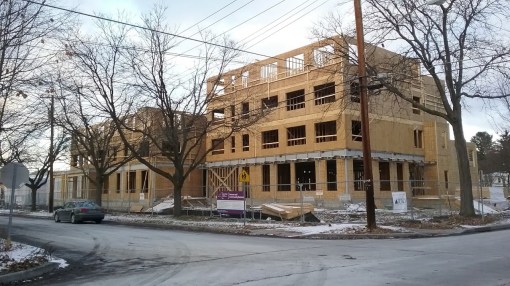
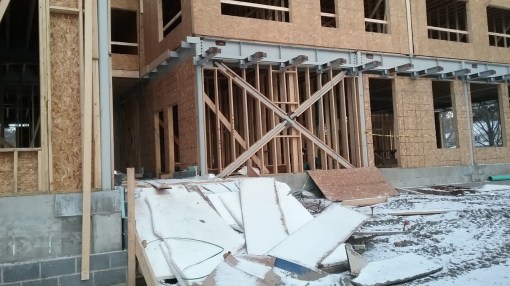
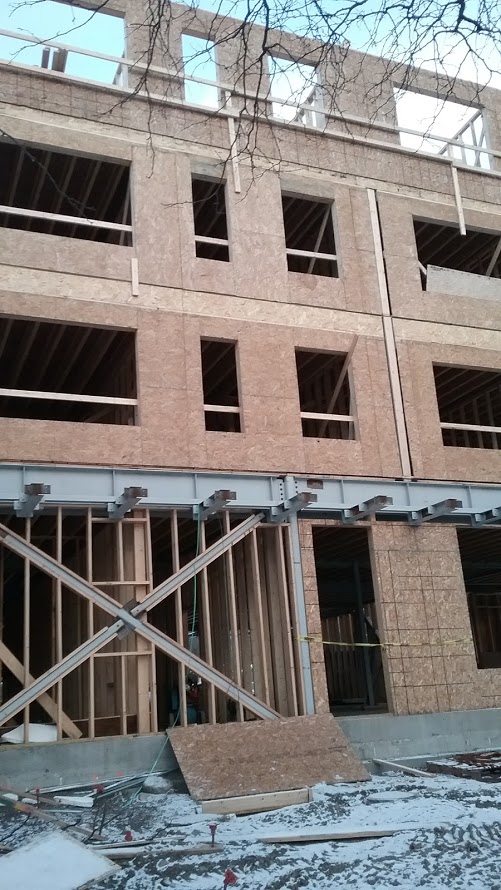
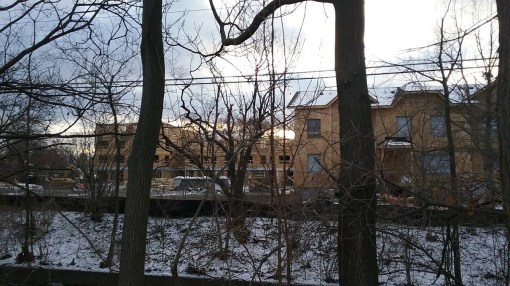
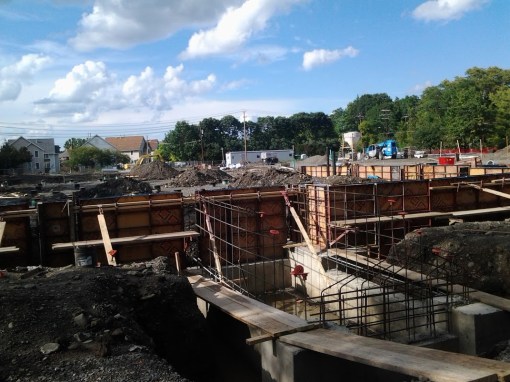
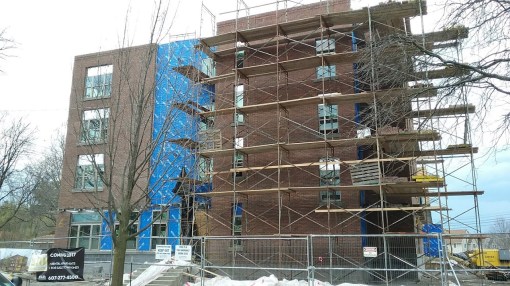
With the apartment building string, Section “A”‘s Blueskin has been mostly bricked over with Redland Heritage Brick. Some Blueskin remains exposed in areas that will be faced with Alpolic exterior metal panels. Fingers crossed that the mustard yellow shown in the elevations looks less jarring in person. It looks like an additional layer of thermal insulation was installed above the windows to go between the Blueskin and the metal panels (mostly dark grey, a few yellow…technically they’re called Alpolic Charcoal and EYL Yellow. the armchair architect in me really wants to harp on the yellow metal panels. I remember a Noah Demarest quote about yellow being a really hard exterior color to pull off. Why not a red or an orange-brown?). The roof is finished and interior fixtures and flooring are being installed.

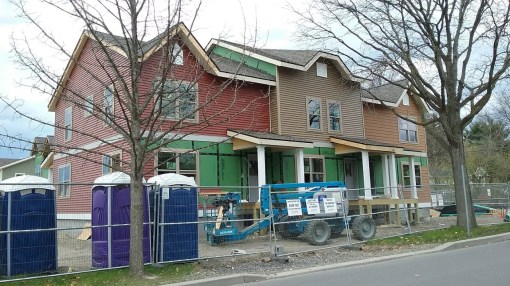
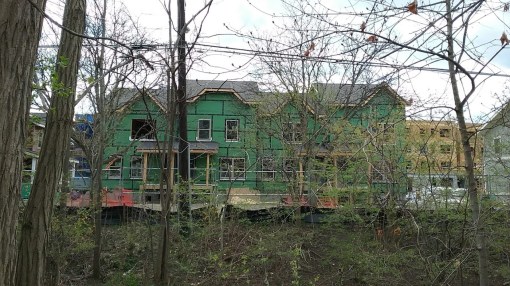
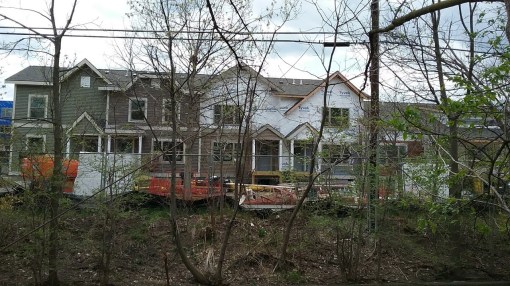
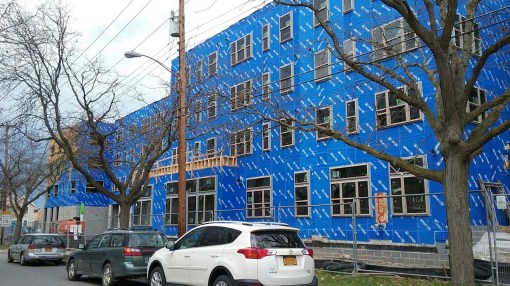
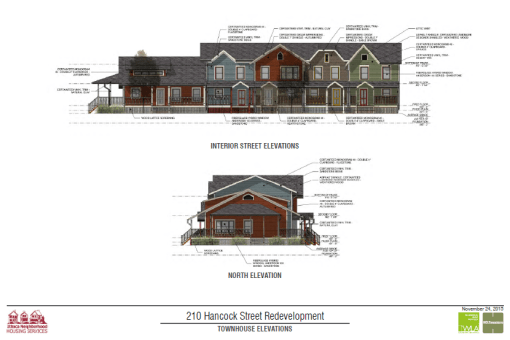
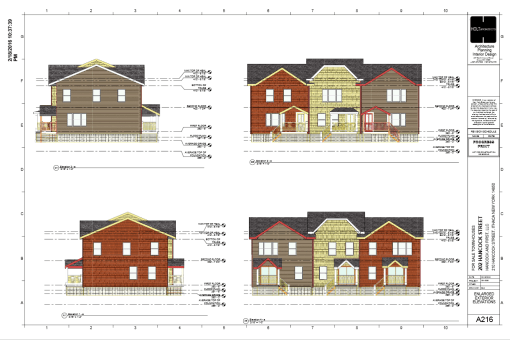
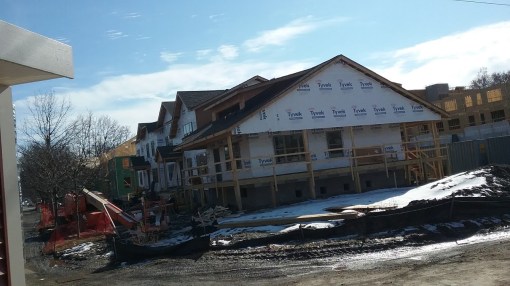
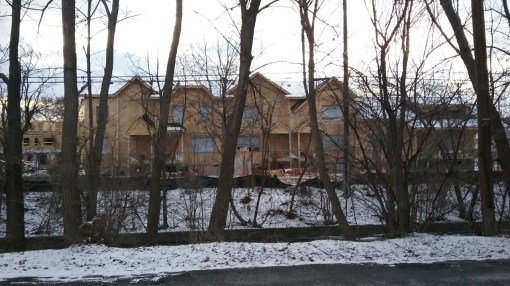
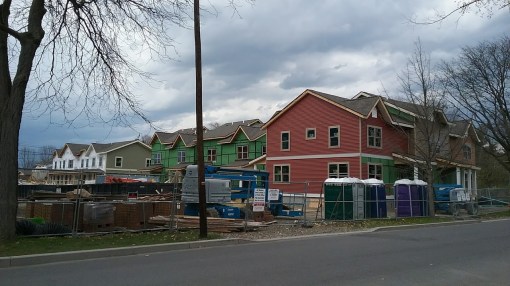
Then we get to the first string of three for-sale townhouses, which will have addresses for the 200 Block of Hancock (apart from 202, I’m forgetting the exact numbers). They look nothing like the elevations submitted for IURA review, and that is not a bad thing. INHS is using Certainteed clapboard siding on the exterior. The one on the west (left) is “Autumn Red”, and the one on the east (right) is “Mountain Cedar”, both of which were used on the Stone Quarry project. The shades of brown and grey are so similar it’s hard to tell what the middle one is, maybe “Hearthstone”. It looks like a mixture of sizes as well, maybe 4″ on the left and middle, and 7″ Mountain Cedar on the right. The trim pieces are Certainteed vinyl and vary slightly in color, neutral whitish or tannish shades like “Sandstone Beige”, “Natural Clay” and “Desert Tan”.

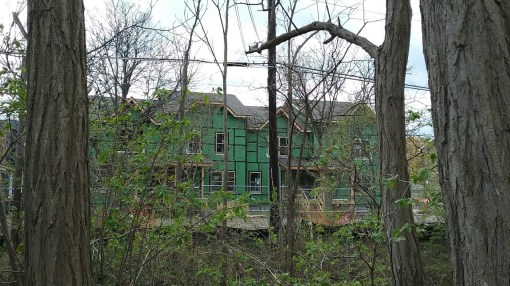
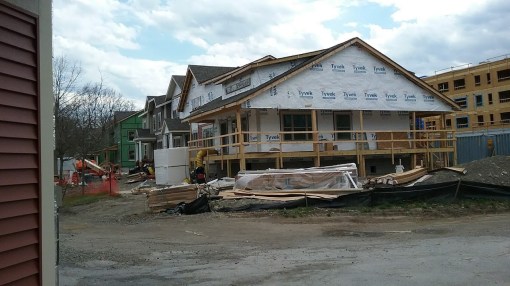
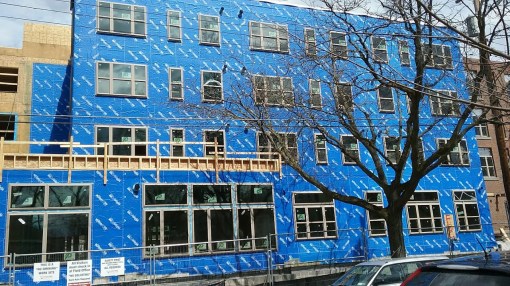
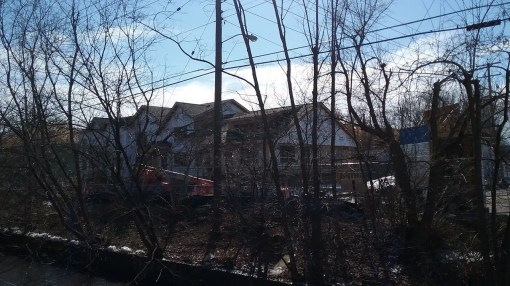
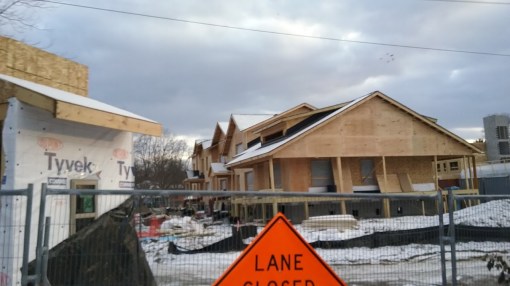
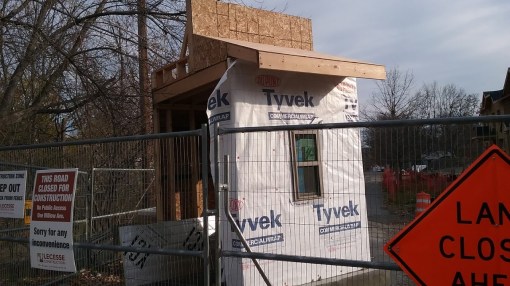
Circling around to the 400 Block of Lake Avenue highlights a construction contrast between the for-sale units and the five for-rent units further north. The for-sale units are wood-frame, plywood Huber ZIP sheathing, and exterior finishes. The for-rent units are wood-frame, standard plywood sheets, Tyvek Housewrap, and exterior finishes. The difference between the two is really a matter of preference – both are effective water-resistive barriers if installed properly. ZIP panels tend to be easier to install (lower labor cost), but more expensive as a product.

The Certainteed colors on the rentals are “Spruce”, “Sable Brown”, a split-level “Autumn Red/Hearthstone”, “Flagstone” and another “Autumn Red”. Some of these will be 4″ clapboard, others 7″ shingles – all Certainteed, all to give the impression of individual units so they play well with their older, detached neighbors. The Spruce Green unit looks a little odd with that big blank wall above the porch, and in the renders and elevation it appears to be bigger than the final product.

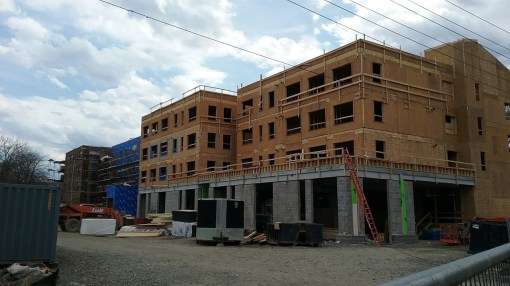
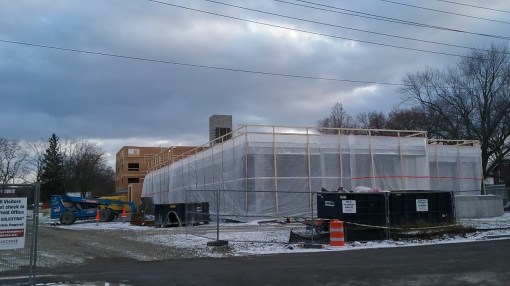
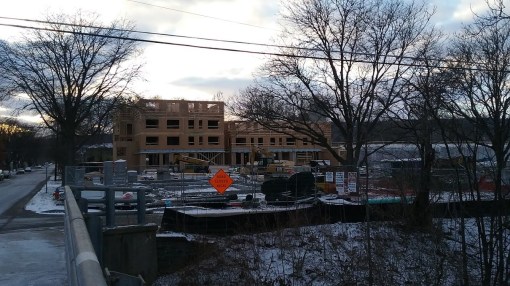
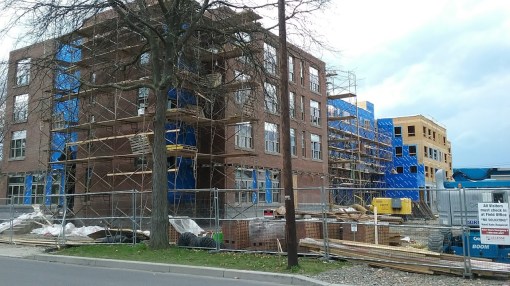
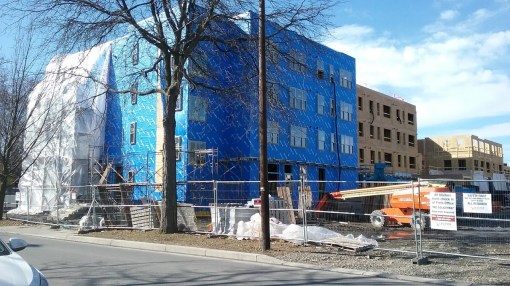
Apartment sections “C” and “D” are still being framed, and “B” has been fully skinned and fitted out with windows. “B” will be faced with will use Carolina Ceramics Teakwood Brick and Morin blue-grey corrugated steel with pearl, EYL yellow and charcoal Alpolic metal panels, “C” will use Redland Whitehall Brick (white brick) as well as Alpolic panels, and “D” will use the same Heritage Red brick as “A” but, with some corrugated steel on the stairwell. “C” and “D” also have a first-floor covered parking garage. The garage will be face in Barnes and Cone Masonry, but the city’s November 2015 filing makes reference to a product that doesn’t appear in their brochures.

The apartment will be ready by August 1st, and the for-sale units will be on the market by the fall. Lecesse Construction is the general contractor.


210 Hancock Construction Update, 2/2017

20 02 2017

Normally construction sites get updates every two months. But at the INHS Hancock project site, things are getting really interesting in a short time.

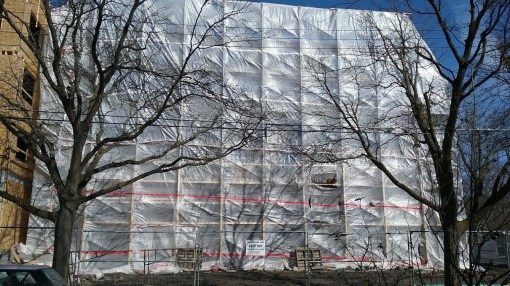
First, the main apartment building. In just the past month, section “A”, the southernmost wing, has been wrapped in Blueskin, roofed, and the windows have been fitted. Answering a question from a few months back, it looks like the Blueskin’s purpose is to be the water/vapor membrane under the brick. The section of “A” under the weatherproof plastic tenting is being bricked – a few loose bricks can be seen in the last photos through holes in the plastic. Not only do the workers appreciate some protection from the elements, brickwork requires temperatures to be kept above freezing so that the water in the mortar doesn’t freeze out, so not only is there plastic wrap, Lecesse has also deployed portable heaters. Section “B” will follow with the Blueskin sheathing, roofing and window-fitting, and then “C” and “D”, which host the indoor garage (hence the CMUs) and are still being framed out.

The five rental townhouses have a typical wood-frame build-out – first comes wood framing and roofing, then tar papered and shingling, housewrapping and window fitting. Interestingly, the seven for-sale townhouses (collectively referred to as “202 Hancock”) are using Huber ZIP sheathing panels, which the rentals did not. The Hancock street trio of homes have been framed but not roofed, while the Lake Avenue quartet are still being framed out, awaiting the rest of their roof trusses. The insides of the for-sale homes are still just bare stud walls at this point, while the rentals are probably far enough along that most utility rough ins have been completed, and sheetrock is being hung in the units. All in all, Lecesse Construction and their subcontractors have been moving at a very good clip over the past month or so.

A construction loan filing on January 23rd states Tompkins Trust lent INHS $1,581,796 to finance the 202 Hancock units. The total cost (hard and soft) of the seven for-sale units is estimated at $2.36 million. The five two bedroom units (1,147 SF) will be sold for about $114,000, and two three-bedroom units (1,364 SF) for $136,000, to qualified applicants making 60-80% of local AMI, or $37,000-$49,000/year.

For the sake of comparison, the apartment building and for-sale units are partially financed with a $7,790,511 loan from a Citibank fund – through an LLC, Citibank bought the low-income housing tax credits (LIHTCs) awarded to the project by New York State. The apartment building’s total cost comes to $13.8 million, with the rest financed through INHS’s money, federal tax credits, housing grants and a low-interest loan from the state’s housing division (NYSHCR).

Renters or homeowners interested in obtaining a unit can fill out an inquiry form here. The rentals will be ready for occupancy by August 1st, 2017, and the for-sale units are looking at a November 2017 completion.

20170218_132608 20170218_132630 20170218_132650 20170218_132705 20170218_132720 20170218_132737 20170218_132806 20170218_132824 20170218_132828 20170218_132850 20170218_132905 20170218_132928 20170218_133033 20170218_133051 20170218_133132 20170218_133217 20170218_133245 20170218_133259 20170218_133312 20170218_133355 20170218_133420

inhs_pride_design_v5_3

blueskin-vp100-brick inhs_pride_design_v6_1202_hancock_2 202_hancock_1 202_hancock_3

inhs_pride_design_v6_1


News Tidbits 2/18/17: Credits and Loans

18 02 2017

warren_medical_lansing_1

1. Over in Lansing village, it looks like the new Arleo medical office building is starting to moving forward. A sketch plan of the project was presented at the village planning board’s meeting earlier this week. Although Lansing doesn’t upload accessory docs like site plans and elevations, this one has been floating around for the past several months in marketing material as “Cayuga Ridge”. Quoting the May 7th 2016 news roundup:

“The new one-story building, which appears to be designed by Binghamton-based Keystone Associates, would be off of Warren Road, although it looks like the building would be accessed from a driveway coming off of Uptown Road. The 2.71 acre property north of 100 Uptown Road is zoned “Human Health Services District” by the village, and borders undeveloped land owned by Cornell, and several other suburban medical office buildings built over the past few decades. The resolution on the attached site plan is too low to determine the square footage, though it looks to be in the low tens of thousands.”

labourgade-on-seneca-dormer2

2. For those who like their cottages tiny – it looks like Schickel Construction has begun work on the spiritual successor to their 140-unit Boiceville Cottages project in Caroline. The 40-house rental development is called “La Bourgade on Seneca”, and is located in the town of Hector, in Schuyler County just outside of Burdett village. For the record, Bourgade is a French term for an unfortified village or settlement. More details can be found on the website here. There will be two cottage types available -, “The Classic”, a 2-bedroom, 900 SF plan that will rent at $1,495/month, and “The Spacious”, a 2-bedroom with a dormer loft space totaling 1,000 SF and renting at $1,695 month. The house very much like their Boiceville cousins, but with angled eaves (dunno what the correct term is and google’s not helping – if there’s an architect reading, please chime in). All units will have lake views.

Personally, I see this as a stretch for the Ithaca market, since it’s 25 miles west of the city. But it might tap into a more plebeian contingent the wine country crowd, the wealthier of whom have taken to building grand vacation or permanent homes along the Finger Lakes in recent years. The first 9 units, three clusters of three, are currently under construction, as is a community center. Delivery is expected in May 2017.

ic_master_plan_3

3. It looks like Ithaca College is putting some more thought into their housing needs. The college has been meeting with planning firm U3 Advisors to explore the possibility of new off-campus student housing.

U3 Advisors is already familiar with the area, as they are also under contract with Cornell to formulate their off-campus housing plan. Unlike Cornell, however, Ithaca College has no plans to grow enrollment – the master plan expects it to stay steady around 7,000. However, many of the dorms are reaching the end of their useful lives, meaning that the college can either sink a fair sum into renovation and replacement of utility systems, or tear down and build anew. An off-campus option could either be a private entity on private land, or a deal on IC-owned land like what Cornell and EdR are doing with Maplewood. A 200-300 bedroom off-campus option could mesh with the town of Ithaca’s visions for a walkable South Hill neighborhood on the intersection of Route 96 and King Road.

It’s still just studies and meetings at this point, but as the oldest dorms hit 50 years old on South Hill, there might be something fresh in the pipeline. We’ll see what happens.

cma_v2_2

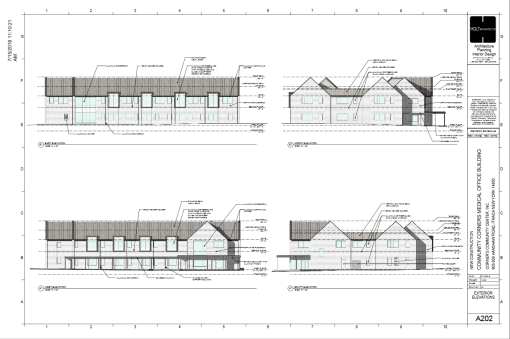
4. Ithaca’s West End will be welcoming a new tenant in the next couple months. Courtesy of Nick Reynolds over at the Times, the USDA is shifting its regional office out of Community Corners in Cayuga Heights, and into Fulton Meadows, a commercial office building at 225 South Fulton Street. the move is being undertaken in anticipation of the construction of Tim Ciaschi’s new Cayuga Medical Associates office building, which is set to get underway at Community Corners later this year.

201_college_v5_1

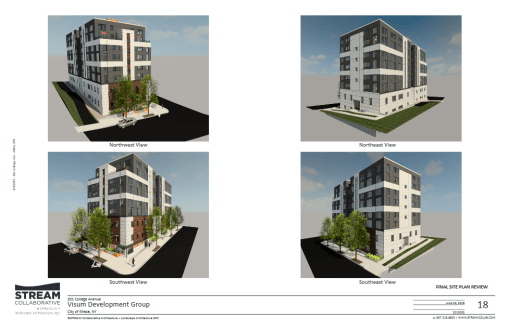
5. Looks like we have an idea of the price tag for Visum Development’s 201 College Avenue. According to a construction loan filed with the county on the 15th, S&T Bank loaned Todd Fox’s company $7,870,673 to help cover the costs of the project. The breakdown in the filing says $6,841,038 for hard construction costs (materials/equipment/labor), $507,000 in soft costs (permits/legal/marketing/financing fees), $300k in contigency and $226k in interest reserves. Add in the $2.64 million for the land purchase, and the total comes to $10,514,180.

That’s something of a premium because the project is on an accelerated schedule after the big hullabaloo with Neil Golder and the city Planning Board last fall. Note that the loan doesn’t cover all the costs and that there is money from other sources, like cash equity from Visum itself.

S&T Bank is a regional bank based out of Western Pennsylvania, but they’ve been making inroads into Ithaca’s commercial lending market. S&T Bank also financed the construction of the Holiday Inn Express that recently opened on Route 13, lending $5,973,750 to the hotel developers.

Quick aside, I think this is the first time I’m seeing the square footage calculated out – 201 College will be 33,398 SF.

20170106_160736

6. Hopefully this runs after by INHS refinancing explainer, so it makes more sense. Quick rehash, low income housing tax credits (LIHTCs) are sold to banks and similar financial institutions so that they get the tax credit, and the affordable housing developer gets the money they need to move forward with a project. With that in mind, here’s an interesting though unfortunate tidbit from INHS’s Paul Mazzarella:

“This following may be more than you want to include in this article, but it is relevant.  The pricing of tax credits exists in a marketplace where they rise and fall in value.  In past projects completed by INHS, we’ve received from $0.91 to $1.02 of equity investment for each dollar of tax credit.  The pricing of tax credits has recently plummeted because of the recent election and the uncertainty in DC.  This is mostly due to discussions about changing the corporate tax rate.  A lower corporate tax rate will mean that companies have less profits to shield from taxes and therefore the demand for tax credits will be reduced.  Even though no changes have yet been made to the corporate tax rate, just the discussion about this has reduced the pricing of tax credits to around $0.80.  What does this mean for INHS? It means that the project that we’ve been working on for several years suddenly has a funding gap that didn’t exist a few months ago, due entirely to investor’s fear of risk due to an uncertain future..  This is true for every tax credit project in the country and has all of us struggling to make the pro formas work.”

Sigh. Politics.

habitat_208_third_st


7. The Times has the first render for Habitat for Humanity’s two-family townhouse project at 208/210 Third Street on the city’s Northside. It looks to be the same architect as the 4-unit project for 402 South Cayuga – I can’t seem to find the architect offhand as a few designers have donated time and energy, but local planner George Frantz shepherded the project through the approvals process. Each unit is about 1500 SF. The plan for the $305,000 project is to break ground in April and have the move-in ceremony in Spring 2018. As with all local Habitat projects, a portion of the construction will come from volunteer labor, including 500 hours of “sweat equity”, and homeownership classes that the two recipient lower-income families (making 60% AMI or less, $32,000/year) will need to complete as part of the deal.

maplewood-v7_7-planning-board

8. Wrapping this up with the local agendas for next week – the town of Ithaca will be looking at a home B&B permit on Bostwick Road, a retaining wall for Ithaca College’s track, and finishes touches on the Maplewood approvals. The city’s project review meeting indicates the city plans to look at the subdivision at 109 Dearborn Place, Declaration of Lead Agency and Environmental Review for the 11-unit 107 South Albany Street plan,  and “Approval of Conditions” for City Centre, which is just making sure they’ve completed everything asked for in the final approval. In sum, nothing too exciting at the moment, but we’ll see if the city has any new projects coming up when the actual PB agenda comes out next week.

9. Quick note to wrap up – the woman behind the Rogues Harbor Inn in Lansing has purchased a prominent and historic building on Freeville’s main drag. Eileen Stout purchased 2 Main Street, a mixed-use building with restaurant space, a tile shop and three apartments, on Thursday for $132,000. The seller was Tompkins Trust and it’s well below assessment – doesn’t look like a foreclosure though. The bank bought the property for almost double the price in May 2016.


210 Hancock Construction Update, 1/2017

9 01 2017

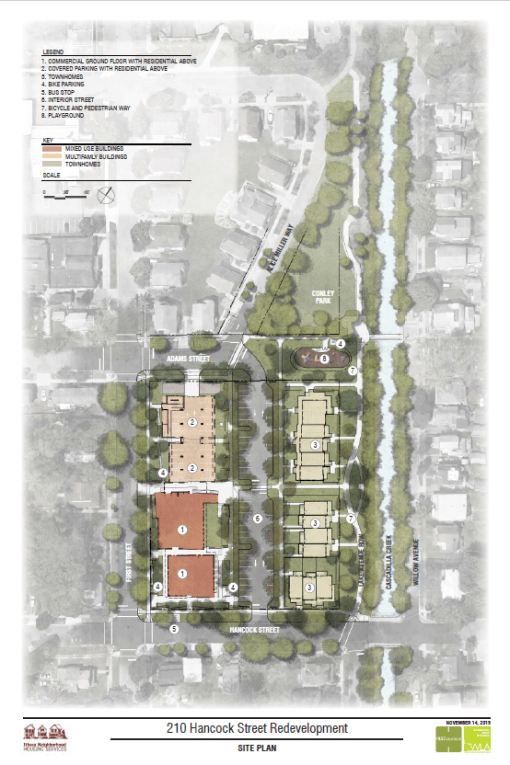
So much to see over at the 210 Hancock site. First, the prefabricated wood wall panels of section “A”, the south wing of the apartment building, are up to the top (fourth) floor, and one gets a pretty good idea of the vertical scale of the building. For the record, roof height will be 46 feet, not counting mechanicals. The second section to the north of it, “B”, was designed by HOLT Architects to be a little closer to the street, so it looks less like one continuous wall, and helps create the impression of separate structures. The first floor of these two subsections, which is framed by metal and wood rather than wood alone, will house the daycare, rental offices and commercial space. Sections “C” and “D” will consist of apartments over the indoor garage, which is currently wrapped in plastic sheeting, and separated from the other two section by a CMU stairwell.

The rental townhouses are fully framed (210 Hancock’s website says window install is expected to start soon), and it appears that Lecesse has start construction on the seven for-sale townhouses – the foundation walls have been excavated and poured. These units have a slab (shallow) foundation, and not having to worry about excavation allows the townhouses to move along at a faster clip. The apartments and rental townhouses should be ready by August, the for-sale townhouses by November. Ithaca Neighborhood Housing Services (INHS) has a website up for rental applications here and qualified home-owners here.

20170106_155902 20170106_155925 20170106_160000 20170106_160020 20170106_160043 20170106_160130 20170106_160153 20170106_160227 20170106_160247 20170106_160309 20170106_160331 20170106_160347 20170106_160457 20170106_160508 20170106_160531 20170106_160540 20170106_160610 20170106_160626 20170106_160639 20170106_160700 20170106_160711 20170106_160720 20170106_160736 20170106_160744 20170106_160821 20170106_160855
inhs_pride_design_v6_1

inhs_pride_design_v5_3 inhs_pride_design_v5_2

202_hancock_1 202_hancock_2

202_hancock_3


210 Hancock Construction Update, 11/2016

2 12 2016

Plenty of progress at 210 Hancock. LeCesse has the foundation completed and the apartment building is out of the ground. The northern two segments have a parking garage on the first floor, hence the paving. Rebar poking out of the CMUs will tie into the steel structure. The southern two segments are a little further along. Steelwork is underway for both, with the first floor framed out. The southernmost structure, which will house the affordable daycare space, already has interior stud walls going up, as well as plywood with rough openings for doors and windows.

The five for-rent townhouses are much further along than I had anticipated. They are fully framed and it looks like tar paper is being applied to the rooftops. Looking at the sample wall at the corner of the property, there were a couple different housewraps in display – one was standard DuPont Tyvek commercial wrap, the other was Henry BlueSkin, which I’ve never before seen in a project around Ithaca. A little research suggests BlueSkin is a newer and more expensive product, but it seems to have its proponents. With fewer staples or button caps involved, it’s less labor-intensive to install, and less fastening comes with less of a risk of the vapor barrier being torn open and compromising its waterproofing abilities.

Both are fully synthetic plastic wraps with microscopic holes that allow moisture to breathe out without letting moisture in from the outside, preventing mold and wood rot. But in order for Tyvek to work effectively, all the joints and seams have to be taped tight to keep water from seeping in at the edges. Blueskin is created with an adhesive so that it doesn’t have to be taped down. However, BlueSkin still has to be fastened at window and door openings, the application surface has to be clean and dry, and it’s more difficult to apply in temperatures less than 40 degrees F – keep in mind, we’re at the onset of a northeast winter. I’m not sure which barrier will be applied where, but we’ll find out soon.
20161119_142839 20161119_142845 20161119_142917 20161119_142951 20161119_143026 20161119_143048 20161119_143138 20161119_143223 20161119_143351 20161119_143446 20161119_143453 20161119_143532 20161119_143604

20161119_143253

inhs_pride_design_v6_1 inhs_pride_design_v5_3 inhs_pride_design_v5_2 inhs_pride_design_v5_1


News Tidbits 10/15/16: Stoops and Stumbles, Growth and Gables

15 10 2016

maguirebirdseye-620x420

1. The Maguire proposal for Carpenter Business Park will be heading to the Common Council next month, but the prognosis isn’t good. The city council’s Planning Committee voted 4-0 to say that the proposal didn’t fit with the city’s Comprehensive Plan for the near-Waterfront property – the plan calls for walkable, urban mixed-uses, preferably with residential components. The discussion wasn’t unanimous in its logic – 2nd Ward Councilmen Nguyen and Murtagh were stronger adherents to the plan, while the 1st Ward’s Cynthia Brock doesn’t think housing is appropriate – but they all disagreed with the multi-brand car dealership plan as-is. Maguire has asked for a delay in vote so that the plan could be tweaked, but the Committee voted to move forward.

Because of the 18-month TMPUD in place, the Common Council has to vote to approve all projects in the waterfront area, so the resolution to decline further review of the project will be voted on at the next non-budget Council meeting. It will not be unanimous – the 3rd Ward’s Donna Fleming wrote a letter of support for the project, and the 1st Ward’s George McGonigal voiced support for the concept though not this particular plan. But the chances of approval are pretty slim at this point.

119_125_college_avenue_2

2. Judging from the site photos John Novarr’s project team sent along, it looks like environmental remediation has already commenced at the site of his faculty townhouse project at 119-125 College Avenue in Collegetown. 121 College, in particular, is already in the early stages of remediation. It’s a pretty extensive photo documentation, one that might have to do with historic preservation aspects, like determining what can be salvaged and reused. It’s pretty clear that the properties, which were recently acquired from an Endicott-based landlord who held the properties for decades, are in rough shape. Novarr seems to have a preference for prepping sites before plans are approved (ex. 209-215 Dryden), so it’s uncertain how much time these three boarding houses have left.

202_hancock_1

3. Courtesy of the Ithaca Urban Renewal Agency’s Neighborhood Investment Committee, we get to see a pretty thorough breakdown of the expenses and revenues of an owner-occupied affordable housing project.

The details come as part of INHS’s application for $314,125 in Federal HUD HOME funds, to be used for the 7 for-sale townhouse units included with the 210 Hancock project, collectively called 202 Hancock. The funds would be used to cover soft costs, like project management, engineering and architecture fees, legal fees, and site inspections.

inhs_202_financials

The 202 Hancock project construction cost is estimated at $1,754,860, about $344,000 per unit, or about $198/SF. That’s expensive, but not unusual – 203 Third Street was about $190/SF. The cost is high due to rapidly rising construction costs, and due to federal guidelines and lender specifications, INHS is required to hire contractors with extensive insurance. Add in soft costs and it jumps to $2,408.371.

Now let’s consider the sales. The five two-bedroom units are expected to sell for $130,052 to a household making no more than $38,046. The two three-bedrooms will sell for $164,979, to households making $42,428/year or less. Those incomes don’t meet the rule-of-thumb of 3.4x annual income, but HOME funds cover part of the cost ($24,000 for the 2-bedrooms, $36,000 for the three-bedrooms). INHS gets $960,218 in the project sales – and that’s the same amount Tompkins Trust Company is willing to cover with a construction loan. So the initial gap is $1,448,155. Now we’re starting to see why new housing can be so expensive.

INHS gets $7,000 in revenue from Energy Star rebates on appliances, and has up to $351,153 equity they can put towards the project, most of that being the value the of 202 Hancock’s land. The IURA would issue a low-interest bond for $215,875 to be paid back by INHS, and the non-profit has secured $280,000 in grants directly from the state (NYS AHC), and $280,000 in NYS CDBG funds awarded by local governments (this tactic is known as “subsidy layering“). This complicated puzzle of funding sources is why so many developers are not interested in doing affordable housing.

Side note, one of the pre-development costs is market analysis. Might seem silly, but grant reviewers want proof the housing crisis isn’t just bluster, and that these units won’t sit empty. An analysis by Randall/West determined that at a sale price of $136,000 for a 2-bedroom, and $162,000 for a 3-bedroom, qualified buyers would be found and under contract within 4.6 months. The units should be available for occupancy by June 2017.

202_hancock_2

Secondly, thanks to a legal settlement between the state and Morgan Stanley, a $4 million affordable housing grant is available for renovations of existing INHS scattered site rentals (98 units in 44 buildings across the city). Most of these units are rented to individuals making 60% or less of the area’s median income (about or less than $32k/yr). The funds would go towards major, long-term renovations, such as new roofs, windows, siding, and energy efficiency improvements. INHS could also use the funds, disbursed via the city, to refinance its portfolio, acquiring some of the properties and paying off $1.8 million in loans on already-purchased properties.

Here’s the short of it – the goal is to buy/pay off the scattered rental sites they manage, renovate and make them energy efficient and comfortable, lock them into the Community Housing Trust so that they become permanently affordable, transfer the land to a wholly-owned Housing Development Fund Corporation, and then sell some of the buildings to an LLC while INHS continues as property manager. The funds from sales would finance new affordable housing. This is all set up as it is to take advantage of legal and tax benefits of different corporate tax structures, while minimizing the drawbacks. Potentially, the Morgan Stanley settlement money could be used to leverage an additional $15 million in tax credits and affordable housing grants from the state.

Correction, per INHS’s Scott Reynolds in the comments section: rentals aren’t in the Community Housing Trust, but affordability would be required for 50 years.

Rochester-based SWBR would be in charge of renovation design plans, and 2+4 Construction will be general contractor. Tenants may need to be relocated as renovations occur, which will be coordinated by INHS staff. The goal is to have the settlement money accepted by the city by the end of the year, financing by April 2017, and renovations completed by the end of 2018.

cwd_bldg24_1

4. It’s another one of those special meetings – the city Planning Board will be sitting down next Tuesday to go over comments and sort another batch of public comments regarding the Chain Works DEIS, this time on public health. Once you get past the few pages of “this will never work and don’t bother trying”, there’s actually some interesting back and forth about remediation and what that entails. Also on the agenda are revisions to the Holiday Inn Express down in Southwest Ithaca – namely, they’re trying to avoid building the stairs to Spencer Road, as well as some other landscaping issues. At the second meeting later this month, the board is expected to Declare Lead Agency, open public hearings and review parts of the FEAF for TCAction’s Amici House, 8-unit 607 South Aurora, and the 8-story City Centre project on the Trebloc site downtown.

maplewood_v7_1

5. The plans for Maplewood have been modified yet again, in a change that the project team hopes will please neighbors and the town of Ithaca planning board. In revised plans submitted this past Wednesday, the 4-story apartment building planned for Mitchell Road has been replaced with a few sets of 2.5 and 3.5-story townhouses and stacked flats, and Building B to its north was extended slightly to compensate for the loss of bedrooms. Even so, the accompanying letter from Scott Whitham states that the unit and bed count have decreased slightly, from 473 units and 887 beds, to 442 units and 872 beds.

maplewood_v7_2 maplewood_v7_3

Also modified was their appearance – stoops, porches, dormers and gable roofs were added to give them a more harmonious appearance with the rest of the neighborhood. It’s not clear if the rest of the units were aesthetically modified as well.


210 Hancock Construction Update, 9/2016

6 10 2016

I try not to sit on these for too long, but it’s been a busy week with the Voice.

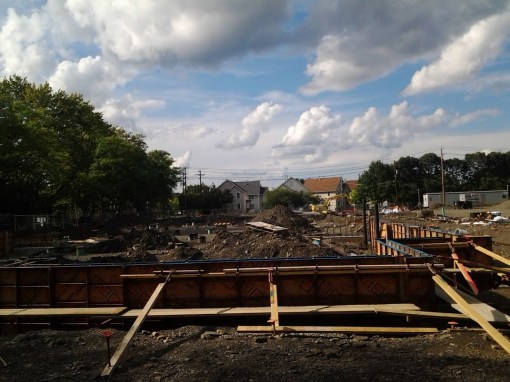
The main apartment building is in the process of having its foundation walls dug, formed and poured. The forms are put in place to hold the concrete as it is poured and cured, and then the construction team (led by Lecesse Construction) moves on to the next section. The rebar grid sticking out of the concrete gives it additional strength and rigidity. The steel piles are being inserted with the hydraulic hammer, which should be wrapping up any day now if it hasn’t already. The four-story apartment building is divided into four sections – the two with concrete pours underway, the southern two, will host TCAction’s daycare and non-profit office space. The northern two will host indoor ground-level parking.

The soil in Northside is not so great, much of it lies in the 100 or 500-year flood zone and is too unstable for less expensive slab/shallow foundations like what they use in many of the projects on the hills. For a large project like this, the safe, albeit more expensive and intrusive approach is to do a deep foundation. However, the wood-frame townhouses are small enough and light enough such that a shallow foundation can be used – you can see foundation work for the five rental townhouses in the last two photos. The seven for-sale townhouses will follow a little later this November, the original plan was to have them open in June 2017, but they have been pushed back to late fall 2017 as a result of the contractor switch.

It looks like, however, they have added the interest form for buying a townhouse to their website here. Under the working name “202 Hancock”, this $2.36 million project will have five two bedroom units (1,147 SF) to be sold for about $114,000, and two three-bedroom units (1,364 SF) for $136,000. They will be available to those making 60-80% of local AMI, or $37,000-$49,000/year. The townhouses would be a part of the Community Housing Trust (CHT), keeping them affordable even as they are sold to others in later years. More info on those units here. For those qualified and preferring to rent an apartment or townhouse, the form is here.

20160918_160842 20160918_160856 20160918_160915 20160918_160949 20160918_161026 20160918_161049 20160918_161140 20160918_161218 20160918_161258


News Tidbits 8/20/16: Another Campus Coming?

20 08 2016

Fairly quiet week, but still a few things going on-

inhs_pride_design_v5_3

1. The Journal’s Nick Reynolds followed up on the pile-driving underway at the 210 Hancock site in Ithaca’s North Side neighborhood. Admittedly, no one wants to live next to a site while hearing and feeling the bang of the pile-driver against the piles being inserted into the ground. Thankfully, this phase of the affordable housing project should be wrapped up by the end of the month. Lecesse Construction’s subcontractor, Ferraro Piling and Shoring of rural Erie County, is inserting 10-15 piles per day between the hours of 8 AM and 4 PM, and about 170 piles will be used in the project. Not fun for the neighbors, but this too shall pass.

sleep_inn_1

2. The town of Ithaca’s planning board had their close look at the Sleep Inn proposal for Elmira Road. They were not impressed. The primary complaints were that it was a one-sided design (meaning the front received significantly more cosmetic attention than the rear and sides), that it was big and that it was ugly.

The architect of the 70-room hotel, Joe Turnowchyk of HEX 9 Architects, responded with “all corporate hotels are basically ugly”, which isn’t the kind of response that will be well-received. It was followed with “[He thinks] that if they’re going to put more money into the front of the building, they shouldn’t need to address the rear”, which isn’t a good response either, because the rear faces the Black Diamond Trail.

Outsider looking in, one interpretation of the board’s commentary is that the stone and brick is fine, but they want less of a slab and more articulation – the recently-opened 64-room Best Western Plus in Cortlandville comes to mind. The massing is broken up, and architectural details and brickwork add visual interest, giving it aesthetic appeal even though the road is 40 or 45 MPH over there. The minutes note a comparison to an Arizona Sleep Inn to show what can be done with Choice Hotels brands. Anyway, the decision was tabled, with a revised design presentation planned for a September meeting.

3. New to the market this week – a duplex and five-unit mobile home park in Varna being marketed for “development potential”. The site is a one acre parcel at 10 Freese Road in Varna, touted as “perfect for townhouses or apartments”. Since the late 1980s, the “Wayside Mobile Home Park” has been the property of Ithaca attorney Ray Schlather, who was an ardent opponent of West End density and waterfront rezoning a few years back.

Zoning is Varna Hamlet Traditional District (VHTD), and it gets a little weird density-wise – per the guidelines, and being one acre, a developer could do four single-family homes, six townhouses, six condos, or three rental apartments, max 30% lot coverage. If LEED Certified, add 2 S-F homes, 2 townhouses, 1 condo, or 4 apartment units respectively. Lastly, there’s a redevelopment bonus, which honestly appears to be at the town’s discretion. If awarded, add another home, 2 townhouses, condo or 4 apartments. So in theory, max build-out for a green redevelopment is either 7 single-family houses, 10 townhouses, eight condos or eleven rental apartments on that acre of land. No idea what happens if they’re combos thereof.

Anyway, the property is being offered at $219,000, just a little over the $192,500 tax assessment.

4. So this is intriguing – the city of Ithaca Common Council will be taking a vote next Wednesday to take $150,000 from the $500,000 Capital Project fund to relocate and build a new Fire station #9, and fund two consolidation studies. One would consolidate the city hall, the Central Fire Station, Station No. 9, and Police HQ into a government campus at the site of the Central Fire Station at 310 West Green Street; the second is to study a centralized facility shared by water/sewer and streets/facilities. There’s a lot that need to be considered as part of the government campus study, which would likely involve buying neighboring properties, or building skyward. Also worth noting, the fire station parking lot is part of the Downtown West historic district. Anyway, look for a lot more discussion if the money is awarded and the study gets underway.
123_eddy_street_2

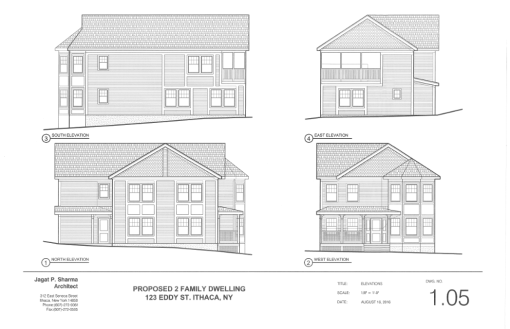
5. This week’s eye candy. Folks on Orchard Place asked for more detailed renders of the proposed two-family home at 123 Eddy Street, and here they are. Medium yellow Hardie board with white trim was the original plan. It appears that after the original drawing was submitted, the roof was realigned and one of the west-facing (front) second-floor windows was removed.

Note that this is just the planning board lot subdivision approval – although a single two-family home is typically too small to trigger planning board’s site plan review qualifications, the design still has to be approved by the ILPC and the Board of Zoning Appeals.

6. Case in point – If you live in Fall Creek, you might notice a new two-family house in the coming months. The Stavropoulos family, owners of the State Street Diner, just purchased the house for sale at 1001 North Aurora Street (above asking price, which is, for better or worse, quite common in Fall Creek) and plans to replace it with a duplex. Tompkins Trust gave them a $400,000 construction loan on the 18th. It’s a little different from the Stavropoulos’ typical M.O., which is to buy an existing house and do major renovations, as they did at 318-320 Pleasant Street and 514 Linn Street. This one looks like it will be a completely new build. No BZA, ILPC or Planning Board approval is required here, just staff level approval from the city.

7. Somewhat interesting Planning Board meeting next Tuesday. Here’s what in the bullpen:

1. Agenda Review 6:00
2. Privilege of the Floor 6:01
3. Subdivision Review 6:20

A. 123 & 125 Eddy St. (shown above)
Applicant: Nick Lambrou
Actions: Declaration of Lead Agency PUBLIC HEARING Determination of Environmental Significance Recommendation to BZA

4. Site Plan Review 6:40
A. Project: Mixed-Use Building (Harold’s Square)
Location: 123-139 E. State St. (The Commons)
Applicant: David Lubin for L Enterprises, LLC
Actions: Consideration of Project Changes

So I wrote about these changes for the Voice. The Planning Board resolution calls for modifications to the new design. The board mandates glass block for the elevator shaft on the north and lower west facades, restoration of the terra cotta cap and vertical bands on the Commons-facing facade, and restoring a deleted window from the East facade above the Sage Building. Could really used some updated renders right about now.

B. Project: Mixed-Use Building — Collegetown Crossing 6:55
Location: 307 College Ave.
Applicant: Scott Whitham for
Actions: Consideration of Project Changes (Landscape)

Project Description: Some slight tweaks here to the pedestrian walkway, mostly changes “simplifying and altering materials for the landscape”. The curvy benches are now straight, and the trees were eliminated in favor of shrubs because of concerns of branches extending onto the fire station’s property.

C. Project: Apartment Building 7:05
Location: 201 College Ave.
Applicant: Noah Demarest, STREAM Collaborative, for Visum Development Group
Actions: Consideration of Amended Negative Declaration of Environmental Significance, Request for Zoning Interpretation & Appeal Consideration of Final Site Plan Approval

Dunno what to say about this one at this point, since this is unfamiliar territory for everyone involved. We’ll see what happens.

D. SKETCH PLAN: 607 S. Aurora St. 7:35

The new project of the month is for 607 South Aurora Street on South Hill. It’s a single-family home on a 0.7 acre lot owned by Lou Cassaniti, the hot dog vendor on the Commons, but rumor mill says the applicant is Charlie O’Connor of Modern Living Rentals. Zoning is R-2a, which is detached single-family and duplex. Semi-educated guess, given lot size, zoning and rumored developer, the plans are small-scale infill, maybe subdividing the existing lot to build a duplex or two.

4. Zoning Appeals 7:50

5. Old/New Business 7:55

A. Chain Works District Redevelopment Project DGEIS: Special Planning Board Meeting, August 30, 2016, 6:00 p.m. to Review Comments/Responses
B. Maguire/Carpenter Business Park Temp. Mandatory Planned Unit Development (PUD): Public Information Session, Wednesday, August 31, 2016, 6:00 p.m., Common Council Chambers

210 Hancock Construction Update, 7/2016

28 07 2016

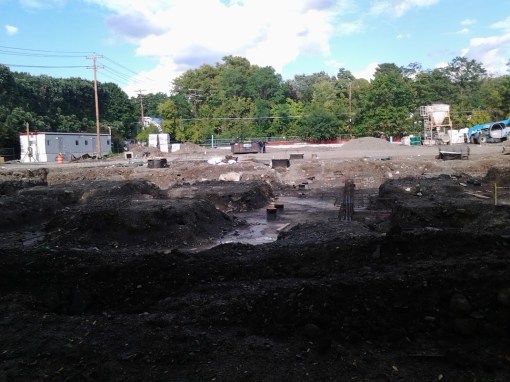
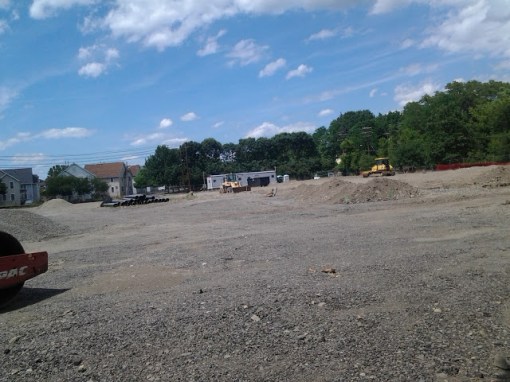
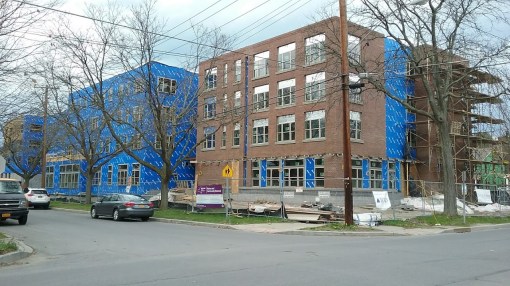
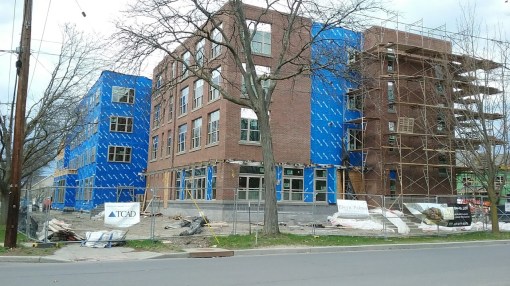
At the 210 Hancock property in Ithaca’s Northside neighborhood, site prep is taking place. The site is being graded and excavation is now underway for subsurface utilities installation (water and sewer pipes, the teal tubes stacked in the photos). INHS is conducting vibration monitoring while all this goes on, although the pile installation won’t start for another couple weeks, running foe about three weeks, mid-late August to mid September. Contractor Lecesse Construction will be installing 10-15 piles per day with a hydraulic hammer, between the hours of 8 AM and 4 PM. If the Voice’s Facebook inbox during the demolition phase this past spring was any indication, some very zealous neighbors will be providing breathless live coverage.

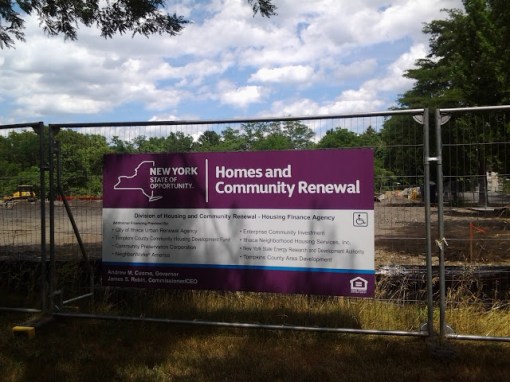
All in all, the contractor issue set INHS back about three months, but the grant funding is accommodating and rental agreements won’t be signed until the project is much closer to completion, late spring or summer 2017. For those who meet the affordable income brackets (breakdowns here), the rental interest form is here. The 54 apartments and the 5 rental townhomes should be ready to go by this time next year.

20160717_143140 20160717_143212 20160717_143239 20160717_143304 20160717_143318

20160717_143202

inhs_pride_design_v5_3 inhs_pride_design_v5_2 inhs_pride_v3_elevations_1

inhs_pride_design_v5_1


News Tidbits 7/23/16: Movers, Makers, Shakers, and Breakers

23 07 2016

1. Hitting the market late last week – a small office building with potential. 416 Elmira Road is located on the southern edge of the big box district, right next to the “bridge to nowhere” and a little before Buttermilk Falls. Built in 1988, it’s a one-story 4,000 SF building on 0.32 acres, inoffensive to the eye but fairly humdrum with a CMU exterior. The current owner is a spinal surgeon in Delaware who picked it up in 2009 for $500k. Previously, the building served as the local office for a state agency.

One could pick the building up if they wanted offices in a high-traffic area, although a few options present themselves. The zoning is SW-3 = SW (SouthWest Area) is a sort of catch-all for business types allowed under Ithaca zoning, with SW-3 geared towards smaller suburban box retail. That is a possibility here, although there wouldn’t be much parking on-site. Housing is an option here as well, although perhaps not appealing since the zoning is capped at two floors with 60% lot coverage. The list price is $585k, we’ll see what happens.
750_casca_1

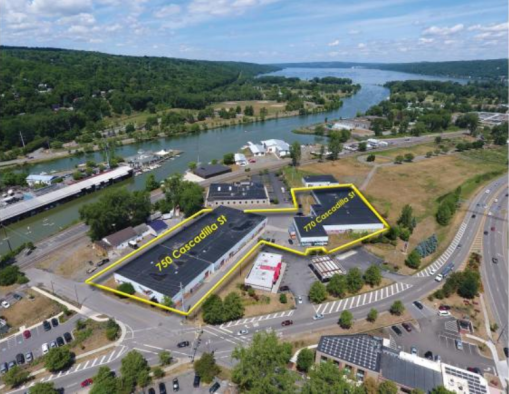
2. …and item number two, hitting the market this past Wednesday, and probably the far more interesting of the two listings in this week’s update. Cornell has put their West End printing facility and warehouse up for sale. The Big Red seems to be trying to rid itself of excess properties in the past few weeks, having recently listed partially-developed land it has off Triphammer as well. The 37,422 SF Cornell U. Press facility at 750 Cascadilla Street was acquired by the university in 1993, and is valued at $1.6 million by the county. The other warehouse, 30,000 SF 770 Cascadilla Street, is leased by a storage company from Cornell, who purchased the building in 2000, and is valued at $1.2 million. The listing is $2.7 million, so these two properties and the 3.12 acres they sit on are being marketed below assessment.

This part of the city has attracted quite a bit of attention as of late. The Maguires are quietly working on their plans for a new set of dealerships to the north and east. Form Ithaca has envisioned keeping the warehouse properties intact, but reusing and renovating them into “maker spaces” as part of an “Innovation District” for food processors, technology firms and light manufacturing. The land itself is zoned industrial, but the city’s comprehensive plan calls for waterfront-focused mixed-use, so in practice the zoning is obsolete, due to be updated as the city continues with neighborhood-specific comprehensive plans over the next 12 months. That sort of creates a grey area where, if a potential buyer has a plan in mind, they’d probably be better off pitching it to City Hall and JoAnn Cornish first, and gauging reactions.

312_spencer_2 312_spencer_3

3. Well, this was pretty quick. Local developer Charlie O’Connor of Modern Living Rentals has secured funding for his 2-building, 4-unit project at 312-314 West Spencer Road, on vacant land subdivided from two existing houses. The two two-story duplexes received a $250,000 construction loan from Bryan Warren of Warren Real Estate on Friday the 15th. Noah Demarest designed the two stacked flat-type apartments, three bedrooms per units. SPR documents stated an August 2017 opening, but with this funding in hand, it might be sooner.

4. Also receiving a construction loan – $450,000 at 322-24 Smith Road in Groton town, the site of a “canine events center“. The Bank of Groton is the lender. The 17,320 SF facility was built last year, so either this is some other site improvement, or the filing is really late. Also, canine event centers are a thing. The more you know.

201_college_v5_1
5. This could be called a “scorched earth” approach. Neil Golder has a lawsuit against Todd Fox and the city of Ithaca Planning Board over the 44-unit, 74-bed 201 College project, saying the decision was capricious and that the project should require an Environmental Impact Statement (EIS). The court’s ruling will be released August 8th.

I’ll be frank – while this project matters a lot to Neil, as proposals go it’s a fairly routine midsize ($5 million -$15 million) project, like any of the other Collegetown buildings underway, like Hancock and Stone Quarry, like the Old Library site, the Carey addition or the Hotel Ithaca addition. The board declares lead agency for SEQR/CEQR review, they identify issues, and it’s the applicants responsibility to resolve them to the board’s satisfaction. If that has been done, a negative declaration is issued, and approval can be considered, as is the case here. An EIS only comes into play for projects that pose truly significant detrimental impacts to a large population if the issues aren’t effectively mitigated – hence why Maplewood Park, Cornell’s 880-bed housing development, and the multi-million square-foot Chain Works District are the only two active projects required to complete an EIS. Past precedent suggests Neil doesn’t have much of a case.
We’ll file this with the Times’ write-up about the fight over the Old Library, and the fight over Maplewood. Short summary, everyone’s on the warpath this week.

20150613_175047

6. This week was focused on doing write-ups about the county housing study for the Voice, but that was before the county pulled nearly all the materials offline. Boo, Tompkins. Anyway – here’s a few details from the special needs interviews that I had planned sharing in this update – Catholic Charities has procured a 4-bedroom house, INHS’s Paul Mazzarella says his organization is looking at introducing a new project in 2017, and TCAction has early plans for a second, 15-bed facility, separate from their Amici House project.

7. The town of Ithaca is planning to put out a “request for qualifications for professional services” to conduct an economic feasibility study of the Elmira Road / Inlet Valley corridor southwest of the city.  The official vote to move forward will be at the Tuesday meeting, with bids due by some point in September. The $60,000 study (half town, half NYS ESD) will be an economic feasibility study and development plan designed “to enhance its distinct characteristics by fostering and building on the assets that currently exist, rather than enabling expansion of the city’s urban and regional development”. In other words, the town would like to expand on its idea from the Comprehensive Plan – artisanal and cottage industries, “maker spaces”, some lodging and light industrial. We’ll see what they come up with, which will have to relate to the new form-based code the town is planning to implement.

trebloc-future
8. Fairly light agenda for the city planning board next week – not a whole lot of decision making expected.

1.        Agenda Review     6:00
2.        Privilege of the Floor    6:01
3.        Site Plan Review

A. Rooftop telecommuncation facility on top of Island Fitness – Declaration of Lead Agency, public hearing, Determination of Environmental Significance, Consideration of Preliminary & Final Site Plan Approval
B. 201 College – “No Action — Applicant’s Response to Site Plan Review Issues”. Originally this was supposed to be final site plan approval, which may or may not be impacted by the whole lawsuit spiel.
C. City Centre (shown above) – “No Action — Applicant Response to Planning Board Comments”
D. SKETCH PLAN: Amici House — Tompkins Community Action Expansion at 661-711 Spencer Rd – I had heard this one might be four floors, and INHS has a hand in it. We’ve seen the site plan for a while now, so this isn’t going to make a big splash.