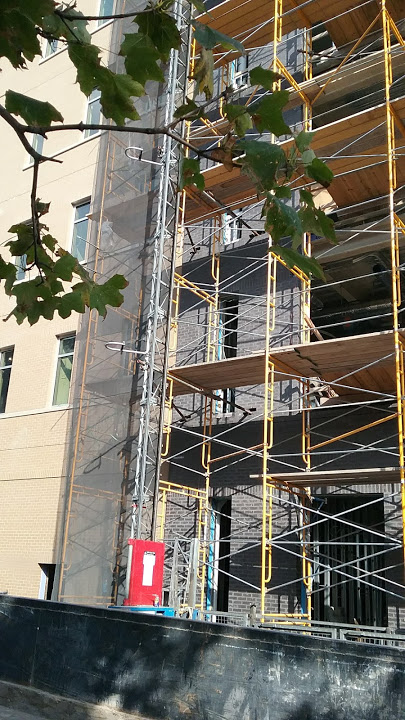
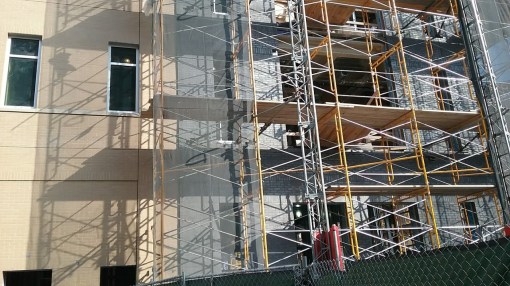
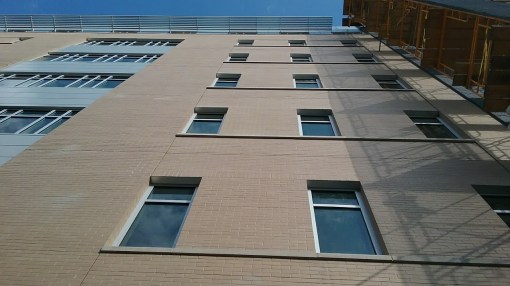
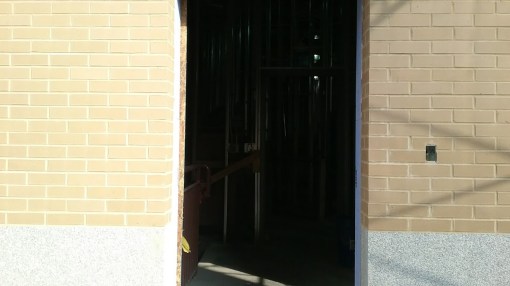
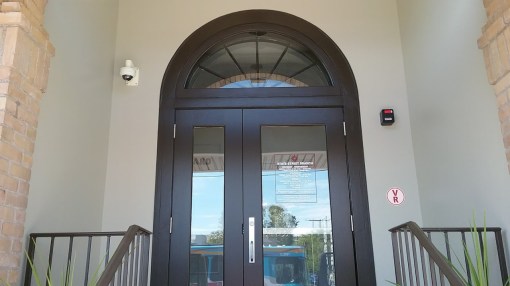
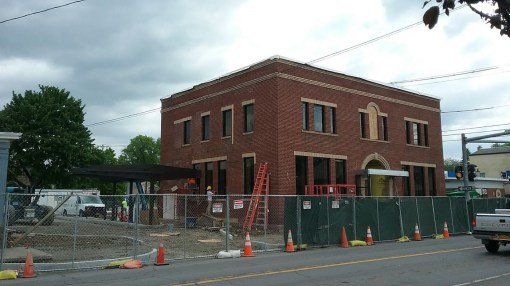
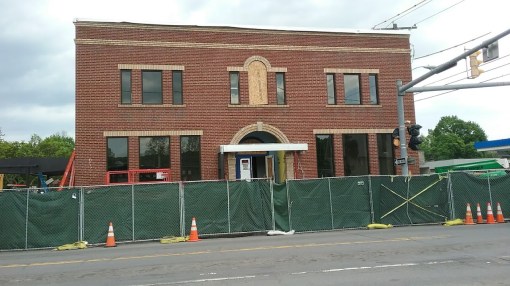
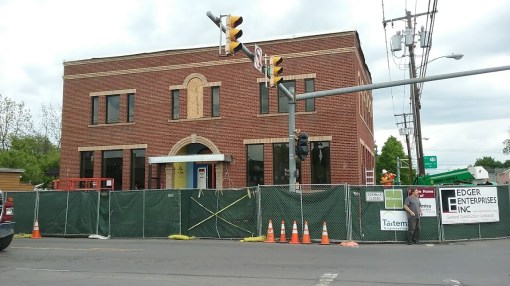
Cayuga Medical Associates Construction Update, 11/2017

8 11 2017

According the the federal Bureau of Labor Statistics, medical and educational services are the largest component of Ithaca’s economy, and among its fastest growing. While the colleges are growing incrementally, medical services have boomed as people live longer (up 5.2 years in Tompkins County from 1980-2014), and Baby Boomers’ need for medical services grows – Cayuga Medical Center has added several hundred jobs in the past decade alone.

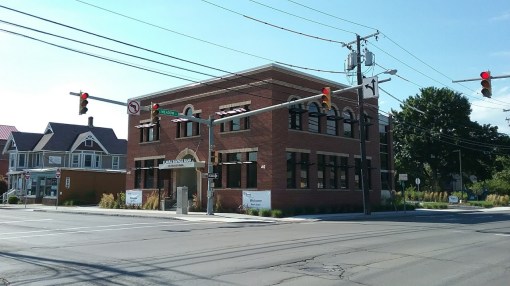
In March 2016, Cayuga Medical Associates, a for-profit business partnered with Cayuga Medical Center, announced plans to build an outpatient facility at Community Corners, an early-suburban style shopping and office center located at the five corners intersection of Cayuga Heights (the official project address is 903-909 Hanshaw Road). While the core of the plaza dates from the late 1940s, additions such as the Chemung Canal branch and the renovated Island Fitness gym branch have been built in the past several years. CMA had been looking for sites in northeast Tompkins County, and found that Community Corners was the best choice for their needs.

Initial plans called for a 3-story, 39,500 SF building designed by local architecture firm HOLT Architects, which has a well-known specialty in highly technical medical structures. the first floor would host cardiology and cardiac care services (later revised to neurological services), and internal care (prevention, diagnosis and treatment of adult diseases) on the second floor. The third floor was still rather speculative when first proposed. The building was expected to host about 72 staff and 400 patients per day. The project was going to be a bit of a slog – Cayuga Heights has what’s likely the most stringent planning board of any municipality in Tompkins, and the project would need variances for height, setbacks and lot coverage. Landscape architecture firm TWMLA’s Kim Michaels would represent owner Tim Ciaschi and the project team at meetings.

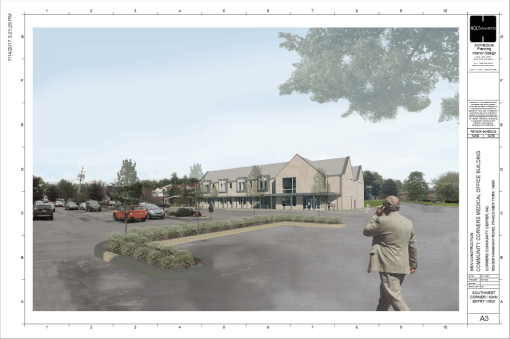
After a few months of back and forth, it became clear the the village was not going to be comfortable with the 3-story plan, and having no tenants locked down for the top floor, the scale of the project was decreased to 2 floors and 28,200 SF (23,200 SF lease-able space) in July 2016. Now only expecting 300 patients per day, the variances needed were generally more minor – while the height was contentious, a few percent over the maximum lot coverage isn’t as much of a concern. The village has eyed a denser, mixed-use Community Corners, if not necessarily the traffic and people that go with it; neighboring property owner Mark Mecenas has been mulling over plans for several years. The more modern-looking original design was replaced by one that better fit the plaza’s 1940s building, with gables and dormers.

Although concerns were raised over traffic, aesthetics, and those who felt Community Corners was the wrong place for a medical facility (they wanted street-level shops with condos above), the board was reasonably pleased with the changes, and after a few more months of SEQR review, the project was approved in November 2016. However, it was approved on the stipulation that parking demand mitigation measures be prepared and approved by the village first, as well as a customary submission of planned exterior finishes. Since parking had been underused at the rear of the site, only fifteen parking spaces are being added, for a total of 300, which brings it close to capacity (estimated daily use upon full occupancy was 262 spaces for the 3-story version). The submitted and approved parking plan allows for a small amount of overflow into neighboring lots, a partnership with the Gadabout bus service for seniors, talks with TCAT and a shower station for those who wish to bike to work. The parking plan was approved by the village back in August.

Along with the building, the project provides revised internal circulation with new driveways and sidewalks, landscaping, and stormwater facilities.  A one-story 1950s office building and a 1960s former Tompkins Trust bank branch were demolished to make room for the new building. The exterior will be faced with off-white brick and a grey brick header course, with a metal roof and aluminum windows. Current plans call for the building to open during summer 2018.

According to county filings, Chemung Canal Trust Company is providing the $7.8 million construction loan. McPherson Builders of Ithaca is the general contractor, which is offhand the largest project I can recall for which a local firm has served as GC. Along with HOLT Architects designing the building and TWMLA doing the landscaping, Ithaca’s T.G. Miller P.C. provided civil engineering and surveying work.

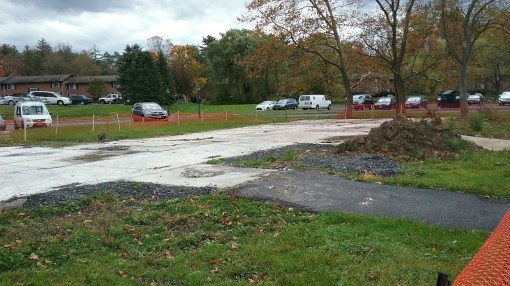
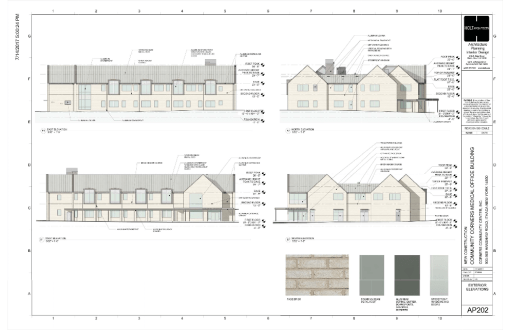
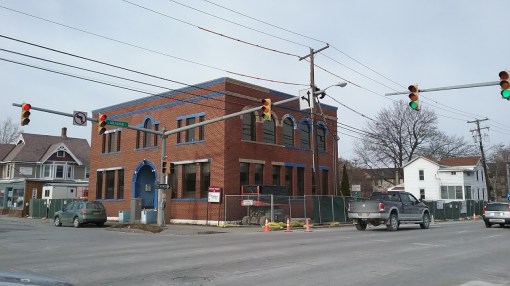
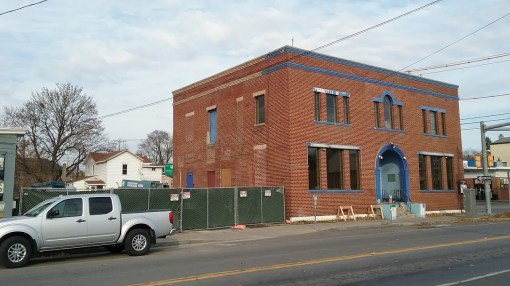
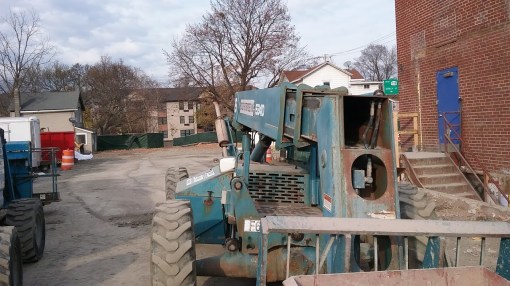
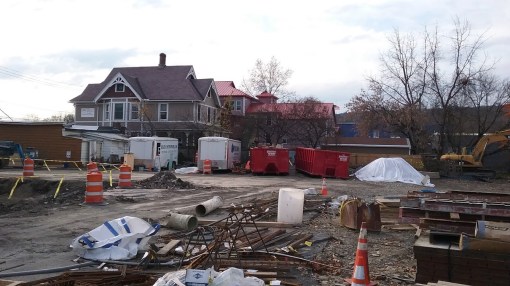
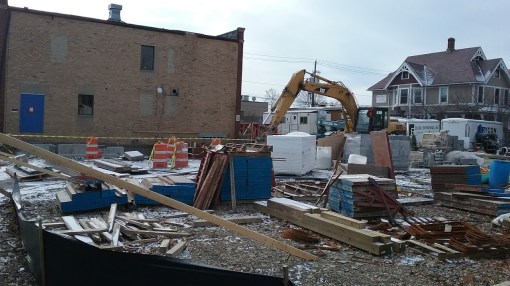
As of the end of October, demolition of existing structures has been mostly completed, with only the slab foundations remaining. The new building will also use a slab foundation, four feet thick according to the elevation drawing below.

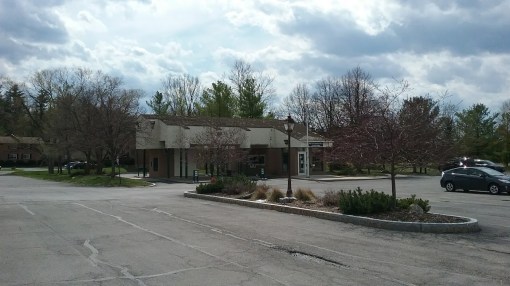
Pre-development, April 16th 2017:

October 24th, 2017


August 2016 revision. The version approved in 2016 used fiber cement boards, later revised to brick.


Tompkins Financial Corporation HQ Construction Update, 10/2017

27 10 2017

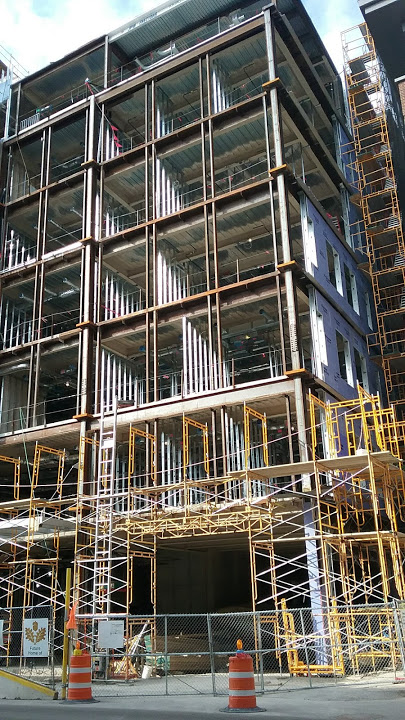
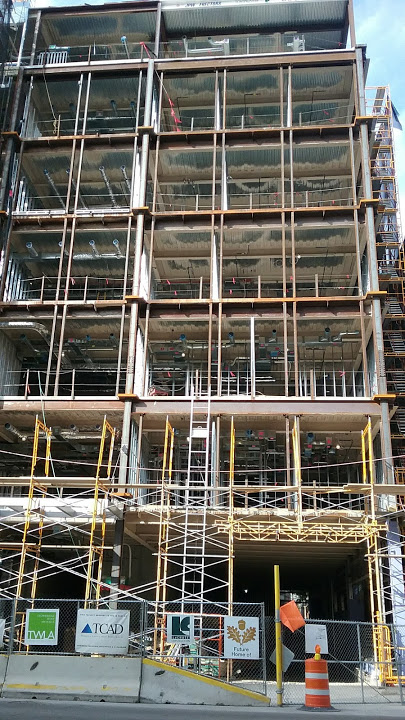
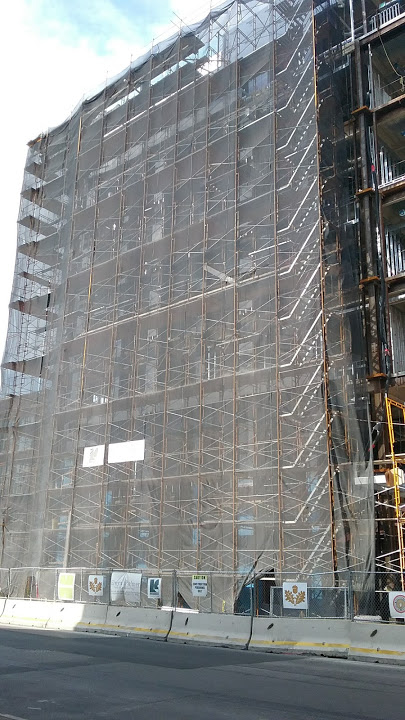
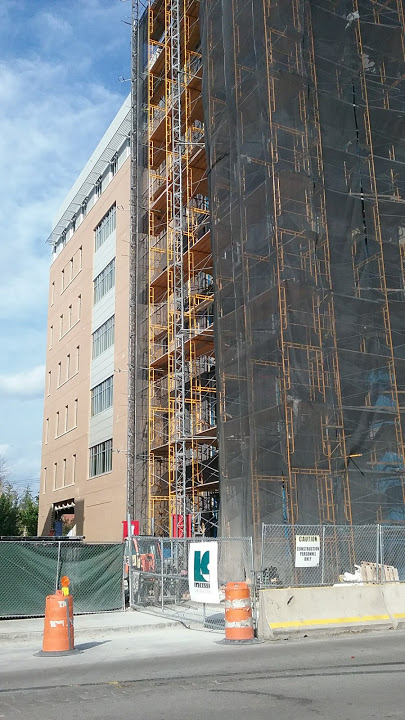
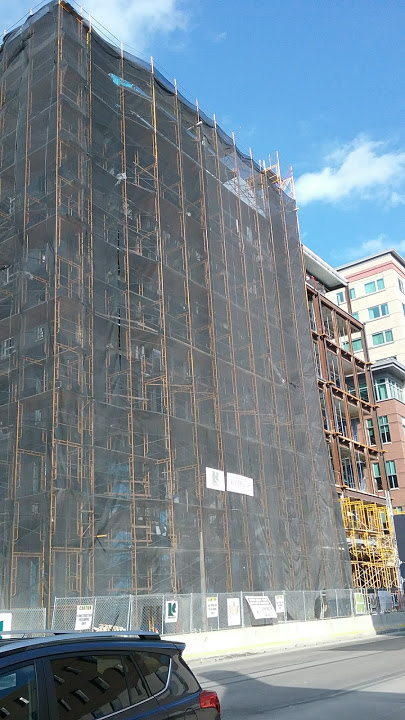
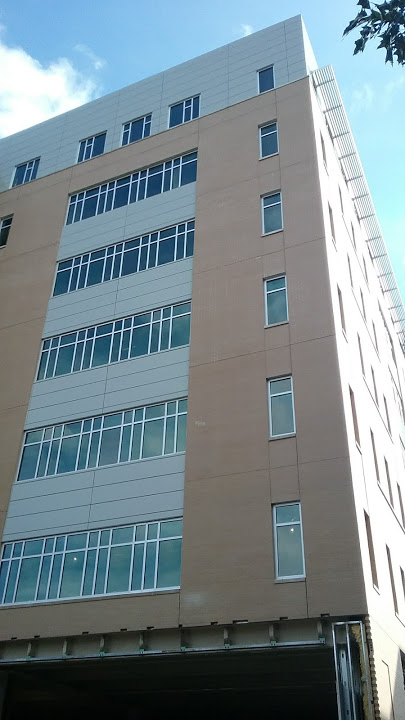
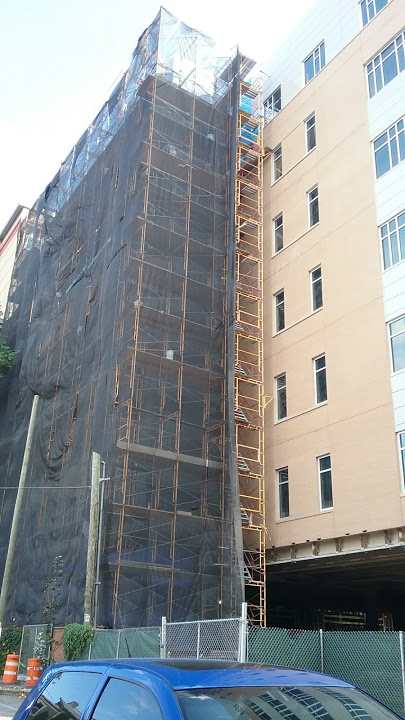
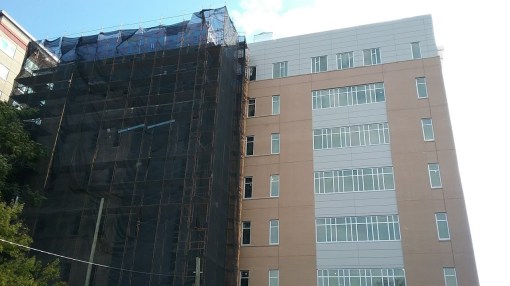
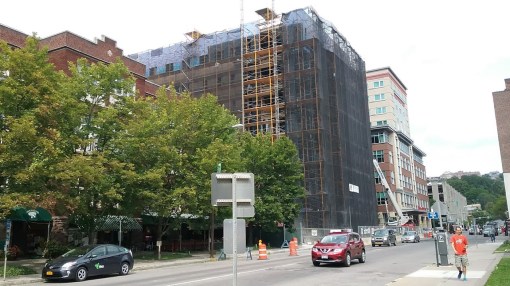
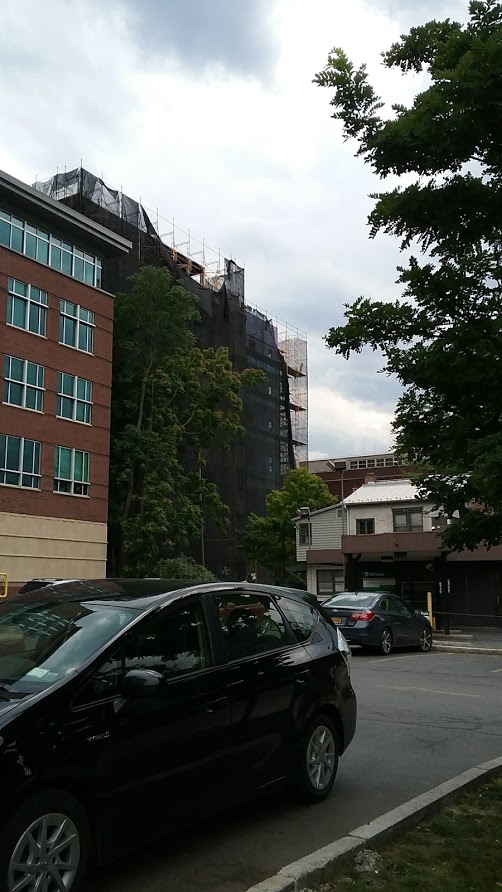
Work continues on the new Tompkins Trust office tower in downtown Ithaca. The official topping-out, which means that the building has reached maximum structural height and framing is complete, was earlier this month. U.S. Gypsum sheathing can be seen on the east and south (front) sides, with fireproofing and interior stud walls clearly visible from street level. You can see some of the HVAC rough-ins on the lower floors. Meanwhile, on the north (rear) and west faces, the exterior facade has been bricked and paneled with aluminum metal, tan brick, dark grey brick, stone sills and aluminum window fittings. It’s a little surprising the sunshades are already up, since exterior details typically don’t come until later in the construction process – and it’s clearly not that far along, given the rough openings still present at ground level. The base will be finished with brick and granite.

To be honest, I was concerned the back side would end up looking cheap, but it seems to be coming up nicely, but I’m holding off on final judgement until I see how the rear stairwell turns out.

About the biggest change at this point is that the $31.3 million, 110,000 SF building may not be finished and completed occupied until mid-May 2018, two months later than initially planned.


Tompkins Financial Corporation HQ Construction Update, 8/2017

25 08 2017

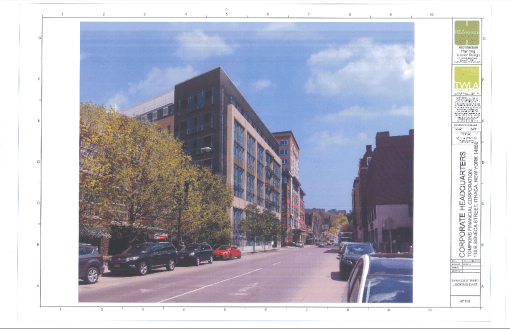
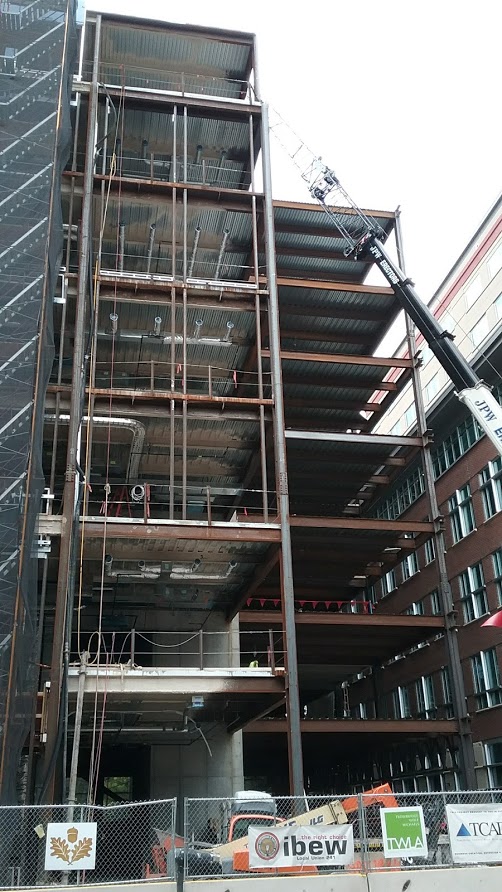
At the new Tompkins Financial Headquarters under construction at 119 West Seneca Street downtown, it looks like most of the structural steel has been erected, and gypsum sheathing has been installed over the skeleton. The top (seventh) floor is set back slightly from the lower levels, and will use light colored aluminum metal panels on all sides except the front, which will use black brick and stone veneer. With the exception of the rear stairwell, the side and rear walls will be faced with a tan brick veneer on the lower floors.

Brick veneer can be tricky because it’s porous. Water can penetrate the brick and make its way to subsurface coatings, where moisture can do damage over time. As a result, builders have to use a water-resistive barrier (WRB) between the sheathing and the brick. This can be done a few different ways – with Simeon’s and DiBella’s, for example, they used a polyurethane spray foam.

In this case, it looks like there’s a bright blue-colored vapor barrier being applied over the sheathing, probably Carisle Coating and Waterproofing (CCW) 705 or similar. CCW-705 is a rubberized-asphalt adhesive laminated with a smooth, durable plastic film. Construction crews spray an adhesive (CAV-GRIP) onto the sheathing, and then roll out the air/water barrier sheets over the top, kinda like wallpaper. These unfurled sheets are then pressed over with a seam roller to ensure it’s firmly and completely applied to the building surface.  The edges of the sheets are then filled in with a liquid mastic, which is a putty-like waterproof filler and sealant. Once the surface is completely sealed by the barrier, tie plates are fastened with washers and screws, and the brick veneer is laid over the top, typically with a 2″ spacing for drainage and ventilation. It appears the brick may be underway on the western wall of the building, as shown in the first image below. Meanwhile, the bottom floor looks like a different sheathing material, some variety of Dow Thermax panels (fiberglass embedded in polyiso) from the looks of it.

Based on building elevations and girder brackets, the JPW Erectors crane located at the southeast corner of the site will eventually be replaced with the last steel sections for the building. The steel decking is in, and there’s ductwork for the HVAC rough-ins. Curious to see if they’ll have the building closed up before the first snow flies.

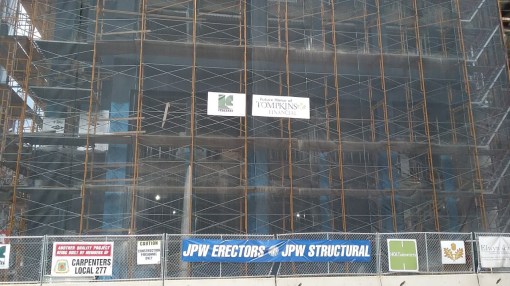
LeChase is the general contractor, and it looks like they have some union crews doing work on site – the Carpenters’ Union Local 277 and the IBEW (International Brotherhood of Electrical Workers) Local 241 have signage up, as do project team members JPW Erectors, Elwyn & Palmer (structural engineering), TWMLA Landscape Architects, and HOLT Architects.


602 West State Street Construction Update, 7/2017

19 07 2017

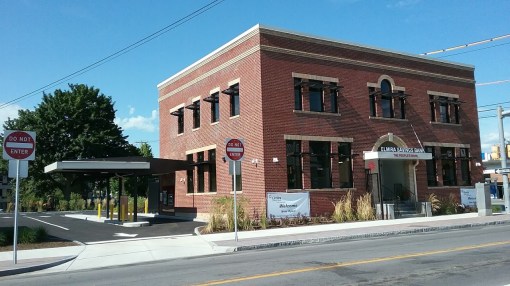
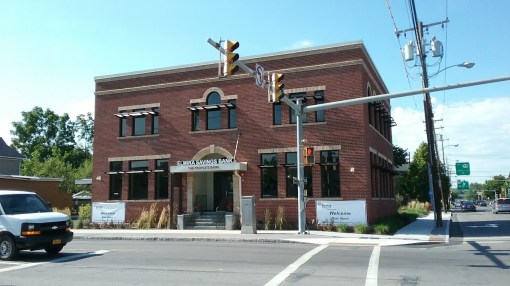
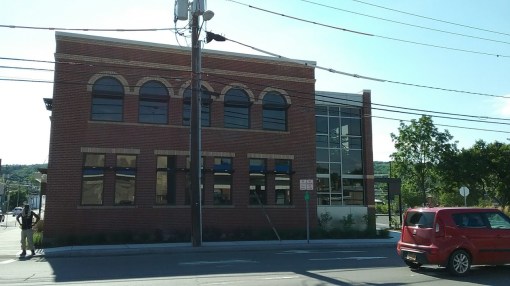
The new Elmira Savings Bank is open in Ithaca’s West End, and this project is done. A former restaurant is now 5,000 SF of renovated space plus 1,600 SF in a contemporary addition. Design-wise, it’s a smart re-use of a century-old structure, modernizing it but maintaining the integrity the original structure. Kudos to HOLT Architects for a successful blend of old and new. Elmira’s Edger Enterprises brought the $1.7 million project from the drawing board and into reality.

There’s no doubt that the project is further proof in the increased vitality and attraction of Ithaca’s long-forsaken West End, and another step on the the path to turning it into a stronger neighborhood. Within just a block, one has the new Planned Parenthood (2014), the 17-unit Iacovelli Apartments (2013), the renovated HOLT Architects office (2016), a gas station renovated into the Jade Garden restaurant (2015), and the new microbrewery opening up in the rear of the Cornell Laundry warehouse.

If there is one thing I wish had gone different with this project, it was the sale of the property and removal of three low-income families. That got ugly, and it tarnished what was otherwise a decent project. The story I’ve been told in the two years since is that the bank were mislead by the previous owner, who gave them old rental paperwork saying tenants were month-to-month, and ESB mistakenly assumed it was still accurate. So there’s something to be said about due diligence and taking a couple hours out to meet with tenants before any notices go out.

The northern end of the property has preserved a few mature trees, and in the long-run ESB would like to partner with a developer, affordable or otherwise, to do something along West Seneca. Plus, there are organizations like Lakeview, who coincidentally looked at doing a development where ESB is nowand are moving forward with affordable housing in the West End. More opportunities for mixed-use plans with market-rate and affordable housing will open up as properties go on the market and Ithaca’s economy continues to develop – and plans like Cayuga Med’s are big if auspicious question marks.

While it’s great to have new housing plans brought forward, it’s also important to maintain existing affordable housing (and programs to assist) while adding those new options. With Lakeside and Parkside scooped up and pushed upmarket, and Maple Hill now market-rate Ithaca East, that takes hundreds of units out of the equation, and this is a significant concern. It’s no surprise that tensions boiled over given the difficulties in preserving existing LMI housing options, and in approving and building new ones.

Anyway, enough with the final thoughts. Enjoy the photos.

Before:

After:


602 West State Street Construction Update, 5/2017

30 05 2017

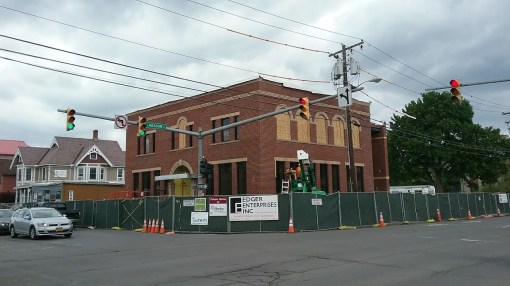
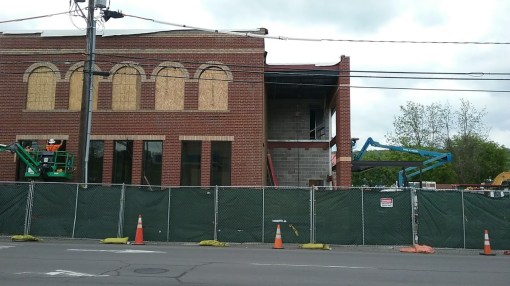
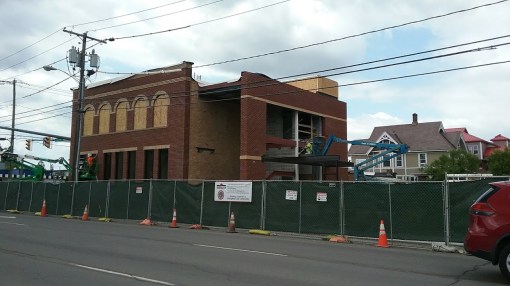
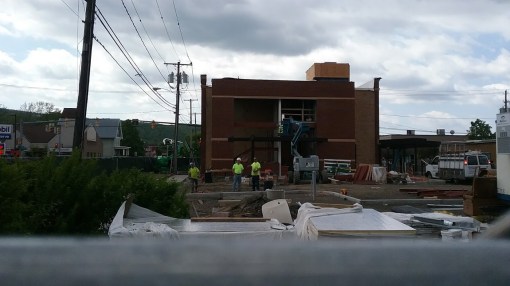
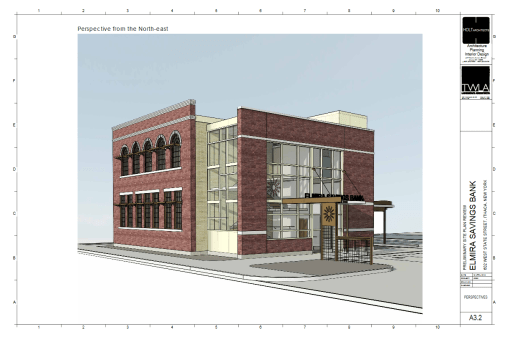
Starting to get a good idea of what the final product will look like at the future Elmira Savings Bank location at 602 West State Street. The structural steel for the drive-thru canopy is up, the new front and rear entrance canopies are being erected, and the new curbing is down. The new north addition has its steel and masonry with matching belt course, but it looks like the new interior stairs have yet to be built (the floor plan of the new addition is basically a stairwell albeit an imposing one, an elevator lobby and the elevator). the two-story opening facing Meadow Street will be framed with metal panels and fitted out with a contemporary glass curtain wall.

The early renders suggested a beige color for the aluminum panels, but according to the final materials submission, the panels will be Alucobond “Anodic Satin Mica”, which most folks would describe as a soft tan/dull tan. The alumnium roof coping, flashing and gutters/downspouts will be Hickman Sandstone, and the stucco will be painted Benjamin Moore Horizon Greyboth are close approximations of the building’s historic paint colors.

Taking a guess, the arched windows have to be custom-made, and given the time that takes, it might explain why they’re the last replacement windows to be inserted. The windows will be fitted with metal sunshades towards the end of the construction period.

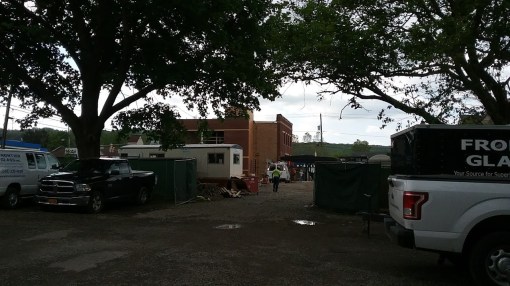
Construction on the $1.7 million renovation/addition (5,000SF/1,600 SF, total 6,600 SF) is due to wrap up in August. Elmira Savings Bank will occupy 3,300 SF on the first floor. The second floor, also about 3300 SF, will host for-rent office space (a little too big for the Voice though, which I’d wager at 800 SF off the cuff). HOLT Architects is in charge of design, and Elmira’s Edger Enterprises is in charge of the buildout. It looks like glazing has been subcontracted to Frontier Glass Inc. of Rochester.


Cornell Veterinary School Expansion Construction Update, 3/2017

26 03 2017

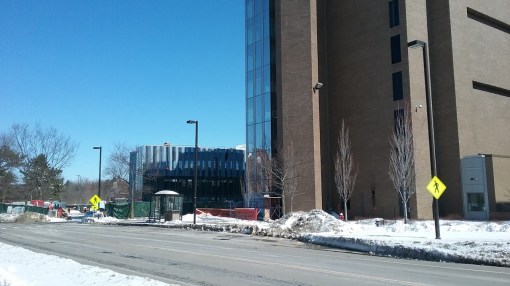
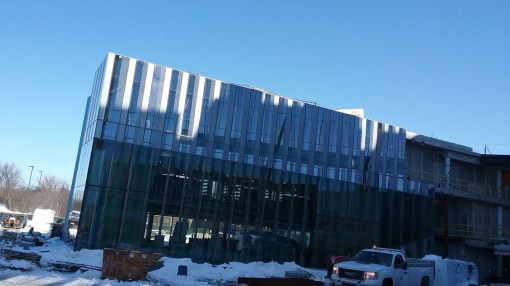
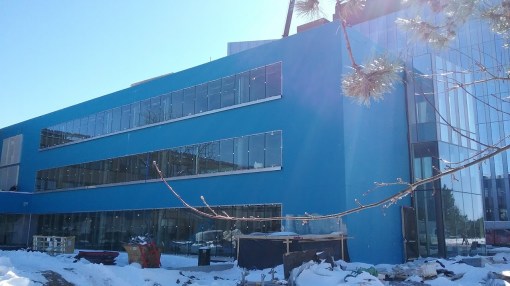
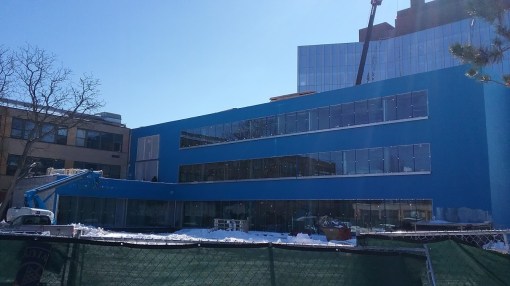
There’s been quite a bit of progress over at the Vet School. It looks like the exterior glass and aluminum are going on the new library and administrative wing. Windows and sheathing have been installed on the north face as well, with a water-resistive barrier applied over the sheathing. The new atrium is being framed out.

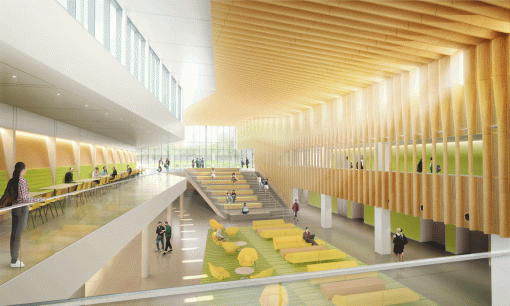
According to the Vet School’s construction update page, interior framing and utilities installations are underway in the new wing, and the new cafeteria is under construction – both are aiming for August completions. The new atrium and lecture hall will be closed off shortly, with interior work to launch in earnest once that occurs.

Thanks to Maria Livingston over at HOLT Architects, readers now know what the new Community Practice Service building will look like. Syracuse’s G. M. Crisalli and Associates Inc. has been selected as general contractor, and construction for the $7 million, 12,000 SF wood-frame structure is expected from March 2017- March 2018.


News Tidbits 2/11/17: Cooperation Required

11 02 2017

107_s_albany_rev_1

1. It looks like the plans for 107 South Albany Street are getting a major revision. Readers might recall that previously approved plans called for a rear addition onto an existing house to create a 9-unit, 11-bedroom apartment building. The latest plans are a little more substantial.

For one thing, the existing house would be no more under the new plan. In its place looks to be a 3.5 story, 8,427 SF, 11-unit apartment building, all one-bedroom apartments. Developer Stavros Stavropoulos has once again turned to local architect Daniel Hirtler for design work; for each of them, this is the largest project they’ve worked on to date. Hirtler came up with a design that offer contextual features like a cornice and an orthodox window arrangement, but adds a modern vertical stair element in the middle of the structure to keep the design from being an imitation. Zoning is CBD-60, so no parking is required, 100% lot coverage is allowed, and the 40.5′ proposal is comfortably within the 60-foot height limit.  According to the SPR filing, the construction cost will be about $900k and the construction period will be from September 2017 to June 2018.

As much as I dislike seeing attractive old houses come down, the new design fits well into an older urban context. Plus, if the medical practice on State ever gets redeveloped, 3.5 floors offers a nice transition to the lower-density structures further south. I’m not a super big fan of the blank wall next to the recessed entry, although the intent is to make it interesting with light fixtures, a brick pattern and an iron trellis that will be grown over with vines. Fiber cement will be used on the upper floors, with brick veneer and granite accents at street level.

On another note, it looks like the city will be looking at a one-lot subdivision next month at 109 Dearborn Place in the Cornell Heights Historic District – the owners, a married couple who are renovating the old PRI into a historically appropriate two-family residence, are looking to sell some of the land as part of the “partnership dissolution”. The PRI renovation is expected to continue. The application says a house was previously located on the undeveloped portion of the property (a glance at old maps indicate a schoolhouse was located on-site in the 1920s). It’s worth noting that the wife is also the owner of Bridges Cornell Heights, a high-end senior living facility on the next block. Bridges previously subdivided a Cornell Heights lot in 2005 to build a second residence to serve its deep-pocketed clients. Any new house would need to go through ILPC review.

323_taughannock_townhouses_2

2. Meanwhile, the Ithaca Common Council had their monthly Planning and Economic Development Committee meeting. It looks like the revised 323 Taughannock project has been caught up in the TM-PUD, so it will have to get Common Council approval. Apart from a certain councilor’s general objections to housing near or on the waterfront, this one isn’t likely to stir up much controversy. The construction timeline for Steve Flash’s 8-unit , 16,959 SF owner-occupied townhouse project is June 2017 – January 2018, with an estimated value of $2-$3 million. Potentially, there could be 16 units, since each townhouse comes with a live/work space that could be converted to a separate studio apartment unit.

Also included at the meeting was a session on electric car infrastructure, votes to send laws allowing dogs in Stewart Park and a temporary altar to the Common Council, votes to circulate a zoning amendment to allow brewpubs in business zones, and a discussion of tree plantings. The Maguires also discussed possibly shifting their project to Southwest Park behind Wal-Mart, which is covered on the Voice here.

3. The city of Ithaca has been awarded funding to build a replacement bridge for North Aurora Street over Cascadilla Creek. Continuing the city’s heavy infrastructure investments of the past few years (for instance, the bridges as Lake Street, East Clinton Street, and the work planned for Brindley Street/Taughannock Boulevard), the state is giving $1.178 million towards the replacement span. Engineering work and public meetings will take place in 2017 and early 2018, with construction and completion by 2019.

maplewood_v7_3

4. Over in the town of Ithaca, final approval has been granted to Cornell and EdR’s Maplewood project, meaning that everything is good to go and barring any unforseen circumstances, the 441-unit, 872-bed complex should be open for graduate and professional students by the end of July 2018. The difference between preliminary and final approval is that in preliminary, the concept is greenlighted but there needs to be additional filings completed – tree planting schedules, revised labels on diagrams, construction staging plans, and proof of final approval from the city for their portion. For those who are wondering, the 150-200 workers on-site will be parking at a temporary lot behind the Kinney Drugs at East Hill Plaza, and will be walking the five minutes down Mitchell Street to get to the job site. The first building should start to rise in late Spring of this year, with new structures rising in stages as we go through the rest of 2017.

rodeway_revision_1

The town planning board also reviewed revised plans for the Rodeway Inn at 654 Elmira Road, where the old wings will now be torn down and rebuilt on the same footprint and an enclosed corridor will be built into the new wings. The final result will have a net increase of four motel rooms, to 44 (the previous plan added only two motel rooms). The plan for renovating the single-family home on the property into a community center is unaffected by these changes and moving forward as originally planned.
20160918_151026
5. It’s been behind schedule a few months, but DiBella’s Subs is expected to open at 222 Elmira Road on February 16th.

thecomputingctr_2

thecomputingctr_3

6. It seemed a little odd when The Computing Center stated in their IDA application that their plans had already been approved, and there was nothing on file. Turns out they’re hoping to get approval for their 4,600 SF HQ from the town of Lansing next week.

The full suite of documents can be found on the town of Lansing’s website here. It looks like the farmhouse next door to 987 Warren Drive will be spared from the wrecking ball; although The Computing Center bought the property, it’s being subdivided and the barn-turned-garage is the only building that will be torn down. Lansing has one of the more lenient planning boards, so although this probably won’t be fully approved next week, there’s a good chance this project will receive final approval by the end of March.

204260_56b8b8a8c98ee1-47810900_full

7. Over on West Hill, a large vacant parcel on Bundy Road just exchanged hands. The 66.98 acre parcel has been marketed for the past few years as a development opportunity – it has municipal water and sewer, and it’s a stone’s throw from Cayuga Medical Center, Overlook and the Conifer/Cornell developments off of Route 96/Trumansburg Road. Its previous ownership, a family that has owned it in some form since 1964 (moving between members in 1984 and 1991), had it on the market for $359,900.

The buyers, a husband-and-wife pair of medical doctors who live nearby, paid $305,000 for the deed, according to a filing on the 9th. An online search for future hints doesn’t really give much guidance – the doctors have donated modest amounts to Finger Lakes Land Trust and have signed some anti-fracking petitions, and while they own undeveloped properties around them, this parcel isn’t adjacent to their house. It doesn’t really fit the Land Trust’s ideal land donations either, since it’s been substantially subdivided with medium-density residential, and borders a growing corridor. So, it’s hard to gauge just what exactly is planned here. For the record, the land is currently zoned medium density residential (max 3 floors, up to 2.9 lots/acre), but the town’s new comprehensive plan sees the property as new urbanist medium density (5-8 units/acre small-scale mixed-use), with undeveloped open space towards the southwest corner of the parcel.
cornell-project-dsun

8. Let’s finish this week off with a talk about energy. Good news first – there might be a solution to the West Dryden pipeline issue. Background here, but the nutshell is, Lansing has tapped out their natural gas capacity, and in order to accommodate new development that would need natural gas, NYSEG needs to build a higher capacity pipeline from their current facilities in the town of Dryden. This new pipeline would go along West Dryden Road, but has run into fierce opposition, mostly because Dryden residents are famous for being anti-natural gas – this was the town that took on the fracking companies and won. Keep in mind, these folks aren’t just disdainful of natural gas, they are adamantly opposed. So using their property to accommodate something they don’t like is a bit like asking to build an abortion clinic next to an evangelical church because that just happens to be where the land is cheapest, but they would have to share a driveway.

Unsurprisingly, the town of Dryden enacted a moratorium on large-scale pipeline installation. The town of Lansing is not happy because it stymies their development, and they’re extra-concerned that their biggest property taxpayer, the Cayuga Power Plant, is about to go belly up and leave the town with $100 million less on its tax rolls. The county wants to move away from fossil fuels, but it also wants to encourage development and not leave Lansing in the lurch.

This week, a plan was put forth that might accommodate both needs. A small compressor station would be built to keep pipe pressure from falling too low during times of peak demand, so that guarantees service for existing customers. The second prong is to wean existing development off natural gas and encourage new development to use other means – electric heat pumps, like those to be used in Maplewood and City Centre. This encouragement would be given through subsidies or tax breaks. The compressor station and the incentives would be in effect by late 2018.

It looks promising, but the feasibility studies are still ongoing, and Lansing is not totally on board. Both Lansing Village and Lansing Town feel they were not represented during these discussions with NYSEG, and that heat pumps are a major financial burden to saddle homebuilders with. They also wonder if the electrical grid would be capable of supporting so many heat pumps.

Speaking strictly from my experience, I’ve visited construction projects with heat pumps, and while they are a cost increase, it’s a couple percent more than the same structure with conventional heating – there’s a recently-built single-family house I can think of offhand where the cost of heat pumps was about $5,000 more on the $200,000 construction cost. If it’s incentivized, one could make it financially sensible, at least for residential options if not all. Also, I’m wary of Lansing’s reasoning because they piddled away the three town center projects five years ago – if they had stayed on top of it, they’d have $50 million more in property value and this wouldn’t be such a pressing issue now.

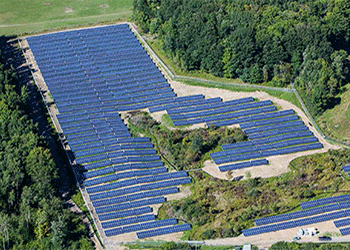
That being said, there are problems with this area’s approach to alternative energy. Newfield is the big culprit here – they’re about to put in a moratorium on commercial solar panel installations, which is worrying since this is the same town that redesigned their wind turbine law to ban them in essence. If municipalities are limiting residents’ abilities to turn to alternative energy sources (many urban areas have to turn to commercial arrays or turbines because there’s not enough room/too much demand on-site), then the community will be unsuccessful in weaning the population off of fossil fuels. But Dryden, which is in the process of changing their laws to accommodate large-scale solar arrays, is at the forefront of this issue – those panels could provide the electricity for the heat pumps and help turn the tide on energy sources. It only works if everyone cooperates.



602 West State Street Construction Update, 1/2017

13 01 2017

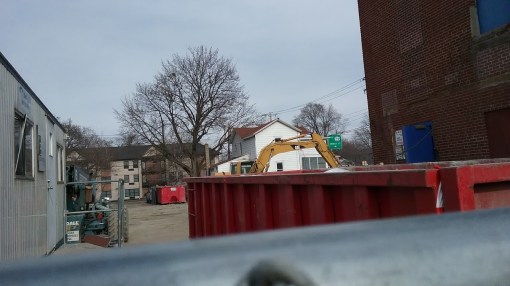
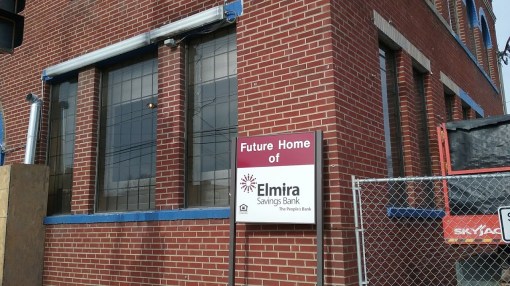
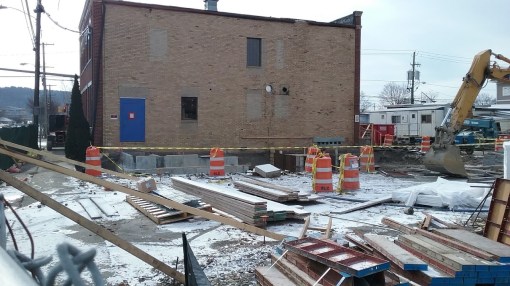
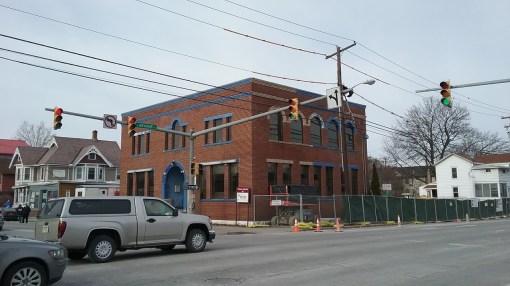
With the sidewalk along Meadow St closed off, getting up close to the Elmira Savings Bank project just became much more difficult. From the front, there hasn’t been much exterior work yet – judging from the dumpster, Edger Enterprises has been more focused on gutting the interior of the hundred year-old building. It does look like that, since November, some of the historically inaccurate blue paint has been stripped from the east facade. It doesn’t look like there’s been much progress on the new wing on the north side, the foundation looks about the same at it did two months ago. Dunno if they’ll be hitting that March 2017 completion date.

More info about the project can be found here.

20170107_114207 20170107_114322 20170107_114328 20170107_114404 20170107_114448 20170107_114515 20170107_114552 20170107_114603 20170107_114747 20170107_114801 20170107_114856


602 West State Street Construction Update, 11/2016

29 11 2016

It’s been a busy period for construction starts. Elmira savings Bank has started work on their new branch office at 602 West State on Ithaca’s West End.

The project itself isn’t controversial. But the $1.75 million purchase in December 2015, followed by the very controversial eviction of three low-income families so that their homes could be turned into parking lots…well, that didn’t go over very well, nor should it have. Now with the chance to do some retrospective, it appears that the primary malefactor was the previous property owner, who signed new leases with the tenants but didn’t tell Elmira savings Bank when he sold them the properties. Elmira Savings Bank could have saved themselves many headaches if they had done some due diligence by meeting with the tenants of the properties they were purchasing, but, live and learn, sometimes the hard way.

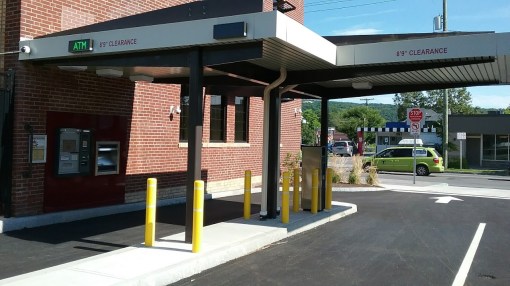
Plans call for renovating the 5,000 SF building that once housed the Pancho Villa restaurant, a 1,600 SF addition on the north side of the building, and a new drive-thru for bank customers. 16 parking spaces will be included. Edger Enterprises of Elmira will be the general contractor for the $1.7 million project, which is expected to be completed in March 2017. HOLT Architects, headquartered just across the street, is the design firm on record. The primary change during the review process was to limit the house demolitions – the board strongly encouraged ESB to find a partner to develop those lots rather than convert them to parking. At the moment, one of the houses has been torn down to make way for the drive-thru, but the other two will be left as-is and vacant for the time being.
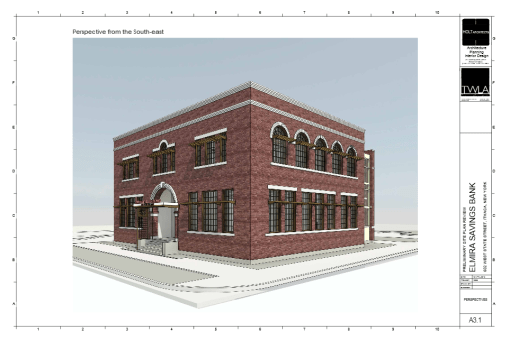
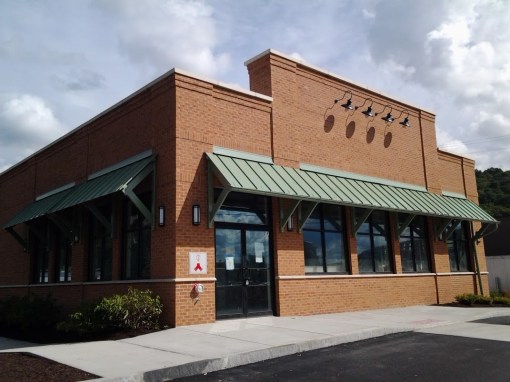
The new addition will incorporate a limestone base, red brick similar to that of the existing structure, Alucobond anodic satin mica colored metal panels above and below the aluminum window curtainwall, and Hickman sandstone-colored metal roof coping. The blue painted brick will be restored to more historically accurate grey-green, and the bricked-in windows will be restored. Bronze-colored metal sunshades will be installed over the windows, and the steel drive-thru canopy will be the same color. The roof will be a white single-ply membrane.

In the construction photos, the new addition has had its foundation excavated and it looks like the concrete is in the process of being formed and poured, with subsurface utility lines poking out in the excavated, yet to be poured portion. The small windowless addition and fire escape on the western wall of the existing structure have been removed as the building advances through renovation – the first and second-floor doors will be replaced with appropriately-sized and historically-accurate windows to match the bricked-in window towards the front.

20161119_135025 20161119_135052 20161119_135127 20161119_135139 20161119_135150 20161119_135156 20161119_135215 20161119_135225

elmira_savings_v2

esb_1 esb_3-1


Previews and Reviews From the AIA Design Crawl

10 10 2016

Last Friday, several Ithaca-area architecture and engineering firms banded together to co-host an open house night at their locations across the city. Here are some of the latest and greatest plans are from some of the local designers.

The first stop was John Snyder Architects in Ithaca’s West End. On display were the Carey Building plans and other recent works, like the internal renovation of the South Hill Business Campus for CBORD.

The second location on the list was HOLT Architects at 619 West State, which was probably the most family-friendly of the hosts, based off of the pizza bar and the children’s play-room. HOLT had several new and in-progress projects they shared with the public that evening.

20161007_175436 20161007_175444

The Computing Center is looking to move out of the Cornell Business Park and into a new property to be built at 987 Warren Drive in the town of Lansing. The property is currently a two-story farmhouse and includes a vacant lot on the corner of Warren Road and Warren Drive, purchased by its current owner (an LLC) in December 2014. The new building appears to be a one-story structure.
20161007_175504 20161007_182158
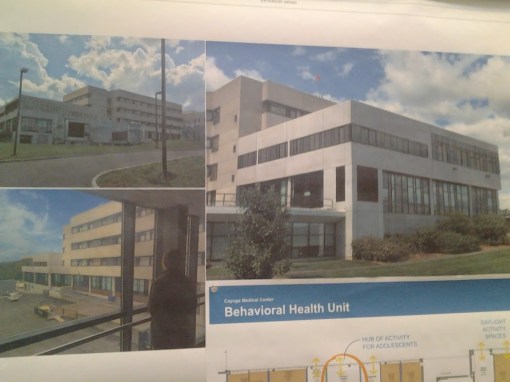
HOLT is arguably the local specialist for medical facilities and lab structures. Here’s a pair of projects recently completed at Cayuga Medical Center. The Surgical Services Renovation is a renovation and addition that includes space next to the front entrance, creating a new “face” for the complex. The Behavioral Health Unit is an addition on the northwest side of the building, and isn’t visible from most nearby roads and structures.

20161007_182103
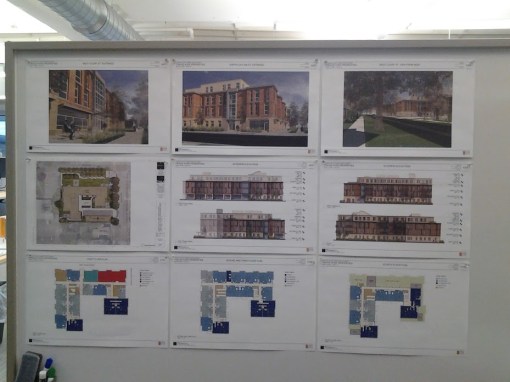
The online version of these will be showing up in the Voice soon enough, but here are the latest design plans for the Old Library site. The indoor parking was eliminated so that the fourth floor could be set further back, and the entire building has been pulled away from West Court Street. The building still has 57 apartment units for the 55+ crowd.
The next stops were at Taitem Engineering and SPEC Consulting. Taitem (which stands for “Technology As If The Earth Mattered”) serves as structural engineering for many local projects, focusing heavily on renewable energy sourcing and energy efficiency. The focus of their open house was a tour of their LEED Platinum, 120-year old building at 110 South Albany Street, which they said was only the fourth renovation of its kind to achieve Platinum designation. I snapped a photo of Taitem’s staff, but that was taken for the IV Twitter account.

SPEC Consulting had on display a couple of home renovations they have underway, a mixed-use building in Johnson City, as well as rehab of a vacant commercial building in downtown Binghamton into a 70-unit mixed use building. To be honest, I was more focused on the personal than professional when I was at SPEC – I ran into someone I knew from undergrad whom I hadn’t seen in nine years, who apparently settled in the area and married a SPEC architect.

20161007_193020

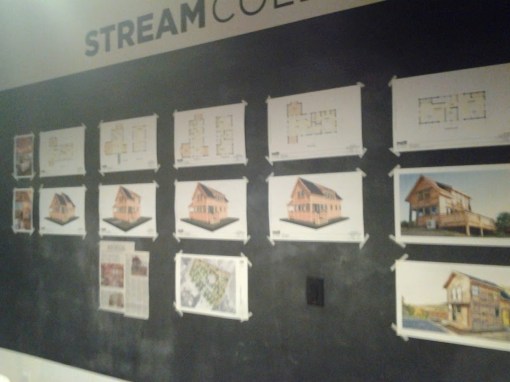
At STREAM, several projects were on display – 201 College Avenue, State Street Triangle concept drawings, and a room showcasing Tiny Timbers. According to Noah Demarest, this was the first time they had shown all the home plan designs together. Also there was Buzz Dolph, the entrepreneur behind Tiny Timbers.

Not shown here but on display were a pair of attractive design concepts for CR-4 zoning in Collegetown. They might become more than concepts at some point.

20161007_211521
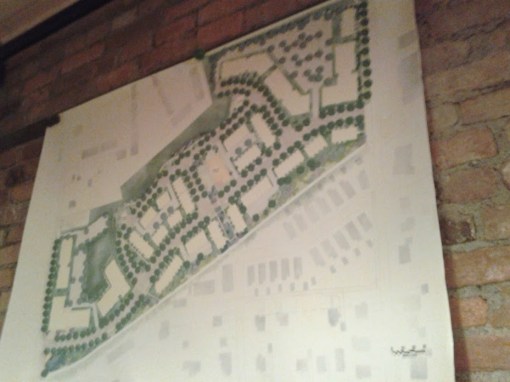
This is the latest Maplewood site plan, courtesy of Whitham Design and Planning. Here are the two big changes (previous site plan here) –

1. The Maple Avenue building has been broken up into two separate buildings.
2. Townhouses sit on Mitchell at the southwest corner of the site, replacing the multi-story apartment building previously planned.

The number of beds, previously 887, has probably decreased a little bit as a result.

I did not make it to Chiang O’Brien Architects, unfortunately. It looks like from their website they have a new project underway at SUNY Oneonta.