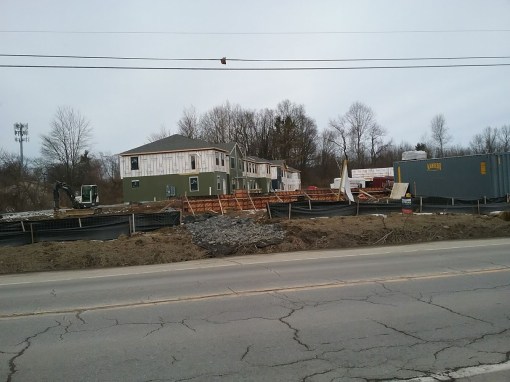
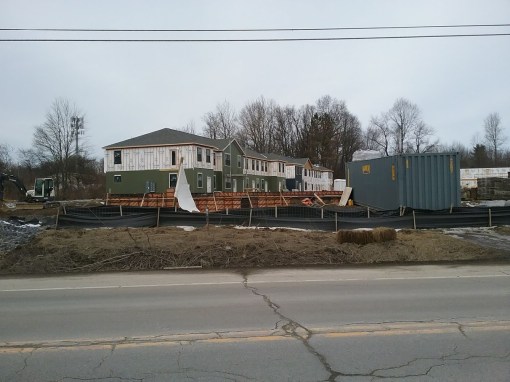
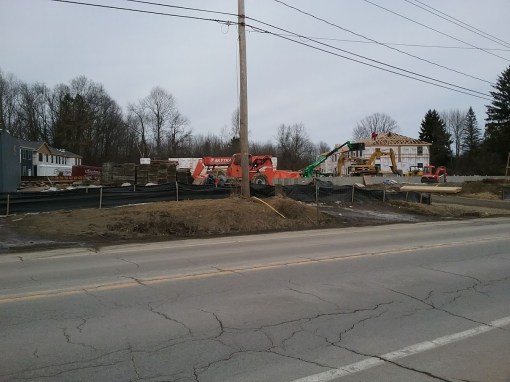
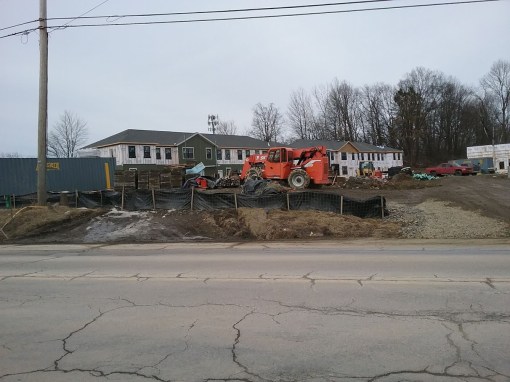
City Centre Construction Update, 3/2019

24 03 2019

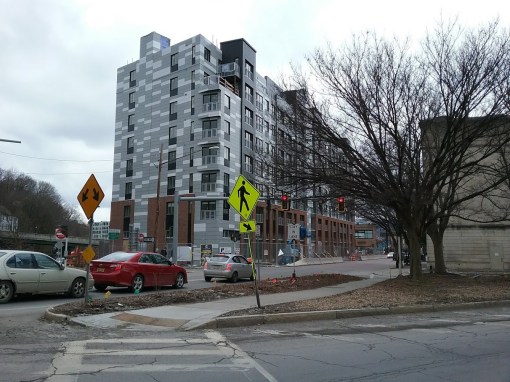
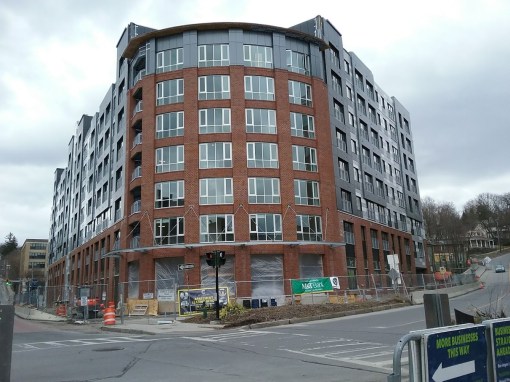
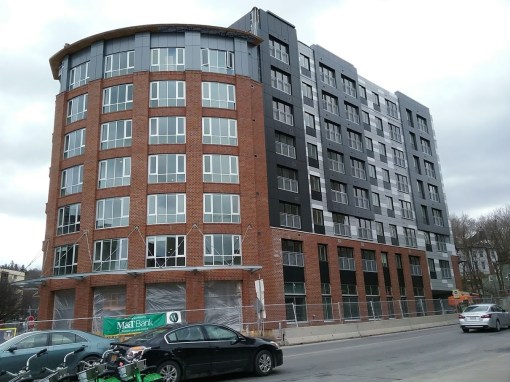
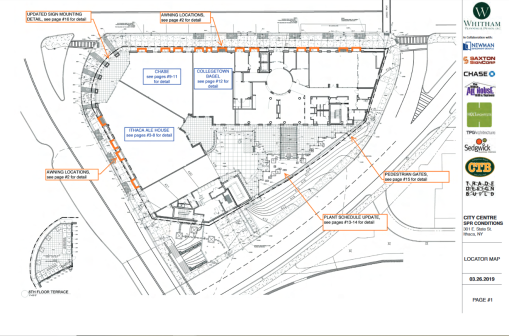
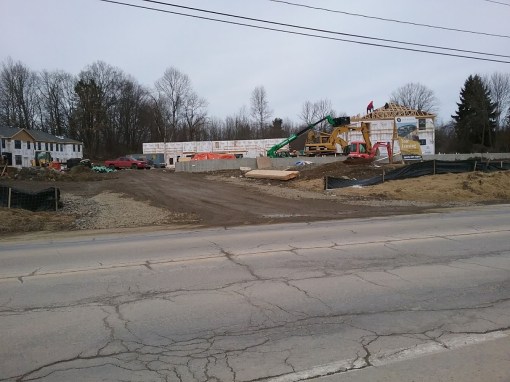
All of City Centre’s retail occupants have been identified – The Ale House, Collegetown Bagels and Chase Bank. Although two of three are cannibalizing other Downtown locations, the move comes with some benefits – it’s an expansion for CTB and the Ale House, and the Ale House is expecting to add 20 jobs, and CTB will likely add a few new positions as well. Chase is totally new, and if the average bank branch is 2,000 SF and 6.5 staff, it seems safe to assume that a 5,357 SF branch/regional office is probably 12-15 staff. Ithaca’s own HOLT Architects is engaged in some minor building design work and Whitham Planning and Design is doing the landscaping (including the heat lamps, string lighting and fire pits), Saxton Sign Corporation of Auburn will make the signage, Trade Design Build of Ithaca and TPG Architecture of New York will flesh out the interiors, and East Hill’s Sedgwick Business Interiors will provide furnishings. Clicking here will allow you to scroll through the interior layouts for the retail spaces.

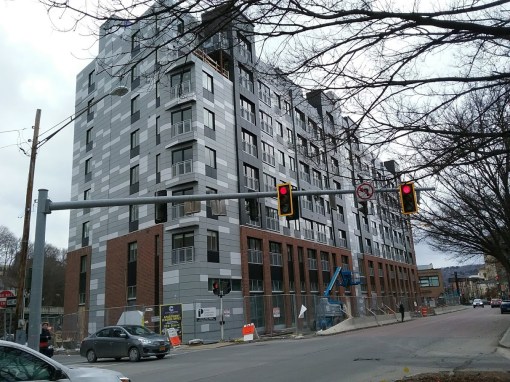
A glance at their Instagram suggests that as of a week ago, about 100 of the 192 apartment units have been reserved. There don’t appear to be any particular trends in the unit selection, an off-the-cuff suggests a similar occupancy rate for studios, one-bedroom and two-bedrooms, and there’s no strong preference in floors, though perhaps there’s a slight preference towards interior-facing units (I wouldn’t call it statistically significant). It appears they’re filling at a good clip now that graduate and professional students are making their commitments to Cornell (professional students, for example business/MBA and law/JD students, tend to be older and wealthier, and are one of the target markets for the project). If trends continue, the project will be in good shape for its June opening, with full retail occupancy and high residential occupancy, even at City Centre’s decidedly upmarket prices.

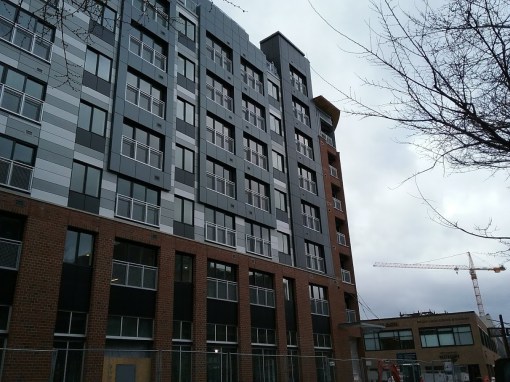
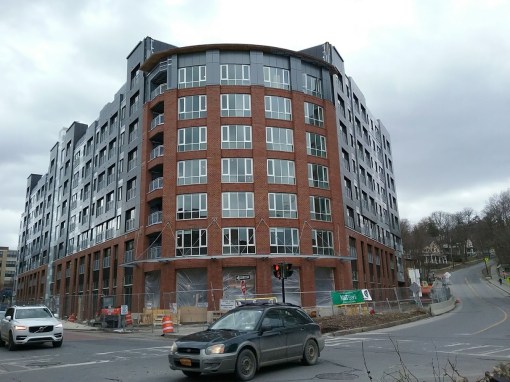
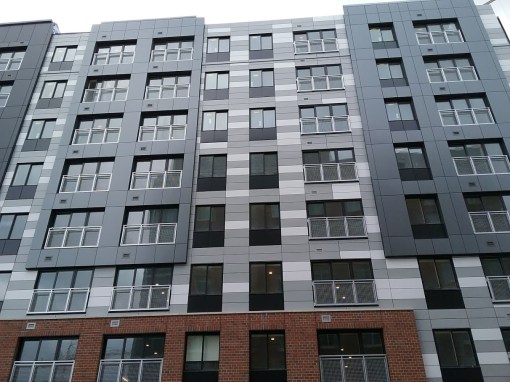
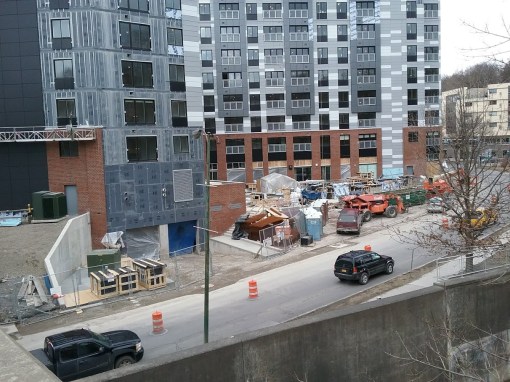
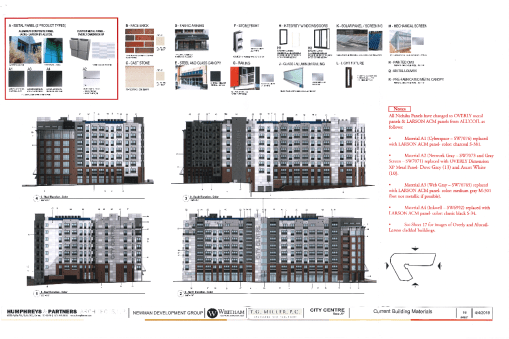
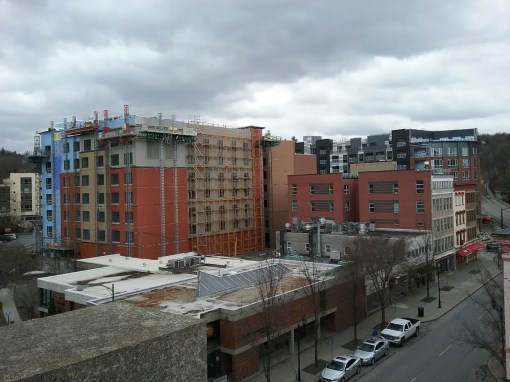
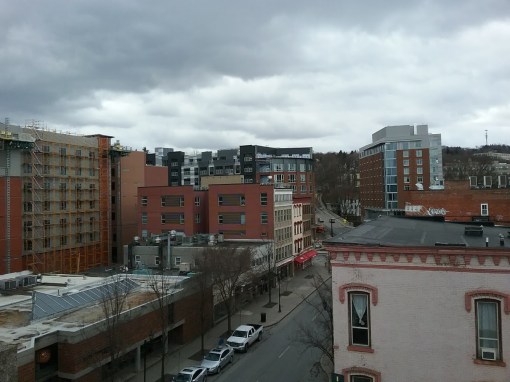
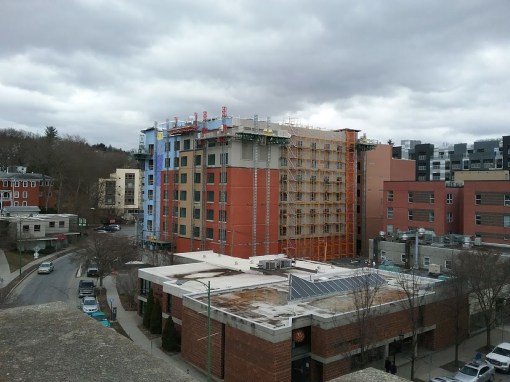
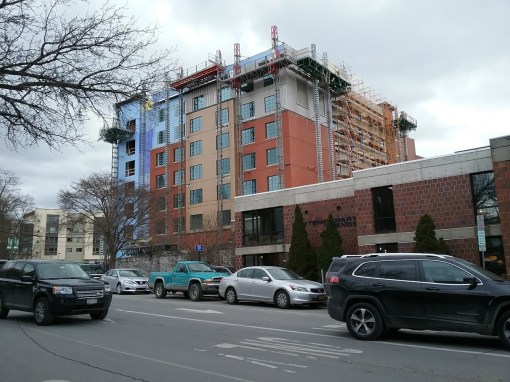
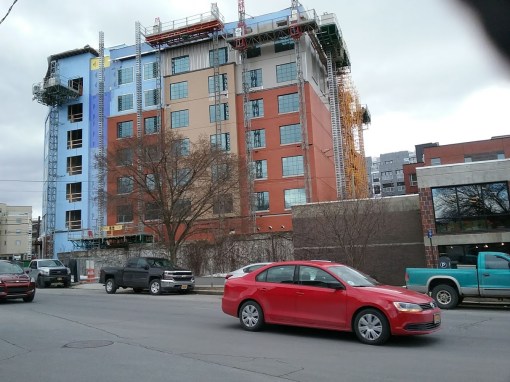
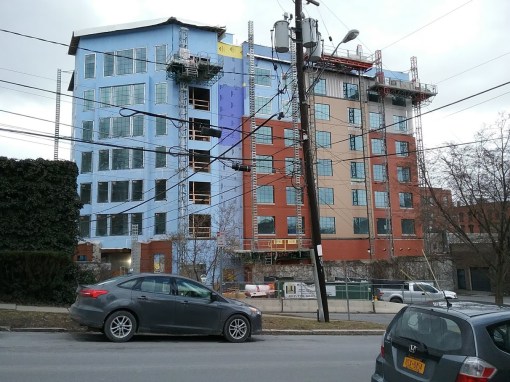
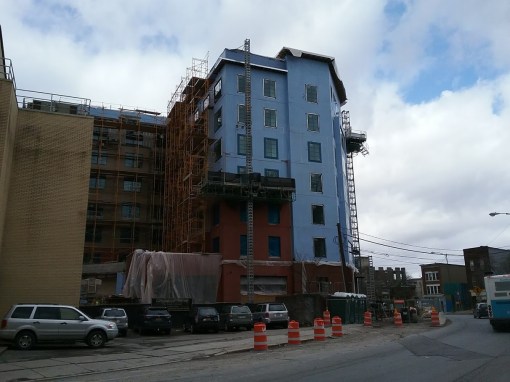
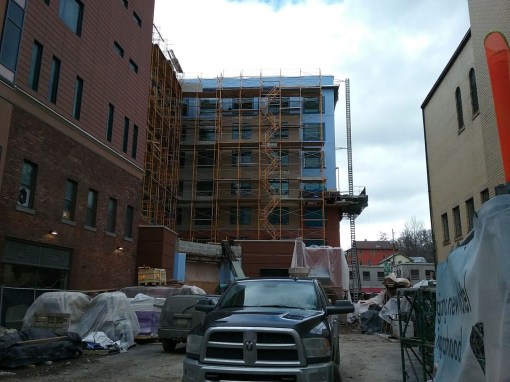
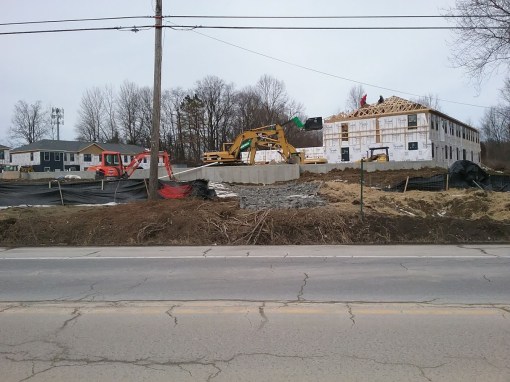
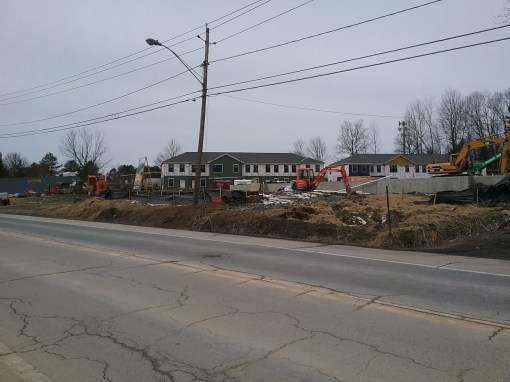
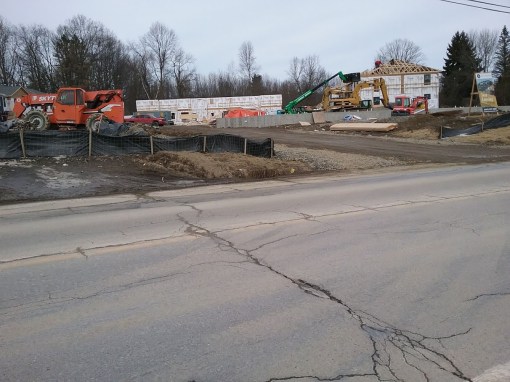
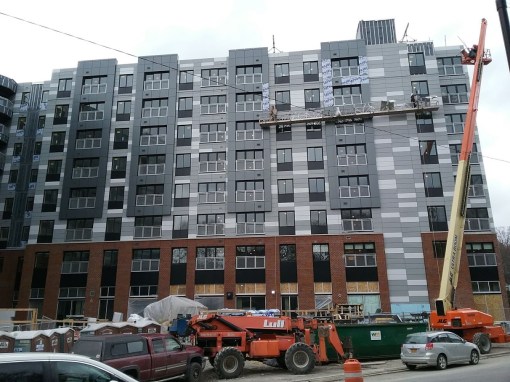
On the exterior, some of the Overly and Larson ACM metal panels have yet to be installed (mostly on the back./interior side), trim and exterior details are partially in place, and the ground level is still being built out with commercial doors and utility fixtures (garage doors for commercial deliveries, for example). The roof membrane doesn’t appear to be in place yet either. Overall, though, the exterior is substantially complete, and it looks like the will finish out over the next several weeks on schedule, which is a pretty big deal for a 218,000 SF $53 million project. Kudos to Purcell Construction and their subcontractors on that. Signage and landscaping will also go in this spring. I’m not big on the patterning of the metal panels (which looks like design by MS Paint), but it seems to be the go-to exterior material of choice.

Background information and the history of the project can be found here.


238 Linden Avenue Construction Update, 3/2019

22 03 2019

Like 119-125 College Avenue, 238 Linden is being designed by ikon.5 Architects, With similar aesthetics and structural design (and more than a passing similarity to the 2,000 bed Cornell North Campus dormitory expansion, which has the same development team) looking at this project is essentially like looking at the next steps for its larger sibling a couple blocks away. However, while 119-125 College Avenue uses Welliver as its general contractor, Hayner Hoyt is in charge of buildout for the 238 Linden site, with several subcontractors on site (for example, the roofing is being done by Hale Contracting of Horseheads). Like its sister building, this project has no online presence apart from what was documented by the city or reported by the Voice and Times.

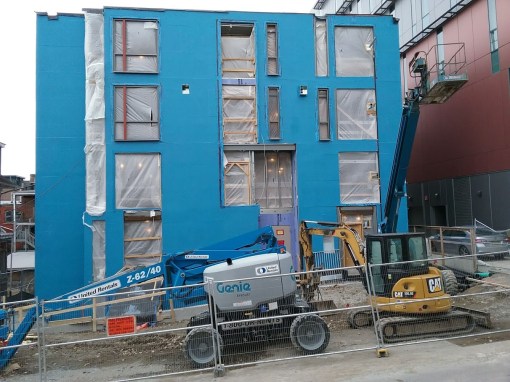
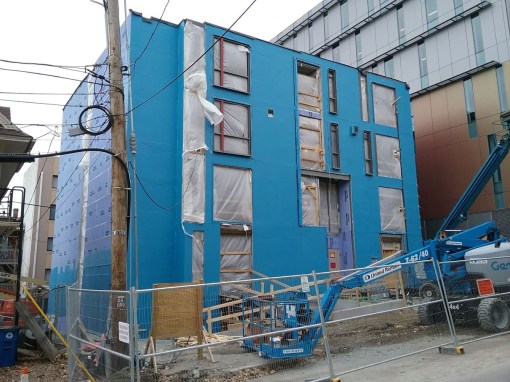
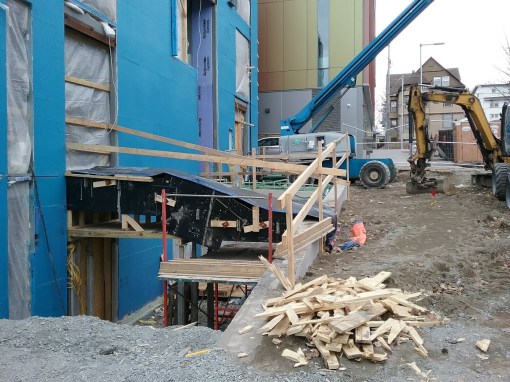
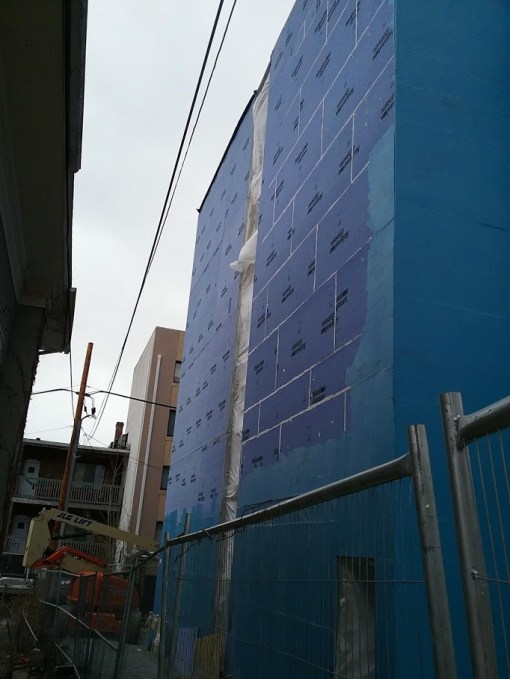
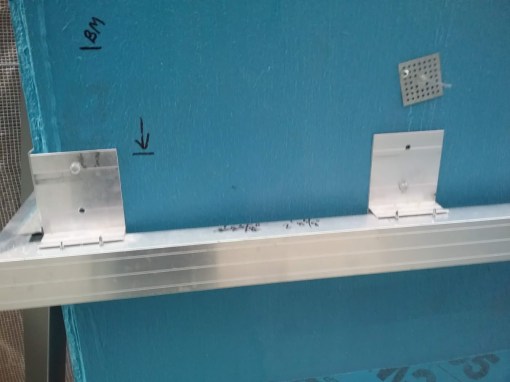
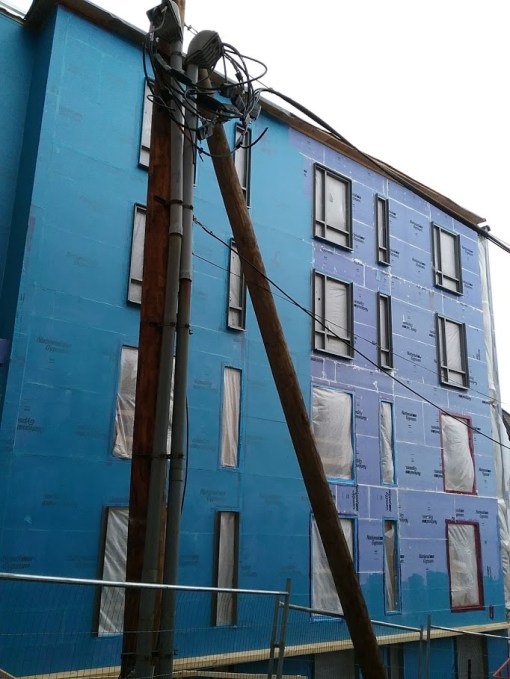
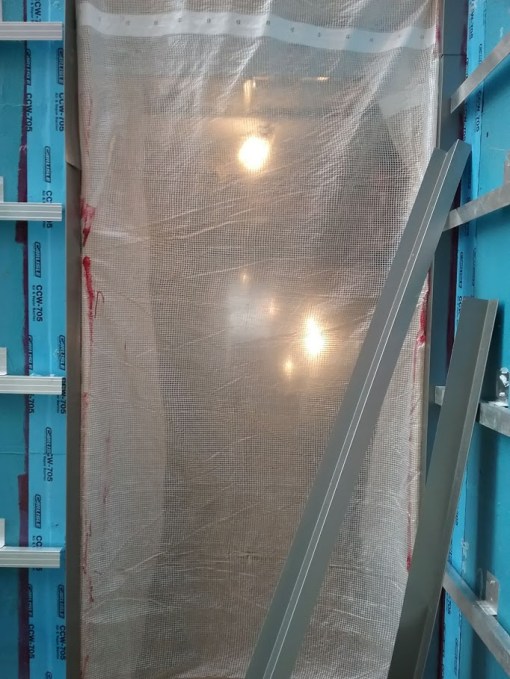
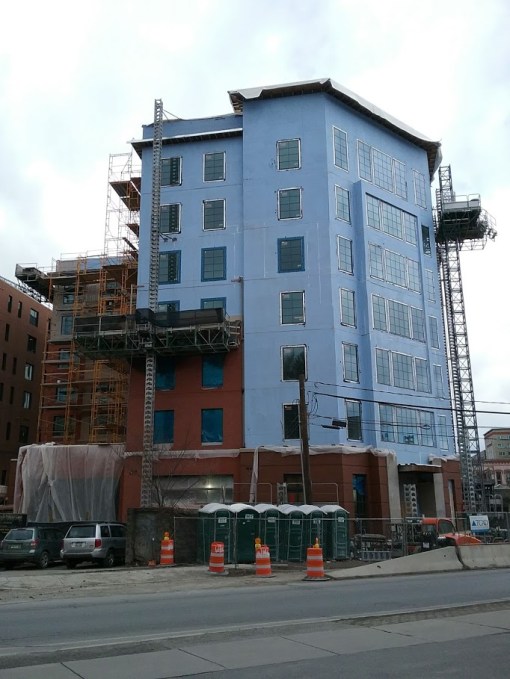
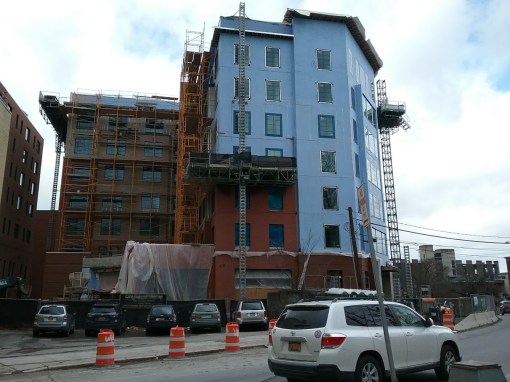
Interestingly, the window frames protrude from the wall rather then sitting flush with the set opening. The waterproof barrier is on over the gypsum panels, and the metal rails for the fiber cement and zinc panels are in the process of being installed on the north and west faces.

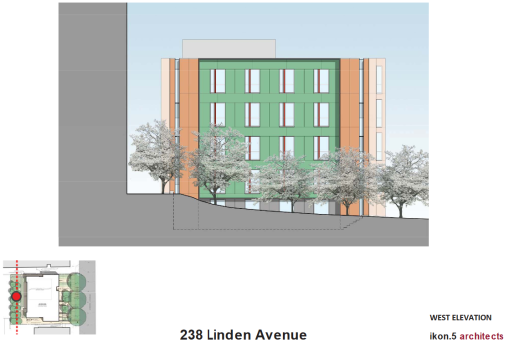
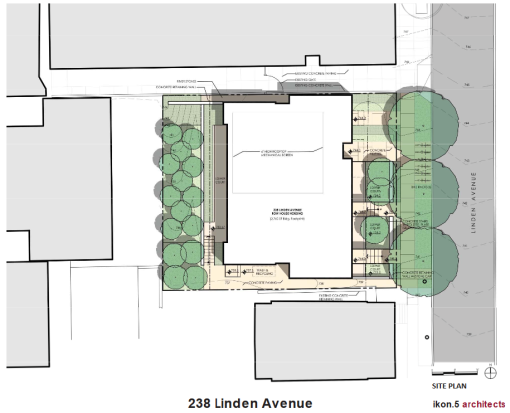
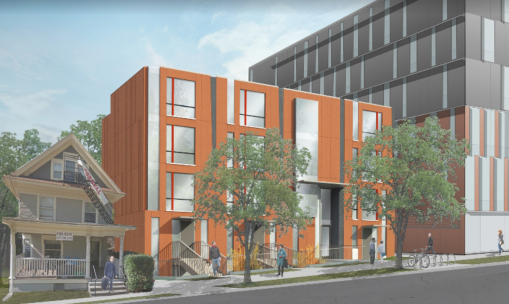
It was clear at first glance that the footprint of the building is markedly different, and the fenestration is nothing like the approved renders at the bottom of the post – there are fewer windows overall, and honestly I’m not sure if the building footprint was reduced in size. It was supposed to be 24 studio units, but I wouldn’t be surprised if it were only eighteen now. There was no public reviews for these changes, and these are by no means minor tweaks. The line between a large new construction project redesign requiring board re-approval, and a redesign only needing staff approval is rather murky.

A history and overall description of the 238 Linden Avenue project can be found here.


Hilton Canopy Hotel Construction Update, 3/2019

21 03 2019

It appears that the Hilton Canopy hotel developers put an in-house restaurant back into the mix late in the development process. The new eatery, to be called “Ezra” in what’s ostensibly a nod to Ezra Cornell. Dunno how large the new restaurant will be, but the early designs called for about 2,000 SF of space. In keeping with the Canopy theme, the restaurant logo incorporates Pantone PMS165 orange, with aluminum letters, faced in matte black base vinyl print, and on a wood laminate background intended to mimic Brazilian Walnut. The address for the new 131-room hotel will be 310 East State / Martin Luther King Jr. Street. The signage will be built and installed by Lauretano Sign Group of Connecticut. Outdoor dining spaces will have chic industrial aesthetic tables and chairs and contemporary, durable outdoor furniture.

For those interested, some job openings have been posted for those who wish to be hotel staff. The General Manager has the co-title of “Chief Enthusiast”. Management can expect to make up to $80k/year, but most staff will fall in the $11-$15/hour range, with a bit more for some titles and a bit less ($7.50/hour + tips) for those who will be working in the restaurant. They might be a little higher given those were 2014 figures, but it looks likes only management jobs are being filled at the moment.

As for the construction itself, work on the fiber cement panel and brick veneer installation continues. It looks like a waterproof materials might be going on over the gypsum sheathing, laid over with metal rails and then faced with the exterior material of choice. The rails would allow for any outside moisture absorbed to drain down and off the building. Some of the industrial-style windows are in,with flashing tape surrounding the window to prevent water and air penetration. We also now know what “sauteed mushroom” looks like as an exterior siding color. The hotel is expected to open in “Mid 2019”, probably too late for the May graduations but Q3 2019 looks plausible. The Canopy website comes with a thumbnail interior render, though the resolution isn’t so great:

Further information on the Canopy hotel can be found here.


Ithaca Tompkins Regional Airport Construction Update, 2/2019

3 03 2019

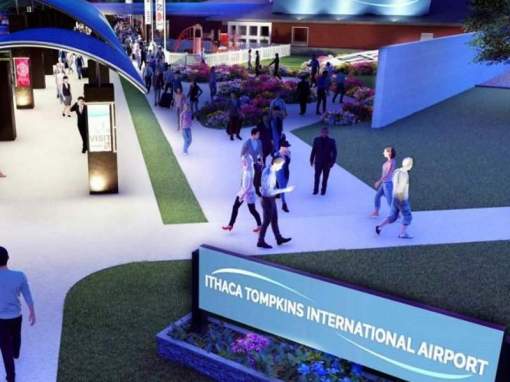
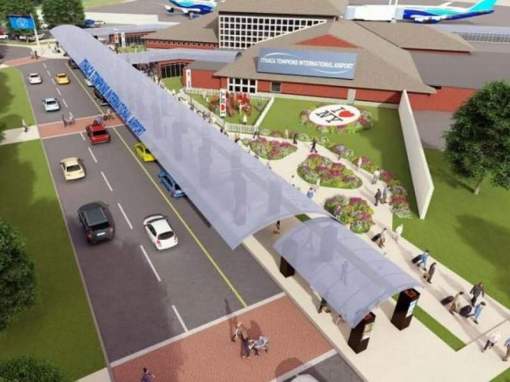
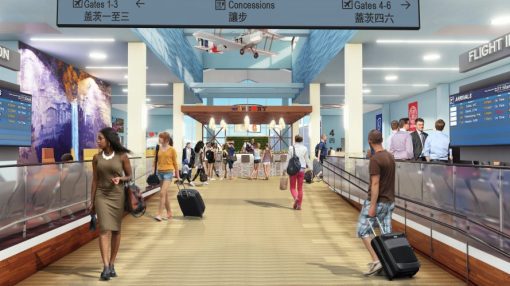
The spark notes: A multi-component expansion and reconfiguration of a regional airport, the $24.7 million Ithaca-Tompkins Airport expansion will result in six new gates, three new boarding bridges and 15,600 SF of new space, allowing the airport to take on additional flights, larger planes and serve an international clientele. The expansion, which will create at least sixteen new jobs serving the airports growing operation, will be finished by the end of 2019.

Now for the long version. I did a long-form history of airports in Tompkins County back in 2011 here. Ithaca had an aiport down around Taber Street in the 1910s, and a few years later it relocated to where Cass Park is today. The Flood of 1935 quashed hopes for the lakeshore airport, and so Cornell took it upon itself to buy the land in 1944 for an airport from some farmers in Lansing, open said airport in 1948, and operate it as its own airport until transferring ownership to Tompkins County in 1956, finally closing the municipal airport down by the lake. It was just as important for Cornell to get out of its airport as well, as it was a financial drain and managerial headache. The old airport merged into Cass Park in the 1960s and Hangar Theatre came along in 1975. Meanwhile, the regional airport in Lansing was completely rebuilt in 1994.

Although Tompkins County isn’t especially large, it has a couple of things going for it that its regional peers in Binghamton and Elmira don’t. For one, Ithaca-Tompkins is more affluent and enjoys a growing economy. For two, Ithaca’s economy is much more cosmopolitan; Cornell and Ithaca College have students, staff and faculty flying in and out regularly, often with connections to more lucrative international flights. Ithaca’s growth in hospitality and tech have contributed to this as well, as its a comparatively popular choice for visitors from the big East Coast cities. It also helps that major highways don’t actually make it to Ithaca, making driving an even bigger pain for visitors.

In a 2011 NYS Dept. of Transportation study of state airports, it was noted that although Ithaca-Tompkins services an area half the size of Binghamton, it’s economic impact is 25% greater ($66 million vs $52 million), and the airport generates 23% greater revenue ($28.6 million vs. $23.2 million). It also supports/generates 510 jobs (ITH had 204 FTE employees in 2009), vs. 483 for BGM. The study noted that the airport hosted 110,000 passengers in 2009, and generated $5.33 million in state and local tax revenue annually. Since that time, airport teaffic has generally bounced around between 95,000 and 110,000 enplanements (passengers boarding at ITH), with 101,000 enplanements in 2018, and a 9% increase in cargo flights. With arrivals, the number of passengers served exceeds 200k.

My personal recollection of the airport announcement was that it was nearly out of the blue. The Voice, Times and other outlets were given less than a day’s notice by the state’s economic development unit, and talking through the usual back channels (Slack and Twitter), everyone quickly suspected it was airport-related because of the location of the big economic announcement. Sure enough, that’s what it was, with the governor breaking the news. Since then, the pace has been remarkably rapid. As a government-owned public resource, the airport does not have to go through the regular environmental review process, where the village of Lansing declares itself lead agency for review and takes several months or more to make decisions. Here, Tompkins County is the lead agency. Government authorities (state and county) basically tell the village what they were planning to do, and invite their comments for consideration as with any member of the public. In some cases, like with the new DOT building on Warren Road, they’ll also hold public open houses (note that will be a separate construction update series, after it gets underway). The airport project started construction in October (with another visit from the governor), and the intent is for the expanded facility to be open by the end of this year.

C&S Companies is the all-in-one engineer and architect for the project. C&S is a large, multi-disciplinary firm headquartered in Syracuse with offices in nine states and Washington D.C., and has previously provided design and engineering services for ITH. Streeter Associates of Elmira is the Phase I general contractor, having won the bidding process for Phase I ($7.638 million of work) in September. The Ithaca Tompkins airport expansion project is being financed through $14.2 million of funding by the New York State Government, as part of the Upstate Airport Economic Development and Revitalization Competition. The airport is pursuing federal grants worth $10.2 million to fund Phase II of construction later this year, and if awarded, Tompkins County is expected to provide the remaining $260,000. It looks like the county is prepared to issue municipal bonds to cover the $10 million if they have to.

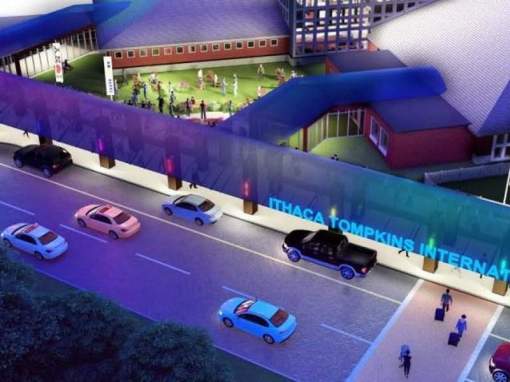
The expansion comes with encouragement from the airlines; United’s Newark flights, which had struggled with on-time departure rates, were replaced with flights to Washington D.C. late last year, and American Airlines added flights to Charlotte were added late last year. Delta Airlines provides an Ithaca to Detroit route, and American also provides an Ithaca to Philadelphia routeThe airport is currently aiming to regain service to the New York City area, a possible Toronto or Montreal route via Air Canada, and obtain a flight route to Chicago. Ithaca-Tompkins will rebrand itself to “Ithaca Tompkins International Airport” with the addition of the customs facility. The airport won’t host regular international flights yet, but it will now be capable of accepting chartered flights from Canada, and increasingly, wealthy Asian visitors have been pushing for direct service.

There has been some pushback from the community, regarding carbon emissions, catering to the wealthy, and the potential presence of ICE, the acronym for the highly controversial Immigration and Customs Enforcement agency. The county legislature has refuted the accusations and claims, saying they would prohibit the facility if ICE were to move in, that the carbon emissions would be even worse if flying into Philadelphia or New York and driving up, and that while they would love more federal money for buses or homeless housing, that’s not how federal earmarks work.  Offhand, the TIGER transportation grant applications for buses and better mass transit get shot down every time (they’re extremely competitive, having only a 10% acceptance rate) – there have been eight attempts by Ithaca and Tompkins County over the past decade, as well as one transit application as part of a regional economic development grant to the state, which also failed. Homeless housing grants through HUD or NYS HCR are also very competitive.
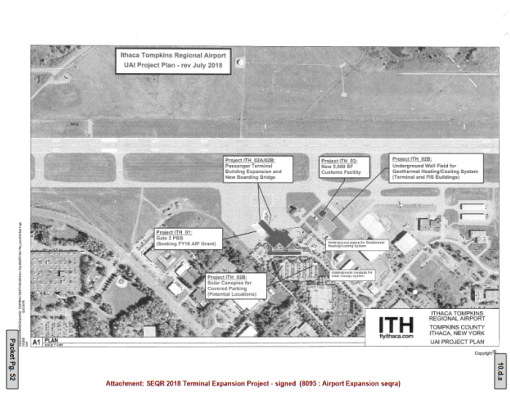
Running down the components of the expansion can be a little disorienting. The May announcement had the following details:

  • Major security enhancements, including updating TSA baggage screening to be compliant with post-9/11 security requirements and adding another line for passenger security screening to alleviate wait times.
  • Reconfiguration of the security checkpoint and relocation of TSA office space as part of a 7,500-square-foot expansion of the passenger hold room.
  • Reconfiguration of airline office space and expansion of baggage screening space as part of a 2,500-square-foot addition on the east side.
  • Baggage security and check-in improvements to streamline the process and improve efficiency.
  • Three new passenger boarding bridges to accommodate jet aircraft and additional service.
  • Six new passenger boarding and departure gates, bringing the total number of gates at the airport to twelve.
  • Addition of 1,700-square-feet of space at the main entrance and an expanded ticket counter to improve passenger circulation and provide more room for ticket lines.
  • Construction of a new 5,000-square-foot Federal Customs Facility.
  • Technology upgrades to include high-speed WiFi, Bluetooth connectivity and additional charging ports and outlets.
  • Food service enhancements, such as expanding a pre-security café and adding 4,000 square feet of space for post-security food concessions.
  • Installation of a separate bus lane and a wind-resistant waiting area for buses, taxis and hotel shuttles.
  • Installation of new plumbing, HVAC, fire protection, mechanical and electrical systems.
  • Installation of a new geothermal water-source heat pump system to reduce natural gas usage for the terminal.


Those details were revised and a little more fleshed out in the SEQR forms shared with the county in July 2018:

– The Passenger Terminal Expansion will consist of three additions totaling 15,600 SF. 8.500 SF is an addition to the passenger holding area (which makes flying sound about as comfortable as it feels), 5,400 SF for additional bagging screening space and office space for the TSA and for airlines, and 1,700 SF by the main entrance for expanded passenger circulation and ticket counter space.

– Apron reconstruction, 40,000 SF. The apron is the area where planes park, refuel, and where some passenger loading/unloading takes place.

– Utilities replacement, interior “building enhancements”, one new passenger boarding bridge, and refurbishment of the existing boarding bridge.

– Installation of a geothermal heating and cooling system using 40 underground wells, 350-400 feet deep, and a closed-loop piping system. The operation is similar to a heat pump system, using the earth’s latent heat as a reservoir. The ground disturbance area to install the wells will be about 15,000 SF (~0.35 acres).

– Installation of overhead canopies with solar panels in the airport parking lot.

-Construction of a new 5,000 SF customs facility. The facility will be a one-story masonry structure with steel framing. The facility will accommodate no more than twenty passengers, and is exclusively tailored towards international business visitors – it’s been previously stated that business executives and Asian visitors, who often come in via Canada, have expressed a strong interest in private jet accommodations.

– Approximately ten new employees as a result of the terminal expansion, and six more from the construction of the new customs facility, for a total of sixteen new full-time jobs.

– Cayuga Solar (the new solar extension of the Cayuga Power Plant) will provide electricity to power ground source heat pumps, and solar panels will be erected above the parking lots which will have the secondary advantage of keeping a lot of the snow off of parked cars. It is expected that at least 80% of gas consumption will be eliminated, replaced by the solar power and electric heat pumps. That will save $50,000 annually on utility costs, even with a terminal that is 1/3 larger.

Separately, the state just announced an additional $1.5 million grant for a shared vehicle and aircraft fueling and storage facility. A vehicle fueling facility was originally planned for the NYS DOT site nearby, but had received pushback from neighbors, so the state decided to consolidate it with the aircraft fuel facility and build it on airport land across Warren Road from Borg Warner.

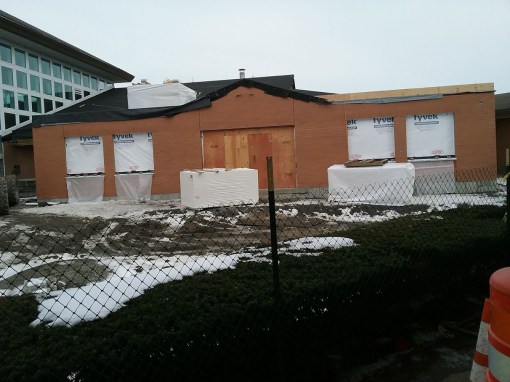
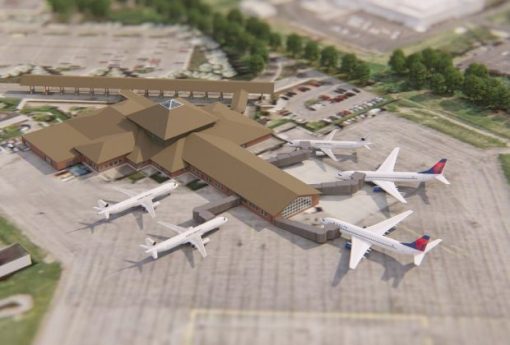
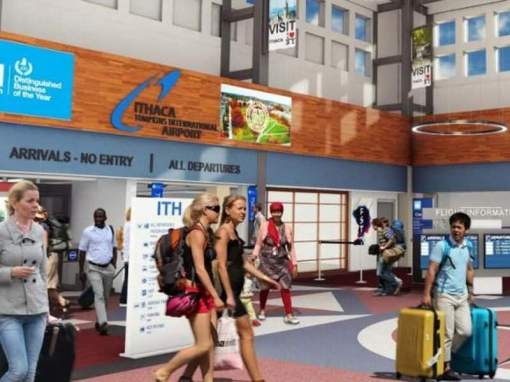
The photos below only show the 1,700 SF addition by the airport’s main entrance; the security situation makes taking photos more complicated than in most places (and my goal is to write news, not make it). At some point, a formal photo tour might be possible, but for now, the photo set is limited.



Village Solars Construction Update, 2/2019

3 03 2019

It was with some surprise that the latest trip to the never-ending Village Solars construction site yielded significant progress on only one apartment building, instead of the usual two or three. The 24-unit Building “L” is mostly complete from the outside, and likely to open for occupancy this spring, adding another 3 three-bedrooms, 6 two-bedrooms, 3 one-bedrooms and 12 studios to the market. 24-unit Building “K”, just to its east (right, in the photos), appears to have not made much progress; excavation was completed, and it looks like there are wood forms for the foundation on site, though with the snow and active work underway, it was hard to tell if the concrete slab had been poured – judging from the dirt piles, that’s a no.

Local Law #6 (2017) of the Village Solars PDA permitted three additional buildings to be built before Lifestyle Properties (the Lucente Property) was legally obligated to build the community center building (Building “F”), which is to contain a small amount of commercial space (restaurant), service space (gym, laundry, rental office) and up to twenty one-bedroom units. If “L” and “K” are completed this year, that will allow one more building to receive a building permit before the community center must be built and receive a certificate of occupancy (i.e. habitable and practically complete). Until then, no additional building permits are allowed. The law also stipulates that the community center has to be completed, regardless of the status of other apartment buildings, by the end of 2020.  Like other apartments, it won’t be subject to site plan review, bu any potential commercial applicant would have to undergo site plan review.


GreenStar Co-Operative Market Construction Update, 2/2019

2 03 2019

We’re going to rewind the clock a bit on this to before GreenStar. It’s early 2017. Two major regional medical service providers are eyeing locations in the affluent and growing city of Ithaca. The first is Cayuga Medical Center / Cayuga Medical Associates. The second is Guthrie Clinic / Guthrie Medical Group.

How bad did these two want to outdo each other and lock their rival out of the city? So much so that Cayuga Medical Center paid several times the value on Carpenter Business Park. So much so that Guthrie bought a site that would fail to meet their needs.

For neither CMC or Guthrie was it the best of moves, but not everything is done rationally. In June 2017, Guthrie paid $2.85 million for the properties at 750 and 770 Cascadilla Street, over the asking price of $2.7 million. For those millions they purchased 3.12 acres, with a 37,422 SF printing press/ warehouse built in 1980, and a 30,000 SF storage facility built in 1988. Cornell University had previously used the facilities as part of its printing press operations, and had been seeking to sell the properties since July 2016.

Guthrie started looking at its options at that point, and wasn’t liking them. But there appeared to be an opportunity. The developers of City Harbor, working on their mixed-use proposal a couple of blocks away, would provide Guthrie a convenient escape hatch to Pier Road, where they could build a structure from scratch that would suit their needs. In return, Guthrie would offer up its recently-purchased Cascadilla properties to GreenStar on a long-term lease, with an option to buy.

For GreenStar Co-Op Market, the site was a welcome opportunity of its own, a real estate version of “one man’s meat is another man’s poison”. Founded in 1971, GreenStar has been leasing its current location at 701 West Buffalo Street since the fall of 1992, following a fire that destroyed their store on North Cayuga Street. Satellite stores operate out of the DeWitt Mall at 215 North Cayuga Street in Downtown Ithaca, and at 307 College Avenue in Ithaca’s Collegetown neighborhood. Specializing in locally-sourced and organic foods, the co-op has enjoyed significant market growth in the past decade, with sales increasing by nearly 50% since 2011, to over $22 million annually.

That was both a good and a bad thing. As I wrote for the Voice back in April 2018, GreenStar makes a very small profit on sales, and relies on membership growth as a supplement. But their West End store was jam-packed, all built out with no more room and increasingly agitated co-op members. With other grocers moving in on the organic and natural food market, it was going to be grow, or perish, taking 200 jobs with it. GreenStar had been in talks with landlords and developers for a new space, and City Harbor’s project team was one of those who listened. Just as City Harbor’s Pier Road was Guthrie’s escape hatch, 770 Cascadilla Street was going to be GreenStar’s.

Plans were first announced in December. As a Co-Operative food market, GreenStar has to put any kind of move of this scale out to its shareholders for a vote, through paper and electronic ballots with a three week voting period in March of 2018. The vote for the move was 92% in favor. The project was approved by the city last July, and the groundbreaking was this past November. If all goes well, the lease agreement will allow GreenStar to buy the property from Guthrie in 2030; this passed the member vote with 97% saying yes.

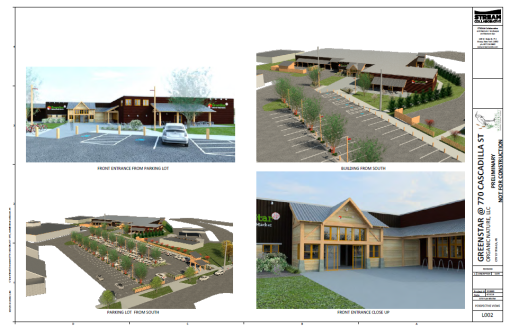
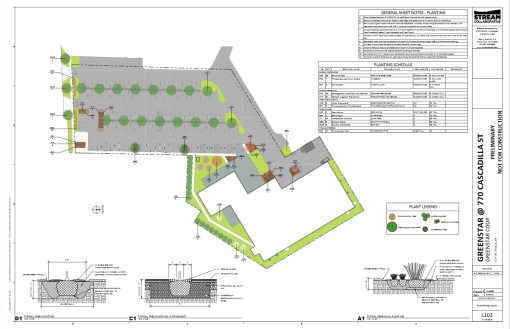
The plan is to renovate 770 Cascadilla into the latest and greatest GreenStar flagship. 750 Cascadilla would come down for a 160-space store parking lot and landscaping. The new space would have an edible garden, outdoor cafe, mezzanine stairway and classrooms. The building would be refinished, insulated, and potentially net-zero energy compatible, meaning all the energy it consumes comes from renewable sources. Breaking it down, the new retail area will be 16,500 SF, there will (well, was, see the last paragraph in this entry) be 5,200 SF mezzanine space for office and administrative functions, and a 13,000 SF kitchen and events space. With the addition of the mezzanine, the warehouse will be expanded in square footage from about 30,000 SF to 35,219 SF. The Space @ GreenStar would be moved to within the new store, and shrink from a 225-person capacity, to 125, and once moved in the old Space @ GreenStar location will be put up for sale. The Space isn’t much of a revenue generator for the Co-Op, and is rarely utilized at full capacity.

The project will take a little over a year, from November 2018 to December 2019 (the store itself wouldn’t open until February 2020, after the equipment is in, shelves are stocked and electronics are tested). Local architecture firm STREAM Collaborative is in charge of exterior design, and architect Pam Wooster will handle the interior layout. Elmira’s Edger Enterprises will be the general contractor for the buildout. Delaware River Solar will supply the solar energy to power the building via an off-site array.

GreenStar, which is carrying out the project with its City Harbor partners (Edger Enterprises, Morse Construction and Lambrou Real Estate) as Organic Nature LLC, did apply for and receive a standard seven-year tax abatement worth about $625k, about 4% of the project cost. $130k in new taxes would be paid over the period. GreenStar’s project would add at least 40 full-time equivalent positions with most jobs in the $15-$16/hour range plus benefits (Starting pay will be about $13.50/hour plus benefits; GreenStar has previously been certified as a living wage employer, though they appear to have been just below it in 2017). Generally speaking, the abatement application was one of the less contentious public hearings, which could be due to GreenStar’s stature in the Ithaca community, its labor and environmental practices, and because dedicated opposition could put 200 jobs and the whole Co-Op at risk of closure.

According to GreenStar’s TCIDA tax abatement application, while the project is $4.9 million to build (hard costs), the overall project costs are $14.8 million. Other sources have said $3.7 million in hard costs, so YMMV. Along with $8.7 million in bank and credit union financing, and $4.6 million in cash equity, the Co-Op has launched a $2.5 million capital campaign to sell investment shares to owners to help cover the project costs.

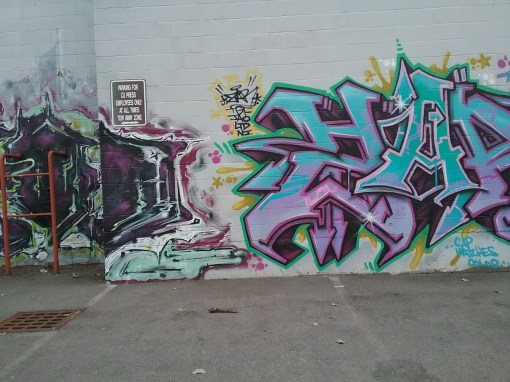
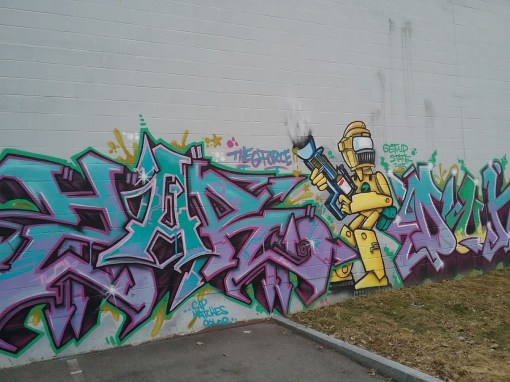
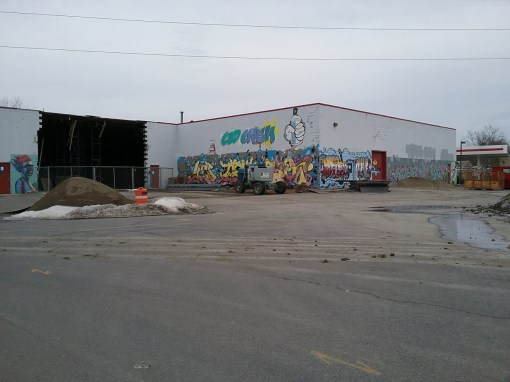
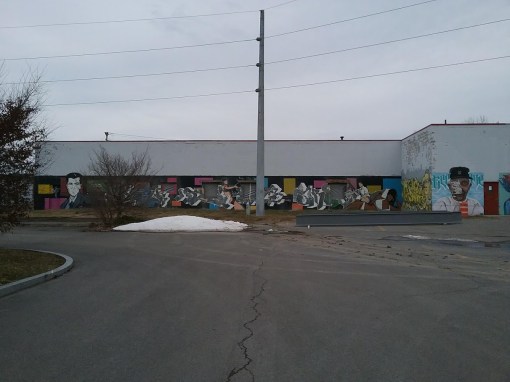
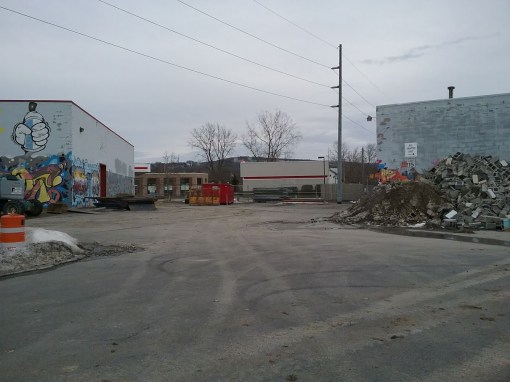
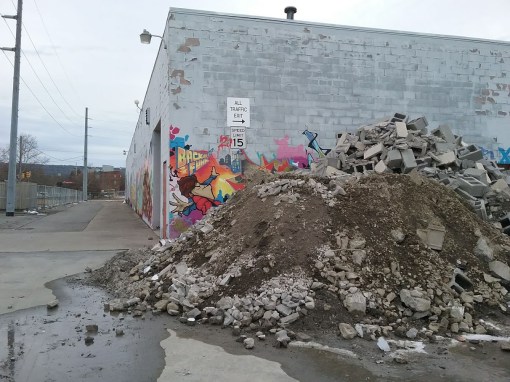
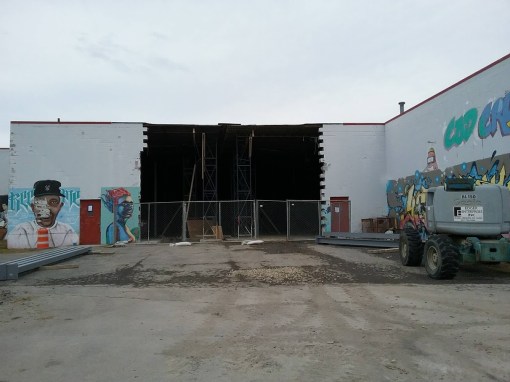
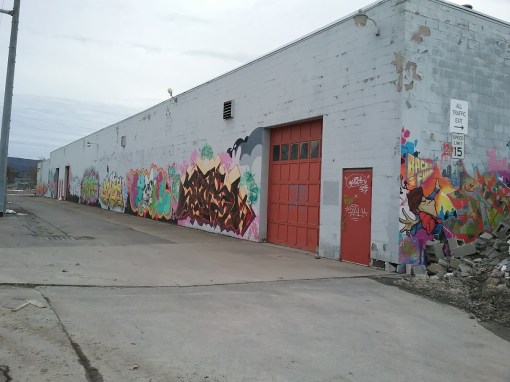
At present, a large gap has been opened in the exterior of 770 Cascadilla’s CMU facade. This is where the entrance of the new GreenStar will be, and it was practically the only major design change during the review process. The steel sitting aside the building may be for building out the mezzanine. A pile of debris sits next to 750 Cascadilla, which will itself be a pile of debris in due course. About the biggest loss here will be some pretty fantastic street art.

In the past couple of weeks, the interior was revised as a cost-cutting measure, shrinking the mezzanine by roughly half and reducing the size of the classrooms from 108 seats to a single room of 33, with the former first-floor classroom space now replaced by offices for GreenStar staff. The opening also appears to have been pushed back by 1-2 months, to “early spring 2020”.


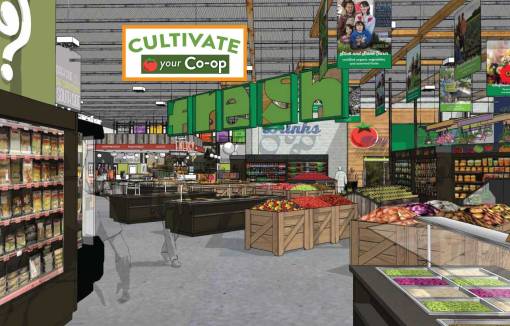
Early render

early render

final render


East Pointe Apartments Construction Update, 2/2019

1 03 2019

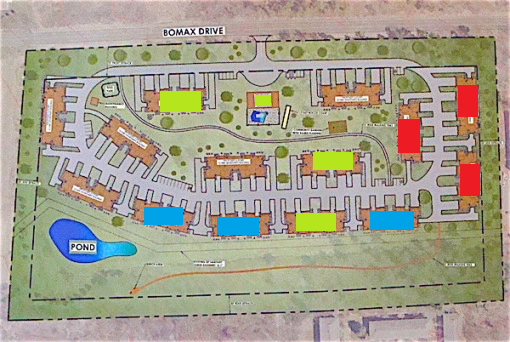
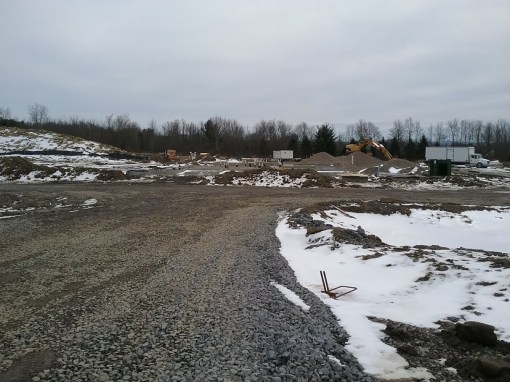
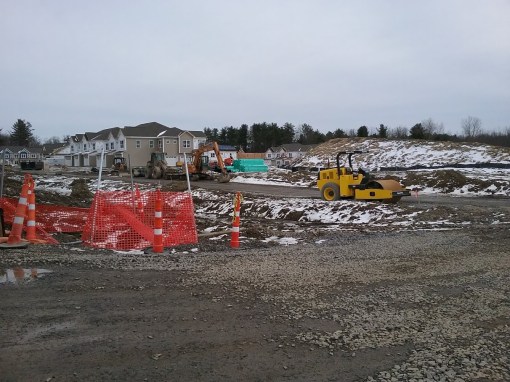
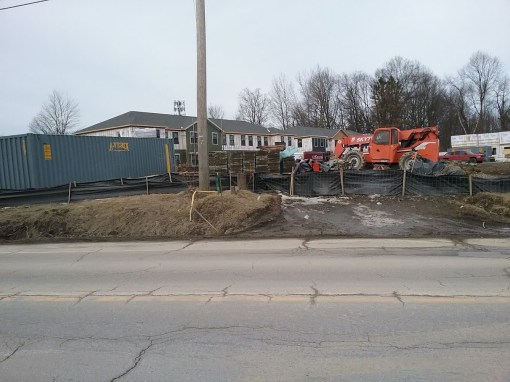
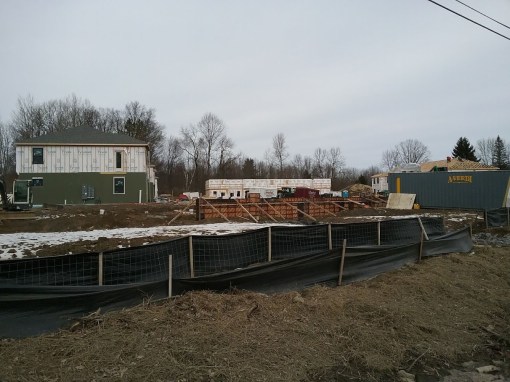
With so much construction underway at one site, I figured it’d be easiest to try and color code this using the site plan.

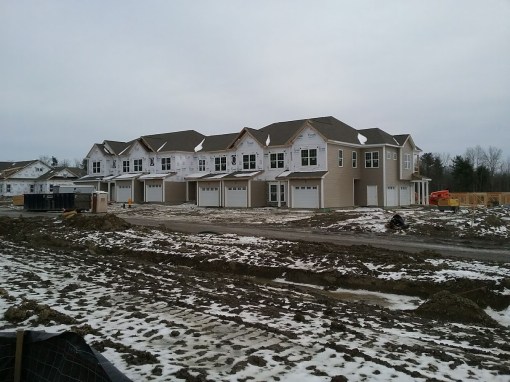
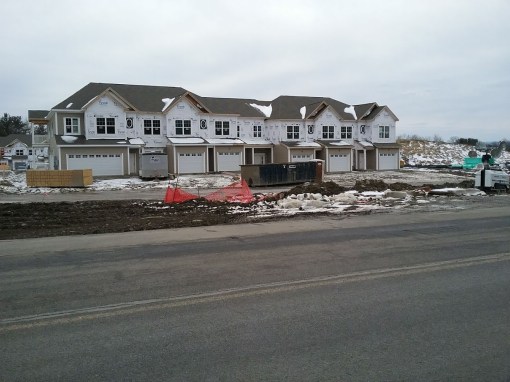
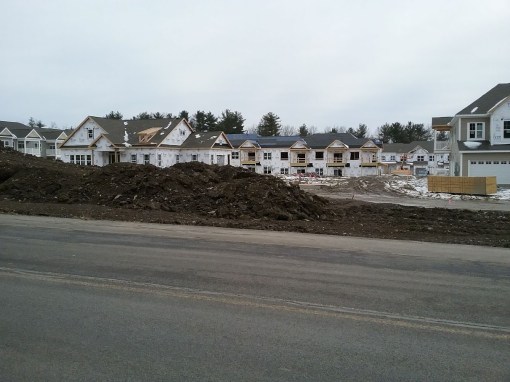
Red boxes overlay townhouse strings that are largely complete from the outside. Green is framed and sheathed (plywood with Tyvek housewrap), but lacks exterior siding, trimboards and architectural details. Blue are townhouse strings where framing is underway. Looking at the site and comparing it to the site plan above, it seems that the community center is actually to the east (right) of the entrance, so there likely going to be two townhouse strings to its left (west), one of which is framed and one of which is just a foundation at this point.

Knowing that the first units are expected to be open for occupancy on April 1st, I’d wager the three strings in red (~30 units) will be ready by that time, the community center and units in green (three strings, ~30 units) will be ready by June 1st, and the three strings in blue (~30 units) will be ready by September 1st. That would give roughly December 2019 and April 2020 for the last two sets, which sounds about right from the construction timeline I’ve seen for a spring 2020 completion.

Rents on the units are as follows, per the project website and multiple apartment advertising websites:

# BRs/ # BAs / Monthly Rent / Square Footage / Unit Code

1 BR 1 Bathroom    $1,695    820 Sq Ft   B
1 BR 1 Bathroom    $1,795    873 Sq Ft   C
2 BRs 2 Bathrooms $1,895 1,093 Sq Ft   A
2 BRs 2 Bathrooms $1,910 1,095 Sq Ft   E
2 BRs 2 Bathrooms $1,975 1,157 Sq Ft   G
2 BRs 2 Bathrooms $1,995 1,090 Sq Ft   F
3 BRs 2 Bathrooms $2,445 1,268 Sq Ft   D

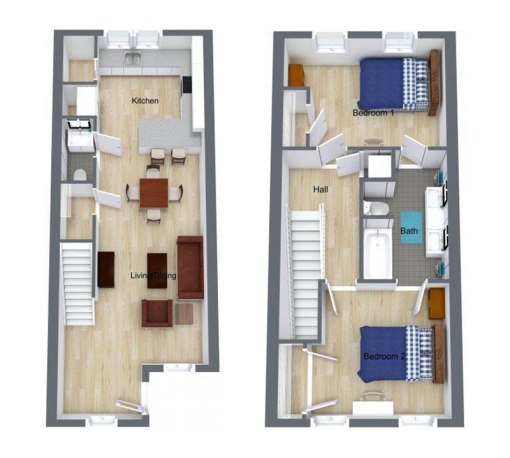
Layouts can be seen here. Each townhouse string contains a mix of 1-3 bedroom units. In total there are 14 three-bedroom, 90 two-bedroom, and 36 one-bedroom units, which doesn;t break down neatly by fourteen townhouse string, so there are some variations.

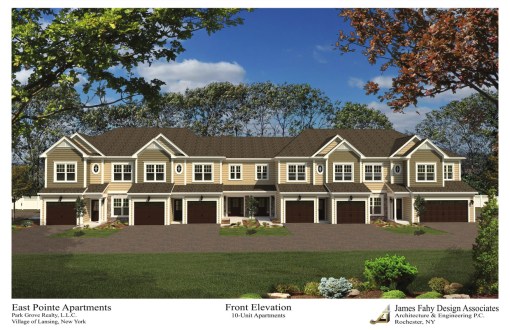
Those variations also show up in the exterior finishes. The units near completion now use what looks like Certainteed vinyl siding and trimboards. Type “1” is tan and navy blue siding with stone accents around entrances, and Type “2” is slate grey and yellow siding, though I didn’t get a close enough look to see if these have stone accents as well (there were crews actively working on site). The rendering in advertisements suggests there will be a third type, Type “3”, with beige and olive green vinyl siding and stone veneer accents.

Just like the townhouse strings, the community center is a different design than first advertised. So basically, nothing in the built project quite matches the plans that were publicly available, whether it be building designs or site plans. The only things that have stay constant are the fourteen strings of ten units with a community center and a loop road. Not a fan of surprises here, but we’ll see how the finished product is looking once more of the site has been built out later this year.

More information about the project’s history and seemingly accurate details can be found here.


TC3 Arthur Kuckes Childcare Center Construction Update, 2/2019

1 03 2019

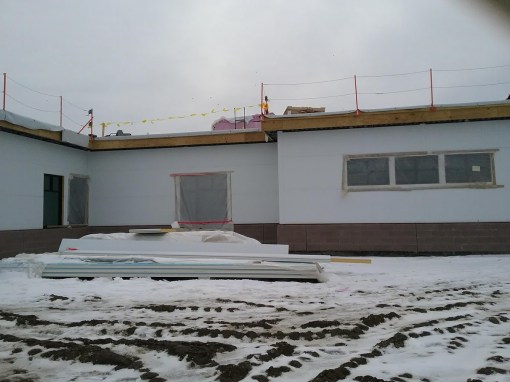
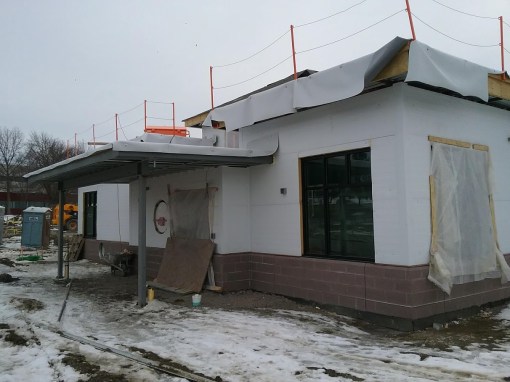
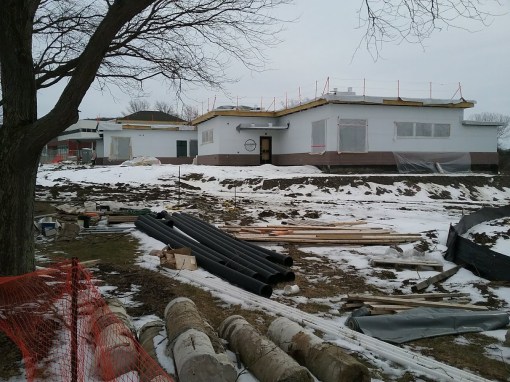
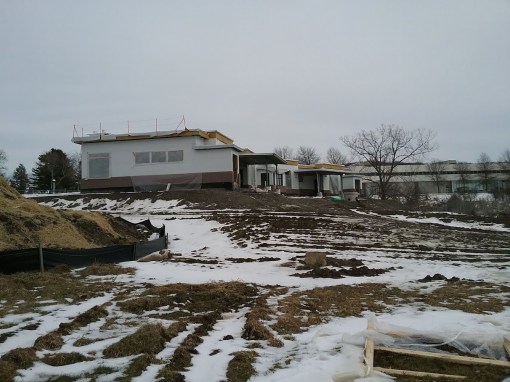
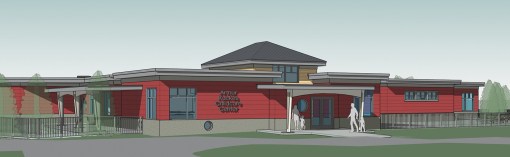
The new childcare center at Tompkins Cortland Community College has been fully framed and sheathed. Some of the windows are in, while the remainder remain rough openings, as do the doors. Given the fireproofing needed here those walls are most likely gypsum sheathing panels with a vapor/water barrier, atop a masonry base. Fiber cement and metal panels will be used in the exterior finishes. The hipped roof over the entrance has underlayment in place, but no shingles, and guessing from the temporary guardrails on the roof, it’s probably got some protective/vapor barrier down. But the pink stack on the roof is is insulating panels, and those will need to be in place before the top membrane (synthetic rubber probably) is laid. The project hasn’t made much news as of late, though it looks like some subcontracting work is out for bid. The $6.5 million, 9,875 SF project is expected to open in time for the fall semester.

More info about the childcare center can be found on the blog here.


802 Dryden Road Construction Update, 2/2019

28 02 2019

The townhouses at 802 Dryden Road are in varying states of construction, with no apparent pattern to the choices. Buildings “E” and “F” at the western end of the site have been framed, sheathed in Tyvek housewrap, roofed, shingled, and have doors and windows fitted. “E” has the navy blue panels, and “F” the olive green panels. Building “C”, at the eastern end of the site, is in the process of having its roof framed; a crew was on-site last weekend bolting together the trusses. Building “D” has partial framing and sheathing, Building “B” at the eastern front of the site has its slab concrete foundation finished but not framing as of yet, and forms for pouring the foundation walls are still on-site for Building “A”. So generally speaking, counterclockwise from lower left, buildings are progressively less far along.

For the record, each building, seven units apiece, will a unique address when finished – 802, 804, 806, 808, 810, and 812 Dryden Road.

It was previously noted that the purchaser was operating under an LLC tied to a Pittsburgh-area business executive, Matt Durbin. A new project website says the firm is “Maifly Development”, a small but seemingly deep-pocketed Pittsburgh company that appears to be pursuing a mixture of student-oriented and market-rate properties across the country. Along with the LEED Certified “(b)outique two-story townhome community abutting the Cornell University campus, nestled in a picturesque natural setting,” Maifly has developments in Pittsburgh and Eugene, Oregon (to be one of the city’s tallest buildings, the 230-unit/443-bed  “Hub Apartments”). In other words, this is the real estate development company Durbin owns and operates, and he has plenty on hand.

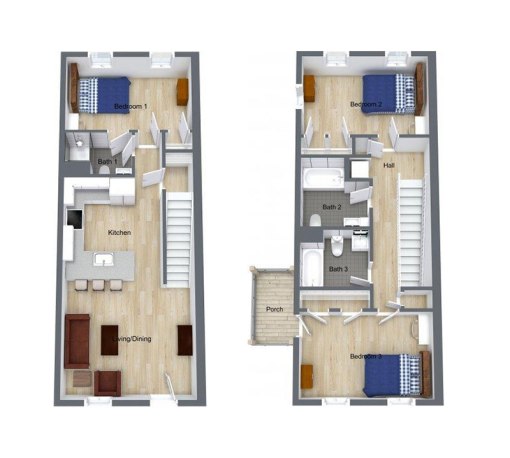
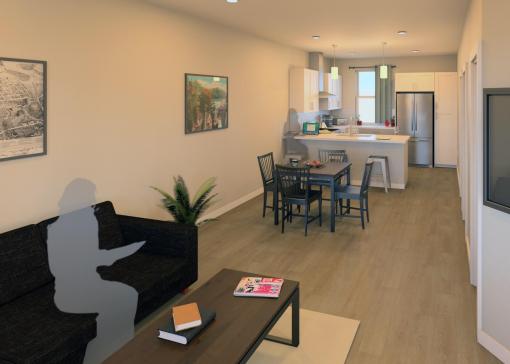
The new Ivy Ridge website shows four apartment plans, consisting of two two-bedroom formats, a three-bedroom unit, and a four-bedroom unit. The site also includes some new renders, including some interior perspectives included here at the end of the post. The number on the website is the number of C.S.P. Management, so it appears local real estate manager Jerry Dietz will be handling landlord duties on behalf of the developer.

Looking at the website Q&A, it’s clearly geared to Cornell students, and although rents haven’t been posted on most websites, it looks like C.S.P. discreetly listed them before anyone else. A two-bedroom will be $1,800/month, a three-bedroom $2,500/month, and a four-bedroom $3,200/month. Cable and most utilities (all except electric) are included in the rent, the units come partially furnished, and pets, include large dogs, are allowed. Stainless steel appliances, in-unit washer and dryer, and marble tile are also planned. Exterior features include 70 parking spaces, bike racks, stormwater ponds, bioretention areas, a childrens’ playground, and a dog park. Although the project isn’t expected to be complete until August, C.S.P. has some units listed for a June 1st occupancy, which given the site photos, it seems plausible that’s they’d open in two phases.
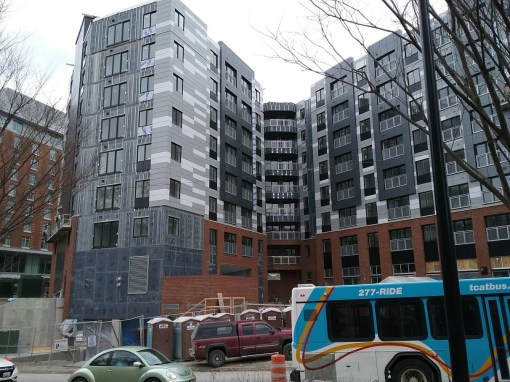
There’s a modest discrepancy in the construction sot, which is partially my fault. An early estimate for the 42-unit/108-bed, 50,000 SF project was $7.5 million, and that’s what I’ve used in some articles and posts. The final development cost with loan from M&T Bank is about $8.6 million.


105 Dearborn Place Construction Update, 2/2019

26 02 2019

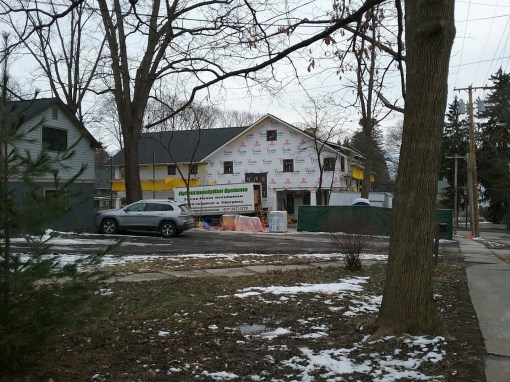
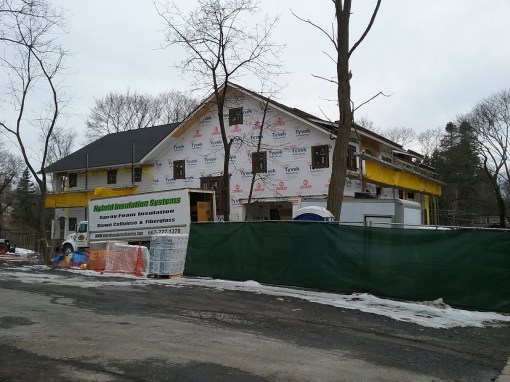
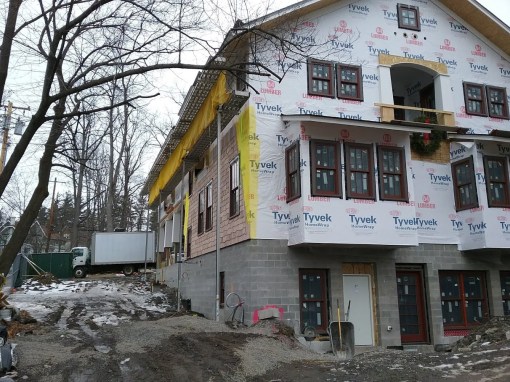
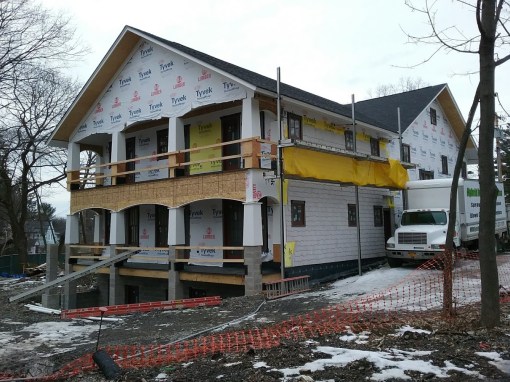
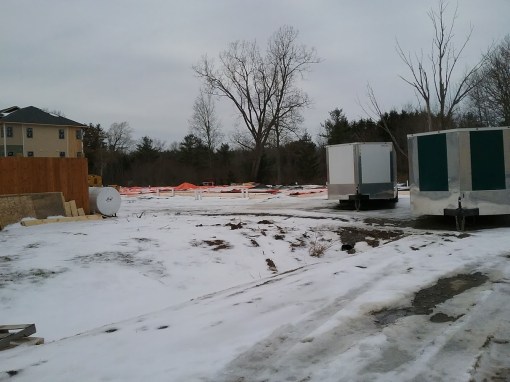
When you’re building a $4.2 million, 12-bedroom/16-person mansion for wealthy seniors, the material choices tend to be somewhat more upscale. At 105 Dearborn Place, over the typical Tyvek are a yellow waterproof barrier and traditional cedar shingles. These will be painted at a later time. The CMU block walls of the partially-exposed basement level will be layered over with cultured stone.

With the house fully-framed, the structural details are starting to show; along with banks of windows and shed dormers, and there are no less than five porches on the second level, four recessed and a more traditional open porch at the rear of the 10,930 SF building. Some of the architectural details will show up later (roof brackets, railings and balconies), and the porte-cochere has yet to be assembled.

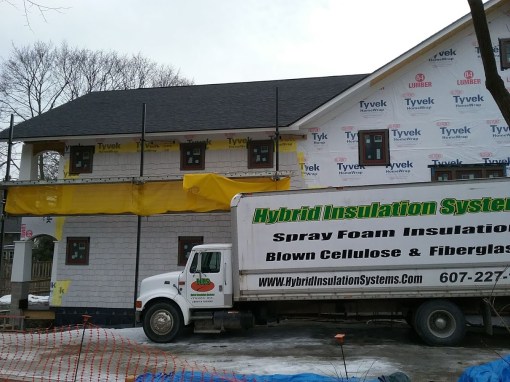
A truck on site and crew in full plastic suits suggested that spray foam insulation was underway inside, so the utilities rough-ins (electrical, plumbing, HVAC) are probably in place, but drywall, cabinetry/fixtures, and flooring are not. The insulation is being applied by Hybrid Insulation Systems of Ithaca.
There don’t appear to be any promotional advertisements for the new building yet, but keep an eye out as it moves closer to completion later this year. Owner Elizabeth Classen has been quite busy in the past year, signing on as a partner in Travis Hyde Properties’ Library Place project on the 300 Block of North Cayuga Street.

More information on 105 Dearborn Place can be found here.