Schwartz Plaza Construction Update, 8/2017

18 08 2017

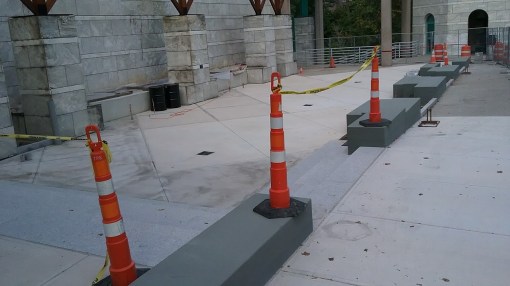
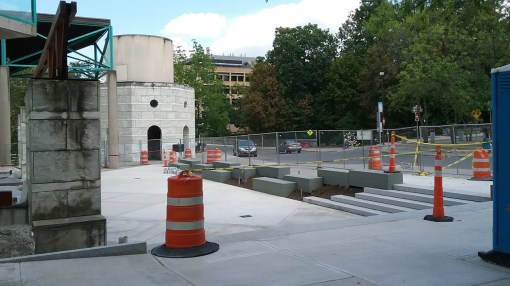
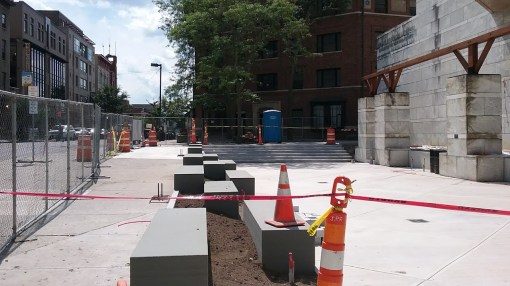
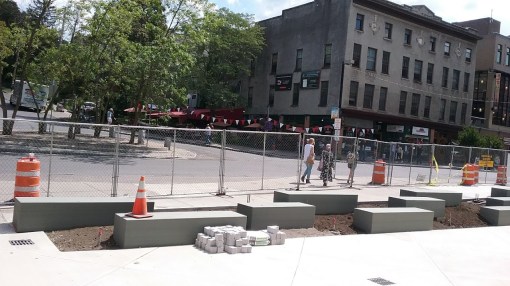
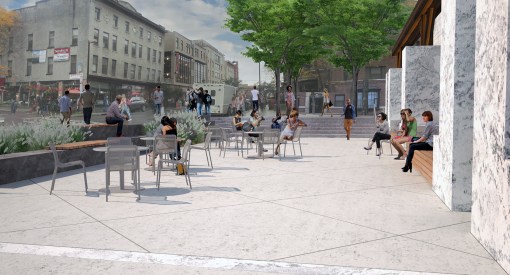
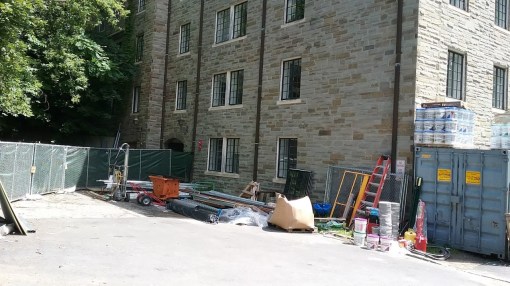
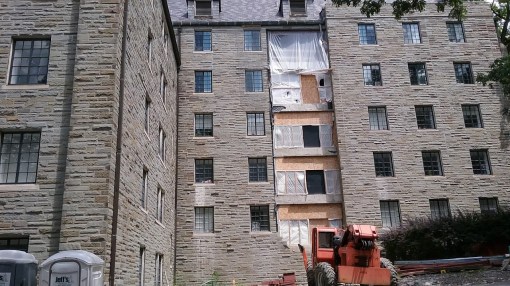
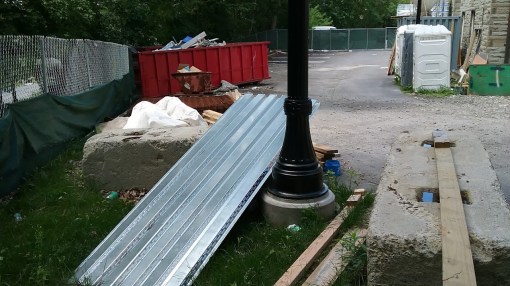
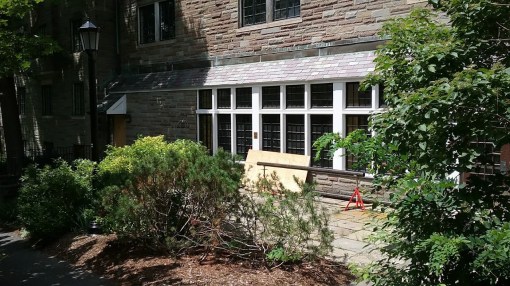
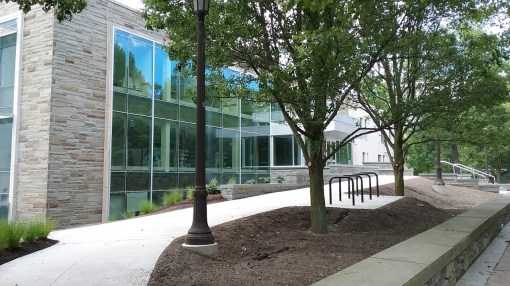
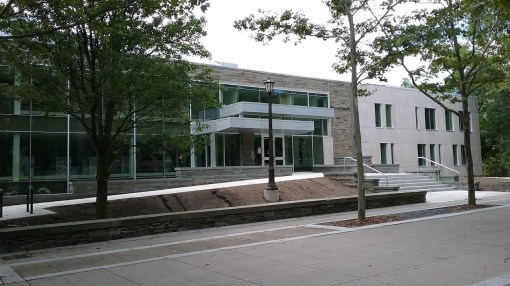
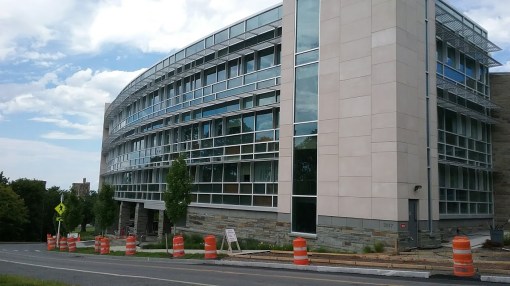
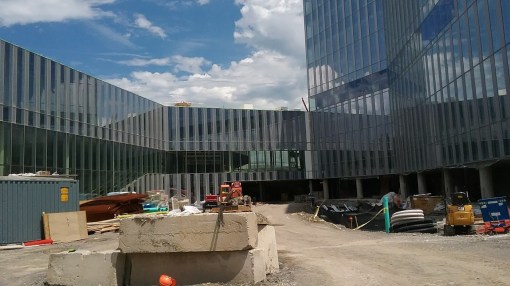
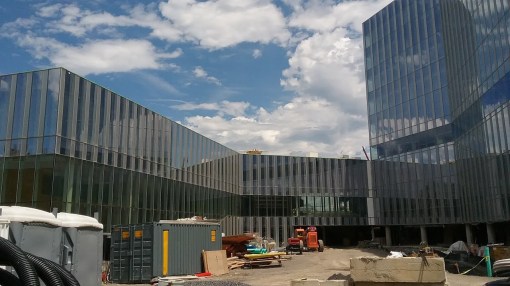
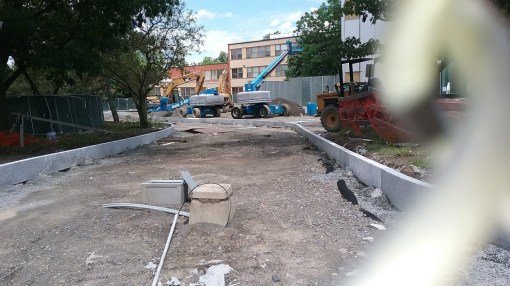
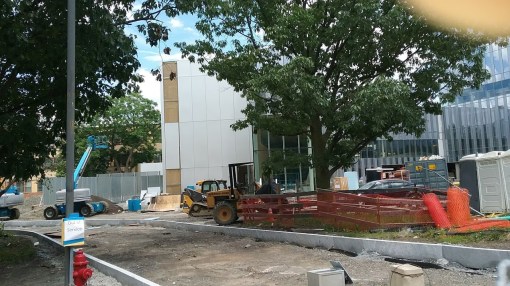
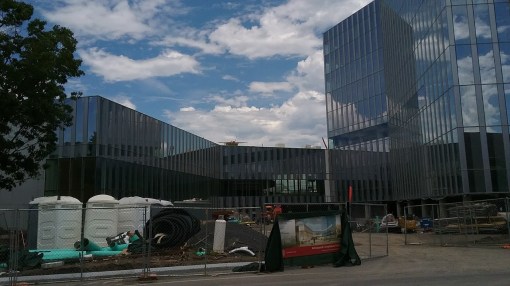
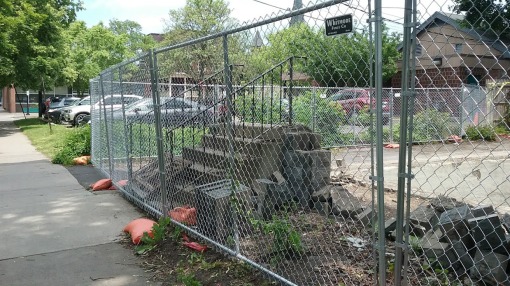
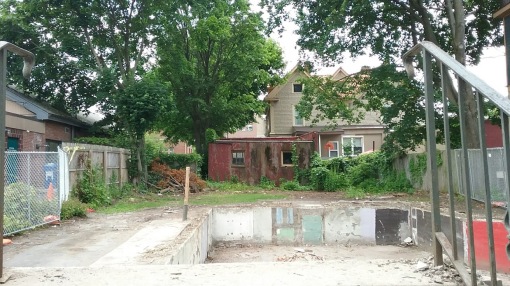
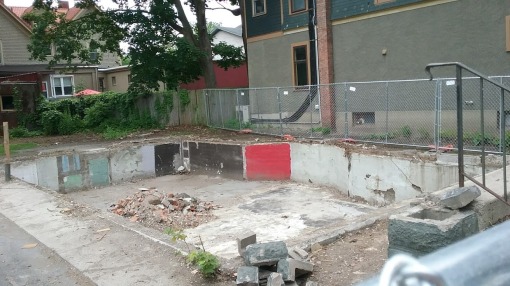
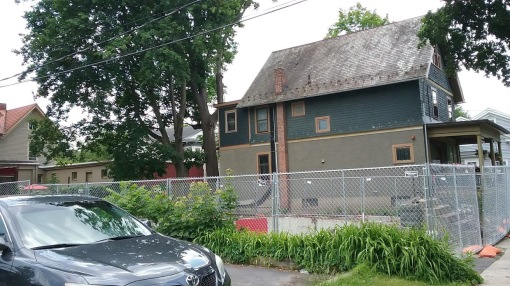
Cornell’s modest but useful renovation of Schwartz Plaza has made significant progress. Gone are the walls that kept the sunken plaza cloistered from passerby, and in its place are stone seats and durable granite setts, for what ideally serves as a visible, attractive public gathering space in Collegetown’s dense quarters. Ornamental grasses will be planted between the seats, and from the renders, it looks like recessed LED light poles will be added as well.

Wood benches will be installed on a granite base below the steel trusses of the far wall, and some of the stone seatings on the near/eastern side will be overlaid with wood benches as well. Hopefully the marble columns get a thorough cleaning; after a few decades, it could use a good scrub. New ornamental bushes and vines will be planted along the trusses and against the back wall of the sunken “forecourt”.

Originally, this was supposed to be done in time for classes, but that seems unlikely at this point. A September finish is likely a fair estimate.


Chapter House / 406 Stewart Avenue Construction Update, 8/2017

17 08 2017

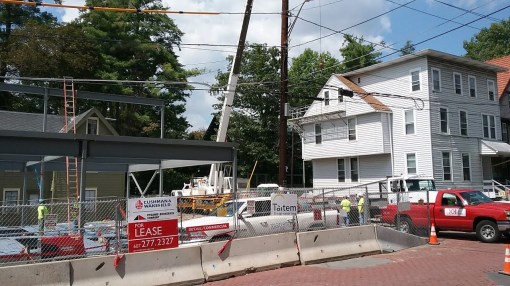
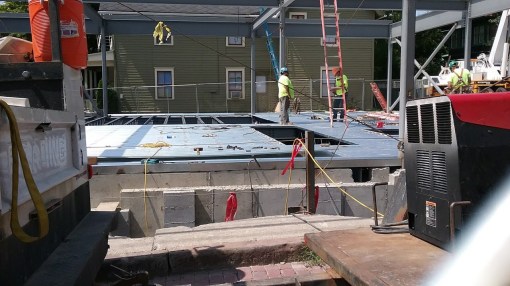
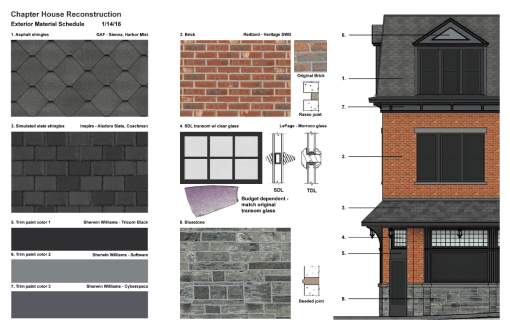
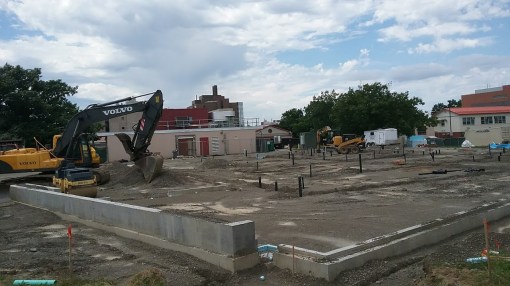
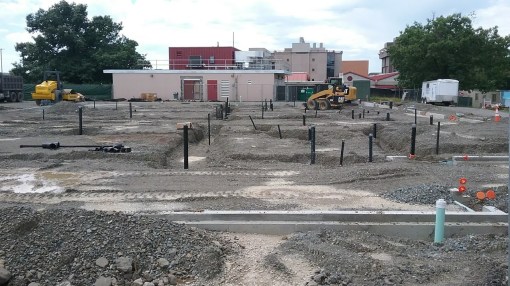
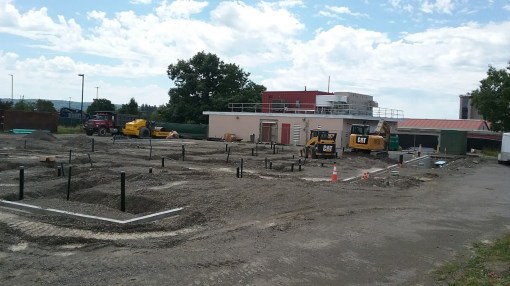
Some good news and some bad news. The good news is, the replacement building for 400-404 Stewart Avenue is well underway. No false starts, no rumor milling. The new structure is quite substantial for a modest three-story building – structural steel frame (currently up to the second floor), steel floor panels, finished basement, – all heavy duty, commercial grade construction, befitting for a mixed-use structure with possible food retail or general retail tenants on the 3,000 SF ground floor. Note the structural cross-beams; those well segments will not have windows. The exposed portion of the concrete foundation wall will be faced with bluestone later in the build-out. The fifth photo shows no concrete between the floor panels and foundation, presumably because the corner entrance will have an interior stairway that steps up to the ground level.

Now for the bad news. I chatted with a worker on the site, and when I said “the Chapter House site”, he chuckled, shook his head, and recommended I don’t use that phrase. “The Chapter House ain’t coming back,” he said before picking up a shovel. “People will forget all about it in four years anyway.” It hasn’t been a secret that the Chapter House likely isn’t making a return, but for many students and non-students, it’s still a disappointment to hear that.

The construction timeline for 400-404 Stewart called for a completion this year, which seems generous. The apartment building at 406 Stewart Avenue has been graded, but construction will not start until later this fall. Hayner Hoyt is the general contractor, with Taitem in charge of the structural engineering.

UPDATE: In the comments, John Hoey, the proprietor of the Chapter House, has written in the comments that he intends to reopen the bar, if not here then elsewhere in Collegetown.


Cornell Law School Renovation Update, 7/2017

31 07 2017

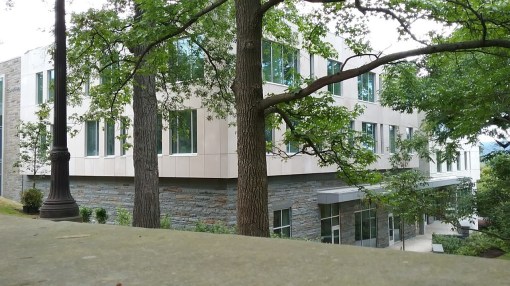
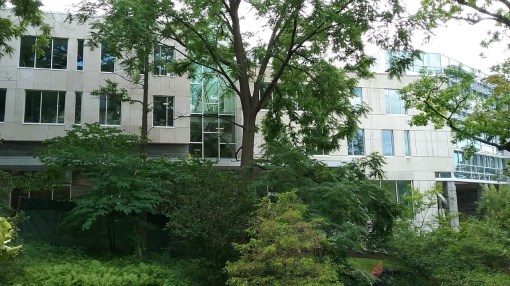
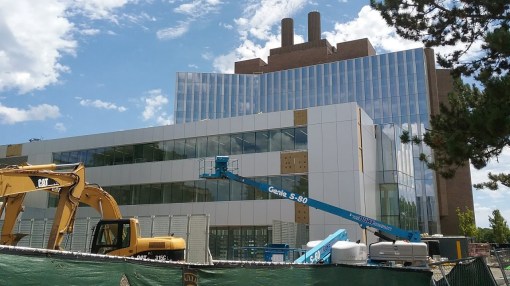
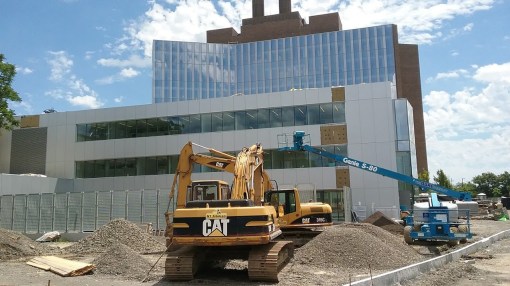
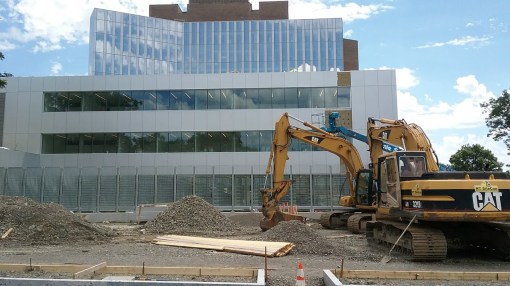
On the outside, progress is modest – the windows and CMUs from the upper floors have been removed from the west face to make way for the future glass-encased stairwell. The steel beams sitting in the staging area are part of the Certainteed Drywall Suspension System and will be used in the construction of the new ceilings in the gutted interior, although some of the different gauges present may also be used for interior wall framing. There has been no visible progress on enclosing the loggia yet.


Gannett Health Center Construction Update, 7/2017

27 07 2017

Here are the rest of the photos from the Cornell Health, formerly known as Gannett Health Center. The Voice write-up is here. The project is mostly complete, with some sidewalk and landscaping yet to be completed (the official timeline has the project wrapping up in October, but given the stocked pharmacy and furnished lobby, the project is practically complete from this blog’s perspective). Look for a potential final Voice article later in the fall, as part of an official tour of the building around the time of the ceremonial ribbon-cutting.

On a personal note, I want to briefly send my apologies for the slow updates; I’ve been dealing with a personal loss, and their passing hit me harder than I anticipated. It’s also been a very slow week news-wise, so don’t expect a weekly news round-up tomorrow evening.


Cornell Veterinary School Expansion Construction Update, 7/2017

25 07 2017

Just clearing out the photo stash – only a small sampling of the photos made it into the Voice round-up. The first set show the new administration and library wing finishing exterior aluminum panel installation, new curbing being laid, and the mostly finished entry and atrium area. The later photos are of the new Community Practice Service building, which is finishing underground utilities routing and foundation work – the new service facility will be one-story and wood-frame, which should allow the structural framing to move quickly.

The new vet school facilities will be open by late August, and the new CPS Building neat spring.


Ithaka Terraces Construction Update, 7/2017

21 07 2017

Some more progress on the Ithaka Terraces condo project at 215-221 West Spencer Street. Buildings “A” and “B” have had their porches built out and sheathed, with some of the decorative columns are in place (the architecture, penned by STREAM Collaborative, is supposed to take design curs from traditional Greek/Mediterranean hillside structures). The white coating visible from the uphill photos is the water-resistive barrier over which the stucco will be laid. Building “C” is framed and sheathed, but the roof isn’t fully shingled and many of the windows and doors have yet to be fitted. Long-awaited Building “D” has finally started construction, with excavation underway and some foundation forms in place. The grand central stairway is beginning to take shape. From what I was told by developer Ed Cope (PPM Homes), the model unit should be unveiled in the next few weeks.
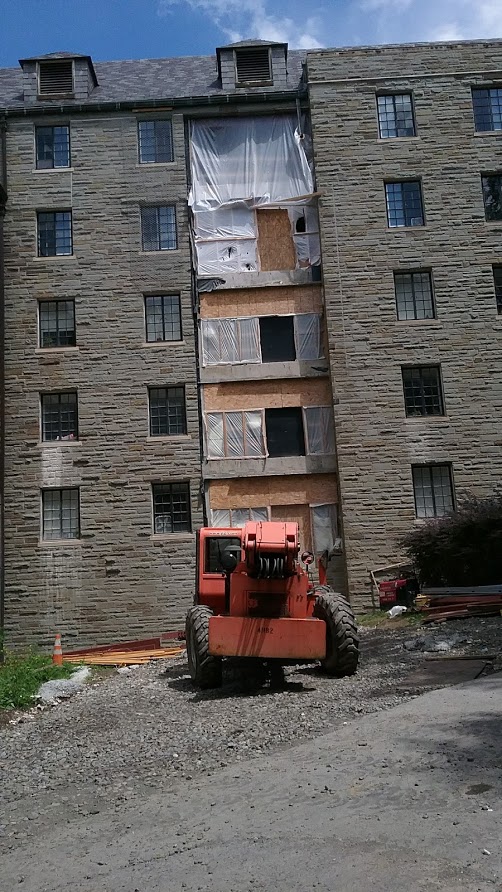
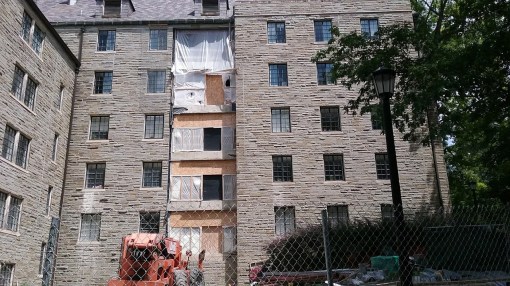
The website has been updated to take inquiries, with unit sizes ranging from a 1,005 SF 2-bed, 2-bath, unit, to a 3-bedroom, 3-bath 1520 SF unit (3 bathrooms? For the family that hates sharing sinks and showers?). Nothing on the website states pricing, which was previously estimated in the $265k-$390k range.

Side note, I dropped by 413 West Seneca Street and 109 North Corn Street, a pair of projects Ed Cope is doing in Ithaca’s State Street corridor. Nothing to report yet.


Poet’s Landing Phase II Construction Update, 7/2017

16 07 2017

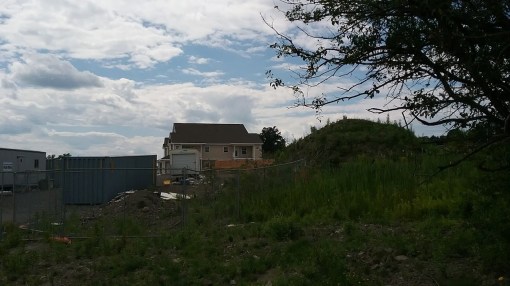
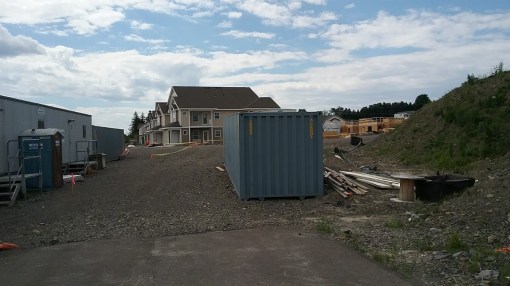
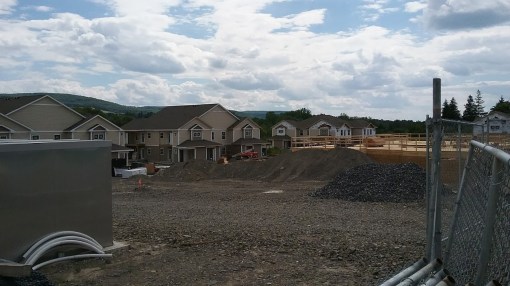
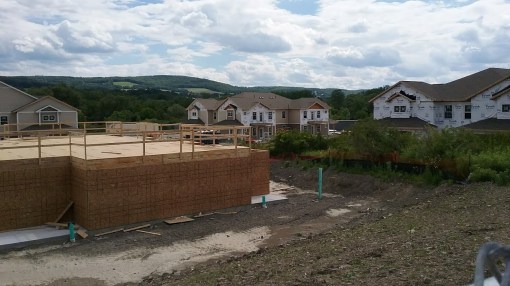
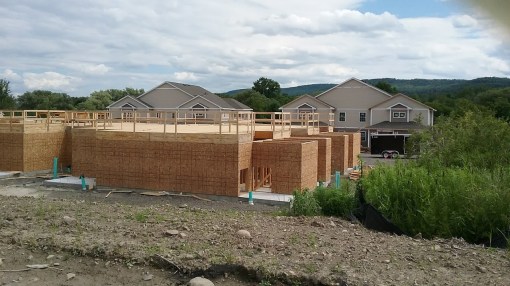
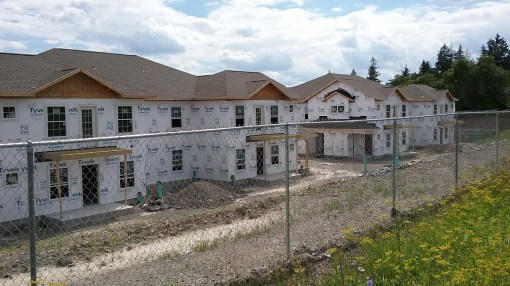
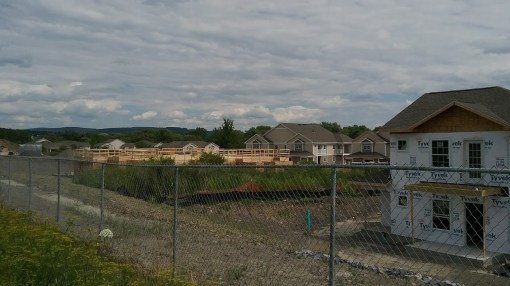
Over at the Poet’s Landing construction site, it looks like two of the buildings, previous dubbed “E” and “F” since I have no actual documentation of individual address, are pretty close to completion. “F’s” exterior work is almost complete, waiting for a few more trim pieces such as balcony and porch railings. It’s difficult to tell how far along the interior is; what looks like a gaping hole in the front at first glance, is actually a covered vestibule that leads to front doors, some of which appear to have been left open in photos seven and eight below. A typical build-out usually involves the interior being fairly far along by the time exterior trim is being attached – rough-ins complete, drywall hung, and probably the painting, utilities finish work and counters/cabinetry are underway. Building “E”, which is a little further behind on the trimwork, appeared to have some unpainted drywall visible just beyond the open front doors.

Stepping further back in the construction process, building “D” is in the midst of Certainteed vinyl siding attachment, and Building “C” has been shingled and fully wrapped in DuPont Tyvek, its balcony frames and porch columns just naked beams for now. Building “B” has yet to be fully wrapped, and “A” isn’t even fully framed yet. It looks like some of “A’s” roof trusses are sitting near Building “F”.

Although unsure offhand, if Conifer is planning to do a phased move-in, they could have Buildings “F” and “E” occupied by Labor Day, “D” and “C” before Halloween, and “B” and “A” before the end of the year. Building “F” was just getting its second story framed back in February, so another six months for “A” doesn’t seem unreasonable.

When finished, there will be 16 1-bedroom units, 24 2-bedroom units, and eight 3-bedroom units. Units will be rented to households making 60% of area median income or less, so less than $32k/year. Tenants will have an interview with management, and have to pass a background check. Given the dearth of affordable housing, not everyone interviewed and qualified will be offered a unit, but in that case, they will be offered a spot on a waiting list if desired. Those interested in units in the $10.8 million project can sign up for an “interest list” here, which will notify them as management interviews commence, giving them the chance to sign up and start the process.

So, this is something I’d like to expand on a bit, given some of the recent talk about Hamilton Square in Trumansburg. Some folks have cited Overlook at West Hill as an example of the crime and degeneracy that “these people” will bring to the village. This reminded me of the West Village piece I did for the Voice last year, where I argued successful affordable housing involves community engagement and respect, access to services, and proactive tenant management.

With any group of landlords, you have good ones, mediocre ones and bad ones. Overlook’s management leaves something to be desired, as has West Village’s. Omni Development, which manages West Village, seems to be taking a greater, more proactive role, although its history of hands-off behavior leaves many wary. Overlook is managed by Domain Companies, which is based out of New York City and New Orleans, and was developed in partnership with the Arker Companies. Back when it was proposed in 2003-04, INHS did advocate for the project during the town’s review process and obtain affordable housing loans. However, they are not and have never been Overlook’s property managers.

I can honestly say I have never heard of systemic issues with anything INHS or Conifer manages in Tompkins County. Rarely if ever is there a criminal complaint about the people who occupy Conifer’s Linderman Creek, Poet’s Landing I, The Meadows, or any of their other Tompkins County properties. That goes for the general affordable housing as well as the senior housing. I can say the same thing about INHS – through the Voice, which wouldn’t hesitate to cover crime since it drives clicks so well, there’s nothing I’ve seen about Stone Quarry’s residents being an issue, or the Henry St. John Apartments, Breckenridge Place or TowerView. I can come up with complaints for both (Conifer’s unfortunate choice of auto-centric sites with cookie-cutter units, INHS’s care-worn older stock), but neither of those has to do with tenant management.

If it were Domain/Arker or Omni pushing Hamilton Square, There would be reason for concern. But given that’s it’s INHS, mixed-market with owner occupied units, moderately sized and has convenient access to Trumansburg village, I strongly doubt management of the rentals is going to be a problem.


107 South Albany Street Construction Update, 6/2017

22 06 2017

Seems fair to move this one over into the construction column. Introducing 107 South Albany Street.

The State Street Corridor represents one of Ithaca’s best possibilities for infill development. It’s a mixed-use area with a hodge-podge of buildings and styles, from ornate century-old properties to commercial utilitarian structures. It has a number of sites that have easy access to downtown and amenities, permitting a walkable lifestyle. It’s also less expensive than downtown properties. With this in mind, the city rezoned much of it in 2013 to allow for 5-story buildings, up to 60 feet tall, with no need for parking. The zoning was a simple box overlay regardless of lot lines, which resulted in some “secret” infill opportunities like 512-514 West Green Street, whose rear yard was in the rezoned area, and as a result, owner Carmen Ciaschi was able to legally slip in a two-family home without adding additional parking.

107 South Albany Street was rezoned as a result of the 2013 overlay. The existing property was a mixed-use two-story home that had an apartment on the upper floors, and converted on the first floor to commercial office functions (law office). This presented an opportunity for the enterprising developer.

Enter Stavros (Nick) Stavropoulos. The West Hill native, whose family runs the State Street Diner, runs a small rental company, Renting Ithaca. However, Stavropoulos has slowly and steadily made his way from management to real estate development – first with additions to existing buildings like 318-320 Pleasant Street, and then entirely new properties like 514 Linn Street in 2015, and a project currently at 1001 North Aurora Street. His M.O. so far has been to find middling properties in desirable locations, and add inoffensive infill rental housing – nothing that stretches code, nothing that will anger the neighbors. Earlier projects were designed by Lucente family favorite Larry Fabbroni, but more recent projects have turned to a low-profile, longtime Ithaca architect named Daniel Hirtler, who runs Flatfield Designs. Stavropoulos picked up 107 South Albany Street for $236,000 in August 2015.

Seemingly, each project he takes on is larger than the last. 1001 North Aurora is a 4-unit project, 12 bedrooms with a hard cost of about $400,000. 107 South Albany is slated to be his latest and greatest yet. The original plan, as introduced in Spring 2016, was to build a new six-unit building at the rear of the existing house, and renovate the house into three apartment units, for one studio, six one-bedroom units, and two two-bedroom units. After a few months of planning board review and critique from the design committee, the 3,954 SF, $500,000 plan was approved and slated to start in July 2016.

However, that plan never moved forward. Instead, this past winter, Stavropoulos decided to submit a new set plans. The new plan called for eleven units and eleven bedrooms, but instead of retaining the existing house, it would be deconstructed and replaced with a new three-story, 8,427 SF building. With its neighbors including a former gas station-turned medical service and older, historic structures, the building’s design is an attempt to bridge the gap. The front sports a cornice, a brick veneer on the first floor, tan fiber cement lap siding above and a traditional window arrangement. In contrast, a stucco finish fiber cement stair tower in the middle of the structure serves as a visual interest for passerby on West State Street, and gives the building a modern touch. The building’s height is capped at 40 feet 5 inches, well below the constraints set by the zoning.

The building isn’t designed for active street use, with a recessed entry and bike storage area for privacy, and no first-floor windows on the front facade. However, in an attempt to create an attractive streetscape, the building uses lighted wall recesses on the exterior, the brick work will have decorative patterns, and a large semi-circular iron trellis that will be adorned with native twining vines. The project cost is $946,600, according to the city’s Site Plan Review document.

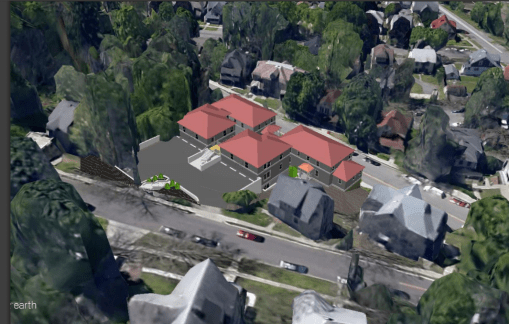
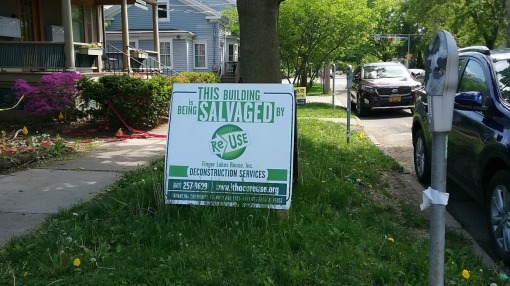
As of this month, Finger Lakes ReUse has deconstructed the existing house, cleaned and processed the salvaged materials, and has them for sale at their warehouse/store on Old Elmira Road. The foundation and front staircase are all that remain. The plan is to start construction on the new building in the September/October time frame, and to have it open for occupancy by summer 2018. No contractor or construction manager has been named as of yet.

From June:

From May:

Pre-development:

Isometric Plan and interior layout:


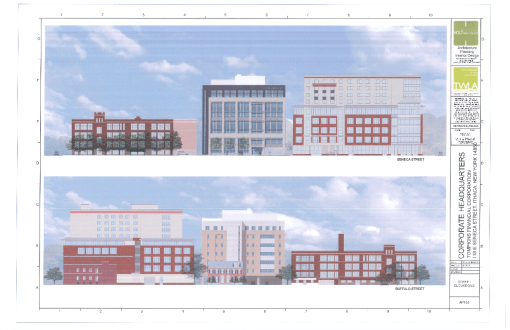
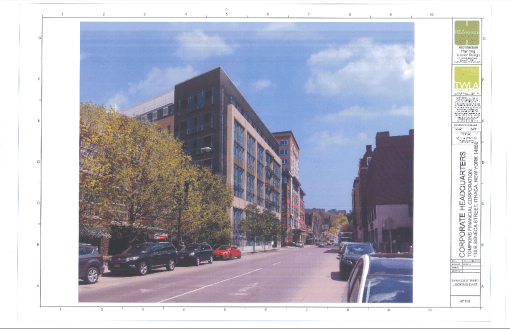
Tompkins Financial Corporation HQ Construction Update, 6/2017

20 06 2017

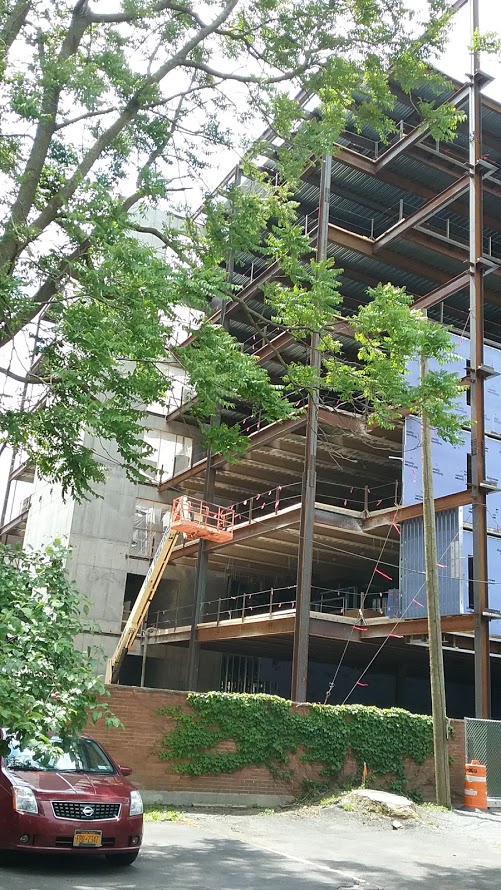
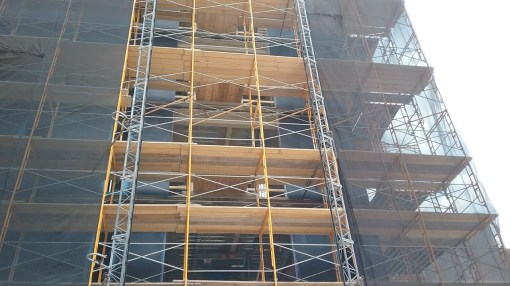
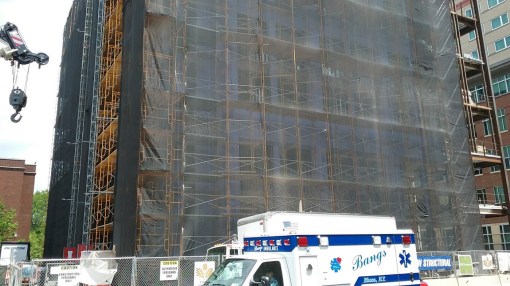
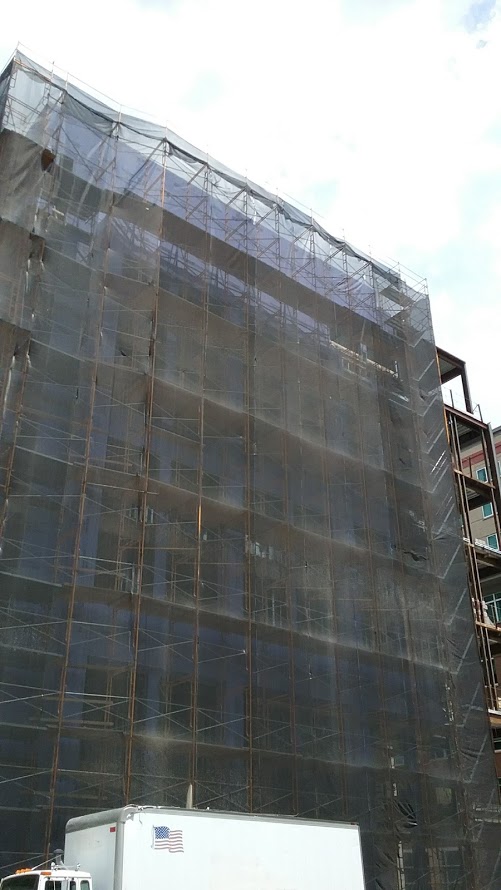
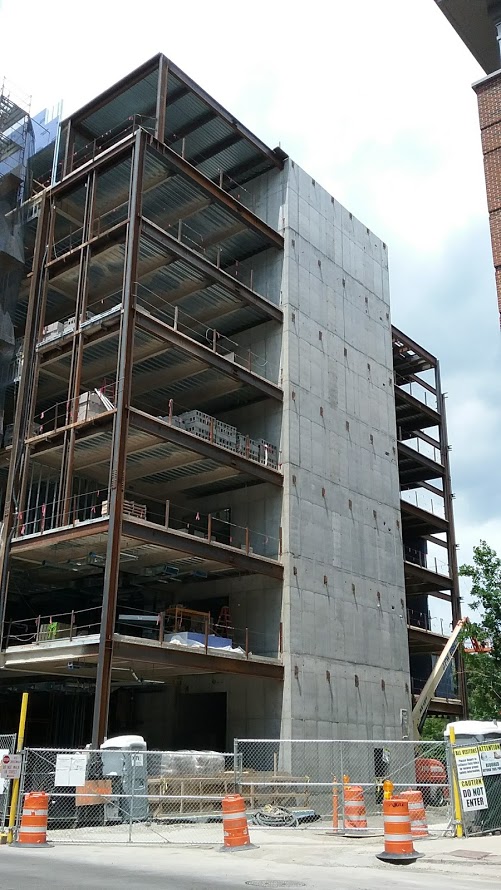
Over to the Tompkins Financial HQ. The rear face is a bit strange-looking at first glance because there’s a set of steel beams projecting right next to the first layers of gypsum sheathing, so it’s not clear where the back of the building is. A look at the plans indicates that the rear steel extension outlines a future stairwell, which projects a little further back from the main body of the building. The eastern segment of the skeleton has yet to be built past the elevator core, and consequently the rest of the rear/north wall projection has yet to be erected. As the rest of the structural steel is bolted into place, that will be boxed up, decked and sheathed.

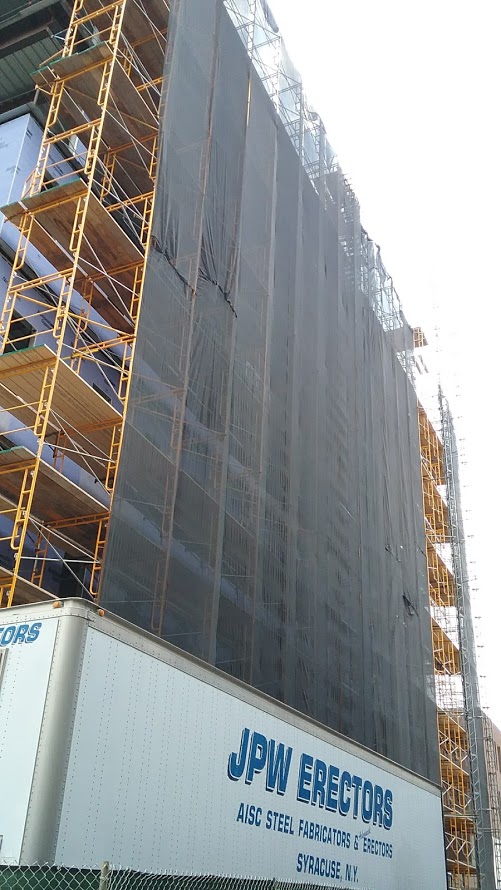
The lower floors have been sprayed with an undercoat of fireproofing, and are starting interior build-out with steel stud walls and concrete masonry units (cinder blocks). Under the safety cover, the fire-proof gypsum panels extend the full height of the building, with rough openings for future windows. Note that the top floor is set back a little bit from the lower floors, which can seen a little better in April’s update; this will be faced with a black brick veneer, while the projecting wall of the lower floors will be faced with a lighter stone. This feature was designed to make the building’s bulk a bit more subtle, and to respect the size and fenestration (window arrangement) of the DeWitt Mall next door.

Still a ways out from its March 2018 delivery date, but it looks like LeChase has things on track.


Cayuga View Senior Living Construction Update, 6/2017

17 06 2017

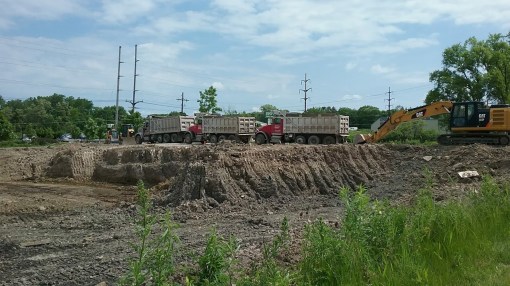
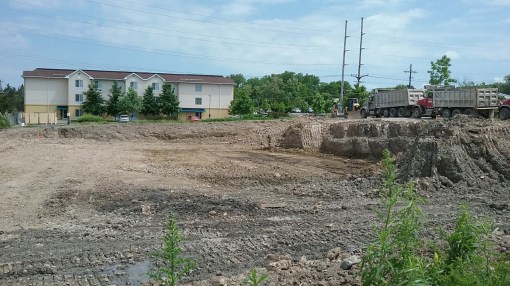
Figure Cayuga View can probably go under the “under/construction” column. Finally.

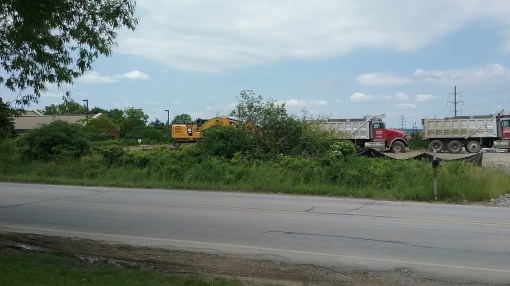
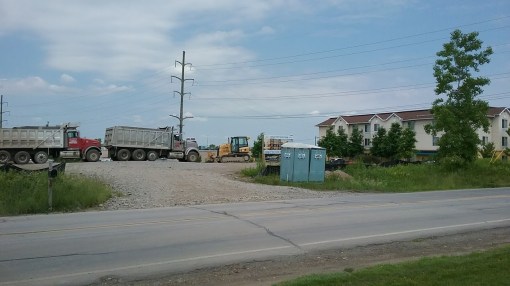
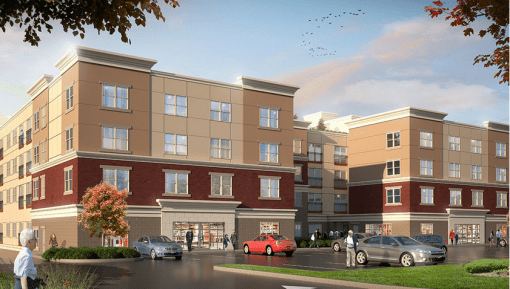
Cayuga View Senior Living, street address 16 Cinema Drive, is one of several Ithaca-area projects attempting to make a dent in the county’s lack of senior housing. Along with affordable housing and special needs housing, senior housing is often cited as something that the county needs a lot of more of, and soon. The county’s just-released housing strategy cites the need for 100-200 subsidized units by 2025, as well as a new skilled care facility. Various forms of senior care are expected to drive demand for an additional 750 units. A fully independent market-rate senior project like this isn’t explicitly categorized, but would potentially address some of the demand for senior housing in Tompkins County.

Cayuga View is a mixed-use 60-unit project on the last vacant high density-zoned parcel in the village of Lansing. Like many projects, the Thaler Family and their business partners have taken years to get to this point. The Thalers have owned the land since 1971, and have divided it up over the years, for example subdividing the property in 2000 to accommodate the construction of the CFCU branch next door. The first record of Cayuga View is really for an entirely different plan by the Thalers – in fall 2012, they proposed “C.U. Suites”, a 3-story, 43,000 SF building with 39 apartments geared towards Cornell graduate students. Along with those units were 26 covered parking spaces and two commercial spaces.

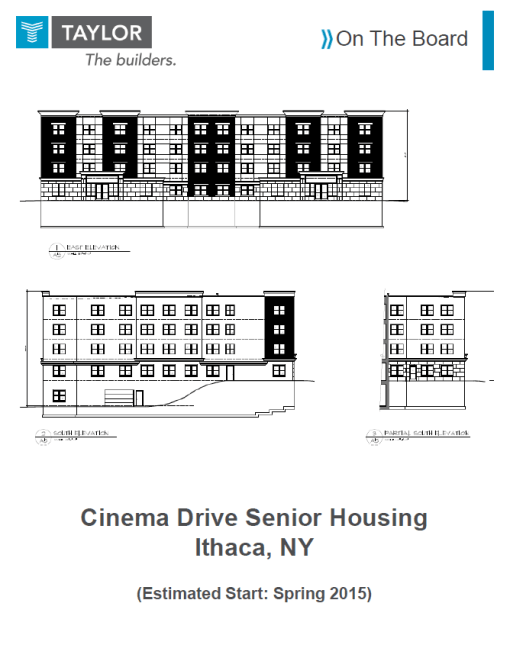
However, after getting approval for C.U. Suites, they decided to re-tool the project. At about this time, Taylor The Builders, a construction firm based out of Rochester, came on board as the general contractor, and it was determined that the student market angle “didn’t work very well”. In 2014, the revised plan, for “Cayuga View Senior Living” was rolled out. This was larger, 4 stories and 87,515 SF, with 59-62 apartment units depending on the iteration – Manley Thaler stated it wouldn’t be affordable or take federal funds, but he hoped to fill a niche below Kendal in the senior market.

It took some time to go through Lansing village boards, planning and zoning. Cayuga View required a number of zoning variances and reviews of its legalese to clarify the rules for a 55+ community in Lansing – namely, the boards didn’t want the project to revert to general housing, and there was debate over a 10 year stipulation vs. a 20 year or 30 year stipulation (I’ve honestly never heard of senior housing switching to general housing). One BZA person was upset by the height of the building and wanted it to be one floor less, and a planning board member was upset by the lack of parking, about 100 spaces.

After approvals for a tweaked 87,359 SF building were granted in Spring 2016, the project entered a sort of stall mode while it tried to obtain financing. Cayuga View Senior Living managed to land a construction loan earlier this year. According to a construction loan filed on May 25th, Five Star Bank of Warsaw (Wyoming County) is loaning the Thaler family and their associates $10.88 million to make their project become reality. Along with the loan, the Thalers and their business partners will be putting up $1,796,450 in equity to move the project forward, bring total costs to $12,676,450. It comes out to about $145/SF, a little less (~10%) than a comparable project in Ithaca city.

Included with the project are 12 1-bedroom, 1-bath units (725 SF), 48 2-bedroom, 2-bath units (three floor plans, 900-1,110 SF), and 2,680 SF of retail space, with preference towards coffee shops, small eateries or services like a salon or barber shop. The webpage comes with rendered 3-D tours; I dunno about you folks, but if there are two glasses of wine sitting on the kitchen counter at 10 AM, my concerns aren’t going to be about unit availability. 5% of the units will be built handicap-accessbile, but all will be handicap-adaptable.

The units will be priced upmarket, $1,550/month for a 1-bedroom, $2,250-$2,775/month for a two-bedroom, plus $200/month for top floor lake view units. With that comes a community center, in-unit washer/dryer, trash removal, fitness room, wi-fi, library/computer room, intercoms, rooftop garden, basic cable TV and pets under 30 lbs. for an additional monthly fee. Hot water shouldn’t be listed as a feature, but what do I know.

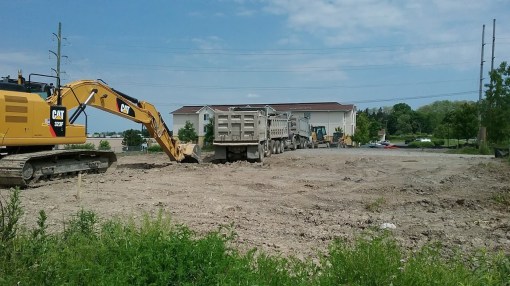
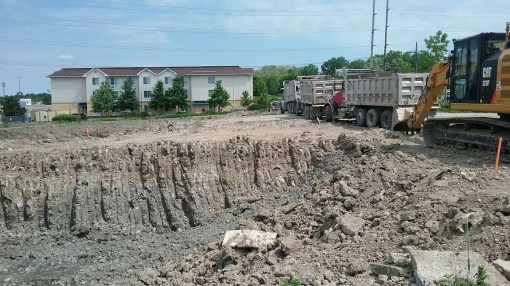
According to their Facebook page, Cayuga View S.L. will be ready for occupancy by Spring 2018. NH Architecture‘s Roger Langer is the project architect. Note in the foundation excavation photos that the building will be built into the slope of the hill – four floors in the front (east), five in the back (west). There has yet to be an updated site plan posted, but parking will mostly be on the side facing the bank.

At the end here is a shot of the Triphammer Apartments/former Chateau Claire renovation across the street. That is a separate $1.14 million project by Park Grove Realty to renovate 64 ca. 1960 apartment units (kitchen and bathroom remodeling, washer-and-dryer installations, roof repair, new balconies, gutters, landscaping and lighting), add parking stalls and a 425 SF rental office.