News Tidbits 1/20/17: A Week Late and A Day Early

20 01 2017

1. In the town of Ulysses, work continues on a rezoning and reimagining of the hamlet of Jacksonville. The town held a meeting for public feedback this past Thursday. For those who are unfamiliar, Jacksonville is a cluster of a few dozen houses and a few small businesses about two-thirds of the way up Route 96 from Ithaca to Trumansburg. The town is working with local urban planning firm Randall + West to redevelop the hamlet, which has been plagued in recent decades with not just the standard rural upstate flight, but total disinvestment in some parts as a result of a massive gas spill in the late 1970s that poisoned the wells of neighboring properties, which Exxon bought and left in a state of low, sporadic maintenance.

However, some areas are served by municipal water systems, and the town is looking at expanding the hamlet zone, and creating a hamlet center zone in the hopes that they can give the hamlet “quality growth” and a Trumansburg-like flavor – small shops and density at the core, and somewhat walkable for basic errands, with sidewalks and interconnected streets. It’s a bit reminiscent the old “nodes” concept pushed by the county about a decade ago, but with more emphasis on walkability. The zoning brief shows participants have expressed a preference towards small-lot houses and 2-4 floor mixed use. With the latest public meeting completed, the plan is to have a zoning draft ready by March.

For the record, Ulysses permited 11 new homes in 2016, so even if the revised Jacksonville hamlet zoning becomes more accommodating, don’t expect a boomtown.

402_s_cayuga_habitat_2 402_s_cayuga_habitat_3

2. From the IURA Neighborhood Investment Committee agenda, a few more details about Habitat for Humanity’s plans for 402 South Cayuga Street. Four units, $720,000 construction cost, about $799,500 with soft costs. Savings from volunteer labor reduce the cost to $709,500. Funding comes from $100k in cash equity attained by the sale of the Morris Avenue townhouses, $300k in grants and $120k in HUD funding. Private donors and grants are expected to contribute about $189k. The initial design and land purchases expenses are being covered with funds from the $50,000 sale of a 32-acre parcel in Trumansburg for public green space. With multiple transactions required before anything can move forward, the plan is to break ground in June 2018 with construction lasting from 18-24 months.

The units will be sold to families making 30-60% of local AMI (i.e. $16-$32k/year) who put in the requisite sweat labor and take approved home-ownership and finance courses. The units will be solar-capable, though they’re still debating if the panels will be installed by Habitat or the responsibility of owners. By the way, the bright colors of the units are intentional.

The committee has said this project pretty much checks off every box on their want list, and Habitat for Humanity has been named preferred developer; contingent on approvals, the IURA will sell the property to the non-profit for $32,000.
amici_v3_1

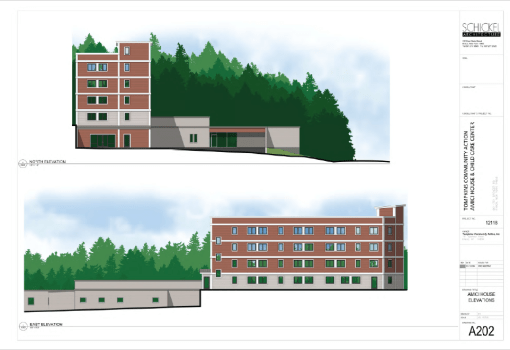
3. For those that might have missed it, the Times’ new journo, Matt Butler, did a nice piece on TCAction’s Amici House development. The 23-unit project will be up for prelim approval at this month’s Planning Board meeting. In the piece, TCAction Director Lee Dillon notes that it’s not strictly for drug rehab, it’s for homeless youth regardless of the presence of addiction. The project also provides a low-cost childcare center with five HeadStart classrooms able to support 40-45 kids. Apart from a couple of concerns and complaint, reactions have been generally receptive to the plan, which will be located at 701 Spencer Road on the southern edge of the city.

As a former Head Start student, I never knew it was geared towards low-income families until I was in high school. There’s a lot of real, tangible value to Head Start as an early education program, especially in a community like Ithaca where the school district the kids enter into is capable and well-regarded. I applaud the Amici House project and look forward to its construction.

tiny_tims_7 unnamed

4. Tiny Timbers is getting quite creative. In addition to the five existing designs, Buzz Dolph’s team, working with architect Noah Demarest, have rolled out two new designs. The first is a one-story, two-bedroom house which looks to be in the 630 SF range, with the option of deleting the second bedroom available. The second design is called “big cube”, with a 21′ x 21′ footprint (two stories, 882 SF), slightly larger than the 18′ x 18′ regular cube. The website seems to be down for an update at the moment, but the 3D panorama still works.

The town of Dryden has granted approval to the Varna site, so at this point marketing and sales of the home sites should be getting underway soon. If successful, Tiny Timbers could be a solution to meeting an underserved and difficult-to-serve segment of the Ithaca market – new, modestly-priced homes.

20161119_145216

5. Here’s the funding application for the first stages of the Tompkins County Heritage Center. The request is for $35,500 from the legislature. That would cover community presentations, legal fees for partnership agreements, a retail space plan, branding language and design, concept overview, website, floor plans, exhibit design and the launch of a capital campaign later this year (May for the silent campaign, October for the public campaign). Along with the capital campaign, primary funding may come in part from the $500 million URI fund that the state awarded to the Southern Tier back in 2015. The History Center and its partners are exploring some of the way they can reuse the 18,000 SF space currently occupied by Tompkins Trust; for example, multimedia presentations in the former bank vaults. STREAM Collaborative is in charge of the new floor plans, STREAM will work with St. John Design Group to do the branding, and Todd Zwigard Architects will handle exhibit design. The Solstice Group will be providing guidance in assembling and running the capital campaign.

To be frank, I’m still not sold on the idea of the Heritage Center being a driver of tourism itself, but I could see it being an enhancement to downtown Ithaca’s other offerings, as well as a gateway for visitors staying at the new hotels near or soon to be open within a couple blocks of the site: “Come for the colleges, wineries and gorges, but check this out while you’re here, you just might find other things you want to do and see”.
20170107_124807

6. The initial December 2016 jobs reading of 73,800 rounds out the 2016 jobs reports. Tallying up the average, the initial estimate for the Ithaca metro for 2016 is 71,600, an increase of 1.7% from last year’s average of 70,400. As always, take the initial estimates with a grain of salt, since they’re liable to be adjusted a fair amount in the big March revision. However, should they hold up, it gives Ithaca the highest percent growth of any New York State metro in the past year (although for the record, NYC added 1.1%, or 109,000 jobs in the past 12 months, basically an Ithaca and a half). For reference, the 2011 jobs average was 66,200, and the 2006 estimate was 62,600.

With the exception of those neighborhoods closest to the universities, the biggest driver of the housing affordability crisis is not student population growth, which was about 196 over the past year (+285 Cornell, -89 IC). It’s the people relocating to/near Ithaca for work. That doesn’t capture the imagination and emotion as much as saying the city’s being overrun by obnoxious 20-year olds.
20161209_121807

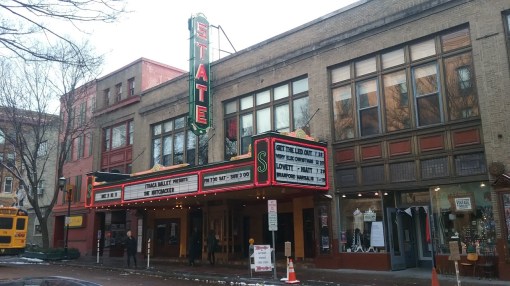
7. Not everything recorded in an interview makes it into Voice articles due to space constraints. Here are some transcribed notes from the “State of the State Theatre” piece that didn’t make the final cut:

Q: Where do you see things going in the next 15 years? What will the State Theatre of 2030 be like?

Doug Levine: We’d be fresh off celebrating our hundred year anniversary! They don’t build theaters like this anymore, we’ve made a lot of improvements to the building, we’ve completely renovated the restrooms. Technologically, we’ll be a lot more advanced, paperless ticketing will be a seamless transaction. We want to maintain the building charm, it’s just a grand palace, but behind the scenes, we’re getting more efficient and innovative, we’ve upgraded to LEDs, and the stage sound and lights will be a lot more cutting-edge, and we’d like to be more energy efficient. I would like to see more flexible seating in 15 years. We’d stay with DSP [Dan Smalls Presents] long-term, that’s worked out really well for us. We’re going in a good direction and I want to keep building on that success.

Q: Dovetailing off that, Ithaca is one of the few growing areas of upstate, and it’s increasingly seen as a tourism and leisure destination. Do you see ways for the State to tap into that? What other opportunities do you see (I noticed something called Ticketfly)?

DL: Conferences are a growing opportunity, the growing economy has led to a spike in conferences from all over the state wanting to come here, and those thinking creatively reach out to us, we had 2-3 last year and [we have] more planned, they’ll use us and Cinemapolis, it’s never going to be a big component but it’s nice to have those groups coming in. We average over 50,000 a year through our doors, 40% from beyond Tompkins County – New York, Philadelphia, Canada.

20151108_154139

8. It looks like the town of Ithaca wants to extend their two-family home moratorium beyond the initial 9 months. 9 months was explicitly chosen after considerable concern from developers and homebuilders last Spring stemming from the initially-proposed 12 months, which would have impacted two construction seasons. The town doesn’t even provide a new timeline, it leaves a blank next to 2017. Really burning through the goodwill here.


college_townhouses_v2_1

8. Looks like a rather luckluster agenda for the planning board next Tuesday. A bunch of projects up for preliminary and/or final approval. These meetings could start becoming very light on substance if there isn’t more in the pipeline. Here’s the schedule:

1. Agenda Review              6:00

2. Privilege of the Floor    6:01

3. Site Plan Review
A. Project:  Amici House & Childcare Center                               6:10
Location: 661-701 Spencer Rd.
Applicant: Tom Schickel for Tompkins Community Action (TC Action)
Actions: Consideration of Preliminary & Final Approval
B. Project: City Centre — Mixed Use Project (Housing & Retail)       6:30
Location: 301 E. State/M.L.K., Jr. St.
Applicant: Jeff Smetana for Newman Development Group, LLC
Actions: Public Hearing, Potential Consideration of Preliminary Approval

C. Project: College Townhouse Project 7:00
Location: 119, 121, & 125 College Ave.
Applicant: Kathryn Wolf, Trowbridge Wolf Michaels Landscape Architects, LLP
Actions: Approval of Trans. Demand Management Plan, Consideration of Preliminary & Final Approval

D. Project: Apartments (5 Units) 7:30
Location: 126 College Ave
Applicant: Visum Development Group
Actions: Public Hearing, Approval of Trans. Demand Management Plan, Consideration of Preliminary
& Final Approval

E. Project: Apartments (9 Units) 7:50
Location:210 Linden Ave
Applicant: Visum Development Group
Actions: Public Hearing, Approval of Trans. Demand Management Plan, Consideration of Preliminary
& Final Approval

F. 107 S Albany St – Sketch Plan 8:10

Presumably, the Stavropouloses are heading back for some type of major revision to their 6-unit, 9-bedroom proposal. The previous plan was an addition onto the back of the existing century-old property. We’ll see what is changed, and by how much. Zoning is CBD-60 – five floors, no parking.
G. 821 Cliff Street – Parking for Business in a Residential Zone 8:30

Parking for the medical office building at 821 Cliff Street; perhaps an expansion to help market it, as I see postings for its space scattered throughout commercial listings. Nearby properties are vacant land.

4. Zoning Appeal: 8:50
#3056, Area Variance, 301 E State St.

5.Old/New Business:
A. Sidewalk on Worth Street -Planning Board Resolution to Board of Public Works
B. 2017 Planning Division Work Plan – Planning Board Comments
C. Update — Joint Planning Board/ILPC Meeting (DeWitt House)

Regarding 5B., Apparently the city is still having discussions with Fane regarding a development of 330 College Avenue, the former Green Cafe on the SW corner of College Avenue and Dryden Road in inner Collegetown. I write “a” redevelopment because the previous 12-story proposal didn’t look like it was going to make friends and influence people. Also on the long-term agenda are the Maguire plans for the Carpenter Business Park, Ithaca Gun, and Chain Works, which is still undergoing environmental review. Those are going to be long slogs, so don’t worry about missing anything.

News Tidbits 1/7/17: Storage and Storefronts

7 01 2017

1. Like a phoenix, it looks like Wings Over Ithaca is coming back. The franchise, whose Ithaca location was shut down after the owner was charged with 26 counts of tax evasion, will be operated under a new ownership consisting of four young Cornell alumni from the New York City area. However, while the ownership is changing, the management team for the eatery will be largely the same. The new incarnation will also be in a new location – Wings, which called East Hill Plaza its home for fifteen years, will now be located in a 1,743 SF retail storefront at 119-121 Dryden Road in Inner Collegetown. The property, owned by Ithaca Renting, previously held a Greek restaurant and then a tobacco shop, but it’s been more often vacant than occupied over the past ten years. A new kitchen is being installed in the retail space to accommodate. Expect an early Spring opening.

distributed_sun

2. This sounds promising, but I’m not comfortable with the precision of the details. According to Cassie Negley over at the Times, Washington D.C.-based Distributed Sun LLC, a rapidly-expanding solar energy company, wants to build two large-scale solar installations in the town of Dryden. One would be on Cornell land south of Route 366 on Turkey Hill Road, the other near the Willow Glen Cemetery on non-Cornell private land. The company is familiar with the area, as they are Cornell’s partner on the large-scale array recently installed near the county airport. The company also has plans for seven arrays on four parcels in Spencer in Tioga County, and they’re working with Cornell on solar installations for the tech school down on NYC’s Roosevelt Island.

The topic of discussion is whether or not a PILOT (Payment In Lieu Of Taxes) could be reached for the installation – solar installations are already exempt from NYS taxes, but school districts and towns can levy their own. Since the Cornell property doesn’t pay taxes, a lump PILOT that covers both could actually pay more than taxing the non-exempt proposal at full value. The construction timeframe at present is April-October 2017; and, here’s the imprecise part, the arrays would create 200-250 local jobs and another 100 jobs nationwide – and, from the town minutes, that doesn’t appear to be a typo. Presumably, most of that is construction, and a few in maintenance. I’d like to see the numbers for permanent local jobs, because along with the renewable energy growth and reduced electricity costs for nearby residents, the permanent jobs would be one of the big economic selling points. Given the Mettler Toledo news a few months ago, new jobs in Dryden would be welcome.

100_13701

3. Time for some sad news – 722 University Avenue is gone. The university demolished the 5,738 SF, 116 year-old house it earlier this week. The property has a storied history as the home to several fraternities and sororities; it’s kind of a shame it wasn’t renovated to provide student housing. The university has no long-term plans to redevelop the lot.

20170101_152251 20170101_152310 20170101_152348 20170101_152359

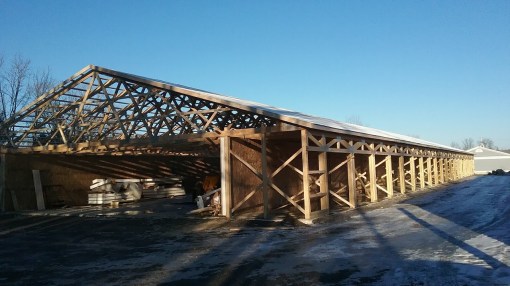
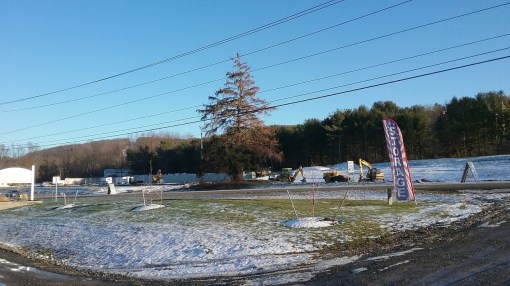
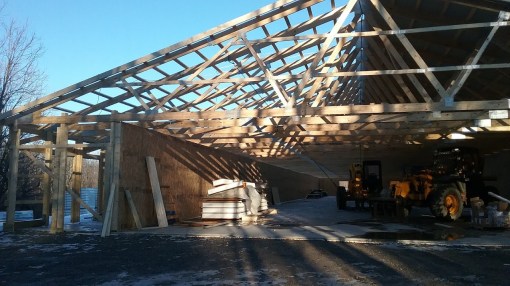
4. Dryden, the storage capital of Tompkins County. Across the street from the 79,000 SF Storage Squad self-storage facility under construction, 4 Season Storage is busy putting up their own addition. According to a loan filing on the 3rd, 4 Season’s new building is 12,000 SF, and the hard construction costs come in at $481,172. CFCU is the lender. The structure is already framed and is being roofed, the cross trusses already separate the exterior units (not sure if those will be climate-controlled like the interior ones). Storage Squad is further behind, a graded site and a couple of reinforced concrete walls at the moment.

20161119_145216

5. In case you were wondering, here are some of county administrator Joe Mareane’s planning and development goals for 2017 –

– Negotiate the purchase of the Tompkins Trust Building for use by the History Center and Heritage Education Center. Also, develop a “governance”, or operations, plan for how the facility will be managed and maintained; how space will be allocated; how rent will be determined, etc.
– Work with NYS DOT and local agencies (Planning and ITCTC) to secure funding for a Route 13 traffic study.
– Facilitate the development of a realistic business strategy that allows the Airport to continue to
serve the community and be financially self-sufficient.
– With TCAction, put plans in place for a new residential project aimed at providing a meaningful
amount of housing for the chronically homeless.
– Bring alternative plans to re-use the rear portion of the Human Services Annex to the Legislature; implement its recommendation.

There’s a possibility, based on the 2016 notes that follow, that the 24-unit Re-Use project and the housing for the chronically homeless may be two different projects – the Re-Use housing project is described as transitional re-entry housing, while the housing for the chronically homeless is said to be in the property acquisition phase – i.e. still scouting out sites, with the goal of construction within two years. They might be the same, they might not, it’s not 100% clear from the notes. As for the Human Services Annex, there have been talks for additional space for Cayuga Medical Center’s services, or space for courthouse functions, and a decision is expected in Q1 2017.


News tidbits 12/24/16: Looking to the Future

24 12 2016

20161211_132440

20161211_132501

20161211_132542

1. Going to take advantage of this light week to go through some of the photo stash. I thought of doing a Poet’s Landing update, but because LeChase is mostly working on site clearing/prep and excavation at this point, and given the snow on the ground, it didn’t seem like there was a whole lot to be gained from making a unique update. But, rest assured, it’s still underway, there’s just not a whole lot to see at the moment. Once the snow melts off, the slab foundations work should be visible, and there might even be some framing going up by mid-winter. The six new apartment buildings and their 48 units should be ready by the fall of 2017.

20161209_121337

2. 107 South Albany in the city is another one that doesn’t merit its own post just yet, but work should be taking place at some point soon. The building permits have been filed with the city for the 6-unit, 9-bedroom renovation and addition to the rear of the existing building, and from peering inside the existing windows, there’s the impression that interior demolition work could be underway – could explain the broken window on the second floor at least. There was no excavation work yet in the backyard, where the new wing will go. The Site Plan Review document says July 2016 to August 2017. Maybe there will be something to talk about by the next round of downtown updates.

3. Some folks might remember Phoenix Books, the hard-to-miss barn bookstore off of 366 as one approached Ithaca from Dryden. The store closed last year after 30 years of business, and the barn itself is about a century old. Now the property at 1608 Dryden Road is for sale. The barn, a small outbuilding, and 29.3 acres for $229,900. According to the Zillow posting, a sale is already pending.

4. From sales to sold. An industrial property in the Inlet Corridor of Ithaca town has exchanged hands. The property is at 142 Ithaca Beer Drive, next door to the growing brewery and restaurant. According to the listing with Pyramid Brokerage, the property consists of “Two commercial buildings totaling 6,812SF on 2.79 acres at south end and just off of Ithaca’s Elmira Road (NYS Route 13) commercial corridor. Ideal for combo of office (812SF) and industrial/warehouse (6,000SF) with lots of room to expand. All municipal services. Warehouse building has high ceilings, concrete floors, 2 overhead doors and more. Great opportunity for light industrial/manufacturing with array of flex space.”

The Iacovellis used it to house their construction equipment, and had it on the market for $409,000. It sold for just under that, a reasonable $400,000, to Greentree Garden Supply, which has operations a stone’s throw away from the property. Greentree makes their own soil products (potting soils, soil formula), so that may be a potential future use of the warehouse they just picked up. Good for them; they seem to be thriving as well as their garden plants.

58505e689f6ef-image

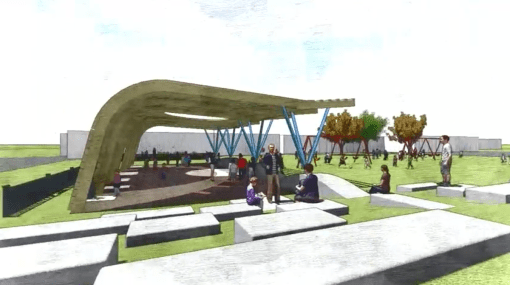
5. Here’s a cool idea – the Lansing School District is planning to build an outdoor classroom as part of $4.95 million in renovations. Cassandra Negley has the full story at the Times. The renovations were approved by a landslide 240-32 vote, which was helped by the fact that the project will be funded with grants and money from the school district’s reserve (rainy day) fund – no additional cost will be assumed by the taxpayers. In advocating for the project, school district staff noted that it would provide for “multi-sensory experiences”, a useful asset during the instruction of natural and environmental science topics, and cited studies that showed students performed better academically when given the opportunity to have classes in outdoor spaces. The space would be used as covered play space during recesses.

maplewood_v7_5

6. Going off into hand-waving territory here. Enter at your own risk.

You might have heard in the news this week that New York State, even though it added 104,500 jobs over the past year, is estimated to have recorded a population loss of about 1,800 people. That’s not a good thing for a number of reasons, but it’s a more acute issue upstate. New York City issued building permits for 101,705 residential units from 2013-2015, with another 13,000-14,000 estimated this year, and the city, just the boroughs and not even counting the suburbs, makes up nearly all the population growth (375,272 through July 2015, vs. 367,179 as the total gain for the state from 2010- July 2016). Upstate continues to hemorrhage people to other states. Not a surprise to anyone who’s travelled outside of Ithaca, Saratoga or the few other bright spots. What can we expect for Ithaca in a bad piece of news for Upstate?

Here are some off-the-cuff tallies for population growth. Ithaca’s estimated to be 30,788 as of July 2015, up 774 since 2010. The estimates due out early next year cover July 1, 2015 to July 1, 2016.  What opened in that time frame?

By my count, Stone Quarry (82 beds), the Lofts at Six Mile Creek (66 beds), 804 East State (18 beds), 707 East Seneca (18 beds), 206 Taughannock (10 beds), the Lehigh Valley House condos (6 units, will assume county average 1.7 occupants per unit, for 10 residents), 116 Catherine Street (17 beds), and the 140 College Avenue (12 bed addition). Allow another half dozen or so units with a dozen beds total, for accessory apartments or new single-family homes. Only one of these projects replaced existing housing units – a one-bedroom bungalow came down for 804 East State. The gross gain is about 244 people, if we assume the standard of one person per bedroom or studio unit.

Now let’s do some subtractions. Hughes Hall closed on Cornell’s campus. -47 off the bat, for 197. Now, the math can’t easily accommodate those who had a household member move in/be born, or move out/pass on. But trends suggest a 2% decrease per decade, so we’ll treat it as negligible. So, my baseline prediction for the 2016 estimate is 30,981.

Just thinking offhand of the projects that have opened since July 1, 2016, expect at least 210 more for the July 1, 2017 estimate, and 670 in 2018, because that’s when Collegetown Terrace phase III (344 bedrooms), Novarr’s townhouses (net gain ~60 bedrooms), 210 Hancock (90 bedrooms) and Todd Fox’s latest trio (net gain ~110 bedrooms) are included in the figures. These drive-by numbers are based just on what’s underway, or approved and financed. The 2017, or more particularly the 2018 numbers could go up. So roughly, 30,981 in 2016, 31,191 in 2017, and 31,861 by July 1, 2018, assuming no major catastrophes and that the local economy’s growth and residential vacancy rate is consistent.

For the record, the purely mental figure I use for a 2020 census is 32,500. That would consider Harold’s Square (146 bedrooms), City Centre (250 bedrooms), the first phase of Chain Works (80+ bedrooms), as well as other proposals that may arise in the next year or two and open before April 1, 2020, the official census date. I do not factor in any new Cornell North Campus dorms in the estimate, since the new dorms will initially function as temporary replacements for existing space that will be concurrently closed and renovated.

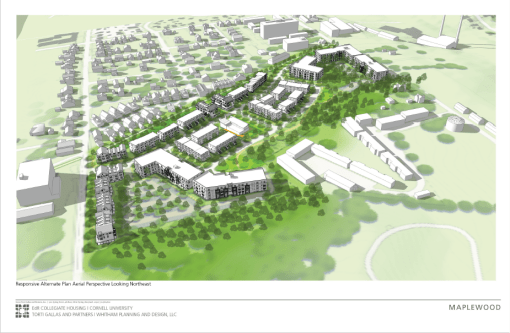
Now, when thinking about the town of Ithaca, things get really weird because of Maplewood – a loss of 370-380 beds. The town doesn’t have any large multifamily underway – my partially-imputed count from permit reports gives about five newly-occupied duplex units and 20 or so homes for the July 2015 – June 2016 period, and the 10 Belle Sherman townhouses. That’s probably 100-120 beds total. The town of Ithaca will likely show a decrease in population in the 2016 census estimate because of the Maplewood closure, and it will be bad optics because there’s all this talk of affordable housing issues, and seeing a decline in population in the news will inspire a negative kneejerk reaction – either “if it’s going down do we really need housing”, or “hey, it’s going down, then why are the rents so damned high”. Have that talking point ready, Ithaca town board.

For the 2017 count/2018 release, the partially-educated guess is an increase of 150 given Brookdale, but the 872 new Maplewood residents won’t come into count until the 2018-19 estimation period, at which point we’re pretty much at the next census. I’m thinking around 21,500 for 2020 (from 19,930 in 2010), if the current trends continue and major housing projects are completed.


902 Dryden Road Construction Update, 12/2016

19 12 2016

Varna has long been touted as one of those places where development is likely to happen. The hamlet, which has under 1,000 people, sits close to Cornell in the town of Dryden – land is cheaper than most parts of the city, but the area is served by the bus line, which opens it up to Cornell’s deep-pocketed student market. However, Varna can be a tough nut to crack – this far out, the demand is mostly driven by more cost-conscious grad students rather than free-spending undergrads, and the going price for a rental is lower. With a less captive market and less lucrative rents, Varna becomes a trickier prospect.

Plus, although the town itself is fairly accommodating, some members of the local neighborhood group, the Varna Community Association, have a disposition against rentals, preferring that any development that comes along be owner-occupied. Owner-occupied is possible as Tiny Timbers hopes to demonstrate, but it is more difficult to finance since a developer can’t guarantee income the same way they could with rentals.

Since the 1980s, one can find at least six projects proposed in Varna that never came to fruition – the latest and grandest being a massive 260-unit proposal by the Lucente family, which the town turned away from further consideration after concerns about quality of life, and significant pushback from members of the VCA. Concurrently, the town was looking at updating the hamlet’s zoning, and the issues with the Lucente plan helped formulate the new Varna comprehensive plan adopted in 2012, and revised zoning not long thereafter. The zoning identified areas for density and dvelopment (ideally, a walkable core), and preserving more rural lands beyond the main drag.

902 Dryden Road, first proposed in June 2015, was the first project to come along after those planning and zoning updates. It was somewhat unexpected by some residents, because a redevelopment of this property was not envisioned in the town’s 2012 plan (which shows that plans are guidelines, not prescriptions). Initially, it was a 15-unit, 42-bed proposal, rentals aimed towards grad students and Cornell staff. Two of the units, totaling six bedrooms, already exist. Modern Living Rentals, a partnership of local developers Charlie O’Connor and Todd Fox, purchased the property in June 2014 for $215,000. At the time, the units were going to be entirely solar-powered, aiming for net-zero energy (what is produced on-site is equal to or greater than what it consumed).

At this point in time, Fox and O’Connor had done some duplexes and the 6-unit apartment building at 707 East Seneca in the city, but 902 was going to their first “large” project. But, they hadn’t counted on strong opposition, not just from neighbors but from Cornell Plantations (now Cornell Botanical Gardens), who had concerns about the floodplain at the rear of the parcel, where it borders Fall Creek. The town was hesitant to move forward with approval unless there were revisions.

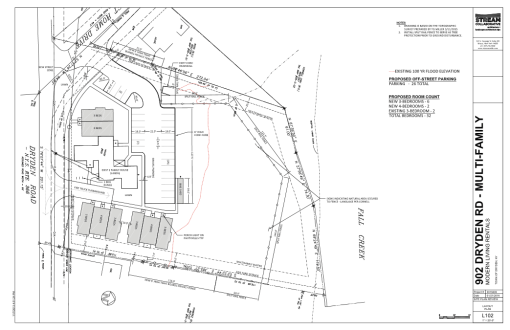
As time wore on and meetings were held with the town and VCA, the project was reduced in scale; the lot size used to determine maximum unit density was calculated incorrectly the first time and two units were removed, and then the project was scaled back further to reduce impacts on the floodplain, moving the gravel parking lot so that it wouldn’t infringe on the plain – the final count came out to 10 units and 32 bedrooms, or 8 units and 26 bedrooms if counting just the new structures. The solar panels had been on the flood plain as well, but were eliminated because they were no longer financially doable at 8 units; it was stated that the infrastructure would be built to support net-zero energy down the line, if power was purchased from off-site. The reduced-size project was acceptable to the town and to Cornell, and 902 Dryden was approved in March 2016.

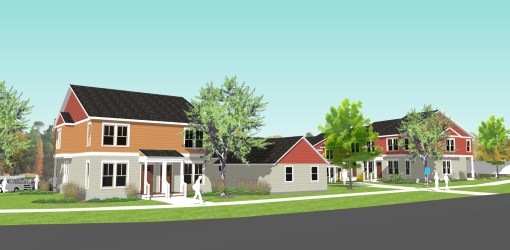
Along with the existing duplex, two new units will be built opposite a shared wall. Two three-unit clusters will also be built on the east side of the parcel. The middle units of the three-unit clusters will have four bedrooms with 1606 SF of living space; all the rest will be three-bedroom units, and about 1500 SF each. STREAM Collaborative is the project architect.

There are two separate groups of drawings floating around for the buildings, and I am not sure which is correct. The render below, from shortly after approval, shows warm colors. Renders on MLR’s website show what looks like blue, brown and white fiber cement panels. The unit rents range from $1500-$2000/month for the three-bedrooms, and $2600/month for the four-bedrooms. The project cost was estimated at about $1.5 million in early Site Plan Review docs.

It’s a bit of tricky site for photos- the site borders the intersection of 366 and Forest Home Drive, leaving a pull-off in front of the mobile home park, or at the spit of land where the roads split. But it looks like site clearing and foundation excavation are ongoing. If anyone knows who the contractor is, drop me a line in the comments.


20161211_130116

902_dryden_final 902_dryden_v4_1


News Tidbits 12/17/16: So Much In One Week

17 12 2016

1. For the developers out there, it looks like your next opportunity just opened up in Collegetown. For sale are three houses on Linden Avenue – 6-unit, 8-bedroom 230 Linden, for sale at $675,000 (taxed at $350,000), neighboring 4-unit, 8-bedroom 228 Linden at $700,000 (taxed at $460,000), and two doors down, 2-unit, 11-bedroom 224 Linden at $525,000 (taxed at $400,000). All three are somewhat run-down student apartment houses on the cusp of inner and outer Collegetown – as such, their zoning is CR-4, which allows four floors, 50% lot coverage, and has no parking requirement.

The properties were all purchased in the mid-1970s by a small-time local landlord, who was killed in a car accident two years ago. According to the listings, the seller’s agent is a family member, and the units are leased until late 2017 or 2018, meaning that if one were to purchase with an eye towards rapid redevelopment, they would have to negotiate with the tenants, or wait it out. That being said, there’s a lot of potential here, particularly if a buyer combines 228 and 230 into one lot. The city designed the CR-4 zoning with Linden Avenue specifically in mind – the concept render is a northward perspective of a revitalized Linden Avenue. They’re a lot of money, but there could be some interesting news down the line.

210linden_126college

2. Also in Collegetown, here are a couple of concept color renders of 210 Linden Avenue (left) and 126 College Avenue, courtesy of Visum Development’s webpage (currently down, cached link here). I confess to be more of a warm colors person, but assuming these are fiber cement boards and wood trim (or fiber cement that looks like wood), they could turn out quite nice.

On a related note, Visum’s Fox and partner Charlie O’Connor have started earth moving for their townhouse project at 902 Dryden Road in Varna. As it turns out, it is a very difficult site to get photos of, despite its easily accessible location. I’ll do a more in-depth shortly, but the units should be ready by August.

20161211_131919 20161211_131943

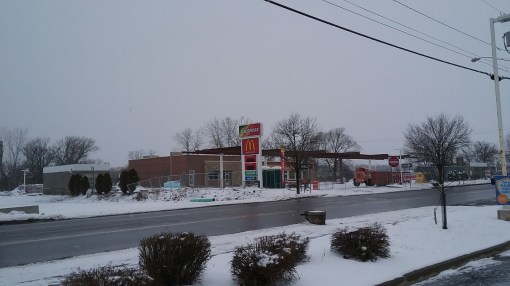
3. Fulfilling a promise to Fred, here’s the rather upscale McDonald’s/Fasttrak combo under construction North Road in the village. There is a billboard on 366 advertising for new hires for when they reopen, but unfortunately, it was too difficult to attempt a photo of the board and render. The building’s exterior is largely complete, and the gas station canopy is framed – late winter opening? The new construction has a price tag of about $500k. Honestly, for a roadside stop, it looks pretty nice.

20161211_131533

20161211_131514

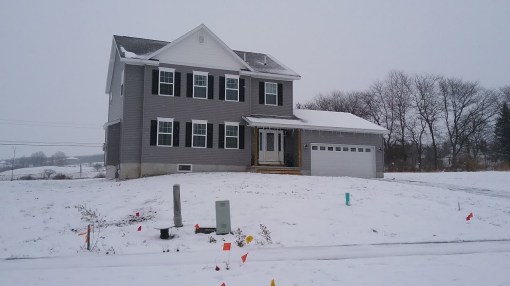
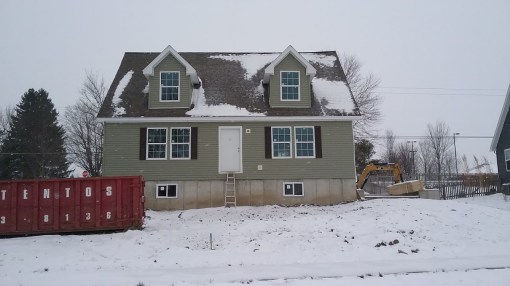
4. More on Dryden, with a couple houses of the week. Looks like some modulars are going into the Maple Ridge development – one recently completed, one in the works. The open space to the right of house number two, the Cape Cod, will host a garage. The land for house one sold to Kenn-Schl Inc, a regional modular home builder and seller, in June for $48k. House two’s land was sold to a Rochester man for $39k in October. At this rate, Maple Ridge is going to fill out their 15-lot phase one in another year or two. Although waylaid by the Great Recession, the big plan is for three phases and 51 lots.

20161211_133227

5. On the 15th, the construction loan for the William George Agency’s new 1-story, 24-unit dormitory was filed to the county records office. The $3 million loan comes courtesy of …. A trip to the property didn’t pan out, it didn’t look like anything was underway even though the building permits were filed with the town of Dryden a few months ago. Then again, as a facility for troubled youth, it’s not the most welcoming place for a random visitor to be taking photos.

maplewood_v7_4

6. So what’s being discussed by the towns? In the town of Ithaca next week, a lot line adjustment between two houses, and more Maplewood discussion, with consideration of preliminary site plan approval. Meanwhile, the town of Dryden has cell towers galore, as well as revised approvals for Storage Squad (1401 Dryden) and Tiny Timbers; plans are in the pipe line for a 7-lot subdivision of the Dryden Lake Golf Course, and a possible sewer extension study for NYS Route 366 east of the NYSEG building.

Image Property of HOLT Architects

7. Speaking of sewer, the town and village of Lansing are negotiating sewer deals so that the town can use village lines to help accommodate future growth. Dan Veaner at the Lansing Star has the story. the report says the town is asking for 700 units of capacity, where a unit is 328 gallons. 700 units would also put the Cayuga Heights plant at capacity. The town’s intent is to extend sewer capacity to encourage development along Triphammer Road (as in the town center concept shown above), with the reasoning that it’s a natural extension of established development, and would help grow the tax base in the event of the power plant closing. Not as grand as the plans that were shot down in 2007, but like the Warren Road sewer built a few years ago, it’s seen as a more organic and cost-efficient approach.

20161209_123851

20161209_123931

8. There might be some of movement on Jason Fane’s Bank Tower $4 million renovation from office space to 32 apartments. The windows were inspected and tagged recently, possibly to determine what needs to be replaced where. Most of the exterior of the Commons-facing building will receive a cleaning and re-freshening, with the bulk of the work geared towards the interior.

20161210_140231

9. In economic news, 24/7 Wall Street is reporting that Ithaca has the 25th best job growth in the nation from November 2015 – November 2016. 2,200 jobs equates to 4.4%, by their measure.

Hate to burst the bubble, but don’t buy into it just yet. Initial estimates can be way off due to statistically insignificant sample size for small communities. It may hold, it may not. Wait until March and see if the numbers get revised.

city-center-v4-1

10. Interesting meeting next week for the city Planning Board. Amici House and Maplewood are up for final approval, and a couple revitalized or new projects. Here’s the scoop:

1. Agenda Review 6:00
2. Privilege of the Floor
3. Site Plan Review

A. Project: Maplewood Redevelopment Project 6:10
Location: Veteran’s Ave. (between Maple Ave. & Mitchell St.)
Applicant: Scott Whitham, Whitham Planning & Design, LLC, for Cornell University
Actions: Adoption of Findings, Public Hearing, Consideration of Preliminary & Final Site Plan Approval

The Town Planning Board filed a Notice of Completion on November 30th, 2016, which can be viewed here: http://www.town.ithaca.ny.us/major-projects/maplewood. The Town Board will consider adoption of a Findings Statement on December 20, 2016.

The city will specifically sign off on the bus stop and landscaped area at the northwest corner. STREAM Collaborative is the landscape architect.

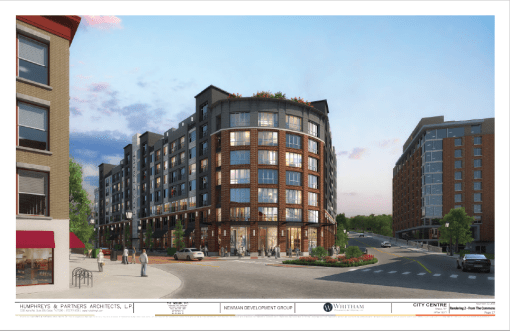
B. Project: City Centre — Mixed Use Project (Housing & Retail) 6:30
Location: 301 E. State/M.L.K., Jr. St.
Applicant: Jeff Smetana for Newman Development Group, LLC
Actions: Determination of Environmental Significance, Recommendation to BZA

amici_v3_1

C. Project: Amici House & Childcare Center 6:50
Location: 661-701 Spencer Rd.
Applicant: Tom Schickel for Tompkins Community Action (“TCAction”)
Actions: Consideration of Preliminary & Final Approval

Tweaked since last time – a little more glass in the stairwell, and the roofline of the classroom building has been broken up with three distinct gables.

college_townhouses_v2_1

D. Project: College Townhouse Project 7:10
Location: 119, 121, & 125 College Ave.
Applicant: Kathryn Wolf, Trowbridge Wolf Michaels Landscape Architects, LLP
Actions: Public Hearing Determination of Environmental Significance

The big changes appears to be the switch from boxy bay window projections to curvy ones. Not sure if it works, given all the other boxiness. But on the bright side, we now know what the rear apartment building looks like:

college_townhouses_v2_2

E. Project: Apartments (5 Units) 7:30
Location: 126 College Ave
Applicant: Visum Development Group
Actions: Declaration of Lead Agency, Potential Determination of Environmental Significance

This is what I get for writing things over the week rather than all at once. Confirmed fiber cement panels (wood-like and Allura olive green) and a very light yellow Nichiha panel.

F. Project: Apartments (9 Units) 7:50
Location: 210 Linden Ave
Applicant: Visum Development Group
Actions: Declaration of Lead Agency, Potential Determination of Environmental Significance

Charcoal grey fiber cement panels, light grey panels, natural wood trim and red doors. The base will be stucco.

G. 323 Taughannock – Apartment (Redesign) – Sketch Plan 8:10

Steve Flash’s 21-unit apartment building for Inlet Island was approved two years ago, but has not moved forward due to soil issues and parking costs. This new version is still a housing proposal, but I’m hearing for-sale units that may be condo-like. The design will also be new, but the aesthetic will be similar – it will once again be crafted by STREAM Collaborative.
H. Ithaca Reuse Center – Sketch Plan 8:30

I know about this project because a county staffer emailed me by accident. But without official docs, I wasn’t about to report on anything. The plan calls for a mixed-use building, not unlike that seen in design concepts a couple of years ago. TCAction and INHS are involved, so there is an affordable housing component – probably looking at mixed-use overall.

4. Zoning Appeals 8:50
• 3053, Sign Variance, 310 Taughannock Blvd.
• 3055, Area Variance, 113 Farm St.
• 3056, Area Variance, 301 E State St.

5. Old/New Business:
A. Update — Chainworks DGEIS – Transportation Comments/Responses – yes, it’s still going.
B. Update — City/Town Joint Planning Board Meeting Jan 31, 2017 – Maplewood?
C. Update — Joint Planning Board/ILPC Meeting (DeWitt House) – Let’s see how this goes…


Village Solars Construction Update, 12/2016

13 12 2016

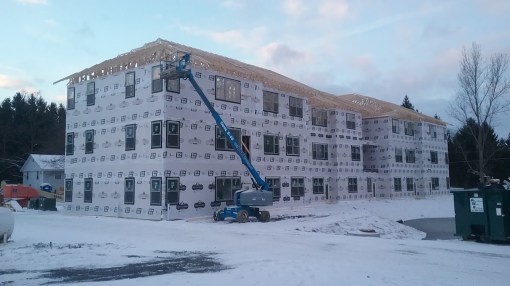
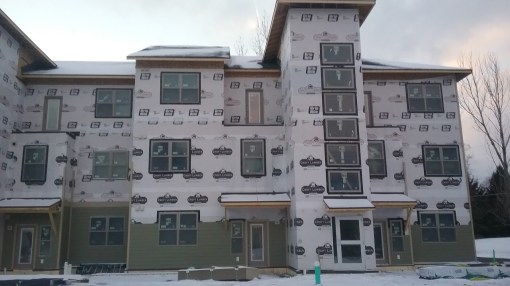
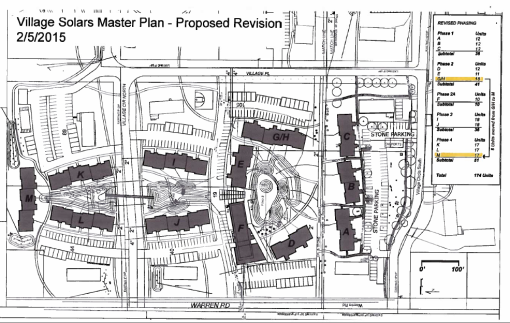
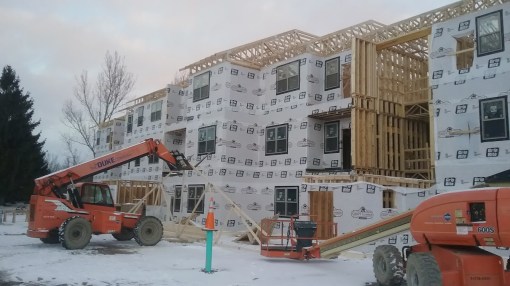
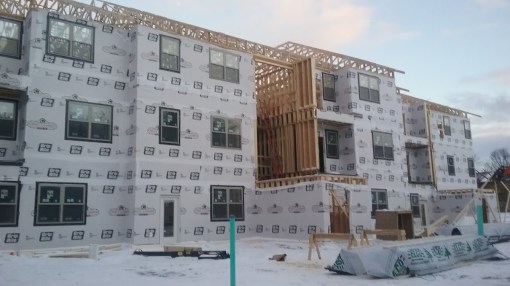
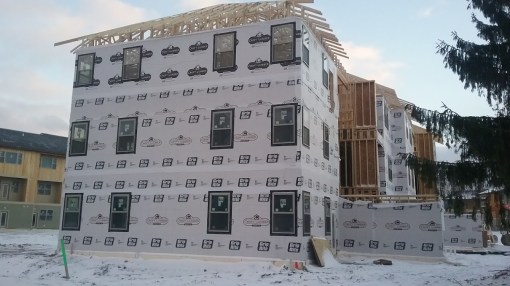
The latest two buildings at the Village Solars apartment complex are moving along. Building J is nearly fully framed, the roof trusses are being lifted (literally, by a lift) into place, and the lower floors have been covered in housewrap, with windows fitted into their openings. You get the idea of how the exterior buildout process works by looking at Building J – the exterior wood frame is built, plywood sheets are sealed over the top of the stud walls, housewrap gets applied as a moisture barrier, and then the exterior finishes go on over the house wrap. One can just make out some of the interior wood stud walls through the panes.

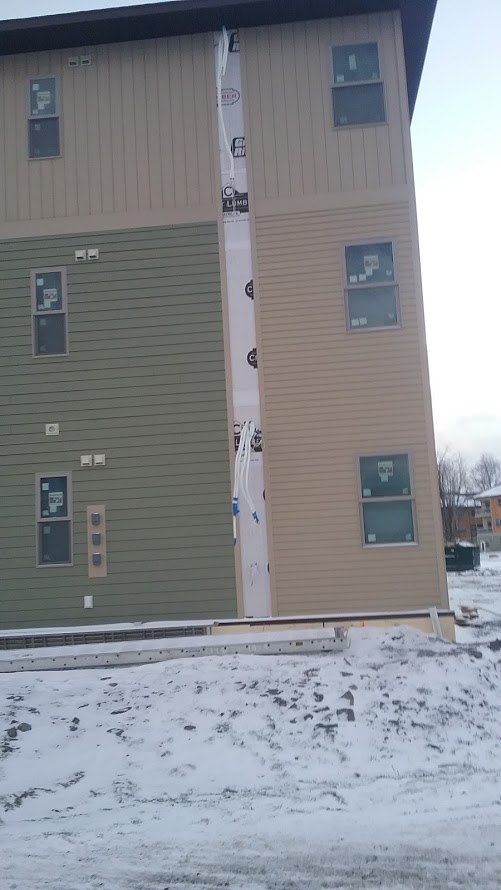
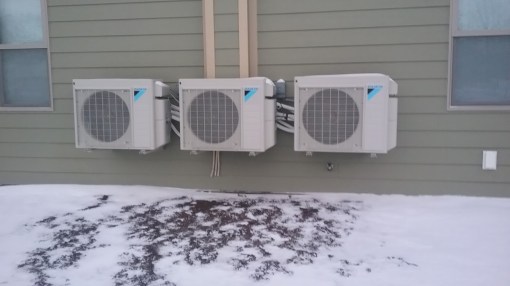
Meanwhile, Building “I” is a little further along, but it tells us how the roofing process goes. First the roof trusses are attached, then the Huber ZIP sheets are set into place and the eaves are closed up, the underlayment and tar paper goes on, and finally shingles and trim boards. The wires dangling from the side of Building “I” are electrical wires for the Daikin wall-mounted heat pumps.

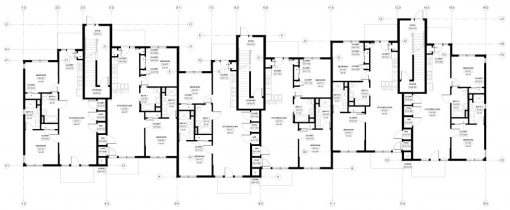
Initially, the plans called for 36 units, but with the splitting of some of the larger three-bedroom units into smaller arrangements, the actual number is likely higher. The Lansing town board approved changes to the complex that raised the number of units permitted/to be built from 174 to 206, although the change in overall square footage is negligible. Although not listed on Lifestyles Properties’ webpage, units range from $1050-$1650/month, depending on size and location. Craigslist tends to have the most up-to-date info, but those links stop working when the ad expires.

As with the other phases, the buildout for phase III received a $6 million loan from Tompkins Trust Company. According to the architects’ website, after phase III opens, work is expected to commence on a community building, retail options and walking paths. A bus stop is also in the works.
20161209_161503 20161209_161529 20161209_161539 20161209_161603 20161209_161611 20161209_161622 20161209_161638 20161209_161649 20161209_161717 20161209_161752 20161209_161805 20161209_161827 20161209_161843 20161209_161915 20161209_161936 20161209_161941 20161209_162003 20161209_162022 20161209_162030

village_solars_2exterior-1024x548 plan-01-1024x423


News Tidbits 12/10/16: Missing Out On the Fun

10 12 2016

reach_works_1
1. We’ll start off out in the town of Lansing this week with a new business startup looking to climb to the top of the pack. Reach Works, the brainchild of an academic family that relocated to Ithaca, just earned final site plan approval to build a professional-grade climbing wall and facility at 1767 East Shore Drive, next to The Rink. The $1.2 million, 10,400 SF building will have a noticeable impact on the Lansing shoreline, as the building will reach 56 feet in height. South Hill’s George Breuhaus will be the architect in charge.

According to the Times’ Cassandra Negley, the owner looked at Chain Works for an opportunity, but those plans fell through. The finalizing of the wall design is underway now, and Reach Works hopes to begin construction in March and be open by next fall. Between the pro shop and the wall, they hope to employ five full-time and ten part-time, with most making about the living wage of $15/hour (although, the application on file with the town says six employees). The hope is that it also becomes a regional attraction, drawing in hardcore climbers from the Rochester, Syracuse and Binghamton metros. Best of luck to them.

maplewood_v7_4

2. Maplewood is almost ready. The city is set to give its final approval this month, and the town is expected to give preliminary approval before the Christmas holiday. The latest changes to the FEIS include the following details:

– The amount of money for traffic calming measures has been increased from $20,000 to $100,000. $30,000 goes to the city and town, and $70,000 will be allocated by EdR and Cornell for streetscape improvements that they will build.
– Recycled building materials will be incorporated into the buildings.
– A revised estimate states that 100 to 150 construction staff will be on site during construction. They will park behind the East Hill farmer’s market space and are expected to walk over to the site. They will work on weekends, with noisy work commencing after 8 AM.
– The units closest to the East Hill Rec Way have been moved another four feet back from the trail.
– Initial property taxes in 2018 will be $2.25 million. IT is assumed they will go up 3% each year thereafter.

Oh, and the questioner who freaked out over the East Hill Village plan online – that SWA plan dates from about 2007.

cayuga_med_behavioral_sciences_1-620x420

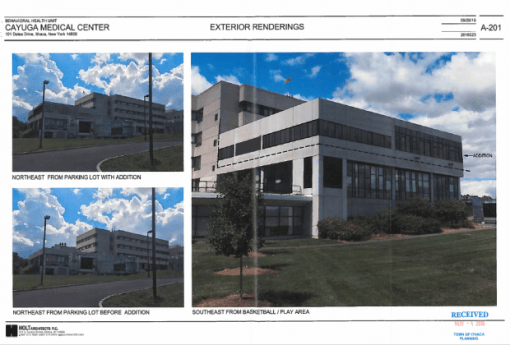
3. Cayuga Med’s plans for a 6,000 SF addition to their Behavioral Health Unit has been approved. At this point, the project needs a minor zoning variance for height,and then CMC has to apply for certification from the New York State Office of Mental Health for the facility to be approved- specialized medical facilities, like CMC and Brookdale, have to prove there is a need before they’re allowed to build. The hospital hopes to open the project to bidding early next year.

masonic_temple_1-771x595

4. So ICYMI, the Masonic Temple rehabilitation is moving forward. Six months later than anticipated, but it is moving forward. The project is valued somewhere north of $1 million. There is one other project on the Ithaca Landmarks Preservation Commission (ILPC) agenda that I thought of writing an article about, but decided it was too minor – the Alpha Phi Alpha house at 421 North Albany will be doing a reconstruction of a non-historically significant rear porch. If it were a full reno, I’d do a write-up for the Voice.

Also on the ILPC agenda – a discussion of Collegetown Historic Resources. I have the feeling this is being spurred by Novarr’s 119-125 College Avenue project, the College townhouses. Three historically significant but non-landmarked apartment houses were taken down to make way for the project, which is expected to go up for preliminary approval later this month. The city did a review after the document was first published in 2009, and landmarked the Snaith House at 140 College and Grandview House at 201 College – they could be considering making a move towards landmarking other properties – some of the historic structures on the 400 Block of College Avenue, and the 100 blocks of Oak Avenue, College Avenue and Linden Avenue are possibilities. Novarr has another project rumored for 215 College Avenue, but that building, dating from the 1870s and renovated/expanded numerous times, was not on the 2009 list.

5. Staying Collegetown, a big sale this week – 113 College Avenue sold for $1.7 million. That’s a very impressive price for an outer Collegetown apartment house – the tax assessment has it pegged at $610,000. The bones of the 13-bedroom, 3,738 SF building date from the late 1800s, but like its twin next door, it’s been the subject of a very unsympathetic renovation (records suggest the renos were done around 1980). The house has been owned by the Tallman family since 1987.

The property is zoned CR-4 – four floors, no parking required. CR-4 is the same zoning as Novarr’s townhouses and Visum’s latest pair of proposals. And, because what goes around comes around, the buyer is the same LLC that sold Visum’s Todd Fox 201 College Avenue for $2.65 million back in June – Russell Johnson’s PBC & Associates LLC. He also picked up a CR-3 building at 233 Linden Avenue for $750k back in the fall. Price suggests redevelopment, but the buyer isn’t known for that – he might have just paid big for a long-term investment. TL;DR, he might be planning something, he might not; we’ll see.

On a side note, the county’s going to make some money raising the property tax assessment on this one – offhand, I’ve noticed most of the houses sold this week (excluding a couple in Ithaca city) have gone at or well under assessment, which is a bit unusual, and probably not something that the tax assessor’s office wants to see.

20160630_142619

6. Good news and bad news from the Regional Economic Development Council awards. The good news is, the area’s getting money. Cargill gets $2 million towards their salt mine project (they requested $5 million), Cornell gets $250,000 for a startup business alliance, County Waste gets $355k for a food waste transfer station at the recycling center site, and the Sciencenter gets $150k for renovations. Several smaller awards are to hire staff for cultural and arts programs.

Now the bad news – one project, marked priority, was not funded – the Collegetown Travel Corridor proposed by the city of Ithaca to connect Downtown and Collegetown. I asked to make sure, and the Planning Department was just a little deflated in their response. Major bummer. I don’t doubt the value of arts programs, but $38,500 for a theatre director and $41,000 for a workforce expansion isn’t sustainable, it’s one year’s salary. That’s nice, but how does that benefit the area in the long-term? The Travel Corridor would have further encouraged urban development downtown and Collegetown that could have indirectly supported the arts through patronage, or directly through taxes that are used to fund local-level grants.


News Tidbits 12/4/2016: Not Forgotten

4 12 2016

old_libe_v7_1

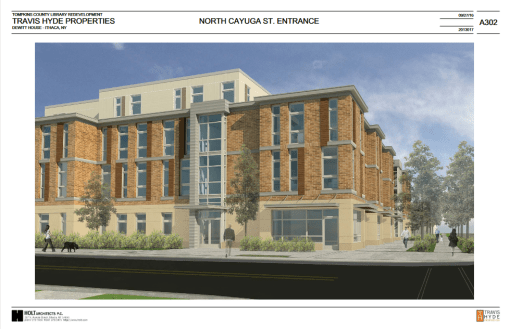
1. It looks like the Old Library proposal will be coming up to bat one last time. Developer Travis Hyde Properties and its project team will present one last major revision at the January Ithaca Landmarks Preservation Commission (ILPC) meeting. Things are well behind schedule at this point, as the ILPC continues to take issue with the old library proposal – which at last check, has had seven separate designs proposed and shot down for one reason or another. The Times reports that senior services non-profit Lifelong is one again involved in the project, although it had never really left – they will control the community room on the first floor, and will receive the revenues generated from renting it to outside entities. The last iteration may once again include first-floor interior parking, since that was the sticking point at the October ILPC meeting – the plan for design #8 is to increase parking from the proposed 10 spaces, to 25-30 spaces. If the January concept is acceptable, or at least close to ILPC approval, Travis Hyde will pursue the 55-60 unit plan; otherwise, it’s over.
The county had hoped that the sale of the property would generate $925,000 at the outset, as well as future tax revenues; the current building’s mechanical systems are past their useful life and in need of replacement, a cost likely to exceed a million dollars. With no sale, and a perceived “toxic” site for development due to opposition both during the RFP stage and during this review process, the county and city will be in a less than enviable position if things fall through.

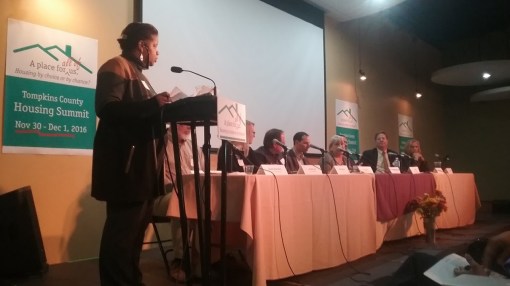
At the housing summit, the old library came up as a point of concern and contention; JoAnn Cornish, the city’s planning director, suggested at one that if the county had been willing to part with the property for a token $1, than the need to build up on the site wouldn’t be so great. I happened to be taking notes next to a county legislator and Old Library Committee member who muttered that that was a terrible idea and Cornish had no idea what she was talking about. Anyone looking for common ground is going to have a real hard time finding it.

cma_v2_2

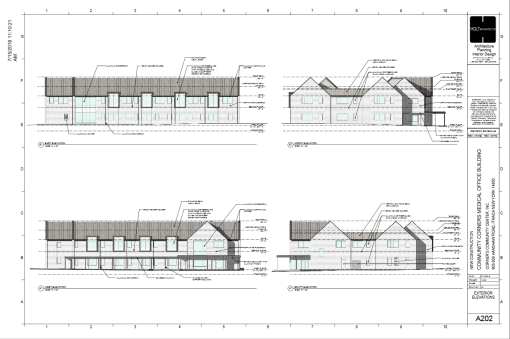
2. It looks like Cayuga Medical Associates’ plan for Community Heights is nearly good to go. Only a couple minor revisions were presented at the Cayuga Heights Planning Board’s meeting on the 28th – a rear (east) driveway, sidewalk work and a detention basin. Cover letter here, updated site plan here, and a letter noting a potential change in hosted medical specialties here. The $5.6 million medical office building at 903-909 Hanshaw Road is 2 floors and 28,000 SF (square-feet), of which 23,200 SF will be lease-able space. The initial presentation in March called for a 3-story, 39,500 SF structure. Two buildings, a one-story office building and a vacant drive-thru bank branch, would be demolished.

chapter_house_reconst_v5_1
3. Now for something that’s a little less certain – the 400-406 Stewart Avenue reconstruction. One can’t call it the Chapter House reconstruction, because there’s no certainty that that is what will happen. Nick Reynolds has the full story over at the Times. The Chapter House’s intended space on the first floor is being advertised by Pyramid Brokerage for $35/SF, double the bar’s rent from before the fire. The owner of the Chapter House referred to all this pre-development as a “money pit” as the building still has no anchor tenant, but he was still open to being a part of the rebuild. In short, it looks like we’re seeing some bickering between the developer and potential tenant spill out into the public domain, and we’ll see how it plays out.

amici_house_v3_1

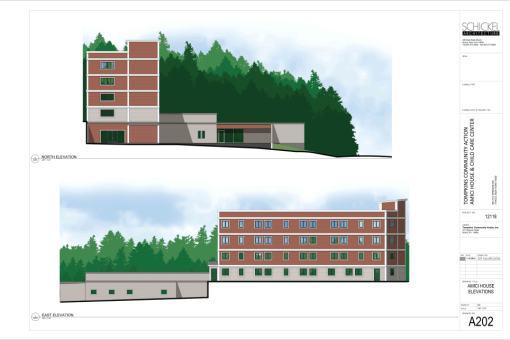
4. At the city planning board meeting last week, preliminary approval was granted to Charlie O’Connor’s four two-family homes at 607 South Aurora. City Centre also continued with its review, with comments focusing on sustainability and solar panels. Changes to the project are minor at this point, and we’re probably close to the final product at this stage. Amici House was also debated, with neighbors expressing concerns about the size, and uncertainty on whether TCAction can handle 23 homeless or vulnerable youth.

I’ll register a small complaint – the north stairwell of the residential building. I’d encourage TCAction and Schickel Architecture to explore using smoked or tinted glass to reduce glare, rather than bricking it in. It makes the building look cold and industrial, which seems just as unfriendly to neighbors as glare would be.

The board also went ahead with lead agency on Novarr’s College Townhouses project, and was shown brief presentation on two Visum Development Group projects, 126 College and 210 Linden. More on those here.

20160630_142619

5. The Times included a quick Collegetown construction rundown about a week and a half ago. Two quick addendums –
A. Still no plan for 330 College Avenue, since Fane did the development version of trolling by proposing a 12-story building in a 6-story zone, and was told there was “no way in hell” it would happen;
B. Nothing scheduled for 302-306 College Avenue, aka “Avenue 102”, until at least mid-2018. The rumor mill says the Avramis family, who proposed a two-building, 102-unit sketch plan in October 2014, are concerned about market saturation. Given Cornell’s plans to increase their enrollment by raising their incoming freshman class size from 3250 to 3500, it might be worth another look.

downtown_design_guidelines_1

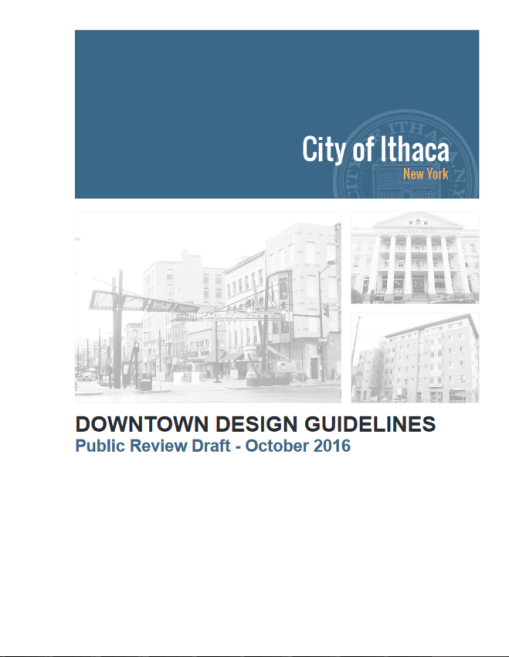
6. The city has released the preliminary design guidelines from Winter & Company. The Collegetown guidelines are here, Downtown’s here. Although there are suggested rather than mandatory, in theory, a project team could use these guidelines to formulate plans that would be less likely to get hung up in the city’s project review process – one could call it “form-based code lite”. There’s nothing particularly groundbreaking in here, but the guidelines do promote urban-friendly and contextual designs. These are draft open to public comment – those who would like to can send their thoughts to city planner Megan Wilson at mwilson*at*cityofithaca.org by December 15th. there are some differences between existing zoning and these guidelines (for example, setbacks) that will need to be addressed at some point – the revised drafts will roll out in mid-January.

20161201_121840

7. Now that the county housing summit is behind us, I think that while there wasn’t any sort of huge breakthrough at the event, it was helpful to the community to have the obstacles and suggested goals shared with a large audience. Although, as county legislator Anna Kelles pointed out, it wasn’t necessarily a wide audience – renters, younger residents and lower-income individuals were not well-represented. At least for me, the big, exciting news was Cornell’s plans for new housing, which I will be writing about for the Voice later this week. While not perfect, the event did bring to light certain issues – NIMBYism can be a delicate topic in an audience like this, but one of the points that was stressed at the summit was, if you support a project, then let the governing body in charge know you support it and why. Heck, JoAnn Cornish was saying the city gets opposition emails from residents of California and Oregon. A little support from local residents, even students, reminds city staff and board members that there a variety of opinions.

I can definitely say that not everyone who attended was pro-development – after the woman behind me asked if I was a reporter (I said yes, for the Voice), she kept passing me notes like “since when did development bring property taxes down”, “developers are just in it for the money” and “Ithaca shouldn’t have to change”. I don’t think she liked my replies – the first one I wrote back a response about spreading the tax burden out with new infill development, the second I wrote “strictly speaking perhaps, but they don’t want to turn out a terrible product”, and the last, I perhaps unkindly wrote “[t]ell that to the families being priced out. Something has to change.” She got up and left shortly afterward.


News Tidbits 11/19/16: Winter Is Coming

19 11 2016

executive-education-center-and-hotel-777x622

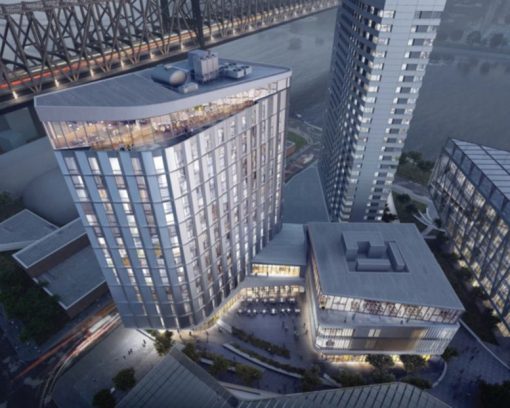
1. We’ll start off in the Big Apple this week. Cornell and its development team have released plans for the fourth and last building in the first phase of the Cornell Tech buildout. The Verizon Executive Education Center and Hotel consist of two buildings connected by a shared hall, and will include four 50-75 seat classrooms, small breakout rooms, and a 195-key hotel for visitors to the school. The plans also call for a restaurant, rooftop lounge and cafe – none of which sound very academic, but the building is meant to be an event center and gateway to the nascent school.

The exterior will be encased in aluminum and wood planks. There will be no parking, but there will be pedestrian courtyards, bike lanes and green space. The facilities are part of the campus’s first phase, which also includes a 26-story student and staff residential building; the Bridge, an incubator for researchers and small businesses; and the Bloomberg Center academic building. Those buildings will open in summer 2017, while the Verizon Center will probably be a 2018 opening, assuming the final designs are approved by the city of New York.

hopshire_1

2. Now to turn to something much closer to Ithaca. Dryden’s Hopshire Brewery is in the midst of a two-phase expansion, reports the Times. The first phase, shown above, consists of a 1,200 SF addition to the west side of the structure, and the new addition is already framed and closed up, with the expectation of being completed by the start of 2017. The space will be used to host events for as many as 100 attendees. the second phase, a 1,300 SF addition to the brewery and storage area, will start next year. The work is partially funded with an Empire State Development grant.

Speaking of drinks, the Watershed, a new bar and coffee lounge, will open by Thanksgiving. It replaces Rumble Seat Music at the former telephone exchange building at 121 West State Street in Downtown Ithaca. The Watershed owners expect to create eight living-wage jobs.

3. From county records, we can see just how much the Rodeway Inn renovation is going to cost local businessman Pratik Ahir – $2,095,000, but the hard costs are only $926,000. The difference is due to the existing mortgage on the property. The lender is Generations Bank, a small bank based out of the Seneca Falls. Anecdotally, we seem to be seeing an uptick in small upstate lenders looking to stake claims on the growing Ithaca market, which could be a real asset for the region – with a limited number of local lenders, financing is often a big hurdle with Ithaca-area projects.

maplewood-v7_8-planning-board maplewood-v7_6

4. As noted earlier this week in the Voice, lots of new Maplewood renders to take a gander at. Going through all the emails from the public comment period, I’d say that overall most are positive and positive-constructive – there are a few sour grapes, but they’re in the minority. For this area, that’s actually a pretty big accomplishment, and it means Cornell and EdR have successfully addressed most of the concerns raised by neighbors and community members. The big changes in respone to public comment have been a a commitment to 50% off-site solar energy, $20,000 to the town for traffic calming measures on Mitchell Street (raised crosswalks, speed bumps), and the two townhouse strings facing Walnut Street and the Belle Sherman Cottages have been redesigned to look more traditional and fit in better with their non-student neighbors. We’re probably very close to the final design at this point, if not already there.

Once preliminary approval has been granted, demolition will start on the south side of the Maplewood property and make its way northward in four phases. The first townhouse strings and apartment buildings will begin construction on the south side of the property in the March-April timeframe, depending on overall progress and external factors. The first completed buildings will be ready by October/November 2017, but it looks like occupancy will happen all at once in August 2018.

wegmans_pad_parcel-1116

5. The City Planning Board Agenda is pretty busy next week – Todd Fox will be presenting two new mid-sized Collegetown projects, Wegman’s is seeking a renewal on the approvals for their pad parcel building, and several other projects had major or minor redesigns. Here’s the rundown on the Voice, and the schedule here:

AGENDA ITEM                 APPROX. START-TIME

1. Agenda Review              6:00

2. Privilege of the Floor   6:01

3. Site Plan Review
A. Project:  Maplewood Redevelopment Project                               6:10
Location: Veteran’s Ave. (between Maple Ave. & Mitchell St.)
Applicant: Scott Whitham, Whitham Planning & Design, LLC, for Cornell University
Actions: Update & Schedule
B. Project:  City Centre — Mixed Use Project (Housing & Retail)     6:25
Location: 301 E. State/M.L.K., Jr. St.
Applicant: Jeff Smetana for Newman Development Group, LLC
Actions: PUBLIC HEARING    Review of Full Environmental Assessment Form (FEAF), Part 3

C. Project:  Amici House & Childcare Center                                6:50
Location: 661-701 Spencer Rd.
Applicant: Tom Schickel for Tompkins Community Action (“TCAction”)
Actions: Declaration of Lead Agency, PUBLIC HEARING, Determination of Environmental Significance, Recommendation to BZA

D. Project:  Four Duplexes                                                         7:20
Location: 607 S. Aurora St.
Applicant: Charles O’Connor
Actions: Determination of Environmental Significance, Consideration of Preliminary Approval
E. Project:  College Townhouse Project                                      7:45
Location: 119, 121, & 125 College Ave.
Applicant: Kathryn Wolf, Trowbridge Wolf Michaels Landscape Architects, LLP
Actions: Declaration of Lead Agency, Review of Full Environmental Assessment Form (FEAF), Part 2
F. 126 College Ave. — Sketch Plan            8:00
G. 210 Linden Ave. — Sketch Plan              8:20
H. Wegmans Retail Building – Extension of Site Plan Approval     8:40
4. Zoning Appeals                                                                     8:50
• 3049, Special Permit, 908 N. Cayuga St.
• 3050, Area Variance, 528 W. Green St.
• 3051, Area Variance, 661-665 Spencer Rd.
• 3052, Area Variance & Special Permit, 701 Spencer Rd.
• 3054, Sign Permit, 222 Elmira Rd.
5. Old/New Business                                                                 9:00
A.  Special Planning Board Meeting: 11/29/16
B.  Update — City/Town Joint Planning Board Meeting
C.  Update — Joint Planning Board/ILPC Meeting (DeWitt House)
D.  Changes/Corrections to Collegetown Area Form Districts (CAFD)
E.  Building Materials — Discussion on Potential Restriction on Vinyl Siding
6. Reports                                                                                 9:20
A.  Planning Board Chair (verbal)
B.  Director of Planning & Development (verbal)
C.  Board of Public Works Liaison (verbal)

7. Approval of Minutes: May 24, 2016, June 28, 2016, July 26, 2016, and/or October 25, 2016 (time permitting)      9:30

8. Adjournment      9:31


News Tidbits 11/12/16: Oof.

12 11 2016

lansingapts600

1. Starting off this week in Lansing, the village has okayed a zoning change that would allow the planning board to move forward with consideration of a 140-unit upscale apartment project on Bomax Drive. Neighbors came out to oppose the zoning change for the 19.5 acre parcel from office park business/tech to high-density residential, saying it would create additional traffic and hurt property values. The village board, however, responded in dissent, noting a lack of housing, a fit with the 2015 village comprehensive plan, and that this was about the zoning and not the project, which the planning board will critique as a separate action. The zoning change was approved unanimously. Park Grove Realty is now free to submit plans to the village, and planning board review will go from there. Expect it to take at least a few months.

therm_1

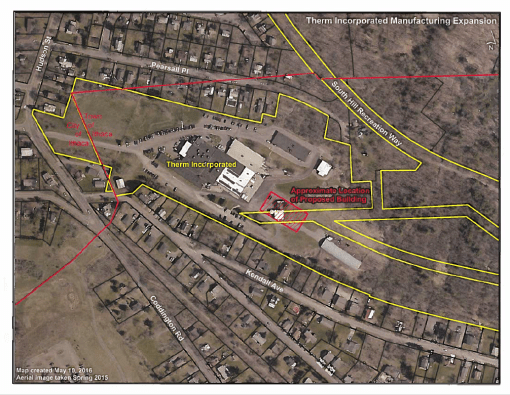
2. A couple quick notes from the town of Ithaca – Therm Inc. has commenced construction on their 20,000 SF addition at their South Hill plant. It’s a few months later than originally anticipated, but underway nevertheless. The $2.5 million project is expected to create 10 manufacturing jobs, according to the county IDA.

Also underway at this point is the renovation and expansion of the Rodeway Inn on Elmira Road. The plans call for expanding the existing 25 motel units, adding 2 new units on the ends of the main structure, and renovating a house on the property for a 1,146 SF community room to serve guests. Landscaping and lighting would also be updated. The town pegs the construction cost at about $679,000.

341_coddington_1

3. Here’s some good news – it looks like someone has taken up the Iacovellis on their offer of a free historic house at 341 Coddington Road, providing that the taker moves it. It appears NYSEG was creating some hangups since the power lines have to be moved out of the way (NYSEG is infamously difficult to work with), but with any luck, the house itself will be saved. My colleague Mike Smith is doing the legwork on a story, so hopefully more details on the “buyer” will come forth shortly.

4. Back in July, several West End properties owned by an out-of-area LLC hit the market. Now, at least one of them has sold. The duplex at 622 West Buffalo (blue in the map above) was sold for $90,000 to a gentleman from suburban Syracuse. Immediately after, paperwork was filed with the county for a $179,145 building loan courtesy of Seneca Federal Savings and Loan, a small regional bank out of Syracuse. The paperwork does not indicate if it will be renovations/additions to the existing building, or a new structure (sometimes the sale price is a part of the building loan, but in this case the buyer paid separately, with $171,187 set aside for hard costs).

20161007_163922

5. Sticking with county filings, the construction loan for the third phase of the Village Solars was filed with Tompkins County this week. $6 million is being lent by Tompkins Trust to fund construction of 42 units, 21 in each building. Initially they were slated to have 18 units each, but because the three-bedroom properties don’t have quite the same appeal as smaller one-bedroom and two-bedroom units, Lifestyle Properties (the Lucente family) has broken up the units without significantly changing the exterior appearance and layout. Actual Contractors LLC, another Lucente company, is the general contractor, with Albanese Plumbing, T. U. Electric, and Bomak Contractors (excavation/foundation) rounding out the construction team.

119_125_college_1

6. This is one of those unusual months were the city projects memo and the project review meeting agenda go out in the same week. Apart from the Collegetown Townhouse project, there are no new projects being presented, but there is new information and new renders.

In the projects memo, Novarr’s project is the new shiny, while Amici House, the8-unit project at 607 South Aurora and City Centre are being carried over as old business. Regarding City Centre, it doesn’t look like any particular points of contention have been raised by city planning, the framework for mitigating Historic Ithaca’s design complaint is already included, and most of the other requests are for more information/paperwork. From the Design meeting, it looks like the debate on the townhouses project is minor, mostly with where to locate the trees out front, and window details. They will not be putting windows into the north face because it’s on the lot line, but they will vary the materials for visual interest. The Design Committee requested that City Centre insert more windows in some areas, and less signage, as well as consideration of decorative elements to highlight the curved facade facing Aurora and East State Streets.

The project review committee meeting has all of the above, plus updated submissions from the Maplewood project team. Although no substantial development will occur in the city, the Maplewood project crosses municipal boundaries and the city has deferred to the town for lead agency. The meeting will also have a few zoning variances to comment on. The only notable zoning variance is for local realtor Carol Bushberg, who wants to do a one-story 812 SF rear addition at her office at 528 West Green Street, which is in a WEDZ zone and requires two floors.

maplewood_v7_4

maplewood_v7_5

Looking at the Maplewood submission, the new dormer/gable style will be for the building strings that front Mitchell Street, and the two strings most visible from Walnut Street. More modern designs will be used for the remaining structures. Looking closely, the designs do vary from string to string, which will give the site some character and additional visual interest. The project timeline is pretty tight with submissions, meetings and approvals, aiming for preliminary approval from the town on December 20th, demolition to start immediately thereafter, and final site plan approval by January 3rd.

For links, here’s the Collegetown Townhouse updated submission, engineering narrative, site plan render, and cross section render. Here are the updated materials for 607 South Aurora (no significant changes, just a summary of submission materials),  here’s a new site survey for Amici House, and the project update for Maplewood.

7. Meanwhile, there’s nothing too exciting on any of the town boards next week. Lansing town will consider additions to a self-storage facility, a one-lot subdivision and a climbing wall facility next to The Rink. Ithaca town will be conducting their own analysis of Maplewood, and a one-lot subdivision.

Now, after this week’s election news, one might wonder if this has any impacts on local housing/development. Arguably, there are a few. Expect federal funds for affordable funding to be cut drastically, and grants for mass transit projects to also take a major hit. While those are major losses, the state has far greater control, so there will still be some funding available, but definitely not as much as would have been expected under a Democratic administration. Most land use and building issues are decided at the local level, so don’t expect significant impacts there.

More of a question would be infrastructure investments. The president elect wants to launch a massive rebuilding program, but the Republican Senate majority leader has already said that’s not something they’re interested in, so we’ll just have to see if he can force it through or not. If there’s any silver lining to all this, it might come in some form of deregulation, but while he might be a fan of urban environments, most of his cabinet will likely not. We also have to keep in mind the disdain for elite colleges like Cornell, so research funding, and the economy built off it, is probably going to take a hit. For the Ithaca area, the change in administrations is likely a net negative.