Cornell Veterinary School Expansion Construction Update, 5/2017

24 05 2017

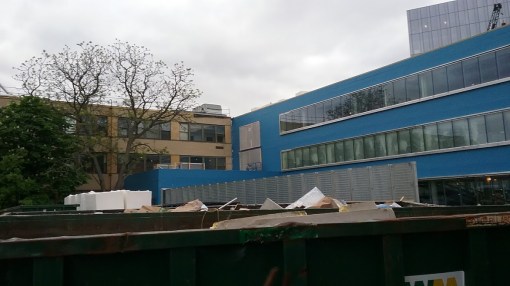
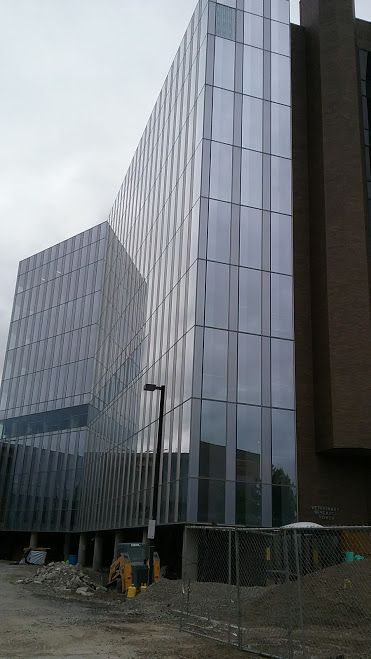
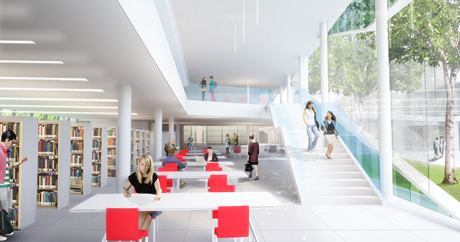
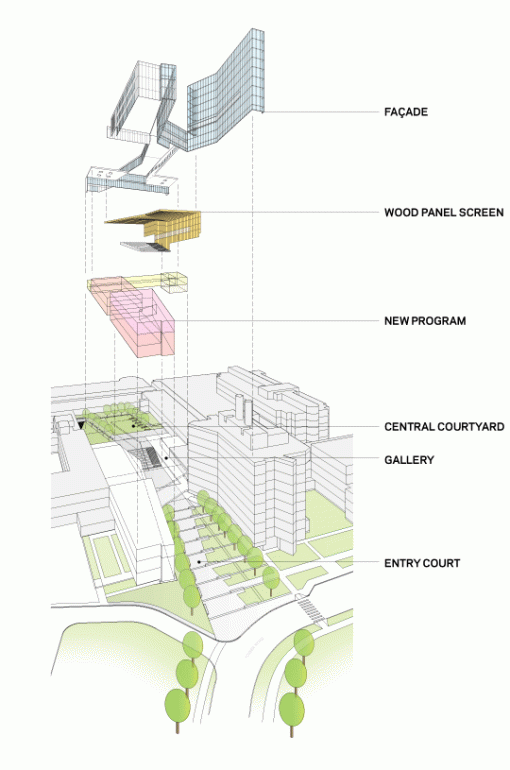
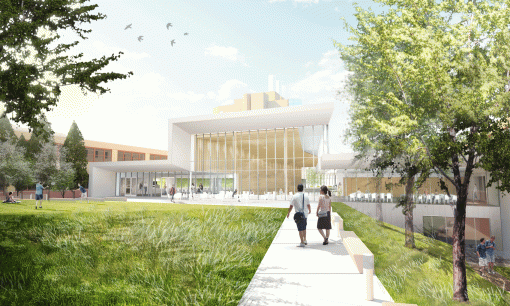
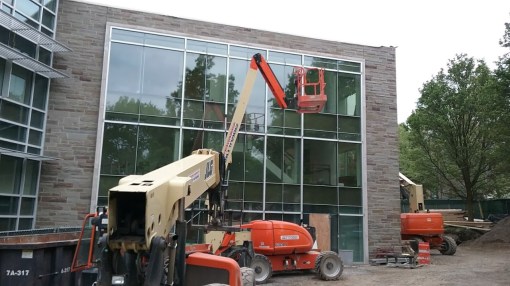
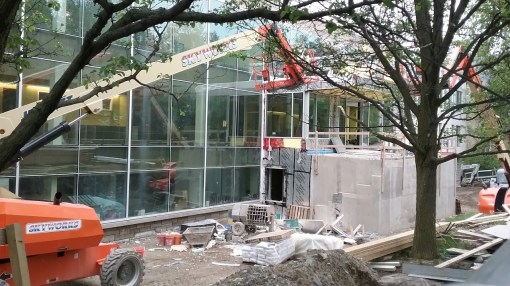
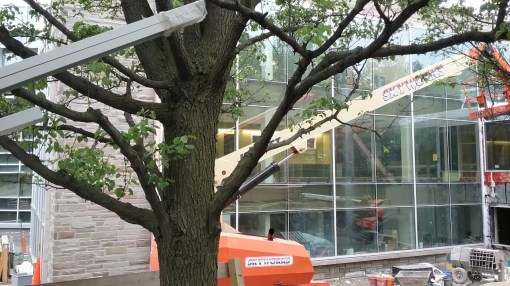
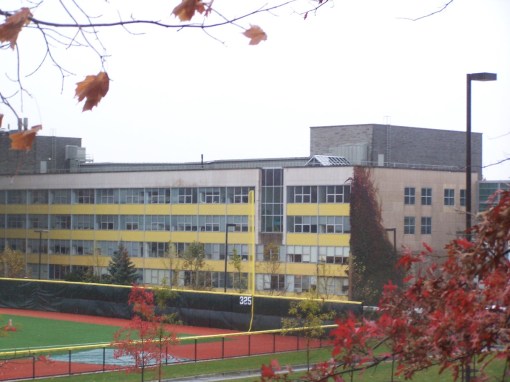
So many projects in the final stretch up on East Hill. The Vet School expansion’s multipurpose atrium is in the process of being closed up with its curtain wall glazing. An interior shot from the start of May shows interior stud walls are up and utilities rough-ins taking place, but drywall, interior trim and fixtures had not been undertaken.The concrete for the “grand staircase” had just been poured.

The atrium will be called “Takoda’s Run“, in honor of a greyhound adopted by alumna Janet Swanson (for whom Cornell’s wildlife rehabilitation center is named). The Swanson family are major university benefactors – Janet, Class of 1963, has given millions of dollars to the Vet School since the mid-2000s. Husband John (BS 1961, B.M.E. 1962, M.M.E. 1963), an engineer and tech executive, has given tens of millions to the university. The atrium in Duffield Hall and a lab suite in Weill are named for him, as well as several endowed professorships, fellowships and scholarships. Not just leaving it to Cornell, the couple has buildings named after them at Washington and Jefferson College in Pennsylvania, and a $41 million donation to the University of Pittsburgh led to the Swanson School of Engineering. My former editor at the Voice is definitely not a fan of this practice, but for those with a lot of money to burn, naming opportunities can be found or scoffed at here.

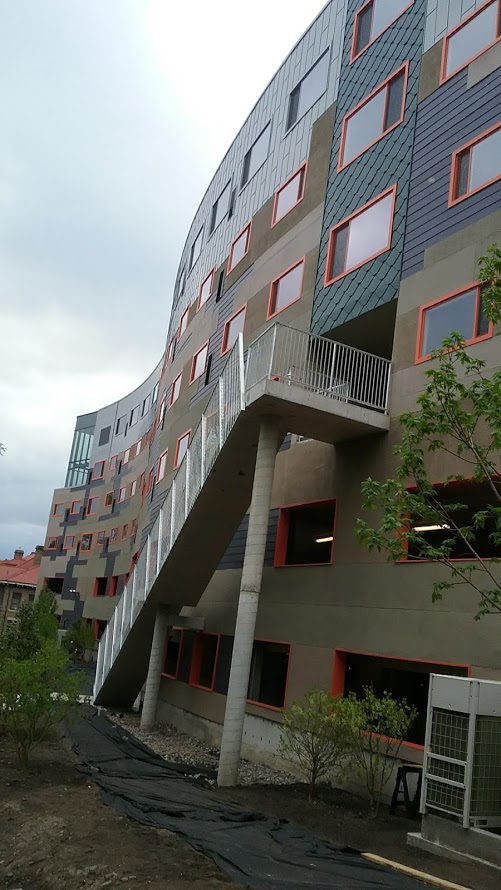
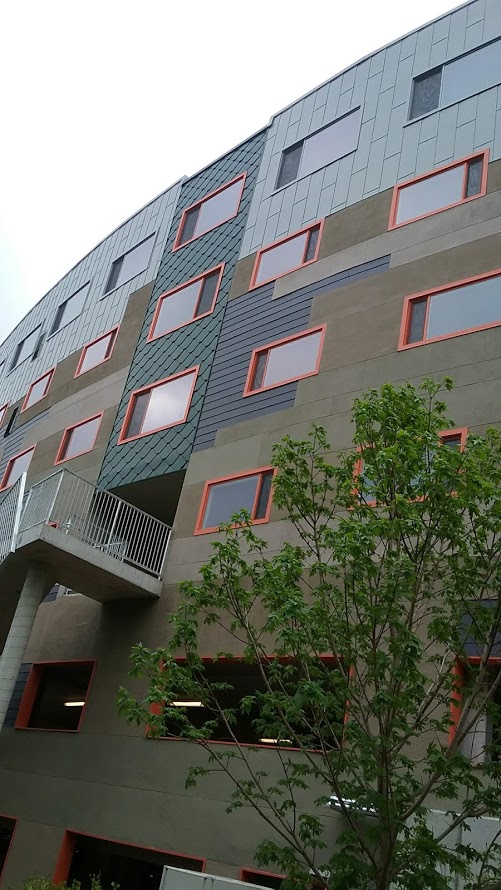
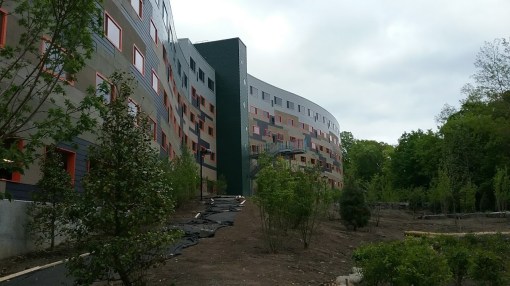
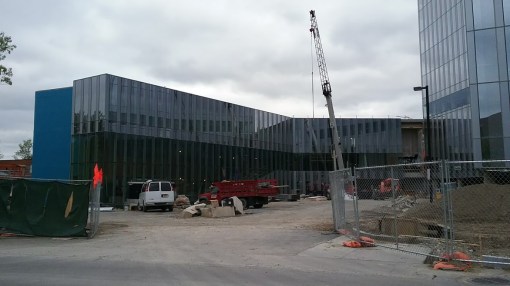
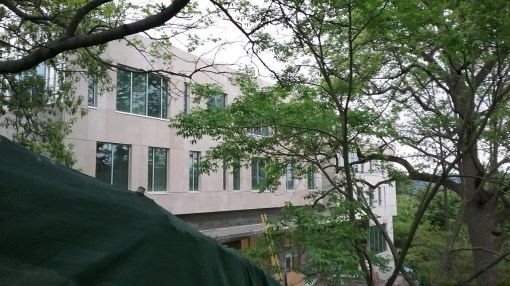
From the outside, the new administrative and library wing haven’t changed much since March, but at this point all Welliver has left is some window installs, exterior panels and finishes. Since I’m on a kick at the moment, the Flower-Sprecher library is named for former governor Roswell Flower (1892-94) for allocating funding, and in the early 1990s, Dr. Isidor Sprecker ’39 (Americanized from Sprecher) donated a substantial sum for renovation. It looks like some underground utilities work is going on out by the curb, possibly in preparation for the new landscaping and lighting fixtures.

The new Community Practice Service Building is underway, although I don’t have photos – the Poultry Virus Building has been demolished and the site was being cleared and readied for new construction. The timeline for the new 12,000 SF HOLT Architects-designed building is May 2017-May 2018, a couple months later than originally programmed.

The project seems to be a little bit behind schedule. The project team was initially aiming for a June completion, which was a little optimistic. The new schedule calls for an August opening.


Gannett Health Center Construction Update, 5/2017

23 05 2017

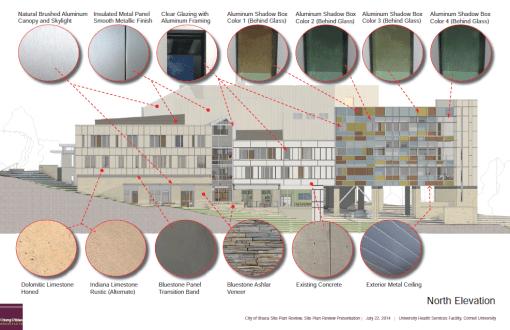
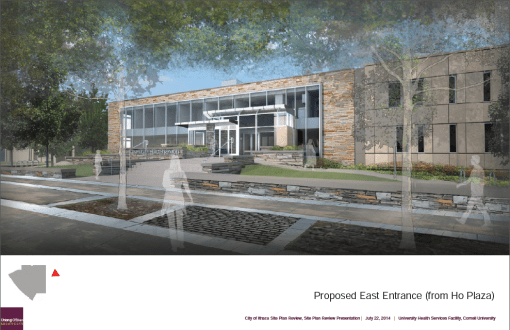
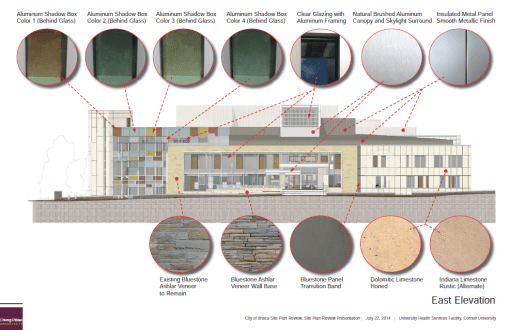
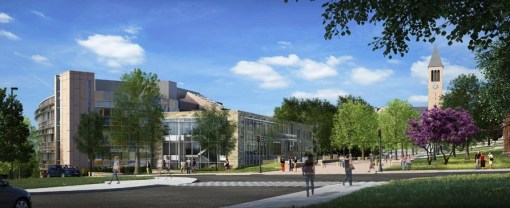
Another Cornell project in the final stretch is the second phase of the $44 million Gannett Health Services reconstruction, now known as “Cornell Health“. The new entrance is being fleshed out with fiberglass mat sheathing, and will be finished out with stone and brushed aluminum. The silvery material is a Carisle 705FR-A fireproof air/vapor barrier, which is made of aluminum and HDPE (plastic) sheets. The entrance canopy will be enclosed in glass, and the concrete podium will be concealed when the front entrance is backfilled to the height of Ho Plaza. The new northeast wing is being clad in limestone panels atop a continuous anchor system, because stone is dense and it needs a system able to support its weight. OCD-inducing Side note, that “Cornell Health” lettering signage is a different font than the rest of campus, Arial versus the campus’s usual Kabel font.

Like with Upson, the plan is to have the building open by August, although the landscaping could take another couple of months, wrapping up by October 2017.


Upson Hall Construction Update, 5/2017

22 05 2017

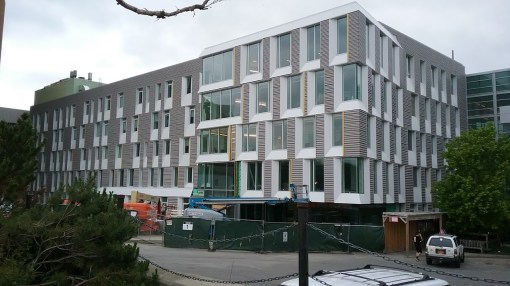
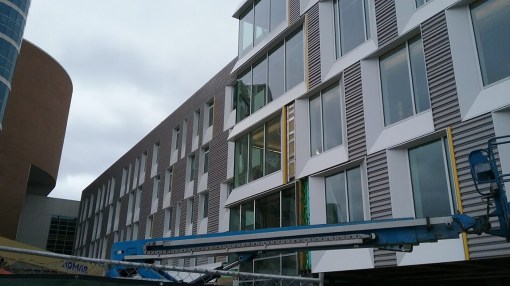
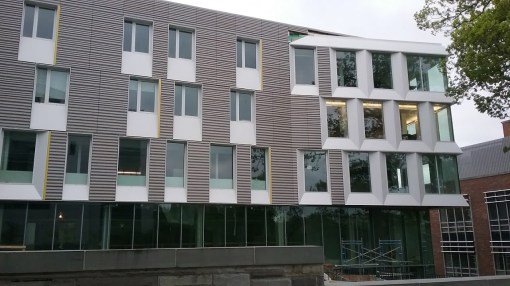
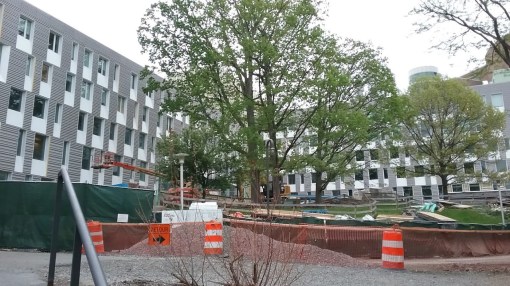
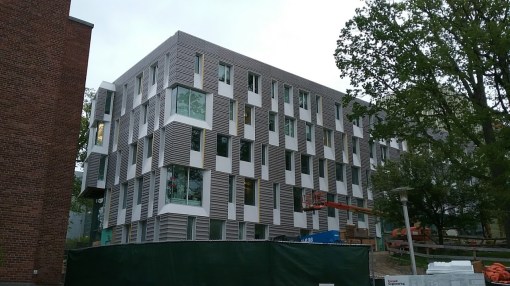
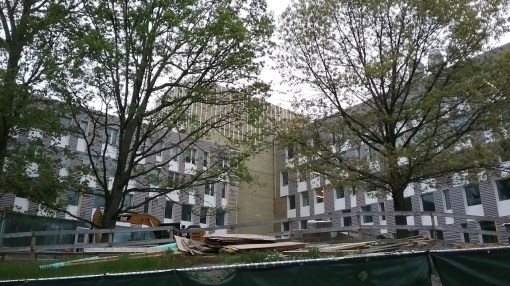
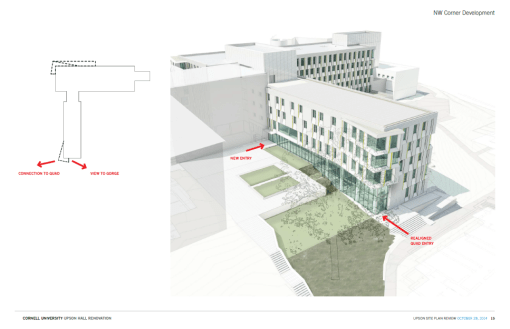
Home stretch for Upson Hall’s $74 million makeover. Nearly all of the turquoise water-resistive barrier (WRB) has been covered up with terracotta panels and aluminum inserts at this point. The utilities shaft and mechanical penthouse have been faced with a water resistant base layer and aluminum clips, and will be faced with grey metal panels. Note that those thin yellow aluminum plates on the exterior are a finished design featurethey’re intended to be a nod to the original canary yellow aluminum curtain bands that once lined Upson Hall’s facade. At this point, the upper three floors are occupied, the lower two floors and basement are being finished out, the exterior is nearly complete and interim landscaping features will be installed by The Pike Company before the building opens for full occupancy in August.

Over the next ten years, Cornell would like to utilize LTL Architects and Perkins + Will to redo the rest of the Engineering Quad with designs similar to Upson Hall. The $300 million plan also calls for the demolition of Carpenter Hall and a new multi-story building on the corner of Campus Road and College Avenue. Whether or not those things happen remains to be seen. The earliest renders of the Upson Hall plan are included at the end of this entry, and while the general design has remained the same, some of the design features, such as the shape of the bump-outs, the fenestration, and the emphasis on the south terrace were revised before the final plan was drafted.


Collegetown Terrace Construction Update, 5/2017

21 05 2017

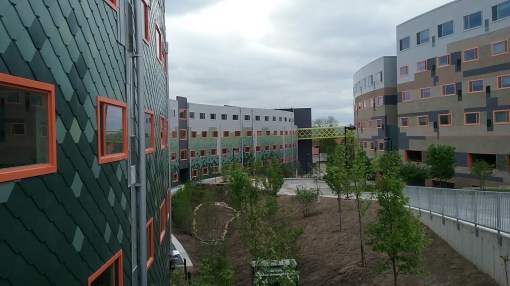
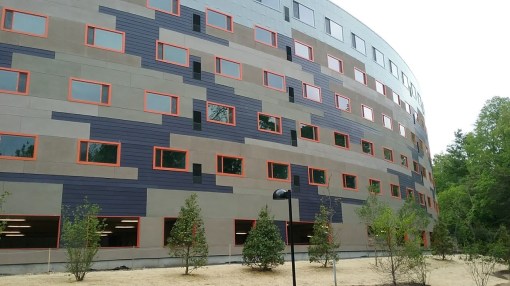
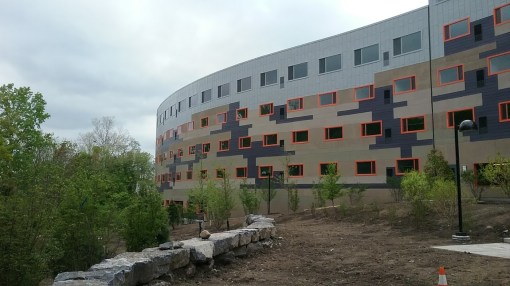
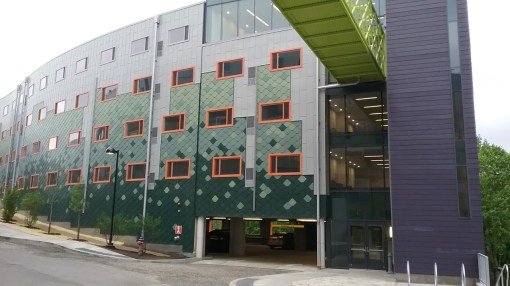
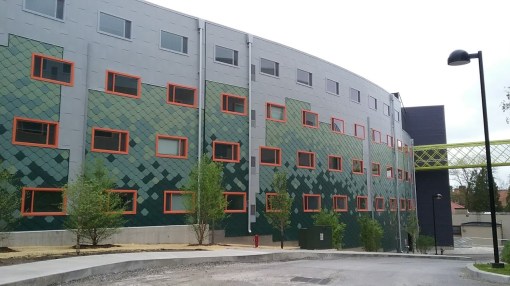
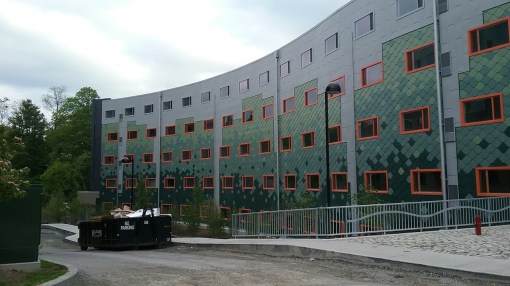
Collegetown Terrace phase 3 is actually opening this month. Speaking to John Novarr a few weeks ago, he mentioned that the first units would actually be welcoming tenants this month, to take advantage of the modest June-June 12-month market that comes before the typical August-June 10-month period that dominates the students calendar. From yesterday, it looks like the first tenants have indeed moved into the Building 7’s 247 units and 344 bedrooms. Units range from 218 SF studio suites with shared baths, kitchen and laundry (5-10 studios per suite), to 1266 3-bedroom units. For the record, the official address will be “120 Valentine Place”. The listed amenities include:

  • Heat included in rent
  • Upper floor large windows for expansive view
  • High speed data access throughout included in rent
  • Kitchen appliances: dishwasher, garbage disposal, microwave, stove and refrigerator
  • Custom-made cabinets
  • Granite counter surfaces in kitchen and bathroom
  • Limestone floors in kitchen, bathroom, and entries
  • Air conditioning in all apartments
  • Elevators
  • Monitored heat detectors, smoke detectors, CO detectors, and sprinklers
  • Fully furnished with blinds, leather sofa, and full/queen beds. Some with work stations and walk in closets
  • Prox/reader security system
  • Washers and dryers in all apartments.
  • Covered parking available for a fee
  • Free shuttle to Cornell. The free shuttle runs to and from campus weekdays throughout the academic year.

Rents clock in at a premium of around $1,000+/bedroom, but the studio suites will come in around $700/bedroom. It does seem like there are some mixed opinions on living there, if the Yelp reviews are any indication.

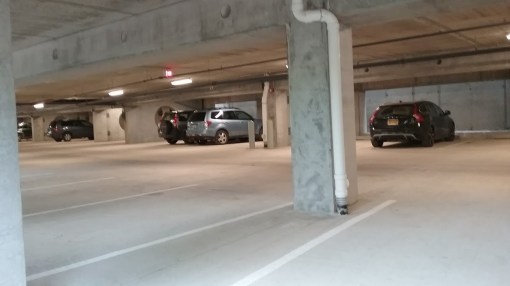
One slight modification that was sought recently was an approval considerations variance to allow tenants from other Novarr-Mackesey properties to park their cars in the Terrace’s garage. This has been something of a long-running issue with Terrace, which built more parking than it needed in the earlier phases, and as a result requested and received a variance to convert a floor intended for parking into dorm-style living quarter for students on more modest budgets. Even with the original variance, it seems that there are still an excessive number of unused parking spaces, ones that Novarr-Mackesey sees as potential rentable tenant spaces for residents in some of their nearby structures, including two housing projects due to get underway in the next year, 119-125 College Avenue (College Townhouses) and 238 Linden Avenue.

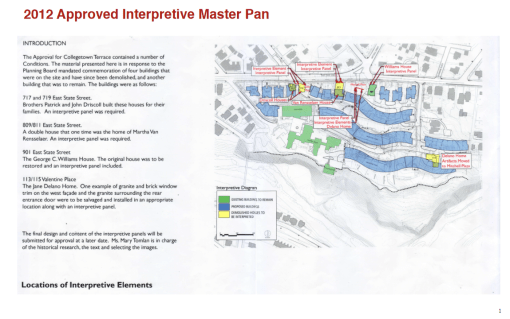
As part of the final stages of project completion (and stipulations of its original approval back in August 2011), some interpretive signage and features will be included in the landscaping, recognizing a few of the homes and the nurses’ dormitory that once stood on the site (recall that Casa Roma was once the city hospital). Thankfully the google street view archives are but a click away, so that the curious can go back and look at what was there prior. Some of the homes were architecturally interesting, if not necessarily historic.

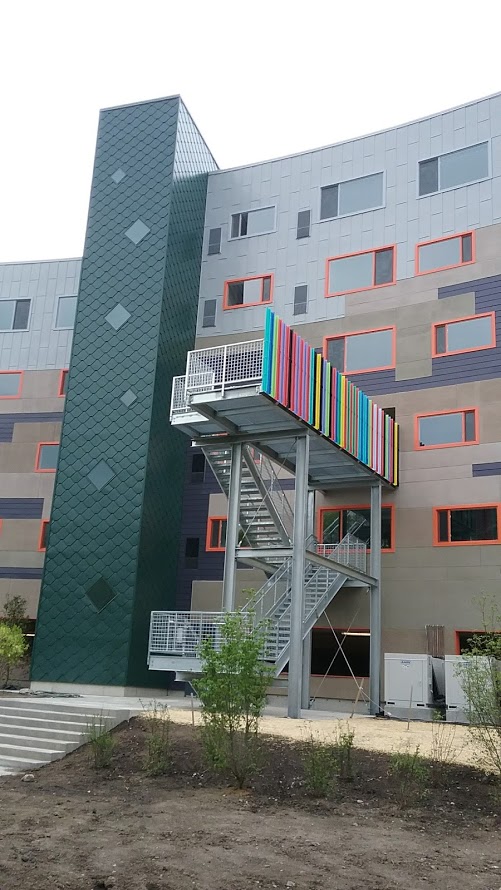
Note the stair railing art in photo ten. It’s as if someone looked at modern buildings, said they weren’t colorful enough, and designed that art feature to have ALL THE COLORS. Holy rainbow explosion. More seriously, it’s quite unusual, and kinda neat, since it’s not often you see a visual feature of interest so tucked away from public viewsheds.

So that pretty much wraps this up. In terms of private non-institutional projects, I dunno if there’s been a project that’s had an impact like this. It’s been a long time since the first presentation back in April 2009. In terms of numbers, it’s enormous – $190 million investment, 1,250+ beds (net gain of over 600), 16 acres. Certainly the latest few hundred beds will help to make a dent in the rental market, it’s by far the biggest project opening for occupancy this year. The trade-off will be a possible softening in some rental segments (e.g. small landlords in fringe student markets), but given the city’s push towards turning rentals back into owner-occupied units, and getting rent appreciation under control, it’s not something that will elicit much concern, especially as Cornell’s student population continues to grow.

In some ways, this project is many good things; growing the tax base, and addressing the need for housing in a somewhat inconspicuous manner, the buildings stepping downward into the hillside. With 344 new residents in the core of Ithaca, it may also give a healthy boost to nearby businesses in Collegetown and Downtown. But CTT has its detractors and criticism – the size still makes unnerves some permanent residents nearby, and the architectural design is a bit polarizing. There’s a tendency to look at building projects in black and white, but it’s never a cut-and-dry process. In reality, it’s a delicate balance of costs, capabilities, the market and the community’s wants and concerns.

Novarr deserve credit in that, unlike many projects, this project has stayed largely true to approved form over the years with the exception of the parking variances. There’s an uncomfortable trend with last-second revisions in more recent plans, but Collegetown Terrace has stuck fairly closely to the original plan as explicated in its Environmental Impact Statement years ago. City staff and elected officials also deserve credit for seeing the potential here for something that could contribute to Ithaca, rather than just saying “this is too much” and turning their backs on it. Credit is also due to ikon.5 and Welliver for their work in designing this massive project, and building it out (which included many local unions and their tradespeople).


Tompkins Financial Corporation HQ Construction Update, 4/2017

25 04 2017

I could see the clouds to the north and west, I knew the rain was coming. I even glanced at a radar still on my phone and assumed that, as most fronts tend to do, it was moving west to east in a diagonal SW-NE band – by that logic, I had about fifteen minutes to take photos, run to my car and get my umbrella. As it turns out, the front was pushing north to south. So I did not have fifteen minutes. I had five. Oops.

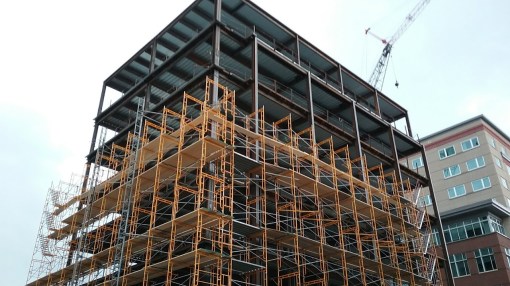
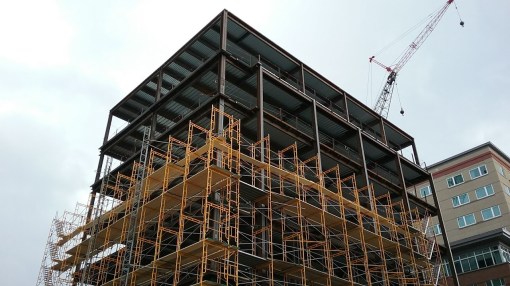
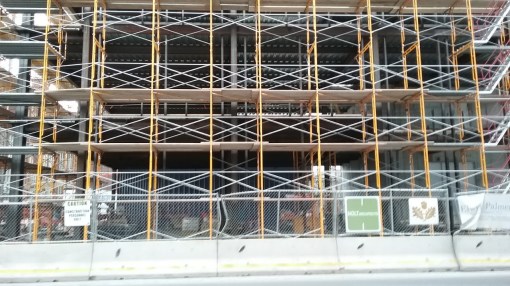
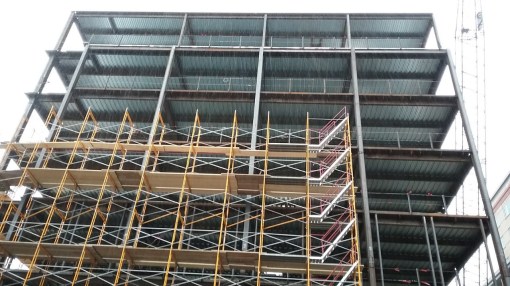
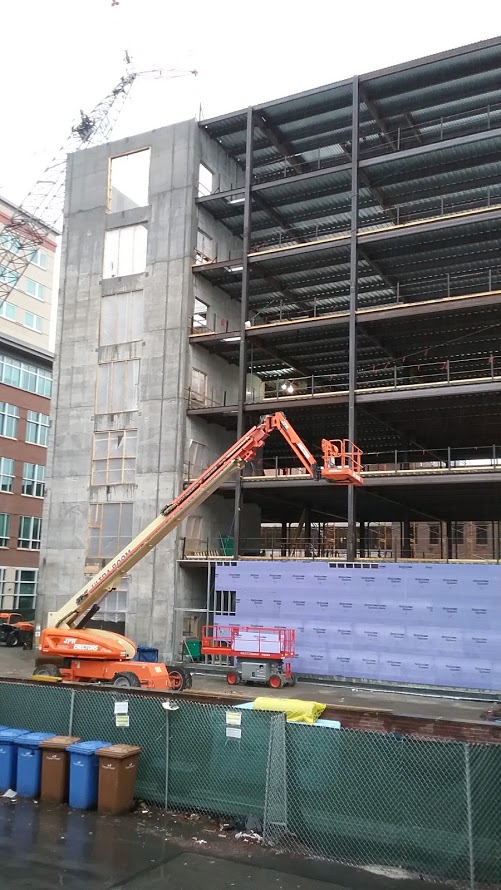
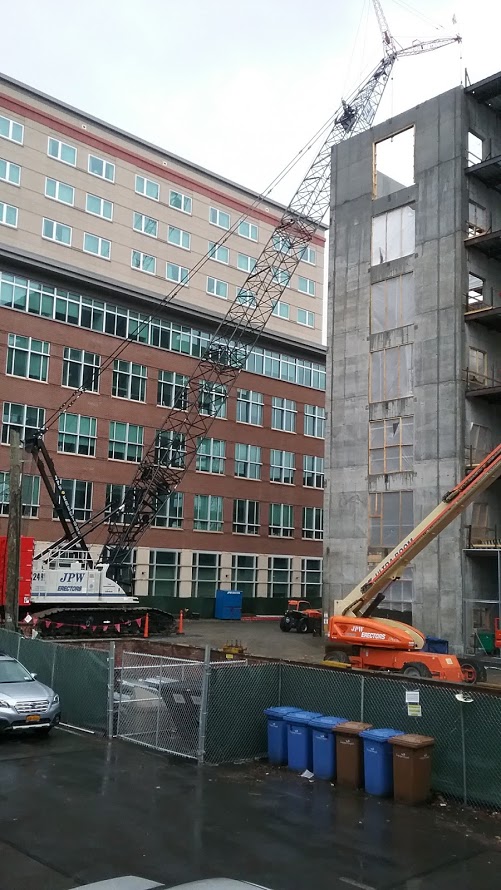
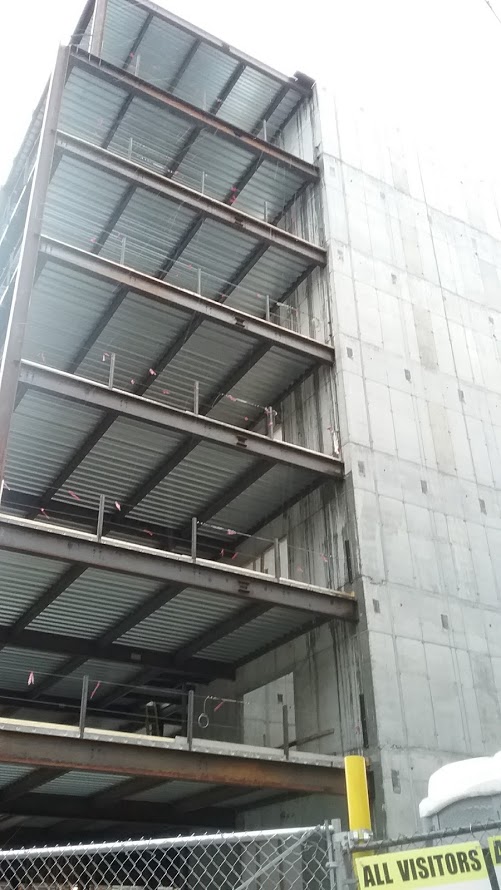
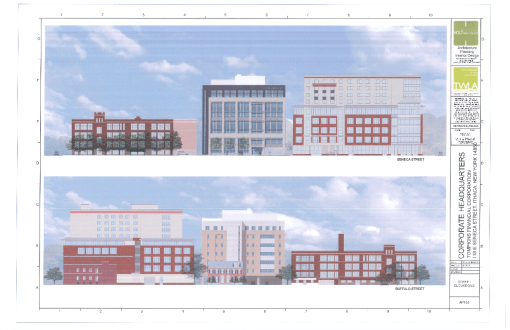
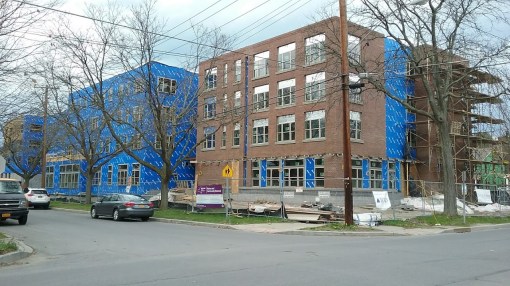
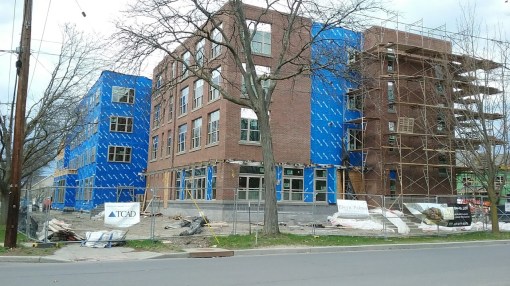
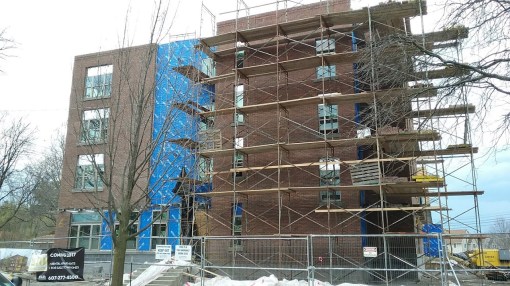
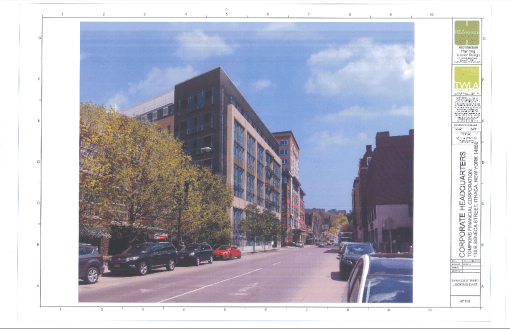
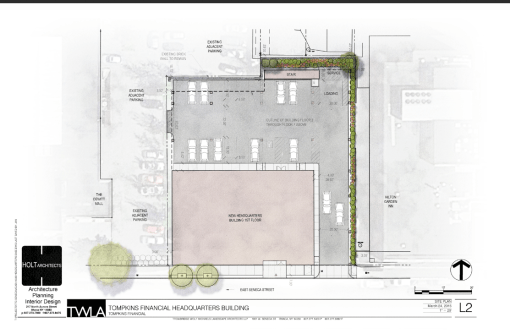
Anyway, TFC’s new HQ is topped out and decked with corrugated steel (a bit sooner than anticipated), though it’s not built out – the rear (north) flank and the east flank are missing. Those are the portions that will be built over the surface parking. You can make out a couple of the support piles in the pics below, and those will tie into the structural columns in the garage area, and into the structural steel of the upper levels. As noted with 201 College, it’s a bit unexpected that the structure would top out before even a single floor is built out, but it is what it is. The building’s height is there, but in terms of breadth, it’s less than half of the final product. The elevator core is at full height, and the steel stud wall and gypsum sheathing on the back separate the future ground-floor bank branch from the rear parking, which will be reserved for customers and clients. Pipe scaffolding has been erected as workers begin work on the interior (sprinkler system, utilities rough-ins).

Occupancy is intended by March 2018. JPW Erectors, a division of the JPW Companies of Syracuse, is in charge of the framing, while LeChase Construction is the general contractor. HOLT Architects penned the 110,000 SF building’s design.


210 Hancock Construction Update, 4/2017

23 04 2017

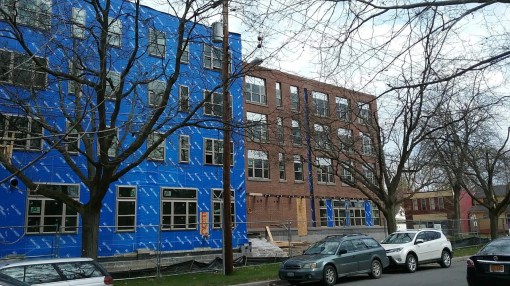
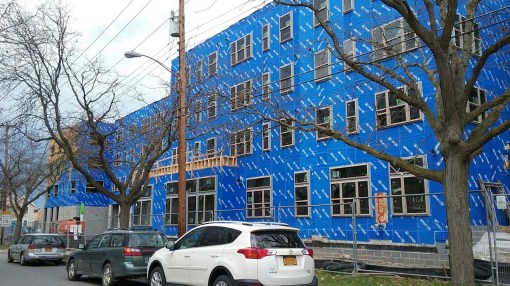
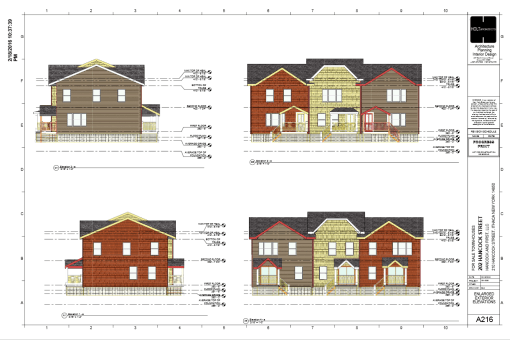
There is so much going on at INHS’s 210 Hancock site, this might be the record for most photos in a single construction update. Let’s go counterclockwise from the southwest corner, since that’s the order these photos were taken.

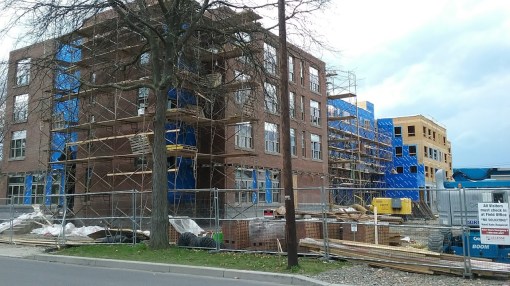
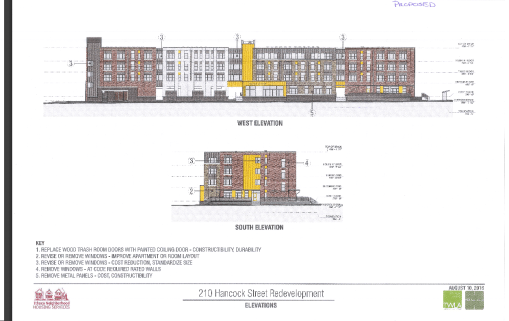
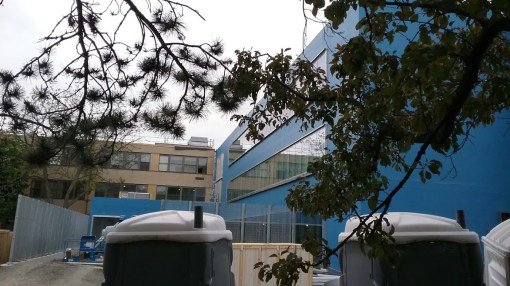
With the apartment building string, Section “A”‘s Blueskin has been mostly bricked over with Redland Heritage Brick. Some Blueskin remains exposed in areas that will be faced with Alpolic exterior metal panels. Fingers crossed that the mustard yellow shown in the elevations looks less jarring in person. It looks like an additional layer of thermal insulation was installed above the windows to go between the Blueskin and the metal panels (mostly dark grey, a few yellow…technically they’re called Alpolic Charcoal and EYL Yellow. the armchair architect in me really wants to harp on the yellow metal panels. I remember a Noah Demarest quote about yellow being a really hard exterior color to pull off. Why not a red or an orange-brown?). The roof is finished and interior fixtures and flooring are being installed.
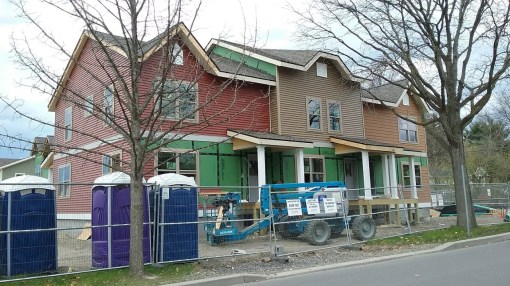
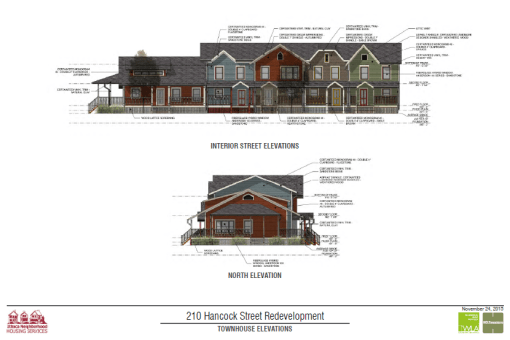
Then we get to the first string of three for-sale townhouses, which will have addresses for the 200 Block of Hancock (apart from 202, I’m forgetting the exact numbers). They look nothing like the elevations submitted for IURA review, and that is not a bad thing. INHS is using Certainteed clapboard siding on the exterior. The one on the west (left) is “Autumn Red”, and the one on the east (right) is “Mountain Cedar”, both of which were used on the Stone Quarry project. The shades of brown and grey are so similar it’s hard to tell what the middle one is, maybe “Hearthstone”. It looks like a mixture of sizes as well, maybe 4″ on the left and middle, and 7″ Mountain Cedar on the right. The trim pieces are Certainteed vinyl and vary slightly in color, neutral whitish or tannish shades like “Sandstone Beige”, “Natural Clay” and “Desert Tan”.

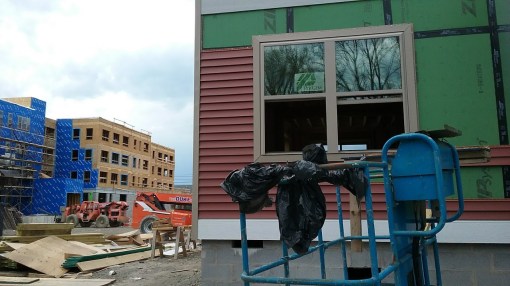
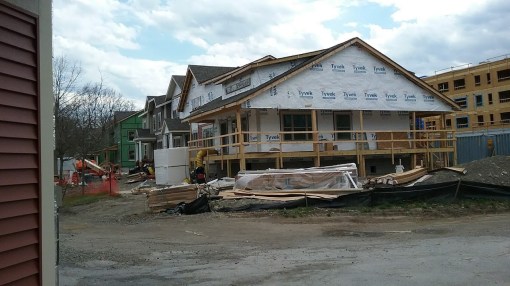
Circling around to the 400 Block of Lake Avenue highlights a construction contrast between the for-sale units and the five for-rent units further north. The for-sale units are wood-frame, plywood Huber ZIP sheathing, and exterior finishes. The for-rent units are wood-frame, standard plywood sheets, Tyvek Housewrap, and exterior finishes. The difference between the two is really a matter of preference – both are effective water-resistive barriers if installed properly. ZIP panels tend to be easier to install (lower labor cost), but more expensive as a product.

The Certainteed colors on the rentals are “Spruce”, “Sable Brown”, a split-level “Autumn Red/Hearthstone”, “Flagstone” and another “Autumn Red”. Some of these will be 4″ clapboard, others 7″ shingles – all Certainteed, all to give the impression of individual units so they play well with their older, detached neighbors. The Spruce Green unit looks a little odd with that big blank wall above the porch, and in the renders and elevation it appears to be bigger than the final product.

Apartment sections “C” and “D” are still being framed, and “B” has been fully skinned and fitted out with windows. “B” will be faced with will use Carolina Ceramics Teakwood Brick and Morin blue-grey corrugated steel with pearl, EYL yellow and charcoal Alpolic metal panels, “C” will use Redland Whitehall Brick (white brick) as well as Alpolic panels, and “D” will use the same Heritage Red brick as “A” but, with some corrugated steel on the stairwell. “C” and “D” also have a first-floor covered parking garage. The garage will be face in Barnes and Cone Masonry, but the city’s November 2015 filing makes reference to a product that doesn’t appear in their brochures.

The apartment will be ready by August 1st, and the for-sale units will be on the market by the fall. Lecesse Construction is the general contractor.


Hotel Ithaca Construction Update, 4/2017

23 04 2017

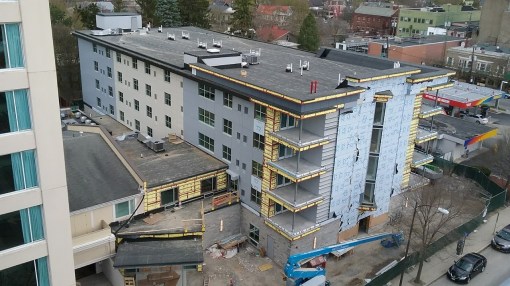
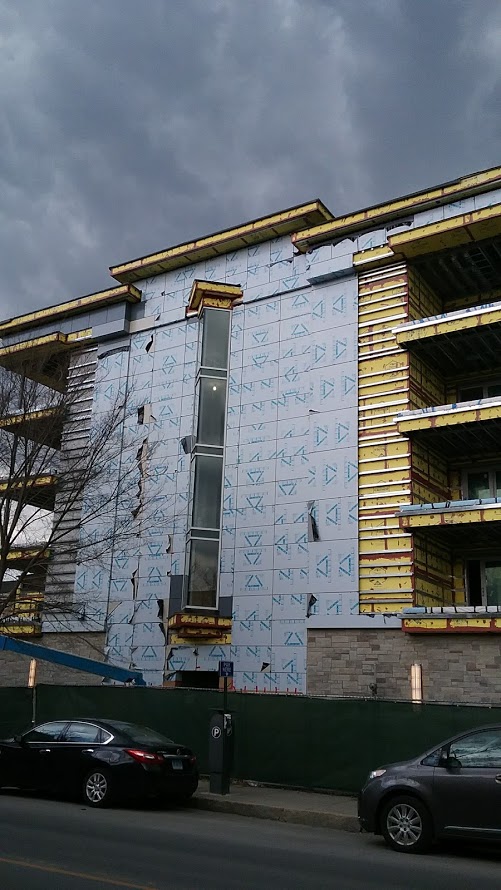
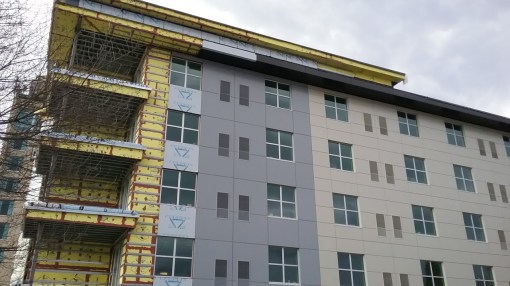
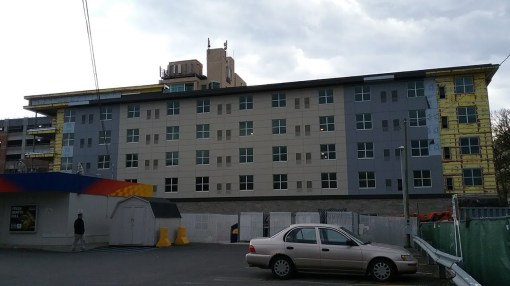
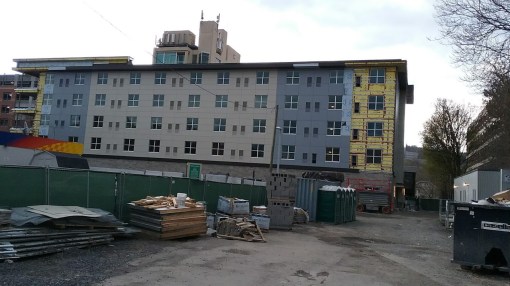
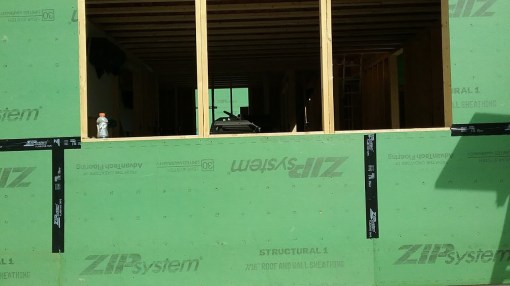
The exterior finishing is further along on the new wing of the Hotel Ithaca. For most of the hotel, the exterior wall construction goes something like this – the steel stud walls are erected, RMax polyiso insulation boards are attached, and the fire-rated GP DensElement fiberglass mat gypsum sheathing panels go over the boards – the maroon sealant is PROSOCO R-Guard FastFlash liquid flashing. DensElement is different from other GP DensGlass products in that the water-resistive barrier (WRB) is integrated into the fiberglass mat, so there shouldn’t be the need to place a barrier over the sheathing. But some parts of the sheathing do appear to have an exterior WRB (compare the southeast and northeast balconies in the first photo below), so make of it what you will.

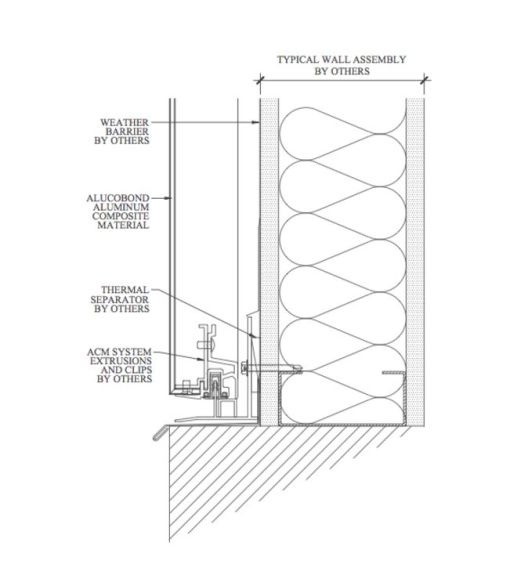
Once the fiberglass mats are installed and sealed tight, metal clips are adhered to the sheathing, and then Alucobond panels are fastened to the clips. Alucobond is an aluminum panel that is sometimes used as an exterior finish because it’s lightweight and fairly dent-resistant (and aesthetically, metal panels are used for a modern, clean look). The drawbacks are cost, and potential waterproofing issues if not installed correctly. Along the ground floor, stone veneer was applied over the sheathing.

Side note, the initial design called for diamond-shaped panels, which were rejected by the Planning Board with extreme prejudice – one member called it “strip mall architecture“. Although, the strange part of all this is, the final product appears to be a blend of what was initially proposed, and what was approved – the exterior and window elements resemble the final render, but the final submission didn’t have a doorway on the east end of the wing, while the initial design did. The end of this update has a copy of each for comparison.

It looks like the roof is finished and the trim is going on, so with the exception of the remaining metal panels, doors and trim pieces like the balcony railings, the exterior is nearly complete. Hart is aiming for an opening by graduation weekend, so things should move at a fast clip over the next few weeks. Krog Corp, a frequent partner of owner Hart Hotels, is the general contractor.


1001 North Aurora Street Construction Update, 4/2017

21 04 2017

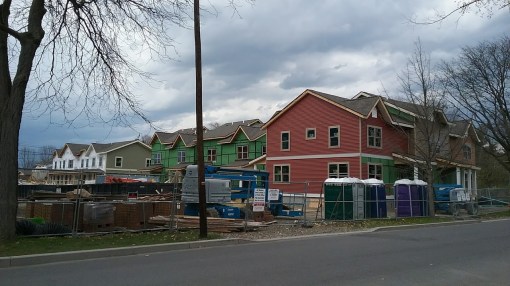
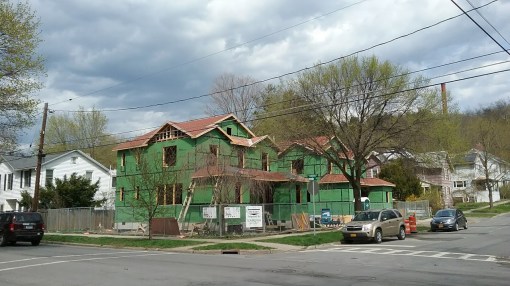
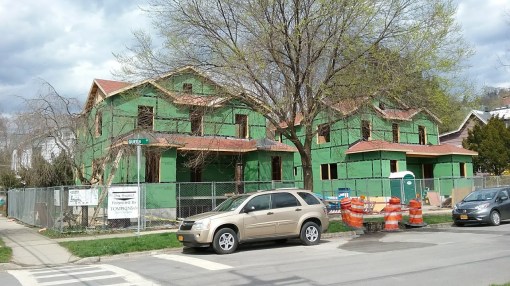
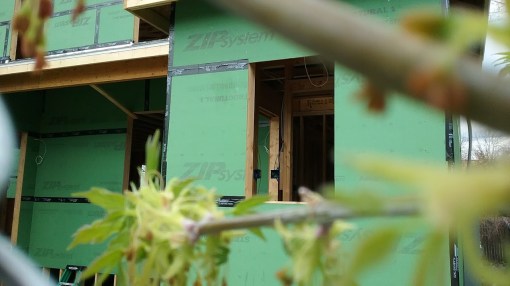
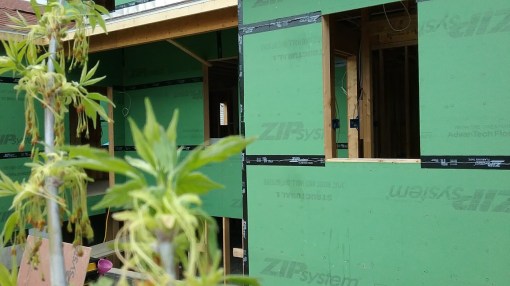
Some more progress on the two-building, four-unit 1001 North Aurora Street project in Fall Creek. Since February, the building have been framed out, roofed and shingled. For the record, the shingles are Owens Corning TruDefinition Duration Shingles, Terra Cotta color. Huber ZIP System plywood sheets are being attached to the exterior over the wood studs, and interior framing, rough-ins and drywall is underway.

On a happy note, it looks like the side windows on the eastern building, which had the potential to be deleted as a cost-saving measure, are indeed going in based on the rough openings. The exterior will consist of two brownish shades of LP SmartSide cedar texture siding, with a white lap band and trim. Technically, that white is Sherwin-Williams “Nacre”, and these plebeian lips had to go to Google to figure out how that’s pronounced (NAY-ker). Because mother-of-pearl is just two darn pedestrian. The browns are “Rice Grain” and “Sawdust”.

Developer Stavros Stavropoulos (d/b/a Renting Ithaca) should be bringing these 3-bedroom rental units onto the market by the end of May, as 202 Queen Street and 206 Queen Street. Shortly thereafter, he and architect Daniel Hirtler which be launching into next project, and their biggest to date – a 3-story, 11-unit apartment building at 107 South Albany Street, just west of downtown.


Village Solars Construction Update, 4/2017

19 04 2017

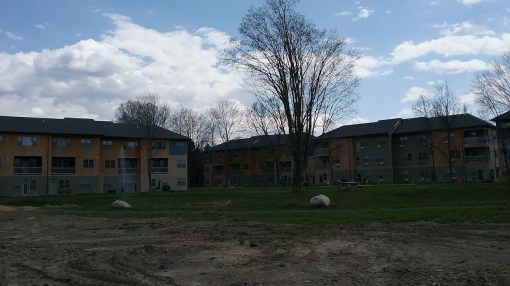
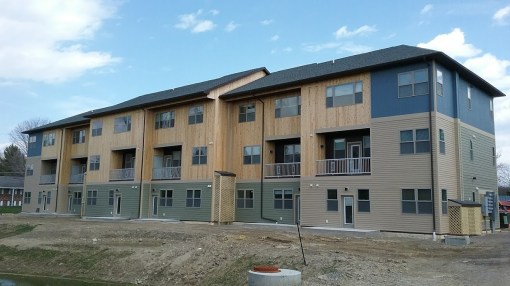
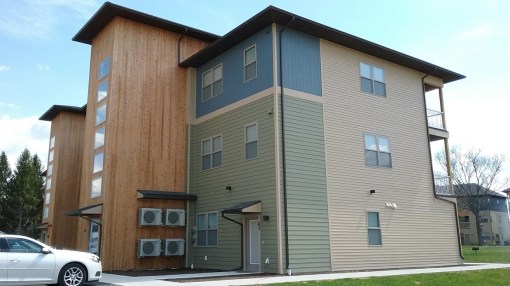
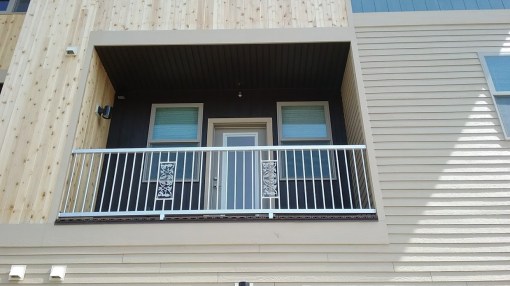
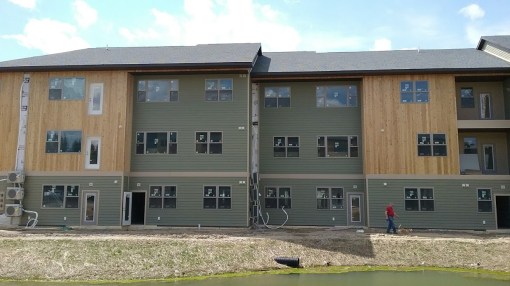
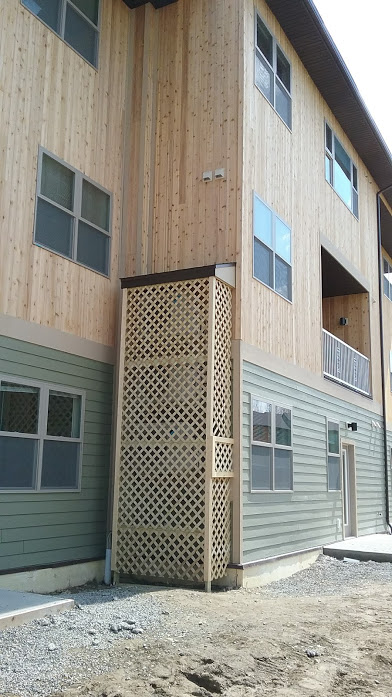
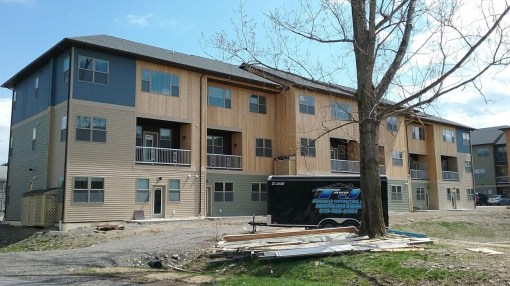
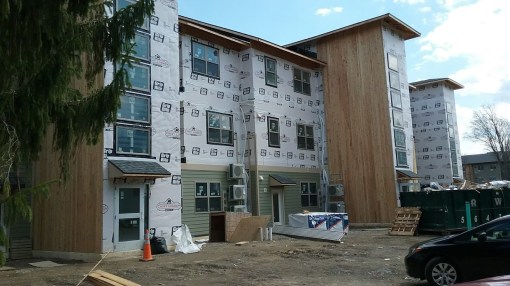
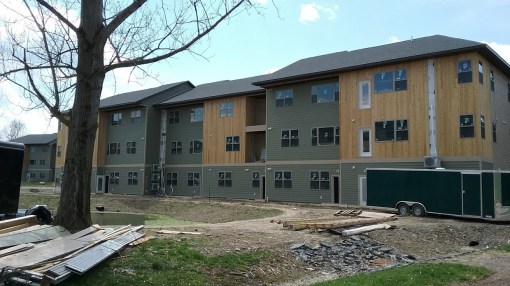
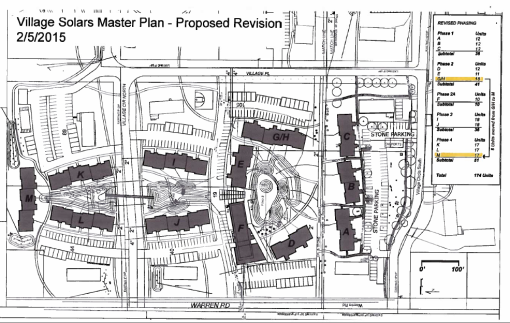
At the never-ending Village Solars apartment complex in Lansing, Building “I” is nearly complete from the outside. It sports a few details that make it stand apart from earlier phases – the balconies railings are a different design, a dark-colored fiber cement board is being used for some of the balcony alcoves, and the heat pumps have been hidden away under a wood lattice screen. Given how clean the immediate project site is, it would not be a surprise if this building is aiming for a May 1 occupancy.

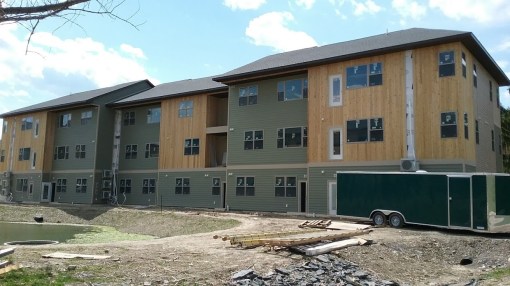
Meanwhile, Building “J” is a little further behind – the windows and doors have been fitted and the roofing is complete, but the exterior wood grain and fiber cement panels are still a work in progress, as is the building trim. The doors on the upper levels will likely lead to small juliette balconies like those seen here. Inside, it’s stud walls and rough-ins, and there did not appear to be any drywall hung yet.You can see the unscreened Daikin heat pumps in the fourth photo below. It looks like the roofing was done by T and J Associated Contractors out of Auburn.

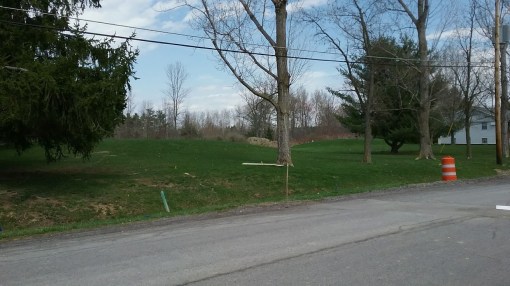
It doesn’t look like work has started on Phase 4 yet, which should consist of the last three buildings in the first stage of build-out (“K”, “L”, and “M”). If it’s anything like the previous phases, the construction team will start with the Phase 4 site clearing this summer. The later stages of development call for multiple phases to the east, and possible replacement of some of the older 1970s apartment buildings with newer structures [3/22 Town Board Minutes]. Potentially, the complete build-out would be around 423 units, from 400 SF studio micro-units to 1,185 SF three-bedroom two-bath apartments. Keep in mind, that would be several years out, well into the next decade. Along with those units come community space, retail components, expanded trail and outdoor components and a bus stop.

Rents look to be in the middle of the market – the micro-unit studios start at $865/month, going all the way up to top-of-the-line three-bedroom units at $1680/month. One-bedrooms and two-bedrooms start at $950/month and $1260/month respectively.

While looking around, an older gentlemen walking his dog went in and out; dunno if it was a relative of the Lucente family (the owner/developers, d/b/a Lifestyle Properties), or a curious onlooker.


209-215 Dryden Road Construction Update, 4/2017

17 04 2017

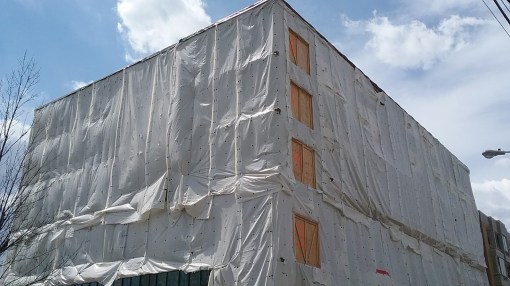
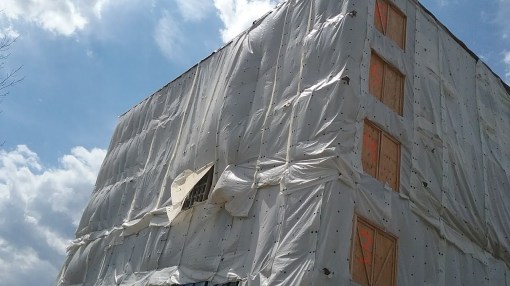
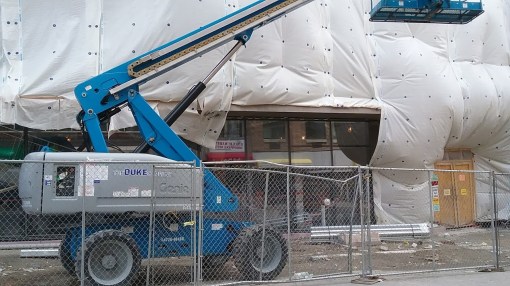
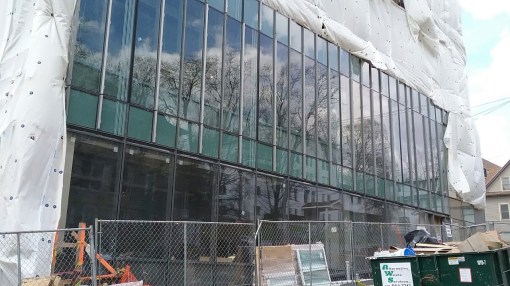
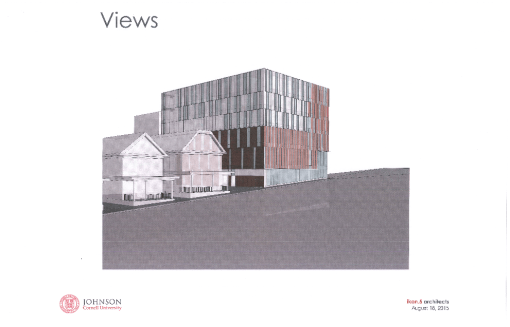
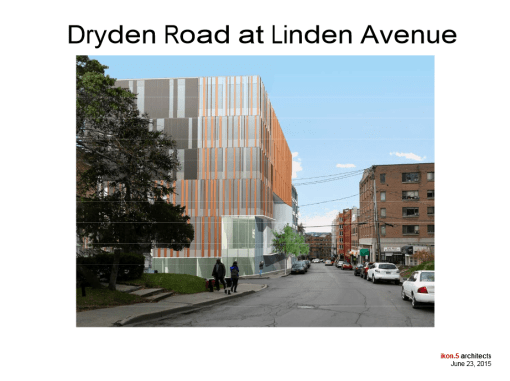
Work on the new Breazzano Center continues in Collegetown, with the exterior plastic sheets slowly being replaced by the metal and glass facade. On this particular windy day, the tarp was flapping enough to reveal a bit of the exterior metal stud walls underneath. On the rear of the building, the salmon-orange and dark grey panels now cover most of the exterior wall. The recently proposed 238 Linden townhouses will come up to about the top of the third floor, where the salmon panels change over to grey. 238 Linden will be roughly the same color as the lower-level panels, probably with the same metal finish. Note the clips on the exterior wall, which are for aluminum sunshades.

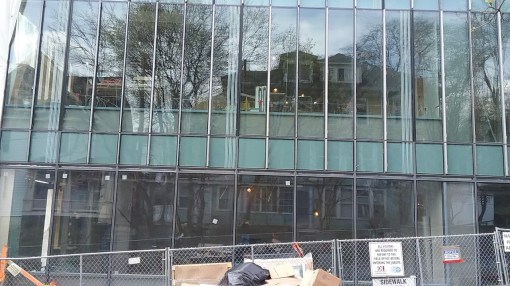
I’ve had contractors tell me that one of the ways you can tell the quality of the curtain wall glass is by how much distortion one sees in the reflection (optical distortion). Based off that criterion, the glass used on the entry level appears to be a fairly high grade. The opaque glass panels are called spandrel glass, and are used to conceal the floor slabs.  It looks like the thin vertical steel panels will be installed over the curtain wall, though not in all places – The northeast corner and ground floor will not have the steel panels, nor will the atrium at the front of the building.

One can barely see the interior work in these photos, but the interior stud walls were up and drywall has been hung on the lower floors, which means that most of the utilities rough-ins have been completed.

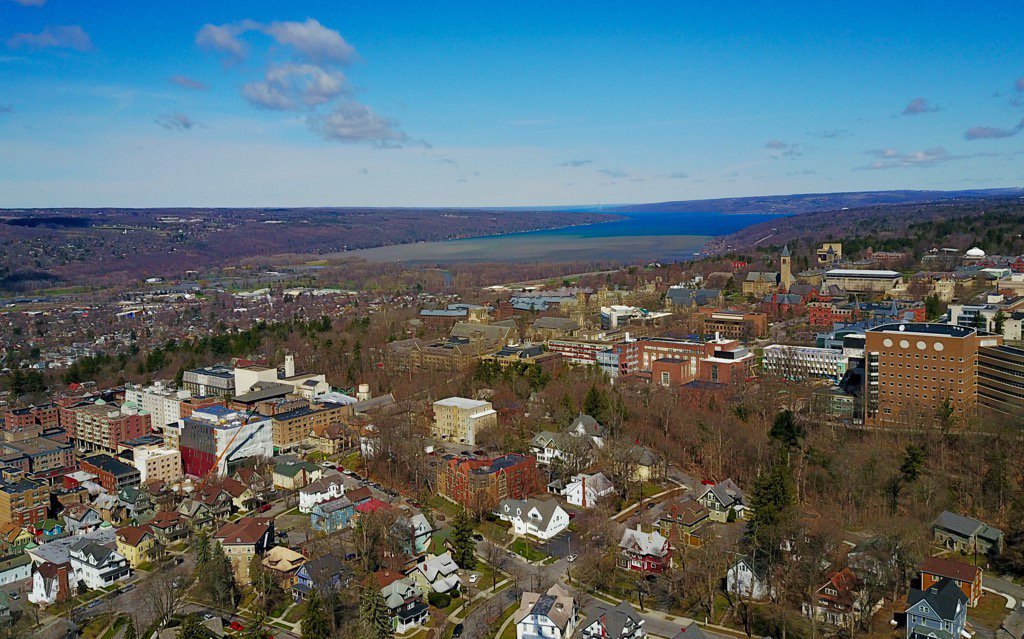
The last photo, which comes courtesy of Tom Schryver, gives an idea of the scale of the building in context – at six floors and 80 feet, it is the tallest that the Collegetown form zoning allows without a variance. At 76,200 SF, it’s the fifth-largest by square footage, after Cascadilla Hall (77,913 SF), The Schwartz Center (80,989 SF), Eddygate (95,000 SF) and 312 College Avenue (112,392 SF).