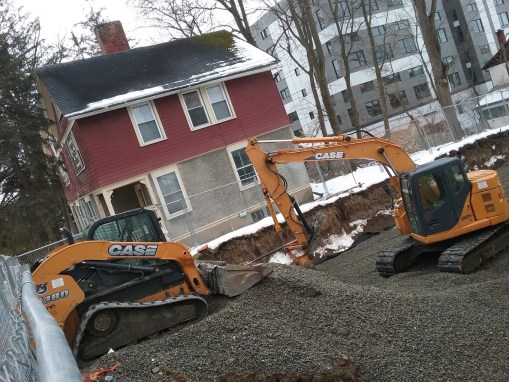
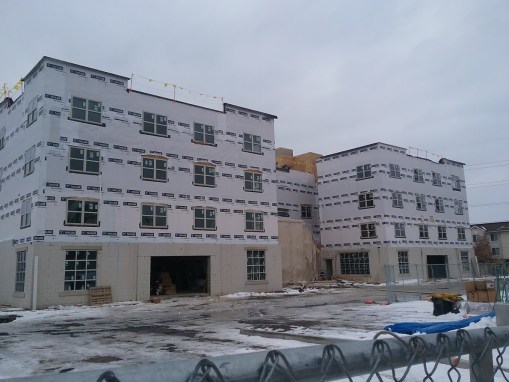
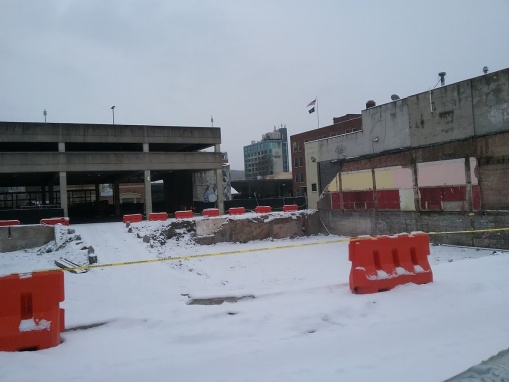
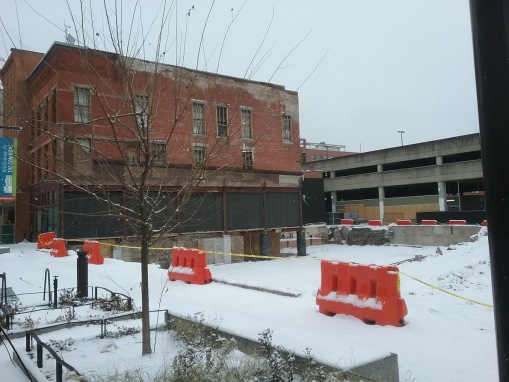
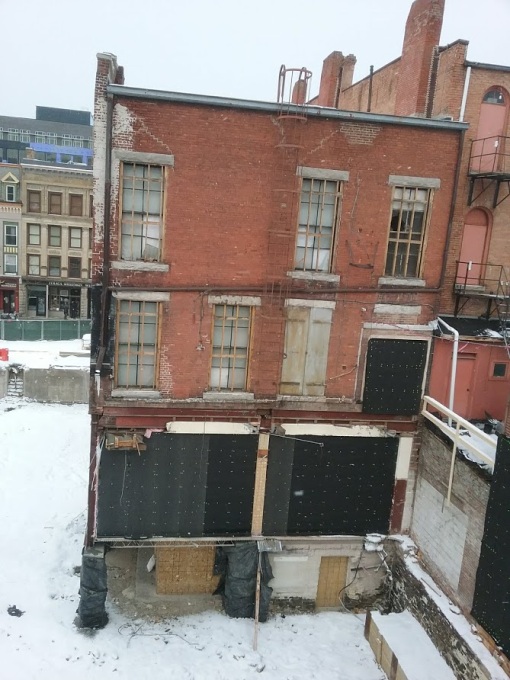
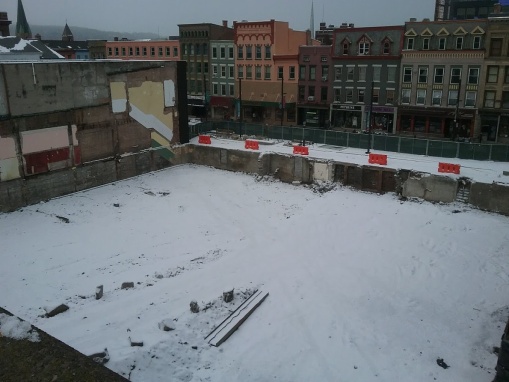
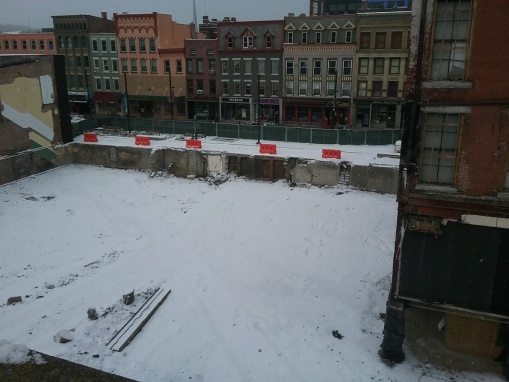
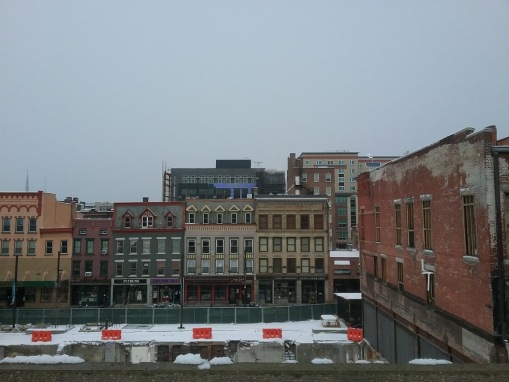
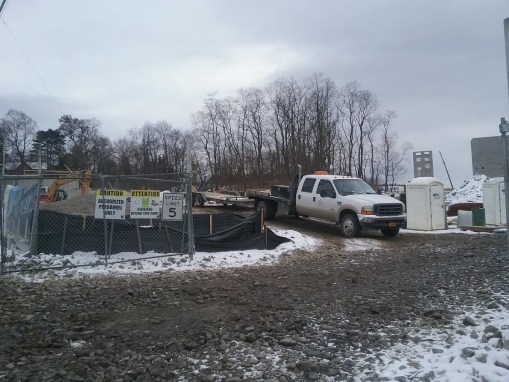
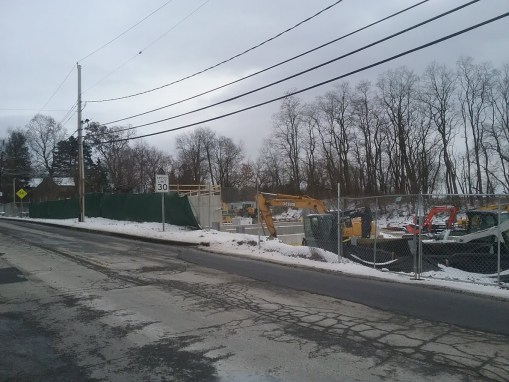
So here’s some good news – 210 Linden Avenue is moving forward once again. The city’s Board of Public Works (BPW) held a special meeting on the 30th that would create a loading zone in front of 210 Linden Avenue. This is important because the new state fire code restrictions say no construction can occur along Linden since the street is no longer considered wide enough. By eliminating the parking space in front of 210 Linden and replacing it with a loading zone, it created a “wider” street since a fire crew would no longer have to worry about parked cars along the street frontage. This made it easier for the project to obtain a fire code variance from the state.
BPW is ostensibly not a fan of the arrangement, but given that the developer (Visum) was notified by the city of the change after the existing building had been torn down, they were willing to grant the loading zone given the unique circumstances.
Well, mostly unique. One other project was subject to the the same issue under very similar circumstances – Novarr-Mackesey’s 238 Linden Avenue. That project team is also asking for a loading zone during this month’s BPW meeting, and hopes to be granted a state fire code variance as well (and 210 Linden gives them reason to be optimistic). While every future project planned for Linden is now in limbo, it appears likely these two will be able to move forward.
Also in the good news category, a state fire code variance was granted for another Visum project, 118 College Avenue, under the expectation that the city and NYSEG will follow through with their plans to bury the power lines on College Avenue in the next two years. With the lines to be buried relatively soon, the state felt comfortable granting the variance for a building taller than 30 feet (118 College is just under 45 feet).
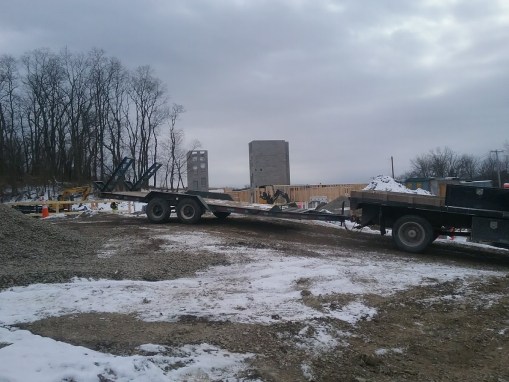
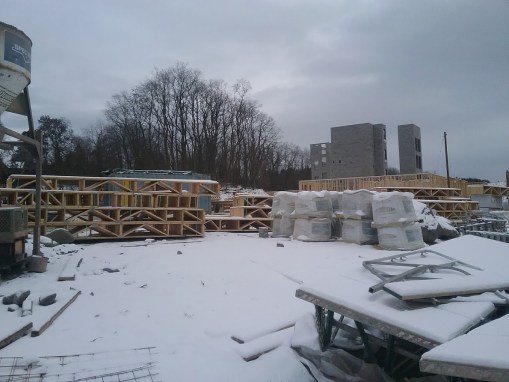
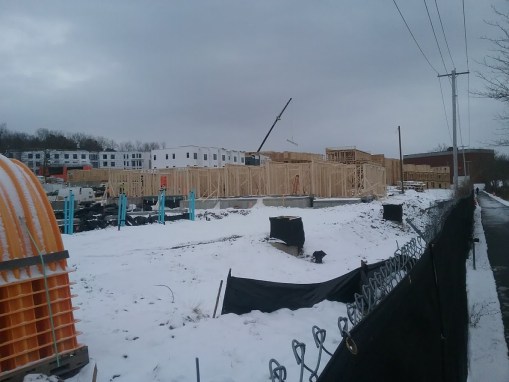
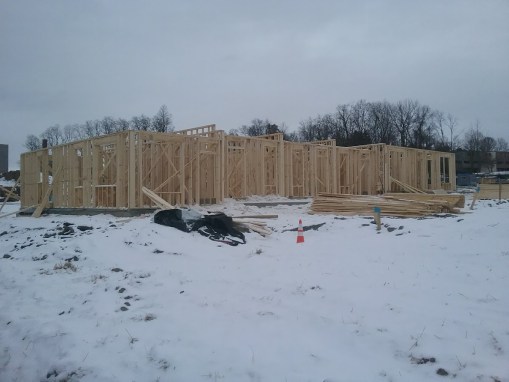
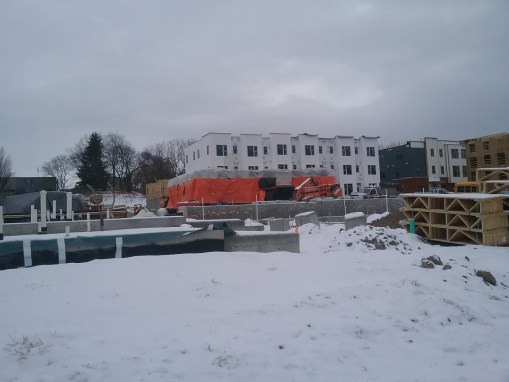
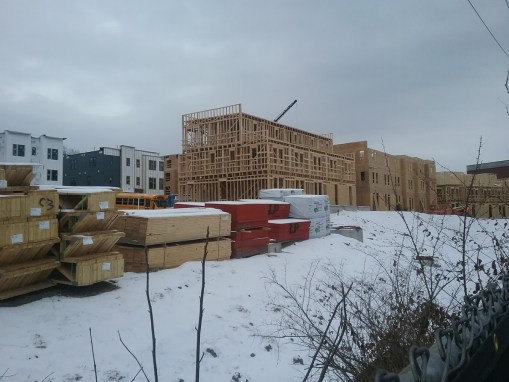
The buildings are aiming for an August 2018 completion. They are wood-framed structures, which in comparable economic circumstances, can move along faster than a concrete or steel. Even then, it’s still going to be a tight deadline for William H. Lane Inc.
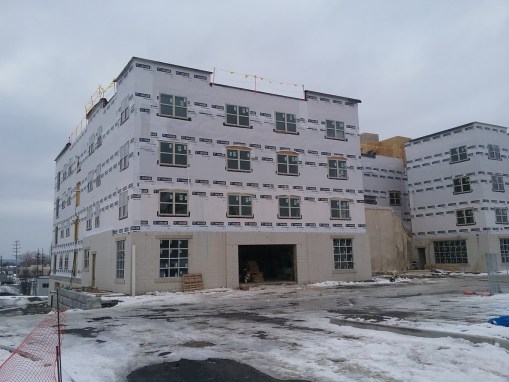
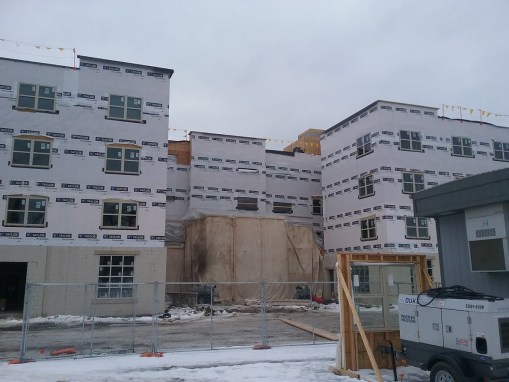
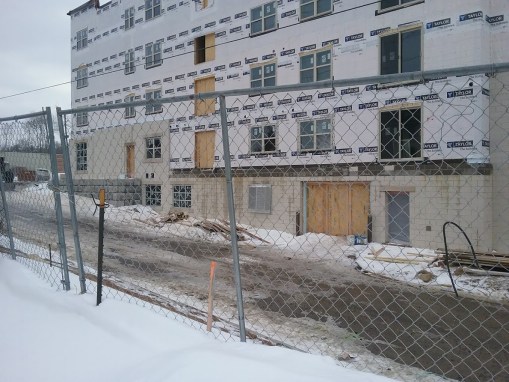
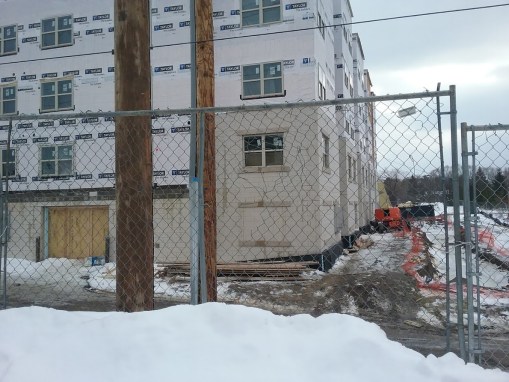
Somehow, these sat in my drafts folder for a week after they slipped off the radar. Anyway, Cayuga View Senior Living is topped out, most of the windows and entryways have been fitted, and much of the exterior has been wrapped. Exterior finishes include concrete masonry unit (CMU), face brick and fiber cement panels.
Touted amenities include “Hot Water, Basic/Standard Cable, Designer Kitchens, Energy Efficient New Construction, Trash Removal, Rooftop Garden Access, 24/7 Maintenance, Community Room, Fitness Center, Library/Computer Room, Secure Intercom, Wi-Fi Campus, [and] 24/7 Site Monitoring”, under the marketing moniker “Discover New Freedom”. One of the senior sub-markets the Thalers hope to target are snowbirds (like themselves), for whom they expect to rent the units year-round but only spend the warmer months and holidays up in Lansing. For $1,500-$2,775/month, that’s a lot of money to give up for a place to not live in all-year round. But that’s just one millennial’s shallow-pocketed perspective.
Taylor the Builders plans to deliver the 87,359 SF, 60-unit building sometime this spring – probably later in the season, perhaps May or June. No details are publicly available on the percent of units pre-leased, or for occupants of the twin 1,340 SF commercial spaces on the first floor. Background info on the project can be found here.
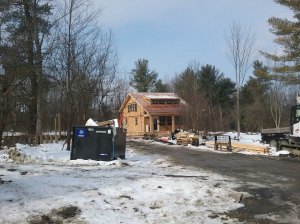
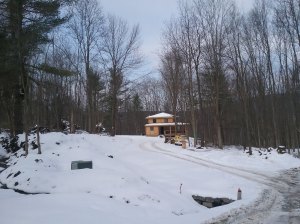
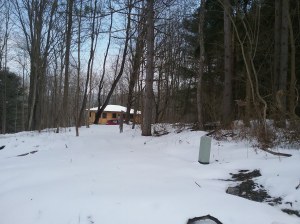
1. Let’s do some houses of the week. Above, the four new homes Tiny Timber has constructed at 1624 Ellis Hollow Road in Dryden. Each home lot is a little over an acre. The subdivision was approved last spring for the wooded parcel a couple miles east of Ithaca, and since then, Tiny Timbers has been busy selling units and lots to buyers. Two were sold in August, one in September, and the last in December. Therefore, this is 100% built out, since the last lot is a conservation lot at the rear (north) end of the property, designed to protect Cascadilla Creek. The units utilize a shared driveway, with spurs for each home. If you want to look at the homes more closely, click to enlarge the photos.
Assuming these are like the other townhouses, expect them to be 3-bedroom units, low 2000s SF with garages, and to go for $350-$450k when they’re finished several months from now.
3. Dryden’s new Rite Aid is coming along. Fully framed, and the plastic in the window openings is likely intended to allow construction crews to work indoors without exposure to the fierce winter elements. The curbing and paving is complete in the parking lot, and it looks like they install metal bollards all around the lot’s perimeter to keep the less-than-attentive from driving into the wall (something that happened to the Nice N’ Easy in my hometown no less than three times before they finally put some in). It is still planned to open in March.
4. Over in Fall Creek, it appears a small apartment building is in line for some major renovations. 1002 North Aurora, a four-unit building built in 1898, had been on the market for $395,000. The seller had owned the property for 24 years, and the price was only slightly above the assessed value of $375,000.
On Friday, the property sold for $400,000 to an LLC associated with local developer Modern Living Rentals (Charlie O’Connor et al.). The same day, a building loan agreement was filed from Tioga State Bank to the LLC for $712,000. A lot of that was going towards the land acquisition, and once soft costs are deducted as well, the loan is $287,000.
MLR tends to be very transparent about their plans, and a glance at their recently updated website shows the purchase and a ‘information on this project coming soon’. However, they already uploaded the interior renovation plans from STREAM Collaborative. It’s a very thorough interior renovation, and it appears to complete change interior floor plans, with new bedrooms (net gain of one?) as well as new kitchens, bathrooms, and fire rated ceilings. Exterior changes appear to include a renovated fire escape staircase, a couple new windows on the third (top) floor), and a new skylight. While old, this apartment building is a hodge-podge of additions from decades past, so let’s see what a renovation can do to clean things up. It’s plausible the renovations would be complete by August, so they can appeal to students as well as the general market.
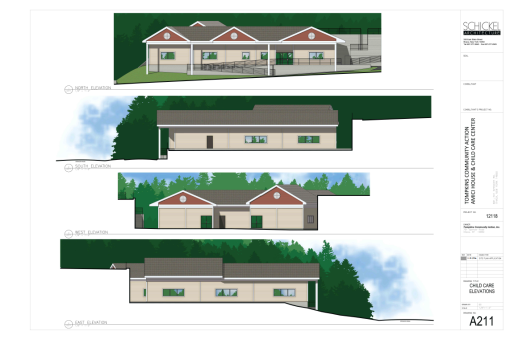
5. It looks like Amici House is finally moving forward. The project, located at 661-701 Spencer Road, received a $3,732,469 loan from the New York State Homeless Housing and Assistance Corporation. The money was announced back in April, and appears to be getting disbursed now.
The five-story, 20,710 SF (square-foot) project, approved by the city of Ithaca last January, calls for 23 studio housing units for homeless or vulnerable young individuals in the 18-25 age range. Along with the units and office/function space for local social services non-profit TCAction, the plan also calls for a 7,010 SF early heard start facility, called the “Harriet Gianellis Childcare Center”, that will house five classrooms, kitchen and restrooms, and an outdoor play area. The childcare facility will serve 48 low-to-moderate income families and create up to 21 jobs.
Recently, the HGCC applied for a low-interest loan from the IURA, $90,690 to help cover unanticipated moving expenses associated with the project. TCAction thought they could stay on-site during construction, but the contractor said otherwise, so they’ll be 609 W. Clinton while the new Amici House is built. The loan says it will generate three jobs, but that’s more a technical stipulation than an actual figure associated with the project. The funding for the childcare appears to be separate, $1,325,000 already approved by the state, $603,000 from M&T Bank, and $84,200 from a standing IURA loan. It is fully funded, although it is not completely clear if it will be built concurrently with the housing (the likely answer is yes).
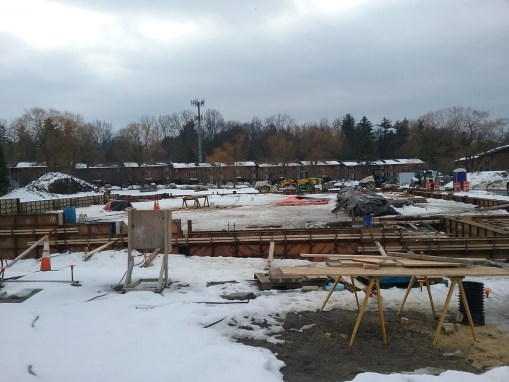
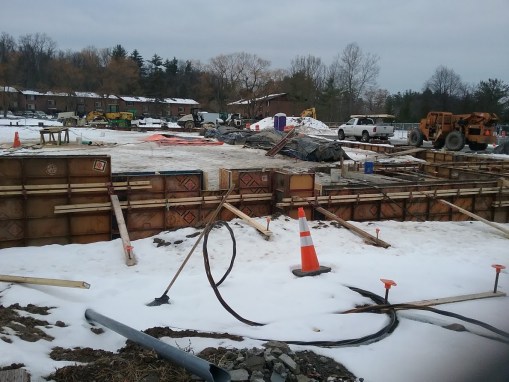
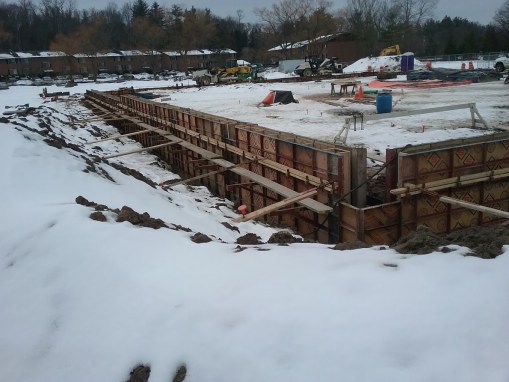
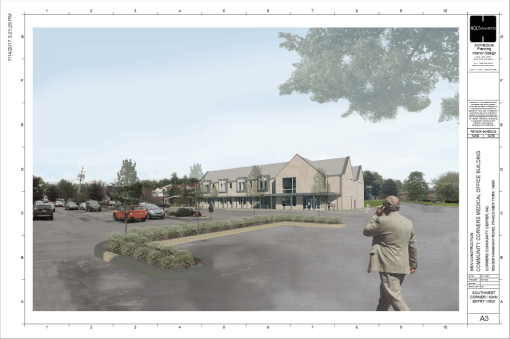
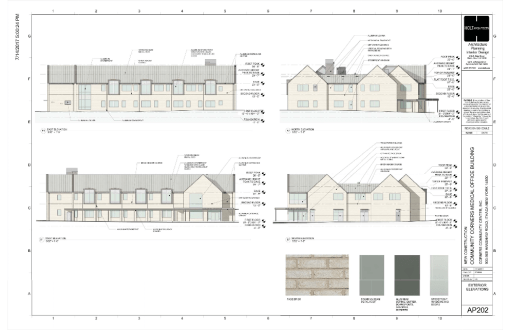
At the Cayuga Medical Associates site in Community Corners, the foundation has been excavated and the forms have been assembled. These are Symons Steel-Ply forms, steel with plywood facing that has been erected and braced along the perimeter of the building footprint.
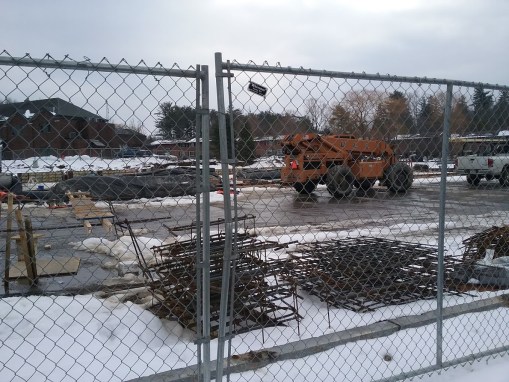
Unlike the downtown properties, the foundation here is a slab, so the footers will go in along the perimeter and the slab will be poured atop the cleared and leveled footprint of the structure, distributing the weight of the building. The steel rebar sitting along the fence will be laid within the building footprint and poured over with the concrete mix, providing additional strength to the concrete as it cures. It looks like some walls have already been poured, cured and interspersed with rebar topped with OSHA orange safety caps.
Meanwhile, it looks like the adjacent site where the former bank building was torn down has been fully cleared. This will be part of the parking lot, along with associated curbing and landscaping.
Not much to add here beyond the blurb in the Voice roundup. The Ithaka Terraces are likely to be finished this spring. There is nothing public regarding any sales figures for the ten 2-bedroom and two 3-bedroom units. I’m not sure if another visit is necessary, though maybe if they set up a model unit and don’t mind a nosy blogger, there will be one last photo set.
If there any criticism to levy here, it’s not necessarily an issue with just this project, but I’ve had emails calling it gentrification and ‘luxury housing that Ithaca doesn’t need’. But if people are buying here, then they aren’t buying another city property and potentially outbidding someone with fewer dollars to spend. A little additional supply to take pressure taken off the market is welcome. As noted above, the city tried to sell the lot for affordable housing, but it didn’t pan out (not unlike the issues with 402 South Cayuga Street a block away). Additionally, this project is fully taxed, the project team did not seek abatements.
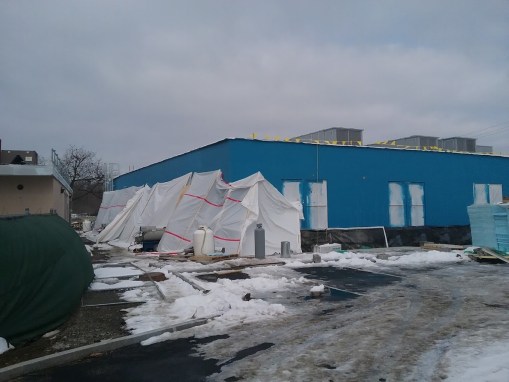
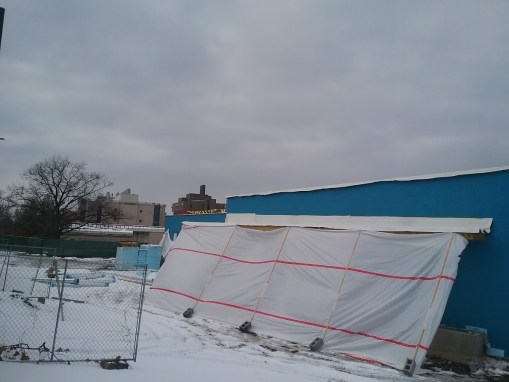
At this point, the expansion is done, and the construction at hand is the new $7 million Community Practice Service Building at 107 Farrier Road, where the Poultry Virus Lab once stood. It looks like a waterproof spray coat was applied above the previously-applied water-resistive barrier, based on the overspray on the rough window openings. There are plastic sheets with ribbing up over some of the exterior walls and part of the front entrance – the rendering shows concrete walls with decorative finishes, so what might be happening is that these are still curing, and the sheets are there to keep precipitation (whatever it may be this time of the year) from penetrating and changing the concrete and water mixing ratio, which can weaken the wall.
The roof equipment (HVAC commercial units) appears to be in place, but the synthetic rubber membrane has yet to be laid. A truck at the rear of the construction site suggests Michael A Ferrauilo Plumbing and Heating of Rochester is one of the subcontractors. They’ll be busy for a while yet; stacks of insulating form board and galvanized metal utility ducts suggest plenty of interior and exterior work still left to be done before the May opening.
Grab a cup of coffee or tea for this one, it’s a long introduction.
Touching on a familiar topic again, downtown and urban living has enjoyed a revived interest in the past fifteen years, and coincident with moderate but steady economic growth in Ithaca, it has created plenty of opportunities for those with assets and expertise. Succeeding in those opportunities is a slightly different story – money and a strong project team are important, but some projects have an easier go of it than others. Harold’s Square has experienced substantial obstacles in its long pre-construction period, but thanks to developer David Lubin’s flexibility and tenacity, as well as an accommodating local government and growing market, it has surmounted those challenges and is now underway.
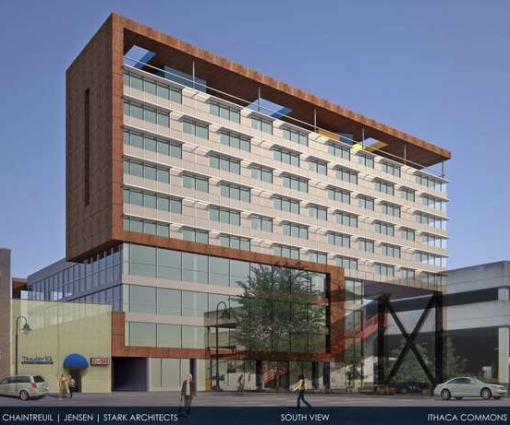
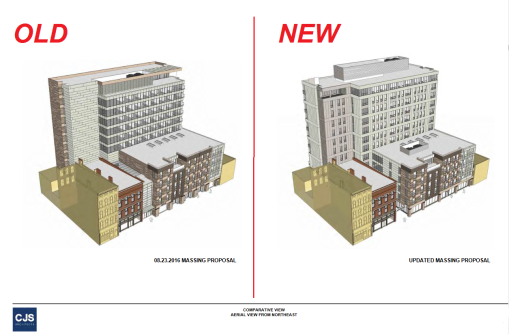
The first version of Harold Square at 123-139 The Commons was proposed back in October 2012. At the time, the plans called for first-floor retail, a few floors of office space, and 60-70 apartments on the upper floors of the 11-story building. The Sage Block (Benchwarmers) and W.H. Miller Building (Home Dairy) would be renovated, while three less historic buildings would be taken down to make way for the new development. The estimated price was $30 million and the plan was to have the 126,000 SF building finished by summer 2014. At that time, the building would have needed a fairly substantial zoning variance – the entire site was CBD-60, and it reached about 135 feet.
With the exception of the first-floor retail and Sage Block renovation, none of the other details have remained the same. However, the five major design iterations have all been by the same architect – CJS Architects (formerly Chaintreuil | Jensen | Stark Architects), with offices in Rochester and (later) Buffalo.
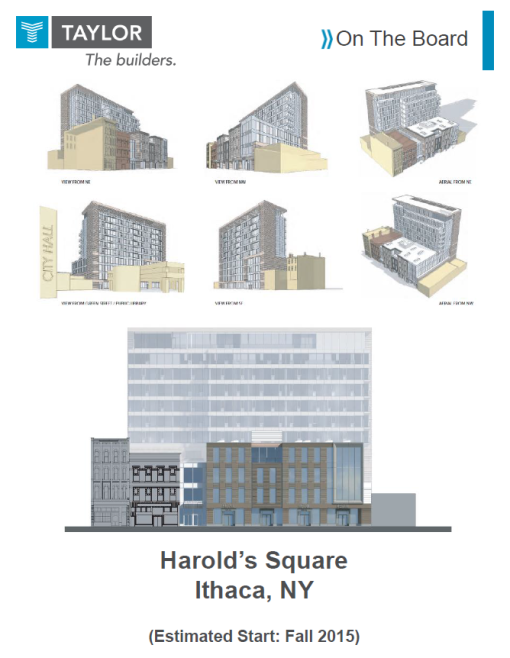
The project design was critiqued and reviewed thoroughly over the next ten months, which also produced the first major set of design changes – in fact, if you’re googling Harold’s Square without prior knowledge, images of this version, v02, turn up enough that even many current agencies and organizations (and even the posters on the construction fence) treat it as the final design. The 2015 image from the contractor’s website, Taylor the Builders, is shown above. It did away with some of the less-liked design features of v01, but retained a clean, contemporary profile with a curtain wall of glass, and terracotta panels that extended to the roof canopy. During this period, plans to acquire the W.H. Miller Building were dropped.
At this point, post IDA approval, we kinda enter a publicly dormant period. Publicly, apart from the occasional reassurance from Lubin that the project was still alive, and the re-application for approval permits since those expire after two years, there didn’t appear to be much going on. Behind the scenes, it gets a little more interesting.
With the space utilization issue worked out, the project was still seen as a sizable risk to potential lenders – it was at its inception the largest project proposed in downtown Ithaca since 2005’s Seneca Place, and Lubin had some experience with smaller projects, but nothing this size. Finding a partner to buy in to the plan would reduce the loan needed and add experience, making the project an easier sell to lenders. This is where McGuire Development, a major interest in the Buffalo market (3.5 million SF), came into play. They saw the potential in Lubin’s vision and the value in the Ithaca market, and agreed to buy in as a development partner. This appears to have been finalized in January 2017.
By October, the project was underway, courtesy of a construction loan from Norwich-based NBT Bank. The bank is a regional player with about 1.5x the assets of Tompkins Trust. This is new territory for NBT, which typically limits itself to single-family home loans in Tompkins, and has no service branches within county lines. The loan is for $33,842,000. L Enterprises and McGuire have each put up $5 million to cover the $43,842,000 cost of the project.
The project team includes L Enterprises LLC (led by David Lubin) as lead developer, McGuire Development as co-developer, Taylor the Builders as the general contractor, CJS Architects, Fagan Engineers and Land Surveyors handling the application and civil/structural engineering work, and Brous Consulting for public relations. Those who want to follow the project without this blog as an intermediary can sign up for update on the project webpage here.
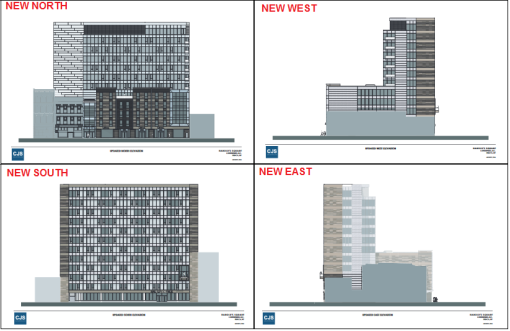
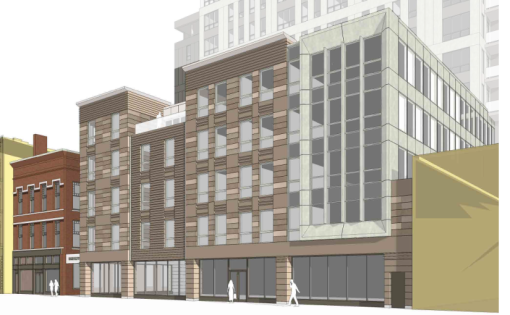
With the latest update on their webpage also comes the latest version of the project design, v05 – which doesn’t really affect the program space, but it does have several visual changes. The corner units now have exposed balconies vs enclosed rooms, the dark metal band on the top floor facing the Commons has been removed, and the retail frontage was reconfigured a bit on the Commons facade (the north module was stretched, one of the entry doors moved, and different fenestration patterns have been applied to some of the modules and the northwest face).
So there’s a lot going on. You can scroll through the 40+ photos below, or you can check out the conveniently placed webcam that EDR installed at all their projects. It seems like Mother Nature is out to stop this project at just about any cost – as explained by the Voiceand the Times, EdR has lost 25 days of construction time due to weather (rain) delays, and that forced the project team to not only ask for extended hours earlier this year, but they also had to request earlier this month to be allowed to work on Saturdays. Now LeChase and their subcontractors have to contend with multiple days of subzero temperatures, in what is likely the longest and most severe cold snap in over a decade. It’s one complication after another. The webcams shows they’ve put up heavy-duty plastic sheeting to keep the extreme cold at bay as the crew continues work on the townhouse strings.
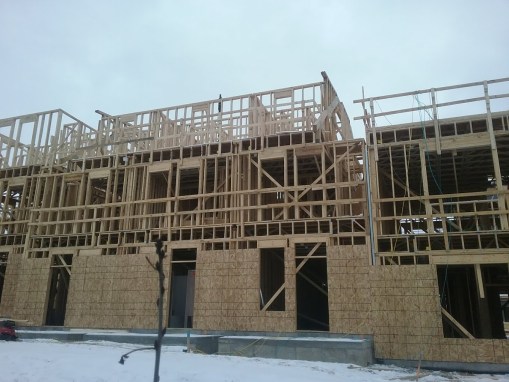
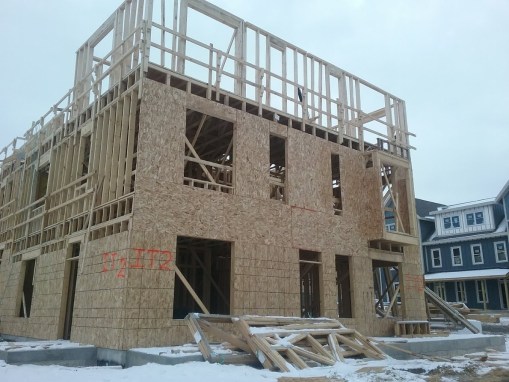
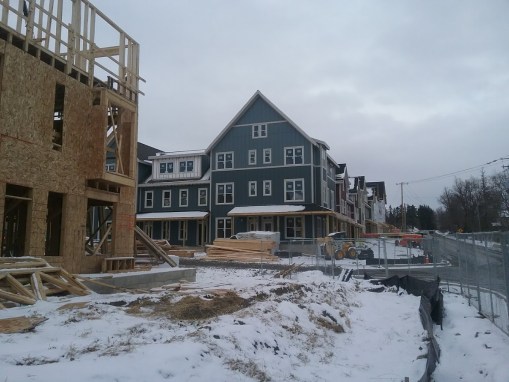
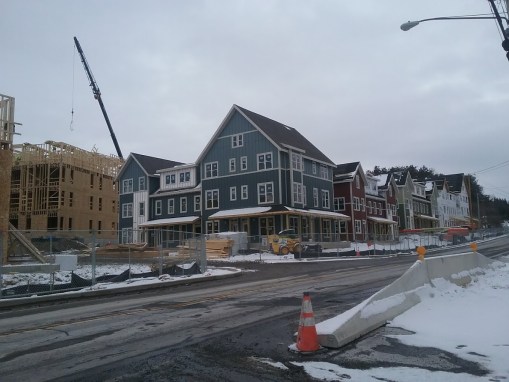
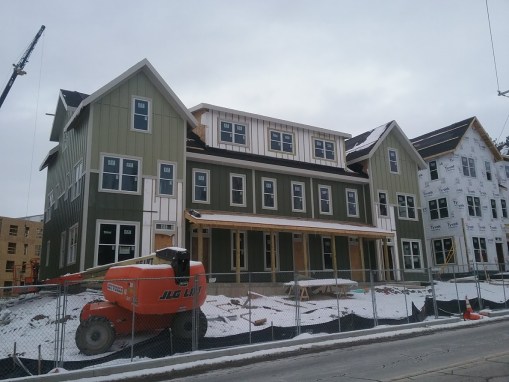
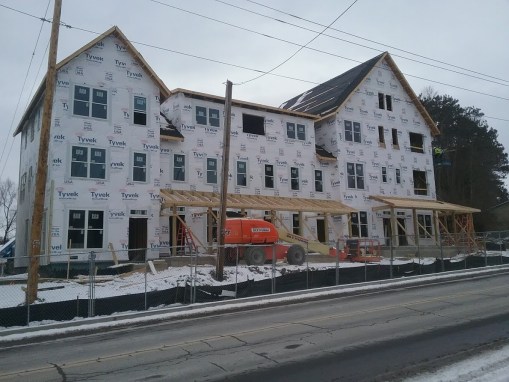
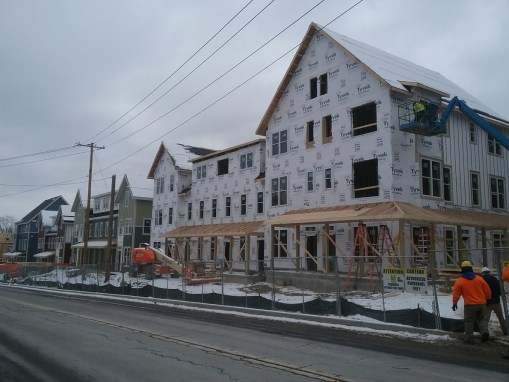
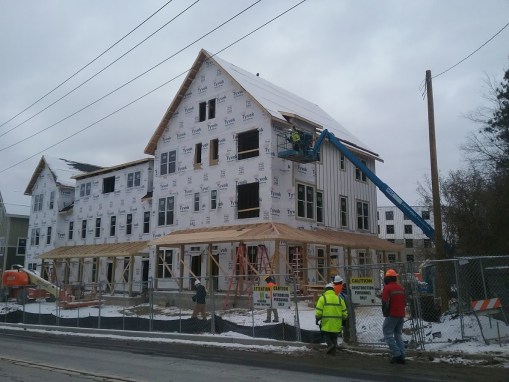
There are 27 buildings in some state of construction, from foundation work to framing to exterior facade application, and all manner of interior work from framing, to rough-ins, and for the furthest along, insulation and perhaps drywall hanging. Fixtures, primer coats of paint, and trim pieces (moldings, baseboard) will follow. There are have been some minor exterior design modifications (like the dormers in the buildings along Mitchell Street), but otherwise it’s as-approved.
More specifically:
Apartment Building B: Framing (top floor)
Apartment Building C: Framed, sheathed, windows fitted, some exterior facade materials attached
Apartment Building D: Foundation finished, stairwells erected, framing just starting
Apartment Building E: Foundation slab work
Apartment Building F: Foundation slab work
Townhouse Strings:
At, Bt, Ct, Dt, Ht1, Jt1, Jt2, Kt1, Community Center – unclear, not above ground level or readily visible
Et1 – slab
Ft, Gt2, Kt2 – framed, sheathed (partially for Gt-2), exterior facade work for Ft and Kt2
Gt1 – slab (in photos, now framing first floor based on webcam)
I have to say, based off the work so far, I’m liking what I’m seeing, even with the tweaks the architectural designs and materials appear to be good quality. Here’s hoping the project team can maintain their tight schedule against the environmental odds.
It’s also important to look at the larger trends in the local market. In Ithaca’s case, office space is typically small-scale, and very little is built without a tenant already in mind. Ithaca’s economy is growing steadily, but since meds and eds just build their own space, and tech jobs tend to be “asset light”, the demand for rental office space isn’t growing much. Also, with Tompkins Trust Company building a new headquarters a couple blocks away, which would consolidate several rented spaces into their spacious new digs, it looked likely that there would be a glut of office space by the end of the decade.
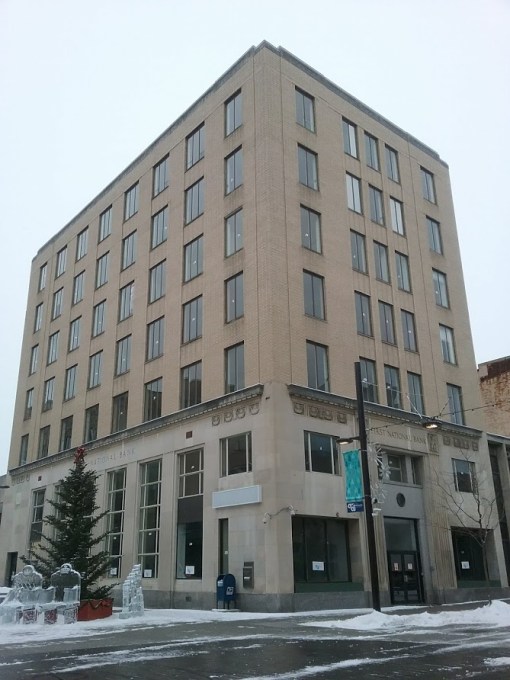
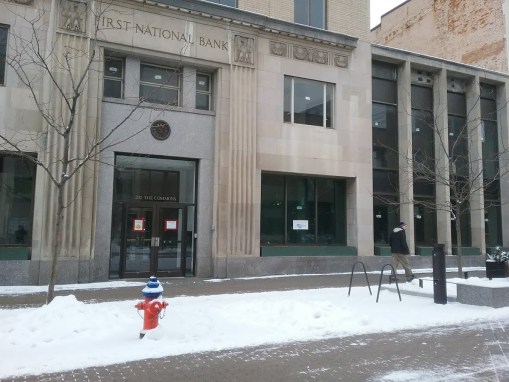
According to a press release, the fourth and fifth floors will retain a traditional layout, while floors three, six and seven will move to an open-office format. CFCU will host a service branch on the ground floor. New windows, communications systems, and high-efficient utilities will be installed in the building. The sixth and seventh floors appear to be spec space, with tenants TBD.
On the ground and second floors, it appears the lobby area is being opened up to give it a more spacious feel, and interior demolition work continues, given the rubble chute off the side of 111 North Tioga Street.
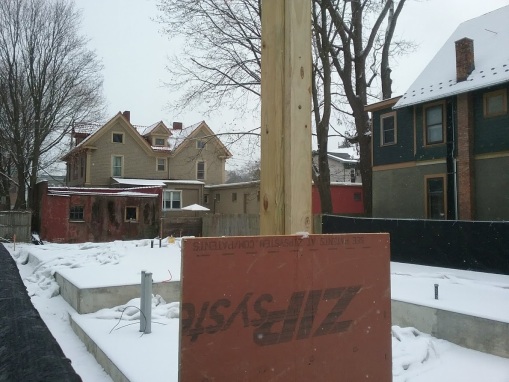
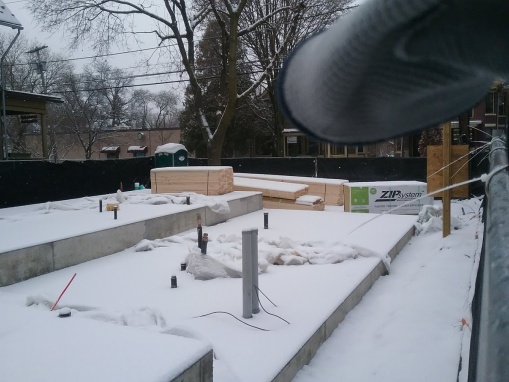
Since October, it looks like the foundation slab has been poured over the footers, and the construction crew is preparing to start work on framing. Judging from the materials on-site, it looks like wood-frame with Huber ZIP panels. Wood-frame structures tend to rise quickly, so once the project team is ready, it should go up at a rapid pace, and probably top out in within just a few weeks. The 11-unit, $1.1 million apartment building is expected to be ready for occupancy by July.
It’ll be interesting to find out what Stavros Stavropoulos’s next project is, since the plan for a pair of duplexes at 209 Hudson Street was kiboshed by the city after the South Hill zoning overlay went into effect. If he’s looking at other locations along the State Street Corridor, he’d likely find the planning department and Common Council more amenable. If his name shows up in any sales, I’ll note it in the round-up.
On that note, expect a brief holiday pause in the daily posts. They’ll be back next week.



























































 Ithacating in Cornell Heights