News Tidbits 1/21/2019

22 01 2019

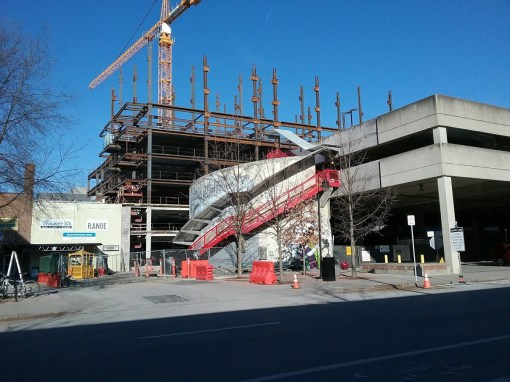
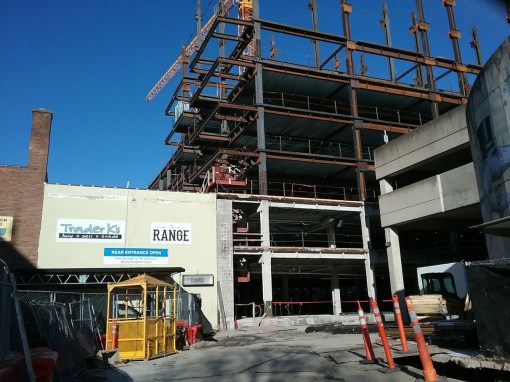
1. A quick note regarding the county’s feasibility study of a new county office building on the 400 Block of North Tioga Street on the edge between Downtown and Fall Creek – Ithaca’s HOLT Architects has been tapped to perform the analyses. The idea isn’t totally new to HOLT, who had drawn up rough ideas of a joint city-county office building as part of the Downtown Ithaca Alliance’s 2020 Strategy way back at the start of the decade. This process will quietly continue until the results are ready for review and discussion sometime in March.

In an off-record conversation with a county official, the topic came up of, “why not just move to one of the office buildings in the Cornell business park”, as the county Department of Health has done. This person pointed out that it would much easier to buy a building, renovate it, move in and start operations. Except for one bring problem – the suburban office park is hardly accessible, and so the choice of county occupants would be fairly limited, given the need for the county’s less well-off to be able to access the site. A location on the fringe of Ithaca’s Downtown is much more walkable and readily approachable from buses, bikes and so forth, while a Cornell business park is really only readily accessible to those coming by car or the occasional bus. So the county is willing to walk on coals and risk the ire of nearby residents in order to maintain a more accessible facility.

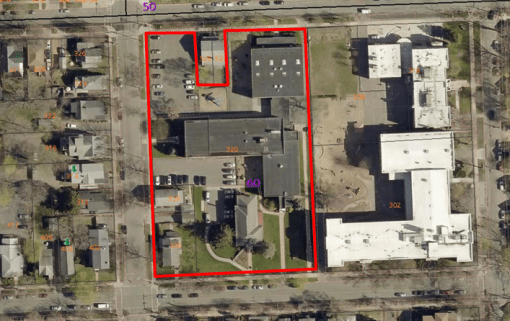
2. Before it was officially announced, the rumor that INHS was selected for the Immaculate Conception School had been floating around for a few weeks. Most of the city staff and officials I’ve spoken with were actually breathing something of a relief, because most of them know and trust INHS. Or rather, they trust INHS to be one of the less divisive choices out there. They’re local, they plan to have a mix of affordable housing and office space for family services-related non-profits, and they’ll be going through an open house process that will give residents a chance to help shape the project before anything goes up to the city for review.

Two details worth noting – for one, INHS does have timeline in mind for its redevelopment (new construction and renovations) to the site. It would like to have tenant occupancy by December 2021, so they’ve got three years to go from start to finish. Expect meetings this Spring and Summer, and probably a project submission by late summer for a fall planning board review and approval by the end of the year. That will give them time to start applying for and attaining affordable housing grants, and to break ground on the redevelopment sometime in 2020.

For two, the city of Ithaca intends on buying the school gymnasium on the northeast side of the parcel. The gym would be used for indoor recreation by the Greater Ithaca Activities Center (GIAC), which is just next door. They’re looking to pay $290,000 for the parcel. It is not clear if this was planned in conjunction with INHS, if INHS developed two separate purchase plans to accommodate that possibility, or if it simply throws a wrench into things. Generally speaking, gym access and affordable housing were the two signaled prerequisites for any city consideration of a Planned Unit Development (PUD), the DIY Zoning that would give more flexibility with site redevelopment. Regardless of PUD, I suspect renovation of the school and Catholic Charities buildings are one key redevelopment feature, and on the new construction side, the parking lot on the corner of North Plain and West Court Streets isn’t long for this world.

3. Tenant number two has been confirmed for City Centre – Collegetown Bagels will be moving from its 1,500 SF location at 201 North Aurora Street, to a 2,300 SF ground-level retail space inside the 192-unit apartment building. According to Edwin Viera at the Times, “Gregor Brous, owner and operator of Collegetown Bagels, decided to make the move after finding out the current building CTB is located in is being demolished.”

For the record, that’s a couple of years out. Visum Development does have plans for the site, which involve a mixed-use apartment building with approximately 60 units above ground-level retail. A sketch plan review was conducted back in 2015, but the plan has not undergone any formal review, and it has to undergo some redesigns anyway since they had planned to buy Jagat Sharma’s parcel at 312 East Seneca Street, and consolidate it into their project. Sharma instead sold to developer Stavros Stavropoulos, who has his own plans for a six-story building. The rumor has been that any redevelopment of the site is still a year or two away, but it is a likely prospect in the medium-term.

As for CTB, the larger space will allow them to try out some new concepts, expand their drink menu, and from the sound of it, add some alcoholic beverages to their offerings. This is not the first time they’ve looked at the Trebloc site, as they had tentatively agreed to move into State Street Triangle, had the building been approved and built.

4. Just to mention the Planning Board Agenda, for the sake of brevity, here’s the link, but not much is actually being decided on this month. Wegman’s is seeking yet another two-year extension on the 15,700 SF retail building they had approved in December 2014 (long rumored as a Wegmans-owned liquor store or a homegoods store similar to Williams-Sonoma). Amici House is seeking some signage variance approval and approval of site plan changes already made. This is likely to pass since its material color and detail changes, but because this was already done without consent and they’re going back to request consent after the fact, the board may have some harsh words. Amici House attends for its 23 studios to be available for occupancy by young, formerly homeless or otherwise vulnerable individuals by February 1st. Site plan approval is also on the agenda for the Maguire Ford Lincoln renovation and expansion. New proposals are the 200-unit mixed-use Visum affordable housing duo shared on the Voice today, and the Modern Living Rentals proposal for 815 South Aurora, which as touched on the other day, is likely to be pretty sizable.

The supplemental on the Falls Park senior housing project notes that the project is intended to qualify under Ithaca’s Green Building Policy under the “Easy Path” scoring system, and perhaps a bit disappointingly, the smokestack for Ithaca Gun, once intended for incorporation into the public space, will be coming down so that the ground beneath it can be cleaned during the remediation. However, smokestack bricks will be available as mementos for those who want them.

Heading to the ZBA will be a lot subdivision to split a double lot on Homestead Road back into two lots, the Amici House signage, and Agway’s plan to rebuild a 700 SF storage shed destroyed by fire, with a new one-story 1,400 SF structure. Zoning on its waterfront site requires two floors, but the new shed is only one floor and needs a variance.


News Tidbits 1/20/2019

21 01 2019

Now to start digging into the odds and ends:

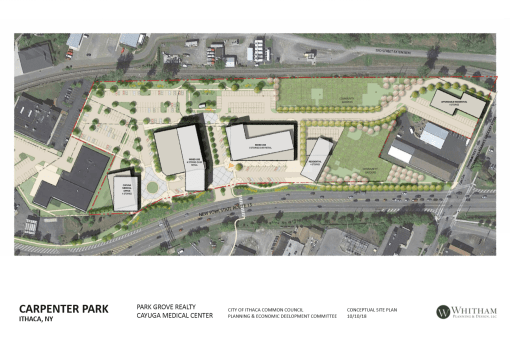
1. For those interested in learning more about the Carpenter Business Park proposal, Northside United, the neighborhood group that represents the Northside Neighborhood, will be hosting the development team for a presentation and Q&A on Monday, February 4th 6pm at the Quaker Meeting House on 120 Third Street. Here’s the project breakdown as provided in email by Northside United:

Affordable Housing. A 4-story building with 42 one and two-bedroom units of working family housing will be sited near Farmer’s Market and 3rd Street and targeted at those in the 50-60% of area median income ($30,000-$35,000 household income range). The affordable units are in a separate 4-story building from the market rate units, they say due to federal/state requirements for low-income housing tax credits. Park Grove Realty (with staff formerly associated with Conifer) will manage the affordable units.

Market Rate Housing. In addition to the building affordable housing, two other 4-6 story buildings in the development will be targeted at market rate rents (and also include commercial/retail).  Maybe 150 or so units of market rate housing.

CMC Medical Office Building. This 4-story building, at the east end of site near Cascadilla Street, is slated to be mostly medical/specialist offices and a still to be defined “healthcare location,” but not a “convenient-care” type facility.

Commercial Space. Tentatively there will also be approximately 20,000 feet of commercial space in the development.

Neighborhood Design and Features. They talk about this being a small “new neighborhood” of its own, but knitted together with our existing Northside neighborhood.

Community Gardens. Ithaca Community Garden retains its current size (following a land swap) and becomes permanent (pending agreement with Gardens and City). As this is being negotiated with the Gardens and City, NU probably does not need to spend time on it.

Opening Fifth Street to Rt. 13 is being considered.  

Northside United participants have asked the development team consider an urgent care or dental clinic on-site, screening the parking from the rode, better pedestrian and bike access (with reference to Form Ithaca’s boulevard concept), consider townhomes vs. multistory buildings, making the Fifth Street access pedestrian/bike only, well-designed green space, include a local committee of officials, residents and developers to guide the design process, and satisfaction with the affordable component, though they’d like it mixed with other buildings. That last one is always tough, because state-administered affordable housing grants don’t allow this out of concern the market-rate section goes bankrupt; so if they were in the same building, they would still have to be one contiguous entity within the building, as with Visum’s Green Street proposal.

Kind word of advice – if you want to attend but are not a Northside resident, be as respectful like you’re a guest invited to someone else’s house. In the 210 Hancock debate, Fall Creek was strongly negative to the affordable housing proposal, which was in neighboring Northside and better received in Northside. But Fall Creekers had a habit of steering the conversation, which created tensions with Northside United.

2. Dryden’s Tiny Timber Homes has been keeping busy. The firm is rolling out a new line of smaller homes in an effort to better meet the needs of the middle-income housing market. The first home shown above is their first truly tiny timber – a 330 SF home that sells for about $75,000 fully finished. The second example is a U-shaped ranch home being built on Landon Road in the town of Caroline; that 2-bedroom, 856 SF home on 1.2 acres is selling for $199,000, which is practically the maximum buying power of the median family income in Tompkins County (3.4 * $59,000 = $200.6k). The new line of homes will include designs ranging from the 330 SF example, to 1,100 SF, which can be built for $150-$200/SF depending on the home model, location and features.

Tiny Timbers has also rolled out its next cluster development, a 20-home development on 6 acres on a vacant West Hill at the dead end of Campbell Avenue. Plans call for screened parking, a community garden and a multi-use trail. As reported by my Voice colleague Devon Magliozzi, the Planning Board was enthusiastic but cautioned that West Hill was generally averse to any new development. I dunno if that is totally true in this case; I had a conversation with George McGonigal a few years ago when Tiny Timbers bought the property, and he was cautiously optimistic for owner-occupied housing as long as they weren’t “packed like sardines”; dunno if ~3 units/acre passes the test. This would be their second such development, following the Tiny Timbers Varna plan, “The Cottages at Fall Creek Crossing”, which has sold at least four of its fifteen lots (the website shows three sold, but it’s not clear when the webpage was last updated) and is undergoing site prep for the new homes. The homes here would likely be similarly priced, in the $200k-$275k range, and 850 SF – 2,000 SF.

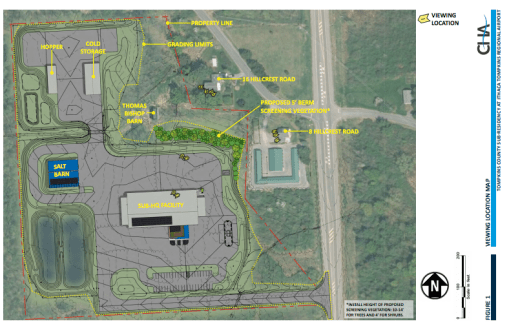
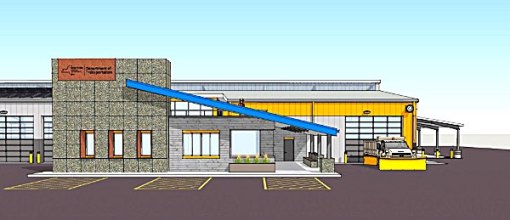
3. Here’s a look at the New York State Department of Transportation’s plan for a new regional facility on Warren Road in the town of Lansing. Here’s a description of the plan as reported by the Lansing Star, per DOT representatives at the meetings to the county and town last week:

“Buildings on the site will include a 30,000 square foot ‘sub-residency’ maintenance building, a 5,000 square foot Cold Storage, a 8,200 square foot Salt Barn, and a 2,500 square foot Hopper Building (covered lean-to). The proposed maintenance building will have vehicle storage for 10 trucks, a loader and tow plow, with one additional double depth mechanical bay and single depth, drive-thru truck washing bay. It also includes an office area (three rooms), lunch/break room (30 people), toilet/shower/locker rooms, storage rooms and mechanical/electrical rooms. The site will also contain stockpile areas for pipe, stone and millings, and ancillary site features including a fueling station, parking for 40 vehicles, and stormwater management facilities. The project will require construction of an access drive from Warren Road and the extension of utilities.”

As is often the case with high-priority state projects, the construction time frame is fast – the governor’s office wants the site built and fully operational by the end of the year. Also, much to the chagrin of some very unhappy neighbors who don’t want a DOT facility nearby, the town of Lansing is not Lead Agency in environmental review – the Federal Aviation Agency (FAA) is, given proximity to the airport (the county sold the 15.5 acres of land to the airport last September). Public resource projects by the state, like state-owned office buildings, state maintenance facilities and labs, are generally excluded from local zoning codes and do not have nearly as lengthy of an approval process. The nearly 1,000 page Environmental Site Assessment report can be found on the DOT website here. CHA Companies (formerly  Clough Harbor and Associates) of Albany, a prominent state contractor, did the assessment on behalf of the state.

There’s always going to be a bit of limitation in where the state can go with a project like this. The state wants out of the waterfront, not just because the county wants the land to be redeveloped, but because the salt and vehicle fluids could pose risks to the water quality of the inlet and lake (and DOT doesn’t want to be on the hook for that), access to 13 is more difficult due to urban traffic, the location isn’t efficient to where the state plows state roads previously handled by the town, and lastly, the state has simply outgrown the waterfront site -it needs more land, and taking the railroad’s or the Farmers Market’s is not a viable option. The state did originally plan using a site in Dryden on Ellis Drive, but the state determined that response time to urban areas was too long, and since some of the land was federally designated as wetland, the site was too small.

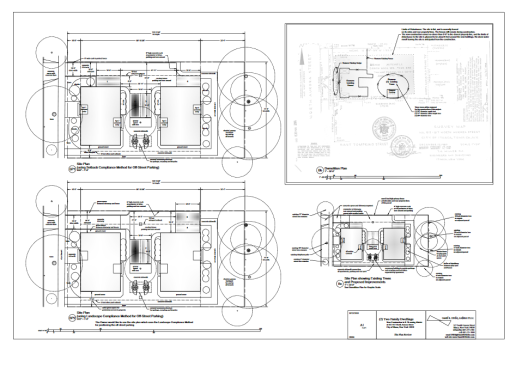
4. In the county’s deed filings, one of the more common recordings is the easements filed by NYSEG, often for new line connections to the power grid. Once in a blue moon, they turn up something interesting. The above site sketch comes courtesy of one of those filings. Scott Morgan owns 543 Asbury Road, and in 2015 he had proposed eight duplexes on the property, but the town had issues with that much density on a rural lot, so Morgan shelved the plan and the town amended the code to prevent such density on rural parcels. In turn, it appears that Morgan subdivided the 5-acre lot into four parcels, and is building a duplex on each. If they’re like his Lansing rentals, expect them to be ranch-style units with two bedrooms each.


128 West Falls Street Construction Update, 12/2018

6 01 2019

This post was supposed to go up a week ago, but was delayed by a bout with the flu. Sometimes, things get delayed and health concerns have to take precedence. 128 West Falls Street is an example of that.

128 West Falls Street is a single-family rental home situated on a mostly empty 0.375 acre urban lot on the northwest side of Fall Creek. The property was bought by Heritage Park Townhomes back in December 2012. Heritage Park, recently rebranded Perfect Heritage, is the umbrella organization for a few different businesses run by local builder Ron Ronsvalle and his family. Those include Perfect Painters (home painting), Heritage Builders (home construction), Heritage Park Rentals, and a few years back, there was even an auto repair business.

On the development side, Heritage Builders has built or renovated a number of small-scale residential and commercial projects around the greater Ithaca area, tapping into a variety of markets. These include student rentals on South Hill, apartments and commercial retail/office space in Lansing, some smaller multi-family infill in the city of Ithaca, and some for-sale housing on South Hill. There isn’t really a pattern, it’s more or less what’s available at the time they’re looking to take on something new.

In March 2014, plans were first announced for infill apartments at 128 West Falls Street, consisting of three new buildings with six rental units. The design of these was rather awkward and somewhat larger than the typical 1.5-2.5 story homes that comprise nearby blocks, so there was a fair amount of pushback from neighbors. This was problematic because the Board of Zoning Appeals was required to sign off on setback and parking variances needed for the project to move forward; the property is being subdivided into three parcels, one for the existing single-family home, one for the to-be-built duplex (later a single-family home) to the east, and the third for the two duplexes on the west end of the parcel. The existing home will have no on-site parking within its (middle) lot, instead sharing with the west lot.

The project team met with neighbors, heard their concerns, and reworked the design – it was a bit smaller, with five units in two two-family homes and and one single-family home, and the designs, created by architect/engineer Lawrence John Fabbroni of Fabbroni Associates, showed a more traditional aesthetic when the revised site plan review was submitted in October 2014. At the time, the planning board hailed it as a successful example of working with the community to create a mutually acceptable outcome. The plans were approved by the planning board in February 2015.

However, the project didn’t move forward, and after two years, the approvals expired. Not long after the project was approved, Ronsvalle was badly injured in an accident, and the injuries left him paralyzed and unable to use his limbs; he is reliant on assistance and voice commands. As the letter from Fabbroni stated, “certain life events prevented the owner from resuming full business activities until a support system was running smoothly.” For a while, it had looked like the project was unlikely to ever happen. However, the request for re-approval was submitted in June 2018, and with no changes, the project generated little discussion and was re-approved the following month. The revised SPR states $665,000 in hard costs with a construction period in two phases from August 2018 to August 2020.

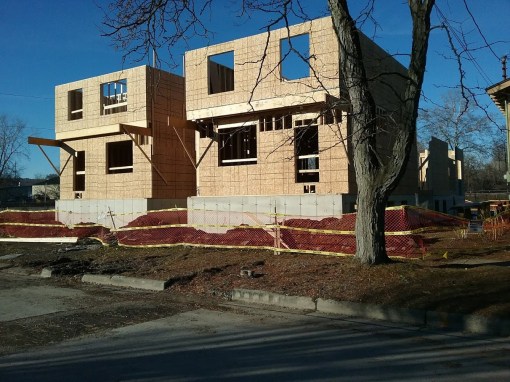
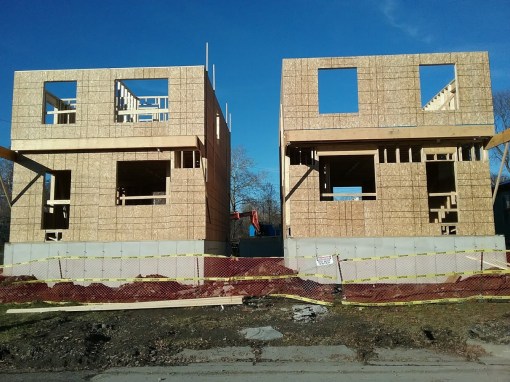
The project includes seven off-street parking spaces, one driveway, sidewalks/walkways, stormwater facilities and landscaping (new trees, pavers, raised plant beds). The three units facing West Falls Street are designed to resemble typical older homes in the neighborhood. Building 1 is a single-family building with three bedrooms, finished in LP Smartside wood lap siding colored Sherwin-Williams Aurora Brown on the lower floors, LP Smartside wood shake siding on the gable level and colored S-W Roycroft Brass, and trim panels in S-W Roycroft Vellum. Building 2 is two units with three bedrooms each; the massing of Building 2 is broken down into two distinct halves, connected only through the foundation and a ground level breezeway. The west unit will have a bay window and a full gable roof with dormers, while the east unit has a partially-hipped roof, creating visual interest between the two otherwise mirrored units. LP Smartside wood lap siding in S-W Renwick Olive will be used on the lower levels of each., LP SmartSide smooth wood panels with batten trim will be used on the west unit’s gable level, while the dormers on the east unit will use lap siding, both colored in S-W Roycroft Bronze-Green. The trim panels will once again be S-W Roycroft Vellum. For the record, all of these colors are from Sherwin-Williams’ “Heritage Palette” historic color series; and historic East Aurora, New York is home to the Roycroft Campus.
The building tucked back from West Falls Street, Building 3, is a more contemporary design hosting two two-bedroom units. The lower levels use LP engineered wood siding in S-W Rockwood Blue-Green, and on the gable level, smooth wood panels in S-W Downing Stone. As with the other two, the wood trim panels are painted S-W Roycroft Vellum. Altogether, there’s a total of five new units and thirteen new bedrooms in the project. The project is designed such that the whole four-building, six-unit assemblage can be converted into condominium housing at a later date, if Heritage Park chooses to do so.
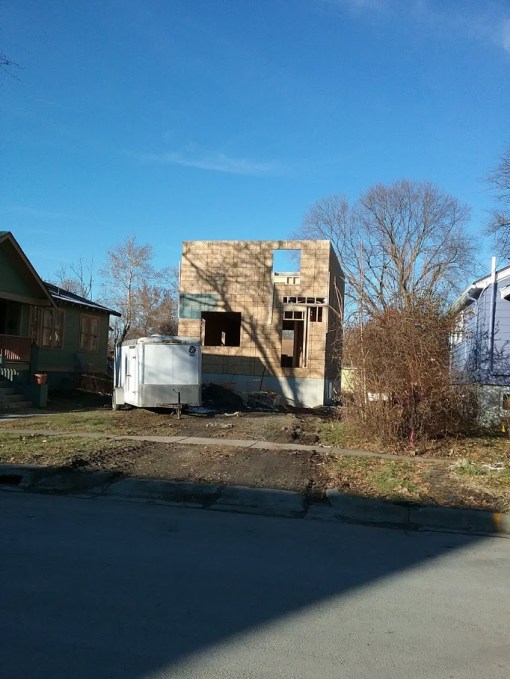
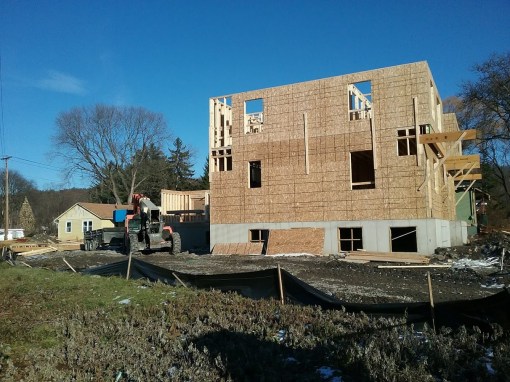
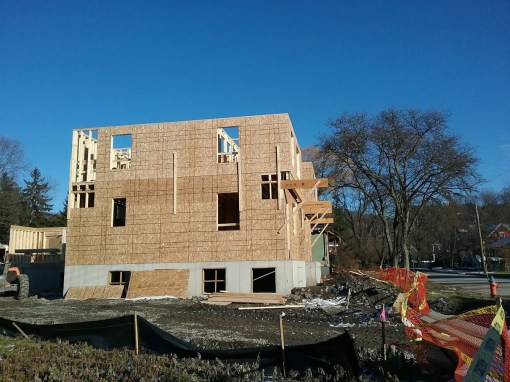
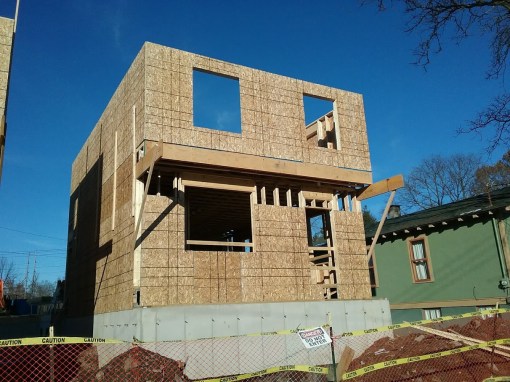
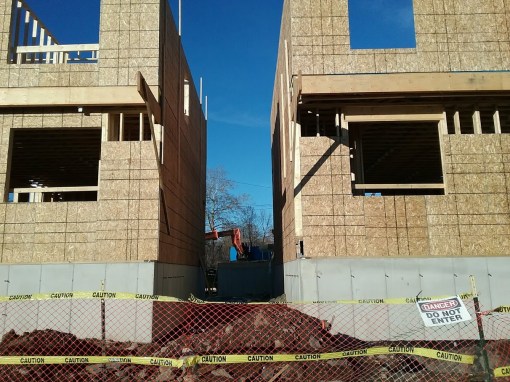
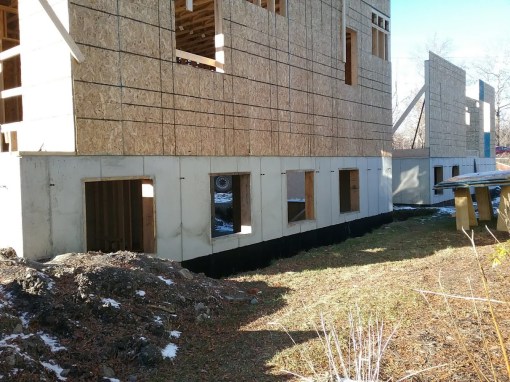
The photos below suggest a quicker timeframe for construction than suggested in the 2018 Site Plan Review – framing is substantially underway for all structures, with the first two floors framed out for Buildings 1 and 2, and above-ground framing just getting underway for Building 3. The concrete foundations are complete. A good estimate would be an August 2019 completion for all five units, or in other words, they decided to merge the two phases back into one. The designs don’t totally match the drawings. The elevations don’t show windows in the basement level concrete, and some of the other window patterns don’t totally align either.


City Centre Construction Update, 12/2018

28 12 2018

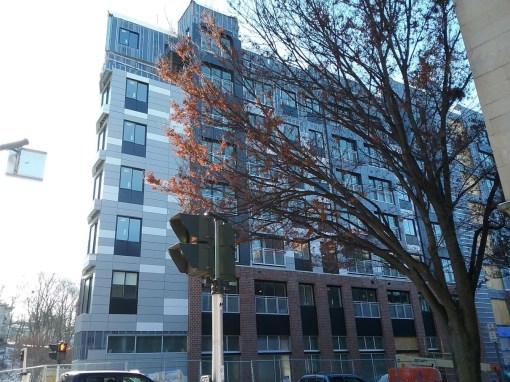
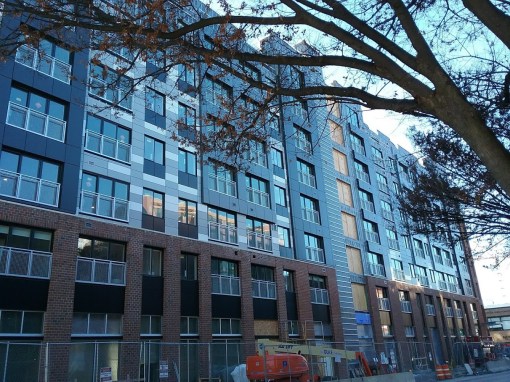
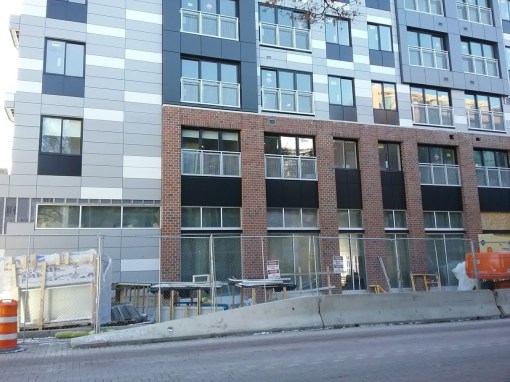
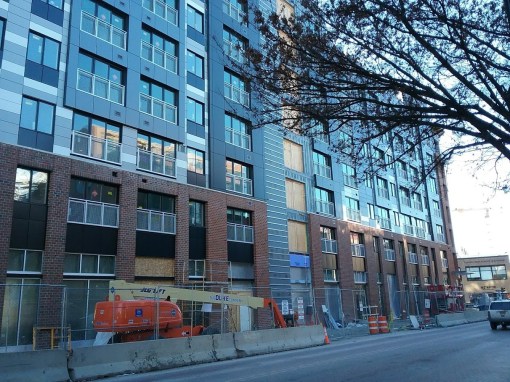
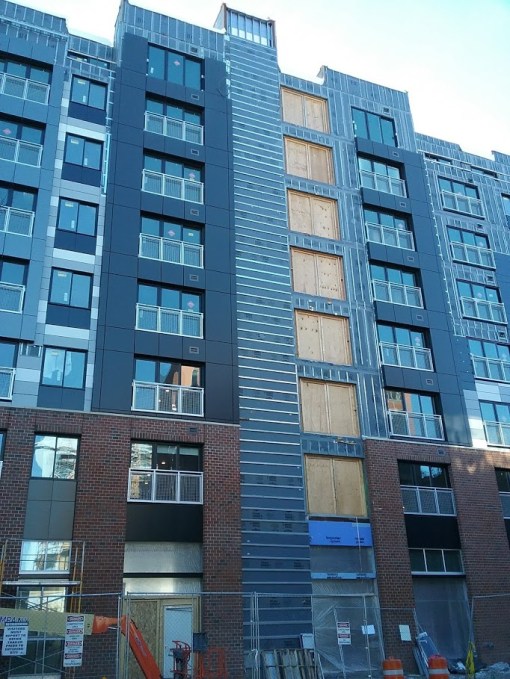
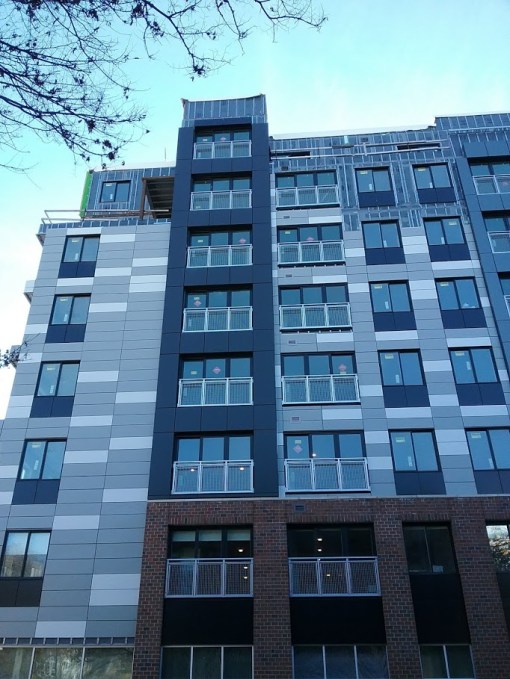
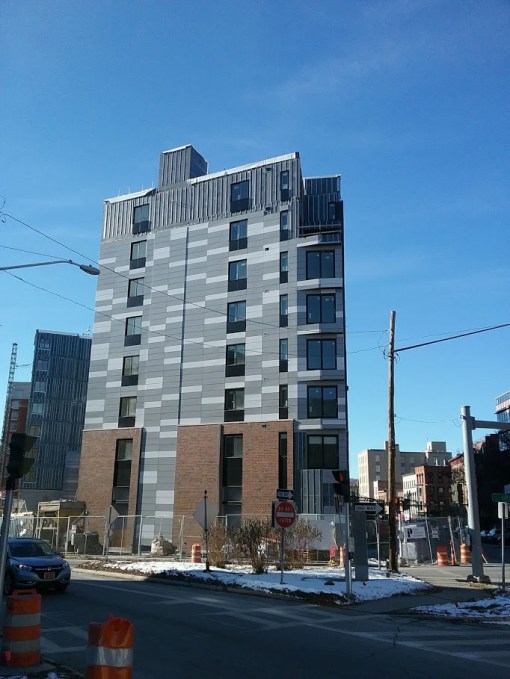
Facade installation continues on the exterior of the City Centre project on the 300 block of East State Street. According to project representatives, all three commercial retail spaces on the ground level have been reserved. Along with the Ale House, the other spaces will be “a financial institution and a new dining experience from a beloved local restaurateur”. The rumor mill has suggested a couple of names for that restaurateur, and that the initial concept was to be Italian, but with the opening of Pasta Vitto across the street, the tenant is taking the restaurant in a new direction.

For those interested (and not necessarily looking for a new apartment), City Centre has finished out a few model units for hard hat tours. You can stop by the leasing office on the Commons to schedule a walkthrough.

Some of the project team members have started to tout their involvement with the project, which is generally a good sign (it means they’re proud of their work). The image above comes from Whitham Planning and Design, of which I’m kinda jealous. Meanwhile, the regional Carrier equipment dealer is touting the project’s use of a Toshiba-Carrier VRF HVAC systemVariable Refrigerant Flow, the technical name for the electric heat pumps the building utilizes. The heat pump system and its units are being installed by Petcosky and Sons, a heating and plumbing subcontractor out of Vestal. Purcell Construction is the general contractor (and their City Centre webcam is here).

The project is still on target for a June 2019 opening. The project background and description can be found here.


Harold’s Square Construction Update, 12/2018

27 12 2018

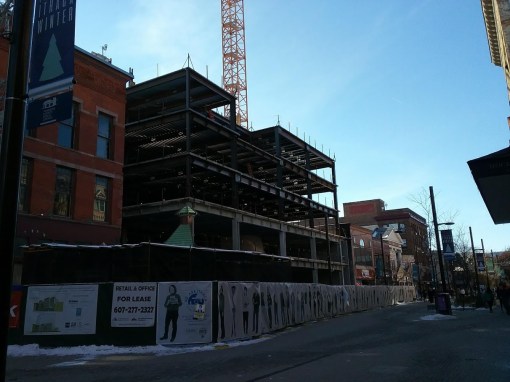
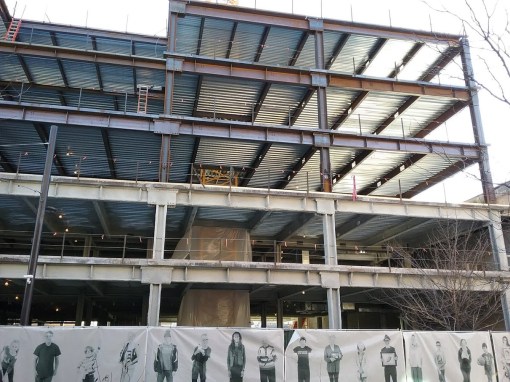
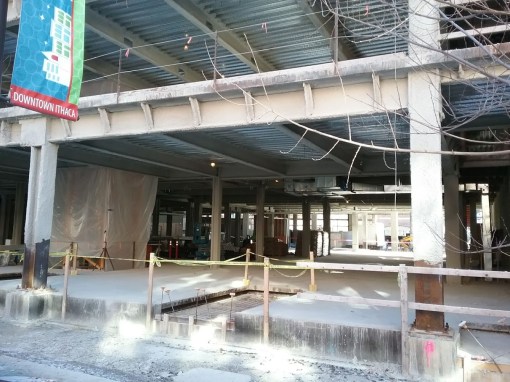
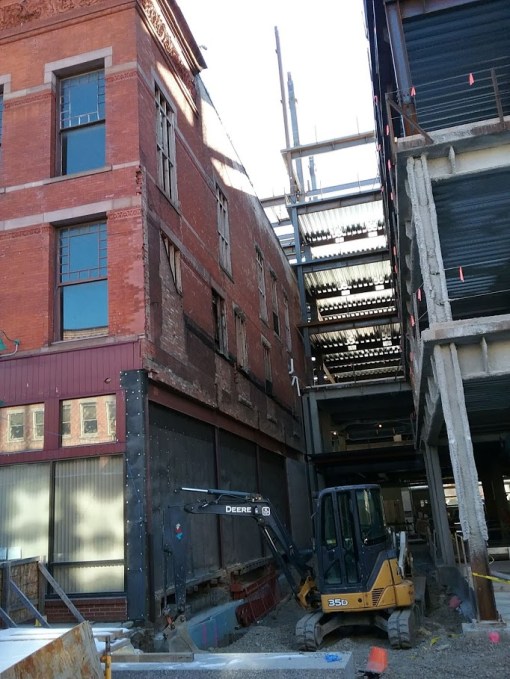
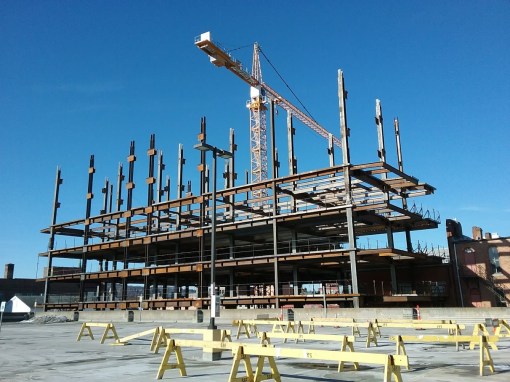
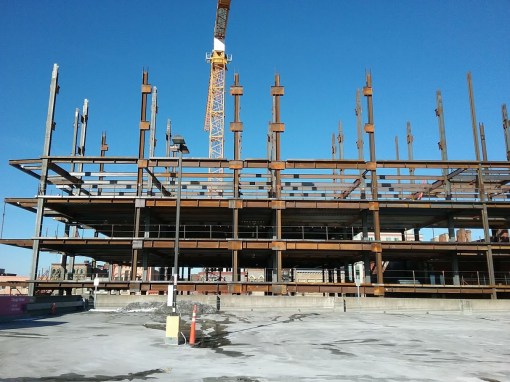
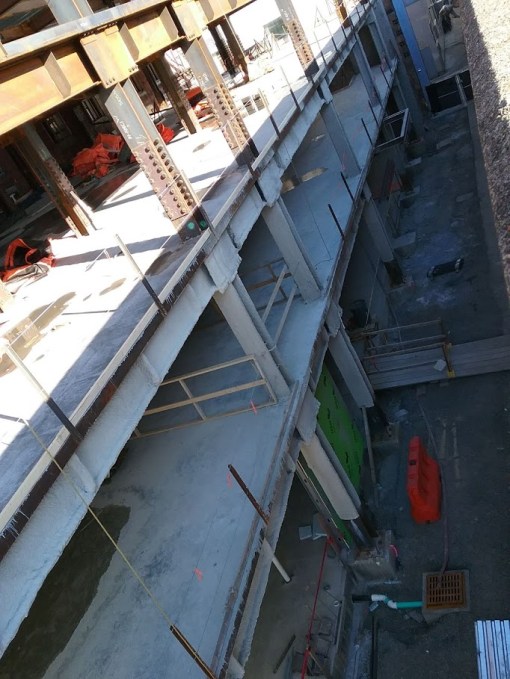
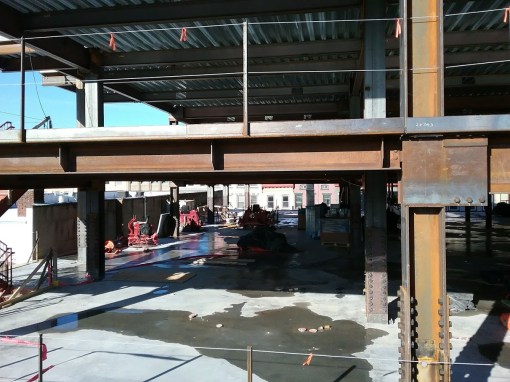
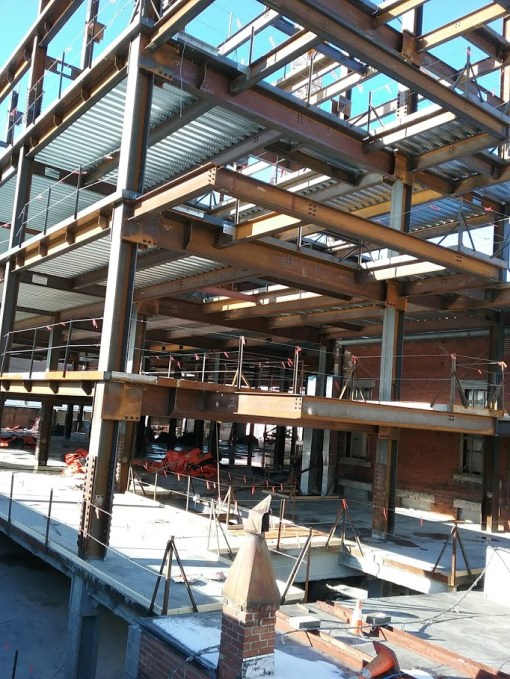
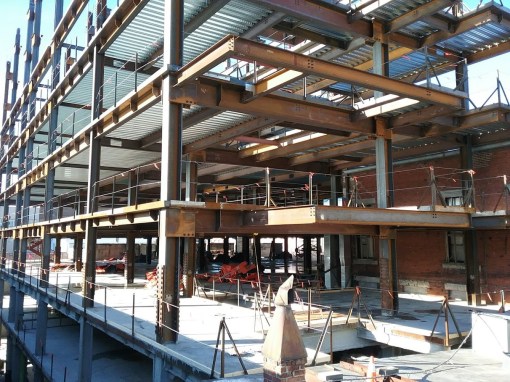
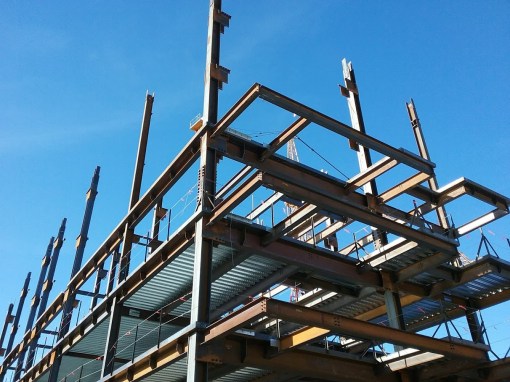
Just noting that the structural steel frame is fully built out up to the fifth floor and that fireproofing and sprinkler system installation is underway. The project utilizes SidePlate Systems for lateral steel connections, which utilizes a lighter frame design that is still durable. This has a higher upfront cost in design, but may balance out much of that with reduced materials and labor costs, as well as being able to stick to a tight buildout schedule. The IBEW (International Brotherhood of Electrical Workers) Local 241 is proudly touting their involvement with the buildout, and local labor advocates will be pleased by the commitment to local union labor. Taylor the Builders is the general contractor.

The apartment units have begun showing up online, though they are not able to be reserved just yet and no prices are given. The units come in the following sizes:

Studio 1 Bath 42 units 435 SF
1 Bed 1 Bath 32 units 686 SF
2 Beds 2 Baths 34 units 945 SF

Retail and office spaces are available for lease through Pyramid Brokerage’s David Huckle. The first floor Commons-facing units are being offered at $24/square foot (3-5 year lease), and the second and third floor office space is being offered for $22.50-$24/square foot. The retail spaces are 2,674 SF, 2,900 SF and 9,210 SF, which can be combined by a deep-pocketed lessee for a maximum of 16,241 SF. The minimum leaseble office space is 2,900 SF (which Pyramid describes as being about enough for seven people in a Class A environment), and the maximum is 33,832 SF (enough for 135 workers). The online as says a 2022 completion, which is overly, overly conservative. I would take a guess at Q4 2019 or Q1 2020. Obviously not the Spring 2019 they originally hoped for, but there have been numerous weather issues that delayed the concrete pours for weeks. The rest of the steel frame should rise faster since the tower portion (floors 6-12) is only a fraction of the building’s overall footprint.


Cornell Fine Arts Library (Rand Hall) Construction Update, 12/2018

22 12 2018

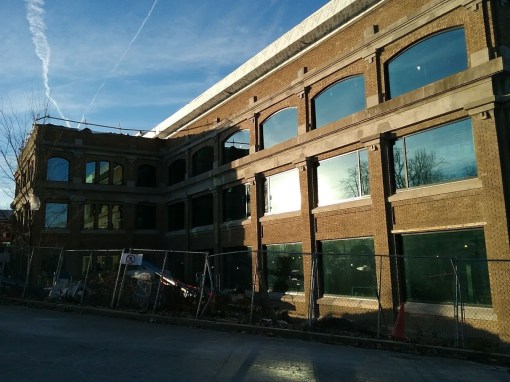
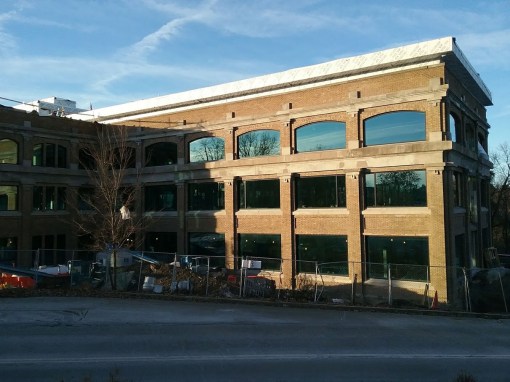
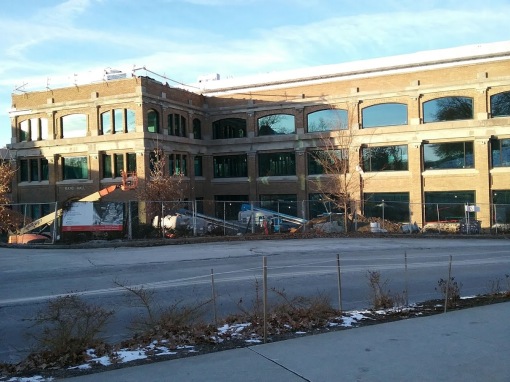
Cornell’s new Fine Arts Library (FAL) is coming along. The Mui Ho Fine Arts Library will occupy the top floors of Rand Hall, a ca. 1911 structure that long housed the design studios of the Department of Architecture. My own memories of Rand were relegated to the outside, usually a small throng of architecture students getting their nicotine fix just beyond the entrance (and on a few occasions, substances more illicit).

Rand has always been the workhorse of the Architecture School and a fine example of early 20th century industrial architecture, but for the past twenty years Cornell actively made one attempt or another to get rid of it – in their attempts to build Milstein, the university proposed to tear down Rand not once, but twice. However, there was significant pushback by alumni and historic preservation groups against the idea, and it was one of the factors that weighed into the Koolhaas design for Milstein Hall, which functions as more an addition to the AAP School than a replacement.

The interior will consist of three levels of mezzanine shelving for the 125,000-volume Fine Arts Library’s collection, as well as interspersed work/study spaces. The library stacks will consist of “inverted ziggurats” accessed by stairs and walkways. Floor-to-ceiling space will range from 48 feet on the north side of the reading room to 7.5 feet in some sections of the library stacks. Long, unobstructed hallways will run the length of Rand Hall. The large variation is meant to convey both grand spaces and “private engagement” with the books. 8,000 square feet of shop space for the AAP program will occupy the first floor. Other features will include reading carrels with built-in monitors and lockable book storage, public computing stations and a seminar room. The roof will host a 1,500 square-foot structural deck, outfitted with base plates for temporary structures as well as power, water and digital connections. The semi-elliptical roof pavilion will be built at a later date.

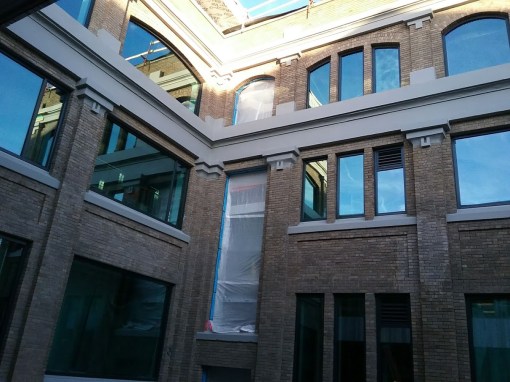
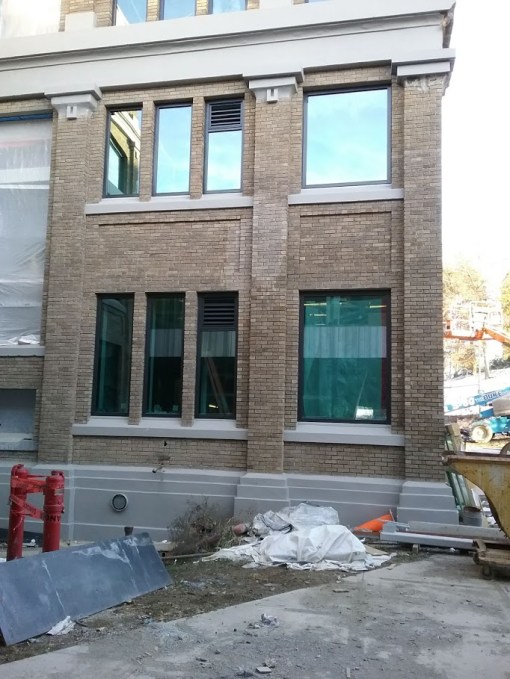
In this renovation and expansion, Rand’s daylight-factory windows were replaces with single panes, the east stairwell was removed, and a steel canopy is going up over the roof. The building will have two entrances, one public and one for AAP only. In an attempt to limit energy use, the building utilizes rigid foam insulation, installing double-glazed windows and all mechanical systems are being replaced. Like Cornell’s other Central Campus building, Rand/FAL is tied into the Combined Heat and Power system, which uses a mix of renewable and conventional fuel (mostly natural gas) sources.

As previously covered, the architect is a Cornell alum, Vienna-based Wolfgang Tschapeller M.A. ’87. More of Tschapeller’s very avant-garde designs can be found at his website here. The project is being funded in part by a  $6 million dollar donation from Cornell alumna, architect and UC-Berkeley professor Mui Ho ’62 B. Arch ’66.

The $21.6 million project is expected to be completed in June 2019, after a construction period of 18 months. Welliver is the general contractor.

Now at about the two-thirds mark, most of the new windows are in, with clips still in place for the newly installed windows on the east facade. The area of “damage” was the result of the teardown of the eastern stairwell, which was a much more recent construction and not original to the structure. The Carisle VP 705 on the roof is a self-adhering waterproof and fireproof fabric to limit moisture penetration from the aluminum panels.


Hilton Canopy Hotel Construction Update, 12/2018

20 12 2018

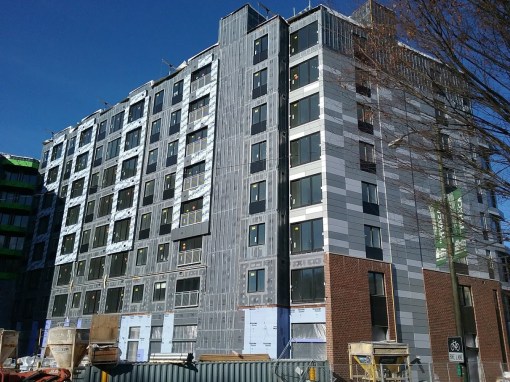
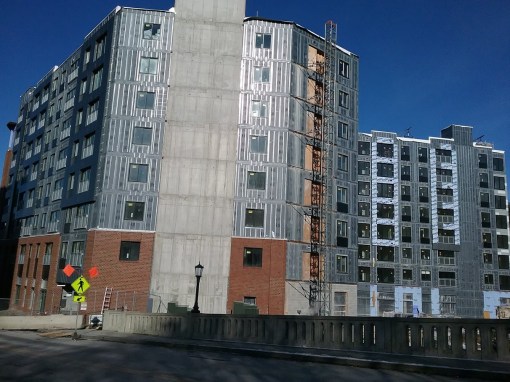
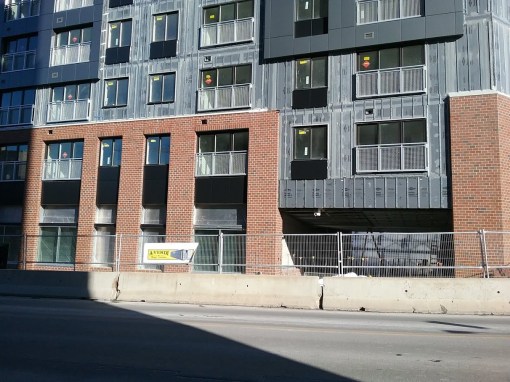
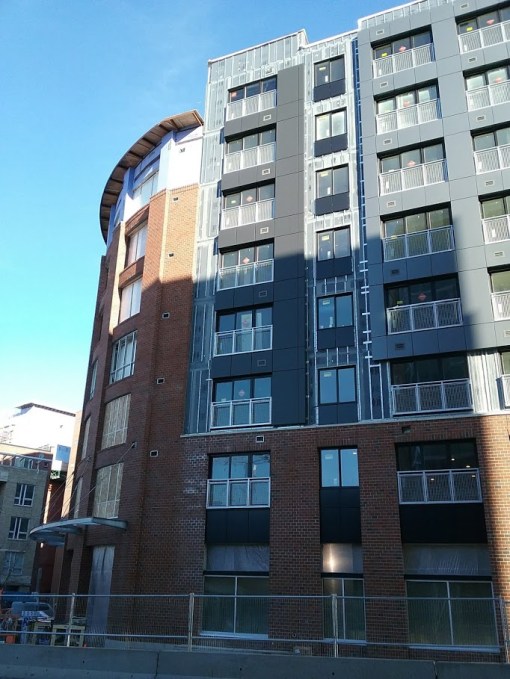
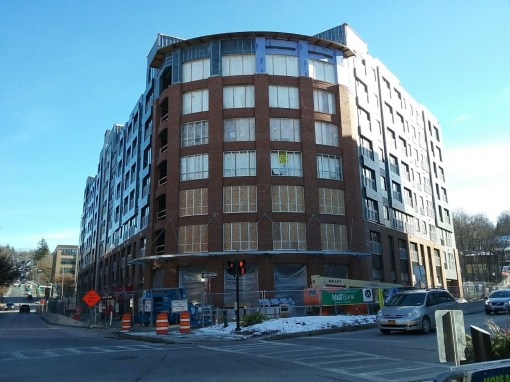
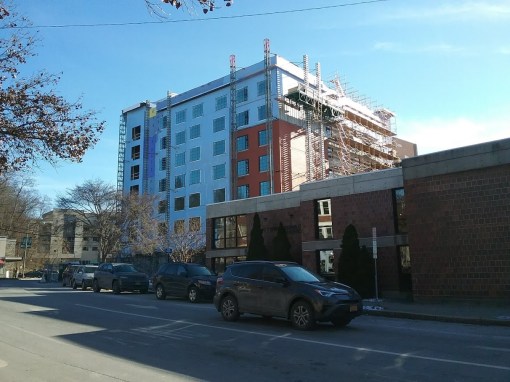
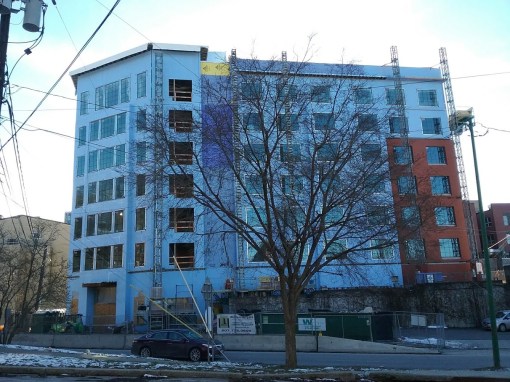
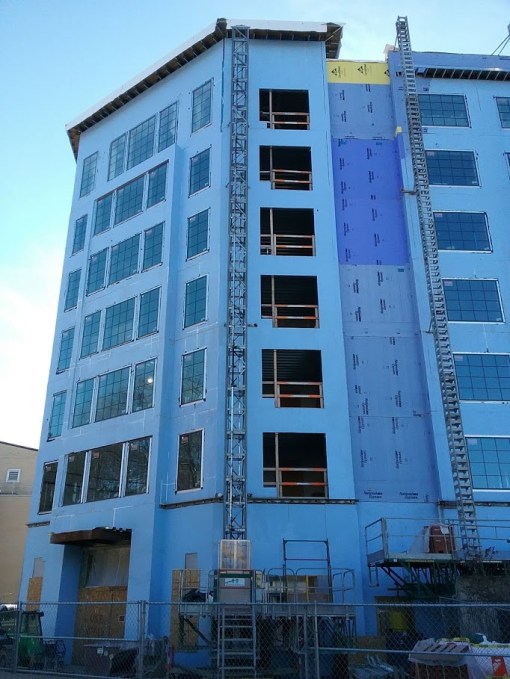
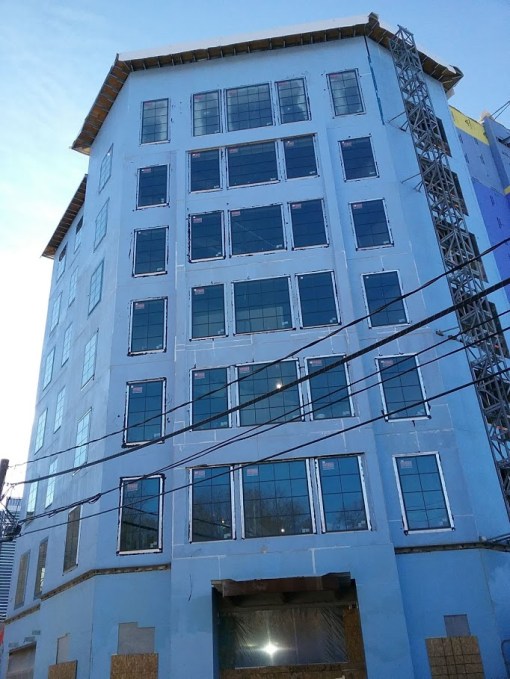
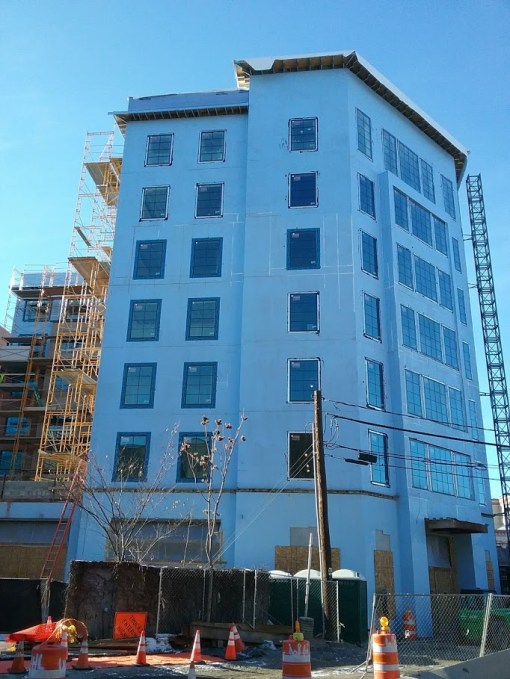
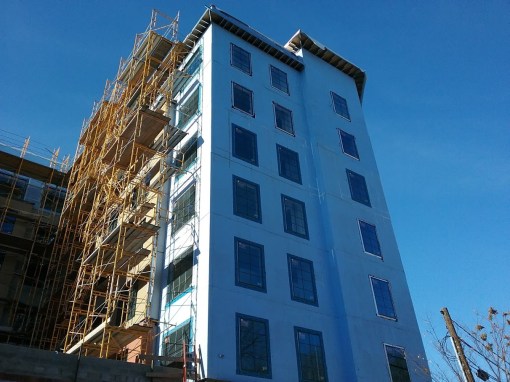
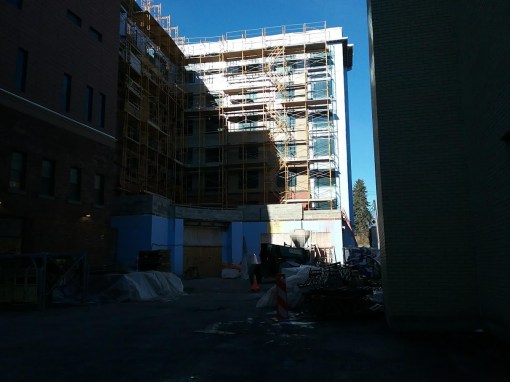
We’re starting to see some of the face materials being attached to the Canopy Hilton’s exterior.The brick veneer is Bowerston Shale Company Red Smooth blend. The bumpout with the industrial-style bay windows will use a darker and browner blend called “Pioneer Smooth”. Some of the “Sauteed Mushroom” fiber cement panels are also visible underneath the scaffolding. “Rockport Grey” and “Dark Ash” (light grey and dark grey) fiber cement panels will be used on the upper levels and to provide visual interest being the bricked spaces. Most of the sheathing is in place, as are most of the windows.The bridge blue bands around some of the windows is probably sealant/waterproofing material.

An interesting little detail here – during the excavation, some remnant fragments were found from the former Stand Theater, which occupied the site from 1917 until its demolition in 1993. It was a grand building in its time, designed in an Egyptian Revival theme (which the Carey Building emulated when it was built a few years later) and capable of sitting 1,650 in golden age splendor. But the theater was never well designed for the transition from stage to screen, and after decades of decay, it closed first in 1976, and then reopened for a few years at the end of the 1970s into the 1980s for live shows, but the expense of maintenance proved a burden on shoestring budgets. Although on the tail end of urban renewal, the car was still king in the early 1990s, and a parking lot was deemed a better alternative to a decaying theater whose revitalization attempts had failed. A few of the more decorative pieces that were found will be put on display in an exhibit inside the hotel lobby.

The 131-room hotel, on the east end of Downtown on the 300 Block of East State Street, is expected to open in 2019. Baywood Hotels, the developer, has been quite busy lately, purchasing the five year-old Fairfield Inn at 359 Elmira Road a few weeks ago. Rather curiously, the $5.9 million purchase of the 106-room hotel was $1.1 million below assessment. The sale used a “bargain and sale deed”, which one often sees with foreclosures. Bargain and sale deeds are riskier than standard deeds. It basically means that if the property has an issue or unpaid bill, you’re on the hook, not the seller.

The curious details of that sale makes me think of a never-completed story the Voice was working on involving the Fairfield. Not long after the Voice launched, the then-owners reached out in an email, saying they had constructed and opened the Fairfield, and after being open almost two years, “we can attest that there is no need for hotel rooms since demand is on a downward slide and we are having trouble servicing our debt. We also feel the Ithaca City officials are artificially generating demand hype to attract more hotel developers along with promises of tax abatement.” We had worked out this idea where their story would be part one, and getting the city and business officials to respond would be part two.

I did an interview with the Fairfield owner and manager, but to prove their claim wasn’t just their hotel and that it was a citywide/regional problem, we needed hard data, proprietary information on occupancy rates and things like Revenue Per Available Room (RevPAR). The regional data of all hotels combined did not back up the claim, and with none of the Fairfield’s peer hotels were willing to take part or even support or refute the Fairfield owners’ claims, there was an inability to expand the story beyond the Fairfield’s anecdotal experience, and so it never moved beyond a first draft. It was the first in-depth story I had worked on that failed to pan out.

In retrospect, I suspect the truth was somewhere in the middle. Given that one of the boutique hotels was cancelled, and how much time was needed for the new downtown hotels to obtain financing, there was clearly some concern from lenders about what the market could support. But because those new hotels are opening over a period of a few years, and local economic growth has continued, the worst fears of the hotel “boom” have been avoided.

Further information on the Canopy hotel can be found here.


News Tidbits 12/17/18

18 12 2018

Here’s a look at the agenda for the city of Ithaca Planning and Development Board meeting this month. It’s a week earlier than usual due to the Christmas holiday. Notes and comments in italics below.

1. Agenda Review 6:00
2. Special Order of Business – Presentation of the Greater Southside Plan 6:05
3. Privilege of the Floor 6:20
4. Approval of Minutes: November 27, 2018 6:35

5 Special Permits 6:40

A. Project: Bed & Breakfast Special Permit
Location: 130 Coddington Road
Applicant: Noah Demarest
Actions: Declaration of Lead Agency, Public Hearing, Determination of Environmental Significance, Potential Consideration of Special Permit Approval

Project Description: The applicant is seeking a Special Permit for use of the property as a homeowner occupied Bed and Breakfast. The property was originally issued a Special Permit in 1998 for operation of the five bedroom home as a homeowner occupied Bed and Breakfast; the Special Permit was not renewed in 2003, as required by §325-9c(4)(g)[3], and has therefore expired. During a recent home inspection, it was discovered the property had continued to operate absent a Special Permit, necessitating a new Special Permit application. No physical alterations to the building or the site are proposed. Issuance of a Special Permit is an Unlisted Action under the City of Ithaca Environmental Quality Review Ordinance (“CEQRO”) and the State Environmental Quality Review Act “(“SEQRA”)

This is a simple case of where the previous owner never renewed the five-year permit and didn’t tell the new buyer, who planned to continue using the home as a live-in Bed & Breakfast. No letters of opposition are on file. Approval, with the proper completion of all necessary forms, is likely to be straightforward.

B. Project: Bed & Breakfast Home Special Permit 6:50
Location: 2 Fountain Place
Applicant: Jason K Demarest
Actions: Declaration of Lead Agency, Public Hearing, Determination of Environmental Significance, Potential Consideration of Special Permit Approval
Project Description: The applicant is seeking a Special Permit to operate the existing 4,492 SF nine (9) bedroom residence located at 2 Fountain Place as a Bed and Breakfast Home. The owner is proposing to utilize four (4) of the nine (9) bedrooms as guest bedrooms for a period not to exceed 21 consecutive days, with a fifth bedroom utilized for home-owner occupancy. Guest occupancy will be limited to two persons or one family per guestroom. No exterior modifications are proposed to the existing home to establish the B&B use, and the existing house is compatible with the character of the neighborhood. Existing parking for seven (7) vehicles exists in the turnaround off Willets Place. The applicant does not propose cooking facilities in the guestrooms, and food service is to be limited to guests of the B&B. No other B&B Homes exist within 500 feet of the property. One sign that is five (5) SF maximum in area and not self-illuminated will be installed in compliance with Chapter 272 of the City Code, “Signs.”

Under city zoning code, B&Bs, which are to be owner-occupied, are allowed to four bedrooms to be used for the guests. A zoning code variance to use eight bedrooms as guest occupancy seemed unlikely, but the new owners believe the B&B may still be viable. Local architect Jason K. Demarest (brother of STREAM’s principal architect, Noah Demarest) is known for his historic restorations and historically-inspired design work, so his involvement is auspicious for those who hope that the century-old mansion and former Ithaca College president’s house retains its character.

6 Site Plan Review
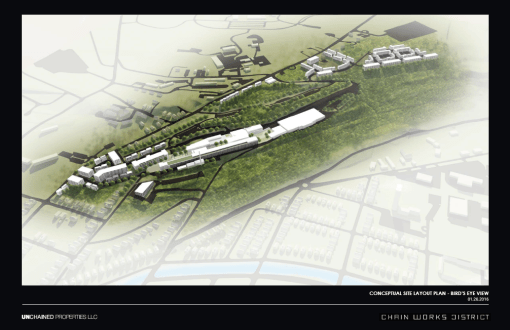
A. Project: Chain Works District Redevelopment Plan (FGEIS) 7:00
Location: 620 S. Aurora St.
Applicant: Jamie Gensel for David Lubin of Unchained Properties
Actions: Review FGEIS & Town Comments – No Action
Project Description: The proposed Chain Works District seeks to redevelop and rehabilitate the +/-800,000 sf former Morse Chain/Emerson Power Transmission facility, located on a 95-acre parcel traversing the City and Town of Ithaca’s municipal boundary. The applicant has applied for a Planned Unit Development (PUD) for development of a mixed-use district, which includes residential, commercial, office, and manufacturing. The site’s redevelopment would bridge South Hill and Downtown Ithaca, the Town and the City of Ithaca, by providing multiple intermodal access routes including a highly-desired trail connection. The project will be completed in multiple phases over a period of several years with the initial phases involving the redevelopment of the existing structures. Current redevelopment of this property will focus on retrofitting existing buildings and infrastructure for new uses. Using the existing structures, residential, commercial, studio workspaces, and office development are proposed to be predominantly within the City of Ithaca, while manufacturing will be within both the Town and City of Ithaca. Project materials are available for download from the City website: http://www.cityofithaca.org/DocumentCenter/Index/119

Hey, they’re starting to include documentation links in the agenda descriptions now! Most of the town’s comments are minor modifications and a possible correction on one of the traffic lane analyses. There’s a boatload of paperwork to dig through, so this meeting is just a chance for the planning board to look at the town’s comments, digest some of the supplemental files, and make sure there are no red flags or major concerns within that subset of information.
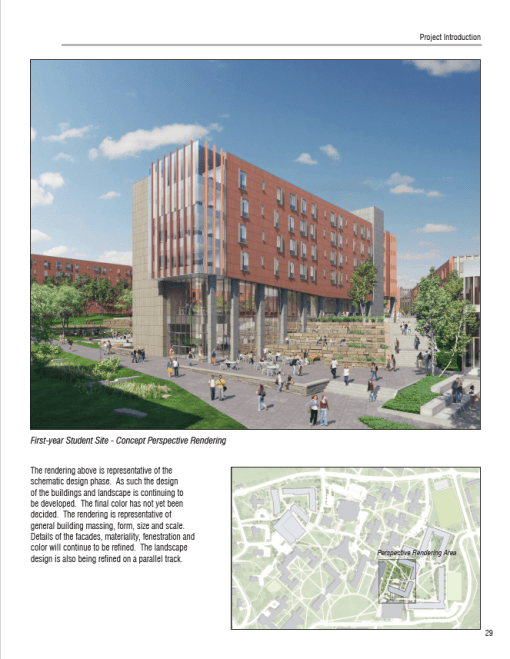
B. Project: North Campus Residential Expansion (NCRE) 7:20
Location: Cornell University Campus
Applicant: Trowbridge Wolf Michaels for Cornell University
Actions: Determination of Environmental Significance
Project Description: The applicant proposes to construct two residential complexes (one for sophomores and the other for freshmen) on two sites on North Campus. The sophomore site will have four residential buildings with 800 new beds and associated program space totaling 299,900 SF and a 59,700 SF, 1,200-seat, dining facility. The sophomore site is mainly in the City of Ithaca with a small portion in the Village of Cayuga Heights; however, all buildings are in the City. The freshman site will have three new residential buildings (each spanning the City and Town line) with a total of 401,200 SF and 1,200 new beds and associated program space – 223,400 of which is in the City, and 177,800 of which is in the Town. The buildings will be between two and six stories using a modern aesthetic. The project is in three zoning districts: the U-I zoning district in the City in which the proposed five stories and 55 feet are allowed; the Low Density Residential District (LDR) in the Town which allows for the proposed two-story residence halls (with a special permit); and the Multiple Housing District within Cayuga Heights in which no buildings are proposed. This has been determined to be a Type I Action under the City of Ithaca Environmental Quality Review Ordinance (“CEQRO”) §176-4 B.(1)(b), (h) 4, (i) and (n) and the State Environmental Quality Review Act (“SEQRA”) § 617.4 (b)(5)(iii). Project materials are available for download from the City website: http://www.cityofithaca.org/DocumentCenter/Index/811

This is likely to be the most contentious part of the meeting. The planning staff have conducted their analysis. Some traffic mitigation measures are sought, including circulation and mass transit / multi-modal transit improvements. The city will make sewer system upgrades a stipulation of project approval, and being next to the Cornell Heights Historic District, the board as Lead Agency wants a more sensitive use of materials and material colors, and extensive vegetative screening to be reviewed further before approval. But the most debated component, the energy use impacts, the city feels is effectively mitigated through the proposed measures by the applicant team.

I’m going to raise one point of correction though – the number of beds is going up to 2,079, but the planning staff should note that a campus-owned fraternity house, the former Sigma Alpha Mu building at 10 Sisson Place (the chapter moved to 122 McGraw Place), is coming down to make way for the project, so the gross number of beds is at least 30 less that that figure.
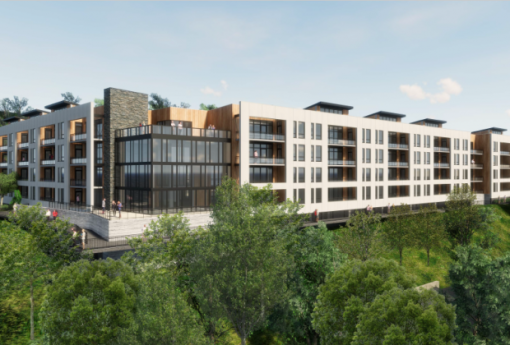
C. Project: Falls Park Apartments (74 Units) 7:50
Location: 121-125 Lake Street
Applicant: IFR Development LLC
Actions: Review of FEAF Part 3 – No Action
Project Description: The applicant proposes to build a 133,000 GSF, four-story apartment building and associated site improvements on the former Gun Hill Factory site. The 74-unit, age-restricted apartment building will be a mix of one- and two-bedroom units and will include 7,440 SF of amenity space and 85 parking spaces (20 surface spaces and 65 covered spaces under the building). Site improvements include an eight-foot wide public walkway located within the dedicated open space on adjacent City Property (as required per agreements established between the City and the property owner in 2007) and is to be constructed by the project sponsor. The project site is currently in the New York State Brownfield Cleanup Program (BCP). Before site development can occur, the applicant is required to remediate the site based on soil cleanup objectives for restricted residential use. A remedial investigation (RI) was recently completed at the site and was submitted to NYSDEC in August 2018. The project is in the R-3a Zoning District and requires multiple variances. This is a Type I Action under the City of Ithaca Environmental Quality Review Ordinance (“CEQRO”) §176-4 B(1) (h)[2], (k) and (n) and the State Environmental Quality Review Act (“SEQRA”) §617-4 (b) (11). Project materials are available for download from the City website: http://www.cityofithaca.org/DocumentCenter/Index/852

Part III of FEAF is the city planner-written review of impacts, proposed mitigations, and whether the lead agency feels the mitigations are appropriate and effective. Some stormwater, remediation plan and other supplemental materials are still needed before a declaration of significance can be made. 

D. Project: New Two-Family Dwellings 8:10
Location: 815-817 N Aurora
Applicant: Stavros Stavropoulos
Actions: Public Hearing
Project Description: The applicant proposes to demolish an existing two-family residential structure and construct two new 1,290 SF two-family dwellings on a 9,590 SF lot. The existing residential building is a legally non-conforming building with a side setback deficiency (2.9 feet instead of the required 5 feet). The proposed redevelopment will include four parking spaces for four three-bedroom apartments. The applicant is requesting the Board’s approval to use the landscaping compliance method for parking arrangement. The project site is located in the R-2b Zoning District and meets all applicable zoning lot and setback requirements. This is an Unlisted Action under the City of Ithaca Environmental Quality Review Ordinance (“CEQRO”) and the State Environmental Quality Review Act (“SEQRA”). Project materials are available for download from the City website: http://www.cityofithaca.org/DocumentCenter/Index/859

City staff were really unhappy about this plan last month, and it was implied that this was one of the examples of “bad” infill that may lead to the new single primary structure overlay. However, barring extreme circumstances (think Maguire at Carpenter Park), review will continue under the current regulations. No new materials appear to have been submitted since the last meeting. 

E. Project: Maguire Ford Lincoln Additions and Improvements 8:30
Location: 370 Elmira Road
Applicant: John Snyder Architects PLLC
Actions: Public Hearing, Potential Determination of Environmental Significance

Project Description: The applicant proposes to demolish a portion of the existing building and construct two additions with updated exterior materials. The existing building is 18,500 GSF, with 2,265 GSF proposed for demolition. The new building will be 24,110 GSF. Site improvements include incorporation of a new pedestrian walking path, and site connections to Wegmans. Approximately 311 parking spaces are proposed to accommodate customer, service parking, employee, and display parking. The project site is located in the SW-2 Zone, is subject to the 2000 Southwest Design Guidelines, and will require a zoning variance for a front yard that exceeds the maximum permissible in the SW-2 district (34 feet maximum permitted, 69-feet 3-inch setback proposed). This is an Unlisted Action under the City of Ithaca Environmental Quality Review Ordinance (“CEQRO”) and the State Environmental Quality Review Act (“SEQRA”); however, it will be treated as a Type I Action for the purpose of environmental review. Project materials are available for download from the City website: http://www.cityofithaca.org/DocumentCenter/Index/860

The revised plans include modified architectural features (more windows, a green wall), and a greater amount of vegetated landscaping to comply with zoning. On-site solar panels are being considered per board recommendation, but the old building was not designed to hold the weight of solar panels. The new wings will be designed to host panels. Heat pumps are being evaluated for some functions, but some of the heavy-duty components like the service bay will likely rely on modified conventional fuel systems. The building will meet or exceed NYS Energy Code requirements.

F. West Hill- Tiny Timbers – Sketch Plan 8:50

This one has been a long time coming. Tiny Timbers bought a 5.45 acre parcel on the south end of Campbell Avenue’s 400 block back in September 2016, and has long planned one of its cluster home developments on the vacant lot. As noted at the time on the blog:

“Dolph et al. are looking to do a similar development to the one in Varna on a 5.45 acre parcel at the south end of the 400 Block of Campbell Avenue, which was noted in a weekly news roundup when it hit the market back for $195k in August 2015. The Journal’s Nick Reynolds touched on it in a through write-up he did earlier this week. The comprehensive plan calls this portion of West Hill low-density residential, less than 10 units per acre. Current zoning is R-1a, 10000 SF minimum lot size with mandatory off-street parking, although maybe a cluster subdivision would come into play here. The Varna property is a little over 6 units per acre. If one assumes a similar density to the Varna project, the ballpark is about 35 units, if sticking to the 10000 SF lot size, then 23 units.

On the one hand, expect some grumbling from neighbors who won’t be thrilled with development at the end of their dead-end street. On the other hand, these small houses are modestly-sized and priced, they’ll be owner-occupied, and if the Varna site is any indication, the landscaping and building design will be aesthetically pleasing.”

G. 112-114 Summit Ave – Sketch Plan 9:10

This one required some fact-checking, because 114 Summit Avenue was the former Cascadilla school dorm that came down last year to make way for the Lux apartment project at 232-236 Dryden Road. A better address for this project might be “238 Dryden”, and the rumor mill says it’s by Visum Development Group, who developed the Lux. Although the exact positioning seems uncertain, the parcel north of the Lux is CR-3 (three floors, 40% lot coverage, parking and houselike features such as gables and porches required), and the remaining adjoining parcels are CR-4 (four floors, 50% lot coverage, no parking required). With student housing experiencing a little more slack in the market lately, it’s not clear if this is student housing, or another use.

7. Old/New Business PRC Meeting Time/ Date 9:30

8. Reports
A. Planning Board Chair
B. BPW Liaison
C. Director of Planning & Development 9:40

9. Adjournment 9:50


119-125 College Avenue (College Townhouses) Construction Update, 12/2018

16 12 2018

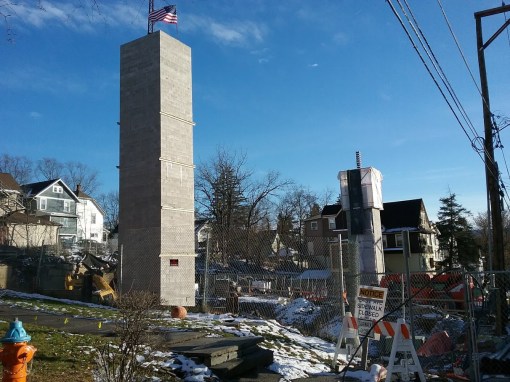
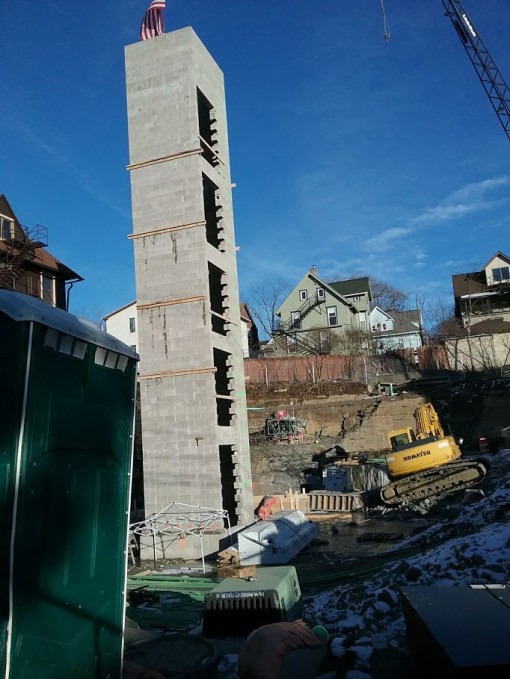
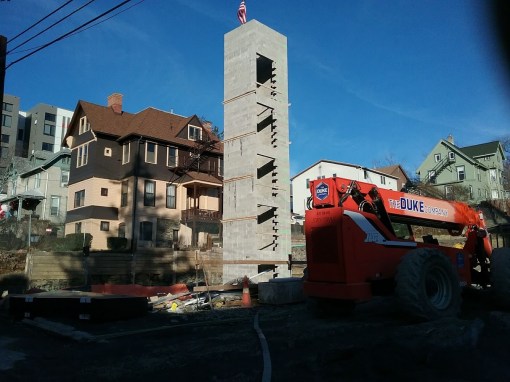
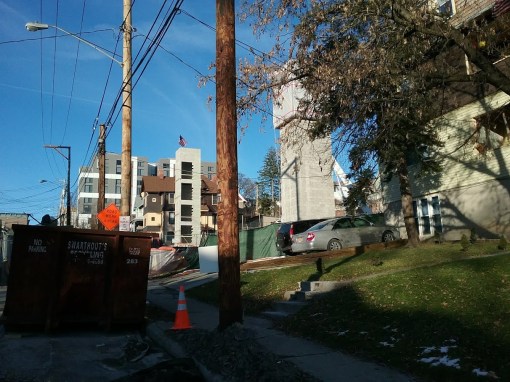
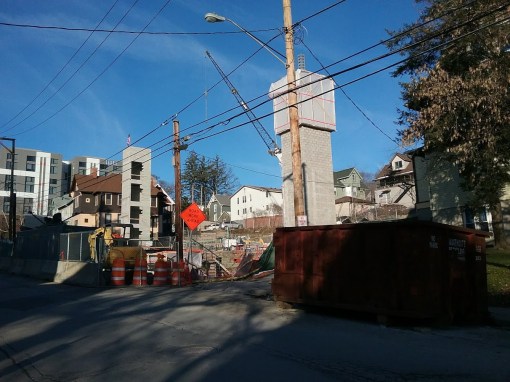
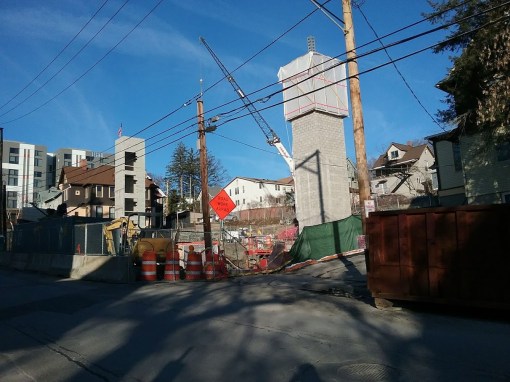
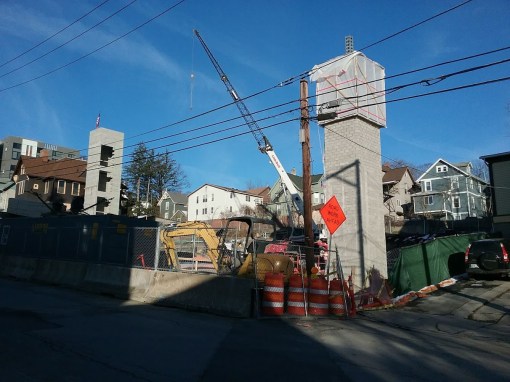
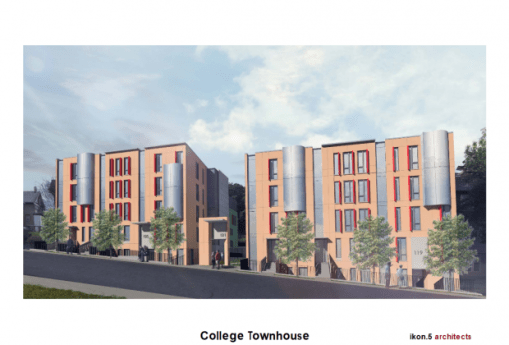
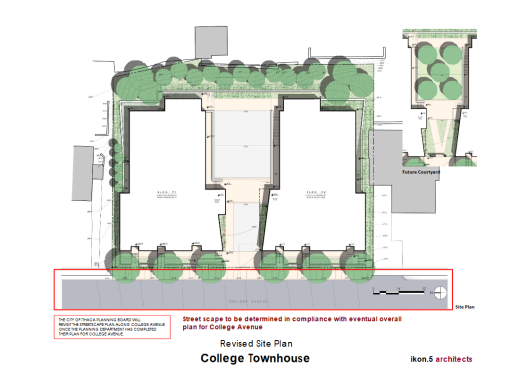
The CMU (concrete masonry unit) elevator/stairwell cores are being assembled for Novarr and Proujansky’s Cornell visiting faculty and staff housing at 119-125 College Avenue. The North Building’s core tower is complete and capped with an American flag courtesy of Welliver (who are proudly displaying their involvement with Cornell’s North Campus Residential Initiative on their homepage, and is co-developed by Novarr and Proujansky). It’s kinda intuitive from the east tower, but workers work their way up along the inside, using the steel girder in the center. The plastic sheeting offers some basic weather protection as the cinder blocks are mortared and laid into place in a running bond pattern. These cores give an idea of how tall the finished buildings will be, though keep in mind the lowest exit/entry opening is the basement, which will be built out and backfilled up to ground level as construction progresses.

One of the reasons why the hot gossip swirls around Novarr’s Collegetown plans is that he enjoys a very close relationship to Cornell, so if the university determines it wants to do something Collegetown, they can turn to someone who has a lot of developable property and a strong relationship with the school. Rather than deal with the potentially damaging public blowback of a tax-exempt property, Novarr and Proujansky keep it on the tax rolls and create a welcome degree of separation. Most of their properties are fully taxed – the Breazzano, which serves an academic function rather than ancillary function like housing or student services, has a PILOT agreement for fifty years.

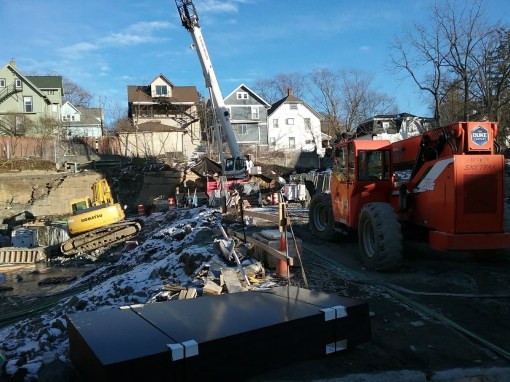
Apart from the excavated sites and elevator cores, the concrete foundation work (footers, slab pours, foundation walls) is ongoing, mostly at the south building. It doesn’t look like the north building is quite as far along, even though the elevator core is complete.

Project information and history can be found here.


Stewart Park Inclusive Playground Construction Update, 12/2018

15 12 2018

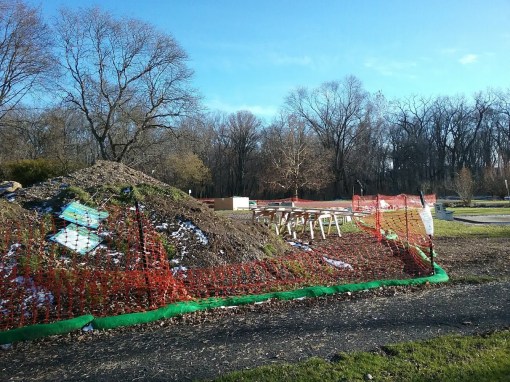
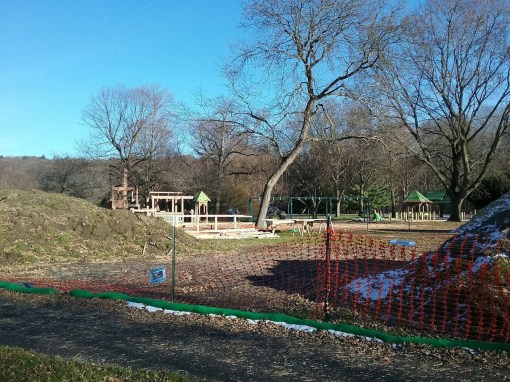
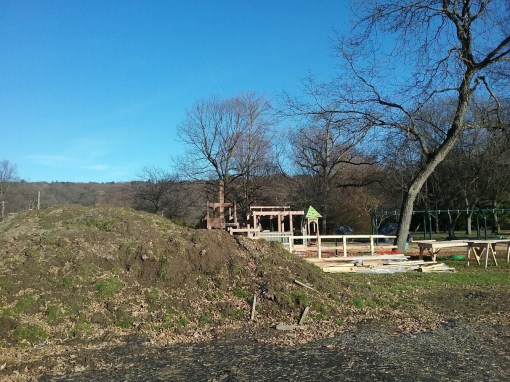
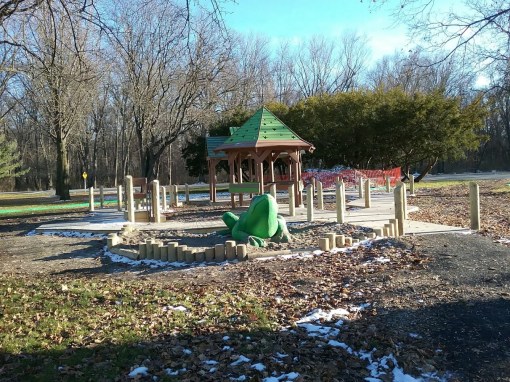
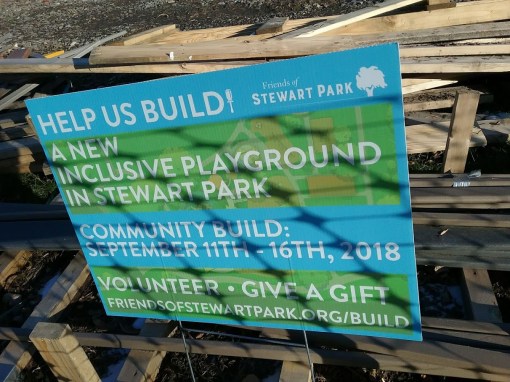
Here’s a look at the Stewart Park Inclusive Playground project. Overseen by the non-profit Friends of Stewart Park (FSP), the two-phase plan was approved by the city earlier this year, and started construction in September for a May 2019 completion. Plans for the project date back to at least 2015, with formal planning board review moving forward in late 2017. Among the features planned are (from the website):

  • A new, accessible splash pad that will conserve water.
  • Specially designed school-age and pre-school play structures.
  • An accessible berm  that provides children a starting point for exciting play experiences for all children.
  • The use of native plants and sustainable building materials and site design strategies to make the playground a model for green playground design.
  • Educational opportunities to interpret the natural environment of the park – the vegetation, birds, fish and wildlife that make this site so special.
  • Natural play areas including a music garden and sand play area.
  • Numerous swings and climbing structures, shaded seating areas and many benches for relaxing.
  • New accessible bathrooms and changing stalls adjacent to the playground and carousel.
  • A restored and accessible Carousel (completed).
  • Accessible walkways and paths linking to the Cayuga Waterfront Trail and other areas of the park and Ithaca’s waterfront.

When FSP refers to an inclusive playground, it means that it offers something for kids of all abilities – it offers a full sensory experience with lots to touch, to see and to hear. Disabled children will be able to access and enjoy much of the equipment, as well as the gardens and play areas.

Complementary additions will include a parking lot addition, benches, and bathrooms. The cost of the new and improved facilities is $1.7 million ($1,517,500 in hard construction costs like materials and labor, $182,100 for soft costs like design fees, legal and permitting, and a $50,000 annual maintenance fund). The project will take about nine months to construct, and be built through a combination of traditional paid construction crews, and volunteer community builds.

As previously reported, the location of the new structures is between the splash pad on the west end of the park and the carousel to the east, south of the transmission lines, with a total area of about 1.65 acres. The area north of the power lines is envisioned as an open play and picnicking area. With the exception of the large swings, the existing equipment will eventually be removed to near the DPW maintenance building and the ‘Whirly Bug’. The older play structure near the carousel will be moved, to another park if possible.

Three playground design and landscaping firms are involved with FSP’s plans – Parkitects, Play by Design and EarthPlay are coordinated designs and features to maximize the play value and amenities, while giving a nod to local features like rock formations and the steamboats that used to come down the lake. T.G. Miller is handling the more technical details like grading and stormwater management, and STREAM Collaborative designed the 900 square-foot storage and bathroom building.

The first phase, which includes the pre-school play area, is open, much of it thanks to the work of over a thousand of volunteers back in September, and participating organizations who sponsored volunteers and support services during the intense six-day build. Phase II will start next year, once the worst of winter has passed.

On the funding side, $1 million was received in a state grant spearheaded by Ithaca’s state Assemblywoman, Barbara Lifton (D-125th). The remaining $700,000 is being raised through a capital campaign. At last update, $658,082 had been committed by private sources. The big donors are listed here, and if you want to help close the gap in the home stretch, the donation link is here. A specialized fundraiser for the new accessible surfacing materials (a safe, durable material on which wheelchairs can move) for the playground is here.