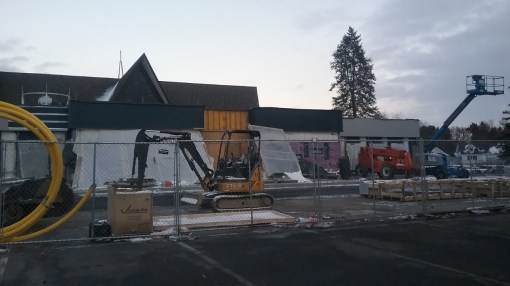
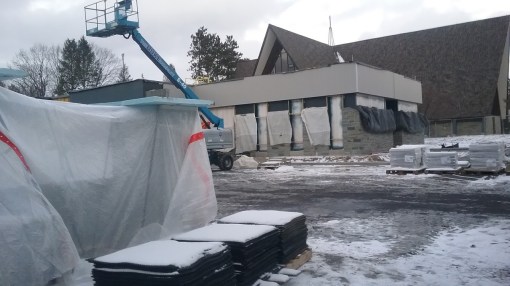
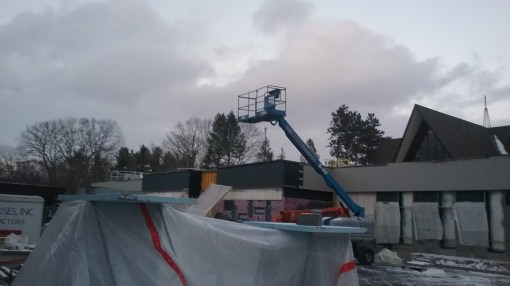
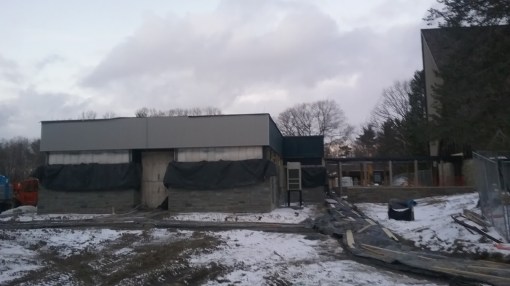
201 College Avenue Construction Update, 12/2016

18 12 2016

The Collegetown construction boom continues. In 2017, the city can expect at least five projects to open in the neighborhood, with a net gain of about 118 beds and $16 million in assessed tax value** – a two-family house at 123 Eddy Street; Cornell’s, 6-story, 76,000 SF Breazzano Center for its Executive MBA Program; the 5-unit, 28-bed 126 College Avenue;  the 9-unit, 36-bed 210 Linden Avenue; and lastly, the 5-story, 74 bed 201 College Avenue. Which has also been by far the most contentious one.

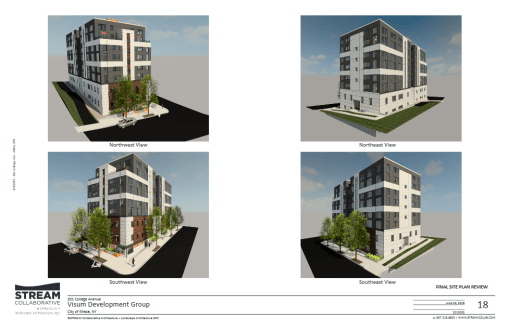
The project was first proposed in March – and from beginning to end, the only substantial change was a mild revision to its upper floors to create a setback as a modern deference to the Grandview House further up the block. That resulted in a loss of two bedrooms, dropping the plan from 76 to 74 beds.

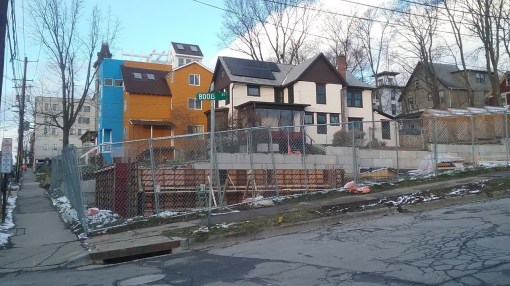
For Todd Fox, who proposed the building through his company Visum Development Group, there wasn’t much room for revisions. He was going to, and paid, a premium on the property – $2.65 million, formally deeded in June by its previous owner, a small-scale local landlord who owned it for about seven years prior. The site held an early 1900s apartment house with three large spruce trees at the front, which became another source of contention during the debate.

To make the project financially feasible, he needed to build to the maximum 5 floors and 70 feet allowed by the site’s MU-1 zoning (the project would have been outright impossible before the 2014 CAFD zoning overhaul, due to the parking requirement), and building micro-units with mezzanines would make the project pencil out – the profit value of the vertical space was effectively maximized. Working with architect Noah Demarest of STREAM Collaborative, he proposed a fairly modern building with fiber-cement panels, woven bamboo boards and cedar accents.

However, one thing that did not factor in to the calculations was the neighbor of 201, 203 College’s Neil Golder. Neil is a 44-year resident of Collegetown, having moved in in 1972, and buying his house in the early 1990s. As the kitchen manager for Loaves and Fishes and a former Common Councilor for the 4th Ward, he’s well known among the Ithaca community and is well connected to its grassroots organizations, as well as the political movers and shakers. By any account, Neil and his late partner Kathy Yoselson are beloved stalwarts of Ithaca’s progressive scene. However, Neil has generally not been a fan of development, particularly Collegetown’s (with one notable exception – 307 College).

What 201’s debate boils down to is a clash of two strong personalities. Todd Fox, who is probably the most gung-ho and financially adept developer one will find in the city of gorges; and Neil Golder, who was determined as hell to stop the project planned for the house next door, which wasn’t just a development, it was a project that he deeply felt would be a major detriment to his quality of life. Hence, Neil launched the group “Save the Soul of Collegetown“, under the auspices of protecting all of Collegetown, but mostly as a personal vehicle to drum up support to battle Fox and his apartment building.

The point of this summary isn’t to summarize every detail. You can read the 580+ page summary from the city, or all the Voice articles here. But there are a few key plot points.

After review and a negative declaration of environmental significance (meaning, effectively mitigated), he project received preliminary approval in June, and the city and the planning board were promptly slapped with a lawsuit by Golder. The stated case was that the environmental assessment was inadequate and that the project needed an EIS. Although it was quite a stretch given past precedent, it did make the planning board quite uncomfortable. John Schroeder, a longtime board member who served with Neil on the council, did a very deep analysis of the 2014 zoning code and determined that the building may be illegal on technicality.

That technicality was about building facade length, and whether Bool Street was a primary facade – if it was, it would legally have been required to be two separate buildings for having too long of a continuous face to the street. The zoning code, however, illustrated that an approach with indents such as 201’s were acceptable, and the city planning department, in their pre-site plan review assessment and meetings with Fox, had signed off on the plan as legal and acceptable. And they maintained that it was acceptable. So there ended up being a battle between the planning board, which is appointed though knowledgeable community members, and the planning department, which consists of vetted city staff. These kinds of battles are extremely rare, and it is likely that 201 was the first in decades.

While this debate raged, the building far exceeded its intended start date of July 2016. As a result, the site went on the market, and the plans were cast into jeopardy.

Although Fox and his team wanted to avoid a trip to the Board of Zoning Appeals, it was determined by the board to be the only legitimate course of action. The BZA had to decide whether or not the project was legal. And, in a 3-1 decision in October, they decided it was legal, due to ambiguity in the code, and a lack of timeliness on the part of the planning board, as the legality was not considered until after months of review, after preliminary approval was granted. After the BZA ruling, work on the building began the next day.

No one walked away from this one looking good; One reader emailed in and compared it to a Clinton vs. Trump vote. The debate sent a chill down the development community, and created additional bitterness for some of the old-timers who felt Ithaca was selling out to developers and student interests. The planning department and board were also left with some resentment towards the other; now that the code has been clarified, one can hope further battles like this can be avoided.

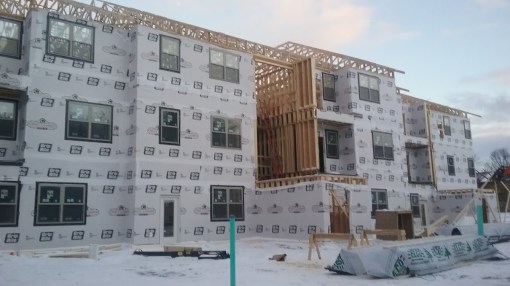
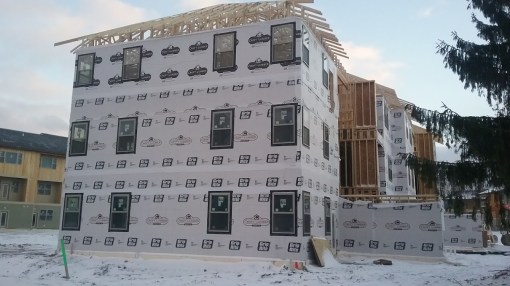
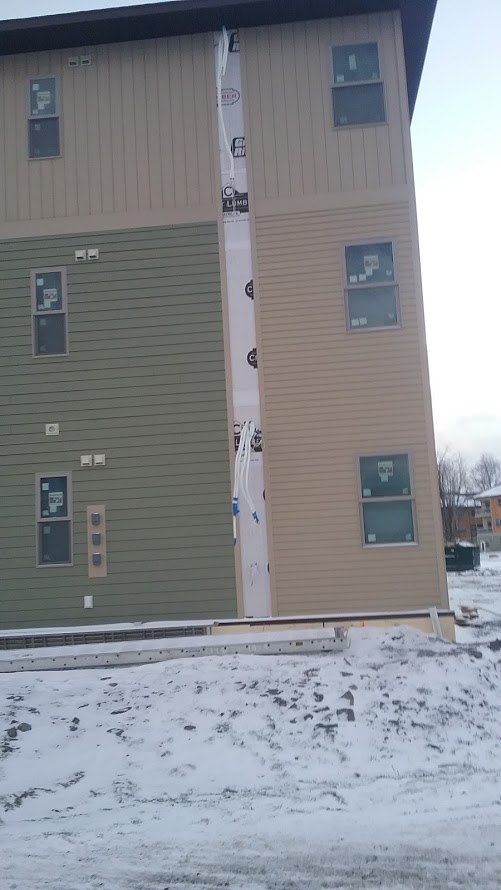
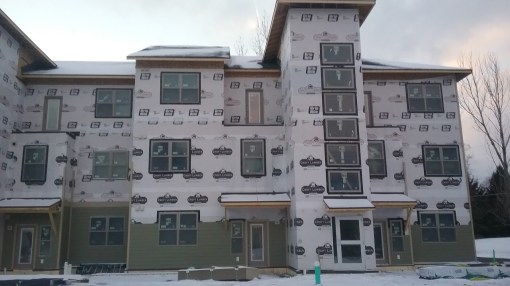
Anyway, the building itself. Here are the floorplans. The mechanical room, a trash room, interior bike storage, gym and storage space occupy the basement. Four three-bedroom and four four-bedoom units (28 beds), with about 1,000 SF each, occupy the first and second floors. The third and fourth floors have micro-units, 16 of which will be about 392 SF studios, 8 of which will be 670 SF with two bedrooms, give or take a few feet for each (32 beds). The top floor has nearly the same layout as three and fourth, with eight micro-units of about 392 SF and 2 two-bedrooms of about 670 SF. However, the westernmost two units are studios, which have balconies and are about 400 SF each. So, 14 beds on the top floor, for a total of 74. The smaller units make use of mezzanine spaces and netting to increase usable space.

Fox’s rental company, Modern Living Rentals, is handling the leases. The units are currently listed from $1,670/month to $4,170/month, depending on size and location.

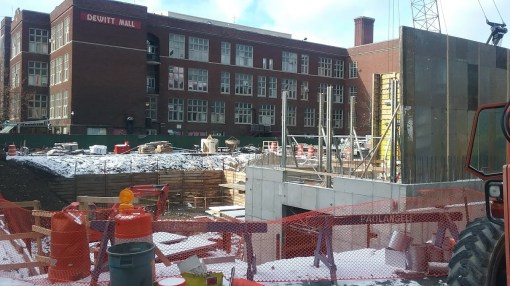
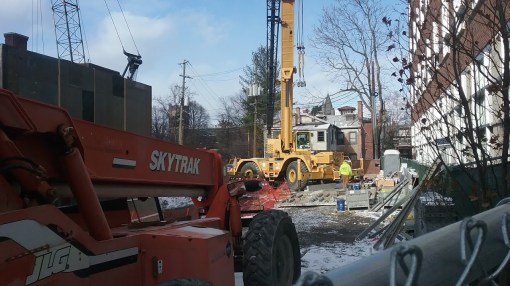
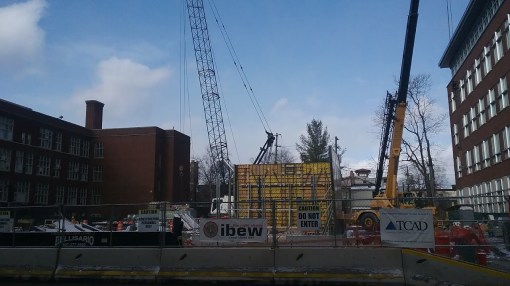
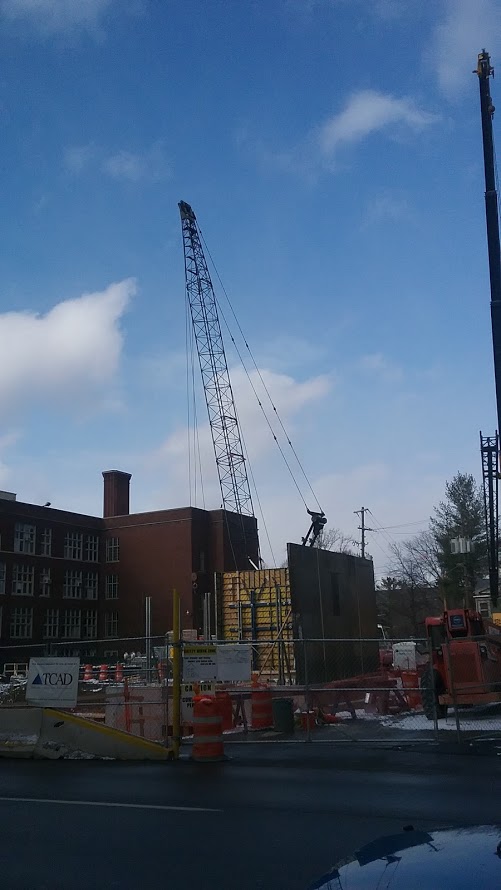
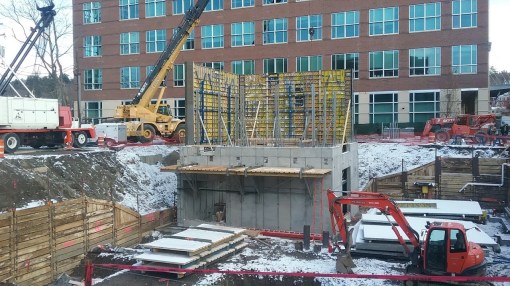
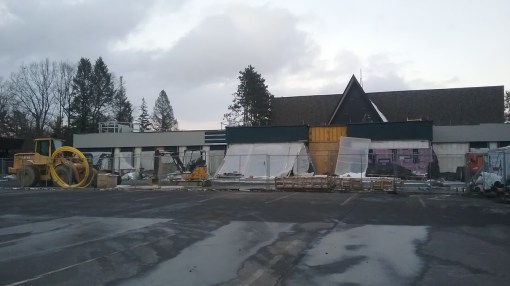
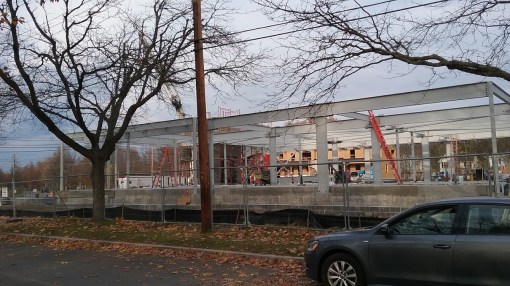
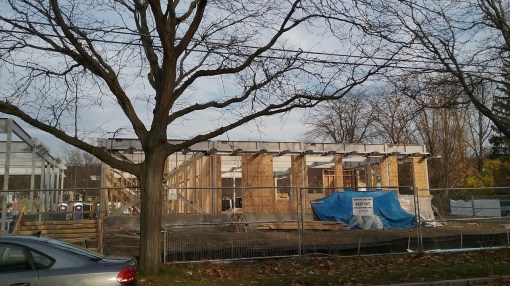
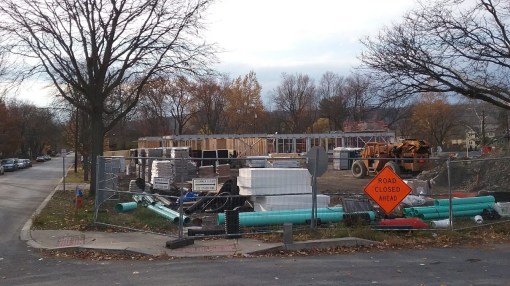
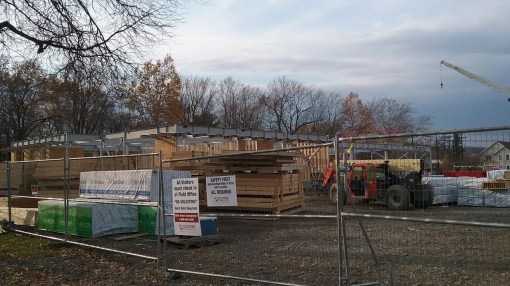
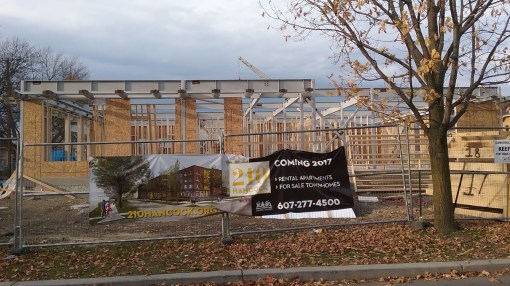
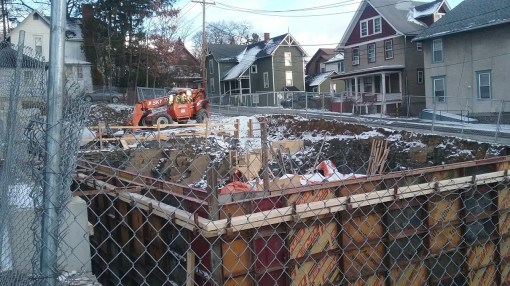
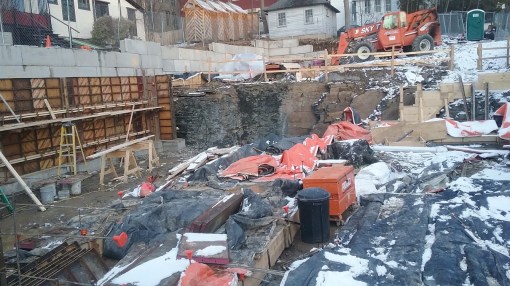
In the photos below, note that the excavated portion is only half of the building footprint – the basement only occupies the western half of the structure. The eastern half is slab-on-grade (Collegetown has more stable soils than most of the valley locations, so multi-story slab foundation buildings are feasible). The elevator core will be in the middle bridge of the “H”-shaped structure. Foundation forms are up and the concrete is being poured – through the fence, you can see one of the concrete footers already in place.

William H. Lane Inc. of Binghamton, who just finished up the Marriott downtown, is the general contractor for the approximately $6 million project, which is paying a premium to meet the opening date of August 2017.

**If you add in Phase III of Collegetown Terrace, which is on the fringe of what’s normally considered Collegetown, raise those numbers to 462 beds and $71 million.
20161209_153319

20161209_153332

20161209_153341

20161209_153350

20161209_153402

20161209_153706

201_college_site 201_college_v5_1


Tompkins Financial Corporation HQ Construction Update, 12/2016

18 12 2016

The future headquarters of Tompkins Financial Corporation is starting to rise from the ground at 118 East Seneca Street. The elevator core and south stairwell are being poured section by section. Forms are being put into place to build the next level of the core. It looks like structural steel surrounded by concrete fortified with steel rods (rebar). The small holes within the elevator core are where the structual steel of the superstructure will tie in. The basement appears to be fully excavated with all the wood lagging in place. The four H-shaped steel bars next to the elevator core are piles, which will carry the building load. More on those in a minute.

The basement for the TFC HQ is a bit of an unusual setup. The excavated portion (12-13 feet deep) only encompasses the floor plate for the basement and ground floor. The second to seventh floors will have larger floor plates. The elevator core actually sits at the northeast corner of the ground floor’s floor plate – the area between it and the Hilton Garden Inn will be the driveway, and behind it, the customer parking lot. Stairwells to the upper levels will also rise on the northeastern boundary of the property, and the northwest corner of the first floor, close to the parcel’s lot line with the DeWitt Mall. The upper floors will have the support of additional load-bearing columns along the perimeter of the property (they will tie into the end-bearing steel foundation piles seen here in August, which seem to be capped and at ground level now).

Along with the perimeter piles and the piles within the ground floor plate, four support columns will rise from through the parking area to the floors above. Those appear to be pile caps for two of those support columns in the second to last photo. The four H-shaped steel bars are capped with a thick block of concrete from which the support columns will tie into, and use as their base. The weight of the building will be transferred through the steel structure, through the pile cap and evenly distribute the weight into those piles, which will transfer the load down into very firm soil 65-70 feet below ground level. This is what will give the building its stability.

Anyway, seems like I forgot to take photos of the drive-thru bank branch under construction across the street – which is probably close to completion at this point, if not already. The $31.3 million office building will open in March 2018. LeChase Construction is the general contractor, and HOLT Architects is responsible for the design.

20161209_125159 20161209_125207 20161209_125228 20161209_125243 20161209_125309 20161209_125322 20161209_125401 20161209_125416

tfc_hq_first_floor_plan

tfc_hq_profile


News Tidbits 12/17/16: So Much In One Week

17 12 2016

1. For the developers out there, it looks like your next opportunity just opened up in Collegetown. For sale are three houses on Linden Avenue – 6-unit, 8-bedroom 230 Linden, for sale at $675,000 (taxed at $350,000), neighboring 4-unit, 8-bedroom 228 Linden at $700,000 (taxed at $460,000), and two doors down, 2-unit, 11-bedroom 224 Linden at $525,000 (taxed at $400,000). All three are somewhat run-down student apartment houses on the cusp of inner and outer Collegetown – as such, their zoning is CR-4, which allows four floors, 50% lot coverage, and has no parking requirement.

The properties were all purchased in the mid-1970s by a small-time local landlord, who was killed in a car accident two years ago. According to the listings, the seller’s agent is a family member, and the units are leased until late 2017 or 2018, meaning that if one were to purchase with an eye towards rapid redevelopment, they would have to negotiate with the tenants, or wait it out. That being said, there’s a lot of potential here, particularly if a buyer combines 228 and 230 into one lot. The city designed the CR-4 zoning with Linden Avenue specifically in mind – the concept render is a northward perspective of a revitalized Linden Avenue. They’re a lot of money, but there could be some interesting news down the line.

210linden_126college

2. Also in Collegetown, here are a couple of concept color renders of 210 Linden Avenue (left) and 126 College Avenue, courtesy of Visum Development’s webpage (currently down, cached link here). I confess to be more of a warm colors person, but assuming these are fiber cement boards and wood trim (or fiber cement that looks like wood), they could turn out quite nice.

On a related note, Visum’s Fox and partner Charlie O’Connor have started earth moving for their townhouse project at 902 Dryden Road in Varna. As it turns out, it is a very difficult site to get photos of, despite its easily accessible location. I’ll do a more in-depth shortly, but the units should be ready by August.

20161211_131919 20161211_131943

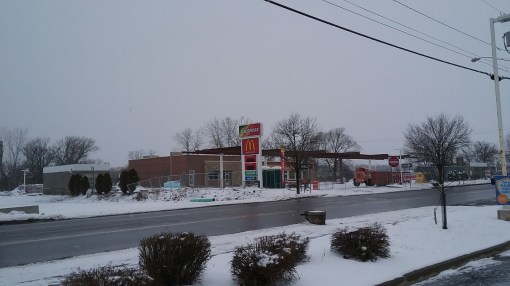
3. Fulfilling a promise to Fred, here’s the rather upscale McDonald’s/Fasttrak combo under construction North Road in the village. There is a billboard on 366 advertising for new hires for when they reopen, but unfortunately, it was too difficult to attempt a photo of the board and render. The building’s exterior is largely complete, and the gas station canopy is framed – late winter opening? The new construction has a price tag of about $500k. Honestly, for a roadside stop, it looks pretty nice.

20161211_131533

20161211_131514

4. More on Dryden, with a couple houses of the week. Looks like some modulars are going into the Maple Ridge development – one recently completed, one in the works. The open space to the right of house number two, the Cape Cod, will host a garage. The land for house one sold to Kenn-Schl Inc, a regional modular home builder and seller, in June for $48k. House two’s land was sold to a Rochester man for $39k in October. At this rate, Maple Ridge is going to fill out their 15-lot phase one in another year or two. Although waylaid by the Great Recession, the big plan is for three phases and 51 lots.

20161211_133227

5. On the 15th, the construction loan for the William George Agency’s new 1-story, 24-unit dormitory was filed to the county records office. The $3 million loan comes courtesy of …. A trip to the property didn’t pan out, it didn’t look like anything was underway even though the building permits were filed with the town of Dryden a few months ago. Then again, as a facility for troubled youth, it’s not the most welcoming place for a random visitor to be taking photos.

maplewood_v7_4

6. So what’s being discussed by the towns? In the town of Ithaca next week, a lot line adjustment between two houses, and more Maplewood discussion, with consideration of preliminary site plan approval. Meanwhile, the town of Dryden has cell towers galore, as well as revised approvals for Storage Squad (1401 Dryden) and Tiny Timbers; plans are in the pipe line for a 7-lot subdivision of the Dryden Lake Golf Course, and a possible sewer extension study for NYS Route 366 east of the NYSEG building.

Image Property of HOLT Architects

7. Speaking of sewer, the town and village of Lansing are negotiating sewer deals so that the town can use village lines to help accommodate future growth. Dan Veaner at the Lansing Star has the story. the report says the town is asking for 700 units of capacity, where a unit is 328 gallons. 700 units would also put the Cayuga Heights plant at capacity. The town’s intent is to extend sewer capacity to encourage development along Triphammer Road (as in the town center concept shown above), with the reasoning that it’s a natural extension of established development, and would help grow the tax base in the event of the power plant closing. Not as grand as the plans that were shot down in 2007, but like the Warren Road sewer built a few years ago, it’s seen as a more organic and cost-efficient approach.

20161209_123851

20161209_123931

8. There might be some of movement on Jason Fane’s Bank Tower $4 million renovation from office space to 32 apartments. The windows were inspected and tagged recently, possibly to determine what needs to be replaced where. Most of the exterior of the Commons-facing building will receive a cleaning and re-freshening, with the bulk of the work geared towards the interior.

20161210_140231

9. In economic news, 24/7 Wall Street is reporting that Ithaca has the 25th best job growth in the nation from November 2015 – November 2016. 2,200 jobs equates to 4.4%, by their measure.

Hate to burst the bubble, but don’t buy into it just yet. Initial estimates can be way off due to statistically insignificant sample size for small communities. It may hold, it may not. Wait until March and see if the numbers get revised.

city-center-v4-1

10. Interesting meeting next week for the city Planning Board. Amici House and Maplewood are up for final approval, and a couple revitalized or new projects. Here’s the scoop:

1. Agenda Review 6:00
2. Privilege of the Floor
3. Site Plan Review

A. Project: Maplewood Redevelopment Project 6:10
Location: Veteran’s Ave. (between Maple Ave. & Mitchell St.)
Applicant: Scott Whitham, Whitham Planning & Design, LLC, for Cornell University
Actions: Adoption of Findings, Public Hearing, Consideration of Preliminary & Final Site Plan Approval

The Town Planning Board filed a Notice of Completion on November 30th, 2016, which can be viewed here: http://www.town.ithaca.ny.us/major-projects/maplewood. The Town Board will consider adoption of a Findings Statement on December 20, 2016.

The city will specifically sign off on the bus stop and landscaped area at the northwest corner. STREAM Collaborative is the landscape architect.

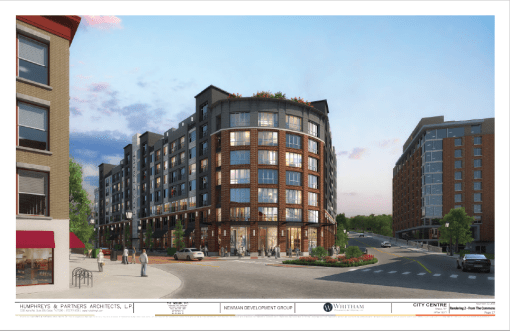
B. Project: City Centre — Mixed Use Project (Housing & Retail) 6:30
Location: 301 E. State/M.L.K., Jr. St.
Applicant: Jeff Smetana for Newman Development Group, LLC
Actions: Determination of Environmental Significance, Recommendation to BZA

amici_v3_1

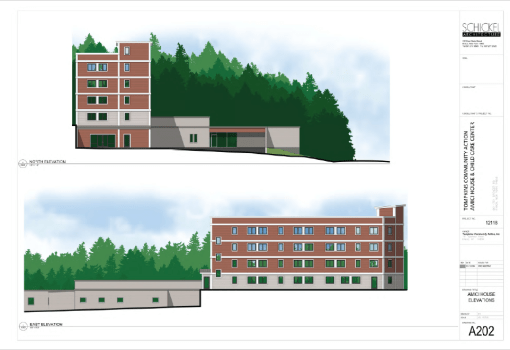
C. Project: Amici House & Childcare Center 6:50
Location: 661-701 Spencer Rd.
Applicant: Tom Schickel for Tompkins Community Action (“TCAction”)
Actions: Consideration of Preliminary & Final Approval

Tweaked since last time – a little more glass in the stairwell, and the roofline of the classroom building has been broken up with three distinct gables.

college_townhouses_v2_1

D. Project: College Townhouse Project 7:10
Location: 119, 121, & 125 College Ave.
Applicant: Kathryn Wolf, Trowbridge Wolf Michaels Landscape Architects, LLP
Actions: Public Hearing Determination of Environmental Significance

The big changes appears to be the switch from boxy bay window projections to curvy ones. Not sure if it works, given all the other boxiness. But on the bright side, we now know what the rear apartment building looks like:

college_townhouses_v2_2

E. Project: Apartments (5 Units) 7:30
Location: 126 College Ave
Applicant: Visum Development Group
Actions: Declaration of Lead Agency, Potential Determination of Environmental Significance

This is what I get for writing things over the week rather than all at once. Confirmed fiber cement panels (wood-like and Allura olive green) and a very light yellow Nichiha panel.

F. Project: Apartments (9 Units) 7:50
Location: 210 Linden Ave
Applicant: Visum Development Group
Actions: Declaration of Lead Agency, Potential Determination of Environmental Significance

Charcoal grey fiber cement panels, light grey panels, natural wood trim and red doors. The base will be stucco.

G. 323 Taughannock – Apartment (Redesign) – Sketch Plan 8:10

Steve Flash’s 21-unit apartment building for Inlet Island was approved two years ago, but has not moved forward due to soil issues and parking costs. This new version is still a housing proposal, but I’m hearing for-sale units that may be condo-like. The design will also be new, but the aesthetic will be similar – it will once again be crafted by STREAM Collaborative.
H. Ithaca Reuse Center – Sketch Plan 8:30

I know about this project because a county staffer emailed me by accident. But without official docs, I wasn’t about to report on anything. The plan calls for a mixed-use building, not unlike that seen in design concepts a couple of years ago. TCAction and INHS are involved, so there is an affordable housing component – probably looking at mixed-use overall.

4. Zoning Appeals 8:50
• 3053, Sign Variance, 310 Taughannock Blvd.
• 3055, Area Variance, 113 Farm St.
• 3056, Area Variance, 301 E State St.

5. Old/New Business:
A. Update — Chainworks DGEIS – Transportation Comments/Responses – yes, it’s still going.
B. Update — City/Town Joint Planning Board Meeting Jan 31, 2017 – Maplewood?
C. Update — Joint Planning Board/ILPC Meeting (DeWitt House) – Let’s see how this goes…


Village Solars Construction Update, 12/2016

13 12 2016

The latest two buildings at the Village Solars apartment complex are moving along. Building J is nearly fully framed, the roof trusses are being lifted (literally, by a lift) into place, and the lower floors have been covered in housewrap, with windows fitted into their openings. You get the idea of how the exterior buildout process works by looking at Building J – the exterior wood frame is built, plywood sheets are sealed over the top of the stud walls, housewrap gets applied as a moisture barrier, and then the exterior finishes go on over the house wrap. One can just make out some of the interior wood stud walls through the panes.

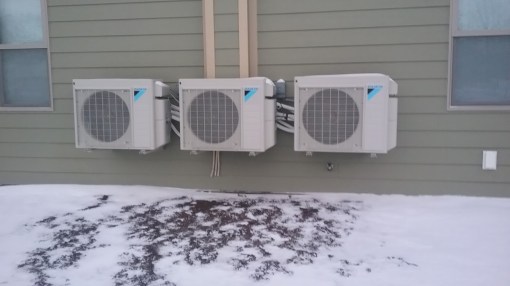
Meanwhile, Building “I” is a little further along, but it tells us how the roofing process goes. First the roof trusses are attached, then the Huber ZIP sheets are set into place and the eaves are closed up, the underlayment and tar paper goes on, and finally shingles and trim boards. The wires dangling from the side of Building “I” are electrical wires for the Daikin wall-mounted heat pumps.

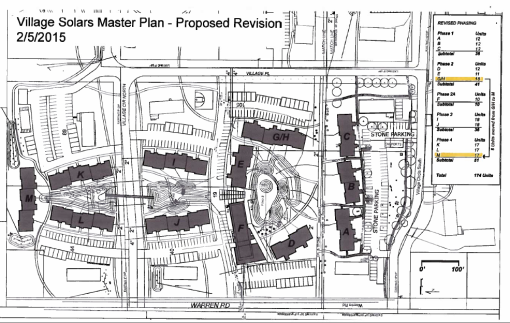
Initially, the plans called for 36 units, but with the splitting of some of the larger three-bedroom units into smaller arrangements, the actual number is likely higher. The Lansing town board approved changes to the complex that raised the number of units permitted/to be built from 174 to 206, although the change in overall square footage is negligible. Although not listed on Lifestyles Properties’ webpage, units range from $1050-$1650/month, depending on size and location. Craigslist tends to have the most up-to-date info, but those links stop working when the ad expires.

As with the other phases, the buildout for phase III received a $6 million loan from Tompkins Trust Company. According to the architects’ website, after phase III opens, work is expected to commence on a community building, retail options and walking paths. A bus stop is also in the works.
20161209_161503 20161209_161529 20161209_161539 20161209_161603 20161209_161611 20161209_161622 20161209_161638 20161209_161649 20161209_161717 20161209_161752 20161209_161805 20161209_161827 20161209_161843 20161209_161915 20161209_161936 20161209_161941 20161209_162003 20161209_162022 20161209_162030

village_solars_2exterior-1024x548 plan-01-1024x423


St. Catherine of Siena Parish Center Construction Update, 12/2016

12 12 2016

Over at St. Catherine of Siena’s new parish center, it looks like the GlasRoc sheathing towards the roof has been sprayed with the dark blue waterproofing, some “continuous anchors” (metal rails) have been attached, and the exterior panels are being attached. The renders show a different color and possibly material, so it’s not 100% clear on whether this is the final appearance.

Below that, the stone veneer is progressing, and most of the gypsum sheathing has been waterproofed. Only a few of the smaller windows have been installed, the rest still have yet to be fitted. In the second to last photo, the new enclosed walkway from the parish center to the church is coming along, framed but not yet outfitted with its expansive glass walls.

20161209_162951 20161209_163002 20161209_163043 20161209_163048 20161209_163128 20161209_163150 20161209_163302

st_catherine_v2


News Tidbits 12/10/16: Missing Out On the Fun

10 12 2016

reach_works_1
1. We’ll start off out in the town of Lansing this week with a new business startup looking to climb to the top of the pack. Reach Works, the brainchild of an academic family that relocated to Ithaca, just earned final site plan approval to build a professional-grade climbing wall and facility at 1767 East Shore Drive, next to The Rink. The $1.2 million, 10,400 SF building will have a noticeable impact on the Lansing shoreline, as the building will reach 56 feet in height. South Hill’s George Breuhaus will be the architect in charge.

According to the Times’ Cassandra Negley, the owner looked at Chain Works for an opportunity, but those plans fell through. The finalizing of the wall design is underway now, and Reach Works hopes to begin construction in March and be open by next fall. Between the pro shop and the wall, they hope to employ five full-time and ten part-time, with most making about the living wage of $15/hour (although, the application on file with the town says six employees). The hope is that it also becomes a regional attraction, drawing in hardcore climbers from the Rochester, Syracuse and Binghamton metros. Best of luck to them.

maplewood_v7_4

2. Maplewood is almost ready. The city is set to give its final approval this month, and the town is expected to give preliminary approval before the Christmas holiday. The latest changes to the FEIS include the following details:

– The amount of money for traffic calming measures has been increased from $20,000 to $100,000. $30,000 goes to the city and town, and $70,000 will be allocated by EdR and Cornell for streetscape improvements that they will build.
– Recycled building materials will be incorporated into the buildings.
– A revised estimate states that 100 to 150 construction staff will be on site during construction. They will park behind the East Hill farmer’s market space and are expected to walk over to the site. They will work on weekends, with noisy work commencing after 8 AM.
– The units closest to the East Hill Rec Way have been moved another four feet back from the trail.
– Initial property taxes in 2018 will be $2.25 million. IT is assumed they will go up 3% each year thereafter.

Oh, and the questioner who freaked out over the East Hill Village plan online – that SWA plan dates from about 2007.

cayuga_med_behavioral_sciences_1-620x420

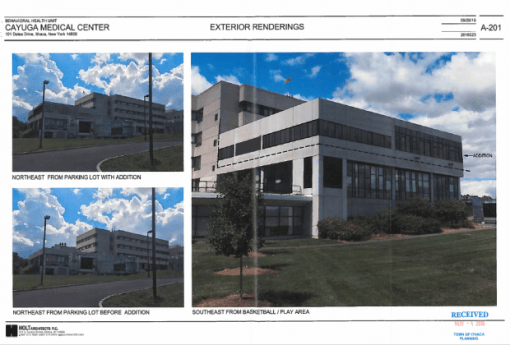
3. Cayuga Med’s plans for a 6,000 SF addition to their Behavioral Health Unit has been approved. At this point, the project needs a minor zoning variance for height,and then CMC has to apply for certification from the New York State Office of Mental Health for the facility to be approved- specialized medical facilities, like CMC and Brookdale, have to prove there is a need before they’re allowed to build. The hospital hopes to open the project to bidding early next year.

masonic_temple_1-771x595

4. So ICYMI, the Masonic Temple rehabilitation is moving forward. Six months later than anticipated, but it is moving forward. The project is valued somewhere north of $1 million. There is one other project on the Ithaca Landmarks Preservation Commission (ILPC) agenda that I thought of writing an article about, but decided it was too minor – the Alpha Phi Alpha house at 421 North Albany will be doing a reconstruction of a non-historically significant rear porch. If it were a full reno, I’d do a write-up for the Voice.
Also on the ILPC agenda – a discussion of Collegetown Historic Resources. I have the feeling this is being spurred by Novarr’s 119-125 College Avenue project, the College townhouses. Three historically significant but non-landmarked apartment houses were taken down to make way for the project, which is expected to go up for preliminary approval later this month. The city did a review after the document was first published in 2009, and landmarked the Snaith House at 140 College and Grandview House at 201 College – they could be considering making a move towards landmarking other properties – some of the historic structures on the 400 Block of College Avenue, and the 100 blocks of Oak Avenue, College Avenue and Linden Avenue are possibilities. Novarr has another project rumored for 215 College Avenue, but that building, dating from the 1870s and renovated/expanded numerous times, was not on the 2009 list.

5. Staying Collegetown, a big sale this week – 113 College Avenue sold for $1.7 million. That’s a very impressive price for an outer Collegetown apartment house – the tax assessment has it pegged at $610,000. The bones of the 13-bedroom, 3,738 SF building date from the late 1800s, but like its twin next door, it’s been the subject of a very unsympathetic renovation (records suggest the renos were done around 1980). The house has been owned by the Tallman family since 1987.
The property is zoned CR-4 – four floors, no parking required. CR-4 is the same zoning as Novarr’s townhouses and Visum’s latest pair of proposals. And, because what goes around comes around, the buyer is the same LLC that sold Visum’s Todd Fox 201 College Avenue for $2.65 million back in June – Russell Johnson’s PBC & Associates LLC. He also picked up a CR-3 building at 233 Linden Avenue for $750k back in the fall. Price suggests redevelopment, but the buyer isn’t known for that – he might have just paid big for a long-term investment. TL;DR, he might be planning something, he might not; we’ll see.

On a side note, the county’s going to make some money raising the property tax assessment on this one – offhand, I’ve noticed most of the houses sold this week (excluding a couple in Ithaca city) have gone at or well under assessment, which is a bit unusual, and probably not something that the tax assessor’s office wants to see.

20160630_142619

6. Good news and bad news from the Regional Economic Development Council awards. The good news is, the area’s getting money. Cargill gets $2 million towards their salt mine project (they requested $5 million), Cornell gets $250,000 for a startup business alliance, County Waste gets $355k for a food waste transfer station at the recycling center site, and the Sciencenter gets $150k for renovations. Several smaller awards are to hire staff for cultural and arts programs.

Now the bad news – one project, marked priority, was not funded – the Collegetown Travel Corridor proposed by the city of Ithaca to connect Downtown and Collegetown. I asked to make sure, and the Planning Department was just a little deflated in their response. Major bummer. I don’t doubt the value of arts programs, but $38,500 for a theatre director and $41,000 for a workforce expansion isn’t sustainable, it’s one year’s salary. That’s nice, but how does that benefit the area in the long-term? The Travel Corridor would have further encouraged urban development downtown and Collegetown that could have indirectly supported the arts through patronage, or directly through taxes that are used to fund local-level grants.


210 Hancock Construction Update, 11/2016

2 12 2016

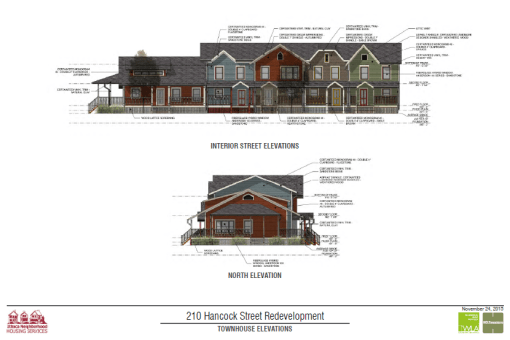
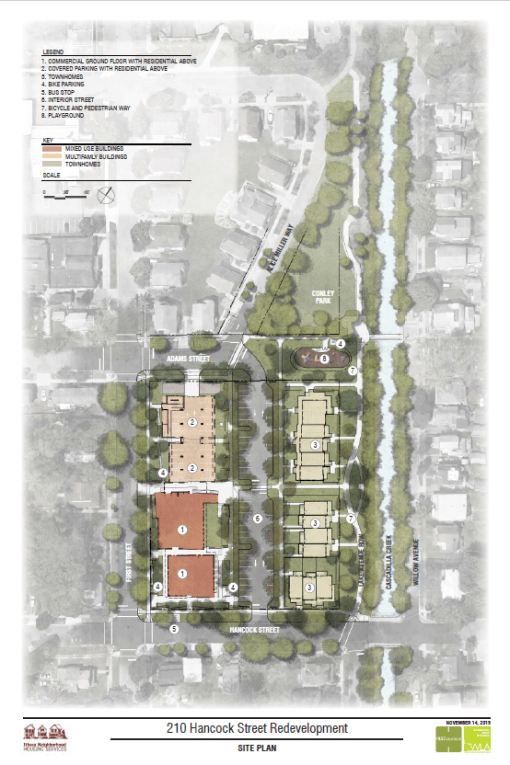
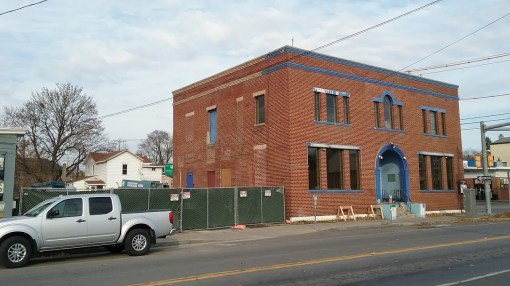
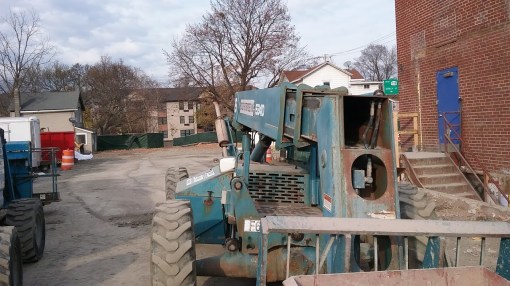
Plenty of progress at 210 Hancock. LeCesse has the foundation completed and the apartment building is out of the ground. The northern two segments have a parking garage on the first floor, hence the paving. Rebar poking out of the CMUs will tie into the steel structure. The southern two segments are a little further along. Steelwork is underway for both, with the first floor framed out. The southernmost structure, which will house the affordable daycare space, already has interior stud walls going up, as well as plywood with rough openings for doors and windows.

The five for-rent townhouses are much further along than I had anticipated. They are fully framed and it looks like tar paper is being applied to the rooftops. Looking at the sample wall at the corner of the property, there were a couple different housewraps in display – one was standard DuPont Tyvek commercial wrap, the other was Henry BlueSkin, which I’ve never before seen in a project around Ithaca. A little research suggests BlueSkin is a newer and more expensive product, but it seems to have its proponents. With fewer staples or button caps involved, it’s less labor-intensive to install, and less fastening comes with less of a risk of the vapor barrier being torn open and compromising its waterproofing abilities.

Both are fully synthetic plastic wraps with microscopic holes that allow moisture to breathe out without letting moisture in from the outside, preventing mold and wood rot. But in order for Tyvek to work effectively, all the joints and seams have to be taped tight to keep water from seeping in at the edges. Blueskin is created with an adhesive so that it doesn’t have to be taped down. However, BlueSkin still has to be fastened at window and door openings, the application surface has to be clean and dry, and it’s more difficult to apply in temperatures less than 40 degrees F – keep in mind, we’re at the onset of a northeast winter. I’m not sure which barrier will be applied where, but we’ll find out soon.
20161119_142839 20161119_142845 20161119_142917 20161119_142951 20161119_143026 20161119_143048 20161119_143138 20161119_143223 20161119_143351 20161119_143446 20161119_143453 20161119_143532 20161119_143604

20161119_143253

inhs_pride_design_v6_1 inhs_pride_design_v5_3 inhs_pride_design_v5_2 inhs_pride_design_v5_1


602 West State Street Construction Update, 11/2016

29 11 2016

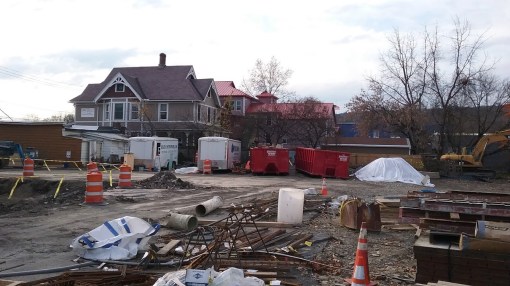
It’s been a busy period for construction starts. Elmira savings Bank has started work on their new branch office at 602 West State on Ithaca’s West End.

The project itself isn’t controversial. But the $1.75 million purchase in December 2015, followed by the very controversial eviction of three low-income families so that their homes could be turned into parking lots…well, that didn’t go over very well, nor should it have. Now with the chance to do some retrospective, it appears that the primary malefactor was the previous property owner, who signed new leases with the tenants but didn’t tell Elmira savings Bank when he sold them the properties. Elmira Savings Bank could have saved themselves many headaches if they had done some due diligence by meeting with the tenants of the properties they were purchasing, but, live and learn, sometimes the hard way.

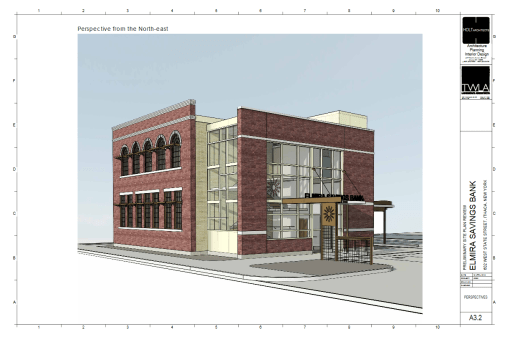
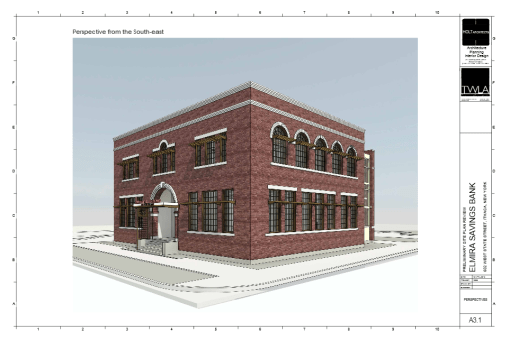
Plans call for renovating the 5,000 SF building that once housed the Pancho Villa restaurant, a 1,600 SF addition on the north side of the building, and a new drive-thru for bank customers. 16 parking spaces will be included. Edger Enterprises of Elmira will be the general contractor for the $1.7 million project, which is expected to be completed in March 2017. HOLT Architects, headquartered just across the street, is the design firm on record. The primary change during the review process was to limit the house demolitions – the board strongly encouraged ESB to find a partner to develop those lots rather than convert them to parking. At the moment, one of the houses has been torn down to make way for the drive-thru, but the other two will be left as-is and vacant for the time being.

The new addition will incorporate a limestone base, red brick similar to that of the existing structure, Alucobond anodic satin mica colored metal panels above and below the aluminum window curtainwall, and Hickman sandstone-colored metal roof coping. The blue painted brick will be restored to more historically accurate grey-green, and the bricked-in windows will be restored. Bronze-colored metal sunshades will be installed over the windows, and the steel drive-thru canopy will be the same color. The roof will be a white single-ply membrane.

In the construction photos, the new addition has had its foundation excavated and it looks like the concrete is in the process of being formed and poured, with subsurface utility lines poking out in the excavated, yet to be poured portion. The small windowless addition and fire escape on the western wall of the existing structure have been removed as the building advances through renovation – the first and second-floor doors will be replaced with appropriately-sized and historically-accurate windows to match the bricked-in window towards the front.

20161119_135025 20161119_135052 20161119_135127 20161119_135139 20161119_135150 20161119_135156 20161119_135215 20161119_135225

elmira_savings_v2

esb_1 esb_3-1


The Cherry Artspace Construction Update, 11/2016

28 11 2016

I don’t mind doing these summary posts – I just wish that several projects didn’t start in the same two month span.

The Cherry Artspace, to be located at 102 Cherry Street in Ithaca city, is a multidisciplinary theatre and arts venue planned by The Cherry Arts, a performing arts non-profit led by Artistic Director Sam Buggeln (Bug-ellen). The building is intended to not only house performances by The Cherry Arts, but other local and traveling theater groups, concerts, poetry and jam sessions, and just about anything else in the name of creative arts and artistic expression. The building will join Ithaca’s active and productive performing arts scene, including venues such as The Hangar Theatre and the State Theatre. College towns like Ithaca love their arts, be they visual, spoken or both.

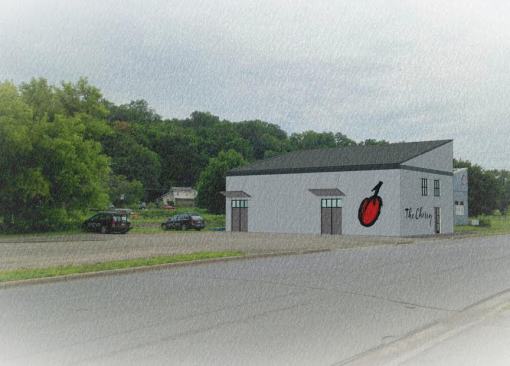
The plan is for a one-story, 1,900 SF space designed by local architect Claudia Brenner to blend in with the industrial architecture that comprises the Cherry Street corridor. To do this, the building is basically the big brother to the former Renovus Energy building next door – similar colors, similar materials, and a shed roof, which Renovus put on to make the 1,154 SF building more amenable to solar panels. The space on which it is being built previously housed parking spaces and a utility shed, since moved. Buggeln purchased the building and lot in August 2015 for $240,000, and the construction and furnishing costs for the Artspace are estimated at $375,000. The Cherry, which can host up to 180 patrons during performances, has a parking agreement with the business next door to use their parking spaces, and it works out since the two organizations will be busiest at different times of the day.

The approval process was a bit lengthy, all things considered. The city created its TM-PUD zone as a way to legally deter the Maguire car dealership proposal for the waterfront, but the Cherry Artspace fell into the waterfront zoning overlay as well, so it not only had to go through the Planning Board, but the Common Council. The Artspace held its public information meetings at the end of March and mid-April. It enjoyed fairly broad public support, but two of the eight voting councilmen still voted against its construction at the May meeting. One was concerned about noise, the other was kinda out of the blue. The project also had to apply for several zoning variances from the Board of Zoning Appeals.

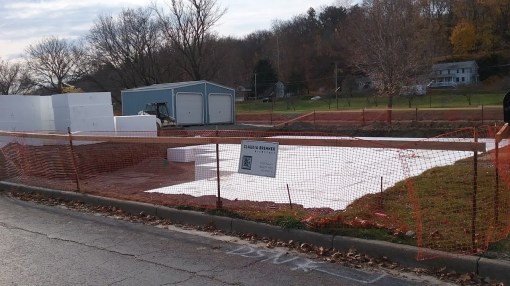
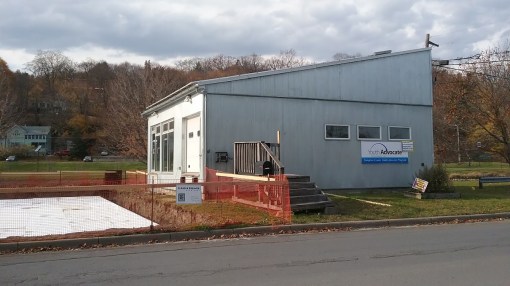
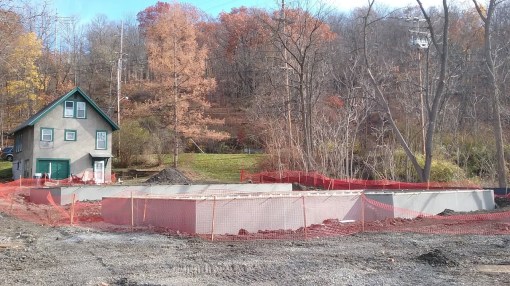
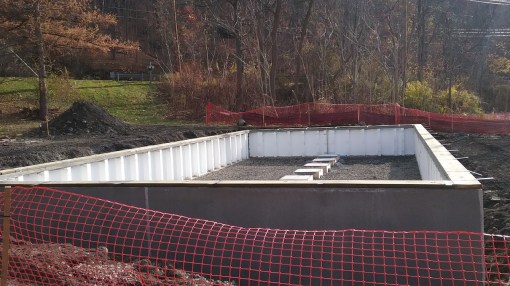
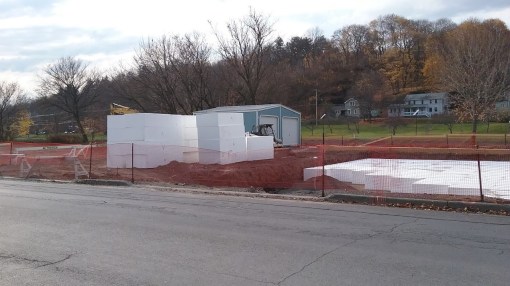
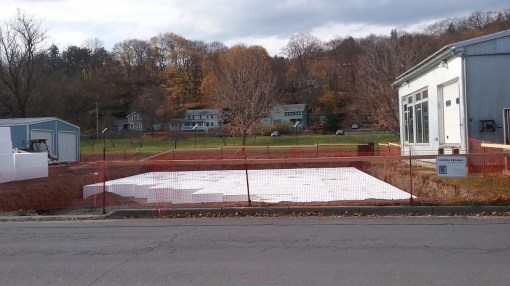
Construction on the Artspace officially began November 7th. This was a few months later than originally anticipated, and according to Buggeln it was due to contractor delays. I a rather unusual setup, that’s a slab foundation going in, but it’s made of styrofoam blocks – given the waterfront location and high water table, the relatively light building will “float” on top of the blocks.

20161119_134349 20161119_134359 20161119_134404 20161119_134409 20161119_134424

cherry_2


312-314 Spencer Road Construction Update, 11/2016

28 11 2016

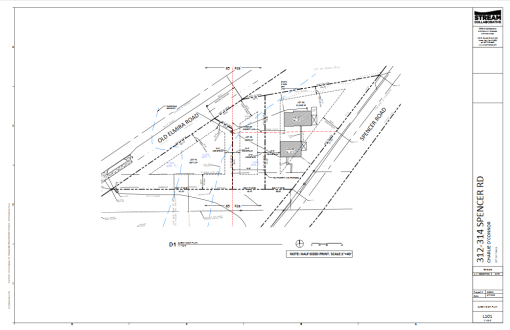
I’ll start off by saying I struggle with how to title this project. It has no official name, and the street address for the two new two-family homes has yet to be determined – presumably, they would be assigned addresses for the 200 block of Old Elmira Road. The developer, Charlie O’Connor of Modern Living Rentals, uses the address of the properties from which there were subdivided from – 312 and 314 Spencer Road, the two houses in the rear of the first photo.

Originally, 312 and 314 had three lots with some pretty unusual lot lines, but with .607 acres, there was a lot of unused backyard space, especially for city parcels. Seeing an opportunity, O’Connor negotiated a purchase agreement with property owner Giuliano Lucatelli, who ran a restaurant in the building adjacent to the houses (and perhaps a couple of readers remember Lucatelli’s Ristorante). With the benediction of the city, the project team consolidated the three parcels together, and then subdivided the newly-created parcel to create two buildable lots facing Old Elmira Road, and a third lot containing the two existing houses. The plans were approved back in June, and O’Connor officially purchased the houses and land for $193,000 in mid-July. On November 1st, the project received a $500,000 construction loan from local businessman Bryan Warren of Warren Real Estate. That would seem to cover most of the hard costs; the site plan review application estimated the construction cost at $513,000.

Plans call for two two-story houses with footprints of 23.5 feet by 48 feet (1,128 SF). Each floor will contain a three-bedroom, two-bath unit. The houses, designed by prolific local architect Noah Demarest of STREAM Collaborative, have been fashioned to blend into the early 20th century homes that comprise most of Ithaca’s South Side neighborhood – gable roofs, window bay projections, shake and lap siding, and modest porches. An earlier design shown on Modern Living Rentals’ website shows a larger and more contemporary window design on the buildings’ front faces, but it looks like that was scaled back to two more-traditional looking windows as the project went through planning board review.

To accommodate the new homes, some trees were removed, but as a mitigation measure, new trees will be planted closer to the street. The western tip of the properties intrudes into the 100-year flood zone, but that part should remain undisturbed. Each three-bedroom unit will have one parking space, in line with the city’s R-2a zoning (one space per three bedrooms).

An ad on Craigslist suggests the 3-bedroom units will be run for $1700 total, a premium price point as new units often are, but well below the prices that one would see in Downtown or Collegetown. Advertised features include stainless steel appliances, granite counter tops, in-unit washer/dryer, ample closet space and custom-tiled bathrooms. Parking will be in off-street gravel lots.

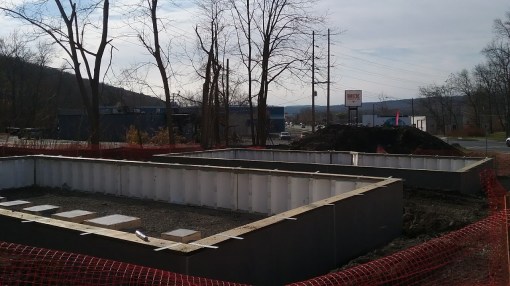
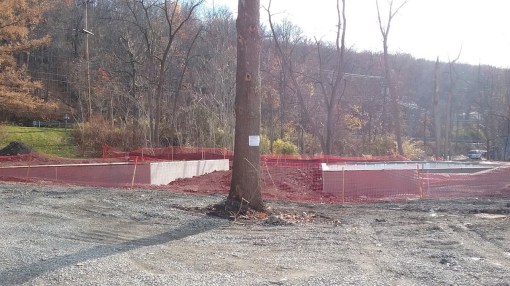
If the photos below are any indication, those tiled bathrooms and granite counter tops are still a ways off. The foundations have been excavated, formed and poured, but the framing has yet to begin. Subterranean utilities have been laid and prepped. Note that the foundation of the western house includes a bump-out for a window bay projection, but the eastern house does not.
20161119_125716 20161119_125729 20161119_125744 20161119_125800 20161119_125813 20161119_125831

312_spencer 312_spencer_2 312_spencer_3