News Tidbits 10/22/16: Seal of Approval

22 10 2016

201_college_v4_1

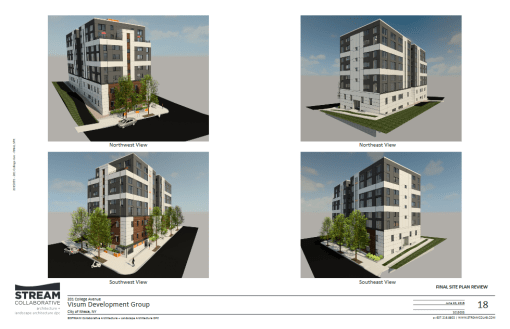
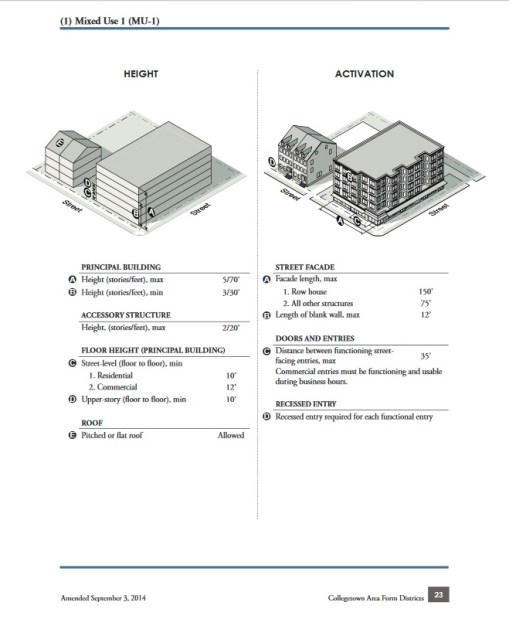
1. In yet another twist in the 201 College Avenue saga, the project will be moving forward. The Board of Zoning Appeals sided 3-1 with the city Zoning Director and denied the Planning Board’s consideration that the building be considered illegal due to facade length. According to a report from former Times reporter Josh Brokaw (now operating as an indy journalist),  the board was swayed by arguments of time and ambiguity in the code. Brokaw’s reading makes it sound like there’s still some raw feelings between staff and board. The way to solve the most pressing issue would be to clarify the code based on the facade debate, and have the common council ratify those changes over the next few months. All in all, the Form District code works pretty well, and a number of projects have been presented without big discussions over semantics. But in the case of 201, it’s clear that the CAFD wording and imagery could use further refinement, so that everyone is on the same page. With 201 resolved, now is a good time to do that.

Dunno what the completion date will be offhand (August 2017 would be a breakneck pace, but we’ll see). Neighbor Neil Golder has refiled his lawsuit, but the case isn’t especially strong.
elmira_savings_v2

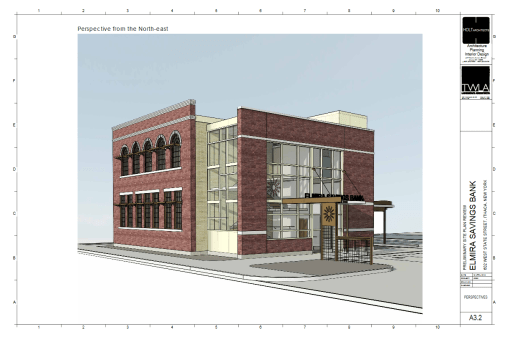
2. Also getting underway this week is the renovation of the former Pancho Villa restaurant at 602 West State Street into the West End branch of Elmira Savings Bank. This is quite a bit earlier than initially planned – Site Plan Review docs suggested a July-December 2017 construction/renovation. Edger Enterprises of Elmira will be the general contractor for the 6,600 SF, $1 million project, which is expected to be completed in March 2017.
evergreen_dryden_1

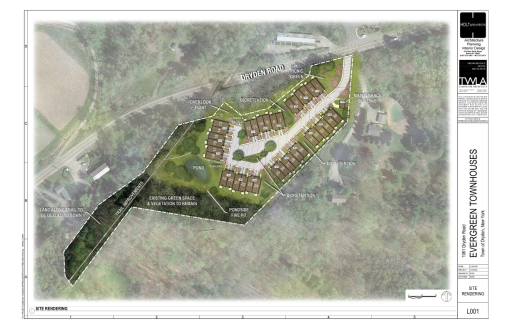
3. The Dryden town board has approved 4-1 the concept of the Evergreen Townhouses plan for 1061 Dryden Road just east of Varna. This means that they accept a PUD can be appropriately applied for the site, but the project will need to submit a formal, more detailed development plan before any final approvals will be considered. One of the major changes that is being requested is a 15-foot setback between the property line and the units at the southeast side of the parcel (25-36), so expect those to get a little trim off of the rear side (the dissenting vote, Councilwoman Linda Lavine, was because she preferred a 25-foot setback). If the setback and the other stipulations are accommodated, its chances of approval are pretty good. Developer and local businessman Gary Sloan has 270 days to submit detailed plans for review.

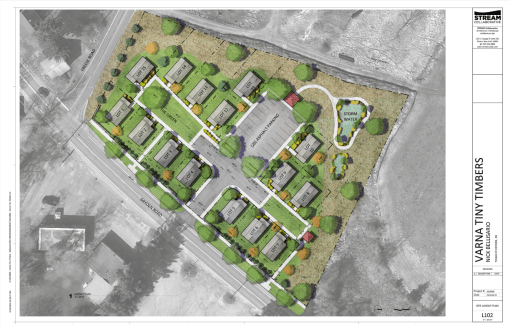
Meanwhile, Tiny Timbers will be up for Dryden Zoning Board of Appeals review in early November. Since an internal road will be used to access some of the home lots, the town board will be viewing the site as an “Open Development Area” (ODA), which by Dryden’s definition is development with no direct road access. The town board will hold their public meeting on the 20th to approve the ODA, the planning board’s acceptance on the 27th. The ZBA is the last or second-to-last step in the approvals process (not sure offhand if the town will need to vote again to give a final approval).

lansing_meadows_old

4. The senior housing next to the BJ’s in Lansing might finally be moving forward this spring. Dan Veaner has the full story here at the Lansing Star. The issue stems from working with the U.S. Army Corps of Engineers to determine what parts of the land can and cannot be developed – delineating the wetlands, basically. Apparently, the wetlands were created by an overflowing culvert back when the mall was built in the 1970s. But regardless of how they were created, the USACE deems they have to be protected, especially since it developed into a rare wetland environment called an “inland salt marsh”. Since then, it’s been back-and-forth on units – I’ve heard as few as 9 and as many as 18. A portion of the wetlands would still need to be relocated. The PDA boundaries were changed slightly by the board at the request of developer Eric Goetzmann earlier this month to accommodate the USACE determination. The tax break Goetzmann received to build BJ’s is contingent on the senior housing getting built, though at this point, one has to wonder just how much this wetlands tangle has cost him. Hope it was worth it.

maplewood_v7_3

5. From the sound of it, the Maplewood Park DEIS public hearing was fairly positive. Many of the neighbors are pleased with the changes, although some are still opposed to the density or have concerns about traffic. In response, it’s worth pointing out that the commute of Maplewood’s residents will almost entirely be bus, bike and foot during normal business/school hours, and its convenience to bus routes and services will also help minimize overall traffic impacts. As for density, well, if you want Cornell to house its students and reduce the burden on the open market, promoting density on the existing Maplewood site may result in a more sustainable, more cost efficient project if planned properly, with less of a neighborhood impact than building several hundred beds on an undeveloped parcel elsewhere (since the Maplewood site has been inhabited in some form since the 1940s, the growth in density would not be as prominent – about 490 beds, vs. 872 beds).

Should readers feel inclined, comments are still being accepted by town planners up until October 31st. The materials and submission email can be found here.

6. It looks like there were a couple big sales in the local real estate market this week. The first one was the Tops Plaza in big box land, just south of Wegmans. National retail developer DDR Corp. sold the property to another large firm, NYC-based DRA Advisors LLC, for $20 million on the 18th. The sale included three addresses – 710-734 South Meadow, 614 South Meadow, and 702 South Meadow – The Tops Plaza, The smaller strip to its south (called Threshold Plaza), and the pad parcels like Chili’s and Elmira Savings Bank. Perhaps the most notable part of this sale is that it’s slightly below the total assessed value of $20,941,000. However, DRA picked up the property as part of a bundle sale of 15 shopping centers in Western and Central New York, so maybe it was a bulk discount, or compensating for weaker properties.

The other big sale was between a long-time local landlord and a newer, rapidly growing one. The Lucente family (as Lucente Homes) sold 108, 116, 202 and 218 Sapsucker Woods Road to Viridius LLC for $1.276 million on the 18th. According to county records, each is a 4-unit building built in the 1970s and worth about $275k – meaning, Viridius just acquired 16 units for a little above the $1.1 million assessed. Viridius’s M.O. is to buy existing properties, do energy audits to determine what needs to be done where to maximize energy efficiency, disconnect them from fossil fuel heating and energy sources, install pellet stoves, heat pumps and the like, renovate/modernize the properties, and connect the more efficient house to a solar grid or other renewable energy sources. If Sustainable Tompkins were a developer, they’d look like Viridius.


7. This last one isn’t so much a big sale, but worth noting for future reference – 126 College Avenue sold for $510,000 on the 19th. The buyer was an LLC at an address owned by Visum Development’s Todd Fox.

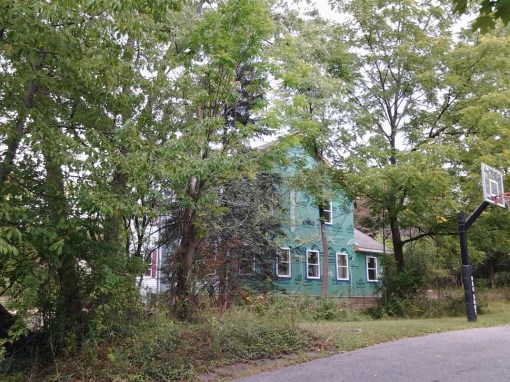
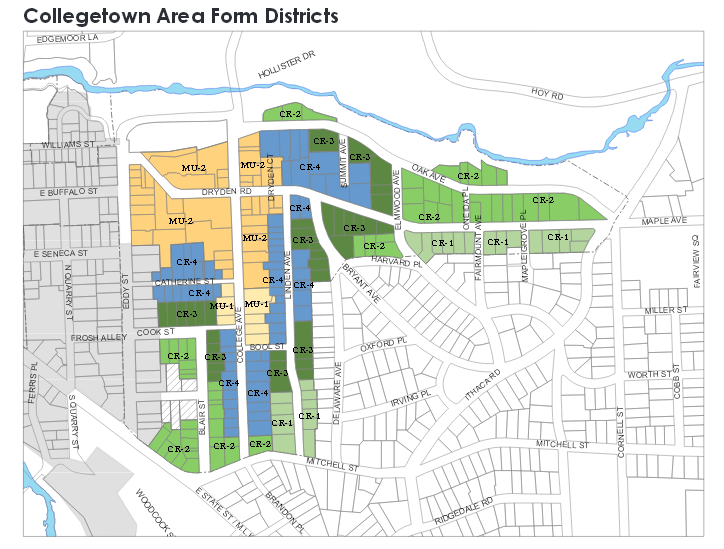
126 College is a 2-story, 6-bedroom house that might have been attractive long ago, but someone’s beaten it with an ugly stick and paved much of the front lawn (growing up near Syracuse, we called paved front lawns “Italian lawns”, with my uncle one of the many offenders). The purchase price is a little below the asking price of $529k, but more than double the assessment. Zoning at the property is CR-4 – up to 50% lot coverage, 25% green space, up to 4 floors and 45 feet in height, a choice of pitched or flat roofs, and required front porches, stoops or recessed entries. This is the lowest-density zone for which no parking is required. The city describes the zoning as “an essential bridge” between higher and lower density, geared towards townhouses, small apartment buildings and apartment houses.

Granted, not everything Visum/MLR does is new, some of their work focuses on renovation. But given the location, and given that frequent design collaborator STREAM had “conceptual” CR-4 designs on display during the design crawl earlier this month, it’s not a big stretch of the imagination.
city_centre_v3_2

8. Interesting agenda for the city planning board next week, if nothing new. Here’s the schedule:

AGENDA ITEM                 APPROX. START-TIME

1. Agenda Review                6:00
2. Privilege of the Floor         6:01

3. Subdivision Review
A. Project:  Minor Subdivision           6:15
Location: 404 Wood St.
Actions: Consideration of Final Subdivision Approval
A minor subdivision to split a double-lot in Ithaca’s South Side neighborhood into two lots, one with the existing house and one that would be used for a new house or small apartment building. A variance for an existing rear year deficiency of the house would need to be approved (the rear deficiency wouldn’t be affected by the new lot which is on the east side, but it’s a legal technicality).
B. Project:  Minor Subdivision             6:25
Location: 123 & 125 Eddy St.
Actions:  Consideration of Final Subdivision Approval
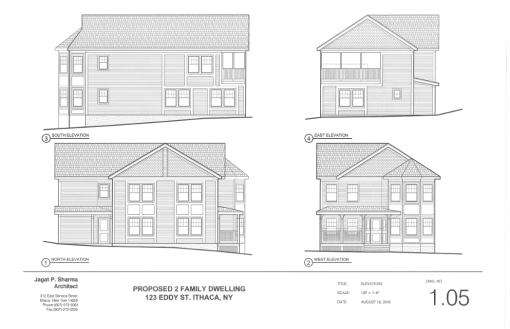
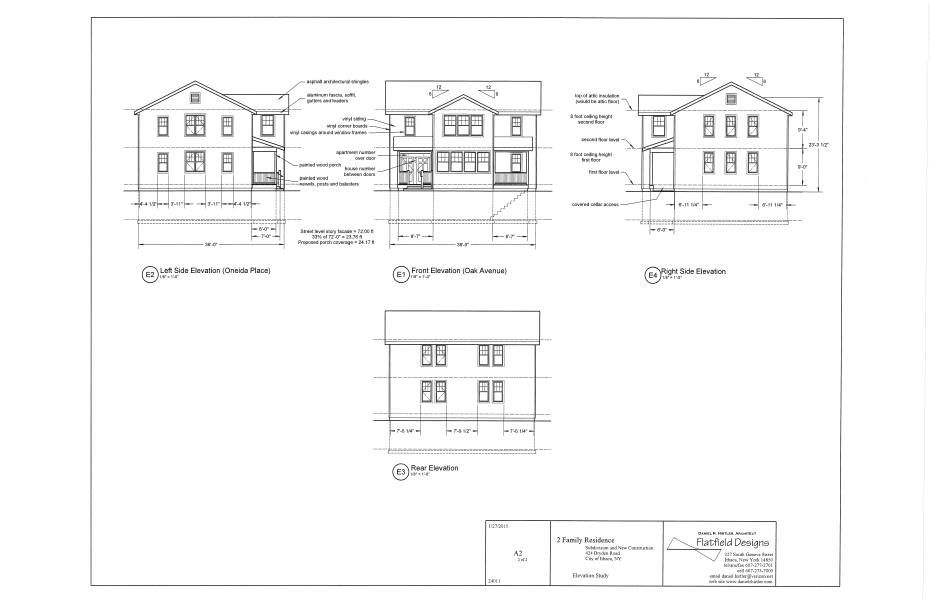
Collegetown landlord Nick Lambrou is planning subdivision of a double lot to build a new 2-unit, 6-bedroom house designed to be compatible with the East Hill Historic District. CEQR has been given neg dec (meaning, all’s mitigated and good to proceed), and zoning variances for deficient off-street parking have been granted.
C. Project:  Minor Subdivision                6:35
Location: 1001 N. Aurora St. (Tax Parcel # 12.-6-13)
Actions:  Consideration of Final Subdivision Approval
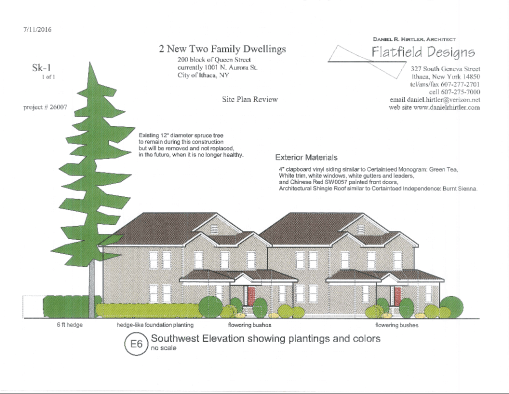
One of those small infill builds, this proposal in Fall Creek takes down an existing single-family home for two two-family homes on a subdivided lot. The design has been tweaked, with more windows, a belly band, more varied exterior materials, and additional gables to provide visual interest.

4. Site Plan Review

A. Project:  City Centre — Mixed Use Project (Housing & Retail)           6:45
Location: 301 E. State/M.L.K., Jr. St.
Applicant: Jeff Smetana for Newman Development Group, LLC
Actions:  Declaration of Lead Agency  │ Review of Full Environmental Assessment Form (FEAF), Part 2

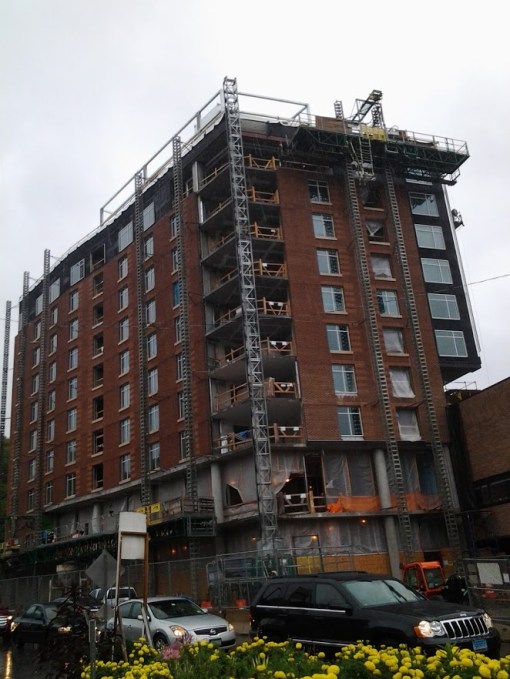
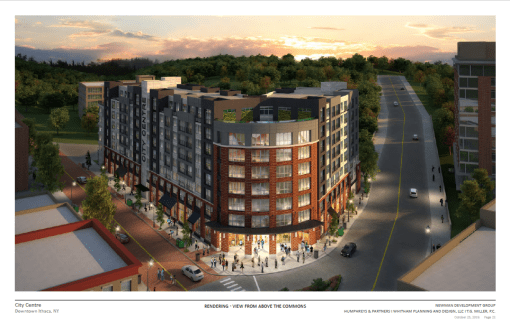
The 8-story mixed-use proposal for the Trebloc site. Comes with one letter of support, and a letter of opposition from Historic Ithaca, who have previously stated they will oppose anything greater than four floors on State Street, and six floors overall.
B. Project:  Amici House & Childcare Center            7:15
Location: 661-701 Spencer Rd.
Applicant: Tom Schickel for Tompkins Community Action (“TCAction”)
Actions: No Action — Review of Full Environmental Assessment Form (FEAF), Parts 2 & 3
C. Project:  Four Duplexes                               7:30
Location: 607 S. Aurora St.
Applicant: Charles O’Connor
Actions:  Declaration of Lead Agency  │ PUBLIC HEARING  │ Review of FEAF, Part 2
MLR’s four-building, 8-unit plan for South Hill. Comes with a letter of neighbor support saying the scale is appropriate.
D. 371 Elmira Rd. (Holiday Inn Express) — Approval of Project Changes      7:45
The debate over the Spencer Road staircase and rip-rap continues.
E. 312-314 Spencer Rd. — Satisfaction of Conditions: Building Materials   7:55
F. 119, 121, & 125 College Ave. (College Townhouse Project) — Update        8:05
Novarr’s 67-unit townhouse project geared towards Cornell faculty. No decisions planned, just an update on the project. Keeps your fingers crossed for some renders.
G. Maplewood Redevelopment Project — Planning Board Comments on Draft Generic Environmental Impact Statement (DGEIS)     8:20
The city’s deferred judgement to the town, but the board can still have their say. The comments will be recorded and addressed as part of the EIS review process.
5. Zoning Appeals                          8:35
• #3047, Area Variance, 123 Heights Court
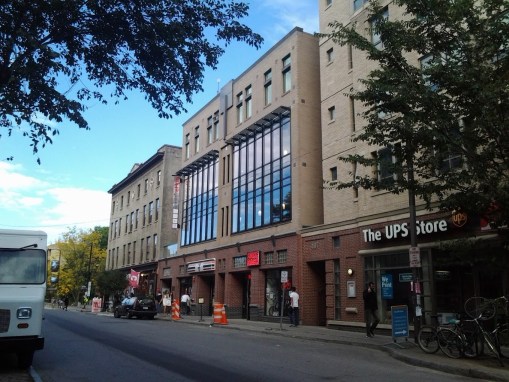


409 College Avenue (Student Agencies eHub) Construction Update, 10/2016

17 10 2016

With all these Collegetown projects wrapping up over the past few months, I may need to re-balance my update schedule. The Student Agencies renovation is complete and eHub has opened. I intended to take a few interior photos, but the staff on the first floor were tied up with several other visitors, so I moved on to the next site.

I think the real benefit to this project isn’t so much the renovation as those who are occupying it. eHub is meant to encourage student entrepreneurs. They may migrate to Rev, they may be successful and grow their business locally, adding local jobs and helping to diversify the local economy beyond meds and eds.

For example, the tech startup Rosie was launched in 2012 by Cornell students, and was housed in eHub’s eLab space. After they graduated, the founders migrated to Rev, and have since migrated to office space on the Commons. Today, the company employs 21 people locally (26 total), with more hires planned. Another eHub “grad”, FiberSpark, has stayed local and provides the fastest internet service in Ithaca. Not all the companies are successful, and not all the successful companies stay in Ithaca. But if even a portion of them survive and thrive here, than that’s a real asset for the community. I look forward to seeing what an expanded program will cultivate.

20161007_155339 20161007_155357 20161007_155416


205 Dryden (Dryden South) Construction Update, 10/2016

16 10 2016

205 Dryden is practically finished from the outside. There may still be some work on interior finishes for spaces like the basement gym. It appears that the decorative pre-cast concrete crown has been modified, so that of a slightly projecting cornice, the crown is flat. That might be the result of value engineering, the rush to have the building finished, or both. The exterior wall facing the College/Dryden intersection might seem a bit stark, but chances are, that corner will be the site of its own construction project at some point in the near future. Photos of the furnished rooms can be found on the project’s website here.

20161007_155245 20161007_155313 20161007_160313

205_dryden_-_rendering


209-215 Dryden Road Construction Update, 10/2016

14 10 2016

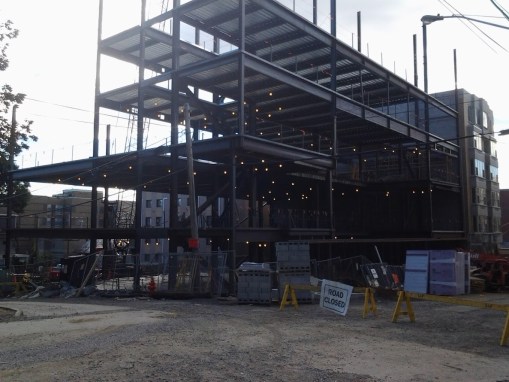
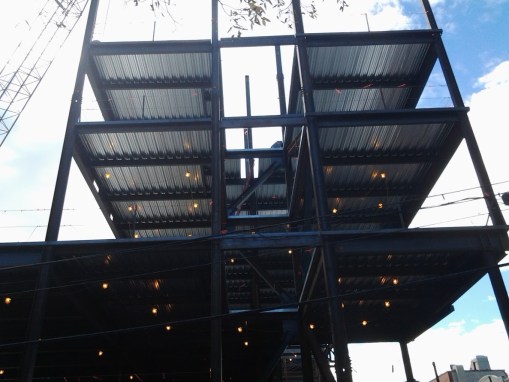
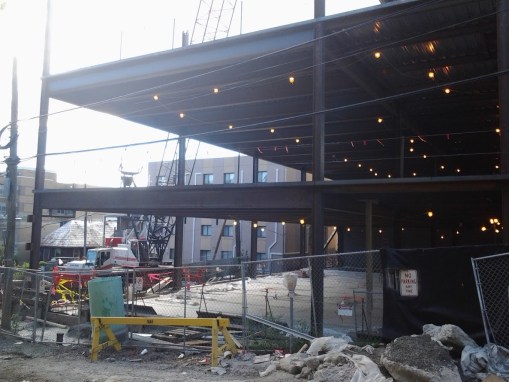
With the rise of the structural steel, 209-215 Dryden Road (aka the Breazzano Family Center for Business Education) is starting to make a significant dent in the Collegetown skyline.

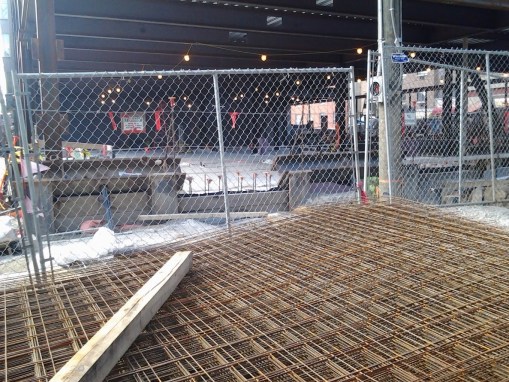
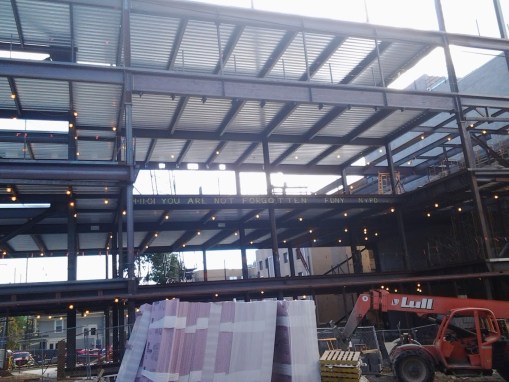
The floorplates are up to the fourth level, and the vertical steel columns indicate just how tall the building will be when the steel skeleton is built out. The concrete floor has been poured on the ground level, and corrugated steel decking has been laid on the upper floors – note that only the first and second floors have reached their full dimensions, the upper floors are waiting for the delivery of additional steel columns and cross beams for the crane to hoist into place. The sheets of wire grid seen outside the fence are for future concrete floor pours, providing strength and rigidity for the concrete, just as rebar does for foundations.

The large gap in the front of the building is the multi-story atrium space – the lower three floors are academic class space, while the upper three floors are academic office functions for the Cornell Executive MBA program. The smaller gap towards the north (right) side is for a stairwell.

Nice touch with the subtle commemoration of 9-11 emergency responders. It’s not uncommon to see these tributes when steel work is underway during the fall.

20161007_154941 20161007_155001 20161007_155014 20161007_155017 20161007_155050 20161007_155054 20161007_155100 20161007_155116 20161007_155139 20161007_155206 20161007_155234 20161007_155255

209-215_2 209-215_basement


News Tidbits 10/8/16: No Rain, But the Money’s Flowing

8 10 2016

sleep_inn_v2_1
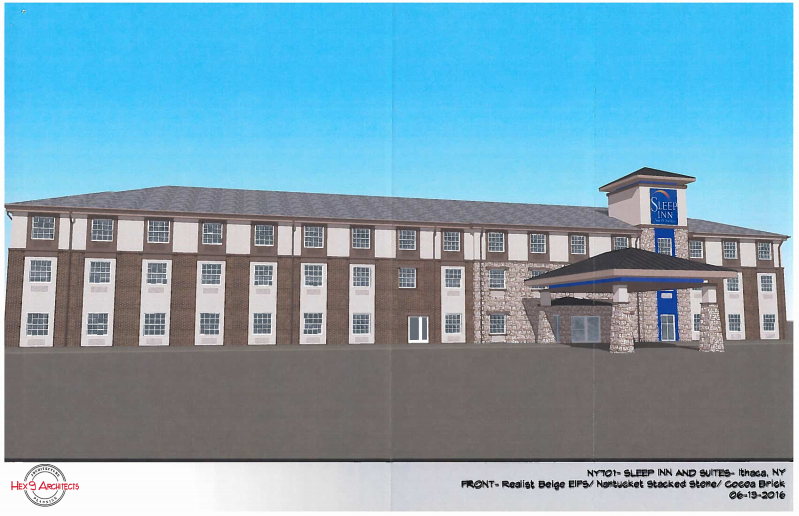
1. The Sleep Inn project at 635 Elmira Road went back to the town of Ithaca planning board last Tuesday. The initial write-up looked good – town planners were very pleased with the proposed changes, and the developer, local hotelier Pratik Ahir, proposed two different concepts to the board to see which one they were more comfortable with. The one that the board likes would be finalized in the plans and submitted for final approval later this year. No media were at the meeting, so I do not know which concept they preferred.

Both concepts by HEX 9 Architects attempt to maintain the rustic character that the town seeks to maintain for its part of the Inlet Valley Corridor. Concept one at top uses stone veneer (Elderado Stone), timber trusses, Hardie plank lap siding, and asphalt shingles. This design features balconies on both the front and rear of the building. Concept 2 incorporates a more varied roofline and building face, metal roof panels, stone veneer and a couple different types of Hardie Board. Concept 2 has less timber and no balconies. The town planning department felt that both concepts were unique enough and rustic enough to get its benediction in the SEQR analysis they sent over to the board. The concepts are a big improvement over the rendition we saw in August.

canopy_comparo_elevations_new_2
2. Looks like the Canopy Hilton is a go. The project secured a $19.5 million construction loan from ESL Federal Credit Union on Friday September 30th. ESL is a new face to the local market – “Eastman Savings and Loan” was founded in Rochester in 1920 to serve employees of former photography giant Eastman Kodak. The 7-story, 131-room hotel is expected to open in Spring 2018.

57e13f
3. Also funded this week – the second phase of Poet’s Landing out in the village of Dryden. Citibank is lending $7,702,326 to Rochester-based Confier LLC to build the 48 affordable apartment units across the street from Dryden High School, just west of 72-unit phase one. The documents were filed on Tuesday the 4th. The design of the second phase’s will be the same as phase one’s, an eight unit per building design by NH Architecture that is one of Conifer’s standard designs. The total project cost is $10.8 million, with the balance come from state affordable housing grants and tax credits. The build-out is expected to take about a year.

201_college_v5_1

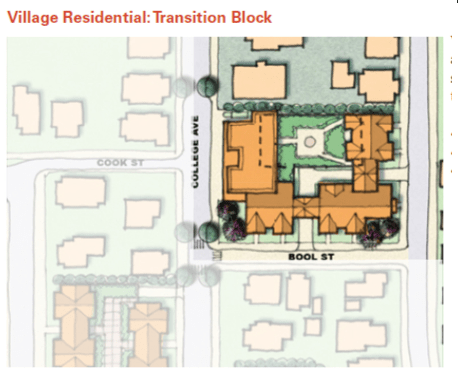
4. So a few news bits about 201 College. The partially-deconstructed house at 201 College is now getting torn down, which had nothing to do with approval, and everything to do with break-ins and safety issues – there was evidence of squatters taking up residence, and the expense of a tear-down is worth avoiding a lawsuit or tragedy. Speaking of which, although a ruling on 201 College has yet to be issued and won’t be for a few weeks, Neil Golder’s lawsuit has already been re-filed. The court hearing is scheduled for December. According to an exchange with my colleague Mike Smith, Fox is planning rowhouses along Bool Street, within a 45-foot height limit but spanning the block, as it seems he has a purchase option on neighboring 202 Linden.

20161007_131502

5. According to Nick Reynolds at the Times (yes, he jumped papers), the buildings to be deconstructed for the Harold’s Square project are to be vacated by the end of October. Developer David Lubin plans to start the deconstruction process, which is a little more intensive and lengthier than a typical demolition, in November. Things have been complicated by the city’s decision to forego the project in the Restore NY grant application, where the $500,000 was allocated to pay for demolition, and must now be sourced from elsewhere. Once secured, the plan is to file for the permit, and by law they have up to 30 days to start deconstruction from the day the permit is issued. Construction should go for about 18 months, once the site is cleared.

607_s_aurora_2 607_s_aurora_1

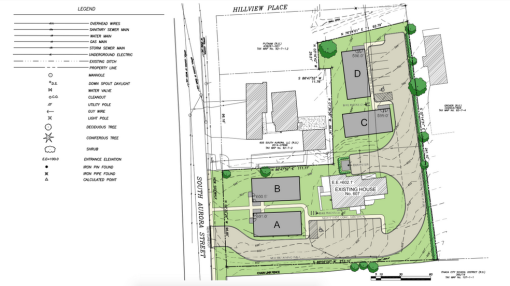
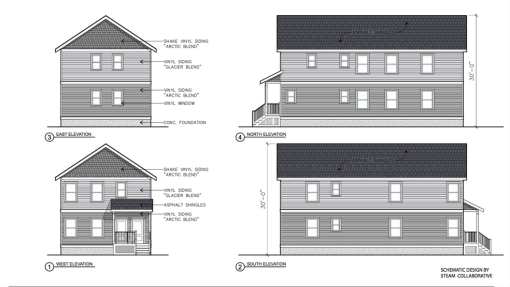
6. The 8-unit 607 South Aurora project will be seeking “Declaration of Lead Agency” at the Planning Board meeting, and materials have been filed with the city. Project narrative here, SPR application here, drawings here. The big changes since sketch plan were sidewalk and parking lot revisions, and rotating Building D to establish harmony with Hillview Place. The project is estimated to cost $1.5 million and aims for a construction timeline of March to September 2017. This is the next incremental step up for Charlie O’Connor of Modern Living Rentals, whose M.O. is to quietly pursue modestly-sized infill projects in less dense parts of the city (ex. the two duplexes planned for 312-314 Old Elmira). In a change of pace, the staff of Sharma Architecture are the designers this time around.

123_eddy_street_2

7. From the Board of Zoning Appeals meeting, the new two-family house at 123 Eddy Street has been granted zoning variances. Expect the Sharma-designed two-unit, six-bedroom rental property to start construction next year in time for the 2017-18 academic year.

20160918_155855 20160918_155910

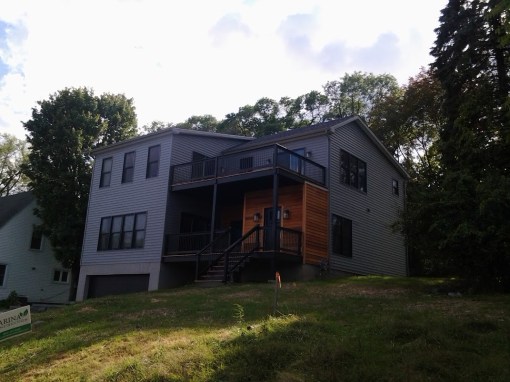
6. House of the week. Instead of one underway, this week will show two recent completions. Leading off is this house on West Hill’s Campbell Avenue, built by Carina Construction. This project came up in a weekly roundup back in late May – it’s a $320,000 project per the permit filing with the city, with $280,000 lent by Tompkins Trust. The contrast between the wood siding and the (fiber cement?) vinyl siding is a nice touch, as is the two-story porch. Definitely a unique house, and a showcase of just what kind of variety one can do with modular pieces if they’re willing to get creative.

20160918_162315 20160918_162648

Now for house number two. This isn’t a new build, but a very thorough renovation. Every time I take photos, I run into the owners, and normally I try to be as unobtrusive as possible. But, given that I’ve run into him twice, he’s familiar enough with me that we’ve had a conversation about his work.

20160109_151921

This is in Fall Creek on North Aurora. The couple who own this place moved in from Pennsylvania, they were just starting retirement when the wife’s father was no longer able to take care of it. It had been a duplex, but the other unit was more workshop space. The building was in good shape, but these folks wanted to modernize and refresh it, so they decided to do a to-the-studs renovation, basically turning it into a new home within an existing shell. Fiber cement, wood shingles, a few modern touches (the south bumpout, the unusual gable/shed hybrid dormers), a carriage house, a lot of work went into it over the past year and a half and it shows.


Collegetown Terrace Construction Update, 9/2016

29 09 2016

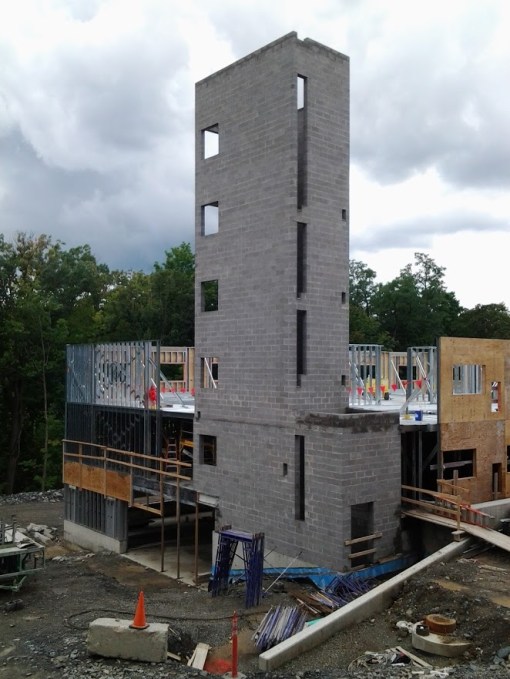
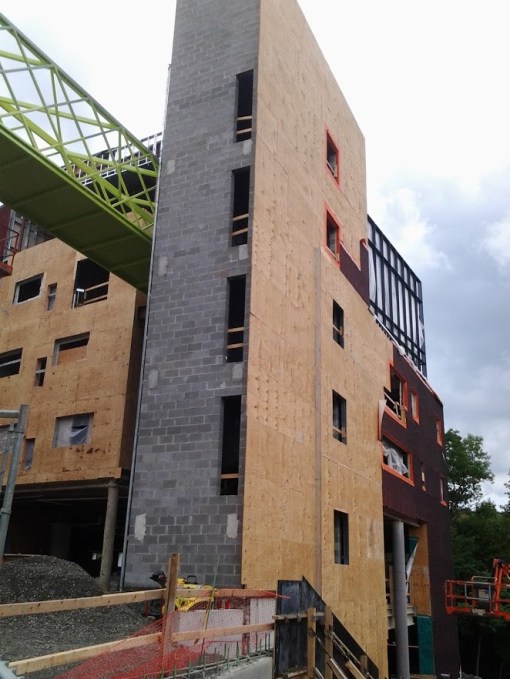
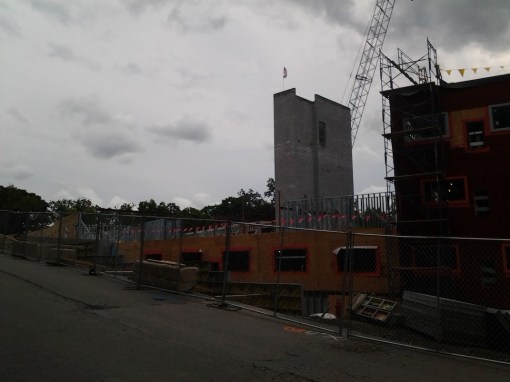
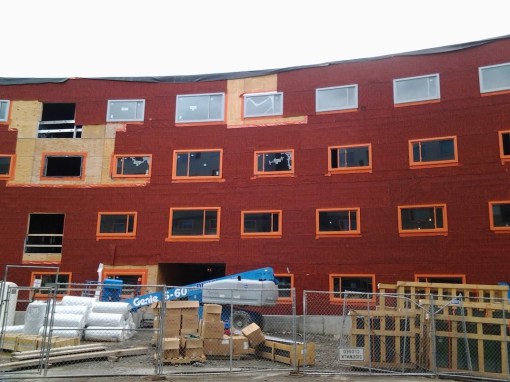
Novarr-Mackesey‘s curvilinear Collegetown Terrace is one of those projects that’s so big, we can see multiple steps of the construction process at once. In general, the further west one goes, the further along the building is. On the east end, the stairwell and elevator shaft stand high above the framing underway. Steel exterior stud walls are being sheathed with plywood with rough openings for windows. Some of the interior steel stud wall framing can be seen as well. In the next section further west, the framing and sheathing are further along, but still a few floors short of the stairwell/shaft. Some structural steel, which separates groups of units, is present as well. The westernmost third is fully framed and mostly sheathed, enough that the maroon-colored waterproof barrier has been applied to the plywood in most places, and windows have been fitted into many of the rough openings.

Continuing west, we come across the “fish scales” – yes, for better or worse, they’re going on Building 7, likely topped by the aluminum metal walls previously seen in Phase II. The side facing thr gorge has the same linear earth-tone facade that is present on Building 5. The westernmost end of the building is not a little further behind, possibly for ease of materials transport, or because of different architectural details that they have yet to bring to the site (based on the rough openings and the sheathed steel, both are plausible). It looks like the southwest corner will host a glass curtain wall section setback from the primary walls, based off of the steel framing.  An early render suggests the common spaces will be clustered along the west end of Building 7. Note that parking will be on the lowermost two floors, with dorm style units on the third floor, and regular apartment units on the upper three floors. The wood forms next to the western stairwell/shaft look to be for a new concrete staircase that will run alongside the west wall.

Montour Falls-based Welliver is in charge of the build-out, and CTT7 should be complete and ready for occupancy by August 2017. Princeton’s ikon.5 Architects are the building designers, and Baltimore’s Floura Teeter the landscape architect. Big league commercial real estate financial lender Walter & Dunlop Inc. provided the $70 million bridge loan.

A quick google search turns up a surprising number of AirBnB hits.

20160918_141746 20160918_141751 20160918_141758 20160918_142023 20160918_142027 20160918_142040 20160918_142046 20160918_142129 20160918_142148 20160918_142409 20160918_142442 20160918_142518 20160918_142738 20160918_142928 20160918_142944 20160918_142952


News Tidbits 9/24/16: The Implicit and the Explicit

24 09 2016

tiny_timbers_1

1. Over in the town of Dryden, it looks like Buzz Dolph and STREAM Collaborative’s Tiny Timbers project is up for preliminary approval. The site plan hasn’t changed much, just slight modifications for a dumpster/recycling enclosure and a bus pull-off. However, the home options have been expanded a bit. There will be five options, ranging from a 1-story 525 SF home starting at $99,500, to a 1,050 SF model priced at $184,500. Design specs (flooring, finishes, HVAC) can be found here.

Along with Tiny Timbers, Dolph is planning a similar, smaller project near his house on Quarry Road in Dryden town. That $800,000 project, called “Quarry Ridge Cooperative“, consists of two duplexes (four units), all owner-occupied. The homes will be connected to a shared driveway and carport through breezeways. Back of the envelope calculations suggest these units will be around 1,000 SF each. The 2.26 acres will be collectively owned by the four homeowners.

2. On a related note, another sister project to Tiny Timbers is being prepped for a site on the city’s portion of West Hill. Dolph et al. are looking to do a similar development to the one in Varna on a 5.45 acre parcel at the south end of the 400 Block of Campbell Avenue, which was noted in a weekly news roundup when it hit the market back for $195k in August 2015. The Journal’s Nick Reynolds touched on it in a through write-up he did earlier this week. The comprehensive plan calls this portion of West Hill low-density residential, less than 10 units per acre. Current zoning is R-1a, 10000 SF minimum lot size with mandatory off-street parking, although maybe a cluster subdivision would come into play here. The Varna property is a little over 6 units per acre. If one assumes a similar density to the Varna project, the ballpark is about 35 units, if sticking to the 10000 SF lot size, then 23 units.

On the one hand, expect some grumbling from neighbors who won’t be thrilled with development at the end of their dead-end street. On the other hand, these small houses are modestly-sized and priced, they’ll be owner-occupied, and if the Varna site is any indication, the landscaping and building design will be aesthetically pleasing.

201_college_v5_1

3. I dunno if I’ve ever seen such strenuous contention between the planning board and the city’s planning department. The planning board’s objected to Zoning Director Phyllis Radke’s determination that the project is legal per the Form District MU-1 Zoning.

The document put forth by John Schroeder and approved by the board rests on the following interpretations:
-in cases where the zoning isn’t explicitly stated in denser zones, it should rely on what is stated in less dense codes, and interpretations of the introductory “purpose and intent” section of the code, which qualifies similarities of form and scale if the numbers and dimensions for facade length aren’t explicitly stated.

-The argument also draws debate towards the unstated but implied interpretation of street facade, which refers to the building’s primary face, vs. building facades facing both streets. The board’s filing argues that the Bool Street facade was intended as a primary facade early on.

cafd_mu1

-Unlabeled parts of the diagram, such as MU-1’s, have no meaning. Even if they could give the impression of longer facades, it’s not the intent of the code.

The document goes on to say that Radke “invented claims unsupported by the text”, uses “tortured logic” and “silly conclusions”. Ouch.  Since interpretation is not a cut-and-dry matter of clear definitions, so we end up with an argument from both sides that relies on an interpretation of ambiguities, something more akin to a court room. A curious result of this discussion is that the Planning Board had to send out a letter to neighbors saying they would be arguing zoning determinations, which are going to be far out of most readers’ expertise, as the precise details and intent of the 2014 zoning will be the primary driver of this debate.

20160821_134831

4. The Ithacan is reporting a mid-to-late October opening for the Marriott, the Journal is reporting November. Presumably, one of them is correct. The delay from the original August opening is attributed to a labor shortage. Hiring is currently underway for the 159-room hotel and its restaurant, which according to the IJ, are expected to employ 50 to 60 in total. About 75% will be full-time, and wages are expected to run from $10/hr + tips for wait staff, to $18-$19/hour, with the hope that a premium paycheck compared to similar positions at other local hotels will translate to a premium experience for guests.

tc3_daycare

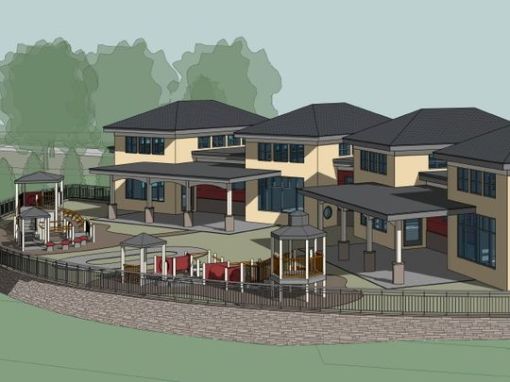
5. It looks like TC3’s Childcare facility is well on its way to reality. At least $4.5 million has been secured for the $5.5 million project and its scholarship endowment for students with children. $2.5 million for that was recently received in a set of state grant and funds, according to WHCU. Another $2 million comes from benefactor Arthur Kuckes, for whom the new facility will be named.

20160918_141051 20160918_141131

6. It’s been a while since I’ve done house of the week. So, here’s a new house underway on the 200 Block of Pearl Street in the city’s Bryant Park neighborhood. Ithaca’s Carina Construction is doing their modular magic here, the pieces have been assembled and most of the siding and roof trim has been attached. Not 100% sure if there will be a porch, the lack of siding above the door suggests it’s a possibility.

To be honest, when I was going through my list of single-families underway, I was mostly finding that Carina dominated the list. Since Avalon Homes went under, and most stick-builds are beaucoup bucks due to higher labor and materials costs, Carina’s offerings have broad appeal in Ithaca’s isolated, tight home market.

The lot was created four years ago by a subdivision of 222 Miller across the street. Since then, it exchanged hands a few times before a local realtor sold the property for $130,000 in July to a family who relocated to the area from Texas.

119_125_college_avenue

7. The Planning Board Agenda is up, and it’s the shortest in ages, thanks to that special meeting last week. Here’s the rundown:

1.  Agenda Review                                                      6:00
2.  Privilege of the Floor                                              6:01

 3.  Subdivision Review

A. Project:  Minor Subdivision                                      6:15
Location: 404 Wood St.
Actions: Declaration of Lead Agency  – PUBLIC HEARING – Determination of Environmental Significance – Recommendation to BZA

A minor subdivision to split a double-lot in Ithaca’s South Side neighborhood into two lots, one with the existing house and one that would be used for a new house or small apartment building. A variance for an existing rear year deficiency of the house would need to be approved (the rear deficiency wouldn’t be affected by the new lot which is on the east side, but it’s a legal technicality).
B. Project:  Minor Subdivision                                          6:30
Location: 1001 N. Aurora St. (Tax Parcel # 12.-6-13)
Actions: Declaration of Lead Agency – PUBLIC HEARING – Determination of Environmental Significance
Touched on this one last week. Deconstruction of an existing single-family home for two two-family homes, each on its lot.

4. Site Plan Review

A. Project:  Two Duplexes                                              6:45
Location: 1001 N. Aurora St. (Tax Parcel # 12.-6-13)
Applicant: Dan Hirtler for Stavros Stavropoulos
Actions: Declaration of Lead Agency – PUBLIC HEARING – Determination of Environmental Significance – Consideration of Preliminary & Final Site Plan Approval

B. SKETCH PLAN:  Townhomes & Apartments at 119-121 & 125 College Ave.        7:00

I’ve spilled some electronic ink on this project before – Novarr’s $10 million project for faculty townhomes and apartments. Rumor mill says “modern-looking” and “glassy”, which given Novarr’s fondness for ikon.5 architects (his guest house is on the main page of their portfolio), that isn’t a surprise. The three parcels are CR-4 zoning, so 4 stories and 50% lot coverage allowed. Previous estimates were for 50-60 units. I’d say the biggest uncertainty in approvals comes from the existing apartment houses, which haven’t been declared historic, but former councilwoman Mary Tomlan and the Planning Board’s John Schroeder recommended for consideration in 2009 (only 15 of the 31 suggestions were considered, and only 2 received historic designation, Snaith House and Grandview House). Novarr’s been amenable to compromises before (see Collegetown Terrace), so we’ll see what happens here.

5. Zoning Appeals
• #3044, Area Variance, 170 Pearsall Pl.
• #3046, Area Variance, 404 Wood St.
• #3048, Appeal of Zoning Determination, 201 College Ave.                                 7:30


News Tidbits 9/17/16: Point By Point

17 09 2016

maguirebirdseye-620x420
1. Starting this week off with the Maguires again. Although there was significant vocal opposition from planning committee members to the proposal, they decided to postpone the decision for another month. It would have been more merciful and understanding if they had just declined to continue, but the committee voted 4-1 against making a decision at their Wednesday night meeting, citing to need to process public comment. Most of the comments in favor of the proposal mostly spoke highly of the Maguires as employers and economic drivers (and even some of the opposition did as well), most of the opposition focused on the plan not meshing with visions for what they want the neighborhood to become. The board will consider a resolution against the project next month, but it sounds like the decision has already been made.

201_college_v5_1

2. This will be something of an unusual month. Along with the typical retinue of meetings, the Planning Board will have a special meeting next week to weigh in on the next round of Chain Works District EIS public comments, approve some slight revisions to 210 Hancock, and zoning determination for 201 College Avenue.

inhs_pride_design_v5_4 inhs_pride_design_v6_1

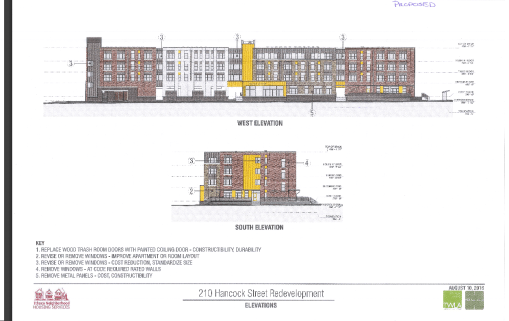
The changes to 210 Hancock are noticeable but minor. On the landscaping side, the concrete curb around the playground is proposed to be removed as a cost-saving measure, a fence separating the for-sale and for-rent townhouses will be removed and a fire lane put in, and the Lake Avenue paving will be changed up to match the waterfront trail. For the buildings, the 54-unit apartment building would have some windows tweaked or removed to standardize sizes (reduce cost) and fire safety concerns, and some of the yellow metal panels would be replaced with brick for cost and ease of installation. No changes are proposed to the townhouses.

As for 201 College, City Zoning Director Phyllis Radke issued a determination that 201 College is compliant and permitted by MU-1 zoning. She also states a number of concerns with the Planning Board’s handling of the review. Among the reasons cited are:

  • Pre-site plan review in November 2015 by zoning and planning concluded the project met CAFD guidelines.
  • Facade isn’t defined in the CAFD document. Building length and facade length can be interpreted as two separate measurements.
  • Facade length did not come up as a concern until July, four months after meetings began, after design review by the board, and after prelim site approval had been granted.
  • The building meets the conceptual guidelines provided in the zoning. While there are concerns about (yet unwritten) design standards and activation of both street facades, there’s nothing in the code for MU-1 that explicitly limits facade length on any side other than the primary face. There is, however, in MU-2. So secondary street facade length was stated in the code for one zone, but in no others. Even though it’s been argued as an ambiguity, the board did not consider secondary street facade length in its review of a CR-2 zoned duplex at 319 Oak Avenue in early 2015. The activation requirements apply only to the primary face for non MU-2 structures. If the board decided it was still ambiguous, Hess Realty Corp. vs. Town of Rotterdam (1993) says that ambiguities must be resolved in the favor of the property owner.
  • 201_college_vision_2009
  • The 2009 vision guidelines that people keep citing, and Neil uses on the “Save our Soul” facebook page – not only do they suggest taking down Neil’s house, they also have building lengths running the entirety of Bool Street.

With all that noted, even if it’s decided the project is in fact legal and doesn’t need a trip to the BZA, it likely won’t be moving forward this year, if at all. Visum couldn’t start in time for the desired August 2017 completion, and the project and site are for sale. For a potential buyer, though, it would be of significant benefit to have the zoning debate resolved before any sale occurs.

3. Out in the towns, there’s not a whole lot of development discussion in next week’s agendas. The town of Ithaca will continue its review of Maplewood Park (running behind schedule at this point) and issue a couple of lot subdivisions, neither of which are expected to be a big debate.  The town of Dryden received plans for a 10,500 SF self-storage facility for the vacant northeast corner of Freeville Road and Enterprise Drive. The 70′ x 150′ warehouse will house 121 units, and about 7,500 SF will be climate-controlled. The project will cost about $350,000. There also plans for an Open Development Area (ODA) on Dryden’s Scofield Road. ODA means an ROW or easement is required for building permits, and the town has to review the plans – nothing’s been filed yet.

20160821_145711

4. A pair of construction loan agreements worth noting this week. The first is Storage Squad’s facility going up at 1401 Dryden Road east of Varna. According to a filing on the 12th, the company received a construction loan of $1.4 million from Tompkins Trust. That money will be used to finance the build-out of their 79,600 SF storage facility already underway. The second is the Dollar General being built at the corner of Route 34/East Shore Drive and Cayuga Vista Drive in Lansing. Primax Properties (under the name Sea Mountain Ventures II LLC) received a $956,000 loan to build the 9,100 SF retail store, which is also under construction. that loan was also filed on the 12th. The lending institution is BB&T, a major regional bank in the Southeast. Primax is headquartered in Charlotte, and BB&T is headquartered just 90 minutes up the road in Winston-Salem, so in this case, it’s less about a bank being interested in Ithaca, and more about two major companies located near each other and having an established business relationship.

109-corn-1413-w-seneca-1

5. So the Ithaca Urban Renewal Agency’s Economic Development Committee selected the $3.7 million Seneca/Corn proposal to submit to the state for the Restore NY 4 grant. And I feel a bit embarrassed because the Voice story, comparing the Seneca/Corn proposal and the State Street rehabs, ran after the decision was made, so it comes off as a bit clueless thanks to timing. Anyway, the application will be looked at by the Planning Committee, and submitted in early October. If all goes well, funding could be granted by the beginning of next year, with the renovated Wyllie’s and the Ithaca Glass overbuild ready for tenants by early 2018. Ed Cope is the developer, STREAM Collaborative the architect.

corner_store_2016

6. For sale this week, and for the budding entrepreneur – 2,310 SF neighborhood commercial retail at 402-04 West Court Street in the Washington Park neighborhood. Talk about a change. When I started at Cornell ten years ago, this was “The Corner Store”, and it was severely run down. I don’t remember the florist sign, but everything else in the assessment photo below fits my memories from the mid 2000s.
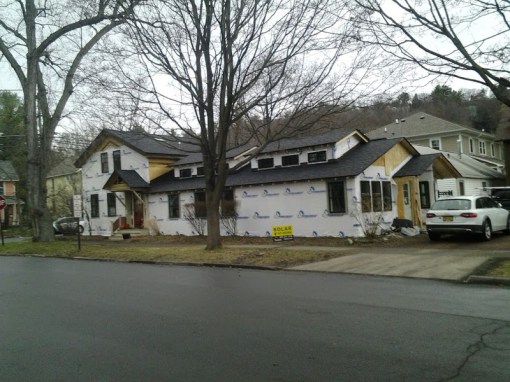
corner_store_2000s

During the past ten years, the bump-out was renovated, then the building was repainted, and The Corner Store became the “Red and White Cafe“, a highly-regarded neighborhood fish fry and seafood restaurant. According to the listing, the major renovations came about three years ago. County records indicate the property last exchanged hands in 1988. Along with the retail space comes 432 SF of storage.

The listing is asking for $975,000, but that would be for building and business – the building and lot are valued at $120,000, so any potential buyer is going to be much more interested in the cafe than the building.


News Tidbits 9/10/16: Situations To Be Avoided

10 09 2016

Pardon the week hiatus. Sometimes, by the time there’s enough news to share, it’s already the weekend, so it just makes more sense to fun a longer feature the following week.

maguirebirdseye-620x420

1. The Maguire dealership proposal for Carpenter Business Park had a lukewarm reception at its public info session a week and a half ago. A copy of the application can be found here, and Second Ward Councilman Ducson Nguyen was kind enough to upload a 90-minute video of the meeting on his facebook page, and a transcript of the meeting can be found here. A second public info meeting will be held on the 14th.

You might recall news of the project broke last winter, followed shortly thereafter by a vote of the city Common Council to subject waterfront and waterfront-vicinity properties to a “Temporary Mandatory Planned Unit Development” (TM-PUD), meaning that any building proposal would be subject to a vote of the Common Council as a stipulation of approval (typically, projects only need the Planning Board’s consent, plus the BZA and/or ILPC if needed). One other project has gone through the TM-PUD process since then, the Cherry Artspace performing arts building. The small experimental theater held its public info meetings at the end of March and mid-April. It enjoyed fairly broad  public support, but two of the eight voting councilmen still voted against its construction at the May meeting. If a a project with widespread support has some trouble getting passage, you can already guess what will happen with the Maguire proposal.
There’s only about a year left in that TM-PUD. But for the Maguires, it was too late as soon as the TM-PUD was passed. Perhaps more concerning, this is creating one of those cases where everybody’s opinion is coming out of the woodwork – some demand it be a park, some say industrial space only, Form Ithaca advocates walkable mixed-uses, and then there was that verbal brawl on the Ithaca West list-serve about the evils of the Ithaca Community Garden. A lot of folks think their idea is the only reasonable option, so if this plays out like the old library site, there’s going to be a lot of acrimony in the long run. Hopefully when the TM-PUD expires, the city will have the new urban mixed-use zoning ready for implementation, so situations like this can be avoided in the future.

20160821_123800

2. Can’t help but feel just a little sympathetic towards Steve Fontana – he tried to have this project open for move-in, and everything that could go wrong, was going wrong. The Journal’s Nick Reynolds reports that first it was a safety systems issue with the elevator holding up the certificate of occupancy, and then a water main burst. The latest planned opening date is September 9th, when the initial date was August 1st. Now it’s a financial issue, a public relations issue, and a mess for all involved. This could be used as an example of why Todd Fox put the 201 College site up for sale – it became clear that August 2017 opening wasn’t going to happen.

201_college_v5_1

3. On that note, I’m going touch on 201 College real quick. Given the amount of time that went into the Collegetown Form District – six years – this just looks bad all around. On the one hand, Todd Fox could benefit from more patience (granted, we don’t know what the financing situation was), and the character attack on Neil Golder in his supporting documentation turned some people off to his cause. But what John Schroeder did also deserves strong scrutiny. It’s odd to claim a zoning code issue when the MU-1 code is only three pages, and he helped write it. He was also aware that 201 College went through pre-site plan review with the city’s Planning Department, and they gave it the okay to proceed with review. This looks very suspiciously like Schroeder was explicitly looking for anything he could to help out his old colleague Neil, and that small ambiguity was the best he could do, which he was able to parlay with success.

This continues an uncomfortable pattern we’ve seen with other projects like the Old Library where one government body gives the OK, and another stops it after the consent is given. The whole point of these laborious review processes is to prevent controversy from arising. Who wants to take on the risk of proposing condos, mixed-use and affordable housing when, given that many projects require the approvals of multiple boards and committees, there’s a track record of mixed signals?

Rezoning has come up as an idea, but it’s not as simple as it sounds. Spot rezoning (single-lot rezoning) would likely be deemed illegal because the current zoning is consistent with the recently-passed Comprehensive Plan, something the courts look for in zoning lawsuits. Thinking slightly broader, Collegetown’s MU-1 is nine parcels – Fox, Josh Lower and John Novarr, all major local developers, own seven of them. If 20% of those affected by a rezoning proposal file a protest petition, a super-majority of the Common Council – 75%, 8 of 10 in practice – is required for rezoning approval. That is what stopped the first Collegetown rezoning during the Peterson administration. If it couldn’t pass then, a similar super-majority event is unlikely to pass now.

4. On the edge of Ithaca’s South Side neighborhood, the CVS Pharmacy sold for a pretty penny – or rather, $4.09 million, on the 1st. The property is assessed at $1.8 million, but sold for $3.6 million in 2006. The buyer is an LLC traceable to a suburban Boston firm with a broad retail space portfolio, so whether they plan to keep things as they are, or propose something new, is anyone’s guess.

trebloc-future2-1-620x420

5. Finally, a copy of the Site Plan Review application for Newman Development Group’s City Centre project at 301 East State Street in Downtown Ithaca. Keep in mind, this is from the June filing, so things are likely to have been updated or revised in response to the planning board. The 9 story building tops out at 96 feet. The approximate construction cost at the time of the filing was $32 million, with a proposed build-out from February 2017 to October 2019, which seems lengthy, and in another part of the document it says construction will last only 20 months. 400 construction jobs, 50 permanent jobs by tenants in the 10,600 SF of first floor retail, and building service staff. Overall square footage isn’t given, but given the retail and 7,225 SF of amenity space, 160,000 SF probably isn’t a bad first guess. For comparison, State Street Triangle was 288,000 SF, later reduced to the same height and similar dimensions as City Centre. In a sense, City Centre started off where SST required months to get to. Hopefully that bodes well for the proposal.

arpt_pk_1

6. Remember that airport business park study from a while back? There’s no strong demand for a business park. But the NYS DOT wants to move their waterfront office and storage facility to the site. So removing those salt sheds and replacing them with mixed-use waterfront property won’t happen until the state buys whatever it needs here, builds and moves in to a new facility. Not sure what they’ll do with the property on Ellis Drive in Dryden that they’ve owned for the past decade; presumably sell it as surplus, but who knows?

chain_works_rev3_3

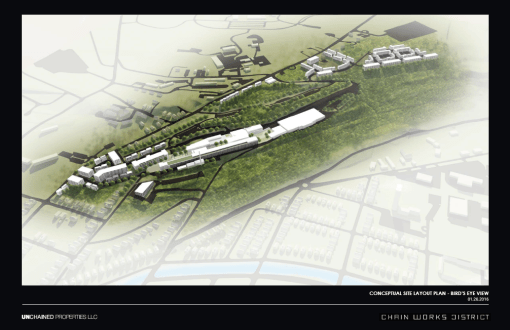
7. From the Ithaca Times: The Al-Huda Islamic Center hopes to start construction on their Graham Road mosque in 2017, and then obtain land for burials later this decade. In other news, new Times reporter Lori Sanken is reporting on the Chain Works progress, the Planning Board requesting color changes, careful consideration of heights, and debates about forest [preservation and Route 96B. Developer Dave Lubin of UnChained Properties wants to do renovations to existing buildings first, but seeing as they have yet to have the state sign off on a remediation place, they’re considering the construction of new buildings first, if NYS DEC approval for remediation gets delayed. And Catholic Charities and non-profit group Ithaca Welcomes Refugees are actively trying to procure affordable living space for 50 refugees who will be arriving in the Ithaca area after October 1st.

pinney_peruville_1
8. It’s been incubating for a while, but it looks like former Lansing town supervisor A. Scott Pinney’s plan for 15 duplexes (30 units) is moving forward. A gravel road will be extended from 4 existing duplexes at 390 Peruville Road (NYS 34B), looping through the property from Scofield to Peruville. The “Developer’s Conference” to talk about the project will be a part of the Lansing town planning board’s meeting next Monday. Also up for discussion are slight revisions to the Village Solars PDA, related to the community center and first-floor commercial space in the proposed Building F.

1001_n_aurora_1

9. From the Ithaca city Projects Memo for September, it looks like there’s a couple of subdivisions planned. One is for 404 Wood Street in the South Side neighborhood, where the owner wants to subdivide a double-lot he has for sale, allowing the vacant lot to be developed for a house or small apartment building. Quoting the application, “Instead of an empty grassy lot, there would be a building on it”. Points for simplicity.

The other is a double lot at 1001 North Aurora Street in Fall Creek. This came up a couple of weeks ago in a weekly tidbits round-up, because the new owner, Stavros Stavropoulos, received a $400,000 loan to build a duplex. Turns out it’s actually two duplexes, which require a lot subdivision, and will trigger planning board review. The application notes that even with the density increase, it’s still less than the surrounding neighborhood. The two two-family homes with have 3 bedrooms and about 1200 SF per unit, and are designed by local architect Daniel R. Hirtler to fit in with the neighborhood. Unusually, the application includes documentation of the previous owner signing off on the redevelopment plan. Construction is estimated to run from this month through May 2017.


The Government Campus

3 09 2016

5-1-2012 120

The idea of a government campus in Ithaca is very intriguing. It offers big opportunities, and potential pitfalls.

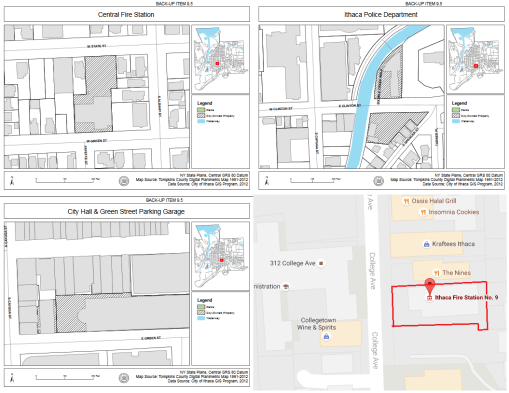
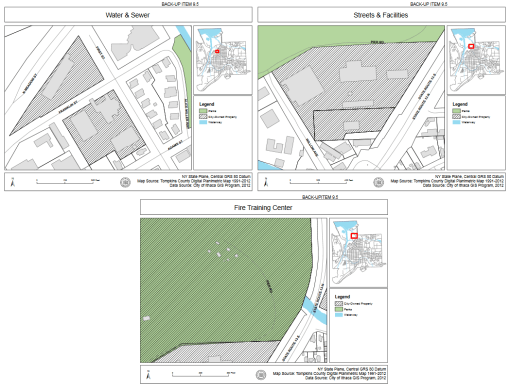
A copy of the funding request can be found here. The $150,000 study comprises two components – the first would combine the Collegetown Fire Station (No. 9), Central Fire Station at 310 W. Green Street, the Police Headquarters on E. Clinton and City Hall into one site on the property of the Central Fire Station. The second combines DPW Streets and Facilities and DPW Water and Sewer into one location.

Given the very profound impact this would have on the city, there’s been relatively little news about it. I cued my colleague Mike Smith in to it, and he did an interview with Planning Director JoAnn Cornish, which led to two articles. The spark notes are that the current condition of some of these properties is poor, so the city is looking at which to consolidate and/or build new, and which to renovate. The money is left over from the study looking into moving Station No. 9 and designing a replacement (apparently, it only cost $80,000 of the $500,000 allotted), so this is the planning department’s shout of carpe diem. The Common Council has given strong support to doing the consolidation study.

Let’s make it clear – there is no commitment anything will happen. Nothing may change at all, Station No. 9 may still move to Maple Avenue while everything else is left as is, or the consolidation plan might actually get carried out. But if they have the money and time, it’s worth exploring the possibilities.

consolidation_study_1

Study one, the “government campus”, involves a space needs assessment for programming and staff, concept site plans, and cost estimates for new facilities. The study will also offer appraisals for existing buildings and discussion of selling these properties:

  • City Hall and the adjacent parking lot to its east
  • The Collegetown Fire Station
  • The Police HQ, but not the Courts Building
  • The Western 1/3rd of the Green Street Garage

Each has its opportunities. The western third of the Green Street Garage has some of Ithaca’s most accommodating zoning for urban projects – CBD-140, a 140-foot building with no parking requirement. When the garage was rebuilt several years ago, only the central section was structurally redone. The western section is nearing 50 years old, so without major renovation, it will be nearing the end of its safe useful life. The early plans for Cayuga Green called for a larger garage on Green Street, so another floor or two on the remaining two thirds is not impossible.

Meanwhile, Ithaca has never been particularly attached to its city hall – the building was built for NYSEG in 1939, and the city bought the building in 1964, demolishing its old city hall for the Seneca Street Garage not long after. In the mid 1980s, the city attempted to sell city hall so that it could be bought by a private owner and leased out to the county, all part of an effort to keep the Department of Social Services downtown – the city failed to persuade the county legislature, which moved DSS out to West Hill until the Human Services Building opened on the 300 block of West State in 1998. Demolition would face significant opposition, but conversion to housing could be a safe option for a hypothetical new owner.

The Collegetown Fire Station is prime real estate. It’s MU-2 zoning (six floors, no parking) in the heart of Collegetown at 309 College Avenue. Given that 201 College sold for $2.65 million, and 215 College sold for $5.3 million, there’s little doubt the city could fetch a multi-million price here. An RFP would have to be cognizant of the fact that the site itself is best-suited to student housing, because not only would its price be limited by other means, non-students may not be comfortable living in a location that’s 95+% students. There could be a provision for housing fund payments or off-site affordable housing at an appropriate location.

The city police station is a question mark. The zoning for the Police HQ and Courts building is B-1a, and the police parking lot is R-3b. R-3b is 4 floors, 40% lot coverage, a parking space for every unit or three bedrooms, whichever is greater. B-1a is nearly the same, but with 50% lot coverage, but the Courts Building could make selling a tough prospect.

Now comes the question of the Central Fire Station redevelopment, which occupies much of its site on West Green. A back-of-the-envelope for the police HQ, fire station No. 9 and City Hall is about 48,000 SF (assuming police uses make up half of the courts complex). The Central Fire Station occupies 17,000 SF. So you’re asking for a sizable multi-story building on top of what’s there, and not counting impacts like parking. The city would need to be careful, as South Side is one of the more affordable areas and the risk for displacement of low-income households is considerable. Any project would also have to go through ILPC consideration since it borders historic properties.

consolidation_study_2

Study #2, the DPW consolidation, also offers opportunities. The study calls for a consolidation at a new location in Southwest Ithaca down by the box stores. It involves a space needs assessment for programming and staff, concept site plans, and cost estimates for new facilities. The city says it may also consider a shared facility with the town of Ithaca, or the county. In such a move, the city frees up space that it could sell on the North Side, and opportunities that could enhance redevelopment efforts on the Waterfront. The Northside area is also one of the new parts of the city where affordable housing is feasible and accommodated by neighbors, so mixed-uses with market-rate and affordable housing is plausible. The Pier Road area has high water tables which could drive up foundation (construction) costs, but Form Ithaca highlighted redevelopment potential at the site during their charettes.

Anyway, this is a lot of handwaving. Any work would be far, far off, probably well into the 2020s. A lot can happen between now and then – the economy tanks, priorities change, the sale of any property ends up a big debacle like the county’s Old Library redevelopment. It could make the city a lot of money in sale and taxes and help continue the downtown renaissance, or if done wrong it could end up being a burden that hurts taxpayers as well as lower-income households. But it’s certainly an interesting topic to explore.