201 College Avenue Construction Update, 8/2017

16 08 2017

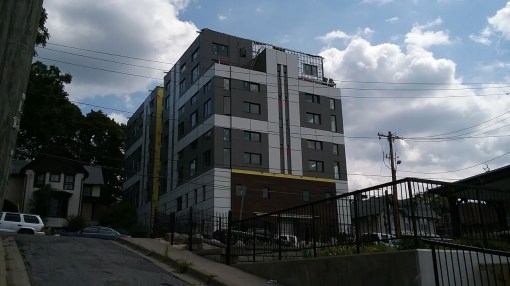
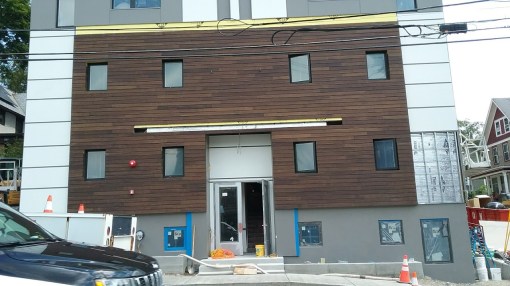
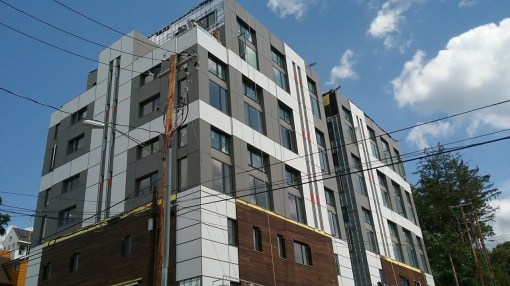
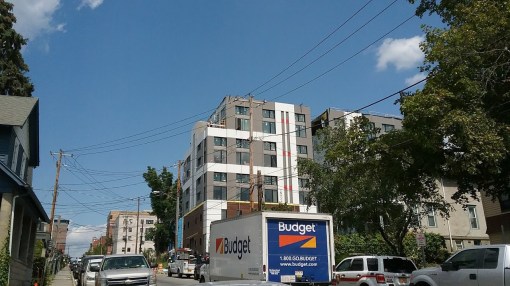
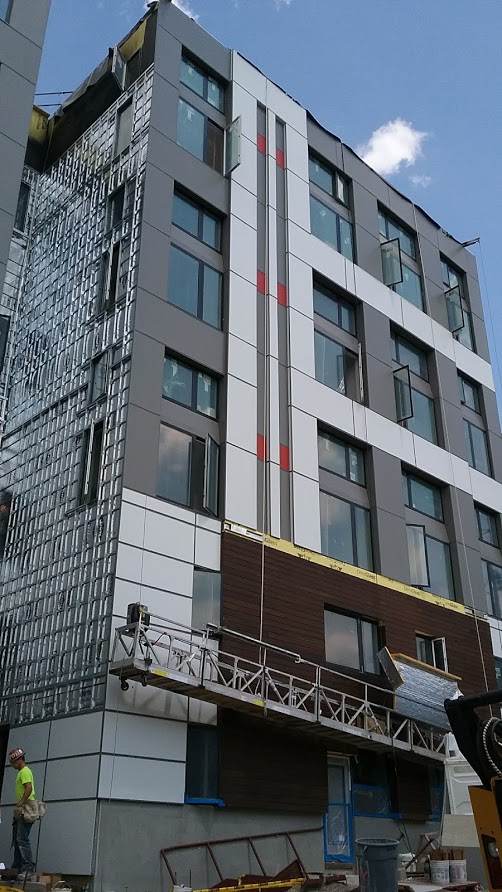
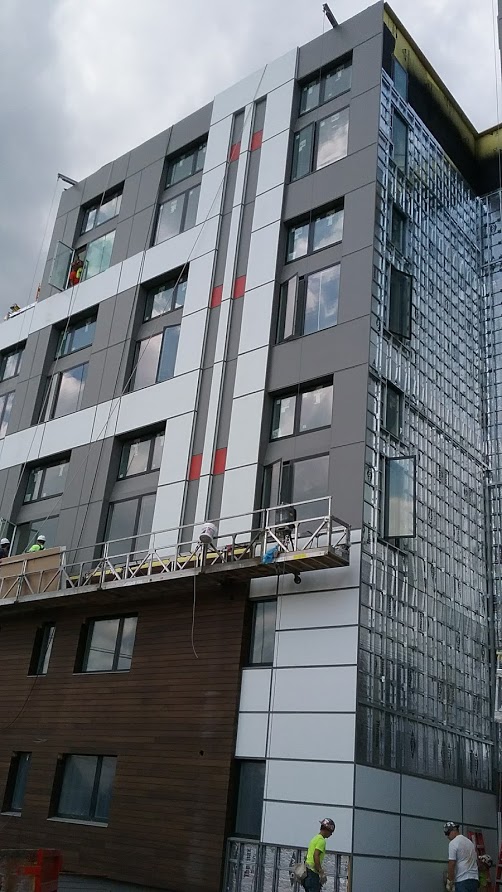
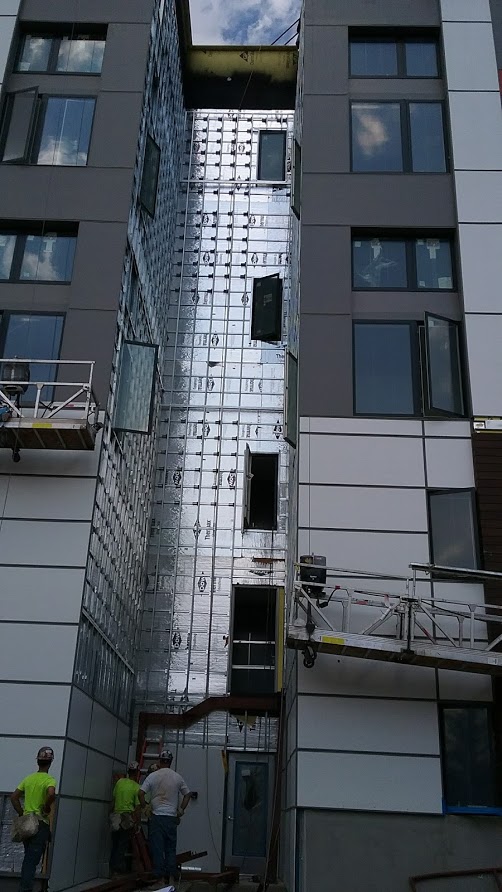
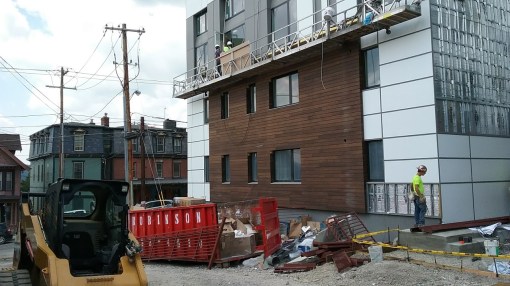
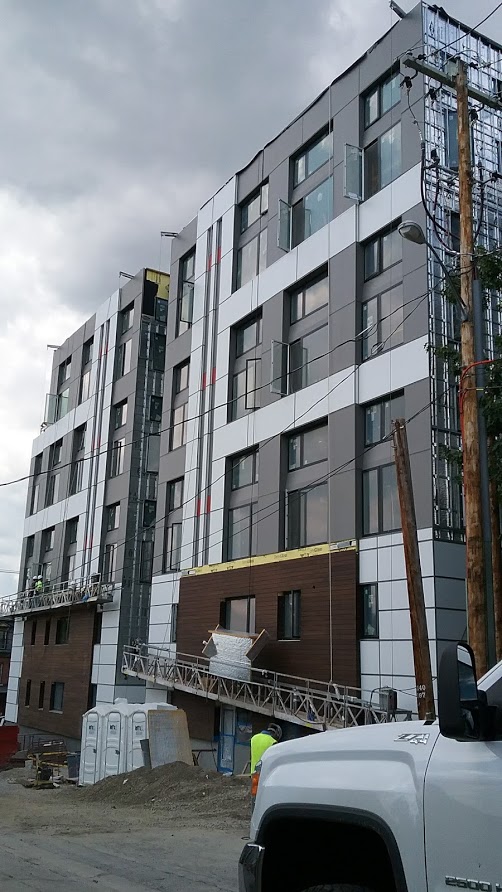
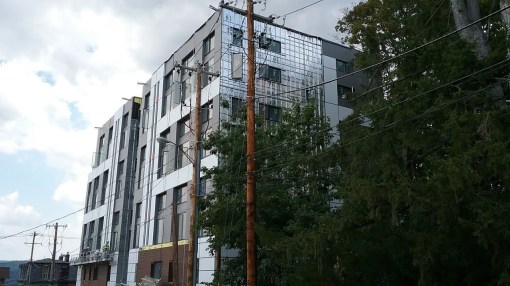
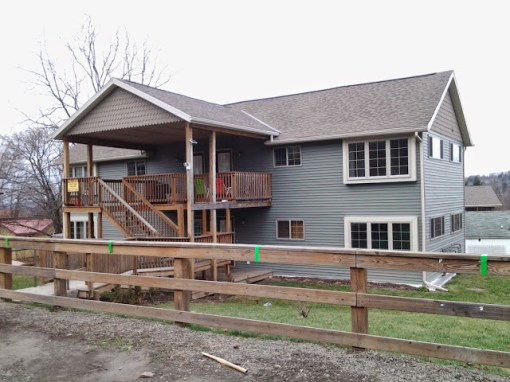
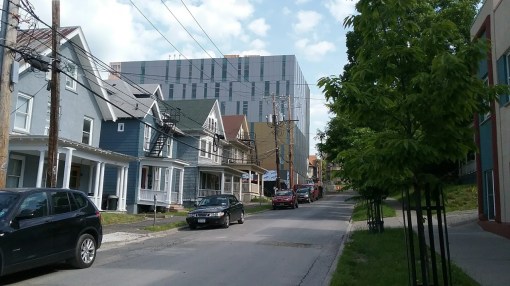
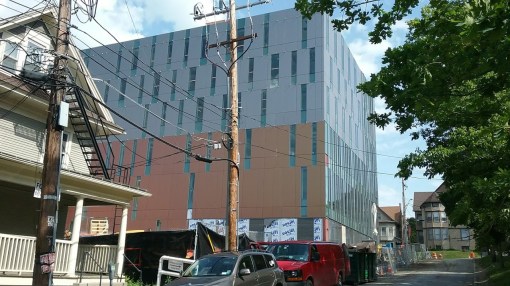
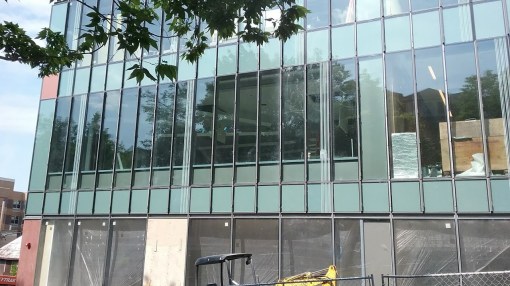
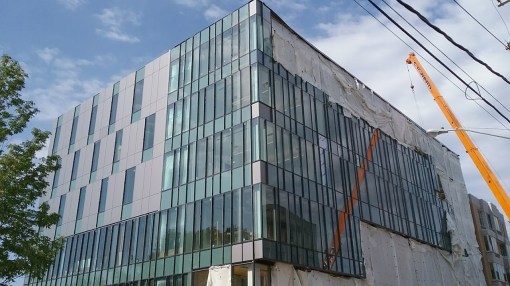
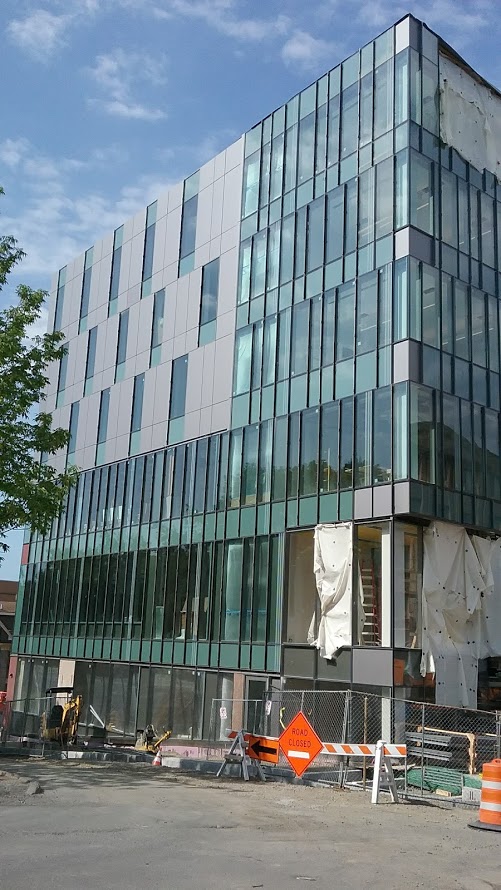
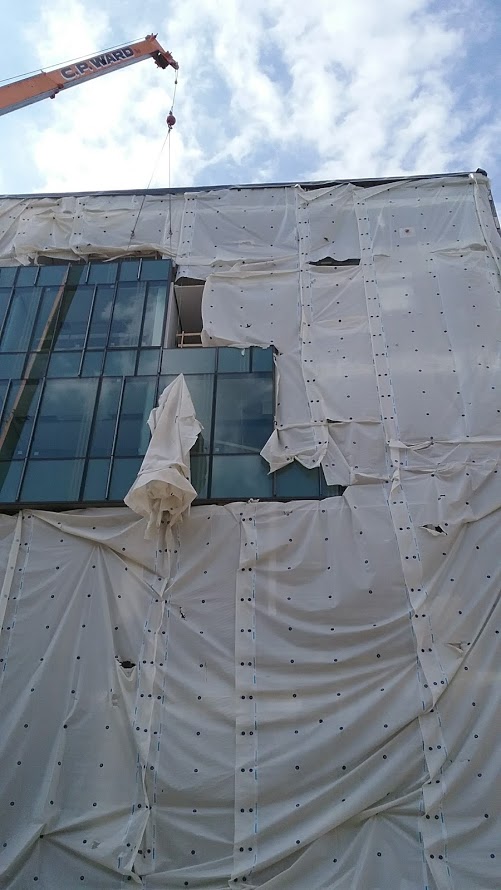
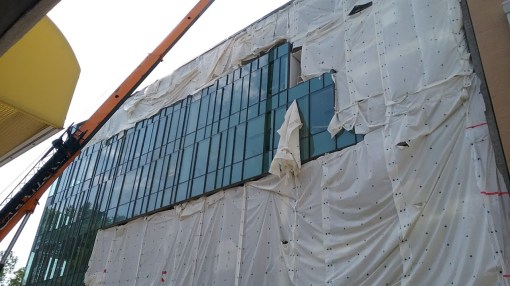
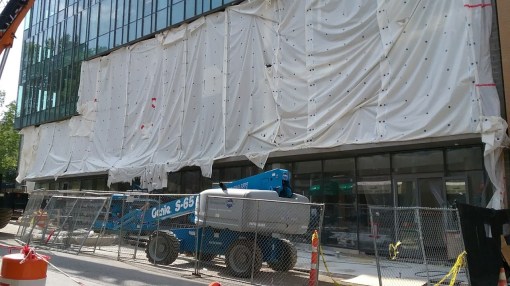
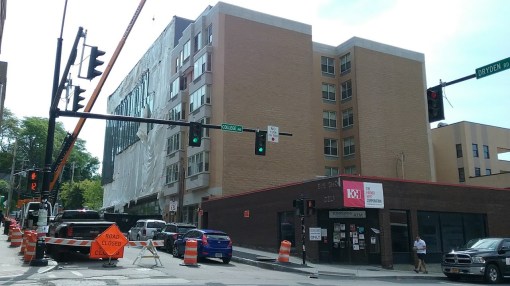
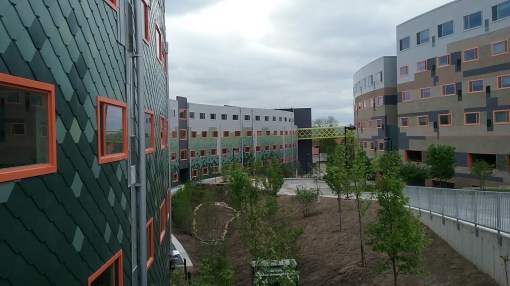
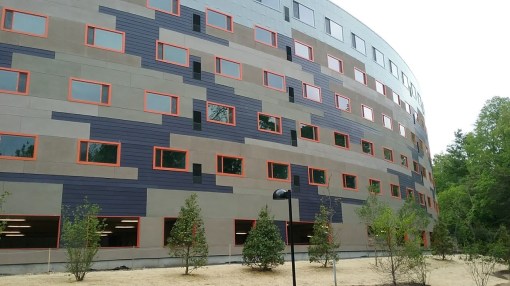
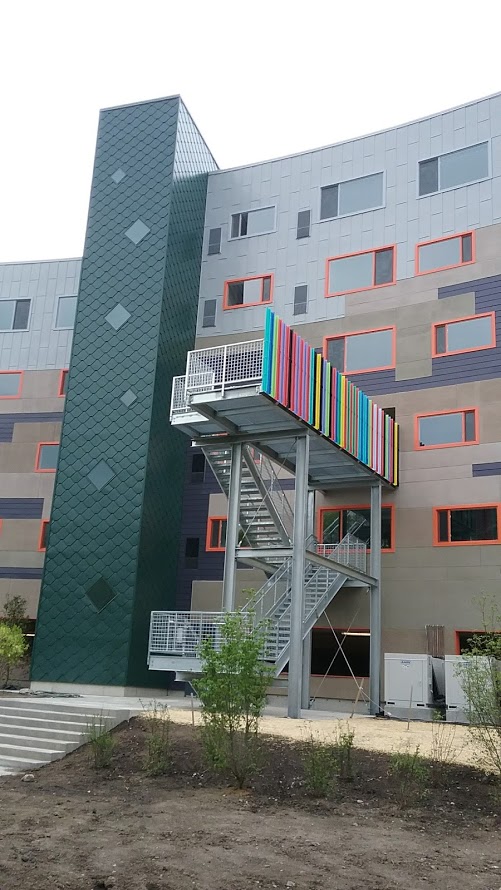
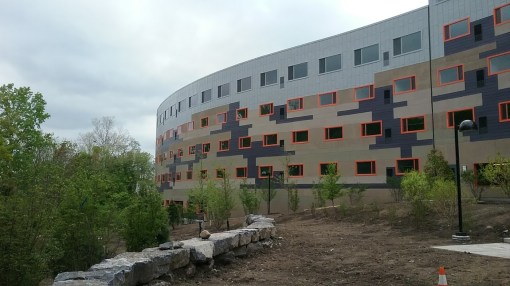
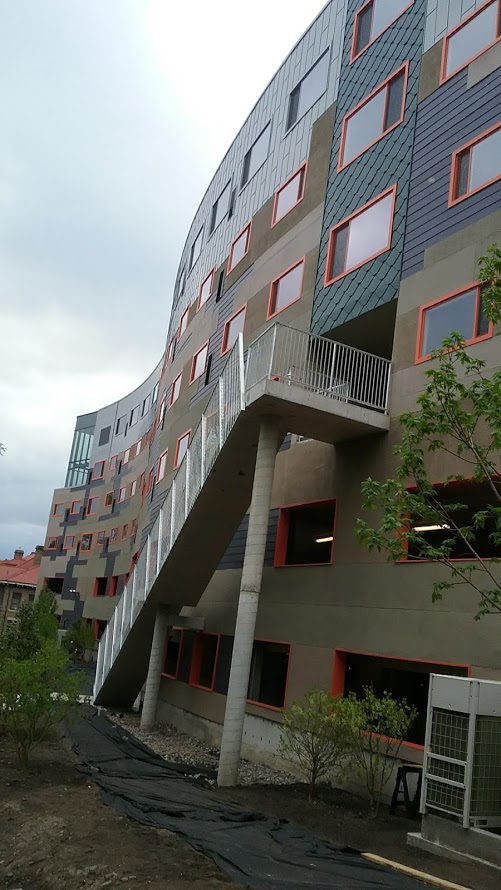
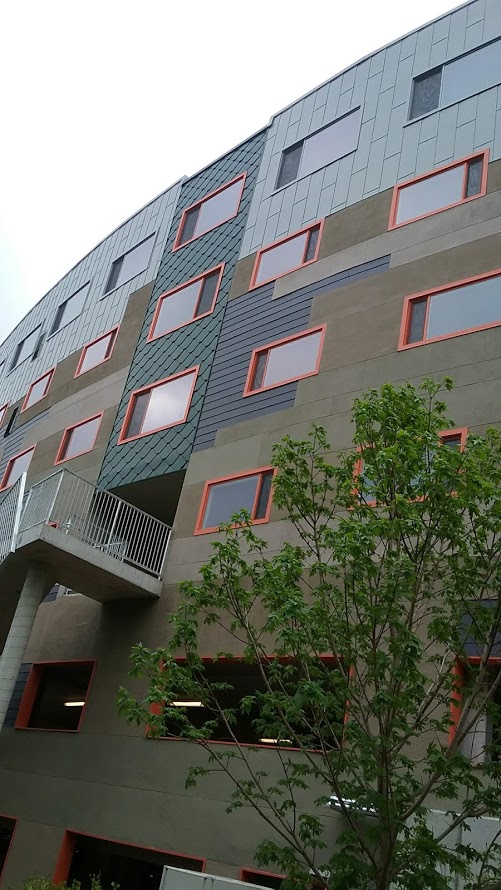
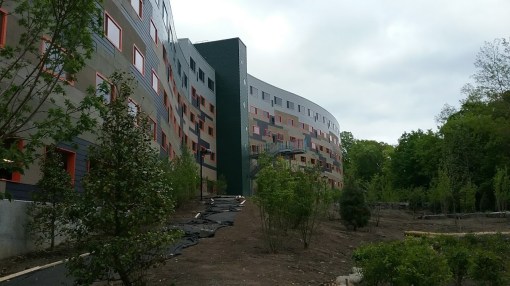
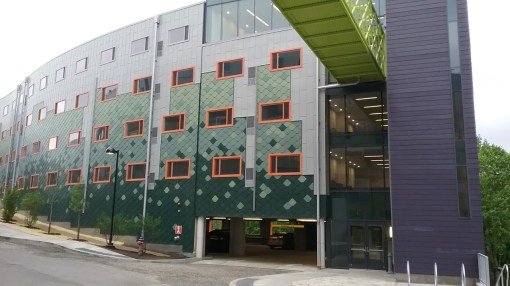
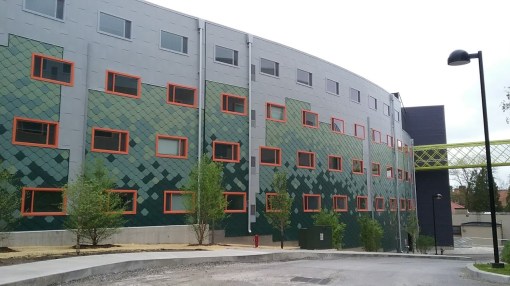
201 College is a work in progress on the outside, but the inside is nearly complete. According to Visum Development’s Todd Fox, who happened to be at the site when the photos were taken yesterday, there are cleaning crews inside, and a certificate of occupancy is being obtained. Renters will be able to move in on Friday.

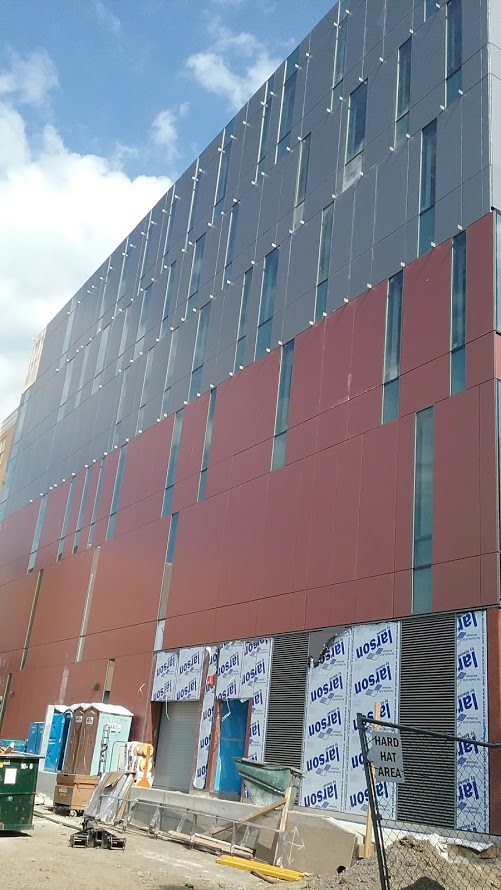
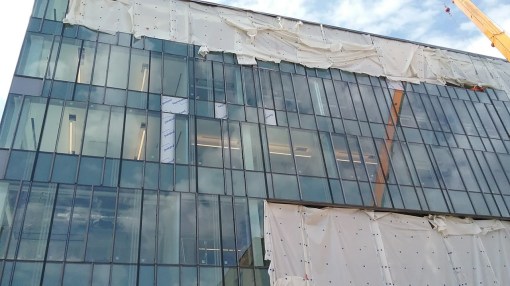
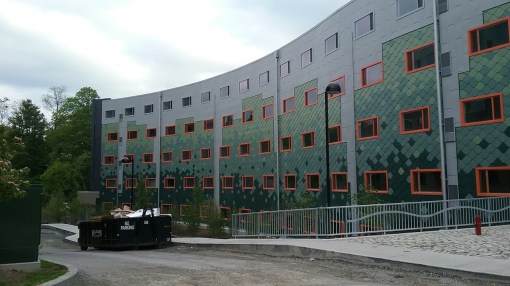
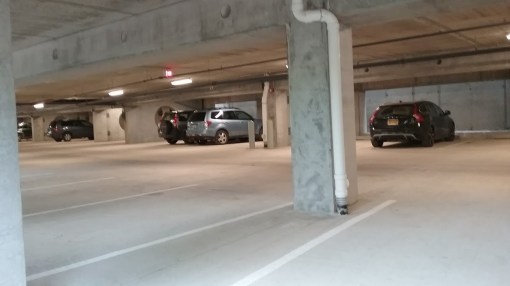
On the outside however, work is still coming along. From the looks of it, it appears all the woven bamboo siding has been attached. However, the overhead canopy has yet to be installed over the front entrance, and some of the decorative “iron ore” black metal rails and fiber cement panels (“Allura Snow White” and “Gauntlet Gray“) have yet to be clipped on over the structural metal rails. So while tenants will be able to move in for the fall semester later this week, construction on the exterior and landscaping finishes will extend into September. Similarly, the basement area, which will host the fitness room and bike storage, will need a few more weeks before it’s ready for use.

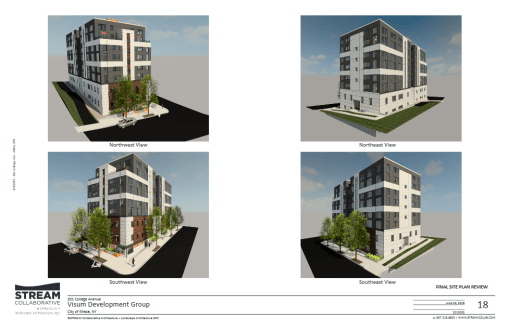
For what it’s worth, 201 College looks just like the renderings provided by its architect STREAM Collaborative, which one would think isn’t a big deal, but it is – there have been cases of developers building something that lacked details of features shown but not explicitly required in approval, which had led to consternation among the planning board and staff.

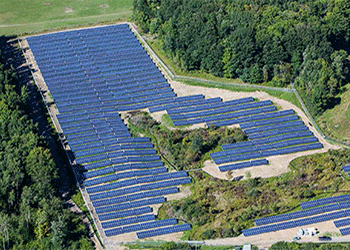
On another good note, I asked Fox how things were with neighbor Neil Golder, who led efforts to halt the project last year. Since the lawsuit failed, the two sides have been fairly amenable to each other – Fox still offered Golder solar panels on 201 to compensate for shadows, and Golder has let construction workers access his property when trying to maneuver equipment on and off site. Fox said that, in exchange for paying Golder’s water bill, he let construction crews hook up hoses from his spigots to spray down the dust and add water to the concrete.

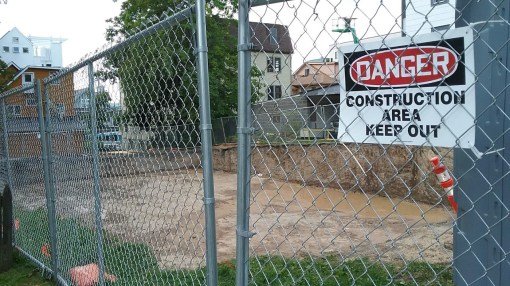
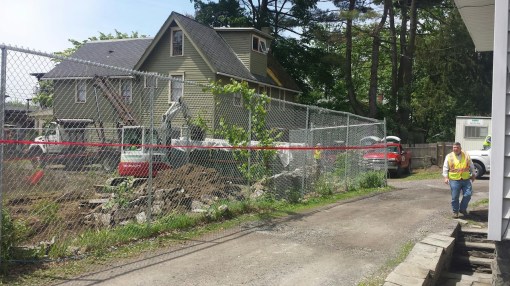
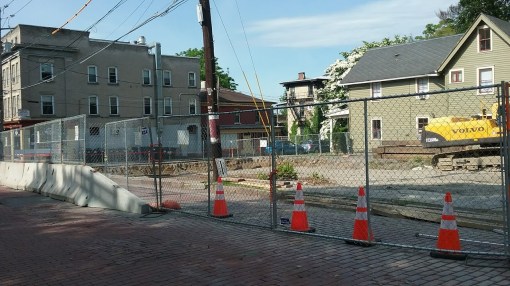
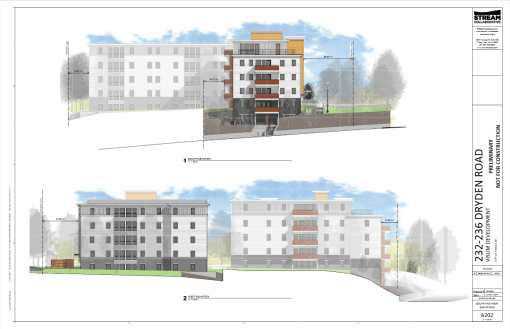
As 201 wraps up, Fox has his eye on his other approved projects – 210 Linden Avenue, a 4-story, 36-bedroom building, has been excavated and padded (last two photos here), and is waiting on municipal permits to begin construction of the foundation. As with 201 College, William H. Lane Inc. of Binghamton will be the general contractor, and STREAM is the architect. 232-236 Dryden Road, a pair of 4-story buildings with 191 bedrooms, is due to start site prep in September. Two smaller Visum projects, for 118 College Avenue and 126 College Avenue, have no firm construction dates at this time.


News Tidbits 8/12/17: Two Kinds of Rehab

12 08 2017

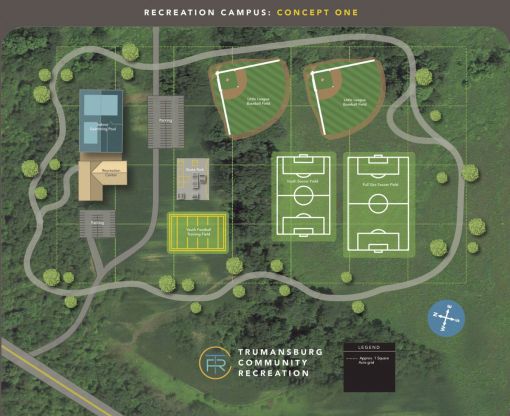
1. It looks like some Trumansburg residents want to build a recreational complex. According to the Ithaca Times’ Jamie Swinnerton, for the civic group Trumansburg Community Recration, “{t}he ultimate goal is to build a recreation center, soccer fields, baseball fields, a youth football field, a skate park, and a pool to the community. The first phase of the project would be building the sports fields and possibly a recreational campus. While the group is still searching for space for these amenities, it is raising funds through grants and donations. The fundraising goal right now is $750,000.”

Along with private donations, the community advocacy organization is seeking state funds, which state law requires be obtained via municipal entities, i.e. the village, school district, town and county. It’s not that governing bodies have to commit money, they just have to express support and sign off on applications, and allocate the awarded funds if/when they are received.

Phase two for the non-profit would be a community center, likely a re-purposed building, and phase three would be a pool, which is garnering significant community attention. Although the group hasn’t committed to a location (the rendering is completely conceptual), it is examining the feasibility of different sites in and around Trumansburg. Interested folks can contact or donate to the group here, or sign up for emails if they so like.

2. Cayuga Addiction Recovery Services (CARS) has finally received the money from a July 2016 grant award. Cayuga Addiction Recovery Services (CARS) will be using it toward a new 25-bed adult residential facility. The new facility will be built on the Trumansburg campus adjacent to a 60-bed facility on Mecklenburg Road, near the county line a couple miles to the southwest of Trumansburg. An undisclosed number of jobs are expected to be created. Founded in a Cornell U. fraternity house in 1972, CARS provides treatment, counseling, skills training and support services to help clients overcome addictions and rebuild lives. The current facility was opened in 2004.

While the location is quite rural, the nature of the facility (rehab, focus on opioid abuse) is getting pushback from at least one town board member who doesn’t want it in the town (link, scroll down to 7-25-TB minutes). The plan has yet to go before the Ulysses planning board.

3. INHS made its name on home rehabs, and it looks to be making a return to its roots. The non-profit developer is asking the IURA for $41,378 towards the renovation of an existing 3-bedroom house on 828 Hector Street, which will then be sold to a low-moderate income family (80% AMI, about $41,000/year) and locked into the Community Housing Trust.

The project cost is $238,041. $152,000 to buy the foreclosed property from Alternatives Federal Credit Union, $8,000 in closing/related costs, $60,000 in renovations, $5,000 contingency, $8,141 in other costs (legal/engineering), and $4,900 in marketing/realtor fees. The funding sources would be $144,163 from the sale, $15,000 from INHS’s loan fund (to cover the down payment for the buyer), $37,500 in equity and the $41,378 grant. A for-profit could renovate for cheaper, but federal and state guidelines say INHS has to hire those with a $1 million of liability insurance coverage, which takes many small contractors out of the equation.

Side note, the city’s federal grant funding disbursement was dropped by $50,000, because HUD is an easy target in Washington. Luckily, Lakeview decided to forego its grant funds because they found the federal regulations unwieldy, which freed up a little over $43k to move around to cover most of the losses.

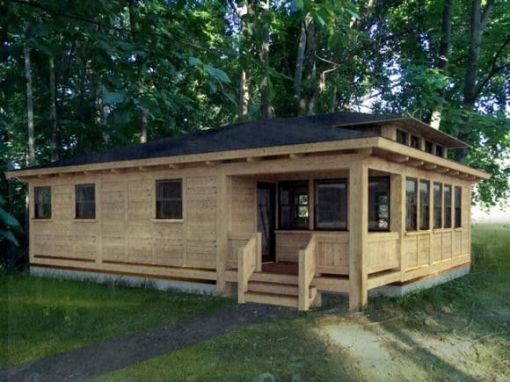
4. Speaking of Hector Street, it looks like Tiny Timbers is rolling out a pair of new spec plans for two lots on the city’s portion of West Hill. The house on the left, for 0.27 acre Lot 1, is a 1,040 SF 2 BD/1BA design listed at 187,900, which is a good value for a new house in the city. 0.26 acre Lot 2 is a 3 BD/2 BA 1,370 SF home listed at $222,900. Taking a guess based on the lot sizes, these are the wooded vacant lots west of 920 Hector. There’s a third vacant lot over there, but no listing yet.

5. On the city’s Project Review Committee meeting agenda, which is the same as the memo…not much. Lakeview’s 60-unit affordable housing project on the 700 Block of West Court Street will have its public hearing and determination of envrionmental significance, the last step in SEQR and the one before preliminary approval. Same goes for INHS’s 13-unit project on the 200 Block of Elm Street.

Apart from related or minor zoning variances and review of proposed historic designation in Collegetown for the Chacona and Larkin Buildings (411-415 College and 403 College), the only other project for review is 217 Columbia, Charlie O’Connor’s. Which, as covered by my Voice colleague Kelsey O’Connor and by Matt Butler at the Times, did not go over well, though Charlie seemed willing to change plans to avert a firestorm. From a practical standpoint, I’d imagine he’s much more focused on his much larger 802 Dryden Road project, and this is small if hot potatoes. The 6-bedroom duplex (three beds each) is designed by Ithaca architect John Snyder.

My own feeling is that a moratorium isn’t the answer, but if they wanted to roll out another TM-PUD so that Common Council gets to review plans as well as the Planning Board, then so be it. My issue with moratoriums is that local municipalities do a terrible job sticking to timelines and have to extend them again and again. Plus, there are projects like the Ithaka Terraces condos, or the new Tiny Timber single-family going up on Grandview, that aren’t the focus of the debate but would be ensnared by a blanket moratorium.

Meanwhile in the town, the planning board discussion for next week will mostly focus on the NRP Ithaca Townhouses on West Hill. The revisions will be up for final approval, which would allow NRP to move forward with their 2018-19 Phase 1 buildout (66 units and a community center). Phase II (39 units) will follow in 2019-20.

6. In sales this week, the big one appears to be 808 East Seneca – 5 unit, 4,125 SF historic property just west of Collegetown in Ithaca’s East Hill neighborhood. List price was $1.575 million, and it sold for modestly less, $1.45 million, which is well above the $900,000 tax assessment. The sellers were a local couple had owned the property since 1982, and the buyer is an LLC formed by the Halkiopoulos family, one of Collegetown’s old Greek families, and medium-sized landlords with a number of other houses in the area.

Perhaps more intriguing is the sale of 452 Floral Avenue for $100,000 to home builder Carl Lupo. The vacant 4.15 acre property had been the site of a 30-unit affordable owner-occupied project back in 1992, but given that the Ithaca economy was faltering in the early 1990s, the plans never moved forward.

7. A quick update from the Lansing Star about the Park Grove Realty lawsuit. While the Jonson family of developers may have lost the village elections by a large margin, their lawsuit accusing the village of an illegal zoning change to permit the project has been reviewed by the state’s court system – and they lost. The state supreme court ruled the zoning change was perfectly legal, appropriate to the revised Comprehensive Plan, and accusations of negative impacts on the Jonsons’ Heights of Lansing project are overblown and speculative.

The Jonsons intend to file an appeal, and have to send in their final draft by September 5th. At this point, the project is left in a waiting pattern – the village is leaving the public hearing open until the appeal is resolved. If the appeal overturns the ruling, than the project can’t proceed regardless of village approval. Given the basis for the initial ruling, an overturning seems unlikely, but it will be a few more months before any approvals can be granted.


News Tidbits 7/22/17: Throwing Darts

22 07 2017

1. Let’s start off the week with a little intrigue. A vacant 12.34 acre property on Wiedmeier Court in Ithaca town sold for $65,000 earlier this week – given that it was on the market for five years and marketed for development potential, the sale merited a closer look.

At first glance, it seemed to merit a shrug. The buyer was an LLC that could be traced back to a CPA in the San Francisco area, a woman of retirement age. The profile fits the deep-pocketed subset who might buy a sizable slice of land near Ithaca, and build a home for their retirement enjoyment. Not uncommon in Tompkins County.

Then on Wednesday, the same buyer purchased 114 and 122 Birdseye View Drive from the Cleveland family for $485,000. 122 is a 4-bedroom single-family, and 114 a 3-bedroom single-family. Both are next to IC, nearly new houses in a development otherwise filled with small-scale student housing. So, things just got more interesting. We’ll see if anything comes of the Wiedmeier property.

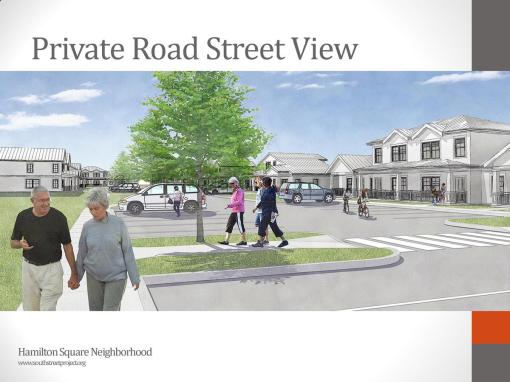
2. Just briefly touching on Hamilton Square this week – one of the questions I previously held off on addressing was the possibility of the abatement. Although the county has said they’re open to considering affordable housing tax abatements or PILOTs (Payments In Lieu Of Taxes) as part of their housing strategy, housing itself usually isn’t enough to merit a visit to the IDA. But with the addition of the nursery/daycare, it bared similarities to 210 Hancock, which cited its planned daycare center and the new jobs at the center in its PILOT request.

So, I asked what the plan was. Here’s the response from INHS’s Real Estate Development Director, Joe Bowes:

“We are not seeking an abatement from the IDA for the project.  If the day care is a non-profit then it would be tax exempt without the need for an IDA abatement.  The housing does not need the abatement in this case so it will be assessed and will pay property taxes.  210 had other reasons for requesting an abatement.”

Emphasis his. In the documentation on Hancock, the abatement was partially driven by the acquisition cost of the property and the need for a deep pile foundation. The buildings are much smaller at 46 South Street, so a slab/shallow foundation is suitable, and it helps that Trumansburg’s soil is less water-logged and more stable than Northside’s. This results in a lower development cost per square foot, so although they arguably could (and upset the neighbors even more), INHS isn’t pursuing a PILOT or abatement. The only tax savings will be for the eleven affordable owner-occupied units, which will be assessed for what they can sell for within the Community Housing Trust, rather than a market-rate value. This has the county’s support, because taxing a townhouse for double the value of what the lower-middle class homeowner could sell it for undermines its affordability.

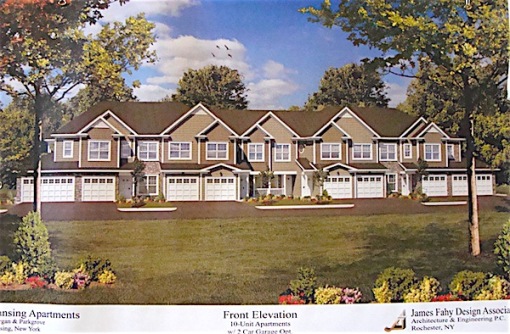
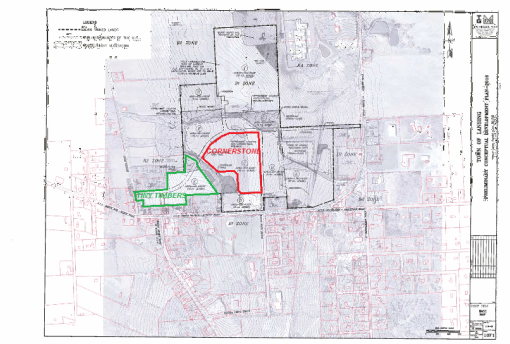
3. Here’s an interesting note from Lansing regarding the Cornerstone land purchase. The first phase on 13.5 acres would be 68-72 units. The second phase on the remaining 8.9 acres would potentially host another 72 units. All of these would be affordable. This might cause a backlash as too much, but if one of the phases was general affordable housing, and the other affordable senior housing, then that might negate most of the blowback. Anyway, something to watch for.

On another note, the modified PDA for the Village Solars has a stipulation that the community center/mixed-use building (“F”, green dot) has to be completed by the end of 2020, and only 4 of the 9 other buildings will be approved before the community center is complete. Everything north of Circle North will not be allowed to start construction until the community center is open. This suggests a build-out of #116/#102, 2017-18, #2/#22, 2018-19, Community Center 2019-2020, #117/#36 2020-21, and K, L and M would be built in 2021-22.


4. Laurels and darts. Here’s a dart. The town of Ithaca is seeking to, once again, extend its moratorium on two-family properties. When the law was enacted in early May 2016, it was supposed to be for 270 days, meaning an early February expiration. Then it was extended to the end of July. Now they want to extend it to the end of October, which given the seasonal nature of construction, effectively stops all new two-family properties through the winter of 2017/18.

I’ll be frank. This is not a good look. There were a number of concerns from property owners when the law was proposed for a length of one year, was unfairly long, and the town has not only realized their concerns, it’s exceeded them. The town is establishing a bad faith precedent through what property owners will complain as either being ill will, or incompetence. Part of me is concerned that anyone fighting the town on something, be it zoning, development, conservation or anything, will use this as an example of how the town “can’t be trusted”. I’ve never been a fan of moratoriums, because they end up seeking extensions. Not impressed to have another example to file away.

5. And on that note, the town of Groton just slapped a six-month moratorium on all solar arrays designed to power more than one house or one agricultural farm. No commercial solar, no community solar. Technically, the law also stops wind turbines and gas pipelines, but the Times’ quotes make it clear this was all about solar.

6. The county legislature finally approved a name to the Heritage Center this week. The “Tompkins Center for History and Culture” was approved 10-2. The previous vote failed due to a number of absent legislators and pushback for not having enough to consider the name. Legislator Chock D-3rd) initially wanted it named for late legislator Stu Stein, but naming buildings after people has been against county policy since the early 2000s. Legislator McBean-Clairborne (D-1st) voted against it because she felt the word “county” should be in there. This has not been a month where local government engenders confidence.

7. Short but interesting city of Ithaca Planning Board meeting meeting up. The only thing up for final approval is the McDonald’s rebuild at 372 Elmira Road, while INHS’s Elm Street and Lakeview’s West End project are set to begin formal environmental review. Here’s the agenda:

1. Agenda Review 6:00

2. Privilege of the Floor 6:01

3.Site Plan Review

A. Project: Commercial Rebuild (McDonalds) 6:10
Location: 372 Elmira Road
Applicant:McDonalds USA LLC
Actions: Consideration of Preliminary & Final Site Plan Approval
Project Description: The applicant proposes to replace the existing 4,800 SF restaurant facility with a new 4,400 SF building, construct a side-by-side drive-thru, install new landscaping, a dining patio, lighting, signage and a masonry landscape wall, as well as reconfigure the parking layout. The project is in the SW-2 Zoning District and requires an area variance. This is an Unlisted Action under the City of Ithaca Environmental Quality Review Ordinance (“CEQRO”), and the State Environmental Quality Review Act (“SEQRA”), for which the Planning Board as Lead Agency made a Negative Declaration of Environmental Significance on June 27, 2017.

B.Project: Elm St Apartments (Rebuild) 6:25

Location: 203-209 Elm Street
Applicant: Lynn Truame for Ithaca Neighborhood Housing Services Inc. (INHS)
Actions: Declaration of Lead Agency, Review of FEAF Parts 2 & 3
Project Description: The proposed project consist of the demolition of two single family homes and one
multiple dwelling and the construction of a single 12,585 SF apartment building with 13 dwelling units, parking for six vehicles, and other associated site improvements. Due to the slope of the site, the building will have 2 stories facing Elm Street and three stories in the rear. The project requires the consolidation of three tax parcels. The project is in the R-3a Zoning district and is seeking two area variances for relief from rear yard setback and parking requirements. This is a Type I Action under the City of Ithaca Environmental Quality Review Ordinance (“CEQRO”)§176-4 (1)(h)[3], and the State Environmental Quality Review Act(“SEQRA”)§ 617.4 (11) and is subject to environmental review.

C. Project: 709 West Court Street (Housing) 6:50
Location: 326 & 328 N Meadow St. and 709–713 W Court Street
Applicant: Trowbridge Wolf Michaels LLP for Lakeview Health Services Inc.
Actions: Declaration of Lead Agency, Review of FEAF Parts 2 & 3
Project Description: The applicant proposes to construct a five-story L-shaped building with footprintof 10,860 SF and GFA of 62,700 SF on the .81 acre project site comprising four tax parcels (to be consolidated). The building will containing sixty (60) one-bedroom apartments plus associated shared common space (community room, laundry facilities, lounges, and exterior courtyard), support staff offices, program spaces, conference room, utility rooms, and storage. The siting of the building allows for a small landscaped front yard, a south-facing exterior courtyard, and a 16 space surface parking lot in the rear of the site. Site development will require the removal of five structures and associated site elements. The project is in the WEDZ- 1 Zoning District. This is a Type I Action under the City of Ithaca Environmental Quality Review Ordinance (“CEQRO”)§176-4 (1)(k) and (n), and the State Environmental Quality Review Act (“SEQRA”) § 617.4 (11) and is subject to environmental review.

D. 105 Dearborn –Sketch Plan 7:10

This is Bridges Cornell Heights new 16-bedroom independent living building for seniors. If it’s at the Planning Board, that means the ILPC has signed off on the building and site design.

E. 311 College Ave – Sketch Plan 7:30

This is…curious. 311 College Avenue is The Nines restaurant and bar, and was built in 1905 as fire station No. 9 before the new station opened next door in the late 1960s. The old station was sold off and became the Nines in the early 1970s, and has been under its current ownership since 1980. The top two floors are used for storage, according to county records.

At a glance, it’s a valuable piece of land with a lot of posibilities – MU-2 zoning allows six floors and 100% lot coverage. On the other hand, this is a relative historic property in Collegetown, and development perceived as insensitive will likely see significant opposition. There had been talk by ILPC staff of giving the building historic designation back in February 2016 out of concerns over development pressure, but it seems no formal application was made. So there are options here, but the developer should proceed with caution.

4. Zoning Appeals 7:50
#3066, 214 Elmira Road, Area Variance
#3079, 413 Titus Ave, Area Variance

5. Old/New Business 8:00
A. Planning Board Recommendation to Council Regarding Proposed Waterfront Rezoning
B. Planning Board Report Regarding the Proposed Local Historic Landmark Designation of 403 College
Ave
C. Downtown Wayfinding

6.Reports 8:30
A. Planning Board Chair (verbal)
B. Director of Planning & Development (verbal)
C. Board of Public Works Liaison


News Tidbits 6/25/17: Lazy Sunday

25 06 2017

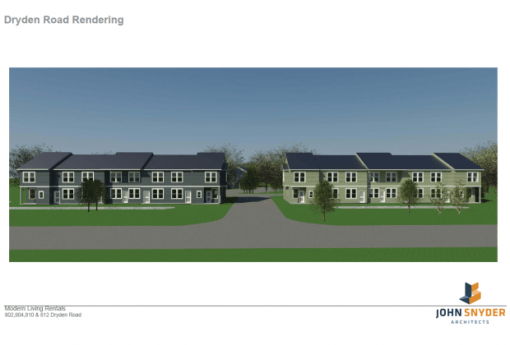
1. Starting off with the new project of the week: 42-unit, 108-bedroom 802 Dryden Road. As relayed on the Voice, the parcel currently hosts several rental properties in varying condition. The project is Modern Living Rentals’ largest to date, partly because developer Charlie O’Connor tends to focus more on smaller infill in urban areas.

Although no time table has been given for the $7.5 million project, a likely prospect is approval by the end of the year, with a spring 2018 groundbreaking, and a summer 2019 opening. While John Snyder Architects is in charge of design modifications, the townhouse designs are recycled from STREAM Collaborative’s 902 Dryden plan currently finishing up down the road. Marathon Engineering’s Adam Fishel will be shepherding the project through the approvals process, just as he did the Sleep Inn for Elmira Road.

Location-wise, it’s on a bus route but most everything will need some kind of vehicular transport, so it’s fairly auto-centric. There isn’t a lot of lot nearby apart from a few small rentals and single-family homes, and Cornell farm fields. On the other hand, few neighbors means fewer people likely to raise a fuss at planning board and town board meetings. As long as they provide town favorites like heat pumps, don’t expect big hangups as this plan moves through municipal review.

2. So here’s something out of the blue. Recently, the house at 2124 Mecklenburg Road in Enfield was sold to “The Broadway Group LLC d/b/a TBG Alabama LLC”, and a $998,000 construction loan agreement was filed shortly afterwards. One does not normally see million-dollar projects in Enfield, but a look at the filing yielding no information other than to suggest it was a retail building.

A little further digging indicates The Broadway Group, based out of Huntsville, Alabama, specializes in the development and construction of Dollar General stores. The lender, Southern States Bank, headquartered in Anniston, Alabama, is a preferred commercial lender for TBG. So this is a similar case to the Dollar General recently built in Lansing by Primax Properties –  it’s less about a bank being interested in Ithaca, and more about two major companies located near each other and having an established business relationship. A check of Enfield’s Planning Board reveals that the applicant took great pains not to reveal the name of the tenant, saying only a stand-alone variety dry goods store. A confidentiality clause with client limits what they could say, and TBG will technically own the metal building for a year until it transfers over to Dollar General. Expect a Q4 2017 and with it, 10-12 retail jobs.

I’ll be candid on this one – I sent out an email before writing anything up for the Voice asking if there were enough Enfield/West Hill readers who would care enough to justify an article being written. Jolene encouraged it, the piece went up, and the traffic on the article was actually pretty good, somewhat above average in fact.
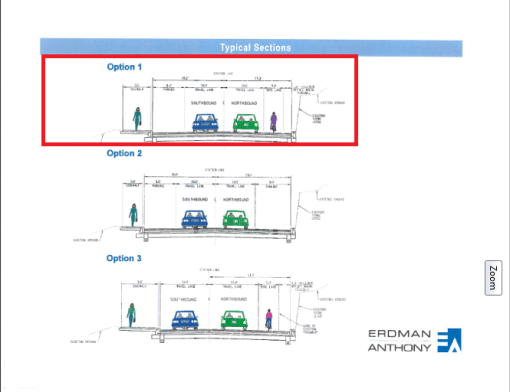
3. The city has decided which option it wants to pursue for its rework of University Avenue. Basically, say goodbye to the northbound parking aisle and say hello to a new bike lane. The southbound parking aisle will remain, along with a 7-foot wide sidewalk and 10-foot travel lanes.

4. It looks like plans for the next Press Bay Alley are moving forward. 110-112 West Green Street was sold to Urban Core LLC (John Guttridge / David Kuckuk) for $650,000 on the 19th, and a $581,250 construction loan from Tompkins Trust was filed the same day. Technically, some of the construction loan is actually for the purchase; according to the IURA breakdown, the renovation into micro-retail, office and two 500 SF apartments will only cost about $207,500, plus $40,000 for soft costs like architectural plans, engineering and legal expenses. As part of the $200,000 loan extended to Urban Core LLC by the IURA, the project needs to create at least 6 full-time jobs at full occupancy. On the Press Bay Alley Facebook page, the developers have announced plans for a spring opening, and issued a call for active-use tenants looking for anywhere from 300-2,000 SF.

5. Cincinnati-based Bloomfield Schon has arranged to sell the Cayuga Green complex, lofts, apartments and all. The developer would sell the buildings to Laureate House Ithaca Management LLC. Upon the intended purchase date of August 1st, Laureate House would pay the IURA loan balance ($733,130 at the moment with a $4,880 monthly payment) off in full. That would be about 21 years earlier than anticipated. Laureate House appears to be a start-up real estate firm backed by three wealthy Cornell alums; although the literature says they seek to launch 55+ communities for active seniors in college towns, there don’t appear to be changes in use or commercial/residential tenant mix planned with the purchase of Cayuga Green.
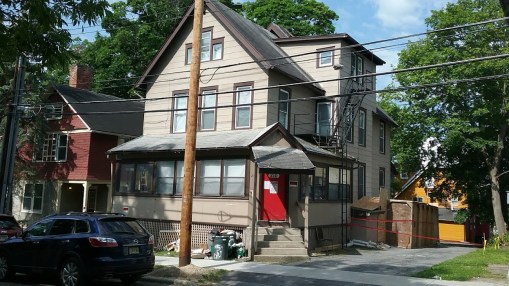
6. Been meaning to note this, but it appears 210 Linden Avenue is undergoing asbestos remediation, which means that the building is being prepped for deconstruction. It looks like Visum Development will be moving forward soon with their plans for a 9-unit, 36-bedroom student apartment building on the property. I did not seen any outward indication of similar work being performed on 118 College or 126 College Avenue at last check, though it’s been a couple weeks.

7. Here’s a look at the city of Ithaca’s Planning Board agenda for next week. Harold Square and 323 Taughannock will have their latest revisions checked for satisfaction of final approval (various paperwork submissions, and of samples of exterior materials to make sure they’re acceptable). 238 Linden Avenue, 232-236 Dryden Road and the DeWitt House old library redevelopment are up for final approval, and the McDonald’s and Finger Lakes ReUse’s supportive housing projects will be reviewed for determination of environmental significance, which basically means that potential impacts have been addressed and if necessary, properly mitigated.

There is also one semi-new project, which is 709-713 Court Street  – that would be the street address for Lakeview’s $20 million mixed-use affordable housing plan on Ithaca’s West End. From previous paperwork, it is known that it’s 5 floors with 50 units of affordable housing, 25 of which will be set aside for Lakeview clients with psychiatric disability. There will be 6,171 SF of commercial space on the first floor, and 17 parking spaces. PLAN Architectural Studios of Rochester will be the architect. Apart from a rough outline, there have been no renders shared of the project, so that’s the “semi-new” part.

AGENDA ITEM Approx. Start Time

  1. Agenda Review 6:00
  2. Privilege of the Floor 6:01
  3. Site Plan Review

A. Project: Mixed Use Apartments – Harold Square 6:10

Location: 123-129 E State/ MLK St (the Commons)

Applicant: L Enterprises LLC

Actions: Satisfaction of Conditions

Project Description: The Board approved project changes with conditions on May 23, 2017. The Applicant was asked submit revised materials to return to satisfy the conditions in June.

B. Project: Apartments (Short-Term Rental) 6:30

Location: 238 Linden Ave

Applicant: Trowbridge Wolf Michaels for DRY-LIN Inc.

Actions: Public Hearing Determination of Environmental Significance, Preliminary & Final Approval, Approval of Transportation Demand Management Plan

C. Project: McDonalds Rebuild 6:50

Location: 372 Elmira Road

Applicant: McDonalds USA LLC

Actions: Declaration of Lead Agency, Public Hearing, Determination of Environmental Significance, Recommendation to BZA

D. Project: Residential Mixed Use (DeWitt House) 7:00

Location: 310-314 N Cayuga Street

Applicant: Kimberly Michaels, Trowbridge Wolf Michaels for Frost Travis, Owner

Actions: Preliminary and Final Approval

E. Project: Apartments 7:20

Location: 323 Taughannock Blvd

Applicant: Noah Demarest for Rampart Real LLC

Actions: Satisfaction of Conditions

Project Description: The Board approved the project with conditions on May 23, 2017. The Applicant was asked to submit revised materials to return to satisfy the conditions in June.

F. Project: Finger Lakes ReUse Commercial Expansion and Supportive Apartments 7:40

Location: 214 Elmira Road

Applicant: Finger Lakes ReUse

Actions:  Public Hearing  Determination of Environmental Significance

G. Project: Apartments (60 Units) 8:00

Location: 232-236 Dryden Road

Applicant: Noah Demarest of Stream Collaborative for Visum Development Group

Actions: Determination of Environmental Significance, Preliminary and Final Approval, Approval of

Transportation Demand Management Plan

H. 709-713 Court Street – Housing – Sketch Plan 8:20

  1. Zoning Appeals 8:45
  1. Old/New Business
  2. Planning Board Comments on the Proposal to Rezone Areas of the Waterfront 8:50
  1. Reports
  2. Planning Board Chair (verbal)

9:10

  1. Director of Planning & Development (verbal)
  2. Board of Public Works Liaison (verbal)
  3. Approval of Minutes: May 23, 2017, April 25, 2017, and November 22, 2016 (time permitting) 9:30
  4. Adjournment 9:35


Chapter House / 406 Stewart Avenue Construction Update, 6/2017

16 06 2017

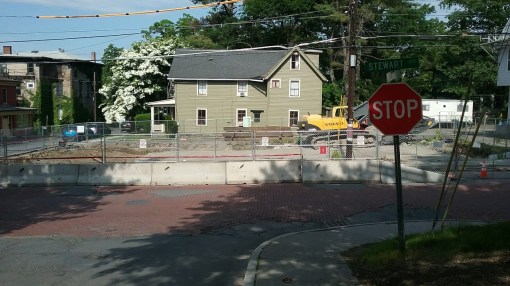
The funny thing about this project is, I already did the synopsis back in February 2016, the first time that it seemed to be under construction.

At the time, the construction seemed ready to move forward, but then, well…it didn’t. Former 400-404 Stewart Avenue owner Sebastian Mascaro sold the property and plans over to neighbor Jim Goldman, who intended to carry them forward. However, citing unfavorable cost estimates, Goldman decided to wait, and only recently has the project obtained favorable terms that would allow it to proceed.

The plans are still the same, although the project manager has changed. CSP Management (Jerry Dietz) will still manage the apartment rentals, but the commercial component is under the control of Pyramid Brokerage, Syracuse-based Hayner Hoyt will be the general contractor, and the construction manager representing Goldman is not with Hayner Hoyt and does not appear to be from the Ithaca area.

As a frank aside, it has been a rare degree of frustration to dig up information about this project. Goldman, for whatever reason, is incredibly publicity-averse, and everyone involved with the Chapter House has been asked or told to not talk about it. The little bit of information the Voice and 14850 have been able to get has come from CSP Management, which in itself comes with lots of cautions and uncertain language. The one occasion I spoke with Goldman, he told me he knew nothing and no longer owned the site, which if true, isn’t in the county’s records.

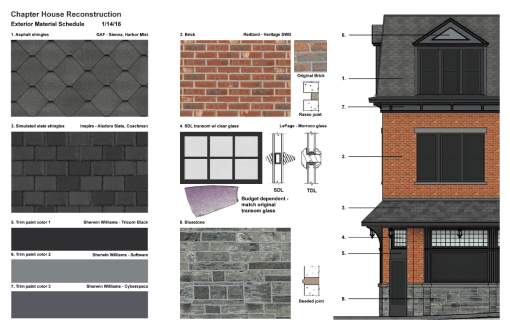
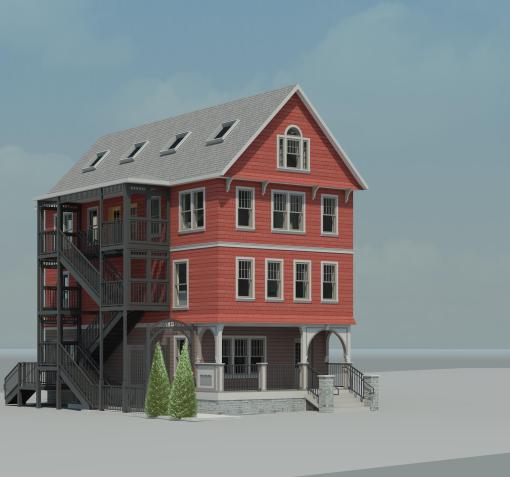
Here’s what is known. 406 Stewart Avenue will be 4 units, 7 bedrooms, replacing a similar-looking 1898 structure destroyed by fire in April 2015. 400-404 Stewart Avenue is about 9,000 SF with first floor retail with two floors of apartments – the number of bedrooms and units is not clear, as the number has been in flux. Note that calling it “the Chapter House project” is inaccurate – John Hoey, who owns the right to the Chapter House name, has not committed to reopening on the site, and the first-floor is being offered at a rather hefty $35/SF. For comparison’s sake, most downtown rates I’ve seen come in at about half that, although Pyramid is playing up its proximity to Cornell and the inner Collegetown market. A potential interior layout for a bar is included in the marketing material.

The current plan is to have 400-404 Stewart open by the end of the year, and 406 Stewart by Summer 2018. Jason K. Demarest is the architect for both buildings.

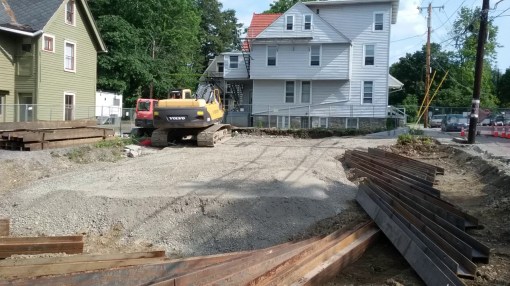
The first photo below is from my colleague Mike Blaney on May 23rd, as environmental remediation company ERSI was finishing clean-up of the fire-damaged site. In the following photos from this past weekend, the property has been leveled and graded, and a foundation is being excavated. The steel H-beams will be used as support for a retaining wall to shore up the soil, protecting the foundation and providing stability as the concrete is poured and cured.


Schwartz Plaza Construction Update, 6/2017

15 06 2017

One of the biggest complaints about Collegetown is the lack of public gathering spaces – there’s no real park or public plaza that can be utilized for gatherings and events. The gorges aren’t all that accessible and aren’t suitable for large groups, and places like CTB and St. Luke’s provide for small private gatherings and community events, but the lack of a sizable public social space poses a challenge to the neighborhood’s ability to provide for its residents.

As Collegetown’s raison d’etre, Cornell is stepping up to the plate to offer a space with the renovation of Schwartz Plaza. It’s not truly a public space as something owned by the city or county, but Cornell’s large, multi-faceted presence offers a reasonable facsimile.

Part of the purpose for building the Schwartz Performing Arts Center in Collegetown was to draw in people from outside the neighborhood, and mix the non-students with the students. When the building first opened in 1989, the plaza was intended as an outdoor reception area for Schwartz patrons, and the original design by English architect James Stirling, which called for a lively “forecourt”, was never built out. Instead, the plaza was walled off from the street and there was little exposure or interaction with College Avenue. As a result, outside of performances, Schwartz Plaza tends to be barren, its only social function comes from being close to a bus stop.

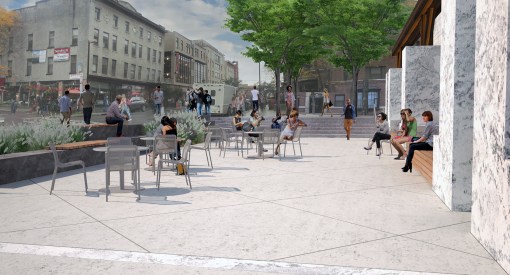
The stated goals for Schwartz Plaza’s renovation are to improve pedestrian circulation, increase safety by providing for better visibility, and to enhance aesthetics. To do this, Cornell will remove the 4-foot tall concrete wall that separates the plaza from the sidewalk, create a series of short stairs to facilitate “permeability” of pedestrians to and from the plaza, and adding new seating and landscaping to make the plaza more inviting – stone walls and pavers, wood-on-granite benches, recessed LED lighting, new bike racks and planters. It’s not really a new structure or even a change of use, but to make the plaza more effective for its intended use.

To quote the marketing pitch: “This project is expected to yield a lively new gathering space that serves as a catalyst for an enhanced pedestrian boulevard along College Avenue, the primary pedestrian gateway to the university. This project is conceived as a key node within a larger, future Collegetown public realm enhancement area.”

Being a fairly minor project, and having hosted some community meetings last fall to determine the neighborhood’s design preferences, this plan sailed through the city’s planning board review, in and out from February through March. I can’t seem to locate the SPR offhand, but the total cost is about $600,000.

As projects go, this one should be relatively short at about four months, May-August 2017. TWMLA is responsible for the plaza design, T. G. Miller for civil engineering work, and Taitem Engineering for electrical engineering. The contractor isn’t clear and (unusually) Cornell doesn’t have it listed on their webpages, but the invited bidders were all regional road/landscape construction firms.

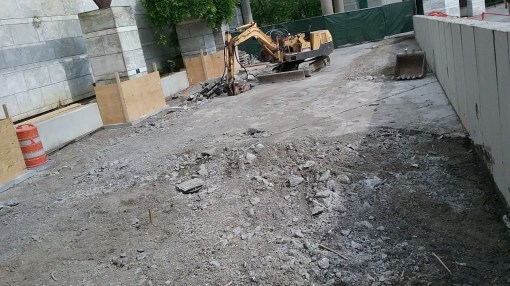
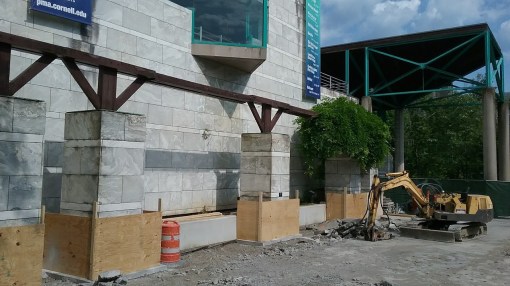
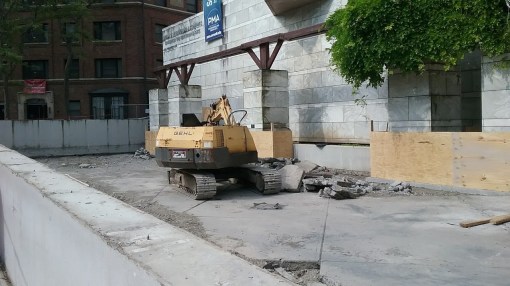
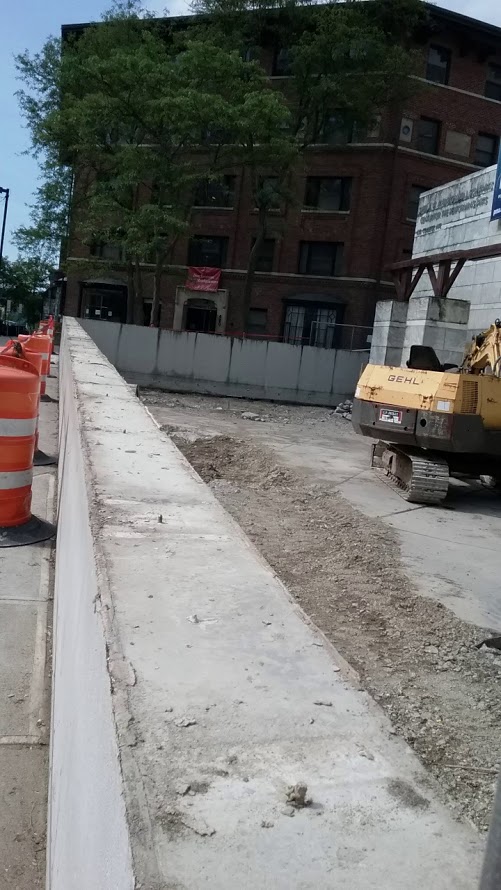
In the photos, it looks like removal of the old plaza is underway, with the wall soon to follow. The plywood around the Vermont marble columns is for protection (way back, the columns were intended to be limestone and brick stringcourses, but it was value-engineered to marble and off-white Dryvit).


209-215 Dryden Road Construction Update, 6/2017

13 06 2017

For news about today’s event, please go to the Voice.

Most of the rear and east facade are complete on the Breazzano Center at 209-215 Dryden Road. The Larson sheeting on the utility/loading dock refers to Larson Alucoil, the brand name of the aluminum metal panels being used to complete the less photogenic vantage points of the new 6-story building. The clips on the rear wall will be used as hinges for architectural sunshades.

Most of the windows and spandrel glass has been installed on the read and east facade. Note that spandrel glass is purely decorative, and there are metal panels between the glass and the lip of the floor plate. The white stripes indicate where the salmon-colored metal panels will be installed over the glass, although I personally would be just as happy to see them go without; the glass curtain wall gives the building an airier, less overbearing appearance. The bottom floor uses clear glass to give the building greater transparency at street level, and is meant to enliven (“activate”) the block. In photo 9, you can see the ceiling of one of the large group instruction classrooms, meaning that the drywall has been hung on at least the lower floors, and utilities rough-ins have been completed.

At the time these photos were taken, workers were easing a new panel section of the front curtain wall into place – it’s a bit of a delicate process to hoist the glazing with the crane and line everything up just right, and then quickly fasten it into place so they can move on with the next section, pulling the tarp back and continuing down the line. One imagines it must get a bit stuffy under the plastic sheeting this time of the year. More complicated exterior sections like the projecting atrium wall have yet to be tackled.

The Breazzano Center should be open in time for the fall 2017 semester. Not long thereafter, the staging area next door at 238 Linden will becoming a project of its own with the erection of a 4-story, 24-studio apartment building. That project is up for final approval later this month.


201 College Avenue Construction Update, 6/2017

12 06 2017

201 College is moving right along. W. H. Lane has been charging ahead at a rapid clip in order to have the 44-unit apartment building ready for occupancy in August. the front (west) half is further in the construction process – fireproof Georgia-Pacific DensGlass fiberglass mat sheathing, coated and sealed a pitch black air/vapor barrier (Carlisle Barriseal?), and layered with Dow Thermax polyiso insulation boards. The Thermax is coated in a reflective outer layer to repel incoming solar radiation and keep the building cool during the summer. Or at least, that’s what one of the construction guys told me. Some windows have been fitted into the structure on the lower floors.

The back half is not as far along. The northeast and east walls remain bare steel studs, while the southeast wall is just getting its DensGlass mats installed. The paired window layout might seem a little unusual, but many of the units will utilize a “mezzanine” intermediary floor to increase the living space in each unit.

One detail that has appeared to have changed from the images on file here are the stairwell windows above the front entrance. The drawings show one square window for each floor, while the finished building will have a pair of smaller square windows.

The front facade might seem a bit bland at the moment, but a plethora of exterior finishes should give the building a more visually interesting appearance – A large Sherwin-Williams Iron Ore (aka fancy off-black) metal canopy above the entrance, and fiber cement panels in shades of Allura Snow White, S-W Gauntlet Grey, and S-W Chinese Red, as well as woven bamboo siding. A stucco aggregate will be applied to exposed foundation sections (when you’re spending $10 million, you can afford the real deal over DryVit), and white cedar panels with a clear protective finish will be used for canopy ceilings and architectural screens. Long story short, variety of colors and materials should help break up the mass and make it look less overbearing.

With August just a scant two months away, we’ll have an idea of how nice the final product looks soon enough.


News Tidbits 6/10/17: In High Demand

10 06 2017

1. Start off this week with some eye candy. Here are the latest renders for Visum Development’s 191-bed, 60-unit project at 232-236 Dryden Road. The biggest change here is the Dryden Road facade – revised fenestration, and the addition of shingle-style balconies. STREAM Collaborative’s intent is to give the south building a little more historical sensitivity – when the Cascadilla school still had a dorm in the late 1800s and early 1900s, it included a 4-story shingle-style dormitory complete with dining room and gym. The balconies are throwbacks to the dormitory’s balconies.

However, given that this building will date open in 2018 and not 1898, instead of wood shingle, the balconies will use Allura “Redwood” fiber cement shinglewood pulp mixed with sand and cement, shaped for a wood-like appearance, but with the durability of concrete. Fiber cement is also more expensive to buy and install vs. materials like vinyl, which is why only more expensive or visible structures tend to use it. Other planned materials include Endicott manganese ironspot velour brick veneer, fiber cement panels with LP smart trim painted in Sherwin-Williams Pure White and Anonymous (actual name), lap siding in SW Pure White and Marigold, granite grey stucco (*real* stucco, not DryVit), a metal canopy and Andersen windows.

2. Business is good for STREAM Collaborative. So good that they’re expanding both in staff and space. The young, prolific architecture firm led by Noah Demarest will be moving out from its location in the City Hall Annex at 123 Sough Cayuga Street, and into a larger downtown space in the ca. 1872 Gregg Block at 108-112 West State Street, across from the State Theatre. The new digs are being renovated now, and are expected to be ready for occupancy by July 1st.

On another note, the owner of the city hall annex has taken to advertising the office space on Cragislist, which seems like the wrong choice to me. An apartment, sure. A house for sale or offices to rent? My impression is that folks prefer a more professional medium than what Craigslist offers. Kinda the same with jobs – servers or dog-sitters, sure. Accountants or architects? Ehh.

Maybe I’m just behind the times. Here’s the posting for the former Hal’s Deli on the 100 Block North Aurora Street. $5500/month.

3. WHCU is reporting that INHS has had no shortage of applicants for the 210 Hancock rentals. After receiving over 200 applications, they set up a lottery in which 122 “made it through” , and then selected the top 60 (there are 59 rental units though…might be a just in case there’s a drop-out, or it could just be conversational rounding). If it’s anything like New York City’s lottery, what happens is that each application is validated, sorted for requested unit type, and is assigned a randomized log number – those who get 1-48 for the one-bedroom subset, and 1-11 for the two-bedrooms subset, are awarded dibs on a unit, so long as they pass the income check and background check. Unit occupancy is expected late this summer, and marketing for the seven for-sale units will start…

4. …pretty much now. The three units in the first image are 204, 206 and 208 Hancock Street, the four for-sales in image two are from L to R, 406, 408, 410 and 412 Lake Street. 206 Hancock, 408 Lake and 410 Lake will be 910 SF 2 bedroom, 1.5 bath units that will sell for $112,000 to qualified buyers. 406 Lake and 412 are 1088 SF, 2 bed 1.5 bath units priced at $129,000. The largest units, 204 Hancock and 208 Hancock, are 1300 SF, 3 bed 1.5 bath units that will sell for $145,000. The plan is to have buyers lined up for all seven units by the end of the year.

5. The county legislature has approved the Heritage Center acquisition. The county will pay $2 million for the 18,500 SF property, about $400,000 below assessment. Tompkins Financial Corporation is parting with its former offices next spring as it moves into a new HQ a block away. The plan is to have the heritage center, which will host tourism and history-focused non-profits, open for occupancy by the end of 2018, just as The History Center’s lease at 406 E. State runs out.

6. Seems like Lakeview is serious about their West End mixed-use project. The mental health services organization just purchased three properties on Thursday the 8th – 326 North Meadow for $150,000, 711-13 West Court Street for $525,000, and 329 North Meadow and 709 West Court (same owner) for $550,000.

Lakeview is planning a mixed-use 5-story building with a small amount of first-floor retail and 50 apartment units, all of which would be affordable, and half of which would be set aside for those with mental health ailments who are generally independent, but will have Lakeview staff to turn to in times of need. The project team requested $250,000 from the city IURA to help finance the $20.1 million project, but were only awarded $50,000 since it’s still at a relatively stage without detailed plans. The project team expects to submit their project for review later this year, with a 2018 construction start.

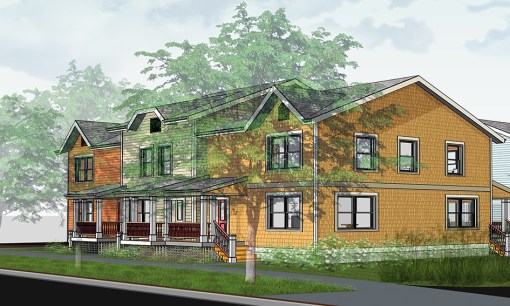
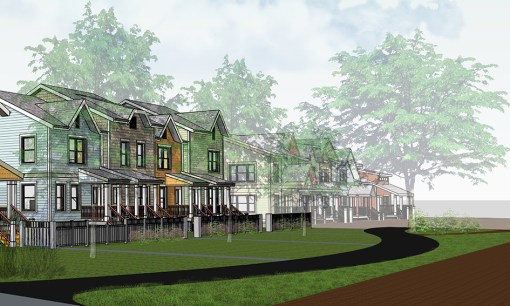
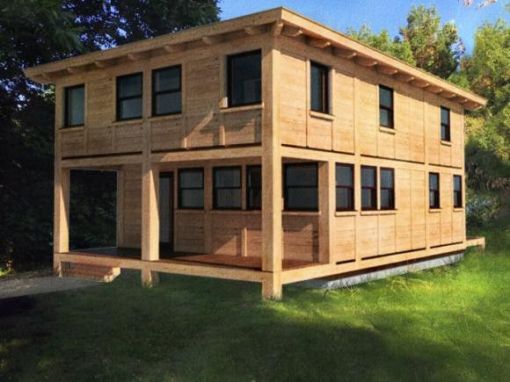
7. Tiny Timbers is doing well. In an update to their website, they note the completion of their first house, a “lofted L” model just over the county line in Hector, and a new house planned in Enfield (given that Enfield permitted just one new house last year, there’s probably a joke in there somewhere). There is another home just getting underway in Lansing’s Farm Pond Circle development, and a fourth will start soon on Grandview Drive in the city of Ithaca’s portion of South Hill. All the new units will be “big cubes” like the render shown above.

8. Looking at the city of Ithaca’s planning department memo this month, there’s nothing new to note for June. Smaller projects tend to show up in the memo, since the sketch plan for feedback isn’t as big of a deal for a small proposal, like a new store or a modest apartment building. Finger Lakes ReUse’s 22 studio units for vulnerable/formerly homeless populations will have its public hearing and Determination of Environmental Significant (step before prelim approval), the McDonald’s rebuild will have Declaration of Lead Agency, public hearing, BZA recs and DoES, 232-236 Dryden will have its DoES vote, and the Old Library redevelopment and 238 Linden will be up for approval.

9. Finishing off this week with a word of approval – the Dryden town board gave approval to Gary Sloan’s 36-unit Evergreen Townhouses at 1061 Dryden Road, per Cassie Negley at the Ithaca Times. At the boards’ (both planning and town) encouragement, the solar panels were replaced with electric heat pumps, which could utilize off-site solar and open up the possibility of a more environmentally sustainable project overall, given the proliferation of solar arrays underway in Tompkins and the region (my off the cuff estimate has at least enough solar arrays planned in Tompkins in the next 18 months to power over 10,000 homes). A play structure and 11 more parking spaces were also added.


Collegetown Terrace Construction Update, 5/2017

21 05 2017

Collegetown Terrace phase 3 is actually opening this month. Speaking to John Novarr a few weeks ago, he mentioned that the first units would actually be welcoming tenants this month, to take advantage of the modest June-June 12-month market that comes before the typical August-June 10-month period that dominates the students calendar. From yesterday, it looks like the first tenants have indeed moved into the Building 7’s 247 units and 344 bedrooms. Units range from 218 SF studio suites with shared baths, kitchen and laundry (5-10 studios per suite), to 1266 3-bedroom units. For the record, the official address will be “120 Valentine Place”. The listed amenities include:

  • Heat included in rent
  • Upper floor large windows for expansive view
  • High speed data access throughout included in rent
  • Kitchen appliances: dishwasher, garbage disposal, microwave, stove and refrigerator
  • Custom-made cabinets
  • Granite counter surfaces in kitchen and bathroom
  • Limestone floors in kitchen, bathroom, and entries
  • Air conditioning in all apartments
  • Elevators
  • Monitored heat detectors, smoke detectors, CO detectors, and sprinklers
  • Fully furnished with blinds, leather sofa, and full/queen beds. Some with work stations and walk in closets
  • Prox/reader security system
  • Washers and dryers in all apartments.
  • Covered parking available for a fee
  • Free shuttle to Cornell. The free shuttle runs to and from campus weekdays throughout the academic year.

Rents clock in at a premium of around $1,000+/bedroom, but the studio suites will come in around $700/bedroom. It does seem like there are some mixed opinions on living there, if the Yelp reviews are any indication.

One slight modification that was sought recently was an approval considerations variance to allow tenants from other Novarr-Mackesey properties to park their cars in the Terrace’s garage. This has been something of a long-running issue with Terrace, which built more parking than it needed in the earlier phases, and as a result requested and received a variance to convert a floor intended for parking into dorm-style living quarter for students on more modest budgets. Even with the original variance, it seems that there are still an excessive number of unused parking spaces, ones that Novarr-Mackesey sees as potential rentable tenant spaces for residents in some of their nearby structures, including two housing projects due to get underway in the next year, 119-125 College Avenue (College Townhouses) and 238 Linden Avenue.

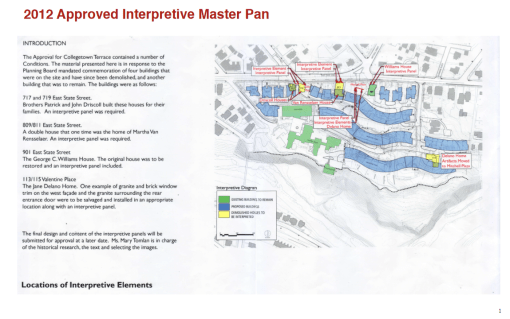
As part of the final stages of project completion (and stipulations of its original approval back in August 2011), some interpretive signage and features will be included in the landscaping, recognizing a few of the homes and the nurses’ dormitory that once stood on the site (recall that Casa Roma was once the city hospital). Thankfully the google street view archives are but a click away, so that the curious can go back and look at what was there prior. Some of the homes were architecturally interesting, if not necessarily historic.

Note the stair railing art in photo ten. It’s as if someone looked at modern buildings, said they weren’t colorful enough, and designed that art feature to have ALL THE COLORS. Holy rainbow explosion. More seriously, it’s quite unusual, and kinda neat, since it’s not often you see a visual feature of interest so tucked away from public viewsheds.

So that pretty much wraps this up. In terms of private non-institutional projects, I dunno if there’s been a project that’s had an impact like this. It’s been a long time since the first presentation back in April 2009. In terms of numbers, it’s enormous – $190 million investment, 1,250+ beds (net gain of over 600), 16 acres. Certainly the latest few hundred beds will help to make a dent in the rental market, it’s by far the biggest project opening for occupancy this year. The trade-off will be a possible softening in some rental segments (e.g. small landlords in fringe student markets), but given the city’s push towards turning rentals back into owner-occupied units, and getting rent appreciation under control, it’s not something that will elicit much concern, especially as Cornell’s student population continues to grow.

In some ways, this project is many good things; growing the tax base, and addressing the need for housing in a somewhat inconspicuous manner, the buildings stepping downward into the hillside. With 344 new residents in the core of Ithaca, it may also give a healthy boost to nearby businesses in Collegetown and Downtown. But CTT has its detractors and criticism – the size still makes unnerves some permanent residents nearby, and the architectural design is a bit polarizing. There’s a tendency to look at building projects in black and white, but it’s never a cut-and-dry process. In reality, it’s a delicate balance of costs, capabilities, the market and the community’s wants and concerns.

Novarr deserve credit in that, unlike many projects, this project has stayed largely true to approved form over the years with the exception of the parking variances. There’s an uncomfortable trend with last-second revisions in more recent plans, but Collegetown Terrace has stuck fairly closely to the original plan as explicated in its Environmental Impact Statement years ago. City staff and elected officials also deserve credit for seeing the potential here for something that could contribute to Ithaca, rather than just saying “this is too much” and turning their backs on it. Credit is also due to ikon.5 and Welliver for their work in designing this massive project, and building it out (which included many local unions and their tradespeople).