News Tidbits 6/25/17: Lazy Sunday

25 06 2017

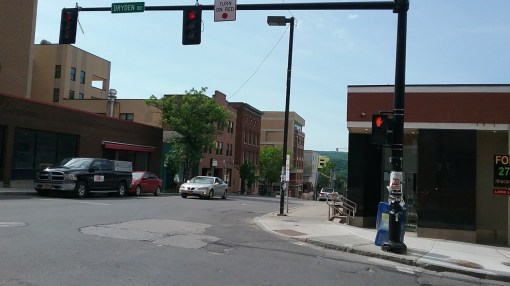
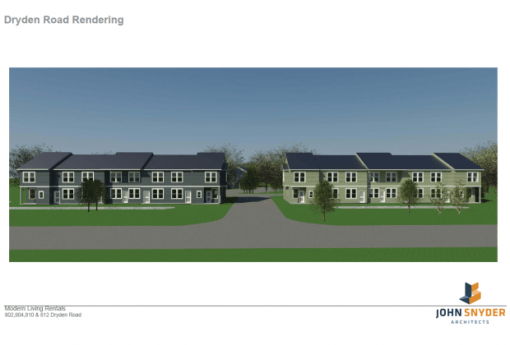
1. Starting off with the new project of the week: 42-unit, 108-bedroom 802 Dryden Road. As relayed on the Voice, the parcel currently hosts several rental properties in varying condition. The project is Modern Living Rentals’ largest to date, partly because developer Charlie O’Connor tends to focus more on smaller infill in urban areas.

Although no time table has been given for the $7.5 million project, a likely prospect is approval by the end of the year, with a spring 2018 groundbreaking, and a summer 2019 opening. While John Snyder Architects is in charge of design modifications, the townhouse designs are recycled from STREAM Collaborative’s 902 Dryden plan currently finishing up down the road. Marathon Engineering’s Adam Fishel will be shepherding the project through the approvals process, just as he did the Sleep Inn for Elmira Road.

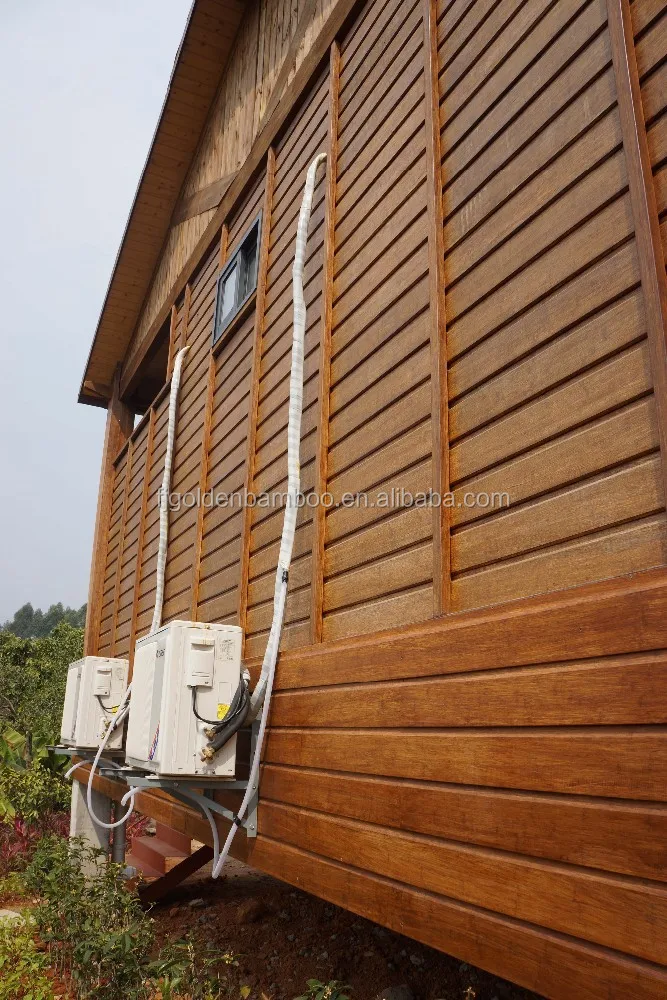
Location-wise, it’s on a bus route but most everything will need some kind of vehicular transport, so it’s fairly auto-centric. There isn’t a lot of lot nearby apart from a few small rentals and single-family homes, and Cornell farm fields. On the other hand, few neighbors means fewer people likely to raise a fuss at planning board and town board meetings. As long as they provide town favorites like heat pumps, don’t expect big hangups as this plan moves through municipal review.

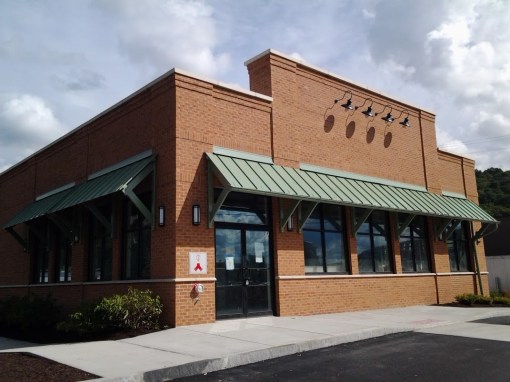
2. So here’s something out of the blue. Recently, the house at 2124 Mecklenburg Road in Enfield was sold to “The Broadway Group LLC d/b/a TBG Alabama LLC”, and a $998,000 construction loan agreement was filed shortly afterwards. One does not normally see million-dollar projects in Enfield, but a look at the filing yielding no information other than to suggest it was a retail building.

A little further digging indicates The Broadway Group, based out of Huntsville, Alabama, specializes in the development and construction of Dollar General stores. The lender, Southern States Bank, headquartered in Anniston, Alabama, is a preferred commercial lender for TBG. So this is a similar case to the Dollar General recently built in Lansing by Primax Properties –  it’s less about a bank being interested in Ithaca, and more about two major companies located near each other and having an established business relationship. A check of Enfield’s Planning Board reveals that the applicant took great pains not to reveal the name of the tenant, saying only a stand-alone variety dry goods store. A confidentiality clause with client limits what they could say, and TBG will technically own the metal building for a year until it transfers over to Dollar General. Expect a Q4 2017 and with it, 10-12 retail jobs.

I’ll be candid on this one – I sent out an email before writing anything up for the Voice asking if there were enough Enfield/West Hill readers who would care enough to justify an article being written. Jolene encouraged it, the piece went up, and the traffic on the article was actually pretty good, somewhat above average in fact.
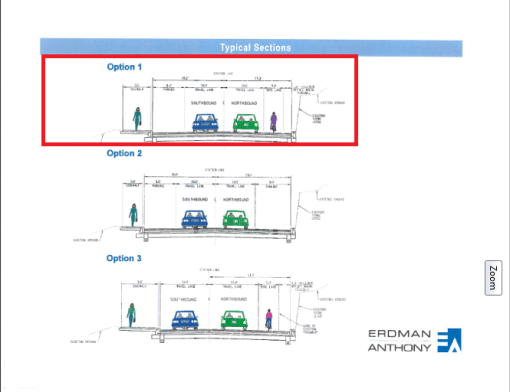
3. The city has decided which option it wants to pursue for its rework of University Avenue. Basically, say goodbye to the northbound parking aisle and say hello to a new bike lane. The southbound parking aisle will remain, along with a 7-foot wide sidewalk and 10-foot travel lanes.

4. It looks like plans for the next Press Bay Alley are moving forward. 110-112 West Green Street was sold to Urban Core LLC (John Guttridge / David Kuckuk) for $650,000 on the 19th, and a $581,250 construction loan from Tompkins Trust was filed the same day. Technically, some of the construction loan is actually for the purchase; according to the IURA breakdown, the renovation into micro-retail, office and two 500 SF apartments will only cost about $207,500, plus $40,000 for soft costs like architectural plans, engineering and legal expenses. As part of the $200,000 loan extended to Urban Core LLC by the IURA, the project needs to create at least 6 full-time jobs at full occupancy. On the Press Bay Alley Facebook page, the developers have announced plans for a spring opening, and issued a call for active-use tenants looking for anywhere from 300-2,000 SF.

5. Cincinnati-based Bloomfield Schon has arranged to sell the Cayuga Green complex, lofts, apartments and all. The developer would sell the buildings to Laureate House Ithaca Management LLC. Upon the intended purchase date of August 1st, Laureate House would pay the IURA loan balance ($733,130 at the moment with a $4,880 monthly payment) off in full. That would be about 21 years earlier than anticipated. Laureate House appears to be a start-up real estate firm backed by three wealthy Cornell alums; although the literature says they seek to launch 55+ communities for active seniors in college towns, there don’t appear to be changes in use or commercial/residential tenant mix planned with the purchase of Cayuga Green.
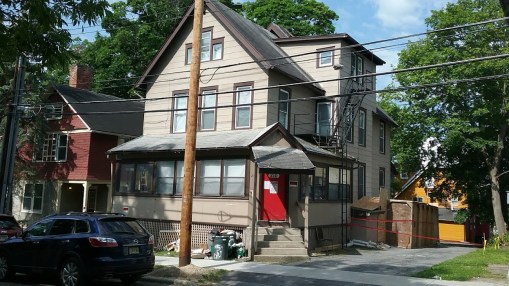
6. Been meaning to note this, but it appears 210 Linden Avenue is undergoing asbestos remediation, which means that the building is being prepped for deconstruction. It looks like Visum Development will be moving forward soon with their plans for a 9-unit, 36-bedroom student apartment building on the property. I did not seen any outward indication of similar work being performed on 118 College or 126 College Avenue at last check, though it’s been a couple weeks.

7. Here’s a look at the city of Ithaca’s Planning Board agenda for next week. Harold Square and 323 Taughannock will have their latest revisions checked for satisfaction of final approval (various paperwork submissions, and of samples of exterior materials to make sure they’re acceptable). 238 Linden Avenue, 232-236 Dryden Road and the DeWitt House old library redevelopment are up for final approval, and the McDonald’s and Finger Lakes ReUse’s supportive housing projects will be reviewed for determination of environmental significance, which basically means that potential impacts have been addressed and if necessary, properly mitigated.

There is also one semi-new project, which is 709-713 Court Street  – that would be the street address for Lakeview’s $20 million mixed-use affordable housing plan on Ithaca’s West End. From previous paperwork, it is known that it’s 5 floors with 50 units of affordable housing, 25 of which will be set aside for Lakeview clients with psychiatric disability. There will be 6,171 SF of commercial space on the first floor, and 17 parking spaces. PLAN Architectural Studios of Rochester will be the architect. Apart from a rough outline, there have been no renders shared of the project, so that’s the “semi-new” part.

AGENDA ITEM Approx. Start Time

  1. Agenda Review 6:00
  2. Privilege of the Floor 6:01
  3. Site Plan Review

A. Project: Mixed Use Apartments – Harold Square 6:10

Location: 123-129 E State/ MLK St (the Commons)

Applicant: L Enterprises LLC

Actions: Satisfaction of Conditions

Project Description: The Board approved project changes with conditions on May 23, 2017. The Applicant was asked submit revised materials to return to satisfy the conditions in June.

B. Project: Apartments (Short-Term Rental) 6:30

Location: 238 Linden Ave

Applicant: Trowbridge Wolf Michaels for DRY-LIN Inc.

Actions: Public Hearing Determination of Environmental Significance, Preliminary & Final Approval, Approval of Transportation Demand Management Plan

C. Project: McDonalds Rebuild 6:50

Location: 372 Elmira Road

Applicant: McDonalds USA LLC

Actions: Declaration of Lead Agency, Public Hearing, Determination of Environmental Significance, Recommendation to BZA

D. Project: Residential Mixed Use (DeWitt House) 7:00

Location: 310-314 N Cayuga Street

Applicant: Kimberly Michaels, Trowbridge Wolf Michaels for Frost Travis, Owner

Actions: Preliminary and Final Approval

E. Project: Apartments 7:20

Location: 323 Taughannock Blvd

Applicant: Noah Demarest for Rampart Real LLC

Actions: Satisfaction of Conditions

Project Description: The Board approved the project with conditions on May 23, 2017. The Applicant was asked to submit revised materials to return to satisfy the conditions in June.

F. Project: Finger Lakes ReUse Commercial Expansion and Supportive Apartments 7:40

Location: 214 Elmira Road

Applicant: Finger Lakes ReUse

Actions:  Public Hearing  Determination of Environmental Significance

G. Project: Apartments (60 Units) 8:00

Location: 232-236 Dryden Road

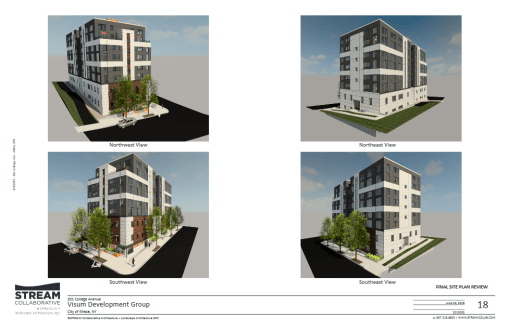
Applicant: Noah Demarest of Stream Collaborative for Visum Development Group

Actions: Determination of Environmental Significance, Preliminary and Final Approval, Approval of

Transportation Demand Management Plan

H. 709-713 Court Street – Housing – Sketch Plan 8:20

  1. Zoning Appeals 8:45
  1. Old/New Business
  2. Planning Board Comments on the Proposal to Rezone Areas of the Waterfront 8:50
  1. Reports
  2. Planning Board Chair (verbal)

9:10

  1. Director of Planning & Development (verbal)
  2. Board of Public Works Liaison (verbal)
  3. Approval of Minutes: May 23, 2017, April 25, 2017, and November 22, 2016 (time permitting) 9:30
  4. Adjournment 9:35


Chapter House / 406 Stewart Avenue Construction Update, 6/2017

16 06 2017

The funny thing about this project is, I already did the synopsis back in February 2016, the first time that it seemed to be under construction.

At the time, the construction seemed ready to move forward, but then, well…it didn’t. Former 400-404 Stewart Avenue owner Sebastian Mascaro sold the property and plans over to neighbor Jim Goldman, who intended to carry them forward. However, citing unfavorable cost estimates, Goldman decided to wait, and only recently has the project obtained favorable terms that would allow it to proceed.

The plans are still the same, although the project manager has changed. CSP Management (Jerry Dietz) will still manage the apartment rentals, but the commercial component is under the control of Pyramid Brokerage, Syracuse-based Hayner Hoyt will be the general contractor, and the construction manager representing Goldman is not with Hayner Hoyt and does not appear to be from the Ithaca area.

As a frank aside, it has been a rare degree of frustration to dig up information about this project. Goldman, for whatever reason, is incredibly publicity-averse, and everyone involved with the Chapter House has been asked or told to not talk about it. The little bit of information the Voice and 14850 have been able to get has come from CSP Management, which in itself comes with lots of cautions and uncertain language. The one occasion I spoke with Goldman, he told me he knew nothing and no longer owned the site, which if true, isn’t in the county’s records.

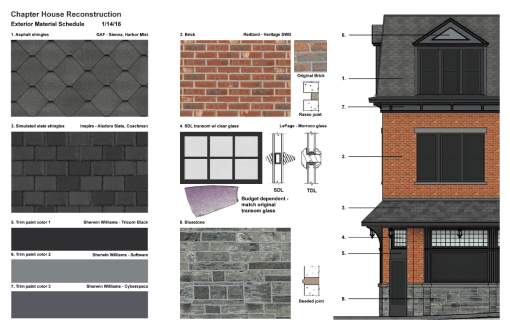
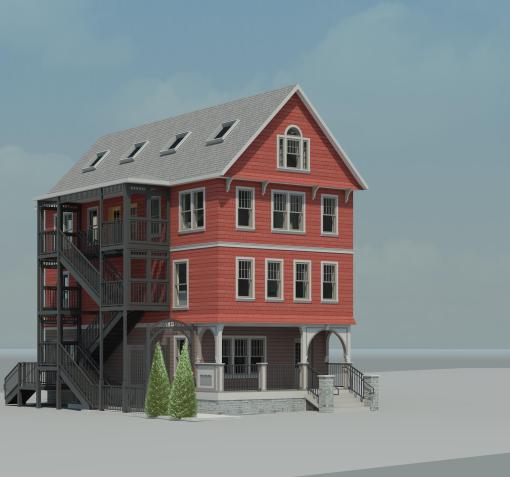
Here’s what is known. 406 Stewart Avenue will be 4 units, 7 bedrooms, replacing a similar-looking 1898 structure destroyed by fire in April 2015. 400-404 Stewart Avenue is about 9,000 SF with first floor retail with two floors of apartments – the number of bedrooms and units is not clear, as the number has been in flux. Note that calling it “the Chapter House project” is inaccurate – John Hoey, who owns the right to the Chapter House name, has not committed to reopening on the site, and the first-floor is being offered at a rather hefty $35/SF. For comparison’s sake, most downtown rates I’ve seen come in at about half that, although Pyramid is playing up its proximity to Cornell and the inner Collegetown market. A potential interior layout for a bar is included in the marketing material.

The current plan is to have 400-404 Stewart open by the end of the year, and 406 Stewart by Summer 2018. Jason K. Demarest is the architect for both buildings.

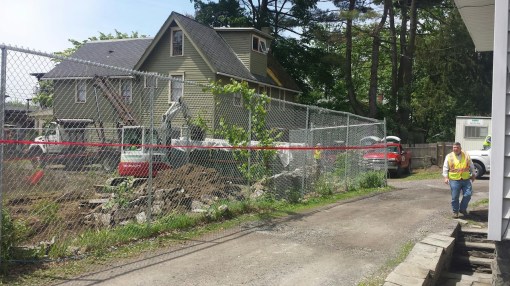
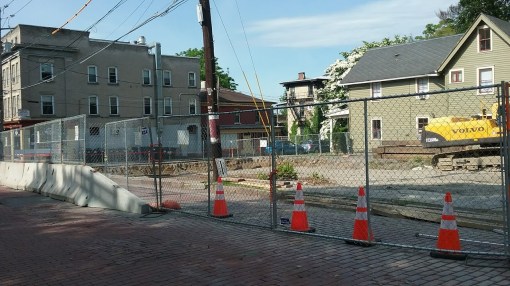
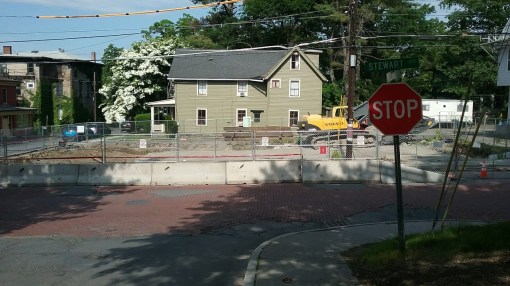
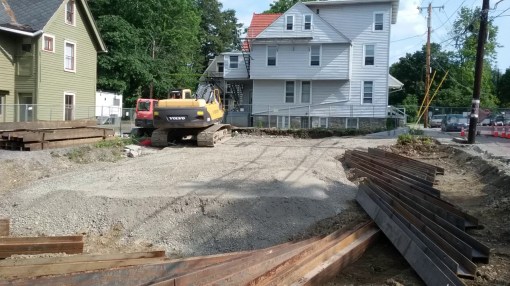
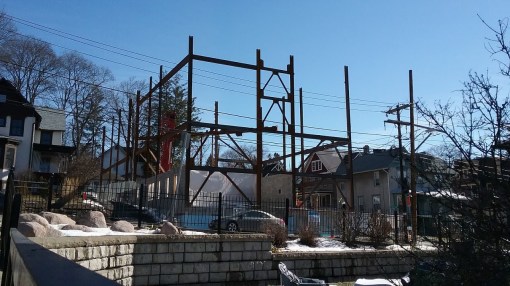
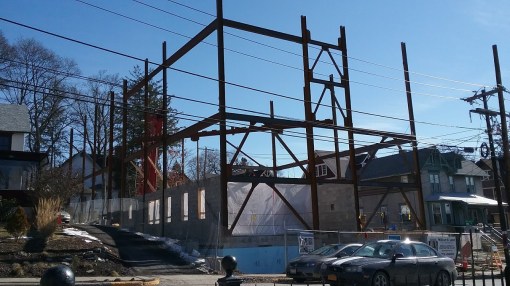
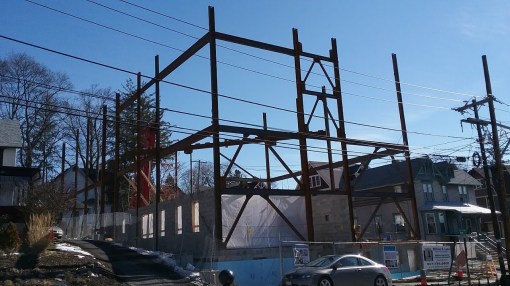
The first photo below is from my colleague Mike Blaney on May 23rd, as environmental remediation company ERSI was finishing clean-up of the fire-damaged site. In the following photos from this past weekend, the property has been leveled and graded, and a foundation is being excavated. The steel H-beams will be used as support for a retaining wall to shore up the soil, protecting the foundation and providing stability as the concrete is poured and cured.


201 College Avenue Construction Update, 6/2017

12 06 2017

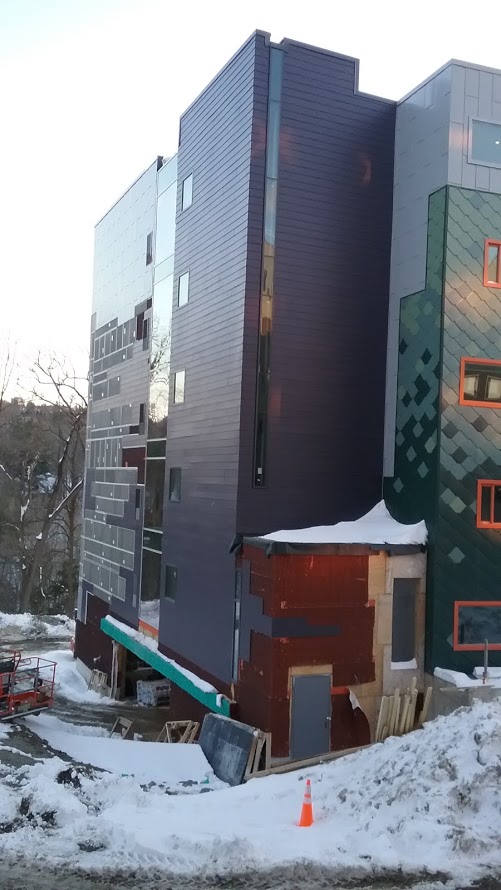
201 College is moving right along. W. H. Lane has been charging ahead at a rapid clip in order to have the 44-unit apartment building ready for occupancy in August. the front (west) half is further in the construction process – fireproof Georgia-Pacific DensGlass fiberglass mat sheathing, coated and sealed a pitch black air/vapor barrier (Carlisle Barriseal?), and layered with Dow Thermax polyiso insulation boards. The Thermax is coated in a reflective outer layer to repel incoming solar radiation and keep the building cool during the summer. Or at least, that’s what one of the construction guys told me. Some windows have been fitted into the structure on the lower floors.

The back half is not as far along. The northeast and east walls remain bare steel studs, while the southeast wall is just getting its DensGlass mats installed. The paired window layout might seem a little unusual, but many of the units will utilize a “mezzanine” intermediary floor to increase the living space in each unit.

One detail that has appeared to have changed from the images on file here are the stairwell windows above the front entrance. The drawings show one square window for each floor, while the finished building will have a pair of smaller square windows.

The front facade might seem a bit bland at the moment, but a plethora of exterior finishes should give the building a more visually interesting appearance – A large Sherwin-Williams Iron Ore (aka fancy off-black) metal canopy above the entrance, and fiber cement panels in shades of Allura Snow White, S-W Gauntlet Grey, and S-W Chinese Red, as well as woven bamboo siding. A stucco aggregate will be applied to exposed foundation sections (when you’re spending $10 million, you can afford the real deal over DryVit), and white cedar panels with a clear protective finish will be used for canopy ceilings and architectural screens. Long story short, variety of colors and materials should help break up the mass and make it look less overbearing.

With August just a scant two months away, we’ll have an idea of how nice the final product looks soon enough.


Collegetown Terrace Construction Update, 5/2017

21 05 2017

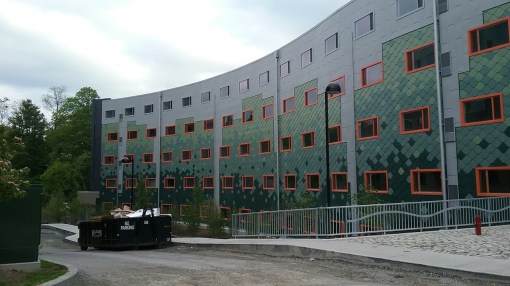
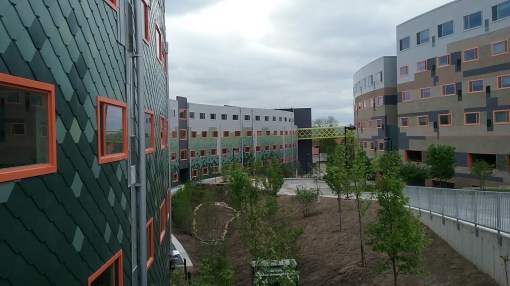
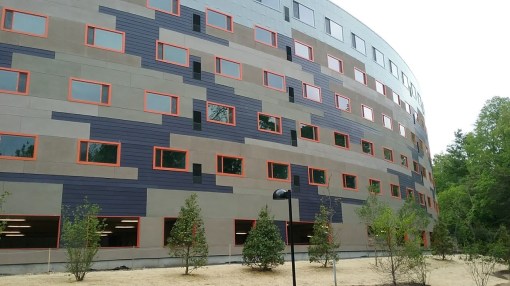
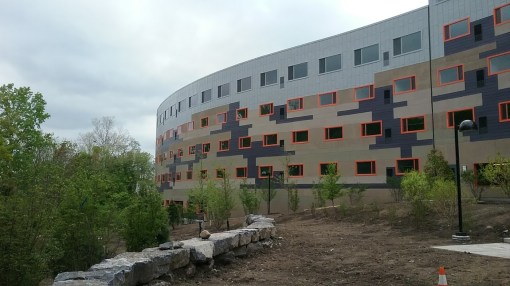
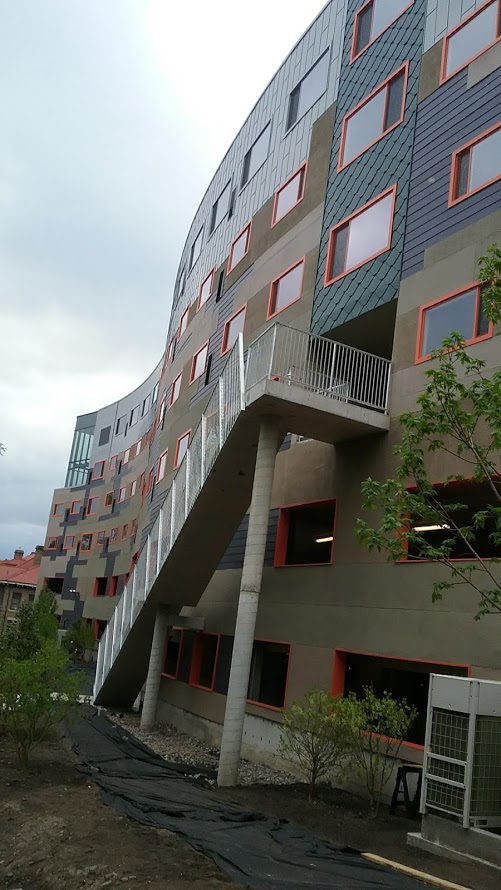
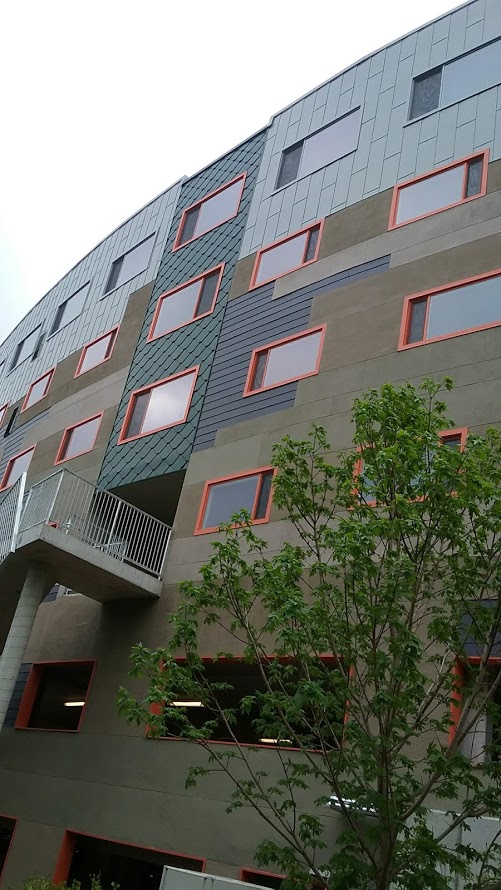
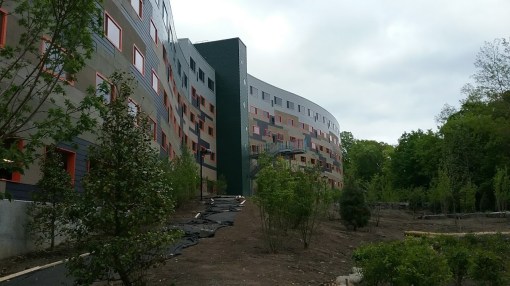
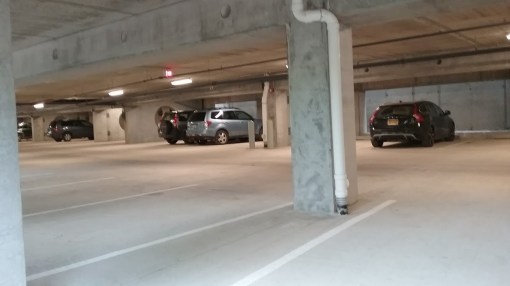
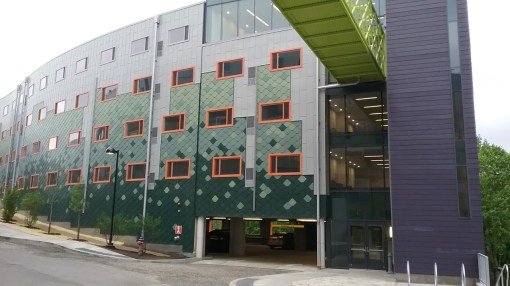
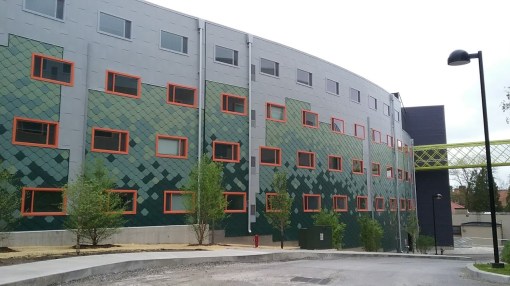
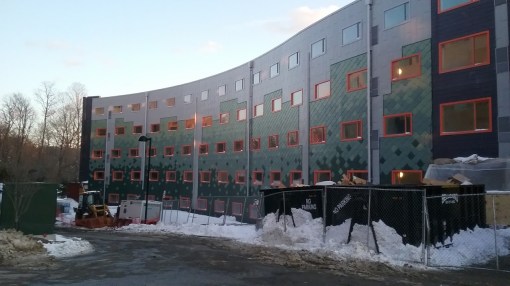
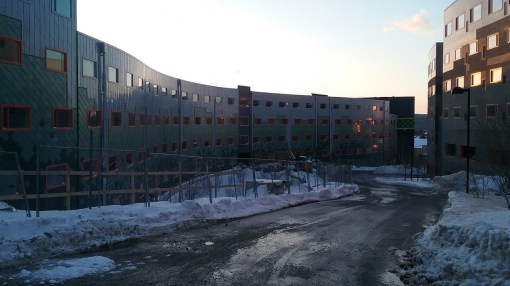
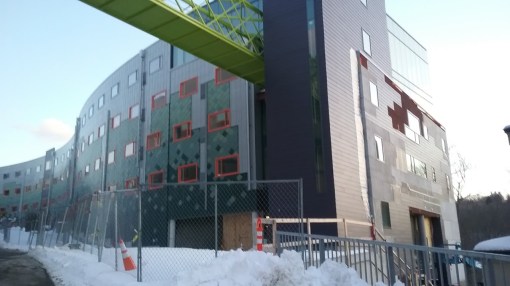
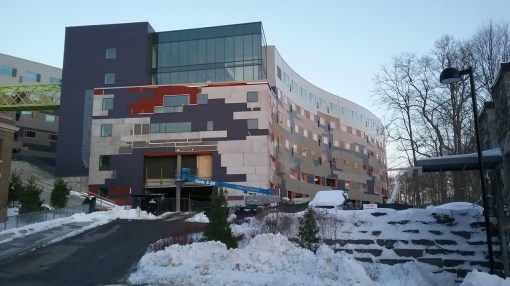
Collegetown Terrace phase 3 is actually opening this month. Speaking to John Novarr a few weeks ago, he mentioned that the first units would actually be welcoming tenants this month, to take advantage of the modest June-June 12-month market that comes before the typical August-June 10-month period that dominates the students calendar. From yesterday, it looks like the first tenants have indeed moved into the Building 7’s 247 units and 344 bedrooms. Units range from 218 SF studio suites with shared baths, kitchen and laundry (5-10 studios per suite), to 1266 3-bedroom units. For the record, the official address will be “120 Valentine Place”. The listed amenities include:

  • Heat included in rent
  • Upper floor large windows for expansive view
  • High speed data access throughout included in rent
  • Kitchen appliances: dishwasher, garbage disposal, microwave, stove and refrigerator
  • Custom-made cabinets
  • Granite counter surfaces in kitchen and bathroom
  • Limestone floors in kitchen, bathroom, and entries
  • Air conditioning in all apartments
  • Elevators
  • Monitored heat detectors, smoke detectors, CO detectors, and sprinklers
  • Fully furnished with blinds, leather sofa, and full/queen beds. Some with work stations and walk in closets
  • Prox/reader security system
  • Washers and dryers in all apartments.
  • Covered parking available for a fee
  • Free shuttle to Cornell. The free shuttle runs to and from campus weekdays throughout the academic year.

Rents clock in at a premium of around $1,000+/bedroom, but the studio suites will come in around $700/bedroom. It does seem like there are some mixed opinions on living there, if the Yelp reviews are any indication.

One slight modification that was sought recently was an approval considerations variance to allow tenants from other Novarr-Mackesey properties to park their cars in the Terrace’s garage. This has been something of a long-running issue with Terrace, which built more parking than it needed in the earlier phases, and as a result requested and received a variance to convert a floor intended for parking into dorm-style living quarter for students on more modest budgets. Even with the original variance, it seems that there are still an excessive number of unused parking spaces, ones that Novarr-Mackesey sees as potential rentable tenant spaces for residents in some of their nearby structures, including two housing projects due to get underway in the next year, 119-125 College Avenue (College Townhouses) and 238 Linden Avenue.

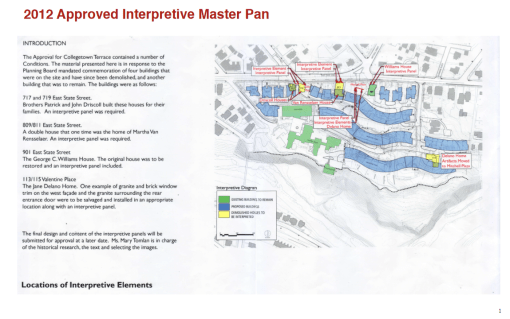
As part of the final stages of project completion (and stipulations of its original approval back in August 2011), some interpretive signage and features will be included in the landscaping, recognizing a few of the homes and the nurses’ dormitory that once stood on the site (recall that Casa Roma was once the city hospital). Thankfully the google street view archives are but a click away, so that the curious can go back and look at what was there prior. Some of the homes were architecturally interesting, if not necessarily historic.

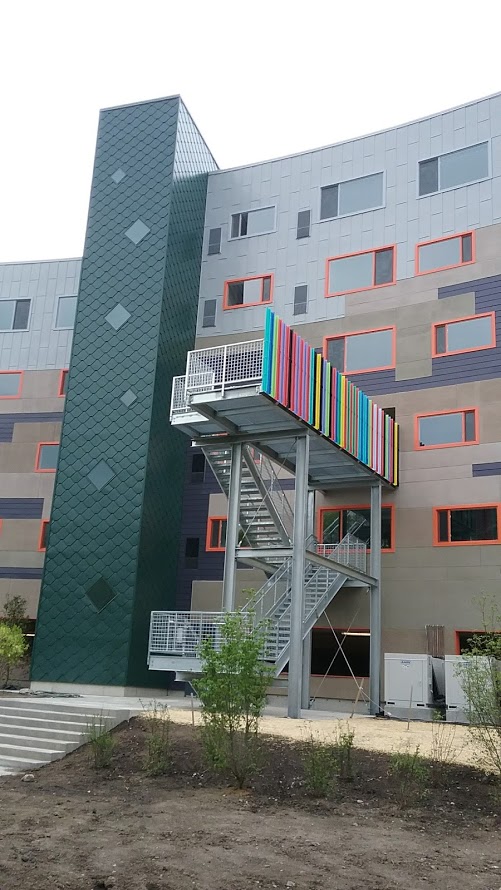
Note the stair railing art in photo ten. It’s as if someone looked at modern buildings, said they weren’t colorful enough, and designed that art feature to have ALL THE COLORS. Holy rainbow explosion. More seriously, it’s quite unusual, and kinda neat, since it’s not often you see a visual feature of interest so tucked away from public viewsheds.

So that pretty much wraps this up. In terms of private non-institutional projects, I dunno if there’s been a project that’s had an impact like this. It’s been a long time since the first presentation back in April 2009. In terms of numbers, it’s enormous – $190 million investment, 1,250+ beds (net gain of over 600), 16 acres. Certainly the latest few hundred beds will help to make a dent in the rental market, it’s by far the biggest project opening for occupancy this year. The trade-off will be a possible softening in some rental segments (e.g. small landlords in fringe student markets), but given the city’s push towards turning rentals back into owner-occupied units, and getting rent appreciation under control, it’s not something that will elicit much concern, especially as Cornell’s student population continues to grow.

In some ways, this project is many good things; growing the tax base, and addressing the need for housing in a somewhat inconspicuous manner, the buildings stepping downward into the hillside. With 344 new residents in the core of Ithaca, it may also give a healthy boost to nearby businesses in Collegetown and Downtown. But CTT has its detractors and criticism – the size still makes unnerves some permanent residents nearby, and the architectural design is a bit polarizing. There’s a tendency to look at building projects in black and white, but it’s never a cut-and-dry process. In reality, it’s a delicate balance of costs, capabilities, the market and the community’s wants and concerns.

Novarr deserve credit in that, unlike many projects, this project has stayed largely true to approved form over the years with the exception of the parking variances. There’s an uncomfortable trend with last-second revisions in more recent plans, but Collegetown Terrace has stuck fairly closely to the original plan as explicated in its Environmental Impact Statement years ago. City staff and elected officials also deserve credit for seeing the potential here for something that could contribute to Ithaca, rather than just saying “this is too much” and turning their backs on it. Credit is also due to ikon.5 and Welliver for their work in designing this massive project, and building it out (which included many local unions and their tradespeople).


201 College Avenue Construction Update, 4/2017

19 04 2017

Dropping by Visum Development Group‘s 201 College Avenue project, I was a little surprised that one half of the building is so much further along than the other half.

201 College is a “H” or dumbbell-shaped structure – the bridge between the two halves hosts the elevator shaft and part of the circulation (hallway). The west wing has completed structural framing, the exterior stud walls are being installed, and even some of the sheathing (fire-rated GP DensGlass fiberglass mat gypsum) is up on the ground level. Peering inside, it looks like some of the interior stud walls have already been set.

In contrast, the east wing isn’t that much further along than it was two months ago – the ground level masonry has been built-out, but the structural steel has not advanced since the February update. It’s not a sign of any difficulties, and other structures have taken or are taking similar approaches – Tompkins Trust’s new HQ has topped out, for example, but the north and east wings have yet to be built out beyond the elevator core. Still, it will take several weeks for the east wing to catch up when William H. Lane Inc. moves ahead with that side of the structure.

According to the construction loan docs filed with the county, the 33,398 SF project is being funded with a $7,870,673 loan from Pennsylvania-based S&T Bank, separate from the $2,640,000 from Visum and its backers that went towards purchase of the property. Hard costs, which are the construction materials and labor, comprise $6,841,038 of the loan, while soft costs comprise $506,984 (permits, legal, marketing, architect and engineering fee, liability insurance, financing costs such as loan fees/taxes/recording costs). An additional $300,000 serves as contingency (your “cover your butt” cash in case of unexpected expenses or poor occupancy rates), and $226,158 is set aside as interest reserve (a special savings account that pays the lender interest on the construction loan while the building is under construction – the objective is to get the building done and occupied before the reserve runs out).

The timeframe is quite tight on 201 College, with a planned August 2017 opening. The rest of the building should move along quickly over the next few months.


Collegetown Terrace Construction Update, 3/2017

22 03 2017

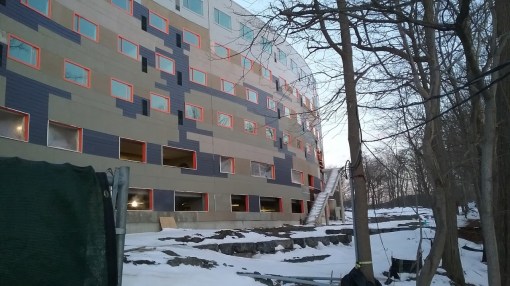
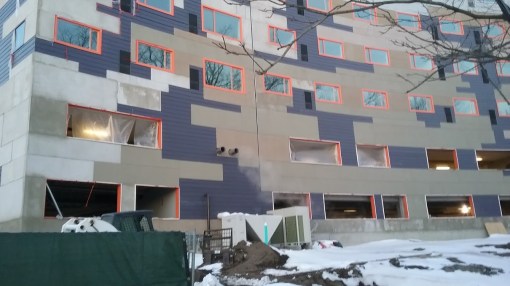
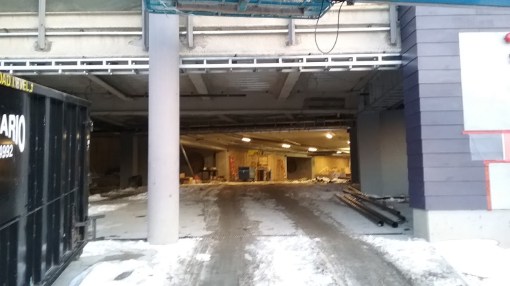
From the outside, Collegetown Terrace’s third and final phase is nearly complete. Some cement panels and clapboards are still being attached at the ends and the south face, and the entry areas need to be finished out, but otherwise it looks like the exterior is mostly finished.

Peering through the windows as the lights clicked on, it looks like drywall has been hung in most of the units, and closet doors and cabinetry are or are being installed, meaning they’re pretty far along and that finishing work is all that’s left for some units (there are 344 units, so it could take a while to do them all). All in all, things look on track for the expected summer completion. Kudos to Welliver for keeping such a massive building on schedule.

\


201 College Avenue Construction Update, 2/2017

2 03 2017

201 College Avenue is reaching for the sky – when these photos were taken about a week and half ago, the structural steel was as high as the third floor, so there’s still two more floors to be boxed out by the H-beams. Although only five floors, the mezzanine-approach to maximizing square footage means that the units on the third through fifth floors are quite tall, 16 feet from sub-floor to sub-floor, 70 feet for the whole building.

The basement level, which only occupies the west half of the building (the east half is slab-on-grade) has been fleshed out with reinforced concrete walls – the windows on the street corner will look into a gym and game room, while the two pocket windows on the northwest corner will look into the mechanical room. The blue boards on the concrete are rigid styrofoam panels used for insulation and moisture protection.

It looks like some wall framing is underway on the first floor for the three-bedroom units – those CMU walls face the stairwell, and the exterior walls of the building itself. The interior unit walls will likely be a more typical lightweight steel frame.

There’s been some documentation floating around that suggests an early working name for 201 College Avenue was “The Heustis Lofts”, Heustis (sometimes Huestis) Street being the original name of College Avenue. However, it doesn’t seem the moniker was officially adopted.
20170218_115452 20170218_115504 20170218_115509 20170218_115538 20170218_115559 20170218_115623 20170218_115712 20170218_115735 20170218_115747 20170218_115756 20170218_115802

201_college_v5_1


News Tidbits 2/25/17: Creating a Place to Call Home

25 02 2017

is2r5l9l9byvab0000000000
1. It looks like the homes designed for Tiny Timbers won’t just be limited to Tiny Timbers. The company has partnered with realtor Brent Katzmann for a to-be-built house in Lansing’s Farm Pond Circle housing development touts a Tiny Timbers-based home design by STREAM Collaborative. 1.09 acres and a 2 bed, 2 bath 1,430 SF house for $219,400. The relatively low price compared to most new builds is in part due to Tiny Timbers’ modular approach – the “Big Cube” retails for $156,900 with a finished basement, and the Farm Pond parcels go for $39k-$45k, so not counting the soft costs (permits/marketing), that pretty much sums up the costs.

Farm Pond Circle is a 19-lot subdivision in Lansing town that was the brainchild of the late Jack Jensen. All homes have to exceed state energy code by 20%, cannot exceed 2600 SF, and cannot use aluminum or vinyl siding. A couple lots have been aside for affordable single-family home construction. After Jensen’s passing in 2014, another local homebuilder, Bruno Schickel (Boiceville Cottages), picked up the undeveloped lots (10 of the 19) for about $165k last February, and intends to follow through on Jensen’s plans.

tiny_tims_7

2. Speaking of Tiny Timbers, it appears the budding modular timber-frame builder is expanding their offerings into a full line of homes. Tiny Timbers now has 16 different models in five series. Prices range from a completed 600 SF model with no basement at $109,900, to a 1,950 SF model with finished basement at $197,900, land and well/septic not included.

In a blog post on their website, Caleb Dolph, builder Buzz Dolph’s son and the guy in charge of marketing, says that the first sold house is underway in Hector (if Ithaca had exurban areas, Hector would be it), at least five others are in contract, though it’s not clear if any of those are for the 15-lot Varna site. Given that they planned for ten houses in 2017, the Tiny Timbers staff might have underestimated the market, which is more a fortunate challenge than a complaint.

3. A local non-profit is looking to expand its real estate footprint a little bit. Tompkins County Opportunities, Alternatives, and Resources (OAR) is seeking to buy a run-down house at 626 West Buffalo Street and renovate it into five beds of transitional housing for those getting out of jail and trying to get back on their feet. The intent is to provide, safe, secure housing to better help with the transition process, which can include education, job training and mental health and/or addiction treatment. The county would provide $100,000 in a one-time allotment – the house is for sale for $99,999, the purchase offer is for $95,000, and a further $60,000 would be spent on renovations. The rest of the money ($55,000) comes from grants, donations and a mortgage. Ultimately, the goal is to provide decent housing that helps reduce the recidivism rate (convicted persons committing more crimes), ideally saving the county on future court and incarceration costs, as well as what they hope pans out to a lower crime rate.

swd_websitelogo

4. Staying on the topic of special needs housing, the Second Wind Cottages is looking to add another three cottages in Newfield this year. The cottages are modest, ~200 SF and costing $12-$15k each to build. As reported by the Times’ Jaime Cone, every unit provides shelter to a formerly homeless male. Rents are “pay as you can”. A small community facility provides services like a kitchenette, office, washer and dryer. Three more cottages are planned for 2018, which will round out the “campus” with 18 units. A similar facility is planned up the road, one that will house homeless women and children. Although Newfield is a ways out, both sites are on the bus line into Ithaca.

The Second Wind Cottages are a private endeavor by businessman Carmen Guidi, and paid for through grants, fundraisers, and donations (money, furniture, etc). Volunteer labor similar to that used for Habitat for Humanity is utilized and welcomed. Like with the OAR house, by providing a safe, warm space to live, these units may help reduce homelessness and the issues homelessness creates.

123_eddy_street_2

lambrou_123_eddy_craigslist

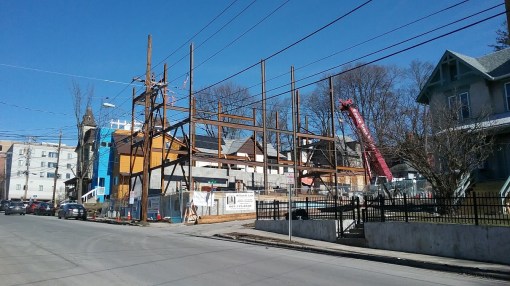
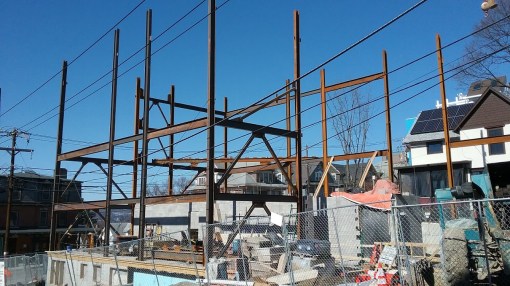
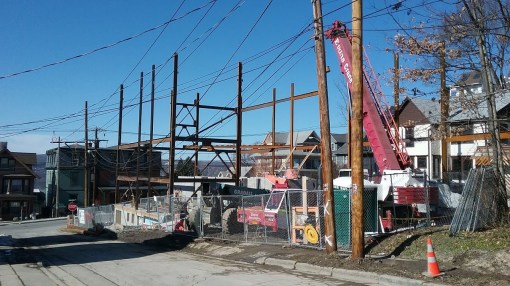
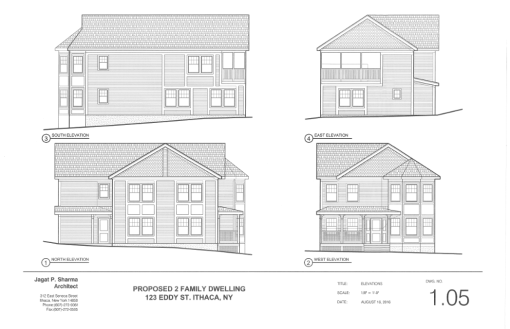
5. Work has yet to start on the new two-family home planned at 123 Eddy Street in Collegetown, but it looks like developer/landlord Nick Lambrou is seeking major changes to the project. Lambrou wants to replace the approved design at top, with the one below, which is copied from a Craigslist posting. The designs are both by Jagat Sharma, but the new plan is a variant of the two-family homes that Sharma’s doing for Charlie O’Connor at the recently-approved 4-building 607 South Aurora project.

The property falls into the East Hill Historic District, which is under the ILPC’s jurisdiction. According to Bryan McCracken, the city’s Historic Preservation Planner, the design will be heading for review within the next month or two.

The design has been used before so there’s familiarity with the design and lower risk, plus there are possible cost efficiencies if using the same contractors as O’Connor, because they’ll move quicker as they’ve done it before. On the other hand, unlike 607 South Aurora, this property is in the East Hill Historic District, and full-time neighbors on Orchard Place have been watching these plans very closely – they’re wary of students, and will likely not be fans of the projecting second-floor porch, as the previous version was tucked into the building. Not sure using a slightly more decorated version of a design being deployed elsewhere will get the ILPC’s blessing, but we’ll see what happens.

cayugafarms_2

6. Why yes, Lansing town is still hopping mad about the natural gas issue. The town supervisor cites the tap-out as the cause of delay for Robert Weinstein’s 102-unit Cayuga Farms project, although the previous documentation says it’s a sewer issue – the developer has to deploy an Orenco modular sewer system, which has to be approved by the NYS DEC.

maplewood_v7_4

7. Here’s a copy of Maplewood’s buildout timeline. The first Maplewood apartments should start construction in May 2017, pending no issues. Generally, the crews will be working from the outside in; buildings closer to Maple Avenue and Mitchell Street have earlier construction schedules, while those interior to Maplewood will start in the fall or early winter. Also, street names. Veteran’s Place will continue to be the main thoroughfare, but from north to south, it will intersect with “James Lane”, “East Sylvan Mews”, and “Lena Street”. James Lane wraps around to form the secondary N-S thoroughface on the east side of the parcel. James and Lena Mitchell were the original owners of the property when Ithaca was first settled in the early 1800s.

The Stormwater Property Protection Plan (SWPPP) still needs to be okayed by the town of Ithaca, but that’s about the only thing left before final approval is granted.

107_s_albany_rev_1

8. It looks like the Planning Board meeting should be interested. Not a whole lot being decided, but some sketch plans have been submitted. For rental projects aiming for August 2018 openings, Feb-Apr is going to be the primary submission period, as they seek approvals by May or June so that construction can run on a Summer 2017 – Summer 2018 schedule.
AGENDA ITEM Approx. Start Time
1.Agenda Review 6:00

2. Privilege of the Floor 6:01

3. Subdivision Review
A. Project: Minor Subdivision 6:10
Location: 109 Dearborn Place, Tax Parcel 9.-3-11
Applicant: Lee and Elizabeth Ambrose
Actions: Declaration of Lead Agency, Public Hearing, Determination of Environmental Significance, Recommendation to BZA

4.Site Plan Review
A. Project: Apartments (11 Units) 6:30
Location: 107 S Albany Street
Applicant: Stavros Stavropoulos
Actions: Declaration of Lead Agency, Public Hearing, Determination of Environmental Significance

B. Schwartz Plaza Redesign- Sketch Plan 6:50

More on that here.

C. 238 Linden Avenue – Townhomes – Sketch Plan 7:10

238 Linden is a non-historic student rental house, and a John Novarr property in a CR-4 zone – 4 floors, no parking required. Further to that, 240 Linden to its north was taken down for staging space for the Breazzano Center, but as that will be finishing up this Spring, it leaves an MU-2 (six floors, no parking) parcel open for development. A townhomes plan suggest one or both of these parcels will host something not unlike the ikon.5-designed townhouses plan Novarr plans to build at 119-125 College Avenue.

D. 372 Elmira Road – McDonalds Rebuild – Sketch Plan 7:30

If Ithaca’s lucky, it’ll have upscale features like the one finishing up in Dryden. Otherwise, a modern update to the 1980s design is plausible. A number of older McD’s restaurants nationwide have been upgraded to the new design in the past few years.

E. 301 Eddy Street – Student Apartments 7:50

This is intriguing. 301 Eddy is a Nick Lambrou property in an MU-2 zone – a four-story, 8-unit/37 bed apartment building built in 1995, and it’s also the address for Collegetown Park’s parking lot. One possibility is replacing part of the parking lot with another apartment building – Lambrou may push to six floors, but it’s not his style. He’s described his offerings as “boutique” buildings, properties with less than 20 units and 20-50 bedrooms. Recent examples include 2015’s 116 Catherine Street, and 2012’s 309 Eddy Street. If the past is any precedent, this will be a Jagat Sharma design.

5. Zoning Appeal: #3057, Area Variance, 109 Dearborn Place 8:10

6. Old/New Business: Special Meeting Chainworks District DGEIS – Transportation 8:20

7. Reports
A. Planning Board Chair (verbal) 8:30
B. Director of Planning & Development(verbal)
C. Board of Public Works Liaison (verbal)


News Tidbits 2/11/17: Cooperation Required

11 02 2017

107_s_albany_rev_1

1. It looks like the plans for 107 South Albany Street are getting a major revision. Readers might recall that previously approved plans called for a rear addition onto an existing house to create a 9-unit, 11-bedroom apartment building. The latest plans are a little more substantial.

For one thing, the existing house would be no more under the new plan. In its place looks to be a 3.5 story, 8,427 SF, 11-unit apartment building, all one-bedroom apartments. Developer Stavros Stavropoulos has once again turned to local architect Daniel Hirtler for design work; for each of them, this is the largest project they’ve worked on to date. Hirtler came up with a design that offer contextual features like a cornice and an orthodox window arrangement, but adds a modern vertical stair element in the middle of the structure to keep the design from being an imitation. Zoning is CBD-60, so no parking is required, 100% lot coverage is allowed, and the 40.5′ proposal is comfortably within the 60-foot height limit.  According to the SPR filing, the construction cost will be about $900k and the construction period will be from September 2017 to June 2018.

As much as I dislike seeing attractive old houses come down, the new design fits well into an older urban context. Plus, if the medical practice on State ever gets redeveloped, 3.5 floors offers a nice transition to the lower-density structures further south. I’m not a super big fan of the blank wall next to the recessed entry, although the intent is to make it interesting with light fixtures, a brick pattern and an iron trellis that will be grown over with vines. Fiber cement will be used on the upper floors, with brick veneer and granite accents at street level.

On another note, it looks like the city will be looking at a one-lot subdivision next month at 109 Dearborn Place in the Cornell Heights Historic District – the owners, a married couple who are renovating the old PRI into a historically appropriate two-family residence, are looking to sell some of the land as part of the “partnership dissolution”. The PRI renovation is expected to continue. The application says a house was previously located on the undeveloped portion of the property (a glance at old maps indicate a schoolhouse was located on-site in the 1920s). It’s worth noting that the wife is also the owner of Bridges Cornell Heights, a high-end senior living facility on the next block. Bridges previously subdivided a Cornell Heights lot in 2005 to build a second residence to serve its deep-pocketed clients. Any new house would need to go through ILPC review.

323_taughannock_townhouses_2

2. Meanwhile, the Ithaca Common Council had their monthly Planning and Economic Development Committee meeting. It looks like the revised 323 Taughannock project has been caught up in the TM-PUD, so it will have to get Common Council approval. Apart from a certain councilor’s general objections to housing near or on the waterfront, this one isn’t likely to stir up much controversy. The construction timeline for Steve Flash’s 8-unit , 16,959 SF owner-occupied townhouse project is June 2017 – January 2018, with an estimated value of $2-$3 million. Potentially, there could be 16 units, since each townhouse comes with a live/work space that could be converted to a separate studio apartment unit.

Also included at the meeting was a session on electric car infrastructure, votes to send laws allowing dogs in Stewart Park and a temporary altar to the Common Council, votes to circulate a zoning amendment to allow brewpubs in business zones, and a discussion of tree plantings. The Maguires also discussed possibly shifting their project to Southwest Park behind Wal-Mart, which is covered on the Voice here.

3. The city of Ithaca has been awarded funding to build a replacement bridge for North Aurora Street over Cascadilla Creek. Continuing the city’s heavy infrastructure investments of the past few years (for instance, the bridges as Lake Street, East Clinton Street, and the work planned for Brindley Street/Taughannock Boulevard), the state is giving $1.178 million towards the replacement span. Engineering work and public meetings will take place in 2017 and early 2018, with construction and completion by 2019.

maplewood_v7_3

4. Over in the town of Ithaca, final approval has been granted to Cornell and EdR’s Maplewood project, meaning that everything is good to go and barring any unforseen circumstances, the 441-unit, 872-bed complex should be open for graduate and professional students by the end of July 2018. The difference between preliminary and final approval is that in preliminary, the concept is greenlighted but there needs to be additional filings completed – tree planting schedules, revised labels on diagrams, construction staging plans, and proof of final approval from the city for their portion. For those who are wondering, the 150-200 workers on-site will be parking at a temporary lot behind the Kinney Drugs at East Hill Plaza, and will be walking the five minutes down Mitchell Street to get to the job site. The first building should start to rise in late Spring of this year, with new structures rising in stages as we go through the rest of 2017.

rodeway_revision_1

The town planning board also reviewed revised plans for the Rodeway Inn at 654 Elmira Road, where the old wings will now be torn down and rebuilt on the same footprint and an enclosed corridor will be built into the new wings. The final result will have a net increase of four motel rooms, to 44 (the previous plan added only two motel rooms). The plan for renovating the single-family home on the property into a community center is unaffected by these changes and moving forward as originally planned.

20160918_151026
5. It’s been behind schedule a few months, but DiBella’s Subs is expected to open at 222 Elmira Road on February 16th.

thecomputingctr_2

thecomputingctr_3

6. It seemed a little odd when The Computing Center stated in their IDA application that their plans had already been approved, and there was nothing on file. Turns out they’re hoping to get approval for their 4,600 SF HQ from the town of Lansing next week.

The full suite of documents can be found on the town of Lansing’s website here. It looks like the farmhouse next door to 987 Warren Drive will be spared from the wrecking ball; although The Computing Center bought the property, it’s being subdivided and the barn-turned-garage is the only building that will be torn down. Lansing has one of the more lenient planning boards, so although this probably won’t be fully approved next week, there’s a good chance this project will receive final approval by the end of March.

204260_56b8b8a8c98ee1-47810900_full

7. Over on West Hill, a large vacant parcel on Bundy Road just exchanged hands. The 66.98 acre parcel has been marketed for the past few years as a development opportunity – it has municipal water and sewer, and it’s a stone’s throw from Cayuga Medical Center, Overlook and the Conifer/Cornell developments off of Route 96/Trumansburg Road. Its previous ownership, a family that has owned it in some form since 1964 (moving between members in 1984 and 1991), had it on the market for $359,900.

The buyers, a husband-and-wife pair of medical doctors who live nearby, paid $305,000 for the deed, according to a filing on the 9th. An online search for future hints doesn’t really give much guidance – the doctors have donated modest amounts to Finger Lakes Land Trust and have signed some anti-fracking petitions, and while they own undeveloped properties around them, this parcel isn’t adjacent to their house. It doesn’t really fit the Land Trust’s ideal land donations either, since it’s been substantially subdivided with medium-density residential, and borders a growing corridor. So, it’s hard to gauge just what exactly is planned here. For the record, the land is currently zoned medium density residential (max 3 floors, up to 2.9 lots/acre), but the town’s new comprehensive plan sees the property as new urbanist medium density (5-8 units/acre small-scale mixed-use), with undeveloped open space towards the southwest corner of the parcel.

cornell-project-dsun

8. Let’s finish this week off with a talk about energy. Good news first – there might be a solution to the West Dryden pipeline issue. Background here, but the nutshell is, Lansing has tapped out their natural gas capacity, and in order to accommodate new development that would need natural gas, NYSEG needs to build a higher capacity pipeline from their current facilities in the town of Dryden. This new pipeline would go along West Dryden Road, but has run into fierce opposition, mostly because Dryden residents are famous for being anti-natural gas – this was the town that took on the fracking companies and won. Keep in mind, these folks aren’t just disdainful of natural gas, they are adamantly opposed. So using their property to accommodate something they don’t like is a bit like asking to build an abortion clinic next to an evangelical church because that just happens to be where the land is cheapest, but they would have to share a driveway.

Unsurprisingly, the town of Dryden enacted a moratorium on large-scale pipeline installation. The town of Lansing is not happy because it stymies their development, and they’re extra-concerned that their biggest property taxpayer, the Cayuga Power Plant, is about to go belly up and leave the town with $100 million less on its tax rolls. The county wants to move away from fossil fuels, but it also wants to encourage development and not leave Lansing in the lurch.

This week, a plan was put forth that might accommodate both needs. A small compressor station would be built to keep pipe pressure from falling too low during times of peak demand, so that guarantees service for existing customers. The second prong is to wean existing development off natural gas and encourage new development to use other means – electric heat pumps, like those to be used in Maplewood and City Centre. This encouragement would be given through subsidies or tax breaks. The compressor station and the incentives would be in effect by late 2018.

It looks promising, but the feasibility studies are still ongoing, and Lansing is not totally on board. Both Lansing Village and Lansing Town feel they were not represented during these discussions with NYSEG, and that heat pumps are a major financial burden to saddle homebuilders with. They also wonder if the electrical grid would be capable of supporting so many heat pumps.

Speaking strictly from my experience, I’ve visited construction projects with heat pumps, and while they are a cost increase, it’s a couple percent more than the same structure with conventional heating – there’s a recently-built single-family house I can think of offhand where the cost of heat pumps was about $5,000 more on the $200,000 construction cost. If it’s incentivized, one could make it financially sensible, at least for residential options if not all. Also, I’m wary of Lansing’s reasoning because they piddled away the three town center projects five years ago – if they had stayed on top of it, they’d have $50 million more in property value and this wouldn’t be such a pressing issue now.

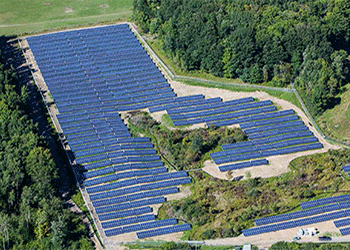
That being said, there are problems with this area’s approach to alternative energy. Newfield is the big culprit here – they’re about to put in a moratorium on commercial solar panel installations, which is worrying since this is the same town that redesigned their wind turbine law to ban them in essence. If municipalities are limiting residents’ abilities to turn to alternative energy sources (many urban areas have to turn to commercial arrays or turbines because there’s not enough room/too much demand on-site), then the community will be unsuccessful in weaning the population off of fossil fuels. But Dryden, which is in the process of changing their laws to accommodate large-scale solar arrays, is at the forefront of this issue – those panels could provide the electricity for the heat pumps and help turn the tide on energy sources. It only works if everyone cooperates.


Collegetown Terrace Construction Update, 1/2017

8 01 2017

And to think that a year ago about this time, Collegetown Terrace’s Building 7 was just an excavated trench.

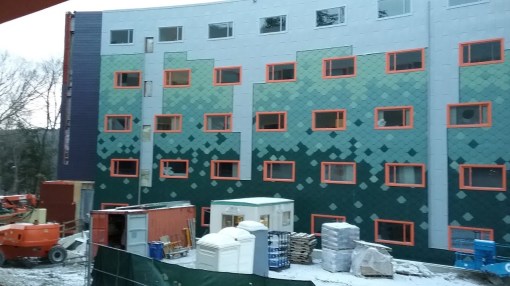
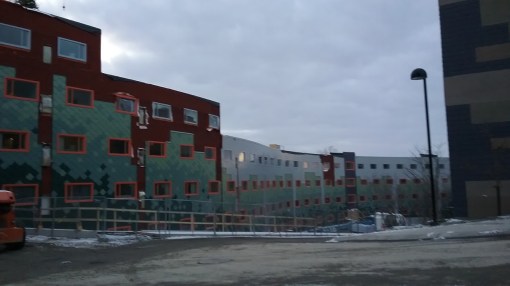
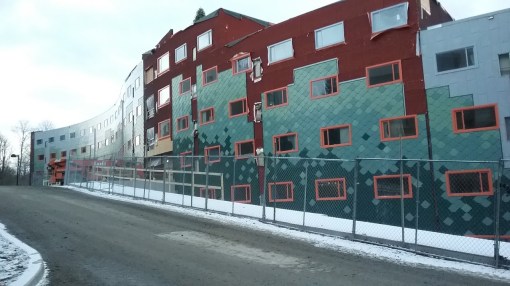
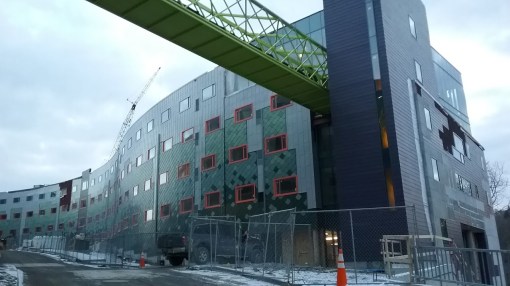
On the outside, facade installation continues. It looks like that, along with the fish scales and aluminum panels, there might be a dark blue fiber cement siding not unlike that seen on the smaller buildings lining East State Street. The east cinder block stairwell seen in November’s photos has been wrapped in waterproofing and is now receiving its exterior finishes. Most of the windows have been fitted at this point. The AC units have yet to be installed, and from what could be seen through the windows and openings, the inside has had drywall hung in some locations, but is still down to the stud walls in other sections. There are a couple of architectural quirks that give the building a little bit of visual interest – for instance, the reverse-pitch on the roof where Valentine Place terminates, probably indicating a stairwell or landing area, breaks up the monotony of the wall. I really like the curtain-wall glass used for the amenities/common area at the southwest corner of the structure.

A pine tree on the roof is a traditional way to celebrate the “topping out” of the building.

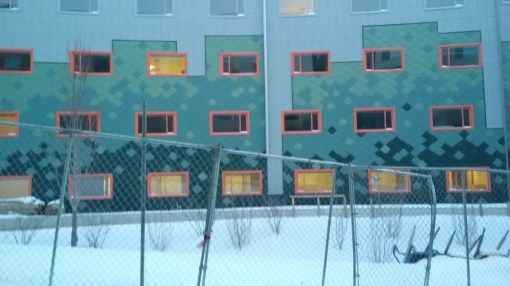
By the way, I have been wrong – the fish scales are in fact metal, their finish coat just makes them feel like vinyl. According to a trade industry website, they are “0.032-aluminum (0.032” thickness), diamond-shaped, flat metal CastleTop Shingles from ATAS International Inc. of Allentown, Pennsylvania. ikon.5 architects selected three standard colors-Hartford Green, Patina Green and Hemlock Green-and four designer colors-Adobe Dust, Metallic Gold, Acorn Yellow and Louisburg Green.” It looks like the shingles are more commonly advertised for roofing, although their interlocking tabs allow them to be used for walls as well. The three shades of green on Building 7 are the three standard colors, logic being that designer color shingles likely cost more and were used more sparingly. The other four show up on Building 3 where it approaches East State Street.


20170106_163724 20170106_163805 20170106_163817 20170106_163912 20170106_163931 20170106_163951 20170106_164021 20170106_164026 20170106_164102 20170106_164206 20170106_164212 20170106_164249 20170106_164309 20170106_164636 20170106_164719 20170106_164730  20170106_164800 20170106_165233