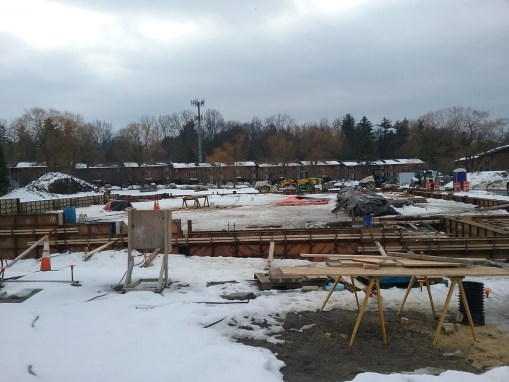
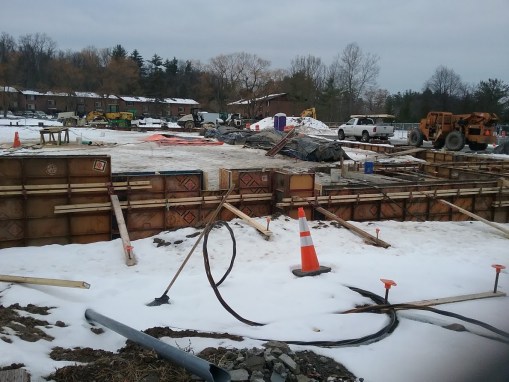
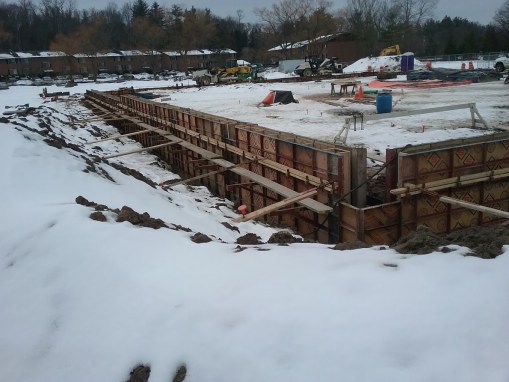
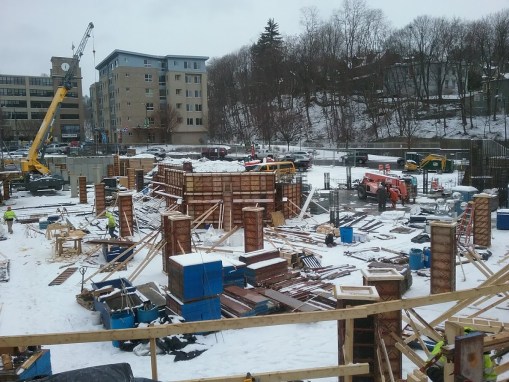
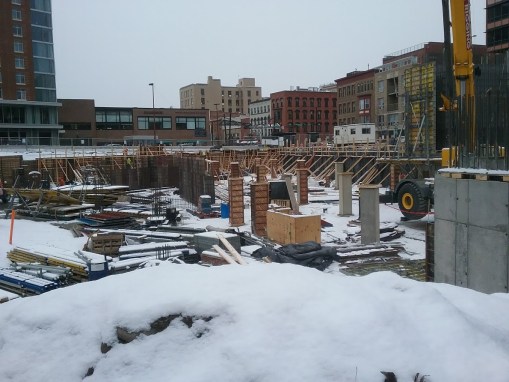
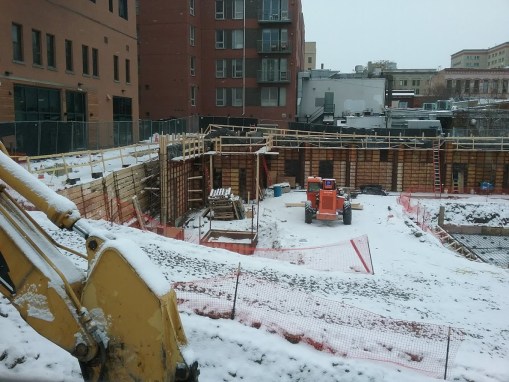
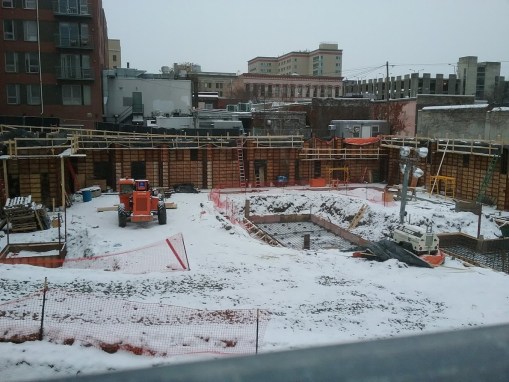
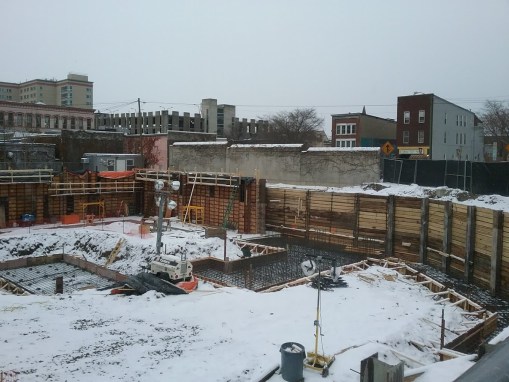
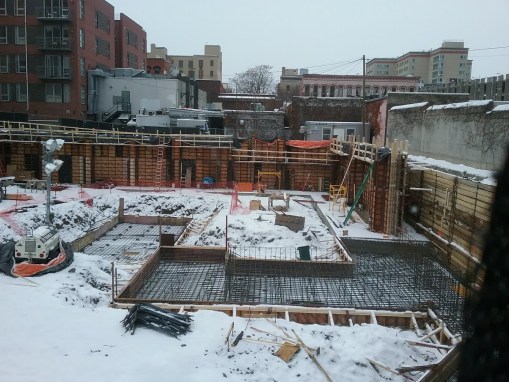
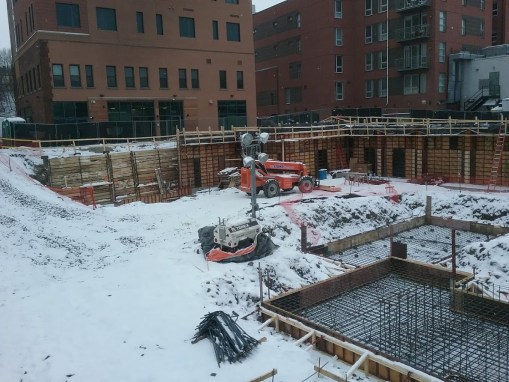
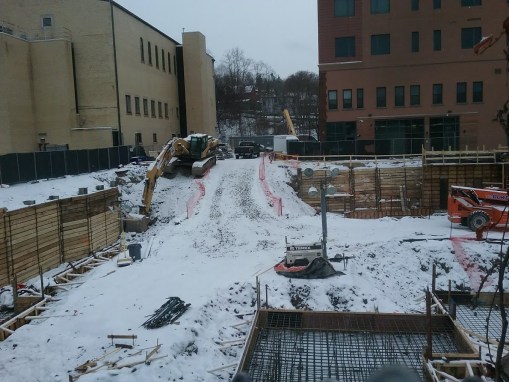
At the Cayuga Medical Associates site in Community Corners, the foundation has been excavated and the forms have been assembled. These are Symons Steel-Ply forms, steel with plywood facing that has been erected and braced along the perimeter of the building footprint.
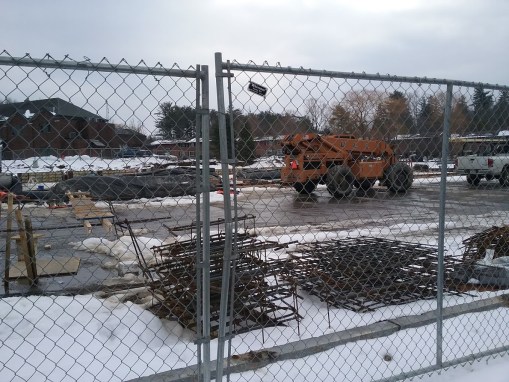
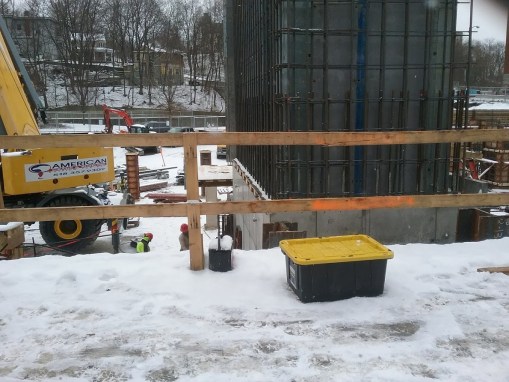
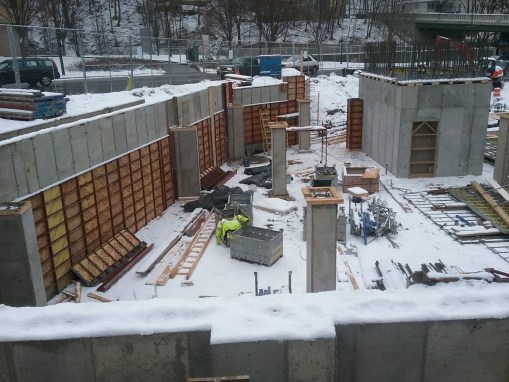
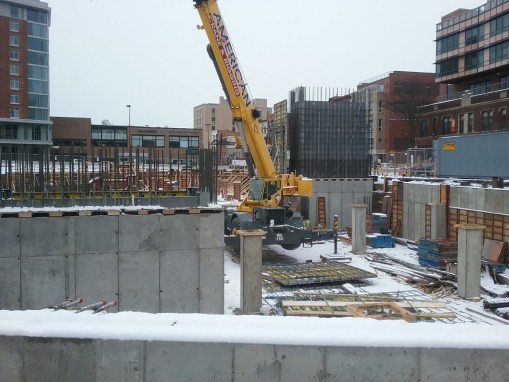
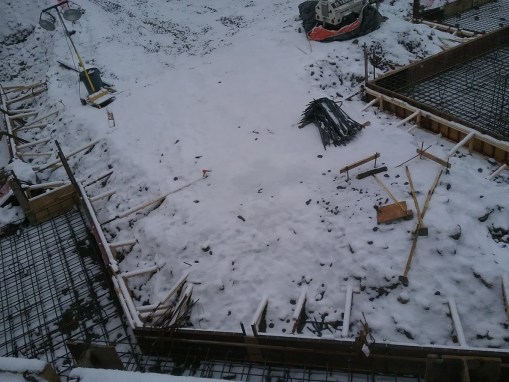
Unlike the downtown properties, the foundation here is a slab, so the footers will go in along the perimeter and the slab will be poured atop the cleared and leveled footprint of the structure, distributing the weight of the building. The steel rebar sitting along the fence will be laid within the building footprint and poured over with the concrete mix, providing additional strength to the concrete as it cures. It looks like some walls have already been poured, cured and interspersed with rebar topped with OSHA orange safety caps.
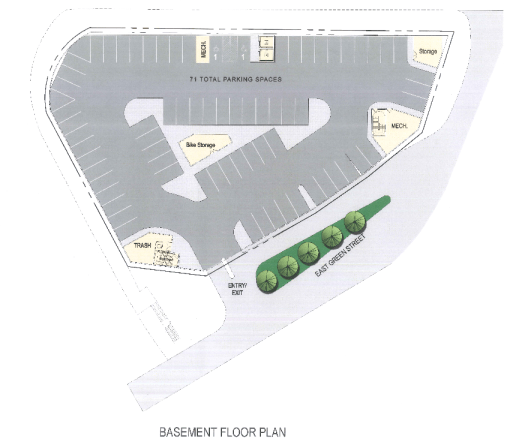
Meanwhile, it looks like the adjacent site where the former bank building was torn down has been fully cleared. This will be part of the parking lot, along with associated curbing and landscaping.
Not much to add here beyond the blurb in the Voice roundup. The Ithaka Terraces are likely to be finished this spring. There is nothing public regarding any sales figures for the ten 2-bedroom and two 3-bedroom units. I’m not sure if another visit is necessary, though maybe if they set up a model unit and don’t mind a nosy blogger, there will be one last photo set.
If there any criticism to levy here, it’s not necessarily an issue with just this project, but I’ve had emails calling it gentrification and ‘luxury housing that Ithaca doesn’t need’. But if people are buying here, then they aren’t buying another city property and potentially outbidding someone with fewer dollars to spend. A little additional supply to take pressure taken off the market is welcome. As noted above, the city tried to sell the lot for affordable housing, but it didn’t pan out (not unlike the issues with 402 South Cayuga Street a block away). Additionally, this project is fully taxed, the project team did not seek abatements.
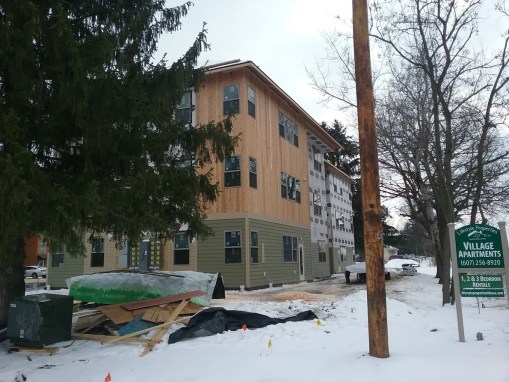
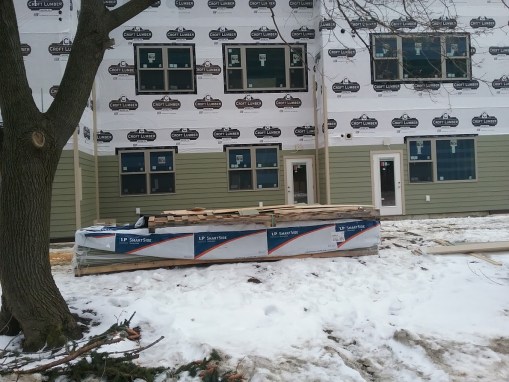
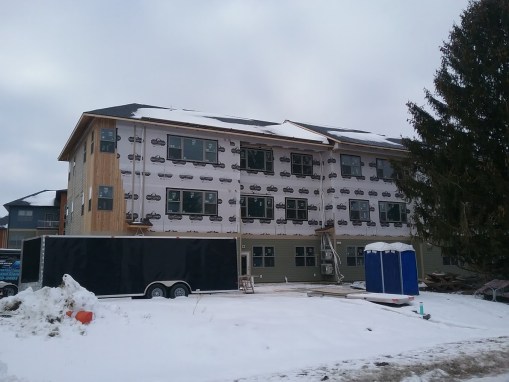
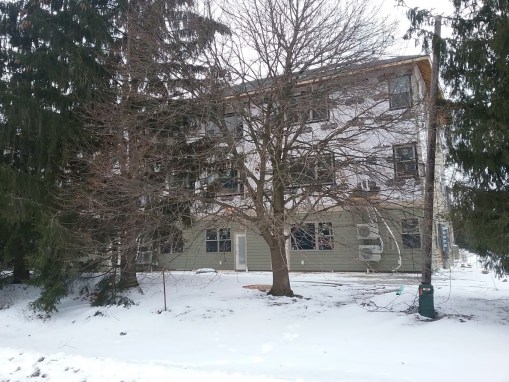
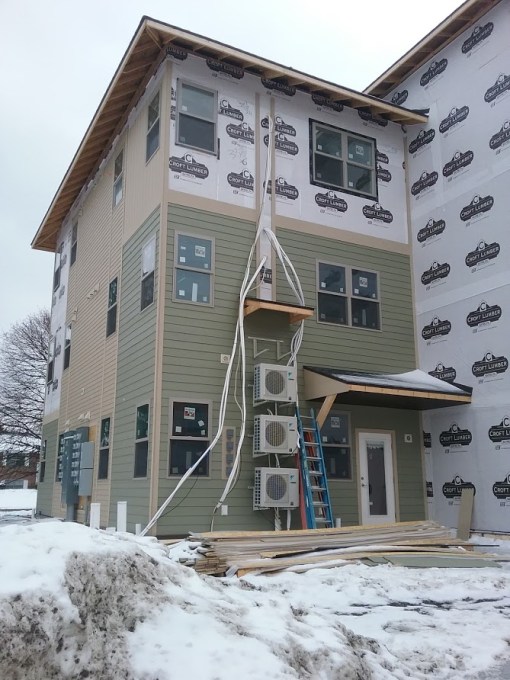
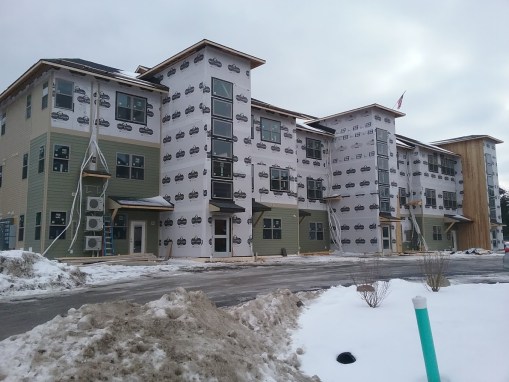
Work continues at the Village Solars apartment project in Lansing, though it’s mostly been interior construction these past couple months. 102 Village Place has had some of its composite wood siding applied (LP SmartSide treated and engineered wood siding), and the electrical wiring and air-source heat pump units are in place, though not fully connected just yet.
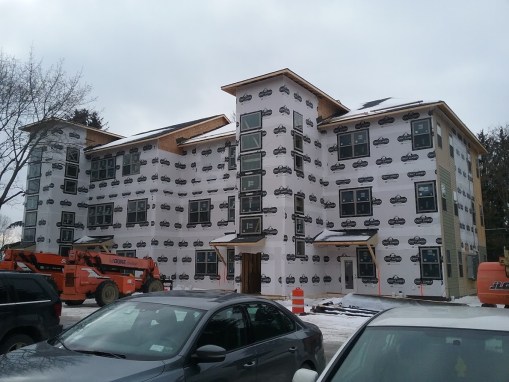
116 Village Place, the younger of the pair, is not as far along but has been fully framed, wrapped and shingled since November, and some siding has been attached. It looks like not all the windows have been fitted, given the wrapped rough opening on the third floor in the first photo below. Based off the open door in that same photo, it looks like framing, insulation and utilities rough-ins (plumbing, electrical, HVAC) are ongoing. 116 is the smaller building of the two, with 18 units, 12 studios and six 2-bedrooms. Like 102, it also replaces an older apartment building, an eight-unit structure of one-bedroom units (and 14 more residents on-site, using the same math as before).
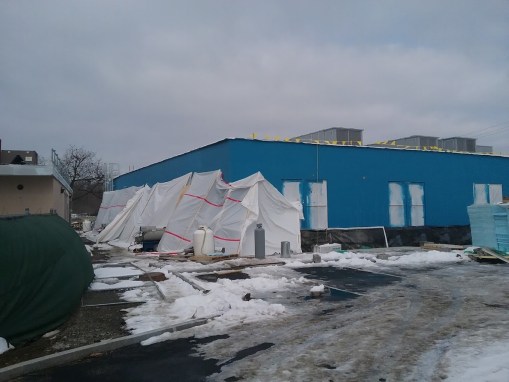
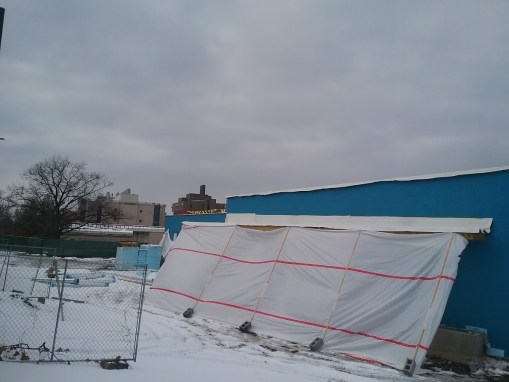
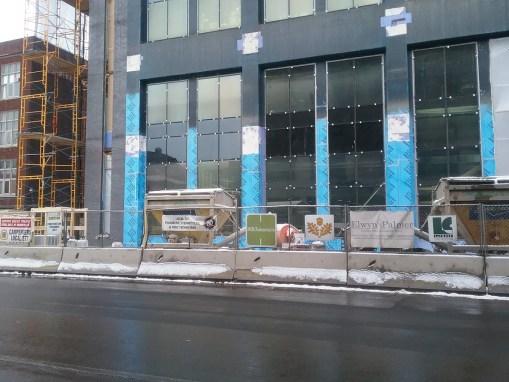
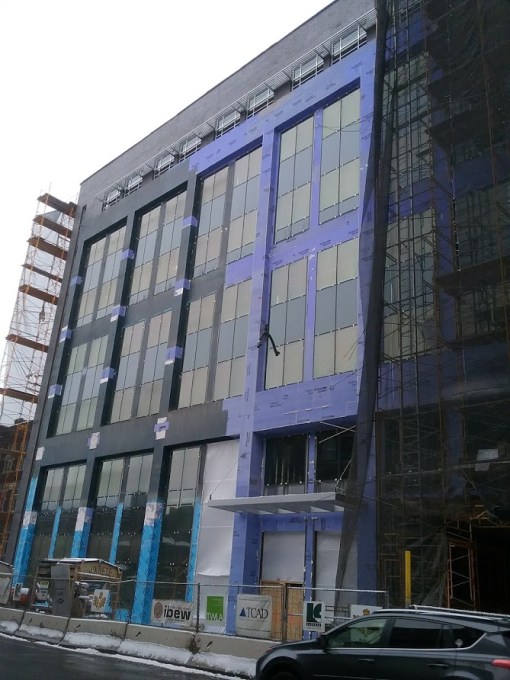
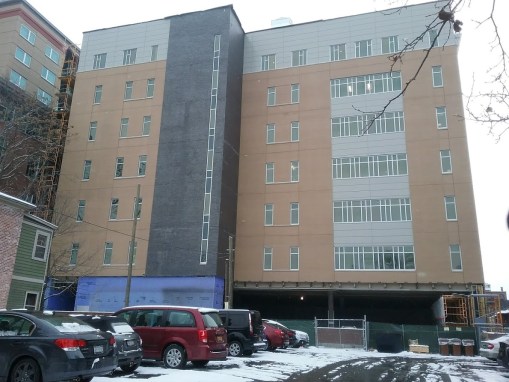
At this point, the expansion is done, and the construction at hand is the new $7 million Community Practice Service Building at 107 Farrier Road, where the Poultry Virus Lab once stood. It looks like a waterproof spray coat was applied above the previously-applied water-resistive barrier, based on the overspray on the rough window openings. There are plastic sheets with ribbing up over some of the exterior walls and part of the front entrance – the rendering shows concrete walls with decorative finishes, so what might be happening is that these are still curing, and the sheets are there to keep precipitation (whatever it may be this time of the year) from penetrating and changing the concrete and water mixing ratio, which can weaken the wall.
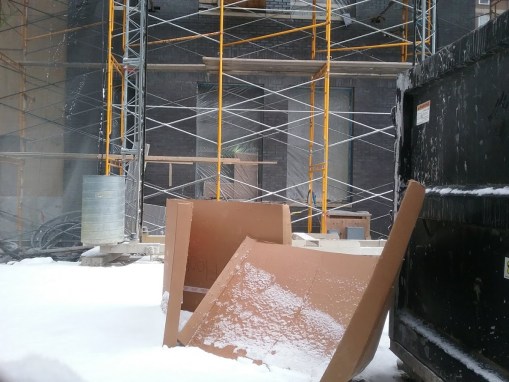
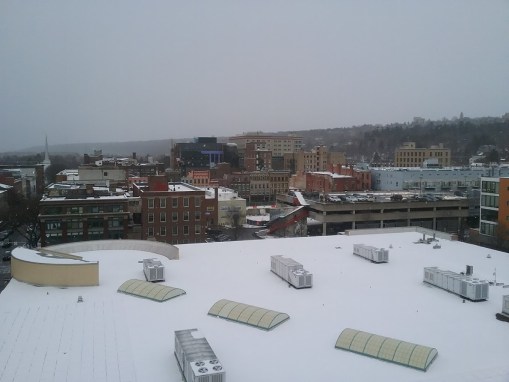
The roof equipment (HVAC commercial units) appears to be in place, but the synthetic rubber membrane has yet to be laid. A truck at the rear of the construction site suggests Michael A Ferrauilo Plumbing and Heating of Rochester is one of the subcontractors. They’ll be busy for a while yet; stacks of insulating form board and galvanized metal utility ducts suggest plenty of interior and exterior work still left to be done before the May opening.
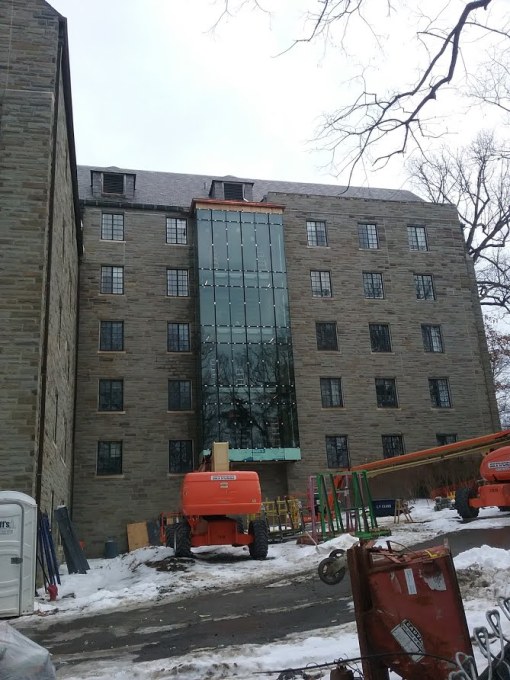
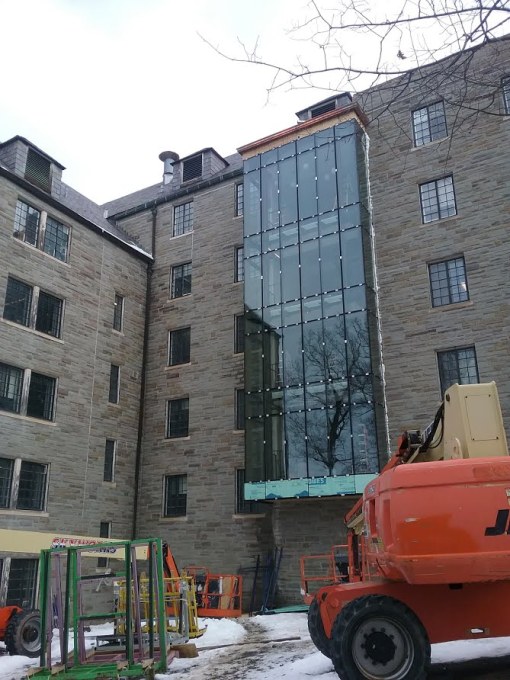
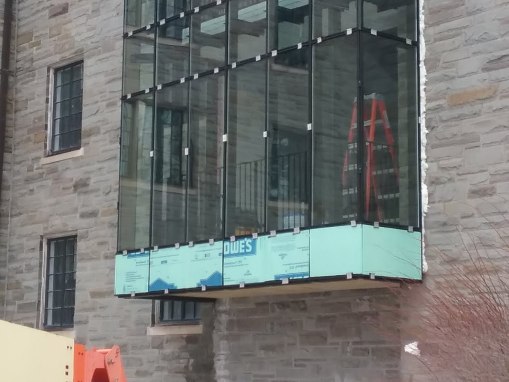
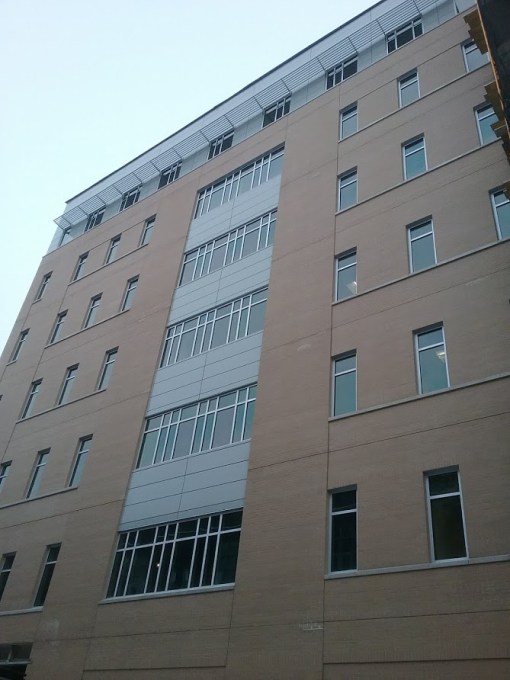
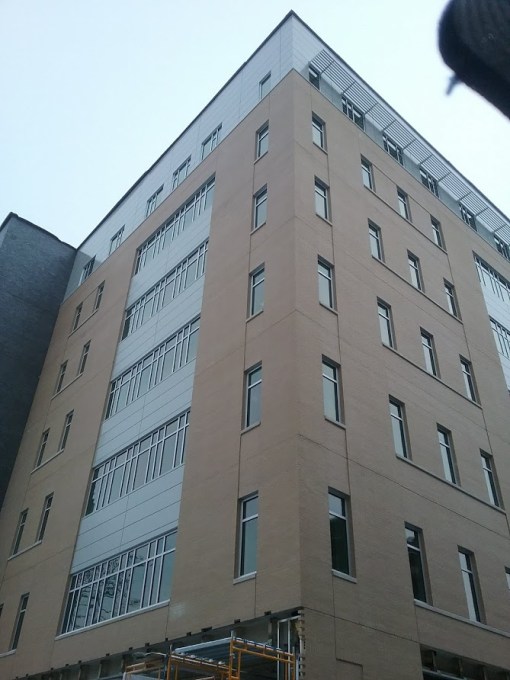
Finally, the glass for the new western staircase bump-out makes its debut. There appear to be visible brackets between glass panels in the curtain wall, so this is quite recent – the aluminum frames have yet to be finished. The copper flashing up top is nice and fresh, and if the renders are any indication, the wood panels just below that will be finished with steel panels. Peer inside closely and you can see the outline of the new staircase and the metal railings on each landing.
Worth noting, there is a major difference between the approved drawings and the built product – notice that the bump-out is four floors. The renderings show five, it was expected to extend down to ground level. That bottom section with the Lowes Green Guard (polystyrene foam insulating boards) might still be finished with steel panels and decorative “Cornell Law School” lettering, given its width; but, can’t be sure at this point.
Grab a cup of coffee or tea for this one, it’s a long introduction.
Touching on a familiar topic again, downtown and urban living has enjoyed a revived interest in the past fifteen years, and coincident with moderate but steady economic growth in Ithaca, it has created plenty of opportunities for those with assets and expertise. Succeeding in those opportunities is a slightly different story – money and a strong project team are important, but some projects have an easier go of it than others. Harold’s Square has experienced substantial obstacles in its long pre-construction period, but thanks to developer David Lubin’s flexibility and tenacity, as well as an accommodating local government and growing market, it has surmounted those challenges and is now underway.
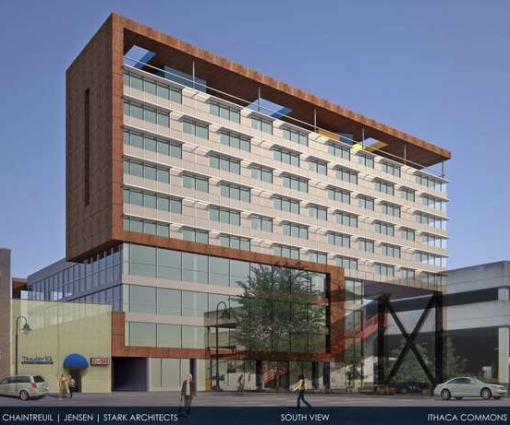
The first version of Harold Square at 123-139 The Commons was proposed back in October 2012. At the time, the plans called for first-floor retail, a few floors of office space, and 60-70 apartments on the upper floors of the 11-story building. The Sage Block (Benchwarmers) and W.H. Miller Building (Home Dairy) would be renovated, while three less historic buildings would be taken down to make way for the new development. The estimated price was $30 million and the plan was to have the 126,000 SF building finished by summer 2014. At that time, the building would have needed a fairly substantial zoning variance – the entire site was CBD-60, and it reached about 135 feet.
With the exception of the first-floor retail and Sage Block renovation, none of the other details have remained the same. However, the five major design iterations have all been by the same architect – CJS Architects (formerly Chaintreuil | Jensen | Stark Architects), with offices in Rochester and (later) Buffalo.
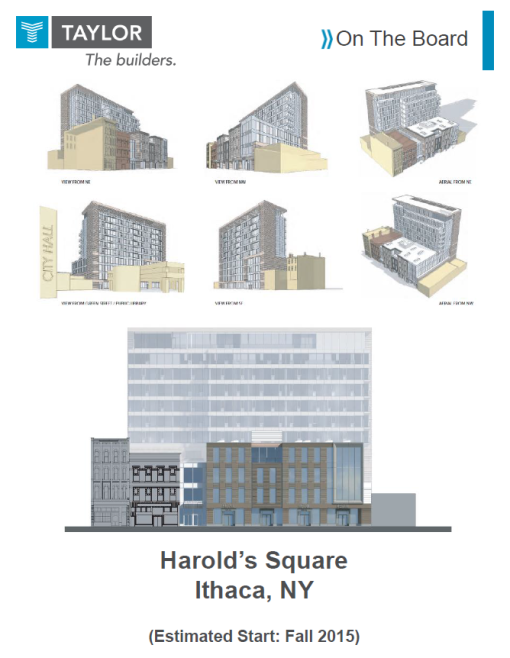
The project design was critiqued and reviewed thoroughly over the next ten months, which also produced the first major set of design changes – in fact, if you’re googling Harold’s Square without prior knowledge, images of this version, v02, turn up enough that even many current agencies and organizations (and even the posters on the construction fence) treat it as the final design. The 2015 image from the contractor’s website, Taylor the Builders, is shown above. It did away with some of the less-liked design features of v01, but retained a clean, contemporary profile with a curtain wall of glass, and terracotta panels that extended to the roof canopy. During this period, plans to acquire the W.H. Miller Building were dropped.
At this point, post IDA approval, we kinda enter a publicly dormant period. Publicly, apart from the occasional reassurance from Lubin that the project was still alive, and the re-application for approval permits since those expire after two years, there didn’t appear to be much going on. Behind the scenes, it gets a little more interesting.
With the space utilization issue worked out, the project was still seen as a sizable risk to potential lenders – it was at its inception the largest project proposed in downtown Ithaca since 2005’s Seneca Place, and Lubin had some experience with smaller projects, but nothing this size. Finding a partner to buy in to the plan would reduce the loan needed and add experience, making the project an easier sell to lenders. This is where McGuire Development, a major interest in the Buffalo market (3.5 million SF), came into play. They saw the potential in Lubin’s vision and the value in the Ithaca market, and agreed to buy in as a development partner. This appears to have been finalized in January 2017.
By October, the project was underway, courtesy of a construction loan from Norwich-based NBT Bank. The bank is a regional player with about 1.5x the assets of Tompkins Trust. This is new territory for NBT, which typically limits itself to single-family home loans in Tompkins, and has no service branches within county lines. The loan is for $33,842,000. L Enterprises and McGuire have each put up $5 million to cover the $43,842,000 cost of the project.
The project team includes L Enterprises LLC (led by David Lubin) as lead developer, McGuire Development as co-developer, Taylor the Builders as the general contractor, CJS Architects, Fagan Engineers and Land Surveyors handling the application and civil/structural engineering work, and Brous Consulting for public relations. Those who want to follow the project without this blog as an intermediary can sign up for update on the project webpage here.
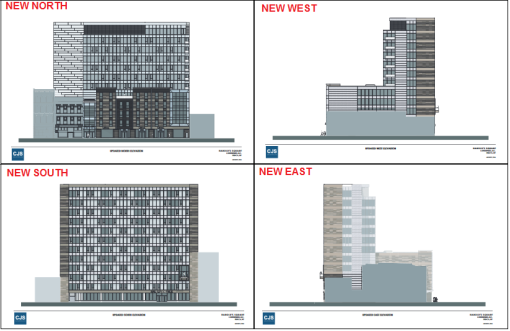
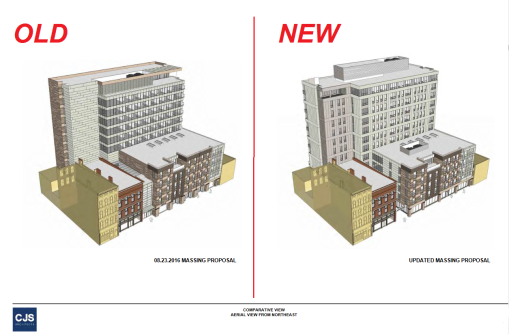
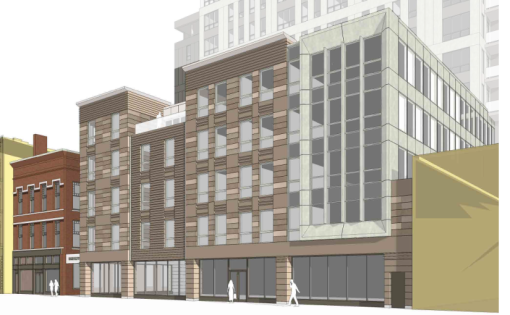
With the latest update on their webpage also comes the latest version of the project design, v05 – which doesn’t really affect the program space, but it does have several visual changes. The corner units now have exposed balconies vs enclosed rooms, the dark metal band on the top floor facing the Commons has been removed, and the retail frontage was reconfigured a bit on the Commons facade (the north module was stretched, one of the entry doors moved, and different fenestration patterns have been applied to some of the modules and the northwest face).
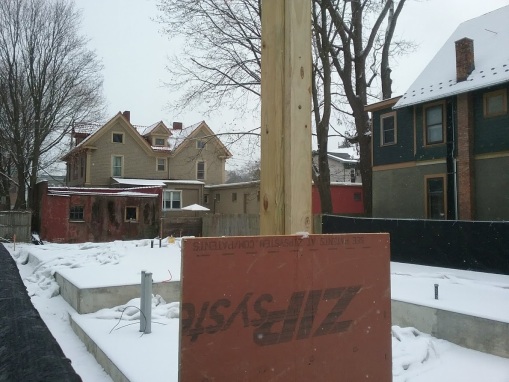
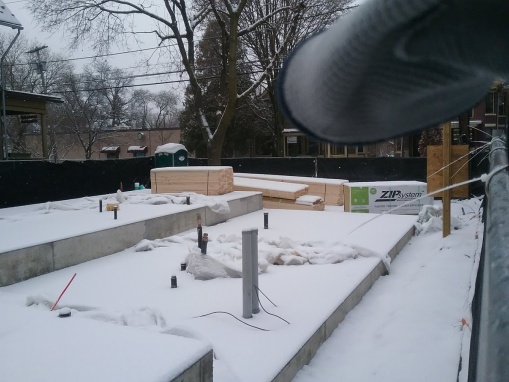
Since October, it looks like the foundation slab has been poured over the footers, and the construction crew is preparing to start work on framing. Judging from the materials on-site, it looks like wood-frame with Huber ZIP panels. Wood-frame structures tend to rise quickly, so once the project team is ready, it should go up at a rapid pace, and probably top out in within just a few weeks. The 11-unit, $1.1 million apartment building is expected to be ready for occupancy by July.
It’ll be interesting to find out what Stavros Stavropoulos’s next project is, since the plan for a pair of duplexes at 209 Hudson Street was kiboshed by the city after the South Hill zoning overlay went into effect. If he’s looking at other locations along the State Street Corridor, he’d likely find the planning department and Common Council more amenable. If his name shows up in any sales, I’ll note it in the round-up.
On that note, expect a brief holiday pause in the daily posts. They’ll be back next week.
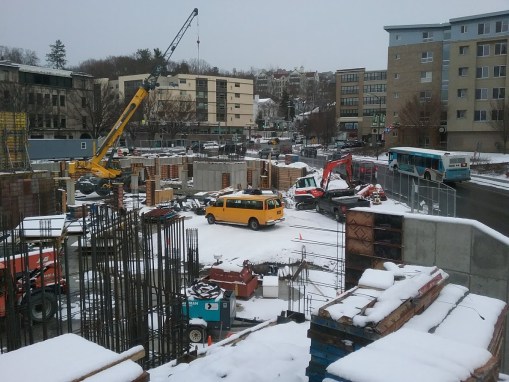
As with the Hilton Canopy Hotel under construction just across the street, City Centre is in the middle of foundation work. Steel forms with plywood facing have been erected and braced along the perimeter of the building footprint. In fact, it looks like the project team is using the same Symons Steel-Ply system being deployed at the Canopy site. The piles have been driven and the foundation slab is poured. The team is slowly making their way to the steel frame of each pile, encasing it within forms before pouring the concrete, letting it cure, and then removing the forms to reveal a concrete/steel column ready for vertical additions. The elevator cores and stairwell columns are also on the rise. – the elevator core facing East State Street appears to be the furthest along.
As I previously said, as structural steel takes height here and with the Canopy and Harold’s Square, downtown Ithaca is going to look like one big advertisement for TCAD.
Given how long this project seemed to be be stuck in post-approval financial purgatory, it still surprised me when I see construction underway at the Hilton Canopy hotel site on the 300 Block of East State Street.
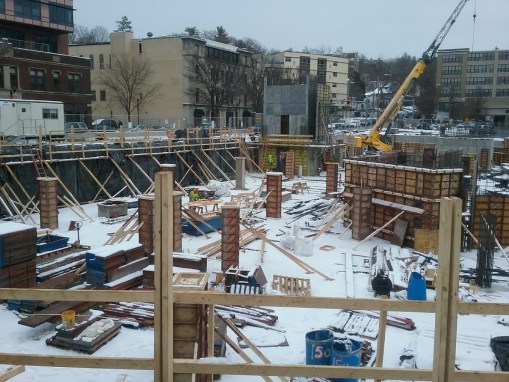
One imagines that summer 2018 will be a construction nerd’s paradise, as cranes for City Centre, Harold’s Square and the Hilton will dot the city’s skyline, no doubt making their way into future TCAD imagery. But for now, it’s subsurface work. The Canopy is excavated, lagging, H-beams and steel tiebacks have been erected to hold the soil back, and wooden forms are being assembled for the concrete pours. Forms are typically plywood, sometimes aluminum or steel, and are braced to resist the pressure from the concrete as it is poured to make the foundation walls. For commercial buildings like the Canopy, stronger steel forms with plywood sheet ply are used. In this case, since the walls are quite tall, workers have installed brackets and scaffolds along the forms so that they can stand and work higher up on the walls. Specifically, I think it’s a Symons Steel-Ply Forming System that is being used.
The footprint of the site also has some less imposing wood forms that have been assembled, and interior to those some steel rebar has been laid, to add strength to the concrete as it cures. Some of the basement concrete slab has already been poured along the perimeter, and some is being readied for pours. The elevator shaft and north stairwell will occupy some of the footprint of where the rebar grid is in the second and third photos below. The basement will consist of storage rooms, utility space, a fuel room, laundry facilities, housekeeping office, main offices for hotel staff and back-end operations, restrooms and a breakroom. The smaller forms with the square outline on the south side of the site look to be about where the money counting room and/or data/communications room will be.
Note the light rigging onsite – December’s short daylight hours are no conducive for outdoor construction. Floodlamps are a way around that.
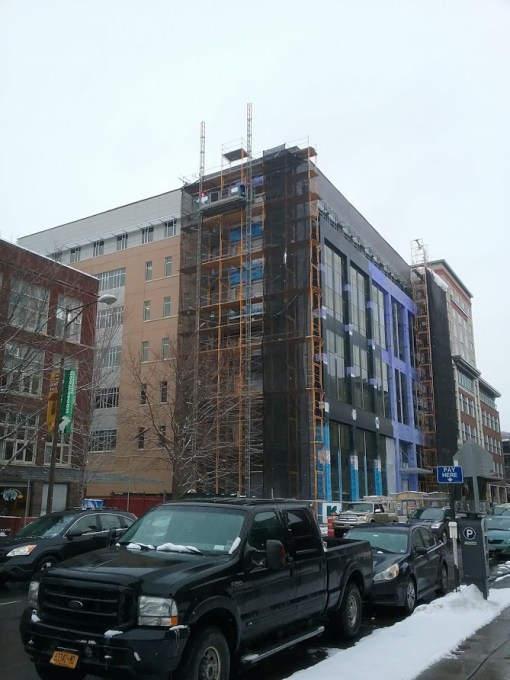
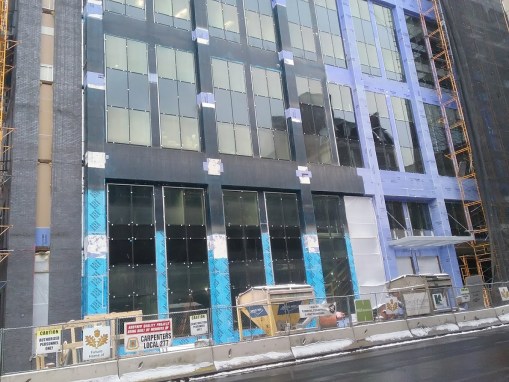
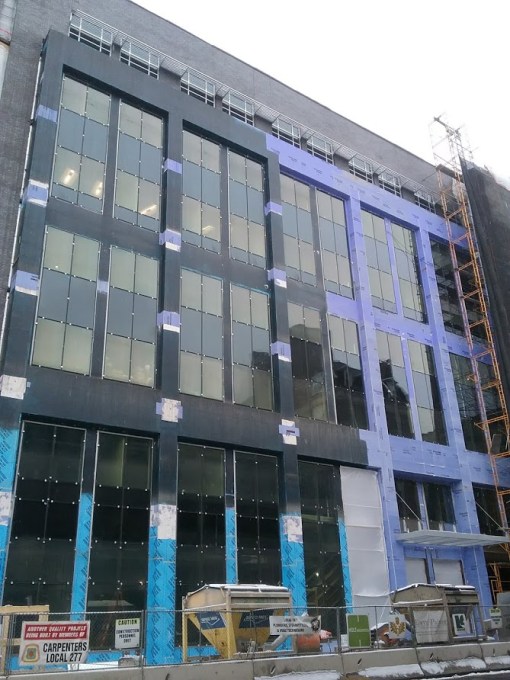
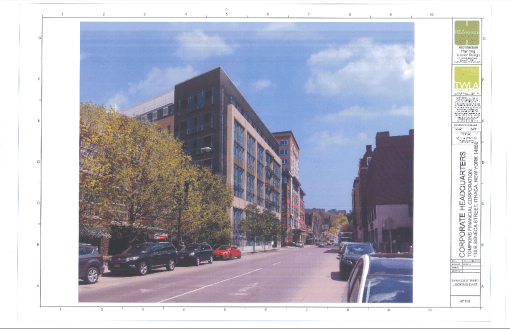
Most of the scaffolding and netting has been taken down on the Tompkins Financial Headquarters in downtown Ithaca. Most of the glazing has been completed, and the Endicott “manganese ironspot” brick veneer is being attached, which isn’t so much a jet black as it is a dark grey. Definitely not as dark as the waterproof coat going on over the gypsum sheathing on the front facade, which will be finished with a grey stone veneer. Not sure why the change of materials on the front facade between U.S. Gypsum panels and Carisle CCW-705 air/vapor barrier, since it doesn’t look like barrier is being applied over the whole of the front before the coating is applied. If someone from HOLT Architects or LeChase Construction knows, feel free to chime in.
There’s still plenty of work left with the exterior finish work, stone veneer and granite base, not to mention interior work like drywall, fixtures and finishes. TFC staff should be moving into the new digs by the end of May.






























































 Ithacating in Cornell Heights
