The Tompkins County Housing Strategy

18 05 2017

The County’s Housing Strategy draft was originally going to be in the next news roundup, but it’s large enough to do separately, and my colleague Kelsey is tackling this meeting for the Voice. For those who couldn’t attend the Housing Strategy hosted by the county last Wednesday evening, the presentation is here and the outline is here. Comments can be sent to the Planning Department here from now through the end of the month.

First, quantities. This was touched on in the news round-up a couple of weeks ago, but the county would like at least 580 units coming online each year, plus specialty student and senior housing. For comparison’s sake, the county hasn’t exceeded that value since 1994, when Kendal was permitted in Cayuga Heights, and prior to 2016, the last time it exceeded 500 units was in 2000.

In more recent years, the value bounced between 200 and 300 units in a given year; during the recession, it dropped into the mid-100s. The article linked above is older, so it lacks the 2015 values, which were 279 units countywide, consistent with 2012-2014. Then we get to 2016, which was just finalized by HUD. There were 575 units, of which 121 were single-family homes, and 454 were multi-family structures. Let’s present that by community (click on the table to expand):

Cayuga Heights and Freeville didn’t approve a single unit, while the 271 units in Ithaca city is their highest stat since 2000, and the second highest in the 35-year online record. Dryden village’s growth can be attributed to Poet’s Landing Phase II, Ithaca town’s to Cayuga Meadows, and Lansing town’s to the Village Solars.

The point of this is to illustrate that 580 units annually is a lofty figure, but it is an attainable goal.

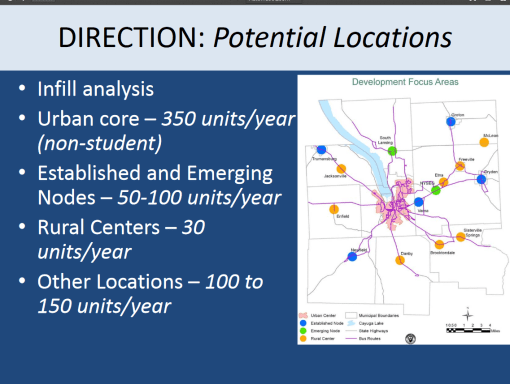
Then we get to locations. The ideal is to focus the growth in the city of Ithaca – since these stats are non-student housing, the targeted areas in the city include Downtown, the State Street Corridor, West End/Waterfront, and anything they can displace from the big box corridor on the southwest side. If a good opportunity for infill presents itself elsewhere in the city, that’s great, but it’s not the focus.

However, not everyone wants to live in Ithaca. Land in the “nodes” is cheaper and oftentimes the approvals process is easier. The county envisions 50-100 in the villages and growing hamlets like Varna and South Lansing, were a town center concept is in the RFP review process. Rural hamlets would see a handful of units annually (30 or less), and other locations basically just refers to Lansing’s suburban sprawl between the village and South Lansing. The town is hellbent on development any which way it happens, conventional approaches are the easiest to get financed, and the county’s not going to fight them.

The county’s housing strategy is three-pronged: Information/Collaboration, New Units and Existing Units.

  • Information and Collaboration includes a virtual housing office for resources and a collaborative network to formulate and pitch housing solutions. It’s kinda vague in the notes.
  • New unit strategies include support for targeted new development, streamlining zoning and examining potential incentives through the IDA.
    • Targeted new development can include RFQs for government-owned surplus property, early community engagement regarding DFAs (Development Focus Areas) and assistance in producing “shovel-ready” sites through things such as sewer access and energy hookups.
    • Streamlining zoning is to make it easier to get an initial product that will look like the final product – less uncertainty, less money spent on revisions. Inclusionary zoning seems pretty much dead in the water, as the county doesn’t seem to know if the community will support incentives for affordable housing, or if will even be effective. Done wrong, an inclusionary ordinance could actually result in less housing, if the burden is too great for the incentives offered.
    • Additional IDA incentives could include mixed-market or all-affordable rentals being eligible for abatements, and possible an abatement for any neighborhood or community who builds in inclusionary zoning. Looking at you, Trumansburg.
  • Existing unit strategies include the encouragement of rehabs (especially from rentals to owner-occupied), code enforcement and fair housing enforcement. Airbnb is still a tricky issue, so expect some tweaks to regulations on what constitutes rentals, hotels and legal occupancy.

There’s also a strong support/monitoring component in the strategy, which basically is a tracker of all projects underway, what stages, what they consist of, and so on. Beat you to the punch guys.


News Tidbits 5/6/17: Starting Small and Dreaming Big

6 05 2017

1. The Evergreen Townhouses in Varna was hotly debated at the last town board meeting, per the Times’ Cassie Negley. Linda Lavine, one of the town board members, was particularly fierce in her criticism, calling the solar panels “useless”, and others in attendance expressed concern about appropriate room for amenities.

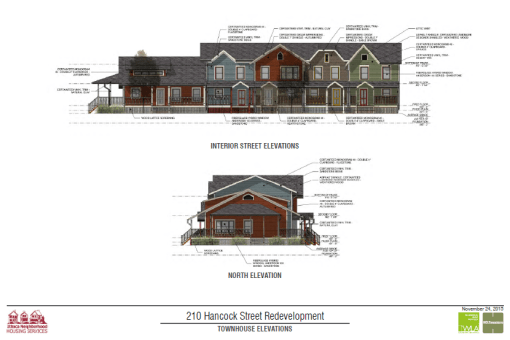
However, it also seems one of the phrases bandied about was that it wasn’t “family-friendly”. If you’re reading this and one of those folks, do yourself a favor and stop using that term. It’s an enormously baited phrase, historically used to fight affordable housing as a racist/classist euphemism, because people of a certain class or color were apparently less appropriate for families to be around. For an unfortunate example, it was a phrase used with the INHS 210 Hancock affordable housing plan in Ithaca. Think of it as the equivalent of a religious group claiming a TV show isn’t “family-friendly” because it has a same-sex couple, or feminists.

Although this project is market-rate, deciding whether or not something is “family-friendly” is subjective and potentially baited. It gives others the wrong idea on how to discuss the pros and cons of a project, which should be about features, or lack thereof. TL;DR, find a different phrase.

Oh, and on another note – Planning Board member Don Scutt. For someone claiming Dryden is getting an anti-business reputation, your work fighting the solar panels isn’t doing the town any favors. I don’t always (often?) agree with your mirror opposite and board colleague Joe Wilson, but at least I can say he’s consistent in his views.

Anyway, off soapbox. It looks like the public hearing was left open as the project may potentially pursue a modified plan of some form, so we’ll just have to see what happens.

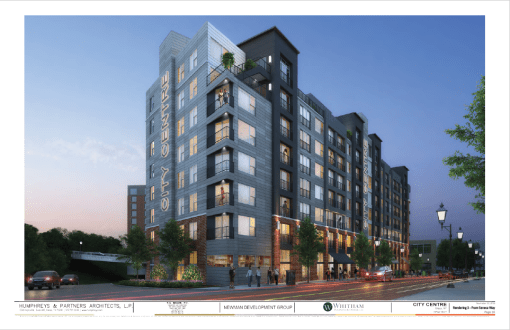
2. The Trebloc property, future home of City Centre, has exchanged hands. 301 East State Street sold for $6,800,000 on April 28th. The seller was “Trebloc Development Company”, the company of developer Rob Colbert. The buyer was “City Centre Associates LLC”, a limited-liability entity created Newman Development. This brings the 8-story, 218,211 SF mixed-use project one step closer to getting underway.

3. A couple of news notes from the Tompkins County PEDEEQ (planning/dev catch-all) Committee meeting:

I. OAR’s transitional housing at 626 West Buffalo Street will be called “Endeavor House”.

II. The county is set to start work on its draft housing strategy. The annual goal figures through 2025 include:

–580 “workforce units” per year, of which 280 are rentals going for 50-100% area median income, and 300 would be for-sale, with 80 of those condos.

–student beds, either dorms or student housing developers, commensurate with enrollment growth

–special needs beds to those making 50% or less of AMI. No quantitative descriptor is given.

–350 units in the urban core, 50-100 in “emerging and established nodes”, 30 in rural centers and 100-150 in “other areas”, which includes suburban Lansing.

https://www.facebook.com/plugins/post.php?href=https%3A%2F%2Fwww.facebook.com%2Fmedia%2Fset%2F%3Fset%3Da.1518721884836040.1073741852.772959889412247%26type%3D3&width=500

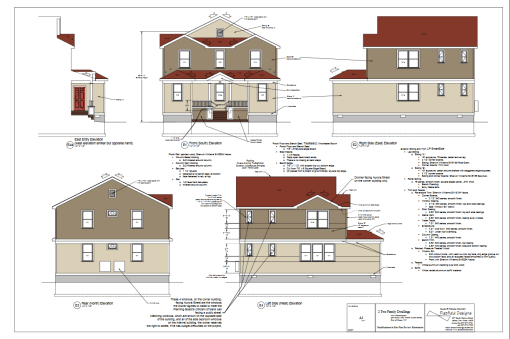
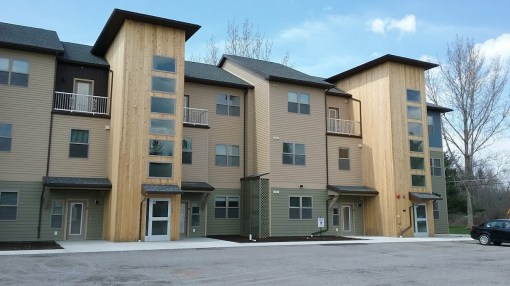
4. 607 South Aurora Street is officially underway. Modern Living Rentals posted an update to their facebook page showing site prep for their infill residential project in the city of Ithaca’s South Hill neighborhood. The four new buildings will be two-family units with three-beds each (24 total), similar to those recently completed at 125 and 139 Old Elmira Road. If the statistics are correct, the existing house will be renovated into a two family house – the banner suggests a 4-bed unit and a 2-bed unit to bring the total to 30 beds. This project will get a full write-up later this month, and its progress will be tracked as it heads for an August completion.

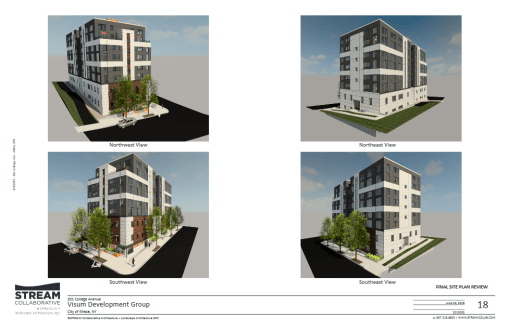
5. Looking at the city of Ithaca’s projects memo, it doesn’t look like anything brand new will be coming up. The formal review process is set to begin on Visum Development’s 232-236 Dryden Road project. I’m kinda confused on STREAM’s project description because it references both 191 bedrooms and 206 bedrooms, and some of the numbers don’t match the parenthetical figures -for example, thirty-seven (42) bike spaces. Going off the FEAF, it looks like the number of beds has in fact been increased to 206. The construction timeframe is August 2017 – August 2018, and it looks like both buildings will comprise one phase. Deep foundation, so apologies in advance to the neighbors who may be hearing a a pile driver this fall. The developer is exploring net-zero energy options.

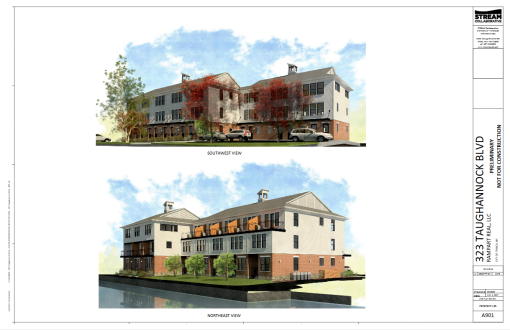
Also of note, 323 Taughannock received some visual tweaks. Gone are the cute sprial staircases leading to the waterfront, and in their place are more standard treatments. The group of five will now have their balconies on the third floor instead of the second floor. The changes on the front are more subtle, with the window fenestration now centered on each unit, and the front doors rearranged (old version here). Overall, the design is still roughly the same, it’s just a revision of a lot of details. Worth noting, given the crap soils on Inlet Island these will be on a timber pile foundation designed by Taitem Engineering. 238 Linden Avenue, 118 College Avenue and Benderson’s 7,313 SF retail addition are up for final approval this month.

6. Meanwhile, from the ILPC, it looks like there are a couple of density-expanding projects planned in the city’s historic districts. The first will renovate a garage at 339 South Geneva Street in the Henry St. John Historic District (part of Southside) into a one-bedroom carriage house. It’s infill, the garage is non-contributing and the design is an improvement, and it looks like a good if small project.

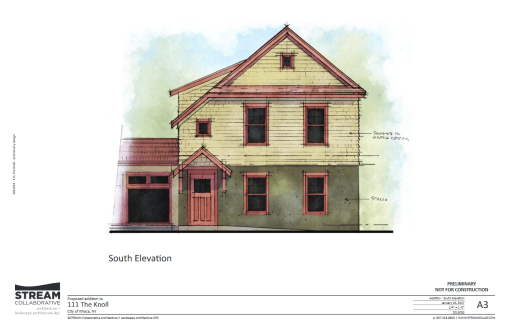
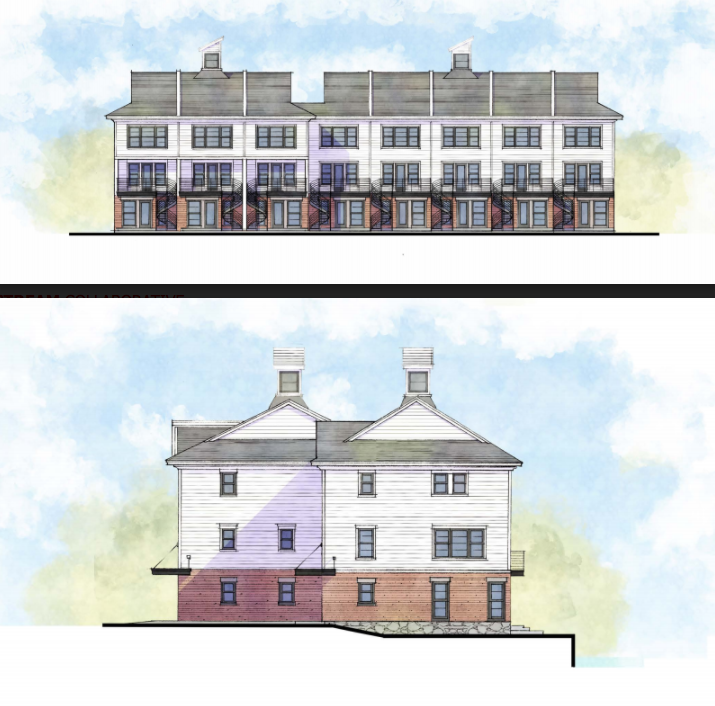
The other is a renovation of a classic Cornell Heights Mansion at 111 The Knoll into group housing for “Sophia House”, a Cornell Christian organization for women. The men’s equivalent, “Chesterton House”, is next door. The plan calls for renovating the five-bedroom, legal for eight-persons house into a 15-bed home. Part of that would entail demolishing the 1950s garage, which is connected by a breezeway to the ca. 1910 house, and replacing the garage with a four-bed addition, still connected through the breezeway.

Both designs are by STREAM Collaborative, as are 232-236 Dryden and 323 Taughannock. Can’t fault STREAM for being good at what they do – if a developer wants modern like 201 College, they get modern. If one wants traditional like the above examples, Noah Demarest and his team can do that too. They know the market and what works in terms of design. Unlike many local architecture firms, STREAM’s business is almost completely in Tompkins County – they did some concept design work in Rome and Utica, and some of the Tiny Timbers kits have been sold outside the county, but otherwise everything else is in or close to Ithaca. Business is good.

harolds_square_v4_new_comparo

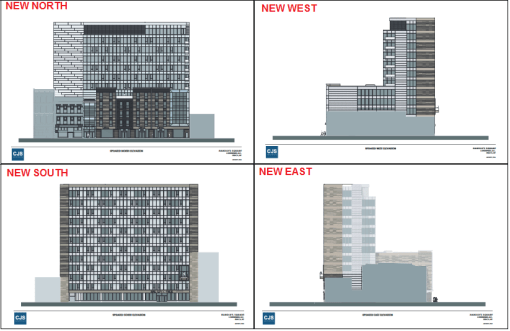
7. Admittedly, this is beating a dead horse, but Harold’s Square will eventually get underway. It appears the problem right now is that the tax abatement approved by the county is insufficient because of the increase in project costs (up 12% to $42.9 million), so the project team is heading back to the IDA to get the abatement revised (the Hilton Canopy did the same thing a few months ago). The project was previously approved for a 7-year abatement, but this time around they are seeking the 10-year abatement. Combined property, sales and mortgage tax abatement would come out to $5.089 million. New property taxes generated over the 10-year period would be $3.4 million (note that is on top of what’s already paid; IDA abatements use the current taxes as the baseline).

The office space and retail space look higher than previously stated (33k vs 25k, and 16k vs 12k), but it looks like that’s because the Sage Building renovations are included in the IDA numbers. The apartment count remains the same (108), although it looks like one 1-bedroom unit has been replaced with a 2-bedroom unit.

Two reasons are cited for the delay- issues with getting the office and retail space occupied, and a premium price on construction workers as a result of the increased local activity. The pre-development costs are clocking in around $800,000, so if it fails to get approval from the IDA’s board, that will be a pretty big cost to swallow.

Should it be approved, the construction timeline is stated as June 2017 through Q1 2019.

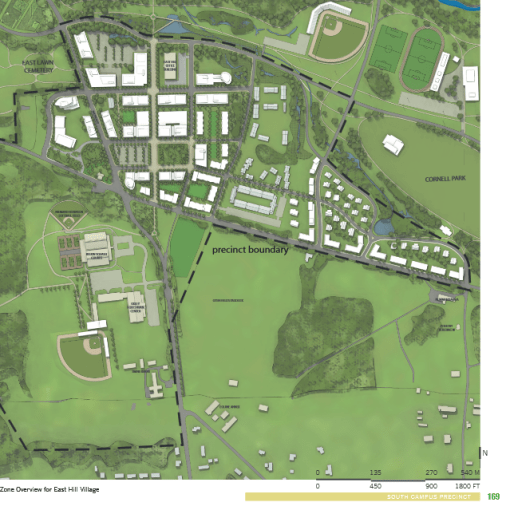
8. Just throwing this in for the sake of throwing this in – mark your calendars for May 17th, when Cornell hosts a forum about the new East Hill Village neighborhood from 5:30-7:30 PM at the East Hill Office Building at 395 Pine Tree Rd. The project website notes that it will start with a 30-minute presentation, followed by breakout groups to brainstorm what people do and don’t want included in the building plans – certain retail uses, housing components, general visions for the site. There will be more meetings over the next several months – the goal is an Autumn 2017 exhibition for the preliminary plans.


News Tidbits 4/29/17: Happy Birthday Mom

29 04 2017

1. The Times’ Matt Butler has written a great summary of almost everything you wanted to know about the Ithaca development approvals process (formally called entitlements). Basically, Ithaca’s high standards and arduous review process come with pros and cons. On a positive note, the city is more likely to get a nice product, the drawback is that it scares developers off. For those who do give the city a spin, the city is a desirable investment for a number of reasons (affluent residents, steadily growing economy), but the lengthy process generates uncertainties (bad for financing) and requires more money (bad for affordability).

There’s nothing wrong with high standards, but it really helps if the city gives developers a set of guidelines for what they’re looking for in a design, rather than forcing them to rely on antiquated zoning. Design guidelines were recently approved for Downtown and Collegetown, which should help, although an overhaul of the zoning would be much welcomed. However, in a city famous for its activism, even the most well-orchestrated plans can be broadsided by NIMBY grassroots, so even with these heavily-structured guidelines, building in Ithaca is likely to have uncertainties and challenges into the foreseeable future.

2. A couple of grants worth noting – Tompkins Community Action was awarded $3.7 million by the state to go towards construction of their Amici House project at 661-701 Spencer Road in Ithaca. The funds will cover about 45% of the $8.25 million construction cost. Work is supposed to begin this summer on the mixed-use project, which includes 23 studio units for vulnerable or previously homeless youth, and a 7,010 SF daycare/early education facility.

In other news,the Alcohol & Drug Council of Tompkins County was awarded $500,000 by the Care Compass Network Innovation Fund to use towards the establishment and operation of a 20-24 bed detox facility, much needed resource as the heroin epidemic continues to grip the nation. CCN is a non-profit consortium funded by Southern Tier health centers like Guthrie, Cayuga Med and Binghamton General. ADC-TC is a non-profit that focuses on substance abuse education, prevention and outpatient treatment. No facility was named in the announcement.

On a third note, the sale of 626 West Buffalo Street was completed. Tompkins County Opportunities, Alternatives, and Resources (OAR) intends to renovate the house into five beds of transitional housing for those getting out of jail and trying to get back on their feet. The intent is to provide, safe, secure housing to better help with the transition process, which can include education, job training and mental health and/or addiction treatment. The house was purchased for $95,000, and an additional $60,000 would be spent on renovations. The county voted to provide $100,000 in a one-time allotment – the rest of the money ($55,000) comes from grants, donations and a mortgage. Ultimately, the goal is to provide decent housing that helps reduce the recidivism rate (convicted persons committing more crimes), ideally saving the county on future court and incarceration costs, as well as what they hope pans out to a lower crime rate.
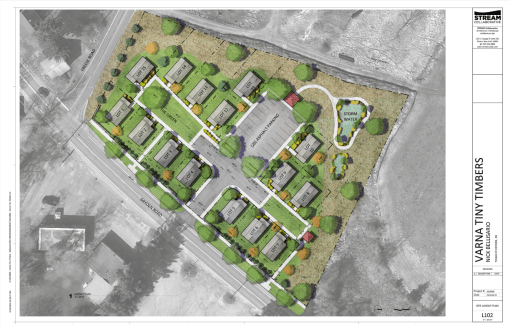
3. Tiny Timbers seems to be to a good start. The fledging modular timber-frame company run by the Dolph Family has added several members to its construction crew, and they will build the frame components out their newly-adapted warehouse-mill on Hall Road in Dryden. The house in Hector is nearly complete, two more are being prepared (both big cubes), and the gravel road is being constructed for their just-approved five-lot subdivision at 1624 Ellis Hollow Road. Going off the wording of their last blog post, it looks like three of those lots are already reserved or purchased (one lot is a conservation area).
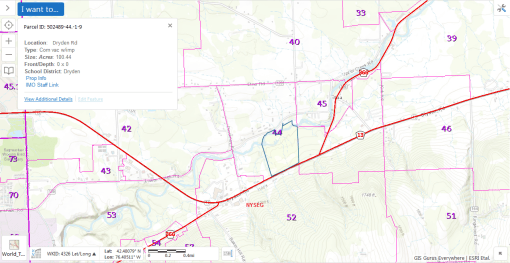
4. Let’s not beat around the bush – you’re coming here for a bit of inside information, not just a news round-up. One of the reasons Dryden and Tompkins County have each committed $1,750 to an infrastructure study of the Route 13 corridor is that there is a concept proposal on the table from INHS for a mixed-use development with retail and 250 affordable housing units, on approximately 50 acres of a 100 acre parcel – half of it is north of the rail trail and would be conserved, possibly through Finger Lakes Land Trust. At 5 units/acre, it’s below Varna’s highest densities, but it’s about the rural threshold of about 2 units/acre.

As it so happens, a quick check of the county’s property tax map shows a 100.44 acre parcel of vacant farmland across the street from 1477 Dryden Road, outlined in blue above. The back half is Fall Creek, so given buffers and general environment concerns, it’s good sense to leave it alone. The land has been owned by the Leonardo Family (the ones who ran The Palms) since 1942.

I asked Dryden Town Planning Director Ray Burger about it, and he knew only what the county said. But it’s something to keep an eye on as the town figures out whether or not to extend sewer to that parcel.

5. It seems like there’s quite the tempest going on in Lansing. Let’s review. All this comes courtesy of the Lansing Star (not for lack of trying on my part. Almost all Lansing staff and officials ignore my phone calls and emails, except zoning officer Marty Moseley. Thanks Marty.).

I. Over in the village, the “Preservation Party” lost the village election by a large margin to the incumbent Community Party by a roughly 75/25 split (240 votes vs 80 votes). This result should settle the Bomax Drive rezoning from commercial tech space to residential once and for all.
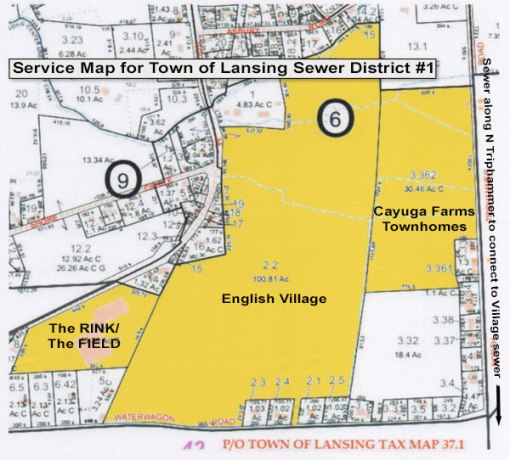
Image courtesy of the Lansing Star

II. Lansing town has inked an MOU with Cayuga Heights and Lansing village to install a sewer line up Triphammer Road to create a small sewer district. However, it’s impacts would be substantial – it would have three primary users – the 102-unit Cayuga Farms project, the 117-unit English Village project, and the RINK, which is expanding its facility. The developers want the sewer so much, they’re paying for it in what town supervisor Ed LaVigne is calling a “public/private partnership”. Properties that do not hook up would not be hit with an increased assessment, according to LaVigne and county assessor Jay Franklin.

A back of the envelope estimate suggests $50-$60 million in increased land assessment, and $1.5 million+ in property taxes. Perfect for offsetting a rapidly devaluing power plant that was once your town’s biggest taxpayer. The village boards still need to sign off on the MOU, but Lansing town is desperate to make a deal.

III. The Lansing Meadows senior housing seems to be worked out, and it includes the  small community-focused food retail component desired by developer Eric Goetzmann. The public hearing is on the 1st; if approved next month, the construction bids will be posted shortly thereafter with an intended summer start on the 20-unit mixed-use project.

IV. Just…wow. On the one hand, LaVigne et al. have a right to be upset. Their town’s biggest taxpayer is faltering, they’re trying encourage as much development as they can to offset the plunge in property taxes, and with debates like the West Dryden pipeline, they have a right to be frustrated. But to say the county’s sabotaging your town is a whole different ball game. To say “[r]ight now The County is on the sh** list as far as I’m concerned,” well…

He deserves sympathy. There’s a lot of BS mixed in with the good of Tompkins County, and his town and its schools are in a real bind. Poo pooing them isn’t helping anybody. But…he can’t magically change how people in Dryden or Ithaca think. Ask solar companies if they’d be interested in town properties, find a way to make residential heat pumps and renewables work. Hell, work with TCAD, talk with Heather McDaniel and the green groups and come up with ideas. I had a professor in grad school tell me that “you lure more flies with honey than vinegar”. LaVigne has a right to be upset, but this isn’t a good look.

6. Now that a few people at INHS and County Planning have been annoyed (sorry guys), back to the news. The Journal is reporting that the town of Ulysses has acquired three Jacksonville properties from Exxon Mobil, in what they hope is the next step in closing a disastrous chapter in the town’s history. Back in the 1970s, the former Mobil gas station at the corner of Jacksonville Road and Route 96 leaked enormous amounts of gasoline and poisoned the hamlet’s groundwater – one report says a person passed out from noxious fumes when they turned on their shower.

The state DEC became involved and ordered Exxon Mobil to clean up the mess, which was carried out from 1984 to 1988, and the multinational gas company purchased most of the affected properties and demolished them – an 1827 church was left intact. The DEC’s case file was finally closed in 2005 after the test levels had receded to more acceptable readings, but Exxon Mobil has continued to own the property, letting the church fall into disrepair.

The town is buying the church at 5020 Jacksonville Road, a 0.275 acre vacant lot at 5036 Jacksonville Road, and a 0.656 acre vacant lot at 1853 Trumansburg Road for $5,001 (the trio’s total assessed value is $84,700). The plan is to install a septic for the church at 5036, renovate the church just enough to keep it from rotting out, and once the building is stable, the plan is to resell to someone looking for a unique fixer-upper. If no buyer is found, the town plans to eventually restore the church on their own. The larger lot on Trumansburg Road is being considered for resale towards private development, or use as a TCAT park-and-ride.

7. Is the Canopy Hilton underway or isn’t it underway? Still kinda hard to tell.
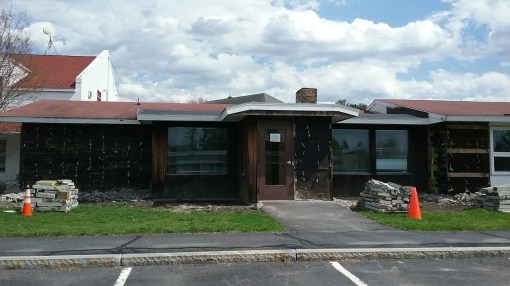
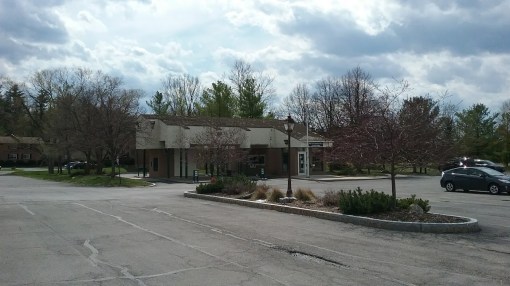
8. On the other hand, it looks like the new medical office building planned for Community Corners in Cayuga Heights, is starting demo work. The stone is being stripped from the existing buildings, to be reused on other structures. The Cayuga Medical Associates plan calls for a $5.6 million medical office building at 903-909 Hanshaw Road, 2 floors and 28,000 SF (square-feet), of which 23,200 SF will be lease-able space.

9. Nothing too exciting from the planning board agendas around the county – Lansing has nothing up, Cayuga Heights has nothing of note. Over in the town of Ithaca, Cornell plans to try again with its Peterson Parking Lot replacement (after the disastrous first try last April), the 15-lot Monkemeyer subdivision on East King Road continues review, and a 2-lot modification is up for consideration. In Dryden, the advisory planning board will continue review for the Tiny Timbers Ellis Hollow subdivision mentioned earlier, and a 7-lot subdivision of the former Dryden Lake golf course; there will also be some solar panel discussion, and possibly some info on the ~20 unit Pineridge Cottages project planned for Mineah Road.


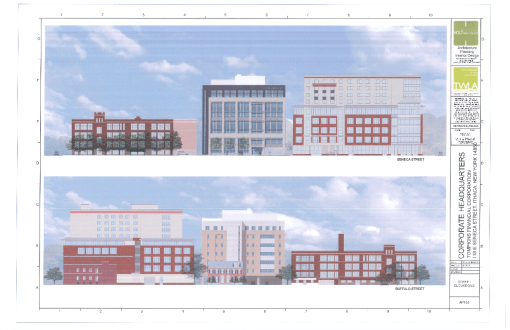
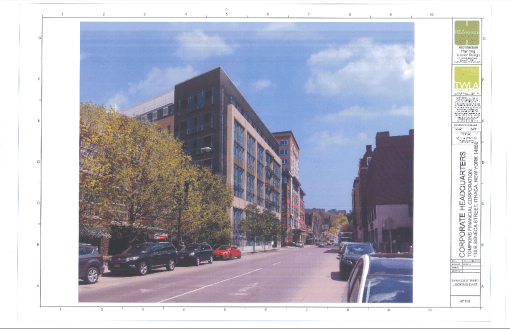
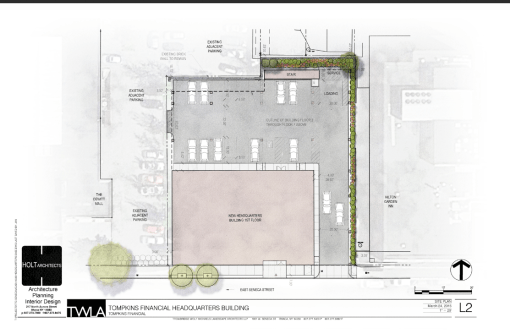
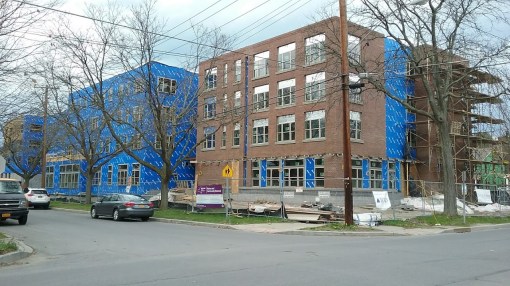
Tompkins Financial Corporation HQ Construction Update, 4/2017

25 04 2017

I could see the clouds to the north and west, I knew the rain was coming. I even glanced at a radar still on my phone and assumed that, as most fronts tend to do, it was moving west to east in a diagonal SW-NE band – by that logic, I had about fifteen minutes to take photos, run to my car and get my umbrella. As it turns out, the front was pushing north to south. So I did not have fifteen minutes. I had five. Oops.

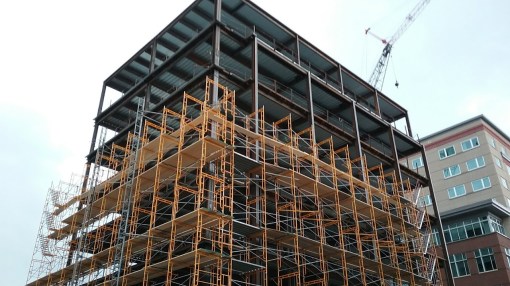
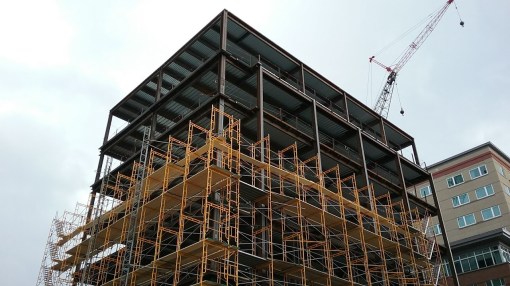
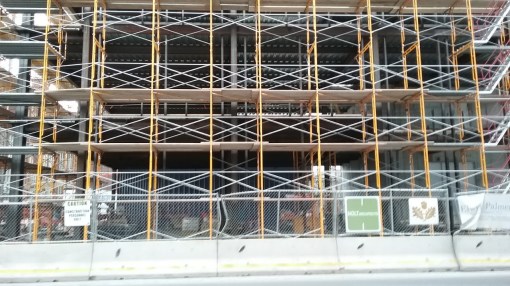
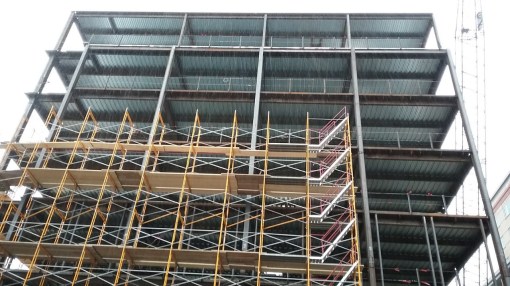
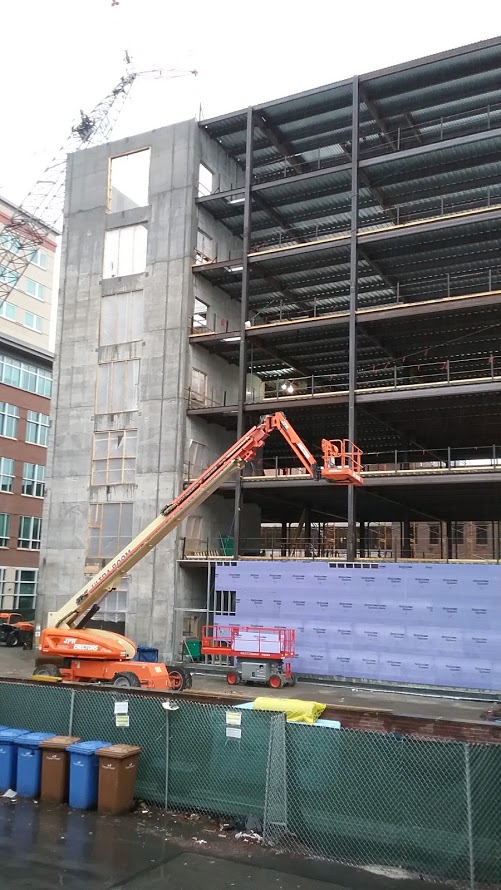
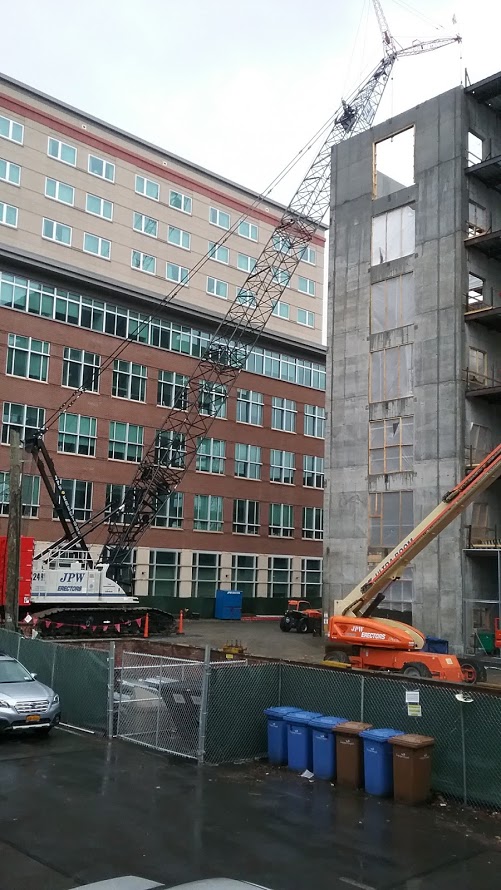
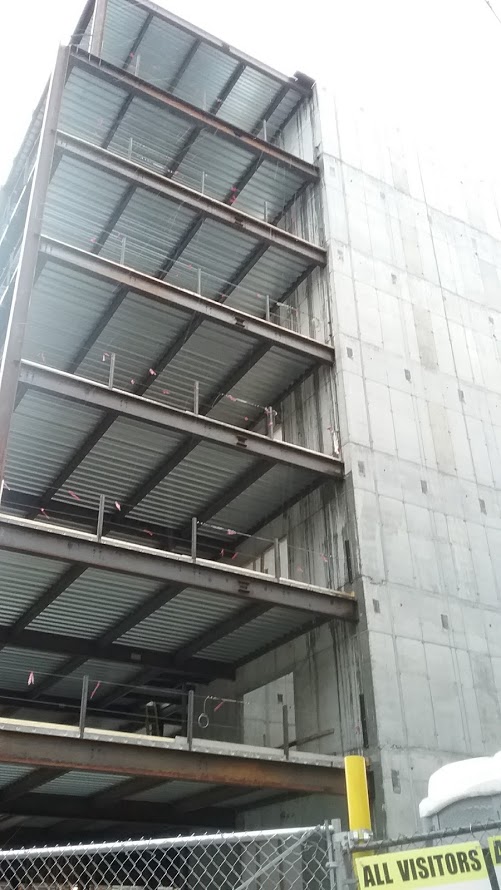
Anyway, TFC’s new HQ is topped out and decked with corrugated steel (a bit sooner than anticipated), though it’s not built out – the rear (north) flank and the east flank are missing. Those are the portions that will be built over the surface parking. You can make out a couple of the support piles in the pics below, and those will tie into the structural columns in the garage area, and into the structural steel of the upper levels. As noted with 201 College, it’s a bit unexpected that the structure would top out before even a single floor is built out, but it is what it is. The building’s height is there, but in terms of breadth, it’s less than half of the final product. The elevator core is at full height, and the steel stud wall and gypsum sheathing on the back separate the future ground-floor bank branch from the rear parking, which will be reserved for customers and clients. Pipe scaffolding has been erected as workers begin work on the interior (sprinkler system, utilities rough-ins).

Occupancy is intended by March 2018. JPW Erectors, a division of the JPW Companies of Syracuse, is in charge of the framing, while LeChase Construction is the general contractor. HOLT Architects penned the 110,000 SF building’s design.


210 Hancock Construction Update, 4/2017

23 04 2017

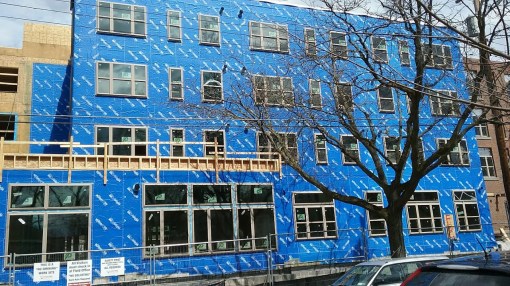
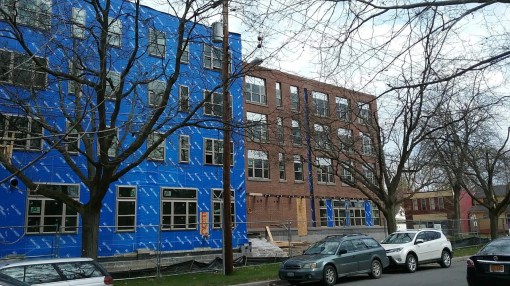
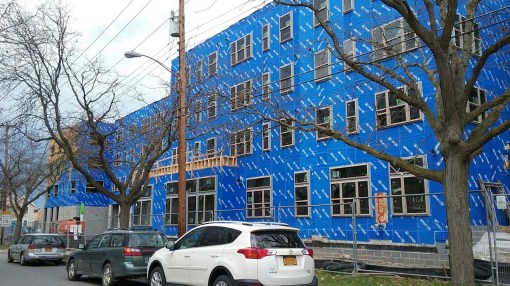
There is so much going on at INHS’s 210 Hancock site, this might be the record for most photos in a single construction update. Let’s go counterclockwise from the southwest corner, since that’s the order these photos were taken.

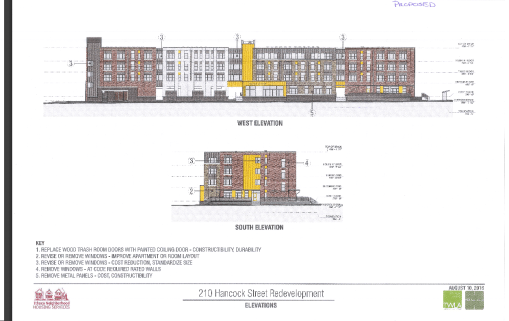
With the apartment building string, Section “A”‘s Blueskin has been mostly bricked over with Redland Heritage Brick. Some Blueskin remains exposed in areas that will be faced with Alpolic exterior metal panels. Fingers crossed that the mustard yellow shown in the elevations looks less jarring in person. It looks like an additional layer of thermal insulation was installed above the windows to go between the Blueskin and the metal panels (mostly dark grey, a few yellow…technically they’re called Alpolic Charcoal and EYL Yellow. the armchair architect in me really wants to harp on the yellow metal panels. I remember a Noah Demarest quote about yellow being a really hard exterior color to pull off. Why not a red or an orange-brown?). The roof is finished and interior fixtures and flooring are being installed.
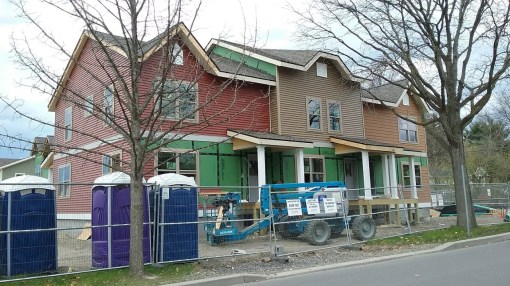
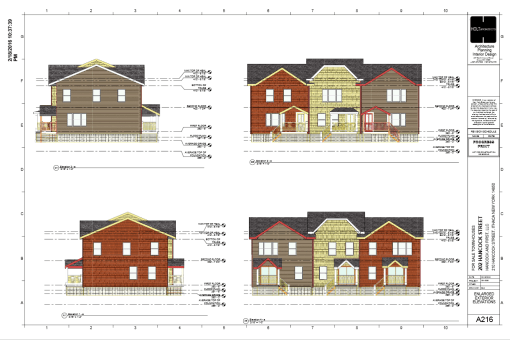
Then we get to the first string of three for-sale townhouses, which will have addresses for the 200 Block of Hancock (apart from 202, I’m forgetting the exact numbers). They look nothing like the elevations submitted for IURA review, and that is not a bad thing. INHS is using Certainteed clapboard siding on the exterior. The one on the west (left) is “Autumn Red”, and the one on the east (right) is “Mountain Cedar”, both of which were used on the Stone Quarry project. The shades of brown and grey are so similar it’s hard to tell what the middle one is, maybe “Hearthstone”. It looks like a mixture of sizes as well, maybe 4″ on the left and middle, and 7″ Mountain Cedar on the right. The trim pieces are Certainteed vinyl and vary slightly in color, neutral whitish or tannish shades like “Sandstone Beige”, “Natural Clay” and “Desert Tan”.

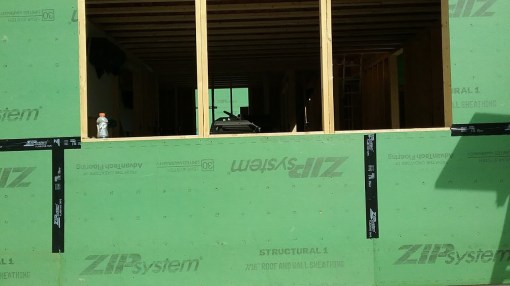
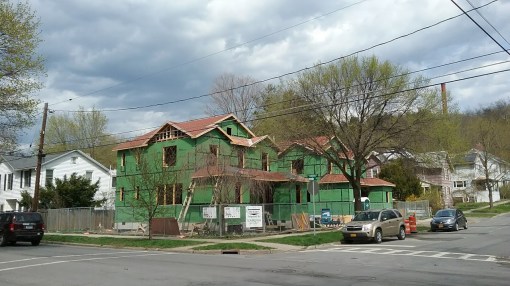
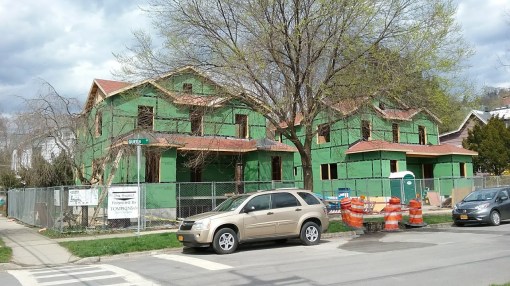
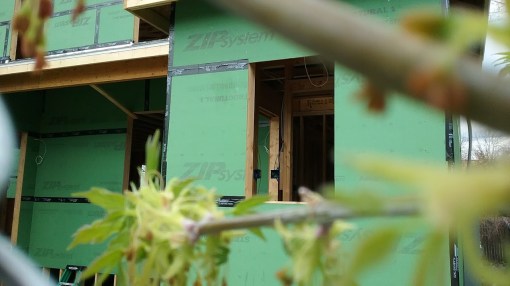
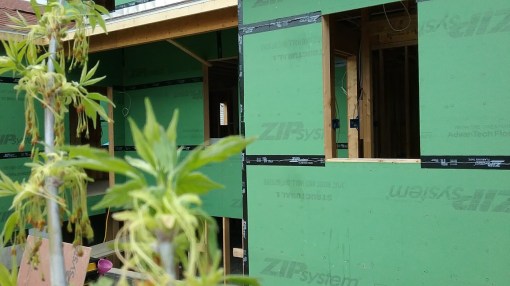
Circling around to the 400 Block of Lake Avenue highlights a construction contrast between the for-sale units and the five for-rent units further north. The for-sale units are wood-frame, plywood Huber ZIP sheathing, and exterior finishes. The for-rent units are wood-frame, standard plywood sheets, Tyvek Housewrap, and exterior finishes. The difference between the two is really a matter of preference – both are effective water-resistive barriers if installed properly. ZIP panels tend to be easier to install (lower labor cost), but more expensive as a product.

The Certainteed colors on the rentals are “Spruce”, “Sable Brown”, a split-level “Autumn Red/Hearthstone”, “Flagstone” and another “Autumn Red”. Some of these will be 4″ clapboard, others 7″ shingles – all Certainteed, all to give the impression of individual units so they play well with their older, detached neighbors. The Spruce Green unit looks a little odd with that big blank wall above the porch, and in the renders and elevation it appears to be bigger than the final product.

Apartment sections “C” and “D” are still being framed, and “B” has been fully skinned and fitted out with windows. “B” will be faced with will use Carolina Ceramics Teakwood Brick and Morin blue-grey corrugated steel with pearl, EYL yellow and charcoal Alpolic metal panels, “C” will use Redland Whitehall Brick (white brick) as well as Alpolic panels, and “D” will use the same Heritage Red brick as “A” but, with some corrugated steel on the stairwell. “C” and “D” also have a first-floor covered parking garage. The garage will be face in Barnes and Cone Masonry, but the city’s November 2015 filing makes reference to a product that doesn’t appear in their brochures.

The apartment will be ready by August 1st, and the for-sale units will be on the market by the fall. Lecesse Construction is the general contractor.


Hotel Ithaca Construction Update, 4/2017

23 04 2017

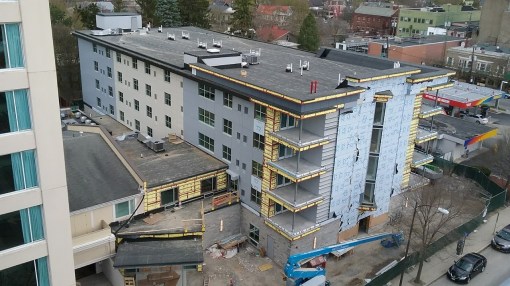
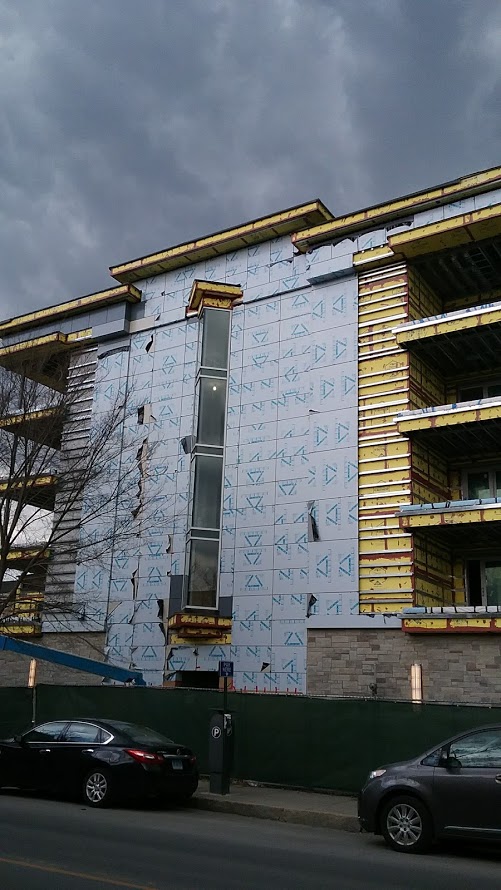
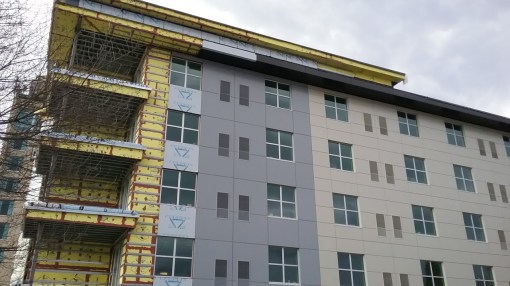
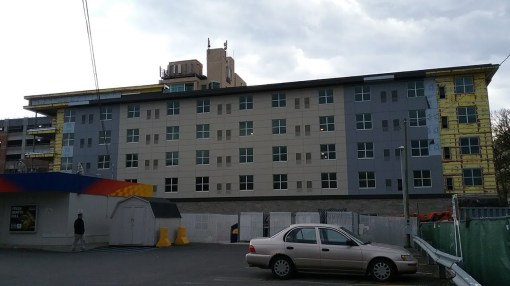
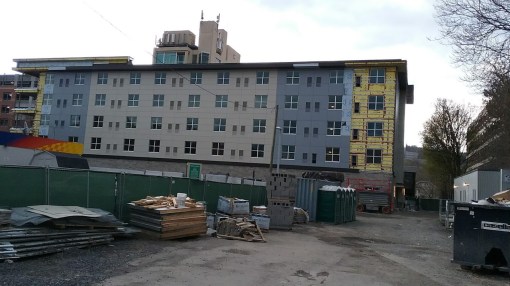
The exterior finishing is further along on the new wing of the Hotel Ithaca. For most of the hotel, the exterior wall construction goes something like this – the steel stud walls are erected, RMax polyiso insulation boards are attached, and the fire-rated GP DensElement fiberglass mat gypsum sheathing panels go over the boards – the maroon sealant is PROSOCO R-Guard FastFlash liquid flashing. DensElement is different from other GP DensGlass products in that the water-resistive barrier (WRB) is integrated into the fiberglass mat, so there shouldn’t be the need to place a barrier over the sheathing. But some parts of the sheathing do appear to have an exterior WRB (compare the southeast and northeast balconies in the first photo below), so make of it what you will.

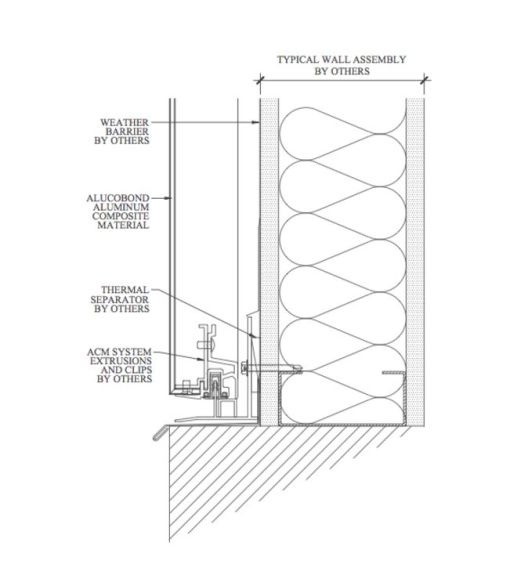
Once the fiberglass mats are installed and sealed tight, metal clips are adhered to the sheathing, and then Alucobond panels are fastened to the clips. Alucobond is an aluminum panel that is sometimes used as an exterior finish because it’s lightweight and fairly dent-resistant (and aesthetically, metal panels are used for a modern, clean look). The drawbacks are cost, and potential waterproofing issues if not installed correctly. Along the ground floor, stone veneer was applied over the sheathing.

Side note, the initial design called for diamond-shaped panels, which were rejected by the Planning Board with extreme prejudice – one member called it “strip mall architecture“. Although, the strange part of all this is, the final product appears to be a blend of what was initially proposed, and what was approved – the exterior and window elements resemble the final render, but the final submission didn’t have a doorway on the east end of the wing, while the initial design did. The end of this update has a copy of each for comparison.

It looks like the roof is finished and the trim is going on, so with the exception of the remaining metal panels, doors and trim pieces like the balcony railings, the exterior is nearly complete. Hart is aiming for an opening by graduation weekend, so things should move at a fast clip over the next few weeks. Krog Corp, a frequent partner of owner Hart Hotels, is the general contractor.


1001 North Aurora Street Construction Update, 4/2017

21 04 2017

Some more progress on the two-building, four-unit 1001 North Aurora Street project in Fall Creek. Since February, the building have been framed out, roofed and shingled. For the record, the shingles are Owens Corning TruDefinition Duration Shingles, Terra Cotta color. Huber ZIP System plywood sheets are being attached to the exterior over the wood studs, and interior framing, rough-ins and drywall is underway.

On a happy note, it looks like the side windows on the eastern building, which had the potential to be deleted as a cost-saving measure, are indeed going in based on the rough openings. The exterior will consist of two brownish shades of LP SmartSide cedar texture siding, with a white lap band and trim. Technically, that white is Sherwin-Williams “Nacre”, and these plebeian lips had to go to Google to figure out how that’s pronounced (NAY-ker). Because mother-of-pearl is just two darn pedestrian. The browns are “Rice Grain” and “Sawdust”.

Developer Stavros Stavropoulos (d/b/a Renting Ithaca) should be bringing these 3-bedroom rental units onto the market by the end of May, as 202 Queen Street and 206 Queen Street. Shortly thereafter, he and architect Daniel Hirtler which be launching into next project, and their biggest to date – a 3-story, 11-unit apartment building at 107 South Albany Street, just west of downtown.


201 College Avenue Construction Update, 4/2017

19 04 2017

Dropping by Visum Development Group‘s 201 College Avenue project, I was a little surprised that one half of the building is so much further along than the other half.

201 College is a “H” or dumbbell-shaped structure – the bridge between the two halves hosts the elevator shaft and part of the circulation (hallway). The west wing has completed structural framing, the exterior stud walls are being installed, and even some of the sheathing (fire-rated GP DensGlass fiberglass mat gypsum) is up on the ground level. Peering inside, it looks like some of the interior stud walls have already been set.

In contrast, the east wing isn’t that much further along than it was two months ago – the ground level masonry has been built-out, but the structural steel has not advanced since the February update. It’s not a sign of any difficulties, and other structures have taken or are taking similar approaches – Tompkins Trust’s new HQ has topped out, for example, but the north and east wings have yet to be built out beyond the elevator core. Still, it will take several weeks for the east wing to catch up when William H. Lane Inc. moves ahead with that side of the structure.

According to the construction loan docs filed with the county, the 33,398 SF project is being funded with a $7,870,673 loan from Pennsylvania-based S&T Bank, separate from the $2,640,000 from Visum and its backers that went towards purchase of the property. Hard costs, which are the construction materials and labor, comprise $6,841,038 of the loan, while soft costs comprise $506,984 (permits, legal, marketing, architect and engineering fee, liability insurance, financing costs such as loan fees/taxes/recording costs). An additional $300,000 serves as contingency (your “cover your butt” cash in case of unexpected expenses or poor occupancy rates), and $226,158 is set aside as interest reserve (a special savings account that pays the lender interest on the construction loan while the building is under construction – the objective is to get the building done and occupied before the reserve runs out).

The timeframe is quite tight on 201 College, with a planned August 2017 opening. The rest of the building should move along quickly over the next few months.


Village Solars Construction Update, 4/2017

19 04 2017

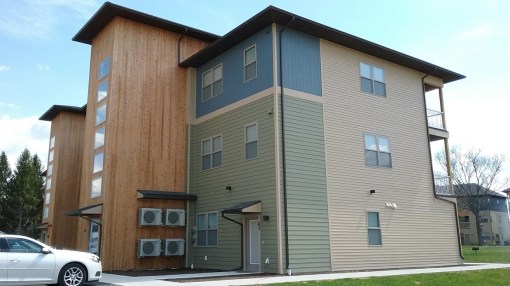
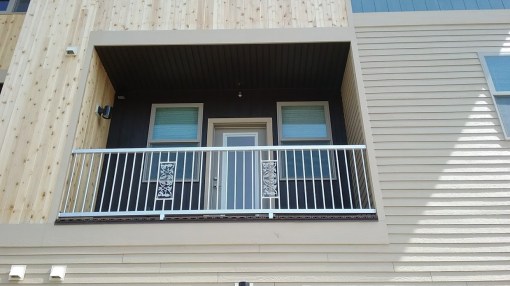
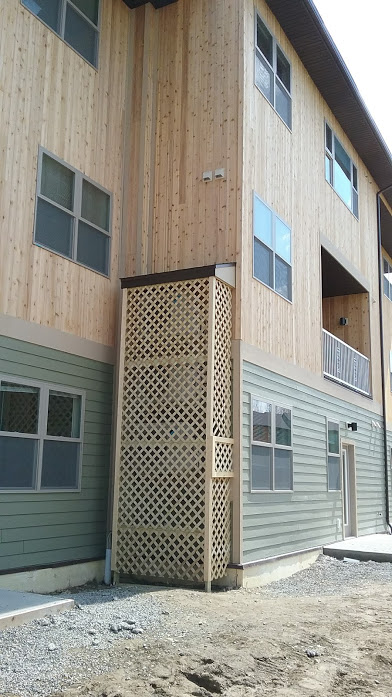
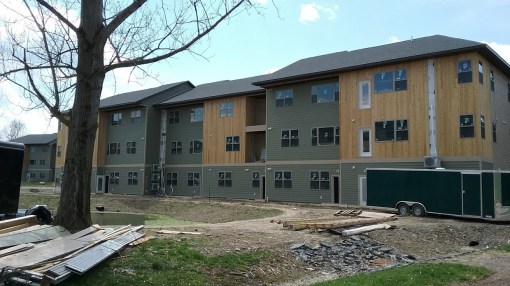
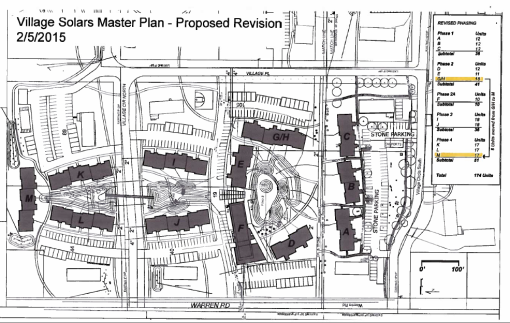
At the never-ending Village Solars apartment complex in Lansing, Building “I” is nearly complete from the outside. It sports a few details that make it stand apart from earlier phases – the balconies railings are a different design, a dark-colored fiber cement board is being used for some of the balcony alcoves, and the heat pumps have been hidden away under a wood lattice screen. Given how clean the immediate project site is, it would not be a surprise if this building is aiming for a May 1 occupancy.

Meanwhile, Building “J” is a little further behind – the windows and doors have been fitted and the roofing is complete, but the exterior wood grain and fiber cement panels are still a work in progress, as is the building trim. The doors on the upper levels will likely lead to small juliette balconies like those seen here. Inside, it’s stud walls and rough-ins, and there did not appear to be any drywall hung yet.You can see the unscreened Daikin heat pumps in the fourth photo below. It looks like the roofing was done by T and J Associated Contractors out of Auburn.

It doesn’t look like work has started on Phase 4 yet, which should consist of the last three buildings in the first stage of build-out (“K”, “L”, and “M”). If it’s anything like the previous phases, the construction team will start with the Phase 4 site clearing this summer. The later stages of development call for multiple phases to the east, and possible replacement of some of the older 1970s apartment buildings with newer structures [3/22 Town Board Minutes]. Potentially, the complete build-out would be around 423 units, from 400 SF studio micro-units to 1,185 SF three-bedroom two-bath apartments. Keep in mind, that would be several years out, well into the next decade. Along with those units come community space, retail components, expanded trail and outdoor components and a bus stop.

Rents look to be in the middle of the market – the micro-unit studios start at $865/month, going all the way up to top-of-the-line three-bedroom units at $1680/month. One-bedrooms and two-bedrooms start at $950/month and $1260/month respectively.

While looking around, an older gentlemen walking his dog went in and out; dunno if it was a relative of the Lucente family (the owner/developers, d/b/a Lifestyle Properties), or a curious onlooker.


209-215 Dryden Road Construction Update, 4/2017

17 04 2017

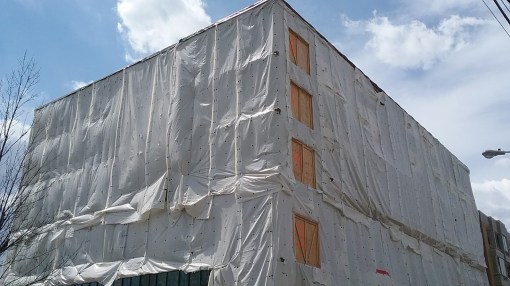
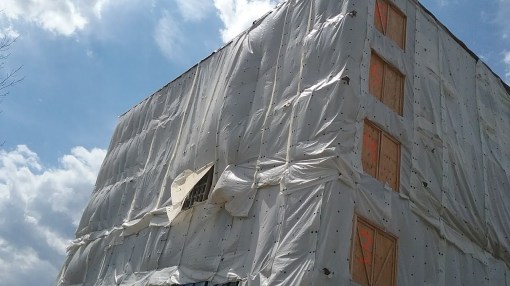
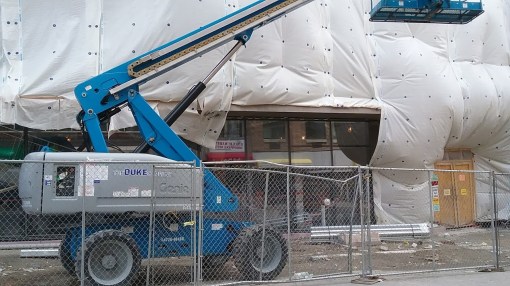
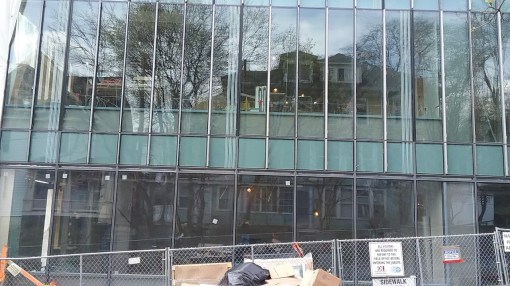
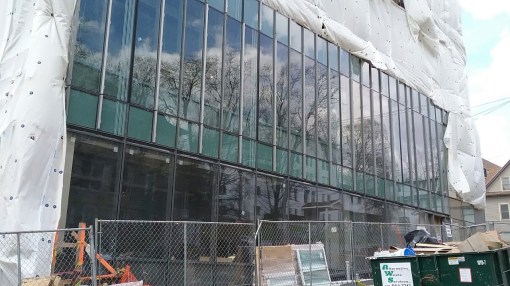
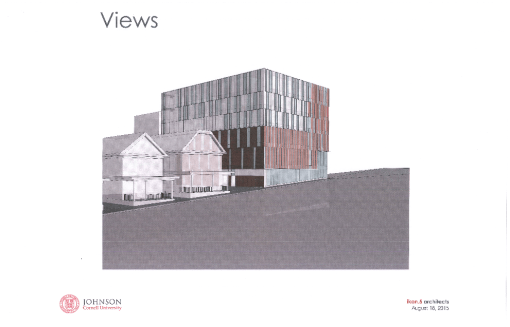
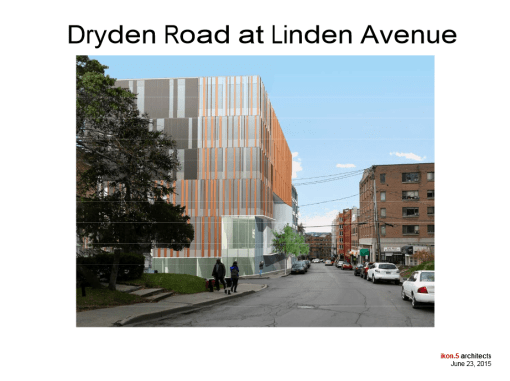
Work on the new Breazzano Center continues in Collegetown, with the exterior plastic sheets slowly being replaced by the metal and glass facade. On this particular windy day, the tarp was flapping enough to reveal a bit of the exterior metal stud walls underneath. On the rear of the building, the salmon-orange and dark grey panels now cover most of the exterior wall. The recently proposed 238 Linden townhouses will come up to about the top of the third floor, where the salmon panels change over to grey. 238 Linden will be roughly the same color as the lower-level panels, probably with the same metal finish. Note the clips on the exterior wall, which are for aluminum sunshades.

I’ve had contractors tell me that one of the ways you can tell the quality of the curtain wall glass is by how much distortion one sees in the reflection (optical distortion). Based off that criterion, the glass used on the entry level appears to be a fairly high grade. The opaque glass panels are called spandrel glass, and are used to conceal the floor slabs.  It looks like the thin vertical steel panels will be installed over the curtain wall, though not in all places – The northeast corner and ground floor will not have the steel panels, nor will the atrium at the front of the building.

One can barely see the interior work in these photos, but the interior stud walls were up and drywall has been hung on the lower floors, which means that most of the utilities rough-ins have been completed.

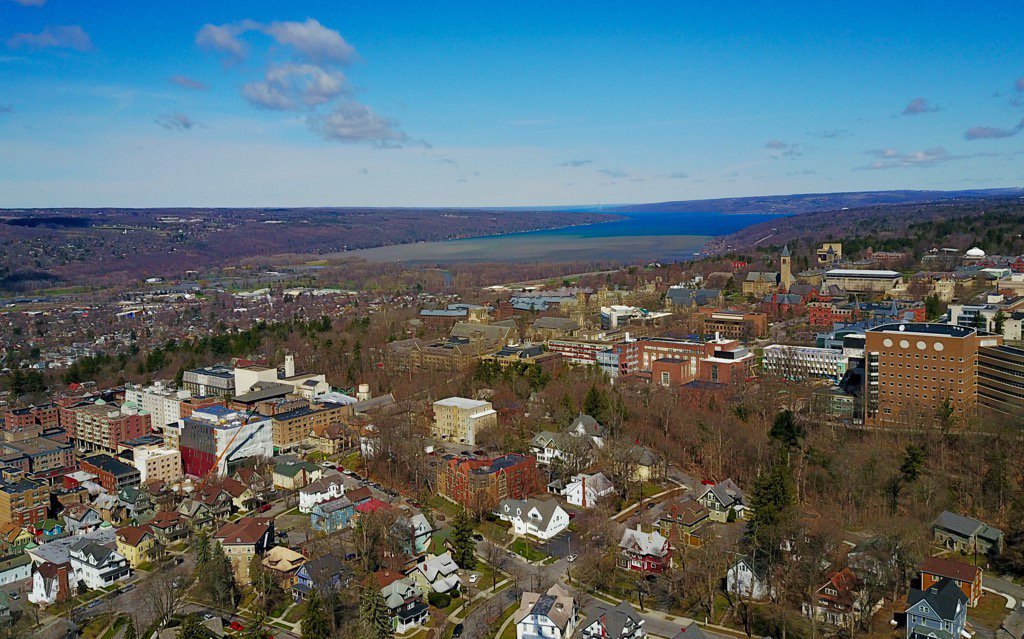
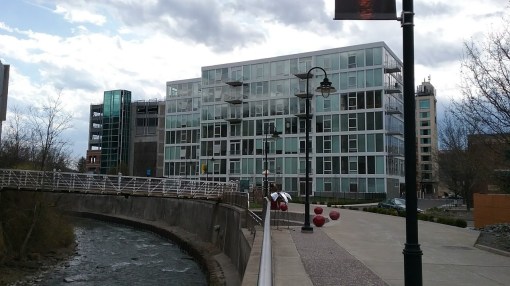
The last photo, which comes courtesy of Tom Schryver, gives an idea of the scale of the building in context – at six floors and 80 feet, it is the tallest that the Collegetown form zoning allows without a variance. At 76,200 SF, it’s the fifth-largest by square footage, after Cascadilla Hall (77,913 SF), The Schwartz Center (80,989 SF), Eddygate (95,000 SF) and 312 College Avenue (112,392 SF).