News Tidbits 8/5/17: Having the Right Look

5 08 2017

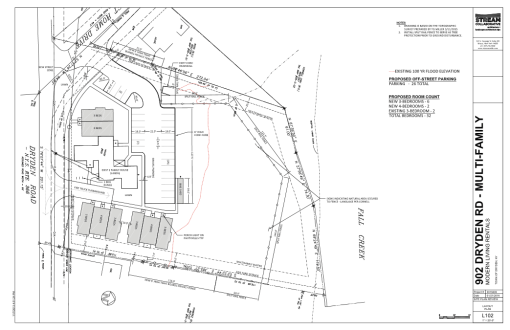
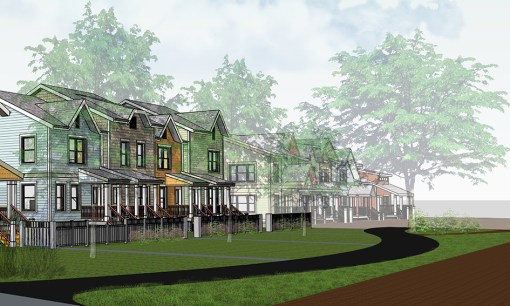
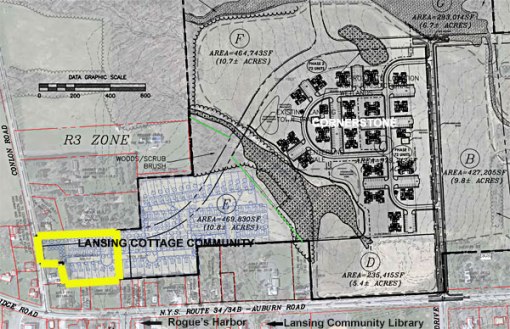
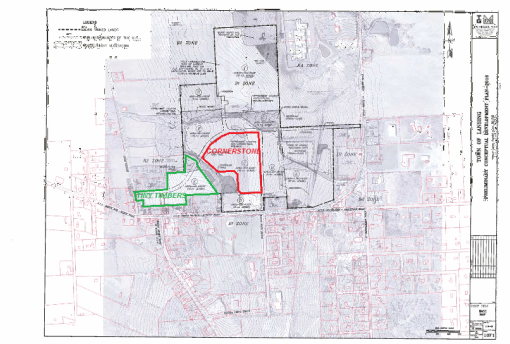
1. Thanks to Dan Veaner at the Lansing Star, we have the first rough site plan for the proposed Cornerstone and Tiny Timbers projects at the Lansing Town Center site at the intersection of Route 34B and Triphammer Roads. Readers may recall that Tiny Timbers has proposed a development of 60 for-sale single-family homes (ten in the first phase) called “Lansing Community Cottages”, and Cornerstone is proposing up to 144 affordable apartments in two phases for the town center site.

Specifically, Tiny Timbers is looking to sell homes averaging about 1,000-1,200 SF in the $175,000-$225,000 range, which is a critical but tough-to-hit segment in the local housing market. With consultation from planner David West, the homes are designed in a traditional urban layout, with congregated parking spaces instead of garages, and community green spaces. None of the homes are more than 150 feet from the roads and parking areas, a safety requirement to ensure access for emergency vehicles. Ten units would be built in phase one, twenty in phase two, and thirty in phase three. About the only concern town officials have expressed at this point is a second means of ingress/egress to keep the traffic down on Conlon Road.
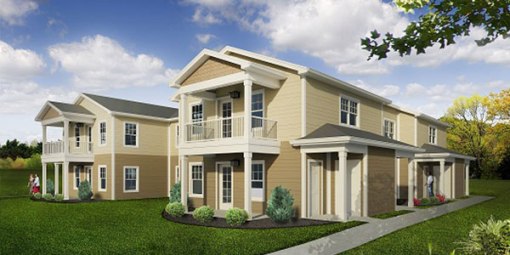
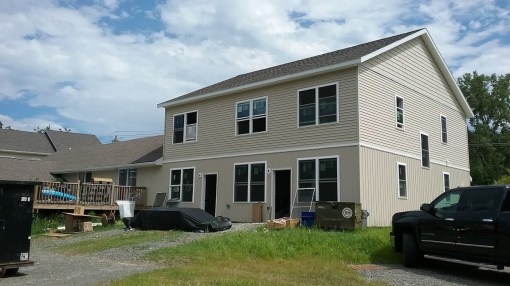
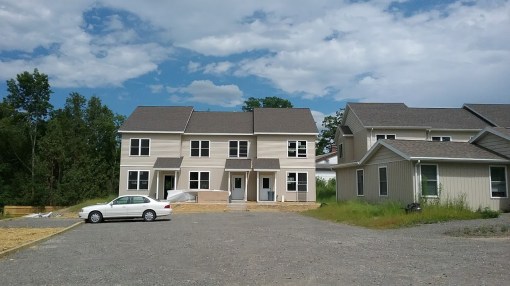
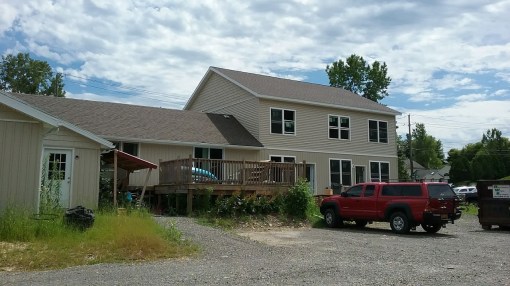
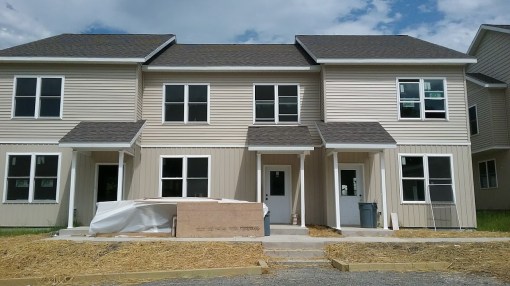
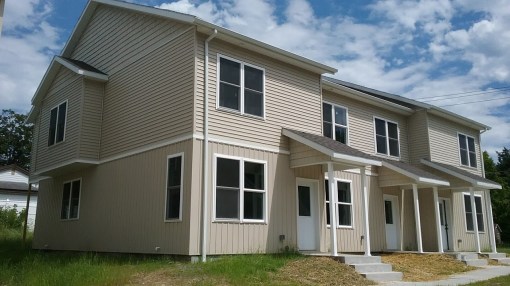
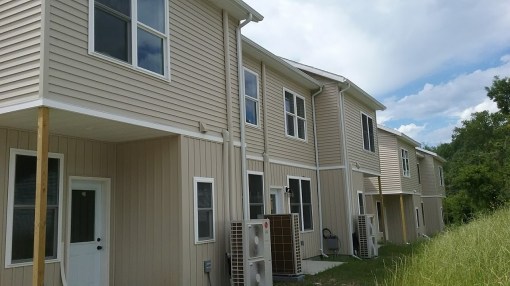
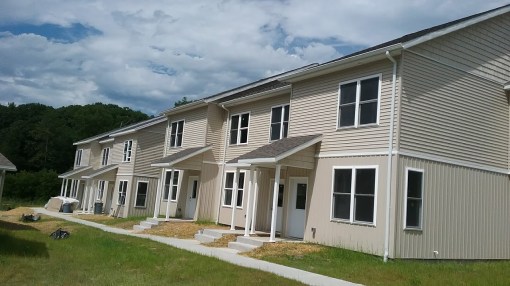
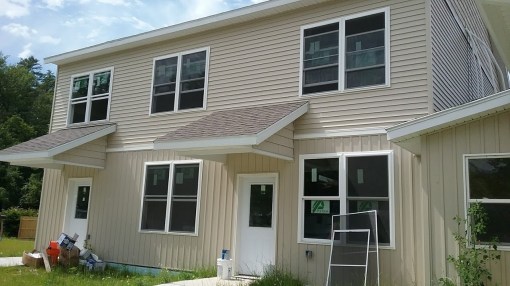
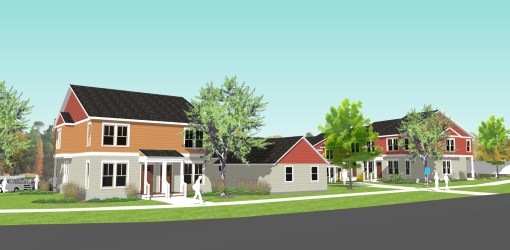
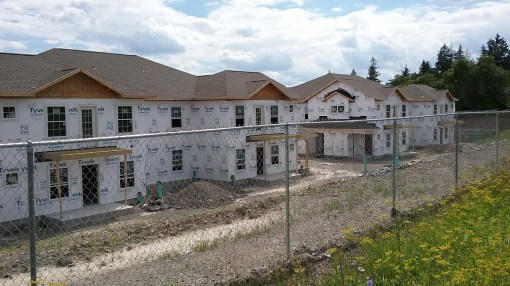
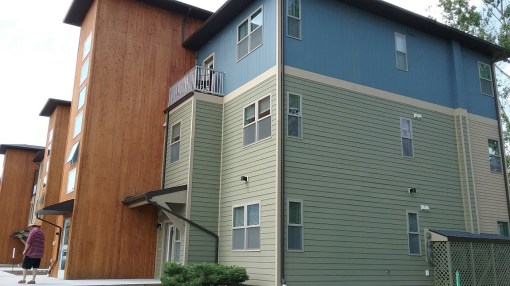
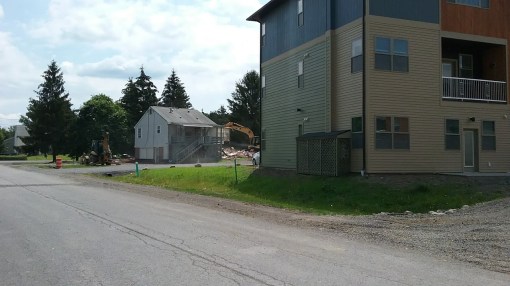
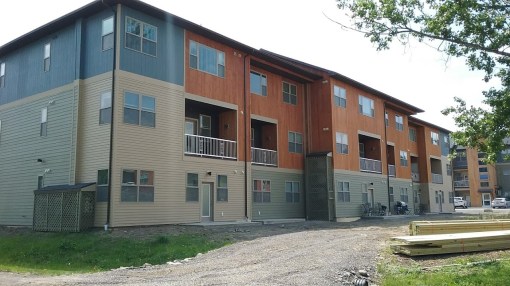
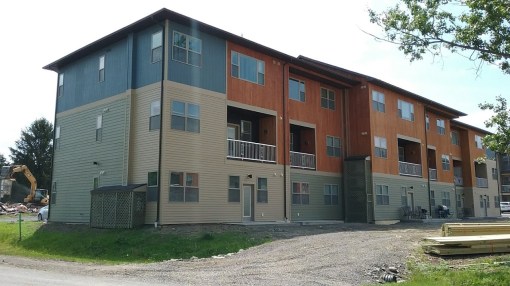
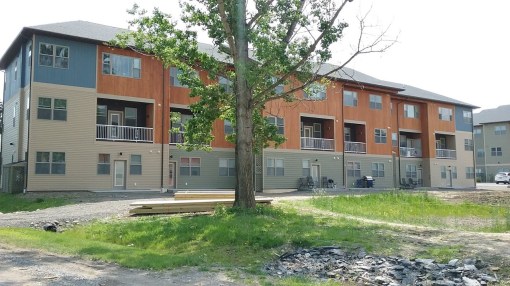
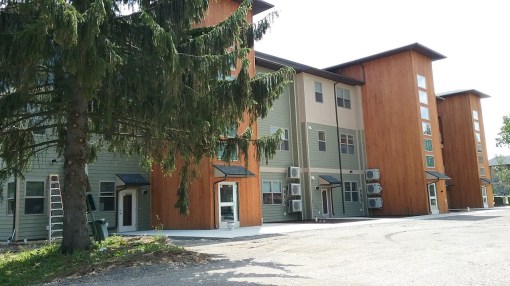
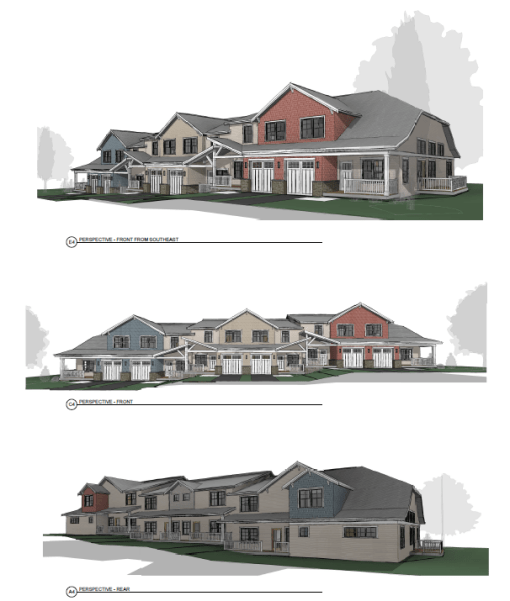
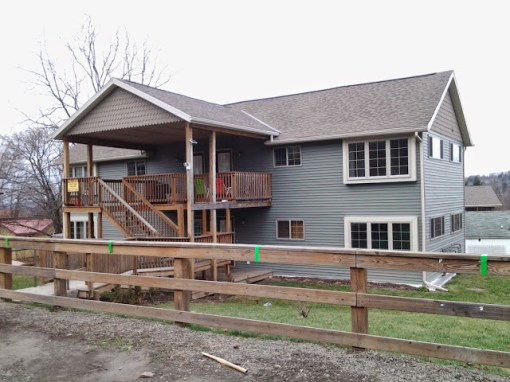
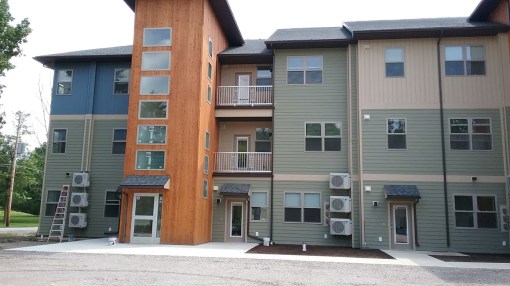
In contrast to Tiny Timbers’ site plan, the Cornerstone plan is a more conventional suburban layout with parking adjacent to each 8-unit structure. In fact, based on the above design, and the need for affordable developers to save on costs and therefore many reuse designs when they can, it’s likely that some of the Cornerstone apartments look something like the above image, which comes from a recent Cornerstone project near Brockport. The detailing and the colors may differ, but it’s a pretty good bet that’s how some of the finished units will look. Like Conifer, Cornerstone appear to be using a mix of their standard designs, and there are two distinct designs on the site plan, as well as a community center.

2. A redevelopment opportunity in downtown Ithaca has sold, but it looks like there are no plans. 110-112 West Seneca Street is a 538 SF salon with a large rental parking lot, and zoning is B-1a, meaning 4 floors 50% lot coverage, parking requirements in effect of about one space per unit or one space per 250 SF of commercial use. Tompkins Trust (Tompkins Financial Corp.) picked up the property on Friday the 28th for $600,000, below the $800k asking price but still quite substantial for what’s mostly land.

Unfortunately, it doesn’t look like anything is going to happen here. Tompkins Trust had previously rented the 23 parking spaces on site for use by its own employees – whether they’re hedging bets or don’t trust the parking garage situation, they appear to be buying the property to use as parking. Boo. With any luck, after their new HQ opens up next spring and their parking situation settles down, they’ll find better uses or potential partners for the lot. With no historic attributes but proximity to major services and amenities, a parking lot on this property is a waste of potential.
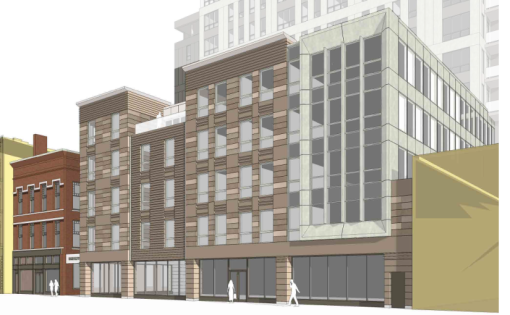
3. The Harold’s Square project team has given their website a overhaul, and with that comes the official timeline. According to the web page, asbestos abatement is now underway, demolition will start in September, construction will last through January 2019, and marketing/lease-up for the commercial spaces and 108 residential units should will start in January 2019.

The project description web page mentions 100 construction jobs, 50 retail jobs and 200 office jobs, which seems accurate for the square footage of each use (12k retail, 25k office). The estimate of 250 residents is way too generous though – the back-of-the-envelope is one person per bedroom, and there are about 144 bedrooms/studio units.

Side note, I reserve the right to grouse that the media links both go to the Times.

4. Dunno what’s going to happen with the Lansing Meadows senior housing up by the mall. Background story on the Voice here. On the one hand, the wetlands were an arduous and expensive undertaking, and Goetzmann did those to Army Corps of Engineers standards. It does make it tougher for the project to be financially viable. On the other hand, the village has a right to be frustrated, and it’s not unreasonable that they’re feeling that they’re being taken for a ride. Goetzmann received an IDA tax deal for what was largely a retail project, largely a no-no because most jobs in retail are low wage. He also received a variance for a community retail component, and multiple extensions from the IDA on fulfilling the housing component.

An increase in density spreads the fixed costs out among a greater number of units, and it’s encouraged by the village and county, so that’s not the issue. The design is what bothers them – while shared walls and utilities is a cost-saving measure, the village has expected smaller, house-like units since the project was first proposed in the late 2000s. Maybe the happy medium between this and the ten duplexes is a site plan with 3-4 unit structures with 20-24 units, with the buildings designed with pitched roofs, dormers, small porches and other home-like features. Let’s see what happens in the next couple of months.

5. Plans for co-op housing on West State Street have been waylaid, perhaps permanently. New York City businessman Fei Qi had previously proposed to renovate the historic 3,800 SF property at 310 West State Street into office space, and more recently a 12-14 person co-op. However, there have been a couple of issues with both plans – the ca. 1880 building is in need of significant structural renovation. Years of deferred maintenance prior to Qi (who bought it from the Salvation Army for $195k last year) has left the building in rough shape, and asbestos and lead need to be removed. For the housing proposal to be permitted, fire suppression systems would also need to be installed. Some city officials have expressed concern that like the carriage house that once existed at the rear of the property, if the building gets mothballed again, its structural integrity may be at risk. Any external changes would need to be approved by the Landmarks Commission. It appears that Qi recently applied to the commission stating economic hardship, saying he was unaware the building was a historic property and was not communicated to him by the seller or real estate agent, and cannot afford to renovate it to ILPC standards. The designation went into effect in April 2015, a year before sale.

Concurrently, Qi has put the property up for sale. For an asking price of $278,000, one gets the building and the architect’s plans. I’ve seen ball-park estimates of $500k for the renovation into office space, but I never saw an estimate for the co-op. As a result of the structural issues, the building’s assessed value plunged from $250,000 in 2016 to $100,000 last year, most of that being the land. Fingers crossed, someone steps up to the plate to save this building before it’s too late.

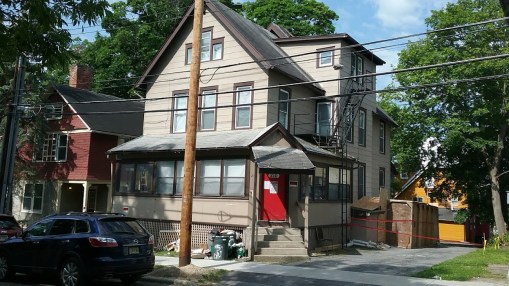
6. Last month, I speculated that there was a plan for redeveloping 217 Columbia Street on Ithaca’s South Hill. Turns out there is, and it’s really upsetting the neighbors. The plan by Modern Living Rentals is to preserve the existing building, but build an additional two-family home on the property as well. For the neighbors, this is apparently one student-oriented rental too far. Some are calling for a moratorium, and others a zoning change to prevent rentals without an owner living in the property. Most of South Hill’s zoning is R-2 residential, which is one-and-two family homes, and most of the construction in South Hill these past few years has been one and two-family homes. The issue is that they’re upset they’re rentals, many of which appeal to Ithaca College students further up the hill in the town. In theory, you could make it an approval requirement that the renters be non-students, although I’m not sure that would placate the situation. We’ll see how it goes.

News Tidbits 7/22/17: Throwing Darts

22 07 2017

1. Let’s start off the week with a little intrigue. A vacant 12.34 acre property on Wiedmeier Court in Ithaca town sold for $65,000 earlier this week – given that it was on the market for five years and marketed for development potential, the sale merited a closer look.

At first glance, it seemed to merit a shrug. The buyer was an LLC that could be traced back to a CPA in the San Francisco area, a woman of retirement age. The profile fits the deep-pocketed subset who might buy a sizable slice of land near Ithaca, and build a home for their retirement enjoyment. Not uncommon in Tompkins County.

Then on Wednesday, the same buyer purchased 114 and 122 Birdseye View Drive from the Cleveland family for $485,000. 122 is a 4-bedroom single-family, and 114 a 3-bedroom single-family. Both are next to IC, nearly new houses in a development otherwise filled with small-scale student housing. So, things just got more interesting. We’ll see if anything comes of the Wiedmeier property.

2. Just briefly touching on Hamilton Square this week – one of the questions I previously held off on addressing was the possibility of the abatement. Although the county has said they’re open to considering affordable housing tax abatements or PILOTs (Payments In Lieu Of Taxes) as part of their housing strategy, housing itself usually isn’t enough to merit a visit to the IDA. But with the addition of the nursery/daycare, it bared similarities to 210 Hancock, which cited its planned daycare center and the new jobs at the center in its PILOT request.

So, I asked what the plan was. Here’s the response from INHS’s Real Estate Development Director, Joe Bowes:

“We are not seeking an abatement from the IDA for the project.  If the day care is a non-profit then it would be tax exempt without the need for an IDA abatement.  The housing does not need the abatement in this case so it will be assessed and will pay property taxes.  210 had other reasons for requesting an abatement.”

Emphasis his. In the documentation on Hancock, the abatement was partially driven by the acquisition cost of the property and the need for a deep pile foundation. The buildings are much smaller at 46 South Street, so a slab/shallow foundation is suitable, and it helps that Trumansburg’s soil is less water-logged and more stable than Northside’s. This results in a lower development cost per square foot, so although they arguably could (and upset the neighbors even more), INHS isn’t pursuing a PILOT or abatement. The only tax savings will be for the eleven affordable owner-occupied units, which will be assessed for what they can sell for within the Community Housing Trust, rather than a market-rate value. This has the county’s support, because taxing a townhouse for double the value of what the lower-middle class homeowner could sell it for undermines its affordability.
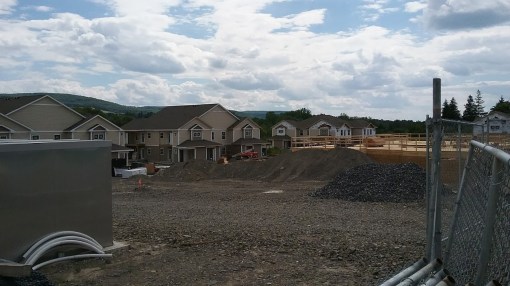
3. Here’s an interesting note from Lansing regarding the Cornerstone land purchase. The first phase on 13.5 acres would be 68-72 units. The second phase on the remaining 8.9 acres would potentially host another 72 units. All of these would be affordable. This might cause a backlash as too much, but if one of the phases was general affordable housing, and the other affordable senior housing, then that might negate most of the blowback. Anyway, something to watch for.

On another note, the modified PDA for the Village Solars has a stipulation that the community center/mixed-use building (“F”, green dot) has to be completed by the end of 2020, and only 4 of the 9 other buildings will be approved before the community center is complete. Everything north of Circle North will not be allowed to start construction until the community center is open. This suggests a build-out of #116/#102, 2017-18, #2/#22, 2018-19, Community Center 2019-2020, #117/#36 2020-21, and K, L and M would be built in 2021-22.


4. Laurels and darts. Here’s a dart. The town of Ithaca is seeking to, once again, extend its moratorium on two-family properties. When the law was enacted in early May 2016, it was supposed to be for 270 days, meaning an early February expiration. Then it was extended to the end of July. Now they want to extend it to the end of October, which given the seasonal nature of construction, effectively stops all new two-family properties through the winter of 2017/18.

I’ll be frank. This is not a good look. There were a number of concerns from property owners when the law was proposed for a length of one year, was unfairly long, and the town has not only realized their concerns, it’s exceeded them. The town is establishing a bad faith precedent through what property owners will complain as either being ill will, or incompetence. Part of me is concerned that anyone fighting the town on something, be it zoning, development, conservation or anything, will use this as an example of how the town “can’t be trusted”. I’ve never been a fan of moratoriums, because they end up seeking extensions. Not impressed to have another example to file away.
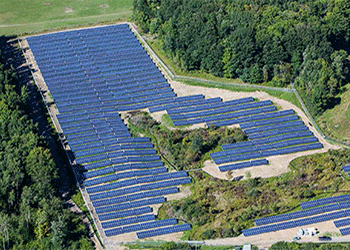
5. And on that note, the town of Groton just slapped a six-month moratorium on all solar arrays designed to power more than one house or one agricultural farm. No commercial solar, no community solar. Technically, the law also stops wind turbines and gas pipelines, but the Times’ quotes make it clear this was all about solar.

6. The county legislature finally approved a name to the Heritage Center this week. The “Tompkins Center for History and Culture” was approved 10-2. The previous vote failed due to a number of absent legislators and pushback for not having enough to consider the name. Legislator Chock D-3rd) initially wanted it named for late legislator Stu Stein, but naming buildings after people has been against county policy since the early 2000s. Legislator McBean-Clairborne (D-1st) voted against it because she felt the word “county” should be in there. This has not been a month where local government engenders confidence.

7. Short but interesting city of Ithaca Planning Board meeting meeting up. The only thing up for final approval is the McDonald’s rebuild at 372 Elmira Road, while INHS’s Elm Street and Lakeview’s West End project are set to begin formal environmental review. Here’s the agenda:

1. Agenda Review 6:00

2. Privilege of the Floor 6:01

3.Site Plan Review

A. Project: Commercial Rebuild (McDonalds) 6:10
Location: 372 Elmira Road
Applicant:McDonalds USA LLC
Actions: Consideration of Preliminary & Final Site Plan Approval
Project Description: The applicant proposes to replace the existing 4,800 SF restaurant facility with a new 4,400 SF building, construct a side-by-side drive-thru, install new landscaping, a dining patio, lighting, signage and a masonry landscape wall, as well as reconfigure the parking layout. The project is in the SW-2 Zoning District and requires an area variance. This is an Unlisted Action under the City of Ithaca Environmental Quality Review Ordinance (“CEQRO”), and the State Environmental Quality Review Act (“SEQRA”), for which the Planning Board as Lead Agency made a Negative Declaration of Environmental Significance on June 27, 2017.

B.Project: Elm St Apartments (Rebuild) 6:25

Location: 203-209 Elm Street
Applicant: Lynn Truame for Ithaca Neighborhood Housing Services Inc. (INHS)
Actions: Declaration of Lead Agency, Review of FEAF Parts 2 & 3
Project Description: The proposed project consist of the demolition of two single family homes and one
multiple dwelling and the construction of a single 12,585 SF apartment building with 13 dwelling units, parking for six vehicles, and other associated site improvements. Due to the slope of the site, the building will have 2 stories facing Elm Street and three stories in the rear. The project requires the consolidation of three tax parcels. The project is in the R-3a Zoning district and is seeking two area variances for relief from rear yard setback and parking requirements. This is a Type I Action under the City of Ithaca Environmental Quality Review Ordinance (“CEQRO”)§176-4 (1)(h)[3], and the State Environmental Quality Review Act(“SEQRA”)§ 617.4 (11) and is subject to environmental review.

C. Project: 709 West Court Street (Housing) 6:50
Location: 326 & 328 N Meadow St. and 709–713 W Court Street
Applicant: Trowbridge Wolf Michaels LLP for Lakeview Health Services Inc.
Actions: Declaration of Lead Agency, Review of FEAF Parts 2 & 3
Project Description: The applicant proposes to construct a five-story L-shaped building with footprintof 10,860 SF and GFA of 62,700 SF on the .81 acre project site comprising four tax parcels (to be consolidated). The building will containing sixty (60) one-bedroom apartments plus associated shared common space (community room, laundry facilities, lounges, and exterior courtyard), support staff offices, program spaces, conference room, utility rooms, and storage. The siting of the building allows for a small landscaped front yard, a south-facing exterior courtyard, and a 16 space surface parking lot in the rear of the site. Site development will require the removal of five structures and associated site elements. The project is in the WEDZ- 1 Zoning District. This is a Type I Action under the City of Ithaca Environmental Quality Review Ordinance (“CEQRO”)§176-4 (1)(k) and (n), and the State Environmental Quality Review Act (“SEQRA”) § 617.4 (11) and is subject to environmental review.

D. 105 Dearborn –Sketch Plan 7:10

This is Bridges Cornell Heights new 16-bedroom independent living building for seniors. If it’s at the Planning Board, that means the ILPC has signed off on the building and site design.

E. 311 College Ave – Sketch Plan 7:30

This is…curious. 311 College Avenue is The Nines restaurant and bar, and was built in 1905 as fire station No. 9 before the new station opened next door in the late 1960s. The old station was sold off and became the Nines in the early 1970s, and has been under its current ownership since 1980. The top two floors are used for storage, according to county records.

At a glance, it’s a valuable piece of land with a lot of posibilities – MU-2 zoning allows six floors and 100% lot coverage. On the other hand, this is a relative historic property in Collegetown, and development perceived as insensitive will likely see significant opposition. There had been talk by ILPC staff of giving the building historic designation back in February 2016 out of concerns over development pressure, but it seems no formal application was made. So there are options here, but the developer should proceed with caution.

4. Zoning Appeals 7:50
#3066, 214 Elmira Road, Area Variance
#3079, 413 Titus Ave, Area Variance

5. Old/New Business 8:00
A. Planning Board Recommendation to Council Regarding Proposed Waterfront Rezoning
B. Planning Board Report Regarding the Proposed Local Historic Landmark Designation of 403 College
Ave
C. Downtown Wayfinding

6.Reports 8:30
A. Planning Board Chair (verbal)
B. Director of Planning & Development (verbal)
C. Board of Public Works Liaison


902 Dryden Road Construction Update, 7/2017

17 07 2017

Seeing as these are expected to open for occupancy next month, this will probably be the final visit to the 902 Dryden site.

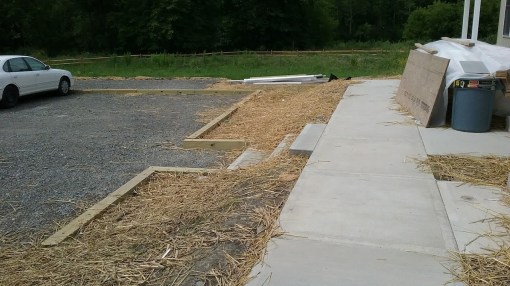
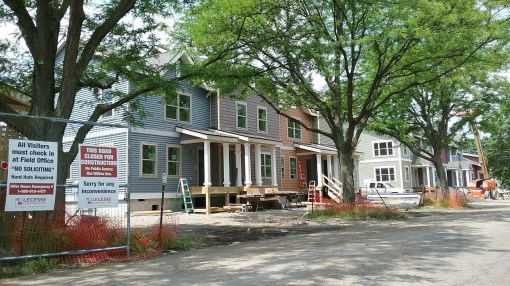
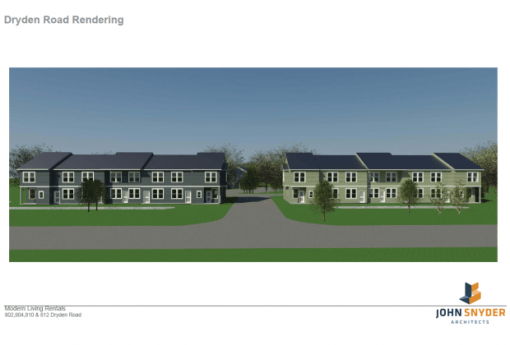
From the outside, these look to be complete. The landscaping is partially done. Grass is down and some of the parking area has been bordered with wood beams, but some sidewalk and plantings have yet to be poured/planted, and the bike shed will come towards the end.  About the only thing left for the buildings thesmelves are a few minor pieces of trim (trim boards, porch light fixtures). I’m still a bit disappointed that secondary colors were dropped in father of a color I like to call “bland oatmeal”, but the variation of shingle-style, lap and vertical siding makes up for it somewhat.

The inside of the units are in varying states of late-stage interior work – one of the end units was nearly showpiece ready with only some minor painting left. Working northward to units less further along, cabinetry and appliances were being installed, as were lighting fixtures, oven hoods and kitchen backslashes. Visum/Modern Living Rentals seems to strongly prefer neutral shades for interior colors, which is generally advisable when selling or renting a home. The appliances hanging up on the wall behind the kitchen counters are the air-source heat pumps.  The units closest to Forest Home Drive were still in the midst of drywall paint prep – there was a worker walking around on professional drywall stilts, which I did not take photos of because I wasn’t sure if they would see me and force me to go off-site. The drywall had been hung and appeared to be mudded, but not painted.

To quote the online ad:

These beautiful townhouses are a great place to call home!!
Brand new construction in late 2016 [sic?], has all the amenities needed! Brand new EVERYTHING, stainless steel appliances, granite counter tops, kitchen complete with a dishwasher! Great sized rooms with ample closet space, all custom tiles bathroom as well! Washer and dryer IN unit!

902 Dryden is not big or ostentatious. I wouldn’t call it out of place in rural Varna, and another 8 units and 26 bedrooms are welcome to the local rental market. Modern Living Rentals and Visum Development are bringing a pretty solid addition to the Varna market. Consider this a preview of MLR’s next project, the 42-unit rental complex they want to put in just a mile up the road at 802 Dryden.

Bella Faccia Construction is the general contractor, and STREAM Collaborative is the architect.


Poet’s Landing Phase II Construction Update, 7/2017

16 07 2017

Over at the Poet’s Landing construction site, it looks like two of the buildings, previous dubbed “E” and “F” since I have no actual documentation of individual address, are pretty close to completion. “F’s” exterior work is almost complete, waiting for a few more trim pieces such as balcony and porch railings. It’s difficult to tell how far along the interior is; what looks like a gaping hole in the front at first glance, is actually a covered vestibule that leads to front doors, some of which appear to have been left open in photos seven and eight below. A typical build-out usually involves the interior being fairly far along by the time exterior trim is being attached – rough-ins complete, drywall hung, and probably the painting, utilities finish work and counters/cabinetry are underway. Building “E”, which is a little further behind on the trimwork, appeared to have some unpainted drywall visible just beyond the open front doors.

Stepping further back in the construction process, building “D” is in the midst of Certainteed vinyl siding attachment, and Building “C” has been shingled and fully wrapped in DuPont Tyvek, its balcony frames and porch columns just naked beams for now. Building “B” has yet to be fully wrapped, and “A” isn’t even fully framed yet. It looks like some of “A’s” roof trusses are sitting near Building “F”.

Although unsure offhand, if Conifer is planning to do a phased move-in, they could have Buildings “F” and “E” occupied by Labor Day, “D” and “C” before Halloween, and “B” and “A” before the end of the year. Building “F” was just getting its second story framed back in February, so another six months for “A” doesn’t seem unreasonable.

When finished, there will be 16 1-bedroom units, 24 2-bedroom units, and eight 3-bedroom units. Units will be rented to households making 60% of area median income or less, so less than $32k/year. Tenants will have an interview with management, and have to pass a background check. Given the dearth of affordable housing, not everyone interviewed and qualified will be offered a unit, but in that case, they will be offered a spot on a waiting list if desired. Those interested in units in the $10.8 million project can sign up for an “interest list” here, which will notify them as management interviews commence, giving them the chance to sign up and start the process.

So, this is something I’d like to expand on a bit, given some of the recent talk about Hamilton Square in Trumansburg. Some folks have cited Overlook at West Hill as an example of the crime and degeneracy that “these people” will bring to the village. This reminded me of the West Village piece I did for the Voice last year, where I argued successful affordable housing involves community engagement and respect, access to services, and proactive tenant management.

With any group of landlords, you have good ones, mediocre ones and bad ones. Overlook’s management leaves something to be desired, as has West Village’s. Omni Development, which manages West Village, seems to be taking a greater, more proactive role, although its history of hands-off behavior leaves many wary. Overlook is managed by Domain Companies, which is based out of New York City and New Orleans, and was developed in partnership with the Arker Companies. Back when it was proposed in 2003-04, INHS did advocate for the project during the town’s review process and obtain affordable housing loans. However, they are not and have never been Overlook’s property managers.

I can honestly say I have never heard of systemic issues with anything INHS or Conifer manages in Tompkins County. Rarely if ever is there a criminal complaint about the people who occupy Conifer’s Linderman Creek, Poet’s Landing I, The Meadows, or any of their other Tompkins County properties. That goes for the general affordable housing as well as the senior housing. I can say the same thing about INHS – through the Voice, which wouldn’t hesitate to cover crime since it drives clicks so well, there’s nothing I’ve seen about Stone Quarry’s residents being an issue, or the Henry St. John Apartments, Breckenridge Place or TowerView. I can come up with complaints for both (Conifer’s unfortunate choice of auto-centric sites with cookie-cutter units, INHS’s care-worn older stock), but neither of those has to do with tenant management.

If it were Domain/Arker or Omni pushing Hamilton Square, There would be reason for concern. But given that’s it’s INHS, mixed-market with owner occupied units, moderately sized and has convenient access to Trumansburg village, I strongly doubt management of the rentals is going to be a problem.


News Tidbits 7/15/17: Ess Ess, Dee Dee

15 07 2017

1. Hamilton Square. There’s a lot to say here.

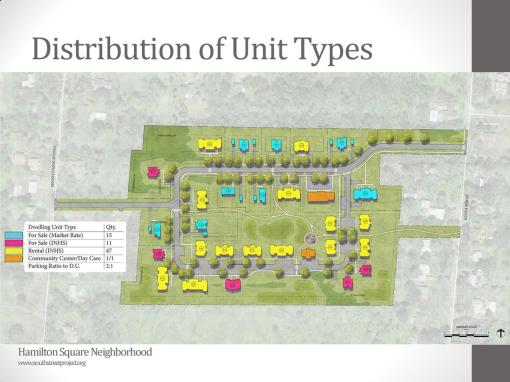
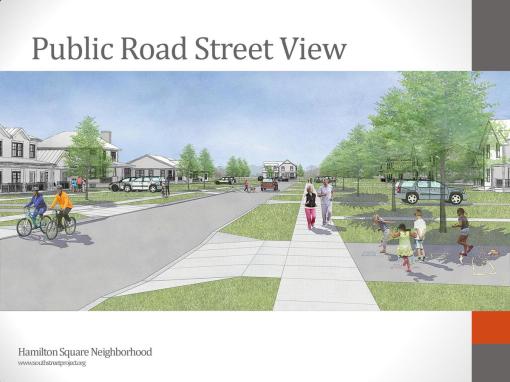
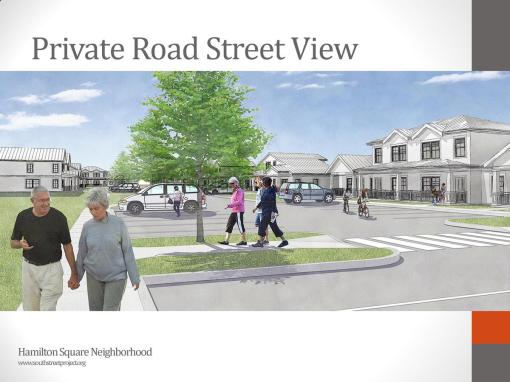
First, the neutral segment. The website is up, www.southstreetproject.org. Plenty of renders (definitely not cookie-cutter), site plans, housing prices, everything one needs for a fair assessment. The units are no more than 2 floors, mostly townhouse format. 47 affordable rentals units, 11 affordable for-sale units, and 15 market-rate for-sale units for a total of 73 on a 19 acre site. That’s less than 4 units per acre (0.26 acres/unit, comparable to the older 0.25-0.5 acre lots on Pennsylvania and South Streets), and fits zoning. The units are interspersed throughout the property. Parking ratio is 2 spaces per units, units are a mix of 1-3 bedrooms. There will be aging-in-place and energy efficient home options for sale, as well as in the rentals. The project will host a playground and nursery/daycare facility geared towards low and moderate-income households. Much of this comes from the result of constructive community feedback.

But what started off on a polite note is getting really ugly, really quickly. It is not a good sign when my editor calls me and tells me that, as a person of color, she felt uncomfortable at the latest meeting.

Given the transparency of this process, which still hasn’t even been submitted for formal planning board review, I find comments about this being “hidden” or rushed through to be a stretch. The project hasn’t submitted anything for formal review yet. Nothing but a sketch plan has been done, and multiple community meetings, and 30-minute small group listening sessions. It really does not get much more personal than that.

One of the questions that was raised was that people are unable there are many more affordable rentals than for-sale units. There are two reasons why that is. For one, funding for purchasable units is more difficult to get. The government is more likely to disburse a grant if it knows there are buyers waiting in the wings. That’s why the buildout for the for-sale units is 2-8 years. For two, for low and moderate-income households often don’t have much money saved for a big expense such as down-payment, and far more are capable of renting versus buying.

There are valid concerns that need to be addressed. For example, traffic. A study is being conducted with a third party. The typical thing I hear, affordable housing, or any project really, is that “they’ll lie, they’re in XYZ’s pocket”. If no one trusts you to do your job properly, no municipal board will sign off on accepting your study, and you’re finished as a firm. Likewise with stormwater analysis and civil engineering. School system capacity is checked with the district, which basically just sends a letter saying “yes, we have room” or “no, we don’t have room”. The study is being conducted and will be made public long before any approvals are granted, people can weigh in after reading it to say whether it’s comprehensive and adequate, and feel free to say something and explain why it may not be. That’s the purpose of SEQR, to determine impacts and mitigate unavoidable impacts.

On a related note, a board’s job is to review the objective components of a project. It is not appropriate, or legal, to decide on a subjective trait like whether the people who will live there fit the “Trumansburg way of life” or that the project is “too Ithacan”. Who decides what those things are? Because too quickly, it degenerates into a look or an image, and a train of thought that should never be a part of any development conversation. Because it’s subjective, those terms meant something quite different in 1997, and something quite different in 1977.

Also, there seems to be this idea that poor people in urban neighborhoods will be forced out here, and they will be a burden on TrumansburgThere are plenty of people who live and work in Trumansburg who need affordable options in a rapidly-appreciating real estate market. The one bedrooms will be rented to individuals making $22k-$48k. That could be a store manager, a barista, a school teacher or a retiree. Tenants are screened, visited at their current home and interviewed before being offered a unit. Qualified affordable home buyers will mostly be in the $42k-$64k range (80-120% AMI). Think nurses, office workers, tradespeople (following INHS’s sales deeds, I actually see a lot of ICSD teachers). The market rate units will offer whatever the market allows price-wise; new townhouse-style housing in Trumansburg would likely fetch $250k+, so think upper-middle income.

It would be nonsensical to make people in Ithaca move into housing in Trumansburg that they don’t want and would drive up their costs; however, those who want to live there, whether because they admire Trumansburg, work there, or both, will seek the opportunities it provides.

For a county that seems keenly aware of its housing issues, there tends to be an uncomfortable amount of pushback against affordable housing, whether it be Fall Creek, South Hill, Lansing or Trumansburg. Does that qualify as being “too Ithacan”?

2. Taking a look at the county’s records this week, it looks like 210 Linden Avenue’s construction loan has been filed. Elmira Savings Bank is lending Visum Development (Todd Fox and associates) $3.15 million, with $2,358,783 towards the hard costs (materials/labor) of replacing the existing 12-bedroom student apartment house with a 9-unit, 36-bedroom apartment building. Elmira Savings Bank is one of the biggest single-family construction loan lenders in Tompkins, but they have only been the lender for a few multi-family projects. The only other multi-million project in the past few years was the 18-unit Rabco Apartments at 312 Thurston Avenue in Cornell Heights – a project that, along with the cancelled 1 Ridgewood, so incensed deep-pocketed permanent residents nearby that they petitioned and succeeded in getting the city to downgrade the zoning.

Also filed this week was a $415,000 construction loan from Tompkins Trust to the owner of Hancock Plaza on the 300 Block of Third Street in Ithaca’s Northside neighborhood. The 19,584 SF shopping plaza, built in 1985, is assessed at $1.485 million and has been under its current ownership since 2002. Most might know it for the DMV, but it also hosts Istanbul restaurant, a bookkeeping service, and a gas station and convenience store that opened in renovated space in 2015. There’s no indication in the loan as to what kind of work will be performed, about $363,000 has been set aside for hard costs like materials and labor, and the work is required to be finished by March 2018.

3. Also filed in both sales and construction loans this week was paperwork for 306 North Cayuga Street, right next to DeWitt Park on the edge of Ithaca’s downtown. Also known as the C. R. Williams House, the 8,798 SF, ca. 1898 property was assessed at $900,000 and on the market for $1.4 million last year. The sale price was $1.3 million.

I was privy to an email chain that engaged an out-of-state condo developer to look at the property, but that person was not the buyer.  The LLC traces back to Travis Hyde Properties, just a few blocks away.

According to Frost Travis of THP, the plan is to renovate the live/work space to allow for more space for THP, which is outgrowing its North Tioga Street location, and four apartment units. Exterior changes will only be cosmetic, but any substantial changes will be subject to ILPC approval, as the property sits in the DeWitt Park Historic District. Elmira Savings Bank is lending $1.24 million for the renovation, of which $1,204,752 is going towards the actual construction (so apparently, this was a big week for ESB). The project is expected to be complete by next summer, according to the loan filing.

4. For the aspiring homebuilder or developer – new to the market this week, a run-down though salvageable 1830 home at 1975 Dryden Road just east of Dryden village, and 101 acres of developable vacant land currently rented out for agricultural use. The sale price is $795,000. The county GIS lists the property at 112.4 acres, but without a map in the listing, it’s hard to tell if there’s a typo or if there might be a subdivision somewhere. The assessment is for $531,900, $401,300 of which is the land. It appears the property has been in the ownership of the same family since 1968. The property is listed as a rural agricultural district, which is geared towards ag uses, but permits office, one-family and two-family homes as-of-right; multi-family and box retail require special use permits. Zoning is one unit per two acres, but in the case of a conservation subdivision that preserves open/natural space, it’s one unit per acre – either way, only about 50 units allowed here. Technically, a PUD (aka DIY zoning) is also an option, but would need adequate justification. Kinda hoping it doesn’t become conventional suburban sprawl, but will reserve judgement for when this sells.


5. Ithaca is once again competing for $10 million in state funds as part of the regional Downtown Redevelopment Initiative. The funds are intended to spark investment in urban cores and improve infrastructure for communities throughout the state, ten cities selected each year, one in each region. Readers may recall Elmira won last year. This year, Ithaca is competing against two of its Southern Tier peers – Watkins Glen, with which it competing with last year as well, and Endicott, a struggling satellite city over by Binghamton, that is entering the competition for the first time. Reports suggest the Ithaca submission is largely the same as last year’s. Winners will be announced in the fall.


News Tidbits 7/8/17: Watching the Fireworks

8 07 2017

1. A pair of major downtown projects are starting to get a move on site-prep and demolition. The Trebloc Building has been torn down to make way for the 187,000 SF, $32.9 million City Centre project.

Photo from C. Hadley Smith Collection

For a bit of historical perspective, the Trebloc Building was a sort of monument to municipal desperation. Up until 1967, the site housed several 2-5 story buildings from the late 1800s and early 1900s. Then along came urban renewal. The city had made plans to demolish the buildings and sell the lot to a bank tenant, who would build a new office and help revitalize the city’s run-down downtown. But after demolishing the building, the potential bank tenant never followed through on its original intent, and the city spend years trying to sell the lot, which was used for makeshift parking in the interim. Finally, they found a buyer in the Colbert Family doing business as the Trebloc Development Company. The Trebloc Building was originally planned to have two floors, but financial troubles had reduced it to one before it finally opened for business in 1974.

One could argue that nothing quite represented the nadir of Ithaca’s downtown quite like the struggling, unloved and unlovely Trebloc Building did. There are some buildings worth fighting for, and even some mediocre ones that come down with a bittersweet sentiment. This was neither.

Perhaps unhappily for downtown businesses, City Centre will be under construction for quite some time; adjusting the estimate given to the IDA, late 2019 or even early 2020 is possible.

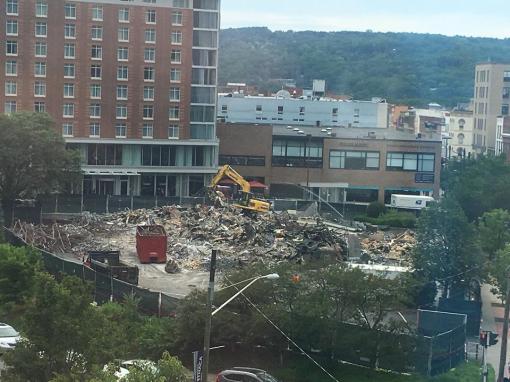
Meanwhile, just a couple blocks west, Harold’s Square is also gearing up for demolition of 123-135 East State Street. Unlike the Trebloc teardown, Developer David Lubin will be deconstructing the existing structures, so that their components can be re-used (the process will be managed by Finger Lake Re-Use). I’ve always been kinda partial to the green tile on the former Race Office Supply, so hopefully that goes to a good home. 137-139 East State will be renovated as part of the Harold’s Square project. Harold’s Square, a 180,000 SF building with a hard construction cost of $32.6 million, is expected to take about 18 months, opening in Q1 2019. Dunno why City Centre’s construction schedule is a year longer, although with the underground garage, the project is a little larger (211,200 SF), and more structurally complex. It could also just be a very generous estimate.

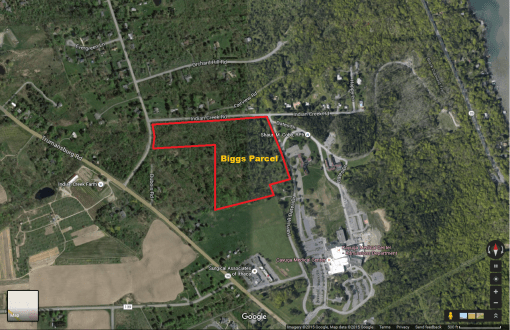
2. Tompkins County will be hosting a meeting at the Museum of the Earth on July 19th at 7:30 PM to discuss plans for the Biggs Parcel on the town of Ithaca’s portion of West Hill. As covered previously, the 25.5 acre parcel, which has something of a long news history, has been for sale since last summer, but without any firm offers, the county ended its realtor contract and has been trying to figure out with to do with the property. Although there are some streams and wetlands, there are some development possibilities; neighbors have been pushing for it to be a county-owned natural preserve, but the county wants an option that will pay taxes, whether that be a multi-family development, private estate or otherwise.

While the county did not identify this parcel as a high environmental protection priority, they are busy working with Finger Lakes Land Trust to protect a 125-acre property in Caroline, and there are ongoing discussions regarding a 324-acre property in Dryden.

3. As with nearly every sizable project in Tompkins County, the Inn at Taughannock expansion is being met with some resistance from neighbors. As relayed by the Times’ Jamie Swinnerton, arguments cited include traffic, view sheds, size, neighborhood character (which seems a bit weird, given there’s not much of a neighborhood nearby), and most frequently, noise, which the town could help resolve by asking for an acoustical counsultant’s report like what Ben Rosenblum submitted in Ithaca for his cancelled proposal for a jazz bar at 418 East State Street. The addition, which calls for a new restaurant, event space and five guest rooms, would create about 25 jobs if built and opened as planned. The often-joked but actually rarely-seen email calling me a “thoughtless corporatist” arrived in the inbox after the first write-up, which indicates this fireworks show may not be over for a little while.

4. In a bit of a weird hang-up, the Heritage Center project attempted to give itself a formal name, but the name was shot down by the County Legislature. The proposed moniker of “Tompkins Center for History and Culture” was defeated in a 7 yes -3 no vote (8 yes votes required) because a few of the legislators felt there hadn’t been enough time to gauge community reaction. Personally, I thought “Tompkins County Heritage Center” was fine, but to each their own.

5. Thankfully, the county’s endorsement of the Housing Strategy was unanimous. This is but a baby step in solving the county’s housing woes, but it’s an important step. The county now has a sort of guiding document to help address issues in adding and improving the local housing stock.

There are a few key things that the county will need to adhere to when moving forward. First is working with communities to identify suitable areas for development, and making updates to infrastructure and zoning to guide developers towards those properties instead of far-flung, natural areas where acquisition costs are low and there are fewer neighbors to contend with. Second is bridging the affordability gap – some of this can be done by encouraging new housing at market-rate, but the county will need to be constructively engaging and reliable when helping affordable housing plans apply for grants or exploring tax incentives to help make their proposals feasible.

The third, and arguably the most controversial point here, is standing firm in the face of opposition. Many Tompkins residents are averse to new housing (or really, new anything) near them. For example, consider the Tiny Timbers plan recently announced for Lansing Town Center. The plan checks a lot of boxes – at $175-$225k, it’s fairly affordable owner-occupied new housing, with a smaller ecological footprint than many detached single-family homes. Yet, in the Voice comments, it was dumped on as both a glorified trailer park and unaffordable at the same time, and the neighbor who tried and failed to buy the property from the town to prevent development was trying to scare people from small house living (which at 1000-1500 SF, these aren’t really “tiny” houses anyway). The county should listen for the sake of good government, but after weighing the argument, unless a project is truly a detriment to a community’s quality of life, the county and local boards will need a firm backbone in withstanding criticism. It also helps if people who like a project give their two cents in an email or meeting.

So, good first step, but there’s a lot of work ahead. Fingers crossed.


News Tidbits 6/25/17: Lazy Sunday

25 06 2017

1. Starting off with the new project of the week: 42-unit, 108-bedroom 802 Dryden Road. As relayed on the Voice, the parcel currently hosts several rental properties in varying condition. The project is Modern Living Rentals’ largest to date, partly because developer Charlie O’Connor tends to focus more on smaller infill in urban areas.

Although no time table has been given for the $7.5 million project, a likely prospect is approval by the end of the year, with a spring 2018 groundbreaking, and a summer 2019 opening. While John Snyder Architects is in charge of design modifications, the townhouse designs are recycled from STREAM Collaborative’s 902 Dryden plan currently finishing up down the road. Marathon Engineering’s Adam Fishel will be shepherding the project through the approvals process, just as he did the Sleep Inn for Elmira Road.

Location-wise, it’s on a bus route but most everything will need some kind of vehicular transport, so it’s fairly auto-centric. There isn’t a lot of lot nearby apart from a few small rentals and single-family homes, and Cornell farm fields. On the other hand, few neighbors means fewer people likely to raise a fuss at planning board and town board meetings. As long as they provide town favorites like heat pumps, don’t expect big hangups as this plan moves through municipal review.

2. So here’s something out of the blue. Recently, the house at 2124 Mecklenburg Road in Enfield was sold to “The Broadway Group LLC d/b/a TBG Alabama LLC”, and a $998,000 construction loan agreement was filed shortly afterwards. One does not normally see million-dollar projects in Enfield, but a look at the filing yielding no information other than to suggest it was a retail building.

A little further digging indicates The Broadway Group, based out of Huntsville, Alabama, specializes in the development and construction of Dollar General stores. The lender, Southern States Bank, headquartered in Anniston, Alabama, is a preferred commercial lender for TBG. So this is a similar case to the Dollar General recently built in Lansing by Primax Properties –  it’s less about a bank being interested in Ithaca, and more about two major companies located near each other and having an established business relationship. A check of Enfield’s Planning Board reveals that the applicant took great pains not to reveal the name of the tenant, saying only a stand-alone variety dry goods store. A confidentiality clause with client limits what they could say, and TBG will technically own the metal building for a year until it transfers over to Dollar General. Expect a Q4 2017 and with it, 10-12 retail jobs.

I’ll be candid on this one – I sent out an email before writing anything up for the Voice asking if there were enough Enfield/West Hill readers who would care enough to justify an article being written. Jolene encouraged it, the piece went up, and the traffic on the article was actually pretty good, somewhat above average in fact.

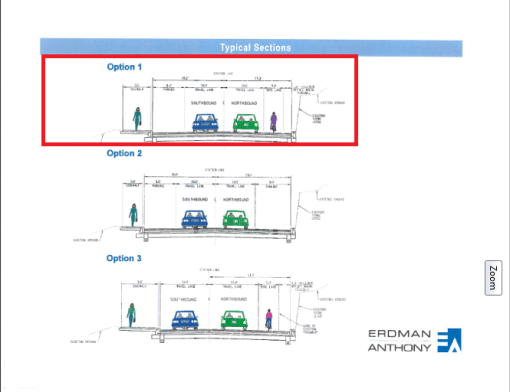
3. The city has decided which option it wants to pursue for its rework of University Avenue. Basically, say goodbye to the northbound parking aisle and say hello to a new bike lane. The southbound parking aisle will remain, along with a 7-foot wide sidewalk and 10-foot travel lanes.

4. It looks like plans for the next Press Bay Alley are moving forward. 110-112 West Green Street was sold to Urban Core LLC (John Guttridge / David Kuckuk) for $650,000 on the 19th, and a $581,250 construction loan from Tompkins Trust was filed the same day. Technically, some of the construction loan is actually for the purchase; according to the IURA breakdown, the renovation into micro-retail, office and two 500 SF apartments will only cost about $207,500, plus $40,000 for soft costs like architectural plans, engineering and legal expenses. As part of the $200,000 loan extended to Urban Core LLC by the IURA, the project needs to create at least 6 full-time jobs at full occupancy. On the Press Bay Alley Facebook page, the developers have announced plans for a spring opening, and issued a call for active-use tenants looking for anywhere from 300-2,000 SF.

5. Cincinnati-based Bloomfield Schon has arranged to sell the Cayuga Green complex, lofts, apartments and all. The developer would sell the buildings to Laureate House Ithaca Management LLC. Upon the intended purchase date of August 1st, Laureate House would pay the IURA loan balance ($733,130 at the moment with a $4,880 monthly payment) off in full. That would be about 21 years earlier than anticipated. Laureate House appears to be a start-up real estate firm backed by three wealthy Cornell alums; although the literature says they seek to launch 55+ communities for active seniors in college towns, there don’t appear to be changes in use or commercial/residential tenant mix planned with the purchase of Cayuga Green.

6. Been meaning to note this, but it appears 210 Linden Avenue is undergoing asbestos remediation, which means that the building is being prepped for deconstruction. It looks like Visum Development will be moving forward soon with their plans for a 9-unit, 36-bedroom student apartment building on the property. I did not seen any outward indication of similar work being performed on 118 College or 126 College Avenue at last check, though it’s been a couple weeks.

7. Here’s a look at the city of Ithaca’s Planning Board agenda for next week. Harold Square and 323 Taughannock will have their latest revisions checked for satisfaction of final approval (various paperwork submissions, and of samples of exterior materials to make sure they’re acceptable). 238 Linden Avenue, 232-236 Dryden Road and the DeWitt House old library redevelopment are up for final approval, and the McDonald’s and Finger Lakes ReUse’s supportive housing projects will be reviewed for determination of environmental significance, which basically means that potential impacts have been addressed and if necessary, properly mitigated.

There is also one semi-new project, which is 709-713 Court Street  – that would be the street address for Lakeview’s $20 million mixed-use affordable housing plan on Ithaca’s West End. From previous paperwork, it is known that it’s 5 floors with 50 units of affordable housing, 25 of which will be set aside for Lakeview clients with psychiatric disability. There will be 6,171 SF of commercial space on the first floor, and 17 parking spaces. PLAN Architectural Studios of Rochester will be the architect. Apart from a rough outline, there have been no renders shared of the project, so that’s the “semi-new” part.

AGENDA ITEM Approx. Start Time

  1. Agenda Review 6:00
  2. Privilege of the Floor 6:01
  3. Site Plan Review

A. Project: Mixed Use Apartments – Harold Square 6:10

Location: 123-129 E State/ MLK St (the Commons)

Applicant: L Enterprises LLC

Actions: Satisfaction of Conditions

Project Description: The Board approved project changes with conditions on May 23, 2017. The Applicant was asked submit revised materials to return to satisfy the conditions in June.

B. Project: Apartments (Short-Term Rental) 6:30

Location: 238 Linden Ave

Applicant: Trowbridge Wolf Michaels for DRY-LIN Inc.

Actions: Public Hearing Determination of Environmental Significance, Preliminary & Final Approval, Approval of Transportation Demand Management Plan

C. Project: McDonalds Rebuild 6:50

Location: 372 Elmira Road

Applicant: McDonalds USA LLC

Actions: Declaration of Lead Agency, Public Hearing, Determination of Environmental Significance, Recommendation to BZA

D. Project: Residential Mixed Use (DeWitt House) 7:00

Location: 310-314 N Cayuga Street

Applicant: Kimberly Michaels, Trowbridge Wolf Michaels for Frost Travis, Owner

Actions: Preliminary and Final Approval

E. Project: Apartments 7:20

Location: 323 Taughannock Blvd

Applicant: Noah Demarest for Rampart Real LLC

Actions: Satisfaction of Conditions

Project Description: The Board approved the project with conditions on May 23, 2017. The Applicant was asked to submit revised materials to return to satisfy the conditions in June.

F. Project: Finger Lakes ReUse Commercial Expansion and Supportive Apartments 7:40

Location: 214 Elmira Road

Applicant: Finger Lakes ReUse

Actions:  Public Hearing  Determination of Environmental Significance

G. Project: Apartments (60 Units) 8:00

Location: 232-236 Dryden Road

Applicant: Noah Demarest of Stream Collaborative for Visum Development Group

Actions: Determination of Environmental Significance, Preliminary and Final Approval, Approval of

Transportation Demand Management Plan

H. 709-713 Court Street – Housing – Sketch Plan 8:20

  1. Zoning Appeals 8:45
  1. Old/New Business
  2. Planning Board Comments on the Proposal to Rezone Areas of the Waterfront 8:50
  1. Reports
  2. Planning Board Chair (verbal)

9:10

  1. Director of Planning & Development (verbal)
  2. Board of Public Works Liaison (verbal)
  3. Approval of Minutes: May 23, 2017, April 25, 2017, and November 22, 2016 (time permitting) 9:30
  4. Adjournment 9:35


Cayuga View Senior Living Construction Update, 6/2017

17 06 2017

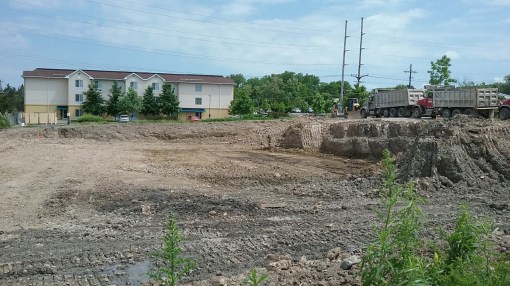
Figure Cayuga View can probably go under the “under/construction” column. Finally.

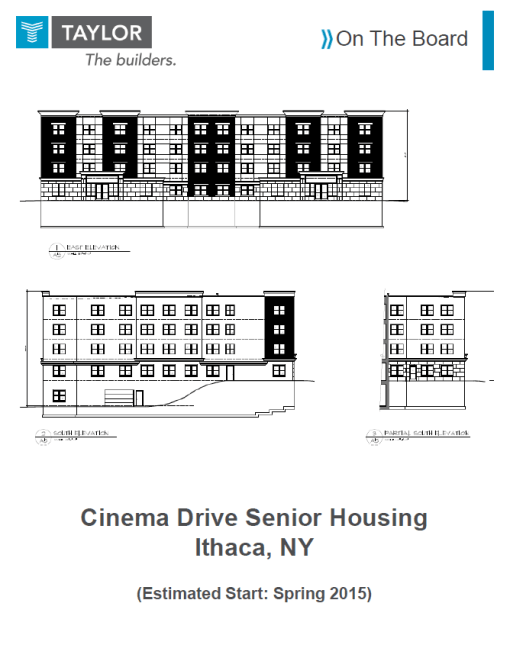
Cayuga View Senior Living, street address 16 Cinema Drive, is one of several Ithaca-area projects attempting to make a dent in the county’s lack of senior housing. Along with affordable housing and special needs housing, senior housing is often cited as something that the county needs a lot of more of, and soon. The county’s just-released housing strategy cites the need for 100-200 subsidized units by 2025, as well as a new skilled care facility. Various forms of senior care are expected to drive demand for an additional 750 units. A fully independent market-rate senior project like this isn’t explicitly categorized, but would potentially address some of the demand for senior housing in Tompkins County.

Cayuga View is a mixed-use 60-unit project on the last vacant high density-zoned parcel in the village of Lansing. Like many projects, the Thaler Family and their business partners have taken years to get to this point. The Thalers have owned the land since 1971, and have divided it up over the years, for example subdividing the property in 2000 to accommodate the construction of the CFCU branch next door. The first record of Cayuga View is really for an entirely different plan by the Thalers – in fall 2012, they proposed “C.U. Suites”, a 3-story, 43,000 SF building with 39 apartments geared towards Cornell graduate students. Along with those units were 26 covered parking spaces and two commercial spaces.

However, after getting approval for C.U. Suites, they decided to re-tool the project. At about this time, Taylor The Builders, a construction firm based out of Rochester, came on board as the general contractor, and it was determined that the student market angle “didn’t work very well”. In 2014, the revised plan, for “Cayuga View Senior Living” was rolled out. This was larger, 4 stories and 87,515 SF, with 59-62 apartment units depending on the iteration – Manley Thaler stated it wouldn’t be affordable or take federal funds, but he hoped to fill a niche below Kendal in the senior market.

It took some time to go through Lansing village boards, planning and zoning. Cayuga View required a number of zoning variances and reviews of its legalese to clarify the rules for a 55+ community in Lansing – namely, the boards didn’t want the project to revert to general housing, and there was debate over a 10 year stipulation vs. a 20 year or 30 year stipulation (I’ve honestly never heard of senior housing switching to general housing). One BZA person was upset by the height of the building and wanted it to be one floor less, and a planning board member was upset by the lack of parking, about 100 spaces.

After approvals for a tweaked 87,359 SF building were granted in Spring 2016, the project entered a sort of stall mode while it tried to obtain financing. Cayuga View Senior Living managed to land a construction loan earlier this year. According to a construction loan filed on May 25th, Five Star Bank of Warsaw (Wyoming County) is loaning the Thaler family and their associates $10.88 million to make their project become reality. Along with the loan, the Thalers and their business partners will be putting up $1,796,450 in equity to move the project forward, bring total costs to $12,676,450. It comes out to about $145/SF, a little less (~10%) than a comparable project in Ithaca city.

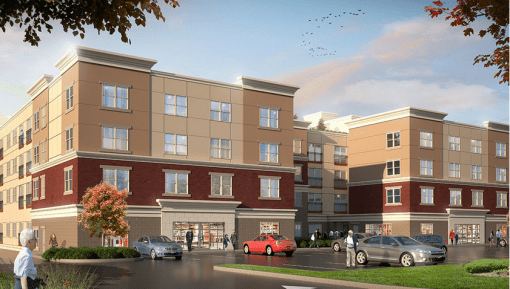
Included with the project are 12 1-bedroom, 1-bath units (725 SF), 48 2-bedroom, 2-bath units (three floor plans, 900-1,110 SF), and 2,680 SF of retail space, with preference towards coffee shops, small eateries or services like a salon or barber shop. The webpage comes with rendered 3-D tours; I dunno about you folks, but if there are two glasses of wine sitting on the kitchen counter at 10 AM, my concerns aren’t going to be about unit availability. 5% of the units will be built handicap-accessbile, but all will be handicap-adaptable.

The units will be priced upmarket, $1,550/month for a 1-bedroom, $2,250-$2,775/month for a two-bedroom, plus $200/month for top floor lake view units. With that comes a community center, in-unit washer/dryer, trash removal, fitness room, wi-fi, library/computer room, intercoms, rooftop garden, basic cable TV and pets under 30 lbs. for an additional monthly fee. Hot water shouldn’t be listed as a feature, but what do I know.

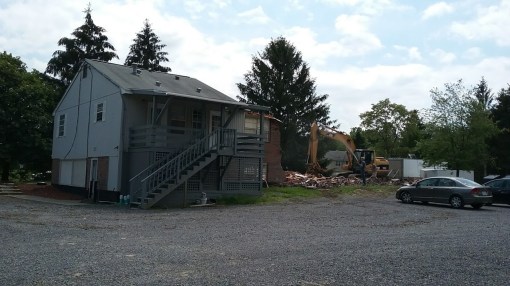
According to their Facebook page, Cayuga View S.L. will be ready for occupancy by Spring 2018. NH Architecture‘s Roger Langer is the project architect. Note in the foundation excavation photos that the building will be built into the slope of the hill – four floors in the front (east), five in the back (west). There has yet to be an updated site plan posted, but parking will mostly be on the side facing the bank.

At the end here is a shot of the Triphammer Apartments/former Chateau Claire renovation across the street. That is a separate $1.14 million project by Park Grove Realty to renovate 64 ca. 1960 apartment units (kitchen and bathroom remodeling, washer-and-dryer installations, roof repair, new balconies, gutters, landscaping and lighting), add parking stalls and a 425 SF rental office.


Village Solars Construction Update, 6/2017

17 06 2017

It’s not often that I run into someone who’s aware of this blog, let alone while taking site photos. When I arrived at the Village Solars property off of Warren Road in Lansing, I was immediately surprised to see they were taking down one of the older 1970s 10-unit properties, 102 Village Place. A salvage job this is not; the excavator was actively tearing through the brick veneer and wood window frames, leaving them in a pile as it slowly worked its way through the building. A gentlemen with a hose was spraying the fresh debris down to keep airborne dust to a minimum. To be honest, even if the building has little historic value, there’s always a bit of a bittersweet feeling to see a place that hundreds called home fall to the march of progress.

And the march of progress it is. As readers of the Voice may be aware, the plan for the Village Solars has been changed up. The next few phases will remove the 1960s-1970s 8-unit and 10-unit (all 1-bedroom) buildings and build new Village Solars buildings on their foundations. The net gain in units will be 70, bringing the number built and to be built from 502 to 572, and a gain in bedrooms of about 124.

It’s a bit complicated of a breakdown – four of the new building planned – 24-unit “K”, 24-unit “L”, and 18-unit “M” – were originally to be the next phase. When all that was said and done, Building “F”, which will host retail components, a community center and 20 studio units, was to be built. Those are being pushed off in favor of the replacement units. For example, 102 Village Place, coming down in the photos below, will be replaced with a 24-unit building that will also be called 102 Village Place. It’s five peers closest to the Village Solars will also be coming down for the construction of 18 or 24 unit apartment buildings on their footprints. There will be five phases, and it looks like two older buildings will come down and have replacements built each year for the next three years, with the last two being the all-new K/L/M and F. The designs for the six new buildings will be similar to the existing Village Solars.

So while taking photos, I happened to see a gentleman in a wide-brimmed hat and loafers, drinking a couple beers. I intended to not make waves and to just walk past when he broke the ice by saying “I’m surprised there aren’t more neighbors out watching. You don’t see something like this everyday.” I ended up making my acquaintance with Jon Lucente, the son of Rocco Sr., brother of Steve and uncle to Rocco Jr. – so, not as directly involved as the others, but still aware and knowledgeable. Turns out he lives in the Village Solars.

One of our conversation topics swirled around the hassles of regulation – a little talk on the Briarwood mess ten years ago, a little bit about Varna, and a lot about the Village Solars. To be frank, he had nothing but great things to say about Lansing town government. But he complained some of the building code regulations created headaches for his family and their in-house contracting team. For example, the buildings had be earthquake-proof, and the expensive sprinkler systems over the balconies are only legal until 2022 but they were the only type approved for use. Interestingly, they originally wanted to do four floors but building codes say an elevator is required for 4 or more floors (this tripped up Ecovillage as well as few years back). Jon brought this all back to the cost being passed on to tenants.

On my end, it was mostly just polite acknowledgement. I understand his point, but details like the elevator rule are in the building code for safety reasons. The thing is, building codes are an imprecise science – they may be too stringent in some circumstances, but lacking in others, so as a result they’re constantly re-evaluated. Given an event like the London Grenfell Tower fire disaster, where the Reynobond aluminum panels were stuffed with polyiso insulation, which is a risk because it can produce toxic fumes if it burns, there’s always good reason to take a hard look at the codes and reassess. For the record, polyiso is a common insulation material, although in the local cases I’m aware of, it goes on over the fireproofing and under the cladding, meaning it would be very difficult to set it on fire, and the Grenfell case implies the panels may have created a tunnel effect for heat and flame. The specific cladding that was used on Grenfell Tower is banned for use on buildings taller than 40 feet in the U.S.  

Anyway, I still enjoyed an opportunity to chat with one of the Lucentes. Building “I” is occupied and Building “J” will be open for occupancy at the start of July – just a little exterior trim left to do on the outside. The photos below have a close-up of the fiber cement board used on the Village Solars, which apropos to this post, doesn’t burn because it’s basically sand and concrete mixed with wood pulp. Won’t make the same claim about those wood-grain trim boards though.


News Tidbits 6/10/17: In High Demand

10 06 2017

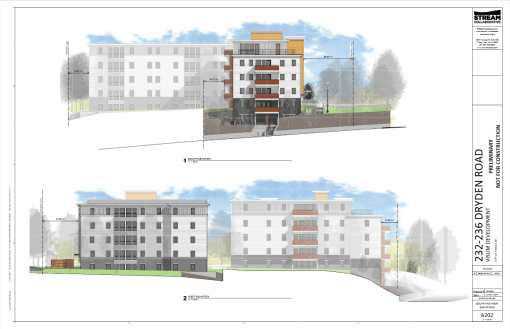
1. Start off this week with some eye candy. Here are the latest renders for Visum Development’s 191-bed, 60-unit project at 232-236 Dryden Road. The biggest change here is the Dryden Road facade – revised fenestration, and the addition of shingle-style balconies. STREAM Collaborative’s intent is to give the south building a little more historical sensitivity – when the Cascadilla school still had a dorm in the late 1800s and early 1900s, it included a 4-story shingle-style dormitory complete with dining room and gym. The balconies are throwbacks to the dormitory’s balconies.

However, given that this building will date open in 2018 and not 1898, instead of wood shingle, the balconies will use Allura “Redwood” fiber cement shinglewood pulp mixed with sand and cement, shaped for a wood-like appearance, but with the durability of concrete. Fiber cement is also more expensive to buy and install vs. materials like vinyl, which is why only more expensive or visible structures tend to use it. Other planned materials include Endicott manganese ironspot velour brick veneer, fiber cement panels with LP smart trim painted in Sherwin-Williams Pure White and Anonymous (actual name), lap siding in SW Pure White and Marigold, granite grey stucco (*real* stucco, not DryVit), a metal canopy and Andersen windows.

2. Business is good for STREAM Collaborative. So good that they’re expanding both in staff and space. The young, prolific architecture firm led by Noah Demarest will be moving out from its location in the City Hall Annex at 123 Sough Cayuga Street, and into a larger downtown space in the ca. 1872 Gregg Block at 108-112 West State Street, across from the State Theatre. The new digs are being renovated now, and are expected to be ready for occupancy by July 1st.

On another note, the owner of the city hall annex has taken to advertising the office space on Cragislist, which seems like the wrong choice to me. An apartment, sure. A house for sale or offices to rent? My impression is that folks prefer a more professional medium than what Craigslist offers. Kinda the same with jobs – servers or dog-sitters, sure. Accountants or architects? Ehh.

Maybe I’m just behind the times. Here’s the posting for the former Hal’s Deli on the 100 Block North Aurora Street. $5500/month.

3. WHCU is reporting that INHS has had no shortage of applicants for the 210 Hancock rentals. After receiving over 200 applications, they set up a lottery in which 122 “made it through” , and then selected the top 60 (there are 59 rental units though…might be a just in case there’s a drop-out, or it could just be conversational rounding). If it’s anything like New York City’s lottery, what happens is that each application is validated, sorted for requested unit type, and is assigned a randomized log number – those who get 1-48 for the one-bedroom subset, and 1-11 for the two-bedrooms subset, are awarded dibs on a unit, so long as they pass the income check and background check. Unit occupancy is expected late this summer, and marketing for the seven for-sale units will start…

4. …pretty much now. The three units in the first image are 204, 206 and 208 Hancock Street, the four for-sales in image two are from L to R, 406, 408, 410 and 412 Lake Street. 206 Hancock, 408 Lake and 410 Lake will be 910 SF 2 bedroom, 1.5 bath units that will sell for $112,000 to qualified buyers. 406 Lake and 412 are 1088 SF, 2 bed 1.5 bath units priced at $129,000. The largest units, 204 Hancock and 208 Hancock, are 1300 SF, 3 bed 1.5 bath units that will sell for $145,000. The plan is to have buyers lined up for all seven units by the end of the year.

5. The county legislature has approved the Heritage Center acquisition. The county will pay $2 million for the 18,500 SF property, about $400,000 below assessment. Tompkins Financial Corporation is parting with its former offices next spring as it moves into a new HQ a block away. The plan is to have the heritage center, which will host tourism and history-focused non-profits, open for occupancy by the end of 2018, just as The History Center’s lease at 406 E. State runs out.

6. Seems like Lakeview is serious about their West End mixed-use project. The mental health services organization just purchased three properties on Thursday the 8th – 326 North Meadow for $150,000, 711-13 West Court Street for $525,000, and 329 North Meadow and 709 West Court (same owner) for $550,000.

Lakeview is planning a mixed-use 5-story building with a small amount of first-floor retail and 50 apartment units, all of which would be affordable, and half of which would be set aside for those with mental health ailments who are generally independent, but will have Lakeview staff to turn to in times of need. The project team requested $250,000 from the city IURA to help finance the $20.1 million project, but were only awarded $50,000 since it’s still at a relatively stage without detailed plans. The project team expects to submit their project for review later this year, with a 2018 construction start.

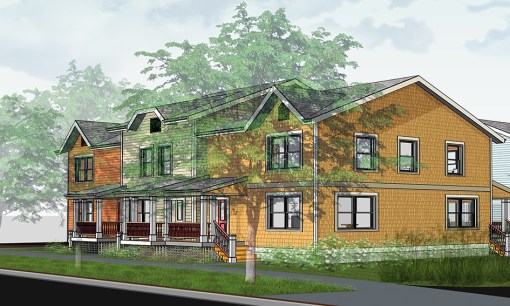
7. Tiny Timbers is doing well. In an update to their website, they note the completion of their first house, a “lofted L” model just over the county line in Hector, and a new house planned in Enfield (given that Enfield permitted just one new house last year, there’s probably a joke in there somewhere). There is another home just getting underway in Lansing’s Farm Pond Circle development, and a fourth will start soon on Grandview Drive in the city of Ithaca’s portion of South Hill. All the new units will be “big cubes” like the render shown above.

8. Looking at the city of Ithaca’s planning department memo this month, there’s nothing new to note for June. Smaller projects tend to show up in the memo, since the sketch plan for feedback isn’t as big of a deal for a small proposal, like a new store or a modest apartment building. Finger Lakes ReUse’s 22 studio units for vulnerable/formerly homeless populations will have its public hearing and Determination of Environmental Significant (step before prelim approval), the McDonald’s rebuild will have Declaration of Lead Agency, public hearing, BZA recs and DoES, 232-236 Dryden will have its DoES vote, and the Old Library redevelopment and 238 Linden will be up for approval.

9. Finishing off this week with a word of approval – the Dryden town board gave approval to Gary Sloan’s 36-unit Evergreen Townhouses at 1061 Dryden Road, per Cassie Negley at the Ithaca Times. At the boards’ (both planning and town) encouragement, the solar panels were replaced with electric heat pumps, which could utilize off-site solar and open up the possibility of a more environmentally sustainable project overall, given the proliferation of solar arrays underway in Tompkins and the region (my off the cuff estimate has at least enough solar arrays planned in Tompkins in the next 18 months to power over 10,000 homes). A play structure and 11 more parking spaces were also added.