201 College Avenue Construction Update, 12/2016

18 12 2016

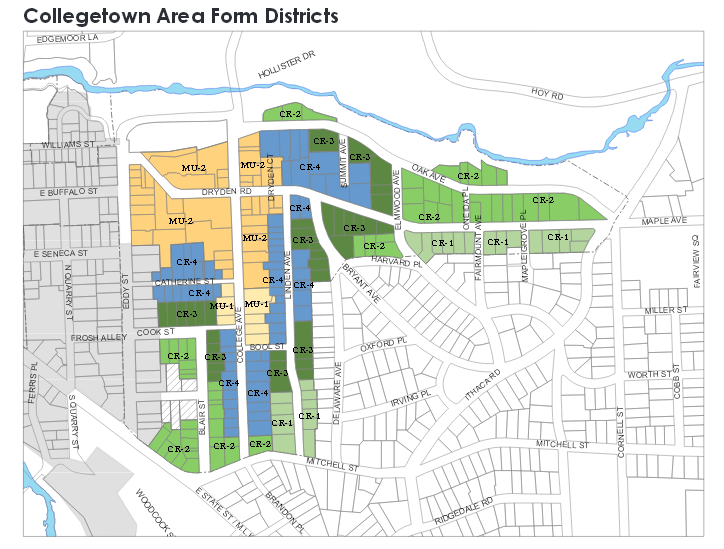
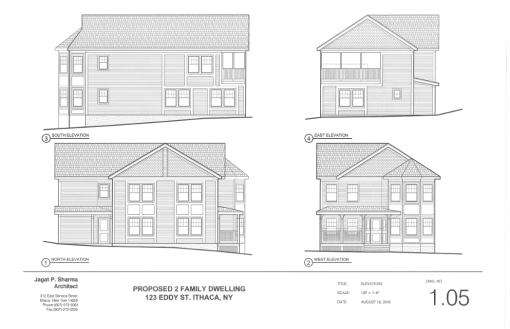
The Collegetown construction boom continues. In 2017, the city can expect at least five projects to open in the neighborhood, with a net gain of about 118 beds and $16 million in assessed tax value** – a two-family house at 123 Eddy Street; Cornell’s, 6-story, 76,000 SF Breazzano Center for its Executive MBA Program; the 5-unit, 28-bed 126 College Avenue;  the 9-unit, 36-bed 210 Linden Avenue; and lastly, the 5-story, 74 bed 201 College Avenue. Which has also been by far the most contentious one.

The project was first proposed in March – and from beginning to end, the only substantial change was a mild revision to its upper floors to create a setback as a modern deference to the Grandview House further up the block. That resulted in a loss of two bedrooms, dropping the plan from 76 to 74 beds.

For Todd Fox, who proposed the building through his company Visum Development Group, there wasn’t much room for revisions. He was going to, and paid, a premium on the property – $2.65 million, formally deeded in June by its previous owner, a small-scale local landlord who owned it for about seven years prior. The site held an early 1900s apartment house with three large spruce trees at the front, which became another source of contention during the debate.

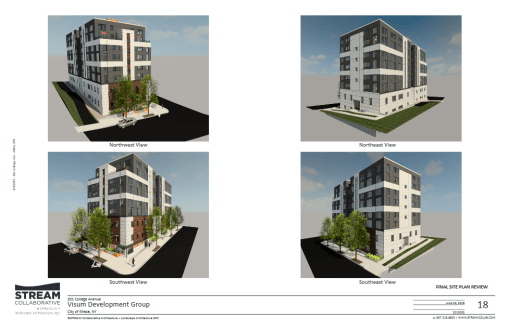
To make the project financially feasible, he needed to build to the maximum 5 floors and 70 feet allowed by the site’s MU-1 zoning (the project would have been outright impossible before the 2014 CAFD zoning overhaul, due to the parking requirement), and building micro-units with mezzanines would make the project pencil out – the profit value of the vertical space was effectively maximized. Working with architect Noah Demarest of STREAM Collaborative, he proposed a fairly modern building with fiber-cement panels, woven bamboo boards and cedar accents.

However, one thing that did not factor in to the calculations was the neighbor of 201, 203 College’s Neil Golder. Neil is a 44-year resident of Collegetown, having moved in in 1972, and buying his house in the early 1990s. As the kitchen manager for Loaves and Fishes and a former Common Councilor for the 4th Ward, he’s well known among the Ithaca community and is well connected to its grassroots organizations, as well as the political movers and shakers. By any account, Neil and his late partner Kathy Yoselson are beloved stalwarts of Ithaca’s progressive scene. However, Neil has generally not been a fan of development, particularly Collegetown’s (with one notable exception – 307 College).

What 201’s debate boils down to is a clash of two strong personalities. Todd Fox, who is probably the most gung-ho and financially adept developer one will find in the city of gorges; and Neil Golder, who was determined as hell to stop the project planned for the house next door, which wasn’t just a development, it was a project that he deeply felt would be a major detriment to his quality of life. Hence, Neil launched the group “Save the Soul of Collegetown“, under the auspices of protecting all of Collegetown, but mostly as a personal vehicle to drum up support to battle Fox and his apartment building.

The point of this summary isn’t to summarize every detail. You can read the 580+ page summary from the city, or all the Voice articles here. But there are a few key plot points.

After review and a negative declaration of environmental significance (meaning, effectively mitigated), he project received preliminary approval in June, and the city and the planning board were promptly slapped with a lawsuit by Golder. The stated case was that the environmental assessment was inadequate and that the project needed an EIS. Although it was quite a stretch given past precedent, it did make the planning board quite uncomfortable. John Schroeder, a longtime board member who served with Neil on the council, did a very deep analysis of the 2014 zoning code and determined that the building may be illegal on technicality.

That technicality was about building facade length, and whether Bool Street was a primary facade – if it was, it would legally have been required to be two separate buildings for having too long of a continuous face to the street. The zoning code, however, illustrated that an approach with indents such as 201’s were acceptable, and the city planning department, in their pre-site plan review assessment and meetings with Fox, had signed off on the plan as legal and acceptable. And they maintained that it was acceptable. So there ended up being a battle between the planning board, which is appointed though knowledgeable community members, and the planning department, which consists of vetted city staff. These kinds of battles are extremely rare, and it is likely that 201 was the first in decades.

While this debate raged, the building far exceeded its intended start date of July 2016. As a result, the site went on the market, and the plans were cast into jeopardy.

Although Fox and his team wanted to avoid a trip to the Board of Zoning Appeals, it was determined by the board to be the only legitimate course of action. The BZA had to decide whether or not the project was legal. And, in a 3-1 decision in October, they decided it was legal, due to ambiguity in the code, and a lack of timeliness on the part of the planning board, as the legality was not considered until after months of review, after preliminary approval was granted. After the BZA ruling, work on the building began the next day.

No one walked away from this one looking good; One reader emailed in and compared it to a Clinton vs. Trump vote. The debate sent a chill down the development community, and created additional bitterness for some of the old-timers who felt Ithaca was selling out to developers and student interests. The planning department and board were also left with some resentment towards the other; now that the code has been clarified, one can hope further battles like this can be avoided.

Anyway, the building itself. Here are the floorplans. The mechanical room, a trash room, interior bike storage, gym and storage space occupy the basement. Four three-bedroom and four four-bedoom units (28 beds), with about 1,000 SF each, occupy the first and second floors. The third and fourth floors have micro-units, 16 of which will be about 392 SF studios, 8 of which will be 670 SF with two bedrooms, give or take a few feet for each (32 beds). The top floor has nearly the same layout as three and fourth, with eight micro-units of about 392 SF and 2 two-bedrooms of about 670 SF. However, the westernmost two units are studios, which have balconies and are about 400 SF each. So, 14 beds on the top floor, for a total of 74. The smaller units make use of mezzanine spaces and netting to increase usable space.

Fox’s rental company, Modern Living Rentals, is handling the leases. The units are currently listed from $1,670/month to $4,170/month, depending on size and location.

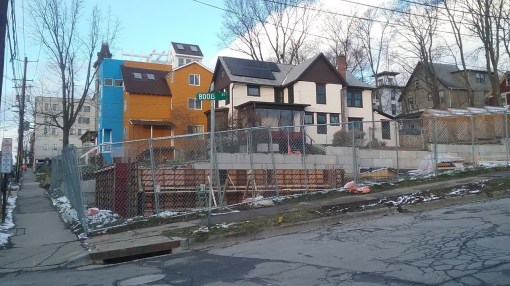
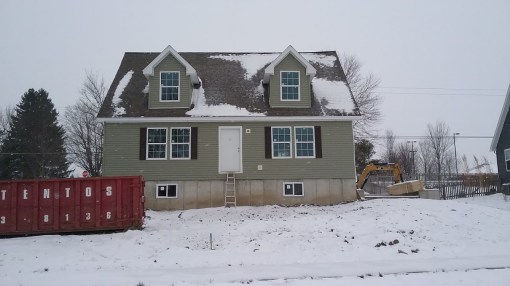
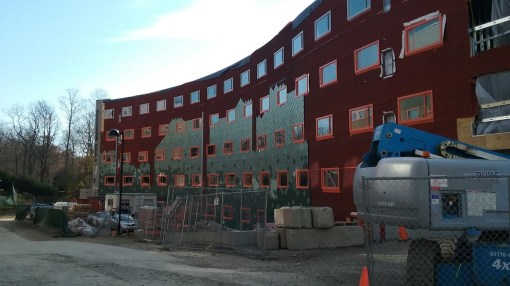
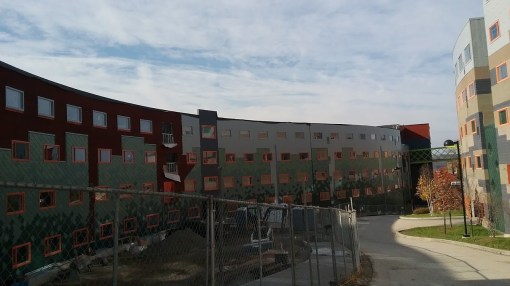
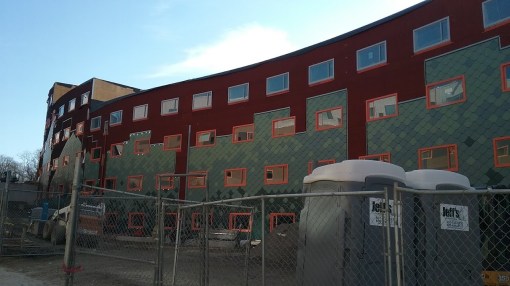
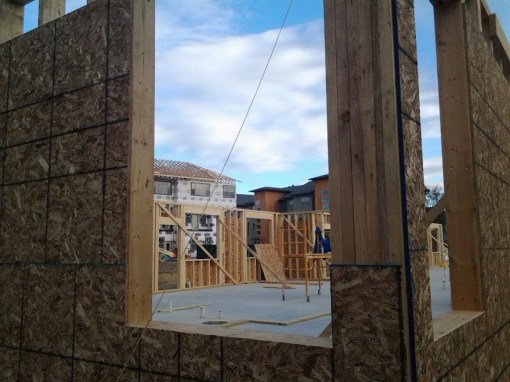
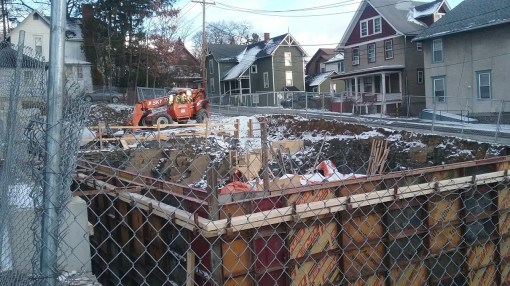
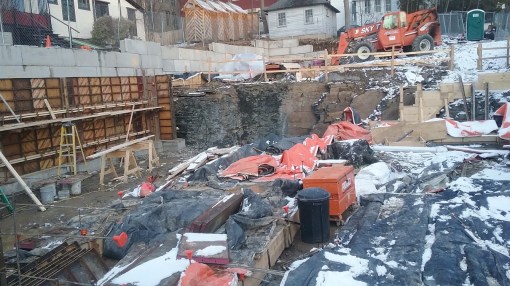
In the photos below, note that the excavated portion is only half of the building footprint – the basement only occupies the western half of the structure. The eastern half is slab-on-grade (Collegetown has more stable soils than most of the valley locations, so multi-story slab foundation buildings are feasible). The elevator core will be in the middle bridge of the “H”-shaped structure. Foundation forms are up and the concrete is being poured – through the fence, you can see one of the concrete footers already in place.

William H. Lane Inc. of Binghamton, who just finished up the Marriott downtown, is the general contractor for the approximately $6 million project, which is paying a premium to meet the opening date of August 2017.

**If you add in Phase III of Collegetown Terrace, which is on the fringe of what’s normally considered Collegetown, raise those numbers to 462 beds and $71 million.
20161209_153319

20161209_153332

20161209_153341

20161209_153350

20161209_153402

20161209_153706

201_college_site 201_college_v5_1


News Tidbits 12/17/16: So Much In One Week

17 12 2016

1. For the developers out there, it looks like your next opportunity just opened up in Collegetown. For sale are three houses on Linden Avenue – 6-unit, 8-bedroom 230 Linden, for sale at $675,000 (taxed at $350,000), neighboring 4-unit, 8-bedroom 228 Linden at $700,000 (taxed at $460,000), and two doors down, 2-unit, 11-bedroom 224 Linden at $525,000 (taxed at $400,000). All three are somewhat run-down student apartment houses on the cusp of inner and outer Collegetown – as such, their zoning is CR-4, which allows four floors, 50% lot coverage, and has no parking requirement.

The properties were all purchased in the mid-1970s by a small-time local landlord, who was killed in a car accident two years ago. According to the listings, the seller’s agent is a family member, and the units are leased until late 2017 or 2018, meaning that if one were to purchase with an eye towards rapid redevelopment, they would have to negotiate with the tenants, or wait it out. That being said, there’s a lot of potential here, particularly if a buyer combines 228 and 230 into one lot. The city designed the CR-4 zoning with Linden Avenue specifically in mind – the concept render is a northward perspective of a revitalized Linden Avenue. They’re a lot of money, but there could be some interesting news down the line.

210linden_126college

2. Also in Collegetown, here are a couple of concept color renders of 210 Linden Avenue (left) and 126 College Avenue, courtesy of Visum Development’s webpage (currently down, cached link here). I confess to be more of a warm colors person, but assuming these are fiber cement boards and wood trim (or fiber cement that looks like wood), they could turn out quite nice.

On a related note, Visum’s Fox and partner Charlie O’Connor have started earth moving for their townhouse project at 902 Dryden Road in Varna. As it turns out, it is a very difficult site to get photos of, despite its easily accessible location. I’ll do a more in-depth shortly, but the units should be ready by August.

20161211_131919 20161211_131943

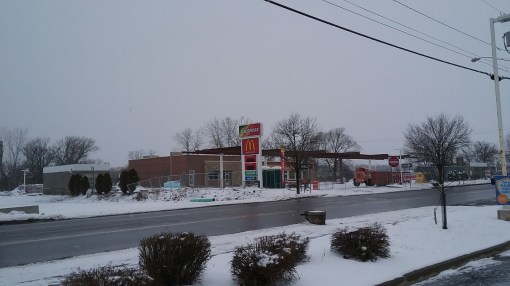
3. Fulfilling a promise to Fred, here’s the rather upscale McDonald’s/Fasttrak combo under construction North Road in the village. There is a billboard on 366 advertising for new hires for when they reopen, but unfortunately, it was too difficult to attempt a photo of the board and render. The building’s exterior is largely complete, and the gas station canopy is framed – late winter opening? The new construction has a price tag of about $500k. Honestly, for a roadside stop, it looks pretty nice.

20161211_131533

20161211_131514

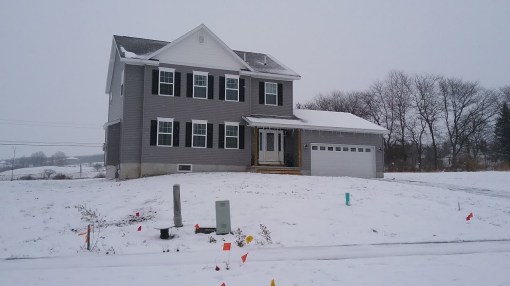
4. More on Dryden, with a couple houses of the week. Looks like some modulars are going into the Maple Ridge development – one recently completed, one in the works. The open space to the right of house number two, the Cape Cod, will host a garage. The land for house one sold to Kenn-Schl Inc, a regional modular home builder and seller, in June for $48k. House two’s land was sold to a Rochester man for $39k in October. At this rate, Maple Ridge is going to fill out their 15-lot phase one in another year or two. Although waylaid by the Great Recession, the big plan is for three phases and 51 lots.

20161211_133227

5. On the 15th, the construction loan for the William George Agency’s new 1-story, 24-unit dormitory was filed to the county records office. The $3 million loan comes courtesy of …. A trip to the property didn’t pan out, it didn’t look like anything was underway even though the building permits were filed with the town of Dryden a few months ago. Then again, as a facility for troubled youth, it’s not the most welcoming place for a random visitor to be taking photos.

maplewood_v7_4

6. So what’s being discussed by the towns? In the town of Ithaca next week, a lot line adjustment between two houses, and more Maplewood discussion, with consideration of preliminary site plan approval. Meanwhile, the town of Dryden has cell towers galore, as well as revised approvals for Storage Squad (1401 Dryden) and Tiny Timbers; plans are in the pipe line for a 7-lot subdivision of the Dryden Lake Golf Course, and a possible sewer extension study for NYS Route 366 east of the NYSEG building.

Image Property of HOLT Architects

7. Speaking of sewer, the town and village of Lansing are negotiating sewer deals so that the town can use village lines to help accommodate future growth. Dan Veaner at the Lansing Star has the story. the report says the town is asking for 700 units of capacity, where a unit is 328 gallons. 700 units would also put the Cayuga Heights plant at capacity. The town’s intent is to extend sewer capacity to encourage development along Triphammer Road (as in the town center concept shown above), with the reasoning that it’s a natural extension of established development, and would help grow the tax base in the event of the power plant closing. Not as grand as the plans that were shot down in 2007, but like the Warren Road sewer built a few years ago, it’s seen as a more organic and cost-efficient approach.

20161209_123851

20161209_123931

8. There might be some of movement on Jason Fane’s Bank Tower $4 million renovation from office space to 32 apartments. The windows were inspected and tagged recently, possibly to determine what needs to be replaced where. Most of the exterior of the Commons-facing building will receive a cleaning and re-freshening, with the bulk of the work geared towards the interior.

20161210_140231

9. In economic news, 24/7 Wall Street is reporting that Ithaca has the 25th best job growth in the nation from November 2015 – November 2016. 2,200 jobs equates to 4.4%, by their measure.

Hate to burst the bubble, but don’t buy into it just yet. Initial estimates can be way off due to statistically insignificant sample size for small communities. It may hold, it may not. Wait until March and see if the numbers get revised.

city-center-v4-1

10. Interesting meeting next week for the city Planning Board. Amici House and Maplewood are up for final approval, and a couple revitalized or new projects. Here’s the scoop:

1. Agenda Review 6:00
2. Privilege of the Floor
3. Site Plan Review

A. Project: Maplewood Redevelopment Project 6:10
Location: Veteran’s Ave. (between Maple Ave. & Mitchell St.)
Applicant: Scott Whitham, Whitham Planning & Design, LLC, for Cornell University
Actions: Adoption of Findings, Public Hearing, Consideration of Preliminary & Final Site Plan Approval

The Town Planning Board filed a Notice of Completion on November 30th, 2016, which can be viewed here: http://www.town.ithaca.ny.us/major-projects/maplewood. The Town Board will consider adoption of a Findings Statement on December 20, 2016.

The city will specifically sign off on the bus stop and landscaped area at the northwest corner. STREAM Collaborative is the landscape architect.

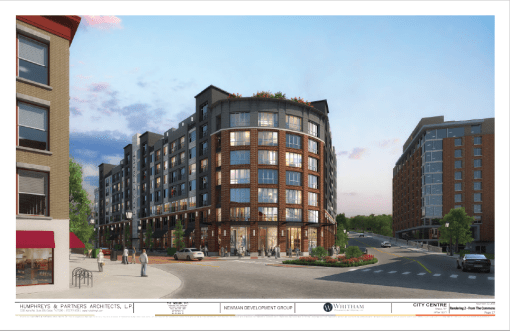
B. Project: City Centre — Mixed Use Project (Housing & Retail) 6:30
Location: 301 E. State/M.L.K., Jr. St.
Applicant: Jeff Smetana for Newman Development Group, LLC
Actions: Determination of Environmental Significance, Recommendation to BZA

amici_v3_1

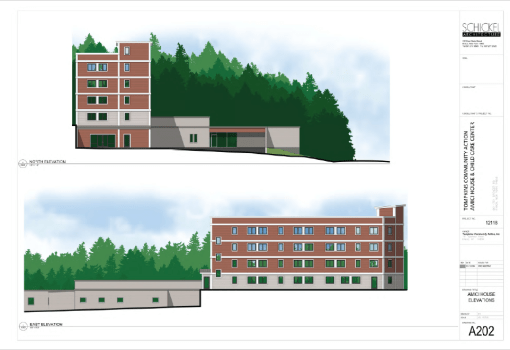
C. Project: Amici House & Childcare Center 6:50
Location: 661-701 Spencer Rd.
Applicant: Tom Schickel for Tompkins Community Action (“TCAction”)
Actions: Consideration of Preliminary & Final Approval

Tweaked since last time – a little more glass in the stairwell, and the roofline of the classroom building has been broken up with three distinct gables.

college_townhouses_v2_1

D. Project: College Townhouse Project 7:10
Location: 119, 121, & 125 College Ave.
Applicant: Kathryn Wolf, Trowbridge Wolf Michaels Landscape Architects, LLP
Actions: Public Hearing Determination of Environmental Significance

The big changes appears to be the switch from boxy bay window projections to curvy ones. Not sure if it works, given all the other boxiness. But on the bright side, we now know what the rear apartment building looks like:

college_townhouses_v2_2

E. Project: Apartments (5 Units) 7:30
Location: 126 College Ave
Applicant: Visum Development Group
Actions: Declaration of Lead Agency, Potential Determination of Environmental Significance

This is what I get for writing things over the week rather than all at once. Confirmed fiber cement panels (wood-like and Allura olive green) and a very light yellow Nichiha panel.

F. Project: Apartments (9 Units) 7:50
Location: 210 Linden Ave
Applicant: Visum Development Group
Actions: Declaration of Lead Agency, Potential Determination of Environmental Significance

Charcoal grey fiber cement panels, light grey panels, natural wood trim and red doors. The base will be stucco.

G. 323 Taughannock – Apartment (Redesign) – Sketch Plan 8:10

Steve Flash’s 21-unit apartment building for Inlet Island was approved two years ago, but has not moved forward due to soil issues and parking costs. This new version is still a housing proposal, but I’m hearing for-sale units that may be condo-like. The design will also be new, but the aesthetic will be similar – it will once again be crafted by STREAM Collaborative.
H. Ithaca Reuse Center – Sketch Plan 8:30

I know about this project because a county staffer emailed me by accident. But without official docs, I wasn’t about to report on anything. The plan calls for a mixed-use building, not unlike that seen in design concepts a couple of years ago. TCAction and INHS are involved, so there is an affordable housing component – probably looking at mixed-use overall.

4. Zoning Appeals 8:50
• 3053, Sign Variance, 310 Taughannock Blvd.
• 3055, Area Variance, 113 Farm St.
• 3056, Area Variance, 301 E State St.

5. Old/New Business:
A. Update — Chainworks DGEIS – Transportation Comments/Responses – yes, it’s still going.
B. Update — City/Town Joint Planning Board Meeting Jan 31, 2017 – Maplewood?
C. Update — Joint Planning Board/ILPC Meeting (DeWitt House) – Let’s see how this goes…


News Tidbits 12/10/16: Missing Out On the Fun

10 12 2016

reach_works_1
1. We’ll start off out in the town of Lansing this week with a new business startup looking to climb to the top of the pack. Reach Works, the brainchild of an academic family that relocated to Ithaca, just earned final site plan approval to build a professional-grade climbing wall and facility at 1767 East Shore Drive, next to The Rink. The $1.2 million, 10,400 SF building will have a noticeable impact on the Lansing shoreline, as the building will reach 56 feet in height. South Hill’s George Breuhaus will be the architect in charge.

According to the Times’ Cassandra Negley, the owner looked at Chain Works for an opportunity, but those plans fell through. The finalizing of the wall design is underway now, and Reach Works hopes to begin construction in March and be open by next fall. Between the pro shop and the wall, they hope to employ five full-time and ten part-time, with most making about the living wage of $15/hour (although, the application on file with the town says six employees). The hope is that it also becomes a regional attraction, drawing in hardcore climbers from the Rochester, Syracuse and Binghamton metros. Best of luck to them.

maplewood_v7_4

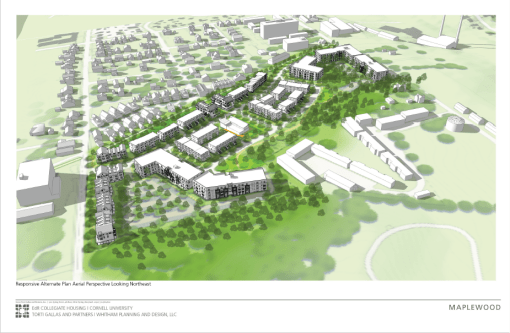
2. Maplewood is almost ready. The city is set to give its final approval this month, and the town is expected to give preliminary approval before the Christmas holiday. The latest changes to the FEIS include the following details:

– The amount of money for traffic calming measures has been increased from $20,000 to $100,000. $30,000 goes to the city and town, and $70,000 will be allocated by EdR and Cornell for streetscape improvements that they will build.
– Recycled building materials will be incorporated into the buildings.
– A revised estimate states that 100 to 150 construction staff will be on site during construction. They will park behind the East Hill farmer’s market space and are expected to walk over to the site. They will work on weekends, with noisy work commencing after 8 AM.
– The units closest to the East Hill Rec Way have been moved another four feet back from the trail.
– Initial property taxes in 2018 will be $2.25 million. IT is assumed they will go up 3% each year thereafter.

Oh, and the questioner who freaked out over the East Hill Village plan online – that SWA plan dates from about 2007.

cayuga_med_behavioral_sciences_1-620x420

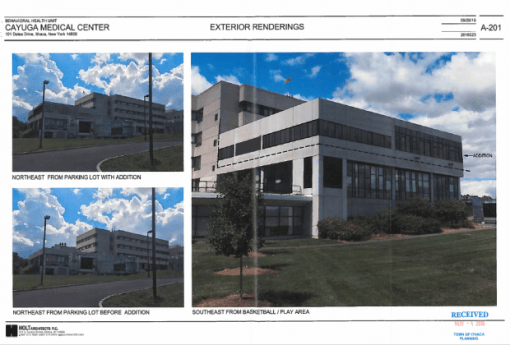
3. Cayuga Med’s plans for a 6,000 SF addition to their Behavioral Health Unit has been approved. At this point, the project needs a minor zoning variance for height,and then CMC has to apply for certification from the New York State Office of Mental Health for the facility to be approved- specialized medical facilities, like CMC and Brookdale, have to prove there is a need before they’re allowed to build. The hospital hopes to open the project to bidding early next year.

masonic_temple_1-771x595

4. So ICYMI, the Masonic Temple rehabilitation is moving forward. Six months later than anticipated, but it is moving forward. The project is valued somewhere north of $1 million. There is one other project on the Ithaca Landmarks Preservation Commission (ILPC) agenda that I thought of writing an article about, but decided it was too minor – the Alpha Phi Alpha house at 421 North Albany will be doing a reconstruction of a non-historically significant rear porch. If it were a full reno, I’d do a write-up for the Voice.

Also on the ILPC agenda – a discussion of Collegetown Historic Resources. I have the feeling this is being spurred by Novarr’s 119-125 College Avenue project, the College townhouses. Three historically significant but non-landmarked apartment houses were taken down to make way for the project, which is expected to go up for preliminary approval later this month. The city did a review after the document was first published in 2009, and landmarked the Snaith House at 140 College and Grandview House at 201 College – they could be considering making a move towards landmarking other properties – some of the historic structures on the 400 Block of College Avenue, and the 100 blocks of Oak Avenue, College Avenue and Linden Avenue are possibilities. Novarr has another project rumored for 215 College Avenue, but that building, dating from the 1870s and renovated/expanded numerous times, was not on the 2009 list.

5. Staying Collegetown, a big sale this week – 113 College Avenue sold for $1.7 million. That’s a very impressive price for an outer Collegetown apartment house – the tax assessment has it pegged at $610,000. The bones of the 13-bedroom, 3,738 SF building date from the late 1800s, but like its twin next door, it’s been the subject of a very unsympathetic renovation (records suggest the renos were done around 1980). The house has been owned by the Tallman family since 1987.

The property is zoned CR-4 – four floors, no parking required. CR-4 is the same zoning as Novarr’s townhouses and Visum’s latest pair of proposals. And, because what goes around comes around, the buyer is the same LLC that sold Visum’s Todd Fox 201 College Avenue for $2.65 million back in June – Russell Johnson’s PBC & Associates LLC. He also picked up a CR-3 building at 233 Linden Avenue for $750k back in the fall. Price suggests redevelopment, but the buyer isn’t known for that – he might have just paid big for a long-term investment. TL;DR, he might be planning something, he might not; we’ll see.

On a side note, the county’s going to make some money raising the property tax assessment on this one – offhand, I’ve noticed most of the houses sold this week (excluding a couple in Ithaca city) have gone at or well under assessment, which is a bit unusual, and probably not something that the tax assessor’s office wants to see.

20160630_142619

6. Good news and bad news from the Regional Economic Development Council awards. The good news is, the area’s getting money. Cargill gets $2 million towards their salt mine project (they requested $5 million), Cornell gets $250,000 for a startup business alliance, County Waste gets $355k for a food waste transfer station at the recycling center site, and the Sciencenter gets $150k for renovations. Several smaller awards are to hire staff for cultural and arts programs.

Now the bad news – one project, marked priority, was not funded – the Collegetown Travel Corridor proposed by the city of Ithaca to connect Downtown and Collegetown. I asked to make sure, and the Planning Department was just a little deflated in their response. Major bummer. I don’t doubt the value of arts programs, but $38,500 for a theatre director and $41,000 for a workforce expansion isn’t sustainable, it’s one year’s salary. That’s nice, but how does that benefit the area in the long-term? The Travel Corridor would have further encouraged urban development downtown and Collegetown that could have indirectly supported the arts through patronage, or directly through taxes that are used to fund local-level grants.


Collegetown Terrace Construction Update, 11/2016

24 11 2016

The last phase of Collegetown Terrace is fully framed up. Novarr-Mackesey‘s 344-bed project is mostly closed up, just in time it seems. The maroon waterproofing material covers nearly all of the structure, windows have been fitted in most of the openings, the vinyl “fish scales” are still being applied and the aluminum metal panels are slowly making their way from west to east. One critique I have about the grey panels is that they are not perfectly flat – bumps, dimples and seam pressure spots are visible in direct light (see second-to-last photo for reference). Getting the rest of the water-resistant wrap and exterior materials will progress more slowly now that winter’s set in, but the meat of the work at this point will be focused on the interior – getting the utilities installed, stud walls assembled, drywall hung, and fixtures in place. Work on the roof (EPDM synthetic rubber most likely) will have to wait for spring as well. Welliver is expected to have phase III ready for occupancy by August.

20161119_122915 20161119_122951 20161119_122958 20161119_123050 20161119_123105 20161119_123110 20161119_123128 20161119_123208 20161119_123228 20161119_123300 20161119_123321 20161119_123535 20161119_123618 20161119_123851


News Tidbits 11/19/16: Winter Is Coming

19 11 2016

executive-education-center-and-hotel-777x622

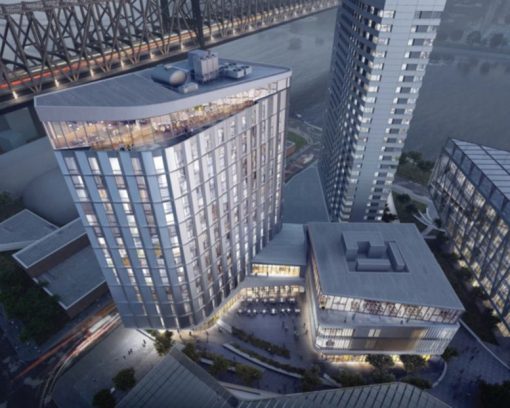
1. We’ll start off in the Big Apple this week. Cornell and its development team have released plans for the fourth and last building in the first phase of the Cornell Tech buildout. The Verizon Executive Education Center and Hotel consist of two buildings connected by a shared hall, and will include four 50-75 seat classrooms, small breakout rooms, and a 195-key hotel for visitors to the school. The plans also call for a restaurant, rooftop lounge and cafe – none of which sound very academic, but the building is meant to be an event center and gateway to the nascent school.

The exterior will be encased in aluminum and wood planks. There will be no parking, but there will be pedestrian courtyards, bike lanes and green space. The facilities are part of the campus’s first phase, which also includes a 26-story student and staff residential building; the Bridge, an incubator for researchers and small businesses; and the Bloomberg Center academic building. Those buildings will open in summer 2017, while the Verizon Center will probably be a 2018 opening, assuming the final designs are approved by the city of New York.

hopshire_1

2. Now to turn to something much closer to Ithaca. Dryden’s Hopshire Brewery is in the midst of a two-phase expansion, reports the Times. The first phase, shown above, consists of a 1,200 SF addition to the west side of the structure, and the new addition is already framed and closed up, with the expectation of being completed by the start of 2017. The space will be used to host events for as many as 100 attendees. the second phase, a 1,300 SF addition to the brewery and storage area, will start next year. The work is partially funded with an Empire State Development grant.

Speaking of drinks, the Watershed, a new bar and coffee lounge, will open by Thanksgiving. It replaces Rumble Seat Music at the former telephone exchange building at 121 West State Street in Downtown Ithaca. The Watershed owners expect to create eight living-wage jobs.

3. From county records, we can see just how much the Rodeway Inn renovation is going to cost local businessman Pratik Ahir – $2,095,000, but the hard costs are only $926,000. The difference is due to the existing mortgage on the property. The lender is Generations Bank, a small bank based out of the Seneca Falls. Anecdotally, we seem to be seeing an uptick in small upstate lenders looking to stake claims on the growing Ithaca market, which could be a real asset for the region – with a limited number of local lenders, financing is often a big hurdle with Ithaca-area projects.

maplewood-v7_8-planning-board maplewood-v7_6

4. As noted earlier this week in the Voice, lots of new Maplewood renders to take a gander at. Going through all the emails from the public comment period, I’d say that overall most are positive and positive-constructive – there are a few sour grapes, but they’re in the minority. For this area, that’s actually a pretty big accomplishment, and it means Cornell and EdR have successfully addressed most of the concerns raised by neighbors and community members. The big changes in respone to public comment have been a a commitment to 50% off-site solar energy, $20,000 to the town for traffic calming measures on Mitchell Street (raised crosswalks, speed bumps), and the two townhouse strings facing Walnut Street and the Belle Sherman Cottages have been redesigned to look more traditional and fit in better with their non-student neighbors. We’re probably very close to the final design at this point, if not already there.

Once preliminary approval has been granted, demolition will start on the south side of the Maplewood property and make its way northward in four phases. The first townhouse strings and apartment buildings will begin construction on the south side of the property in the March-April timeframe, depending on overall progress and external factors. The first completed buildings will be ready by October/November 2017, but it looks like occupancy will happen all at once in August 2018.

wegmans_pad_parcel-1116

5. The City Planning Board Agenda is pretty busy next week – Todd Fox will be presenting two new mid-sized Collegetown projects, Wegman’s is seeking a renewal on the approvals for their pad parcel building, and several other projects had major or minor redesigns. Here’s the rundown on the Voice, and the schedule here:

AGENDA ITEM                 APPROX. START-TIME

1. Agenda Review              6:00

2. Privilege of the Floor   6:01

3. Site Plan Review
A. Project:  Maplewood Redevelopment Project                               6:10
Location: Veteran’s Ave. (between Maple Ave. & Mitchell St.)
Applicant: Scott Whitham, Whitham Planning & Design, LLC, for Cornell University
Actions: Update & Schedule
B. Project:  City Centre — Mixed Use Project (Housing & Retail)     6:25
Location: 301 E. State/M.L.K., Jr. St.
Applicant: Jeff Smetana for Newman Development Group, LLC
Actions: PUBLIC HEARING    Review of Full Environmental Assessment Form (FEAF), Part 3

C. Project:  Amici House & Childcare Center                                6:50
Location: 661-701 Spencer Rd.
Applicant: Tom Schickel for Tompkins Community Action (“TCAction”)
Actions: Declaration of Lead Agency, PUBLIC HEARING, Determination of Environmental Significance, Recommendation to BZA

D. Project:  Four Duplexes                                                         7:20
Location: 607 S. Aurora St.
Applicant: Charles O’Connor
Actions: Determination of Environmental Significance, Consideration of Preliminary Approval
E. Project:  College Townhouse Project                                      7:45
Location: 119, 121, & 125 College Ave.
Applicant: Kathryn Wolf, Trowbridge Wolf Michaels Landscape Architects, LLP
Actions: Declaration of Lead Agency, Review of Full Environmental Assessment Form (FEAF), Part 2
F. 126 College Ave. — Sketch Plan            8:00
G. 210 Linden Ave. — Sketch Plan              8:20
H. Wegmans Retail Building – Extension of Site Plan Approval     8:40
4. Zoning Appeals                                                                     8:50
• 3049, Special Permit, 908 N. Cayuga St.
• 3050, Area Variance, 528 W. Green St.
• 3051, Area Variance, 661-665 Spencer Rd.
• 3052, Area Variance & Special Permit, 701 Spencer Rd.
• 3054, Sign Permit, 222 Elmira Rd.
5. Old/New Business                                                                 9:00
A.  Special Planning Board Meeting: 11/29/16
B.  Update — City/Town Joint Planning Board Meeting
C.  Update — Joint Planning Board/ILPC Meeting (DeWitt House)
D.  Changes/Corrections to Collegetown Area Form Districts (CAFD)
E.  Building Materials — Discussion on Potential Restriction on Vinyl Siding
6. Reports                                                                                 9:20
A.  Planning Board Chair (verbal)
B.  Director of Planning & Development (verbal)
C.  Board of Public Works Liaison (verbal)

7. Approval of Minutes: May 24, 2016, June 28, 2016, July 26, 2016, and/or October 25, 2016 (time permitting)      9:30

8. Adjournment      9:31


News Tidbits 11/12/16: Oof.

12 11 2016

lansingapts600

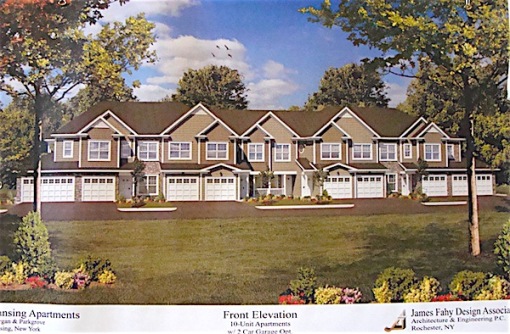
1. Starting off this week in Lansing, the village has okayed a zoning change that would allow the planning board to move forward with consideration of a 140-unit upscale apartment project on Bomax Drive. Neighbors came out to oppose the zoning change for the 19.5 acre parcel from office park business/tech to high-density residential, saying it would create additional traffic and hurt property values. The village board, however, responded in dissent, noting a lack of housing, a fit with the 2015 village comprehensive plan, and that this was about the zoning and not the project, which the planning board will critique as a separate action. The zoning change was approved unanimously. Park Grove Realty is now free to submit plans to the village, and planning board review will go from there. Expect it to take at least a few months.
therm_1

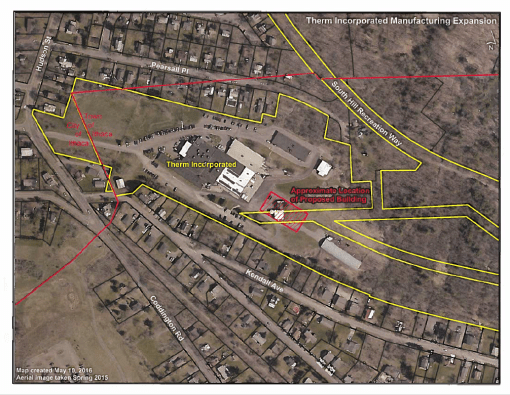
2. A couple quick notes from the town of Ithaca – Therm Inc. has commenced construction on their 20,000 SF addition at their South Hill plant. It’s a few months later than originally anticipated, but underway nevertheless. The $2.5 million project is expected to create 10 manufacturing jobs, according to the county IDA.

Also underway at this point is the renovation and expansion of the Rodeway Inn on Elmira Road. The plans call for expanding the existing 25 motel units, adding 2 new units on the ends of the main structure, and renovating a house on the property for a 1,146 SF community room to serve guests. Landscaping and lighting would also be updated. The town pegs the construction cost at about $679,000.

341_coddington_1

3. Here’s some good news – it looks like someone has taken up the Iacovellis on their offer of a free historic house at 341 Coddington Road, providing that the taker moves it. It appears NYSEG was creating some hangups since the power lines have to be moved out of the way (NYSEG is infamously difficult to work with), but with any luck, the house itself will be saved. My colleague Mike Smith is doing the legwork on a story, so hopefully more details on the “buyer” will come forth shortly.

4. Back in July, several West End properties owned by an out-of-area LLC hit the market. Now, at least one of them has sold. The duplex at 622 West Buffalo (blue in the map above) was sold for $90,000 to a gentleman from suburban Syracuse. Immediately after, paperwork was filed with the county for a $179,145 building loan courtesy of Seneca Federal Savings and Loan, a small regional bank out of Syracuse. The paperwork does not indicate if it will be renovations/additions to the existing building, or a new structure (sometimes the sale price is a part of the building loan, but in this case the buyer paid separately, with $171,187 set aside for hard costs).

20161007_163922

5. Sticking with county filings, the construction loan for the third phase of the Village Solars was filed with Tompkins County this week. $6 million is being lent by Tompkins Trust to fund construction of 42 units, 21 in each building. Initially they were slated to have 18 units each, but because the three-bedroom properties don’t have quite the same appeal as smaller one-bedroom and two-bedroom units, Lifestyle Properties (the Lucente family) has broken up the units without significantly changing the exterior appearance and layout. Actual Contractors LLC, another Lucente company, is the general contractor, with Albanese Plumbing, T. U. Electric, and Bomak Contractors (excavation/foundation) rounding out the construction team.

119_125_college_1

6. This is one of those unusual months were the city projects memo and the project review meeting agenda go out in the same week. Apart from the Collegetown Townhouse project, there are no new projects being presented, but there is new information and new renders.

In the projects memo, Novarr’s project is the new shiny, while Amici House, the8-unit project at 607 South Aurora and City Centre are being carried over as old business. Regarding City Centre, it doesn’t look like any particular points of contention have been raised by city planning, the framework for mitigating Historic Ithaca’s design complaint is already included, and most of the other requests are for more information/paperwork. From the Design meeting, it looks like the debate on the townhouses project is minor, mostly with where to locate the trees out front, and window details. They will not be putting windows into the north face because it’s on the lot line, but they will vary the materials for visual interest. The Design Committee requested that City Centre insert more windows in some areas, and less signage, as well as consideration of decorative elements to highlight the curved facade facing Aurora and East State Streets.

The project review committee meeting has all of the above, plus updated submissions from the Maplewood project team. Although no substantial development will occur in the city, the Maplewood project crosses municipal boundaries and the city has deferred to the town for lead agency. The meeting will also have a few zoning variances to comment on. The only notable zoning variance is for local realtor Carol Bushberg, who wants to do a one-story 812 SF rear addition at her office at 528 West Green Street, which is in a WEDZ zone and requires two floors.

maplewood_v7_4

maplewood_v7_5

Looking at the Maplewood submission, the new dormer/gable style will be for the building strings that front Mitchell Street, and the two strings most visible from Walnut Street. More modern designs will be used for the remaining structures. Looking closely, the designs do vary from string to string, which will give the site some character and additional visual interest. The project timeline is pretty tight with submissions, meetings and approvals, aiming for preliminary approval from the town on December 20th, demolition to start immediately thereafter, and final site plan approval by January 3rd.

For links, here’s the Collegetown Townhouse updated submission, engineering narrative, site plan render, and cross section render. Here are the updated materials for 607 South Aurora (no significant changes, just a summary of submission materials),  here’s a new site survey for Amici House, and the project update for Maplewood.

7. Meanwhile, there’s nothing too exciting on any of the town boards next week. Lansing town will consider additions to a self-storage facility, a one-lot subdivision and a climbing wall facility next to The Rink. Ithaca town will be conducting their own analysis of Maplewood, and a one-lot subdivision.

Now, after this week’s election news, one might wonder if this has any impacts on local housing/development. Arguably, there are a few. Expect federal funds for affordable funding to be cut drastically, and grants for mass transit projects to also take a major hit. While those are major losses, the state has far greater control, so there will still be some funding available, but definitely not as much as would have been expected under a Democratic administration. Most land use and building issues are decided at the local level, so don’t expect significant impacts there.

More of a question would be infrastructure investments. The president elect wants to launch a massive rebuilding program, but the Republican Senate majority leader has already said that’s not something they’re interested in, so we’ll just have to see if he can force it through or not. If there’s any silver lining to all this, it might come in some form of deregulation, but while he might be a fan of urban environments, most of his cabinet will likely not. We also have to keep in mind the disdain for elite colleges like Cornell, so research funding, and the economy built off it, is probably going to take a hit. For the Ithaca area, the change in administrations is likely a net negative.


News Tidbits 11/5/16: Condemnation and Praise

5 11 2016

maguirebirdseye-620x420

1. The Maguire waterfront plan has been rejected. By an 8-2 vote, the Ithaca city Common Council voted to discontinue consideration of the state-of-the-art Ford/Lincoln/Nissan dealership, with most citing concerns about the project’s marginal or poor fit with the city’s comprehensive plan, which calls for an urban mixed-use form of development in the Carpenter Circle area where this dealership is proposed. The votes in favor of the proposal, from the third ward’s Donna Fleming and first ward’s George McGonigal, cited ways it could be conceived as fitting with the plan (greener alternative, local business expansion), and challenges the site offers to the city’s urban plan (poor soils, trains, chemical storage, power lines).

Although this shuts down the current proposal, this may not be the last we hear from the Maguires or the Carpenter Business Park site. At the meeting, company President Phil Maguire offered a teaser, saying they may partially liquidate their land holdings to bring in mixed-use development that would share the CBP space with the dealership. Given the heavy alterations that would need to occur, the council decided to vote down the existing proposal and send a message that it doesn’t fit the city’s goals. However, the council said they and the planning department would expedite review of an amended proposal, should it come forth.

20150613_175047

2. If you’ve ever wanted some explicit discussion of the challenges of doing affordable housing in Tompkins County, here’s a great summary courtesy of the the town of Ithaca. Back in August, the town’s Planning Committee (of town board members, similar to the city’s PEDC Committee) met with Ithaca Neighborhood Housing Services Director Paul Mazzarella for a Q&A. The town is considering regulations for inclusionary housing, and after INHS’s Greenways project fell through, they would like guidance and input on to make an effective code that promotes affordable housing without killing all residential development. Here are some of the highlights:

– Ithaca is a market of smaller builders. Local developers aren’t able or interested in doing huge projects, and most outsiders don’t see Tompkins County as a big enough or profitable enough market to tap into. So that leaves it to smaller builders who don’t have scale efficiencies, and are inclined to build luxury housing because the return on investment is more likely (i.e. less risky). The strong local economy also means that the local construction labor pool is largely tapped out, and additional crews have to be imported.

– Mandated affordable housing tends to work best in expensive, hot markets where the Return on Investment (ROI) for the market-rate units is more likely – your Seattles, San Franciscos and New Yorks. Even there, it is often paired with incentives such as height or square footage. Mazzarella noted he doesn’t think the city’s voluntary program will work very well. One thing to note with mixed-income projects is that the market-rate units will often be higher priced to cover the cost of lower-priced units. Simplified example – say you’re building ten houses for a sale price of $250,000. To meet an affordable mandate you sell two at $200,000, but to still obtain adequate ROI, that $100,000 is going to spread among the other eight – so you have two for sale at at $200,000, and eight at $262,500.

– We talk about modular homes as lower-cost alternatives, and for rural locations they often are, due to materials and labor costs. However, INHS found that in their experience for sites in the city and town, the cost is comparable to stick-built, although at larger scales, cost efficiencies may be achieved (ex. the Belle Sherman Cottages).

Another interesting read is the committee’s September meeting with city historic preservation planner Bryan McCracken and Historic Ithaca’s Christine O’Malley about protecting historical resources. As it turns out, the city cannot designate an individual landmark without the owner’s permission, and historic districts require the approval of 60% of affected property owners.

hipped_roof_tinytimbers

3. Seems like Tiny Timbers had a well-attended open house. On their blog, the Dolphs have shared a cross-sectional diagram of an exterior wall – beneath the hemlock siding and copper trim will be ZIP sheathing and polyiso (thermoset plastic foam) insulation. ZIP is everywhere in residential construction, polyiso less common – locally, it was used extensively with the Boiceville Cottages in Caroline. On the inside, one has sheetrock and bamboo flooring. Exposed hemlock posts and ceilings will complement the sheetrock.

Also being rolled out is a fifth home design, a larger two-bedroom, two-bath home with a hipped roof. Variety is the space of life, as the saying goes.

119_125_college_1

4. It was exciting to finally see the release of renderings for John Novarr’s College Townhouses project at 119-125 College Avenue. Links to the Site Plan Review document, historical documentation and drawings can be found in the Voice write-up here. There have yet to be images released for the garden apartment building to be built at the rear of the property, but look for the same general design features as the rowhouses. As expected from ikon.5 Architects, the design is modern and glassy, and given the Facebook comments and a couple of emails that came in, some neighbors are less than happy about that. However, this isn’t a historic district, so long as it meets zoning regulations, Novarr is free to hire whoever he darn well pleases. As mentioned in previous write-ups, he had ikon.5 design his guest house, so this isn’t strictly a cost thing, he genuinely likes their work. It was a bit surprising but interesting to see the well-researched history of the three 19th century boarding houses currently on the property, and it makes me wonder if that was a requirement. Novarr’s proven to be accommodating in the past, perhaps he’ll deconstruct rather than demolish, and the salvageable parts can be reused.

The project team will meet with members of the Planning Board on Tuesday afternoon for Design Review – about the only thing that stands out at initial glance is the lack of windows or visual interest with the north face, barely noticeable in the rendering. That probably won’t fly with the board, but we’ll see if it gets changed up as it goes through review. City Centre, the 8-story Trebloc site redevelopment, will also undergo further design review at the meeting.

chapter_house_reconst_v5_1

5. The Chapter House is going to the Ithaca Landmarks Preservation Commission (ILPC) yet again. The changes are subtle and few, but the rules are the rules. A service door will be added to the west (rear) wall, the inset vestibule is being reconfigured a bit, and the third-floor dormer windows are being changed from double-hung to casement – meaning that instead of sliding up and down, they’ll open with a crank. The ILPC will vote on the changes in November, which will probably sail through without much debate, and hopefully, just maybe, quite possibly, the Chapter House project can get underway.

sleep_inn_v2_1
6. A couple quick updates from the town of Ithaca Planning Board minutes – after some discussion and a bit of praise for the redesign effort, the board opted for timber-trimmed Design “A” for the Sleep Inn proposal on Elmira Road. The minutes from Maplewood’s EIS meeting were also uploaded, and it is rare to see this much positivity in discussion of a project – not to say there weren’t dissenters, but the alternative energy source and efficiency initiative, use of local labor, and softening of the design on Mitchell Street won most of the speaking audience over. Public comment closed on Halloween, and now the project team must respond to all the reasonable comments received as part of the review process.


News Tidbits 10/29/16: Envision Small Spaces

29 10 2016

lansingaptsmap600

1. The heated debate over the Park Grove project in the village of Lansing continues. The primary opposition to rezoning continues to be the Jonson family of Ithaca Home (Forest City Realty / IJ Construction), and residents of their Heights of Lansing development at the end of Bomax Drive. Reasons cited include loss in property values, increased traffic, and slowing the completion of their own project.

Pardon the incredulity when hearing about property value concerns in a community with well-documented property appreciation. Furthermore, only two houses have been built in the Heights of Lansing development in the past couple of years. Since the project first launched in 2006, they have sold 17 townhouses and homes, in a development that planned for about 80. They’ve been moving at a snail’s pace for years, and it;s hard nothing to do with the zoning of nearby property. Another angry speaker asked why Lansing has to shoulder the county’s housing burden, but it’s not just Ithaca that has housing issues. In short, while I’m critical of this specific proposal, the zoning change makes sense. The board may consider a zoning change at its November 7th meeting.

holochuck

2. Thanks to the county planning department, we have a little more information about NRP Groups’ revival of the Holochuck Homes project on West Hill. It appears Tompkins is intending to award $300,000 in Community Housing Development Funds to the development team. The CHDF funds go towards affordable housing projects intended for households making 80% of Area Median Income or less (AMI is about $54,000/year, so roughly $43,000/year and less). It looks like 89 of the 106 units in this townhouse proposal will qualify for the funds; most likely the other 17 will be priced in the 80-100% AMI range. Like 210 Hancock and other larger projects, units typically aren’t restricted to one specific income bracket, there tends to be a mix of lower and lower-middle incomes. It also appears that Arbor Housing and Development, an affordable housing developer based out of Corning, will be partnering with NRP Group on the project. Ithaca would be new territory for Arbor Housing, whose next closest site is an apartment building in Odessa in Schuyler County.

tiny_timbers_1

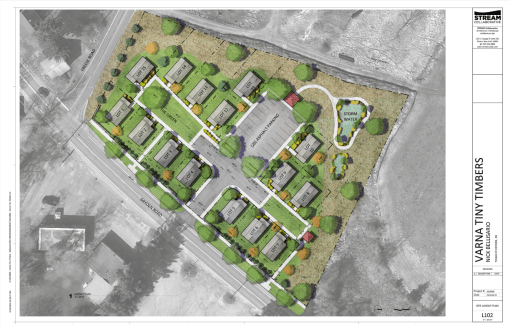
3. Looks like Tiny Timbers is one step closer to reality. The property at 5 Freese Road, once known as “Mt. Varna”, was sold on the 25th by Nick Bellisario to “VTT LLC” for $184,122.59. Presumably, VTT is short for Varna Tiny Timbers. Bellisario and co-owner Otis Phillips had purchased the land for $90k in 2006, and considered a couple different development plans for the site, including a 20-unit modular townhouse project for the site several years back. The land was most recently assessed at $100k. Philips is bowing out of ownership, but county documents show Bellisario and Tiny Timbers creator Buzz Dolph are co-partners in the LLC. The 15-unit Tiny Timbers project will be hosting an open house Saturday the 29th, and may be considered for final approval by the town of Dryden in November.

100_0520

4. Up on Ezra’s former farm, a hefty donation will finance the renovation of Noyes Lodge into a campus welcome center. The family of trustee Marvin Tang ’70 is donating $3 million to partially finance the creation of what will be the Marvin Y. Tang Welcome Center, pending approval by the Board of Trustees. The gift responds to a challenge grant created by mega-donor Atlantic Philanthropies (funded by Charles Feeney ’56), which offered up to $3 million in matching funds to donations towards the new welcome center – so with $6 million secured, the renovation’s financing is secured and will be able to move forward. Cornell has long considered a reception and exhibition space by the gorges, having mulled over but ultimately backing away from a plan penned by architect Richard Meier in the late 1980s. Tang, now retired, was a venture capitalist based in Hong Kong, and the regional chairman of a recruitment firm for business executives.

The Noyes Lodge, a 9,100 SF building that opened in 1958 as a womens’ dining hall, is currently used for language classes and training. Those functions would be moved into newly renovated space in Stimson Hall. JMZ Architects of Glens Falls, a favorite of the SUNY System, will be the design firm in charge of the renovation and re-purposing. The exhibition space will be the work of Poulin and Morris Inc. of New York City. Cornell plans to open the new welcome center by Summer 2018.

village_solars_2

5. There seem to have been some changes to the Village Solars project up in Lansing. According to the newly-uploaded planning board minutes, the site plan has been revised from 174 units to 206 units, but most of that is tied up in unit reconfiguration. Reaching out for specifics, here’s the response from Rocco Lucente the younger:

We have found that the micro unit floor plans are very, very popular and the three bedroom units have been the only units we’ve had any problems with getting rented in a timely manner (like most companies we like to be rented out by the end of Cornell’s season if possible), so we will be modifying the three bedroom floor plans to become micro units and our new junior one bedrooms, which are slightly larger than the micro unit and includes a separate bedroom and living room/kitchen area. The total number of bedrooms goes up very, very slightly and the square footage should remain relatively unchanged.”

The micro units he’s referring to are the units created during phase two, when two larger units were split into smaller units as a sort of testing of the waters – apparently it worked out quite well. It’s worth noting that three-bedroom units had the highest vacancy rate in the Danter study. We’ll see if this creates significant design changes, but one thing’s for certain, it drives up the unit count per building – for instance, Building M, slated to be built in the next phase, has increased from 17 to 24 units.

f5321f76a7c2ce2d9c3d0b069686bdab18e656969cc9b4cce8063cbab0926e8aa52b0bc270ce88ac

Modern Living Rentals has started advertising units for 201 College Avenue. Business partner Visum is shooting for August 2017, which will be a very quick pace – hopefully William H. Lane Inc., the general contractor, is up to the challenge. With heat included in the rent, a three-bedroom will run anywhere from $3,250-$4,170/month, a two-bedroom for $2,170/month, and a one-bedroom with top-floor patio access will cost $1,670/month,  which puts it pretty close to the high end of the Collegetown market. The “New York City-style loft apartments”, as the ads boast, come with such building amenities as a high-end gym, media lounge, bike room, and high-end security system. Apartment amenities include full furnishings, stainless steel appliances, granite countertops, in-unit dishwasher machines, washer and dryers, 16′ ceilings, and cargo nets. Yes, cargo nets – they extend from the bedroom and over the living room, and are billed as “the perfect place to relax and study”, capable of holding up to five people. I asked architect Noah Demarest about them, and he said the idea came from developer Todd Fox, and that examples can be found on Pinterest.

Meanwhile, Charlie O’Connor’s three-bedroom two-family houses underway on Old Elmira Road will be ready by February, and come in at $2,100/month per unit.


a-place-for-all-of-us

X. For those who might be interested, sign up for the Tompkins County Housing Summit can be found here. Attendance is free, and comes with a meet and greet on the night of Wednesday November 30th at the Greenstar workspace (“The Space”), and a day-long summit on Thursday December 1st (attendees can choose whether to attend one or both). It appears that there’s a wait-list already for the Thursday summit, but the Wednesday night reception still has space for new registrants.


News Tidbits 10/22/16: Seal of Approval

22 10 2016

201_college_v4_1

1. In yet another twist in the 201 College Avenue saga, the project will be moving forward. The Board of Zoning Appeals sided 3-1 with the city Zoning Director and denied the Planning Board’s consideration that the building be considered illegal due to facade length. According to a report from former Times reporter Josh Brokaw (now operating as an indy journalist),  the board was swayed by arguments of time and ambiguity in the code. Brokaw’s reading makes it sound like there’s still some raw feelings between staff and board. The way to solve the most pressing issue would be to clarify the code based on the facade debate, and have the common council ratify those changes over the next few months. All in all, the Form District code works pretty well, and a number of projects have been presented without big discussions over semantics. But in the case of 201, it’s clear that the CAFD wording and imagery could use further refinement, so that everyone is on the same page. With 201 resolved, now is a good time to do that.

Dunno what the completion date will be offhand (August 2017 would be a breakneck pace, but we’ll see). Neighbor Neil Golder has refiled his lawsuit, but the case isn’t especially strong.

elmira_savings_v2

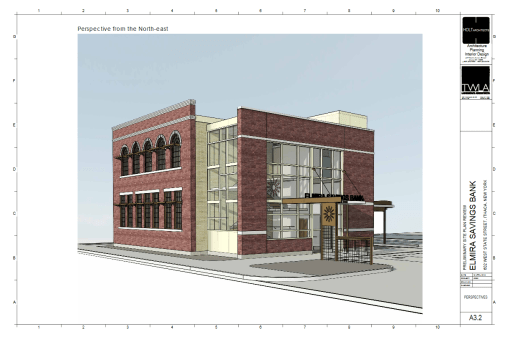
2. Also getting underway this week is the renovation of the former Pancho Villa restaurant at 602 West State Street into the West End branch of Elmira Savings Bank. This is quite a bit earlier than initially planned – Site Plan Review docs suggested a July-December 2017 construction/renovation. Edger Enterprises of Elmira will be the general contractor for the 6,600 SF, $1 million project, which is expected to be completed in March 2017.

evergreen_dryden_1

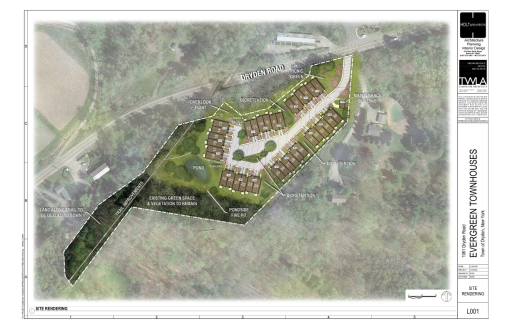
3. The Dryden town board has approved 4-1 the concept of the Evergreen Townhouses plan for 1061 Dryden Road just east of Varna. This means that they accept a PUD can be appropriately applied for the site, but the project will need to submit a formal, more detailed development plan before any final approvals will be considered. One of the major changes that is being requested is a 15-foot setback between the property line and the units at the southeast side of the parcel (25-36), so expect those to get a little trim off of the rear side (the dissenting vote, Councilwoman Linda Lavine, was because she preferred a 25-foot setback). If the setback and the other stipulations are accommodated, its chances of approval are pretty good. Developer and local businessman Gary Sloan has 270 days to submit detailed plans for review.

Meanwhile, Tiny Timbers will be up for Dryden Zoning Board of Appeals review in early November. Since an internal road will be used to access some of the home lots, the town board will be viewing the site as an “Open Development Area” (ODA), which by Dryden’s definition is development with no direct road access. The town board will hold their public meeting on the 20th to approve the ODA, the planning board’s acceptance on the 27th. The ZBA is the last or second-to-last step in the approvals process (not sure offhand if the town will need to vote again to give a final approval).

lansing_meadows_old

4. The senior housing next to the BJ’s in Lansing might finally be moving forward this spring. Dan Veaner has the full story here at the Lansing Star. The issue stems from working with the U.S. Army Corps of Engineers to determine what parts of the land can and cannot be developed – delineating the wetlands, basically. Apparently, the wetlands were created by an overflowing culvert back when the mall was built in the 1970s. But regardless of how they were created, the USACE deems they have to be protected, especially since it developed into a rare wetland environment called an “inland salt marsh”. Since then, it’s been back-and-forth on units – I’ve heard as few as 9 and as many as 18. A portion of the wetlands would still need to be relocated. The PDA boundaries were changed slightly by the board at the request of developer Eric Goetzmann earlier this month to accommodate the USACE determination. The tax break Goetzmann received to build BJ’s is contingent on the senior housing getting built, though at this point, one has to wonder just how much this wetlands tangle has cost him. Hope it was worth it.

maplewood_v7_3

5. From the sound of it, the Maplewood Park DEIS public hearing was fairly positive. Many of the neighbors are pleased with the changes, although some are still opposed to the density or have concerns about traffic. In response, it’s worth pointing out that the commute of Maplewood’s residents will almost entirely be bus, bike and foot during normal business/school hours, and its convenience to bus routes and services will also help minimize overall traffic impacts. As for density, well, if you want Cornell to house its students and reduce the burden on the open market, promoting density on the existing Maplewood site may result in a more sustainable, more cost efficient project if planned properly, with less of a neighborhood impact than building several hundred beds on an undeveloped parcel elsewhere (since the Maplewood site has been inhabited in some form since the 1940s, the growth in density would not be as prominent – about 490 beds, vs. 872 beds).

Should readers feel inclined, comments are still being accepted by town planners up until October 31st. The materials and submission email can be found here.

6. It looks like there were a couple big sales in the local real estate market this week. The first one was the Tops Plaza in big box land, just south of Wegmans. National retail developer DDR Corp. sold the property to another large firm, NYC-based DRA Advisors LLC, for $20 million on the 18th. The sale included three addresses – 710-734 South Meadow, 614 South Meadow, and 702 South Meadow – The Tops Plaza, The smaller strip to its south (called Threshold Plaza), and the pad parcels like Chili’s and Elmira Savings Bank. Perhaps the most notable part of this sale is that it’s slightly below the total assessed value of $20,941,000. However, DRA picked up the property as part of a bundle sale of 15 shopping centers in Western and Central New York, so maybe it was a bulk discount, or compensating for weaker properties.

The other big sale was between a long-time local landlord and a newer, rapidly growing one. The Lucente family (as Lucente Homes) sold 108, 116, 202 and 218 Sapsucker Woods Road to Viridius LLC for $1.276 million on the 18th. According to county records, each is a 4-unit building built in the 1970s and worth about $275k – meaning, Viridius just acquired 16 units for a little above the $1.1 million assessed. Viridius’s M.O. is to buy existing properties, do energy audits to determine what needs to be done where to maximize energy efficiency, disconnect them from fossil fuel heating and energy sources, install pellet stoves, heat pumps and the like, renovate/modernize the properties, and connect the more efficient house to a solar grid or other renewable energy sources. If Sustainable Tompkins were a developer, they’d look like Viridius.


7. This last one isn’t so much a big sale, but worth noting for future reference – 126 College Avenue sold for $510,000 on the 19th. The buyer was an LLC at an address owned by Visum Development’s Todd Fox.

126 College is a 2-story, 6-bedroom house that might have been attractive long ago, but someone’s beaten it with an ugly stick and paved much of the front lawn (growing up near Syracuse, we called paved front lawns “Italian lawns”, with my uncle one of the many offenders). The purchase price is a little below the asking price of $529k, but more than double the assessment. Zoning at the property is CR-4 – up to 50% lot coverage, 25% green space, up to 4 floors and 45 feet in height, a choice of pitched or flat roofs, and required front porches, stoops or recessed entries. This is the lowest-density zone for which no parking is required. The city describes the zoning as “an essential bridge” between higher and lower density, geared towards townhouses, small apartment buildings and apartment houses.

Granted, not everything Visum/MLR does is new, some of their work focuses on renovation. But given the location, and given that frequent design collaborator STREAM had “conceptual” CR-4 designs on display during the design crawl earlier this month, it’s not a big stretch of the imagination.

city_centre_v3_2

8. Interesting agenda for the city planning board next week, if nothing new. Here’s the schedule:

AGENDA ITEM                 APPROX. START-TIME

1. Agenda Review                6:00
2. Privilege of the Floor         6:01

3. Subdivision Review
A. Project:  Minor Subdivision           6:15
Location: 404 Wood St.
Actions: Consideration of Final Subdivision Approval
A minor subdivision to split a double-lot in Ithaca’s South Side neighborhood into two lots, one with the existing house and one that would be used for a new house or small apartment building. A variance for an existing rear year deficiency of the house would need to be approved (the rear deficiency wouldn’t be affected by the new lot which is on the east side, but it’s a legal technicality).
B. Project:  Minor Subdivision             6:25
Location: 123 & 125 Eddy St.
Actions:  Consideration of Final Subdivision Approval
Collegetown landlord Nick Lambrou is planning subdivision of a double lot to build a new 2-unit, 6-bedroom house designed to be compatible with the East Hill Historic District. CEQR has been given neg dec (meaning, all’s mitigated and good to proceed), and zoning variances for deficient off-street parking have been granted.
C. Project:  Minor Subdivision                6:35
Location: 1001 N. Aurora St. (Tax Parcel # 12.-6-13)
Actions:  Consideration of Final Subdivision Approval
One of those small infill builds, this proposal in Fall Creek takes down an existing single-family home for two two-family homes on a subdivided lot. The design has been tweaked, with more windows, a belly band, more varied exterior materials, and additional gables to provide visual interest.

4. Site Plan Review

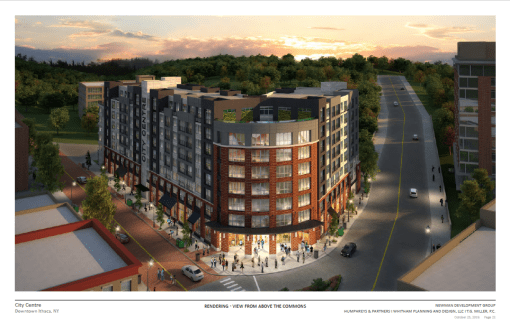
A. Project:  City Centre — Mixed Use Project (Housing & Retail)           6:45
Location: 301 E. State/M.L.K., Jr. St.
Applicant: Jeff Smetana for Newman Development Group, LLC
Actions:  Declaration of Lead Agency  │ Review of Full Environmental Assessment Form (FEAF), Part 2

The 8-story mixed-use proposal for the Trebloc site. Comes with one letter of support, and a letter of opposition from Historic Ithaca, who have previously stated they will oppose anything greater than four floors on State Street, and six floors overall.
B. Project:  Amici House & Childcare Center            7:15
Location: 661-701 Spencer Rd.
Applicant: Tom Schickel for Tompkins Community Action (“TCAction”)
Actions: No Action — Review of Full Environmental Assessment Form (FEAF), Parts 2 & 3
C. Project:  Four Duplexes                               7:30
Location: 607 S. Aurora St.
Applicant: Charles O’Connor
Actions:  Declaration of Lead Agency  │ PUBLIC HEARING  │ Review of FEAF, Part 2
MLR’s four-building, 8-unit plan for South Hill. Comes with a letter of neighbor support saying the scale is appropriate.
D. 371 Elmira Rd. (Holiday Inn Express) — Approval of Project Changes      7:45
The debate over the Spencer Road staircase and rip-rap continues.
E. 312-314 Spencer Rd. — Satisfaction of Conditions: Building Materials   7:55
F. 119, 121, & 125 College Ave. (College Townhouse Project) — Update        8:05
Novarr’s 67-unit townhouse project geared towards Cornell faculty. No decisions planned, just an update on the project. Keeps your fingers crossed for some renders.
G. Maplewood Redevelopment Project — Planning Board Comments on Draft Generic Environmental Impact Statement (DGEIS)     8:20
The city’s deferred judgement to the town, but the board can still have their say. The comments will be recorded and addressed as part of the EIS review process.
5. Zoning Appeals                          8:35
• #3047, Area Variance, 123 Heights Court


205 Dryden (Dryden South) Construction Update, 10/2016

16 10 2016

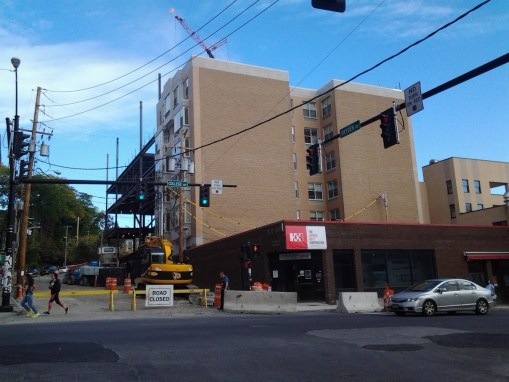
205 Dryden is practically finished from the outside. There may still be some work on interior finishes for spaces like the basement gym. It appears that the decorative pre-cast concrete crown has been modified, so that of a slightly projecting cornice, the crown is flat. That might be the result of value engineering, the rush to have the building finished, or both. The exterior wall facing the College/Dryden intersection might seem a bit stark, but chances are, that corner will be the site of its own construction project at some point in the near future. Photos of the furnished rooms can be found on the project’s website here.

20161007_155245 20161007_155313 20161007_160313

205_dryden_-_rendering