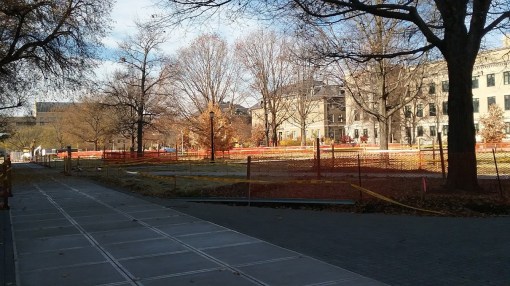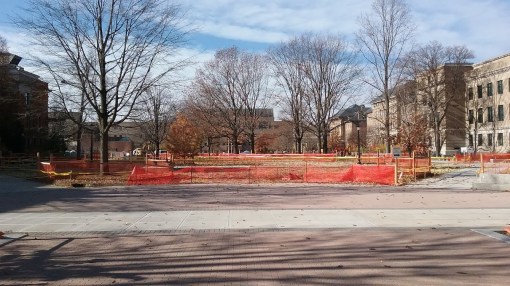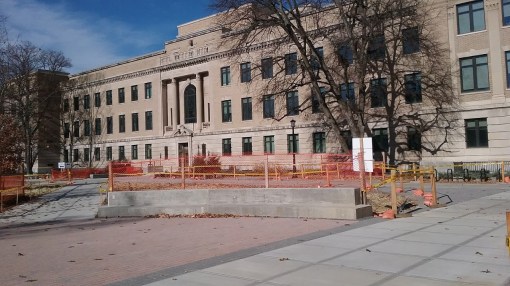
209-215 Dryden Road Construction Update, 12/2016

14 12 2016

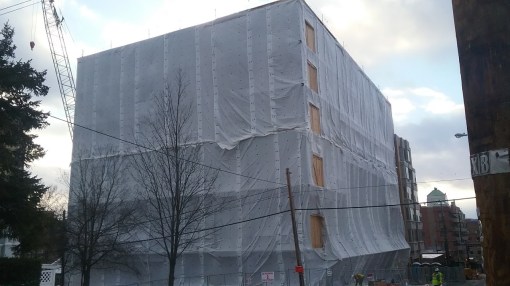
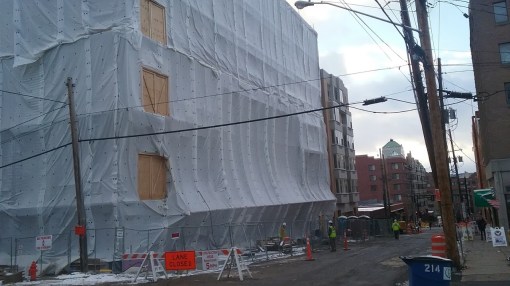
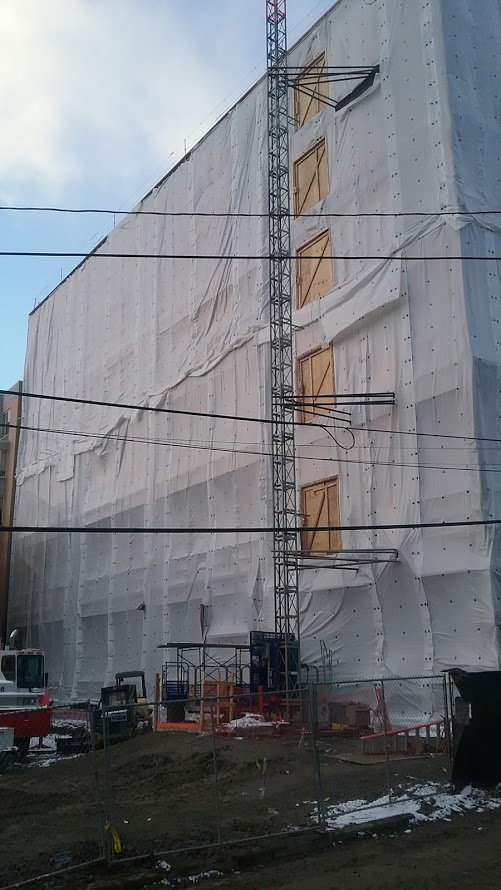
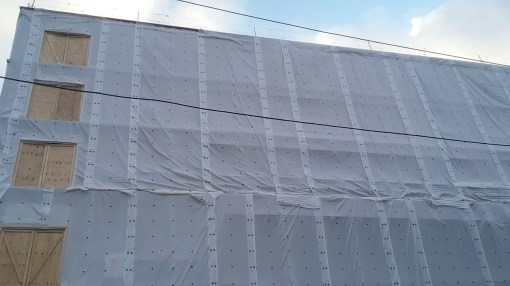
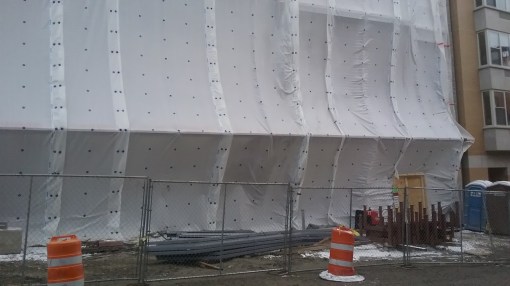
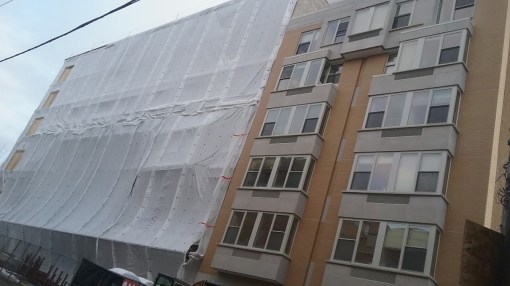
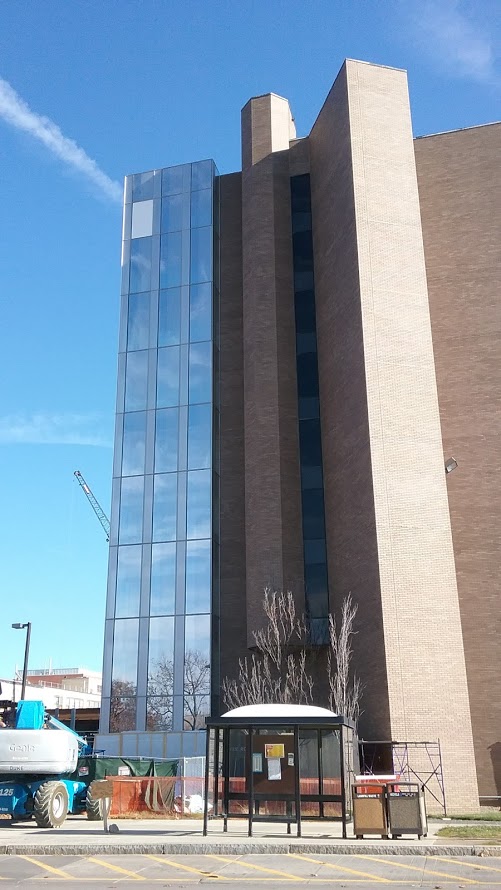
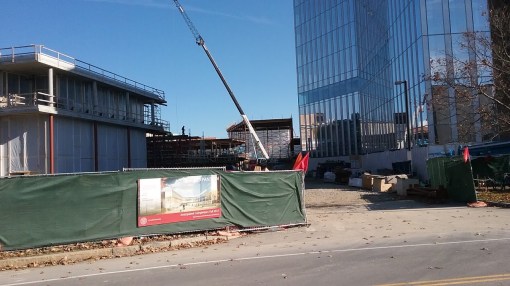
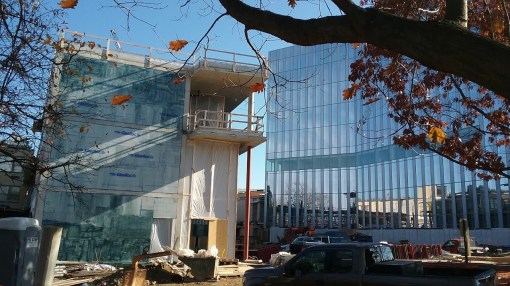
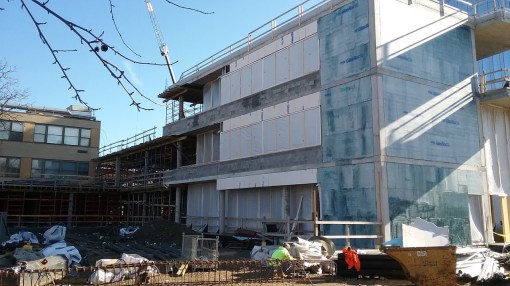
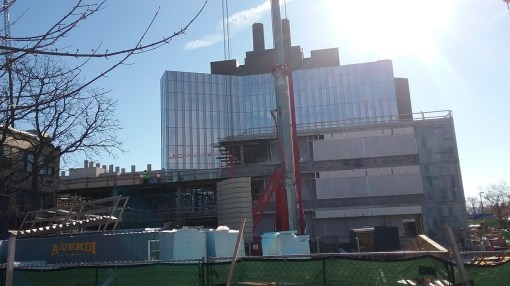
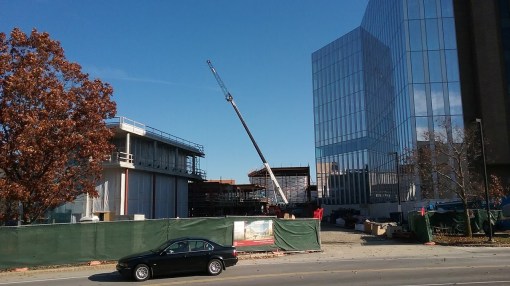
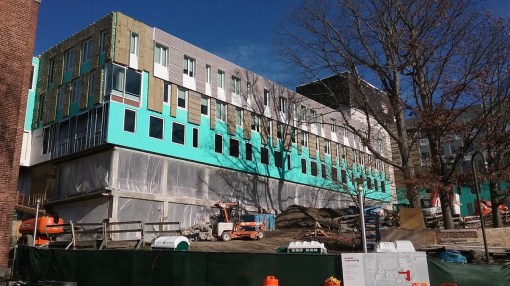
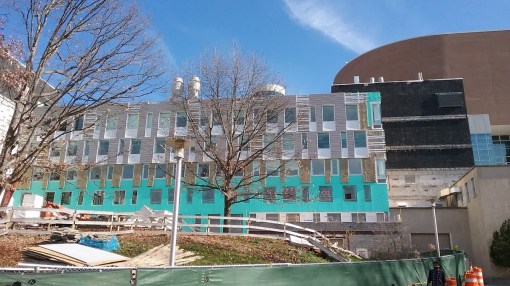
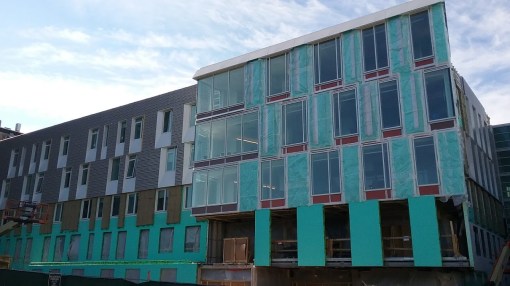
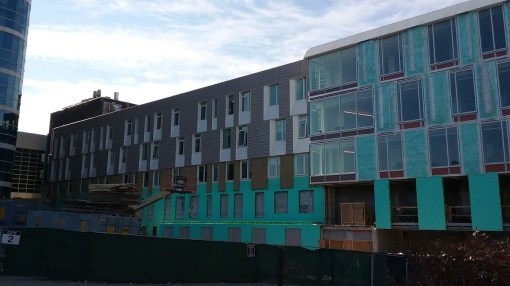
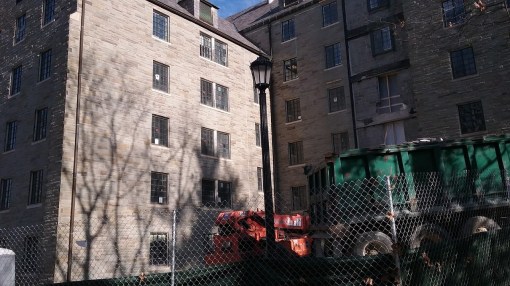
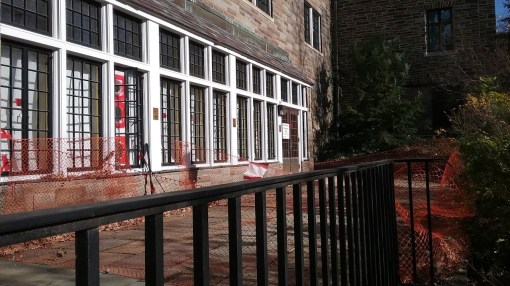
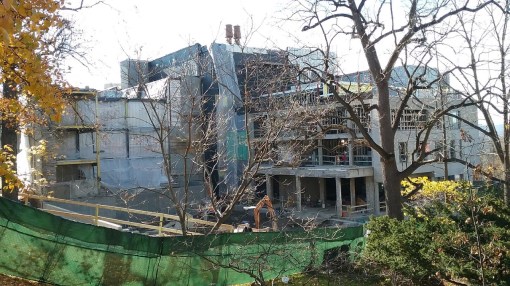
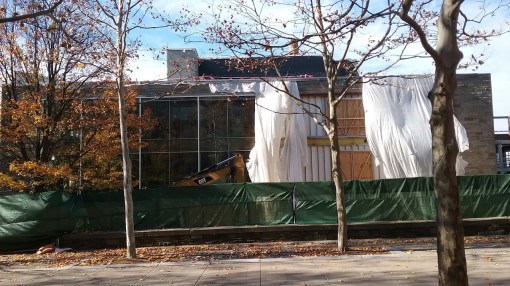
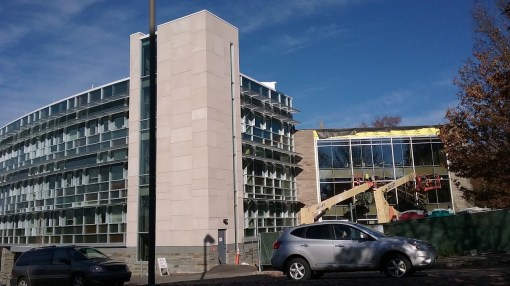
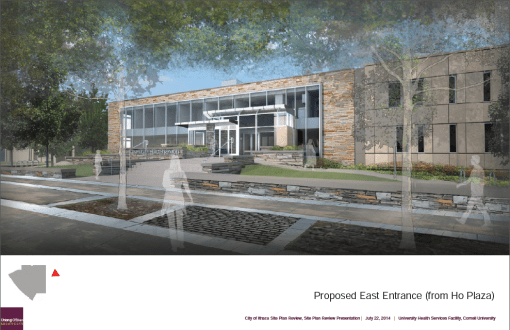
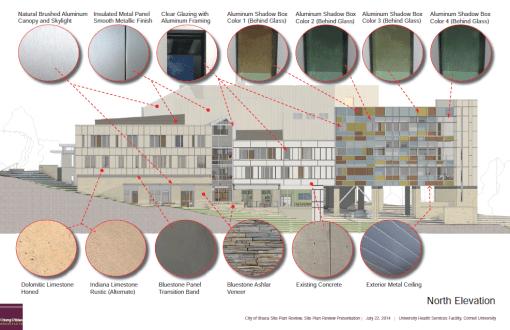
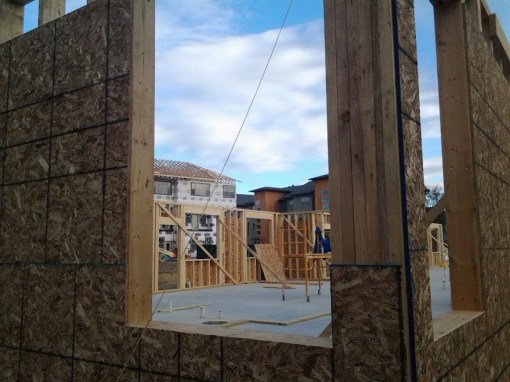
Cornell’s Breazzano Family Center at 209-215 Dryden Road is closed up for the winter. Literally, with white plastic sheeting, as a protective measure against the elements while interior work moves along. The plywood holes on the front and back sides are removable so that a lift can deliver materials to different floors of the 6-story building. One can make out the dramatic entry foyer above the steel stretching out the sheeting above the ground floor. Note that the height of the building, 80 feet, is the maximum permitted under Collegetown’s form zoning (MU-2, up to 6 floors or up to 80 feet).

The plan is to have the new 76,300 SF building open by Summer 2017. Hayner Hoyt Corporation of Syracuse is the general contractor.

After the last Breazzano update a couple months ago, I had contacted Cornell to do a piece about the expanding Executive MBA program, what’s driving the growth, why Collegetown, and so on…but after being led around or misled by several emails over a few weeks, I gave up on the piece. For what it’s worth, Poets and Quants did a thoughtful article and interview here with the Johnson School Dean, Soumitra Dutta, talking about the future of the MBA program and the business school merger with the Dyson/AEM program and the Hotel School. Maybe I’d have had better luck if I just sidestepped Cornell’s PR unit.

20161209_155004 20161209_155019 20161209_155104 20161209_155204 20161209_155215 20161209_155234 20161209_155258

209-215_2


News Tidbits 12/10/16: Missing Out On the Fun

10 12 2016

reach_works_1
1. We’ll start off out in the town of Lansing this week with a new business startup looking to climb to the top of the pack. Reach Works, the brainchild of an academic family that relocated to Ithaca, just earned final site plan approval to build a professional-grade climbing wall and facility at 1767 East Shore Drive, next to The Rink. The $1.2 million, 10,400 SF building will have a noticeable impact on the Lansing shoreline, as the building will reach 56 feet in height. South Hill’s George Breuhaus will be the architect in charge.

According to the Times’ Cassandra Negley, the owner looked at Chain Works for an opportunity, but those plans fell through. The finalizing of the wall design is underway now, and Reach Works hopes to begin construction in March and be open by next fall. Between the pro shop and the wall, they hope to employ five full-time and ten part-time, with most making about the living wage of $15/hour (although, the application on file with the town says six employees). The hope is that it also becomes a regional attraction, drawing in hardcore climbers from the Rochester, Syracuse and Binghamton metros. Best of luck to them.

maplewood_v7_4

2. Maplewood is almost ready. The city is set to give its final approval this month, and the town is expected to give preliminary approval before the Christmas holiday. The latest changes to the FEIS include the following details:

– The amount of money for traffic calming measures has been increased from $20,000 to $100,000. $30,000 goes to the city and town, and $70,000 will be allocated by EdR and Cornell for streetscape improvements that they will build.
– Recycled building materials will be incorporated into the buildings.
– A revised estimate states that 100 to 150 construction staff will be on site during construction. They will park behind the East Hill farmer’s market space and are expected to walk over to the site. They will work on weekends, with noisy work commencing after 8 AM.
– The units closest to the East Hill Rec Way have been moved another four feet back from the trail.
– Initial property taxes in 2018 will be $2.25 million. IT is assumed they will go up 3% each year thereafter.

Oh, and the questioner who freaked out over the East Hill Village plan online – that SWA plan dates from about 2007.

cayuga_med_behavioral_sciences_1-620x420

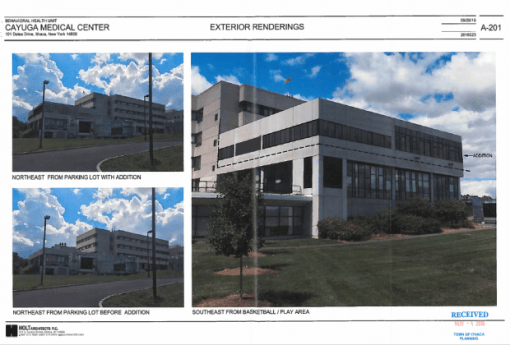
3. Cayuga Med’s plans for a 6,000 SF addition to their Behavioral Health Unit has been approved. At this point, the project needs a minor zoning variance for height,and then CMC has to apply for certification from the New York State Office of Mental Health for the facility to be approved- specialized medical facilities, like CMC and Brookdale, have to prove there is a need before they’re allowed to build. The hospital hopes to open the project to bidding early next year.

masonic_temple_1-771x595

4. So ICYMI, the Masonic Temple rehabilitation is moving forward. Six months later than anticipated, but it is moving forward. The project is valued somewhere north of $1 million. There is one other project on the Ithaca Landmarks Preservation Commission (ILPC) agenda that I thought of writing an article about, but decided it was too minor – the Alpha Phi Alpha house at 421 North Albany will be doing a reconstruction of a non-historically significant rear porch. If it were a full reno, I’d do a write-up for the Voice.

Also on the ILPC agenda – a discussion of Collegetown Historic Resources. I have the feeling this is being spurred by Novarr’s 119-125 College Avenue project, the College townhouses. Three historically significant but non-landmarked apartment houses were taken down to make way for the project, which is expected to go up for preliminary approval later this month. The city did a review after the document was first published in 2009, and landmarked the Snaith House at 140 College and Grandview House at 201 College – they could be considering making a move towards landmarking other properties – some of the historic structures on the 400 Block of College Avenue, and the 100 blocks of Oak Avenue, College Avenue and Linden Avenue are possibilities. Novarr has another project rumored for 215 College Avenue, but that building, dating from the 1870s and renovated/expanded numerous times, was not on the 2009 list.

5. Staying Collegetown, a big sale this week – 113 College Avenue sold for $1.7 million. That’s a very impressive price for an outer Collegetown apartment house – the tax assessment has it pegged at $610,000. The bones of the 13-bedroom, 3,738 SF building date from the late 1800s, but like its twin next door, it’s been the subject of a very unsympathetic renovation (records suggest the renos were done around 1980). The house has been owned by the Tallman family since 1987.

The property is zoned CR-4 – four floors, no parking required. CR-4 is the same zoning as Novarr’s townhouses and Visum’s latest pair of proposals. And, because what goes around comes around, the buyer is the same LLC that sold Visum’s Todd Fox 201 College Avenue for $2.65 million back in June – Russell Johnson’s PBC & Associates LLC. He also picked up a CR-3 building at 233 Linden Avenue for $750k back in the fall. Price suggests redevelopment, but the buyer isn’t known for that – he might have just paid big for a long-term investment. TL;DR, he might be planning something, he might not; we’ll see.

On a side note, the county’s going to make some money raising the property tax assessment on this one – offhand, I’ve noticed most of the houses sold this week (excluding a couple in Ithaca city) have gone at or well under assessment, which is a bit unusual, and probably not something that the tax assessor’s office wants to see.

20160630_142619

6. Good news and bad news from the Regional Economic Development Council awards. The good news is, the area’s getting money. Cargill gets $2 million towards their salt mine project (they requested $5 million), Cornell gets $250,000 for a startup business alliance, County Waste gets $355k for a food waste transfer station at the recycling center site, and the Sciencenter gets $150k for renovations. Several smaller awards are to hire staff for cultural and arts programs.

Now the bad news – one project, marked priority, was not funded – the Collegetown Travel Corridor proposed by the city of Ithaca to connect Downtown and Collegetown. I asked to make sure, and the Planning Department was just a little deflated in their response. Major bummer. I don’t doubt the value of arts programs, but $38,500 for a theatre director and $41,000 for a workforce expansion isn’t sustainable, it’s one year’s salary. That’s nice, but how does that benefit the area in the long-term? The Travel Corridor would have further encouraged urban development downtown and Collegetown that could have indirectly supported the arts through patronage, or directly through taxes that are used to fund local-level grants.


Cornell Veterinary School Expansion Construction Update, 11/2016

23 11 2016

Definitely seeing a lot of progress on the Vet School Expansion. The new glass curtain wall on the Vet Research Tower is nearly complete, and the final finishes are due to wrap up by the end of the month. The new library/dean’s wing by the front entrance is undergoing interior framing and utilities installation. The new atrium and lecture hall are now visible from the street, now that some of the structural steel has been erected. Floor slabs and roof decking are also being laid.

The new atrium and lecture hall are expected to be closed up by January, and the whole $74 million project is aiming for an August 2017 opening. The Community Practice Service Building, a separate $7 million project on the Vet School campus, is expected to start construction in early next year with a completion in late fall 2017.

20161119_111157 20161119_111208 20161119_111225 20161119_111243 20161119_111252 20161119_111334 20161119_111358 20161119_111436 20161119_111503 20161119_111514 20161119_111632

cad048742a281097e5667382eced42333f5656954f5a3ef1021519c03b4abe9f


Upson Hall Construction Update, 11/2016

22 11 2016

Because of the multi-phased, tiered buildout of Upson Hall’s renovation, it’s easy to miss the changes. For example, in the first photo, there really haven’t been any exterior changes to the fourth or fifth floor, but on the third floor, there’s been significant progress – the old stone has been removed, the new stud walls have been erected, gypsum-based glass mat sheathing has been laid and waterproofed, and new windows have been fitted. You can see the latest batch of exterior wall progress on the third floor of the west face, third photo below. The first and second floors have had their old exteriors stripped as well, but at the moment the frame is exposed. The interior has been gutted and new utilities rough-ins are being routed.

On the side facing the Engineering Quad, the progress has been similar – the third floor has seen the most work recently as the renovations work their way from top to bottom. Turning to the east face, sheathing extends to the bottom floor, and it looks like an aluminum roof cap has been installed on the new bump-out. The general contractor for Upson is The Pike Company, which is touting the project with computer-generated images of construction staging on its front webpage.
20161119_115304 20161119_115324 20161119_115359 20161119_115406 20161119_115453 20161119_115518 20161119_115541 20161119_115630 20161119_115651 20161119_115713 20161119_115733 upson-header-1920x700


Cornell Law School Renovation Update, 11/2016

22 11 2016

Introducing a new project to work into the rotation – work has begun on Cornell Law’s renovations of Hughes Hall. Coincidentally, I broke this story for the Voice almost a year ago to this date.

In Summer 2012, the Cornell Law program embarked on a three-phase renovation and expansion program to their facilities. The first phase was a 17,500 SF, mostly-subterranean addition of an auditorium space, two large-group classrooms. foyer space, and a renovated courtyard. Designed by Boston-based Ann Beha Architects and constructed by Welliver, that $23.8 million phase, certified LEED Platinum, was completed in late summer 2014. Plans for phase II came forth in November 2015, and were approved by the city this past March. Phase III, which calls for renovations to the law school library, has yet to be presented.

Hughes Hall was built by the university in 1963 and named for former professor Charles Evans Hughes. Hughes only spent two years at Cornell, partially because of the need to make better money from private practice, and partially because of familial pressures to leave behind a “one-horse town like Ithaca”. He would later serve as governor and a Chief Justice of the U.S. Supreme Court. Hughes was a source of inspiration for mid-20th century megadonor Myron Taylor, and so the new law school dorms were named in his honor. The building served as the dorm and dining facility for the law school until 2005, when the first and second floors were renovated for administrative and faculty office space.

The Hughes Hall remodeling will have three basic components: enclosing the open-air loggia that currently connects Hughes Hall with Myron Taylor Hall, adding a staircase to the west side of Hughes Hall, and repaving the dining terrace by the Fork and Gavel Café. Administrative offices and event spaces will be on the lower floors, and faculty offices on the upper floors. The renovations will be seeking LEED Silver certification – this is two levels lower than the LEED Platinum of phase one, but it’s a lot easier and cheaper to achieve energy savings when a project is underground.

As a result of the remodeling, the last law school dorm units, totaling 47 student beds, were removed. At the time this was announced, Maplewood had yet to come forth, and I did a rare editorial for the Voice calling Cornell out on a lack of planning and poor stewardship. Minor site plan and landscaping improvements are planned.

Design work is by KSS Architects, with offices in Princeton and Philadelphia. Frequent Cornell collaborator Welliver will serve as the general contractor. The project is expected to cost about $10.2 million and take about 13 months to complete. The project was initially slated to begin in June 2016 and wrap up in July 2017, but it appears the construction launch ended up being a few months later than anticipated.

In the photos below, some of the exterior stone veneer has been stripped from the wall, and on the lower levels the windows and some of the concrete masonry wall has been removed. This will be where the new glass-enclosed staircase will go. Work on closing up the loggia has yet to start.

20161119_114538 20161119_114624 20161119_114638 20161119_114820 20161119_114831 20161119_114847 20161119_114920 20161119_114925

hughes_cornell_4 hughes_cornell_3 hughes_cornell_2


Gannett Health Center Construction Update, 11/2016

21 11 2016

Phase II of Cornell Health is advancing. A lot of the progress in the couple of months has focused on retrofitting the existing 1957 and 1979 additions – there will be a new three-story wing on the northeast side of the building, but it looks like only the foundation and subsurface utilities have been completed. New steel has been built on the 1979 wing, and rough window openings have been punched into the northern face. Meanwhile, the 1957 wing sports some new and very big panes of glass – recall that the building used to sport three levels of window bands separated by beige concrete panels. These large panes give the effect of a squatter, smaller structure, even though the external dimensions of the wing haven’t changed. The new entrance is still being built out. Looking closely, one can see new steel stud walls going into the interior as the old wings get completely gutted to meet the needs of a 21st century health center.

The renovations and new 18,000 SF northeast wing should be complete by August 2017. The $55 million project is being built by The Pike Company’s Syracuse office.

20161119_114006 20161119_114034 20161119_114055 20161119_114120 20161119_114142 20161119_114154 20161119_114214 20161119_114256

gannett_northeast_persp gannett_eat_persp gannett_north_final


Cornell Ag Quad Rehabilitation Construction Update, 11/2016

21 11 2016

It’s that time of the month – construction updates will be forthcoming over the next several days.

On Cornell’s campus, work on the Ag Quad renovation continues. The eastern half of the quad, closer to Mann Library, is mostly complete – phase one of two. There weren’t as many underground utilities to lay in the eastern half, so it was able to progress more quickly, limiting the risk of running into winter. The new pavers are being set into place, and hay has been thrown down to keep the fresh soil and seed from blowing away, and to provide a warmer, moister environment for it to germinate in when the time comes. Those big holes behind the new seating area are for new trees that have yet to be planted – best practices state that trees are most likely to survive if planted in early spring.

Meanwhile, on the western half of the property, most of the new utilities (electrical, steam, sewer and water) have been laid, and new lamppost mounts are in place. According to a worker on-site, that metal structure in the third-to-last photo is a protective barrier to keep soil from falling back in onto workers as they assemble and lay the new utility lines. The precast concrete blocks in the second-to-last photo are protective covers for the new steam pipes. The pipes are laid, the protective barriers are put into place over them, and the channel is backfilled with soil to bring it to ground level. Cosmetic surface work on the western half of the Ag Quad will have to wait until next spring, when the threat of winter storms has passed.

The $9.6 million project began during the summer, and is scheduled for a completion before the 2017-18 academic year. MKW & Associates LLC of New Jersey is the lead landscape architect, Over & Under Piping Contractors Inc. of Auburn is the GC, and Albany-based CHA Consulting Inc. is providing civil engineering expertise. Background information on the project can be found here.

20161119_112653 20161119_112722 20161119_112732 20161119_112807 20161119_112835 20161119_112911 20161119_112936 20161119_113029 20161119_113341


News Tidbits 11/19/16: Winter Is Coming

19 11 2016

executive-education-center-and-hotel-777x622

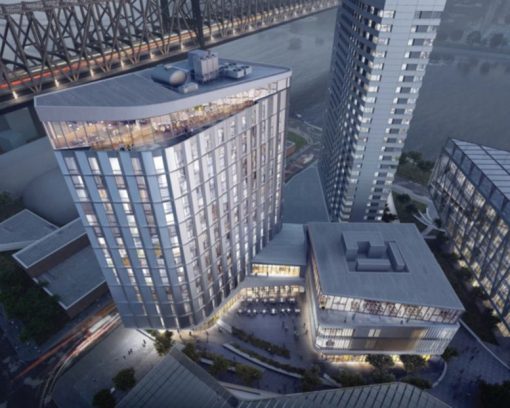
1. We’ll start off in the Big Apple this week. Cornell and its development team have released plans for the fourth and last building in the first phase of the Cornell Tech buildout. The Verizon Executive Education Center and Hotel consist of two buildings connected by a shared hall, and will include four 50-75 seat classrooms, small breakout rooms, and a 195-key hotel for visitors to the school. The plans also call for a restaurant, rooftop lounge and cafe – none of which sound very academic, but the building is meant to be an event center and gateway to the nascent school.

The exterior will be encased in aluminum and wood planks. There will be no parking, but there will be pedestrian courtyards, bike lanes and green space. The facilities are part of the campus’s first phase, which also includes a 26-story student and staff residential building; the Bridge, an incubator for researchers and small businesses; and the Bloomberg Center academic building. Those buildings will open in summer 2017, while the Verizon Center will probably be a 2018 opening, assuming the final designs are approved by the city of New York.

hopshire_1

2. Now to turn to something much closer to Ithaca. Dryden’s Hopshire Brewery is in the midst of a two-phase expansion, reports the Times. The first phase, shown above, consists of a 1,200 SF addition to the west side of the structure, and the new addition is already framed and closed up, with the expectation of being completed by the start of 2017. The space will be used to host events for as many as 100 attendees. the second phase, a 1,300 SF addition to the brewery and storage area, will start next year. The work is partially funded with an Empire State Development grant.

Speaking of drinks, the Watershed, a new bar and coffee lounge, will open by Thanksgiving. It replaces Rumble Seat Music at the former telephone exchange building at 121 West State Street in Downtown Ithaca. The Watershed owners expect to create eight living-wage jobs.

3. From county records, we can see just how much the Rodeway Inn renovation is going to cost local businessman Pratik Ahir – $2,095,000, but the hard costs are only $926,000. The difference is due to the existing mortgage on the property. The lender is Generations Bank, a small bank based out of the Seneca Falls. Anecdotally, we seem to be seeing an uptick in small upstate lenders looking to stake claims on the growing Ithaca market, which could be a real asset for the region – with a limited number of local lenders, financing is often a big hurdle with Ithaca-area projects.

maplewood-v7_8-planning-board maplewood-v7_6

4. As noted earlier this week in the Voice, lots of new Maplewood renders to take a gander at. Going through all the emails from the public comment period, I’d say that overall most are positive and positive-constructive – there are a few sour grapes, but they’re in the minority. For this area, that’s actually a pretty big accomplishment, and it means Cornell and EdR have successfully addressed most of the concerns raised by neighbors and community members. The big changes in respone to public comment have been a a commitment to 50% off-site solar energy, $20,000 to the town for traffic calming measures on Mitchell Street (raised crosswalks, speed bumps), and the two townhouse strings facing Walnut Street and the Belle Sherman Cottages have been redesigned to look more traditional and fit in better with their non-student neighbors. We’re probably very close to the final design at this point, if not already there.

Once preliminary approval has been granted, demolition will start on the south side of the Maplewood property and make its way northward in four phases. The first townhouse strings and apartment buildings will begin construction on the south side of the property in the March-April timeframe, depending on overall progress and external factors. The first completed buildings will be ready by October/November 2017, but it looks like occupancy will happen all at once in August 2018.

wegmans_pad_parcel-1116

5. The City Planning Board Agenda is pretty busy next week – Todd Fox will be presenting two new mid-sized Collegetown projects, Wegman’s is seeking a renewal on the approvals for their pad parcel building, and several other projects had major or minor redesigns. Here’s the rundown on the Voice, and the schedule here:

AGENDA ITEM                 APPROX. START-TIME

1. Agenda Review              6:00

2. Privilege of the Floor   6:01

3. Site Plan Review
A. Project:  Maplewood Redevelopment Project                               6:10
Location: Veteran’s Ave. (between Maple Ave. & Mitchell St.)
Applicant: Scott Whitham, Whitham Planning & Design, LLC, for Cornell University
Actions: Update & Schedule
B. Project:  City Centre — Mixed Use Project (Housing & Retail)     6:25
Location: 301 E. State/M.L.K., Jr. St.
Applicant: Jeff Smetana for Newman Development Group, LLC
Actions: PUBLIC HEARING    Review of Full Environmental Assessment Form (FEAF), Part 3

C. Project:  Amici House & Childcare Center                                6:50
Location: 661-701 Spencer Rd.
Applicant: Tom Schickel for Tompkins Community Action (“TCAction”)
Actions: Declaration of Lead Agency, PUBLIC HEARING, Determination of Environmental Significance, Recommendation to BZA

D. Project:  Four Duplexes                                                         7:20
Location: 607 S. Aurora St.
Applicant: Charles O’Connor
Actions: Determination of Environmental Significance, Consideration of Preliminary Approval
E. Project:  College Townhouse Project                                      7:45
Location: 119, 121, & 125 College Ave.
Applicant: Kathryn Wolf, Trowbridge Wolf Michaels Landscape Architects, LLP
Actions: Declaration of Lead Agency, Review of Full Environmental Assessment Form (FEAF), Part 2
F. 126 College Ave. — Sketch Plan            8:00
G. 210 Linden Ave. — Sketch Plan              8:20
H. Wegmans Retail Building – Extension of Site Plan Approval     8:40
4. Zoning Appeals                                                                     8:50
• 3049, Special Permit, 908 N. Cayuga St.
• 3050, Area Variance, 528 W. Green St.
• 3051, Area Variance, 661-665 Spencer Rd.
• 3052, Area Variance & Special Permit, 701 Spencer Rd.
• 3054, Sign Permit, 222 Elmira Rd.
5. Old/New Business                                                                 9:00
A.  Special Planning Board Meeting: 11/29/16
B.  Update — City/Town Joint Planning Board Meeting
C.  Update — Joint Planning Board/ILPC Meeting (DeWitt House)
D.  Changes/Corrections to Collegetown Area Form Districts (CAFD)
E.  Building Materials — Discussion on Potential Restriction on Vinyl Siding
6. Reports                                                                                 9:20
A.  Planning Board Chair (verbal)
B.  Director of Planning & Development (verbal)
C.  Board of Public Works Liaison (verbal)

7. Approval of Minutes: May 24, 2016, June 28, 2016, July 26, 2016, and/or October 25, 2016 (time permitting)      9:30

8. Adjournment      9:31


Martha Pollack, Cornell’s New Madam President

14 11 2016

5-1-2012 123

As announced earlier today, Cornell’s 14th president will also be its second female leader. Univ. of Michigan provost Dr. Martha E. Pollack has been selected to take over the helm from interim president Hunter Rawlings starting in April 2017.

Currently, Pollack is the Provost and Executive Vice President for Academic Affairs at the University of Michigan, as well as a Professor of Computer Science. As a student, Dr. Pollack earned her degrees at two of Cornell’s peers – a bachelor’s degree in linguistics from Dartmouth College, and a PhD as well a master’s in computer science and engineering from the University of Pennsylvania. Her professional specialty is artificial intelligence, with years of research focused on the design of technology to help those with cognitive impairments, including natural-language processing, temporal reasoning, and automated planning.

Pollack has held a number of positions across the country. From 1985 to 1991, she was a computer scientist at the Artificial Technology Center of SRI International, a non-profit research institute started by, and still closely associated with Stanford University. In what be a good fit with Cornell’s trajectory, SRI was initially created in the 1940s to help spur economic development in the vicinity of Stanford – an area that would later become known as Silicon Valley.

Following her time at SRI, she was a professor at the University of Pittsburgh for nine year, moving to Ann Arbor in 2000 to join the computer science department at U. Michigan. It was at Michigan where she began to work her way up the academic leadership ladder – first as an associate chair of the Electrical Engineering and Computer Science department from 2004-2007, than as Dean of the School of Information from 2007-2010, then as a Vice Provost for Budgetary and Academic Affairs from 2010-2013, and then promoted in January 2013 to her latest position as Provost and Executive Vice President for Academic Affairs for the 44,000 student university. The provost role in higher education is basically the second-in-command, leading the administrations function of the university. Apparently, Michigan has a knack for turning out Ivy League presidents – Pollack accepted the provost position following colleague Philip Hanlon’s departure to take over as President at Dartmouth College.

Like many high-flying professionals, Pollack has earned a number of service and research awards over the course her career. When promoted in 2013, University of Michigan President Mary Sue Coleman spoke of her glowingly, saying “it’s obvious to me that she’s somebody with enormous potential.” A colleague described Pollack as “gentle, kind and has always been a tireless advocate for our student body.”

The appointment to provost, originally for two years, was renewed by the university in December 2014, and came with additional praise. “Provost Pollack has been an innovative and disciplined academic and budget leader for the campus. … I appreciate her work to hold down tuition costs, provide more financial aid to our students, and her leadership of important new initiatives in digital education and engaged learning,” said Mark Schlissel, the new president of the university.

While at Michigan, Pollack has taken some heat from conservative circles for overseeing a change in student registrations that allowed students to select their own pronouns in respect those who are gender non-conforming. earlier this year, Pollack gave a speech to Michigan students and used the example of supporting transgender children as an example of how young people must “fill the empathy gap.

Regarding her personal life, Pollack has been married for 32 years to Ken Gottschlich, an engineer and jazz musician, and has two grown children.

Although Cornell is large, well-respected and multifaceted institution, so is Michigan. A computer scientist with strong research acumen and academic connections seems like a comfortable choice for Cornell president. With her credentials, at a glance it appears that her appointment is a wise decision that fits with the university’s strategic goals.


News Tidbits 11/12/16: Oof.

12 11 2016

lansingapts600

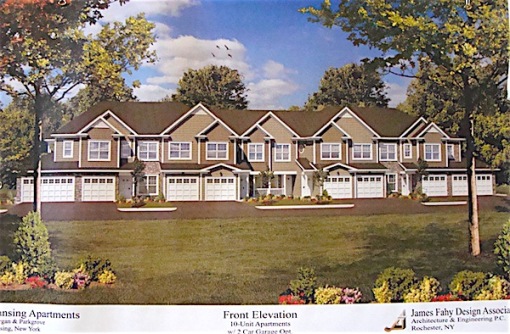
1. Starting off this week in Lansing, the village has okayed a zoning change that would allow the planning board to move forward with consideration of a 140-unit upscale apartment project on Bomax Drive. Neighbors came out to oppose the zoning change for the 19.5 acre parcel from office park business/tech to high-density residential, saying it would create additional traffic and hurt property values. The village board, however, responded in dissent, noting a lack of housing, a fit with the 2015 village comprehensive plan, and that this was about the zoning and not the project, which the planning board will critique as a separate action. The zoning change was approved unanimously. Park Grove Realty is now free to submit plans to the village, and planning board review will go from there. Expect it to take at least a few months.
therm_1

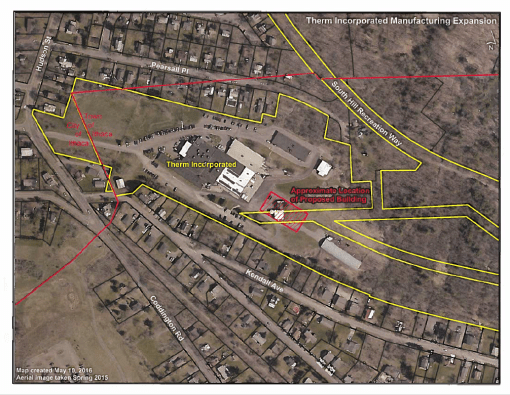
2. A couple quick notes from the town of Ithaca – Therm Inc. has commenced construction on their 20,000 SF addition at their South Hill plant. It’s a few months later than originally anticipated, but underway nevertheless. The $2.5 million project is expected to create 10 manufacturing jobs, according to the county IDA.

Also underway at this point is the renovation and expansion of the Rodeway Inn on Elmira Road. The plans call for expanding the existing 25 motel units, adding 2 new units on the ends of the main structure, and renovating a house on the property for a 1,146 SF community room to serve guests. Landscaping and lighting would also be updated. The town pegs the construction cost at about $679,000.

341_coddington_1

3. Here’s some good news – it looks like someone has taken up the Iacovellis on their offer of a free historic house at 341 Coddington Road, providing that the taker moves it. It appears NYSEG was creating some hangups since the power lines have to be moved out of the way (NYSEG is infamously difficult to work with), but with any luck, the house itself will be saved. My colleague Mike Smith is doing the legwork on a story, so hopefully more details on the “buyer” will come forth shortly.

4. Back in July, several West End properties owned by an out-of-area LLC hit the market. Now, at least one of them has sold. The duplex at 622 West Buffalo (blue in the map above) was sold for $90,000 to a gentleman from suburban Syracuse. Immediately after, paperwork was filed with the county for a $179,145 building loan courtesy of Seneca Federal Savings and Loan, a small regional bank out of Syracuse. The paperwork does not indicate if it will be renovations/additions to the existing building, or a new structure (sometimes the sale price is a part of the building loan, but in this case the buyer paid separately, with $171,187 set aside for hard costs).
20161007_163922

5. Sticking with county filings, the construction loan for the third phase of the Village Solars was filed with Tompkins County this week. $6 million is being lent by Tompkins Trust to fund construction of 42 units, 21 in each building. Initially they were slated to have 18 units each, but because the three-bedroom properties don’t have quite the same appeal as smaller one-bedroom and two-bedroom units, Lifestyle Properties (the Lucente family) has broken up the units without significantly changing the exterior appearance and layout. Actual Contractors LLC, another Lucente company, is the general contractor, with Albanese Plumbing, T. U. Electric, and Bomak Contractors (excavation/foundation) rounding out the construction team.

119_125_college_1

6. This is one of those unusual months were the city projects memo and the project review meeting agenda go out in the same week. Apart from the Collegetown Townhouse project, there are no new projects being presented, but there is new information and new renders.

In the projects memo, Novarr’s project is the new shiny, while Amici House, the8-unit project at 607 South Aurora and City Centre are being carried over as old business. Regarding City Centre, it doesn’t look like any particular points of contention have been raised by city planning, the framework for mitigating Historic Ithaca’s design complaint is already included, and most of the other requests are for more information/paperwork. From the Design meeting, it looks like the debate on the townhouses project is minor, mostly with where to locate the trees out front, and window details. They will not be putting windows into the north face because it’s on the lot line, but they will vary the materials for visual interest. The Design Committee requested that City Centre insert more windows in some areas, and less signage, as well as consideration of decorative elements to highlight the curved facade facing Aurora and East State Streets.

The project review committee meeting has all of the above, plus updated submissions from the Maplewood project team. Although no substantial development will occur in the city, the Maplewood project crosses municipal boundaries and the city has deferred to the town for lead agency. The meeting will also have a few zoning variances to comment on. The only notable zoning variance is for local realtor Carol Bushberg, who wants to do a one-story 812 SF rear addition at her office at 528 West Green Street, which is in a WEDZ zone and requires two floors.

maplewood_v7_4

maplewood_v7_5

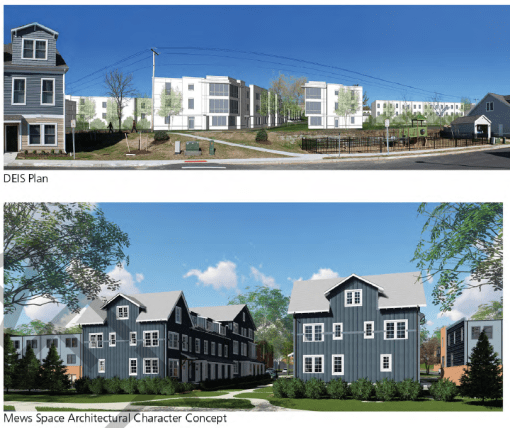
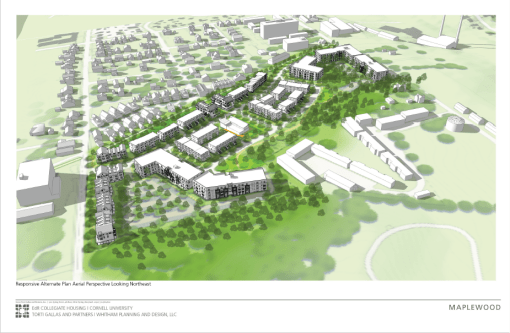
Looking at the Maplewood submission, the new dormer/gable style will be for the building strings that front Mitchell Street, and the two strings most visible from Walnut Street. More modern designs will be used for the remaining structures. Looking closely, the designs do vary from string to string, which will give the site some character and additional visual interest. The project timeline is pretty tight with submissions, meetings and approvals, aiming for preliminary approval from the town on December 20th, demolition to start immediately thereafter, and final site plan approval by January 3rd.

For links, here’s the Collegetown Townhouse updated submission, engineering narrative, site plan render, and cross section render. Here are the updated materials for 607 South Aurora (no significant changes, just a summary of submission materials),  here’s a new site survey for Amici House, and the project update for Maplewood.

7. Meanwhile, there’s nothing too exciting on any of the town boards next week. Lansing town will consider additions to a self-storage facility, a one-lot subdivision and a climbing wall facility next to The Rink. Ithaca town will be conducting their own analysis of Maplewood, and a one-lot subdivision.

Now, after this week’s election news, one might wonder if this has any impacts on local housing/development. Arguably, there are a few. Expect federal funds for affordable funding to be cut drastically, and grants for mass transit projects to also take a major hit. While those are major losses, the state has far greater control, so there will still be some funding available, but definitely not as much as would have been expected under a Democratic administration. Most land use and building issues are decided at the local level, so don’t expect significant impacts there.
More of a question would be infrastructure investments. The president elect wants to launch a massive rebuilding program, but the Republican Senate majority leader has already said that’s not something they’re interested in, so we’ll just have to see if he can force it through or not. If there’s any silver lining to all this, it might come in some form of deregulation, but while he might be a fan of urban environments, most of his cabinet will likely not. We also have to keep in mind the disdain for elite colleges like Cornell, so research funding, and the economy built off it, is probably going to take a hit. For the Ithaca area, the change in administrations is likely a net negative.